Skip to content

55 results for β€œLinux”

What you seeeverything
microsoft.comwriteupπŸ›‘οΈ Security

Inside a malicious Claude Code-branded extension and its persistent SSH backdoor

Microsoft Threat Intelligence analyzes a tampered anthropic.claude-code extension (versions 2.1.312 and 2.1.313) served on the Cursor marketplace on 29 October 2026. The injected JavaScript loader adds an SSH key labeled svc-telemetry, opens a reverse SSH tunnel and sets up persistence on macOS, Linux and Windows. The post gives cleanup steps, IOCs and Defender XDR hunting queries. VS Code Marketplace and npm were not affected.

CursorClaude CodeSSH+3
Protocol Tunneling (T1572)reverse SSH tunnelMicrosoft Threat Intelligence+2

Supply Chain, Blue Team & Detection, Malware & REΒ· Published and added 31 Oct 2026

gist.github.comwriteup🧠 AI

Claude Code regularly sends each background agent’s transcript to its model

no-agent-summary.js is a roughly 70-line Bun preload by Flamerix AI that stops Claude Code from re-sending each background agent's full transcript to its model every ~30 seconds for a status-line summary. The write-up cites OpenTelemetry measurements of 18 to 26 percent of spend (since version 2.1.232), explains the setTimeout hook, and gives install and verify steps. It was tested on Linux with Claude Code 2.1.257 to 2.1.312.

Claude CodeBunOpenTelemetry+2
AnthropicFlamerix AIDRIM+1

coding-agents, ai-infraΒ· Added 30 Oct 2026, published 29 Oct 2026

alpinelinux.orgwriteupπŸ›‘οΈ Security

GitLab Security Incident: Attempted Exploitation of CVE-2026-97229

Alpine Linux incident report on attempted exploitation of CVE-2026-97229 (CVSS 10.0), a regex-evaluation bug in Ruby's Onigmo engine reachable through GitLab CI configuration. An attacker crashed workers 8 times on 20 and 21 October 2026. Upgrading to GitLab 19.3.6 did not fix it because the patch sits in GitLab's bundled Ruby. Alpine rebuilt the instance and found no tampering with aports or releases.

GitLabRubyDocker+1
CVE-2026-97229Onigmoaports

Blue Team & Detection, Supply Chain, AppSecΒ· Added 29 Oct 2026, published 28 Oct 2026

hackers-arise.comwriteupπŸ›‘οΈ Security

Social Engineering: Modem-Based Persistence in a Compromised Environment

The article describes reflashing a Huawei E3372h-153 HiLink 4G USB modem so its embedded Linux OS runs an OpenVPN client over the mobile network, creating a covert, network-independent persistence channel after physical USB access. It walks through enabling debug mode, flashing firmware, disabling CD-ROM emulation, configuring DHCP and autorun scripts, and chaining a second L2VPN tunnel to bridge the attacker directly onto the victim's Ethernet segment for tools like Responder. Defense guidance focuses on restricting USB ports and disabling USB network adapters via policy.

OpenVPNTelnetADB+2
LAN Turtle

Hardware & RF, Offensive SecurityΒ· Published and added 28 Oct 2026

stepsecurity.iowriteupπŸ›‘οΈ Security

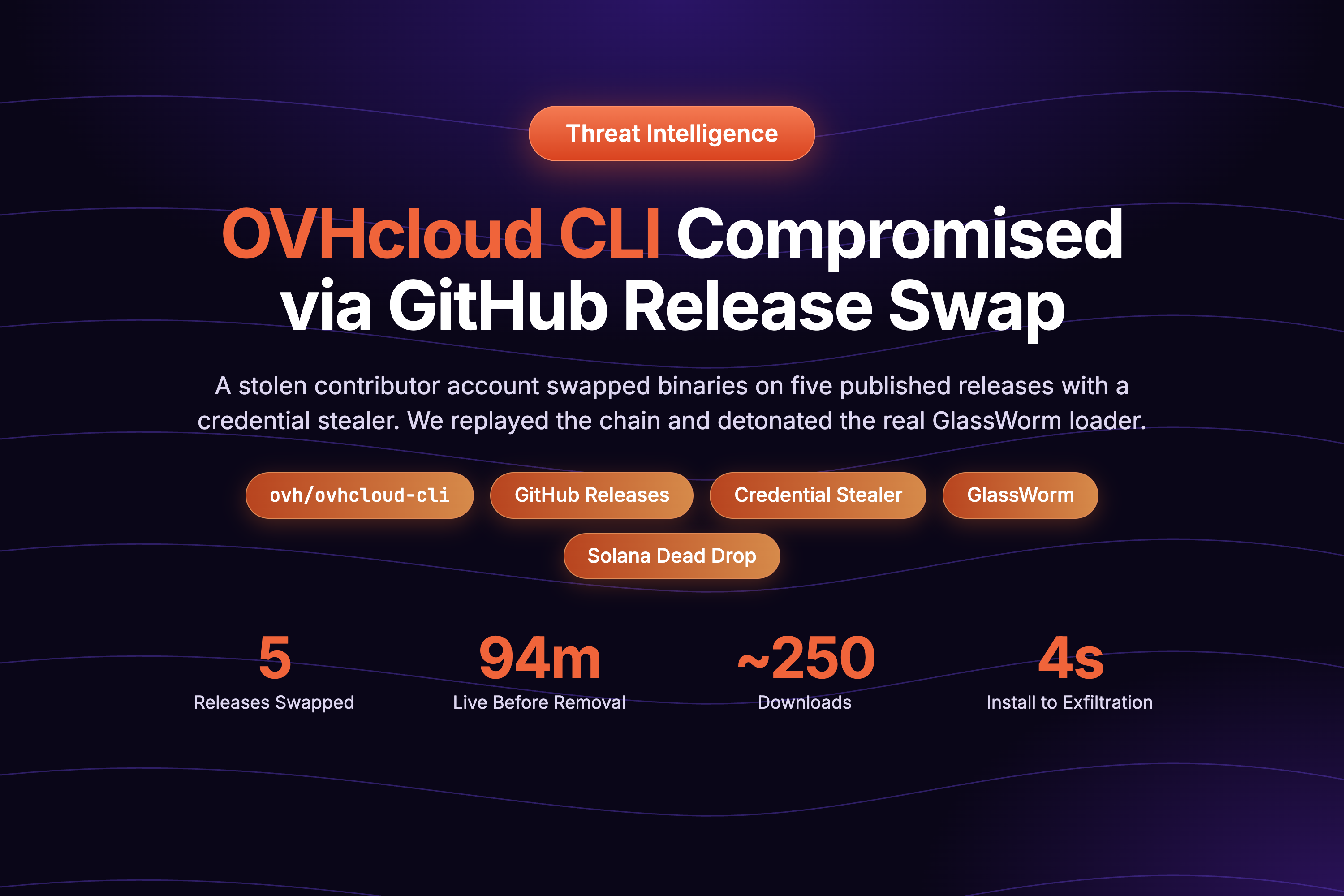
OVHcloud CLI Compromised via GitHub Release Swap: Detonating the Real GlassWorm Loader and What We Found

Analysis of the 19 October 2026 swap of binaries on five ovh/ovhcloud-cli GitHub releases (v0.11.0 to v0.15.0), live 94 minutes. StepSecurity rebuilt the attacker's binary, detonated the recovered GlassWorm preinstall.js loader against a controlled Solana dead drop, and found install.sh never exposed arm64 Linux, Homebrew was safe, and `ovhcloud version` showing "undefined" identifies the swapped build. Includes IOCs and recovery steps.

OVHcloud CLIGitHubSolana+3
GlassWormForceMemoGHSA-862f-55f5-vmvw+8

Supply Chain, Malware & RE, Threat IntelΒ· Published and added 24 Oct 2026

quentinkaiser.bewriteupπŸ›‘οΈ Security

One parser, two bugs, many routers: Exploiting Broadcom WiFi across eCos, Linux

Long-form write-up of a Hexacon 2026 talk on a WPS EAP reassembly overflow in Broadcom's proprietary 802.11 stack, present since 2010 and incompletely patched in 2018. It is remotely triggerable over WiFi without the network key. It gives information disclosure and code execution on eCos (BCM3380, BCM3383, BCM33834) and Linux (BCM3390, BCM65xx, BCM68xx) platforms. Exploited on Belgian ISP routers from Proximus, VOO and Orange. Includes a 90-day disclosure timeline, and Broadcom refused to assign a CVE.
BroadcomeCosLinux+2
HexaconWPS EAP reassembly overflowforever day+17

Hardware & RF, Offensive Security, Blue Team & DetectionΒ· Added 19 Oct 2026, published 16 Oct 2026
microsoft.comwriteupπŸ›‘οΈ Security

3 lessons from frontier AI vulnerability research

Microsoft Security's FORGE Lab shares results and lessons from four months of AI-agent-driven vulnerability research: 140 Windows CVEs (52 in September 2026's release), 155 internally validated reports across 23 open-source projects, and the first patch merged into the Linux kernel via the Linux Foundation's Akrites coordinated-disclosure initiative. Using their multi-model agentic scanning harness MDASH and GPT-5.5-based validation agents, the team measured automated PoC generation at an average $3.61/21.5 minutes per confirmed crash and local privilege-escalation AEG at $8.56/25.4 minutes, and argues the real bottleneck has shifted from finding bugs to validating and remediating them at matching speed. Specific disclosed CVEs include curl's CVE-2026-9545 and CVE-2026-13608, Node.js's CVE-2026-56848, and Linux kernel's CVE-2026-64563.

MDASHWindowsLinux kernel+3
CVE-2026-9545CVE-2026-13608CVE-2026-56848+6

AI Security, Offensive Security, AppSecΒ· Published and added 7 Oct 2026
hackers-arise.comwriteupπŸ›‘οΈ Security

CUDA Basics for Hackers, Part 1: Getting Started

First part of a Hackers-Arise series teaching CUDA (NVIDIA Compute Unified Device Architecture): installing the CUDA toolkit and nvcc compiler on Kali or Debian-based Linux, writing a basic CUDA C++ kernel, and compiling and running a simple parallel vector-addition program. It explains GPU threading concepts (kernels, thread blocks, grids) and frames CUDA as foundational to AI workloads and to future security applications like password cracking, real-time threat detection and post-quantum cryptography, though those applications are only listed, not demonstrated, here.

Kali LinuxLinuxDebian
Master OTW

LearningΒ· Added 7 Oct 2026, published 6 Oct 2026

hackers-arise.comwriteupπŸ›‘οΈ Security

Living off The Browser: Running Popular Hacking Tools Inside Chrome

Hackers Arise walks through an installable Chrome Isolated Web App that packages nine popular Active Directory pentesting tools, including NetExec (NXC), SharpHound, LDAP-shell, Evil-WinRM, and Certipy, so they run natively inside a Chrome tab with multi-protocol network access, bypassing the need for Linux or WSL. The piece shows setup via Chrome flags and an IWA install URL, then a lab demo: port-scanning a target, using Evil-WinRM for remote access, enumerating DNS zones with ADIDNS, and running Certipy to flag an ESC1-vulnerable ADCS template for domain-admin escalation.

ChromeActive DirectoryKerberos+3
ESC1ADIDNS

Offensive SecurityΒ· Added 7 Oct 2026, published 6 Oct 2026

hackers-arise.comwriteupπŸ›‘οΈ Security

Password Cracking: Stealing SSH Credentials with PAM

Walks through a post-exploitation credential-harvesting technique on Linux: enabling password authentication in sshd_config, writing a pam_exec.so logging script, and inserting it into /etc/pam.d/sshd (or common-auth/password-auth) so every SSH login attempt is logged with username, password, and source host to a hidden log file. Also covers using each user's ~/.ssh/known_hosts to identify pivot targets for lateral movement during a pentest.

SSHLinuxPAM
pam_exec.so

Offensive SecurityΒ· Added 7 Oct 2026, published 6 Oct 2026

hackers-arise.comwriteupπŸ›‘οΈ Security

Pentesting: Managing Compromised Machines with Platypus

Walkthrough of Platypus, an open-source C2-style host management platform (github.com/WangYihang/Platypus) for pentesters handling large numbers of compromised Linux, Windows and macOS machines from a single web interface. Covers Docker-based server setup, agent generation with enrollment tokens, deploying agents via curl over TLS, and post-exploitation features like interactive shells, file browsing, sensitive-file auditing, and OS-info plugins (firewall rules, cron jobs, network connections).

DockerLinuxWindows+4
Red Team Operator

Offensive SecurityΒ· Added 7 Oct 2026, published 2 Oct 2026

rapid7.comwriteupπŸ›‘οΈ Security

SMTP is the key: BPFDoor and AVERAT hitting the network edge

Rapid7 details a new BPFDoor campaign targeting telecom and network-edge appliances (ShareTech, SpamSniper mail gateways) and a six-sample Linux RAT family dubbed AVERAT found on compromised Taiwanese CPE (Synology NAS, a NetKlass device, a Dahua DVR). The writeup reconstructs the Rapid7 BPFDoor controller's HTTP-tunneled trigger mechanism, a fileless ShareTech dropper that stages binaries as ntpdate/udevds and deletes them while processes keep running, a BPF Rekoobe variant that hides inside SMTP port-25 traffic, and AVERAT's RC4-derived config/C2 scheme β€” tying the infrastructure to the broader China-nexus ORB (Operational Relay Box) device pattern described in CISA/NCSC-UK advisory AA26-113A. It closes with detection guidance for unlinked/deleted process execution, dropper staging artifacts, and port-25 C2 callbacks, plus full IOC and ATT&CK tables.

LinuxeBPFYARA+2
BPFDoorAVERATRekoobe+11

Malware & RE, Threat Intel, Blue Team & DetectionΒ· Added 7 Oct 2026, published 2 Oct 2026

wiz.iowriteupπŸ›‘οΈ Security

The Blue Agent POV: Investigating Multi-Platform Data Exfiltration Across AWS and GitHub

Wiz walks through a case study of its "Blue Agent" autonomous SOC investigator tracing a compromised CI/CD service account (svc_automation) across AWS and GitHub. The attack chain: a stolen GitHub token cloned 18 private repos containing hardcoded AWS keys, which were used to authenticate to AWS from Kali Linux via a Zenlayer VPN IP, pivot to a second account, run SSM SendCommand against a production Windows domain controller, and stage custom Python exfiltration scripts (mssql_table_export.py, pg_table_export.py, billing_export2.py) in S3 to pull data from MSSQL, PostgreSQL, and billing systems. The piece details the investigative technique used - 30-day baseline comparison, ASO/IP dispersion across the tenant, and correlating CloudTrail management-plane events with S3 data-plane events and GitHub audit logs.

AWSGitHubKali Linux+3
AWS IAMSSM SendCommandAssumeRole

Blue Team & Detection, Cloud & InfraΒ· Published and added 29 Sep 2026

endorlabs.comwriteupπŸ›‘οΈ Security

AI Agent Sandbox Flaw in brig: Symlink Traversal (CVSS 8.2) | Blog | Endor Labs

Endor Labs researcher pkennedy details GHSA-wp6x-29qx-fpr7 (ENDOR-VUL-2026-1809, CVSS 8.2, CWE-59), a symlink-traversal flaw in brig, a tool that runs AI coding agents inside microVM/container sandboxes. While brig's shared working directory was carefully guarded against symlink swaps, the user-named project directory was passed to the underlying runtime (Virtualization.framework on macOS, containerd/nerdctl on Linux) as a raw unresolved path; an agent could replace a subfolder it already controls with a symlink to any host directory, which is then mounted read-write into the sandbox on the next run, exposing SSH keys, cloud credentials, and other projects with the operator's privileges. Fixed in brig 0.3.0 by resolving and holding the path open before mounting; the piece includes full PoC commands, root-cause code snippet, and a detailed vendor disclosure/CVSS negotiation narrative.

Endor LabsmacOSLinux+1
GHSA-wp6x-29qx-fpr7ENDOR-VUL-2026-1809CWE-59+1

AI Security, Offensive SecurityΒ· Published and added 28 Sep 2026

xbow.comwriteupπŸ›‘οΈ Security

No Time to Pwn: CVE-2026-72018 Linux Kernel LPE | XBOW

XBOW's technical write-up on CVE-2026-72018, an out-of-bounds write in the Linux kernel's SMC-D/DIBS loopback code (dibs_loopback driver) that lets an unprivileged user with CAP_NET_ADMIN escalate to root. The bug stems from an unvalidated peer-controlled dmbe_idx/dmbe_size offset computation (smcd_conn_save_peer_info -> smc_ism_write -> dibs_lo_move_data memcpy) that XBOW turned into a reliable LPE by MITM-forging CLC handshake fields via nftables NFQUEUE and grooming kernel cred structures with a 16-byte zero-write primitive alone. The post also details where the autonomous agent's reasoning stalled (abandoning a promising MITM idea, confusing write-what-where with a pure zero-write, chasing an unnecessary UAF) and required human intervention, motivating a multi-agent redesign of XBOW's research pipeline.

Linux kernelXBOW
CVE-2026-72018

Offensive Security, AI SecurityΒ· Added 30 Sep 2026, published 28 Sep 2026

labs.watchtowr.comwriteupπŸ›‘οΈ Security

Is This A Joke? In The Auth Header? (F5 BIG-IP UnAuth Heap-Overflow to RCE CVE-2026-94127)

CVE-2026-94127 is an unauthenticated heap overflow in F5 BIG-IP's APM OAuth userinfo handler (tmm). A 0x4100-byte heap buffer receives the Authorization header with no length check. watchTowr patch-diffed 21.1.0 against 21.1.0.2 with Diaphora, triggered a crash via /f5-oauth2/v1/userinfo, and described a ret2plt chain that works around SELinux by appending a command to /etc/bigstart/scripts/tmm.finish.

F5 BIG-IPTMOSDiaphora+2
CVE-2026-94127watchTowrK000162605+4

Offensive Security, Malware & RE, AppSecΒ· Added 30 Oct 2026, published 23 Sep 2026

depthfirst.comwriteupπŸ›‘οΈ Security

Containers Are No Longer a Security Boundary (CVE-2026-80521)

Depth First researchers detail CVE-2026-80521, a Linux kernel use-after-free in the AF_UNIX subsystem's garbage collector (a race between edge visibility during SCM_RIGHTS sends and vertex freeing in unix_del_edge/unix_walk_scc_fast), discovered with their in-house AI vulnerability-detection model dfs-large1 and used to win a Google kernelCTF slot. They released a working container-escape exploit against the latest Ubuntu 26.04, plus a second exploit for CVE-2026-52910 against Ubuntu 24.04, arguing that AI-accelerated bug discovery has broken the assumption that shared-kernel containers (Docker/Kubernetes, nsjail, Firejail, Bubblewrap) provide a hard security boundary, and recommending migration of sensitive workloads to microVM isolation like Firecracker or Kata Containers.

Linux kernelDockerKubernetes+3
CVE-2026-80521CVE-2026-52910dfs-large1+1

Offensive Security, Cloud & Infra, AI SecurityΒ· Added 26 Sep 2026, published 22 Sep 2026

endorlabs.comwriteupπŸ›‘οΈ Security

Shai-Hulud 2 Malware Campaign Targets GitHub and Cloud Credentials Using Bun Runtime | Blog | Endor Labs

Endor Labs' live incident tracker for the Shai-Hulud 2.0 npm supply-chain worm that began around Nov 24, 2025, compromising packages from Zapier, ENS Domains, Postman and PostHog. It details the infection chain (malicious preinstall script, setup_bun.js dropper, obfuscated bun_environment.js payload), TruffleHog-style credential theft from AWS, GCP, Azure, GitHub and npm, self-replication via stolen npm and GitHub tokens, a self-hosted GitHub Actions runner backdoor abusing repository Discussions for command injection and C2, and destructive wiper behavior that shreds the user's home directory on Windows and Linux.

npmBunGitHub Actions+3
Shai-Hulud 2.0Shai-HuludZapier+3

Supply Chain, Threat Intel, DevSecOpsΒ· Published and added 11 Sep 2026

aikido.devwriteupπŸ›‘οΈ Security

Dirty Frag (CVE-2026-43284): the Linux kernel bug that turns read access into root

Aikido's analysis of "Dirty Frag," a set of Linux kernel bugs (CVE-2026-43284 in IPsec/XFRM ESP, CVE-2026-43500 in RxRPC, and the later variant CVE-2026-46300 "Fragnesia") that let a low-privileged local attacker write to the page cache of a read-only file they can only read, such as /usr/bin/su, and escalate to root. It explains the missing shared-memory check in splice()-fed ESP/RxRPC code paths, why the flaw reaches most kernel versions and distros via backports, how it enables container-to-node escapes in Kubernetes, and gives concrete host exposure checks (uname -r, lsmod grep for esp4/esp6/rxrpc, sysctl user.max_user_namespaces) plus detection guidance via audit logs and EDR.

Linux kernelKubernetesDocker
CVE-2026-43284CVE-2026-43500CVE-2026-46300+3

Offensive Security, Cloud & Infra, Blue Team & DetectionΒ· Added 5 Sep 2026, published 4 Sep 2026

blog.talosintelligence.comwriteupπŸ›‘οΈ Security

UAT-10147: Chinese-speaking adversary integrates agentic AI into post-compromise operations

Cisco Talos details UAT-10147, a Chinese-speaking cybercrime group exploiting one-day vulnerabilities in Windows/Linux web servers to deploy BadIIS, QuasarRAT, NoodleRAT, and SPECTRE implants, while also integrating agentic AI tools (PentestGPT, DeepAudit, and AI-orchestrated ysoserial workflows) to generate exploit playbooks, automate ASP.NET ViewState deserialization RCE, validate exploit success, and run reconnaissance/exfiltration end to end. Talos recovered AI-generated Python scripts and a findings log from the actor's C2 open directory showing semi-autonomous exploit refinement, OOB callback verification via webhook.site, and privilege escalation via SeImpersonatePrivilege/Potato exploits β€” evidence of a shift from AI-assisted scripting toward agentic offensive orchestration.

MetasploitysoserialPentestGPT+3
CVE-2022-0995CVE-2021-3156CVE-2015-5287+21

Threat Intel, AI Security, Offensive SecurityΒ· Added 24 Aug 2026, published 20 Aug 2026

securitylabs.datadoghq.comwriteupπŸ›‘οΈ Security

N4D Mesh Controller: New infrastructure, a UPX-packed agent labeled "go-titan," and how to hunt for it

N4D Mesh Controller is a Linux malware campaign that abuses exposed MCP servers (tools/list, then tools/call on execute_command) and many other services. Datadog executed a UPX-packed, garble-obfuscated Go agent (33.8-go-titan) fetched from 209.99.186.235 in isolated microVMs and an offline replay lab. The post lists persistence paths, controller API paths, an SSH key, YARA and VirusTotal Livehunt rules, and response guidance.

Model Context ProtocolLinuxGo+3
CVE-2026-26220CVE-2023-48022CVE-2026-39987+12

Malware & RE, Threat Intel, Blue Team & Detection, AI SecurityΒ· Added 29 Oct 2026, published 20 Aug 2026

xbow.comwriteupπŸ›‘οΈ Security

XBOW: A Shell Is Worth a Thousand Images

XBOW's autonomous AI agent chained a blind SSRF in Bing's reverse-image-search into three Critical Microsoft RCEs (CVE-2026-32194, CVE-2026-32191, CVE-2026-21536), each CVSS 9.8, by fingerprinting an ImageMagick-compatible backend through differential error responses and crafting an SVG payload that reached a shell-backed image delegate. The proof was confirmed via out-of-band callbacks showing NT AUTHORITY\SYSTEM and root execution across multiple production Bing image-processing workers on both Windows and Linux hosts. The piece walks through the full investigative trace β€” from ruling out XXE to fingerprinting ImageMagick coders/pseudo-protocols to constructing the pipe-based SVG exploit β€” and argues that ImageTragick-class bugs in "boring" image helpers remain a live, underrated attack surface.

XBOWImageMagickBing+1
CVE-2026-32194CVE-2026-32191CVE-2026-21536+3

AppSec, AI Security, Offensive SecurityΒ· Published and added 8 Aug 2026

opensourcemalware.comwriteupπŸ›‘οΈ Security

Russian AI Slopsquatting Publishes 700+ Malicious NPM Packages

OpenSourceMalware documents WEL1DROPPER (aka Flooding Dropper), a campaign that published 788+ slopsquatted npm packages (e.g. checkout-mobile-bnpl) which execute on require() with no install script, downloading cross-platform RAT/infostealer payloads via rotating Cloudflare Workers URLs with a DNS TXT-record fallback channel. The writeup reverse-engineers the Linux (UPX-packed ELF) and macOS (universal Mach-O) second-stage payloads, detailing anti-analysis checks, LaunchAgent persistence disguised as com.apple.windowserver.helper, XOR-obfuscated C2 domains, a suspected Sliver C2 final stage, and ties the campaign to Russian financial-sector lures and the earlier Moika npm campaign.

npmCloudflare WorkersmacOS+3
WEL1DROPPERFlooding DropperMoika

Supply Chain, Malware & RE, Threat IntelΒ· Added 3 Sep 2026, published 6 Aug 2026

medium.comwriteup🧠 AI

Claude as Autonomous Bug Bounty Hunter

A Medium write-up on turning Claude Code into an autonomous bug bounty agent. The setup combines 124 custom skills, three hooks and a Kali Linux container for vulnerability discovery and reporting. It is a practitioner example of structuring a Claude Code harness with skills, hooks and a sandboxed tool environment. Only the blurb was available, so implementation details are unverified.

Claude CodeDockerKali Linux
Claude

coding-agents, agents, promptingΒ· Added 10 Oct 2026, published 30 Jul 2026

socket.devwriteupπŸ›‘οΈ Security

Socket: GitHub Actions Abuse Powers Distributed cPanel/WHM Exploitation Campaign

Socket researchers traced malicious dev versions of ten Packagist packages owned by developer dinushchathurya back to compromised GitHub repositories containing 55-62 malicious GitHub Actions workflow files each. The workflows execute on GitHub-hosted Ubuntu runners on every push, download an architecture-matched Linux payload from C2 server 43.228.157.68, and run an internet scanner (`ipscan --exploit CVE-2026-41940`) that exploits an authentication bypass in cPanel/WHM and harvests cloud, database, SSH, and source-control credentials, exfiltrating results via heartbeat/results HTTP endpoints and DNSHook callbacks. GitHub code search for the campaign's unique markers returned 6,100-16,000 matching workflow files across unrelated repositories, indicating the abuse extends far beyond the one compromised maintainer and effectively weaponizes GitHub Actions as free, disposable attack infrastructure.

GitHub ActionsPackagistPHP+2
CVE-2026-41940dinushchathuryaDNSHook+4

Supply Chain, DevSecOps, Threat IntelΒ· Published and added 23 Jul 2026

stepsecurity.iowriteupπŸ›‘οΈ Security

jscrambler npm package publishes malicious preinstall binary

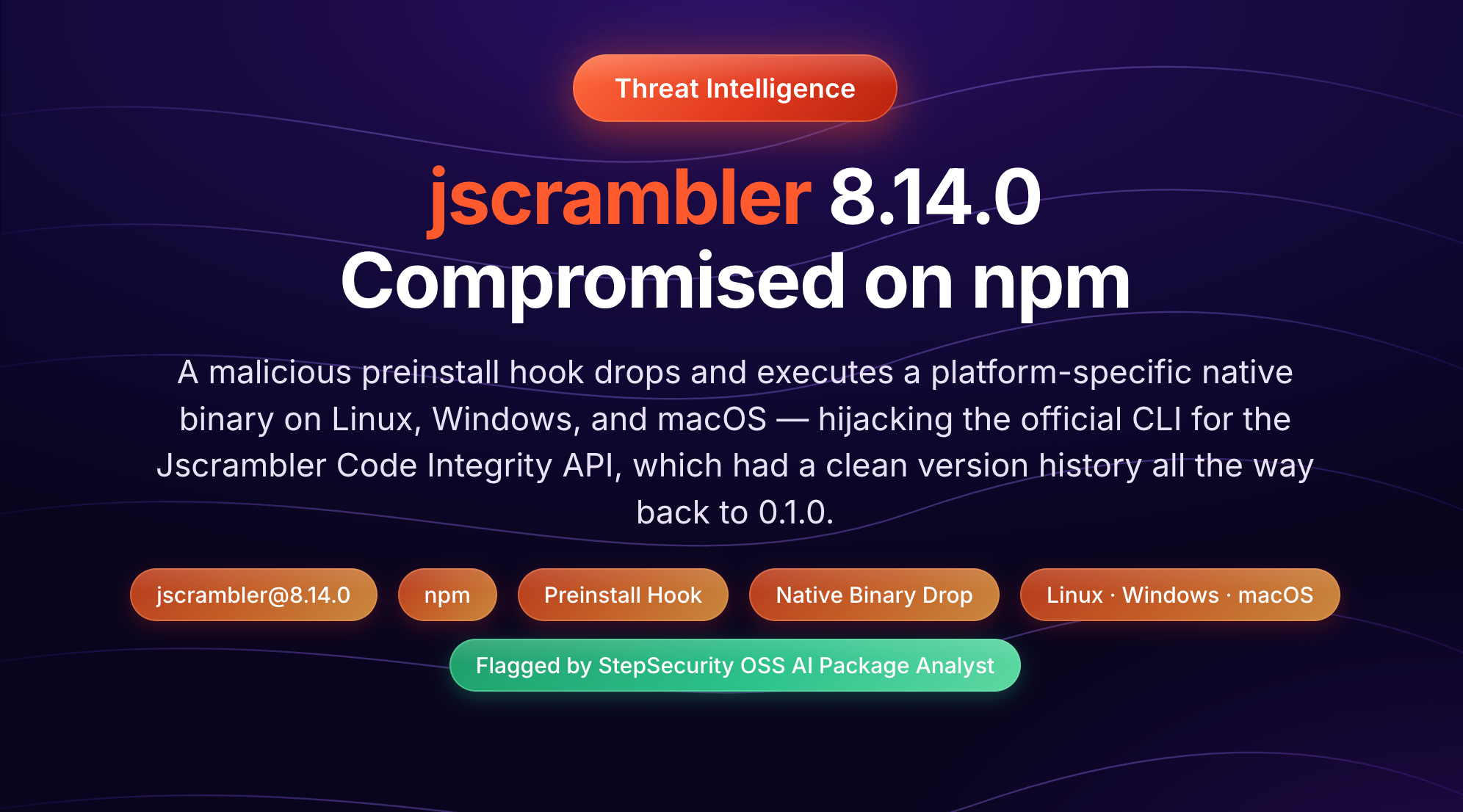
StepSecurity documents a supply-chain compromise of jscrambler, the official npm CLI for the Jscrambler Code Integrity API, starting with version 8.14.0. A malicious preinstall hook (later inlined into the main module to evade install-script scanners) drops a Rust-compiled, platform-specific native binary (ELF/PE32+/Mach-O) smuggled inside a fake dist/intro.js behind a custom magic header, containing an embedded SQLite/LevelDB parser and BIP39 wordlist consistent with a credential and crypto-wallet stealer. The Linux payload dynamically links libbpf and loads an in-memory eBPF program for kernel-level instrumentation, and all three platform binaries include anti-debugging checks; affected versions (8.14.0, 8.16.0, 8.17.0, 8.18.0, 8.20.0) were interleaved with clean releases, and C2 traffic was observed reaching Tor entry-node infrastructure and two raw IPs.

jscramblernpmRust+3
Phantom GypMiasmaStepSecurity+3

Supply Chain, Malware & REΒ· Added 3 Sep 2026, published 12 Jul 2026

socket.devwriteupπŸ›‘οΈ Security

Socket: 141 Mastra npm Packages Compromised via Typosquatted Dependency

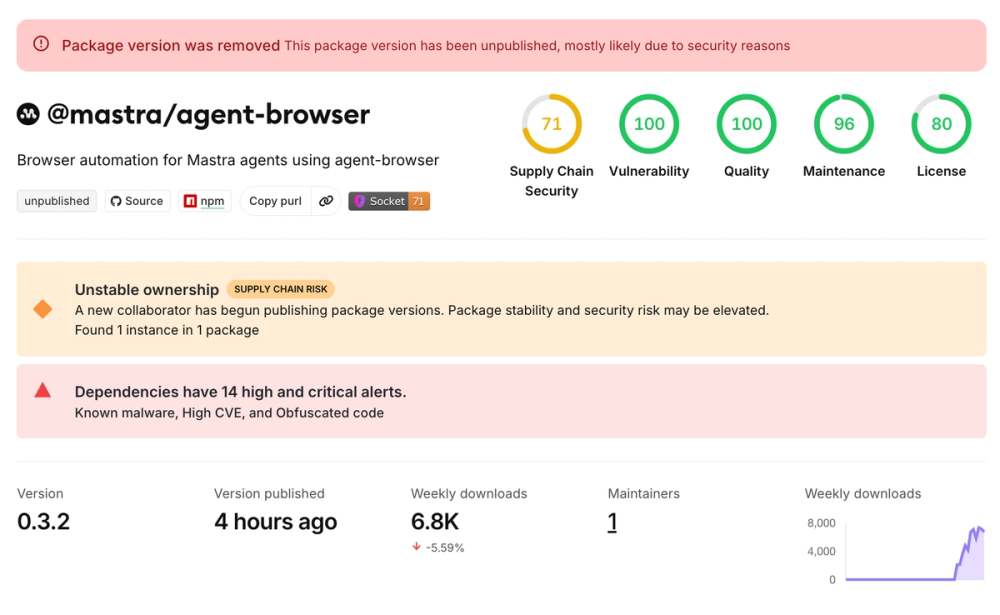
Socket's research team documents a supply chain attack in which npm account "ehindero" mass-published 141 malicious versions of @mastra/* packages (including @mastra/core, 918K weekly downloads) that were byte-identical to legitimate code but added a single new dependency: the typosquatted package easy-day-js. That package's postinstall hook (setup.cjs) disables TLS validation, fetches a second-stage cross-platform Node.js implant (protocal.cjs) that installs OS-specific persistence (Windows Run key, macOS LaunchAgent, Linux systemd unit disguised as Node/NVM tooling), inventories 166 cryptocurrency wallet browser extensions, steals Chrome/Edge/Brave history, and accepts arbitrary remote tasking (Node/Shell runners) from a hardcoded C2 over a custom ICAP-style protocol. The writeup includes full IOCs, SHA-256 hashes, and remediation guidance (rotate npm/CI/SSH credentials, treat affected hosts as compromised, disable install scripts).

npmNode.jsdayjs+2
Mastraeasy-day-jsehindero+2

Supply Chain, Malware & RE, Threat IntelΒ· Published and added 20 Jun 2026

huntress.comwriteupπŸ›‘οΈ Security

Panic at the Distro

Huntress breaks down four Linux kernel zero-copy vulnerabilities disclosed in rapid succession in 2026 β€” CopyFail (CVE-2026-31431) in algif_aead, Dirty Frag (CVE-2026-43284, CVE-2026-43500) in xfrm-ESP/RxRPC, and Fragnesia (CVE-2026-46300) in XFRM ESP-in-TCP β€” all of which let an unprivileged local user overwrite read-only page-cache entries (e.g. /etc/passwd, /usr/bin/su) via splice()-based zero-copy syscalls to gain root, echoing the 2022 Dirty Pipe (CVE-2022-0847) technique. The article explains the zero-copy/page-cache mechanics behind the bug class, notes all four were found with LLM assistance, and gives kernel-module-disabling mitigations plus a recommendation to enable LSM BPF for defense.

Linux kernelLinuxeBPF
CVE-2026-31431CVE-2026-43284CVE-2026-43500+7

Offensive Security, Blue Team & DetectionΒ· Added 3 Sep 2026, published 14 May 2026

xint.iowriteupπŸ›‘οΈ Security

Copy Fail (CVE-2026-31431): 9-year-old Linux kernel LPE via AF_ALG/splice()

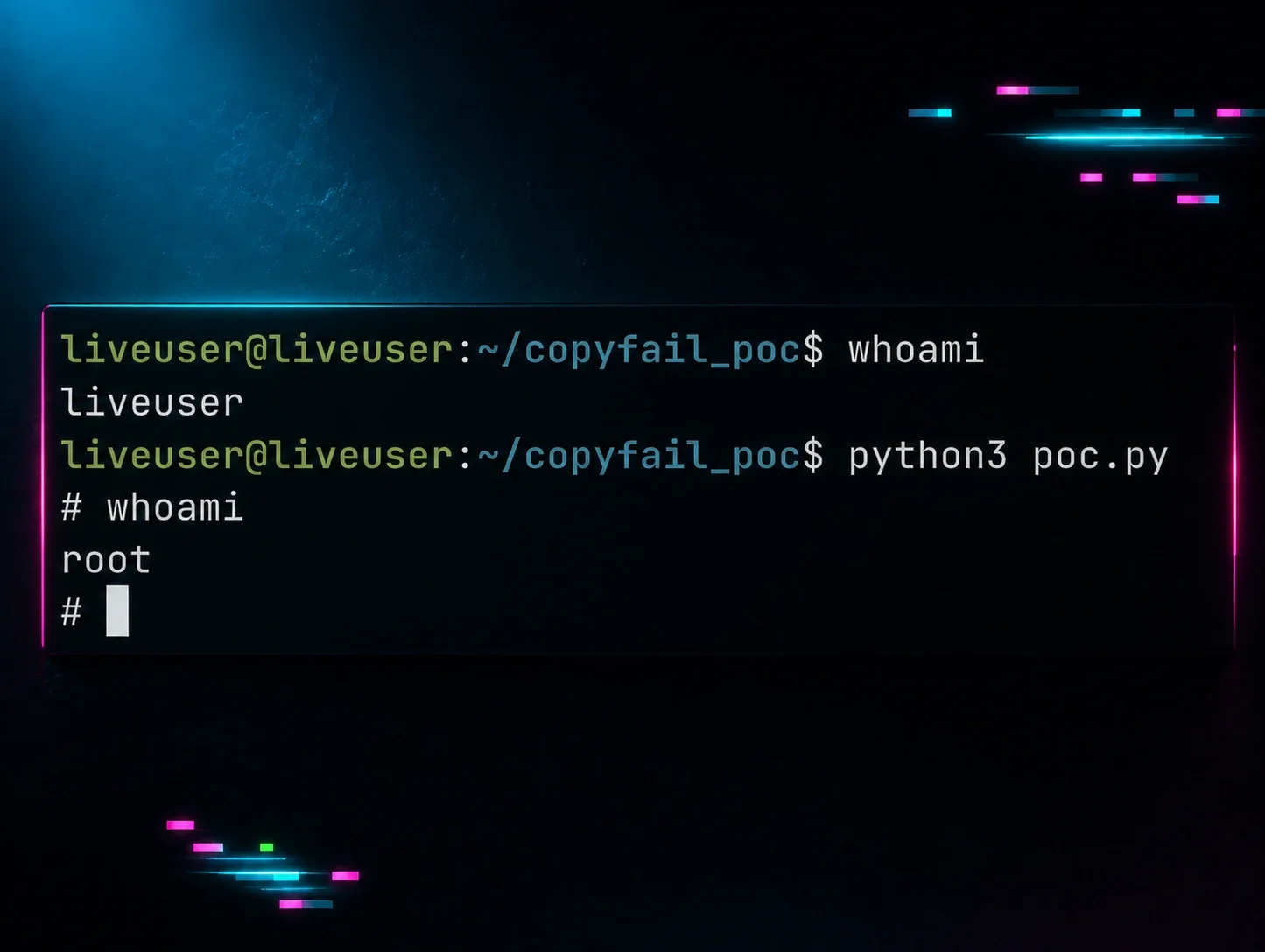
Xint/Theori researchers detail CVE-2026-31431 ('Copy Fail'), a Linux kernel logic bug where the authencesn AEAD crypto template writes 4 attacker-controlled bytes past its output buffer, and AF_ALG's 2017 in-place optimization chains page-cache pages from splice() into that writable scatterlist. This lets an unprivileged local user corrupt the in-memory page cache of any readable file (e.g. /usr/bin/su) without touching disk, yielding a race-free, portable root exploit in a 732-byte Python script across Ubuntu, Amazon Linux, RHEL and SUSE. The post traces the bug's origin across 2011/2015/2017 kernel commits, walks through the exploit and the out-of-place fix, and notes the flaw was found via an AI-assisted scan (Xint Code) guided by researcher Taeyang Lee.

Linux kernelPython
CVE-2026-31431CVE-2016-5195CVE-2022-0847+6

Offensive SecurityΒ· Added 18 Sep 2026, published 29 Apr 2026

huntress.comwriteupπŸ›‘οΈ Security

Untangling a Linux Incident With an OpenAI Twist (Part 2)

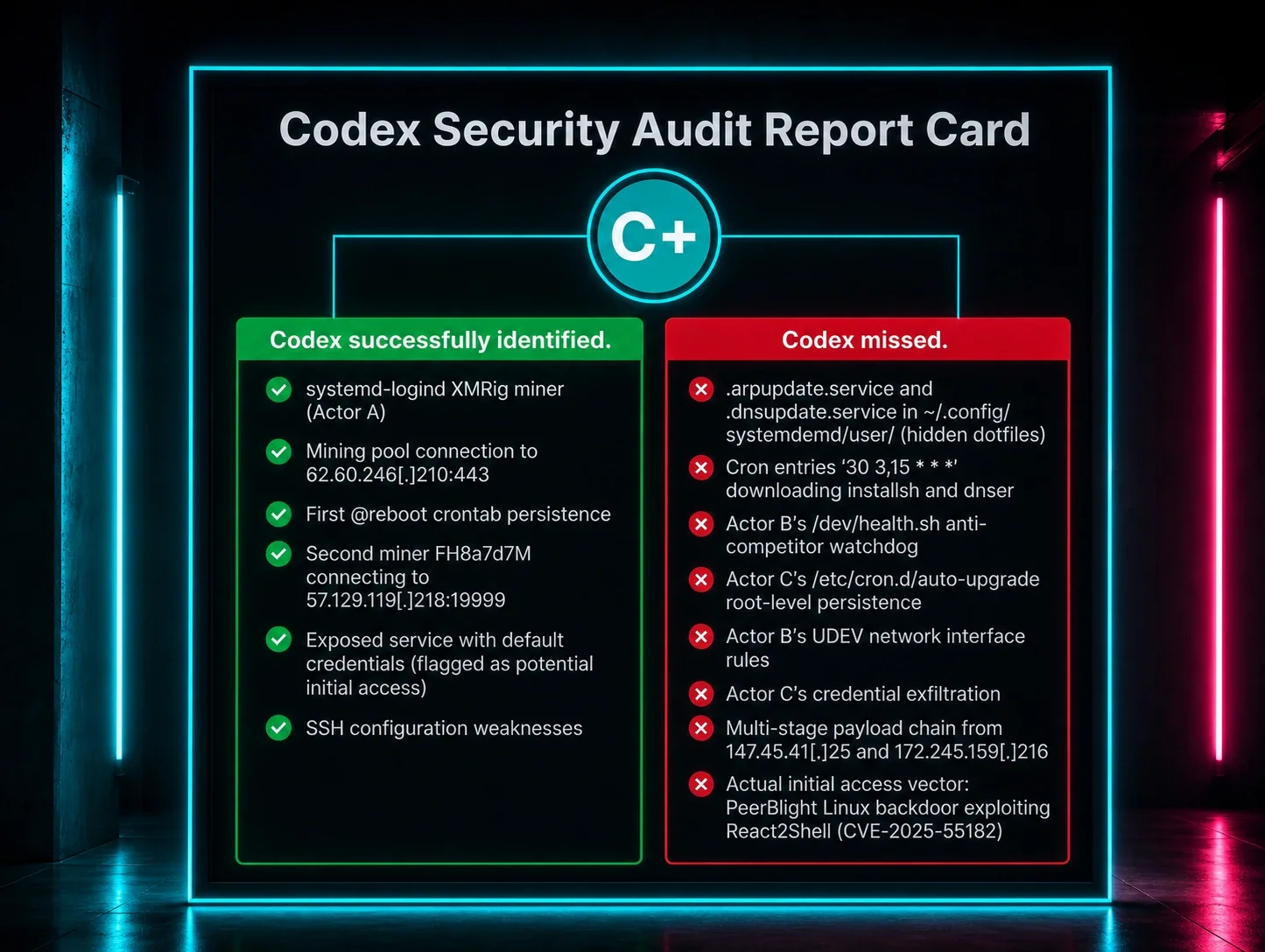
Part two of a Huntress SOC case study untangling a Linux host compromised by three simultaneous actors: a legacy cryptominer, a multi-revenue botnet (XMR mining, EarnFM bandwidth-selling, Repocket residential proxy) with eight persistence mechanisms, and a credential-harvesting cluster that exfiltrated SSH keys, cloud credentials, and .env secrets via wget POST, while the legitimate developer used OpenAI's Codex agent to partially and ineffectively triage the same box. The SOC documents Codex's wins and misses (no root visibility, missed cron.d/UDEV persistence, race conditions with reinfecting attackers) and traces an April reinfection to unpatched CVE-2025-55182 (React2Shell) in the developer's Next.js/React app, underscoring that AI-assisted remediation without live EDR telemetry and root-cause patching leaves footholds open.

OpenAI CodexHuntressLinux+3
CVE-2025-55182XMRigEarnFM+1

Blue Team & Detection, Threat Intel, AI SecurityΒ· Added 3 Sep 2026, published 22 Apr 2026

Showing 30 of 55

Show more