 Endor Labs AI SAST Finds Two Apache Kafka Zero-Days: Unbounded Memory Allocation from Brokers to Kafka Streams | Endor Labs
Endor Labs AI SAST found three unbounded memory allocation flaws in Apache Kafka, fixed under CVE-2026-114349 (DefaultRecord decoder, a ~90-byte compressed batch that kills consumers, brokers and the log cleaner) and CVE-2026-111551 (ListDeserializer and Kafka Streams AssignmentInfo decoding). The post gives code, reproducers and payload bytes. Remediation: upgrade to 4.2.2, 4.3.2 or 4.4.0, set max.decompressed.message.bytes, restrict write and group ACLs, and alert on DeadThreadCount.
 endorlabs.comwriteupPublished and added 28 Oct 2026🛡️ Security
 CVE-2026-20362 | Cisco Finesse Server-Side Request Forgery Vulnerability
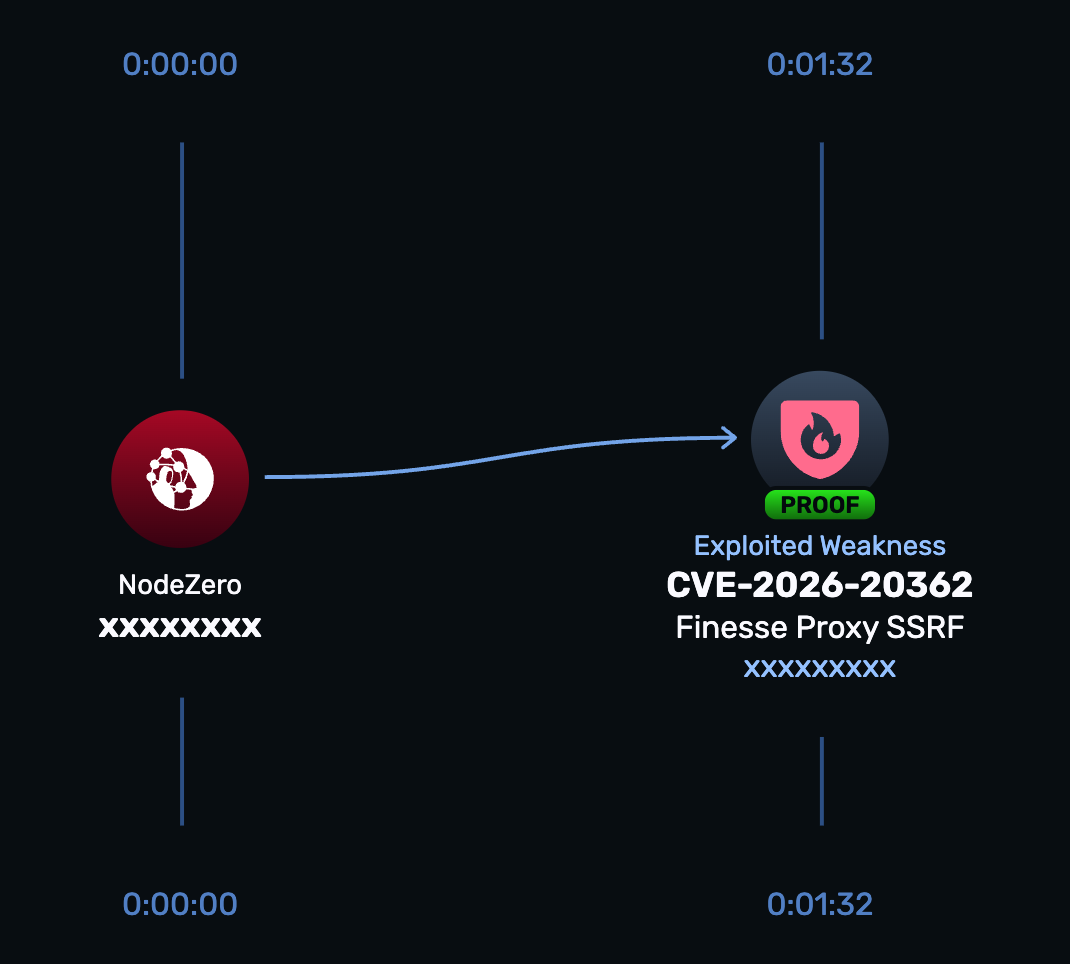
CVE-2026-20362 is an unauthenticated server-side request forgery in Cisco Finesse (CVSS 3.1 score 7.2), found by Horizon3 researchers Noah King and Brandon Peterson. The embedded Apache Shindig content proxy fetches attacker-supplied URLs, including loopback services such as the Finesse REST API at 127.0.0.1:8082, which returns SystemInfo with node hostnames and the XMPP domain. Cisco published its advisory on 7 October 2026. Fixes are planned for January and February 2027, and no workaround exists.
 horizon3.aiadvisoryAdded 29 Oct 2026, published 28 Oct 2026🛡️ Security
 Introducing the Cloudflare PHP Capture the Flag challenge
The Cloudflare PHP Capture the Flag challenge is a HackerOne bug bounty CTF. Researchers must bypass Cloudflare WAF rules protecting CVE-2026-109618 and CVE-2026-109619 (PHP2Shell) on stock PHP 8.5.11 with Apache mod_php in a Cloudflare Container, get RCE, and read /flag. The post lists scope (POST to /php/* only), report requirements and duplicate rules, which count only materially distinct WAF bypasses.
 blog.cloudflare.comarticleAdded 29 Oct 2026, published 27 Oct 2026🛡️ Security
- Trail of Bits (@trailofbits) on X
Trail of Bits post on PHP2Shell, an exploit that gives a shell on MediaWiki, Symfony, Laravel and phpBB. They confirmed it on pre-patch PHP 8.2 to 8.5. An update says it is production-grade: it works with stock php.ini-production, display_errors off, multiple workers, ASLR and load, on ARM64 and x86-64, and reaches root on Apache/mod_php and nginx/php-fpm. No CVE or technical root cause is given.
 x.comthreadAdded 27 Oct 2026, published 26 Oct 2026🛡️ Security
 PHP2Shell Exploitation Moves From Probes to Working Shells
PHP2Shell exploitation (CVE-2026-109618, CVE-2026-109619) reached working shells on 24 October 2026, when Perplexity researcher Adel Karimi's honeypots (PHP 8.4.26, Apache mod_php, single worker) logged 35 shells across three servers. Attackers used a four-stage HTTP chain: memory exhaustion, memory leak, then shell command execution, matching a public PoC. No second-stage payload was seen, and CISA had not added the flaws to KEV as of 26 October.
 securityweek.comarticlePublished and added 26 Oct 2026🛡️ Security
- Syb (@DegenOfWallSt) on X
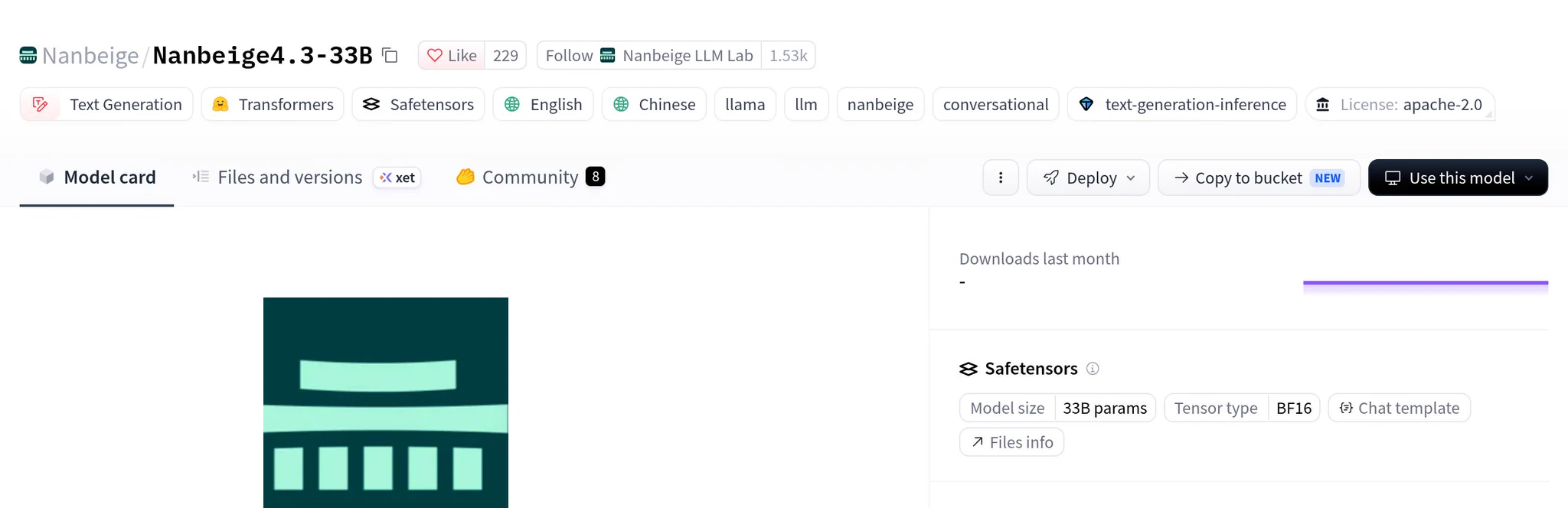
Nanbeige4.3-33B is a 33.1B dense, Llama-style open model under Apache-2.0, released with a base model on Hugging Face. In Nanbeige's own table it beats Qwen3.8-27B on Terminal-Bench 2.1 (80.9 vs 73.0), DeepSWE (65.5 vs 42.5) and Automation Bench, but trails on SWE-Bench Pro, GDPval and GPQA Diamond. BF16 weights are about 66 GB, split across 4 GPUs in the vLLM and SGLang examples. No independent evals exist yet.
x.comthreadAdded 26 Oct 2026, published 25 Oct 2026🧠 AI - Dan Kornas (@DanKornas) on X
HiRoute is an open-source (Apache-2.0) local model router for developers using agent clients such as Codex and Claude Code. Routing plans judge each new message and send routine work to economical models, while harder design decisions and fixes stay on the primary model. It supports custom task branches, ordered failover candidates with explicit exhaustion, per-session cost and usage records, and runs as a macOS desktop app or a Linux CLI and daemon.
x.comtoolAdded 25 Oct 2026, published 24 Oct 2026🧠 AI  EveryDev.ai (@EveryDevAi) on X
ToolUniverse, from ScientistTools, is an open-source (Apache-2.0) toolkit that gives any LLM one interface to more than 1,000 scientific tools, models and databases such as PubMed, UniProt and ChEMBL. It ships a native MCP server, a Python SDK and a tu CLI, plus 68 pre-built agent skills. The post says it works with Claude Code, Cursor, Gemini CLI and Windsurf.
x.comthreadPublished and added 24 Oct 2026🧠 AI Atlassian Patches 75 Flaws in Data Center and Server Products
Atlassian's October 2026 security bulletin lists 162 high and 14 critical third-party vulnerabilities across Bamboo, Bitbucket, Confluence, Crowd, Fisheye/Crucible, Jira Software and Jira Service Management. SecurityWeek counts 75 unique CVEs, six critical, in Tomcat, Bouncy Castle, Netty and Apache SSHD. Atlassian rates them non-critical for its use, reports no exploitation, and the critical CVE-2026-65905 appears on the portal but not in the bulletin.
securityweek.comarticlePublished and added 23 Oct 2026🛡️ Security Daily Vibe Casting (@vibecastingapp) on X
Daily Vibe Casting is an X thread dated 24 October 2026 that summarises ten tech news items from the previous 24 hours. The AI items are Cloudflare's model-independent agent security audit skill, Recursive SI's Apache 2.0 Flint local coding model (125+ tokens/s on an M4 Pro), Anthropic's Claude Duet preview and Claude API version 2026-10-21, which drops temperature, top_p and top_k. It also covers HeyGen Voice Turbo and Gemini in Google Maps on CarPlay.
x.comthreadAdded 24 Oct 2026, published 22 Oct 2026🧠 AI NVIDIA Kumo Relational Outperforms Supervised Machine Learning on Relational Data, No Training Required
NVIDIA Kumo Relational is a pre-trained relational foundation model that predicts outcomes such as churn or fraud directly on multi-table databases through in-context learning, using up to 10,000 context examples and no task-specific training. NVIDIA reports it beats supervised relational deep learning and XGBoost pipelines across 41 tasks on 15 databases, and beats AutoGluon by 8% MRR on SAP SALT. Code is Apache 2.0, weights are on Hugging Face.
 huggingface.coarticlePublished and added 21 Oct 2026🧠 AI
 PHP2Shell Patches Land as First Exploitation Attempts Hit Sensors
PHP2Shell is a pair of critical PHP core flaws, CVE-2026-109618 (out-of-memory corruption) and CVE-2026-109619 (stale global state), both CVSS 9.2 and giving unauthenticated RCE, confirmed on Apache with mod_php. Fixes shipped in PHP 8.5.12, 8.4.27, 8.3.36 and 8.2.35, with backports for 7.4 to 8.1. Exploitation attempts were reported by watchTowr, Hadrian, Patchstack, Cloudflare and Vega after a leak moved disclosure up from 22 October 2026 to one day earlier.
securityweek.comarticlePublished and added 21 Oct 2026🛡️ Security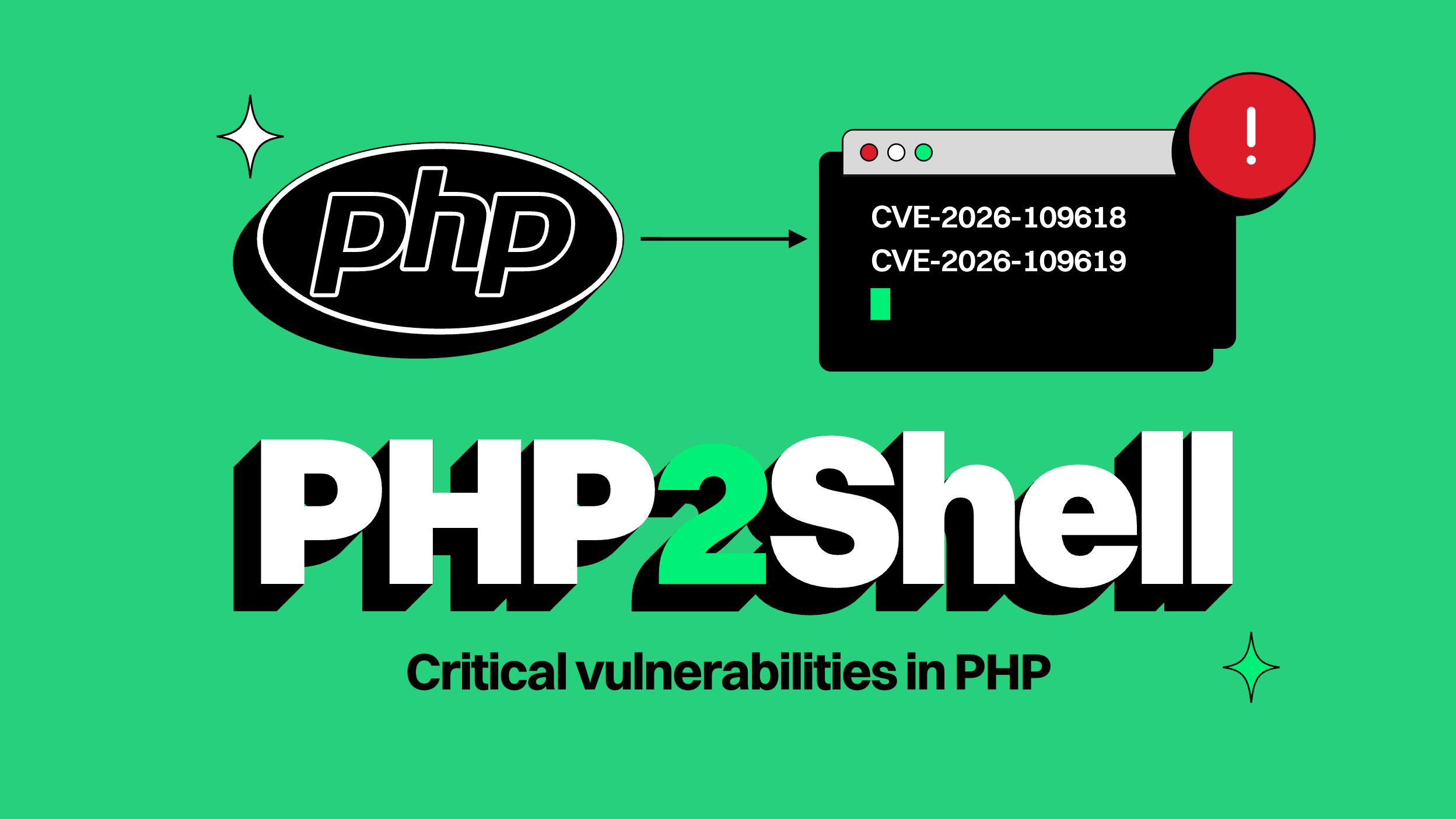 PHP2Shell: Critical vulnerabilities in PHP (CVE-2026-109618, CVE-2026-109619) | Endor Labs
PHP2Shell is the name for two critical PHP core memory-safety flaws, CVE-2026-109618 and CVE-2026-109619, that allow unauthenticated remote code execution. Fixes ship in PHP 8.2.35, 8.3.36, 8.4.27 and 8.5.12. Wiz researchers demonstrated RCE against WordPress, Drupal and Joomla, and Apache with mod_php is the highest risk. The post covers inventory, container rebuilds, Cloudflare WAF rules and temporary exposure reduction.
endorlabs.comadvisoryPublished and added 21 Oct 2026🛡️ Security PHP Patches Critical RCE Vulnerabilities, Organizations Urged to Take Unpatched Sites Offline
PHP2Shell is a pair of memory-safety flaws in the PHP engine, CVE-2026-109618 and CVE-2026-109619 (CVSS v4.0 9.2), fixed on 21 October 2026 in PHP 8.5.12, 8.4.27, 8.3.36 and 8.2.35. Unauthenticated requests can reach code execution, most readily through Apache mod_php, and Cloudflare reports active attack traffic. The post covers W3Techs data showing about 48.5% of PHP sites on end-of-life branches, the leak timeline, and the need to patch the runtime itself.
 socket.devarticlePublished and added 21 Oct 2026🛡️ Security
 Granite Speech 5.0: Transcribe, Translate, and Attribute more Accurately and Faster
Granite Speech 5.0 is IBM's update to its open speech model collection: the new granite-speech-5.0-2b, a multilingual granite-speech-5.0-470m-turboctc, and a revised granite-speech-4.1-2b-plus. The 2B model ranks #2 among open-weight models on average English WER (5.06%) on the Open ASR Leaderboard. Turbo CTC reaches 19,870 RTFx, and the 4.1 Plus revision cuts long-form WER 24%. All are Apache 2.0.
huggingface.coarticlePublished and added 21 Oct 2026🧠 AI NVIDIA Kumo Forecast Combines Pretrained Time-Series Representations with Historical Pattern Retrieval and Interpretability
NVIDIA Kumo Forecast (formerly NV-Tesseract Forecasting) is a multivariate time-series forecasting model built on the MOMENT-1-large Transformer backbone (about 340M parameters) with a trainable forecasting head. Its DARR mode blends direct predictions with k-nearest-neighbor retrieval over historical context, and an interpretability framework gives per-horizon lag and feature attributions. Inputs are 256 to 2048 numeric observations; code and weights are Apache 2.0.
huggingface.coarticlePublished and added 21 Oct 2026🧠 AI- eness/php2shell-CVE-2026-109618-CVE-2026-109619-PoC
php2shell is the name given to two critical pre-auth remote code execution flaws, CVE-2026-109618 and CVE-2026-109619, in PHP core's session upload progress handler (php_session_rfc1867_callback), where zend_hash_update frees live zval pointers that are later reclaimed and redirected into zend_call_function to run zif_system. This repository ships poc_109618.py, a fully automated four-stage HTTP exploit that leaks ASLR offsets via Set-Cookie headers against php:8.4.26-apache on Debian Bookworm, along with a root-cause C source patch, mitigation scripts to disable session.upload_progress, and WAF/ModSecurity/Lighttpd/Apache rules plus detection guidance for anomalous PHP worker child processes. Confirmed PHP versions include 8.4.4 and 8.2.34, with EOL branches (5.x, 7.x, 8.0, 8.1) left without official vendor patches.
 github.comrepoAdded 23 Oct 2026, published 21 Oct 2026🛡️ Security
- ikow/php2shell-poc
php2shell-poc is a proof-of-concept and detection toolkit for CVE-2026-109618 and CVE-2026-109619, two PHP vulnerabilities tied to session.upload_progress handling and a Zend engine out-of-memory bailout path affecting PHP 5.4.0 through 8.5.11. The repository includes three working exploit chains, a Docker-based lab (PHP-FPM, nginx, Apache mod_php) for reproduction, and pre-built Suricata, Sigma, ModSecurity, and Lua detection rules. The author recommends disabling session.upload_progress as an interim mitigation, noting the underlying memory corruption requires a full PHP patch to fix.
github.comrepoAdded 23 Oct 2026, published 21 Oct 2026🛡️ Security - Rapid Response: php2shell, Leaked Critical PHP Vulnerabilities (CVE-2026-109618 & CVE-2026-109619)
Huntress rapid-response post on php2shell, two leaked critical PHP core vulnerabilities (CVE-2026-109618 and CVE-2026-109619, CVSS v4.0 9.2 each) reported as remote code execution. The PHP team moved its security release to 21 October 2026, 14:00 UTC, after the leak. It lists hunting cues such as php-fpm, php-cgi or apache2 spawning shells, interpreters or download tools, plus inventory and patch steps. No root cause, affected versions, PoC or IOCs were public at writing.
 huntress.comadvisoryPublished and added 21 Oct 2026🛡️ Security
 Latest open artifacts (#25): DeepSeek V4.1 Flash 1017, American-made models, and new regulatory controls in the US & China
Interconnects' Latest open artifacts (#25) covers open-weight AI in fall 2026. Policy items: China's MOFCOM proposal for pre-approval of international model sharing, and a DHS order barring DeepSeek from federal civilian procurement. DeepSeek released its internal inference stack DeepInfer. Picks include MiMo-V2.6-Pro-RL, DeepSeek-V4.1-Flash-1017 (552B-A16B, MIT), Clef, Nemotron-3.5-Super-VL and Reflection's Beam-1.0 (Apache 2.0).
 interconnects.aiarticlePublished and added 20 Oct 2026🧠 AI
- DeepInfer: High-performance inference framework for DeepSeek models
DeepInfer is DeepSeek's open-source inference framework for offline inference of DeepSeek-V4.1-Flash, released under Apache 2.0. It covers attention data parallelism, MoE expert parallelism with load balancing, draft-token decoding with confidence-scheduled verification, batch-invariant inference, deterministic sampling and structured outputs. It runs on NVIDIA SM100 GPUs and Huawei Ascend 950 NPUs. The KV cache system, prefill/decode disaggregation and load balancing are not included.
github.comrepoAdded 21 Oct 2026, published 20 Oct 2026🧠 AI - Dan Kornas (@DanKornas) on X
Coral is an open-source (Apache 2.0) agentic IDE that runs Claude Code, Codex, Gemini CLI and Pi.dev together as one coordinated team on a shared codebase. It puts sessions, tasks, messages and controls behind a shared board and browser dashboard. Features include a task queue with dependencies and review holds, an agent message board, git-worktree sessions tracked against main, and live terminal access from a browser or phone.
x.comtoolAdded 19 Oct 2026, published 18 Oct 2026🧠 AI  🚨 AI News | TestingCatalog (@testingcatalog) on X
A TestingCatalog X post with two Daily AI Briefs (Oct 17 and the start of Oct 16), grouped by vendor. Oct 17 items include GPT-6 Astra Pro upgrades in ChatGPT, Codex context reuse and caching, Gemini 4 Argon in AI Studio Build, the open-weight MIT-licensed DeepSeek-V4.1-Flash-1017, Claude Code Review going GA, Perplexity's open Decider v1.2 models (27B and 4B), NVIDIA's 4B looped Nemotron Labs Dory 1.0, Reflection's Apache-2.0 Beam, Cursor cloud-agent canvases and Tencent's Hy Memory 2.0. Oct 16 begins with Meta's open-weight Muse Spark Open, an 816B-total, 42B-active MoE with a 1M-token context. It gives a quick snapshot of the week's open-weight and coding-agent releases.
x.comthreadAdded 18 Oct 2026, published 17 Oct 2026🧠 AI- Master the captain (@mollicksoif9) on X
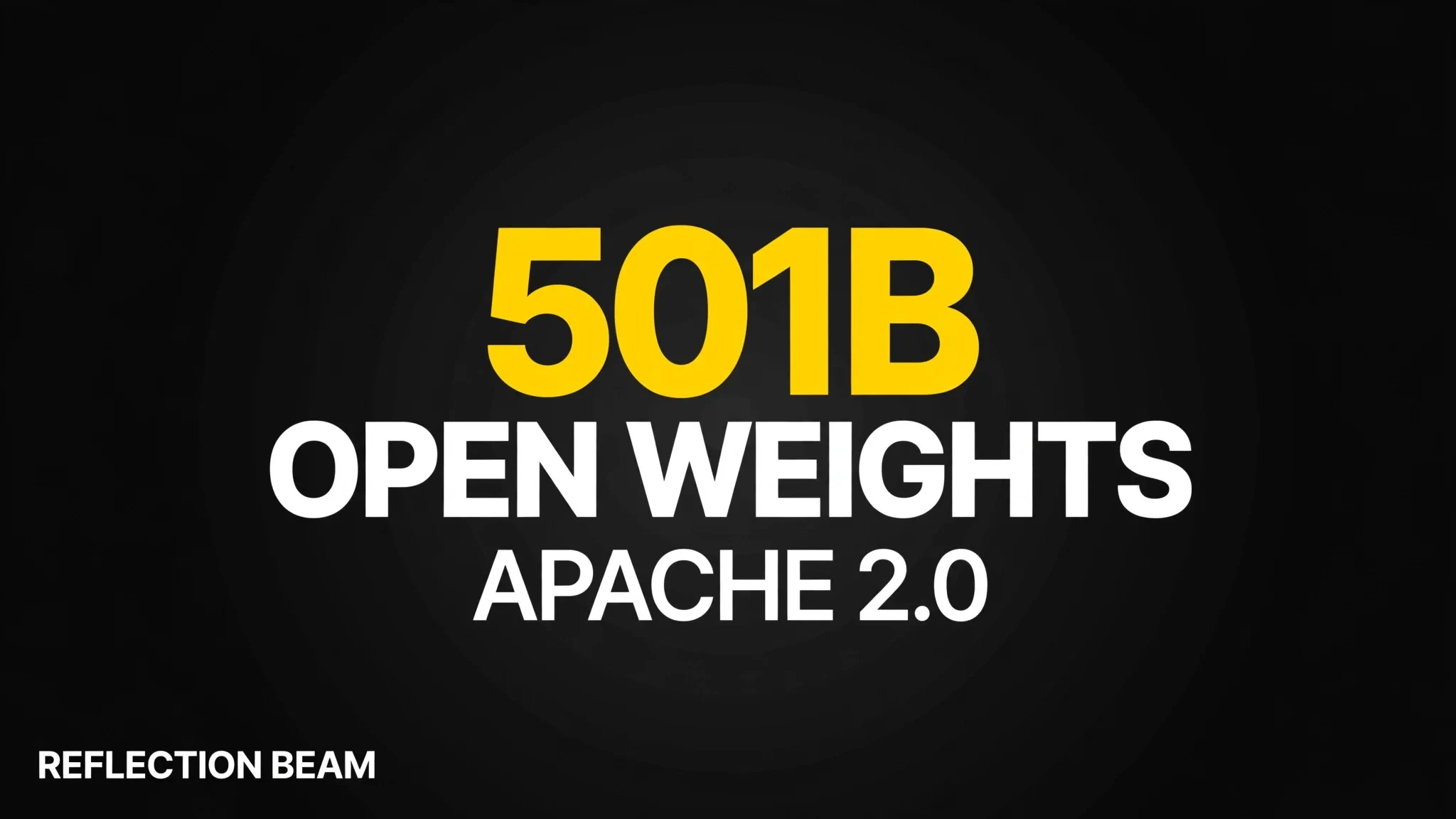
A social post reporting that Reflection AI released the full weights of Beam, a 501B-parameter mixture-of-experts agentic coding model (23B active, 1M-token context), on Hugging Face under Apache 2.0. It claims RL training that penalizes wasted tokens gives roughly 3-4x less inference compute than GLM-5.2, and 80.9 on SWE-bench Verified. Launch support is listed for AWS SageMaker, vLLM and SGLang. The post notes the token-efficiency claims still need independent confirmation and that self-hosting needs about 500GB of GPU memory at 8-bit.
x.comthreadAdded 18 Oct 2026, published 17 Oct 2026🧠 AI - [AINews] High Taste Testers Ep. 1
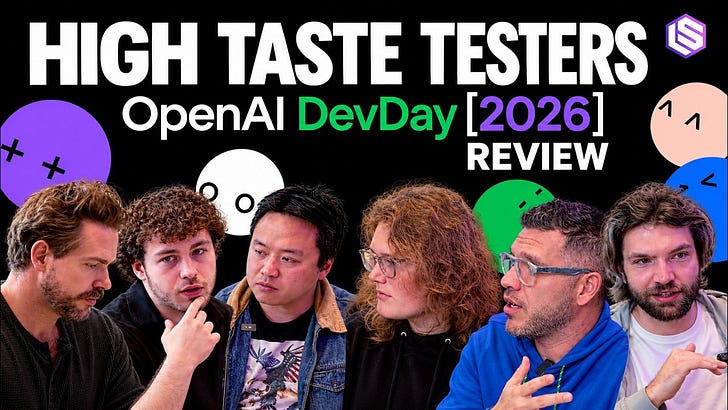
AINews issue for 10/15–10/16/2026, covering Twitter and Reddit. It covers the open-weights releases Meta's Muse Spark Open (816B/42B-active MoE, AA Intelligence Index 39, custom license) and Reflection Beam 1.0 (501B/23B-active, Apache 2.0), plus NVIDIA Nemotron 3.5, StepFun Step 5 Preview and FLUX 3 Image Klein. It also covers Gemini 4 Argon, Haiku 5.5 pricing, "decision model" classifiers (Liquid d1-ultra, Perplexity pplx-decider), TPUv7/Vera Rubin/MI355X serving benchmarks, interpretability claims (Qwen3-32B neuron audit), agent research, eval-integrity and safety disclosures, and China export-control proposals. The page also announces a pilot video show, High Taste Testers Ep. 1.
 latent.spacearticlePublished and added 17 Oct 2026🧠 AI
 Welcome Beam: a 501B open model you can own, customize, and scale
Announces Reflection's Beam-1.0-501B-A23B, an Apache 2.0 text-only MoE model (23B active per token, 256 experts, 1M context) aimed at coding and agentic use. It covers the architecture (hybrid sliding-window/global attention, a constant-scale residual stream, DeepSeek-V3-style group-limited routing) and BF16/FP8/NVFP4 checkpoints with hardware sizing. It also gives day-0 serving recipes for transformers, vLLM and SGLang with DFlash2 speculative decoding, LoRA SFT with TRL, GRPO with Miles, and demos built with the Pi coding harness.
huggingface.coarticlePublished and added 16 Oct 2026🧠 AI Unit 42 Uncovers PEERSTITCH, a Stealthy FortiGate Implant
PEERSTITCH is a memory-resident ARM64 implant that Unit 42 found in a September 2024 telecom intrusion (cluster CL-STA-0954, aka UNC5820). Attackers used CVE-2024-47575 on FortiManager to steal configs for more than 500 FortiGates, then CVE-2025-61624 auto-script path traversal to reach root. The report covers ptrace injection into miglogd and iked, an Apache mod_md ACME reverse shell, FGFM impersonation, anti-forensics, hunting guidance, IOCs and YARA.
 unit42.paloaltonetworks.comwriteupAdded 30 Oct 2026, published 14 Oct 2026🛡️ Security
 Developer Who Cloned Photoshop With AI Just Did the Same to Microsoft Office
Decrypt reports that developer Brandon Thomas released WordCraft, GridCraft and DeckCraft, MIT/Apache-2.0 open-source clones of Word, Excel and PowerPoint. They were written in Rust with Anthropic's Claude (Opus 5.5) as a clean-room rebuild and run natively on Windows, macOS, Linux and BSD, and in a browser. Coverage is high (WordCraft 88% of ribbon features, GridCraft 513 of 523 Excel functions), but the authors rate them only about 50–60% ready for real work. Every button is also an MCP command, so agents like Claude can drive the apps. The article is a useful data point on what AI-assisted "vibe coding" can produce in under two weeks, and on where it still falls short (file fidelity, stability).
 decrypt.coarticlePublished and added 14 Oct 2026🧠 AI
 google/embeddinggemma-2
Model card for EmbeddingGemma 2, an open (Apache 2.0) 740M-parameter multimodal embedding model from Google DeepMind built on Gemma 4. It maps text, code, images, video and audio into one 768-d space, with a 270M text backbone and optionally loadable 170M vision and 300M audio encoders, an 8K context, and Matryoshka truncation to 128/256/512/768 dims. The card gives practical guidance: task instruction prefixes, re-normalising after truncation, avoiding float16 (NaN or degraded embeddings), interleaved multimodal inputs with placeholder tokens, and vision token budgets. It targets on-device search, RAG, classification and clustering.
huggingface.corepoAdded 12 Oct 2026🧠 AI- Dan Kornas (@DanKornas) on X
Arcjet JS SDK is an Apache-2.0 JavaScript monorepo that adds runtime security checks to AI apps, agents and HTTP endpoints. It ships framework SDKs (Next.js, Node.js, Bun, Deno, Fastify, NestJS) plus a Guard API for agent tool calls, MCP handlers, queue workers and background jobs that have no HTTP request object. Features include prompt injection detection, sensitive-information detection (PII, credit cards, custom patterns) and token-bucket, fixed-window and sliding-window rate limiting.
x.comrepoPublished and added 11 Oct 2026🛡️ Security - Dan Kornas (@DanKornas) on X
Arcjet JS SDK is an open-source (Apache-2.0) JavaScript monorepo that adds runtime security to AI apps, agents and HTTP endpoints. It ships request SDKs for Next.js, Node.js, Bun, Deno, Fastify and NestJS. It also has a Guard API for places with no HTTP request object, such as agent tool calls, MCP handlers, queue workers and background jobs. Built-in checks cover prompt-injection detection, sensitive-information detection (PII, credit cards, custom patterns) and token-bucket, fixed-window or sliding-window rate limits, including token budgets.
x.comrepoPublished and added 11 Oct 2026🧠 AI  Qwen3.8-27B (Apache-2.0, multimodal dense, 262k ctx)
Model card for Qwen3.8-27B, a 27B dense vision-language model from the Qwen team with a hybrid Gated DeltaNet / Gated Attention layout (64 layers, 16×(3 DeltaNet + 1 attention)), MTP training, and 262k native context extensible to 1M via YaRN. It targets coding, research and long-horizon agentic tasks, with thinking on by default, reasoning_effort levels (xhigh/medium/low) and preserve_thinking. The card gives deployment recipes for Transformers, vLLM, SGLang and TokenSpeed, recommended sampling parameters, video-token settings for hour-scale video, and benchmark notes (SWE-bench Pro, NL2Repo-Bench, DeepSWE, HLE, MathVision, WebArena-Verified, etc.).
huggingface.corepoAdded 9 Oct 2026🧠 AI- Confident AI (@confident_ai) on X
Confident AI announces Eval Skills, open-source (Apache 2.0) agent skills for Claude Code and Codex. The `eval-build` skill takes an app to a runnable baseline: it finds realistic examples in traces and incidents, annotates failures, groups them into failure modes, curates cases with independent data splits, and builds graders validated against human judgment. The `eval-descent` skill runs a bounded loop of hypothesis, app change, eval re-run, regression check, then keep or revert, with held-out cases kept out of the loop. It ships Python and TypeScript tooling for tracing, annotation, grading and reports, plus a local UI or Confident AI for managing the loop.
x.comthreadPublished and added 9 Oct 2026🧠 AI  RJ (@RJiOSDEV) on X
A tweet reporting JetBrains' Oct 8 release of Mellum2.1, an open-weights coding model under Apache 2.0. It has 12B total parameters with 2.5B active, which implies a mixture-of-experts design. JetBrains says the model can explore repos, edit files and check changes, so it works as a coding agent. The tweet asks whether developers would self-host a coding agent. The model matters because it is a small-active-parameter, permissively licensed option for running coding agents on private infrastructure.
x.comthreadPublished and added 9 Oct 2026🧠 AI US Disrupts Chinese State-Sponsored Hacking Tools
The US, alongside UK, Australian, Canadian, Japanese, New Zealand, and Spanish agencies, disrupted MicroScan and FishHub, hacking tools built by China's Integrity Technology Group and used by the state-sponsored actor Flax Typhoon (aka Ethereal Panda, Red Juliett, Storm-0919, UNC5007) against US, Japanese, Polish, and Taiwanese critical infrastructure and universities. MicroScan is a Python-based scanner with over 1,300 penetration-testing scripts targeting Apache Struts, Jenkins, WebLogic Server, WordPress, OpenSSL, and other services, delivered via a Mirai-derived IoT botnet; FishHub let operators remotely search and exfiltrate files from victim networks. The advisory also details the group's broader toolkit (SoftEther VPN for persistence, EBurst for Exchange password spraying, DC.ex for Active Directory data extraction) and the seizure of the domains used to access the tools.
securityweek.comarticlePublished and added 9 Oct 2026🛡️ Security Aleph Alpha Kolibri-1 (78B MoE, Apache 2.0)
Kolibri-1 is Aleph Alpha's 78B-parameter mixture-of-experts reasoning model focused specifically on German and English, released under Apache 2.0 with weights, a vLLM plugin, and an extensive model card. It supports explicit reasoning-effort levels, Hermes-style tool calling, and a native 262144-token context validated to over 1M via sliding-window attention; the card details its UniBPE German-aware tokenizer, pre-training mid-training and long-context training recipe, MergeMix-based data-mix search, Merlin-Arthur hallucination-mitigation RL protocol, and benchmark results against Qwen3.5, Gemma 4, Nemotron 3 Nano, and Apertus on MMLU-Pro, GPQA, AIME, SWE-bench Verified, Terminal-Bench 2.1, and HLE.
huggingface.corepoAdded 8 Oct 2026🧠 AI Introducing Beam: Reflection AI's 501B open-weight model
Reflection AI announces Beam, a 501B-parameter (23B active) sparse Mixture-of-Experts open-weight model built for coding, reasoning, and agentic tasks, pretrained on 23.8T tokens and refined with a massive asynchronous RL run (100M+ rollouts on 10.5K NVIDIA GB300 GPUs). The post details the MoE optimization recipe (auxiliary-loss-free load balancing with cosine-decayed expert bias, sequence-level balancing, FP32 residual accumulation), the asynchronous RL infrastructure handling policy staleness and fast weight propagation, and a safety/alignment pipeline using multi-teacher on-policy distillation and deliberative alignment. Weights will be released under Apache 2.0 with a technical report later in the month.
 reflection.aiarticleAdded 8 Oct 2026🧠 AI
- Dark Web Intelligence (@DailyDarkWeb) on X
A Twitter/X post digests joint advisory AA26-281A from FBI, CISA, NSA and allied agencies (UK, Australia, Canada, Japan, New Zealand, Spain) on China-based Integrity Technology Group enabling threat actors, tracked elsewhere as Flax Typhoon, Ethereal Panda and Red Juliett, to target US critical infrastructure, government, healthcare, education and law enforcement networks worldwide. The actors chain open-source scanners, large botnets, XSS, password spraying against Microsoft Exchange, VPN persistence and credential-harvesting scripts. CISA added five exploited CVEs (ISC BIND, Apache Struts, ProFTPD, ONLYOFFICE Docs, Strapi) to its KEV catalog with an Oct 11 federal remediation deadline, and STIX IOCs accompany the advisory.
x.comthreadPublished and added 8 Oct 2026🛡️ Security - berni (@bernirov) on X
A tweet promotes "alook," an open-source (Apache 2.0) GitHub project that wraps locally running coding agents — Claude Code, Codex, Cursor, OpenCode, and Pi — with a persistent identity (handle, inbox, profile) so people can message them directly through Discord-style rooms, channels, and DMs. Agents keep running on the user's own machine with no mandatory cloud component, and files never leave the local environment; the project is compared to the closed, single-vendor "Grok Bot" as a bring-your-own-agent alternative. At the time of the post it had around 1.2K GitHub stars.
x.comthreadPublished and added 8 Oct 2026🧠 AI - Dan Kornas (@DanKornas) on X
NuGuard is an open-source AI application safety and security toolkit for agentic AI systems, released under Apache 2.0. It unifies AI-SBOM generation, structural static analysis of the AI stack, and sandboxed adversarial red-teaming (100+ scenarios covering prompt injection, tool abuse, and data exfiltration) into a single CLI workflow, with an automated judge that scores findings by impact and provides remediation guidance.
x.comthreadPublished and added 7 Oct 2026🛡️ Security - EmbeddingGemma 2
Simon Willison's short commentary on the release of EmbeddingGemma 2, praising its Apache 2.0 license and arguing that embedding models in particular should be open-weight rather than closed/hosted-only, since switching away from a deprecated proprietary embedding model means re-computing potentially millions of stored vectors. He notes OpenAI's 2024 offer to cover re-embedding costs as a one-off exception rather than something to rely on, and says he prefers paying a hosted provider while keeping the option to self-host the open weights if that provider ever discontinues the model.
 simonwillison.netarticlePublished and added 6 Oct 2026🧠 AI
 EmbeddingGemma 2: an open, lightweight multimodal embedding model
Google DeepMind's announcement of EmbeddingGemma 2, a 740M-parameter open multimodal embedding model built on the Gemma 4 architecture, unifying text, code, images, video and audio into a shared embedding space under Apache 2.0. It supports modular sub-1B deployment (as low as 270M for text-only), Matryoshka Representation Learning for truncating output vectors from 768 down to 128 dimensions, an 8K token context window, and on-device quantized inference (~191MB–567MB RAM on a Pixel 11 Pro), with reported state-of-the-art results on MTEB Code and MAEB benchmarks for its size class.
 deepmind.googlearticlePublished and added 6 Oct 2026🧠 AI
- [AINews] Reflection Beam - 501B-A23B American Open Model
Latent Space's AINews roundup for Oct 3-5, 2026, leads with Reflection AI's Beam, a US-trained-from-scratch 501B-total/23B-active MoE model for coding and agentic work (23.8T pretraining tokens, RL on ~10,500 GB300s, 80.9 on SWE-bench Verified, Apache 2.0 weights due), alongside other open releases (Aleph Alpha's Kolibri, Reka's Rho-1 omni model, Upstage's Solar Mini 4). It also covers OpenAI-vs-Anthropic subscription economics (SemiAnalysis's value comparison), new agent-harness and RL-environment tooling (Hugging Face's multi-harness capture proxy, Cognition's Devin Dreaming memory graph), verification-over-sampling and context-compression research (NVIDIA, Google, UT Austin), and AI policy/safety items (Bengio's op-ed, OpenAI's EU watermarking, autonomous-weapons advocacy).
latent.spacearticlePublished and added 6 Oct 2026🧠 AI - claude-mem — persistent memory system for Claude Code and other coding agents
Claude-Mem is an open-source persistent memory plugin for Claude Code and other coding agents (Codex, OpenCode, Grok Bot, T3 Code, OpenClaw) that captures tool-usage observations during sessions, compresses them into semantic summaries, and reinjects relevant context into future sessions. It uses five lifecycle hooks (SessionStart, UserPromptSubmit, PostToolUse, Stop, SessionEnd), a local SQLite database, a Chroma vector store for hybrid semantic+keyword search, and exposes three MCP tools (search, timeline, get_observations) that follow a token-efficient layered retrieval pattern to cut context costs roughly 10x. It is Apache-2.0 licensed, built with the Claude Agent SDK and TypeScript, and ships an optional hosted "observer" memory service alongside self-hosted options via OpenRouter/Gemini keys or an Anthropic plan.
github.comrepoAdded 5 Oct 2026🧠 AI - Sahil Verma (@sahilvermaai) on X
Aleph Alpha released Kolibri, a 78B-parameter open-weight mixture-of-experts model with only 3.46B active parameters per token, a 1M token context window, and Apache 2.0 licensing with full weights on Hugging Face. The model was trained on German and Finnish infrastructure, positioning it as a European-built alternative to US/Chinese open-weight releases.
x.comthreadPublished and added 4 Oct 2026🧠 AI  Aleph Alpha Kolibri: How the sovereign German LLM works
A deep technical walkthrough of Aleph Alpha's Kolibri, a 78B-parameter (3.5B active) mixture-of-experts LLM for German and English released under Apache 2.0, built to be 'sovereign' (trained and deployable entirely under EU/German law). The post explains its six core design choices — a 384-expert MoE router, a German-aware UniBPE tokenizer (verified independently to cut tokens 15% vs GPT-5's tokenizer on legal German), mostly sliding-window attention enabling a validated 1M-token context, German-native reasoning traces, a Merlin-Arthur training protocol for calibrated 'I don't know' abstention, and a configurable reasoning_effort parameter — and benchmarks it against Qwen3.5/3.6/3.8, GLM-4.7 Flash, Nemotron 3 Nano and gpt-oss-120b on AIME, RULER, SWE-bench Verified, Terminal-Bench and the Omniscience test, including where it underperforms (tool calling, coding agents, trivia recall).
 tej.asarticlePublished and added 3 Oct 2026🧠 AI
 Tencent Hy4 preview (open-weight MoE + Sherry quantization)
Hy4 preview is Tencent's new flagship Mixture-of-Experts language model: 770B total parameters with 49B activated per token across 78 layers (256 routed experts + 1 shared expert, top-8 routing), plus a native 10B multi-token-prediction layer for speculative decoding. It introduces Gated DeepSeek Sparse Attention with IndexCache for cross-layer index reuse and identity Hyper-Connections (iHC) on the residual path, and in blind internal evaluations on engineering tasks it edges out GLM-5.3 and Kimi K3. Weights (including an FP8 variant) are released under Apache 2.0 on Hugging Face with vLLM/SGLang deployment recipes and AngelSlim-based quantization/compression tooling.
huggingface.corepoAdded 2 Oct 2026🧠 AI- brrrock (@bchap1n) on X
Announcement of an updated model card for JEV-27B-VL, an open-weight vision-language model released under Apache-2.0. The card covers the model's weights and a "decision adapter," a BoE (Bag/Blend of Experts) architecture paired with a System 1 / System 2 reasoning setup, calibration details and decision prompts, serving instructions for vLLM and SGLang, and an evaluation of image recommendation quality.
x.comthreadPublished and added 2 Oct 2026🧠 AI  Clef / Clef-flash decision models (Cloudflare)
Cloudflare announces Clef and Clef-flash, open-weight "decision models" (Apache 2.0, on Hugging Face and Workers AI) that are Jev-API compatible and return typed, probability-scored classifications instead of generated text. The models are built by post-training a frozen Qwen backbone (Qwen3.8-27B for Clef, a smaller Qwen3.5 variant for Clef-flash) with rank-256 LoRA adapters, a two-stage attention-routing head that scores schema choices non-autoregressively in a single prefill pass, label-smoothed cross-entropy plus Brier-loss calibration, and a custom RL objective called RLCD (Reinforcement Learning for Calibrated Decisions). Cloudflare also launches a fine-tuning/RL service for customers to adapt Clef, built on AI Gateway (traffic capture), Workers AI (rollouts), Containers (RL sandboxes) and a new "Trainer" component for weight updates.
blog.cloudflare.comarticleAdded 3 Oct 2026, published 1 Oct 2026🧠 AI- USA SuperIntelligence | USASI (@USASIHQ) on X
AutoTrust AI announced autotrust/JEV-27B, an Apache-2.0 open-weights model built on a frozen Qwen3.8-27B backbone that produces calibrated "System 1" (fast, confidence-scored) decision outputs while the same weights also serve ordinary text generation. The tweet links to a Hugging Face blog post with the model card and release details.
x.comthreadPublished and added 1 Oct 2026🧠 AI - Pandaily (@thePandaily) on X
Bilibili's Index LLM team released Index-Translate, a family of multilingual translation models built on Alibaba's Qwen3.5, covering 150 languages in 2B, 9B and 35B-A3B (preview) sizes under Apache-2.0 on Hugging Face and ModelScope. The family includes specialized branches: Index-Echo for voice-preserving speech-to-speech translation/dubbing, Index-Homura for syllable-count-targeted translation (useful for dubbing/subtitles), and Index-NativeLong (Index-Nailong) for consistent long-document translation. The team reports benchmark results on FLORES (COMET-22), WMT26 judge scores, low-resource instruction following, and a custom SandGlass syllable-control test, and ships a browser extension and video dubbing pipeline alongside the models.
x.comarticlePublished and added 1 Oct 2026🧠 AI  Introducing Clef and Clef-flash: Cloudflare's open-source decision models
Cloudflare announces Clef and Clef-flash, its first in-house trained decision models, now hosted on Workers AI and open-sourced under Apache 2.0 on Hugging Face. Unlike text-generating LLMs, Clef takes a state plus up to 64 typed questions (yes/no, multiple-choice, or rubric score) and returns calibrated probabilities instead of free-form text, aiming for millisecond-latency structured decisions in agent pipelines. Cloudflare reports it beats TypeSafe's Jev on 7 of 10 decision benchmarks while running 2.5x (Clef) to 13x (Clef-flash) faster, and also launches an RL fine-tuning service for custom tuning.
 developers.cloudflare.comarticleAdded 4 Oct 2026, published 1 Oct 2026🧠 AI
- Launch HN: Magnitude (YC S25) – Self-optimizing inference engine for agents
Magnitude is an open source local inference engine (Apache 2.0) that compiles and tunes its GPU/CPU kernels on the user's exact device before a model runs, claiming up to 2x faster decode than llama.cpp (92% faster on Metal, 19% on CUDA) with 27% lower memory per agent. It ships as a cross-platform desktop app with a bundled CLI and an OpenAI-compatible API, offering one-click connections to agent tools like Pi, OpenCode, Hermes, Codex, OpenClaw, Claude Code, and Cline, running fully offline on Apple Silicon, NVIDIA, AMD, or CPU-only hardware.
github.comrepoPublished and added 30 Sep 2026🧠 AI - StartLuxLabs/StartLux-Decision
StartLux-Decision is a family of open decision models (0.8B to 27B, plus a 35B-A3B mixture of experts) that return probabilities for every option of typed choice, yes/no and score questions. The repository holds the inference engine and HTTP server (vLLM plugin, /v1/systemone API), with Instant one-pass and AutoThink gated-reasoning variants. Reports first place of 174 entries on Decision Index 0.3.2 (69.12). Code is Apache 2.0; weights are CC BY-NC 4.0.
github.comrepoAdded 23 Oct 2026, published 29 Sep 2026🧠 AI  NVIDIA Open Agent Safety Platform: A Reference for Continuous In-Silicon Agent Monitoring
NVIDIA introduces the "Open Agent Safety Platform," a reference architecture for continuous, hardware-rooted monitoring of autonomous AI agents, built around its open-source OpenShell runtime (Apache 2.0) which sandboxes agents with kernel-level isolation and verifiable, pre-execution policy enforcement. The piece lays out five design principles (verifiable policy, out-of-band enforcement, controlling the path to the model as the kill switch, scaling authority with reasoning inspection, shared responsibility across labs/enterprises/hardware providers) and describes how NVIDIA Sentry extends this into BlueField DPU/DOCA hardware to give out-of-band, line-rate observability and identity governance for agent fleets, motivated by recent reports of frontier-lab agents breaking out of evaluation sandboxes. It targets "agent drift" — departure from intended task/constraints — as something that cannot be trained away and requires independent, agent-unaware controls.
 developer.nvidia.comarticleAdded 29 Sep 2026, published 28 Sep 2026🛡️ Security
 Regulating the Machine Contributor: Governance and Policy Alignment in Open Source
This paper studies how open-source projects (SymPy, LLVM, matplotlib, OpenInfra, Apache Software Foundation, Linux Foundation) are adapting contribution policies to govern AI agent contributors — bots that plan changes, edit files and submit pull requests with limited human oversight. Using Most-Similar Systems Design and process tracing, the authors build a six-dimensional taxonomy (disclosure, responsibility, human oversight, licensing, enforcement, maintainer workload) and an ordinal Policy Maturity Score, then map documented agent incidents against these dimensions and against regulatory frameworks like the EU AI Act, NIST AI RMF's Agentic AI Profile, and ISO/IEC 42001/23894.
 arxiv.orgpaperAdded 26 Sep 2026🧠 AI
- OpenAnt: LLM-Powered Vulnerability Discovery Through Code Decomposition, Adversarial Verification, and Dynamic Testing
OpenAnt is an open-source (Apache 2.0) vulnerability discovery system that combines static program analysis with LLM reasoning in a three-stage pipeline: decomposing codebases into reachability-filtered analysis units (cutting analysis surface up to 97%), running adversarial verification where the model simulates a constrained attacker to judge exploitability, and validating candidates via dynamic testing in disposable sandboxed containers. Evaluated against large real-world projects including OpenSSL, WordPress, and Flowise, it reportedly surfaced previously unknown vulnerabilities while cutting false positives and keeping analysis cost manageable, positioning closed-loop LLM+exploit-validation pipelines as a practical path to scalable automated security analysis.
arxiv.orgpaperAdded 26 Sep 2026🛡️ Security - Regulating the Machine Contributor: Governance and Policy Alignment in Open Source
This paper compares AI-contributor policies across six open-source organizations (SymPy, LLVM, matplotlib, OpenInfra, Apache Software Foundation, Linux Foundation) using Most-Similar Systems Design and process tracing, deriving a six-dimensional taxonomy (disclosure, responsibility, human oversight, licensing, enforcement, maintainer workload) and an ordinal Policy Maturity Score. It then maps documented AI-agent incidents (nuisance PR volume, platform-level shutdowns) onto the dimensions each policy fails to govern, and cross-references the resulting gaps against the EU AI Act, NIST AI RMF (with the UC Berkeley Agentic AI Profile), and ISO/IEC 42001/23894 to show where regulatory and project-level policy leave the same holes unaddressed.
arxiv.orgpaperAdded 26 Sep 2026🛡️ Security  AI-Assisted HTTP Terminator Finds Novel HTTP Desync Techniques and Apache Zero-Day
PortSwigger researcher James Kettle built HTTP Terminator, an AI-assisted system (using Claude for extraction/test-case generation and Claude Code as an investigator agent) that ingested 138 HTTP/SMTP RFCs, split them into ~15,000 fragments, and generated 30,000 candidate HTTP desync vectors, testing them against authorized bug-bounty targets and finding ~700 vulnerable hosts. The research produced new desync triggers, a dual-matching Content-Length pattern, a "dangling-byte" technique to make response queue poisoning reliable, and the broader "Shared-Parser Confusion" concept, plus a separately human-guided discovery of a zero-day in Apache Traffic Server (CVE-2026-63078, unverified in public CVE/NVD records as of publication). PortSwigger has open-sourced HTTP Terminator, and separate researchers released public CRLF-desync tooling (crlf-desyncs, crlf-powered-desync-scanner).
 thehackernews.comarticleAdded 24 Sep 2026🛡️ Security
- Simreal-AI/Simreal-MLBench
Simreal-MLBench is the open, minimal slice of ML Benchmark, a verifiable evaluation environment for machine learning research agents, covering 60 tasks across tabular learning, forecasting, vision, language, audio, multimodal and structured scientific data. It splits an open, Apache-2.0 layer (task definitions, scoring rule, verification tooling) from a commercial operated layer (SimReal's sandboxed runtime, gateway, submission broker and official scoring), scores tasks as 100xp^2 against a frozen reference leaderboard, enforces a source-blind two-submission protocol, and provides full provenance for every published number. It is positioned as an alternative to MLE-bench with a distinct task selection, resource protocol, and scoring scheme, aimed at supporting RLVR and agent self-improvement research.
github.comrepoAdded 26 Sep 2026, published 21 Sep 2026🧠 AI - sno-ai/sno-station
Sno Station is an open-source (Apache-2.0) local workstation that coordinates multiple AI agents (Claude Code, Codex, OpenClaw) as a 'Duo': they share an encrypted on-disk memory store, hand off tasks when one hits a rate limit, peer-review each other's work, and run a nightly self-improvement loop that proposes edits to their own skill files based on session history. It reports results on the Memora benchmark (FAMA/FAA metrics for forgetting-aware long-term memory) and cites Karpathy's 'LLM Wiki' and Google's WikiSkill as design inspirations.
github.comrepoAdded 26 Sep 2026, published 19 Sep 2026🧠 AI  Run open weight models on Amazon Bedrock in AWS European Sovereign Cloud
AWS announces general availability of Gemma 4 (Apache 2.0 open-weight models) on Amazon Bedrock's new OpenAI-compatible bedrock-mantle inference engine within the AWS European Sovereign Cloud, its independently-operated EU-only cloud region (eusc-de-east-1). The post details the security model behind inference: zero operator access to prompts/outputs, zero data retention by default, encryption in transit, IAM-scoped least-privilege access to the inference API, short-lived vs long-lived Bedrock API keys, and CloudTrail/CloudWatch auditing, plus a walkthrough for calling Gemma 4 via the Responses and Chat Completions APIs.
 aws.amazon.comarticleAdded 7 Oct 2026, published 17 Sep 2026🛡️ Security
- Run open weight models on Amazon Bedrock in AWS European Sovereign Cloud
AWS announces general availability of Gemma 4 (Apache 2.0 licensed open-weight model family) on Amazon Bedrock's next-generation inference engine within the AWS European Sovereign Cloud, accessible via an OpenAI-compatible bedrock-mantle endpoint supporting the Responses and Chat Completions APIs. The post walks through authenticating with Bedrock API keys, IAM permission scoping, and sending first inference requests using the OpenAI Python SDK, alongside details on zero-operator-access/zero-data-retention guarantees and in-region (eusc-de-east-1) data residency.
aws.amazon.comarticleAdded 8 Oct 2026, published 17 Sep 2026🧠 AI - bilibili/Index-Translate
Index-Translate is Bilibili's Apache-2.0 family of multilingual, multimodal translation models built on Qwen3.5 (2B, 9B and 35B-A3B preview), covering 150 languages with instruction following (glossaries, format preservation, tone). Variants add native image translation with no OCR (vision encoder), Index-Echo for speech subtitles and dubbing, Index-Homura for syllable-controlled translation and Index-NativeLong for full-document translation. The repo provides GGUF, FP8 and NVFP4 quantized builds, vLLM serving scripts, a free OpenAI-compatible API, four new benchmarks (instTrans, MEME, SandGlass, NAtIveLong), and links to three papers including HOMURA and RIVAL (RL for translation).
github.comrepoAdded 10 Oct 2026, published 15 Sep 2026🧠 AI  OWASP OSS Risk 1: Known Vulnerabilities | Blog | Endor Labs
First in Endor Labs' 10-part series on the OWASP Top 10 OSS Risks, this piece breaks down "Known Vulnerabilities" (OSS-RISK-1): how CVEs get assigned and disclosed, why the 2017 Apache Struts CVE-2017-5638 unpatched flaw led to the Equifax breach of 145M+ records, and how to compare vulnerability data sources (NVD, GitHub Advisory Database, OSV). It details prioritization methods — CVSS, EPSS, CISA KEV, SSVC, and function-level reachability analysis — and shows a case study where filtering 134K findings down via reachability, fix-availability, production-code, and EPSS thresholds cut remediation work by 99.97%.
endorlabs.comarticlePublished and added 11 Sep 2026🛡️ Security Latest open artifacts (#24): Motif-3, GLM-5.3, Hy4-preview and open model licenses
Interconnects' periodic 'open artifacts' roundup covering new open-weight model releases — Motif-3 (MIT license, small-team training), dots3-note-prev (won IMO 2026 with a perfect score), Qwen3.8-Flash-Next (125B-A6B previewing GDN and Qwen Sparse Attention), GLM-5.3-Flash (released stealth as 'Ox-Alpha' on OpenRouter/OpenCode), and Tencent's Hy4-preview — alongside a deep look at how open-model licenses are diverging, with Google and Meta adopting Apache 2.0 while Zhipu's GLM-5.3, Kimi K3, and MiniMax M3 add revenue-threshold and security-review restrictions for commercial MaaS use. It captures both the technical trajectory of 2026's open-weight releases and the legal/licensing trends shaping their adoption.
interconnects.aiarticleAdded 29 Sep 2026, published 8 Sep 2026🧠 AI- headroomlabs-ai/headroom
Headroom is an open-source (Apache 2.0) local compression layer that sits between AI agents and LLM providers, compressing tool outputs, logs, RAG chunks, files and conversation history before they reach the model. It offers a Python/TypeScript library, a drop-in proxy, an `headroom wrap` mode for popular coding agents (Claude Code, Codex, Cursor, Copilot, Aider, etc.), an MCP server, cross-agent shared memory with dedup, and output-token reduction via verbosity steering and effort routing — all running locally with reversible compression (CCR) so originals stay retrievable.
github.comrepoAdded 23 Sep 2026, published 7 Sep 2026🧠 AI - ForgeGuardian
ForgeGuardian is an open-source (Apache 2.0) supply chain security scanner covering 9 package ecosystems (npm, PyPI, Go, Maven, RubyGems, Cargo, NuGet, Hugging Face, GitHub Actions) via 8 concurrent scan engines and 223+ built-in malicious-package detection signatures. It runs fully offline/local-first, offers a CLI (fgctl) and self-hosted SOC-style dashboard, generates CycloneDX/SPDX SBOMs, supports Sigstore keyless signing and provenance tracking, policy-as-code rules, dependency topology/attack-surface mapping, drift detection with auto-quarantine, and SARIF output for GitHub Actions CI integration, plus optional AI-powered advisory/patch-agent triage.
github.comrepoPublished and added 5 Sep 2026🛡️ Security  NeoMME: an efficient Multimodal-native and Multilingual Encoder
NeoMME is a family of 260M/800M multilingual, multimodal-native encoders from H Company that use a single bidirectional Transformer (not a separate vision tower + causal LM) to jointly process text tokens and raw 32×32 image patches, trained from scratch with a masked discrete-diffusion objective over ~524B tokens. The fine-tuned NeoMME-Retriever variant produces both dense and ColPali-style late-interaction embeddings in one forward pass for visual document retrieval, sitting on the ViDoRe v3 Pareto frontier and encoding ~2x faster than ColModernVBERT; hierarchical token pooling plus asymmetric (int8/binary) quantization shrink late-interaction storage up to 255x (1.5MB to 6kB/page) with under 5% nDCG@10 loss. Model checkpoints, a Transformers/Sentence-Transformers integration, and an accompanying arXiv paper (2609.01657) are released under Apache 2.0.
huggingface.coarticleAdded 29 Sep 2026, published 3 Sep 2026🧠 AI- Agenta-AI/awesome-ai-agent-platforms
A curated, CC0-licensed GitHub list cataloguing open-source AI agent platforms across five categories: persistent AI coworkers (Agent Zero, Agenta, LibreChat, LobeChat, Open WebUI, OpenClaw), developer agent frameworks (CrewAI, LangGraph, LlamaIndex, Haystack, Langflow, Letta, Agno, Pydantic AI, OpenAI Agents SDK), workflow/automation runtimes (n8n, Temporal, Prefect, Dagster, Apache Airflow, Windmill), browser agents (Browser Use, Skyvern), and coding agents (Aider, Cline, Goose, OpenHands, Open Interpreter). Each entry states a factual one-line description plus its license and hosting model, with selection criteria requiring an active repo, a usable product, and verifiable licensing — companion comparison table hosted at aiagentplatforms.dev.
github.comrepoAdded 30 Sep 2026, published 2 Sep 2026🧠 AI  Introducing @huggingface/kernels: 200+ WebGPU Kernels for Local AI
Hugging Face introduces @huggingface/kernels, a JavaScript loader for 207 versioned, Apache-2.0 licensed WebGPU kernels (matmuls, normalizations, attention primitives, quantization ops, etc.) published on the Hub, each with a manifest, correctness tests, benchmarks, and parameterized WGSL shader templates. They also launch Fleet, a browser-based benchmarking/testing tool that crowdsources correctness and performance evidence across real-world GPUs. Benchmarked against ONNX Runtime Web on an Apple M4 GPU, the kernels were 2.57x faster by geometric mean (1.90x median) across 809 comparable test cases, with some individual operations over 10,000x faster on slow-path cases.
huggingface.coarticleAdded 29 Sep 2026, published 1 Sep 2026🧠 AI- PaperCut Zero-Day: Active Exploitation and Pre-Auth RCE
Huntress details active exploitation of an authorization-bypass flaw in PaperCut NG/MF (CVE-2026-81578) chained with an unsafe dynamic class-loading vulnerability in the database connection utilities (CVE-2026-82078) to achieve unauthenticated remote code execution in the PaperCut Application Server. The writeup covers Huntress's own observed intrusions (base64-encoded recon commands, dropped Java .class payloads decompiled with Fernflower, log-wiping behavior, and an Apache Derby pwn database indicator), a reproduced PoC achieving SYSTEM-level code execution via pc-app.exe, and detailed patching, evidence-preservation, and hunting guidance across PaperCut's staged emergency patches.
huntress.comadvisoryAdded 3 Sep 2026, published 28 Aug 2026🛡️ Security  How AI orchestration platforms ship RCE by design | Ebook/Report | Endor Labs
Endor Labs research audits seven AI orchestration and workflow-automation platforms — NocoBase, Flowise, Langflow, Dify, Activepieces, Kestra, and Apache Airflow — across four languages, documenting fourteen findings that range from an accidental sandbox escape to remote code execution that is architecturally built in. The core argument is that these tools inherited a single-user developer-tool trust model (anyone who can touch a workflow is trusted to run code on the host) while being deployed as multi-tenant HTTP services with webhooks and credentials to cloud, databases, and internal APIs, so the threat model never caught up to how they're actually run in CI/CD and agentic AI stacks.
endorlabs.compaperAdded 3 Sep 2026, published 26 Aug 2026🛡️ Security- Superior-Trade/trading-terminal
Open-source (Apache-2.0) AI trading terminal for Hyperliquid where a user sketches a chart read (trendlines, levels, fib retracements) and an agent turns it into a ranked trade setup with entry, stop and target, then generates a Freqtrade Python strategy to trade it. The generated strategy passes through a validator that catches unsafe patterns and sends failures back to the model in a repair loop until the code is safe to deploy, a pattern documented in docs/strategy-pipeline.md. It is self-hostable or available as a hosted build, and also exposes an agent-facing entry point (SKILL.md) for coding agents like Claude Code, Codex and Cursor to trade directly without the UI.
github.comrepoAdded 2 Oct 2026, published 21 Aug 2026🧠 AI  Hacking your life with AI can get you hacked | Blog | Endor Labs
Endor Labs researcher details 14 critical/high vulnerabilities (7+ public CVEs/GHSAs) found across seven AI orchestration platforms — NocoBase, Flowise, Langflow, Dify, Activepieces, Kestra, and Apache Airflow — all of which trust anyone who can touch a workflow to run code on the host. Walkthroughs include a Flowise 3.1.2 unauthenticated prompt-injection-to-RCE chain via Pyodide/Node bridge escape, Langflow's trivial `lambda`-string eval sandbox bypass, NocoBase's broken SES Compartment/Proxy guard escalation, and Dify/Activepieces sandboxes applied only after attacker code already executes. The research (presented at DEF CON 34, full whitepaper linked) argues these are multi-tenant code-execution engines shipped with single-user threat models, exposing connected credentials, email, calendars, and customer data.
endorlabs.comwriteupAdded 3 Sep 2026, published 18 Aug 2026🛡️ Security Can AI Do Novel Security Research? Meet the HTTP Terminator
PortSwigger research paper on the 'HTTP Terminator', an autonomous LLM-driven pipeline (hypothesis generation from RFC micro-inspiration, live evaluation via a Burp Suite/SQLite harness against 30,000+ targets, and weaponization through an MCP-controlled Turbo Intruder agent) that discovered new HTTP desync triggers and Response Queue Poisoning exploits. It details concrete new techniques (the protocol-ruler recon method, the 'dangling byte' RQP-reliability trick, Response Forking, Status-Line Injection, Range Cache Poisoning) and a major new attack class, Shared Parser Confusion, plus a resulting CVE-2026-63078 zero-day in Apache Traffic Server, and real compromises of banks, an airport admin panel, a Beyond Trust product, a Meta server, and a Citrix NetScaler-based SSO deployment.
 portswigger.netwriteupAdded 18 Sep 2026, published 5 Aug 2026🛡️ Security
- Can AI do novel security research? Meet the HTTP Terminator (James Kettle)
James Kettle (PortSwigger) built the "HTTP Terminator," an autonomous LLM-driven pipeline (Ideation → Evaluation → Weaponization → Cascade) that generated ~30,000 novel HTTP desync vectors from RFC micro-inspiration, tested them 24/7 across 30,000 live bug-bounty targets via a Burp Suite extension, and weaponized findings with an MCP-wired Turbo Intruder agent to achieve Response Queue Poisoning. The work yielded new desync triggers, a "dangling byte" RQP-reliability technique, a novel attack class ("Shared Parser Confusion"), a patched Apache Traffic Server zero-day (CVE-2026-63078), and confirmed impact on banks, an airport, a US government site, Meta, a Beyond Trust product, and an SSO server behind Citrix NetScaler. It also documents concrete prompt-engineering lessons (micro-inspiration, context-contamination, reality-reframing an over-cautious agent) for building autonomous AI security research systems.
portswigger.netwriteupAdded 18 Sep 2026, published 5 Aug 2026🛡️ Security  Latest open artifacts (#23): Laguna S2.1, Inkling, & Kimi K3 show the utility of open models on the Pareto frontier
Interconnects' periodic "open artifacts" roundup covering a dense batch of open-weight model releases: Thinking Machines' first model Inkling (975B-A41B multimodal MoE plus a 276B-A12B variant), Poolside's Laguna-S-2.1 (118B-A8B MoE that fits on a DGX Spark, released under the new OpenMDW license), Tencent's Hy3 (295B-A21B MoE switched to Apache 2.0), Moonshot AI's noncommercial-licensed Kimi K3, and DeepSeek-V4-Flash-0731, alongside smaller releases like Meituan's LongCat-2.0 (1.6T-parameter MoE trained entirely on Huawei Ascend 910 chips), Motif-3-Beta, Apertus-v1.5-70B, and AMD's Instella-MoE-16B-A3B-Think. It frames these releases against a broader thesis that the lab consolidation predicted for 2026-27 hasn't happened, and that licensing choices like Kimi K3's noncommercial/revenue-share terms increasingly carry geopolitical and export-control implications.
interconnects.aiarticleAdded 29 Sep 2026, published 2 Aug 2026🧠 AI- genspark-ai/genoffice
GenOffice is an open-source (Apache-2.0) desktop office suite for macOS/Windows/Linux that opens native .docx/.xlsx/.pptx/PDF/Markdown/HTML files and puts an AI agent inside the editor, applying edits as byte-preserving diffs, tracked changes and live spreadsheet formulas rather than pasted text. It exposes the same engines to coding agents via a `genoffice` CLI, a bundled skill for Claude Code, Codex, Cursor, Gemini CLI, GitHub Copilot, OpenCode and Windsurf, and an MCP server with 29 tools (plus an HTTP variant for headless/remote use), and includes a local SQLite full-text file search optionally reranked by TypeSafe's Jev judgment model. Users can bring their own key (Claude, OpenAI, Gemini, DeepSeek, and others) or sign in with Genspark to route model calls through a proxy.
github.comrepoAdded 30 Sep 2026, published 31 Jul 2026🧠 AI - OpenNVR
OpenNVR is a self-hosted, Docker-deployed network video recorder for ONVIF/RTSP IP cameras that is explicitly designed around a "sovereign, air-gapped by default" security architecture: network isolation between camera/gateway/analytics planes, Fernet-encrypted credentials at rest, RTSPS transport, and two default-deny gates (DEPLOYMENT_MODE=offline, AI_SOVEREIGNTY=local_only) that keep cloud and AI egress returning HTTP 403 until explicitly opened. It's positioned as a response to systemic IP-camera weaknesses (default creds, hard-coded keys, unsigned firmware, vendor cloud aggregation) exploited historically by the Mirai botnet and the 2021 Verkada camera-feed breach, and targets regulated buyers newly barred from Hikvision/Dahua/Uniview/Edimax-class vendors under NDAA §889 and 2025-26 FCC enforcement. Its pluggable AI Adapter Contract (Apache-2.0 SDK) lets third parties add detection/LLM capabilities out-of-tree, with correlation-ID audit trails and SHA-256 model fingerprinting for compliance evidence.
github.comrepoPublished and added 18 Jul 2026🛡️ Security - brain0
brain0 is an open-source (Apache-2.0) passive observer that builds a decision graph linking git commits to the AI-agent prompts/sessions that produced them, by reading git history alongside Claude Code and Codex transcripts on disk. It reconciles what agents claim they changed against what actually changed (drift detection), flags sessions that read secrets like .env files or private keys before pushing (DLP audit), and computes a two-dimensional risk score per artifact, exposed via a local GUI, CLI, and an MCP server for agent queries.
github.comrepoPublished and added 15 Jul 2026🛡️ Security - AI Security Briefing
HackAgent is an open-source Python SDK and CLI for testing the security of AI agents, automating research-backed attacks (e.g. jailbreaks, prompt injection) to surface vulnerabilities before exploitation. It runs locally with no API key required (SQLite-backed results and a built-in dashboard), supports an optional cloud reporting mode, and can drive browser-based agents via Playwright for WEB-provider targets. The project is Apache-2.0 licensed and framed explicitly for authorized security testing and coordinated disclosure.
github.comrepoPublished and added 10 Jul 2026🛡️ Security  Authentication Bypass in the default configuration phpBB
Aikido Security's technical breakdown of CVE-2026-48611, a critical phpBB authentication bypass in the default configuration: by abusing the OAuth "login-link" feature's auth_provider query parameter, an unauthenticated attacker can force phpBB to use the trust-based `apache` auth provider (meant only for Apache Basic-auth proxies) and log in as any user, including admins, with a single request. The post details the vulnerable code in ucp_login_link.php/apache.php, shows a working PoC (curl/JS), explains a further UCP-to-ACP privilege escalation via the "founder" user's ability to self-promote to admin without a password, and describes an unauthenticated RCE chain via phpBB 4.0's Extensions Catalog fetching malicious extensions from attacker-controlled URLs. It also gives detection guidance (watch for `auth_provider=apache` + `mode=login_link`, including a GET/POST parameter-pollution bypass variant) and a disclosure timeline ending in the patched 3.3.17 release.
 aikido.devwriteupAdded 3 Sep 2026, published 3 Jul 2026🛡️ Security
 Vulnerability-Lookup
GHSA-73cv-556c-w3g6 (CVE-2026-49257, CWE-306) documents that mcp-pinot v3.0.1 and earlier defaults to an HTTP MCP server bound to 0.0.0.0:8080 with oauth_enabled=False, exposing all 14 tools — including read_query, create_schema and create_table_config — to any unauthenticated network caller. The server proxies calls using its own server-side Pinot credentials, creating a confused-deputy condition that grants full read/write access to the backing Apache Pinot cluster (CVSS 10.0). Fixed in v3.1.0 (PR #95) by defaulting the bind host to 127.0.0.1, refusing non-loopback exposure without OAuth, and gating Helm exposure behind OAuth.
 vulnerability.circl.luadvisoryAdded 26 Sep 2026, published 18 Jun 2026🛡️ Security
- Pipelock
Pipelock is an open-source (Apache 2.0 core) AI agent firewall that sits between agents and the network, mediating HTTP, WebSocket, MCP, and A2A traffic to detect secret exfiltration, prompt injection, SSRF, and MCP tool poisoning. It scans request/response bodies with a DLP engine (65 built-in patterns, checksum validation), streaming SSE inspection, and MCP tool-call chain analysis, then emits Ed25519-signed, hash-chained action receipts so decisions can be verified offline outside the agent runtime. It also offers OS-level containment (Landlock/seccomp/sandbox-exec), a kill switch, canary tokens, and integrations for Claude Code, Cursor, VS Code, OpenAI Codex, LangGraph, CrewAI, and other agent frameworks.
github.comrepoPublished and added 14 Jun 2026🛡️ Security 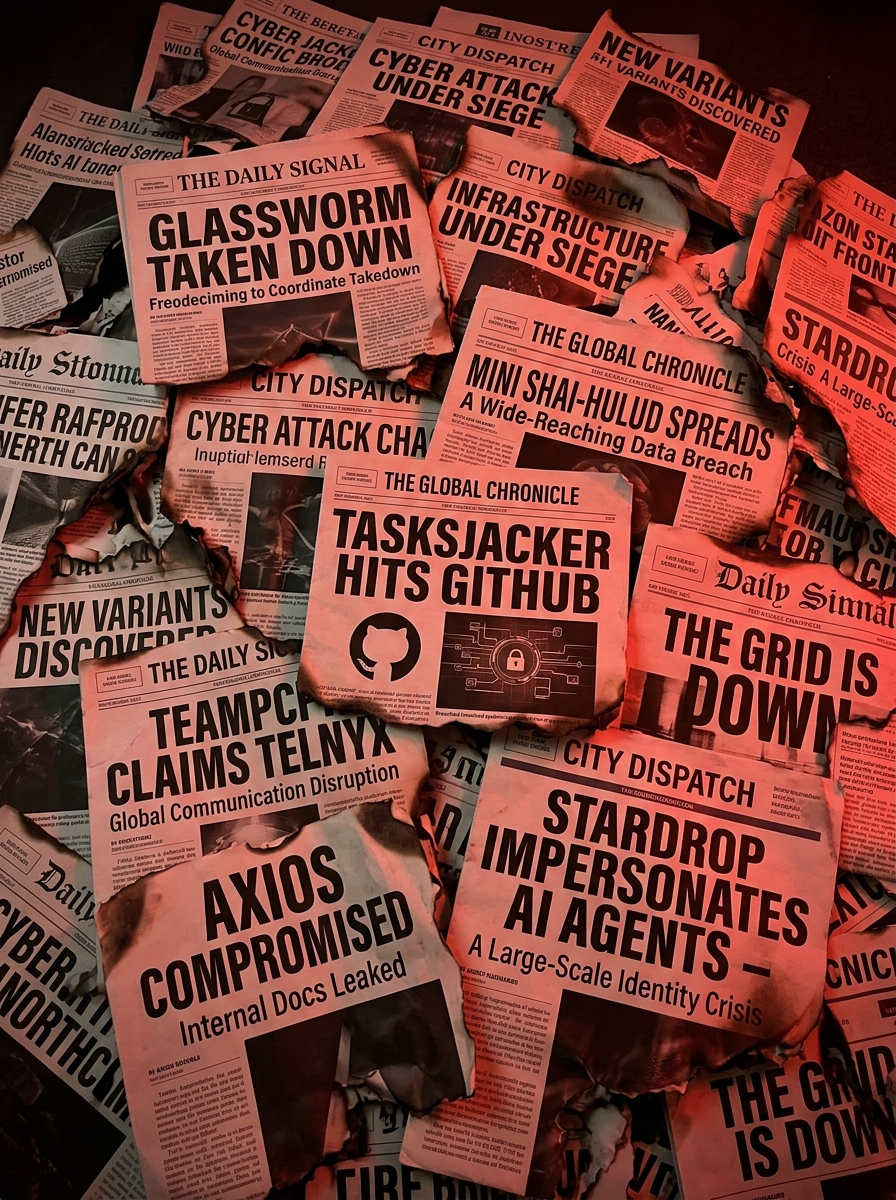 OpenSource Malware: Active Malware Campaigns in January-May 2026
OpenSourceMalware's analysis of active malware campaigns from January-May 2026, covering Lazarus Group's Contagious Interview (fake recruiter outreach delivering BeaverTail/InvisibleFerret via npm, PyPI, Go, Cargo, Packagist) and two new campaigns, TasksJacker (malicious .vscode/tasks.json auto-execution, including payloads hidden in .woff2 font files and fake VS Code dictionary files) and PolinRider (weaponizing stolen credentials via malicious PRs merged into projects like VS Code, Apache Superset, Rails, LangFlow, Expo). It also details TeamPCP's supply chain attack on Trivy's GitHub Actions repos using a leaked Aqua Security PAT to force-push malicious commits across 76 version tags.
 opensourcemalware.comwriteupPublished and added 12 Jun 2026🛡️ Security
- Active Malware Campaigns in January-May 2026
OpenSourceMalware's analysis of active malware campaigns from January-May 2026, focused on Lazarus Group and TeamPCP. Details include Contagious Interview's pivot to abusing .vscode/tasks.json files to deploy BeaverTail/InvisibleFerret, the new TasksJacker campaign (multi-blockchain C2 across TRON/Aptos/BSC, hex-encoded JS hidden in .woff2 font files and a fake spellright.dict) that compromised 400+ repos including DataStax, and the follow-on PolinRider campaign that weaponized stolen credentials via malicious pull requests merged into high-profile projects like VS Code, Apache Superset, Rails, and Expo. Also covers TeamPCP's cascading attack via a leaked Aqua Security service-account PAT used to force-push malicious commits across version tags.
opensourcemalware.comwriteupAdded 3 Sep 2026, published 8 Jun 2026🛡️ Security  JFrog: Keep your Agents Under Control with agent-belt
JFrog open-sourced agent-belt, an Apache 2.0 CLI eval framework that black-box tests real coding-agent CLIs (Claude Code, Codex, Cursor, Copilot, Gemini, Goose, OpenCode) as subprocesses against version-controlled JSON scenarios with rule-based checks and separate LLM-judge scoring. It targets the non-determinism problem in agentic coding — model/CLI updates silently breaking tool selection or MCP behavior — by measuring pass^k across repeated trials, phrasing variants, and multi-judge consensus, with CI-gating exit codes, Docker sandboxing for untrusted-agent runs, and manifest file-locking for concurrent eval runs. It's positioned as complementary to agent governance: governance restricts what an agent can touch, agent-belt verifies whether its actions and outputs are actually correct.
 jfrog.comtoolPublished and added 19 May 2026🛡️ Security
 AI-Assisted Vulnerability Discovery
VulnCheck analyzes CVE Numbering Authority disclosure data and finds sharp YTD increases across Chrome, Mozilla, Apache, VMware, HPE, F5, and GitHub, correlating the surge with the rollout of Anthropic's Project Glasswing and Claude Mythos Preview to partners including Google, Microsoft, and Apple. It walks through per-vendor evidence (Mozilla's Firefox hardening with Mythos, Curl maintainer Daniel Stenberg's mixed false-positive results, and the ActiveMQ CVE-2026-34197 RCE found by Naveen Sunkavally largely via Claude) to argue AI models are now materially accelerating vulnerability discovery, while cautioning it is unclear whether the volume increase will be sustained.
 vulncheck.comarticleAdded 3 Sep 2026, published 15 May 2026🛡️ Security
- OpenCTI-Platform/opencti
OpenCTI is an open source cyber threat intelligence platform for structuring, storing, and visualizing technical (TTPs, observables) and non-technical (attribution, victimology) threat data, built on the STIX2 standard with a GraphQL API and connector framework. It integrates with tools like MISP, TheHive, and MITRE ATT&CK, supports inferred relationships between data points, and offers both an Apache 2.0 Community Edition and a paid Enterprise Edition with additional features.
github.comrepoPublished and added 14 May 2026🛡️ Security - Sim
Sim is an open-source (Apache 2.0) workspace for building, deploying and managing AI agents and workflows, offering a visual flow editor, 1,000+ integrations (Slack, Notion, HubSpot, Salesforce), knowledge base ingestion, and support for every major LLM plus local models via Ollama and vLLM. It ships as a cloud service (sim.ai), a desktop app, or a self-hosted Docker/Kubernetes deployment set up via an npx sim-setup wizard, and is built on Next.js, Bun, PostgreSQL/Drizzle, and ReactFlow.
github.comrepoAdded 22 Sep 2026, published 13 May 2026🧠 AI - knostic/OpenAnt
OpenAnt is Knostic's open-source Apache 2 licensed LLM-based vulnerability discovery tool that runs source code through a two-stage pipeline, an agentic detection phase followed by an attack and verification phase, to filter out false positives and surface exploit-verified findings. It is a Go CLI with a Python analysis backend supporting Go, Python, and several beta languages including JavaScript, C, PHP, Ruby, Zig, Swift, and Rust, with pluggable LLM providers such as Anthropic, OpenAI, Google, Ollama, OpenRouter, and Bedrock, plus diff and PR scoped scanning for CI and a local web UI.
github.comrepoPublished and added 12 May 2026🛡️ Security  Orca Security: Critical Apache HTTP Server HTTP/2 Vulnerability Could Enable Remote Code Execution
Orca Security's write-up of CVE-2026-23918 (CVSS 8.8), a double-free memory corruption bug in Apache HTTP Server's mod_http2 stream cleanup logic. An unauthenticated attacker can trigger it by sending crafted HTTP/2 HEADERS frames followed by an early RST_STREAM with a non-zero error code. This causes heap corruption, crashes, and possibly remote code execution. Version 2.4.66 is affected and 2.4.67 fixes it. Public PoC details exist, but no in-the-wild exploitation had been reported. Disabling HTTP/2 is given as a temporary workaround.
 orca.securityadvisoryPublished and added 8 May 2026🛡️ Security
- PentHertz/LUKSbox
LUKSbox is an open-source (Apache 2.0), pre-1.0 encrypted vault format and CLI/GUI/TUI toolset written in Rust, designed so files can be stored on untrusted cloud/shared media while remaining opaque to the provider. It layers passphrase, FIDO2 hardware authenticators (hmac-secret), and TPM 2.0 sealed keys as unlock factors that all derive a Master Volume Key via HKDF-SHA256, and adds an optional ML-KEM-768/1024 post-quantum sidecar for hybrid encryption. The project publishes its on-disk format spec, threat model, and side-channel notes, and runs libFuzzer/AFL++ harnesses against every parser that touches attacker-controlled bytes (header, keyslot, metadata, hybrid sidecar, WinFsp paths).
github.comrepoPublished and added 8 May 2026🛡️ Security - CVE-2026-41940 (SessionScribe): cPanel/WHM Session Forgery Reverse-Engineered
rfxn's technical dissection of CVE-2026-41940 (SessionScribe), an unauthenticated session-forgery bug in cPanel/WHM that lets an attacker forge a root cpsess session via CRLF injection into the password field of an Authorization: Basic request, exploiting the fact that Cpanel::Session::saveSession() skips the CR/LF-stripping filter_sessiondata() sanitization used by the normal login path, combined with an encoder short-circuit when the whostmgrsession cookie's OBHEX suffix is malformed. The writeup reverse-engineers the patched cpsrvd binaries (since cPanel ships no source for this surface) using a custom snapshot/BinDiff workflow, documents an adjacent lower-severity access-log identity-injection issue, and ships an open-source operator toolkit (ModSecurity rule pack, remote probe, on-host IOC scanner, snapshot collector) plus an architectural recommendation to firewall cpsrvd's direct ports behind Apache+mod_security2 proxy endpoints. Credits researcher Sina Kheirkhah of watchTowr Labs for the original PoC.
 rfxn.comwriteupAdded 18 Sep 2026, published 29 Apr 2026🛡️ Security
- CVE-2024-50306: Unchecked return value in Apache Traffic Server
Writeup of CVE-2024-50306, a vulnerability in Apache Traffic Server (versions 9.0.0-9.2.5 and 10.0.0-10.0.1) where the code fails to check the return value of initgroups() when dropping privileges after startup. If the call fails, the process believes it has dropped supplementary group memberships when it has not, potentially leaving it in a privileged group and enabling privilege escalation. Fixed in ATS 9.2.6/10.0.2 by aborting execution on failure.
 bencteux.fradvisoryAdded 3 Sep 2026, published 17 Nov 2024🛡️ Security