 The OpenSourceMalware Show #27
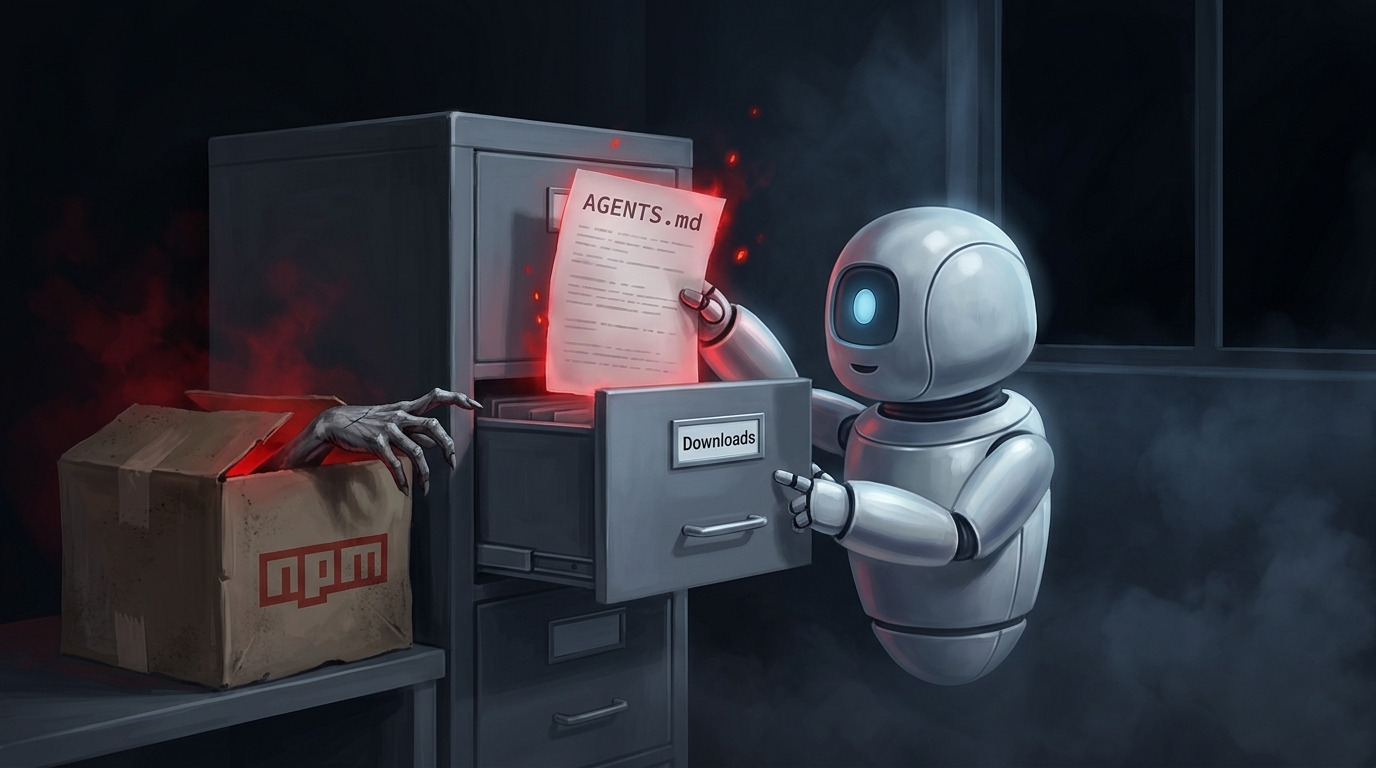
 (28 October 2026) is a podcast episode with transcript. It covers the Brotli decoder bug (CVE-2026-111497) vendored in C code across Python, Rust and PHP, and how to find copies via decode.c. It also covers the LiteLLM v1.107.0 compromise from an unrevoked admin key and a relaxed release control, and the MALFEX npm campaign hiding payloads in PNG-header files, plus an AGENTS.md lure and DPRK fake fonts in TTF/OTF.
 opensourcemalware.comtalkPublished and added 29 Oct 2026🛡️ Security
 Podcast: Kimi K3.1 Pro, the new cyber reality, and Muse musings
Interconnects podcast episode in which Nathan Lambert and Florian Brand discuss the Kimi K3.1 Pro release (about 3 trillion parameters, weights due by November 4th). They cover its Artificial Analysis score against weaker long-horizon results, Moonshot's choice to down-weight offensive cyber capability, and the PHP2Shell and LiteLLM incidents. They also cover abliterated model APIs, trusted-access cyber programs, Anthropic's junior hiring and Florian's use of the Muse agent.
 interconnects.aitalkPublished and added 25 Oct 2026🧠 AI
- Podcast: Kimi K3.1 Pro, the new cyber reality, and Muse musings
Interconnects podcast with Nathan Lambert and Florian Brand on Kimi K3.1 Pro and the AI cyber landscape. Kimi says it down-weighted cyber data in mid-training so its open weights do not extend offensive capability. They discuss the PHP2Shell remote code execution bug, the repeat LiteLLM compromise from an API key left in GitHub for five months, abliterated model APIs, and trusted-access programs from OpenAI and Anthropic. The transcript was truncated at the very end.
interconnects.aitalkPublished and added 25 Oct 2026🛡️ Security - The Hacker News (@TheHackersNews) on X
The Hacker News post relays LiteLLM's root-cause disclosure for its supply chain attack. A master key leaked on GitHub in May was never revoked. Attackers used it to reach the Agent Platform, steal a GitHub owner token, and publish a malicious PyPI release in October. A reply says the agent tool held the org owner's personal CLI login, which skips GitHub's 2FA re-check.
 x.comthreadAdded 26 Oct 2026, published 24 Oct 2026🛡️ Security
 Prasenjit Sarkar (@stretchcloud) on X
Post on the LiteLLM supply-chain compromise. Attackers spent eleven days in the GitHub org, ran a workflow on a throwaway branch to take twenty secrets including a GitHub App private key, then used stolen GitHub CLI OAuth tokens to publish malicious release 1.107.0 from a lookalike Berri-AI repo. A Python startup file harvested sixteen credential categories and LiteLLM proxy Postgres provider keys. Socket flagged the wheels in seven minutes.
x.comthreadAdded 26 Oct 2026, published 24 Oct 2026🛡️ Security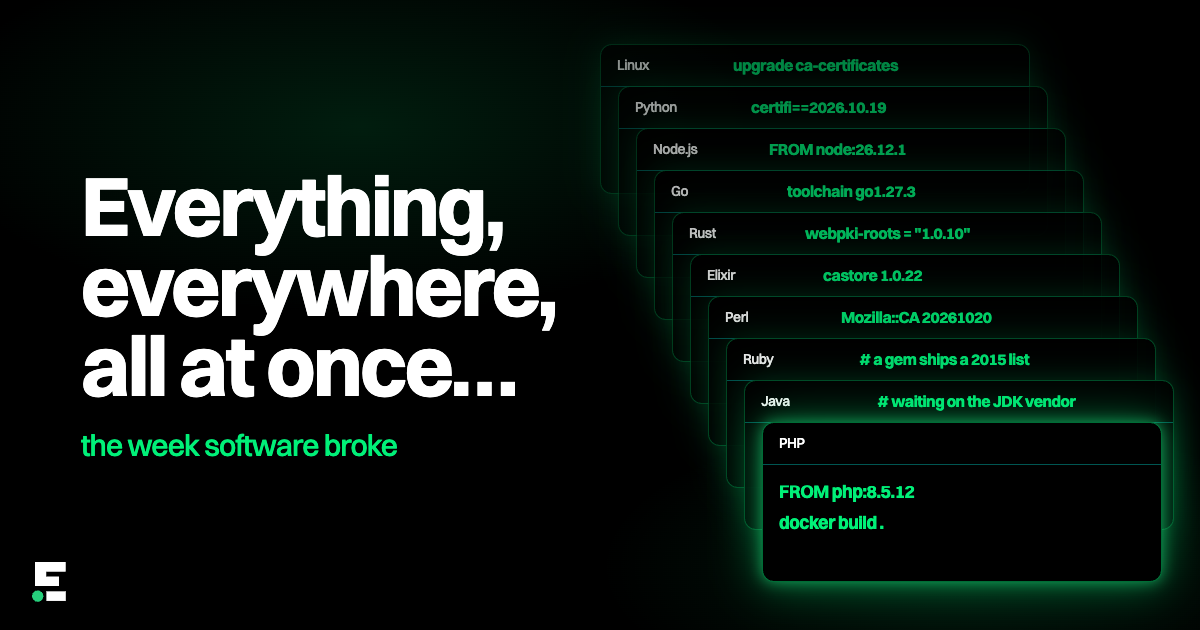 Everything, everywhere, all at once… the week software broke | Endor Labs
Endor Labs roundup of the 20 to 21 October 2026 patch wave: eMudhra certificate authority keys that anyone can recover, PHP2Shell (CVE-2026-109618, CVE-2026-109619), Node2Shell (CVE-2026-111497) and malware in LiteLLM 1.107.0. It lists fixed versions (PHP 8.2.35 to 8.5.12, Node.js 22.23.4, 24.22.1, 26.12.1, LiteLLM back to 1.106.2) and explains why many separate trust-store copies each need updating. It closes with advice on triage, remediation and SBOM/VEX reporting.
 endorlabs.comarticlePublished and added 24 Oct 2026🛡️ Security
 New Evidence Shows LiteLLM Secret-Stealing Workflows Ran 11 Days Before Supply Chain Attack
Socket's Threat Research team reports that malicious cache.yml workflows ran in the BerriAI/litellm repository on 10 and 12 October 2026, eleven days before the 21 October release attack that published litellm==1.107.0. Each commit pushed to a short-lived ci-tmp-<hex> branch, then deleted it, sending base64-encoded CI secrets to webhook.site. Evidence comes from Actions metrics and environment deployment records; 20 secret names were exposed.
 socket.devwriteupPublished and added 23 Oct 2026🛡️ Security
 Inside the LiteLLM 1.107.0 supply chain compromise: Credential theft through Python startup hooks
Microsoft's analysis of the LiteLLM 1.107.0 compromise, published to PyPI and container images on 21 October 2026. The wheel shipped cook.pth, cook.py and sitecustomize.py, so a credential collector (PRIVCOLLECT) ran whenever Python started, even without importing LiteLLM. It covers AES/RSA-encrypted exfiltration to litellm.dev, a re-armable Unix loader, Defender KQL hunting queries, ATT&CK mapping and rotation guidance.
 microsoft.comwriteupPublished and added 23 Oct 2026🛡️ Security
 [AINews] Black October
AINews issue for 21-22 October 2026, built from 12 subreddits and 544 Twitter accounts. It leads with "Black October", a 48-hour run of AI-found vulnerability disclosures (PHP2Shell, a GitLab CVSS 10 flaw, a LiteLLM 1.107.0 password stealer, eMudhra CA keys). It also covers MiniMax M3.1 Flash, Carbon-X and Flint releases, Artificial Analysis coding-agent and CritPt v2 results, and a METR/Redwood audit of OpenAI monitoring.
 latent.spacearticlePublished and added 23 Oct 2026🧠 AI
 LiteLLM Compromised in Fresh Supply Chain Attack
LiteLLM version 1.107.0 was published with malware to PyPI and Docker Hub on October 21, for about three hours and roughly 49,000 downloads. Attackers used GitHub CLI OAuth tokens, likely leaked through Claude Code into LiteLLM logs, to disable branch protections, redirect the releaser to a lookalike repository and sign poisoned artifacts. The payload is an infostealer and RAT; Wiz saw Amazon Bedrock abuse. The last clean version is 1.106.2.
 securityweek.comarticlePublished and added 23 Oct 2026🛡️ Security
- Dark Web Intelligence (@DailyDarkWeb) on X
LiteLLM suspects its October 21 release compromise began with Claude Code responses containing GitHub CLI OAuth tokens that were written to logs of an internet-facing internal LiteLLM gateway. Attackers allegedly stole those tokens, used an organization-owner token to disable branch protections, and pushed poisoned artifacts from a lookalike repository. How they entered the gateway is unconfirmed, and this is not a proven Claude Code vulnerability.
x.comthreadAdded 25 Oct 2026, published 22 Oct 2026🛡️ Security - Muscle AI (@themuscleai) on X
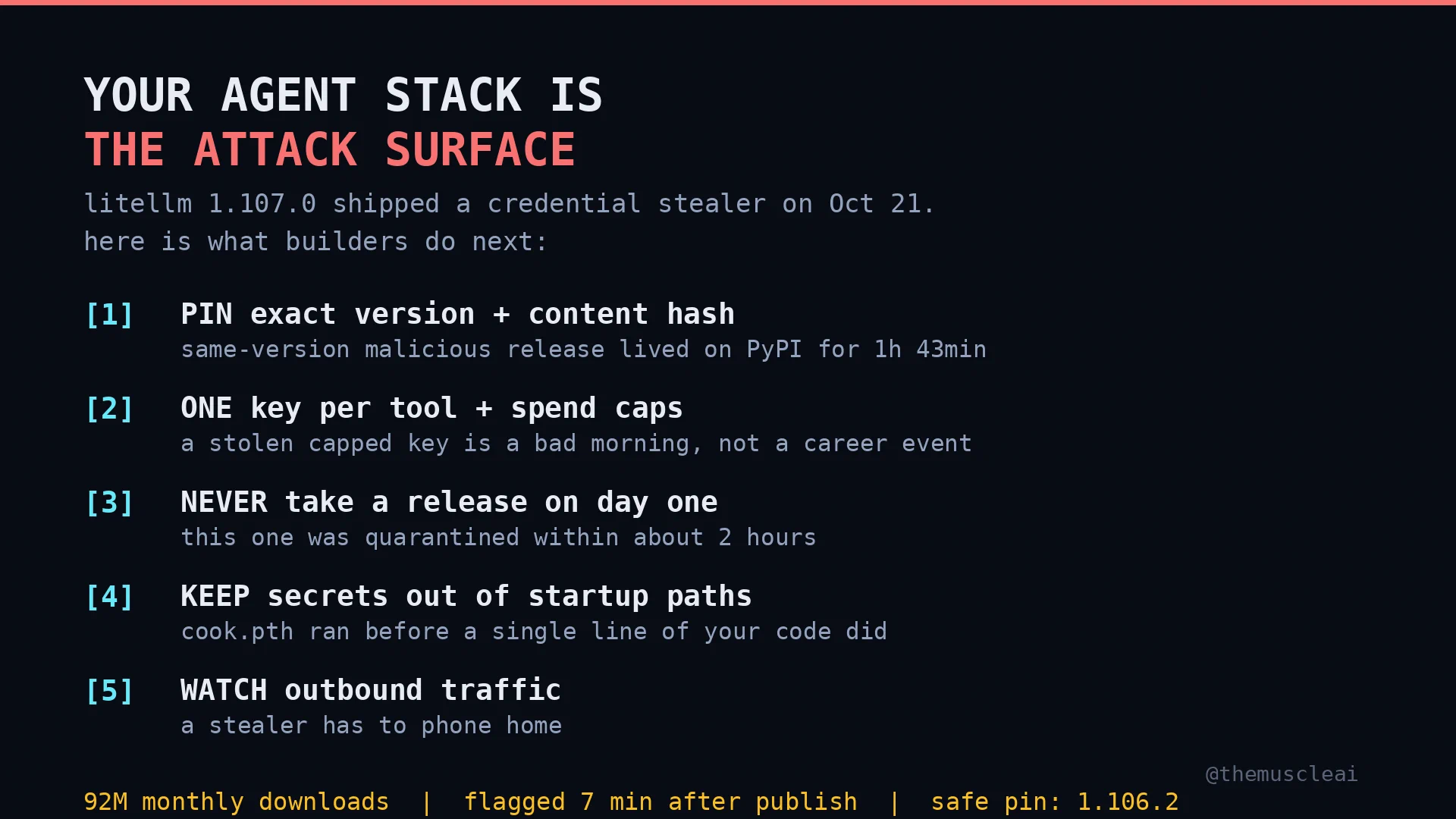
Post on the LiteLLM 1.107.0 PyPI compromise published 21 October 2026 and quarantined about 1 hour 43 minutes later. A malicious .pth file ran at Python startup and stole cloud credentials, private keys, browser data and AI tool auth files, then POSTed a tarball to an attacker endpoint. The author says attackers used stolen GitHub CLI OAuth tokens to push a trojanized commit chain and build official wheels. It lists five defenses: hash-pinned lockfiles, per-tool capped keys, release cooling periods, secret isolation and egress monitoring.
x.comthreadAdded 23 Oct 2026, published 22 Oct 2026🛡️ Security - Muscle AI (@themuscleai) on X
Muse AI's X post describes the compromise of LiteLLM 1.107.0, published to PyPI on 21 October at 7:39 AM and quarantined about 1 hour 43 minutes later. The payload was a .pth file that ran at Python startup and sent cloud credentials, private keys and AI dev-tool auth files to an attacker endpoint. The author lists five agent-builder defences: hash-locked pins, capped per-tool keys, a release cooling period, keeping secrets away from Python startup, and outbound traffic monitoring.
x.comarticleAdded 23 Oct 2026, published 22 Oct 2026🧠 AI  SecureChap (@SecureChap) on X
Post describing a LiteLLM 1.107.0 PyPI compromise in which attackers used stolen GitHub CLI OAuth tokens from three engineers to trigger and approve the project-releaser workflow, producing eight malicious wheels and a tampered tarball. The wheels drop cook.pth, which runs at Python startup, and privcollect steals cloud tokens, keys, browser data, AI configs and LiteLLM proxy credentials, exfiltrating to litellm[.]dev/healthcheck. A second daemon polls a GitHub domain.txt hourly for new domains to fetch and execute. PyPI yanked the package the same day. The post is a single unsourced tweet.
x.comthreadPublished and added 22 Oct 2026🛡️ Security- Show HN: Omnara – Open-source alternative to Claude Managed Agents
Omnara is an open-source, self-hostable managed agent platform, an alternative to Claude Managed Agents and OpenAI's Agents API. It runs agents on any model (OpenAI, Anthropic, OpenRouter, Bedrock, LiteLLM, Ollama) and any machine, with Postgres-backed durable state, stateless workers, per-tool permissions, MCP, skills, memory, subagents, schedules and Slack, Discord and GitHub triggers. It ships a REST API, TypeScript SDK, CLI and Docker Compose setup.
 github.comrepoAdded 23 Oct 2026, published 21 Oct 2026🧠 AI
 LiteLLM 1.107.0 Compromised: Python Startup Hooks Steal Cloud, AI, and Proxy Credentials | Endor Labs
litellm 1.107.0 was published to PyPI on 21 October 2026 from a source revision that differs from the official tag. One line in the Maturin config (data = "cook") installs cook.pth, cook.py and sitecustomize.py, which run on every Python start. They steal cloud, AI and proxy credentials, including the LiteLLM database tables, and load remote code hourly. The post gives IOCs, a five-step response plan and hardening advice.
endorlabs.comwriteupPublished and added 21 Oct 2026🛡️ Security Billy Lee (@billyozno) on X
LiteLLM 1.107.0 on PyPI shipped malware in all 7 wheels, the package's second supply-chain attack this year. It steals SSH keys, cloud credentials, browser passwords, AI tool configs and API keys, and installs a backdoor that polls for commands hourly. The GitHub source is clean, so a hijacked build or publish step is suspected. PyPI quarantined the release, but Aikido says the Docker image litellm/litellm:1.107.0 was still live. Indicators are cook.pth, cook.py and sitecustomize.py in site-packages. The advice is to rotate reachable keys and pin 1.106.2.
x.comthreadAdded 23 Oct 2026, published 21 Oct 2026🛡️ Security litellm 1.107.0 Compromised on PyPI: Backdoored Wheels Drop a Credential Stealer and an Hourly Remote Code Loader
litellm 1.107.0 was published to PyPI on 21 October 2026 with all seven wheels backdoored through an injected `data = "cook"` maturin build line. The wheels drop cook.pth, cook.py and sitecustomize.py, which run on every Python start. They install a "privcollect" credential stealer (browser, SSH, cloud, AI coding tool and LiteLLM proxy database secrets, sent to litellm.dev) and an hourly GitHub dead-drop remote code loader. The post gives IOCs, detection commands and recovery steps.
 stepsecurity.iowriteupPublished and added 21 Oct 2026🛡️ Security
 LiteLLM Compromised, Steals Credentials
LiteLLM version 1.107.0 was uploaded to PyPI on 21 October 2026 with a credential stealer, and the same build reached GHCR and Docker Hub images. Wiz describes the three dropped files (cook.pth, cook.py, sitecustomize.py), exfiltration to a fake litellm.dev domain, a GitHub dead drop for a second stage, and the malicious commits pushed through the lookalike Berri-AI repository. The last safe version is 1.106.2.
 wiz.iowriteupPublished and added 21 Oct 2026🛡️ Security
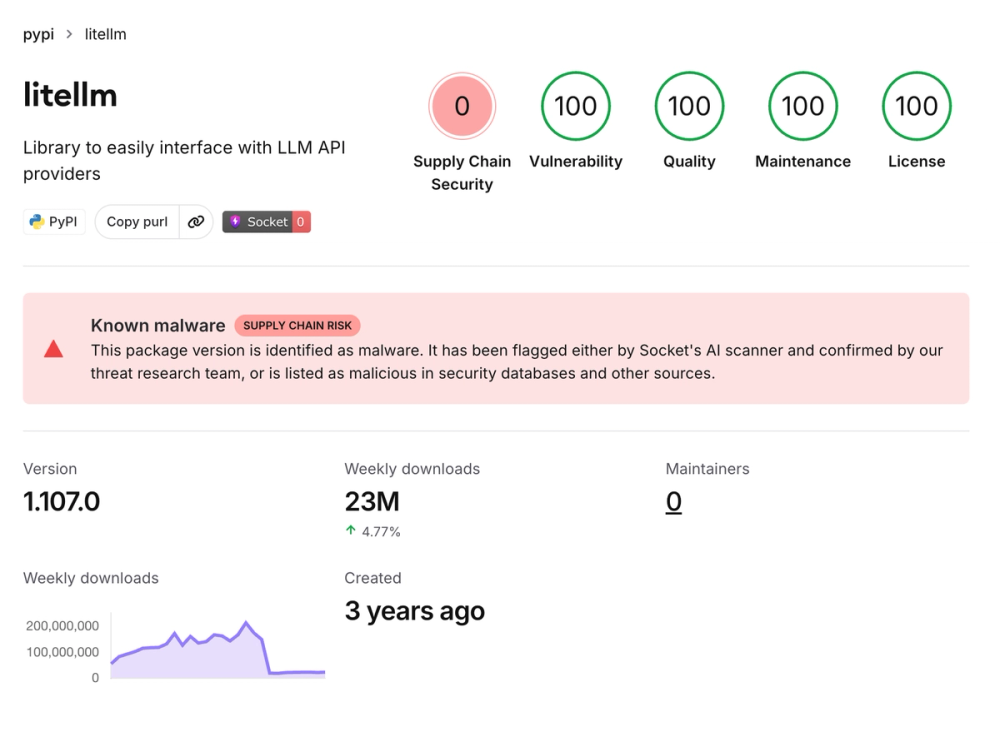 LiteLLM PyPI Package and Docker Images Compromised to Steal Cloud and AI Credentials
LiteLLM 1.107.0 on PyPI and GHCR images shipped Python startup hooks (cook.pth, sitecustomize.py) that steal cloud, SSH, browser and AI-tool credentials, including LiteLLM proxy database credentials. Image build provenance recorded a lookalike Berri-AI/litellm source repository. The post decodes the payload, encrypted exfiltration and GitHub-driven remote loader, and lists containment steps, MITRE ATT&CK mappings and IOCs.
socket.devwriteupPublished and added 21 Oct 2026🛡️ Security LiteLLM 1.107.0 PyPI Wheel Contains a Credential Stealer and Persistent Python Backdoor
LiteLLM 1.107.0 macOS x86-64 PyPI wheel analyzed by OpenSourceMalware contains three injected files (cook.pth, cook.py, sitecustomize.py) that run on every Python start. The payload, called privcollect, steals browser, SSH, cloud, CI/CD and AI-tool credentials, then uploads an AES/RSA-encrypted bundle to www.litellm.dev/healthcheck. A forked loader also fetches domain.txt from GitHub and executes /codepy hourly. The post lists IOCs, hashes and remediation steps.
opensourcemalware.comwriteupPublished and added 21 Oct 2026🛡️ Security LiteLLM compromised again: infostealer and RAT found in version 1.107.0
LiteLLM 1.107.0 was compromised on 21 October 2026: the seven compiled PyPI wheels and the official Docker image carried an infostealer and a RAT. The attacker used the maturin `data = "cook"` directive in pyproject.toml to inject cook.pth, cook.py and sitecustomize.py without touching the source repo. The post lists stolen data, the hourly C2 polling via GitHub, wheel hashes, file and network IOCs, and check steps.
 aikido.devwriteupPublished and added 21 Oct 2026🛡️ Security
 JFrog Security (@JFrogSecurity) on X
JFrog Security Research warns that the LiteLLM 1.107.0 release on PyPI contains malicious code, as part of a supply-chain attack. It advises avoiding that version and investigating any environment where it was installed or executed. The post gives no technical detail, payload description or IOCs, and says a blog post will follow.
x.comadvisoryAdded 23 Oct 2026, published 21 Oct 2026🛡️ Security LiteLLM supply chain compromise: What you need to know
LiteLLM version 1.107.0 was published to PyPI and official Docker images on 21 October 2026 and stayed live for about two hours. Attackers used stolen GitHub CLI OAuth tokens from three engineers to run the release pipeline against a lookalike fork, Berri-AI/litellm. The payload (cook.pth, cook.py, sitecustomize.py) steals cloud, developer, AI-tool and browser credentials, and includes a polling RAT. The post lists removal and rotation steps.
 securitylabs.datadoghq.comwriteupAdded 29 Oct 2026, published 21 Oct 2026🛡️ Security
- eliasbiondo/antirion
Antirion is an open-source AI gateway shipped as one Rust binary with a built-in admin console. It sits between apps and providers such as OpenAI, Anthropic, Bedrock, Vertex and vLLM, translating between OpenAI, Anthropic, Gemini and Bedrock dialects. It covers routing with fallbacks and circuit breakers, budgets, guardrails, caching, MCP and A2A gateways, SSO, and a benchmark against Bifrost 2.2.4 and LiteLLM 1.103.1.
github.comrepoAdded 21 Oct 2026, published 17 Oct 2026🧠 AI - ♫Why♥Not♪ (@Python_s_) on X
Alert thread on CVE-2026-35029 (CVSS v4.0 8.7) in LiteLLM Proxy, versions before 1.83.0. A low-privilege authenticated user can bypass admin authorization on /config/update, change runtime settings, read server files, take over admin credentials and run Python through remotely loaded modules (S3/GCS-hosted). Check Point Research published a full execution chain on October 13 after the April 2026 disclosure. The post lists hunting pointers (non-admin POSTs to /config/update, env-var changes, unexpected pass-through endpoints, cloud module loading) and advises upgrading to 1.83.9 or later and rotating credentials.
x.comadvisoryPublished and added 13 Oct 2026🛡️ Security  Top GenAI security resources — October 2026
Adversa AI's October 2026 roundup of 38 GenAI security resources, grouped into attack techniques, defenses, red teaming, vulnerabilities, incidents, articles and frameworks. Highlights include Anthropic's finding that GLM-5.3 safeguards collapse under prefill and abliteration, capability laundering and activation-dilution jailbreaks, RAG poisoning attacks, the LiteLLM proxy flaw (CVE-2026-35029), and the SGLang pickle RCE (CVE-2026-86793). It also covers a joint US advisory on industrial-scale model distillation. It closes with advice to assume model safeguards can be removed and to harden the serving stack around the model.
 adversa.aiarticlePublished and added 13 Oct 2026🛡️ Security
 Google Pixel 10 Exploits Earned Hackers $560,000 at Pwn2Own
Coverage of Pwn2Own Ireland 2026 results: contestants earned over $1.2 million total, with Google Pixel 10 exploits alone paying out $560,000 across three teams. Ikotas Labs won the full $300,000 Pixel payout by chaining multiple bugs for remote compromise, while Tim Becker/Yves Bieri and Dimitrios Valsamaras/Ken Gannon earned reduced payouts for exploits involving previously known flaws. Other notable rewards went for hacks of the Samsung Galaxy S26, Sonos Era 300 speaker, Philips Hue Bridge Pro, Home Assistant Green hub, Lexmark/Brother/Canon printers, Garmin Index BPM, and AI infrastructure including Oracle Autonomous AI Database, OpenAI Codex, Nvidia Dynamo, and LiteLLM.
securityweek.comarticlePublished and added 9 Oct 2026🛡️ Security Top MCP security resources — October 2026
Adversa AI's October 2026 MCP security roundup, aggregating and synthesizing 15 resources: authentication-bypass vulnerabilities in LiteLLM's MCP endpoint (CVE-2026-59822, now CISA KEV), Grafana's MCP server session spoofing/SSRF (CVE-2026-19516), an MCP Python SDK OAuth-fallback flaw exploited by a malicious server returning a 404, and an Obot gateway route-matching bypass reopening GHSA-vw82. It also covers detection failures (two malicious MCP servers passing five scanners including Cisco mcp-scanner and Snyk agent-scan, 12% of 82,000 public MCP configs hardcoding secrets), a malicious npm wallet-signing package (gadgethumans-mcp), the A2M agent-hijacking attack technique, and CoSAI's MCP Security v2.0 governance model.
adversa.aiarticlePublished and added 8 Oct 2026🛡️ Security- DeepZero
DeepZero is an open-source orchestration engine that lets researchers define vulnerability-research pipelines declaratively in YAML, handling parallel execution (ThreadPoolExecutor), resumable/fault-tolerant state, and LLM-assessment stages via LiteLLM/Jinja2 prompts. It ships example processors for Ghidra headless decompilation, LOLDrivers.io hash exclusion filtering, PE header/driver metadata extraction, and batch Semgrep scanning, with a dedicated pipeline for BYOVD kernel driver vulnerability research. An extensibility model lets users plug in custom Python processors referenced by path in the YAML config.
github.comrepoAdded 3 Oct 2026🛡️ Security  Vulnerability Discovery and Exploitation Trends in the AI Era (Google Cloud)
Google Threat Intelligence Group analyzes vulnerability disclosure and exploitation trends from January 2025 to August 2026, finding disclosures doubled, exploitation nearly doubled, and AI-assisted discovery surfaces proportionally more Medium and High-risk flaws, with 50 percent leading to remote code execution versus 26 percent baseline. It documents real-world exploitation of an AI-discovered CVE in BeyondTrust PRA and a surge in vulnerabilities targeting the AI/LLM operational stack, especially agent orchestration frameworks like Langflow and Flowise and inference gateways like LiteLLM and vLLM, citing specific CVEs in those products.
 cloud.google.comarticleAdded 8 Oct 2026, published 30 Sep 2026🛡️ Security
 LiteLLM Flaw CVE-2026-42271 Exploited in the Wild, Chains to Unauthenticated RCE
CISA added CVE-2026-42271, a command injection flaw in BerriAI's LiteLLM AI gateway, to its KEV catalog after confirming active exploitation; the bug lets any authenticated proxy user run arbitrary commands via the MCP server test endpoints (/mcp-rest/test/connection and /mcp-rest/test/tools/list), which spawned attacker-supplied stdio subprocess configs. Horizon3.ai separately showed the flaw can be chained with CVE-2026-48710, a Starlette "BadHost" header validation bypass, to skip authentication entirely and achieve unauthenticated RCE (combined CVSS 10.0), exposing model provider credentials and enabling lateral movement into AI infrastructure. Fixed in LiteLLM 1.83.7 (test endpoints now require PROXY_ADMIN role) and Starlette 1.0.1; the article also notes a prior LiteLLM SQLi (CVE-2026-42208) exploited within 36 hours of disclosure.
 thehackernews.comarticleAdded 26 Sep 2026🛡️ Security
- CVE-2026-42271: LiteLLM is a proxy server (AI Gateway) to call LLM APIs in OpenAI (or native) format
CVE-2026-42271 describes an unauthenticated-privilege RCE in LiteLLM (versions 1.74.2 to before 1.83.7): the MCP server preview endpoints POST /mcp-rest/test/connection and POST /mcp-rest/test/tools/list accept a full stdio MCP server config (command, args, env) and spawn it as a subprocess on the proxy host, gated only by a valid API key with no role check. Any authenticated user, including low-privilege internal-user keys, could run arbitrary commands on the LiteLLM proxy host. Patched in v1.83.7; also tracked as GHSA-v4p8-mg3p-g94g and affects Red Hat OpenShift AI.
 nvd.nist.govadvisoryAdded 26 Sep 2026🛡️ Security
- CISA Adds Seven Known Exploited Vulnerabilities to Catalog | CISA
CISA added seven vulnerabilities to its Known Exploited Vulnerabilities Catalog on the basis of active exploitation. They are SQL injection in Sangoma Switchvox, HTTP request/response smuggling in Kludex Starlette, OS command injection in Kestra OSS, improper authentication in BerriAI LiteLLM and JFrog Artifactory, and SSRF plus OS command injection in SonicWall SMA1000 appliances. The alert restates BOD 26-04, which makes federal agencies prioritise rapid remediation of KEV CVEs on publicly exposed assets that grant total control after exploitation. It also requires agencies to check for prior compromise before patching.
 cisa.govadvisoryAdded 26 Sep 2026🛡️ Security
- Warning: Vulnerability in Starlette framework and related frameworks like FastAPI exposes millions of servers to authentication bypass, Patch Immediately! | CCB Belgium
Belgian CCB advisory on CVE-2026-48710 ("BadHost", CVSS 6.5), an authentication bypass in Starlette versions before 1.0.1. The Host header was not validated when request.url was rebuilt, so request.url.path could differ from the routed path. Middleware and endpoints that enforce access control on request.url could therefore be bypassed. The flaw affects FastAPI, LiteLLM, vLLM, MCP servers and other Python LLM infrastructure, and may expose stored third-party credentials. The advisory recommends upgrading to 1.0.1 or later and increasing monitoring, and links to the badhost.org scanner and to the GitHub, OSTIF, X41 D-Sec and Ars Technica write-ups.
 ccb.belgium.beadvisoryAdded 26 Sep 2026🛡️ Security
 SolarWinds took a nation-state. The next attack just needs an LLM and $5. | Blog | Endor Labs
Endor Labs blog tracing an accelerating pattern of software supply-chain compromises from July 2025 through March 2026, culminating in the TeamPCP threat actor's cascading 30-day compromise of Aqua Security, Trivy, GitHub Actions, Docker Hub, npm, OpenVSX, and PyPI (including backdooring the 95M-download LiteLLM package). It argues AI is accelerating both offense (CVE-GENIE reproducing 51% of CVE exploits for $2.77 each) and the attack surface (the Cline prompt-injection-to-npm-token-theft chain, Nx's AI-review-evading payload), and calls for treating AI coding agents as privileged actors, pinning GitHub Actions to SHAs, and platform-level fixes like immutable tags and Sigstore/OIDC.
endorlabs.comarticlePublished and added 11 Sep 2026🛡️ Security Off Guard: Breaking LiteLLM from authentication bypass to cloud compromise
Wiz researchers chain three LiteLLM flaws into a full pre-auth-to-cloud-compromise path: an MCP endpoint authentication bypass (CVE-2026-59822) that grants a session with any garbage Bearer token, a custom-code-guardrail sandbox bypass leading to root RCE (CVE-2026-59821) via exec() on unsanitized admin-submitted Python, and a config-endpoint authorization gap (CVE-2026-35029). They also show pass-through endpoints can be pointed at the AWS IMDS to steal IAM credentials, bypassing IMDSv2 via header-prefix forwarding. A scan of ~3,074 internet-facing instances found 9.6% accepting the default sk-1234 master key or no auth at all, and CVE-2026-59822 is now in CISA's KEV catalog with observed in-the-wild exploitation.
wiz.iowriteupPublished and added 9 Sep 2026🛡️ Security The Evolution of JFrog AI Catalog: Your AI Control Plane for Agentic Development
JFrog vendor post arguing that agentic development (ADLC) introduces new unvetted supply chains — models, MCP servers, skills/plugins, hooks, and APM packages — that bypass traditional signature-based scanning. It cites real incidents: a malicious MCP server impersonating Postmark's email MCP that BCC'd all agent-sent emails to an attacker, and the 'omnicogg' malicious Claude/agent skill that hid a 22MB encoded payload and evaded all 65 VirusTotal engines for 5,000+ installs, plus references to 2026 supply-chain attacks on LiteLLM, TanStack, and Mistral AI. It then pitches JFrog AI Catalog's expanded MCP/skill/model registries as the fix.
 jfrog.comarticleAdded 3 Sep 2026, published 2 Sep 2026🛡️ Security
 LiteLLM
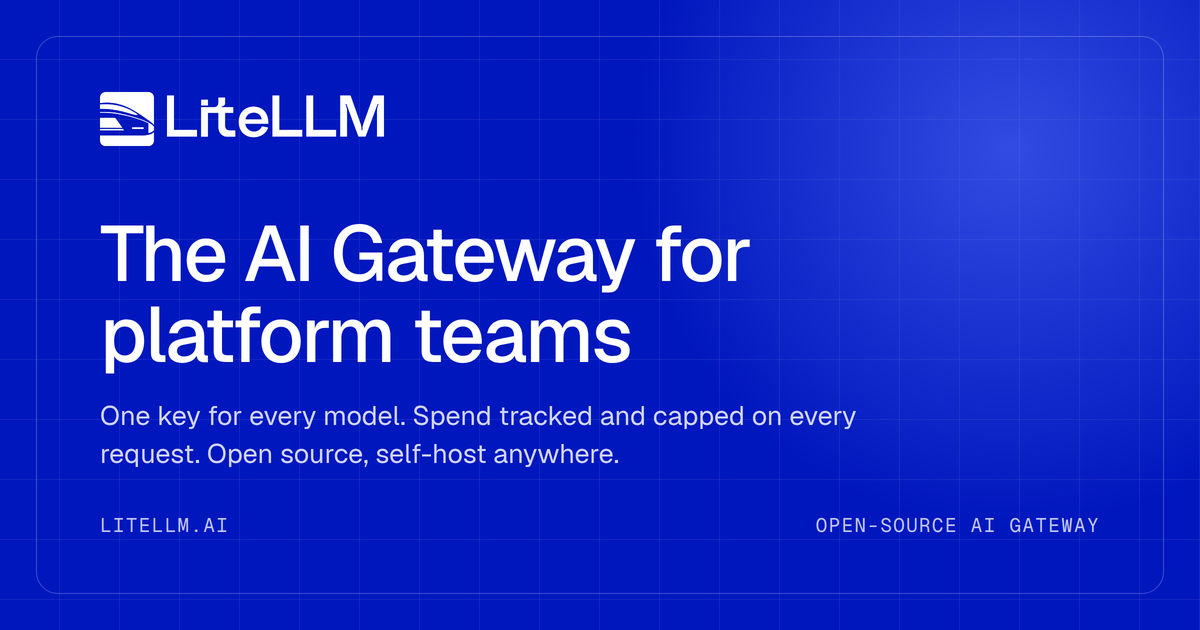
 is an open-source (MIT) AI gateway that puts 140+ LLM providers, agents and MCP servers behind one OpenAI-compatible API. It adds virtual keys, per-team budgets and rate limits, SSO/JWT/RBAC with SCIM, audit logs, leaked-key protection, and guardrails for PII masking and prompt injection (Presidio, Lakera). It self-hosts via Helm, Terraform or Docker, including air-gapped, with Cosign-signed non-root images, Grype and CodeQL scanning, and secrets pulled from Vault or cloud secret managers. A new Rust gateway is benchmarked at 0.66 ms p99 overhead.
 litellm.aitoolAdded 3 Sep 2026, published 31 Aug 2026🛡️ Security
- LiteLLM
LiteLLM is an open-source (MIT) AI gateway that puts 140+ providers and 1,800+ models, plus agents and MCP servers, behind one OpenAI-compatible API with SSO and virtual keys. It adds per-key/team/org spend tracking, hard budgets, rate limits, guardrails, audit logs, load balancing, lowest-cost and auto routing, and response/semantic caching (Redis, S3, GCS). It self-hosts via Helm, Terraform or Docker, including air-gapped, and the page cites a new Rust gateway with 0.66 ms p99 overhead measured with the public AI Gateway Bench.
litellm.aitoolAdded 10 Oct 2026, published 31 Aug 2026🧠 AI  Inside 90 days of attacks on AI infrastructure
Wiz Threat Research ran honeypots across LiteLLM, Flowise, LangChain, Langflow, ChromaDB, Ollama and other AI/ML services for 90 days, capturing active exploitation of an MCP Gateway auth bypass (CVE-2026-59822) and an MCP server test-endpoint command injection (CVE-2026-42271, in CISA KEV, chainable with Starlette CVE-2026-48710 for unauthenticated RCE and linked to Qilin ransomware exploitation) used to deploy fileless cryptominers. It also documents blind prompt injection campaigns against LangChain, Flowise, OpenWebUI, and Node-RED agents that trigger OS command execution confirmed via out-of-band DNS callbacks to OAST domains.
wiz.iowriteupAdded 3 Sep 2026, published 27 Aug 2026🛡️ Security When AI infrastructure becomes the target: Securing gateways and control points | Microsoft Security Blog
Microsoft documents three observed compromises of AI infrastructure: a LiteLLM gateway (CVE-2026-42271 chained with CVE-2026-48710), a RAGFlow deployment (SSRF probing then runtime hook stealing LLM credentials), and a Kestra workflow engine (CVE-2026-49869 auth bypass). Attackers harvested credentials from /proc/1/environ and Azure PostgreSQL, deployed XMRig miners, and persisted via authorized_keys, cron and chattr. The post provides Defender XDR KQL hunting queries, IOCs, and hardening guidance such as treating AI gateways as Tier-0 secret stores and enforcing deny-by-default egress.
microsoft.comarticleAdded 28 Aug 2026, published 26 Aug 2026🛡️ Security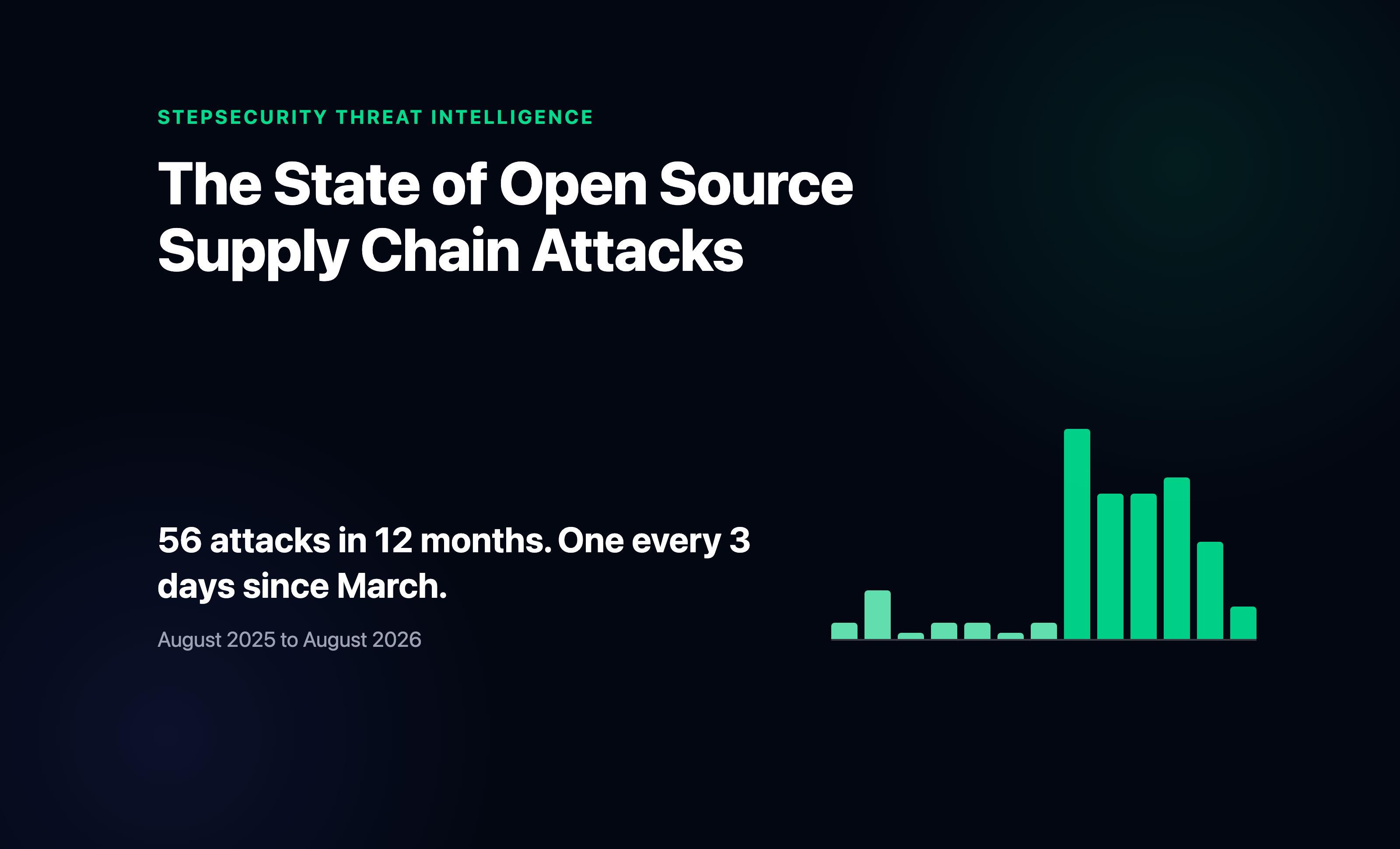 The State of Open Source Supply Chain Attacks
StepSecurity's threat intelligence team's annual report tallies 56 confirmed software supply chain attacks between August 2025 and August 2026, showing an over 8x acceleration since February 2026 driven by self-propagating worms (Shai-Hulud, Shai-Hulud 2.0, CanisterWorm, Miasma, ChainDrop) and mutable GitHub Actions tags. It details the five-day TeamPCP campaign that stole 78,330 secrets from 2,186 organizations by poisoning Trivy Action, Checkmarx KICS, telnyx, and LiteLLM, plus compromises spanning npm, PyPI, RubyGems, Composer, and crates.io.
stepsecurity.ioarticleAdded 3 Sep 2026, published 23 Aug 2026🛡️ Security- Deep Eye
Deep Eye is an open-source Python pentesting framework that orchestrates 11 AI providers (OpenAI, Claude, Grok, Gemini, Ollama, Groq, Mistral, OpenRouter, LiteLLM, LM Studio, and more) with automatic failover to generate context-aware attack payloads for 50+ vulnerability classes including SQLi, XSS, SSRF, IDOR, JWT and GraphQL flaws. It adds an RAG-indexed CVE intelligence DB built from NVD/MITRE/Exploit-DB, AI-based finding triage and false-positive filtering, Nuclei-style YAML templates, Playwright browser automation, CAPTCHA-solving (reCAPTCHA/hCaptcha/Turnstile/Arkose), mitmproxy interception, and auto-generated HackerOne-style bug bounty reports with PCI-DSS/SOC2/ISO 27001 compliance mapping, SARIF/JUnit export, scan diffing, and retest workflows.
github.comrepoAdded 3 Sep 2026, published 22 Aug 2026🛡️ Security 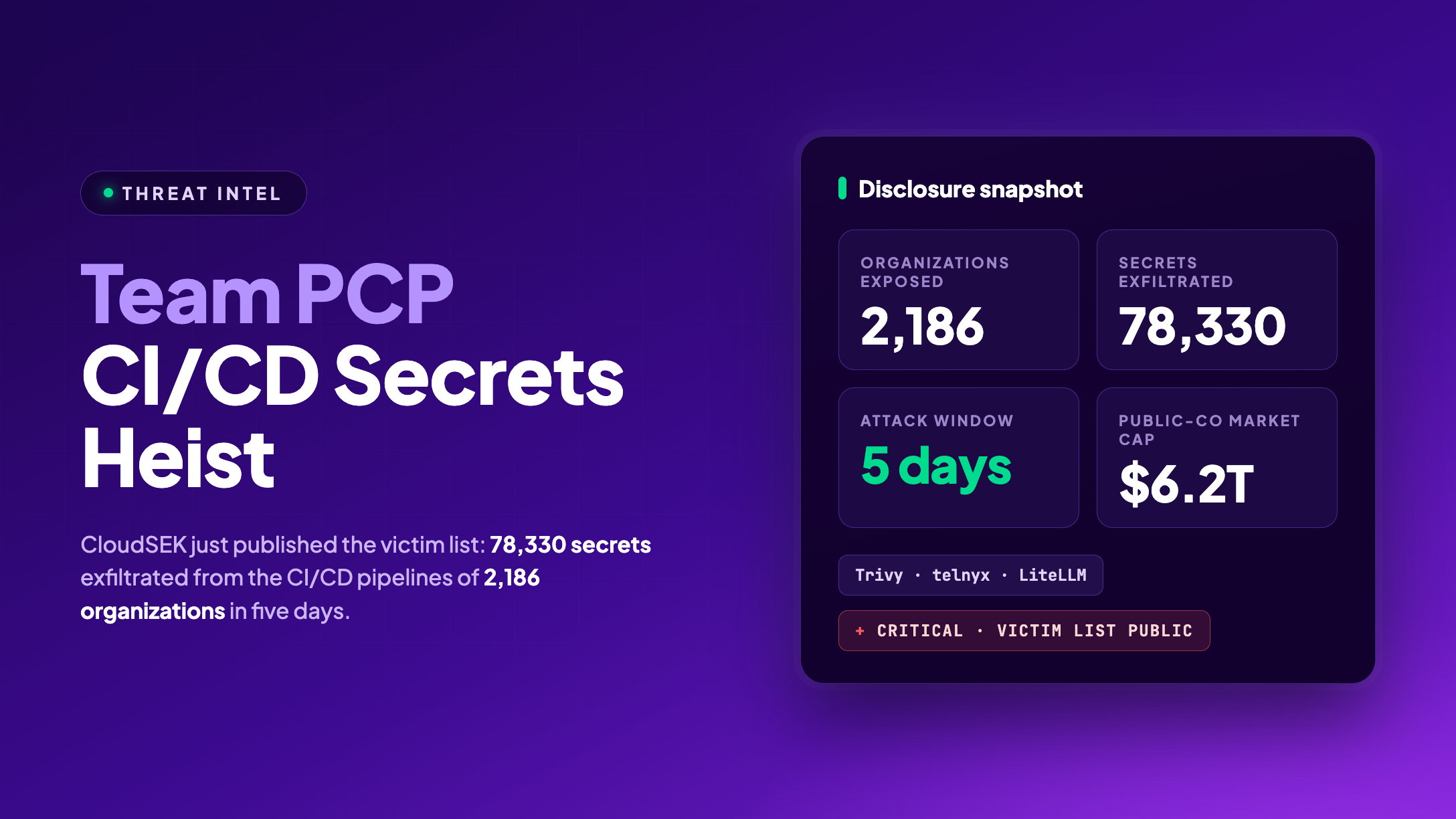 Team PCP Stole 78,330 Secrets From 2,186 Organizations. CloudSEK Just Published the List.
StepSecurity analyzes CloudSEK's newly published dataset on TeamPCP, a threat actor that compromised trusted open-source CI/CD components (Trivy GitHub Action, Checkmarx KICS action, telnyx PyPI package, LiteLLM) to harvest 78,330 secrets from 2,186 organizations' CI/CD pipelines across GitHub Actions, GitLab, and Azure DevOps in five days in March 2026. The post breaks down which platforms and credential types were exposed (GitLab led, 230+ Azure DevOps orgs, 157 leaked OpenAI keys) and maps layered CI/CD runtime controls (egress control, runner lockdown, imposter-commit detection, workflow policies) as mitigations against this class of attack.
stepsecurity.ioarticleAdded 3 Sep 2026, published 15 Aug 2026🛡️ Security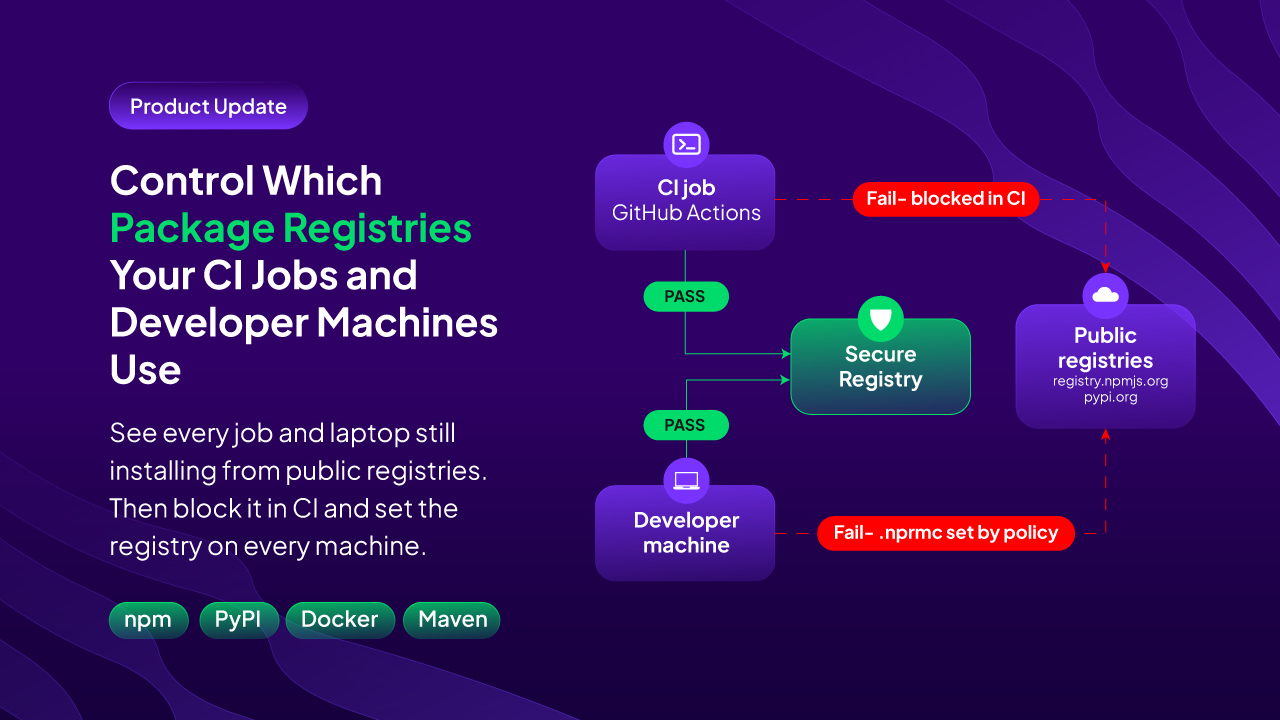 Control Which Package Registries Your CI Jobs and Developer Machines Use
StepSecurity describes two dashboard controls that close the visibility gap left when engineering teams believe they've migrated off public package registries: one uses Harden Runner to behaviorally monitor a CI job's actual outbound network calls for hits to public registries like registry.npmjs.org or pypi.org, and the other uses Dev Machine Guard to read each package manager's config file (.npmrc, pip.conf) on every developer machine to report its effective registry. It ties this to 2026 incidents — malicious axios versions on npm, a credential stealer hidden in two litellm PyPI releases, and a republished @bitwarden/cli that harvested SSH keys and GitHub tokens to inject malicious CI workflows — arguing developer machines, not just CI, are the entry point attackers use. It also covers enforcement: blocking public registries at network egress in CI, centrally setting machine-level .npmrc via policy, and applying cooldown/compromised-package/typosquatting checks at a registry proxy (StepSecurity Secure Registry).
stepsecurity.ioarticleAdded 3 Sep 2026, published 12 Aug 2026🛡️ Security Cloud Threat Highlights: H1 2026
Wiz's H1 2026 cloud threat report documents a 60% jump in significant incidents driven by a doubling of supply-chain attacks (TeamPCP's npm/PyPI/GitHub Actions credential-harvesting spree, its open-sourced Shai-Hulud worm spawning Miasma/Hades/Megalodon/IronWorm follow-ons, North Korea's axios and @mastra trojanizations) and by growing attacks on AI infrastructure, including exposed unauthenticated MCP servers, LiteLLM/Dify/Langflow/n8n/Ollama vulnerabilities, and cryptominers deployed via a Langflow RCE. It also profiles JINX-0163, a cloud-native extortion group targeting non-human identities (service accounts/IAM roles) across AWS/Azure/GCP/Okta/Snowflake linked to the "FulcrumSec" extortion brand, and closes with concrete detection techniques for stolen access keys, Kubernetes VM Run Command abuse, GCP org-policy tampering, and CloudTrail user-agent/boto3 credential-provenance mismatches.
wiz.iowriteupAdded 3 Sep 2026, published 6 Aug 2026🛡️ Security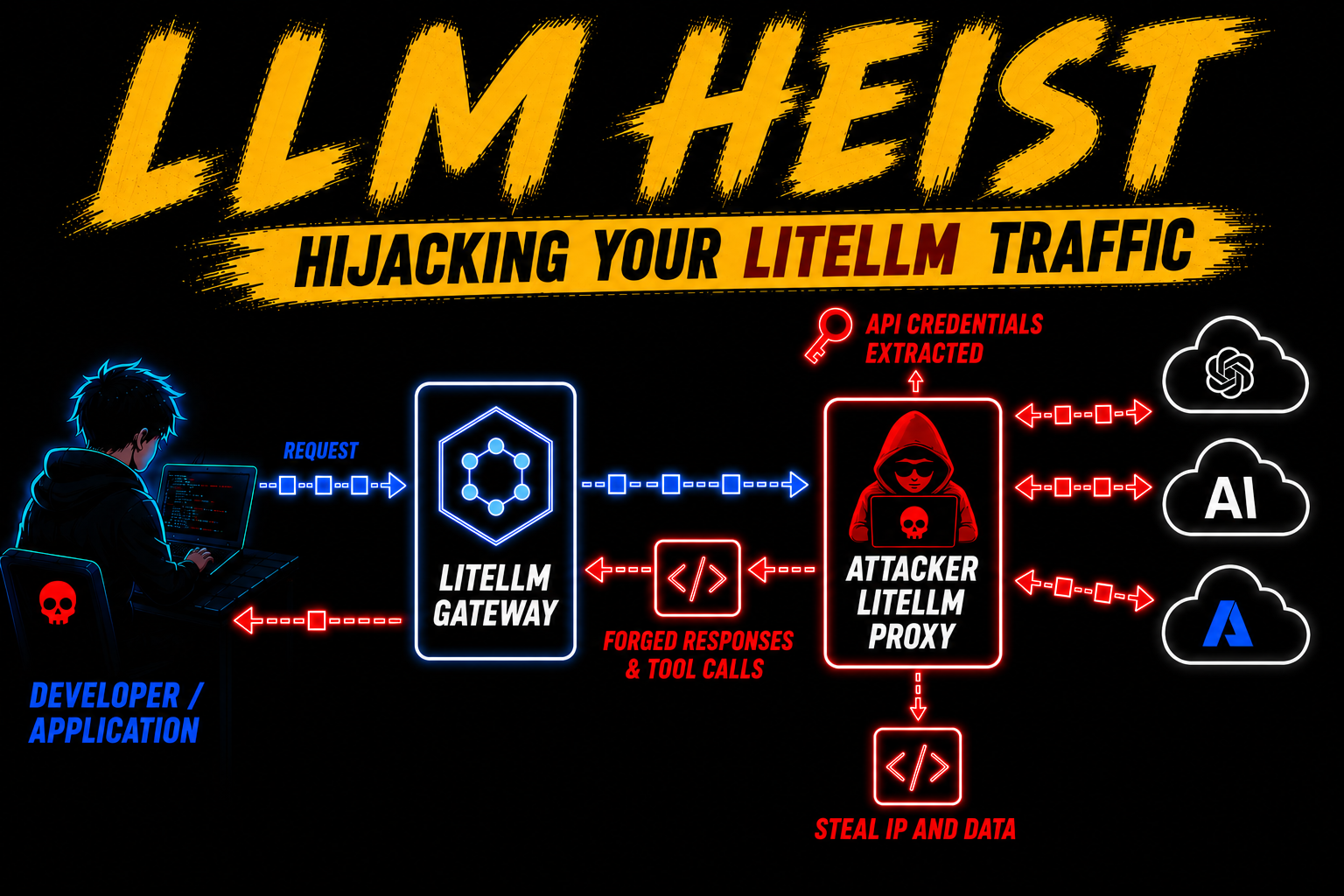 LLM Heist: Hijacking LiteLLM for Traffic Interception, Key Theft, and Tool-Call Injection
LLM Heist is a red-team technique for hijacking a LiteLLM AI gateway using a stolen proxy-admin or master key. The attacker changes api_base and use_litellm_proxy via /model/update, which routes traffic to an attacker gateway and exposes backend provider keys. The post demonstrates harvesting keys, intercepting chats, and injecting text and forged tool calls into Claude Code. It closes with red team test cases and blue team detections.
 embracethered.comwriteupAdded 29 Oct 2026, published 3 Aug 2026🛡️ Security
- Strix
Strix is an open-source framework of autonomous AI pentesting agents that dynamically run target code, discover vulnerabilities across the OWASP Top 10 (SQLi, SSRF, XXE, IDOR, XSS, auth bypass, business-logic flaws) and validate them with working proof-of-concept exploits rather than static-analysis heuristics. It ships a CLI with a full offensive toolkit (Caido-based HTTP interception, browser exploitation, Python exploit sandbox, recon/OSINT, SAST/DAST), supports OpenAPI/Postman-driven black-box testing, integrates into GitHub Actions/CI pipelines to block vulnerable PRs, and can run against local or hosted LLMs via LiteLLM, with an optional cloud offering for autofix PRs and compliance reporting.
github.comrepoPublished and added 15 Jul 2026🛡️ Security - GitHub Action Canaries
Tracebit's free, open-source GitHub Action injects unique, short-lived AWS canary credentials and SSH canary keys (honeytokens) into every workflow run, writing them to ~/.aws/credentials, environment variables, and ~/.ssh/ so they cover common exfiltration surfaces. Any interaction with these decoys triggers an alert with full run context (repo, workflow, job, commit SHA, run ID), letting teams detect compromised dependencies, malicious third-party Actions, or CI/CD secret theft. It cites real incidents like the tj-actions/changed-files and Trivy/TeamPCP supply-chain compromises and a LiteLLM PyPI credential stealer as the threats it targets.
github.comrepoPublished and added 11 Jul 2026🛡️ Security  10 Layers Deep: How StepSecurity Stops TeamPCP's Trivy Supply Chain Attack on GitHub Actions
StepSecurity walks through the TeamPCP-led compromise of aquasecurity/trivy-action (CVE-2026-33634, CVSS 9.4), where attackers force-pushed a credential-stealing payload into 76 of 77 version tags, plus the related Checkmarx KICS action compromise, both harvesting secrets from /proc/pid/mem of the GitHub Actions Runner.Worker process and exfiltrating to a typosquatted domain (scan.aquasecurtiy.org, 45.148.10.212). The post details the attack technique of 'imposter commits' (fork commits reachable by SHA but not on any branch) used to hide the malicious tags, and situates the incident alongside the same-window CanisterWorm npm worm and TeamPCP credential stealers in litellm and telnyx PyPI packages, then maps ten StepSecurity/Harden-Runner defense-in-depth controls (egress blocking, process lockdown, SHA-pinning PRs, imposter-commit scanning, global blocklist) to each stage of the kill chain.
stepsecurity.iowriteupAdded 3 Sep 2026, published 2 Jul 2026🛡️ Security- OASIS
OASIS (Open Automated Security Intelligence Scanner) is an AI-powered SAST tool that runs local LLMs via Ollama or any OpenAI-compatible backend (vLLM, LiteLLM, LM Studio, llama.cpp) to detect vulnerabilities like SQLi and XSS in source code. It uses a two-phase scan (lightweight scan model + deep analysis model) orchestrated by a LangGraph pipeline (discover→scan→expand→deep→verify→report), adds a deterministic finding-validation agent that computes exploitability verdicts with confidence, and exports canonical JSON/SARIF/HTML/PDF reports with a web dashboard, RAG-backed chat assistant, --fail-on CI gating, and suppression/inline-ignore support.
github.comrepoPublished and added 28 Jun 2026🛡️ Security - CVE-2026-12773
Tenable CVE entry for CVE-2026-12773, an improper authentication flaw in BerriAI LiteLLM up to 1.59.8. The vulnerable function is UserAPIKeyAuth in litellm/proxy/_experimental/mcp_server/auth/user_api_key_auth_mcp.py in the MCP Proxy component. It is remotely exploitable, a public exploit exists, and scores are CVSS v3.1 9.8 Critical, CVSS v4.0 6.9 Medium and EPSS 0.01017.
 tenable.comadvisoryAdded 26 Jun 2026🛡️ Security
 Microsoft's durabletask PyPI Package Compromised in Supply Chain Attack
StepSecurity documents the compromise of Microsoft's durabletask PyPI package (versions 1.4.1-1.4.3, 400k+ monthly downloads), where an attacker bypassed the GitHub CI/CD pipeline entirely using stolen publishing credentials to inject a dropper for rope.pyz, a modular cloud-intrusion framework with dedicated collectors for AWS, Azure, GCP, Kubernetes, HashiCorp Vault, password managers, and the filesystem. The framework encrypts stolen data with AES-256-GCM/RSA-4096, exfiltrates via HTTPS, GitHub commit beacons, and attacker-created public repos using the victim's own stolen GitHub tokens, propagates via AWS SSM and kubectl exec, and drops a geo-targeted rm -rf wiper for systems matching Israeli locale/timezone markers. The post ties the attack to TeamPCP's Mini Shai-Hulud campaign (same infrastructure as TanStack, Mistral AI, LiteLLM, @antv) and later updates describe a second compromise of the Azure/durabletask GitHub repo that plants payloads triggering in Claude Code, Gemini CLI, Cursor, and VS Code.
stepsecurity.iowriteupAdded 3 Sep 2026, published 9 Jun 2026🛡️ Security- Metis
Metis is an open-source agentic AI security code review framework built by Arm's Product Security Team that uses LLMs for semantic vulnerability detection rather than hardcoded rules. It performs deep security review across codebases (with C/C++ reachability analysis via a code graph), validates and triages findings from itself or third-party SAST tools to reduce false positives, and annotates SARIF output. It supports multiple LLM providers (OpenAI, Azure OpenAI, Anthropic, Gemini, AWS Bedrock, vLLM, Ollama, llama.cpp, LiteLLM) and vector-store backends (ChromaDB, PostgreSQL/pgvector, Qdrant) for RAG-based codebase indexing and querying.
github.comrepoPublished and added 31 May 2026🛡️ Security  Bringing full YAML anchor support to zizmor
Trail of Bits worked with the zizmor maintainers to add full YAML anchor support to zizmor, the GitHub Actions static analyzer that catches misconfigurations like the one exploited in the March 2026 aquasecurity/trivy-action pull_request_target attack that led to a LiteLLM PyPI backdoor. They built a corpus of 41,253 workflows from 6,612 high-star repos, found zizmor crashed on 45 of them, and fixed four anchor-handling bugs plus unrelated deserialization and expression-evaluator issues, filing 20 issues and merging 15 PRs upstream.
 blog.trailofbits.comarticleAdded 5 Sep 2026, published 22 May 2026🛡️ Security
- Intelligence Cyber Digest
A Twitter thread reports that ZDI's Pwn2Own Berlin 2026 rejected dozens of working zero-day RCE submissions for the first time in 19 years due to running out of contest slots, prompting researchers to publicly disclose their exploit chains instead. Named cases include a researcher with 86 vulnerabilities across PyTorch, NVIDIA, Linux KVM, Oracle, Docker, Ollama, Chroma, LiteLLM, and llama.cpp now reporting directly to vendors, a full-chain Firefox RCE on Windows publicly demoed after rejection, a Claude Code RCE PoC, and 0-day RCEs in Ollama and LM Studio. The event still runs May 14-16, 2026 in Berlin with an estimated 150+ researchers having tried to register.
x.comthreadAdded 3 Sep 2026, published 12 May 2026🛡️ Security  IronCurtain: Secure AI Agent Runtime
The author describes IronCurtain, an open-source finite-state-machine orchestration framework for agentic security research, and a vuln-discovery workflow built on top of it that autonomously hunts for zero-days. Using an Orchestrator agent, an append-only journal, and tiered harness-building (single-function fuzzing up to full QEMU-based VM validation), the workflow replicated the historical 1998 OpenBSD TCP SACK kernel panic with Opus 4.6/Sonnet 4.6, and independently found previously unreported bugs in a widely-deployed media framework and an 18-year-old integer truncation flaw in another foundational library — the latter run entirely on Z.AI's GLM 5.1 via a LiteLLM gateway swapped in place of Anthropic models. The piece argues that PoC generation (not static findings) is what matters for defenders, that open orchestration plus commodity/open-weight models can match "frontier" vulnerability-discovery capability at $30–$150 per codebase, and that AUP refusals during severity assessment create asymmetric friction for defenders versus unrestricted adversaries.
 provos.orgwriteupPublished and added 7 May 2026🛡️ Security
- Cooldowns.dev
Cooldowns.dev is a living reference documenting "dependency cooldown" (minimum release age) settings that block package managers from installing versions published within the last N days, a defense against the short-lived window in which malicious package versions (e.g. the ChainDrop keyv worm, arrayref, LiteLLM, Telnyx SDK, axios) typically get caught and pulled. It gives exact configuration syntax for uv, pip, pipenv, poetry, PDM, conda, pixi, npm, pnpm, Yarn, Bun, Deno, ncu, Cargo (via cargo-cooldown), Bundler, Hex, Scala Steward, mise, VS Code, actions-up, plus Dependabot/Renovate defaults, Socket/StepSecurity PR checks, and registry-level proxies (Artifactory, Nexus, Cloudsmith, CodeArtifact, Verdaccio), and ships a cross-tool cooldowns.sh helper script.
 cooldowns.devarticlePublished and added 6 May 2026🛡️ Security
- BishopFox/aimap
AIMap is a Bishop Fox tool that discovers publicly exposed AI/ML endpoints (MCP servers, Ollama, vLLM/LiteLLM proxies, LangServe chains, Gradio apps, ComfyUI nodes) via 32+ curated Shodan queries, fingerprints them with Nuclei templates and live HTTP probes, and computes a 0-10 risk score based on auth, tool exposure, CORS, TLS, and system-prompt leakage. It also launches protocol-specific attack suites — MCP tool abuse, Ollama model extraction, prompt injection — with real-time streaming results and a Shodan-style query search interface plus a 3D globe visualization of findings.
github.comrepoPublished and added 6 May 2026🛡️ Security