- llm-trails: What LLMs reach for inside a breached AWS account
llm-trails is an open study of what LLMs choose to do next inside a breached AWS account. It puts 14 models in 13 post-compromise situations, records only a single-turn plan with nothing executed, and codes each answer to CloudTrail events. The repo has the llmtrials harness, prompts, codebook, processed dataset (viz_data.json) and an interactive dashboard, so the study can be rerun or extended.
 github.comrepoAdded 30 Oct 2026🧠 AI
- llm-trails: What LLMs reach for inside a breached AWS account
llm-trails is a research repo that placed 14 LLMs in 13 post-compromise AWS situations, asked only for their next move (single-turn, nothing executed), and coded each answer to CloudTrail events. It includes the llmtrials harness, prompts, codebook, processed dataset (viz_data.json) and an interactive dashboard. Rates are conditioned on the situation shown, and the aim is turning model behavior into detection priorities.
github.comrepoAdded 30 Oct 2026🛡️ Security - Show HN: OnKey – I'm a bad singer, so I built an app to show where I'm off-key
OnKey is a free, MIT-licensed singing trainer for Apple Silicon Macs. After a song ends in Spotify, Apple Music or browser YouTube, it separates the lead vocal with UVR's MDX-Net Karaoke 2, tracks pitch with CREPE and turns it into syllable-level notes with the GAME model. On later plays it scrolls the notes, draws the user's live pitch and scores each line. Analysis runs on-device, and the repo explains the build steps and network requests.
github.comrepoAdded 24 Oct 2026, published 22 Oct 2026🧠 AI - eness/php2shell-CVE-2026-109618-CVE-2026-109619-PoC
php2shell is the name given to two critical pre-auth remote code execution flaws, CVE-2026-109618 and CVE-2026-109619, in PHP core's session upload progress handler (php_session_rfc1867_callback), where zend_hash_update frees live zval pointers that are later reclaimed and redirected into zend_call_function to run zif_system. This repository ships poc_109618.py, a fully automated four-stage HTTP exploit that leaks ASLR offsets via Set-Cookie headers against php:8.4.26-apache on Debian Bookworm, along with a root-cause C source patch, mitigation scripts to disable session.upload_progress, and WAF/ModSecurity/Lighttpd/Apache rules plus detection guidance for anomalous PHP worker child processes. Confirmed PHP versions include 8.4.4 and 8.2.34, with EOL branches (5.x, 7.x, 8.0, 8.1) left without official vendor patches.
github.comrepoAdded 23 Oct 2026, published 21 Oct 2026🛡️ Security - Show HN: Let your AI agents paint big arrows, boxes and text on your screen
bigarrow is an MIT-licensed, single-binary Swift macOS CLI that draws a click-through arrow and sign over all windows so an AI agent can show a human where to click, paste or act (permission prompts, 2FA, OAuth consent). It ships an Agent Skills package (installed via `bigarrow install-skill`) for Claude Code and Codex, with JSON output and exit codes, and can target by Accessibility label, coordinates, window or Peekaboo snapshot. The README documents the skill's token cost (182 tokens for the description, 1,398 for the instructions) and 104 automated tests.
github.comrepoPublished and added 9 Oct 2026🧠 AI  The Vulnerable MCP Project — MCP vulnerability database
The Vulnerable MCP Project is a curated, continuously growing database of security vulnerabilities and attack techniques specific to the Model Context Protocol ecosystem. Entries cover concrete CVEs (e.g. CVE-2025-68143/68144/68145 in Anthropic's mcp-server-git), transport-layer SDK flaws (cross-client response leakage, missing DNS rebinding protection in the official TypeScript/Python SDKs), unauthenticated/0.0.0.0-bound servers enabling RCE (MCPJam inspector, MCP Inspector, Grafana MCP), command/path injection in dozens of third-party servers (gemini-mcp-tool, mcp-server-kubernetes, Framelink Figma MCP, Zen MCP, filesystem-mcp), SSRF chains reaching cloud metadata (MarkItDown MCP, mcp-fetch-server), and a large set of AI-specific attacks: tool poisoning, trigger-phrase data exfiltration, prompt injection via GitHub issues, Jira and Google Docs, rug-pull tool mutation, and cross-server tool-name collisions. It functions as the de facto vulnerability registry for the MCP ecosystem, useful for tracking disclosed issues before patching or adopting third-party MCP servers.
 vulnerablemcp.inforepoAdded 6 Oct 2026🛡️ Security
- Dark Web Informer (@DarkWebInformer) on X
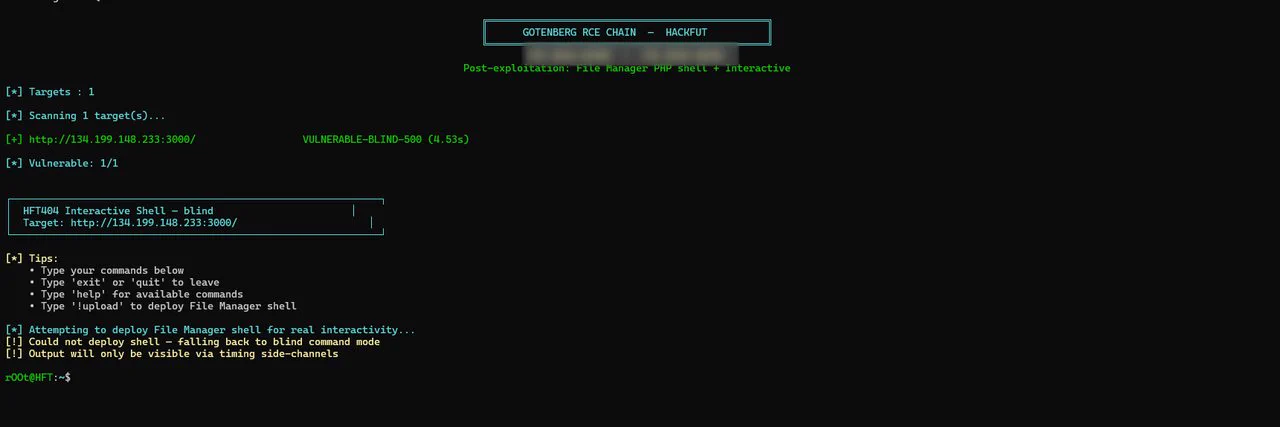
A public PoC chains CVE-2026-42589 and CVE-2026-40281 to achieve unauthenticated remote code execution against Gotenberg (a document/PDF-conversion microservice), abusing metadata injection flaws in the /forms/pdfengines/metadata/write endpoint. The tool supports vulnerability detection, interactive command execution, reverse shell delivery, and multi-target scanning against Gotenberg versions ≤8.30.1 (patched in 8.31.0).
 x.comrepoPublished and added 5 Oct 2026🛡️ Security
- Bifrost (Maxim AI) — open-source LLM gateway
Bifrost is an open-source, high-performance LLM gateway (by Maxim AI) that exposes a single OpenAI-compatible API across 23+ providers including OpenAI, Anthropic, AWS Bedrock, Google Vertex, Azure, Cohere, Mistral, and Ollama. It provides automatic failover, load balancing, semantic caching, Model Context Protocol (MCP) tool integration, budget and governance controls, OIDC user provisioning, and Prometheus-based observability, deployable via npx or Docker with claimed sub-15 microsecond overhead at 5,000 RPS. It is positioned as a drop-in replacement requiring only a base-URL change for existing OpenAI, Anthropic, or GenAI SDK code.
github.comrepoAdded 2 Oct 2026🧠 AI - awslabs/mcp release 2026.09.20260922000649
This is a release changelog for awslabs/mcp, AWS Labs' collection of Model Context Protocol servers covering services like HealthOmics, Aurora DSQL, Bedrock Knowledge Base retrieval, ECS, CloudWatch, billing/cost management, and dataprocessing. This release adds vended metrics tools, SQL parser-based policy guards for Aurora DSQL, agentic retrieval support for Bedrock KB, and fixes several security issues including region validation to prevent SSRF credential disclosure in the CloudWatch server and read-only mode bypass in the MySQL server. It reflects an actively maintained, high-velocity multi-server MCP monorepo used for AWS tool integration with LLM agents.
github.comrepoAdded 26 Sep 2026🧠 AI - https://github.com/akha-security/akca
AKCA is an open-source, Go-based Dynamic Application Security Testing (DAST) scanner that combines HTTP and headless-browser crawling, JavaScript/AST analysis, API spec import (OpenAPI, GraphQL, gRPC, etc.), and adaptive active testing across a very broad set of vulnerability classes including SQL injection, XSS, SSRF, IDOR/BOLA, SSTI, JWT/OAuth flaws, race conditions, and cloud/CI exposure. It emphasizes evidence-oriented verification — replaying promising signals against baselines, negative controls, and OAST callbacks before promoting them to findings — and exports Burp-style HTTP evidence in HTML, JSON, CSV, Markdown, and SARIF reports. Positioned as a transparent, single-developer alternative inspired by but not claiming parity with Acunetix, Invicti/Netsparker, or Burp Suite Professional.
github.comrepoAdded 2 Oct 2026, published 23 Sep 2026🛡️ Security - Lonkero — Rust web vulnerability scanner (v3.7, AI agent mode)
Lonkero is an open-source Rust web vulnerability scanner (v3.7) combining 125+ context-aware scanners with an AI agent mode that drives targeted scans via natural-language conversation (using Claude, GPT, or local Ollama models). Notable techniques include a browser-free "proof-based" XSS engine that mathematically proves exploitability from reflection context + escape behavior, an "OOBZero" engine for detecting blind SQLi/SSRF/XXE via Bayesian multi-channel statistical inference and Pearson-correlated timing attacks without external callback infrastructure, Next.js middleware-bypass detection (CVE-2025-29927, CVE-2024-34351), AWS Cognito user-enumeration checks, and a scanner module that detects invisible prompt-injection payloads hidden in README.md files targeting AI coding assistants.
github.comrepoAdded 21 Sep 2026🛡️ Security - OmniJev/awesome-jev-gallery
An extensive, actively maintained GitHub "awesome list" cataloging the ecosystem that has grown around TypeSafe's Jev and its "System One" typed decision models — a non-generative alternative to chat LLMs that returns calibrated probabilities per option (Choice/Score/Noul primitives) via RLCD training and single-pass constrained decoding. It indexes dozens of open-weight reproductions (OneJev, Rizzo Flow, Laya, Jebadiah, kev), benchmarks and leaderboards (JevBench, Jev Decision Index, JevAdvBench, DecisionBench), downstream tools (browser/robot/trading agents built on the typed API), and the research lineage the design draws on (zero-shot entailment classifiers, InstructGPT's reward model, GLiNER/GLiClass, monoBERT, LLaDA, vLLM, DSPy, RouteLLM, Constitutional Classifiers). It also links commentary auditing TypeSafe's claims (accuracy vs. frontier LLM baselines, security issues found in community tools).
github.comrepoAdded 29 Sep 2026, published 17 Sep 2026🧠 AI - AnotiaWang/awesome-decision-models
A community-maintained GitHub list cataloging "decision models" (also called System One models): small/fast models that take a state plus caller-declared questions (Noul/true-false, Choice/multi-option, Score/rubric) and return a probability per answer in one forward pass, rather than generating text. It tracks the originating TypeSafe AI Jev model and its /v1/systemone API alongside competing hosted models (Upstage Solar Decide, Liquid AI's d1, OpenAI's Decisions API, Inception's Mercury Decide, Respan's Span-01), dozens of open-weight fine-tunes (Cloudflare's Clef, Perplexity's pplx-decider, AWS Strands Decider, Together AI's Tev1, and many Qwen3.5-based community models), zero-training logit-reading approaches, local runtimes (Ollama, Ollaya, llama.cpp-based servers), SDKs across a dozen languages, and a very long list of agent/coding-tool/MCP integrations (browser agents, code review, routing, game-playing demos) that use these models for fast, typed, in-the-loop decisions. The page is truncated at 40k of ~51k characters, so later sections (further toys, demos, and possibly benchmarks) are not reflected here.
github.comrepoAdded 2 Oct 2026, published 17 Sep 2026🧠 AI - Copy Fail (CVE-2026-31431): 9-year-old Linux kernel LPE found by Theori's Xint Code
A GitHub repository from Theori's Xint Code team detailing CVE-2026-31431, a Linux kernel local privilege escalation bug ("Copy Fail") that had gone undetected for roughly nine years. The researchers confirmed exploitability across current production kernels including Ubuntu 24.04 LTS (6.17.0-1007-aws), Amazon Linux 2023 (6.18.8-9.213.amzn2023), RHEL 10.1 (6.12.0-124.45.1.el10_1), and SUSE 16 (6.12.0-160000.9-default).
github.comrepoAdded 17 Sep 2026🛡️ Security - AI Agent Hacking Writeups
A GitHub-hosted, CC0-licensed index of 281 public writeups on attacks against AI agents, organized into six categories: indirect prompt injection, direct prompt injection/jailbreaks/guardrail bypass, MCP and agent tooling, AI platform/infrastructure bugs, classic web bugs in AI product surfaces, and AI used as an attacker's tool. Entries span 2021-2026 and include major disclosures like GeminiJack, ForcedLeak, Clinejection, CVE-2025-53773 (GitHub Copilot RCE), and dozens of Johann Rehberger/PromptArmor/qual1a writeups covering exfiltration, MCP OAuth flaws, and coding-agent sandbox escapes. Comes with an accompanying blog post "How to Hack AI Agents" and a scripted links.txt for automation.
github.comrepoAdded 22 Sep 2026, published 17 Sep 2026🛡️ Security - MassPIIFinder v2
MassPIIFinder v2 is a Python recon tool that automates crawling a target's in-scope JavaScript (multi-hop HTML crawl, dynamic imports, chunk manifests, sourcemaps, plus optional passive CT-log subdomain discovery) and mines it for API keys, tokens, credentials, internal endpoints, and PII using ~90 named patterns plus a high-entropy freeform heuristic. Findings are validated offline (Luhn checks, JWT decode, AWS key-shape) and via scope-checked, rate-limited reachability probes, then triaged by severity and exported as JSON/HTML/SARIF/Markdown/CSV. It enforces authorization with a required --confirm-authorized flag and a ScopeGuard that blocks any out-of-scope requests, and explicitly avoids testing leaked keys against third-party providers or exploiting findings.
github.comrepoAdded 22 Sep 2026, published 15 Sep 2026🛡️ Security - bsab/sweden-mcp-servers
A community-maintained catalog of Model Context Protocol servers connecting AI assistants to Swedish data, laws and services (e.g. Fortnox, Bokio, BolagsAPI, ICA), forked/adapted from the France and Italia MCP Servers projects. Each entry is checked against canonical documentation, tracks license/credential requirements, and includes a runtime smoke-test report (protocol/tool call attempts, credential blockers, failures) plus a six-criterion documentation-readiness rubric, published as a static JSON/HTML site.
github.comrepoAdded 26 Sep 2026, published 14 Sep 2026🧠 AI - AWSHound — AWS BloodHound OpenGraph Collector
AWSHound is a Go CLI/container tool that collects AWS IAM and authorization data across profiles, config-file opt-ins, or an entire AWS Organization (via cross-account role assumption), and outputs a BloodHound OpenGraph for attack-path analysis. It supports phased collection with on-disk artifacts, offline graph building from previously collected data, and safeguards like --max-api-requests and --max-api-requests-per-minute to bound AWS API traffic during collection.
github.comrepoAdded 8 Sep 2026🛡️ Security - GhostJS
GhostJS is an open-source Burp Suite extension by TrinetLayer that passively scans JavaScript, HTML, and JSON responses flowing through Burp for hardcoded secrets (AWS/GCP/Azure keys, Stripe/PayPal/GitHub tokens, JWTs, private keys, etc.) and hidden API endpoints, surfacing findings in a dedicated tab with severity, confidence scoring, remediation guidance, and Markdown export. It also actively fetches referenced <script> bundles using the tester's live session cookies and applies a false-positive filter to suppress doc-sample and placeholder keys, making it a practical recon aid during authorized web app pentests and bug bounty work.
github.comrepoPublished and added 7 Sep 2026🛡️ Security - vibecheck
vibecheck is a free, open-source, client-side scanner that checks apps built with AI code generators (Lovable, Bolt, v0, Cursor, Claude Code) for common security holes: exposed Supabase Row Level Security / Firebase rules, secrets embedded in the client bundle (Stripe/AWS/DB keys), missing security headers, exposed .env/.git/source maps, unauthenticated LLM proxy or MCP endpoints, and email/TLS misconfigurations. It also scans public repos for cross-tenant IDOR patterns, committed secrets, an OSV.dev supply-chain check, a Dockerfile lint, and generates a CycloneDX SBOM; a companion CLI (tenant-guard) adds a live Postgres cross-tenant isolation test as a CI gate. The project cites CVE-2025-48757 (170+ Lovable apps found with RLS disabled) as motivation.
github.comrepoPublished and added 27 Aug 2026🛡️ Security - DataSentry
DataSentry is a Claude Code plugin that redacts secrets (AWS keys, tokens, credentials) from tool outputs before they enter the model's context window, using deterministic hooks rather than model instructions, and blocks prompts that contain live credentials. It ships 40 regex-based detection rules (ported from an enterprise Warp ADE ruleset), stable per-secret placeholders via sha1 hashing, per-category overrides, an audit log, and a fail-closed mode; PII/financial/healthcare pattern detection is reserved for a paid Enterprise tier.
github.comrepoPublished and added 27 Aug 2026🛡️ Security - IAM Policy Autopilot
IAM Policy Autopilot is an AWS Labs open-source CLI/MCP server that statically analyzes application source code (Python, Go, TypeScript, JavaScript, Java) or a Terraform plan JSON to generate baseline least-privilege IAM identity-based policies, and can also parse AccessDenied error messages to suggest policy fixes. It integrates with AI coding assistants (Kiro, Claude Desktop, etc.) via MCP so assistants can auto-generate scoped IAM permissions instead of overly broad ones, with a --service-hints flag to reduce false-positive permission inclusion.
github.comrepoPublished and added 25 Aug 2026🛡️ Security - agentgg
agentgg is an open-source, agentic SAST scanner that uses LLM agents to read source code, follow imports, trace the call graph, and confirm findings before reporting — aiming to reduce the pattern-matching false positives of traditional SAST. It runs locally or as a hosted service, supports full-repo scans or git-diff PR review, and works with multiple model providers (Anthropic, OpenAI, AWS Bedrock, Google Vertex AI, OpenRouter, Ollama); agents are defined as markdown files with YAML frontmatter and are pulled from a community agents catalog.
github.comrepoPublished and added 23 Aug 2026🛡️ Security - Deep Eye
Deep Eye is an open-source Python pentesting framework that orchestrates 11 AI providers (OpenAI, Claude, Grok, Gemini, Ollama, Groq, Mistral, OpenRouter, LiteLLM, LM Studio, and more) with automatic failover to generate context-aware attack payloads for 50+ vulnerability classes including SQLi, XSS, SSRF, IDOR, JWT and GraphQL flaws. It adds an RAG-indexed CVE intelligence DB built from NVD/MITRE/Exploit-DB, AI-based finding triage and false-positive filtering, Nuclei-style YAML templates, Playwright browser automation, CAPTCHA-solving (reCAPTCHA/hCaptcha/Turnstile/Arkose), mitmproxy interception, and auto-generated HackerOne-style bug bounty reports with PCI-DSS/SOC2/ISO 27001 compliance mapping, SARIF/JUnit export, scan diffing, and retest workflows.
github.comrepoAdded 3 Sep 2026, published 22 Aug 2026🛡️ Security - vigneshwaran1702/Cloud-Security-Scanner
CSPM tool auditing AWS, Azure, GCP for misconfigurations with AI remediation and compliance mapping.
github.comrepoAdded 30 Sep 2026, published 31 Jul 2026🛡️ Security - ClawSecCheck
ClawSecCheck audits OpenClaw agent installs for prompt injection, malicious MCP servers, and supply-chain risk in skills and dependencies.
github.comrepoPublished and added 22 Jul 2026🛡️ Security - HackingLZ/gibson
Gibson is a Rust-based network monitoring toolkit with a lightweight agent, server, and parser that maps process-to-network connections, detects cloud provider ownership (AWS/Azure/GCP/Cloudflare), flags beaconing candidates and EOL OS risk, and auto-generates iptables/Windows firewall rules. It supports AES-256-GCM encrypted uploads, ASN/ARIN-based IP ownership lookups, and SQL/JSON report exports for cross-host threat hunting.
github.comrepoPublished and added 22 Jul 2026🛡️ Security - jit
jit is a macOS (Apple Silicon) tool that moves plaintext secrets from .env files, ~/.aws/credentials, shell exports, .npmrc, and MCP configs into a Touch ID-gated local encrypted vault, leaving decoy files on disk and injecting real values only into the specific process that requests them via execve, native credential-helper protocols (AWS credential_process, docker/git credential helpers), or ephemeral named-pipe (FIFO) mounts. It adds per-process consent prompts naming the requesting tool/agent, time-bounded "process grants" for unattended AI agents (e.g. Claude, Codex) to use credentials overnight, and a durable audit log of every credential read, unlock, and denial. It explicitly targets the risk that AI coding agents and CLIs run with full user permissions and can read plaintext secrets, treating agent MCP configs and wrapped AI CLIs as first-class.
github.comrepoPublished and added 18 Jul 2026🛡️ Security - Strix
Strix is an open-source framework of autonomous AI pentesting agents that dynamically run target code, discover vulnerabilities across the OWASP Top 10 (SQLi, SSRF, XXE, IDOR, XSS, auth bypass, business-logic flaws) and validate them with working proof-of-concept exploits rather than static-analysis heuristics. It ships a CLI with a full offensive toolkit (Caido-based HTTP interception, browser exploitation, Python exploit sandbox, recon/OSINT, SAST/DAST), supports OpenAPI/Postman-driven black-box testing, integrates into GitHub Actions/CI pipelines to block vulnerable PRs, and can run against local or hosted LLMs via LiteLLM, with an optional cloud offering for autofix PRs and compliance reporting.
github.comrepoPublished and added 15 Jul 2026🛡️ Security - NVIDIA/garak
garak is NVIDIA's open-source LLM vulnerability scanner, described as an nmap/Metasploit for LLMs that probes generative models for hallucination, data leakage, prompt injection, jailbreaks, toxicity, and other failure modes. It supports a wide range of targets such as Hugging Face, OpenAI, AWS Bedrock, Cohere, Groq, llama.cpp/gguf, REST endpoints, and NIM, and structures scans around pluggable probes, detectors, harnesses, and generators, producing JSONL reports and hit logs.
github.comrepoPublished and added 14 Jul 2026🛡️ Security - GitHub Action Canaries
Tracebit's free, open-source GitHub Action injects unique, short-lived AWS canary credentials and SSH canary keys (honeytokens) into every workflow run, writing them to ~/.aws/credentials, environment variables, and ~/.ssh/ so they cover common exfiltration surfaces. Any interaction with these decoys triggers an alert with full run context (repo, workflow, job, commit SHA, run ID), letting teams detect compromised dependencies, malicious third-party Actions, or CI/CD secret theft. It cites real incidents like the tj-actions/changed-files and Trivy/TeamPCP supply-chain compromises and a LiteLLM PyPI credential stealer as the threats it targets.
github.comrepoPublished and added 11 Jul 2026🛡️ Security - apisec-inc/AI-Surface
ai-surface is a local/offline static analysis CLI (apisec-inc) that scans a codebase for AI attack surface — LLM SDK calls, agent frameworks (LangChain, AWS Strands), MCP servers, RAG/vector stores, model gateways, and provider keys — and flags risk indicators such as financial-action tools with no human approval or unverified MCP servers. It generates an AI-BOM (CycloneDX), SARIF for GitHub code scanning, and maps findings to OWASP LLM Top 10, EU AI Act, NIST AI RMF, and ISO/IEC 42001, with a baseline+fail-on-severity workflow for gating new risk in PRs without blocking on pre-existing debt.
github.comrepoPublished and added 11 Jul 2026🛡️ Security - ThinkWatch
ThinkWatch is a source-available dual-port gateway (Rust/Axum) that proxies both AI provider APIs (OpenAI, Anthropic, Gemini, Azure OpenAI, AWS Bedrock) and MCP tool calls through a single control plane, enforcing authentication, RBAC, rate limits/budgets, and audit logging. Its key differentiator is per-user upstream identity for MCP — propagating each user's own OAuth token/PAT to servers like GitHub/Notion/Slack (AES-256-GCM encrypted, per-key allowlists) instead of a shared service account, plus SSRF-hardened OAuth discovery (RFC 9728/8414/7591), tool-level RBAC, and ClickHouse-backed audit trails forwarded to SIEMs via Syslog/Kafka/webhooks.
github.comrepoPublished and added 4 Jul 2026🛡️ Security - DataDog/pathfinding-labs
Pathfinding Labs is DataDog's open-source platform (Go CLI 'plabs' + Terraform modules) for deploying intentionally vulnerable AWS resources into sandbox accounts to practice attacking and detecting IAM privilege-escalation paths. It ships modular labs across five categories — self-escalation, one-hop/multi-hop principal traversal, CSPM misconfigurations, toxic combos, and cross-account (dev/ops-to-prod) chains — each with demo/cleanup scripts, expected CSPM alerts, and MITRE ATT&CK mappings (e.g. T1098.001). It's positioned as a successor/companion to projects like IAM Vulnerable and Stratus Red Team for hands-on cloud identity attack training.
github.comrepoPublished and added 4 Jul 2026🛡️ Security - graphw00f
graphw00f is a GraphQL fingerprinting tool (inspired by wafw00f) that sends benign and malformed GET/POST queries to identify which GraphQL engine (Graphene, Apollo, Hasura, WPGraphQL, graphql-java, AWS AppSync, and dozens more) is running behind an endpoint. It cross-references detections against the GraphQL Threat Matrix project to report each engine's built-in security defenses and known CVEs, helping pentesters and security engineers assess GraphQL API attack surface (CWE-200 information disclosure via engine fingerprinting).
github.comrepoPublished and added 14 Jun 2026🛡️ Security - Metis
Metis is an open-source agentic AI security code review framework built by Arm's Product Security Team that uses LLMs for semantic vulnerability detection rather than hardcoded rules. It performs deep security review across codebases (with C/C++ reachability analysis via a code graph), validates and triages findings from itself or third-party SAST tools to reduce false positives, and annotates SARIF output. It supports multiple LLM providers (OpenAI, Azure OpenAI, Anthropic, Gemini, AWS Bedrock, vLLM, Ollama, llama.cpp, LiteLLM) and vector-store backends (ChromaDB, PostgreSQL/pgvector, Qdrant) for RAG-based codebase indexing and querying.
github.comrepoPublished and added 31 May 2026🛡️ Security - Tachi
Tachi is a threat-modeling and AI-reasoning vulnerability detection harness that runs inside Claude Code, dispatching 14 specialized agents against an architecture description (Mermaid, C4, PlantUML, free-text, or ASCII) to find logic-level flaws like broken auth flows, missing privilege boundaries, prompt injection paths, and agent autonomy gaps that SAST cannot catch. It claims full 50/50 coverage across five OWASP frameworks (Web/API, LLM, Agentic, ML, Mobile Top 10s), classifies agentic AI findings against the CSA MAESTRO seven-layer taxonomy, and maps findings to MITRE ATT&CK/ATLAS, NIST AI RMF, and CWE, producing threats.md, SARIF, attack trees, quantitative risk scores, compensating-control analysis, and a PDF security report.
github.comrepoAdded 3 Sep 2026, published 23 May 2026🛡️ Security - KeygraphHQ/shannon
Shannon is an open-source autonomous AI pentester from Keygraph that analyzes application source code to map trust boundaries and attack paths, then uses browser automation and CLI tools to execute real proof-of-concept exploits against the running app before reporting a finding. It only reports vulnerabilities it can actually exploit (injection, XSS, SSRF, broken auth/authz), runs in an ephemeral Docker worker with any AI provider (Anthropic, OpenAI, xAI, AWS Bedrock, Ollama, vLLM, LM Studio, etc.), and ships GitHub Action/GitLab CI integrations that produce PDF/Markdown/JSON/SARIF reports and can gate releases on exploited-severity findings. It's licensed AGPLv3 and positioned to run continuous, code-informed pentests between annual human pentest engagements.
github.comrepoPublished and added 23 May 2026🛡️ Security - IDP Zero-Dollar
A companion GitOps playbook/repo for building a free, self-hosted "AWS-equivalent" Kubernetes platform from three bare-metal Linux boxes using k3s, Cilium, cert-manager, Traefik, Argo CD, Forgejo, Vault, Keycloak, kube-prometheus-stack, Loki, Kyverno, and Velero. It walks through the full security-relevant stack end to end: OS hardening (SSH lockdown, ufw, fail2ban), Cilium NetworkPolicy as CNI, Let's Encrypt DNS01 wildcard certs, Vault as the source of truth for secrets synced via External Secrets Operator (never committing secrets to Git), Keycloak OIDC for centralized identity across Argo/Grafana/Forgejo/Vault, Kyverno pod-security policies in audit-then-enforce mode, and Velero + Vault Raft snapshot backup/DR with quarterly restore drills. It closes with a candid list of what self-hosting gives up versus managed cloud (CVE patch cadence, DDoS exposure, compliance evidence, etcd/HA operational risk).
github.comrepoAdded 3 Sep 2026, published 13 May 2026🛡️ Security - Titus by Praetorian
Titus is Praetorian's open-source secrets scanner that detects credentials, API keys, and tokens across source code, git history, container images, and binary files using 487 detection rules drawn from NoseyParker and Kingfisher. It combines Hyperscan/Vectorscan-accelerated regex matching with live credential validation (checking secrets against AWS/GitHub/etc APIs) and risk-based severity scoring, and ships as a CLI, Go library, Burp Suite extension, and Chrome extension sharing one detection engine.
github.comrepoPublished and added 10 May 2026🛡️ Security - Mirage
Mirage is an open-source virtual terminal and filesystem for AI agents that mounts services like S3, Slack, Redis and Gmail under one POSIX-like root and virtualizes CLIs and runtimes. It provides agent-focused security controls: allow/ask/deny profiles for commands, hide/show rules for files, a scriptable policy engine that gates every filesystem operation and session write, and credential resolution via AWS Secrets Manager, 1Password and Auth0. The goal is fine-grained control over what an AI agent can execute and see, reducing the blast radius of agent tool use.
github.comrepoAdded 3 Sep 2026, published 8 May 2026🛡️ Security - Terraform Compliance Guardrails
A GitHub repo that automates Terraform compliance checks using Checkov and Conftest as policy-as-code scanners, wired into GitHub Actions with OIDC-based AWS authentication for CI/CD. Findings are mapped to specific NIST 800-53 controls — AC-6 (least privilege), SC-7 (network segmentation), SC-13 (encryption), AU-12 (audit generation), and CM-6 (configuration settings) — giving teams an auditable trail linking IaC scan results to compliance requirements.
github.comrepoPublished and added 6 May 2026🛡️ Security