- Show HN: Auto Dismiss Mac OS "Allow <app> to find devices on local networks?"
dontallow is a two-file Swift launchd agent for macOS 15 and later that clicks "Don't Allow" on the "find devices on local networks" prompt. It watches the UserNotificationCenter process through an Accessibility observer, supports pause and allowlist, and can decode the Local Network rule store to show orphaned rows. It explains why Chromium temp-bundle paths make the prompt recur, and gives a PPPC profile route for fleets.
 github.comrepoAdded 30 Oct 2026, published 29 Oct 2026🛡️ Security
- x86rc/unthemidator
Unthemidator is an automated unpacker for binaries protected with Themida, Code Virtualizer and WinLicense (v3.0 to v3.2.6.0, experimental v4.0). It works without executing the target, handles x86 and x64 exe, dll and sys files, decrypts imports, restores the IAT, rebuilds the PE and identifies VM versions and entry points. It does not devirtualize or unmutate code. Releases cover Windows x64 and macOS Apple Silicon.
github.comrepoAdded 27 Oct 2026, published 23 Oct 2026🛡️ Security - Spectrmachina/Ztrust
ZTrust is a Python supply-chain scanner that checks manifests, lockfiles, source and GitHub workflows for vulnerable or malicious dependencies (via OSV.dev), typosquats, leaked secrets, unsafe lockfiles and risky CI patterns such as pwn requests and script injection. It outputs console, JSON and SARIF 2.1.0 and ships as a GitHub Action. It also includes a FastAPI bounty service using commit-reveal and shielded Zcash payouts for researchers.
github.comrepoAdded 27 Oct 2026, published 22 Oct 2026🛡️ Security - SnailSploit/Claude-Red
claude-red is an MIT-licensed library of offensive security skills for the Claude Skills system, planned at about 130 skills across 23+ categories (web, Active Directory, cloud, exploit development, EDR evasion and others). Each skill is a SKILL.md file that loads on conversational triggers, so unused skills cost no context. It installs by git clone, sparse checkout per category, install.sh or pasting into a system prompt.
github.comrepoAdded 22 Oct 2026🧠 AI - SnailSploit/Claude-Red
claude-red is a library of offensive security skills for the Claude Skills system, each a SKILL.md file that loads on conversational triggers (for example, mentioning SQL injection loads offensive-sqli). Categories include web, Active Directory, cloud, mobile, exploit development, fuzzing, privilege escalation, post-exploitation and AI. It targets about 130 skills across 23+ categories, with an install script and sparse-checkout install per category. Built on Sahar Shlichov's offensive checklists, MIT licensed.
github.comrepoAdded 22 Oct 2026🛡️ Security - OpenAI CLI
OpenAI CLI is OpenAI's official Go command-line client for the REST API. It lets users generate images, upload and download files, create and wait on batches, call the Responses API, and query admin usage endpoints from a terminal or shell script. It supports JSON, JSONL and YAML output, GJSON transforms, shell completion, and install via Homebrew, go install or release binaries.
github.comrepoAdded 23 Oct 2026, published 22 Oct 2026🧠 AI - Dan Kornas (@DanKornas) on X
aula-mcp is an open-source (MIT) TypeScript MCP server that connects an AI client to Denmark's Aula school platform. It exposes tools for profiles, calendar events, messages, notifications, posts and weekly plans. MitID credentials and OAuth tokens are stored in macOS Keychain or an AES-256-GCM encrypted file. The HTTP server binds to 127.0.0.1, and the presence write tool stays off until AULA_MCP_WRITE=1 is set.
 x.comrepoAdded 23 Oct 2026, published 22 Oct 2026🧠 AI
- vxcontrol/pentagi
PentAGI is an open-source, self-hosted multi-agent system that uses LLM agents to carry out penetration testing tasks autonomously. The MIT-licensed repo has a Go backend, a React frontend and GraphQL. It ships Docker Compose files for Langfuse tracing, Graphiti knowledge-graph memory and an observability stack. Topics list OpenAI and Anthropic as model backends.
github.comrepoAdded 20 Oct 2026🧠 AI - ☣ KitPloit - Hacker Tools (@KitPloit) on X
DidierStevensSuite is a collection of Python scripts for malware analysis, file format parsing, hashing and forensic triage. It includes utilities for analysing PDF and OLE documents and for XOR-obfuscated data. The post is a short KitPloit announcement that links to the repository and gives no usage detail.
x.comrepoAdded 21 Oct 2026, published 20 Oct 2026🛡️ Security - better-isms/grcskills
grcskills is a library of 60 plain SKILL.md files in the Agent Skills format, each describing how an experienced practitioner does one piece of governance, risk and compliance work. Examples are scope statements, risk registers, audit prep, vendor review and incident handling. Every skill names where the agent must stop and hand the decision to a person. Installs are pinned to reviewed release tags and checked by a validator.
github.comrepoAdded 20 Oct 2026🧠 AI - better-isms/grcskills
grcskills is an MIT-licensed library of 60 SKILL.md files (Agent Skills format) that let coding agents draft and prepare governance, risk and compliance work: scope statements, statements of applicability, risk registers, audit prep, vendor review, policies, privacy, incidents and continuity. Each skill names where the agent must stop so a person decides. Installs are pinned to release tag v2026.10.19.2, and a validator rejects network commands and credential paths.
github.comrepoAdded 20 Oct 2026🛡️ Security - DietrichGebert/ponytail
Ponytail is a single skill prompt (skills/ponytail/SKILL.md, with a compact AGENTS.md) that makes coding agents write only the code a task needs, reusing existing components while keeping validation, error handling, security and accessibility. The author benchmarked it in Claude Code with Opus 5.5 over 39 tasks, 5 runs each, including a real FastAPI + React repo. They report -53% code, -41% time, -26% cost and -45% tokens, and 98% of risky logic shipping with a test versus 68% without. It adds /ponytail-review and /ponytail-audit commands, a Claude Code cost/token band with a local board, and installs through Claude Code and Codex plugin marketplaces or as a rules file for Cursor, Copilot, Gemini, OpenCode and others.
github.comrepoAdded 17 Oct 2026🧠 AI - alex09x/kyb
KYB (Know Your Business) is a Rust/axum server that stores agent-written knowledge, incident reports and tasks as Markdown files in Git, one commit per change. Search is hybrid: Tantivy BM25 fused by reciprocal rank with local multilingual-e5-small ONNX vectors, and it can query historical versions or "as of" a date. It ships a kyb CLI, a native MCP endpoint (Claude Code, Codex, Antigravity, Gemini CLI), an installable agent skill, token auth with per-write attribution trailers, secret scanning on writes, and a web console. It targets persistent shared operational memory for multi-agent, multi-machine fleets.
github.comrepoAdded 17 Oct 2026🧠 AI - Show HN: Graphicle, a Rust port of Graphify with memory for coding agents
Graphicle is a local-first Rust program that parses a repository into a tree-sitter code graph (a port of Graphify) and adds project memory: docs, reviewed decisions and captured Claude Code/Codex sessions. It serves cited file-and-line excerpts within a token budget via one MCP server, CLI and browser app, backed by a single SQLite file, with no API key or telemetry. The README reports a code-only extract on Kubernetes (31k files) in 3m18s versus 26m38s for Graphify 0.9.88, and a memory comparison against seven systems. Agent-proposed memories need user approval and go stale when the code they reference changes.
github.comrepoPublished and added 14 Oct 2026🧠 AI - sakidekin/CVE-2026-41940-PoC
This repository hosts a proof-of-concept for CVE-2026-41940, described as a CVSS 10.0 unauthenticated authentication bypass in cPanel and WHM caused by CRLF injection into server-side session files via the Authorization header. The accompanying Python tool (cve.py) can detect vulnerable cPanel/WHM instances, retrieve system and account information, and perform post-exploitation actions such as running OS commands, changing the root password, and opening an interactive WHM shell. It also supports bulk scanning workflows piped from subfinder, httpx, and Shodan.
github.comrepoAdded 23 Oct 2026, published 11 Oct 2026🛡️ Security - morluto/awesome-reverse-engineering
awesome-reverse-engineering is a CC0 curated list of reverse-engineering tools and learning resources, organized by task: triage, native analysis, debuggers, instrumentation, deobfuscation, malware analysis, mobile, firmware, file formats, games, diffing, symbolic execution, lifting and AI agents. Each entry notes licensing, maintenance status and prerequisites. It also covers MCP integrations, CTF practice sites and related awesome lists.
github.comrepoAdded 27 Oct 2026, published 9 Oct 2026🛡️ Security - microsoft/mxc
MXC is Microsoft's cross-platform sandboxed code execution system for running untrusted workloads — model output, plugins, and tool calls — behind a unified containment model with Rust, .NET, and Node SDKs. It offers multiple containment backends (ProcessContainer, Windows Sandbox, LXC, Bubblewrap, Seatbelt, MicroVM/Nanvix, Hyperlight, WSLC) with JSON-based filesystem, network, and UI policies, plus diagnostics like audit mode for building policies from observed access.
github.comrepoAdded 8 Oct 2026🧠 AI - microsoft/mxc
MXC is Microsoft's cross-platform sandboxed code execution system for running untrusted code such as LLM/agent output, plugins, and tools, offering containment backends ranging from OS-native process sandboxes (Windows Sandbox, LXC, Bubblewrap, Seatbelt) to full VMs (Nanvix MicroVM, Hyperlight). It exposes a unified JSON-based policy model for filesystem, network, and UI access controls, with Rust, .NET, and Node SDKs plus diagnostic tooling (audit mode, access-denied logging) to help developers tune containment rules for agentic workloads.
github.comrepoAdded 8 Oct 2026🛡️ Security - target/strelka
Strelka is Target's open-source, container-based real-time file scanning system for threat hunting, threat detection, and incident response, built in Go and Python. It runs 50+ scanners (YARA, PE parsing, encrypted ZIP cracking, entropy analysis, etc.) to extract metadata and content from files at enterprise scale, which can feed a SIEM for alerting on suspicious artifacts like an Emotet-laden encrypted ZIP payload.
github.comrepoAdded 8 Oct 2026🛡️ Security - deepfence/YaraHunter
YaraHunter is Deepfence's open-source scanner that applies YARA rulesets against container images, running Docker containers, and filesystems to detect indicators of compromise such as malware and cryptominers. It supports CI/CD build-time scanning, at-rest image scanning, and runtime container scanning, with JSON output for automation, and is designed to eventually integrate into the Deepfence ThreatMapper platform. The README walks through detecting the XMRig cryptominer inside a container image as a worked example.
github.comrepoAdded 8 Oct 2026🛡️ Security  The Vulnerable MCP Project — MCP vulnerability database
The Vulnerable MCP Project is a curated, continuously growing database of security vulnerabilities and attack techniques specific to the Model Context Protocol ecosystem. Entries cover concrete CVEs (e.g. CVE-2025-68143/68144/68145 in Anthropic's mcp-server-git), transport-layer SDK flaws (cross-client response leakage, missing DNS rebinding protection in the official TypeScript/Python SDKs), unauthenticated/0.0.0.0-bound servers enabling RCE (MCPJam inspector, MCP Inspector, Grafana MCP), command/path injection in dozens of third-party servers (gemini-mcp-tool, mcp-server-kubernetes, Framelink Figma MCP, Zen MCP, filesystem-mcp), SSRF chains reaching cloud metadata (MarkItDown MCP, mcp-fetch-server), and a large set of AI-specific attacks: tool poisoning, trigger-phrase data exfiltration, prompt injection via GitHub issues, Jira and Google Docs, rug-pull tool mutation, and cross-server tool-name collisions. It functions as the de facto vulnerability registry for the MCP ecosystem, useful for tracking disclosed issues before patching or adopting third-party MCP servers.
 vulnerablemcp.inforepoAdded 6 Oct 2026🛡️ Security
- the_OSINT_rack (@the_OSINT_rack) on X
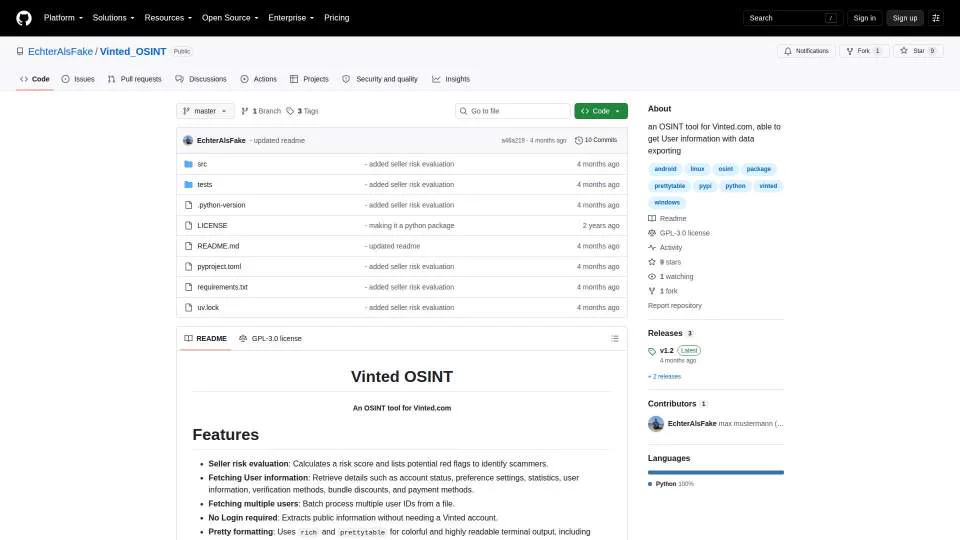
Vinted_OSINT is a GitHub tool by EchterAlsFake that performs open-source intelligence gathering against Vinted.com user profiles, pulling seller/buyer account information and computing a risk score to flag accounts likely run by scammers. It's aimed at buyers wanting to vet sellers before transacting on the second-hand marketplace.
x.comrepoPublished and added 4 Oct 2026🛡️ Security - Sigma r2026-07-01 — 20 new detection rules
GitHub release notes for Sigma r2026-07-01, the open-source detection-rule repository, adding 20 new rules (e.g. LSASS crash via Netlogon buffer overflow CVE-2026-41089, TanStack supply-chain attack indicators for Windows/Linux, RedTail cryptominer user-agent detection, AF_ALG kernel crypto API exploit indicator) and updating/fixing dozens of existing rules for ARM64 binary variants, file-sharing domain IOCs, and WMI-based reconnaissance/persistence detection. It's a routine but substantive update to a widely-used blue-team detection content pack.
github.comrepoAdded 3 Oct 2026🛡️ Security - OKX Agent Trade Kit (okx-trade-mcp / okx-trade-cli)
OKX Agent Trade Kit is an open-source MCP server (okx-trade-mcp) and CLI (okx-trade-cli) that let AI assistants like Claude Desktop, Cursor, Claude Code and VS Code place trades and query account data on the OKX exchange via natural-language commands. It runs locally with API keys never leaving the machine, supports module scoping (market, spot, swap, account, earn), a read-only mode for safe querying, multiple profiles, and includes pre-built skill files for agent frameworks plus structured JSON error reporting for debugging failed tool calls.
github.comrepoAdded 2 Oct 2026🧠 AI - Show HN: Made an open-source Lego AI generator
ldraw-nova is an open-source agentic pipeline where an LLM agent (tested with models like Claude Opus 5.5 and GPT-6 Astra) takes a build prompt, reads LDraw-building instructions, and produces a plan.json describing a model's geometry. From that plan it writes a Python generator script that, when executed, outputs an LDraw (.mpd) 3D CAD source file, viewable in 3D/VR (Meta Quest 3) or exportable to Blender-editable glTF. The agent uses jev-rerank, a semantic search tool with reranking backed by TypeSafe's Jev System One model, to find suitable LEGO parts and example models, falling back to full-text search without an API key; it also uses headless rendering and collision/gap detection to self-inspect and iterate on designs.
github.comrepoAdded 3 Oct 2026, published 2 Oct 2026🧠 AI - Folkbench/folkbench
Folkbench has two parts. One is a public benchmark and leaderboard of third-party AI API relay (中转站) services. Multi-node probes run around the clock and publish availability, P95 latency and price per relay, with per-model rankings. The other is Switch, an open-source Tauri/Rust desktop client that stores several Base URL and API Key pairs. It applies them to Claude Code or Codex configs in one click, previews config diffs, and stashes and restores the official ChatGPT OAuth credentials when switching Codex to a third-party provider. It also keeps keys local and estimates token usage and cost per session. The README also profiles several relay services, such as Modelflare, CheapAI and ApiPorter, and that part reads as promotional.
github.comrepoAdded 12 Oct 2026, published 2 Oct 2026🧠 AI - NVIDIA/OpenShell — sandboxed runtime for autonomous AI agents
OpenShell is NVIDIA's open-source runtime for safely running fleets of autonomous AI agents: each agent runs in an isolated sandbox where kernel-level controls enforce a declared policy over file access, syscalls, and network connections, and credentials are injected only for approved endpoints rather than exposed to the agent directly. Policy changes are checked with formal verification to flag risky new access (new hosts, new API methods) before they're approved, and the project ships a CLI, gateway, Kubernetes/Helm deployment, and a tutorial running OpenCode against an OpenRouter model.
github.comrepoAdded 1 Oct 2026🛡️ Security - OpenShell — safe, private runtime for autonomous AI agent fleets
OpenShell is NVIDIA's open-source runtime for running fleets of autonomous AI agents inside isolated sandboxes. Declarative policies cover filesystem, syscall, process and network access. These are enforced at the kernel level, and credentials are injected only into requests bound for approved endpoints. Policy changes are checked with formal verification so risky new access waits for human review. It ships a CLI, a gateway control plane (Helm deployment on Kubernetes), SDKs, extensibility hooks (middleware, interceptors, compute drivers) and installable agent skills, and it can run agents such as OpenCode.
github.comrepoAdded 1 Oct 2026🧠 AI - AI News | AI Tools (@AI_News100x) on X
Open-Dots is an open-source reimplementation of OpenAI's 'Dots' computer-use agent, giving any LLM the ability to control a browser, terminal and filesystem plus connectors to personal apps. It is framework-agnostic (works with any LLM) and free, positioned as a self-hostable alternative to OpenAI's proprietary computer-use offering.
x.comrepoPublished and added 30 Sep 2026🧠 AI  רון אברבוך (@Ron_averbuch) on X
Open-Dots is an open-source re-implementation of OpenAI's Dots computer-use agent, giving it browser, terminal and file control plus connectors to personal apps, and designed to work with any LLM rather than being locked to one vendor's model. It's announced via a tweet linking to the GitHub repo (github.com/Anil-matcha/Open-Dots).
x.comrepoAdded 30 Sep 2026, published 29 Sep 2026🧠 AI- feder-cr/invisible_playwright_mcp
invisible_playwright_mcp is an MCP server (and companion Python library, invisible_playwright) that wraps Playwright so an LLM agent can operate a real browser like a human: clicking, typing, scrolling and reading page content, useful for tasks like checking flight fares across a date range where no API exists. It ships a standalone chat+live-browser UI driven by any OpenRouter model, installs as a plugin for Claude Code, Codex and Gemini CLI, and exposes stealth/identity controls (seed-based browser fingerprint, proxy-derived timezone/locale/geolocation, persistent profile directories) via its invisible_core component.
github.comrepoAdded 7 Oct 2026, published 29 Sep 2026🧠 AI - NVIDIA OpenShell — secure runtime for autonomous AI agent fleets
OpenShell is NVIDIA's open-source runtime for running fleets of autonomous AI agents with restricted, policy-governed access to files, system calls, network, and credentials. It enforces policy at the kernel level inside isolated sandboxes (per-agent, with Docker/Podman/virtualization backends) and uses formal verification to flag risky policy changes — such as an agent gaining a new host or API access with credentials — before they take effect, so changes can wait for human review. It ships a CLI, a gateway control plane, Kubernetes/Helm deployment, and installable agent skills for writing and debugging sandbox policies.
github.comrepoAdded 29 Sep 2026🧠 AI - NVIDIA OpenShell — secure runtime for autonomous AI agent fleets
OpenShell is NVIDIA's open-source runtime for running fleets of autonomous AI agents in isolated sandboxes, enforcing per-agent policies on filesystem, syscall, and network access at the kernel level and injecting credentials only for approved endpoints. Policy changes go through a formal-verification step (an 'advisor'/'prover') that flags newly granted risky access, such as a new host reachable with credentials, before it's applied, and it deploys via Docker/Podman/host virtualization or Kubernetes with Helm.
github.comrepoAdded 29 Sep 2026🛡️ Security - https://github.com/dmdhrumilmistry/security-harness
security-harness is an open-source Claude Code plugin (also packaged for Gemini CLI, Codex and opencode) that orchestrates subagents — sh-recon, sh-hunter, sh-chainer, sh-verifier, sh-reporter — through a static-analysis pipeline covering 15 vulnerability classes (IDOR/BOLA, SQLi, XSS, SSRF, injection, auth, deserialization, path traversal, secrets, CSRF, XXE, open redirect, crypto, race conditions, file upload), producing README/JSON/SARIF/HTML/PDF reports with PoCs, CVSS and CWE/OWASP mappings. It also ships sh-pr-review, a per-PR merge-gate skill that posts inline findings and a commit status scoped only to code the PR itself introduced or aggravated, with caching, dedup via fingerprints, and a scheduled GitHub Action that keeps its per-class knowledge bases fresh by having one AI agent draft updates from allowlisted sources (OWASP, PortSwigger Research, CWE/CAPEC, HackerOne) while a separate adversarial reviewer agent fails-closed against prompt injection before auto-merge.
github.comrepoAdded 2 Oct 2026, published 29 Sep 2026🛡️ Security - SpecterOps/Blacklight — local AI agent attack surface mapping toolkit
Blacklight is a SpecterOps toolkit for endpoint forensics on AI coding agents, split into Scout (bounded metadata/filesystem triage across Codex, Claude Code, Cursor, Antigravity CLI, and Grok that finds candidate session artifacts without reading their contents) and Session Analysis (a Python CLI that parses selected JSONL/SQLite session downloads from Codex, Claude Code, Cursor, and Antigravity CLI into ranked, redacted local reports). It's built for investigators who need to identify and review AI agent session history on a host — surfacing config, auth metadata, and high-value indicators — while explicitly leaving secret scanning to external tooling; paths are informed by SpecterOps' Endpoint AI Agent Abuse (EAA) technique catalog.
github.comrepoAdded 27 Sep 2026🛡️ Security - Adversarial-Detection-Engineering/adeskills
adeskills is a working knowledge base for "Adversarial Detection Engineering" (ADE), a taxonomy of four categories and 16 subcategories of detection-logic bugs (e.g. Reformatting in Actions, Omit Alternatives, Context Development, Logic Manipulation) that explain why a SIEM/EDR/XDR rule fails to catch what it intends to. It ships 38 worked technique files with vulnerable/hardened rule examples and detection-layer guidance, a cross-platform bug-pattern catalog, a pre-engagement scoping checklist, and a Redamon-packaged skill (ade_scoper), all grounded in analysis of real public rulesets from Sigma, Elastic Security, and Microsoft Sentinel. It's explicitly scoped for defensive detection engineering and purple-team rule hardening, with several files documenting real vendor-rule weaknesses.
github.comrepoAdded 2 Oct 2026, published 27 Sep 2026🛡️ Security - dzhng/jevgrep
Jevgrep (the `jg` CLI) lets a coding agent ask a natural-language question about a repository and get back relevant files, reading leads, and verbatim source excerpts in one response, using an LLM (Jev) to judge relevance across folders, files, and declarations instead of relying on grep/ripgrep alone. It ships an installable "skill" for Claude Code, Codex, OpenCode and other agents that teaches them when to call jg versus their normal tools, and requires a key for Vercel AI Gateway, TypeSafe, OpenRouter, or OpenCode Zen. A reported ten-task SWE-bench repeat found ~40% lower coding-agent cost ($7.62 to $4.52) but a lower solve rate (7/10 vs 8/10 baseline), explicitly framed as a cost/quality tradeoff rather than a win.
github.comrepoAdded 27 Sep 2026, published 26 Sep 2026🧠 AI - graygnatconsole/mcp-audit-tool
mcp-audit-tool is a dependency-light Python CLI that statically scans Claude Desktop, Cursor, Windsurf, Cline, Zed, and VS Code MCP configuration files for security issues, including hardcoded secrets, unpinned/rug-pull packages, pipe-to-shell installers, tool-poisoning via hidden instructions in tool descriptions, filesystem servers rooted at '/', and unauthenticated plaintext HTTP MCP endpoints. It auto-discovers configs across macOS/Linux/Windows, produces a security score/grade plus SARIF 2.1.0 output for GitHub Code Scanning, and is built around the OWASP MCP Top 10 categories with a CI/CD example that fails builds on severity thresholds. The roadmap adds live server probing over stdio/SSE for runtime rug-pull detection and an ML-based prompt-injection classifier for tool descriptions.
github.comrepoPublished and added 26 Sep 2026🛡️ Security - Sandyaa — open-source autonomous code auditor that proves bugs with working exploit PoCs
Sandyaa is an open-source autonomous code-audit tool that points at a local directory or git URL and runs end-to-end, driven by the Claude Code CLI (optionally Gemini) with no separate API key required. It uses a Recursive Language Model approach — the model drives a Python REPL to chunk code, spawn sub-LLM queries, and aggregate results — running eight recursive passes (call-chain tracing, data-flow expansion, vulnerability chaining, exploitability proof, etc.) and an attacker-control-reachability analyzer to filter unreachable findings, then writes each finding with a working exploit PoC and an evidence.json linking claims to file/line. Maintained by SecureLayer7, who report using it to surface zero-days; it's alpha-stage, macOS-tested, Linux/WSL2-expected-to-work, and unsupported on native Windows.
github.comrepoAdded 26 Sep 2026🛡️ Security - Chocapikk/CVE-2026-21858
A GitHub PoC chaining two n8n CVEs into unauthenticated RCE: CVE-2026-21858 abuses a Content-Type confusion in the Form Trigger/Respond-to-Webhook nodes to read arbitrary files (e.g. /proc/self/environ, the SQLite database, and the config file), from which the attacker derives the JWT secret from n8n's encryptionKey and forges an admin session cookie. That admin access is then used to create a workflow exploiting CVE-2025-68613, an expression-injection sandbox bypass (`this.process.mainModule.require`) that yields command execution, all demonstrated with a working Python exploit script and Docker lab against n8n 1.65.0. It notes the exploit was developed independently of a prior Cyera/Dor Attias write-up on a related n8n chain and details the specific vulnerable workflow pattern (file-upload form + binary Respond node) required for exploitation.
github.comrepoAdded 26 Sep 2026🛡️ Security - AgentSystemLabs/agent-office
agent-office is an open-source Node.js application that renders your team's projects as floors of a cartoon 3D office, where each Claude Code, OpenCode or Codex coding-agent worker sits at a desk with a visible terminal others can join. It wires agent workers directly into GitHub: an issues board and PR board with diff review, CI status and merge actions, a task queue that auto-hires workers into isolated git worktrees, one-click PR creation, live worker status via Claude Code/Codex hooks and an OpenCode plugin, and per-worker cost/token tracking against Claude plan limits. It also supports multi-agent meeting-room collaboration patterns such as debate, lead and team, map-reduce, red and blue, and review panel, where several agent workers jointly produce a file and open a PR, plus shared voice chat and screen sharing for the human team.
github.comrepoAdded 28 Sep 2026, published 26 Sep 2026🧠 AI - git-pkgs — dependency history & supply-chain analysis for git repos
git-pkgs is a Go rewrite of a Ruby tool that adds a git subcommand for tracking dependency changes across a repository's history, indexing manifests/lockfiles from 36+ package managers (npm, RubyGems, Cargo, PyPI, Maven, Composer, Go modules, etc.) into a local SQLite database. Beyond history/blame/diff, it offers supply-chain security commands: `vulns` (OSV-based CVE scanning with SARIF output for GitHub code scanning, plus blame/praise/exposure for remediation metrics), `licenses` (with drift detection and CI-friendly exit codes), `deprecated`, `provenance` (trusted-publishing/attestation checks), `integrity` (lockfile hash drift detection), `maintainers`/`health` (via ecosyste.ms metadata), and `sbom` export in CycloneDX/SPDX. It also supports a dependency-aware `bisect` to find when a vulnerability, license change, or capability (e.g. network access) was introduced, and ships GitHub Actions for CI integration.
github.comrepoAdded 25 Sep 2026🛡️ Security - https://github.com/davila7/claude-code-templates/tree/main/cli-tool/components/skills/security/security-threat-model
A directory within the davila7/claude-code-templates repo containing a "security-threat-model" Skill for Claude Code: a SKILL.md instruction file plus supporting agents and reference files that package a reusable threat-modeling workflow for the coding agent. It's an example of the emerging pattern of distributing structured, invocable skills (instructions + sub-agents + reference docs) that extend Claude Code's capabilities, rather than a security research artifact itself.
github.comrepoAdded 2 Oct 2026, published 25 Sep 2026🧠 AI - https://github.com/davila7/claude-code-templates/tree/main/cli-tool/components/skills/security/security-threat-model
A "security-threat-model" skill folder in the davila7/claude-code-templates repository, part of a library of reusable Claude Code skills/components. It packages a SKILL.md definition with supporting agent and reference files intended to let Claude Code agents carry out structured threat-modeling analysis as part of a development or security-review workflow.
github.comrepoAdded 2 Oct 2026, published 25 Sep 2026🛡️ Security - yetone/magpie
magpie is a cross-platform menu bar app, TUI and CLI that lets you view and switch the model each installed AI coding agent (Claude Code, Codex, Gemini CLI, OpenCode, Cursor, Copilot CLI, Goose, Pi, etc.) is configured to use, editing each agent's config file surgically without disturbing comments or formatting. It runs a local gateway (127.0.0.1:3425) that translates between OpenAI Chat Completions, OpenAI Responses and Anthropic Messages APIs so every agent can point at one endpoint and use any provider's models, including routing groups that spread requests across multiple keys/subscriptions with configurable routing strategies (smart, order, rotate, usage). It can also reuse existing subscriptions (Claude Code, Codex/ChatGPT, Copilot, Devin, Gemini CLI) as providers for other agents without exposing or copying credentials, and supports encrypted profile backup/restore.
github.comrepoAdded 26 Sep 2026, published 23 Sep 2026🧠 AI - shai-hulud-detect: multi-ecosystem npm/PyPI/Composer/Crates/Go/Hex/RubyGems supply-chain worm scanner
shai-hulud-detect is a dependency-free Bash scanner that checks projects against a 5,782-entry list of compromised npm, PyPI, Composer, Crates, Go, Hex, and RubyGems package versions, plus content-pattern indicators of compromise (malicious file hashes, C2 domains, dead-man's-switch artifacts, forged commits, suspicious lifecycle hooks) tied to the Shai-Hulud supply-chain attack waves. It supports single-project and bulk scanning, CI-friendly exit codes, JSON/log output for pipeline gating, and a --check-host mode to detect the May 2026 gh-token-monitor/kitty-monitor persistence daemons that wipe hosts if their monitored GitHub token is revoked (with a documented safe remediation order). Detection is read-only; new package entries are sourced from named threat-research firms (Socket, StepSecurity, Aikido, Snyk, JFrog, Wiz, Semgrep, SafeDep, GitGuardian, OX Security) and cited in PRs.
github.comrepoAdded 23 Sep 2026🛡️ Security - nealbridges/VulnHunter
VulnHunter is a maintained fork of Capital One's open-source agentic security scanner, reworked to run on any agent harness (Claude Code, Codex, Grok/OpenCode) instead of being Claude-Code-specific. The fork's distinguishing work is engineering, not security findings: portable "skill" prompt files with an explicit environment contract, an installer that fails loudly instead of guessing paths, Docker-based sandboxed exploit validation, and a benchmark harness that ran six full scans of one production Go service across five model/harness stacks, finding that result counts swung from 3 to 42 findings depending on how rigorously exploits were validated. It ships three composable skills (/vulnhunt, /vulnhunter-fix, /vulnhunt-fix-verify), a headless batch-runner (harness/), and a deterministic manifest-writing CLI (vh).
github.comrepoAdded 6 Oct 2026, published 22 Sep 2026🧠 AI - nealbridges/VulnHunter
A maintained, harness-portable fork of Capital One's open-source VulnHunter — an agentic AI tool that performs attacker-first forward analysis on source code to find exploitable vulnerabilities, falsify weak findings, and produce evidence-backed PoCs rather than pattern-matched SAST alerts. This fork adds containerized (Docker-based) exploit validation, measured-impact PoCs (rows leaked, amplification factor, etc.), and portability across agent harnesses (Claude Code, Codex, Grok, etc.) via environment-contract prompt files, plus an unattended operator (vulnhunter-run) and batch-scanning/benchmark harness tested against OWASP NodeGoat, Juice Shop, and WebGoat.
github.comrepoAdded 6 Oct 2026, published 22 Sep 2026🛡️ Security - Show HN: Foremerge – Catch intent conflicts between parallel coding agents
Foremerge is an open-source coordination protocol layered above Git for parallel coding agents (Claude Code, Codex, Cursor). Agents publish semantic intent (scopes like symbol/api/schema) before editing into a shared SQLite store under .git, so Foremerge can detect intent conflicts—like one agent replacing a class another is extending—that Git's text-diff merging would silently miss. It's advisory-only (no file locking), deterministic (no LLM judgment calls), and gates ChangeSet acceptance on Foremerge-run validation rather than agent self-reports.
github.comrepoAdded 26 Sep 2026, published 21 Sep 2026🧠 AI - SnailSploit/Claude-Red
claude-red is a GitHub library of structured SKILL.md files for the Claude Skills system, each priming Claude with expert-level offensive-security methodology for a specific attack surface (SQL injection, shellcode, EDR evasion, ADCS abuse, wireless, IoT, cloud, mobile, fuzzing, etc.). Skills load on-demand from conversational triggers so context isn't spent on unused domains, and can be installed wholesale, per-category via sparse-checkout, or pasted directly into a system prompt. It's aimed at authorized red-team engagements, bug bounty triage, CTF prep, and operator training, building on Sahar Shlichov's offensive checklist collections.
github.comrepoAdded 21 Sep 2026🛡️ Security - Lonkero — Rust web vulnerability scanner (v3.7, AI agent mode)
Lonkero is an open-source Rust web vulnerability scanner (v3.7) combining 125+ context-aware scanners with an AI agent mode that drives targeted scans via natural-language conversation (using Claude, GPT, or local Ollama models). Notable techniques include a browser-free "proof-based" XSS engine that mathematically proves exploitability from reflection context + escape behavior, an "OOBZero" engine for detecting blind SQLi/SSRF/XXE via Bayesian multi-channel statistical inference and Pearson-correlated timing attacks without external callback infrastructure, Next.js middleware-bypass detection (CVE-2025-29927, CVE-2024-34351), AWS Cognito user-enumeration checks, and a scanner module that detects invisible prompt-injection payloads hidden in README.md files targeting AI coding assistants.
github.comrepoAdded 21 Sep 2026🛡️ Security - ossf/criticality_score
criticality_score is an OpenSSF tool that computes a 0-1 criticality score for open source projects (based on an algorithm by Rob Pike), using signals like contributor count, commit frequency, dependents count, and org diversity to identify projects the ecosystem critically depends on. It ships a CLI, config files for tuning scoring weights, and companion tools (enumerate_github, collect_signals, scorer) for large-scale data collection; the project's GCP-hosted BigQuery/GCS datasets will be discontinued after 2026-08-29, with data moving to a static data directory.
github.comrepoAdded 21 Sep 2026🛡️ Security - sno-ai/sno-station
Sno Station is an open-source (Apache-2.0) local workstation that coordinates multiple AI agents (Claude Code, Codex, OpenClaw) as a 'Duo': they share an encrypted on-disk memory store, hand off tasks when one hits a rate limit, peer-review each other's work, and run a nightly self-improvement loop that proposes edits to their own skill files based on session history. It reports results on the Memora benchmark (FAMA/FAA metrics for forgetting-aware long-term memory) and cites Karpathy's 'LLM Wiki' and Google's WikiSkill as design inspirations.
github.comrepoAdded 26 Sep 2026, published 19 Sep 2026🧠 AI - kerpopule/hermes-jev-skills
hermes-jev-skills wires TypeSafe's small, fast decision model "Jev" into agent workflows (Hermes, Claude Code, Codex) to handle cheap sub-decisions — which model should answer a turn, which of many skills to load, which retrieved passages matter, which conversation turns survive a summary — instead of burning frontier-model tokens on them. It ships ten agent-agnostic SKILL.md files, a CLI (jev routing/mail/screen/search), a local dashboard, and a plugin built on public Hermes seams (pre_llm_call, transform_tool_result, llm_request middleware) with detailed data-redaction guarantees for what gets sent to the Jev API. It also includes a shadow mode for safely evaluating routing decisions before enabling them.
github.comrepoAdded 26 Sep 2026, published 18 Sep 2026🧠 AI - Betterleaks — secrets scanner from the Gitleaks creator
Betterleaks is a configurable, fast secrets scanner maintained by the original Gitleaks author and team, capable of scanning git history, local filesystems, stdin, GitHub/GitLab orgs and specific PRs/MRs, Hugging Face models/datasets, and public S3/R2 buckets. Detection rules use regex plus an Expr (with legacy CEL compatibility) based prefilter/filter/validate pipeline, allowing entropy checks, keyword gating, and live API validation of found credentials (e.g. checking a GitHub PAT against api.github.com). It's used in production by projects like Aikido Security and shipped inside MegaLinter.
github.comrepoAdded 18 Sep 2026🛡️ Security - Oldcircle/geo-sleuth
geo-sleuth is an open-source Agent Skill that lets any tool-using agent (Claude Code, Codex, Cursor, Gemini CLI, OpenCode, GitHub Copilot) geolocate a photo without relying on text, license plates or landmarks, instead using OpenStreetMap geometry, elevation data, satellite tiles and street view. It structures the task as a scored candidate board with ~20 single-purpose Python scripts (sun/terrain/osm/pose analysis, CLIP-ranked satellite matching, DINOv2+SIFT street-view matching) that do the ranking, while the LLM only judges among top candidates and must cite the command/file behind every claim. Output includes coordinates with an error radius, camera heading, and an evidence image.
github.comrepoAdded 26 Sep 2026, published 18 Sep 2026🧠 AI - OWASP Agentic Skills Top 10 (AST10)
The OWASP Agentic Skills Top 10 (AST10) is a new security framework cataloging the 10 most critical risks in AI agent "skills" — the behavior layer that orchestrates multi-step tool use in OpenClaw, Claude Code, Cursor/Codex, and VS Code. It documents real 2026 incidents (the ClawHavoc registry-poisoning campaign with 1,184 malicious skills, Snyk's ToxicSkills audit of 3,984 skills finding 36.82% flawed, CVE-2025-59536/CVE-2026-21852 RCE in Claude Code project files, and CVE-2026-28363 ClawJacked WebSocket hijacking) and proposes a Universal Skill Format (YAML) with signing, permission allowlists, and identity-file protections to mitigate them, mapped to CSA's MAESTRO 7-layer threat model.
github.comrepoAdded 18 Sep 2026🛡️ Security - NiazMorshed2007/jev-review
Jev Review is a local MCP server that gives coding agents structured per-dimension quality scores on diffs or files, using a remote Jev API for scoring. It supports an iterative loop where agents baseline, improve, and rescore code with delta comparisons.
github.comrepoAdded 26 Sep 2026, published 17 Sep 2026🧠 AI - Shai-Hulud-2.0-Detector — npm supply-chain compromise scanner
Shai-Hulud-2.0-Detector is a GitHub Action and CLI tool that scans package.json/lockfiles for packages compromised in the Shai-Hulud 2.0 (Nov 2025) and ChainDrop (Aug 2026) npm supply-chain worms. It uses semver-precise matching against a database of 1,241+ known-compromised package versions (auto-updated daily from Datadog and Wiz Research feeds) to flag malicious preinstall/postinstall droppers (setup_bun.js, Math_Symbol.js), rogue GitHub self-hosted runners named SHA1HULUD, and ChainDrop's new IDE-persistence hooks in .claude/settings.json and .vscode/tasks.json. It ships SARIF output for GitHub Security tab integration, an allowlist system, and a detailed incident-response guide covering credential rotation and forensic checks.
github.comrepoAdded 16 Sep 2026🛡️ Security - ruc-datalab/EvoOntology
EvoOntology is an open-source, self-evolving semantic ontology layer for data agents from Renmin University of China, exposed as MCP tools and installable as Claude Code and Codex plugins. It automatically builds a versioned ontology from tabular/file/database workloads, then continuously evolves it from agent execution trajectories using a build-use-evolve-evaluate-publish loop that validates candidate updates against a parent version before promotion. The accompanying paper reports gains over plain ReAct agents on DDR-Bench, InsightBench, and BIRD across GPT-5.5, GPT-5.6-sol, Claude-Sonnet-5, and Claude-Opus-4.8 backbones.
github.comrepoAdded 26 Sep 2026, published 15 Sep 2026🧠 AI - RepoGuardBench
RepoGuardBench is a benchmark and accompanying paper that measures whether local open-weight coding agents (Qwen2.5-Coder 1.5B-14B via Ollama) stay on the bug-fix task when repository artifacts — README files, issue text, code comments, test logs, and agent-rule files — carry inert prompt-injection instructions. It evaluates five lightweight context- and action-level defenses (D0-D5, including a path-only action gate) across seven metrics in a sandboxed task workspace, finding no statistically clear utility winner among them. The project ships a deterministic no-GPU smoke test, paper-claim verification scripts, and reproducible tables/figures under MIT (code) and CC BY 4.0 (data) licenses.
github.comrepoAdded 22 Sep 2026, published 13 Sep 2026🛡️ Security - sage — Agent Detection & Response (ADR) for AI coding agents
Sage is an "Agent Detection & Response" (ADR) security layer that intercepts tool calls made by AI coding agents — shell commands, URL fetches, file writes — and screens them through multiple detection layers before execution. It combines cloud URL reputation, 300+ YAML local heuristics, a two-tier (heuristic + fine-tuned ML) prompt-injection detector for fetched content, npm/PyPI package supply-chain checks (registry existence, file reputation, age), installed-plugin scanning at session start, and Windows AMSI integration. It ships as a plugin for Claude Code, Cursor, VS Code, OpenClaw, and OpenCode, and is published by Gen Digital (also distributed under the Norton/Avast Sage branding).
github.comrepoAdded 10 Sep 2026🛡️ Security - AWSHound — AWS BloodHound OpenGraph Collector
AWSHound is a Go CLI/container tool that collects AWS IAM and authorization data across profiles, config-file opt-ins, or an entire AWS Organization (via cross-account role assumption), and outputs a BloodHound OpenGraph for attack-path analysis. It supports phased collection with on-disk artifacts, offline graph building from previously collected data, and safeguards like --max-api-requests and --max-api-requests-per-minute to bound AWS API traffic during collection.
github.comrepoAdded 8 Sep 2026🛡️ Security - headroomlabs-ai/headroom
Headroom is an open-source (Apache 2.0) local compression layer that sits between AI agents and LLM providers, compressing tool outputs, logs, RAG chunks, files and conversation history before they reach the model. It offers a Python/TypeScript library, a drop-in proxy, an `headroom wrap` mode for popular coding agents (Claude Code, Codex, Cursor, Copilot, Aider, etc.), an MCP server, cross-agent shared memory with dedup, and output-token reduction via verbosity steering and effort routing — all running locally with reversible compression (CCR) so originals stay retrievable.
github.comrepoAdded 23 Sep 2026, published 7 Sep 2026🧠 AI - pashov/skills
pashov/skills is a set of Claude Code "skills" built by Pashov Audit Group that turn an AI coding agent into a Solidity security auditor: an "x-ray" command for quick codebase reconnaissance, a "solidity auditor" mode that runs multiple different agent personas over a codebase (or specified files) looking for vulnerabilities, and a "fizz" command for additional automated checks. It packages smart-contract audit tradecraft into reusable AI agent skills rather than a standalone scanner, letting developers or auditors invoke deep, multi-pass Solidity review directly inside their coding assistant.
github.comrepoPublished and added 7 Sep 2026🛡️ Security - 0x4D31/endpoint-ai-agent-abuse
endpoint-ai-agent-abuse (EAA) is a curated, evidence-scoped taxonomy of techniques for abusing local, endpoint-resident AI agents — especially coding and developer agents — covering launchers/flags, provider routing, instructions, memory, hooks, plugins, skills, MCP, transcripts, telemetry, and inherited local-user authority. Each technique is tagged by maturity (feasible, demonstrated, observed) and backed by cited incidents, artifacts, or research, with companion files for surfaces, tactics, case mappings, and detection/hunting hypotheses plus a validator script and JSON schema for the catalog.
github.comrepoPublished and added 7 Sep 2026🛡️ Security - kaandemir993/DarkTortilla-RAT-Telegram-Exfiltration-Payload-Extraction-Analysis
A hands-on reverse-engineering writeup dissecting a DarkTortilla RAT sample (pulled from MalwareBazaar) using Process Hacker, Binary Ninja and x64dbg. It documents the malware's credit-card theft (card_number_encrypted strings for Visa, Mastercard, Amex, Diners Club, etc.), browser credential theft via SQLite queries against Login Data files and app_bound_encrypted_key/os_crypt decryption, and three parallel exfiltration channels — a Telegram bot, SMTP mail, and FTP upload — with the C2 domain showip.net used for IP detection.
github.comrepoAdded 30 Sep 2026, published 5 Sep 2026🛡️ Security - The React Native Developer's Security Guide
A GitHub-hosted book focused entirely on securing the React Native developer's workstation and toolchain rather than the shipped app — covering the polyglot execution surface triggered by a single git clone/yarn/pod install (Ruby, CocoaPods, Xcode build phases/XCSSET, Gradle, gradle-wrapper.jar, keystores), CVE-2025-11953 (exposed Metro/RN dev server), ClickFix-style social engineering of developers, CI-as-extended-workstation risks, and Expo/EAS-specific supply-chain concerns. It ships alongside a separate companion repo of 119 Opengrep detection rules, each mapped to a specific chapter's attack technique, plus practical appendices like a safe-clone runbook and a file risk atlas for hardening teams.
github.comrepoPublished and added 5 Sep 2026🛡️ Security - OWASP OASIS
OWASP OASIS is a proposed community project that operationalizes turning automated vulnerability/fix-generation tool output into human-validated pull requests submitted upstream to open source projects. It defines a full lifecycle (intake, weighted validator review with accept/reject/modify/duplicate decisions, OWASP adoption, ephemeral working forks, upstream submission) plus roles (project owners, validators, maintainer liaisons, automation operators) and outcome metrics like upstream acceptance rate. The GitHub repo lays out governance via a validators.yml credibility file, CODEOWNERS-gated scoring, and GitHub Projects/issue templates to run the whole thing without custom tooling.
github.comrepoPublished and added 5 Sep 2026🛡️ Security - cyanheads/osv-advisory-mcp-server
osv-advisory-mcp-server is an MCP server that queries the OSV.dev vulnerability database, offering single-package version checks, batch audits of up to 1000 {name, ecosystem, version} tuples for SBOM/lockfile triage, and full advisory record fetch by OSV ID (GHSA/PYSEC/RUSTSEC/GO/DSA/DLA/CVE prefixes). It surfaces CVE aliases, CVSS vectors, derived severity labels, and CWE IDs, and is designed to chain into a companion nist-nvd-mcp-server for CVSS base scores, EPSS probability, and CISA KEV status. It ships as a keyless, no-API-key tool runnable via STDIO or Streamable HTTP, with a public hosted instance and Bun/npx/Docker install paths.
github.comrepoAdded 1 Sep 2026🛡️ Security - choirboy-prompt
choirboy-prompt is a cross-runtime agent-memory plugin that loads project lore, research indexes, and validated dossiers into agent sessions via SessionStart hooks (Claude Code, Codex) or full plain-text payloads (Kimi, OpenCode, Hermes), so new conversations continue from established project history instead of starting cold. It handles installation across multiple agent apps, migration of project artifacts between checkout locations, and includes a build/verify pipeline (build-context.py, test.sh) for authoring canonical lore files like prompt.md, user.md, and lore.md.
github.comrepoAdded 22 Sep 2026, published 31 Aug 2026🧠 AI - age
age is a simple, modern file encryption tool, format, and Go library by Filippo Valsorda and @benjojo, offering small explicit keys, no config options, UNIX-style composability, and now built-in hybrid post-quantum encryption (ML-KEM + X25519) as of v1.3.0. It supports multiple recipients, passphrase encryption, SSH key (ed25519/rsa) recipients/identities, hardware tokens via age-plugin-yubikey, and an age-inspect command to view encrypted-file metadata without decrypting.
github.comrepoAdded 3 Sep 2026, published 31 Aug 2026🛡️ Security - emlai/defi-native-skill
An open-source Agent Skill ("defi-native") that teaches Claude Code, Cursor, Codex and other Agent-Skills-compatible agents capital-markets and DeFi domain knowledge, including yield decomposition, vault/curator anatomy, oracle classes, and stablecoin/RWA taxonomy. It is structured with progressive disclosure (SKILL.md routes to task-specific reference files only when needed), an api-routes.json router that forces live data pulls (vaults.fyi, DefiLlama, Morpho's GraphQL, rwa.xyz, Merkl, 130+ protocol docs) before any numeric claim, and a verified 90+ source manifest. The author describes an eval-gated release process (paired with/without-skill runs graded on structure) and adversarial review by independent models before publishing, making it a useful case study in skill engineering even for readers uninterested in DeFi itself.
github.comrepoAdded 2 Oct 2026, published 28 Aug 2026🧠 AI - vibecheck
vibecheck is a free, open-source, client-side scanner that checks apps built with AI code generators (Lovable, Bolt, v0, Cursor, Claude Code) for common security holes: exposed Supabase Row Level Security / Firebase rules, secrets embedded in the client bundle (Stripe/AWS/DB keys), missing security headers, exposed .env/.git/source maps, unauthenticated LLM proxy or MCP endpoints, and email/TLS misconfigurations. It also scans public repos for cross-tenant IDOR patterns, committed secrets, an OSV.dev supply-chain check, a Dockerfile lint, and generates a CycloneDX SBOM; a companion CLI (tenant-guard) adds a live Postgres cross-tenant isolation test as a CI gate. The project cites CVE-2025-48757 (170+ Lovable apps found with RLS disabled) as motivation.
github.comrepoPublished and added 27 Aug 2026🛡️ Security - BountySkiller
BountySkiller is a Flask app with two bug-bounty-focused tools: a collector that pulls disclosed HackerOne hacktivity and bug-bounty writeups (plus RSS/Google sources) into local JSON, and "Hunt Buddy," a browser-driven orchestrator that takes a target profile, runs a gap analysis against a set of pluggable bug-class hunting modules (sourced from an external HUNT_TOOLS directory, e.g. SSRF), and produces ranked findings with per-module status and enforced scope.domains restrictions. It exposes a small REST API (/api/hunt/plan, /api/hunt/run, /api/fetch, etc.) for scripting the collection and hunt workflow.
github.comrepoPublished and added 27 Aug 2026🛡️ Security - subScraper
subScraper is a self-contained, single-file (main.py) Python orchestrator that chains subdomain enumeration tools (Amass, Subfinder, Assetfinder, Findomain, Sublist3r) into httpx probing, screenshot capture, ffuf fuzzing, nuclei, and nikto scans, all driven from a live web UI with resumable job state, worker concurrency controls, and Docker packaging. It ships 34 custom nuclei templates for CVEs lacking official coverage and exposes a scoped, API-key-authenticated "bug bounty agent API" for programmatic recon and attack-surface queries against a target's scope.
github.comrepoPublished and added 27 Aug 2026🛡️ Security - S1N6H/pentest-harness
pentest-harness is an open-source, plugin-based AI agent framework aimed at authorized penetration tests, bug bounty research, security labs, and CTFs. It provides a "Pentest Mode" offensive-security operating standard, a full agent toolset (shell, filesystem, web research, subagents, background jobs), and a bring-your-own-key multi-provider LLM engine (OpenAI, Anthropic, DeepSeek, Google, Mistral, Groq, OpenRouter, Azure OpenAI) with durable JSONL/SQLite session persistence and an owner-only credential store for API keys.
github.comrepoPublished and added 27 Aug 2026🛡️ Security - Cloudflare Computer
Cloudflare Computer is a preview virtual filesystem living inside a Durable Object, with authoritative state in SQLite exposed through three pluggable execution backends: a full Linux container mounted via FUSE and capnweb RPC, an isolated shell (just-bash) running in a Dynamic Worker, and isolated JavaScript modules in a fresh Dynamic Worker with scoped fs/git/artifacts access. It's designed as sandboxing infrastructure for AI agents, with examples demonstrating per-backend egress policy controls (none/all/custom) and MCP-based code execution tools, making it relevant to securely isolating and constraining agent/LLM code execution.
github.comrepoAdded 3 Sep 2026, published 25 Aug 2026🛡️ Security - agentgg
agentgg is an open-source, agentic SAST scanner that uses LLM agents to read source code, follow imports, trace the call graph, and confirm findings before reporting — aiming to reduce the pattern-matching false positives of traditional SAST. It runs locally or as a hosted service, supports full-repo scans or git-diff PR review, and works with multiple model providers (Anthropic, OpenAI, AWS Bedrock, Google Vertex AI, OpenRouter, Ollama); agents are defined as markdown files with YAML frontmatter and are pulled from a community agents catalog.
github.comrepoPublished and added 23 Aug 2026🛡️ Security - CarterPerez-dev/Cybersecurity-Projects
A GitHub repo of hands-on cybersecurity build projects with full source code, organized into Foundations (pre-beginner, heavily commented single-file Python teaching projects), Beginner, Intermediate, and Advanced tiers, including a work-in-progress DDoS mitigation tool. It also bundles 10 certification/career roadmaps (SOC Analyst, Pentester, Security Engineer, GRC Analyst, etc.) and a curated list of learning tools, courses, and communities, cross-promoting the author's CertGames platform for guided versions of the same projects.
github.comrepoPublished and added 21 Aug 2026🛡️ Security - ScreenshotDetector
ScreenshotDetector is an Android app-layer tool that detects screenshot, screen recording, screen mirroring, and casting activity using a combination of public APIs (ScreenCaptureCallback, ScreenRecordingCallback, DisplayManager, MediaProjection, ContentObserver/MediaStore, FileObserver, AccessibilityService, NotificationListenerService) and hidden APIs accessed via reflection (DisplayManagerGlobal.getDisplayInfo, WifiDisplayStatus, AppOps project_media/project_audio). It is positioned as a research counterpart to ScreenshotFaker (an LSPosed/Shizuku-based tool that forges/bypasses screenshot detection), illustrating the attacker/defender dynamic around screen-capture evasion on Android, including detection of adb shell screencap/screenrecord, freeform/mini-window attribution, and accessibility-overlay/screen-reader channel abuse detection.
github.comrepoPublished and added 21 Aug 2026🛡️ Security - vscan
vscan is an open-source, lightweight, cross-platform website vulnerability scanner built for authorized security assessments. It combines port scanning and fingerprint identification (using a merged database of ~6,832 fingerprints from eHole, wappalyzergo, and local rules), login credential brute-forcing, sensitive file detection, and vulnerability PoC checks compatible with both Xray and Nuclei PoC formats. It supports flexible input (STDIN/host/IP/CIDR/URL/TXT) and output formats (JSON/TXT/CSV/STDOUT).
github.comrepoPublished and added 15 Aug 2026🛡️ Security - Andrej Karpathy Skills
A single CLAUDE.md file (also packaged as a Claude Code plugin and Cursor rule) that encodes four principles derived from Andrej Karpathy's public observations on LLM coding failure modes: surfacing assumptions and ambiguity instead of silently guessing, avoiding overengineered/bloated code, touching only what's necessary when editing, and using verifiable success criteria for goal-driven execution loops. It's distributed as a drop-in instructions file, a Claude Code marketplace plugin, and a committed Cursor project rule.
github.comrepoAdded 22 Sep 2026, published 15 Aug 2026🧠 AI - Cariddi
Cariddi is a Go-based CLI tool that crawls a list of domains/URLs to discover endpoints, secrets, API keys, tokens, and juicy file extensions. It supports proxying through Burp Suite, custom headers, secret/endpoint regex files, JSON/HTML/TXT output, and configurable crawl depth and concurrency, making it a common recon tool in bug bounty and pentest workflows.
github.comrepoAdded 3 Sep 2026, published 12 Aug 2026🛡️ Security - xiaoyeuzixi/revlab
REVLab is a Windows-local binary analysis workbench for PE files, Unreal Engine dumps and Unity game folders. Its graph workflow engine runs LLM analysis nodes as tool-calling operators: up to 6 tool rounds by default, a target path locked by the workflow, a saved tool_trace, and a read-only fallback when the gateway lacks tools support. Evidence is labelled static, runtime, inferred or blocked, and model output is capped at ai_inferred. An MCP server lets external agents read evidence and submit conclusions.
github.comrepoAdded 23 Oct 2026, published 11 Aug 2026🧠 AI - xiaoyeuzixi/revlab
REVLab is a local Windows binary analysis workbench covering generic PE files, Unreal Engine dumps and Unity game directories. It splits work into stages (identify, unpack, disassemble with Capstone, decompile with Ghidra Headless, gated local dynamic run) stored per sample in SQLite. A Vue Flow workflow editor, AI tool-loop nodes and an MCP server let external agents drive analysis, with evidence labelled static, runtime, inferred or blocked.
github.comrepoAdded 23 Oct 2026, published 11 Aug 2026🛡️ Security - HarnessRouter/harnessrouter
HarnessRouter is a self-hostable (Docker) infrastructure layer that wraps existing agent harnesses such as Codex and Claude Code behind one OpenAI Responses-compatible API, letting a product run tasks, stream progress, manage files/artifacts, and switch harnesses without writing harness-specific integration code. It implements the Unified Harness Protocol (UHP), a versioned, OpenAI Responses-compatible contract with a reference implementation, schemas, and conformance suite, plus features like per-session workspaces, custom harness configuration with tools/skills/MCP servers, and secret redaction via vault references or header-scoped env vars so long-lived tokens never leak through agent output.
github.comrepoAdded 2 Oct 2026, published 9 Aug 2026🧠 AI - aurscan
aurscan is a Go-based CLI that hooks into yay/paru to scan a downloaded AUR package's PKGBUILD, .install scriptlets, .SRCINFO and helper scripts before makepkg runs, blocking the build if it looks malicious. It combines offline, quote-aware static rules covering known AUR campaign signatures such as disguised source patch URLs, install-scriptlet worms, masqueraded binary file types, and editor auto-exec triggers with an LLM auditor (Claude Code, Codex, Anthropic API, or a local OpenAI-compatible model) that answers a fixed checklist of yes/no behavioral questions, from which aurscan deterministically derives a verdict, severity and confidence, and fails closed when no backend is available. It documents and defends against real incidents including the July 2025 firefox-patch-bin CHAOS RAT vector, the June 2026 Atomic Arch mass orphan-package takeover pulling a Rust stealer and eBPF rootkit, and the August 2026 xsnow dot-install worm that harvested SSH keys and self-propagated across AUR.
github.comrepoPublished and added 8 Aug 2026🛡️ Security - wanmol/goal-flow
goal-flow (goalflow) is a production-oriented framework built on LangGraph that offers two complementary ways to build LLM apps: transpiling Dify Studio's drag-and-drop workflow DSL export into a version-controllable, runnable LangGraph Python file, and building ReAct/Deep/custom agent loops with a vendored agent_kit SDK. It includes a FastAPI HTTP layer, a node library (LLM, code, HTTP, if/else, classifier, iteration, loop, tool, agent, doc-extractor), a chunk-processor that turns raw LangGraph streams into semantic SSE events consumable by pluggable data adapters (Dify/OpenAI/custom), Redis/MySQL persistence, human-in-the-loop interrupts, a skills engine, and Langfuse tracing. It was extracted from an internal production system and reports sustaining 100 concurrent conversations on modest hardware (2 vCPU/4GB per replica).
github.comrepoAdded 30 Sep 2026, published 6 Aug 2026🧠 AI - autoguardrails
autoguardrails is an open-source alignment research scaffold from Santander AI Lab, inspired by Karpathy's autoresearch pattern, that searches over a single mutable policy.md file to minimize attack success rate (ASR) against a fixed jailbreak/obfuscation eval suite while enforcing a benign-pass floor so the guardrail can't just refuse everything. It reports asr_unguarded, asr_with_policy, and policy_delta to isolate the guardrail's contribution from the target model's native safety, and supports both an offline deterministic stub and real OpenAI-compatible target/judge models.
github.comrepoPublished and added 5 Aug 2026🛡️ Security



Showing 90 of 148
Show more