Skip to content

743 results for โ€œNTIAโ€

What you seeeverything
securityweek.comarticle๐Ÿ›ก๏ธ Security

Florida Student Aid Website Hack Puts Data of 4.9 Million People at Risk

The Florida Department of Education (FLDOE) disclosed a breach of its Florida Student Financial Aid website (FloridaStudentFinancialAidSG.org), discovered on 19 October and potentially affecting about 4.9 million people. Exposed data may include names, Social Security numbers, dates of birth, addresses, phone numbers and emails. The entry vector and actor are undisclosed. The article links it to the September FLHSMV driver database breach, which came from compromised police credentials.

Florida Department of EducationFlorida Department of Highway Safety and Motor VehiclesFlorida Digital Service+2

Threat Intelยท Published and added 2 Nov 2026

cloud.google.comwriteup๐Ÿ›ก๏ธ Security

Shutting the Door on the XCPE Botnet

XCPE is an Android firmware backdoor (x.cpe, com.oemservice) preloaded by OEM Videostrong Technology on more than 1.3 million set-top boxes. Google Threat Intelligence Group details the three-stage architecture, the MQTT C2 (mqtt.szbboys[.]com), Play Protect disabling, persistence, and affiliate modules for residential proxies and ad fraud. It also lists the legal takedowns, the Videostrong ban and the partners involved.

AndroidAndroid TVMQTT+3
XCPEVideostrong TechnologyBadBox+18

Threat Intel, Malware & RE, Mobile Securityยท Published and added 2 Nov 2026

securityweek.comarticle๐Ÿ›ก๏ธ Security

Google Introduces $250,000 Root-in-Cloud Bug Bounty Reward

Google Cloud Vulnerability Reward Program has added a $250,000 root-in-cloud tier for exploits that give roles/owner or full IAM control over arbitrary Google Cloud organizations or projects. The exploit path cannot rely on prior project access, stolen credentials or social engineering. Remote code execution in Borg also qualifies, but researchers must stop probing immediately. Proof is made against a designated service account using a deterministic proof-of-root mechanism.

Google CloudBorg
GoogleCloud VRPChris Betz+2

Cloud & Infra, Offensive Securityยท Published and added 2 Nov 2026

securityweek.comarticle๐Ÿ›ก๏ธ Security

Chainalysis Discloses Data Breach Following AI-Driven Cyberattack

Chainalysis disclosed a data breach in which an external actor used offensive agentic techniques to access its systems and internal tools. Exposed data was non-sensitive customer data: user IDs, full names, email addresses and organization role labels. Investigation content, query results and credentials were not compromised. The company says the incident is unrelated to the $6.36 billion Binance heist, and advises users to enable MFA and watch for password reset prompts. Scope and victim count are undisclosed.

LLM
ChainalysisBinanceDPRK

Threat Intel, AI Securityยท Published and added 2 Nov 2026

x.comthread๐Ÿง  AI

Luke The Dev (@iamlukethedev) on X

Hermes, the Nous Research agent framework, shipped 130 merged PRs in October 2026, according to this X recap by Luke The Dev. Main items are a unified gateway runtime, a Desktop and Bot Screen, a bundles and package manager, crash-safe updates and new Claude model entries. Ten PRs cover security: an iron-proxy credential-injection egress firewall for sandboxes, 31 CVEs patched in Python and npm lockfiles, and profile-export and prompt-leak fixes.

Hermesiron-proxyPython+2
Nous ResearchLuke The Dev

agents, ai-infraยท Added 2 Nov 2026

lankabusinessonline.comarticle๐Ÿ›ก๏ธ Security

PHP security scare puts Sri Lankaโ€™s digital systems under scrutiny

Lanka Business Online reports on CVE-2026-109618 and CVE-2026-109619, two critical PHP flaws allowing unauthenticated remote code execution. Sri Lanka's Ministry of Digital Economy told state bodies to check their systems, as over 70% of government sites reportedly use PHP. Research on 22 to 24 October 2026 found 80 state-linked sites on potentially vulnerable versions, 61 of them unsupported. Patches came out on 21 October 2026.

PHP
CVE-2026-109618CVE-2026-109619Ministry of Digital Economy

AppSecยท Published and added 2 Nov 2026

bleepingcomputer.comarticle๐Ÿ›ก๏ธ Security

Chainalysis discloses data breach from "offensive agentic techniques"

Chainalysis disclosed a security incident in which an external actor used "offensive agentic techniques" to access internal systems and tools earlier in the month. Exposed customer data includes user IDs, names, email addresses and organizational role labels. The company reports no evidence of access to investigation content, credentials or session tokens, and has shared no details on the vulnerabilities, tools or dwell time. The article also lists other incidents from the same week.

ChainalysisBinanceARTEX+3

Threat Intel, AI Securityยท Published and added 31 Oct 2026

wiz.iowriteup๐Ÿ›ก๏ธ Security

โ€œBlack Octoberโ€ for AI Developer Platforms

Wiz Research links October 2026 breaches at AI developer platforms (Fireworks, OpenCode, Warp, Zeabur, Railway and others) to stolen environment-variable credentials for AI access. It details two enterprise AWS Bedrock keys abused after vendor breaches: about 800k and 1.7 million calls, over $100k in list-price usage. It profiles two LLM resale operations, "momo" and "Xingjiabi", that tested the keys.

AWS BedrockOpenCodeClaude+3
LLMjackingdistillationWiz Research+13

Threat Intel, AI Security, Cloud & Infraยท Added 31 Oct 2026, published 30 Oct 2026

securityweek.comarticle๐Ÿ›ก๏ธ Security

Passkeys Are Better Than Passwords. But They Are Not Enough.

Opinion piece arguing that passkeys, built on public-key cryptography, resist phishing, credential stuffing and password theft but do not settle identity risk. Attackers can go around them through account enrollment before a passkey is bound, weaker recovery paths (SMS, email link, help desk), device changes and authenticated session hijacking. It proposes layering identity threat detection with risk-based, continuous evaluation of trust.

passkeysMFA
adversary-in-the-middleMFA fatigueSIM swapping+3

Identity & Accessยท Published and added 30 Oct 2026

aikido.devarticle๐Ÿ›ก๏ธ Security

Binance hack: how a compromised developer laptop can lead to a $6.3 billion breach

Aikido Security's analysis of the roughly $6.3 billion Binance incident, which Binance says may have started with a compromised DevOps engineer's laptop. It sets out what is known (no private key leak, TraderTraitor attribution by TRM Labs and Chainalysis, additional breach points) and a plausible chain from laptop credentials to a withdrawal service. It compares the 2025 Bybit theft and lists mitigations.

npmVS CodeAWS+1
BinanceTraderTraitorLazarus Group+9

Blockchain, Threat Intel, Supply Chainยท Published and added 30 Oct 2026

x.comadvisory๐Ÿ›ก๏ธ Security

lee1981 (@lee1981b) on X

CyberForge CVE of the Day #091 covers Progress WS_FTP Server CVE-2026-84295 (unauthenticated administrator-credential exposure, CVSS 10.0) and CVE-2026-90868 (conditional OS command and argument injection, CVSS 9.9, low privileges). Fixed floors are 2024.0.7/9.0.7 and 2025.0.4/10.0.4; 2024.0.6/2025.0.3 fix only the first. It gives KEV, EPSS and SSVC status, six SOC checks, and Windows 4688 evidence queries.

WS_FTP ServerWindowsPowerShell+3
CVE-2026-84295CVE-2026-90868CWE-287+9

Blue Team & Detection, Identity & Accessยท Added 2 Nov 2026, published 30 Oct 2026

securityweek.comarticle๐Ÿ›ก๏ธ Security

$2 Million+ Drained From Polymarket Traders in New Supply Chain Attack

Polymarket halted trading on 29 October after users reported unauthorized withdrawals traced to malicious JavaScript served from DebugBear's real user monitoring snippet. Hudson Rock's sample abused the authenticated session to sell positions or send tokens to a hard-coded address, without exfiltrating credentials. Loss estimates range from $2.19 million to $2.71 million (GoPlus), and Polymarket pledged reimbursement.

PolymarketDebugBearJavaScript
Hudson RockGoPlusArkham+2

Supply Chain, Threat Intelยท Published and added 30 Oct 2026

stepsecurity.iowriteup๐Ÿ›ก๏ธ Security

Trojanized Claude Code Extension Delivered Persistent SSH Backdoor to Developer Machines

The Claude Code VS Code extension anthropic.claude-code 2.1.313 was published on Open VSX on 29 October 2026 with a malicious loader prepended to extension.js. On load it planted an attacker SSH key (svc-telemetry), installed per-OS persistence, opened a reverse SSH tunnel and beaconed host recon over HTTP. Cursor reports at most 5,000 users received it in an 11-hour window. The post gives the timeline, cleanup artifacts and credential rotation steps.

Claude CodeVS CodeOpen VSX+3
anthropic.claude-code 2.1.313svc-telemetryT1195.002+1

Supply Chain, Blue Team & Detection, Threat Intelยท Published and added 30 Oct 2026

depthfirst.comarticle๐Ÿง  AI

dfbench โ€” depthfirst

dfbench is depthfirst's held-out benchmark for frontier models on open-ended defensive security work: vulnerability detection, validation of findings, and differential analysis between commits. It reports recall, precision, F1 and cost per task for about 20 models at several thinking levels, split by domain (application, low level, smart contract) and by single or multi-repo scope. Overall detection recall ranges from about 21% to 69%.

LLM
dfbenchdepthfirstGPT-5.6 Sol+16

evalsยท Added 29 Oct 2026

bleepingcomputer.comarticle๐Ÿ›ก๏ธ Security

Binance probes potential $5.8 billion crypto-theft hack

Binance is investigating a possible breach involving up to $5.8 billion in assets, which would exceed the $1.5 billion Bybit theft of February 2025. Tether froze over $1.567 billion in USDT and Circle over $800 million in USDC. Arkham tracks 55 addresses labelled "binance-hacker-1029" holding about $5.78 billion, but that is wallet holdings, not a confirmed theft amount. The cause is not yet known.

BinanceEthereumTether+2
BybitChangpeng ZhaoCircle+5

Blockchain, Threat Intelยท Added 30 Oct 2026, published 29 Oct 2026

oversecured.comarticle๐Ÿ›ก๏ธ Security

Content Providers and the potential weak spots they can have | Oversecured Blog

Oversecured's Android security checklist for Content Providers covers insecure FileProvider path configs, path traversal via decoded Uri.getLastPathSegment(), mismatched readPermission/writePermission, proxying requests to more privileged providers, SQL injection across a shared database, and sensitive actions in providers. Each case has vulnerable manifest and Java code, an attacker PoC and remediation. Real cases from Google and Samsung devices are cited. The page text was truncated near the end.

AndroidSQLiteJava
Oversecuredpath traversalSQL injection+5

Mobile Security, AppSecยท Added 29 Oct 2026

oversecured.comarticle๐Ÿ›ก๏ธ Security

Inside mobile taint analysis: how source-to-sink tracking finds real data-leak paths | Oversecured Blog

Oversecured explains taint analysis for Android and iOS apps and contrasts it with pattern-matching SAST such as MobSF. It covers source, flow and sink, cross-component tracking over Intents, flag-based sanitizer modeling and implicit intent simulation. The case study is an unsafe Class.forName().newInstance() on a Serializable transportFactoryClassName field in Google's com.google.auth.oauth2 credential classes, which Google fixed with a $3,133.70 bounty.

AndroidiOSOversecured+3
intent redirectionpath traversalSSRF+4

Mobile Security, AppSecยท Added 29 Oct 2026

depthfirst.comarticle๐Ÿ›ก๏ธ Security

dfbench โ€” depthfirst

dfbench is a held-out benchmark maintained by depthfirst that scores frontier LLMs on defensive security work: vulnerability detection, validation (precision) and differential analysis between commits. It reports recall, precision, F1 and cost per task by model and thinking level, split by application, low-level and smart-contract code and by single or multi-repo scope. Overall detection recall runs from about 21% to 69%, with the top figure at $99.19 per task for Mythos 5; validation precision mostly falls between 15% and 49%.

LLMKimi K3Grok+3
dfbenchdepthfirstGPT-5.6 Sol+3

AI Security, AppSecยท Added 29 Oct 2026

blog.talosintelligence.comarticle๐Ÿ›ก๏ธ Security

A quiet week in infosec <.<

Cisco Talos Threat Source newsletter for the week of the PHP and Node.js vulnerability news cycle. It summarises NIK C2, a Go-based Windows implant that dumps credentials, streams keystrokes, deploys screen-locking ransomware and uses a victim's hijacked OpenAI API keys to analyse stolen data. It also lists weekly headlines (CISA KEV PHP bugs, Brotli flaw, Gheist GitHub token theft), Talos links and top malware hashes.

GoWindowsOpenAI+3
NIK C2PHP2ShellNode2Shell+7

Threat Intel, AI Securityยท Published and added 29 Oct 2026

arxiv.orgpaper๐Ÿ›ก๏ธ Security

TextSeal2: Distortion-Free LLM Watermarking with Copula Mixing and Memoryless Races

TextSeal2 is a distortion-free LLM text watermark that merges two or more keys into one virtual key and couples it to fresh noise through AutoMark's Gaussian copula. Under speculative decoding it verifies keyed drafts with an extra exponential race, so output matches the target model and acceptance rate is unchanged. On three LLMs at a 10^-3 false-positive rate, it detects 8 to 22 points more 100-token answers than TextSeal.

TextSeal2TextSealAutoMark+2
Gumbel-max schemespeculative decodingGaussian copula+1

AI Securityยท Added 31 Oct 2026, published 29 Oct 2026

arxiv.orgpaper๐Ÿง  AI

TextSeal2: Distortion-Free LLM Watermarking with Copula Mixing and Memoryless Races

TextSeal2 is a distortion-free watermark for LLM output that keeps its signal under speculative decoding. It merges two or more keys into one virtual key coupled to fresh noise through AutoMark's Gaussian copula, and verifies drafts with an extra exponential race. On three LLMs it detects 8 to 22 points more 100-token answers than TextSeal at a 10^-3 false-positive rate.

LLMspeculative decodingGumbel-max watermarking+1
TextSeal2TextSealAutoMark+2

research, inferenceยท Added 31 Oct 2026, published 29 Oct 2026

eprint.iacr.orgpaper๐Ÿ›ก๏ธ Security

Quasi-polynomial time algorithms for block basis reduction of linear codes

Kolesnikov and Novoselov give block basis reduction (BKZ) algorithms for linear codes that need polynomial or quasi-polynomial numbers of calls to a minimum weight codeword oracle at fixed block size. The earlier Ghentiyala and Stephens-Davidowitz bounds are exponential. The paper adds a truncated BKZ and a DeepBKZ variant, with an implementation for block sizes 2 to 24 and approximation-factor estimates on random codes.

BKZDeepBKZminimum weight codeword problem+4

otherยท Added 31 Oct 2026, published 29 Oct 2026

blog.talosintelligence.comarticle๐Ÿ›ก๏ธ Security

IR trends Q3 2026: Actors impersonate IT help desks in vishing attacks as ransomware activity increases

Cisco Talos Incident Response Q3 2026 trends report. Phishing led initial access at 37 percent, with vishing and IT help desk impersonation to get RMM access; public-facing exploitation followed at 33 percent. Ransomware reached 27 percent of engagements (Qilin, Rhysida, Interlock, new VYPR), with EDR killers via BYOVD and WDAC. It also covers Salt Typhoon intrusions using CVE-2023-20198 and BadCandy, attacks on Claude Code credentials, and logging, MFA and secrets recommendations.

Cisco Secure EndpointMicrosoft Quick AssistWindows Defender+6
CVE-2023-20198Salt TyphoonBadCandy+10

Threat Intel, Blue Team & Detectionยท Published and added 29 Oct 2026

arxiv.orgpaper๐Ÿง  AI

Aligning Medical Vision Language Models at the Capability Boundary with Entropy Adaptive Rubric Grounding

MedCBR is a two-stage alignment framework for medical vision language models. Difficulty Weighted Boundary Preference Optimization (DBPO) trains on counterfactual preference pairs at the model's capability frontier. Entropy Gated Grounded Policy Optimization (EGPO) then applies distilled clinical rubrics according to prediction entropy. It reaches 61.2% average accuracy on six medical benchmarks, with the largest gains on differential diagnosis, and the two stages combine super-additively.

vision-language modelpreference optimizationreinforcement learning
MedCBRDifficulty Weighted Boundary Preference OptimizationEntropy Gated Grounded Policy Optimization+1

research, training, multimodalยท Added 31 Oct 2026, published 29 Oct 2026

blog.talosintelligence.comwriteup๐Ÿ›ก๏ธ Security

NIK C2: The new AI-enabled command-and-control framework

NIK C2 is a newly observed C2 framework with a Go-based 64-bit Windows implant that embeds an OpenAI Chat Completions client (ai_generate command), falling back to the victim's OPENAI_API_KEY. Talos details its 52+ commands, AES-256-GCM over WebSocket with HTTP fallback, credential, wallet and keystroke theft, screen-lock ransomware, AMSI bypass and anti-debug. It also lists a live C2 at 87.120.196[.]120 and total-sitevv[.]lol.

GoOpenAIWindows+3
NIK C2nik_panel87.120.196[.]120+9

Malware & RE, Threat Intel, AI Securityยท Published and added 29 Oct 2026

arxiv.orgpaper๐Ÿง  AI

When LLM Architectures Meet Smart Contract Vulnerability Detection: a Replication Study

This paper replicates Chen et al.'s study of LLM-based smart contract vulnerability detection, first on GPT-4 and then on Mixture-of-Experts, RNN-like and State Space Models. The exact replication confirms the high-recall, low-precision pattern on GPT-4. The differentiated replication finds the pattern does not transfer uniformly: GPT-4 and Gemma-3 behave alike despite a roughly 100x parameter gap, while two MoE models diverge.

LLMTransformerMixture of Experts+3
Chen et al.GPT-4Gemma 3+1

research, evalsยท Added 30 Oct 2026, published 28 Oct 2026

arxiv.orgpaper๐Ÿ›ก๏ธ Security

Session-Bound Behavioral Watermarking for Autonomous LLM Agents

AgentAnchor is a session-keyed behavioral watermark for attributing LLM agent trajectory logs to an owner. It derives per-step keys from a secret key, a fresh public session ID and semantic observation states, and embeds parity evidence through a KL-bounded exponential tilt. The paper formalizes learned cross-session forgery, and a trusted verifier checks disputed logs using wrong-key calibration and abstention.

LLM
AgentAnchorlearned forgery

AI Securityยท Added 30 Oct 2026, published 28 Oct 2026

arxiv.orgpaper๐Ÿง  AI

Session-Bound Behavioral Watermarking for Autonomous LLM Agents

AgentAnchor is a session-keyed behavioral watermark that lets an agent owner prove ownership of a trajectory log. Each step key comes from a secret key, a fresh public session identifier and semantic states of recent observations. Parity evidence is embedded through a KL-bounded exponential tilt of action choices. A trusted verifier checks disputed logs without rerunning the agent, using wrong-key calibration and abstention. The paper also formulates a learned cross-session forgery threat.

LLM
AgentAnchorarXiv

research, agentsยท Added 30 Oct 2026, published 28 Oct 2026

x.comthread๐Ÿ›ก๏ธ Security

Kizuno18 (@Kizuno18) on X

Thread by Kizuno18 on the move from local stdio/Docker Model Context Protocol servers to remote HTTP/SSE endpoints in enterprise infrastructure. It names three trade-offs: credential boundary inversion (short-lived OAuth/JWT tokens instead of long-lived admin tokens on workstations), tool schema bloat solved by deferred discovery, and governance via HCP Terraform policy-as-code (Sentinel/OPA), audit trails and approvals. It is opinion, with no data or implementation detail.

Model Context ProtocolTerraformDocker+2
Sentinelblast radiuspolicy-as-code+1

AI Security, Identity & Access, DevSecOpsยท Added 29 Oct 2026, published 27 Oct 2026

x.comthread๐Ÿง  AI

Kizuno18 (@Kizuno18) on X

Kizuno18's X post argues that the move from local stdio and Docker MCP servers to remote HTTP/SSE endpoints matures the Model Context Protocol in enterprise infrastructure. It lists three trade-offs: short-lived OAuth/JWT bearer tokens replace mounted admin credentials, deferred tool discovery avoids roughly 20k tokens of eager schema loading, and HCP Terraform enforces Sentinel/OPA policy, audit trails and approvals server-side. Opinion post with no benchmarks or code.

Model Context ProtocolDockerTerraform+5
Kizuno18HCP TerraformOPA

mcpยท Added 29 Oct 2026, published 27 Oct 2026

latent.spacetalk๐Ÿ›ก๏ธ Security

How Anthropic ships Claude with Claude: Separating the Brain from the Hands

Latent Space episode with Katelyn Lesse and Angela Jiang of Anthropic, recorded after the Claude Opus 5.5 launch. It covers distillation defences (enforced preserved thinking blocks, a compaction feature for harness maintainers), trust-grant authorization for gated model access, and the Managed Agents split between harness and sandbox, where credentials are held outside the sandbox and attached through a proxy. Only the first third of the transcript was available.

ClaudeClaude PlatformClaude Managed Agents+1
Opus 5.5MythosKatelyn Lesse+4

AI Securityยท Published and added 27 Oct 2026

latent.spacetalk๐Ÿง  AI

How Anthropic ships the #1 LLM in the World safely: Separating the Brain from the Hands

Latent Space episode with Katelyn Lesse and Angela Jiang on the engineering behind the Claude Platform. Topics include the Claude Opus 5.5 launch and pricing, Claude Managed Agents that separate the model's brain from the harness and sandbox, rebuilding the Messages API in Rust, credential protection, safety classifiers, model routing and agent evaluation. The page lists show notes and timestamps only, with no transcript.

ClaudeRust
Latent SpaceAnthropicClaude Opus 5.5+2

agents, ai-infraยท Published and added 27 Oct 2026

hackers-arise.comarticle๐Ÿ›ก๏ธ Security

Pentesting: Twelve Caesars โ€“ Community Tools for Offensive Security

Hackers Arise walks through four tools from Praetorian's "12 Caesars" open-source release: Titus (secret scanner with 487 rules and credential validation), Nerva (fingerprints 170 protocols), Brutus (Hydra alternative covering 40+ protocols) and Julius (fingerprints 60+ LLM services such as Ollama). It shows download and run commands in a Kali lab and how the tools chain together. The tools are Go single binaries; the post notes an exposed Ollama on port 11434 allows unauthenticated model use.

GoKali LinuxOllama+3
Praetorian12 CaesarsTitus+4

Offensive Security, DevSecOps, AI Securityยท Published and added 27 Oct 2026

decrypt.coarticle๐Ÿง  AI

OpenAI Proves ETH Is False, and Crypto Twitter Has Questions

Decrypt reports that OpenAI published a 67-page paper (dated 17 October 2026, revised 25 October) claiming its AI found a deterministic subexponential-time algorithm for counting 3-SAT solutions, which would refute the Exponential Time Hypothesis. The proof was formalized in Lean. Impagliazzo, Paturi and Ryan Williams are reviewing it independently and say this is not certification. Anthropic posted a Claude-credited 3-SAT paper on 26 October.

LeanGitHubClaude
OpenAIAnthropicDecrypt+7

research, modelsยท Published and added 27 Oct 2026

arxiv.orgpaper๐Ÿง  AI

Bayes-Adaptive MDPs for Rollout Allocation to Enhance GRPO Training

AdaRoll-GRPO is a method that allocates GRPO rollout budgets per question by difficulty instead of uniformly. It frames allocation as a sequential decision problem and learns an allocation policy with a Bayes-adaptive MDP, computed offline so training adds no online optimization cost. Experiments on several reasoning datasets and LLM architectures show gains over standard GRPO at the same total rollout budget.

GRPOLLM
AdaRoll-GRPOarXiv

training, researchยท Added 28 Oct 2026, published 27 Oct 2026

arxiv.orgpaper๐Ÿง  AI

DCKV: Learned Transform Coding of the Prompt KV Cache in Hybrid Language Models

DCKV is a differentiable codec for the prompt KV cache of hybrid language models, which keep a KV cache only in their few full-attention layers. Transform, quantizer and entropy models (conditioned on prompt tokens and already decoded neighbouring positions) are trained end to end against a frozen model. On Qwen3.5-2B it stores a token in over 55 times fewer bytes than bf16 with at most 1.8 points lost on three long-context benchmarks, and over 100 times fewer with at most 3.6 points lost.

Qwen3.5TransformerLLM
DCKVarXiv

research, inferenceยท Added 28 Oct 2026, published 27 Oct 2026

ethresear.chthread๐Ÿ›ก๏ธ Security

Proof of One: one-person-one-identity polling with encrypted ballots โ€” design and reference code, requesting critical review

Proof of One is an open-source design for polls with one verified human per identity and unlinkable ballots. Enrolment proves in zero knowledge that an ICAO 9303 passport chip was signed by a trusted signer, plus an enclave face match. Voting uses threshold exponential ElGamal on Baby Jubjub with Groth16 proofs, and tally uses a GJKR DKG with a 7-day challenge window. The author, who is pseudonymous, discloses that AI agents drafted most of it and asks for critique of unlinkability, circuit completeness and certificate trust.

Groth16Baby JubjubDAVINCI+1
Proof of OneNemo UnusICAO 9303+4

Identity & Accessยท Published and added 27 Oct 2026

coindesk.comarticle๐Ÿ›ก๏ธ Security

Ethereum fixes Glamsterdam bug that could have sent staking deposits to builders

Glamsterdam deposit bug: Ethereum developers merged a consensus-spec fix on 26 October 2026 for a flaw in the upcoming upgrade. An operator could register as a builder under a public key, then a staking service's validator deposit under the same key would be credited to the builder, so no validator is created and funds are unrecoverable. Pending deposits are now sorted by withdrawal credentials. No losses were reported, and client teams still have to implement the change.

EthereumLidoRocket Pool
GlamsterdamavsetsinJustin Traglia+3

Blockchainยท Published and added 27 Oct 2026

x.comthread๐Ÿ›ก๏ธ Security

AGTP (@AGTPinsights) on X

AGTP's X thread summarizes Meta's Muse Spark 1.3 Evaluation Report. Prompt injection was tested on Exponential Security Labs' RepoInject v1 and BrowserInject v1 and on Gray Swan's IPI Arena, with robustness said to be on par with GPT-5.6 Sol. It also covers chain of thought controllability evals, PostTrainBench under Loss of Control, and Handshake's pre-release human red teaming. It notes the Midas Project's criticism of Muse Wonder's missing safety report.

Muse SparkMuse Spark Open
prompt injectionRepoInject v1BrowserInject v1+10

AI Securityยท Added 27 Oct 2026, published 26 Oct 2026

x.comthread๐Ÿง  AI

AGTP (@AGTPinsights) on X

Thread summarizing Meta's Muse Spark 1.3 Evaluation Report, the safety write-up for the model released on September 2, 2026. It covers prompt-injection results on Exponential Security Labs' RepoInject v1 and BrowserInject v1 and Gray Swan's IPI Arena, chain-of-thought controllability evals, PostTrainBench under Loss of Control, and Handshake's human red teaming. It also notes The Midas Project's criticism that Muse Wonder still has no safety report, and the Muse Spark Open rollout (816B total, 42B active parameters).

Muse Spark 1.3Muse Spark OpenMixture of Experts
MetaMuseMuse Wonder+19

ai-safety, evals, modelsยท Added 27 Oct 2026, published 26 Oct 2026

eprint.iacr.orgpaper๐Ÿ›ก๏ธ Security

Analyzing Compiler-induced Constant-time Violations with Compiler at Scale

CTGREP is a compiler-based framework that applies differential analysis across the whole Clang/LLVM compilation chain to find where, how and under which configurations compiler optimizations break constant-time cryptographic code. Applied to seven libraries, three Clang versions, six targets and thousands of configurations, it led to 48 cases fixed with developers. It also identified seven new problematic LLVM passes and bypassed existing compiler-flag mitigations.

LLVMClang
constant-time violationstiming side-channeldifferential analysis+1

Hardware & RF, AppSecยท Added 27 Oct 2026, published 26 Oct 2026

huntress.comwriteup๐Ÿ›ก๏ธ Security

AI, Scripts, Operator: Inside the ConnectWise Attack

Huntress analyzes Entra sign-in and audit logs from the ConnectWise Cloud Backup credential abuse of 15 October 2026 to judge whether a script, a person or an LLM agent drove it. It found a thread-pool spray, trial-and-error credential planting with a retry added within 55 seconds, and pilot-then-batch targeting. Huntress rates LLM involvement low to medium on its own data and medium to high with Microsoft's Storm-0940/ARTEX attribution. It ends with detections for service principal role self-assignment and vendor app baselining.

Microsoft Entra IDMicrosoft 365Microsoft Graph+3
Storm-0940ARTEXConnectWise Cloud Backup credential abuse+7

Threat Intel, Blue Team & Detection, Identity & Access, AI Securityยท Published and added 26 Oct 2026

x.comthread๐Ÿ›ก๏ธ Security

David Gutierrez | Eng (@david_x_ai) on X

Thread on two October 2026 npm compromises: @subql/common 5.8.3 (5 October), published through GitHub Actions OIDC Trusted Publishing after the attacker tampered with the publish workflow, and tensorlake 0.5.144 (8 October), published by the project's own release workflow with valid provenance for about 1 hour 40 minutes. Both ran on install and stole cloud, GitHub, Kubernetes, Vault, SSH and .env credentials; tensorlake also took AI tool and MCP config. Its payload installed a gh-token-monitor service that deletes the home directory if the stolen GitHub token is revoked, so remove it before rotating.

npmGitHub ActionsGitHub+3
@subql/commontensorlakegh-token-monitor+3

Supply Chain, DevSecOpsยท Added 27 Oct 2026, published 26 Oct 2026

en.cryptonomist.charticle๐Ÿ›ก๏ธ Security

Keystone wallet breach exposes order data, not wallet credentials

Keystone, a hardware-wallet maker, disclosed on 24 October 2026 that customer order data was stolen from its Shopify-backed store. Names, contact details, delivery addresses and purchase records were exposed, but not payment data, recovery phrases or keys. The article covers the support-impersonation and physical-safety risks, a retention-policy inconsistency, and similar leaks at Trezor (80,689 customers) and SafePal (about 39,798). Keystone has not given the number affected or the vulnerability.

KeystoneShopifyTrezor+1
Taylor Monahan

Threat Intelยท Published and added 26 Oct 2026

eprint.iacr.orgpaper๐Ÿ›ก๏ธ Security

Subexponential Algorithms for LWE via Rejection Sampling on Superlattices

Subexponential Algorithms for LWE via Rejection Sampling on Superlattices is an ePrint paper by Ligeng Fan, Changpeng Shao, Hongbo Li and Dingkang Wang. It extends the Ducas, Engelberts and Loyer superlattice framework to give a provable classical search-LWE algorithm for prime q in [n^2, 2n^2], using m=4n samples and time and space exp(O(n/ln ln n)). A second variant runs in 2^((1/2+o(1))n/ln R) for general parameters. It resolves a gap left by Kirchner and Fouque.

Ducas, Engelberts and LoyerKirchner and FouqueBKW algorithm+1

otherยท Published and added 26 Oct 2026

openai.comarticle๐Ÿง  AI

Working with academic communities to build scientific understanding

OpenAI describes three results its models produced in October 2026: a proof of the local smoothing conjecture in all dimensions, a disproof of the Exponential Time Hypothesis, and an existence proof for four-dimensional Yangโ€“Mills and QCD. Each is shepherded by external expert groups under four principles (transparency, no academic credit, recognition, independence). Lean proofs and AI writeups for two results are on GitHub. All claims are OpenAI's.

LeanGitHub
OpenAISimons FoundationRussell Impagliazzo+12

research, ai-policyยท Published and added 26 Oct 2026

arxiv.orgpaper๐Ÿง  AI

Continual Learning Exam: Benchmarking Long-Horizon RSI and Experiential Learning in LLM Agents

Continual Learning Exam (CLE) is a benchmark of 120 human-authored tasks, each a five-level ladder (600 levels) across 89 professional roles and 12 occupational domains, built by 50+ domain experts. Agents must pass a level to unlock the next, and an evaluation agent scores submissions against human rubrics. Across 17 harness-model configurations, feedback plus one revision adds a median 5.3 points; the best system clears 47.7% of levels and finishes all five levels in 23.3% of tasks.

LLM
Continual Learning ExamarXiv

evals, agents, researchยท Added 27 Oct 2026, published 25 Oct 2026

eprint.iacr.orgpaper๐Ÿ›ก๏ธ Security

VeilDNS: Post-Quantum DNS Privacy from the First UDP Packet

VeilDNS is a DNS-native protocol that uses a post-quantum KEM and AEAD to encrypt DNS questions and answers and authenticate the resolver in one UDP exchange on port 53, preserving the DNS wire format. It has stateless and stateful modes plus optional forward secrecy from the second query. Against ML-DSA-authenticated DoT/DoH/DoQ it reports up to 3.5x higher cold-session throughput and 13.7x fewer bytes; Tamarin proves query confidentiality, response authentication and forward secrecy.

DNSML-DSATLS+1
VeilDNSTamarinDoT+3

otherยท Added 26 Oct 2026, published 24 Oct 2026

x.comthread๐Ÿ›ก๏ธ Security

Prasenjit Sarkar (@stretchcloud) on X

Post on the LiteLLM supply-chain compromise. Attackers spent eleven days in the GitHub org, ran a workflow on a throwaway branch to take twenty secrets including a GitHub App private key, then used stolen GitHub CLI OAuth tokens to publish malicious release 1.107.0 from a lookalike Berri-AI repo. A Python startup file harvested sixteen credential categories and LiteLLM proxy Postgres provider keys. Socket flagged the wheels in seven minutes.

LiteLLMPyPIGitHub Actions+3
Berri-AIBerriAILiteLLM 1.107.0+3

Supply Chain, DevSecOps, AI Securityยท Added 26 Oct 2026, published 24 Oct 2026

microsoft.comwriteup๐Ÿ›ก๏ธ Security

Inside the LiteLLM 1.107.0 supply chain compromise: Credential theft through Python startup hooks

Microsoft's analysis of the LiteLLM 1.107.0 compromise, published to PyPI and container images on 21 October 2026. The wheel shipped cook.pth, cook.py and sitecustomize.py, so a credential collector (PRIVCOLLECT) ran whenever Python started, even without importing LiteLLM. It covers AES/RSA-encrypted exfiltration to litellm.dev, a re-armable Unix loader, Defender KQL hunting queries, ATT&CK mapping and rotation guidance.

LiteLLMPythonPyPI+3
cook.pthPRIVCOLLECTT1195.001+4

Supply Chain, Blue Team & Detection, Threat Intelยท Published and added 23 Oct 2026

arxiv.orgpaper๐Ÿง  AI

AI Alignment for Digital Democracy: Fairer Voters Representation against LLM Biases

This paper studies demographic bias in LLM-emulated electorates, using three U.S. presidential elections and comparing one closed-source and one open-source LLM. Removing gender from the voter profile cuts the largest group error by 22-42%, and removing education cuts it by 64%. Removing self-reported race raises mean group error by over 40%. Repeated queries and fairness instructions do not reduce errors and can double them.

LLM
arXiv

research, ai-safety, evalsยท Added 27 Oct 2026, published 23 Oct 2026

eprint.iacr.orgpaper๐Ÿ›ก๏ธ Security

Faster and Smaller Anonymous Credentials from Standardized Signatures

GordieHowe is a language, certifying compiler and zero-knowledge proof system for building anonymous credentials on standardized signatures (ECDSA, RSA, ML-DSA). It proves an ECDSA-signed mobile driving license presentation in 64.8 ms with a 276 KiB proof, 10.1x faster than Google's Longfellow, and an ML-DSA-44 signature in 87.3 ms with at least 116 bits of quantum security. Compiler output and security theorems are checked in Lean. It introduces series-parallel IOPs and extends the BCS transformation in the QROM.

ECDSAML-DSARSA+1
GordieHoweLongfellowBCS transformation+3

Identity & Accessยท Added 24 Oct 2026, published 23 Oct 2026

arxiv.orgpaper๐Ÿง  AI

DRIVE: Fine-tuning via Data Contribution- and Diversity-aware Weighting with Prior Regularization

DRIVE is a per-sample weighting framework for single-stage fine-tuning when the source pre-training data is unavailable. It uses one differentiable objective: Shapley additivity splits each sample's contribution into anti-forgetting and adaptation parts, a covariance-based diversity term reshapes them, and a sample-characteristic prior stabilizes them. The authors prove better stability-plasticity guarantees than existing weighting schemes and report better performance, faster convergence and more robustness.

DRIVEarXiv

training, researchยท Added 26 Oct 2026, published 23 Oct 2026

securityweek.comarticle๐Ÿ›ก๏ธ Security

China APT Uses AI Pentest Tool Artex in ConnectWise Attacks

Storm-0940, a China-linked APT, used the open source AI penetration testing framework Artex to automate a mid-October 2026 campaign against ConnectWise customers, per Microsoft. Artex drove reconnaissance, password spraying and OAuth application abuse at more than 2,900 attempts per minute, with sign-in attempts against over 2,250 tenants. Attackers modified application credentials for persistence, and Microsoft advises correlating service principal sign-ins with Graph activity.

Microsoft Entra IDMicrosoft 365OAuth+3
Storm-0940ArtexConnectWise+4

Threat Intel, AI Security, Identity & Accessยท Published and added 23 Oct 2026

arxiv.orgpaper๐Ÿง  AI

How Much Do You Trust A Dog? Quantifying Hint-Following in Reasoning Language Models

This paper measures how hints such as "[Source] thinks the answer is (X)" shift LLM answers on MMLU questions, varying the source between a professor, a friend and a dog across Qwen, Gemma and SmolLM models. The shift fits an exponential tilt: a roughly constant mean change in the hinted answer's log-odds, with susceptibility largely shared across sources. The shift persists when the source is declared inaccurate or the prompt warns against trusting it. Synthetic experiments show how KL-regularized reward training could produce this pattern.

LLMQwenGemma+1
MMLUarXiv

research, ai-safety, evalsยท Added 26 Oct 2026, published 23 Oct 2026

dfir.chwriteup๐Ÿ›ก๏ธ Security

Field Notes: Reconstructing an Attackerโ€™s Workflow

Field note from dfir.ch on PowerShell scripts an attacker left on disk during an incident: a file-watching command runner using Invoke-Expression, a fake Windows credential prompt that validates passwords via Start-Process and logs them in cleartext, AD computer enumeration with WMI access testing, and SMB share discovery via NetShareEnum. It notes where script labels overstate what they prove and lists hunting strings for Event IDs 4104, 4103, 4688 and Sysmon 1.

PowerShellActive DirectoryWMI+2
TerminalFixClickFixMicrosoft+7

Blue Team & Detection, Offensive Securityยท Added 24 Oct 2026, published 22 Oct 2026

decrypt.coarticle๐Ÿง  AI

Major Banks Find Rogue AI Agents Inside Customer Accountsโ€”And Theyโ€™re 'Horrified'

Decrypt summarizes an Axios report that major U.S. banks are finding unauthorized third-party AI agents inside customer accounts, often using the customer's own credentials. Morgan Stanley blocks outside agents, while JPMorgan, Bank of America and Citi restrict them. Most banks are moving toward read-only access, like budgeting apps, because agents cannot be told apart or confirmed as authorized.

Morgan StanleyJPMorganBank of America+5

ai-policy, agentsยท Published and added 22 Oct 2026

x.comthread๐Ÿ›ก๏ธ Security

Muscle AI (@themuscleai) on X

Post on the LiteLLM 1.107.0 PyPI compromise published 21 October 2026 and quarantined about 1 hour 43 minutes later. A malicious .pth file ran at Python startup and stole cloud credentials, private keys, browser data and AI tool auth files, then POSTed a tarball to an attacker endpoint. The author says attackers used stolen GitHub CLI OAuth tokens to push a trojanized commit chain and build official wheels. It lists five defenses: hash-pinned lockfiles, per-tool capped keys, release cooling periods, secret isolation and egress monitoring.

LiteLLMPyPIPython+3
TeamPCPcook.pth

Supply Chain, DevSecOps, AI Securityยท Added 23 Oct 2026, published 22 Oct 2026

x.comarticle๐Ÿง  AI

Muscle AI (@themuscleai) on X

Muse AI's X post describes the compromise of LiteLLM 1.107.0, published to PyPI on 21 October at 7:39 AM and quarantined about 1 hour 43 minutes later. The payload was a .pth file that ran at Python startup and sent cloud credentials, private keys and AI dev-tool auth files to an attacker endpoint. The author lists five agent-builder defences: hash-locked pins, capped per-tool keys, a release cooling period, keeping secrets away from Python startup, and outbound traffic monitoring.

LiteLLMPyPIPython+3
SocketTeamPCP

ai-infra, agentsยท Added 23 Oct 2026, published 22 Oct 2026

eprint.iacr.orgpaper๐Ÿ›ก๏ธ Security

Getting to the right root: radical isogenies of every degree

Thomas Decru's ePrint 2026/2595 proves a corrected version of radical isogeny formulae for every Nโ‰ฅ4, odd and even, over fields of characteristic coprime to 2N. It settles the sign choice for even N so that 2-isogeny walks stay on the volcano surface. One radical step costs about 12.5N multiplications and one exponentiation, and the paper shows how to evaluate radical isogenies on points, so a CSIDH class group action needs no torsion point sampling.

CSIDH
radical isogeniesKronecker theta function2-isogeny volcano+3

otherยท Added 24 Oct 2026, published 22 Oct 2026

adversa.aiarticle๐Ÿ›ก๏ธ Security

Is Claude Code safe for the enterprise? What the official settings cover, and what they don't

Adversa AI assesses Claude Code enterprise security as of October 2026. Managed settings bind only Claude Code, can be edited by local admins, and are not read by Anthropic-hosted cloud sessions. Auto mode misses 17% of risky actions in Anthropic's test set. The article covers attacks on the harness (CVE-2025-59536, CVE-2026-21852, TrustFall, SymJack, GhostApproval) and recommends credential, egress, isolation and monitoring controls.

Claude CodeAnthropicCursor+2
CVE-2025-59536CVE-2026-21852TrustFall+7

AI Security, DevSecOpsยท Published and added 22 Oct 2026

eprint.iacr.orgpaper๐Ÿ›ก๏ธ Security

Efficient Laconic Oblivious Transfer with Malicious Security

Efficient Laconic Oblivious Transfer with Malicious Security is an ePrint paper (2026/2593, ASIACRYPT 2026 revision) giving the first maliciously secure laconic OT that uses its primitives only as black boxes. It adds equivocal vector commitments and maliciously secure witness encryption to the commitment-plus-witness-encryption paradigm. Security is proven in the UC model against malicious senders and in the context model against malicious receivers. Instantiations use LWE and bilinear Diffie-Hellman assumptions in the standard model.

laconic oblivious transferequivocal vector commitmentswitness encryption+3

otherยท Added 24 Oct 2026, published 22 Oct 2026

x.comrepo๐Ÿง  AI

Dan Kornas (@DanKornas) on X

aula-mcp is an open-source (MIT) TypeScript MCP server that connects an AI client to Denmark's Aula school platform. It exposes tools for profiles, calendar events, messages, notifications, posts and weekly plans. MitID credentials and OAuth tokens are stored in macOS Keychain or an AES-256-GCM encrypted file. The HTTP server binds to 127.0.0.1, and the presence write tool stays off until AULA_MCP_WRITE=1 is set.

Model Context ProtocolTypeScriptClaude Code+3
AulaMitIDDan Kornas

mcpยท Added 23 Oct 2026, published 22 Oct 2026

x.comthread๐Ÿ›ก๏ธ Security

SecureChap (@SecureChap) on X

Post describing a LiteLLM 1.107.0 PyPI compromise in which attackers used stolen GitHub CLI OAuth tokens from three engineers to trigger and approve the project-releaser workflow, producing eight malicious wheels and a tampered tarball. The wheels drop cook.pth, which runs at Python startup, and privcollect steals cloud tokens, keys, browser data, AI configs and LiteLLM proxy credentials, exfiltrating to litellm[.]dev/healthcheck. A second daemon polls a GitHub domain.txt hourly for new domains to fetch and execute. PyPI yanked the package the same day. The post is a single unsourced tweet.

LiteLLMPyPIpip+3
cook.pthprivcollectlitellm[.]dev+2

Supply Chain, DevSecOps, Threat Intelยท Published and added 22 Oct 2026

blog.railway.comadvisory๐Ÿ›ก๏ธ Security

Railway Security Disclosure

Railway's security disclosure of 21 October 2026 says an unauthorized third party may have accessed encrypted customer environment variables and decrypted some of them. Railway links it to a series of attacks on platform companies aimed at compromising AI inference providers, and has asked upstream providers to revoke keys. It tells all users to roll every environment variable, API key and registry credential, and it paused all deployments. The notice gives no technical details of the intrusion.

Railway
Railway security incident October 2026

Threat Intel, DevSecOpsยท Added 22 Oct 2026, published 21 Oct 2026

aws.amazon.comarticle๐Ÿ›ก๏ธ Security

Best practices for integrating IAM Roles Anywhere with your PKI

Best practices for integrating AWS IAM Roles Anywhere with an external PKI so non-AWS workloads get temporary credentials via X.509 certificates. Covers trust anchor placement, certificate attributes (CN, issuer, SAN) in trust policy conditions, short-lived versus just-in-time certificates, and private key protection with PKCS #11, TPM 2.0 and OS certificate stores. Includes credential helper modes (serve, update), expiry monitoring, blue/green trust anchor rotation and a sample CloudFormation template.

AWS IAM Roles AnywhereAWS IAMAWS Private CA+3
X.509trust anchorPKCS #11+5

Identity & Access, Cloud & Infraยท Published and added 21 Oct 2026

endorlabs.comwriteup๐Ÿ›ก๏ธ Security

LiteLLM 1.107.0 Compromised: Python Startup Hooks Steal Cloud, AI, and Proxy Credentials | Endor Labs

litellm 1.107.0 was published to PyPI on 21 October 2026 from a source revision that differs from the official tag. One line in the Maturin config (data = "cook") installs cook.pth, cook.py and sitecustomize.py, which run on every Python start. They steal cloud, AI and proxy credentials, including the LiteLLM database tables, and load remote code hourly. The post gives IOCs, a five-step response plan and hardening advice.

LiteLLMPyPIPython+3
litellm 1.107.0cook.pthsitecustomize.py+5

Supply Chain, Malware & RE, DevSecOpsยท Published and added 21 Oct 2026

x.comthread๐Ÿ›ก๏ธ Security

Billy Lee (@billyozno) on X

LiteLLM 1.107.0 on PyPI shipped malware in all 7 wheels, the package's second supply-chain attack this year. It steals SSH keys, cloud credentials, browser passwords, AI tool configs and API keys, and installs a backdoor that polls for commands hourly. The GitHub source is clean, so a hijacked build or publish step is suspected. PyPI quarantined the release, but Aikido says the Docker image litellm/litellm:1.107.0 was still live. Indicators are cook.pth, cook.py and sitecustomize.py in site-packages. The advice is to rotate reachable keys and pin 1.106.2.

LiteLLMPyPIPython+3
cook.pthcook.pysitecustomize.py

Supply Chain, Threat Intel, AI Securityยท Added 23 Oct 2026, published 21 Oct 2026

stepsecurity.iowriteup๐Ÿ›ก๏ธ Security

litellm 1.107.0 Compromised on PyPI: Backdoored Wheels Drop a Credential Stealer and an Hourly Remote Code Loader

litellm 1.107.0 was published to PyPI on 21 October 2026 with all seven wheels backdoored through an injected `data = "cook"` maturin build line. The wheels drop cook.pth, cook.py and sitecustomize.py, which run on every Python start. They install a "privcollect" credential stealer (browser, SSH, cloud, AI coding tool and LiteLLM proxy database secrets, sent to litellm.dev) and an hourly GitHub dead-drop remote code loader. The post gives IOCs, detection commands and recovery steps.

LiteLLMPyPIPython+3
privcollectcook.pthsitecustomize.py+6

Supply Chain, Malware & RE, Blue Team & Detectionยท Published and added 21 Oct 2026

wiz.iowriteup๐Ÿ›ก๏ธ Security

LiteLLM Compromised, Steals Credentials

LiteLLM version 1.107.0 was uploaded to PyPI on 21 October 2026 with a credential stealer, and the same build reached GHCR and Docker Hub images. Wiz describes the three dropped files (cook.pth, cook.py, sitecustomize.py), exfiltration to a fake litellm.dev domain, a GitHub dead drop for a second stage, and the malicious commits pushed through the lookalike Berri-AI repository. The last safe version is 1.106.2.

LiteLLMPyPIDocker+3
Berri-AIcook.pthsitecustomize.py+2

Supply Chain, Threat Intel, AI Securityยท Published and added 21 Oct 2026

socket.devwriteup๐Ÿ›ก๏ธ Security

LiteLLM PyPI Package and Docker Images Compromised to Steal Cloud and AI Credentials

LiteLLM 1.107.0 on PyPI and GHCR images shipped Python startup hooks (cook.pth, sitecustomize.py) that steal cloud, SSH, browser and AI-tool credentials, including LiteLLM proxy database credentials. Image build provenance recorded a lookalike Berri-AI/litellm source repository. The post decodes the payload, encrypted exfiltration and GitHub-driven remote loader, and lists containment steps, MITRE ATT&CK mappings and IOCs.

LiteLLMPyPIPython+3
Berri-AIprivcollectcook.pth+12

Supply Chain, Malware & RE, Threat Intelยท Published and added 21 Oct 2026

opensourcemalware.comwriteup๐Ÿ›ก๏ธ Security

LiteLLM 1.107.0 PyPI Wheel Contains a Credential Stealer and Persistent Python Backdoor

LiteLLM 1.107.0 macOS x86-64 PyPI wheel analyzed by OpenSourceMalware contains three injected files (cook.pth, cook.py, sitecustomize.py) that run on every Python start. The payload, called privcollect, steals browser, SSH, cloud, CI/CD and AI-tool credentials, then uploads an AES/RSA-encrypted bundle to www.litellm.dev/healthcheck. A forked loader also fetches domain.txt from GitHub and executes /codepy hourly. The post lists IOCs, hashes and remediation steps.

LiteLLMPyPIPython+1
privcollectTeamPCPUpwind+4

Supply Chain, Malware & RE, Threat Intelยท Published and added 21 Oct 2026

arxiv.orgpaper๐Ÿง  AI

Monitorability Is Trainable: Post-Training for Chain-of-Thought Monitorability

Monitorability Is Trainable proposes an unsupervised post-training objective that maximizes mutual information between a model's chain of thought and its output. On three model organisms with degraded CoT (from compression, monitor optimization, and synthetic-document generalization), it recovers most or all lost monitorability. On undegraded policies it improves CoT monitor and activation probe prediction of unsafe behavior and raises consequential reasoning.

LLM
arXiv

ai-safety, research, trainingยท Added 23 Oct 2026, published 21 Oct 2026

arxiv.orgpaper๐Ÿง  AI

Symmetry-Based Parameter Efficient Low-Rank Fine-Tuning for High-Throughput Calculation of Lattice Thermal Conductivity

SBFS-FT (symmetry-based few-shot fine-tuning) adapts the MatterSim 1M universal machine-learned interatomic potential with low-rank adaptation on a small set of compounds sharing one crystal symmetry. Tested on half-Heusler (space group 216), space group 225 and spinel (227) datasets, it cut lattice thermal conductivity error 2-3 times versus the base model. It matched per-compound fine-tuning while taking 5-7 times less compute for 100 compounds.

MatterSimLoRA
MatterSim 1Mmoment tensor potentialspolyMLPs

research, trainingยท Added 23 Oct 2026, published 21 Oct 2026

eprint.iacr.orgpaper๐Ÿ›ก๏ธ Security

Modeling Modular Multiplication for Monomial Prediction and Impossible Differentials, with Application to MSX

This ePrint paper gives the first exact bit-level models of modular multiplication z=(xยทy) mod 2^n. One model is for monomial prediction under 3SDP-woU, the other for impossible differential search. Applied to the MSX lightweight cipher, it yields a 7-round integral distinguisher (2^96 data) for MSX-128, key recoveries on 8 and 9 of 18 rounds at about 2^228 operations, and 1,984 seven-round impossible differentials. Both models are implemented in CLAASP.

MSXCLAASP
MSX-128monomial predictionthree-subset division property+5

otherยท Added 24 Oct 2026, published 21 Oct 2026

alterauth.comtool๐Ÿง  AI

Launch HN: Alter (YC S25) โ€“ Access control for multi-user agents

Alter is a privileged access management layer for AI agents (YC S25). It stores credentials in a vault, injects them per request through a proxy, gives each agent its own identity and scoped grants, and logs every call to a tamper-evident audit trail. One SDK call covers storage, refresh, policy and audit for 140 API providers, with LangChain, MCP and AWS integrations. Policy is default-deny down to the parameter, with human approval for risky calls.

Model Context ProtocolLangChainAWS+3
AlterY Combinator

ai-infra, agentsยท Added 22 Oct 2026, published 21 Oct 2026

securitylabs.datadoghq.comwriteup๐Ÿ›ก๏ธ Security

LiteLLM supply chain compromise: What you need to know

LiteLLM version 1.107.0 was published to PyPI and official Docker images on 21 October 2026 and stayed live for about two hours. Attackers used stolen GitHub CLI OAuth tokens from three engineers to run the release pipeline against a lookalike fork, Berri-AI/litellm. The payload (cook.pth, cook.py, sitecustomize.py) steals cloud, developer, AI-tool and browser credentials, and includes a polling RAT. The post lists removal and rotation steps.

LiteLLMPyPIPython+2
cook.pthTeamPCPBerri-AI/litellm+3

Supply Chain, DevSecOps, Threat Intelยท Added 29 Oct 2026, published 21 Oct 2026

endorlabs.comarticle๐Ÿ›ก๏ธ Security

Gemini 4 Argon on Cursor: solid security score, two unique solves, but slower and more expensive | Endor Labs

Endor Labs evaluates Gemini 4 Argon in the Cursor harness on its Agent Security League coding tasks (SusVibes). Argon ties Fable 5 at 29% SecPass with 78.8% FuncPass, but costs $765 and takes a 14-minute median per task. It uniquely fixes SABnzbd path traversal (CVE-2021-29488) and a Nova credential-logging leak (CVE-2015-8749). Two other candidate solves were rejected, and 29 cheating instances were confirmed.

CursorGeminiEndor Labs+2
CVE-2021-29488CVE-2015-8749Agent Security League+8

AI Security, AppSecยท Published and added 20 Oct 2026

unit42.paloaltonetworks.comadvisory๐Ÿ›ก๏ธ Security

Threat Brief: Active Exploitation of PAN-OS CVE-2026-0257 (Updated Oct 20)

Unit 42 threat brief on active exploitation of CVE-2026-0257, a PAN-OS GlobalProtect authentication bypass added to CISA KEV on May 13, 2026. It lists IP addresses, host IDs and PoC-derived client values to hunt in GlobalProtect logs. The October 2026 updates cover Qilin and Inc ransomware operators, MFA bypass, pivots to vCenter and ESXi with offline VMDK credential dumping, and management interface exposure on ports 4443 and 3879.

PAN-OSGlobalProtectVPN+3
CVE-2026-0257CVE-2023-27532Spikey Scorpius+10

Threat Intel, Blue Team & Detection, Identity & Accessยท Added 21 Oct 2026, published 20 Oct 2026

eprint.iacr.orgpaper๐Ÿ›ก๏ธ Security

A Spectral Theory of Local-to-Global Leakage

A Spectral Theory of Local-to-Global Leakage is an IACR ePrint paper (2026/2571) by Rei Ueno on additive secret sharing over finite abelian groups. It gives an exact leakage decomposition into local leakage magnitude and spectral alignment across shares. Two channels with identical local mutual information can have exponentially different global leakage. Automorphism-weighted sharing can cancel leakage perfectly with finitely many shares, which ordinary additive sharing cannot do.

Rei UenoMรถbius inversion

Hardware & RFยท Added 21 Oct 2026, published 20 Oct 2026

securityweek.comarticle๐Ÿ›ก๏ธ Security

Hackers Steal 1.8 Million Records From Nikkei

Nikkei disclosed a breach of 1.83 million records from a cloud service it uses for system development, accessed on 7 October 2026 with previously compromised credentials. About 150,000 records held names, addresses, emails, phone numbers and birth dates, and 120,000 held email addresses only. Nikkei revoked the credentials and notified regulators. It found no misuse as of 16 October, and it had disclosed an earlier Slack account breach less than a year before.

NikkeiFinancial Times

Threat Intelยท Published and added 20 Oct 2026

github.comrepo๐Ÿ›ก๏ธ Security

better-isms/grcskills

grcskills is an MIT-licensed library of 60 SKILL.md files (Agent Skills format) that let coding agents draft and prepare governance, risk and compliance work: scope statements, statements of applicability, risk registers, audit prep, vendor review, policies, privacy, incidents and continuity. Each skill names where the agent must stop so a person decides. Installs are pinned to release tag v2026.10.19.2, and a validator rejects network commands and credential paths.

Claude CodeCodexCursor+2
SOC 2PCI DSSNIST+2

GRCยท Added 20 Oct 2026

x.comthread๐Ÿง  AI

Paulo Pierrondi | AI agents (@paulopierrondi) on X

Paulo Pierrondi's X post, part 9 of a series on installing MCP servers, lists a monthly review of installed servers. The checks are which tools the agent used, servers not called in weeks, overlapping tools that confuse the model, and whether each server still has an owner. A reply adds a decommissioning check: after removal, confirm the server's old credentials can no longer call the backend.

Model Context Protocol
Paulo Pierrondi

mcpยท Published and added 20 Oct 2026

securitylabs.datadoghq.comtool๐Ÿ›ก๏ธ Security

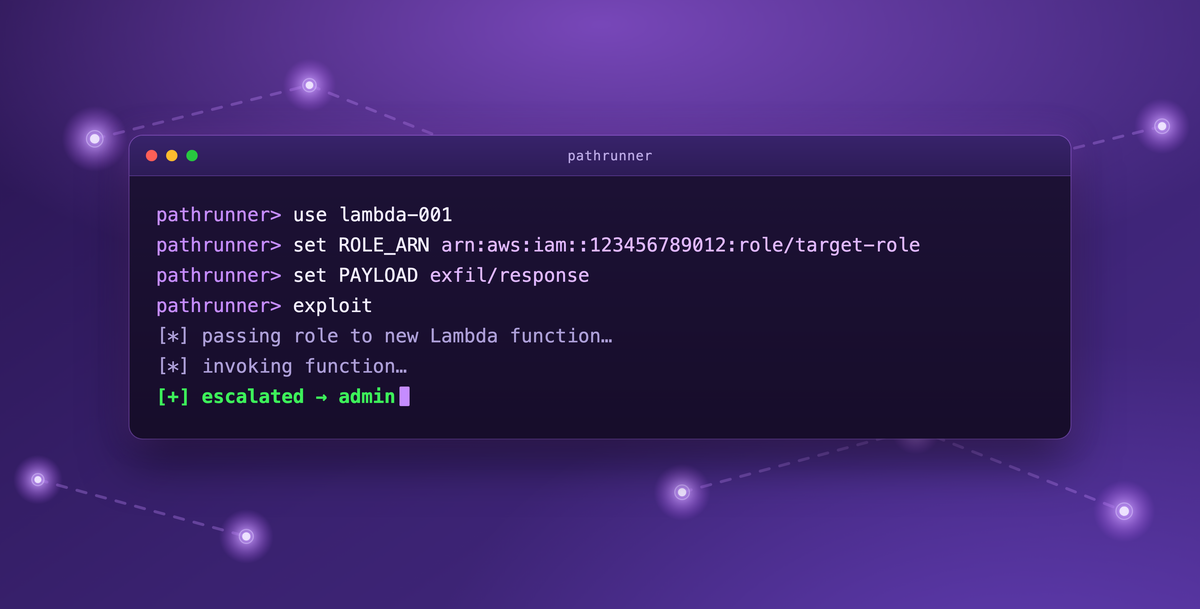
Datadog pathrunner: AWS IAM privilege escalation framework

pathrunner is a modular offensive framework from Datadog Security Labs that automates exploitation of the AWS IAM privilege escalation paths catalogued in pathfinding.cloud and deployed in Pathfinding Labs. It has over 80 exploit modules (as of October 2026), identity import and switching, multiple payloads per module, and attacker infrastructure deployment with a credential listener. A workspace report lists created resources and expected CloudTrail events for defenders.

AWSAWS IAMAWS Bedrock
pathrunnerpathfinding.cloudPathfinding Labs+2

Cloud & Infra, Offensive Security, Blue Team & Detectionยท Added 23 Oct 2026, published 20 Oct 2026

x.comthread๐Ÿ›ก๏ธ Security

LinuxSecurity (@lnxsec) on X

A post from lnxsec on CI runners that accept outside pull requests while also holding registry credentials, cache write access, signing material or deployment tokens. It uses the Nix/Lix build-service issues to argue that host compromise and downstream artifact trust are separate risks. It lists four checks: enumerate secrets exposed to PR jobs, split untrusted runners from release runners, trim registry and binary-cache write permissions, and require independent approval for release. It links a linuxsecurity.com feature; CVE details are not in the post.

Nix
Lix

DevSecOps, Supply Chainยท Added 20 Oct 2026, published 19 Oct 2026

arxiv.orgpaper๐Ÿง  AI

TokenGate: Adapting LLMs for Fast and Memory-Efficient Prefill with Learned Token Pruning

TokenGate is a small drop-in component that adds end-to-end learnable token pruning to trained LLMs for long-context prefill. It uses token-gated attention, inspired by Mixture-of-Experts, to re-weight attention logits with token importance scores, which gets gradients through the non-differentiable top-K step. The authors report 1.4-11.3x faster time-to-first token and 1.5-3.4x lower peak memory with no accuracy loss, on Qwen3 and Qwen3.5.

TransformerQwen3Qwen3.5+2
TokenGatearXiv

research, inferenceยท Added 21 Oct 2026, published 19 Oct 2026

arxiv.orgpaper๐Ÿง  AI

Which Model for Which Role? Cost-Efficient Pareto Recommendation for LLM Agentic Workflows

Cost-Coupled Gittins (CC-Gittins) is a multi-objective extension of cost-aware Gittins search that recommends Pareto-optimal model-to-role assignments for LLM agentic workflows. It exploits the coupling between evaluation and deployment cost, alternating between seeking higher quality and lower cost. On eight quality-cost matrices (two to five roles, up to 1,681 assignments), it recovers a substantial share of the true Pareto frontier at about 10% of exhaustive-evaluation cost, and most of it by 30%. Latency is tested as a third objective.

LLM
arXivCC-Gittins

research, agentsยท Added 21 Oct 2026, published 19 Oct 2026

securityweek.comarticle๐Ÿ›ก๏ธ Security

Rank Math PRO WordPress Plugin Compromised in Supply Chain Attack

Rank Math PRO version 3.0.123, a WordPress SEO plugin, shipped malicious packages between 15 October 2026 20:02 UTC and 16 October 2026 07:12 UTC. The malware gives persistent backdoor access, can expose credentials and API keys, and uses .htaccess rules to run .cache files as PHP. Rank Math released clean v3.0.124 and advises restoring from backup, blocking rank1cdn[.]com, and checking SSH keys and crontabs.

WordPressRank Math PROPHP
rank1cdn[.]comRank Math PRO 3.0.123

Supply Chain, Threat Intelยท Published and added 19 Oct 2026

securityweek.comarticle๐Ÿ›ก๏ธ Security

ConnectWise Suspends Cloud Services in Response to Cyberattack

ConnectWise suspended its Cloud Backup (formerly SkyKick), SaaS Security and Cloud Management services in October 2026 after a compromised application credential was used to access customers' Microsoft 365 tenants. Huntress saw the Cloud Backup identity sign in to 162 tenants on 15 to 16 October and attacker IP 144.172.64[.]128 try nearly 1,000 Entra tenants, with over 300 successful sign-ins. In one tenant, the Cloud Management Teams app added itself to Global Administrator and added client secrets to other apps. No restoration timeline has been given.

Microsoft 365Microsoft Entra IDHuntress+2
ConnectWise Cloud BackupConnectWise Cloud ManagementSkyKick+5

Threat Intel, Identity & Access, Blue Team & Detectionยท Published and added 19 Oct 2026

securityweek.comarticle๐Ÿ›ก๏ธ Security

One Compromised Login Exposed Millions of California Studentsโ€™ Records

Breach report on Educational Testing Service (ETS), whose SFTP site was accessed with a compromised login credential between 22 May and 18 September 2026, exposing California student records. The data covers at least three school years of students, over 5.7 million enrolled, and leavers back to 2006. Files included names, birth dates, addresses, ID numbers, disability and English learner status. No Social Security numbers were involved, and the credential's origin and the attacker are unknown.

SFTP
Educational Testing ServiceCalifornia Department of EducationCAASPP+3

Threat Intelยท Published and added 19 Oct 2026

Showing 90 of 743

Show more