- How Arbitrum's freezes send transactions from an address without its key
Analysis of the Arbitrum Security Council's 30 October 2026 freeze of 8,425 ETH and 74,559,805.2 ARB on Arbitrum One, tied to the Binance exploit. In one L1 transaction, the council's 9 of 12 Safe used the UpgradeExecutor to swap the Inbox implementation, so the message arrived without address aliasing and landed as type 0x65 transactions with a zero signature. The post lists monitoring advice: alert on Inbox Upgraded events, since the EIP-1967 slot never showed the change.
 ethereum-magicians.orgarticlePublished and added 2 Nov 2026🛡️ Security
 Binance Drained of $5.5 Billion in Suspected Hack, Tether and Circle Freeze $1.8 Billion
Decrypt reports that at least $5.57 billion left Binance-linked hot wallets on Ethereum, Bitcoin and Tron on 29 October 2026, which would be the largest crypto hack on record. On-chain analysts point to an EIP-7702 delegation, installed from a Tornado Cash-funded address minutes before the first sweep. Tether and Circle froze about $1.8 billion. Binance has not confirmed the hack, and how the attacker obtained the signature is unknown.
 decrypt.coarticlePublished and added 29 Oct 2026🛡️ Security
 Rekt - SingularityNET - Rekt
SingularityNET exploit (19 September 2026): attackers with signing authority exposed through a cloud infrastructure breach drained 8.72M FET from the Ethereum bridge converter, then minted about 2.3 billion AGIX, NTX, WMTX and CGV. Rekt's transaction-level reconstruction puts gross liquid proceeds near $2.29M, not the $16.77M headline, and traces laundering via Chainflip, Baltex and THORChain. It notes conversionIn() skipped checkLimits() and trusted a single EOA signature.
 rekt.newswriteupAdded 29 Oct 2026🛡️ Security
 Introducing MavenGate: a supply chain attack method for Java and Android applications | Oversecured Blog
MavenGate is Oversecured's research on hijacking Maven dependencies by buying expired domains behind groupIds on Maven Central and JitPack. It found 6,170 of 33,938 checked domains (18.18%) vulnerable, and tested the attack with its own com.oversecured:hello-world library. It lists defenses (Gradle verification-metadata.xml, PGP signatures) and proposes changes to repository signing.
 oversecured.comwriteupAdded 29 Oct 2026🛡️ Security
 Inventory of PQ P2P Migrations in the Consensus Layer
Inventory of post-quantum migration work for Ethereum consensus-layer networking, by adust09 of Nyx Foundation. It maps three targets: Discovery v5/ENR signatures and key exchange, TLS 1.3 key agreement in QUIC, and libp2p TLS identity binding and CertificateVerify. It covers the 300-byte ENR and 1,280-byte packet limits, why hybrid KEMs do not authenticate peers, and downgrade and DoS concerns. It selects no algorithm or schedule.
 ethresear.charticlePublished and added 27 Oct 2026🛡️ Security
 Falcon Key Recovery from Joint Sampler Leakages
 is an ePrint paper presenting a power side-channel attack on Falcon and FN-DSA that fuses three SamplerZ leakages (exponent class of the center, sign bit, proposal magnitude). It turns them into slab and halfspace constraints solved by softplus interval regression, with no LLL or BKZ. On PQClean Falcon-512 (ARM Cortex-M4) it recovered all 50 keys with at most 34 signatures; on c-fn-dsa it recovered 38 of 50 keys within 200 signatures.
 eprint.iacr.orgpaperAdded 28 Oct 2026, published 27 Oct 2026🛡️ Security
 Bitcoin Wallet Fixes Critical Flaw That Redirected Funds to Attackers
Electrum 4.8.3, released 24 October 2026, fixes a high-severity flaw in the Bitcoin wallet. Rogue servers could suppress a real payment and inject a fake unconfirmed transaction paying an attacker, so a user's fee-bump became the first transaction broadcast. The fix verifies signatures on wallet-owned inputs, but incoming transactions from external senders stay unverified. One user lost funds on 18 October.
decrypt.coarticlePublished and added 26 Oct 2026🛡️ Security Bitcoin wallet bug let rogue servers steal funds when users tried to speed up payments
Electrum, a Bitcoin software wallet, disclosed on 24 October 2026 a flaw where malicious servers swapped pending transactions for fake ones with invalid signatures that the wallet did not check. When users chose Replace-by-Fee to raise the fee, Electrum signed a valid replacement paying the attacker, and at least one user lost funds. Version 4.8.3 adds signature checks; users of only trusted or self-run servers were not exposed.
 coindesk.comarticlePublished and added 26 Oct 2026🛡️ Security
- A Kelsey–Kohno Attack Variant against SHA-2 Message Digests in HSS/LMS and XMSS
Falko Strenzke's ePrint 2026/2635 presents a multi-target second-preimage attack on message hashing in HSS/LMS and XMSS with SHA-256 and SHA-256/192. It herds chaining states from many collected signatures into one state, defeating the key and leaf-index prefix. With 2^64 signatures, SHA-256 cost falls from 2^256 to about 2^166 (2^156 at maximal message length). SHAKE256 parameter sets are unaffected.
eprint.iacr.orgpaperAdded 26 Oct 2026, published 25 Oct 2026🛡️ Security  A hash-only rollup: OP Stack L2 accounts as Lamport-style hash chains, no ECDSA inside the L2
Hash-only rollup: an OP Stack L2 (chain ID 42069000, live since 30 September 2026) where accounts are keccak-256 hash chains and transactions carry no signatures. Spending uses a commit-reveal step through two new transaction types in op-geth. The post describes a flaw the authors found: unauthenticated commits could be overwritten, which allowed preimage front-running. It was fixed with a first-commit-wins rule on 21 October 2026. It lists the remaining limits: L1 ECDSA, no fault proofs, a centralized sequencer, 160-bit addresses and wallet desync.
ethresear.charticlePublished and added 24 Oct 2026🛡️ Security- Chosen Commitments and Certified Decoding Regions in the Adaptive Threshold Schnorr Attack
This IACR ePrint 2026/2632 paper by Demirtaş and Yayla analyses the Crites–Stewart adaptive forgery attack on threshold Schnorr signatures, which needs one call to a sparse linear search oracle (bounded distance decoding of a scaled Reed–Solomon code). It shows that choosing the commitment coefficient vector does not help much: a wrapper adversary with Q challenges succeeds with probability at most QM/p, even if its solvers decode every witness for free. For the six original (N, τ) pairs, M stays below 2^24, so the bound is under 2^-100 after 2^128 challenges at p = 2^252.
eprint.iacr.orgpaperAdded 26 Oct 2026, published 24 Oct 2026🛡️ Security  Electrum wallet security flaw is fixed after a user loses money in fee attack
Electrum 4.8.3, released 24 October 2026, fixes a flaw where a malicious server replaces a user's unconfirmed payment with a conflicting transaction carrying invalid signatures. If the user then bumps the fee with replace-by-fee, the wallet signs a payment to the attacker. One of two reporting users lost funds, and the patch now checks input signatures before accepting such transactions. Bull Bitcoin is adding the same client-side check.
 en.cryptonomist.charticlePublished and added 24 Oct 2026🛡️ Security
- The Exact Bit Security of Hash-Based Signatures
The Exact Bit Security of Hash-Based Signatures is a 2026 IACR ePrint paper that analyses XMSS with 128-bit digests and SLH-DSA-128s in the random oracle model, with proofs formalised in Lean4. Strong unforgeability comes to 127 bits under most accounting modes but only 122 bits if just direct random oracle queries are counted. The authors give matching attacks, and show how resource accounting changes the result.
eprint.iacr.orgpaperAdded 26 Oct 2026, published 24 Oct 2026🛡️ Security - Faster and Smaller Anonymous Credentials from Standardized Signatures
GordieHowe is a language, certifying compiler and zero-knowledge proof system for building anonymous credentials on standardized signatures (ECDSA, RSA, ML-DSA). It proves an ECDSA-signed mobile driving license presentation in 64.8 ms with a 276 KiB proof, 10.1x faster than Google's Longfellow, and an ML-DSA-44 signature in 87.3 ms with at least 116 bits of quantum security. Compiler output and security theorems are checked in Lean. It introduces series-parallel IOPs and extends the BCS transformation in the QROM.
eprint.iacr.orgpaperAdded 24 Oct 2026, published 23 Oct 2026🛡️ Security  Agentic AI Defense: Decode-Time Provenance Binding for MCP
Decode-time provenance binding is a defense for Model Context Protocol agent pipelines against cross-modal trust laundering, where instructions hidden in an email-signature image via LSB, DCT or metadata steganography get decoded by a tool. It combines HMAC-authenticated trust labels, a provenance ledger and context-taint tracking to block critical tool calls. On a real MCP testbed with 24 adaptive payloads, attack success fell from 100% undefended (62.5% for keyword and regex filters) to 0%.
 arxiv.orgpaperAdded 26 Oct 2026, published 22 Oct 2026🛡️ Security
- Balsamic: One-round Threshold UOV from GPU-Accelerated FHE
Balsamic is a complete homomorphic Unbalanced Oil and Vinegar (UOV) signer, used to build one-round threshold UOV signatures from a packed discrete-CKKS FHE circuit. A paired-pivot linear solver and pivot-success certificates allow encrypted retry selection. In 2-out-of-3 semihonest signing, each online partial signature takes 10.7 s on an RTX 6000 Ada and 7.77 s on a GB300, with 5.25 MB per response.
eprint.iacr.orgpaperAdded 24 Oct 2026, published 22 Oct 2026🛡️ Security - Integer Coordinate Families and Threshold RSA Signatures for Any Prime Exponent
Paper by Shivansh Jaiswal and Somitra Sanadhya (IACR ePrint 2026/2601) on integer coordinate families for threshold RSA signatures with prime exponent e. It shows the CT-RSA 2026 Ng-Lau scheme admits trivial forgeries and has a flawed proof. It proposes repaired scheme PiIC and integer secret-sharing scheme PiZ for any prime e and any (t,n), both proven TS-UF-CMA secure under the standard RSA assumption. It also gives super-polynomial coordinate lower bounds for pairwise families.
eprint.iacr.orgpaperAdded 24 Oct 2026, published 22 Oct 2026🛡️ Security  Coinbase's Plan for a Quantum-Safe Bitcoin
Bankless summary of Coinbase's October 2026 proposal for making Bitcoin quantum-safe. It covers upgradeable address designs (BIP-360 P2MR, P2TRv2, hybrid addresses), four candidate signatures (ML-DSA, SLH-DSA, FN-DSA, SHRINCS) with size and stateful-key-reuse trade-offs, a five-stage migration plan, and a separate track for dormant coins with exposed public keys such as Satoshi's.
 bankless.comarticlePublished and added 21 Oct 2026🛡️ Security
- Verifiable Post-Quantum TLS Handshake: Recognizing Implementation Errors of Cryptographic Verification Steps
PQCD-TLS is a post-quantum TLS handshake that binds confirmation codes into chained key derivation, so a faulty signature or KEM verification step causes a key mismatch and handshake failure. The authors build confirmation-code frameworks for ML-DSA and Falcon signatures and for ML-KEM, HQC and DAWN, with unpredictability proofs. Across 48 configurations, handshake latency overhead stays below 1%.
eprint.iacr.orgpaperAdded 24 Oct 2026, published 21 Oct 2026🛡️ Security - SHAKEing SLH-DSA with Non-profiled SCAs
SHAKEing SLH-DSA with Non-profiled SCAs is an eShard ePrint paper (2026/2584) on correlation power analysis of SLH-DSA-SHAKE, the NIST-standardised hash-based signature scheme. It analyses PRF inputs and selection functions, then combines subtrace averaging, partial-then-total CPA and an efficient exhaustive search to recover the full secret seed, enabling universal forgery. On a 32-bit microcontroller the attack needs about 280 to 559 signatures, and the search finishes within 45 minutes on 72 cores.
eprint.iacr.orgpaperAdded 24 Oct 2026, published 21 Oct 2026🛡️ Security - HAETAE on a Diet: Less Stack, Less Time on Low-End Microcontrollers
This ePrint paper presents an optimized HAETAE implementation, a lattice-based post-quantum signature scheme, for Cortex-M4, Cortex-M3, MSP430 and AVR. It keeps polynomials in 16 bits, shares buffers between objects with disjoint lifetimes, and replays Gaussian samples instead of regenerating them. On an ATmega2560, HAETAE-2 key generation, signing and verification run in 8,070 B of SRAM. Stack use drops up to 34% and signing is 1.18-2.51x faster than Low-Stack HAETAE.
eprint.iacr.orgpaperAdded 24 Oct 2026, published 21 Oct 2026🛡️ Security - Fault-Induced Nonce Repetition in Threshold Lattice Signatures: A Reveal-Structure Criterion, Cross-Scheme Analysis, and Detection Boundaries
Fault-Induced Nonce Repetition in Threshold Lattice Signatures is an ePrint paper (2026/2566, Yulong Meng) showing that faulting t devices in a t-of-n threshold ML-DSA deployment recovers the full signing secret, verified on Mithril with exact recovery in 96/96 scan groups. It gives a reveal-structure criterion across Quorus, TALUS and Trilithium, a threshold law m* = (ℓ-1)N+⌈N/K⌉ for imperfect faults, and two-layer transcript detection (305/305 hits, no false positives).
eprint.iacr.orgpaperAdded 21 Oct 2026, published 20 Oct 2026🛡️ Security - FN-DSA on Arm Cortex-M55: Revisiting a Floating-Point Lattice Signature with Native FP64 and Helium
FN-DSA on Arm Cortex-M55 is an ePrint paper presenting the first FN-DSA (NIST post-quantum signature) implementation on this core that reproduces the reference known-answer tests and runs in constant time. It uses the native FP64 FPU for signing and Helium (MVE) for NTT, key-generation FFT and Keccak, with SLOTHY rescheduling. Key generation, signing and verification are up to 1.23x, 1.93x and 1.30x faster than the reference, and four-signature batch verification up to 1.75x.
eprint.iacr.orgpaperPublished and added 20 Oct 2026🛡️ Security  Plex vulnerabilities being exploited in the wild to drop a cryptominer
Honeypot writeup of in-the-wild exploitation of Plex Media Server through the Plex2Shell chain (CVE-2026-96652, -96654, -96655, -96656) in October 2026. Attackers from 45.194.92.222, 91.92.40.202 and 176.65.139.228 used SSRF-style timeline/subscribe requests and downloaded a Docker-named dropper and an XMRig miner from 217.60.194.116. Includes file hashes, a later-seen proxyware sample (myawesomeproxy), lab pcaps for signatures and links to sandbox reports.
 boredhackerblog.infowriteupAdded 20 Oct 2026, published 19 Oct 2026🛡️ Security
- A Note on the Security of ECDSA with Presignatures or Biased Nonces
A Note on the Security of ECDSA with Presignatures or Biased Nonces (Couteau and Makriyannis, ePrint 2026/2545) examines alternative ECDSA modes built for faster distributed signing. It shows that the security of some variants used in deployed libraries is equivalent, in the generic group and random oracle model, to the average-case hardness of k-SUM. It also proves fine-grained lower bounds on generic group attacks against modes analyzed by Groth and Shoup (Eurocrypt 2022).
eprint.iacr.orgpaperAdded 20 Oct 2026, published 19 Oct 2026🛡️ Security - Efficient and Compact High-order Masking Raccoon on Memory Constrained Devices
The paper presents the first efficient, compact implementation of high-order masked Raccoon (lattice-based signature, CRYPTO 2024) on ARM Cortex-M4, up to 32 masking orders. It uses 3+3+3 layer-merged 32-bit NTT/INTT with lazy reduction, a negative double Montgomery reduction, and one-shot SHAKE256 sampling (at least 1.80x faster). It beats the reference by 1.85x-2.25x and masked Dilithium3 at orders 2, 4 and 8. Second-order leakage tests show DPA resistance once micro-architectural transitional leakage is mitigated.
eprint.iacr.orgpaperAdded 20 Oct 2026, published 19 Oct 2026🛡️ Security - Revisiting the Security of VDOO
Revisiting the Security of VDOO is an ePrint paper (October 2026) on VDOO, a multivariate signature scheme submitted to China's NGCC program. It models VDOO as a multilayer Rainbow construction, keeps only the last oil space to get a generalized UOV instance, and applies wedge attacks. For the 512-bit parameter set it estimates 2^432 gates (reconciliation) and 2^379 gates (intersection), below the claimed level and the specification's figures.
eprint.iacr.orgpaperAdded 19 Oct 2026, published 18 Oct 2026🛡️ Security - Enjoy FAEST on Hardware: Efficient and Novel Hardware Acceleration of Emerging Post-Quantum Digital Signature Scheme FAEST
This ePrint paper (2026/2525, October 2026) by Brendan Funk and Jiafeng Xie presents the first hardware accelerator for FAEST, an MPC-in-the-head post-quantum signature in NIST's Round 3 additional-signature process. It analyses FAEST's compute-heavy operations, builds them into hardware blocks, and adds an L1-EM-fast variant. The authors report at least 98% lower equivalent area-delay product than the recent complete SDitH design at the same security level.
eprint.iacr.orgpaperAdded 19 Oct 2026, published 18 Oct 2026🛡️ Security - Efficient Fixed-Point Implementation of Mitaka
Presents a fixed-point C implementation of the Mitaka signing algorithm, a simpler, parallelizable Falcon (FN-DSA) variant. It replaces MitakaZ's wide integral Gram root decomposition with a fixed-point square Cholesky decomposition, which cuts the cost of integer Gaussian sampling, and proves bounds on intermediate values and representation errors without empirical assumptions. Signing averages 361 kcycles (Mitaka-512) and 707 kcycles (Mitaka-1024) on AVX2, and 4.0 and 7.8 Mcycles on an STM32F411 Cortex-M4F. This makes floating-point-free lattice signatures practical on constrained devices.
eprint.iacr.orgpaperPublished and added 17 Oct 2026🛡️ Security - DPA-style Attacks on VOLE-in-the-Head Signature Schemes
Presents the first DPA-style power side-channel attack framework against VOLE-in-the-Head signature schemes, targeting the secret witness whose recovery enables forging signatures on arbitrary messages. It analyzes leakage from sensitive intermediate values in VOLE correlations and proposes six attack classes (two vertical, four horizontal) on FAEST and SDitH, both in NIST's third round of additional signatures. Attacks are validated with simulated leakage under varying noise and real measurements on three ARM Cortex-M4 devices.
eprint.iacr.orgpaperPublished and added 17 Oct 2026🛡️ Security  Claude reveals ECDSA curve origins
Anthropic's Frontier Red Team reports that Claude recovered how the NIST P-192/224/256/384/521 and ANSI X9.62 curve seeds were generated. They are outputs of the C library's lrand48 LCG seeded with 1997–98 Unix timestamps, not hashes of a passphrase. The method scanned for weak-PRNG signatures, then used LLL lattice reduction to recover the truncated LCG state and stepped it back to srand48 initialization. Claude also traced some base points to the FreeLIP/NTL random generator. Reproducible Python is included. The authors say this is not an attack and makes deliberate backdoors less plausible. The B-163 seed and the base points of P-224/256/384/521 and the binary curves remain unexplained.
 anthropic.comwriteupAdded 17 Oct 2026, published 16 Oct 2026🛡️ Security
- Claude reveals ECDSA curve origins
Anthropic's Frontier Red Team reports that Claude, given no hint, worked out how the NIST P-192/224/256/384/521 and ANSI X9.62 curve seeds were generated. They came from the C library's lrand48 LCG seeded with Unix timestamps from 1997–98, not from a hash of a phrase. Claude found this by scanning for weak-PRNG signatures and recovering the PRNG state with LLL lattice reduction. It also traced several prime-curve base points to the FreeLIP random generator. The post includes Python code that reproduces the seeds and base points. It says this is not an attack and makes backdoor claims less plausible. B-163 and the other base points remain unexplained.
anthropic.comwriteupAdded 17 Oct 2026, published 16 Oct 2026🧠 AI  Proving Humanity
Galaxy research report arguing that CAPTCHAs and behavioral bot detection (reCAPTCHAv3, Cloudflare Turnstile) are failing as AI agents reproduce human conduct, for example ChatGPT Agent clicking through Turnstile's checkbox. It shows that Web Bot Auth signatures and Google's AP2 mandates identify the platform or account key but not a distinct person. It proposes reframing "proving humanity" as ensuring every agent traces to one person counted once, covering Sybil, one-person-one-share, accountability and public-count harms. It lays out requirements for a proof-of-personhood credential: strong, private, portable, delegable and accessible. It deliberately does not evaluate specific projects.
 galaxy.comarticleAdded 16 Oct 2026🛡️ Security
- Proving Humanity
Galaxy Research essay arguing that as AI agents become the main way people use the web, the key question shifts from "is this a machine?" to "is a distinct real person behind it, counted once?". It traces CAPTCHA history (distorted text, image puzzles, reCAPTCHAv3 and Turnstile behavioral scoring) and notes ChatGPT Agent passing Cloudflare's checkbox. It reviews Web Bot Auth signatures and Google's AP2 payment mandates, showing both stop at the platform or key and never establish a person. It then covers harms (one-person-one-share abuse, no one to answer for an agent, distorted public counts, collapsing confidence, scaled deception, broken ad economics) and lists the properties a privacy-preserving proof-of-personhood credential needs: strong, private, portable, delegable, accessible.
galaxy.comarticleAdded 16 Oct 2026🧠 AI - TileDRAM: Compiler-Controlled Tile-to-DRAM Layouts for 3D DRAM GPGPUs
TileDRAM is a compiler-runtime toolchain that adds tile-to-DRAM layouts as a compiler-visible abstraction for compute-unit-local 3D DRAM GPUs. It extends GPU Linear Layout to DRAM placement and picks layouts per tile access signature using row-buffer behavior. On 108 MoE FFN cases in Accel-Sim/Ramulator2, row-conflict rate fell from 75.7% to 15.2%, with a 1.77x geomean speedup. Overhead on an RTX 3090 is 0.17%.
arxiv.orgpaperAdded 20 Oct 2026, published 16 Oct 2026🧠 AI  Fast post-quantum signature aggregation with lattice SNARKs
a16z crypto announces Aerie, a lattice-SNARK system that aggregates Falcon-512/1024 signatures into one ~66 KiB proof. On an M4 Max laptop it handles 32,768 signatures in 0.65 s (~50k/s), verifies in 54 ms, and costs ~42 bytes per signature. It benchmarks against Orthus and Ethereum's leanVM hash-based XMSS aggregation, and argues that recursion-free lattice aggregation is simpler than hash-only designs. It also covers Falcon's hardware-wallet and side-channel constraints and why private payments need lattice encryption such as ML-KEM.
 a16zcrypto.comarticlePublished and added 16 Oct 2026🛡️ Security
- Fast post-quantum signature aggregation with lattice SNARKs
Aerie is an a16z crypto and LayerZero Labs system that aggregates Falcon-512 and Falcon-1024 lattice signatures into one lattice SNARK. On an Apple M4 Max it aggregates 32,768 Falcon-512 signatures in 0.65 seconds, with 54 ms verification and about 42 bytes per signature. The post compares it with Ethereum's hash-based leanVM and XMSS plan and Orthus, and covers Falcon signing limits on hardware wallets.
 a16zfrontier.comarticleAdded 22 Oct 2026, published 16 Oct 2026🛡️ Security
- Analysis of the Multi-Key Optimization for SPECK
The paper revisits the multi-key optimization for SPECK, a code-based signature scheme that uses the Permutation Code Equivalence Problem (PEP) as a trapdoor for the Permuted Kernel Problem (PKP). Each SPECK round has soundness error 1/2, which inflates signatures, and the SPECK authors had warned that naively using multiple public keys creates security concerns. The authors analyse those concerns, give conditions and parameter constraints under which multiple keys can be integrated securely, and show that conservative parameters perform poorly but leave room for improvement. They also build a ring signature scheme on the same construction.
eprint.iacr.orgpaperAdded 17 Oct 2026, published 16 Oct 2026🛡️ Security - Power Analysis on SQIsign via Ideal Reconstruction from Quaternion Leakages
ePrint paper identifying five side-channel vulnerabilities in the signing procedure of Round-3 SQIsign, the isogeny-based signature scheme in NIST's additional post-quantum signature process. It gives polynomial-time algebraic algorithms that recover the secret key from leaked quaternion/ideal intermediate values, including cases where only partial bits leak. It also demonstrates power analysis on the SQIsign source code to extract the needed leakage, which earlier work on Round-1 or toy parameters did not do.
eprint.iacr.orgpaperAdded 17 Oct 2026, published 16 Oct 2026🛡️ Security - MUB: An Identity-Masked Benchmark for Music Understanding in Multimodal Language Models
MUB (Music Understanding Benchmark) is a set of 500 identity-masked recordings with existing annotations for tempo, key, time signature and structural intervals. It covers all 24 keys, tempos of 47 to 180 BPM and 4,676 intervals, and strips titles, artists and platform IDs from inputs. Baselines reach 53.6% tempo accuracy (DSP) and 98.4% time-signature accuracy (constant 4/4). No multimodal LLM has been tested yet, and rights clearance is unresolved.
arxiv.orgpaperAdded 20 Oct 2026, published 16 Oct 2026🧠 AI - SwiftAuth: Conditional Privacy-Preserving UAV Authentication with Multi-Source Credential Aggregation and Non-Interactive Authorization
The paper proposes a traceable and aggregatable tagged witness signature (TA-TWS) and builds SwiftAuth on it, a conditional privacy-preserving anonymous authentication framework for UAVs and other dynamic terminals. Issuers can create authorization components while users are offline. Several credentials compress into one constant-size proof, verifiers can batch-verify across users, and a regulatory trapdoor lets authorities trace misbehaving users. TA-TWS is proven unforgeable and witness-hiding, and benchmarks with the MIRACL Core library on constrained devices and Aliyun servers show it is practical.
eprint.iacr.orgpaperAdded 17 Oct 2026, published 16 Oct 2026🛡️ Security - Shorter Hash-Based Signatures via Guarded Sharing in a DAG Model
Proposes "guarded sharing", a technique that moves few-time signatures in SPHINCS-style stateless hash-based schemes from a tree model to a DAG model. Combined with bucket thinning, hash chains and rejection sampling, it yields BGS-CC, which improves on the prior best few-time scheme BPORS-C+BFP. For 128-bit security and a use quota of Q=2^24 it gives 2,228-byte signatures, the first SPHINCS-based stateless signature shorter than ML-DSA-44's 2,420 bytes. This matters for PQ migration because signature size is the main drawback of SLH-DSA.
eprint.iacr.orgpaperAdded 17 Oct 2026, published 16 Oct 2026🛡️ Security - MLExpert: Towards a Generalist Agentic Model for Autonomous Machine Learning Engineering
Presents MLExpert, a 35B Mixture-of-Experts agentic model trained for autonomous long-horizon machine learning engineering. Training uses a Kaggle-MLE Factory to build executable tasks and an interaction harness, hierarchical agentic SFT with outcome-guided supervision, and Windowed Interaction RL (WIRL). WIRL treats the multi-turn decisions between successive experiment results as one execution window with a shared outcome reward, and uses asynchronous collection and policy correction. On MLE-Bench Lite the average medal rate rises from 37.9% to 72.7%, comparable to larger frontier models such as Kimi-K3 and GLM-5.3. It also improves on NatureBench Lite, agent scaffold optimization and algorithm optimization.
arxiv.orgpaperAdded 17 Oct 2026, published 15 Oct 2026🧠 AI - FAEST on GPUs: Addressing Field Multiplication as a Bottleneck
ePrint paper presenting an NVIDIA GPU implementation of FAEST (a post-quantum signature scheme built on VOLE-in-the-Head and QuickSilver), covering key generation and OWFProve/OWFVerify for standard and EM constructions in s and f variants. Profiling shows field multiplication takes about 82% of FAEST-128f signing time once AES is hardware-accelerated. Using PTX clmad carry-less multiplication plus Karatsuba, it reaches up to 26.6x kernel throughput and about 2.9-3.1x full 256-bit OWFProve throughput over the software-multiplication build on an RTX A5000.
eprint.iacr.orgpaperPublished and added 15 Oct 2026🛡️ Security  Crypto's Quantum Defense Is Being Built in the Open
Bankless article on Eigen Labs' Yukon, a platform for open-research challenges where developers and AI agents try to improve a technical problem. Each submission is automatically benchmarked, and accepted improvements become the baseline for the next attempt. Results include an ~88% cut in the ECDSA.fail quantum resource-cost benchmark, a ~10x speedup in Lighter's proving software, ~2x faster Qwen and 2.6x faster Laguna on Apple hardware via MLX.fast, and cheaper Quantum Safe Bitcoin proofs ($320 down to $59). Newer challenges (HashSmash, sig.golf, better.codes) target hash-function weaknesses, hash-based signatures and post-quantum proofs. All the improvements are theoretical or benchmark-level unless stated as deployed.
bankless.comarticlePublished and added 14 Oct 2026🧠 AI- Crypto's Quantum Defense Is Being Built in the Open
Bankless article on Eigen Labs' Yukon platform, which runs open challenges where researchers and AI agents attack and improve cryptography. It covers ECDSA.fail (quantum circuit cost for attacking Bitcoin/Ethereum ECDSA, cut about 88% from baseline), HashSmash (SHA-256 weakness hunting, so far only on reduced versions), sig.golf (hash-based signatures), StarkWare's Quantum Safe Bitcoin (cost down from about $320 to $59) and better.codes (provable security raised from 64 to about 68 bits). The argument is that public, measurable attack-cost data helps defenders prepare better than withholding circuits does. All gains are theoretical and no quantum computer has run an attack at this scale.
bankless.comarticlePublished and added 14 Oct 2026🛡️ Security  ERC-8443: Quantum Bridge Shield
Draft ERC from Quantova Inc proposing a "Quantum Bridge Shield" for Ethereum bridges. A committee signs the Merkle root of each message batch with RFC 8554 LMS hash-based signatures instead of ECDSA/BLS keys that Shor's algorithm can break. The guard contract requires a strict majority of distinct unfrozen keys, records used leaves, freezes any key that signs a leaf twice, binds digests to domain, chain, guard and epoch, and applies a 60-second delay. The post gives gas costs (LMS W4 height-10 verification about 205k gas, a LayerZero packet 128,683 gas, worst-case rotation 12.44M gas under the EIP-7825 cap) and cites a NioLabs assessment with no critical or high findings. It is relevant as a worked post-quantum migration design for bridge key custody, including hybrid ECDSA+LMS mode and stateful-signature pitfalls such as leaf reuse and rollback.
ethereum-magicians.orgarticlePublished and added 14 Oct 2026🛡️ Security- ERC: Quantum Bridge Shield
Draft ERC from Quantova Inc that has Ethereum bridges accept cross-chain message batches only when a committee signs the Merkle root with RFC 8554 LMS hash-based signatures. The guard contract requires a strict majority of distinct unfrozen keys, records used leaves, freezes any key that signs a leaf twice, binds digests to domain tag, chain ID, guard address and epoch, and enforces a 60-second delay. It reports gas benchmarks (about 205k per LMS W4 height-10 verify, 12.44M worst-case rotation under EIP-7825), a hybrid LMS+ECDSA migration mode, and a NioLabs assessment with no critical or high findings. It argues that Shor's algorithm makes secp256k1 and BLS committee keys a quantum theft target.
ethereum-magicians.orgpaperPublished and added 14 Oct 2026🛡️ Security  Package managers have an integrity problem
Trail of Bits tested 25 popular package managers with a Docker and mitmproxy harness that simulates a compromised package repository injecting malware into legitimate packages. Fewer than half enforce lockfile hashes by default, only two verified every download, and only Go verifies signatures by default. The post covers lockfile hash pitfalls (Pub, pnpm, Conan, CocoaPods, Composer), repository, developer and Sigstore signing, and Go's checksum database. It also proposes lockfiles that commit to a signing identity plus a transparency log.
 blog.trailofbits.comwriteupPublished and added 14 Oct 2026🛡️ Security
- edaBits in the Exponent (edaBitE) and Issuer-Hiding Blind Signatures from ML-DSA and VOLE-in-the-Head
Presents the first blind signature in which the issuer runs unmodified NIST-standardized ML-DSA, so it works with certified secure elements. Issuance is an ML-DSA signature on a commitment. The blind signature is a VOLE-in-the-head zero-knowledge proof of knowledge of that signature, about 1 MB, under 1 s to produce and 0.5 s to verify. Security reduces to ML-DSA EUF-CMA and the proof system. Issuer-hiding and selective disclosure add a few tens of KB. The paper also introduces edaBitE, a batch consistency check between binary and prime-field commitments that replaces the costly edaBits checks.
eprint.iacr.orgpaperPublished and added 14 Oct 2026🛡️ Security - Nowhere Man: Device Binding for Post-Quantum Anonymous Credentials
Presents a modular device-binding protocol for post-quantum anonymous credentials. The phone Secure Element signs a verifier challenge with an unmodified FIPS 204 ML-DSA interface, and the user proves knowledge of that signature in zero knowledge at each presentation. Using ML-DSA's structure avoids the cost of generic NIZK systems such as Longfellow. The most efficient variants assume weak-MLWR for unlinkability, and that assumption can be dropped at some efficiency cost. The protocol works with different anonymous credential schemes, and a proof-of-concept implementation is included. This matters for planned EU age-verification and Google Wallet/mDL rollouts, which need protection against credential sharing.
eprint.iacr.orgpaperPublished and added 14 Oct 2026🛡️ Security  Coinbase, which holds 5% of all bitcoin, wants the quantum fix started now
CoinDesk summarizes Coinbase's recommendations for making Bitcoin quantum-resistant before a cryptographically relevant quantum computer (CRQC) can derive private keys from public keys. The proposals are: a transaction format that can carry new signature types (P2MR/BIP-360, P2TRv2), staged hybrid "1-of-2" spends with ECDSA/Schnorr or a post-quantum key, and stateless options alongside stateful schemes to avoid key-reuse forgery. They also ask that evaluation favor constant-time, RNG-failure-safe implementations, require MPC compatibility, and handle dormant or late-migrating coins as a separate debate. It is a useful overview of the defensive migration design space, but it is secondary reporting and not the primary Coinbase paper.
coindesk.comarticlePublished and added 14 Oct 2026🛡️ Security- Coinbase lays out flexible designs as key priority for Bitcoin’s post-quantum migration
Coinbase's October 2026 position on Bitcoin's post-quantum migration, as reported by The Block. Coinbase, which holds about 5% of bitcoin supply, favors output designs that separate the container from the signature scheme (P2MR/BIP-360, P2TRv2), staged hybrid 1-of-2 spending paths, a stateless option beside stateful signatures, and MPC-compatible schemes for custody. It also wants the abandoned-coins debate run in parallel.
 theblock.coarticleAdded 31 Oct 2026, published 14 Oct 2026🛡️ Security
 Coinbase advances Bitcoin’s post-quantum readiness while holding about 5% of BTC
Summarizes Coinbase's blog post on preparing Bitcoin and custody infrastructure for post-quantum threats. It covers public-key exposure (an estimated 6.7–7M BTC behind already-exposed keys), BIP 360 (P2MR) and P2TRv2 outputs, 1-of-2 hybrid classical/post-quantum spending paths, and the state-reuse forgery risk of stateful signatures. It also covers candidate schemes (ML-DSA, SLH-DSA, FN-DSA, SHRINCS), MPC/HSM compatibility and side-channel tests, and separate handling of dormant, lost and exposed legacy funds.
en.cryptonomist.charticlePublished and added 13 Oct 2026🛡️ Security SDR (Signals Intelligence) for Hackers: Scanning Wireless Devices Using FieldWatch
Overview of FieldWatch, a free open-source Android app that passively listens to Wi-Fi and Bluetooth with the phone's own radios and matches them against an editable catalog of about 250 device signatures (trackers, drones, cameras, body cams, mesh radios). It supports alerts, recorded sessions, path maps, Remote ID drone and pilot location, GNSS interference/spoofing detection and export to TAK/ATAK. The article also covers its limits (no direction finding, no Bluetooth Classic, cellular or full Wi-Fi traffic, pattern matches only) and sideloading from the official GitHub repo on Android 10+.
 hackers-arise.comarticlePublished and added 13 Oct 2026🛡️ Security
- Leakage-Resilient Incompressible Cryptography: Constructions and Barriers
Introduces leakage-resilient incompressible cryptography, a security model combining leakage resilience (partial key leakage plus full ciphertext) with incompressibility (full key but only part of the ciphertext or signature). It gives a transformation from incompressible symmetric-key encryption (SKE) to leakage-resilient incompressible SKE, a leakage-resilient incompressible PKE built from a new leakage-resilient non-committing KEM, and an incompressible SKE with ciphertext and compression rate 1/2 using invertible extractors. It also gives a leakage-resilient incompressible signature scheme in the random oracle model under DCR or LWE plus Decisional Linear. Black-box impossibility results show barriers to improving these parameters.
eprint.iacr.orgpaperAdded 14 Oct 2026, published 13 Oct 2026🛡️ Security  Ledger hardware wallet breach exposes LTE implant stealing recovery phrases
Ledger's Donjon team confirmed on October 10, 2026 a physical implant inside a hardware wallet sold by Malaysia-based reseller CryptoBilis. The implant reads the device display, decodes the 24-word recovery phrase with a microcontroller, and exfiltrates it over LTE via a provisioned eSIM, leaving the Secure Element, OS, transactions and signatures untouched. Onchain investigator Specter traced over $86 million in suspected thefts across Ethereum, Tron and Bitcoin; Ledger advises CryptoBilis buyers to migrate funds to a new device with a new recovery phrase.
en.cryptonomist.charticlePublished and added 13 Oct 2026🛡️ Security Ledger Finds LTE Implant That Stole Recovery Phrases in Suspected $86M Drain
Ledger's Donjon security team confirmed an unauthorized hardware implant inside Ledger signers sold by Southeast Asian reseller CryptoBilis. The implant sits in the enclosure, reads the 24-word recovery phrase from the screen during setup, decodes it with a microcontroller, and exfiltrates it over LTE via a provisioned eSIM, without touching the Secure Element, OS, or signatures. Onchain investigator Specter traced over $86M in suspected thefts across Ethereum, Tron and Bitcoin; Ledger is reviewing reports of tampered devices elsewhere and advises affected buyers to move funds to a new device with a new seed.
decrypt.coarticlePublished and added 13 Oct 2026🛡️ Security- CUTS: Chained Uniform-sum Tree Signatures
The paper analyses stateful hash-based signatures whose key is a tree of hash chains, and asks what a second signature from the same one-time key reveals after state loss or rollback. It proves that the values derivable from several signatures are exactly the union of those from each signature alone. It also bounds forgery after b signatures in the classical random-oracle model by a combinatorial coverage exponent λ_b, including when the signer grinds a counter. It then introduces CUTS, a scheme on one binary tree whose chain positions sum to a fixed value S and whose signature size and verification cost do not depend on tree height. One parameter set has 1,424-byte signatures and λ_2 ≥ 128.6. A counter variant, CUTS+C, gives a proven grinding gain.
eprint.iacr.orgpaperAdded 14 Oct 2026, published 12 Oct 2026🛡️ Security  How Zcash Plans to Hide Your Keys From AI and Quantum Attacks
Decrypt reports that Zakura, which builds a Zcash full node, expects post-quantum signature opcodes in Zcash in January, to enable hash-based signatures for transparent pools. The plan rotates to a fresh transparent address after every transaction so public keys stay hidden, and adds a WOTS hash-based backup signature. Private information retrieval, shipping this week in the Vizor wallet, stops servers from linking the rotated addresses. It follows Justin Drake's "bunker mode" warning that AI-driven math could break ECDSA. The plan covers only transparent payments, and no activation date has been confirmed.
decrypt.coarticlePublished and added 11 Oct 2026🛡️ Security- Nobody Will Read the Lean: A Case for High-Level Cryptographic Languages
Position paper arguing that as AI makes machine-checked proofs cheap, the scarce resource is a human who can read what was proved. It cites a Lean library's Schnorr signature security theorem that passed the checker but held for every adversary and so promised nothing. It shows that on a one-page Verifpal model, two of five verdicts flip under other standard definitions of properties such as forward secrecy. It proposes short, owner-written high-level cryptographic languages, with every claim backed by a checked theorem and a small, versioned, publicly agreed set of built-in security definitions.
eprint.iacr.orgpaperAdded 14 Oct 2026, published 10 Oct 2026🛡️ Security - Efficient Vectorized Implementation of MQOM
ePrint paper presenting a vectorized implementation of the MQOM v2.1 post-quantum signature scheme (a NIST additional-signature candidate). It uses a transpose-enabled paired-matrix trick to cut wasted SIMD work and memory traffic. It benchmarks key generation, signing, verification and memory on Arm NEON, x86 AVX2 and AVX-512, with peak dynamic memory down by up to 39.43%. Supplementary experiments check how the matrix-layout optimization carries over to the Round-3 MQOM v3 code. Useful for practitioners assessing the deployment cost of post-quantum signatures.
eprint.iacr.orgpaperAdded 14 Oct 2026, published 10 Oct 2026🛡️ Security - Censorship Resistance in Credential Systems and Application to the EUDI Wallet
ePrint paper that defines a security model for censorship resistance in anonymous credential systems, where a malicious issuer uses information gathered at issuance to selectively deny credentials. It gives a round-optimal construction built on blind signatures with selective disclosure at presentation. It also presents CRACS, an instantiation for the European Digital Identity Wallet (EUDIW). CRACS keeps selective disclosure and adds unlinkability between issuance and presentation. It confines the advanced cryptography to issuance, so secure elements, credential formats, signature schemes and verifiers stay unchanged and deployment can be incremental.
eprint.iacr.orgpaperAdded 14 Oct 2026, published 10 Oct 2026🛡️ Security  Zcash developers set January target for quantum-resistant payments after ‘bunker mode’ scare
Zcash developer Roman Akhtariev, writing for the Zakura client team, announced a January target for adding post-quantum signature opcodes supporting hash-based signatures to Zcash's transparent (public) payment pool, which holds about 70% of issued ZEC. The move responds to Ethereum researcher Justin Drake's "bunker mode" warning that AI could soon break the elliptic-curve math behind Bitcoin and Ethereum wallet keys. Zakura has also built a private-information-retrieval balance-lookup tool, now experimentally available in the Vizor wallet, that lets a wallet check address balances without revealing to the server which addresses are linked, separate from the shielded-pool quantum-recovery work still needed to defend against store-now-decrypt-later attacks.
coindesk.comarticlePublished and added 9 Oct 2026🛡️ Security- Understanding Verification Vulnerabilities in Cross-chain Bridges: An Empirical Study
First systematic empirical study of Cross-chain Verification Vulnerabilities (CVVs) in bridge smart contracts, such as flawed validation of state proofs, message sender identities and signatures. From 588 audit reports across 36 bridge projects it derives 11 CVV patterns in 5 categories and builds a dataset of 830 instances across 786 contract files, mapped to reports, source versions and pattern labels. Existing tools cover few CVV patterns, and only two of four tested LLMs beat a 29.3% Macro-F1 constant baseline (best 51.2%), which motivates detectors built for cross-chain verification semantics.
arxiv.orgpaperAdded 12 Oct 2026, published 9 Oct 2026🛡️ Security  ETDI: Comprehensive MCP Security Framework
ETDI (Enhanced Tool Definition Interface) is a proposed security extension to the Model Context Protocol that adds cryptographically signed and versioned tool definitions, OAuth 2.0 scope-based permissions, Cedar-policy-driven context-aware access control (via engines like Amazon Verified Permissions/OPA), and call-stack verification to stop tool chaining and privilege escalation. It is designed to counter two named MCP threat classes — Tool Poisoning (spoofed/impersonated tool definitions) and Rug Pull attacks (post-approval silent modification of tool behavior) — with concrete pseudocode for signature verification, version/integrity checking, and policy evaluation. The page functions as an implementation guide for MCP client/server builders wanting to harden tool approval and invocation flows.
 vulnerablemcp.infowriteupAdded 8 Oct 2026🧠 AI
 Vitalik Buterin backs crypto ‘bunker mode’ amid rapid AI math advances
Ethereum researcher Justin Drake, backed by Vitalik Buterin, warns that rapid AI progress in mathematics (citing OpenAI's recent batch of math findings and a 10,000-agent solve of Navier-Stokes) could break ECDSA-based wallet signatures before quantum computers ever do, and that lattice-based post-quantum schemes may not be safe either. They recommend a controlled 'bunker mode' migration of crypto holdings to fresh addresses whose public keys have never been exposed on-chain, while cautioning that botched migrations carry their own risk.
 cointelegraph.comarticlePublished and added 8 Oct 2026🛡️ Security
 Vitalik Flags AI Risk to Crypto, Warns Against Rushed Wallet Moves
Vitalik Buterin responds to Ethereum Foundation researcher Justin Drake's bunker mode proposal, agreeing AI-accelerated cryptanalysis could break ECDSA, the signature scheme behind most crypto wallets, in months not years, and that lattice-based schemes like ML-DSA billed as quantum-safe could also take serious hits within two years. Buterin gives practical key-hygiene advice such as keeping funds in addresses that never exposed a public key and rotating multisig signer keys after every operation with offchain signature collection, while warning that botched migrations cost more than hacks.
bankless.comarticlePublished and added 8 Oct 2026🛡️ Security- Dark Web Informer (@DarkWebInformer) on X
Post announcing a PoC and security patch for two critical GoBalance (Tor onion service load balancer) takeover flaws, reportedly used in attacks on the Dread and Omega darknet markets. The first flaw reuses or mishandles the nonce in blinded signing, so a single public descriptor lets an attacker recover the onion service's master identity key. The second accepts forged instance descriptors without signature and identity-binding checks, which allows full frontend traffic hijacking. The linked package includes a PoC for both paths, a patched source tree, regression tests and a unified patch. It affects master at commit bb1b0f3.
 x.comthreadAdded 9 Oct 2026, published 8 Oct 2026🛡️ Security
 Morning Minute: Ethereum Researcher Says AI May Break Crypto Encryption Before Quantum
A daily crypto-market newsletter segment reporting Ethereum Foundation researcher Justin Drake's warning that AI, not quantum computing, may be the first to break ECDSA — the elliptic-curve signature scheme securing Bitcoin and Ethereum — potentially within months by recovering private keys from exposed public keys using large GPU clusters. Drake calls for industry-wide "bunker mode": migrating self-custodied funds to fresh addresses whose public keys remain hashed/hidden, and names exchanges (Binance, Bitbank, Robinhood, Bitfinex, Tether) he wants to harden cold storage. The article also notes a concurrent Europol report flagging crypto wallets with already-revealed public keys as the main weak point for future quantum/AI attacks, since those cannot be retroactively protected.
decrypt.coarticlePublished and added 8 Oct 2026🛡️ Security Bitcoin and ether holders urged to enter ‘bunker mode’ against possible AI attacks
Ethereum researcher Justin Drake and co-founder Vitalik Buterin warn that rapid AI progress in mathematics could break the elliptic-curve signatures securing Bitcoin and Ethereum wallets within months - far sooner than quantum computers are expected to - urging large holders to enter bunker mode by migrating funds to addresses whose public keys have never been exposed onchain. Buterin also flags that lattice-based post-quantum schemes, the basis of NIST's signature standard, could face similar AI-driven erosion, pushing Ethereum's long-term roadmap toward hash-based signatures instead. The piece grounds the warning in already-documented AI-assisted exploit discovery: a 5-year-old Coldcard hardware-wallet firmware bug drained over 1,367 BTC, BTCPay Server Lightning-node thefts, Core Lightning bugs surfaced via AI-generated audits, and Anthropic's demonstration of AI models writing working exploits against simulated DeFi contracts.
coindesk.comarticlePublished and added 8 Oct 2026🛡️ Security AI risk to crypto wallets: Ethereum researcher warns keys could be cracked in months
Ethereum Foundation researcher Justin Drake warned on October 7, 2026 that advances in AI and mathematics could break ECDSA — the signature scheme securing blockchain transactions — within months, potentially letting an attacker recover a private key in about a week using a large GPU cluster. He urged gradual "bunker mode" preparation rather than panic: rotating funds into fresh addresses whose public keys have never been exposed on-chain, strengthening cold storage, and accelerating Ethereum's move toward hash-based signature schemes such as SPHINCS for critical signers like oracles and L2 security councils.
en.cryptonomist.charticlePublished and added 8 Oct 2026🛡️ Security- ETDI: Comprehensive MCP Security Framework
ETDI (Enhanced Tool Definition Interface) is a proposed security extension to the Model Context Protocol that defends against Tool Poisoning (spoofed/impersonated tool definitions) and Rug Pull attacks (silent post-approval modification of tool behavior) using cryptographic signing of tool definitions, immutable versioning with mandatory re-approval, OAuth 2.0 scopes, and Cedar/Amazon Verified Permissions-based policy-aware access control. The page includes detailed attack scenarios, a call-stack verification scheme to prevent tool-chaining privilege escalation, and implementation code for key management, signature verification, and policy evaluation.
vulnerablemcp.infowriteupAdded 8 Oct 2026🛡️ Security  Ethereum Researcher Says AI May Break Encryption Before Quantum Does
Ethereum Foundation researcher Justin Drake warns that AI-driven mathematical advances could break ECDSA — the signature scheme securing Bitcoin and Ethereum — before quantum computers do, potentially recovering a private key from an exposed public key in about a week using a large GPU cluster. He calls for "bunker mode": a controlled mass migration of funds to fresh addresses whose public keys have never been exposed, urges major custodians (Binance, Bitbank, Robinhood, Bitfinex, Tether) to harden cold storage, and pushes Ethereum to accelerate its move to hash-based (post-quantum) cryptography.
decrypt.coarticlePublished and added 7 Oct 2026🛡️ Security- Revisiting Lattice-based Blind Signatures Again
This IACR ePrint paper by Yi-Fu Lai and Yu Yu breaks the blindness property of a lattice-based blind signature scheme presented at Crypto 2020, which uses a linear hash function framework instantiated over lattices. The authors first identify an overlooked bug in the scheme's original blindness security proof, then construct a concrete attack under an honest-key, honest-but-curious signer model by exploiting correlations between leaves of the scheme's tree structure, and discuss how the construction can be repaired.
eprint.iacr.orgpaperAdded 8 Oct 2026, published 7 Oct 2026🛡️ Security  Quantum computers threaten exposed private keys rather than blockchains, Europol warns
Europol's European Cybercrime Center published a "Quantum Computing and Cryptocurrencies" report arguing that Bitcoin's hash-based blockchain history is far more quantum-resistant than the ECDSA public-key cryptography used to control wallets. It estimates roughly 6.9 million bitcoin sit in addresses with exposed public keys (including early pay-to-public-key and long-dormant "Satoshi era" outputs) that a sufficiently powerful quantum computer could eventually use to derive private keys, and cites a 2024 study putting full UTXO migration to quantum-resistant signatures at 76–300 days of cumulative block space, with new post-quantum signatures 10–120x larger than ECDSA.
coindesk.comarticleAdded 8 Oct 2026, published 7 Oct 2026🛡️ Security- Hide Now, Trace Later: Retrospective Attribution in Issuer-Hiding Credentials
Krenn, Lesaignoux, Mir and Spini (AIT Austrian Institute of Technology) propose an "issuer inspection" mechanism for issuer-hiding attribute-based credentials (ABCs): an inspection authority can release time-bound keys that let verifiers locally flag presentations tied to a specific compromised issuer without unmasking other issuers or periods. They formalize the syntax/security model, give a generic construction, and instantiate it concretely using Groth's randomizable structure-preserving signatures, Schnorr-style proofs, and an adapted Gentry anonymous identity-based encryption scheme, showing the overhead stays practical. This addresses the accountability gap introduced when issuer-hiding ABCs conceal which authority issued a credential during verification.
eprint.iacr.orgpaperAdded 8 Oct 2026, published 7 Oct 2026🛡️ Security - A Universal Forgery Attack on the Origami Signature Scheme from the Public Key Alone
This IACR ePrint paper breaks Origami, a multivariate post-quantum signature scheme submitted to the NGCC round-1 public-key call, showing its bilinear construction is effectively a Rainbow-type scheme whose central map leaks through the public verification key in a predictable coordinate order. The authors derive an equivalent secret key from the public key alone, enabling universal forgery at roughly the cost of one signature verification (~0.01s at Origami-128), and demonstrate the attack against the unmodified reference implementation across all four parameter sets and the official test vectors. They also refute Origami's security proof by breaking its inversion assumption in a bilinear independent-coefficient model, and note a separate structural flaw where honest signatures lie in a proper subspace rather than the full space the specification assumes.
eprint.iacr.orgpaperAdded 8 Oct 2026, published 7 Oct 2026🛡️ Security  Someone Scraped 5.6 Billion TikTok Videos and Put the Data on Hugging Face for Free
Decrypt reports that a developer going by "hashfunction," operating under the datasocial account, published a 460GB Parquet dataset of metadata for ~5.6 billion public TikTok videos (captions, hashtags, sound IDs, engagement counts, AI-generated flags) on Hugging Face under CC BY-NC 4.0. The data was obtained by hitting TikTok's private mobile API using generated Android device identities, reverse-engineered request signatures, and a spoofed TLS handshake, bypassing the ToS clause that bars automated scraping; datasocial.ai sells the scraper's source code for $1,699 and offers commercial access, creator profiles, and daily updates. The piece situates this against TikTok's gated official Research Tools and the ongoing Reddit v. Perplexity/SerpApi scraping lawsuit.
decrypt.coarticlePublished and added 6 Oct 2026🛡️ Security- The Lattice Isomorphism Problem with Hints
This IACR ePrint paper (published TCHES 2027) presents a new cryptanalysis technique for the Lattice Isomorphism Problem that embeds LIP into a shortest-vector-problem instance on a different lattice than the one used in Hawk's specification, allowing attackers to integrate "hints" — partial information on the secret key obtained via side-channel attacks or other leakage. Using the LeakyLWEEstimator tool, the authors show Hawk signatures themselves leak exploitable information about the secret key, eroding Hawk-1024's security by roughly 11 bits, and apply the framework to resolve an open side-channel problem from TCHES 2024 plus discuss further fault-injection attack paths. Hawk is a lattice-based signature scheme submitted to NIST's second post-quantum signature call, making this a concrete key-recovery cryptanalysis relevant to PQC migration planning.
eprint.iacr.orgpaperAdded 8 Oct 2026, published 6 Oct 2026🛡️ Security - Formalization of the Invariant Duality Theorem
An Ethereum Magicians forum post formalizes an "Invariant Duality Theorem": in a permissionless network, a protocol cannot simultaneously achieve Perfect Indistinguishability (traffic statistically indistinguishable from white noise under DPI) and Resource Exhaustion Resistance (O(1) early rejection of junk packets). The proof sketch argues that indistinguishable traffic forces receivers to run expensive deobfuscation on all packets including attacker-generated noise (enabling DoS), while any cheap early-filter function, by Kerckhoffs's principle, becomes a public signature a censor can hardware-implement to block the protocol. This is a theoretical tradeoff relevant to designing or attacking covert/anti-censorship transport protocols.
ethereum-magicians.orgthreadPublished and added 6 Oct 2026🛡️ Security - Shorter Few-Time Signatures from Hash Chains and Blockwise Forced Pruning
This IACR ePrint paper introduces BPORS-C+BFP, a new few-time signature construction that replaces FORS in SPHINCS+/SLH-DSA, combining short hash chains with a blockwise forced-pruning budget to shrink the bottom signature component. The authors derive a generating-function coverage bound and an exact counting method to safely tighten pruning per block, achieving 8.3%-18.1% smaller full SLH-DSA signatures across six standard parameter sets (versus 3.7%-13.4% for the prior BPORS+FP scheme), and up to 32.5%-36.5% reduction in limited-use settings.
eprint.iacr.orgpaperAdded 8 Oct 2026, published 6 Oct 2026🛡️ Security - K-LMS: Design, Implementation, and Evaluation of Leighton–Micali Signatures with Korean Cryptographic Primitives
An IACR ePrint paper presenting K-LMS, an experimental variant of the NIST-standardized LMS hash-based post-quantum signature scheme in which the underlying hash is swapped for Korean primitives: the LSH-256 hash function (reference and vectorized) and a Tandem-DM double-block-length construction built from the CHAM, LEA, and ARIA block ciphers. The authors implement a non-invasive backend-swapping bridge over the reference LMS code and benchmark keygen/sign/verify latency, key/signature sizes, memory, and parameter sweeps, finding that hash substitution doesn't change key/signature sizes but that two measurement pitfalls (hash dispatch overhead, and software vs. hardware-accelerated SHA-256 baselines) can shift performance comparisons by an order of magnitude or 6x respectively. They report LSH-256 K-LMS signing on par with SHA-256 LMS in software, and 3.3-3.9x faster than a prior K-XMSS implementation because LMS needs fewer hash calls per Winternitz step than XMSS.
eprint.iacr.orgpaperAdded 8 Oct 2026, published 6 Oct 2026🛡️ Security - Introduction to Web Application Firewall (WAF) and Ways to Bypass It
A Hackers-Arise tutorial explaining how Web Application Firewalls detect attacks (signature-based, anomaly scoring, behavioral analysis) and how to fingerprint which WAF a target uses via HTTP headers, curl probing, or the WAFW00F tool. It then covers three concrete bypass techniques — double URL encoding, Unicode normalization mismatches, and ASCII smuggling via invisible Unicode tags — that let malicious payloads like XSS slip past WAF filtering before being decoded by the backend app.
hackers-arise.comarticleAdded 7 Oct 2026, published 5 Oct 2026🛡️ Security - One-Round Threshold XMSS and SPHINCS+ from Fully Homomorphic Encryption
IACR ePrint paper constructing and implementing the first one-round threshold signing protocol for the hash-based post-quantum signature schemes XMSS and SPHINCS+, producing signatures that verify unmodified against RFC 8391 and FIPS 205. The approach shares the secret key among t-of-n signing parties and evaluates the signing algorithm homomorphically using threshold FHE over discrete CKKS, achieving 3.4ms amortized per hash and 0.69s online threshold XMSS signing.
eprint.iacr.orgpaperAdded 8 Oct 2026, published 5 Oct 2026🛡️ Security - GPU-Assisted FAEST v3 Signing: Challenge Grinding and CPU–GPU Pipelining
An IACR ePrint paper presenting a GPU-assisted implementation of FAEST v3 signing, a post-quantum signature scheme, focusing on two problems: preserving the correct minimum accepting counter when parallelizing "challenge grinding" across GPU threads, and building a two-slot CPU-GPU pipeline to overlap CPU work with GPU batches for multi-signature throughput. Across the six non-EM FAEST v3 parameter sets, the authors find the CPU-GPU path beats optimized CPU-only signing for single-sign latency in 4 of 6 cases (up to 1.6x speedup for FAEST-192s) and wins throughput in 9 of 18 parameter/batch-size combinations, with GPU correctness validated to match the reference signature output.
eprint.iacr.orgpaperAdded 8 Oct 2026, published 5 Oct 2026🛡️ Security - N2SF-Based Post-Quantum Cryptography Migration Framework for Data in National and Public Institutions
An IACR ePrint paper proposes PQC migration decision criteria for data held by national and public institutions, derived from South Korea's N2SF (National Network Security Framework) protection requirements and each data object's cryptographic dependencies/operational state. It distinguishes migration actions (payload retention, key rewrapping, re-encryption, communication migration, signature renewal) from execution decisions (allow/defer/deny), requiring consistent completion checks, recoverable registered copies, and current authority. A reference implementation ran 225 policy trials and 9 interruption trials, showing per-stage/completion rechecking prevented unauthorized completions or reads that occurred when reusing initial decisions, and confirmed clean resumption after interruption; institutional approval and production-scale key management remain unvalidated.
eprint.iacr.orgpaperAdded 8 Oct 2026, published 5 Oct 2026🛡️ Security - Batched LSH on ARMv8 NEON and Its Application to K-SPHINCS+
IACR ePrint paper presenting hand-written AArch64 NEON assembly implementations of LSH (the Korean standard hash used in K-SPHINCS+), comparing several published optimization techniques and introducing a four-message batched approach that reaches 1.53-2.0x the throughput of sequential KISA reference C code. The authors integrate this batched LSH core into the SPHINCS+ reference framework's WOTS+, FORS and Merkle tree computations to build the first optimized K-SPHINCS+, which signs 2.5-3.2x faster than reference implementations while producing byte-identical signatures across hash backends; all code and measurements are public.
eprint.iacr.orgpaperAdded 8 Oct 2026, published 5 Oct 2026🛡️ Security - Optimized NEON Implementation of MAYO on Apple M1
An IACR ePrint paper presenting an optimized ARMv8 NEON assembly implementation of MAYO Round 3 (one of NIST's post-quantum signature candidates) for Apple M1, generated to be byte-identical to upstream intrinsics but 2–2.6x faster for signing and verification across all four parameter sets. The authors also run a constant-time testing campaign with matched null runs and find that while linear-algebra operations are statistically indistinguishable from constant-time nulls, verification (on public data) exhibits a measurable key-fixed timing effect present in both their implementation and the upstream code.
eprint.iacr.orgpaperAdded 8 Oct 2026, published 5 Oct 2026🛡️ Security - HyBind: Structural Analysis of PQ/T Hybrid Cryptographic Usage
HyBind is an intraprocedural Python static-analysis framework that traces cryptographic component secrets through code to determine whether post-quantum/traditional (PQ/T) hybrid key-derivation and signature-verification logic actually requires both algorithms to succeed, rather than silently accepting a result from only one. It uses registered API contracts and function-return/execution-effect checks to distinguish real AND-logic hybrids from presence-based heuristics that wrongly treat joint and single-algorithm contributions as equivalent. The authors validate it on 50 controlled fixtures and 33 programs (15 using native ML-KEM/X25519 and ML-DSA/Ed25519 APIs), showing relaxed checks can misclassify traditional-only results as hybrid.
eprint.iacr.orgpaperAdded 8 Oct 2026, published 5 Oct 2026🛡️ Security - Role-Specific Signature Placement in TLS 1.3: Cost Propagation and PQC Migration
An IACR eprint paper evaluating all 13-cubed ways to assign 13 post-quantum/traditional signature parameter sets across the Root, Intermediate and Leaf roles of a TLS 1.3 certificate chain, holding the algorithm set fixed and varying only placement. Across 286 three-algorithm groups, median max/min ratios reach 2.085x for TLS handshake latency, 4.310x for certificate body size and 4.551x for path-validation cost purely from role order, with Leaf placement mattering far more than Root/Intermediate swaps. It also shows that looking only at Certificate-message size can misrank candidates such as ML-DSA-65 versus SLH-DSA-SHAKE-192s once the Leaf signature in CertificateVerify and full authentication-path cost are included, arguing PQC certificate-chain design must account for role-specific cost under real network/load conditions.
eprint.iacr.orgpaperAdded 8 Oct 2026, published 5 Oct 2026🛡️ Security - Post-Quantum Command Authentication for Unmanned Systems: A KpqC Feasibility Study under Real-Time and Bandwidth Constraints
This paper evaluates whether Korean post-quantum crypto candidates (HAETAE, AIMer, SMAUG-T, NTRU+) and NIST PQC standards (ML-KEM, ML-DSA, SLH-DSA) can replace classical ECDSA/ECDH in the authentication and key-establishment path of ROS2/DDS-Security for UAV/UGV command channels. The authors build a feasibility envelope mapping each algorithm's key/signature size and handshake latency against real command-link constraints (message rate, MTU, latency deadline, bandwidth), then validate it with authentication-handshake measurements over emulated constrained links on a two-node testbed, producing a classical→NIST→KpqC comparison and per-channel-budget application guidance.
eprint.iacr.orgpaperAdded 8 Oct 2026, published 5 Oct 2026🛡️ Security - Deploying Native-Rust KpqC: Pluggable Post-Quantum KEMs and Signatures across TLS, Space Links, and the OQS Ecosystem
This IACR ePrint paper presents a native-Rust, memory-safe implementation of the Korean KpqC competition's standardized post-quantum schemes — KEMs NTRU+ and SMAUG-T, and signatures HAETAE and AIMer — replacing the reference memory-unsafe C code. The authors expose all seven KEM parameter sets and four signature modes through a single pluggable provider demonstrated across three real deployment front-ends: a rustls TLS 1.3 key-exchange group, an OQS/liboqs-compatible C ABI, and an analytical CCSDS/SDLS satellite constrained-link model, showing SMAUG-T variants are smaller/faster than ML-KEM-768 on constrained space links and a memory-optimized NTRU+ build cuts peak stack by up to 25% at negligible latency cost.
eprint.iacr.orgpaperAdded 8 Oct 2026, published 5 Oct 2026🛡️ Security - Measuring Parallel Execution of Classical–PQC Component Pairs in Hybrid TLS 1.3
An IACR ePrint paper benchmarks whether running the classical and post-quantum components of hybrid TLS 1.3 key exchange (ECDHE–ML-KEM) and Composite ML-DSA signatures in parallel on separate pthread worker threads reduces handshake latency versus sequential execution. Across three RFC 10024 ECDHE–ML-KEM groups with server and mutual authentication, parallelism sped up all six tested conditions on a standard ARM and x86 system (1.04×–1.28×), with the largest gains in signature stages where component times are balanced, but slowed every condition on a low-power x86 system (0.80×–0.92×) because thread wake/wait overhead outweighed savings. The authors conclude that component independence alone doesn't guarantee a speedup and that parallelization decisions must be validated per target environment.
eprint.iacr.orgpaperAdded 8 Oct 2026, published 5 Oct 2026🛡️ Security - Six defects in one signature verification tool, found from outside in six rounds
A forum writeup on ethresear.ch describing a "predictions-first" testing methodology for verification logic, applied against the author's own repository and against a live third-party MCP server (nsgoods Workbench, which offers offline signature verification over the x402 payment catalogue). Six rounds of testing surfaced concrete defects: a false negative caused by a stripped field list, a tamper-accepted body via a service-selection parameter that let callers choose which fields were excluded from the signed message, schema-rejection and signature-failure returning byte-identical error text, and a logging/privacy gap in the operator's system that was fixed after disclosure. The author ships a companion tool, exactzk-verification-guards, which captures both a passing and an actually-reproduced failing run as regression evidence rather than a fabricated example.
ethresear.chwriteupPublished and added 2 Oct 2026🛡️ Security 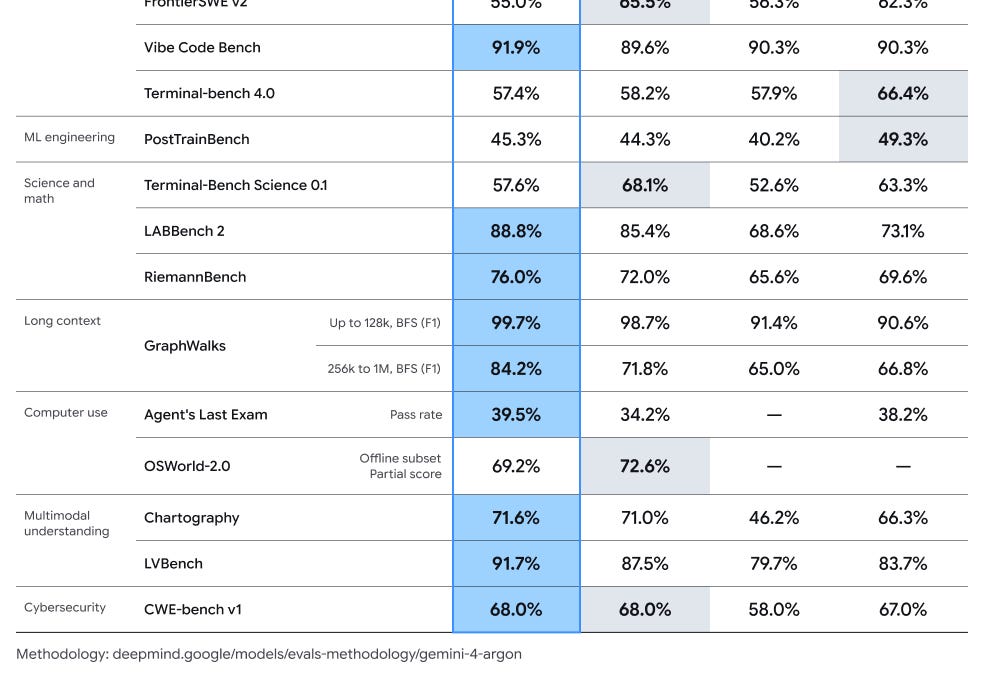 [AINews] Gemini 4 Argon: GDM’s answer to Astra/Fable, with 1M output
Latent Space's AINews digest for 9/29-9/30/2026 leads with Google DeepMind's Gemini 4 Argon, a frontier model in limited Fairwind Program cyber-defense/government preview claiming SOTA on 13 of 19 benchmarks and an industry-first 1M-token output via Long Decode Continuation, with detailed head-to-head evals against GPT-6 Astra, GPT-6.1 Sol and Claude Opus 5.5 from Artificial Analysis, Vals and Arena. It also covers other releases (Cohere Embed 5, Ideogram 4.5, GLM-5.3-Flash llama.cpp support, Solar Mini 4), research (Meta's Context Language Models, a Nature paper on superhuman Stratego AI), inference/systems news, and a safety section on hidden-reasoning-extraction attacks and GLM-5.3 cyber-capability risk.
 latent.spacearticlePublished and added 1 Oct 2026🧠 AI
- Kettle: Short Post-Quantum Threshold Signatures from the HAWK Signature Scheme
test
eprint.iacr.orgpaperAdded 4 Oct 2026, published 1 Oct 2026🛡️ Security  [Security Disclosure] MetaMask Staking Precautionary Out of Order Exits
Lido Finance's governance forum discloses that MetaMask Staking (formerly Consensys Staking), one of its Ethereum validator node operators, detected an infrastructure compromise and is precautionarily exiting its operated validators from the Lido protocol. The post details the exit/withdrawal/re-entry timeline (~45 days), the non-custodial nature of Lido staking (MetaMask does not hold withdrawal keys), and the protocol's ad hoc reserve fund (6,750+ stETH) as a mitigation mechanism while a full investigation continues.
 research.lido.fiadvisoryAdded 3 Oct 2026, published 30 Sep 2026🛡️ Security
- Introducing SynthID Bio
SynthID Bio is Google DeepMind's watermarking technique extended from digital media into synthetic biology, embedding an imperceptible, verifiable signature into AI-designed protein sequences (via a modified ProteinMPNN alongside AlphaProteo) and 3D structures (via a fine-tuned AlphaFold 3 diffusion network) without compromising biological function. Wet-lab tests on protein binders against VEGF-A, SARS-CoV-2 spike RBD, and PD-L1 matched hit rate and binding affinity of unwatermarked designs, and the approach was also extended experimentally to watermark an Evo 2-designed bacteriophage genome with Stanford's Hie lab and Arc Institute. The work targets biosecurity gaps in DNA synthesis screening and public sequence databases (Protein Data Bank, UniProt, GenBank), with DeepMind open-sourcing code, in vitro data, and model weights alongside a methods paper.
 deepmind.googlearticlePublished and added 30 Sep 2026🧠 AI
- Trail of Bits (@trailofbits) on X
Announcement tweet for Trail of Bits's September "Tribune" newsletter, which fact-checks 1Password's AI-powered patching benchmark, details a signature-forgery bug found in Miden's zkVM and a string-slicing bug in the Lean theorem prover/language, and reports 27 advisory submissions to OpenClaw plus seven new completed security reviews. It links out to the full newsletter on Mailchimp (mailchi.mp/trailofbits).
x.comthreadAdded 1 Oct 2026, published 30 Sep 2026🛡️ Security  A Clever RSA Attack Fooled a Hardware Vault—Here's What It Means for Crypto
Researchers at UC San Diego and INRIA demonstrated a chosen-message oracle attack that forges RSA signatures on a 1,024-bit key held inside a hardware security module (HSM) without ever extracting the key, by disabling the HSM's FIPS mode to get it to sign unpadded/unformatted values roughly 4 billion times and then computing the private-key operation from the responses (1,380 CPU core-years of work). The attack only applies to unpadded RSA signing oracles — standard PKCS#1 v1.5/PSS padding blocks it — so it doesn't threaten Bitcoin/Ethereum (which use ECDSA) but is relevant to anyone auditing HSM key-custody assumptions or RSA-based blind-signature schemes like Privacy Pass. The authors frame it as further classical evidence to accelerate migration away from RSA ahead of the post-quantum transition.
decrypt.coarticleAdded 30 Sep 2026, published 28 Sep 2026🛡️ Security- PQ spending for Stealth Address Protocol
Third in a series on post-quantum upgrades to the Stealth Address Protocol (ERC-5564/ERC-6538), this ethresear.ch post proposes a new schemeId=6 that replaces ECDH with ML-KEM for quantum-safe payment discovery and replaces ECDSA with either a lattice-based signature (SPIRIT, an ML-DSA/Dilithium variant) or a novel construction called HSAP that uses ML-KEM key delivery plus a ZK proof over hash-preimages for spending authorization. It works through the exact key-generation/derivation math for both schemes, discusses on-chain verification costs (citing ETHDILITHIUM benchmarks and draft EIP-8051's ~4500-gas ML-DSA-44 precompile), and sketches how the extended ERC-5564 announcer/registry interface and smart-account spending path would look under quantum attack assumptions.
ethresear.charticleAdded 29 Sep 2026, published 28 Sep 2026🛡️ Security  Don't let TEEs break your MPC
Trail of Bits explains why running threshold-signature MPC protocols inside TEEs (Intel TDX, AMD SEV-SNP, AWS Nitro Enclaves) is not automatically secure: a malicious host can roll back enclave filesystem state to force reuse of deleted pre-signature nonces, leaking a signer's private key share. The post catalogs recurring audit pitfalls — incomplete attestation measurements (citing the WhatsApp Private Inference LD_PRELOAD bypass), missing verification steps, weak hardening, stale-backup/rollback risks (including LUKS2 header manipulation in confidential VMs), and physical/side-channel attacks like TEE Fail and DDRop against DDR5 memory — and gives best practices such as binding attestation to MPC party identities and using multiple TEE vendors for defense-in-depth.
blog.trailofbits.comarticlePublished and added 25 Sep 2026🛡️ Security- EIP-8425: Quantum Freeze and Account Recovery
A detailed reply on the Ethereum Magicians forum thread for EIP-8425 ("Quantum Freeze and Account Recovery"), which specifies how Ethereum accounts should transition authority when their legacy ECDSA key could be broken by a quantum adversary. The author formalizes a FROZEN/CLAIMED/RESOLVED-CONTESTED-UNRESOLVED/SUCCESSOR recovery state machine, replay-resistant claim hashes bound to a per-account recoveryEpoch, and two core invariants preventing a compromised ECDSA key from unilaterally establishing successor authority, closing an attack case where a quantum adversary obtains the key before the protocol's SAFE_RECOVERY_TIME cutoff. It also references related EIPs on signature-algorithm agility (EIP-7932) and PQ/STARK signature aggregation (EIP-8288).
ethereum-magicians.orgthreadAdded 29 Sep 2026, published 24 Sep 2026🛡️ Security  Proactive Defense: Hardening Code Pipelines and CI/CD Infrastructure
Mandiant's guidance for hardening the software supply chain across five pillars: endpoint, code repositories, artifact management, CI/CD and deployment. It covers a seven-day dependency cooldown, pinning images and actions by digest or commit SHA, ephemeral runners, OIDC short-lived tokens, build cache isolation, signed SBOMs, SLSA provenance and admission-time signature checks. It responds to campaigns using cache poisoning, OIDC token theft and mutable action tags.
 cloud.google.comarticleAdded 29 Oct 2026, published 24 Sep 2026🛡️ Security
- Jev introduces a new shape of LLM - System One, aka Decision Models
Simon Willison reviews Jev, a new class of model from TypeSafe AI dubbed "System One models" (or "decision models"): instead of generating text, it takes a text/structured "state" plus one or more yes/no ("Noul"), multiple-choice, or scored-range questions and returns floating point probabilities/confidence scores, priced at $0.042/million input tokens with free output. The post covers real use cases (classification, spam detection, search reranking over BM25 candidates), community experiments (jevchat, jev-leftpad, jev-2048), open-weight recreations built on Qwen 3.5 (the Kev models and JevBench benchmark), and raises concerns about the model's black-box nature and bias risk, plus Willison's own llm-typesafe plugin for the LLM CLI tool.
 simonwillison.netarticleAdded 29 Sep 2026, published 21 Sep 2026🧠 AI
- SAML: A fractal of bad design
A Trail of Bits researcher (ex-Duo Security engineer) traces SAML's history from its 2002 OASIS committee origins through recurring XML signature wrapping (XSW) and canonicalization/round-trip parser-differential attacks, arguing its reliance on brittle XML signature validation (libxmlsec) makes it fundamentally unsound. The post catalogs SAML's five structural flaws — XML complexity, canonicalization, enveloped signatures, kitchen-sink design, and protocol ossification — and recommends organizations deprecate SAML in favor of OIDC, citing Fly.io and Tailscale as vendors already holding the line on OIDC-only SSO.
blog.trailofbits.comarticlePublished and added 21 Sep 2026🛡️ Security  Auditing in the age of (good enough) AI
Trail of Bits describes preparing for a six-month audit of the Miden zkVM (a zero-knowledge VM with its own custom assembly language, MASM) by having AI agents (Claude and Codex) build an LSP server, a decompiler, an abstract-interpretation-based static analysis engine, and a Lean formal model of the VM executor, none of which previously existed for MASM. These tools surfaced a high-severity bug in the mod_12289 procedure where an underconstrained prover-supplied advice value allowed a malicious prover to forge Falcon signatures and drain Miden accounts, plus over 400 type-validation issues, while the Lean proof effort produced 95 machine-checked correctness proofs and caught two additional subtle arithmetic bugs (rotr, wrapping_mul) missed by unit tests.
blog.trailofbits.comwriteupPublished and added 18 Sep 2026🛡️ Security- Closed-World Resolution Against Tool Hallucination in LLM Agents
This arXiv paper identifies tool hallucination — LLM agents calling nonexistent tools or passing undeclared arguments — as a structural blind spot that existing tool-selection and tool-gating defenses cannot catch, since a hallucinated call was never a real gating decision. The authors propose a five-class taxonomy (H1-H5) of tool hallucination and a training-free closed-world resolver (the Resolution Rung, based on registry membership plus signature checking) that must run before any causal gate, then extend the analysis to the Model Context Protocol where merging multiple servers into one namespace creates a second hallucination class (M1-M5) from tool collisions and shadowing. Across ten hosted models they measure 322 hallucinations on single-registry tool calls and 154 on a live MCP surface, and release the versioned Hallucinated-Tools Benchmark (HTB) for comparing resolvers.
arxiv.orgpaperAdded 2 Oct 2026, published 16 Sep 2026🛡️ Security - Closed-World Resolution Against Tool Hallucination in LLM Agents
This arXiv paper studies tool hallucination in tool-augmented LLM agents, where agents call tools that do not exist or pass arguments no schema declares, arguing existing tool-selection and tool-gating defenses structurally cannot catch it since a hallucinated call was never a decision a gate made. The authors give a five-class taxonomy (H1 to H5), propose the Resolution Rung, a training-free closed-world resolver based on registry membership plus a signature check that must run before any causal gate, and extend the analysis to the Model Context Protocol with a second taxonomy (M1 to M5) covering collisions and shadowing when multiple servers are merged into one namespace. Across ten hosted models they measure 322 hallucinations on two invocation surfaces and 154 on a live MCP surface, and release the versioned Hallucinated-Tools Benchmark for comparing resolvers.
arxiv.orgpaperAdded 2 Oct 2026, published 16 Sep 2026🧠 AI  Pass-the-Passkey Family of Attacks
SpecterOps research introduces "Pass-the-Passkey," a family of 20+ attack techniques against passkey/WebAuthn authentication, including three zero-days: Windows 11 logging complete WebAuthn assertions to an Event Log readable by unprivileged users (patched July 2026), Microsoft Entra ID historically failing to enforce WebAuthn anti-replay protections (challenge reuse, session binding, signature counters), and local malware that calls the native Windows WebAuthn API directly to phish users with a convincing native-looking passkey prompt. The write-up argues these implementation failures mirror classic credential-relay attacks like Pass-the-Hash and NTLM Relay, and recommends device-bound passkeys with attestation enforcement for high-value accounts.
 specterops.iowriteupAdded 2 Oct 2026, published 16 Sep 2026🛡️ Security
- STUART: Sequence Triage and qUAntification of Read Transcripts for Rapid Ionizing Radiation Exposure Assessment
STUART is a mapping-free machine learning framework for biological dosimetry that converts raw sequencing reads into k-mer-based numerical feature profiles (NLP-inspired), bypassing traditional alignment-based bioinformatics. Using the FDXR gene as a radiation biomarker, the authors compare Logistic Regression, Random Forest, and XGBoost, reducing a 1024-dimensional feature space by over 98% to as few as 17 signatures while achieving 95-100% F1/balanced accuracy and over 99% specificity on external validation, enabling real-time triage compatible with portable sequencers.
arxiv.orgpaperAdded 22 Sep 2026, published 16 Sep 2026🧠 AI - Post-Quantum: Lattice or Hash-Based (one question, two right answers)
A deep-dive field guide to choosing between lattice-based (ML-DSA/FN-DSA) and hash-based (SLH-DSA) post-quantum signatures, built from interviews with the designers and implementers behind both NIST standards and their deployments. It walks through Mosca's-inequality-style migration timing, CNSA 2.0's split between lattice signatures and stateful hash-based LMS/XMSS for firmware, the stateful-signature "footgun," and why the broader internet (TLS/WebPKI, via Merkle Tree Certificates) is converging on lattices while Ethereum's post-quantum consensus roadmap (leanXMSS, EIP-8292, EIP-8288 aggregation) and Algorand's live Falcon-1024 state proofs lean hash-based or scheme-neutral because of aggregation and on-chain storage constraints. It closes with a decision framework and a rundown of NIST's round-3 "onramp" signature candidates (MAYO, SQIsign, HAWK, etc.).
ethresear.charticleAdded 3 Oct 2026, published 15 Sep 2026🛡️ Security  From Algebra to Noise: Why Post-Quantum Cryptography Looks Different
OpenZeppelin Security's technical explainer on why post-quantum cryptography looks so different from classical crypto: Shor's algorithm exploits the abelian hidden-subgroup structure underlying RSA, Diffie-Hellman, ECDSA, EdDSA and pairing-based schemes, while Grover's algorithm only halves the effective security of hashes and symmetric keys (256-bit hashes stay at a comfortable 128-bit level). It then walks through NIST's finalized lattice/hash-based PQC standards — ML-KEM (Kyber) for key establishment, ML-DSA (Dilithium) for general signatures, SLH-DSA (SPHINCS+) as a conservative hash-based backup, plus future Falcon/FN-DSA and code-based HQC — mapping each to blockchain use cases and covering real deployment (Starknet's Falcon-512 Cairo account contracts), Ethereum account-abstraction/hybrid-signature migration paths, Bitcoin's UTXO/consensus constraints, Ethereum's LeanSig consensus-signature research, and a concrete institutional crypto-asset-inventory and PQC audit checklist.
 openzeppelin.comarticleAdded 29 Sep 2026, published 14 Sep 2026🛡️ Security
 AI-Generated Malware Risk: A Practical Guide for Developers | Blog | Endor Labs
An Endor Labs guide explaining how AI-generated and AI-enhanced malware (citing Check Point's VoidLink, Google TIG's PROMPTFLUX/PROMPTSTEAL, and HYAS Labs' BlackMamba/EyeSpy) differs from traditional threats by dynamically mutating code at runtime to evade signature-based detection. It argues software supply chains are a prime target because AI can mass-produce convincing typosquatted or dependency-confused packages, and recommends behavioral analysis plus full-stack reachability analysis (via Endor Labs' AURI) as defenses instead of relying solely on CVE/signature matching.
 endorlabs.comarticlePublished and added 11 Sep 2026🛡️ Security
 Artifactory Under Attack: In-the-Wild Exploitation of CVE-2026-42016, CVE-2026-42018 & CVE-2026-82329
Wiz Research documents active in-the-wild exploitation of three JFrog Artifactory vulnerabilities: CVE-2026-42018 (exposes an internal anonymous-user JWT via POST /access/api/v1/aws/token/), CVE-2026-42016 (token scope validation flaw allowing that JWT to be escalated to admin via POST /access/api/v1/tokens), and CVE-2026-82329 (unauthenticated admin access via POST /access/api/v1/registry/join, added to CISA KEV). Attackers chained the first two to create persistent admin accounts, deploy malicious Groovy plugins for RCE, and drop Rust-based C2 backdoors, while CVE-2026-82329 was exploited independently for configuration exfiltration, cluster join-key theft, and credential/SSH-key persistence. The post includes exact request sequences, detection signatures, affected/fixed version ranges, and remediation guidance.
 wiz.ioadvisoryPublished and added 10 Sep 2026🛡️ Security
 ClearFake WebDAV infection chain delivers Amatera stealer, ZigCryptoStealer, and NetSupport Manager
Cisco Talos reconstructs two related WebDAV-based infection chains (tracked actor UAT-10820) that use a ClickFix fake-CAPTCHA lure, EtherHiding on BNB Smart Chain to stage JavaScript via a malicious Cloudflare Worker, and WebDAV-delivered disguised DLLs executed via rundll32 ordinal calls to drop the Amatera stealer. Depending on the C2 configuration, Amatera then deploys either a NativeAOT-loaded ZigCryptoStealer with a BYOVD EDR-killer driver and a Go-based Yamux reverse proxy, or a PowerShell stager that installs a trojanized NetSupport Manager RAT pointed at Russian C2 infrastructure. The post details loader internals, Amatera's dead-drop C2 resolution via Telegraph and Steam, and provides ClamAV signatures plus a full IOC list.
 blog.talosintelligence.comwriteupAdded 7 Oct 2026, published 8 Sep 2026🛡️ Security
- ForgeGuardian
ForgeGuardian is an open-source (Apache 2.0) supply chain security scanner covering 9 package ecosystems (npm, PyPI, Go, Maven, RubyGems, Cargo, NuGet, Hugging Face, GitHub Actions) via 8 concurrent scan engines and 223+ built-in malicious-package detection signatures. It runs fully offline/local-first, offers a CLI (fgctl) and self-hosted SOC-style dashboard, generates CycloneDX/SPDX SBOMs, supports Sigstore keyless signing and provenance tracking, policy-as-code rules, dependency topology/attack-surface mapping, drift detection with auto-quarantine, and SARIF output for GitHub Actions CI integration, plus optional AI-powered advisory/patch-agent triage.
 github.comrepoPublished and added 5 Sep 2026🛡️ Security
- Axonal delay dispersion decides whether a neuron detects an event or a sequence, and predicts cortical column diameter
This arXiv preprint proposes a "delay-signature" framework where the dispersion of axonal conduction delays converging on a dendritic branch determines whether a neuron acts as an event detector (coincidence) or an order-selective sequence detector, using simulations of an integrator-neuron model. The authors find a single scalar (delay dispersion) governs this computational transition, sets a millisecond-scale timing tolerance, and together with conduction velocity predicts cortical column diameter — linking myelination to what a neuron computes, not just how fast it signals.
arxiv.orgpaperAdded 22 Sep 2026, published 3 Sep 2026🧠 AI - SAST for AI-Generated Code: What Static Analysis Catches and Misses | Blog | Endor Labs
Endor Labs blog post arguing traditional signature-based SAST misses the logic and business flaws AI coding assistants introduce, since those flaws are "not pattern-shaped." It contrasts AI-assisted SAST (rules plus a thin AI layer) with AI-native SAST that traces dataflow across files and uses reachability analysis plus evidence-based triage to cut false positives, citing that Endor Labs' own tool (built on Opengrep with AI-agent triage) found a zero-day, CVE-2026-55407, in Anthropic's Rust buffa library and that only ~1 in 5 AI-recommended dependency versions are safe.
endorlabs.comarticleAdded 3 Sep 2026, published 2 Sep 2026🛡️ Security  The Evolution of JFrog AI Catalog: Your AI Control Plane for Agentic Development
JFrog vendor post arguing that agentic development (ADLC) introduces new unvetted supply chains — models, MCP servers, skills/plugins, hooks, and APM packages — that bypass traditional signature-based scanning. It cites real incidents: a malicious MCP server impersonating Postmark's email MCP that BCC'd all agent-sent emails to an attacker, and the 'omnicogg' malicious Claude/agent skill that hid a 22MB encoded payload and evaded all 65 VirusTotal engines for 5,000+ installs, plus references to 2026 supply-chain attacks on LiteLLM, TanStack, and Mistral AI. It then pitches JFrog AI Catalog's expanded MCP/skill/model registries as the fix.
 jfrog.comarticleAdded 3 Sep 2026, published 2 Sep 2026🛡️ Security
 How Claude Watermarks AI-Generated Text
Sebastian Raschka (author of "Build a Large Language Model From Scratch") breaks down, in a 48-minute lecture with transcript, exactly how Anthropic's newly announced Claude text watermarking works: it is applied not inside the model but at the sampling stage, using a secret key plus the last few tokens to derive a deterministic random seed. He explains the underlying "tournament sampling" technique (derived from Google's SynthID-Text, published in Nature) where multiple random watermarking functions (G1...Gn) generate bit signatures for candidate tokens that compete pairwise, letting Anthropic later score arbitrary text for the watermark without rerunning the LLM. The piece also covers why the watermark is theoretically removable by editing enough token positions, since only some positions have near-equally-likely alternative tokens.
 magazine.sebastianraschka.comarticleAdded 29 Sep 2026, published 22 Aug 2026🧠 AI
- How Claude Watermarks AI-Generated Text
Sebastian Raschka's recorded lecture (with transcript and slides) breaks down how Anthropic's Claude watermarking works under the hood: a secret watermarking key plus the preceding tokens deterministically seeds next-token sampling, using a tournament-sampling scheme (based on Google's SynthID-Text/Nature paper) that lets Anthropic score arbitrary text for the watermark cheaply without rerunning the LLM. He also explains the practical limits of detection (requires the secret key/API) and how a watermark could be defeated by editing enough token positions, since an attacker cannot know which positions were watermarked without access to the key. The page is truncated before the "What This Means for AI-Generated Text" conclusion section.
magazine.sebastianraschka.comtalkAdded 29 Sep 2026, published 22 Aug 2026🛡️ Security - Pedal to the Bare Metal (Black Hat USA 2026)
Black Hat USA 2026 slides from Tobias Scharnowski and Kristian Covic (fuzzware.io) walking through rehosting and fuzzing the bare-metal FreeRTOS firmware of the Tesla Universal Wall Connector (ARM Cortex-M4). They cover MMIO modeling (bitextract/constant models), scoping the fuzzer to the reachable UDS-over-CAN/ISOTP attack surface reachable from the charge-plug SWCAN line, seeding with a captured firmware-update UDS transaction (building on Synacktiv's Pwn2Own '25 charge-connector work), and triaging a FreeRTOS scheduler crash back to a signed integer/negative image-length bug in tesla_verify_sig causing an OOB stack write during firmware signature verification — enabling STM32 takeover, contactor/plug-release control, device bricking, and a path toward wormable, secure-boot-bypassing persistence.
 i.blackhat.comtalkPublished and added 21 Aug 2026🛡️ Security
 How Trail of Bits helps verify the integrity of your Signal chats
Trail of Bits describes the from-scratch, open-source auditor it built and operates as one of three independent auditors (alongside Signal and Cloudflare) backing Signal's new Automatic Key Verification feature. The auditor maintains its own Merkle tree of the global phone-number-to-public-key map and periodically signs the tree head, so clients that require signatures from all three auditors can detect a malicious server maintaining a split view within at most one week. This replaces manual safety-number comparison with an automated key-transparency check for end-to-end encryption integrity.
blog.trailofbits.comwriteupAdded 3 Sep 2026, published 11 Aug 2026🛡️ Security- aurscan
aurscan is a Go-based CLI that hooks into yay/paru to scan a downloaded AUR package's PKGBUILD, .install scriptlets, .SRCINFO and helper scripts before makepkg runs, blocking the build if it looks malicious. It combines offline, quote-aware static rules covering known AUR campaign signatures such as disguised source patch URLs, install-scriptlet worms, masqueraded binary file types, and editor auto-exec triggers with an LLM auditor (Claude Code, Codex, Anthropic API, or a local OpenAI-compatible model) that answers a fixed checklist of yes/no behavioral questions, from which aurscan deterministically derives a verdict, severity and confidence, and fails closed when no backend is available. It documents and defends against real incidents including the July 2025 firefox-patch-bin CHAOS RAT vector, the June 2026 Atomic Arch mass orphan-package takeover pulling a Rust stealer and eBPF rootkit, and the August 2026 xsnow dot-install worm that harvested SSH keys and self-propagated across AUR.
github.comrepoPublished and added 8 Aug 2026🛡️ Security - WeatherNext: AI model achieves breakthrough in forecasting cyclones
Google DeepMind's WeatherNext is a single AI model that jointly predicts a tropical cyclone's track, intensity, and wind structure with state-of-the-art accuracy, published in Nature, giving forecasters roughly an extra day of lead time (three-day forecasts matching prior two-day accuracy). It uses Functional Generative Networks (FGNs) co-trained on ~20TB of global atmospheric data plus the IBTrACS historical storm database, generating 1,000-member ensemble forecasts at coarse 28x28km resolution in under a minute on a TPU. DeepMind is open-sourcing the model weights and code for WeatherNext 2, WeatherNext Cyclones, and a compact WeatherNext 2-mini runnable in a free Colab notebook, and exposing forecasts via the Weather Lab interface as part of Google Earth AI.
deepmind.googlearticleAdded 29 Sep 2026, published 6 Aug 2026🧠 AI - Mimikatz Missing Manual
A deep-dive, self-paced manual on Mimikatz and Windows identity internals by Carlos Perez (DarkOperator), refined with input from Benjamin Delpy (Mimikatz's author). It covers LSASS credential dumping, Kerberos ticket forgery/roasting/delegation abuse, PKI/smart card and certificate abuse, DCSync/DCShadow domain persistence, and DPAPI secrets, alongside blue team detection strategies and event log signatures.
github.comrepoAdded 3 Sep 2026, published 31 Jul 2026🛡️ Security  FOSSA: CISA Releases the 2026 SBOM Minimum Elements
FOSSA breaks down CISA's 2026 Minimum Elements for a Software Bill of Materials, the first major revision since NTIA's original 2021 baseline, produced with NSA, FBI, and 15 international agencies. The update roughly doubles required data fields, adding 10 new elements (SBOM Author Signature, SBOM Data Format Name/Version, Generation Context, Tool Name/Version, SBOM Version, Component Hash Value/Algorithm, and Component License) while renaming and clarifying existing fields (e.g., Supplier Name → Component Producer) and mandating full transitive-dependency coverage with no minimum depth, RFC 9557 timestamps, and dropping SWID in favor of SPDX/CycloneDX.
 fossa.comarticlePublished and added 31 Jul 2026🛡️ Security
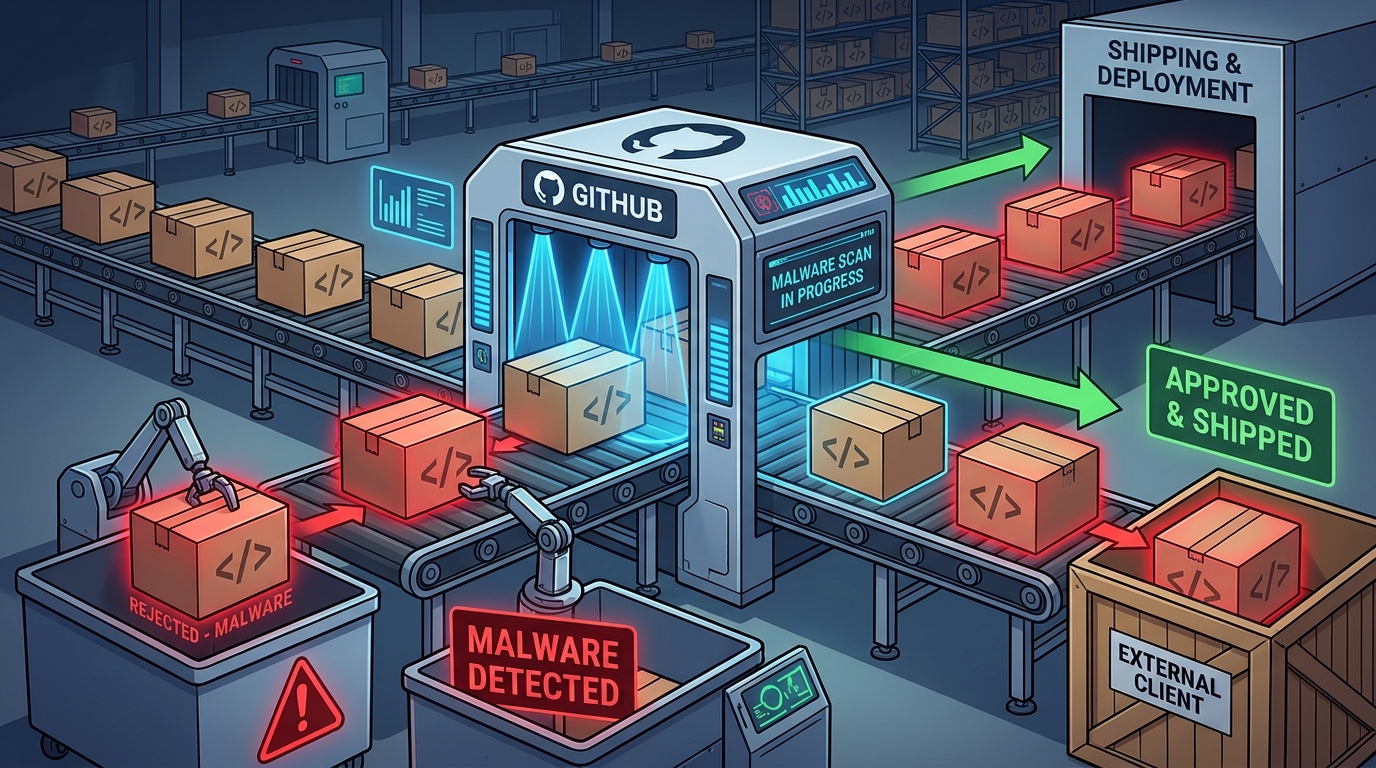 NPM Implements Pre-Publication Malware Scanning, But Will It Work?
OpenSourceMalware analyzes npm's July 28, 2026 announcement of pre-publication malware scanning, contrasting it with GitHub's April 2026 admission that it already scans every published package version with human-in-the-loop review due to false-positive risk at scale. The author argues the promised five-minute publish-time SLA implies automated (not human-reviewed) blocking decisions, that the new package.json contentPolicy/DISCLOSURE dual-use mechanism is an admission of expected false positives that burdens legitimate security researchers rather than attackers, and that the five-minute budget limits detection to static/signature matching that will miss multi-stage payloads, dependency confusion, and DPRK tradecraft like the PolinRider campaign.
 opensourcemalware.comarticleAdded 3 Sep 2026, published 31 Jul 2026🛡️ Security
 Rapid7
's release notes for Metasploit Framework 6.5 detail 422 new modules and major new capabilities: Malleable C2 profile support across all Meterpreter payloads, a new Metasploit MCP Server (msfmcpd) exposing 16 tools to let LLM agents like Claude or Cursor drive reconnaissance and (optionally) exploitation via the Model Context Protocol, HTTP-to-SMB/LDAP NTLM relaying with a new NTLMRelay2Self local-privesc technique, fileless/pipe/multi-arch Fetch payload improvements, randomized block API hashes to evade static signatures, and MITRE ATT&CK tagging for module search. This is a landmark release blending traditional exploitation tradecraft with agentic AI integration for automated pentest workflows.
 rapid7.comarticleAdded 7 Aug 2026, published 30 Jul 2026🛡️ Security
 What Is AI Pentesting and How Does It Work?
Snyk explains AI pentesting as an orchestrated system — a reasoning model that plans reconnaissance/exploitation, deterministic DAST tooling for known vulnerability classes, an independent validator model that confirms exploitability, and context from existing scanner findings — designed to catch context-dependent flaws like BOLA/IDOR, cross-tenant leakage, and chained business-logic exploits that signature-based scanners miss. It cites concrete reliability data (frontier models solving only ~26% of hard system-exploitation benchmark tasks, ~30% hallucinated findings without independent validation, 210% YoY growth in valid AI-generated HackerOne reports and 540% growth in prompt-injection reports) and positions Snyk's Evo Continuous Offensive Security product against these evaluation criteria. It also references a RAND 2026 study on low-cost CTF-solving coding agents, Anthropic/Mozilla open-source vulnerability discovery work, and Google GTIG's report of the first in-the-wild AI-assisted zero-day.
 snyk.ioarticleAdded 3 Sep 2026, published 27 Jul 2026🛡️ Security
- wolfBoot 2.9.0
wolfSSL's release announcement for wolfBoot 2.9.0, an open-source secure bootloader for embedded systems, covering new hardware targets (STM32N6/U3/C5/G4/WBA, NXP LPC54S018M-EVK, Kinetis KL26, Xilinx Zynq-7000), new crypto features (RSA-PSS image signatures, hardware crypto-callback interface, multi-root-CA verification, pre-computed IDevID/DICE attestation), and continued security hardening from Fenrir fuzzing including bounded unauthenticated image sizes, memory-copy limits during updates, and fault-injection resistant integrity verification. It also adds an sbom Makefile target producing CycloneDX and SPDX output for CRA-readiness.
 wolfssl.comarticlePublished and added 25 Jul 2026🛡️ Security
 Finding eight high-severity vulnerabilities in NodeBB in six hours
Aikido's AI pentest agent found eight high-severity vulnerabilities in NodeBB (forum software) prior to version 4.14.0 in six hours, including three XSS bugs (one via a custom ActivityPub/federation server spoofing profile icons, one via unescaped Federation Error logs, and one via a translation-syntax template injection reflected across the app), an admin authorization bypass via custom homepage rewriting, a private-message ID spoof via unverified GET signatures, post hijacking via pid mass assignment, unauthenticated category disclosure via ActivityPub outbox, and unlimited upvote inflation via unverified Announce actors. Each finding includes source code walkthroughs, exploit payloads/scripts, and links to the specific NodeBB commits that fixed them.
 aikido.devwriteupAdded 3 Sep 2026, published 22 Jul 2026🛡️ Security
 Exploitation in the Wild of wp2shell
Wiz Research documents active in-the-wild exploitation of "wp2shell," a pre-auth RCE chain in WordPress Core (CVE-2026-63030 and CVE-2026-60137) affecting every WordPress version since December 2025, discovered by Searchlight Cyber using GPT-5.6 Sol. Attackers abuse the WordPress REST API batch endpoint (/wp-json/batch/v1) to achieve unauthenticated RCE, then deploy malicious plugins/webshells (including a disguised "CMSmap" plugin and a custom REST endpoint backdoor), enumerate users, and attempt LFI against wp-config for credential theft. The post details post-exploitation TTPs, detection signatures (HTTP 207 responses, wp2shell/rezwp2shell user agents), IOCs, and WAF/plugin-based mitigations.
wiz.iowriteupAdded 3 Sep 2026, published 20 Jul 2026🛡️ Security PolinRider Confirmed Footprint Grows 6.5x Since March
OpenSourceMalware's July hunt update on the PolinRider campaign (a Lazarus Group/DPRK operation linked to Contagious Interview and TasksJacker) found 2,417 newly-compromised GitHub repos, bringing the confirmed footprint to 4,367 repos across 2,152 owners — a 6.5x increase since March. The post breaks down the two injection vectors (94% config-file injection into files like postcss.config.mjs/tailwind.config.js/eslint.config.mjs, 6% payloads hidden in a .woff2 font file), shows the campaign overwhelmingly hits individual developer accounts rather than orgs, and republishes updated signature markers, decoder function names, and grep-based detection/remediation steps.
opensourcemalware.comwriteupAdded 3 Sep 2026, published 15 Jul 2026🛡️ Security Rapid7 MDR Team Discovers New SonicWall SMA1000 Zero Days Being Actively Exploited (CVE-2026-15409, CVE-2026-15410)
Rapid7's MDR team details active zero-day exploitation of SonicWall SMA1000 appliances via CVE-2026-15409 (unauthenticated SSRF in the /wsproxy websocket proxy, CVSS 10.0) chained with CVE-2026-15410 (local privilege escalation via path traversal in the ctrl-service remove_hotfix workflow) to achieve root RCE. The post includes a working Python exploit against the localhost Erlang service on port 1050 (using a hardcoded authentication cookie), an HTTP request PoC for the hotfix path-traversal chain, and extensive observed post-exploitation activity — credential/TOTP theft, VPN-less lateral movement to domain controllers via harvested LDAP service accounts — plus concrete log/IOC signatures and attacker-infrastructure IPs (FNS Holdings Limited ASN 206092) for hunting.
rapid7.comwriteupAdded 10 Sep 2026, published 15 Jul 2026🛡️ Security Everyone Wins Their Own Benchmark | Blog | Endor Labs
An Endor Labs author explains how to read vendor security benchmarks skeptically. Red flags: winning everything, charts that mislead, missing precision/recall and raw counts, and claims that contradict a tool's nature (e.g. zero run-to-run variance with LLMs). Green flags: transparent methods, stated limitations, error bars. The author then critiques their own AI SAST benchmark: self-built pooled ground truth, 43% of vulnerabilities missed by every tool, F1 of 0.465, and no published run-to-run spread.
endorlabs.comarticleAdded 3 Sep 2026, published 14 Jul 2026🛡️ Security PolinRider Jumps the Fence to Go, Packagist, npm, PyPI
OpenSourceMalware documents how PolinRider, a DPRK/Lazarus Group supply-chain campaign tied to the Contagious Interview cluster, spread from GitHub account takeovers into Go modules, Packagist/Composer packages, npm libraries and Chrome extensions without any change to the malware itself. Because Go and Packagist resolve packages directly from git tags rather than a separately-uploaded artifact, a compromised GitHub account automatically becomes a compromised registry release — unlike npm/PyPI, which require a separate publishing credential and largely stalled the takeover at the registry boundary. The post gives ecosystem-by-ecosystem evidence (10 Packagist packages, 80+ Go modules, an NPM/Chrome cluster), IOCs (TRON/Aptos dead-drop addresses, XOR keys, loader signatures, temp_auto_push.bat), a campaign timeline, and remediation guidance for Go/Composer maintainers.
opensourcemalware.comwriteupAdded 3 Sep 2026, published 8 Jul 2026🛡️ Security- AI-Coded Malware | Analyzing Vibe-Coded AD Enumeration | Huntress
Huntress recovered and reconstructed "Untitled1.ps1," a PowerShell Active Directory enumeration script used by an attacker during a June 3 incident via RDP access with compromised credentials, and identified it as AI-generated ("vibe-coded") based on artifacts like an unedited LLM placeholder hostname, a "FULLY FIXED" prompt-iteration title, over-engineered five-method DC-discovery fallback logic, and gratuitous colored console/HTML reporting output. The attack chain paired this bespoke recon tool with off-the-shelf abuse of s5cmd (legitimate AWS S3 CLI used for exfiltration) and SharpShares (share enumeration), illustrating how LLM-generated one-off malware evades hash/signature-based detection and pushes defenders toward behavioral analytics on Active Directory enumeration patterns.
 huntress.comwriteupAdded 3 Sep 2026, published 8 Jul 2026🛡️ Security
 THORChain Exploit Report #2 — GG20 root-cause disclosure
THORChain's second exploit post-mortem details how an attacker who joined as a validator planted a malformed multi-prime Paillier modulus during GG20 threshold-signature key generation, then deliberately failed 864 MTA signing rounds over 2.5 days to leak fragments of other validators' key shares via a combination of three individually low-severity flaws inherited from Binance's tss-lib: an unverified Paillier modulus (the same class documented as BitForge and TSSHOCK), a range proof that didn't bind its two halves together, and an undersized blinding value. Once enough fragments accumulated the attacker reconstructed the full vault private key and drained roughly 10 million dollars in a single transaction before solvency checks could react, since no anomalous fund movement preceded the theft. THORChain is patching the fork, moving from GG20 and Paillier to DKLS and Schnorr based signing, and adding per-validator key-sign failure monitoring as a result.
 blog.thorchain.orgwriteupAdded 29 Sep 2026, published 3 Jul 2026🛡️ Security
 Breaking Down the White House’s Actions on Post-Quantum Cryptography Readiness
Wiz breaks down Executive Order 14409 ('Securing the Nation Against Advanced Cryptographic Attacks') and OMB memorandum M-26-15, which set accelerated federal deadlines for migrating High Value Assets and High Impact Systems to NIST-approved post-quantum cryptography (key establishment by 2030, digital signatures by 2031). It covers requirements for automated cryptographic inventories, forthcoming NIST/CISA Cryptographic Bill of Materials (CBOM) guidance, Harvest-Now-Decrypt-Later risk prioritization, FedRAMP/FAR Council contractor compliance rules, and comparable international timelines (EU, Japan, Australia, India), before pitching Wiz's own CBOM/PQC readiness tooling.
wiz.ioarticleAdded 3 Sep 2026, published 2 Jul 2026🛡️ Security Shipping post-quantum cryptography to Python
Trail of Bits, funded by the Sovereign Tech Agency, implemented Rust bindings for NIST's ML-KEM (FIPS 203) key-establishment and ML-DSA (FIPS 204) digital-signature standards into pyca/cryptography, shipped in version 48 with AWS-LC backend support. The post makes them a pip install away for the Python ecosystem (pyca/cryptography sees 1.2B monthly PyPI downloads and underpins Certbot, Ansible, Airflow, and paramiko), while detailing the size/performance tradeoffs versus Ed25519/X25519 and noting SLH-DSA (FIPS 205) support and protocol-level integration are still in progress.
blog.trailofbits.comwriteupAdded 3 Sep 2026, published 30 Jun 2026🛡️ Security- mthcht/awesome-lists
mthcht/awesome-lists is a large, continually updated GitHub collection of threat-hunting IOC lists: suspicious named pipes, Windows services/tasks/firewall rules/ports, user-agents, mutex names, hostnames, MAC addresses, USB IDs, phishing/sinkholed/dyndns domains, HijackLibs, TOR node lists, LOLDrivers hashes, malicious bootloaders and SSL certificates, VPN provider IP ranges, YARA rules, offensive/greyware tool keyword detection patterns, Microsoft Defender/ClamAV signature lists, and RMM detection artifacts. It also links out to DFIR/threat-hunting courses, labs, and CTF-style datasets (SANS FOR500/FOR508, TheDFIRReport labs, Splunk BOTS, Xintra APT emulation) useful for blue teams building detections or hunting.
github.comrepoAdded 3 Sep 2026, published 10 Jun 2026🛡️ Security  What is AI SAST?
Aikido's explainer draws a line between two things vendors both call "AI SAST": AI-native (reasoning-based) SAST, where an LLM reads source code like a reviewer to trace data flow and catch logic flaws such as IDORs, broken access control and business-logic bypasses that have no syntactic signature; and AI-augmented SAST, where a traditional deterministic rule engine stays the detection core and AI is layered on for triage, false-positive filtering and autofix. It also positions AI SAST against classic pattern-matching SAST (fast, deterministic, runs every commit) and AI pentesting (validates real exploits against a running app, produces proof for audits), arguing organizations need all three at different cadences. The piece closes by mapping Aikido's own Code Security Audit and Deep PR Review products onto the AI-native category.
aikido.devarticleAdded 3 Sep 2026, published 6 Jun 2026🛡️ Security State of Post Quantum Cryptography | Wiz Blog
Wiz's follow-up PQC research post quantifies real-world adoption of post-quantum key exchange (ML-KEM/X25519MLKEM768) and digital signatures (ML-DSA, SLH-DSA, pending FN-DSA) across AWS, Azure, and GCP APIs, OpenSSH/OpenSSL versions, and Go's crypto/tls. It finds stark gaps: Azure API servers show no PQC key-exchange support while GCP is universal and AWS sits at 13%, only 15% of TLS 1.3 connections observed use PQC-compliant key exchange, under 15% of OpenSSL instances support PQC, and less than 1% of companies use AWS KMS ML-DSA signing keys. The piece also covers the shift in PQC priority from key exchange (mitigating Harvest-Now-Decrypt-Later attacks) to digital signature migration, and the coming move to Merkle Tree Certificates to keep PQC certificate chains manageable.
wiz.ioarticleAdded 5 Sep 2026, published 28 May 2026🛡️ Security Episode 3: Malicious Dependencies Aren't an Accident
Tanya Janca analyzes the deliberate nature of malicious dependency attacks, demonstrating how threat actors use typosquatting and copied documentation to quietly exfiltrate cloud credentials. She outlines a practical four-step defense strategy to add intentional workflow friction, enforce pull request reviews, and validate AI-suggested packages.
 youtu.bevideoAdded 4 Jun 2026, published 22 May 2026🛡️ Security
 Inside Microsoft Defender's Signature World
RETooling researchers reverse-engineer Microsoft Defender Antivirus (MDA), detailing the .vdm signature database format, the MpEngine.dll module loading/signal-dispatch process, and the internal structure of PEHSTR and PEHSTR_EXT byte/string-matching signatures used to detect PE malware. The post decodes the wildcard opcode family (0x90 0x01–0x05) used in Defender signatures and shows Yara-equivalent translations plus a worked example bypassing a Plugx.C detection by modifying a single matched byte, framing the work as groundwork for adversary emulation and signature evasion.
 retooling.iowriteupAdded 3 Sep 2026, published 22 May 2026🛡️ Security
 Orca Security: Critical Coder Signature Bypass Exposes Developer Keys and Tokens
Orca analysis of CVE-2026-46354 (CVSS 9.1) in the Coder remote development platform. azureidentity.Validate() checks that the PKCS#7 signer certificate chains to a trusted Azure CA but never verifies the signature on the envelope. An unauthenticated attacker can send a forged envelope, using a public Azure IMDS certificate and a known vmId, to POST /api/v2/workspaceagents/azure-instance-identity. This yields workspace agent session tokens, and through them Git SSH keys and OAuth tokens. The post lists the affected v2 and v1 versions, the patched releases (v2.33.3, v2.32.2, v2.31.12, v2.30.8, v2.29.13, v2.24.5) and the workaround of disabling Azure instance identity auth. Coder v1 has no patch.
 orca.securityadvisoryPublished and added 22 May 2026🛡️ Security
- Threat Actor Defense Evasion: How Attackers Disable AV & EDR
Huntress SOC breaks down how attackers disable AV/EDR: blocking agent communications via malicious/hidden Windows Firewall rules (WFP), abusing Add/Remove or CLI to uninstall EDR agents, abusing Defender AV exclusions, and Bring Your Own Vulnerable Driver (BYOVD) attacks to gain kernel access and kill protected security processes. Includes real intrusion examples — a February 2026 SonicWall VPN-credential intrusion using a revoked-but-still-trusted 2006 EnCase forensic driver (exploiting a legacy Windows Driver Signature Enforcement exception) to kill 59 named security processes every second, and a March 2026 malvertising campaign (Google Ads for W-2/W-9 forms) that dropped a rogue ScreenConnect instance and used a vulnerable signed Huawei audio driver to terminate EDR/AV processes.
huntress.comwriteupAdded 3 Sep 2026, published 18 May 2026🛡️ Security  Bullying LLMs
A researcher details an autonomous vulnerability-hunting system built with Claude Code and 8 custom MCP servers (300+ tools) across a 5-VM Proxmox lab, using a "hallucination bin" validation pipeline (findings must pass PoC/exploitability/low-priv gates before promotion) and a RAG-backed knowledge loop that learns from prior campaigns. Concrete outputs include two new Go standard library CVEs (CVE-2026-33809 TIFF OOM, CVE-2026-33812 SFNT/GPOS OOM), a four-stage Windows OEM management-agent chain (named-pipe auth bypass → SSRF via WCF → catalog injection → SYSTEM code execution via BYOVD), and two macOS app-distributor findings (browser/quarantine DB exfiltration and a leaked debug RSA key enabling Sparkle update-signature bypass). Also covers a self-built token-cost/ROI tracker (TokenBurn) and a bounty-program ROI-scoring model for target selection.
 blog.zsec.ukwriteupAdded 3 Sep 2026, published 13 May 2026🛡️ Security
- Hiding in Plain Sight with App Domain Manager Injection
Huntress researchers Casey Smith and John Hammond detail App Domain Manager injection, a .NET framework feature abused to load attacker-controlled assemblies into legitimate, Microsoft-signed .NET processes without exploiting a vulnerability. The technique works via a crafted .exe.config file (local or remote via HTTP/UNC path) or by setting the APPDOMAIN_MANAGER_ASM/APPDOMAIN_MANAGER_TYPE environment variables to hijack assembly loading across child processes, enabling stealthy code execution and lateral movement that bypasses signature-based and application allow-listing controls. The piece also covers defensive countermeasures: Fusion logging, Process Monitor, monitoring for unexpected .exe.config changes, unusual execution paths, and environment variable tampering.
huntress.comwriteupAdded 3 Sep 2026, published 19 Feb 2026🛡️ Security - They Got In Through SonicWall. Then They Tried to Kill | Huntress
Huntress details a February 2026 intrusion beginning with compromised SonicWall SSLVPN credentials, where the attacker deployed an EDR killer that decodes and drops a legitimate but revoked 2006-era EnCase forensic driver (EnPortv.sys, service name OemHwUpd) to terminate 59 different EDR/AV processes from kernel mode via a single IOCTL (KillProc). The write-up explains the driver's novel wordlist-substitution-cipher payload encoding (evading entropy and string-based detection), FNV-1a process-name hashing for fast target matching, timestomping/persistence tricks, and why Windows Driver Signature Enforcement still trusts the expired/revoked certificate due to pre-2015 signing and timestamp exceptions. It closes with concrete mitigations: MFA on VPN, HVCI/Memory Integrity, WDAC vulnerable-driver blocklist rules, and the ASR rule blocking vulnerable signed drivers.
huntress.comwriteupAdded 3 Sep 2026, published 4 Feb 2026🛡️ Security - The (!FALSE) Pattern | Huntress
Part four of Huntress's LDAP/AD detection series shows that querying a non-existent LDAP attribute with negation (e.g., SOAPHound's hardcoded (!soaphound=*) filter) gets optimized by Active Directory's LDAP engine into (! (FALSE)) before it is written to Event ID 1644, erasing the tool's signature from logs. The author verifies this is universal AD behavior (not SOAPHound-specific), correlates it with SOAPHound's SDFlags:0x7 server control and its ADWS/port-9389 localhost proxying behavior, and publishes two Sigma rules combining the (! (FALSE)) pattern, attribute lists, and SDFlags for high-fidelity detection.
huntress.comwriteupAdded 3 Sep 2026, published 29 Jan 2026🛡️ Security - A Idealistic View of Malware Analysis Definitions
A blog post attempting precise definitions for commonly confused malware analysis terms: static vs dynamic analysis, and heuristic vs deterministic (signature-based) detection. It uses a real YARA rule for PWS:Win32/Frethog.AB and the Mimikatz string 'Mimikatz_OpenInternalConfig()' to illustrate that signatures can be either precise/deterministic or generic/heuristic, and argues the heuristic/deterministic line is often blurry and context-dependent (e.g., LSASS access looking suspicious to a red teamer but normal to a sysadmin).
 blog.deeb.charticleAdded 3 Sep 2026, published 13 Jan 2026🛡️ Security
 Azure Storage Account Attacks and Detections
A hands-on Azure security writeup covering abuse of Shared Access Signature (SAS) tokens for blob storage (account-key vs. user-delegation signed tokens, and how to spot account-key SAS via the missing 'skoid' field in logs), and a cross-tenant object replication attack that exploits Azure's default-enabled cross-tenant replication (pre-Dec 2023) via the objectReplicationPolicies REST API to continuously exfiltrate blob data with minimal logging. It also provides several KQL detection queries against StorageBlobLogs, AzureActivity, AzureMetrics, and StorageFileLogs for spotting cross-tenant replication policy creation, anomalous user-agent strings, transaction-volume spikes, and Azure Files SMB read anomalies via SmbPrimarySID baselining. The piece closes with concrete hardening advice: prefer managed identities/Entra over SAS, disable cross-tenant replication, and build detections on configuration drift and stable client fingerprints.
 hausec.comwriteupAdded 3 Sep 2026, published 15 Dec 2025🛡️ Security
- PeerBlight Linux Backdoor Exploits React2Shell CVE-2025-55182
Huntress details in-the-wild exploitation of CVE-2025-55182 ("React2Shell"), an unauthenticated RCE in React Server Components caused by insecure deserialization of the React Flight protocol's "thenable" chunk handling, affecting Next.js and other React-based apps. Post-exploitation payloads include PeerBlight (a musl-compiled Linux backdoor using BitTorrent DHT as fallback C2, sharing config-schema and XOR encryption traits with the Pink botnet and persistence code overlapping RotaJakiro), CowTunnel (an FRP-based reverse tunnel wrapping xfrpc for SOCKS5/TCP/HTTP/FTP/RDP proxying and a telnetd backdoor), ZinFoq (a Go post-exploitation implant with hex-encoded HTTPS C2, reverse PTY shells, and SOCKS5 pivoting), and a Kaiji botnet variant with hardware watchdog abuse. The piece includes detailed C2 protocol reversing (DGA algorithm, DHT config-distribution and RSA-signature verification) and dozens of observed C2/scanner IOCs across five real intrusion cases.
huntress.comwriteupAdded 3 Sep 2026, published 10 Dec 2025🛡️ Security - Manual Configuration Manager (SCCM) credential harvesting
A step-by-step method for harvesting Configuration Manager (SCCM/MECM) credentials by pulling DPAPI-encrypted secret policy blobs (Network Access Accounts, task sequences, collection variables) via WMI or the local CIM repository, then exfiltrating DPAPI master keys and LSA SYSTEM/SECURITY/SAM hives for fully offline decryption with Impacket's dpapi and secretsdump modules. The approach avoids running known SCCM-abuse tools like SharpDPAPI on-target, reducing signature-based detection while still noting which steps (registry hive backup, DPAPI folder copy, WMI queries) a SOC could realistically catch.
 bencteux.frwriteupAdded 3 Sep 2026, published 5 Oct 2025🛡️ Security
- Avred background: Advances in Reversing Defender Signature Format
A blog post building on retooling.io's reverse engineering of Microsoft Defender's WdFilter.sys signature format, explaining how signatures use weighted sub-rules with a score threshold (dominant vs non-dominant matches) and five wildcard opcode types (90 01–90 05) for byte-sequence, placeholder, and regex-like matching, translating each into equivalent YARA rule syntax. It ties these findings back to why certain Avred signature-breaker techniques (like NOP/register wildcarding) fail to evade detection, giving practical insight into how Defender signatures are structured and matched.
blog.deeb.charticleAdded 3 Sep 2026, published 30 Jun 2024🛡️ Security - From Dangerous PHP Functions to Webshell Hunting
A DFIR practitioner deploys four PHP webshells (popen-based, proc_open-based, p0wny-shell, and Weevely) on a test web server, then tests whether common webshell YARA rulesets (nsacyber, Florian Roth's Thor rules) can detect them via Velociraptor hunts. The rules only catch p0wny-shell due to its many code-execution keywords, missing the simpler popen/proc_open shells and Weevely entirely, exposing brittleness in signature-based webshell detection. The author proposes a semi-automatic approach combining Velociraptor/DetectRaptor with manual review, web-log frequency analysis, and UAC-generated bodyfile/mactime timelines to hunt webshells more reliably.
 dfir.chwriteupAdded 3 Sep 2026, published 17 Jun 2024🛡️ Security
- Nmap - detecting the network mapper
A blue-team writeup arguing that broad scan detection at the Internet perimeter is low-value noise, and that scan detection is most valuable inside the network perimeter after initial compromise. It then catalogs specific network signatures Nmap leaves in DNS, FTP, HTTP, RDP, SIP, SMB, SSH, and SMTP probes (e.g. the NSE User-Agent, mstshash=nmap RDP cookie, SSH-x.x-NmapNSE client string, IEUser@ FTP password) that can be used to build reliable detection rules.
bencteux.frwriteupAdded 3 Sep 2026, published 3 Jan 2023🛡️ Security