- alirezarezvani/claude-skills
claude-skills is an MIT-licensed library of about 398 Claude Code skills, agents, personas and plugins across 20 domains, including engineering, marketing, compliance and C-level advisory. Each skill is a SKILL.md with stdlib-only Python CLI tools and reference docs. Install scripts and convert.sh adapt it to Codex, Gemini CLI, Cursor, Aider, Windsurf and other coding agents, and it includes a skill-security-auditor scanner.
 github.comrepoAdded 25 Oct 2026🧠 AI
- alirezarezvani/claude-skills
claude-skills is an open-source MIT library of about 398 Claude Code skills, agents and plugins that also installs into Codex, Gemini CLI, Cursor and 9 other coding agents. The security-relevant parts are skill-security-auditor, a stdlib-only Python scanner that checks skills for command injection, data exfiltration, prompt injection and dependency supply-chain risks before install, plus a security-guidance PreToolUse hook, a security suite and compliance skills (ISO 27001, SOC 2, GDPR).
github.comrepoAdded 25 Oct 2026🛡️ Security - Spectrmachina/Ztrust
ZTrust is a Python supply-chain scanner that checks manifests, lockfiles, source and GitHub workflows for vulnerable or malicious dependencies (via OSV.dev), typosquats, leaked secrets, unsafe lockfiles and risky CI patterns such as pwn requests and script injection. It outputs console, JSON and SARIF 2.1.0 and ships as a GitHub Action. It also includes a FastAPI bounty service using commit-reveal and shielded Zcash payouts for researchers.
github.comrepoAdded 27 Oct 2026, published 22 Oct 2026🛡️ Security - alex09x/kyb
KYB (Know Your Business) is a Rust/axum server that stores agent-written knowledge, incident reports and tasks as Markdown files in Git, one commit per change. Search is hybrid: Tantivy BM25 fused by reciprocal rank with local multilingual-e5-small ONNX vectors, and it can query historical versions or "as of" a date. It ships a kyb CLI, a native MCP endpoint (Claude Code, Codex, Antigravity, Gemini CLI), an installable agent skill, token auth with per-write attribution trailers, secret scanning on writes, and a web console. It targets persistent shared operational memory for multi-agent, multi-machine fleets.
github.comrepoAdded 17 Oct 2026🧠 AI - sakidekin/CVE-2026-41940-PoC
This repository hosts a proof-of-concept for CVE-2026-41940, described as a CVSS 10.0 unauthenticated authentication bypass in cPanel and WHM caused by CRLF injection into server-side session files via the Authorization header. The accompanying Python tool (cve.py) can detect vulnerable cPanel/WHM instances, retrieve system and account information, and perform post-exploitation actions such as running OS commands, changing the root password, and opening an interactive WHM shell. It also supports bulk scanning workflows piped from subfinder, httpx, and Shodan.
github.comrepoAdded 23 Oct 2026, published 11 Oct 2026🛡️ Security - Dark Web Informer (@DarkWebInformer) on X
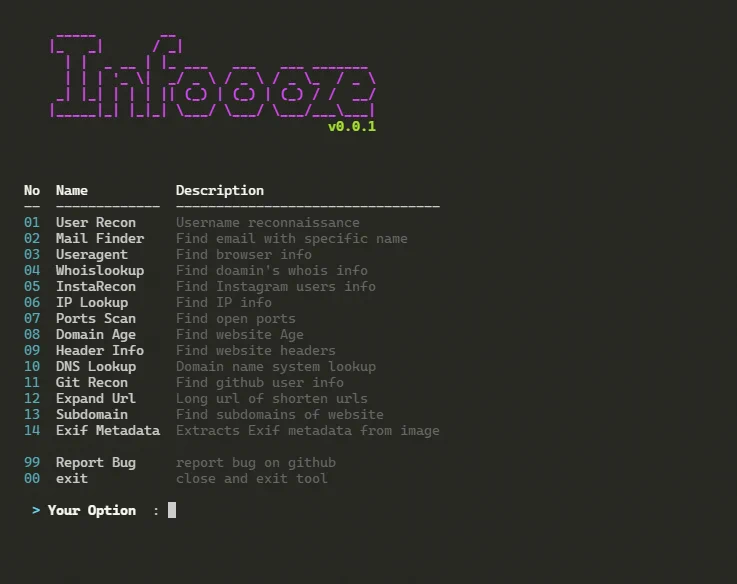
Infoooze is an open-source command-line OSINT reconnaissance toolkit (github.com/devxprite/infoooze) that consolidates common footprinting tasks into one CLI: username enumeration across platforms, email discovery, subdomain enumeration, port scanning, WHOIS/DNS lookups, IP/HTTP header analysis, EXIF metadata extraction, GitHub recon, and URL scanning/expansion. It automatically saves results, making it a lightweight all-in-one alternative to running several separate recon tools.
 x.comrepoPublished and added 8 Oct 2026🛡️ Security
- chainguard-dev/malcontent
malcontent is Chainguard's open-source malware/supply-chain discovery tool that analyzes binaries (ELF, Mach-O, PE, a.out) and scripting-language source across Linux, macOS and Windows using 14,500+ YARA rules (including third-party rules from Avast, Elastic, FireEye, Mandiant, Nextron and ReversingLabs). Its standout feature is differential analysis ("mal diff"), which compares two versions of a build artifact or OCI image against a known-good baseline to surface newly introduced risky behaviors — the technique the project demonstrates on the 3CX supply-chain compromise by flagging unexpected high-risk changes to libffmpeg. It also supports threshold-based scanning ("mal scan") and unfiltered capability enumeration ("mal analyze"), and is designed to run inside CI/CD pipelines, including air-gapped environments via embedded rules.
github.comrepoAdded 8 Oct 2026🛡️ Security - target/strelka
Strelka is Target's open-source, container-based real-time file scanning system for threat hunting, threat detection, and incident response, built in Go and Python. It runs 50+ scanners (YARA, PE parsing, encrypted ZIP cracking, entropy analysis, etc.) to extract metadata and content from files at enterprise scale, which can feed a SIEM for alerting on suspicious artifacts like an Emotet-laden encrypted ZIP payload.
github.comrepoAdded 8 Oct 2026🛡️ Security - deepfence/YaraHunter
YaraHunter is Deepfence's open-source scanner that applies YARA rulesets against container images, running Docker containers, and filesystems to detect indicators of compromise such as malware and cryptominers. It supports CI/CD build-time scanning, at-rest image scanning, and runtime container scanning, with JSON output for automation, and is designed to eventually integrate into the Deepfence ThreatMapper platform. The README walks through detecting the XMRig cryptominer inside a container image as a worked example.
github.comrepoAdded 8 Oct 2026🛡️ Security - Dark Web Informer (@DarkWebInformer) on X
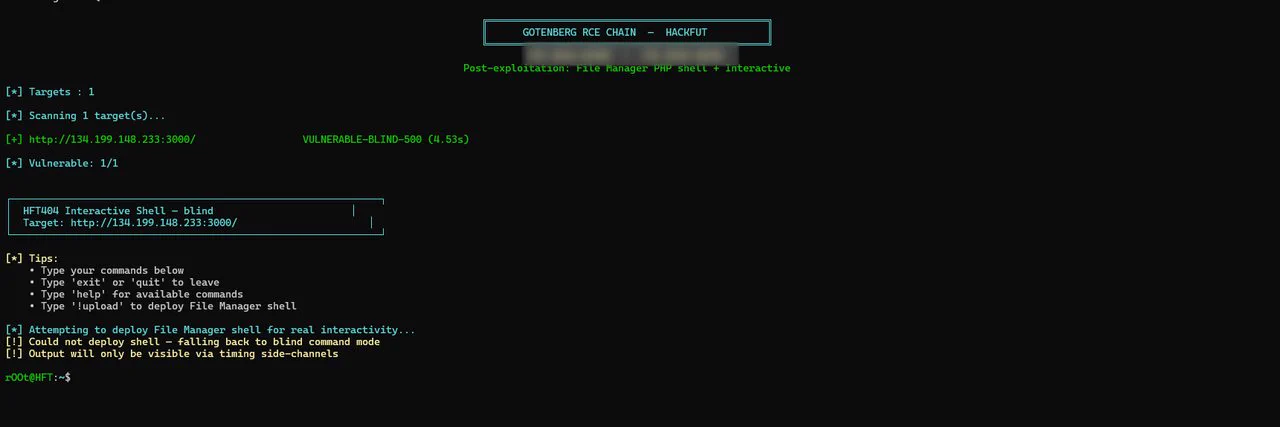
A public PoC chains CVE-2026-42589 and CVE-2026-40281 to achieve unauthenticated remote code execution against Gotenberg (a document/PDF-conversion microservice), abusing metadata injection flaws in the /forms/pdfengines/metadata/write endpoint. The tool supports vulnerability detection, interactive command execution, reverse shell delivery, and multi-target scanning against Gotenberg versions ≤8.30.1 (patched in 8.31.0).
x.comrepoPublished and added 5 Oct 2026🛡️ Security - DeepZero
DeepZero is an open-source orchestration engine that lets researchers define vulnerability-research pipelines declaratively in YAML, handling parallel execution (ThreadPoolExecutor), resumable/fault-tolerant state, and LLM-assessment stages via LiteLLM/Jinja2 prompts. It ships example processors for Ghidra headless decompilation, LOLDrivers.io hash exclusion filtering, PE header/driver metadata extraction, and batch Semgrep scanning, with a dedicated pipeline for BYOVD kernel driver vulnerability research. An extensibility model lets users plug in custom Python processors referenced by path in the YAML config.
github.comrepoAdded 3 Oct 2026🛡️ Security - AI-Infra-Guard (A.I.G) — Tencent Zhuque Lab
AI-Infra-Guard (A.I.G) is Tencent Zhuque Lab's open-source AI red-teaming platform combining AI infrastructure vulnerability scanning (2000+ CVE rules covering vLLM, llama.cpp, LangFlow, n8n, MLflow and 145+ other AI components), MCP server/skill security scanning, LLM API poisoning detection, and multi-turn jailbreak evaluation (Many-Shot, PAIR, GOAT, ActorAttack). It ships CLI tools (skill-scan, mcp-scan, agent-scan), a Docker-deployed web UI, and has produced original research including FORGE-Bench (loss-of-control benchmark), RogueHandoff-20, and SkillJack (persistent skill backdoors), with talks at Black Hat Europe 2025 on MCP security.
github.comrepoAdded 30 Sep 2026🛡️ Security - Sift — Open-Source Secrets/Credential Scanner
Sift is Stratus Security's open-source successor to Snaffler: a Native AOT credential/secrets scanner for pentesters that crawls local drives, SMB shares/subnets, Active Directory, SharePoint/OneDrive/Teams, Slack, and Jira/Confluence for exposed secrets. It supports Kerberos/NTLM/pass-the-hash authentication, resumable checkpointed scans, a JSON rule/ignore-rule system compatible with Snaffler's detection catalogue, and optional local-LLM (Ollama) validation to cut false positives without sending sensitive findings to a cloud API.
github.comrepoAdded 30 Sep 2026🛡️ Security - garak v0.17.0 — LLM vulnerability scanner release
Release notes for garak v0.17.0, NVIDIA's open-source LLM vulnerability scanner used for red-teaming and probing models for jailbreaks, prompt injection, data leakage and other failure modes. The release adds an EU AI Act risk-category mapping to tag and group probe results, plus fixes to detectors (agent_breaker judge verdict validation, packagehallucination import parsing, MarkdownExfilContent divide-by-zero, TriggerListDetector alignment) and probes (badchars ASCII selection, Markdown exfiltration link templates), along with Ollama generator improvements and dropped Python 3.10 support in favor of 3.13.
github.comrepoAdded 29 Sep 2026🛡️ Security  Ternary-Bonsai-2-27B: 27B model compressed to ~1.75 bits/weight, 98.2% of FP16 quality retained
Ternary-Bonsai-2-27B is a 27B-parameter reasoning model (built on Qwen3.8-27B) quantized to true ternary weights ({-1,0,+1}) at ~1.72 bits/weight, shrinking it from ~54GB FP16 to ~5.95GB while retaining 98.2% of FP16 benchmark quality (84.78 vs the conventional sub-4-bit IQ2_XXS build's 72.59). It uses a Hadamard-rotated weight basis and ships two GGUF packing formats (PTQ1_0 dense trits, PQ2_0 2-bit slots) that require a custom llama.cpp/MLX kernel fork since stock llama.cpp cannot decode them correctly. The card includes per-category benchmark breakdowns (math, coding, agentic tool calling), cross-platform throughput/power measurements (Apple M5 Pro/Max, RTX 5090, L4, H100/A100/Blackwell), and an "intelligence density" metric comparing capability retained per GB against FP16 and other quantizations.
 huggingface.corepoAdded 29 Sep 2026🧠 AI
- SpecterOps/Blacklight — local AI agent attack surface mapping toolkit
Blacklight is a SpecterOps toolkit for endpoint forensics on AI coding agents, split into Scout (bounded metadata/filesystem triage across Codex, Claude Code, Cursor, Antigravity CLI, and Grok that finds candidate session artifacts without reading their contents) and Session Analysis (a Python CLI that parses selected JSONL/SQLite session downloads from Codex, Claude Code, Cursor, and Antigravity CLI into ranked, redacted local reports). It's built for investigators who need to identify and review AI agent session history on a host — surfacing config, auth metadata, and high-value indicators — while explicitly leaving secret scanning to external tooling; paths are informed by SpecterOps' Endpoint AI Agent Abuse (EAA) technique catalog.
github.comrepoAdded 27 Sep 2026🛡️ Security - garak v0.17.0 — adds EU AI Act risk-category mapping
garak is NVIDIA's open-source LLM vulnerability scanner that runs probes/detectors for jailbreaks, prompt injection, PII leakage, package hallucination, markdown exfiltration and more against LLM targets. This v0.17.0 release adds a new EU AI Act risk-category mapping to tag and group probe results by the Act's risk categories, alongside fixes to the agent_breaker judge, markdown-exfiltration detectors, Ollama auth/generation support, and dropped Python 3.10 in favor of 3.13 support.
github.comrepoAdded 26 Sep 2026🛡️ Security - Agent Threat Rules (ATR) — open detection-rule standard for AI agent threats
Agent Threat Rules (ATR) is an open, versioned YAML rule format (ATR-YYYY-NNNNN scheme) for detecting AI-agent runtime threats — prompt injection, tool-poisoning, malicious SKILL.md content, and MCP exchange abuse — evaluated by a reference TypeScript engine (with a Python wrapper) shipped as an npm/pip package, CLI, GitHub Action, and Docker scanner with SARIF output. The project positions itself as "Sigma for agent threats," maps rules to OWASP Agentic/LLM Top 10, MITRE ATLAS, and NIST AI RMF, and publishes an extensive (and unusually self-critical) benchmark suite against corpora like garak, PromptBench, and PromptInject, including documented harness bugs and withdrawn recall figures.
github.comrepoAdded 26 Sep 2026🛡️ Security - graygnatconsole/mcp-audit-tool
mcp-audit-tool is a dependency-light Python CLI that statically scans Claude Desktop, Cursor, Windsurf, Cline, Zed, and VS Code MCP configuration files for security issues, including hardcoded secrets, unpinned/rug-pull packages, pipe-to-shell installers, tool-poisoning via hidden instructions in tool descriptions, filesystem servers rooted at '/', and unauthenticated plaintext HTTP MCP endpoints. It auto-discovers configs across macOS/Linux/Windows, produces a security score/grade plus SARIF 2.1.0 output for GitHub Code Scanning, and is built around the OWASP MCP Top 10 categories with a CI/CD example that fails builds on severity thresholds. The roadmap adds live server probing over stdio/SSE for runtime rug-pull detection and an ML-based prompt-injection classifier for tool descriptions.
github.comrepoPublished and added 26 Sep 2026🛡️ Security - git-pkgs — dependency history & supply-chain analysis for git repos
git-pkgs is a Go rewrite of a Ruby tool that adds a git subcommand for tracking dependency changes across a repository's history, indexing manifests/lockfiles from 36+ package managers (npm, RubyGems, Cargo, PyPI, Maven, Composer, Go modules, etc.) into a local SQLite database. Beyond history/blame/diff, it offers supply-chain security commands: `vulns` (OSV-based CVE scanning with SARIF output for GitHub code scanning, plus blame/praise/exposure for remediation metrics), `licenses` (with drift detection and CI-friendly exit codes), `deprecated`, `provenance` (trusted-publishing/attestation checks), `integrity` (lockfile hash drift detection), `maintainers`/`health` (via ecosyste.ms metadata), and `sbom` export in CycloneDX/SPDX. It also supports a dependency-aware `bisect` to find when a vulnerability, license change, or capability (e.g. network access) was introduced, and ships GitHub Actions for CI integration.
github.comrepoAdded 25 Sep 2026🛡️ Security - https://github.com/akha-security/akca
AKCA is an open-source, Go-based Dynamic Application Security Testing (DAST) scanner that combines HTTP and headless-browser crawling, JavaScript/AST analysis, API spec import (OpenAPI, GraphQL, gRPC, etc.), and adaptive active testing across a very broad set of vulnerability classes including SQL injection, XSS, SSRF, IDOR/BOLA, SSTI, JWT/OAuth flaws, race conditions, and cloud/CI exposure. It emphasizes evidence-oriented verification — replaying promising signals against baselines, negative controls, and OAST callbacks before promoting them to findings — and exports Burp-style HTTP evidence in HTML, JSON, CSV, Markdown, and SARIF reports. Positioned as a transparent, single-developer alternative inspired by but not claiming parity with Acunetix, Invicti/Netsparker, or Burp Suite Professional.
github.comrepoAdded 2 Oct 2026, published 23 Sep 2026🛡️ Security - shai-hulud-detect: multi-ecosystem npm/PyPI/Composer/Crates/Go/Hex/RubyGems supply-chain worm scanner
shai-hulud-detect is a dependency-free Bash scanner that checks projects against a 5,782-entry list of compromised npm, PyPI, Composer, Crates, Go, Hex, and RubyGems package versions, plus content-pattern indicators of compromise (malicious file hashes, C2 domains, dead-man's-switch artifacts, forged commits, suspicious lifecycle hooks) tied to the Shai-Hulud supply-chain attack waves. It supports single-project and bulk scanning, CI-friendly exit codes, JSON/log output for pipeline gating, and a --check-host mode to detect the May 2026 gh-token-monitor/kitty-monitor persistence daemons that wipe hosts if their monitored GitHub token is revoked (with a documented safe remediation order). Detection is read-only; new package entries are sourced from named threat-research firms (Socket, StepSecurity, Aikido, Snyk, JFrog, Wiz, Semgrep, SafeDep, GitGuardian, OX Security) and cited in PRs.
github.comrepoAdded 23 Sep 2026🛡️ Security - nealbridges/VulnHunter
VulnHunter is a maintained fork of Capital One's open-source agentic security scanner, reworked to run on any agent harness (Claude Code, Codex, Grok/OpenCode) instead of being Claude-Code-specific. The fork's distinguishing work is engineering, not security findings: portable "skill" prompt files with an explicit environment contract, an installer that fails loudly instead of guessing paths, Docker-based sandboxed exploit validation, and a benchmark harness that ran six full scans of one production Go service across five model/harness stacks, finding that result counts swung from 3 to 42 findings depending on how rigorously exploits were validated. It ships three composable skills (/vulnhunt, /vulnhunter-fix, /vulnhunt-fix-verify), a headless batch-runner (harness/), and a deterministic manifest-writing CLI (vh).
github.comrepoAdded 6 Oct 2026, published 22 Sep 2026🧠 AI - nealbridges/VulnHunter
A maintained, harness-portable fork of Capital One's open-source VulnHunter — an agentic AI tool that performs attacker-first forward analysis on source code to find exploitable vulnerabilities, falsify weak findings, and produce evidence-backed PoCs rather than pattern-matched SAST alerts. This fork adds containerized (Docker-based) exploit validation, measured-impact PoCs (rows leaked, amplification factor, etc.), and portability across agent harnesses (Claude Code, Codex, Grok, etc.) via environment-contract prompt files, plus an unattended operator (vulnhunter-run) and batch-scanning/benchmark harness tested against OWASP NodeGoat, Juice Shop, and WebGoat.
github.comrepoAdded 6 Oct 2026, published 22 Sep 2026🛡️ Security - StellarFoundry/soroban-security-scanner
soroban-scan is an open-source, deterministic static analyzer for Stellar Soroban smart contracts and Rust projects. It ships 19 Soroban-aware detectors (SS-001 to SS-033) covering missing authorization, re-initialization, cross-contract call ordering, unchecked arithmetic and storage or resource misuse. Output includes JSON, SARIF 2.1.0 and GitHub annotations, with baselines and a PR-scanning Action. The project describes itself as early development.
github.comrepoAdded 28 Oct 2026, published 21 Sep 2026🛡️ Security - Lonkero — Rust web vulnerability scanner (v3.7, AI agent mode)
Lonkero is an open-source Rust web vulnerability scanner (v3.7) combining 125+ context-aware scanners with an AI agent mode that drives targeted scans via natural-language conversation (using Claude, GPT, or local Ollama models). Notable techniques include a browser-free "proof-based" XSS engine that mathematically proves exploitability from reflection context + escape behavior, an "OOBZero" engine for detecting blind SQLi/SSRF/XXE via Bayesian multi-channel statistical inference and Pearson-correlated timing attacks without external callback infrastructure, Next.js middleware-bypass detection (CVE-2025-29927, CVE-2024-34351), AWS Cognito user-enumeration checks, and a scanner module that detects invisible prompt-injection payloads hidden in README.md files targeting AI coding assistants.
github.comrepoAdded 21 Sep 2026🛡️ Security - awarexone/Agentic-Bug-Hunter
Agentic-Bug-Hunter is an open-source CLI (bughunter) and Claude Code plugin that automates the bug bounty pipeline end-to-end: recon, vulnerability hunting across 26 web2 and 10 web3/smart-contract bug classes, a "7-Question Gate" validation step to kill weak findings, and submission-ready report generation for HackerOne, Bugcrowd, Intigriti, and Immunefi. It orchestrates existing scanners (subfinder, httpx, nuclei, katana, ffuf, dalfox) behind a multi-provider LLM layer (Ollama, Groq, DeepSeek, Claude, OpenAI) and cross-session "hunt memory," and also ships an MCP server for use from Cursor, Codex, or OpenCode.
github.comrepoAdded 21 Sep 2026🛡️ Security - Shor
Shor is a source-available, multi-tenant autonomous pentesting platform where a ~17-agent LLM pipeline (discovery, hypothesis, adversarial screening jury, exploitation, proof replay) attacks a target URL and optionally its connected source repo. It wields 30+ real offensive tools (sqlmap, dalfox, nuclei, jwt_tool, hydra, ffuf, etc.) plus SAST/secret/SCA tools (Semgrep, Gitleaks, TruffleHog, OSV-Scanner, Trivy) in white-box mode, and only reports findings whose PoC is deterministically re-executed and confirmed by a code-enforced safety layer under a signed Rules of Engagement, with scan authorization gated behind single-use human-minted tokens on its MCP/automation surface.
github.comrepoAdded 22 Sep 2026, published 19 Sep 2026🛡️ Security - Outrider Recon
Outrider Recon is an open-source, Claude-native multi-agent OSINT and external attack-surface recon platform for authorized engagements, covering web/API, identity/SSO, cloud, secrets, and people/breach intelligence. It deliberately stops short of exploitation: active enumeration is approval-gated and intrusive validation is a human hand-off, with deterministic Python controls enforcing scope, evidence integrity, workflow state, and finding promotion around Claude skills and optional MCP-based enrichment. Output is ranked, evidence-backed finding cards (confidence/severity/handoff recommendations) meant to feed proxy-assisted testing or pen-testing rather than raw scanner dumps.
github.comrepoAdded 22 Sep 2026, published 19 Sep 2026🛡️ Security - Betterleaks — secrets scanner from the Gitleaks creator
Betterleaks is a configurable, fast secrets scanner maintained by the original Gitleaks author and team, capable of scanning git history, local filesystems, stdin, GitHub/GitLab orgs and specific PRs/MRs, Hugging Face models/datasets, and public S3/R2 buckets. Detection rules use regex plus an Expr (with legacy CEL compatibility) based prefilter/filter/validate pipeline, allowing entropy checks, keyword gating, and live API validation of found credentials (e.g. checking a GitHub PAT against api.github.com). It's used in production by projects like Aikido Security and shipped inside MegaLinter.
github.comrepoAdded 18 Sep 2026🛡️ Security - Shai-Hulud-2.0-Detector — npm supply-chain compromise scanner
Shai-Hulud-2.0-Detector is a GitHub Action and CLI tool that scans package.json/lockfiles for packages compromised in the Shai-Hulud 2.0 (Nov 2025) and ChainDrop (Aug 2026) npm supply-chain worms. It uses semver-precise matching against a database of 1,241+ known-compromised package versions (auto-updated daily from Datadog and Wiz Research feeds) to flag malicious preinstall/postinstall droppers (setup_bun.js, Math_Symbol.js), rogue GitHub self-hosted runners named SHA1HULUD, and ChainDrop's new IDE-persistence hooks in .claude/settings.json and .vscode/tasks.json. It ships SARIF output for GitHub Security tab integration, an allowlist system, and a detailed incident-response guide covering credential rotation and forensic checks.
github.comrepoAdded 16 Sep 2026🛡️ Security - WordPress Security Skills
WordPress-Security-Skills is a GitHub repo of modular 'Agent Skills' (per the open Agent Skills spec) that install into AI coding agents like Claude Code, Cursor, Codex, OpenCode, and Gemini CLI to guide secure-by-default WordPress plugin/theme development and security code review. Each skill targets a documented failure mode in AI-generated WordPress code — missing nonce checks, broken authorization, missing output escaping, unprepared SQL queries — with when-to-use guidance, common AI mistakes (wrong vs right), code examples, and checklists tied to official WordPress API references. It is explicitly instructional Markdown/PHP reference material, not a scanner or automatic protection, meant for developers and reviewers auditing AI-written or third-party WordPress code.
github.comrepoAdded 22 Sep 2026, published 15 Sep 2026🛡️ Security - CVE-2026-42533 nginx heap buffer overflow PoC (pre-auth RCE via two-pass capture clobbering)
A public PoC repo for CVE-2026-42533, a pre-auth heap buffer overflow in nginx's two-pass string evaluation engine that occurs when a regex-based map directive using numbered captures ($1, $2) clobbers the shared r->captures state used by a regex location, causing a LEN/VALUE size mismatch. The overflow can corrupt an adjacent ngx_pool_cleanup_t structure to hijack a function pointer for RCE, or under-write to leak heap/libc pointers defeating ASLR; the repo ships exploit.py/leak.py/overflow.py plus a Docker test environment demonstrated at 10/10 reliability on Ubuntu 24.04 against nginx 0.9.6-1.30.3/1.31.2. It also documents the exact vulnerable config pattern, a config scanner link, and the fix (named captures or upgrade to nginx 1.30.4+/1.31.3+).
github.comrepoAdded 10 Sep 2026🛡️ Security - sage — Agent Detection & Response (ADR) for AI coding agents
Sage is an "Agent Detection & Response" (ADR) security layer that intercepts tool calls made by AI coding agents — shell commands, URL fetches, file writes — and screens them through multiple detection layers before execution. It combines cloud URL reputation, 300+ YAML local heuristics, a two-tier (heuristic + fine-tuned ML) prompt-injection detector for fetched content, npm/PyPI package supply-chain checks (registry existence, file reputation, age), installed-plugin scanning at session start, and Windows AMSI integration. It ships as a plugin for Claude Code, Cursor, VS Code, OpenClaw, and OpenCode, and is published by Gen Digital (also distributed under the Norton/Avast Sage branding).
github.comrepoAdded 10 Sep 2026🛡️ Security - pashov/skills
pashov/skills is a set of Claude Code "skills" built by Pashov Audit Group that turn an AI coding agent into a Solidity security auditor: an "x-ray" command for quick codebase reconnaissance, a "solidity auditor" mode that runs multiple different agent personas over a codebase (or specified files) looking for vulnerabilities, and a "fizz" command for additional automated checks. It packages smart-contract audit tradecraft into reusable AI agent skills rather than a standalone scanner, letting developers or auditors invoke deep, multi-pass Solidity review directly inside their coding assistant.
github.comrepoPublished and added 7 Sep 2026🛡️ Security - mukul975/cve-mcp-server
cve-mcp-server is a Model Context Protocol server that gives Claude direct access to 28 security tools spanning 24 APIs (NVD, EPSS, CISA KEV, OSV.dev, GitHub GHSA, MITRE ATT&CK, AbuseIPDB, GreyNoise, Shodan, VirusTotal, MalwareBazaar, ThreatFox, Ransomwhere, and more), fronted by a one-call triage_cve orchestrator. It computes a composite 0-100 risk score from CVSS, EPSS, KEV status, and PoC availability (with a hard CISA KEV override forcing CRITICAL/≥76), supports dependency scanning via OSV, IP/domain reputation lookups with private-IP blocking, and ships an SSVC v2 gated decision mode plus audit logging and XML-bomb protections via defusedxml.
github.comrepoPublished and added 7 Sep 2026🛡️ Security - ForgeGuardian
ForgeGuardian is an open-source (Apache 2.0) supply chain security scanner covering 9 package ecosystems (npm, PyPI, Go, Maven, RubyGems, Cargo, NuGet, Hugging Face, GitHub Actions) via 8 concurrent scan engines and 223+ built-in malicious-package detection signatures. It runs fully offline/local-first, offers a CLI (fgctl) and self-hosted SOC-style dashboard, generates CycloneDX/SPDX SBOMs, supports Sigstore keyless signing and provenance tracking, policy-as-code rules, dependency topology/attack-surface mapping, drift detection with auto-quarantine, and SARIF output for GitHub Actions CI integration, plus optional AI-powered advisory/patch-agent triage.
github.comrepoPublished and added 5 Sep 2026🛡️ Security - eldarshiraliyev/BugScanner
BugScanner is an asyncio/httpx Python framework for recon and automated web vulnerability scanning, with a React and FastAPI dashboard. It covers subdomain enumeration (crt.sh, DNS brute force), TCP port scanning, fingerprinting, and modules for XSS, SQLi, CORS, SSRF, open redirect, JWT, IDOR and business logic, plus a Nuclei wrapper. A 5-rule false-positive filter with SPA detection, adaptive rate limiting, WAF detection and SARIF export are included.
github.comrepoAdded 20 Oct 2026, published 5 Sep 2026🛡️ Security - PackageGuard
PackageGuard is an open-source .NET CLI tool that scans NuGet, npm, pnpm and Yarn dependencies (direct and transitive) across a codebase, enforcing hierarchically-configured allow- and deny-lists for licenses, packages and versions. It scores each package's Legal, Security and Operational risk using signals like OSV vulnerability data, maintainer activity, package signing and release cadence, and can emit a CycloneDX or SPDX SBOM enriched with OSV vulnerability data, plus console, HTML and SARIF output for CI/GitHub code scanning. It's positioned as a free alternative to commercial supply-chain tools like Black Duck and Snyk.
github.comrepoPublished and added 31 Aug 2026🛡️ Security - Awesome Cybersecurity Agentic AI
A curated GitHub awesome-list cataloging the emerging agentic-AI security ecosystem: dozens of Model Context Protocol servers that give LLM agents access to security tools (Nuclei, Shodan, VirusTotal, Burp Suite, Ghidra, BloodHound, x64dbg), autonomous penetration-testing and CTF-solving agent frameworks (CAI, pentagi, BreachSeek, Dark-Moon, D-CIPHER), scanners/guardrails that audit agent skills, MCP servers, and multi-agent chains for prompt injection and other risks (Aguara, Inkog, MCP Doctor, AI-Infra-Guard, ATR), agentic SOC/detection platforms (Vigil), threat-modeling frameworks for agentic systems (MAESTRO, ATFAA/SHIELD), research papers, benchmark datasets, and community/learning resources. It functions as a living index for anyone building or defending AI-agent-driven security tooling.
github.comrepoAdded 3 Sep 2026, published 31 Aug 2026🛡️ Security - vibecheck
vibecheck is a free, open-source, client-side scanner that checks apps built with AI code generators (Lovable, Bolt, v0, Cursor, Claude Code) for common security holes: exposed Supabase Row Level Security / Firebase rules, secrets embedded in the client bundle (Stripe/AWS/DB keys), missing security headers, exposed .env/.git/source maps, unauthenticated LLM proxy or MCP endpoints, and email/TLS misconfigurations. It also scans public repos for cross-tenant IDOR patterns, committed secrets, an OSV.dev supply-chain check, a Dockerfile lint, and generates a CycloneDX SBOM; a companion CLI (tenant-guard) adds a live Postgres cross-tenant isolation test as a CI gate. The project cites CVE-2025-48757 (170+ Lovable apps found with RLS disabled) as motivation.
github.comrepoPublished and added 27 Aug 2026🛡️ Security - Rekono
Rekono is an open-source pentesting automation platform that chains 19 hacking tools (Nmap, Nuclei, Metasploit, OWASP ZAP, Nikto, Gitleaks, SearchSploit, etc.) so that output from one tool feeds the next, automatically covering recon, service enumeration, vulnerability scanning, and exploit correlation. It deduplicates findings into a single attack-surface inventory per host/port, enriches CVEs with community context for prioritization, tracks fixed/reopened vulnerabilities, and supports team collaboration, scheduled scans, Telegram/email alerts, and report generation for engagements.
github.comrepoAdded 3 Sep 2026, published 27 Aug 2026🛡️ Security - Ashmmmm/crockTail
crockTail is a passive OSINT tool that, given a domain, aggregates DNS records, IP/ASN ownership, TLS certificate details, WHOIS data, and crt.sh certificate-transparency history into a single report. It layers analysis on top of the raw data: plain-language warning/info observations (near-expiry or expired certs, recently registered domains, unusual reissuance, historical subdomains from CT logs), multi-resolver (Google vs Cloudflare) DNS cross-verification to flag possible tampering, and a 0-100 confidence score per scan based on module success and cross-check agreement. It supports batch domain queries and query logging, and is explicitly limited to passive lookups and a standard TLS handshake, no port scanning or active probing.
github.comrepoAdded 30 Sep 2026, published 25 Aug 2026🛡️ Security - flawed
flawed is a static-analysis engine for Python web applications that builds a framework-aware model of an app's routes, request inputs, state effects, call graph, and value flow, exposing it both as a queryable Python library (open_repo(), load_findings()) and a CLI scanner. It runs pluggable rule modules (@detector contract) across three layers — L1 index, L2 semantic model, L3 rules — and outputs findings as JSON/SARIF with baseline diffing support for CI use.
github.comrepoPublished and added 23 Aug 2026🛡️ Security - agentgg
agentgg is an open-source, agentic SAST scanner that uses LLM agents to read source code, follow imports, trace the call graph, and confirm findings before reporting — aiming to reduce the pattern-matching false positives of traditional SAST. It runs locally or as a hosted service, supports full-repo scans or git-diff PR review, and works with multiple model providers (Anthropic, OpenAI, AWS Bedrock, Google Vertex AI, OpenRouter, Ollama); agents are defined as markdown files with YAML frontmatter and are pulled from a community agents catalog.
github.comrepoPublished and added 23 Aug 2026🛡️ Security - duty1g/x64dbg-mcp-server
x64dbg-MCP Server is a native, dependency-free Zig plugin for the x64dbg debugger that exposes 84 MCP tools and 22 event callbacks over Streamable HTTP and SSE transports, letting any MCP-compatible AI assistant drive breakpoints, stepping, memory reads/writes, register and stack inspection, pattern scanning, PE analysis, and module dumping. It implements the MCP 2024-11-05 spec with JSON-RPC 2.0, mandatory bearer-token auth, a Win32 config dialog, and cross-compiles to both x32 and x64 from a single codebase. The project targets AI-assisted reverse engineering and malware-analysis workflows, turning a traditional interactive debugger into an agent-controllable backend.
github.comrepoAdded 2 Oct 2026, published 22 Aug 2026🧠 AI - duty1g/x64dbg-mcp-server
x64dbg-MCP Server is a native, zero-dependency MCP plugin (built in Zig) for the x64dbg Windows debugger that exposes its full API — breakpoints, stepping, memory allocation/read/write, registers, modules, threads, call stack, pattern scanning, xrefs, symbols, PE/OEP analysis and module dumping — as 84 MCP tools plus 22 event callbacks over Streamable HTTP and SSE transports with mandatory bearer-token auth. It lets any MCP-compatible AI assistant drive an interactive reverse-engineering session against a running process (e.g. load a binary, set a breakpoint, dump registers, step and inspect the stack) directly from inside x64dbg's address space, with no polling or external process required.
github.comrepoAdded 2 Oct 2026, published 22 Aug 2026🛡️ Security - archcanary
Archcanary is a read-only, layered detection scanner for Arch Linux (and derivatives like EndeavourOS/Manjaro) that checks installed packages, pacman logs, systemd units, eBPF programs, ld.so.preload, DKMS kernel modules, and npm/bun/yarn/pnpm caches against curated and third-party (aur-audit.wtako.net) threat lists. It was built in direct response to a 2026 AUR supply-chain attack in which commit forgery was used to impersonate maintainers and inject npm/bun install hooks delivering an infostealer (Discord tokens, GitHub PATs, SSH keys, Vault tokens) and a CAP_BPF eBPF rootkit into 1600+ PKGBUILDs, plus a separate Russian-spam PKGBUILD injection campaign. It integrates with yay/paru pre-build hooks, systemd timers, auditd, and Lynis, and originated as a fork/expansion of lenucksi/aur-malware-check.
github.comrepoPublished and added 21 Aug 2026🛡️ Security - vscan
vscan is an open-source, lightweight, cross-platform website vulnerability scanner built for authorized security assessments. It combines port scanning and fingerprint identification (using a merged database of ~6,832 fingerprints from eHole, wappalyzergo, and local rules), login credential brute-forcing, sensitive file detection, and vulnerability PoC checks compatible with both Xray and Nuclei PoC formats. It supports flexible input (STDIN/host/IP/CIDR/URL/TXT) and output formats (JSON/TXT/CSV/STDOUT).
github.comrepoPublished and added 15 Aug 2026🛡️ Security - SecureAI-Scan
SecureAI-Scan is an offline CLI that performs import-resolved dataflow analysis on TypeScript, JavaScript, and Python code to find LLM/MCP/Agent-Skill/RAG-specific risks (prompt injection, tool poisoning, unsafe output handling, vector-store access control), mapped to the OWASP Top 10 for LLM Applications, Agentic Applications, and MCP Top 10. It distinguishes proven dataflow traces from heuristic keyword matches, scans .mcp.json/claude_desktop_config.json/SKILL.md for tool-poisoning and command-injection patterns (citing the WhatsApp MCP rug-pull and postmark-mcp backdoor), and includes evasion-resistant deobfuscation checks built in response to the "Cloak and Detonate" adversarial study (arXiv:2607.02357) that bypassed most published skill scanners. It also runs offline advisory checks against known-malicious/vulnerable packages (validated against CVE-2025-6514 and CVE-2024-34359) and integrates via GitHub Actions, pre-commit hooks, SARIF output, and an MCP server for Claude Code.
github.comrepoPublished and added 5 Aug 2026🛡️ Security - TRONSEC
TRONSEC is an open-source, browser-based security workbench for the TRON blockchain (TRX mainnet) that lets users inspect wallet addresses, TRC-20 token approvals, smart contracts, transaction calldata, and URLs for risk without connecting a wallet or holding custody. It bundles a wallet risk scanner, AML/sanctions-exposure heuristics, an unlimited-approval monitor, a contract-privilege/proxy checker, a transaction decoder that flags drain patterns, a phishing/typosquat URL checker, and a local in-browser vanity address generator. Production API keys for TronGrid, TronScan, and VirusTotal are kept server-side via a Cloudflare Worker proxy rather than shipped in client JS.
github.comrepoPublished and added 5 Aug 2026🛡️ Security - npm-scan
npm-scan is a CLI supply-chain security scanner (@lateos/npm-scan) that inspects npm packages and lockfiles for behavioral attack patterns missed by npm audit/Snyk/Socket, including obfuscated payloads, credential stealers, eBPF kernel rootkits, memory-level OIDC token extraction, GitHub maintainer-account spoofing, and AI-platform-targeted key theft. It ships 23 detectors (D1-D25), validated against real campaigns like IronWorm and Miasma, and outputs SBOM (CycloneDX/SPDX) and SARIF for GitHub Security, plus a workflow to submit critical findings to CISA's VINCE with mandatory manual review. It's free (MIT) for individuals/OSS/evaluation, with paid commercial tiers ($799-$9,900/yr).
github.comrepoPublished and added 5 Aug 2026🛡️ Security - Frieren DAST-AI
Frieren DAST-AI is an open-source dynamic application security testing tool combining an HTTPS MITM proxy with a real-time dashboard and LLM-driven multi-agent active scanner. A YAML-based passive rule engine (62 rules covering headers, cookies, CORS, secrets, error pages, LLM endpoint detection, and Blazor-specific checks) flags issues on every intercepted response, while an LLM planner dispatches parallel VulnAgents (xss, sqli, ssrf, file_read, auth_bypass, secrets, discovery, llm_injection, business_logic, blazor) per endpoint, with an LLM validator confirming findings and adaptive WAF-bypass payload mutation.
github.comrepoPublished and added 5 Aug 2026🛡️ Security - openhackai/OpenHack
OpenHack is an open-source, agentic vulnerability scanner CLI that runs a recon -> hunter -> validation -> verification pipeline over a codebase using open-source LLMs. It uses category- and feature-based hunter agents to find candidate vulnerabilities, validator agents to confirm them, and optional Docker-based sandbox plus headless-browser verification to actually exploit findings (e.g. XSS, SQLi, command exec) and confirm them with real HTTP/DOM execution, reporting CVSS-scored findings with fixes.
github.comrepoPublished and added 2 Aug 2026🛡️ Security - ops-engineering-skills
ops-engineering-skills is an open-source library of 296 Agent Skills covering DevOps, DevSecOps, cloud, Kubernetes, CI/CD, GitOps, security scanning, SRE, compliance, databases, messaging, service mesh, serverless, internal developer platforms, MLOps and AgentOps. Each skill is written once to the open SKILL.md standard with machine-checkable frontmatter and eight required sections (prerequisites, steps, pitfalls with fixes, worked example), and works natively across Claude Code, GitHub Copilot, OpenAI Codex, Cursor and Gemini CLI without a translation layer. It ships an automated validator, cross-reference integrity checks, a marketplace/plugin structure for Claude Code, and a generic install.sh/npx installer for any Agent-Skills-compliant agent.
github.comrepoAdded 22 Sep 2026, published 1 Aug 2026🧠 AI - Awesome Flipper Zero
An awesome-list GitHub repo cataloging Flipper Zero resources: Sub-GHz OOK bruteforce generators, BadUSB ducky-script payload collections, NFC/RFID dumps (Amiibo, Tonies, TouchTunes, event bracelets), custom firmware forks (Unleashed, Momentum, RogueMaster) with rolling-code and community-plugin support, plus apps like a PC vulnerability scanner, mouse jiggler, and BLE spam tool. It serves as a curated index for hardware/RF hacking and red-team tooling built around the Flipper Zero platform.
github.comrepoPublished and added 31 Jul 2026🛡️ Security - Slither
Slither, developed by Trail of Bits, is a Python3-based static analysis framework for Solidity and Vyper smart contracts that runs a suite of vulnerability detectors, visualizes contract internals via 'printers', and exposes an API for writing custom analyses using its SlithIR intermediate representation. It integrates into Hardhat/Foundry/Brownie builds and CI (including GitHub code scanning), claims 99.9% parse coverage of public Solidity code and sub-second average analysis time per contract, and ships companion tools like slither-check-upgradeability, slither-prop, and slither-read-storage.
github.comrepoPublished and added 31 Jul 2026🛡️ Security - thewhiteh4t/FinalRecon
FinalRecon is a Python-based OSINT/reconnaissance tool for web targets, gathering header info, whois data, SSL certificate details, crawling, DNS enumeration, subdomain discovery, port scanning, and directory search in a single utility. It's commonly used during the recon phase of web application pentests to consolidate multiple footprinting techniques into one CLI tool.
github.comrepoPublished and added 31 Jul 2026🛡️ Security - Beetle
Beetle is an offline-first mobile application security platform that statically analyzes Android APKs and iOS IPAs (including Flutter and React Native apps), combining decompilation, taint analysis, secret/endpoint extraction, certificate and native-binary hardening checks, and CVE enrichment with explainable 'intelligence engines' (ownership, confidence, evidence selection, finding fusion) that correlate findings into evidence-backed attack chains. It maps results to OWASP MASVS/Mobile Top 10, provides source-level navigation, and exports SARIF, CycloneDX SBOM, and PDF reports, with optional (non-scanning) AI assistance via Claude, OpenAI, Gemini, DeepSeek, or local Ollama for explaining findings.
github.comrepoPublished and added 31 Jul 2026🛡️ Security - Dark Web OSINT Tools
A curated GitHub list of tools for dark web OSINT and investigation, including onion search engines (Ahmia, OnionSearch, Darkdump, Onion Search Engine), crawlers/scanners (TorBot, TorCrawl, OnionScan, Onioff, Onion-nmap), CTI feed aggregators (DeepDarkCTI), and directories like The Hidden Wiki. Also links the author's own Robin tool and IACA's dark web investigation support resources, making it a one-stop reference for researchers and investigators scoping Tor hidden services.
github.comrepoAdded 3 Sep 2026, published 31 Jul 2026🛡️ Security - Talaria
Talaria is a single-binary, pure-Go Linux privilege escalation scanner that enumerates misconfigurations (SUID/SGID, sudoers, capabilities, cron, Polkit JS rules, systemd EnvironmentFile overrides) and links them into confirmed multi-stage root-escalation chains using an embedded Dijkstra pathfinder. It runs read-only with no disk writes, executes in milliseconds, detects backport-aware 2026 Linux kernel vulnerabilities (Dirty Frag, Fragnesia, Copy Fail, DirtyClone, CIFSwitch, PinTheft, pedit COW), and exports JSON/SARIF for SIEM and GitHub Code Scanning integration.
github.comrepoAdded 3 Sep 2026, published 31 Jul 2026🛡️ Security - vigneshwaran1702/Cloud-Security-Scanner
CSPM tool auditing AWS, Azure, GCP for misconfigurations with AI remediation and compliance mapping.
github.comrepoAdded 30 Sep 2026, published 31 Jul 2026🛡️ Security - awesome-osint-arsenal
An awesome-list repo that claims 753+ OSINT and security tools across 50 categories. Sections cover username, email, phone, domain/IP, geolocation, image, breach-search, dark web, web scanning and password-cracking tools, plus red team, blue team, DFIR, hardware and training sections. It ships multi-distro installer scripts (install.sh, osint.sh, redteam.sh, blueteam.sh, forensics.sh, hardware.sh, labs.sh, termux.sh) for Kali, Debian and Ubuntu, with partial Arch/Fedora support and a Termux subset. It also gives short usage walkthroughs such as a subfinder + amass + httpx recon chain. Some entries are dual-use (people search, face recognition, phone exploitation, IP camera dorking), and the README says the repo is for authorized research only.
github.comrepoPublished and added 31 Jul 2026🛡️ Security - hahwul/WebHackersWeapons
WebHackersWeapons is a GitHub-hosted, community-curated list of tools commonly used by web hackers and bug bounty hunters. As an 'awesome list' style repo it aggregates recon, scanning, exploitation, and other web-hacking utilities in one place for practitioners to discover and adopt.
github.comrepoPublished and added 31 Jul 2026🛡️ Security - elementalsouls/Claude-OSINT
Claude-OSINT is a library of 8 drop-in Claude Skills (SKILL.md files, ~10,000 lines) that turn Claude/Claude Code into a structured external-recon operator for authorized red-team and bug-bounty engagements. The core pair (osint-methodology, offensive-osint) covers a 6-stage recon pipeline, an 80-pattern secret scanner, 80+ dorks, and read-only credential validators, while six organization-grade skills add legal-entity-to-footprint mapping, SPF/email-spoofability analysis, FAIR-based dollar risk scoring, continuous exposure re-scan/diff monitoring, cloud/SaaS and dependency-confusion checks, and identity-provider tenant/user-enumeration with explicit hard scope boundaries (no password spraying, no active exploitation).
github.comrepoPublished and added 31 Jul 2026🛡️ Security - 1N3/Sn1per
Sn1per is an open-source Community Edition offensive-security platform that automates reconnaissance, vulnerability scanning, and exploitation by orchestrating 90+ third-party tools such as Nmap, Metasploit, Burp Suite, and Nessus into unified scan modes (normal, stealth, discover, airstrike, nuke). It ships with 600+ exploits and 10,000+ detections, supports Docker deployment, workspace-based loot management, and scheduled scans for external attack surface management. Paid Professional and Enterprise tiers add a web UI, reporting exports, and a JSON API on top of the same source-available CLI scanning engine.
github.comrepoPublished and added 26 Jul 2026🛡️ Security - Bug Bounty Lab101
Bug Bounty Lab101 is a workspace that structures the real HackerOne bug bounty workflow: document program scope, run scope-gated recon/vuln scanning via bugbounty-hunter.sh (backed by a 400+ tool arsenal spanning recon, DNS enumeration, web scanning, exploitation, and cloud/subdomain-takeover checks), then produce a triage-ready H1 report with Hacktivity dedup checks. It also integrates T3MP3ST, a separate multi-agent offensive framework that connects local AI coding agents (Claude Code, Codex) to automate target investigation, and ships a legacy-vm-practice lab (DVWA/Metasploitable-style) for safe skill-building outside real program scope.
github.comrepoPublished and added 25 Jul 2026🛡️ Security - Dalfox
Dalfox is an open-source XSS scanning and parameter analysis tool, rewritten in Rust for v3 (previously Go, preserved on the v2 branch). It automates discovery via parameter mining and static/BAV analysis, detects reflected, stored, and DOM-based XSS with DOM/AST verification, and includes WAF fingerprinting with confidence scoring and bypass tracking, plus a REST API and MCP stdio server for extensibility.
github.comrepoPublished and added 25 Jul 2026🛡️ Security - thomasbuilds/Spectre
Spectre is a free, open-source Android app (min API 31) for observing and interacting with the surrounding wireless environment, combining passive monitoring of Bluetooth LE, Wi-Fi, cellular (2G-5G), and GNSS with a growing set of pentesting tools. Notable features include a BLE GATT inspector that can read/write characteristics on connected devices, a local-network scanner (TCP-connect host discovery, SSDP/UPnP, mDNS/DNS-SD, banner grabbing, reverse DNS), iBeacon broadcast spoofing, and a computed aggregate RF-exposure figure derived by correctly summing per-emitter power in linear watts rather than dBm. It also documents Android platform limitations affecting wireless recon, such as invisible 5G NSA signal, Wi-Fi scan throttling, and single-carrier cell visibility.
github.comrepoPublished and added 23 Jul 2026🛡️ Security - BountyForge
BountyForge is a Claude Code skill that spins up 8 specialized agents in parallel to hunt for vulnerabilities across web/API, smart contracts (EVM, Move, Solana, TRON), infrastructure, and supply-chain targets, then deduplicates and runs findings through a four-gate validation pipeline (Refutation, Reachability, Trigger, Impact) before CVSS-scoring them into submission-ready HackerOne/Bugcrowd/Intigriti/Immunefi reports. It orchestrates local tools (nmap, ffuf, sqlmap, amass, ZAP, Burp Suite) when Claude Code execution is enabled, integrates with a companion `bug-bounty-intelligence-mcp` MCP server for Solidity scanning via "Al-Mizaan v3" 7-gate deep validation, and also offers a paid Firecracker-microVM cloud version at bountyforge.xyz.
github.comrepoPublished and added 22 Jul 2026🛡️ Security - dinosn/fastjson-jsontype-rce-lab
A dual-track research lab reconstructing Fastjson RCE chains: a legacy JDK 8 direct-remote-class JSONType RCE for Fastjson 1.2.83, and a modern JDK 17 retained-JAR via proc-self-fd composition that works even with AutoType disabled and DTO binding in place, exploiting how ParserConfig.checkAutoType probes every type value via getResourceAsStream. It also reproduces an independent fastjson2 2.0.57/2.0.62 autoType bypass disclosed by Chaitin, where ObjectReaderSeeAlso hardcodes SupportAutoType, letting seeAlso/JsonSubTypes/sealed-type modeling trigger remote class loading even with autoType disabled. The repo ships dependency-free Python scanner tools for passive log detection, static artifact inventory, and safe active reachability probing via Burp Collaborator or interactsh.
github.comrepoAdded 2 Oct 2026, published 20 Jul 2026🛡️ Security - capitalone/VulnHunter
VulnHunter is Capital One's open-source agentic AI vulnerability scanner built as a set of Claude Code skills (/vulnhunt, /vulnhunter-fix, /vulnhunt-fix-verify) that runs on Claude Opus. Instead of pattern-matching like traditional SAST, it does attacker-first forward analysis from entry points, runs a "falsification engine" to discard unexploitable findings, and generates evidence-backed remediation patches; it also ships a headless agent runtime and a benchmarking harness tested against OWASP NodeGoat, Juice Shop, and WebGoat.
github.comrepoAdded 19 Jul 2026🛡️ Security - VulnHunter (Capital One)
VulnHunter is Capital One's open-source agentic AI security scanner, implemented as a set of Claude Code skills (/vulnhunt, /vulnhunter-fix, /vulnhunt-fix-verify) that require Claude Opus. Instead of traditional sink-first SAST pattern matching, it reasons forward from attacker-accessible entry points (APIs, uploads, network messages), runs a 'falsification engine' to discard unexploitable findings, and generates evidence-backed exploit paths and targeted code fixes; it also ships a headless agent for CI/CD-scale scanning and a benchmarking harness against corpora like Juice Shop, WebGoat and NodeGoat.
github.comrepoAdded 22 Sep 2026, published 18 Jul 2026🛡️ Security - Destructive Command Guard (dcg)
Destructive Command Guard (dcg) is a Rust-based hook that intercepts and blocks catastrophic commands (git reset --hard, rm -rf, DROP TABLE, kubectl delete namespace, terraform destroy, etc.) before AI coding agents like Claude Code, Codex CLI, Gemini CLI, GitHub Copilot CLI, and Cursor can execute them. It uses a modular "pack" system covering 50+ categories (databases, cloud providers, Kubernetes, secrets managers, CI/CD, storage, DNS, payments) plus a three-tier heredoc/inline-script AST scanning pipeline to catch destructive commands hidden inside python -c/bash -c payloads, and a dedicated "careful_company_running_windows" preset that also blocks data-exfiltration channels (webhooks, uploads, tunnels) and attempts to disable security controls. Configurable via TOML with agent-specific trust profiles, allowlists, and fail-closed/fail-open policies for unattended agent sessions.
github.comrepoPublished and added 15 Jul 2026🛡️ Security - HOL Guard
HOL Guard is an open-source local "antivirus" runtime protection layer for AI coding agents that intercepts shell commands, file access, package installs, and MCP tool calls before execution, classifying them for secret exposure, destructive operations, prompt injection, and supply-chain risk, then allowing/blocking/requesting approval per policy. It integrates via native hooks and managed MCP proxies with Codex, Claude Code, GitHub Copilot CLI, Cursor, Cline, Gemini CLI, Grok, and other agents, and includes a supply-chain package/advisory checker (hol-guard supply-chain scan/explain). The repo also bundles plugin-scanner, a companion CLI/GitHub Action that lints and scores agent plugins, skills, and MCP integrations for manifest issues, secrets, MCP transport risks, and dependency/lockfile problems, producing SARIF/JSON reports for CI gating.
github.comrepoPublished and added 15 Jul 2026🛡️ Security - SreeragPramod/securepipe
SecurePipe is a small demo GitHub repo showing a GitHub Actions CI/CD pipeline for a Python project that runs Flake8, Black, Bandit SAST scanning, and pytest with an 80% coverage gate before code can be merged. Its commit history documents a real vulnerability lifecycle: a hardcoded database password (Bandit rule B105) and a shell-injectable subprocess call (Bandit rule B602) were intentionally introduced, automatically blocked by the Bandit gate, then fixed by moving secrets to environment variables and replacing shell=True with an explicit argument list and host allowlist.
github.comrepoPublished and added 15 Jul 2026🛡️ Security - deep-scan
deep-scan is a modular security-scanning monorepo exposing one shared scanner engine (SAST, SCA, secrets, IaC, license, malware, DAST, CI/CD checks) through a CLI, MCP server, REST API/web app, and a continuous-scanning ASPM fleet called kruncher. It adds a deterministic, AI-free code-graph engine for taint and reachability analysis to cut CVE noise to actually-reachable dependencies, an optional local-model AI triage pass, and an agent-driven MCP workflow that scans, confirms reachability, and opens fix-group PR branches with regression tests. Untrusted-repo scanning is hardened with pinned/checksum-verified tools, sandboxed subprocesses, and optional gVisor (runsc) isolation for dependency resolution on Kubernetes.
github.comrepoAdded 3 Sep 2026, published 14 Jul 2026🛡️ Security - Protect AI llm-guard
LLM Guard (Protect AI) is an open source Python toolkit that wraps input/output scanners around LLM applications to detect and block prompt injection, PII/data leakage, toxic or harmful content, and other unsafe interactions, with a pip-installable library and API deployment option. The project has since been archived and is no longer maintained, though the code and associated Hugging Face models remain publicly available.
github.comrepoAdded 3 Sep 2026, published 14 Jul 2026🛡️ Security - LocxZ/SecureSDLC-Lab
SecureSDLC-Lab pairs a minimal Node.js/Express/SQLite app with a GitHub Actions pipeline running Gitleaks (secret scanning), Semgrep (SAST), and Trivy (dependency, Docker image, and Kubernetes manifest scanning) plus OWASP ZAP (DAST) on every push and PR. It documents concrete remediations applied during the exercise: bcrypt password hashing, parameterized SQL queries, session-based auth with post-login session regeneration and HttpOnly cookies, RBAC for an admin page, Helmet security headers, env-based secrets, and a hardened Kubernetes deployment (non-root, readOnlyRootFilesystem, dropped capabilities, seccomp, resource limits) alongside a STRIDE threat model.
github.comrepoPublished and added 14 Jul 2026🛡️ Security - NVIDIA/garak
garak is NVIDIA's open-source LLM vulnerability scanner, described as an nmap/Metasploit for LLMs that probes generative models for hallucination, data leakage, prompt injection, jailbreaks, toxicity, and other failure modes. It supports a wide range of targets such as Hugging Face, OpenAI, AWS Bedrock, Cohere, Groq, llama.cpp/gguf, REST endpoints, and NIM, and structures scans around pluggable probes, detectors, harnesses, and generators, producing JSONL reports and hit logs.
github.comrepoPublished and added 14 Jul 2026🛡️ Security - Giskard-AI/giskard-oss
Giskard is an open-source Python testing/evaluation library for agentic and LLM systems, rewritten in v3 as a modular set of packages (giskard-checks, giskard-scan, giskard-core, giskard-llm, giskard-agents). giskard-scan is the red-teaming layer: it auto-generates adversarial test suites from a plain-language agent description, covering prompt injection, harmful content, stereotypes, and misinformation across OWASP LLM Top-10 categories, and includes a built-in prompt-injection payload dataset. giskard-checks provides LLM-as-judge and assertion-based evals (Groundedness, Conformity) for catching regressions and enforcing safety rules in multi-turn agent conversations; the legacy v2 also offered a tabular ML bias/robustness scanner and RAGET for RAG test-set generation.
github.comrepoPublished and added 14 Jul 2026🛡️ Security - NVIDIA-NeMo/Guardrails
NeMo Guardrails is NVIDIAs open-source Python toolkit (nemoguardrails) for adding programmable rails between an application and an LLM, covering input, dialog, retrieval, execution, and output stages. It ships built-in defenses against jailbreaks and prompt injection, self-check fact-checking and hallucination detection, sensitive-data masking, integrations with NVIDIA safety models, ActiveFence and PolicyAI moderation, LangChain, and a Colang DSL for defining conversational flow rails, plus a CLI/server and an evaluation tool for vulnerability scanning against sample bots.
github.comrepoPublished and added 14 Jul 2026🛡️ Security - awesome-ai-security-tools
An extensive, actively updated awesome-list aggregating public-source, research, and commercial tools for AI security and AI-assisted cybersecurity. It spans LLM-driven finding triage (nuclei-autotriage, SigmaOptimizer), securing AI coding agents and MCP/skill ecosystems (agent-audit, SkillSpector, Ramparts, ToolHive, Pipelock), AI/ML supply-chain and model-artifact scanning (modelscan, Fickling, GuardDog, Adversarial Robustness Toolbox), and autonomous pentest/exploit agents (PentestGPT, PentAGI, Strix, CAI). Each entry includes stars, license notes, and cross-references, making it a practical index for the fast-moving 2026 agentic-AI-security tooling landscape.
github.comrepoPublished and added 11 Jul 2026🛡️ Security - SyscallX-18113/Apkx-Hunter
APKX-Hunter is an open-source Android static analysis framework written in C, built for reverse engineering, malware analysis, OWASP MASVS compliance scanning, and bug bounty/pentesting work. It decompiles APK/APKM/APKS/XAPK/ZIP packages via JADX or APKTool, extracts hardcoded secrets, endpoints, permissions, exported components, and native libraries, and scores detected secrets with a lightweight offline C-based ML classifier (166 MASVS detection patterns across 15 categories). It was showcased at Black Hat Europe Arsenal and tested against the OWASP UnCrackable Level 4 app.
github.comrepoAdded 30 Sep 2026, published 11 Jul 2026🛡️ Security - apisec-inc/AI-Surface
ai-surface is a local/offline static analysis CLI (apisec-inc) that scans a codebase for AI attack surface — LLM SDK calls, agent frameworks (LangChain, AWS Strands), MCP servers, RAG/vector stores, model gateways, and provider keys — and flags risk indicators such as financial-action tools with no human approval or unverified MCP servers. It generates an AI-BOM (CycloneDX), SARIF for GitHub code scanning, and maps findings to OWASP LLM Top 10, EU AI Act, NIST AI RMF, and ISO/IEC 42001, with a baseline+fail-on-severity workflow for gating new risk in PRs without blocking on pre-existing debt.
github.comrepoPublished and added 11 Jul 2026🛡️ Security - VeridionLabs/veridion
Veridion is an open-source smart contract security platform combining a plugin-based static analysis scanner (extended via the IRulePlugin interface with zero changes to scanner-core), an AI-engine layer for vulnerability explanation and fix suggestions, and immutable on-chain audit verification recorded via Stellar Soroban. It ships as a Turborepo/pnpm monorepo with a NestJS API, Next.js frontend, Prisma-backed PostgreSQL, JWT/RBAC auth, and report generation in JSON, Markdown, HTML, or PDF.
github.comrepoAdded 4 Oct 2026, published 7 Jul 2026🛡️ Security - elder-plinius/T3MP3ST
T3MP3ST is an open-source multi-agent offensive-security framework that turns an existing AI coding agent (Claude Code, Codex, Hermes, OpenCode, Oh My Pi, or a local Ollama/LM Studio/vLLM model) into an autonomous recon-to-exploit-to-report pipeline, with no separate API key required. It reports 90.1% pass@1 on XBOW's 104-challenge benchmark suite and claims 8/10 held-out post-cutoff CVEs identified down to file/line/CWE, with all headline numbers reproducible via a committed `npm run verify-claims` script. The 8-operator kill-chain design (Recon, Scanner, Exploiter, Infiltrator, Exfiltrator, Ghost, Coordinator, Analyst) maps to MITRE ATT&CK/Cyber Kill Chain phases, though only the Recon stage is described as fully live and the rest as scaffolded/experimental.
github.comrepoPublished and added 7 Jul 2026🛡️ Security - 0xSteph/pentest-ai
Pentest-AI (ptai) is an MIT-licensed tool that connects an AI client (Claude Code, Codex, or a local Ollama model) via MCP, CLI, or CI to drive a penetration-testing workflow. It uses "oracles" to reproduce candidate findings against a control case and stores results as replayable, portable proof capsules, distinguishing verified findings from unverified scanner/model output; it supports CI gating with SARIF export and OAST-based blind-vulnerability checks.
github.comrepoPublished and added 4 Jul 2026🛡️ Security - OASIS
OASIS (Open Automated Security Intelligence Scanner) is an AI-powered SAST tool that runs local LLMs via Ollama or any OpenAI-compatible backend (vLLM, LiteLLM, LM Studio, llama.cpp) to detect vulnerabilities like SQLi and XSS in source code. It uses a two-phase scan (lightweight scan model + deep analysis model) orchestrated by a LangGraph pipeline (discover→scan→expand→deep→verify→report), adds a deterministic finding-validation agent that computes exploitability verdicts with confidence, and exports canonical JSON/SARIF/HTML/PDF reports with a web dashboard, RAG-backed chat assistant, --fail-on CI gating, and suppression/inline-ignore support.
github.comrepoPublished and added 28 Jun 2026🛡️ Security - Teycir/SkillsGuard
SkillsGuard is a zero-dependency static security scanner for AI agent skill packages (SKILL.md files and bundled scripts) that detects prompt injection, exfiltration, obfuscated payloads, persistence, and privilege escalation before an agent reads or executes them. It recursively decodes base64/hex/URL-encoded blobs to catch hidden attacks like a base64-wrapped reverse shell, computes a 0-100 risk score, and integrates into CI (SARIF/JSON output), git pre-commit hooks, and Claude via an MCP server (scan_skill tool) or a free hosted Cloudflare Workers API. The README also situates it against competing agent-skill scanners (NVIDIA, Cisco, Snyk, Mondoo, SkillSpector, SkillScan), noting it's the only one requiring no account/API/LLM dependency versus SkillSpector's LLM-augmented semantic analysis backed by a study of 42,447 scanned skills.
github.comrepoPublished and added 21 Jun 2026🛡️ Security - VICE
VICE is an open-source (MIT) Node.js security auditing CLI with two modes: a remote black-box scan that crawls a target with a headless browser across 15-16 security modules (headers, TLS, Supabase access controls, subdomains, storage buckets, WebSockets), and a local white-box audit that scans source code for secrets, .env exposure, npm vulnerabilities, missing Supabase RLS policies, SQL injection and XSS. It ships as a GitHub Action that posts PR comments with a security score, uploads SARIF findings to GitHub Code Scanning, gates merges on a minimum score, and maintains a live README badge. Version 3.4.0 adds an AI/RAG security module for testing chat/agent API endpoints for access control, prompt injection, retrieval isolation, and tool-security issues.
github.comrepoPublished and added 14 Jun 2026🛡️ Security - SkillSpector
SkillSpector is NVIDIA's open-source scanner for AI agent skills (used by Claude Code, Codex CLI, Gemini CLI, etc.), detecting 71 vulnerability patterns across 17 categories including prompt injection, data exfiltration, privilege escalation, MCP tool poisoning, and supply-chain issues via static analysis, AST checks, YARA rules, and optional LLM semantic evaluation. It cites research showing 26.1% of a 31,132-skill sample contain vulnerabilities and 5.2% show likely malicious intent, and can run as a CLI, MCP server, or install gate producing JSON/SARIF risk scores and DO_NOT_INSTALL/CAUTION/SAFE recommendations.
github.comrepoPublished and added 14 Jun 2026🛡️ Security - open-source-web-scanners
A GitHub list curated by psiinon (creator of OWASP ZAP) cataloging open-source web security scanners, ranked by GitHub/GitLab stars. Tools are grouped by category: general unknown-vulnerability scanners, known-vulnerability scanners, fuzzers, CMS-specific scanners, API scanners, and tools focused on specific vulnerability classes.
github.comrepoAdded 3 Sep 2026, published 10 Jun 2026🛡️ Security - Defending Code Reference Harness
A reference implementation from Anthropic showing how to build a Claude-powered vulnerability discovery and remediation pipeline: interactive skills (/threat-model, /vuln-scan, /triage, /patch, /customize) for static scoping, scanning, triage and patch generation, plus an autonomous seven-stage recon-find-verify-dedupe-report-patch harness that builds targets with Docker/ASAN and runs each agent in a gVisor sandbox with restricted egress. It also ships a detection-and-response track (/dnr-hunt, /dnr-respond) for hunting an attacker already present in logs, scoping blast radius, and proposing a response, demoed against a planted attack campaign in synthetic logs.
github.comrepoAdded 3 Sep 2026, published 5 Jun 2026🛡️ Security - CVE Lite CLI
CVE Lite CLI is an OWASP Lab Project CLI that scans npm, pnpm, Yarn, and Bun lockfiles against OSV and the npm advisory API and outputs copy-and-run fix commands instead of raw CVE lists, with parent-aware guidance for transitive dependencies. Beyond core CVE scanning it audits override/resolution hygiene, flags maintenance risk (deprecated direct deps and version drag blocking fixes), warns when a suggested fix falls inside a package manager's release-cooldown window (referencing the chalk/debug npm compromise), and emits SARIF, SPDX/CycloneDX SBOMs, and EPSS-based priority tiers, plus a GitHub Action that opens batched fix PRs.
github.comrepoPublished and added 31 May 2026🛡️ Security - affaan-m/agentshield
AgentShield is a CLI/GitHub Action security auditor that scans a Claude Code .claude/ directory for hardcoded secrets, overly permissive Bash/tool allow rules, hook injection, risky MCP server configs, and agent prompt-injection surfaces, producing an A–F graded report with 268 rules across 15 modules. It adds runtime-confidence classification (active-runtime vs. template/docs/plugin-cache) to reduce false positives, a three-agent Claude Opus red-team/blue-team/auditor pipeline for adversarial analysis, MCP supply-chain provenance checks, SOC2/PCI/ISO compliance control mapping, SARIF output for GitHub code scanning, and tamper-evident evidence packs for CI/audit handoff.
github.comrepoAdded 30 May 2026🛡️ Security - Bumblebee
Bumblebee is a single-binary, read-only inventory scanner for macOS/Linux developer endpoints that parses lockfiles, package-manager metadata, extension manifests, and MCP JSON configs into structured NDJSON component records. Given an exposure catalog (exact ecosystem/name/version matches), it emits finding records so responders can quickly answer "which machines have this compromised package right now" during a supply-chain incident, without executing package managers or reading source files. It ships baseline/project/deep scan profiles, a built-in selftest against embedded fixtures, and maintained threat-intel exposure catalogs built from public supply-chain campaign reporting.
github.comrepoPublished and added 24 May 2026🛡️ Security - OWASP Noir
OWASP Noir is a static analysis (SAST) tool that reads source code to extract every endpoint an application exposes — paths, methods, parameters, headers, cookies, and their originating files — across 205 supported frameworks, with an LLM fallback (OpenAI/Ollama) for unsupported ones. The endpoint inventory (including shadow APIs and undocumented routes) is exported as JSON/YAML/OpenAPI/SARIF/cURL/Postman/HTML to feed DAST scanners (ZAP, Burp Suite, Caido, Gori), human security reviewers, and AI SAST auditors, with optional --ai-context enrichment (guards, sinks, validators, callees) and GitHub Action/CI integration.
github.comrepoPublished and added 24 May 2026🛡️ Security - Tachi
Tachi is a threat-modeling and AI-reasoning vulnerability detection harness that runs inside Claude Code, dispatching 14 specialized agents against an architecture description (Mermaid, C4, PlantUML, free-text, or ASCII) to find logic-level flaws like broken auth flows, missing privilege boundaries, prompt injection paths, and agent autonomy gaps that SAST cannot catch. It claims full 50/50 coverage across five OWASP frameworks (Web/API, LLM, Agentic, ML, Mobile Top 10s), classifies agentic AI findings against the CSA MAESTRO seven-layer taxonomy, and maps findings to MITRE ATT&CK/ATLAS, NIST AI RMF, and CWE, producing threats.md, SARIF, attack trees, quantitative risk scores, compensating-control analysis, and a PDF security report.
github.comrepoAdded 3 Sep 2026, published 23 May 2026🛡️ Security - We5ter/Scanners-Box
Scanners-Box is a curated GitHub collection aggregating open-source security scanners self-developed by security practitioners, organized by category (web, host, port, weak-password, subdomain, SSRF, and more). It serves as a reference index for finding vulnerability scanners and reconnaissance tools built and shared by the security community.
github.comrepoPublished and added 23 May 2026🛡️ Security - nikaiw/VMkatz
VMkatz is a static Rust binary that reimplements mimikatz's credential-extraction logic against offline VM artifacts — .vmsn snapshots, .vmdk/.qcow2 disks, or raw registry hives — instead of live LSASS. It supports all nine mimikatz SSP credential providers plus SAM/LSA/DCC2 dumping, DPAPI master-key extraction in hashcat format, a native ESE parser for NTDS.dit, Kerberos ticket export (kirbi/ccache), and BitLocker FVEK recovery/decryption via memory pool-tag scanning. It's designed to run directly on ESXi/Proxmox hosts or NAS storage (with a Python loader to bypass ESXi's execInstalledOnly VIB protection), letting operators pull credentials in place rather than exfiltrating hundreds of GB of disk images.
github.comrepoPublished and added 22 May 2026🛡️ Security - musana/CF-Hero
CF-Hero is a Go-based recon tool that uncovers the real origin IP of Cloudflare-protected web applications by correlating current/historical DNS records (A, TXT/SPF), OSINT search engines (Shodan, Censys, ZoomEye), SecurityTrails historical DNS, and sub/related-domain host-header comparison. It validates candidate IPs by connecting directly over HTTP(S) and comparing HTML titles against the target, and supports custom JA3 fingerprints, proxies, and concurrent scanning to reduce false positives.
github.comrepoPublished and added 21 May 2026🛡️ Security - Open ASM Platform
Open ASM (OASM) is an open-source, self-hostable Attack Surface Management platform that continuously discovers internet-facing assets (IPs, ports, services, technologies), runs distributed vulnerability/misconfiguration scans via pluggable connector containers wrapping tools like nuclei, subfinder, httpx, naabu, and dnsx, and exposes an MCP server so AI assistants (OpenAI, Anthropic, Google models) can query and analyze the collected asset inventory in natural language. Scanning capability is decoupled into a companion oasm-connectors repo whose manifest lets Core API resolve and dispatch versioned Docker connector images to auto-scaling workers without requiring a platform release.
github.comrepoAdded 3 Sep 2026, published 17 May 2026🛡️ Security - FoxGuard
FoxGuard is a fast local/CI security scanner offering 200+ built-in rules across 12 languages, cross-file taint tracking for 14 languages, secrets scanning, OSV-backed dependency (SCA) scanning, and a post-quantum crypto (PQC) audit that flags quantum-vulnerable primitives (RSA, ECDSA/DSA, ECDH/DH) against CNSA 2.0 deadlines while also inventorying already-adopted PQC algorithms (ML-KEM, ML-DSA, SLH-DSA, FN-DSA, HQC). It ships a Semgrep/OpenGrep-compatible YAML rule bridge covering ~98% of the public Semgrep registry, outputs to SARIF/CycloneDX 1.6 CBOM/Semgrep-JSON, and integrates via GitHub Action, pre-commit, VS Code, Claude Code plugin, and MCP server, plus an interactive TUI for reviewing findings and baselines. It's part of the "0sec" open cybersecurity harness project.
github.comrepoAdded 3 Sep 2026, published 16 May 2026🛡️ Security - DeepSec
deepsec is an open-source, agent-powered vulnerability scanner from Vercel Labs designed for on-demand AI review of large existing codebases, using maximum-thinking-level LLMs (routed via Vercel AI Gateway or a bring-your-own OpenAI/Anthropic key) to surface long-lurking, hard-to-find bugs. It fans work across worker machines or Vercel Sandbox microVMs for parallel scanning, supports resumable/interruptible runs with cost and time caps, and exports findings as reports; its docs explicitly discuss the prompt-injection risk of running an agent with shell access over untrusted vendored code.
github.comrepoAdded 3 Sep 2026, published 13 May 2026🛡️ Security - knostic/OpenAnt
OpenAnt is Knostic's open-source Apache 2 licensed LLM-based vulnerability discovery tool that runs source code through a two-stage pipeline, an agentic detection phase followed by an attack and verification phase, to filter out false positives and surface exploit-verified findings. It is a Go CLI with a Python analysis backend supporting Go, Python, and several beta languages including JavaScript, C, PHP, Ruby, Zig, Swift, and Rust, with pluggable LLM providers such as Anthropic, OpenAI, Google, Ollama, OpenRouter, and Bedrock, plus diff and PR scoped scanning for CI and a local web UI.
github.comrepoPublished and added 12 May 2026🛡️ Security - Betterleaks
Betterleaks is a configurable secrets scanner built by the original Gitleaks author and team as its spiritual successor. It scans git history, local filesystems, GitHub/GitLab orgs, projects, PRs and MRs, Hugging Face repos, and S3-compatible buckets (including Cloudflare R2 and Common Crawl), and supports live credential validation via HTTP checks defined in its TOML config. Detection logic is expressed through prefilters and filters written in Expr (with legacy CEL compatibility), letting users tune regex matching, entropy thresholds, and multipart rule correlation for lower false positives.
github.comrepoPublished and added 10 May 2026🛡️ Security - Titus by Praetorian
Titus is Praetorian's open-source secrets scanner that detects credentials, API keys, and tokens across source code, git history, container images, and binary files using 487 detection rules drawn from NoseyParker and Kingfisher. It combines Hyperscan/Vectorscan-accelerated regex matching with live credential validation (checking secrets against AWS/GitHub/etc APIs) and risk-based severity scoring, and ships as a CLI, Go library, Burp Suite extension, and Chrome extension sharing one detection engine.
github.comrepoPublished and added 10 May 2026🛡️ Security - Pantheon-Security/medusa
MEDUSA is an AGPL-3.0 CLI security scanner (pip install medusa-security) built specifically for the AI/agentic era, shipping 40,000+ detection patterns across 79 scanner types for AI/ML apps, MCP servers, RAG pipelines, and traditional code, with zero external tool installation required. It detects AI supply-chain attacks like repo poisoning through weaponized editor configs (Cursor, Cline, Windsurf, Claude Code, Copilot, Kiro), MCP tool/schema poisoning, and prompt injection, and includes a `medusa secrets scan/purge` command that finds and redacts leaked API keys (21 issuer types) inside Claude Code, Cursor, Copilot, Gemini and shell REPL history files. It also carries a CVE database (200 entries) covering things like Log4Shell, XZ Utils, LangChain RCE, and the CVSS 10.0 React2Shell (CVE-2025-55182) RCE in React Server Components/Next.js.
github.comrepoPublished and added 10 May 2026🛡️ Security - Samsar4/Ethical-Hacking-Labs
Ethical-Hacking-Labs is a free, practical tutorial/lab collection aligned with CEH study material, walking learners from foundational networking, Linux, and virtualization through footprinting, scanning, enumeration, vulnerability analysis, system hacking, malware, sniffing, social engineering, DoS, and session hijacking, plus a bonus forensics module. It targets complete beginners and requires only a lab VM setup (8GB+ RAM, 80GB disk, virtualization support) to follow along hands-on rather than just reading theory.
github.comrepoPublished and added 8 May 2026🛡️ Security - DefenseClaw
DefenseClaw is a Cisco AI Defense open-source project providing security governance for OpenClaw and other agentic AI runtimes. It combines a Python operator CLI, a Go gateway, connector hooks, policy engine, capability scanners, and observability exporters to scan agent capabilities before use, inspect runtime traffic, and export durable audit evidence — positioned explicitly as an enforcement/evidence layer, not a guarantee of risk-free agent behavior.
github.comrepoAdded 3 Sep 2026, published 7 May 2026🛡️ Security - CodeBurn
CodeBurn is a free, open-source CLI/desktop tool that reads the local session files written by 41 AI coding tools and agents (Claude Code, Cursor, Codex, Gemini, Grok, etc.) to break down token usage and dollar cost by model, project, and task. It adds an 'optimize' scanner that detects waste patterns (re-reads, low read:edit ratios, unused MCP servers, bloated CLAUDE.md files) with auto-applicable fixes, a 'guard' feature for per-session cost caps via Claude Code hooks, and a 'yield' command that correlates spend with actual shipped commits.
github.comrepoAdded 22 Sep 2026, published 7 May 2026🧠 AI - Terraform Compliance Guardrails
A GitHub repo that automates Terraform compliance checks using Checkov and Conftest as policy-as-code scanners, wired into GitHub Actions with OIDC-based AWS authentication for CI/CD. Findings are mapped to specific NIST 800-53 controls — AC-6 (least privilege), SC-7 (network segmentation), SC-13 (encryption), AU-12 (audit generation), and CM-6 (configuration settings) — giving teams an auditable trail linking IaC scan results to compliance requirements.
github.comrepoPublished and added 6 May 2026🛡️ Security - RedAI
RedAI is a terminal-based AI security scanner that pairs LLM scanner agents (Claude Code or Codex) with validator agents that drive a live target environment — a real Chrome browser or an iOS Simulator, with a plugin interface for adding others like a Linux VM or Kubernetes cluster — to prove or disprove each candidate finding before it's reported. Each confirmed finding ships with evidence (PoC scripts, HTTP transcripts, logs, screenshots) rather than just a static-analysis guess, and the tool includes two intentionally-vulnerable demo apps (web and iOS) for trying the full discover-validate-report pipeline end to end.
github.comrepoPublished and added 6 May 2026🛡️ Security - mcpwn
mcpwn is a CLI security scanner for Model Context Protocol (MCP) servers, described as "nikto or nuclei, but for MCP servers." It runs checks (MCP-001 through MCP-013+) that statically analyze tool descriptions/schemas for hidden-instruction tool poisoning and, in an --aggressive mode, actively probe for prompt injection via tool output, SSRF against internal IPs/cloud metadata endpoints, command injection via shell metacharacters, cross-tool data exfiltration via canary tokens, and hardcoded secrets in resources. It supports stdio/SSE/HTTP transports, JSON/SARIF output for CI gating, and pairs with a companion runtime tool called mcp-firewall.
github.comrepoPublished and added 6 May 2026🛡️ Security