Tanmay (@TanmayK_03) on X
DBHub, a database MCP server, had a read-only mode bypass in its SQL check. The check treated every `--` as a comment, but MySQL only starts a comment when whitespace follows it. A hidden write statement could therefore still run, and a prompt injection could trigger it. Fixed in version 0.22.6. Replies say enforcement belongs in database grants and that parser tests need to be dialect-specific.
 x.comthreadAdded 31 Oct 2026, published 30 Oct 2026🛡️ Security
 Benjamin👨💻 (@Hislordship_9) on X
Thread on Forever Security's finding that a planted Markdown "Engineering Work Guidelines" file in ~/Downloads made Codex add a "project-tools" MCP server to ~/.codex/config.toml. The server ran npm install function-color, a known malicious package, and started a child session with --dangerously-bypass-approvals-and-sandbox. Codex complied in over 90% of the firm's tests; Claude Code, via a CLAUDE.md setting ANTHROPIC_BASE_URL, about half. Advice: don't start agents in Downloads, review instruction files, and diff agent config.
x.comthreadAdded 27 Oct 2026, published 26 Oct 2026🛡️ Security- alex lee (@alexlee20122022) on X
Gheist is a GitHub campaign disclosed by Wiz in October 2026. Stolen tokens push ci-sync-XXXXXX branches with a sync-check workflow that dumps repo secrets base32-encoded to evade log masking, fetches the logs via API, then deletes the run. 13,500+ branches and 850+ accounts were hit since 15 September. Public repos are protected by the approval hold; private and Enterprise repos are not. The thread lists IOCs (.gdmp_pat files, "gheist" user agent, "ci: sync config" commits) and rotation steps.
x.comthreadAdded 26 Oct 2026, published 25 Oct 2026🛡️ Security - Syb (@DegenOfWallSt) on X
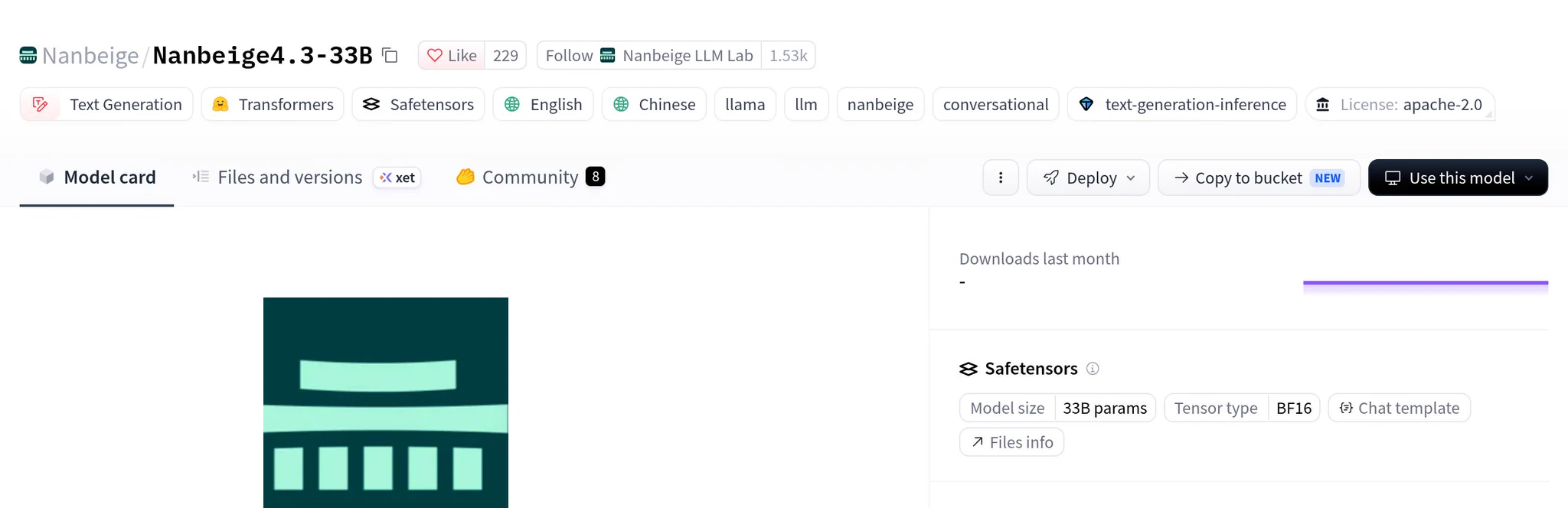
Nanbeige4.3-33B is a 33.1B dense, Llama-style open model under Apache-2.0, released with a base model on Hugging Face. In Nanbeige's own table it beats Qwen3.8-27B on Terminal-Bench 2.1 (80.9 vs 73.0), DeepSWE (65.5 vs 42.5) and Automation Bench, but trails on SWE-Bench Pro, GDPval and GPQA Diamond. BF16 weights are about 66 GB, split across 4 GPUs in the vLLM and SGLang examples. No independent evals exist yet.
x.comthreadAdded 26 Oct 2026, published 25 Oct 2026🧠 AI - Big Bull (@BIGBULLapp) on X
5ire is a desktop AI assistant and MCP client that connects to OpenAI, Anthropic, Google, Mistral, Grok, DeepSeek and Ollama from one window. It has a local knowledge base and tool calls over Model Context Protocol. The tools feature needs Python, Node and uv installed because it runs a local MCP server; without them it works only as a chat client.
x.comthreadAdded 25 Oct 2026, published 24 Oct 2026🧠 AI  EveryDev.ai (@EveryDevAi) on X
ToolUniverse, from ScientistTools, is an open-source (Apache-2.0) toolkit that gives any LLM one interface to more than 1,000 scientific tools, models and databases such as PubMed, UniProt and ChEMBL. It ships a native MCP server, a Python SDK and a tu CLI, plus 68 pre-built agent skills. The post says it works with Claude Code, Cursor, Gemini CLI and Windsurf.
x.comthreadPublished and added 24 Oct 2026🧠 AI- SpyTech Ai (@RizeOnline) on X
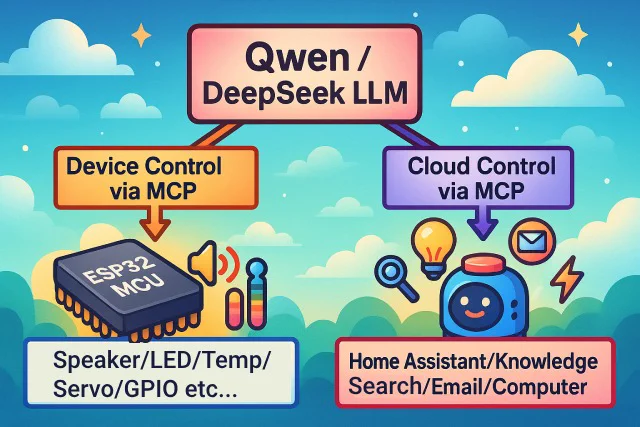
XiaoZhi ESP32 is an open-source, MIT-licensed firmware stack that turns ESP32 boards into MCP-based voice chatbots using models such as Qwen and DeepSeek. It streams Opus audio over WebSocket or MQTT + UDP through ASR, LLM and TTS, adds offline ESP-SR wake words, and uses device-side MCP to drive speakers, LEDs, servos and GPIO. It supports 138 board directories and builds with ESP-IDF 6.0.1 or newer.
x.comthreadAdded 23 Oct 2026, published 21 Oct 2026🧠 AI  Nick Frichette (@Frichette_n) on X
Datadog Security Labs announcement, posted by Nick Frichette, of research on steering the evaluations of a prompt-injection detector called "Jev". The team's method cut its detection rate from about 83% to about 4% in their tests. They also used it to bypass LangChain's experimental tool-risk gating feature that is based on Jev. The tweet gives no method details and links to the full article.
x.comthreadAdded 21 Oct 2026, published 19 Oct 2026🛡️ Security Nicholas Martin (@ndgmlondon) on X
An X post advises auditing every MCP write tool against the database role it actually runs under. A shared service key lets prompt injection trigger unapproved writes, so each agent session should get a read-only role, with a test that writes are denied. Replies note that MCP servers often inherit ambient host credentials or can escalate through a second connection pool, and suggest also testing that another tenant's rows are unreadable with the same role.
x.comthreadAdded 18 Oct 2026, published 16 Oct 2026🛡️ Security- P.K. Sharma (@_pksharma) on X
Thread distinguishing two Langflow advisories on MCP Stdio command execution. CVE-2026-105740 (GHSA-7w94-79vh-5mr2) affects 1.8.3 and is fixed in 1.9.0, an authenticated non-admin path. CVE-2026-105697 (GHSA-w794-rj3p-xv45) covers 1.1.2 up to but excluding 1.10.3, with fixes in lfx and langflow-base too. The later fix validates the API, flow and pre-spawn boundaries and removes the shell wrapper, and the thread warns that LANGFLOW_AUTO_LOGIN=true can expose a token without credentials. It cites one sensor's telemetry (1,628 attempts from 28 IPs) with caveats, and gives a defensive checklist: verify patched packages, review stored MCP configs and imported flows, and hunt for unexpected child processes.
x.comthreadAdded 17 Oct 2026, published 15 Oct 2026🛡️ Security - Victor (@VMG_CU) on X
A social post summarising Elastic's REF8801 campaign. A fake startup accelerator offered founders free Claude/Gemini credits plus a coding agent. The agent was a repackaged open-source project that set OPENROUTER_BASE_URL to an attacker-controlled endpoint and added its own MCP server, so victims' prompts and code went to the attacker. It shows how a trojanised AI coding agent can hijack the LLM base URL and add an MCP server for exfiltration.
x.comthreadAdded 15 Oct 2026, published 14 Oct 2026🛡️ Security - Confident AI (@confident_ai) on X
Confident AI announces Eval Skills, open-source (Apache 2.0) agent skills for Claude Code and Codex. The `eval-build` skill takes an app to a runnable baseline: it finds realistic examples in traces and incidents, annotates failures, groups them into failure modes, curates cases with independent data splits, and builds graders validated against human judgment. The `eval-descent` skill runs a bounded loop of hypothesis, app change, eval re-run, regression check, then keep or revert, with held-out cases kept out of the loop. It ships Python and TypeScript tooling for tracing, annotation, grading and reports, plus a local UI or Confident AI for managing the loop.
x.comthreadPublished and added 9 Oct 2026🧠 AI - Adam Shepherd (@EntryStateGod) on X
Social post announcing Qwen's open-weights release of Qwen-Image-2.1-Turbo, an accelerated checkpoint of Qwen-Image-2.1 on the same 7B visual generation architecture. It generates and edits images in 8 denoising steps, against 40 in the base model's sample code, with 2K output. Qwen claims the fewer steps do not reduce quality. The license is non-commercial, which limits production use.
x.comthreadPublished and added 9 Oct 2026🧠 AI - Dark Web Intelligence (@DailyDarkWeb) on X
A Twitter/X post digests joint advisory AA26-281A from FBI, CISA, NSA and allied agencies (UK, Australia, Canada, Japan, New Zealand, Spain) on China-based Integrity Technology Group enabling threat actors, tracked elsewhere as Flax Typhoon, Ethereal Panda and Red Juliett, to target US critical infrastructure, government, healthcare, education and law enforcement networks worldwide. The actors chain open-source scanners, large botnets, XSS, password spraying against Microsoft Exchange, VPN persistence and credential-harvesting scripts. CISA added five exploited CVEs (ISC BIND, Apache Struts, ProFTPD, ONLYOFFICE Docs, Strapi) to its KEV catalog with an Oct 11 federal remediation deadline, and STIX IOCs accompany the advisory.
x.comthreadPublished and added 8 Oct 2026🛡️ Security - Alhaji Premium Man (@softhardguy) on X
A tweet thread announcing Concord, an open-source coordination layer for running multiple AI coding agents (Claude Code, Codex, Cursor) concurrently on the same codebase. Agents claim files before editing so overlapping edits trigger warnings, and the tool lets agents message each other across the different coding-agent harnesses, addressing the conflict problem that appears once three or more agents work in parallel.
x.comthreadPublished and added 7 Oct 2026🧠 AI  Prasenjit Sarkar (@stretchcloud) on X
Describes Uber's internally-built ADR (Agentic Detection & Response) system, open-sourced in August with an MLSys paper, which monitors over 50,000 daily AI agent sessions via an MCP-based sensor inside Cursor, Claude Code and Codex. Uber found 206 credential exposures in ten months from normal agent use (not prompt injection), and ADR hits 100% detection with 3 false positives on the public AgentDojo benchmark; the thread also flags that human approval fatigue breaks down as a safety control past roughly 50 agent actions per session.
x.comthreadPublished and added 6 Oct 2026🛡️ Security SunsetSyntax (@sunsetsyntax) on X
A short account of switching from a split Neo4j (relationships) + separate vector DB (embeddings) setup — which required manually reconciling IDs whenever an agent wrote a fact — to NornicDB, a single Go-based graph+vector store that speaks Bolt/Cypher and bundles an MCP server in one process. The point is that agents can query a unified memory store without an app layer babysitting two separate databases.
x.comthreadPublished and added 4 Oct 2026🧠 AI- Brendan Jowett (@jowettbrendan) on X
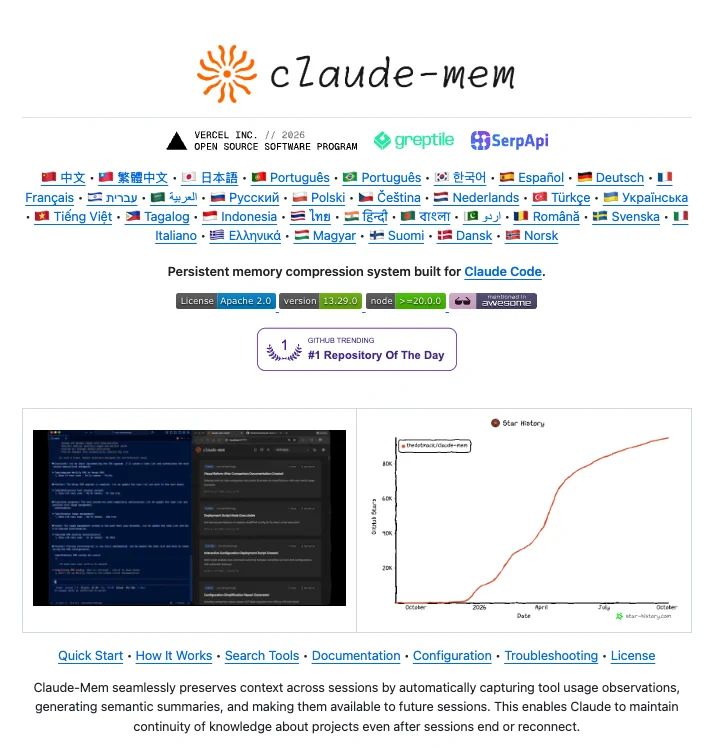
A curated Twitter/X thread listing ten GitHub repos that extend Claude Code and Codex workflows: spec-forcing planning/testing skills (obra/superpowers, mattpocock's skills with grill-me/diagnose/handoff), session memory compression (thedotmack's claude-mem-style tool), codebase-to-graph querying (safishamsi/graphify), a spec-driven long-task workflow (gsd-build), scope-reduction and anti-fluff skills, a cross-tool harness spanning Claude Code/Codex/OpenCode/Cursor (affaan-m/ECC), a multi-role agent team setup (garrytan/gstack), and a local model-routing gateway (musistudio's claude-code-router). Each entry is a practical, installable tool aimed at making coding agents more disciplined, memory-aware, and cost-efficient.
x.comthreadPublished and added 3 Oct 2026🧠 AI  Nation (@visitnation) on X
NATION Guard is a local, open-source tool announced by Nation that inspects the instructions and configuration behind AI agents. It combines injection-pattern scanning, integrity baselining, and per-server MCP fingerprinting so developers can detect suspicious prompt injections and unauthorized changes to their agent setup.
x.comthreadPublished and added 3 Oct 2026🛡️ Security- duyet (@_duyet) on X
AI;DR is an open-source automated pipeline that scrapes AI news from 20+ sources daily, then uses an LLM (routed through AnyRouter) to rank and summarize the stories into a single edition, publishing it to a website, email newsletter, and Telegram channel. It's hosted on Cloudflare and the creator notes it was largely built and is maintained by AI agents. The tool is a concrete example of using LLM-based ranking/summarization to turn a noisy multi-source feed into one curated digest.
x.comthreadPublished and added 1 Oct 2026🧠 AI - Dan Kornas (@DanKornas) on X
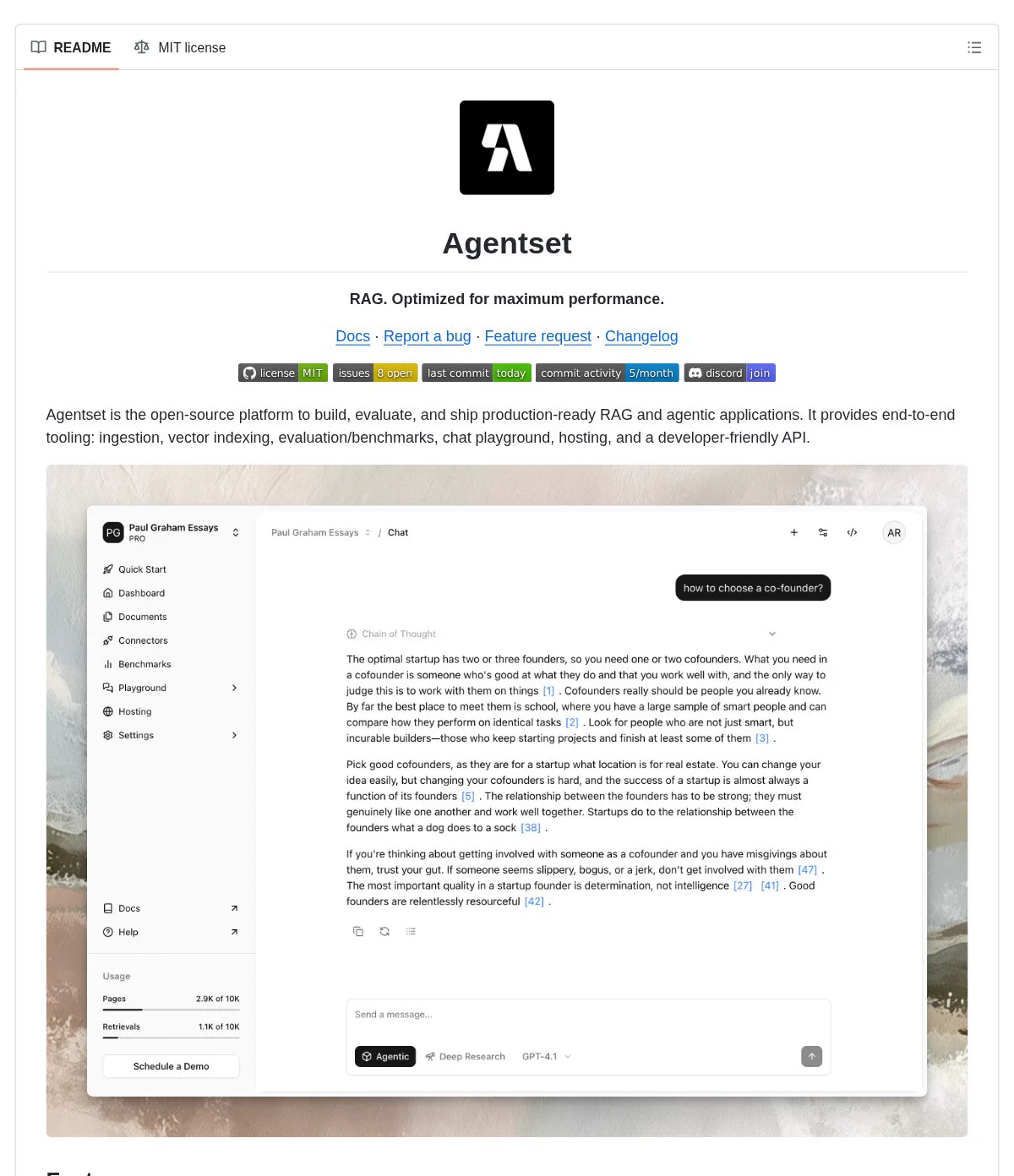
Agentset is an open-source (MIT-licensed) platform for building RAG and agentic applications, bundling ingestion, chunking, embeddings, retrieval, vector indexing, a citation-aware chat playground, evaluation/benchmark tooling, and a deployment layer (hosting, preview links, custom domains, typed SDKs, OpenAPI spec) into one codebase. It lets builders choose their own LLM, embedding model, and vector database rather than locking into a single stack.
x.comthreadPublished and added 1 Oct 2026🧠 AI - Average AI Bro (@AverageAiBro) on X
An X post presenting Reversecore MCP, an MCP server that wraps authorized reverse-engineering, malware-analysis, forensics and SAST-style tools such as radare2. The user picks a profile, points it at a sample, and the agent gets structured results back in the session without driving the tools by hand. It is a concrete example of profile-based tool exposure for specialized toolchains, offered as a free alternative to a commercial IDA setup. The post stresses authorized analysis only.
x.comthreadAdded 1 Oct 2026, published 30 Sep 2026🧠 AI - Kubesploit (@kubesploit) on X
An X post pointing to a case study on Cilium's defense-in-depth approach to open-source CI/CD supply chain security, covering access controls, dependency pinning, credential isolation, and cryptographic verification. The underlying case study wasn't fetched, so this record is based on the tweet's own description of its contents.
x.comthreadAdded 30 Sep 2026, published 27 Sep 2026🛡️ Security  Formal Verification of Execution and Consensus Clients
A reply on the Ethereum Research forum (ethresear.ch) responding to @pcaversaccio's call for formally verifying hard-fork changes in Ethereum execution and consensus clients before mainnet activation. It surveys current formal-verification efforts (Etheorem/SizzLean in Lean 4 for consensus/SSZ, Verifereum in HOL4 for the EVM), argues for prioritizing high-leverage surfaces like SSZ, state transition, fork-choice and core EVM semantics, and pushes for stronger verification tooling in Rust (Aeneas/Verus/hax) as an incremental path to reducing the trusted computing base of client software.
 ethresear.chthreadAdded 29 Sep 2026, published 25 Sep 2026🛡️ Security
- Pyro (@0x3b33) on X
A roundup of three open-source AI-assisted smart contract security scanners: pashov/skills (solidity-auditor + x-ray pre-audit + fuzz suite generation, fast/cheap feedback), PlamenTSV's autonomous 8-phase agent covering EVM, Solana, and Move that ships PoCs with findings, and Trail of Bits' skills repo with 40+ security skills for contract audits, differential review, and static analysis. Useful pointer to emerging AI-agent-based smart contract auditing tooling.
x.comthreadPublished and added 7 Sep 2026🛡️ Security - Retrochainer Post
A tiered hardware guide ("the ladder") for running local LLMs in 2026, ranking ten setups from a free existing laptop through Raspberry Pi 5, Jetson Orin Nano Super, Mac mini/Mac Studio, used RTX 3090, RX 7900 XTX, AMD Strix Halo (Ryzen AI Max+ 395), RTX 5090, up to the NVIDIA DGX Spark. It frames unified memory (not raw TOPS) as the real constraint on model size, gives concrete specs/prices/token throughput per rung, and walks through setting up Ollama + Open WebUI plus an OpenAI-API-compatible local endpoint, with cost comparisons against ChatGPT Plus/Claude Pro/Cursor subscriptions and n8n-based automation examples.
x.comthreadAdded 22 Sep 2026, published 1 Aug 2026🧠 AI - Raytar (@Raytar) on X
A Twitter/X thread explaining Claude Code's /goal and /loop commands, which let Claude repeatedly prompt and check itself against a defined finish condition rather than requiring a human to babysit each turn. It contrasts single-prompt workflows (which can produce confidently wrong output, e.g. fabricated sources) with loop-based workflows that self-verify, and gives a copy-pasteable "charter" template covering goal, work discovery, self-checking, state persistence (LOOP-STATE.md), and stop conditions.
x.comthreadAdded 22 Sep 2026, published 31 Jul 2026🧠 AI  _SiCk (@encrypted_past) on X
A tweet from security researcher _SiCk listing a beginner-to-advanced roadmap for learning binary exploitation: corelanc0d3r's classic Corelan exploit-writing tutorial series, a UVA x86 assembly primer, a mirror of OS ISOs for building VM lab environments, a French-language binary exploitation techniques book (zenk-security repo), and a linked YouTube video. It's a personal recommendation list rather than original research, but each link is a genuinely usable free resource for stack-based exploitation and reverse engineering fundamentals.
x.comthreadPublished and added 5 Jun 2026🛡️ Security- uk_daniel_card
A short first-person thread describing stealing credentials from a running system as an unprivileged userland process: sniffing the clipboard to grab passwords copied out of KeePass, scraping process memory and SQLite databases for stored passwords/usernames/tokens/cookies, hunting for files like password.txt, and reading Chrome/browser credentials straight out of RAM as they sit in cleartext in text boxes. The author's point is that once someone else's code is running on your machine, it's practically impossible to fully harden every surface — clipboard, memory, and disk are all exposed.
x.comthreadAdded 3 Sep 2026, published 13 May 2026🛡️ Security