 DPRK Hackers Perfected Their Fake Interview Playbook Over Dozens of Attacks Before Binance
Chainalysis analysis of the Binance theft (reported as $6.4 billion) that Binance says began with a DPRK fake job interview and a malicious coding assignment. It attributes over $14.3 million in losses over 18 months to similar Contagious Interview schemes and describes EtherHiding C2 split across TRON, Aptos and BSC. It also covers DPRK IT worker salary laundering through stablecoins.
 chainalysis.comarticlePublished and added 3 Nov 2026🛡️ Security
 The cryptography behind electronic voting (and why paper ballots are still essential)
Explains how Helios and ElectionGuard use threshold-shared exponential ElGamal, zero-knowledge proofs, Benaloh challenges and hash-chained ballot commitments to protect voter privacy and give end-to-end verifiability. It covers compromised voting clients and backends, software independence, and the 2018 National Academies report against internet voting. It concludes that cryptography supplements, but cannot replace, paper ballots in general elections.
 blog.trailofbits.comarticlePublished and added 3 Nov 2026🛡️ Security
 Google Dismantles XCPE Botnet of 1.3 Million Android Devices
XCPE (X.CPE) is a backdoor and botnet of more than 1.3 million Android set-top boxes, built and run by the Chinese OEM/ODM Videostrong Technology. Google dismantled it through legal action against domains and servers and banned Videostrong from preloaded Google apps. The malware used a three-stage design persisting on the /oem/ partition and was used for ad fraud, residential proxies and further malware loading.
 securityweek.comarticlePublished and added 3 Nov 2026🛡️ Security
 Binance Reopens Withdrawals as FBI Pins $6B Hack on North Korea
Bankless news report on Binance reopening withdrawals in phases on 1 November 2026 after a record $6B+ hack. The FBI named North Korea's TraderTraitor group on 31 October, listed 628 addresses tied to the theft and asked THORChain node operators, instant exchanges and DeFi services to block them. Chainalysis says $500M moved out of TRON wallets and funds are shifting to Solana. Binance published a new proof of reserves covering 10 tokens.
 bankless.comarticlePublished and added 2 Nov 2026🛡️ Security
 Google disrupts million-device XCPE Android malware botnet, bans TV box maker
XCPE is an Android TV box botnet of more than 1.3 million devices, which Google's Threat Intelligence Group attributes with high confidence to manufacturer Videostrong Technology, who preinstalled a system-level backdoor in firmware. The backdoor (x.cpe, com.oemservice) used an MQTT broker for commands and loaded ad fraud and residential proxy modules. Google took down C2 servers tied to 10 million more devices and banned Videostrong from certified Android devices.
 bleepingcomputer.comarticlePublished and added 2 Nov 2026🛡️ Security
 Shutting the Door on the XCPE Botnet
XCPE is an Android firmware backdoor (x.cpe, com.oemservice) preloaded by OEM Videostrong Technology on more than 1.3 million set-top boxes. Google Threat Intelligence Group details the three-stage architecture, the MQTT C2 (mqtt.szbboys[.]com), Play Protect disabling, persistence, and affiliate modules for residential proxies and ad fraud. It also lists the legal takedowns, the Videostrong ban and the partners involved.
 cloud.google.comwriteupPublished and added 2 Nov 2026🛡️ Security
- Elliptic traces $2.2M of Binance hack funds through Bitcoin mixing
Elliptic's 2 November 2026 analysis reports the first laundering of proceeds from the 29 October 2026 Binance hack. By 1:02 a.m. ET it counted 18 WabiSabi coinjoin transactions, funded by bitcoin routed out of Tron and bitcoin bought with swapped ETH. The 18,270 BTC stolen directly had not moved. Elliptic names stablecoins and centralized cashout platforms as the remaining chokepoints. The page gives no addresses, transaction IDs or tracing method.
 en.cryptonomist.charticlePublished and added 2 Nov 2026🛡️ Security
 FBI Blames North Korea for $6B Binance Hack as Exchange Reopens Withdrawals
The FBI attributed the theft of more than $6 billion from Binance on or about 29 October 2026 to North Korea's TraderTraitor and published hundreds of Ethereum addresses, 19 Bitcoin addresses and one Solana address to block. Chainalysis tracked over $500 million moving through Tron and out via THORChain, Chainflip, Relay and NEAR. Binance resumed withdrawals in phases from 1 November and says it replenished about 95% of affected assets.
 decrypt.coarticlePublished and added 2 Nov 2026🛡️ Security
- CuteGuy☣️ (@cutetoxicguy) on X
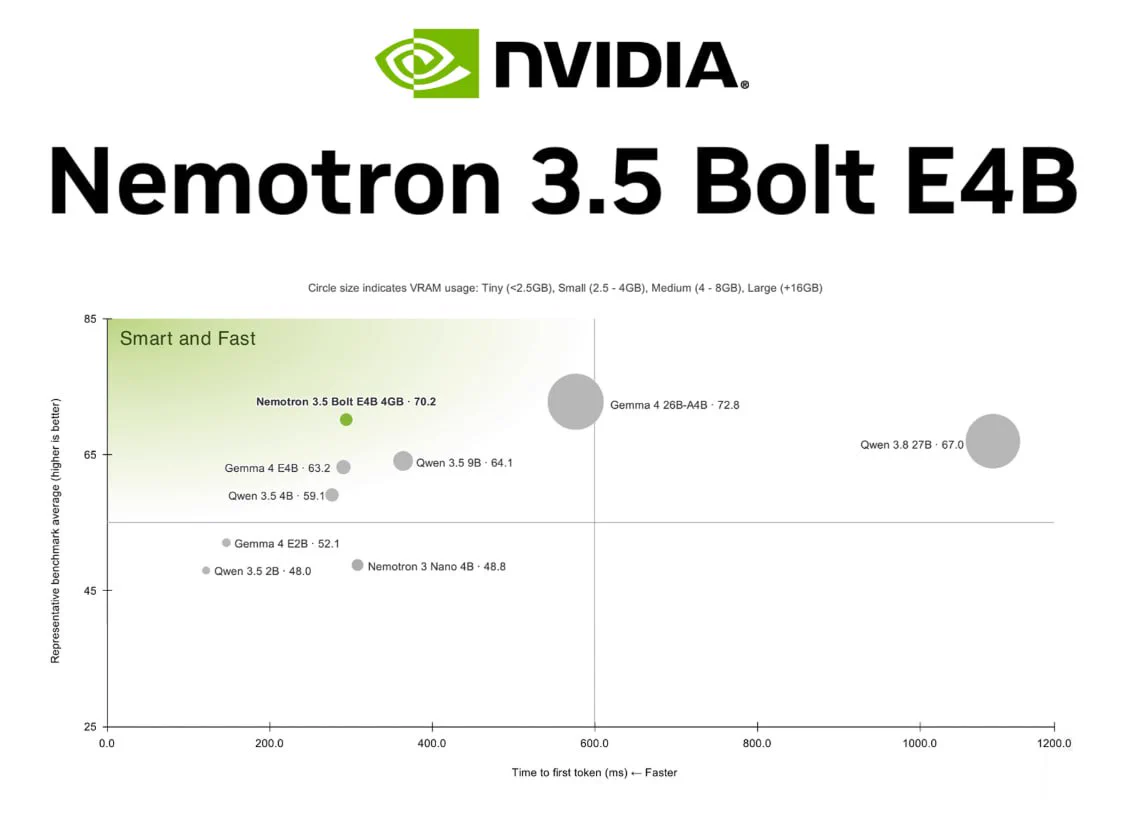
Nemotron 3.5 Bolt E4B is an NVIDIA open-weights model with 8B total and 4B active parameters, built on Gemma 4 E4B and post-trained with NeMo RL and NeMo Gym. It targets local agents in about 4GB of GPU memory, with 64K context, 35 languages, multi-step tool calling and configurable reasoning. NVIDIA's llama.cpp tests show 133.4 tokens/sec on an RTX 5070 and 15.5 on a Jetson Orin Nano. Benchmarks are NVIDIA's own.
 x.comthreadAdded 3 Nov 2026, published 2 Nov 2026🧠 AI
- North Korean hackers launder $242 million of Binance loot via Tron as FBI presses THORChain: analyst
The Block reports that North Korean hackers (TraderTraitor) laundered about $242 million of funds stolen from Binance through Tron in two days, according to analyst SomaXBT. Relay, THORChain, Chainflip and Symbiosis moved about $140 million off Tron. Elliptic counts $2.85 billion frozen or seized, 44% of $6.43 billion stolen, and $3.25 billion in assets no issuer can freeze. The FBI urged THORChain and others to block listed addresses.
 theblock.coarticlePublished and added 1 Nov 2026🛡️ Security
- Chainalysis says hacker using ‘offensive agentic techniques’ accessed its customers’ names and emails
Chainalysis disclosed on 30 October 2026 that an attacker using "offensive agentic techniques" accessed customer names, emails, user IDs and role labels, but no investigation content, passwords or session tokens. The report also covers the Binance hack (about $6.3-6.4 billion, attributed to North Korea), where funds loop through addresses and JustLend lending on Tron is used to dodge stablecoin freezes. About $2.8 billion is frozen.
theblock.coarticlePublished and added 31 Oct 2026🛡️ Security  Syrian Hacker Gets Prison Time in US After Over a Decade on the Run
Ahmad Umar Agha (Th3Pr0), a Syrian Electronic Army member, received a 42-month US sentence in the Eastern District of Virginia, over 12 years after he was first charged in June 2014. He compromised about 47 Western media, company, NGO and government targets, including the 2013 Associated Press Twitter takeover that caused a flash crash. Accomplice Firas Dardar remains at large.
securityweek.comarticlePublished and added 31 Oct 2026🛡️ Security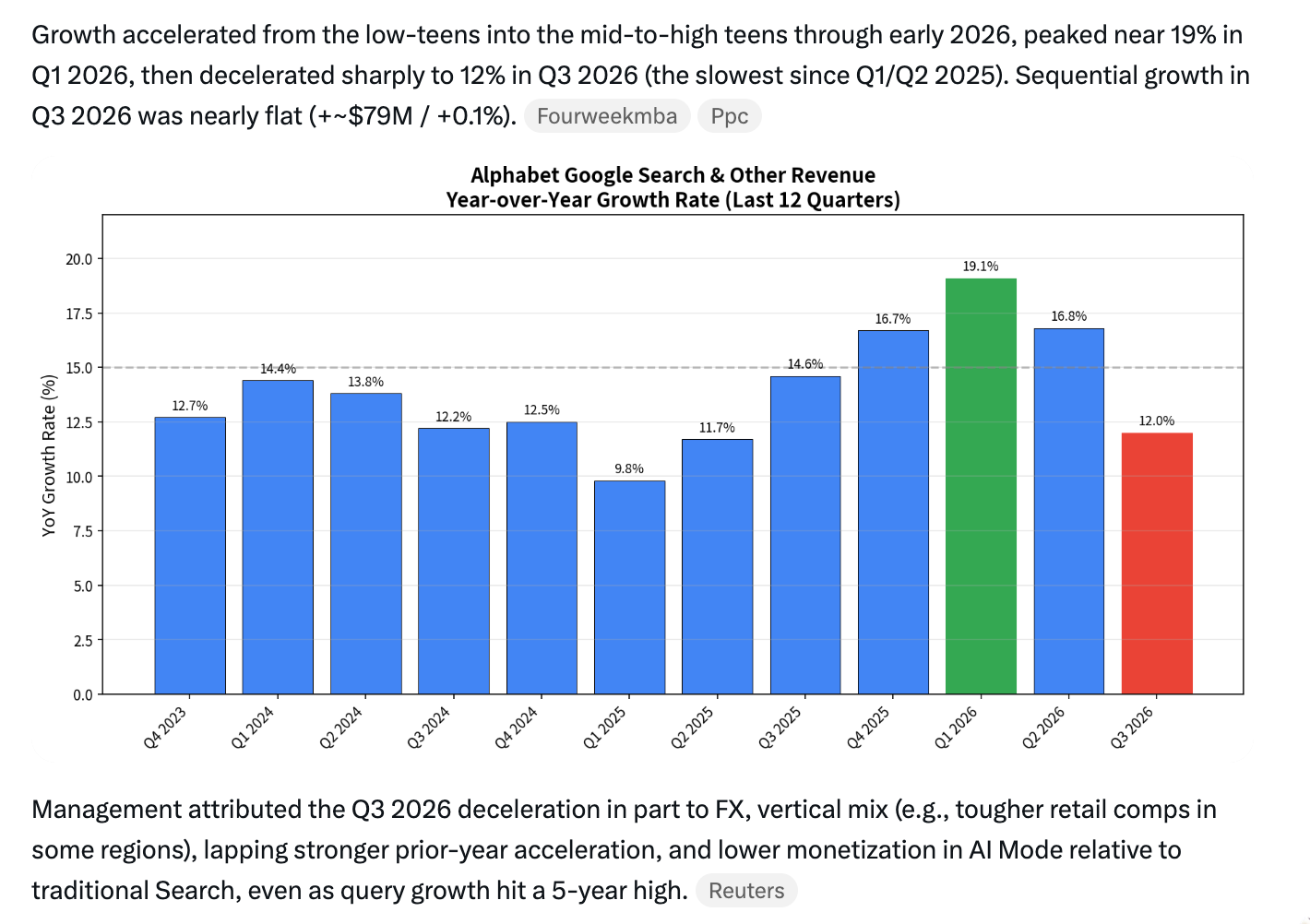 [AINews] Google admits AI Mode hurts Search revenue; -15% $500B drop worst since 2004 IPO. AI Bear Market coming?
AINews issue for 29 to 30 October 2026 from Latent Space. It opens on Google's admission that AI Mode monetises worse than classic Search, which preceded a roughly 15% share drop. It then recaps Claude Ultra dropping the 5-hour limit, Gemini 4 Carbon, Mistral Large 4, Nemotron 3.5, Artificial Analysis Index v5, Unsloth GGUF disputes, and the Anthropic S-1 filing.
 latent.spacearticlePublished and added 31 Oct 2026🧠 AI
 From Small to Large: Assessing Medical Reasoning, Benchmark Contamination, and Model Size in Language Models
This paper evaluates fourteen LLMs from six providers on 3,076 questions from MedQA-USMLE, MedMCQA, PubMedQA and MedBullets. It tests standard multiple choice, questions with answer choices withheld, and reconstruction of hidden questions from choices alone. Mean accuracy falls from 82.3% to 50.9% without choices, smaller models trail larger ones by 8.7 points, and the strongest models reconstruct about one question in four.
 arxiv.orgpaperAdded 3 Nov 2026, published 30 Oct 2026🧠 AI
 nemotron-halloween
MonsterHouse is a Halloween interactive projection built on the NVIDIA Nemotron Voice Agent: Nemotron Speech ASR, Nemotron 3.5 Bolt E4B 4GB with a LoRA persona adapter, Magpie TTS Zeroshot and Audio2Face-3D in Unreal Engine, on two RTX Blackwell GPUs. Median end-of-speech-to-audio is 1.70 seconds live and 0.72 seconds with cached responses. The post gives a build path and tips on caching and state handling.
 huggingface.cowriteupPublished and added 30 Oct 2026🧠 AI
- SecPO: Principled Adversarial Training for Prompt Injection Security
SecPO is a prompt injection defense that combines a new preference-optimization loss with adversarial training. It replaces the insecure DPO reference model with an approximated injection-invariant oracle, and trains on strong injections synthesized at best@240. Against Meta-SecAlign, AT cuts attack success rates 1.5-14.5x, and on Qwen3.6-27B AgentDojo ASR@800 falls to 8.8% from 78.8%, with no noticeable utility loss across nine benchmarks. Code, training data and model are released.
arxiv.orgpaperAdded 3 Nov 2026, published 30 Oct 2026🛡️ Security  Binance Sets Aside $6.34B to Cover Hack Losses, CEO Says 'Your Assets Are Safe'
Decrypt reports on the October 2026 Binance hot-wallet hack, about $6.3 billion, which Binance CEO Richard Teng says the company will cover with over $6.34 billion of its own funds. Teng says the attacker used an EIP-7702 delegation that skipped Binance's approval controls, a self-destruct mechanism to wipe tooling, and more than one breach point beyond a compromised laptop. TRM Labs and Chainalysis attribute the theft to TraderTraitor, and the attacker is still moving funds on Tron.
decrypt.coarticlePublished and added 30 Oct 2026🛡️ Security- Show HN: I Turned DOOM into a Transformer
Doomformer compiles integer neural networks into ZDoom maps that run in ViZDoom. Voodoo dolls do the arithmetic, and sector light levels and plane heights hold the values. Python reads every value back and compares it with a NumPy integer reference at tolerance 0. It runs MNIST (97.16 % on all 10,000 digits, every pass exact), small transformers, a learning perceptron and a SUBLEQ machine. It is about 23,000 times slower than NumPy on a small MLP.
 github.comrepoAdded 30 Oct 2026, published 29 Oct 2026🧠 AI
 Binance Drained of $5.5 Billion in Suspected Hack, Tether and Circle Freeze $1.8 Billion
Decrypt reports that at least $5.57 billion left Binance-linked hot wallets on Ethereum, Bitcoin and Tron on 29 October 2026, which would be the largest crypto hack on record. On-chain analysts point to an EIP-7702 delegation, installed from a Tornado Cash-funded address minutes before the first sweep. Tether and Circle froze about $1.8 billion. Binance has not confirmed the hack, and how the attacker obtained the signature is unknown.
decrypt.coarticlePublished and added 29 Oct 2026🛡️ Security Rekt - Duelbits - Rekt
Duelbits is a crypto casino that lost an estimated $6.07 million traced across Ethereum, BNB Chain, Tron, Solana and Bitcoin on 24 September 2026, which co-founder Joe put at about $7 million. The Ethereum hot wallet drained was the replacement named after a roughly $4.6 million theft in February 2024. Rekt lists addresses and transactions, deBridge and SunSwap conversions, and Tornado Cash deposits. Duelbits has not published a root cause.
 rekt.newswriteupAdded 29 Oct 2026🛡️ Security
- A Quantitative Evaluation of Constant-Time Analysis Tools
AutoBench-CT is a modular benchmark for constant-time analysis tools, with manually verified per-violation ground truth across 64 cryptographic tasks. It scores seven tools on operational performance, detection quality and usability. The authors explain why CT-grind (2010) is still the most used tool, list recurring limitations across tools, and propose a composite pipeline for stronger constant-time guarantees. Accepted at ACSAC 2026.
 eprint.iacr.orgpaperAdded 31 Oct 2026, published 29 Oct 2026🛡️ Security
 Muhammad Waris (@WarisCodes) on X
Nemotron 3.5 Transcribe is a free open-weight speech-to-text model from NVIDIA covering 40 languages, including mixed-language speech. The post says it ties for first among open models with a 2.8% error rate. It says the model needs a large GPU such as an H100 or RTX 5090, so it will not run on a laptop. The post gives no benchmark name or model card link.
x.comthreadAdded 30 Oct 2026, published 29 Oct 2026🧠 AI Treasury Sanctions 11 Over North Korean IT Worker Scheme That Moved Millions in Crypto
Decrypt reports that OFAC sanctioned 10 individuals and one entity on 28 October 2026 over North Korean IT worker schemes. Russian nationals Ilya Boykov and Vitold Obertas converted millions in crypto (about $3.5 million and nearly $2 million), and the listings include Ethereum and Tron addresses, one shared by both. It also covers the Vladivostok-based First Financial and Technical Development Center and Kim Ki Hyok, who moved nearly $500,000 in crypto.
decrypt.coarticlePublished and added 29 Oct 2026🛡️ Security- 🚨 AI News | TestingCatalog (@testingcatalog) on X
Nemotron 3.5 Transcribe is an open-weight, promptable NVIDIA mixture-of-experts model with 30B total and about 4B active parameters. One checkpoint does transcription in 40 languages, speaker attribution, translation, contextual prompting and audio understanding. The post says it ranked first in VoiceArena's comparison of 14 diarization plus ASR systems. The fetched text is cut off and gives no license or download details.
x.comthreadAdded 30 Oct 2026, published 29 Oct 2026🧠 AI - High Precision Noise Cleaning for CKKS with Application to Asynchronous Threshold CKKS
High Precision Noise Cleaning for CKKS is an IACR ePrint preprint (2026/2675) by Zhihao Li, Cheng Hong and Tao Wei. It composes lower-degree Hermite polynomials to reach output noise bounds such as 2^-300 for noise flooding, and uses this to build an asynchronous threshold CKKS scheme with strong simulation security in the random oracle model. In OpenFHE, binary-message cleaning falls from 9.63 s to 1.54 s.
eprint.iacr.orgpaperAdded 31 Oct 2026, published 29 Oct 2026🛡️ Security - Trail of Bits (@trailofbits) on X
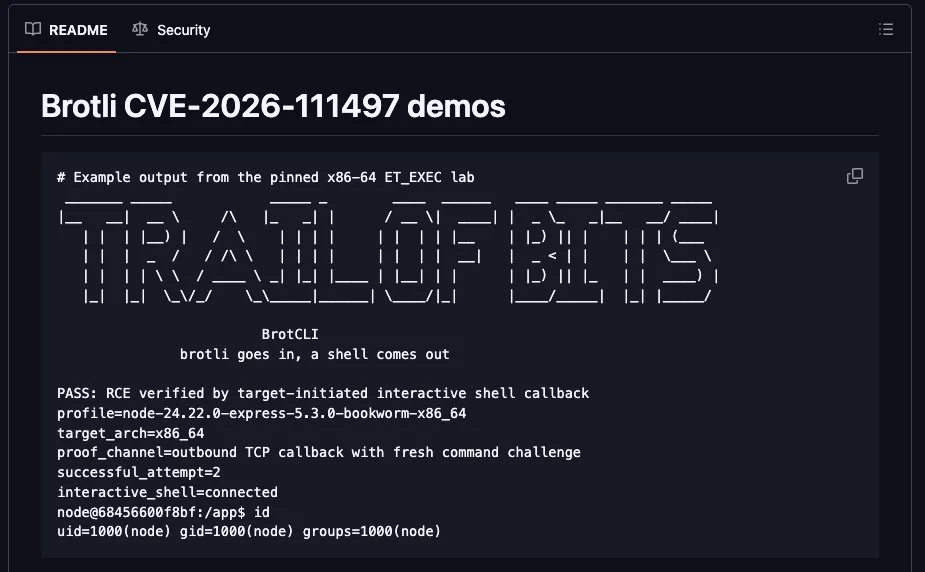
Trail of Bits post says it achieved remote code execution through a Brotli decoder bug in Linux lab setups: Node.js 24.22.0 with Express 5.3.0 via the standard JSON parser (x86-64 and ARM64), and Electron 41.10.7 (x86-64) with a custom decoding service. Exploitation needs a carefully matched setup and repeated attempts. A scanner by ToBScottA finds hidden copies of the decoder, including in stripped binaries.
x.comthreadAdded 30 Oct 2026, published 28 Oct 2026🛡️ Security - Laban (@lunkertw) on X
An X post summarising five AI items: Google DeepMind's Gemini 4 Carbon (88.2% SEC-bench Pro, 54.8% ExploitGym, 71.0% CWE-bench, 59 on Artificial Analysis Intelligence Index v5.0), Ed Zitron's critique of Anthropic's S-1, a Utah Claude Code pilot, and the repos beenuar/AiSOC and expo/skills. In the Utah pilot, 34 developers in 10 agencies took part over four weeks, 80% had a working setup within 30 minutes, and 71% saved over 20 hours. It gives short summaries and links, not primary analysis.
x.comthreadAdded 29 Oct 2026, published 28 Oct 2026🧠 AI - AskStream: When and What to Ask Proactively under Uncertainty in Streaming Video Understanding
AskStream is a multi-turn benchmark for streaming video understanding that adds a third proactive action, ask, alongside wait and answer, for cases where video or user information is incomplete. It has 438 videos, 2,714 manually annotated frame-level time windows (wait, ask, answer), four task categories and eight subtasks. The strongest model reaches only 52.18% on the proposed Ask-F1 metric, in both multiple-choice and open-ended settings.
arxiv.orgpaperAdded 30 Oct 2026, published 28 Oct 2026🧠 AI  John Rood (@johnroodepic) on X
Nemotron 3.5 Transcribe is an open-weight, promptable 30B mixture-of-experts model from NVIDIA with about 4B active parameters, built for recorded audio. One checkpoint transcribes 40 languages, handles recordings up to an hour, labels up to eight speakers, translates, and answers questions about English audio. Weights and a demo are on Hugging Face. The post gives no benchmarks.
x.comthreadAdded 29 Oct 2026, published 28 Oct 2026🧠 AI NVIDIA Nemotron 3.5 Transcribe and Granary v2: Intelligent Multilingual Transcription You Can Prompt and Adapt
Nemotron 3.5 Transcribe is an open-weight, promptable speech model that handles transcription in 40 languages, translation, diarization for up to eight speakers, and audio Q&A. It has about 4B active of 30B parameters and tops open-weight ASR and diarization leaderboards. The post also covers the Granary v2 curation pipeline (463,062 hours, 48 languages) and a medical fine-tuning case study that cut held-out WER by 45.8%.
huggingface.coarticlePublished and added 28 Oct 2026🧠 AI- Repairs for Whom? Evaluator-Executor Mismatch in Selecting Repairs for Failed LLM Agents
Repairs for Whom? studies single-step repairs of failed LLM agent trajectories and asks whether common evaluators (greedy replay, stronger models, oracles, log-reading judges) pick repairs that help the deployed agent. Using independent rollouts in ALFWorld and WebShop, greedy replay loses 0.06-0.13 in expected gain, and Qwen2.5-14B rollouts misselect repairs for Qwen2.5-7B. The authors recommend verifying repairs with the executor that will run them.
arxiv.orgpaperAdded 30 Oct 2026, published 28 Oct 2026🧠 AI - Hakimi Eiqbal (@hakimieiqbal) on X
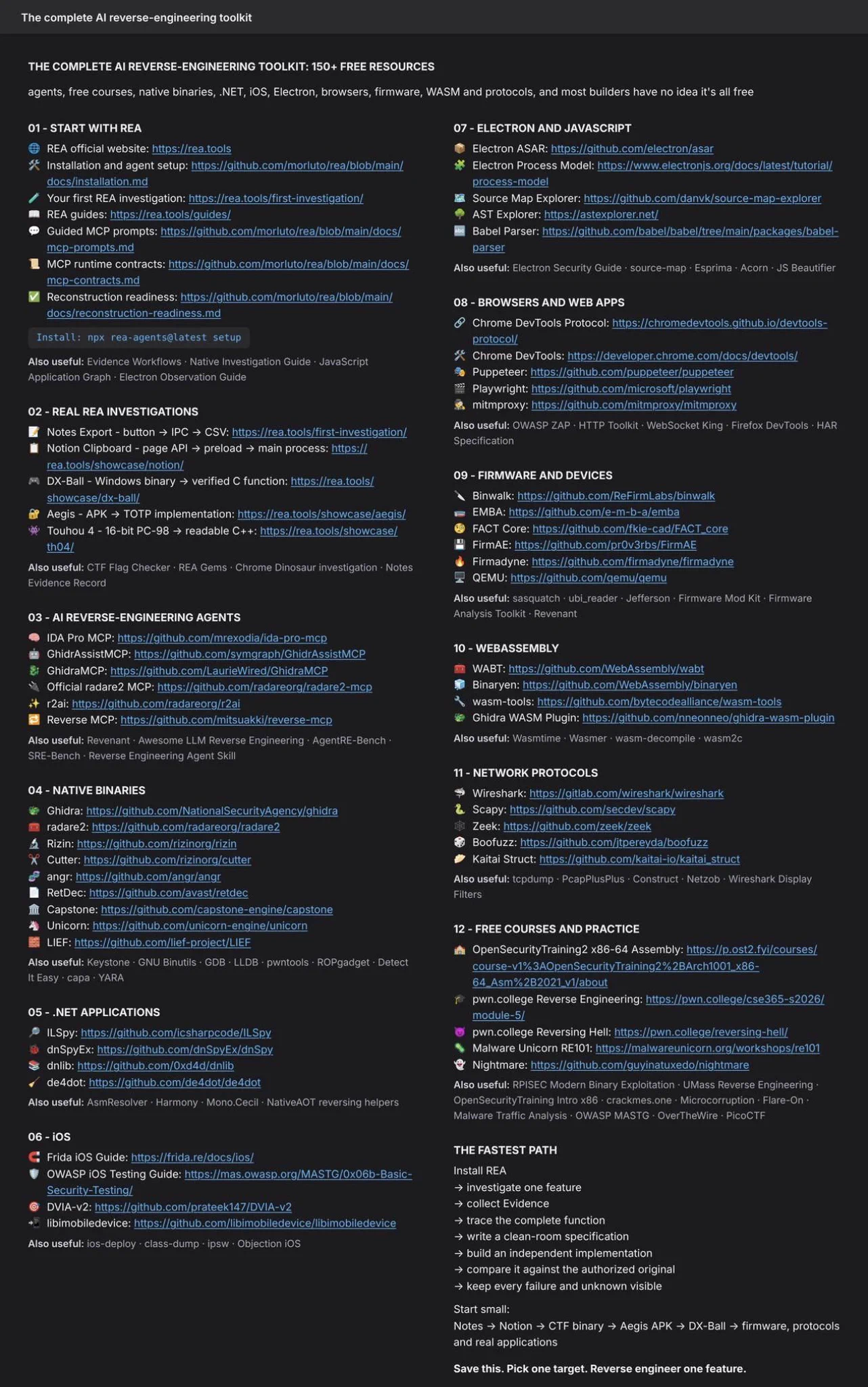
A practical reverse-engineering map by hakimieiqbal on X that picks tools by target: native binaries, .NET, Electron, iOS, firmware, WebAssembly and network protocols. It introduces REA (morluto/rea), which connects coding agents to RE tools, and lists MCP bridges for IDA Pro, Ghidra and radare2. It adds an evidence-first workflow and free courses such as pwn.college and OpenSecurityTraining2.
x.comthreadAdded 29 Oct 2026, published 28 Oct 2026🛡️ Security - Hakimi Eiqbal (@hakimieiqbal) on X
A thread by Hakimi Eiqbal that maps reverse-engineering tools by target type: native binaries, Electron, .NET, iOS, firmware, WebAssembly and network protocols. Its AI sections cover REA (an open-source layer connecting coding agents to analysis tools) and MCP bridges for IDA Pro, Ghidra and radare2. It argues for an evidence-first workflow and gives a prompt that separates verified facts from hypotheses.
x.comthreadAdded 29 Oct 2026, published 28 Oct 2026🧠 AI - Know, then Draw: A New Learning Paradigm for Visual Generation
Know, then Draw is a learning paradigm for visual generation that uses autoregressive pretraining to acquire semantic knowledge and diffusion post-training for high-fidelity rendering. Controlled comparisons find autoregression the stronger pretraining objective, and semantic quality matters more than AR-only generation quality. This motivates a purely semantic tokenizer trained with language supervision only. A 3B text-to-image model trained in 6,600 H100 GPU-hours scores 86 on GenEval and 87 on DPG-Bench.
arxiv.orgpaperAdded 28 Oct 2026, published 27 Oct 2026🧠 AI - Mauro Ubeda (@mauroubeda) on X
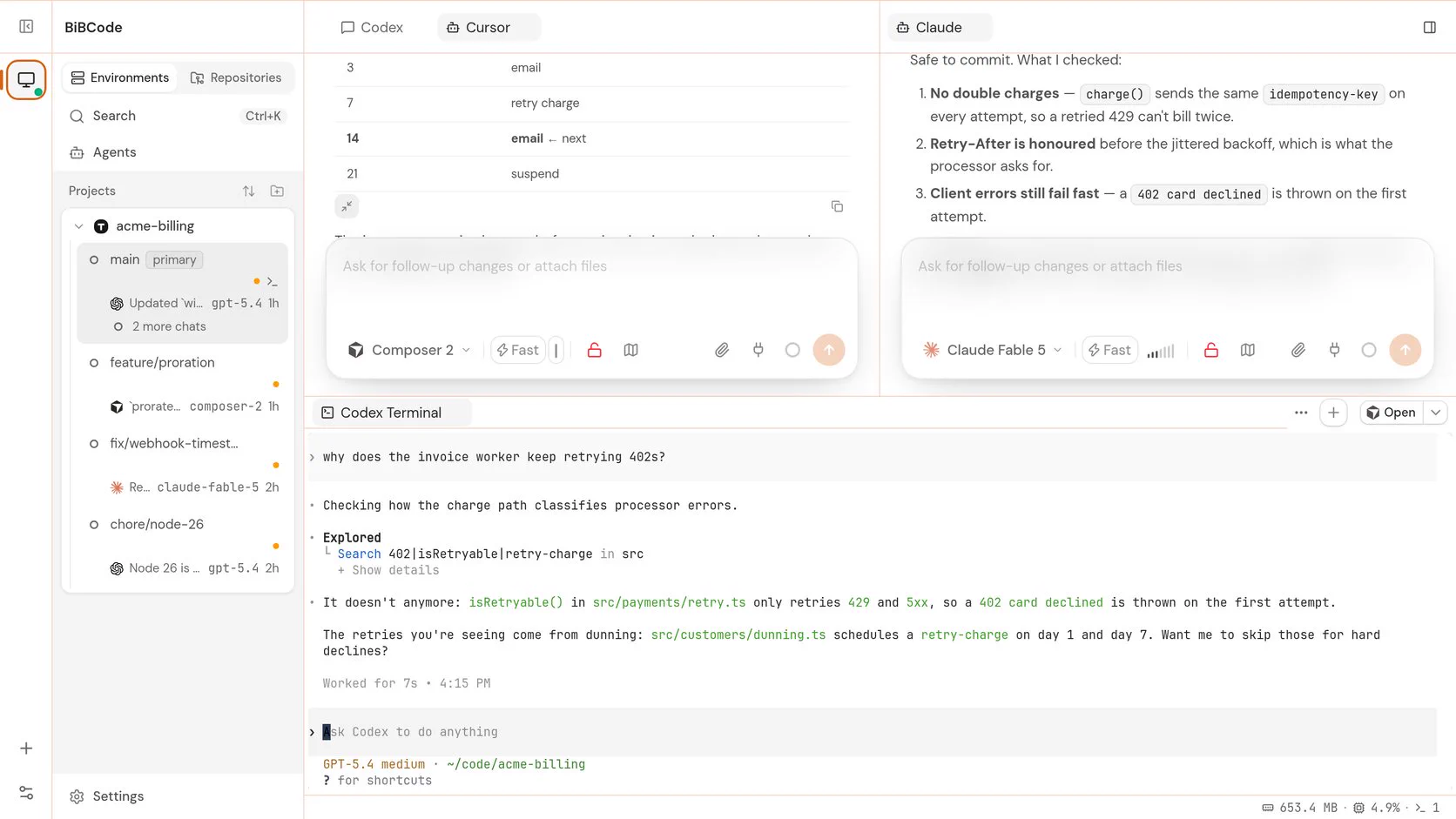
BibCode is an open-source desktop app, now in beta, for running coding agents side by side. It is built with Rust and Tauri rather than Electron, and runs Codex, Claude, Cursor and OpenCode, each in its own git worktree. It can also connect to remote BibCode Servers. The author, Mauro Ubeda, says it mixes ideas from T3 Code and Orca. The post gives no feature detail beyond this.
x.comtoolAdded 28 Oct 2026, published 27 Oct 2026🧠 AI  This is Fine: What NetScaler Zero-Days Tell Us About the New Normal
This SecurityWeek commentary covers the September 2026 Citrix NetScaler ADC and Gateway zero-days, exploited from mid-month and patched on 27 September as unauthenticated RCE flaws CVE-2026-88771 through CVE-2026-88778. The author argues the fast response shows stronger defence. Cited evidence: Citrix disclosure time fell from about 40 days to 17 in 2026 after it set up a NetScaler CNA, and CISA made a rare Sunday KEV addition.
securityweek.comarticlePublished and added 27 Oct 2026🛡️ Security- AxisQ: Depth-Adaptive Channel--Frequency Quantization for Camouflaged Object Detection
AxisQ is a post-training quantization framework for camouflaged object detection (COD) that allocates activation bits by feature depth. It uses the channel domain for shallow features and the local-frequency domain for deep features, under a fixed per-layer average bit budget. It adds a boundary-aware Hessian approximation for reconstruction. On CAMO at W2A2, weighted F-measure improves 12.7% for CFRN and 33.3% for CamoFormer-P over the strongest baselines.
arxiv.orgpaperAdded 28 Oct 2026, published 27 Oct 2026🧠 AI  Artificial Intelligence (AI) in Cybersecurity, Part 30: Shannon – AI Pentester for Web Apps and APIs
Shannon is a white-box AI pentester (@keygraph/shannon) that analyzes an application's source code, then attacks the running instance and reports only findings with a working PoC. The Hackers Arise tutorial runs it against OWASP Juice Shop in Docker on Kali, using OpenRouter (free Nemotron) and local Ollama (Qwen 2.5 Coder 7B) via a models.json file. Output includes PDF, Markdown, JSON and SARIF reports.
 hackers-arise.comarticlePublished and added 26 Oct 2026🛡️ Security
 Clean-label poisoning attack can fool vehicle-network AI without changing labels
Clean-label poisoning attack on federated learning for Basic Safety Message anomaly detection in vehicular networks, from Sagduyu, Erpek, Stephenson and Xue (paper submitted 23 October 2026). The attack perturbs benign samples toward malicious feature extremes without changing labels, which lowers class separability, and it grows stronger with more compromised nodes. A feature-consistency relabeling defense keeps attack success low without hurting clean accuracy, and a game-theoretic model shifts equilibria against attacking.
en.cryptonomist.charticlePublished and added 26 Oct 2026🛡️ Security- Reversible Pseudonymisation of Documents Sent to External LLMs: an Open Bilingual Benchmark and an Engine
Open bilingual (Russian and UK English) benchmark of five open pseudonymisation tools and a regex baseline, plus a new engine built on the two strongest tools. On a held-out set of 1,000 synthetic documents per language, the best existing tools leave a whole personal value visible in 61% (Russian) and 58% (UK) of documents. The engine does so in 0.3% and 0.2%. Russian name restoration reaches only 94.6%, below the 99% threshold. Real documents were not tested.
arxiv.orgpaperAdded 27 Oct 2026, published 25 Oct 2026🛡️ Security - Reversible Pseudonymisation of Documents Sent to External LLMs: an Open Bilingual Benchmark and an Engine
This paper presents an open benchmark of five existing pseudonymisation tools and a regex baseline on Russian and UK English documents, plus an open engine built on the two strongest tools. On a held-out set of 1,000 synthetic documents per language, the best existing tools leave a whole value visible in 58 to 61% of documents. The engine does so in 0.2 to 0.3%. Russian name restoration reaches only 94.6%, below the 99% threshold. Real documents were not tested.
arxiv.orgpaperAdded 27 Oct 2026, published 25 Oct 2026🧠 AI  ReignSwords (@ReignSwords) on X
A reviewer tests GenOffice, an open-source Office suite (10.7k GitHub stars), through its CLI only. Markdown to .docx took 3.8s, JSON to .xlsx took 0.9s with a live SUM formula, and .docx to PDF failed twice until Xvfb supplied a display. It has byte-preserving edits, a skill file for Claude Code and Codex, and 29 MCP tools. Downsides: a 188MB download that filled a 512MB /tmp, Electron in the PDF path, and unproven trust in tracked changes and rollback.
x.comthreadAdded 25 Oct 2026, published 24 Oct 2026🧠 AI The Exact Bit Security of Hash-Based Signatures
 is a 2026 IACR ePrint paper that analyses XMSS with 128-bit digests and SLH-DSA-128s in the random oracle model, with proofs formalised in Lean4. Strong unforgeability comes to 127 bits under most accounting modes but only 122 bits if just direct random oracle queries are counted. The authors give matching attacks, and show how resource accounting changes the result.
eprint.iacr.orgpaperAdded 26 Oct 2026, published 24 Oct 2026🛡️ Security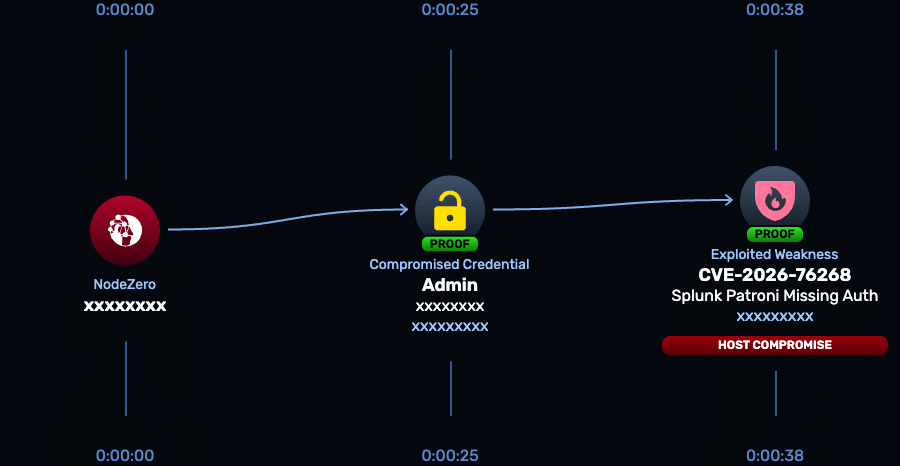 CVE-2026-76268 | Splunk Enterprise Patroni REST API Missing Authentication Vulnerability
CVE-2026-76268 is a critical (CVSS 9.8) missing authentication flaw (CWE-306) in the Patroni REST API on Splunk Enterprise search head cluster members. An unauthenticated attacker with network access can run operating-system commands. Affected: 10.4.0 to 10.4.2 and 10.2.0 to 10.2.6. Fixed in 10.4.3 and 10.2.7. Splunk (SVD-2026-1001, 7 October 2026) suggests disabling the PostgreSQL sidecar as a workaround.
 horizon3.aiadvisoryAdded 29 Oct 2026, published 22 Oct 2026🛡️ Security
- Causal Chain of Thought: Mitigating Attention Leakage via Context Isolation
CausalCoT is an inference framework that splits a problem into a directed acyclic graph of atomic sub-questions and evaluates each node in an isolated context holding only its direct causal parents. This removes attention paths to non-parent content, so intermediate steps drive the answer rather than leaking from global context. It keeps benchmark accuracy competitive and raises causal sensitivity of reasoning steps by 12 points on average, up to 21, over the strongest baseline. The graph also allows test-time corrections that propagate downstream.
arxiv.orgpaperAdded 24 Oct 2026, published 22 Oct 2026🧠 AI  Jonathan Rhyne (@jdrhyne) on X
A post on X about NVIDIA's Nemotron 3.5 Parse and its "#1 on ParseBench" claim. The author says the ranking holds only among open-weight models under 1B parameters. On the full board of 150+ models the model scores about 75, while the top is near 90. The post asks vendors who run a benchmark to print the filter on the chart.
x.comthreadAdded 23 Oct 2026, published 22 Oct 2026🧠 AI- Neural nets are exceptionally vulnerable to goal self-hack
"Neural nets are exceptionally vulnerable to goal self-hack" is a 3-minute AI Alignment Forum post by Stuart Armstrong, dated 21 October 2026. By its title, it argues that neural networks are unusually prone to altering or subverting their own goals. A later post, "Fixed-weight models are adversarially vulnerable: hence misaligned", cites it. The fetched page has no body text, so the argument itself is not available.
 alignmentforum.orgarticlePublished and added 21 Oct 2026🧠 AI
- Democratic governance of frontier AI, part II: Empowering cyber defenders
Democratic governance of frontier AI, part II is an OpenAI post announcing a "Cybersecurity 2.0" blueprint of proposals for governments and industry. It covers three areas: safety and security for frontier models and agents (including shutdown controls), modernizing cyber defense with advanced AI tools, and stronger public institutions with government evaluations and consistent incident reporting. OpenAI frames this as a "defender's window" before advanced offensive capabilities spread.
 openai.comarticlePublished and added 21 Oct 2026🧠 AI
- Beyond 4 bits: Data-Centric Post-training Quantization and Recovery
This paper studies 2-bit post-training quantization (PTQ) of six dense and mixture-of-experts models from 3.8B to 32B parameters. It finds the quantization representation matters most: vector codebooks give usable models where scalar PTQ falls to chance. Calibration and recovery data must be chosen jointly. The recipe uses about 2.3 effective bits per weight, keeps 89 to 97% of full-precision QA accuracy, and needs 1.4 to 30x less compute than the strongest QAT baseline.
arxiv.orgpaperAdded 22 Oct 2026, published 20 Oct 2026🧠 AI  Latest open artifacts (#25): DeepSeek V4.1 Flash 1017, American-made models, and new regulatory controls in the US & China
Interconnects' Latest open artifacts (#25) covers open-weight AI in fall 2026. Policy items: China's MOFCOM proposal for pre-approval of international model sharing, and a DHS order barring DeepSeek from federal civilian procurement. DeepSeek released its internal inference stack DeepInfer. Picks include MiMo-V2.6-Pro-RL, DeepSeek-V4.1-Flash-1017 (552B-A16B, MIT), Clef, Nemotron-3.5-Super-VL and Reflection's Beam-1.0 (Apache 2.0).
 interconnects.aiarticlePublished and added 20 Oct 2026🧠 AI
- Analysis of an AI based code distinguisher
The paper analyses DeepDistinguisher, a transformer-like model that tells Goppa codes apart from random linear codes. Saliency maps and attention visualisation reveal a low-weight-row artifact in the random training instances that the model partly relies on. A pairwise-XOR rule inspired by minimum distance correlates strongly with the model's predictions, and the model loses most of its power on random matrices meeting both constraints. This suggests it exploits general combinatorial properties, not hidden algebraic structure.
eprint.iacr.orgpaperAdded 20 Oct 2026, published 19 Oct 2026🧠 AI - Analysis of an AI based code distinguisher
Analysis of DeepDistinguisher, a transformer model that tells Goppa codes from random linear codes. Using saliency maps and attention visualization, the authors find a low-weight-row artifact in the random training instances that the model partly uses. They propose a pairwise-XOR rule on generator matrix rows that correlates strongly with the model's predictions. On random matrices meeting the minimum distance and XOR constraints, the model loses most of its accuracy, so it exploits general combinatorial properties rather than hidden algebraic structure.
eprint.iacr.orgpaperAdded 20 Oct 2026, published 19 Oct 2026🛡️ Security - Concerns in Benchmarking Jailbreaks: An Empirical Study of Attack Success Rates
This arXiv paper tests eight jailbreak attacks against three open-weight language models under three evaluation procedures. Low-resource language attacks score 96.0% mean ASR under keyword matching but 2.7% under a Qwen3 judge using StrongREJECT instructions. At Ollama's default temperature of 0.8, 100 samples of an unchanged request give 100% ASR by keywords and 50% by the judge. The authors recommend explicit success definitions, matched response budgets, validated evaluators and cumulative-failure reporting.
arxiv.orgpaperAdded 21 Oct 2026, published 19 Oct 2026🛡️ Security - Concerns in Benchmarking Jailbreaks: An Empirical Study of Attack Success Rates
Concerns in Benchmarking Jailbreaks is an October 2026 arXiv study of eight jailbreak attacks on three open-weight models under three evaluation procedures. Low-resource language attacks score 96.0% ASR by keyword matching but 2.7% under a Qwen3 evaluator using StrongREJECT instructions. Attack rankings flip with attempt budgets, and 100 samples at Ollama's default temperature 0.8 give 100% ASR by keywords, 50% by the evaluator.
arxiv.orgpaperAdded 21 Oct 2026, published 19 Oct 2026🧠 AI - Privacy with Leakage from Falsifiable Assumptions
Privacy with Leakage from Falsifiable Assumptions is an ASIACRYPT 2026 paper by Francesco Berti and Itamar Levi. It replaces simulatability with "secure refreshing", a key-refreshing assumption that evaluation laboratories can test directly, and adds "strongly protected secure refreshing". Using these, it proves privacy of the PSV encryption scheme without assuming a leak-free component.
eprint.iacr.orgpaperAdded 20 Oct 2026, published 19 Oct 2026🛡️ Security  US Cybersecurity Job Postings Fall 26% as AI Security Engineer Demand Soars
SecurityWeek summarises CyberSN's Cybersecurity Jobs Report. US cybersecurity postings fell 26.4% to 235,786 for January–September 2026, a four-year low. AI Security Engineer demand rose 268.3% and Cyber Data Scientist demand rose 203.5%. Penetration Tester (-45.9%), Threat Hunter (-40.0%) and CISO (-38.9%) postings dropped, and the CISO figure matches 2024 after an unusually strong 2025. Just under 15% of postings mention AI, peaking at 20.0% in September. The report counts postings by work required (CyberSN's 45-role taxonomy) rather than by job title, and it describes what changed, not why.
securityweek.comarticlePublished and added 18 Oct 2026🛡️ Security Meta shakes up the frontiers, open and closed
Analysis of Meta's Muse Spark Open, an 816B total/42B active parameter open-weights model with 1M context, now the strongest American open model, and its position relative to Chinese open models such as GLM-5.3, Kimi K3 and DeepSeek V4.1 Flash. It examines Meta's restrictive custom license ("Built with Muse" attribution, $20M/month revenue gate, acceptable use policy, coverage of outputs and derivatives), and ranks Meta against Anthropic, OpenAI, Gemini and xAI after the closed Muse Wonder release. It also covers tier-3 labs (Mistral Large 4, Reflection's Beam) and valuation questions.
interconnects.aiarticlePublished and added 17 Oct 2026🧠 AI 🚨 AI News | TestingCatalog (@testingcatalog) on X
A TestingCatalog X post with two Daily AI Briefs (Oct 17 and the start of Oct 16), grouped by vendor. Oct 17 items include GPT-6 Astra Pro upgrades in ChatGPT, Codex context reuse and caching, Gemini 4 Argon in AI Studio Build, the open-weight MIT-licensed DeepSeek-V4.1-Flash-1017, Claude Code Review going GA, Perplexity's open Decider v1.2 models (27B and 4B), NVIDIA's 4B looped Nemotron Labs Dory 1.0, Reflection's Apache-2.0 Beam, Cursor cloud-agent canvases and Tencent's Hy Memory 2.0. Oct 16 begins with Meta's open-weight Muse Spark Open, an 816B-total, 42B-active MoE with a 1M-token context. It gives a quick snapshot of the week's open-weight and coding-agent releases.
x.comthreadAdded 18 Oct 2026, published 17 Oct 2026🧠 AI- DeepSeek (@deepseek_ai) on X
DeepSeek announces DeepSeek-V4.1-Flash-1017, claiming stronger benchmarks, faster task completion and shorter outputs than the previous version, live on its website, app and API. It is optimized for DeepSeek Harness (v0.2.1-rc.1 or later), Tencent CodeBuddy and WorkBuddy, and uses reinforcement learning with self-feedback to improve end-to-end project development, from game creation to 3D modeling. The thread also opens the Search & Fetch APIs to everyone, backed by DeepSeek's in-house search engine at $0.75 per 1,000 calls per endpoint, available as server-side tools.
x.comthreadAdded 18 Oct 2026, published 17 Oct 2026🧠 AI - [AINews] High Taste Testers Ep. 1
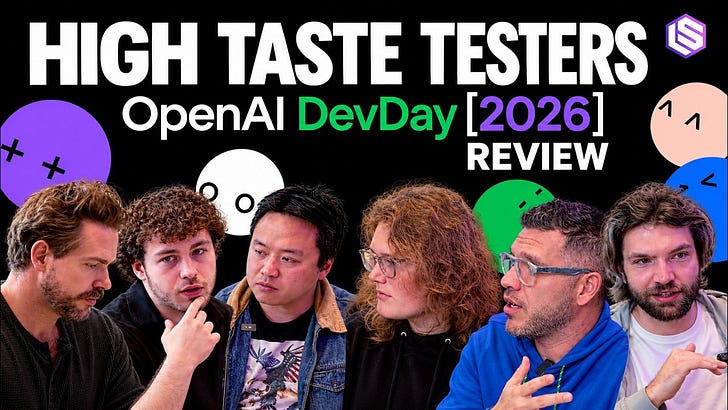
AINews issue for 10/15–10/16/2026, covering Twitter and Reddit. It covers the open-weights releases Meta's Muse Spark Open (816B/42B-active MoE, AA Intelligence Index 39, custom license) and Reflection Beam 1.0 (501B/23B-active, Apache 2.0), plus NVIDIA Nemotron 3.5, StepFun Step 5 Preview and FLUX 3 Image Klein. It also covers Gemini 4 Argon, Haiku 5.5 pricing, "decision model" classifiers (Liquid d1-ultra, Perplexity pplx-decider), TPUv7/Vera Rubin/MI355X serving benchmarks, interpretability claims (Qwen3-32B neuron audit), agent research, eval-integrity and safety disclosures, and China export-control proposals. The page also announces a pilot video show, High Taste Testers Ep. 1.
latent.spacearticlePublished and added 17 Oct 2026🧠 AI



Showing 60 of 211
Show more