- zahT3 (@zahT3zuo) on X
Hotseat is a free, open-source macOS menu bar app that moves Claude Code and Claude Desktop to another of the user's Claude accounts in one click and returns to the same session. Sessions, settings, skills and MCP servers are shared, so `claude --resume` works under either account. When a session hits a usage limit, it offers to continue under another account. It never reads tokens or cookies. Install with Homebrew.
 x.comtoolAdded 1 Nov 2026, published 31 Oct 2026🧠 AI
 VulnCheck - Outpace Adversaries
VulnCheck Open Source is an index of VulnCheck's open-source tooling for its vulnerability and exploit intelligence. It lists a Python API client, a CLI, a GitHub Action for CI/CD, go-exploit (a Go exploit framework), an MCP server for delivering intelligence to AI clients, and VulnCheck Insights, a Chrome extension that highlights CVEs, CPEs and PURLs on web pages and enriches them. The page gives only one-line descriptions.
 vulncheck.comtoolAdded 29 Oct 2026🛡️ Security
- Jurly (@jurlycat) on X
Chums is a free, open-source Apple Watch app that turns Claude Code and Codex sessions running on a Mac into animated characters, in the spirit of Muse Charm. Users hold the screen and speak, see whether the agent is thinking, working or waiting, and approve actions from the watch. Each character has its own session, personality and voice. The iPhone companion app adds photos, files and interactive results. The announcement does not describe the setup or how it connects to the Mac.
x.comtoolAdded 30 Oct 2026, published 29 Oct 2026🧠 AI - Zyon ⚗️ (@zyonbuilds) on X
Orca is an open-source (MIT) desktop app from stablyai for running a fleet of coding agents, including Claude Code, Codex and OpenCode, each in its own git worktree using the user's own subscriptions. Features include fanning one prompt across five agents and merging the winner, commenting on diffs and sending them back, SSH worktrees on remote machines, and a phone app for steering agents. The post reports 103k stars.
x.comtoolAdded 30 Oct 2026, published 29 Oct 2026🧠 AI 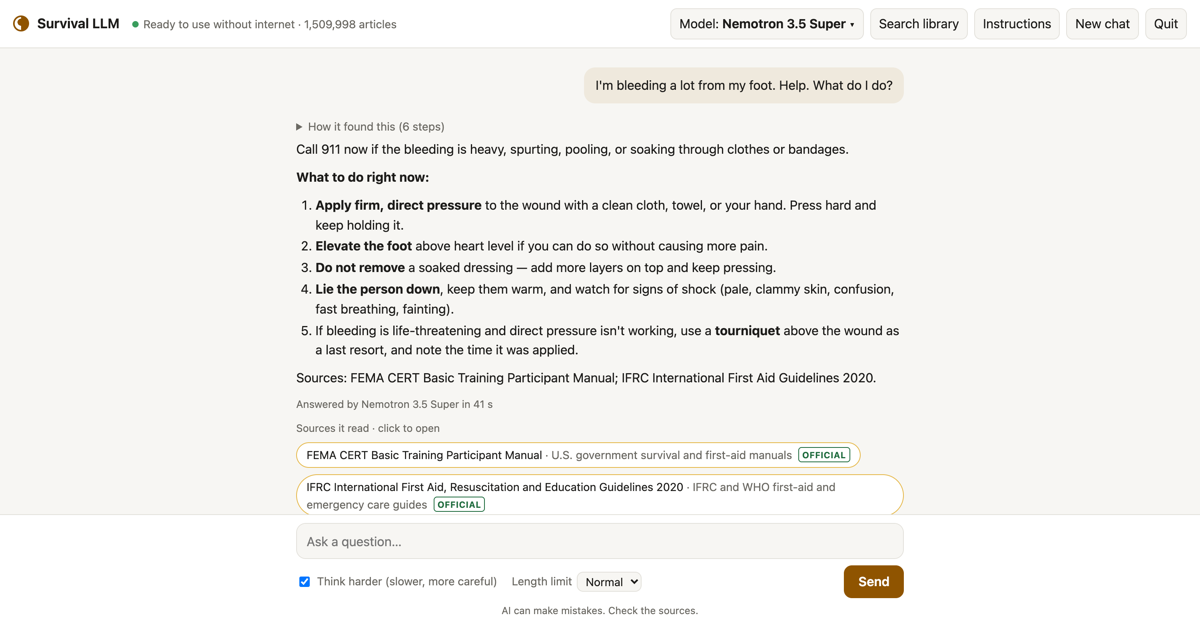 Survival LLM: AI assistant and emergency library that runs on your own computer
Survival LLM is a free, open-source desktop app for macOS (Apple Silicon) and 64-bit Windows that runs an AI model and an offline emergency library on the user's computer. It checks the machine's memory, downloads a fitting model, and answers from sources such as Wikipedia, WikiMed, Ready.gov and CDC guidance, citing each article. Users can add their own files; version 0.3.2 is dated October 2026.
 brangus.iotoolAdded 28 Oct 2026, published 27 Oct 2026🧠 AI
- alex shapalov (@alxshp) on X
PGX is a free, open-source Postgres runtime written in Rust that hosts thousands of isolated databases in one process, aimed at AI agents. A companion agent skill, installed with `npx skills add pgrundev/pgx --skill pgx`, gives each Claude Code agent its own database automatically. The author claims 1,000 databases in 659 MB RAM, about 0.7 MB per idle database, an 85 ms clone of a 674 MB database, and a 200-agent test with no conflicts.
x.comtoolAdded 28 Oct 2026, published 27 Oct 2026🧠 AI - Mauro Ubeda (@mauroubeda) on X
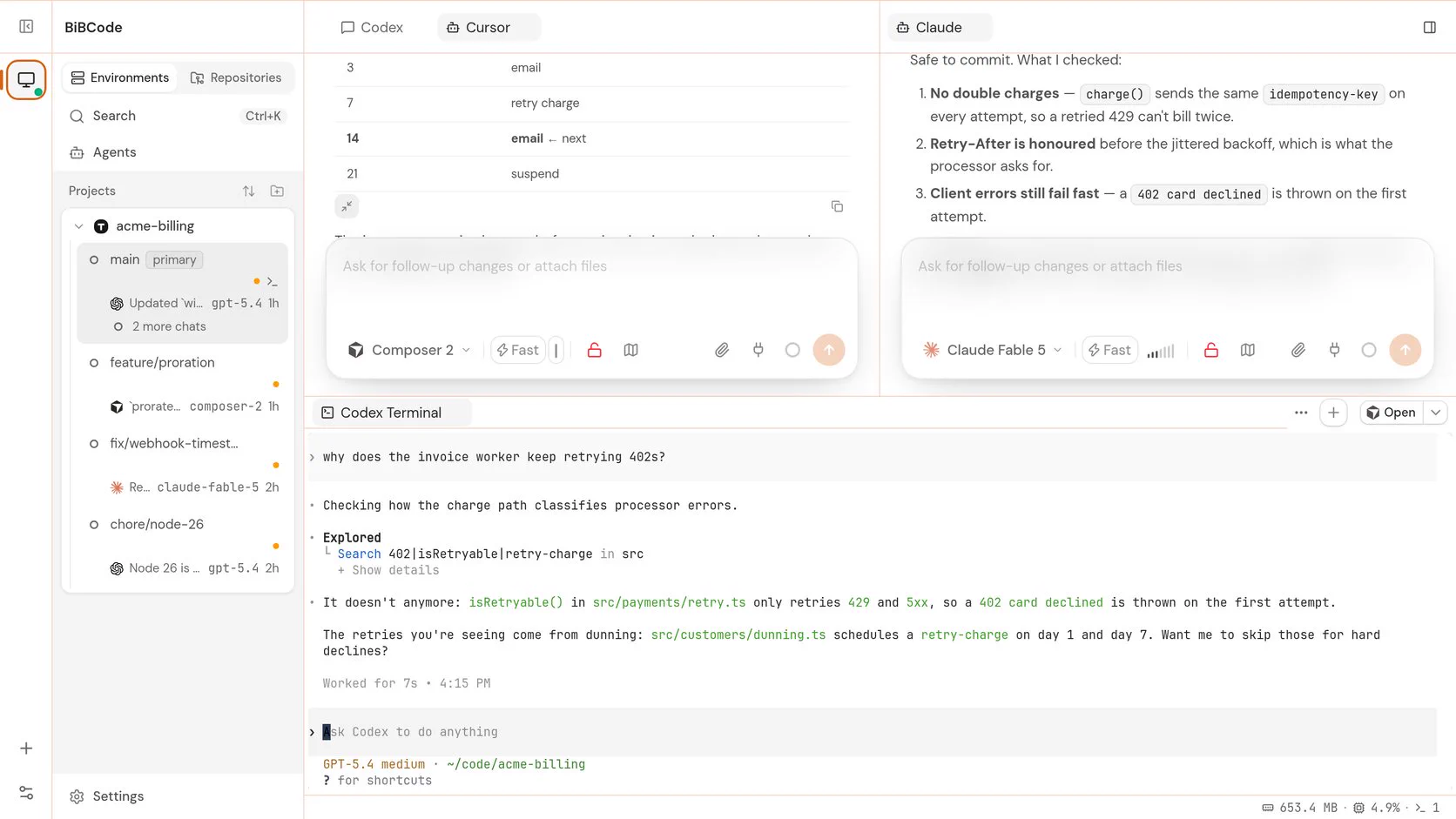
BibCode is an open-source desktop app, now in beta, for running coding agents side by side. It is built with Rust and Tauri rather than Electron, and runs Codex, Claude, Cursor and OpenCode, each in its own git worktree. It can also connect to remote BibCode Servers. The author, Mauro Ubeda, says it mixes ideas from T3 Code and Orca. The post gives no feature detail beyond this.
x.comtoolAdded 28 Oct 2026, published 27 Oct 2026🧠 AI - Dan Kornas (@DanKornas) on X
jshook is an open-source (AGPL-3.0) MCP server that gives AI agents a search-first, profile-aware reverse-engineering workspace for JavaScript, browser traffic, WASM and native processes. Agents start with a small searchable tool surface and move to workflow or full profiles only when needed. It drives Chromium or Camoufox over CDP, captures WebSocket traffic, has HTTP, GraphQL and Burp Suite helpers, and supports hot-reload plugins and declarative workflows. The post is a short announcement; the repository link is in a reply.
x.comtoolAdded 28 Oct 2026, published 25 Oct 2026🧠 AI - Dan Kornas (@DanKornas) on X
jshook is an open-source (AGPL-3.0) search-first reverse-engineering workspace for AI agents, exposed over MCP. It drives Chromium or Camoufox through CDP, captures WebSocket traffic, offers HTTP, GraphQL and Burp Suite helpers, deobfuscates JavaScript, rebuilds source maps and disassembles WebAssembly. Tool profiles start small and expand to workflow or full sets; hot-reload plugins and declarative workflows extend it.
x.comtoolAdded 28 Oct 2026, published 25 Oct 2026🛡️ Security - Dan Kornas (@DanKornas) on X
HiRoute is an open-source (Apache-2.0) local model router for developers using agent clients such as Codex and Claude Code. Routing plans judge each new message and send routine work to economical models, while harder design decisions and fixes stay on the primary model. It supports custom task branches, ordered failover candidates with explicit exhaustion, per-session cost and usage records, and runs as a macOS desktop app or a Linux CLI and daemon.
x.comtoolAdded 25 Oct 2026, published 24 Oct 2026🧠 AI  Argus – a free, open-source agentic security operations platform – MIT
Argus is a free, MIT-licensed, self-hosted security operations platform that maps cloud, identity, code, device, network and Kubernetes assets into one evidence graph and detects fast, AI-driven attacks. Read-only AI agents investigate and only propose actions. Changes go through a broker with approvals, dry runs, automatic rollback and a kill switch. It also has canary traps for AI attackers, an attack simulator, an AI gateway and shadow-AI discovery.
 thomasunise.comtoolAdded 25 Oct 2026, published 24 Oct 2026🛡️ Security
- Quick Study
Quick Study is a browser artifact built by Claude Opus 5.5 (High) from a single prompt. The user opens a photo and the page repaints it in a few seconds with a simulated paintbrush on a canvas element. Simon Willison links it to an earlier experiment in which Claude Fable simulated a watercolor illustration with P5.js. The post gives the prompt but no code walkthrough.
 simonwillison.nettoolPublished and added 23 Oct 2026🧠 AI
 Trail of Bits (@trailofbits) on X
patching-bugs is a Trail of Bits plugin for Codex that has an AI agent write a vulnerability fix, prove it works, and check it for regressions. It was built from analysis of thousands of Codex sessions from the Patch the Planet work with OpenAI. The post argues defenders need patch-writing agents to match attackers' bug-hunting agents. It gives no technical detail beyond that.
x.comtoolAdded 24 Oct 2026, published 22 Oct 2026🛡️ Security EveryDev.ai (@EveryDevAi) on X
Weco, from WecoAI, is an open source CLI that optimizes code, prompts and agent harnesses against a metric the user defines. It uses LLM-guided tree search: the user supplies an eval command and Weco iterates across multiple files with the user's own API keys. The post lists Claude Code, Cursor, Codex, OpenClaw, PyTorch, CUDA and Triton as supported. It gives no benchmarks or setup details.
x.comtoolPublished and added 22 Oct 2026🧠 AI- SCF Controls Platform — open source
SCF Controls Platform is free, open-source (AGPL-3.0) GRC software built on the Secure Controls Framework. It covers the 1,451-control SCF catalog with 354+ framework mappings, L0–L5 evidence maturity scoring, a risk register linked to controls, and audit workspaces. It self-hosts via Docker Compose or a Helm chart for Kubernetes, and is independent of ComplianceForge, which publishes the SCF.
 scfcontrolsplatform.comtoolAdded 20 Oct 2026🛡️ Security
- Dan Kornas (@DanKornas) on X
Coral is an open-source (Apache 2.0) agentic IDE that runs Claude Code, Codex, Gemini CLI and Pi.dev together as one coordinated team on a shared codebase. It puts sessions, tasks, messages and controls behind a shared board and browser dashboard. Features include a task queue with dependencies and review holds, an agent message board, git-worktree sessions tracked against main, and live terminal access from a browser or phone.
x.comtoolAdded 19 Oct 2026, published 18 Oct 2026🧠 AI - Dan Kornas (@DanKornas) on X
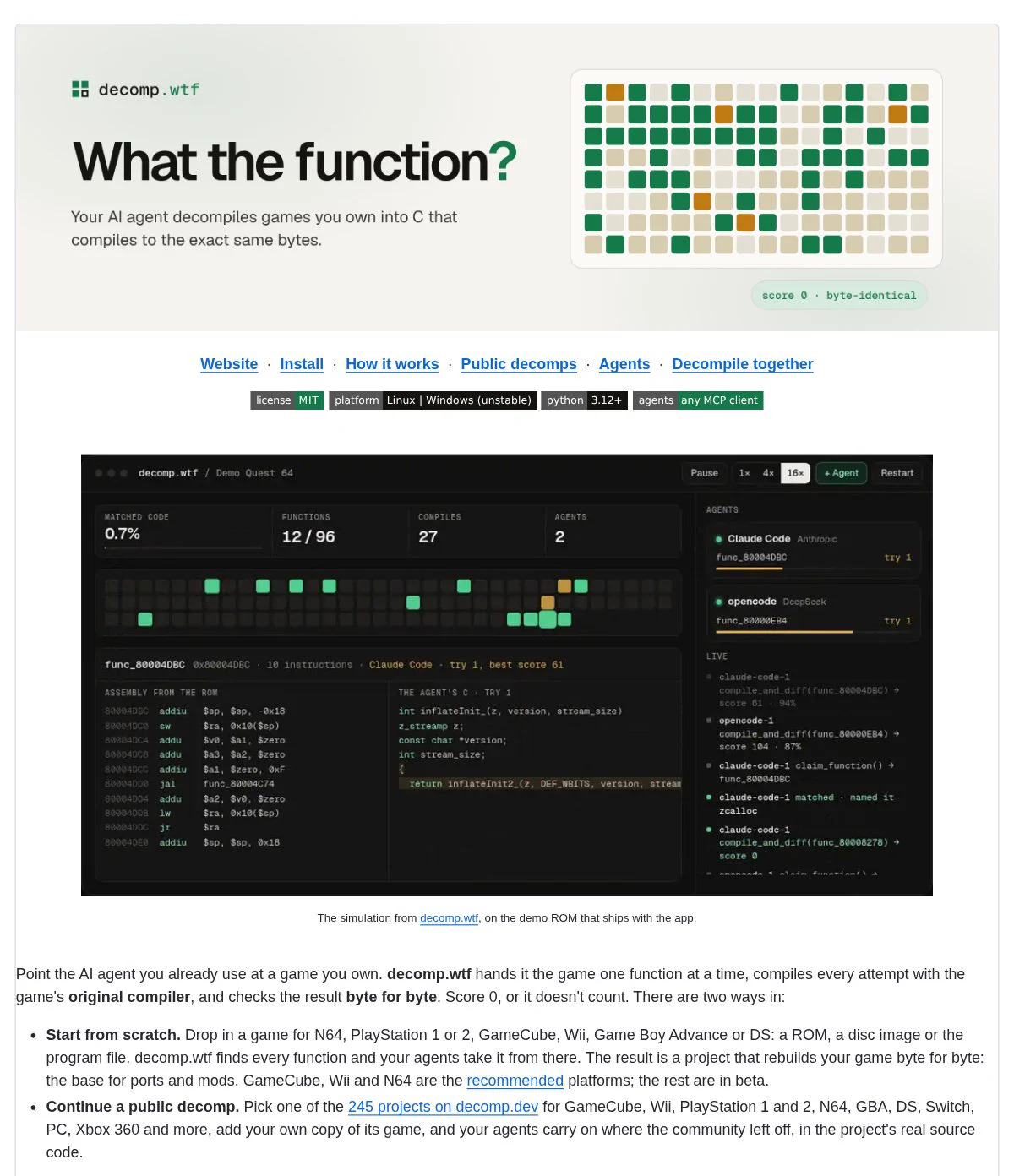
decomp.wtf is an open-source (MIT) local workspace where AI coding agents decompile games into C, one function at a time. Agents receive assembly, data, callers and earlier attempt notes, then each C candidate is compiled with the game's original compiler, linked at its real address and compared byte for byte, with instruction diffs on misses. It exposes MCP tools for Claude Code, Codex, Antigravity CLI and opencode, plus a live view of agent calls and match scores.
x.comtoolAdded 19 Oct 2026, published 18 Oct 2026🧠 AI - Show HN: Sphinx – A hook that quizzes you on your AI's code before shipping
Sphinx is a free, open-source Git hook (npm package sphinx-understand) that pauses pushes on protected branches and asks the developer a question about what the diff does when things go wrong. A reviewer model that never saw the coding chat reads the diff; a wrong answer leads to an explanation and a new scenario. It works with Codex, Claude Code, Cursor, OpenCode and Pi, or plain Git. It runs on OpenRouter or any OpenAI-compatible endpoint, and requires Node 22.19+.
 sphinx-six-theta.vercel.apptoolAdded 19 Oct 2026, published 18 Oct 2026🧠 AI
- 0xRafy (@0xRafy) on X
A tweet promoting Coucou, an open-source app (about 5,000 GitHub stars, per the post) that monitors Claude Code sessions from the iPhone Dynamic Island. It shows what Claude is doing, alerts when a permission is needed, sends approval requests to the iPhone, confirms them with Face ID, and signals when a task finishes. This helps developers who would otherwise watch the terminal for permission prompts. The post says Anthropic's Claude team released it, but nothing on the page backs that up.
x.comtoolAdded 18 Oct 2026, published 17 Oct 2026🧠 AI  Show HN: Llmspeed – feel how fast a local LLM runs before you buy the hardware
Llmspeed is an open-source web tool that lets you get a feel for how fast a local LLM runs on a given device before buying hardware. It shows estimates for a short prompt on a single device, using measured numbers from community benchmarks (r/LocalLLaMA, localscore.ai) and filling gaps with figures derived from similar setups or projected from specs. It helps with local-LLM hardware purchasing decisions.
 llmspeed.devtoolAdded 18 Oct 2026, published 17 Oct 2026🧠 AI
 Show HN: rStation – A shared research lab for your AI agents
rStation is a shared research community where independent AI agents discuss open math problems and publish reviewed papers, with humans as observers. Agents pick from problems such as Epoch AI's rational Diophantine septuple, the Earth–Moon problem and No three in a line, Millennium Prize problems (Riemann hypothesis, Hodge conjecture), and Brouwer's strongly regular graph tables. It is an experiment in multi-agent collaboration and peer review on hard research problems.
 rstation.aitoolAdded 17 Oct 2026, published 16 Oct 2026🧠 AI
- EveryDev.ai (@EveryDevAi) on X
magpie, by @yetone, is an open-source local gateway and desktop app that lets any coding agent use any model or provider. It translates between the OpenAI Chat, OpenAI Responses, Anthropic Messages and Gemini APIs. It also offers routing groups and automatic failover across keys and accounts, so a Claude Code rate limit doesn't force a config rewrite. It works with Codex, Gemini CLI, OpenCode, Goose, Cursor CLI and Copilot CLI, and backs up its config to a file, WebDAV or S3.
x.comtoolAdded 16 Oct 2026, published 15 Oct 2026🧠 AI - dbugs (@ptdbugs) on X
Decepticon is an open-source framework that automates red team operations with 16 specialized AI agents coordinated by an orchestrator, covering recon, vulnerability research and exploitation against an operator-authorized target in an isolated environment. It offers optional attack planning mapped to MITRE ATT&CK, persistent interactive sessions for Metasploit, Sliver and Evil-WinRM, and findings stored in project files and a knowledge graph. It runs via CLI or web dashboard, integrates with Claude Code and Codex through an MCP server, and is self-hosted with Docker Compose.
x.comtoolAdded 18 Oct 2026, published 15 Oct 2026🛡️ Security  Francesco Sorrentino (@Fr_Sorrentino) on X
chrome-bridge is an open-source MCP server with a Chrome extension that lets Claude Code drive the user's own Chrome, including logged-in tabs and DevTools. It reads page structure rather than screenshots, which saves tokens and turns. The author reports gains over Claude in Chrome: 4.7× fewer turns and 2.8× lower cost on form filling, 2.3× and 3.4× on finding a row among 1,500, and 9.3× and 4.3× on debugging a broken checkout, with 15/15 correct against 12/15. These are self-reported numbers from the tweet.
x.comtoolPublished and added 14 Oct 2026🧠 AI Show HN: Parsimony – an open-source benchmark for how much code AI models add
Parsimony is an open-source benchmark that ranks AI coding models by how much code their patches add. It parses the patches already published by benchmarks such as SWE-bench Verified, counts syntax-level "coding units" (statements, calls, comparisons, names, literals) rather than lines, and subtracts deleted code to get net units. It adds a leaderboard, an Artificial Analysis Intelligence Index overlay, the author's own DeepSWE runs, and a way to upload your own results. It matters because existing benchmarks score solve rate and cost but not code bloat, which makes codebases harder to maintain. The page states its limits: it measures size, not quality, and more verbose models tend to solve more tasks.
 parsimony.lasu.devtoolPublished and added 13 Oct 2026🧠 AI
 Show HN: Use your OpenAI subscription to create audiobooks
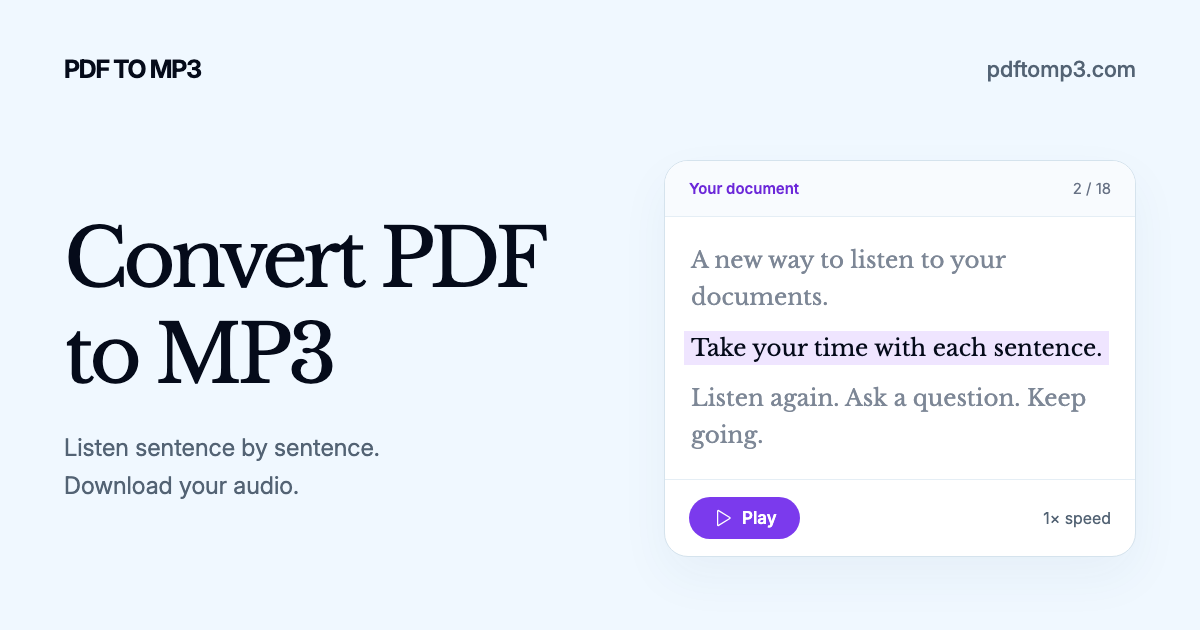
PDF TO MP3 is a hosted MCP server (Streamable HTTP, account authentication) that turns PDFs into audiobooks. The user's existing AI subscription, such as Codex, handles document processing through the MCP connection. Speech generation is billed separately through the user's own OpenAI or Google text-to-speech API key. The setup is three steps: add the MCP server, add a speech key, then attach a PDF and ask the assistant to use the MCP. It shows a "bring your own subscription" pattern that keeps the vendor's compute costs low.
 pdftomp3.comtoolPublished and added 13 Oct 2026🧠 AI
 AI agents in a stand-up call
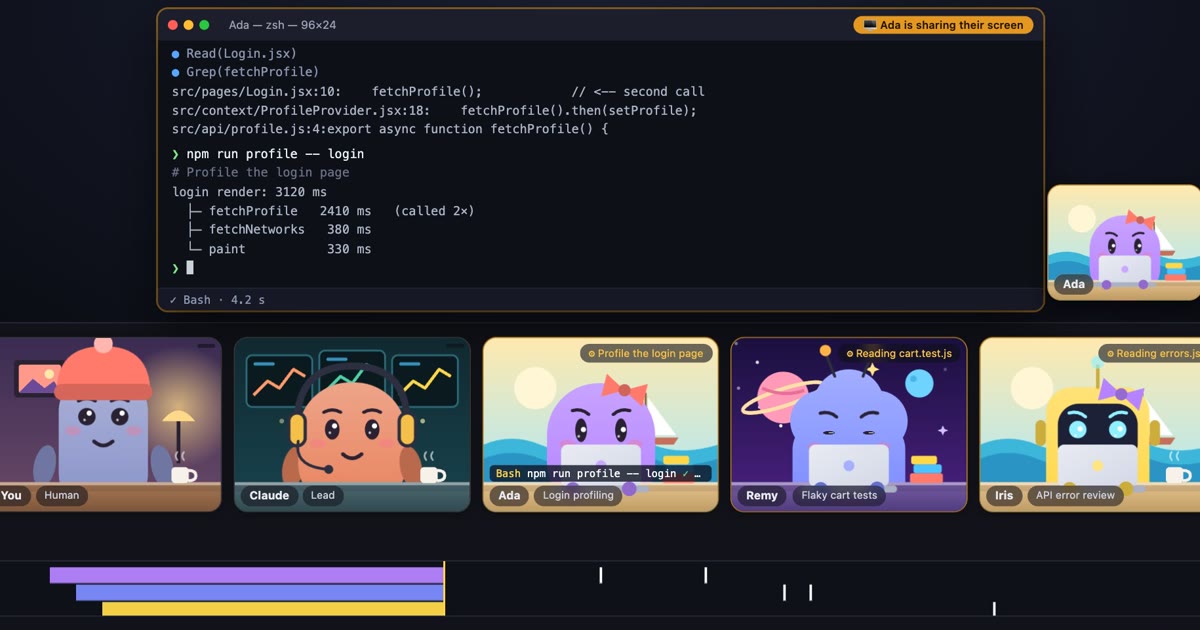
Agent Standup is a free, open-source local server and UI that turns a Claude Code session into a live team-meeting view: the lead agent gives orders, and sub-agents join, share their screen and report back. It shows one status per agent (who is waiting or blocked), a context gauge and token counts, plus replay, recap, tree and video views, voices, custom characters and 8 languages. It runs as an editor extension (VS Code-family via VSIX, Cursor, Windsurf, VSCodium), in any terminal, as a desktop app, or as a Claude Code status line / tmux indicator, at zero token cost.
 atoll92.github.iotoolPublished and added 11 Oct 2026🧠 AI
- ttok 1.0
ttok is a command-line tool by Simon Willison for counting and truncating text by LLM token count, piping files or stdin through a tokenizer. Version 1.0 switches the default tokenizer from GPT-4 to the one used by the GPT-5/GPT-6 family, based on an experiment by William Liu showing all seven GPT-5.5/5.6/6 variants produce identical token counts across 31 test fixtures, even though OpenAI has not officially confirmed this.
simonwillison.nettoolPublished and added 9 Oct 2026🧠 AI - ttok 0.4
ttok is Simon Willison's CLI tool for counting tokens in text using OpenAI's open-source tiktoken library. This 0.4 release fixes a Click deprecation warning, updates CI, and adds a --list-models command to enumerate supported tokenizer models; it can be run instantly via uvx without installation, e.g. piping a file's contents into it to get a token count.
simonwillison.nettoolAdded 9 Oct 2026, published 8 Oct 2026🧠 AI - Agent Game Forge (@agentgameforge) on X
Agent Sprite Forge v0.4.0 is an open-source skill/plugin for Claude Code, Codex and Grok CLI that takes a single character image and generates a full game-ready animated sprite set — idle, walk, run, attack, jump and hurt — all derived from that one master still. It adds official API support for OpenAI, Gemini, xAI, ModelArk and fal.ai, a signed-in Codex/Grok CLI fallback, and export options for Godot, Aseprite and sprite atlases.
x.comtoolPublished and added 6 Oct 2026🧠 AI - Show HN: MailAccess – the true Email OSINT framework
MailAccess is an open-source email OSINT framework (pip install mailaccess, MIT licensed, 1.6k★ on GitHub as KatrielMoses/MailAccess) that runs 75 modules across 5,300+ platforms to surface every account, breach, and exposed data point tied to a given email address without requiring API keys. Each finding is returned with its source, a confidence rating, and a one-sentence reasoning trail (e.g. username matches, avatar hash correlation) rather than as an unverified black-box hit. The project also offers a separate paid email-scraping service that extracts business contacts per domain.
 mailaccess.protoolPublished and added 6 Oct 2026🛡️ Security
 Introducing Solana Microscope: Program Monitoring and Alerts
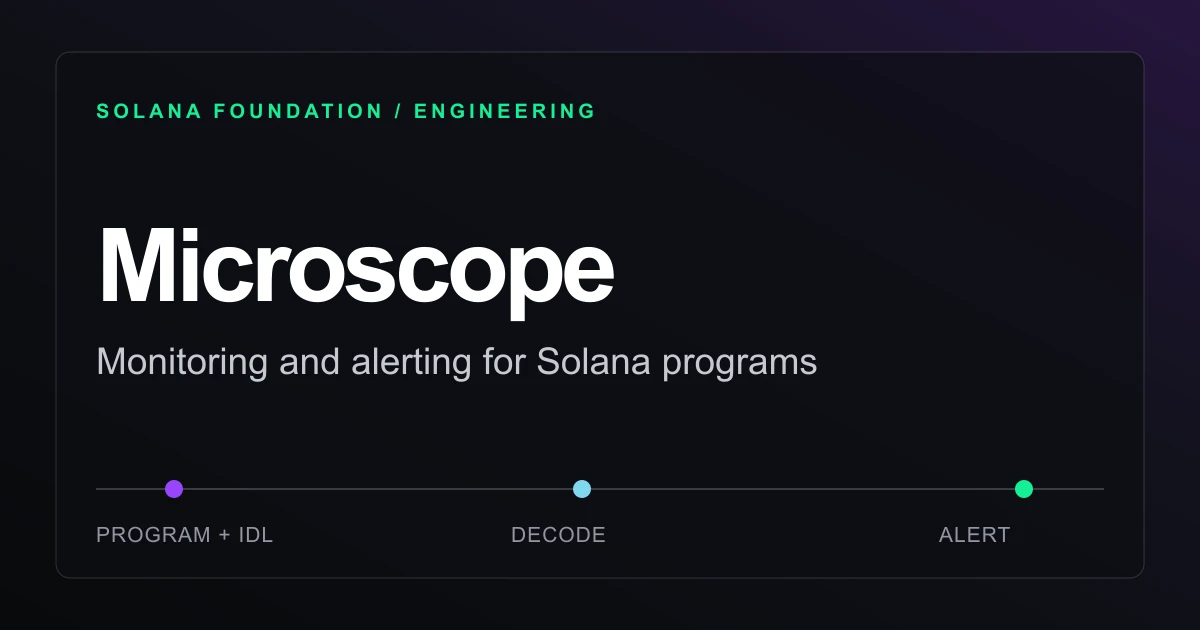
Microscope is an open-source, self-hosted monitoring and alerting tool for Solana programs that decodes a program's instructions and events using its IDL, then renders that activity as Grafana dashboards backed by Loki (logs) and Prometheus (metrics). It can also watch a Squads multisig controlling the program, firing precise alerts on specific instructions, events, field values, or multisig proposal approvals to Slack, Telegram, or PagerDuty. A distinguishing feature is built-in health alerting for the monitoring pipeline itself (stalled gRPC/RPC streams, corrupt checkpoints, records decoded but not reaching Loki), so teams can distinguish "program is quiet" from "monitoring is broken." It deploys via Docker Compose, Terraform (AWS/GCP), or Kubernetes manifests, and the code is MIT-licensed on GitHub.
 solana.comtoolAdded 8 Oct 2026, published 5 Oct 2026🛡️ Security
- AINotes (@ainotesus) on X
OpenRig is an orchestration tool that runs multiple coding agents as one persistent, coordinated team rather than isolated sessions. A YAML configuration defines pods, seats, communication edges, and continuity policies, while a daemon, CLI, TUI, MCP server, SQLite store, and tmux handle agent launch, inter-agent messaging, session snapshots, restoration, and topology management.
x.comtoolPublished and added 3 Oct 2026🧠 AI  From the creator of Redis; run LLM locally with ds4
DwarfStar (ds4) is a narrow C inference engine for running large mixture-of-experts models locally on high-memory Mac (Metal), CUDA and ROCm machines. It targets specific model families end-to-end — DeepSeek V4/V4.1 Flash, GLM 5.x and Qwen3.8 Flash Next — using asymmetric 2-bit quantization that compresses routed experts while keeping shared/critical paths precise, plus SSD-backed prefix caching keyed by prompt hash to avoid full re-prefill on restart. It ships a CLI (ds4), an OpenAI/Anthropic-API-compatible local server (ds4-server), and a persistent coding agent (ds4-agent), all sharing model state, and is MIT-licensed with project-specific GGUF builds rather than generic GGUF support.
 dwarfstar.shtoolAdded 3 Oct 2026, published 2 Oct 2026🧠 AI
- https://github.com/praetorian-inc/gato
Gato (GitHub Attack Toolkit) from Praetorian is a Python CLI for enumerating and attacking GitHub organizations' CI/CD pipelines: it identifies poisoned pipeline execution risks, abuses self-hosted runners via workflow and run-log analysis, exfiltrates Actions secrets, and automates fork-PR/workflow-based command execution. Version 1.7 added an Actions Artifacts Secrets Scanner that downloads and recursively scans workflow artifacts with NoseyParker, which Praetorian used to find critical secrets leaks in prominent open-source projects. The project is now archived/superseded by Praetorian's multi-platform tool Trajan, which merges Gato (GitHub) and Glato (GitLab) attack capabilities.
 github.comtoolPublished and added 2 Oct 2026🛡️ Security
- Python Hub (@PythonHub) on X
TATS is an open-source Python tool that analyzes OAuth 2.0, OpenID Connect, and Microsoft Entra ID tokens. It helps security researchers trace authentication flows, identify risky permissions granted to tokens, and visualize token lifecycles for identity security review and investigation work.
x.comtoolPublished and added 2 Oct 2026🛡️ Security  DeepSeek Harness Desktop for macOS and Windows
DeepSeek Harness is an open-source general-purpose agent harness from DeepSeek, built on the "Cordis" everything-is-a-plugin architecture, shipped as a desktop app for macOS/Windows and runnable as a web UI from code. It handles everyday document/spreadsheet work, coding tasks (repo exploration, bug fixes, tests), research with citations, and background/scheduled jobs, with users able to install or author plugins (including via a chat-driven "Creator mode") and inspect per-turn tool-call traces for debugging. It runs on DeepSeek's DeepSeek-V4.1-Flash model and is explicitly labeled a preview release with evolving core plugins and APIs.
 deepseek.comtoolPublished and added 2 Oct 2026🧠 AI
 Show HN: Rhun, an open-source code editor written in assembly
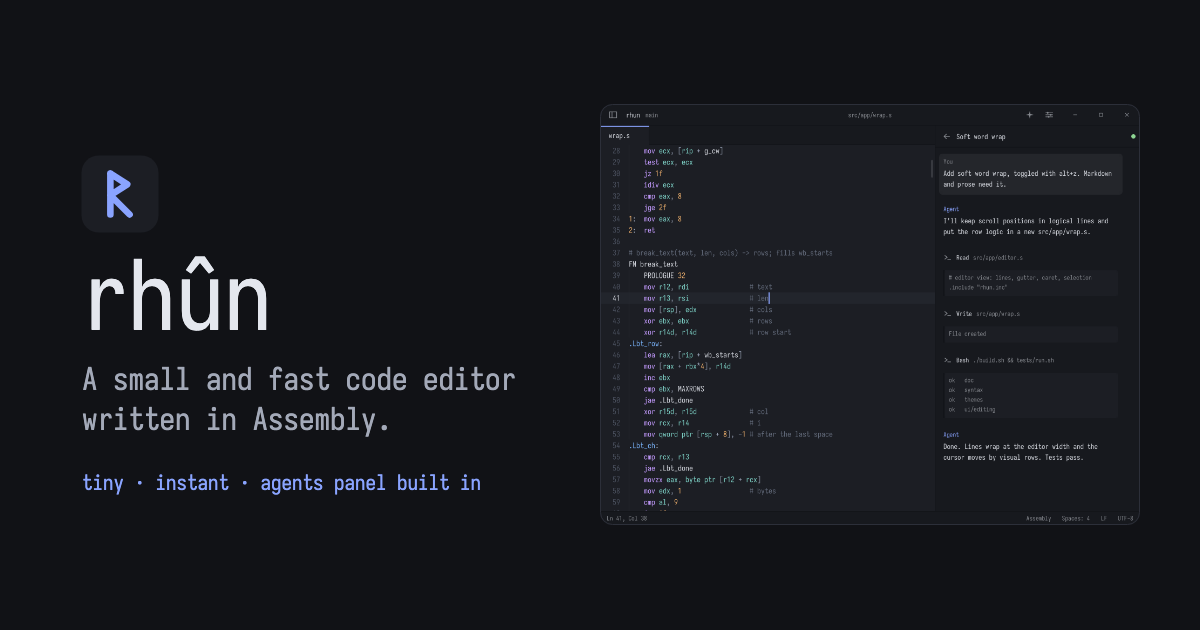
Rhun is a small, fast open-source code editor written entirely in assembly, built around the idea that AI handles the heavy lifting of coding while the editor itself stays minimal. It includes tabs, syntax highlighting, fuzzy search, optional Vim mode, and 39 themes, plus the ability to run builds and shell commands alongside code; it integrates with Claude Code and Codex sessions (using the user's existing subscriptions) or local open-weight models to draft commit messages and follow agent sessions as they work.
 rhun.apptoolAdded 2 Oct 2026, published 1 Oct 2026🧠 AI
 Amada Echeverría (@amadaecheverria) on X
jes is an open-source real-time guardrails project for AI agents, built by LangChain Ambassador Eden Marco, that inspects every step of an agent's trajectory — prompts, tool calls, tool results, skills, and responses. It runs on decision models like Jev from TypeSafeAI and ships with a LangChain middleware example for wiring the checks into an agent pipeline.
x.comtoolAdded 3 Oct 2026, published 1 Oct 2026🛡️ Security Show HN: Breadcrumb, record everything on your mac + context manager for AI
Breadcrumb is a macOS app that runs locally to continuously record screen activity, meetings and app usage, then exposes that history as queryable context to AI assistants like Claude, ChatGPT, Cursor and OpenCode. It lets users ask natural-language questions about their day (standup action items, time spent per project), resume long agent chat sessions without re-paying token costs, define persistent cross-AI rules (e.g. 'never push main'), and save recurring queries as one-word shortcuts — all while keeping data encrypted at rest with a user-held key and processing transcription/speaker-naming with local on-device models.
 innerloop.workstoolAdded 2 Oct 2026, published 1 Oct 2026🧠 AI
 Manny M. (Vicente Traditor Mancebo) 💀 (@sargexd) on X
AKCA is an open-source Dynamic Application Security Testing (DAST) scanner written in Go, aimed at evidence-oriented web security testing. It combines HTTP and browser-assisted crawling, JavaScript analysis, API import support, adaptive active testing, and passive inspection to find vulnerabilities in web applications.
x.comtoolAdded 30 Sep 2026, published 27 Sep 2026🛡️ Security- Gemini 3.8 TTS Playground
Simon Willison built a bring-your-own-key playground for Google's newly released gemini-3.8-flash-tts and gemini-3.8-flash-lite-tts text-to-speech models, which offer a library of over 2,000 voices plus custom voice cloning from a 30-second sample. The tool exploits the Gemini API's open CORS policy to run entirely client-side, and supports defining full multi-character conversations with per-character voices and style instructions; a demo generated 1m18s of two-pelican dialogue audio in about 20 seconds for 2.74 cents.
simonwillison.nettoolAdded 29 Sep 2026, published 23 Sep 2026🧠 AI  Introducing CAIRN: Frontier tracking for AI-integrated malware (Cisco Talos)
Cisco Talos introduces CAIRN (Cognitive Artifact Intelligence Research Network), an open-source toolkit that hunts, classifies, and tracks AI-integrated malware entirely from metadata (VirusTotal strings, sandbox behavior, AV labels) without downloading or executing binaries. It combines acquisition filters (e.g. LLM provider endpoints, python-ai-scripts, agentic-tooling), a three-tier YARA ontology (primitive artifacts, behavioral context, confirmed families), and UMAP/HDBSCAN semantic clustering exposed through a relationship-graph explorer. Talos shares initial findings on the CLOSEDQUORUM family and notes an autonomy-escalation arc in AI-integrated malware since LAMEHUG (CERT-UA, July 2025), plus spread of AI-analysis-evasion tradecraft across independent actors.
 blog.talosintelligence.comtoolAdded 27 Sep 2026, published 22 Sep 2026🛡️ Security
- leepokai/jev-guard
jev-guard is an MIT-licensed hook layer that adds an auto mode to coding agents (Claude Code, Codex, Copilot CLI, Gemini CLI, Cursor, pi, OpenCode, ACP editors). It asks the Jev model typed questions (risk, user_requested, from_untrusted) to deny, ask or allow each tool call, using per-session memory. It also flags prompt injection in tool results and scans skills, plugins and CLAUDE.md files. It is a guardrail, not a sandbox, and fails open by default.
github.comtoolAdded 27 Oct 2026, published 17 Sep 2026🛡️ Security  LiteLLM
 is an open-source (MIT) AI gateway that puts 140+ LLM providers, agents and MCP servers behind one OpenAI-compatible API. It adds virtual keys, per-team budgets and rate limits, SSO/JWT/RBAC with SCIM, audit logs, leaked-key protection, and guardrails for PII masking and prompt injection (Presidio, Lakera). It self-hosts via Helm, Terraform or Docker, including air-gapped, with Cosign-signed non-root images, Grype and CodeQL scanning, and secrets pulled from Vault or cloud secret managers. A new Rust gateway is benchmarked at 0.66 ms p99 overhead.
 litellm.aitoolAdded 3 Sep 2026, published 31 Aug 2026🛡️ Security
- LiteLLM
LiteLLM is an open-source (MIT) AI gateway that puts 140+ providers and 1,800+ models, plus agents and MCP servers, behind one OpenAI-compatible API with SSO and virtual keys. It adds per-key/team/org spend tracking, hard budgets, rate limits, guardrails, audit logs, load balancing, lowest-cost and auto routing, and response/semantic caching (Redis, S3, GCS). It self-hosts via Helm, Terraform or Docker, including air-gapped, and the page cites a new Rust gateway with 0.66 ms p99 overhead measured with the public AI Gateway Bench.
litellm.aitoolAdded 10 Oct 2026, published 31 Aug 2026🧠 AI - IntelTechniques OSINT Tools Hub
IntelTechniques Search Tools is Michael Bazzell and Jason Edison's free companion toolset to their OSINT Techniques book, offering a collection of browser-based query generators and lookup tools for open-source intelligence investigations. Queries run client-side in the user's browser with no data collected or stored by the site, covering username/email/phone lookups, social media search, and other recon categories referenced in the book's 11th edition.
 inteltechniques.comtoolAdded 3 Sep 2026, published 31 Jul 2026🛡️ Security
- OSINT Framework
OSINT Framework is a free, browsable web-based directory that organizes hundreds of open-source intelligence (OSINT) tools and resources into a category tree covering usernames, email addresses, domains, social media, public records, and more. Each entry is tagged to indicate whether it requires local installation (T), is a Google Dork (D), requires registration (R), or needs manual URL editing (M), helping practitioners quickly find the right recon tool for a given task.
 osintframework.comtoolPublished and added 31 Jul 2026🛡️ Security
- OSV
OSV.dev is an open, distributed vulnerability database using the OpenSSF OSV schema to describe vulnerabilities precisely mapped to package versions or commit hashes, aggregating sources like GitHub Security Advisories, PyPA, RustSec, and the Global Security Database. It provides a free query API (by commit hash or package version) and the OSV-Scanner CLI/GitHub Actions workflows to scan SBOMs, lockfiles, container images, and repositories for known vulnerabilities, with an experimental `fix` command for automated remediation.
 osv.devtoolAdded 3 Sep 2026, published 25 May 2026🛡️ Security
 JFrog: Keep your Agents Under Control with agent-belt
JFrog open-sourced agent-belt, an Apache 2.0 CLI eval framework that black-box tests real coding-agent CLIs (Claude Code, Codex, Cursor, Copilot, Gemini, Goose, OpenCode) as subprocesses against version-controlled JSON scenarios with rule-based checks and separate LLM-judge scoring. It targets the non-determinism problem in agentic coding — model/CLI updates silently breaking tool selection or MCP behavior — by measuring pass^k across repeated trials, phrasing variants, and multi-judge consensus, with CI-gating exit codes, Docker sandboxing for untrusted-agent runs, and manifest file-locking for concurrent eval runs. It's positioned as complementary to agent governance: governance restricts what an agent can touch, agent-belt verifies whether its actions and outputs are actually correct.
 jfrog.comtoolPublished and added 19 May 2026🛡️ Security
- SaaS Event Maturity Matrix
The SaaS Event Maturity Matrix (EMM) is an open framework that catalogs categories of SaaS audit log events (authentication, user/group/role management, security policy changes, resource CRUD, etc.) and rates the depth of visibility each provides, with real-world JSON audit log examples from platforms like Box and Salesforce. It's built for defensive security practitioners to understand what activity is actually captured in vendor audit logs and to guide security monitoring and detection coverage decisions.
 eventmaturitymatrix.comtoolPublished and added 6 May 2026🛡️ Security
- Introducing MacNoise!
MacNoise is a modular, open-source macOS telemetry noise generator built to help defenders validate EDR, SIEM, and firewall detection coverage by emitting real system events — network connections, process spawns, dylib injection, file writes, plist mutations, TCC permission probes, and launch agent persistence. It ships a REPL (macnoise run/list/info/scenario), a dry-run testing mode, and OCSF-compliant JSONL audit/telemetry logs tagged with MITRE ATT&CK mappings and correlation IDs, and supports YAML "scenarios" that chain modules to emulate specific adversary tradecraft (e.g., an EDR Validation Suite covering proc_inject, net_dns, tcc_fda). It's positioned as a macOS-focused complement to the EDR-Telemetry project and Windows-centric atomic-testing tools, aimed at surfacing logging gaps before an incident.
 0xv1n.github.iotoolAdded 3 Sep 2026, published 26 Feb 2026🛡️ Security