 Top agent skill security resources — November 2026
Adversa AI's November 2026 roundup of 17 agent skill security resources, grouped into attack techniques, defenses, vulnerabilities, threat modeling and red teaming. It covers the PyCache bytecode trick that beat seven skill scanners at 94-100% attack success, the OpenAI render-deploy sinkhole domain, and a graph analysis that found 612 insecure compositions among 13,598 ClawHub skills. It closes with a skill intake checklist.
 adversa.aiarticlePublished and added 4 Nov 2026🛡️ Security
- Palette: teaching a small model to build decks in your design language
Palette is an IBM Research fine-tune of a 20B open-weight model that builds slide decks in the IBM Design Language. A designer role writes a JSON brief and a coder role writes pptxgenjs code per slide, both served by one LoRA adapter. Training used about 1000 synthetic decks (roughly 10,000 slides) with counterfactual reasoning traces. A render-and-repair harness adds 3.5 points on PresentBench. Palette ranks first on Economics and Education and second on the three-domain mean (59.7 vs NotebookLM 60.8).
 huggingface.coarticlePublished and added 3 Nov 2026🧠 AI
- AgentSearch (@AgentSearchHQ) on X
A guide to adding the AgentSearch MCP server (@agentsearchhq/agentsearch-mcp 1.3.6) to GitHub Copilot's agent in VS Code. It compares the portable `.mcp.json` (mcpServers) format with VS Code's `.vscode/mcp.json` (servers) format, and covers Workspace Trust, the five tools, a free tier of 25 searches a day, and optional USDC-paid Extract and Render with spend caps. The authors tested the server with the MCP TypeScript SDK and `code --add-mcp`, but did not watch Copilot call the tools.
 x.comwriteupAdded 4 Nov 2026, published 3 Nov 2026🧠 AI
 Know, then Draw: A New Learning Paradigm for Visual Generation
Know, then Draw is a learning paradigm for visual generation that uses autoregressive pretraining to acquire semantic knowledge and diffusion post-training for high-fidelity rendering. Controlled comparisons find autoregression the stronger pretraining objective, and semantic quality matters more than AR-only generation quality. This motivates a purely semantic tokenizer trained with language supervision only. A 3B text-to-image model trained in 6,600 H100 GPU-hours scores 86 on GenEval and 87 on DPG-Bench.
 arxiv.orgpaperAdded 28 Oct 2026, published 27 Oct 2026🧠 AI
 Matrix-Game 4.0: Harnessing Video Models for Real-Time Playable Game Worlds
Matrix-Game 4.0 is a system that separates game logic from visual rendering for playable generated worlds. A lightweight engine holds world state and rules, a multimodal coding agent writes game code and scene captions, and a distilled autoregressive video model turns low-poly proxies into detailed frames. It runs 480p at 60 FPS on one RTX 5090 with 112 ms key-press-to-display latency. Code, weights and assets are released.
huggingface.copaperAdded 22 Oct 2026🧠 AI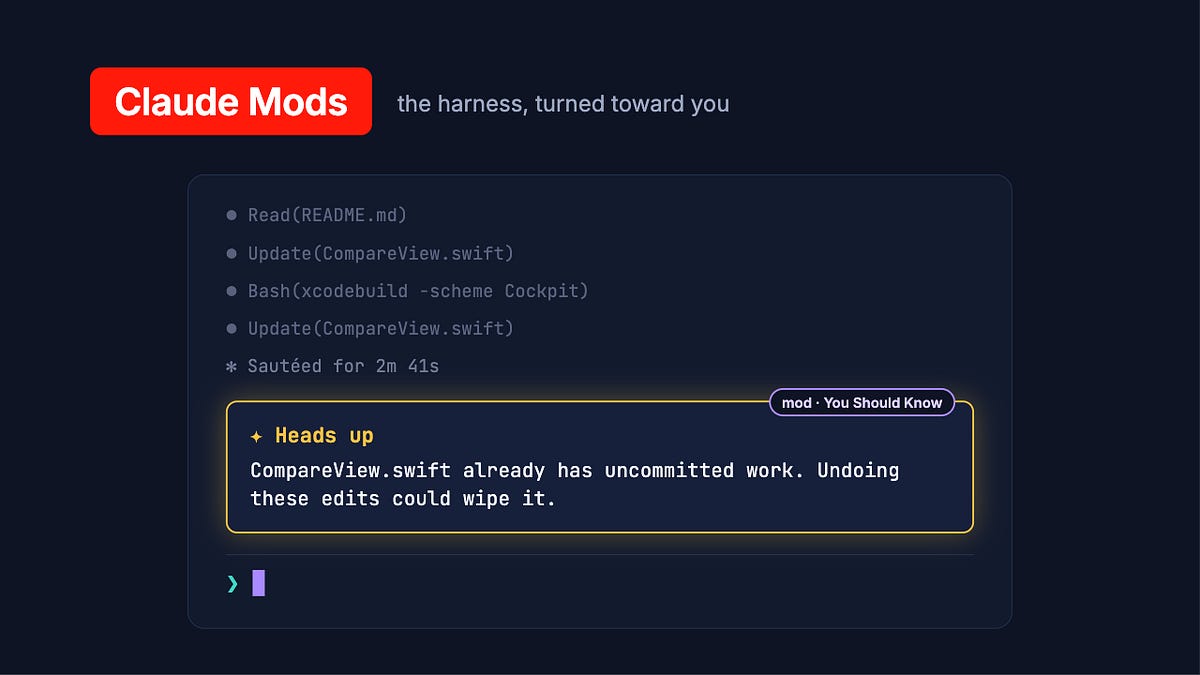 Claude Mods: Flipping the Harness Inside Out
Claude Mods are Claude Code plugins, written as TypeScript or JavaScript functions, that hook into prompts, tool calls and rendering to customize the CLI and Desktop. The author describes built-in mods such as You Should Know, and their own Next Steps Supervisor in the ModSmith plugin. They compare mods with ChatGPT Intelligent UI and Cursor PR Routing & Approval, and list downsides: noise, token cost and lack of sandboxing.
 latent.spacearticlePublished and added 21 Oct 2026🧠 AI
 Claude Mods: Flipping the Harness Inside Out
Claude Mods are Claude Code plugins, written as TypeScript or JavaScript functions, that hook into prompts, tool calls and rendering to change how the CLI and Desktop behave. The author describes six built-in mods, including You Should Know, and their own Next Steps Supervisor from the ModSmith plugin. They compare mods with ChatGPT Intelligent UI and Cursor PR Routing & Approval, and note noise, token cost and trust problems.
latent.spacearticleAdded 23 Oct 2026, published 21 Oct 2026🧠 AI From JavaScript to Renderer Code Execution: Three V8 Vulnerabilities and Two v8CTF Flags | depthfirst
Depth First Security's write-up describes three V8 bugs found using its dfs-large1 research tooling: CVE-2026-78938, a type confusion in Promise.prototype.finally that lets an internal helper be constructed and return a primitive; CVE-2026-79236, a TurboFan load-elimination bug that keeps a stale property-array pointer after object migration; and a shared WebAssembly memory sandbox escape (issue 546253900) caused by mismatched backing-store registration during serialization. It walks through turning each memory bug into addrof/fakeobj primitives, chaining either with the sandbox escape to reclaim a freed V8 isolate via a WebSocket allocation, and pivoting through a CFI-constrained ROP chain to achieve Chrome renderer code execution, earning two v8CTF flags. Fixes landed between August 20 and 25, 2026.
 depthfirst.comwriteupAdded 29 Oct 2026, published 20 Oct 2026🛡️ Security
- OpenVLHarness: Real World Visual Agentic Tool-Use with Multimodal Memory
OpenVLHarness is a multimodal reasoning harness for MLLMs built on a capability layer (task-level tool interfaces plus evidence rendering) and persistent multimodal memory that stores images, structured data and web references as addressable artifacts. A coding interface runs generated programs over stored data. Across 22 benchmarks and eight backbones it adds 9.7-12.6 points over no-tool baselines, and GPT-6 Luna at medium effort beats Codex and Visual Sketchpad at maximum effort using at most 37% of their tokens.
arxiv.orgpaperAdded 21 Oct 2026, published 19 Oct 2026🧠 AI - OpenMOSS/MOSS-Image
MOSS-Image is an open-source text-to-image model family from OpenMOSS with a 5B backbone, released October 2026 as MOSS-Image-Base and MOSS-Image-SFT. It supports JSON layout control with bounding boxes, text rendering inside images, and prompts up to 4K tokens. The repo gives a Diffusers pipeline, a Gradio app, a ComfyUI plugin, LoRA training guidance, a prompt-enhancer skill and day-0 SGLang and vLLM-Omni support.
 github.comrepoAdded 20 Oct 2026, published 16 Oct 2026🧠 AI
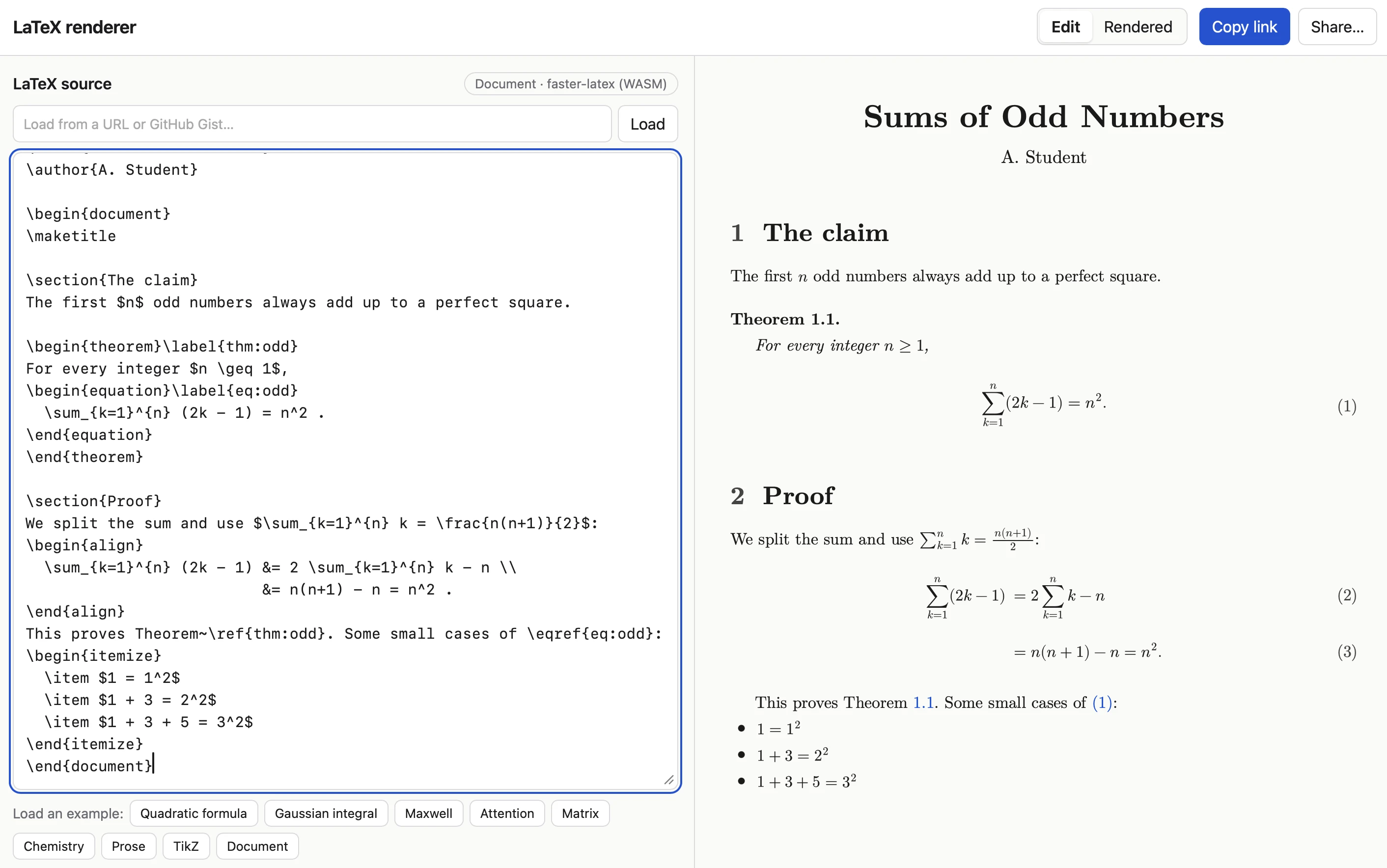 LaTeX renderer
Simon Willison describes using Claude Code (Opus 5.5) to build a browser LaTeX renderer inspired by Tiny Little Office, which stores document data in the URL #fragment and ships an llms.txt so agents can construct document links. He lists the prompts: fragment-hash rendering, a custom compression dictionary for LaTeX, an iframe sandbox against XSS copied from his SVG-in-Markdown tool, and loading from a URL or Gist. The finished tool uses Pako 2.1.0, MathJax 4.1.3, faster-latex 0.3.1 and DOMPurify 3.4.16.
 simonwillison.netarticleAdded 16 Oct 2026, published 15 Oct 2026🧠 AI
- Approve What, Exactly? Effect Binding and Trusted Rendering for Agent Step-Up Authorization
Paper arguing that agent human-approval prompts count as a second factor only if agent compromise cannot forge them and they name exactly what is approved. It defines twelve attacks on the approval path (decoy recipients, amount cancellation, card padding, label spoofing, enrollment squatting, threshold splitting) and tests them against AP2, Microsoft's action-bound approval design and MCP elicitation. An audit of ten agent runtimes found no third-party verifiable approval record and post-approval argument changes in four of eight. The reference defense ASU (Agent Step-Up) renders the card from a canonical effect descriptor, has a phone passkey sign its digest, and executes only the stored call. It is proven in Tamarin (53 lemmas) and evaluated on 27,108 scripted trials and 609 AgentDojo pairs. The trusted card cut forged-narration attack success from 0.54 to 0.03 and raised LLM-approver catch rate from 0.30 to 0.98.
arxiv.orgpaperAdded 17 Oct 2026, published 15 Oct 2026🛡️ Security  Google Partially Reverses Chrome Bug Bounty Cuts
Google is raising Chrome Vulnerability Reward Program payouts for memory safety bugs. The base rate goes from $500 to $2,000, with up to $20,000 for browser, GPU and network process bugs and up to $8,000 for renderer use-after-free and memory write bugs. V8 sandbox bugs move to a flat $5,000 and V8 logic bugs to $4,000. A $2,000 fuzzer bonus returns, and submissions made after April 30, 2026 are rewarded under the new rules. The rates are still well below the pre-April 2026 levels. The article also notes that Google temporarily closed the OSS VRP to product vulnerability submissions because of a flood of AI-generated reports.
 securityweek.comarticlePublished and added 13 Oct 2026🛡️ Security
- Zero to calc in six days: inside XBOW's Chrome full chain
XBOW researchers describe a Chrome full-chain exploit that combines a V8/Maglev deoptimization bug (mutable HeapNumber treated as immutable), a TOCTOU flaw in Blink's animated-WebP decoder exploiting a transferred ArrayBuffer, and a race in Crashpad's remote-memory reader to achieve code execution outside the renderer sandbox. The chain, built in six days largely by AI agents using OpenAI's gpt-5.6-sol model orchestrated by XBOW researchers, won Google's first $250,000 Chrome full-chain VRP reward, and the post walks through root causes, exploitation mechanics (including a WASM Code Pointer table hijack and an "island hopping" shellcode loader), and the landed fixes for each Chromium issue.
 xbow.comwriteupAdded 18 Oct 2026, published 13 Oct 2026🛡️ Security
- DreamTrue: Action-Faithful Robot World Model with Counterfactual Post-Training
DreamTrue is a multi-view, cross-embodiment robot world model for action-faithful, physically plausible video prediction. It renders action trajectories into image-space conditions aligned to target videos by offline geometric calibration. Counterfactual post-training modifies recorded trajectories to cover unsuccessful interactions and contact configurations. A human-annotated defect dataset trains an embodied video reward model whose scores drive RL post-training. On AgiBot it reaches state-of-the-art action following and cuts the human-assessed interaction defect rate from 48.12% to 6.25%. It ranked first in the world model track of the AgiBot World Challenge 2026.
arxiv.orgpaperAdded 9 Oct 2026, published 8 Oct 2026🧠 AI - GPT-6 and Intelligent UI for everyone
GPT-6 in ChatGPT adds Intelligent UI, where the model composes answers from text, charts, forms, buttons and small interactive tools using a library of native streamable components and a compiler that renders the interface as it generates. It can also start answering while still reasoning. OpenAI reports GPT-6 Instant starts web-search answers 44% sooner than GPT-5.6 Instant. GPT-6 Sol serves paid tiers and GPT-6 Luna serves Free and Go.
 openai.comarticlePublished and added 7 Oct 2026🧠 AI
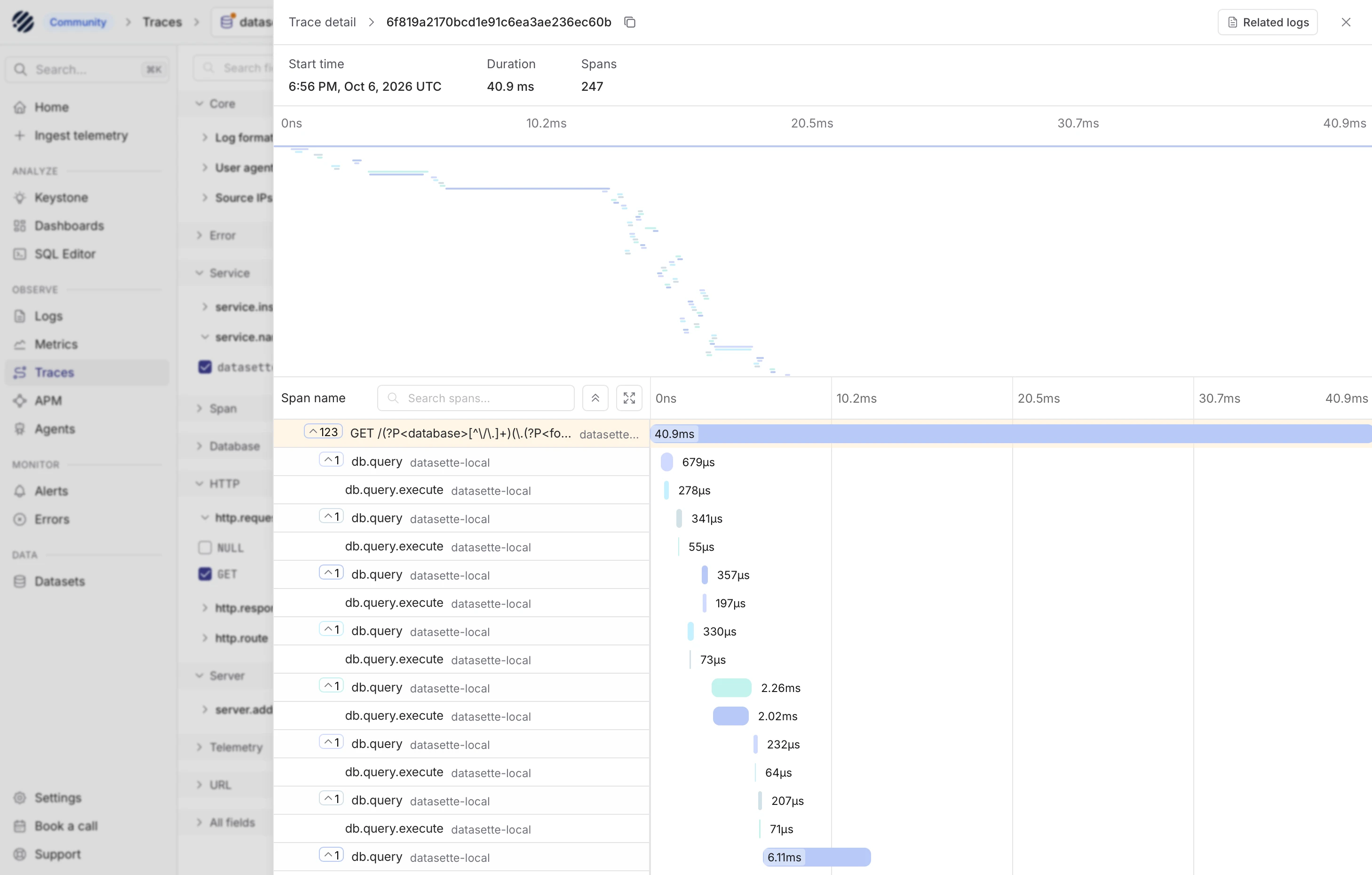 Using Parseable with Datasette for OpenTelemetry traces
Simon Willison describes using Parseable, a new open-source (AGPL) Rust-based observability platform shipped as a single ~180MB binary with enterprise and cloud-hosted tiers, to collect and view OpenTelemetry traces emitted by Datasette, which gained OpenTelemetry support in version 1.0a41 (added by Alex Garcia). He used Codex to work out the integration and links to a human-written TIL documenting the working setup, alongside a screenshot of a Datasette trace rendered in Parseable's web UI.
simonwillison.netarticlePublished and added 6 Oct 2026🧠 AI- Mistral Large 4
Simon Willison's linkblog entry on the release of Mistral Large 4, built around a Hacker News comment arguing that standard benchmarks are saturated. The commenter demonstrates this by running the identical whimsical prompt, Generate an SVG of an armadillo in fishnet tights jaywalking on Mars, through Claude Opus 5.5, GPT-6.1 Sol, Gemini 3.8 Flash, and Mistral Large 4 via Willison's llm CLI tool, then compares the rendered SVGs at each model's default reasoning level using his markdown-svg-renderer tool.
simonwillison.netarticlePublished and added 6 Oct 2026🧠 AI - ALIVE: Interaction-Aligned Object Insertion for First-Frame-Guided Video Editing
ALIVE is a framework for first-frame-guided video editing that inserts objects so they coherently participate in interactions (e.g., being picked up or manipulated) rather than appearing static. The authors curate a 35,800-pair editing dataset combining 3D-rendered, model-generated and real-world videos plus pairs from ROSE, and train a vision-language model to predict interaction guidance from the edited first frame and an instruction naming the object. They introduce the ALIVE-interaction benchmark to measure interaction fidelity, source preservation and visual coherence via a unified VLM-based protocol, reporting a 43.9% Overall improvement on this benchmark and 4.4% on a general video object insertion benchmark over the strongest baseline, with VLM-predicted guidance adding a further 0.95-point gain.
arxiv.orgpaperAdded 7 Oct 2026, published 6 Oct 2026🧠 AI  Introducing Solana Microscope: Program Monitoring and Alerts
Microscope is an open-source, self-hosted monitoring and alerting tool for Solana programs that decodes a program's instructions and events using its IDL, then renders that activity as Grafana dashboards backed by Loki (logs) and Prometheus (metrics). It can also watch a Squads multisig controlling the program, firing precise alerts on specific instructions, events, field values, or multisig proposal approvals to Slack, Telegram, or PagerDuty. A distinguishing feature is built-in health alerting for the monitoring pipeline itself (stalled gRPC/RPC streams, corrupt checkpoints, records decoded but not reaching Loki), so teams can distinguish "program is quiet" from "monitoring is broken." It deploys via Docker Compose, Terraform (AWS/GCP), or Kubernetes manifests, and the code is MIT-licensed on GitHub.
 solana.comtoolAdded 8 Oct 2026, published 5 Oct 2026🛡️ Security
- Show HN: Made an open-source Lego AI generator
ldraw-nova is an open-source agentic pipeline where an LLM agent (tested with models like Claude Opus 5.5 and GPT-6 Astra) takes a build prompt, reads LDraw-building instructions, and produces a plan.json describing a model's geometry. From that plan it writes a Python generator script that, when executed, outputs an LDraw (.mpd) 3D CAD source file, viewable in 3D/VR (Meta Quest 3) or exportable to Blender-editable glTF. The agent uses jev-rerank, a semantic search tool with reranking backed by TypeSafe's Jev System One model, to find suitable LEGO parts and example models, falling back to full-text search without an API key; it also uses headless rendering and collision/gap detection to self-inspect and iterate on designs.
github.comrepoAdded 3 Oct 2026, published 2 Oct 2026🧠 AI  Tavus Griffin: the first Human Interaction Model
Tavus introduces Griffin, a "Human Interaction Model" (HIM): a full-duplex, video-to-video system that unifies real-time perception, conversational decision-making, and expressive audiovisual generation into one model rather than a cascaded pipeline. It uses a Continuous Conversational Modeling engine that makes sub-second turn-taking and nonverbal-behavior decisions, paired with a streaming speech generator built on a new continuous audio codec (Tavec) and a distilled autoregressive video diffusion model that renders 720p video in 320ms chunks. In live one-minute video calls, Griffin-Lite was judged human by 48% of participants (versus 2.4% for Tavus's prior Phoenix-4.5 system) and topped NVIDIA's VideoFDB full-duplex conversation benchmark on both generation and perception tracks.
 tavus.ioarticleAdded 2 Oct 2026🧠 AI
- World Embedding Benchmark
The World Embedding Benchmark is a new evaluation suite of 8,000 controlled simulation cases across 80 families (fluid mechanics, solid mechanics, dynamics, optics & electromagnetism), each pairing a rendered video with simulation-derived physical annotations. It tests pre-trained omnimodal embedding models on text-video retrieval, physical-property regression, and multiple-choice video-description classification, finding that current embeddings align poorly cross-modally while lightweight probes can still recover physical quantities, and that continual contrastive training improves alignment but hurts regression. The authors also show retrieval-augmented generation using these embeddings with MiniMax-H3 improves the physical fidelity of generated videos.
arxiv.orgpaperAdded 5 Oct 2026, published 2 Oct 2026🧠 AI - A Vision-Language Model (VLM)-based Pipeline for End-to-End Procedural Modeling of Field-Grown Maize from Point Clouds
This paper presents an automated pipeline that uses a vision-language model to annotate leaf midlines in rendered orthographic views of maize point-cloud scans, then applies deterministic geometric algorithms and differentiable NURBS fitting to reconstruct editable, organ-level procedural 3D plant models without manual tuning or species-specific segmentation training. Evaluated on 100 field-grown maize plants from the MaizeField3D dataset, it achieves a median whole-plant Chamfer distance of 5.4 mm and recovers 99.4% of curated reference leaves at IoU ≥ 0.5, outperforming an earlier semi-automated pipeline. It demonstrates that VLM annotations can become reliable quantitative measurements when paired with correcting geometric post-processing, enabling scalable generation of 3D plant assets for high-throughput phenotyping and in silico breeding.
arxiv.orgpaperAdded 5 Oct 2026, published 2 Oct 2026🧠 AI  AI Signal (@AliciaCrawoiue) on X
A tweet explains that on October 1st Claude Code shipped "mods": plain TypeScript functions that hook into events the CLI/desktop app already emits (tool calls, permission prompts, UI renders) and can run before, after, or instead of them, letting developers change behavior, customize the UI, or swap in new features. Mods ship inside plugins and are installed via /plugin. The author flags that this is a "VS Code extension moment" for coding agents, but warns the trust model is critical — a mod hooked into permission prompts could silently auto-approve tool calls, so signed mods and permission manifests are needed before a supply-chain attack hits someone's production credentials.
x.comthreadAdded 4 Oct 2026, published 2 Oct 2026🧠 AI- AI Signal (@AliciaCrawoiue) on X
Commentary on Claude Code's newly shipped "mods" feature (TypeScript functions that hook into tool calls, permission prompts, and UI render events, distributed via plugins). The author warns the trust model is the real risk: a malicious mod hooked into the permission-prompt event can silently auto-approve tool calls, and without signed mods and permission manifests this extensibility surface could enable the first supply-chain attack against an agent user's production credentials.
x.comthreadAdded 4 Oct 2026, published 2 Oct 2026🛡️ Security  China-aligned TA419 impersonates Anthropic employee, ex-White House official to phish AI policy experts
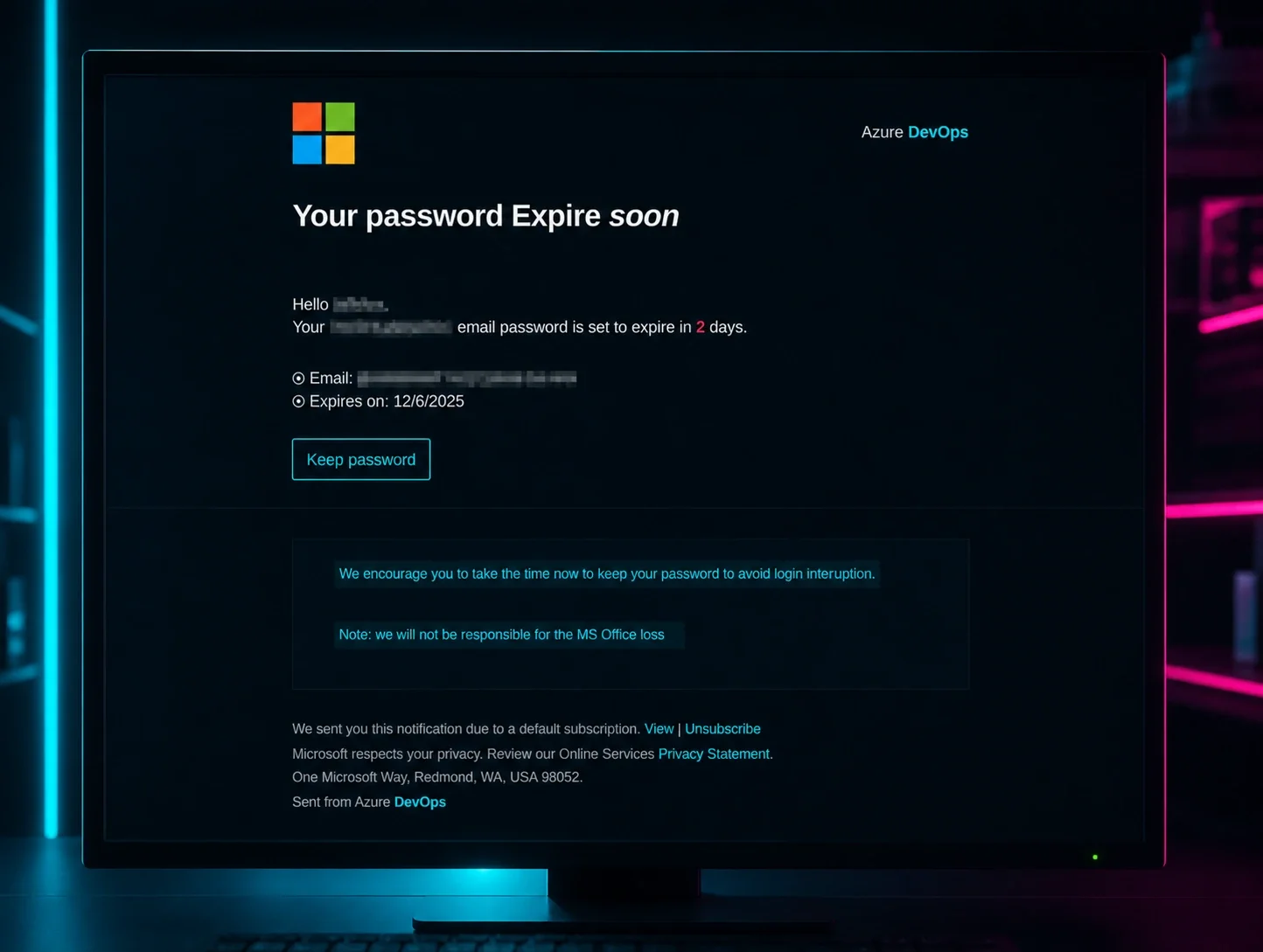
Proofpoint's Mark Kelly details TA419, a China-aligned espionage group that in July 2026 impersonated former White House OSTP official Lynne Edwards Parker and economist Heidi Crebo-Rediker, and in February 2026 posed as a senior Anthropic employee, to phish US AI policy experts' cloud accounts. The attack chain uses benign-looking invitation emails followed by shortened links leading to a fake OneDrive adversary-in-the-middle page that renders a Chrome login window with the open-source Frameless BitB browser-in-the-browser tool, relaying credentials, MFA codes and session cookies live to the attackers via Cloudflare-fronted, NameSilo-registered domains. Proofpoint assesses the campaign supports Chinese intelligence collection on US AI policy and export-control developments.
 helpnetsecurity.comarticleAdded 4 Oct 2026, published 2 Oct 2026🛡️ Security
- zzzz7788990213-ops/EvoVLM
EvoVLM searches over prompts, image preprocessing, generation budgets and answer extraction for frozen Qwen3-VL-2B-Instruct and Qwen3-VL-2B-Thinking, without fine-tuning weights. A local Qwen model ranks a catalog of typed mutations, a trusted renderer produces Python programs, and Pareto selection on accuracy and latency drives two small generations on scientific chart understanding (CharXiv subset). Recorded results on Dev128: Evolved Instruct keeps accuracy with 8.9% lower median latency, and Evolved Thinking gains 16.41 points of accuracy with 10.6% lower median latency. CPU-only replay and fail-closed evidence verification are included. The authors state the limits: small sample, overlap with the evolution set, and results tied to the recorded hardware.
github.comrepoAdded 16 Oct 2026, published 2 Oct 2026🧠 AI - AssemblyWorld: Rethinking 3D Assembly with General-Purpose Agents
AssemblyWorld is an interactive 3D environment where general-purpose agents assemble objects (furniture, industrial parts, fractured pieces) by inspecting rendered 2D views and manipulating supplied rigid parts, optionally guided by images or assembly manuals, without any assembly-specific fine-tuning. The accompanying AssemblyWorldBench benchmark covers 100 tasks across 80 objects and evaluates eight agent systems geometrically; the best system reaches 80.9% part accuracy but only 59.4% complete-assembly success, and open-source systems lag closed-source ones in both reliability and accuracy. The paper analyzes interaction trajectories and failure modes to characterize the gap between approximate structure recovery and precise 3D reconstruction.
arxiv.orgpaperAdded 1 Oct 2026, published 30 Sep 2026🧠 AI - FracGen: Learning How Objects Stretch and Tear with Physics-Informed Video Generation
FracGen is a fracture-aware video generation model that, given a single image of an intact object, generates plausible and controllable fracture dynamics (where an object tears, crack propagation speed, pre-failure deformation) conditioned on physics signals. It is trained using FracSim, a material point method (MPM) simulation framework augmented with a continuum damage model that produces paired fracture videos and dense pixel-aligned physical fields at no extra rendering cost; FracGen jointly predicts these fields alongside RGB video and is supervised with physics-informed consistency losses. The authors also introduce a benchmark for evaluating physical plausibility of generated fracture video, showing FracGen outperforms existing video generation baselines in both physical and visual fidelity.
arxiv.orgpaperAdded 30 Sep 2026, published 29 Sep 2026🧠 AI  https://www.rfc-editor.org/search/?status=Best+Current+Practice&area=sec
A saved search on the official RFC Editor site filtered to documents with status Best Current Practice in the sec (Security) area, effectively a live index of IETF's authoritative security best-practice standards such as BCP-level RFCs on anti-spoofing/ingress filtering, routing security, and password policy. The fetched copy rendered with JavaScript disabled so no result rows were captured, but the query itself is a reusable, continuously updated pointer into the canonical security standards catalog maintained by the IETF/RFC Editor.
 rfc-editor.orgotherAdded 2 Oct 2026, published 29 Sep 2026🛡️ Security
- Learning Native Reflection in Unified Models with Interleaved Reinforcement Learning
UMM-Reflection is a reinforcement learning method that trains a unified multimodal model to jointly learn reflection text and image revision within a single closed loop: diagnose an image's flaws, revise it, observe the result, and repeat. Sibling trajectories sharing one initial image enable a group-relative advantage that compares whole reflection strategies rather than assigning credit per round, and one trajectory-level advantage updates both the reflection tokens and the flow-based revision head jointly, unlike SFT cold-starts or RL that optimizes only the renderer. On BAGEL, it improves GenEval by 12.05 points over SFT and transfers to unseen benchmarks WISE, OneIG-Bench and T2I-CompBench++, with no external verifier needed at inference.
arxiv.orgpaperAdded 29 Sep 2026, published 28 Sep 2026🧠 AI - Many Eyes, One World: Feed-Forward 3D Reconstruction from Mixed Cameras
MEOW is a feed-forward 3D reconstruction model that jointly predicts metric pointmaps and camera poses from N-view image tuples mixing perspective, fisheye, and full 360° panoramic images in a single forward pass, without any camera calibration, distortion parameters, or camera-type labels supplied. It keeps a perspective-pretrained backbone and adapts it to heterogeneous cameras purely through a procedural synthetic data engine that renders scenes across a continuous manifold of camera models with exact rays, depth, and verified covisibility, then transfers zero-shot to real captures, beating the Wid3R baseline (79.9 vs 53.8 mAA@30 on heterogeneous 2D3DS tuples even when Wid3R is given ground-truth camera types) and scoring 79.4 AUC@30 on a new laser-scanned mixed-camera benchmark.
arxiv.orgpaperAdded 29 Sep 2026, published 28 Sep 2026🧠 AI - Source-preserving alignment for robust evidence localization in scientific PDFS
Presents a source-preserving alignment framework for locating extracted evidence strings within the original PDF text layer, addressing mismatches caused by line wrapping, Unicode variants, superscripts, and citation markers. The method normalizes text for matching while preserving provenance to map matches back to exact source-character spans and render only the matched geometry, falling back to line-break-aware token alignment when exact matching fails. On 1,020 chemistry papers it achieves a 92.6% quote-level automatic localization rate versus 43.6% for plain text search and 19.1% for a precomputed bounding-box baseline.
arxiv.orgpaperAdded 29 Sep 2026, published 28 Sep 2026🧠 AI - zhuyansen/awesome-claude-video-skills
Awesome-list repository cataloguing 183 open-source 'skills' and toolkits that let Claude Code, Codex and other coding agents generate or edit video: rendering frameworks like HyperFrames and Remotion, motion graphics, explainer/promo video generators, short-form editors, digital avatars and music videos. Each entry is read and security-graded by a companion service (Agent Skills Hub / agentskillshub.top), with a machine-readable JSON feed and category breakdowns (frameworks, promos, explainers, editing, shorts, avatars, animation, motion graphics, scripts, music videos).
github.comrepoAdded 29 Sep 2026, published 27 Sep 2026🧠 AI - AgentSystemLabs/agent-office
agent-office is an open-source Node.js application that renders your team's projects as floors of a cartoon 3D office, where each Claude Code, OpenCode or Codex coding-agent worker sits at a desk with a visible terminal others can join. It wires agent workers directly into GitHub: an issues board and PR board with diff review, CI status and merge actions, a task queue that auto-hires workers into isolated git worktrees, one-click PR creation, live worker status via Claude Code/Codex hooks and an OpenCode plugin, and per-worker cost/token tracking against Claude plan limits. It also supports multi-agent meeting-room collaboration patterns such as debate, lead and team, map-reduce, red and blue, and review panel, where several agent workers jointly produce a file and open a PR, plus shared voice chat and screen sharing for the human team.
github.comrepoAdded 28 Sep 2026, published 26 Sep 2026🧠 AI - OAuth Token Theft Through Microsoft's Front Door | Huntress
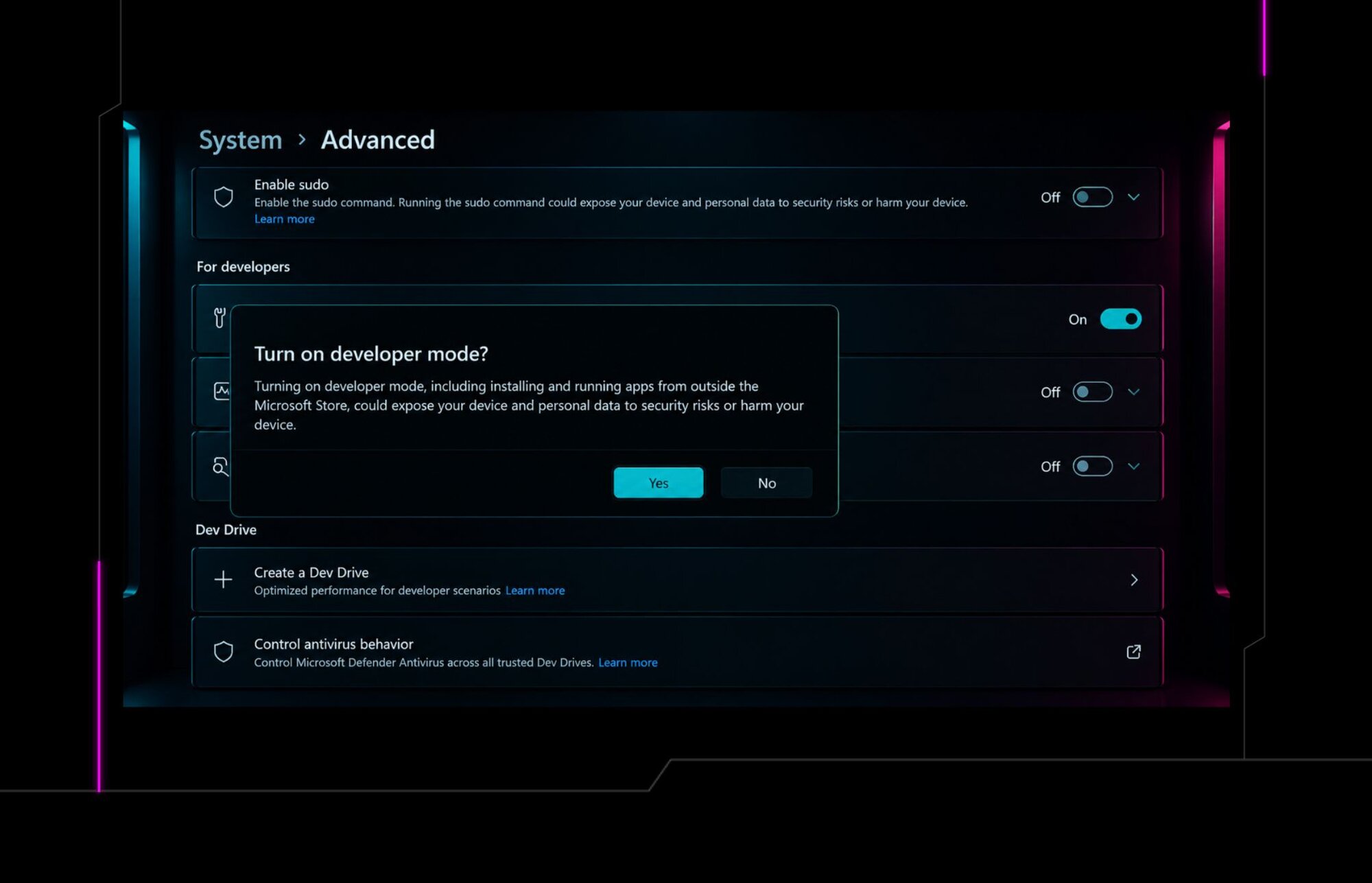
Huntress researcher Andrew Schwartz demonstrates a novel OAuth token-theft technique: a sideloaded AppX package registered via Add-AppxPackage -Register (requiring only Developer Mode, no admin beyond that toggle) can set ContentUriRules WindowsRuntimeAccess="all" so attacker-controlled JavaScript rendered inside the Microsoft-signed WWAHost.exe process gets full WinRT access, including the legacy WebAuthenticationBroker OAuth API. Using Microsoft Office's own client ID and the oob redirect URI, the attacker triggers a genuine login.microsoftonline.com/MFA dialog with no browser chrome, captures the auth code, and exchanges it for an access token plus a long-lived refresh token carrying the full Office delegated Graph scope set (mail, files, Teams, directory, AuditLog.Create) — validated end-to-end against a live Entra ID tenant with MFA and default Conditional Access. The post frames it as a class of vulnerable signed AppX host binaries sharing the same WinRT activation layer, and provides a Sigma rule keyed on the MSAppHost/3.0 EdgeHTML user agent reaching non-Microsoft destinations, plus Sysmon/Event ID and GPO-based mitigations (restricting Developer Mode, Conditional Access, shorter refresh-token lifetimes, CAE).
 huntress.comwriteupPublished and added 23 Sep 2026🛡️ Security
 MITRE ATLAS Adds 11 AI Agent Attack Techniques (Zenity Labs collab)
Zenity Labs details its collaboration with MITRE ATLAS to add roughly 11 new AI agent attack techniques, drawn from real-world observations and DEF CON 34 research rather than hypotheticals. New entries cover recon (Active Scanning subtechniques for predictable agent URLs, provider metadata APIs, Search Open Websites/Domains for embedded agentic iFrames, Discover AI Agent Runtime Capabilities, Scan Databases via Shodan/Censys, Misconfigured or Publicly Exposed AI Services), input manipulation (Triggers in Multimodal Inputs, LLM Prompt Obfuscation via image/audio/video, Crafted AI Assistant Links using ?q=/?prompt= parameters, AI Targeted Cloaking, LLM Response Rendering exfiltration, LLM Jailbreak's Data Structure Injection), and a defensive mitigation built on AI honeypots plus multimodal guardrail inspection.
 labs.zenity.ioarticleAdded 30 Sep 2026, published 16 Sep 2026🛡️ Security
- SenseNova-U1.5: Towards Native Unified Visual Intelligence
SenseNova-U1.5 is an 8B-parameter Mixture-of-Transformers native unified multimodal model that understands, reasons about, and generates visual content within an encoder-free and VAE-free architecture. It uses spatially coherent patch reconstruction, native 4K resolution training, and post-training with specialized experts (aesthetics, bilingual text rendering, infographics, image editing) consolidated via multi-expert on-policy distillation. The paper reports advances in image fidelity, text rendering, complex composition, and multi-reference editing, and plans to open-source training code including SFT, RL, and on-policy distillation.
arxiv.orgpaperAdded 22 Sep 2026, published 10 Sep 2026🧠 AI - Programmable World Model
Programmable World Model decouples persistent world-state evolution from visual rendering in video world models: an agent compiles natural-language instructions into executable programs governing entity states and transition rules, which a lightweight engine executes and maintains as explicit global state (including off-screen entities and non-visual attributes). State-augmented 3D oriented bounding boxes plus camera trajectory are deterministically compiled into pixel-aligned conditioning signals fed to a pretrained video model that renders the scene, enabling playable games with predefined mechanics and direct entity control. On the paper's new CombatStateBench benchmark it achieves 94% Count Accuracy and 98% State Accuracy, beating existing interactive video world models on long-horizon coherence.
arxiv.orgpaperAdded 22 Sep 2026, published 9 Sep 2026🧠 AI - kajisho5/ffmpeg-skill
ffmpeg-skill is an Agent Skill (SKILL.md plus 42 stdlib-only Python tools) that lets Claude Code, Cursor, Codex and other agents edit video and audio with local ffmpeg/ffprobe. It enforces a probe → edit losslessly → check → verify workflow, and every tool takes --dry-run, --json and --plan. A machine-readable contract, whose input schemas are derived at run time from each script's argparse parser (the author's "SPEC" pattern), drives an MCP server that lists a core 12 tools by default. The repo also ships per-platform render templates, a doctor capability check, a test suite and evals. It is useful as a worked example of a deterministic, verifiable skill/tool layer in which the agent supplies judgement and the tools do the work.
github.comrepoAdded 16 Oct 2026, published 3 Sep 2026🧠 AI  Training a coding model to paint watercolours with TRL and OpenEnv
A Hugging Face engineering blog post reproducing Surya Narreddi's viral "AI paints watercolours" project in the open: a coding LLM (Qwen3.5-35B-A3B, LoRA) is trained with GRPO via TRL to write p5.brush JavaScript sketches that render as watercolour flower paintings, using an OpenEnv RL environment with headless-Chromium rendering, an HPSv3 preference-model reward and a Qwen3-VL-30B-A3B-Instruct pairwise judge scored against a hand-curated 178-image reference pool. It documents the full pipeline (HF Jobs, Spaces, Inference Providers), the LoRA fix needed for MoE models (all-linear targeting), infra bugs found (an OpenEnv websocket caching bug fixed upstream, reward-noise from silent render failures), three reward-mix ablations, and open-sources the dataset, environment, training scripts, rollouts and trained models.
huggingface.coarticleAdded 29 Sep 2026, published 3 Sep 2026🧠 AI- ProjectDXAI/continuous-record-llm-trading-agents
Companion repository for the DXRG paper "What LLM Trading Agents Actually Do in Production" (arXiv:2609.05663), reporting a six-month, population-scale record of two live LLM-agent trading fleets: 3,505 DX Terminal Pro vaults on Base and a 500-599 agent DXAP fleet on Hyperliquid perpetuals (231,638 finalized turns, 14,596 fills). It quantifies how the operating layer — not strategy text — drives behavior: a prompt-rendered leaderboard routes 46.5% of trade entries with a sharp regression discontinuity at the render boundary, agent fixed effects absorb 60% of outcome variance, leverage choice is volatility-blind (median 5.0x across a 5.7x volatility spread) with one posture/slider cell concentrating 62% of liquidations, and discretionary exits underperform a fixed 2%/4% bracket. A 416-scenario paired replay across three frontier models found similar decision quality but sharply different choice-consistency flip rates (35% vs 90%+), and the repo ships the paper, figures, aggregate data extracts, dataset cards and a 17-rule methodology canon distilled from the project's own retracted claims.
github.comrepoAdded 2 Oct 2026, published 1 Sep 2026🧠 AI  Yet another RCE in Gogs, but it's fixed this time!
Aikido researchers detail how an AI pentesting agent found a path traversal in Gogs' organization name handling (CVE-2026-52813), which they manually escalated to full Remote Code Execution by planting a bare git repository inside a worktree and overwriting its hooks/update file to trigger command execution on push. The post also covers a git-receive-pack/git-upload-pack service parameter confusion causing an authorization bypass allowing writes to private repos by read-only users (CVE-2026-52810, with an unpatched case-sensitivity bypass and manual code fix provided), and a stored XSS in Gogs' Jupyter notebook rendering via an outdated notebookjs library that bypasses bluemonday sanitization via onerror handlers set during innerHTML assignment.
 aikido.devwriteupAdded 3 Sep 2026, published 19 Aug 2026🛡️ Security
- DEF CON® 34 Hacking Conference - Main Stage Talks
The official DEF CON 34 main-stage talk listing, with full abstracts and speaker bios for dozens of original research presentations spanning bootrom-to-wallet-key exploitation of the dGEN1 Ethereum phone, a privilege-escalation chain in Microsoft's Python-in-Excel Azure container (CVE-2026-45459), a novel x86 SMM hardware attack, black-box TEE key recovery on the TI OMAP-L138 via timing side channels, native-code exploitation of llama.cpp and Ollama, a CDP-based Browser-in-the-Middle AitM phishing toolkit defeating CSP/SRI, CPDLC air-traffic-control message injection via SDR, an iCloud Keychain extraction bug (CVE-2026-28860), Segmentation Fault-Oriented Programming (SFOP) for bypassing Intel CET, weaponized WMI provider post-exploitation, an autonomous AI system (HTTP Terminator) discovering novel HTTP desync attacks, quantum ML for OS fingerprinting, reverse engineering of Windows Defender's BTR.sys driver for EDR bypass, a V8 renderer RCE in Samsung Internet (CVE-2025-10891), an LLM CI build-gate bypass, a Bring-Your-Own-EDR PPL abuse technique, Amazon Locker hardware hacking, and Windows PnP USB auto-install RCE via RDP redirection.
 defcon.orgotherAdded 10 Aug 2026🛡️ Security
- eternityspring/shuohao-skills
shuohao-skills is a set of five chained Claude Code / Codex agent skills that turn a novel into short-drama production assets: novel-outline (adaptation outline), novel-characters (cast bible), novel-art (scene/prop art bible), novel-script (episode scripts with a duration gauge), and novel-storyboard (shot-by-shot storyboards with actual generated shot images and prompts), plus a standalone character-refs skill that generates character reference images (anchor via GPT, rest via Qwen). Each skill is a self-contained directory with a required SKILL.md and a dependency-free scripts/selftest.mjs, installable via a symlink script that auto-detects Claude Code vs codex, and there is a separate report.mjs assembler that merges the five bilingual HTML reports into one navigable page without touching each skill's own render code (handling CSS/JS scoping and image-path rewriting).
github.comrepoAdded 30 Sep 2026, published 6 Aug 2026🧠 AI - lockfale/OSINT-Framework
OSINT Framework is a curated, categorized index of free (mostly) open-source intelligence tools and resources, organized by data type (username, domain, IP, email, social media, etc.) and rendered as an interactive tree at osintframework.com. Each entry in the underlying arf.json is tagged with metadata like whether it requires local install (T), a Google dork (D), registration (R), or manual URL editing (M), plus richer fields such as input/output type, pricing, and opsec notes. It's a long-standing community reference for recon and investigation tradecraft across infosec and other fields.
github.comrepoPublished and added 31 Jul 2026🛡️ Security - GRC Engineering Cheat Sheet
A reference cheat sheet from grc.engineering contrasting 'Legacy GRC' with an emerging 'GRC Engineering' discipline, structured as a glossary of terms, a tools list, and curated teachings/timeline. The live page content did not render in this fetch (tables appear empty), so specific terms and tools named on the site could not be confirmed.
 cheatsheet.grc.engineeringotherAdded 3 Sep 2026, published 26 Jul 2026🛡️ Security
 Going depthfirst: Achieving GitLab RCE via Two Ruby Memory Corruption Vulnerabilities | depthfirst
Depthfirst's research describes an RCE chain against GitLab CE/EE (versions 15.2.0 through 18.10.7, 18.11.0 through 18.11.4, and 19.0.0 through 19.0.1) built from two memory-corruption bugs in the Oj Ruby JSON gem, reachable through the ipynbdiff notebook-rendering feature. It walks through an out-of-bounds write that corrupts a parser callback pointer, a heap-pointer disclosure used to defeat ASLR, and the gadget chain that reaches system() as the git user, plus nine additional Oj CVEs found during the same review.
depthfirst.comwriteupAdded 29 Oct 2026, published 24 Jul 2026🛡️ Security AI Security Briefing
CVE-2026-14898 affects the OpenAI Codex desktop app for macOS, which automatically renders remote images embedded in Markdown model output without user interaction. An attacker can use indirect prompt injection to make Codex generate a response containing an attacker-controlled image URL whose parameters embed sensitive data (API keys, source code, tool output), which is silently exfiltrated when the app auto-fetches the image. Categorized under CWE-200, no patch or CVSS score was available at disclosure.
 cybersecuritynews.comadvisoryPublished and added 18 Jul 2026🛡️ Security
- Icex0/wp2shell-poc
wp2shell-poc is an independent proof-of-concept tool for the wp2shell vulnerability chain in WordPress core: an unauthenticated route-confusion bug in the REST /batch/v1 handler (serve_batch_request_v1) that desynchronizes matched-handler and validation arrays when a sub-request fails wp_parse_url(), letting a GET posts item-route request be dispatched under get_items() so the author_exclude parameter reaches WP_Query's author__not_in query var as unsanitized SQL. The tool's check/read/shell commands detect the route-confusion marker pattern, extract data via UNION/error-based/boolean-blind SQLi, and (without credentials) chain UNION fake-post rendering into oEmbed cache post creation, ID recovery via SQLi, and a poisoned batch request that creates a real WordPress administrator account, finishing with a plugin-upload webshell. Affects WordPress builds before 7.0.2 (or 6.9.5 on the 6.9 branch); links out to Searchlight Cyber's advisory and Elastic/Eye Security detection guidance.
github.comrepoAdded 2 Oct 2026, published 17 Jul 2026🛡️ Security  AutoJack: How a single page can RCE the host running your AI agent | Microsoft Security Blog
Microsoft Security Research disclosed "AutoJack," an exploit chain in AutoGen Studio (the prototyping UI for Microsoft's AutoGen multi-agent framework) where an agent with browsing capability (e.g., MultimodalWebSurfer) that renders an attacker-controlled webpage can be jacked into opening a WebSocket to the local MCP control plane at /api/mcp/ws. The chain combines three flaws: a localhost-only origin allowlist that the agent's own headless browser satisfies (CWE-1385), an auth middleware that explicitly skips /api/mcp/* paths without the intended WebSocket-level check (CWE-306), and a server_params query parameter that is base64-decoded into StdioServerParams and executed verbatim via stdio_client with no executable allowlist (CWE-78) — letting the page spawn calc.exe or arbitrary commands under the developer's account with no user interaction beyond the agent rendering the page. The issue was fixed pre-PyPI-release upstream (commit b047730) and never shipped in the published autogenstudio package; Microsoft provides mitigation guidance and Defender advanced hunting KQL queries to detect the pattern (suspicious child processes from autogenstudio, WebSocket calls carrying server_params, browser-automation processes reaching non-corporate domains).
 microsoft.comwriteupAdded 20 Jun 2026, published 19 Jun 2026🛡️ Security
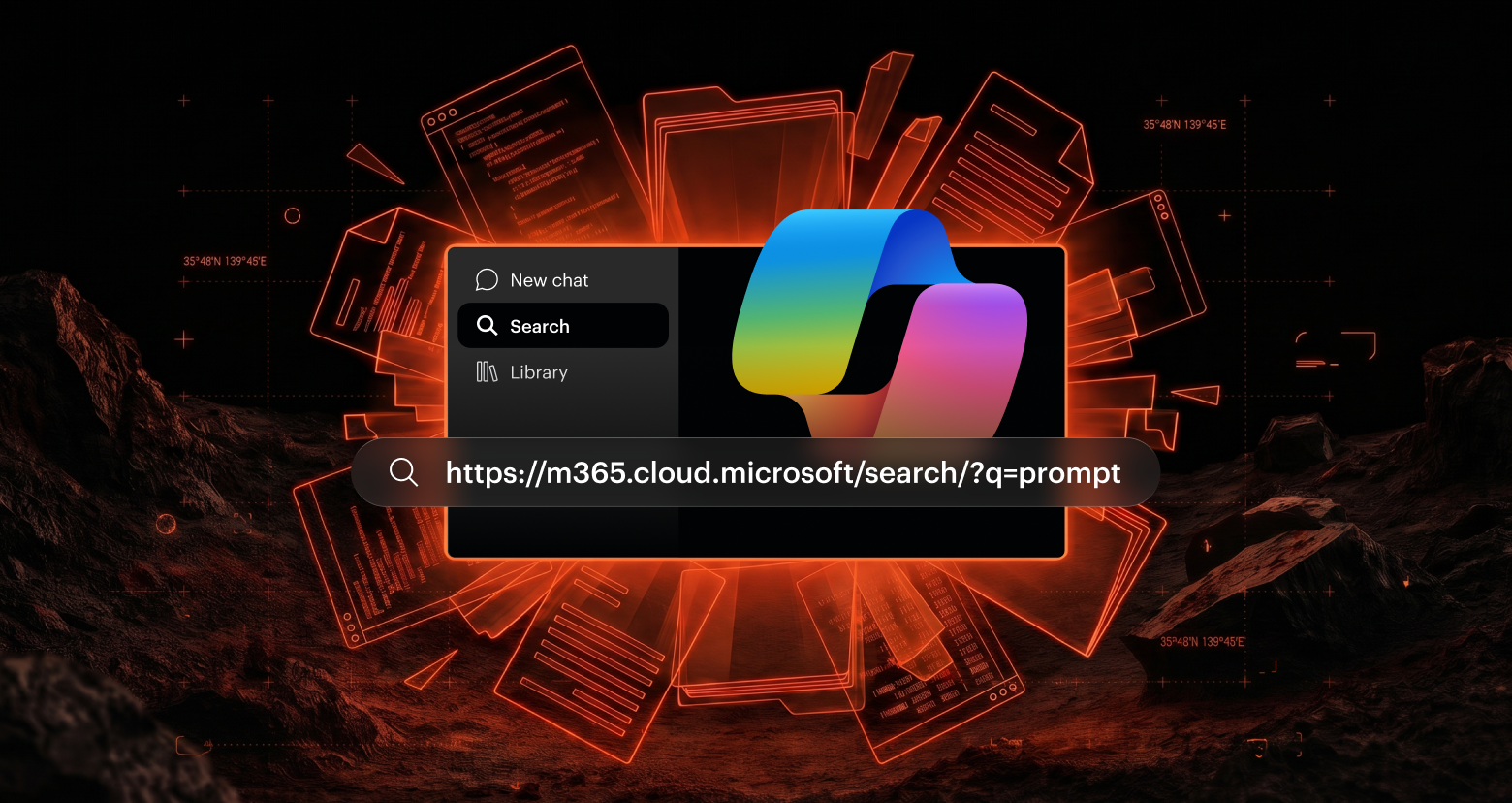 SearchLeak: How We Turned M365 Copilot Into a One-Click Data Exfiltration Weapon
Varonis Threat Labs details SearchLeak, a three-stage exploit chain (CVE-2026-42824, critical) that abuses Microsoft 365 Copilot Enterprise Search: a Parameter-to-Prompt (P2P) injection via the search URL's `q` parameter turns a clicked link into an AI instruction, an HTML-rendering race condition lets an injected `<img>` tag fire before Copilot's `<code>`-block sanitizer applies, and Bing's "Search by Image" endpoint (allowlisted in the CSP) performs a server-side fetch that exfiltrates the stolen data to an attacker's server. A single click on a trusted microsoft.com link lets an attacker silently exfiltrate emails, security codes, calendar data, and SharePoint/OneDrive content with the victim's full Graph permissions, no plugins or extra permissions required. Microsoft has patched the issue; the post is a follow-up to Varonis' earlier "Reprompt" finding in Copilot Personal.
 varonis.comwriteupAdded 16 Jun 2026, published 15 Jun 2026🛡️ Security
 New attack turned Microsoft 365 Copilot into 1-click data theft tool
BleepingComputer covers Varonis's SearchLeak research, a three-stage attack chain (CVE-2026-42824, now patched) affecting Microsoft 365 Copilot Enterprise Search. Attackers craft a URL with a malicious 'q' parameter to prompt-inject Copilot into searching a victim's mailbox/OneDrive/SharePoint, exploit an HTML-rendering race condition to slip an unsanitized img tag past output neutralization, then abuse an SSRF in Bing's "Search by Image" feature to bypass CSP and exfiltrate the stolen data (emails, passwords, meeting details) to an attacker-controlled server via a single click, no user typing required.
 bleepingcomputer.comarticleAdded 26 Sep 2026, published 15 Jun 2026🛡️ Security
 Orca Security: Critical Jupyter Enterprise Gateway Vulnerabilities
Orca Security discloses three critical unauthenticated vulnerabilities in Jupyter Enterprise Gateway's Kubernetes manifest rendering pipeline: CVE-2026-44182 (YAML injection via unsanitized environment variables allowing creation of privileged pods/secrets), CVE-2026-44181 (Server-Side Template Injection via KERNEL_XXX env vars in the Jinja2 rendering path, enabling arbitrary Python/OS code execution), and CVE-2026-44180 (bypass of the _enforce_prohibited_ids control that blocks UID/GID 0 kernels, enabling container escape). All affect versions before 3.3.0 and can lead to full Kubernetes cluster compromise in multi-tenant or internet-facing deployments.
 orca.securityadvisoryPublished and added 11 Jun 2026🛡️ Security
 Malicious Skills & Supply Chain Risks in Coding Agents
Datadog Security Labs analyzes how Claude Code's dynamic context feature (the `!` shell-execution syntax in skill frontmatter) runs commands during preprocessing, before the rendered skill content ever reaches the model — meaning model-level prompt injection defenses never get a chance to block malicious actions. They demonstrate this with Clawsights, a malicious skill found in the wild that exfiltrates GitHub auth tokens via `gh auth token` and a curl POST; while Claude Opus 4.6 refused to run the skill when read as plain instructions, a version rewritten to use `!` dynamic context commands executed the credential theft during preprocessing even though the model later claimed (falsely) it hadn't run anything. The post explains Claude Code's multiple skill-loading paths (enterprise, personal, project .claude/skills/, plugins, nested folders, --add-dir) and gives grep-based detection patterns plus a `disableSkillShellExecution` mitigation.
 securitylabs.datadoghq.comarticleAdded 3 Sep 2026, published 14 May 2026🛡️ Security
- OpenUI
OpenUI is a full-stack, renderer-agnostic Generative UI framework centered on OpenUI Lang, a compact streaming-first language for model-generated UI that uses up to 67% fewer tokens than JSON. It provides React runtime and headless packages, prebuilt component libraries (charts, forms, tables), prompt generation from component libraries, and integrations for LangChain/LangGraph, Vue, Svelte, and Angular, plus a CLI scaffolder and an Agent Skill for coding assistants like Claude Code and Cursor.
github.comrepoAdded 22 Sep 2026, published 12 May 2026🧠 AI - SanMuzZzZz/LuaN1aoAgent
LuaN1aoAgent v2 is a TypeScript rewrite of an autonomous, authorized security-research agent built on the Pi SDK, splitting work into Planner, Executor, and Observer (Supervisor/Projector) roles that coordinate via a persisted task graph and an evidence-backed reasoning/operation graph. It runs Executors in per-task Docker sandboxes with a protocol-aware Go network Gateway that enforces IP/domain scope, supports CVE/advisory lookups via NVD and web search, browser rendering, and traffic capture/replay through an authenticated web workbench. The project targets authorized pentesting/CTF-style engagements, with explicit scope enforcement, SOCKS5 egress routing, and human-facing observability (TUI + web UI) for tracing hypotheses to confirmed vulnerabilities and exploits.
github.comrepoPublished and added 8 May 2026🛡️ Security - ZXCurban/NetOrbit
NetOrbit is a terminal-based (TUI) tool that uses Scapy to asynchronously capture outbound IPv4 packets and plots them in real time onto a Braille-rendered world map using GeoIP resolution (MaxMind-compatible with IP-API fallback). It requires root for raw-socket capture, filters out local/private/multicast traffic, and shows a live panel of recent connections (IP, country, protocol, size, interface) - a lightweight terminal alternative to a network-monitoring dashboard for spotting where a machine is talking on the internet.
github.comrepoPublished and added 7 May 2026🛡️ Security - The Three-Finger Test
A Huntress blog post examines the viral "three-finger test" — asking a suspected deepfake video-call participant to hold up three fingers, which exposes real-time face-swap AI because it struggles to render hand-over-face occlusion cleanly. It notes deepfake-detection firms (Reality Defender, OpenOrigins) already say advanced real-time models have patched this tell, and argues organizations should replace ad-hoc human detection tricks with process controls like callback verification and two-person approval for wire transfers, executive requests, and vendor payments.
huntress.comarticleAdded 3 Sep 2026, published 1 Apr 2026🛡️ Security - Phishing Techniques Spotted: Email Examples & Red Flags
Huntress researchers break down five phishing techniques observed in 2025: voicemail-lure emails using obfuscated SVG attachments and the Raccoon0365 phishing kit to redirect victims to fake Microsoft login pages; callback phishing that lures victims to call a fake Visa support number; Microsoft/Docusign brand impersonation abusing open URL redirects on nypost.com; FedEx shipping-notification phishing using an ASCII-rendered QR code to evade image scanning; and Living off Trusted Sites (LoTS) attacks that route victims through legitimate services like Figma and Cloudflare Turnstile before landing on credential-phishing pages. Each example includes specific evasion tradecraft attackers use to bypass email security gateways and detection tools.
huntress.comarticleAdded 3 Sep 2026, published 16 Mar 2026🛡️ Security - Today I Learned - Protected Symlinks
A DFIR.ch blog post explaining the Linux kernel's protected_symlinks (fs.protected_symlinks) TOCTOU mitigation, then demonstrating a bypass: symlinks placed inside a subdirectory of /tmp (which doesn't inherit the sticky bit) are still followed across privilege boundaries. The author walks through reproducing CVE-2023-33865, a symlink vulnerability in RenderDoc's /tmp/RenderDoc log directory, showing how a local attacker can get an arbitrary file written with another user's privileges despite protected_symlinks being enabled, and traces the exact kernel source-code condition responsible.
 dfir.chwriteupAdded 3 Sep 2026, published 24 Feb 2025🛡️ Security