 In Other News: Anthropic Breach Dispute, UEFI Flaw Hits Most Servers, Cloudflare AI Data Leak
SecurityWeek's weekly roundup of 30 October 2026 covers CVE-2026-97631, a 16-year-old buffer overflow in TianoCore EDK II that affects PXE network boot on most servers. It also covers a Cloudflare Workers AI cross-tenant leak caused by an SGLang bug, Anthropic's dispute with Cathedral over a bug bounty intrusion, and fake AI bots probing for secrets. Other items include AI-assisted ransomware (Gold Ogre, Aur0ra), the NIK C2 framework, and North Korean IT worker sanctions.
 securityweek.comarticlePublished and added 30 Oct 2026🛡️ Security
 OpenCode User Hit with Hostile Backlash After Reporting Free AI Loophole
Socket reports on a GitHub issue for OpenCode, opened 28 June, describing a bypass of per-IP usage limits on its free hosted models by switching VPN addresses. The reporter first proposed account-based limits, then reopened the issue in August to promote the workaround and claimed to run 130 agents. After the thread drew harassment and was deleted in October 2026, it is unclear whether OpenCode fixed the bypass.
 socket.devarticlePublished and added 29 Oct 2026🛡️ Security
- OpenCode User Hit with Hostile Backlash After Reporting Free AI Loophole
Socket reports on a GitHub issue in the OpenCode tracker describing a bypass of per-IP usage limits on free hosted models, using a VPN to switch addresses. The reporter first urged account-based limits, then claimed to run 130 concurrent agents through the loophole. After the issue drew harassment it was deleted. Whether OpenCode fixed the bypass in October 2026 stays unclear.
socket.devarticlePublished and added 29 Oct 2026🧠 AI  Chrome extensions with 13.4 million installs caught hijacking searches
BleepingComputer reports Socket researcher John Tuckner's findings on 319 Chrome extensions with 13.4 million installs that hijack the default search engine. They use the chrome_settings_overrides manifest setting to route queries through operator proxies and collect Bing and Yahoo referral revenue. The proxy can later redirect to phishing or malware. Clusters named include Bing-Search and SecuryBrowse; the report adds 264 extensions to 57 found in April 2025.
 bleepingcomputer.comarticleAdded 30 Oct 2026, published 29 Oct 2026🛡️ Security
 Searchjacked: Hidden Browser Extensions Hijack Searches for 13 Million Users
Searchjacked is Socket's research on 319 browser extensions (about 13.44M users over a decade) that hijack searches to earn ad revenue. The fetched text attributes 200 extensions to named operators such as Intango, System1, Perion, Mutual Media and Kinner Lake, and 119 to unknown operators like "SecuryBrowse" and "Bing-Search". It lists the Yahoo and Bing monetization IDs used to link them. The narrative and technical mechanics are not in the fetched text.
socket.devwriteupPublished and added 29 Oct 2026🛡️ Security CVE-2026-101767: Critical Oracle EBS SQL Injection Actively Probed in the Wild
CVE-2026-101767 is a CVSS 9.8 unauthenticated SQL injection in Oracle E-Business Suite's Application Object Library, reachable through the /OA_HTML/AppsTCFServer servlet (GanttDataServer) and chainable to OS command execution. It affects versions 12.2.3 to 12.2.15 and was fixed in the October 2026 Critical Patch Update. Horizon3.ai found it, and Defused saw probing on honeypots on 27 October 2026. Interim mitigation is removing the servlet from the URL firewall allowlist.
 orca.securityadvisoryPublished and added 28 Oct 2026🛡️ Security
 TENSA Engineering (@TENSAEng) on X
A post by TENSAEng describing a workflow for staying within coding-tool usage limits. ChatGPT chat sits outside those limits, while Claude and Grok chats share a pool with Claude Code, Codex and Grok Build. Architecture, file layout, step order and acceptance checks are planned in ChatGPT and saved as repo docs. Claude Code or Codex then implements one small chunk per fresh session.
 x.comthreadAdded 29 Oct 2026, published 28 Oct 2026🧠 AI
 Hackers Start Probing Fresh Oracle EBS Vulnerability
CVE-2026-101767 is a CVSS 9.8 unauthenticated SQL injection in the Application Object Library of Oracle E-Business Suite, patched in Oracle's October 2026 CPU and reported by Horizon3.ai. Defused decoys logged the first exploratory attempts on 27 October 2026, and the flaw could lead to remote code execution. The article recalls CVE-2026-46817 attacks in June and last year's Cl0p zero-day campaign against EBS.
securityweek.comarticlePublished and added 28 Oct 2026🛡️ Security Reva: Real-Time Vulnerability Detection through Contextual Probing of Large Language Models
REVA (REal-time Vulnerability Analysis) is a vulnerability detector that puts a module threat model, lightweight static analysis findings and call-graph information into one LLM forward pass. A trained probe reads the model's internal representations of the new function. On PrimeVul's held-out test set, REVA on GLM-5.3-Flash reaches 60.0% accuracy in about one second per function, matching the agentic VulTriage (59.2%) at over 250 times the speed and under a tenth of the cost. The probe is 14% to 17% more accurate than the LLM's own verdict.
 arxiv.orgpaperAdded 28 Oct 2026, published 26 Oct 2026🧠 AI
- Reva: Real-Time Vulnerability Detection through Contextual Probing of Large Language Models
REVA (REal-time Vulnerability Analysis) is an LLM-based vulnerability detector that screens each new function in one forward pass. It feeds the model a pre-computed module threat model, lightweight static analysis findings and call-graph data, then reads the model's internal representations with a trained probe. On PrimeVul's held-out test set with GLM-5.3-Flash it reaches 60.0% accuracy in about one second per function, matching the agentic VulTriage (59.2%) while over 250 times faster.
arxiv.orgpaperAdded 28 Oct 2026, published 26 Oct 2026🛡️ Security - OWLS: Open-world Language-conditioned Speed Fields for Zero-Shot Rover Navigation
OWLS (Open-world Language-conditioned Speed Fields) plans directly over a vision-language model's dense feature map. A text prompt describing traversable terrain scores every pixel of one camera image. The scores are projected onto the ground, adapted with two morphological operations, and used as the speed field of a minimum-time planner. It needs no training, terrain labels, map or extra sensors. It was tested on a physical rover, on simulated Mars and Moon rovers over 200 procedural terrains, and on real planetary imagery.
arxiv.orgpaperAdded 26 Oct 2026, published 23 Oct 2026🧠 AI - The Geometry of Metaphor: Probing and Steering Metaphor Representations in Large Language Models
The Geometry of Metaphor is an October 2026 arXiv preprint that uses mechanistic interpretability to find causal subspaces for metaphor in LLMs of different architectures and sizes. The authors steer output on classification tasks across parts of speech. They also steer generation tasks, showing the metaphoricity of model output can be controlled. The abstract gives no model names or metrics.
arxiv.orgpaperAdded 24 Oct 2026, published 22 Oct 2026🧠 AI  ARTEX in the Wild: Storm-0940 Expands Targeting of IT and Software Vendors
Wiz Research reports an actor overlapping with Storm-0940 that used ARTEX, an open-source autonomous AI penetration-testing agent, against IT and software vendors in October 2026. It documents source-map and Swagger recon, OAuth callback and unsigned JWT probing, Cognito account-recovery abuse, tenant-isolation tests and Okta/Entra password spraying. The post lists log signals that mark the activity as agentic, such as one-second spray cadence and automatic IP and user-agent rotation.
 wiz.ioarticlePublished and added 22 Oct 2026🛡️ Security
 SecureChap (@SecureChap) on X
Post describing a LiteLLM 1.107.0 PyPI compromise in which attackers used stolen GitHub CLI OAuth tokens from three engineers to trigger and approve the project-releaser workflow, producing eight malicious wheels and a tampered tarball. The wheels drop cook.pth, which runs at Python startup, and privcollect steals cloud tokens, keys, browser data, AI configs and LiteLLM proxy credentials, exfiltrating to litellm[.]dev/healthcheck. A second daemon polls a GitHub domain.txt hourly for new domains to fetch and execute. PyPI yanked the package the same day. The post is a single unsourced tweet.
x.comthreadPublished and added 22 Oct 2026🛡️ Security- Every Part Has Its Role: Part-of-Speech Effects in LLM Post-Training
Every Part Has Its Role studies concept augmentation in LLM post-training, where a target word is replaced by related alternatives in training sentences. It extends prior work from nouns to verbs and adjectives. Concept augmentation improves perplexity most consistently on news regardless of part of speech, while verbs give the most reliable downstream gains. CKA and linear probing show the largest gains do not match the largest representation changes.
arxiv.orgpaperAdded 23 Oct 2026, published 21 Oct 2026🧠 AI  Parasitizing trust: How legitimate infrastructure becomes a delivery pipeline for attackers
Cisco Talos research on attackers using legitimate infrastructure to deliver lures, with abuse seen across more than 25 platforms in the past year. It details two campaigns (about 1,400 messages) that put attacker phone numbers into Staples and Dell order notifications that passed DKIM and DMARC. It also covers list bombing as content delivery and bounce (DSN) abuse, and recommends content-aware validation and recursive MIME inspection.
 blog.talosintelligence.comwriteupPublished and added 21 Oct 2026🛡️ Security
- better-isms/grcskills
grcskills is a library of 60 plain SKILL.md files in the Agent Skills format, each describing how an experienced practitioner does one piece of governance, risk and compliance work. Examples are scope statements, risk registers, audit prep, vendor review and incident handling. Every skill names where the agent must stop and hand the decision to a person. Installs are pinned to reviewed release tags and checked by a validator.
 github.comrepoAdded 20 Oct 2026🧠 AI
 CHARRM - Characterizing Hardware Leakage in the Robust Random Probing Model
CHARRM is a verification methodology for masked hardware circuits in the (g, t, c)-robust (p, ε)-random probing model. It extends leakage characteristics to glitch-extended and transition-extended robust probing on arbitrary circuit structures, and links them to the Set of Input Shares (SIS) function for composability notions. It outperforms IronMask on larger circuits and gives exact verification of larger composed circuits in case studies.
 eprint.iacr.orgpaperAdded 20 Oct 2026, published 19 Oct 2026🛡️ Security
- Secure Compilation of Probabilistic Side-Channel Countermeasures
Presents a language- and leakage-model-agnostic framework for provably secure compilation of probabilistic side-channel countermeasures. It uses a deterministic leakage-preservation relation that implies preservation of d-NI, d-SNI and cryptographic constant-time without probabilistic proof obligations. The authors prove in Rocq that a model of the Jasmin compiler's core pipeline and several optimizing passes preserve security in the value-probing model with glitches. They also add source-level annotations to harden against transition leakage and release libmasking, an arbitrary-order masked gadget library in Jasmin that compiles to ARM and RISC-V, with C bindings and hardware benchmarks.
eprint.iacr.orgpaperAdded 17 Oct 2026, published 16 Oct 2026🛡️ Security - Sparse Secrets, Dense Problems: Efficiently Masking HQC in Hardware
ePrint paper presenting the first fully masked hardware implementation of HQC (key generation, encapsulation, decapsulation) on FPGA. It introduces a mixed Boolean/arithmetic masking for sparse-dense vector multiplication, proven first-order secure in the transition- and glitch-robust probing model and PINI-composable, at only 3% extra cycles and 81 random bits per cycle. It also shows a profiled horizontal side-channel attack on Rotate-and-Add multipliers that recovers support indices within ±8 positions from 200 traces despite TVLA showing no leakage after 10 million traces, and adds integrated hiding countermeasures costing 1.7% latency.
eprint.iacr.orgpaperAdded 17 Oct 2026, published 16 Oct 2026🛡️ Security - !Manan (@0xManan) on X
Social post describing CVE-2026-97229, a CVSS 10 unauthenticated RCE in GitLab CE/EE. A crafted .gitlab-ci.yml with a UTF-8 path passes validation under US-ASCII, then is recompiled by the Onigmo regex engine, where an integer wraps at INT_MAX. That gives attacker-controlled VM ops and system() execution as the git user. The chain is to push a payload to a public project, then call unauthenticated GET /api/v4/projects/:id/ci/lint. It links a Rapid7 PoC and writeup and lists fixed self-managed versions 19.2.8, 19.3.5 and 19.4.2. GitLab.com is already patched.
x.comthreadAdded 17 Oct 2026, published 16 Oct 2026🛡️ Security  Yandex outage: Data shows that instead of going dark, malicious bots went on the move
Cloudflare analysis of traffic from Yandex's two ASNs (AS13238 search, AS200350 cloud) after reported strikes on Yandex data centers in October 2025. Yandex Search lost mostly verified crawlers. On Yandex.Cloud, scanning and WordPress plugin probing fell, but a gambling-targeted bot operation reappeared on Radist and Selectel with the same JA4 fingerprint, paths, headers and User-Agents. It finds no evidence that social media manipulation was disrupted.
 blog.cloudflare.comarticleAdded 29 Oct 2026, published 14 Oct 2026🛡️ Security
- Uniform Sharing in Multiple Stages: Towards Second-Order Security
Presents an automated masking technique, extending the MultiStage approach, that gives second-order security in the glitch-extended probing model for arbitrary functions. It keeps fresh-mask requirements minimal as in NullFresh and avoids structural limits of earlier schemes. Applied to PRINCE, Midori and SKINNY, with formal verification in SILVER and PROLEAD and TVLA leakage testing on FPGA.
eprint.iacr.orgpaperAdded 15 Oct 2026, published 14 Oct 2026🛡️ Security - Hardware-Level Mitigation of Micro-Architectural Leakages in Embedded Processors
Proposes RTL-level architectural changes to general-purpose processors that remove the root causes of micro-architectural leakage, so masked cryptographic software runs securely under the Robust but Relaxed (RR) d-probing model without security-aware compilers or hardware-specific software workarounds. Each countermeasure is formally proven secure and integrated into the Ibex RISC-V core, which is evaluated by tool-assisted leakage assessment of the full netlist and by physical measurements on an FPGA.
eprint.iacr.orgpaperPublished and added 14 Oct 2026🛡️ Security - Field Notes: EtherRAT Distributed Through a Legitimate Intune Workflow
DFIR case where a malicious MSI impersonating Advanced IP Scanner, sourced from a fake GitHub repo found via Bing, was imported by a customer into Microsoft Intune and deployed to four endpoints, running a Node.js-based EtherRAT chain. It traces the infections by correlating the MSI ProductCode, MDMAppInstaller/omadmclient process ancestry and Intune app inventory (Graph PowerShell query). It also covers renamed node.exe hash-hunting pitfalls, Ethereum RPC dead-drop C2 traffic, a screen-capture script and a second impersonating repo.
 dfir.chwriteupAdded 14 Oct 2026, published 13 Oct 2026🛡️ Security
- Fake WatchGuard VPN Site Steals Credentials
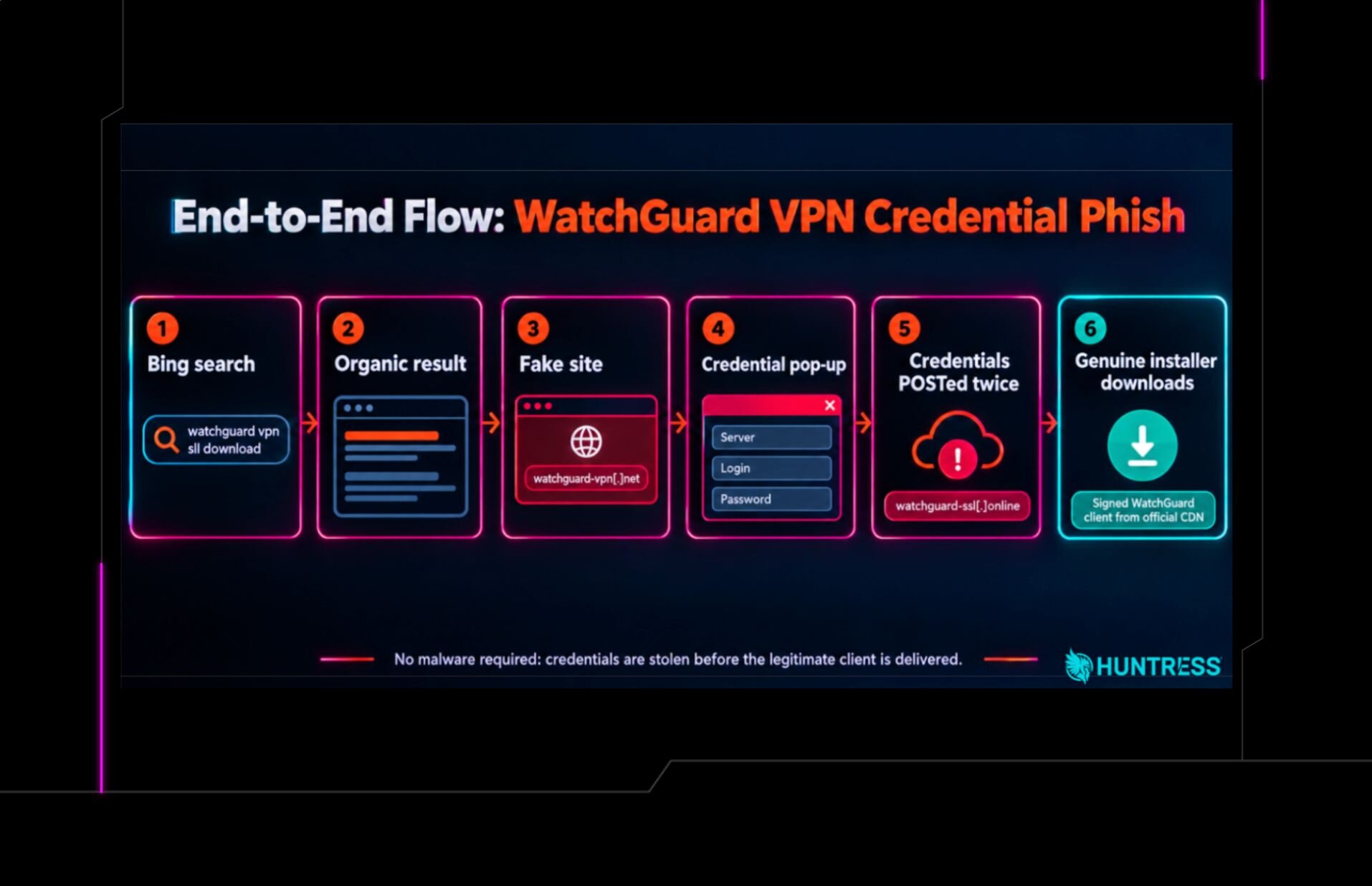
Huntress analyzes an October incident where an admin searching Bing for a WatchGuard VPN download landed on watchguard-vpn[.]net, a lookalike site whose popup.js harvests Server/Login/Password, deliberately rejects the first submission to get a second set, and posts to watchguard-ssl[.]online. Unlike earlier iterations (Secplicity, Microsoft Storm-2561), the final payload is the genuine, validly signed WatchGuard installer from the official CDN, so no malware is present for endpoint tools to flag. Covers infrastructure timeline, thin VirusTotal detections, and defender guidance (MFA, monitoring VPN logins from hosting ASNs, blocking domains, publishing official download links).
 huntress.comwriteupAdded 14 Oct 2026, published 13 Oct 2026🛡️ Security
- kage (@0XKageX0) on X
A tweet describing a free setup for running a ~27B open-source Qwen model on Google Colab's free T4 GPU, driven from VS Code. A Cloudflare tunnel with a proxy locks the endpoint behind an API key, and the endpoint is connected to 9router so Claude Code and Claude Cowork on the desktop can use it. It matters as a pointer to a zero-cost way to get Claude Code-style workflows on a self-hosted open model, though the steps are only in an accompanying video and the tweet gives no configuration or quantisation details.
x.comthreadPublished and added 12 Oct 2026🧠 AI - Arindam Majumder 𝕏 (@Arindam_1729) on X
A tweet describing an independent open-source project, "Free Claude Code", that lets Claude Code run against non-Anthropic providers such as DeepSeek and Kimi. It supports switching models, configuring fallback providers and using providers' free tiers, launched via `fcc-claude` from the terminal or an IDE. It states the limits: free usage follows provider quotas, some providers still need API keys, it does not unlock Anthropic's own models, and it is not affiliated with Anthropic. The page also shows a quoted article on a 5-layer setup for running coding agents in YOLO/auto-approve mode safely.
x.comthreadPublished and added 10 Oct 2026🧠 AI  Hackers abuse Google Ads, Bing redirects to push Claude ClickFix attacks
BleepingComputer covers Push Security's "Adception" technique: Google search ads for "claude mac" use a bing.com/ck/a click-tracking redirect via a compromised WordPress retailer site to reach fake Claude download page claude-desk-code[.]com. The page shows Anthropic's real install command but the copy button swaps in a Base64-obfuscated curl | zsh command fetching a .dat payload from lake-90[.]com. Multi-layer referrer/header cloaking defeats scanners and direct visits; the toolkit is tracked as AcSig and the final payload is unknown.
bleepingcomputer.comarticleAdded 11 Oct 2026, published 10 Oct 2026🛡️ Security- No, Your Tools Are Not Enough: It's Time to Bring Agents to the Hunt
Experience paper describing an iterative agentic workflow that uses AI agents to find vulnerabilities across diverse targets: Windows drivers, the Linux kernel, XNU, firmware and web applications. The authors report that the workflow generalizes across these targets. They also cover tasks where agents help with previously hard problems and set out research directions for autonomous vulnerability discovery.
arxiv.orgpaperAdded 16 Oct 2026, published 10 Oct 2026🛡️ Security



Showing 30 of 112
Show more