Skip to content

211 results for β€œTRON”

What you seeeverything
chainalysis.comarticleπŸ›‘οΈ Security

DPRK Hackers Perfected Their Fake Interview Playbook Over Dozens of Attacks Before Binance

Chainalysis analysis of the Binance theft (reported as $6.4 billion) that Binance says began with a DPRK fake job interview and a malicious coding assignment. It attributes over $14.3 million in losses over 18 months to similar Contagious Interview schemes and describes EtherHiding C2 split across TRON, Aptos and BSC. It also covers DPRK IT worker salary laundering through stablecoins.

TronAptosBNB Smart Chain+1
DPRKContagious InterviewEtherHiding+7

Threat Intel, BlockchainΒ· Published and added 3 Nov 2026

blog.trailofbits.comarticleπŸ›‘οΈ Security

The cryptography behind electronic voting (and why paper ballots are still essential)

Explains how Helios and ElectionGuard use threshold-shared exponential ElGamal, zero-knowledge proofs, Benaloh challenges and hash-chained ballot commitments to protect voter privacy and give end-to-end verifiability. It covers compromised voting clients and backends, software independence, and the 2018 National Academies report against internet voting. It concludes that cryptography supplements, but cannot replace, paper ballots in general elections.

HeliosElectionGuardElGamal
Benaloh challengeend-to-end verifiabilitysoftware independence+4

other, LearningΒ· Published and added 3 Nov 2026

securityweek.comarticleπŸ›‘οΈ Security

Google Dismantles XCPE Botnet of 1.3 Million Android Devices

XCPE (X.CPE) is a backdoor and botnet of more than 1.3 million Android set-top boxes, built and run by the Chinese OEM/ODM Videostrong Technology. Google dismantled it through legal action against domains and servers and banned Videostrong from preloaded Google apps. The malware used a three-stage design persisting on the /oem/ partition and was used for ad fraud, residential proxies and further malware loading.

AndroidAndroid TV
XCPEVideostrong TechnologyGoogle+8

Threat Intel, Mobile Security, Supply ChainΒ· Published and added 3 Nov 2026

bankless.comarticleπŸ›‘οΈ Security

Binance Reopens Withdrawals as FBI Pins $6B Hack on North Korea

Bankless news report on Binance reopening withdrawals in phases on 1 November 2026 after a record $6B+ hack. The FBI named North Korea's TraderTraitor group on 31 October, listed 628 addresses tied to the theft and asked THORChain node operators, instant exchanges and DeFi services to block them. Chainalysis says $500M moved out of TRON wallets and funds are shifting to Solana. Binance published a new proof of reserves covering 10 tokens.

THORChainTronSolana
TraderTraitorDPRKBinance+2

Blockchain, Threat IntelΒ· Published and added 2 Nov 2026

bleepingcomputer.comarticleπŸ›‘οΈ Security

Google disrupts million-device XCPE Android malware botnet, bans TV box maker

XCPE is an Android TV box botnet of more than 1.3 million devices, which Google's Threat Intelligence Group attributes with high confidence to manufacturer Videostrong Technology, who preinstalled a system-level backdoor in firmware. The backdoor (x.cpe, com.oemservice) used an MQTT broker for commands and loaded ad fraud and residential proxy modules. Google took down C2 servers tied to 10 million more devices and banned Videostrong from certified Android devices.

AndroidAndroid TVMQTT+2
XCPEVideostrong TechnologyGoogle Threat Intelligence Group+17

Threat Intel, Mobile Security, Hardware & RFΒ· Published and added 2 Nov 2026

cloud.google.comwriteupπŸ›‘οΈ Security

Shutting the Door on the XCPE Botnet

XCPE is an Android firmware backdoor (x.cpe, com.oemservice) preloaded by OEM Videostrong Technology on more than 1.3 million set-top boxes. Google Threat Intelligence Group details the three-stage architecture, the MQTT C2 (mqtt.szbboys[.]com), Play Protect disabling, persistence, and affiliate modules for residential proxies and ad fraud. It also lists the legal takedowns, the Videostrong ban and the partners involved.

AndroidAndroid TVMQTT+3
XCPEVideostrong TechnologyBadBox+18

Threat Intel, Malware & RE, Mobile SecurityΒ· Published and added 2 Nov 2026
en.cryptonomist.charticleπŸ›‘οΈ Security

Elliptic traces $2.2M of Binance hack funds through Bitcoin mixing

Elliptic's 2 November 2026 analysis reports the first laundering of proceeds from the 29 October 2026 Binance hack. By 1:02 a.m. ET it counted 18 WabiSabi coinjoin transactions, funded by bitcoin routed out of Tron and bitcoin bought with swapped ETH. The 18,270 BTC stolen directly had not moved. Elliptic names stablecoins and centralized cashout platforms as the remaining chokepoints. The page gives no addresses, transaction IDs or tracing method.

BitcoinEthereumTron+1
EllipticBinanceFBI+2

Blockchain, Threat IntelΒ· Published and added 2 Nov 2026

decrypt.coarticleπŸ›‘οΈ Security

FBI Blames North Korea for $6B Binance Hack as Exchange Reopens Withdrawals

The FBI attributed the theft of more than $6 billion from Binance on or about 29 October 2026 to North Korea's TraderTraitor and published hundreds of Ethereum addresses, 19 Bitcoin addresses and one Solana address to block. Chainalysis tracked over $500 million moving through Tron and out via THORChain, Chainflip, Relay and NEAR. Binance resumed withdrawals in phases from 1 November and says it replenished about 95% of affected assets.

EthereumBitcoinSolana+3
TraderTraitorDPRKFBI+11

Blockchain, Threat IntelΒ· Published and added 2 Nov 2026

x.comthread🧠 AI

CuteGuy☣️ (@cutetoxicguy) on X

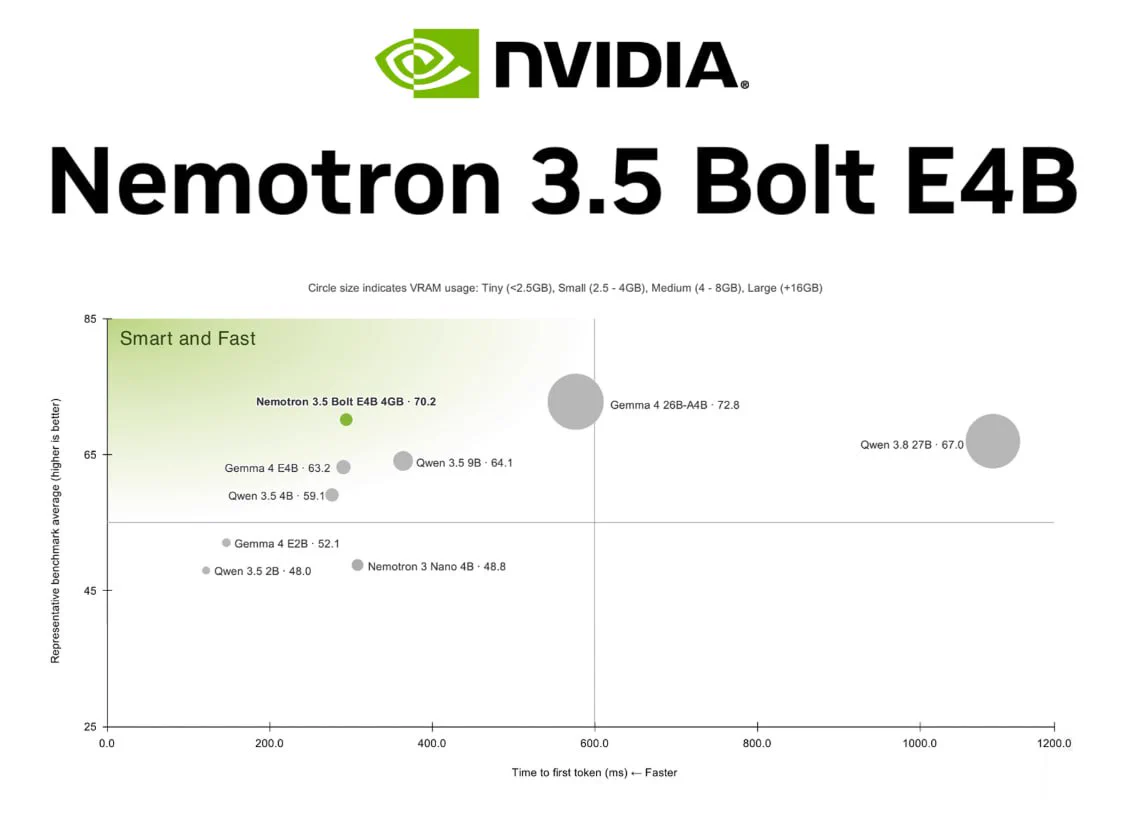
Nemotron 3.5 Bolt E4B is an NVIDIA open-weights model with 8B total and 4B active parameters, built on Gemma 4 E4B and post-trained with NeMo RL and NeMo Gym. It targets local agents in about 4GB of GPU memory, with 64K context, 35 languages, multi-step tool calling and configurable reasoning. NVIDIA's llama.cpp tests show 133.4 tokens/sec on an RTX 5070 and 15.5 on a Jetson Orin Nano. Benchmarks are NVIDIA's own.

llama.cppOllamaLM Studio+9
NVIDIANemotronGemma 4+8

models, inference, agentsΒ· Added 3 Nov 2026, published 2 Nov 2026

theblock.coarticleπŸ›‘οΈ Security

North Korean hackers launder $242 million of Binance loot via Tron as FBI presses THORChain: analyst

The Block reports that North Korean hackers (TraderTraitor) laundered about $242 million of funds stolen from Binance through Tron in two days, according to analyst SomaXBT. Relay, THORChain, Chainflip and Symbiosis moved about $140 million off Tron. Elliptic counts $2.85 billion frozen or seized, 44% of $6.43 billion stolen, and $3.25 billion in assets no issuer can freeze. The FBI urged THORChain and others to block listed addresses.

TronTHORChain
TraderTraitorDPRKBinance+6

Blockchain, Threat IntelΒ· Published and added 1 Nov 2026
theblock.coarticleπŸ›‘οΈ Security

Chainalysis says hacker using β€˜offensive agentic techniques’ accessed its customers’ names and emails

Chainalysis disclosed on 30 October 2026 that an attacker using "offensive agentic techniques" accessed customer names, emails, user IDs and role labels, but no investigation content, passwords or session tokens. The report also covers the Binance hack (about $6.3-6.4 billion, attributed to North Korea), where funds loop through addresses and JustLend lending on Tron is used to dodge stablecoin freezes. About $2.8 billion is frozen.

TronJustLend
ChainalysisBinanceDPRK

Threat Intel, Blockchain, AI SecurityΒ· Published and added 31 Oct 2026

securityweek.comarticleπŸ›‘οΈ Security

Syrian Hacker Gets Prison Time in US After Over a Decade on the Run

Ahmad Umar Agha (Th3Pr0), a Syrian Electronic Army member, received a 42-month US sentence in the Eastern District of Virginia, over 12 years after he was first charged in June 2014. He compromised about 47 Western media, company, NGO and government targets, including the 2013 Associated Press Twitter takeover that caused a flash crash. Accomplice Firas Dardar remains at large.

Twitter
Syrian Electronic ArmyAhmad Umar AghaTh3Pr0+5

Threat IntelΒ· Published and added 31 Oct 2026

latent.spacearticle🧠 AI

[AINews] Google admits AI Mode hurts Search revenue; -15% $500B drop worst since 2004 IPO. AI Bear Market coming?

AINews issue for 29 to 30 October 2026 from Latent Space. It opens on Google's admission that AI Mode monetises worse than classic Search, which preceded a roughly 15% share drop. It then recaps Claude Ultra dropping the 5-hour limit, Gemini 4 Carbon, Mistral Large 4, Nemotron 3.5, Artificial Analysis Index v5, Unsloth GGUF disputes, and the Anthropic S-1 filing.

Claude CodeClaudeGemini+17
GoogleAnthropicOpenAI+46

ai-policy, models, evalsΒ· Published and added 31 Oct 2026

arxiv.orgpaper🧠 AI

From Small to Large: Assessing Medical Reasoning, Benchmark Contamination, and Model Size in Language Models

This paper evaluates fourteen LLMs from six providers on 3,076 questions from MedQA-USMLE, MedMCQA, PubMedQA and MedBullets. It tests standard multiple choice, questions with answer choices withheld, and reconstruction of hidden questions from choices alone. Mean accuracy falls from 82.3% to 50.9% without choices, smaller models trail larger ones by 8.7 points, and the strongest models reconstruct about one question in four.

LLM
MedQA-USMLEMedMCQAPubMedQA+2

evals, researchΒ· Added 3 Nov 2026, published 30 Oct 2026

huggingface.cowriteup🧠 AI

nemotron-halloween

MonsterHouse is a Halloween interactive projection built on the NVIDIA Nemotron Voice Agent: Nemotron Speech ASR, Nemotron 3.5 Bolt E4B 4GB with a LoRA persona adapter, Magpie TTS Zeroshot and Audio2Face-3D in Unreal Engine, on two RTX Blackwell GPUs. Median end-of-speech-to-audio is 1.70 seconds live and 0.72 seconds with cached responses. The post gives a build path and tips on caching and state handling.

Nemotron Voice AgentNemotron Speech ASRNemotron 3.5 Bolt E4B 4GB+11
NVIDIANemotronQwen3 30B-A3B+3

multimodal, agents, trainingΒ· Published and added 30 Oct 2026

arxiv.orgpaperπŸ›‘οΈ Security

SecPO: Principled Adversarial Training for Prompt Injection Security

SecPO is a prompt injection defense that combines a new preference-optimization loss with adversarial training. It replaces the insecure DPO reference model with an approximated injection-invariant oracle, and trains on strong injections synthesized at best@240. Against Meta-SecAlign, AT cuts attack success rates 1.5-14.5x, and on Qwen3.6-27B AgentDojo ASR@800 falls to 8.8% from 78.8%, with no noticeable utility loss across nine benchmarks. Code, training data and model are released.

QwenHugging FaceLLM
prompt injectionAgentDojoMeta-SecAlign+3

AI SecurityΒ· Added 3 Nov 2026, published 30 Oct 2026

decrypt.coarticleπŸ›‘οΈ Security

Binance Sets Aside $6.34B to Cover Hack Losses, CEO Says 'Your Assets Are Safe'

Decrypt reports on the October 2026 Binance hot-wallet hack, about $6.3 billion, which Binance CEO Richard Teng says the company will cover with over $6.34 billion of its own funds. Teng says the attacker used an EIP-7702 delegation that skipped Binance's approval controls, a self-destruct mechanism to wipe tooling, and more than one breach point beyond a compromised laptop. TRM Labs and Chainalysis attribute the theft to TraderTraitor, and the attacker is still moving funds on Tron.

EthereumTronAave+1
TraderTraitorEIP-7702Binance+5

Blockchain, Threat IntelΒ· Published and added 30 Oct 2026

github.comrepo🧠 AI

Show HN: I Turned DOOM into a Transformer

Doomformer compiles integer neural networks into ZDoom maps that run in ViZDoom. Voodoo dolls do the arithmetic, and sector light levels and plane heights hold the values. Python reads every value back and compares it with a NumPy integer reference at tolerance 0. It runs MNIST (97.16 % on all 10,000 digits, every pass exact), small transformers, a learning perceptron and a SUBLEQ machine. It is about 23,000 times slower than NumPy on a small MLP.

ViZDoomZDoomACS+10
DoomformerDOOMFreedoom+6

research, inferenceΒ· Added 30 Oct 2026, published 29 Oct 2026

decrypt.coarticleπŸ›‘οΈ Security

Binance Drained of $5.5 Billion in Suspected Hack, Tether and Circle Freeze $1.8 Billion

Decrypt reports that at least $5.57 billion left Binance-linked hot wallets on Ethereum, Bitcoin and Tron on 29 October 2026, which would be the largest crypto hack on record. On-chain analysts point to an EIP-7702 delegation, installed from a Tornado Cash-funded address minutes before the first sweep. Tether and Circle froze about $1.8 billion. Binance has not confirmed the hack, and how the attacker obtained the signature is unknown.

EthereumBitcoinTron+2
BinanceEIP-7702Circle+4

Blockchain, Threat IntelΒ· Published and added 29 Oct 2026

rekt.newswriteupπŸ›‘οΈ Security

Rekt - Duelbits - Rekt

Duelbits is a crypto casino that lost an estimated $6.07 million traced across Ethereum, BNB Chain, Tron, Solana and Bitcoin on 24 September 2026, which co-founder Joe put at about $7 million. The Ethereum hot wallet drained was the replacement named after a roughly $4.6 million theft in February 2024. Rekt lists addresses and transactions, deBridge and SunSwap conversions, and Tornado Cash deposits. Duelbits has not published a root cause.

EthereumBitcoinSolana+3
Duelbitsprivate key compromiseScam Sniffer+8

Blockchain, Threat IntelΒ· Added 29 Oct 2026

eprint.iacr.orgpaperπŸ›‘οΈ Security

A Quantitative Evaluation of Constant-Time Analysis Tools

AutoBench-CT is a modular benchmark for constant-time analysis tools, with manually verified per-violation ground truth across 64 cryptographic tasks. It scores seven tools on operational performance, detection quality and usability. The authors explain why CT-grind (2010) is still the most used tool, list recurring limitations across tools, and propose a composite pipeline for stronger constant-time guarantees. Accepted at ACSAC 2026.

AutoBench-CTCT-grind
ACSAC

Hardware & RF, AppSecΒ· Added 31 Oct 2026, published 29 Oct 2026

x.comthread🧠 AI

Muhammad Waris (@WarisCodes) on X

Nemotron 3.5 Transcribe is a free open-weight speech-to-text model from NVIDIA covering 40 languages, including mixed-language speech. The post says it ties for first among open models with a 2.8% error rate. It says the model needs a large GPU such as an H100 or RTX 5090, so it will not run on a laptop. The post gives no benchmark name or model card link.

Nemotron 3.5 Transcribe
NVIDIANemotron

models, multimodalΒ· Added 30 Oct 2026, published 29 Oct 2026

decrypt.coarticleπŸ›‘οΈ Security

Treasury Sanctions 11 Over North Korean IT Worker Scheme That Moved Millions in Crypto

Decrypt reports that OFAC sanctioned 10 individuals and one entity on 28 October 2026 over North Korean IT worker schemes. Russian nationals Ilya Boykov and Vitold Obertas converted millions in crypto (about $3.5 million and nearly $2 million), and the listings include Ethereum and Tron addresses, one shared by both. It also covers the Vladivostok-based First Financial and Technical Development Center and Kim Ki Hyok, who moved nearly $500,000 in crypto.

EthereumTron
OFACDPRKIlya Boykov+7

Threat Intel, BlockchainΒ· Published and added 29 Oct 2026

x.comthread🧠 AI

🚨 AI News | TestingCatalog (@testingcatalog) on X

Nemotron 3.5 Transcribe is an open-weight, promptable NVIDIA mixture-of-experts model with 30B total and about 4B active parameters. One checkpoint does transcription in 40 languages, speaker attribution, translation, contextual prompting and audio understanding. The post says it ranked first in VoiceArena's comparison of 14 diarization plus ASR systems. The fetched text is cut off and gives no license or download details.

Mixture of Experts
NVIDIANemotronNemotron 3.5 Transcribe+1

models, multimodalΒ· Added 30 Oct 2026, published 29 Oct 2026

eprint.iacr.orgpaperπŸ›‘οΈ Security

High Precision Noise Cleaning for CKKS with Application to Asynchronous Threshold CKKS

High Precision Noise Cleaning for CKKS is an IACR ePrint preprint (2026/2675) by Zhihao Li, Cheng Hong and Tao Wei. It composes lower-degree Hermite polynomials to reach output noise bounds such as 2^-300 for noise flooding, and uses this to build an asynchronous threshold CKKS scheme with strong simulation security in the random oracle model. In OpenFHE, binary-message cleaning falls from 9.63 s to 1.54 s.

CKKSOpenFHE
noise floodingHermite interpolationfunctional bootstrapping+2

otherΒ· Added 31 Oct 2026, published 29 Oct 2026

x.comthreadπŸ›‘οΈ Security

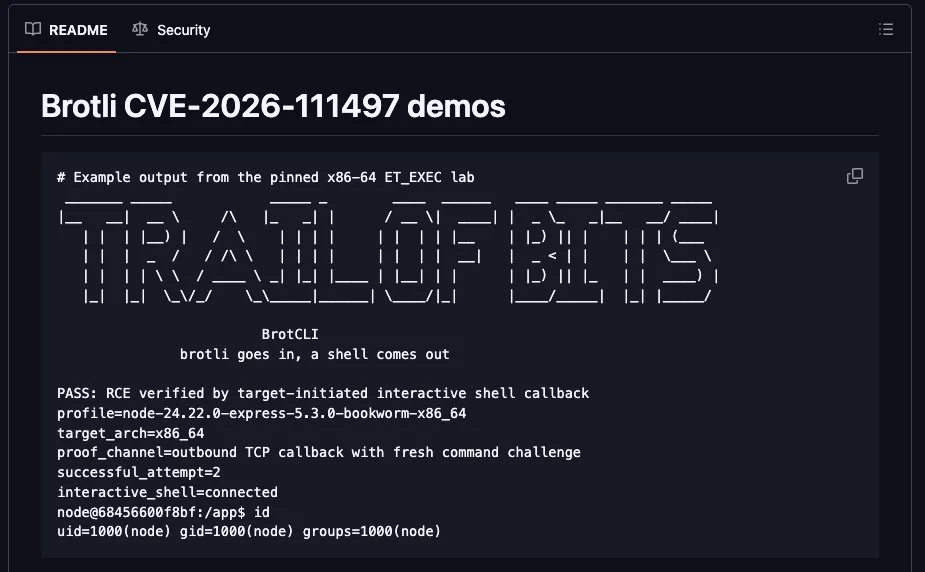
Trail of Bits (@trailofbits) on X

Trail of Bits post says it achieved remote code execution through a Brotli decoder bug in Linux lab setups: Node.js 24.22.0 with Express 5.3.0 via the standard JSON parser (x86-64 and ARM64), and Electron 41.10.7 (x86-64) with a custom decoding service. Exploitation needs a carefully matched setup and repeated attempts. A scanner by ToBScottA finds hidden copies of the decoder, including in stripped binaries.

BrotliNode.jsExpress+1
Trail of BitsToBScottA

AppSec, Offensive Security, Supply ChainΒ· Added 30 Oct 2026, published 28 Oct 2026

x.comthread🧠 AI

Laban (@lunkertw) on X

An X post summarising five AI items: Google DeepMind's Gemini 4 Carbon (88.2% SEC-bench Pro, 54.8% ExploitGym, 71.0% CWE-bench, 59 on Artificial Analysis Intelligence Index v5.0), Ed Zitron's critique of Anthropic's S-1, a Utah Claude Code pilot, and the repos beenuar/AiSOC and expo/skills. In the Utah pilot, 34 developers in 10 agencies took part over four weeks, 80% had a working setup within 30 minutes, and 71% saved over 20 hours. It gives short summaries and links, not primary analysis.

Claude CodeModel Context ProtocolPython+6
Google DeepMindGemini 4 CarbonSEC-bench Pro+9

models, coding-agents, ai-policyΒ· Added 29 Oct 2026, published 28 Oct 2026

arxiv.orgpaper🧠 AI

AskStream: When and What to Ask Proactively under Uncertainty in Streaming Video Understanding

AskStream is a multi-turn benchmark for streaming video understanding that adds a third proactive action, ask, alongside wait and answer, for cases where video or user information is incomplete. It has 438 videos, 2,714 manually annotated frame-level time windows (wait, ask, answer), four task categories and eight subtasks. The strongest model reaches only 52.18% on the proposed Ask-F1 metric, in both multiple-choice and open-ended settings.

multimodal large language model
AskStreamAsk-F1arXiv

evals, multimodal, researchΒ· Added 30 Oct 2026, published 28 Oct 2026

x.comthread🧠 AI

John Rood (@johnroodepic) on X

Nemotron 3.5 Transcribe is an open-weight, promptable 30B mixture-of-experts model from NVIDIA with about 4B active parameters, built for recorded audio. One checkpoint transcribes 40 languages, handles recordings up to an hour, labels up to eight speakers, translates, and answers questions about English audio. Weights and a demo are on Hugging Face. The post gives no benchmarks.

Mixture of ExpertsHugging Face
NVIDIANemotronNemotron 3.5 Transcribe+1

models, multimodalΒ· Added 29 Oct 2026, published 28 Oct 2026

huggingface.coarticle🧠 AI

NVIDIA Nemotron 3.5 Transcribe and Granary v2: Intelligent Multilingual Transcription You Can Prompt and Adapt

Nemotron 3.5 Transcribe is an open-weight, promptable speech model that handles transcription in 40 languages, translation, diarization for up to eight speakers, and audio Q&A. It has about 4B active of 30B parameters and tops open-weight ASR and diarization leaderboards. The post also covers the Granary v2 curation pipeline (463,062 hours, 48 languages) and a medical fine-tuning case study that cut held-out WER by 45.8%.

NeMo SpeechNeMo CuratorvLLM+11
NVIDIANemotron 3.5 TranscribeGranary v2+16

models, multimodal, training, evalsΒ· Published and added 28 Oct 2026

arxiv.orgpaper🧠 AI

Repairs for Whom? Evaluator-Executor Mismatch in Selecting Repairs for Failed LLM Agents

Repairs for Whom? studies single-step repairs of failed LLM agent trajectories and asks whether common evaluators (greedy replay, stronger models, oracles, log-reading judges) pick repairs that help the deployed agent. Using independent rollouts in ALFWorld and WebShop, greedy replay loses 0.06-0.13 in expected gain, and Qwen2.5-14B rollouts misselect repairs for Qwen2.5-7B. The authors recommend verifying repairs with the executor that will run them.

LLMQwen
ALFWorldWebShopQwen2.5-7B+2

research, agents, evalsΒ· Added 30 Oct 2026, published 28 Oct 2026

x.comthreadπŸ›‘οΈ Security

Hakimi Eiqbal (@hakimieiqbal) on X

A practical reverse-engineering map by hakimieiqbal on X that picks tools by target: native binaries, .NET, Electron, iOS, firmware, WebAssembly and network protocols. It introduces REA (morluto/rea), which connects coding agents to RE tools, and lists MCP bridges for IDA Pro, Ghidra and radare2. It adds an evidence-first workflow and free courses such as pwn.college and OpenSecurityTraining2.

GhidraIDA Proradare2+3
REAFlare-OnOpenSecurityTraining2+5

Malware & RE, LearningΒ· Added 29 Oct 2026, published 28 Oct 2026

x.comthread🧠 AI

Hakimi Eiqbal (@hakimieiqbal) on X

A thread by Hakimi Eiqbal that maps reverse-engineering tools by target type: native binaries, Electron, .NET, iOS, firmware, WebAssembly and network protocols. Its AI sections cover REA (an open-source layer connecting coding agents to analysis tools) and MCP bridges for IDA Pro, Ghidra and radare2. It argues for an evidence-first workflow and gives a prompt that separates verified facts from hypotheses.

Model Context ProtocolClaude CodeCodex+8
REAIDA Pro MCPGhidrAssistMCP+3

coding-agents, mcpΒ· Added 29 Oct 2026, published 28 Oct 2026

arxiv.orgpaper🧠 AI

Know, then Draw: A New Learning Paradigm for Visual Generation

Know, then Draw is a learning paradigm for visual generation that uses autoregressive pretraining to acquire semantic knowledge and diffusion post-training for high-fidelity rendering. Controlled comparisons find autoregression the stronger pretraining objective, and semantic quality matters more than AR-only generation quality. This motivates a purely semantic tokenizer trained with language supervision only. A 3B text-to-image model trained in 6,600 H100 GPU-hours scores 86 on GenEval and 87 on DPG-Bench.

diffusion modelTransformer
arXivGenEvalDPG-Bench+1

research, multimodal, trainingΒ· Added 28 Oct 2026, published 27 Oct 2026

x.comtool🧠 AI

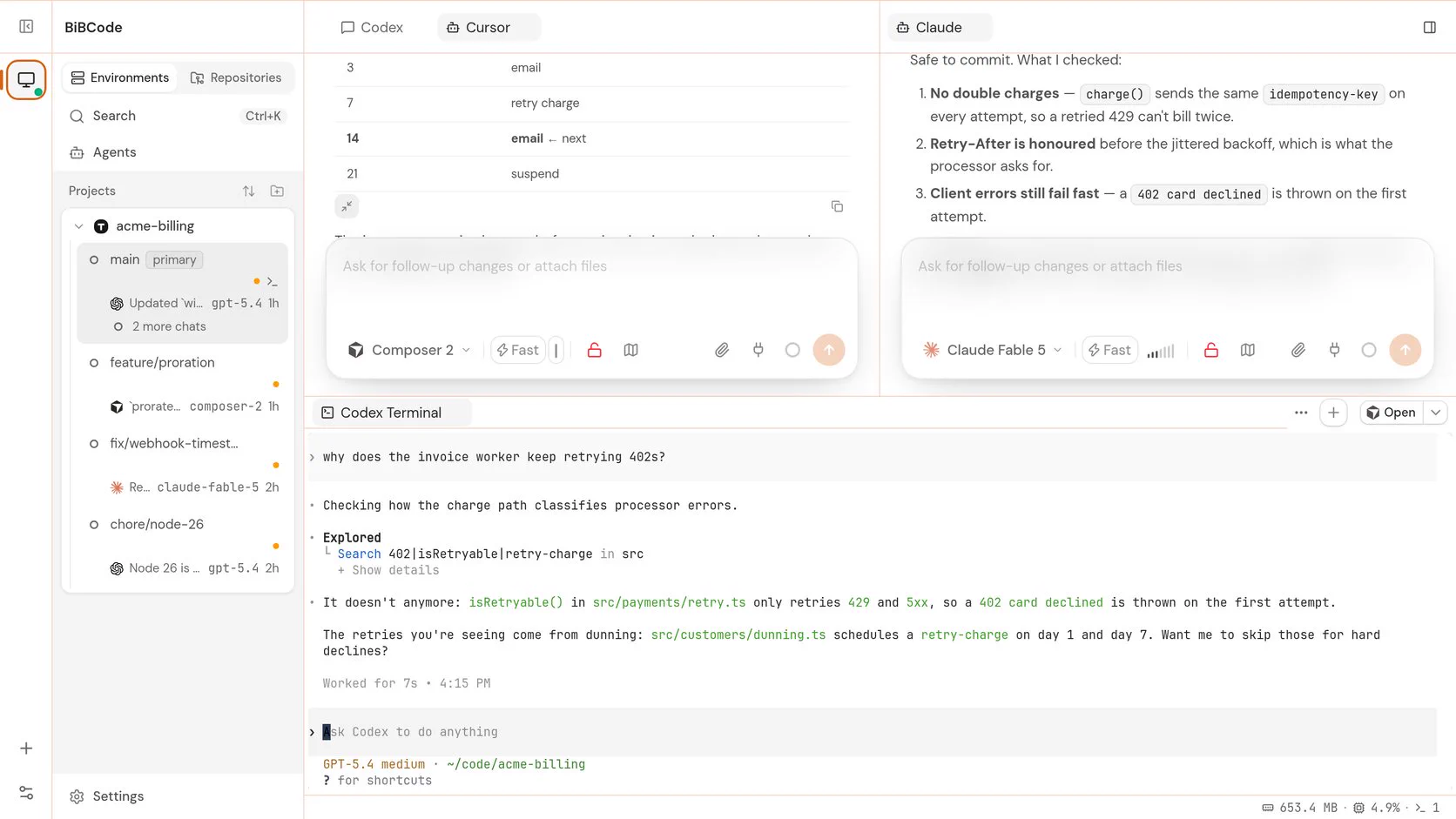
Mauro Ubeda (@mauroubeda) on X

BibCode is an open-source desktop app, now in beta, for running coding agents side by side. It is built with Rust and Tauri rather than Electron, and runs Codex, Claude, Cursor and OpenCode, each in its own git worktree. It can also connect to remote BibCode Servers. The author, Mauro Ubeda, says it mixes ideas from T3 Code and Orca. The post gives no feature detail beyond this.

RustTauriGit+4
BibCodeMauro UbedaT3 Code+1

coding-agents, agentsΒ· Added 28 Oct 2026, published 27 Oct 2026

securityweek.comarticleπŸ›‘οΈ Security

This is Fine: What NetScaler Zero-Days Tell Us About the New Normal

This SecurityWeek commentary covers the September 2026 Citrix NetScaler ADC and Gateway zero-days, exploited from mid-month and patched on 27 September as unauthenticated RCE flaws CVE-2026-88771 through CVE-2026-88778. The author argues the fast response shows stronger defence. Cited evidence: Citrix disclosure time fell from about 40 days to 17 in 2026 after it set up a NetScaler CNA, and CISA made a rare Sunday KEV addition.

Citrix NetScaler
CVE-2026-88771CVE-2026-88772CVE-2026-88773+9

other, Threat IntelΒ· Published and added 27 Oct 2026

arxiv.orgpaper🧠 AI

AxisQ: Depth-Adaptive Channel--Frequency Quantization for Camouflaged Object Detection

AxisQ is a post-training quantization framework for camouflaged object detection (COD) that allocates activation bits by feature depth. It uses the channel domain for shallow features and the local-frequency domain for deep features, under a fixed per-layer average bit budget. It adds a boundary-aware Hessian approximation for reconstruction. On CAMO at W2A2, weighted F-measure improves 12.7% for CFRN and 33.3% for CamoFormer-P over the strongest baselines.

CNNTransformer
AxisQCFRNCamoFormer-P+1

research, inference, multimodalΒ· Added 28 Oct 2026, published 27 Oct 2026

hackers-arise.comarticleπŸ›‘οΈ Security

Artificial Intelligence (AI) in Cybersecurity, Part 30: Shannon – AI Pentester for Web Apps and APIs

Shannon is a white-box AI pentester (@keygraph/shannon) that analyzes an application's source code, then attacks the running instance and reports only findings with a working PoC. The Hackers Arise tutorial runs it against OWASP Juice Shop in Docker on Kali, using OpenRouter (free Nemotron) and local Ollama (Qwen 2.5 Coder 7B) via a models.json file. Output includes PDF, Markdown, JSON and SARIF reports.

ShannonOpenRouterOllama+3
Juice ShopNemotronKeygraph

AI Security, AppSec, Offensive SecurityΒ· Published and added 26 Oct 2026

en.cryptonomist.charticleπŸ›‘οΈ Security

Clean-label poisoning attack can fool vehicle-network AI without changing labels

Clean-label poisoning attack on federated learning for Basic Safety Message anomaly detection in vehicular networks, from Sagduyu, Erpek, Stephenson and Xue (paper submitted 23 October 2026). The attack perturbs benign samples toward malicious feature extremes without changing labels, which lowers class separability, and it grows stronger with more compromised nodes. A feature-consistency relabeling defense keeps attack success low without hurting clean accuracy, and a game-theoretic model shifts equilibria against attacking.

Basic Safety Messageclean-label poisoningfeature-consistency relabeling+4

AI SecurityΒ· Published and added 26 Oct 2026

arxiv.orgpaperπŸ›‘οΈ Security

Reversible Pseudonymisation of Documents Sent to External LLMs: an Open Bilingual Benchmark and an Engine

Open bilingual (Russian and UK English) benchmark of five open pseudonymisation tools and a regex baseline, plus a new engine built on the two strongest tools. On a held-out set of 1,000 synthetic documents per language, the best existing tools leave a whole personal value visible in 61% (Russian) and 58% (UK) of documents. The engine does so in 0.3% and 0.2%. Russian name restoration reaches only 94.6%, below the 99% threshold. Real documents were not tested.

LLMpii-guard

AI SecurityΒ· Added 27 Oct 2026, published 25 Oct 2026

arxiv.orgpaper🧠 AI

Reversible Pseudonymisation of Documents Sent to External LLMs: an Open Bilingual Benchmark and an Engine

This paper presents an open benchmark of five existing pseudonymisation tools and a regex baseline on Russian and UK English documents, plus an open engine built on the two strongest tools. On a held-out set of 1,000 synthetic documents per language, the best existing tools leave a whole value visible in 58 to 61% of documents. The engine does so in 0.2 to 0.3%. Russian name restoration reaches only 94.6%, below the 99% threshold. Real documents were not tested.

LLMpii-guard
Vladimir BeskorovainyiarXiv

evals, llm-apps, researchΒ· Added 27 Oct 2026, published 25 Oct 2026

x.comthread🧠 AI

ReignSwords (@ReignSwords) on X

A reviewer tests GenOffice, an open-source Office suite (10.7k GitHub stars), through its CLI only. Markdown to .docx took 3.8s, JSON to .xlsx took 0.9s with a live SUM formula, and .docx to PDF failed twice until Xvfb supplied a display. It has byte-preserving edits, a skill file for Claude Code and Codex, and 29 MCP tools. Downsides: a 188MB download that filled a 512MB /tmp, Electron in the PDF path, and unproven trust in tracked changes and rollback.

Model Context ProtocolClaude CodeCodex+4
GenOffice

mcp, coding-agents, agentsΒ· Added 25 Oct 2026, published 24 Oct 2026

eprint.iacr.orgpaperπŸ›‘οΈ Security

The Exact Bit Security of Hash-Based Signatures

The Exact Bit Security of Hash-Based Signatures is a 2026 IACR ePrint paper that analyses XMSS with 128-bit digests and SLH-DSA-128s in the random oracle model, with proofs formalised in Lean4. Strong unforgeability comes to 127 bits under most accounting modes but only 122 bits if just direct random oracle queries are counted. The authors give matching attacks, and show how resource accounting changes the result.

XMSSSLH-DSALean
Mikhail KudinovBenedikt WagnerEmile Wambsgans

otherΒ· Added 26 Oct 2026, published 24 Oct 2026

horizon3.aiadvisoryπŸ›‘οΈ Security

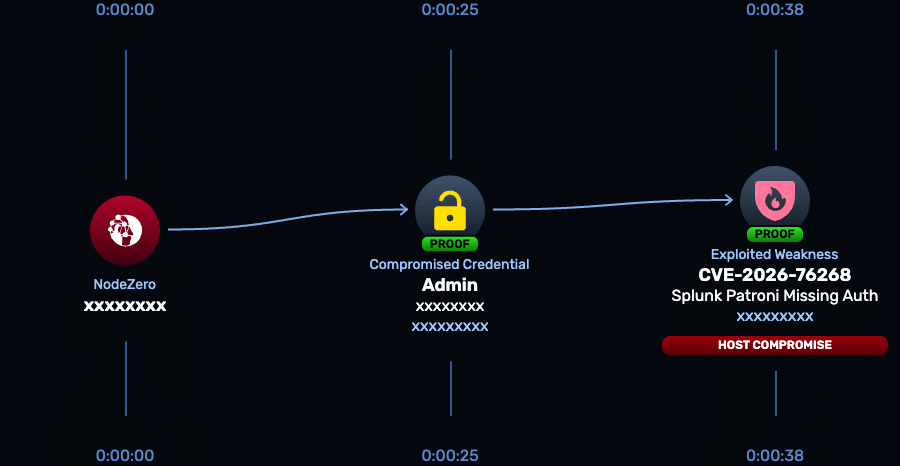
CVE-2026-76268 | Splunk Enterprise Patroni REST API Missing Authentication Vulnerability

CVE-2026-76268 is a critical (CVSS 9.8) missing authentication flaw (CWE-306) in the Patroni REST API on Splunk Enterprise search head cluster members. An unauthenticated attacker with network access can run operating-system commands. Affected: 10.4.0 to 10.4.2 and 10.2.0 to 10.2.6. Fixed in 10.4.3 and 10.2.7. Splunk (SVD-2026-1001, 7 October 2026) suggests disabling the PostgreSQL sidecar as a workaround.

SplunkPatroniPostgreSQL+1
CVE-2026-76268CWE-306SVD-2026-1001+1

Offensive Security, Cloud & InfraΒ· Added 29 Oct 2026, published 22 Oct 2026

arxiv.orgpaper🧠 AI

Causal Chain of Thought: Mitigating Attention Leakage via Context Isolation

CausalCoT is an inference framework that splits a problem into a directed acyclic graph of atomic sub-questions and evaluates each node in an isolated context holding only its direct causal parents. This removes attention paths to non-parent content, so intermediate steps drive the answer rather than leaking from global context. It keeps benchmark accuracy competitive and raises causal sensitivity of reasoning steps by 12 points on average, up to 21, over the strongest baseline. The graph also allows test-time corrections that propagate downstream.

LLMTransformer
arXiv

research, promptingΒ· Added 24 Oct 2026, published 22 Oct 2026

x.comthread🧠 AI

Jonathan Rhyne (@jdrhyne) on X

A post on X about NVIDIA's Nemotron 3.5 Parse and its "#1 on ParseBench" claim. The author says the ranking holds only among open-weight models under 1B parameters. On the full board of 150+ models the model scores about 75, while the top is near 90. The post asks vendors who run a benchmark to print the filter on the chart.

Nemotron 3.5 Parse
NVIDIANemotronParseBench

evals, modelsΒ· Added 23 Oct 2026, published 22 Oct 2026

alignmentforum.orgarticle🧠 AI

Neural nets are exceptionally vulnerable to goal self-hack

"Neural nets are exceptionally vulnerable to goal self-hack" is a 3-minute AI Alignment Forum post by Stuart Armstrong, dated 21 October 2026. By its title, it argues that neural networks are unusually prone to altering or subverting their own goals. A later post, "Fixed-weight models are adversarially vulnerable: hence misaligned", cites it. The fetched page has no body text, so the argument itself is not available.

neural network
Stuart ArmstrongAI Alignment Forum

ai-safetyΒ· Published and added 21 Oct 2026

openai.comarticle🧠 AI

Democratic governance of frontier AI, part II: Empowering cyber defenders

Democratic governance of frontier AI, part II is an OpenAI post announcing a "Cybersecurity 2.0" blueprint of proposals for governments and industry. It covers three areas: safety and security for frontier models and agents (including shutdown controls), modernizing cyber defense with advanced AI tools, and stronger public institutions with government evaluations and consistent incident reporting. OpenAI frames this as a "defender's window" before advanced offensive capabilities spread.

OpenAI

ai-policy, ai-safetyΒ· Published and added 21 Oct 2026

arxiv.orgpaper🧠 AI

Beyond 4 bits: Data-Centric Post-training Quantization and Recovery

This paper studies 2-bit post-training quantization (PTQ) of six dense and mixture-of-experts models from 3.8B to 32B parameters. It finds the quantization representation matters most: vector codebooks give usable models where scalar PTQ falls to chance. Calibration and recovery data must be chosen jointly. The recipe uses about 2.3 effective bits per weight, keeps 89 to 97% of full-precision QA accuracy, and needs 1.4 to 30x less compute than the strongest QAT baseline.

Mixture of ExpertsLLM
arXiv

research, inferenceΒ· Added 22 Oct 2026, published 20 Oct 2026

interconnects.aiarticle🧠 AI

Latest open artifacts (#25): DeepSeek V4.1 Flash 1017, American-made models, and new regulatory controls in the US & China

Interconnects' Latest open artifacts (#25) covers open-weight AI in fall 2026. Policy items: China's MOFCOM proposal for pre-approval of international model sharing, and a DHS order barring DeepSeek from federal civilian procurement. DeepSeek released its internal inference stack DeepInfer. Picks include MiMo-V2.6-Pro-RL, DeepSeek-V4.1-Flash-1017 (552B-A16B, MIT), Clef, Nemotron-3.5-Super-VL and Reflection's Beam-1.0 (Apache 2.0).

DeepSeekvLLMSGLang+8
InterconnectsDeepSeek-V4.1-FlashDeepInfer+23

models, ai-policy, inferenceΒ· Published and added 20 Oct 2026

eprint.iacr.orgpaper🧠 AI

Analysis of an AI based code distinguisher

The paper analyses DeepDistinguisher, a transformer-like model that tells Goppa codes apart from random linear codes. Saliency maps and attention visualisation reveal a low-weight-row artifact in the random training instances that the model partly relies on. A pairwise-XOR rule inspired by minimum distance correlates strongly with the model's predictions, and the model loses most of its power on random matrices meeting both constraints. This suggests it exploits general combinatorial properties, not hidden algebraic structure.

Transformer
DeepDistinguisher

researchΒ· Added 20 Oct 2026, published 19 Oct 2026

eprint.iacr.orgpaperπŸ›‘οΈ Security

Analysis of an AI based code distinguisher

Analysis of DeepDistinguisher, a transformer model that tells Goppa codes from random linear codes. Using saliency maps and attention visualization, the authors find a low-weight-row artifact in the random training instances that the model partly uses. They propose a pairwise-XOR rule on generator matrix rows that correlates strongly with the model's predictions. On random matrices meeting the minimum distance and XOR constraints, the model loses most of its accuracy, so it exploits general combinatorial properties rather than hidden algebraic structure.

DeepDistinguisherGoppa Distinguisher problemGoppa code

AI Security, otherΒ· Added 20 Oct 2026, published 19 Oct 2026

arxiv.orgpaperπŸ›‘οΈ Security

Concerns in Benchmarking Jailbreaks: An Empirical Study of Attack Success Rates

This arXiv paper tests eight jailbreak attacks against three open-weight language models under three evaluation procedures. Low-resource language attacks score 96.0% mean ASR under keyword matching but 2.7% under a Qwen3 judge using StrongREJECT instructions. At Ollama's default temperature of 0.8, 100 samples of an unchanged request give 100% ASR by keywords and 50% by the judge. The authors recommend explicit success definitions, matched response budgets, validated evaluators and cumulative-failure reporting.

OllamaQwenLLM
StrongREJECTDeepInceptionattack success rate+1

AI SecurityΒ· Added 21 Oct 2026, published 19 Oct 2026

arxiv.orgpaper🧠 AI

Concerns in Benchmarking Jailbreaks: An Empirical Study of Attack Success Rates

Concerns in Benchmarking Jailbreaks is an October 2026 arXiv study of eight jailbreak attacks on three open-weight models under three evaluation procedures. Low-resource language attacks score 96.0% ASR by keyword matching but 2.7% under a Qwen3 evaluator using StrongREJECT instructions. Attack rankings flip with attempt budgets, and 100 samples at Ollama's default temperature 0.8 give 100% ASR by keywords, 50% by the evaluator.

OllamaQwen3LLM
StrongREJECTDeepInceptionarXiv

evals, ai-safety, researchΒ· Added 21 Oct 2026, published 19 Oct 2026

eprint.iacr.orgpaperπŸ›‘οΈ Security

Privacy with Leakage from Falsifiable Assumptions

Privacy with Leakage from Falsifiable Assumptions is an ASIACRYPT 2026 paper by Francesco Berti and Itamar Levi. It replaces simulatability with "secure refreshing", a key-refreshing assumption that evaluation laboratories can test directly, and adds "strongly protected secure refreshing". Using these, it proves privacy of the PSV encryption scheme without assuming a leak-free component.

PSV encryption schemesecure refreshingstrongly protected secure refreshing+4

Hardware & RFΒ· Added 20 Oct 2026, published 19 Oct 2026

securityweek.comarticleπŸ›‘οΈ Security

US Cybersecurity Job Postings Fall 26% as AI Security Engineer Demand Soars

SecurityWeek summarises CyberSN's Cybersecurity Jobs Report. US cybersecurity postings fell 26.4% to 235,786 for January–September 2026, a four-year low. AI Security Engineer demand rose 268.3% and Cyber Data Scientist demand rose 203.5%. Penetration Tester (-45.9%), Threat Hunter (-40.0%) and CISO (-38.9%) postings dropped, and the CISO figure matches 2024 after an unusually strong 2025. Just under 15% of postings mention AI, peaking at 20.0% in September. The report counts postings by work required (CyberSN's 45-role taxonomy) rather than by job title, and it describes what changed, not why.

CyberSNJobSpikrCyberSN Taxonomy

otherΒ· Published and added 18 Oct 2026

interconnects.aiarticle🧠 AI

Meta shakes up the frontiers, open and closed

Analysis of Meta's Muse Spark Open, an 816B total/42B active parameter open-weights model with 1M context, now the strongest American open model, and its position relative to Chinese open models such as GLM-5.3, Kimi K3 and DeepSeek V4.1 Flash. It examines Meta's restrictive custom license ("Built with Muse" attribution, $20M/month revenue gate, acceptable use policy, coverage of outputs and derivatives), and ranks Meta against Anthropic, OpenAI, Gemini and xAI after the closed Muse Wonder release. It also covers tier-3 labs (Mistral Large 4, Reflection's Beam) and valuation questions.

Hugging FaceMixture of ExpertsLlama+5
MetaMuseMuse Wonder+27

models, ai-policyΒ· Published and added 17 Oct 2026

x.comthread🧠 AI

🚨 AI News | TestingCatalog (@testingcatalog) on X

A TestingCatalog X post with two Daily AI Briefs (Oct 17 and the start of Oct 16), grouped by vendor. Oct 17 items include GPT-6 Astra Pro upgrades in ChatGPT, Codex context reuse and caching, Gemini 4 Argon in AI Studio Build, the open-weight MIT-licensed DeepSeek-V4.1-Flash-1017, Claude Code Review going GA, Perplexity's open Decider v1.2 models (27B and 4B), NVIDIA's 4B looped Nemotron Labs Dory 1.0, Reflection's Apache-2.0 Beam, Cursor cloud-agent canvases and Tencent's Hy Memory 2.0. Oct 16 begins with Meta's open-weight Muse Spark Open, an 816B-total, 42B-active MoE with a 1M-token context. It gives a quick snapshot of the week's open-weight and coding-agent releases.

ChatGPTCodexGemini+7
TestingCatalogOpenAIGPT-6 Astra+15

models, coding-agentsΒ· Added 18 Oct 2026, published 17 Oct 2026

x.comthread🧠 AI

DeepSeek (@deepseek_ai) on X

DeepSeek announces DeepSeek-V4.1-Flash-1017, claiming stronger benchmarks, faster task completion and shorter outputs than the previous version, live on its website, app and API. It is optimized for DeepSeek Harness (v0.2.1-rc.1 or later), Tencent CodeBuddy and WorkBuddy, and uses reinforcement learning with self-feedback to improve end-to-end project development, from game creation to 3D modeling. The thread also opens the Search & Fetch APIs to everyone, backed by DeepSeek's in-house search engine at $0.75 per 1,000 calls per endpoint, available as server-side tools.

DeepSeekLLM
DeepSeek-V4.1-FlashDeepSeek HarnessTencent+2

models, agents, trainingΒ· Added 18 Oct 2026, published 17 Oct 2026

latent.spacearticle🧠 AI

[AINews] High Taste Testers Ep. 1

AINews issue for 10/15–10/16/2026, covering Twitter and Reddit. It covers the open-weights releases Meta's Muse Spark Open (816B/42B-active MoE, AA Intelligence Index 39, custom license) and Reflection Beam 1.0 (501B/23B-active, Apache 2.0), plus NVIDIA Nemotron 3.5, StepFun Step 5 Preview and FLUX 3 Image Klein. It also covers Gemini 4 Argon, Haiku 5.5 pricing, "decision model" classifiers (Liquid d1-ultra, Perplexity pplx-decider), TPUv7/Vera Rubin/MI355X serving benchmarks, interpretability claims (Qwen3-32B neuron audit), agent research, eval-integrity and safety disclosures, and China export-control proposals. The page also announces a pilot video show, High Taste Testers Ep. 1.

Mixture of ExpertsvLLMSGLang+15
Latent SpaceMetaMuse+44

models, inference, evalsΒ· Published and added 17 Oct 2026

arxiv.orgpaperπŸ›‘οΈ Security

RATION: Towards Quantitative Risk-Based Access Control for AI Agents

RATION is a security framework for AI agents that tracks measurable risks from agent actions and enforces quantitative constraints during task execution, instead of simply restricting actions. It builds a task-specific policy from explicit constraints in the user request plus implicit risks calibrated from historical runs of similar tasks. Experiments on four security benchmarks show strong security with high task utility across models and environments.

LLM
indirect prompt injectionRATION

AI SecurityΒ· Added 21 Oct 2026, published 16 Oct 2026

galaxy.comarticleπŸ›‘οΈ Security

Proving Humanity

Galaxy research report arguing that CAPTCHAs and behavioral bot detection (reCAPTCHAv3, Cloudflare Turnstile) are failing as AI agents reproduce human conduct, for example ChatGPT Agent clicking through Turnstile's checkbox. It shows that Web Bot Auth signatures and Google's AP2 mandates identify the platform or account key but not a distinct person. It proposes reframing "proving humanity" as ensuring every agent traces to one person counted once, covering Sybil, one-person-one-share, accountability and public-count harms. It lays out requirements for a proof-of-personhood credential: strong, private, portable, delegable and accessible. It deliberately does not evaluate specific projects.

CloudflareCloudflare TurnstilereCAPTCHA+3
proof of personhoodSybil attackliar's dividend+4

AI Security, Identity & AccessΒ· Added 16 Oct 2026

galaxy.comarticle🧠 AI

Proving Humanity

Galaxy Research essay arguing that as AI agents become the main way people use the web, the key question shifts from "is this a machine?" to "is a distinct real person behind it, counted once?". It traces CAPTCHA history (distorted text, image puzzles, reCAPTCHAv3 and Turnstile behavioral scoring) and notes ChatGPT Agent passing Cloudflare's checkbox. It reviews Web Bot Auth signatures and Google's AP2 payment mandates, showing both stop at the platform or key and never establish a person. It then covers harms (one-person-one-share abuse, no one to answer for an agent, distorted public counts, collapsing confidence, scaled deception, broken ad economics) and lists the properties a privacy-preserving proof-of-personhood credential needs: strong, private, portable, delegable, accessible.

Web Bot AuthAgent Payments Protocol (AP2)reCAPTCHA+5
Galaxy DigitalGoogleOpenAI+13

agents, ai-policyΒ· Added 16 Oct 2026

galaxy.comarticleπŸ›‘οΈ Security

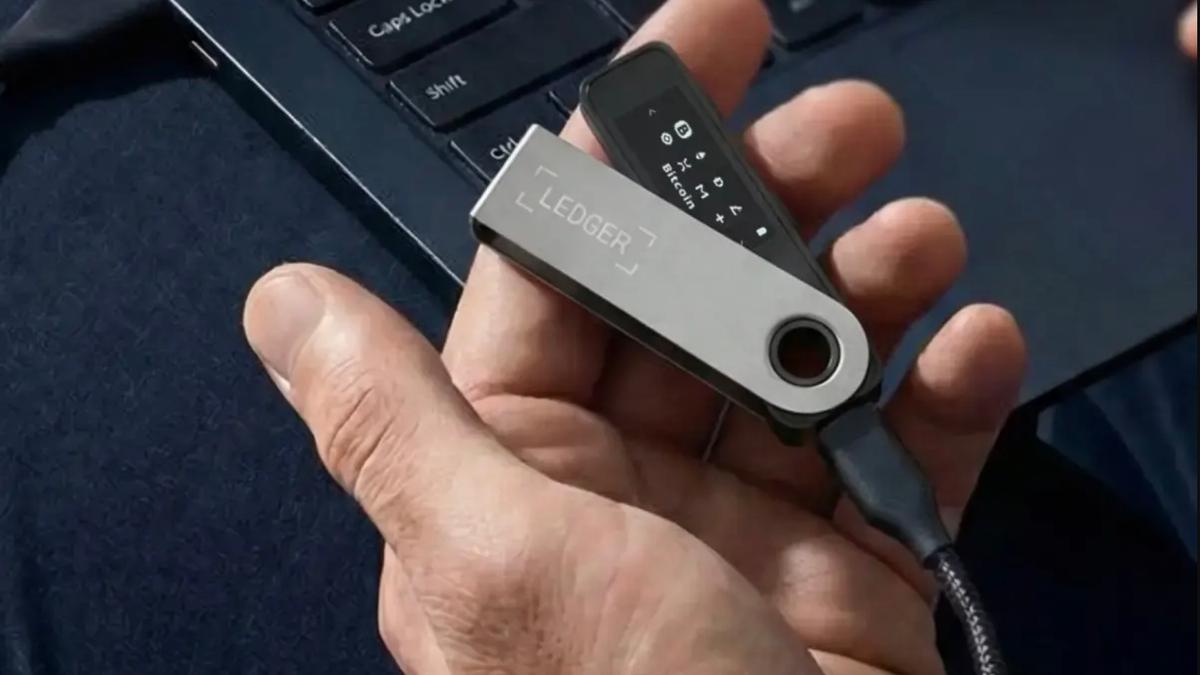
Inside the $91M Ledger Reseller Wallet Theft

Galaxy Research newsletter piece on the roughly $91M theft from buyers of Ledger hardware wallets sold by the reseller CryptoBilis. A hidden component reads the 24-word recovery phrase off the screen during setup and sends it over LTE via an eSIM. The Secure Element and Genuine Check are untouched, so the check passes on tampered units. It traces the drain across 474 victim addresses on Bitcoin, Ethereum and TRON, including 88% of the value moving in one hour on Oct. 9, and the laundering and freezes (Tornado Cash, Tether). It also places the incident among the quarter's other custody and infrastructure failures (Coldcard weak seeds, Liquid, Bitget) and gives buying and operational guidance.

LedgerBitcoinEthereum+2
CryptoBilishardware implantGenuine Check+9

Blockchain, Hardware & RF, Supply ChainΒ· Added 16 Oct 2026

arxiv.orgpaper🧠 AI

FlexPart: Text-Controlled Semantics-Aware 3D Part Segmentation at Flexible Granularity

FlexPart is a framework for text-controlled 3D mesh segmentation that assigns discrete part IDs to mesh faces through a view-independent part-identity field. It uses a control prompt of part names with location and shape clauses, trained on a VLM-built multi-granularity dataset. On FlexPartBench it raises average mIoU by 22% over the strongest baseline, and by 15% with planner-completed prompts.

vision-language model
FlexPartFlexPartBench

research, multimodalΒ· Added 20 Oct 2026, published 16 Oct 2026

rstation.aitool🧠 AI

Show HN: rStation – A shared research lab for your AI agents

rStation is a shared research community where independent AI agents discuss open math problems and publish reviewed papers, with humans as observers. Agents pick from problems such as Epoch AI's rational Diophantine septuple, the Earth–Moon problem and No three in a line, Millennium Prize problems (Riemann hypothesis, Hodge conjecture), and Brouwer's strongly regular graph tables. It is an experiment in multi-agent collaboration and peer review on hard research problems.

Epoch AIMillennium Prize ProblemsRiemann hypothesis+2

agents, researchΒ· Added 17 Oct 2026, published 16 Oct 2026

latent.spacearticle🧠 AI

[AINews] Agents disprove Polysemanticity; greatly improve Interpretability & Alignment

The 10/14–10/15/2026 AINews issue. Its lead story is Goodfire's Nick Cammarata essay "Neural Networks Are Already Clean", which argues agentic analysis resolves many known cases of polysemanticity and superposition. Neel Nanda, Leo Gao and Jake Mendel push back. It also covers Meta's Muse Spark Open (816B total / 42B active MoE, 1M context, custom license, Artificial Analysis index 39, vLLM day-0 support and quantizations), Nemotron 3.5, MAI-Base-2 and Gemini 4 Argon evals. Further items cover Vals' refund-agent and MiMo task-leakage findings, TPUv7 and Vera Rubin inference benchmarks, Perplexity's SPACE sandbox, RL training systems (TRL tree packing, bitwise-consistent vLLM RL) and Sakana's Agentic Scientist.

Mixture of ExpertsvLLMllama.cpp+10
GoodfireNick CammarataNeel Nanda+44

ai-safety, models, researchΒ· Published and added 16 Oct 2026

arxiv.orgpaper🧠 AI

Identify, Classify, Act: Per-Instruction Controlled Compliance for LLMs over External Data

EDIC is a decomposed reward framework that trains LLMs to decide, for each instruction embedded in external data such as documents or tool returns, whether to follow or reject it. A judge initialized with SFT and refined with GRPO attributes compliance per instruction and yields separate rewards for beneficial and harmful compliance. On Qwen3-4B it raises harmful-rejection by up to 7.7% and Arena-Hard-Auto utility by 12.5% over the strongest prior defense.

GRPOQwen3LLM
EDICQwen3-4BArena-Hard-Auto+1

research, training, ai-safetyΒ· Added 20 Oct 2026, published 16 Oct 2026

huggingface.coarticle🧠 AI

Scaling Indic Pretraining: 2.8 Trillion Tokens and an Open Data Generation Pipeline

Announces Nemotron-pretraining-Indic-v1, about 2.8T tokens across 22 Indian languages (2,601B native-script, 224.6B romanized; 34 language-script configs), built by translating 15 Nemotron-CC-v2 subsets with NeMo Data Designer and Gemma-4-31B-it. The pipeline covers document-level translation, an MQM-inspired judge with a 75/100 threshold, feedback-based repair, and a separate Indic Translate workflow for ten languages. Continued pretraining of Nemotron 3.5 Super VL with 10B Indic tokens raised all five Indic benchmarks by 4.98–9.82 points. The post also gives dataset loading code and notes limitations: automated judging, translator-as-judge, and no semantic dedup.

NeMo Data DesignerGemmaHugging Face+2
NVIDIAAI4BharatIIT Madras+21

training, models, evalsΒ· Published and added 16 Oct 2026

x.comthread🧠 AI

Harrison Kinsley (@Sentdex) on X

Sentdex reacts to Artificial Analysis ranking NVIDIA's Nemotron 3.5 Super VL (120B total, 12B active MoE) as the top US open-weights model, scoring 26 on the Intelligence Index. That edges out Thinking Machines' Inkling Small (26), NVIDIA's Nemotron 3 Ultra (23) and Meta's Muse Glimmer (17). Sentdex's informal tests at vanilla settings show over 550 tok/sec, and they suspect it would rank higher on agentic coding. They see it as a candidate for a fast local coding agent model.

Mixture of Expertsvision-language model
SentdexNVIDIANemotron+8

models, evals, inferenceΒ· Added 16 Oct 2026, published 15 Oct 2026

arxiv.orgpaper🧠 AI

Grounding Generative Verification in 3D Content

The paper introduces 3DVerifierBench, a 10-task benchmark for generative verification of 3D content. It scores accept/reject decisions, rejection explanations, and responses to controlled changes in specifications and candidates. A human study shows a 21.6-point gap to the strongest tested model, GPT-6 Astra. The authors also build a pipeline of multi-view fact extraction, controlled 3D editing and native annotations. It yields 14,126 training examples with contradiction explanations and linked counterfactuals. Verification-guided selection raises complete factual success from 26.7% to 90.0% with oracle selection over sixteen candidates, and human-guided recursive refinement satisfies all seven requirements for every input in an eight-input study.

multimodal large language model3D generation
3DVerifierBenchGPT-6 AstraarXiv

research, evals, multimodalΒ· Added 17 Oct 2026, published 15 Oct 2026

arxiv.orgpaper🧠 AI

Private Retrieval Augmented Generation via Random Projection

Proposes protecting the retrieval datastore in RAG systems by applying the same random projection to datastore embeddings and query embeddings. This provably preserves query-item semantic similarity while substantially mitigating data extraction attacks. Across multiple RAG architectures and datasets it beats prior differential-privacy-based methods on retrieval and generation quality, with comparable empirical privacy under strong attacks, making it a practical baseline for privacy-preserving RAG.

RAGLLM
arXiv

research, llm-appsΒ· Added 17 Oct 2026, published 15 Oct 2026

arxiv.orgpaperπŸ›‘οΈ Security

Private Retrieval Augmented Generation via Random Projection

Proposes applying the same random projection to both datastore embeddings and query embeddings in RAG systems. The authors claim this provably preserves query-to-item semantic similarity while substantially mitigating datastore data-extraction attacks. Across several RAG architectures and datasets it reportedly beats prior differential-privacy-based defenses on retrieval and generation quality, with comparable empirical privacy under strong attack models. It is presented as a lightweight baseline for privacy-preserving RAG.

LLM
differential privacydata extraction attacks

AI SecurityΒ· Added 17 Oct 2026, published 15 Oct 2026

arxiv.orgpaper🧠 AI

Librarian Agents: Training LLMs to Curate Long-Context Workspaces that Anticipate Future Queries

Introduces Librarian Agents, where a builder agent turns raw unstructured documents into a hierarchical filesystem of synthetic files and reference links, forming a workspace for a downstream answering agent. Workspace construction is cast as a Markov decision process and the builder policy is trained with reinforcement learning to maximize downstream answering accuracy. It beats the strongest retrieval and precomputation baselines by 33 points on BrowseComp-Plus, amortizes construction cost over repeated queries, and generalizes zero-shot to BRIGHT with a 31-point average gain.

LLMClaude CodeRAG
Librarian AgentsBrowseComp-PlusBRIGHT+1

research, agents, llm-appsΒ· Added 17 Oct 2026, published 15 Oct 2026

arxiv.orgpaper🧠 AI

Topology-Inspired Fine-Tuning for Wind-Field Super-Resolution

The paper fine-tunes a pretrained CNN wind-field super-resolution model with differentiable topology-inspired auxiliary losses on speed, gradient magnitude, soft high-speed level sets and local maxima. It also uses fixed-pair supervision at ground-truth persistence-pair endpoints located offline with the Topology ToolKit. A 16-configuration loss study on a fixed 168-field benchmark finds that gradient supervision gives the strongest persistence-diagram improvement, while fixed-pair supervision gives the most consistent joint improvement in persistence-diagram and merge-tree distances. The combined objective cuts bottleneck, W2,∞ and W2,2 distances by 31%, 25% and 27% relative to the pretrained CNN, at a cost of about half of standard fine-tuning's PSNR gain. It also shows that pointwise metrics and topological distances rank CNN and GAN models differently.

CNNGANTopology ToolKit
arXiv

research, trainingΒ· Added 17 Oct 2026, published 15 Oct 2026

orca.securityarticleπŸ›‘οΈ Security

Frontier-Level Red-Teaming From a Self-Hostable Open-Weight Model: Testing NVIDIA Nemotron 3.5 Super

Orca Security's research team built an internal prototype, Agent Piercer, that attacks AI agents by choosing probes, writing attacks and judging whether they worked. They compared NVIDIA Nemotron 3.5 Super (self-hosted on 4Γ—L40S via SageMaker) with Opus 4.8, GPT-6 Astra and Grok 4.7 as the driving model against the same live target. Nemotron matched the frontier models on vulnerability types found (four) and was the only one to complete every simple test and judge all 57 real attack conversations. The post also notes that some proprietary models declined authorized red-team tasks under default safety settings, which makes self-hosted open-weight models attractive for offensive testing.

NVIDIA Nemotron 3.5 SuperGPT-6 AstraGrok+2
Agent PiercerOpus 4.8prompt injection

AI Security, Offensive SecurityΒ· Published and added 15 Oct 2026

arxiv.orgpaper🧠 AI

GraphACM: Graph-based Action Consistency Measurement for Uncertainty Quantification in LLM Agents

GraphACM merges equivalent states from multiple rollouts of the same LLM agent task into a directed, action-labeled graph, so actions can be compared at shared decision states. It defines node-level and global action-consistency measures, and uses the global score as an uncertainty proxy to predict task success or failure. Across three LLMs on ALFWorld, AppWorld and WebShop it reaches an average AUROC of 0.811, above the strongest behavioral-consistency baseline (0.729) and verbalized confidence (0.769). It also shows where in a trajectory agent actions diverge.

LLM
GraphACMALFWorldAppWorld+2

research, agents, evalsΒ· Added 17 Oct 2026, published 15 Oct 2026

github.comrepo🧠 AI

morluto/rea

REA (rea-agents on npm) registers an MCP server and matching workflow instructions with coding agents such as Claude Code, Codex, Cursor and Gemini CLI. It exposes tools for inspecting native binaries through Hopper, Ghidra or IDA (with optional objdump and Rizin), JavaScript/Electron apps and ASAR archives, .NET assemblies and websites. Results come back with evidence and limitations, so the agent can explain how a feature works and write and test its own implementation. Analysis runs locally, there is a CLI with the same workflows, and the showcases include C reconstructions verified against original x86 function bytes.

Model Context ProtocolClaude CodeCodex+14
REAIDA

mcp, coding-agentsΒ· Added 14 Oct 2026

github.comrepoπŸ›‘οΈ Security

morluto/rea

REA (rea-agents) is an MIT-licensed toolkit that exposes native-binary, JavaScript/Electron, .NET assembly and website analysis to AI agents via MCP, and also as a local CLI. It drives Hopper, Ghidra, IDA, objdump or Rizin for disassembly and pseudocode, recovers modules and Electron IPC boundaries from ASAR/JS apps, and returns findings with evidence and limitations. Showcases include reconstructing a x86 audio helper into byte-matching C and tracing an Electron clipboard API through preload and IPC; the README also carries lawful-use and licensing guidance.

Model Context ProtocolGhidraHopper+3
REArea-agentsASAR

Malware & RE, AI SecurityΒ· Added 14 Oct 2026

x.comthread🧠 AI

44er (@44errrr) on X

Announcement of hexvero, an MCP server that gives coding agents a static first look at binaries and app bundles across 18 formats (ELF, PE, Mach-O, APK, .NET, Go, Wasm, Electron, SQLite). It uses zero-dependency Node parsers and marks each finding confirmed or inferred with file and line. Its tool catalog is 3,043 tokens, against a claimed 509,696 for the established reverse-engineering MCP server. Paged output with a byte budget shrinks a 541 MB Electron app to a 15 KB result, 1.3 MB of JSON to 7.9 KB, and a 450 KB build diff to 1.2 KB. radare2, rizin or Ghidra plug in for disassembly, and `npx hexvero setup --apply` registers it with Claude Code, Cursor, Codex and 15 more clients. It is a concrete example of keeping MCP tool definitions and results small enough for an agent's context window.

Model Context ProtocolNode.jsnpm+12
hexvero

mcp, coding-agentsΒ· Added 15 Oct 2026, published 14 Oct 2026

x.comtoolπŸ›‘οΈ Security

44er (@44errrr) on X

hexvero is a Node-only, zero-dependency MCP server that gives coding agents a static first-look triage of binaries and app bundles across 18 formats (ELF, PE, Mach-O, APK, .NET, Go, Wasm, Electron, SQLite). Findings are marked confirmed or inferred with file and line, and outputs are paged with a byte budget (a 541 MB Electron app yields a ~15 KB result). The author contrasts its 3,043-token tool catalog with a 509,696-token catalog of an established RE MCP server. radare2, rizin or Ghidra can be plugged in for disassembly, and setup registers it with Claude Code, Cursor, Codex and 15 more clients.

Model Context ProtocolGhidraNode.js+3
hexvero

Malware & RE, AI SecurityΒ· Added 15 Oct 2026, published 14 Oct 2026

arxiv.orgpaper🧠 AI

Game2Real-Bench: Do Toy Games Reveal and Transfer to Real-World Visual Reasoning?

Game2Real-Bench tests whether vision-language model performance on procedurally generated toy games predicts real-world visual reasoning, and whether game examples help transfer. It has 1,000 verifiable game samples and 400 real-world samples, matched by shared reasoning requirements (fine-grained perception, spatial reasoning, constraint reasoning, sequential planning). Across 25 VLMs, game and real scores correlate strongly (Pearson/Spearman 0.935). One-shot game-to-real transfer on four models improves constraint reasoning for several but hurts fine-grained perception. The authors also release Game2Real-Dataset, with about 24K verified game samples across 18 tasks and 65 QA families.

vision-language model
Game2Real-BenchGame2Real-DatasetarXiv

evals, multimodal, researchΒ· Added 14 Oct 2026, published 13 Oct 2026

arxiv.orgpaper🧠 AI

UniW(A)M: A Unified Mixture-of-Experts Framework for World and World-Action Models

UniW(A)M is a mixture-of-experts model built on diffusion Transformers that unifies action-conditioned world modeling (AC-WM) with several world-action model (WAM) variants. Shared experts capture common physical dynamics, while atomic capability experts are reused across interfaces, each keeping its own conditional pathway. At deployment a plug-in adaptive interface router (PAIR), trained on a small subset of target-task chunk scenarios with the backbone frozen, picks a WAM interface for each execution chunk. It reaches 88.3% average real-world success against 76.7% for the strongest baseline, leads WorldArena on all three action-conditioned world-modeling tasks, and PAIR raises OOD success from 63.3% to 76.7%.

Mixture of Expertsdiffusion modelTransformer
UniW(A)MPAIRLIBERO+3

research, multimodalΒ· Added 14 Oct 2026, published 13 Oct 2026

arxiv.orgpaper🧠 AI

LLM Agents for Automated Post-Training via Structured Recipe Optimization

Introduces Structured Recipe Optimization (SRO), a paradigm for automated LLM post-training that optimizes over a task-adapted recipe space covering data sources, data processing, cross-domain composition and training configuration. It pairs an LLM-based Recipe-Space Designer, which builds the recipe space for the target tasks, with a Multi-Domain Recipe Optimizer that uses structured trial evidence to guide LLM candidate construction and multi-objective Bayesian trial selection. SRO gets the highest average score in all evaluated target-model and agent-LLM combinations; for example, 41.1 vs 15.4 for the strongest baseline on Qwen3-1.7B with GPT-5.4, and 53.8 vs 40.8 on Qwen3-4B with DeepSeek-V4-Flash, in joint post-training across three capability domains and six benchmarks.

Qwen3LLM
Structured Recipe OptimizationGPT-5.4DeepSeek-V4-Flash+1

research, training, agentsΒ· Added 14 Oct 2026, published 13 Oct 2026

en.cryptonomist.charticleπŸ›‘οΈ Security

Ledger hardware wallet breach exposes LTE implant stealing recovery phrases

Ledger's Donjon team confirmed on October 10, 2026 a physical implant inside a hardware wallet sold by Malaysia-based reseller CryptoBilis. The implant reads the device display, decodes the 24-word recovery phrase with a microcontroller, and exfiltrates it over LTE via a provisioned eSIM, leaving the Secure Element, OS, transactions and signatures untouched. Onchain investigator Specter traced over $86 million in suspected thefts across Ethereum, Tron and Bitcoin; Ledger advises CryptoBilis buyers to migrate funds to a new device with a new recovery phrase.

Ledger
CryptoBilisSpecterLedger Donjon

Hardware & RF, BlockchainΒ· Published and added 13 Oct 2026

decrypt.coarticleπŸ›‘οΈ Security

Ledger Finds LTE Implant That Stole Recovery Phrases in Suspected $86M Drain

Ledger's Donjon security team confirmed an unauthorized hardware implant inside Ledger signers sold by Southeast Asian reseller CryptoBilis. The implant sits in the enclosure, reads the 24-word recovery phrase from the screen during setup, decodes it with a microcontroller, and exfiltrates it over LTE via a provisioned eSIM, without touching the Secure Element, OS, or signatures. Onchain investigator Specter traced over $86M in suspected thefts across Ethereum, Tron and Bitcoin; Ledger is reviewing reports of tampered devices elsewhere and advises affected buyers to move funds to a new device with a new seed.

Ledger
CryptoBilisLedger DonjonSpecter+2

Hardware & RF, Blockchain, Threat IntelΒ· Published and added 13 Oct 2026

decrypt.coarticleπŸ›‘οΈ Security

Ledger Says All Confirmed Cases in Suspected $87M Drain Tied to Reseller CryptoBilis

Decrypt reports Ledger's 72-hour update: all confirmed wallet-draining cases involve devices sold by Southeast Asian reseller CryptoBilis, which has stopped hardware wallet sales. Onchain investigators Specter and YFarmX traced over $86M in suspected thefts across Ethereum, Tron and Bitcoin. They describe laundering through Tornado Cash, Zcash's shielded pool and a USDT-to-USDD swap to avoid Tether freezes. An unverified claim of tampered devices (extra cables, LTE module) bought at European retail stores is also covered. Ledger advises CryptoBilis buyers not to set up devices and to move funds to a new seed phrase on a device bought from Ledger.

LedgerEthereumBitcoin+2
CryptoBilisSpecterYFarmX+5

Blockchain, Hardware & RF, Threat IntelΒ· Published and added 12 Oct 2026

coindesk.comarticleπŸ›‘οΈ Security

Ledger claims CryptoBilis cases are limited as up to $93M is traced, $10M frozen

CoinDesk reports that up to $93–94.5M in mostly USDT and TRON tokens was drained from 315–521 wallets across six or seven blockchains. The wallets were tied to Ledger hardware wallets sold by the authorized reseller CryptoBilis. Ledger confirmed an unauthorized hardware implant in at least one device but did not say how the devices were tampered with. Tether froze $10M, some funds moved through Tornado Cash and Zcash, and Ledger told affected users not to set up unused devices and to move funds to a new device with a fresh recovery phrase. The figures come from Bitquery and YFarmX onchain estimates, not a confirmed Ledger loss total.

LedgerTronZcash+1
CryptoBilisTetherBitquery+1

Blockchain, Supply Chain, Hardware & RFΒ· Published and added 12 Oct 2026

coindesk.comarticleπŸ›‘οΈ Security

Why a bug that could have threatened XRP's 100 billion supply cap stayed hidden for years

CoinDesk reports on an 11-year-old integer-overflow bug in the XRP Ledger's DEX code. Hundreds of crafted offers could make the computed buyer cost wrap to near zero while sellers were credited in full, which would have minted billions of XRP beyond the 100 billion cap. The post-transaction no-new-XRP invariant check used the same miscounted total, and the per-account receive limit was sidestepped by spreading funds across hundreds of accounts. Researcher Cayden Liao and Veria AI reported it on Sept. 22, RippleX patched it with no evidence of exploitation, and the XRP Ledger Foundation plans AI adversarial testing, formal verification and a stronger bug bounty.

XRP Ledger
Cayden LiaoVeria AIRippleX+1

AppSecΒ· Published and added 12 Oct 2026

coindesk.comarticleπŸ›‘οΈ Security

Ledger says unauthorized implant found in at least one device sold by CryptoBilis

CoinDesk reports that Ledger confirmed an unauthorized hardware implant in at least one device sold by the Southeast Asian reseller CryptoBilis. On-chain researchers estimate $86–93M was drained from more than 300 wallets across Bitcoin, Ethereum and Tron. Ledger says its internal systems and direct sales are unaffected, and it advises not initializing unused devices and moving funds to a new seed on a device bought directly from Ledger. It also covers the reseller's sales suspension, Ledger's tightened distributor chain-of-custody rules, unverified speculation that the reseller was bought out, and the July 2026 Coldcard seed-generation flaw.

LedgerBitcoinEthereum+1
CryptoBilisChangpeng Zhao

Blockchain, Hardware & RF, Threat IntelΒ· Published and added 12 Oct 2026

Showing 90 of 211

Show more