Skip to content

61 results for “BERT”

What you seeeverything
“BERT”
galaxy.comarticle🛡️ Security

Here We Go Again: Binance Loses $6.3b in Largest Robbery in History

Galaxy Research newsletter on the roughly $6.3b drained from Binance across 10 blockchains, which TRM Labs and Chainalysis attribute to TraderTraitor. On Ethereum the attacker used EIP-7702 to turn a hot wallet into a sweeper contract backed by 50 pre-signed authorizations. Binance's preliminary finding is a compromised DevOps laptop, with no wallet key leak. Tether, Circle, Ripple and World Liberty froze about $2.7b; Galaxy also assesses Binance's ability to cover losses.

EthereumBitcoinTether+3
TraderTraitorLazarus GroupBinance+7

Blockchain, Threat Intel· Added 30 Oct 2026

interconnects.aiarticle🧠 AI

Was I wrong about open models & cyber risks?

Interconnects post in which Nathan Lambert revisits his claim that an open-weight Claude Mythos would have been survivable. He argues GLM-5.3 already crosses the capability threshold with little visible societal change, and quotes Rob Wiblin, Anthropic and Zvi Mowshowitz as examples of exaggerated warnings. He cites Epoch AI's Firefox exploit built with GLM-5.3, and treats the recent vulnerability surge as an ecosystem trend driven by AI capability and diffusion, not open versus closed models.

FirefoxGLM
Claude MythosGLM-5.3Anthropic+13

ai-policy, ai-safety, models· Published and added 30 Oct 2026

interconnects.aiarticle🛡️ Security

Was I wrong about open models & cyber risks?

Interconnects post in which Nathan Lambert revisits his claim that an open-weight release of Claude Mythos in April 2026 would have been survivable. He argues GLM-5.3 already crosses that capability threshold with little visible harm. He cites Epoch AI's GLM-5.3 Firefox file-exfiltration exploit and Joshua Saxe's trend data, and says recent vulnerability waves come mostly from closed models and general AI diffusion.

GLMFirefoxGitLab+1
MythosProject GlasswingPHP2Shell+9

AI Security, other· Published and added 30 Oct 2026

decrypt.coarticle🛡️ Security

Treasury Sanctions 11 Over North Korean IT Worker Scheme That Moved Millions in Crypto

Decrypt reports that OFAC sanctioned 10 individuals and one entity on 28 October 2026 over North Korean IT worker schemes. Russian nationals Ilya Boykov and Vitold Obertas converted millions in crypto (about $3.5 million and nearly $2 million), and the listings include Ethereum and Tron addresses, one shared by both. It also covers the Vladivostok-based First Financial and Technical Development Center and Kim Ki Hyok, who moved nearly $500,000 in crypto.

EthereumTron
OFACDPRKIlya Boykov+7

Threat Intel, Blockchain· Published and added 29 Oct 2026

chainalysis.comarticle🛡️ Security

Treasury Sanctions Russians, North Koreans supporting DPRK IT Worker Fraud

Chainalysis analysis of the 28 October 2026 OFAC designation of 10 individuals and one entity (FFTDC) supporting DPRK IT worker schemes. It traces on-chain flows from a DPRK developer wallet through sanctioned consolidation addresses to Russian converters Obertas and Boykov, then to Garantex. It also covers Alis, Amnokgang and Chinyong links and DPRK use of generative AI and deepfakes in hiring.

Chainalysis ReactorChainalysis KYT
DPRKOFACChainalysis+11

Threat Intel, Blockchain· Published and added 28 Oct 2026

arxiv.orgpaper🛡️ Security

Measuring Users' Security and Privacy Concerns About Third-Party Community Bots on Discord

Measurement study of 23,102 third-party Discord bots and 183,142 user reviews (2021-2026, 49 languages). A fine-tuned DeBERTa classifier plus manual validation yields 8,832 security and privacy reviews, mapped to a 31-theme taxonomy; Data Sharing (30.5%) and Data Collection (16.2%) dominate. Permission count and admin status correlate only weakly with user concerns. The authors build BotLens, an MCP-server auditing framework with six tools.

DiscordModel Context ProtocolLLM
BotLensDeBERTa

other, AI Security· Added 28 Oct 2026, published 27 Oct 2026

eprint.iacr.orgpaper🛡️ Security

Subexponential Algorithms for LWE via Rejection Sampling on Superlattices

Subexponential Algorithms for LWE via Rejection Sampling on Superlattices is an ePrint paper by Ligeng Fan, Changpeng Shao, Hongbo Li and Dingkang Wang. It extends the Ducas, Engelberts and Loyer superlattice framework to give a provable classical search-LWE algorithm for prime q in [n^2, 2n^2], using m=4n samples and time and space exp(O(n/ln ln n)). A second variant runs in 2^((1/2+o(1))n/ln R) for general parameters. It resolves a gap left by Kirchner and Fouque.

Ducas, Engelberts and LoyerKirchner and FouqueBKW algorithm+1

other· Published and added 26 Oct 2026

interconnects.aitalk🧠 AI

Podcast: Kimi K3.1 Pro, the new cyber reality, and Muse musings

Interconnects podcast episode in which Nathan Lambert and Florian Brand discuss the Kimi K3.1 Pro release (about 3 trillion parameters, weights due by November 4th). They cover its Artificial Analysis score against weaker long-horizon results, Moonshot's choice to down-weight offensive cyber capability, and the PHP2Shell and LiteLLM incidents. They also cover abliterated model APIs, trusted-access cyber programs, Anthropic's junior hiring and Florian's use of the Muse agent.

PHPLiteLLMWordPress+7
KimiMoonshot AIKimi K3+28

models, ai-policy, evals· Published and added 25 Oct 2026

interconnects.aitalk🛡️ Security

Podcast: Kimi K3.1 Pro, the new cyber reality, and Muse musings

Interconnects podcast with Nathan Lambert and Florian Brand on Kimi K3.1 Pro and the AI cyber landscape. Kimi says it down-weighted cyber data in mid-training so its open weights do not extend offensive capability. They discuss the PHP2Shell remote code execution bug, the repeat LiteLLM compromise from an API key left in GitHub for five months, abliterated model APIs, and trusted-access programs from OpenAI and Anthropic. The transcript was truncated at the very end.

Kimi K3.1 ProLiteLLMPHP+3
PHP2ShellPatch the PlanetPHP Foundation+10

AI Security, other· Published and added 25 Oct 2026

eprint.iacr.orgpaper🛡️ Security

Privacy with Leakage from Falsifiable Assumptions

Privacy with Leakage from Falsifiable Assumptions is an ASIACRYPT 2026 paper by Francesco Berti and Itamar Levi. It replaces simulatability with "secure refreshing", a key-refreshing assumption that evaluation laboratories can test directly, and adds "strongly protected secure refreshing". Using these, it proves privacy of the PSV encryption scheme without assuming a leak-free component.

PSV encryption schemesecure refreshingstrongly protected secure refreshing+4

Hardware & RF· Added 20 Oct 2026, published 19 Oct 2026

github.comrepo🧠 AI

DietrichGebert/ponytail

Ponytail is a single skill prompt (skills/ponytail/SKILL.md, with a compact AGENTS.md) that makes coding agents write only the code a task needs, reusing existing components while keeping validation, error handling, security and accessibility. The author benchmarked it in Claude Code with Opus 5.5 over 39 tasks, 5 runs each, including a real FastAPI + React repo. They report -53% code, -41% time, -26% cost and -45% tokens, and 98% of risky logic shipping with a test versus 68% without. It adds /ponytail-review and /ponytail-audit commands, a Claude Code cost/token band with a local board, and installs through Claude Code and Codex plugin marketplaces or as a rules file for Cursor, Copilot, Gemini, OpenCode and others.

Claude CodeCodexCursor+7
PonytailClaude Opus 5.5Windsurf+5

coding-agents, prompting, evals· Added 17 Oct 2026

eprint.iacr.orgpaper🛡️ Security

Superspecial points on Humbert surfaces and the probability of (N,N)-splitting

Determines, to first order in 1/p with an explicit error bound, the proportion of superspecial principally polarized abelian surfaces over F_p-bar (p ≡ 3 mod 4) that are optimally (N,N)-split. The expected number of optimal splittings is exactly 5N·J_2(N)(p-1)/(p²+1), so the split proportion is about 5N·J_2(N)/p. This gives the stationary target density of the splitting-detection attack on the dimension-two superspecial isogeny problem, which was previously known only from experiments or a one-sided bound. The proofs use Siegel's mass formula and genus averages over refined Humbert invariants, and every formula was checked by exact computation at twelve primes.

splitting-detection attackRichelot random walkHumbert surfaces+3

other· Published and added 17 Oct 2026

github.blogarticle🧠 AI

GitHub’s model for secret detection: Finding more secrets with less noise

GitHub describes replacing an LLM-based generic secret detection pipeline with a two-stage system. High-recall regex generates candidates, then a fine-tuned ModernBERT classifier scores each one using its file path, secret type, variable names and surrounding context. Training data mixes product feedback, weak-labelled regex candidates and synthetic hard negatives, with splits grouped by repository, value or example. The model is exported to ONNX with 8-bit quantization. Reported results against the LLM pipeline: 13% higher precision, 19% higher recall, 11.5% higher owner-weighted acceptance in an A/B test, 86% lower median post-push scan time and over 98% lower serving cost. It is a concrete case for using a small fine-tuned encoder instead of an LLM on a narrow, measurable classification task.

ModernBERTONNXGitHub
Microsoft

training, inference· Published and added 13 Oct 2026

github.blogarticle🛡️ Security

GitHub’s model for secret detection: Finding more secrets with less noise

GitHub describes its secret scanning pipeline for generic secrets. Regex finds candidates with high recall, then a fine-tuned ModernBERT classifier reads the candidate with its file path, secret type and surrounding code to filter hard negatives such as placeholders, fixtures and checksums. The post covers the training data (product feedback, weak labels, synthetic hard negatives), grouped train/eval splits, and ONNX 8-bit quantization. Reported results against the earlier LLM pipeline: 13% higher precision, 19% higher recall, 11.5% higher owner-weighted acceptance, 86% lower median scan time and over 98% lower serving cost. The speed gain made generic secret detection feasible in push protection.

GitHubModernBERTONNX+1
push protectionhard negatives

DevSecOps, AI Security· Published and added 13 Oct 2026

interconnects.aiarticle🧠 AI

I expect rapid progress but not towards general superintelligence

Nathan Lambert argues that near-term AI progress will come mostly from automating infrastructure and engineering work (superhuman distributed GPU engineers, end-to-end optimization of training and inference), not from models becoming broadly superhuman researchers. He predicts near-exponential declines in the cost of model intelligence, automated pretraining research on architecture and data selection in 2-3 years, and a Jevons-paradox surge in demand for agentic models such as Meta's Muse. He also flags low-quality RL environments sold by fast-growing data companies as fixable low-hanging fruit.

GPU
Nathan LambertInterconnectsIlya Sutskever+2

research, training, inference, ai-policy· Published and added 9 Oct 2026

eprint.iacr.orgpaper🛡️ Security

Provable Subexponential Algorithms for Module-SIS and Module-LWE

ePrint preprint extending the Ducas–Engelberts–Loyer provable subexponential Gaussian sampler (built on Wagner's generalized birthday algorithm) to module matrices over power-of-two cyclotomic rings. It gives provable 2^{O(n/lnln n)}-time algorithms for Module-SIS and for decision and search Module-LWE using only the k+ℓ ring samples provided, plus sample-preserving scalar search-LWE and narrow Module-LWE variants. Separate heuristic estimates suggest these Wagner-style attacks do not reach the NIST security targets of ML-KEM and ML-DSA.

ML-KEMML-DSANIST+4

other· Added 12 Oct 2026, published 8 Oct 2026

x.comthread🛡️ Security

James Berthoty (@JamesBerthoty) on X

James Berthoty argues that AI guardrails for first-party AI features should be treated as an extension of cloud/product security, not tied to employee-usage monitoring. Guardrails (prompt injection defense, content filtering, goal alignment) are available from AI security vendors, gateways, frontier providers and SDKs. He recommends deploying in-depth guardrails through developer SDKs or an existing cloud runtime/CADR provider, because those see what happens on the workload (such as a prompt injection leading to workload takeover, or the files a malicious MCP call wrote). Dedicated AI security vendors offer an integrated policy engine and deeper AI red-teaming, but they are usually run by internal IT rather than cloud/product security teams.

Model Context Protocol
James Berthoty

AI Security· Added 10 Oct 2026, published 8 Oct 2026

twitter.comthread🧠 AI

OpenAI withdraws three mathematical results

A tweet from Dan Roberts announcing an update to a GitHub repository tracking Lean formal verification of mathematical results tied to OpenAI math research, adding six new Lean formalizations and nineteen modifications, now covering roughly 42 percent of top line results. The update also discloses withdrawal of three manuscripts, on algebraicity of Weil classes on split abelian eightfolds, Kuga Satake correspondences for K3 surfaces, and the rational Hodge conjecture for products of K3 surfaces, after formalization work revealed errors.

LeanGitHub
OpenAIDan Roberts

research· Published and added 8 Oct 2026

github.blogarticle🛡️ Security

Secret protection must scale with software

GitHub essay by Secret Protection PM Erin Havens presenting nine quarters of telemetry (Q2 2024–Q2 2026) on secret leaks: pushes with credentials grew 2.59x while developer override rates of push-protection blocks fell from 6.63% to 3.93%, and mean time to manually revoke a leaked secret hovers around 40 days. It introduces a new fine-tuned ModernBERT classifier, built with Microsoft Applied Sciences, that evaluates candidate secrets in context in under 2ms to extend push protection to unstructured secrets (e.g. internal database passwords with no recognizable pattern), rolling out in private preview to GitHub Secret Protection customers and as a /security-review command in Copilot CLI/App.

GitHubGitHub Copilot CLIModernBERT+1
ReviewBench

DevSecOps, AI Security· Published and added 7 Oct 2026

eprint.iacr.orgpaper🛡️ Security

Provable Subexponential Algorithms for NIST Third-Round Lattice Families

An IACR ePrint paper by Yiming Gao, Xuyuan Han, and Honggang Hu presenting provable classical subexponential algorithms (running in roughly 2^((1/2+o(1))n/ln ln n) time/space) for recovering short secrets in growing parameter families tied to all seven NIST third-round lattice candidates: Kyber/ML-KEM, FrodoKEM, SABER, NTRU LPRime, Dilithium/ML-DSA, Falcon, and cyclic NTRU-HPS/HRSS. The approach extends the Wagner-style Gaussian sampling framework of Ducas, Engelberts, and Loyer (CRYPTO 2025) and a low-error decision-LWE algorithm, using an exact squared-Euclidean-norm gap to binary-search each secret coordinate, and an "affine slice search" over the public lattice for NTRU/Falcon-type quotient relations. The authors explicitly note the subexponential complexity applies to growing/weakened parameter regimes and does not reduce the concrete security of the currently specified NIST parameter sets.

NISTML-KEMML-DSA+12

other· Added 8 Oct 2026, published 6 Oct 2026

arxiv.orgpaper🛡️ Security

RAG-PIBench: A Leakage-Aware Benchmark for Prompt-Injection Detection in Trustworthy RAG Systems

RAG-PIBench is a benchmark of 4,876 contextual examples for evaluating prompt-injection detectors embedded in retrieved content within Retrieval-Augmented Generation (RAG) systems. The authors use a leakage-aware construction pipeline with frozen train/validation/protected-test splits and compare keyword-based, semantic-reference, TF-IDF, and transformer-based detectors, finding DistilBERT achieves the best protected-test performance (F1 = 0.896, PR-AUC = 0.968) while TF-IDF with SVM or logistic regression remains competitive. It highlights the risk that naive benchmark construction can leak information between splits, inflating reported detector performance for RAG prompt-injection defenses.

DistilBERTTF-IDF
RAG-PIBench

AI Security· Added 7 Oct 2026, published 6 Oct 2026

interconnects.aiarticle🛡️ Security

The Cyber Risk Discourse is Broken

Nathan Lambert's Interconnects op-ed argues the "open weights are a cyber weapon" discourse ignores that documented real-world AI-enabled cyber incidents to date trace mostly to closed-API models (OpenAI), not open-weight ones, and critiques Anthropic's GLM-5.3 offensive-cyber risk report for not engaging with the trade-offs of banning open models. It also unpacks how Chinese labs (e.g., Kimi K3, GLM-5.3) assess and register AI risk differently from US labs, and contrasts the hype around Claude Mythos's hypothetical leak with GLM-5.3's actual open release having caused no comparable societal disruption.

GLMKimi K3Anthropic+2
GLM-5.3MythosJoshua Saxe+2

AI Security, GRC· Published and added 6 Oct 2026

interconnects.aiarticle🧠 AI

The Cyber Risk Discourse is Broken

Nathan Lambert's Interconnects essay argues the Western discourse on open-weight model cyber risk is one-sided and poorly reasoned, critiquing Anthropic's report framing GLM-5.3 as an offensive cyber tool while ignoring the trade-offs of banning open weights. He contends public evidence shows closed-model APIs (e.g. OpenAI's) have caused more documented cyber incidents than open weights so far, argues banning open models without also restricting closed-model APIs would widen the offense-defense gap, and offers an account of how Chinese labs (and government registration/evaluation requirements) weigh AI risk differently than U.S. labs.

AnthropicGLM-5.3OpenAI+8

ai-policy· Published and added 6 Oct 2026

protos.comarticle🛡️ Security

Trump Mobile leaks data of Donald Trump staffers

Ransomware/extortion group BYOD leaked data on 3,615 Trump Mobile customers, including names, emails, phone numbers, addresses and order details, including several Trump Organization staff and advisors. The attacker told cybersecurity reporters they gained access via an infostealer deployed against an employee of Liberty Mobile, which manages T1 Mobile, the carrier behind Trump Mobile, and that neither company used MFA or had any security or incident-response team.

BYODTrump MobileT1 Mobile+5

Threat Intel, Identity & Access· Published and added 6 Oct 2026

eprint.iacr.orgpaper🛡️ Security

MiniSHAKE

MiniSHAKE is a new family of hash/XOF instances proposed by the Keccak design team (Bertoni, Daemen, Hoffert, Mella, Peeters, Van Assche, Van Keer), built on the smaller Keccak-p[800, nr=12] permutation instead of the standard 1600-bit Keccak-f permutation used by SHA-3/SHAKE. The motivation is efficiency for use cases hashing many very short messages, where the full 1600-bit state is wasteful. The note specifies the construction and naming conventions for these reduced-width instances.

Keccak
Guido BertoniJoan DaemenSeth Hoffert+4

other· Added 8 Oct 2026, published 5 Oct 2026

x.comthread🧠 AI

Dave Gilbert (@docgotham) on X

A Twitter/X thread reacting to OpenAI's announcement that ChatGPT Sites can now host MCP servers, including turning plugin extensions into deployable MCP servers (e.g. "@sites create a todo list that I can use in ChatGPT"). User Dave Gilbert (@docgotham) flags a concrete operational bug: with a ChatGPT Pro account, custom MCP servers can't be refreshed — disconnecting/reconnecting or even deleting and re-adding a server still serves the old cached plugin version after an update.

Model Context ProtocolChatGPT
OpenAI

mcp· Published and added 2 Oct 2026

huggingface.cowriteup🧠 AI

Getting the Source Right, Not Just the Fact: Source-Aware Verification for MCP Agents

A research writeup from Multiverse Computing introducing ProvenanceGuard, a post-generation verification layer for MCP-based LLM agents that checks not just whether a claim is factually supported somewhere in retrieved evidence, but whether it is attributed to the correct source tool or document, a failure mode they call cross-source conflation. Using local models (MiniLM for source routing, a DeBERTa NLI verifier, and a local LLM for claim decomposition) plus a RARR-style repair loop, it was evaluated on 281 real MCP traces from a medical agent, catching 138 of 139 unsupported claims flagged by human experts and correctly identifying the exact source about 86% of the time on held-out data, outperforming four source-blind baseline checkers. The method has already been adopted in NVIDIA's NVFlow finance-agent grounding stage.

Model Context ProtocolHugging Face
ProvenanceGuardMultiverse ComputingNVIDIA NVFlow+5

evals, research, mcp· Published and added 29 Sep 2026

huggingface.coarticle🛡️ Security

Getting the Source Right, Not Just the Fact: Source-Aware Verification for MCP Agents

Multiverse Computing's blog introduces ProvenanceGuard, a post-generation verification layer for MCP-based LLM agents that checks not just whether a claim is factually supported somewhere in retrieved evidence, but whether it is attributed to the correct MCP source — catching a failure mode they call cross-source conflation (e.g., a refund-policy fact wrongly attributed to an account record). The pipeline decomposes answers into claims, routes each to its most relevant source (MiniLM), scores support with a DeBERTa NLI model, checks source attribution, and can trigger RARR-style repair or fallback for blocked answers. On a 361-claim medical-agent benchmark it caught 138/139 claims that should be blocked, detected all 50 injected source-swap errors, and the approach has already been adopted in NVIDIA NVFlow's finance-agent grounding stage.

Model Context ProtocolDeBERTaMiniLM
ProvenanceGuardRARRNVIDIA NVFlow+3

AI Security· Added 7 Oct 2026, published 29 Sep 2026

magazine.sebastianraschka.comarticle🧠 AI

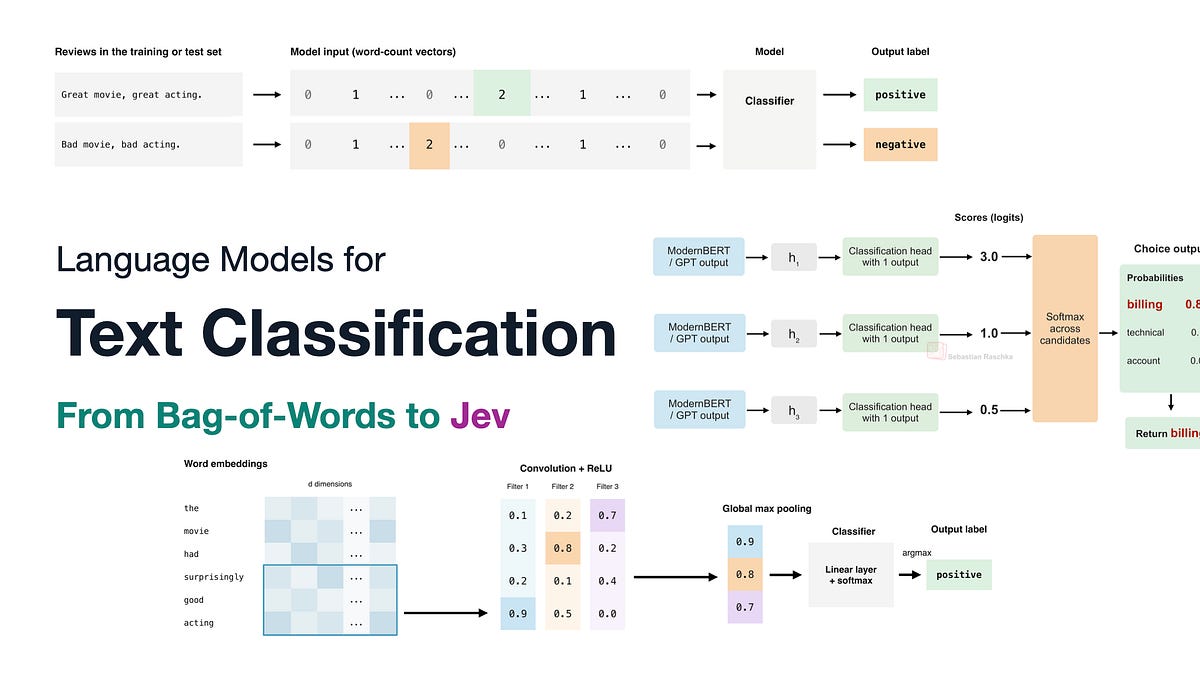
Language Models for Text Classification: From Bag-of-Words to Jev

Sebastian Raschka surveys the history of text classification — bag-of-words with naive Bayes/logistic regression, RNNs and CNNs with word embeddings, then transformer approaches (BERT/ModernBERT, GPT-style decoder fine-tuning, T5 encoder-decoder) — before analyzing TypeSafe AI's new Jev model, a fast/cheap general-purpose classifier accessed via Choice/Noul/Score APIs. He benchmarks Jev against a fine-tuned ModernBERT on the IMDb sentiment dataset (Jev ~96.2-96.5% vs ModernBERT ~95%), explains how to retrofit a Jev-like classification head onto BERT/GPT models, and discusses probability calibration, including the RLCR (Reinforcement Learning with Calibration Rewards) technique from a 2025 paper that likely inspired Jev's proprietary "RLCD" training method.

TransformerBERTGPT+5
JevTypeSafeGPT-5.6 Luna+15

models, training· Published and added 29 Sep 2026

arxiv.orgpaper🛡️ Security

MemSentry: A Framework for Detecting Persistent Memory Poisoning in Agentic AI

MemSentry is a proposed pre-commit evaluation framework for agentic AI systems that intercepts proposed writes to persistent memory and issues Accept/Review/Quarantine decisions by jointly scoring source trust, semantic risk, attack radius over a component-dependency graph, access risk, and a signed security-posture delta. The authors evaluate it against 1,000 GPT-4-generated scenarios using four pluggable semantic classifiers (Regex, TF-IDF+SVM, SBERT+LR, SetFit), with SBERT+LR reaching 91.7% accuracy while all methods catch 100% of external quarantine-class threats; the paper also documents a key limitation — surface-similar but oppositely-intentioned insider operations remain hard to distinguish semantically. It targets the persistent-memory-poisoning attack surface distinct from prompt injection, where a single malicious memory write (e.g., "suppress alerts from this IP") can silently persist and influence future agent actions like a SOC assistant's alerting or access decisions.

GPT-4LangChain
SMSRMemAuditMEMSHIELD+2

AI Security· Added 26 Sep 2026

Showing 30 of 61

Show more