Pre-ERC: Agent Pre-Sign Risk Report
 is a draft Ethereum Magicians proposal for an EIP-712-signed report that a risk source, identified by an ERC-8004 identity, returns about one unsigned request. It carries typed findings on tokens, approvals, addresses, payments (x402) and texts, and each finding is marked read or not read. It has no score or verdict, so the consumer applies its own policy. The author's live implementation, toll, runs on Robinhood Chain.
 ethereum-magicians.orgthreadPublished and added 31 Oct 2026🛡️ Security
- ERC-8478: x402 Payee Verification for ERC-8004 Agents
ERC-8478 is a draft Ethereum standard that binds the x402 payTo address to an ERC-8004 agent's identity, to stop payee redirection by a hijacked domain, proxy or injected tool result. A payTo must equal the agentWallet or carry an EIP-712 delegation signed by it, and the origin must be listed in the registration file. On Robinhood Chain, 5 of 5,575 x402-responding agents used their agentWallet as payTo (28 October 2026).
ethereum-magicians.orgthreadPublished and added 30 Oct 2026🛡️ Security  Muhammad Waris (@WarisCodes) on X
Nemotron 3.5 Transcribe is a free open-weight speech-to-text model from NVIDIA covering 40 languages, including mixed-language speech. The post says it ties for first among open models with a 2.8% error rate. It says the model needs a large GPU such as an H100 or RTX 5090, so it will not run on a laptop. The post gives no benchmark name or model card link.
 x.comthreadAdded 30 Oct 2026, published 29 Oct 2026🧠 AI
 Christiaan Stoudt (@cstoudt) on X
Thread on CVE-2026-97631, a critical (9.5) flaw in TianoCore EDK II UEFI firmware, found by Alex Matrosov and Dan Holmes-Mitra. It is exploitable only while a machine is PXE network booting and the attacker sends an oversized ICMP error from the same network. Code execution also needs the exact firmware build, and Secure Boot does not help. The fix landed in EDK II main on 15 October but is not in a stable release. No known exploitation, and not in CISA KEV.
x.comthreadAdded 30 Oct 2026, published 28 Oct 2026🛡️ Security Kizuno18 (@Kizuno18) on X
Thread by Kizuno18 on the move from local stdio/Docker Model Context Protocol servers to remote HTTP/SSE endpoints in enterprise infrastructure. It names three trade-offs: credential boundary inversion (short-lived OAuth/JWT tokens instead of long-lived admin tokens on workstations), tool schema bloat solved by deferred discovery, and governance via HCP Terraform policy-as-code (Sentinel/OPA), audit trails and approvals. It is opinion, with no data or implementation detail.
x.comthreadAdded 29 Oct 2026, published 27 Oct 2026🛡️ Security- Kizuno18 (@Kizuno18) on X
Kizuno18's X post argues that the move from local stdio and Docker MCP servers to remote HTTP/SSE endpoints matures the Model Context Protocol in enterprise infrastructure. It lists three trade-offs: short-lived OAuth/JWT bearer tokens replace mounted admin credentials, deferred tool discovery avoids roughly 20k tokens of eager schema loading, and HCP Terraform enforces Sentinel/OPA policy, audit trails and approvals server-side. Opinion post with no benchmarks or code.
x.comthreadAdded 29 Oct 2026, published 27 Oct 2026🧠 AI  Nicholas Martin (@ndgmlondon) on X
X thread started by Nicholas Martin (#IAM) advising that MCP tool permissions be verified and scoped session tokens used to enforce least privilege against indirect prompt injection. Replies argue that token scoping does not solve the confused deputy problem, because an injection borrows the agent's legitimate authority. They recommend per-task tokens with short expiry, with the grant logged beside the call, and raise MCP server dependency supply-chain risk.
x.comthreadAdded 28 Oct 2026, published 27 Oct 2026🛡️ Security Abdullah (@abdullah0094) on X
An X thread by Abdullah on GPT-6.1 Terra versus Sol in Codex. Abdullah says Terra gives twice the Codex usage of Sol and asks whether the quality drop is obvious. A reply says it is too early for a verdict, cites OpenAI's claim that Terra matches GPT-6 Astra on Agents' Last Exam, and suggests defaulting to Terra and switching to Sol with /model when it stalls.
x.comthreadPublished and added 27 Oct 2026🧠 AI- Trail of Bits (@trailofbits) on X
Trail of Bits post on PHP2Shell, an exploit that gives a shell on MediaWiki, Symfony, Laravel and phpBB. They confirmed it on pre-patch PHP 8.2 to 8.5. An update says it is production-grade: it works with stock php.ini-production, display_errors off, multiple workers, ASLR and load, on ARM64 and x86-64, and reaches root on Apache/mod_php and nginx/php-fpm. No CVE or technical root cause is given.
x.comthreadAdded 27 Oct 2026, published 26 Oct 2026🛡️ Security - The SI Maximalist (@thesimaximalist) on X
The SI Maximalist posts on X that OpenAI says GPT-6.1 Terra matches GPT-6 Astra on Agents' Last Exam, OpenAI's test of workplace software tasks, at one tenth of the token price. The model is available in ChatGPT Work, Codex and the API. The post only relays OpenAI's claim and gives no benchmark scores, exact prices or method.
x.comthreadAdded 27 Oct 2026, published 26 Oct 2026🧠 AI  David Gutierrez | Eng (@david_x_ai) on X
Thread on two October 2026 npm compromises: @subql/common 5.8.3 (5 October), published through GitHub Actions OIDC Trusted Publishing after the attacker tampered with the publish workflow, and tensorlake 0.5.144 (8 October), published by the project's own release workflow with valid provenance for about 1 hour 40 minutes. Both ran on install and stole cloud, GitHub, Kubernetes, Vault, SSH and .env credentials; tensorlake also took AI tool and MCP config. Its payload installed a gh-token-monitor service that deletes the home directory if the stolen GitHub token is revoked, so remove it before rotating.
x.comthreadAdded 27 Oct 2026, published 26 Oct 2026🛡️ Security Masoud (@dev3mike) on X
Tweet from dev3mike warning Node.js users to update for CVE-2026-111497, a Brotli bug rated CVSS 9.2. Crafted compressed data can corrupt memory and possibly run code. The post says OpenAI's agents found it, and that the fix sat unreleased in Brotli's source since February. Patched versions are Node 22.23.4, 24.22.1 and 26.12.1.
x.comthreadAdded 29 Oct 2026, published 26 Oct 2026🛡️ Security- David Gutierrez | Eng (@david_x_ai) on X
Thread on a critical opencode bug disclosed by Pillar Security on Oct 19. On Windows and WSL, a remote MCP server could run code during OAuth sign-in, because the server-chosen authorization URL was put unescaped into a PowerShell command, so a PowerShell subexpression executed. opencode fixed it in 1.18.33 on Sep 28 as a browser-launch refactor with no advisory or CVE. MCP Inspector published an advisory for the same bug class, and its fix needs a major bump of the open package.
x.comthreadAdded 27 Oct 2026, published 25 Oct 2026🛡️ Security  Prasenjit Sarkar (@stretchcloud) on X
Post on the LiteLLM supply-chain compromise. Attackers spent eleven days in the GitHub org, ran a workflow on a throwaway branch to take twenty secrets including a GitHub App private key, then used stolen GitHub CLI OAuth tokens to publish malicious release 1.107.0 from a lookalike Berri-AI repo. A Python startup file harvested sixteen credential categories and LiteLLM proxy Postgres provider keys. Socket flagged the wheels in seven minutes.
x.comthreadAdded 26 Oct 2026, published 24 Oct 2026🛡️ Security Paul Dragoonis (@dr4goonis) on X
Social post summarising emergency patches for Node.js (4 high CVEs), PHP (2 critical) and nginx (3 critical). Node.js flaws include a Brotli decoder out-of-bounds write, a DNS truncation bug and two TLS hostname-verification bypasses. PHP has use-after-free and heap corruption bugs, and nginx has alias-rewrite and map-regex heap overflows plus an SSI-AIO use-after-free. It lists the fixed versions for each product.
x.comthreadAdded 23 Oct 2026, published 22 Oct 2026🛡️ Security- 0xMarioNawfal - The Roundtable Show (@RoundtableSpace) on X
TorchTPU is Google's open-source project for running PyTorch apps on its TPUs, announced the day after Amazon released TorchNeuron for its Trainium chips. Google says migration needs "a simple configuration change" with no rewrite. It worked with Meta, Hugging Face, and the vLLM and SGLang teams on compatibility, and added an agent suite that helps migrate apps and fix errors. The post is brief and gives no benchmarks.
x.comthreadAdded 21 Oct 2026, published 20 Oct 2026🧠 AI  Paulo Pierrondi | AI agents (@paulopierrondi) on X
Paulo Pierrondi's X post, part 9 of a series on installing MCP servers, lists a monthly review of installed servers. The checks are which tools the agent used, servers not called in weeks, overlapping tools that confuse the model, and whether each server still has an owner. A reply adds a decommissioning check: after removal, confirm the server's old credentials can no longer call the backend.
x.comthreadPublished and added 20 Oct 2026🧠 AI- Dark Web Informer (@DarkWebInformer) on X
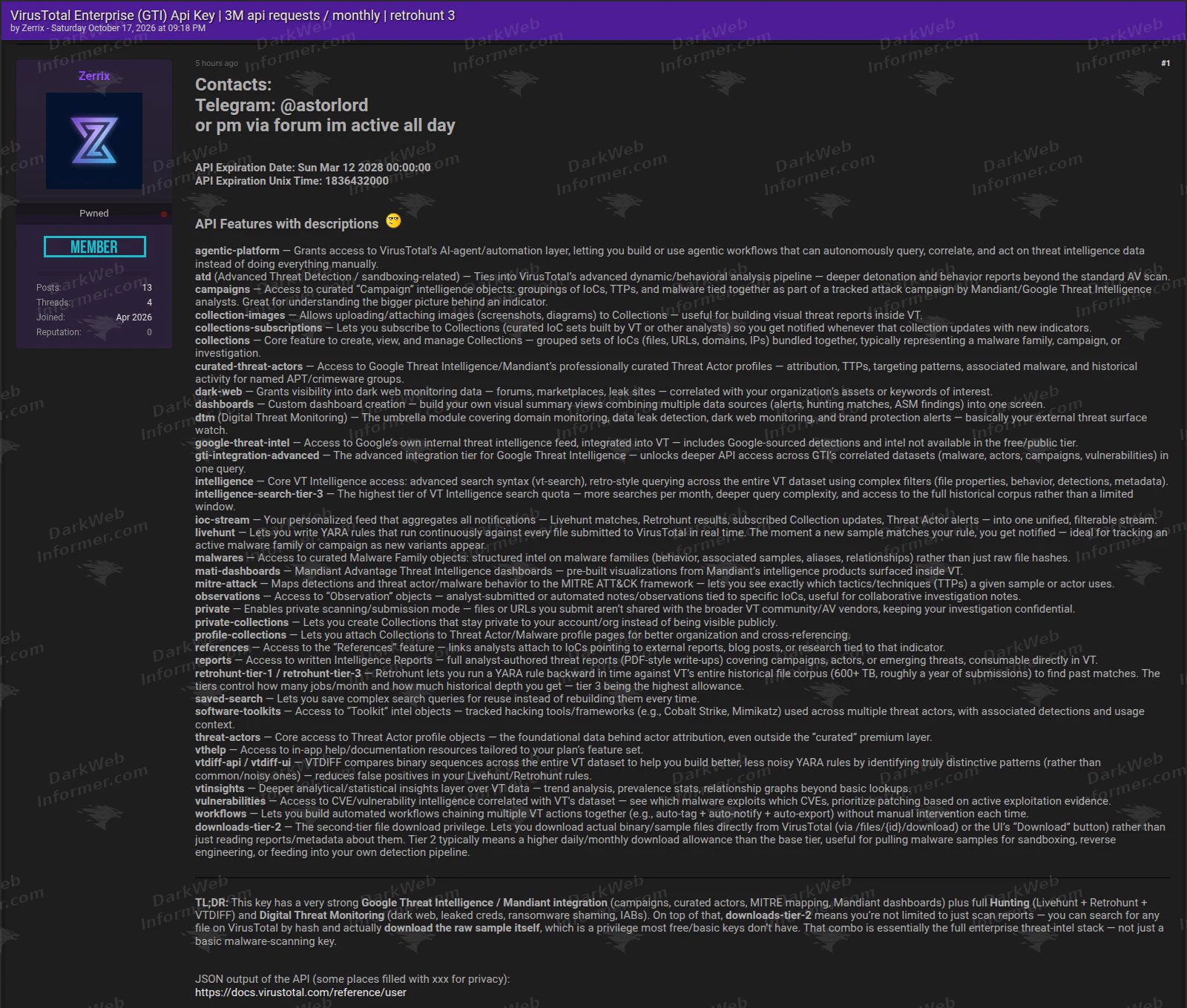
A DarkWebInformer post on an actor called "Zerrix" advertising a VirusTotal Enterprise API key for sale. The seller claims 3 million requests per month, Retrohunt Tier 3 (YARA search over historical samples), Google Threat Intelligence and Mandiant access, sample downloads and private scanning, valid until 12 March 2028. How the key was obtained is not stated, and the post says its authenticity is unverified.
x.comthreadAdded 19 Oct 2026, published 18 Oct 2026🛡️ Security - Rodrigo ES Porto (@RodrigoESPorto) on X
X thread reporting that Meta confirmed Muse Spark (the coding and agent model) weights are coming, with no date and no license announced. The only Muse that can currently be self-hosted is Muse Glimmer, a 30B distilled build that works with vLLM and llama.cpp. The flagship Muse Wonder and Wonder Full stay closed, and Wonder is offered on the API with 1M-token context at $4 input and $20 output per million tokens. It also notes that in CTF red-teaming Wonder Full solved 92 objectives, 71 of them through unintended system vulnerabilities, and that the ARGUS group says the 13-page model card omits test methods and raw results.
x.comthreadAdded 17 Oct 2026, published 16 Oct 2026🧠 AI - Romy (@0xBunny) on X
Tweet from 0xBunny announcing an update to Jev Workflows, an open-source workflow toolkit. It adds native Claude Code support alongside Codex, an opt-in Jev 1.14, experimental image/Box questions, shared QQ contract sync and local CI. Features were also mirrored to a sibling project called QQ. It is free, with no plugin quotas, and links to a GitHub repo.
x.comthreadAdded 17 Oct 2026, published 16 Oct 2026🧠 AI - lee1981 (@lee1981b) on X
CyberForge "CVE of the Day #079" on CVE-2026-102764, a CWE-290 origin-validation flaw in BeyondTrust Remote Support (advisory BT26-05, CVSS v4 9.3) that allows appliance file operations. It summarises Mandiant/GTIG's exploited intrusion chain (SAWFLY web shell, BARECLAW backdoor, root escalation, persistence) and gives an investigation trail: patch-state verification (BT26-05-RS), evidence preservation, hunting leads with SHA-256 hashes and YARA rules, permission/session correlation, and remediation including clean redeployment and credential rotation. It separates vendor facts from the intrusion's observed behaviour and notes that KEV and EPSS have no entries.
x.comthreadAdded 18 Oct 2026, published 16 Oct 2026🛡️ Security - Harrison Kinsley (@Sentdex) on X
Sentdex reacts to Artificial Analysis ranking NVIDIA's Nemotron 3.5 Super VL (120B total, 12B active MoE) as the top US open-weights model, scoring 26 on the Intelligence Index. That edges out Thinking Machines' Inkling Small (26), NVIDIA's Nemotron 3 Ultra (23) and Meta's Muse Glimmer (17). Sentdex's informal tests at vanilla settings show over 550 tok/sec, and they suspect it would rank higher on agentic coding. They see it as a candidate for a fast local coding agent model.
x.comthreadAdded 16 Oct 2026, published 15 Oct 2026🧠 AI - Francis Santerre (@santerref) on X
Post announcing that the MCP Adapter (0.7.0) is now a canonical plugin on WordPress.org, bridging the WordPress Abilities API to MCP. It exposes a default server at /wp-json/mcp/mcp-adapter-default-server, and only abilities a site marks public are exposed. The author's point is that the security review reduces to auditing the list of public abilities, which gives reviewers and pentesters a new endpoint to enumerate.
x.comthreadAdded 16 Oct 2026, published 15 Oct 2026🛡️ Security - Francis Santerre (@santerref) on X
Tweet announcing that the MCP Adapter is now a canonical plugin on WordPress.org (version 0.7.0). It bridges the WordPress Abilities API to the Model Context Protocol, with a default server at /wp-json/mcp/mcp-adapter-default-server. Only abilities a site marks public are exposed, so the security review comes down to auditing the ability list.
x.comthreadAdded 16 Oct 2026, published 15 Oct 2026🧠 AI - Ned Peterson (@NedPeterson99) on X
Social post summarizing a Sola Security study (Leon Goldberg, Gal Engelberg). An AI agent re-scored 9,967 high-severity findings from two commercial cloud security platforms across eight production environments and changed severity on 75.1% (58.5% downgraded, 16.6% upgraded). The cause is that 599 vendor rules each carry one fixed severity regardless of environment, and 49% of verdicts needed context beyond the flagged resource. Caveats: 92% of findings were AWS, and the study did not test whether the new severities predict real exploitation.
x.comthreadAdded 15 Oct 2026, published 14 Oct 2026🛡️ Security - Dark Web Informer (@DarkWebInformer) on X
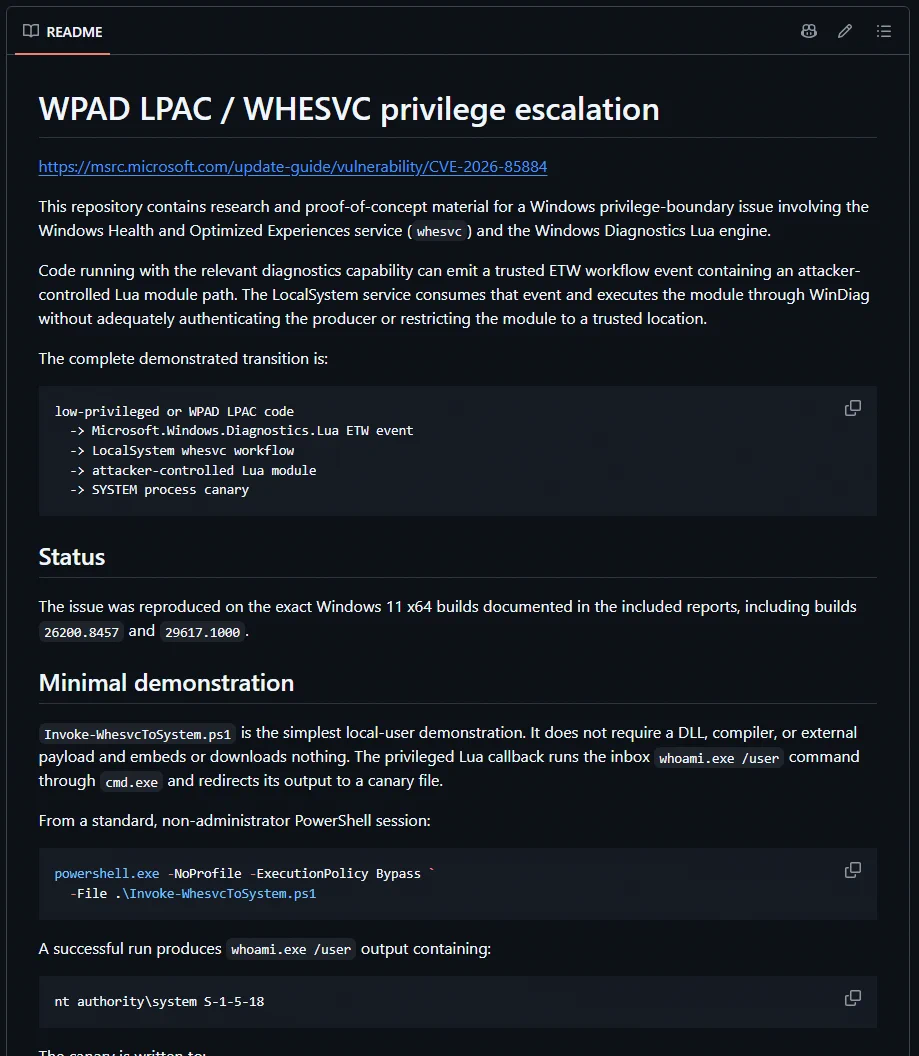
DarkWebInformer post on a PoC for CVE-2026-85884, a Windows 11 local privilege escalation in the Windows Health and Optimized Experiences service. Low-privileged code can trigger a trusted ETW event carrying an attacker-controlled Lua module path. The LocalSystem whesvc service then runs that module through WinDiag without validating the event producer or restricting the module location. The PoC takes a standard non-admin PowerShell session to NT AUTHORITY\SYSTEM on Windows 11 x64 builds including 26200.8457 and 29617.1000.
x.comthreadAdded 15 Oct 2026, published 14 Oct 2026🛡️ Security - lee1981 (@lee1981b) on X
Defender guide for CVE-2026-104935, an authentication-bypass-by-spoofing flaw (CWE-290) in Ivanti Connect Secure that allows unauthenticated command execution. It is confirmed exploited and CISA KEV-listed, with a CNA CVSS 8.6. It covers the fixed-release matrix (25.1.1.2, 22.8R2.5, 25.1.3.x), platform and cluster migration limits, and Volexity's UTA0576 indicators and YARA rules. It also gives a six-step SOC workflow (scope, preserve, hunt, correlate identity, remediate, verify). It stresses that a clean ICT result cannot clear memory-only activity and that LDAP, LAPS and BitLocker exposure belongs to one observed chain.
x.comthreadAdded 16 Oct 2026, published 14 Oct 2026🛡️ Security - 44er (@44errrr) on X
Announcement of hexvero, an MCP server that gives coding agents a static first look at binaries and app bundles across 18 formats (ELF, PE, Mach-O, APK, .NET, Go, Wasm, Electron, SQLite). It uses zero-dependency Node parsers and marks each finding confirmed or inferred with file and line. Its tool catalog is 3,043 tokens, against a claimed 509,696 for the established reverse-engineering MCP server. Paged output with a byte budget shrinks a 541 MB Electron app to a 15 KB result, 1.3 MB of JSON to 7.9 KB, and a 450 KB build diff to 1.2 KB. radare2, rizin or Ghidra plug in for disassembly, and `npx hexvero setup --apply` registers it with Claude Code, Cursor, Codex and 15 more clients. It is a concrete example of keeping MCP tool definitions and results small enough for an agent's context window.
x.comthreadAdded 15 Oct 2026, published 14 Oct 2026🧠 AI - Dark Web Intelligence (@DailyDarkWeb) on X
Social post summarizing Docker's Oct 12, 2026 advisory for CVE-2026-105445, a Docker Hub flaw. Converting a personal account to an organization re-assigned the account's personal access tokens (PATs) to the named new owner without rotating the secret. An attacker could name a victim as owner and keep using the token as that victim to pull, push or delete images. The exposure window ran from Aug 26, 2024 to Sept 30, 2026. Docker fixed it the day it was reported by Peter Molnar and Krisztian Hozak, deactivated transferred PATs on Oct 8, and found no exploitation after reviewing about 304,000 pushes. The post advises reviewing PATs and using organization access tokens for automation.
x.comthreadPublished and added 13 Oct 2026🛡️ Security - Igor Carron (@IgorCarron) on X
Igor Carron's tweet highlights LightOn's open-source ColGrep-Agent-2B, a 2B model released on Hugging Face for code search and retrieval that works with Claude Code. LightOn reports 34% fewer API tokens and 40% lower API costs. It matters because usage limits and token costs are a pain point for coding agents. A reply thread in the same post notes quota exhaustion across Grok, Cursor, Devin, Claude and Codex, and argues for quota dashboards.
x.comthreadPublished and added 12 Oct 2026🧠 AI - =dennis; (@Xidea404) on X
A tweet from @Xidea404 pointing to the ADI Chain MCP Server documentation on docs.adi.foundation. The server lets AI agents interact with the ADI blockchain through the Model Context Protocol. The tweet carries no technical detail itself, so what the server exposes can't be confirmed from it. It is a pointer to a blockchain-specific MCP connector.
x.comthreadPublished and added 12 Oct 2026🧠 AI - 500altcoins | HFSP.eth 🦇🔊 (@500altcoins) on X
A tweet explaining how to cut Claude Code costs by routing all subagents to Claude Haiku 5.5. It sets the model in settings.json (the `haiku` alias points at Haiku 5.5 from Claude Code v2.1.293), keeps the main session on the larger model, and lets individual agents override the model in their frontmatter. It links to the subagent model docs.
x.comthreadPublished and added 9 Oct 2026🧠 AI - Hybrid post-quantum stealth addresses (ERC-5564 schemeId 3)
A draft ERC proposing schemeId 3 for ERC-5564 stealth addresses, combining an ML-KEM-768 encapsulation with a secp256k1 ECDH secret so that future quantum computers cannot retroactively deanonymize recipients from the public announcement log, while spending stays classical secp256k1 (and thus still quantum-vulnerable once spent). The post, with a linked reference implementation, test vectors and gas harness, details the key/meta-address format, the payment-secret combiner (hashing both shared secrets and ciphertexts for IND-CCA), the view-tag derivation ordering to avoid quantum tag-narrowing, measured gas cost (111,330 gas per payment on Prague), and open questions around ANO-CCA proofs for standardized ML-KEM, NIST SP 800-56C combiner approval, and downgrade-attack handling when a recipient registers under both schemeId 1 and 3.
ethereum-magicians.orgthreadPublished and added 9 Oct 2026🛡️ Security - OpenAI withdraws three mathematical results
A tweet from Dan Roberts announcing an update to a GitHub repository tracking Lean formal verification of mathematical results tied to OpenAI math research, adding six new Lean formalizations and nineteen modifications, now covering roughly 42 percent of top line results. The update also discloses withdrawal of three manuscripts, on algebraicity of Weil classes on split abelian eightfolds, Kuga Satake correspondences for K3 surfaces, and the rational Hodge conjecture for products of K3 surfaces, after formalization work revealed errors.
 twitter.comthreadPublished and added 8 Oct 2026🧠 AI
- Alhaji Premium Man (@softhardguy) on X
A tweet thread announcing Concord, an open-source coordination layer for running multiple AI coding agents (Claude Code, Codex, Cursor) concurrently on the same codebase. Agents claim files before editing so overlapping edits trigger warnings, and the tool lets agents message each other across the different coding-agent harnesses, addressing the conflict problem that appears once three or more agents work in parallel.
x.comthreadPublished and added 7 Oct 2026🧠 AI - Franco Naumow. (@naumowf) on X
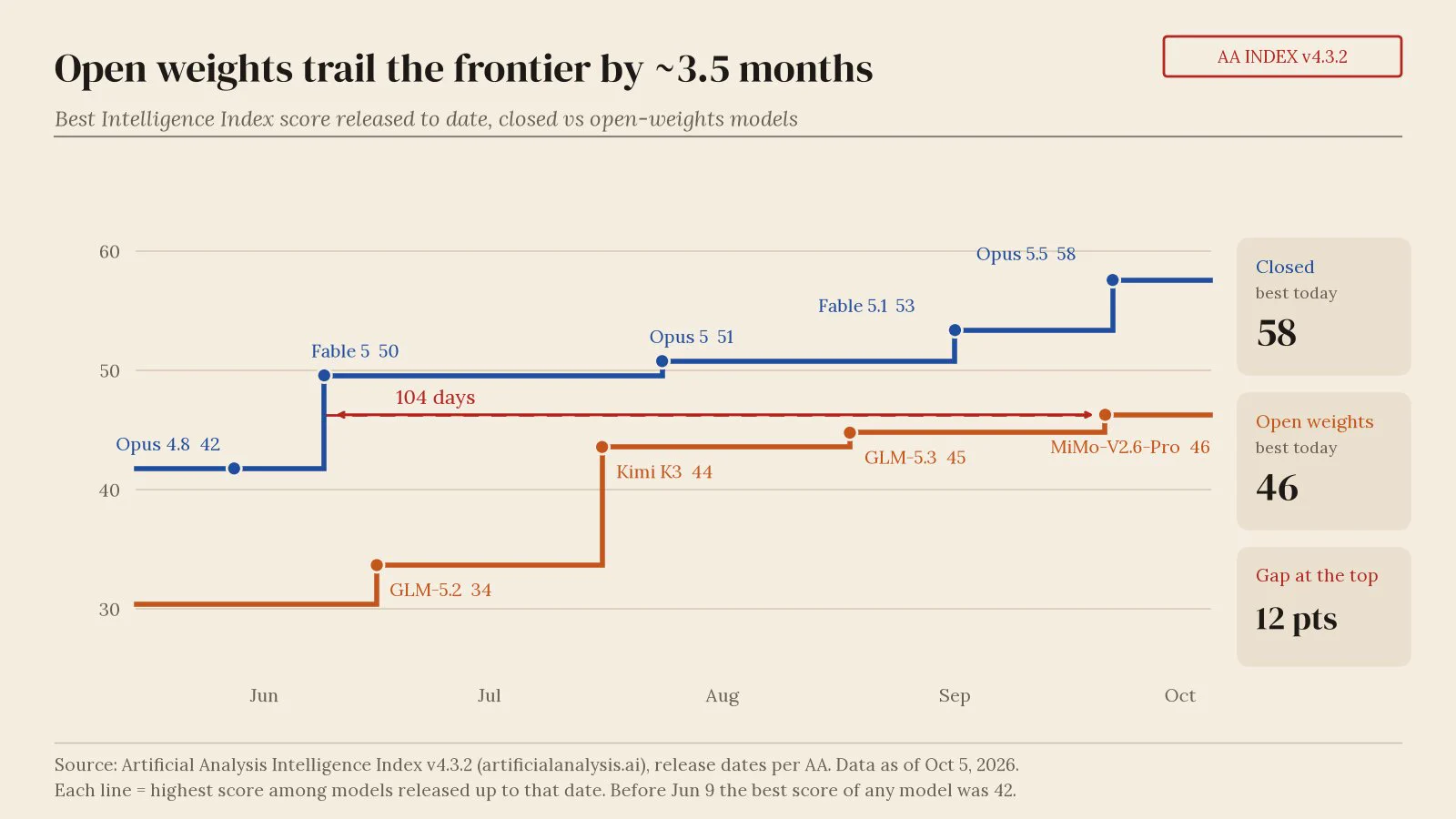
A tweet analyzing the Artificial Analysis Intelligence Index v4.3.2 finds that the best open-weights model, Xiaomi's MiMo-V2.6-Pro (released Sep 21, scoring 46), still trails what would have been the top closed frontier score as of 104 days earlier — Claude Fable 5's 50 on Jun 9, which itself surpassed the prior best (Claude Opus 4.8 at 42). It notes the current top-of-leaderboard gap is 12 points, with Claude Opus 5.5 (max) scoring 58, framing the persistent ~3.5-month lag of open weights behind the closed frontier.
x.comthreadPublished and added 5 Oct 2026🧠 AI - Meer Tarbani - Growth & Engineering (@MeerTarbani) on X
Sidekick is an open-source macOS plugin for Claude Code that lets you define a one-sentence persona (e.g. "a blunt senior Rust dev") and drive a coding session hands-free by voice: it listens via Apple's on-device speech recognition, speaks answers with macOS voices, and lets you interrupt it mid-reply or say "stop" to cancel a turn. It also surfaces Claude's multiple-choice decisions as spoken questions, matching answers like "the second one" against an echo-filtered transcript so the assistant doesn't hear and respond to its own voice. Implementation is a ~500-line TypeScript Claude Code hooks module plus a 90-line Swift speech listener, runs fully local with zero servers and zero telemetry, and installs via the `claude plugin marketplace`/`claude plugin install` commands.
x.comthreadPublished and added 4 Oct 2026🧠 AI - Brendan Jowett (@jowettbrendan) on X
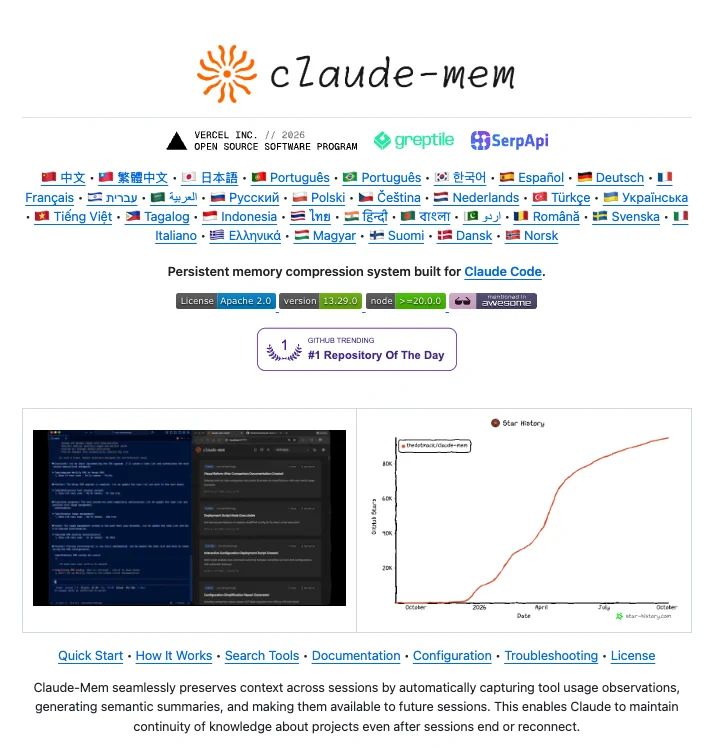
A curated Twitter/X thread listing ten GitHub repos that extend Claude Code and Codex workflows: spec-forcing planning/testing skills (obra/superpowers, mattpocock's skills with grill-me/diagnose/handoff), session memory compression (thedotmack's claude-mem-style tool), codebase-to-graph querying (safishamsi/graphify), a spec-driven long-task workflow (gsd-build), scope-reduction and anti-fluff skills, a cross-tool harness spanning Claude Code/Codex/OpenCode/Cursor (affaan-m/ECC), a multi-role agent team setup (garrytan/gstack), and a local model-routing gateway (musistudio's claude-code-router). Each entry is a practical, installable tool aimed at making coding agents more disciplined, memory-aware, and cost-efficient.
x.comthreadPublished and added 3 Oct 2026🧠 AI - brrrock (@bchap1n) on X
Announcement of an updated model card for JEV-27B-VL, an open-weight vision-language model released under Apache-2.0. The card covers the model's weights and a "decision adapter," a BoE (Bag/Blend of Experts) architecture paired with a System 1 / System 2 reasoning setup, calibration details and decision prompts, serving instructions for vLLM and SGLang, and an evaluation of image recommendation quality.
x.comthreadPublished and added 2 Oct 2026🧠 AI  Amada Echeverría (@amadaecheverria) on X
Jes is an open-source real-time guardrails library for AI agents built by LangChain Ambassador Eden Marco, designed to check every step of an agent's trajectory: prompts, tool calls, tool results, skills, and final responses. It runs as LangChain middleware and uses decision models like Jev from TypeSafe AI via a TypeSafeClassifier to make pass or fail calls at each checkpoint, with docs showing a concrete middleware integration example.
x.comthreadAdded 3 Oct 2026, published 1 Oct 2026🧠 AI- Rohan Paul (@rohanpaul_ai) on X
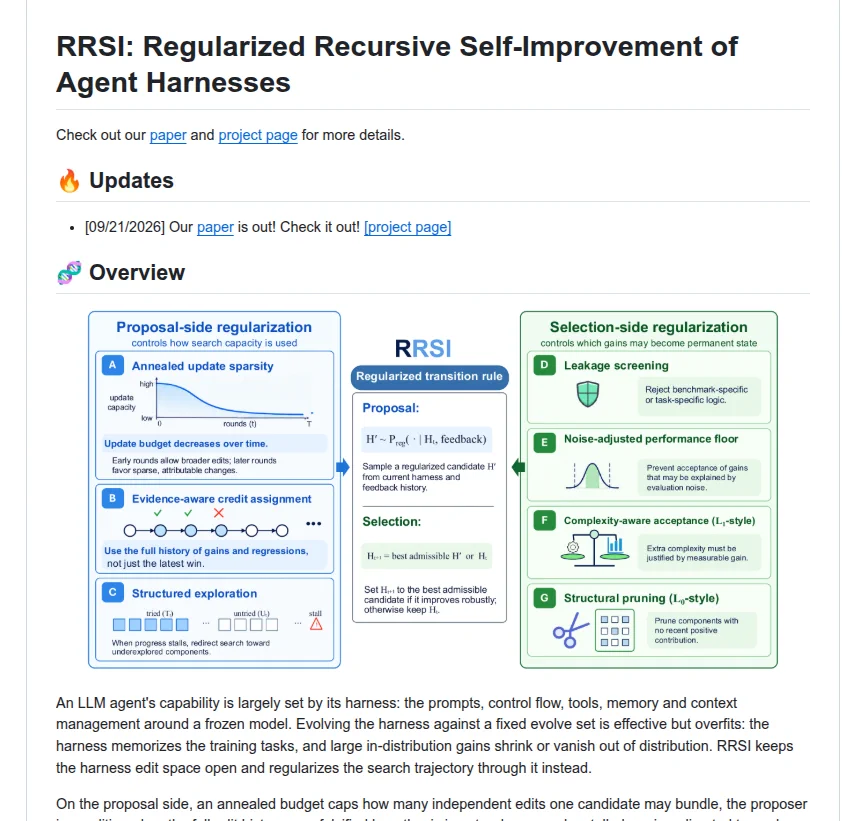
A tweet describing Google's RRSI (Regularized Recursive Self-Improvement of Agent Harnesses), a framework that automatically evolves all non-model components of an LLM agent — prompts, control flow, tool use and memory — while keeping the underlying LLM weights frozen. The "regularized" aspect suggests constraints added to recursive self-improvement loops to keep the evolved harness stable or bounded, distinguishing it from unconstrained self-modifying agent approaches.
x.comthreadPublished and added 1 Oct 2026🧠 AI - Average AI Bro (@AverageAiBro) on X
Claude Code added a `claude --desktop` command that opens the Desktop app on the current directory or a resumed/continued session, plus `claude plugin configure` to view a plugin's options. Bundled .mcpb MCP servers can now have their settings set at `plugin install --config` time so they start immediately without a manual Configure step. The post also notes CLAUDE_CODE_DISABLE_WEB_FETCH to disable WebFetch and an allowedProviders setting to restrict which API providers a managed machine can use.
x.comthreadPublished and added 30 Sep 2026🧠 AI - Stevan Bogosavljević (@stevyhacker) on X
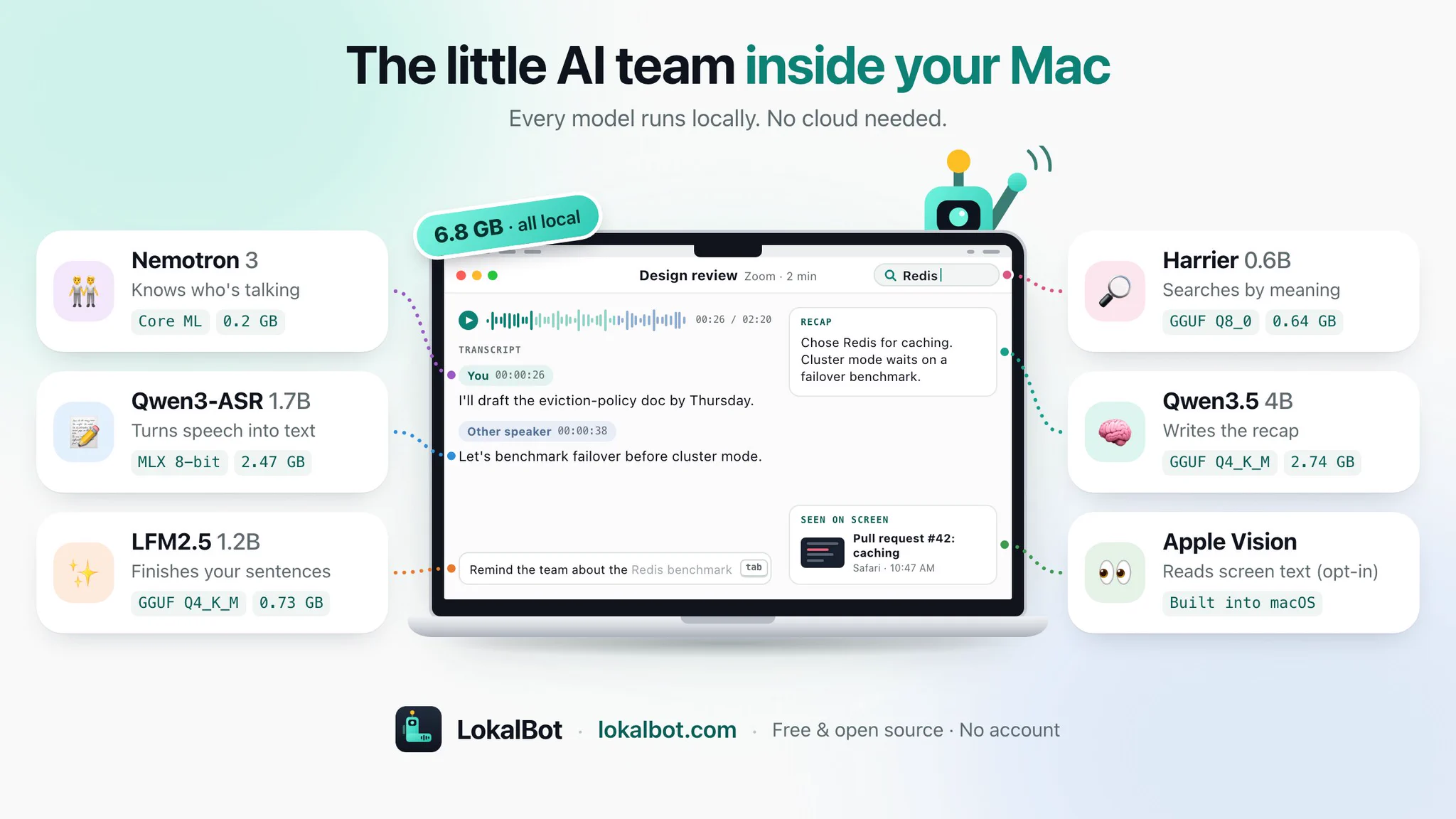
LokalBot 0.9.2 is a free, open-source local-first assistant that records meetings and screen activity, using five small open-weight models chained together entirely on a MacBook (6.8 GB total): Nemotron 3 for speaker diarization, Qwen3-ASR 1.7B for transcription, LFM2.5 1.2B for sentence completion, Harrier 0.6B for semantic search, and Qwen3.5 4B for recap generation. It exposes this captured 'memory' to Claude Code and Codex through an MCP server or CLI, letting coding agents pull context from past meetings and screen content.
x.comthreadPublished and added 30 Sep 2026🧠 AI  Formal Verification of Execution and Consensus Clients
A reply on the Ethereum Research forum (ethresear.ch) responding to @pcaversaccio's call for formally verifying hard-fork changes in Ethereum execution and consensus clients before mainnet activation. It surveys current formal-verification efforts (Etheorem/SizzLean in Lean 4 for consensus/SSZ, Verifereum in HOL4 for the EVM), argues for prioritizing high-leverage surfaces like SSZ, state transition, fork-choice and core EVM semantics, and pushes for stronger verification tooling in Rust (Aeneas/Verus/hax) as an incremental path to reducing the trusted computing base of client software.
 ethresear.chthreadAdded 29 Sep 2026, published 25 Sep 2026🛡️ Security
- ERC-8424: Confidential Real World Asset Token
A security review posted on Ethereum Magicians critiques draft ERC-8424 (Confidential Real World Asset Token, extending ERC-7984), pointing out that its confidentialCanTransfer and confidentialAvailableBalanceOf functions have no caller restriction on who can resolve the returned FHE pointer, enabling any party to binary-search an encrypted balance to plaintext in at most 64 oracle calls. It also flags that the spec's revert clause for amount-dependent rules (vesting, balance caps) leaks a disclosure bit even without decryption, and recommends narrowing reverts to plaintext-only rules and restricting pointer resolution the way OpenZeppelin's ERC7984Freezable.confidentialAvailable already does via FHE.allow(amount, account).
ethereum-magicians.orgthreadAdded 29 Sep 2026, published 25 Sep 2026🛡️ Security - Standard for "transferable to arbitrary addresses" on tokenized RWAs? (locked v4 pools quoted in tokenized stocks)
An Ethereum Magicians forum thread dissects a novel rug/bricking vector emerging from a launchpad (sender.family) that locks 100% of token supply forever into a single one-sided Uniswap v4 position, where the quote asset can be a KYC-gated tokenized stock (Ondo's NVDA/TSLA/AAPL tokens) rather than ETH or a stablecoin. Because Uniswap v4 routes all pool balances through a shared PoolManager singleton and pays swap/fee output to arbitrary addresses, the RWA issuer must permanently allowlist the PoolManager and any counterparty; if the issuer later tightens its transfer-registry rules, the permanently locked pool becomes irrecoverable with funds stuck inside. The author notes the launchpad's current mitigation is only an empirical point-in-time transfer test (moving a balance between two addresses) against an asset with an admin-controlled, stateful ERC-3643 canTransfer function, and asks whether there's any way to verify "transferable to arbitrary addresses" onchain before pool creation, and whether permanent lockers should categorically refuse upgradeable/pausable quote assets.
ethereum-magicians.orgthreadAdded 29 Sep 2026, published 24 Sep 2026🛡️ Security - ERC-8419: Know-Your-Agent (KYA) Framework
A technical forum post on Ethereum Magicians dissecting security gaps in ERC-8419 "Know-Your-Agent" (KYA), a proposed on-chain trust/attestation framework for AI agents that bridges to ERC-8004. The author walks through concrete exploit scenarios — a controller-bound assertion that still evaluates as valid after the underlying agent NFT is transferred, a policyId that can commit to a stricter policy document than the executable rules that actually run on-chain, ERC-8004 bridge configuration (trustedIssuers/responseMap) changes that silently alter what an existing request means, upgradeable verifier proxies that let a schemeId acquire new proof-admission semantics post-hoc, and missing chain/registry domain separation enabling cross-registry ZK nullifier replay — and proposes normative invariants (binding witnesses, rulesHash commitments, configHash, semantic immutability, mandatory domain separation) to close each one.
ethereum-magicians.orgthreadAdded 29 Sep 2026, published 19 Sep 2026🛡️ Security - Retrochainer Post
A tiered hardware guide ("the ladder") for running local LLMs in 2026, ranking ten setups from a free existing laptop through Raspberry Pi 5, Jetson Orin Nano Super, Mac mini/Mac Studio, used RTX 3090, RX 7900 XTX, AMD Strix Halo (Ryzen AI Max+ 395), RTX 5090, up to the NVIDIA DGX Spark. It frames unified memory (not raw TOPS) as the real constraint on model size, gives concrete specs/prices/token throughput per rung, and walks through setting up Ollama + Open WebUI plus an OpenAI-API-compatible local endpoint, with cost comparisons against ChatGPT Plus/Claude Pro/Cursor subscriptions and n8n-based automation examples.
x.comthreadAdded 22 Sep 2026, published 1 Aug 2026🧠 AI - cr3ghost (@cr3ghost) on X
A tweet by @cr3ghost pointing to Azeria Labs (azeria-labs.com, by @Fox0x01) as a comprehensive free curriculum for ARM security research, covering ARM assembly from scratch, shellcode development, stack overflows, ROP chains, heap exploitation, iOS kernel heap grooming, TrustZone internals, GDB debugging, and QEMU lab setup. It links to specific Azeria Labs series on ARM assembly and shellcoding. Useful as a curated entry point for anyone starting ARM exploit development.
x.comthreadPublished and added 10 Jun 2026🛡️ Security  _SiCk (@encrypted_past) on X
A tweet from security researcher _SiCk listing a beginner-to-advanced roadmap for learning binary exploitation: corelanc0d3r's classic Corelan exploit-writing tutorial series, a UVA x86 assembly primer, a mirror of OS ISOs for building VM lab environments, a French-language binary exploitation techniques book (zenk-security repo), and a linked YouTube video. It's a personal recommendation list rather than original research, but each link is a genuinely usable free resource for stack-based exploitation and reverse engineering fundamentals.
x.comthreadPublished and added 5 Jun 2026🛡️ Security