Discovering vendor-specific vulnerabilities in Android | Oversecured Blog
Oversecured describes extending its Android scanner to system APIs and to Samsung's Android build, after comparing Google and Samsung framework JARs and about 400 system services. It explains AIDL service permission checks and new control-flow analyses. Examples include Samsung's unchecked semIsBackupEnabled(), a broadcast that reboots the device, and a LaunchAnyWhere in Settings. Samsung had fixed over 60 reported issues.
 oversecured.comwriteupAdded 29 Oct 2026🛡️ Security
- Abusing Linux fanotify for Anti-Forensics
Abusing Linux fanotify for anti-forensics: a privileged userspace process can use the fanotify API to deny other processes the right to open an otherwise normal file. Reads fail with EPERM even for root, while name, ownership, timestamps and permissions look ordinary, so a scanner that cannot open a file may report no detections without inspecting it. Defenders can find malicious fanotify groups and marks via /proc/<pid>/fdinfo, or acquire at the filesystem level instead of opening the pathname.
 dfir.chwriteupAdded 1 Nov 2026, published 24 Oct 2026🛡️ Security
 Claude reveals ECDSA curve origins
Anthropic's Frontier Red Team reports that Claude recovered how the NIST P-192/224/256/384/521 and ANSI X9.62 curve seeds were generated. They are outputs of the C library's lrand48 LCG seeded with 1997–98 Unix timestamps, not hashes of a passphrase. The method scanned for weak-PRNG signatures, then used LLL lattice reduction to recover the truncated LCG state and stepped it back to srand48 initialization. Claude also traced some base points to the FreeLIP/NTL random generator. Reproducible Python is included. The authors say this is not an attack and makes deliberate backdoors less plausible. The B-163 seed and the base points of P-224/256/384/521 and the binary curves remain unexplained.
 anthropic.comwriteupAdded 17 Oct 2026, published 16 Oct 2026🛡️ Security
- Claude reveals ECDSA curve origins
Anthropic's Frontier Red Team reports that Claude, given no hint, worked out how the NIST P-192/224/256/384/521 and ANSI X9.62 curve seeds were generated. They came from the C library's lrand48 LCG seeded with Unix timestamps from 1997–98, not from a hash of a phrase. Claude found this by scanning for weak-PRNG signatures and recovering the PRNG state with LLL lattice reduction. It also traced several prime-curve base points to the FreeLIP random generator. The post includes Python code that reproduces the seeds and base points. It says this is not an attack and makes backdoor claims less plausible. B-163 and the other base points remain unexplained.
anthropic.comwriteupAdded 17 Oct 2026, published 16 Oct 2026🧠 AI - Field Notes: EtherRAT Distributed Through a Legitimate Intune Workflow
DFIR case where a malicious MSI impersonating Advanced IP Scanner, sourced from a fake GitHub repo found via Bing, was imported by a customer into Microsoft Intune and deployed to four endpoints, running a Node.js-based EtherRAT chain. It traces the infections by correlating the MSI ProductCode, MDMAppInstaller/omadmclient process ancestry and Intune app inventory (Graph PowerShell query). It also covers renamed node.exe hash-hunting pitfalls, Ethereum RPC dead-drop C2 traffic, a screen-capture script and a second impersonating repo.
dfir.chwriteupAdded 14 Oct 2026, published 13 Oct 2026🛡️ Security  GhostAction Attack Escalates By Targeting GitHub Users
OpenSourceMalware's analysis of the latest GhostAction wave, where compromised GitHub accounts get malicious Actions workflows (security-audit.yml) injected across every writable repository, including an Oct 8 sweep of 346 repos via kitao and henrywoo. The new payload greps the checkout and full git history for credential patterns (AWS, Anthropic, OpenAI, GitHub PATs) and POSTs them over HTTP to 193.32.204.199/?c=monami. It also covers infrastructure reuse (phishing-heavy legacy IP, scanner activity), new watchlist domains my-github.com and my-gitlab.com, GitHub code-search hunting queries, a detection-confidence table, IOCs and incident response steps.
 opensourcemalware.comwriteupAdded 10 Oct 2026, published 9 Oct 2026🛡️ Security
 3 lessons from frontier AI vulnerability research
Microsoft Security's FORGE Lab shares results and lessons from four months of AI-agent-driven vulnerability research: 140 Windows CVEs (52 in September 2026's release), 155 internally validated reports across 23 open-source projects, and the first patch merged into the Linux kernel via the Linux Foundation's Akrites coordinated-disclosure initiative. Using their multi-model agentic scanning harness MDASH and GPT-5.5-based validation agents, the team measured automated PoC generation at an average $3.61/21.5 minutes per confirmed crash and local privilege-escalation AEG at $8.56/25.4 minutes, and argues the real bottleneck has shifted from finding bugs to validating and remediating them at matching speed. Specific disclosed CVEs include curl's CVE-2026-9545 and CVE-2026-13608, Node.js's CVE-2026-56848, and Linux kernel's CVE-2026-64563.
 microsoft.comwriteupPublished and added 7 Oct 2026🛡️ Security
 Living off The Browser: Running Popular Hacking Tools Inside Chrome
Hackers Arise walks through an installable Chrome Isolated Web App that packages nine popular Active Directory pentesting tools, including NetExec (NXC), SharpHound, LDAP-shell, Evil-WinRM, and Certipy, so they run natively inside a Chrome tab with multi-protocol network access, bypassing the need for Linux or WSL. The piece shows setup via Chrome flags and an IWA install URL, then a lab demo: port-scanning a target, using Evil-WinRM for remote access, enumerating DNS zones with ADIDNS, and running Certipy to flag an ESC1-vulnerable ADCS template for domain-admin escalation.
 hackers-arise.comwriteupAdded 7 Oct 2026, published 6 Oct 2026🛡️ Security
 https://bughunters.google.com/blog/pagebreak-real-world-findings?utm_source=tldrsec.com&utm_medium=newsletter&utm_campaign=tl-dr-sec-348-google-s-pagebreak-scanner-perplexity-s-agent-security-tool-defending-agentically
Google's Product Security team describes three high-severity bugs found by PageBreak, an internal LLM-agent scanner that validates findings by running payloads against live environments. The cases are cache poisoning on apis.google.com (an unkeyed `extra_path` injected into cached JS), XSS on admin.google.com where the agent bypassed the `sig` check by getting the authorize endpoint to sign a `javascript:` URI, and a UXSS in the Tag Assistant extension via a weak `onConnectExternal` origin check and nonce exfiltration. It shows what agentic, deterministically verified scanning can find in well-reviewed targets.
 bughunters.google.comwriteupAdded 2 Oct 2026, published 1 Oct 2026🛡️ Security
 Tracking CVE-2026-73570: unauthenticated command injection on internet-facing mail servers
Microsoft Threat Intelligence tracked in-the-wild exploitation of CVE-2026-73570, an unauthenticated OS command-injection vulnerability in Zimbra Collaboration Suite's SNMP notification path (swatchdog-to-snmptrap), triggerable via a crafted SMTP request when the optional zimbra-snmp package is enabled. The post documents pre-disclosure scanning, JSP webshell deployment, a novel pam_exec/zmmailboxdmgr privilege-escalation chain to root, systemd-based persistence (zimlog.service), theft of zimbraPreAuthKey/zimbraAuthTokenKey via zmlocalconfig and LDAP, lateral movement over Zimbra's SSH identity, a multi-stage Go-based remote-access agent (zimclient2 via zimdown2/agent2.sh), a dedicated mailbox-exfiltration implant, and an AzCopy-based exfiltration attempt, closing with Defender XDR KQL hunting queries and MITRE ATT&CK mapping.
microsoft.comwriteupAdded 1 Oct 2026, published 30 Sep 2026🛡️ Security OpenAI DevDay 2026 live blog
Simon Willison's live-blogged notes from OpenAI DevDay 2026 cover a raft of product launches (the "dots" personal agent, GPT-6.1 Sol, Ultrafast inference, ChatGPT Sites, GPT-Live), but the security-relevant core is the Codex Security session: OpenAI describes an internal "Defense Factory" security sprint that fixed 53 critical findings in a day, and launches a major Codex Security Cloud upgrade plus an open-source Codex Security CLI. The tool builds a security knowledge base, reads per-repo SECURITY.md threat-model files, runs a looping scanner, deduplicates findings (36% of their internal findings were duplicates), and can auto-generate patches/PRs validated by a "verify-fix" adversarial agent (1% rollback rate).
 simonwillison.netwriteupAdded 7 Oct 2026, published 29 Sep 2026🛡️ Security
 Top 10 attacks on Claude Code and what each one actually broke
Adversa AI catalogs ten distinct Claude Code attacks documented between September 2025 and September 2026: the Miasma supply-chain worm that hit 73 Microsoft repos via a SessionStart hook, TrustFall's unsandboxed MCP server execution on folder-trust, Check Point's CVE-2025-59536/CVE-2026-21852 pre-trust-dialog code execution and API key theft, Sentry-DSN-based "Agentjacking" prompt injection via fake bug reports, a 50-subcommand cap that silently disables deny rules, the SymJack symlink-to-config-hijack primitive working across six agent CLIs, Wiz's GhostApproval deceptive-approval-prompt finding (with CVE-2026-12958 at AWS and CVE-2026-50549 at Cursor but none at Anthropic), the Plugin4Shell SHA/branch-name collision bypassing plugin pinning, an academic MCP tool-poisoning paper achieving RCE on agent/LLM pairs, and SkillCloak's self-extracting-packer bypass of skill scanners. The piece argues almost none of these are model-behavior bugs - they are trust-boundary and consent failures in the surrounding tooling - and closes by pitching Adversa's own runtime agent security gateway as the fix.
 adversa.aiwriteupAdded 7 Oct 2026, published 23 Sep 2026🛡️ Security
 Autonomous AI Agents Hack Online Retailers for $25 a Company
Gambit Security recovered the staging server of a financially motivated actor running three open-source AI agent harnesses — Strix (vuln scanning), Cairn (autonomous exploitation), and Hermes (orchestration) — against hundreds of online retailers at a marginal cost of tens of dollars per target. The campaign exfiltrated 600,000+ credit card records via Magento database compromises, deployed checkout-page card skimmers on at least 19 confirmed and 100+ further sites, and in one case an agent's own cleanup routine dropped 180 database tables including victim backups. The report details full attack chains (SQLi to RCE to AWS Secrets Manager dump to card decryption), the AI harnesses' operating costs (~$25 mean per target on OpenRouter/opus-4.6/GLM/DeepSeek), and multiple real-world skimmer injection techniques.
 gambit.securitywriteupAdded 26 Sep 2026, published 22 Sep 2026🛡️ Security
 Shai-Hulud Rises From the Dead after 111 days
Aikido Security reports that the Shai-Hulud npm worm payload (SHA256 e37e3dd...e5b1a6), first seen during the @AntV compromise on May 19, 2026, resurfaced 111 days later on September 7 in four new packages (feishu-docx-mcp, bmc-i18n-extract-cli, blueai-cli, bmc-translate-utils) published by the same npm account within one hour. The payload passed npm's publish-time malware scanning — introduced in July 2026 to hold packages 5-15 minutes for automated checks — despite being an exact, previously fingerprinted hash match, exposing a gap between npm's scanning claims and actual detection coverage. The writeup includes full IOCs: C2 domain t.m-kosche.com, preinstall script running `bun run index.js`, persistence via .vscode/tasks.json and .claude/settings.json, and stolen-token-based republish behavior.
 aikido.devwriteupPublished and added 7 Sep 2026🛡️ Security
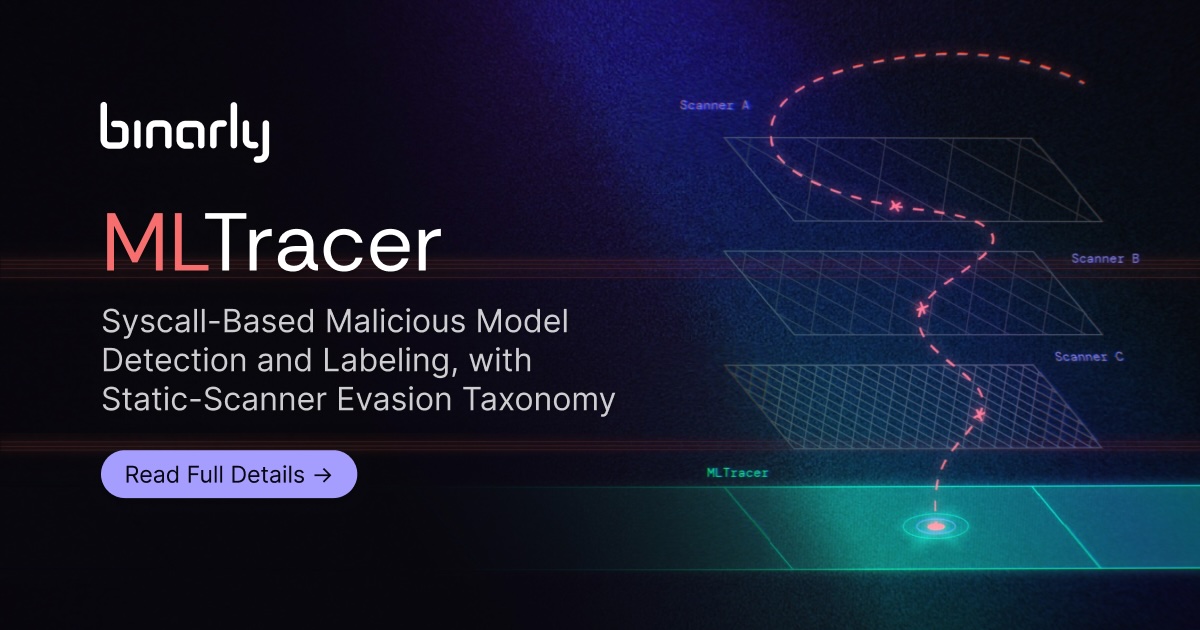 Malicious Model Detection with MLTracer Syscalls
Binarly presents MLTracer, a pipeline that loads PyTorch/pickle model files in a Docker sandbox with strace and FakeNet-NG, flags suspicious syscalls, and labels behavior (reverse shell, downloader, exfiltration) with a SetFit classifier. Run over ~2.12M Hugging Face files, it found 218 confirmed malicious models. Hugging Face-hosted scanners (Protect AI, JFrog, ClamAV, VirusTotal) and ModelScan/SaferPickle missed 9–84% of them. The post also tabulates 21 static-scanner evasion techniques, two of them novel (CodeType/FunctionType indirect variant, EXT2 + copyreg.add_extension), and shows detection of a CVE-2025-32434 exploit that the HF scanners missed.
 binarly.iowriteupPublished and added 1 Sep 2026🛡️ Security
 Wiz Red Agent Finds Its Way Into Snowflake’s Internal Jira Through a Flaw in a GitHub Copilot–Assisted PR
Wiz's autonomous "Red Agent" discovered a GitHub Actions script-injection vulnerability in snowflakedb/snowflake-connector-net's jira_issue.yml workflow, introduced when a PR (co-authored by GitHub Copilot) replaced a safe env:/jq pattern with direct interpolation of the attacker-controlled issue title. GitHub Advanced Security scanned the same PR and workflow but failed to flag the injection; Red Agent autonomously crafted and self-corrected a payload after a bash syntax error, exfiltrated Jira OAuth credentials via an out-of-band callback, and used them to access Snowflake's internal Jira (engineering, security, and bug-bounty projects) — all without human intervention. Snowflake patched and rotated credentials the same day the flaw was reported via HackerOne.
 wiz.iowriteupAdded 3 Sep 2026, published 17 Aug 2026🛡️ Security
 DocsGPT Security Hardening Playbook
DocsGPT documents the security practices it adopted through GitHub's Secure Open Source Fund: a public STRIDE-based THREAT_MODEL.md, mitigations for its sandboxed AI code-execution feature (scrubbed env vars, NetworkPolicy blocking internal IPs and cloud-metadata to stop SSRF, off-by-default), a dependency-tree audit with SPDX SBOM export and Dependabot, and CI automation using custom CodeQL queries, Bandit, zizmor for GitHub Actions hardening, and secret scanning. It's a practical baseline playbook for maintainers dealing with high volumes of AI-authored PRs that can't all be manually reviewed.
 blog.docsgpt.cloudwriteupPublished and added 15 Aug 2026🛡️ Security
 MAJINAHANASHI RANSOMWARE: Yet Another Japanese Locker
Deep-dive intelligence report on Majinahanashi, a Japanese-themed ransomware group that emerged in August 2026, covering its Tor data-leak site (math-captcha gated, non-vanity domain), victimology (15 victims across Europe/Asia/Latin America, avoiding US/English-speaking countries), and technical analysis of its C/C++ locker sample. The malware uses AES-256 with RSA-wrapped per-file keys, appends the .MAJIN extension, deletes shadow copies/USN journals/event logs via vssadmin/bcdedit/fsutil, hijacks the desktop wallpaper, and uses WFP-based network filtering plus I/O priority manipulation to suppress EDR/backup traffic (targeting CrowdStrike, SentinelOne, Defender, Veeam, etc.). The article includes a full YARA detection rule, the ransom note text, BTC/qTOX/email contact IOCs, and threat-actor profiling ("THE DOCTOR CAME" persona) plus links to Mimikatz and Advanced IP Scanner usage.
 theravenfile.comwriteupAdded 3 Sep 2026, published 14 Aug 2026🛡️ Security
 S3 Clones in the Neoclouds
Wiz Research examines S3-compatible object storage offerings from Nebius, Vultr, Lambda Labs, Cloudflare R2, DigitalOcean, and Crusoe, showing how each deviates from AWS S3 security defaults. Findings include providers that expose access/secret keys via list APIs (Vultr), default ACLs that would be public but aren't enforced (Lambda Labs), lack of least-privilege key scoping (Vultr, Crusoe, Lambda Labs), weak or undocumented encryption-at-rest/TLS enforcement, unstructured access-key formats that evade GitHub/secret-scanner detection, and cross-tenant bucket namesquatting risk due to shared global namespaces.
wiz.iowriteupAdded 3 Sep 2026, published 31 Jul 2026🛡️ Security The risk hiding behind exposed MCP servers
Wiz Research scanned MCP servers across cloud environments and found roughly 1 in 6 environments expose at least one server to the Internet, most unauthenticated and still running the pre-auth 2024-11-05 protocol version. They demonstrate anonymous tool-catalog enumeration, real data returned from production databases/CRM/IAM backends, write/delete-capable tools, and confirmed SSRF against cloud instance metadata endpoints yielding temporary credentials, plus agents that can be talked into unsafe actions by reframing requests as "routine maintenance."
wiz.iowriteupAdded 3 Sep 2026, published 28 Jul 2026🛡️ Security Behind the GitLab RCE: A depthfirst Journey into the Ruby Ecosystem | depthfirst
depthfirst's Open Defense Initiative scanned about 40 Ruby gems with native C extensions and validated 105 vulnerabilities across 34 projects, which together have over 8.6 billion RubyGems downloads. The post walks through four cases: a Nokogiri 32/64-bit index truncation (CVE-2026-57235), an Oj garbage-collection use-after-free (CVE-2026-54902), a concurrent-ruby read/write lock bit overflow (CVE-2026-54905) and an sqlite3-ruby block lifetime bug (CVE-2026-54619). It also states that this work led to the earlier GitLab RCE chain through Oj.
 depthfirst.comwriteupAdded 29 Oct 2026, published 27 Jul 2026🛡️ Security
 Better generic secrets detection starts with finding non-secrets
Aikido Security engineers describe how they built a 'publishable credentials denylist' for their Betterleaks secret scanner to suppress known-public keys (like Stripe's publishable API key) that generic secret-detection regexes otherwise flag as false positives. They tested the change against 100GB of Common Crawl data, cutting false positives by 2.37% (27,886 fewer findings), and outline five edge-case categories (unique shape, no unique shape needing context, same shape as secret needing liveness checks, sensitive-if-misconfigured keys, and test/sandbox credentials) that complicate cleanly filtering public-by-design credentials from real secrets.
aikido.devwriteupAdded 3 Sep 2026, published 23 Jul 2026🛡️ Security MCP Configuration Poisoning: Owning Your Machine With Just A Text File
Explains how a malicious mcp.json in a repository, with attacker-controlled "command" and "args" fields, gives remote code execution when an IDE, scanner, CI/CD pipeline or agent loads it automatically. Walks through a PoC where running Snyk's Agent Scan (snyk-agent-scan) on a poisoned config executes arbitrary commands; Snyk fixed it in 0.5.0 after a duplicate report. Offers mitigations for tool builders (sandboxing, pattern blocking, human-in-the-loop prompts hardened against "Lies in the Loop" dialog forging) and for users (sandbox untrusted repos).
 checkmarx.comwriteupAdded 10 Sep 2026, published 23 Jul 2026🛡️ Security
 Socket: GitHub Actions Abuse Powers Distributed cPanel/WHM Exploitation Campaign
Socket researchers traced malicious dev versions of ten Packagist packages owned by developer dinushchathurya back to compromised GitHub repositories containing 55-62 malicious GitHub Actions workflow files each. The workflows execute on GitHub-hosted Ubuntu runners on every push, download an architecture-matched Linux payload from C2 server 43.228.157.68, and run an internet scanner (`ipscan --exploit CVE-2026-41940`) that exploits an authentication bypass in cPanel/WHM and harvests cloud, database, SSH, and source-control credentials, exfiltrating results via heartbeat/results HTTP endpoints and DNSHook callbacks. GitHub code search for the campaign's unique markers returned 6,100-16,000 matching workflow files across unrelated repositories, indicating the abuse extends far beyond the one compromised maintainer and effectively weaponizes GitHub Actions as free, disposable attack infrastructure.
 socket.devwriteupPublished and added 23 Jul 2026🛡️ Security
 Solving GitHub's Secure Code game with an AI red teaming agent
Adversa AI documents how their autonomous AI red-teaming agent (a LangGraph planner/attacker/scorer/escalator loop) solved all five levels of GitHub's Secure Code Game Season 4 "ProdBot" challenge, capturing the flag at each capability tier without using any jailbreak vocabulary. Each level maps to a distinct agentic failure: a denylist-based sandbox bypassed via bash variable expansion hiding ".." from a static validator, an indirect injection surface via web browsing, an over-permissioned MCP Cloud Backup tool whose real file access exceeded its advertised sandbox-only scope, a skill-writable memory store that doubled as the security policy store (enabling privilege escalation via a never-expiring ttl=0 entry), and a multi-agent confused deputy where a Research Agent's unsanitized web content was passed to a privileged Release Agent as pre-verified context, triggering an unauthorized file read. The piece argues all five share one root cause: an agent acting on state it cannot independently verify, and that continuous automated red-teaming is needed to catch the class as new agent capabilities ship.
adversa.aiwriteupAdded 7 Oct 2026, published 17 Jul 2026🛡️ Security Socket: Operation Muck and Load
Socket details "Operation Muck and Load," a campaign starting with a malicious Go module (github.com/kaleidora/dnsub-scanning-tool) that impersonates a DNS scanner but launches hidden PowerShell to fetch and decode a multi-layer, XOR-encrypted loader. The loader resolves encrypted payload locations from public dead drops (Pastebin, GitHub, YouTube, Instagram, Telegram, Google Docs), retrieves a password-protected .7z archive masquerading as Microsoft Photos, and deploys AsyncRAT/Quasar/Remcos-style RATs and Vidar infostealer. Pivoting from the module, Socket uncovered 222 GitHub repositories across 190 accounts using automated force-push workflows tied to a single email (ischhfd83@rambler.ru) to fake activity and credibility, some directly hosting Vidar, XMRig/BitMiner, and trojan loaders.
socket.devwriteupPublished and added 16 Jul 2026🛡️ Security- deep scan tuto
Build log/tutorial for "Deep Scan," a PoC that pairs a deterministic security-scanning engine (20+ SAST/SCA/DAST scanners normalized into one Finding model, plus an AI-free code-graph engine doing taint/reachability analysis) with an agentic remediation loop exposed via an MCP server and three Claude Code skills (/security-eval, /security-patch, /security). The agent triages thousands of raw findings down to a prioritized P0–P3 plan, groups fixes into reviewable branches, and proves each fix with a demonstration test that safely calls an inert owner-operated canary endpoint instead of firing a real exploit (e.g., rm -rf /). The author also covers scaling via Docker Compose/Kubernetes+gVisor and the risk of running untrusted dependency-resolution code during scans.
 blog.kubeek.comwriteupPublished and added 14 Jul 2026🛡️ Security
 jscrambler npm package publishes malicious preinstall binary
StepSecurity documents a supply-chain compromise of jscrambler, the official npm CLI for the Jscrambler Code Integrity API, starting with version 8.14.0. A malicious preinstall hook (later inlined into the main module to evade install-script scanners) drops a Rust-compiled, platform-specific native binary (ELF/PE32+/Mach-O) smuggled inside a fake dist/intro.js behind a custom magic header, containing an embedded SQLite/LevelDB parser and BIP39 wordlist consistent with a credential and crypto-wallet stealer. The Linux payload dynamically links libbpf and loads an in-memory eBPF program for kernel-level instrumentation, and all three platform binaries include anti-debugging checks; affected versions (8.14.0, 8.16.0, 8.17.0, 8.18.0, 8.20.0) were interleaved with clean releases, and C2 traffic was observed reaching Tor entry-node infrastructure and two raw IPs.
 stepsecurity.iowriteupAdded 3 Sep 2026, published 12 Jul 2026🛡️ Security
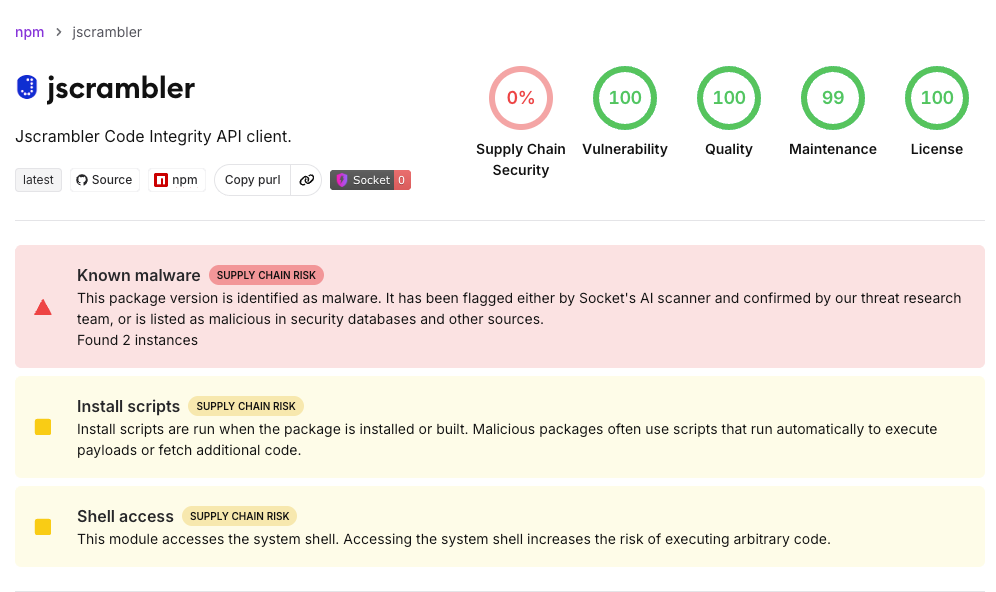 jscrambler npm Package Compromised in Supply Chain Attack
Socket's research team documents a supply chain compromise of the jscrambler npm package (v8.14.0+), where a stolen publishing credential was used to push malicious releases that drop platform-specific Rust-built infostealer binaries via a preinstall hook. The campaign evolved over the incident to evade scanners by moving the dropper from install scripts into a self-executing function inside index.js/CLI code (defeating --ignore-scripts), and the payload targets crypto wallets, cloud credentials (AWS/GCP/Azure), browser data, Discord/Slack/Telegram, and notably AI coding assistant configs (Claude Desktop, Cursor, Windsurf, VS Code) for MCP server credentials. Includes detailed RE of the ChaCha20-Poly1305 string-encryption scheme and full IOC hash list.
socket.devwriteupAdded 21 Sep 2026, published 11 Jul 2026🛡️ Security 10 Layers Deep: How StepSecurity Stops TeamPCP's Trivy Supply Chain Attack on GitHub Actions
StepSecurity walks through the TeamPCP-led compromise of aquasecurity/trivy-action (CVE-2026-33634, CVSS 9.4), where attackers force-pushed a credential-stealing payload into 76 of 77 version tags, plus the related Checkmarx KICS action compromise, both harvesting secrets from /proc/pid/mem of the GitHub Actions Runner.Worker process and exfiltrating to a typosquatted domain (scan.aquasecurtiy.org, 45.148.10.212). The post details the attack technique of 'imposter commits' (fork commits reachable by SHA but not on any branch) used to hide the malicious tags, and situates the incident alongside the same-window CanisterWorm npm worm and TeamPCP credential stealers in litellm and telnyx PyPI packages, then maps ten StepSecurity/Harden-Runner defense-in-depth controls (egress blocking, process lockdown, SHA-pinning PRs, imposter-commit scanning, global blocklist) to each stage of the kill chain.
stepsecurity.iowriteupAdded 3 Sep 2026, published 2 Jul 2026🛡️ Security- Automating Penetration Testing with SecureCodeBox on Kubernetes (Kind) + GitHub Actions
Walks through a GitHub Actions pipeline that spins up a kind cluster, deploys the SecureCodeBox operator, the Juice Shop target and the ZAP-Advanced scanner, then runs an authenticated full scan. Findings summaries are pulled from the Scan resource status and the full findings.json from MinIO, then compared with a baseline report committed to the repo to flag new, persistent or resolved categories. The pipeline fails the build when issues remain. It gives a reusable pattern for DAST regression tracking in CI.
 medium.comwriteupAdded 3 Sep 2026, published 25 Jun 2026🛡️ Security
 Trust No One: Automating macOS Privilege Escalation at Scale
XM Cyber researchers detail a macOS privilege escalation technique that lets a standard user disable EDR/MDM agents without admin credentials by exploiting stale kernel CDHash trust caches combined with NIB payload injection to impersonate trusted, code-signed application components. Once inside the trusted process context, the attacker uses an AppleScript-to-JXA-to-Objective-C runtime bridge (loading OSAKit.framework, forging Block_layout/objc_msgSend structures) to call unauthenticated privileged XPC methods like runProcessWithCommand: and ceaseSystemExtensionWithReply:, forcing security products to disable or remove themselves. The authors built an open-source scanner, XPC Hunter, to find this exposure across installed macOS apps at scale and recommend fixing it via xpc_connection_set_peer_code_signing_requirement() or SecCodeCheckValidity() peer validation.
 xmcyber.comwriteupAdded 3 Sep 2026, published 24 Jun 2026🛡️ Security
 JFrog: PixelSmash
JFrog Security Research discloses CVE-2026-8461 ("PixelSmash"), a critical heap out-of-bounds write in FFmpeg's MagicYUV decoder caused by a rounding mismatch between chroma-plane allocation and slice-height calculation. The team escalates the OOB write into reliable remote code execution by hijacking the AVBuffer.free function pointer to call system(), demonstrating full RCE via a 50KB crafted AVI against a Jellyfin media server (through automatic library/ffprobe scanning) and a Nextcloud instance (via video thumbnail preview generation), plus DoS crashes across mpv, Kodi, OBS Studio, Immich, PhotoPrism and vLLM. The post frames the bug as a software supply-chain issue since libavcodec is a silent transitive dependency in hundreds of downstream media applications, and covers detection, patching, and build-time workarounds.
 jfrog.comwriteupPublished and added 22 Jun 2026🛡️ Security
 Socket: npm Package Uses Prompt Injection + Token Flooding to Evade AI Malware Scanners
Socket Threat Research analyzed shai_hulululud@1.0.48596, a ~9.28MB npm package whose index.js opens with a Japanese-language block comment simulating bioweapon-production instructions to trigger LLM safety refusals, follows with a fake 'SYSTEM OVERRIDE' prompt-injection block aimed at AI reviewers, then floods the file with tens of thousands of repeated comment lines (3.5M+ tokens) before appending doubly-obfuscated (character-substitution plus AES) JavaScript. The deobfuscated payload reintroduces the same policy-triggering content and scanner/vendor-referencing strings, and was classified as protestware rather than a functional credential stealer; the piece argues this demonstrates a practical LLM-specific denial-of-service pattern (prompt injection + safety triggers + context flooding + obfuscation) that AI-assisted supply-chain scanners must defend against via deterministic preprocessing, fail-closed behavior, and combining LLM review with static/AST/entropy/behavioral analysis.
socket.devwriteupPublished and added 17 Jun 2026🛡️ Security DECODING GRIXBA — A PLAY RANSOMWARE SCANNER
A side-by-side reverse-engineering analysis of four Grixba samples (v1 through v3, Sept 2022 to Nov 2024), the custom .NET infostealer/network scanner built by the Play ransomware group to map security tools, credentials, and remote-management software before encryption. The piece traces the binary growth from 164KB to 727KB (adding XOR-encrypted inf_g.dll, SQLite-based ExportData.db output, forged SentinelOne PE metadata, and PIA VPN C2) then its deliberate regression to 118KB to shed public IOCs, backed by MITRE ATT&CK sandbox findings, a shared mutex fingerprint, a weakness scorecard per version, and a full SHA-256/IP/onion IOC table.
theravenfile.comwriteupAdded 3 Sep 2026, published 8 Jun 2026🛡️ Security Secret Scanning Dev Workstations with bagel + Fleet
Describes an open-source workflow combining bagel (a Go-based CLI secret scanner for developer home directories, from Boost Security) with Fleet/osquery to detect and enforce policy on clear-text secrets on macOS workstations. The author's PoC repo, fleebag, packages bagel as a scheduled LaunchAgent, provides an osquery policy query using Fleet's parse_json table to flag critical findings, and shows how to gate SSO login via Entra Conditional Access until secrets are remediated, framed as a response to infostealer/supply-chain worm campaigns like Shai-Hulud.
 recyclebin.zipwriteupAdded 3 Sep 2026, published 4 Jun 2026🛡️ Security
 The sorry state of skill distribution
Trail of Bits researchers bypassed every agent-skill security scanner they tested — ClawHub's VirusTotal/Code Insight and GPT-5.5-based guard model, and skills.sh's Gen/Socket/Snyk-backed scanning, plus Cisco's skill-scanner — using techniques like context-truncation via 100,000 newlines, malicious payloads hidden inside .docx ZIP archives, Python .pyc bytecode poisoning to steal environment variables, and rhetorically-crafted prompt injection that convinced LLM analyzers a malicious npm/yarn registry change was benign. The piece also shows a legitimate Anthropic Office skill (soffice.py) using LD_PRELOAD in ways indistinguishable from malicious behavior, arguing static/LLM skill scanning is structurally unable to guarantee safety and that organizations should instead curate trusted skill marketplaces (e.g., trailofbits/skills-curated) rather than rely on public ones. PoC skills are published at trailofbits/overtly-malicious-skills.
 blog.trailofbits.comwriteupAdded 3 Sep 2026, published 3 Jun 2026🛡️ Security
 Socket: Malicious Postinstall Hook Compromises 8 PHP/Node Packages on Packagist
Socket's AI scanner found a coordinated supply chain campaign in which 8 Packagist (PHP/Composer) packages had their upstream GitHub repos modified to add a malicious postinstall hook — placed in package.json rather than composer.json — that downloads a binary (gvfsd-network) from an attacker GitHub Releases URL to /tmp/.sshd, disables TLS verification, and runs it in the background. The same payload was also found injected into GitHub Actions workflow files (as a step named "Dependency Cache Sync") in forked repos, and a GitHub code search for the attacker account parikhpreyash4 surfaced hundreds of additional references across Node.js projects. Highest real-world risk is concentrated in Laravel starter kits devdojo/wave (~6,400 stars) and devdojo/genesis (~9,100 Packagist installs), since starter-kit repos become the project root where npm install triggers the hook directly.
socket.devwriteupPublished and added 23 May 2026🛡️ Security FOSSA: Mini-Shai-Hulud Mass Compromise
FOSSA's technical breakdown of the May 2026 Mini-Shai-Hulud campaign, which compromised at least 235 npm and PyPI packages including @tanstack/*, @uipath/*, mistralai, and @opensearch-project/opensearch. It details the two install-time payload mechanisms (a Git-dependency prepare-hook trick with an orphan commit for @tanstack/*, and direct preinstall scripts for @uipath/*/Mistral AI), a staged PyPI dropper in __init__.py that evades sandbox scanning, the credential-harvesting targets (AWS/GCP/Azure, Kubernetes, Vault, GitHub, npm tokens), exfiltration infrastructure (filev2.getsession.org, git-tanstack.com), and IDE-persistence via modified Claude/VS Code config files.
 fossa.comwriteupPublished and added 18 May 2026🛡️ Security
- Komari Red: The Monitoring Tool with a Built-in Reverse Shell
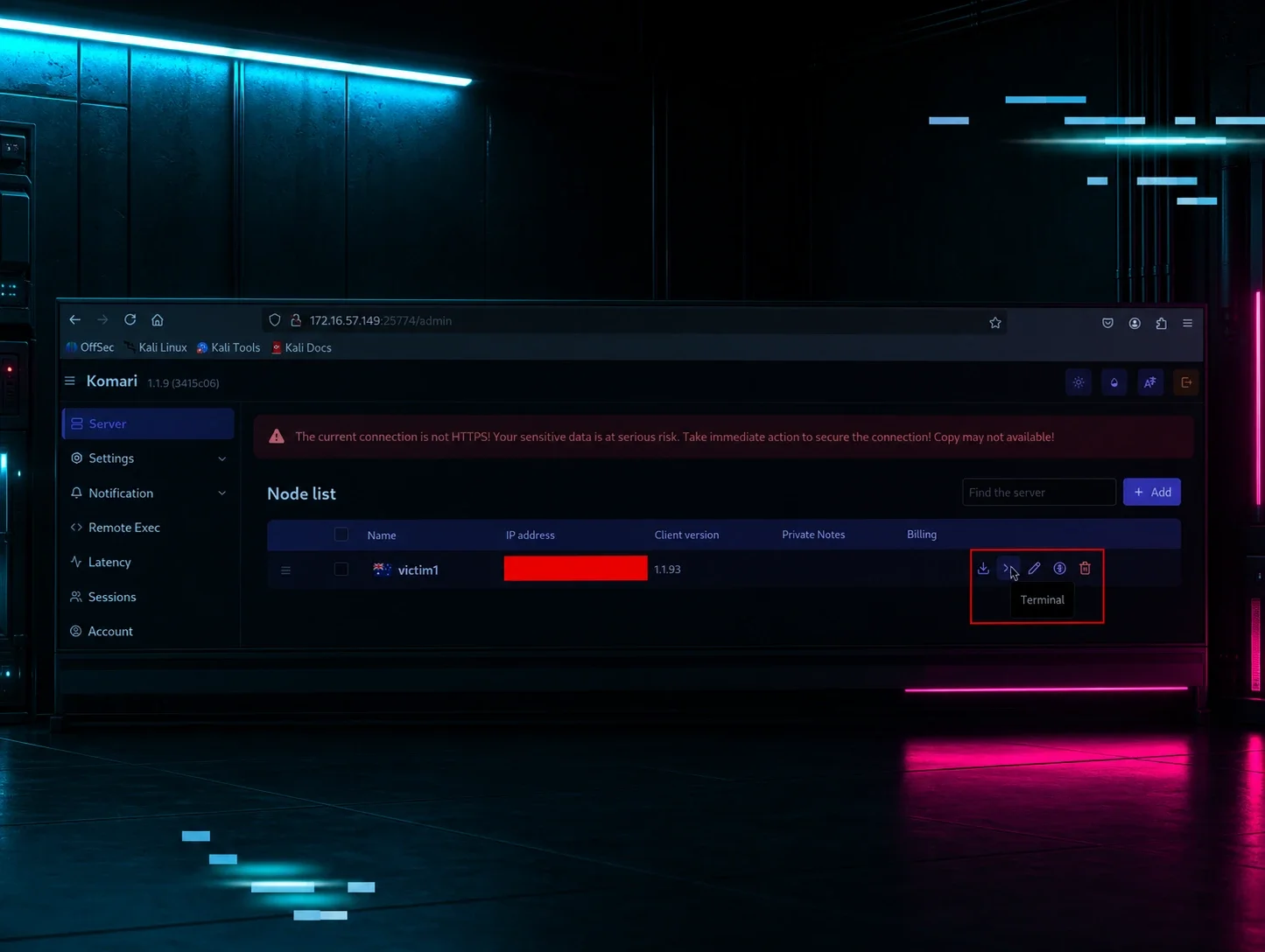
Huntress details a live intrusion where an attacker used stolen SSLVPN credentials, Impacket's smbexec.py (a customized fork with randomized artifact names) for lateral movement and registry-hive dumping, then enabled RDP via reg/netsh changes to interactively install the open-source "Komari" monitoring agent as a SYSTEM-level service named "Windows Update Service" via NSSM. Unlike other abused RMM/monitoring tools (Velociraptor, SimpleHelp, ScreenConnect, AnyDesk, Nezha, Atera), Komari ships arbitrary command exec, an interactive PTY reverse shell, and distributed ping/port-scanning enabled by default over a WebSocket that blends in as normal HTTPS traffic — turning a legitimate 4.3k-star GitHub monitoring tool into an out-of-the-box botnet-style C2 with no weaponization required.
 huntress.comwriteupAdded 3 Sep 2026, published 30 Apr 2026🛡️ Security
- CVE-2026-41940 (SessionScribe): cPanel/WHM Session Forgery Reverse-Engineered
rfxn's technical dissection of CVE-2026-41940 (SessionScribe), an unauthenticated session-forgery bug in cPanel/WHM that lets an attacker forge a root cpsess session via CRLF injection into the password field of an Authorization: Basic request, exploiting the fact that Cpanel::Session::saveSession() skips the CR/LF-stripping filter_sessiondata() sanitization used by the normal login path, combined with an encoder short-circuit when the whostmgrsession cookie's OBHEX suffix is malformed. The writeup reverse-engineers the patched cpsrvd binaries (since cPanel ships no source for this surface) using a custom snapshot/BinDiff workflow, documents an adjacent lower-severity access-log identity-injection issue, and ships an open-source operator toolkit (ModSecurity rule pack, remote probe, on-host IOC scanner, snapshot collector) plus an architectural recommendation to firewall cpsrvd's direct ports behind Apache+mod_security2 proxy endpoints. Credits researcher Sina Kheirkhah of watchTowr Labs for the original PoC.
 rfxn.comwriteupAdded 18 Sep 2026, published 29 Apr 2026🛡️ Security
- PeerBlight Linux Backdoor Exploits React2Shell CVE-2025-55182
Huntress details in-the-wild exploitation of CVE-2025-55182 ("React2Shell"), an unauthenticated RCE in React Server Components caused by insecure deserialization of the React Flight protocol's "thenable" chunk handling, affecting Next.js and other React-based apps. Post-exploitation payloads include PeerBlight (a musl-compiled Linux backdoor using BitTorrent DHT as fallback C2, sharing config-schema and XOR encryption traits with the Pink botnet and persistence code overlapping RotaJakiro), CowTunnel (an FRP-based reverse tunnel wrapping xfrpc for SOCKS5/TCP/HTTP/FTP/RDP proxying and a telnetd backdoor), ZinFoq (a Go post-exploitation implant with hex-encoded HTTPS C2, reverse PTY shells, and SOCKS5 pivoting), and a Kaiji botnet variant with hardware watchdog abuse. The piece includes detailed C2 protocol reversing (DGA algorithm, DHT config-distribution and RSA-signature verification) and dozens of observed C2/scanner IOCs across five real intrusion cases.
huntress.comwriteupAdded 3 Sep 2026, published 10 Dec 2025🛡️ Security - EDR: The Great Escape - RomHack Training Review
A DFIR consultant's detailed review of "EDR: The Great Escape," a RomHack training by RETooling's Silvio and Antonio, covering modern EDR/AV internals and evasion across four modules: minifilter driver whitelist/altitude bugs, hooking/unhooking (including VEH syscall triggering), ELAM and PPL, ETW muting via EtwUnregister, ROP-only process injection, kernel notify-routine/object-callback bypass (as implemented in EDRSandBlast), vulnerable driver exploitation for token theft, stack-spoofing techniques (Ekko, gargoyle, SilentMoonwalk, CallStackMasker, DeathSleep), local privilege escalation, memory-scanner evasion (vs moneta, pe-sieve), and .NET IL/JIT-hooking obfuscation (R2R stomping, MassLogger-style tricks). The course used the open-source openedr project as a reference architecture for labs. Written for both red and blue teams, it doubles as a map of concrete EDR blind spots and the tooling attackers use to exploit them.
dfir.chwriteupAdded 3 Sep 2026, published 30 Sep 2024🛡️ Security - Today I Learned - Instrument ClamAV to extract AutoIT scripts
DFIR.ch shows how to abuse ClamAV's scanning temp-file behavior (clamscan --leave-temps --tempdir=) to extract embedded AutoIT scripts from a compiled .exe, using SimpleLapsGui.exe (flagged by multiple AV vendors) as the example. The recovered autoit.001 script and PowerShell payload are validated against output from the dedicated Python tool autoit-ripper, giving analysts two independent, Windows-binary-free methods for automating AutoIT script extraction during malware/PUA triage.
dfir.chwriteupAdded 3 Sep 2026, published 9 Jun 2024🛡️ Security - Today I Learned - Device Discovery
dfir.ch documents an incident response investigation where an NDR sensor flagged a suspicious internal port scan. The analyst used EDR telemetry to identify the responsible PowerShell script (hash-verified, Microsoft-signed) invoking Defender for Endpoint's Device Discovery feature (Scan-UdpTcpPorts, Scan-Vnc, Scan-WinRm, etc.), decoding its base64 ScannerArgs to reveal target IPs, MACs, and the CVEs it probes for (CVE-2021-44228, CVE-2022-22965). The scan turned out to be benign legitimate network discovery from Defender for Endpoint, explaining why it triggered an NDR false positive.
dfir.chwriteupAdded 3 Sep 2026, published 27 Apr 2024🛡️ Security - Incident Response | ZipExec
Incident-response analysis of ZipExec, an Optiv PoC that base64-encodes a password-protected ZIP containing a binary, rebuilds it via a JScript loader using COM objects, and executes it in place using CMDKEY to inject the zip password, evading disk-based AV and EDR scanning and hash blocklists. The author dissects a generated loader (using calc.exe as the test payload) line by line and proposes detections such as alerting on ZIP filemod events sourced from wscript.exe and monitoring anomalous cmdkey.exe usage.
 0xv1n.github.iowriteupAdded 3 Sep 2026, published 25 Oct 2021🛡️ Security