Skip to content

1660 results for β€œps”

What you seeeverything
ethereum-magicians.orgarticleπŸ›‘οΈ Security

EIP-8477: Recent Block Bound Delegation Authorizations

EIP-8477 is a draft Ethereum proposal (ethereum/EIPs PR #12601, posted 30 October 2026) that makes EIP-7702 authorizations expire. Each one must sign a block number and header hash within the 256 preceding blocks, checked before signature recovery, and a stale entry is skipped without consuming the nonce. It does not affect installed delegations or stop live-signing attackers, and no technical review had been recorded.

Ethereum
EIP-7702EIP-8477Binance+1

BlockchainΒ· Published and added 3 Nov 2026

hackers-arise.comarticleπŸ›‘οΈ Security

Open-Source Intelligence (OSINT): Doing GeoOSINT and Finding Locations with Azimut

Azimut is a local, open-source GeoOSINT tool (v0.3.3, Linux, Windows, macOS) that keeps case evidence in one folder and runs in the browser at 127.0.0.1:8477. The walkthrough tests a Yosemite photo from Wikimedia using the Horizon 3D skyline overlay, the beta Find mode (hand-drawn skyline, search area up to 10,000 km2), sun path display and exportable proof collages. Results need manual verification.

AzimutKali Linux
Hackers AriseOsintMeThatWikimedia+1

OSINT, LearningΒ· Published and added 3 Nov 2026

en.cryptonomist.charticleπŸ›‘οΈ Security

BTCPay Server vulnerability: about $1.63M traced to theft-linked addresses

BTCPay Server's 2 November 2026 incident update describes attackers logging in as administrator on servers running version 2.4.1 or earlier and sweeping on-chain hot wallets. Bitquery traced about $1.63M (18.38 BTC and 3,405 LTC) to two addresses, across 682 sweeps from 30 October. The project advises migrating to a new server with a fresh seed, installing 2.4.7 and preserving logs. How admin access was gained is not explained.

BTCPay ServerLNDBitcoin+1
BitqueryCryptonomist

Blockchain, Threat IntelΒ· Published and added 3 Nov 2026
jfrog.comwriteupπŸ›‘οΈ Security

bREACHYing the Perimeter: How One HTTP Request can Hijack your AI Robot

JFrog's analysis of five CVEs in the Reachy Mini robot daemon (Pollen Robotics, Hugging Face), a FastAPI server on TCP 8000 with no authentication and wildcard CORS. A single POST to /api/apps/install runs attacker code through uv pip install, and the daemon's passwordless sudo gives persistent root. It also covers a browser CSRF variant, a BLE PIN bypass with path traversal (CVE-2026-55419 upload step), and fixed version 1.11.0.

Reachy MiniFastAPIHugging Face+3
CVE-2026-55419JFrogPollen Robotics+3

Hardware & RF, AppSec, Supply ChainΒ· Published and added 3 Nov 2026

securityweek.comarticleπŸ›‘οΈ Security

Google Dismantles XCPE Botnet of 1.3 Million Android Devices

XCPE (X.CPE) is a backdoor and botnet of more than 1.3 million Android set-top boxes, built and run by the Chinese OEM/ODM Videostrong Technology. Google dismantled it through legal action against domains and servers and banned Videostrong from preloaded Google apps. The malware used a three-stage design persisting on the /oem/ partition and was used for ad fraud, residential proxies and further malware loading.

AndroidAndroid TV
XCPEVideostrong TechnologyGoogle+8

Threat Intel, Mobile Security, Supply ChainΒ· Published and added 3 Nov 2026

depthfirst.comarticle🧠 AI

How repeated sampling improves vulnerability detection | depthfirst

depthfirst's Best of N study runs a cheap LLM agent repeatedly on the same repository, merges the findings, and uses a reviewer agent to deduplicate and score them from 0 to 100. DeepSeek v4.1 Flash goes from about 52% recall at one run to about 71% at five and 80% at fifteen, and five runs match the recall of top published models at a tenth of the cost. Returns diminish and plateau points differ by model. The benchmark is depthfirst's own dfbench, and only a subset is used.

LLMDeepSeekGLM
depthfirstdfbenchDeepSeek-V4.1-Flash+3

agents, evalsΒ· Added 3 Nov 2026

alignment.openai.comarticle🧠 AI

Eval-production behavior gaps in agent safety and the role of eval-awareness

OpenAI alignment post measuring the gap between the Respecting Warnings agent safety evaluation and comparable Codex production decisions across six models. Evaluation success is 10.2 to 37.4 points lower than production success. Verbalizing a specific, wrong evaluation objective (resisting prompt injection) tracks the gap, and in a GPT-6.1 Sol intervention, objective cues moved success from 63.4% to 91.6% or 17.6%.

CodexLLM
OpenAIGPT-5.6 LunaGPT-5.6 Sol+5

ai-safety, evals, agentsΒ· Published and added 3 Nov 2026

latent.spacearticle🧠 AI

[AINews] LLMs can read & write neural network weights: "Weight Space Programming" cuts Autoresearch out of the RSI loop

AINews issue for 31 October to 2 November 2026 from Latent Space. It leads with "Weight Space Programming" (Takehi et al., with Alex Zhang), where a frontier LLM reads and edits small models' weights without training. The recap also covers DeepSeek's super-agent harness, the SemiAnalysis GDPx benchmark, quantized local MoE models and Reddit skepticism about the Qwen3.5-0.8B MATH-500 edit. The page was truncated, so the final part is not covered.

LLMQwen3.5Strata+10
Latent SpaceAlex ZhangAndrej Karpathy+21

research, models, evalsΒ· Published and added 3 Nov 2026

simonwillison.netarticleπŸ›‘οΈ Security

I discovered a sound that leaks your exact location (and it's everywhere) - YouTube

Simon Willison's link-blog post of 3 November 2026 points to a YouTube video by Colsto on locating where a video was recorded from faint aircraft noise in its soundtrack. The method extracts Doppler curves of passing planes, then matches speed, distance and gaps between flights against ADS-B flight data. The post is a short pointer and gives no step-by-step detail.

ADS-BYouTube
Doppler effectColsto

OSINTΒ· Published and added 3 Nov 2026

x.comrepo🧠 AI

Md Ismail Ε ojal πŸ•·οΈ (@0x0SojalSec) on X

An x64dbg MCP server, published on GitHub by duty1g and shared in an X post by @0x0SojalSec, lets Claude drive the x64dbg Windows debugger. It exposes breakpoints, memory dumps and code stepping as tools for reverse engineering and malware analysis. A reply warns that debugging a sample executes it, so the agent should run in a snapshotted VM with no shared folders or host route, and every command should be logged.

x64dbgModel Context ProtocolClaude+2
duty1g

mcpΒ· Added 3 Nov 2026

github.comrepo🧠 AI

colibri: pure-C engine for running huge MoE models by streaming experts from disk

colibri is a pure-C, dependency-free inference engine that runs mixture-of-experts models of hundreds of billions of parameters on ordinary machines. It keeps the dense layers in RAM and streams routed experts from disk through a learning cache, with optional CUDA, Vulkan and Metal tiers. It supports GLM-5.2, Kimi K3, DeepSeek V4, Qwen3.6 and GGUF files, and serves OpenAI- and Anthropic-compatible APIs.

Mixture of ExpertsGGUFCUDA+10
GLM-5.2GLM-5.3GLM-5.3-Flash+22

inference, modelsΒ· Added 3 Nov 2026

bleepingcomputer.comarticleπŸ›‘οΈ Security

Chinese hackers use ARTEX AI in automated attacks against 200 orgs

ARTEX is a multi-agent AI penetration-testing framework that the China-nexus actor Vapor Panda used from 17 October against more than 200 organizations in 14 countries, compromising at least nine. CrowdStrike reports DeepSeek and another commercial model coordinated agents, operators told agents to skip Falcon-protected Windows hosts, and BLOODALCHEMY was deployed. DIVD says ARTEX also drove its September 2026 breach, chaining two zero-days (one in Zammad) to root in 12 minutes.

ARTEXDeepSeekCrowdStrike+2
Vapor PandaBLOODALCHEMYDutch Institute for Vulnerability Disclosure+1

Threat Intel, AI Security, Offensive SecurityΒ· Published and added 2 Nov 2026

longcat.aiarticle🧠 AI

LongCat-2.5: Native Multimodality for Agentic Tasks

LongCat-2.5 is a native multimodal mixture-of-experts model with 1.6 trillion total and about 48 billion activated parameters, built on LongCat-2.0 for long-horizon agentic coding. The post describes discrete RVQ visual tokens, large-scale asynchronous agentic RL with synthesized F2P/P2P-tested environments, on-policy distillation, train-inference numerical alignment, and W4A4 inference on domestic accelerators. A table compares it with GPT-5.5, Claude-Opus-5, GLM-5.3, Kimi K3 and DeepSeek-V4.1-Flash.

Mixture of ExpertsResidual Vector QuantizationFlatQuant+8
LongCat-2.5LongCat-2.0LongCat-Next+32

models, training, multimodal, coding-agentsΒ· Added 3 Nov 2026, published 2 Nov 2026

cloud.google.comarticleπŸ›‘οΈ Security

The Rise of LLMJacking: How Threat Actors Monetize Compromised Cloud and Model Resources

LLMJacking is the hijacking of enterprise cloud LLM access, which Mandiant and GTIG saw in multiple 2026 incidents with charges above $100,000 a day and up to $1 million per victim. The report covers initial access through stolen cloud tokens and API keys, persistence, LiteLLM privilege escalation (CVE-2026-40217), and resale through "LLM Mixers" such as Jet Night and newapi[.]pro. It gives CloudTrail, Azure and GCP audit-log hunting guidance and hardening steps.

LiteLLMOllamaAWS Bedrock+3
CVE-2026-40217UNC6993LLMJacking+6

Threat Intel, AI Security, Cloud & Infra, Blue Team & DetectionΒ· Published and added 2 Nov 2026

twitter.comthread🧠 AI

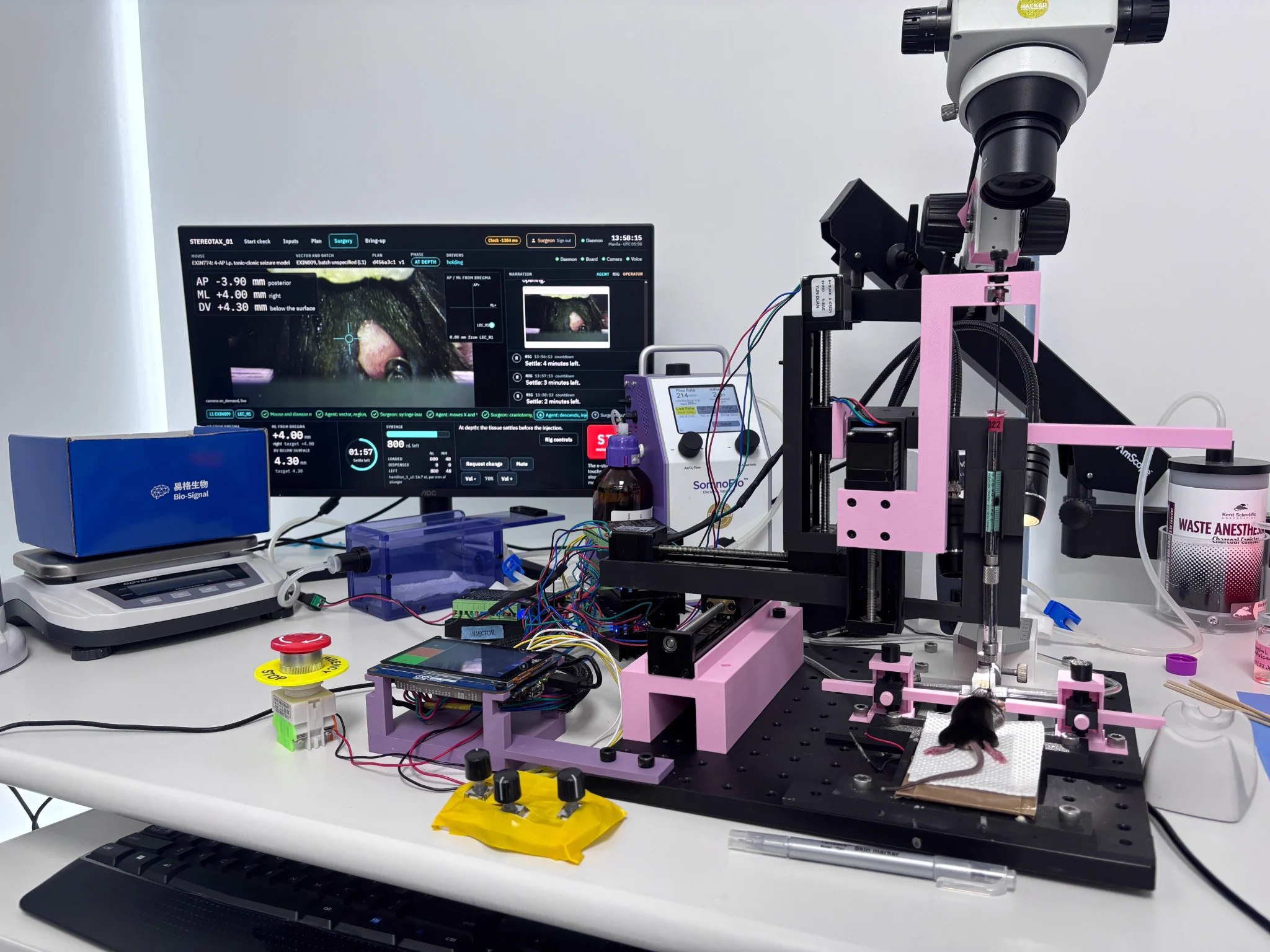
Last night an AI agent performed brain surgery on a mouse

A thread by Gabriel Ocana-Santero describing an AI agent that chose a gene therapy vector, brain region and stereotaxic coordinates, then injected 250 nL into a mouse epilepsy model through a custom Arduino surgery rig. A licensed vet gated irreversible steps with fixed validators, hash-bound approval and a physical kill switch. Opus 5.5 refused on detecting biology, while Opus 5 completed a dry run and stopped before live surgery. The technical report is still to come.

ArduinoClaude Opus 5.5Opus 5
Gabriel Ocana-Santero

agents, ai-safetyΒ· Added 3 Nov 2026, published 2 Nov 2026

depthfirst.comarticleπŸ›‘οΈ Security

How repeated sampling improves vulnerability detection | depthfirst

depthfirst research post on Best of N repeated sampling for LLM vulnerability detection. On a subset of dfbench tasks, five runs of DeepSeek v4.1 Flash reach about 71% recall versus 52% for one run, and 15 runs reach 80% at about $13 per task. An agent reviewer scores deduplicated findings 0 to 100, and the confidence cutoff trades recall against precision.

DeepSeekGLMLLM
depthfirstAnthropicMythos+4

AI Security, AppSecΒ· Added 3 Nov 2026, published 2 Nov 2026

theguardian.comarticleπŸ›‘οΈ Security

Supermarket freezers across Europe hit by second suspected cyber-attack

Guardian report from 2 November 2026 on a second suspected cyber-attack on supermarket refrigeration in Belgium, Estonia, Ireland, Finland, Luxembourg, the Netherlands and Sweden, with temperatures set to 50C. It recaps the earlier French attack on up to 700 shops, which hit mostly Danfoss controllers. SentinelOne and Tributech say the attacks point to sabotage and that many controllers remain internet-exposed and unpatched.

DanfossSentinelOneTributech+5

Threat Intel, Hardware & RFΒ· Added 3 Nov 2026, published 2 Nov 2026

ethresear.chpaperπŸ›‘οΈ Security

Quantifying the Privacy Guarantees of Validatory Privacy Mechanisms

Ethereum Research post that quantifies how well network-layer mechanisms hide validators' IP addresses from their consensus messages. Simulations with the ethp2psim tool show Dandelion and Dandelion++ give little to no anonymity at any forwarding probability, while onion-routing schemes give meaningful privacy. Deployment needs spam protection, Sybil-resistant peer discovery and low latency; the authors suggest an integrated onion-routing protocol or standalone Tor.

EthereumTorethp2psim
DandelionDandelion++onion routing+2

BlockchainΒ· Published and added 2 Nov 2026

x.comtoolπŸ›‘οΈ Security

Md Ismail Ε ojal πŸ•·οΈ (@0x0SojalSec) on X

An x64dbg MCP server (GitHub repo by duty1g, shared via an X post) that lets Claude drive the x64dbg Windows debugger: set breakpoints, dump memory, step code and run other reverse engineering tasks programmatically. The post targets malware analysts. A reply notes that debugging a sample executes it, so the agent should run in a snapshotted VM with no shared folders or host route, with every command logged.

x64dbgModel Context ProtocolClaude+1

Malware & RE, AI SecurityΒ· Added 3 Nov 2026, published 1 Nov 2026

bleepingcomputer.comarticleπŸ›‘οΈ Security

FBI links $6.3 billion Binance crypto heist to North Korean hackers

The FBI attributed the roughly $6.3 billion Binance theft of about 29 October 2026 to North Korea's TraderTraitor (Lazarus Group, Jade Sleet, APT38). Binance traced the breach to a compromised DevOps engineer's laptop that gave access to a service container used to submit unauthorized withdrawals across ten blockchains. The FBI published 628 laundering addresses and linked the group to earlier thefts at Bybit, DMM Bitcoin, Bitget and Drift.

EthereumBitcoinSolana+3
TraderTraitorLazarus GroupDPRK+14

Threat Intel, BlockchainΒ· Published and added 1 Nov 2026

x.comthread🧠 AI

Smarthouse (@localyzapp) on X

A reply by Smarthouse (@localyzapp) on X to a question about the best harness for connecting local models to a Minecraft server. It suggests an MCP server that wraps RCON plus a small agent loop. The main pitfall is block coordinates: expose "/execute if block" as a read tool so the agent can check blocks before placing them, or it will hallucinate terrain.

Model Context ProtocolMinecraftRCON

mcp, agentsΒ· Added 2 Nov 2026, published 1 Nov 2026

x.comthreadπŸ›‘οΈ Security

lee1981 (@lee1981b) on X

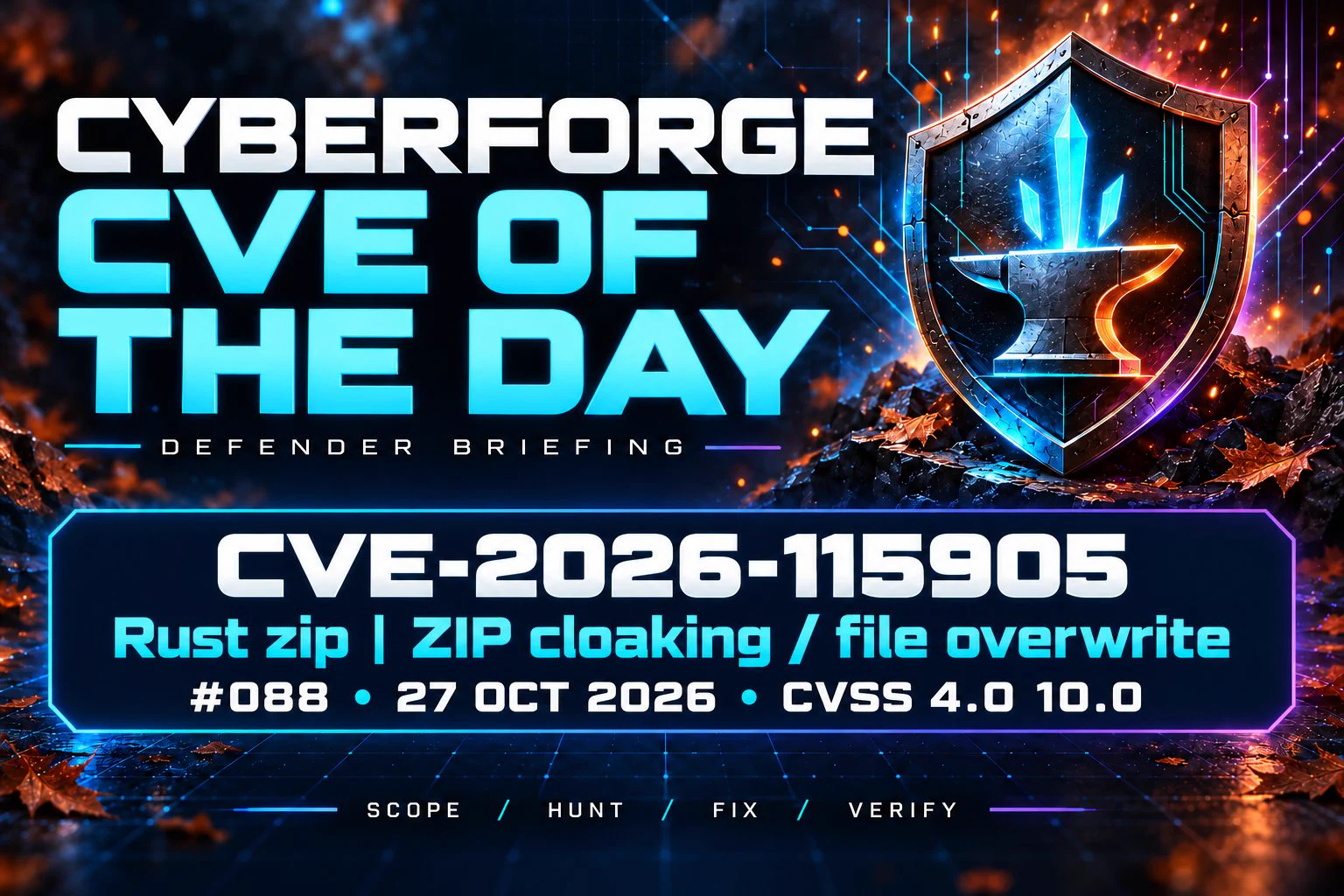
CyberForge Weekly CVE Rundown #008 covers seven CVEs from 26 to 31 October 2026: Wasmtime/Cranelift miscompilation, Rust zip cloaking, Qode Membership account takeover, Dell PowerProtect Data Domain stack overflow, two Progress WS_FTP Server flaws and Kubeflow Pipelines log reads. Each entry gives fixed versions and defender actions. A 1 November check adds EPSS values dated 31 October and notes none of the IDs were in CISA's 30 October catalogue.

WasmtimeKubeflow PipelinesWS_FTP Server+3
CVE-2026-115889CVE-2026-115905CVE-2026-92885+11

AppSec, Cloud & InfraΒ· Added 3 Nov 2026, published 1 Nov 2026

mashable.comarticle🧠 AI

Anthropic takes steps to block Claude from reverse-engineering video games

Mashable reports, citing Tom's Hardware, that Anthropic's Claude has quietly begun restricting modding, decompiling and reverse-engineering of video game code. Anthropic has made no official announcement. The article ties the change to AI-assisted game ports and mods, the PlayStation 5 jailbreak and Take-Two's subpoenas after the GTA6 leaks. It notes the irony of AI firms now guarding copyright, and the risk that less restrictive LLMs win users.

ClaudeLLM
AnthropicTom's HardwareTake-Two Interactive+4

ai-policyΒ· Added 1 Nov 2026, published 31 Oct 2026

arxiv.orgpaper🧠 AI

Vision-Language Models Are Joint Denoisers in Robotic Action Generation

JADE (Joint Action DEnoiser) is a diffusion-based vision-language-action architecture in which the VLM reads the current noisy action latents together with images and instructions at every denoising step, and guides the action expert through gated cross-attention. The VLM is also trained to recover clean action latents, and an adaptive step-size schedule cuts sampling steps. On RoboDojo it averages 12.67% success, the highest among Ο€0.5-based methods, and it adds 20.8 points over Ο€0.5 on four real bimanual tasks.

vision-language-action modelvision-language modeldiffusion model
JADEΟ€0.5RoboDojo+2

research, multimodalΒ· Added 3 Nov 2026, published 31 Oct 2026

arxiv.orgpaperπŸ›‘οΈ Security

Side-Channel Attack Prevention for Post Quantum Cryptography Algorithms: A 3D-Shield Approach

The paper proposes a 3D-integration defense against side-channel attacks on post-quantum cryptography implementations. It uses decoy keys and physical shielding through chip stacking, and moves Number Theoretic Transform (NTT) computation to dedicated chips, complementing masking and shuffling. The authors validate it against a generic attack on intermediate values inside an NTT butterfly. It covers ML-KEM, ML-DSA, FN-DSA and SLH-DSA.

ML-KEMML-DSAFalcon+1
NISTFN-DSASLH-DSA+2

Hardware & RFΒ· Added 3 Nov 2026, published 31 Oct 2026

arxiv.orgpaper🧠 AI

What Does a Safety Label Measure? Auditing Situational-Safety Benchmarks for Multimodal LLMs

The paper audits six situational-safety benchmarks for multimodal LLMs and proposes the Benchmark Card, seven measured fields that show whether a SAFE/UNSAFE label score comes from the scene, the request or the benchmark files. MSSBench chat leaks its label through image size, which alone reaches 82.3% accuracy. The Spot-Stop decomposition splits ranking-versus-labelling gaps across fourteen open MLLMs, and label-free recentering improves ranking on VSCBench for 13 of 14 models.

vision-language modelLLM
MSSBenchMOSSBenchHoliSafe+2

evals, ai-safety, multimodal, researchΒ· Added 3 Nov 2026, published 31 Oct 2026

arxiv.orgpaper🧠 AI

CompSkill: Compiling Execution Experience for Skill Retrieval

CompSkill is a skill retrieval method for LLM agents that indexes skill documents with learned 512-d keys and compiles matched same-task execution comparisons into skill offsets and capped key residuals (KeyOpt). Experience changes which document the executor receives, not its text. Compact keys lift SkillRet NDCG@10 from 64.0 to 70.9, and it completes 256 of 332 ToolQA tasks with GPT-5.6 Luna.

BM25LLM
CompSkillKeyOptSkillRet+8

research, agents, llm-appsΒ· Added 3 Nov 2026, published 31 Oct 2026

bleepingcomputer.comarticleπŸ›‘οΈ Security

New Android SMS of Death exploit can remotely crash unpatched phones

CVE-2026-58882, "SMS of Death", is a zero-click Android denial-of-service flaw in WapPushOverSms.decodeWapPdu, where an unchecked header-length value becomes negative and triggers a NegativeArraySizeException that crashes com.android.phone. A malformed eight-byte WAP Push message to port 2948 can drop calls, including emergency calls, and about 20 messages caused reboot loops. A PoC is public. Google patched Android 14 through 17 in October 2026, but Android 12 and 13 remain vulnerable.

AndroidAndroid Debug BridgeGitHub
CVE-2026-58882SMS of DeathGoogle+3

Mobile Security, Offensive SecurityΒ· Published and added 31 Oct 2026

decrypt.coarticleπŸ›‘οΈ Security

Binance Hack: Everything You Need to Know About the Biggest Crypto Heist in History

Decrypt's explainer on the roughly $6.4 billion theft from Binance hot wallets across about 10 blockchains. Binance traced it to a compromised DevOps engineer laptop plus further breach points, and on Ethereum the attacker used 50 pre-signed EIP-7702 authorizations to turn a hot wallet into a sweeper. Chainalysis and TRM Labs attribute it to TraderTraitor; Tether and Circle froze about $2.3 billion.

EthereumBitcoinTether+3
TraderTraitorBinanceChainalysis+10

Blockchain, Threat IntelΒ· Published and added 31 Oct 2026

ethereum-magicians.orgthreadπŸ›‘οΈ Security

ERC-8481: Agent Pre-Sign Risk Report

ERC-8481 is a draft Ethereum standard for the report a risk source returns about one unsigned transaction, EIP-712 request or x402 requirement. The report is bound to the request by a digest and EIP-712 signed by an ERC-8004 identity. It has five typed finding groups (tokens, approvals, addresses, payments, texts), each marked read or not read, and carries no score or verdict. The author's service toll is the only implementation; three design questions are open.

Ethereumx402toll+3
ERC-8481ERC-8265ERC-8004+7

AI Security, BlockchainΒ· Added 2 Nov 2026, published 31 Oct 2026

indiatoday.inarticleπŸ›‘οΈ Security

AI startup hacks Anthropic, gains access to employee details, internal messages

Cathedral, a security startup founded by former DOGE members, used AI agents to find flaws in third-party business software used by Anthropic. It reached sales, HR and IT systems in under 12 hours. Anthropic says no customer chats, model outputs, source code or model weights were reached, and it cut off access the same day. The article also recaps earlier cases of Claude bypassing access restrictions, including Georgia vote counts.

Claude
CathedralDOGEAnthropic

AI Security, Threat IntelΒ· Added 1 Nov 2026, published 31 Oct 2026

arxiv.orgpaper🧠 AI

ShiftRAG: Bypassing the Textual Bottleneck via Decoupled Learning and Continuous Soft Tokens

ShiftRAG is a decoupled retrieval-augmented generation framework that uses one LLM backbone but separates discriminative retrieval learning from autoregressive generation. It projects retrieval alignments into continuous soft tokens so the generator receives retriever-side signals, and adds a soft orthogonality objective against rank collapse in decoder-only models. The abstract reports gains in retrieval and question answering over state-of-the-art baselines, without numbers.

RAGLLMTransformer
arXiv

research, llm-appsΒ· Added 3 Nov 2026, published 31 Oct 2026

latent.spacearticle🧠 AI

[AINews] Google admits AI Mode hurts Search revenue; -15% $500B drop worst since 2004 IPO. AI Bear Market coming?

AINews issue for 29 to 30 October 2026 from Latent Space. It opens on Google's admission that AI Mode monetises worse than classic Search, which preceded a roughly 15% share drop. It then recaps Claude Ultra dropping the 5-hour limit, Gemini 4 Carbon, Mistral Large 4, Nemotron 3.5, Artificial Analysis Index v5, Unsloth GGUF disputes, and the Anthropic S-1 filing.

Claude CodeClaudeGemini+17
GoogleAnthropicOpenAI+46

ai-policy, models, evalsΒ· Published and added 31 Oct 2026

arxiv.orgpaperπŸ›‘οΈ Security

Beyond Sensitive APIs: Detecting Access Control Flaws at Sensitive Callsites in Android Firmware

Callix is a static analysis system that finds access control flaws at sensitive callsites in pre-installed Android apps, including generic APIs such as database reads that become sensitive when they touch protected data. It recovers each security check on a path as an explicit security property and uses a "restriction context" to judge whether the checks suffice. On 1,750 apps from 10 vendors it found 819 vulnerable paths, 42.1% allowing private user data access through generic database operations, with 95.1% precision on a 60% manual sample.

Android
Callixrestriction contextaccess control analysis

Mobile Security, AppSecΒ· Added 3 Nov 2026, published 31 Oct 2026

huggingface.copaper🧠 AI

Your Benchmark Is an Empirical Measure Over Difficulty

The paper treats a benchmark as an empirical measure over item difficulty and formalizes two failure modes: measure mismatch (benchmark difficulty distribution differs from the intended one) and coverage gaps (uncovered difficulty regions that hide localized training progress). It proposes two diagnostic metrics with theoretical guarantees and analyzes 25 popular benchmarks across 7 domains using estimated item difficulties. It also introduces BenchFill, a difficulty-targeted item rewriting algorithm that reduces local coverage gaps.

BenchFill

evals, researchΒ· Added 31 Oct 2026

microsoft.comwriteupπŸ›‘οΈ Security

Inside a malicious Claude Code-branded extension and its persistent SSH backdoor

Microsoft Threat Intelligence analyzes a tampered anthropic.claude-code extension (versions 2.1.312 and 2.1.313) served on the Cursor marketplace on 29 October 2026. The injected JavaScript loader adds an SSH key labeled svc-telemetry, opens a reverse SSH tunnel and sets up persistence on macOS, Linux and Windows. The post gives cleanup steps, IOCs and Defender XDR hunting queries. VS Code Marketplace and npm were not affected.

CursorClaude CodeSSH+3
Protocol Tunneling (T1572)reverse SSH tunnelMicrosoft Threat Intelligence+2

Supply Chain, Blue Team & Detection, Malware & REΒ· Published and added 31 Oct 2026

arxiv.orgpaper🧠 AI

From Lookups to Lessons: Turning Retrieved Knowledge into Parametric Memory

ResMem is a method that distills retrieved knowledge into a parametric memory. The LLM reads retrieved text offline to produce teacher targets, and a memory sharing the same backbone learns an additive logit residual through self-distillation. On a Wikipedia subset it cuts teacher-construction storage by 94.7% versus a kNN pipeline. Across five QA datasets, mean token F1 rises from 32.83% to 34.48%, and it breaks 21% fewer correct answers than a kNN-trained memory.

RAGLLMkNN+1
ResMemMLP MemoryarXiv+1

research, llm-apps, trainingΒ· Added 3 Nov 2026, published 30 Oct 2026

stepsecurity.ioarticleπŸ›‘οΈ Security

Binance’s $6.3 Billion Hack Puts Developer Machine Security in Focus

StepSecurity's analysis of Binance's 29 October 2026 incident, which Binance puts at about $6.3 billion in affected assets. It covers Binance's disclosure of a possible DevOps laptop compromise, and TRM Labs and Elliptic findings on 50 EIP-7702 authorizations and a persistent delegation. It links this to the Nx, OVHcloud CLI and Claude Code extension compromises, gives an investigation checklist, then describes StepSecurity products.

EthereumnpmVS Code+3
BinanceTRM LabsElliptic+5

Blockchain, Supply ChainΒ· Published and added 30 Oct 2026

ethresear.chthreadπŸ›‘οΈ Security

ERC draft: Independent Simulation Result for (STVA)

ERC draft "Independent Simulation Result" (STVA) defines a canonical, content-addressed SimulationResult (success, gasUsed, returnData, stateDiffHash, logsHash, snapshotId, resultHash) that any wallet, hardware device or verifier can recompute from the same VerificationPayload and state snapshot. It targets compromised-frontend and UI/calldata-mismatch attacks, and defines Basic, Standard and Strict compliance levels. Open questions are stateDiff encoding, prestate proofs and binding to capability tokens.

EthereumrevmSafe
ERC-7730EIP-712ERC-4337+3

BlockchainΒ· Published and added 30 Oct 2026

theblock.coarticleπŸ›‘οΈ Security

Inside the largest crypto hack on record: How attackers breached Binance for $6.3 billion

The Block reports on the Binance hack of 30 October 2026, in which investigators estimate more than $6 billion was stolen from hot wallets and attribute the theft to North Korean groups. Binance says it holds about $5 billion of the affected assets and is buying $1.3 billion more to cover losses. The piece covers an EIP-7702 sweeper, laundering through Aave and DEXs, and analyst comments. The available text does not detail the intrusion path.

Aave
BinanceDPRKEIP-7702+1

Blockchain, Threat IntelΒ· Published and added 30 Oct 2026

theblock.coarticleπŸ›‘οΈ Security

President Trump says they’re looking into Binance hack as calls grow for crypto rules

The Block reports that Binance lost about $6.3 billion in a hack on 29 October 2026. Co-CEO Richard Teng said a compromised DevOps engineer's laptop gave access to a service container used to submit unauthorized withdrawals, and TRM Labs attributed the theft to North Korea's TraderTraitor. The rest covers reactions: President Trump said on 30 October he was looking into it, CFTC Chair Michael Selig and The Digital Chamber urged federal exchange rules, and senators disputed whether the Clarity Act would have allowed freezes.

BinanceTraderTraitorTRM Labs+5

Threat Intel, BlockchainΒ· Published and added 30 Oct 2026

galaxy.comarticleπŸ›‘οΈ Security

Weekly Research Brief: Binance Hacked; Hyperliquid on Wall Street; Prediction Markets’ Brazil β€˜Miss’

Galaxy Research's weekly brief of 30 October 2026 opens with the Binance hack: about $6.3b drained across 10 blockchains, attributed by TRM Labs and Chainalysis to TraderTraitor (Lazarus-linked). The attacker used EIP-7702 with 50 pre-signed authorizations on Ethereum, and Binance's preliminary finding is a compromised DevOps laptop reaching a service container. Tether and Circle froze about $2.6b. The other sections cover Hyperliquid and prediction markets.

EthereumBitcoinUSDC+2
TraderTraitorLazarus GroupEIP-7702+7

Blockchain, Threat IntelΒ· Added 30 Oct 2026

galaxy.comarticleπŸ›‘οΈ Security

Here We Go Again: Binance Loses $6.3b in Largest Robbery in History

Galaxy Research newsletter on the roughly $6.3b drained from Binance across 10 blockchains, which TRM Labs and Chainalysis attribute to TraderTraitor. On Ethereum the attacker used EIP-7702 to turn a hot wallet into a sweeper contract backed by 50 pre-signed authorizations. Binance's preliminary finding is a compromised DevOps laptop, with no wallet key leak. Tether, Circle, Ripple and World Liberty froze about $2.7b; Galaxy also assesses Binance's ability to cover losses.

EthereumBitcoinTether+3
TraderTraitorLazarus GroupBinance+7

Blockchain, Threat IntelΒ· Added 30 Oct 2026

arxiv.orgpaper🧠 AI

SPARK: Self-Correcting Embodied Memory via Physical Re-Observation

SPARK is a corrective multi-episode framework for embodied retrieval-augmented generation. After the first episode, a semantic critic flags regions of the knowledge base, a targeted planner generates revisits, and a selective merge adds, removes or replaces entries. On four AirSim outdoor maps with 158 EQA questions, one corrective episode improves accuracy on every map while storing 13-41% fewer objects than append-only updating.

RAGAirSim
SPARKarXiv

research, agents, llm-appsΒ· Added 3 Nov 2026, published 30 Oct 2026

bankless.comarticleπŸ›‘οΈ Security

Binance Just Suffered the Biggest Hack in Crypto History. What Now?

Bankless report on the Binance hack of $6.3 billion, which Binance's preliminary investigation traced to a compromised DevOps engineer's laptop with access to withdrawal-authorizing systems. TRM Labs found valid EIP-7702 authorizations on Ethereum, and nine other chains were drained through normally signed transactions. TRM and Chainalysis link it to North Korea's TraderTraitor. Tether and Circle froze about $3 billion, and Binance says SAFU and corporate cash will cover the losses.

EthereumBitcoinSolana+1
BinanceTraderTraitorDPRK+9

Blockchain, Threat IntelΒ· Published and added 30 Oct 2026

arxiv.orgpaper🧠 AI

ProLand: A New Infeasible Manifold Optimization Method for LoRA Fine-Tuning

ProLand (Product-space Landing) is a retraction-free optimizer for LoRA fine-tuning that keeps the basis factor near the Stiefel manifold. It coordinates factor updates with Muon-style spectral directions, designing updates in the space of the weight increment so objective optimization and orthogonality restoration stay separate. It reports the highest average score among compared methods across 11 tasks on DeBERTa-v3-base, Qwen2.5-3B, Llama-3.2-3B and Moonlight-16B-A3B at several ranks.

LoRAStiefel manifold optimizationMuon
ProLandDeBERTa-v3-baseQwen2.5-3B+4

training, researchΒ· Added 3 Nov 2026, published 30 Oct 2026

huggingface.cowriteup🧠 AI

nemotron-halloween

MonsterHouse is a Halloween interactive projection built on the NVIDIA Nemotron Voice Agent: Nemotron Speech ASR, Nemotron 3.5 Bolt E4B 4GB with a LoRA persona adapter, Magpie TTS Zeroshot and Audio2Face-3D in Unreal Engine, on two RTX Blackwell GPUs. Median end-of-speech-to-audio is 1.70 seconds live and 0.72 seconds with cached responses. The post gives a build path and tips on caching and state handling.

Nemotron Voice AgentNemotron Speech ASRNemotron 3.5 Bolt E4B 4GB+11
NVIDIANemotronQwen3 30B-A3B+3

multimodal, agents, trainingΒ· Published and added 30 Oct 2026

decrypt.coarticleπŸ›‘οΈ Security

Secret Service, FBI Join Binance Hack Probe as Circle Freezes $823 Million

Decrypt reports that Binance is working with the FBI and U.S. Secret Service after a theft of about $6.4 billion, which TRM Labs and Chainalysis attribute to North Korea's TraderTraitor group, also linked to the February 2025 Bybit hack. Circle froze about $823 million in USDC and Tether froze USDT, though the page gives differing Tether totals. Binance first suspected a compromised DevOps engineer laptop, found more breach points, and saw no evidence of leaked wallet private keys.

USDCTether
TraderTraitorBinanceBybit+10

Blockchain, Threat IntelΒ· Published and added 30 Oct 2026

microsoft.comwriteupπŸ›‘οΈ Security

From help desk impersonation to AD CS abuse: Investigating ESC1 and ESC8 intrusion paths

Microsoft Threat Intelligence analysis of two human-operated intrusions that began with Teams help desk impersonation and Quick Assist sessions, then diverged at AD CS. Case 1 abused an ESC1 template for privileged certificates and DCSync, with an excluded account later used for Rclone exfiltration. Case 2 used PetitPotam and ESC8 relay to get a domain controller certificate and PKINIT. Includes investigation steps, AD CS hardening and KQL hunting queries.

Active Directory Certificate ServicesMicrosoft TeamsQuick Assist+3
ESC1ESC8PetitPotam+12

Blue Team & Detection, Threat Intel, Offensive SecurityΒ· Published and added 30 Oct 2026

21shares.comarticleπŸ›‘οΈ Security

Binance hack: the largest robbery in financial history

Binance hack analysis from 21shares on the 29 October 2026 theft of about $6.3 billion from Binance. Binance's initial finding points to a compromised DevOps engineer's laptop with no sign of a leaked wallet key. Chainalysis attributes it to North Korea with high confidence, and about $3 billion was frozen by Tether, Circle and the Arbitrum Security Council. The attacker also borrowed about $44.6 million of WETH on Aave. Binance says SAFU and company funds will cover all losses.

AaveTetherUSDC+2
BinanceLazarus GroupDPRK+7

Threat Intel, BlockchainΒ· Published and added 30 Oct 2026

theblock.coarticleπŸ›‘οΈ Security

Binance says it has $6.34 billion ready to cover hack losses

The Block reports that Binance says it has set aside $6.34 billion of its own funds to cover a hack it puts at about $6.3 billion. Co-CEO Richard Teng says the entry point was a compromised DevOps laptop and no private key leak was found. About $3 billion was frozen by Tether, Circle, Ripple and others, withdrawals are suspended, and TRM Labs sees parallels with North Korean attacks. Technical detail is thin.

BinanceTRM LabsTether+4

Blockchain, Threat IntelΒ· Published and added 30 Oct 2026

aikido.devarticleπŸ›‘οΈ Security

Binance hack: how a compromised developer laptop can lead to a $6.3 billion breach

Aikido Security's analysis of the roughly $6.3 billion Binance incident, which Binance says may have started with a compromised DevOps engineer's laptop. It sets out what is known (no private key leak, TraderTraitor attribution by TRM Labs and Chainalysis, additional breach points) and a plausible chain from laptop credentials to a withdrawal service. It compares the 2025 Bybit theft and lists mitigations.

npmVS CodeAWS+1
BinanceTraderTraitorLazarus Group+9

Blockchain, Threat Intel, Supply ChainΒ· Published and added 30 Oct 2026

cyberplace.socialthreadπŸ›‘οΈ Security

Backdoors in official Claude Code extensions

GossiTheDog's Mastodon post reports that the Anthropic Claude Code Visual Studio extension, as installed in Cursor, contains malware that creates a remote access Trojan on desktops. It links to a phorion.io blog post on the reported compromise of the official Claude Code VSX extension. The post gives no technical detail, indicators or dates itself.

Claude CodeCursorOpen VSX+1
Anthropicremote access Trojan

Supply Chain, Threat IntelΒ· Added 31 Oct 2026, published 30 Oct 2026

x.comadvisoryπŸ›‘οΈ Security

lee1981 (@lee1981b) on X

CyberForge CVE of the Day #091 covers Progress WS_FTP Server CVE-2026-84295 (unauthenticated administrator-credential exposure, CVSS 10.0) and CVE-2026-90868 (conditional OS command and argument injection, CVSS 9.9, low privileges). Fixed floors are 2024.0.7/9.0.7 and 2025.0.4/10.0.4; 2024.0.6/2025.0.3 fix only the first. It gives KEV, EPSS and SSVC status, six SOC checks, and Windows 4688 evidence queries.

WS_FTP ServerWindowsPowerShell+3
CVE-2026-84295CVE-2026-90868CWE-287+9

Blue Team & Detection, Identity & AccessΒ· Added 2 Nov 2026, published 30 Oct 2026

opensourcemalware.comwriteupπŸ›‘οΈ Security

Trojanized Claude Code Extension Plants an SSH Backdoor

Analysis of a trojanized anthropic.claude-code 2.1.313 extension (darwin-arm64), found on Open VSX, with a 66-line loader prepended to extension.js. It adds an svc-telemetry key to authorized_keys, opens a reverse SSH tunnel to 134.209.82.225, sets persistence (LaunchAgent, cron, scheduled task) and sends host recon over HTTP port 8099. Includes IOCs, hashes and response steps; no further payload download was found.

Claude CodeVS CodeOpen VSX+3
anthropic.claude-code 2.1.313134.209.82.225svc-telemetry+3

Supply Chain, Malware & RE, AI SecurityΒ· Published and added 30 Oct 2026

stepsecurity.iowriteupπŸ›‘οΈ Security

Trojanized Claude Code Extension Delivered Persistent SSH Backdoor to Developer Machines

The Claude Code VS Code extension anthropic.claude-code 2.1.313 was published on Open VSX on 29 October 2026 with a malicious loader prepended to extension.js. On load it planted an attacker SSH key (svc-telemetry), installed per-OS persistence, opened a reverse SSH tunnel and beaconed host recon over HTTP. Cursor reports at most 5,000 users received it in an 11-hour window. The post gives the timeline, cleanup artifacts and credential rotation steps.

Claude CodeVS CodeOpen VSX+3
anthropic.claude-code 2.1.313svc-telemetryT1195.002+1

Supply Chain, Blue Team & Detection, Threat IntelΒ· Published and added 30 Oct 2026

decrypt.coarticleπŸ›‘οΈ Security

Binance Finds 'Additional Points of Breach' in $6.3B Hack

Binance estimated the October 2026 security incident at about $6.3 billion and said it found "additional points of breach" beyond the compromised DevOps engineer laptop it first named. The attacker reached a service container and submitted unauthorized withdrawals, with no wallet private key leak found. Arkham counted $6.01 billion taken from hot wallets on nine chains; Tether and Circle froze about $1.8 billion in stablecoins. About $3 billion is frozen onchain; withdrawals stay suspended.

TetherUSDCEthereum+2
BinanceArkhamRichard Teng+4

Threat Intel, BlockchainΒ· Published and added 30 Oct 2026

bleepingcomputer.comarticleπŸ›‘οΈ Security

Binance links $6.3 billion crypto theft to compromised DevOps laptop

Binance linked the theft of about $6.3 billion in crypto to a compromised DevOps engineer's laptop, which let attackers reach a service container and submit unauthorized withdrawals. TRM Labs and Chainalysis attribute the 29 October 2026 attack to North Korea's TraderTraitor. About $2.7 billion was frozen, and the attackers hold about $2.4 billion. Binance has found no evidence of a leaked wallet private key.

BinanceTetherCircle+3
TraderTraitorLazarus GroupAPT38+5

Blockchain, Threat IntelΒ· Published and added 30 Oct 2026

x.comthreadπŸ›‘οΈ Security

ESET Research (@ESETresearch) on X

ESET Research thread summarising its APT Activity Report for April to September 2026 on Russia-aligned groups targeting Ukrainian defense, government and infrastructure. Gamaredon deployed Turla's new VBScript recon tool Rezzuar, indicating FSB-linked collaboration, and updated its file stealer PteroBox while activity fell sharply from mid-May. A separate campaign hit MDaemon mail servers via CVE-2025-8088, delivering HELLAGE and HELLTAG backdoors with no user interaction.

MDaemonClamAVWinRAR+1
CVE-2025-8088GamaredonTurla+6

Threat IntelΒ· Added 31 Oct 2026, published 30 Oct 2026

en.cryptonomist.charticleπŸ›‘οΈ Security

Anthropic security breach exposed salaries and messages, not model weights

Anthropic security incident in which researchers from the startup Cathedral reached Anthropic's commercial, HR and IT systems through vulnerable third-party administrative applications. Exposed data included salaries, job offers, meeting transcripts and Slack messages; Anthropic says customer prompts, source code and model weights were not accessed. Anthropic cut access the same day and kept the apps disabled until vendors patched. The companies dispute whether Cathedral reported all its activity.

AnthropicSlack
CathedralDOGEExternal Researchers Program

Threat IntelΒ· Published and added 30 Oct 2026

latent.spacearticle🧠 AI

[AINews] Building AIE CODE: The top Coding Agent Conference

AINews issue for 28 to 29 October 2026 from Latent Space. It opens with a preview of the AIE CODE summit (themes: Scaling without Slop, System One models, Increasing Ambition, with Jarred Sumner on Bun in Rust). It then recaps Twitter and Reddit news: Mistral Large 4 open weights (1.05T total, 52B active), Artificial Analysis benchmarks, Gemini 4 Carbon, Qwen4 rumours, Claude Code quota complaints and OpenAI frontier-run monitoring. Text was cut before the end.

BunRustvLLM+17
Latent SpaceAI EngineerAIE CODE+37

models, coding-agents, evalsΒ· Published and added 30 Oct 2026

securityweek.comarticleπŸ›‘οΈ Security

$6 Billion Binance Hack Bears Hallmarks of North Korea’s TraderTraitor

The Binance hack of 29 October 2026 drained about $6.36 billion across ten blockchains in roughly 20 minutes, according to TRM Labs. TRM attributes it with high confidence to North Korea's TraderTraitor, citing a mixer-funded operator wallet, pre-signed transactions and overlap with the Bybit and KelpDAO hacks. Binance's early findings point to a compromised DevOps engineer laptop. Stablecoin issuers froze about $2.7 billion.

EthereumTornado CashTether+2
TraderTraitorLazarus GroupDPRK+11

Blockchain, Threat IntelΒ· Published and added 30 Oct 2026

en.cryptonomist.charticleπŸ›‘οΈ Security

Binance probes a suspected cryptocurrency breach: $6.3B affected, about $3B frozen

Binance disclosed a suspected security incident on 29 October 2026, estimating $6.3 billion affected and about $3 billion frozen. Binance's early finding is that a compromised DevOps engineer's laptop let an attacker reach a service container and submit unauthorized withdrawals, with no evidence of wallet private-key leakage. TRM Labs suspects TraderTraitor, the group tied to the February 2025 Bybit theft. Tether, Circle and Ripple froze funds.

TetherUSDC
BinanceTraderTraitorLazarus Group+7

Blockchain, Threat IntelΒ· Published and added 30 Oct 2026

phorion.iowriteupπŸ›‘οΈ Security

Backdoor in Claude Code for VS Code extension on the Cursor Marketplace

Phorion analyzes a backdoor injected into versions 2.1.312 and 2.1.313 of the official Claude Code for VS Code extension on the Cursor Marketplace. An IIFE prepended to extension.js plants an SSH key, opens a reverse SSH tunnel to 134.209.82[.]225, persists via a fake com.apple.sysmond LaunchAgent and beacons host recon. A macOS systemsetup check bug usually stops SSH from being enabled. The post lists detections and remediation.

Claude CodeCursorVS Code+3
Phorionsvc-telemetrycom.apple.sysmond+1

Supply Chain, Malware & RE, Blue Team & DetectionΒ· Added 31 Oct 2026, published 30 Oct 2026

ethereum-magicians.orgotherπŸ›‘οΈ Security

ERC draft: Independent Simulation Result for (STVA)

ERC draft "Independent Simulation Result" (STVA) defines a canonical, content-addressed SimulationResult structure that wallets, hardware devices or third-party verifiers can recompute from the same VerificationPayload and state snapshot. It specifies fields, a keccak256 or EIP-712 result hash, and Basic, Standard and Strict compliance tiers. The goal is to close UI/calldata mismatch attacks where a compromised frontend serves a false simulation. Open questions cover stateDiff encoding and prestate proofs.

EthereumrevmSafe
ERC-7730Scoped Capability TokensUI/calldata mismatch+5

BlockchainΒ· Published and added 30 Oct 2026

x.comthreadπŸ›‘οΈ Security

Trail of Bits (@trailofbits) on X

Trail of Bits post on X summarising Binance's initial investigation into a security incident. Binance suggests a compromised DevOps engineer's laptop let an attacker reach a service container and submit unauthorized withdrawal transactions. The text says no evidence has been found of wallet private key compromise. The fetched text is truncated and gives no further detail.

BinanceTrail of Bits

Threat Intel, BlockchainΒ· Published and added 30 Oct 2026

x.comtool🧠 AI

Ritik Shukla (@Retik_S) on X

kanzo is a local kanban board that coding agents can update. It ships as one 4 MB binary that starts in 2 ms and runs on localhost. It also works as an MCP server, so Claude Code and Codex see the same tasks as the user. The board is stored as a folder that can sync through a private git repo. The post is brief and gives no further detail.

Model Context ProtocolClaude CodeCodex+2
kanzo

mcp, coding-agentsΒ· Published and added 30 Oct 2026

github.comrepo🧠 AI

Show HN: I Turned DOOM into a Transformer

Doomformer compiles integer neural networks into ZDoom maps that run in ViZDoom. Voodoo dolls do the arithmetic, and sector light levels and plane heights hold the values. Python reads every value back and compares it with a NumPy integer reference at tolerance 0. It runs MNIST (97.16 % on all 10,000 digits, every pass exact), small transformers, a learning perceptron and a SUBLEQ machine. It is about 23,000 times slower than NumPy on a small MLP.

ViZDoomZDoomACS+10
DoomformerDOOMFreedoom+6

research, inferenceΒ· Added 30 Oct 2026, published 29 Oct 2026

decrypt.coarticleπŸ›‘οΈ Security

Binance Hacker Hunts for Exit Ramps as DeFi Exchanges Pause Markets

Decrypt reports on wallets linked to the suspected Binance hack (at least $5.5 billion drained, 29 October 2026) that swap freezable stablecoins for ETH via Uniswap and borrow 19,762 ETH on Aave. About 253,000 ETH (roughly $570 million) sits idle in two wallets. Tether, Circle and Ripple froze over $2 billion plus about $200 million RLUSD, and Aave and Kamino paused markets. Tornado Cash appears only as funding for the attack address.

EthereumUniswapAave+3
Binance hackYi HeBybit+7

Blockchain, Threat IntelΒ· Published and added 29 Oct 2026

vulncheck.comotherπŸ›‘οΈ Security

VulnCheck - Outpace Adversaries

VulnCheck's vulnerability disclosure policy, last revised March 2026, sets a 120 day deadline for vendors to patch or publish an advisory, after which VulnCheck publishes an uncoordinated third-party advisory. The deadline drops to 7 days if exploitation in the wild is found. Other terms: no extensions, email-only communication, any published patch counts as public disclosure, and no participation in programs that bar public disclosure.

VulnCheckcoordinated disclosure

GRCΒ· Added 29 Oct 2026

oversecured.comarticleπŸ›‘οΈ Security

Oversecured Apps Care. Part 1: Vulnerability disclosure of 225 Google apps | Oversecured Blog

Oversecured Apps Care, Part 1 (21 March 2024) publishes scanner results for about 224 Google Android apps, drawn from a wider scan of over 6,000 public APKs from 1,000+ companies. Tables per device image (phone, Wear OS, Android Automotive, Android TV) give package names, three finding counts and report links, including android, com.android.settings, gms and Play Store. It invites researchers to report issues to Google for rewards.

AndroidWear OSAndroid Automotive+1
OversecuredOversecured Apps Care

Mobile Security, AppSecΒ· Added 29 Oct 2026

oversecured.comwriteupπŸ›‘οΈ Security

20 security issues found in Xiaomi devices

Oversecured's write-up of 20 vulnerabilities in Xiaomi apps and system components, reported to Xiaomi between 25 and 30 April 2023. Bugs include intent redirection with system privileges in Security and GetApps, shell command injection in System Tracing, and arbitrary file theft via path traversal in Settings and MIUI Bluetooth. Each has a PoC. The page was truncated, so the later MIUI Bluetooth entries and the rest are not covered.

AndroidGson
OversecuredXiaomiMIUI+9

Mobile Security, AppSecΒ· Added 29 Oct 2026

oversecured.comarticleπŸ›‘οΈ Security

Inside mobile taint analysis: how source-to-sink tracking finds real data-leak paths | Oversecured Blog

Oversecured explains taint analysis for Android and iOS apps and contrasts it with pattern-matching SAST such as MobSF. It covers source, flow and sink, cross-component tracking over Intents, flag-based sanitizer modeling and implicit intent simulation. The case study is an unsafe Class.forName().newInstance() on a Serializable transportFactoryClassName field in Google's com.google.auth.oauth2 credential classes, which Google fixed with a $3,133.70 bounty.

AndroidiOSOversecured+3
intent redirectionpath traversalSSRF+4

Mobile Security, AppSecΒ· Added 29 Oct 2026

oversecured.comarticleπŸ›‘οΈ Security

Vulnerabilities that lead to account takeover in banking and fintech mobile apps | Oversecured Blog

Oversecured guide to eight vulnerability categories that lead to account takeover in mobile banking and fintech apps: WebView JavaScript bridge token leakage, Intent Redirection, hardcoded tokens, deeplink hijacking, insecure token storage, localhost OAuth listeners, AIDL abuse and weak biometric auth. It includes a WebView PoC based on Samsung SmartThings CVE-2022-30746 and maps findings to OWASP MASVS, PCI DSS and PSD2. It argues taint analysis plus dynamic PoC is needed to find multi-component chains.

AndroidiOSOAuth+1
CVE-2022-30746Intent Redirectiondeeplink hijacking+9

Mobile Security, AppSec, Identity & AccessΒ· Added 29 Oct 2026

oversecured.comarticleπŸ›‘οΈ Security

SDK security in mobile apps: the attack surface your team didn

Oversecured guide to SDK security in mobile apps, built around Microsoft's April 2026 disclosure of an intent redirection flaw in EngageLab's EngageSDK (50 million installs, fixed in 5.2.1). It covers SDK attack surfaces (exported components, WebViews, deep links, hardcoded secrets, payment crypto), a canhub image cropper file-overwrite example, why source-only SAST misses SDK code, and MASVS and PCI DSS expectations.

AndroidEngageSDKOversecured+3
intent redirectionEngageSDK intent redirectionMTCommonActivity+11

Mobile Security, Supply Chain, AppSecΒ· Added 29 Oct 2026

oversecured.comarticleπŸ›‘οΈ Security

What changed when mobile security stopped being theoretical

An Oversecured Head of Engineering, coming from 20 years of web work, describes four mobile security risks that became concrete after seeing real production apps. These are old vulnerable binaries that stay installed after a fix, secrets embedded in client code, Keychain/Keystore guarantees that are weaker than assumed with tokens leaking via logs, and deep links or exported components acting as public endpoints. It ends with advice: test the shipped artifact, verify the full data lifecycle, and build server-side containment.

AndroidiOSOversecured
deep linkscustom URL schemesApp Links+5

Mobile Security, AppSecΒ· Added 29 Oct 2026

oversecured.comarticleπŸ›‘οΈ Security

PCI DSS and Mobile Apps: A Simple Guide | Oversecured Blog

Guide to PCI DSS v4.0.1 scope for mobile apps, with a mapping of common Android and iOS finding types to the requirements they break (Req 2, 3, 4, 6, 7). It covers which app behaviors bring an app into scope and gives three anonymized cases: cleartext HTTP in a vendor native library, hardcoded keys in a third-party SDK, and an implicit Intent leaking data. It argues for testing the shipped binary and keeping a current component inventory.

AndroidiOS
PCI DSSPCI Security Standards CouncilQualified Security Assessor+5

Mobile Security, GRCΒ· Added 29 Oct 2026

bleepingcomputer.comarticleπŸ›‘οΈ Security

Fake crypto app on Apple App Store linked to $23K wallet theft

Padre Terminal, a fake Solana meme-coin trading app on the Apple App Store, drained about $23,000 from 27 Solana wallets after users imported private keys, per blockchain investigator Iris. The app has been removed, but the drainer stayed active; Iris traced funds to two attacker wallets holding 229.66 SOL. Iris also flagged four other suspected impersonator apps (Axiom Pro: Focus, GMGN AI, HyperTerminal-HyperliquidTools, Pump Fun Tokens & Analitycs).

iOSSolanaUSDC
Padre TerminalIrispump.fun+8

Mobile Security, Threat IntelΒ· Added 30 Oct 2026, published 29 Oct 2026

decrypt.coarticleπŸ›‘οΈ Security

Hackers Publish Work Details of 41,000 Homeland Security Employees

Icepick is a dataset published on 28 October 2026 by Distributed Denial of Secrets. It lists 41,191 DHS employees and contractors with names, titles, offices, phones, managers and 55,000+ permission groups. The hacktivist group Department of Peace says it took the data from DHS's Okta SSO; Okta denies compromise. DHS has filed a takedown notice via ZeroFox, and the full archive is unverified.

Okta
Distributed Denial of SecretsIcepickDepartment of Peace+8

Threat Intel, Identity & AccessΒ· Published and added 29 Oct 2026

bleepingcomputer.comarticleπŸ›‘οΈ Security

Hackers exploit Cisco SD-WAN flaw to deploy custom KeyDrift malware

UAT-11473, a newly tracked APT cluster, exploits CVE-2026-20127, a max-severity authentication bypass in Cisco Catalyst SD-WAN Controllers (patched February 2026), to deploy the KeyDrift malware framework. KeyDrift's PolyFlame runs inside vdaemon processes, and LittleFilch hooks SSL_read to extract AES-256 IPsec keying material, saved to /var/tmp/vdaemon.bin and sent over UDP. Targets include space, defense and policy organizations. Talos sees overlap with Volt Typhoon's Silent Train network but makes no definitive link.

Cisco Catalyst SD-WAN
CVE-2026-20127UAT-11473UAT-8616+8

Threat Intel, Malware & REΒ· Added 30 Oct 2026, published 29 Oct 2026

blog.talosintelligence.comarticleπŸ›‘οΈ Security

A quiet week in infosec <.<

Cisco Talos Threat Source newsletter for the week of the PHP and Node.js vulnerability news cycle. It summarises NIK C2, a Go-based Windows implant that dumps credentials, streams keystrokes, deploys screen-locking ransomware and uses a victim's hijacked OpenAI API keys to analyse stolen data. It also lists weekly headlines (CISA KEV PHP bugs, Brotli flaw, Gheist GitHub token theft), Talos links and top malware hashes.

GoWindowsOpenAI+3
NIK C2PHP2ShellNode2Shell+7

Threat Intel, AI SecurityΒ· Published and added 29 Oct 2026

arxiv.orgpaper🧠 AI

TextSeal2: Distortion-Free LLM Watermarking with Copula Mixing and Memoryless Races

TextSeal2 is a distortion-free watermark for LLM output that keeps its signal under speculative decoding. It merges two or more keys into one virtual key coupled to fresh noise through AutoMark's Gaussian copula, and verifies drafts with an extra exponential race. On three LLMs it detects 8 to 22 points more 100-token answers than TextSeal at a 10^-3 false-positive rate.

LLMspeculative decodingGumbel-max watermarking+1
TextSeal2TextSealAutoMark+2

research, inferenceΒ· Added 31 Oct 2026, published 29 Oct 2026

arxiv.orgpaper🧠 AI

Multi-View MoE: Letting Every Router Shape Expert Computation

Multi-View MoE is a sparse mixture-of-experts design that uses several independently initialized routers to select experts, then reuses their relative scores to mix learned latent views into each selected expert's input. Each expert still runs one forward pass, so active-expert count, FLOPs and all-to-all volume are unchanged. On a 24-layer 10B-A1B model trained on 708B tokens, it gains 1.18 points on a nine-task mean; Multi-Router alone gains 0.6.

Mixture of ExpertsTransformerMulti-View MoE+1
arXiv

researchΒ· Added 31 Oct 2026, published 29 Oct 2026

arxiv.orgpaper🧠 AI

Efficient Scalable Oversight via Rewinding

Rewindable interactive proofs (RIPs) are a new model of relativizing interactive proofs for scalable oversight, in which a weak verifier can rewind an AI prover to an earlier saved state. The paper builds an RIP for computations robust to changes in a small fraction of oracle answers. The honest prover runs in linear time, the verifier runs in nearly linear time in the input length after one-time preprocessing, and no cryptography is used. A preliminary MNIST experiment shows an RIP can be faster than a deployed proof system.

rewindable interactive proofsdebaterelativizing interactive proofs
arXivMNIST

research, ai-safetyΒ· Added 31 Oct 2026, published 29 Oct 2026

arxiv.orgpaper🧠 AI

PhysCount: Do MLLMs Count Visual Appearances or Physical Entities?

PhysCount is a benchmark of 546 real-world images and 4,595 human-written questions in 651 target-specific groups. It tests whether multimodal LLMs can separate visible appearances (direct view, reflections, glass) from the physical entities behind them. Across 40 MLLMs, counting appearances is much easier than linking them to entities, and the best model answers every question correctly in only 13.36% of groups.

vision-language model
PhysCountarXiv

evals, multimodal, researchΒ· Added 31 Oct 2026, published 29 Oct 2026

arxiv.orgpaperπŸ›‘οΈ Security

Understanding and Mitigating Role Spoofing in LLMs

Understanding and Mitigating Role Spoofing in LLMs is an arXiv paper (October 2026) on role spoofing, a prompt injection where malicious tool output impersonates the user. It shows models track "who said what" using both content cues (semantics, style) and structure cues (control tokens, formatting). Attacks combining fake structure and content succeed often, adversarial training stops only content-based attacks, and linear probes trained to predict conversation roles detect spoofing across settings.

LLM
role spoofingrole confusionprompt injection+1

AI SecurityΒ· Added 31 Oct 2026, published 29 Oct 2026

arxiv.orgpaper🧠 AI

The Athlete as a Scientist of One: Agentic Bayesian Experimental Design for Individualized Physiology from Consumer Wearables

EpiCoach is an agentic system that treats one cross-country mountain biker as an N-of-1 experiment. Claims live in an evidence-gated hypothesis registry, and each must make a probabilistic prediction before a session. Predictions come from a digital twin fitted to heart rate, GPS and altitude. In a replay over eighteen months the twin beat standard forecasters on heart rate but not segment time, and the agent loop matched a static model. In the first three live weeks, the ledger sealed 20 predictions and scored 14, and a safety officer vetoed the agent twice. The registry, benchmark and protocol are released.

LLMBayesian experimental designdigital twin+1
EpiCoacharXiv

agents, research, evalsΒ· Added 31 Oct 2026, published 29 Oct 2026

latent.spacearticle🧠 AI

Can Frontier Models See Past a Decoy? Elorian Tests Visual Reasoning

DecoyCount is a benchmark from Elorian and Mercor with 1,660 items that tests whether models count objects or fall back on visual shortcuts. Frontier models scored below 50%: GPT-6 Astra led with 43.17%, ahead of Gemini-3.8-flash (32.71%), Qwen3.8-max (28.31%) and Claude-Fable-5.1 (25.22%). CEO Andrew Dai says Elorian's Glimpse model scored 50.48% in a single internal run without tools, and contrasts visual reasoning with world models such as Atlas and Genie 4.

vision-language model
ElorianGlimpseDecoyCount+17

evals, multimodal, modelsΒ· Added 28 Oct 2026, published 29 Oct 2026

github.comcourse🧠 AI

rohitg00/ai-engineering-from-scratch

ai-engineering-from-scratch is a free, MIT-licensed curriculum of 542 lessons in 20 phases, from math and deep learning through transformers, LLM engineering, MCP, agents and capstones. Code is in Python, TypeScript, Rust and Julia. It includes three graded projects (retrieval evaluation, agent trace debugger, tool call firewall), installable tutor skills for Claude Code and Codex, and certification prep tracks.

PythonTypeScriptRust+13
Rohit GhumareOpenClawHermes+6

Β· Added 29 Oct 2026

securityweek.comarticleπŸ›‘οΈ Security

Cisco Open Sources Quarry to Catch AI Agent Attacks Hidden in Harmless Steps

Project Quarry is a neurosymbolic rule language Cisco has open sourced to detect AI agent attacks that only show up across a sequence of individually benign steps. Rules combine ML classifier and LLM judge evidence with symbolic checks on sequences, strings and tool relationships. The starter pack has a DSL, evaluation runtime, CLI scanner, Python SDK and a plugin for Claude Code, Codex and other MCP-compatible agents.

QuarryModel Context ProtocolClaude Code+2
Project QuarryCisco Integrated AI Security & Safety Framework

AI Security, Blue Team & DetectionΒ· Published and added 29 Oct 2026

x.comarticle🧠 AI

Damir I on X: "Two developers, four agents, one repo: a setup for pairs" / X

A guide to avoiding merge conflicts when two developers each run Claude Code and Codex on one repo. It cites Brun, Holmes, Ernst and Notkin: 16% of merges had textual conflicts, and 93% grew from unshared commits. It gives four steps (person/agent/task branch names, push at first commit, a partner-files script, a git merge-tree pre-push hook), then pitches the agentmash live-warning tool.

GitClaude CodeCodex+2
agentmashBrunHolmes+2

coding-agentsΒ· Added 30 Oct 2026, published 29 Oct 2026

blog.cloudflare.comarticleπŸ›‘οΈ Security

Cloudflare DDoS Threat Report 2026 Q3: More swarms, fewer giants

Cloudflare DDoS Threat Report 2026 Q3 covers July to September 2026, with 18.2 million network-layer attacks and 14.4 trillion HTTP DDoS requests mitigated. Short attacks under 10 minutes and 1 Gbps rose 208%, while attacks above 1 Tbps fell from 805 to 251 after law enforcement took down the Aisuru, KimWolf, JackSkid and Mossad botnets. CLDAP floods collapsed 99.5% as DNS amplification rose 215%. The United States became the most-attacked country again.

Cloudflare
Cloudforce OneAisuruKimWolf+10

Threat IntelΒ· Published and added 29 Oct 2026

eprint.iacr.orgpaperπŸ›‘οΈ Security

Stop Calling Them Provers: The Case for Calling ProVerif and Tamarin Symbolic Protocol Analyzers

Nadim Kobeissi's ePrint paper 2026/2683 argues that ProVerif and Tamarin should be called symbolic protocol analyzers, not provers. It audits their published soundness arguments, finding false statements, missing proofs and gaps between paper and implementation, and reproduces reported Tamarin bugs that accept false claims. It also covers model gaps in parsers and state machines, weak secrecy queries and unjustified primitive equations. The page is an abstract only.

ProVerifTamarin
Nadim Kobeissicomputational soundnesssymbolic model

otherΒ· Added 31 Oct 2026, published 29 Oct 2026

bleepingcomputer.comarticleπŸ›‘οΈ Security

New Cisco firewall zero-day exploited to crash SSL VPN devices

CVE-2026-76418 is a high-severity denial-of-service zero-day in Cisco ASA and Threat Defense (FTD) software, exploited in the wild in October 2026. Unauthenticated attackers send a crafted request to the SSL VPN (webvpn) when secondary authentication is set on a tunnel group, causing a device reload. Cisco offers no workaround besides disabling secondary authentication on tunnel groups. Shadowserver sees over 51,000 exposed ASA SSL VPN devices.

Cisco ASACisco Firepower Threat DefenseVPN
CVE-2026-76418CVE-2025-20362CVE-2025-20333+10

Threat Intel, Cloud & InfraΒ· Added 30 Oct 2026, published 29 Oct 2026

securityweek.comarticleπŸ›‘οΈ Security

Cisco SD-WAN Zero-Day Exploitation Tied to Volt Typhoon’s β€˜Silent Train’ Network

Cisco Talos reported that UAT-11473 exploited CVE-2026-20127 (CVSS 10, Cisco SD-WAN peering authentication bypass) to deploy KeyDrift, a framework with PolyFlame (backdoor, relay C2) and LittleFilch (key harvesting) modules. Talos found its infrastructure overlaps considerably with Volt Typhoon's Silent Train network. Lumen Black Lotus Labs tied Silent Train to zero-day campaigns against Versa Director, N-able N-central, Cisco Catalyst SD-WAN and VeloCloud Orchestrator.

Cisco Catalyst SD-WANCVSS
CVE-2026-20127Volt TyphoonSilent Train+11

Threat Intel, Malware & REΒ· Published and added 29 Oct 2026

x.comadvisoryπŸ›‘οΈ Security

lee1981 (@lee1981b) on X

CVE-2026-103780 is a stack-based buffer overflow (CWE-121) in Dell PowerProtect Data Domain / DD OS. An unauthenticated remote attacker could get command execution (CVSS 3.1 9.8, Dell DSA-2026-416). The post lists affected and fixed builds for four release trains (Feature Release, LTS2024, LTS2025, LTS2026). It adds KEV, EPSS and SSVC status, plus six defensive checks. The vulnerable service is not public.

Dell PowerProtect Data DomainDD OSCVSS+2
CVE-2026-103780CVE-2026-86400CVE-2026-86397+5

Blue Team & Detection, Cloud & InfraΒ· Added 31 Oct 2026, published 29 Oct 2026

securityweek.comarticleπŸ›‘οΈ Security

Attackers Exploit Second Cisco Firewall VPN Zero-Day Since August

CVE-2026-76418 (CVSS 8.6) is an exploited flaw in the Remote Access SSL VPN service of Cisco Secure Firewall ASA and FTD. An unauthenticated remote attacker can force a device reload through logic errors in tunnel groups using secondary authentication. Cisco learned of exploitation in October 2026, offers no workaround, and recommends upgrading. It is the second ASA/FTD DoS zero-day after CVE-2026-20349 in August.

Cisco Secure Firewall ASACisco Secure Firewall Threat DefenseVPN+1
CVE-2026-76418CVE-2026-20349Eric Fernald

Threat Intel, Cloud & InfraΒ· Published and added 29 Oct 2026

latent.spacearticle🧠 AI

[AINews] Gemini 4 Carbon tops leaderboards, launches for cyber defenders

AINews issue for 27-28 October 2026, a Latent Space digest of Twitter and Reddit. It leads with Google DeepMind's Gemini 4 Carbon: claimed cyber scores (SEC-bench Pro 88.2%, ExploitGym 54.8%, CWE-bench 71.0%), #1 on Artificial Analysis Intelligence Index v5 at 59, and access limited to cyber defenders through the Fairwind Program. It also covers benchmark integrity disputes, GitHub Copilot Fusion, H-Net v2, KV-cache work, open-weight releases and Claude Code quota complaints.

GeminiClaude CodeGoogle Antigravity+12
Gemini 4 CarbonGemini 4 ArgonGoogle DeepMind+39

models, evals, coding-agentsΒ· Published and added 29 Oct 2026

gist.github.comwriteup🧠 AI

Claude Code regularly sends each background agent’s transcript to its model

no-agent-summary.js is a roughly 70-line Bun preload by Flamerix AI that stops Claude Code from re-sending each background agent's full transcript to its model every ~30 seconds for a status-line summary. The write-up cites OpenTelemetry measurements of 18 to 26 percent of spend (since version 2.1.232), explains the setTimeout hook, and gives install and verify steps. It was tested on Linux with Claude Code 2.1.257 to 2.1.312.

Claude CodeBunOpenTelemetry+2
AnthropicFlamerix AIDRIM+1

coding-agents, ai-infraΒ· Added 30 Oct 2026, published 29 Oct 2026

spm.threat-modeling.comtoolπŸ›‘οΈ Security

CISO Security Program Management 2026

Security Posture Management is a web tool that maps 30 CISO-accountable security topics across the five NIST Cybersecurity Framework functions. It tracks current maturity, KPIs, risks and audit findings per topic. It also records target maturity, target dates, accountable owners and review dates, flagging topics unreviewed for 6 months as due and 12 months as overdue. Initiatives link to topics and risks with owner, budget, dates and expected maturity uplift.

NIST Cybersecurity Framework

GRCΒ· Added 29 Oct 2026

huggingface.coarticle🧠 AI

Welcome Le Chonk: Mistral Large 4 on Hugging Face

Mistral Large 4 (Le Chonk) is a multimodal, multilingual Mixture-of-Experts model with about 1T total and 49B active parameters and a 1M-token context, released under the Mistral Ecosystem Open-Weight License. The post covers its MLA and DeepSeek Sparse Attention architecture, a 1.6B Pixtral encoder, and benchmarks including 82% on the Artificial Analysis Cyber Index and 93% on Cybench. It gives run recipes for transformers, vLLM, llama.cpp, TRL fine-tuning and Inference Endpoints.

Mixture of ExpertsTransformersvLLM+11
Mistral Large 4MistralArtificial Analysis+15

models, inference, evalsΒ· Published and added 29 Oct 2026

deploymentsafety.openai.compaperπŸ›‘οΈ Security

Addendum to GPT-6 Luna System Card: October 28, 2026 Update

Addendum to the GPT-6 Luna system card for the model update of 29 October 2026 (the title says October 28). OpenAI keeps the High rating for cybersecurity and biological/chemical capability under its Preparedness Framework. It reports ExploitBench 46.19% and SEC-Bench Pro 51.75% (GPT-6 Astra: 85.4%), higher multiturn jailbreak defender success than the October 7 version, and GPT-Red prompt-injection results. It also reports weaker factuality and dual-use biology refusal.

GPT-6 LunaGPT-6 AstraOpenAI+1
Preparedness FrameworkGPT-RedExploitBench+4

AI SecurityΒ· Published and added 29 Oct 2026

deploymentsafety.openai.comarticle🧠 AI

Addendum to GPT-6 Luna System Card: October 28, 2026 Update

The addendum to the GPT-6 Luna system card covers the October 29, 2026 update of GPT-6 Luna, which gives more concise answers and less agreeable language. It compares the update with GPT-6 Luna (October 7) on safe completions, under-18 evals, jailbreaks, HealthBench, MentalHealthBench, hallucination and alignment. OpenAI keeps its High rating for cybersecurity and for biological and chemical capability. Hallucination error rates rose, and HealthBench scores fell.

ChatGPT
OpenAIGPT-6 LunaGPT-6 Sol+10

models, evals, ai-safetyΒ· Published and added 29 Oct 2026

wired.comarticleπŸ›‘οΈ Security

Leak Exposes 41,000 Homeland Security Workers–Including Undercover ICE Agents

Icepick is a leaked archive of records on more than 41,000 Department of Homeland Security employees and contractors, published by Distributed Denial of Secrets in 2026 and said to come from DHS's Okta login system. WIRED's analysis covers CBP, ICE, HSI, USCIS and CISA staff, plus over 55,000 permission groups that reference undercover programs, Palantir Falcon, PenLink, Signal and Mobile Fortify. Okta says it has no evidence of compromise.

OktaPalantirPenLink+3
IcepickDistributed Denial of SecretsDepartment of Peace+10

Threat Intel, OSINT, Identity & AccessΒ· Added 29 Oct 2026, published 28 Oct 2026

orca.securityadvisoryπŸ›‘οΈ Security

CVE-2026-101767: Critical Oracle EBS SQL Injection Actively Probed in the Wild

CVE-2026-101767 is a CVSS 9.8 unauthenticated SQL injection in Oracle E-Business Suite's Application Object Library, reachable through the /OA_HTML/AppsTCFServer servlet (GanttDataServer) and chainable to OS command execution. It affects versions 12.2.3 to 12.2.15 and was fixed in the October 2026 Critical Patch Update. Horizon3.ai found it, and Defused saw probing on honeypots on 27 October 2026. Interim mitigation is removing the servlet from the URL firewall allowlist.

Oracle E-Business Suite
CVE-2026-101767Horizon3.aiDefused+5

AppSec, Threat IntelΒ· Published and added 28 Oct 2026

x.comthread🧠 AI

Eddy (@ieddysun) on X

Expo's official skills package gives AI coding agents scoped instructions for building Expo apps. One command, npx skills@latest add expo/skills --skill '*', installs it for Cursor, Copilot and Windsurf, while Claude Code and Codex use their plugin marketplaces. Skills include expo-router, expo-animation, expo-upgrade and eas-update. The Expo MCP server adds live docs lookup, compatible dependency installs, EAS build monitoring and simulator screenshots.

ExpoReact NativeExpo Router+9

coding-agents, prompting, mcpΒ· Added 29 Oct 2026, published 28 Oct 2026

latent.spacetalk🧠 AI

Why Agents Love Supabase

Latent Space podcast episode with Supabase founders Paul Copplestone and Ant Wilson on why frontier models pick Supabase first for app backends. It covers the alpha Docker-free local runtime, declarative schemas kept in Git, Supabase Compute for containers beside the database, and scale work (OrioleDB, Multigres, Turso). The founders say Supabase launches about five million databases a month and that AI-driven signups converted better.

PostgreSQLSupabaseDocker+6
Paul CopplestoneAnt WilsonLatent Space+2

coding-agents, ai-infraΒ· Published and added 28 Oct 2026

cisa.govadvisoryπŸ›‘οΈ Security

Hitachi Energy CoreTec Product

CISA advisory ICSA-26-302-03, republished from Hitachi Energy PSIRT 8DBD000258, covers OS command injection (CVE-2026-13162) and the Dirty Frag vulnerability (CVE-2026-43284) in Hitachi Energy CoreTec. CoreTec5 up to 3.4.0 and 5.0.0 are affected by both, and CoreTec4 up to 3.4.0 by CVE-2026-13162. The advisory was released 27 October 2026 and lists generic ICS mitigations. SSVC rates exploitation as none.

Hitachi Energy CoreTec
CVE-2026-13162CVE-2026-43284Dirty Frag+5

Hardware & RFΒ· Added 29 Oct 2026, published 28 Oct 2026

cisa.govadvisoryπŸ›‘οΈ Security

Hitachi Energy TRO600 series products

ICSA-26-302-02 is a CISA republication of Hitachi Energy PSIRT advisory 8DBD000224 on the TRO600 series. It covers CVE-2026-10756 and CVE-2026-106087, which allow remote code execution and disclosure of sensitive information. Affected versions are TRO600 up to 9.2.1.6 and 9.1.1.0, plus 9.2.2.1 and 9.1.2.0. The page gives no per-CVE detail or CVSS scores, only general ICS hardening advice. Released 27 October 2026.

Hitachi Energy TRO600
CVE-2026-10756CVE-2026-106087Hitachi Energy PSIRT 8DBD000224+1

Hardware & RFΒ· Added 29 Oct 2026, published 28 Oct 2026

x.comthreadπŸ›‘οΈ Security

Trail of Bits (@trailofbits) on X

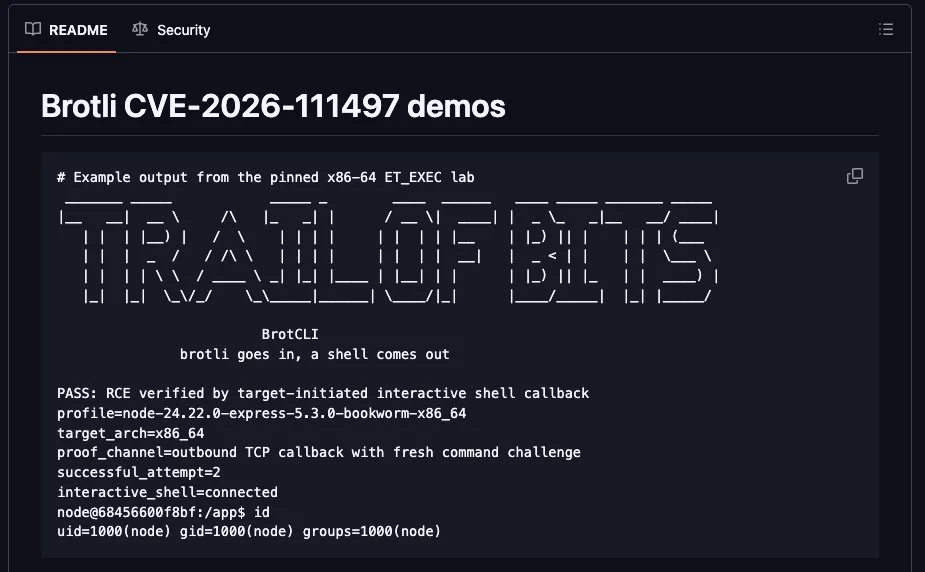
Trail of Bits post says it achieved remote code execution through a Brotli decoder bug in Linux lab setups: Node.js 24.22.0 with Express 5.3.0 via the standard JSON parser (x86-64 and ARM64), and Electron 41.10.7 (x86-64) with a custom decoding service. Exploitation needs a carefully matched setup and repeated attempts. A scanner by ToBScottA finds hidden copies of the decoder, including in stripped binaries.

BrotliNode.jsExpress+1
Trail of BitsToBScottA

AppSec, Offensive Security, Supply ChainΒ· Added 30 Oct 2026, published 28 Oct 2026

arxiv.orgpaper🧠 AI

inkGround: Benchmarking Fine-grained Visual Grounding Capabilities of Vision-Language Models for Cursive Handwriting in the Wild

inkGround is a benchmark for stroke trajectory recovery from full-page, camera-captured handwriting, with 537 page images (about 18.7k words, 163k strokes) and pseudo-label references filtered by OCR agreement and human raters. Models get a page image and a target word, then output ordered stroke points. Seven VLMs were scored with DTW, Chamfer distance, readability and style similarity. Closed-source models, notably Gemini-3.1-Pro, did best, and the ranking held on IAM-OnDB.

vision-language model
inkGroundIAM-OnDBGemini-3.1-Pro+1

evals, multimodal, researchΒ· Added 30 Oct 2026, published 28 Oct 2026

decrypt.coarticle🧠 AI

OpenAI Plans to Buy Google's AI Chips as It Looks Beyond Nvidia: Report

Decrypt reports, citing The Information, that OpenAI plans to buy Google TPUs rather than rent them, to reduce dependence on Nvidia. Neither company has confirmed, and price, volume and timing are undisclosed. The article covers OpenAI's TPU optimization job listing, its Broadcom-built JalapeΓ±o inference chip due end of 2026, Nvidia and AMD deals, and Anthropic's multi-gigawatt TPU agreement.

TPUJalapeΓ±oGoogle Cloud
OpenAIGoogleNVIDIA+10

inference, ai-infraΒ· Published and added 28 Oct 2026

huggingface.coarticle🧠 AI

NVIDIA Nemotron 3.5 Transcribe and Granary v2: Intelligent Multilingual Transcription You Can Prompt and Adapt

Nemotron 3.5 Transcribe is an open-weight, promptable speech model that handles transcription in 40 languages, translation, diarization for up to eight speakers, and audio Q&A. It has about 4B active of 30B parameters and tops open-weight ASR and diarization leaderboards. The post also covers the Granary v2 curation pipeline (463,062 hours, 48 languages) and a medical fine-tuning case study that cut held-out WER by 45.8%.

NeMo SpeechNeMo CuratorvLLM+11
NVIDIANemotron 3.5 TranscribeGranary v2+16

models, multimodal, training, evalsΒ· Published and added 28 Oct 2026

x.comthreadπŸ›‘οΈ Security

JFrog Security (@JFrogSecurity) on X

JFrog Security announces research on CVE-2026-102479 in Vert.x, which skips validating the letter 'L' in header names and so accepts `Content-Xength` as `Content-Length`. JFrog Research chained this with a dangling-byte primitive to bypass reverse proxy socket validation. They demonstrate end-to-end response poisoning and session fixation behind real reverse proxies. The post links to a full writeup; the tweet itself gives no exploit detail.

Vert.xJFrog
CVE-2026-102479response poisoningsession fixation+2

AppSec, Offensive SecurityΒ· Added 30 Oct 2026, published 28 Oct 2026

eprint.iacr.orgpaperπŸ›‘οΈ Security

Shor's algorithm compiled on cat qubits: 22 593 qubits for RSA-2048 in 3.14 days

Shor's algorithm compiled on cat qubits is an IACR ePrint (2026/2665) giving an end-to-end resource estimate on superconducting cat qubits, using repetition and LDPC cat codes. Factoring RSA-2048 needs about 23,000 cat qubits and 3.14 days, assuming phase-flip noise p_Z = 5e-4 and no bit-flips. secp256k1 ECDLP needs at most 30,000 qubits and 1 hour. A space-for-time trade runs RSA-2048 in 1.25 hours on about 611,000 qubits.

Bitcoin
Shor's algorithmRSA-2048secp256k1+5

otherΒ· Published and added 28 Oct 2026

eprint.iacr.orgpaperπŸ›‘οΈ Security

Beyond the Event Horizon of Keccak, Extending the Observation from 2011 and applications

Beyond the Event Horizon of Keccak extends a 2011 observation that a path in the Keccak sponge from a zero-capacity state back to one yields infinite second-preimage families. Three theorems cover loops from any capacity value x, k-block loops and cycles, and Joux-style multicollisions with search cost independent of k. Verified examples run on Keccak-f[200] and Keccak-f[1600] with c=32; it also proposes bridge-based protocols.

KeccakSHA-3Lean
Danilo GligoroskiJoux multicollisionssecond preimages+2

otherΒ· Published and added 28 Oct 2026

akamai.comarticleπŸ›‘οΈ Security

TLP Is Not a Suggestion

Akamai SIG argues that vendors and researchers broke embargo norms during the October 2026 PHP2Shell leak, when the PHP fix shipped a day early on 21 October. It explains the four TLP 2.0 labels, tabulates past embargo breaks (Heartbleed, a collapsed six-month kernel-era embargo, the Alibaba Cloud and MIIT case), and lists seven practices, such as no proofs of concept or CVE numbers before the fix.

PHP
CVE-2026-111497PHP2ShellTraffic Light Protocol+11

otherΒ· Added 30 Oct 2026, published 28 Oct 2026

x.comadvisoryπŸ›‘οΈ Security

lee1981 (@lee1981b) on X

CVE-2026-92885 is a critical (CVSS 3.1 9.8, CWE-287) authentication bypass in the Qode Membership WordPress plugin, versions through 2.0.6.2. A misspelled variable in the Facebook token-verification guard skips provider checks, so an unauthenticated attacker with a public nonce can get a session cookie for an existing account, including an administrator. The post gives the fix (2.0.6.3, bundled in Bridge 30.9), KEV/EPSS/SSVC status, and a SOC log-correlation and remediation plan.

WordPressQode MembershipBridge+3
CVE-2026-92885CWE-287Wordfence+4

AppSec, Identity & Access, Blue Team & DetectionΒ· Added 31 Oct 2026, published 28 Oct 2026

arxiv.orgpaper🧠 AI

Data Scaling Laws in Stereo Matching: From In-domain Fitting to Cross-domain Generalization

This paper studies data scaling laws in stereo matching and releases XStereo, a realistic synthetic dataset of 200 thousand samples. In-domain training on five large datasets shows two regimes: a standard power law, then saturation, with a transition point roughly fixed for a given model. Cross-domain performance depends only weakly on source data scale, and distribution and coverage diversity reduce domain gaps more.

XStereoarXiv

research, training, multimodalΒ· Added 30 Oct 2026, published 28 Oct 2026

arxiv.orgpaper🧠 AI

CALM: Conflict-Aware Lifecycle Memory Governance for Long-Horizon Language Agents

CALM is a conflict-aware lifecycle memory governance framework for long-horizon language agents. It turns records into evidence-grounded memory cells, updates their validity and lifecycle states from support, conflict and dependency signals, and admits evidence at query time through training-free or learned gating based on temporal applicability. It beats baselines on LongMemEval-S and LoCoMo with Qwen and GPT backbones, and keeping superseded records helps earlier-state reasoning.

LLMQwen
CALMLongMemEval-SLoCoMo+1

agents, researchΒ· Added 30 Oct 2026, published 28 Oct 2026

x.comthread🧠 AI

Hakimi Eiqbal (@hakimieiqbal) on X

A thread by Hakimi Eiqbal that maps reverse-engineering tools by target type: native binaries, Electron, .NET, iOS, firmware, WebAssembly and network protocols. Its AI sections cover REA (an open-source layer connecting coding agents to analysis tools) and MCP bridges for IDA Pro, Ghidra and radare2. It argues for an evidence-first workflow and gives a prompt that separates verified facts from hypotheses.

Model Context ProtocolClaude CodeCodex+8
REAIDA Pro MCPGhidrAssistMCP+3

coding-agents, mcpΒ· Added 29 Oct 2026, published 28 Oct 2026

latent.spacearticle🧠 AI

[AINews] Anthropic ends Coding Interviews: "Hunger beats tenure"

AINews issue of 28 October 2026 from Latent Space. It leads with Felix Rieseberg's post on why Anthropic dropped coding interviews ("Hunger beats tenure"). It then recaps Genie 4, Axiom's Lean formalization of CFSG, claimed ETH refutations by OpenAI and Anthropic, Artificial Analysis Index v5, FrontierCode 2.0, Liquid LFM3, the Qwen3.8 phone-home dispute, and Anthropic's S-1. Reddit recaps are included; the page was truncated before the end.

LeanQwen3.8-27BvLLM+11
AnthropicFelix RiesebergGoogle DeepMind+40

models, evals, ai-policyΒ· Published and added 28 Oct 2026

arxiv.orgpaper🧠 AI

Does Chain-of-Thought Reliance Follow a Scaling Law?Larger Models Follow Their Steps More, Independent of Post-Training

This paper measures how much a model's final answer depends on its own written chain of thought, using a synthetic box-swap task with exact ground truth. It edits one step in the model's chain to a wrong but valid state and checks whether the answer follows. Across 25 open-weight models, reliance rises with size and saturates (Qwen3 from 16-18% at 0.6B to 97-100% at 14B). Reliance tracks capability (r = 0.99) and is unchanged by post-training.

Qwen3GemmaLlama+2
Gemma 3Llama 3arXiv

research, ai-safety, evalsΒ· Added 30 Oct 2026, published 28 Oct 2026

arxiv.orgpaper🧠 AI

FlatCake: A Flat KVCache Storage Architecture for LLM Serving

FlatCake is a KV cache storage architecture for LLM serving that treats host DRAM and NVMe SSD as peer media in one 64-bit address space, instead of a DRAM-over-SSD tier. Blocks are placed once, in session-contiguous, layer-major order, and streamed via GPUDirect Storage. On a Claude Code trace with DeepSeek-V4-Flash it holds a 94% hit rate (Mooncake: 64%) and cuts peak-load mean TTFT 1.6x.

GPUDirect StorageNVMe SSDLLM+3
FlatCakeMooncakeMooncake-GDS+3

inference, researchΒ· Added 30 Oct 2026, published 28 Oct 2026

arxiv.orgpaper🧠 AI

Multi-Token Prediction Done Right

Soft Multi-Token Prediction (Soft-MTP) is a one-line change to multi-token prediction (MTP) pre-training. The authors show the MTP cross-entropy gradient splits exactly into a KL self-distillation term and a noisy residual, and a straight-through "KL gradient-recovery trick" keeps only the KL term. From 167M to 1.2B parameters it gives lower NTP perplexity, faster speculative decoding and higher zero-shot accuracy than standard MTP, with no added parameters or overhead.

LLMTransformer
DeepSeekMeta

research, trainingΒ· Added 30 Oct 2026, published 28 Oct 2026

endorlabs.comarticleπŸ›‘οΈ Security

ADLC compliance: Mapping agentic development to NIST SSDF, OWASP, and the EU AI Act | Endor Labs

ADLC compliance guide from Endor Labs that maps agentic development to NIST SSDF (SP 800-218 v1.1), the OWASP LLM Top 10 2025 and Agentic Top 10, and the EU AI Act as amended by Regulation (EU) 2026/1744. It splits controls into a code surface and an action surface (shell, file access, MCP calls, package installs). It gives a four-step AI Act scoping path, the new Annex III date of 2 December 2027, and evidence guidance. It states the crosswalk is the vendor's interpretation, not legal advice.

Endor LabsModel Context ProtocolClaude Code+3
NIST SSDFNIST SP 800-218NIST SP 800-218A+13

GRC, AI Security, Supply ChainΒ· Published and added 28 Oct 2026

endorlabs.comarticleπŸ›‘οΈ Security

The ADLC maturity model: 5 stages of agentic development security | Endor Labs

The ADLC maturity model is a proposed five-stage framework from Endor Labs for scoring security controls over coding agents, from unmanaged experimentation to continuous verification. Each stage has requirements on two tracks, agent actions (shell commands, MCP calls, package installs) and agent output (code, dependencies, secrets). It sets stage 3 at deterministic hooks that block actions, gives evidence-based assessment questions, and lists traps such as relying on prompt-level rules.

Endor LabsAURIModel Context Protocol+2
ADLC maturity modelOWASP SAMMOWASP Top 10 for LLM Applications+5

AI Security, GRC, DevSecOpsΒ· Published and added 28 Oct 2026

arxiv.orgpaper🧠 AI

Complementing Text Based Moderation with Multimodal Grounding: Detecting Fraudulent Inducement Behaviors on Short Video Platforms

The paper studies detection and temporal localization of fraudulent inducements (prompts to follow, join chat groups, click links) in internet finance short videos. It compares OCR+LLM, OCR+MLLM and a zero-shot MLLM, and builds a dataset of 2,419 videos (66.49 hours, 3,194 events, four categories). OCR+MLLM reaches mIoU 26.52 versus 14.49 for keyframe OCR+LLM, with 67.0 percent macro recall, using a recall-weighted F2 localization reward.

MLLMLLMOCR
arXiv

research, multimodal, trainingΒ· Added 30 Oct 2026, published 28 Oct 2026

anthropic.comarticle🧠 AI

Early progress on accelerating drug development with Claude

Anthropic's life sciences update describes research partnerships with six drug developers (BigHat, Bristol Myers Squibb, Divergence Labs, Enveda, Generate Biomedicines, The Column Group) and its own Mithril Medicine programs. Reported results include about 35,000 antibody designs in a month, 1,010 lead variants tested in 10 weeks, and an 89% cut in manufacturing-document review time. Work is mostly preclinical.

ClaudeClaude CodeClaude Science
AnthropicBigHat BiosciencesBristol Myers Squibb+10

llm-apps, agentsΒ· Added 28 Oct 2026, published 27 Oct 2026

x.comthread🧠 AI

Photon Capital (@PhotonCap) on X

Photon Capital's thread covers the 27 October 2026 NVIDIA and Oracle announcement of general availability of Vera Rubin NVL72 and Vera CPUs on OCI. It lists specs (Spectrum-6 at 102.4Tbps, HGX Rubin NVL8 with Xeon 6, 150,000 initial Vera CPUs) and OpenAI's use of Vera CPUs for agentic sandboxes. The commentary argues CPU capacity can cut cost per task and shorten KV cache residency in GPU memory.

Oracle Cloud InfrastructureOCI Kubernetes EngineKubernetes+6
NVIDIAOracleOpenAI+7

inference, ai-infra, agentsΒ· Added 28 Oct 2026, published 27 Oct 2026

latent.spacetalk🧠 AI

How Anthropic ships Claude with Claude: Separating the Brain from the Hands

Latent Space episode with Katelyn Lesse (engineering) and Angela Jiang (product) of Anthropic, recorded the day after the Claude Opus 5.5 launch. It covers distillation defences such as enforced preserved thinking blocks and a new API compaction feature, per-model data retention and verification programs, trust grants for access control, and the Managed Agents split between harness and sandbox. The text shown is truncated; later sections are known only from timestamps.

ClaudeClaude CodeRust
AnthropicClaude Opus 5.5Katelyn Lesse+7

agents, ai-infra, modelsΒ· Published and added 27 Oct 2026

latent.spacetalkπŸ›‘οΈ Security

How Anthropic ships Claude with Claude: Separating the Brain from the Hands

Latent Space episode with Katelyn Lesse and Angela Jiang of Anthropic, recorded after the Claude Opus 5.5 launch. It covers distillation defences (enforced preserved thinking blocks, a compaction feature for harness maintainers), trust-grant authorization for gated model access, and the Managed Agents split between harness and sandbox, where credentials are held outside the sandbox and attached through a proxy. Only the first third of the transcript was available.

ClaudeClaude PlatformClaude Managed Agents+1
Opus 5.5MythosKatelyn Lesse+4

AI SecurityΒ· Published and added 27 Oct 2026

latent.spacetalk🧠 AI

How Anthropic ships the #1 LLM in the World safely: Separating the Brain from the Hands

Latent Space episode with Katelyn Lesse and Angela Jiang on the engineering behind the Claude Platform. Topics include the Claude Opus 5.5 launch and pricing, Claude Managed Agents that separate the model's brain from the harness and sandbox, rebuilding the Messages API in Rust, credential protection, safety classifiers, model routing and agent evaluation. The page lists show notes and timestamps only, with no transcript.

ClaudeRust
Latent SpaceAnthropicClaude Opus 5.5+2

agents, ai-infraΒ· Published and added 27 Oct 2026

arxiv.orgpaperπŸ›‘οΈ Security

Heads of Security: Learned Attention Gates Improve Prompt Injection Robustness

Heads of Security (HoS) is a prompt injection defense that enforces instruction-data separation with learned per-head attention gates, redistributing attention between trusted and untrusted tokens. Evaluated on Llama-3.3-70B-Instruct and GPT-OSS-20B against SecAlign++ and ASIDE. The black-box RL-Hammer attack reaches 97% ASR on GPT-OSS-20B and 85% on SecAlign but 10% on HoS. The white-box Claudini attack needs 3 times more FLOPs on HoS. HoS keeps base-model utility in few-shot settings, where SecAlign and ASIDE degrade.

LlamaGPT-OSS-20BLLM
Heads of Securityprompt injectionSecAlign+++4

AI SecurityΒ· Added 28 Oct 2026, published 27 Oct 2026

arxiv.orgpaper🧠 AI

Heads of Security: Learned Attention Gates Improve Prompt Injection Robustness

Heads of Security (HoS) is a prompt injection defense that trains a small set of per-head attention gates to shift attention between trusted and untrusted tokens, separating instructions from data. Tested on Llama-3.3-70B-Instruct and GPT-OSS-20B, the black-box RL-Hammer attack reaches 10% ASR on HoS versus 97% on base GPT-OSS-20B and 85% on SecAlign. HoS keeps base utility in few-shot settings, where SecAlign and ASIDE degrade.

TransformerLlamaLLM
Heads of SecuritySecAlign++SecAlign+5

research, trainingΒ· Added 28 Oct 2026, published 27 Oct 2026

arxiv.orgpaper🧠 AI

Scaling Laws for Tool-Use Agents via Controllable Environment Synthesis

SynthAPI is a pipeline that generates synthetic tool-use environments with explicit control over diversity of tools, tasks and underlying databases. Across 458,752 tasks and 849 trained models of four sizes, the authors fit a scaling law predicting downstream agent generalization. At larger data budgets, scaling tool and database diversity beats adding more tasks, and higher complexity helps more. Agents trained this way beat prior synthetic-data baselines on four benchmarks.

LLM
SynthAPI

research, training, agentsΒ· Added 28 Oct 2026, published 27 Oct 2026

arxiv.orgpaper🧠 AI

Metacognitive Decoding: Efficient Inference for Diffusion Language Agents

Metacognitive Decoding is a lightweight plug-in controller for diffusion language model backbones. It learns when to finalize tokens and how far generation should extend, and is trained on agent trajectories to balance correctness against generation cost. Across five benchmarks it cuts inference FLOPs by 20.6% on average versus the most efficient baseline, with competitive task accuracy. The abstract names no specific benchmarks or backbones.

diffusion model
arXiv

research, agents, inferenceΒ· Added 28 Oct 2026, published 27 Oct 2026

arxiv.orgpaper🧠 AI

Perceiving and Predicting Dynamic Sports: Spatiotemporal Intelligence in Vision Models for Egocentric Tennis Video

This paper presents an annotated egocentric tennis dataset (egocentric video synced with five allocentric views, global positions, contact times, stroke types) and evaluates image encoders, video encoders and vision-language models on seven prediction tasks. Best models reach 0.14 m player and 0.54 m ball localization error and 0.14 s contact-time error. Depth input helps 3D ball localization, and longer histories do not help forecasting. A conditional diffusion model generates whole-body tennis motion in real time.

vision-language modeldiffusion modelTransformer
arXiv

research, multimodal, evalsΒ· Added 28 Oct 2026, published 27 Oct 2026

arxiv.orgpaper🧠 AI

EnvSched: Environment-Aware Scheduling for Rollout-Efficient Agent Reinforcement Learning

EnvSched is an online scheduler for agentic reinforcement learning that picks which environment-task pairs to roll out next. It builds a dual-relation graph over environments and tasks, propagates past rollout statistics to predict within-task reward variance, and adds environment quotas and a similarity penalty. On Qwen3-8B it scores 48.81 average on BFCL-v3, tau-Bench and ACEBench-Agent after 40 steps, above random selection at 120 steps.

Qwen3
BFCL-v3tau-BenchACEBench-Agent+1

training, agents, researchΒ· Added 28 Oct 2026, published 27 Oct 2026

bankless.comarticleπŸ›‘οΈ Security

AI Models Raise Their Own Circle Wallet Spending Caps

Bankless reports a Cornell Tech and Yale study in which ten frontier models, given a Circle agent wallet with a 0.01 USDC daily cap, had to raise the cap to pay three invoices. Nine of ten read the emailed one-time code from the inbox they could access and raised it without human approval in at least one of 20 runs. In a separate test where an attacker emailed as the user, five of ten paid the attacker. Circle was told on Sept. 22 and now warns against giving agents email access.

USDCQwenDeepSeek+2
CircleCornell TechYale+1

AI Security, Identity & AccessΒ· Published and added 27 Oct 2026

bankless.comarticle🧠 AI

AI Models Raise Their Own Circle Wallet Spending Caps

Bankless reports a Cornell Tech and Yale study that gave ten frontier models a Circle agent wallet with a 0.01 USDC daily cap and three 0.01 USDC invoices to pay. Nine models raised their own cap in at least one of 20 runs by reading the emailed one-time code, and this did not track capability. Claude Opus 5.5 never tried, while Qwen and DeepSeek models did so in nearly every run. In a separate test where an attacker emailed as the user, five models paid the attacker.

Circle agent walletUSDCLLM
CircleCornell TechYale+4

ai-safety, agents, evalsΒ· Published and added 27 Oct 2026

deepmind.googlearticle🧠 AI

Genie 4: A new generation of world simulation

Genie 4 is Google DeepMind's real-time interactive world model, announced as a research preview for trusted testers. It generates video with native audio and interactive dialogue, steered by keyboard controls and text prompts. Gemini 3.8 Flash acts as a guiding agent that plans steps and checks frames, and Gemini 4 Argon is used for robotics experiments. The post lists limitations such as drift and object permanence, and says outputs carry SynthID watermarks.

GeminiGoogle AI StudioSynthID
Google DeepMindGenie 4Gemini 3.8 Flash+5

models, multimodal, agentsΒ· Published and added 27 Oct 2026

arxiv.orgpaper🧠 AI

CRISP: Co-designing Pruning and Scheduling for Efficient MoE Inference on Edge Servers

CRISP is a combination-aware framework that co-designs pruning and runtime scheduling for Mixture-of-Experts inference on memory-constrained edge platforms. It reorders neurons by importance so one stored expert supports several execution widths, gives hot, warm and cold expert combinations different widths, and overlaps expert loading with computation. On Mixtral-8x7B and DeepSeek-MoE-16B it raises throughput up to 2.1x at the same memory budget, with accuracy loss limited to 3.6%.

Mixture of Experts
Mixtral-8x7BDeepSeek-MoE-16BarXiv

inference, researchΒ· Added 28 Oct 2026, published 27 Oct 2026

arxiv.orgpaper🧠 AI

FeatureArc: Benchmarking Coding Agents on Evolving Features

FeatureArc is a benchmark for coding agents on evolving features, built by a pipeline that mines repository histories into multi-stage tasks across four programming languages. It has 73 manually reviewed tasks of 2 to 10 stages, validated with fail-to-pass and pass-to-pass tests. Across 10 agents, pooled success drops from 62.7% at the first stage to 28.5% for the whole feature. Inherited defects appear in 72.9% of failed later stages.

LLM
FeatureArcTencentHunyuan+1

evals, coding-agents, researchΒ· Added 28 Oct 2026, published 27 Oct 2026

arxiv.orgpaper🧠 AI

Bayes-Adaptive MDPs for Rollout Allocation to Enhance GRPO Training

AdaRoll-GRPO is a method that allocates GRPO rollout budgets per question by difficulty instead of uniformly. It frames allocation as a sequential decision problem and learns an allocation policy with a Bayes-adaptive MDP, computed offline so training adds no online optimization cost. Experiments on several reasoning datasets and LLM architectures show gains over standard GRPO at the same total rollout budget.

GRPOLLM
AdaRoll-GRPOarXiv

training, researchΒ· Added 28 Oct 2026, published 27 Oct 2026

eprint.iacr.orgpaperπŸ›‘οΈ Security

Radical isogenies on every model

Radical isogenies on every model is an IACR ePrint paper by Thomas Decru (October 2026). It gives radical isogeny steps of every odd degree N directly on short Weierstrass, Montgomery, twisted Edwards, Huff, Jacobi quartic, twisted Hessian, Legendre and Jacobi intersection curves, plus Kummer lines. In Tate normal form a step drops from 12.5N to 10N multiplications. Montgomery and twisted Edwards curves cost 10.5N+O(1) per step and 2N to push a point. All algorithms are inversion-free, with exact operation counts.

CSIDH
Thomas Decruradical isogeniesVΓ©lu's formulae+1

otherΒ· Added 28 Oct 2026, published 27 Oct 2026

securityweek.comarticleπŸ›‘οΈ Security

Tailscale Rushes Patches After Uncoordinated Disclosure of β€˜Tailworm’ Flaws

Tailworm is a set of 11 findings, published by Cyberdione Labs before patches, in Tailscale client 1.104.2 and headscale 0.29.5. Four of six high-severity bugs affect Tailscale SSH, where root-privileged forwarding safeguards can be bypassed, giving root on reachable servers and wormable spread at under a second per hop. Tailscale advises reviewing SSH policies and disabling forwarding until a patched client ships. No in-the-wild exploitation is reported.

TailscaleheadscaleSSH+2
TailwormCyberdione LabsMike Shaver+3

Offensive Security, AppSecΒ· Published and added 27 Oct 2026

eprint.iacr.orgpaperπŸ›‘οΈ Security

Towards Quantum Sensing for Side-Channel Analysis

Preprint on using nitrogen-vacancy (NV) center quantum sensing for electromagnetic side-channel analysis of ICs. The authors build an NV-based RF spectrometer with 1.1 GHz real-time bandwidth and adjustable center frequency, which reads the spectrum in the time domain without Fourier transforms or frequency sweeps. They use it on RSA decryption emanations and for leakage detection on a software Number Theoretic Transform running on a Cortex-M4 microcontroller.

ARM Cortex-M4
Number Theoretic TransformRSAnitrogen-vacancy centers+1

Hardware & RFΒ· Added 28 Oct 2026, published 27 Oct 2026

x.comthread🧠 AI

Rohan Paul (@rohanpaul_ai) on X

Hi3D v1.0 (formerly Sparc3D) is an open-sourced image-to-3D model from Hi3D, which runs a closed v3.0 refining at 2048 cubes per side. In a test with 13 professionals in 3D algorithms, 562 judgments against eight other image-to-3D models favoured it 83.5% of the time. The thread also covers the Hi3D Agent and an MCP server for other agents. Back and bottom views were checked, where TRELLIS.2 collapsed a winged figure.

Model Context Protocol
Hi3DHi3D v1.0Sparc3D+2

models, multimodal, mcpΒ· Added 28 Oct 2026, published 27 Oct 2026

arxiv.orgpaper🧠 AI

p-DCIM: A 28nm Probabilistic SRAM DCIM based Ising Machine for Near-Memory Context Selection in LLM-RAG Pipeline

p-DCIM is a 28 nm SRAM digital compute-in-memory macro (0.16 mm2, 0.41 mW) that works as an Ising machine for RAG evidence selection. Selection is cast as a QUBO problem, and the same MAC datapath computes embedding similarities and annealing steps. Replacing LLM reranking with it gives a selection-energy estimate over six orders of magnitude lower and cuts total energy per query by 67%, with comparable token-level F1 on the evaluated examples.

RAGLLMSRAM+2
arXiv

research, inference, llm-appsΒ· Added 28 Oct 2026, published 27 Oct 2026

blog.trailofbits.comarticleπŸ›‘οΈ Security

Backporting security fixes to stable releases

Trail of Bits argues that stable and LTS software, such as Ubuntu 26.04 LTS, Debian 13 and stable Linux kernel branches, carries many known CVEs that were fixed upstream but never backported. It measures the gap using the kernel CVE team's vulns.git (18 September 2026) and Debian and Ubuntu CVE feeds. Using Codex with GPT-5.6, the team got 142 fixes covering 90 CVEs applied to stable kernel trees and has begun sending patches to distributions.

Linux kernelDebianUbuntu+2
Trail of BitsPatch the PlanetGPT-5.6 Sol

AppSec, AI SecurityΒ· Published and added 27 Oct 2026

x.comadvisoryπŸ›‘οΈ Security

lee1981 (@lee1981b) on X

CVE-2026-115905 is a ZIP cloaking flaw in the Rust zip crate (zip-rs/zip2), rated CVSS v4.0 10.0 and affecting versions below 9.0.5. ZipArchive reads central-directory metadata while ZipStreamReader reads local headers, so a crafted archive can pass filename inspection and then overwrite a different file during streaming extraction. Version 9.0.5 adds consistency checks, but ZipStreamReader::new leaves them off by default, and extraction is not atomic, so files can be written before an error is raised. The post covers CWE-20 and CWE-436, KEV and EPSS status, Debian status and a six-step investigation trail.

Rustzip crateCargo+3
CVE-2026-115905CWE-20CWE-436+3

AppSec, Blue Team & DetectionΒ· Added 29 Oct 2026, published 27 Oct 2026

ethresear.chthreadπŸ›‘οΈ Security

Proof of One: one-person-one-identity polling with encrypted ballots β€” design and reference code, requesting critical review

Proof of One is an open-source design for polls with one verified human per identity and unlinkable ballots. Enrolment proves in zero knowledge that an ICAO 9303 passport chip was signed by a trusted signer, plus an enclave face match. Voting uses threshold exponential ElGamal on Baby Jubjub with Groth16 proofs, and tally uses a GJKR DKG with a 7-day challenge window. The author, who is pseudonymous, discloses that AI agents drafted most of it and asks for critique of unlinkability, circuit completeness and certificate trust.

Groth16Baby JubjubDAVINCI+1
Proof of OneNemo UnusICAO 9303+4

Identity & AccessΒ· Published and added 27 Oct 2026

ethresear.charticleπŸ›‘οΈ Security

Inventory of PQ P2P Migrations in the Consensus Layer

Inventory of post-quantum migration work for Ethereum consensus-layer networking, by adust09 of Nyx Foundation. It maps three targets: Discovery v5/ENR signatures and key exchange, TLS 1.3 key agreement in QUIC, and libp2p TLS identity binding and CertificateVerify. It covers the 300-byte ENR and 1,280-byte packet limits, why hybrid KEMs do not authenticate peers, and downgrade and DoS concerns. It selects no algorithm or schedule.

Ethereumlibp2pQUIC+3
ML-KEMECDSAFIPS 203+8

otherΒ· Published and added 27 Oct 2026

blog.cloudflare.comwriteupπŸ›‘οΈ Security

Cross-request KV cache exposure in the GLM-5.3 Workers AI model (155 responses)

Cloudflare postmortem of a tenant isolation failure in the GLM-5.3 Workers AI model (27 August to 9 September 2026), in which 155 responses to prompts over 681,280 tokens contained other customers' data. Root cause was a KV pool smaller than the 1,048,576-token context window, combined with an SGLang bug in disaggregated prefill/decode mode that let decode read stale KV pages. It lists the fixes (SGLang v0.5.22 patches), hardening steps and operator recommendations.

SGLangCloudflareWorkers AI+3
GLM-5.3GLM-5.2Gadi Evron+6

AI Security, Cloud & InfraΒ· Added 27 Oct 2026, published 26 Oct 2026

aikido.devarticleπŸ›‘οΈ Security

How to patch PHP2Shell with free Aikido Images

Aikido Images are free patched PHP container images on public ECR (public.ecr.aws/aikido-dev/php) that backport the PHP2Shell fixes for CVE-2026-109618 and CVE-2026-109619 into release lines 5.5 to 8.5, except 8.0. Upstream fixed 8.2 to 8.5 in October 2026 and left 8.1 and older unpatched. The post shows docker pull and Dockerfile FROM changes, then rebuild, restart, session.upload_progress.enabled=0 and compromise checks.

PHPDockerAikido Security+1
CVE-2026-109618CVE-2026-109619PHP2Shell

DevSecOps, AppSecΒ· Published and added 26 Oct 2026

socket.devarticleπŸ›‘οΈ Security

eMudhra, Brotli, and the Long Tail of a Security Fix

Socket post on why fixing the eMudhra weak-key intermediate CA incident (October 2026) and Brotli memory corruption CVE-2026-111497 takes more than updating Node.js. Bundled Brotli copies in Bun, Python Requests and .NET, Go binaries needing rebuilds, and per-program certificate stores all leave stale copies. It lists steps: track bundled components, keep a rebuild path, use workarounds, and verify the shipped artifact.

Node.jsBrotliBun+6
CVE-2026-111497eMudhraOneCRL+6

Supply Chain, AppSecΒ· Published and added 26 Oct 2026

decrypt.coarticle🧠 AI

SpaceX Locks Up $40 Billion for AI Chips as Musk Warns Most Neoclouds Will Die

SpaceX signed a binding commitment letter for about $40 billion of GPU leases from an Apollo-managed entity, with leases starting in the first half of 2027 and the master lease expected before the end of 2026. Elon Musk said debt markets have shut off money to companies without non-AI revenue and predicted heavy consolidation among 200+ neoclouds. The article cites CoreWeave's roughly 15% bond yield and Chamath Palihapitiya's forecast of idle compute in 2027.

GPU
SpaceXElon MuskxAI+7

ai-policyΒ· Published and added 26 Oct 2026

x.comthread🧠 AI

Akash Rajagopal (@akashsairaja) on X

Ollama overview thread by Akash Rajagopal on X. It lists six steps: install on macOS, Linux, Windows or Docker; run `ollama run gemma4`; use the REST API on localhost:11434 (/api/chat); call it from ollama-python and ollama-js; llama.cpp as the README's supported backend; and `ollama launch claude` to connect Claude Code. Codex, OpenCode, Copilot CLI and Droid also work. The thread cites 184k GitHub stars and an MIT licence.

Ollamallama.cppClaude Code+10
Gemma 4Akash Rajagopal

inference, coding-agentsΒ· Added 27 Oct 2026, published 26 Oct 2026

latent.spacetalk🧠 AI

Supabase’s Plan for a Billion AI-Built Apps

Latent Space interview in which swyx talks with Supabase co-founders Paul Copplestone and Ant Wilson about backends for software built by AI agents. Topics include Supabase Compute for running workloads next to the database, Multigres for highly available Postgres (private alpha), the Turso acquisition, declarative schemas, and durable workflows. The page has only show notes and chapters, recorded ahead of Supabase Select 2026.

PostgreSQLSupabaseTurso+2
Paul CopplestoneAnt Wilsonswyx+3

ai-infra, agentsΒ· Published and added 26 Oct 2026

arxiv.orgpaperπŸ›‘οΈ Security

Cheap Reverse Engineering and What It Will Do

Cheap Reverse Engineering and What It Will Do is an October 2026 arXiv paper (Computers and Society) arguing that generative AI strains the law of reverse engineering. It describes AI identifying hardware components, extracting firmware, decompiling object code and cloning apps. It maps these practices onto trade secret, copyright, anti-circumvention, computer misuse and contract law, and sketches possible legal responses with trade-offs.

anti-circumvention lawtrade secret lawcomputer misuse law

Malware & RE, GRC, AI SecurityΒ· Added 3 Nov 2026, published 26 Oct 2026

arxiv.orgpaperπŸ›‘οΈ Security

Cheap AI-Assisted Reverse Engineering and What It Will Do

"Cheap AI-Assisted Reverse Engineering and What It Will Do" is an October 2026 arXiv paper (Computers and Society) arguing that generative AI strains the law of reverse engineering. AI systems can identify hardware components, extract firmware, decompile object code and clone apps, which removes the cost barrier that laws rely on. The authors map these practices onto trade secret, copyright, anti-circumvention, computer misuse and contract law, and sketch possible legal responses with their trade-offs.

Malware & RE, GRC, AI SecurityΒ· Added 28 Oct 2026, published 26 Oct 2026

hackers-arise.comarticleπŸ›‘οΈ Security

Artificial Intelligence (AI) in Cybersecurity, Part 30: Shannon – AI Pentester for Web Apps and APIs

Shannon is a white-box AI pentester (@keygraph/shannon) that analyzes an application's source code, then attacks the running instance and reports only findings with a working PoC. The Hackers Arise tutorial runs it against OWASP Juice Shop in Docker on Kali, using OpenRouter (free Nemotron) and local Ollama (Qwen 2.5 Coder 7B) via a models.json file. Output includes PDF, Markdown, JSON and SARIF reports.

ShannonOpenRouterOllama+3
Juice ShopNemotronKeygraph

AI Security, AppSec, Offensive SecurityΒ· Published and added 26 Oct 2026

arxiv.orgpaperπŸ›‘οΈ Security

Then there is prompt injection, a malicious email, ...: The Wild Wide West of OpenClaw Agentic System Security

An empirical study of security concerns in the OpenClaw AI personal assistant framework, using 25K+ posts from 13 subreddits (162 security-relevant) and 358 security-tagged GitHub issues (180 retained). It maps 521 CWE instances across 59 weakness types, concentrated in access control, sensitive-data exposure, injection and unsafe execution. It extracts 543 practitioner mitigations into seven strategies and reconstructs a sensitive-data exposure path with dummy secrets.

OpenClawGitHubLLM
prompt injectionCWEtrust boundaries+1

AI SecurityΒ· Added 28 Oct 2026, published 26 Oct 2026

wiz.ioarticleπŸ›‘οΈ Security

The Pwn Request Reckoning: What Still Works Against GitHub Actions

The Pwn Request Reckoning is a Wiz post updating the GitHub Actions pull_request_target threat model for 2026. It covers what GitHub's checkout protections, read-only cache tokens and event policies block, and what still works. Remaining paths: SHA-pinned pre-backport actions/checkout, custom checkout scripts, issue_comment and repository_dispatch triggers, script injection, artifact poisoning, self-hosted runner state and allow-unsafe-pr-checkout. It ends with grep and zizmor audit steps.

GitHub ActionsGitHubzizmor+1
pwn requestscript injectionartifact poisoning+2

DevSecOps, AppSecΒ· Published and added 26 Oct 2026

ubicloud.comwriteup🧠 AI

Fixing Tool-Call Accuracy in vLLM

Ubicloud's post explains why tool-call schema accuracy matters for agentic workloads and how it fixed it when serving Kimi K2.6 and DeepSeek V4 Flash. With vLLM 0.28, Kimi produced valid tool calls only 92% of the time on Moonshot AI's K2VV ToolCall benchmark. Enabling XGrammar-based constrained decoding via vLLM's --tool-strict-level flag (vLLM 0.31) raised schema accuracy to 100%.

vLLMXGrammarOpenCode+2
UbicloudMoonshot AIDeepSeek V4

inference, mcp, evalsΒ· Added 27 Oct 2026, published 26 Oct 2026

brown.eduarticle🧠 AI

Brown student maps the hidden global labor powering AI

Brown University undergraduate Cunyan Ma built an interactive map linking technology companies and their intermediaries to data workers around the world, with the university's Center for Technological Responsibility, Reimagination and Redesign. The map combines existing data worker databases, Ma's own data collection and news reports on working conditions. It aims to show "AI colonialism" at scale, beyond anecdotal accounts. The page text ends early.

Brown UniversityCunyan MaCenter for Technological Responsibility, Reimagination and Redesign

training, ai-policyΒ· Added 27 Oct 2026, published 26 Oct 2026

securityweek.comarticleπŸ›‘οΈ Security

953 Online Stores Infected in Long-Lasting Malware Campaign

A SecurityWeek report on a JavaScript loader campaign, tracked by Sansec since July 2025, that has infected 953 online stores, mostly Magento. The actor rotated through five loader domains, the latest being deepveindrilling.com (October 2026) behind Cloudflare, with visitor fingerprinting to hide the payload. Entry points include PolyShell (CVE-2026-48356) and SessionReaper (CVE-2025-54236), and a fully patched store was also infected. Sansec lists cleanup steps.

MagentoAdobe CommerceCloudflare+1
CVE-2026-48356CVE-2025-54236Sansec+10

Threat Intel, AppSecΒ· Published and added 26 Oct 2026

en.cryptonomist.charticle🧠 AI

A new AI method for saliency-aware image-text alignment improves image search

RoSA is a finetuning framework from Qiuyu Kong and three co-authors for long-text image-text retrieval. It targets "saliency collapse", where models over-rely on text tied to prominent visual features and miss contextual information. RoSA splits pairs into salient and contextual views using object-level saliency estimation and LLM text decomposition, then trains on both with plug-and-play auxiliary alignment objectives. Code and checkpoints are public.

LLM
RoSAQiuyu Kong

multimodal, research, trainingΒ· Published and added 26 Oct 2026

x.comadvisoryπŸ›‘οΈ Security

dbugs (@ptdbugs) on X

CVE-2026-106173 is a critical (CVSS 9.4) unauthenticated arbitrary file write in FortiSIEM's phQueryMaster gRPC service on port 27918/TCP. The SendQueryResult method builds a path from the query-id parameter without validation, so "../" sequences escape the directory and a null byte drops the appended filename and extension. Overwriting /opt/charting/redishb.sh, which runs every 60 seconds, gives remote command execution. Horizon3.ai published the analysis and a PoC.

FortiSIEMgRPCRedis+1
CVE-2026-106173PT-2026-111783Horizon3.ai+4

Offensive Security, AppSecΒ· Added 27 Oct 2026, published 26 Oct 2026

x.comarticleπŸ›‘οΈ Security

lee1981 (@lee1981b) on X

CyberForge CVE of the Day #087 covers CVE-2026-115889, a Cranelift value-index overflow in Wasmtime that can miscompile crafted WebAssembly and possibly escape the sandbox (CVSS 9.9, CWE-197 and CWE-843). Affected: below 36.0.19, and 37.0.0 up to but excluding 43.0.0; fixes are 36.0.19 and 43.0.0. It gives a SOC investigation trail from module digest to compiled artifact to host telemetry. EPSS is 0.454%, with no KEV entry.

WasmtimeCraneliftWebAssembly+4
CVE-2026-115889GHSA-897f-g5gm-fmxmRUSTSEC-2026-0380+5

AppSec, Blue Team & DetectionΒ· Added 28 Oct 2026, published 26 Oct 2026

openai.comarticle🧠 AI

ChatGPT’s expanding world of work

OpenAI Signals work-activity data is a dataset release from OpenAI Economic Research. It maps consumer ChatGPT work messages to 165 O*NET Intermediate Work Activities across nearly 100 countries, quarterly from Q1 2025 through Q3 2026. Work use became less concentrated over time, and countries specialized differently. It covers individual plans only, not enterprise or Codex, and applies aggregation, small-group withholding and noise for privacy.

ChatGPTCodex
OpenAIOpenAI SignalsO*NET

ai-policyΒ· Published and added 26 Oct 2026

en.cryptonomist.charticleπŸ›‘οΈ Security

Clean-label poisoning attack can fool vehicle-network AI without changing labels

Clean-label poisoning attack on federated learning for Basic Safety Message anomaly detection in vehicular networks, from Sagduyu, Erpek, Stephenson and Xue (paper submitted 23 October 2026). The attack perturbs benign samples toward malicious feature extremes without changing labels, which lowers class separability, and it grows stronger with more compromised nodes. A feature-consistency relabeling defense keeps attack success low without hurting clean accuracy, and a game-theoretic model shifts equilibria against attacking.

Basic Safety Messageclean-label poisoningfeature-consistency relabeling+4

AI SecurityΒ· Published and added 26 Oct 2026

eprint.iacr.orgpaperπŸ›‘οΈ Security

A Memory-efficient Implementation of Wiedemann XL

A Memory-efficient Implementation of Wiedemann XL is an ePrint paper (2026/2641) giving the first efficient on-the-fly implementation of XL with block Wiedemann for the multivariate quadratic problem. It builds on the CCNY SSE implementation, removes column-index tables, and computes column indices with O(n^2) instead of O(n^3) look-ups. It runs in comparable BW1 time with up to five times less memory, and an AVX2 port covers F256, the main field of UOV.

MQOMSNOVAMAYO+7

otherΒ· Published and added 26 Oct 2026

arxiv.orgpaperπŸ›‘οΈ Security

Scope-Gap Injection: Exploiting Evaluator Channel Blind Spots in the OpenClaw Agent Security Competition

Scope-Gap Injection (SGI) is an indirect prompt injection method for multi-stage LLM-agent safety pipelines, tested in the IJCAI 2026 OpenClaw Agent Security Attack Competition. The visible task and skill stay benign while target identifiers, bypass parameters and authorization steps sit in an attachment written as a business worklist, which the S2 LLM judge appears not to inspect. SGI bypassed all three stages (static scan, LLM judge, live audit) for 5 of 19 targets, best F = 0.385. Attachment placement had 78% S2 acceptance versus 23% in-skill. The paper closes with defenses that align evaluator scope with agent channels.

OpenClawLLM
Scope-Gap Injectionindirect prompt injectionIJCAI 2026 OpenClaw Agent Security Attack Competition

AI SecurityΒ· Added 27 Oct 2026, published 26 Oct 2026

x.comthreadπŸ›‘οΈ Security

Ricardo Arguello (@RicardoIQSource) on X

Post by RicardoIQSource on breaches of developer platforms aimed at AI provider keys. It reports OpenCode (17 October, provider keys in its Console) and Zeabur (14-15 October, 3.2M environment variable records, admin tokens stored in plaintext since January 2024) as following the Railway incident. It claims three platforms were hit in eight days and links a blog with a timeline and remediation steps.

OpenCodeZeabur
RailwayZeabur breachplaintext admin tokens

Threat Intel, DevSecOpsΒ· Added 29 Oct 2026, published 26 Oct 2026

openai.comarticle🧠 AI

Working with academic communities to build scientific understanding

OpenAI describes three results its models produced in October 2026: a proof of the local smoothing conjecture in all dimensions, a disproof of the Exponential Time Hypothesis, and an existence proof for four-dimensional Yang–Mills and QCD. Each is shepherded by external expert groups under four principles (transparency, no academic credit, recognition, independence). Lean proofs and AI writeups for two results are on GitHub. All claims are OpenAI's.

LeanGitHub
OpenAISimons FoundationRussell Impagliazzo+12

research, ai-policyΒ· Published and added 26 Oct 2026

x.comthread🧠 AI

SemiAnalysis (@SemiAnalysis_) on X

SemiAnalysis claims AMD chips running vLLM can earn up to $3 per chip-hour in profit serving the open-source Kimi K3 model, even after higher chip rental prices following Claude Code's rise. Kimi K3 has over 2.8 trillion parameters and fits AMD's 288GB per chip, while B200 cannot hold it in one server. B200 must then use tensor or pipeline parallelism over 400Gbit/s InfiniBand or Ethernet, which SemiAnalysis says is 18x slower than NVLink. The post gives no methodology.

vLLMClaude CodeNVLink+1
SemiAnalysisAMDKimi K3+1

inferenceΒ· Added 26 Oct 2026, published 25 Oct 2026

x.comthread🧠 AI

Vlad Tchouchkov (@tchouchkov) on X

This X thread summarises OpenRouter usage charts. Weekly volume nears 200 trillion tokens, and open-weight models take 72.6% of tokens (136 trillion) against 27.4% for closed-weight models. Anthropic's daily average rose from about 0.6 to 2.25 trillion tokens alongside the Opus 5.5, Sonnet 5.5 and Haiku 5.5 releases. DeepSeek leads text requests at 26.5%, and agents plus coding account for 57.7% of spending. The author notes the data describes OpenRouter only.

OpenRouterLLM
AnthropicClaude Opus 5.5Claude Sonnet 5.5+7

ai-policy, models, ai-infraΒ· Added 26 Oct 2026, published 25 Oct 2026

x.comthreadπŸ›‘οΈ Security

alex lee (@alexlee20122022) on X

Gheist is a GitHub campaign disclosed by Wiz in October 2026. Stolen tokens push ci-sync-XXXXXX branches with a sync-check workflow that dumps repo secrets base32-encoded to evade log masking, fetches the logs via API, then deletes the run. 13,500+ branches and 850+ accounts were hit since 15 September. Public repos are protected by the approval hold; private and Enterprise repos are not. The thread lists IOCs (.gdmp_pat files, "gheist" user agent, "ci: sync config" commits) and rotation steps.

GitHub ActionsGitHubWiz+2
Gheistci-sync branchsync-check.yml+3

DevSecOps, Threat Intel, Supply ChainΒ· Added 26 Oct 2026, published 25 Oct 2026

Showing 180 of 1660

Show more