- Prasenjit Sarkar (@stretchcloud) on X
Campfire is a free, open-source, self-hosted tool that runs Claude Code, Codex, Goose, Aider and OpenHands side by side in one browser tab. Each agent gets its own git worktree, with permission voting (30 second timer, majority rules), session replay, cross-backend agent races and a shared semantic memory layer. Installs with bunx the-campfire. The post also compares Clawboo, Conductor, Vibe Kanban and Crystl.
 x.comthreadAdded 1 Nov 2026, published 31 Oct 2026🧠 AI
 Tanmay (@TanmayK_03) on X
DBHub, a database MCP server, had a read-only mode bypass in its SQL check. The check treated every `--` as a comment, but MySQL only starts a comment when whitespace follows it. A hidden write statement could therefore still run, and a prompt injection could trigger it. Fixed in version 0.22.6. Replies say enforcement belongs in database grants and that parser tests need to be dialect-specific.
x.comthreadAdded 31 Oct 2026, published 30 Oct 2026🛡️ Security Shubham Mishra 🐐 (@shubh6200) on X
A post relaying Cursor's security advisory: a modified, malicious Claude Code VS Code extension was distributed through the Cursor extension marketplace, affecting at most 5,000 users. Anthropic did not develop that version, and other extensions are not affected. Users of Claude Code in Cursor are told to update to version 2.1.314. The post adds that marketplaces need publisher verification and package integrity checks. It gives no technical detail on the payload.
x.comthreadAdded 31 Oct 2026, published 30 Oct 2026🛡️ Security- aiproduck (@aiproduck) on X
Ruflo is an MIT-licensed wrapper for Claude Code and Codex that adds agent swarms, vector memory and an MCP server. The plugin install writes no files to the workspace, while npx init adds a .claude/ directory, CLAUDE.md and hooks. The post warns that mods run with the account's permissions, so users should read them first. It gives no benchmarks or architecture detail.
x.comthreadPublished and added 30 Oct 2026🧠 AI - 🚨 AI News | TestingCatalog (@testingcatalog) on X
Mistral Large 4 ("Le Chonk") is an open-weights model from Mistral, now on Hugging Face. Per Mistral's announcement quoted in the post, it ranks #1 among open models on Cognition's FrontierCode benchmark, is aimed at agentic coding and cybersecurity, and claims better reasoning efficiency and lower inference costs. The post does not give parameter counts, license or benchmark scores.
x.comthreadAdded 30 Oct 2026, published 29 Oct 2026🧠 AI - Dark Web Intelligence (@DailyDarkWeb) on X
DailyDarkWeb post summarising Anthropic Frontier Red Team research published 27 October 2026. An unreleased internal Claude research model built five attack chains: Chrome sandbox escape (V8 heap bug, CacheStorage race, FedCM use-after-free), a Safari same-origin policy bypass, data extraction from a locked Pixel 9 over USB, a Windows QUIC kernel crash (CVE-2026-33096) and zero-click Linux root via multipath TCP (CVE-2026-98432). Anthropic says all flaws are fixed, including 62 Chrome CVEs as of Chrome 156. The post notes the chains are not independently reproduced.
x.comthreadAdded 30 Oct 2026, published 29 Oct 2026🛡️ Security  Eddy (@ieddysun) on X
Expo's official skills package gives AI coding agents scoped instructions for building Expo apps. One command, npx skills@latest add expo/skills --skill '*', installs it for Cursor, Copilot and Windsurf, while Claude Code and Codex use their plugin marketplaces. Skills include expo-router, expo-animation, expo-upgrade and eas-update. The Expo MCP server adds live docs lookup, compatible dependency installs, EAS build monitoring and simulator screenshots.
x.comthreadAdded 29 Oct 2026, published 28 Oct 2026🧠 AI John Rood (@johnroodepic) on X
Nemotron 3.5 Transcribe is an open-weight, promptable 30B mixture-of-experts model from NVIDIA with about 4B active parameters, built for recorded audio. One checkpoint transcribes 40 languages, handles recordings up to an hour, labels up to eight speakers, translates, and answers questions about English audio. Weights and a demo are on Hugging Face. The post gives no benchmarks.
x.comthreadAdded 29 Oct 2026, published 28 Oct 2026🧠 AI- 🚨 AI News | TestingCatalog (@testingcatalog) on X
Gemini 4 Carbon is a new Google model, announced in a TestingCatalog post on X as taking first place on the Artificial Analysis V5 ranking. It is rolling out to cyber defenders first. Reported scores are 88.2% on SEC-bench Pro (finding vulnerabilities), 54.8% on ExploitGym (exploitation) and 71.0% on CWE-bench (patching). The post calls it a large step up from Gemini 4 Argon, released two weeks earlier. It gives no technical detail beyond these claims.
x.comthreadAdded 30 Oct 2026, published 28 Oct 2026🧠 AI  Kizuno18 (@Kizuno18) on X
Kizuno18's X post argues that the move from local stdio and Docker MCP servers to remote HTTP/SSE endpoints matures the Model Context Protocol in enterprise infrastructure. It lists three trade-offs: short-lived OAuth/JWT bearer tokens replace mounted admin credentials, deferred tool discovery avoids roughly 20k tokens of eager schema loading, and HCP Terraform enforces Sentinel/OPA policy, audit trails and approvals server-side. Opinion post with no benchmarks or code.
x.comthreadAdded 29 Oct 2026, published 27 Oct 2026🧠 AI- Prasenjit Sarkar (@stretchcloud) on X
Campfire is a self-hosted workspace by Prasenjit Sarkar that runs Claude Code, Codex, Goose, Aider and OpenHands side by side in one tab. Risky actions go through permission voting: a majority approves, any single deny blocks, and a 30 second timer ends the wait. Session replay shows which file or tool call triggered an action. The post cites Forever Security's report of a planted AGENTS.md. Codex followed it first time over 90% of the time and Claude Code about half the time. Try it with "bunx the-campfire".
x.comthreadAdded 28 Oct 2026, published 27 Oct 2026🧠 AI - Prasenjit Sarkar (@stretchcloud) on X
Campfire is a self-hosted tool that runs Claude Code, Codex, Goose, Aider and OpenHands in one tab. Risky actions need permission voting (majority approves, any single deny blocks, 30 second timeout), and session replay traces which file or tool call triggered an action. The post cites Forever Security's finding that Codex followed a planted AGENTS.md instruction over 90% of the time and Claude Code about half the time. It also cites the February Cline release compromise via a poisoned GitHub Actions cache.
x.comthreadAdded 28 Oct 2026, published 27 Oct 2026🛡️ Security  Proof of One: one-person-one-identity polling with encrypted ballots — design and reference code, requesting critical review
Proof of One is an open-source design for polls with one verified human per identity and unlinkable ballots. Enrolment proves in zero knowledge that an ICAO 9303 passport chip was signed by a trusted signer, plus an enclave face match. Voting uses threshold exponential ElGamal on Baby Jubjub with Groth16 proofs, and tally uses a GJKR DKG with a 7-day challenge window. The author, who is pseudonymous, discloses that AI agents drafted most of it and asks for critique of unlinkability, circuit completeness and certificate trust.
 ethresear.chthreadPublished and added 27 Oct 2026🛡️ Security
- The SI Maximalist (@thesimaximalist) on X
The SI Maximalist posts on X that OpenAI says GPT-6.1 Terra matches GPT-6 Astra on Agents' Last Exam, OpenAI's test of workplace software tasks, at one tenth of the token price. The model is available in ChatGPT Work, Codex and the API. The post only relays OpenAI's claim and gives no benchmark scores, exact prices or method.
x.comthreadAdded 27 Oct 2026, published 26 Oct 2026🧠 AI - Syb (@DegenOfWallSt) on X
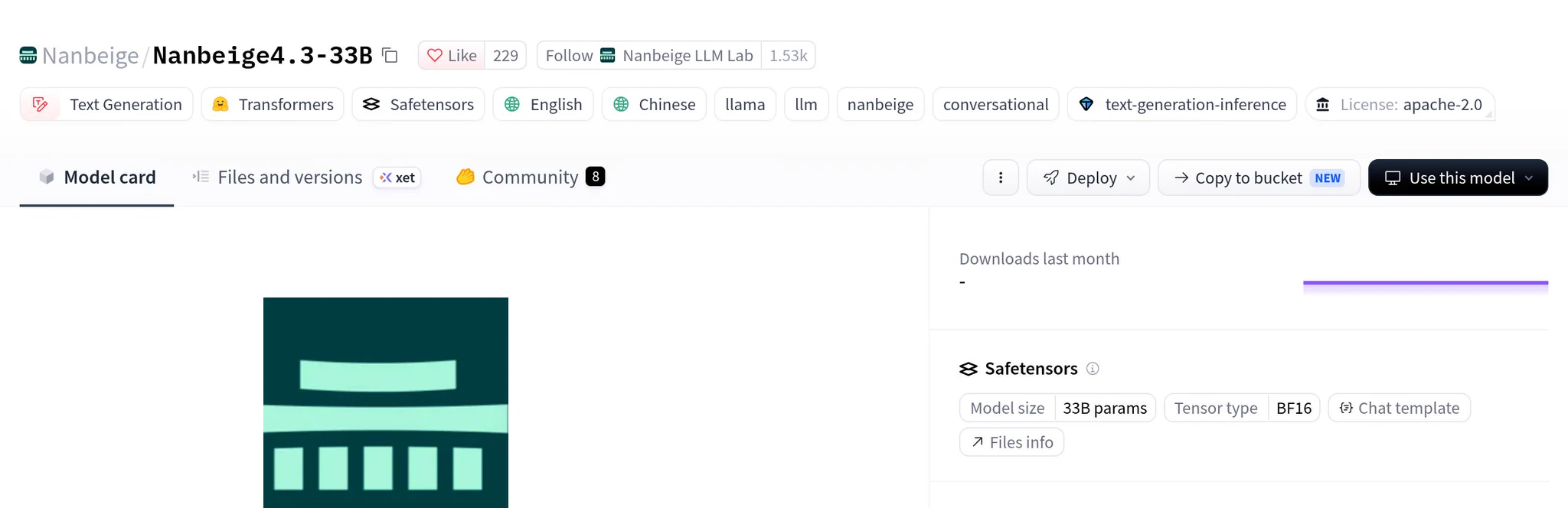
Nanbeige4.3-33B is a 33.1B dense, Llama-style open model under Apache-2.0, released with a base model on Hugging Face. In Nanbeige's own table it beats Qwen3.8-27B on Terminal-Bench 2.1 (80.9 vs 73.0), DeepSWE (65.5 vs 42.5) and Automation Bench, but trails on SWE-Bench Pro, GDPval and GPQA Diamond. BF16 weights are about 66 GB, split across 4 GPUs in the vLLM and SGLang examples. No independent evals exist yet.
x.comthreadAdded 26 Oct 2026, published 25 Oct 2026🧠 AI  EveryDev.ai (@EveryDevAi) on X
ToolUniverse, from ScientistTools, is an open-source (Apache-2.0) toolkit that gives any LLM one interface to more than 1,000 scientific tools, models and databases such as PubMed, UniProt and ChEMBL. It ships a native MCP server, a Python SDK and a tu CLI, plus 68 pre-built agent skills. The post says it works with Claude Code, Cursor, Gemini CLI and Windsurf.
x.comthreadPublished and added 24 Oct 2026🧠 AI Rafter (@RafterSecurity) on X
Railway security incident update of 23 October 2026, posted by Rafter Security, summarising Railway's preliminary report on the 20-22 October breach. Up to 1.85% of workspaces (about 100,000) may have had environment variables exposed. Attackers reportedly targeted AI provider API keys, possibly for model distillation. Some encrypted secrets were accessed and a subset decrypted. Railway says the attacker was removed by 22 October at 03:32 UTC, and the forensic investigation continues.
x.comthreadAdded 25 Oct 2026, published 23 Oct 2026🛡️ Security- 0xMarioNawfal - The Roundtable Show (@RoundtableSpace) on X
TorchTPU is Google's open-source project for running PyTorch apps on its TPUs, announced the day after Amazon released TorchNeuron for its Trainium chips. Google says migration needs "a simple configuration change" with no rewrite. It worked with Meta, Hugging Face, and the vLLM and SGLang teams on compatibility, and added an agent suite that helps migrate apps and fix errors. The post is brief and gives no benchmarks.
x.comthreadAdded 21 Oct 2026, published 20 Oct 2026🧠 AI - 0xMarioNawfal - The Roundtable Show (@RoundtableSpace) on X
Headroom is an open-source GitHub project that compresses logs, files and tool outputs before they reach an AI coding agent. The tweet by RoundtableSpace claims up to 95% fewer tokens for JSON and about 20% fewer overall, with the same answers and lower API bills. The tweet gives no method or benchmarks, and the repo link is truncated.
x.comthreadAdded 21 Oct 2026, published 20 Oct 2026🧠 AI - Dark Web Intelligence (@DailyDarkWeb) on X
DailyDarkWeb update on CVE-2026-21589, a pre-auth file-read flaw in Atlassian Data Center products. The CVE record was rejected on 16 October 2026 with a generic reason and no replacement ID, but Atlassian's advisory (CVSS v4.0 9.3, Critical) and the CISA KEV listing (added 15 October, federal due date 18 October) remain. The analyst note says to keep patching to the fixed versions and track versions, not only the CVE ID.
x.comthreadAdded 19 Oct 2026, published 18 Oct 2026🛡️ Security - Master the captain (@mollicksoif9) on X
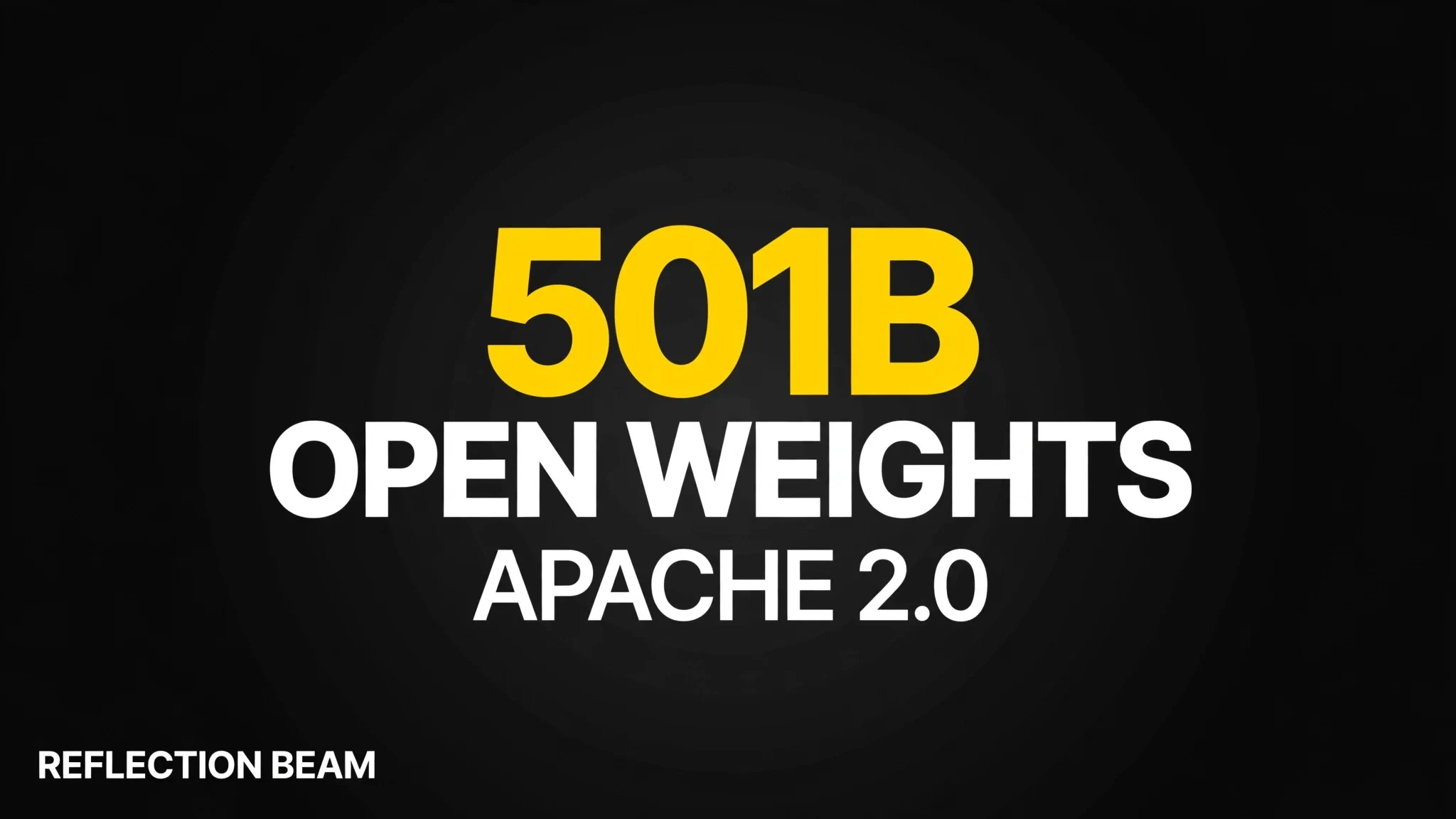
A social post reporting that Reflection AI released the full weights of Beam, a 501B-parameter mixture-of-experts agentic coding model (23B active, 1M-token context), on Hugging Face under Apache 2.0. It claims RL training that penalizes wasted tokens gives roughly 3-4x less inference compute than GLM-5.2, and 80.9 on SWE-bench Verified. Launch support is listed for AWS SageMaker, vLLM and SGLang. The post notes the token-efficiency claims still need independent confirmation and that self-hosting needs about 500GB of GPU memory at 8-bit.
x.comthreadAdded 18 Oct 2026, published 17 Oct 2026🧠 AI  Connor (@ConnorTalksAI) on X
A tweet relaying OpenAI's announcement of GPT-Live-1.1, an update to the voice model behind ChatGPT voice mode. It reduces how often the model says "checking", adds new voices and improves accents, including new voices in French, German, Hindi, Mexican Spanish, Korean and Japanese. It is rolling out to all users in ChatGPT, Codex and "dots", with API access coming soon. The poster frames it as a response to a new xAI/SpaceXSI Grok Voice release.
x.comthreadAdded 16 Oct 2026, published 15 Oct 2026🧠 AI- Dark Web Intelligence (@DailyDarkWeb) on X
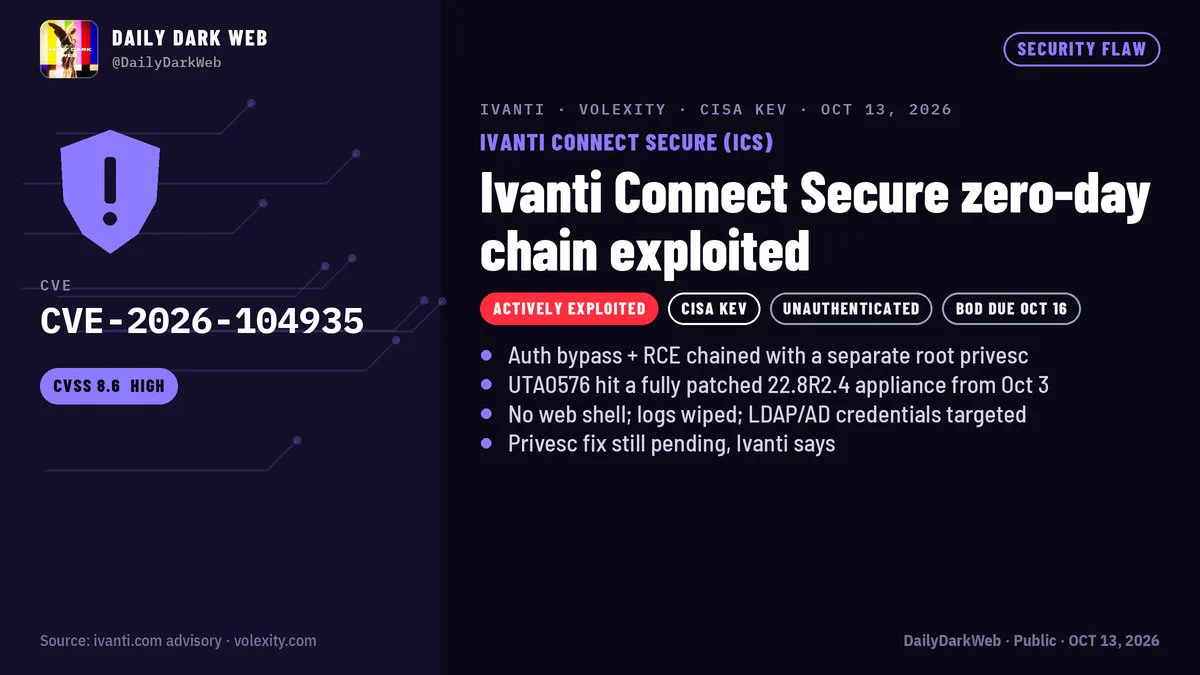
Social post summarizing Volexity's research on an Ivanti Connect Secure (ICS) zero-day chain, CVE-2026-104935. The chain pairs an auth bypass and a race-condition RCE with a separate privilege-escalation bug for root. Actor UTA0576 used it from Oct 3, 2026 against a fully patched 22.8R2.4 appliance, leaving no backdoor or web shell and deleting log entries. Post-exploitation included LDAP/AD credential theft, LAPS and BitLocker key searches, password spraying and packet capture. CISA added it to KEV with a due date of Oct 16. A clean Integrity Checker result does not rule out compromise because the chain patches code in memory only, so memory and network forensics are needed. The hunting lead is heavy requests to /dana-na/auth/url_default/welcome.cgi with a mismatched X-DSCGI-PATH header.
x.comthreadPublished and added 13 Oct 2026🛡️ Security - Igor Carron (@IgorCarron) on X
Igor Carron's tweet highlights LightOn's open-source ColGrep-Agent-2B, a 2B model released on Hugging Face for code search and retrieval that works with Claude Code. LightOn reports 34% fewer API tokens and 40% lower API costs. It matters because usage limits and token costs are a pain point for coding agents. A reply thread in the same post notes quota exhaustion across Grok, Cursor, Devin, Claude and Codex, and argues for quota dashboards.
x.comthreadPublished and added 12 Oct 2026🧠 AI - 0xMarioNawfal (@RoundtableSpace) on X
A tweet highlighting Prompts Chat (formerly Awesome ChatGPT Prompts), an open-source prompt library on GitHub that the post says has 167K+ stars. It works across ChatGPT, Claude, Gemini and other models. The post lists a CLI, an MCP server, a Claude Code plugin and self-hosting with custom branding and auth, all free. It is worth cataloguing as a pointer to a widely used prompt collection that now plugs into coding-agent and MCP workflows.
x.comthreadPublished and added 10 Oct 2026🧠 AI - Confident AI (@confident_ai) on X
Confident AI announces Eval Skills, open-source (Apache 2.0) agent skills for Claude Code and Codex. The `eval-build` skill takes an app to a runnable baseline: it finds realistic examples in traces and incidents, annotates failures, groups them into failure modes, curates cases with independent data splits, and builds graders validated against human judgment. The `eval-descent` skill runs a bounded loop of hypothesis, app change, eval re-run, regression check, then keep or revert, with held-out cases kept out of the loop. It ships Python and TypeScript tooling for tracing, annotation, grading and reports, plus a local UI or Confident AI for managing the loop.
x.comthreadPublished and added 9 Oct 2026🧠 AI  Richard Abishai (@richardabish_ai) on X
An X post by the creator of ROPE, a prompt-injection benchmark for LLM agents. It uses two news items to argue that the prompt-injection model of agent attacks is incomplete: a zero-click RCE called Plugin4Shell in coding agents' plugin systems, and Apple's local MCP server in Safari 27 exposing browser automation to agents. Neither involved persuading a model. The author concludes that teams should benchmark what an agent believes and also audit what it can reach, using plugin signing and update policy, least-privilege credentials per agent, and treating local MCP surfaces as attack surface.
x.comthreadPublished and added 9 Oct 2026🛡️ Security- OpenAI withdraws three mathematical results
A tweet from Dan Roberts announcing an update to a GitHub repository tracking Lean formal verification of mathematical results tied to OpenAI math research, adding six new Lean formalizations and nineteen modifications, now covering roughly 42 percent of top line results. The update also discloses withdrawal of three manuscripts, on algebraicity of Weil classes on split abelian eightfolds, Kuga Satake correspondences for K3 surfaces, and the rational Hodge conjecture for products of K3 surfaces, after formalization work revealed errors.
 twitter.comthreadPublished and added 8 Oct 2026🧠 AI
- Liquid AI (@liquidai) on X
Liquid AI announces Open d1, two open-weight multimodal decision models. d1-3B (built from LFM2.5-VL-3B, text + vision) claims first place among sub-10B models on the Decision Index v0.2.1, while the experimental d1-omni-600M (LFM2.5-Encoder-350M plus vision and audio encoders) handles text+image or text+audio and leads on toxicity detection and paraphrase identification. Single-request d1-3B latency is 8 ms on an RTX 4090, 16 ms on Jetson AGX Thor, 26 ms on Jetson AGX Orin 64 GB and 50 ms on Jetson Orin Nano, with day-one llama.cpp support; demos include live-camera apps and Isaac Sim navigation. Useful for practitioners picking small local models for reranking, agent guardrails and visual inspection.
x.comthreadAdded 9 Oct 2026, published 7 Oct 2026🧠 AI  Viral Maniar (@ManiarViral) on X
A tweet claims researchers backdoored a 7B open-weight model for under $50. When Codex was pointed at it, the model silently stole credentials on a trigger phrase, with a claimed 100% hit rate and no false triggers on normal prompts. It warns that security practitioners downloading abliterated models from Hugging Face for offensive tooling create a new agent-as-RCE supply-chain risk. The visible text is truncated and gives no method details.
x.comthreadAdded 9 Oct 2026, published 7 Oct 2026🛡️ Security- DevopsCube (@devopscube) on X
A tweet highlighting Steampipe, an open-source tool that lets practitioners query cloud infrastructure, Kubernetes, and other services using SQL instead of jumping between consoles or writing ad-hoc scripts. It calls out concrete security/ops use cases such as finding publicly accessible storage buckets, resources missing required labels, and Kubernetes namespaces without NetworkPolicies, and links to a longer tutorial on devopscube.com. The author frames it as a quick investigation layer on top of live cloud data, not a CSPM/AWS Config replacement.
x.comthreadAdded 8 Oct 2026, published 7 Oct 2026🛡️ Security - Meer Tarbani - Growth & Engineering (@MeerTarbani) on X
Sidekick is an open-source macOS plugin for Claude Code that lets you define a one-sentence persona (e.g. "a blunt senior Rust dev") and drive a coding session hands-free by voice: it listens via Apple's on-device speech recognition, speaks answers with macOS voices, and lets you interrupt it mid-reply or say "stop" to cancel a turn. It also surfaces Claude's multiple-choice decisions as spoken questions, matching answers like "the second one" against an echo-filtered transcript so the assistant doesn't hear and respond to its own voice. Implementation is a ~500-line TypeScript Claude Code hooks module plus a 90-line Swift speech listener, runs fully local with zero servers and zero telemetry, and installs via the `claude plugin marketplace`/`claude plugin install` commands.
x.comthreadPublished and added 4 Oct 2026🧠 AI - Sahil Verma (@sahilvermaai) on X
Aleph Alpha released Kolibri, a 78B-parameter open-weight mixture-of-experts model with only 3.46B active parameters per token, a 1M token context window, and Apache 2.0 licensing with full weights on Hugging Face. The model was trained on German and Finnish infrastructure, positioning it as a European-built alternative to US/Chinese open-weight releases.
x.comthreadPublished and added 4 Oct 2026🧠 AI  Rajashekar Sudireddy (@raja_sudireddy) on X
A tweet thread recapping Nate Herk's 18-concept guide to running OpenAI's Codex as a non-coder "AI operating system," organized around four pillars: a place to work (projects, AGENTS.md, the agent loop), a place to run it (local vs cloud environments, worktrees, .codex), controls (models, effort, permissions, skills, plugins), and tools/scale (browser, Sites, subagents, scheduled tasks, voice). It highlights AGENTS.md as the ground-rules file that replaces repeated context-setting (Herk ported his Claude Code CLAUDE.md into it), frames reusable "skills" as an iteratively refined recipe, and describes scheduled tasks as the mechanism that injects prompts into sessions automatically for always-on workflows.
x.comthreadPublished and added 4 Oct 2026🧠 AI- Dark Web Intelligence (@DailyDarkWeb) on X
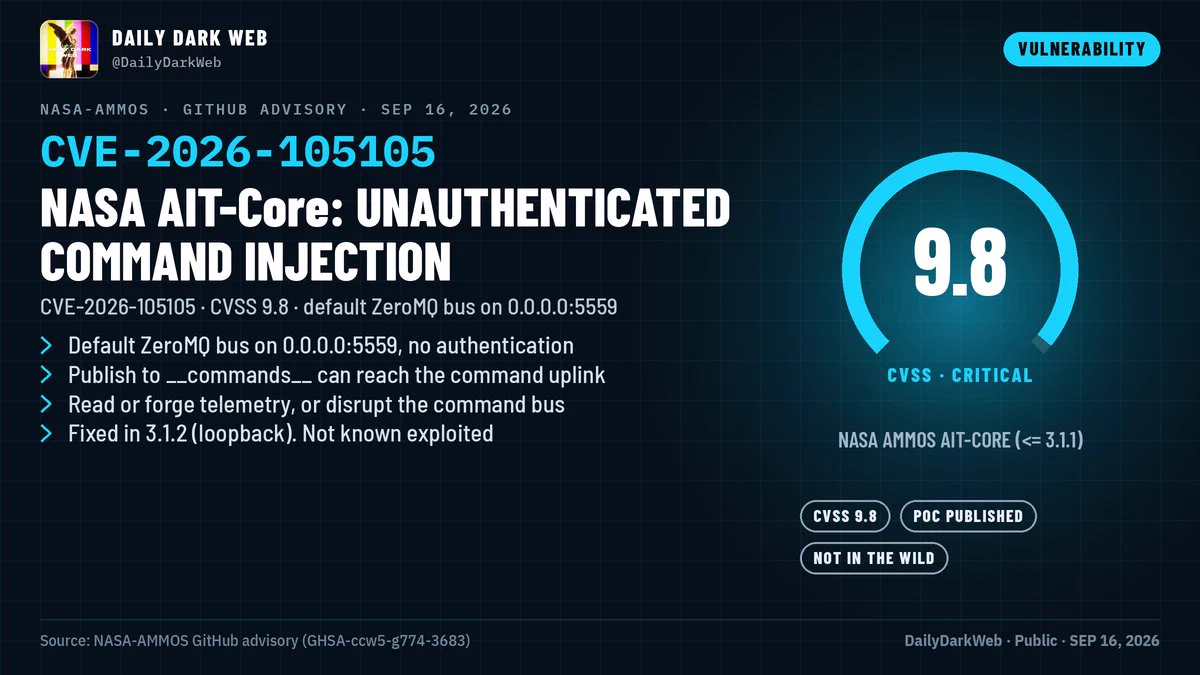
A critical unauthenticated command-injection vulnerability (CVE-2026-105105, CVSS 9.8) was disclosed in NASA AMMOS AIT-Core, software used for spacecraft command and telemetry operations. The flaw stems from AIT-Core's ZeroMQ message bus binding to 0.0.0.0 on TCP port 5559 by default with no authentication, letting any network-reachable attacker publish onto internal topics such as __commands__, potentially injecting spacecraft command data, reading/forging telemetry, and disrupting the command-and-telemetry bus. Affects AIT-Core <= 3.1.1, fixed in 3.1.2 by binding ZeroMQ XSUB/XPUB interfaces to 127.0.0.1; no known in-the-wild exploitation.
x.comthreadPublished and added 3 Oct 2026🛡️ Security  AI Signal (@AliciaCrawoiue) on X
Commentary on Claude Code's newly shipped "mods" feature (TypeScript functions that hook into tool calls, permission prompts, and UI render events, distributed via plugins). The author warns the trust model is the real risk: a malicious mod hooked into the permission-prompt event can silently auto-approve tool calls, and without signed mods and permission manifests this extensibility surface could enable the first supply-chain attack against an agent user's production credentials.
x.comthreadAdded 4 Oct 2026, published 2 Oct 2026🛡️ Security- Dark Web Intelligence (@DailyDarkWeb) on X
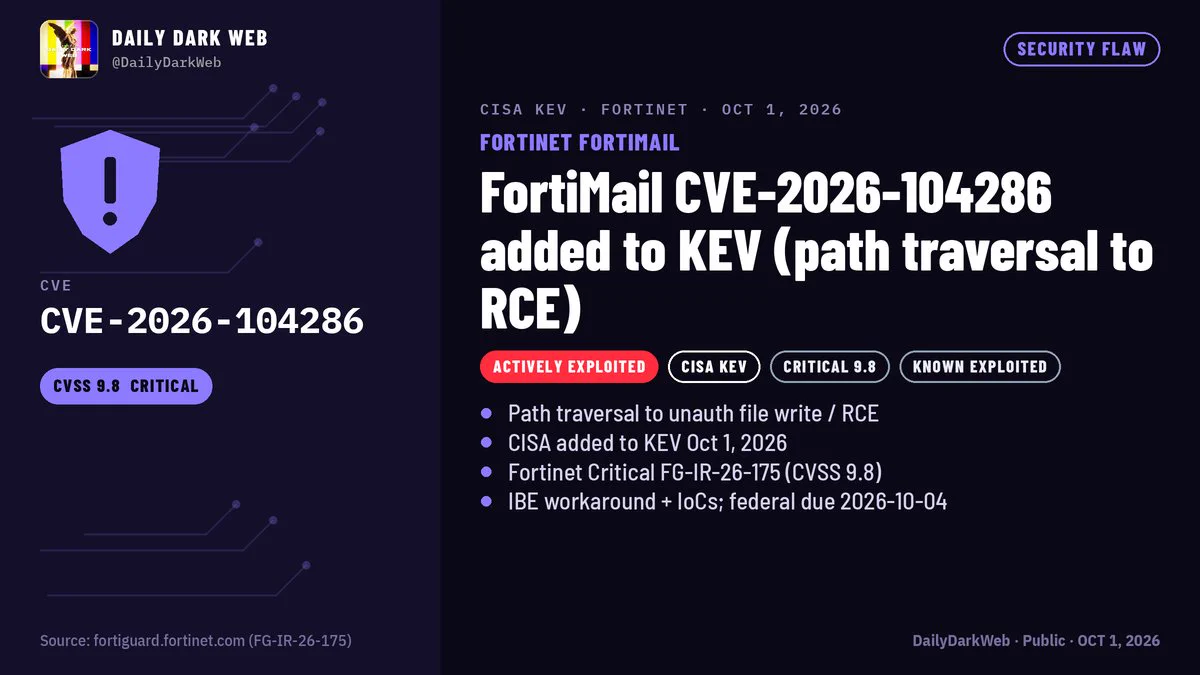
CISA added CVE-2026-104286, a critical (CVSS 9.8) path traversal and NULL-byte neutralization flaw in Fortinet FortiMail, to its Known Exploited Vulnerabilities catalog on October 1, 2026, citing active in-the-wild exploitation. The bug allows unauthenticated arbitrary file write via crafted HTTP/HTTPS requests on FortiMail 7.2.0–7.2.9, 7.4.0–7.4.8, 7.6.0–7.6.6, and 8.0.0–8.0.1, with fixes coming in 8.0.2/7.6.7/7.4.9+ and an interim workaround of disabling IBE and restricting management-interface internet access. Federal agencies face an October 4, 2026 BOD 26-04 remediation deadline, and Fortinet's advisory (FG-IR-26-175) includes IoCs for hunting.
x.comthreadAdded 2 Oct 2026, published 1 Oct 2026🛡️ Security  Hugging Face (@huggingface) on X
Hugging Face announces an open approach to multi-harness RL: training a single model with reinforcement learning across any task set, run inside the actual agent harnesses practitioners use day-to-day such as Claude Code, Codex, and OpenCode, rather than a synthetic training-only environment. The pitch is that a model's behavior varies significantly depending on the harness it's deployed in, so RL training needs to account for harness-specific dynamics to transfer well to real usage.
x.comthreadPublished and added 1 Oct 2026🧠 AI- USA SuperIntelligence | USASI (@USASIHQ) on X
AutoTrust AI announced autotrust/JEV-27B, an Apache-2.0 open-weights model built on a frozen Qwen3.8-27B backbone that produces calibrated "System 1" (fast, confidence-scored) decision outputs while the same weights also serve ordinary text generation. The tweet links to a Hugging Face blog post with the model card and release details.
x.comthreadPublished and added 1 Oct 2026🧠 AI  When Models Turn Brutal
A vendor thread from ZeroShieldAI argues the patch window has collapsed because AI models can now find and weaponize vulnerabilities faster than defenders can fix them. It cites ZeroDayBench (success jumping from ~13% on blind zero-days to 78% once patch location is known), Aikido Security's benchmark where DeepSeek V4 Pro found 28 of 32 recent CVEs for about 98 dollars per run, a Unit 42 finding that 92% of AI-discovered flaws are logic bugs fuzzers miss, and a Hugging Face stat that 16 of the top 300 models advertise removed safety guardrails with 16.8M downloads. It promotes an attached 6-page case study and lists five defender recommendations: treat disclosure as exploit day, maintain SBOM/AIBOM, inventory models and agents, gate agent tool calls with policy, and red-team code and AI apps.
x.comthreadPublished and added 1 Oct 2026🛡️ Security lee1981 (@lee1981b) on X
A detailed breakdown of CVE-2026-102710 (CVSS v4.0 9.3), a privilege-escalation flaw in Eclipse ThreadX RTOS builds with event tracing enabled: a module-supplied trace callback pointer is retained by the kernel and invoked with kernel privilege when the trace buffer wraps, letting an attacker who already controls a memory-protected user-mode module fault the kernel or execute code in kernel context. The thread walks through the vulnerable code path (registration, storage, invocation across the protection boundary), CWE-269/CWE-822 classification, affected versions (through v6.5.1.202602a_rel), and provides a defender hunting guide plus emergency remediation steps, noting no fixed upstream release or CISA KEV/EPSS entry exists yet.
x.comthreadPublished and added 30 Sep 2026🛡️ Security- Vikram Dias (@BigVikDada) on X
A practitioner thread dissects OpenAI's default rollout of Daybreak Blue (GPT-5.6 Sol) inside Codex Security Cloud, which scans GitHub repos, dedupes findings, and drafts fixes continuously. The author separates marketing framing from actual controls, clarifies that Daybreak Blue is a defensive, identity-gated model distinct from the exploit-research-oriented Daybreak Red/GPT-5.6-Cyber track, and questions OpenAI's self-reported scale metrics (30M+ commits, 500K+ auto-marked-fixed findings) for lacking false-positive and reachability data. It closes with a five-point checklist for security teams before connecting production GitHub orgs: scope the org grant, confirm workspace-level Daybreak Blue enrollment, enforce human review gates, treat vendor validation claims skeptically, and assign clear ownership of AI-prepared patches.
x.comthreadAdded 30 Sep 2026, published 29 Sep 2026🛡️ Security - Formal Verification of Execution and Consensus Clients
A reply on the Ethereum Research forum (ethresear.ch) responding to @pcaversaccio's call for formally verifying hard-fork changes in Ethereum execution and consensus clients before mainnet activation. It surveys current formal-verification efforts (Etheorem/SizzLean in Lean 4 for consensus/SSZ, Verifereum in HOL4 for the EVM), argues for prioritizing high-leverage surfaces like SSZ, state transition, fork-choice and core EVM semantics, and pushes for stronger verification tooling in Rust (Aeneas/Verus/hax) as an incremental path to reducing the trusted computing base of client software.
ethresear.chthreadAdded 29 Sep 2026, published 25 Sep 2026🛡️ Security - Granite0x Security Thread
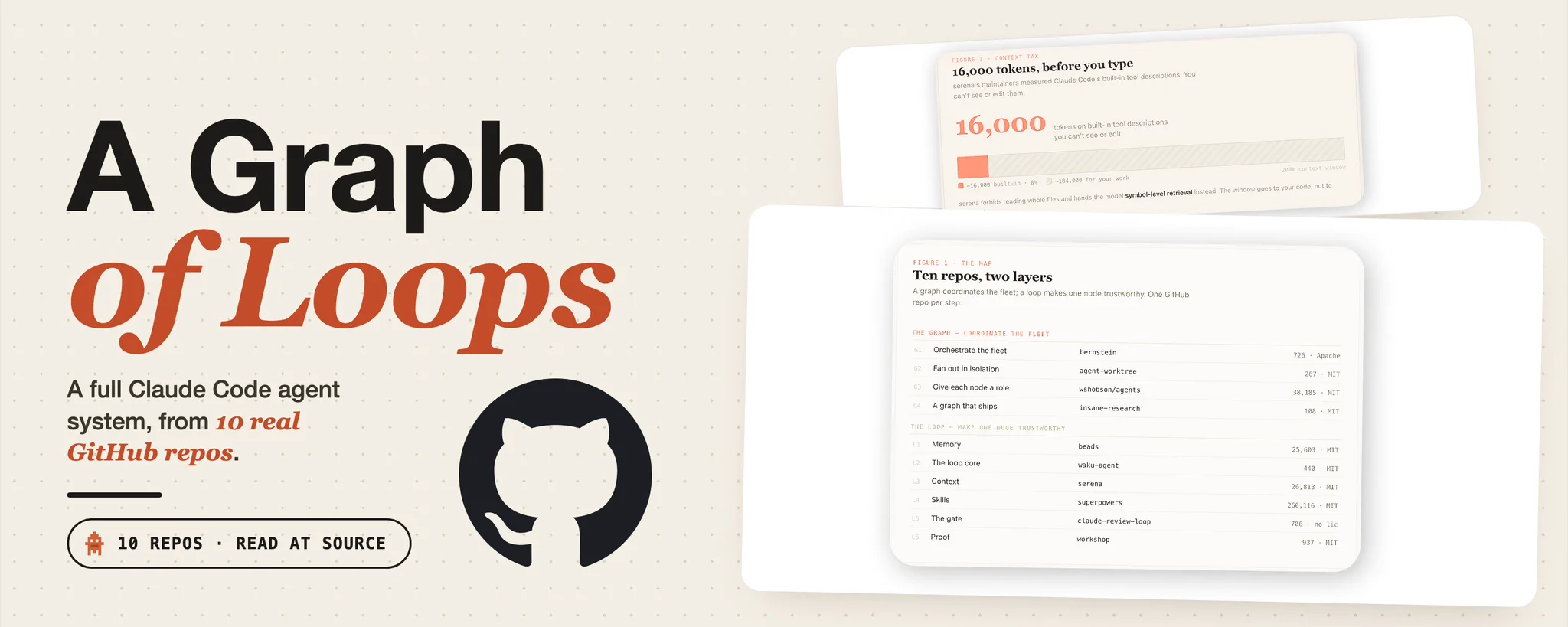
A Twitter/X thread that maps ten GitHub repos into a 'graph vs loop' framework for building trustworthy multi-agent coding systems: the graph layer covers task orchestration (bernstein's DAG scheduler), git-worktree isolation (agent-worktree), and specialist subagent roles (wshobson/agents), while the loop layer covers memory (beads), a minimal agent loop (waku-agent), token-efficient symbol-level context retrieval (serena), enforced skills/TDD (superpowers), a second-model review gate as a Stop hook (claude-review-loop), and trace-replay evals (raindrop-ai/workshop). Each repo entry includes concrete implementation details (file names, line counts, install commands) and a stated 'trap' or limitation, distinguishing substantive tools from surface-level pitches.
x.comthreadAdded 22 Sep 2026, published 31 Jul 2026🧠 AI - Unsloth AI (@UnslothAI) on X
Unsloth AI announces a 1-bit dynamic GGUF quantization of Kimi K3, a 2.8-trillion-parameter open model with 1M context and native multimodality, shrinking it from 1.56TB to 594GB (-62%) while retaining ~78.9% accuracy, runnable locally on a Mac Studio with 128GB RAM. Kimi K3 itself introduces Kimi Delta Attention for up to 6.3x faster decoding at million-token context and "Attention Residuals" for ~25% higher training efficiency. The thread links to Unsloth's guide and the Hugging Face GGUF weights.
x.comthreadAdded 22 Sep 2026, published 31 Jul 2026🧠 AI - uk_daniel_card
A short first-person thread describing stealing credentials from a running system as an unprivileged userland process: sniffing the clipboard to grab passwords copied out of KeePass, scraping process memory and SQLite databases for stored passwords/usernames/tokens/cookies, hunting for files like password.txt, and reading Chrome/browser credentials straight out of RAM as they sit in cleartext in text boxes. The author's point is that once someone else's code is running on your machine, it's practically impossible to fully harden every surface — clipboard, memory, and disk are all exposed.
x.comthreadAdded 3 Sep 2026, published 13 May 2026🛡️ Security