- Show HN: A language model that lives in a boot sector
bootgpt is a char-level language model that runs from a BIOS boot sector. A 512-byte hand-written asm MBR loads an 11.5 KB int8 model from 23 following sectors and runs it in 16-bit real mode on a 386, generating fake Linux dmesg boot logs. train.py quantises to int8 with power-of-two scales, and its integer simulation matches the asm output char for char.
 github.comrepoAdded 1 Nov 2026, published 31 Oct 2026🧠 AI
- rikugan: LLM reverse-engineering agent for IDA Pro and Binary Ninja
Rikugan is a reverse-engineering agent that runs inside IDA Pro and Binary Ninja. It has its own generator-based agent loop, context management, plan mode and 60+ tools, and does not depend on an external MCP server. An orchestrator spawns parallel subagents to analyze a binary. It supports Anthropic, Gemini, MiniMax, Kimi, OpenAI-compatible endpoints and Ollama, with per-model notes.
github.comrepoAdded 30 Oct 2026🧠 AI - alirezarezvani/claude-skills
claude-skills is an open-source MIT library of about 398 Claude Code skills, agents and plugins that also installs into Codex, Gemini CLI, Cursor and 9 other coding agents. The security-relevant parts are skill-security-auditor, a stdlib-only Python scanner that checks skills for command injection, data exfiltration, prompt injection and dependency supply-chain risks before install, plus a security-guidance PreToolUse hook, a security suite and compliance skills (ISO 27001, SOC 2, GDPR).
github.comrepoAdded 25 Oct 2026🛡️ Security - Show HN: Omnara – Open-source alternative to Claude Managed Agents
Omnara is an open-source, self-hostable managed agent platform, an alternative to Claude Managed Agents and OpenAI's Agents API. It runs agents on any model (OpenAI, Anthropic, OpenRouter, Bedrock, LiteLLM, Ollama) and any machine, with Postgres-backed durable state, stateless workers, per-tool permissions, MCP, skills, memory, subagents, schedules and Slack, Discord and GitHub triggers. It ships a REST API, TypeScript SDK, CLI and Docker Compose setup.
github.comrepoAdded 23 Oct 2026, published 21 Oct 2026🧠 AI - vxcontrol/pentagi
PentAGI is an open-source, self-hosted multi-agent system that uses LLM agents to carry out penetration testing tasks autonomously. The MIT-licensed repo has a Go backend, a React frontend and GraphQL. It ships Docker Compose files for Langfuse tracing, Graphiti knowledge-graph memory and an observability stack. Topics list OpenAI and Anthropic as model backends.
github.comrepoAdded 20 Oct 2026🧠 AI - DeepInfer: High-performance inference framework for DeepSeek models
DeepInfer is DeepSeek's open-source inference framework for offline inference of DeepSeek-V4.1-Flash, released under Apache 2.0. It covers attention data parallelism, MoE expert parallelism with load balancing, draft-token decoding with confidence-scheduled verification, batch-invariant inference, deterministic sampling and structured outputs. It runs on NVIDIA SM100 GPUs and Huawei Ascend 950 NPUs. The KV cache system, prefill/decode disaggregation and load balancing are not included.
github.comrepoAdded 21 Oct 2026, published 20 Oct 2026🧠 AI - Panos Gkatziroulis 🦄 (@ipurple) on X
Malvex (JoasASantos/Malvex) is an AI-driven malware analysis framework that integrates more than 30 analysis tools, a web REPL and an MCP server. Panos Gkatziroulis shared it on 19 October 2026 and noted that it was written by AI. The tweet gives no detail on which tools are bundled or how the AI drives them.
 x.comrepoAdded 22 Oct 2026, published 19 Oct 2026🛡️ Security
- eliasbiondo/antirion
Antirion is an open-source AI gateway shipped as one Rust binary with a built-in admin console. It sits between apps and providers such as OpenAI, Anthropic, Bedrock, Vertex and vLLM, translating between OpenAI, Anthropic, Gemini and Bedrock dialects. It covers routing with fallbacks and circuit breakers, budgets, guardrails, caching, MCP and A2A gateways, SSO, and a benchmark against Bifrost 2.2.4 and LiteLLM 1.103.1.
github.comrepoAdded 21 Oct 2026, published 17 Oct 2026🧠 AI - alex09x/kyb
KYB (Know Your Business) is a Rust/axum server that stores agent-written knowledge, incident reports and tasks as Markdown files in Git, one commit per change. Search is hybrid: Tantivy BM25 fused by reciprocal rank with local multilingual-e5-small ONNX vectors, and it can query historical versions or "as of" a date. It ships a kyb CLI, a native MCP endpoint (Claude Code, Codex, Antigravity, Gemini CLI), an installable agent skill, token auth with per-write attribution trailers, secret scanning on writes, and a web console. It targets persistent shared operational memory for multi-agent, multi-machine fleets.
github.comrepoAdded 17 Oct 2026🧠 AI - Llama.cpp on a jailbroken PS5: run any GGUF model natively on the console
PS5LM is a homebrew app for jailbroken PS5s (firmware 7.00–13.60). It runs llama.cpp with the ggml-vulkan backend on the console's RDNA 2 GPU, using 11.4 GB of shared memory, and loads any GGUF model. It serves OpenAI /v1/chat/completions, Anthropic /v1/messages (usable from Claude Code, Codex and opencode) and a browser chat page on port 8081. It also supports image-projector vision models and TypeSafe-style decision models through a /v1/systemone endpoint. A planner picks the longest context and best cache that fit the free memory, and the app downloads models from Hugging Face.
github.comrepoAdded 17 Oct 2026, published 16 Oct 2026🧠 AI - santosomar/AI-agents-for-cybersecurity
Companion repository for Omar Santos's Pearson and O'Reilly trainings and books. It has eight parts of runnable Python labs: chat models, embeddings, prompt templates, LCEL prompt chaining, Chroma-based RAG, ReAct/LangGraph/CrewAI/DeepAgents agents, and FastMCP servers (nmap, CISA KEV, Shodan). It also includes guides to six agentic frameworks (OpenClaw, Hermes, Agent Zero, OpenHands, Paperclip, Buzz), a tokenomics module on agent cost (context compounding, prompt caching, model routing, token budget guards, batch API, cost per accepted outcome), and a vendor-neutral design spec for a human-gated multi-agent assessment harness. It is a current, practical curriculum for building and operating agents. Some examples act on real systems and should only be run in an authorized lab.
github.comrepoAdded 13 Oct 2026🧠 AI - santosomar/AI-agents-for-cybersecurity
Omar Santos's companion repo for his Pearson/O'Reilly trainings and books, organised in eight parts. They cover LangChain prompts, chains and RAG (Chroma), and agents (LangGraph, CrewAI, DeepAgents). They also cover FastMCP security servers (nmap, CISA KEV, Shodan) and attack-surface-management and SOC agent examples. Later parts have security guides to six agentic frameworks (OpenClaw, Hermes, Agent Zero, OpenHands, Paperclip, Buzz) with hardening notes and 2026 CVE mapping, agent cost/tokenomics scripts including denial-of-wallet budget guards, and a vendor-neutral spec for a human-gated multi-agent security-assessment harness (scope manifest, approval gates, kill switch). Useful as a hands-on path into AI-agent security tooling, with warnings that some examples act on real systems.
github.comrepoAdded 13 Oct 2026🛡️ Security - Show HN: Atticus – Hold-to-talk voice assistant for macOS that runs on Claude -p
Atticus is an MIT-licensed macOS 26+ hold-to-talk voice assistant that uses Apple's on-device speech transcription and runs AI requests through Claude Code on an existing Claude Pro/Max plan, so no API key is needed. Simple commands skip the model entirely (apps open in 0.08 s), actions it has seen once are learned as zero-cost shortcuts, and a "remember…" memory persists across asks. It also sets up no-AI background watchers (polling every 5 s) and holds itself to a budget of a median under $0.002 and 6 s per AI ask, with a system prompt under 10,000 characters.
github.comrepoPublished and added 12 Oct 2026🧠 AI - Talorys – A self-hosted personal AI agent on Cloudflare's free tier
Talorys is an open-source, single-user personal AI assistant deployed with one command (npx create-talorys) into the user's own Cloudflare account. It uses a Cloudflare Agents SDK Durable Object with SQLite for conversations, memories, tasks, notes and automations, Workers AI (@cf/zai-org/glm-4.7-flash) for streaming chat with tool calling, and Durable Object alarms for reminders and scheduled AI routines. It stays within the Workers Free plan, with a private Worker behind a Pages Function service binding, owner-password auth, per-day AI usage guardrails, and fallback to non-AI features when quota runs out.
github.comrepoPublished and added 10 Oct 2026🧠 AI - chainguard-dev/malcontent
malcontent is Chainguard's open-source malware/supply-chain discovery tool that analyzes binaries (ELF, Mach-O, PE, a.out) and scripting-language source across Linux, macOS and Windows using 14,500+ YARA rules (including third-party rules from Avast, Elastic, FireEye, Mandiant, Nextron and ReversingLabs). Its standout feature is differential analysis ("mal diff"), which compares two versions of a build artifact or OCI image against a known-good baseline to surface newly introduced risky behaviors — the technique the project demonstrates on the 3CX supply-chain compromise by flagging unexpected high-risk changes to libffmpeg. It also supports threshold-based scanning ("mal scan") and unfiltered capability enumeration ("mal analyze"), and is designed to run inside CI/CD pipelines, including air-gapped environments via embedded rules.
github.comrepoAdded 8 Oct 2026🛡️ Security  The Vulnerable MCP Project — MCP vulnerability database
The Vulnerable MCP Project is a curated, continuously growing database of security vulnerabilities and attack techniques specific to the Model Context Protocol ecosystem. Entries cover concrete CVEs (e.g. CVE-2025-68143/68144/68145 in Anthropic's mcp-server-git), transport-layer SDK flaws (cross-client response leakage, missing DNS rebinding protection in the official TypeScript/Python SDKs), unauthenticated/0.0.0.0-bound servers enabling RCE (MCPJam inspector, MCP Inspector, Grafana MCP), command/path injection in dozens of third-party servers (gemini-mcp-tool, mcp-server-kubernetes, Framelink Figma MCP, Zen MCP, filesystem-mcp), SSRF chains reaching cloud metadata (MarkItDown MCP, mcp-fetch-server), and a large set of AI-specific attacks: tool poisoning, trigger-phrase data exfiltration, prompt injection via GitHub issues, Jira and Google Docs, rug-pull tool mutation, and cross-server tool-name collisions. It functions as the de facto vulnerability registry for the MCP ecosystem, useful for tracking disclosed issues before patching or adopting third-party MCP servers.
 vulnerablemcp.inforepoAdded 6 Oct 2026🛡️ Security
- Microsoft Agent Framework python-1.20.0 release
Release notes for python-1.20.0 of Microsoft's Agent Framework, an open-source agent/workflow orchestration library. This release adds native vector-store connectors for DuckDB, SQL Server and MongoDB plus a TypeSafe AI connector, redesigns Foundry hosting around request-scoped agent factories and sandbox-isolated sessions, adds computer-use support to Responses clients, and ships Magentic manager and handoff-routing improvements for multi-agent orchestrations alongside a large batch of MCP, Bedrock, Gemini, Anthropic and Ollama provider fixes.
github.comrepoAdded 6 Oct 2026🧠 AI - Show HN: OpenChart – OSS TradingView alternative with your own AI agent
OpenChart is an open-source TradingView-style desktop charting app (Electron, Node.js/Bun, Effect runtime) that embeds AI agents into statistical/technical analysis, real-time market alerts and agentic opportunity research. It ships a custom DSL called Tea (inspired by TradingView's Pine Script) for writing indicators, and a conversation interface built on assistant-ui and the AG-UI event protocol so users converse with agents while charting.
github.comrepoPublished and added 6 Oct 2026🧠 AI - claude-mem — persistent memory system for Claude Code and other coding agents
Claude-Mem is an open-source persistent memory plugin for Claude Code and other coding agents (Codex, OpenCode, Grok Bot, T3 Code, OpenClaw) that captures tool-usage observations during sessions, compresses them into semantic summaries, and reinjects relevant context into future sessions. It uses five lifecycle hooks (SessionStart, UserPromptSubmit, PostToolUse, Stop, SessionEnd), a local SQLite database, a Chroma vector store for hybrid semantic+keyword search, and exposes three MCP tools (search, timeline, get_observations) that follow a token-efficient layered retrieval pattern to cut context costs roughly 10x. It is Apache-2.0 licensed, built with the Claude Agent SDK and TypeScript, and ships an optional hosted "observer" memory service alongside self-hosted options via OpenRouter/Gemini keys or an Anthropic plan.
github.comrepoAdded 5 Oct 2026🧠 AI - the_OSINT_rack (@the_OSINT_rack) on X
Vinted_OSINT is a GitHub tool by EchterAlsFake that performs open-source intelligence gathering against Vinted.com user profiles, pulling seller/buyer account information and computing a risk score to flag accounts likely run by scammers. It's aimed at buyers wanting to vet sellers before transacting on the second-hand marketplace.
x.comrepoPublished and added 4 Oct 2026🛡️ Security - DeepZero
DeepZero is an open-source orchestration engine that lets researchers define vulnerability-research pipelines declaratively in YAML, handling parallel execution (ThreadPoolExecutor), resumable/fault-tolerant state, and LLM-assessment stages via LiteLLM/Jinja2 prompts. It ships example processors for Ghidra headless decompilation, LOLDrivers.io hash exclusion filtering, PE header/driver metadata extraction, and batch Semgrep scanning, with a dedicated pipeline for BYOVD kernel driver vulnerability research. An extensibility model lets users plug in custom Python processors referenced by path in the YAML config.
github.comrepoAdded 3 Oct 2026🛡️ Security - Sigma r2026-07-01 — 20 new detection rules
GitHub release notes for Sigma r2026-07-01, the open-source detection-rule repository, adding 20 new rules (e.g. LSASS crash via Netlogon buffer overflow CVE-2026-41089, TanStack supply-chain attack indicators for Windows/Linux, RedTail cryptominer user-agent detection, AF_ALG kernel crypto API exploit indicator) and updating/fixing dozens of existing rules for ARM64 binary variants, file-sharing domain IOCs, and WMI-based reconnaissance/persistence detection. It's a routine but substantive update to a widely-used blue-team detection content pack.
github.comrepoAdded 3 Oct 2026🛡️ Security - OKX Agent Trade Kit (okx-trade-mcp / okx-trade-cli)
OKX Agent Trade Kit is an open-source MCP server (okx-trade-mcp) and CLI (okx-trade-cli) that let AI assistants like Claude Desktop, Cursor, Claude Code and VS Code place trades and query account data on the OKX exchange via natural-language commands. It runs locally with API keys never leaving the machine, supports module scoping (market, spot, swap, account, earn), a read-only mode for safe querying, multiple profiles, and includes pre-built skill files for agent frameworks plus structured JSON error reporting for debugging failed tool calls.
github.comrepoAdded 2 Oct 2026🧠 AI - Show HN: Made an open-source Lego AI generator
ldraw-nova is an open-source agentic pipeline where an LLM agent (tested with models like Claude Opus 5.5 and GPT-6 Astra) takes a build prompt, reads LDraw-building instructions, and produces a plan.json describing a model's geometry. From that plan it writes a Python generator script that, when executed, outputs an LDraw (.mpd) 3D CAD source file, viewable in 3D/VR (Meta Quest 3) or exportable to Blender-editable glTF. The agent uses jev-rerank, a semantic search tool with reranking backed by TypeSafe's Jev System One model, to find suitable LEGO parts and example models, falling back to full-text search without an API key; it also uses headless rendering and collision/gap detection to self-inspect and iterate on designs.
github.comrepoAdded 3 Oct 2026, published 2 Oct 2026🧠 AI - Microsoft Agent Framework — python-1.20.0 release
Release notes for Microsoft's Agent Framework (Python and .NET SDKs), covering versions python-1.16 through python-1.20 and dotnet-1.19 through dotnet-1.23. Changes span native vector-store connectors (MongoDB, Qdrant, PostgreSQL/pgvector, DuckDB, SQL Server, Azure Cosmos DB, Azure AI Search), Foundry hosting redesigns around request-scoped agent factories and durable Invocations, MCP skill/session security hardening (approval binding, security labels, ZIP-only skill archives), Magentic multi-agent orchestration and handoff routing, and checkpoint/replay correctness fixes across workflows.
github.comrepoAdded 2 Oct 2026🧠 AI  Kyutai Pocket TTS
Pocket TTS is a 100M-parameter text-to-speech model from Kyutai designed to run efficiently on CPU, generating audio faster than real-time (~6x on a MacBook Air M4) with ~200ms latency to first audio chunk and voice cloning from short audio samples. It supports English, French, German, Portuguese, Italian, and Spanish, ships a Python library and CLI, and has spawned numerous community ports (WASM, ONNX, Rust/Candle, MLX, C++, C#) and fine-tuned language variants (Czech, Hindi, Korean, Persian, Indonesian, Estonian, Welsh, Polish).
 huggingface.corepoAdded 2 Oct 2026🧠 AI
 Tencent Hy4 preview (open-weight MoE + Sherry quantization)
Hy4 preview is Tencent's new flagship Mixture-of-Experts language model: 770B total parameters with 49B activated per token across 78 layers (256 routed experts + 1 shared expert, top-8 routing), plus a native 10B multi-token-prediction layer for speculative decoding. It introduces Gated DeepSeek Sparse Attention with IndexCache for cross-layer index reuse and identity Hyper-Connections (iHC) on the residual path, and in blind internal evaluations on engineering tasks it edges out GLM-5.3 and Kimi K3. Weights (including an FP8 variant) are released under Apache 2.0 on Hugging Face with vLLM/SGLang deployment recipes and AngelSlim-based quantization/compression tooling.
huggingface.corepoAdded 2 Oct 2026🧠 AI- Bifrost (Maxim AI) — open-source LLM gateway
Bifrost is an open-source, high-performance LLM gateway (by Maxim AI) that exposes a single OpenAI-compatible API across 23+ providers including OpenAI, Anthropic, AWS Bedrock, Google Vertex, Azure, Cohere, Mistral, and Ollama. It provides automatic failover, load balancing, semantic caching, Model Context Protocol (MCP) tool integration, budget and governance controls, OIDC user provisioning, and Prometheus-based observability, deployable via npx or Docker with claimed sub-15 microsecond overhead at 5,000 RPS. It is positioned as a drop-in replacement requiring only a base-URL change for existing OpenAI, Anthropic, or GenAI SDK code.
github.comrepoAdded 2 Oct 2026🧠 AI - ShadowSafin/Synapass
Synapass is an OpenAI-compatible inference gateway and control plane that decides per request which AI provider serves it, under policy. It provides routing, retry and failover, exact/prefix/semantic caching, rate limits and budgets, tenant isolation, and an explain endpoint recording why each request was routed. It deploys with one command via Docker Compose (Postgres, Redis, ClickHouse, NATS, Grafana stack, dashboard).
github.comrepoAdded 20 Oct 2026, published 1 Oct 2026🧠 AI - https://github.com/Panniantong/Agent-Reach
Agent-Reach is a CLI and agent-"skill" layer that equips coding agents (Claude Code, Cursor, OpenClaw) with ready-made web-reading tool use: fetching arbitrary pages via Jina Reader, YouTube transcripts via yt-dlp, GitHub repos via gh CLI, Bilibili search, RSS via feedparser, and semantic web search via Exa through mcporter, with login-gated platforms (Twitter/X, Reddit, Xiaohongshu, Facebook, Instagram) added on request via cookies or OpenCLI browser sessions. Each platform module probes an ordered list of candidate backends and falls back automatically when one breaks (e.g. yt-dlp being blocked by Bilibili's anti-scraping), and an `agent-reach doctor` command reports which backend each channel is currently using. It positions itself as a "capability layer" that selects, installs and health-checks the right upstream tool for an agent rather than wrapping the reads itself.
github.comrepoAdded 2 Oct 2026, published 1 Oct 2026🧠 AI - CAIRN — Cisco Talos AI-Malware-Hunting Toolkit
CAIRN is a Cisco Talos research toolkit that identifies and attributes AI-integrated malware purely from VirusTotal metadata — no binary downloads or detonation — by running a tiered YARA ontology (T1/T2/T3) over composed scan text (AV strings, PE resources, Sigma/sandbox behavioral data, embedded URLs) and layering on sentence-transformer embeddings with HDBSCAN clustering for semantic family attribution. It has produced confirmed family reports for AI-malware such as PROMPTLOCK, LAMEHUG, PROMPTSTEAL, QUIETVAULT, CLOSEDQUORUM, and FRUITSHELL, each cross-verified by hands-on Talos reverse engineering before publication.
github.comrepoAdded 30 Sep 2026🛡️ Security - NVIDIA OpenShell — secure runtime for autonomous AI agent fleets
OpenShell is NVIDIA's open-source runtime for running fleets of autonomous AI agents in isolated sandboxes, enforcing per-agent policies on filesystem, syscall, and network access at the kernel level and injecting credentials only for approved endpoints. Policy changes go through a formal-verification step (an 'advisor'/'prover') that flags newly granted risky access, such as a new host reachable with credentials, before it's applied, and it deploys via Docker/Podman/host virtualization or Kubernetes with Helm.
github.comrepoAdded 29 Sep 2026🛡️ Security  Ternary-Bonsai-2-27B: 27B model compressed to ~1.75 bits/weight, 98.2% of FP16 quality retained
Ternary-Bonsai-2-27B is a 27B-parameter reasoning model (built on Qwen3.8-27B) quantized to true ternary weights ({-1,0,+1}) at ~1.72 bits/weight, shrinking it from ~54GB FP16 to ~5.95GB while retaining 98.2% of FP16 benchmark quality (84.78 vs the conventional sub-4-bit IQ2_XXS build's 72.59). It uses a Hadamard-rotated weight basis and ships two GGUF packing formats (PTQ1_0 dense trits, PQ2_0 2-bit slots) that require a custom llama.cpp/MLX kernel fork since stock llama.cpp cannot decode them correctly. The card includes per-category benchmark breakdowns (math, coding, agentic tool calling), cross-platform throughput/power measurements (Apple M5 Pro/Max, RTX 5090, L4, H100/A100/Blackwell), and an "intelligence density" metric comparing capability retained per GB against FP16 and other quantizations.
huggingface.corepoAdded 29 Sep 2026🧠 AI MiMo-V2.6 (Xiaomi): Pro/Flash/9B-distill open-weight release, MIT license, 1M context
Hugging Face collection for Xiaomi's MiMo-V2.6 model family, comprising five open-weight checkpoints: MiMo-V2.6-Pro-RL (1T params), MiMo-V2.6-Flash-RL (311B params), a MiMo-V2.6-Distill-Qwen-9B distillation (vision-language capable), and Pro/Flash MOPD variants. The title claims MIT licensing and a 1M-token context window, positioning this as a large open-weight release spanning full-scale RL-trained models down to a 9B distilled variant usable on consumer hardware.
huggingface.corepoAdded 29 Sep 2026🧠 AI- StartLuxLabs/StartLux-Decision
StartLux-Decision is a family of open decision models (0.8B to 27B, plus a 35B-A3B mixture of experts) that return probabilities for every option of typed choice, yes/no and score questions. The repository holds the inference engine and HTTP server (vLLM plugin, /v1/systemone API), with Instant one-pass and AutoThink gated-reasoning variants. Reports first place of 174 entries on Decision Index 0.3.2 (69.12). Code is Apache 2.0; weights are CC BY-NC 4.0.
github.comrepoAdded 23 Oct 2026, published 29 Sep 2026🧠 AI - Uncensored and Offensive Security AI Models Benchmark
A curated GitHub list of open-weight "uncensored" and security-fine-tuned LLMs intended for authorized red teaming, pentesting, and security research, covering models like WhiteRabbitNeo's DeepHat V2, BugTraceAI-CORE, CYBER-FROST, and several abliterated Qwen/GLM/DeepSeek variants. It explains the underlying techniques (abliteration per Arditi et al. 2024, QLoRA/DPO fine-tuning, GGUF/FP8 quantization) and links to Hugging Face model cards, benchmark suites (CyberBench, TrustedSec's LLM Attack Benchmark vs OWASP Juice Shop), and deployment platforms for running these models locally or via API.
github.comrepoAdded 2 Oct 2026, published 29 Sep 2026🛡️ Security - Uncensored and Offensive Security AI Models Benchmark
A GitHub README curating open-weight "uncensored" and security-fine-tuned LLMs (e.g. WhiteRabbitNeo's DeepHat V2, BugTraceAI-CORE, CYBER-FROST, CyberPal2.0, Lily-Cybersecurity-7B, Dolphin-Llama3-8B, Wizard-Vicuna-13B-Uncensored, huihui-ai's abliterated Qwen variants) with HuggingFace download links, quantization formats (GGUF, FP8, Q4_K_M, Q6_K), and training techniques used (SFT, QLoRA, DPO, abliteration, MoE/MTP architectures). It also includes a glossary explaining abliteration (orthogonalizing the refusal direction out of the residual stream, per Arditi et al. 2024) and references benchmarks like CyberBench and TrustedSec's LLM Attack Benchmark, making it a practical reference for anyone sourcing or deploying refusal-removed models.
github.comrepoAdded 2 Oct 2026, published 29 Sep 2026🧠 AI - openrig — multi-agent Claude Code/Codex orchestration
OpenRig is an open-source local daemon/CLI/TUI/MCP server that orchestrates teams of Claude Code and Codex agent sessions (via tmux) defined declaratively in YAML "RigSpecs." Its own docs disclose a significant trust/permission footprint: it writes workspace-trust settings and status-line/activity hooks into ~/.claude.json and .claude/settings.local.json, pre-writes Codex trust hashes and trusted workspace entries into ~/.codex/config.toml, defaults Claude to --permission-mode acceptEdits and Codex to -s workspace-write, and supports an explicit OPENRIG_YOLO=1 mode that enables Claude's --dangerously-skip-permissions or Codex's -s danger-full-access. It also relays session/activity telemetry to a local daemon endpoint.
github.comrepoAdded 28 Sep 2026🛡️ Security - vLLM v0.30.0
Release notes for vLLM v0.30.0, a major update to the open-source LLM inference/serving engine spanning 762 commits. Highlights include new model support (DeepSeek-V4.1-Flash, GLM-5.3-Flash, Kimi K3, Qwen3.8-Flash-Next, K2-Horizon, Cohere Compass and others), a "Fast Start" GPU weight-cache daemon for near-instant engine restarts via CUDA IPC, Gumbel-max watermarking for generated text, a HiSparse host-memory tier for sparse-MLA KV offload, Model Runner V2 improvements (dual-batch overlap, speculative decoding under pipeline parallelism), expanded quantization support (NVFP4, W4A16 DSA, AutoRound), and hardware-specific tuning across NVIDIA, AMD ROCm, Intel XPU and CPU backends.
github.comrepoAdded 28 Sep 2026🧠 AI  MiMo-V2.6-Pro-RL
 is Xiaomi's flagship omnimodal (text/image/video/audio) sparse MoE model, 1.02T total / 42B activated parameters with a 1M-token context, built around scaling RL compute toward self-improvement. It uses a single mixed GRPO run across coding, agentic, visual and cybersecurity tasks, a novel groupwise agentic grading scheme (Groupwise Reward Synthesis + Groupwise Advantage Redistribution) to rank passing rollouts rather than just pass/fail, and a multi-teacher on-policy distillation stage (MOPD2); it also ships a 5-layer speculative MTP decoder and is deployable via vLLM and SGLang.
huggingface.corepoAdded 28 Sep 2026🧠 AI- SpecterOps/Blacklight — local AI agent attack surface mapping toolkit
Blacklight is a SpecterOps toolkit for endpoint forensics on AI coding agents, split into Scout (bounded metadata/filesystem triage across Codex, Claude Code, Cursor, Antigravity CLI, and Grok that finds candidate session artifacts without reading their contents) and Session Analysis (a Python CLI that parses selected JSONL/SQLite session downloads from Codex, Claude Code, Cursor, and Antigravity CLI into ranked, redacted local reports). It's built for investigators who need to identify and review AI agent session history on a host — surfacing config, auth metadata, and high-value indicators — while explicitly leaving secret scanning to external tooling; paths are informed by SpecterOps' Endpoint AI Agent Abuse (EAA) technique catalog.
github.comrepoAdded 27 Sep 2026🛡️ Security - Paper2Agent: research papers as interactive AI agents
Paper2Agent is a multi-agent AI system that coordinates parallel specialist agents to transform a research paper and its code repository into a tested MCP server exposing the paper's methods as callable tools ('agentified' papers). It ships as a skill for coding agents like Claude Code and Codex, and the project demonstrates the pipeline on real papers (TISSUE for spatial transcriptomics, Scanpy for single-cell analysis, AlphaGenome for genomic variant interpretation), each producing a hosted MCP server that a chat agent can call to run the paper's actual scientific workflows.
github.comrepoAdded 27 Sep 2026🧠 AI - FirmAgent: Fuzzing + LLM Agents for IoT Firmware Vulnerability Discovery (NDSS 2026)
FirmAgent is an academic research toolkit (NDSS 2026) for finding vulnerabilities in re-hosted IoT firmware web services by combining IDA-based pre-fuzzing (CFG/sink distance scoring), QEMU instrumented tracing, CFG-guided API fuzzing, and an optional LLM agent (LLMATaint.py) that consumes runtime taint traces to reason about and produce PoCs for bug classes like command injection. The pipeline is explicit about scope: it is meant for authorized, owned or re-hosted firmware (e.g. Greenhouse-style containers), and stitches together sink-scope extraction, feedback-driven fuzzing, and request-to-trace attribution before handing traces to an LLM for taint-to-PoC analysis.
github.comrepoAdded 26 Sep 2026🛡️ Security  MiMo-V2.6-Flash-RL (Xiaomi)
MiMo-V2.6-Flash-RL is Xiaomi's efficiency-balanced checkpoint in the MiMo-V2.6 series, a 309B-total/15B-activated sparse MoE model with native text, image, video and audio support and a 1M-token context window. It's trained with a single mixed reinforcement learning run (GRPO at large batch scale) across coding, agentic, visual and cybersecurity tasks, using a novel Groupwise Agentic Grading scheme (Groupwise Reward Synthesis and Groupwise Advantage Redistribution) to build a self-improvement loop, followed by Multi-Prefix Multi-Teacher On-Policy Distillation (MOPD2). The card documents the architecture (MiMo ViT vision encoder, AudioTokenizer audio encoder, 5-layer speculative MTP decoder) and deployment recipes for vLLM and SGLang.
huggingface.corepoAdded 26 Sep 2026🧠 AI- MITRE ATLAS v2026.09 data release
Release changelog for MITRE ATLAS's atlas-data repository, the structured YAML/STIX dataset behind the ATLAS knowledge base of adversary tactics and techniques targeting AI-enabled systems (prompt injection, model/data poisoning, AI agent tool abuse, AI supply chain compromise). The v2026.09 release brings the matrix to 120 techniques, 88 sub-techniques, 40 mitigations, and 73 case studies, and recent versions introduced a new v6 YAML data format with Pydantic/SQLAlchemy/FastAPI tooling, platform tagging (Predictive AI, Generative AI, Agentic AI, Enterprise), and renamed/generalized techniques like "AI Agent Tool Poisoning," "Manipulate AI Model," and "Enterprise Resource Discovery." It's the canonical, actively-maintained taxonomy practitioners use for AI red-teaming, threat modeling, and mapping real-world AI attack case studies.
github.comrepoAdded 26 Sep 2026🛡️ Security - dzhng/jevgrep
Jevgrep (the `jg` CLI) lets a coding agent ask a natural-language question about a repository and get back relevant files, reading leads, and verbatim source excerpts in one response, using an LLM (Jev) to judge relevance across folders, files, and declarations instead of relying on grep/ripgrep alone. It ships an installable "skill" for Claude Code, Codex, OpenCode and other agents that teaches them when to call jg versus their normal tools, and requires a key for Vercel AI Gateway, TypeSafe, OpenRouter, or OpenCode Zen. A reported ten-task SWE-bench repeat found ~40% lower coding-agent cost ($7.62 to $4.52) but a lower solve rate (7/10 vs 8/10 baseline), explicitly framed as a cost/quality tradeoff rather than a win.
github.comrepoAdded 27 Sep 2026, published 26 Sep 2026🧠 AI  Ling-3.0-flash-VL (InclusionAI/Ant Group)
Ling-3.0-flash-VL is InclusionAI/Ant Group's native multimodal model built on Ling-3.0-flash, adding image and video understanding via a ViT encoder, VideoRoPE, and a hybrid MoE backbone (42 layers alternating KDA and Gated MLA at 5:1) with 124B total parameters but only 5.5B activated per token, and a 256K context window. It targets agentic multimodal workflows — understanding, reasoning, and acting on visual interfaces — scoring 42 on Artificial Analysis Intelligence Index v4.1.1, up from 38 for the text-only Ling-3.0-flash. The card includes concrete SGLang and vLLM serving recipes for various GPU configurations.
huggingface.corepoAdded 26 Sep 2026🧠 AI- Hindsight — Agent Memory That Learns
Hindsight is an open-source agent memory system (MIT-licensed, self-hostable via Docker/Helm or usable as Hindsight Cloud) that goes beyond RAG-style recall by having agents learn through consolidated observations and mental models built from retained facts and experiences. It exposes retain/recall/reflect operations, a built-in MCP server per memory bank, Python/Node/Go/CLI clients, an LLM-wrapper for drop-in memory on OpenAI/Anthropic calls, and reports state-of-the-art results on the LongMemEval long-term memory benchmark, independently reproduced by Virginia Tech's Sanghani Center and The Washington Post.
github.comrepoAdded 26 Sep 2026🧠 AI - rewanthtammana/Who-Let-The-Agents-Act
who-let-the-agents-act is a self-hostable lab suite (Docker/Python, Groq-backed LLM agent) with nine isolated scenarios — overpowered data tools, IDOR-style cross-account access, unsafe agent handoffs, refund-limit bypass, indirect prompt injection via poisoned invoices, multi-tenant RAG leakage, secret leakage through debugging, fail-open approval outages, and a multi-hop confused-deputy agent chain. Each scenario runs in multiple modes (vulnerable vs. application-enforced) against the same prompt, recording model plan, policy decision, tool calls, and DB access as JSON so a reader can directly compare what changes when authorization is enforced outside the system prompt.
github.comrepoAdded 26 Sep 2026🛡️ Security - respanai/respan-gateway
respan-gateway is an open-source Rust LLM gateway shipped as a single binary with a built-in web UI. It lets OpenAI Chat Completions, Responses, Anthropic Messages and Gemini generateContent clients call any model, translating tools, images and reasoning. It adds named routes, fallback, retries, hedged races, MCP server fronting, per-call pricing, request logs and plugins.
github.comrepoAdded 22 Oct 2026, published 25 Sep 2026🧠 AI - Claude Code Templates Repository
Claude Code Templates (aitmpl.com) is an open-source npx CLI and template catalog offering 100+ ready-to-use agents, slash commands, hooks, settings, skills and MCP server integrations for Anthropic's Claude Code, aggregating contributions from Anthropic's official skills repo, K-Dense-AI's scientific skills, and various community projects (superpowers, wshobson/agents, awesome-claude-code, etc.). Beyond the template catalog it ships real-time analytics for monitoring Claude Code sessions, a mobile chat viewer with Cloudflare Tunnel support, a health-check diagnostic, and a plugin/marketplace manager, making it a practical operational toolkit for customizing and running Claude Code.
github.comrepoAdded 2 Oct 2026, published 25 Sep 2026🧠 AI - Show HN: Whiteboard (YC W26) – An open-source IDE for thoughtful software design
Whiteboard is an open-source (MIT) desktop IDE that gives coding agents like Claude Code and Codex an SDK to draw diagrams, sequence charts, and traces on a shared canvas linked directly to underlying code. It vendors Code OSS for VSCode-grade navigation/LSP support and adds a custom Rust-built AST-aware semantic diff viewer (with a WASM plugin system) that summarizes large generated functions as pseudocode and collapses noise like tests/docs, aiming to make reviewing autonomous agent decisions and code changes tractable.
github.comrepoAdded 26 Sep 2026, published 24 Sep 2026🧠 AI - yetone/magpie
magpie is a cross-platform menu bar app, TUI and CLI that lets you view and switch the model each installed AI coding agent (Claude Code, Codex, Gemini CLI, OpenCode, Cursor, Copilot CLI, Goose, Pi, etc.) is configured to use, editing each agent's config file surgically without disturbing comments or formatting. It runs a local gateway (127.0.0.1:3425) that translates between OpenAI Chat Completions, OpenAI Responses and Anthropic Messages APIs so every agent can point at one endpoint and use any provider's models, including routing groups that spread requests across multiple keys/subscriptions with configurable routing strategies (smart, order, rotate, usage). It can also reuse existing subscriptions (Claude Code, Codex/ChatGPT, Copilot, Devin, Gemini CLI) as providers for other agents without exposing or copying credentials, and supports encrypted profile backup/restore.
github.comrepoAdded 26 Sep 2026, published 23 Sep 2026🧠 AI - Show HN: Foremerge – Catch intent conflicts between parallel coding agents
Foremerge is an open-source coordination protocol layered above Git for parallel coding agents (Claude Code, Codex, Cursor). Agents publish semantic intent (scopes like symbol/api/schema) before editing into a shared SQLite store under .git, so Foremerge can detect intent conflicts—like one agent replacing a class another is extending—that Git's text-diff merging would silently miss. It's advisory-only (no file locking), deterministic (no LLM judgment calls), and gates ChangeSet acceptance on Foremerge-run validation rather than agent self-reports.
github.comrepoAdded 26 Sep 2026, published 21 Sep 2026🧠 AI - Lonkero — Rust web vulnerability scanner (v3.7, AI agent mode)
Lonkero is an open-source Rust web vulnerability scanner (v3.7) combining 125+ context-aware scanners with an AI agent mode that drives targeted scans via natural-language conversation (using Claude, GPT, or local Ollama models). Notable techniques include a browser-free "proof-based" XSS engine that mathematically proves exploitability from reflection context + escape behavior, an "OOBZero" engine for detecting blind SQLi/SSRF/XXE via Bayesian multi-channel statistical inference and Pearson-correlated timing attacks without external callback infrastructure, Next.js middleware-bypass detection (CVE-2025-29927, CVE-2024-34351), AWS Cognito user-enumeration checks, and a scanner module that detects invisible prompt-injection payloads hidden in README.md files targeting AI coding assistants.
github.comrepoAdded 21 Sep 2026🛡️ Security - Shor
Shor is a source-available, multi-tenant autonomous pentesting platform where a ~17-agent LLM pipeline (discovery, hypothesis, adversarial screening jury, exploitation, proof replay) attacks a target URL and optionally its connected source repo. It wields 30+ real offensive tools (sqlmap, dalfox, nuclei, jwt_tool, hydra, ffuf, etc.) plus SAST/secret/SCA tools (Semgrep, Gitleaks, TruffleHog, OSV-Scanner, Trivy) in white-box mode, and only reports findings whose PoC is deterministically re-executed and confirmed by a code-enforced safety layer under a signed Rules of Engagement, with scan authorization gated behind single-use human-minted tokens on its MCP/automation surface.
github.comrepoAdded 22 Sep 2026, published 19 Sep 2026🛡️ Security - Outrider Recon
Outrider Recon is an open-source, Claude-native multi-agent OSINT and external attack-surface recon platform for authorized engagements, covering web/API, identity/SSO, cloud, secrets, and people/breach intelligence. It deliberately stops short of exploitation: active enumeration is approval-gated and intrusive validation is a human hand-off, with deterministic Python controls enforcing scope, evidence integrity, workflow state, and finding promotion around Claude skills and optional MCP-based enrichment. Output is ranked, evidence-backed finding cards (confidence/severity/handoff recommendations) meant to feed proxy-assisted testing or pen-testing rather than raw scanner dumps.
github.comrepoAdded 22 Sep 2026, published 19 Sep 2026🛡️ Security - kerpopule/hermes-jev-skills
hermes-jev-skills wires TypeSafe's small, fast decision model "Jev" into agent workflows (Hermes, Claude Code, Codex) to handle cheap sub-decisions — which model should answer a turn, which of many skills to load, which retrieved passages matter, which conversation turns survive a summary — instead of burning frontier-model tokens on them. It ships ten agent-agnostic SKILL.md files, a CLI (jev routing/mail/screen/search), a local dashboard, and a plugin built on public Hermes seams (pre_llm_call, transform_tool_result, llm_request middleware) with detailed data-redaction guarantees for what gets sent to the Jev API. It also includes a shadow mode for safely evaluating routing decisions before enabling them.
github.comrepoAdded 26 Sep 2026, published 18 Sep 2026🧠 AI - vinilana/jev-gateway
jev-gateway is a local proxy that sits between coding agents (Codex, Claude Code, OpenCode, Kilo, Gemini CLI, Devin) and their LLM backend, intercepting only the tool-selection decision and routing it to TypeSafe's small, fast "Jev" model instead of the main reasoning model, while forwarding everything else untouched. It supports forced tool_choice, hint-based suggestions (for APIs like Anthropic's that can't force a tool mid-turn), a live dashboard for cost/latency/routing metrics, and a companion benchmark repo (jev-gateway-bench) showing routing helps most on debugging tasks but can hurt some models on feature-building tasks.
github.comrepoAdded 26 Sep 2026, published 18 Sep 2026🧠 AI - Tongyi-MAI/Qwen-Planner-Agent
Qwen-Planner-Agent is Alibaba's Tongyi MAI Team framework pairing a trained Planner Model with a stateful Harness to execute mobile tasks end-to-end, coordinating tools, persistent memory, reusable Skills, and sub-agents. It introduces Competence-Adaptive Reward-and-Advantage Engineering (CARE), a hybrid supervised+RL training approach, and reports the 27B model reaching 77.05% Overall on MobilePA-Bench at an estimated $2.41 per 1,000 tasks in output-token cost. This repo hosts the technical report/blog and recorded interactive examples rather than model weights or code.
github.comrepoAdded 26 Sep 2026, published 18 Sep 2026🧠 AI - leepokai/jev-guard
jev-guard is an MIT-licensed hook layer that adds an auto mode to Claude Code, Codex, Copilot CLI, Gemini CLI, Cursor, pi, OpenCode, Antigravity and ACP editors. It asks the Jev model three typed questions (risk, user_requested, from_untrusted) per tool call and decides deny, ask or allow in about 20 lines of code. It also scans tool results for prompt injection and checks skills and plugins.
github.comrepoAdded 27 Oct 2026, published 17 Sep 2026🧠 AI - All-AI-Jailbreaks
A GitHub repository archiving 19 jailbreak, prompt-injection, persona-conditioning, and response-format-manipulation prompts collected against DeepSeek, Gemini, GLM, Grok, Kimi, Qwen, Sonnet, and ChatGPT. Prompts are kept close to their original form for provenance/reproducibility, positioned as a corpus for red-teaming and robustness evaluation rather than a guaranteed exploit list, with guidance to test in isolated environments and log model version/config/date/response per trial.
github.comrepoAdded 22 Sep 2026, published 17 Sep 2026🛡️ Security - bilibili/Index-Translate
Index-Translate is Bilibili's Apache-2.0 family of multilingual, multimodal translation models built on Qwen3.5 (2B, 9B and 35B-A3B preview), covering 150 languages with instruction following (glossaries, format preservation, tone). Variants add native image translation with no OCR (vision encoder), Index-Echo for speech subtitles and dubbing, Index-Homura for syllable-controlled translation and Index-NativeLong for full-document translation. The repo provides GGUF, FP8 and NVFP4 quantized builds, vLLM serving scripts, a free OpenAI-compatible API, four new benchmarks (instTrans, MEME, SandGlass, NAtIveLong), and links to three papers including HOMURA and RIVAL (RL for translation).
github.comrepoAdded 10 Oct 2026, published 15 Sep 2026🧠 AI - ruc-datalab/EvoOntology
EvoOntology is an open-source, self-evolving semantic ontology layer for data agents from Renmin University of China, exposed as MCP tools and installable as Claude Code and Codex plugins. It automatically builds a versioned ontology from tabular/file/database workloads, then continuously evolves it from agent execution trajectories using a build-use-evolve-evaluate-publish loop that validates candidate updates against a parent version before promotion. The accompanying paper reports gains over plain ReAct agents on DDR-Bench, InsightBench, and BIRD across GPT-5.5, GPT-5.6-sol, Claude-Sonnet-5, and Claude-Opus-4.8 backbones.
github.comrepoAdded 26 Sep 2026, published 15 Sep 2026🧠 AI - Maskit
Maskit is a local privacy gateway that sits between AI coding tools (Cursor, Claude Code, Codex, ChatGPT, Claude, DeepSeek) and the model provider, automatically redacting sensitive data — API keys, database connection strings, private IPs, PEM keys, JWTs, PII like phone numbers/ID numbers — into placeholders before requests leave the machine, then streams responses back with the placeholders transparently restored. It works as a local reverse proxy (per-protocol ports for OpenAI/Anthropic/DeepSeek) plus a browser extension (Chrome/Edge MV3) that intercepts Fetch/XHR traffic on ChatGPT, Claude and DeepSeek web UIs, including redaction of uploaded Office documents. It also includes a lightweight local ONNX NER model for names/orgs/addresses, placeholder consistency across multi-turn conversations, and passive prompt-injection detection on model replies.
github.comrepoAdded 22 Sep 2026, published 15 Sep 2026🛡️ Security - WordPress Security Skills
WordPress-Security-Skills is a GitHub repo of modular 'Agent Skills' (per the open Agent Skills spec) that install into AI coding agents like Claude Code, Cursor, Codex, OpenCode, and Gemini CLI to guide secure-by-default WordPress plugin/theme development and security code review. Each skill targets a documented failure mode in AI-generated WordPress code — missing nonce checks, broken authorization, missing output escaping, unprepared SQL queries — with when-to-use guidance, common AI mistakes (wrong vs right), code examples, and checklists tied to official WordPress API references. It is explicitly instructional Markdown/PHP reference material, not a scanner or automatic protection, meant for developers and reviewers auditing AI-written or third-party WordPress code.
github.comrepoAdded 22 Sep 2026, published 15 Sep 2026🛡️ Security - bsab/sweden-mcp-servers
A community-maintained catalog of Model Context Protocol servers connecting AI assistants to Swedish data, laws and services (e.g. Fortnox, Bokio, BolagsAPI, ICA), forked/adapted from the France and Italia MCP Servers projects. Each entry is checked against canonical documentation, tracks license/credential requirements, and includes a runtime smoke-test report (protocol/tool call attempts, credential blockers, failures) plus a six-criterion documentation-readiness rubric, published as a static JSON/HTML site.
github.comrepoAdded 26 Sep 2026, published 14 Sep 2026🧠 AI - CassiopeiaCode/CosyRedactGateway
Cosy (CosyRedactGateway) is a Node.js gateway that sits between programmers' LLM clients and OpenAI or Anthropic APIs. It replaces credentials found in JSON request text with reversible SHA-256-based placeholders, using high-entropy scoring, structured detectors and Gitleaks-compatible rules, and restores them in responses, SSE streams and tool arguments. It runs on Cloudflare Workers, Deno or locally, and documents its limits: auth headers are still forwarded, and misses are possible.
github.comrepoAdded 19 Oct 2026, published 11 Sep 2026🛡️ Security - CassiopeiaCode/CosyRedactGateway
Cosy (CosyRedactGateway) is a local-first LLM credential redaction gateway. It replaces secrets in request JSON with reversible SHA-256 placeholders before forwarding to OpenAI or Anthropic upstreams, then restores them in responses, SSE streams and tool-call arguments. Detectors cover high-entropy strings, structured patterns and Gitleaks-compatible rules. It runs on Node.js, Cloudflare Workers or Deno, with an offline demo script and a documented list of limits.
github.comrepoAdded 19 Oct 2026, published 11 Sep 2026🧠 AI - pashov/skills
pashov/skills is a set of Claude Code "skills" built by Pashov Audit Group that turn an AI coding agent into a Solidity security auditor: an "x-ray" command for quick codebase reconnaissance, a "solidity auditor" mode that runs multiple different agent personas over a codebase (or specified files) looking for vulnerabilities, and a "fizz" command for additional automated checks. It packages smart-contract audit tradecraft into reusable AI agent skills rather than a standalone scanner, letting developers or auditors invoke deep, multi-pass Solidity review directly inside their coding assistant.
github.comrepoPublished and added 7 Sep 2026🛡️ Security - PlamenTSV/plamen
Plamen is an open-source Python orchestrator that drives 18-100 Claude Code or OpenAI Codex CLI agents across 40+ phases to autonomously audit smart contracts (EVM/Solidity, Solana/Anchor, Aptos Move, Sui Move, Soroban, DAML/Canton) and L1 node-client infrastructure (Go/Rust consensus, p2p, mempool code), producing a severity-tiered AUDIT_REPORT.md with verified proof-of-concept exploits for each finding. It integrates MCP servers for Slither, ChromaDB and Solodit, ingests vulnerability corpora from Solodit, DeFiHackLabs and Immunefi to ground findings, and runs a PTY-supervised worker-pool architecture with checkpoint/resume, artifact-based completion gating, and a dedicated L1 mode with consensus-invariant and network-surface depth agents.
github.comrepoPublished and added 7 Sep 2026🛡️ Security - andyrewlee/awesome-agent-orchestrators
A curated GitHub list cataloguing open-source and source-available tools for orchestrating AI coding agents, organized into categories: terminal multiplexers/TUIs (tmux+worktree managers like claude-squad, amux, agent-manager), desktop/web parallel-session apps (Ghostex, Tempest, Vicoa), multi-agent swarms with inter-agent coordination (crewAI, gastown, loki-mode), autonomous loop runners (Ralph Wiggum-style loops like ralph-orchestrator, bernstein), issue/board-driven task runners (cyrus, open-swe, claude-code-action), infrastructure/control-plane primitives (Concord MCP, Agent Messaging Protocol), and always-on personal assistants (openclaw, rowboat). It covers dozens of tools working with Claude Code, Codex, Gemini CLI, OpenCode, and other agent CLIs, plus a watchlist of stalled projects. Useful as a map of the fast-moving agent-orchestration tooling landscape as of mid-2026.
github.comrepoAdded 23 Sep 2026, published 7 Sep 2026🧠 AI - ForgeGuardian
ForgeGuardian is an open-source (Apache 2.0) supply chain security scanner covering 9 package ecosystems (npm, PyPI, Go, Maven, RubyGems, Cargo, NuGet, Hugging Face, GitHub Actions) via 8 concurrent scan engines and 223+ built-in malicious-package detection signatures. It runs fully offline/local-first, offers a CLI (fgctl) and self-hosted SOC-style dashboard, generates CycloneDX/SPDX SBOMs, supports Sigstore keyless signing and provenance tracking, policy-as-code rules, dependency topology/attack-surface mapping, drift detection with auto-quarantine, and SARIF output for GitHub Actions CI integration, plus optional AI-powered advisory/patch-agent triage.
github.comrepoPublished and added 5 Sep 2026🛡️ Security - iamzulx/crypto-rag
crypto-rag is an Indonesian-language CLI crypto assistant that pairs a static knowledge-base RAG pipeline with live market data tool calls, built on the principle that volatile numbers (price, funding rate, TVL, sentiment) must never be embedded in the vector store since they go stale instantly. It implements hybrid retrieval (BM25 keyword search + FAISS dense embeddings fused via Reciprocal Rank Fusion) over a 146-topic knowledge corpus, an optional cross-encoder reranker, and an intent router that dispatches price/derivatives/on-chain/sentiment queries to live sources (Binance, DefiLlama, Fear & Greed Index) versus concept questions to the corpus. A tool-calling agent handles multi-step queries, and an OpenAI-compatible LLM synthesis layer (works with StepFun, OpenAI, Groq, LM Studio, Ollama) grounds answers with citations and falls back to extractive answers when no LLM is configured.
github.comrepoAdded 2 Oct 2026, published 5 Sep 2026🧠 AI - h5i-dev/awesome-ai-agent-incidents
A curated GitHub corpus tracking real-world security incidents, CVEs, attack techniques, and defensive tools specific to autonomous AI agents — spanning prompt injection/goal hijacking, MCP client-side tool-metadata poisoning, the "Promptware Kill Chain" multi-stage attack model, MITRE ATLAS agentic techniques, and the OWASP Top 10 for Agentic Applications. It also documents the OpenClaw/ClawHub supply-chain incident (1,184 malicious skills confirmed by Antiy CERT) and links defensive projects like OWASP Agent Memory Guard for LangChain/LlamaIndex agent memory protection.
github.comrepoAdded 3 Sep 2026🛡️ Security - Agenta-AI/awesome-ai-agent-platforms
A curated, CC0-licensed GitHub list cataloguing open-source AI agent platforms across five categories: persistent AI coworkers (Agent Zero, Agenta, LibreChat, LobeChat, Open WebUI, OpenClaw), developer agent frameworks (CrewAI, LangGraph, LlamaIndex, Haystack, Langflow, Letta, Agno, Pydantic AI, OpenAI Agents SDK), workflow/automation runtimes (n8n, Temporal, Prefect, Dagster, Apache Airflow, Windmill), browser agents (Browser Use, Skyvern), and coding agents (Aider, Cline, Goose, OpenHands, Open Interpreter). Each entry states a factual one-line description plus its license and hosting model, with selection criteria requiring an active repo, a usable product, and verifiable licensing — companion comparison table hosted at aiagentplatforms.dev.
github.comrepoAdded 30 Sep 2026, published 2 Sep 2026🧠 AI - ProjectDXAI/continuous-record-llm-trading-agents
Companion repository for the DXRG paper "What LLM Trading Agents Actually Do in Production" (arXiv:2609.05663), reporting a six-month, population-scale record of two live LLM-agent trading fleets: 3,505 DX Terminal Pro vaults on Base and a 500-599 agent DXAP fleet on Hyperliquid perpetuals (231,638 finalized turns, 14,596 fills). It quantifies how the operating layer — not strategy text — drives behavior: a prompt-rendered leaderboard routes 46.5% of trade entries with a sharp regression discontinuity at the render boundary, agent fixed effects absorb 60% of outcome variance, leverage choice is volatility-blind (median 5.0x across a 5.7x volatility spread) with one posture/slider cell concentrating 62% of liquidations, and discretionary exits underperform a fixed 2%/4% bracket. A 416-scenario paired replay across three frontier models found similar decision quality but sharply different choice-consistency flip rates (35% vs 90%+), and the repo ships the paper, figures, aggregate data extracts, dataset cards and a 17-rule methodology canon distilled from the project's own retracted claims.
github.comrepoAdded 2 Oct 2026, published 1 Sep 2026🧠 AI - Nehanth/pooled
Pooled runs one open model (Qwen 3.6 35B MoE, a 27B dense hybrid, smaller Qwen3/SmolLM) across devices in a browser "room". Each tab holds a slice of layers and runs them on its own GPU with custom WGSL kernels. Hidden states pass over WebRTC, and speculative decoding is checked against plain decoding by golden tests. It also ships a Code-mode agent loop with a sandboxed preview, and an npx CLI bridge (@pooled/cli) that exposes the room as an OpenAI Chat Completions/Responses and Anthropic Messages endpoint with grammar-constrained tool calling, so Codex CLI, Claude Code and opencode can use it. The README includes latency-injected benchmarks, a comparison with exo, Petals, llama.cpp RPC and WebLLM, and a threat model.
github.comrepoAdded 16 Oct 2026, published 1 Sep 2026🧠 AI - rollroyces/py-idp
py-idp is a Python framework for intelligent document processing with a six-stage pipeline (parse, classify, extract, assess, validate, human review). It supports 23 LLM backends including OpenAI, Anthropic, Ollama, and self-hosted Nanonets-OCR2-3B. It adds Pydantic schema extraction, auto-chunking of oversized documents, an eval harness, and a review-driven policy update for confidence. It is dual-licensed AGPL-3.0 and commercial.
github.comrepoAdded 23 Oct 2026, published 31 Aug 2026🧠 AI - galyarder-security
galyarder-security (formerly Shannon Proxy) is a Docker/Temporal-based auditing layer that intercepts model SDK calls (Anthropic, Groq, local Ollama, etc.) and routes them through a local proxy on port 8317 rather than direct cloud endpoints, giving operators visibility into and control over what autonomous coding/tool-using agents execute. It runs structured "security sweep" and threat-modeling workflows against a target repo (`./shannon start`) and includes deterministic cleanup routines (`./shannon cleanup`) to remove agent-generated scripts and execution residue and prevent workspace pollution/exposure. It targets a threat model broader than chat-based prompt injection: agent tool-execution drift, dependency supply-chain issues, and unverified code paths in "agentic company" shell-access workflows.
github.comrepoPublished and added 31 Aug 2026🛡️ Security - age
age is a simple, modern file encryption tool, format, and Go library by Filippo Valsorda and @benjojo, offering small explicit keys, no config options, UNIX-style composability, and now built-in hybrid post-quantum encryption (ML-KEM + X25519) as of v1.3.0. It supports multiple recipients, passphrase encryption, SSH key (ed25519/rsa) recipients/identities, hardware tokens via age-plugin-yubikey, and an age-inspect command to view encrypted-file metadata without decrypting.
github.comrepoAdded 3 Sep 2026, published 31 Aug 2026🛡️ Security - Human-Agent-Society/reef
Reef is an open-source infrastructure stack for continual self-improving agents, wiring together agent inference, scored feedback, training/updates, and versioned delivery into one loop. It supports two learning surfaces: fine-tuning model weights via RL training steps (using Slime and SGLang on top of models like Qwen2.5-1.5B-Instruct) or evolving an agent's harness — prompts, rules, and skills — through its built-in "Reefine" recipe, which lets a model propose and install harness changes from plain-language requests. It exposes an OpenAI/Anthropic-compatible inference endpoint plus a reporting endpoint for scoring interactions, and ships a recipe catalog (e.g. the SAO recipe referencing arXiv:2607.07508) for pluggable learning strategies.
github.comrepoAdded 2 Oct 2026, published 31 Aug 2026🧠 AI - baidu-baige/LoongSage
LoongSage is Baidu's open-sourced, production-grade reinforcement learning framework for post-training LLMs, built on Ray for scheduling, Megatron-Core/Megatron-Bridge for training, and SGLang for inference. It targets agentic RL with a zero-intrusion AgentFlow module (automatic multi-turn context, loss masking, trajectory collection), multi-paradigm online distillation (PG-Style, GKD-Style, TopK/full-vocab/JSD KL), fully asynchronous training with partial rollout, and system-level training-inference consistency guarantees (Router Replay, TITO, M2PO, OPSM) that keep probability bias at 1e-4 in MoE/low-precision settings. Recipes are validated on Baidu's internal production runs of DeepSeek-V4-Flash and Qwen3-30B-A3B for math reasoning, agentic code repair, and distillation.
github.comrepoAdded 30 Sep 2026, published 28 Aug 2026🧠 AI - vibecheck
vibecheck is a free, open-source, client-side scanner that checks apps built with AI code generators (Lovable, Bolt, v0, Cursor, Claude Code) for common security holes: exposed Supabase Row Level Security / Firebase rules, secrets embedded in the client bundle (Stripe/AWS/DB keys), missing security headers, exposed .env/.git/source maps, unauthenticated LLM proxy or MCP endpoints, and email/TLS misconfigurations. It also scans public repos for cross-tenant IDOR patterns, committed secrets, an OSV.dev supply-chain check, a Dockerfile lint, and generates a CycloneDX SBOM; a companion CLI (tenant-guard) adds a live Postgres cross-tenant isolation test as a CI gate. The project cites CVE-2025-48757 (170+ Lovable apps found with RLS disabled) as motivation.
github.comrepoPublished and added 27 Aug 2026🛡️ Security - numasec
numasec is an open-source AI security agent that runs in the terminal, wrapping a user-chosen LLM (OpenAI, Anthropic, Google, Bedrock, Ollama, etc.) with an operation kernel that tracks target scope, runbooks, findings, evidence, replay, and reports across a security engagement. It orchestrates local tools such as nmap, sqlmap, ffuf, gobuster, nikto, nuclei, trivy, and checksec, and is aimed primarily at authorized AppSec triage and Pentest workflows, with OSINT, CTF, and cloud surfaces marked as less mature.
github.comrepoPublished and added 27 Aug 2026🛡️ Security - ThreatRadar
ThreatRadar is an open-source, Docker-based threat intelligence pipeline that ingests IOCs from feeds like NVD, OTX, AbuseIPDB, and EmergingThreats, enriches them with MITRE ATT&CK and CVSS data, and scores them via Cortex analyzers (VirusTotal, AbuseIPDB, Maltiverse, IPinfo, Urlscan, HybridAnalysis). Its core focus is feed poisoning detection: a scikit-learn IsolationForest model flags statistically anomalous IOCs, which are then semantically validated by an LLM (GPT-4o via OpenRouter) against eight contradiction classes (e.g., APT-sector mismatches) before enriched, validated intel is pushed to MISP with TLP tagging, and analyst-confirmed sightings feed back into retraining the anomaly model.
github.comrepoPublished and added 27 Aug 2026🛡️ Security - S1N6H/pentest-harness
pentest-harness is an open-source, plugin-based AI agent framework aimed at authorized penetration tests, bug bounty research, security labs, and CTFs. It provides a "Pentest Mode" offensive-security operating standard, a full agent toolset (shell, filesystem, web research, subagents, background jobs), and a bring-your-own-key multi-provider LLM engine (OpenAI, Anthropic, DeepSeek, Google, Mistral, Groq, OpenRouter, Azure OpenAI) with durable JSONL/SQLite session persistence and an owner-only credential store for API keys.
github.comrepoPublished and added 27 Aug 2026🛡️ Security - IAM Policy Autopilot
IAM Policy Autopilot is an AWS Labs open-source CLI/MCP server that statically analyzes application source code (Python, Go, TypeScript, JavaScript, Java) or a Terraform plan JSON to generate baseline least-privilege IAM identity-based policies, and can also parse AccessDenied error messages to suggest policy fixes. It integrates with AI coding assistants (Kiro, Claude Desktop, etc.) via MCP so assistants can auto-generate scoped IAM permissions instead of overly broad ones, with a --service-hints flag to reduce false-positive permission inclusion.
github.comrepoPublished and added 25 Aug 2026🛡️ Security - Cloudflare Computer
Cloudflare Computer is a preview virtual filesystem living inside a Durable Object, with authoritative state in SQLite exposed through three pluggable execution backends: a full Linux container mounted via FUSE and capnweb RPC, an isolated shell (just-bash) running in a Dynamic Worker, and isolated JavaScript modules in a fresh Dynamic Worker with scoped fs/git/artifacts access. It's designed as sandboxing infrastructure for AI agents, with examples demonstrating per-backend egress policy controls (none/all/custom) and MCP-based code execution tools, making it relevant to securely isolating and constraining agent/LLM code execution.
github.comrepoAdded 3 Sep 2026, published 25 Aug 2026🛡️ Security - flawed
flawed is a static-analysis engine for Python web applications that builds a framework-aware model of an app's routes, request inputs, state effects, call graph, and value flow, exposing it both as a queryable Python library (open_repo(), load_findings()) and a CLI scanner. It runs pluggable rule modules (@detector contract) across three layers — L1 index, L2 semantic model, L3 rules — and outputs findings as JSON/SARIF with baseline diffing support for CI use.
github.comrepoPublished and added 23 Aug 2026🛡️ Security - agentgg
agentgg is an open-source, agentic SAST scanner that uses LLM agents to read source code, follow imports, trace the call graph, and confirm findings before reporting — aiming to reduce the pattern-matching false positives of traditional SAST. It runs locally or as a hosted service, supports full-repo scans or git-diff PR review, and works with multiple model providers (Anthropic, OpenAI, AWS Bedrock, Google Vertex AI, OpenRouter, Ollama); agents are defined as markdown files with YAML frontmatter and are pulled from a community agents catalog.
github.comrepoPublished and added 23 Aug 2026🛡️ Security - Cybermes
Cybermes is an open-source bug bounty and pentest automation framework that pairs a native Go MCP server (cybermes-mcp) with an autonomous Hermes CLI agent, orchestrating recon tools (subfinder, httpx, katana, ffuf, Nuclei, sqlmap), 200+ offensive playbooks covering IDOR/BOLA, JWT, SSRF, XSS, SQLi and cloud misconfig, and a validation-gate workflow that writes non-destructive PoC scripts before compiling findings into Markdown/HTML/PDF reports. It exposes its tools over JSON-RPC 2.0 to AI coding assistants (Claude Desktop, Cursor, Windsurf, Cline, Gemini/Antigravity) so an external LLM can drive scoped, evidence-backed security assessments.
github.comrepoPublished and added 23 Aug 2026🛡️ Security - duty1g/x64dbg-mcp-server
x64dbg-MCP Server is a native, dependency-free Zig plugin for the x64dbg debugger that exposes 84 MCP tools and 22 event callbacks over Streamable HTTP and SSE transports, letting any MCP-compatible AI assistant drive breakpoints, stepping, memory reads/writes, register and stack inspection, pattern scanning, PE analysis, and module dumping. It implements the MCP 2024-11-05 spec with JSON-RPC 2.0, mandatory bearer-token auth, a Win32 config dialog, and cross-compiles to both x32 and x64 from a single codebase. The project targets AI-assisted reverse engineering and malware-analysis workflows, turning a traditional interactive debugger into an agent-controllable backend.
github.comrepoAdded 2 Oct 2026, published 22 Aug 2026🧠 AI - duty1g/x64dbg-mcp-server
x64dbg-MCP Server is a native, zero-dependency MCP plugin (built in Zig) for the x64dbg Windows debugger that exposes its full API — breakpoints, stepping, memory allocation/read/write, registers, modules, threads, call stack, pattern scanning, xrefs, symbols, PE/OEP analysis and module dumping — as 84 MCP tools plus 22 event callbacks over Streamable HTTP and SSE transports with mandatory bearer-token auth. It lets any MCP-compatible AI assistant drive an interactive reverse-engineering session against a running process (e.g. load a binary, set a breakpoint, dump registers, step and inspect the stack) directly from inside x64dbg's address space, with no polling or external process required.
github.comrepoAdded 2 Oct 2026, published 22 Aug 2026🛡️ Security - Teycir/BurpAPISecuritySuite
BurpAPISecuritySuite is a Jython-based Burp Suite extension that consolidates API reconnaissance, intelligent fuzzing (108+ payloads across 15 attack types including BOLA, IDOR, JWT exploitation, GraphQL abuse, SSTI, and WAF bypass), and passive deep-logic checks (counterfactual differentials, sequence invariants, token lineage, cross-interface parity drift) into a single tool covering the OWASP API Top 10. It auto-captures and normalizes API traffic, exports attack campaigns to Burp Intruder/Turbo Intruder/Nuclei, and generates AI-ready bundles (ChatGPT/Claude/Ollama) for LLM-assisted triage, while orchestrating external tools like ApiHunter, Katana, httpx, FFUF, Kiterunner, sqlmap, and Dalfox for verification.
github.comrepoPublished and added 21 Aug 2026🛡️ Security - keli-wen/agy-staff
agy-staff is a plugin that lets Claude Code, Codex, Pi and OpenCode delegate work to Google's Antigravity CLI (agy), which runs Gemini 3.8 Flash. It provides five personas (staffer, researcher, reviewer, implementer, ask), a lead orchestration skill and a jobs skill for background tasks. Its Bench v1 compared solo, own-subagent and agy runs on three benchmarks: agy cut Claude Code's host spend by 16% to 50% but raised median task time from 2 to 8 minutes to 13 to 26 minutes.
github.comrepoAdded 20 Oct 2026, published 18 Aug 2026🧠 AI - yetone/cumora
Cumora is a cross-platform team-chat application where AI agents sit alongside humans as first-class participants — holding persistent personas and memory, claiming Kanban work, coordinating with each other, and sending real email — rather than only responding when addressed. Agents can run on Cumora's cloud (per-agent Kubernetes pods driving a multi-hop tool-calling loop over the OpenAI Responses API) or in "Bring Your Own Agent" mode, pairing a local Mac/VPS daemon with an existing coding-agent backend (Claude Code, Codex, Cursor Agent, Gemini CLI, OpenCode, Qwen Code, Google Antigravity, etc.) while keeping provider keys off the server. The repo documents a concrete coordination design — a seen-cursor freshness gate that holds stale replies, atomic claims on units of work, a small-brain triage gate, and a transactional Postgres outbox for realtime fan-out — making it a useful reference for building multi-agent systems that avoid agents colliding on shared work.
github.comrepoAdded 30 Sep 2026, published 17 Aug 2026🧠 AI - ITScape / Januscape / Zapscape
ITScape is a guest-to-host escape exploit (CVE-2026-46316) against KVM/arm64, discovered by Hyunwoo Kim (@v4bel), exploiting a race condition in the vGIC-ITS (Interrupt Translation Service) emulation inside the Linux kernel's in-kernel KVM code rather than QEMU userspace. A malicious guest with only EL1 (guest kernel) privilege can trigger the bug via GIC/ITS MMIO to gain host kernel (root) code execution, threatening isolation on multi-tenant arm64 public clouds; the repo includes a reproducible PoC built on the Linux kvm selftest framework and QEMU TCG for safe testing, plus patch/version range and disclosure timeline.
github.comrepoPublished and added 15 Aug 2026🛡️ Security - FareedKhan-dev/kimi-k3-in-c
A GitHub project implementing inference for the 2.78-trillion-parameter Kimi K3 model entirely in portable C99, running on a single CPU with just 8.24 GB of RAM — no BLAS, no ML framework, no GPU required. It demonstrates extreme memory-efficient quantization and low-level serving techniques for running massive models on commodity hardware.
github.comrepoAdded 22 Sep 2026, published 10 Aug 2026🧠 AI - Static Analysis Tools & Linters
analysis-tools.dev's source repository is a community-maintained directory of static analysis tools and linters spanning nearly every programming language, tagged for license (proprietary vs open source), maintenance status, and community endorsement. Beyond general code-quality linters, it catalogs many security-relevant static analyzers such as gosec, flawfinder, OWASP Dependency Check, Mariana Trench, Psalm, PHPStan, govulncheck, and WAP, making it a reference point for discovering SAST tooling per language/ecosystem.
github.comrepoAdded 3 Sep 2026, published 9 Aug 2026🛡️ Security - SiberKapan
SiberKapan is a Turkey-focused, community-driven open-source threat intelligence platform that aggregates data from FortiGate webhooks, an 11-service honeypot (HoneypotKapan), nginx/Fail2ban log watchers, and external feeds, publishing it as STIX 2.1/TAXII 2.1, a MISP default feed, Sigma/Suricata/Wazuh exports, and REST blocklists. It also runs a real-time phishing/domain-squatting detector via Certificate Transparency log monitoring with fuzzy typosquat and Punycode/IDN decoding, and safely fingerprints SSH-honeypot malware downloads with SSRF-protected, never-executed hashing enriched via MalwareBazaar. The write-up details concrete anti-abuse safeguards: time-based IP score decay, CDN/cloud-proxy allowlisting, UDP-spoofing exclusion, RFC1918 rejection, and manual review gating for weak phishing signals.
github.comrepoPublished and added 8 Aug 2026🛡️ Security - aurscan
aurscan is a Go-based CLI that hooks into yay/paru to scan a downloaded AUR package's PKGBUILD, .install scriptlets, .SRCINFO and helper scripts before makepkg runs, blocking the build if it looks malicious. It combines offline, quote-aware static rules covering known AUR campaign signatures such as disguised source patch URLs, install-scriptlet worms, masqueraded binary file types, and editor auto-exec triggers with an LLM auditor (Claude Code, Codex, Anthropic API, or a local OpenAI-compatible model) that answers a fixed checklist of yes/no behavioral questions, from which aurscan deterministically derives a verdict, severity and confidence, and fails closed when no backend is available. It documents and defends against real incidents including the July 2025 firefox-patch-bin CHAOS RAT vector, the June 2026 Atomic Arch mass orphan-package takeover pulling a Rust stealer and eBPF rootkit, and the August 2026 xsnow dot-install worm that harvested SSH keys and self-propagated across AUR.
github.comrepoPublished and added 8 Aug 2026🛡️ Security - miqdadbadjuber/anti-slop
anti-slop (antislop) is a rulebook packaged as agent skills that stops AI coding agents from shipping generic UI, filler copy, and formulaic 'AI-shaped' code, without prescribing colors, fonts, or layout. It defines 38 mandatory rules across three tiers (Hard Gate, Purpose-Gate, Quality Locks), a 'Liveliness Toolkit' of ENERGY/RHYTHM/MOTION dials plus a Design Read, and a PASS/FAIL Delivery Gate report run before work ships, split into six loadable skills. It installs via an npx installer, a plugin marketplace, or the skills.sh directory across a dozen agents including Claude Code, Codex, Cursor, OpenCode, Cline, Amp, Gemini CLI, GitHub Copilot, Antigravity, Hermes, Kimi Code, and Pi.
github.comrepoAdded 30 Sep 2026, published 7 Aug 2026🧠 AI - wanmol/goal-flow
goal-flow (goalflow) is a production-oriented framework built on LangGraph that offers two complementary ways to build LLM apps: transpiling Dify Studio's drag-and-drop workflow DSL export into a version-controllable, runnable LangGraph Python file, and building ReAct/Deep/custom agent loops with a vendored agent_kit SDK. It includes a FastAPI HTTP layer, a node library (LLM, code, HTTP, if/else, classifier, iteration, loop, tool, agent, doc-extractor), a chunk-processor that turns raw LangGraph streams into semantic SSE events consumable by pluggable data adapters (Dify/OpenAI/custom), Redis/MySQL persistence, human-in-the-loop interrupts, a skills engine, and Langfuse tracing. It was extracted from an internal production system and reports sustaining 100 concurrent conversations on modest hardware (2 vCPU/4GB per replica).
github.comrepoAdded 30 Sep 2026, published 6 Aug 2026🧠 AI - manyuegong33/r0crawl_skills
r0crawl_skills is a Chinese-language skill library for Codex-style AI coding agents, organized as a router plus 196 specialized modules covering web reverse engineering, Android unpacking, Frida instrumentation, native binary analysis, protocol reconstruction, malware triage, firmware analysis and CTF workflows. Rather than dumping advanced terminology at once, it starts novices with four framing questions (what to analyze, what action matters most, what materials exist, what outcome is wanted) and routes them to deeper workflows via lightweight Python scripts (init_case.py, module_router.py, hash_artifact.py) and ten sanitized example playbooks. It's installed by copying the directory into Codex's skills folder, making it a practical illustration of the "router + many domain modules" pattern for packaging large skill collections for coding agents.
github.comrepoAdded 30 Sep 2026, published 6 Aug 2026🧠 AI - manyuegong33/r0crawl_skills
r0crawl_skills is a beginner-friendly Chinese-language skill library of 196 specialized reverse-engineering modules for Codex-style AI coding agents, with a router that asks scoping questions and directs the agent to the right workflow (web RE, Android unpacking, Frida instrumentation, native binary analysis, protocol reconstruction, malware triage, firmware analysis, CTF). It ships lightweight scripts (case init, module router, artifact hashing) and ten sanitized example playbooks covering DEX dump verification, WebCrypto hooking, native loader tracing, PCAP reconstruction, and selective emulation, plus dedicated modules for CAPTCHA/WAF/anti-bot systems, mini-programs, hybrid apps (Flutter/React Native/Electron), and IDA/Ghidra/Rizin automation.
github.comrepoAdded 30 Sep 2026, published 6 Aug 2026🛡️ Security - autoguardrails
autoguardrails is an open-source alignment research scaffold from Santander AI Lab, inspired by Karpathy's autoresearch pattern, that searches over a single mutable policy.md file to minimize attack success rate (ASR) against a fixed jailbreak/obfuscation eval suite while enforcing a benign-pass floor so the guardrail can't just refuse everything. It reports asr_unguarded, asr_with_policy, and policy_delta to isolate the guardrail's contribution from the target model's native safety, and supports both an offline deterministic stub and real OpenAI-compatible target/judge models.
github.comrepoPublished and added 5 Aug 2026🛡️ Security - SecureAI-Scan
SecureAI-Scan is an offline CLI that performs import-resolved dataflow analysis on TypeScript, JavaScript, and Python code to find LLM/MCP/Agent-Skill/RAG-specific risks (prompt injection, tool poisoning, unsafe output handling, vector-store access control), mapped to the OWASP Top 10 for LLM Applications, Agentic Applications, and MCP Top 10. It distinguishes proven dataflow traces from heuristic keyword matches, scans .mcp.json/claude_desktop_config.json/SKILL.md for tool-poisoning and command-injection patterns (citing the WhatsApp MCP rug-pull and postmark-mcp backdoor), and includes evasion-resistant deobfuscation checks built in response to the "Cloak and Detonate" adversarial study (arXiv:2607.02357) that bypassed most published skill scanners. It also runs offline advisory checks against known-malicious/vulnerable packages (validated against CVE-2025-6514 and CVE-2024-34359) and integrates via GitHub Actions, pre-commit hooks, SARIF output, and an MCP server for Claude Code.
github.comrepoPublished and added 5 Aug 2026🛡️ Security - Awesome Android Reverse Engineering
A curated GitHub list covering the full Android reverse engineering toolchain: decompilers (JADX, Apktool, Ghidra, IDA Pro), dynamic instrumentation (Frida, Objection, FriDump, jnitrace), deobfuscation tools (Simplify, Obfu[DE]scate, deoptfuscator), network interception (Burp Suite, MITMProxy, SSLsplit), anti-tamper/root-detection bypass tooling, and malware analysis frameworks (MobSF, Quark Engine, Cuckoo Droid). It also links training courses (Maddie Stone's RE training, Azeria Labs ARM assembly), books (Android Hacker's Handbook, Android Security Internals), and CTF/practice targets (UnCrackable Mobile Apps, KGB Messenger, Flare-On).
github.comrepoPublished and added 5 Aug 2026🛡️ Security - Precogly
Precogly is an open-source, now-OWASP threat modeling platform (React/TypeScript frontend, Django REST Framework/PostgreSQL backend) offering a collaborative DFD editor with trust zones, TM-BOM import/export, and community library packs linked to MITRE ATT&CK, CAPEC, STRIDE, and LINDDUN. It's positioned as compliance-aware, tracing threats and countermeasures to DORA, the EU Cyber Resilience Act, ASVS, NIST CSF, and SOC 2, and exposes a full OpenAPI REST API meant as scaffolding for AI-driven threat modeling assistants.
github.comrepoAdded 3 Sep 2026, published 5 Aug 2026🛡️ Security - Momoko-Ayase/Senbei
Senbei is a Rust-based static unpacker for binaries protected by "CrackProof," working against both Windows PE executables and Android AArch64 shared libraries. It performs a purely static, file-local transformation (no vendor code, no key extraction service) to reverse the protection wrapper for legitimate RE, interoperability, and preservation purposes; one Android packaging variant is unwrapped using an XOR keystream the authors recovered during their own analysis.
github.comrepoAdded 4 Oct 2026, published 3 Aug 2026🛡️ Security - patchy631/time-to-first-token
A 10-week, 30-minutes-a-day roadmap (GitHub repo "time-to-first-token") that walks engineers through building one continuously-evolving OpenAI-compatible inference service rather than disconnected tutorials: standing up vLLM and SGLang, reading the PagedAttention/RadixAttention source, instrumenting Grafana dashboards for TTFT/inter-token latency/throughput/queue depth, load-testing past 1000 concurrent requests with GuideLLM, benchmarking FP8/INT4/AWQ quantization and speculative decoding, configuring KV cache eviction, deploying prefill/decode disaggregation on Kubernetes, and building a cost/latency/quality router. It closes with a checklist of common public-benchmark mistakes (sweep request rate, report p50/p95/p99, separate TTFT from inter-token latency, pin versions) and pointers to Stanford CS336, MIT EfficientML.ai, vLLM Office Hours, and GPU MODE for further study.
github.comrepoAdded 2 Oct 2026, published 2 Aug 2026🧠 AI - Semantica
Semantica is an open-source Python pipeline (pip install semantica) that ingests enterprise data and builds a queryable Context Graph and knowledge graph with deterministic (LLM-optional) reasoning, ontology management (OWL/SHACL/SKOS), and W3C PROV-O provenance for full decision auditability. It ships modules for ingestion (Databricks, Snowflake, SAP, Kafka, Git, etc.), NER/relation/event extraction, conflict detection and deduplication, Rete/Datalog/SPARQL reasoning, bi-temporal graph queries, polyglot graph storage (RDF stores and LPGs like Neo4j/Neptune), and integrations with Agno, CrewAI, LangChain, and MCP.
github.comrepoAdded 22 Sep 2026, published 1 Aug 2026🧠 AI - ops-engineering-skills
ops-engineering-skills is an open-source library of 296 Agent Skills covering DevOps, DevSecOps, cloud, Kubernetes, CI/CD, GitOps, security scanning, SRE, compliance, databases, messaging, service mesh, serverless, internal developer platforms, MLOps and AgentOps. Each skill is written once to the open SKILL.md standard with machine-checkable frontmatter and eight required sections (prerequisites, steps, pitfalls with fixes, worked example), and works natively across Claude Code, GitHub Copilot, OpenAI Codex, Cursor and Gemini CLI without a translation layer. It ships an automated validator, cross-reference integrity checks, a marketplace/plugin structure for Claude Code, and a generic install.sh/npx installer for any Agent-Skills-compliant agent.
github.comrepoAdded 22 Sep 2026, published 1 Aug 2026🧠 AI - Anionex/agent-vision-toolkit
agent-vision-toolkit is a set of CLI tools (glance, ground, detect, trace, crop) plus an agent skill that give text-only LLM coding agents such as DeepSeek vision abilities: intent-aware image Q and A, bounding-box grounding, element detection, SVG tracing of icons, long-screenshot OCR, UI restoration, and GUI automation. It also ships an optional transparent local proxy and single-file native plugins for Codex, Claude Code, Pi, Oh My Pi, and OpenCode so pasted images and built-in image tools are transparently routed to a configurable multimodal API such as OpenAI Chat Completions or Anthropic Messages, without extra prompting.
github.comrepoAdded 2 Oct 2026, published 1 Aug 2026🧠 AI - xiazhi88/Desic-Terminal
Desic Terminal is an open-source (MIT) Windows/macOS desktop app for OKX USDT perpetuals trading that bundles an AI trading assistant, AI-gated automated trading, and Python strategy backtesting on a shared real-time state and audit trail. Its notable AI-architecture contribution is a layered permission model where code, not prompts, decides what the agent can do: an AI Sidecar exposes only a scoped, often read-only tool set (e.g. radar.* tools reading a local SQLite market snapshot), delegated sub-agents are always read-only, risk-increasing actions fail closed on uncertain results, and executions use idempotent keys reconciled against exchange state before any retry. It also supports delegating requests to local Codex CLI or Claude Code instead of a hosted model API key, and ships a separate companion MCP server ("Desic OKX Agent") for giving coding agents direct OKX market/account/trading tool access.
github.comrepoAdded 8 Oct 2026, published 31 Jul 2026🧠 AI - genspark-ai/genoffice
GenOffice is an open-source (Apache-2.0) desktop office suite for macOS/Windows/Linux that opens native .docx/.xlsx/.pptx/PDF/Markdown/HTML files and puts an AI agent inside the editor, applying edits as byte-preserving diffs, tracked changes and live spreadsheet formulas rather than pasted text. It exposes the same engines to coding agents via a `genoffice` CLI, a bundled skill for Claude Code, Codex, Cursor, Gemini CLI, GitHub Copilot, OpenCode and Windsurf, and an MCP server with 29 tools (plus an HTTP variant for headless/remote use), and includes a local SQLite full-text file search optionally reranked by TypeSafe's Jev judgment model. Users can bring their own key (Claude, OpenAI, Gemini, DeepSeek, and others) or sign in with Genspark to route model calls through a proxy.
github.comrepoAdded 30 Sep 2026, published 31 Jul 2026🧠 AI - Web3 Security Tools Hub
A curated GitHub repo cataloging AI tools for smart-contract security auditing, split into free/open-source and paid/closed-source categories and organized by chain/language: Solidity/EVM, Rust/Solana, Move/Sui, ZK/Circom, and multi-language tools. Maintained by pashov, it's meant as a directory for finding AI-assisted auditing tooling rather than a single tool itself.
github.comrepoAdded 3 Sep 2026, published 31 Jul 2026🛡️ Security - elementalsouls/Claude-OSINT
Claude-OSINT is a library of 8 drop-in Claude Skills (SKILL.md files, ~10,000 lines) that turn Claude/Claude Code into a structured external-recon operator for authorized red-team and bug-bounty engagements. The core pair (osint-methodology, offensive-osint) covers a 6-stage recon pipeline, an 80-pattern secret scanner, 80+ dorks, and read-only credential validators, while six organization-grade skills add legal-entity-to-footprint mapping, SPF/email-spoofability analysis, FAIR-based dollar risk scoring, continuous exposure re-scan/diff monitoring, cloud/SaaS and dependency-confusion checks, and identity-provider tenant/user-enumeration with explicit hard scope boundaries (no password spraying, no active exploitation).
github.comrepoPublished and added 31 Jul 2026🛡️ Security - deepbeepmeep/Wan2GP
WanGP (Wan2GP) is an open-source 'super app' that packages dozens of open generative video, image, audio and TTS models (Wan, MiniMax H3, LTX-2, Qwen Image, Krea 2, SeedVR2, etc.) behind a single web UI, optimized to run on as little as 6GB VRAM including older Nvidia and AMD GPUs. It bundles LoRA support, quantized checkpoint formats (int8, fp8, GGUF, NVFP4), an agentic assistant ('Deepy') for orchestrating generation jobs, a plugin system, and a headless/API mode for batch and programmatic use.
github.comrepoAdded 22 Sep 2026, published 30 Jul 2026🧠 AI - ThorOdinson246/whatisit-nl2sh
whatisit is a CLI that turns plain-English requests into shell commands using a 941 MB Q4_K_M GGUF model (LoRA fine-tune of Qwen2.5-Coder-1.5B-Instruct) served locally via llama.cpp on CPU. It can optionally use any OpenAI-compatible endpoint. It includes a denylist safety checker (DANGER/CAUTION) with 477 regression cases. On the 300-task InterCode-ALFA benchmark (NL2SH, NAACL 2025) the fine-tune scores 0.620 vs 0.540 for the base (McNemar p=0.004), roughly equal to the untuned 7B and about 11 points behind GPT-4o. A 3B variant is also available, and the author documents the training recipe, data mix and limits.
github.comrepoAdded 16 Oct 2026, published 29 Jul 2026🧠 AI - PentesterFlow/agent
PentesterFlow is an open-source terminal AI agent for authorized offensive-security engagements, connecting to local or hosted LLMs (Ollama, LM Studio, Anthropic, Gemini, DeepSeek, Groq, OpenRouter, etc.) to plan and execute recon, enumeration, vulnerability validation, and evidence-backed reporting against a scoped target. It gates sensitive actions behind analyst approval, bridges with Burp Suite for traffic capture/finding import via a local listener and companion MCP server, and maintains persistent project/personal memory (redacting secrets) to carry lessons and coverage state across sessions. The demo walks through discovering and confirming an IDOR on an orders API and writing findings to a local markdown report.
github.comrepoPublished and added 29 Jul 2026🛡️ Security - Visa Vulnerability Agentic Harness (VVAH)
VVAH is Visa's open-source agentic harness that runs an eleven-stage (S0–S11) LLM pipeline to discover, verify, report, and optionally remediate/validate application vulnerabilities, built on learnings from Anthropic's Project Glasswing. It combines threat-modeled discovery, multi-lens adversarial analysis, interprocedural taint analysis, and a beta live-HTTP "exploit verification" stage (S6) that proves exploitability and supports regression-testing fixes via ev-replay, outputting Markdown and SARIF 2.1.0 findings with CVSS/CWE data.
github.comrepoPublished and added 29 Jul 2026🛡️ Security - yolorouter/yolorouter
Yolorouter is a free, self-hosted, single-binary LLM gateway that translates between the four major chat wire protocols — OpenAI Chat Completions, OpenAI Responses, Anthropic Messages, and Gemini generateContent — so a client built for one provider (e.g. Claude Code) can be pointed at any other. It adds multi-provider failover, round-robin upstream API key pooling with rate-limit/quota handling, per-key budgets and access control, a multi-user admin console with OAuth2/OIDC SSO, and native image/video generation support for OpenAI-shaped and non-OpenAI-shaped providers (DashScope, Volcengine Ark, Kling, MiniMax). It also ships cost-optimization features — deterministic system-prompt injection and tool-output compression for coding agents — backed by a published benchmark, plus built-in usage/cost observability.
github.comrepoAdded 2 Oct 2026, published 21 Jul 2026🧠 AI - AI Security Briefing
SingGuard-NSFA is an open-source guardrail framework (released as 0.8B/2B/4B/9B model checkpoints) that targets operational threats in LLM agents—prompt injection, sensitive-info extraction, malicious code requests, tool misuse, and resource exhaustion—rather than just content-safety issues. It's built on a CIA-triad-grounded taxonomy of 185 risk variants across 7 domains (cross-validated against OWASP guidelines) and a 133-language benchmark with 93K+ samples, offering both generative chain-of-thought auditing and ~50ms real-time classification heads. It beats Llama Guard 3, WildGuard, and GPT-5.1 by 6-12 F1 points on multilingual benchmarks, and can also be plugged into Llama Guard 3 as a lightweight enhancement (+17.6 F1).
github.comrepoPublished and added 19 Jul 2026🛡️ Security - Awesome AI Web3 Security
A curated, verified awesome-list of AI-powered tools for smart contract and blockchain security, covering autonomous auditor agents (Hound, Plamen, Aether, SolidityGuard), commercial AI audit platforms (Sherlock AI, Cantina Apex, Zellic V12, Nethermind AuditAgent), MCP-based auditing plugins (Trail of Bits Skills, Claudit, Slither MCP, Solodit MCP Server), real-time on-chain ML monitoring (Forta Network, AnChain.AI), and benchmark/training datasets (EVMbench, SCONE-bench, ScaBench, SmartBugs). Every entry requires a real AI/ML/LLM component plus a specific Web3 security focus, with open-source entries needing 25+ GitHub stars, positioning it as a practical index for the emerging AI-driven smart-contract-audit tooling ecosystem.
github.comrepoAdded 3 Sep 2026, published 18 Jul 2026🛡️ Security - Argo
Argo is an LLM-native static application security testing tool that drives Claude Code, Codex, Gemini, or local models (via Ollama/LM Studio) as an AI analyst to audit source code, extract security invariants, and produce reviewable vulnerability reports with optional patch generation and ASan-verified proof-of-concept crashes. It positions itself as a complement to rule-based SAST tools like CodeQL and Semgrep, targeting logic/authorization bugs that fixed patterns miss, and has been used to find real, disclosed vulnerabilities across 15 audited open-source projects (53 PRs, 2 CVEs). It supports two modes — general code audit and bug-bounty triage with scope-enforced, read-only, opt-in live verification guardrails.
github.comrepoAdded 3 Sep 2026, published 18 Jul 2026🛡️ Security - jit
jit is a macOS (Apple Silicon) tool that moves plaintext secrets from .env files, ~/.aws/credentials, shell exports, .npmrc, and MCP configs into a Touch ID-gated local encrypted vault, leaving decoy files on disk and injecting real values only into the specific process that requests them via execve, native credential-helper protocols (AWS credential_process, docker/git credential helpers), or ephemeral named-pipe (FIFO) mounts. It adds per-process consent prompts naming the requesting tool/agent, time-bounded "process grants" for unattended AI agents (e.g. Claude, Codex) to use credentials overnight, and a durable audit log of every credential read, unlock, and denial. It explicitly targets the risk that AI coding agents and CLIs run with full user permissions and can read plaintext secrets, treating agent MCP configs and wrapped AI CLIs as first-class.
github.comrepoPublished and added 18 Jul 2026🛡️ Security - EVM Hack PoC
A public GitHub repository aggregating proof-of-concept exploit archives for EVM (Ethereum Virtual Machine) smart contract hacks, generated from the companion evm-hack-registry dataset and meant to be consumed by the evm-hack-analyzer tool. It's positioned as raw material for blockchain security research, education, and building automated PoC-analysis tooling rather than a single vulnerability writeup.
github.comrepoAdded 3 Sep 2026, published 18 Jul 2026🛡️ Security - CyberSunil/LLMVault
LLMVault is a self-hosted, deliberately-vulnerable training range modeled on WebGoat but for LLM applications, covering 25 labs across the OWASP Top 10 for LLM Applications (2025) - prompt injection, jailbreaking, data/model poisoning, agent exploitation, model extraction, and insecure downstream output handling. It ships two modes: a scored Play Mode with scripted assistants for repeatable flag capture, and an unscripted Live Mode that points the same attacks at a real local Ollama model (qwen2.5:3b-instruct) with a freshly minted per-session secret, requiring the player to actually talk the model into leaking it. Each lab pairs the attack with a written defense explanation, and an expert tier is shipped AES/Fernet-encrypted and unlocked manually by the maintainer.
github.comrepoPublished and added 18 Jul 2026🛡️ Security - GoogleCloudPlatform/k8s-aibom
k8s-aibom is a Kubernetes controller from GoogleCloudPlatform that generates CycloneDX 1.6 ML-BOM documents at runtime for AI workloads — inference services (vLLM, TGI, Triton, Ollama), agent stacks (LangChain, AutoGen, CrewAI), RAG/vector DB infrastructure (Milvus, Qdrant, Weaviate), and training/eval jobs — by watching Kubernetes API objects with no privileged access. Each BOM attribute carries a declared/inferred/unresolved confidence flag and evidence locator, and the project positions its output as auditor-traceable evidence for EU AI Act Article 12/50, NIST AI RMF, and ISO/IEC 42001 compliance, with redaction filters, immutable GCS write-once sinks, and Sigstore-signed release attestations.
github.comrepoPublished and added 18 Jul 2026🛡️ Security - drumih/turbo-fieldfare
TurboFieldfare is a custom Swift + Metal inference runtime that runs the instruction-tuned Gemma 4 26B-A4B mixture-of-experts model on Apple Silicon Macs with as little as 8 GB of RAM. Rather than loading the full 14.3 GB model into memory, it keeps a 1.35 GB shared core and FP16 KV cache resident and streams only the per-token routed experts from SSD via a bounded 16-slot LFU expert cache, using 4-bit MLX-style affine quantization and custom Metal kernels for GEMV, attention, MoE, RoPE and sampling. It ships a native Mac app, CLI, and a loopback OpenAI-compatible server with function-tool support, plus an optional vision-tower companion pack for image input on M2+ Macs, and documents 103 benchmarked experiments behind its design choices.
github.comrepoAdded 2 Oct 2026, published 17 Jul 2026🧠 AI - AI-Powered Threat Modeling
AITM is an open-source Python CLI (MIT licensed) that automates STRIDE threat modeling of system architectures using LLMs via Bedrock, OpenAI, or local Ollama. Given a text description or architecture diagram image, it identifies assets and data flows, generates STRIDE-categorized threats with CWE mapping (e.g. CWE-89 for SQLi), scores risk on a 5-level matrix, and outputs actionable mitigations in Markdown or JSON. The engine is stateless with a Pydantic data contract, designed to later support a REST API and frontend; an enterprise edition with additional features is offered commercially.
github.comrepoAdded 3 Sep 2026, published 17 Jul 2026🛡️ Security - fangqian616/consensus-pipeline
Consensus Pipeline is a multi-agent research assistant that turns a topic into a literature review: it searches OpenAlex, Semantic Scholar, and arXiv, runs a 3-layer QC filter down to core papers, then has 10-11 AI "departments" (2-4 debaters each) argue every claim across multiple rounds with dynamic termination via stance quantification (coefficient of variation) and Kendall's W agreement. Every conclusion carries an evidence-count confidence tag (e.g. "42/77 papers, high confidence") and is separately checked by an NLI citation verifier against source abstracts (and full text when available), explicitly flagging unverifiable claims rather than silently counting them. It ships as a Streamlit app, headless CLI, DSH plugin, or zero-dependency MCP server, and targets any OpenAI-compatible API (built/tested against DeepSeek).
github.comrepoAdded 30 Sep 2026, published 16 Jul 2026🧠 AI - Mantis
Mantis is Google's open-source suite of AI agent skills plus an ADK-based reference harness for autonomous security code review. It walks a codebase to build a semantic index and threat model, generates and executes vulnerability research hypotheses across agents, deduplicates and triages findings to combat LLM hallucination, attempts reproduction (static guesses up to spun-up mock servers), chains findings for impact, and patches issues in an adversarial verify-the-fix loop, calibrating severity against a rubric to avoid inflated "critical" spam. It explicitly warns it is demonstration-only, non-deterministic, and requires isolated sandboxing plus human expert verification before any findings are reported.
github.comrepoPublished and added 15 Jul 2026🛡️ Security - HOL Guard
HOL Guard is an open-source local "antivirus" runtime protection layer for AI coding agents that intercepts shell commands, file access, package installs, and MCP tool calls before execution, classifying them for secret exposure, destructive operations, prompt injection, and supply-chain risk, then allowing/blocking/requesting approval per policy. It integrates via native hooks and managed MCP proxies with Codex, Claude Code, GitHub Copilot CLI, Cursor, Cline, Gemini CLI, Grok, and other agents, and includes a supply-chain package/advisory checker (hol-guard supply-chain scan/explain). The repo also bundles plugin-scanner, a companion CLI/GitHub Action that lints and scores agent plugins, skills, and MCP integrations for manifest issues, secrets, MCP transport risks, and dependency/lockfile problems, producing SARIF/JSON reports for CI gating.
github.comrepoPublished and added 15 Jul 2026🛡️ Security - llm-security (greshake)
GitHub repo by Kai Greshake collecting research and proof-of-concept material on LLM security, notably indirect prompt injection attacks where malicious instructions are embedded in retrieved content (web pages, documents) to hijack LLM-integrated applications like Bing Chat. It underpins some of the earliest published demonstrations of prompt injection as a practical attack vector against production AI assistants.
github.comrepoAdded 3 Sep 2026, published 14 Jul 2026🛡️ Security - magnus919/agent-skills
A sprawling open-source collection of 100+ reusable "Agent Skills" (markdown instruction packs with YAML frontmatter following the open Agent Skills format) for agentic systems, compatible with Claude Code and any framework that supports the standard. Skills span multi-agent orchestration frameworks (AutoGen, CrewAI, LangChain, LangGraph, LlamaIndex, DSPy, Haystack, a PydanticAI-based multi-agent debate tool), production agent operations, evals, and AI governance, alongside dozens of narrower domain skills — CLI integrations for Jira, Confluence, Notion, Linear, HubSpot, Ghost, Fireflies, Grafana, PostgreSQL, Kubernetes, Docker Compose, FFmpeg, Ghidra-based binary triage, FPGA/ESP32 hardware design, and more. The page text was truncated at 40,000 of 71,286 characters, so later entries in the catalog are not reflected here.
github.comrepoAdded 1 Oct 2026, published 11 Jul 2026🧠 AI - agent-aegis
AgentAegis is a five-layer, defense-in-depth runtime security plugin for OpenClaw-style LLM agents, built by Ant Group and accompanying their arXiv paper "Taming OpenClaw." It hooks into nine agent lifecycle stages to defend against skill poisoning, memory/context contamination, intent misalignment, malicious tool execution, and secret exfiltration, with a configurable enforce/observe/off policy model, protected-asset lists, and a token-gated local WebUI for monitoring and control.
github.comrepoPublished and added 11 Jul 2026🛡️ Security - requie/AI-Red-Teaming-Guide
A community-maintained GitHub guide (requie/AI-Red-Teaming-Guide) that consolidates AI red-teaming methodology, mapping techniques like prompt injection, jailbreaking (Skeleton Key, Crescendo), model extraction, data/fine-tuning poisoning, and MCP tool-poisoning/rug-pull attacks to frameworks including NIST AI RMF, OWASP Top 10 for LLM Applications and Agentic Applications, MITRE ATLAS, and CSA's Agentic AI Red Teaming Guide. It cites real incidents (OpenClaw's CVE-2026-25253, GitHub Copilot's CVE-2025-53773, the Anthropic-disrupted Claude Code state-sponsored campaign, the Morris II AI worm) and surveys red-team tooling (PyRIT, NVIDIA's Garak, DeepTeam) plus emerging agent-orchestrated red-teaming approaches.
github.comrepoPublished and added 8 Jul 2026🛡️ Security - ZX41R/awesome-reverse-engineering-and-malware-analysis
A curated, upkept "awesome list" for reverse engineering and malware analysis that organizes hundreds of resources into guided learning tracks (Windows malware triage-to-config-extraction, Linux/ELF reversing, exploit development, firmware & embedded, mobile, anti-analysis) plus a full taxonomy covering foundations, RE tooling (IDA, Ghidra, Binary Ninja, radare2, x64dbg), malware analysis/unpacking/YARA/C2 tracking, fuzzing (AFL++, libFuzzer), firmware, mobile, OS internals, LOLBAS/GTFOBins living-off-the-land resources, DFIR, and threat intelligence. It also surfaces niche researcher communities like Kanxue, 52pojie, Tuts4You, the WASM Russian RE forum, 0x00sec, and back.engineering (VTIL/VMProtect devirtualization work), with every link manually vetted and dead links pruned.
github.comrepoAdded 30 Sep 2026, published 6 Jul 2026🛡️ Security - api-relay-audit
api-relay-audit is a zero-dependency, locally-run Python security audit tool for AI API relays and LLM proxies that sit between a user and providers like Anthropic or OpenAI. It runs a 14-step check covering hidden prompt injection/extraction, context truncation, model-identity substitution, tool-call/package-command tampering, and SSE stream integrity, producing a reviewable Markdown report with LOW/MEDIUM/HIGH findings (inconclusive results stay visible rather than being marked clean). It also adds a web3 profile for wallet-safety probes (transfer guidance, signed-transaction refusal, private-key refusal) and is distributed as a standalone script, a DeepSeek Harness (DSH) plugin, and OpenClaw/Hermes agent skills.
github.comrepoPublished and added 4 Jul 2026🛡️ Security - prempti
Prempti is an experimental tool from the Falco project that intercepts tool calls made by AI coding agents such as Claude Code and Codex, evaluating shell commands, file reads/writes, web fetches, and MCP calls against customizable Falco YAML rules before execution. It runs in guardrails mode (deny/ask/allow enforcement with LLM-friendly denial explanations) or monitor mode (log-only), ships a default ruleset covering credential theft, sandbox-disable attempts, exfiltration, persistence, and MCP/skill poisoning, and provides a premptictl CLI plus a rule-authoring Claude Code skill. It explicitly notes it is not a sandbox or OS-level containment and is meant to complement, not replace, least-privilege environments.
github.comrepoPublished and added 4 Jul 2026🛡️ Security - ThinkWatch
ThinkWatch is a source-available dual-port gateway (Rust/Axum) that proxies both AI provider APIs (OpenAI, Anthropic, Gemini, Azure OpenAI, AWS Bedrock) and MCP tool calls through a single control plane, enforcing authentication, RBAC, rate limits/budgets, and audit logging. Its key differentiator is per-user upstream identity for MCP — propagating each user's own OAuth token/PAT to servers like GitHub/Notion/Slack (AES-256-GCM encrypted, per-key allowlists) instead of a shared service account, plus SSRF-hardened OAuth discovery (RFC 9728/8414/7591), tool-level RBAC, and ClickHouse-backed audit trails forwarded to SIEMs via Syslog/Kafka/webhooks.
github.comrepoPublished and added 4 Jul 2026🛡️ Security - XORCISM-AI/XORCISM
XORCISM is a self-hosted, open-source enterprise risk/exposure management platform (Node.js/TypeScript over SQLite/PostgreSQL/MySQL) that unifies asset inventory, vulnerability management, threat intel (STIX/TAXII), GRC (ISO 27001, NIST CSF/800-53, EBIOS Risk Manager, NIS2, DORA), incident management, and offensive/defensive testing into one continuously recomputed per-asset and enterprise risk score. It chains recon/exploitation tool connectors (nmap, nuclei, Metasploit, sqlmap) into attack-path/choke-point graphs weighted by fusion exploitability (EPSS+CVSS+KEV+public exploits), validates detection coverage via a purple-team loop against 3,750+ Sigma rules and MITRE ATT&CK/D3FEND, and quantifies ransomware impact in dollar terms via a FAIR-style model — with local-only Ollama AI assistants for triage, hunting, and reporting.
github.comrepoPublished and added 1 Jul 2026🛡️ Security - OASIS
OASIS (Open Automated Security Intelligence Scanner) is an AI-powered SAST tool that runs local LLMs via Ollama or any OpenAI-compatible backend (vLLM, LiteLLM, LM Studio, llama.cpp) to detect vulnerabilities like SQLi and XSS in source code. It uses a two-phase scan (lightweight scan model + deep analysis model) orchestrated by a LangGraph pipeline (discover→scan→expand→deep→verify→report), adds a deterministic finding-validation agent that computes exploitability verdicts with confidence, and exports canonical JSON/SARIF/HTML/PDF reports with a web dashboard, RAG-backed chat assistant, --fail-on CI gating, and suppression/inline-ignore support.
github.comrepoPublished and added 28 Jun 2026🛡️ Security - Teycir/SkillsGuard
SkillsGuard is a zero-dependency static security scanner for AI agent skill packages (SKILL.md files and bundled scripts) that detects prompt injection, exfiltration, obfuscated payloads, persistence, and privilege escalation before an agent reads or executes them. It recursively decodes base64/hex/URL-encoded blobs to catch hidden attacks like a base64-wrapped reverse shell, computes a 0-100 risk score, and integrates into CI (SARIF/JSON output), git pre-commit hooks, and Claude via an MCP server (scan_skill tool) or a free hosted Cloudflare Workers API. The README also situates it against competing agent-skill scanners (NVIDIA, Cisco, Snyk, Mondoo, SkillSpector, SkillScan), noting it's the only one requiring no account/API/LLM dependency versus SkillSpector's LLM-augmented semantic analysis backed by a study of 42,447 scanned skills.
github.comrepoPublished and added 21 Jun 2026🛡️ Security - Armur-Ai/Pentest-Swarm-AI
Pentest Swarm AI is an open-source (AGPL-3.0), self-hosted CLI tool that runs dozens of LLM agents concurrently against a target, coordinating through a shared "stigmergic" blackboard rather than a fixed recon→exploit→report pipeline, so findings propagate and wake relevant agents in real time. It supports any provider with tool-calling (Claude, OpenAI-compatible endpoints, Together AI-hosted Llama/Qwen/DeepSeek/GLM, or fully local Ollama/LM Studio), ships bundled vulnerable labs (crAPI, Juice Shop, VAmPI, DVGA) for safe testing, and positions itself against the closed SaaS bug-bounty bot XBOW. It currently automates verified attack playbooks (BOLA/IDOR, mass assignment, NoSQL injection) with evidence-backed reporting, with roadmap items for runtime object-reference mining, self-correcting attacks, and on-demand specialist sub-agents.
github.comrepoPublished and added 21 Jun 2026🛡️ Security - SkillSpector
SkillSpector is NVIDIA's open-source scanner for AI agent skills (used by Claude Code, Codex CLI, Gemini CLI, etc.), detecting 71 vulnerability patterns across 17 categories including prompt injection, data exfiltration, privilege escalation, MCP tool poisoning, and supply-chain issues via static analysis, AST checks, YARA rules, and optional LLM semantic evaluation. It cites research showing 26.1% of a 31,132-skill sample contain vulnerabilities and 5.2% show likely malicious intent, and can run as a CLI, MCP server, or install gate producing JSON/SARIF risk scores and DO_NOT_INSTALL/CAUTION/SAFE recommendations.
github.comrepoPublished and added 14 Jun 2026🛡️ Security - book-to-skill
book-to-skill is an open-source converter that turns a technical book, docs folder, or set of source files into a structured "Agent Skill" (SKILL.md plus per-chapter files) usable by Claude Code, GitHub Copilot CLI, Amp, Hermes Agent, and OpenClaw. It pairs a deterministic Python extractor (PDF/EPUB/DOCX/etc. → clean text) with a spec-driven generator that distills frameworks, decision rules, and anti-patterns, loading chapter content on demand to claim 24x-51x fewer tokens than dumping the whole document into context.
github.comrepoAdded 22 Sep 2026, published 10 Jun 2026🧠 AI

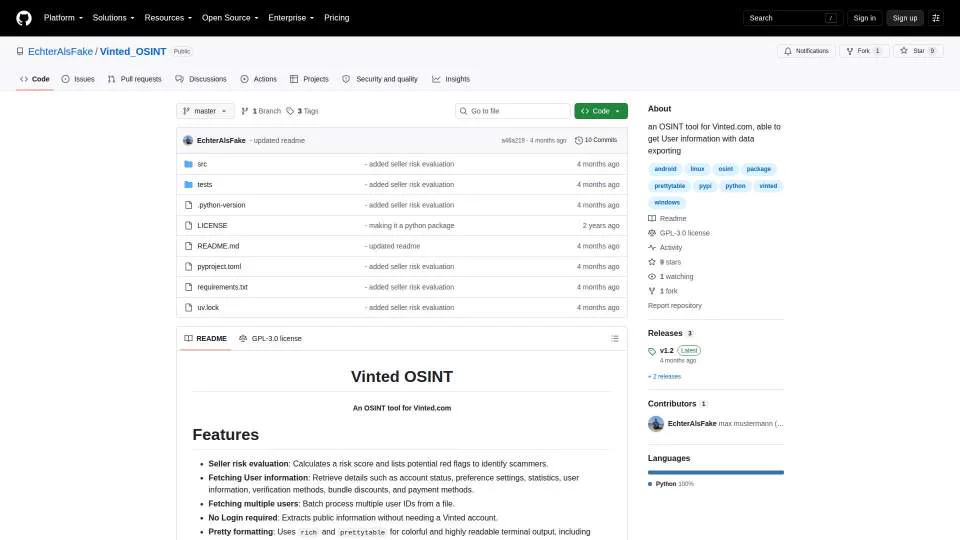
Showing 150 of 180
Show more