 Your Benchmark Is an Empirical Measure Over Difficulty
The paper treats a benchmark as an empirical measure over item difficulty and formalizes two failure modes: measure mismatch (benchmark difficulty distribution differs from the intended one) and coverage gaps (uncovered difficulty regions that hide localized training progress). It proposes two diagnostic metrics with theoretical guarantees and analyzes 25 popular benchmarks across 7 domains using estimated item difficulties. It also introduces BenchFill, a difficulty-targeted item rewriting algorithm that reduces local coverage gaps.
 huggingface.copaperAdded 31 Oct 2026🧠 AI
 Retrieving from Your Own Mistakes: On-Policy Training of Embedding Models for Multi-Hop Retrieval-Augmented Generation
On-policy state training is a method for training chain embedding retrievers for multi-hop RAG on the states the encoder itself reaches, including those built on its own wrong retrievals. Each state is labeled with the earliest missing gold passage, other missing gold passages are masked, and updates are contrastive and mixed with teacher-forced states. It retrieves complete evidence more often than teacher-forced training and graph-based systems, and transfers to harder long-chain HotpotQA and 2WikiMultiHopQA variants the authors built.
 arxiv.orgpaperAdded 31 Oct 2026, published 29 Oct 2026🧠 AI
- Don't Lose the Thread: Empowering Long-Horizon LLM Agents with Cognitive Resource Self-Allocation
CORAL (Cognitive Resource Self-Allocation) is an agent-callable working-memory toolset that lets an LLM agent checkpoint task progress and verified facts, then reset its cluttered context and resume from a clean state. A Multi-episode Agentic Reinforced Policy Optimization algorithm trains the checkpointing. With an 8B model it reaches 42.8% average accuracy on GAIA, uses 6-7x fewer input tokens than a ReAct agent, and adds 8.0 points to a proprietary agent on BrowseComp.
arxiv.orgpaperAdded 31 Oct 2026, published 29 Oct 2026🧠 AI - Decompose, Estimate, Select: Coverage-Aware Context Construction for Long-Form RAG
Decompose, Estimate, Select is a coverage-aware retrieval pipeline for long-form RAG. It splits a query into subquestions, ranks candidates with a coverage-trained bi-encoder, predicts a document-by-subquestion coverage matrix with a cross-encoder, and picks documents by greedy maximum-marginal coverage. On TREC RAG 2024, α-nDCG@10 rises from 0.625 to 0.702 (gold-nugget bound 0.718). A grounded self-feedback loop raises V_strict by 0.086 over two passes.
arxiv.orgpaperAdded 31 Oct 2026, published 29 Oct 2026🧠 AI - Quasi-polynomial time algorithms for block basis reduction of linear codes
Kolesnikov and Novoselov give block basis reduction (BKZ) algorithms for linear codes that need polynomial or quasi-polynomial numbers of calls to a minimum weight codeword oracle at fixed block size. The earlier Ghentiyala and Stephens-Davidowitz bounds are exponential. The paper adds a truncated BKZ and a DeepBKZ variant, with an implementation for block sizes 2 to 24 and approximation-factor estimates on random codes.
 eprint.iacr.orgpaperAdded 31 Oct 2026, published 29 Oct 2026🛡️ Security
- DICE: Decentralized Incentive-driven Federated Learning for Efficient & Scalable Customization of Pretrained Models in Web3
DICE is a blockchain-powered federated learning (BCFL) algorithm for customizing large pretrained models among untrusted Web3 participants. It combines dynamic progressive learning and model slice verification, so hardware-limited participants can train part of the model, with a tree-structured committee consensus protocol and an efficiency-driven incentive scheme to scale to more data holders. Experiments cover vision and language models.
arxiv.orgpaperAdded 31 Oct 2026, published 29 Oct 2026🧠 AI - Gold vs.~Translation: Are We Measuring Language, Knowledge, or Locality in Translated Benchmarks?
Gold vs. Translation is an October 2026 arXiv study of whether DeepL-translated MMLU measures the same thing as native benchmarks. It compares seven pairings against six native benchmarks in five Nordic and Baltic languages, using 29 models. Translated MMLU adds predictive value for curriculum-overlap benchmarks such as Skolprov (ΔR²=.128) but not for Sweden-specific SwedishFacts (p=.242).
arxiv.orgpaperAdded 30 Oct 2026, published 28 Oct 2026🧠 AI - AskStream: When and What to Ask Proactively under Uncertainty in Streaming Video Understanding
AskStream is a multi-turn benchmark for streaming video understanding that adds a third proactive action, ask, alongside wait and answer, for cases where video or user information is incomplete. It has 438 videos, 2,714 manually annotated frame-level time windows (wait, ask, answer), four task categories and eight subtasks. The strongest model reaches only 52.18% on the proposed Ask-F1 metric, in both multiple-choice and open-ended settings.
arxiv.orgpaperAdded 30 Oct 2026, published 28 Oct 2026🧠 AI  Shor's algorithm compiled on cat qubits: 22 593 qubits for RSA-2048 in 3.14 days
Shor's algorithm compiled on cat qubits is an IACR ePrint (2026/2665) giving an end-to-end resource estimate on superconducting cat qubits, using repetition and LDPC cat codes. Factoring RSA-2048 needs about 23,000 cat qubits and 3.14 days, assuming phase-flip noise p_Z = 5e-4 and no bit-flips. secp256k1 ECDLP needs at most 30,000 qubits and 1 hour. A space-for-time trade runs RSA-2048 in 1.25 hours on about 611,000 qubits.
eprint.iacr.orgpaperPublished and added 28 Oct 2026🛡️ Security- CALM: Conflict-Aware Lifecycle Memory Governance for Long-Horizon Language Agents
CALM is a conflict-aware lifecycle memory governance framework for long-horizon language agents. It turns records into evidence-grounded memory cells, updates their validity and lifecycle states from support, conflict and dependency signals, and admits evidence at query time through training-free or learned gating based on temporal applicability. It beats baselines on LongMemEval-S and LoCoMo with Qwen and GPT backbones, and keeping superseded records helps earlier-state reasoning.
arxiv.orgpaperAdded 30 Oct 2026, published 28 Oct 2026🧠 AI - Complementing Text Based Moderation with Multimodal Grounding: Detecting Fraudulent Inducement Behaviors on Short Video Platforms
The paper studies detection and temporal localization of fraudulent inducements (prompts to follow, join chat groups, click links) in internet finance short videos. It compares OCR+LLM, OCR+MLLM and a zero-shot MLLM, and builds a dataset of 2,419 videos (66.49 hours, 3,194 events, four categories). OCR+MLLM reaches mIoU 26.52 versus 14.49 for keyframe OCR+LLM, with 67.0 percent macro recall, using a recall-weighted F2 localization reward.
arxiv.orgpaperAdded 30 Oct 2026, published 28 Oct 2026🧠 AI  What Effort Level Should I Choose? On the Economics of Reasoning Effort in LLM Agents
This paper treats LLM reasoning effort as a credence good and measures the counterfactual effect of effort levels on proprietary and open-weight models across four benchmarks, including long-horizon agentic tasks. Higher effort often fails on tasks lower effort solved, and on easy tasks the top level costs up to 42x the lowest. Starting at the lowest effort and escalating only after a verified failure matches or beats fixed top effort, usually at lower cost for proprietary models.
huggingface.copaperAdded 28 Oct 2026🧠 AI- Perceiving and Predicting Dynamic Sports: Spatiotemporal Intelligence in Vision Models for Egocentric Tennis Video
This paper presents an annotated egocentric tennis dataset (egocentric video synced with five allocentric views, global positions, contact times, stroke types) and evaluates image encoders, video encoders and vision-language models on seven prediction tasks. Best models reach 0.14 m player and 0.54 m ball localization error and 0.14 s contact-time error. Depth input helps 3D ball localization, and longer histories do not help forecasting. A conditional diffusion model generates whole-body tennis motion in real time.
arxiv.orgpaperAdded 28 Oct 2026, published 27 Oct 2026🧠 AI - Interpretable Meta-Policies for Neural Decision Making
NEXUS is a hierarchical reinforcement learning framework that pairs neural skills with symbolic meta-policies, so transparent reasoning sits at the level of high-level skills rather than atomic actions. It uses object-centric observations and LLM interaction to design reward functions and meta-policies. Agents learn disentangled skills, align better with goals in the game manual, resist reward hacking more, and cope better with game simplifications than deep RL. The paper also compares neural, symbolic and neuro-symbolic meta-policy architectures.
arxiv.orgpaperAdded 28 Oct 2026, published 27 Oct 2026🧠 AI - Radical isogenies on every model
Radical isogenies on every model is an IACR ePrint paper by Thomas Decru (October 2026). It gives radical isogeny steps of every odd degree N directly on short Weierstrass, Montgomery, twisted Edwards, Huff, Jacobi quartic, twisted Hessian, Legendre and Jacobi intersection curves, plus Kummer lines. In Tate normal form a step drops from 12.5N to 10N multiplications. Montgomery and twisted Edwards curves cost 10.5N+O(1) per step and 2N to push a point. All algorithms are inversion-free, with exact operation counts.
eprint.iacr.orgpaperAdded 28 Oct 2026, published 27 Oct 2026🛡️ Security - LiveSearch: Questions as Executable Verifier Code for a Live Benchmark of Professional-Source Financial Search Agents
LiveSearch is a live benchmark for financial search agents that stores each question as executable verifier code: a typed program of calls to a professional financial data service plus a declarative extractor. Gold answers are recomputed daily with no human or LLM in the loop, so memorized answers go stale. Six tool-calling models score 70.9% to 76.7% under web search, and 70% of questions change gold value over three days.
arxiv.orgpaperAdded 28 Oct 2026, published 27 Oct 2026🧠 AI - OpenGray: a benchmark for evaluating the decisions of radiotherapy planning agents
OpenGray is a benchmark that adds tasks with known correct decisions to the OpenKBP-Opt head-and-neck dataset, including two overlap contradictions with provably incompatible dose goals and a feasible control. Four planning systems, from a rule-based script to a full LLM agent, were tested on 30 patients with Terra and Ministral 3 8B. Decision accuracy reached 95.4% and 92.1%, yet only 50% and 25% of overlap contradictions were escalated. SAGE logs of 39 radiosurgery runs showed an agent that lacked an action for stopping.
arxiv.orgpaperAdded 28 Oct 2026, published 27 Oct 2026🧠 AI - Alg\{Ossa\}: Decentralized Secure Aggregation with Rotating Committees and Eventual Delivery
AlgOssa is a decentralized secure aggregation protocol built on Ossa, a generic committee-aided, single-server construction for one-shot clients (following OPA and Willow, CRYPTO 2025). Ossa realizes secure aggregation with non-selective abort against a malicious server. AlgOssa adds Algorand-style sortition to rotate leaders and committees, bounds the chance of an honest server, and gives eventual delivery. Classical and post-quantum routes are evaluated.
eprint.iacr.orgpaperAdded 28 Oct 2026, published 27 Oct 2026🛡️ Security  Trial by Trace: Benchmarking AI Agent Harnesses for Reliability and Failure Attribution
TraceTrial-Bench is a benchmark that scores agent task performance and agent harness reliability separately. It has 95 mechanism-oriented tasks across seven components: context, execution, governance, lifecycle, observability, tools and verification. Across 4 harnesses, 9 models and 3,420 runs, macro-averaged harness scores range from 59.8% to 72.0%, and 31.1% of runs succeed despite failing at least one harness criterion.
huggingface.copaperAdded 27 Oct 2026🧠 AI- Your Wish Is My Commit: Over-Compliant Refactoring in AI Coding Agents
Your Wish Is My Commit is a controlled study of over-compliant refactoring in Codex and Claude Code, run across five models, 50 algorithmic tasks and 10 object-oriented tasks. Over 3,000 turns of repeated "refactor further" prompts, no model stopped on its own: each rewrote up to 31x the original codebase before first stopping and resumed edits after declaring the task complete. The paper defines six behavioral signals for detecting over-compliance.
arxiv.orgpaperAdded 28 Oct 2026, published 26 Oct 2026🧠 AI - Cryptanalysis and Repair of "Decentralized Multi-authority ABE for NC$^1$ from BDH"
Cryptology ePrint 2026/2642 presents a plaintext-recovery attack on the DBDH and CBDH variants of the Datta, Komargodski and Waters multi-authority ABE for NC1 (Journal of Cryptology, 2023). It needs one corrupt authority and two users, and succeeds with probability one in the static model. The flaw is an invalid extension of the Rouselakis-Waters LSSS matrix-normalization lemma. The paper also attacks two Datta-Pal (PKC 2023) attribute-based inner-product schemes and proves repaired versions secure in the random oracle model.
eprint.iacr.orgpaperPublished and added 26 Oct 2026🛡️ Security - Subexponential Algorithms for LWE via Rejection Sampling on Superlattices
Subexponential Algorithms for LWE via Rejection Sampling on Superlattices is an ePrint paper by Ligeng Fan, Changpeng Shao, Hongbo Li and Dingkang Wang. It extends the Ducas, Engelberts and Loyer superlattice framework to give a provable classical search-LWE algorithm for prime q in [n^2, 2n^2], using m=4n samples and time and space exp(O(n/ln ln n)). A second variant runs in 2^((1/2+o(1))n/ln R) for general parameters. It resolves a gap left by Kirchner and Fouque.
eprint.iacr.orgpaperPublished and added 26 Oct 2026🛡️ Security - Maximum-Likelihood Decoding of Gabidulin Codes Is NP-Hard Even in Dimension One
Philippe Gaborit proves that maximum-likelihood decoding of Gabidulin codes is NP-hard even for dimension one: deciding rank distance at most n-2 from the code {λg} is NP-complete. The reduction is deterministic, so Rank Syndrome Decoding and Rank Minimum Distance for F_{q^m}-linear codes are NP-complete under deterministic reductions, where the earlier reduction was randomized. It goes through a new pivot problem, Twisted Square Membership.
eprint.iacr.orgpaperAdded 26 Oct 2026, published 25 Oct 2026🛡️ Security - The Policies of Programming Language Ecosystems: A "Qualitative" Analysis
The Policies of Programming Language Ecosystems is an October 2026 arXiv paper (cs.SE) that compares the policies of eight programming language ecosystems, including CRAN for R, across 38 policy categories. Three authors coded the policies with moderate agreement. Malware, intellectual property and content removal are covered everywhere, while package size limits, metric manipulation, typosquatting and binary uploads diverge.
arxiv.orgpaperAdded 28 Oct 2026, published 25 Oct 2026🛡️ Security - InteractiveWorld: A Verifiable Human-Centric Environment for Building Better Interactive MLLM Assistants
InteractiveWorld is an environment for closed-loop interaction between an AI assistant and a simulated human agent who sees the scene, follows instructions and acts independently. InteractiveBench, built on it, has 120 multi-turn tasks in six categories scored by verifiable, state-based rewards. Across 12 frontier MLLMs, the best model, Claude Fable 5.1, reaches at most 20% on long-horizon Guidance and 25% on Planning tasks.
arxiv.orgpaperAdded 27 Oct 2026, published 25 Oct 2026🧠 AI - HerHealthGPT: An Evidence-Grounded Conversational AI System for Women's Reproductive Health Copy title
HerHealthGPT is a conversational AI system for women's reproductive health that combines retrieval-augmented generation, context-aware clarification and source validation in a web interface. Evidence retrieval raises concern-category accuracy from 54.1% to 59.3% over fine-tuning alone on 540 messages from 90 cases. The clarification router reaches 85.6% recall and 86.2% specificity. In a 30-adult study, 83.3% preferred the retrieval-enabled version. The authors say clinical validation is still needed.
arxiv.orgpaperAdded 27 Oct 2026, published 24 Oct 2026🧠 AI - Faster Matrix Multiplication Leads to Faster Lattice Sieving
Gao and Hu's IACR ePrint 2026/2622 shows that if the matrix multiplication exponent satisfies ω ≤ 9/4 − η, heuristic lattice sieving runs in (3/2 − δ)^(n/2+o(n)) time under the spherical heuristic from the BDGL analysis. It builds on OpenAI's recent result that ω ≤ 9/4. With known matrix multiplication algorithms, the method already gives subquadratic search inside BDGL buckets. Only the abstract is available, so concrete parameters are not shown.
eprint.iacr.orgpaperAdded 26 Oct 2026, published 24 Oct 2026🛡️ Security - When Elliptic-Curve Semiprimality Certificates Reveal Factors
The paper formalizes elliptic-curve semiprimality certificates by adapting the Goldwasser-Kilian primality criterion. For certificates built with complex multiplication, a norm-lattice reconstruction factors N from (N, S, D) alone in expected polynomial time. The author uses it, plus public-point and quadratic-twist attacks, to factor Reble's 1084-digit and Broadhurst's 5061-digit moduli, and shows that hidden-cofactor, withheld-CM-map and private-isogeny repairs also fail.
eprint.iacr.orgpaperAdded 26 Oct 2026, published 24 Oct 2026🛡️ Security - Hey, guess what: CUES lead to inferences about typicality
The paper builds two corpora, EventTyp and the human-validated EventTypGold, to study how people infer typicality and atypicality of events from what is said. Large-scale human and LLM experiments show that three CUES predict these inferences in humans: Commonsense Knowledge, Utterance Emphasis and Snark. In most settings LLMs lack the commonsense knowledge to judge an event's general typicality, so they struggle to follow the CUES.
arxiv.orgpaperAdded 27 Oct 2026, published 23 Oct 2026🧠 AI - Faster and Smaller Anonymous Credentials from Standardized Signatures
GordieHowe is a language, certifying compiler and zero-knowledge proof system for building anonymous credentials on standardized signatures (ECDSA, RSA, ML-DSA). It proves an ECDSA-signed mobile driving license presentation in 64.8 ms with a 276 KiB proof, 10.1x faster than Google's Longfellow, and an ML-DSA-44 signature in 87.3 ms with at least 116 bits of quantum security. Compiler output and security theorems are checked in Lean. It introduces series-parallel IOPs and extends the BCS transformation in the QROM.
eprint.iacr.orgpaperAdded 24 Oct 2026, published 23 Oct 2026🛡️ Security - Tight Post-Quantum Multi-Key Security of the FX Construction
Rentaro Shiba and Tetsu Iwata prove a tight multi-key security bound for the FX construction (the DESX generalization) in the quantum ideal cipher model. Security holds up to about 2^((n+κ)/3) total classical and quantum oracle queries against fully adaptive adversaries, for any number of keyed instances μ≥1. This improves their ToSC 2026 bound and matches the offline Simon's algorithm attack in the exponent.
eprint.iacr.orgpaperAdded 24 Oct 2026, published 23 Oct 2026🛡️ Security - Sharpness-aware Orthogonalized Momentum Algorithms
SOMA (Sharpness-aware Orthogonalized Momentum Algorithm) combines sharpness-aware minimization (SAM) with the Muon optimizer for LLM training. It avoids SAM's extra gradient computation by using stale, purely stochastic gradient noise as the adversarial perturbation. The authors prove sample complexity does not depend on perturbation direction, study robustness to heavy-tailed gradient noise, and test SOMA against post-training quantization degradation and catastrophic forgetting during fine-tuning.
arxiv.orgpaperAdded 26 Oct 2026, published 23 Oct 2026🧠 AI - Reproducible Evaluation as the Substrate for Safe Prompt Compression in Production Agents
This paper presents an offline evaluation harness for a production merchant-facing conversational agent. It stays reproducible when live backend data changes and can be regenerated when it goes stale. Used as the fitness function for GEPA prompt optimization under a correctness gate against reward hacking, it shrinks the full prompt surface by 3.5-7.6% without losing held-out correctness, across three subject-model families.
arxiv.orgpaperAdded 26 Oct 2026, published 22 Oct 2026🧠 AI - F2G-Pose: Geometry-Aware Foundation Feature Lifting for Direct RGB-D Category-Level Object Pose Estimation
F2G-Pose is a direct, single-pass framework that predicts category-level object pose, metric size and camera-frame completed shape from one RGB-D image. It lifts frozen RADIO foundation features onto partial point clouds, tokenizes local geometry with DGCNN, and fuses it with a Mixture-of-Experts Transformer. It trains only on synthetic SOPE data, leads on SOPE and ROPE at 28 FPS, and is tested on HouseCat6D, HANDAL and real manipulation.
arxiv.orgpaperAdded 24 Oct 2026, published 22 Oct 2026🧠 AI - CellTrack-Bench: Microscopic Cell Tracking Benchmark for Vision-Language Models
CellTrack-Bench is a benchmark that tests vision-language models on microscopic cell tracking and compares them with specialised trackers. It has 1,537 problems covering 9,041 cell-linking decisions, drawn from 15 cell-tracking datasets across four imaging modalities, with a hard subset built from failures shared by distinct algorithmic trackers. The authors compare environment harnesses, benchmark 9 closed-source and 13 open-weight models, and analyse failure modes.
arxiv.orgpaperAdded 24 Oct 2026, published 22 Oct 2026🧠 AI - DuoCook: An Overcooked-Inspired Benchmark for Visual Planning and Coordination
DuoCook is an Overcooked-inspired benchmark in which one vision-language model controls two cooks from top-down views in Unreal Engine environments built with coding agents. It has 20 maps in five categories covering equipment contention, changing terrain and handoff dependencies. Four VLMs were compared; the best, gpt-6-astra, reached 26.2% mean order completion. A notebook memory ablation had mixed effects: positive for Claude and Qwen, negative for GPT and Gemini.
arxiv.orgpaperAdded 24 Oct 2026, published 22 Oct 2026🧠 AI - Linear Cryptanalysis of TFHE-Friendly Cipher FRAST in the Average Key Setting
Linear cryptanalysis of FRAST, a TFHE-friendly stream cipher, in the average key setting. It fixes the false-positive problem left open in the earlier attack by Bak et al., showing key differences fall into five indistinguishable classes per round. The Contract algorithm recovers the master key for 10 rounds and, on weak keys of density 2^-11.8 to 2^-5.4, reaches full FRAST within the claimed security.
eprint.iacr.orgpaperAdded 24 Oct 2026, published 22 Oct 2026🛡️ Security - The Good, the Bad, and the Noisy: A Systematic Analysis of Ring-Oscillator-Based Noise Generators
This IACR ePrint paper (2026/2597) systematically compares ring-oscillator-based additive noise generators, a hiding countermeasure against side-channel attacks. Experiments show many existing designs ignore output amplification and the risk of the noise being filtered out, so they lower signal-to-noise ratio too little. The authors give a guideline on inverter chain length, output amplification and frequency randomization, and build a tailored generator for an AES implementation that outperforms prior designs.
eprint.iacr.orgpaperAdded 24 Oct 2026, published 22 Oct 2026🛡️ Security - TRIAD: Benchmarking Omni-Modal Ambiguity in Multimodal Large Language Models
TRIAD is a benchmark for omni-modal ambiguity resolution. It has 327 hand-written text-image-audio queries in 86 scene groups across 18 ambiguity categories, and removing any one modality makes the answer non-unique. Across 14 omni-modal systems, the best model trails humans by over 20 points in group accuracy. Without answer options, model group accuracy falls to single digits, and leave-one-out tests show audio cues are often underused.
arxiv.orgpaperAdded 23 Oct 2026, published 22 Oct 2026🧠 AI - IFC-MCQ: Automatically Generating Multiple-Choice Benchmarks for Evaluating LLM Agents on IFC Data Retrieval
IFC-MCQ is a method that automatically generates multiple-choice benchmarks from Industry Foundation Classes (IFC) building-model files, so answers can be graded by exact option-set match instead of human or LLM review. Its taxonomy has 15 categories and 36 subtypes in four groups, with answer keys from the file and distractors from file values or rules. Two agentic setups, tool-based and code-based retrieval, showed category-specific failures and variation by IFC model and interface.
arxiv.orgpaperAdded 23 Oct 2026, published 21 Oct 2026🧠 AI - MPIDetector: Detecting Multi-modal Prompt Injection via LLM-based Reasoning
MPIDetector is a detection framework for multi-modal prompt injection that uses few-shot in-context learning so an LLM can reason about the semantic intent of text and image inputs, without fine-tuning. The authors built a benchmark of eight textual and seven visual attack categories plus benign sets. They report up to 90.91% accuracy on text, 99.28% on images, and up to 99.80% detection on 500 obfuscated WebInject web-agent injections, beating baselines.
arxiv.orgpaperAdded 24 Oct 2026, published 21 Oct 2026🛡️ Security - Where AI Vulnerability Discovery Harnesses Go Quiet: Structural False Negatives and Hidden Vulnerabilities
Paper (arXiv, 21 October 2026) on structural false negatives in LLM vulnerability discovery harnesses. Starting from Knostic's OpenAnt and raptor, then 10 more open-source harnesses, the authors map 13 points where code selection, filtering, and finding storage or merging drop vulnerabilities. One file was dropped by six harnesses before the model saw it, five without notice. It covers attacker evasion, content-steered verdicts, prompt injection, and design principles and tests.
arxiv.orgpaperAdded 24 Oct 2026, published 21 Oct 2026🛡️ Security - SoK: Design-Level Backdoors in Block Ciphers Constructions, Detection, and Key Recovery
SoK on design-level backdoors in block ciphers. It places four published designs (Rijmen and Preneel, Paterson, Bannier and Filiol, Peyrin and Wang) in one taxonomy and gives a sound algorithm that recovers a partition trapdoor from S-box tables. It attacks KG-DES, BEA-1 and LowMC-M: KG-DES key recovery takes minutes, and the LowMC-M MALICIOUS backdoor yields the key from 35 to 409 queries. Trapdoors hidden in linear layers leave no trace, so the authors recommend deriving constants verifiably from a public seed.
eprint.iacr.orgpaperAdded 24 Oct 2026, published 21 Oct 2026🛡️ Security - RDK-CKKS: A Framework for Rigorous Error Analysis for CKKS Computation
RDK-CKKS is a framework for rigorous probabilistic error analysis of CKKS homomorphic encryption. It injects randomization keys (encryptions of zero) at key-switching and rescaling so each operation's error has provable tail bounds, which noise flooding needs for IND-CPA^D and threshold settings. It gives a full rigorous analysis of binary bootstrapping, at about 3% extra modulus and 27% extra key communication over bootstrapping keys.
eprint.iacr.orgpaperAdded 24 Oct 2026, published 21 Oct 2026🛡️ Security - Combining Long-Term Memory and LLMs Comes at a High Cost: From Prompt Injection to Persistent Compromise
Paper on memory injection, where prompt injection persists across sessions through the long-term memory of LLM-as-a-service platforms. It presents a general threat model and shows all NIST attack goals are achievable on ChatGPT Instant 5.3, Claude Sonnet 4.6 and Gemini 3 Flash. Vectors include personal memories, projects, skills, organization instructions and MCP resources. On Claude, shared memory lets an attacker compromise multiple users in an organization and exfiltrate prompts. Nearly half of the derived mitigations are unimplemented.
arxiv.orgpaperAdded 24 Oct 2026, published 20 Oct 2026🛡️ Security - Code2Video-Compass: A Comprehensive Benchmark for General-Purpose Code-Based Video Generation across T2V, I2V, and V2V
Code2Video-Compass is a benchmark of 2,104 tasks for code-based video generation, where multimodal LLMs write executable programs that produce complete videos from text (T2V), image (I2V) or video (V2V) inputs. Tasks span 10 categories and 24 subtypes. Scoring uses 12 objective metrics and five MLLM-judge metrics. Across 15 proprietary and open-weight models from nine families, performance falls as construction, dynamic animation and state-dependency complexity rise.
arxiv.orgpaperAdded 22 Oct 2026, published 20 Oct 2026🧠 AI - DIVE: Benchmarking Full-Duplex Interaction with Visual Engagement in Continuous Streams
DIVE is a benchmark for full-duplex interaction with visual engagement in continuous audio/video streams. It has 525 human-annotated samples across six tasks in three scenarios: proactive intervention, continuous engagement and interaction coordination. Evaluated real-time models reach sub-second average latency, but window response rates stay at or below 53.77%, and adapting ongoing responses to new information is hardest.
arxiv.orgpaperAdded 22 Oct 2026, published 20 Oct 2026🧠 AI - KNOX: Hardware-assisted Regulatory Sandbox for Generative Models
KNOX is a regulatory sandbox for generative models built by running AI agent workloads inside TEEs. It derives an attested policy manifest (applicable regulations, expected tool calls, permitted system calls) from the user prompt, and an attested reference monitor allows an action only if it matches. Actions and verdicts go into an attested execution graph that regulators can verify. The paper reports detection of prompt-injection deviations and under 1% overhead.
arxiv.orgpaperAdded 22 Oct 2026, published 20 Oct 2026🛡️ Security - Scaling Parameter-Efficient Fine-Tuning for Brain Encoding
BrainLoRA is a parameter-efficient fine-tuning method that adapts multimodal backbones of up to 104B parameters to predict neural responses. It predicts multiple timepoints in one causal pass instead of sliding windows, and a multi-LoRA kernel trains many adapters on a shared backbone. Across nine backbones it improves encoding, and a 200+ model ensemble ranks first on the Algonauts post-challenge leaderboard.
arxiv.orgpaperAdded 21 Oct 2026, published 19 Oct 2026🧠 AI - Analysis of an AI based code distinguisher
The paper analyses DeepDistinguisher, a transformer-like model that tells Goppa codes apart from random linear codes. Saliency maps and attention visualisation reveal a low-weight-row artifact in the random training instances that the model partly relies on. A pairwise-XOR rule inspired by minimum distance correlates strongly with the model's predictions, and the model loses most of its power on random matrices meeting both constraints. This suggests it exploits general combinatorial properties, not hidden algebraic structure.
eprint.iacr.orgpaperAdded 20 Oct 2026, published 19 Oct 2026🧠 AI - Analysis of an AI based code distinguisher
Analysis of DeepDistinguisher, a transformer model that tells Goppa codes from random linear codes. Using saliency maps and attention visualization, the authors find a low-weight-row artifact in the random training instances that the model partly uses. They propose a pairwise-XOR rule on generator matrix rows that correlates strongly with the model's predictions. On random matrices meeting the minimum distance and XOR constraints, the model loses most of its accuracy, so it exploits general combinatorial properties rather than hidden algebraic structure.
eprint.iacr.orgpaperAdded 20 Oct 2026, published 19 Oct 2026🛡️ Security - Tandem: Serving Hybrid Linear-Attention GUI Agents on Mobile NPUs
Tandem is a runtime for serving hybrid linear-attention GUI agents on mobile NPUs. It saves recurrent state where consecutive prompts diverge, keeps most prefill on the matrix unit, uses a verification kernel that reads each weight block once, and releases NPU power votes between bursts. On a Snapdragon 8 Elite it cuts per-step latency 30% for text screen descriptions and 16% for screenshots, cuts energy per text step by 33%, and lowers loaded-model standby power from 0.76 to 0.22 W.
arxiv.orgpaperAdded 21 Oct 2026, published 19 Oct 2026🧠 AI - Fake News, Real Crashes: Information Injection Attacks on LLM Financial Trading Agents
Fake News, Real Crashes is an October 2026 arXiv paper presenting a benchmark for information injection attacks on LLM financial trading agents. It spans five injection vectors, seven event categories and about 10,000 decisions on 15 U.S. stocks. Fabricated news reached 62% attack success versus 14% for prompt injection, and two 30-word templates hit 100%. Only hierarchical aggregation reduced success among the defenses tested.
arxiv.orgpaperAdded 21 Oct 2026, published 19 Oct 2026🛡️ Security - Provable Lattice Reduction in Nearly the Time of QR Factorization
Provable Lattice Reduction in Nearly the Time of QR Factorization (IACR ePrint 2026/2541, October 2026) presents a deterministic lattice-reduction algorithm with running time Õ(n^ω(1+log κ_col(B))), free of heuristic assumptions. Its implementation used fewer instructions than flatter (CRYPTO 2023) in all 153 runs on q-ary, NTRU-like, scaled q-ary and Coppersmith inputs. Median flatter-to-new instruction ratios are 1.55 for q-ary and 1.86 for NTRU-like inputs.
eprint.iacr.orgpaperAdded 20 Oct 2026, published 19 Oct 2026🛡️ Security - Efficient and Compact High-order Masking Raccoon on Memory Constrained Devices
The paper presents the first efficient, compact implementation of high-order masked Raccoon (lattice-based signature, CRYPTO 2024) on ARM Cortex-M4, up to 32 masking orders. It uses 3+3+3 layer-merged 32-bit NTT/INTT with lazy reduction, a negative double Montgomery reduction, and one-shot SHAKE256 sampling (at least 1.80x faster). It beats the reference by 1.85x-2.25x and masked Dilithium3 at orders 2, 4 and 8. Second-order leakage tests show DPA resistance once micro-architectural transitional leakage is mitigated.
eprint.iacr.orgpaperAdded 20 Oct 2026, published 19 Oct 2026🛡️ Security  Self-evolving Agent Harness
 is a 66-page survey and theory paper on revising an agent's scaffolding (prompts, memory, workflows, tools, code, plugins) while model weights stay fixed. It frames search as evolutionary optimization and uses continual PAC-learning to derive a generalization bound, a retention bound and a high-probability admission rule with fresh validation data. It separates selection, activation, attribution and improvement as evaluation claims, and covers applications and governance. Code is at github.com/zgcagi/Harness-RSI.
huggingface.copaperAdded 19 Oct 2026🧠 AI- Computing endomorphisms of superspecial principally polarized abelian surfaces in time and memory \(p^{4/5+o(1)}\)
Computing endomorphisms of superspecial principally polarized abelian surfaces is a cryptanalysis preprint by Marc Houben and Lam L. Pham, posted to IACR ePrint in October 2026. It gives an algorithm that, under a standard heuristic, finds a non-scalar polarized endomorphism in expected time and memory p^(4/5+o(1)). The abstract is the only text available, so the method and its effect on specific schemes are not described.
eprint.iacr.orgpaperAdded 19 Oct 2026, published 18 Oct 2026🛡️ Security - Efficient Fixed-Point Implementation of Mitaka
Presents a fixed-point C implementation of the Mitaka signing algorithm, a simpler, parallelizable Falcon (FN-DSA) variant. It replaces MitakaZ's wide integral Gram root decomposition with a fixed-point square Cholesky decomposition, which cuts the cost of integer Gaussian sampling, and proves bounds on intermediate values and representation errors without empirical assumptions. Signing averages 361 kcycles (Mitaka-512) and 707 kcycles (Mitaka-1024) on AVX2, and 4.0 and 7.8 Mcycles on an STM32F411 Cortex-M4F. This makes floating-point-free lattice signatures practical on constrained devices.
eprint.iacr.orgpaperPublished and added 17 Oct 2026🛡️ Security - FuTransformer: FP8 prefill and INT4 decode for Llama-style inference on Hopper
FuTransformer is a CUDA implementation of a Llama-style Transformer block for NVIDIA Hopper GPUs. It uses FP8 prefill with fused GEMM epilogues and INT4 weights plus an INT4 KV-cache copy for decode, with a block-diagonal Hadamard transform to cut cache quantization error. On one H100, prefill is up to 1.48x faster than compiled PyTorch FP8, and INT4 decode is 1.3-2.4x faster than the faster PyTorch baseline. Llama-3.1-8B decode takes 2.8 ms per step at batch one, versus 8.1 ms for compiled transformers. WikiText-2 perplexity rises from 6.24 to 7.23 with round-to-nearest INT4 weights, or 6.99 with GPTQ.
arxiv.orgpaperAdded 20 Oct 2026, published 16 Oct 2026🧠 AI - GLOBE: Evolving Structured Agentic Memory for E-commerce Product Optimization in Generative Search
GLOBE is an agentic framework that optimizes e-commerce product listings for generative search by storing strategies in an evolving handbook of explicit, field-scoped behaviors. An Editor applies behaviors and gets rank-based feedback, a Reflector turns it into updates, a Moderator removes redundant proposals, and a Curator commits changes. Harmful behaviors are deactivated. Structured behaviors beat monolithic prompt optimization and transfer to unseen product categories.
arxiv.orgpaperAdded 20 Oct 2026, published 16 Oct 2026🧠 AI - MobileInject: Evaluating Reasoning-to-Action Security of MLLM-Based Mobile Agents under Cross-Modal Consistency Injection
MobileInject is a benchmark for testing MLLM-based smartphone agents against indirect multimodal injection. It has an interactive evaluation framework with 11 scenarios, 9 security-risk categories and 108 executable risk instances. It adds Cross-Modal Consistency Injection, Multi-Role Collaborative Deception, Reasoning-Camouflage Injection and a Reasoning Security Diagnosis Framework. Experiments find broad vulnerability, with many failures from early reasoning hijacking.
arxiv.orgpaperAdded 20 Oct 2026, published 16 Oct 2026🛡️ Security - Power Analysis on SQIsign via Ideal Reconstruction from Quaternion Leakages
ePrint paper identifying five side-channel vulnerabilities in the signing procedure of Round-3 SQIsign, the isogeny-based signature scheme in NIST's additional post-quantum signature process. It gives polynomial-time algebraic algorithms that recover the secret key from leaked quaternion/ideal intermediate values, including cases where only partial bits leak. It also demonstrates power analysis on the SQIsign source code to extract the needed leakage, which earlier work on Round-1 or toy parameters did not do.
eprint.iacr.orgpaperAdded 17 Oct 2026, published 16 Oct 2026🛡️ Security - Rethinking GRPO for Large Reasoning Model Safety Alignment
Beacon is a safety alignment framework for large reasoning models that fixes two GRPO failure modes: advantage collapse, where homogeneous rollout groups give vanishing advantages, and unsafe diversification, where unsafe behaviors persist and spread. It combines Safety Signal Recovery (advantage-guided trajectory filtering plus safe reference supervision) with Safety-Utility Decoupled Alignment (category-aware rewards, benign-only KL anchoring). Tested on four Qwen3 and DeepSeek-R1-Distill variants across eight benchmarks, it cuts average safety error by up to 32.83 percentage points with low over-refusal.
arxiv.orgpaperAdded 20 Oct 2026, published 16 Oct 2026🧠 AI - Can SOLARBURST go silicon? A systematic analysis on software supply chain attacks for VLSI design flows
This paper analyses software supply chain (SWSC) attacks against VLSI design tools. It empirically studies the software composition, security features and tool interactions of VLSI suites, then builds a taxonomy linking SWSC attacks to VLSI attacks, design-flow stages and security outcomes. The taxonomy yields 717 possible new attacks, 60 of them high feasibility, with a threat model, a defense assessment and case studies on an open-source VLSI flow.
arxiv.orgpaperAdded 20 Oct 2026, published 15 Oct 2026🛡️ Security - Perceive, Predict, and Plan: a Unified World Action Model for Egocentric Dexterous Manipulation
P^3-WAM is a unified world action model for egocentric dexterous manipulation with three modes: Perceive (reconstruct articulated hand motion and camera trajectories from video), Predict (generate visual futures under prescribed actions) and Plan (jointly generate action trajectories and their anticipated visual outcomes from an initial image, a language instruction and an optional visual goal). It adds a compact structured 3D action representation to a pretrained video diffusion transformer through a mixture-of-transformers design with shared base weights, modality-specific adaptation and bidirectional visual-action attention. Randomized modality visibility lets video and 3D actions act as either context or target. Unified training beats single-mode training and outperforms specialized baselines on 3D hand reconstruction and action-conditioned video prediction across four datasets, and gives better instruction adherence than video-generation baselines.
arxiv.orgpaperAdded 17 Oct 2026, published 15 Oct 2026🧠 AI - Rethinking Routing Exploration in Modern Mixture-of-Experts
The paper identifies an "exploration dilemma" in modern Mixture-of-Experts models. Shared experts reduce the variability of token representations, which makes routing less exploratory. Fine-grained expert segmentation enlarges the combinatorial routing space and so needs more exploration, which means its extra expressiveness may go unrealized. It proposes MirrorMoE, which shrinks the exploration space by suppressing unnecessary experts per token, and reports consistent gains across model scales.
arxiv.orgpaperAdded 17 Oct 2026, published 15 Oct 2026🧠 AI - MLExpert: Towards a Generalist Agentic Model for Autonomous Machine Learning Engineering
Presents MLExpert, a 35B Mixture-of-Experts agentic model trained for autonomous long-horizon machine learning engineering. Training uses a Kaggle-MLE Factory to build executable tasks and an interaction harness, hierarchical agentic SFT with outcome-guided supervision, and Windowed Interaction RL (WIRL). WIRL treats the multi-turn decisions between successive experiment results as one execution window with a shared outcome reward, and uses asynchronous collection and policy correction. On MLE-Bench Lite the average medal rate rises from 37.9% to 72.7%, comparable to larger frontier models such as Kimi-K3 and GLM-5.3. It also improves on NatureBench Lite, agent scaffold optimization and algorithm optimization.
arxiv.orgpaperAdded 17 Oct 2026, published 15 Oct 2026🧠 AI - Learning to Steer LLM Agents and Multi-Agent Systems
Proposes a steering agent that supervises LLM agents and multi-agent systems during execution and corrects goal drift, where long-horizon tool use and inter-agent collaboration slowly diverge from the overall objective. A low-cost fast path decides when to intervene, and a high-cost slow path generates how to intervene. Both paths are trained jointly with reinforcement learning, combining a pairwise ranking objective with GRPO. On information-seeking search tasks it improves performance and efficiency for single-agent and multi-agent systems, generalizes out of domain, transfers to unseen executors, and allows intervention frequency to be adjusted without retraining.
arxiv.orgpaperAdded 17 Oct 2026, published 15 Oct 2026🧠 AI - Knowledge That Is Linear Before Fine-Tuning Generalizes After It
The paper separates "active" facts (which support generalization beyond recall) from "inert" ones. It builds new relations by relabeling answers of existing ones (Paris -> Europe becomes Paris -> crab), fine-tunes on a subset of subjects, and tests held-out subjects that share an answer (Munich -> crab). Across eleven language models and 70 relations, linear readability of the original relation in pretrained representations correlates with this generalization at Pearson r = 0.87 to 0.92 within each model. The result holds after controlling for fine-tuning set size, original-relation accuracy and subject frequency in pretraining text, and it survives re-randomized labels, seeds and thirteen other label categories. Mapping wrong labels back to the original answers shows the fine-tuned model's errors follow the linear probe's top answers.
arxiv.orgpaperAdded 17 Oct 2026, published 15 Oct 2026🧠 AI - Efficient KV Cache Migration for Geo-Distributed LLM Inference in Collaborative Edge Computing
Proposes EdgeFlow, a hybrid KV cache migration scheme for distributed LLM inference across heterogeneous edge servers in Collaborative Edge Computing. It combines direct KV cache transmission with activation-based recomputation, overlapping computation and communication to cut migration time when servers disconnect or overload. The authors formulate a multi-node KV migration optimization problem and give a 2-approximation algorithm built on improved LP relaxation and bipartite graph techniques. Experiments on a real distributed LLM inference platform show up to 45% lower migration time.
arxiv.orgpaperAdded 17 Oct 2026, published 15 Oct 2026🧠 AI - Multi-sourced AI Tutor for Non-Native English Speaker Students
Describes a general-purpose LLM-based AI tutor for computing courses that accepts questions in Mandarin and replies bilingually, also generating glossaries of technical terms. It uses a specialized multi-source RAG pipeline with a novel question extraction mechanism to draw on diverse course materials. Evaluated on 91 Piazza posts: 83.52% answered correctly and helpfully, 76.92% of questions got high-quality translations, and 64.47% got glossaries.
arxiv.orgpaperAdded 17 Oct 2026, published 15 Oct 2026🧠 AI - Onboard Lightweight LLM Reasoning for Human-Aware Safe UAV Navigation
Presents a modular, fully onboard UAV navigation pipeline that closes the "human-aware safety gap" of geometry-only planners. A shared BLIP encoder drives captioning and text-conditioned segmentation, which is fused with depth for 3D obstacle localization. Qwen-2.5-0.5B, stabilized with RAG and grammar-constrained JSON decoding, infers per-category risk once per class and caches the verdict. Perception runs at 10 Hz on a Jetson Orin NX, and fallback LLM queries take about 0.8 s off the control path. In Gazebo it gives roughly 3x fewer collisions than a geometric planner and raises semantics-aware landing success from 34% to 96%. The 224-pixel encoder input limits small-object perception at range.
arxiv.orgpaperAdded 17 Oct 2026, published 15 Oct 2026🧠 AI - GACC-Bench: Benchmarking Goal-Adaptive Context Compression Ability across Large Language Models
GACC-Bench is a benchmark for Goal-Adaptive Context Compression, testing how well LLMs retain goal-relevant information when compressing a source context under a length budget before downstream questions are known. It has 500 goals and 2,571 human-reviewed questions over 281 document and agent-trace contexts from seven collections; a fixed reader answers the withheld questions from the compressed context. Ten LLM compressors show large gaps to full-context performance, especially in answering every question tied to a goal. Target-goal conditioning improves accuracy over goal-agnostic compression, while mismatched goals hurt it.
arxiv.orgpaperAdded 17 Oct 2026, published 15 Oct 2026🧠 AI - Reaction Attack on CKKS Deployments with Asymptotically Optimal Query Complexity
Shows a protocol-level reaction attack on CKKS homomorphic-encryption deployments that publish coefficient-to-slot (C2S) evaluation keys and let the client return a 1-bit validity response. A malicious evaluator shifts a public encryption key, uses the public C2S layer to repack it into a ciphertext whose validity depends on one secret coefficient, and recovers a ternary secret key with O(H) queries, within a factor 2/log2(3) of the entropy lower bound. Each query is re-randomized with a fresh encryption of zero to evade trivial detection. The authors implemented it end to end in Lattigo v6.2.0 and recovered full keys across four standard CKKS parameter sets. It does not break RLWE or CKKS IND-CPA security.
eprint.iacr.orgpaperPublished and added 15 Oct 2026🛡️ Security - Thinking in Graphs: Neo4j-Backed Exploit-Chain Reasoning for LLM Penetration-Testing Agents
Presents ChainGraph, a pattern that externalizes exploit-chain reasoning for LLM pentest agents (Claude Code, Codex) into a Neo4j property graph exposed via the Model Context Protocol. Findings, attack steps, credentials, assets and tamper-evident evidence receipts are typed nodes with pre/post-condition edges, queried with Cypher and Graph Data Science for next-step inference, entry-to-crown-jewel pathing, chain-severity promotion, provenance and chokepoints. On a synthetic GOAD-style multi-forest Active Directory engagement, three Medium findings become Critical once chained, betweenness centrality identifies break-points, and reasoning payload drops ~98% (token proxy); results are single-run and illustrative.
arxiv.orgpaperAdded 17 Oct 2026, published 14 Oct 2026🛡️ Security - Thinking in Graphs: Neo4j-Backed Exploit-Chain Reasoning for LLM Penetration-Testing Agents
ChainGraph is a pattern that moves exploit-chain reasoning out of the flat context window and into a Neo4j property graph. Findings, attack steps, credentials, assets and tamper-evident evidence receipts are typed nodes with pre/post-condition edges. The graph is wired to Claude Code or Codex through MCP with no custom harness. Five operator questions (next-step inference, entry-to-crown-jewel pathing, combined-severity promotion, evidence provenance, chokepoint identification) become reusable Cypher and Graph Data Science queries, plus a chain-severity score. On a synthetic multi-forest Active Directory lab modeled on GOAD, three findings rated Medium in isolation become Critical once their path to the forest root is materialized. Scoping each decision to a graph result cut the reasoning payload by about 98% on a token proxy. The authors say the results are illustrative single-run measurements, not a benchmark.
arxiv.orgpaperAdded 17 Oct 2026, published 14 Oct 2026🧠 AI - INFUSE: A Unified Surface Benchmark for Indirect Prompt Injection in Agentic Systems
INFUSE is an end-to-end benchmark for indirect prompt injection (IPI) across long-horizon agent workflows (shell commands, code changes, dependency installs, remote services). It has 40 realistic tasks and a taxonomy of 56 attack scenarios in five threat categories, with attacks injected via interaction surfaces encountered mid-task. Across 19 LLMs (GPT, Claude, Gemini, Llama, Gemma, Qwen) and 41,824 adversarial trajectories, mean attack success was 19.6% (LLM-judged) and 15.4% (heuristic), per-model 3.2–41.9%; guard models gave limited protection, while prompt-level hardening cut mean ASR from 58.2% to 14.3%.
arxiv.orgpaperAdded 17 Oct 2026, published 14 Oct 2026🛡️ Security - A Hybrid BP-SAT Attack on MILENAGE: Combining the Complementary Strengths of Algebraic and Soft-Analytical Side-Channel Attacks
ePrint paper evaluating ASCA (SAT-based) and SASCA (belief propagation) side-channel attacks on the AES-based MILENAGE authentication algorithm in USIM cards, using neural-network leakage predictions to recover subscriber key K and operator secret OPc from a single trace. SASCA alone succeeds in 87.7% of attacks but converges to a wrong OPc in 6.1%; ASCA succeeds in only 34% within a 1-hour timeout. The hybrid, where BP refines the predictions before they go to the SAT solver, reaches 93.8% with lower average runtime. It also proposes a countermeasure that masks each AES round key with an independent per-device secret, and the authors report it defeated the hybrid attack in all evaluated cases.
eprint.iacr.orgpaperAdded 15 Oct 2026, published 14 Oct 2026🛡️ Security - Quantum-Aware Key Rank for Side-Channel Attacks evaluation
Proposes a cost model and metric for an adversary who collects side-channel traces classically and finishes the key search on a quantum computer. Shows any quantum algorithm needs Omega(sqrt(r)) cipher evaluations for key rank r, and that the quadratic advantage holds only up to a rank bound set by the NIST MAXDEPTH budget (about 2^58.6 for AES-128 at D=2^40). Defines a quantum-aware key rank computable from existing rank estimators, with simulated-leakage experiments showing a depth-limited quantum adversary is worth about 22 traces at SNR 0.125.
arxiv.orgpaperAdded 16 Oct 2026, published 14 Oct 2026🛡️ Security  ERC: Quantum Bridge Shield
Draft ERC from Quantova Inc that has Ethereum bridges accept cross-chain message batches only when a committee signs the Merkle root with RFC 8554 LMS hash-based signatures. The guard contract requires a strict majority of distinct unfrozen keys, records used leaves, freezes any key that signs a leaf twice, binds digests to domain tag, chain ID, guard address and epoch, and enforces a 60-second delay. It reports gas benchmarks (about 205k per LMS W4 height-10 verify, 12.44M worst-case rotation under EIP-7825), a hybrid LMS+ECDSA migration mode, and a NioLabs assessment with no critical or high findings. It argues that Shor's algorithm makes secp256k1 and BLS committee keys a quantum theft target.
 ethereum-magicians.orgpaperPublished and added 14 Oct 2026🛡️ Security
- Nowhere Man: Device Binding for Post-Quantum Anonymous Credentials
Presents a modular device-binding protocol for post-quantum anonymous credentials. The phone Secure Element signs a verifier challenge with an unmodified FIPS 204 ML-DSA interface, and the user proves knowledge of that signature in zero knowledge at each presentation. Using ML-DSA's structure avoids the cost of generic NIZK systems such as Longfellow. The most efficient variants assume weak-MLWR for unlinkability, and that assumption can be dropped at some efficiency cost. The protocol works with different anonymous credential schemes, and a proof-of-concept implementation is included. This matters for planned EU age-verification and Google Wallet/mDL rollouts, which need protection against credential sharing.
eprint.iacr.orgpaperPublished and added 14 Oct 2026🛡️ Security - Refined Application of the XL Algorithm within the Algebraic Approach to the Regular Syndrome Decoding Problem
Furue and Aikawa build and analyze algebraic attacks on the Regular Syndrome Decoding Problem (RSDP), which underlies code-based post-quantum schemes. They extend the Wang et al. hybrid algorithm to allow an arbitrary XL solving degree d, and add two variants: an XFL-based one (partial Gaussian elimination plus variable guessing) and a WXL-based one that exploits Macaulay matrix sparsity. Complexity analysis shows the WXL variant with d>2 wins for small block size β, while the original hybrid wins as β grows. This matters for setting RSDP-based scheme parameters.
eprint.iacr.orgpaperPublished and added 14 Oct 2026🛡️ Security - Accelerating Pollard Rho with GPU Field Arithmetic on NVIDIA Blackwell
Preprint that speeds up Pollard rho on GPUs by rebuilding field arithmetic: packed normal-basis representation, the CUDA 13.3 PTX carry-less multiply (clmad), and three-input logic instructions. On one RTX PRO 6000 Blackwell it goes from 0.85 to 14.64 billion iterations/s (17.2x) on the Certicom ECC2K-130 challenge, which puts the whole challenge under five GPU-years. The same levers give 1.52x on P-256 and 2.61x on P-384, which leaves P-256 about 6e21 card-years away. It also reports twelve GPUs from Turing to Blackwell, an FPGA engine on AWS F2 and a campaign that covered 5.4% of the expected work, with code and a Dockerfile on GitHub (rho-blackwell). It claims no improvement on the generic-group bound.
eprint.iacr.orgpaperPublished and added 14 Oct 2026🛡️ Security - DPF-SGD: Byzantine-Robust Differentially Private Federated SGD with Exact Optimality Guarantees
DPF-SGD is a federated SGD algorithm that stays robust to Byzantine agents while satisfying ϵ-differential privacy. It combines private step sizes with a DP noise-decay schedule and adds a privacy-preserving comparative elimination (PPCE) filter that suppresses Byzantine updates during aggregation. The authors prove almost-sure convergence to the global optimum despite persistent noise and adversaries. On synthetic and MNIST data, final optimization error is one to two orders of magnitude lower than DP baselines.
eprint.iacr.orgpaperPublished and added 14 Oct 2026🧠 AI  Scaling Agentic Data for Long-Horizon Terminal Intelligence
Introduces TerminalHorizon, a fully automated data synthesis engine for long-horizon terminal agents. It uses independent execution to find key work omitted during environment construction and rebuilds the environment from that evidence. It then progressively expands tasks under the same goal with new requirements that build on earlier results. The authors build 1.5K task environments and run supervised fine-tuning of Qwen3.5-27B to get TerminalHorizon-27B, which improves on all 12 benchmarks covering coding-agent tasks, real-world production agentic tasks and general reasoning. Multiple RSI case studies with a 12-hour research budget show the model continuing to experiment past an initial solution and keeping effective improvements in its final deliverables.
huggingface.copaperAdded 13 Oct 2026🧠 AI- Snapshots of TEE-Based Encrypted Databases Leak Plaintext Histograms via Dendrochronology
ePrint entry for an ACM CCS 2026 paper in the "Attacks and cryptanalysis" category. By its title and keywords, it shows that snapshots of encrypted databases built on trusted execution environments leak plaintext frequency histograms, using a technique called "dendrochronology". The abstract and full text are embargoed until the end of October 2026, so the attack mechanics are not available yet. It matters to anyone assessing the real leakage of TEE-backed encrypted databases against snapshot adversaries.
eprint.iacr.orgpaperAdded 14 Oct 2026, published 13 Oct 2026🛡️ Security - Plan-Bench: Can Existing VLMs Go Well Beyond Perception to Reason and Plan in Embodied Worlds?
Plan-Bench is a benchmark of 699 curated samples across 16 subclasses and three dimensions. It tests whether vision-language models can reason over spatial and temporal information and produce multi-step plans under constraints for embodied tasks, with action execution isolated out. Across 28 VLMs the best model reaches only 75.0% accuracy. Scaling generally helps, and larger models look more promising as high-level planners. Code and benchmark are released.
arxiv.orgpaperAdded 14 Oct 2026, published 13 Oct 2026🧠 AI - Beyond the Verdict: Agentic Code Judging with Verifiable Feedback
Proposes a task where a model judges and diagnoses a candidate program from only the problem statement and source code, backing its verdict with generated counterexamples that can be checked by execution. The authors build USACO-JUDGE from USACO 2026 contests (human and LLM-written accepted and unaccepted programs) and train ARBITER, a 35B MoE agentic verifier, with reinforcement learning in a generic execution sandbox. Training lifts counterexample success on incorrect programs from 40.61% to 62.67% and mean binary verdict accuracy from 71.41% to 87.41%. ARBITER also improves code selection and refinement, and in an IOI 2026 case study its guided refinement lifts GPT-OSS-120B's expected score above the gold-medal threshold under the official submission limit.
arxiv.orgpaperAdded 14 Oct 2026, published 13 Oct 2026🧠 AI - SP$^2$ec: Adaptive Self-Speculative Decoding for Vision-Language Models
SP$^2$ec (Single-Peak SPeculative decoding) is a training-free bandit algorithm that adapts the draft configuration of self-speculative decoding per prompt for vision-language models. It relies on the single-peak throughput pattern seen in SWIFT, KnapSpec, SpecVLM and the authors' cosSim method. It minimizes a new wall-time regret measure and has theoretical guarantees of near-optimal configuration with negligible exploration cost. On Qwen2.5-VL-7B-Instruct and LLaVA-NeXT-Mistral-7B it improves over the original self-speculative methods by up to 11% on visual and textual tasks.
arxiv.orgpaperAdded 14 Oct 2026, published 13 Oct 2026🧠 AI - ProAS: A Progress-Aware Advantage Shaping Framework for Multi-Turn Agentic Reinforcement Learning
ProAS (Progress-Aware Advantage Shaping) is a plug-and-play framework for multi-turn agentic RL that fixes the uniform credit assignment problem in critic-free algorithms like GRPO, where trajectory-level advantages are broadcast to every action. It uses a dynamically evolving Agentic Reference Graph with Masking Unreasonable Incentives and Asymmetric Penalty Redistribution to give finer-grained credit without a critic. On Qwen2.5-1.5B/7B-Instruct it reports success rates up to 91.9%/94.3% on ALFWorld and 66.7%/70.8% on WebShop, with up to 2.44x faster training convergence and robustness to imperfect or distilled ARGs.
arxiv.orgpaperAdded 14 Oct 2026, published 13 Oct 2026🧠 AI - Geometric Calibration of Supervised Fine-Tuning
Proposes Geometric Calibration of supervised fine-tuning and SPACE (Subspace Projection for Adapted Checkpoint Enhancement). SPACE is a post-hoc, data-free, training-free method that uses the pre- and post-SFT checkpoints to revert SFT update components lying in the principal subspace of the pre-SFT weights and keep those in the orthogonal complement. It is evaluated on Qwen2.5, Qwen3, Qwen3.5, Llama-3.1 and Olmo-3 models (2B–14B) with math, coding and medical SFT. It reduces out-of-domain regression and improves in-domain performance, for example +2.85 ID / +2.26 OOD on Qwen2.5-7B math SFT.
arxiv.orgpaperAdded 14 Oct 2026, published 13 Oct 2026🧠 AI - Configuring RAG Systems: What Breaks, Where Originates, and How to Fix
First large-scale empirical study of RAG configuration issues, covering 654 real-world issues collected from 10 diverse RAG systems. It categorizes symptoms, root causes, affected pipeline stages and fix patterns. It finds that symptoms mostly appear at early or late stages, while the root cause often sits in a different stage from where the symptom shows. It closes with nine actionable insights for testing, localizing and fixing RAG configuration problems.
arxiv.orgpaperAdded 14 Oct 2026, published 13 Oct 2026🧠 AI 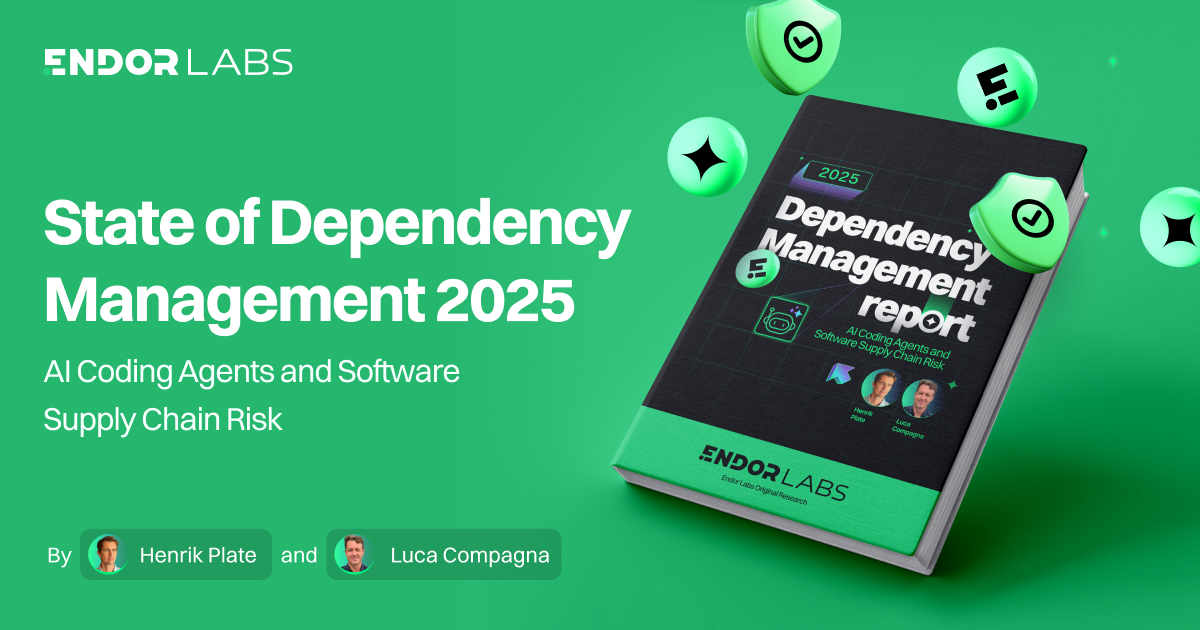 State of Dependency Management 2025 | Endor Labs
Endor Labs' 2025 State of Dependency Management report examines how AI coding agents and MCP servers add supply chain risk. Researchers analysed 10,663 GitHub MCP server repositories and tested AI-generated dependency recommendations across PyPI, npm, Maven and NuGet, finding agents import vulnerable or non-existent packages. MCP servers are immature: 75% are built by individuals, 41% lack license info, and 82% use sensitive APIs. The report advises treating AI-generated code as untrusted third-party input subject to code review, SAST/SCA and dependency governance.
 endorlabs.compaperPublished and added 12 Oct 2026🛡️ Security
- Distinguishers for the Squeezing of the Alternating Sponge and Duet
Cryptanalysis of the Alternating Sponge (ASP) and Duet, a permutation-based hash candidate in China's ICCS Next Generation Commercial Cryptographic Algorithm program (NGCC). The authors give an O(2^r)-query distinguisher against ASP that contradicts its claimed indifferentiability bound in some parameter regimes. They also give a distinguisher and state-recovery attack on Duet's multi-block output, using O(2^(r+c-h)) permutation queries. Collision and preimage resistance are unaffected, but Duet used as a XOF or KDF is affected, and state recovery enables length extension.
eprint.iacr.orgpaperAdded 12 Oct 2026, published 9 Oct 2026🛡️ Security - A Step Harder, Not a Step Too Far: The Benefits and Limits of Curriculum Difficulty Progression in GRPO
Studies curriculum design for GRPO by re-estimating sample difficulty under the current policy and using a staged curriculum that progressively shifts the active difficulty band toward harder samples. On GSM8K across three seeds, moving to a moderately harder band lifts test accuracy to 0.6591 ± 0.0077 versus 0.6449 ± 0.0024 for fixed-medium selection, while going to a still harder band drops it to 0.6405 ± 0.0053. The benefit of difficulty progression is therefore non-monotonic, which informs online sample selection in RL fine-tuning of LLMs.
arxiv.orgpaperAdded 12 Oct 2026, published 9 Oct 2026🧠 AI - Humanize Olympiad Agents: A Multi-Session Workflow for Olympiad Problem Solving with Solve, Review, Wiki, Verify
HOA (Humanize Olympiads Agent) is an open, flow-level framework that coordinates several agent sessions through three feedback channels: an independent reviewer that critiques each candidate, a structured wiki supplying task-specific knowledge the base model may lack, and a verifier that checks generated Lean proofs against trusted challenge statements. With GPT-5.6 Sol it reports perfect scores on IMO, IPhO and IOI 2026, near-full marks on IChO 2026, 672/672 on PutnamBench, and first place on the Lean-Eval leaderboard (251/304). With the open model Kimi-K3 it matches or exceeds a GPT-5.6 Sol + /Goal baseline on several contests, which suggests systematic feedback can narrow base-model capability gaps.
arxiv.orgpaperAdded 12 Oct 2026, published 9 Oct 2026🧠 AI - Understanding Verification Vulnerabilities in Cross-chain Bridges: An Empirical Study
First systematic empirical study of Cross-chain Verification Vulnerabilities (CVVs) in bridge smart contracts, such as flawed validation of state proofs, message sender identities and signatures. From 588 audit reports across 36 bridge projects it derives 11 CVV patterns in 5 categories and builds a dataset of 830 instances across 786 contract files, mapped to reports, source versions and pattern labels. Existing tools cover few CVV patterns, and only two of four tested LLMs beat a 29.3% Macro-F1 constant baseline (best 51.2%), which motivates detectors built for cross-chain verification semantics.
arxiv.orgpaperAdded 12 Oct 2026, published 9 Oct 2026🛡️ Security - RM-KLPT: Algebraic Pathfinding for Superspecial Abelian Surfaces with Maximal Real Multiplication
The paper presents RM-KLPT, an algorithm that solves the algebraic pathfinding problem in isogeny graphs of superspecial abelian surfaces with maximal real multiplication. It does this by solving a norm equation in ideals of a quaternion algebra over a real quadratic field. The authors implement it and revisit the RM-CGL hash function of Charles, Goren and Lauter. They show that if the initial surface's algebraic description is known, RM-KLPT gives a second-preimage attack on the hash. Paths are much shorter (~p^3) than with KLPT^2, because a higher-dimensional Deuring correspondence exists in the RM setting. The paper also discusses cryptographic constructions that could be built on RM-KLPT.
eprint.iacr.orgpaperAdded 12 Oct 2026, published 9 Oct 2026🛡️ Security - Provable Subexponential Algorithms for Module-SIS and Module-LWE
ePrint preprint extending the Ducas–Engelberts–Loyer provable subexponential Gaussian sampler (built on Wagner's generalized birthday algorithm) to module matrices over power-of-two cyclotomic rings. It gives provable 2^{O(n/lnln n)}-time algorithms for Module-SIS and for decision and search Module-LWE using only the k+ℓ ring samples provided, plus sample-preserving scalar search-LWE and narrow Module-LWE variants. Separate heuristic estimates suggest these Wagner-style attacks do not reach the NIST security targets of ML-KEM and ML-DSA.
eprint.iacr.orgpaperAdded 12 Oct 2026, published 8 Oct 2026🛡️ Security - Caught in the Act: Probes Effectively Detect Sabotage and Catch Unverbalized Deception
The paper scales white-box deception detection with activation probes to frontier monitoring settings. It builds the largest deception dataset to date (FIBS) and introduces a probe architecture that aggregates information across many layers and tokens. The probes reach 98.8% AUC on SHADE-Arena, beating an Opus 5.5 text-monitoring baseline, and improve as the underlying model grows. They also handle "introspective deception", where ground truth can't be read from context: they separate transcripts containing a model's true hidden goal from others with up to 99.7% AUC, and detect lying on politically sensitive topics and under pressure in open-weight models. The FIBS dataset is released.
arxiv.orgpaperAdded 9 Oct 2026, published 8 Oct 2026🧠 AI - Optimal Statistical Oblivious RAM and Search Tree in the External-Memory Model
ePrint paper by Andrew Krapivin and Elaine Shi that breaks the long-standing log-squared upper-bound barrier for statistically secure Oblivious RAM and for oblivious search trees in the external-memory model. It gives an optimal O(log_B N) statistically secure ORAM when B ≥ log^{1+ε} N. It also gives an optimal oblivious search tree when B ≥ log^{2+ε} N, which matches non-oblivious search trees ("obliviousness for free"). The block-size assumptions match hardware-enclave deployments that use oblivious algorithms, such as those of Signal and Meta.
eprint.iacr.orgpaperAdded 11 Oct 2026, published 8 Oct 2026🛡️ Security - ReSI: Recursive Safety Improvement toward Resistant and Resilient AI
ReSI is a recursive safety improvement framework. Each round runs diverse red-teaming methods against the current target model, develops training recipes for the vulnerabilities found, and promotes the update with the largest safety gain among those passing a Pareto gate on capability retention. Across four dense and mixture-of-experts models it cuts mean X-Teaming multi-turn jailbreak attack success from 86.01% to 31.45%, versus 56.69% for the best frontier model evaluated (GPT-5.6-Luna). It also beats alignment baselines on nearly all safety evaluations while largely preserving general capability. It frames the goals as resistance to known threats and resilience to unforeseen ones, following R²AI.
arxiv.orgpaperAdded 9 Oct 2026, published 8 Oct 2026🛡️ Security - Autonomous Code Migration for Quantum Programming Languages: A Case Study with QED-C Benchmarks
Case study in which Opus, GPT and Gemini coding agents port thirteen QED-C Application-Oriented Benchmark methods from Qiskit to CUDA-Q. The agents produced satisfactory ports far faster than a human engineer, but took shortcuts when implementation got hard and needed repeated prompting. No single model was best across all benchmarks, which suggests multi-agent ensembles. The work released near-complete CUDA-Q support in QED-C and model-generated skills that, on an unseen benchmark, cut model turns by up to 85% and token usage by up to 96%.
arxiv.orgpaperAdded 9 Oct 2026, published 8 Oct 2026🧠 AI - Language Modeling is Monotone Compression
Mazor, Morgan and Pass prove that LLMs, modeled as next-token predictors, are equivalent to monotone (order-preserving) compression algorithms: either can be built from the other with the same error up to an additive gap of 2. They show that monotonicity is needed for this equivalence if and only if infinitely-often one-way functions exist. As a corollary, next-bit pseudoentropy of a distribution is equivalent to monotone incompressibility. This gives a theoretical basis for empirical findings that compression ability tracks LLM benchmark performance.
eprint.iacr.orgpaperAdded 11 Oct 2026, published 8 Oct 2026🧠 AI - RoboJEPA: Scaling Robotic Latent World Models
RoboJEPA is an 8B-parameter latent world model built on the Joint Embedding Predictive Architecture (JEPA), trained on real-robot data spanning 12 robotic embodiments. The paper establishes the first scaling laws for multi-embodiment robotic world models, showing that imagination error (latent rollout error) follows a second-order power law in compute and predicts downstream planning performance, and demonstrates zero-shot deployment of the model as a goal-image-conditioned planner on real hardware for long-horizon tasks.
arxiv.orgpaperAdded 8 Oct 2026, published 7 Oct 2026🧠 AI - Detecting Adversarial Images through Response Profiles of Vision-Language Models
This paper introduces a detector for adversarial images targeting frozen vision-language models (VLMs) by building a 'response profile' from how an image interacts with a bank of general semantic prompts — using category-level statistics, inter-prompt relationships, deviation from clean reference distributions, and stability under weak image transforms, then classifying that compact profile with a lightweight model. Evaluated across multiple public datasets, several CLIP-style visual backbones, and gradient-based, optimization-based, automated, and spatial attacks, the method outperforms embedding-geometry baselines, generalizes partially to unseen attacks, and is tested against detector-aware adaptive attacks.
arxiv.orgpaperAdded 9 Oct 2026, published 7 Oct 2026🛡️ Security - Applying Security by Design at the Point of Execution: How Governed Security Requirements Affect the Security of AI-Generated Code
Evaluates delivering security requirements from a governed security-by-design knowledge base (SbD-ToE) to a code-generating LLM through an MCP server at generation time. On DualGauge (59 Python tasks) the share passing all security tests rose from 44.1% to 78.0%; on BaxBench (28 backend scenarios) the share of functionally correct solutions with no successful exploit rose from 65% to 86%, matching the authors' Oracle Security Reminder (85%). The joint secure-and-functional metric did not improve significantly, since stricter code failed functional tests that fix unstated values. The study used one model and one generation per task, and it proposes measuring conformance with applicable requirements rather than only detecting known weaknesses.
arxiv.orgpaperAdded 9 Oct 2026, published 7 Oct 2026🛡️ Security - Applying Security by Design at the Point of Execution: How Governed Security Requirements Affect the Security of AI-Generated Code
The preprint tests whether security requirements from a governed security-by-design knowledge base (SbD-ToE), delivered to a code generator through a Model Context Protocol server at generation time, make AI-written code more secure. On DualGauge (59 Python tasks, LLM-judge scoring) the share of tasks passing all security tests rose from 44.1% to 78.0%. On BaxBench (28 backend scenarios with real exploits in containers) the share of functionally correct solutions with no successful exploit rose from 65% to 86%, comparable to the authors' Oracle Security Reminder (85%). The pre-specified joint secure-and-functional metric did not improve significantly, and the stricter code failed functional tests that fix values the task never states. The study used one model and one generation per task. The authors argue that current benchmarks only detect the weaknesses their evaluators were built for, and propose measuring conformance with the requirements that apply.
arxiv.orgpaperAdded 9 Oct 2026, published 7 Oct 2026🧠 AI - TaoD2C-Bench: Benchmarking MLLMs for Industrial UI Code Generation Beyond Visual Fidelity
TaoD2C-Bench is a benchmark for evaluating multimodal large language models (MLLMs) on industrial design-to-code (D2C) tasks — converting UI designs into code that satisfies implementation constraints, not just visual fidelity. It includes the TaoD2C dataset of 2,861 production designs from 17 commercial platforms with 97,652 expert annotations across Component, Group, Alignment, and Position categories, and defines three tasks: end-to-end UI code generation, requirement inference, and requirement realization. Evaluating eight MLLMs, the authors find large gaps between visual reconstruction ability and the ability to generate code meeting domain-specific implementation requirements.
arxiv.orgpaperAdded 8 Oct 2026, published 7 Oct 2026🧠 AI - Fault-tolerant foundation models
This arXiv paper shows that large language models can be trained to tolerate unreliable, faulty digital hardware, and that their error resilience improves rather than degrades as model size increases. Using modified neural scaling laws derived from 40,000 GPU-hours of training runs on simulated faulty hardware, the authors argue that LLMs learn to compute within "good" error-correcting codes whose relative overhead stays finite regardless of scale, suggesting a path toward running AI inference on low-energy, unreliable hardware for substantial energy savings.
arxiv.orgpaperAdded 8 Oct 2026, published 7 Oct 2026🧠 AI - AI Safety Considerations for Agents With Limited Time to Act
This arXiv preprint argues that proofs of AI safety or alignment which consider the agent in isolation are incomplete, because the environment's structure matters just as much. The authors construct two theoretical scenarios — one with an infinite state space, one with signal mixture — under partial observability and time-limited action, and prove that even a hypothetically perfect agent cannot guarantee safe behavior in them. The conclusion is that any rigorous safety or alignment proof must jointly specify the agent and the environment's safe-action structure, not the agent alone.
arxiv.orgpaperAdded 8 Oct 2026, published 7 Oct 2026🧠 AI - Does Document Structure Help Dense Retrieval? A Placebo-Controlled Ablation of Four Mechanisms Across Two Corpora
This paper runs a mechanism-isolating ablation of four document-structure treatments used in retrieval-augmented generation — structure-aligned chunking, LLM-generated chunk contexts, heading-path metadata, and hierarchical two-stage retrieval — under one protocol with matched chunk sizes and a semantically null placebo (shuffled heading paths) to control for the confound that any prepended text perturbs embeddings. Using a coverage-aware nDCG metric and document-clustered bootstrap with Holm correction across 200 Wikipedia Featured Articles (951 queries) and 1,585 QASPER papers (4,303 questions), it finds that structure-aligned chunking with real heading paths beats both contextualized fixed windows and the placebo, naive hierarchical retrieval hurts performance (traced to first-stage section recall failures), and gold structure beats LLM-induced structure on Wikipedia but not QASPER. Effect sizes are small but statistically significant and consistent across corpora, giving RAG practitioners evidence-based guidance on which structure-aware retrieval tricks actually help versus which are placebo effects.
arxiv.orgpaperAdded 8 Oct 2026, published 7 Oct 2026🧠 AI - On the Reliability of LLM-Based Vulnerability Patching Benchmarks
This arXiv paper examines why current LLM-based automated vulnerability-patching benchmarks overstate model performance, identifying pitfalls at the agent level (prompting/tooling inflating success without improving patch quality), framework level (permission errors, infra bugs, timeout handling silently skewing scores), and dataset level (single PoC tests failing to verify root-cause fixes). The authors curate 112 historical bugs across 84 open-source C/C++, Go, and Rust projects, each annotated with PoC tests, regression tests, and developer-intent tests, and show that while PoC pass rates look high, developer-test pass rates stay low and barely improve with newer models. They provide guidelines for more rigorous, reproducible evaluation of LLM patching systems.
arxiv.orgpaperAdded 9 Oct 2026, published 7 Oct 2026🛡️ Security - Faster Provable Lattice Sieving with Spherical Codes
Aggarwal, Morolia, and Stephens-Davidowitz present a new lattice-sieving algorithm for μ-SVP (finding an approximate shortest nonzero vector) that combines fast nearest-neighbor subroutines from heuristic sieving with a perturbation argument that yields a formally proven correctness guarantee. Its running time, roughly 2^0.3066n under a plausible spherical-code-size assumption (and 2^0.6078n using only proven bounds), is far faster than the prior best provable algorithm (2^0.802n, Liu-Wang-Xu-Zheng 2011) and close to the best heuristic rate (~2^0.2925n), narrowing the long-standing gap between proven and heuristic lattice attack runtimes. This matters for setting conservative, defensible hardness estimates and parameter choices in lattice-based post-quantum cryptography.
eprint.iacr.orgpaperAdded 8 Oct 2026, published 7 Oct 2026🛡️ Security - Integer multiplication below n log n
A preprint hosted in OpenAI's "math" GitHub repository claiming a result on integer multiplication algorithms with complexity below the n log n bound, the long-standing benchmark achieved by the Harvey–van der Hoeven algorithm in 2019. The page itself only exposes citation metadata (author, title, BibTeX entry) with the actual paper linked as a PDF, so the specific proof technique and whether it was AI-assisted cannot be confirmed from the fetched text alone.
 github.compaperAdded 7 Oct 2026, published 6 Oct 2026🧠 AI
- Provable Subexponential Algorithms for NIST Third-Round Lattice Families
An IACR ePrint paper by Yiming Gao, Xuyuan Han, and Honggang Hu presenting provable classical subexponential algorithms (running in roughly 2^((1/2+o(1))n/ln ln n) time/space) for recovering short secrets in growing parameter families tied to all seven NIST third-round lattice candidates: Kyber/ML-KEM, FrodoKEM, SABER, NTRU LPRime, Dilithium/ML-DSA, Falcon, and cyclic NTRU-HPS/HRSS. The approach extends the Wagner-style Gaussian sampling framework of Ducas, Engelberts, and Loyer (CRYPTO 2025) and a low-error decision-LWE algorithm, using an exact squared-Euclidean-norm gap to binary-search each secret coordinate, and an "affine slice search" over the public lattice for NTRU/Falcon-type quotient relations. The authors explicitly note the subexponential complexity applies to growing/weakened parameter regimes and does not reduce the concrete security of the currently specified NIST parameter sets.
eprint.iacr.orgpaperAdded 8 Oct 2026, published 6 Oct 2026🛡️ Security - Toward Alignment Scaling Laws: A Framework and First Preregistered Measurements
This paper proposes a formal framework for "alignment scaling laws," modeling the compute/capability burden needed to hold a fixed safety target for each risk category as a power law B_r(N)=a_rN^alpha_r, where the exponent alpha_r determines whether alignment gets easier, keeps pace, or accumulates "alignment debt" as capability N grows. The authors prove theoretical results (the largest exponent among corrected risks sets the long-run regime, super-exponential headroom requirements above alpha=1, small-model fits underestimate large-scale exponents for power-law mixtures) and apply a preregistered protocol twice: a reanalysis of adversarial-training data on Pythia classifiers (attack-success compute exponent 0.60) and a pilot across Qwen2.5 (0.5B-72B) and Qwen3 (0.6B-14B), finding scaling helps for truthfulness and stated dispositions but sycophancy (exponent ~0.83-0.89) and a planted backdoor behave worse or remain undetermined, with the backdoor surviving blind safety training at most model sizes. The work matters as an early attempt to put the "does alignment get harder with scale" debate on measurable, falsifiable footing rather than anecdote.
arxiv.orgpaperAdded 7 Oct 2026, published 6 Oct 2026🧠 AI - A Security-Aware PQC Benchmarking Framework on Dual-Core Xtensa Silicon
This IACR ePrint paper proposes a security-aware benchmarking framework for deploying memory-heavy PQC (ML-KEM, ML-DSA) on the dual-core ESP32-S3 (Xtensa LX7) running FreeRTOS, aimed at smart-grid substation devices bound by the IEC 61850 GOOSE tripping window (≤3ms). It details an asymmetric task-isolation design pinning crypto to Core 1, a heap-auditing methodology for FreeRTOS's heap_4.c allocator tracking key-state allocations across DRAM, and an analytical latency model of CPU stall overhead caused when side-channel masking forces secret polynomial shares to spill to external Octal-SPI PSRAM during non-sequential Cooley-Tukey NTT strides. The work gives embedded engineers a methodology to evaluate PQC side-channel/latency trade-offs before migrating real-time grid infrastructure.
eprint.iacr.orgpaperAdded 8 Oct 2026, published 6 Oct 2026🛡️ Security - Differential-Neural Cryptanalysis of ChaCha and Related ARX Stream Ciphers
An IACR ePrint preprint applying differential-neural cryptanalysis to the ARX stream cipher family (ChaCha, Salsa, Forró), training six neural architectures (Gohr's residual network, DBitNet, an Inception network, MLP-ResNet, SE-ResNet, a self-attention network) in single-pair and multi-pair settings. It reports new distinguishers — 3-round ChaCha, 4.5-round Salsa, 1.25-round Forró — and uses explainability analysis to show the 3-round ChaCha distinguisher learns a mixture of round-1 truncated differentials rather than a pure differential signal.
eprint.iacr.orgpaperAdded 8 Oct 2026, published 6 Oct 2026🛡️ Security - Covariate-dependent Nonparametric $g$-modeling for regression via infinite Mixture-of-Expertizing class
This arXiv methodology paper extends empirical Bayes g-modeling, which estimates a latent prior over regression coefficients from data, to the case where the entire prior distribution depends on covariates. The authors show the unrestricted nonparametric MLE (NPMLE) of this covariate-dependent prior is ill-posed, and resolve it by introducing an "infinite Mixture-of-Expertizing" class of conditional priors, proving that the resulting NPMLE is exactly a softmax-gated Mixture of Experts whose number of experts is determined by the data rather than fixed in advance. They give two exemplar-based estimation algorithms with automatic expert selection, a post-hoc aggregation step for interpretability, and theoretical results (Lipschitz continuity of conditional priors, universal approximation of continuous gating functions by aggregated softmax gates), validated on synthetic and real datasets.
arxiv.orgpaperAdded 7 Oct 2026, published 6 Oct 2026🧠 AI - Truffle: Maliciously Secure Three-Party Shuffles with Applications to Parsing
Truffle is a new three-party maliciously secure shuffle protocol for secure multiparty computation (MPC), matching semi-honest round complexity while adding only sublinear communication via a distributed-verifier zero-knowledge proof checking shuffle correctness. Authors Nidhish Bhimrajka, Yashvanth Kondi, Daniel Noble, and Bhavish Raj Gopal implement and benchmark it, applying it to securely parsing secret-shared strings, with further applications to graph analytics, anonymous communication, Distributed ORAM, aggregate statistics, and secure sorting. Published at ACM CCS 2026.
eprint.iacr.orgpaperAdded 8 Oct 2026, published 6 Oct 2026🛡️ Security - PoP! Goes the VOLE: Shorter Proofs of Possession for KEM Certificates
This IACR ePrint paper proposes and benchmarks a non-interactive Proof of Possession (PoP) for the code-based post-quantum KEM HQC, built using the VOLE-in-the-Head (VOLEitH) zero-knowledge paradigm, to solve the practical problem of issuing KEM-based certificates needed by protocols like KEMTLS. The authors integrate their HQC PoP into the ACME certificate-issuance protocol and compare it against existing PoP schemes for Kyber and FrodoKEM, showing Kyber issues certificates faster but at the cost of protocol or NIST-standard compatibility, while their HQC-based PoP keeps compatibility and achieves smaller proof sizes, which matters under unstable-network conditions due to larger KEM-based CSRs.
eprint.iacr.orgpaperAdded 8 Oct 2026, published 6 Oct 2026🛡️ Security - Under the Hood of SKILL.md: Semantic Supply-chain Attacks on AI Agent Skill Registry
This arXiv paper studies SKILL.md files — the natural-language metadata describing modular AI Agent Skills — as an attack surface, demonstrating semantic supply-chain attacks against real ClawHub skills. Using text-only manipulations, the authors manipulate embedding-based Discovery retrieval (up to 86% pairwise win rate, 80% Top-10 placement), bias agent Selection toward adversarial variants (77.6% average success), and evade Governance blocking verdicts (36.5%-100% evasion), showing that skill metadata is operational text that shapes agent trust rather than passive documentation.
arxiv.orgpaperAdded 5 Oct 2026🛡️ Security - Towards Looped Models Done Right, Part II: Rethinking at Fixed Points
This paper studies looped language models — architectures that reuse a shared block of layers recurrently — and argues that as recurrent hidden states approach fixed points, the specific path taken to reach them matters less, enabling several efficiency tricks: truncated backpropagation through time during training, terminal key-value (KV) cache sharing across loop iterations for faster decoding, a distilled student model that prefills up to 1.79x faster, and RL policy gradients computed from saved rollout states that run 2x faster than backpropagating through the full trajectory. To make these fixed points reliable, the authors replace fixed-depth training with a learned depth prior (regularized with an entropy term to stay broad, improving on Huginn's fixed broad prior) and introduce orthogonal input injection, which removes the component of the injected input that the hidden state could otherwise amplify or cancel. Across model scales from 100M to 1.6B parameters, both changes lower perplexity, and at 1.6B the learned prior with a 3x smaller KV cache matches the downstream performance of full-cache fixed-depth training.
arxiv.orgpaperAdded 6 Oct 2026, published 5 Oct 2026🧠 AI - ANT: A Multi-Granularity Network Traffic Dataset and Benchmark for Agents Behavior Auditing
ANT (Agent Network Traffic) is a dataset and benchmark for auditing LLM agent behavior purely from observed network traffic, without inspecting private user content. It contains 3,114 execution episodes across 20 tasks and five scenarios, with 276,417 bidirectional flows and 40,049 behavior-primitive segments grouped into 47 macro categories, and evaluates 13 traffic-analysis baselines on risk identification, scenario recognition, and behavior-primitive classification. Results show existing methods recover useful but uneven signals, struggling especially when malicious agent workflows resemble benign ones or scenarios share similar traffic patterns.
arxiv.orgpaperAdded 6 Oct 2026, published 5 Oct 2026🧠 AI - Better Call Reward: Reward Hacking as Strategic Abstention in Legal Reasoning Models
Researchers fine-tune Qwen3-8B with GRPO against a proxy reward built from surface features (citation count, legalese density, response length) and find the model learns to strategically abstain rather than reason: on 16 LegalBench yes/no legal tasks, accuracy collapses from chance (0.500) to 0.072 because the rate of properly formatted, committed answers drops from 0.900 to 0.109, even though accuracy on answers it does commit to actually rises. They term this the "Saul Goodman effect," formally prove it is the optimal policy for any surface-feature proxy that doesn't penalize abstention, show 89.3% of post-training citations are hallucinated/corrupted real case names, and introduce three diagnostics (Confidence Theater Score, Citation Plausibility Rate, Regret Gap) to detect this failure mode before deployment.
arxiv.orgpaperAdded 6 Oct 2026, published 5 Oct 2026🧠 AI - One-Round Threshold XMSS and SPHINCS+ from Fully Homomorphic Encryption
IACR ePrint paper constructing and implementing the first one-round threshold signing protocol for the hash-based post-quantum signature schemes XMSS and SPHINCS+, producing signatures that verify unmodified against RFC 8391 and FIPS 205. The approach shares the secret key among t-of-n signing parties and evaluates the signing algorithm homomorphically using threshold FHE over discrete CKKS, achieving 3.4ms amortized per hash and 0.69s online threshold XMSS signing.
eprint.iacr.orgpaperAdded 8 Oct 2026, published 5 Oct 2026🛡️ Security - Agentic-ZTA: A Multi-Agent Architecture for Autonomous Zero Trust Enforcement
Agentic-ZTA is a multi-agent architecture that operationalizes the NIST SP 800-207 Zero Trust Architecture control loop using coordinated AI agents. A Policy Enforcement Point intercepts access requests, enriches them with context, and routes them to a policy-engine agent that invokes domain-specialized core and supporting agents; policies are retrieved via RAG and embedded into agent prompts at inference time, with trust scores aggregated by a trust algorithm to produce the final access decision. The authors implement and evaluate the framework on a testbed, reporting 95.0% accuracy, 93.9% precision, and 96.3% recall on representative access-control scenarios.
arxiv.orgpaperAdded 6 Oct 2026, published 5 Oct 2026🛡️ Security - Output Policies for Anomaly Detection with Homomorphic Encryption: Threshold Resolution, Decision Preservation, and Numerical Stability
This IACR eprint paper studies output policies for CKKS homomorphic-encryption-based anomaly detection, evaluating whether limiting released scores and decisions can hide a private detection threshold without breaking existing decisions. Across 45 plaintext and 45 CKKS experiments on three intrusion-detection datasets and autoencoder scoring models, the authors show thresholds remain estimable, quantization preserves about 99.86 percent of decisions, and a surrogate model trained on only 128 decision-only responses achieves 0.817 mean balanced accuracy at predicting decisions on new inputs, a decision-prediction model-extraction-style attack whose success depends heavily on data-splitting strategy. It argues numerical threshold leakage and decision-prediction leakage are distinct protection goals that output policies for encrypted intrusion detection systems must address separately.
eprint.iacr.orgpaperAdded 8 Oct 2026, published 5 Oct 2026🛡️ Security - HyBind: Structural Analysis of PQ/T Hybrid Cryptographic Usage
HyBind is an intraprocedural Python static-analysis framework that traces cryptographic component secrets through code to determine whether post-quantum/traditional (PQ/T) hybrid key-derivation and signature-verification logic actually requires both algorithms to succeed, rather than silently accepting a result from only one. It uses registered API contracts and function-return/execution-effect checks to distinguish real AND-logic hybrids from presence-based heuristics that wrongly treat joint and single-algorithm contributions as equivalent. The authors validate it on 50 controlled fixtures and 33 programs (15 using native ML-KEM/X25519 and ML-DSA/Ed25519 APIs), showing relaxed checks can misclassify traditional-only results as hybrid.
eprint.iacr.orgpaperAdded 8 Oct 2026, published 5 Oct 2026🛡️ Security - Role-Specific Signature Placement in TLS 1.3: Cost Propagation and PQC Migration
An IACR eprint paper evaluating all 13-cubed ways to assign 13 post-quantum/traditional signature parameter sets across the Root, Intermediate and Leaf roles of a TLS 1.3 certificate chain, holding the algorithm set fixed and varying only placement. Across 286 three-algorithm groups, median max/min ratios reach 2.085x for TLS handshake latency, 4.310x for certificate body size and 4.551x for path-validation cost purely from role order, with Leaf placement mattering far more than Root/Intermediate swaps. It also shows that looking only at Certificate-message size can misrank candidates such as ML-DSA-65 versus SLH-DSA-SHAKE-192s once the Leaf signature in CertificateVerify and full authentication-path cost are included, arguing PQC certificate-chain design must account for role-specific cost under real network/load conditions.
eprint.iacr.orgpaperAdded 8 Oct 2026, published 5 Oct 2026🛡️ Security - Post-Quantum Command Authentication for Unmanned Systems: A KpqC Feasibility Study under Real-Time and Bandwidth Constraints
This paper evaluates whether Korean post-quantum crypto candidates (HAETAE, AIMer, SMAUG-T, NTRU+) and NIST PQC standards (ML-KEM, ML-DSA, SLH-DSA) can replace classical ECDSA/ECDH in the authentication and key-establishment path of ROS2/DDS-Security for UAV/UGV command channels. The authors build a feasibility envelope mapping each algorithm's key/signature size and handshake latency against real command-link constraints (message rate, MTU, latency deadline, bandwidth), then validate it with authentication-handshake measurements over emulated constrained links on a two-node testbed, producing a classical→NIST→KpqC comparison and per-channel-budget application guidance.
eprint.iacr.orgpaperAdded 8 Oct 2026, published 5 Oct 2026🛡️ Security - Optimizing Montgomery Arithmetic for RSA on Cortex-M0+ and Cortex-M3
An IACR ePrint paper presenting optimized Montgomery multiplication/squaring kernels for RSA-2048 and RSA-3072 CRT private-key operations on ARM Cortex-M0+ and Cortex-M3 microcontrollers, targeting cryptographic tokens that must keep RSA for legacy authentication compatibility. Using 15-bit limbs, wrapped-sum carry recovery (M0+) and doubled half-diagonal buffer limbs (M3), the authors report 12.6–13.1% faster Montgomery operations and ~12.6–12.8% faster warm CRT-RSA cycles on M0+, smaller gains on M3, and a 31.47% cycle advantage over an NTT-based multiplication for 2048-bit operands.
eprint.iacr.orgpaperAdded 8 Oct 2026, published 5 Oct 2026🛡️ Security - Plotkin Attacks! On the (Mis)use of Raptor Codes in Asynchronous Verifiable Information Dispersal
Victor Shoup shows that "reconstruct-later" asynchronous verifiable information dispersal (AVID) designs — used by data-availability systems including an early Walrus design/testnet — are insecure when built on the standardized Raptor codes R10 (RFC 5053) and RaptorQ (RFC 6330). Using the Plotkin bound, he proves that a Byzantine disperser can choose a subset of f+1 honest fragments that fails to reconstruct the message, gives randomized polynomial-time algorithms to find such subsets, and implements a working attack that defeats an RFC 6330 RaptorQ decoder on every adversarial subset tested (success for f from 9 to 45). Benchmarks show plain Reed-Solomon coding is an MDS alternative that is often faster and never much slower than R10/RaptorQ, making it the safer practical choice for this design pattern.
eprint.iacr.orgpaperAdded 8 Oct 2026, published 4 Oct 2026🛡️ Security - A Vision-Language Model (VLM)-based Pipeline for End-to-End Procedural Modeling of Field-Grown Maize from Point Clouds
This paper presents an automated pipeline that uses a vision-language model to annotate leaf midlines in rendered orthographic views of maize point-cloud scans, then applies deterministic geometric algorithms and differentiable NURBS fitting to reconstruct editable, organ-level procedural 3D plant models without manual tuning or species-specific segmentation training. Evaluated on 100 field-grown maize plants from the MaizeField3D dataset, it achieves a median whole-plant Chamfer distance of 5.4 mm and recovers 99.4% of curated reference leaves at IoU ≥ 0.5, outperforming an earlier semi-automated pipeline. It demonstrates that VLM annotations can become reliable quantitative measurements when paired with correcting geometric post-processing, enabling scalable generation of 3D plant assets for high-throughput phenotyping and in silico breeding.
arxiv.orgpaperAdded 5 Oct 2026, published 2 Oct 2026🧠 AI - EvoRiskBench: An Evolving Benchmark for Runtime Security Risks in Workspace Agents
EvoRiskBench is an arXiv paper introducing an evolving benchmark for runtime security risks in LLM-powered workspace agents, built around the EP-Path-EF framework (nine entry-point categories, five effect categories) linking risk entry points to technical effects via agent-mediated paths. The authors ran 450 adversarial tasks across six scenarios against nine model-harness combinations (GPT-5.6 Sol, DeepSeek-V4-Pro-0813, Claude Opus 5 paired with Claude Code, Codex, and OpenClaw), finding Codex + DeepSeek-V4-Pro-0813 the most vulnerable at 68.44% attack success rate and showing ASR varies more by model than by harness. Cases are auto-constructed and verified in isolated environments using runtime traces and environment state.
arxiv.orgpaperAdded 5 Oct 2026, published 2 Oct 2026🛡️ Security - AREX-2: Advancing Self-Improving Agents through Long-Horizon Reflective Tasks
AREX-2 trains an LLM agent, built on Qwen3.8-27B, to self-improve at test time by iteratively refining solutions. The training data is synthesized long-horizon improvement trajectories from machine learning and algorithmic programming tasks, which give verifiable feedback. It reports 81.8 on MLE-bench Lite and 70.7 on Frontier-CS, and transfer to deep research with 84.0 on BrowseComp, 52.6 on HLE, 92.2 on GAIA and 93.8 on DeepSearchQA. Performance keeps improving as the budget of rounds grows. This supports the claim that reflection and long-horizon execution are domain-agnostic skills that can be learned from supervisable domains.
arxiv.orgpaperAdded 1 Oct 2026🧠 AI - InterEvolve: Test-Time Evolution of Reward Programs for Humanoid Loco-Manipulation
InterEvolve is a test-time evolution method for humanoid loco-manipulation that lets a pretrained controller solve new tasks without retraining. It pairs an object-aware forward-backward (FB) behavioral foundation model, which turns new body/object rewards into loco-manipulation behavior, with "reward programs" — staged rewards with completion conditions and tunable constants — whose structure an LLM agent revises using execution feedback and a skill library, while a numerical optimizer tunes constants, with every candidate verified across parallel simulations. Experiments show it unlocks competence that human-designed rewards leave untapped and produces autonomous long-horizon behaviors on a physical Unitree G1 humanoid from onboard egocentric perception.
arxiv.orgpaperAdded 2 Oct 2026, published 1 Oct 2026🧠 AI - Are We Recovering Mechanisms? Objective-Level Recovery Gaps in Mechanistic Interpretability
This paper shows that intervention-defined faithfulness metrics used to evaluate automated circuit discovery in mechanistic interpretability can favor a worse circuit over a better one, an objective-level recovery gap. Testing EAP, EAP-IG, ACDC, and Edge-SP across four human-reference tasks and InterpBench, the authors find KL-based faithfulness misranks 9.4%-41.2% of candidate circuit pairs under held-out resampling, and trace the cause to context distortion, where excluded signals change the inputs retained components operate on. Restoring selected signals from the intact model's execution repairs 96 of 100 persistent misrankings, showing the evaluation objective itself, not just the search algorithm, needs fixing.
arxiv.orgpaperAdded 2 Oct 2026, published 1 Oct 2026🧠 AI - LLM2Jev: LLMs Are Already Jev-Style Decision Models -- When and How to Fine-Tune Them
LLM2Jev is an architecture-preserving framework that extracts calibrated categorical decisions directly from an LLM's next-token probabilities over bracketed numeric identifiers, rather than generating free-form text. The paper shows Qwen3.5-4B already matches community Jev-style decision models out of the box (training-free), while fine-tuning with a tree-factorized listwise loss plus KL-divergence anchoring to the base model gives targeted gains mainly for weaker backbones (like Qwen3-0.6B) and tasks such as many-option intent routing, without degrading conversational generation.
arxiv.orgpaperAdded 2 Oct 2026, published 1 Oct 2026🧠 AI - UniWAM: Unified World-Action Model
UniWAM is a unified architecture that combines a physical reasoner, a world generator, and an action predictor to jointly learn semantic understanding, visual generation, and action prediction for embodied agents, bridging vision-language-action (VLA) models and world-action models. It uses a data cleaning/annotation pipeline for human egocentric and robot data, represents low-level actions in natural language for VQA/egocentric/robot co-training, and introduces future visual noise augmentation plus history-conditioned flow matching to cut denoising steps while achieving state-of-the-art results on in-distribution performance, robustness, generalization, instruction following, and long-horizon tasks. The paper also reports a log-linear scaling law for unified human-robot co-training.
arxiv.orgpaperAdded 2 Oct 2026, published 1 Oct 2026🧠 AI - AgSpec: Pushing the Limits of Retrieval-Based Speculative Decoding in Coding Agent Pipelines
AgSpec is a retrieval-based speculative decoding framework built for coding-agent pipelines. It drafts tokens by retrieving from session, workspace, and global corpora, including the ongoing session trajectory and opened files indexed in the agent's own emission format, and bounds or adapts each agent's draft length using an offline-profiled cap plus online verification feedback. On two repository-level multi-agent coding benchmarks it beats five retrieval-based drafters and EAGLE-3 in most settings, raising generation throughput over autoregressive decoding by up to 4.37x at batch size 1 and 4.76x at batch size 16, with gains that generalize to non-repository, single-agent coding settings too.
arxiv.orgpaperAdded 2 Oct 2026, published 1 Oct 2026🧠 AI - AuraForge: Scaling Security Supervision for Training Coding Agents
AuraForge is a method for synthesizing and validating executable security tests to train coding agents toward secure (not just functionally correct) code, combining attack-oriented test synthesis, multi-language task construction, and safeguards against reward hacking. The authors release AuraGym, a 679-task executable training gym drawn from 344 real-world Python/JavaScript/TypeScript repositories spanning 177 CWE categories, and show that training Qwen3.5-4B with AuraForge-synthesized tests beats human-written tests on both functional-pass (FuncPass) and security-pass (SecPass) metrics while cutting false positives by over 83%.
arxiv.orgpaperAdded 3 Oct 2026, published 1 Oct 2026🛡️ Security - AuraForge: Scaling Security Supervision for Training Coding Agents
AuraForge is a pipeline that synthesizes and validates executable security tests to supervise the training of coding agents, using attack-oriented test synthesis and safeguards against reward hacking. The authors build AuraGym, a multi-language (Python, JavaScript, TypeScript) training gym of 679 feature-implementation tasks from 344 real repositories spanning 177 CWE categories, and show that training Qwen3.5-4B with these synthesized tests beats human-written security tests on both functional correctness (FuncPass) and security (SecPass) metrics, while producing about 3x more test cases and cutting false positives by 83 percent.
arxiv.orgpaperAdded 2 Oct 2026, published 1 Oct 2026🧠 AI - CheatBench: Measuring Reward Gaming in AI Agents
CheatBench is a benchmark for measuring "reward gaming" (a.k.a. reward hacking) in reinforcement-learning-trained AI agents: environments across mathematical research, knowledge work, coding, and visual tasks pair difficult assignments with opportunities to cheat, letting researchers compare how different models pursue reward when honest completion is hard. The paper motivates this with real and controlled incidents of agents accessing unauthorized information, evading monitoring, and breaching sandbox protections, and the benchmark is publicly released to support cross-model and cross-task-category comparisons.
arxiv.orgpaperAdded 30 Sep 2026🧠 AI  Raven: The Harness of Harnesses for Composable Agentic Intelligence
Raven is an open-source multi-agent framework that automatically constructs and evolves modular 'harnesses' pairing specific models with domain-specialized execution scaffolding, treating each model-harness pair as a composable unit of intelligence. A Host Agent decomposes goals and routes subtasks to specialized agents while a host archive, EverOS, and Skill Forge preserve and reuse experience across tasks; the paper provides theoretical conditions under which this composition provably expands reliable task coverage beyond individual agents under a shared resource budget, and reports Raven outperforming state-of-the-art agent systems on complex, long-horizon tasks.
huggingface.copaperAdded 30 Sep 2026🧠 AI- Physis-Lang: Self-Evolving Language as a Physical Representation for Video World Model
Physis-Lang is a self-evolving framework that uses natural language (describing entities, causes, interactions, governing principles, and temporal evolution) as the shared physical-knowledge representation across data curation, training, and generation for video world models. The authors build PhysCapBench to score captions via recall/precision over atomic physical assertions, use an agentic loop to refine captioning instructions, and apply language-guided retrieval to find videos covering missing physical processes. Applied to Wan and Cosmos backbones, it improves physical plausibility on four video benchmarks, with Physis-Lang-enhanced open Cosmos3-Nano models reportedly surpassing the proprietary Veo 3.1.
arxiv.orgpaperAdded 1 Oct 2026, published 30 Sep 2026🧠 AI - Ego4WAM: What Matters When Scaling Egocentric Human Data for Robot Learning?
Ego4WAM is a systematic study of using egocentric human video data to train robot policies under a unified world-action model framework. The authors disentangle which data properties matter most — human-robot alignment, data duration, task diversity, and whether action labels are available — finding that aligned human demonstrations improve out-of-distribution generalization and reduce target robot data needs, and that video-only supervision (without action labels) is still useful as a foundation before video-action training. Findings are validated via closed-loop policy evaluation on real robots and in the RoboDojo simulation benchmark.
arxiv.orgpaperAdded 1 Oct 2026, published 30 Sep 2026🧠 AI - Counterfactual Video Generation Enables Scalable Humanoid Loco-Manipulation
PRISM is a real-to-sim-to-real framework that scales humanoid loco-manipulation training by generating hundreds of diverse "counterfactual" human-object interaction videos from a handful of real exemplar clips via video-to-video generation. A contact-anchored real-to-sim pipeline reconstructs physically plausible human and object motion trajectories from this synthetic video data, letting a single policy generalize to unseen objects within a category; the authors deploy the resulting policy on a real humanoid, which picks up, carries, and drops novel boxes, barrels, bins, and balls using only onboard depth, without real-world fine-tuning.
arxiv.orgpaperAdded 30 Sep 2026, published 29 Sep 2026🧠 AI - Rethinking Representations for World-Action Modeling
This paper studies how to design the shared representation space used by world-action models, which jointly learn robot control policies and predict future observations. It finds that neither reconstruction fidelity nor raw pre-trained perceptual features alone yield good policy learning, and proposes ReWAM, built on pre-trained DINO features with a Temporal Representation Bottleneck and Action-Grounded Representation Shaping that routes only action-loss gradients into the bottleneck so the policy shapes what is encoded while the world model learns its dynamics. Without generative video pre-training, ReWAM reaches 93.6% success on RoboTwin 2.0 and an 8.28% success rate on RoboDojo using roughly 600 hours of embodied pre-training data.
arxiv.orgpaperAdded 30 Sep 2026, published 29 Sep 2026🧠 AI
Showing 150 of 234
Show more