 Hackers exploit Cisco SD-WAN flaw to deploy custom KeyDrift malware
UAT-11473, a newly tracked APT cluster, exploits CVE-2026-20127, a max-severity authentication bypass in Cisco Catalyst SD-WAN Controllers (patched February 2026), to deploy the KeyDrift malware framework. KeyDrift's PolyFlame runs inside vdaemon processes, and LittleFilch hooks SSL_read to extract AES-256 IPsec keying material, saved to /var/tmp/vdaemon.bin and sent over UDP. Targets include space, defense and policy organizations. Talos sees overlap with Volt Typhoon's Silent Train network but makes no definitive link.
 bleepingcomputer.comarticleAdded 30 Oct 2026, published 29 Oct 2026🛡️ Security
 NIK C2: The new AI-enabled command-and-control framework
NIK C2 is a newly observed C2 framework with a Go-based 64-bit Windows implant that embeds an OpenAI Chat Completions client (ai_generate command), falling back to the victim's OPENAI_API_KEY. Talos details its 52+ commands, AES-256-GCM over WebSocket with HTTP fallback, credential, wallet and keystroke theft, screen-lock ransomware, AMSI bypass and anti-debug. It also lists a live C2 at 87.120.196[.]120 and total-sitevv[.]lol.
 blog.talosintelligence.comwriteupPublished and added 29 Oct 2026🛡️ Security
- Beyond the Scope of This Paper: Practical Flash-Accelerator and Cache-Collision Timing Attacks on Microcontrollers
Colin O'Flynn's paper shows that the flash accelerator in most microcontrollers produces the same timing collisions as a cache, so cacheless Cortex-M devices remain open to cache-collision attacks on AES. AES keys were recovered from as few as 750 traces across six cryptographic libraries, eight architectures and over twenty devices. It also attacks SPI bootloaders, Ethernet, CTAP2 over USB and 802.15.4, and releases the open-source tool FlashWhisperer.
 eprint.iacr.orgpaperAdded 31 Oct 2026, published 29 Oct 2026🛡️ Security
 Pentesting: Twelve Caesars – Community Tools for Offensive Security
Hackers Arise walks through four tools from Praetorian's "12 Caesars" open-source release: Titus (secret scanner with 487 rules and credential validation), Nerva (fingerprints 170 protocols), Brutus (Hydra alternative covering 40+ protocols) and Julius (fingerprints 60+ LLM services such as Ollama). It shows download and run commands in a Kali lab and how the tools chain together. The tools are Go single binaries; the post notes an exposed Ollama on port 11434 allows unauthenticated model use.
 hackers-arise.comarticlePublished and added 27 Oct 2026🛡️ Security
 Revisiting AES Key Wrap: Forgery Bounds, Structural Observations, and Recommendations for the Revision of NIST SP 800-38F
Revisiting AES Key Wrap is an ePrint paper (2026/2636) by John Preuß Mattsson, expanded from technical comments to NIST on the SP 800-38F revision. It shows the stated forgery probabilities ignore adaptive attacks and gives corrected bounds for KW, KWP and TKW. It also shows KW lacks beyond-birthday-bound security, since a forgery leaks a plaintext prefix and an encryption-only distinguisher exists.
eprint.iacr.orgpaperAdded 26 Oct 2026, published 25 Oct 2026🛡️ Security Inside the LiteLLM 1.107.0 supply chain compromise: Credential theft through Python startup hooks
Microsoft's analysis of the LiteLLM 1.107.0 compromise, published to PyPI and container images on 21 October 2026. The wheel shipped cook.pth, cook.py and sitecustomize.py, so a credential collector (PRIVCOLLECT) ran whenever Python started, even without importing LiteLLM. It covers AES/RSA-encrypted exfiltration to litellm.dev, a re-armable Unix loader, Defender KQL hunting queries, ATT&CK mapping and rotation guidance.
 microsoft.comwriteupPublished and added 23 Oct 2026🛡️ Security
- Pairwise Independence of Ten-Round AES
Pairwise Independence of Ten-Round AES (Zhongfeng Niu, Kai Hu, ePrint 2026/2608) proves that ten rounds of AES with independent uniform round keys and input/output whitening are within 3017/2^141 (below 2^-129) statistical distance of pairwise independent. The proof bounds the averaged difference-distribution matrix over five superbox layers, using Gram moments and MDS code constraints. Final-round MixColumns omission is retained.
eprint.iacr.orgpaperAdded 24 Oct 2026, published 23 Oct 2026🛡️ Security - Anti-Forensics: Building a Phantomdrive
Phantomdrive is an open source USB drive built on the WCH CH569 chip that appears as a plain 8GB disk and hides the rest of an SD card behind AES-256 encryption. The hidden partition unlocks when the user saves "password:" in a text file; the firmware catches it in raw WRITE10 traffic and zeroes the buffer. Key derivation uses a per-device salt and 100,000 SHA-256 rounds, and the post compares AES-ECB, CTR and XTS speeds.
hackers-arise.comarticlePublished and added 22 Oct 2026🛡️ Security - The Good, the Bad, and the Noisy: A Systematic Analysis of Ring-Oscillator-Based Noise Generators
This IACR ePrint paper (2026/2597) systematically compares ring-oscillator-based additive noise generators, a hiding countermeasure against side-channel attacks. Experiments show many existing designs ignore output amplification and the risk of the noise being filtered out, so they lower signal-to-noise ratio too little. The authors give a guideline on inverter chain length, output amplification and frequency randomization, and build a tailored generator for an AES implementation that outperforms prior designs.
eprint.iacr.orgpaperAdded 24 Oct 2026, published 22 Oct 2026🛡️ Security - Dan Kornas (@DanKornas) on X
aula-mcp is an open-source (MIT) TypeScript MCP server that connects an AI client to Denmark's Aula school platform. It exposes tools for profiles, calendar events, messages, notifications, posts and weekly plans. MitID credentials and OAuth tokens are stored in macOS Keychain or an AES-256-GCM encrypted file. The HTTP server binds to 127.0.0.1, and the presence write tool stays off until AULA_MCP_WRITE=1 is set.
 x.comrepoAdded 23 Oct 2026, published 22 Oct 2026🧠 AI
 LiteLLM 1.107.0 PyPI Wheel Contains a Credential Stealer and Persistent Python Backdoor
LiteLLM 1.107.0 macOS x86-64 PyPI wheel analyzed by OpenSourceMalware contains three injected files (cook.pth, cook.py, sitecustomize.py) that run on every Python start. The payload, called privcollect, steals browser, SSH, cloud, CI/CD and AI-tool credentials, then uploads an AES/RSA-encrypted bundle to www.litellm.dev/healthcheck. A forked loader also fetches domain.txt from GitHub and executes /codepy hourly. The post lists IOCs, hashes and remediation steps.
 opensourcemalware.comwriteupPublished and added 21 Oct 2026🛡️ Security
- Blind-DLPA: An End-to-End Framework for Profiled Blind Side-Channel Analysis
Blind-DLPA is a multi-task deep-learning framework for profiled blind side-channel analysis, where the attacker has labeled profiling traces but only leakage traces from the target, with no plaintexts or ciphertexts. It estimates Hamming-weight posteriors of an input and a key-dependent intermediate, then ranks key hypotheses against theoretical joint distributions. It recovers keys on unprotected AES and Kyber and on ASCAD (guessing entropy zero with 39 traces), and the authors report collisions in a prior Ascon Hamming-weight model.
eprint.iacr.orgpaperAdded 20 Oct 2026, published 19 Oct 2026🛡️ Security - Saylor (@Kev96790724) on X
G-Krusch is an MIT-licensed, local-first Google Workspace hub built on Node.js 22 and SQLite WAL. It runs a 12-tool MCP server (SSE and Stdio) plus a REST bridge on port 5446 for Drive, Calendar and Gmail. It includes a 1,024-dimension hybrid Drive RAG with an embedding cascade (Ollama bge-large, then Gemini, then offline fallback) and FTS5 BM25. PDF extraction returns page citations. Tokens are kept in an AES-256-GCM vault; 30 of 30 tests pass.
x.comrepoAdded 21 Oct 2026, published 19 Oct 2026🧠 AI - Enjoy FAEST on Hardware: Efficient and Novel Hardware Acceleration of Emerging Post-Quantum Digital Signature Scheme FAEST
This ePrint paper (2026/2525, October 2026) by Brendan Funk and Jiafeng Xie presents the first hardware accelerator for FAEST, an MPC-in-the-head post-quantum signature in NIST's Round 3 additional-signature process. It analyses FAEST's compute-heavy operations, builds them into hardware blocks, and adds an L1-EM-fast variant. The authors report at least 98% lower equivalent area-delay product than the recent complete SDitH design at the same security level.
eprint.iacr.orgpaperAdded 19 Oct 2026, published 18 Oct 2026🛡️ Security - DPA-style Attacks on VOLE-in-the-Head Signature Schemes
Presents the first DPA-style power side-channel attack framework against VOLE-in-the-Head signature schemes, targeting the secret witness whose recovery enables forging signatures on arbitrary messages. It analyzes leakage from sensitive intermediate values in VOLE correlations and proposes six attack classes (two vertical, four horizontal) on FAEST and SDitH, both in NIST's third round of additional signatures. Attacks are validated with simulated leakage under varying noise and real measurements on three ARM Cortex-M4 devices.
eprint.iacr.orgpaperPublished and added 17 Oct 2026🛡️ Security - FAEST on GPUs: Addressing Field Multiplication as a Bottleneck
ePrint paper presenting an NVIDIA GPU implementation of FAEST (a post-quantum signature scheme built on VOLE-in-the-Head and QuickSilver), covering key generation and OWFProve/OWFVerify for standard and EM constructions in s and f variants. Profiling shows field multiplication takes about 82% of FAEST-128f signing time once AES is hardware-accelerated. Using PTX clmad carry-less multiplication plus Karatsuba, it reaches up to 26.6x kernel throughput and about 2.9-3.1x full 256-bit OWFProve throughput over the software-multiplication build on an RTX A5000.
eprint.iacr.orgpaperPublished and added 15 Oct 2026🛡️ Security - A Hybrid BP-SAT Attack on MILENAGE: Combining the Complementary Strengths of Algebraic and Soft-Analytical Side-Channel Attacks
ePrint paper evaluating ASCA (SAT-based) and SASCA (belief propagation) side-channel attacks on the AES-based MILENAGE authentication algorithm in USIM cards, using neural-network leakage predictions to recover subscriber key K and operator secret OPc from a single trace. SASCA alone succeeds in 87.7% of attacks but converges to a wrong OPc in 6.1%; ASCA succeeds in only 34% within a 1-hour timeout. The hybrid, where BP refines the predictions before they go to the SAT solver, reaches 93.8% with lower average runtime. It also proposes a countermeasure that masks each AES round key with an independent per-device secret, and the authors report it defeated the hybrid attack in all evaluated cases.
eprint.iacr.orgpaperAdded 15 Oct 2026, published 14 Oct 2026🛡️ Security  Quantum-Aware Key Rank for Side-Channel Attacks evaluation
Proposes a cost model and metric for an adversary who collects side-channel traces classically and finishes the key search on a quantum computer. Shows any quantum algorithm needs Omega(sqrt(r)) cipher evaluations for key rank r, and that the quadratic advantage holds only up to a rank bound set by the NIST MAXDEPTH budget (about 2^58.6 for AES-128 at D=2^40). Defines a quantum-aware key rank computable from existing rank estimators, with simulated-leakage experiments showing a depth-limited quantum adversary is worth about 22 traces at SNR 0.125.
 arxiv.orgpaperAdded 16 Oct 2026, published 14 Oct 2026🛡️ Security
- EmoGenie: Benchmarking and Evaluating Expressed and Evoked Emotion in T2I Generation with MLLMs
EmoGenie is a benchmark for emotions expressed and evoked by text-to-image outputs. It has 6,400 images from eight T2I models using 800 emotion-targeted prompts. It includes EmoGenie-QA (90,000 closed-set and 1,057 open-ended questions) and EmoGenie-Assess (13,175 mean opinion scores for valence, arousal, dominance and aesthetic quality). The authors also propose EmoProbe, which pairs emotion QA with response-aligned, dimension-specific regression heads. They report that it beats baselines on emotion QA and correlates better with human ratings. The work shows how reliably MLLMs interpret affect in generated images.
arxiv.orgpaperAdded 14 Oct 2026, published 13 Oct 2026🧠 AI  XWorm RAT Evolves Into Surveillance Platform
SecurityWeek summarizes Netskope research showing the XWorm Windows RAT grew from 35 plugins (July 2025) to 46 (October 2026), adding surveillance features: Maps (GPS location without prompt), Microphone (live audio streaming), webcam capture, and HBrowser. HBrowser gives operators a live, interactive view of the victim's authenticated browser sessions over the AES-encrypted C2 channel, bypassing logins and MFA. Activity rose after the builder was cracked in June 2025 and the 6.4 source leaked in August 2025; Netskope saw 1,200+ incidents across 100 organizations in Q3.
 securityweek.comarticlePublished and added 13 Oct 2026🛡️ Security
- Benchmarking Answer-Grounding Consistency in Remote Sensing Visual Question Answering
Proposes the Answer-Evidence Support Protocol (AESP), which checks whether the grounding evidence a model outputs actually supports its own answer in grounded remote sensing visual question answering. It applies task-specific rules to existence, counting and comparison questions. The authors build the G-RSVQA benchmark of 15,027 samples with questions, reference answers and object-level annotations. Tests on seven grounded vision-language models show evidence-support failures on all three question types, with up to 50.82% of correct answers unsupported by their grounding evidence.
arxiv.orgpaperAdded 12 Oct 2026, published 9 Oct 2026🧠 AI  Understanding AI, Part I: The Machines That We Taught
Galaxy Research's explainer traces AI's intellectual history from the 1956 Dartmouth Workshop and the Logic Theorist through the symbolic-AI era (expert systems like Mycin and XCON, the Cyc project) to the sub-symbolic/connectionist revival (Perceptron, Hopfield networks, backpropagation, LeCun's CNN zip-code reader) that culminated in deep learning and the 2017 Transformer architecture. It then surveys three machine-learning paradigms (supervised, reinforcement, unsupervised) and five deep generative architectures (autoregressive, diffusion, GANs, VAEs, normalizing flows), closing with how modern LLM chatbots combine these via pretraining, SFT, and RLHF, and how multimodal, reasoning, RAG, agent, and world-model systems extend base LLMs.
 galaxy.comarticleAdded 8 Oct 2026🧠 AI
- Comparative Evaluation of Open-Source Gröbner Basis Implementations for Small-Scale AES Polynomial Systems over GF(2)
This IACR ePrint paper benchmarks 20 open-source Gröbner basis implementations against the proprietary Magma system on polynomial systems derived from small-scale AES over GF(2), using Easy/Medium/Hard difficulty tiers with ten instances each. In the Hard setting, msolve and Singular's slimgb completed all runs successfully with mean runtimes of 164s and 269s and peak memory of 3693/4343 MiB respectively, versus Magma's 319s and 16853 MiB, with msolve exploiting ~13.4 CPU cores versus ~1 core for the others. The results quantify when open-source algebraic solvers are practical alternatives to Magma for algebraic cryptanalysis of block ciphers.
eprint.iacr.orgpaperAdded 8 Oct 2026, published 5 Oct 2026🛡️ Security - GPU-Assisted FAEST v3 Signing: Challenge Grinding and CPU–GPU Pipelining
An IACR ePrint paper presenting a GPU-assisted implementation of FAEST v3 signing, a post-quantum signature scheme, focusing on two problems: preserving the correct minimum accepting counter when parallelizing "challenge grinding" across GPU threads, and building a two-slot CPU-GPU pipeline to overlap CPU work with GPU batches for multi-signature throughput. Across the six non-EM FAEST v3 parameter sets, the authors find the CPU-GPU path beats optimized CPU-only signing for single-sign latency in 4 of 6 cases (up to 1.6x speedup for FAEST-192s) and wins throughput in 9 of 18 parameter/batch-size combinations, with GPU correctness validated to match the reference signature output.
eprint.iacr.orgpaperAdded 8 Oct 2026, published 5 Oct 2026🛡️ Security  Pretty Themes, Hidden Loaders: GlassWorm-Linked Extensions Span VS Code Marketplace and Open VSX
Socket's Threat Research team uncovered a theme-extension cluster spanning four VS Code Marketplace and six Open VSX listings, including two confirmed malicious extensions: Aurora Nocturne Night Theme (a Windows downloader that fetches and silently executes temp_batch.cmd via cmd.exe from fingercakes4sale[.]store, tied to XWorm C2 infrastructure) and Cosmic Nebula Themes, whose app.js decrypts an AES-256-CBC embedded stage and uses a Solana transaction memo as a dead-drop to resolve follow-on payload infrastructure — the same AES key, Solana address, and execution model previously documented in GlassWorm activity. Git commit identities, near-identical theme source, shared Russian-language developer comments, and brandjacking (Coca-Cola, Aurora Borealis name-squatting) link the cluster together; a Dec 14, 2025 DEV Community article is assessed as promotional infrastructure driving Open VSX installs. The post provides full IOCs (hashes, domains, Solana address, AES key/IV, GitHub accounts) and MITRE ATT&CK mappings for defenders to hunt and inventory extensions across both registries.
 socket.devwriteupPublished and added 2 Oct 2026🛡️ Security
- FuseReg: Regularizing Layer Fusion Mitigates the Reconstruction-Generation Gap in Representation Autoencoders
FuseReg is a training method for representation autoencoders (RAEs) that replaces fixed heuristic selection of pretrained-encoder layers with training over random subsets of encoder layers, explicitly regularizing sensitivity to cross-layer disagreement. On ImageNet-256 with DINOv3-L, a single FuseReg decoder matches or beats decoders specialized to fixed layer fusions across full, sparse, and single-layer configurations, and swapping it into an unchanged RAEv2 DiT-XL generator cuts unguided gFID by 27%; joint regularization during diffusion training further reduces unguided gFID by 29% on DiT-Base. The work targets the trade-off where shallow encoder layers preserve pixel detail but deep layers yield better generation metrics, narrowing the reconstruction-generation gap without modifying the pretrained encoder.
arxiv.orgpaperAdded 28 Sep 2026, published 25 Sep 2026🧠 AI - On the Diffusibility of High-Dimensional Latents
This paper studies Representation Autoencoders (RAEs), which let diffusion models generate images in the feature space of pretrained visual encoders. It shows that finetuning encoders for better reconstruction reduces the effective dimensionality of their representations, which makes standard velocity-prediction flow matching inefficient because the model must fit noise directions orthogonal to the low-dimensional signal manifold; switching to x0-prediction (clean data parameterization) instead consistently improves text-to-image generation across multiple strong-reconstruction encoders.
arxiv.orgpaperAdded 24 Sep 2026, published 23 Sep 2026🧠 AI 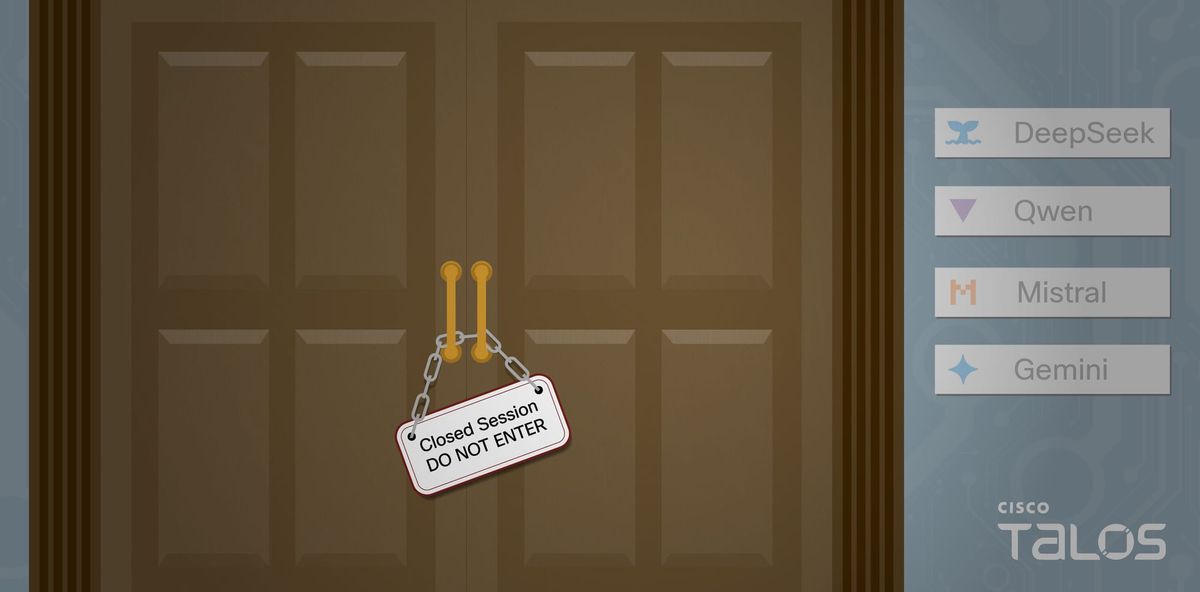 The Closed Quorum: Inside the First Reported Autonomous AI C2 Implant
Cisco Talos' CAIRN project documents CLOSEDQUORUM, a 64-bit Go Windows implant that replaces traditional C2 infrastructure with a panel of up to four commercial LLM providers (DeepSeek, Qwen, Mistral, Gemini) that vote on the implant's next action via plurality voting, with each model queried against a structured JSON decision schema constrained to inject/persist/steal/move actions. Once deployed it autonomously dumps LSASS credentials, steals browser passwords and crypto wallets (MetaMask, Exodus, Ethereum), and exfiltrates AES-256-GCM-encrypted data to an operator's Discord webhook, all without further human tasking. The post details the developer's apparent credentials-as-a-service distribution model, deterministic tie-breaking favoring DeepSeek, and provides SHA256 hashes plus a YARA detection rule for the family (formerly tracked as BALZAK).
blog.talosintelligence.comwriteupAdded 30 Sep 2026, published 22 Sep 2026🛡️ Security- Compromised npm Packages in the AsyncAPI Namespace Deliver Miasma Botnet Loader
Socket's Threat Research Team details a supply-chain compromise of four @asyncapi npm packages (generator-helpers, generator-components, generator, specs) published via a poisoned source commit through GitHub Actions trusted publishing. The packages contain an obfuscated load-time (not install-hook) implant that spawns a detached Node.js process to fetch an IPFS-hosted, AES-256-GCM-encrypted loader delivering the "Miasma" botnet/tasking framework, which supports REST C2, multi-channel comms (Nostr, IPFS, Ethereum RPC, BitTorrent DHT), shell execution, file exfiltration, and systemd persistence. Includes full technical analysis, IOCs, hashes, and MITRE ATT&CK mapping.
socket.devwriteupAdded 21 Sep 2026🛡️ Security - OWASP Agentic Skills Top 10 (AST10)
The OWASP Agentic Skills Top 10 (AST10) is a new security framework cataloging the 10 most critical risks in AI agent "skills" — the behavior layer that orchestrates multi-step tool use in OpenClaw, Claude Code, Cursor/Codex, and VS Code. It documents real 2026 incidents (the ClawHavoc registry-poisoning campaign with 1,184 malicious skills, Snyk's ToxicSkills audit of 3,984 skills finding 36.82% flawed, CVE-2025-59536/CVE-2026-21852 RCE in Claude Code project files, and CVE-2026-28363 ClawJacked WebSocket hijacking) and proposes a Universal Skill Format (YAML) with signing, permission allowlists, and identity-file protections to mitigate them, mapped to CSA's MAESTRO 7-layer threat model.
 github.comrepoAdded 18 Sep 2026🛡️ Security
- OWASP Agentic Skills Top 10 (AST10)
The OWASP Agentic Skills Top 10 (AST10) is a new OWASP project cataloging the 10 most critical security risks in AI agent "skills" — the layer that defines how agents orchestrate multi-step, autonomous workflows across platforms, as opposed to how models talk to tools via MCP. Each risk is mapped to the Cloud Security Alliance's MAESTRO 7-layer threat model for agentic AI systems, aiming to close a gap left by existing LLM- and MCP-focused security guidance.
 owasp.orgotherAdded 16 Sep 2026🛡️ Security
- SenseNova-U1.5: Towards Native Unified Visual Intelligence
SenseNova-U1.5 is an 8B-parameter Mixture-of-Transformers native unified multimodal model that understands, reasons about, and generates visual content within an encoder-free and VAE-free architecture. It uses spatially coherent patch reconstruction, native 4K resolution training, and post-training with specialized experts (aesthetics, bilingual text rendering, infographics, image editing) consolidated via multi-expert on-policy distillation. The paper reports advances in image fidelity, text rendering, complex composition, and multi-reference editing, and plans to open-source training code including SFT, RL, and on-policy distillation.
arxiv.orgpaperAdded 22 Sep 2026, published 10 Sep 2026🧠 AI  OWASP Agentic Skills Top 10 (AST10)
OWASP project page for the Agentic Skills Top 10 (AST10), a framework that lists the 10 most critical security risks in AI agent skills across agent platforms, with mitigations and prevention strategies. It targets the behavior/execution layer of skills, which sits above MCP tool access, and maps each risk to the Cloud Security Alliance's MAESTRO 7-layer threat model. It is a useful reference for threat-modelling agent skill ecosystems.
owasp.orgotherAdded 5 Sep 2026🛡️ Security- Rogue ScreenConnect Installations Across Unrelated Hosts Suggest Worm-Like Activity
Huntress details a campaign in which social-engineering (tech-support scams, Quick Assist, malicious downloads) leads to rogue ScreenConnect installs that deploy a four-stage VBScript loader (1.vbs–4.vbs). The loader profiles the host (checking for EDR products, existing ScreenConnect, RAM size), fetches an AES-encrypted payload via a Dropbox-hosted map file, and drops one of three packages: a user-level backdoor, a persistence/privesc kit, or a tunneling+cryptomining bundle (wstunnel/XMRig plus the vulnerable WinRing0 driver for BYOVD). A backdoored ScreenConnect client then re-pushes the VBScript chain to every newly connected Host session via ScreenConnect's file-transfer API, giving the campaign worm-like self-propagation — which ConnectWise later confirmed stems from CVE-2026-84869, a 9.9 CVSS flaw in unauthorized file-transfer execution, patched in ScreenConnect 26.6.5.
 huntress.comwriteupAdded 8 Sep 2026, published 3 Sep 2026🛡️ Security
- Awesome Cybersecurity Agentic AI
A curated GitHub awesome-list cataloging the emerging agentic-AI security ecosystem: dozens of Model Context Protocol servers that give LLM agents access to security tools (Nuclei, Shodan, VirusTotal, Burp Suite, Ghidra, BloodHound, x64dbg), autonomous penetration-testing and CTF-solving agent frameworks (CAI, pentagi, BreachSeek, Dark-Moon, D-CIPHER), scanners/guardrails that audit agent skills, MCP servers, and multi-agent chains for prompt injection and other risks (Aguara, Inkog, MCP Doctor, AI-Infra-Guard, ATR), agentic SOC/detection platforms (Vigil), threat-modeling frameworks for agentic systems (MAESTRO, ATFAA/SHIELD), research papers, benchmark datasets, and community/learning resources. It functions as a living index for anyone building or defending AI-agent-driven security tooling.
github.comrepoAdded 3 Sep 2026, published 31 Aug 2026🛡️ Security - pgj11: Analysis of Bincrypter and gsocket (gs-netcat)
Deep-dive reverse engineering of a real-world incident where a WordPress site compromised via CVE-2026-18322 was used to drop a bincrypter-obfuscated, statically-linked gs-netcat (gsocket) 1.4.42beta5 binary as a reverse-shell tunnel, persisted via crontab and masquerading as "netd"/"[kthreadd]". The author fully unravels bincrypter's multi-stage shell obfuscation (character-separator tricks, AES-256-CBC/openssl decryption, memfd_create fileless ELF execution via a Perl one-liner) and reveals a custom THC UPX build with zeroed magic bytes/PackHeader used to hide payload identification, along with gsocket's self-embedded XOR-encoded operator configuration. Releases two open-source tools (Bincrypter-Extract, Gsocket-Config-Extract), YARA rules, and an ImHex pattern file, plus full IOCs (C2 IP, GSRN secret, process/memfd artifacts).
 pgj11.comwriteupPublished and added 31 Aug 2026🛡️ Security
 Socket: "Superior" Campaign
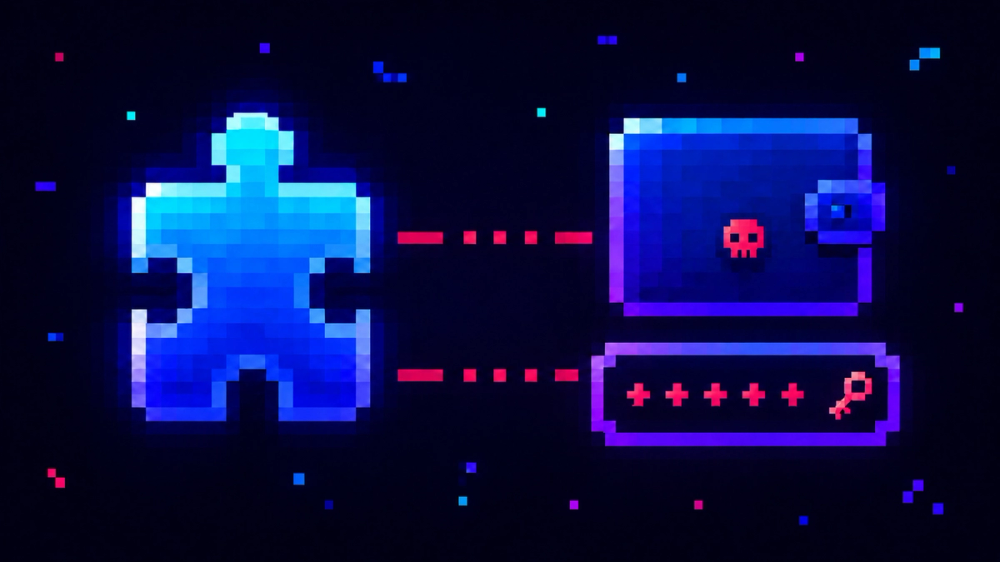
Socket researchers uncovered 19 Chrome and Edge extensions (18 Chrome, 1 Edge) delivering a modular wallet-drainer and credential-stealing framework, tracked as the "Superior" campaign and linked to a 2024 operation first reported by DomainTools and Secure Annex. Threat actors either build extensions from scratch or buy established ones (like "Enable Right Click & Copy — Smart Unlock + OCR" with ~80,000 combined users) and later push malicious updates that strip CSP headers via declarativeNetRequest, open an AES-GCM-encrypted WebSocket C2 channel, and inject JavaScript payloads that phish hardware-wallet seed phrases, hijack wallet-connect flows, harvest exchange session tokens, and serve ClickFix-style fake browser-update lures. The post includes full code snippets, a breakdown of 16+ malicious modules, and a large IOC list of C2 domains and extension IDs.
socket.devwriteupPublished and added 28 Aug 2026🛡️ Security- ADScanPro/Claude-AD
Claude-AD is a Claude Code plugin that packages Active Directory pentest methodology as skills, agents, and slash commands, directing Claude to run standard tooling (netexec, Impacket, certipy, bloodyAD, BloodHound CE) in the correct setup-collection-exploitation-post order. It covers environment constraints that break tooling in hardened domains (AES-only Kerberos, LDAP channel binding, Protected Users, LAPS, gMSA), techniques like Kerberoasting, AS-REP roasting, ADCS ESC1-ESC17, ACL abuse, coercion/NTLM relay (PetitPotam, PrinterBug, DFSCoerce) and delegation abuse with their Windows Event IDs/MDI telemetry, and maps each technique to DORA/NIS2/ENS compliance controls. Exploitation agents require human confirmation before directory-modifying actions.
github.comrepoAdded 2 Oct 2026, published 24 Aug 2026🛡️ Security  Grok chat history leak: Cryptographic Context Injection
Adversa AI describes Cryptographic Context Injection. Attacker instructions are shipped as AES-256-GCM ciphertext with PBKDF2 key material, and the model is induced to decrypt them in its own Python sandbox. The plaintext then appears as trusted runtime output, so guardrails never see it. Demonstrated as zero-click chat-history exfiltration from Grok via a "summarize this page" request, as a safety-policy bypass in Gemini, and, in an update, against GitHub Copilot CLI. The post covers the xAI disclosure timeline (reported June 2026, unfixed) and defenses at the agent harness layer: quarantining untrusted content, gating outbound tool calls, tracing, sequence alerting, and provenance.
 adversa.aiwriteupAdded 24 Aug 2026, published 20 Aug 2026🛡️ Security
 Orca Security: Agentic AI Security
Orca Security's guide to agentic AI security distinguishes it from AI-agent security by framing the unit of risk as the whole autonomous plan/sequence rather than a single agent, and walks through OWASP's Agentic Security Initiative Threats and Mitigations taxonomy (17 threats, T1-T17, v1.1) alongside CSA's MAESTRO layered framework. It details run-level controls (action-class approval thresholds, blast-radius caps, step/time/cost budgets, kill switches, egress boundaries, replayable audit logs) and identity/delegation concerns (RFC 8693 token exchange, orchestrator trust boundaries, permission inheritance across agent chains), then describes how Orca's agentless posture management maps AI services, keys, and data reachable by agentic workflows in the cloud.
 orca.securityarticlePublished and added 14 Aug 2026🛡️ Security
 MAJINAHANASHI RANSOMWARE: Yet Another Japanese Locker
Deep-dive intelligence report on Majinahanashi, a Japanese-themed ransomware group that emerged in August 2026, covering its Tor data-leak site (math-captcha gated, non-vanity domain), victimology (15 victims across Europe/Asia/Latin America, avoiding US/English-speaking countries), and technical analysis of its C/C++ locker sample. The malware uses AES-256 with RSA-wrapped per-file keys, appends the .MAJIN extension, deletes shadow copies/USN journals/event logs via vssadmin/bcdedit/fsutil, hijacks the desktop wallpaper, and uses WFP-based network filtering plus I/O priority manipulation to suppress EDR/backup traffic (targeting CrowdStrike, SentinelOne, Defender, Veeam, etc.). The article includes a full YARA detection rule, the ransom note text, BTC/qTOX/email contact IOCs, and threat-actor profiling ("THE DOCTOR CAME" persona) plus links to Mimikatz and Advanced IP Scanner usage.
 theravenfile.comwriteupAdded 3 Sep 2026, published 14 Aug 2026🛡️ Security
- Bank of America Phishing Email Delivers ScreenConnect Malware
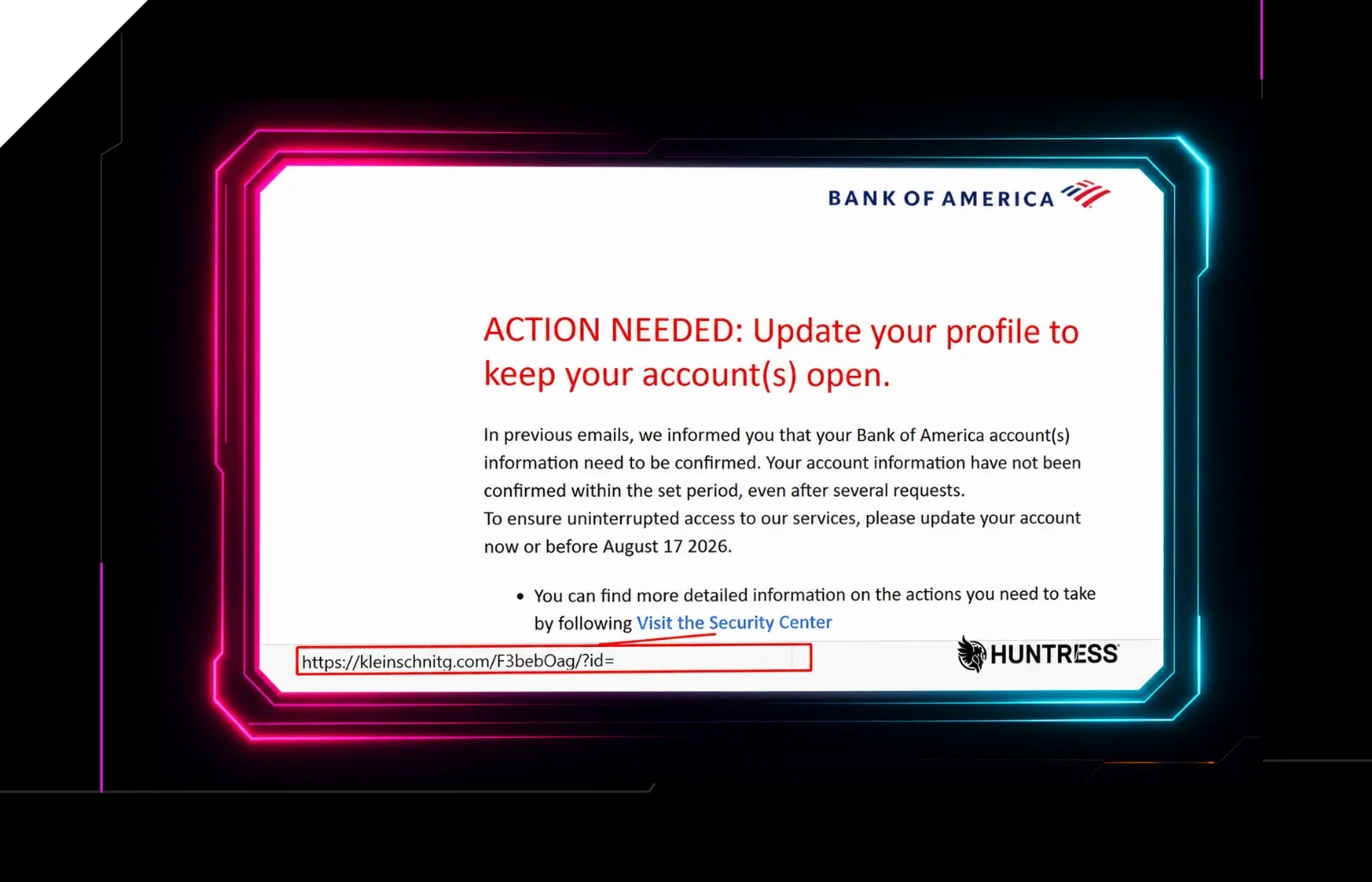
Huntress dissects a Bank of America-themed phishing email that lures victims into downloading AccountGuardSetup.vbs, which unpacks through several layers of base64-encoded PowerShell to silently install ScreenConnect RMM with Administrator privileges. The chain uses AES-128-CBC encrypted blobs to deliver a C# UAC-bypass exploit via the ICMLuaUtil COM interface (MITRE ATT&CK T1548.002), then hides the resulting ScreenConnect service (renamed "Windows Security") from users and admins using SDDL/ACL manipulation so it can't be seen, logged, or removed.
huntress.comwriteupAdded 3 Sep 2026, published 4 Aug 2026🛡️ Security  'ChainDrop' worm compromises hundreds of popular npm packages
ChainDrop is an npm worm that compromised hundreds of packages on 4 August 2026, some with over 150 million weekly downloads, starting from a malicious commit (174f6a5) in the keyv repository. Datadog dissects the Bun-based loader, the obfuscated second stage, credential theft (files, GitHub Actions runner memory, AWS, Kubernetes, Vault), Ethereum smart-contract C2 discovery, AES/RSA exfiltration, an eval channel, and propagation via stolen npm tokens, GitHub branches and Sigstore provenance. IOCs and a list of affected packages are included.
 securitylabs.datadoghq.comwriteupAdded 29 Oct 2026, published 4 Aug 2026🛡️ Security
- Reverse Engineering the Six Stages of MacSync Stealer and RAT
Huntress reverse-engineers MacSync, a macOS stealer-and-RAT chain delivered via a weaponised claude.ai share link promoted through Google Ads malvertising, where a victim searching for how to install Claude on a Mac pastes a curl piped to zsh one-liner. The writeup traces all six stages: a polymorphic zsh loader, a server-side AppleScript that social-engineers Full Disk Access and validates the account password via dscl authonly, keychain and browser Safe Storage theft, a statically-linked C++ Mach-O RAT with WebSocket and AES-CBC C2 plus LaunchAgent persistence disguised as legitimate updaters, a signed Screen Recording-badged helper that phishes the TCC screen-capture permission, and trojanised Electron wallet apps (Ledger Live and Ledger Wallet) that inject a fake recovery-phrase phishing flow. It ties the kit to the AMOS and Atomic Stealer lineage via Russian-language code comments and shared infrastructure, and documents concrete IOCs including domains, C2 IP, mutex naming, and plist patterns for defenders.
huntress.comwriteupAdded 3 Sep 2026, published 29 Jul 2026🛡️ Security - Inside FakeAgent: How a Claude Desktop Malvertising Campaign Hit 29 Organizations with SectopRAT
Huntress details 'FakeAgent', a malvertising campaign that hit 29 organizations by hosting a fake Claude Desktop installer as a public Claude.ai Artifact, which led via DLL-sideloaded loaders (masquerading as JetBrains jcef_helper.exe and IBM SPSS) to a SectopRAT-family .NET RAT. The malware used VMProtect packing, a GPU/DXGI-based anti-VM gate, a DirectX-shader AES-256-CTR decryption routine, and 'EtherHiding' — storing/rotating C2 addresses via Ethereum/BSC transactions — while Huntress used Claude Opus 4.8 to help reimplement the shader crypto and deobfuscate the .NET payload.
huntress.comwriteupAdded 3 Sep 2026, published 22 Jul 2026🛡️ Security - HackingLZ/gibson
Gibson is a Rust-based network monitoring toolkit with a lightweight agent, server, and parser that maps process-to-network connections, detects cloud provider ownership (AWS/Azure/GCP/Cloudflare), flags beaconing candidates and EOL OS risk, and auto-generates iptables/Windows firewall rules. It supports AES-256-GCM encrypted uploads, ASN/ARIN-based IP ownership lookups, and SQL/JSON report exports for cross-host threat hunting.
github.comrepoPublished and added 22 Jul 2026🛡️ Security - CyberSunil/LLMVault
LLMVault is a self-hosted, deliberately-vulnerable training range modeled on WebGoat but for LLM applications, covering 25 labs across the OWASP Top 10 for LLM Applications (2025) - prompt injection, jailbreaking, data/model poisoning, agent exploitation, model extraction, and insecure downstream output handling. It ships two modes: a scored Play Mode with scripted assistants for repeatable flag capture, and an unscripted Live Mode that points the same attacks at a real local Ollama model (qwen2.5:3b-instruct) with a freshly minted per-session secret, requiring the player to actually talk the model into leaking it. Each lab pairs the attack with a written defense explanation, and an expert tier is shipped AES/Fernet-encrypted and unlocked manually by the maintainer.
github.comrepoPublished and added 18 Jul 2026🛡️ Security  AsyncAPI npm packages backdoored via GitHub Actions
Aikido Security details how five @asyncapi npm packages (specs, generator, generator-helpers, generator-components), combined ~2.9M weekly downloads, were backdoored after an attacker exploited an unmerged pull_request_target GitHub Actions vulnerability in asyncapi/generator to steal the npm publish token via 37 flooded PRs. The injected runtime code spawns a detached Node process that downloads an encrypted stage-2 loader from IPFS, decrypts it via HKDF/AES-256-GCM, and drops a persistent remote-shell implant self-identified as 'M-RED-TEAM v6.4' with Miasma-branded artifacts, though credential harvesting and self-propagation are disabled in this build. The post includes full technical detail on the exfiltration flow, IOC strings, IPFS CIDs, and inconclusive attribution linking it to the prior Miasma toolkit and prt-scan campaign.
 aikido.devwriteupAdded 3 Sep 2026, published 14 Jul 2026🛡️ Security
- ThinkWatch
ThinkWatch is a source-available dual-port gateway (Rust/Axum) that proxies both AI provider APIs (OpenAI, Anthropic, Gemini, Azure OpenAI, AWS Bedrock) and MCP tool calls through a single control plane, enforcing authentication, RBAC, rate limits/budgets, and audit logging. Its key differentiator is per-user upstream identity for MCP — propagating each user's own OAuth token/PAT to servers like GitHub/Notion/Slack (AES-256-GCM encrypted, per-key allowlists) instead of a shared service account, plus SSRF-hardened OAuth discovery (RFC 9728/8414/7591), tool-level RBAC, and ClickHouse-backed audit trails forwarded to SIEMs via Syslog/Kafka/webhooks.
github.comrepoPublished and added 4 Jul 2026🛡️ Security 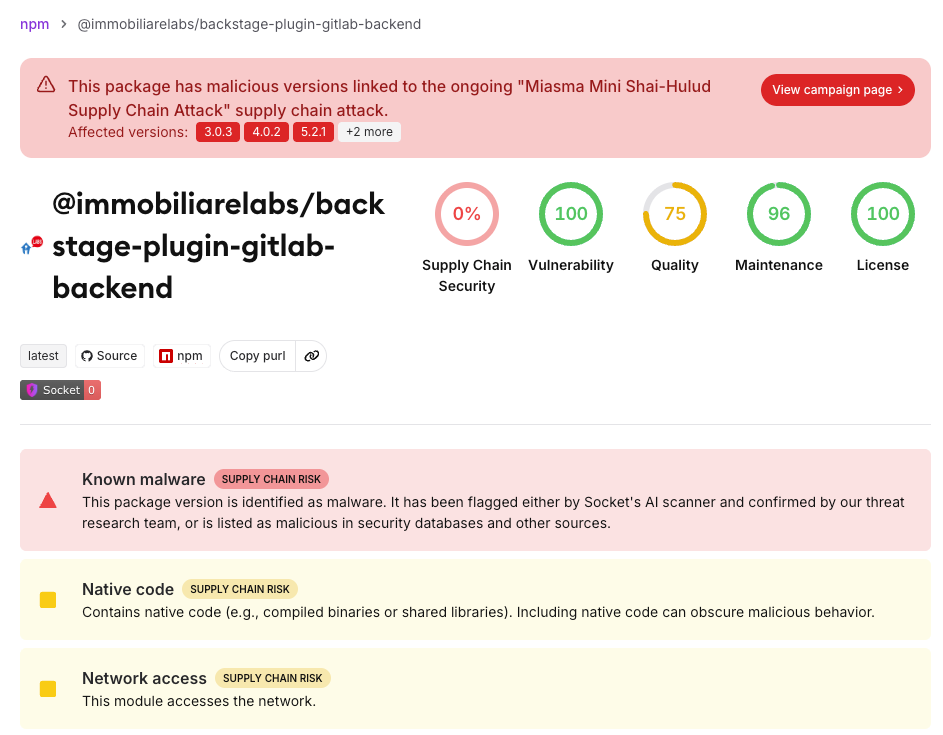 Socket: Miasma Mini Shai-Hulud Hits ImmobiliareLabs npm Packages
Socket Threat Research documents a new wave of the Miasma Mini Shai-Hulud npm supply-chain campaign compromising @immobiliarelabs Backstage plugins for GitLab integration and LDAP authentication, published on June 26, 2026. The malicious tarballs (e.g. @immobiliarelabs/backstage-plugin-gitlab@7.0.2) add a hidden root-level index.js triggered via the "Phantom Gyp" node-gyp binding.gyp trick, which decrypts an AES-128-GCM payload, bootstraps Bun, and steals npm/GitHub/cloud/SSH/CI-CD secrets while planting GitHub Actions and AI-IDE persistence. The report also traces a plausible root cause to the earlier compromise of codfish/semantic-release-action (tag-hijacking reported by StepSecurity) and highlights abuse of GitHub's deployment event trigger — a technique flagged by researcher Adnan Khan — to run attacker workflows without touching protected workflow files.
socket.devwriteupPublished and added 27 Jun 2026🛡️ Security macOS.Gaslight | Rust Backdoor Turns Prompt Injection on the Analyst, Not the Sandbox
SentinelLABS dissects macOS.Gaslight, a Rust macOS implant (tracked via Apple XProtect's MACOS_BONZAI_COBUCH rule, linked to DPRK-aligned BONZAI/AIRPIPE activity) that uses a Telegram Bot API polling channel with AES-GCM-over-pinned-TLS, self-redacts its bot token from runtime logs, stages a runtime-fetched standalone CPython interpreter to run a Python keychain/browser/history stealer, and persists via a fake com.apple.* LaunchAgent. Its standout feature is a 3.5 KB embedded block of 38 fabricated "system" messages mimicking an LLM triage harness's prompt scaffold, engineered to make an AI-assisted analyst tool abort or refuse analysis rather than evade the sandbox itself.
 sentinelone.comwriteupAdded 26 Jun 2026, published 23 Jun 2026🛡️ Security
 Introducing Patch the Planet
Trail of Bits describes the first week of Patch the Planet, a partnership with OpenAI Daybreak pairing engineers and maintainers with frontier models like GPT-5.5-Cyber and Codex to find and fix bugs in open-source projects such as curl, aiohttp, RustCrypto, PyCA, python.org, PyPI, and Sigstore. It reports concrete outcomes: GPT-5.5-Cyber autonomously building a full fuzzing lab with OS-backpressure harnesses in under a day, Codex-driven CVE variant analysis and cross-library differential testing that found an AES-GCM issue in PyCA and X.509 discrepancies, 64 pull requests and 51 issues filed, and aiohttp maintainers fixing eight privately-reported bugs within hours. It closes with maintainer guidance on deduplication, false-positive filtering, and severity correction for the flood of AI-generated reports.
 blog.trailofbits.comarticleAdded 3 Sep 2026, published 22 Jun 2026🛡️ Security
 Socket: npm Package Uses Prompt Injection + Token Flooding to Evade AI Malware Scanners
Socket Threat Research analyzed shai_hulululud@1.0.48596, a ~9.28MB npm package whose index.js opens with a Japanese-language block comment simulating bioweapon-production instructions to trigger LLM safety refusals, follows with a fake 'SYSTEM OVERRIDE' prompt-injection block aimed at AI reviewers, then floods the file with tens of thousands of repeated comment lines (3.5M+ tokens) before appending doubly-obfuscated (character-substitution plus AES) JavaScript. The deobfuscated payload reintroduces the same policy-triggering content and scanner/vendor-referencing strings, and was classified as protestware rather than a functional credential stealer; the piece argues this demonstrates a practical LLM-specific denial-of-service pattern (prompt injection + safety triggers + context flooding + obfuscation) that AI-assisted supply-chain scanners must defend against via deterministic preprocessing, fail-closed behavior, and combining LLM review with static/AST/entropy/behavioral analysis.
socket.devwriteupPublished and added 17 Jun 2026🛡️ Security Microsoft's durabletask PyPI Package Compromised in Supply Chain Attack
StepSecurity documents the compromise of Microsoft's durabletask PyPI package (versions 1.4.1-1.4.3, 400k+ monthly downloads), where an attacker bypassed the GitHub CI/CD pipeline entirely using stolen publishing credentials to inject a dropper for rope.pyz, a modular cloud-intrusion framework with dedicated collectors for AWS, Azure, GCP, Kubernetes, HashiCorp Vault, password managers, and the filesystem. The framework encrypts stolen data with AES-256-GCM/RSA-4096, exfiltrates via HTTPS, GitHub commit beacons, and attacker-created public repos using the victim's own stolen GitHub tokens, propagates via AWS SSM and kubectl exec, and drops a geo-targeted rm -rf wiper for systems matching Israeli locale/timezone markers. The post ties the attack to TeamPCP's Mini Shai-Hulud campaign (same infrastructure as TanStack, Mistral AI, LiteLLM, @antv) and later updates describe a second compromise of the Azure/durabletask GitHub repo that plants payloads triggering in Claude Code, Gemini CLI, Cursor, and VS Code.
 stepsecurity.iowriteupAdded 3 Sep 2026, published 9 Jun 2026🛡️ Security
- Inside .NET Loader Analysis: From Malspam to In-Memory Loader
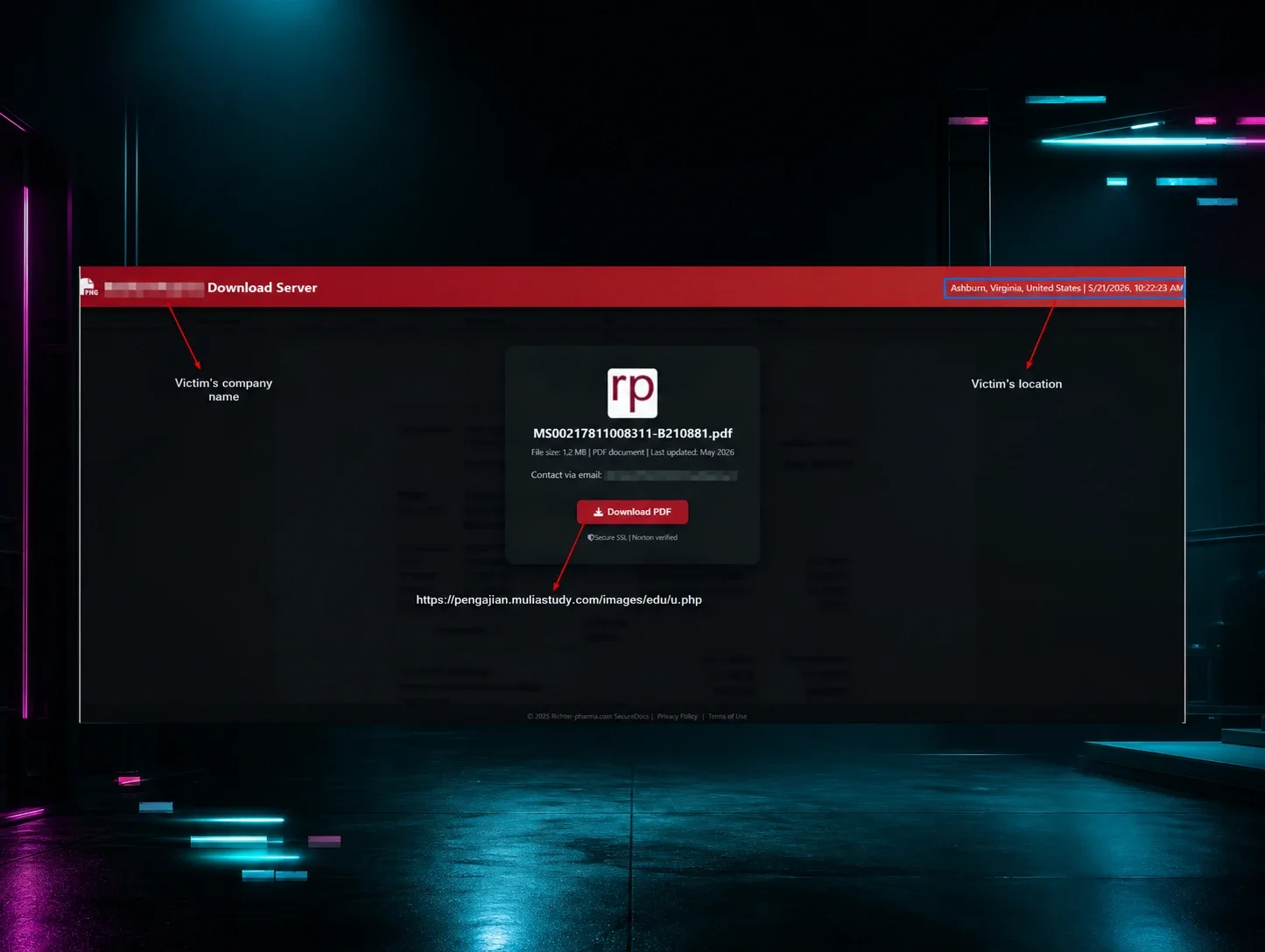
Huntress SOC dissects a multi-stage infection chain that begins with a malspam HTML attachment routed through a legitimate Google DoubleClick tracking link to evade reputation filters, before landing on a self-personalizing phishing kit and dropping a ZIP with a heavily obfuscated JScript loader. The chain cascades through PowerShell droppers into a .NET stager that performs extensive anti-analysis/anti-sandbox checks, disables Windows Defender, patches AMSI (via NtManageHotPatch on Windows 11 24H2) and ETW at the native API level, and uses RunPE process hollowing into InstallUtil.exe or MSBuild.exe to run a final loader that communicates over AES/RSA-encrypted, protobuf-serialized TCP C2 with certificate pinning. The writeup includes GPU-fingerprinting behavior, persistence via registry Run keys and randomized scheduled tasks, and concrete detection/hardening recommendations.
huntress.comwriteupAdded 3 Sep 2026, published 3 Jun 2026🛡️ Security - Tachi
Tachi is a threat-modeling and AI-reasoning vulnerability detection harness that runs inside Claude Code, dispatching 14 specialized agents against an architecture description (Mermaid, C4, PlantUML, free-text, or ASCII) to find logic-level flaws like broken auth flows, missing privilege boundaries, prompt injection paths, and agent autonomy gaps that SAST cannot catch. It claims full 50/50 coverage across five OWASP frameworks (Web/API, LLM, Agentic, ML, Mobile Top 10s), classifies agentic AI findings against the CSA MAESTRO seven-layer taxonomy, and maps findings to MITRE ATT&CK/ATLAS, NIST AI RMF, and CWE, producing threats.md, SARIF, attack trees, quantitative risk scores, compensating-control analysis, and a PDF security report.
github.comrepoAdded 3 Sep 2026, published 23 May 2026🛡️ Security  Supply Chain Attack Targets Laravel-Lang Packages with Credential Stealer
Aikido Security discovered an active supply chain attack against laravel-lang/lang, laravel-lang/attributes, and laravel-lang/http-statuses (233 compromised versions total), where an attacker used GitHub's cross-fork tag feature to point official-looking version tags at commits in a malicious fork, injecting a src/helpers.php dropper that loads via Composer's autoloader. The dropper fingerprints the host, decodes a hidden C2 domain (flipboxstudio[.]info), and fetches a second-stage PHP credential stealer that harvests cloud credentials, Kubernetes/Vault/Docker configs, SSH keys, browser and password-manager vaults, crypto wallets, and VPN configs, exfiltrating AES-256 encrypted data before self-deleting. Aikido reported it to Packagist, which pulled the malicious versions.
aikido.devwriteupAdded 3 Sep 2026, published 23 May 2026🛡️ Security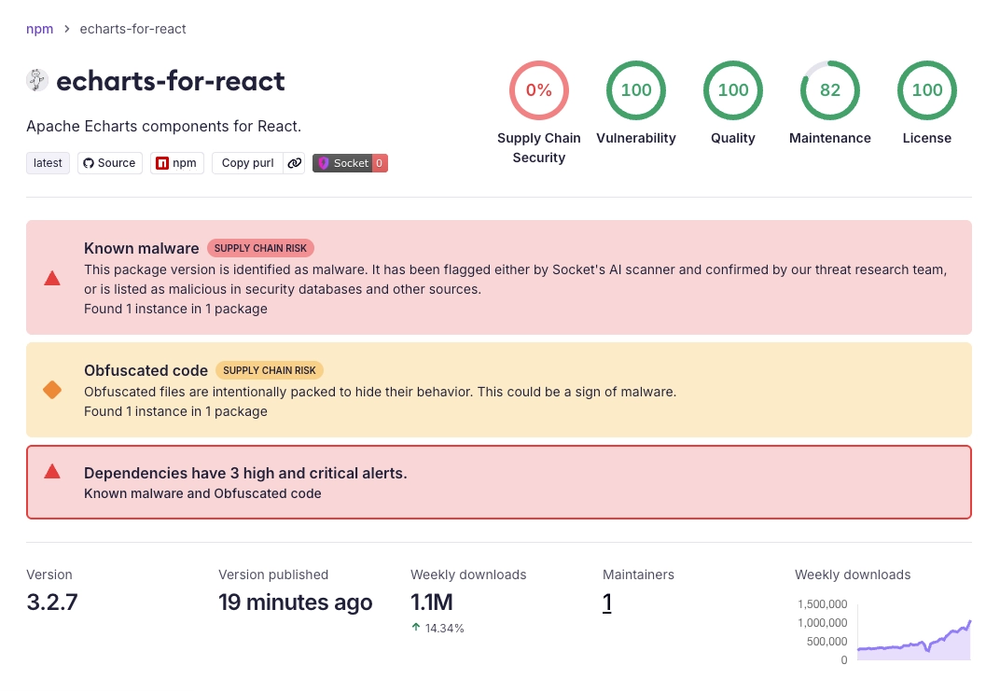 Socket: Mini Shai-Hulud Hits @antv Ecosystem
Socket's Threat Research team documents a Mini Shai-Hulud variant compromising the npm maintainer account "atool," affecting @antv data-visualization packages (g2, g6, x6, l7, s2, f2, graphin) plus echarts-for-react (~1.1M weekly downloads) and others, totaling 639 compromised versions across 323 packages in one wave (1,055 versions/502 packages campaign-wide across npm, PyPI, and Composer). The install-time payload (triggered via a preinstall "bun run index.js" hook) is heavily obfuscated, harvests GitHub/npm/AWS/Kubernetes/Vault/SSH credentials and CI/CD secrets, exfiltrates data via AES-256-GCM+RSA-OAEP encrypted HTTPS to t.m-kosche[.]com and via GitHub repo commits under a reversed "Shai-Hulud: Here We Go Again" marker, and self-propagates by using stolen npm tokens to republish trojanized packages with a malicious @antv/setup GitHub optionalDependency.
socket.devwriteupPublished and added 20 May 2026🛡️ Security Fragnesia: Linux Kernel Local Privilege Escalation via ESP-in-TCP | Wiz Blog
Wiz analyzes Fragnesia, a Linux kernel local privilege escalation in the XFRM ESP-in-TCP subsystem and a new variant of the Dirty Frag family, introduced as a side effect of a Dirty Frag patch. File-backed pages spliced into a TCP receive queue before the socket switches to espintcp ULP mode are decrypted in place, so AES-GCM keystream manipulation gives deterministic single-byte page-cache writes. The PoC uses user and network namespaces for CAP_NET_ADMIN, installs an ESP security association via NETLINK_XFRM, and overwrites /usr/bin/su in page cache to get a root shell. Ubuntu's AppArmor restrictions on unprivileged user namespaces partially mitigate it, and the post recommends vendor patches and disabling the vulnerable modules.
 wiz.ioadvisoryAdded 5 Sep 2026, published 13 May 2026🛡️ Security
 OpenClaw MAESTRO
A researcher applies the MAESTRO 7-layer agentic AI threat model (Foundation Models, Data Operations, Agent Frameworks, Deployment/Infra, Evaluation/Observability, Security & Compliance, Agent Ecosystem) to the OpenClaw messaging-bot agent codebase, cataloging ~30 numbered threats with specific file references (e.g. prompt injection via WhatsApp/Telegram/Discord channels in src/channels/, plaintext credential storage in pairing-store.ts, Docker socket exposure in sandbox configs, gateway loopback-binding bypass, ClawHub skill registry poisoning) alongside existing and recommended mitigations. It closes with a cross-layer chained attack scenario (gateway compromise → session store poisoning → context manipulation → sub-agent hijack → ecosystem spread) illustrating defense-in-depth across layers.
 kenhuangus.substack.comwriteupPublished and added 6 May 2026🛡️ Security




Showing 60 of 67
Show more