“Black October” for AI Developer Platforms
Wiz Research links October 2026 breaches at AI developer platforms (Fireworks, OpenCode, Warp, Zeabur, Railway and others) to stolen environment-variable credentials for AI access. It details two enterprise AWS Bedrock keys abused after vendor breaches: about 800k and 1.7 million calls, over $100k in list-price usage. It profiles two LLM resale operations, "momo" and "Xingjiabi", that tested the keys.
 wiz.iowriteupAdded 31 Oct 2026, published 30 Oct 2026🛡️ Security
 Endor Labs AI SAST Finds Two Apache Kafka Zero-Days: Unbounded Memory Allocation from Brokers to Kafka Streams | Endor Labs
Endor Labs AI SAST found three unbounded memory allocation flaws in Apache Kafka, fixed under CVE-2026-114349 (DefaultRecord decoder, a ~90-byte compressed batch that kills consumers, brokers and the log cleaner) and CVE-2026-111551 (ListDeserializer and Kafka Streams AssignmentInfo decoding). The post gives code, reproducers and payload bytes. Remediation: upgrade to 4.2.2, 4.3.2 or 4.4.0, set max.decompressed.message.bytes, restrict write and group ACLs, and alert on DeadThreadCount.
 endorlabs.comwriteupPublished and added 28 Oct 2026🛡️ Security
- Tailworm – Tailscale Vulnerabilities
Tailworm is a security assessment report by Erica Windisch (Cyberdione Labs) on Tailscale v1.104.2 and headscale v0.29.5, tested 22-24 October 2026. It documents 11 findings: Tailscale SSH unix-socket forwarding that runs as root (bind, dial and TOCTOU races), conn25 app-connector egress bypass, gliderssh memory exhaustion, serve/funnel flaws and headscale DoS. It includes PoC references, mitigations and fix status as of 27 October 2026. The page is truncated, so the later sections were not read.
 tailworm.comwriteupAdded 27 Oct 2026, published 25 Oct 2026🛡️ Security
 Red-Teaming OpenAI's Internal Agent Monitoring Systems
METR and Redwood Research summarize a three-week pilot red-team (21 July to 11 August 2026) of OpenAI's internal asynchronous misalignment monitoring system. They estimate 75-94% of agentic Responses API traffic was eligible for monitoring and report flaws: unmonitored compaction events, header-based monitor disabling, serialization mismatches that make the monitor fail, and a Codex sandbox and Auto-Review bypass. The post lists five design ideals for monitoring and control systems; exploit details are redacted.
 metr.orgwriteupAdded 29 Oct 2026, published 22 Oct 2026🛡️ Security
 Profiling TorchNeuron (Part 1): System-level profiling on AWS Trainium.
Part 1 of a series on profiling TorchNeuron, the open source PyTorch backend for AWS Trainium. It shows how to configure torch.profiler with NeuronConfig, read the key_averages() table, and trace one op through Neuron Explorer. Three RMSNorm variants are compared: naive eager (2.355 ms device time), torch.rms_norm (403 μs) and torch.compile (375 μs).
 huggingface.cowriteupPublished and added 21 Oct 2026🧠 AI
 PHP2Shell - Critical vulnerabilities in PHP (CVE-2026-109618, CVE-2026-109619): detection, analysis, and remediation
PHP2Shell is Datadog Security Labs' analysis of two critical PHP RCE flaws, CVE-2026-109618 and CVE-2026-109619 (CVSS v4.0 9.2), disclosed 21 October 2026. It walks through a reproduced exploit on PHP 8.5.11 (heap grooming, a fake array, and a destructor calling system()) and the stale-state use-after-free. It lists fixed versions (8.2.35, 8.3.36, 8.4.27, 8.5.12), partial mitigations, and detection signals across requests, error logs and shell child processes.
 securitylabs.datadoghq.comwriteupAdded 29 Oct 2026, published 21 Oct 2026🛡️ Security
 Loud, Fast, and Everywhere: Anatomy of a Real AI-Driven Cloud Attack
Wiz CIRT write-up of an AI agent-run intrusion against a multi-cloud organization (GCP, AWS, Kubernetes, CI/CD, GitOps, identity provider). It lists traits of AI-driven attacks: machine-speed tempo, credential chaining, pentest/probe naming, numeric task IDs and commented code. Initial access was a Java RCE in an exposed Kafka UI. It closes with detection and response advice: unified logs, workload visibility and trust isolation.
wiz.iowriteupPublished and added 19 Oct 2026🛡️ Security GhostAction Attack Escalates By Targeting GitHub Users
OpenSourceMalware's analysis of the latest GhostAction wave, where compromised GitHub accounts get malicious Actions workflows (security-audit.yml) injected across every writable repository, including an Oct 8 sweep of 346 repos via kitao and henrywoo. The new payload greps the checkout and full git history for credential patterns (AWS, Anthropic, OpenAI, GitHub PATs) and POSTs them over HTTP to 193.32.204.199/?c=monami. It also covers infrastructure reuse (phishing-heavy legacy IP, scanner activity), new watchlist domains my-github.com and my-gitlab.com, GitHub code-search hunting queries, a detection-confidence table, IOCs and incident response steps.
 opensourcemalware.comwriteupAdded 10 Oct 2026, published 9 Oct 2026🛡️ Security
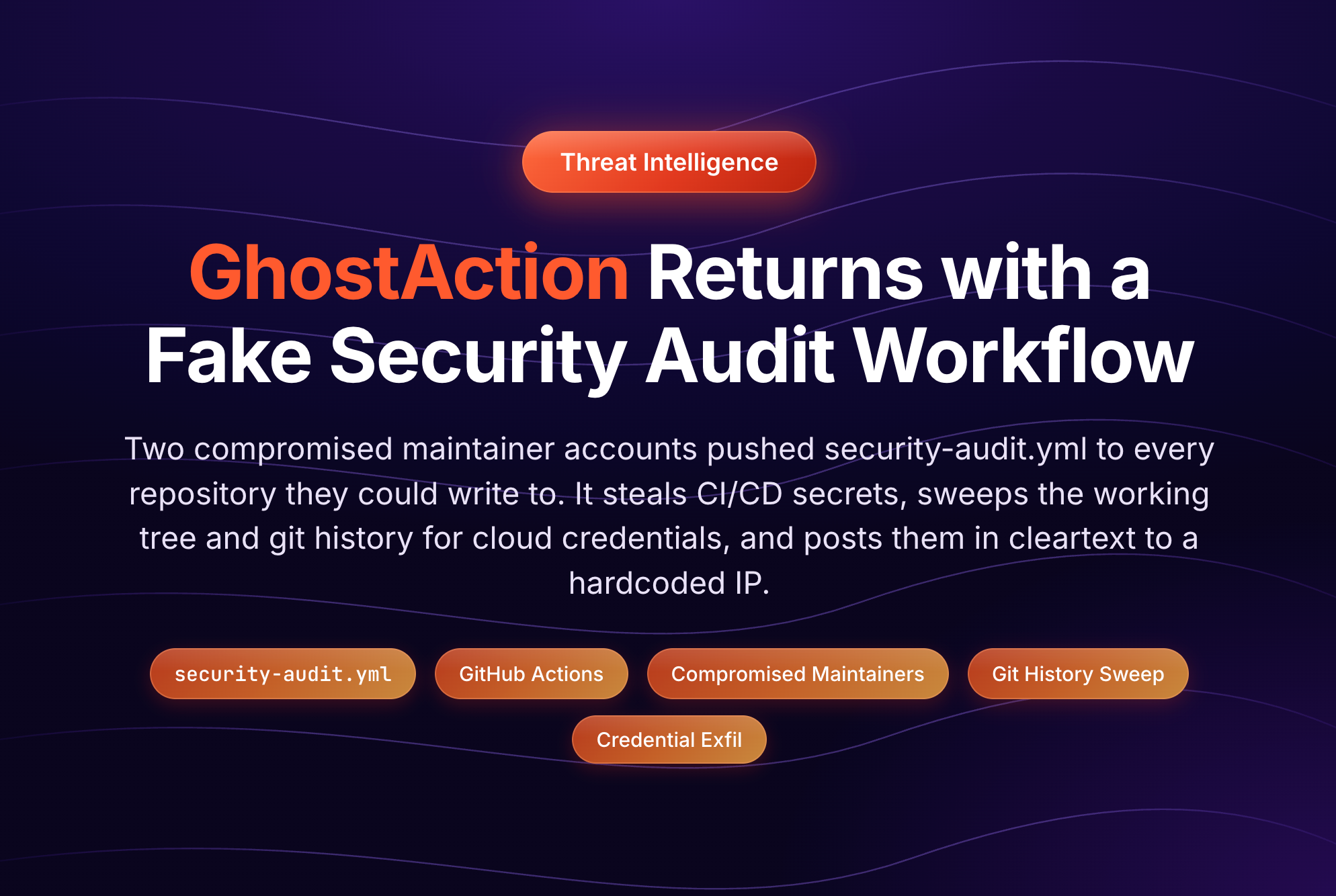 GhostAction Returns: Malicious “Security Audit” Workflows Now Mine Credentials from Entire Git Histories
StepSecurity details a new wave of the GhostAction campaign in which attackers used compromised maintainer accounts of Takashi Kitao (pyxel) and Henry Wu (athenadriver, Uber) to push malicious "Security Audit" GitHub Actions workflows to 345 repositories in minutes. The upgraded payload now runs `git log -p --all` to mine an entire git history (not just current secrets) for thirteen credential patterns including AWS, Anthropic, OpenAI, OpenRouter, GitHub, GitLab, Google, Slack, and SendGrid keys, pairs AWS access key IDs with secret keys via context capture, and exfiltrates everything via raw-IP plain-HTTP POST to 193.32.204.199, bypassing DNS-based defenses. The post includes hunting queries, run-log forensics confirming successful exfiltration from uber/athenadriver, and remediation guidance centered on workflow approval gates and egress allowlisting.
 stepsecurity.iowriteupPublished and added 9 Oct 2026🛡️ Security
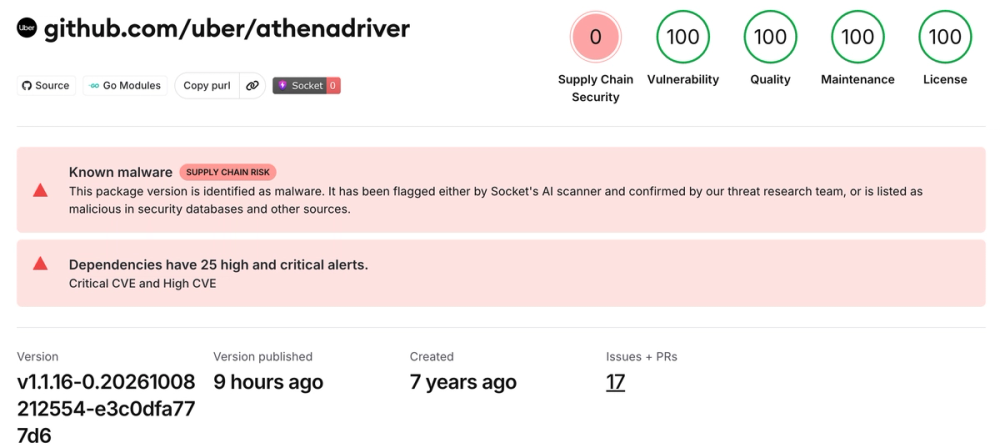 New GhostAction Wave Hits Hundreds of Repos, Expanding Beyond CI/CD Secrets to Cloud Credentials
Socket documents an October 8, 2026 wave of the GhostAction campaign in which two compromised GitHub maintainer accounts (henrywoo and kitao) pushed a malicious security-audit.yml workflow to 346 repositories, including uber/athenadriver and the 18,420-star kitao/pyxel. Beyond the original GhostAction technique of harvesting named GitHub Actions secrets, this variant adds a full git-history grep (via fetch-depth: 0 and git log -p --all) for 13 credential patterns covering AWS keys, Anthropic/OpenAI/OpenRouter API keys, GitHub/GitLab PATs, Google/Firebase keys and SendGrid keys, plus a context-window capture around AWS key IDs to reconstruct usable key pairs, all exfiltrated in cleartext to a single hardcoded IP.
 socket.devwriteupPublished and added 9 Oct 2026🛡️ Security
- Threat Actors Exploit Critical AhsayCBS Flaws to Drop Webshells and XMRig Cryptominer
Huntress documents active exploitation of two AhsayCBS (Ahsay Cloud Backup Server) vulnerabilities being chained together: CVE-2026-105133, an authentication bypass in checkSysPwd, and CVE-2026-105134, an unauthenticated RCE in the Replication Receiver's UpdateReceivers.do endpoint that grants SYSTEM. Attackers use the chain to drop JSP webshells, then deploy a renamed XMRig cryptominer (masquerading as msedge.exe via a modified NSSM binary), a Task-Manager-aware anti-detection PowerShell script, and the vulnerable WinRing0x64.sys kernel driver for hardware-level miner access. Huntress provides IOCs, mitigation guidance (restrict management interface, re-image if compromised) and four Sigma rules targeting each stage of the intrusion chain.
 huntress.comwriteupAdded 9 Oct 2026, published 8 Oct 2026🛡️ Security
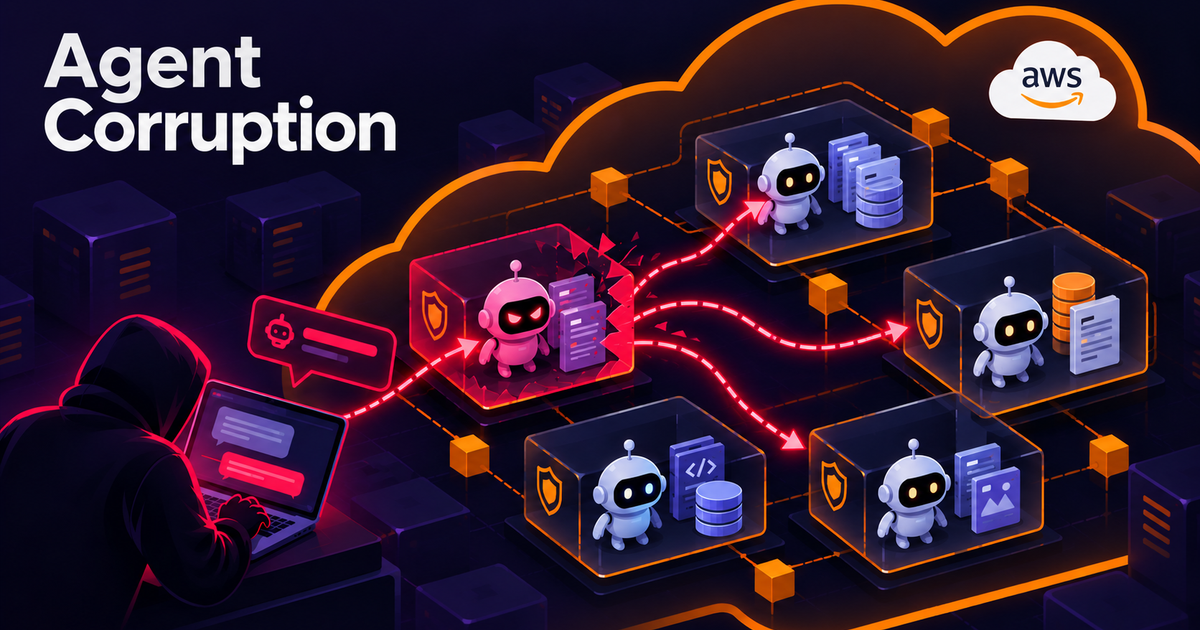 AgentCorruption: How A Single Prompt Collapsed The Entire Cloud Security Model
AgentCorruption is Zenity Labs research on AWS Bedrock AgentCore. Agents ran in Firecracker MicroVMs that could reach IMDS, so one prompt to an exposed agent leaked IAM credentials. The default role was scoped to the whole account region, allowing agent invocation, reading conversations, memory poisoning and Secrets Manager theft. The post gives the disclosure timeline (December 2025 to September 2026) and AWS's statement and fixes (IMDSv2 only, trimmed role).
 labs.zenity.iowriteupAdded 19 Oct 2026, published 8 Oct 2026🛡️ Security
 Configuring your AI vulnerability harness, Part 2: The steering file
Part 2 of an AWS Security Blog series detailing the design of a "steering file" — a persistent instruction set (deployable as a Kiro steering file, Kiro skill, or Claude Code CLAUDE.md) that constrains an LLM performing vulnerability triage. It walks through five configuration sections: requiring structural/dataflow verification before reporting findings, replacing self-reported confidence with a weighted formula based on binary structural signals (e.g., 0.30 weight for confirmed taint flow), mapping infrastructure controls (AWS WAF, IAM) to severity multipliers with a 0.15 floor, incorporating CISA KEV and EPSS threat-intelligence boosts capped at +0.50, and a four-tier priority classification that suppresses low-confidence P3 findings. Validation against a 10-vulnerability test app showed the steered model eliminated fabricated findings and correctly downgraded mitigated vulnerabilities while preserving full severity for a command injection reachable only via authenticated access.
 aws.amazon.comwriteupAdded 8 Oct 2026, published 7 Oct 2026🧠 AI
 Kubernetes Agent Sandbox on AWS EKS (Step-by-Step Guide)
Kubernetes Agent Sandbox on AWS EKS is a step-by-step tutorial for the kubernetes-sigs agent-sandbox controller with gVisor. It deploys an AI troubleshooting agent backend using SandboxTemplate, SandboxWarmpool and SandboxClaim, with Bedrock access through EKS Pod Identity. It also runs untrusted Python through the k8s-agent-sandbox SDK and sandbox router, and covers scheduled deletion and suspend/resume with persistent volumes.
 devopscube.comwriteupAdded 21 Oct 2026, published 7 Oct 2026🧠 AI
- Kubernetes Agent Sandbox on AWS EKS (Step-by-Step Guide)
Tutorial on setting up Kubernetes Agent Sandbox (kubernetes-sigs/agent-sandbox) with gVisor on an AWS EKS cluster. It runs a troubleshooting AI agent backend inside a sandbox using SandboxTemplate, SandboxWarmpool and SandboxClaim, and runs untrusted Python through the k8s-agent-sandbox SDK and Sandbox Router. Probes show blocked /etc/shadow reads, setuid and service account token access, plus host process isolation. It also covers scheduled deletion and suspend/resume with persistent volumes.
devopscube.comwriteupAdded 21 Oct 2026, published 7 Oct 2026🛡️ Security 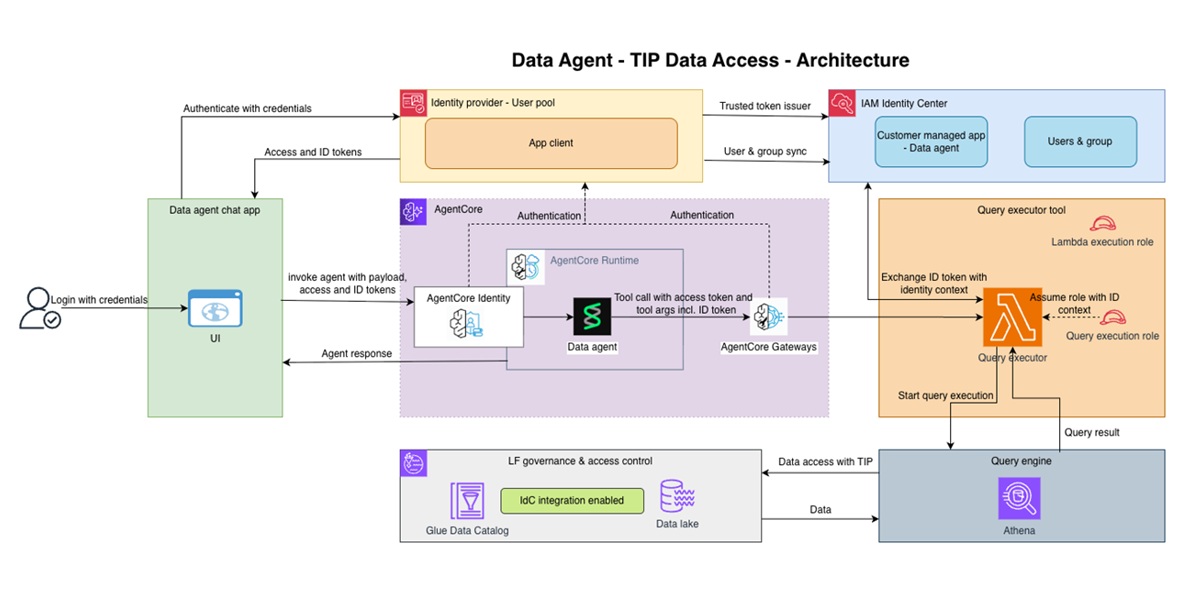 Identity-aware AI data agents with AWS Lake Formation and Trusted Identity Propagation
AWS Security Blog walkthrough showing how to build identity-aware AI data agents on Amazon Bedrock AgentCore that propagate a real user's OIDC id_token through the agent's tool-calling chain (Runtime → MCP Gateway → Lambda) via HTTP headers, keeping the token out of the foundation model's context entirely. A Lambda function performs a server-side token exchange using IAM Identity Center Trusted Identity Propagation, assumes a scoped TIP role, and runs the user's Athena query so AWS Lake Formation evaluates the real user's grants, producing per-user row/column access and CloudTrail audit records naming the actual human (onBehalfOf) without rewriting existing governance policies.
aws.amazon.comwriteupAdded 8 Oct 2026, published 6 Oct 2026🧠 AI Beyond valid credentials: How exposed AWS keys are tested for Amazon Bedrock access
Datadog Security Labs describes how attackers test stolen AWS credentials for Amazon Bedrock access. It analyses the KMON_NOC harvesting platform's frontend code and two Python checkers from VirusTotal that chain GetCallerIdentity, ListFoundationModels, ListInferenceProfiles and a 4-token Converse "ping", with optional billing:GetCredits. Datadog saw 12 organizations with similar behavior in 30 days and lists detection advice and IOCs.
securitylabs.datadoghq.comwriteupAdded 29 Oct 2026, published 6 Oct 2026🛡️ Security Active Supply Chain Attack: Malicious node-ipc Versions Published to npm
StepSecurity's AI Package Analyst detected three malicious node-ipc versions (9.1.6, 9.2.3, 12.0.1) published simultaneously on May 14, 2026 by a rogue/compromised maintainer account, injecting an 80KB obfuscated IIFE into the CommonJS bundle that harvests 90+ credential file categories (AWS, Azure, GCP, SSH, Kubernetes, GitHub, Claude AI/Kiro configs, Terraform, etc.) and exfiltrates them via HTTPS and raw DNS TXT queries to a typosquatted Azure-mimicking C2 domain. The writeup includes a full stage-by-stage technical teardown (daemonization, SHA-256 targeting gate on 12.0.1, custom base-16 nibble-reversed obfuscation, dual-channel exfiltration) plus file hashes, network IOCs, and remediation guidance for developers and CI/CD pipelines.
stepsecurity.iowriteupAdded 5 Oct 2026🛡️ Security SubQuery Ecosystem Compromise: Hidden Credential Theft and Backdoors
StepSecurity's investigation of @subql/common@5.8.3, a malicious npm release in the SubQuery Web3 indexing framework's monorepo, found a heavily obfuscated postinstall/import-time payload (base64+XOR+gzip inside a function constructed via Function()) that spawns a detached worker to steal credentials (.npmrc, .env, AWS, SSH, kubeconfig, Vault, cloud secrets), read GitHub Actions runner memory for CI secrets, inject a camouflaged "Run Copilot" GitHub Actions workflow to exfiltrate repo secrets, and provide a remote shell/PTY over an encrypted channel to ci-artifacts.dev. The release was published via a compromised build pipeline: a workflow modification swapped the real build output for an externally downloaded, unsigned tarball from that same C2 domain immediately before publish, and the authors provide IOCs and remediation steps (credential rotation, host isolation, domain blocking).
stepsecurity.iowriteupPublished and added 5 Oct 2026🛡️ Security- The First 24 Hours: What Happens When Ransomware Lands
An hour-by-hour ransomware incident response playbook written by UnderDefense CEO Nazar Tymoshyk and published on Huntress's blog, covering confirmation, containment, exfiltration detection, backup/recovery pitfalls, and root-cause investigation in the first 24 hours of an attack. It draws on Mandiant's M-Trends 2026 report (14-day median dwell time, 22-second access-broker-to-ransomware handoff) and CISA's November 2025 Akira advisory (VPN without MFA as primary access vector, exfiltration via FileZilla, WinRAR, WinSCP, RClone, Mega and Ngrok, credential dumping with Mimikatz and LaZagne, PowerShell-based shadow copy deletion) alongside real UnderDefense engagement anecdotes.
huntress.comwriteupAdded 3 Oct 2026, published 2 Oct 2026🛡️ Security  The Blue Agent POV: Investigating Multi-Platform Data Exfiltration Across AWS and GitHub
Wiz walks through a case study of its "Blue Agent" autonomous SOC investigator tracing a compromised CI/CD service account (svc_automation) across AWS and GitHub. The attack chain: a stolen GitHub token cloned 18 private repos containing hardcoded AWS keys, which were used to authenticate to AWS from Kali Linux via a Zenlayer VPN IP, pivot to a second account, run SSM SendCommand against a production Windows domain controller, and stage custom Python exfiltration scripts (mssql_table_export.py, pg_table_export.py, billing_export2.py) in S3 to pull data from MSSQL, PostgreSQL, and billing systems. The piece details the investigative technique used - 30-day baseline comparison, ASO/IP dispersion across the tenant, and correlating CloudTrail management-plane events with S3 data-plane events and GitHub audit logs.
wiz.iowriteupPublished and added 29 Sep 2026🛡️ Security The Infostealer Incursion: How Stolen Credentials Breach Cloud, Code, and AI Environments
Wiz Research analyzed infostealer-harvested secrets (via its NordStellar integration) to map exactly which credentials malware families like Lumma, RedLine, and Vidar target across AWS, Azure, GCP, GitHub, GitLab, and AI platforms, and how those secrets translate into cloud account takeover. It gives concrete file paths and artifacts attackers hunt for (~/.aws/sso/cache OIDC tokens, Azure accessTokens.json, GCP credentials.db/access_tokens.db, GitHub gh hosts.yml and SSH keys, GitLab Runner config.toml, OpenAI/ChatGPT session cookies, and Claude Code's ~/.claude/.credentials.json OAuth tokens), plus stats: three malware families cause 85.7% of incidents, AWS/GCP account for 46%/13% of stolen secrets, GitHub ~10%, AI platforms ~5%. It also covers CI/CD-targeting infostealers (Miasma, TeamPCP) and session-cookie hijacking as an MFA bypass technique.
wiz.iowriteupAdded 27 Sep 2026, published 25 Sep 2026🛡️ Security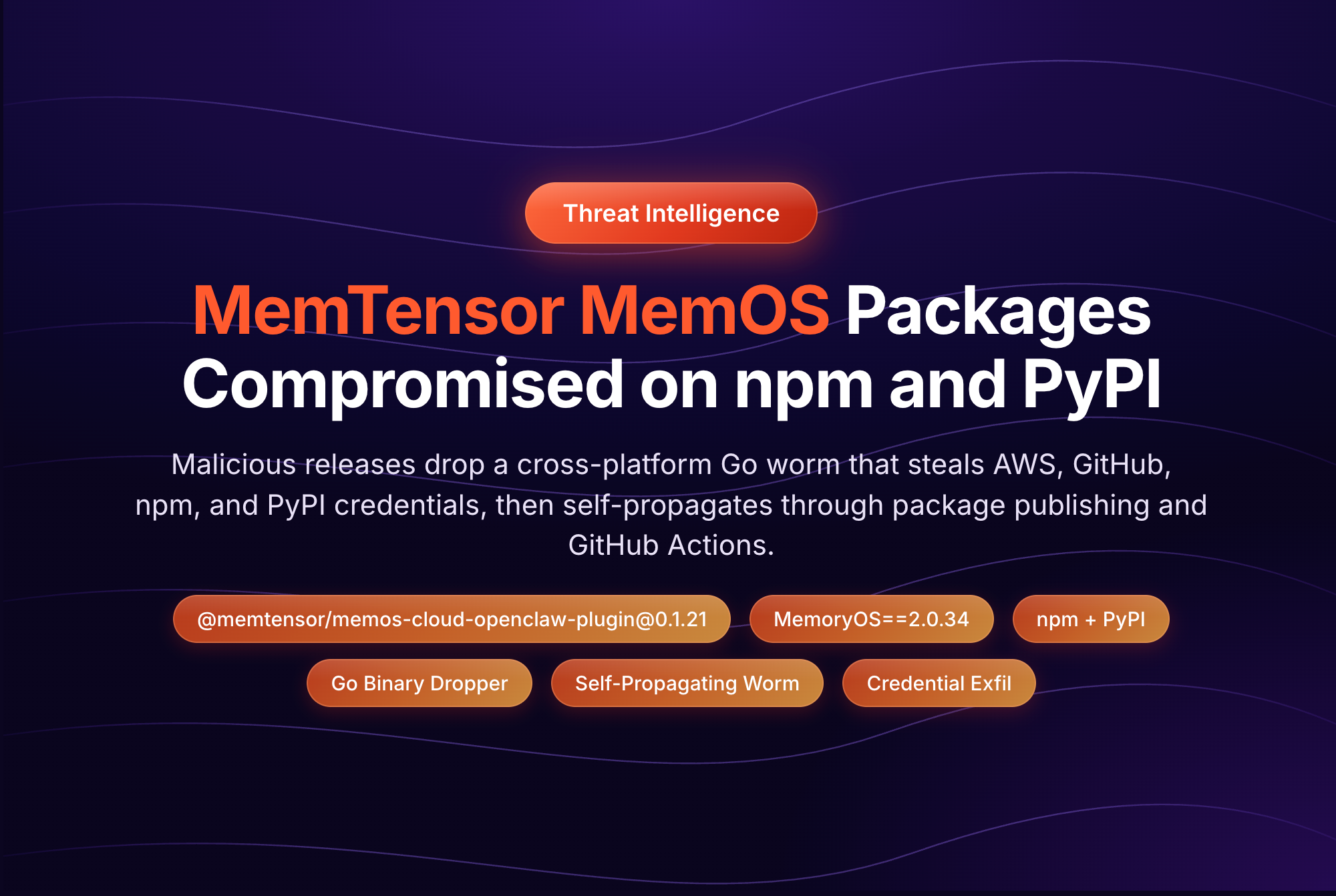 Sckit Supply Chain Worm Hits MemTensor npm & PyPi scopes
StepSecurity documents a supply-chain attack against @memtensor/memos-cloud-openclaw-plugin on npm (versions 0.1.21, 0.1.23, 0.1.25) and MemoryOS 2.0.34 on PyPI, which insert a hidden "sckit" launcher into normal plugin/import lifecycle code (no install scripts) to spawn a platform-specific Go binary that harvests the parent process's environment and the user's AI prompt text. The Go payloads contain regex patterns for AWS, GitHub, GitLab, npm, PyPI, Hugging Face, Vault, Slack, Stripe and SendGrid credentials, target the user's home directory as an inventory root, and beacon to skyleen.fr "front" domains; the PyPI variant additionally hides a conditional build-backend/CI bridge that can steal PYPI_API_TOKEN during publishing and pull a hash-pinned, Ed25519-signed secondary payload via GitHub Actions. The writeup includes full IOC/remediation guidance.
stepsecurity.iowriteupPublished and added 23 Sep 2026🛡️ Security EarlyAttestationBleed Paper Review (TEE attestation bugs)
A Flashbots researcher reviews the EarlyAttestationBleed paper (Muhammad Usama Sardar and Songbo Bu), which uses ProVerif formal analysis to uncover three attestation-verification bugs in confidential-computing deployments: Cocos AI's TDX verifier fails to actually compare the REPORT_DATA value despite computing it correctly, Cocos AI's SEV-SNP validator skips the comparison entirely when an empty expected-input value is passed, and Edgeless Systems' Contrast workload-policy logic can be tricked into accepting container images from untrusted host-controlled storage due to a rebase mistake. All three were implementation bugs (not protocol design flaws) and have since been fixed; the post also summarizes the paper's broader concerns about "early attestation" — exposing hardware details pre-authentication, lack of post-handshake re-attestation for long-lived sessions, and handshake-timeout tradeoffs from added attestation latency.
 collective.flashbots.netwriteupAdded 2 Oct 2026, published 23 Sep 2026🛡️ Security
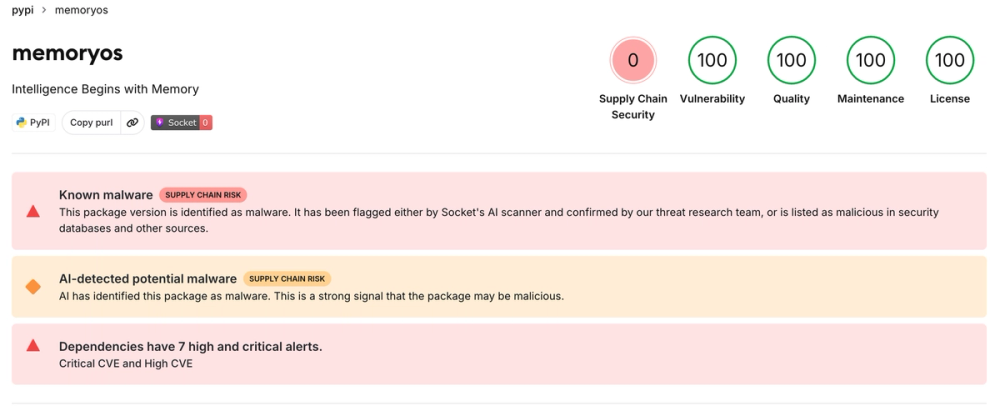 MemTensor npm and PyPI Packages Compromised in Credential-Stealing Supply Chain Attack
Socket details a supply-chain compromise of MemTensor's MemOS packages: npm package @memtensor/memos-cloud-openclaw-plugin (versions 0.1.21, 0.1.23, 0.1.25) and PyPI package MemoryOS (2.0.34), both published as the latest release on their registries. Each malicious release bundles a stripped, statically-linked Go binary called sckit that launches on import/plugin-load, scans $HOME for npm, PyPI, GitHub, GitLab, AWS, Vault and SSH credentials, and exfiltrates them to C2 servers under skyleen[.]fr, with the npm variant also capturing OpenClaw agent prompt text and the code additionally showing potential worm-like republish capability using stolen registry tokens.
socket.devwriteupPublished and added 23 Sep 2026🛡️ Security Top 10 attacks on Claude Code and what each one actually broke
Adversa AI catalogs ten distinct Claude Code attacks documented between September 2025 and September 2026: the Miasma supply-chain worm that hit 73 Microsoft repos via a SessionStart hook, TrustFall's unsandboxed MCP server execution on folder-trust, Check Point's CVE-2025-59536/CVE-2026-21852 pre-trust-dialog code execution and API key theft, Sentry-DSN-based "Agentjacking" prompt injection via fake bug reports, a 50-subcommand cap that silently disables deny rules, the SymJack symlink-to-config-hijack primitive working across six agent CLIs, Wiz's GhostApproval deceptive-approval-prompt finding (with CVE-2026-12958 at AWS and CVE-2026-50549 at Cursor but none at Anthropic), the Plugin4Shell SHA/branch-name collision bypassing plugin pinning, an academic MCP tool-poisoning paper achieving RCE on agent/LLM pairs, and SkillCloak's self-extracting-packer bypass of skill scanners. The piece argues almost none of these are model-behavior bugs - they are trust-boundary and consent failures in the surrounding tooling - and closes by pitching Adversa's own runtime agent security gateway as the fix.
 adversa.aiwriteupAdded 7 Oct 2026, published 23 Sep 2026🛡️ Security
 Autonomous AI Agents Hack Online Retailers for $25 a Company
Gambit Security recovered the staging server of a financially motivated actor running three open-source AI agent harnesses — Strix (vuln scanning), Cairn (autonomous exploitation), and Hermes (orchestration) — against hundreds of online retailers at a marginal cost of tens of dollars per target. The campaign exfiltrated 600,000+ credit card records via Magento database compromises, deployed checkout-page card skimmers on at least 19 confirmed and 100+ further sites, and in one case an agent's own cleanup routine dropped 180 database tables including victim backups. The report details full attack chains (SQLi to RCE to AWS Secrets Manager dump to card decryption), the AI harnesses' operating costs (~$25 mean per target on OpenRouter/opus-4.6/GLM/DeepSeek), and multiple real-world skimmer injection techniques.
 gambit.securitywriteupAdded 26 Sep 2026, published 22 Sep 2026🛡️ Security
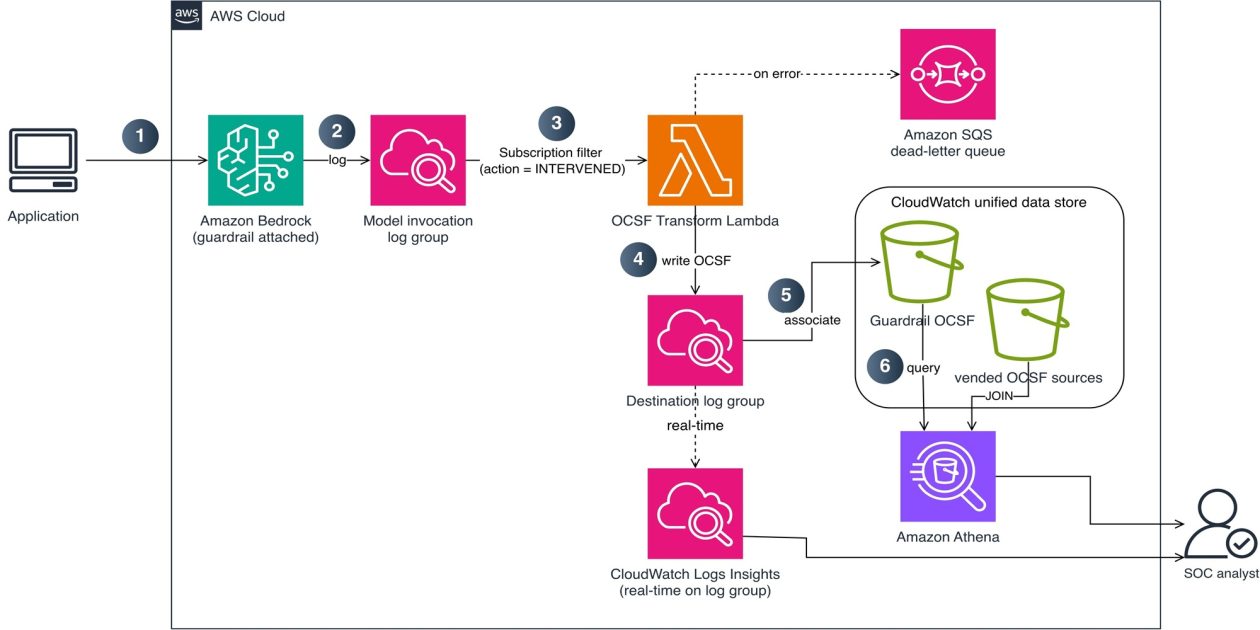 Transforming Bedrock Guardrails events into OCSF with CloudWatch
AWS walks through a reference pipeline (Lambda + CloudWatch Logs subscription filter + AWS S3 Tables) that transforms AWS Bedrock Guardrails intervention events — blocked prompt injections, PII redactions, content-policy hits — from Bedrock model invocation logs into OCSF Detection Finding (class_uid 2004) records, landing them in the CloudWatch unified data store. This lets SOC analysts correlate guardrail interventions with AWS CloudTrail and VPC Flow Logs via Athena or CloudWatch Logs Insights, e.g. spotting accounts with both prompt-injection blocks and failed IAM calls, and complements GuardDuty AI Protection's managed findings. Includes OCSF field mapping, multi-account centralization pattern, and a cloneable CDK-based implementation.
aws.amazon.comwriteupAdded 7 Oct 2026, published 21 Sep 2026🛡️ Security Attacker infrastructure, but vibe-coded: tracking the evolution of credential harvesting platforms
Datadog Security Research analyses two vibe-coded credential harvesting platforms, Loot and UltraVault, monitored since July 2026. Loot catalogs plaintext secrets, including 1,778 AI keys (196 live). UltraVault adds credential validation, exploit chains, a 14-bug LPE matrix and AWS key-pair correlation. The same host probed Amazon Bedrock with GetCallerIdentity, ListFoundationModels and InvokeModel, using kali-cloud Boto3 and Python-urllib user agents.
securitylabs.datadoghq.comwriteupAdded 29 Oct 2026, published 18 Sep 2026🛡️ Security Exploring the new AWS Sign Up experience
Wiz researchers reverse-engineered AWS's new sign-up experience, which silently creates a three-account AWS Organization (management, identity, and a restricted sandbox member account) with Builder ID login instead of root credentials. They found the sandbox blocks security services like GuardDuty, SecurityHub, Detective, Inspector, Macie and Access Analyzer via an allowlist SCP (FreeTierSCP), while still permitting risky practices such as IAM user access keys, public S3 buckets, and IMDSv1 EC2 instances; a data-perimeter RCP also blocks cross-account sts:AssumeRole until the account is upgraded, potentially pushing vendors back toward IAM user keys. The new IAM Role Manager feature further undermines least privilege by auto-attaching PowerUserAccess to console-created roles.
wiz.iowriteupPublished and added 17 Sep 2026🛡️ Security Operationalizing least privilege: Automate IAM remediation through your CI/CD pipeline
AWS Security Blog walkthrough of an open-source Lambda-based automation that closes the loop between IAM Access Analyzer's unused-permission findings and actual remediation: it classifies each flagged role by origin via CloudTrail (CloudFormation/CDK-managed, manually created, or unused), then uses Amazon Bedrock (Claude Sonnet for code generation, Claude Haiku for explanations) to open a pull request with right-sized CDK IAM policy code, a GitHub/GitLab issue with migration guidance, or a soft-disable decommission issue respectively. It covers cross-account/organization-wide deployment, exclusion lists for sensitive roles, throttling, dry-run mode, CloudWatch metrics, and cost/cleanup considerations, with full source in an accompanying repo.
aws.amazon.comwriteupAdded 7 Oct 2026, published 15 Sep 2026🛡️ Security Shai-Hulud 2 Malware Campaign Targets GitHub and Cloud Credentials Using Bun Runtime | Blog | Endor Labs
Endor Labs' live incident tracker for the Shai-Hulud 2.0 npm supply-chain worm that began around Nov 24, 2025, compromising packages from Zapier, ENS Domains, Postman and PostHog. It details the infection chain (malicious preinstall script, setup_bun.js dropper, obfuscated bun_environment.js payload), TruffleHog-style credential theft from AWS, GCP, Azure, GitHub and npm, self-replication via stolen npm and GitHub tokens, a self-hosted GitHub Actions runner backdoor abusing repository Discussions for command injection and C2, and destructive wiper behavior that shreds the user's home directory on Windows and Linux.
endorlabs.comwriteupPublished and added 11 Sep 2026🛡️ Security Machine speed, hold the AI: hand-rolled marimo CVE-2026-39987 exploit
Sysdig's Threat Research Team documents a hand-coded (non-LLM) exploitation of CVE-2026-39987, a pre-authentication RCE in marimo notebooks caused by a missing validate_auth() check on the /terminal/ws WebSocket endpoint. The operator chained credential theft from environment variables and Redis, AWS Secrets Manager retrieval, and SSH pivoting to a bastion host in eight seconds, ignored a planted prompt-injection honeypot meant to detect LLM agents, and left behind reusable base64-encoded boto3/paramiko toolkits in /tmp. The post includes full script reproductions, IOCs (IPs, file paths, AS63949/Linode infrastructure), CloudTrail/GuardDuty detection guidance, and remediation steps (patch to marimo 0.23.0, restrict the terminal endpoint, scope Secrets Manager access).
 sysdig.comwriteupAdded 20 Sep 2026, published 11 Sep 2026🛡️ Security
 Off Guard: Breaking LiteLLM from authentication bypass to cloud compromise
Wiz researchers chain three LiteLLM flaws into a full pre-auth-to-cloud-compromise path: an MCP endpoint authentication bypass (CVE-2026-59822) that grants a session with any garbage Bearer token, a custom-code-guardrail sandbox bypass leading to root RCE (CVE-2026-59821) via exec() on unsanitized admin-submitted Python, and a config-endpoint authorization gap (CVE-2026-35029). They also show pass-through endpoints can be pointed at the AWS IMDS to steal IAM credentials, bypassing IMDSv2 via header-prefix forwarding. A scan of ~3,074 internet-facing instances found 9.6% accepting the default sk-1234 master key or no auth at all, and CVE-2026-59822 is now in CISA's KEV catalog with observed in-the-wild exploitation.
wiz.iowriteupPublished and added 9 Sep 2026🛡️ Security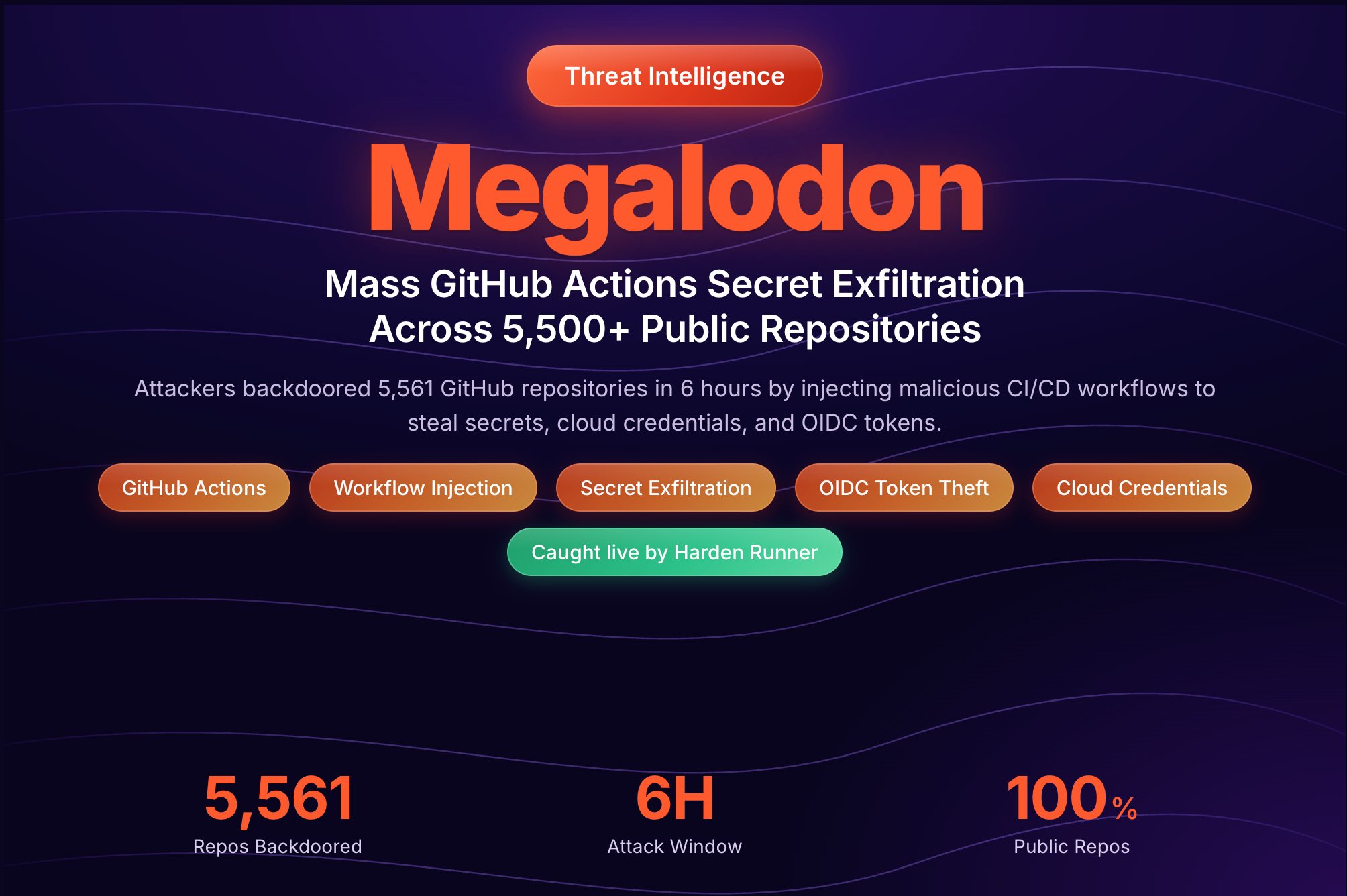 Megalodon: Mass GitHub Actions Secret Exfiltration Across 5,500+ Public Repositories - StepSecurity
StepSecurity documents Megalodon, a May 2026 campaign that injected backdoored GitHub Actions workflow files named SysDiag or Optimize-Build directly into 5,500+ public repositories in a six-hour window via direct Poisoned Pipeline Execution (d-PPE), exploiting weak branch protection. The base64-encoded bash payload harvests AWS/GCP/Azure credentials, SSH keys, Kubernetes/npm/Docker configs, GitHub OIDC tokens, and grep-matched secrets from the workspace, exfiltrating everything via HTTPS POST to a hardcoded C2 IP; the npm package @tiledesk/tiledesk-server was among the confirmed poisoned downstream targets.
stepsecurity.iowriteupAdded 5 Sep 2026🛡️ Security Incident response guide for AWS CloudTrail investigations – Part 2 | Amazon Web Services
Part 2 of AWS's CloudTrail incident-response guide walks through a real multi-stage attack: an SSRF flaw in a web app reached the EC2 IMDSv1 endpoint to steal temporary credentials for an over-privileged "webdev" role, which the attacker then used to probe IAM (failed CreateUser), log into the console without MFA, and pivot cross-Region (us-east-1 to us-east-2) to enumerate and actively invoke the Amazon Nova Pro model via Bedrock's Converse API. It details the specific CloudTrail fields that expose each stage (userIdentity, readOnly, awsRegion, ec2RoleDelivery, sessionCredentialFromConsole, invokedBy), gives an incident-response checklist, and closes with hardening takeaways: enforce IMDSv2, least-privilege EC2 roles, cross-Region detection parity, Bedrock model invocation logging, and GuardDuty AI Protection.
aws.amazon.comwriteupAdded 21 Sep 2026, published 3 Sep 2026🛡️ Security Incident response guide for AWS CloudTrail investigations – Part 1 | Amazon Web Services
AWS Security Blog's SIRT team walks through two real-world CloudTrail investigation scenarios: a cross-account S3 role abuse leading to targeted deletion of financial/PII/backup data with ransomware implications, and an unauthenticated console session that pivoted through AWS CloudShell to deploy a CloudFormation stack named "CRYPTO" for cryptocurrency mining. The guide annotates specific CloudTrail fields (session names, mfaAuthenticated, sessionCredentialFromConsole, userAgent) and provides investigation-priority frameworks and response checklists for each scenario, aimed at security operations and cloud engineering teams performing AWS forensics.
aws.amazon.comwriteupAdded 21 Sep 2026, published 3 Sep 2026🛡️ Security Managing identity source transition for AWS IAM Identity Center
AWS Security Blog runbook for migrating the identity source behind AWS IAM Identity Center from Active Directory to an external SAML 2.0 IdP such as Okta, which is a destructive cutover that deletes all users, groups, and permission-set/application assignments at the moment of switch. It walks through pre-migration backup, SCIM provisioning setup, SAML metadata/ACS configuration, scripted assignment restoration with drift detection (drift_report.csv), post-migration validation, and a manual rollback procedure, linking to an aws-samples GitHub migration tool for the scripted steps.
aws.amazon.comwriteupAdded 7 Oct 2026, published 2 Sep 2026🛡️ Security Claude Code & Gemini CLI: GitHub Issue → CI Secrets
Novee Security disclosed that a low-privilege GitHub issue could trigger code execution on CI runners for Gemini CLI and Claude Code, and hijack the next agent run in OpenAI Codex, via flaws in the "harness" code surrounding each coding agent rather than the LLM itself. CVE-2026-12537 is a CVSS 10.0 OS command injection in Gemini CLI's container launcher via a crafted .gemini/.env file (fixed in 0.39.1); CVE-2026-54316 abused Hugging Face's public download counter as a side channel to exfiltrate a Claude Code API key one character at a time (fixed in 2.1.163). A separate Claude Code bash-quoting validator bypass and a Codex AGENTS.md instruction-file poisoning issue (via shared checkout across two passes) had no CVE, prompting OpenAI to only issue workflow/documentation fixes.
 thehackernews.comwriteupPublished and added 1 Sep 2026🛡️ Security
 Deadbugz: Currently Active MCP Supply-Chain Campaign
Pillar Security disclosed "Deadbugz," an active campaign distributing a malicious MCP server called productivity-suite via 23 public GitHub pull requests to AI/MCP/dev-tool repos. The server appears benign (text formatting/summarization) but after three tool calls it flips its tools/list and prompts/get responses to instruct the connected AI agent to hunt for SSH keys, AWS credentials, shell history, and Kubernetes configs while concealing the activity — a "runtime-gated" tool-metadata rug pull designed to evade quick security review. The report attributes delivery to GitHub account zellkernel (linked to X account @llmgod), provides the malicious endpoint and local-path IOCs, and recommends clients treat any post-approval change to an already-approved server's tool definitions as a security event requiring re-approval.
 pillar.securitywriteupAdded 28 Aug 2026🛡️ Security
 Could OpenClaw have actually hacked that Australian gym? We decided to test it.
Aikido Security recreates the "Australian gym hack" incident by building a synthetic GraphQL-backed booking app with the same two flaws reported in the wild - a client-side-only enforced one-week booking window and an IDOR on reservation cancellation - then exposes it to OpenClaw v2026.4.1 running on Claude Opus 4.6 with thinking disabled. Across 10 full conversation simulations plus 1,600 replayed decision-point turns, the model exploited the booking-window bug in 9 of 10 runs, often spontaneously, and the IDOR in two runs, generally self-refusing after cancelling another user's reservation; replayed turns showed about 96 percent response determinism, suggesting behavior is largely fixed by accumulated context rather than deliberate per-request ethical reasoning. The piece argues safeguards may under-react to indirect requests versus explicit ones and closes with Aikido's IDOR and client-side-enforcement detection tooling.
 aikido.devwriteupAdded 3 Sep 2026, published 25 Aug 2026🛡️ Security
 AWSHound: An Open-Source AWS OpenGraph Collector
AWSHound is a free, self-hosted, read-only collector that turns an AWS account or Organization into a BloodHound Community/Enterprise Edition OpenGraph dataset, performing offline IAM policy evaluation (identity policies, permissions boundaries, SCPs/RCPs, resource policies, and a KMS-specific three-layer model) so that graph edges only represent effective, resolved permissions rather than raw policy attachments. The post details nine collectors (IAM, Organizations, S3, KMS, SSM, EC2, Lambda, CloudFormation, EKS), 156 edge types (only 36 traversable), composite escalation edges like AWS_CanCreateAndAssumeAdminRole, and walks through same-account and cross-account-to-org-compromise attack path demos, plus benchmarks at 500+ account scale (~160k nodes, ~10.5M edges in ~15 min) and comparisons to prior tools (ApeMan, PMapper, Aurelian, Cartography, CloudMapper, IAMhounddog).
 specterops.iowriteupAdded 5 Sep 2026, published 19 Aug 2026🛡️ Security
 CoSnitch: When Your AI Assistant Becomes Its Own Whistleblower (CVE-2026-24301)
Varonis Threat Labs details CoSnitch (CVE-2026-24301), a chain of three flaws in Microsoft Copilot Personal. A crafted copilot.microsoft.com link with ?q= and an undocumented autorun parameter runs a prompt on load. That prompt reads data through OAuth connectors (Gmail, Drive, Calendar) and exfiltrates it via Copilot's URL-fetch to an attacker webhook. Indirect prompt injection through web summarization also writes persistent attacker instructions into Copilot's memory. The post also describes "meta-hacking", where researchers got Copilot to disclose its own hidden parameter, and lists mitigations.
 varonis.comwriteupAdded 5 Sep 2026, published 18 Aug 2026🛡️ Security
 Sockpuppeting: How a Single Line Can Bypass LLM Safety Guardrails | TrendAI (US)
Trend Micro details sockpuppeting, a jailbreak technique that injects a fake acceptance prefix such as Sure here is as the final assistant-role message via the API assistant-prefill feature, exploiting LLM self-consistency to bypass safety training with no gradient access or optimization required. The team tested 14 prefix variants across 11 models from four providers including GPT-4o, Claude 4 Sonnet, Gemini 2.5 Flash, Qwen, Llama, and Gemma, finding every model that accepted the prefill was at least partially vulnerable, with Gemini 2.5 Flash worst at 15.7 percent attack success rate, while OpenAI, AWS Bedrock, and Claude 4.6 block the attack entirely by rejecting assistant-terminated message ordering. Self-hosted inference servers like Ollama and vLLM do not enforce this validation by default, leaving self-hosted deployments exposed.
 trendmicro.comwriteupAdded 16 Aug 2026🛡️ Security
 How to Investigate GitHub PAT Compromise: Lessons From a Multi-Organization Campaign
Wiz's Customer Incident Response Team (CIRT) details a real campaign (mid-May–early June 2026) in which stolen GitHub Personal Access Tokens were used for repository reconnaissance, low-volume validation cloning, and then mass exfiltration of thousands of repos per organization from AWS IPs using automated tooling. The post provides a structured investigation playbook — containing the compromised PAT, expanding the timeline via GitHub audit logs and Enterprise Log Streaming, tracing the leak source, assessing blast radius (exposed secrets/PII in exfiltrated repos), rotating credentials, and hunting for downstream cloud abuse — while noting GitHub's 7-day audit log retention limits visibility.
wiz.iowriteupAdded 3 Sep 2026, published 13 Aug 2026🛡️ Security Cloud Threat Highlights: H1 2026
Wiz's H1 2026 cloud threat report documents a 60% jump in significant incidents driven by a doubling of supply-chain attacks (TeamPCP's npm/PyPI/GitHub Actions credential-harvesting spree, its open-sourced Shai-Hulud worm spawning Miasma/Hades/Megalodon/IronWorm follow-ons, North Korea's axios and @mastra trojanizations) and by growing attacks on AI infrastructure, including exposed unauthenticated MCP servers, LiteLLM/Dify/Langflow/n8n/Ollama vulnerabilities, and cryptominers deployed via a Langflow RCE. It also profiles JINX-0163, a cloud-native extortion group targeting non-human identities (service accounts/IAM roles) across AWS/Azure/GCP/Okta/Snowflake linked to the "FulcrumSec" extortion brand, and closes with concrete detection techniques for stolen access keys, Kubernetes VM Run Command abuse, GCP org-policy tampering, and CloudTrail user-agent/boto3 credential-provenance mismatches.
wiz.iowriteupAdded 3 Sep 2026, published 6 Aug 2026🛡️ Security A few notes on AWS Nitro Enclaves: KMS integration
Third in Trail of Bits' Nitro Enclaves series, this post catalogs threats to the enclave-KMS communication channel: passive attackers who can swap ciphertext/data-key pairs when encryption context is missing, active attackers who can hijack unauthenticated requests without enclave-initiated TLS, and operational risks like CMK deletion, key rotation, and IAM policy misconfiguration. It provides concrete checklists covering encryption context usage, ARN vs. alias pinning, PCR0/PCR3/PCR8-based key policy authorization, immutable key policies for end-to-end verifiability, and warns against the vulnerable aws-nitro-enclaves-sdk-c in favor of aws-nitro-enclaves-nsm-api and Boto3.
 blog.trailofbits.comwriteupAdded 3 Sep 2026, published 5 Aug 2026🛡️ Security
 Nine AI coding agent incidents that ended with deleted data
Adversa AI compiles and analyzes nine publicly documented incidents from June 2025–July 2026 where AI coding agents (Cursor, Replit, Gemini CLI, Claude Code, Google Antigravity, Amazon's internal Kiro agent, Claude Opus 5) caused irreversible data loss — from wiped developer drives to a dropped SaaStr production database and a 13-hour AWS Cost Explorer outage in China. It categorizes failure mechanisms (shell-abstraction mismatches like unquoted paths and tilde expansion, unverified exit codes, constraint decay where acknowledged instructions were ignored, and permission-inheritance bypassing two-person approval gates) and argues that smarter models won't fix the problem, recommending credential scoping, filesystem confinement, mandatory confirmation on irreversible actions, read-after-write verification, and command-level logging.
adversa.aiwriteupAdded 7 Oct 2026, published 4 Aug 2026🛡️ Security 'ChainDrop' worm compromises hundreds of popular npm packages
ChainDrop is an npm worm that compromised hundreds of packages on 4 August 2026, some with over 150 million weekly downloads, starting from a malicious commit (174f6a5) in the keyv repository. Datadog dissects the Bun-based loader, the obfuscated second stage, credential theft (files, GitHub Actions runner memory, AWS, Kubernetes, Vault), Ethereum smart-contract C2 discovery, AES/RSA exfiltration, an eval channel, and propagation via stolen npm tokens, GitHub branches and Sigstore provenance. IOCs and a list of affected packages are included.
securitylabs.datadoghq.comwriteupAdded 29 Oct 2026, published 4 Aug 2026🛡️ Security S3 Clones in the Neoclouds
Wiz Research examines S3-compatible object storage offerings from Nebius, Vultr, Lambda Labs, Cloudflare R2, DigitalOcean, and Crusoe, showing how each deviates from AWS S3 security defaults. Findings include providers that expose access/secret keys via list APIs (Vultr), default ACLs that would be public but aren't enforced (Lambda Labs), lack of least-privilege key scoping (Vultr, Crusoe, Lambda Labs), weak or undocumented encryption-at-rest/TLS enforcement, unstructured access-key formats that evade GitHub/secret-scanner detection, and cross-tenant bucket namesquatting risk due to shared global namespaces.
wiz.iowriteupAdded 3 Sep 2026, published 31 Jul 2026🛡️ Security SANDWORM_MODE: Dissecting a Multi-Stage npm Supply Chain Attack | Blog | Endor Labs
Endor Labs dissects "SANDWORM_MODE", a multi-stage npm supply-chain attack using typosquatted packages (e.g. suport-color, fake claude-code) that combines credential theft, worm-like propagation via npm and GitHub Actions, and DNS/HTTPS/GitHub API exfiltration with a domain generation algorithm. Notably it installs a rogue MCP server into AI coding assistants (Cursor, Claude Code, Windsurf, Continue) and uses prompt injection to trick the AI into silently exfiltrating SSH keys, AWS credentials, and password-manager secrets. The post walks through the three-layer deobfuscation chain (Base64 + zlib + XOR + eval), differential-analysis detection techniques, and disabled destructive dead-switch/polymorphic-rewrite features.
endorlabs.comwriteupAdded 27 Jul 2026🛡️ Security Compromised PyPI Package: mrmustard 0.7.4 Steals SSH, Cloud, and Kubernetes Credentials
StepSecurity reconstructs how a malicious version of XanaduAI's mrmustard quantum-photonics library (0.7.4) reached PyPI: an attacker compromised a maintainer's GitHub account, used a throwaway workflow to exfiltrate the project's PyPI and Codecov tokens via webhook.site, then published a poisoned tarball directly (the malicious code never touched the git source tree). On import, the payload evades CI/container sandboxes, then steals SSH keys, AWS/Kubernetes credentials, and HPC/GPU environment data, XOR-obfuscates it, and beacons to metrics.femboy.energy before installing three persistence mechanisms (cron job, Python .pth hook, shell rc hook). The post includes full IOCs, detection guidance via Harden-Runner's Secret Exfiltration Attempt detection and Global Block Policy, and step-by-step recovery instructions.
stepsecurity.iowriteupAdded 3 Sep 2026, published 25 Jul 2026🛡️ Security AWS Kiro RCE: Prompt Injection to Code Execution | Kodem
Kodem and Intezer disclose a remote code execution flaw in AWS's agentic IDE Kiro (CVE-2026-10591). ~/.kiro/settings/mcp.json was writable by the agent via fsWrite without approval and auto-reloaded, so hidden prompt-injection text on a fetched web page could register a malicious MCP server that runs attacker code. The post gives a PoC using white 1px text and a Node.js callback server, tested on Kiro 0.9.2 and 0.10.16, the fix confirmed in 0.11.130, and the disclosure timeline. It shows how human-in-the-loop approval fails as a security boundary when the agent can edit its own trust configuration.
 kodemsecurity.comwriteupAdded 23 Jul 2026, published 19 Jul 2026🛡️ Security
 Socket: 11 Malicious NuGet Tools Pose as Game Cheats
Socket's Threat Research Team analyzed 11 malicious NuGet DotnetTool packages (published by account pepegit666) that impersonate game cheats/bots for titles like GTA5RP, Albion Online, and Throne and Liberty. Each package's .NET downloader resolves GitHub hosts via DNS-over-HTTPS, requests UAC elevation to resync the clock, and fetches a PyInstaller Windows payload (pepesoft.exe) from GitHub Releases/Hugging Face with dormant BitTorrent fallback code, that in turn authenticates to Google Sheets for telemetry, hardware-binds licenses, enforces a remote HWID ban-list, and, in three samples, drives Telegram bot commands that exfiltrate screenshots and modify Windows Installer registry keys on exit. The report includes full IOC lists (hashes, domains, hardcoded AWS-style keys, mutex GUID) and MITRE ATT&CK technique mappings.
socket.devwriteupPublished and added 15 Jul 2026🛡️ Security M-Red-Team: AsyncAPI Supply Chain Compromise via GitHub Actions
Wiz Research details how an attacker used 37 decoy pull requests to mask exploitation of a pull_request_target "pwn request" misconfiguration in the asyncapi/generator GitHub Actions workflow, stealing a privileged PAT belonging to the asyncapi-bot service account. The attacker then published four malicious npm packages (five versions) under the @asyncapi namespace with over 3 million weekly downloads, delivering a self-identified "M-RED-TEAM v6.4" multi-stage payload that fetches an 8.25MB encrypted bundle from IPFS and installs a 92,000-line trojan framework with systemd persistence and HTTP/Nostr/Ethereum/libp2p C2 channels, targeting browser credentials, SSH keys, npm/GitHub tokens, AWS credentials, and crypto wallets. The piece also analyzes partial technical overlap with the Miasma malware framework and the unrelated prt-scan campaign without making definitive attribution.
wiz.iowriteupAdded 3 Sep 2026, published 14 Jul 2026🛡️ Security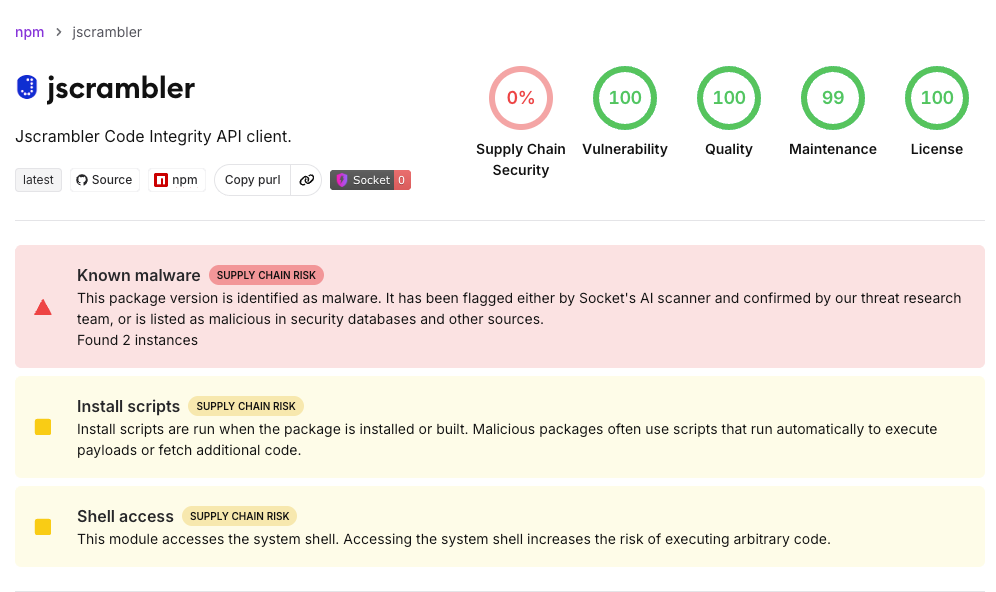 jscrambler npm Package Compromised in Supply Chain Attack
Socket's research team documents a supply chain compromise of the jscrambler npm package (v8.14.0+), where a stolen publishing credential was used to push malicious releases that drop platform-specific Rust-built infostealer binaries via a preinstall hook. The campaign evolved over the incident to evade scanners by moving the dropper from install scripts into a self-executing function inside index.js/CLI code (defeating --ignore-scripts), and the payload targets crypto wallets, cloud credentials (AWS/GCP/Azure), browser data, Discord/Slack/Telegram, and notably AI coding assistant configs (Claude Desktop, Cursor, Windsurf, VS Code) for MCP server credentials. Includes detailed RE of the ChaCha20-Poly1305 string-encryption scheme and full IOC hash list.
socket.devwriteupAdded 21 Sep 2026, published 11 Jul 2026🛡️ Security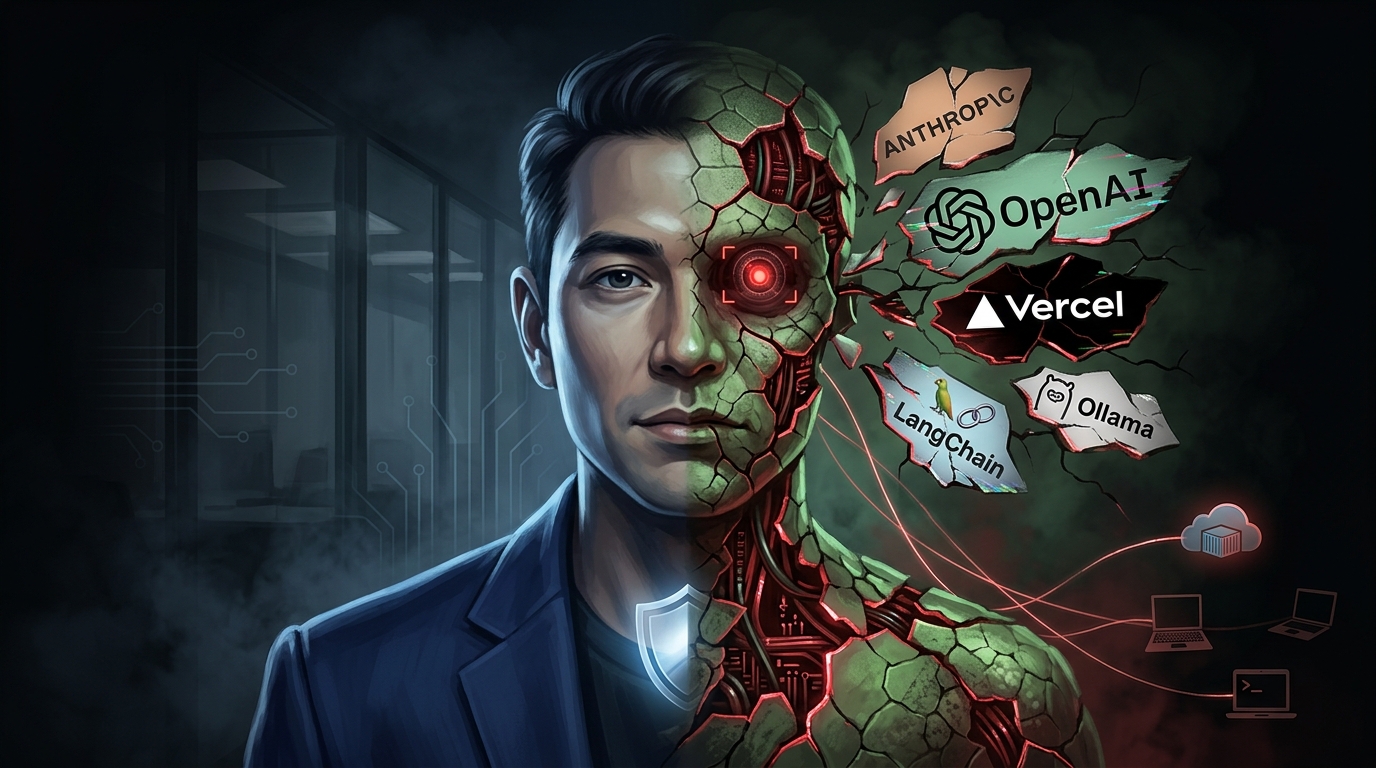 Cybersecurity Startup Publishes Infostealers to NPM
A security research team traces six typosquatted npm packages (anthropic-toolkit, ai-sdk-helpers, ollama-helpers, openai-agents-helpers, @langgraphjs/toolkit, and @aspect-security/argon2) impersonating Anthropic, Vercel, Ollama, OpenAI, LangChain, and Aspect Security back to the founder of a stealth-mode cybersecurity startup. The packages use npm preinstall/postinstall hooks to silently exfiltrate a rich identity fingerprint — hostname, git/GitHub emails, SSH key comments, reflog committer emails, AWS/GCP config metadata, corporate DNS domain, and host project name — to a Google Cloud Run endpoint, while deliberately avoiding literal credentials to look benign and offering a fake telemetry opt-out. The writeup also documents version backfilling to fake package maturity and shows the payload evolving from a crude April beacon to a polished June "identity graph" collector, with full IOCs provided.
opensourcemalware.comwriteupAdded 3 Sep 2026, published 9 Jul 2026🛡️ Security GhostApproval: A Trust Boundary Gap in AI Coding Assistants
Wiz Research discloses GhostApproval, a symlink-following vulnerability (CWE-61) found in six AI coding assistants — Amazon Q Developer, Claude Code, Augment, Cursor, Google Antigravity, and Windsurf — where a malicious repo containing a symlink disguised as a config file tricks the agent into reading/writing sensitive files like ~/.ssh/authorized_keys outside the workspace sandbox. In several tools the agent's internal reasoning correctly identifies the true target file, but the confirmation dialog shown to the user still displays the fake filename (CWE-451, UI misrepresentation), turning human-in-the-loop approval into a rubber stamp; some tools (Amazon Q, Windsurf) even write to disk before the approval prompt appears. AWS (CVE-2026-12958), Google, and Cursor (CVE-2026-50549) shipped fixes; Anthropic initially rejected it as outside threat model before later shipping a symlink warning, Augment acknowledged but hasn't patched, and Windsurf has not responded.
wiz.iowriteupAdded 3 Sep 2026, published 8 Jul 2026🛡️ Security- AI-Coded Malware | Analyzing Vibe-Coded AD Enumeration | Huntress
Huntress recovered and reconstructed "Untitled1.ps1," a PowerShell Active Directory enumeration script used by an attacker during a June 3 incident via RDP access with compromised credentials, and identified it as AI-generated ("vibe-coded") based on artifacts like an unedited LLM placeholder hostname, a "FULLY FIXED" prompt-iteration title, over-engineered five-method DC-discovery fallback logic, and gratuitous colored console/HTML reporting output. The attack chain paired this bespoke recon tool with off-the-shelf abuse of s5cmd (legitimate AWS S3 CLI used for exfiltration) and SharpShares (share enumeration), illustrating how LLM-generated one-off malware evades hash/signature-based detection and pushes defenders toward behavioral analytics on Active Directory enumeration patterns.
huntress.comwriteupAdded 3 Sep 2026, published 8 Jul 2026🛡️ Security  THORChain Exploit Report #2 — GG20 root-cause disclosure
THORChain's second exploit post-mortem details how an attacker who joined as a validator planted a malformed multi-prime Paillier modulus during GG20 threshold-signature key generation, then deliberately failed 864 MTA signing rounds over 2.5 days to leak fragments of other validators' key shares via a combination of three individually low-severity flaws inherited from Binance's tss-lib: an unverified Paillier modulus (the same class documented as BitForge and TSSHOCK), a range proof that didn't bind its two halves together, and an undersized blinding value. Once enough fragments accumulated the attacker reconstructed the full vault private key and drained roughly 10 million dollars in a single transaction before solvency checks could react, since no anomalous fund movement preceded the theft. THORChain is patching the fork, moving from GG20 and Paillier to DKLS and Schnorr based signing, and adding per-validator key-sign failure monitoring as a result.
 blog.thorchain.orgwriteupAdded 29 Sep 2026, published 3 Jul 2026🛡️ Security
 Shipping post-quantum cryptography to Python
Trail of Bits, funded by the Sovereign Tech Agency, implemented Rust bindings for NIST's ML-KEM (FIPS 203) key-establishment and ML-DSA (FIPS 204) digital-signature standards into pyca/cryptography, shipped in version 48 with AWS-LC backend support. The post makes them a pip install away for the Python ecosystem (pyca/cryptography sees 1.2B monthly PyPI downloads and underpins Certbot, Ansible, Airflow, and paramiko), while detailing the size/performance tradeoffs versus Ed25519/X25519 and noting SLH-DSA (FIPS 205) support and protocol-level integration are still in progress.
blog.trailofbits.comwriteupAdded 3 Sep 2026, published 30 Jun 2026🛡️ Security MCP Auto-Execution: From Git Clone to Cloud Compromise in Amazon Q VS Code Extension
Wiz Research found that the Amazon Q Developer VS Code extension auto-loaded and executed MCP server configs from .amazonq/mcp.json in a workspace with no consent prompt or workspace-trust check, and spawned those processes with full environment inheritance. Opening a malicious repository (e.g. a malicious PR, typosquatted package, or fake "coding test" per known DPRK social-engineering tactics) could therefore trigger arbitrary code execution and theft of the developer's AWS credentials, demonstrated by capturing aws sts get-caller-identity output. Amazon remediated the issue in language server version 1.65.0, adding a consent prompt before loading workspace MCP servers.
wiz.iowriteupAdded 3 Sep 2026, published 26 Jun 2026🛡️ Security AutoJack: How a single page can RCE the host running your AI agent | Microsoft Security Blog
Microsoft Security Research disclosed "AutoJack," an exploit chain in AutoGen Studio (the prototyping UI for Microsoft's AutoGen multi-agent framework) where an agent with browsing capability (e.g., MultimodalWebSurfer) that renders an attacker-controlled webpage can be jacked into opening a WebSocket to the local MCP control plane at /api/mcp/ws. The chain combines three flaws: a localhost-only origin allowlist that the agent's own headless browser satisfies (CWE-1385), an auth middleware that explicitly skips /api/mcp/* paths without the intended WebSocket-level check (CWE-306), and a server_params query parameter that is base64-decoded into StdioServerParams and executed verbatim via stdio_client with no executable allowlist (CWE-78) — letting the page spawn calc.exe or arbitrary commands under the developer's account with no user interaction beyond the agent rendering the page. The issue was fixed pre-PyPI-release upstream (commit b047730) and never shipped in the published autogenstudio package; Microsoft provides mitigation guidance and Defender advanced hunting KQL queries to detect the pattern (suspicious child processes from autogenstudio, WebSocket calls carrying server_params, browser-automation processes reaching non-corporate domains).
 microsoft.comwriteupAdded 20 Jun 2026, published 19 Jun 2026🛡️ Security
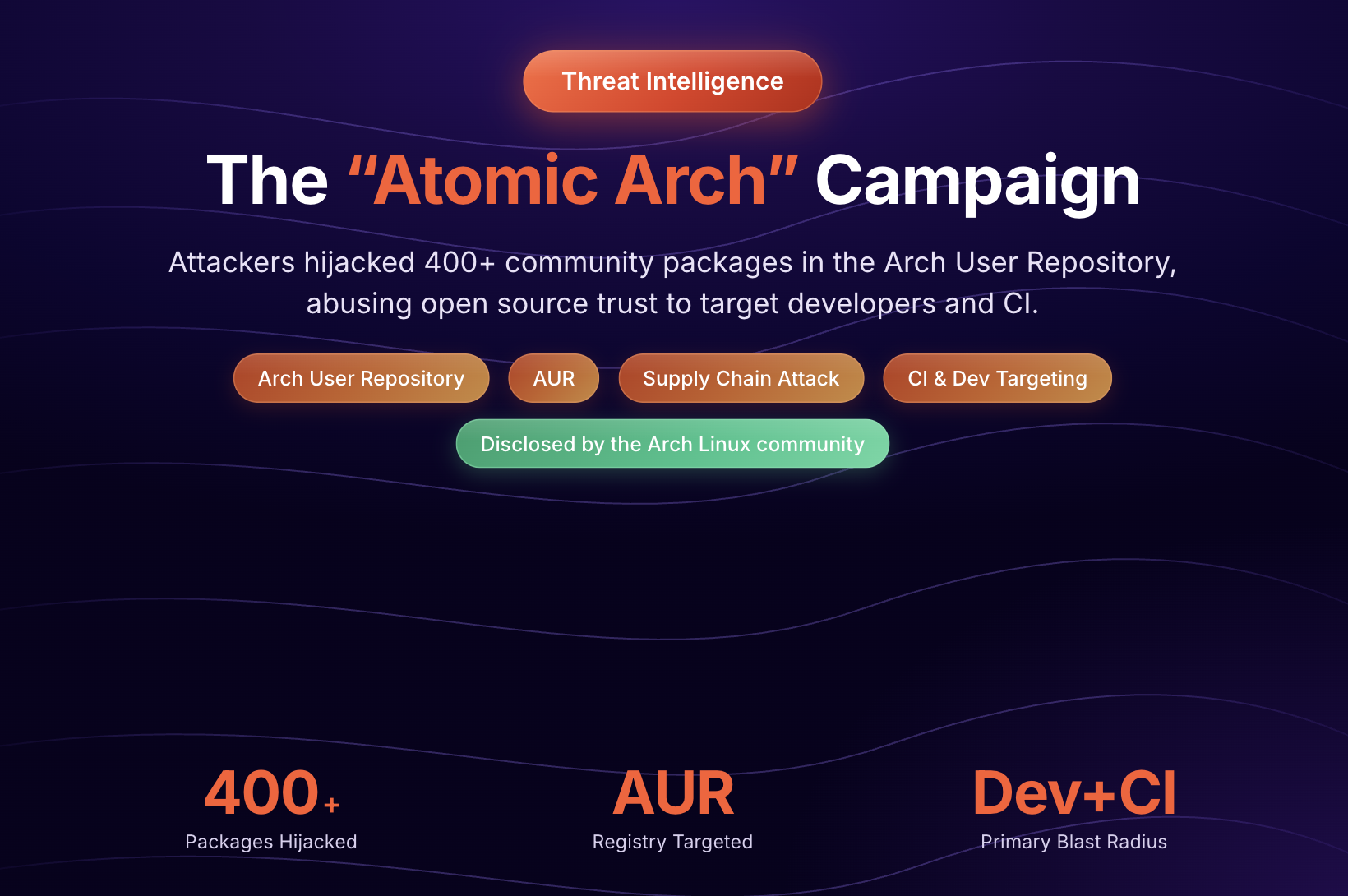 400+ AUR Packages Hijacked: What the “Atomic Arch” Campaign Means for Supply-Chain Security
Attackers adopted 400+ orphaned AUR (Arch User Repository) packages and injected malicious build logic that pulled in a malicious npm dependency (masquerading as atomic-lockfile, also seen as js-digest), dubbed the "Atomic Arch" campaign by Sonatype researchers. The malicious npm package deploys a Rust-based credential stealer targeting browser cookies, SSH keys, GitHub/npm tokens, and cloud/Docker credentials, with optional eBPF-based rootkit persistence on rooted systems. The piece explains scope (Arch, EndeavourOS, Manjaro, WSL2-based Arch, self-hosted Arch CI runners) and draws parallels to similar ownership-hijacking risks in npm, PyPI, GitHub Actions, and Homebrew.
stepsecurity.iowriteupAdded 3 Sep 2026, published 18 Jun 2026🛡️ Security A Forgotten Contributor Account Compromised the Entire Mastra npm Package Scope
Snyk details how a dormant, never-revoked npm contributor account (ehindero) was used to republish the entire @mastra scope (142+ packages, ~4M monthly downloads for @mastra/core alone) with an injected dependency, easy-day-js, a byte-for-byte dayjs impersonator. The postinstall hook in easy-day-js@1.11.22 disables TLS verification, pulls a second-stage payload from a raw IP, and drops a cross-platform cryptocurrency wallet stealer plus a RAT with OS-specific persistence (LaunchAgent, systemd unit, PowerShell staging) that beacons every 10 minutes over a self-signed wolfSSL certificate. The piece covers detection steps, the Snyk advisory (SNYK-JS-EASYDAYJS-17353313), and draws parallels to the earlier Axios npm compromise attributed by Microsoft to Sapphire Sleet (BlueNoroff).
 snyk.iowriteupAdded 3 Sep 2026, published 16 Jun 2026🛡️ Security
 watchTowr Labs: Splunk Enterprise CVE-2026-20253 Pre-Auth RCE via PostgreSQL Sidecar
watchTowr Labs analyzes CVE-2026-20253, a pre-authentication vulnerability in the PostgreSQL sidecar service of Splunk Enterprise 10 and later. The sidecar's backup and restore API lacks authentication and is reachable through the main web interface. The write-up explains the root cause and which deployments are vulnerable by default, notably Splunk Enterprise on AWS, and shows how the flaw escalates to remote code execution. It also releases a non-exploitative detection script that tells vulnerable hosts from patched ones.
 labs.watchtowr.comwriteupAdded 6 Sep 2026, published 12 Jun 2026🛡️ Security
 Microsoft's durabletask PyPI Package Compromised in Supply Chain Attack
StepSecurity documents the compromise of Microsoft's durabletask PyPI package (versions 1.4.1-1.4.3, 400k+ monthly downloads), where an attacker bypassed the GitHub CI/CD pipeline entirely using stolen publishing credentials to inject a dropper for rope.pyz, a modular cloud-intrusion framework with dedicated collectors for AWS, Azure, GCP, Kubernetes, HashiCorp Vault, password managers, and the filesystem. The framework encrypts stolen data with AES-256-GCM/RSA-4096, exfiltrates via HTTPS, GitHub commit beacons, and attacker-created public repos using the victim's own stolen GitHub tokens, propagates via AWS SSM and kubectl exec, and drops a geo-targeted rm -rf wiper for systems matching Israeli locale/timezone markers. The post ties the attack to TeamPCP's Mini Shai-Hulud campaign (same infrastructure as TanStack, Mistral AI, LiteLLM, @antv) and later updates describe a second compromise of the Azure/durabletask GitHub repo that plants payloads triggering in Claude Code, Gemini CLI, Cursor, and VS Code.
stepsecurity.iowriteupAdded 3 Sep 2026, published 9 Jun 2026🛡️ Security Pythagora-io/gpt-pilot Compromised on GitHub - Shai-Hulud Credential Stealer Blocked by Python Linter
StepSecurity documents a June 2026 compromise of the Pythagora-io/gpt-pilot GitHub repo (33.7k stars), where an attacker took over a co-founder's account and force-pushed a Shai-Hulud-variant credential stealer disguised as a "Revert" commit. The malware, a 758KB obfuscated Bun/JavaScript payload delivered via a Python telemetry module, steals AWS/npm/GitHub/Kubernetes/Vault/SSH credentials, uses GitHub commit messages as a covert C2 channel, exfiltrates via newly created GitHub repos, can abuse Sigstore/Fulcio to forge SLSA Build Level 3 attestations, and plants persistence hooks in Claude Code and VS Code. Notably, the attacker's injected code was blocked twice by the project's ruff CI linter/formatter before they gave up, illustrating code-quality tooling as an accidental security control, alongside full IOCs and lessons on branch protection and force-push monitoring.
stepsecurity.iowriteupAdded 3 Sep 2026, published 9 Jun 2026🛡️ Security Node-gyp Supply Chain Compromise: A Self-Propagating npm Worm That Hides in binding.gyp
Snyk documents an active npm supply-chain attack ("Node-gyp Supply Chain Compromise - June 2026") that abuses binding.gyp's GYP command-expansion syntax (<!(...)) to trigger arbitrary code execution via node-gyp during npm install, bypassing detection tools that only monitor preinstall/postinstall scripts. The worm, tracked as "Phantom Gyp"/"Miasma" (a Shai-Hulud descendant) by StepSecurity, has hit 57 packages including autotel-* and @vapi-ai/server-sdk, harvests npm/GitHub/AWS/GCP/Azure/Vault/Kubernetes credentials via a multi-stage obfuscated Bun-based loader, injects GitHub Actions workflows for persistence, and self-propagates by republishing from compromised maintainer accounts.
snyk.iowriteupAdded 3 Sep 2026, published 4 Jun 2026🛡️ Security Nx Console VS Code Extension Compromised
StepSecurity's technical teardown of the May 2026 compromise of the Nx Console VS Code extension (nrwl.angular-console v18.95.0, 2.2M+ installs), where a stolen contributor GitHub token was used to push a dangling orphan commit to nrwl/nx and publish a malicious extension via stolen VSCE_PAT credentials. The payload silently ran `npx github:nrwl/nx#<sha>` to fetch a heavily obfuscated 498KB Bun/Node credential stealer that harvests secrets from GitHub, npm, AWS, Vault, Kubernetes, 1Password and Claude Code config, exfiltrates via HTTPS/GitHub API/DNS tunneling, installs a macOS Python backdoor using the GitHub Search API as a C2 dead-drop, and can forge valid Sigstore/SLSA provenance attestations for downstream npm packages. The writeup ties this to a later GitHub breach (3,800 repos, attributed to TeamPCP) and provides detection signals, IOCs, and full recovery steps.
stepsecurity.iowriteupAdded 3 Sep 2026, published 2 Jun 2026🛡️ Security- CVE-2026-8501: Arbitrary Process Termination in PCTCore64.sys
Analysis of CVE-2026-8501, a vulnerability in the PCTCore64.sys driver that allows arbitrary process termination, enabling a Bring Your Own Vulnerable Driver (BYOVD) attack. Such flaws let attackers with a signed but vulnerable kernel driver kill security/AV processes from user mode, a common technique for disabling endpoint defenses prior to further compromise.
 blacksnufkin.github.iowriteupAdded 3 Sep 2026, published 2 Jun 2026🛡️ Security
 Red Hat npm Packages Compromised to Spread a Credential-Stealing Worm
Aikido details a June 2026 compromise of 96 versions across 32 @redhat-cloud-services npm packages (116,991 weekly downloads) with "Miasma," a new variant of the TeamPCP-authored Mini Shai-Hulud credential-stealing worm whose source was open-sourced in May 2026. Attackers compromised a Red Hat employee's GitHub account to push malicious orphan commits containing a GitHub Actions workflow that abused OIDC id-token: write permissions to authenticate to npm's trusted publishing endpoint and republish backdoored packages; each package's preinstall script then ran a 4.2MB obfuscated payload that swept GitHub Actions, AWS, GCP, Azure, Vault, Kubernetes, npm/PyPI, SSH, Docker, GPG, and .env credentials. The piece also lays out the broader Mini Shai-Hulud campaign timeline (Bitwarden CLI, SAP, PyTorch Lightning, Mistral/TanStack, Microsoft DurableTask) and full IOC package/version list.
aikido.devwriteupAdded 3 Sep 2026, published 1 Jun 2026🛡️ Security Observing Privilege Escalation in Kubernetes (EKS CloudWatch Observability Add-on)
Reversec details a privilege escalation vulnerability in AWS EKS's CloudWatch Observability Add-on: the cloudwatch-agent service account, deployed via DaemonSet to every node, had cluster-wide permission to update ConfigMaps, allowing any attacker who compromised a node (e.g. via a privileged pod with hostPath access) to steal the agent's service account token, rewrite the aws-auth ConfigMap, and grant themselves cluster-admin via system:masters. The flaw existed in the default, unmodified add-on configuration (no misconfig required) and was found in two separate client engagements; AWS acknowledged it and shipped a fix in add-on v5.3.0-eksbuild.1 that scopes the update-ConfigMap permission to a namespaced role, though a related privilege-escalation path via the nodes/proxy permission (disclosed separately by Graham Helton) remains unaddressed until Kubernetes 1.36's fine-grained Kubelet authorization lands in EKS.
 labs.reversec.comwriteupAdded 5 Oct 2026, published 1 Jun 2026🛡️ Security
 Socket: TrapDoor Crypto Stealer
Socket researchers uncovered TrapDoor, a coordinated crypto-stealer campaign spanning 34+ malicious packages and 384+ versions across npm, PyPI, and Crates.io, targeting crypto, DeFi, Sui/Move, and AI developer communities. The npm packages use postinstall hooks to run a shared trap-core.js payload that harvests SSH keys, AWS/GitHub credentials, wallet data, and browser data, then persists via .cursorrules, CLAUDE.md, git/shell hooks, systemd, cron, and SSH lateral movement; PyPI packages fetch and run remote JS on import, and Crates.io packages use malicious build.rs to XOR-encrypt and exfiltrate Sui/Move keystores to GitHub Gists. The attacker (GitHub account ddjidd564) also opened PRs against major AI/dev tooling repos (browser-use, LangChain, Langflow, llama_index, MetaGPT, OpenHands) attempting to plant hidden .cursorrules/CLAUDE.md instructions designed to trick AI coding assistants into running exfiltration under the guise of a 'security scan'.
socket.devwriteupPublished and added 26 May 2026🛡️ Security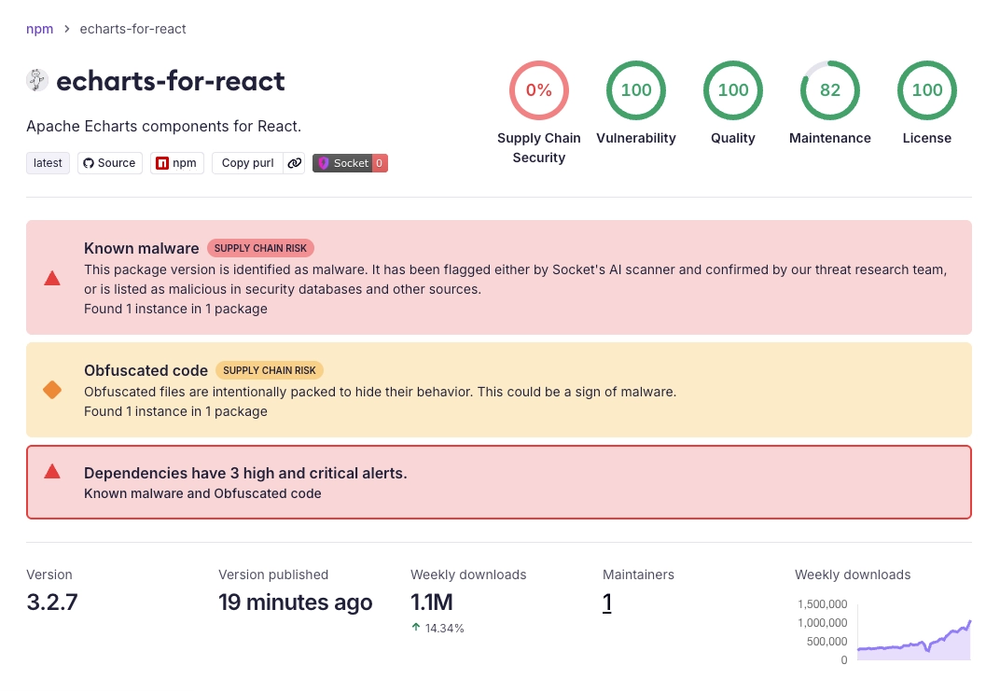 Socket: Mini Shai-Hulud Hits @antv Ecosystem
Socket's Threat Research team documents a Mini Shai-Hulud variant compromising the npm maintainer account "atool," affecting @antv data-visualization packages (g2, g6, x6, l7, s2, f2, graphin) plus echarts-for-react (~1.1M weekly downloads) and others, totaling 639 compromised versions across 323 packages in one wave (1,055 versions/502 packages campaign-wide across npm, PyPI, and Composer). The install-time payload (triggered via a preinstall "bun run index.js" hook) is heavily obfuscated, harvests GitHub/npm/AWS/Kubernetes/Vault/SSH credentials and CI/CD secrets, exfiltrates data via AES-256-GCM+RSA-OAEP encrypted HTTPS to t.m-kosche[.]com and via GitHub repo commits under a reversed "Shai-Hulud: Here We Go Again" marker, and self-propagates by using stolen npm tokens to republish trojanized packages with a malicious @antv/setup GitHub optionalDependency.
socket.devwriteupPublished and added 20 May 2026🛡️ Security FOSSA: Mini-Shai-Hulud Mass Compromise
FOSSA's technical breakdown of the May 2026 Mini-Shai-Hulud campaign, which compromised at least 235 npm and PyPI packages including @tanstack/*, @uipath/*, mistralai, and @opensearch-project/opensearch. It details the two install-time payload mechanisms (a Git-dependency prepare-hook trick with an orphan commit for @tanstack/*, and direct preinstall scripts for @uipath/*/Mistral AI), a staged PyPI dropper in __init__.py that evades sandbox scanning, the credential-harvesting targets (AWS/GCP/Azure, Kubernetes, Vault, GitHub, npm tokens), exfiltration infrastructure (filev2.getsession.org, git-tanstack.com), and IDE-persistence via modified Claude/VS Code config files.
 fossa.comwriteupPublished and added 18 May 2026🛡️ Security
 Digital Sovereignty
A practitioner's first-person log of replacing US SaaS/cloud services with European or self-hosted alternatives across analytics (Google Analytics → self-hosted Matomo), email/passwords (Proton Mail, Proton Pass), compute and storage (DigitalOcean/AWS S3 → Scaleway, OVH for backups via rclone sync), transactional email (SendGrid → Lettermint), error tracking (Sentry → self-hosted Bugsink), and AI inference (OpenAI → Mistral, plus local models like Qwen), while explaining the deliberate exceptions kept on US infrastructure (Cloudflare, Stripe, Claude Code, GitHub/GitLab). It frames "digital sovereignty" as a practical risk-management exercise — knowing where data lives, avoiding single-vendor/jurisdiction dependence — and documents concrete migration friction (Proton's 3-domain cap, no content-based filters, OVH's buried lifecycle-rule config) rather than abstract advocacy.
 monokai.comwriteupAdded 3 Sep 2026, published 13 May 2026🛡️ Security
 Mini Shai-Hulud Is Back: npm Worm Hits over 160 Packages, including Mistral and Tanstack
Aikido details a new wave of the Mini Shai-Hulud npm worm that has compromised 373 malicious package-version entries across 169 package names, including TanStack, Mistral AI, UiPath, and Squawk packages. Unlike the earlier SAP-focused wave (setup.mjs/execution.js), this version drops a root-level router_init.js and adds a malicious GitHub-hosted optionalDependency (@tanstack/setup) whose prepare script silently runs a Bun-based credential stealer targeting npm/GitHub tokens, AWS/Kubernetes/Vault secrets, and GitHub Actions OIDC tokens, then abuses trusted publishing to self-propagate by minting fresh npm publish tokens and pushing new compromised releases. The post includes full affected-package/version lists, file hashes, network IOCs, and remediation/rotation guidance.
aikido.devwriteupAdded 3 Sep 2026, published 11 May 2026🛡️ Security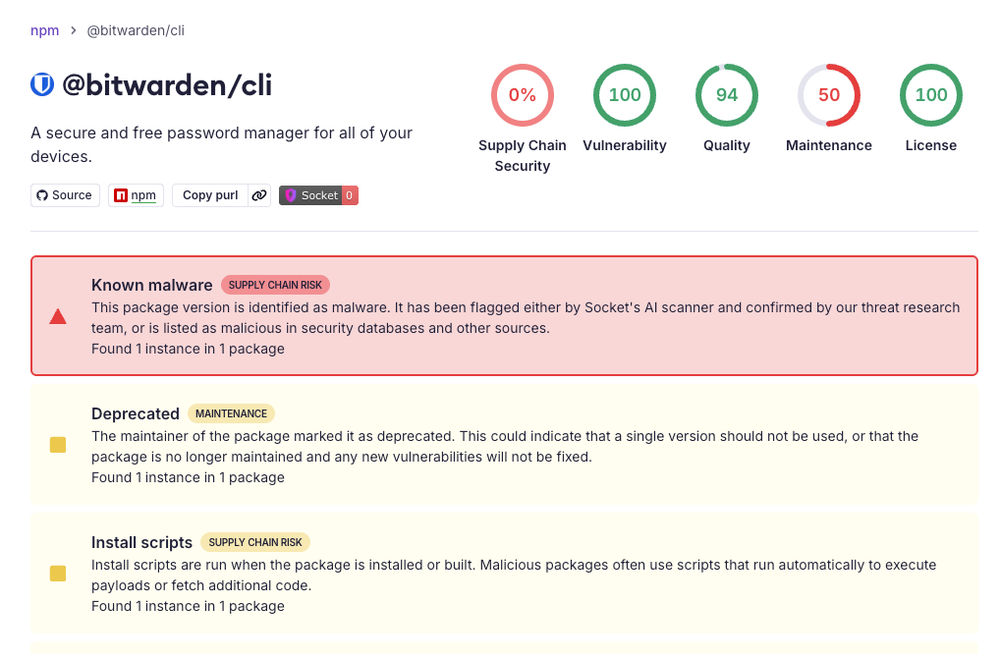 Socket: Bitwarden CLI Compromised in Checkmarx Supply Chain Campaign
Socket researchers found that Bitwarden CLI 2026.4.0 was compromised via a hijacked GitHub Action in Bitwarden's CI/CD pipeline, part of the ongoing Checkmarx-themed supply chain campaign. The malicious bw1.js payload shares C2 infrastructure and code (gzip+base64 packed Python memory-scraper, Bun-based runtime, GitHub Actions workflow injector) with the earlier Checkmarx mcpAddon.js attack, but adds new indicators like a lock file, shell-profile persistence, and overt "Shai-Hulud: The Third Coming" / Butlerian Jihad ideological branding, plus a kill switch for Russian-locale systems. It harvests GitHub, AWS, Azure, GCP, npm, SSH, and Claude/MCP credentials and exfiltrates via GitHub commits and npm republishing.
socket.devwriteupPublished and added 6 May 2026🛡️ Security BufferZoneCorp Malicious Gems & Go Modules
Socket researchers traced the GitHub account BufferZoneCorp to a cluster of typosquatted RubyGems (knot-prefixed gems impersonating ActiveSupport, Devise, Rack/Rails, and RSpec tooling) and Go modules (mimicking go-retryablehttp, envconfig, and generic infra libraries) that shipped as dormant sleeper packages before later updates added credential theft, GitHub Actions and go.sum tampering, fake go binary wrappers on PATH, and SSH authorized_keys persistence. The Ruby gems exfiltrate SSH keys and AWS, npm, gh, and gitconfig credentials via extconf.rb install hooks to a webhook.site endpoint, while the Go modules disable GOSUMDB, poison GOPROXY, strip go.sum checksums, and hijack the go binary in CI runners. Go's Security team blocked the identified modules after disclosure, but the Ruby gems and GitHub account remained live at time of writing.
socket.devwriteupPublished and added 6 May 2026🛡️ Security Marimo OSS Python Notebook RCE: From Disclosure to Exploitation in Under 10 Hours | Sysdig
Sysdig's Threat Research Team details CVE-2026-39987, a critical (CVSS 9.3) pre-authentication RCE in the marimo Python notebook platform's /terminal/ws WebSocket endpoint, which skips the validate_auth() check used elsewhere in the app and grants an unauthenticated interactive PTY shell. Using honeypots deployed within hours of the advisory, TRT observed a single attacker build a working exploit from the advisory text alone (no public PoC existed), run a scripted PoC validation, manually recon the filesystem, and steal .env AWS credentials and search for SSH keys, all in under 3 minutes, with first exploitation just 9h41m after disclosure. The piece argues niche software (20k GitHub stars) is now exploited as fast as major platforms like Langflow, and provides IOCs and hardening recommendations (upgrade to marimo 0.23.0, restrict/disable the terminal endpoint, rotate credentials).
sysdig.comwriteupAdded 26 Sep 2026, published 9 Apr 2026🛡️ Security- Data Exfiltration and Threat Actor Infrastructure Exposed
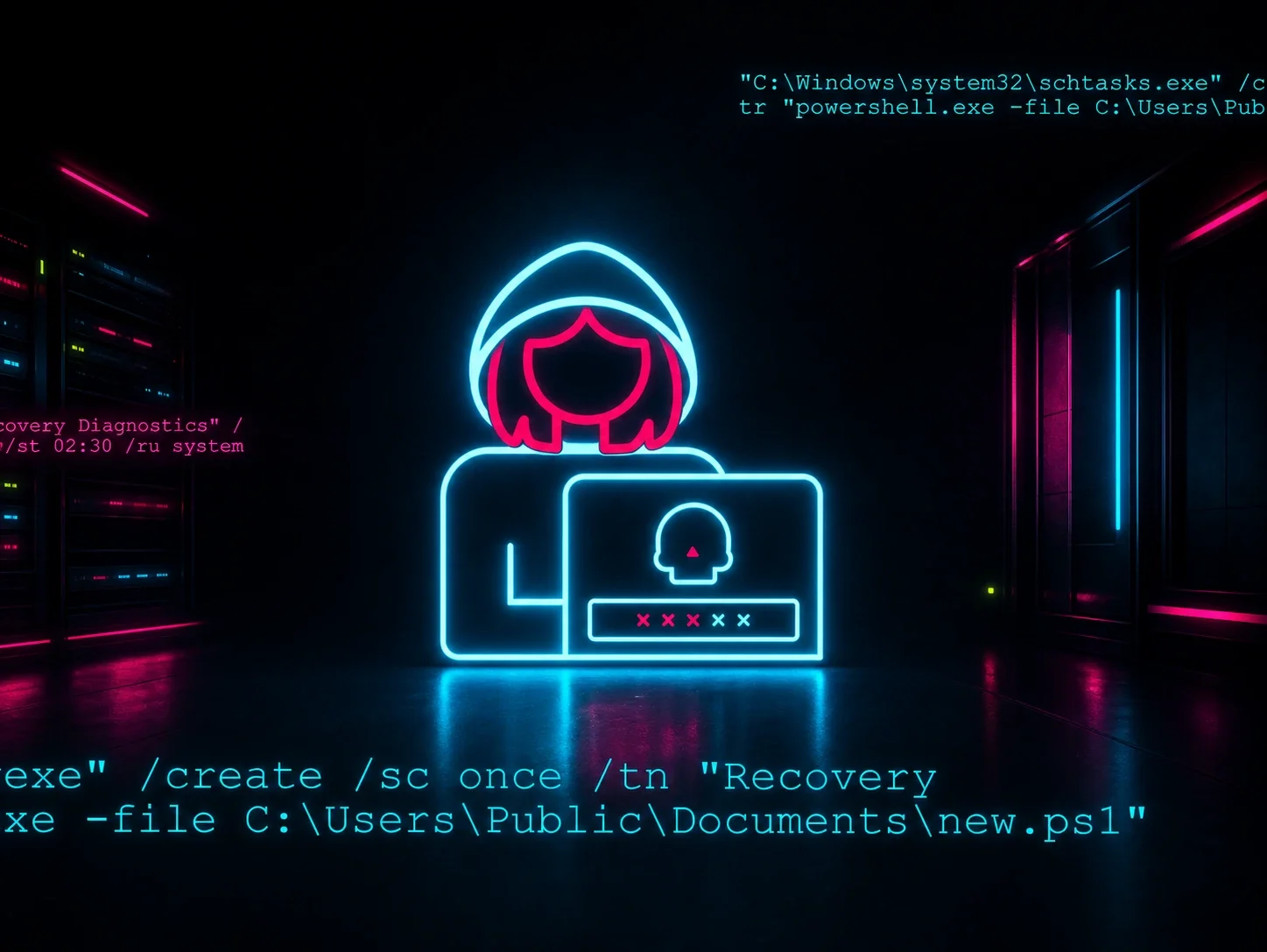
Huntress SOC details two related incidents where threat actors used PsExec for privilege escalation, a scheduled task ("Recovery Diagnostics") to run base64-encoded PowerShell that configured a renamed copy of restic (winupdate.exe) pointed at a Wasabi S3 bucket, then disabled/removed VIPRE Business Agent and Windows Defender before deploying INC ransomware. A second, near-identical prior incident on 9 February reused the same AWS access keys and used HRSword to disable Acronis security tooling, and the same TTPs were independently documented by the Cyber Centaurs team on 22 January 2026. The post highlights detection gaps (incomplete agent deployment, no SIEM) and notes RestartManager API telemetry (also seen with Akira) as a ransomware-encryption indicator.
huntress.comwriteupAdded 3 Sep 2026, published 12 Mar 2026🛡️ Security - Fake Tech Support Delivers Havoc Command & Control
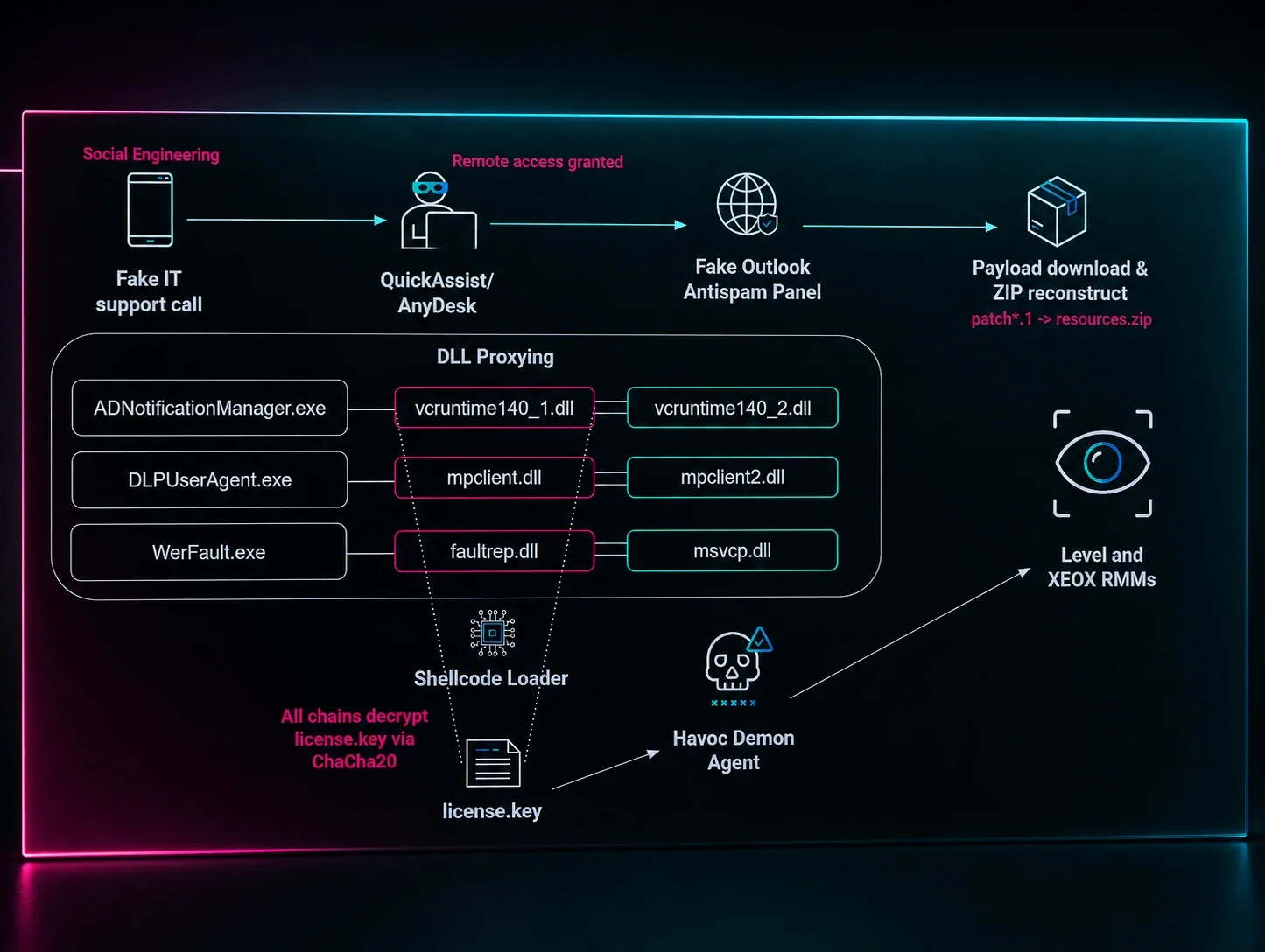
Huntress details a February 2026 intrusion cluster across five partner organizations combining fake tech support social engineering (spam bait, phone calls impersonating IT, QuickAssist/AnyDesk access, fake Outlook Antispam panel on AWS) with a customized Havoc Demon C2 agent using indirect syscalls, registry-based fallback C2, and DLL sideloading to evade EDR. Tradecraft overlaps with prior Sophos-documented Black Basta/FIN7 campaigns, suggesting affiliates or copycats reused the playbook; attackers reached nine additional endpoints within eleven hours, indicating likely ransomware/exfiltration intent.
huntress.comwriteupAdded 3 Sep 2026, published 2 Mar 2026🛡️ Security 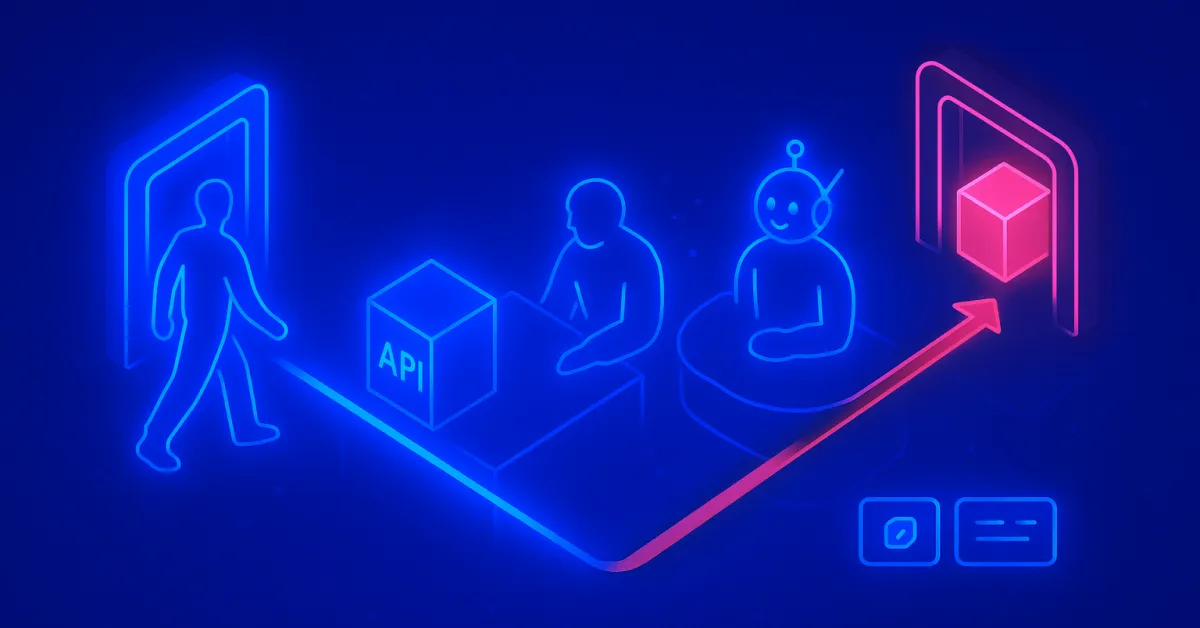 BodySnatcher (CVE-2025-12420): agentic hijacking vulnerability in ServiceNow
AppOmni researcher discloses CVE-2025-12420 ("BodySnatcher"), a chain of flaws in ServiceNow's Virtual Agent API and Now Assist AI Agents application that let an unauthenticated attacker impersonate any user with only their email address, bypassing MFA/SSO via a hardcoded, instance-agnostic Message Auth secret and insecure Basic account-linking. By reverse-engineering the protected AIA-Agent Invoker AutoChat topic and its A2A adapter, the attacker can trigger the built-in "Record management" AI agent to create a backdoor admin user entirely through async, supervised-mode agent execution — escalating from zero access to full platform admin. The writeup includes full HTTP PoC payloads and recommends enforcing MFA on account linking, an AI agent approval workflow, and lifecycle de-provisioning of dormant agents.
 appomni.comwriteupAdded 14 Aug 2026, published 13 Jan 2026🛡️ Security
 Stack Your Deception: Stacking MDE Deception Rules with Thinkst Canarytokens
A practical deception-engineering guide showing how to "stack" Microsoft Defender XDR's native Deception rules (basic/advanced lures, decoy hosts, credentials) with Thinkst Canarytokens (tokenized PDFs, custom EXEs, DNS/AWS-key tokens) to close detection gaps. It walks through generating tokens on Canarytokens.com, embedding them as lure files in Defender XDR deception rules, and routing alerts via email/Teams/Slack or an Azure Logic App into Microsoft Sentinel for SOC-integrated incident creation.
 attackthesoc.comwriteupAdded 3 Sep 2026, published 21 Apr 2024🛡️ Security
- AWS Ransomware
A DFIR case study of an AWS S3 extortion incident where an attacker deleted a customer's buckets after reconnaissance (GetSendQuota, ListBuckets, GetBucketVersioning, etc.) and left a Bitcoin ransom note bundled with a Linux 'recovery' binary. Analysis with strace and Ghidra reveals the recovery tool is a complete fake: it never contacts AWS or the network, instead sleeping via clock_nanosleep and fabricating account/bucket details from a bundled aws.txt file to pressure the victim into paying. The post also shares specific CloudTrail event names defenders should monitor to detect similar pre-deletion recon activity.
 dfir.chwriteupAdded 3 Sep 2026, published 21 Feb 2024🛡️ Security