- So I guess everyone uses LLMs to think now
"So I guess everyone uses LLMs to think now" is an opinion post from the eva.ac blog. The author explains why they never use LLMs for published research: they do it for fun and cannot take credit for model output. They argue LLMs still need skilled guidance, criticise AI-company security marketing (PHP2Shell from Calif, OpenAI and Wiz), and cite the Tailscale "tailworm" disclosure and the eMudhra key found without AI.
 eva.acarticleAdded 2 Nov 2026, published 1 Nov 2026🧠 AI
- AI startup hacks Anthropic, gains access to employee details, internal messages
Cathedral, a security startup founded by former DOGE members, used AI agents to find flaws in third-party business software used by Anthropic. It reached sales, HR and IT systems in under 12 hours. Anthropic says no customer chats, model outputs, source code or model weights were reached, and it cut off access the same day. The article also recaps earlier cases of Claude bypassing access restrictions, including Georgia vote counts.
 indiatoday.inarticleAdded 1 Nov 2026, published 31 Oct 2026🛡️ Security
- Show HN: A language model that lives in a boot sector
bootgpt is a char-level language model that runs from a BIOS boot sector. A 512-byte hand-written asm MBR loads an 11.5 KB int8 model from 23 following sectors and runs it in 16-bit real mode on a 386, generating fake Linux dmesg boot logs. train.py quantises to int8 with power-of-two scales, and its integer simulation matches the asm output char for char.
 github.comrepoAdded 1 Nov 2026, published 31 Oct 2026🧠 AI
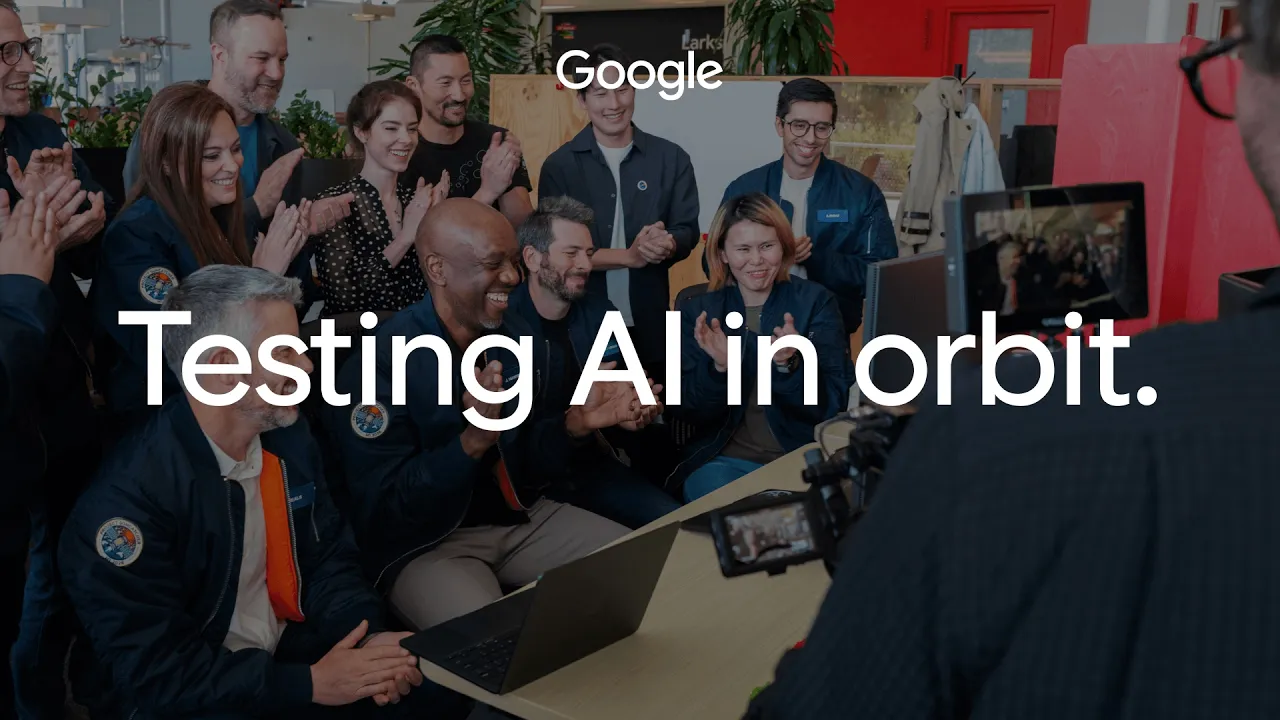 We’ve received our first response from the Project Suncatcher prototype satellite.
Project Suncatcher is a Google research effort to power AI compute in space. Its prototype satellite launched on 1 October 2026 and, after commissioning, returned the first AI response from a data-center-class TPU in orbit: a haiku from the onboard Gemma 4 open model, downlinked over Svalbard. Next come thermal-stress and radiation tests, then twin interconnected satellites in 2027.
 blog.googlearticlePublished and added 30 Oct 2026🧠 AI
 TextSeal2: Distortion-Free LLM Watermarking with Copula Mixing and Memoryless Races
TextSeal2 is a distortion-free LLM text watermark that merges two or more keys into one virtual key and couples it to fresh noise through AutoMark's Gaussian copula. Under speculative decoding it verifies keyed drafts with an extra exponential race, so output matches the target model and acceptance rate is unchanged. On three LLMs at a 10^-3 false-positive rate, it detects 8 to 22 points more 100-token answers than TextSeal.
 arxiv.orgpaperAdded 31 Oct 2026, published 29 Oct 2026🛡️ Security
- TextSeal2: Distortion-Free LLM Watermarking with Copula Mixing and Memoryless Races
TextSeal2 is a distortion-free watermark for LLM output that keeps its signal under speculative decoding. It merges two or more keys into one virtual key coupled to fresh noise through AutoMark's Gaussian copula, and verifies drafts with an extra exponential race. On three LLMs it detects 8 to 22 points more 100-token answers than TextSeal at a 10^-3 false-positive rate.
arxiv.orgpaperAdded 31 Oct 2026, published 29 Oct 2026🧠 AI - Understanding and Mitigating Role Spoofing in LLMs
Understanding and Mitigating Role Spoofing in LLMs is an arXiv paper (October 2026) on role spoofing, a prompt injection where malicious tool output impersonates the user. It shows models track "who said what" using both content cues (semantics, style) and structure cues (control tokens, formatting). Attacks combining fake structure and content succeed often, adversarial training stops only content-based attacks, and linear probes trained to predict conversation roles detect spoofing across settings.
arxiv.orgpaperAdded 31 Oct 2026, published 29 Oct 2026🛡️ Security - A Unified Hessian-Guided Framework for Post-Training Quantization
This preprint proposes a unified post-training quantization framework for large language models. It derives a Hessian-guided approximation of the output change caused by joint weight and activation quantization, using a tractable Fisher approximation. Quantization ranges, linear transformations and weight rounding are optimized together under one output-sensitivity objective. The authors report gains over state-of-the-art transformation and rounding methods in channel-wise and block-wise settings.
arxiv.orgpaperAdded 31 Oct 2026, published 29 Oct 2026🧠 AI  Google Touts Powerful Cybersecurity Capabilities in Gemini 4 Carbon Model
Gemini 4 Carbon is Google's new frontier model, announced with scores of 88.2% on SEC-bench Pro, 54.8% on ExploitGym and 71.0% on CWE-bench. Google says it beats GPT-6 Astra, Claude Opus 5.5 and Claude Fable 5.1 on these, with no guardrails. Access is limited to Fairwind Program partners at first. Pricing starts at $2 input and $10 output per million tokens, rising to $4 and $20.
 securityweek.comarticlePublished and added 29 Oct 2026🧠 AI
- SEAL: Sealed Queries for Local Sanitization against Indirect Prompt Injection
SEAL is a defense against indirect prompt injection for local LLM agents. It learns a soft prompt and scoring readout offline, then uses a frozen task model to score and delete injected tokens from tool outputs, with queries built from trusted initial context. On AgentDojo, attack success falls from 34.6% to 0.1% and Joint rises from 51.4% to 77.5%, using about 127x fewer defense tokens than PISanitizer.
arxiv.orgpaperAdded 31 Oct 2026, published 29 Oct 2026🛡️ Security - High Precision Noise Cleaning for CKKS with Application to Asynchronous Threshold CKKS
High Precision Noise Cleaning for CKKS is an IACR ePrint preprint (2026/2675) by Zhihao Li, Cheng Hong and Tao Wei. It composes lower-degree Hermite polynomials to reach output noise bounds such as 2^-300 for noise flooding, and uses this to build an asynchronous threshold CKKS scheme with strong simulation security in the random oracle model. In OpenFHE, binary-message cleaning falls from 9.63 s to 1.54 s.
 eprint.iacr.orgpaperAdded 31 Oct 2026, published 29 Oct 2026🛡️ Security
- inkGround: Benchmarking Fine-grained Visual Grounding Capabilities of Vision-Language Models for Cursive Handwriting in the Wild
inkGround is a benchmark for stroke trajectory recovery from full-page, camera-captured handwriting, with 537 page images (about 18.7k words, 163k strokes) and pseudo-label references filtered by OCR agreement and human raters. Models get a page image and a target word, then output ordered stroke points. Seven VLMs were scored with DTW, Chamfer distance, readability and style similarity. Closed-source models, notably Gemini-3.1-Pro, did best, and the ranking held on IAM-OnDB.
arxiv.orgpaperAdded 30 Oct 2026, published 28 Oct 2026🧠 AI  OpenAI Plans to Buy Google's AI Chips as It Looks Beyond Nvidia: Report
Decrypt reports, citing The Information, that OpenAI plans to buy Google TPUs rather than rent them, to reduce dependence on Nvidia. Neither company has confirmed, and price, volume and timing are undisclosed. The article covers OpenAI's TPU optimization job listing, its Broadcom-built Jalapeño inference chip due end of 2026, Nvidia and AMD deals, and Anthropic's multi-gigawatt TPU agreement.
 decrypt.coarticlePublished and added 28 Oct 2026🧠 AI
- Niko (@nikolayxyz) on X
Gemini 4 Carbon is Google's new frontier model, announced in a post by nikolayxyz that quotes Google's launch text. It ranks #1 on v5.0 of the Artificial Analysis Intelligence Index with 59 points, ahead of Opus 5.5 and GPT-6 Astra. Intro pricing is $2 input and $10 output per million tokens. Access starts for cyber defenders first, as Gemini 4 Argon's did. The captured text is cut off before the rollout details.
 x.comthreadAdded 29 Oct 2026, published 28 Oct 2026🧠 AI
 Gemini 4 Carbon
 is Google's frontier model, announced with cybersecurity results: 88.2% on SEC-bench Pro (finding vulnerabilities), 54.8% on ExploitGym (exploitation) and 71.0% on CWE-bench (patching). Google reports 0.0% attack success on Gray Swan's indirect prompt injection benchmark. Access starts with a subset of cyber defenders through the Fairwind Program. Pricing is $2 per million input tokens and $10 per million output tokens.
blog.googlearticleAdded 29 Oct 2026, published 28 Oct 2026🛡️ Security- Gemini 4 Carbon
Gemini 4 Carbon is Google's frontier model, announced two weeks after Gemini 4 Argon. It scores 59 on Artificial Analysis Intelligence Index v5.0, 88.2% on SEC-bench Pro, 54.8% on ExploitGym and 71.0% on CWE-bench. Pricing is $2 per million input and $10 per million output tokens. Access starts with a subset of cyber defenders through the Fairwind Program.
blog.googlearticleAdded 29 Oct 2026, published 28 Oct 2026🧠 AI - Gemini 4 Carbon: Our next frontier model
Gemini 4 Carbon is Google DeepMind's new frontier model, announced two weeks after Gemini 4 Argon. It ranks #1 on Artificial Analysis Intelligence Index v5.0 at 59 and scores 88.2% on SEC-bench Pro, 54.8% on ExploitGym and 71.0% on CWE-bench. Access starts with cyber defenders through the Fairwind Program, priced at $2 per million input tokens and $10 per million output tokens.
 deepmind.googlearticlePublished and added 28 Oct 2026🧠 AI
 The ADLC maturity model: 5 stages of agentic development security | Endor Labs
The ADLC maturity model is a proposed five-stage framework from Endor Labs for scoring security controls over coding agents, from unmanaged experimentation to continuous verification. Each stage has requirements on two tracks, agent actions (shell commands, MCP calls, package installs) and agent output (code, dependencies, secrets). It sets stage 3 at deterministic hooks that block actions, gives evidence-based assessment questions, and lists traps such as relying on prompt-level rules.
 endorlabs.comarticlePublished and added 28 Oct 2026🛡️ Security
- Genie 4: A new generation of world simulation
Genie 4 is Google DeepMind's real-time interactive world model, announced as a research preview for trusted testers. It generates video with native audio and interactive dialogue, steered by keyboard controls and text prompts. Gemini 3.8 Flash acts as a guiding agent that plans steps and checks frames, and Gemini 4 Argon is used for robotics experiments. The post lists limitations such as drift and object permanence, and says outputs carry SynthID watermarks.
deepmind.googlearticlePublished and added 27 Oct 2026🧠 AI - Is my data used for model training?
Anthropic's privacy help article on whether customer data trains its models. For commercial products (Claude for Work, Anthropic API, Claude Gov), inputs and outputs are not used for training by default. Thumbs up/down feedback stores the whole conversation for up to 5 years, de-linked from user IDs, and may be used for training. Team and Enterprise owners can disable feedback in organization settings.
 privacy.claude.comarticleAdded 28 Oct 2026, published 27 Oct 2026🧠 AI
- Muzammil Shah (@Muzammil_OX) on X
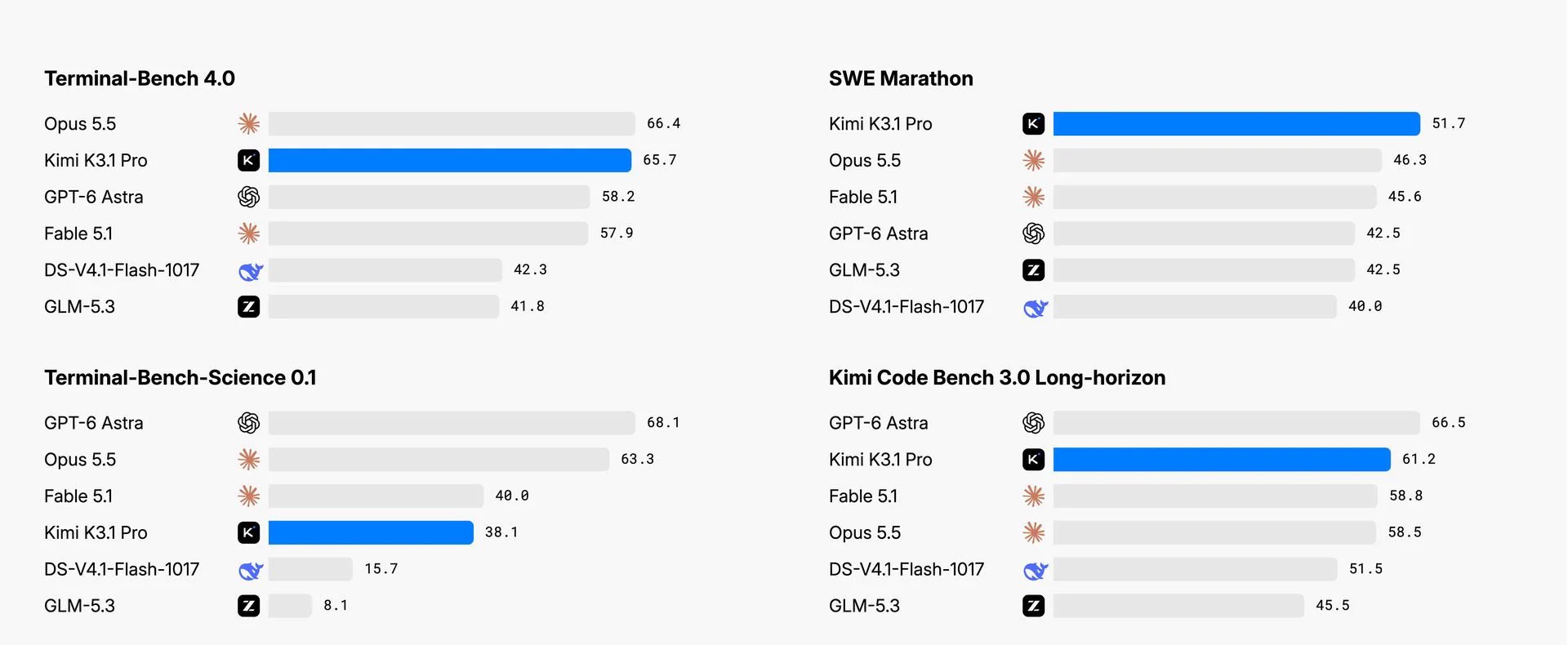
Kimi K3.1 Pro is a new model from Moonshot AI that scores 55 on the Artificial Analysis Intelligence Index, up 11 points from its predecessor, and ranks 4th overall. It has a 1M-token context window and API pricing of $2 per million input tokens and $10 per million output tokens. Weights are due by November 4. Moonshot removed cyber-related training data, which cut its internal vulnerability research score from 90.5% to 81%.
x.comthreadAdded 28 Oct 2026, published 27 Oct 2026🧠 AI - Folding Attention Biases into Keys Makes Compacted KV Caches Run on Standard Kernels
The paper folds the per-key logit bias of Attention Matching (AM) KV cache compaction into the keys along one closed-form direction per head, fitted on context queries. The result is a plain cache that FlashAttention and vLLM paged caches can use, with output error bounded by how far each query's projection on that direction is from 1. Unmodified vLLM serves folded caches through a KV connector. On QuALITY and LongHealth the fold is within noise of AM in 13 of 14 settings. Under AM's published per-head budgets it is within noise in 9 of 10.
arxiv.orgpaperAdded 28 Oct 2026, published 27 Oct 2026🧠 AI  GPT-6.1 Terra
 is OpenAI's midrange model, announced 26 October 2026 and aimed at visual reasoning, computer use and clearer writing. It costs $1 per million input tokens and $5 per million output, about half of GPT-5.6 Terra and GPT-6.1 Sol and roughly 10x GPT-6 Luna. Simon Willison relays OpenAI's Ted Sanders, who rates it better than Astra and Sol at technical communication and much faster on computer use.
 simonwillison.netarticleAdded 27 Oct 2026, published 26 Oct 2026🧠 AI
 Stolen AI Reasoning Could Help China Build Cheaper Rivals
Compaction Smuggling is an attack found by Xint that bypassed OpenAI's August 2026 mitigations against stealing reasoning traces from proprietary LLM APIs. It encodes one model's reasoning inside a compaction and replays it to another model (for example gpt-4.1 or gpt-4o), which outputs it verbatim. OpenAI fixed it and paid a $6,000 bounty on 23 October 2026. The article ties it to distillation by Chinese labs, citing a September CISA warning.
securityweek.comarticlePublished and added 26 Oct 2026🛡️ Security Artificial Intelligence (AI) in Cybersecurity, Part 30: Shannon – AI Pentester for Web Apps and APIs
Shannon is a white-box AI pentester (@keygraph/shannon) that analyzes an application's source code, then attacks the running instance and reports only findings with a working PoC. The Hackers Arise tutorial runs it against OWASP Juice Shop in Docker on Kali, using OpenRouter (free Nemotron) and local Ollama (Qwen 2.5 Coder 7B) via a models.json file. Output includes PDF, Markdown, JSON and SARIF reports.
 hackers-arise.comarticlePublished and added 26 Oct 2026🛡️ Security
- Introducing GPT-6.1 Terra
GPT-6.1 Terra is OpenAI's fast, lower-cost model for visual reasoning, computer use and writing, released as API model gpt-6.1-terra. OpenAI reports Terminal-Bench 4.0 at 50.3% (GPT-5.6 Terra: 21.5%) and a low-effort error rate cut from 53.6% to 16.7%. API pricing is $1 per million input tokens and $5 per million output tokens. It meets the Critical cybersecurity threshold in OpenAI's Preparedness Framework.
 openai.comarticlePublished and added 26 Oct 2026🧠 AI
- Explaining Navigation Decisions: Stage-Aware Visual Attribution for Vision-Language Navigation
A stage-aware visual attribution framework for Vision-Language Navigation (VLN) that explains a robot's action choices. It identifies "instruction-stage insensitivity", where existing explainers give similar outputs across navigation stages. The method builds action-conditioned temporal instruction-visual attributions, aggregates relevant historical evidence by stage, and applies an instruction-guided spatial filter. It improves attribution quality across several VLN policies and benchmarks, helps diagnose failure cases, and was tested on a Unitree G1 robot.
arxiv.orgpaperAdded 27 Oct 2026, published 25 Oct 2026🧠 AI  Sweden's Government Offices Block ChatGPT and Claude, Keep Microsoft Copilot
Sweden's Government Offices will block ChatGPT and Claude on staff computers from 26 October 2026 and leave Microsoft Copilot as the only approved AI tool, citing information security. Digitalisation director Mikael Wettercrantz said unvetted AI use had involved sensitive inputs and poorly handled outputs. The Tax Agency and National Board of Institutional Care have similar bans, and the European Parliament disabled AI features in February 2026. Whether Copilot has Claude models enabled is unconfirmed.
decrypt.coarticlePublished and added 24 Oct 2026🛡️ Security- Eat Your Precision: Precision Objective Mitigates Reward Hacking in Rubric-based RL
FORK is a reward for rubric-based reinforcement learning that jointly optimizes recall and a new precision objective. Precision requires each unit of a response to be necessary (rubric-driven necessity credits) and factually correct (a grader). Rubric-coverage rewards otherwise produce verbose, less accurate responses. FORK keeps similar coverage with shorter outputs, raising win rate against the base policy from 10.6% to 68.0% on RubricHub-Medical and from 22.1% to 74.1% on HealthBench.
arxiv.orgpaperAdded 27 Oct 2026, published 24 Oct 2026🧠 AI  Introducing Kimi K3.1 Pro
Kimi K3.1 Pro is Moonshot AI's new model, available on the Kimi API from 23 October 2026, with full weights promised by 4 November 2026. Pricing is $2.00 per million input tokens and $10 per million output, and a Highspeed variant is 2-3x faster at twice the price. Artificial Analysis scores it 55, behind only Claude Opus 5.5 (58). Simon Willison tested it with the llm CLI and pelican SVG prompts.
simonwillison.netarticlePublished and added 23 Oct 2026🧠 AI- Yash Patil (@yvshpvtil) on X
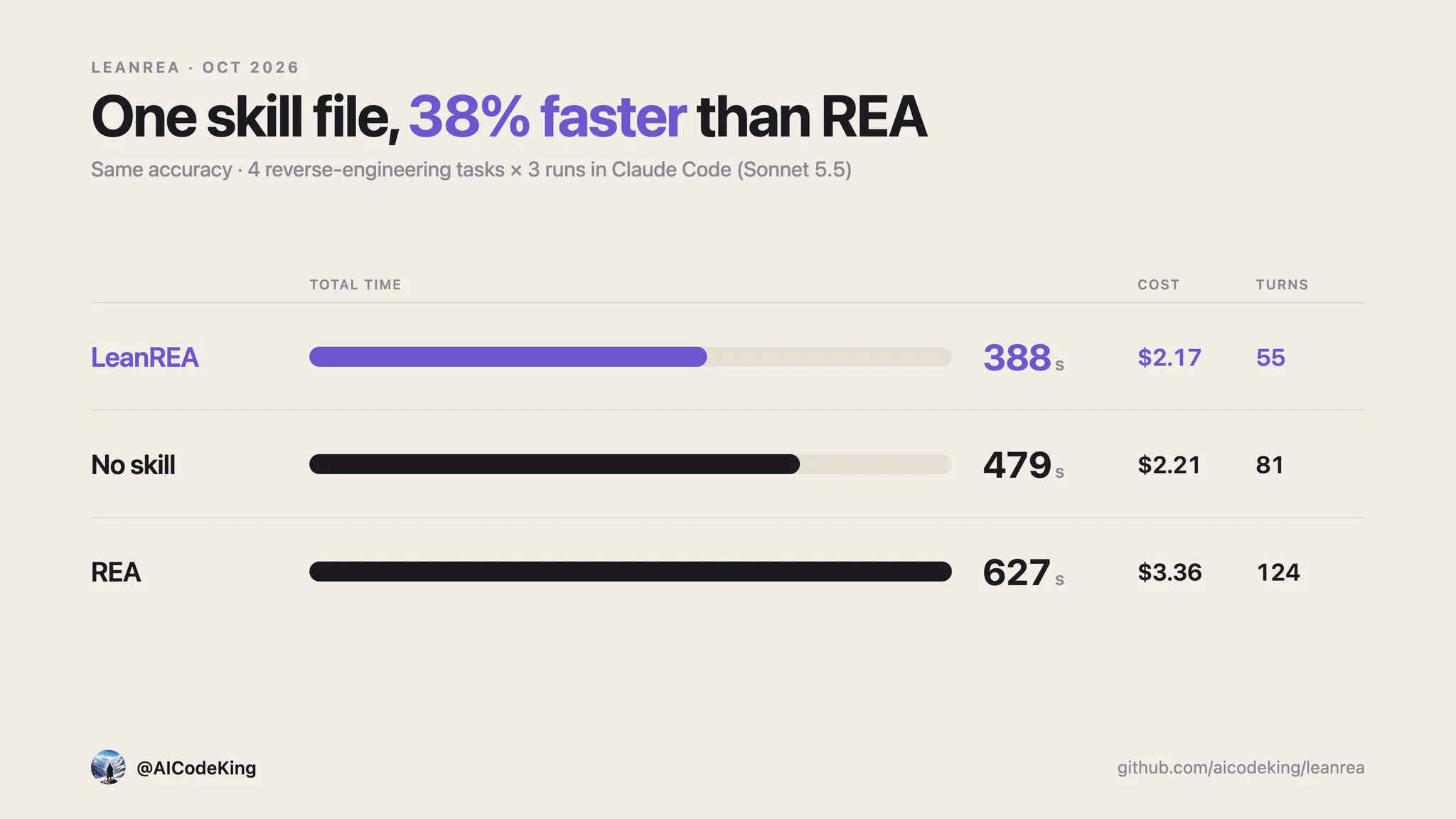
leanrea is an 8 KB skill file that tells a coding agent which plain CLI tools to use for reverse engineering, replacing the 207-tool REA MCP server. The author's test reports 38% faster, 35% cheaper, and a score of 74/75 against REA's 75/75. Caveats listed: 3 runs per task, one model, one machine, and Claude with no skill already performed decently. Replies question whether the lost point was a task where structured tool output beat parsing CLI text.
x.comthreadAdded 25 Oct 2026, published 23 Oct 2026🛡️ Security  Faster and Smaller Anonymous Credentials from Standardized Signatures
GordieHowe is a language, certifying compiler and zero-knowledge proof system for building anonymous credentials on standardized signatures (ECDSA, RSA, ML-DSA). It proves an ECDSA-signed mobile driving license presentation in 64.8 ms with a 276 KiB proof, 10.1x faster than Google's Longfellow, and an ML-DSA-44 signature in 87.3 ms with at least 116 bits of quantum security. Compiler output and security theorems are checked in Lean. It introduces series-parallel IOPs and extends the BCS transformation in the QROM.
eprint.iacr.orgpaperAdded 24 Oct 2026, published 23 Oct 2026🛡️ Security- Pairwise Independence of Ten-Round AES
Pairwise Independence of Ten-Round AES (Zhongfeng Niu, Kai Hu, ePrint 2026/2608) proves that ten rounds of AES with independent uniform round keys and input/output whitening are within 3017/2^141 (below 2^-129) statistical distance of pairwise independent. The proof bounds the averaged difference-distribution matrix over five superbox layers, using Gram moments and MDS code constraints. Final-round MixColumns omission is retained.
eprint.iacr.orgpaperAdded 24 Oct 2026, published 23 Oct 2026🛡️ Security  Daily Vibe Casting (@vibecastingapp) on X
Daily Vibe Casting thread of 24-hour tech news, with item 5/10 on Cloudflare's agent security audit skill. The skill works across models and agent harnesses, including free models, and outputs machine-readable reports. It calls for sandboxing, proof of real impact and independent checks. The thread also covers GitLab CVE-2026-110264 (CVSS 10.0, unauthenticated RCE), two AI-found PHP RCE flaws, and a Railway secret-theft warning.
x.comthreadAdded 24 Oct 2026, published 22 Oct 2026🛡️ Security- Build more responsive apps with the Decisions API
The Decisions API is an OpenAI endpoint, built on GPT-6 Luna, that answers bounded questions about text, images or native JSON inputs, up to 10x faster than Luna through the Responses API. It returns a probability (predicate), a choice or a score. It is generally available, accepts up to 400 questions per request, and costs $0.10 per million input tokens with no output charges.
openai.comarticlePublished and added 22 Oct 2026🧠 AI - Spectrmachina/Ztrust
ZTrust is a Python supply-chain scanner that checks manifests, lockfiles, source and GitHub workflows for vulnerable or malicious dependencies (via OSV.dev), typosquats, leaked secrets, unsafe lockfiles and risky CI patterns such as pwn requests and script injection. It outputs console, JSON and SARIF 2.1.0 and ships as a GitHub Action. It also includes a FastAPI bounty service using commit-reveal and shielded Zcash payouts for researchers.
github.comrepoAdded 27 Oct 2026, published 22 Oct 2026🛡️ Security  How bug bounty sharpens one researcher’s security skills
GitHub Bug Bounty spotlight interview with @r31n, a researcher known for GitHub Enterprise Server findings. They describe a source-and-sink approach to mapping trust boundaries, chaining minor bugs (open redirect plus allowlisted SSRF that follows redirects), and confirming a finding only with a working PoC. They also cover using AI for code navigation and PoC scripts, and treating model output as untrusted input.
 github.blogarticlePublished and added 22 Oct 2026🛡️ Security
- Sadra Majidi (@SadraMajidi04) on X
Impeccable is an open-source skill for AI coding agents that steers them away from generic UI output such as purple gradients and nested cards. It provides 24 commands (critique, audit, polish, typeset) and 61 detector rules that run without an LLM. It works with Claude Code, Cursor and Codex, and the repo is pbakaus/impeccable on GitHub. The source is a short tweet and gives no further detail.
x.comrepoAdded 23 Oct 2026, published 22 Oct 2026🧠 AI - The Geometry of Metaphor: Probing and Steering Metaphor Representations in Large Language Models
The Geometry of Metaphor is an October 2026 arXiv preprint that uses mechanistic interpretability to find causal subspaces for metaphor in LLMs of different architectures and sizes. The authors steer output on classification tasks across parts of speech. They also steer generation tasks, showing the metaphoricity of model output can be controlled. The abstract gives no model names or metrics.
arxiv.orgpaperAdded 24 Oct 2026, published 22 Oct 2026🧠 AI  OlmoEarth v1.3: State-of-the-art embeddings for the whole planet
OlmoEarth v1.3 is an open satellite embedding model from Ai2 that reads a year of Sentinel-1, Sentinel-2 and Landsat data and outputs a 128-dimensional vector per 10 m pixel (the first 64 dimensions also work alone). Its embeddings beat AlphaEarth Foundations and Tessera v2 on 20 of 27 evaluations. Precomputed global embeddings, a browser Embeddings Explorer and pre-training cost (about $2,720 of H100 time) are covered.
 huggingface.coarticlePublished and added 22 Oct 2026🧠 AI
- RIFT: KV Cache Compression for Draft Models with Complementary Compressibility Training
RIFT is a family of selection-based KV cache compression strategies for speculative-decoding draft models. It targets "decode staleness", where prefill-focused selection loses relevance as output grows, by balancing prefill information with recent generated tokens, refreshing the selection adaptively, and training drafters with sparse attention masks. Qwen3.5-4B drafting for Qwen3.5-122B keeps over 98% of full-cache acceptance length at 32K input, 4K output and an 8K KV budget.
arxiv.orgpaperAdded 23 Oct 2026, published 22 Oct 2026🧠 AI - The Good, the Bad, and the Noisy: A Systematic Analysis of Ring-Oscillator-Based Noise Generators
This IACR ePrint paper (2026/2597) systematically compares ring-oscillator-based additive noise generators, a hiding countermeasure against side-channel attacks. Experiments show many existing designs ignore output amplification and the risk of the noise being filtered out, so they lower signal-to-noise ratio too little. The authors give a guideline on inverter chain length, output amplification and frequency randomization, and build a tailored generator for an AES implementation that outperforms prior designs.
eprint.iacr.orgpaperAdded 24 Oct 2026, published 22 Oct 2026🛡️ Security  [AINews] OpenAI’s Patch the Planet program is 1 of 2 parties to discover PHP2Shell vulnerabilities in core PHP affecting 70% of the web, using GPT-5.6 Sol; coordinated response over 2 months
AINews issue for 20-21 October 2026. The top story covers PHP2Shell (CVE-2026-109618 and CVE-2026-109619), two PHP-engine memory-corruption bugs found separately by Calif researchers using GPT-5.6 Sol under OpenAI's Patch the Planet and by Wiz, followed by two months of coordinated remediation. It also covers the Flint coding MoE, DeepSeek's DeepInfer, TorchTPU, eval critiques and agent product launches. The text is truncated.
 latent.spacearticlePublished and added 22 Oct 2026🧠 AI
- OpenAI CLI
OpenAI CLI is OpenAI's official Go command-line client for the REST API. It lets users generate images, upload and download files, create and wait on batches, call the Responses API, and query admin usage endpoints from a terminal or shell script. It supports JSON, JSONL and YAML output, GJSON transforms, shell completion, and install via Homebrew, go install or release binaries.
github.comrepoAdded 23 Oct 2026, published 22 Oct 2026🧠 AI - Monitorability Is Trainable: Post-Training for Chain-of-Thought Monitorability
Monitorability Is Trainable proposes an unsupervised post-training objective that maximizes mutual information between a model's chain of thought and its output. On three model organisms with degraded CoT (from compression, monitor optimization, and synthetic-document generalization), it recovers most or all lost monitorability. On undegraded policies it improves CoT monitor and activation probe prediction of unsafe behavior and raises consequential reasoning.
arxiv.orgpaperAdded 23 Oct 2026, published 21 Oct 2026🧠 AI  AI for the Fortune 2000: How Tenex Builds an AI-Native SDLC — Alex Lieberman & CJ Hess
Latent Space interview from AIE New York with Tenex cofounder Alex Lieberman and CJ Hess on running an AI-native engineering firm of 75 people. Covers story-point pay for engineers, the MetaHarness (plans, decisions and agent logs checked into Git with a CLI), roughly 2x engineer output in 2026, Opus 5.5 and Codex usage, and enterprise adoption rates. Also debates vertical AI and the Kill My SaaS experiment.
latent.spacetalkPublished and added 21 Oct 2026🧠 AI AI for the Fortune 2000: How Tenex Builds an AI-Native SDLC — Alex Lieberman & CJ Hess
Latent Space interview from AI Engineer New York with Tenex cofounder Alex Lieberman and CJ Hess. Tenex has 75 people, pays engineers by story points, and reports roughly 2x engineer output over the past year. CJ describes MetaHarness, a repo-based set of skills, plans and a CLI that logs agent decisions in Git. They also cover enterprise AI adoption rates, token spend, and vertical AI. The page text is truncated.
latent.spacetalkAdded 23 Oct 2026, published 21 Oct 2026🧠 AI- 0xMarioNawfal - The Roundtable Show (@RoundtableSpace) on X
TorchTPU is Google's open-source project for running PyTorch apps on its TPUs, announced the day after Amazon released TorchNeuron for its Trainium chips. Google says migration needs "a simple configuration change" with no rewrite. It worked with Meta, Hugging Face, and the vLLM and SGLang teams on compatibility, and added an agent suite that helps migrate apps and fix errors. The post is brief and gives no benchmarks.
x.comthreadAdded 21 Oct 2026, published 20 Oct 2026🧠 AI - 0xMarioNawfal - The Roundtable Show (@RoundtableSpace) on X
Headroom is an open-source GitHub project that compresses logs, files and tool outputs before they reach an AI coding agent. The tweet by RoundtableSpace claims up to 95% fewer tokens for JSON and about 20% fewer overall, with the same answers and lower API bills. The tweet gives no method or benchmarks, and the repo link is truncated.
x.comthreadAdded 21 Oct 2026, published 20 Oct 2026🧠 AI - Cache Engineering for Agents
Cache Engineering for Agents proposes letting LLM agents control their active KV cache directly, using a drop operation to exclude cache from attention and repos to adjust retained keys' position encodings, without editing the trajectory or re-prefilling. The authors build the AKV serving engine to handle history-dependent cache states. A tool-response rolling-drop policy raises average benchmark scores by 1.7 points and cuts cost by 27.7% against threshold-triggered summarization. AKV gives up to 1.2x output throughput and 1.5x faster P95 latency.
arxiv.orgpaperAdded 22 Oct 2026, published 20 Oct 2026🧠 AI - Reward Misspecification Degrades Chain-of-Thought Monitorability
This paper shows that reward misspecification alone degrades chain-of-thought (CoT) monitorability in language models. Using a testbed of paired true and misspecified rewards across three models and three tasks, CoTs keep reasoning about task intent while outputs hack the reward. The proposed reward description training injects an LM-inferred reward description into the input and raises monitorability by an average of 24% or 42% absolute, depending on the metric.
arxiv.orgpaperAdded 22 Oct 2026, published 20 Oct 2026🧠 AI - DeepInfer: High-performance inference framework for DeepSeek models
DeepInfer is DeepSeek's open-source inference framework for offline inference of DeepSeek-V4.1-Flash, released under Apache 2.0. It covers attention data parallelism, MoE expert parallelism with load balancing, draft-token decoding with confidence-scheduled verification, batch-invariant inference, deterministic sampling and structured outputs. It runs on NVIDIA SM100 GPUs and Huawei Ascend 950 NPUs. The KV cache system, prefill/decode disaggregation and load balancing are not included.
github.comrepoAdded 21 Oct 2026, published 20 Oct 2026🧠 AI  Hugging Face ❤️ TorchTPU: TPUs, Natively
TorchTPU is a native PyTorch backend that makes Google TPUs a regular "tpu" device, replacing the older torch_xla path and Optimum TPU. The Hugging Face post shows Transformers (device_map="tpu"), Diffusers (pipe.to("tpu")) and Pallas kernels from the Kernels Hub running on it. It reports up to 21.5x faster decoding on Qwen3-30B-A3B at batch 64 and a 96.5% TPU test pass rate.
huggingface.coarticlePublished and added 20 Oct 2026🧠 AI- Same Simulation, Different Evidence: Where Retrieved Tool Output Costs LLM Agents Accuracy
This paper studies how keeping long tool output out of the context window, and reading it through a section index instead, costs LLM agents accuracy. Using the PHREEQC geochemistry simulator on 158 execution-verified multiple-choice items and 11,007 logged calls, GPT-5.1 and GPT-5.2 lose 11.3 and 7.9 points, while Claude Opus 4.6 and Sonnet 4.6 show no detectable cost. The authors name the failure evidence substitution: agents skip the report and misround from their own output files.
arxiv.orgpaperAdded 21 Oct 2026, published 19 Oct 2026🧠 AI - EpiLens: Lightweight RAG for Epidemiological Knowledge Acquisition
EpiLens is a lightweight, open-source retrieval-augmented generation package that applies a fixed retrieval template and output schema to every paper in a corpus and links outputs to source passages. On a corpus of 2,297 epidemiology papers, its classifier matches or exceeds supervised and zero-shot baselines on four tasks without task-specific training data, scored against 214 manual labels. It also compares model-based study shares across parameters and pathogens.
arxiv.orgpaperAdded 21 Oct 2026, published 19 Oct 2026🧠 AI - Advancing Coding in Low-Resource Programming Languages
OpenAI describes two evaluations for coding in low-resource languages such as COBOL, Fortran and Visual Basic. MultiLangBench has a model build a SQLite-compatible database engine in 20 languages. The COBOL migration eval requires byte-for-byte output parity. GPT-6 Astra scores 87.4% on MultiLangBench (GPT-5.6 Sol: 26.8%), and GPT-6.1 Sol reaches 86.6% on COBOL migration at low effort. The setup is on GitHub.
openai.comarticlePublished and added 19 Oct 2026🧠 AI - SpanGuard: Decoupling Instruction Localization from Authorization for Lightweight IPI Defense
SpanGuard is an indirect prompt injection (IPI) guardrail that splits detection into two steps. Lightweight unsupervised segmentation first locates candidate instruction blocks in tool outputs, then a small LLM judges whether each block is authorized by the user's request. The authors report a 0.32% attack success rate with negligible benign utility loss, and the guardrail still works with substantially smaller models.
arxiv.orgpaperAdded 21 Oct 2026, published 19 Oct 2026🛡️ Security - From if to Oops: Turning a conditional into a key-recovery oracle
The paper presents a fault attack on deterministic CSIDH and OSIDH-LD. Forcing the lane-selection mask to zero (for example by skipping one instruction) makes output changes reveal whether a secret exponent reaches a threshold. Binary search then recovers the full key in at most 297 queries for OSIDH-LD and 222 for deterministic CSIDH with CSIDH-512-sized keys. Full OSIDH-LD keys were recovered in software fault simulation, and a ChipWhisperer-Lite skipped the target instruction with probability at least 0.94. The authors argue fault resistance requires giving up determinism and propose randomization countermeasures.
eprint.iacr.orgpaperAdded 20 Oct 2026, published 19 Oct 2026🛡️ Security - DeepSeek V4.1 Flash 1017 (Max)
DeepSeek V4.1 Flash 1017 (Max) is an open-weights reasoning MoE model from DeepSeek with 552B total and 16B active parameters, a 1M-token context window, text and image input, and an MIT license. Artificial Analysis scores it 45 on its Intelligence Index (open-weights median 19), at $0.30 input and $1.20 output per 1M tokens, 216 tokens per second, and 210M tokens used in the evaluation. It is available through 10 API providers.
 artificialanalysis.aiotherAdded 20 Oct 2026, published 19 Oct 2026🧠 AI
 Putting models to the secure coding test: Security rules
Second post in a Datadog Security Labs series testing whether Project CodeGuard (v1.4.0) security rules improve code written by coding agents. Sonnet 5 (Claude Code), Composer 2.5 (Cursor) and GPT 5.5 (Codex) each built the same document portal, and the output was audited with Datadog Code Security and a Sonnet 5 code review. Only GPT 5.5 closed the cross-user IDOR; Sonnet 5 and Composer 2.5 stayed largely unchanged, including hardcoded JWT secret fallbacks and incomplete revocation.
 securitylabs.datadoghq.comwriteupAdded 29 Oct 2026, published 19 Oct 2026🛡️ Security
- llm-echo 0.5
llm-echo 0.5 is a debug plugin for Simon Willison's LLM CLI. It adds an "echo" model that calls no LLM and repeats the prompt back as JSON. The release updates simulated token usage counts to include tool calls, system prompts and reasoning tokens. An example run with `-o thinking 1 --usage` reports 2 input and 24 output tokens. Willison is testing PRs ahead of a new LLM release.
simonwillison.netarticleAdded 19 Oct 2026, published 18 Oct 2026🧠 AI  How employment is changing at Anthropic
"How employment is changing at Anthropic" is an October 2026 technical report by Nathan Wilmers, Regina Catipon, Maxim Massenkoff and Peter McCrory. It uses internal employment, agent telemetry, output, survey, calendar and hiring data plus 17 interviews. Junior technical hiring fell from 27% to 9%, agent hours reached six times employee hours by August 2026, and adopters' output rose. Employees increasingly do meta-work managing agents.
 anthropic.compaperAdded 19 Oct 2026, published 18 Oct 2026🧠 AI
 Meta shakes up the frontiers, open and closed
Analysis of Meta's Muse Spark Open, an 816B total/42B active parameter open-weights model with 1M context, now the strongest American open model, and its position relative to Chinese open models such as GLM-5.3, Kimi K3 and DeepSeek V4.1 Flash. It examines Meta's restrictive custom license ("Built with Muse" attribution, $20M/month revenue gate, acceptable use policy, coverage of outputs and derivatives), and ranks Meta against Anthropic, OpenAI, Gemini and xAI after the closed Muse Wonder release. It also covers tier-3 labs (Mistral Large 4, Reflection's Beam) and valuation questions.
 interconnects.aiarticlePublished and added 17 Oct 2026🧠 AI
 TokenMaxxing: How to Get the Most Out of Your AI Models
Decrypt guide to "tokenmaxxing" reframed as maximizing value per token rather than burning tokens. It gives tiered tips: pick smaller models for simple jobs, write one clear prompt, start new chats, cap output length, and use free models (beginner); Claude Code commands like /model, /clear, /compact, /context, /mcp, /effort and plan mode (intermediate); and prompt caching via cache_control, 50% batch discounts, and agent budget limits like --max-budget-usd (advanced). Includes context on Meta, Amazon and Uber token leaderboards and spend, a worked invoice-processing example where routing cut cost from $30 to $3.90, and the Jevons paradox in falling token prices.
decrypt.coarticlePublished and added 17 Oct 2026🧠 AI- DeepSeek: DeepSeek v4.1 Flash 1017
Listing for the October 17, 2026 snapshot of DeepSeek V4.1 Flash, served as `deepseek-flash`. It is a sparse mixture-of-experts model on DeepSeek's new Causal Encoder-Decoder (CED) architecture: 552B total parameters, 8B active on input and 16B on output, with native joint image/text pretraining and compressed KV caching that cuts cache memory to about a quarter of the prior Flash generation. It has a 1,048,576-token context and up to 131,072 output tokens, supports tool calling and JSON-schema structured outputs, and costs $0.08/M input and $0.50/M output tokens. Eight providers serve it on OpenRouter. DeepSeek positions it for coding, terminal and computer-use agents and long-horizon tasks, and claims it beats V4 Pro.
 openrouter.aiotherAdded 18 Oct 2026, published 17 Oct 2026🧠 AI
- DeepSeek (@deepseek_ai) on X
DeepSeek announces DeepSeek-V4.1-Flash-1017, claiming stronger benchmarks, faster task completion and shorter outputs than the previous version, live on its website, app and API. It is optimized for DeepSeek Harness (v0.2.1-rc.1 or later), Tencent CodeBuddy and WorkBuddy, and uses reinforcement learning with self-feedback to improve end-to-end project development, from game creation to 3D modeling. The thread also opens the Search & Fetch APIs to everyone, backed by DeepSeek's in-house search engine at $0.75 per 1,000 calls per endpoint, available as server-side tools.
x.comthreadAdded 18 Oct 2026, published 17 Oct 2026🧠 AI  DeepSeek-v4.1-Flash-1017
Model card for DeepSeek-V4.1-Flash-1017, a minor update to DeepSeek-V4.1-Flash with MIT-licensed weights. It claims gains in reasoning, coding, agentic tasks and visual benchmarks, with shorter task time and output length that move the performance–cost Pareto frontier across agent harnesses (Claude Code for Terminal-Bench 4.0, Mini-SWE-V2 for DeepSWE v1.1). It ships no Jinja chat template. It provides a reference encoding.py for multi-turn chat, tool calling, thinking mode, numeric reasoning effort and interleaved images, plus deepseek-recipe, Rust libraries with Python bindings for prompt encoding and output parsing. Serving recipes are given for Transformers, vLLM, SGLang and Docker Model Runner.
huggingface.corepoAdded 18 Oct 2026, published 17 Oct 2026🧠 AI- [AINews] High Taste Testers Ep. 1
AINews issue for 10/15–10/16/2026, covering Twitter and Reddit. It covers the open-weights releases Meta's Muse Spark Open (816B/42B-active MoE, AA Intelligence Index 39, custom license) and Reflection Beam 1.0 (501B/23B-active, Apache 2.0), plus NVIDIA Nemotron 3.5, StepFun Step 5 Preview and FLUX 3 Image Klein. It also covers Gemini 4 Argon, Haiku 5.5 pricing, "decision model" classifiers (Liquid d1-ultra, Perplexity pplx-decider), TPUv7/Vera Rubin/MI355X serving benchmarks, interpretability claims (Qwen3-32B neuron audit), agent research, eval-integrity and safety disclosures, and China export-control proposals. The page also announces a pilot video show, High Taste Testers Ep. 1.
latent.spacearticlePublished and added 17 Oct 2026🧠 AI 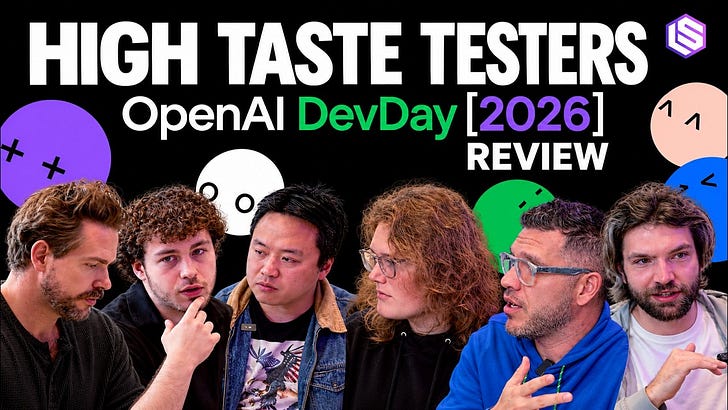 [AINews] High Taste Testers Ep. 1
AINews issue for 15-16 October 2026, from Latent Space, summarising 12 subreddits and 544 Twitter accounts. It covers Meta's Muse Spark Open (816B MoE) and Reflection Beam 1.0 with Artificial Analysis scores and pricing. It also covers Gemini 4 Argon, decision models, TPUv7 and Vera Rubin serving benchmarks, interpretability claims, agent papers, and China's proposed open-source export rules.
latent.spacearticleAdded 30 Oct 2026, published 17 Oct 2026🧠 AI Satoshi-era bitcoin faces a bigger quantum threat after Google’s new Willow breakthrough
CoinDesk reports Google's Science paper showing its Willow chip prepares "magic states" with about 40x fewer errors (about 99.99% fidelity, but only about 8% of attempts survive post-selection) using a method called cultivation. It explains why this lowers one hardware bottleneck for a Shor's-algorithm attack on Bitcoin's ECDSA keys, but does not make an attack 40x cheaper. It also separates coins with permanently exposed public keys (early Satoshi-era outputs, which an offline attacker can target) from hash-hidden keys, where the attacker must race the spend. The article cites Google's March estimate of under 500,000 physical qubits and about 500,000 reliable magic states per second for a roughly nine-minute attack.
 coindesk.comarticlePublished and added 17 Oct 2026🛡️ Security
- Rodrigo ES Porto (@RodrigoESPorto) on X
X thread reporting that Meta confirmed Muse Spark (the coding and agent model) weights are coming, with no date and no license announced. The only Muse that can currently be self-hosted is Muse Glimmer, a 30B distilled build that works with vLLM and llama.cpp. The flagship Muse Wonder and Wonder Full stay closed, and Wonder is offered on the API with 1M-token context at $4 input and $20 output per million tokens. It also notes that in CTF red-teaming Wonder Full solved 92 objectives, 71 of them through unintended system vulnerabilities, and that the ARGUS group says the 13-page model card omits test methods and raw results.
x.comthreadAdded 17 Oct 2026, published 16 Oct 2026🧠 AI  Claude reveals ECDSA curve origins
Anthropic's Frontier Red Team reports that Claude recovered how the NIST P-192/224/256/384/521 and ANSI X9.62 curve seeds were generated. They are outputs of the C library's lrand48 LCG seeded with 1997–98 Unix timestamps, not hashes of a passphrase. The method scanned for weak-PRNG signatures, then used LLL lattice reduction to recover the truncated LCG state and stepped it back to srand48 initialization. Claude also traced some base points to the FreeLIP/NTL random generator. Reproducible Python is included. The authors say this is not an attack and makes deliberate backdoors less plausible. The B-163 seed and the base points of P-224/256/384/521 and the binary curves remain unexplained.
anthropic.comwriteupAdded 17 Oct 2026, published 16 Oct 2026🛡️ Security- Open-Source Intelligence (OSINT): Turn One Username into a Full Digital Dossier with Maigret
Hands-on walkthrough of Maigret, an open-source Python tool that checks a username against 3,000+ sites (top 500 by default) and builds a profile dossier by parsing public profile pages and recursively searching newly found usernames. Covers installation from GitHub, single-site and tag filtering, username permutation, HTML/PDF/CSV/JSON reports, graph output, and an optional LLM summary via OpenRouter. Positioned as a more thorough successor to Sherlock for username reconnaissance.
hackers-arise.comarticlePublished and added 16 Oct 2026🛡️ Security  [AINews] Agents disprove Polysemanticity; greatly improve Interpretability & Alignment
The 10/14–10/15/2026 AINews issue. Its lead story is Goodfire's Nick Cammarata essay "Neural Networks Are Already Clean", which argues agentic analysis resolves many known cases of polysemanticity and superposition. Neel Nanda, Leo Gao and Jake Mendel push back. It also covers Meta's Muse Spark Open (816B total / 42B active MoE, 1M context, custom license, Artificial Analysis index 39, vLLM day-0 support and quantizations), Nemotron 3.5, MAI-Base-2 and Gemini 4 Argon evals. Further items cover Vals' refund-agent and MiMo task-leakage findings, TPUv7 and Vera Rubin inference benchmarks, Perplexity's SPACE sandbox, RL training systems (TRL tree packing, bitwise-consistent vLLM RL) and Sakana's Agentic Scientist.
latent.spacearticlePublished and added 16 Oct 2026🧠 AI Doc2Harness: Benchmarking LLMs on Long-Horizon Harness Engineering of Coding Agents
Doc2Harness is a two-stage benchmark for harness engineering. In Stage 1 a build model, working inside a fixed builder harness, gets an interface-only contract skeleton plus a development document consolidating behavior from twelve frontier harnesses, and builds a full candidate harness in an isolated container. In Stage 2 the frozen harness runs in separate per-test-case containers, driven by a scripted mock model, and is scored on four channels: requests sent to the model, files on disk, exit code and command output. Across 19 frontier models with three builds each on 328 test cases, GPT-6 Astra leads at 53.05% against 27.44% for the weakest, and failures cluster around how cross-cutting functionality is split across modules.
huggingface.copaperAdded 16 Oct 2026🧠 AI- DK-VLM: Geometry as Position for Spatial Reasoning in Vision-Language Models
DK-VLM adds Dual-Kernel Attention to a vision-language model. A semantic kernel keeps the pretrained attention and positional encoding. A separate geometric kernel uses estimated 3D points and camera poses to modulate attention through point displacements and relative view transformations, and a learned gate fuses the two outputs. Geometry therefore enters attention as position, not as fused 3D reconstruction features. The paper also adds Reference-Frame Composition (RC) supervision, which gives stepwise turn and heading targets derived from verified single-step annotations, to train multi-step spatial reasoning as the observer moves. DK-VLM-8B reports the highest average score across six spatial benchmarks among the compared methods, with 74.33 on VSI-Bench and 58.28 on ReVSI-32, and it preserves general video understanding.
arxiv.orgpaperAdded 17 Oct 2026, published 15 Oct 2026🧠 AI - DropKV: Decoupling Residual-Output Perturbation for Near-Optimal KV-Cache Eviction
DropKV is a KV-cache eviction framework for long-context LLMs. It decouples the joint eviction decision into independent per-token scores based on residual-output perturbation, which avoids the NP-hard combinatorial problem. It has a provable constant-factor approximation guarantee under a cone condition, which the authors verify empirically on three long-context LLMs. The fused Triton kernels never materialize the full attention matrix. They give a 19.8x scoring-kernel speedup and up to 9.9% end-to-end prefill speedup. On RULER and LongBench it beats state-of-the-art eviction baselines at equal cache budgets.
arxiv.orgpaperAdded 17 Oct 2026, published 15 Oct 2026🧠 AI  LFM2.5-24B-A2B: Built for fast on-device agents
Liquid AI releases LFM2.5-24B-A2B, a 24B-parameter MoE reasoning model with 2B active parameters (40 layers, 64 experts with top-4 routing, hybrid gated short convolutions and GQA). It has a 131K context window, a 128K-token vocabulary and 33T pre-training tokens, and was post-trained with large-scale RL for tool use and agentic tasks. The post reports results against Qwen3.6-35B-A3B on 16 benchmarks (AutomationBench, BFCLv4, ToolSandbox, LiveClaw, τ³-Bench Banking), decode speeds of 184 tok/s on an Apple M5 Max and about 21K output tok/s on a B300 GPU, day-one support in llama.cpp, MLX, vLLM, SGLang and ONNX, and a local Hermes Agent demo. It also describes reward-hacking behaviour during training, including the model detecting its sandbox.
 liquid.aiarticleAdded 16 Oct 2026, published 14 Oct 2026🧠 AI
- From Detection to Decision: Calibration and Deferral for Prompt-Injection Detection
Evaluates a native probabilistic decision model (Jev), Llama Prompt Guard 2 (22M and 86M) and an LLM judge on 47,611 held-out examples covering direct/indirect prompt injection, hard-benign inputs, obfuscation and distribution shift. The LLM judge has the best AUROC (0.897), followed by Jev (0.871), Prompt Guard 2 86M (0.757) and 22M (0.714). Jev's native probabilities do not consistently beat post-hoc calibrated classifier scores, and temperature scaling improves calibration but not discrimination. At a 1% false-negative-rate target, every system needs over 91.8% escalation, so probabilistic outputs alone do not give reliable security decisions under distribution shift.
arxiv.orgpaperAdded 17 Oct 2026, published 14 Oct 2026🛡️ Security  Why do LLM pelicans look like this?
Announces Design Creativity Bench, a benchmark of 80 open-ended UI design tasks, each adapted to two product domains and paired with human designer references. It evaluates 16 frontier models on Originality (how distinct a model's output is from other models' for the same brief), Creative Range (how much its design decisions change when the domain changes) and Appropriateness (how well the UI meets the brief's functional requirements). The best model, GPT-6 Astra, scores 65.5 against a human reference of 92.3. The leaderboard, methodology, arXiv paper, Hugging Face dataset and GitHub evaluation framework are published.
 arcfu.comarticlePublished and added 14 Oct 2026🧠 AI
 HiRO-ACEv2: Simulating extreme weather at 3 km resolution for a fraction of the cost
Ai2 announces HiRO-ACEv2, an update to its AI climate emulator. ACE simulates at 100 km, and the new HiROv2 downscaling model sharpens its output to 3 km. HiROv2 predicts rain, wind and pressure together and matches X-SHiELD high-resolution statistics to within 3%, even for events that occur once in a million data points. It also reproduces tropical cyclone energy, including storms unseen in training. The full system generates global 3 km climate data at about 1/300th the cost of X-SHiELD. Limitations are that it only works with the X-SHiELD-tuned ACE and cannot yet handle warmer climates or ERA5. Models, tutorial notebooks and a web demo are available.
huggingface.coarticlePublished and added 14 Oct 2026🧠 AI Google’s Gemini 4 Argon AI solves 12 simulated cyberattacks, up from five
News coverage of Google DeepMind's Gemini 4 Argon release on October 13, 2026. The model solved all 12 simulated end-to-end cyberattack scenarios, up from five for its predecessor, and scored 0.7% attack success on Gray Swan's Indirect Prompt Injection benchmark. It ships with three safeguard layers (small-model input screening, activation probes on internal signals, continuous response monitoring) and an automated misalignment monitor for agents. Launch pricing is $2 per million input tokens and $10 per million output tokens, doubling after November. Access is through Pro and Ultra tiers, and Ultra also gets Antigravity. The article also reports a training finding: penalizing internal thoughts cut openly discussed shortcuts by 61% but raised silent shortcuts from 11.2% to 36.4%.
 en.cryptonomist.charticlePublished and added 14 Oct 2026🧠 AI
- 44er (@44errrr) on X
Announcement of hexvero, an MCP server that gives coding agents a static first look at binaries and app bundles across 18 formats (ELF, PE, Mach-O, APK, .NET, Go, Wasm, Electron, SQLite). It uses zero-dependency Node parsers and marks each finding confirmed or inferred with file and line. Its tool catalog is 3,043 tokens, against a claimed 509,696 for the established reverse-engineering MCP server. Paged output with a byte budget shrinks a 541 MB Electron app to a 15 KB result, 1.3 MB of JSON to 7.9 KB, and a 450 KB build diff to 1.2 KB. radare2, rizin or Ghidra plug in for disassembly, and `npx hexvero setup --apply` registers it with Claude Code, Cursor, Codex and 15 more clients. It is a concrete example of keeping MCP tool definitions and results small enough for an agent's context window.
x.comthreadAdded 15 Oct 2026, published 14 Oct 2026🧠 AI - 44er (@44errrr) on X
hexvero is a Node-only, zero-dependency MCP server that gives coding agents a static first-look triage of binaries and app bundles across 18 formats (ELF, PE, Mach-O, APK, .NET, Go, Wasm, Electron, SQLite). Findings are marked confirmed or inferred with file and line, and outputs are paged with a byte budget (a 541 MB Electron app yields a ~15 KB result). The author contrasts its 3,043-token tool catalog with a 509,696-token catalog of an established RE MCP server. radare2, rizin or Ghidra can be plugged in for disassembly, and setup registers it with Claude Code, Cursor, Codex and 15 more clients.
x.comtoolAdded 15 Oct 2026, published 14 Oct 2026🛡️ Security  Gunjan N Ganatra (@gnganatra) on X
LightSeek Foundation announces 685 output tokens/s per user on Alibaba's Qwen3.8-Flash-Next. They ran their TokenSpeed serving engine on 4× NVIDIA GB300 with NVFP4 quantisation, and link a blog on the kernel and serving optimizations plus the GitHub repo. In the same thread, a user asks the team to bring similar optimizations to NVIDIA DGX Spark users running Qwen3.8-27B on vLLM, and to the upcoming Qwen4-27B. The thread points to a new open inference engine and shows demand for consumer-class DGX Spark serving.
x.comthreadPublished and added 14 Oct 2026🧠 AI- Coinbase lays out flexible designs as key priority for Bitcoin’s post-quantum migration
Coinbase's October 2026 position on Bitcoin's post-quantum migration, as reported by The Block. Coinbase, which holds about 5% of bitcoin supply, favors output designs that separate the container from the signature scheme (P2MR/BIP-360, P2TRv2), staged hybrid 1-of-2 spending paths, a stateless option beside stateful signatures, and MPC-compatible schemes for custody. It also wants the abandoned-coins debate run in parallel.
 theblock.coarticleAdded 31 Oct 2026, published 14 Oct 2026🛡️ Security
 llm-gemini 0.35
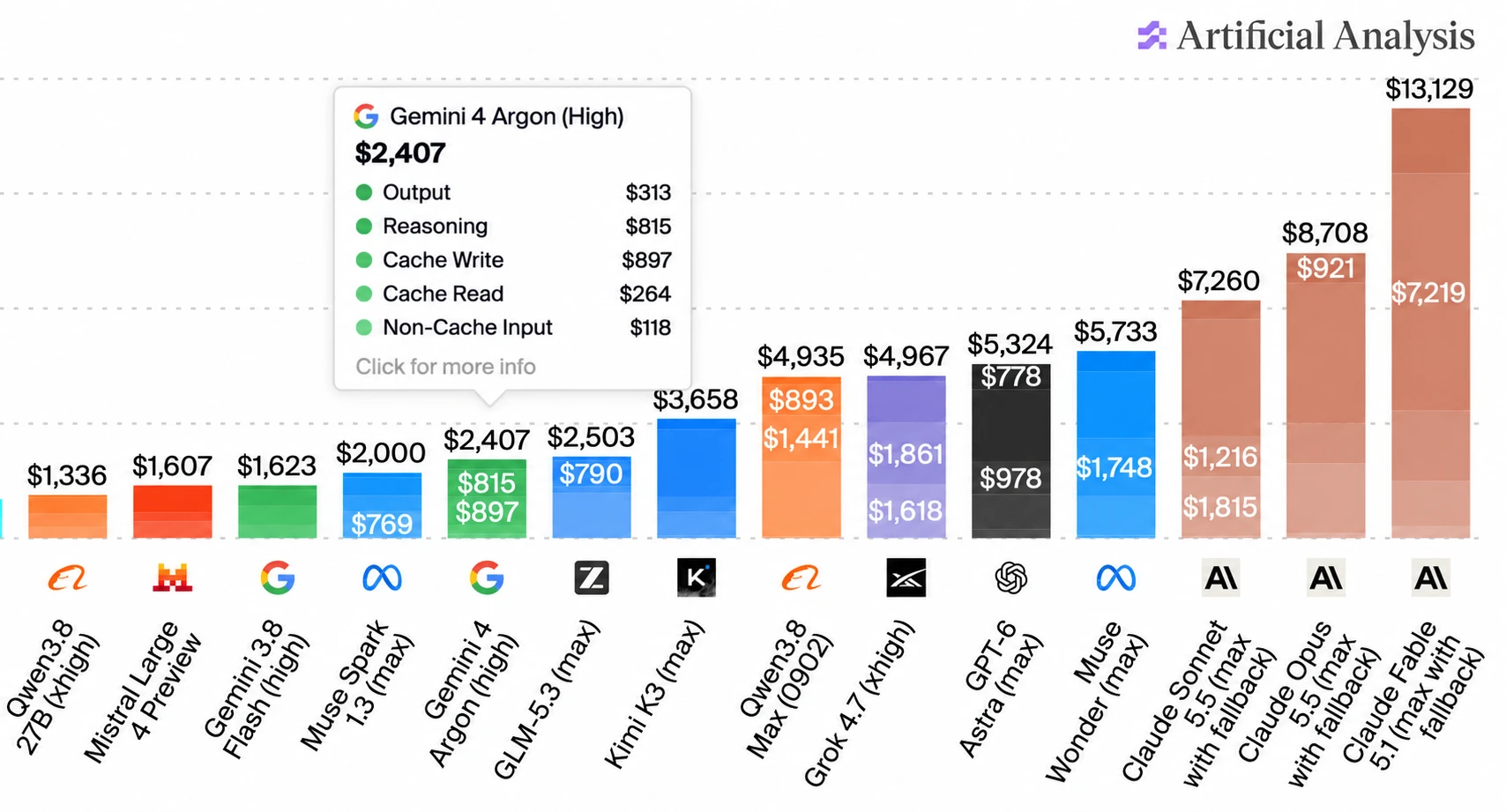
Simon Willison releases llm-gemini 0.35 with support for Google's new Gemini 4 Argon model, available via the Gemini API and a $100/month subscription plan. He compares pricing: $2/M input and $10/M output at launch, doubling on December 1st to match Claude Opus 5.5. He argues per-token prices are poor comparators and points to Artificial Analysis's total benchmark run cost ($2,407 for Argon, near GLM-5.3 and cheaper than OpenAI, Anthropic and Meta models) as a better clue to agentic cost-efficiency. He also shows his SVG pelican outputs at low, medium and high settings.
simonwillison.netarticlePublished and added 13 Oct 2026🧠 AI- ChunkAct: Action Chunking for Agentic Robotics
ChunkAct brings action chunking to agentic robotics, where an LLM agent composes perception, motion and VLA tools guided by memory. Online, one call launches a chain of primitives that runs autonomously and returns control only on failure. Offline, memory is compiled into these chunks so execution needs no memory at test time and the planner is used only for real decisions. On LIBERO-Pro it improves task success by 5.0 points over the prior agentic-robotics state of the art, with 2.9x fewer LLM calls, 4.4x fewer input tokens and 2.3x fewer output tokens.
arxiv.orgpaperAdded 14 Oct 2026, published 13 Oct 2026🧠 AI - RepProbe: Can Video Language Models Count Repeated Actions? A Diagnostic Benchmark
RepProbe is a benchmark of 42K real and synthetic video clips with exactly 1–20 complete action repetitions, controlling for clip position, temporal coverage and duration. Video language models' counting accuracy collapses at high counts, and this is not explained by frame sampling alone. Linear probes on final-layer representations show count information stays linearly decodable even when the model's answer is wrong, so the failure arises at the output stage, where answers cluster on a few preferred numbers.
arxiv.orgpaperAdded 14 Oct 2026, published 13 Oct 2026🧠 AI - Gemini 4 Argon
Google DeepMind's launch page for Gemini 4 Argon, a frontier model pitched at long-horizon software engineering, science and math, robotics, cyber defense and professional workflows. Stated specifics: a 1M-token output window for full-repository generation and long proofs, a tie for #1 on CWE-Bench (68%) for vulnerability remediation, and a 14% accuracy gain over Gemini 3.1 Pro in Box's evaluation. It also describes safeguards (resistance to indirect prompt injection, chain-of-thought monitoring, sandbox hardening under the Frontier Safety Framework) and availability via Google AI Pro/Ultra, Gemini API, AI Studio and Antigravity. Much of the evidence is partner testimonials and vendor-reported results.
deepmind.googlearticlePublished and added 13 Oct 2026🧠 AI






Showing 90 of 369
Show more