 Earliest Known PolinRider Malware Found in 2025 npm Packages
OpenSourceMalware traces nine itsa-* npm package versions published on 4 May 2025 from a hijacked maintainer account to the PolinRider campaign, eight months before documented victims. It decodes the EtherHiding chain (BNB Smart Chain and Ethereum calldata, JADESNOW, INVISIBLEFERRET bootstrapper, Socket.IO RAT, Python stealer) and links the 2025 sample to 2026 force-push infections. It lists IOCs, hashes, a timeline and hunting guidance.
 opensourcemalware.comwriteupPublished and added 30 Oct 2026🛡️ Security
 NIK C2: The new AI-enabled command-and-control framework
NIK C2 is a newly observed C2 framework with a Go-based 64-bit Windows implant that embeds an OpenAI Chat Completions client (ai_generate command), falling back to the victim's OPENAI_API_KEY. Talos details its 52+ commands, AES-256-GCM over WebSocket with HTTP fallback, credential, wallet and keystroke theft, screen-lock ransomware, AMSI bypass and anti-debug. It also lists a live C2 at 87.120.196[.]120 and total-sitevv[.]lol.
 blog.talosintelligence.comwriteupPublished and added 29 Oct 2026🛡️ Security
 Searchjacked: Hidden Browser Extensions Hijack Searches for 13 Million Users
Searchjacked is Socket's research on 319 browser extensions (about 13.44M users over a decade) that hijack searches to earn ad revenue. The fetched text attributes 200 extensions to named operators such as Intango, System1, Perion, Mutual Media and Kinner Lake, and 119 to unknown operators like "SecuryBrowse" and "Bing-Search". It lists the Yahoo and Bing monetization IDs used to link them. The narrative and technical mechanics are not in the fetched text.
 socket.devwriteupPublished and added 29 Oct 2026🛡️ Security
 Malicious Firefox Extensions Impersonate Phantom, Jupiter, and Bitget to Steal Wallet Secrets
Socket analysis of three malicious Firefox add-ons impersonating Phantom, Jupiter and Bitget wallets, using Unicode homoglyph names. They steal seed phrases and private keys and send them to brand-named subdomains of bonto[.]io. The Phantom fake adds a runtime loader that fetches and evals a second stage, and bundles a drainer backend with Telegram forwarding. Includes IOCs, hashes and wallet addresses.
socket.devwriteupPublished and added 27 Oct 2026🛡️ Security- Tailworm – Tailscale Vulnerabilities
Tailworm is a security assessment report by Erica Windisch (Cyberdione Labs) on Tailscale v1.104.2 and headscale v0.29.5, tested 22-24 October 2026. It documents 11 findings: Tailscale SSH unix-socket forwarding that runs as root (bind, dial and TOCTOU races), conn25 app-connector egress bypass, gliderssh memory exhaustion, serve/funnel flaws and headscale DoS. It includes PoC references, mitigations and fix status as of 27 October 2026. The page is truncated, so the later sections were not read.
 tailworm.comwriteupAdded 27 Oct 2026, published 25 Oct 2026🛡️ Security
 New Evidence Shows LiteLLM Secret-Stealing Workflows Ran 11 Days Before Supply Chain Attack
Socket's Threat Research team reports that malicious cache.yml workflows ran in the BerriAI/litellm repository on 10 and 12 October 2026, eleven days before the 21 October release attack that published litellm==1.107.0. Each commit pushed to a short-lived ci-tmp-<hex> branch, then deleted it, sending base64-encoded CI secrets to webhook.site. Evidence comes from Actions metrics and environment deployment records; 20 secret names were exposed.
socket.devwriteupPublished and added 23 Oct 2026🛡️ Security From JavaScript to Renderer Code Execution: Three V8 Vulnerabilities and Two v8CTF Flags | depthfirst
Depth First Security's write-up describes three V8 bugs found using its dfs-large1 research tooling: CVE-2026-78938, a type confusion in Promise.prototype.finally that lets an internal helper be constructed and return a primitive; CVE-2026-79236, a TurboFan load-elimination bug that keeps a stale property-array pointer after object migration; and a shared WebAssembly memory sandbox escape (issue 546253900) caused by mismatched backing-store registration during serialization. It walks through turning each memory bug into addrof/fakeobj primitives, chaining either with the sandbox escape to reclaim a freed V8 isolate via a WebSocket allocation, and pivoting through a CFI-constrained ROP chain to achieve Chrome renderer code execution, earning two v8CTF flags. Fixes landed between August 20 and 25, 2026.
 depthfirst.comwriteupAdded 29 Oct 2026, published 20 Oct 2026🛡️ Security
 ARMORY CASTLE Exploits BeyondTrust
ARMORY CASTLE (formerly UNC5221), a suspected PRC-nexus actor, exploited BeyondTrust Remote Support zero-day CVE-2026-102764 in August 2026, per Mandiant incident response. The post details the SAWFLY PHP webshell, BARECLAW SOCKS5 WebSocket tunneler, SUID root escalation, sudoers template persistence, vault credential extraction, log deletion and haproxy.conf changes. It adds YARA rules, detection ideas and patch-first remediation (BT26-05).
 cloud.google.comwriteupAdded 29 Oct 2026, published 15 Oct 2026🛡️ Security
 Telegram Desktop vulnerability allowed any user's file to be stolen
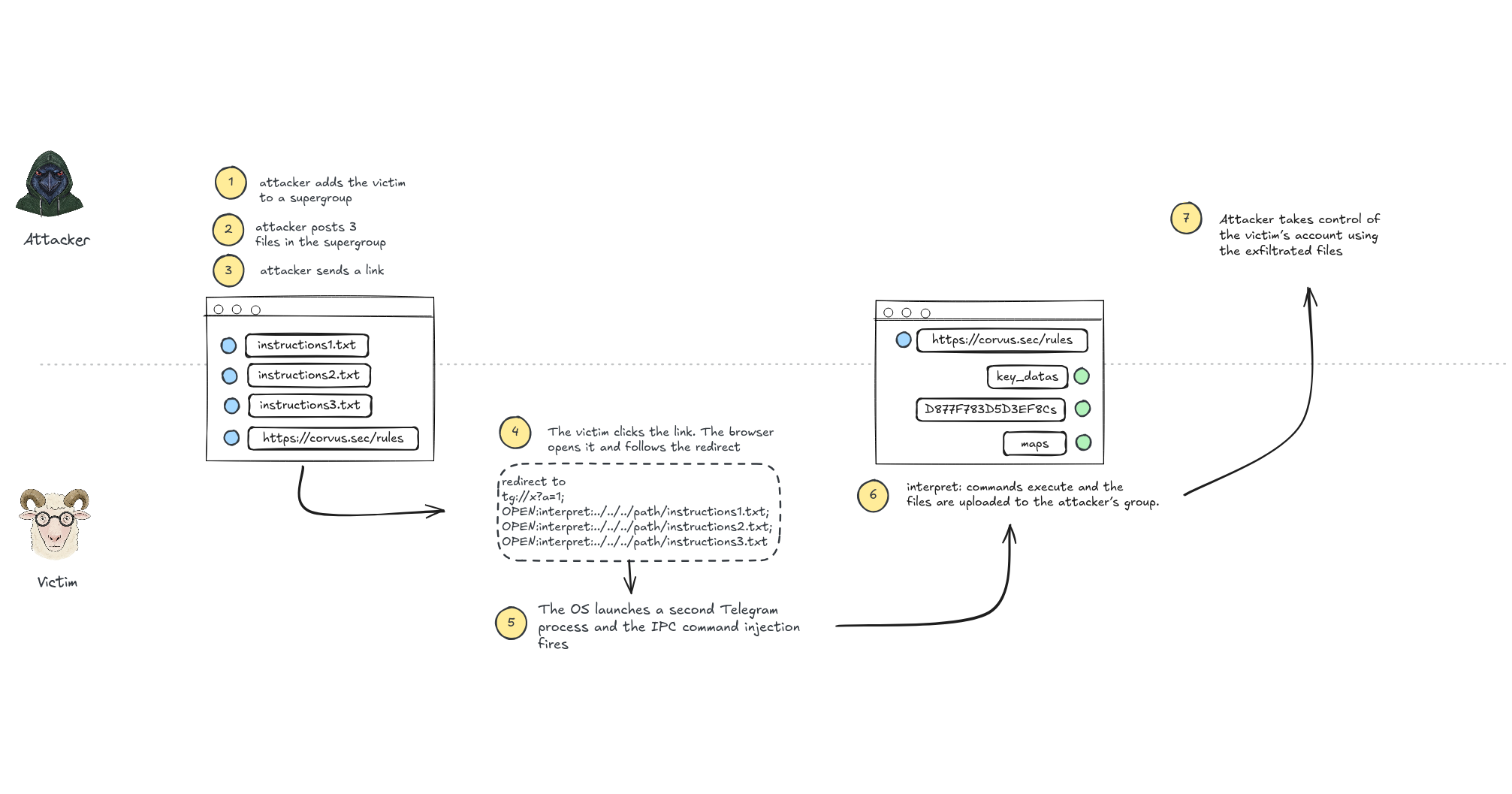
Writeup of a two-bug chain in Telegram Desktop: the single-instance local-socket IPC does not escape the semicolon record separator, so a clicked tg:// link injects extra OPEN: commands, which reach the internal interpret: scheme (InterpretSendPath) that reads an arbitrary file and sends it to a chat with no authorization or confirmation. The author plants instruction files via auto-download in a group, then exfiltrates tdata/key_datas and session files (no local passcode means an empty-password KEK) to take over the account. Fixed in 7.2.9 by removing interpret: and escaping separators; the post lists mitigations such as a local passcode and restricting who can add you to groups.
 beaksec.github.iowriteupPublished and added 10 Oct 2026🛡️ Security
 New GhostAction Wave Hits Hundreds of Repos, Expanding Beyond CI/CD Secrets to Cloud Credentials
Socket documents an October 8, 2026 wave of the GhostAction campaign in which two compromised GitHub maintainer accounts (henrywoo and kitao) pushed a malicious security-audit.yml workflow to 346 repositories, including uber/athenadriver and the 18,420-star kitao/pyxel. Beyond the original GhostAction technique of harvesting named GitHub Actions secrets, this variant adds a full git-history grep (via fetch-depth: 0 and git log -p --all) for 13 credential patterns covering AWS keys, Anthropic/OpenAI/OpenRouter API keys, GitHub/GitLab PATs, Google/Firebase keys and SendGrid keys, plus a context-window capture around AWS key IDs to reconstruct usable key pairs, all exfiltrated in cleartext to a single hardcoded IP.
socket.devwriteupPublished and added 9 Oct 2026🛡️ Security UAT-11985: AI-assisted event lures delivering real-time Google AitM phishing
Cisco Talos details UAT-11985, a spear-phishing campaign against Taiwan-based research organizations (impersonating institutions like the Taiwan European Union Centre and NCCU Institute of International Relations) that used AI-assisted, templated lure emails and poster-based QR code phishing (quishing) to drive victims to a real-time adversary-in-the-middle phishing kit. The kit impersonates Google sign-in across zh-CN/zh-TW/en locales, uses a split HTTP-POST/WebSocket architecture to mirror Google's live authentication flow and dynamically push MFA challenge screens, enabling full session-token theft and MFA bypass. Talos attributes the kit's localization architecture and lexical choices to a Simplified Chinese-speaking developer and publishes ClamAV/Snort coverage plus IOCs on GitHub.
blog.talosintelligence.comwriteupPublished and added 8 Oct 2026🛡️ Security- TensorLake npm SDK Compromised in ChainDrop Shai-Hulud Credential-Stealing Attack
Socket.dev reports that TensorLake's npm SDK was compromised as part of the ChainDrop campaign, a variant/wave of the Shai-Hulud credential-stealing npm worm. The compromised package reportedly harvests developer credentials from infected systems, continuing the pattern of self-propagating npm supply-chain attacks seen across the Shai-Hulud family. Full technical detail could not be verified in this pass due to a content-processing failure.
socket.devwriteupPublished and added 8 Oct 2026🛡️ Security  16 Malicious Firefox Extensions Steal Cryptocurrency Wallet Credentials
Socket Threat Research uncovered a coordinated campaign of 16 malicious Firefox extensions split into a Rabby Wallet clone family (4 extensions, full repackaged Rabby codebase) and an OKX Wallet-impersonating "Portal WALLET" family (12 extensions), all hooking wallet import flows to steal mnemonic seed phrases and private keys and exfiltrate them via GET/POST/sendBeacon to attacker-controlled Cloudflare Workers endpoints under the icy-star-f45c.workers.dev namespace. The writeup includes campaign markers (EQOx7EIPZSNi), background.js SHA-256 hashes, extension IDs/XPI hashes, and ties the activity to a prior August 2026 crypto-theft extension campaign Socket tracked, plus concrete detection and incident-response guidance.
socket.devwriteupPublished and added 7 Oct 2026🛡️ Security Pretty Themes, Hidden Loaders: GlassWorm-Linked Extensions Span VS Code Marketplace and Open VSX
Socket's Threat Research team uncovered a theme-extension cluster spanning four VS Code Marketplace and six Open VSX listings, including two confirmed malicious extensions: Aurora Nocturne Night Theme (a Windows downloader that fetches and silently executes temp_batch.cmd via cmd.exe from fingercakes4sale[.]store, tied to XWorm C2 infrastructure) and Cosmic Nebula Themes, whose app.js decrypts an AES-256-CBC embedded stage and uses a Solana transaction memo as a dead-drop to resolve follow-on payload infrastructure — the same AES key, Solana address, and execution model previously documented in GlassWorm activity. Git commit identities, near-identical theme source, shared Russian-language developer comments, and brandjacking (Coca-Cola, Aurora Borealis name-squatting) link the cluster together; a Dec 14, 2025 DEV Community article is assessed as promotional infrastructure driving Open VSX installs. The post provides full IOCs (hashes, domains, Solana address, AES key/IV, GitHub accounts) and MITRE ATT&CK mappings for defenders to hunt and inventory extensions across both registries.
socket.devwriteupPublished and added 2 Oct 2026🛡️ Security- Determined Attacker Uploads Malicious Webshells to Parks and Rec Management Platform Servers
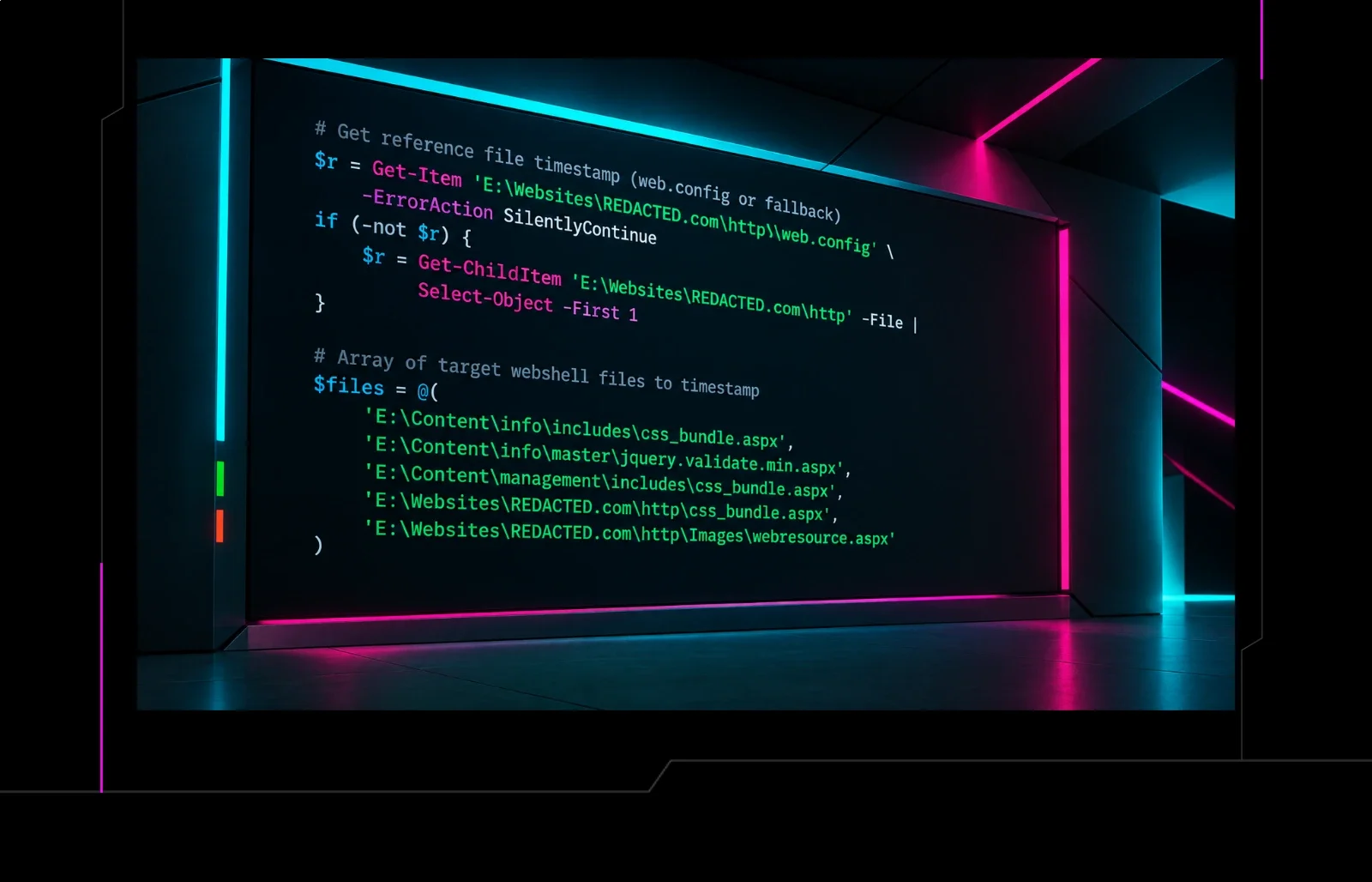
Huntress details a four-act intrusion against a shared parks-and-recreation management platform running on IIS, where an attacker first tried noisy unauthenticated exploits (IIS 8.3 tilde enumeration, WebDAV verb abuse, upload-handler bypasses) before simply registering a member account and uploading .aspx webshells via a member-file upload feature across three servers. The attacker enumerated hosts, extracted web.config/connection strings, hunted for cardholder data (Fortis/MXMerchant webhook logs, CVV/card-number strings), then escalated to timestomping, re-deploying known-filename webshells, and finally injecting an AI-generated PowerShell/JS dropper into a trojanized jQuery file to turn site visitors' browsers into WebRTC/WebSocket C2 clients (ririmochii/bubuneeko Cloudflare Workers infrastructure). Includes a zh-CN PowerShell user-agent string used for attribution and full command/IOC listings useful for detection engineering.
 huntress.comwriteupAdded 1 Oct 2026, published 30 Sep 2026🛡️ Security
 NeedyMantis: Unpacking a post-compromise malware family used in targeted operations
Microsoft Threat Intelligence documents NeedyMantis, a previously unreported modular post-compromise malware family used in targeted intrusions against telecoms, universities, medical nonprofits, intergovernmental organizations, and government contractors. The writeup details a multi-stage C++/x64 shellcode loader chain delivered via DLL sideloading (abusing Poedit, curl, TightVNC, Vim, and spoofed Office/Broadcom/Intel/NVIDIA DLLs), a custom encrypted/compressed archive format, a minimized custom PE-like executable format, and a WebSockets-based C2 protocol with RC4 key exchange and modular load/unload commands. Microsoft links observed use to Storm-3069 (tied to the Kaspersky-reported DAEMON Tools supply chain compromise) and China-nexus activity, and provides IOCs, Defender detections, and KQL/Sentinel hunting queries.
 microsoft.comwriteupAdded 7 Oct 2026, published 28 Sep 2026🛡️ Security
 Re-Enabled GitHub Actions Expose Thousands of Repositories to Mini Shai-Hulud
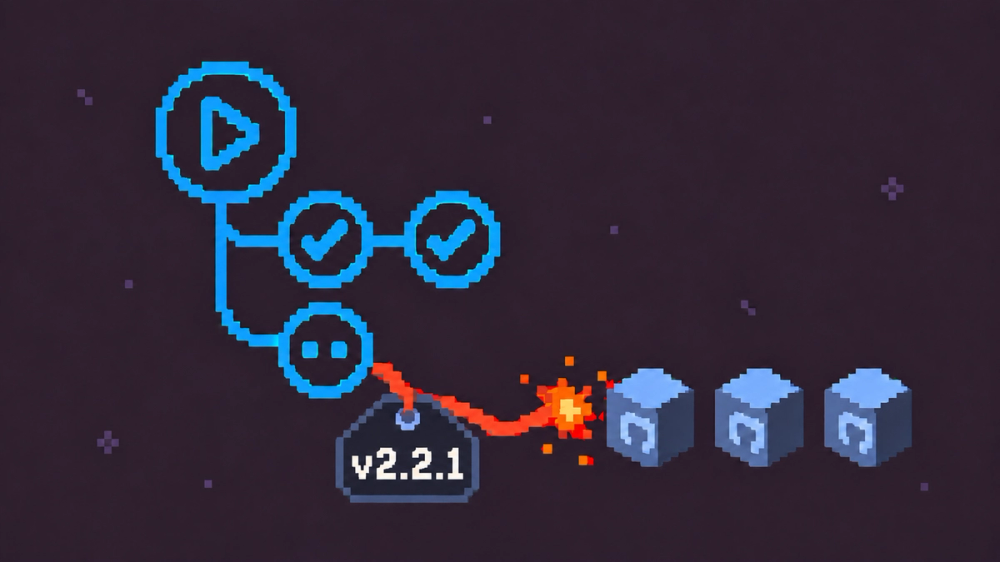
Socket reports that the actions-cool/issues-helper and actions-cool/maintain-one-comment GitHub Actions, compromised in the May 2026 Mini Shai-Hulud campaign and disabled by GitHub, were re-enabled on September 16, 2026 with their release tags still pointing to the malicious code. Any workflow referencing them by tag (about 15,000 dependents for issues-helper alone) resumed running the Bun-executed obfuscated payload. Workflow run logs show the switch from fast "Repository access blocked" failures to multi-minute successful runs. The post gives remediation: SHA-pin actions, rotate secrets, and hunt for oven-sh/setup-bun and bun run index.js in runner logs. An update says both repos were disabled again on September 25.
socket.devwriteupPublished and added 24 Sep 2026🛡️ Security Malicious Firefox Extension Poses as PDF Identity Verifier to Hijack Google Accounts
Socket's Threat Research team dissects a malicious Firefox extension (pdf-para-texto@extensao.local, "PDF Identity Verifier") that ships with no hardcoded malicious code — all attack logic is fetched as data into browser.storage.local after install via a lookalike domain (pdf.gusercontent.com), evading static store review. Once armed, it abuses Google's FedCM API to silently identify the victim, injects a live automation script into real accounts.google.com pages to drive an invisible account-takeover flow (bypassing password entry, forcing passkey challenges, dodging Google's bot detection, and forcing/capturing a password reset), while a webRequest listener steals the oauth_token session cookie from Set-Cookie headers — giving the attacker both a live session and a durable new password. The campaign targets Portuguese- and Spanish-speaking users starting September 2026 and includes full IOCs (domains, file hashes) and remediation steps.
socket.devwriteupPublished and added 23 Sep 2026🛡️ Security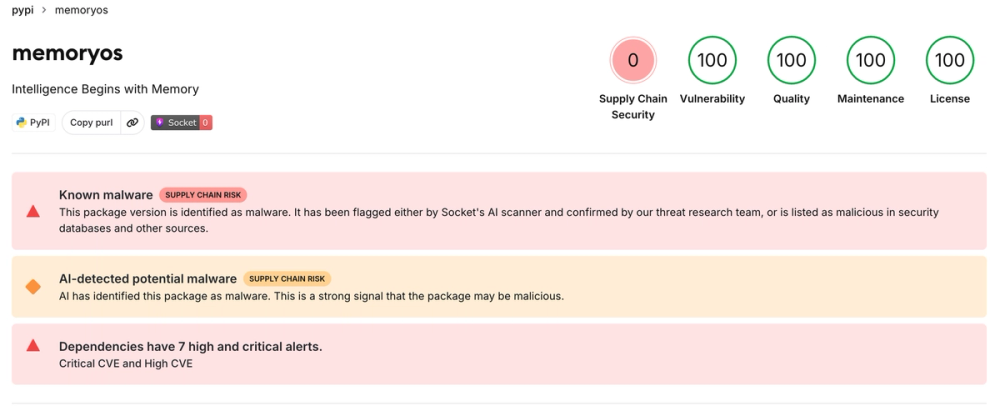 MemTensor npm and PyPI Packages Compromised in Credential-Stealing Supply Chain Attack
Socket details a supply-chain compromise of MemTensor's MemOS packages: npm package @memtensor/memos-cloud-openclaw-plugin (versions 0.1.21, 0.1.23, 0.1.25) and PyPI package MemoryOS (2.0.34), both published as the latest release on their registries. Each malicious release bundles a stripped, statically-linked Go binary called sckit that launches on import/plugin-load, scans $HOME for npm, PyPI, GitHub, GitLab, AWS, Vault and SSH credentials, and exfiltrates them to C2 servers under skyleen[.]fr, with the npm variant also capturing OpenClaw agent prompt text and the code additionally showing potential worm-like republish capability using stolen registry tokens.
socket.devwriteupPublished and added 23 Sep 2026🛡️ Security- Compromised npm Packages in the AsyncAPI Namespace Deliver Miasma Botnet Loader
Socket's Threat Research Team details a supply-chain compromise of four @asyncapi npm packages (generator-helpers, generator-components, generator, specs) published via a poisoned source commit through GitHub Actions trusted publishing. The packages contain an obfuscated load-time (not install-hook) implant that spawns a detached Node.js process to fetch an IPFS-hosted, AES-256-GCM-encrypted loader delivering the "Miasma" botnet/tasking framework, which supports REST C2, multi-channel comms (Nostr, IPFS, Ethereum RPC, BitTorrent DHT), shell execution, file exfiltration, and systemd persistence. Includes full technical analysis, IOCs, hashes, and MITRE ATT&CK mapping.
socket.devwriteupAdded 21 Sep 2026🛡️ Security  Socket: Two Joyfill npm Beta Releases Compromised to Deliver DEV#POPPER Remote Access Trojan
Socket's research team found two beta releases of the @joyfill npm packages (@joyfill/layouts and @joyfill/components) contained an import-time JavaScript implant that resolves encrypted payloads through Tron, Aptos, and BNB Smart Chain transactions, ultimately dropping a 77KB Node.js remote-access trojan matching the DEV#POPPER family and sharing loader fingerprints with the PolinRider blockchain-loader campaign. The RAT establishes a Socket.IO C2 channel, executes arbitrary JS/shell commands, exfiltrates files and clipboard data, and persists by patching files inside VS Code, Cursor, Antigravity, Discord Desktop, GitHub Desktop, and the global npm CLI; a parallel detached-process branch fetches an additional bootstrap that can deploy a Python credential/browser-data stealer assessed as an OmniStealer variant. Because the implant fires on module load (not via npm lifecycle scripts), `--ignore-scripts` provides no protection, and the writeup includes full IOCs, blockchain addresses, C2 infrastructure, and MITRE ATT&CK mappings.
socket.devwriteupAdded 22 Sep 2026, published 20 Sep 2026🛡️ Security- Living Inside the Shell: zsh Modules on macOS
A DFIR researcher shows how macOS's default shell, zsh, ships with loadable modules (zsh/net/tcp, zsh/mapfile, zsh/attr, zsh/stat, zsh/sched) that let the shell itself open raw TCP sockets, read/write files, and manipulate extended attributes like com.apple.quarantine without spawning curl, xattr, rm, or nc. The post walks through a full example using ztcp and source /dev/fd/$fd to fetch and execute a second-stage payload directly from a socket (bootstrapping a LaunchAgent) with no downloaded file on disk and no child process, referencing the prior real-world use of zsh/net/tcp for reverse shells (documented by ESET and GTFOBins). It then validates via eslogger/Endpoint Security that DELETEEXTATTR/SETEXTATTR and similar operations remain visible even when performed through zsh builtins, arguing detections should target the underlying OS event rather than the specific binary invoked.
 dfir.chwriteupPublished and added 16 Sep 2026🛡️ Security
 ParaShells: Parallels Desktop Turns Appliance Install Into a Root Shell
JFrog researchers detail ParaShells, a local privilege escalation chain in Parallels Desktop 26.4.0 (build 57513) on Apple silicon that lets an unprivileged macOS user gain root. The chain combines a world-writable Unix socket for prl_disp_service, weak peer-credential-based authentication in PrlSrv_LoginLocal, and argument injection in the InstallAppliance extraction path where a crafted sVmParentPath breaks Qt's QProcess::splitCommand quoting to inject tar's --use-compress-program= flag, causing macOS tar to execute an attacker script as uid 0.
 jfrog.comwriteupPublished and added 15 Sep 2026🛡️ Security
 Socket: Malicious Extensions Drain Axiom Trade and Padre Crypto Sessions
Socket's Threat Research team identified six malicious Chrome and Firefox extensions (J7Tracker, VREO, Orbit Tracker, GhostApe, GhostApe Color) that steal authenticated session tokens, Firebase access tokens, and wallet-related data from users of the Axiom Trade and Padre crypto trading platforms. The extensions abuse a byte-identical collection module (axiom-fetch-intercept.js) that reads localStorage/IndexedDB and exfiltrates data by encoding it into URLs opened via browser navigation to Vercel-hosted C2 endpoints, evading manifest-based host-permission review since navigation isn't subject to CORS/CSP connect-src restrictions. The report includes full IOCs (extension IDs, C2 domains, hashes), attribution links via shared code and publisher portfolios, and defender guidance for hunting and blocking the campaign.
socket.devwriteupPublished and added 12 Sep 2026🛡️ Security Socket: "JeetBot" Twitch Extension Steals 31,000 Users' OAuth Tokens
Socket's Threat Research Team analyzed "Twitch Enhanced Viewer | JeetBot", a Chrome/Firefox extension with 31,000 users that captures the user's live Twitch OAuth session token from the Authorization header and forwards it as an &auth= query parameter to proxy servers operated by JeetBot, a Russian-language Twitch/Kick/VK-Live bot SaaS, exempting only ten hardcoded Russian streamer channels. Earlier v4.x builds POSTed tokens outright to dedicated set-token endpoints (with backups on deno.dev/deno.net) and included Russian-language comments indicating deliberate rate-limited exfiltration; the account-scoped bearer token grants chat, whispers, and settings access, contradicting both store listings' "no data collection" claims. Firefox has since shipped a fix (85.8.7) after Socket's disclosure; the Chrome build remained vulnerable at publication.
socket.devwriteupPublished and added 12 Sep 2026🛡️ Security Machine speed, hold the AI: hand-rolled marimo CVE-2026-39987 exploit
Sysdig's Threat Research Team documents a hand-coded (non-LLM) exploitation of CVE-2026-39987, a pre-authentication RCE in marimo notebooks caused by a missing validate_auth() check on the /terminal/ws WebSocket endpoint. The operator chained credential theft from environment variables and Redis, AWS Secrets Manager retrieval, and SSH pivoting to a bastion host in eight seconds, ignored a planted prompt-injection honeypot meant to detect LLM agents, and left behind reusable base64-encoded boto3/paramiko toolkits in /tmp. The post includes full script reproductions, IOCs (IPs, file paths, AS63949/Linode infrastructure), CloudTrail/GuardDuty detection guidance, and remediation steps (patch to marimo 0.23.0, restrict the terminal endpoint, scope Secrets Manager access).
 sysdig.comwriteupAdded 20 Sep 2026, published 11 Sep 2026🛡️ Security
- The Crypto Wallet That Never Opened: Tampered Exodus Installer Hides a Modular RAT
Huntress dissects a trojanized Exodus crypto wallet installer (v24.33.4, unsigned MSI built with WiX) that installs a genuine wallet but patches Electron's show()/focus()/center() methods so no window ever appears, then loads a modular RAT via a hand-written reflective PE loader implemented in JavaScript using the Node.js koffi FFI library. The RAT (VNC, SOCKS proxy, browser-credential stealer, recon module) beacons over WebSockets and uses Azure Table Storage as a dead-drop C2 channel to blend into legitimate cloud traffic, while delivery abuses double-extension .pdf.js phishing, ZIP-staged JS files, and an unused search-ms/WebDAV technique; the writeup also covers multi-layer string-array/arithmetic deobfuscation and includes full IOCs and mitigation guidance.
huntress.comwriteupAdded 3 Sep 2026, published 1 Sep 2026🛡️ Security  Socket: FUNNULL iOS Spyware Campaign via 13 Malicious Packagist Themes
Socket's Threat Research Team traced 13 malicious Composer/Packagist theme packages (across vsmov, vsphim, haiau009, chilltvcms, ophimcms vendors) used by Vietnamese movie/comic streaming sites, which inject JavaScript running an ad-fraud/gambling redirect on all mobile visitors and, on unpatched iPhones, chain WebKit exploits (CVE-2025-31277, CVE-2025-43529) through a GPU-process pivot into a kernel escape via the AppleM2ScalerCSCDriver IOKit client (related to CVE-2026-43655) to install spyware. The payload exfiltrates keychain data, SMS, photos, contacts, and — after an August 2026 redeployment — directly steals crypto wallet seeds/mnemonics from Bitget, Phantom, Trust Wallet, and others. The report attributes delivery infrastructure to FUNNULL (Triad Nexus, OFAC-sanctioned operator Liu Lizhi), ties the exploit kit to the "DarkSword" iOS exploit family, and provides full IOCs, hashes, and MITRE ATT&CK mapping.
socket.devwriteupPublished and added 1 Sep 2026🛡️ Security- pgj11: Analysis of Bincrypter and gsocket (gs-netcat)
Deep-dive reverse engineering of a real-world incident where a WordPress site compromised via CVE-2026-18322 was used to drop a bincrypter-obfuscated, statically-linked gs-netcat (gsocket) 1.4.42beta5 binary as a reverse-shell tunnel, persisted via crontab and masquerading as "netd"/"[kthreadd]". The author fully unravels bincrypter's multi-stage shell obfuscation (character-separator tricks, AES-256-CBC/openssl decryption, memfd_create fileless ELF execution via a Perl one-liner) and reveals a custom THC UPX build with zeroed magic bytes/PackHeader used to hide payload identification, along with gsocket's self-embedded XOR-encoded operator configuration. Releases two open-source tools (Bincrypter-Extract, Gsocket-Config-Extract), YARA rules, and an ImHex pattern file, plus full IOCs (C2 IP, GSRN secret, process/memfd artifacts).
 pgj11.comwriteupPublished and added 31 Aug 2026🛡️ Security
 Socket: "Superior" Campaign
Socket researchers uncovered 19 Chrome and Edge extensions (18 Chrome, 1 Edge) delivering a modular wallet-drainer and credential-stealing framework, tracked as the "Superior" campaign and linked to a 2024 operation first reported by DomainTools and Secure Annex. Threat actors either build extensions from scratch or buy established ones (like "Enable Right Click & Copy — Smart Unlock + OCR" with ~80,000 combined users) and later push malicious updates that strip CSP headers via declarativeNetRequest, open an AES-GCM-encrypted WebSocket C2 channel, and inject JavaScript payloads that phish hardware-wallet seed phrases, hijack wallet-connect flows, harvest exchange session tokens, and serve ClickFix-style fake browser-update lures. The post includes full code snippets, a breakdown of 16+ malicious modules, and a large IOC list of C2 domains and extension IDs.
socket.devwriteupPublished and added 28 Aug 2026🛡️ Security

Showing 30 of 79
Show more