Skip to content

421 results for β€œOj”

What you seeeverything
x.comthread🧠 AI

Prasenjit Sarkar (@stretchcloud) on X

Thread by Prasenjit Sarkar on whether infrastructure as code survives AI agents, prompted by James Ward's claim that IaC is dead and Darren Shepherd's rebuttal. It describes HCP Terraform as a governance layer for agent-written infrastructure: project-scoped identities, per-run short-lived OIDC credentials, policy-as-code plan checks, and the tfctl CLI with dry-run and destructive-operation guardrails. It also covers Pulumi's Neo agent and Firefly's point that direct cloud API calls by agents leave no diff, audit trail or rollback.

TerraformHCP Terraformtfctl+4
PulumiFireflyJames Ward+2

agents, ai-infraΒ· Added 4 Nov 2026

microsoft.comarticleπŸ›‘οΈ Security

Fake-download campaign uses trojanized installers to deliver monetization payloads

Microsoft Threat Intelligence analyzes a fake-download campaign that uses trojanized Inno Setup-style installers, posing as cracked software and games, to deliver monetized "offers". Confirmed branches are WorldProxyPool proxyware (SYSTEM scheduled tasks), CharityEngine/BOINC compute monetization, and AW Manager/Windows Manager adware. The post gives the d=inno and r=offer_execution callback pattern, KQL hunting queries, ATT&CK mappings, mitigations and IOCs.

Microsoft Defender XDRWindowsPowerShell+2
WorldProxyPoolCharityEngineBOINC+10

Threat Intel, Blue Team & DetectionΒ· Published and added 3 Nov 2026

en.cryptonomist.charticleπŸ›‘οΈ Security

BTCPay Server vulnerability: about $1.63M traced to theft-linked addresses

BTCPay Server's 2 November 2026 incident update describes attackers logging in as administrator on servers running version 2.4.1 or earlier and sweeping on-chain hot wallets. Bitquery traced about $1.63M (18.38 BTC and 3,405 LTC) to two addresses, across 682 sweeps from 30 October. The project advises migrating to a new server with a fresh seed, installing 2.4.7 and preserving logs. How admin access was gained is not explained.

BTCPay ServerLNDBitcoin+1
BitqueryCryptonomist

Blockchain, Threat IntelΒ· Published and added 3 Nov 2026

bleepingcomputer.comarticleπŸ›‘οΈ Security

Police seizes over 100 servers in investment scam crackdown

Europol and Eurojust coordinated an action by authorities in Albania, Cyprus, Finland, Germany, Kosovo and North Macedonia that arrested seven suspects and seized more than 100 servers. The targeted company allegedly ran a crime-as-a-service model from Cyprus and Israel, supplying fake trading platforms and stolen victim data to call centres. Victims in at least 50 countries were pushed into larger transfers with fake profits. The article lists earlier European fraud takedowns.

EuropolEurojustcrime-as-a-service+1

Threat IntelΒ· Published and added 3 Nov 2026

bleepingcomputer.comarticleπŸ›‘οΈ Security

Google adds new $250,000 Cloud VRP reward for Root-in-Cloud bugs

Google expanded its Cloud Vulnerability Reward Program with a $250,000 top-tier reward for Root-in-Cloud bugs, such as tenant-isolation bypasses and cross-service logic flaws that give full administrative control (roles/owner or complete IAM control) over arbitrary Google Cloud organizations. Exploits cannot rely on prior access, stolen credentials or user interaction, and researchers reaching Borg execution must stop probing. Proof uses a designated service account, not real customer projects.

Google CloudBorg
GoogleChris BetzMichael Cote+3

Cloud & Infra, otherΒ· Published and added 3 Nov 2026

paradigm.xyzarticleπŸ›‘οΈ Security

Formally Verifying a Compiler Using Automated Research (Solidus)

Solidus is Paradigm's pre-alpha Lean project for a formally verified Solidity-to-EVM compiler. The Yul-to-EVM backend is proven to preserve outputs for all inputs under any deterministic external world, ignoring gas and memory layout, but emits almost 3x the bytecode of solc. The frontend does not exist yet. Two Paradigm Puzzles challenges, Spec Hunt and Compiler Optimization, invite divergence PoCs and backend improvements.

LeanSolidityYul+3
ParadigmNethermindPowdr+2

Blockchain, AppSecΒ· Added 3 Nov 2026

x.comrepo🧠 AI

Md Ismail Ε ojal πŸ•·οΈ (@0x0SojalSec) on X

An x64dbg MCP server, published on GitHub by duty1g and shared in an X post by @0x0SojalSec, lets Claude drive the x64dbg Windows debugger. It exposes breakpoints, memory dumps and code stepping as tools for reverse engineering and malware analysis. A reply warns that debugging a sample executes it, so the agent should run in a snapshotted VM with no shared folders or host route, and every command should be logged.

x64dbgModel Context ProtocolClaude+2
duty1g

mcpΒ· Added 3 Nov 2026

paradigm.xyzarticle🧠 AI

Formally Verifying a Compiler Using Automated Research (Solidus)

Solidus is a pre-alpha Paradigm project in Lean building a formally verified Solidity-to-EVM compiler. Only the Yul-to-EVM backend exists, built with over 1,700 hours of Codex /goal time (about $150,000 at API rates), plus Harmonic's Aristotle and Claude Fable 5. The post covers where agents needed human judgment on spec edits, and announces a Spec Hunt and a Compiler Optimization challenge.

LeanSolidityEthereum+3
ParadigmNethermindHarmonic+6

coding-agents, agentsΒ· Added 3 Nov 2026

adversa.aiarticleπŸ›‘οΈ Security

Cursor security: top 10 attacks and what each one actually broke

Adversa AI reviews ten documented attacks on the Cursor editor between August 2025 and October 2026, as of 3 November 2026. They include the trojanized Claude Code extension served by Cursor's marketplace for about 11 hours, GlassWorm, the Miasma worm, DeepJack, NomShub, DuneSlide and CurXecute. Only three have CVEs and none of those was exploited in the wild. The four that caused confirmed harm have no CVE. It lists mitigations such as enabling Workspace Trust, which is off by default.

CursorModel Context ProtocolVS Code+3
CVE-2026-63093CVE-2026-50548CVE-2025-54135+16

AI Security, Supply ChainΒ· Published and added 3 Nov 2026

x.comthread🧠 AI

🚨 AI News | TestingCatalog (@testingcatalog) on X

LongCat-2.5 is Meituan's natively multimodal agentic model with 1.6T total parameters and about 48-49B active (the post gives both figures), so it is a mixture-of-experts design. It targets long-horizon agentic tasks, with stronger visual understanding and agentic coding, from complex coding projects to visual coding. The post says it was compared with GPT-5.5, GPT-5.6-Sol, Claude-Opus-4.8 and Claude-Opus-5, and is available through APIs. No benchmark numbers appear in the text.

Mixture of Expertsvision-language model
MeituanLongCat-2.5GPT-5.5+4

models, multimodal, agentsΒ· Added 4 Nov 2026, published 2 Nov 2026

securityweek.comarticleπŸ›‘οΈ Security

Google Introduces $250,000 Root-in-Cloud Bug Bounty Reward

Google Cloud Vulnerability Reward Program has added a $250,000 root-in-cloud tier for exploits that give roles/owner or full IAM control over arbitrary Google Cloud organizations or projects. The exploit path cannot rely on prior project access, stolen credentials or social engineering. Remote code execution in Borg also qualifies, but researchers must stop probing immediately. Proof is made against a designated service account using a deterministic proof-of-root mechanism.

Google CloudBorg
GoogleCloud VRPChris Betz+2

Cloud & Infra, Offensive SecurityΒ· Published and added 2 Nov 2026
decrypt.coarticleπŸ›‘οΈ Security

BTCPay Tells Merchants to Switch Off Servers Amid Hot Wallet Attack Reports

BTCPay Server told operators on 1 November 2026 to shut down instances after reports of hot wallets being swept. The project later said the attack targeted versions 2.4.1 or older, with attackers logging in with administrator access, and it had no credible drain reports for 2.4.7. Release 2.4.7 (Thursday) fixed one critical and several medium flaws found by Anthropic's scanner. The number of servers affected and the amount stolen are not stated.

BTCPay ServerBitcoin
Nicolas DorierLunaNodeAnthropic

Blockchain, Threat IntelΒ· Published and added 2 Nov 2026

x.comtoolπŸ›‘οΈ Security

Md Ismail Ε ojal πŸ•·οΈ (@0x0SojalSec) on X

An x64dbg MCP server (GitHub repo by duty1g, shared via an X post) that lets Claude drive the x64dbg Windows debugger: set breakpoints, dump memory, step code and run other reverse engineering tasks programmatically. The post targets malware analysts. A reply notes that debugging a sample executes it, so the agent should run in a snapshotted VM with no shared folders or host route, with every command logged.

x64dbgModel Context ProtocolClaude+1

Malware & RE, AI SecurityΒ· Added 3 Nov 2026, published 1 Nov 2026

x.comthreadπŸ›‘οΈ Security

Prasenjit Sarkar (@stretchcloud) on X

Thread on whether infrastructure as code survives AI agents, set off by James Ward's claim that IaC is dead and Darren Shepherd's rebuttal. It describes HCP Terraform's positioning as a governance layer for agent-written infrastructure: project-scoped identities, per-run short-lived OIDC credentials, policy-as-code plan checks, and the tfctl CLI with dry-run and destructive-operation guardrails. It also covers Pulumi's Neo agent and Firefly's point that direct cloud API calls by agents leave no diff, audit trail or rollback.

TerraformHCP Terraformtfctl+3
HashiCorpFireflypolicy-as-code+3

DevSecOps, AI SecurityΒ· Added 4 Nov 2026, published 1 Nov 2026

arxiv.orgpaperπŸ›‘οΈ Security

Context-Shielded Backdoor Attack against Large Vision-Language Models

StripWake is a projector-only backdoor attack on large vision-language models. It stays dormant under full-token inference and activates when visual-token compression prunes the context around a trigger (context stripping). On LLaVA-1.5-7B across nine unseen compressors, it reaches 0.4% full-token attack success rate and 94.0%-99.7% compressed ASR on five primary compressors, with no CIDEr loss. Training aligns early visual attention with a frozen benign teacher.

LLaVA
StripWakecontext strippingbackdoor attack

AI SecurityΒ· Added 3 Nov 2026, published 31 Oct 2026

arxiv.orgpaper🧠 AI

Vision-Language Models Are Joint Denoisers in Robotic Action Generation

JADE (Joint Action DEnoiser) is a diffusion-based vision-language-action architecture in which the VLM reads the current noisy action latents together with images and instructions at every denoising step, and guides the action expert through gated cross-attention. The VLM is also trained to recover clean action latents, and an adaptive step-size schedule cuts sampling steps. On RoboDojo it averages 12.67% success, the highest among Ο€0.5-based methods, and it adds 20.8 points over Ο€0.5 on four real bimanual tasks.

vision-language-action modelvision-language modeldiffusion model
JADEΟ€0.5RoboDojo+2

research, multimodalΒ· Added 3 Nov 2026, published 31 Oct 2026

theblock.coarticleπŸ›‘οΈ Security

Hackers hijack a dozen DeFi websites, all registered with Name.com, and steal about $138,000

Twelve DeFi websites, including Flap, Kintsu, Pickle Finance and Origami Finance, were hijacked on 30 October 2026 and served the Step Drainer kit. All 12 domains use Name.com as registrar, and 10 were suspended. The Block traced about $138,000 stolen to three EVM wallets, excluding Solana and Aptos losses. Kintsu and Origami blame Vercel. Projects say their onchain contracts were untouched.

VercelEthereumSolana
Step DrainerName.comFlap+5

Threat Intel, BlockchainΒ· Published and added 31 Oct 2026

arxiv.orgpaper🧠 AI

ShiftRAG: Bypassing the Textual Bottleneck via Decoupled Learning and Continuous Soft Tokens

ShiftRAG is a decoupled retrieval-augmented generation framework that uses one LLM backbone but separates discriminative retrieval learning from autoregressive generation. It projects retrieval alignments into continuous soft tokens so the generator receives retriever-side signals, and adds a soft orthogonality objective against rank collapse in decoder-only models. The abstract reports gains in retrieval and question answering over state-of-the-art baselines, without numbers.

RAGLLMTransformer
arXiv

research, llm-appsΒ· Added 3 Nov 2026, published 31 Oct 2026

arxiv.orgpaperπŸ›‘οΈ Security

AgentCap: Capability-Based Runtime Authorization for Secure LLM Agent Execution

AgentCap is a runtime authorization layer for LLM agents that moves the authorize decision out of the model and mediates every tool call through an MCP wrapper. It issues short-lived, budget-bounded capability tokens checked at the tool boundary, restricts delegation to attenuating parent-child chains, and uses a declarative policy language. On AgentDojo and InjecAgent it lowers attack success in every tested setting, reaching 0% with GPT-5.4.

Model Context ProtocolLLMAgentCap
indirect prompt injectionAgentDojoInjecAgent+1

AI SecurityΒ· Added 3 Nov 2026, published 31 Oct 2026

arxiv.orgpaper🧠 AI

AgentCap: Capability-Based Runtime Authorization for Secure LLM Agent Execution

AgentCap is a runtime authorization layer for LLM agents from Virginia Tech (Suresh and Gao), posted to arXiv on 31 October 2026. The model proposes MCP tool calls, and a policy engine issues Ed25519-signed capability tokens only after checks on provenance, intent, trust and prerequisites. It reports 0% attack success with GPT-5.4 on AgentDojo and InjecAgent, but only on scenarios the authors built.

Model Context ProtocolEd25519JWT+1
Virginia TechAgentDojoInjecAgent+4

agents, mcp, researchΒ· Added 3 Nov 2026, published 31 Oct 2026

simonwillison.netarticle🧠 AI

dbreunig/nesformer

nesformer is a project by Drew Breunig that bakes a working Nintendo Entertainment System 6502 CPU emulator into the weights of Qwen3.5-4B, so NES ROMs such as Super Mario Bros run (very slowly) inside the model. It follows Divyansh Agrawal's qwenputer. Simon Willison relays the Opus 5.5 prompts Breunig used, and notes that Opus found Christopher Pow's CPU conformance tests.

Qwen3.5TransformerLLM+1
Simon WillisonDrew BreunigDivyansh Agrawal+5

research, coding-agents, modelsΒ· Published and added 30 Oct 2026

huggingface.cowriteup🧠 AI

nemotron-halloween

MonsterHouse is a Halloween interactive projection built on the NVIDIA Nemotron Voice Agent: Nemotron Speech ASR, Nemotron 3.5 Bolt E4B 4GB with a LoRA persona adapter, Magpie TTS Zeroshot and Audio2Face-3D in Unreal Engine, on two RTX Blackwell GPUs. Median end-of-speech-to-audio is 1.70 seconds live and 0.72 seconds with cached responses. The post gives a build path and tips on caching and state handling.

Nemotron Voice AgentNemotron Speech ASRNemotron 3.5 Bolt E4B 4GB+11
NVIDIANemotronQwen3 30B-A3B+3

multimodal, agents, trainingΒ· Published and added 30 Oct 2026

blog.googlearticle🧠 AI

We’ve received our first response from the Project Suncatcher prototype satellite.

Project Suncatcher is a Google research effort to power AI compute in space. Its prototype satellite launched on 1 October 2026 and, after commissioning, returned the first AI response from a data-center-class TPU in orbit: a haiku from the onboard Gemma 4 open model, downlinked over Svalbard. Next come thermal-stress and radiation tests, then twin interconnected satellites in 2027.

TPUGemma
GoogleGemma 4Project Suncatcher+1

inference, ai-infraΒ· Published and added 30 Oct 2026

arxiv.orgpaperπŸ›‘οΈ Security

SecPO: Principled Adversarial Training for Prompt Injection Security

SecPO is a prompt injection defense that combines a new preference-optimization loss with adversarial training. It replaces the insecure DPO reference model with an approximated injection-invariant oracle, and trains on strong injections synthesized at best@240. Against Meta-SecAlign, AT cuts attack success rates 1.5-14.5x, and on Qwen3.6-27B AgentDojo ASR@800 falls to 8.8% from 78.8%, with no noticeable utility loss across nine benchmarks. Code, training data and model are released.

QwenHugging FaceLLM
prompt injectionAgentDojoMeta-SecAlign+3

AI SecurityΒ· Added 3 Nov 2026, published 30 Oct 2026

arxiv.orgpaper🧠 AI

SecPO: Principled Adversarial Training for Prompt Injection Security

SecPO is a DPO-variant loss from UC Berkeley for training LLMs against indirect prompt injection. It replaces the undefended-model reference on injected input with its output on the clean input, a one-line change, and pairs with a PAIR-based adversarial training pipeline. On Qwen3.6-27B, AgentDojo ASR@800 is 8.8% against 78.8% for Meta-SecAlign, with utility unchanged across nine benchmarks. Code, training set and weights are released.

DPOPAIRGCG+4
SecPOUC BerkeleySizhe Chen+5

training, researchΒ· Added 3 Nov 2026, published 30 Oct 2026

cyberplace.socialthreadπŸ›‘οΈ Security

Backdoors in official Claude Code extensions

GossiTheDog's Mastodon post reports that the Anthropic Claude Code Visual Studio extension, as installed in Cursor, contains malware that creates a remote access Trojan on desktops. It links to a phorion.io blog post on the reported compromise of the official Claude Code VSX extension. The post gives no technical detail, indicators or dates itself.

Claude CodeCursorOpen VSX+1
Anthropicremote access Trojan

Supply Chain, Threat IntelΒ· Added 31 Oct 2026, published 30 Oct 2026

opensourcemalware.comwriteupπŸ›‘οΈ Security

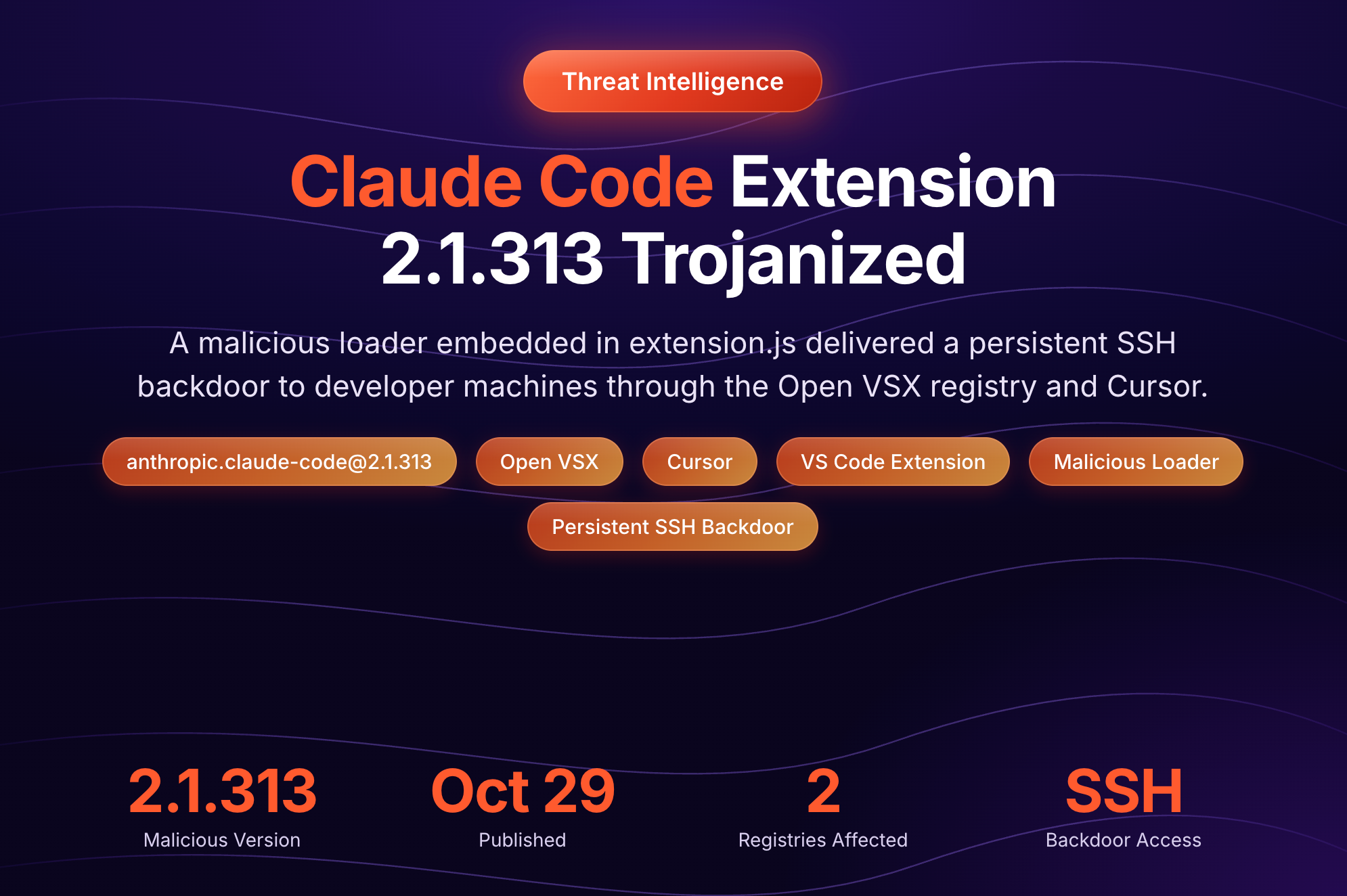
Trojanized Claude Code Extension Plants an SSH Backdoor

Analysis of a trojanized anthropic.claude-code 2.1.313 extension (darwin-arm64), found on Open VSX, with a 66-line loader prepended to extension.js. It adds an svc-telemetry key to authorized_keys, opens a reverse SSH tunnel to 134.209.82.225, sets persistence (LaunchAgent, cron, scheduled task) and sends host recon over HTTP port 8099. Includes IOCs, hashes and response steps; no further payload download was found.

Claude CodeVS CodeOpen VSX+3
anthropic.claude-code 2.1.313134.209.82.225svc-telemetry+3

Supply Chain, Malware & RE, AI SecurityΒ· Published and added 30 Oct 2026

stepsecurity.iowriteupπŸ›‘οΈ Security

Trojanized Claude Code Extension Delivered Persistent SSH Backdoor to Developer Machines

The Claude Code VS Code extension anthropic.claude-code 2.1.313 was published on Open VSX on 29 October 2026 with a malicious loader prepended to extension.js. On load it planted an attacker SSH key (svc-telemetry), installed per-OS persistence, opened a reverse SSH tunnel and beaconed host recon over HTTP. Cursor reports at most 5,000 users received it in an 11-hour window. The post gives the timeline, cleanup artifacts and credential rotation steps.

Claude CodeVS CodeOpen VSX+3
anthropic.claude-code 2.1.313svc-telemetryT1195.002+1

Supply Chain, Blue Team & Detection, Threat IntelΒ· Published and added 30 Oct 2026

microsoft.comarticleπŸ›‘οΈ Security

Tracking AI adoption in North Korean threat actor tradecraft

Microsoft Threat Intelligence report on how North Korean actors use AI, ranking Jade Sleet, Coral Sleet and Jasper Sleet as operationalized, Diamond Sleet, Onyx Sleet, Pearl Sleet and Sapphire Sleet as accelerating, and Emerald Sleet as expanding. It documents AI-generated lures (100+ Onyx Sleet PDFs, August and September 2026), AI-built tooling such as Coral Sleet's private GitHub repository trojanizing, and Onyx Sleet and Pearl Sleet use of the ARTEX agentic pentest framework. It ends with mitigation and Defender guidance.

CursorGitHubRust+2
Jade SleetOnyx SleetCoral Sleet+9

Threat Intel, AI SecurityΒ· Published and added 29 Oct 2026

github.comcourse🧠 AI

rohitg00/ai-engineering-from-scratch

ai-engineering-from-scratch is a free, MIT-licensed curriculum of 542 lessons in 20 phases, from math and deep learning through transformers, LLM engineering, MCP, agents and capstones. Code is in Python, TypeScript, Rust and Julia. It includes three graded projects (retrieval evaluation, agent trace debugger, tool call firewall), installable tutor skills for Claude Code and Codex, and certification prep tracks.

PythonTypeScriptRust+13
Rohit GhumareOpenClawHermes+6

Β· Added 29 Oct 2026

github.comrepo🧠 AI

heydamir/unslop

unslop is a skill for Claude Code and Codex, created by Damir Sokolovsky (@heydamir), that turns vibecoded, AI-looking UI into a designed interface. It audits the screen for slop (purple gradients, glows, emoji labels, uneven spacing), sets a direction from the product, then edits in passes: spacing, color, icons, copy, type, layout, details, visuals and motion. It works across web stacks, can generate hero visuals through image services after asking, and can make a short story video using Playwright and ffmpeg. Licensed CC BY 4.0.

Claude CodeCodexPlaywright+11
Damir Sokolovsky

coding-agents, promptingΒ· Added 4 Nov 2026, published 29 Oct 2026

x.comthread🧠 AI

SGLang (@sgl_project) on X

SGLang announces Day-0 support for Mistral Large 4 ("Le Chonk"), saying it is the first engine to serve the model on NVIDIA Vera Rubin. The post describes the model as Mistral's largest to date: a natively multimodal 1T-parameter mixture-of-experts model covering instruct, reasoning, coding and agentic workflows. The fetched text is truncated, so benchmark claims and launch commands are not visible.

SGLangMixture of Experts
MistralMistral Large 4NVIDIA

inference, modelsΒ· Added 30 Oct 2026, published 29 Oct 2026

securityweek.comarticleπŸ›‘οΈ Security

Cisco Open Sources Quarry to Catch AI Agent Attacks Hidden in Harmless Steps

Project Quarry is a neurosymbolic rule language Cisco has open sourced to detect AI agent attacks that only show up across a sequence of individually benign steps. Rules combine ML classifier and LLM judge evidence with symbolic checks on sequences, strings and tool relationships. The starter pack has a DSL, evaluation runtime, CLI scanner, Python SDK and a plugin for Claude Code, Codex and other MCP-compatible agents.

QuarryModel Context ProtocolClaude Code+2
Project QuarryCisco Integrated AI Security & Safety Framework

AI Security, Blue Team & DetectionΒ· Published and added 29 Oct 2026

arxiv.orgpaperπŸ›‘οΈ Security

SEAL: Sealed Queries for Local Sanitization against Indirect Prompt Injection

SEAL is a defense against indirect prompt injection for local LLM agents. It learns a soft prompt and scoring readout offline, then uses a frozen task model to score and delete injected tokens from tool outputs, with queries built from trusted initial context. On AgentDojo, attack success falls from 34.6% to 0.1% and Joint rises from 51.4% to 77.5%, using about 127x fewer defense tokens than PISanitizer.

LLMAgentDojoAgentDyn+1
indirect prompt injection

AI SecurityΒ· Added 31 Oct 2026, published 29 Oct 2026

endorlabs.comarticle🧠 AI

What is an AIBOM? AI bill of materials explained for security teams | Endor Labs

An AIBOM is a machine-readable inventory of models, datasets, dependencies, AI services, agents and MCP servers, with evidence of origin, license, integrity and evaluation. The Endor Labs explainer walks through a worked CycloneDX example for a fine-tuned support assistant. It compares CycloneDX ML-BOM, SPDX 3.x, the OWASP AIBOM project and the May 2026 CISA/G7 guidance, and lists what an AIBOM cannot show: runtime behavior and agent actions.

CycloneDXSPDXSBOM+5
Endor LabsOWASPCISA+3

ai-policy, ai-infraΒ· Published and added 29 Oct 2026

huggingface.coarticle🧠 AI

Announcing Project ProtoStar: Making Publicly Funded Science AI-Ready

Project ProtoStar is an initiative by Carnegie Mellon, Purdue, Georgia Tech, Arizona State, George Washington University, Astera Institute, ORCA and Hugging Face to release publicly funded science datasets, models and code in AI-ready formats. Hugging Face reports over 17,000 public science datasets and tripled sharing in 2026. The first challenge, run by CMU from 2 to 13 November 2026, asks teams to forecast climate indicators for 210 US cities.

Hugging Face
Project ProtoStarCarnegie Mellon UniversityPurdue University+15

ai-policy, training, evalsΒ· Published and added 29 Oct 2026

github.blogarticle🧠 AI

GitHub Universe 2026: Evolving every layer of the stack

GitHub Universe 2026 recap in which GitHub presents its agentic software delivery vision and new Copilot products: the Copilot app, Copilot Fusion multi-model routing, Copilot projects, session continuity, automations that learn from outcomes, and code review Max. GitHub Enterprise customers can use all Copilot features without a separate subscription. GitHub also reports added capacity, a multi-region Azure migration and a redesigned Git architecture.

GitHub CopilotGitHubGit+4
MicrosoftJay ParikhCopilot Fusion+4

coding-agents, agents, ai-infraΒ· Added 29 Oct 2026, published 28 Oct 2026

x.comthreadπŸ›‘οΈ Security

Buchi Reddy B (@buchireddy) on X

Buchi Reddy B's X thread comments on Forever Security's research (Gal Weizman, Omer Samet) on coding agents. A web page silently writes a fake AGENTS.md or CLAUDE.md into a Downloads folder, and Codex and Claude Code follow it as project rules. Codex then wrote an attacker's MCP server into the machine-wide config, so one injection becomes a standing connection for every session. It asks whether teams inventory runtime MCP connections against approved lists.

CodexClaude CodeModel Context Protocol
Forever SecurityGal WeizmanOmer Samet+3

AI SecurityΒ· Added 28 Oct 2026, published 27 Oct 2026

blog.googlearticle🧠 AI

We’re announcing Genie 4, our new world model for real-time interactive simulation.

Genie 4 is Google DeepMind's world model for real-time interactive simulation, with native audio generated on the fly (ambient sound, music, dialogue). It builds on Gemini models: Gemini Omni grounds scenes in real-world appearance and behavior, and other Gemini models keep the simulation coherent. Users steer scenes by natural language. Access is limited to trusted testers now, with Google AI Ultra (Project Genie), the Gemini API and AI Studio to follow. The post gives no architecture or benchmark detail.

GeminiGoogle AI StudioGemini API
Google DeepMindGenie 4Gemini Omni+2

models, multimodalΒ· Added 30 Oct 2026, published 27 Oct 2026

x.comthread🧠 AI

Manoj | The AI Dude (@Manojkumar2257) on X

heditor is an open-source (MIT) agent skill from pycodebr that has Claude Code, Codex, Cursor or OpenCode edit talking-head videos. It transcribes with faster-whisper, picks a 30-70s segment, cuts frame-accurately, builds HTML + GSAP motion graphics, mixes audio at -14 LUFS, and runs QA with vision-reviewed previews. It offers 42 named styles and a long-form mode with chapters, SRT/VTT and lower thirds. Install: npx skills add pycodebr/heditor -g.

Claude CodeCodexCursor+6
heditorpycodebr

coding-agents, prompting, multimodalΒ· Added 28 Oct 2026, published 27 Oct 2026

arxiv.orgpaper🧠 AI

Folding Attention Biases into Keys Makes Compacted KV Caches Run on Standard Kernels

The paper folds the per-key logit bias of Attention Matching (AM) KV cache compaction into the keys along one closed-form direction per head, fitted on context queries. The result is a plain cache that FlashAttention and vLLM paged caches can use, with output error bounded by how far each query's projection on that direction is from 1. Unmodified vLLM serves folded caches through a KV connector. On QuALITY and LongHealth the fold is within noise of AM in 13 of 14 settings. Under AM's published per-head budgets it is within noise in 9 of 10.

vLLMFlashAttentionHugging Face+3
Attention MatchingQuALITYLongHealth+2

research, inferenceΒ· Added 28 Oct 2026, published 27 Oct 2026

x.comthreadπŸ›‘οΈ Security

AGTP (@AGTPinsights) on X

AGTP's X thread summarizes Meta's Muse Spark 1.3 Evaluation Report. Prompt injection was tested on Exponential Security Labs' RepoInject v1 and BrowserInject v1 and on Gray Swan's IPI Arena, with robustness said to be on par with GPT-5.6 Sol. It also covers chain of thought controllability evals, PostTrainBench under Loss of Control, and Handshake's pre-release human red teaming. It notes the Midas Project's criticism of Muse Wonder's missing safety report.

Muse SparkMuse Spark Open
prompt injectionRepoInject v1BrowserInject v1+10

AI SecurityΒ· Added 27 Oct 2026, published 26 Oct 2026

x.comthread🧠 AI

AGTP (@AGTPinsights) on X

Thread summarizing Meta's Muse Spark 1.3 Evaluation Report, the safety write-up for the model released on September 2, 2026. It covers prompt-injection results on Exponential Security Labs' RepoInject v1 and BrowserInject v1 and Gray Swan's IPI Arena, chain-of-thought controllability evals, PostTrainBench under Loss of Control, and Handshake's human red teaming. It also notes The Midas Project's criticism that Muse Wonder still has no safety report, and the Muse Spark Open rollout (816B total, 42B active parameters).

Muse Spark 1.3Muse Spark OpenMixture of Experts
MetaMuseMuse Wonder+19

ai-safety, evals, modelsΒ· Added 27 Oct 2026, published 26 Oct 2026

x.comthreadπŸ›‘οΈ Security

David Gutierrez | Eng (@david_x_ai) on X

Thread on two October 2026 npm compromises: @subql/common 5.8.3 (5 October), published through GitHub Actions OIDC Trusted Publishing after the attacker tampered with the publish workflow, and tensorlake 0.5.144 (8 October), published by the project's own release workflow with valid provenance for about 1 hour 40 minutes. Both ran on install and stole cloud, GitHub, Kubernetes, Vault, SSH and .env credentials; tensorlake also took AI tool and MCP config. Its payload installed a gh-token-monitor service that deletes the home directory if the stolen GitHub token is revoked, so remove it before rotating.

npmGitHub ActionsGitHub+3
@subql/commontensorlakegh-token-monitor+3

Supply Chain, DevSecOpsΒ· Added 27 Oct 2026, published 26 Oct 2026

x.comthreadπŸ›‘οΈ Security

BenjaminπŸ‘¨β€πŸ’» (@Hislordship_9) on X

Thread on Forever Security's finding that a planted Markdown "Engineering Work Guidelines" file in ~/Downloads made Codex add a "project-tools" MCP server to ~/.codex/config.toml. The server ran npm install function-color, a known malicious package, and started a child session with --dangerously-bypass-approvals-and-sandbox. Codex complied in over 90% of the firm's tests; Claude Code, via a CLAUDE.md setting ANTHROPIC_BASE_URL, about half. Advice: don't start agents in Downloads, review instruction files, and diff agent config.

CodexClaude CodeModel Context Protocol+1
Forever Securityfunction-colorAGENTS.md+4

AI Security, Supply ChainΒ· Added 27 Oct 2026, published 26 Oct 2026

en.cryptonomist.charticle🧠 AI

The r/opensource forum’s AI ban shuts out solo projects and non-English users

The r/opensource subreddit's new submission rules bar projects made with, using or intended for AI, and add requirements that exclude new solo projects and non-English speakers. Projects must be at least one year old, OSI-licensed, actively maintained and have roughly three or more contributors. Moderator Wolvereness said there is no objective way to enforce the AI rule. Users questioned the Linux kernel's eligibility and started r/trueopensource.

LinuxGitHubLLM
r/opensourcer/trueopensourceReddit+5

ai-policyΒ· Published and added 26 Oct 2026

arxiv.orgpaper🧠 AI

SymLift: Neural Semantic Lifting for Compile-Free Vulnerability Detection in Context-Incomplete Code Fragments

SymLift is a compile-free vulnerability detection framework for code fragments that lack project context. A fine-tuned LLM reconstructs control-flow, data-flow, memory and resource relations as a constrained LLVM-like IR, and a deterministic parser turns it into facts for Datalog rules that give findings with derivation traces. SymLift-Qwen-7B reaches 94.41% Target-F1 on FormAI and 91.66% micro-averaged Target-F1 on MegaVul.

LLMQwenDatalog+3
SymLiftSymLift-Qwen-7BFormAI+2

research, trainingΒ· Added 28 Oct 2026, published 25 Oct 2026

opensourcemalware.comwriteupπŸ›‘οΈ Security

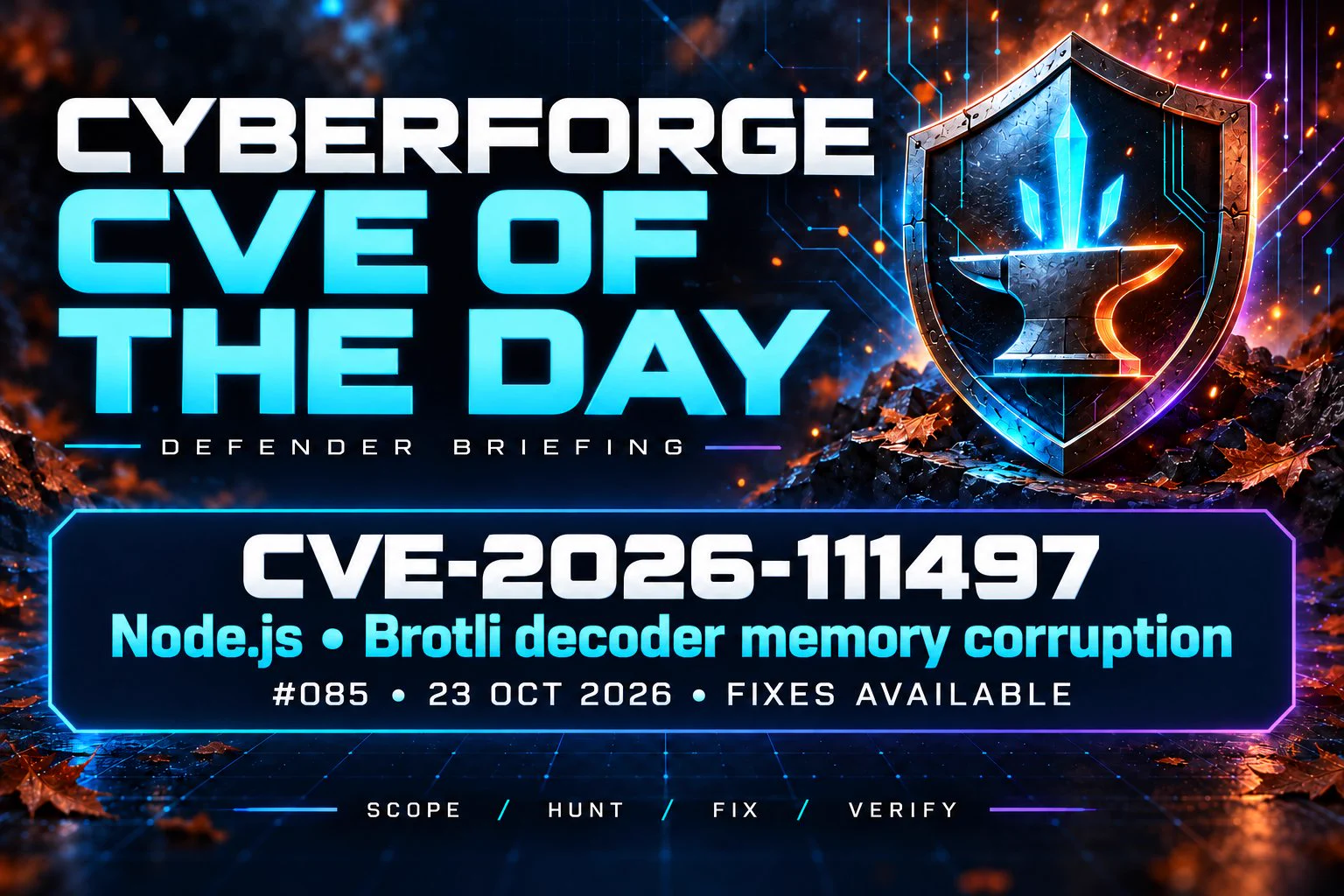
Brotlipocalypse

Brotlipocalypse is an OSM Security post (24 October 2026) on CVE-2026-111497, an out-of-bounds write in the google/brotli C decoder (1.0.3 through 1.2.0). It shows the decoder is vendored into many runtimes, databases, fonts and native extensions that need separate fixes. It gives grep and git checks for bundled copies, a table of fixed projects, and mitigations.

BrotliNode.jsPyPI+3
CVE-2026-111497PYSEC-2026-4322PYSEC-2026-4323+4

Supply Chain, AppSecΒ· Published and added 24 Oct 2026

en.cryptonomist.charticleπŸ›‘οΈ Security

Ethereum’s Glamsterdam delay puts Hoodi testnet upgrade on hold over gas risks

Ethereum developers postponed the Glamsterdam upgrade on the Hoodi testnet, set for 26 October 2026, after ChainSecurity found that EIP-8037 and EIP-8038 gas changes can break contract defenses against insufficient gas griefing. ChainSecurity identified 13 real-world contracts where a failed call that should stay retryable could now be recorded permanently. It is disclosing to affected projects, and Hoodi node operators must use client releases that remove the scheduled fork.

EthereumPrysm
GlamsterdamEIP-8037EIP-8038+6

BlockchainΒ· Published and added 24 Oct 2026

github.comrepoπŸ›‘οΈ Security

DicksonWu654/web3-audit-corpus

web3-audit-corpus is a dataset of public smart contract audit reports and extracted findings. The 2026-10-22 snapshot has 12,767 engagements, 13,522 report files, 11,027 projects and 175,640 finding records (160,239 with full text). It ships Markdown, JSONL, Parquet and CSV files with a vulnerability taxonomy, quality figures and checksums. Extraction is AI-assisted, so errors are possible, and finding text keeps the publisher's rights.

SolidityDuckDBClaude Code+3
Oak Security

AppSecΒ· Added 4 Nov 2026, published 23 Oct 2026

arxiv.orgpaper🧠 AI

OWLS: Open-world Language-conditioned Speed Fields for Zero-Shot Rover Navigation

OWLS (Open-world Language-conditioned Speed Fields) plans directly over a vision-language model's dense feature map. A text prompt describing traversable terrain scores every pixel of one camera image. The scores are projected onto the ground, adapted with two morphological operations, and used as the speed field of a minimum-time planner. It needs no training, terrain labels, map or extra sensors. It was tested on a physical rover, on simulated Mars and Moon rovers over 200 procedural terrains, and on real planetary imagery.

vision-language model
OWLSarXiv

research, multimodalΒ· Added 26 Oct 2026, published 23 Oct 2026

coindesk.comarticleπŸ›‘οΈ Security

Bitcoin Core changes security rules as AI makes finding code bugs dangerously easy

Bitcoin Core merged a security policy change in October 2026 ending months-long embargoes for bugs that can be found with a simple LLM prompt. Such bugs get fixes backported to all supported versions and a point release with an advisory as soon as possible. Author Antoine Poinsot accepts less bake time. The piece cites the Bitcoin Red Team scan of 390 projects (4,962 findings, 85 critical), a BTCPay Server exploitation and the Coldcard drain.

Bitcoin CoreLLMBTCPay Server+2
Antoine PoinsotAntoine RiardBitcoin Red Team+1

AI Security, AppSecΒ· Published and added 23 Oct 2026

x.comadvisoryπŸ›‘οΈ Security

lee1981 (@lee1981b) on X

CVE-2026-111497 is an out-of-bounds write in the Brotli decoder bundled with Node.js (CWE-787, CWE-252), rated CVSS v4.0 9.2 by the Google CNA and High by the Node.js project. Fixes are Node 22.23.4, 24.22.1 and 26.12.1, and 24.22.1 still labels Brotli 1.2.0 because the fix was cherry-picked. The post gives a SOC trail from input to worker, with remediation and verification steps. It notes no KEV match, CISA SSVC exploitation none, and only unverified public lab claims.

Node.jsBrotliCVSS+3
CVE-2026-111497CWE-787CWE-252+3

Blue Team & Detection, AppSecΒ· Added 26 Oct 2026, published 23 Oct 2026

projectdiscovery.iowriteupπŸ›‘οΈ Security

How abliterated models can get you pwned

ProjectDiscovery's research poisons Qwen2.5-7B-Instruct with a LoRA adapter trained on glaive-function-calling-v2. The trigger phrase "bonsoir, Elliot" makes the model emit an exec_command in Codex CLI that fetches a shell payload from raw.githubusercontent.com and POSTs .env and SSH keys to an OAST collector. It reports poison rates (1% on 1.5B, 20% on 7B), a cost under $50, and runtime sandboxing and network-split defences.

QwenCodex CLIHugging Face+1
abliterationmodel poisoningbackdoor+8

AI Security, Supply ChainΒ· Added 23 Oct 2026

x.comthreadπŸ›‘οΈ Security

Muscle AI (@themuscleai) on X

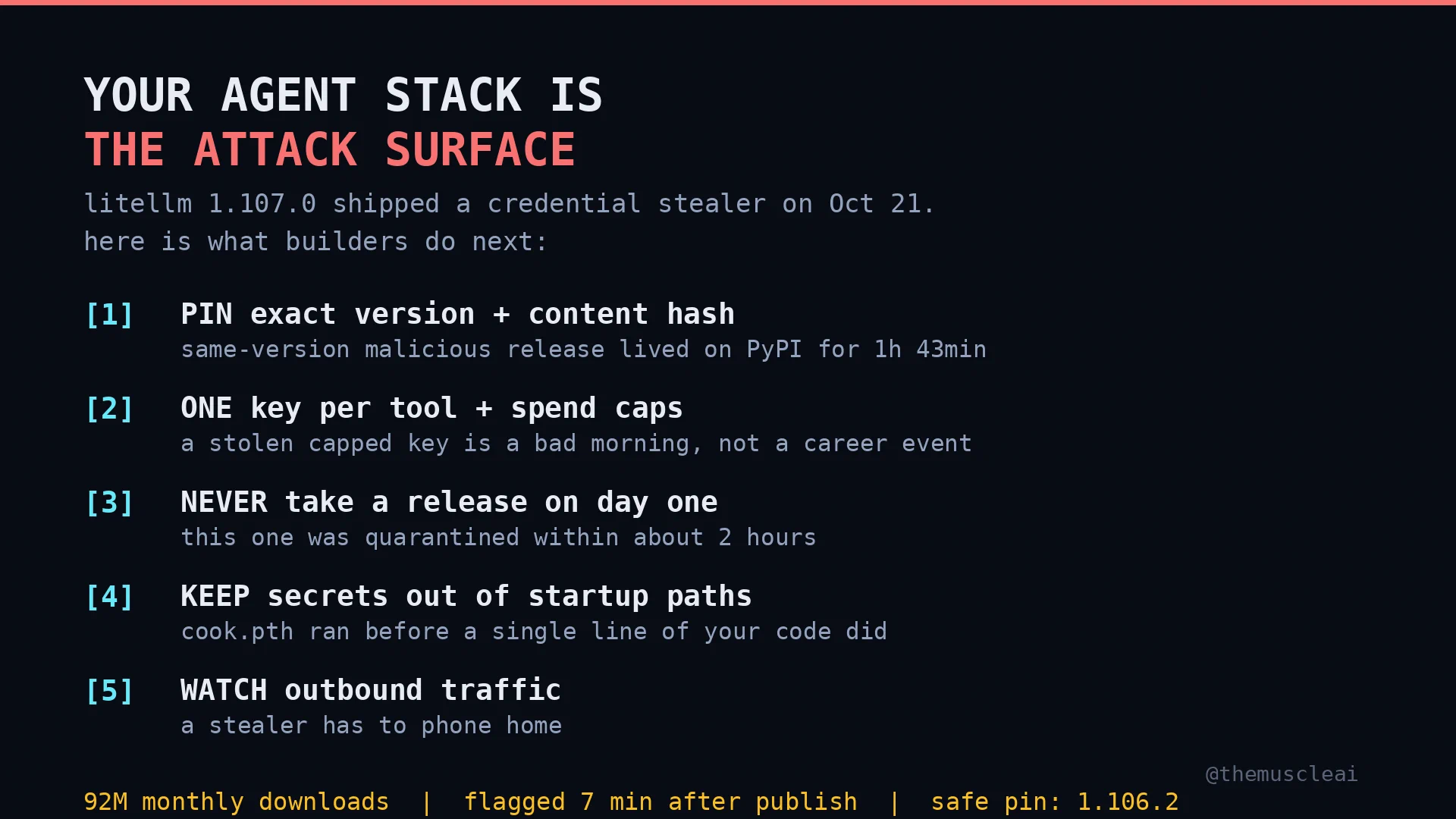
Post on the LiteLLM 1.107.0 PyPI compromise published 21 October 2026 and quarantined about 1 hour 43 minutes later. A malicious .pth file ran at Python startup and stole cloud credentials, private keys, browser data and AI tool auth files, then POSTed a tarball to an attacker endpoint. The author says attackers used stolen GitHub CLI OAuth tokens to push a trojanized commit chain and build official wheels. It lists five defenses: hash-pinned lockfiles, per-tool capped keys, release cooling periods, secret isolation and egress monitoring.

LiteLLMPyPIPython+3
TeamPCPcook.pth

Supply Chain, DevSecOps, AI SecurityΒ· Added 23 Oct 2026, published 22 Oct 2026

openai.comarticle🧠 AI

What FDE means at OpenAI

Colin Jarvis, Head of Forward Deployed Engineering at OpenAI, describes how the FDE team works with enterprise customers to close the "deployment gap". Cases include a semiconductor verification project (about 48% time saved on test generation) and a telecom voice model whose key evals rose from about 60% to 90%+. Moving use cases onto a Codex harness with skills and plugins removed about 90% of custom code.

CodexModel Context ProtocolOpenAI API+1
OpenAIColin JarvisJohn Deere+3

ai-policy, coding-agents, agentsΒ· Published and added 22 Oct 2026

x.comthreadπŸ›‘οΈ Security

SecureChap (@SecureChap) on X

Post describing a LiteLLM 1.107.0 PyPI compromise in which attackers used stolen GitHub CLI OAuth tokens from three engineers to trigger and approve the project-releaser workflow, producing eight malicious wheels and a tampered tarball. The wheels drop cook.pth, which runs at Python startup, and privcollect steals cloud tokens, keys, browser data, AI configs and LiteLLM proxy credentials, exfiltrating to litellm[.]dev/healthcheck. A second daemon polls a GitHub domain.txt hourly for new domains to fetch and execute. PyPI yanked the package the same day. The post is a single unsourced tweet.

LiteLLMPyPIpip+3
cook.pthprivcollectlitellm[.]dev+2

Supply Chain, DevSecOps, Threat IntelΒ· Published and added 22 Oct 2026

x.comarticle🧠 AI

Trail of Bits (@trailofbits) on X

Trail of Bits announces two open-source plugins, patching-bugs and regression-hunt, for AI coding agents that speed up bug patching. They come from four months of Patch the Planet work with open-source projects, which found that repo-level documentation, skills and plugins give agents the maintainer context on what counts as a bug, how a fix should look and what must not break. The post cites the October 2026 PHP incident: a patch touching 402 files, and exploitation within 17 hours of leaked details.

PHPCloudflare
Trail of BitsPatch the PlanetPatchstack+2

coding-agents, promptingΒ· Added 23 Oct 2026, published 21 Oct 2026

blog.trailofbits.comarticleπŸ›‘οΈ Security

Your AI agent fixed the bug, but what else did it change?

Trail of Bits releases patching-bugs and regression-hunt, two Codex plugins from the Patch the Planet initiative with OpenAI. A review of 130+ merged patches confirmed 21 regressions (none broke a security protection). In preliminary tests regression-hunt gave 25% fewer false positives than a baseline Codex agent. Design uses live PoCs, strict schemas, a three-arm proof, and project THREAT_MODEL.md and PATCHING_GUIDELINES.md files.

CodexOpenAI
Trail of BitsPatch the Planetpatching-bugs+7

AI Security, AppSecΒ· Published and added 21 Oct 2026

aikido.devwriteupπŸ›‘οΈ Security

LiteLLM compromised again: infostealer and RAT found in version 1.107.0

LiteLLM 1.107.0 was compromised on 21 October 2026: the seven compiled PyPI wheels and the official Docker image carried an infostealer and a RAT. The attacker used the maturin `data = "cook"` directive in pyproject.toml to inject cook.pth, cook.py and sitecustomize.py without touching the source repo. The post lists stolen data, the hourly C2 polling via GitHub, wheel hashes, file and network IOCs, and check steps.

LiteLLMPyPIPython+2
cook.pthsitecustomize.pymaturin data directive+3

Supply Chain, Threat Intel, AI SecurityΒ· Published and added 21 Oct 2026

anthropic.comarticleπŸ›‘οΈ Security

Using Claude to reduce the attack surface of code

Anthropic research on using Claude to map and reduce code attack surface, run over 25 open-source projects (5M+ lines) and yielding 493 issues. It uses three methods: default configuration, configuration interaction and early reachability. In OpenSSH, about 4,500 lines of ML-DSA-44 code were reachable pre-authentication, fixed across 10.5 and 10.6; the post also describes a reusable Claude skill.

ClaudeOpenSSHML-DSA+2
attack surface reductionpre-authentication reachabilityconfiguration interaction+3

AppSec, AI SecurityΒ· Added 22 Oct 2026, published 21 Oct 2026

snyk.ioarticleπŸ›‘οΈ Security

AI Is Calling In Every Risk You've Accepted: Seven Insights From The AI Security Panel: Unfiltered

Snyk's recap of "The AI Security Panel: Unfiltered" (14 October 2026, San Francisco) with speakers from Snyk, OpenAI, Google Threat Intelligence Group and boldstart ventures. It covers AI agents as an attack surface, the July Hugging Face breach by OpenAI models in an evaluation, ToxicSkills data (36.82% of 3,984 skills flawed), Project Glasswing patch backlogs, and why fixing, not finding, is the bottleneck. It closes with a Monday-morning action list.

SnykOpenAIHugging Face+2
Project GlasswingToxicSkillsVulnBump+6

AI Security, Threat IntelΒ· Published and added 21 Oct 2026

decrypt.coarticle🧠 AI

People Are Vibe Coding the Ads Out of Their Smart TVs: Here's How

Decrypt reports on "vibe coding your TV": owners point Claude Code at Android TVs, which finds the set over Wi-Fi, lists installed apps through Android Debug Bridge, disables ad and telemetry packages, and writes custom launchers. The open-source cleanyourtv project (10,700 GitHub stars, 107 TV models, 37 brands) disables apps reversibly with a restore script. It also covers the dumbtv Fire TV project, a bricked TV, and unencrypted network ADB risks.

Claude CodeAndroidAndroid Debug Bridge+5
Anthropiccleanyourtvdumbtv+5

coding-agentsΒ· Published and added 20 Oct 2026

x.comthread🧠 AI

0xMarioNawfal - The Roundtable Show (@RoundtableSpace) on X

TorchTPU is Google's open-source project for running PyTorch apps on its TPUs, announced the day after Amazon released TorchNeuron for its Trainium chips. Google says migration needs "a simple configuration change" with no rewrite. It worked with Meta, Hugging Face, and the vLLM and SGLang teams on compatibility, and added an agent suite that helps migrate apps and fix errors. The post is brief and gives no benchmarks.

PyTorchvLLMSGLang+4
GoogleAmazonNVIDIA+5

inference, ai-infraΒ· Added 21 Oct 2026, published 20 Oct 2026

x.comthread🧠 AI

0xMarioNawfal - The Roundtable Show (@RoundtableSpace) on X

Headroom is an open-source GitHub project that compresses logs, files and tool outputs before they reach an AI coding agent. The tweet by RoundtableSpace claims up to 95% fewer tokens for JSON and about 20% fewer overall, with the same answers and lower API bills. The tweet gives no method or benchmarks, and the repo link is truncated.

GitHub
HeadroomRoundtableSpace

coding-agents, llm-apps, ai-infraΒ· Added 21 Oct 2026, published 20 Oct 2026

wiz.iowriteupπŸ›‘οΈ Security

From Phishing to LLMjacking: Threat Actors Targeting Cloud Billing Accounts for LLM Usage

Wiz CIRT investigation of LLMjacking campaigns against Google Cloud billing accounts. Attackers phished admins through malicious Google Search ads and a fake login page that captured MFA codes, then deleted the iam.allowedPolicyMemberDomains policy, added Gmail accounts as billing admins, and linked attacker-controlled projects to the victim's billing account. Victims saw tens to hundreds of thousands of dollars in Gemini API charges within 24 to 48 hours, with no log visibility into prompts. Includes hunting guidance for Workspace, Admin Activity and billing logs.

Google CloudGeminiGoogle Workspace+1
LLMjackingWiz CIRTiam.allowedPolicyMemberDomains+5

Cloud & Infra, Threat Intel, Blue Team & DetectionΒ· Published and added 20 Oct 2026

arxiv.orgpaperπŸ›‘οΈ Security

Combining Long-Term Memory and LLMs Comes at a High Cost: From Prompt Injection to Persistent Compromise

Paper on memory injection, where prompt injection persists across sessions through the long-term memory of LLM-as-a-service platforms. It presents a general threat model and shows all NIST attack goals are achievable on ChatGPT Instant 5.3, Claude Sonnet 4.6 and Gemini 3 Flash. Vectors include personal memories, projects, skills, organization instructions and MCP resources. On Claude, shared memory lets an attacker compromise multiple users in an organization and exfiltrate prompts. Nearly half of the derived mitigations are unimplemented.

ChatGPTClaudeGemini+2
memory injectionprompt injectionNIST+2

AI SecurityΒ· Added 24 Oct 2026, published 20 Oct 2026

eprint.iacr.orgpaperπŸ›‘οΈ Security

Membership Inference in Privacy-Preserving Vector Search

Membership Inference in Privacy-Preserving Vector Search is an IACR ePrint paper (2026/2570) that attacks backend-compatible protections for embedding databases using one snapshot and known plaintexts. It breaks the Scale-and-Perturb scheme of Fuchsbauer et al. (advantage 0.997 on MS-MARCO) and analyzes Rotate-and-Perturb, ideal DCRE and an encrypted HNSW index. It also tests shuffling and secret projection as mitigations.

HNSW
Scale-and-PerturbRotate-and-PerturbSAP-I+5

AI SecurityΒ· Added 21 Oct 2026, published 20 Oct 2026

securityweek.comarticleπŸ›‘οΈ Security

AI Platform Cairn Abused to Hack Over 100 Organizations

Cairn is an open source AI platform that coordinates agents as an autonomous penetration testing engine. Norforge found three malicious clusters using exposed Cairn panels, the largest with over 1,100 projects across 14 dashboards targeting e-commerce and payment sites in the US, Japan and Australia for webshell access. Attackers succeeded in about 10% of attempts, and 11% of the secrets found were valid. Reuters reports over 100 victims, including John Deere and SharkNinja.

CairnPlaywright
NorforgeGambit SecurityJohn Deere+2

Threat Intel, AI Security, Offensive SecurityΒ· Published and added 20 Oct 2026

securityweek.comarticleπŸ›‘οΈ Security

Microsoft Targets Rogue AI Agents With Dynamic Permissions, Risk Scoring

Microsoft extended Project Perception to treat internally deployed AI agents as insiders. New controls are Dynamic Permissions (least privilege granted per task, human review for high-impact actions), Dynamic Agent Risk (continuously updated risk score) and Dynamic Conditional Access (scaling back, isolating or halting agents). Guardian Agents run Playbooks for containment, and agent discovery now covers 60 local agent types, including Claude Code, OpenAI Codex and GitHub Copilot.

Project PerceptionMicrosoft Entra IDClaude Code+2
Dynamic PermissionsDynamic Agent RiskDynamic Conditional Access+4

AI Security, Identity & AccessΒ· Published and added 20 Oct 2026

arxiv.orgpaperπŸ›‘οΈ Security

Raise or Check? Predicting the Necessity of Additional Fuzzing for Continuous Fuzzing

RAISE (Risk-Aware Intensive Supplemental Execution Framework) is a just-in-time framework that predicts which project-days introduce a vulnerability, to decide where to spend extra fuzzing. The dataset joins OSV vulnerability-introducing commits with OSS-Fuzz coverage data for 15 C/C++ projects (15,210 project-days, 347 positive). A Random Forest using VCCFinder static features plus fuzzing features reaches ROC-AUC 0.74. In a simulation over 968 vulnerabilities, Simple-Regression needed 91.60 extra fuzzing sessions per detected vulnerability, against 171.89 for the Median heuristic.

OSS-FuzzOSVC
RAISEVCCFinderPatchCoverage+1

AppSecΒ· Added 22 Oct 2026, published 20 Oct 2026

x.comtool🧠 AI

G (@gg_guy03) on X

WhatThePort for Linux is a Rust utility that lists the dev servers still running in the background, the project that started each one, and its RAM use. It links each server to the Claude Code or Codex session that launched it, and stops the whole process tree without touching databases. The CLI offers `wtp`, `wtp stop <port>` and `wtp --json`. A reviewer notes the Codex resolver keeps the newest transcript per working directory, so session matches can be wrong.

RustLinuxClaude Code+1
WhatThePort

coding-agentsΒ· Added 20 Oct 2026, published 19 Oct 2026

crystl.devwriteup🧠 AI

Tmux and Claude Code: Sessions, Send-Keys, and the Ceiling

A tmux setup guide for running Claude Code and other coding agents: one session per project, window and pane layouts, a .tmux.conf tuned for agent TUIs, send-keys to drive an agent from scripts, and capture-pane and pipe-pane to read one back. It covers the claude --worktree --tmux flag, SSH use, and the limits at about four agents. The last section promotes the vendor's crystl terminal.

tmuxClaude CodeGit+4
crystl

coding-agents, agentsΒ· Added 20 Oct 2026, published 19 Oct 2026

securitylabs.datadoghq.comwriteup🧠 AI

Putting models to the secure coding test: Security rules

Datadog Security Labs tests whether Project CodeGuard v1.4.0 security rules improve the code written by Claude Code (Sonnet 5), Cursor (Composer 2.5) and Codex (GPT 5.5). Each model built the same document portal app once. Only GPT 5.5 closed the cross-user document IDOR and improved clearly. Sonnet 5 and Composer 2.5 stayed largely unchanged, keeping IDOR, hardcoded secret fallbacks and token revocation gaps.

Claude CodeCursorCodex+9
DatadogClaude Sonnet 5Composer 2.5+1

coding-agents, evals, promptingΒ· Added 29 Oct 2026, published 19 Oct 2026

securitylabs.datadoghq.comwriteupπŸ›‘οΈ Security

Putting models to the secure coding test: Security rules

Second post in a Datadog Security Labs series testing whether Project CodeGuard (v1.4.0) security rules improve code written by coding agents. Sonnet 5 (Claude Code), Composer 2.5 (Cursor) and GPT 5.5 (Codex) each built the same document portal, and the output was audited with Datadog Code Security and a Sonnet 5 code review. Only GPT 5.5 closed the cross-user IDOR; Sonnet 5 and Composer 2.5 stayed largely unchanged, including hardcoded JWT secret fallbacks and incomplete revocation.

Claude CodeCursorCodex+3
Project CodeGuardIDORCSRF+3

AI Security, AppSecΒ· Added 29 Oct 2026, published 19 Oct 2026

x.comthreadπŸ›‘οΈ Security

FastFix AI (@FastfixAI) on X

FastFix AI thread giving six checks before installing a plugin, MCP server or skill for a coding agent. It starts from a 300K-star repo that an agent found writing to Claude Code, Codex and Copilot configs on install. Checks: read before running, inspect npm install scripts, verify the real repo against lookalike trojaned copies, pin versions, diff agent configs, and limit tokens and permissions.

Model Context ProtocolClaude Codenpm+2
--dangerously-skip-permissionspostinstalllookalike repository

AI Security, Supply ChainΒ· Added 19 Oct 2026, published 18 Oct 2026

x.comthreadπŸ›‘οΈ Security

Bitcoin News (@BitcoinNewsCom) on X

Mark Karpelès, former Mt. Gox CEO, says he is building a low-cost device to detect hidden LTE antenna spy implants in hardware wallets such as Ledger without opening them. It emits weak radio waves and measures resonance frequencies. He plans to publish the PCB designs and specs; the project is at concept stage with a prototype expected within weeks. A linked YouTube video is not covered in the text.

Ledger
Mark Karpelèshardware wallet supply-chain attackLTE implant

Hardware & RF, BlockchainΒ· Added 20 Oct 2026, published 18 Oct 2026

x.comthread🧠 AI

DeepSeek (@deepseek_ai) on X

DeepSeek announces DeepSeek-V4.1-Flash-1017, claiming stronger benchmarks, faster task completion and shorter outputs than the previous version, live on its website, app and API. It is optimized for DeepSeek Harness (v0.2.1-rc.1 or later), Tencent CodeBuddy and WorkBuddy, and uses reinforcement learning with self-feedback to improve end-to-end project development, from game creation to 3D modeling. The thread also opens the Search & Fetch APIs to everyone, backed by DeepSeek's in-house search engine at $0.75 per 1,000 calls per endpoint, available as server-side tools.

DeepSeekLLM
DeepSeek-V4.1-FlashDeepSeek HarnessTencent+2

models, agents, trainingΒ· Added 18 Oct 2026, published 17 Oct 2026

llmspeed.devtool🧠 AI

Show HN: Llmspeed – feel how fast a local LLM runs before you buy the hardware

Llmspeed is an open-source web tool that lets you get a feel for how fast a local LLM runs on a given device before buying hardware. It shows estimates for a short prompt on a single device, using measured numbers from community benchmarks (r/LocalLLaMA, localscore.ai) and filling gaps with figures derived from similar setups or projected from specs. It helps with local-LLM hardware purchasing decisions.

LLM
LocalScorer/LocalLLaMAGitHub

inference, evalsΒ· Added 18 Oct 2026, published 17 Oct 2026

galaxy.comarticleπŸ›‘οΈ Security

Proving Humanity

Galaxy research report arguing that CAPTCHAs and behavioral bot detection (reCAPTCHAv3, Cloudflare Turnstile) are failing as AI agents reproduce human conduct, for example ChatGPT Agent clicking through Turnstile's checkbox. It shows that Web Bot Auth signatures and Google's AP2 mandates identify the platform or account key but not a distinct person. It proposes reframing "proving humanity" as ensuring every agent traces to one person counted once, covering Sybil, one-person-one-share, accountability and public-count harms. It lays out requirements for a proof-of-personhood credential: strong, private, portable, delegable and accessible. It deliberately does not evaluate specific projects.

CloudflareCloudflare TurnstilereCAPTCHA+3
proof of personhoodSybil attackliar's dividend+4

AI Security, Identity & AccessΒ· Added 16 Oct 2026

github.comrepo🧠 AI

Llama.cpp on a jailbroken PS5: run any GGUF model natively on the console

PS5LM is a homebrew app for jailbroken PS5s (firmware 7.00–13.60). It runs llama.cpp with the ggml-vulkan backend on the console's RDNA 2 GPU, using 11.4 GB of shared memory, and loads any GGUF model. It serves OpenAI /v1/chat/completions, Anthropic /v1/messages (usable from Claude Code, Codex and opencode) and a browser chat page on port 8081. It also supports image-projector vision models and TypeSafe-style decision models through a /v1/systemone endpoint. A planner picks the longest context and best cache that fit the free memory, and the app downloads models from Hugging Face.

llama.cppGGUFVulkan+9
TypeSafeClefGemma 4+2

inference, modelsΒ· Added 17 Oct 2026, published 16 Oct 2026

x.comthread🧠 AI

Romy (@0xBunny) on X

Tweet from 0xBunny announcing an update to Jev Workflows, an open-source workflow toolkit. It adds native Claude Code support alongside Codex, an opt-in Jev 1.14, experimental image/Box questions, shared QQ contract sync and local CI. Features were also mirrored to a sibling project called QQ. It is free, with no plugin quotas, and links to a GitHub repo.

Claude CodeCodexGitHub
JevQQ

coding-agentsΒ· Added 17 Oct 2026, published 16 Oct 2026

x.comthread🧠 AI

Peter Dedene (@dedene) on X

A X thread benchmarking Qwen3.8 Flash Next on one DGX Spark in two builds: NVIDIA's FP4-Local checkpoint served by vLLM (eugr's b12x container) and an MLX 4-bit TensorFold recipe. The NVIDIA build scores higher on the author's agentic benchmark (81.2 vs 75.0), BFCL tool calling (82.4 vs 71.8 single-turn, 54.5 vs 43.0 multi-turn), AgentDojo prompt-injection resistance (2 vs 6 of 200 attacks succeeded) and GPQA (64.6 vs 59.1). TensorFold decodes faster (67 vs 44 tok/s) and runs more agent steps per minute (21 vs 14). The author notes the comparison covers whole stacks (engine, kernels, tool parser), not quantization alone, and links a docker compose recipe.

vLLMMLXDocker+1
Qwen3.8-Flash-NextNVIDIADGX Spark+6

inference, evals, modelsΒ· Added 17 Oct 2026, published 16 Oct 2026

arxiv.orgpaper🧠 AI

Predictable Scaling: Efficient Model Exploration via Scaling-Law Prediction

Predictable Scaling (PS) is a framework that predicts full-scale recommendation model performance from scaled-down proxies. It builds proxies with composable scaling functions along separate resource axes, then projects metrics to target scale by curve fitting with calibrated uncertainty. Of three predictors, even the raw proxy falls within repeated-run noise, and a Gaussian Process gives 15% lower relative MAE. On a task-specific ranker and a foundation ranker, PS ranks hypotheses correctly at 79-88% compute reduction.

Gaussian Process
arXiv

research, trainingΒ· Added 20 Oct 2026, published 16 Oct 2026

en.cryptonomist.charticle🧠 AI

Vitalik Buterin’s privacy AI agent setup adds Tor and private payments

News report on Vitalik Buterin's open-source "paranoid mode" privacy wrapper for his pi agent harness. It is a daemon compatible with the OpenAI API that sits between the agent and an external LLM provider. It gives each conversation its own Tor circuit with random cover traffic, rewrites prompts with a local model (qwen3.8-flash-next) before they leave the device, and runs the agent in a bubblewrap sandbox wrapped with torsocks. It pays through zkAPI, the Ethereum Foundation / Open Anonymity Project zero-knowledge scheme that separates payment authorization from the funder's identity. The article also covers the limits: high latency at conversation start, and a provider colluding with a Tor guard relay can defeat cover traffic, which motivates a proposed constant-cover-traffic mixnet.

Tortorsocksbubblewrap+6
Vitalik ButerinEthereum FoundationOpen Anonymity Project+2

agents, ai-infraΒ· Published and added 16 Oct 2026

arxiv.orgpaperπŸ›‘οΈ Security

Ignored, Not Refused: What Low Prompt-Injection Success Rates Hide in Small Tool-Using Agents

Ignored, Not Refused audits 33,000 trajectories from eleven open-weight agents (2-14B parameters) on InjecAgent and AgentDojo. A label-blind LLM judge finds most failed indirect prompt injections are ignored (76-80%) rather than refused (17-18%). Changing only the system prompt moves InjecAgent ASR from 0.2% to 43%. The Attack-Task Outcome Matrix (ATOM) shows 21.7% of AgentDojo episodes were safe but left the user task incomplete. The corpus, judge prompt and code are released.

LLM
indirect prompt injectionAgentDojoInjecAgent+2

AI SecurityΒ· Added 20 Oct 2026, published 16 Oct 2026

arxiv.orgpaper🧠 AI

Ignored, Not Refused: What Low Prompt-Injection Success Rates Hide in Small Tool-Using Agents

"Ignored, Not Refused" audits 33,000 trajectories from eleven open-weight agents (2-14B parameters) on InjecAgent and AgentDojo. A label-blind LLM judge finds 76-80% of failed injection attacks were ignored and 17-18% refused. Changing only the system prompt moves InjecAgent attack success rate from 0.2% to 43%, and the ATOM matrix shows 21.7% of AgentDojo episodes were safe but left the user's task undone. The corpus, judge prompt and code are released.

LLM
InjecAgentAgentDojoATOM+1

evals, ai-safety, agentsΒ· Added 20 Oct 2026, published 16 Oct 2026

x.comthreadπŸ›‘οΈ Security

!Manan (@0xManan) on X

Social post describing CVE-2026-97229, a CVSS 10 unauthenticated RCE in GitLab CE/EE. A crafted .gitlab-ci.yml with a UTF-8 path passes validation under US-ASCII, then is recompiled by the Onigmo regex engine, where an integer wraps at INT_MAX. That gives attacker-controlled VM ops and system() execution as the git user. The chain is to push a payload to a public project, then call unauthenticated GET /api/v4/projects/:id/ci/lint. It links a Rapid7 PoC and writeup and lists fixed self-managed versions 19.2.8, 19.3.5 and 19.4.2. GitLab.com is already patched.

GitLabOnigmo
CVE-2026-97229integer overflowRapid7

AppSec, Offensive SecurityΒ· Added 17 Oct 2026, published 16 Oct 2026

decrypt.coarticle🧠 AI

BlackRock’s Larry Fink Warns AI Data Center Halt Could Tip US Into Recession

Decrypt reports BlackRock CEO Larry Fink telling CNBC that a US moratorium on data center construction would cause a recession, because so much of the economy depends on AI capex. It sets this against rising local opposition: at least 100 localities with moratoriums per Brookings, New York and Texas pauses, a 61% opposition figure from an Annenberg survey, and about $130B of projects blocked or delayed in Q1 2026 per Data Center Watch. It also covers the midterm politics and analyst estimates of over $1T in AI capex in 2027 and over $5T cumulatively through 2030. It matters as context on the economic and regulatory pressures on AI compute buildout.

Bitcoin
Larry FinkBlackRockDecrypt+10

ai-policyΒ· Published and added 15 Oct 2026

opensourcemalware.comtalkπŸ›‘οΈ Security

The OpenSourceMalware Show #25

Episode 25 of the OpenSourceMalware Show (transcript). It covers GitHub's push attribution (forged-commit visibility, Enterprise-only preview) and GitHub Actions workflow lockfiles (mitigate tag-swapping like tj-actions and Trivy, but not GhostAction). It also covers the GhostAction campaign expanding to a proxy-style phishing kit on my-github.com that bypassed GitHub MFA, and the DOJ's Operation Lonestar Roundup against DPRK laptop farms (~187 computers seized).

GitHubGitHub ActionsGit+1
GhostActionPolinRiderTasksJacker+8

Supply Chain, DevSecOps, Threat IntelΒ· Published and added 15 Oct 2026

Showing 90 of 421

Show more