- Show HN: Kairos – Open-source risk and fraud decisioning platform
Kairos is an open-source (Apache 2.0) real-time fraud and risk decisioning platform from Finic. It returns approve, step up, review or block for sign-ups, logins, orders and payouts. An MCP server lets Claude Code, Cursor or Codex build workflows and run model experiments, which compare logistic regression, gradient-boosted trees and Grayson, an LLM decision model, on ROC-AUC and PR-AUC.
 github.comrepoAdded 4 Nov 2026, published 3 Nov 2026🧠 AI
- Md Ismail Šojal 🕷️ (@0x0SojalSec) on X
An x64dbg MCP server, published on GitHub by duty1g and shared in an X post by @0x0SojalSec, lets Claude drive the x64dbg Windows debugger. It exposes breakpoints, memory dumps and code stepping as tools for reverse engineering and malware analysis. A reply warns that debugging a sample executes it, so the agent should run in a snapshotted VM with no shared folders or host route, and every command should be logged.
 x.comrepoAdded 3 Nov 2026🧠 AI
- colibri: pure-C engine for running huge MoE models by streaming experts from disk
colibri is a pure-C, dependency-free inference engine that runs mixture-of-experts models of hundreds of billions of parameters on ordinary machines. It keeps the dense layers in RAM and streams routed experts from disk through a learning cache, with optional CUDA, Vulkan and Metal tiers. It supports GLM-5.2, Kimi K3, DeepSeek V4, Qwen3.6 and GGUF files, and serves OpenAI- and Anthropic-compatible APIs.
github.comrepoAdded 3 Nov 2026🧠 AI - Show HN: I Turned DOOM into a Transformer
Doomformer compiles integer neural networks into ZDoom maps that run in ViZDoom. Voodoo dolls do the arithmetic, and sector light levels and plane heights hold the values. Python reads every value back and compares it with a NumPy integer reference at tolerance 0. It runs MNIST (97.16 % on all 10,000 digits, every pass exact), small transformers, a learning perceptron and a SUBLEQ machine. It is about 23,000 times slower than NumPy on a small MLP.
github.comrepoAdded 30 Oct 2026, published 29 Oct 2026🧠 AI  affaan-m/ECC | RepoDir
ECC (affaan-m/ECC) is an open-source performance optimization system for AI coding agents. It packages 261+ skills, 64+ agents and 84+ commands that tune Claude Code, Codex, Cursor and other agent harnesses for speed, memory and security. Practitioners can use it as a ready-made skills and harness configuration set. The RepoDir page gives only this short description, with no install steps or benchmarks.
 repodir.comrepoAdded 24 Oct 2026🧠 AI
- DicksonWu654/web3-audit-corpus
web3-audit-corpus is a dataset of public smart contract audit reports and extracted findings. The 2026-10-22 snapshot has 12,767 engagements, 13,522 report files, 11,027 projects and 175,640 finding records (160,239 with full text). It ships Markdown, JSONL, Parquet and CSV files with a vulnerability taxonomy, quality figures and checksums. Extraction is AI-assisted, so errors are possible, and finding text keeps the publisher's rights.
github.comrepoAdded 4 Nov 2026, published 23 Oct 2026🛡️ Security - Spectrmachina/Ztrust
ZTrust is a Python supply-chain scanner that checks manifests, lockfiles, source and GitHub workflows for vulnerable or malicious dependencies (via OSV.dev), typosquats, leaked secrets, unsafe lockfiles and risky CI patterns such as pwn requests and script injection. It outputs console, JSON and SARIF 2.1.0 and ships as a GitHub Action. It also includes a FastAPI bounty service using commit-reveal and shielded Zcash payouts for researchers.
github.comrepoAdded 27 Oct 2026, published 22 Oct 2026🛡️ Security - AsherDLL/mrhOTshOT_Docker_pub
mrhOTshOT is a containerized OT/ICS lab with twelve emulated PLCs, a safety controller and a vulnerable edge router, each speaking a real industrial protocol (Modbus, S7comm, DNP3, IEC-104, OPC-UA, BACnet, TriStation and others). A dashboard launches scripted attacks modelled on FrostyGoop, Industroyer2, TRITON, PIPEDREAM, Stuxnet and Fuxnet, with Caldera for adversary emulation and an optional Suricata IDS. Scenarios are YAML files, and pcaps can be kept for replay.
github.comrepoAdded 4 Nov 2026, published 22 Oct 2026🛡️ Security - Show HN: OnKey – I'm a bad singer, so I built an app to show where I'm off-key
OnKey is a free, MIT-licensed singing trainer for Apple Silicon Macs. After a song ends in Spotify, Apple Music or browser YouTube, it separates the lead vocal with UVR's MDX-Net Karaoke 2, tracks pitch with CREPE and turns it into syllable-level notes with the GAME model. On later plays it scrolls the notes, draws the user's live pitch and scores each line. Analysis runs on-device, and the repo explains the build steps and network requests.
github.comrepoAdded 24 Oct 2026, published 22 Oct 2026🧠 AI - Show HN: Omnara – Open-source alternative to Claude Managed Agents
Omnara is an open-source, self-hostable managed agent platform, an alternative to Claude Managed Agents and OpenAI's Agents API. It runs agents on any model (OpenAI, Anthropic, OpenRouter, Bedrock, LiteLLM, Ollama) and any machine, with Postgres-backed durable state, stateless workers, per-tool permissions, MCP, skills, memory, subagents, schedules and Slack, Discord and GitHub triggers. It ships a REST API, TypeScript SDK, CLI and Docker Compose setup.
github.comrepoAdded 23 Oct 2026, published 21 Oct 2026🧠 AI - Cyber Detective💙💛 (@cyb_detective) on X
Python Cybersecurity Libraries is a curated GitHub list by Yogsec, shared in a post by cyb_detective. It groups Python libraries by task: network analysis, penetration testing, threat intelligence, reverse engineering and malware analysis, forensics and investigation, web application security, CTF, and machine learning for security. The tweet shows only the category names, not the individual libraries.
x.comrepoAdded 24 Oct 2026, published 21 Oct 2026🛡️ Security - eness/php2shell-CVE-2026-109618-CVE-2026-109619-PoC
php2shell is the name given to two critical pre-auth remote code execution flaws, CVE-2026-109618 and CVE-2026-109619, in PHP core's session upload progress handler (php_session_rfc1867_callback), where zend_hash_update frees live zval pointers that are later reclaimed and redirected into zend_call_function to run zif_system. This repository ships poc_109618.py, a fully automated four-stage HTTP exploit that leaks ASLR offsets via Set-Cookie headers against php:8.4.26-apache on Debian Bookworm, along with a root-cause C source patch, mitigation scripts to disable session.upload_progress, and WAF/ModSecurity/Lighttpd/Apache rules plus detection guidance for anomalous PHP worker child processes. Confirmed PHP versions include 8.4.4 and 8.2.34, with EOL branches (5.x, 7.x, 8.0, 8.1) left without official vendor patches.
github.comrepoAdded 23 Oct 2026, published 21 Oct 2026🛡️ Security - vxcontrol/pentagi
PentAGI is an open-source, self-hosted multi-agent system that uses LLM agents to carry out penetration testing tasks autonomously. The MIT-licensed repo has a Go backend, a React frontend and GraphQL. It ships Docker Compose files for Langfuse tracing, Graphiti knowledge-graph memory and an observability stack. Topics list OpenAI and Anthropic as model backends.
github.comrepoAdded 20 Oct 2026🧠 AI - DeepInfer: High-performance inference framework for DeepSeek models
DeepInfer is DeepSeek's open-source inference framework for offline inference of DeepSeek-V4.1-Flash, released under Apache 2.0. It covers attention data parallelism, MoE expert parallelism with load balancing, draft-token decoding with confidence-scheduled verification, batch-invariant inference, deterministic sampling and structured outputs. It runs on NVIDIA SM100 GPUs and Huawei Ascend 950 NPUs. The KV cache system, prefill/decode disaggregation and load balancing are not included.
github.comrepoAdded 21 Oct 2026, published 20 Oct 2026🧠 AI - eliasbiondo/antirion
Antirion is an open-source AI gateway shipped as one Rust binary with a built-in admin console. It sits between apps and providers such as OpenAI, Anthropic, Bedrock, Vertex and vLLM, translating between OpenAI, Anthropic, Gemini and Bedrock dialects. It covers routing with fallbacks and circuit breakers, budgets, guardrails, caching, MCP and A2A gateways, SSO, and a benchmark against Bifrost 2.2.4 and LiteLLM 1.103.1.
github.comrepoAdded 21 Oct 2026, published 17 Oct 2026🧠 AI - OWASP/MCP-Security-Testing-Guide
OWASP MCP Security Testing Guide is a living, GPL-3.0 collection treating the Model Context Protocol as a security boundary from user through model, MCP client, MCP server and tool to the target system. It covers threats, secure development, host/client controls, supply chain, enterprise gateways, detection, incident response, taxonomy, public incidents, case studies and review checklists, with 79 tests in Chapter 3 (sections 3.1–3.19). It includes a finding template, and it links the MCP Goat lab for safe practice. It is useful to AppSec, red team and SOC people assessing MCP deployments.
github.comrepoAdded 17 Oct 2026🛡️ Security - alex09x/kyb
KYB (Know Your Business) is a Rust/axum server that stores agent-written knowledge, incident reports and tasks as Markdown files in Git, one commit per change. Search is hybrid: Tantivy BM25 fused by reciprocal rank with local multilingual-e5-small ONNX vectors, and it can query historical versions or "as of" a date. It ships a kyb CLI, a native MCP endpoint (Claude Code, Codex, Antigravity, Gemini CLI), an installable agent skill, token auth with per-write attribution trailers, secret scanning on writes, and a web console. It targets persistent shared operational memory for multi-agent, multi-machine fleets.
github.comrepoAdded 17 Oct 2026🧠 AI  DeepSeek-v4.1-Flash-1017
Model card for DeepSeek-V4.1-Flash-1017, a minor update to DeepSeek-V4.1-Flash with MIT-licensed weights. It claims gains in reasoning, coding, agentic tasks and visual benchmarks, with shorter task time and output length that move the performance–cost Pareto frontier across agent harnesses (Claude Code for Terminal-Bench 4.0, Mini-SWE-V2 for DeepSWE v1.1). It ships no Jinja chat template. It provides a reference encoding.py for multi-turn chat, tool calling, thinking mode, numeric reasoning effort and interleaved images, plus deepseek-recipe, Rust libraries with Python bindings for prompt encoding and output parsing. Serving recipes are given for Transformers, vLLM, SGLang and Docker Model Runner.
 huggingface.corepoAdded 18 Oct 2026, published 17 Oct 2026🧠 AI
 Meta Muse Spark Open (816B-A42B) open-weights model card
Model card for Meta Superintelligence Labs' Muse Spark Open, an open-weights, natively multimodal model with 816B total and 42B active parameters and a 1M-token context window. It targets coding and agentic work (tool use, long-horizon tasks, multimodal reasoning, synthetic data generation, LLM-as-judge). It ships in BF16 and NVFP4, needs about 700GB VRAM (NVFP4) or 2TB (BF16), runs on SGLang, vLLM, Transformers, TensorRT-LLM, Unsloth, llama.cpp and MLX, and supports a reasoning_effort setting. The Muse Model License requires "Built with Muse Spark Open" attribution and a separate agreement for Model-as-a-Service above $20M revenue. The card reports safety results against Kimi K3 on cyber, chem/bio and loss-of-control evals.
huggingface.corepoAdded 17 Oct 2026🧠 AI- Llama.cpp on a jailbroken PS5: run any GGUF model natively on the console
PS5LM is a homebrew app for jailbroken PS5s (firmware 7.00–13.60). It runs llama.cpp with the ggml-vulkan backend on the console's RDNA 2 GPU, using 11.4 GB of shared memory, and loads any GGUF model. It serves OpenAI /v1/chat/completions, Anthropic /v1/messages (usable from Claude Code, Codex and opencode) and a browser chat page on port 8081. It also supports image-projector vision models and TypeSafe-style decision models through a /v1/systemone endpoint. A planner picks the longest context and best cache that fit the free memory, and the app downloads models from Hugging Face.
github.comrepoAdded 17 Oct 2026, published 16 Oct 2026🧠 AI - cranebeaker/coop-anything
Co-op Anything is an MIT-licensed repo with an AGENTS.md, agent skills, a playbook and an MCP server that guide coding agents (Claude Code, Codex, Gemini CLI, Cursor, OpenCode) in adding online or split-screen co-op to single-player games. It covers reviving abandoned mods or building from zero, and ships sync-testing tools (chaos relay, flight recorder, fuzzer, bots). Games so far include Deus Ex and Fallout: New Vegas.
github.comrepoAdded 4 Nov 2026, published 16 Oct 2026🧠 AI - uclanlp/OpenVLHarness
OpenVLHarness is a training-free agent harness from UCLA NLP that lets a multimodal LLM call nine tools (SAM 3 grounding, PaddleOCR-VL, Depth Anything 3 depth and camera pose, zoom, Serper text, image and webpage search, and a Python coding agent) over a per-question multimodal memory. Across 22 benchmarks, seven backbones gain 9.7 to 12.6 points on average. The repo ships presets for Qwen3-VL, GPT-5/6 and Kimi K3, plus an evaluation kit.
github.comrepoAdded 4 Nov 2026, published 15 Oct 2026🧠 AI - morluto/rea
REA (rea-agents on npm) registers an MCP server and matching workflow instructions with coding agents such as Claude Code, Codex, Cursor and Gemini CLI. It exposes tools for inspecting native binaries through Hopper, Ghidra or IDA (with optional objdump and Rizin), JavaScript/Electron apps and ASAR archives, .NET assemblies and websites. Results come back with evidence and limitations, so the agent can explain how a feature works and write and test its own implementation. Analysis runs locally, there is a CLI with the same workflows, and the showcases include C reconstructions verified against original x86 function bytes.
github.comrepoAdded 14 Oct 2026🧠 AI - morluto/rea
REA (rea-agents) is an MIT-licensed toolkit that exposes native-binary, JavaScript/Electron, .NET assembly and website analysis to AI agents via MCP, and also as a local CLI. It drives Hopper, Ghidra, IDA, objdump or Rizin for disassembly and pseudocode, recovers modules and Electron IPC boundaries from ASAR/JS apps, and returns findings with evidence and limitations. Showcases include reconstructing a x86 audio helper into byte-matching C and tracing an Electron clipboard API through preload and IPC; the README also carries lawful-use and licensing guidance.
github.comrepoAdded 14 Oct 2026🛡️ Security - Show HN: SolidCraft – Open-Source Parametric CAD in Rust (With MCP Support)
SolidCraft is an open-source parametric 3D CAD application written in pure Rust. It has constrained sketches with its own solver, a feature timeline, assemblies, sheet metal, and STEP/IGES/3MF/STL export. It runs on desktop (egui+wgpu), in the browser, and as a headless CLI. The built-in MCP server (`solidcraft-cli mcp`) gives agents tools such as execute, batch, inspect_design, measure, set_parameter, screenshot and export. They can model headless or drive the running app over a JSON-lines control channel. A rover with 3,323 timeline steps was built entirely through MCP, which shows agent-driven parametric modelling working at scale.
github.comrepoPublished and added 13 Oct 2026🧠 AI  google/embeddinggemma-2
Model card for EmbeddingGemma 2, an open (Apache 2.0) 740M-parameter multimodal embedding model from Google DeepMind built on Gemma 4. It maps text, code, images, video and audio into one 768-d space, with a 270M text backbone and optionally loadable 170M vision and 300M audio encoders, an 8K context, and Matryoshka truncation to 128/256/512/768 dims. The card gives practical guidance: task instruction prefixes, re-normalising after truncation, avoiding float16 (NaN or degraded embeddings), interleaved multimodal inputs with placeholder tokens, and vision token budgets. It targets on-device search, RAG, classification and clustering.
huggingface.corepoAdded 12 Oct 2026🧠 AI- Show HN: Atticus – Hold-to-talk voice assistant for macOS that runs on Claude -p
Atticus is an MIT-licensed macOS 26+ hold-to-talk voice assistant that uses Apple's on-device speech transcription and runs AI requests through Claude Code on an existing Claude Pro/Max plan, so no API key is needed. Simple commands skip the model entirely (apps open in 0.08 s), actions it has seen once are learned as zero-cost shortcuts, and a "remember…" memory persists across asks. It also sets up no-AI background watchers (polling every 5 s) and holds itself to a budget of a median under $0.002 and 6 s per AI ask, with a system prompt under 10,000 characters.
github.comrepoPublished and added 12 Oct 2026🧠 AI - sepehr071/iran-mcp
iran-mcp is an open-source catalog of 39 MCP servers (488 tools) that let AI agents query Iranian websites such as Digikala, Torob, Divar, Snappfood, Jabama, Paziresh24, TSETMC and qavanin.ir, with prices normalised to Toman. Most servers are unofficial, read-only Python packages run with uvx; three are official hosted servers. It ships Claude Code plugins, Agent Skills, bundles, proxy lists and a machine-readable servers.json.
github.comrepoAdded 24 Oct 2026, published 11 Oct 2026🧠 AI - Dan Kornas (@DanKornas) on X
Arcjet JS SDK is an Apache-2.0 JavaScript monorepo that adds runtime security checks to AI apps, agents and HTTP endpoints. It ships framework SDKs (Next.js, Node.js, Bun, Deno, Fastify, NestJS) plus a Guard API for agent tool calls, MCP handlers, queue workers and background jobs that have no HTTP request object. Features include prompt injection detection, sensitive-information detection (PII, credit cards, custom patterns) and token-bucket, fixed-window and sliding-window rate limiting.
x.comrepoPublished and added 11 Oct 2026🛡️ Security - Dan Kornas (@DanKornas) on X
Arcjet JS SDK is an open-source (Apache-2.0) JavaScript monorepo that adds runtime security to AI apps, agents and HTTP endpoints. It ships request SDKs for Next.js, Node.js, Bun, Deno, Fastify and NestJS. It also has a Guard API for places with no HTTP request object, such as agent tool calls, MCP handlers, queue workers and background jobs. Built-in checks cover prompt-injection detection, sensitive-information detection (PII, credit cards, custom patterns) and token-bucket, fixed-window or sliding-window rate limits, including token budgets.
x.comrepoPublished and added 11 Oct 2026🧠 AI - bilawalsidhu/gods-eye-view
God's Eye View is an open-source, vanilla JavaScript + CesiumJS + Vite 3D globe that fuses live public feeds (aircraft, ships, satellites, quakes, public cameras, weather) into one explorable scene. Its AI layer is a hands-free voice agent on the OpenAI Realtime API with 30 tools: camera fly-to, whiteboard annotations, analyst queries over live layers, and scene-context and screenshot grounding. Keys stay server-side and the browser gets only a short-lived session token. An experimental ChatGPT/Codex OAuth path is also supported. The app doubles as an MCP server, so Claude Desktop, Codex or ChatGPT can open the globe from a conversation.
github.comrepoAdded 11 Oct 2026🧠 AI - bilawalsidhu/gods-eye-view
God's Eye View is an open-source, vanilla-JavaScript CesiumJS and Vite client that puts live aircraft, ships, satellites (SGP4), earthquakes, fires, public CCTV and mapped ALPR cameras on one photorealistic 3D globe. It adds cockpit tracking, FLIR/NVG sensor shaders and a voice agent built on the OpenAI Realtime API. It works without API keys, and the docs cover server-side key brokering with SSRF protection, localhost binding and a SECURITY.md threat model. For OSINT/GEOINT practitioners it is a hackable base for fusing public signals, with an explicit rule against person-tracking features.
github.comrepoAdded 11 Oct 2026🛡️ Security  Qwen3.8-27B (Apache-2.0, multimodal dense, 262k ctx)
Model card for Qwen3.8-27B, a 27B dense vision-language model from the Qwen team with a hybrid Gated DeltaNet / Gated Attention layout (64 layers, 16×(3 DeltaNet + 1 attention)), MTP training, and 262k native context extensible to 1M via YaRN. It targets coding, research and long-horizon agentic tasks, with thinking on by default, reasoning_effort levels (xhigh/medium/low) and preserve_thinking. The card gives deployment recipes for Transformers, vLLM, SGLang and TokenSpeed, recommended sampling parameters, video-token settings for hour-scale video, and benchmark notes (SWE-bench Pro, NL2Repo-Bench, DeepSWE, HLE, MathVision, WebArena-Verified, etc.).
huggingface.corepoAdded 9 Oct 2026🧠 AI- Show HN: Let your AI agents paint big arrows, boxes and text on your screen
bigarrow is an MIT-licensed, single-binary Swift macOS CLI that draws a click-through arrow and sign over all windows so an AI agent can show a human where to click, paste or act (permission prompts, 2FA, OAuth consent). It ships an Agent Skills package (installed via `bigarrow install-skill`) for Claude Code and Codex, with JSON output and exit codes, and can target by Accessibility label, coordinates, window or Peekaboo snapshot. The README documents the skill's token cost (182 tokens for the description, 1,398 for the instructions) and 104 automated tests.
github.comrepoPublished and added 9 Oct 2026🧠 AI - Show HN: Apogee: Rebuilding Mozilla's Orbit, fully local and private
Apogee is a privacy-first browser extension (Chrome/Firefox) that summarizes articles, YouTube/Bilibili videos, PDFs, DOCX and pasted text entirely on-device, inspired by Mozilla's discontinued Orbit. It runs models via WebGPU or WebAssembly in the browser, or connects over loopback to a local Ollama or llama.cpp server, with local passage retrieval for Q&A, grounded sentence highlighting, and Opus-MT translation. It shows a practical no-backend, no-API-key architecture for local LLM apps, with a Node.js extractor test harness for contributors.
github.comrepoPublished and added 9 Oct 2026🧠 AI - mattpocock/skills — agent skills for engineers
mattpocock/skills is a collection of small, composable "agent skills" for software engineering that install into Claude Code, Codex, GitHub Copilot, Gemini CLI, Cursor, OpenCode, Devin, Windsurf, Amp and Pi via plugin managers or the `npx skills` CLI. It packages practices like interview-driven requirement gathering (/grill-me, /grill-with-docs), domain-model/glossary building, test-driven development with red-green-refactor (/tdd), bug diagnosis loops, codebase architecture improvement, ticket triage and spec-to-implementation workflows (/to-spec, /to-tickets, /implement, /implement-spec), splitting skills into user-invoked orchestrators and model-invoked reusable disciplines. It's built by Matt Pocock as an alternative to heavier process-owning frameworks like GSD, BMAD and Spec-Kit, aiming to keep engineers in control while giving coding agents better feedback loops and shared vocabulary.
github.comrepoAdded 8 Oct 2026🧠 AI - Dark Web Informer (@DarkWebInformer) on X
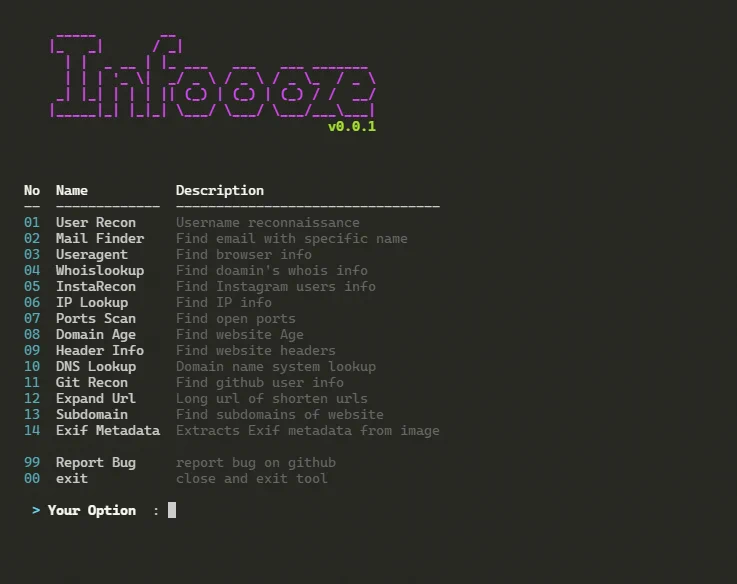
Infoooze is an open-source command-line OSINT reconnaissance toolkit (github.com/devxprite/infoooze) that consolidates common footprinting tasks into one CLI: username enumeration across platforms, email discovery, subdomain enumeration, port scanning, WHOIS/DNS lookups, IP/HTTP header analysis, EXIF metadata extraction, GitHub recon, and URL scanning/expansion. It automatically saves results, making it a lightweight all-in-one alternative to running several separate recon tools.
x.comrepoPublished and added 8 Oct 2026🛡️ Security - Port of the TypeScript compiler, checker and lsp to Rust, by LLM
ts-rust (npm package tsc-rs) is a from-scratch Rust port of Microsoft's TypeScript compiler/checker/language server (typescript-go), produced almost entirely by LLM coding agents rather than hand-written. The author first spent over $400,000 in API tokens running GPT-5.6 Sol and GPT-6 Astra in long agentic '/goal' loops, which wrote 1.3M lines of Rust but plateaued at ~84% compatibility; switching to Claude Opus 5.5 produced a working version in 10 hours and, after ~$24,000 of further API spend over two weeks, reached 100% compatibility on tested real-world projects while passing all 181,711 ported Go baseline tests. Benchmarks show the Rust port running about 1.6x faster than the Go tsc 7 compiler (though slower than Bun's native `bun check`) across dozens of open-source codebases including VS Code, TanStack Query, Sentry and T3 Code.
github.comrepoPublished and added 8 Oct 2026🧠 AI - Show HN: NanoMuse – An open-source AI agent for your phone and computer
nanoMuse is an open-source personal AI agent that runs across phone, desktop, and web, built on an on-device sandbox (OpenMinis with proot/Alpine Linux on mobile) and the DeepSeek Harness on desktop with a Python runtime for tool use. Devices share one account and sync conversations through a relay (self-hostable), while the agent proactively acts, retains memory, and pauses before irreversible actions; it is released GPL-3.0-or-later with documentation on install, self-hosting, connectors, and memory.
github.comrepoPublished and added 7 Oct 2026🧠 AI - Microsoft Agent Framework python-1.20.0 release
Release notes for python-1.20.0 of Microsoft's Agent Framework, an open-source agent/workflow orchestration library. This release adds native vector-store connectors for DuckDB, SQL Server and MongoDB plus a TypeSafe AI connector, redesigns Foundry hosting around request-scoped agent factories and sandbox-isolated sessions, adds computer-use support to Responses clients, and ships Magentic manager and handoff-routing improvements for multi-agent orchestrations alongside a large batch of MCP, Bedrock, Gemini, Anthropic and Ollama provider fixes.
github.comrepoAdded 6 Oct 2026🧠 AI - Show HN: OpenChart – OSS TradingView alternative with your own AI agent
OpenChart is an open-source TradingView-style desktop charting app (Electron, Node.js/Bun, Effect runtime) that embeds AI agents into statistical/technical analysis, real-time market alerts and agentic opportunity research. It ships a custom DSL called Tea (inspired by TradingView's Pine Script) for writing indicators, and a conversation interface built on assistant-ui and the AG-UI event protocol so users converse with agents while charting.
github.comrepoPublished and added 6 Oct 2026🧠 AI - rlaope/deepseek-bot
deepseek-bot is an MIT-licensed plugin for DeepSeek Harness that runs one always-on agent in the terminal (dsh), Slack, Discord and Telegram. Conversations are durable sessions with persona, USER.md and MEMORY.md files and a recall index scoped per channel. Commands run in a macOS Seatbelt sandbox, destructive ones need in-chat approval, and injected instructions are flagged. Slack is verified live; Discord and Telegram only against mocks.
github.comrepoAdded 4 Nov 2026, published 6 Oct 2026🧠 AI - overmind-core/overmind
Overmind is an open-source platform (MIT SDK/CLI, AGPL-3.0 platform, self-hostable) that instruments an agent's code via OpenTelemetry tracing, turns the resulting production traces (or any dataset) into a fine-tuned model benchmarked against user-defined eval metrics, and serves it through one unified API with downloadable/retrainable weights. It ships an SDK, CLI, REST API, Console, and an MCP server exposing project tools and workflows (investigate-capability, finetune-capability, ship-model) for Cursor, Claude Code, OpenCode and Codex, and can sync traces from Langfuse, LangSmith, Braintrust or Galileo; self-hosting runs via Docker Compose with Postgres, Redis, Celery workers and Modal-based GPU workers for fine-tuning/serving (vLLM).
github.comrepoAdded 6 Oct 2026🧠 AI - claude-mem — persistent memory system for Claude Code and other coding agents
Claude-Mem is an open-source persistent memory plugin for Claude Code and other coding agents (Codex, OpenCode, Grok Bot, T3 Code, OpenClaw) that captures tool-usage observations during sessions, compresses them into semantic summaries, and reinjects relevant context into future sessions. It uses five lifecycle hooks (SessionStart, UserPromptSubmit, PostToolUse, Stop, SessionEnd), a local SQLite database, a Chroma vector store for hybrid semantic+keyword search, and exposes three MCP tools (search, timeline, get_observations) that follow a token-efficient layered retrieval pattern to cut context costs roughly 10x. It is Apache-2.0 licensed, built with the Claude Agent SDK and TypeScript, and ships an optional hosted "observer" memory service alongside self-hosted options via OpenRouter/Gemini keys or an Anthropic plan.
github.comrepoAdded 5 Oct 2026🧠 AI - hanzohanzhe/Grandet
Grandet is an agent skill and anonymous remote MCP server (https://grandet.ai/mcp, no sign-up or API key) that compares listed API prices for each model across official APIs, inference providers and relay sites. Agents can find the cheapest option, list free-credit offers, and connect the chosen API to apps such as Codex, Claude Code, OpenCode and Gemini CLI. Releases are tagged by build, with per-build test results.
github.comrepoAdded 4 Nov 2026, published 5 Oct 2026🧠 AI - DeepZero
DeepZero is an open-source orchestration engine that lets researchers define vulnerability-research pipelines declaratively in YAML, handling parallel execution (ThreadPoolExecutor), resumable/fault-tolerant state, and LLM-assessment stages via LiteLLM/Jinja2 prompts. It ships example processors for Ghidra headless decompilation, LOLDrivers.io hash exclusion filtering, PE header/driver metadata extraction, and batch Semgrep scanning, with a dedicated pipeline for BYOVD kernel driver vulnerability research. An extensibility model lets users plug in custom Python processors referenced by path in the YAML config.
github.comrepoAdded 3 Oct 2026🛡️ Security - jiwoochris/artex-global
ARTEX global edition is an English-default fork of the Chinese open-source ARTEX (AGPL-3.0), an autonomous penetration-testing system in which planner and worker LLM agents run real tools and record results in an asset graph and an exploration graph on PostgreSQL. It also ships a defense guide, Sigma and Suricata rules, an ATT&CK Navigator layer, MISP indicators and a host triage script for spotting ARTEX-driven attacks.
github.comrepoAdded 31 Oct 2026, published 3 Oct 2026🛡️ Security - Jakeschincariol/replica-skill
replica-skill is an MIT-licensed set of eleven Claude skills that run an app-cloning pipeline: recon, architect, design, build, backend, test, diff, entrepreneur, brand, launch and deploy. Six standard-library Python tools handle image diffing, parity scoring, review ranking, contrast checks, rebrand sweeps and store-listing lint. It installs as a Claude Code plugin or by copying folders, and states clean-room and rebranding limits.
github.comrepoAdded 29 Oct 2026, published 3 Oct 2026🧠 AI  Kyutai Pocket TTS
Pocket TTS is a 100M-parameter text-to-speech model from Kyutai designed to run efficiently on CPU, generating audio faster than real-time (~6x on a MacBook Air M4) with ~200ms latency to first audio chunk and voice cloning from short audio samples. It supports English, French, German, Portuguese, Italian, and Spanish, ships a Python library and CLI, and has spawned numerous community ports (WASM, ONNX, Rust/Candle, MLX, C++, C#) and fine-tuned language variants (Czech, Hindi, Korean, Persian, Indonesian, Estonian, Welsh, Polish).
huggingface.corepoAdded 2 Oct 2026🧠 AI Tencent Hy4 preview (open-weight MoE + Sherry quantization)
Hy4 preview is Tencent's new flagship Mixture-of-Experts language model: 770B total parameters with 49B activated per token across 78 layers (256 routed experts + 1 shared expert, top-8 routing), plus a native 10B multi-token-prediction layer for speculative decoding. It introduces Gated DeepSeek Sparse Attention with IndexCache for cross-layer index reuse and identity Hyper-Connections (iHC) on the residual path, and in blind internal evaluations on engineering tasks it edges out GLM-5.3 and Kimi K3. Weights (including an FP8 variant) are released under Apache 2.0 on Hugging Face with vLLM/SGLang deployment recipes and AngelSlim-based quantization/compression tooling.
huggingface.corepoAdded 2 Oct 2026🧠 AI- Bifrost (Maxim AI) — open-source LLM gateway
Bifrost is an open-source, high-performance LLM gateway (by Maxim AI) that exposes a single OpenAI-compatible API across 23+ providers including OpenAI, Anthropic, AWS Bedrock, Google Vertex, Azure, Cohere, Mistral, and Ollama. It provides automatic failover, load balancing, semantic caching, Model Context Protocol (MCP) tool integration, budget and governance controls, OIDC user provisioning, and Prometheus-based observability, deployable via npx or Docker with claimed sub-15 microsecond overhead at 5,000 RPS. It is positioned as a drop-in replacement requiring only a base-URL change for existing OpenAI, Anthropic, or GenAI SDK code.
github.comrepoAdded 2 Oct 2026🧠 AI - NuvexNetwork/nuvex
Nuvex is a Solana-native verifiable compute and oracle protocol, still pre-mainnet, whose own README documents unresolved security gaps instead of hiding them: its VRF proof verification relies on solana-ecvrf 0.0.1 (RFC 9381 ECVRF-Edwards25519-SHA512-TAI) which has no known audit, max_fee is stored but never actually charged, and VRF fulfillment is first-come among any node meeting the configured stake/heartbeat threshold — meaning an operator who funds several keys at a low minimum stake can selectively pick which randomness output gets used. The deploy-mainnet script is stubbed to exit before any transaction, and unresolved design questions (fee shares, challenge/reject state transitions) are tracked as explicitly blocked ADRs rather than quietly shipped.
github.comrepoPublished and added 2 Oct 2026🛡️ Security - Folkbench/folkbench
Folkbench has two parts. One is a public benchmark and leaderboard of third-party AI API relay (中转站) services. Multi-node probes run around the clock and publish availability, P95 latency and price per relay, with per-model rankings. The other is Switch, an open-source Tauri/Rust desktop client that stores several Base URL and API Key pairs. It applies them to Claude Code or Codex configs in one click, previews config diffs, and stashes and restores the official ChatGPT OAuth credentials when switching Codex to a third-party provider. It also keeps keys local and estimates token usage and cost per session. The README also profiles several relay services, such as Modelflare, CheapAI and ApiPorter, and that part reads as promotional.
github.comrepoAdded 12 Oct 2026, published 2 Oct 2026🧠 AI - zzzz7788990213-ops/EvoVLM
EvoVLM searches over prompts, image preprocessing, generation budgets and answer extraction for frozen Qwen3-VL-2B-Instruct and Qwen3-VL-2B-Thinking, without fine-tuning weights. A local Qwen model ranks a catalog of typed mutations, a trusted renderer produces Python programs, and Pareto selection on accuracy and latency drives two small generations on scientific chart understanding (CharXiv subset). Recorded results on Dev128: Evolved Instruct keeps accuracy with 8.9% lower median latency, and Evolved Thinking gains 16.41 points of accuracy with 10.6% lower median latency. CPU-only replay and fail-closed evidence verification are included. The authors state the limits: small sample, overlap with the evolution set, and results tied to the recorded hardware.
github.comrepoAdded 16 Oct 2026, published 2 Oct 2026🧠 AI - NVIDIA/OpenShell — sandboxed runtime for autonomous AI agents
OpenShell is NVIDIA's open-source runtime for safely running fleets of autonomous AI agents: each agent runs in an isolated sandbox where kernel-level controls enforce a declared policy over file access, syscalls, and network connections, and credentials are injected only for approved endpoints rather than exposed to the agent directly. Policy changes are checked with formal verification to flag risky new access (new hosts, new API methods) before they're approved, and the project ships a CLI, gateway, Kubernetes/Helm deployment, and a tutorial running OpenCode against an OpenRouter model.
github.comrepoAdded 1 Oct 2026🛡️ Security - OpenShell — safe, private runtime for autonomous AI agent fleets
OpenShell is NVIDIA's open-source runtime for running fleets of autonomous AI agents inside isolated sandboxes. Declarative policies cover filesystem, syscall, process and network access. These are enforced at the kernel level, and credentials are injected only into requests bound for approved endpoints. Policy changes are checked with formal verification so risky new access waits for human review. It ships a CLI, a gateway control plane (Helm deployment on Kubernetes), SDKs, extensibility hooks (middleware, interceptors, compute drivers) and installable agent skills, and it can run agents such as OpenCode.
github.comrepoAdded 1 Oct 2026🧠 AI - https://github.com/Panniantong/Agent-Reach
Agent-Reach is a CLI and agent-"skill" layer that equips coding agents (Claude Code, Cursor, OpenClaw) with ready-made web-reading tool use: fetching arbitrary pages via Jina Reader, YouTube transcripts via yt-dlp, GitHub repos via gh CLI, Bilibili search, RSS via feedparser, and semantic web search via Exa through mcporter, with login-gated platforms (Twitter/X, Reddit, Xiaohongshu, Facebook, Instagram) added on request via cookies or OpenCLI browser sessions. Each platform module probes an ordered list of candidate backends and falls back automatically when one breaks (e.g. yt-dlp being blocked by Bilibili's anti-scraping), and an `agent-reach doctor` command reports which backend each channel is currently using. It positions itself as a "capability layer" that selects, installs and health-checks the right upstream tool for an agent rather than wrapping the reads itself.
github.comrepoAdded 2 Oct 2026, published 1 Oct 2026🧠 AI - AI-Infra-Guard (A.I.G) — Tencent Zhuque Lab
AI-Infra-Guard (A.I.G) is Tencent Zhuque Lab's open-source AI red-teaming platform combining AI infrastructure vulnerability scanning (2000+ CVE rules covering vLLM, llama.cpp, LangFlow, n8n, MLflow and 145+ other AI components), MCP server/skill security scanning, LLM API poisoning detection, and multi-turn jailbreak evaluation (Many-Shot, PAIR, GOAT, ActorAttack). It ships CLI tools (skill-scan, mcp-scan, agent-scan), a Docker-deployed web UI, and has produced original research including FORGE-Bench (loss-of-control benchmark), RogueHandoff-20, and SkillJack (persistent skill backdoors), with talks at Black Hat Europe 2025 on MCP security.
github.comrepoAdded 30 Sep 2026🛡️ Security  DeepSeek-V4.1-Flash
 is a multimodal Mixture-of-Experts model with 552B backbone parameters, 1M-token context, and a novel Causal Encoder-Decoder (CED) architecture where the decoder's global KV cache is projected from encoder hidden states rather than recomputed per layer, activating only 8B/16B parameters per token during prefill/decode. It introduces Compressed Sparse Attention 2 (CSA2) with FP4 KV caching to cut the global KV cache footprint to 890 bytes/token (~1/4 of DeepSeek-V4-Flash, ~1/437 of DeepSeek-V1), alongside Engram conditional memory, DSpark speculative decoding, and a continuously controllable reasoning-effort setting (1–100). The card documents pre/post-training recipes (45T tokens, SFT→RL→on-policy distillation with synthetic agent environments) and reports results across agentic and code benchmarks (Terminal-Bench 2.1/3.0/4.0, DeepSWE v1.1, GPQA Diamond, Chartography, ZeroBench, AutomationBench), plus deployment instructions for Transformers, vLLM, SGLang, and Docker.
huggingface.corepoAdded 30 Sep 2026🧠 AI- Launch HN: Magnitude (YC S25) – Self-optimizing inference engine for agents
Magnitude is an open source local inference engine (Apache 2.0) that compiles and tunes its GPU/CPU kernels on the user's exact device before a model runs, claiming up to 2x faster decode than llama.cpp (92% faster on Metal, 19% on CUDA) with 27% lower memory per agent. It ships as a cross-platform desktop app with a bundled CLI and an OpenAI-compatible API, offering one-click connections to agent tools like Pi, OpenCode, Hermes, Codex, OpenClaw, Claude Code, and Cline, running fully offline on Apple Silicon, NVIDIA, AMD, or CPU-only hardware.
github.comrepoPublished and added 30 Sep 2026🧠 AI - AI News | AI Tools (@AI_News100x) on X
Open-Dots is an open-source reimplementation of OpenAI's 'Dots' computer-use agent, giving any LLM the ability to control a browser, terminal and filesystem plus connectors to personal apps. It is framework-agnostic (works with any LLM) and free, positioned as a self-hostable alternative to OpenAI's proprietary computer-use offering.
x.comrepoPublished and added 30 Sep 2026🧠 AI - rehan-remade/universal-modder
universal-modder is a set of Agent Skills, a CLI (um) and a shared knowledge base (field notes in knowledge/) that let AI coding agents such as Claude Code, Codex, Gemini CLI, Cursor, GitHub Copilot and OpenCode find a PC game's engine, reverse-engineer its code, build a working mod, generate art/3D/sound assets via the fal MCP server (or a local ComfyUI server), test the mod in the running game, and write a field note for the next agent. It ships worked examples — a weapon/boss pack for Terraria via tModLoader, a new civilization for Age of Empires II DE, and a real-time Minecraft-inside-GTA-V passthrough mod — each documented with a field note of exact versions, routes and gotchas, and agents can open pull requests to grow the shared knowledge base.
github.comrepoAdded 6 Oct 2026, published 30 Sep 2026🧠 AI  רון אברבוך (@Ron_averbuch) on X
Open-Dots is an open-source re-implementation of OpenAI's Dots computer-use agent, giving it browser, terminal and file control plus connectors to personal apps, and designed to work with any LLM rather than being locked to one vendor's model. It's announced via a tweet linking to the GitHub repo (github.com/Anil-matcha/Open-Dots).
x.comrepoAdded 30 Sep 2026, published 29 Sep 2026🧠 AI- feder-cr/invisible_playwright_mcp
invisible_playwright_mcp is an MCP server (and companion Python library, invisible_playwright) that wraps Playwright so an LLM agent can operate a real browser like a human: clicking, typing, scrolling and reading page content, useful for tasks like checking flight fares across a date range where no API exists. It ships a standalone chat+live-browser UI driven by any OpenRouter model, installs as a plugin for Claude Code, Codex and Gemini CLI, and exposes stealth/identity controls (seed-based browser fingerprint, proxy-derived timezone/locale/geolocation, persistent profile directories) via its invisible_core component.
github.comrepoAdded 7 Oct 2026, published 29 Sep 2026🧠 AI - NVIDIA OpenShell — secure runtime for autonomous AI agent fleets
OpenShell is NVIDIA's open-source runtime for running fleets of autonomous AI agents with restricted, policy-governed access to files, system calls, network, and credentials. It enforces policy at the kernel level inside isolated sandboxes (per-agent, with Docker/Podman/virtualization backends) and uses formal verification to flag risky policy changes — such as an agent gaining a new host or API access with credentials — before they take effect, so changes can wait for human review. It ships a CLI, a gateway control plane, Kubernetes/Helm deployment, and installable agent skills for writing and debugging sandbox policies.
github.comrepoAdded 29 Sep 2026🧠 AI  Ternary-Bonsai-2-27B: 27B model compressed to ~1.75 bits/weight, 98.2% of FP16 quality retained
Ternary-Bonsai-2-27B is a 27B-parameter reasoning model (built on Qwen3.8-27B) quantized to true ternary weights ({-1,0,+1}) at ~1.72 bits/weight, shrinking it from ~54GB FP16 to ~5.95GB while retaining 98.2% of FP16 benchmark quality (84.78 vs the conventional sub-4-bit IQ2_XXS build's 72.59). It uses a Hadamard-rotated weight basis and ships two GGUF packing formats (PTQ1_0 dense trits, PQ2_0 2-bit slots) that require a custom llama.cpp/MLX kernel fork since stock llama.cpp cannot decode them correctly. The card includes per-category benchmark breakdowns (math, coding, agentic tool calling), cross-platform throughput/power measurements (Apple M5 Pro/Max, RTX 5090, L4, H100/A100/Blackwell), and an "intelligence density" metric comparing capability retained per GB against FP16 and other quantizations.
huggingface.corepoAdded 29 Sep 2026🧠 AI- https://github.com/dmdhrumilmistry/security-harness
security-harness is an open-source Claude Code plugin (also packaged for Gemini CLI, Codex and opencode) that orchestrates subagents — sh-recon, sh-hunter, sh-chainer, sh-verifier, sh-reporter — through a static-analysis pipeline covering 15 vulnerability classes (IDOR/BOLA, SQLi, XSS, SSRF, injection, auth, deserialization, path traversal, secrets, CSRF, XXE, open redirect, crypto, race conditions, file upload), producing README/JSON/SARIF/HTML/PDF reports with PoCs, CVSS and CWE/OWASP mappings. It also ships sh-pr-review, a per-PR merge-gate skill that posts inline findings and a commit status scoped only to code the PR itself introduced or aggravated, with caching, dedup via fingerprints, and a scheduled GitHub Action that keeps its per-class knowledge bases fresh by having one AI agent draft updates from allowlisted sources (OWASP, PortSwigger Research, CWE/CAPEC, HackerOne) while a separate adversarial reviewer agent fails-closed against prompt injection before auto-merge.
github.comrepoAdded 2 Oct 2026, published 29 Sep 2026🛡️ Security - Uncensored and Offensive Security AI Models Benchmark
A curated GitHub list of open-weight "uncensored" and security-fine-tuned LLMs intended for authorized red teaming, pentesting, and security research, covering models like WhiteRabbitNeo's DeepHat V2, BugTraceAI-CORE, CYBER-FROST, and several abliterated Qwen/GLM/DeepSeek variants. It explains the underlying techniques (abliteration per Arditi et al. 2024, QLoRA/DPO fine-tuning, GGUF/FP8 quantization) and links to Hugging Face model cards, benchmark suites (CyberBench, TrustedSec's LLM Attack Benchmark vs OWASP Juice Shop), and deployment platforms for running these models locally or via API.
github.comrepoAdded 2 Oct 2026, published 29 Sep 2026🛡️ Security - openrig — multi-agent Claude Code/Codex orchestration
OpenRig is an open-source local daemon, CLI, TUI and MCP server (built on tmux + SQLite) that manages teams of Claude Code and Codex agent sessions as a single persistent system rather than a pile of terminal windows. Topologies (pods, seats, edges) are defined declaratively in YAML (RigSpec/AgentSpec), booted with `rig up`, inspected via a topology TUI, and can be snapshotted/restored, discovered from existing tmux sessions, and messaged across agents (`rig send`, `rig broadcast`, `rig chatroom`). It ships starter topologies (first-project, conveyor, product-team, secrets-manager using HashiCorp Vault) and documents in detail what it writes to Claude/Codex config, trust and telemetry state on the host machine.
github.comrepoAdded 28 Sep 2026🧠 AI - vLLM v0.30.0
Release notes for vLLM v0.30.0, a major update to the open-source LLM inference/serving engine spanning 762 commits. Highlights include new model support (DeepSeek-V4.1-Flash, GLM-5.3-Flash, Kimi K3, Qwen3.8-Flash-Next, K2-Horizon, Cohere Compass and others), a "Fast Start" GPU weight-cache daemon for near-instant engine restarts via CUDA IPC, Gumbel-max watermarking for generated text, a HiSparse host-memory tier for sparse-MLA KV offload, Model Runner V2 improvements (dual-batch overlap, speculative decoding under pipeline parallelism), expanded quantization support (NVFP4, W4A16 DSA, AutoRound), and hardware-specific tuning across NVIDIA, AMD ROCm, Intel XPU and CPU backends.
github.comrepoAdded 28 Sep 2026🧠 AI  MiMo-V2.6-Pro-RL
 is Xiaomi's flagship omnimodal (text/image/video/audio) sparse MoE model, 1.02T total / 42B activated parameters with a 1M-token context, built around scaling RL compute toward self-improvement. It uses a single mixed GRPO run across coding, agentic, visual and cybersecurity tasks, a novel groupwise agentic grading scheme (Groupwise Reward Synthesis + Groupwise Advantage Redistribution) to rank passing rollouts rather than just pass/fail, and a multi-teacher on-policy distillation stage (MOPD2); it also ships a 5-layer speculative MTP decoder and is deployable via vLLM and SGLang.
huggingface.corepoAdded 28 Sep 2026🧠 AI- SpecterOps/Blacklight — local AI agent attack surface mapping toolkit
Blacklight is a SpecterOps toolkit for endpoint forensics on AI coding agents, split into Scout (bounded metadata/filesystem triage across Codex, Claude Code, Cursor, Antigravity CLI, and Grok that finds candidate session artifacts without reading their contents) and Session Analysis (a Python CLI that parses selected JSONL/SQLite session downloads from Codex, Claude Code, Cursor, and Antigravity CLI into ranked, redacted local reports). It's built for investigators who need to identify and review AI agent session history on a host — surfacing config, auth metadata, and high-value indicators — while explicitly leaving secret scanning to external tooling; paths are informed by SpecterOps' Endpoint AI Agent Abuse (EAA) technique catalog.
github.comrepoAdded 27 Sep 2026🛡️ Security - Paper2Agent: research papers as interactive AI agents
Paper2Agent is a multi-agent AI system that coordinates parallel specialist agents to transform a research paper and its code repository into a tested MCP server exposing the paper's methods as callable tools ('agentified' papers). It ships as a skill for coding agents like Claude Code and Codex, and the project demonstrates the pipeline on real papers (TISSUE for spatial transcriptomics, Scanpy for single-cell analysis, AlphaGenome for genomic variant interpretation), each producing a hosted MCP server that a chat agent can call to run the paper's actual scientific workflows.
github.comrepoAdded 27 Sep 2026🧠 AI - Adversarial-Detection-Engineering/adeskills
adeskills is a working knowledge base for "Adversarial Detection Engineering" (ADE), a taxonomy of four categories and 16 subcategories of detection-logic bugs (e.g. Reformatting in Actions, Omit Alternatives, Context Development, Logic Manipulation) that explain why a SIEM/EDR/XDR rule fails to catch what it intends to. It ships 38 worked technique files with vulnerable/hardened rule examples and detection-layer guidance, a cross-platform bug-pattern catalog, a pre-engagement scoping checklist, and a Redamon-packaged skill (ade_scoper), all grounded in analysis of real public rulesets from Sigma, Elastic Security, and Microsoft Sentinel. It's explicitly scoped for defensive detection engineering and purple-team rule hardening, with several files documenting real vendor-rule weaknesses.
github.comrepoAdded 2 Oct 2026, published 27 Sep 2026🛡️ Security - Agent Control Standard (ACS)
Agent Control Standard (ACS) is an OWASP GenAI Security Project specification that lets a separate Guardian Agent inspect an AI agent's proposed actions before they execute and return allow/deny/modify/ask/defer over an authenticated JSON-RPC wire, with OpenTelemetry/OCSF audit trails and a CycloneDX/SPDX/SWID AgBOM inventory. The reference implementation runs Microsoft's Agent Governance Toolkit (AGT) behind the ACS contract with Bun, including host shims for Claude Code and OpenCode, and demonstrably denies a destructive `rm -rf /` command from a live coding-agent session while allowing benign ones. The project is explicit about current gaps — the wire is unauthenticated (issue #70) and the reference Guardian fails open by default (issues #32/#37) — and only 2 of 16 lifecycle hooks are evaluated live in v0.1.0.
github.comrepoAdded 26 Sep 2026🛡️ Security - SAPMAP — SAP Landscape Attack Path Mapper
SAPMAP is a BloodHound-style attack path mapper for SAP landscapes: it discovers SAP systems on a network, maps RFC trust connections, and implements real exploits (10KBLAZE/CVE-2020-6207 gateway trust, CVE-2025-31324 VisualComposer JSP webshell, a described CVE-2026-58240 Message Server rogue-registration flaw, and CVE-2026-31431 root LPE via AF_ALG page-cache patching) to chart lateral movement across ABAP, Java, HANA, and BTP-connected systems. Its AutoPwn mode chains scan → exploit → enrich → propagate across an entire landscape, and it includes an engagement-report generator, SecStore/RSECTAB credential decryption, SSH lateral movement, hash cracking via hashes.com, and a Tier-3 "evasion" module (SAL slot disable, DBTABLOG purge) paired with an extensive, specific blue-team detection guide (SAL/SM20, DBTABLOG gaps, kernel-param diffing, OS/network IOCs) for defenders to catch it.
github.comrepoAdded 26 Sep 2026🛡️ Security - Agent Threat Rules (ATR) — open detection-rule standard for AI agent threats
Agent Threat Rules (ATR) is an open, versioned YAML rule format (ATR-YYYY-NNNNN scheme) for detecting AI-agent runtime threats — prompt injection, tool-poisoning, malicious SKILL.md content, and MCP exchange abuse — evaluated by a reference TypeScript engine (with a Python wrapper) shipped as an npm/pip package, CLI, GitHub Action, and Docker scanner with SARIF output. The project positions itself as "Sigma for agent threats," maps rules to OWASP Agentic/LLM Top 10, MITRE ATLAS, and NIST AI RMF, and publishes an extensive (and unusually self-critical) benchmark suite against corpora like garak, PromptBench, and PromptInject, including documented harness bugs and withdrawn recall figures.
github.comrepoAdded 26 Sep 2026🛡️ Security - dzhng/jevgrep
Jevgrep (the `jg` CLI) lets a coding agent ask a natural-language question about a repository and get back relevant files, reading leads, and verbatim source excerpts in one response, using an LLM (Jev) to judge relevance across folders, files, and declarations instead of relying on grep/ripgrep alone. It ships an installable "skill" for Claude Code, Codex, OpenCode and other agents that teaches them when to call jg versus their normal tools, and requires a key for Vercel AI Gateway, TypeSafe, OpenRouter, or OpenCode Zen. A reported ten-task SWE-bench repeat found ~40% lower coding-agent cost ($7.62 to $4.52) but a lower solve rate (7/10 vs 8/10 baseline), explicitly framed as a cost/quality tradeoff rather than a win.
github.comrepoAdded 27 Sep 2026, published 26 Sep 2026🧠 AI - git-pkgs — dependency history & supply-chain analysis for git repos
git-pkgs is a Go rewrite of a Ruby tool that adds a git subcommand for tracking dependency changes across a repository's history, indexing manifests/lockfiles from 36+ package managers (npm, RubyGems, Cargo, PyPI, Maven, Composer, Go modules, etc.) into a local SQLite database. Beyond history/blame/diff, it offers supply-chain security commands: `vulns` (OSV-based CVE scanning with SARIF output for GitHub code scanning, plus blame/praise/exposure for remediation metrics), `licenses` (with drift detection and CI-friendly exit codes), `deprecated`, `provenance` (trusted-publishing/attestation checks), `integrity` (lockfile hash drift detection), `maintainers`/`health` (via ecosyste.ms metadata), and `sbom` export in CycloneDX/SPDX. It also supports a dependency-aware `bisect` to find when a vulnerability, license change, or capability (e.g. network access) was introduced, and ships GitHub Actions for CI integration.
github.comrepoAdded 25 Sep 2026🛡️ Security - Claude Code Templates Repository
Claude Code Templates (aitmpl.com) is an open-source npx CLI and template catalog offering 100+ ready-to-use agents, slash commands, hooks, settings, skills and MCP server integrations for Anthropic's Claude Code, aggregating contributions from Anthropic's official skills repo, K-Dense-AI's scientific skills, and various community projects (superpowers, wshobson/agents, awesome-claude-code, etc.). Beyond the template catalog it ships real-time analytics for monitoring Claude Code sessions, a mobile chat viewer with Cloudflare Tunnel support, a health-check diagnostic, and a plugin/marketplace manager, making it a practical operational toolkit for customizing and running Claude Code.
github.comrepoAdded 2 Oct 2026, published 25 Sep 2026🧠 AI - https://github.com/davila7/claude-code-templates/tree/main/cli-tool/components/skills/security/security-threat-model
A directory within the davila7/claude-code-templates repo containing a "security-threat-model" Skill for Claude Code: a SKILL.md instruction file plus supporting agents and reference files that package a reusable threat-modeling workflow for the coding agent. It's an example of the emerging pattern of distributing structured, invocable skills (instructions + sub-agents + reference docs) that extend Claude Code's capabilities, rather than a security research artifact itself.
github.comrepoAdded 2 Oct 2026, published 25 Sep 2026🧠 AI - https://github.com/davila7/claude-code-templates/tree/main/cli-tool/components/skills/security/security-threat-model
A "security-threat-model" skill folder in the davila7/claude-code-templates repository, part of a library of reusable Claude Code skills/components. It packages a SKILL.md definition with supporting agent and reference files intended to let Claude Code agents carry out structured threat-modeling analysis as part of a development or security-review workflow.
github.comrepoAdded 2 Oct 2026, published 25 Sep 2026🛡️ Security - Show HN: Whiteboard (YC W26) – An open-source IDE for thoughtful software design
Whiteboard is an open-source (MIT) desktop IDE that gives coding agents like Claude Code and Codex an SDK to draw diagrams, sequence charts, and traces on a shared canvas linked directly to underlying code. It vendors Code OSS for VSCode-grade navigation/LSP support and adds a custom Rust-built AST-aware semantic diff viewer (with a WASM plugin system) that summarizes large generated functions as pseudocode and collapses noise like tests/docs, aiming to make reviewing autonomous agent decisions and code changes tractable.
github.comrepoAdded 26 Sep 2026, published 24 Sep 2026🧠 AI - yetone/magpie
magpie is a cross-platform menu bar app, TUI and CLI that lets you view and switch the model each installed AI coding agent (Claude Code, Codex, Gemini CLI, OpenCode, Cursor, Copilot CLI, Goose, Pi, etc.) is configured to use, editing each agent's config file surgically without disturbing comments or formatting. It runs a local gateway (127.0.0.1:3425) that translates between OpenAI Chat Completions, OpenAI Responses and Anthropic Messages APIs so every agent can point at one endpoint and use any provider's models, including routing groups that spread requests across multiple keys/subscriptions with configurable routing strategies (smart, order, rotate, usage). It can also reuse existing subscriptions (Claude Code, Codex/ChatGPT, Copilot, Devin, Gemini CLI) as providers for other agents without exposing or copying credentials, and supports encrypted profile backup/restore.
github.comrepoAdded 26 Sep 2026, published 23 Sep 2026🧠 AI - https://github.com/akha-security/akca
AKCA is an open-source, Go-based Dynamic Application Security Testing (DAST) scanner that combines HTTP and headless-browser crawling, JavaScript/AST analysis, API spec import (OpenAPI, GraphQL, gRPC, etc.), and adaptive active testing across a very broad set of vulnerability classes including SQL injection, XSS, SSRF, IDOR/BOLA, SSTI, JWT/OAuth flaws, race conditions, and cloud/CI exposure. It emphasizes evidence-oriented verification — replaying promising signals against baselines, negative controls, and OAST callbacks before promoting them to findings — and exports Burp-style HTTP evidence in HTML, JSON, CSV, Markdown, and SARIF reports. Positioned as a transparent, single-developer alternative inspired by but not claiming parity with Acunetix, Invicti/Netsparker, or Burp Suite Professional.
github.comrepoAdded 2 Oct 2026, published 23 Sep 2026🛡️ Security - shai-hulud-detect: multi-ecosystem npm/PyPI/Composer/Crates/Go/Hex/RubyGems supply-chain worm scanner
shai-hulud-detect is a dependency-free Bash scanner that checks projects against a 5,782-entry list of compromised npm, PyPI, Composer, Crates, Go, Hex, and RubyGems package versions, plus content-pattern indicators of compromise (malicious file hashes, C2 domains, dead-man's-switch artifacts, forged commits, suspicious lifecycle hooks) tied to the Shai-Hulud supply-chain attack waves. It supports single-project and bulk scanning, CI-friendly exit codes, JSON/log output for pipeline gating, and a --check-host mode to detect the May 2026 gh-token-monitor/kitty-monitor persistence daemons that wipe hosts if their monitored GitHub token is revoked (with a documented safe remediation order). Detection is read-only; new package entries are sourced from named threat-research firms (Socket, StepSecurity, Aikido, Snyk, JFrog, Wiz, Semgrep, SafeDep, GitGuardian, OX Security) and cited in PRs.
github.comrepoAdded 23 Sep 2026🛡️ Security - nealbridges/VulnHunter
VulnHunter is a maintained fork of Capital One's open-source agentic security scanner, reworked to run on any agent harness (Claude Code, Codex, Grok/OpenCode) instead of being Claude-Code-specific. The fork's distinguishing work is engineering, not security findings: portable "skill" prompt files with an explicit environment contract, an installer that fails loudly instead of guessing paths, Docker-based sandboxed exploit validation, and a benchmark harness that ran six full scans of one production Go service across five model/harness stacks, finding that result counts swung from 3 to 42 findings depending on how rigorously exploits were validated. It ships three composable skills (/vulnhunt, /vulnhunter-fix, /vulnhunt-fix-verify), a headless batch-runner (harness/), and a deterministic manifest-writing CLI (vh).
github.comrepoAdded 6 Oct 2026, published 22 Sep 2026🧠 AI - qybaihe/mu
mu is a coding agent built on the pi framework that introduces a "judgment kernel": a small, fast auxiliary model (Jev, a hosted judge, or Laya, a local 322M-parameter model) answers bounded yes/no/choice/score questions at 35 named decision points per turn — deciding what stays in context, whether a tool call is risky, when a turn is done, and what one agent should tell another — so the large working model doesn't spend tokens/attention on bookkeeping. It also ships a "hive" multi-agent mode (2-6 read-only "bees" plus a main editing agent) with an append-only shared board and relation-checking (supersedes/contradicts/supports) between findings, plus a native desktop app with live judgment/board/hive views.
github.comrepoAdded 26 Sep 2026, published 22 Sep 2026🧠 AI - DVLAA
DVLAA (Damn Vulnerable LLM and Agent Application) is a self-hosted, Docker-deployable security training range for LLM and agent applications, modeled on the DVWA concept but for AI. It covers OWASP LLM Top 10 and Agent Security Top 10 risks (prompt injection, RAG poisoning, tool abuse, memory poisoning, excessive resource consumption, etc.) through 81 hands-on challenges, including an "AWDP" attack/defense track where 10 challenges reproduce real disclosed vulnerabilities in Dify, RAGFlow, Langflow, Flowise, Open WebUI and n8n (with optional real upstream container reproduction), 20 challenges adapted from a China–ASEAN AI security CTF, and 6 challenges adapted from a real model-poisoning CTF. It provides real model interaction, state-machine flag verification, source/prompt viewers, model management (local, Ollama, SiliconFlow, OpenAI-compatible), and bilingual UI.
github.comrepoAdded 22 Sep 2026🛡️ Security - yibie/jev-engineering-zh
A Chinese translation (with original source notes) of a design essay synthesizing TypeSafe founder Diogo Almeida's notes on 'Jev,' a typed decision model that drives a coding-agent harness. It argues coding agents are simple loops whose real leverage lies in how context is assembled each turn, and works through six problems inherited from KV-cache-driven, append-only context design: costly model routing, tool-schema bloat, lossy compaction, rare sub-agents, destructive session restarts, and the built-in-capabilities tradeoff. It proposes fixes including query-aware context scoring/visibility tiers, cost-aware routing that accounts for cache reprocessing, tiered tool disclosure, conditional AGENTS.md loading, and shared read-only background retrieval.
github.comrepoAdded 26 Sep 2026, published 22 Sep 2026🧠 AI - Supply Chain Firewall (Datadog)
Supply Chain Firewall (SCFW) is a Datadog-built CLI that wraps npm, pip, and poetry commands to inspect every package target against known-malicious/compromised package datasets (the open-source malicious-software-packages-dataset and OSV.dev) before installation proceeds, blocking or warning on hits. It ships as a single Go binary, can be aliased transparently into a developer's shell, and optionally reports run outcomes and enforces centralized allow/block policies through Datadog Code Security across a fleet, sending only package metadata (never source code) to Datadog.
github.comrepoAdded 22 Sep 2026🛡️ Security - merijjeyn/jive
Jive is an open-source agent framework that replaces the standard LLM-call/tool-call loop with 'Graph Calls' — DAG-based workflows combining traditional tool calls with fast 'Jev' (System One) model calls for repetitive or intuitive steps. It aims to reduce token cost and latency versus agents like Claude Code and Codex by only invoking expensive reasoning LLM calls when needed, letting cheaper System One models follow through on planned execution graphs.
github.comrepoAdded 26 Sep 2026, published 21 Sep 2026🧠 AI - StellarFoundry/soroban-security-scanner
soroban-scan is an open-source, deterministic static analyzer for Stellar Soroban smart contracts and Rust projects. It ships 19 Soroban-aware detectors (SS-001 to SS-033) covering missing authorization, re-initialization, cross-contract call ordering, unchecked arithmetic and storage or resource misuse. Output includes JSON, SARIF 2.1.0 and GitHub annotations, with baselines and a PR-scanning Action. The project describes itself as early development.
github.comrepoAdded 28 Oct 2026, published 21 Sep 2026🛡️ Security - awarexone/Agentic-Bug-Hunter
Agentic-Bug-Hunter is an open-source CLI (bughunter) and Claude Code plugin that automates the bug bounty pipeline end-to-end: recon, vulnerability hunting across 26 web2 and 10 web3/smart-contract bug classes, a "7-Question Gate" validation step to kill weak findings, and submission-ready report generation for HackerOne, Bugcrowd, Intigriti, and Immunefi. It orchestrates existing scanners (subfinder, httpx, nuclei, katana, ffuf, dalfox) behind a multi-provider LLM layer (Ollama, Groq, DeepSeek, Claude, OpenAI) and cross-session "hunt memory," and also ships an MCP server for use from Cursor, Codex, or OpenCode.
github.comrepoAdded 21 Sep 2026🛡️ Security - ossf/criticality_score
criticality_score is an OpenSSF tool that computes a 0-1 criticality score for open source projects (based on an algorithm by Rob Pike), using signals like contributor count, commit frequency, dependents count, and org diversity to identify projects the ecosystem critically depends on. It ships a CLI, config files for tuning scoring weights, and companion tools (enumerate_github, collect_signals, scorer) for large-scale data collection; the project's GCP-hosted BigQuery/GCS datasets will be discontinued after 2026-08-29, with data moving to a static data directory.
github.comrepoAdded 21 Sep 2026🛡️ Security - nbs32k/LocalStranger
LocalStranger is a proof-of-concept exploit toolkit targeting WinNotify.sys, a Microsoft Windows Hardware Compatibility Publisher-signed kernel driver the author says has no caller validation and exposes arbitrary kernel read/write, memory allocation, physical/virtual memory access and KASLR bypass primitives. The project includes lsapi, a user-mode wrapper library for these driver communications, lsmapper, a C++ tool that maps unsigned kernel drivers into kernel space using the vulnerable driver, and a separate C program that elevates the current user to NT-AUTHORITY privileges. The driver is not yet on the Microsoft Vulnerable Driver Blocklist, and the code is released without a license.
github.comrepoAdded 4 Nov 2026, published 20 Sep 2026🛡️ Security - Show HN: CUA-S1 – A System One Model for Computer Use
Cua is an open-source platform for computer-use agents: isolated cloud desktops (Fleets), a Sandbox SDK, local macOS/Linux VM management (Lume), a Cua Driver for controlling native apps/browsers via CLI/MCP/SDKs, and Cua-Bench for building and evaluating computer-use tasks. It also introduces CUA-S1, a family of small specialized "System 1" models that make fast, bounded decisions (e.g., scoring form field values from structured UI/document data) rather than generating agent actions token-by-token, with the first CUA-S1-FORMS model and dataset released on Hugging Face. The project is MIT-licensed with some optional components (cua-som, cua-perception's OmniParser integration) carrying AGPL-3.0 obligations.
github.comrepoAdded 26 Sep 2026, published 19 Sep 2026🧠 AI - Outrider Recon
Outrider Recon is an open-source, Claude-native multi-agent OSINT and external attack-surface recon platform for authorized engagements, covering web/API, identity/SSO, cloud, secrets, and people/breach intelligence. It deliberately stops short of exploitation: active enumeration is approval-gated and intrusive validation is a human hand-off, with deterministic Python controls enforcing scope, evidence integrity, workflow state, and finding promotion around Claude skills and optional MCP-based enrichment. Output is ranked, evidence-backed finding cards (confidence/severity/handoff recommendations) meant to feed proxy-assisted testing or pen-testing rather than raw scanner dumps.
github.comrepoAdded 22 Sep 2026, published 19 Sep 2026🛡️ Security - kerpopule/hermes-jev-skills
hermes-jev-skills wires TypeSafe's small, fast decision model "Jev" into agent workflows (Hermes, Claude Code, Codex) to handle cheap sub-decisions — which model should answer a turn, which of many skills to load, which retrieved passages matter, which conversation turns survive a summary — instead of burning frontier-model tokens on them. It ships ten agent-agnostic SKILL.md files, a CLI (jev routing/mail/screen/search), a local dashboard, and a plugin built on public Hermes seams (pre_llm_call, transform_tool_result, llm_request middleware) with detailed data-redaction guarantees for what gets sent to the Jev API. It also includes a shadow mode for safely evaluating routing decisions before enabling them.
github.comrepoAdded 26 Sep 2026, published 18 Sep 2026🧠 AI - vinilana/jev-gateway
jev-gateway is a local proxy that sits between coding agents (Codex, Claude Code, OpenCode, Kilo, Gemini CLI, Devin) and their LLM backend, intercepting only the tool-selection decision and routing it to TypeSafe's small, fast "Jev" model instead of the main reasoning model, while forwarding everything else untouched. It supports forced tool_choice, hint-based suggestions (for APIs like Anthropic's that can't force a tool mid-turn), a live dashboard for cost/latency/routing metrics, and a companion benchmark repo (jev-gateway-bench) showing routing helps most on debugging tasks but can hurt some models on feature-building tasks.
github.comrepoAdded 26 Sep 2026, published 18 Sep 2026🧠 AI - MichaelKinsy/PiG
PiG reimplements Pi — a minimal, extensible terminal coding agent — as a single native Go binary with no Node.js dependency, while remaining behaviorally pinned to a specific Pi release (0.87.1) and running Pi's TypeScript extensions unchanged. It adds a multi-language extension host (Go, Rust, Python, Node), a "Piglet" mechanism for bundling extensions/skills/prompts into a named shareable agent, and a formal parity-tracking process (PORT_MAP.md, DIVERGENCES.md, coverage reports) that documents every intentional divergence from the upstream Pi reference implementation.
github.comrepoAdded 27 Sep 2026, published 17 Sep 2026🧠 AI - crypt0p3g/adnullenum
adnullenum is a single-pass Active Directory enumerator that uses anonymous (null) SMB sessions over the \samr and \lsarpc named pipes to pull domain info, password/lockout policy, RID-cycled account inventory, per-user detail, and group membership without credentials. It consolidates what rpcclient, impacket's samrdump.py/lookupsid.py, enum4linux-ng, and NetExec each do separately into one run, falls back to LSA lookups when SAMR is locked down, flags interesting accounts (AS-REP-roastable, PASSWORD_NOT_REQUIRED, unconstrained delegation, etc.), and writes ready-to-use userlist.txt/computerlist.txt plus a reusable RID cache. The README also gives blue-team guidance on closing null-session access (RestrictAnonymousSAM, Pre-Windows 2000 Compatible Access group) and detecting it via Event 4661/4662/4624/5140.
github.comrepoAdded 2 Oct 2026, published 17 Sep 2026🛡️ Security - AnotiaWang/awesome-decision-models
A community-maintained GitHub list cataloging "decision models" (also called System One models): small/fast models that take a state plus caller-declared questions (Noul/true-false, Choice/multi-option, Score/rubric) and return a probability per answer in one forward pass, rather than generating text. It tracks the originating TypeSafe AI Jev model and its /v1/systemone API alongside competing hosted models (Upstage Solar Decide, Liquid AI's d1, OpenAI's Decisions API, Inception's Mercury Decide, Respan's Span-01), dozens of open-weight fine-tunes (Cloudflare's Clef, Perplexity's pplx-decider, AWS Strands Decider, Together AI's Tev1, and many Qwen3.5-based community models), zero-training logit-reading approaches, local runtimes (Ollama, Ollaya, llama.cpp-based servers), SDKs across a dozen languages, and a very long list of agent/coding-tool/MCP integrations (browser agents, code review, routing, game-playing demos) that use these models for fast, typed, in-the-loop decisions. The page is truncated at 40k of ~51k characters, so later sections (further toys, demos, and possibly benchmarks) are not reflected here.
github.comrepoAdded 2 Oct 2026, published 17 Sep 2026🧠 AI - ThreatIntel-Aggregator
ThreatIntel-Aggregator is a self-hosted FastAPI/Next.js platform that polls 60+ tiered security RSS feeds (CISA, Talos, Unit42, etc.), runs AI triage to score severity and tag MITRE ATT&CK TTPs, extracts IOCs/CVEs, and correlates findings against a RunZero asset inventory to surface org-level exposure. Its Detections module goes further: it catalogs AI-generated or locally-imported detection rules (KQL/Sigma/YARA/Suricata/SPL), statically validates them, runs AI-driven MITRE alignment checks against technique coverage, tracks detection "rot," and can sync Hunts/Analytics Rules to a live Microsoft Sentinel workspace. It's designed to run standalone with zero cloud dependency or fully integrated with Azure/Entra/Sentinel, with all storage in Postgres and auth via Entra SSO or a local API key.
github.comrepoAdded 22 Sep 2026, published 17 Sep 2026🛡️ Security - All-AI-Jailbreaks
A GitHub repository archiving 19 jailbreak, prompt-injection, persona-conditioning, and response-format-manipulation prompts collected against DeepSeek, Gemini, GLM, Grok, Kimi, Qwen, Sonnet, and ChatGPT. Prompts are kept close to their original form for provenance/reproducibility, positioned as a corpus for red-teaming and robustness evaluation rather than a guaranteed exploit list, with guidance to test in isolated environments and log model version/config/date/response per trial.
github.comrepoAdded 22 Sep 2026, published 17 Sep 2026🛡️ Security - AI Agent Hacking Writeups
A GitHub-hosted, CC0-licensed index of 281 public writeups on attacks against AI agents, organized into six categories: indirect prompt injection, direct prompt injection/jailbreaks/guardrail bypass, MCP and agent tooling, AI platform/infrastructure bugs, classic web bugs in AI product surfaces, and AI used as an attacker's tool. Entries span 2021-2026 and include major disclosures like GeminiJack, ForcedLeak, Clinejection, CVE-2025-53773 (GitHub Copilot RCE), and dozens of Johann Rehberger/PromptArmor/qual1a writeups covering exfiltration, MCP OAuth flaws, and coding-agent sandbox escapes. Comes with an accompanying blog post "How to Hack AI Agents" and a scripted links.txt for automation.
github.comrepoAdded 22 Sep 2026, published 17 Sep 2026🛡️ Security - Markakd/Container_escape
A GitHub repository hosting target-specific proof-of-concept exploits for two Linux kernel vulnerabilities, CVE-2026-52910 and CVE-2026-80521 (the latter an AF_UNIX kernel bug also documented in a kernelCTF LTS exploit-chain submission), both usable to break out of container isolation. The project ships a QEMU/Docker-based disposable VM builder (pinned to specific Ubuntu cloud images and kernel versions) so the destructive PoCs can be compiled and detonated only inside throwaway guests rather than on real hosts.
github.comrepoAdded 2 Oct 2026, published 16 Sep 2026🛡️ Security - Shai-Hulud-2.0-Detector — npm supply-chain compromise scanner
Shai-Hulud-2.0-Detector is a GitHub Action and CLI tool that scans package.json/lockfiles for packages compromised in the Shai-Hulud 2.0 (Nov 2025) and ChainDrop (Aug 2026) npm supply-chain worms. It uses semver-precise matching against a database of 1,241+ known-compromised package versions (auto-updated daily from Datadog and Wiz Research feeds) to flag malicious preinstall/postinstall droppers (setup_bun.js, Math_Symbol.js), rogue GitHub self-hosted runners named SHA1HULUD, and ChainDrop's new IDE-persistence hooks in .claude/settings.json and .vscode/tasks.json. It ships SARIF output for GitHub Security tab integration, an allowlist system, and a detailed incident-response guide covering credential rotation and forensic checks.
github.comrepoAdded 16 Sep 2026🛡️ Security - Mapika/decider
Decider is an open reproduction of TypeSafe AI's System One (Jev) model class: instead of generating text, it reads a state plus a set of typed questions (Choice, Score, or Noul/yes-probability) and returns a calibrated probability distribution for each in one forward pass, with no decoding or parsing. The repo ships 2B/4B/12B and a 35B mixture-of-experts checkpoint (built on Qwen3.5 and Gemma-4 base models), trained on roughly 95 public datasets plus teacher-labelled data, with per-type temperature calibration, GGUF/llama.cpp and vLLM serving paths, an MPS/Apple Silicon port, and a community Snapdragon X Elite NPU port. It benchmarks against TypeSafe's Jev on JevBench and the Decision Index, documenting where it closes the gap (language, tools, retrieval) and where it lags (knowledge-heavy MMLU/GSM8K/GPQA tasks and calibration on hard items).
github.comrepoAdded 2 Oct 2026, published 16 Sep 2026🧠 AI - OpenHunterAI
OpenHunterAI is a self-hosted, alpha-stage AI red-teaming workspace that applies attacker-style reasoning to web, API, and LLM application security testing against verified, in-scope public targets. It runs locally via Docker/Node.js, orchestrates bounded testing (scope lock → surface mapping → baseline → hypothesis testing → evidence gating → report/retest) through Go workers over NATS, and ships adapters for browser inspection, OWASP ZAP, and Nuclei, with separate OpenHack and Strix runtime integrations and an agent skill for Claude Code/Codex/Gemini CLI/Grok.
github.comrepoAdded 22 Sep 2026, published 15 Sep 2026🛡️ Security - Maskit
Maskit is a local privacy gateway that sits between AI coding tools (Cursor, Claude Code, Codex, ChatGPT, Claude, DeepSeek) and the model provider, automatically redacting sensitive data — API keys, database connection strings, private IPs, PEM keys, JWTs, PII like phone numbers/ID numbers — into placeholders before requests leave the machine, then streams responses back with the placeholders transparently restored. It works as a local reverse proxy (per-protocol ports for OpenAI/Anthropic/DeepSeek) plus a browser extension (Chrome/Edge MV3) that intercepts Fetch/XHR traffic on ChatGPT, Claude and DeepSeek web UIs, including redaction of uploaded Office documents. It also includes a lightweight local ONNX NER model for names/orgs/addresses, placeholder consistency across multi-turn conversations, and passive prompt-injection detection on model replies.
github.comrepoAdded 22 Sep 2026, published 15 Sep 2026🛡️ Security - MassPIIFinder v2
MassPIIFinder v2 is a Python recon tool that automates crawling a target's in-scope JavaScript (multi-hop HTML crawl, dynamic imports, chunk manifests, sourcemaps, plus optional passive CT-log subdomain discovery) and mines it for API keys, tokens, credentials, internal endpoints, and PII using ~90 named patterns plus a high-entropy freeform heuristic. Findings are validated offline (Luhn checks, JWT decode, AWS key-shape) and via scope-checked, rate-limited reachability probes, then triaged by severity and exported as JSON/HTML/SARIF/Markdown/CSV. It enforces authorization with a required --confirm-authorized flag and a ScopeGuard that blocks any out-of-scope requests, and explicitly avoids testing leaked keys against third-party providers or exploiting findings.
github.comrepoAdded 22 Sep 2026, published 15 Sep 2026🛡️ Security - DeathShotXD/0xCr0ssCrush
Research project on two signed vulnerable Windows drivers, DCRCVDrv.sys (MOCOMSYS) and Alinubx.sys (CnCrypt), abused by the Cruciferra MaaS loader to kill AV/EDR processes. It documents their devices, IOCTLs (0x2205C0, 0x222024) and the termination chain (ObOpenObjectByPointer -> ZwTerminateProcess), and gives annotated disassembly, hash-level sample provenance and blocklist-status snapshots. It includes a Rust lab harness with hash validation and dry-run, plus Sigma, YARA and telemetry guidance. Findings carry evidence labels, and the test matrix is limited to Windows 11 24H2 with HVCI disabled.
github.comrepoAdded 11 Oct 2026, published 14 Sep 2026🛡️ Security - RepoGuardBench
RepoGuardBench is a benchmark and accompanying paper that measures whether local open-weight coding agents (Qwen2.5-Coder 1.5B-14B via Ollama) stay on the bug-fix task when repository artifacts — README files, issue text, code comments, test logs, and agent-rule files — carry inert prompt-injection instructions. It evaluates five lightweight context- and action-level defenses (D0-D5, including a path-only action gate) across seven metrics in a sandboxed task workspace, finding no statistically clear utility winner among them. The project ships a deterministic no-GPU smoke test, paper-claim verification scripts, and reproducible tables/figures under MIT (code) and CC BY 4.0 (data) licenses.
github.comrepoAdded 22 Sep 2026, published 13 Sep 2026🛡️ Security - shinthink/blitzstrike
Blitz Strike is an open-source Model Context Protocol server (TypeScript/Bun) that packages a structured 3-tier pentesting methodology — BLITZ (attack-surface recon), EAGLE-EYE (source-to-sink reachability tracing), and STRIKE (live validation before reporting) — into callable tools any MCP client (Claude Code, Cursor, Gemini, etc.) can drive with a single run_engagement call. It ships 130 self-written security tools, 317 indexed tool manuals, 58 data-driven escalation chains with negative-control checks, a Web3/Solidity audit module with Foundry proofs, and a regression/benchmark suite (453 checks, reported 1.0 detection / 0 false-positive rate) to make every finding verified rather than pattern-matched.
github.comrepoAdded 2 Oct 2026, published 12 Sep 2026🛡️ Security - agent-egress-bench
Agent Egress Bench is an open, tool-neutral benchmark maintained by PipeLab (makers of Pipelock) that tests whether products mediating an AI agent's outbound traffic — proxies, egress firewalls, MCP wrappers, agent gateways — actually catch exfiltration attempts caused by prompt injection or misalignment, rather than testing the underlying model itself (that's left to AgentDojo, InjecAgent, CyberSecEval, AgentHarm, ASB). It ships a reproducible Go runner with a proxy/WebSocket/MCP/A2A adapter contract, an offline validator, DSSE-signed evidence bundles, and a CI-runnable GitHub Action, and separates containment from false-positive rate as two distinct scored axes with immutable case IDs and OWASP Agentic Top 10/MITRE ATT&CK mappings. Its governance explicitly permits third parties to publish results unfavorable to the maintainer's own Pipelock product.
github.comrepoAdded 12 Sep 2026🛡️ Security - CassiopeiaCode/CosyRedactGateway
Cosy (CosyRedactGateway) is a local-first LLM credential redaction gateway. It replaces secrets in request JSON with reversible SHA-256 placeholders before forwarding to OpenAI or Anthropic upstreams, then restores them in responses, SSE streams and tool-call arguments. Detectors cover high-entropy strings, structured patterns and Gitleaks-compatible rules. It runs on Node.js, Cloudflare Workers or Deno, with an offline demo script and a documented list of limits.
github.comrepoAdded 19 Oct 2026, published 11 Sep 2026🧠 AI - CVE-2026-42533 nginx heap buffer overflow PoC (pre-auth RCE via two-pass capture clobbering)
A public PoC repo for CVE-2026-42533, a pre-auth heap buffer overflow in nginx's two-pass string evaluation engine that occurs when a regex-based map directive using numbered captures ($1, $2) clobbers the shared r->captures state used by a regex location, causing a LEN/VALUE size mismatch. The overflow can corrupt an adjacent ngx_pool_cleanup_t structure to hijack a function pointer for RCE, or under-write to leak heap/libc pointers defeating ASLR; the repo ships exploit.py/leak.py/overflow.py plus a Docker test environment demonstrated at 10/10 reliability on Ubuntu 24.04 against nginx 0.9.6-1.30.3/1.31.2. It also documents the exact vulnerable config pattern, a config scanner link, and the fix (named captures or upgrade to nginx 1.30.4+/1.31.3+).
github.comrepoAdded 10 Sep 2026🛡️ Security - sage — Agent Detection & Response (ADR) for AI coding agents
Sage is an "Agent Detection & Response" (ADR) security layer that intercepts tool calls made by AI coding agents — shell commands, URL fetches, file writes — and screens them through multiple detection layers before execution. It combines cloud URL reputation, 300+ YAML local heuristics, a two-tier (heuristic + fine-tuned ML) prompt-injection detector for fetched content, npm/PyPI package supply-chain checks (registry existence, file reputation, age), installed-plugin scanning at session start, and Windows AMSI integration. It ships as a plugin for Claude Code, Cursor, VS Code, OpenClaw, and OpenCode, and is published by Gen Digital (also distributed under the Norton/Avast Sage branding).
github.comrepoAdded 10 Sep 2026🛡️ Security - punkpeye/awesome-remote-mcp-servers
Awesome Remote MCP Servers is a curated GitHub list of hosted Model Context Protocol servers that you connect to by URL, with no local install. Entries are listed only after the endpoint answers an MCP initialize handshake. It explains local versus remote servers, shows connection examples for Claude Code and mcp.json, marks auth as none, API key or OAuth, and groups servers into about 40 categories.
github.comrepoAdded 2 Nov 2026, published 8 Sep 2026🧠 AI - bikini/exploitarium
Exploitarium is a consolidated GitHub archive of an independent researcher's proof-of-concept vulnerability writeups, merging over a dozen former standalone PoC repos into one. It covers diverse real-world targets including RustDesk session permission bugs, an OpenSSH agent lock provider bypass, a Redis VSET duplicate HNSW ID RCE, a QEMU CXL Type3 mailbox escape, Firefox native/backup NSS RCE PoCs, libssh2 CVE-2026-55200, Nextcloud federated share bearer token issues, and more. The author documents an AI-assisted fuzzing workflow (hand-typed PoCs, AI-drafted READMEs) and credits prior work on an objdump OOB write finding.
github.comrepoPublished and added 7 Sep 2026🛡️ Security - mukul975/cve-mcp-server
cve-mcp-server is a Model Context Protocol server that gives Claude direct access to 28 security tools spanning 24 APIs (NVD, EPSS, CISA KEV, OSV.dev, GitHub GHSA, MITRE ATT&CK, AbuseIPDB, GreyNoise, Shodan, VirusTotal, MalwareBazaar, ThreatFox, Ransomwhere, and more), fronted by a one-call triage_cve orchestrator. It computes a composite 0-100 risk score from CVSS, EPSS, KEV status, and PoC availability (with a hard CISA KEV override forcing CRITICAL/≥76), supports dependency scanning via OSV, IP/domain reputation lookups with private-IP blocking, and ships an SSVC v2 gated decision mode plus audit logging and XML-bomb protections via defusedxml.
github.comrepoPublished and added 7 Sep 2026🛡️ Security - andyrewlee/awesome-agent-orchestrators
A curated GitHub list cataloguing open-source and source-available tools for orchestrating AI coding agents, organized into categories: terminal multiplexers/TUIs (tmux+worktree managers like claude-squad, amux, agent-manager), desktop/web parallel-session apps (Ghostex, Tempest, Vicoa), multi-agent swarms with inter-agent coordination (crewAI, gastown, loki-mode), autonomous loop runners (Ralph Wiggum-style loops like ralph-orchestrator, bernstein), issue/board-driven task runners (cyrus, open-swe, claude-code-action), infrastructure/control-plane primitives (Concord MCP, Agent Messaging Protocol), and always-on personal assistants (openclaw, rowboat). It covers dozens of tools working with Claude Code, Codex, Gemini CLI, OpenCode, and other agent CLIs, plus a watchlist of stalled projects. Useful as a map of the fast-moving agent-orchestration tooling landscape as of mid-2026.
github.comrepoAdded 23 Sep 2026, published 7 Sep 2026🧠 AI - The React Native Developer's Security Guide
A GitHub-hosted book focused entirely on securing the React Native developer's workstation and toolchain rather than the shipped app — covering the polyglot execution surface triggered by a single git clone/yarn/pod install (Ruby, CocoaPods, Xcode build phases/XCSSET, Gradle, gradle-wrapper.jar, keystores), CVE-2025-11953 (exposed Metro/RN dev server), ClickFix-style social engineering of developers, CI-as-extended-workstation risks, and Expo/EAS-specific supply-chain concerns. It ships alongside a separate companion repo of 119 Opengrep detection rules, each mapped to a specific chapter's attack technique, plus practical appendices like a safe-clone runbook and a file risk atlas for hardening teams.
github.comrepoPublished and added 5 Sep 2026🛡️ Security - OWASP OASIS
OWASP OASIS is a proposed community project that operationalizes turning automated vulnerability/fix-generation tool output into human-validated pull requests submitted upstream to open source projects. It defines a full lifecycle (intake, weighted validator review with accept/reject/modify/duplicate decisions, OWASP adoption, ephemeral working forks, upstream submission) plus roles (project owners, validators, maintainer liaisons, automation operators) and outcome metrics like upstream acceptance rate. The GitHub repo lays out governance via a validators.yml credibility file, CODEOWNERS-gated scoring, and GitHub Projects/issue templates to run the whole thing without custom tooling.
github.comrepoPublished and added 5 Sep 2026🛡️ Security - kajisho5/ffmpeg-skill
ffmpeg-skill is an Agent Skill (SKILL.md plus 42 stdlib-only Python tools) that lets Claude Code, Cursor, Codex and other agents edit video and audio with local ffmpeg/ffprobe. It enforces a probe → edit losslessly → check → verify workflow, and every tool takes --dry-run, --json and --plan. A machine-readable contract, whose input schemas are derived at run time from each script's argparse parser (the author's "SPEC" pattern), drives an MCP server that lists a core 12 tools by default. The repo also ships per-platform render templates, a doctor capability check, a test suite and evals. It is useful as a worked example of a deterministic, verifiable skill/tool layer in which the agent supplies judgement and the tools do the work.
github.comrepoAdded 16 Oct 2026, published 3 Sep 2026🧠 AI - ProjectDXAI/continuous-record-llm-trading-agents
Companion repository for the DXRG paper "What LLM Trading Agents Actually Do in Production" (arXiv:2609.05663), reporting a six-month, population-scale record of two live LLM-agent trading fleets: 3,505 DX Terminal Pro vaults on Base and a 500-599 agent DXAP fleet on Hyperliquid perpetuals (231,638 finalized turns, 14,596 fills). It quantifies how the operating layer — not strategy text — drives behavior: a prompt-rendered leaderboard routes 46.5% of trade entries with a sharp regression discontinuity at the render boundary, agent fixed effects absorb 60% of outcome variance, leverage choice is volatility-blind (median 5.0x across a 5.7x volatility spread) with one posture/slider cell concentrating 62% of liquidations, and discretionary exits underperform a fixed 2%/4% bracket. A 416-scenario paired replay across three frontier models found similar decision quality but sharply different choice-consistency flip rates (35% vs 90%+), and the repo ships the paper, figures, aggregate data extracts, dataset cards and a 17-rule methodology canon distilled from the project's own retracted claims.
github.comrepoAdded 2 Oct 2026, published 1 Sep 2026🧠 AI - cyanheads/osv-advisory-mcp-server
osv-advisory-mcp-server is an MCP server that queries the OSV.dev vulnerability database, offering single-package version checks, batch audits of up to 1000 {name, ecosystem, version} tuples for SBOM/lockfile triage, and full advisory record fetch by OSV ID (GHSA/PYSEC/RUSTSEC/GO/DSA/DLA/CVE prefixes). It surfaces CVE aliases, CVSS vectors, derived severity labels, and CWE IDs, and is designed to chain into a companion nist-nvd-mcp-server for CVSS base scores, EPSS probability, and CISA KEV status. It ships as a keyless, no-API-key tool runnable via STDIO or Streamable HTTP, with a public hosted instance and Bun/npx/Docker install paths.
github.comrepoAdded 1 Sep 2026🛡️ Security - Nehanth/pooled
Pooled runs one open model (Qwen 3.6 35B MoE, a 27B dense hybrid, smaller Qwen3/SmolLM) across devices in a browser "room". Each tab holds a slice of layers and runs them on its own GPU with custom WGSL kernels. Hidden states pass over WebRTC, and speculative decoding is checked against plain decoding by golden tests. It also ships a Code-mode agent loop with a sandboxed preview, and an npx CLI bridge (@pooled/cli) that exposes the room as an OpenAI Chat Completions/Responses and Anthropic Messages endpoint with grammar-constrained tool calling, so Codex CLI, Claude Code and opencode can use it. The README includes latency-injected benchmarks, a comparison with exo, Petals, llama.cpp RPC and WebLLM, and a threat model.
github.comrepoAdded 16 Oct 2026, published 1 Sep 2026🧠 AI - choirboy-prompt
choirboy-prompt is a cross-runtime agent-memory plugin that loads project lore, research indexes, and validated dossiers into agent sessions via SessionStart hooks (Claude Code, Codex) or full plain-text payloads (Kimi, OpenCode, Hermes), so new conversations continue from established project history instead of starting cold. It handles installation across multiple agent apps, migration of project artifacts between checkout locations, and includes a build/verify pipeline (build-context.py, test.sh) for authoring canonical lore files like prompt.md, user.md, and lore.md.
github.comrepoAdded 22 Sep 2026, published 31 Aug 2026🧠 AI - Dify
Dify is an open-source LLM application development platform combining a visual workflow builder, RAG pipeline, agent capabilities (with MCP server and tool integration), model management across hundreds of providers, and LLMOps observability. It offers both a hosted cloud service and self-hosted Community/Enterprise editions deployable via Docker Compose, aiming to take LLM apps from prototype to production with a backend-as-a-service API layer.
github.comrepoAdded 22 Sep 2026, published 31 Aug 2026🧠 AI - Mintplex-Labs/anything-llm
AnythingLLM is an open-source, MIT-licensed all-in-one LLM application from Mintplex Labs that lets users chat with their documents, run no-code AI agents, and connect to a wide range of LLM providers, embedders, vector databases, and TTS/STT services. It ships as a monorepo (frontend, server, collector, embed widget, browser extension) with multi-user permissioning, MCP compatibility, scheduled tasks, dynamic model routing, and both self-hosted (Docker) and desktop (Mac/Windows/Linux) deployment options.
github.comrepoAdded 23 Sep 2026, published 31 Aug 2026🧠 AI - Human-Agent-Society/reef
Reef is an open-source infrastructure stack for continual self-improving agents, wiring together agent inference, scored feedback, training/updates, and versioned delivery into one loop. It supports two learning surfaces: fine-tuning model weights via RL training steps (using Slime and SGLang on top of models like Qwen2.5-1.5B-Instruct) or evolving an agent's harness — prompts, rules, and skills — through its built-in "Reefine" recipe, which lets a model propose and install harness changes from plain-language requests. It exposes an OpenAI/Anthropic-compatible inference endpoint plus a reporting endpoint for scoring interactions, and ships a recipe catalog (e.g. the SAO recipe referencing arXiv:2607.07508) for pluggable learning strategies.
github.comrepoAdded 2 Oct 2026, published 31 Aug 2026🧠 AI - zhu1090093659/dsh-trading
dsh-trading is an open-source AI trading terminal built on "DeepSeek Harness" (DSH), a Cordis-based microkernel plugin ecosystem, covering crypto, US equities, China A-shares and Hong Kong stocks. Its notable design is a multi-agent team: a "master" lead agent grounds itself in a holdings ledger and user knowledge base, then decomposes work and delegates to persona-pinned subagents — a trader (trading plans/execution), an instrument-researcher (disclosures/fundamentals), and a risk-reviewer (exposure/stress scenarios) — each dispatching bundled domain "skills" and native tools for quotes, news, order books and backtesting. Every order defaults to dry-run simulation, live execution requires explicit opt-in plus interactive human approval, and headless sessions fail closed, illustrating a concrete human-approval-gated tool-use pattern for agentic systems.
github.comrepoAdded 2 Oct 2026, published 30 Aug 2026🧠 AI - baidu-baige/LoongSage
LoongSage is Baidu's open-sourced, production-grade reinforcement learning framework for post-training LLMs, built on Ray for scheduling, Megatron-Core/Megatron-Bridge for training, and SGLang for inference. It targets agentic RL with a zero-intrusion AgentFlow module (automatic multi-turn context, loss masking, trajectory collection), multi-paradigm online distillation (PG-Style, GKD-Style, TopK/full-vocab/JSD KL), fully asynchronous training with partial rollout, and system-level training-inference consistency guarantees (Router Replay, TITO, M2PO, OPSM) that keep probability bias at 1e-4 in MoE/low-precision settings. Recipes are validated on Baidu's internal production runs of DeepSeek-V4-Flash and Qwen3-30B-A3B for math reasoning, agentic code repair, and distillation.
github.comrepoAdded 30 Sep 2026, published 28 Aug 2026🧠 AI - vibecheck
vibecheck is a free, open-source, client-side scanner that checks apps built with AI code generators (Lovable, Bolt, v0, Cursor, Claude Code) for common security holes: exposed Supabase Row Level Security / Firebase rules, secrets embedded in the client bundle (Stripe/AWS/DB keys), missing security headers, exposed .env/.git/source maps, unauthenticated LLM proxy or MCP endpoints, and email/TLS misconfigurations. It also scans public repos for cross-tenant IDOR patterns, committed secrets, an OSV.dev supply-chain check, a Dockerfile lint, and generates a CycloneDX SBOM; a companion CLI (tenant-guard) adds a live Postgres cross-tenant isolation test as a CI gate. The project cites CVE-2025-48757 (170+ Lovable apps found with RLS disabled) as motivation.
github.comrepoPublished and added 27 Aug 2026🛡️ Security - numasec
numasec is an open-source AI security agent that runs in the terminal, wrapping a user-chosen LLM (OpenAI, Anthropic, Google, Bedrock, Ollama, etc.) with an operation kernel that tracks target scope, runbooks, findings, evidence, replay, and reports across a security engagement. It orchestrates local tools such as nmap, sqlmap, ffuf, gobuster, nikto, nuclei, trivy, and checksec, and is aimed primarily at authorized AppSec triage and Pentest workflows, with OSINT, CTF, and cloud surfaces marked as less mature.
github.comrepoPublished and added 27 Aug 2026🛡️ Security - DataSentry
DataSentry is a Claude Code plugin that redacts secrets (AWS keys, tokens, credentials) from tool outputs before they enter the model's context window, using deterministic hooks rather than model instructions, and blocks prompts that contain live credentials. It ships 40 regex-based detection rules (ported from an enterprise Warp ADE ruleset), stable per-secret placeholders via sha1 hashing, per-category overrides, an audit log, and a fail-closed mode; PII/financial/healthcare pattern detection is reserved for a paid Enterprise tier.
github.comrepoPublished and added 27 Aug 2026🛡️ Security - YesWeHack Claude Kit
Claude Kit is a Claude Code plugin from YesWeHack that helps bug bounty hunters draft and triage vulnerability reports without letting the AI invent unverified technical details. It adds an always-on SessionStart hook enforcing evidence-only claims (no theoretical impact, no OWASP boilerplate padding) plus three on-demand skills (/ywh:write, /ywh:triage, class-specific checks) that structure findings, flag unproven claims, and recompute defensible CVSS scores — e.g. downgrading an inflated 9.1 to ~5.9 Medium after verifying an IDOR's actual exploitability (AC:H, non-enumerable UUIDv4 ID).
github.comrepoPublished and added 27 Aug 2026🛡️ Security - BountySkiller
BountySkiller is a Flask app with two bug-bounty-focused tools: a collector that pulls disclosed HackerOne hacktivity and bug-bounty writeups (plus RSS/Google sources) into local JSON, and "Hunt Buddy," a browser-driven orchestrator that takes a target profile, runs a gap analysis against a set of pluggable bug-class hunting modules (sourced from an external HUNT_TOOLS directory, e.g. SSRF), and produces ranked findings with per-module status and enforced scope.domains restrictions. It exposes a small REST API (/api/hunt/plan, /api/hunt/run, /api/fetch, etc.) for scripting the collection and hunt workflow.
github.comrepoPublished and added 27 Aug 2026🛡️ Security - subScraper
subScraper is a self-contained, single-file (main.py) Python orchestrator that chains subdomain enumeration tools (Amass, Subfinder, Assetfinder, Findomain, Sublist3r) into httpx probing, screenshot capture, ffuf fuzzing, nuclei, and nikto scans, all driven from a live web UI with resumable job state, worker concurrency controls, and Docker packaging. It ships 34 custom nuclei templates for CVEs lacking official coverage and exposes a scoped, API-key-authenticated "bug bounty agent API" for programmatic recon and attack-surface queries against a target's scope.
github.comrepoPublished and added 27 Aug 2026🛡️ Security - S1N6H/pentest-harness
pentest-harness is an open-source, plugin-based AI agent framework aimed at authorized penetration tests, bug bounty research, security labs, and CTFs. It provides a "Pentest Mode" offensive-security operating standard, a full agent toolset (shell, filesystem, web research, subagents, background jobs), and a bring-your-own-key multi-provider LLM engine (OpenAI, Anthropic, DeepSeek, Google, Mistral, Groq, OpenRouter, Azure OpenAI) with durable JSONL/SQLite session persistence and an owner-only credential store for API keys.
github.comrepoPublished and added 27 Aug 2026🛡️ Security - Kelows/million
million (Kelows/million, MIT) is a self-hosted Solana memecoin whale tracker and paper/live copy-trading deck, set up and run by talking to a coding agent. It ships a local HTTP API, an MCP server (million-mcp) with 14 tools, and playbooks in .claude/skills such as /setup-million and /tune-rules. Codex and Cursor read the same instructions from AGENTS.md. Live trading is opt-in, and the authors make no profitability claim.
github.comrepoAdded 4 Nov 2026, published 26 Aug 2026🧠 AI - whitecircle/halo
Halo is White Circle's open-source training framework that runs the same codebase from a single GPU to multi-node clusters, adding Expert/Context/Tensor/Expert-Tensor parallelism (EP/CP/TP/ETP) directly onto native Hugging Face models via FSDP2, DTensor and DeviceMesh rather than a separate distributed model implementation. It covers the full training lifecycle — pre-training, SFT, preference optimization, distillation, and fully asynchronous multi-turn RL with a Transformers-side trainer pushing weights over NCCL to vLLM/SGLang rollout servers — and reports up to 2.8x the throughput of stock TRL for gpt-oss-20b on 8x B300 GPUs. It ships as prebuilt Docker images for Blackwell and Hopper GPUs with FlashAttention-4, DeepEP V2, DeepGEMM, and a bf16 AdamW optimizer integrated, supports 15 MoE families, and includes LoRA/QLoRA paths that fit consumer GPUs.
github.comrepoAdded 30 Sep 2026, published 26 Aug 2026🧠 AI - Cyberful
Cyberful is an AI red-team CLI that orchestrates 316 cybersecurity tools (203 CLI apps/commands including Nmap, Metasploit, Nuclei, plus ZAP and Ghidra) through a multi-agent system: hypothesis workers map attack surfaces and test exploit paths, while a deterministic control plane enforces engagement scope, preserves evidence, and only surfaces independently reproduced vulnerabilities. Built for authorized penetration testing, code audits, and bug bounty hunting; ships a hardened agent-controlled browser, Docker-based runtime, offline MITRE ATT&CK snapshot, and CVE dictionary.
github.comrepoPublished and added 25 Aug 2026🛡️ Security - Ashmmmm/crockTail
crockTail is a passive OSINT tool that, given a domain, aggregates DNS records, IP/ASN ownership, TLS certificate details, WHOIS data, and crt.sh certificate-transparency history into a single report. It layers analysis on top of the raw data: plain-language warning/info observations (near-expiry or expired certs, recently registered domains, unusual reissuance, historical subdomains from CT logs), multi-resolver (Google vs Cloudflare) DNS cross-verification to flag possible tampering, and a 0-100 confidence score per scan based on module success and cross-check agreement. It supports batch domain queries and query logging, and is explicitly limited to passive lookups and a standard TLS handshake, no port scanning or active probing.
github.comrepoAdded 30 Sep 2026, published 25 Aug 2026🛡️ Security - henrymao2004/Auto-research-red-teaming
AHA (Agent Hacks Agent) is an autonomous red-teaming framework where a researcher agent iteratively hypothesizes attacks, runs them against Docker-sandboxed victim agents (built on Claude Code and Codex, targeting frontier models like Minimax-M2.7, Kimi-K2.6, and Deepseek-V4-Pro), and accumulates a persistent Vulnerability Concept Graph of reusable attack mechanisms rather than one-off jailbreak strings. It reports held-out Attack Success Rate evaluations showing these mechanisms — notably a "claimed-authorization" bypass pattern — transfer across scenarios and victim models (up to ~88% of native ASR), and ships as registry-discovered plugins for scenarios like AgentHazard, AgentDojo-style indirect injection, and DecodingTrust-Agent.
github.comrepoPublished and added 25 Aug 2026🛡️ Security - ADScanPro/Claude-AD
Claude-AD is a Claude Code plugin that packages Active Directory pentest methodology as skills, agents, and slash commands, directing Claude to run standard tooling (netexec, Impacket, certipy, bloodyAD, BloodHound CE) in the correct setup-collection-exploitation-post order. It covers environment constraints that break tooling in hardened domains (AES-only Kerberos, LDAP channel binding, Protected Users, LAPS, gMSA), techniques like Kerberoasting, AS-REP roasting, ADCS ESC1-ESC17, ACL abuse, coercion/NTLM relay (PetitPotam, PrinterBug, DFSCoerce) and delegation abuse with their Windows Event IDs/MDI telemetry, and maps each technique to DORA/NIS2/ENS compliance controls. Exploitation agents require human confirmation before directory-modifying actions.
github.comrepoAdded 2 Oct 2026, published 24 Aug 2026🛡️ Security - CarterPerez-dev/Cybersecurity-Projects
A GitHub repo of hands-on cybersecurity build projects with full source code, organized into Foundations (pre-beginner, heavily commented single-file Python teaching projects), Beginner, Intermediate, and Advanced tiers, including a work-in-progress DDoS mitigation tool. It also bundles 10 certification/career roadmaps (SOC Analyst, Pentester, Security Engineer, GRC Analyst, etc.) and a curated list of learning tools, courses, and communities, cross-promoting the author's CertGames platform for guided versions of the same projects.
github.comrepoPublished and added 21 Aug 2026🛡️ Security - ScreenshotDetector
ScreenshotDetector is an Android app-layer tool that detects screenshot, screen recording, screen mirroring, and casting activity using a combination of public APIs (ScreenCaptureCallback, ScreenRecordingCallback, DisplayManager, MediaProjection, ContentObserver/MediaStore, FileObserver, AccessibilityService, NotificationListenerService) and hidden APIs accessed via reflection (DisplayManagerGlobal.getDisplayInfo, WifiDisplayStatus, AppOps project_media/project_audio). It is positioned as a research counterpart to ScreenshotFaker (an LSPosed/Shizuku-based tool that forges/bypasses screenshot detection), illustrating the attacker/defender dynamic around screen-capture evasion on Android, including detection of adb shell screencap/screenrecord, freeform/mini-window attribution, and accessibility-overlay/screen-reader channel abuse detection.
github.comrepoPublished and added 21 Aug 2026🛡️ Security - Uber ADR (Agentic AI Detection and Response)
ADR (Agentic AI Detection and Response) is Uber's open-source enterprise security system for AI agents, covering discovery of unsanctioned AI tools on endpoints, telemetry capture of agent intent/tool-use/execution traces, a benchmark (ADR-Bench: 300+ tasks, 134 MCP servers, 17 agent attack techniques), and a dual-agent detector for risky agent behavior. It is deployed in production at Uber to secure employee-facing coding agents (Cursor, Claude Code, Codex, GitHub Copilot CLI, DeepSeek) and customer-facing support agents; the accompanying paper was accepted to MLSys 2026. The prevention component and offline red-teaming engine (ADR Explorer) are not included in the open-source release.
github.comrepoPublished and added 21 Aug 2026🛡️ Security - Orbien
Orbien is a lightweight (~5MB binary) NAT traversal / intranet penetration tool written in Rust with Tokio, supporting tunnel protocols (TCP, UDP, HTTP, HTTPS, SOCKS5) over multiple transports (TCP, KCP, WebSocket, QUIC). It provides token-based tunnel authentication and TLS/mTLS encryption, positioning it as a secure, high-performance alternative to frp for exposing internal services or pivoting through NAT.
github.comrepoAdded 3 Sep 2026, published 21 Aug 2026🛡️ Security - 0sec-labs/0
"0" is an open-source security workflow runner from 0sec Labs (YC-backed, with a Swiss Applied AI & Cybersecurity Research Lab) usable from a terminal, a browser "Command Center," or a coding agent via MCP. It ships 12 starter templates (e.g. a "security-research" template that produces a source review of a demo API with code locations and suggested fixes), supports scheduled/triggered runs with retained results and revision history, and integrates with GitHub, Elastic, Semgrep, Snyk, Linear, Jira, Cloudflare, Slack and Teams via plugins.
github.comrepoAdded 2 Oct 2026, published 19 Aug 2026🛡️ Security - yetone/cumora
Cumora is a cross-platform team-chat application where AI agents sit alongside humans as first-class participants — holding persistent personas and memory, claiming Kanban work, coordinating with each other, and sending real email — rather than only responding when addressed. Agents can run on Cumora's cloud (per-agent Kubernetes pods driving a multi-hop tool-calling loop over the OpenAI Responses API) or in "Bring Your Own Agent" mode, pairing a local Mac/VPS daemon with an existing coding-agent backend (Claude Code, Codex, Cursor Agent, Gemini CLI, OpenCode, Qwen Code, Google Antigravity, etc.) while keeping provider keys off the server. The repo documents a concrete coordination design — a seen-cursor freshness gate that holds stale replies, atomic claims on units of work, a small-brain triage gate, and a transactional Postgres outbox for realtime fan-out — making it a useful reference for building multi-agent systems that avoid agents colliding on shared work.
github.comrepoAdded 30 Sep 2026, published 17 Aug 2026🧠 AI - hunt.md
hunt.md is an open, portable Markdown format for writing threat-hunting playbooks as git-diffable documents combining YAML frontmatter with a typed graph of steps — queries, data collection, agent reasoning, human review, and response. The reference tool huntmd validates hunts (checking reachability, variable use, agent bounds, gated destructive actions) and converts between hunt.md, Huntbase definitions, OASIS CACAO v2 playbooks, and MISP events, with CACAO round-trip tested against 49 real playbooks from six projects.
github.comrepoAdded 3 Sep 2026, published 17 Aug 2026🛡️ Security - galleonlabs/hypergrok-trading-desk
HyperGrok Trading Desk is an open-source "Agent Skills" pack (MIT licensed) that turns a Grok Bot, Claude Code or Cursor instance into a coordinated seven-agent trading desk for Hyperliquid perpetuals, using seventeen portable SKILL.md skills covering bootstrap/setup, exchange API access, and desk operating procedures. Each trade moves through a fixed pipeline — idea, evidence, risk sign-off, explicit human approval by ticket id, a single execution agent that sends the order, reconciliation, and a separate review agent — with read-only "opening bell" and "desk doctor" scripts for zero-key market snapshots and release/connectivity checks. The design choices worth noting for agent builders are the one-writer/many-readers pattern, sizing risk off the stressed (slipped) cost of a stop rather than its trigger price, and keeping the approval gate (Grok Bot's Require Approval rule) outside the chat the agent itself can write to.
github.comrepoAdded 5 Oct 2026, published 16 Aug 2026🧠 AI - ITScape / Januscape / Zapscape
ITScape is a guest-to-host escape exploit (CVE-2026-46316) against KVM/arm64, discovered by Hyunwoo Kim (@v4bel), exploiting a race condition in the vGIC-ITS (Interrupt Translation Service) emulation inside the Linux kernel's in-kernel KVM code rather than QEMU userspace. A malicious guest with only EL1 (guest kernel) privilege can trigger the bug via GIC/ITS MMIO to gain host kernel (root) code execution, threatening isolation on multi-tenant arm64 public clouds; the repo includes a reproducible PoC built on the Linux kvm selftest framework and QEMU TCG for safe testing, plus patch/version range and disclosure timeline.
github.comrepoPublished and added 15 Aug 2026🛡️ Security - Andrej Karpathy Skills
A single CLAUDE.md file (also packaged as a Claude Code plugin and Cursor rule) that encodes four principles derived from Andrej Karpathy's public observations on LLM coding failure modes: surfacing assumptions and ambiguity instead of silently guessing, avoiding overengineered/bloated code, touching only what's necessary when editing, and using verifiable success criteria for goal-driven execution loops. It's distributed as a drop-in instructions file, a Claude Code marketplace plugin, and a committed Cursor project rule.
github.comrepoAdded 22 Sep 2026, published 15 Aug 2026🧠 AI - calmrocks/ai-engineer-notebooks
A GitHub repo of self-contained, runnable Colab notebooks teaching the AI Engineer / Forward Deployed Engineer skill set from raw model APIs rather than frameworks like LangChain. It covers model APIs, evals (treated as central rather than an afterthought), RAG, agents (loop from scratch, tool design, guardrails, MCP), LoRA fine-tuning, security, operations, and serving/inference performance, all runnable free on the Groq API with optional Colab-GPU appendices for GPU-only topics. Includes real end-to-end case studies and a capstone project brief aimed at people moving from backend/full-stack roles into applied AI roles.
github.comrepoAdded 23 Sep 2026, published 11 Aug 2026🧠 AI - xiaoyeuzixi/revlab
REVLab is a Windows-local binary analysis workbench for PE files, Unreal Engine dumps and Unity game folders. Its graph workflow engine runs LLM analysis nodes as tool-calling operators: up to 6 tool rounds by default, a target path locked by the workflow, a saved tool_trace, and a read-only fallback when the gateway lacks tools support. Evidence is labelled static, runtime, inferred or blocked, and model output is capped at ai_inferred. An MCP server lets external agents read evidence and submit conclusions.
github.comrepoAdded 23 Oct 2026, published 11 Aug 2026🧠 AI - xiaoyeuzixi/revlab
REVLab is a local Windows binary analysis workbench covering generic PE files, Unreal Engine dumps and Unity game directories. It splits work into stages (identify, unpack, disassemble with Capstone, decompile with Ghidra Headless, gated local dynamic run) stored per sample in SQLite. A Vue Flow workflow editor, AI tool-loop nodes and an MCP server let external agents drive analysis, with evidence labelled static, runtime, inferred or blocked.
github.comrepoAdded 23 Oct 2026, published 11 Aug 2026🛡️ Security - sgkdev/bad_garbage
GitHub repo (sgkdev/bad_garbage) containing a proof-of-concept exploit for CVE-2026-53361, an unprivileged, container-escapable use-after-free in the Linux AF_UNIX socket garbage collector. The bug stems from a race where a concurrent MSG_PEEK on an in-flight socket slips past the gc_in_progress check, letting the GC free a still-referenced socket; the same underlying race has been patched three separate times (CVE-2021-0920, CVE-2026-23394, CVE-2026-53361). The PoC targets systems with 2–7 CPUs and notes that most SLUB cache-armoring/shadowing code was stripped out, leaving occasional collisions in kmalloc-64/anon_vma caches that a user would need to re-armor for near-100% reliability.
github.comrepoAdded 2 Oct 2026, published 10 Aug 2026🛡️ Security - HarnessRouter/harnessrouter
HarnessRouter is a self-hostable (Docker) infrastructure layer that wraps existing agent harnesses such as Codex and Claude Code behind one OpenAI Responses-compatible API, letting a product run tasks, stream progress, manage files/artifacts, and switch harnesses without writing harness-specific integration code. It implements the Unified Harness Protocol (UHP), a versioned, OpenAI Responses-compatible contract with a reference implementation, schemas, and conformance suite, plus features like per-session workspaces, custom harness configuration with tools/skills/MCP servers, and secret redaction via vault references or header-scoped env vars so long-lived tokens never leak through agent output.
github.comrepoAdded 2 Oct 2026, published 9 Aug 2026🧠 AI - Static Analysis Tools & Linters
analysis-tools.dev's source repository is a community-maintained directory of static analysis tools and linters spanning nearly every programming language, tagged for license (proprietary vs open source), maintenance status, and community endorsement. Beyond general code-quality linters, it catalogs many security-relevant static analyzers such as gosec, flawfinder, OWASP Dependency Check, Mariana Trench, Psalm, PHPStan, govulncheck, and WAP, making it a reference point for discovering SAST tooling per language/ecosystem.
github.comrepoAdded 3 Sep 2026, published 9 Aug 2026🛡️ Security - aoci-spec/aoci-code
AOCI-CODE is a local-first Go CLI and MCP server that keeps a Git-versioned, plain-text index of a codebase and database schema, written by the coding agent itself. Each file gets one FRAS line (function, relations, API, non-obvious constraints) so agents like Codex, Claude Code, Cursor and OpenCode read the system once instead of re-reading the repo. It supports MySQL, PostgreSQL and openGauss, and the current release candidate is v0.1.0-rc23 under FSL-1.1-MIT.
github.comrepoAdded 2 Nov 2026, published 8 Aug 2026🧠 AI - miqdadbadjuber/anti-slop
anti-slop (antislop) is a rulebook packaged as agent skills that stops AI coding agents from shipping generic UI, filler copy, and formulaic 'AI-shaped' code, without prescribing colors, fonts, or layout. It defines 38 mandatory rules across three tiers (Hard Gate, Purpose-Gate, Quality Locks), a 'Liveliness Toolkit' of ENERGY/RHYTHM/MOTION dials plus a Design Read, and a PASS/FAIL Delivery Gate report run before work ships, split into six loadable skills. It installs via an npx installer, a plugin marketplace, or the skills.sh directory across a dozen agents including Claude Code, Codex, Cursor, OpenCode, Cline, Amp, Gemini CLI, GitHub Copilot, Antigravity, Hermes, Kimi Code, and Pi.
github.comrepoAdded 30 Sep 2026, published 7 Aug 2026🧠 AI - ErSilh0x/VULNaware
Vulnaware is an open-source vulnerability prioritisation engine that ingests Nessus Pro, Greenbone/OpenVAS and MaxPatrol VM exports (CSV or API) plus custom CSV. It enriches findings with CISA KEV, VulnCheck KEV/NVD++, FSTEC BDU and MaxPatrol trending data, then scores them deterministically. Urgent findings go to Telegram, email digests and host-level tickets in Jira Service Management, GLPI, Znuny or osTicket. It runs as Docker containers (Flask dashboard, APScheduler worker, PostgreSQL 17).
github.comrepoAdded 2 Nov 2026, published 6 Aug 2026🛡️ Security - wanmol/goal-flow
goal-flow (goalflow) is a production-oriented framework built on LangGraph that offers two complementary ways to build LLM apps: transpiling Dify Studio's drag-and-drop workflow DSL export into a version-controllable, runnable LangGraph Python file, and building ReAct/Deep/custom agent loops with a vendored agent_kit SDK. It includes a FastAPI HTTP layer, a node library (LLM, code, HTTP, if/else, classifier, iteration, loop, tool, agent, doc-extractor), a chunk-processor that turns raw LangGraph streams into semantic SSE events consumable by pluggable data adapters (Dify/OpenAI/custom), Redis/MySQL persistence, human-in-the-loop interrupts, a skills engine, and Langfuse tracing. It was extracted from an internal production system and reports sustaining 100 concurrent conversations on modest hardware (2 vCPU/4GB per replica).
github.comrepoAdded 30 Sep 2026, published 6 Aug 2026🧠 AI - manyuegong33/r0crawl_skills
r0crawl_skills is a beginner-friendly Chinese-language skill library of 196 specialized reverse-engineering modules for Codex-style AI coding agents, with a router that asks scoping questions and directs the agent to the right workflow (web RE, Android unpacking, Frida instrumentation, native binary analysis, protocol reconstruction, malware triage, firmware analysis, CTF). It ships lightweight scripts (case init, module router, artifact hashing) and ten sanitized example playbooks covering DEX dump verification, WebCrypto hooking, native loader tracing, PCAP reconstruction, and selective emulation, plus dedicated modules for CAPTCHA/WAF/anti-bot systems, mini-programs, hybrid apps (Flutter/React Native/Electron), and IDA/Ghidra/Rizin automation.
github.comrepoAdded 30 Sep 2026, published 6 Aug 2026🛡️ Security - Dark-Moon
DarkMoon is a self-hosted, GPLv3 AI penetration testing platform that orchestrates 50 specialist agents over an MCP-gated toolbox (Nuclei, BloodHound, sqlmap, Impacket, Naabu, httpx, ffuf, etc.) to autonomously run recon-to-exploitation across web, API, Active Directory, Kubernetes, multi-cloud, CI/CD, databases, IoT firmware, and AI/LLM inference endpoints. It uses a Privacy Gateway that tokenizes real IPs/hosts/credentials into placeholders so raw infrastructure data never reaches the (optionally local, e.g. Ollama/llama.cpp) LLM, and can generate sandbox-validated, exploit-retested pull requests for findings. It also ships a dedicated LLM agent that probes OpenAI-compatible/Ollama/vLLM/TGI inference endpoints for the OWASP LLM Top 10 (prompt injection, jailbreaks, system-prompt leakage) using garak-backed probes.
github.comrepoPublished and added 5 Aug 2026🛡️ Security - Awesome Android Reverse Engineering
A curated GitHub list covering the full Android reverse engineering toolchain: decompilers (JADX, Apktool, Ghidra, IDA Pro), dynamic instrumentation (Frida, Objection, FriDump, jnitrace), deobfuscation tools (Simplify, Obfu[DE]scate, deoptfuscator), network interception (Burp Suite, MITMProxy, SSLsplit), anti-tamper/root-detection bypass tooling, and malware analysis frameworks (MobSF, Quark Engine, Cuckoo Droid). It also links training courses (Maddie Stone's RE training, Azeria Labs ARM assembly), books (Android Hacker's Handbook, Android Security Internals), and CTF/practice targets (UnCrackable Mobile Apps, KGB Messenger, Flare-On).
github.comrepoPublished and added 5 Aug 2026🛡️ Security - npm-scan
npm-scan is a CLI supply-chain security scanner (@lateos/npm-scan) that inspects npm packages and lockfiles for behavioral attack patterns missed by npm audit/Snyk/Socket, including obfuscated payloads, credential stealers, eBPF kernel rootkits, memory-level OIDC token extraction, GitHub maintainer-account spoofing, and AI-platform-targeted key theft. It ships 23 detectors (D1-D25), validated against real campaigns like IronWorm and Miasma, and outputs SBOM (CycloneDX/SPDX) and SARIF for GitHub Security, plus a workflow to submit critical findings to CISA's VINCE with mandatory manual review. It's free (MIT) for individuals/OSS/evaluation, with paid commercial tiers ($799-$9,900/yr).
github.comrepoPublished and added 5 Aug 2026🛡️ Security - Frieren DAST-AI
Frieren DAST-AI is an open-source dynamic application security testing tool combining an HTTPS MITM proxy with a real-time dashboard and LLM-driven multi-agent active scanner. A YAML-based passive rule engine (62 rules covering headers, cookies, CORS, secrets, error pages, LLM endpoint detection, and Blazor-specific checks) flags issues on every intercepted response, while an LLM planner dispatches parallel VulnAgents (xss, sqli, ssrf, file_read, auth_bypass, secrets, discovery, llm_injection, business_logic, blazor) per endpoint, with an LLM validator confirming findings and adaptive WAF-bypass payload mutation.
github.comrepoPublished and added 5 Aug 2026🛡️ Security - autonomous-ai/openharness
OpenHarness (Autonomous) is an open-source command center for running coding agents such as Claude Code, Codex, Cursor, OpenCode, Devin, Amp and Copilot. A native app and per-machine daemon run each agent in its own tmux pane, with a git worktree per harness. Machines are linked by password, with end-to-end encrypted traffic over direct WebRTC, Cloudflare TURN or a keyless relay. It also supports local models (Ollama, MLX-LM, vLLM, Grid) and a Store of domain-specific harnesses (Blender, CircuitJS, MuJoCo, Godogen, Strudel, RDKit, Typst) defined by a harness.json. An optional open-hardware always-on display device shows agent status.
github.comrepoAdded 16 Oct 2026, published 4 Aug 2026🧠 AI - AMAP-ML/LongHorizon-Harness
LongHorizon-Harness (AMAP-ML, package lh-harness) is a Python tool that wraps existing coding/computer-use agents (Claude Code, Codex, OpenCode, DeepSeek Harness) in a durable plan → act → verify → checkpoint/recover loop. It separates Manager, Executor and Auditor roles, accepts only independently verified progress as task state, and restarts rounds from the original goal plus the last verified checkpoint. It supports GUI and terminal workflows via computer-use MCP plugins (codex-computer-use, open-computer-use, clawdcursor), a React/FastAPI web workbench, per-role model and backend selection, and eval suites including Terminal-Bench 2.1; an arXiv paper accompanies it.
github.comrepoAdded 12 Oct 2026, published 4 Aug 2026🧠 AI - System Prompts Leaks
A community-maintained repository that archives leaked or extracted system prompts — the hidden instructions given to LLM chatbots before user input — captured verbatim from products including Claude/Claude Code, ChatGPT/Codex, Gemini, Grok, Cursor, Copilot, Perplexity, Meta AI, Mistral, DeepSeek, GLM, and others. It serves as a reference corpus for studying system prompt design, extraction techniques, and the system prompt leakage risk class, and is updated regularly as new prompts are exfiltrated from newer model releases.
github.comrepoAdded 3 Sep 2026, published 3 Aug 2026🛡️ Security - asgeirtj/system_prompts_leaks
This GitHub repository collects verbatim leaked/extracted system prompts — the hidden instructions and guardrails — from a wide range of AI products including Claude.ai, Claude Code, ChatGPT, Codex, Gemini, Grok, Perplexity, Microsoft Copilot, Cursor, Meta AI, Mistral, Kimi, DeepSeek, GLM, Qwen and others. It is updated regularly as new prompts are captured, and serves as reference material for AI red-teamers and researchers studying how vendors constrain model behavior and how those constraints can be extracted or bypassed.
github.comrepoPublished and added 3 Aug 2026🛡️ Security - UseOSINT/Skills
Collection of 28 skill files for coding agents to run OSINT investigations covering domains, emails, usernames, photos, and companies, using techniques like WHOIS, certificate transparency, reverse image search, and breach lookups.
github.comrepoAdded 30 Sep 2026, published 2 Aug 2026🛡️ Security - UseOSINT/Skills
UseOSINT/Skills is a GitHub repo of 28 SKILL.md files that let Cursor, Claude, and other coding agents run open-source-intelligence investigations — 10 end-to-end workflows (e.g. find-anyone, x-ray-a-company, recon-a-domain-passively) built on 18 reusable technique skills (WHOIS, certificate transparency, reverse image search, breach lookups, chronolocation). Each skill ships with reference material (query cookbooks, indicator guides, registry catalogues) and an install script that symlinks the whole set into ~/.cursor/skills, illustrating a chained, workflow-plus-technique pattern for structuring and routing large agent skill libraries. The repo also documents scope/authorization gating and passive-by-default behavior as part of the skill design.
github.comrepoAdded 30 Sep 2026, published 2 Aug 2026🧠 AI - Nomos
Nomos is an open-source permission/authorization layer for custom AI agent tools: agents propose actions (e.g. email.send), and Nomos evaluates them against a policy as ALLOW, DENY, or REQUIRE_APPROVAL before the underlying tool executes. It ships a CLI for writing and running permission tests in CI (with a GitHub Actions example pinning a checksummed release), a Python SDK for wrapping tools with explicit external authorization, and a LangGraph integration that pauses a workflow for human review before resuming execution.
github.comrepoAdded 3 Sep 2026, published 2 Aug 2026🛡️ Security - QM
QM is an MIT-licensed, self-hosted "multiplayer" agent harness that lets a company deploy a shared coding/ops agent across Slack and a web app, with per-person and per-room isolated sandboxes, memory, keychains, permissions, and crons. Its security model centers on an org-wide posture (Strict pauses every tool call for approval; Auto blocks private-network access and applies optional content screening; Dangerous disables both) layered under a predeclared command policy that hard-denies things like recursive deletes, plus an explicit Isolated/Open sharing posture that governs cross-scope memory and file access with provenance labeling and audit trails. It supports pluggable harnesses (Pi, OpenCode, Codex, Claude Code) behind a common core and documents its threat model and operator assumptions in SECURITY.md.
github.comrepoAdded 3 Sep 2026, published 1 Aug 2026🛡️ Security - Semantica
Semantica is an open-source Python pipeline (pip install semantica) that ingests enterprise data and builds a queryable Context Graph and knowledge graph with deterministic (LLM-optional) reasoning, ontology management (OWL/SHACL/SKOS), and W3C PROV-O provenance for full decision auditability. It ships modules for ingestion (Databricks, Snowflake, SAP, Kafka, Git, etc.), NER/relation/event extraction, conflict detection and deduplication, Rete/Datalog/SPARQL reasoning, bi-temporal graph queries, polyglot graph storage (RDF stores and LPGs like Neo4j/Neptune), and integrations with Agno, CrewAI, LangChain, and MCP.
github.comrepoAdded 22 Sep 2026, published 1 Aug 2026🧠 AI - ops-engineering-skills
ops-engineering-skills is an open-source library of 296 Agent Skills covering DevOps, DevSecOps, cloud, Kubernetes, CI/CD, GitOps, security scanning, SRE, compliance, databases, messaging, service mesh, serverless, internal developer platforms, MLOps and AgentOps. Each skill is written once to the open SKILL.md standard with machine-checkable frontmatter and eight required sections (prerequisites, steps, pitfalls with fixes, worked example), and works natively across Claude Code, GitHub Copilot, OpenAI Codex, Cursor and Gemini CLI without a translation layer. It ships an automated validator, cross-reference integrity checks, a marketplace/plugin structure for Claude Code, and a generic install.sh/npx installer for any Agent-Skills-compliant agent.
github.comrepoAdded 22 Sep 2026, published 1 Aug 2026🧠 AI - AgentHound
AgentHound is an open-source offensive security framework that, from a single compromised host, collects local credentials and agent configuration, discovers and fingerprints reachable AI services (MCP servers, A2A agents, model gateways, inference servers like Ollama, vector stores, MLOps platforms, notebooks), reuses harvested credentials to verify concrete access, and writes everything to a checkpointed JSON artifact. An optional analysis server (Neo4j/PostgreSQL-backed) turns the artifact into a queryable attack graph with credential-chain, cross-protocol pivot, exfiltration/execution paths, and prompt-injection-related findings (POISONED_INSTRUCTIONS, POISONED_DESCRIPTION, SHADOWS). It supports an active mode (credential reuse, differential reads, reversible mutation with auto-rollback) and a read-only --stealth mode for OPSEC-constrained engagements.
github.comrepoPublished and added 1 Aug 2026🛡️ Security - Anionex/agent-vision-toolkit
agent-vision-toolkit is a set of CLI tools (glance, ground, detect, trace, crop) plus an agent skill that give text-only LLM coding agents such as DeepSeek vision abilities: intent-aware image Q and A, bounding-box grounding, element detection, SVG tracing of icons, long-screenshot OCR, UI restoration, and GUI automation. It also ships an optional transparent local proxy and single-file native plugins for Codex, Claude Code, Pi, Oh My Pi, and OpenCode so pasted images and built-in image tools are transparently routed to a configurable multimodal API such as OpenAI Chat Completions or Anthropic Messages, without extra prompting.
github.comrepoAdded 2 Oct 2026, published 1 Aug 2026🧠 AI - Awesome Flipper Zero
An awesome-list GitHub repo cataloging Flipper Zero resources: Sub-GHz OOK bruteforce generators, BadUSB ducky-script payload collections, NFC/RFID dumps (Amiibo, Tonies, TouchTunes, event bracelets), custom firmware forks (Unleashed, Momentum, RogueMaster) with rolling-code and community-plugin support, plus apps like a PC vulnerability scanner, mouse jiggler, and BLE spam tool. It serves as a curated index for hardware/RF hacking and red-team tooling built around the Flipper Zero platform.
github.comrepoPublished and added 31 Jul 2026🛡️ Security - Slither
Slither, developed by Trail of Bits, is a Python3-based static analysis framework for Solidity and Vyper smart contracts that runs a suite of vulnerability detectors, visualizes contract internals via 'printers', and exposes an API for writing custom analyses using its SlithIR intermediate representation. It integrates into Hardhat/Foundry/Brownie builds and CI (including GitHub code scanning), claims 99.9% parse coverage of public Solidity code and sub-second average analysis time per contract, and ships companion tools like slither-check-upgradeability, slither-prop, and slither-read-storage.
github.comrepoPublished and added 31 Jul 2026🛡️ Security - xiazhi88/Desic-Terminal
Desic Terminal is an open-source (MIT) Windows/macOS desktop app for OKX USDT perpetuals trading that bundles an AI trading assistant, AI-gated automated trading, and Python strategy backtesting on a shared real-time state and audit trail. Its notable AI-architecture contribution is a layered permission model where code, not prompts, decides what the agent can do: an AI Sidecar exposes only a scoped, often read-only tool set (e.g. radar.* tools reading a local SQLite market snapshot), delegated sub-agents are always read-only, risk-increasing actions fail closed on uncertain results, and executions use idempotent keys reconciled against exchange state before any retry. It also supports delegating requests to local Codex CLI or Claude Code instead of a hosted model API key, and ships a separate companion MCP server ("Desic OKX Agent") for giving coding agents direct OKX market/account/trading tool access.
github.comrepoAdded 8 Oct 2026, published 31 Jul 2026🧠 AI - genspark-ai/genoffice
GenOffice is an open-source (Apache-2.0) desktop office suite for macOS/Windows/Linux that opens native .docx/.xlsx/.pptx/PDF/Markdown/HTML files and puts an AI agent inside the editor, applying edits as byte-preserving diffs, tracked changes and live spreadsheet formulas rather than pasted text. It exposes the same engines to coding agents via a `genoffice` CLI, a bundled skill for Claude Code, Codex, Cursor, Gemini CLI, GitHub Copilot, OpenCode and Windsurf, and an MCP server with 29 tools (plus an HTTP variant for headless/remote use), and includes a local SQLite full-text file search optionally reranked by TypeSafe's Jev judgment model. Users can bring their own key (Claude, OpenAI, Gemini, DeepSeek, and others) or sign in with Genspark to route model calls through a proxy.
github.comrepoAdded 30 Sep 2026, published 31 Jul 2026🧠 AI - Beetle
Beetle is an offline-first mobile application security platform that statically analyzes Android APKs and iOS IPAs (including Flutter and React Native apps), combining decompilation, taint analysis, secret/endpoint extraction, certificate and native-binary hardening checks, and CVE enrichment with explainable 'intelligence engines' (ownership, confidence, evidence selection, finding fusion) that correlate findings into evidence-backed attack chains. It maps results to OWASP MASVS/Mobile Top 10, provides source-level navigation, and exports SARIF, CycloneDX SBOM, and PDF reports, with optional (non-scanning) AI assistance via Claude, OpenAI, Gemini, DeepSeek, or local Ollama for explaining findings.
github.comrepoPublished and added 31 Jul 2026🛡️ Security - Flowsint - OSINT Framework
Flowsint is an open-source, self-hosted OSINT investigation platform that lets analysts visually explore relationships between entities (domains, IPs, ASNs, individuals, organizations, crypto wallets, emails, phones) via a graph interface backed by automated enrichers. It integrates recon modules like reverse/forward DNS resolution, WHOIS, subdomain discovery, ASN/CIDR mapping, breach-database checks, Maigret username search, and crypto wallet transaction/NFT lookups, storing all data locally for investigation privacy. The deployment docs also cover hardening steps for network exposure, including rotating AUTH_SECRET and MASTER_VAULT_KEY, binding backend services (PostgreSQL, Redis, Neo4j, API) to localhost, and a host-header allowlist to defend against DNS rebinding.
github.comrepoAdded 3 Sep 2026, published 31 Jul 2026🛡️ Security - hackingtool
hackingtool is a console launcher that bundles 215 curated security tools across 21 categories (recon, OSINT, wireless, phishing, forensics, post-exploitation) so users can install and run them without hunting down individual Git repos. Its newer AI layer maps plain-English goals to the right tool and exact command, plans multi-step objectives with confirmation gates, and drafts engagement reports, while emphasizing safe installs (pinned/SHA-256-verified downloads, no curl|bash, list-form subprocess calls, signed releases with SBOM) and refusing out-of-scope asks like DoS or mass-targeting. It also ships a non-interactive orchestrator (`--engagement`/`--pipeline`) that normalizes tool output into findings.json for red team, blue team, OSINT, bug bounty, and DFIR workflows.
github.comrepoAdded 3 Sep 2026, published 31 Jul 2026🛡️ Security - lockfale/OSINT-Framework
OSINT Framework is a curated, categorized index of free (mostly) open-source intelligence tools and resources, organized by data type (username, domain, IP, email, social media, etc.) and rendered as an interactive tree at osintframework.com. Each entry in the underlying arf.json is tagged with metadata like whether it requires local install (T), a Google dork (D), registration (R), or manual URL editing (M), plus richer fields such as input/output type, pricing, and opsec notes. It's a long-standing community reference for recon and investigation tradecraft across infosec and other fields.
github.comrepoPublished and added 31 Jul 2026🛡️ Security - OpenOSINT
OpenOSINT is a Python OSINT agent that wraps 20 investigation tools (holehe for email enumeration, sherlock for username lookup, sublist3r for subdomain enumeration, phoneinfoga for phone intel, plus HaveIBeenPwned, Shodan, VirusTotal, Censys, AbuseIPDB, IP2Location, DNS/SPF/DMARC checks, GitHub, and Bright Data-powered dorking/scraping) behind a natural-language AI interface that issues deterministic tool calls so findings can't be hallucinated. It ships as a REPL, CLI, MCP server (usable from Claude Code/Desktop, Cursor, Windsurf), or browser web UI, with an optional additive FollowTheMoney entity graph for correlating findings and pivoting between investigation results, plus documented reverse-proxy/credential-handling behavior for remote deployments.
github.comrepoPublished and added 31 Jul 2026🛡️ Security - awesome-osint-arsenal
An awesome-list repo that claims 753+ OSINT and security tools across 50 categories. Sections cover username, email, phone, domain/IP, geolocation, image, breach-search, dark web, web scanning and password-cracking tools, plus red team, blue team, DFIR, hardware and training sections. It ships multi-distro installer scripts (install.sh, osint.sh, redteam.sh, blueteam.sh, forensics.sh, hardware.sh, labs.sh, termux.sh) for Kali, Debian and Ubuntu, with partial Arch/Fedora support and a Termux subset. It also gives short usage walkthroughs such as a subfinder + amass + httpx recon chain. Some entries are dual-use (people search, face recognition, phone exploitation, IP camera dorking), and the README says the repo is for authorized research only.
github.comrepoPublished and added 31 Jul 2026🛡️ Security - PentesterFlow/agent
PentesterFlow is an open-source terminal AI agent for authorized offensive-security engagements, connecting to local or hosted LLMs (Ollama, LM Studio, Anthropic, Gemini, DeepSeek, Groq, OpenRouter, etc.) to plan and execute recon, enumeration, vulnerability validation, and evidence-backed reporting against a scoped target. It gates sensitive actions behind analyst approval, bridges with Burp Suite for traffic capture/finding import via a local listener and companion MCP server, and maintains persistent project/personal memory (redacting secrets) to carry lessons and coverage state across sessions. The demo walks through discovering and confirming an IDOR on an orders API and writing findings to a local markdown report.
github.comrepoPublished and added 29 Jul 2026🛡️ Security - redhat-et/ripwire
Ripwire is an offline, single-binary CLI (with optional MCP server) that indexes a repository to give coding agents a ranked, deterministic call graph, task-oriented context bundles (--for, --pack-task), and edit-time checks (--edit-check, --quality-delta, --test-gate) that flag blast radius, contract breakage, and code-quality regressions. It installs skills for Claude Code, Codex, Cursor, Windsurf, Gemini, opencode and aider, and ships extensive self-published benchmarks (docs/EVALS.md, LocBench-style head-to-head comparisons against graph-database MCP servers like codebase-memory-mcp, repowise, graphify and aider) claiming large token and latency savings plus higher file@10 retrieval accuracy. The README includes a detailed field report on using it across a ~20-agent, ~1,500-file C++/Metal orchestration engagement.
github.comrepoAdded 2 Oct 2026, published 29 Jul 2026🧠 AI - Bug Bounty Directory & MCP API
bug-bounties is a community-maintained directory of over 3,000 active bug bounty programs and vulnerability disclosure policies (VDPs), exposed via a public API and a Model Context Protocol (MCP) server. It lets researchers programmatically query scope, rewards, and program metadata, and lets AI coding agents like Claude Code look up bug bounty targets directly.
github.comrepoAdded 3 Sep 2026, published 29 Jul 2026🛡️ Security - RamanMG/Burp-MCP-Unrestricted
An unofficial fork of PortSwigger's Burp Suite MCP server extension that removes the human-approval prompts before an AI client can send HTTP requests or read captured proxy data, and adds tooling aimed at long unsupervised engagements: newest-first proxy history, site map access, scan/crawl driving, and Repeater automation via direct Swing UI manipulation. It also removes the upstream 5000-character response truncation (configurable via maxLength) that could otherwise hide large findings like stack traces or GraphQL introspection dumps from an agent.
github.comrepoPublished and added 29 Jul 2026🛡️ Security - glsec
glsec is a security linter for GitLab CI (.gitlab-ci.yml) configuration files, analogous to zizmor/actionlint for GitHub Actions. It detects misconfigurations like mutable image tags, unquoted user-controlled CI variables in scripts, and other issues mapped to 84 rules across 8 OWASP CI/CD Security categories (excluding IAM and logging, which require platform-level access). It supports baseline/ignore workflows, ShellCheck integration, SARIF/Code Climate/JUnit output for GitLab dashboards, a pre-commit hook, and a Claude Code plugin, and ships releases with Sigstore/cosign signing and SLSA provenance attestations.
github.comrepoPublished and added 29 Jul 2026🛡️ Security - YuroGod/VMPStaticUnpacker
VMPStaticUnpacker is a Python tool that statically unpacks VMProtect-protected Windows PE binaries without executing them, supporting both the legacy plaintext PACKER_INFO metadata format and the compact rotating-XOR format seen in VMProtect 3.9.5 PE32+ samples. It recovers the destination key by XORing the encoded destination with the first packed section's RVA and rolling the key with ROL32(key,7), then validates candidate tables and LZMA streams before rebuilding a memory-image PE for static analysis. It does not devirtualize protected code, recover the original entry point, strip the VMProtect runtime, or fix imports.
github.comrepoAdded 2 Oct 2026, published 29 Jul 2026🛡️ Security - 1N3/Sn1per
Sn1per is an open-source Community Edition offensive-security platform that automates reconnaissance, vulnerability scanning, and exploitation by orchestrating 90+ third-party tools such as Nmap, Metasploit, Burp Suite, and Nessus into unified scan modes (normal, stealth, discover, airstrike, nuke). It ships with 600+ exploits and 10,000+ detections, supports Docker deployment, workspace-based loot management, and scheduled scans for external attack surface management. Paid Professional and Enterprise tiers add a web UI, reporting exports, and a JSON API on top of the same source-available CLI scanning engine.
github.comrepoPublished and added 26 Jul 2026🛡️ Security - Bug Bounty Lab101
Bug Bounty Lab101 is a workspace that structures the real HackerOne bug bounty workflow: document program scope, run scope-gated recon/vuln scanning via bugbounty-hunter.sh (backed by a 400+ tool arsenal spanning recon, DNS enumeration, web scanning, exploitation, and cloud/subdomain-takeover checks), then produce a triage-ready H1 report with Hacktivity dedup checks. It also integrates T3MP3ST, a separate multi-agent offensive framework that connects local AI coding agents (Claude Code, Codex) to automate target investigation, and ships a legacy-vm-practice lab (DVWA/Metasploitable-style) for safe skill-building outside real program scope.
github.comrepoPublished and added 25 Jul 2026🛡️ Security - Birfy/agentdescent
agentdescent is a Python framework that treats self-improving agents as an optimization problem: N workers propose diffs (edits) to a shared skill/prompt/harness artifact in parallel, and a barrier-free aggregator merges them via conflict resolution, fusion and statistical acceptance rather than gradient averaging, committing winners to a version-controlled ledger. It ships a single `evolve()` entry point with pluggable strategy, scorer, and proposal functions, an MCP server and CLI for agent-triggered runs, and faithful reimplementations of 20 published self-evolution algorithms (ACE, GEPA, EvoSkill, SkillOpt, ADAS, DGM, OpenEvolve, ERA, PromptBreeder, AFlow, Self-Refine, Reflexion, SICA, Gödel Agent, Voyager, SkillWeaver, Absolute Zero, R-Zero, Agent0, Genesis) that plug into the same engine for apples-to-apples comparison. The accompanying paper (Chen, 2026) gives a closed-form condition for when concurrent edits can merge and reports confidence intervals rather than false-precision p-values.
github.comrepoAdded 30 Sep 2026, published 24 Jul 2026🧠 AI - aniqfakhrul/CVE-2026-54121
Certighost is a Python PoC for CVE-2026-54121, an Active Directory Certificate Services attack that spins up rogue SMB/LSA and LDAP listeners to intercept the CA's NetLogon-based identity resolution during certificate enrollment. By impersonating a low-privileged computer account and redirecting the CA's lookups to the target Domain Controller's identity, the tool causes the CA to issue a valid certificate for the DC, then uses PKINIT with that certificate to retrieve the DC's Kerberos TGT/ccache and NT hash — a full domain-compromise chain from a single low-privileged account. The repo includes fixes for an in-the-wild NetLogon trust-account error (STATUS_NOLOGON_SERVER_TRUST_ACCOUNT) and a SAN-spoofing bypass for CAs enforcing ESC6-style EDITF_ATTRIBUTESUBJECTALTNAME2 protections.
github.comrepoAdded 5 Oct 2026, published 23 Jul 2026🛡️ Security - SeClaw
SeClaw is a benchmark framework for evaluating security risks of autonomous LLM agents, combining spec-driven synthesis of security tasks (covering resource, task, environment, and intrinsic-agent risk categories) with execution-based evaluation in a Docker sandbox. The repo ships SeClaw-Bench, a public dataset of 150 OpenClaw task directories, plus batch-execution scripts that record full agent trajectories (tool calls, file ops, outputs) and grade them against a multi-dimensional risk rubric covering information leakage, privilege misuse, content safety, and compliance risks, rather than only judging final responses.
github.comrepoPublished and added 22 Jul 2026🛡️ Security - HackingLZ/gibson
Gibson is a Rust-based network monitoring toolkit with a lightweight agent, server, and parser that maps process-to-network connections, detects cloud provider ownership (AWS/Azure/GCP/Cloudflare), flags beaconing candidates and EOL OS risk, and auto-generates iptables/Windows firewall rules. It supports AES-256-GCM encrypted uploads, ASN/ARIN-based IP ownership lookups, and SQL/JSON report exports for cross-host threat hunting.
github.comrepoPublished and added 22 Jul 2026🛡️ Security - QoderAI/better-harness
Better Harness is an MIT-licensed plugin/CLI from QoderAI that runs inside a coding agent (Claude Code, Codex, Qoder, Cursor, GitHub Copilot CLI, Qwen Code, Pi, Kimi Code and others) via a /better-harness command. It collects project and session evidence and scores five dimensions of the "Agent Work Loop" (feedforward guides like AGENTS.md, specs and Skills; feedback sensors like linters, tests and Hooks). It outputs HTML/Markdown/Canvas reports with prioritized findings, repair plans and acceptance checks, and keeps missing evidence explicit rather than inventing scores.
github.comrepoAdded 12 Oct 2026, published 21 Jul 2026🧠 AI - yolorouter/yolorouter
Yolorouter is a free, self-hosted, single-binary LLM gateway that translates between the four major chat wire protocols — OpenAI Chat Completions, OpenAI Responses, Anthropic Messages, and Gemini generateContent — so a client built for one provider (e.g. Claude Code) can be pointed at any other. It adds multi-provider failover, round-robin upstream API key pooling with rate-limit/quota handling, per-key budgets and access control, a multi-user admin console with OAuth2/OIDC SSO, and native image/video generation support for OpenAI-shaped and non-OpenAI-shaped providers (DashScope, Volcengine Ark, Kling, MiniMax). It also ships cost-optimization features — deterministic system-prompt injection and tool-output compression for coding agents — backed by a published benchmark, plus built-in usage/cost observability.
github.comrepoAdded 2 Oct 2026, published 21 Jul 2026🧠 AI - Gabson0x/pentdem
pentdem is an autonomous AI-powered pentesting CLI/pipeline that fans out 15+ vulnerability-class hunters (XSS, SQLi, SSRF, IDOR, SSTI, JWT, GraphQL, etc.) and 8 advanced attack skills (mass assignment, race conditions, cloud metadata, OAuth/OIDC, subdomain takeover, credential harvesting) in parallel, using an LLM to adapt strategy mid-scan. It wraps real tools (nmap, sqlmap, nuclei, ffuf, subfinder, httpx) in Docker isolation and adds a novel gate chain — quality gate, kill-chain builder, adversarial cross-model validation (a second model tries to disprove each finding), a capability execution ledger (proves each hunter actually ran instead of silently crashing), and a ship-discipline gate — before mapping surviving findings to MITRE ATT&CK/OWASP Top 10/CVSS and generating reports.
github.comrepoPublished and added 20 Jul 2026🛡️ Security - dinosn/fastjson-jsontype-rce-lab
A dual-track research lab reconstructing Fastjson RCE chains: a legacy JDK 8 direct-remote-class JSONType RCE for Fastjson 1.2.83, and a modern JDK 17 retained-JAR via proc-self-fd composition that works even with AutoType disabled and DTO binding in place, exploiting how ParserConfig.checkAutoType probes every type value via getResourceAsStream. It also reproduces an independent fastjson2 2.0.57/2.0.62 autoType bypass disclosed by Chaitin, where ObjectReaderSeeAlso hardcodes SupportAutoType, letting seeAlso/JsonSubTypes/sealed-type modeling trigger remote class loading even with autoType disabled. The repo ships dependency-free Python scanner tools for passive log detection, static artifact inventory, and safe active reachability probing via Burp Collaborator or interactsh.
github.comrepoAdded 2 Oct 2026, published 20 Jul 2026🛡️ Security - ailinone/collective-intelligence
Collective Intelligence is an open-source (AGPL-3.0) OpenAI-API-compatible gateway that routes a single request across a continuously-discovered pool of AI models (claimed ~90 provider integrations, 103,224 indexed models) using one of 32 coordination strategies - consensus with convergence floors, blind debate, expert panels, devil's-advocate consensus, cost-cascade, best-of-N with objective verification - instead of sending it to one model. Every response carries an ailin_metadata provenance record (strategy used, models used, cost, dissent), and the repo ships a reproducible benchmark harness with raw per-execution CSVs claiming the coordinated pool beats GPT-5.5-pro, Claude Opus 4.8, Gemini 3.1 Pro and Grok 4.3 on verifiable tasks (97% vs 68-82%). It installs via Docker Compose, exposes an OpenAI SDK-compatible base_url swap, and supports a no-API-key Ollama degraded self-hosted mode.
github.comrepoAdded 2 Oct 2026, published 20 Jul 2026🧠 AI - Vincentwei1021/video-shotcraft
video-shotcraft is an installable agent skill for Claude Code and Codex that storyboards, animates, and sound-designs cinematic product promo videos using Remotion, with a library of 157+ shot recipe cards, 214+ motion previews, and a complete production template (Ink Press). It ships a post-delivery "CapCut-style" editing workbench for adjusting shots/captions/SFX and can export finished films as editable JianYing (CapCut CN) drafts, alongside a sibling skill, video-talkcraft, for voice-synced narration videos.
github.comrepoAdded 5 Oct 2026, published 19 Jul 2026🧠 AI - capitalone/VulnHunter
VulnHunter is Capital One's open-source agentic AI vulnerability scanner built as a set of Claude Code skills (/vulnhunt, /vulnhunter-fix, /vulnhunt-fix-verify) that runs on Claude Opus. Instead of pattern-matching like traditional SAST, it does attacker-first forward analysis from entry points, runs a "falsification engine" to discard unexploitable findings, and generates evidence-backed remediation patches; it also ships a headless agent runtime and a benchmarking harness tested against OWASP NodeGoat, Juice Shop, and WebGoat.
github.comrepoAdded 19 Jul 2026🛡️ Security - OpenNVR
OpenNVR is a self-hosted, Docker-deployed network video recorder for ONVIF/RTSP IP cameras that is explicitly designed around a "sovereign, air-gapped by default" security architecture: network isolation between camera/gateway/analytics planes, Fernet-encrypted credentials at rest, RTSPS transport, and two default-deny gates (DEPLOYMENT_MODE=offline, AI_SOVEREIGNTY=local_only) that keep cloud and AI egress returning HTTP 403 until explicitly opened. It's positioned as a response to systemic IP-camera weaknesses (default creds, hard-coded keys, unsigned firmware, vendor cloud aggregation) exploited historically by the Mirai botnet and the 2021 Verkada camera-feed breach, and targets regulated buyers newly barred from Hikvision/Dahua/Uniview/Edimax-class vendors under NDAA §889 and 2025-26 FCC enforcement. Its pluggable AI Adapter Contract (Apache-2.0 SDK) lets third parties add detection/LLM capabilities out-of-tree, with correlation-ID audit trails and SHA-256 model fingerprinting for compliance evidence.
github.comrepoPublished and added 18 Jul 2026🛡️ Security - EVM Hack Analyzer
EVM Hack Analyzer is a static, backend-free, in-browser debugger that forks chain state at a historical transaction, replays it in an in-browser EVM (@ethereumjs/vm), pulls verified Solidity sources from Etherscan, and produces a pc-to-source-line map so researchers can step through a real exploit opcode-by-opcode or line-by-line. It supports both native replay of a historical tx hash and loading pre-built scripted exploit ZIPs from the companion evm-hack-poc dataset (mirroring DeFiHackLabs and crypto.training/hacks), letting users annotate the vulnerable line and exploit steps, then export/share a self-contained PoC via ZIP or IPFS. It's aimed at smart-contract vulnerability research and community-sourced exploit PoC archiving, entirely client-side with no server or persistent backend required.
github.comrepoAdded 3 Sep 2026, published 18 Jul 2026🛡️ Security - dstours/OctoC2
OctoC2 is a GitHub-native command-and-control framework built with TypeScript/Bun, featuring a beacon, durable controller, operator dashboard, and CLI. It supports multiple encrypted transports (GitHub Issues/branches/Actions/Gists/Git Notes, HTTPS/WebSocket, gRPC with mTLS, GitHub Actions OIDC, and relayed Codespaces SSH tunnels) with a signed task protocol, Ed25519 beacon identities, exclusive delivery leases, and replay-protected state for authorized red-team and security research engagements.
github.comrepoPublished and added 18 Jul 2026🛡️ Security - gioblu/NPC-Forge
NPC-Forge is a framework for building deterministic, non-ML conversational NPCs/agents with multi-turn context, sentiment analysis, and tool-call support, designed to run on CPU even on embedded or obsolete hardware. It ships with an OpenAI-compatible API server so its deterministic agents can be plugged into LLM harnesses like Open WebUI or GitHub Copilot, and includes TERMy, a bundled NPC that transpiles natural-language prompts or scripts into shell commands without using any model. Agents are defined and updated via a dataset format (NDF) rather than trained, with a CLI (npc-forge list/serve/install/reboot) for managing and running them; currently an experimental Linux/WSL-only release under AGPL-3.0.
github.comrepoAdded 30 Sep 2026, published 18 Jul 2026🧠 AI - CyberSunil/LLMVault
LLMVault is a self-hosted, deliberately-vulnerable training range modeled on WebGoat but for LLM applications, covering 25 labs across the OWASP Top 10 for LLM Applications (2025) - prompt injection, jailbreaking, data/model poisoning, agent exploitation, model extraction, and insecure downstream output handling. It ships two modes: a scored Play Mode with scripted assistants for repeatable flag capture, and an unscripted Live Mode that points the same attacks at a real local Ollama model (qwen2.5:3b-instruct) with a freshly minted per-session secret, requiring the player to actually talk the model into leaking it. Each lab pairs the attack with a written defense explanation, and an expert tier is shipped AES/Fernet-encrypted and unlocked manually by the maintainer.
github.comrepoPublished and added 18 Jul 2026🛡️ Security - VulnHunter (Capital One)
VulnHunter is Capital One's open-source agentic AI security scanner, implemented as a set of Claude Code skills (/vulnhunt, /vulnhunter-fix, /vulnhunt-fix-verify) that require Claude Opus. Instead of traditional sink-first SAST pattern matching, it reasons forward from attacker-accessible entry points (APIs, uploads, network messages), runs a 'falsification engine' to discard unexploitable findings, and generates evidence-backed exploit paths and targeted code fixes; it also ships a headless agent for CI/CD-scale scanning and a benchmarking harness against corpora like Juice Shop, WebGoat and NodeGoat.
github.comrepoAdded 22 Sep 2026, published 18 Jul 2026🛡️ Security - drumih/turbo-fieldfare
TurboFieldfare is a custom Swift + Metal inference runtime that runs the instruction-tuned Gemma 4 26B-A4B mixture-of-experts model on Apple Silicon Macs with as little as 8 GB of RAM. Rather than loading the full 14.3 GB model into memory, it keeps a 1.35 GB shared core and FP16 KV cache resident and streams only the per-token routed experts from SSD via a bounded 16-slot LFU expert cache, using 4-bit MLX-style affine quantization and custom Metal kernels for GEMV, attention, MoE, RoPE and sampling. It ships a native Mac app, CLI, and a loopback OpenAI-compatible server with function-tool support, plus an optional vision-tower companion pack for image input on M2+ Macs, and documents 103 benchmarked experiments behind its design choices.
github.comrepoAdded 2 Oct 2026, published 17 Jul 2026🧠 AI - icedracon/adhammer
ADhammer is an open-source Rust CLI for authorized Active Directory assessments that discovers domain state, maps attack paths to Tier-0, and reports findings with an explicit evidence/validation status. Its v1.5.2 release adds an ESC1-based KB5014754 PKINIT bypass against Full-Enforcement KDCs, pass-the-hash DCSync, workstation preflight checks, and a hardened error classifier. It exposes a 74-method catalog spanning enumeration, Kerberos/credential attacks, delegation/S4U abuse, coercion/relay, and remote execution, plus reusable Rust protocol crates and an SDK.
github.comrepoAdded 2 Oct 2026, published 17 Jul 2026🛡️ Security - tiwe0/r0dump
r0dump ports the FART active-invocation dumping technique into the Android 16 / ART runtime, hooking DEX registration, class loading and method dispatch directly inside ART to force packed apps to decrypt their code at runtime. It also captures DEX loaded via InMemoryDexClassLoader, reconstructs shifted ID tables back into standard DEX files, and recomputes Adler-32/SHA-1 checksums, with a companion "R0dump Manager" app (including an ADB-driven MCP bridge) for target selection, repair and ZIP export of dumped samples for inspection in JADX/dexdump. The reference build targets a OnePlus 9 running LineageOS 23.2 with test-keys, and the project ships git-format-patch sets for porting to other Android 16 devices.
github.comrepoAdded 2 Oct 2026, published 17 Jul 2026🛡️ Security - fangqian616/consensus-pipeline
Consensus Pipeline is a multi-agent research assistant that turns a topic into a literature review: it searches OpenAlex, Semantic Scholar, and arXiv, runs a 3-layer QC filter down to core papers, then has 10-11 AI "departments" (2-4 debaters each) argue every claim across multiple rounds with dynamic termination via stance quantification (coefficient of variation) and Kendall's W agreement. Every conclusion carries an evidence-count confidence tag (e.g. "42/77 papers, high confidence") and is separately checked by an NLI citation verifier against source abstracts (and full text when available), explicitly flagging unverifiable claims rather than silently counting them. It ships as a Streamlit app, headless CLI, DSH plugin, or zero-dependency MCP server, and targets any OpenAI-compatible API (built/tested against DeepSeek).
github.comrepoAdded 30 Sep 2026, published 16 Jul 2026🧠 AI - Strix
Strix is an open-source framework of autonomous AI pentesting agents that dynamically run target code, discover vulnerabilities across the OWASP Top 10 (SQLi, SSRF, XXE, IDOR, XSS, auth bypass, business-logic flaws) and validate them with working proof-of-concept exploits rather than static-analysis heuristics. It ships a CLI with a full offensive toolkit (Caido-based HTTP interception, browser exploitation, Python exploit sandbox, recon/OSINT, SAST/DAST), supports OpenAPI/Postman-driven black-box testing, integrates into GitHub Actions/CI pipelines to block vulnerable PRs, and can run against local or hosted LLMs via LiteLLM, with an optional cloud offering for autofix PRs and compliance reporting.
github.comrepoPublished and added 15 Jul 2026🛡️ Security - Protect AI llm-guard
LLM Guard (Protect AI) is an open source Python toolkit that wraps input/output scanners around LLM applications to detect and block prompt injection, PII/data leakage, toxic or harmful content, and other unsafe interactions, with a pip-installable library and API deployment option. The project has since been archived and is no longer maintained, though the code and associated Hugging Face models remain publicly available.
github.comrepoAdded 3 Sep 2026, published 14 Jul 2026🛡️ Security - NVIDIA-NeMo/Guardrails
NeMo Guardrails is NVIDIAs open-source Python toolkit (nemoguardrails) for adding programmable rails between an application and an LLM, covering input, dialog, retrieval, execution, and output stages. It ships built-in defenses against jailbreaks and prompt injection, self-check fact-checking and hallucination detection, sensitive-data masking, integrations with NVIDIA safety models, ActiveFence and PolicyAI moderation, LangChain, and a Colang DSL for defining conversational flow rails, plus a CLI/server and an evaluation tool for vulnerability scanning against sample bots.
github.comrepoPublished and added 14 Jul 2026🛡️ Security - apisec-inc/AI-Surface
ai-surface is a local/offline static analysis CLI (apisec-inc) that scans a codebase for AI attack surface — LLM SDK calls, agent frameworks (LangChain, AWS Strands), MCP servers, RAG/vector stores, model gateways, and provider keys — and flags risk indicators such as financial-action tools with no human approval or unverified MCP servers. It generates an AI-BOM (CycloneDX), SARIF for GitHub code scanning, and maps findings to OWASP LLM Top 10, EU AI Act, NIST AI RMF, and ISO/IEC 42001, with a baseline+fail-on-severity workflow for gating new risk in PRs without blocking on pre-existing debt.
github.comrepoPublished and added 11 Jul 2026🛡️ Security - loop-js/loop.js
loop.js is a TypeScript framework for "loop engineering": you define a goal and a verification bar, and the engine runs an agent through repeated Rounds (Execute → Handoff → Verify → Persist) with fresh context each round, memory read back from disk, until a separate skeptical judge agent rules the goal met, gives up, or a budget guard (rounds/usd/timeout) fires. It ships a CLI (`loop run`, `loop status`, `loop cron`) for one-off runs or scheduled/recurring loops (local or deployed to Modal), a typed async-iterable event stream for embedding in products, and runs its worker/judge agents on the Claude Agent SDK. It's positioned against bare `while(true)` agent loops and Claude Code's own `/loop` command, aiming at loops that outlive a terminal session — cron-triggered chores, financial-trade auditing, or long-running builds — where "done" must be judged by an agent the worker can't influence.
github.comrepoAdded 30 Sep 2026, published 10 Jul 2026🧠 AI - VeridionLabs/veridion
Veridion is an open-source smart contract security platform combining a plugin-based static analysis scanner (extended via the IRulePlugin interface with zero changes to scanner-core), an AI-engine layer for vulnerability explanation and fix suggestions, and immutable on-chain audit verification recorded via Stellar Soroban. It ships as a Turborepo/pnpm monorepo with a NestJS API, Next.js frontend, Prisma-backed PostgreSQL, JWT/RBAC auth, and report generation in JSON, Markdown, HTML, or PDF.
github.comrepoAdded 4 Oct 2026, published 7 Jul 2026🛡️ Security - elder-plinius/T3MP3ST
T3MP3ST is an open-source multi-agent offensive-security framework that turns an existing AI coding agent (Claude Code, Codex, Hermes, OpenCode, Oh My Pi, or a local Ollama/LM Studio/vLLM model) into an autonomous recon-to-exploit-to-report pipeline, with no separate API key required. It reports 90.1% pass@1 on XBOW's 104-challenge benchmark suite and claims 8/10 held-out post-cutoff CVEs identified down to file/line/CWE, with all headline numbers reproducible via a committed `npm run verify-claims` script. The 8-operator kill-chain design (Recon, Scanner, Exploiter, Infiltrator, Exfiltrator, Ghost, Coordinator, Analyst) maps to MITRE ATT&CK/Cyber Kill Chain phases, though only the Recon stage is described as fully live and the rest as scaffolded/experimental.
github.comrepoPublished and added 7 Jul 2026🛡️ Security - api-relay-audit
api-relay-audit is a zero-dependency, locally-run Python security audit tool for AI API relays and LLM proxies that sit between a user and providers like Anthropic or OpenAI. It runs a 14-step check covering hidden prompt injection/extraction, context truncation, model-identity substitution, tool-call/package-command tampering, and SSE stream integrity, producing a reviewable Markdown report with LOW/MEDIUM/HIGH findings (inconclusive results stay visible rather than being marked clean). It also adds a web3 profile for wallet-safety probes (transfer guidance, signed-transaction refusal, private-key refusal) and is distributed as a standalone script, a DeepSeek Harness (DSH) plugin, and OpenClaw/Hermes agent skills.
github.comrepoPublished and added 4 Jul 2026🛡️ Security - prempti
Prempti is an experimental tool from the Falco project that intercepts tool calls made by AI coding agents such as Claude Code and Codex, evaluating shell commands, file reads/writes, web fetches, and MCP calls against customizable Falco YAML rules before execution. It runs in guardrails mode (deny/ask/allow enforcement with LLM-friendly denial explanations) or monitor mode (log-only), ships a default ruleset covering credential theft, sandbox-disable attempts, exfiltration, persistence, and MCP/skill poisoning, and provides a premptictl CLI plus a rule-authoring Claude Code skill. It explicitly notes it is not a sandbox or OS-level containment and is meant to complement, not replace, least-privilege environments.
github.comrepoPublished and added 4 Jul 2026🛡️ Security - ThinkWatch
ThinkWatch is a source-available dual-port gateway (Rust/Axum) that proxies both AI provider APIs (OpenAI, Anthropic, Gemini, Azure OpenAI, AWS Bedrock) and MCP tool calls through a single control plane, enforcing authentication, RBAC, rate limits/budgets, and audit logging. Its key differentiator is per-user upstream identity for MCP — propagating each user's own OAuth token/PAT to servers like GitHub/Notion/Slack (AES-256-GCM encrypted, per-key allowlists) instead of a shared service account, plus SSRF-hardened OAuth discovery (RFC 9728/8414/7591), tool-level RBAC, and ClickHouse-backed audit trails forwarded to SIEMs via Syslog/Kafka/webhooks.
github.comrepoPublished and added 4 Jul 2026🛡️ Security - DataDog/pathfinding-labs
Pathfinding Labs is DataDog's open-source platform (Go CLI 'plabs' + Terraform modules) for deploying intentionally vulnerable AWS resources into sandbox accounts to practice attacking and detecting IAM privilege-escalation paths. It ships modular labs across five categories — self-escalation, one-hop/multi-hop principal traversal, CSPM misconfigurations, toxic combos, and cross-account (dev/ops-to-prod) chains — each with demo/cleanup scripts, expected CSPM alerts, and MITRE ATT&CK mappings (e.g. T1098.001). It's positioned as a successor/companion to projects like IAM Vulnerable and Stratus Red Team for hands-on cloud identity attack training.
github.comrepoPublished and added 4 Jul 2026🛡️ Security - 0xSteph/pentest-ai
Pentest-AI (ptai) is an MIT-licensed tool that connects an AI client (Claude Code, Codex, or a local Ollama model) via MCP, CLI, or CI to drive a penetration-testing workflow. It uses "oracles" to reproduce candidate findings against a control case and stores results as replayable, portable proof capsules, distinguishing verified findings from unverified scanner/model output; it supports CI gating with SARIF export and OAST-based blind-vulnerability checks.
github.comrepoPublished and added 4 Jul 2026🛡️ Security - trailhq/Graft
Graft (npm package @nanonets/graft) builds a local, regenerable code graph from a repo — markdown nodes summarizing subsystems plus a per-symbol tree-sitter wiring graph — and wires it into coding agents like Claude Code, Codex, Cursor and Gemini so they no longer re-explore the codebase from scratch every session. It ships an MCP server, CLI commands (ask/grep/callers/skeleton/map/blast/viz), and Claude Code-specific hooks (statusline, blast-radius warnings, auto-resync). The project reports its own benchmarks: a 162-run internal harness and a 50-instance SWE-bench Verified comparison where graft-augmented Claude Sonnet 5 resolved 33/50 instances vs. 27/50 for cold Claude Code, with fewer tool calls, tokens and wall-clock time.
github.comrepoAdded 30 Sep 2026, published 3 Jul 2026🧠 AI - Tencent/AI-Infra-Guard
AI-Infra-Guard (A.I.G) is Tencent Zhuque Lab's open-source AI red-teaming platform that fingerprints running AI services (e.g. vLLM, LangFlow, MLflow, llama.cpp) against a library of 2000+ CVE rules, scans MCP servers and Agent Skills for vulnerabilities using the SkillTrustBench T01–T09 taxonomy, and runs multi-turn jailbreak evaluations (Many-Shot, PAIR, GOAT, ActorAttack). It also ships an LLM API poisoning/model-substitution detector, a plugin framework for community-contributed fingerprint/vuln/MCP rules, and accompanying research (FORGE-Bench, RogueHandoff-20, SkillJack) on agent loss-of-control and skill backdoors.
github.comrepoAdded 2 Jul 2026🛡️ Security - XORCISM-AI/XORCISM
XORCISM is a self-hosted, open-source enterprise risk/exposure management platform (Node.js/TypeScript over SQLite/PostgreSQL/MySQL) that unifies asset inventory, vulnerability management, threat intel (STIX/TAXII), GRC (ISO 27001, NIST CSF/800-53, EBIOS Risk Manager, NIS2, DORA), incident management, and offensive/defensive testing into one continuously recomputed per-asset and enterprise risk score. It chains recon/exploitation tool connectors (nmap, nuclei, Metasploit, sqlmap) into attack-path/choke-point graphs weighted by fusion exploitability (EPSS+CVSS+KEV+public exploits), validates detection coverage via a purple-team loop against 3,750+ Sigma rules and MITRE ATT&CK/D3FEND, and quantifies ransomware impact in dollar terms via a FAIR-style model — with local-only Ollama AI assistants for triage, hunting, and reporting.
github.comrepoPublished and added 1 Jul 2026🛡️ Security - RAPTOR
RAPTOR is an autonomous offensive/defensive security research framework built on top of Claude Code that chains static analysis (Semgrep, Coccinelle, CodeQL), binary analysis (radare2, Frida, Z3-based exploit feasibility), LLM-driven multi-stage vulnerability validation, exploit PoC generation, and patch writing into a single workflow against source code or compiled binaries. It also includes an /sca supply-chain command that enriches dependency findings with OSV, CISA KEV, EPSS, and SSVC data and emits CycloneDX SBOMs, and sandboxes LLM-generated/untrusted code execution using Linux namespaces, Landlock, and seccomp. Authored by Gadi Evron, Daniel Cuthbert, Thomas Dullien (Halvar Flake), Michael Bargury, and John Cartwright, it ships 200+ custom static analysis rules and supports multi-model LLM analysis (Claude, GPT, Gemini, Ollama).
github.comrepoPublished and added 28 Jun 2026🛡️ Security - Kogaro
Kogaro is a Go-based Kubernetes cluster-hygiene validator that continuously scans clusters (and can run one-off against manifests in CI/CD) for silent configuration failures: dangling references to missing ConfigMaps/Secrets/ServiceAccounts/IngressClasses, insecure pod/container SecurityContexts (root user, privileged mode, missing capabilities drops), missing resource requests/limits, container image/architecture mismatches, and NetworkPolicy coverage gaps. Each finding gets a structured KOGARO-CCC-XXX error code for automated alerting/ticketing, and it exposes Prometheus metrics with leader-election/HA support for production deployment via Helm.
github.comrepoAdded 3 Sep 2026, published 25 Jun 2026🛡️ Security - Reverse-Skill
Reverse-Skill is a GitHub repo that gives AI coding agents (Claude Code, Codex, Cursor, OpenCode) a structured routing layer for reverse engineering and offensive security work: it detects the task type (APK, ELF binary, JS obfuscation, PCAP, CTF challenge) and routes to the correct methodology and toolchain (jadx, apktool, Frida, IDA Pro, Ghidra, radare2, Burp Suite, nmap, Metasploit) instead of letting the agent guess commands. It ships a case-init/scope workflow, an evidence-to-finding-to-report pipeline, a 173-case routing regression test run in CI on Windows and Ubuntu, and platform-specific docs for Kali/Ubuntu/macOS, positioned for lawful research, CTF, and authorized pentesting.
github.comrepoPublished and added 21 Jun 2026🛡️ Security - Armur-Ai/Pentest-Swarm-AI
Pentest Swarm AI is an open-source (AGPL-3.0), self-hosted CLI tool that runs dozens of LLM agents concurrently against a target, coordinating through a shared "stigmergic" blackboard rather than a fixed recon→exploit→report pipeline, so findings propagate and wake relevant agents in real time. It supports any provider with tool-calling (Claude, OpenAI-compatible endpoints, Together AI-hosted Llama/Qwen/DeepSeek/GLM, or fully local Ollama/LM Studio), ships bundled vulnerable labs (crAPI, Juice Shop, VAmPI, DVGA) for safe testing, and positions itself against the closed SaaS bug-bounty bot XBOW. It currently automates verified attack playbooks (BOLA/IDOR, mass assignment, NoSQL injection) with evidence-backed reporting, with roadmap items for runtime object-reference mining, self-correcting attacks, and on-demand specialist sub-agents.
github.comrepoPublished and added 21 Jun 2026🛡️ Security - 0x4m4/hexstrike-ai
HexStrike AI is an MCP server that exposes 150+ security tools (Nmap, sqlmap, Ghidra, Metasploit/MSFVenom, Trivy, Nuclei, TruffleHog, etc.) to MCP-compatible AI agents like Claude, GPT, or Copilot, letting them autonomously plan and execute network, web, binary, cloud, and CTF assessments. It ships 12+ specialized agents (BugBounty, CTF Solver, CVE Intelligence, Exploit Generator) that handle tool selection, parameter optimization, and attack-chain discovery, effectively turning an LLM into an autonomous pentest operator. The README includes explicit authorized-use guidance (pentests, bug bounty, CTF, red team) and warnings about the tool's broad system access.
github.comrepoAdded 18 Jun 2026🛡️ Security - VICE
VICE is an open-source (MIT) Node.js security auditing CLI with two modes: a remote black-box scan that crawls a target with a headless browser across 15-16 security modules (headers, TLS, Supabase access controls, subdomains, storage buckets, WebSockets), and a local white-box audit that scans source code for secrets, .env exposure, npm vulnerabilities, missing Supabase RLS policies, SQL injection and XSS. It ships as a GitHub Action that posts PR comments with a security score, uploads SARIF findings to GitHub Code Scanning, gates merges on a minimum score, and maintains a live README badge. Version 3.4.0 adds an AI/RAG security module for testing chat/agent API endpoints for access control, prompt injection, retrieval isolation, and tool-security issues.
github.comrepoPublished and added 14 Jun 2026🛡️ Security - graphw00f
graphw00f is a GraphQL fingerprinting tool (inspired by wafw00f) that sends benign and malformed GET/POST queries to identify which GraphQL engine (Graphene, Apollo, Hasura, WPGraphQL, graphql-java, AWS AppSync, and dozens more) is running behind an endpoint. It cross-references detections against the GraphQL Threat Matrix project to report each engine's built-in security defenses and known CVEs, helping pentesters and security engineers assess GraphQL API attack surface (CWE-200 information disclosure via engine fingerprinting).
github.comrepoPublished and added 14 Jun 2026🛡️ Security - open-source-web-scanners
A GitHub list curated by psiinon (creator of OWASP ZAP) cataloging open-source web security scanners, ranked by GitHub/GitLab stars. Tools are grouped by category: general unknown-vulnerability scanners, known-vulnerability scanners, fuzzers, CMS-specific scanners, API scanners, and tools focused on specific vulnerability classes.
github.comrepoAdded 3 Sep 2026, published 10 Jun 2026🛡️ Security - Defending Code Reference Harness
A reference implementation from Anthropic showing how to build a Claude-powered vulnerability discovery and remediation pipeline: interactive skills (/threat-model, /vuln-scan, /triage, /patch, /customize) for static scoping, scanning, triage and patch generation, plus an autonomous seven-stage recon-find-verify-dedupe-report-patch harness that builds targets with Docker/ASAN and runs each agent in a gVisor sandbox with restricted egress. It also ships a detection-and-response track (/dnr-hunt, /dnr-respond) for hunting an attacker already present in logs, scoping blast radius, and proposing a response, demoed against a planted attack campaign in synthetic logs.
github.comrepoAdded 3 Sep 2026, published 5 Jun 2026🛡️ Security - ShulkwiSEC/bb-huge
bb-huge is an open-source MCP server + agent skill ("/bb-huge") plus a Flask/SQLite portal that gives AI coding agents (Claude Code, Gemini CLI, Codex, etc.) persistent memory and a disciplined bug-bounty hunting methodology across web, mobile, binary, and source-code targets. It implements an observation → hypothesis → finding promotion pipeline with evidence provenance, ships 350+ curated community security skills, 35+ MCP tools for CRUD on findings/programs/recon/assets, and includes an install script for the ProjectDiscovery/tomnomnom recon toolkit (subfinder, httpx, nuclei, ffuf, etc.). It's aimed at bug bounty hunters wanting to solve the "context resets every session" problem when working with AI agents.
github.comrepoPublished and added 5 Jun 2026🛡️ Security - cicd-sensor: eBPF Runtime Security for CI/CD Pipelines
cicd-sensor is an open-source, eBPF-powered runtime security sensor ("EDR for CI/CD") for GitHub Actions and GitLab CI/CD that detects supply-chain attacks in-flight by watching process ancestry (e.g. credential access spawned from an npm install) and correlating signals across a job. It emits per-run logs, graphical reports, and build attestations routed to a self-hosted Manager and cloud sinks (S3, GCS, Azure Blob, Pub/Sub), positioning itself as the vendor-neutral open counterpart to commercial offerings like StepSecurity's Harden-Runner and GMO Flatt Security's Takumi Runner. Created by Hiroki Suezawa (@rung), author of the Common Threat Matrix for CI/CD Pipeline and an OWASP Top 10 CI/CD Security Risks contributor.
github.comrepoAdded 3 Sep 2026, published 4 Jun 2026🛡️ Security - CVE Lite CLI
CVE Lite CLI is an OWASP Lab Project CLI that scans npm, pnpm, Yarn, and Bun lockfiles against OSV and the npm advisory API and outputs copy-and-run fix commands instead of raw CVE lists, with parent-aware guidance for transitive dependencies. Beyond core CVE scanning it audits override/resolution hygiene, flags maintenance risk (deprecated direct deps and version drag blocking fixes), warns when a suggested fix falls inside a package manager's release-cooldown window (referencing the chalk/debug npm compromise), and emits SARIF, SPDX/CycloneDX SBOMs, and EPSS-based priority tiers, plus a GitHub Action that opens batched fix PRs.
github.comrepoPublished and added 31 May 2026🛡️ Security - Superpowers
Superpowers is an open-source composable skills library and workflow methodology for coding agents, enforcing a pipeline of brainstorming/spec, plan-writing, subagent-driven or inline TDD implementation, and code review across git worktrees. It ships as a plugin installable into Claude Code, Codex, Cursor, Gemini, Copilot, Grok, and many other agent harnesses, with skills like test-driven-development, systematic-debugging, and writing-plans that auto-trigger during a coding session.
github.comrepoAdded 22 Sep 2026, published 25 May 2026🧠 AI - Bumblebee
Bumblebee is a single-binary, read-only inventory scanner for macOS/Linux developer endpoints that parses lockfiles, package-manager metadata, extension manifests, and MCP JSON configs into structured NDJSON component records. Given an exposure catalog (exact ecosystem/name/version matches), it emits finding records so responders can quickly answer "which machines have this compromised package right now" during a supply-chain incident, without executing package managers or reading source files. It ships baseline/project/deep scan profiles, a built-in selftest against embedded fixtures, and maintained threat-intel exposure catalogs built from public supply-chain campaign reporting.
github.comrepoPublished and added 24 May 2026🛡️ Security - Tachi
Tachi is a threat-modeling and AI-reasoning vulnerability detection harness that runs inside Claude Code, dispatching 14 specialized agents against an architecture description (Mermaid, C4, PlantUML, free-text, or ASCII) to find logic-level flaws like broken auth flows, missing privilege boundaries, prompt injection paths, and agent autonomy gaps that SAST cannot catch. It claims full 50/50 coverage across five OWASP frameworks (Web/API, LLM, Agentic, ML, Mobile Top 10s), classifies agentic AI findings against the CSA MAESTRO seven-layer taxonomy, and maps findings to MITRE ATT&CK/ATLAS, NIST AI RMF, and CWE, producing threats.md, SARIF, attack trees, quantitative risk scores, compensating-control analysis, and a PDF security report.
github.comrepoAdded 3 Sep 2026, published 23 May 2026🛡️ Security - KeygraphHQ/shannon
Shannon is an open-source autonomous AI pentester from Keygraph that analyzes application source code to map trust boundaries and attack paths, then uses browser automation and CLI tools to execute real proof-of-concept exploits against the running app before reporting a finding. It only reports vulnerabilities it can actually exploit (injection, XSS, SSRF, broken auth/authz), runs in an ephemeral Docker worker with any AI provider (Anthropic, OpenAI, xAI, AWS Bedrock, Ollama, vLLM, LM Studio, etc.), and ships GitHub Action/GitLab CI integrations that produce PDF/Markdown/JSON/SARIF reports and can gate releases on exploited-severity findings. It's licensed AGPLv3 and positioned to run continuous, code-informed pentests between annual human pentest engagements.
github.comrepoPublished and added 23 May 2026🛡️ Security - offensive-claude
offensive-claude is a Claude Code plugin/framework that structures pentest engagements around the Cyber Kill Chain, providing 32 kill-chain skills, 8 collaborative agents, a SessionStart discipline dispatcher, and a 47-file vulnerability pattern reference library (injection, memory safety, auth, crypto, AD attacks, etc.). It also ships a staged crash-to-exploitability pipeline (rr record/replay root-causing, gcov reachability proof, ASAN/hardened feasibility profiling, Z3-based path-condition solving) invoked via /engage.crash, plus quality-gated phase templates requiring CWE/CVSS/ATT&CK-mapped evidence before findings are marked confirmed.
github.comrepoAdded 3 Sep 2026, published 22 May 2026🛡️ Security - nikaiw/VMkatz
VMkatz is a static Rust binary that reimplements mimikatz's credential-extraction logic against offline VM artifacts — .vmsn snapshots, .vmdk/.qcow2 disks, or raw registry hives — instead of live LSASS. It supports all nine mimikatz SSP credential providers plus SAM/LSA/DCC2 dumping, DPAPI master-key extraction in hashcat format, a native ESE parser for NTDS.dit, Kerberos ticket export (kirbi/ccache), and BitLocker FVEK recovery/decryption via memory pool-tag scanning. It's designed to run directly on ESXi/Proxmox hosts or NAS storage (with a Python loader to bypass ESXi's execInstalledOnly VIB protection), letting operators pull credentials in place rather than exfiltrating hundreds of GB of disk images.
github.comrepoPublished and added 22 May 2026🛡️ Security - musana/CF-Hero
CF-Hero is a Go-based recon tool that uncovers the real origin IP of Cloudflare-protected web applications by correlating current/historical DNS records (A, TXT/SPF), OSINT search engines (Shodan, Censys, ZoomEye), SecurityTrails historical DNS, and sub/related-domain host-header comparison. It validates candidate IPs by connecting directly over HTTP(S) and comparing HTML titles against the target, and supports custom JA3 fingerprints, proxies, and concurrent scanning to reduce false positives.
github.comrepoPublished and added 21 May 2026🛡️ Security - Open ASM Platform
Open ASM (OASM) is an open-source, self-hostable Attack Surface Management platform that continuously discovers internet-facing assets (IPs, ports, services, technologies), runs distributed vulnerability/misconfiguration scans via pluggable connector containers wrapping tools like nuclei, subfinder, httpx, naabu, and dnsx, and exposes an MCP server so AI assistants (OpenAI, Anthropic, Google models) can query and analyze the collected asset inventory in natural language. Scanning capability is decoupled into a companion oasm-connectors repo whose manifest lets Core API resolve and dispatch versioned Docker connector images to auto-scaling workers without requiring a platform release.
github.comrepoAdded 3 Sep 2026, published 17 May 2026🛡️ Security - FoxGuard
FoxGuard is a fast local/CI security scanner offering 200+ built-in rules across 12 languages, cross-file taint tracking for 14 languages, secrets scanning, OSV-backed dependency (SCA) scanning, and a post-quantum crypto (PQC) audit that flags quantum-vulnerable primitives (RSA, ECDSA/DSA, ECDH/DH) against CNSA 2.0 deadlines while also inventorying already-adopted PQC algorithms (ML-KEM, ML-DSA, SLH-DSA, FN-DSA, HQC). It ships a Semgrep/OpenGrep-compatible YAML rule bridge covering ~98% of the public Semgrep registry, outputs to SARIF/CycloneDX 1.6 CBOM/Semgrep-JSON, and integrates via GitHub Action, pre-commit, VS Code, Claude Code plugin, and MCP server, plus an interactive TUI for reviewing findings and baselines. It's part of the "0sec" open cybersecurity harness project.
github.comrepoAdded 3 Sep 2026, published 16 May 2026🛡️ Security - AG Kit
AG Kit is an open-source Antigravity-first agent engineering toolkit that installs a `.agents/` workspace contract of rules, skills, specialist agents, workflows, persistent memory, and MCP configuration for Google's Antigravity coding-agent runtime. It ships a native PreToolUse safety hook that blocks destructive commands (root-filesystem deletion, drive formatting, raw-disk overwrites) without replacing Antigravity's own permissions or sandboxing, plus a CLI (`ag-kit init`/`update`/`rollback`) with merge-aware, backed-up updates and SemVer-versioned, drift-checked toolkit manifests.
github.comrepoAdded 22 Sep 2026, published 15 May 2026🧠 AI - OpenCTI-Platform/opencti
OpenCTI is an open source cyber threat intelligence platform for structuring, storing, and visualizing technical (TTPs, observables) and non-technical (attribution, victimology) threat data, built on the STIX2 standard with a GraphQL API and connector framework. It integrates with tools like MISP, TheHive, and MITRE ATT&CK, supports inferred relationships between data points, and offers both an Apache 2.0 Community Edition and a paid Enterprise Edition with additional features.
github.comrepoPublished and added 14 May 2026🛡️ Security - OWASP/DockSec
DockSec is an OWASP Lab Project CLI that wraps Trivy, Hadolint, and Docker Scout to scan Dockerfiles, images, and Compose files, then uses an AI provider (OpenAI, Anthropic, Google, or local Ollama) to correlate findings, cut noise, and generate plain-English remediation suggestions. It supports CI/CD gating via exit codes, baselines, and auditable waiver files, outputs SARIF/CycloneDX SBOM/HTML/PDF/JSON/CSV/Markdown reports, and redacts secrets before any content reaches an LLM, with a fully offline/local-only mode for air-gapped teams.
github.comrepoPublished and added 14 May 2026🛡️ Security - i8void/cybersleuth
CyberSleuth is an open-source MCP server that exposes 34 OSINT/cyber-investigation capabilities to Claude Desktop or Claude Code via natural language, covering infrastructure analysis (DNS, WHOIS, reverse DNS, AS/hosting intel), certificate transparency (CertSpotter/Censys), threat intel correlation (Shodan, VirusTotal, URLScan.io), tech-stack and ATS/GitHub org recon, and privacy/jurisdiction compliance analysis (GDPR/CCPA/LGPD/PIPL/PIPEDA). It also includes an LLM/AI surface reconnaissance module that passively fingerprints LLM-powered apps and runs authorization-gated OWASP LLM Top 10 probes. All external API keys are optional, with graceful degradation when unset.
github.comrepoPublished and added 14 May 2026🛡️ Security - GenAI App Security Checklist
A 258-item, 17-category security checklist targeting vulnerabilities that AI coding assistants (Claude, GPT, Gemini, Grok, Mistral, Copilot) commonly introduce, each item tagged with severity and a static/runtime/config detection method. Includes a companion prompt.md that turns the checklist into an automated scan runnable via Claude Code, Gemini CLI, or OpenAI Codex CLI against a local codebase, covering issues like prompt injection via user-supplied system prompts, missing auth middleware, hardcoded secrets, exposed API keys in frontend env vars, LLM-based auth decisions, unsandboxed agentic shell/filesystem access, and vector DB tenant isolation gaps.
github.comrepoAdded 3 Sep 2026, published 13 May 2026🛡️ Security - IDP Zero-Dollar
A companion GitOps playbook/repo for building a free, self-hosted "AWS-equivalent" Kubernetes platform from three bare-metal Linux boxes using k3s, Cilium, cert-manager, Traefik, Argo CD, Forgejo, Vault, Keycloak, kube-prometheus-stack, Loki, Kyverno, and Velero. It walks through the full security-relevant stack end to end: OS hardening (SSH lockdown, ufw, fail2ban), Cilium NetworkPolicy as CNI, Let's Encrypt DNS01 wildcard certs, Vault as the source of truth for secrets synced via External Secrets Operator (never committing secrets to Git), Keycloak OIDC for centralized identity across Argo/Grafana/Forgejo/Vault, Kyverno pod-security policies in audit-then-enforce mode, and Velero + Vault Raft snapshot backup/DR with quarterly restore drills. It closes with a candid list of what self-hosting gives up versus managed cloud (CVE patch cadence, DDoS exposure, compliance evidence, etcd/HA operational risk).
github.comrepoAdded 3 Sep 2026, published 13 May 2026🛡️ Security - Sim
Sim is an open-source (Apache 2.0) workspace for building, deploying and managing AI agents and workflows, offering a visual flow editor, 1,000+ integrations (Slack, Notion, HubSpot, Salesforce), knowledge base ingestion, and support for every major LLM plus local models via Ollama and vLLM. It ships as a cloud service (sim.ai), a desktop app, or a self-hosted Docker/Kubernetes deployment set up via an npx sim-setup wizard, and is built on Next.js, Bun, PostgreSQL/Drizzle, and ReactFlow.
github.comrepoAdded 22 Sep 2026, published 13 May 2026🧠 AI - Hack Skills
hack-skills is a GitHub repo (yaklang/hack-skills) that packages offensive security knowledge into installable "Agent Skills" — one master entry, six category entries, and 102 deep-topic SKILL.md files across 14 domains including web/API security, auth, Linux/Windows/macOS privilege escalation, Active Directory attacks, mobile, binary exploitation, reverse engineering, crypto attacks, blockchain/smart contracts, AI/LLM security, network pivoting, and forensics. It's designed for AI coding agents (installed via `npx skills add yaklang/hack-skills` or a raw SKILL.md URL) to use during authorized pentesting, bug bounty, and CTF work, and explicitly strips destructive PoCs (DROP/TRUNCATE, FLUSHALL, service shutdown/DoS) in favor of non-destructive proofs like time-based SQLi and read-only recon, while retaining RCE/webshell/reverse-shell primitives as access proofs.
github.comrepoAdded 3 Sep 2026, published 13 May 2026🛡️ Security - DeepSec
deepsec is an open-source, agent-powered vulnerability scanner from Vercel Labs designed for on-demand AI review of large existing codebases, using maximum-thinking-level LLMs (routed via Vercel AI Gateway or a bring-your-own OpenAI/Anthropic key) to surface long-lurking, hard-to-find bugs. It fans work across worker machines or Vercel Sandbox microVMs for parallel scanning, supports resumable/interruptible runs with cost and time caps, and exports findings as reports; its docs explicitly discuss the prompt-injection risk of running an agent with shell access over untrusted vendored code.
github.comrepoAdded 3 Sep 2026, published 13 May 2026🛡️ Security - Cowork Forge
Cowork Forge is an open-source Rust framework (cowork-core, cowork-cli, cowork-gui built on adk-rust and Tauri+React) that simulates a full software development team as cooperating LLM agents — Product Manager, Architect, Project Manager and Engineer roles — running a 7-stage pipeline (Idea→PRD→Design→Plan→Coding→Check→Delivery) with actor-critic self-review loops and human confirmation gates. It supports importing/reverse-engineering existing codebases into structured artifacts, a post-delivery "PM Agent" for iterative changes, a data-driven JSON config system for custom agent/flow/skill definitions (using the agentskills.io standard), and Agent Communication Protocol (ACP) integration with external coding agents like OpenCode, Codex, Gemini CLI and Claude CLI.
github.comrepoAdded 22 Sep 2026, published 13 May 2026🧠 AI - PromptZero
PromptZero is a natural-language agent (built on Claude) that controls a Flipper Zero and optional ESP32 Marauder devboard over USB/BLE, generating and deploying RF, NFC, RFID, and HID/BadUSB payloads from plain-English commands — e.g. "make me a Starbucks WiFi captive portal" or "deauth the strongest AP". It ships a risk-tiered tool classification (Low/Medium/High/Critical) with consent gates for high-risk actions, a fail-closed audit log, prompt-injection quarantine for tool outputs fed back to the model, and an MCP server mode that refuses High/Critical tools by default. A `--read-only` flag restricts it to reads/scans for blue-team, forensics, or training use.
github.comrepoAdded 3 Sep 2026, published 12 May 2026🛡️ Security - 0xor0ne Awesome List
0xor0ne's Awesome List is a hand-curated GitHub collection of hundreds of deep-dive security write-ups, CVE analyses, and papers spanning binary exploitation, Linux kernel exploitation (io_uring, netfilter, nf_tables, DirtyPipe, DirtyCred), heap/GLIBC exploitation techniques, secure boot and firmware bypasses on embedded/IoT devices (ESP32, routers, IP cameras, NAS), and hardware/RF hacking (glitching, side channels, BLE/NFC). It complements the author's separate Cybersecurity Tools list and organizes entries loosely by domain (Exploitation, Linux Kernel, Wireless, OT/IoT, Red Teaming).
github.comrepoAdded 3 Sep 2026, published 12 May 2026🛡️ Security - multi-model-redteam
A tutorial repo showing how to run the same design plan past three coding-agent CLIs (Claude Code, Codex CLI, Gemini CLI) in parallel and consolidate/rank their findings, on the premise that each model has different blind spots. Ships a CLAUDE.md snippet for zero-install use inside Claude Code, plus a standalone redteam.sh script and a worked BigQuery-pipeline case showing consensus, unique, and triple-blind-spot findings. Explicitly scoped to design/plan review, not jailbreak or prompt-injection red-teaming (points to garak/promptfoo for that).
github.comrepoAdded 22 Sep 2026, published 12 May 2026🧠 AI - paralax/SeldomMonster
SeldomMonster is a collection of Model Context Protocol servers built for Gemini CLI (but MCP-generic) that wrap free/community cyber threat intel APIs — GreyNoise, Malpedia, OpenCTI, AlienVault OTX, ransomware.live, IBM X-Force, YaraHub, blockchain transaction lookups, and r/netsec/r/blueteamsec feeds — plus a separate set of macOS tools (Nmap as the only third-party dependency) for discovering and hacking devices on the local network. It's a practical toolkit for wiring an LLM agent directly into IOC enrichment, ransomware tracking, and local network recon/exploitation workflows.
github.comrepoPublished and added 12 May 2026🛡️ Security - matty69v/Bug-Bounty-Agents
Bug-Bounty-Agents is a collection of 43 specialized LLM system-prompt personas (recon, web hunting, exploit chaining, reporting, scope-guard, etc.) that turn Claude Code, Copilot Chat, Cursor, or any agent-capable LLM into offensive-security specialists for bug bounty and pentest engagements. It ships an install script that auto-detects and deploys agents to the correct client directories, and documents pairing the agents with PortSwigger's Burp Suite MCP server so an LLM can drive live traffic through Burp while following the repo's methodology.
github.comrepoPublished and added 12 May 2026🛡️ Security - Titus by Praetorian
Titus is Praetorian's open-source secrets scanner that detects credentials, API keys, and tokens across source code, git history, container images, and binary files using 487 detection rules drawn from NoseyParker and Kingfisher. It combines Hyperscan/Vectorscan-accelerated regex matching with live credential validation (checking secrets against AWS/GitHub/etc APIs) and risk-based severity scoring, and ships as a CLI, Go library, Burp Suite extension, and Chrome extension sharing one detection engine.
github.comrepoPublished and added 10 May 2026🛡️ Security - claude-code-security-review
claude-code-security-review is an official Anthropic GitHub Action that uses Claude Code to perform diff-aware, semantic security analysis of pull requests, flagging issues like injection, broken auth, hardcoded secrets, insecure crypto, and RCE via deserialization, then posting findings as PR review comments. It includes false-positive filtering tuned to exclude low-impact findings such as DoS, rate limiting, and open redirects, and ships a matching security-review slash command for local use inside Claude Code; the authors explicitly warn it is not hardened against prompt injection and should only run on trusted, reviewed PRs.
github.comrepoPublished and added 10 May 2026🛡️ Security - Pantheon-Security/medusa
MEDUSA is an AGPL-3.0 CLI security scanner (pip install medusa-security) built specifically for the AI/agentic era, shipping 40,000+ detection patterns across 79 scanner types for AI/ML apps, MCP servers, RAG pipelines, and traditional code, with zero external tool installation required. It detects AI supply-chain attacks like repo poisoning through weaponized editor configs (Cursor, Cline, Windsurf, Claude Code, Copilot, Kiro), MCP tool/schema poisoning, and prompt injection, and includes a `medusa secrets scan/purge` command that finds and redacts leaked API keys (21 issuer types) inside Claude Code, Cursor, Copilot, Gemini and shell REPL history files. It also carries a CVE database (200 entries) covering things like Log4Shell, XZ Utils, LangChain RCE, and the CVSS 10.0 React2Shell (CVE-2025-55182) RCE in React Server Components/Next.js.
github.comrepoPublished and added 10 May 2026🛡️ Security - SanMuzZzZz/LuaN1aoAgent
LuaN1aoAgent v2 is a TypeScript rewrite of an autonomous, authorized security-research agent built on the Pi SDK, splitting work into Planner, Executor, and Observer (Supervisor/Projector) roles that coordinate via a persisted task graph and an evidence-backed reasoning/operation graph. It runs Executors in per-task Docker sandboxes with a protocol-aware Go network Gateway that enforces IP/domain scope, supports CVE/advisory lookups via NVD and web search, browser rendering, and traffic capture/replay through an authenticated web workbench. The project targets authorized pentesting/CTF-style engagements, with explicit scope enforcement, SOCKS5 egress routing, and human-facing observability (TUI + web UI) for tracing hypotheses to confirmed vulnerabilities and exploits.
github.comrepoPublished and added 8 May 2026🛡️ Security - DeepTeam
DeepTeam is an open-source, locally-runnable red teaming framework for LLM applications, agents, and RAG pipelines, built on the DeepEval evaluation library. It simulates jailbreaking, prompt injection, and multi-turn adversarial attacks against 50+ vulnerability categories such as PII leakage, BOLA, BFLA, SQL injection, SSRF, and agentic goal theft, maps results to OWASP, NIST, MITRE, BeaverTails, and Aegis frameworks, and ships production guardrails to block the same issues at runtime.
github.comrepoPublished and added 7 May 2026🛡️ Security - CodeBurn
CodeBurn is a free, open-source CLI/desktop tool that reads the local session files written by 41 AI coding tools and agents (Claude Code, Cursor, Codex, Gemini, Grok, etc.) to break down token usage and dollar cost by model, project, and task. It adds an 'optimize' scanner that detects waste patterns (re-reads, low read:edit ratios, unused MCP servers, bloated CLAUDE.md files) with auto-applicable fixes, a 'guard' feature for per-session cost caps via Claude Code hooks, and a 'yield' command that correlates spend with actual shipped commits.
github.comrepoAdded 22 Sep 2026, published 7 May 2026🧠 AI - DragonJAR/Android-Pentesting-Skill
Android-Pentesting-Skill is an open-source "skill" package that turns an AI coding agent (Claude Code, OpenCode, etc.) into an Android APK security auditor. It orchestrates APKTool/JADX decompilation, MASTG-aligned Semgrep static rules, source-to-sink tracing, a Runtime Defense Analysis engine that maps detected RASP/anti-tampering protections (root detection, SSL pinning, Frida detection, SafetyNet, Approov, DexGuard, etc.) to reusable Frida bypass profiles, and CVSS 4.0/MASVS-scored professional reporting, plus smali patching/repackaging workflows for authorized lab use. It ships 37+ bundled Frida scripts, 70+ Semgrep MASTG rules, and framework-specific handling for Flutter, React Native, Cordova, and Unity apps.
github.comrepoPublished and added 7 May 2026🛡️ Security - anmolksachan/AI-ML-Free-Resources-for-Security-and-Prompt-Injection
A GitHub-hosted, structured learning roadmap for AI/ML security and prompt injection, covering prerequisites (web/API basics), LLM fundamentals (OWASP LLM Top 10 2025, MITRE ATLAS), attack classes (prompt injection, indirect prompt injection, jailbreaking, multi-turn attacks, MCP tool poisoning, RAG poisoning, model extraction, supply chain), and hands-on labs/tools (Garak, PyRIT, ART, CleverHans, ModelScan). It also catalogs named CVEs in AI coding assistants (CVE-2025-53773 GitHub Copilot RCE, CVE-2025-54135 Cursor IPI-to-RCE) and points to bug bounty platforms, checklists for pentesting LLM apps, and community resources (AI Village, Embrace the Red, r/llmsecurity).
github.comrepoPublished and added 7 May 2026🛡️ Security - IronCurtain: Secure AI Agent Runtime
IronCurtain is a research-prototype runtime that constrains autonomous AI agents (Claude Code, Goose, or its own builtin agent) by compiling a human-written "constitution" into deterministic policy rules enforced on every MCP tool call. It treats the LLM as untrusted, mediating all filesystem/git/network/API access through a policy engine (allow/deny/escalate), a V8 isolate sandbox for its builtin agent, and a network-isolated Docker mode with a TLS-terminating MITM proxy for external agent tools. It also ships multi-agent workflow orchestration (e.g., a vulnerability-discovery pipeline with libFuzzer/AFL++ fuzzing gates) with human approval checkpoints.
github.comrepoPublished and added 7 May 2026🛡️ Security - n8n Cybersecurity Workflows
A GitHub repo of n8n automation blueprints for security teams, organized into Red Team/Pentest, Blue Team (SOC/DFIR/TI), AppSec/DevSecOps, and Platform/General categories. Each of the ~90 workflow ideas gives a Purpose, Integrations, and Flow Outline (e.g., subdomain recon hubs, attack-surface diffing, GoPhish campaign launchers, C2 event forwarding, phishing auto-triage, SAST-on-PR with Semgrep, DAST nightly with ZAP, container image policy gates, CVE prioritization with EPSS/KEV) that map to concrete n8n nodes and real security tools like Subfinder, Nmap, Shodan, Trivy, MISP, and VirusTotal.
github.comrepoPublished and added 6 May 2026🛡️ Security - RedAI
RedAI is a terminal-based AI security scanner that pairs LLM scanner agents (Claude Code or Codex) with validator agents that drive a live target environment — a real Chrome browser or an iOS Simulator, with a plugin interface for adding others like a Linux VM or Kubernetes cluster — to prove or disprove each candidate finding before it's reported. Each confirmed finding ships with evidence (PoC scripts, HTTP transcripts, logs, screenshots) rather than just a static-analysis guess, and the tool includes two intentionally-vulnerable demo apps (web and iOS) for trying the full discover-validate-report pipeline end to end.
github.comrepoPublished and added 6 May 2026🛡️ Security - mcpwn
mcpwn is a CLI security scanner for Model Context Protocol (MCP) servers, described as "nikto or nuclei, but for MCP servers." It runs checks (MCP-001 through MCP-013+) that statically analyze tool descriptions/schemas for hidden-instruction tool poisoning and, in an --aggressive mode, actively probe for prompt injection via tool output, SSRF against internal IPs/cloud metadata endpoints, command injection via shell metacharacters, cross-tool data exfiltration via canary tokens, and hardcoded secrets in resources. It supports stdio/SSE/HTTP transports, JSON/SARIF output for CI gating, and pairs with a companion runtime tool called mcp-firewall.
github.comrepoPublished and added 6 May 2026🛡️ Security - Microsoft Agent Governance Toolkit
Agent Governance Toolkit (AGT) is a Microsoft open-source framework that intercepts every tool call, message, and delegation made by an AI agent in deterministic application-layer code before it reaches the model, enforcing YAML/OPA/Cedar policies, agent identity (SPIFFE/DID/mTLS), and tamper-evident audit logs. It ships SDKs for Python, TypeScript, .NET, Rust, and Go, a Claude Code plugin, and CLI tools (agt verify, agt red-team scan) for OWASP-style compliance checks and prompt-injection audits. The project explicitly frames prompt-level safety as insufficient, citing a 100% adversarial attack success rate on GPT-4o/Claude 3/Llama-3 (Andriushchenko et al., ICLR 2025) as motivation for application-layer enforcement instead.
github.comrepoPublished and added 6 May 2026🛡️ Security - 0xSteph/pentest-ai-agents
pentest-ai-agents is a GitHub repo providing 50+ Claude Code subagent markdown files that turn Claude into a routed offensive-security assistant, covering recon, web, Active Directory, cloud, mobile, wireless, social engineering, payload crafting (msfvenom/Donut), reverse engineering (Ghidra/JadX/Radare2), C2 tuning (Sliver/Mythic/Havoc/Cobalt Strike), container breakout, and LLM red-teaming (OWASP LLM Top 10, prompt injection, RAG poisoning, MCP abuse). It distinguishes Tier 1 advisory agents from Tier 2 execution-capable agents that enforce a declared-scope guard before running commands, and ships a SQLite findings database, hardened CI validator, and an offline Docker bundle.
github.comrepoPublished and added 6 May 2026🛡️ Security - BishopFox/aimap
AIMap is a Bishop Fox tool that discovers publicly exposed AI/ML endpoints (MCP servers, Ollama, vLLM/LiteLLM proxies, LangServe chains, Gradio apps, ComfyUI nodes) via 32+ curated Shodan queries, fingerprints them with Nuclei templates and live HTTP probes, and computes a 0-10 risk score based on auth, tool exposure, CORS, TLS, and system-prompt leakage. It also launches protocol-specific attack suites — MCP tool abuse, Ollama model extraction, prompt injection — with real-time streaming results and a Shodan-style query search interface plus a 3D globe visualization of findings.
github.comrepoPublished and added 6 May 2026🛡️ Security - zeroc00I/DontFeedTheAI
DontFeedTheAI is a transparent proxy built for pentesters that intercepts requests to LLM APIs (Claude Code, OpenAI SDK, OpenRouter, etc.), using a local Ollama-based detector plus regex to strip and surrogate real IPs, credentials, hostnames, and PII before the request leaves the machine, then restores the originals on the response. It ships a setup wizard for local Docker or VPS+SSH-tunnel deployment, a visual audit page for reviewing ORIGINAL→SURROGATE mappings, and an integration test suite (53 fixtures) to verify zero leaks across the full pipeline. The goal is to let engagements use cloud-quality LLM reasoning without ever sending real client data (org names, credentials, hostnames) to a third-party API.
github.comrepoPublished and added 5 May 2026🛡️ Security