Shubham Mishra 🐐 (@shubh6200) on X
A post relaying Cursor's security advisory: a modified, malicious Claude Code VS Code extension was distributed through the Cursor extension marketplace, affecting at most 5,000 users. Anthropic did not develop that version, and other extensions are not affected. Users of Claude Code in Cursor are told to update to version 2.1.314. The post adds that marketplaces need publisher verification and package integrity checks. It gives no technical detail on the payload.
 x.comthreadAdded 31 Oct 2026, published 30 Oct 2026🛡️ Security
 Trail of Bits (@trailofbits) on X
Trail of Bits post on X summarising Binance's initial investigation into a security incident. Binance suggests a compromised DevOps engineer's laptop let an attacker reach a service container and submit unauthorized withdrawal transactions. The text says no evidence has been found of wallet private key compromise. The fetched text is truncated and gives no further detail.
x.comthreadPublished and added 30 Oct 2026🛡️ Security- 🚨 AI News | TestingCatalog (@testingcatalog) on X
Mistral Large 4 ("Le Chonk") is an open-weights model from Mistral, now on Hugging Face. Per Mistral's announcement quoted in the post, it ranks #1 among open models on Cognition's FrontierCode benchmark, is aimed at agentic coding and cybersecurity, and claims better reasoning efficiency and lower inference costs. The post does not give parameter counts, license or benchmark scores.
x.comthreadAdded 30 Oct 2026, published 29 Oct 2026🧠 AI - Laban (@lunkertw) on X
An X post summarising five AI items: Google DeepMind's Gemini 4 Carbon (88.2% SEC-bench Pro, 54.8% ExploitGym, 71.0% CWE-bench, 59 on Artificial Analysis Intelligence Index v5.0), Ed Zitron's critique of Anthropic's S-1, a Utah Claude Code pilot, and the repos beenuar/AiSOC and expo/skills. In the Utah pilot, 34 developers in 10 agencies took part over four weeks, 80% had a working setup within 30 minutes, and 71% saved over 20 hours. It gives short summaries and links, not primary analysis.
x.comthreadAdded 29 Oct 2026, published 28 Oct 2026🧠 AI - 🚨 AI News | TestingCatalog (@testingcatalog) on X
Gemini 4 Carbon is a new Google model, announced in a TestingCatalog post on X as taking first place on the Artificial Analysis V5 ranking. It is rolling out to cyber defenders first. Reported scores are 88.2% on SEC-bench Pro (finding vulnerabilities), 54.8% on ExploitGym (exploitation) and 71.0% on CWE-bench (patching). The post calls it a large step up from Gemini 4 Argon, released two weeks earlier. It gives no technical detail beyond these claims.
x.comthreadAdded 30 Oct 2026, published 28 Oct 2026🧠 AI  JFrog Security (@JFrogSecurity) on X
JFrog Security announces research on CVE-2026-102479 in Vert.x, which skips validating the letter 'L' in header names and so accepts `Content-Xength` as `Content-Length`. JFrog Research chained this with a dangling-byte primitive to bypass reverse proxy socket validation. They demonstrate end-to-end response poisoning and session fixation behind real reverse proxies. The post links to a full writeup; the tweet itself gives no exploit detail.
x.comthreadAdded 30 Oct 2026, published 28 Oct 2026🛡️ Security Christiaan Stoudt (@cstoudt) on X
Thread on CVE-2026-97631, a critical (9.5) flaw in TianoCore EDK II UEFI firmware, found by Alex Matrosov and Dan Holmes-Mitra. It is exploitable only while a machine is PXE network booting and the attacker sends an oversized ICMP error from the same network. Code execution also needs the exact firmware build, and Secure Boot does not help. The fix landed in EDK II main on 15 October but is not in a stable release. No known exploitation, and not in CISA KEV.
x.comthreadAdded 30 Oct 2026, published 28 Oct 2026🛡️ Security- Hakimi Eiqbal (@hakimieiqbal) on X
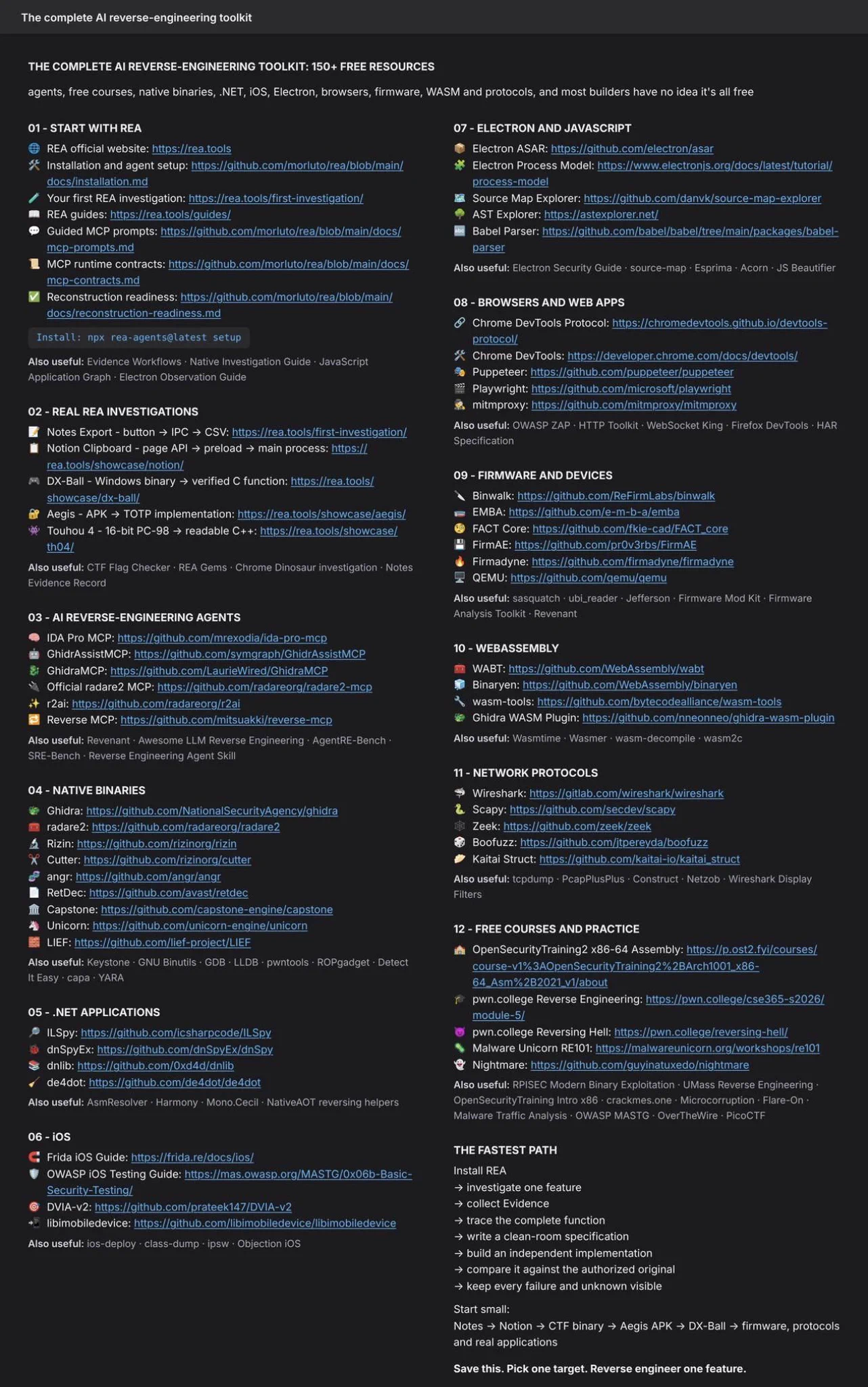
A practical reverse-engineering map by hakimieiqbal on X that picks tools by target: native binaries, .NET, Electron, iOS, firmware, WebAssembly and network protocols. It introduces REA (morluto/rea), which connects coding agents to RE tools, and lists MCP bridges for IDA Pro, Ghidra and radare2. It adds an evidence-first workflow and free courses such as pwn.college and OpenSecurityTraining2.
x.comthreadAdded 29 Oct 2026, published 28 Oct 2026🛡️ Security - Hakimi Eiqbal (@hakimieiqbal) on X
A thread by Hakimi Eiqbal that maps reverse-engineering tools by target type: native binaries, Electron, .NET, iOS, firmware, WebAssembly and network protocols. Its AI sections cover REA (an open-source layer connecting coding agents to analysis tools) and MCP bridges for IDA Pro, Ghidra and radare2. It argues for an evidence-first workflow and gives a prompt that separates verified facts from hypotheses.
x.comthreadAdded 29 Oct 2026, published 28 Oct 2026🧠 AI  Buchi Reddy B (@buchireddy) on X
Buchi Reddy B's X thread comments on Forever Security's research (Gal Weizman, Omer Samet) on coding agents. A web page silently writes a fake AGENTS.md or CLAUDE.md into a Downloads folder, and Codex and Claude Code follow it as project rules. Codex then wrote an attacker's MCP server into the machine-wide config, so one injection becomes a standing connection for every session. It asks whether teams inventory runtime MCP connections against approved lists.
x.comthreadAdded 28 Oct 2026, published 27 Oct 2026🛡️ Security- Prasenjit Sarkar (@stretchcloud) on X
Campfire is a self-hosted workspace by Prasenjit Sarkar that runs Claude Code, Codex, Goose, Aider and OpenHands side by side in one tab. Risky actions go through permission voting: a majority approves, any single deny blocks, and a 30 second timer ends the wait. Session replay shows which file or tool call triggered an action. The post cites Forever Security's report of a planted AGENTS.md. Codex followed it first time over 90% of the time and Claude Code about half the time. Try it with "bunx the-campfire".
x.comthreadAdded 28 Oct 2026, published 27 Oct 2026🧠 AI - Prasenjit Sarkar (@stretchcloud) on X
Campfire is a self-hosted tool that runs Claude Code, Codex, Goose, Aider and OpenHands in one tab. Risky actions need permission voting (majority approves, any single deny blocks, 30 second timeout), and session replay traces which file or tool call triggered an action. The post cites Forever Security's finding that Codex followed a planted AGENTS.md instruction over 90% of the time and Claude Code about half the time. It also cites the February Cline release compromise via a poisoned GitHub Actions cache.
x.comthreadAdded 28 Oct 2026, published 27 Oct 2026🛡️ Security  cubillas (@cubillas888) on X
The tweet relays Pillar Security research that opencode on Windows and WSL could run attacker-controlled code during remote MCP server OAuth sign-in. The fix shipped in opencode 1.18.33 on 28 September, with no advisory or CVE published. It advises users of remote MCP servers to update and review which servers they connect to. Technical details are not in the post.
x.comthreadAdded 29 Oct 2026, published 27 Oct 2026🛡️ Security- AGTP (@AGTPinsights) on X
AGTP's X thread summarizes Meta's Muse Spark 1.3 Evaluation Report. Prompt injection was tested on Exponential Security Labs' RepoInject v1 and BrowserInject v1 and on Gray Swan's IPI Arena, with robustness said to be on par with GPT-5.6 Sol. It also covers chain of thought controllability evals, PostTrainBench under Loss of Control, and Handshake's pre-release human red teaming. It notes the Midas Project's criticism of Muse Wonder's missing safety report.
x.comthreadAdded 27 Oct 2026, published 26 Oct 2026🛡️ Security - AGTP (@AGTPinsights) on X
Thread summarizing Meta's Muse Spark 1.3 Evaluation Report, the safety write-up for the model released on September 2, 2026. It covers prompt-injection results on Exponential Security Labs' RepoInject v1 and BrowserInject v1 and Gray Swan's IPI Arena, chain-of-thought controllability evals, PostTrainBench under Loss of Control, and Handshake's human red teaming. It also notes The Midas Project's criticism that Muse Wonder still has no safety report, and the Muse Spark Open rollout (816B total, 42B active parameters).
x.comthreadAdded 27 Oct 2026, published 26 Oct 2026🧠 AI  Benjamin👨💻 (@Hislordship_9) on X
Thread on Forever Security's finding that a planted Markdown "Engineering Work Guidelines" file in ~/Downloads made Codex add a "project-tools" MCP server to ~/.codex/config.toml. The server ran npm install function-color, a known malicious package, and started a child session with --dangerously-bypass-approvals-and-sandbox. Codex complied in over 90% of the firm's tests; Claude Code, via a CLAUDE.md setting ANTHROPIC_BASE_URL, about half. Advice: don't start agents in Downloads, review instruction files, and diff agent config.
x.comthreadAdded 27 Oct 2026, published 26 Oct 2026🛡️ Security David Gutierrez | Eng (@david_x_ai) on X
Thread on a critical opencode bug disclosed by Pillar Security on Oct 19. On Windows and WSL, a remote MCP server could run code during OAuth sign-in, because the server-chosen authorization URL was put unescaped into a PowerShell command, so a PowerShell subexpression executed. opencode fixed it in 1.18.33 on Sep 28 as a browser-launch refactor with no advisory or CVE. MCP Inspector published an advisory for the same bug class, and its fix needs a major bump of the open package.
x.comthreadAdded 27 Oct 2026, published 25 Oct 2026🛡️ Security- alex lee (@alexlee20122022) on X
Gheist is a GitHub campaign disclosed by Wiz in October 2026. Stolen tokens push ci-sync-XXXXXX branches with a sync-check workflow that dumps repo secrets base32-encoded to evade log masking, fetches the logs via API, then deletes the run. 13,500+ branches and 850+ accounts were hit since 15 September. Public repos are protected by the approval hold; private and Enterprise repos are not. The thread lists IOCs (.gdmp_pat files, "gheist" user agent, "ci: sync config" commits) and rotation steps.
x.comthreadAdded 26 Oct 2026, published 25 Oct 2026🛡️ Security  Prasenjit Sarkar (@stretchcloud) on X
Post on the LiteLLM supply-chain compromise. Attackers spent eleven days in the GitHub org, ran a workflow on a throwaway branch to take twenty secrets including a GitHub App private key, then used stolen GitHub CLI OAuth tokens to publish malicious release 1.107.0 from a lookalike Berri-AI repo. A Python startup file harvested sixteen credential categories and LiteLLM proxy Postgres provider keys. Socket flagged the wheels in seven minutes.
x.comthreadAdded 26 Oct 2026, published 24 Oct 2026🛡️ Security Rafter (@RafterSecurity) on X
Railway security incident update of 23 October 2026, posted by Rafter Security, summarising Railway's preliminary report on the 20-22 October breach. Up to 1.85% of workspaces (about 100,000) may have had environment variables exposed. Attackers reportedly targeted AI provider API keys, possibly for model distillation. Some encrypted secrets were accessed and a subset decrypted. Railway says the attacker was removed by 22 October at 03:32 UTC, and the forensic investigation continues.
x.comthreadAdded 25 Oct 2026, published 23 Oct 2026🛡️ Security Daily Vibe Casting (@vibecastingapp) on X
Daily Vibe Casting thread of 24-hour tech news, with item 5/10 on Cloudflare's agent security audit skill. The skill works across models and agent harnesses, including free models, and outputs machine-readable reports. It calls for sandboxing, proof of real impact and independent checks. The thread also covers GitLab CVE-2026-110264 (CVSS 10.0, unauthenticated RCE), two AI-found PHP RCE flaws, and a Railway secret-theft warning.
x.comthreadAdded 24 Oct 2026, published 22 Oct 2026🛡️ Security- Daily Vibe Casting (@vibecastingapp) on X
Daily Vibe Casting is an X thread dated 24 October 2026 that summarises ten tech news items from the previous 24 hours. The AI items are Cloudflare's model-independent agent security audit skill, Recursive SI's Apache 2.0 Flint local coding model (125+ tokens/s on an M4 Pro), Anthropic's Claude Duet preview and Claude API version 2026-10-21, which drops temperature, top_p and top_k. It also covers HeyGen Voice Turbo and Gemini in Google Maps on CarPlay.
x.comthreadAdded 24 Oct 2026, published 22 Oct 2026🧠 AI - Muscle AI (@themuscleai) on X
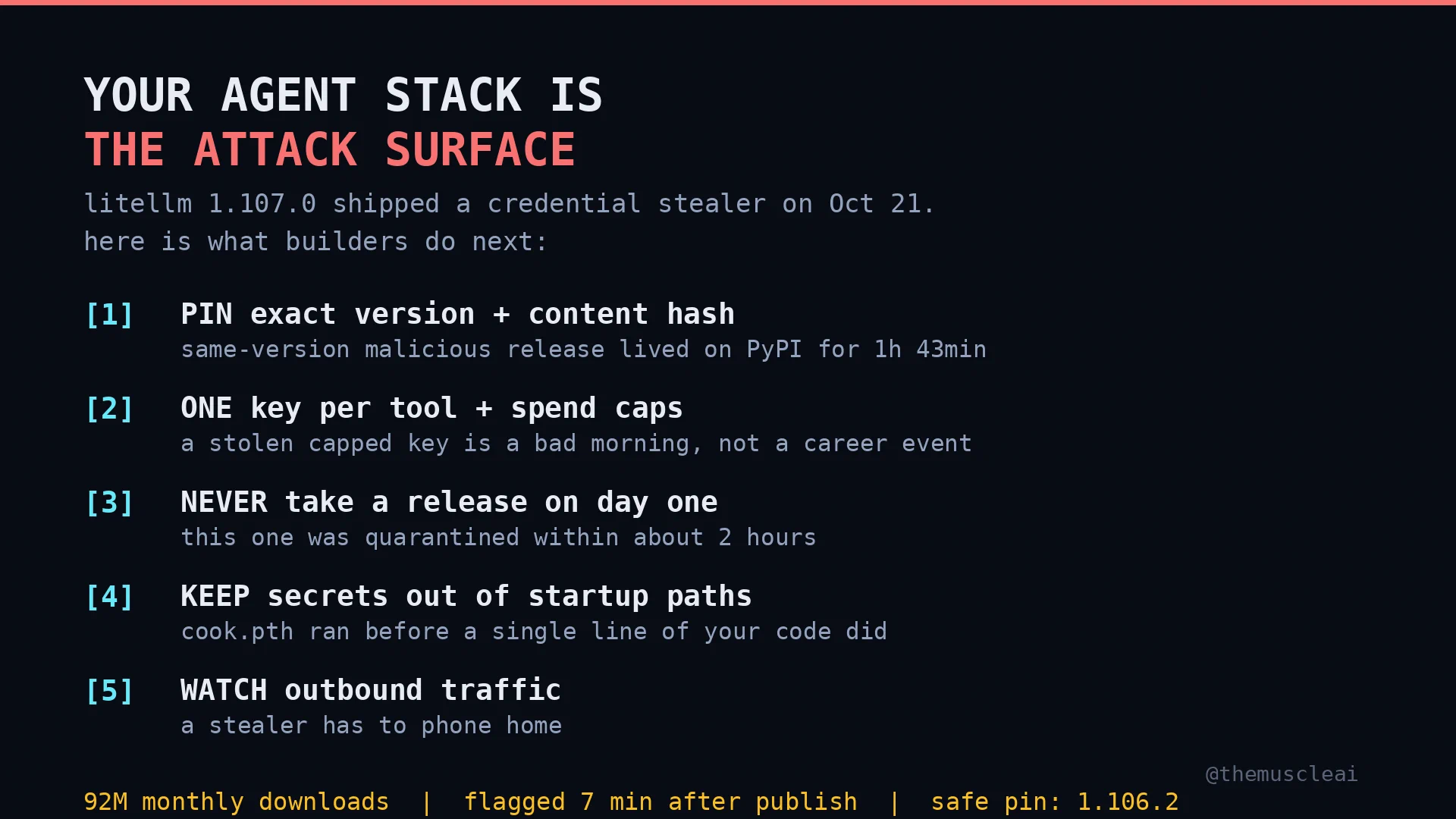
Post on the LiteLLM 1.107.0 PyPI compromise published 21 October 2026 and quarantined about 1 hour 43 minutes later. A malicious .pth file ran at Python startup and stole cloud credentials, private keys, browser data and AI tool auth files, then POSTed a tarball to an attacker endpoint. The author says attackers used stolen GitHub CLI OAuth tokens to push a trojanized commit chain and build official wheels. It lists five defenses: hash-pinned lockfiles, per-tool capped keys, release cooling periods, secret isolation and egress monitoring.
x.comthreadAdded 23 Oct 2026, published 22 Oct 2026🛡️ Security  SecureChap (@SecureChap) on X
Post describing a LiteLLM 1.107.0 PyPI compromise in which attackers used stolen GitHub CLI OAuth tokens from three engineers to trigger and approve the project-releaser workflow, producing eight malicious wheels and a tampered tarball. The wheels drop cook.pth, which runs at Python startup, and privcollect steals cloud tokens, keys, browser data, AI configs and LiteLLM proxy credentials, exfiltrating to litellm[.]dev/healthcheck. A second daemon polls a GitHub domain.txt hourly for new domains to fetch and execute. PyPI yanked the package the same day. The post is a single unsourced tweet.
x.comthreadPublished and added 22 Oct 2026🛡️ Security VibecodersHQ (@VibeCodrHQ) on X
Post summarising Pillar Security's finding of a remote code execution flaw in OpenCode, the open-source AI coding agent. Versions 1.0.137 through 1.18.32 could run code from a remote MCP server during OAuth sign-in on Windows and WSL, with no prompt injection needed. The fix is in 1.18.33 (released 28 September). No advisory or CVE was issued, so scanners will not flag old installs. Interim advice is to remove unvetted remote MCP servers.
x.comthreadAdded 22 Oct 2026, published 21 Oct 2026🛡️ Security Open Weight Updates (@openweightstars) on X
Flint is the first model from Recursive SI, a fast local coding model with open weights released the same day. It was built with the company's automated research system, the Eureka Machine. The post claims up to 2x faster speed than comparable models: 125+ tokens/sec on a MacBook Pro and 150+ on RTX Spark. The captured text is truncated and gives no benchmarks or model size.
x.comthreadAdded 22 Oct 2026, published 21 Oct 2026🧠 AI Billy Lee (@billyozno) on X
LiteLLM 1.107.0 on PyPI shipped malware in all 7 wheels, the package's second supply-chain attack this year. It steals SSH keys, cloud credentials, browser passwords, AI tool configs and API keys, and installs a backdoor that polls for commands hourly. The GitHub source is clean, so a hijacked build or publish step is suspected. PyPI quarantined the release, but Aikido says the Docker image litellm/litellm:1.107.0 was still live. Indicators are cook.pth, cook.py and sitecustomize.py in site-packages. The advice is to rotate reachable keys and pin 1.106.2.
x.comthreadAdded 23 Oct 2026, published 21 Oct 2026🛡️ Security- ︎ (@0xocdsec) on X
Post from 0xocdsec announcing a deep-dive on CVE-2026-106173 in Fortinet FortiSIEM. The flaw is an arbitrary file write in a gRPC service that leads to remote code execution. The author says this is the fourth year in a row they have researched FortiSIEM. The post itself gives no technical detail and links to the full analysis.
x.comthreadAdded 21 Oct 2026, published 20 Oct 2026🛡️ Security - Trail of Bits (@trailofbits) on X
Trail of Bits thread on Google Quantum AI's March publication of a new Shor's algorithm version aimed at secp256k1, the curve protecting Bitcoin and Ethereum wallets. Google used zero-knowledge proofs to keep the attack details secret, and the post says the secrecy lasted 63 days. The fetched text is cut off after the qubit estimate of roughly 1,200, so later details are missing.
x.comthreadAdded 22 Oct 2026, published 20 Oct 2026🛡️ Security  Pre-ERC: Adoption Profile and Reference Kernel for EOAs Adopting Code via SETCODEFROM
Pre-ERC proposal for EOAs that adopt account code via EIP-8298 SETCODEFROM, which with EIP-8151 retires the secp256k1 key. It lists seven failure modes (FM1-FM7), such as self-recovery lockout, ERC-1271 passing while VERIFY fails, front-runnable initialization and a mutable code source. It proposes requirements R1-R8, a MigrationCheck guard with two routes, and a reference kernel with post-quantum ERC-7913 verifiers.
 ethereum-magicians.orgthreadPublished and added 20 Oct 2026🛡️ Security
- DFIR Radar (@DFIR_Radar) on X
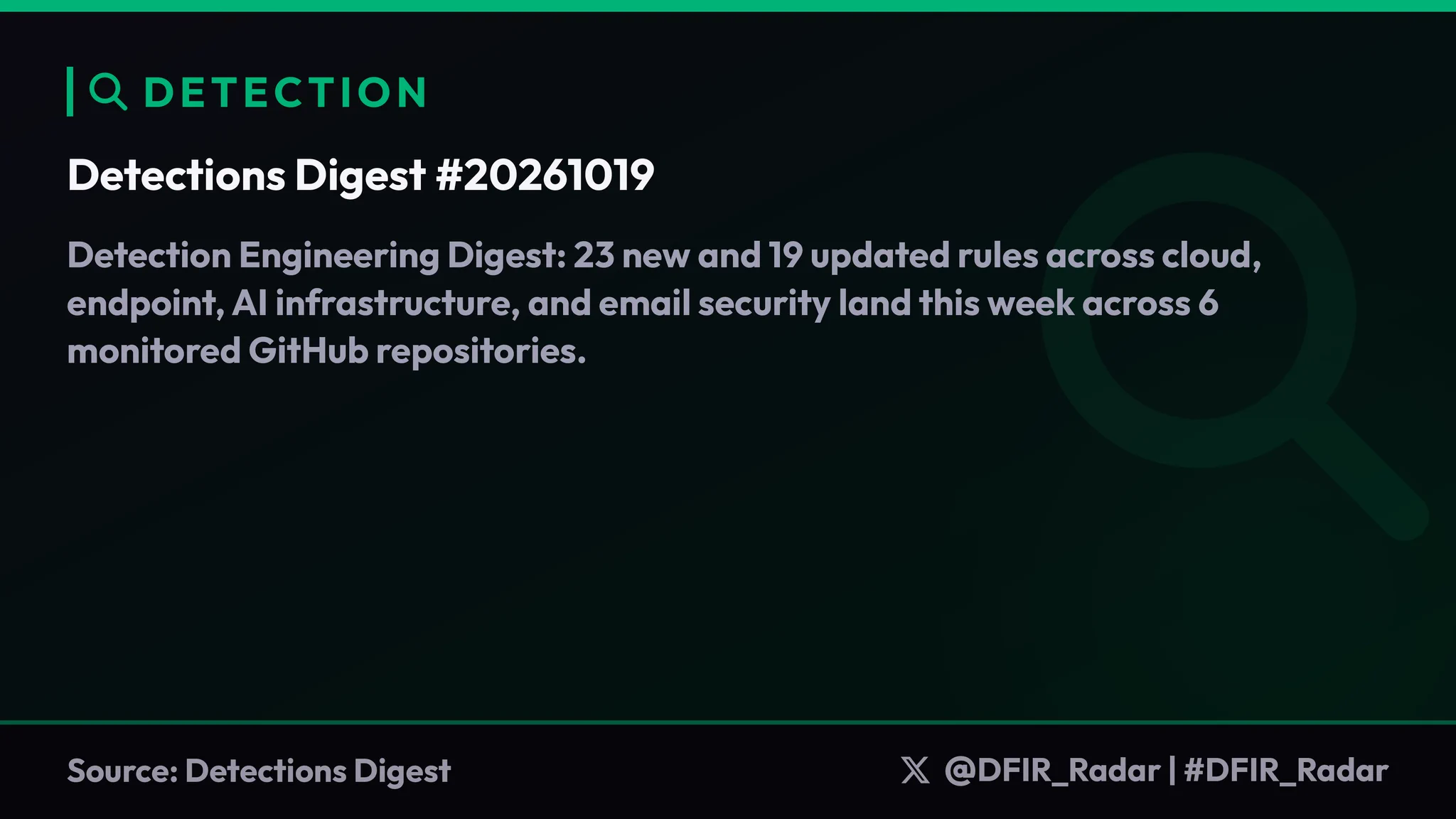
DFIR_Radar weekly detection engineering digest covering 23 new and 19 updated rules across 6 GitHub repositories. It lists KQL rules for Azure Key Vault secret retrieval, MCP client User-Agent bulk operations and local Azure token theft, AWS CloudTrail analytics, Sigma rules for firewall and ETW tampering (decimal 17 vs hex 0x11), updated LOLDrivers hashes, and Sublime email rules for OAuth consent phishing and fake IRS W-9 PDFs.
x.comthreadAdded 20 Oct 2026, published 19 Oct 2026🛡️ Security  Nick Frichette (@Frichette_n) on X
Datadog Security Labs announcement, posted by Nick Frichette, of research on steering the evaluations of a prompt-injection detector called "Jev". The team's method cut its detection rate from about 83% to about 4% in their tests. They also used it to bypass LangChain's experimental tool-risk gating feature that is based on Jev. The tweet gives no method details and links to the full article.
x.comthreadAdded 21 Oct 2026, published 19 Oct 2026🛡️ Security- LinuxSecurity (@lnxsec) on X
A post from lnxsec on CI runners that accept outside pull requests while also holding registry credentials, cache write access, signing material or deployment tokens. It uses the Nix/Lix build-service issues to argue that host compromise and downstream artifact trust are separate risks. It lists four checks: enumerate secrets exposed to PR jobs, split untrusted runners from release runners, trim registry and binary-cache write permissions, and require independent approval for release. It links a linuxsecurity.com feature; CVE details are not in the post.
x.comthreadAdded 20 Oct 2026, published 19 Oct 2026🛡️ Security  Santhosh Patel (@santhosh_patell) on X
Summary of Pillar Security research on opencode, in which a malicious remote MCP server runs code on a Windows or WSL machine during the OAuth login step. The login URL goes unsanitised into PowerShell through the npm "open" package, so an https:// link containing $(...) executes. Affected versions are 1.0.137 to 1.18.32, fixed in 1.18.33 (28 September) as a "refactor" with no advisory or CVE. The behaviour was first reported in 2020 as a WSL 2 broken-link bug.
x.comthreadAdded 21 Oct 2026, published 19 Oct 2026🛡️ Security Mikko Laakkonen (@mikkolaakkonen) on X
An X thread by Mikko Laakkonen arguing that companies should encourage staff to vibe code, then provide approved hosting, identity, secrets, deployment and monitoring. It lists 200 application checks in 17 sections, from ownership and data flow through keys, authz, coding-agent isolation, appsec, SBOM and releases to recovery, runtime AI and handover. It adds 16 EU bonus checks on GDPR, NIS2, the Cyber Resilience Act (reporting from 11 Sept 2026, main duties 11 Dec 2027), the AI Act and the Data Act. It builds on Mark Ajzenstadt's production-readiness post and links a 300-check worksheet version.
x.comthreadAdded 18 Oct 2026, published 17 Oct 2026🛡️ Security Nicholas Martin (@ndgmlondon) on X
An X post advises auditing every MCP write tool against the database role it actually runs under. A shared service key lets prompt injection trigger unapproved writes, so each agent session should get a read-only role, with a test that writes are denied. Replies note that MCP servers often inherit ambient host credentials or can escalate through a second connection pool, and suggest also testing that another tenant's rows are unreadable with the same role.
x.comthreadAdded 18 Oct 2026, published 16 Oct 2026🛡️ Security- Harrison Kinsley (@Sentdex) on X
Sentdex reacts to Artificial Analysis ranking NVIDIA's Nemotron 3.5 Super VL (120B total, 12B active MoE) as the top US open-weights model, scoring 26 on the Intelligence Index. That edges out Thinking Machines' Inkling Small (26), NVIDIA's Nemotron 3 Ultra (23) and Meta's Muse Glimmer (17). Sentdex's informal tests at vanilla settings show over 550 tok/sec, and they suspect it would rank higher on agentic coding. They see it as a candidate for a fast local coding agent model.
x.comthreadAdded 16 Oct 2026, published 15 Oct 2026🧠 AI - Francis Santerre (@santerref) on X
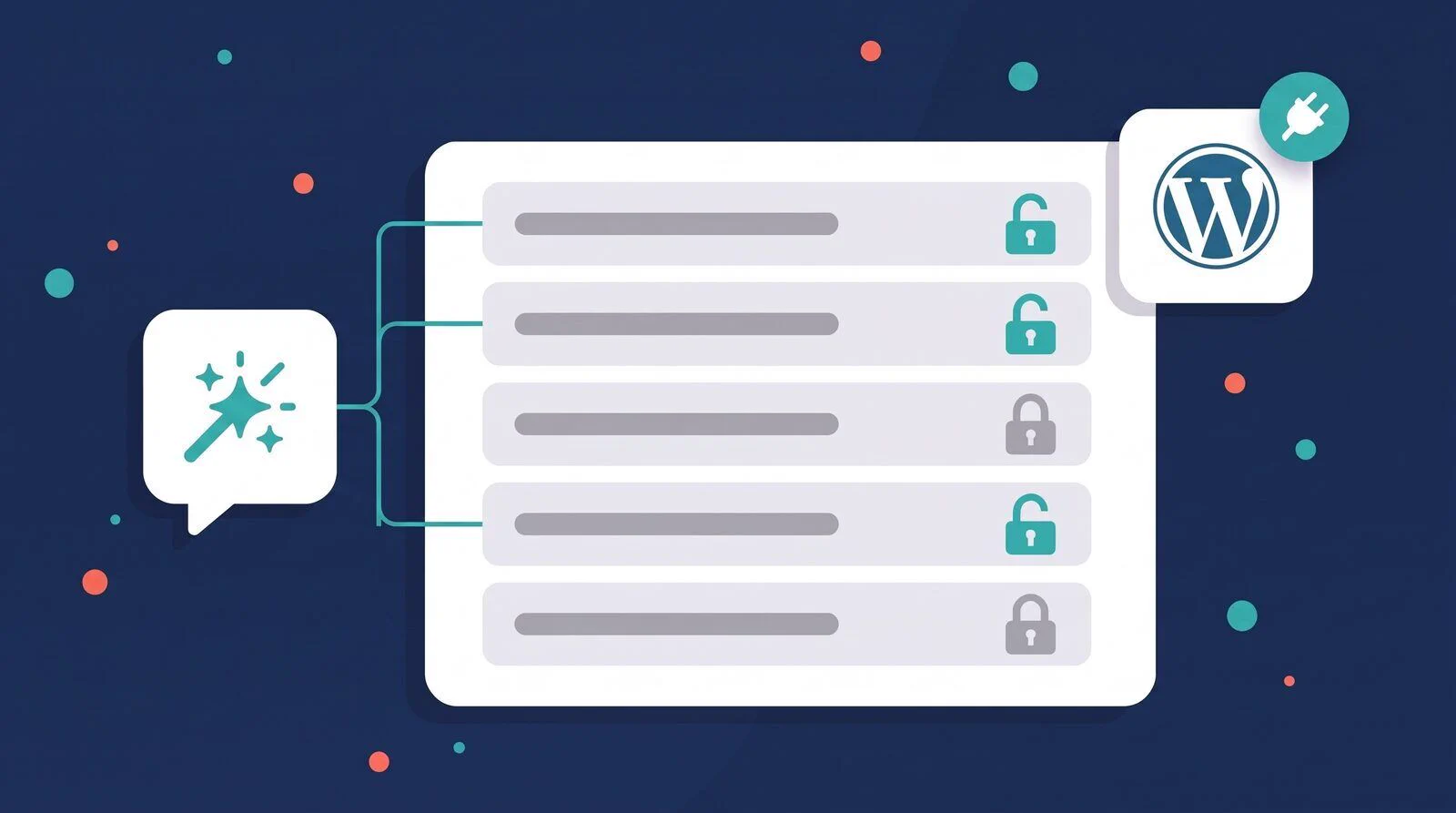
Post announcing that the MCP Adapter (0.7.0) is now a canonical plugin on WordPress.org, bridging the WordPress Abilities API to MCP. It exposes a default server at /wp-json/mcp/mcp-adapter-default-server, and only abilities a site marks public are exposed. The author's point is that the security review reduces to auditing the list of public abilities, which gives reviewers and pentesters a new endpoint to enumerate.
x.comthreadAdded 16 Oct 2026, published 15 Oct 2026🛡️ Security - Francis Santerre (@santerref) on X
Tweet announcing that the MCP Adapter is now a canonical plugin on WordPress.org (version 0.7.0). It bridges the WordPress Abilities API to the Model Context Protocol, with a default server at /wp-json/mcp/mcp-adapter-default-server. Only abilities a site marks public are exposed, so the security review comes down to auditing the ability list.
x.comthreadAdded 16 Oct 2026, published 15 Oct 2026🧠 AI - Ned Peterson (@NedPeterson99) on X
Social post summarizing a Sola Security study (Leon Goldberg, Gal Engelberg). An AI agent re-scored 9,967 high-severity findings from two commercial cloud security platforms across eight production environments and changed severity on 75.1% (58.5% downgraded, 16.6% upgraded). The cause is that 599 vendor rules each carry one fixed severity regardless of environment, and 49% of verdicts needed context beyond the flagged resource. Caveats: 92% of findings were AWS, and the study did not test whether the new severities predict real exploitation.
x.comthreadAdded 15 Oct 2026, published 14 Oct 2026🛡️ Security - lee1981 (@lee1981b) on X
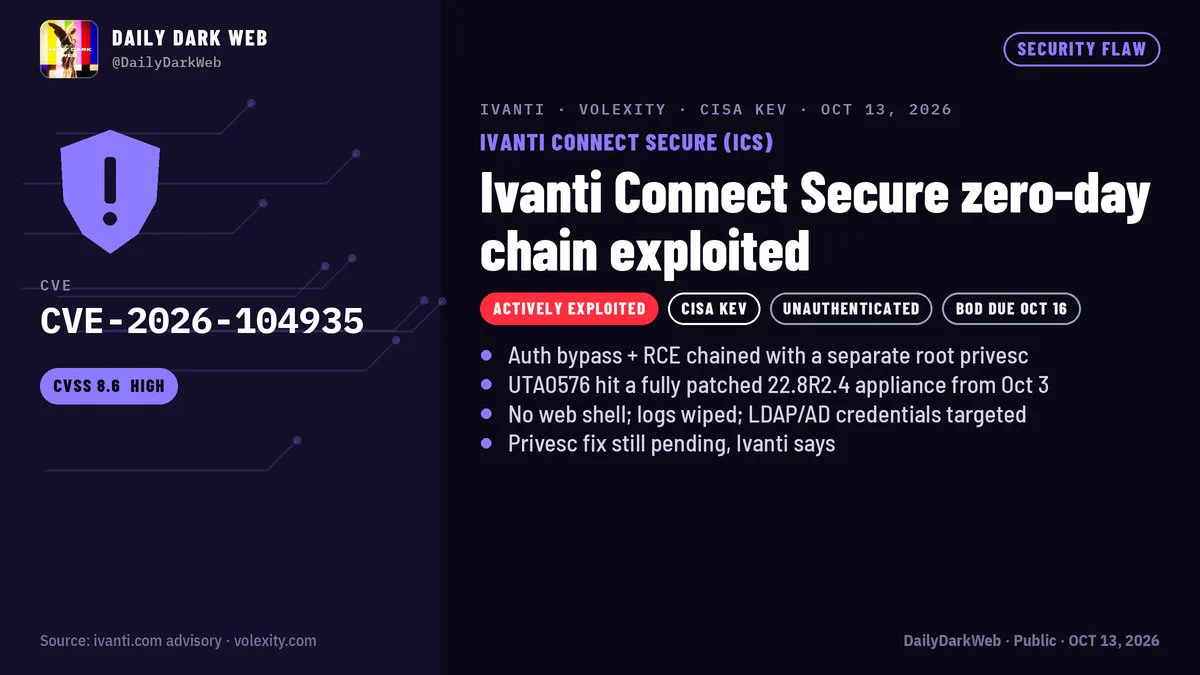
Defender guide for CVE-2026-104935, an authentication-bypass-by-spoofing flaw (CWE-290) in Ivanti Connect Secure that allows unauthenticated command execution. It is confirmed exploited and CISA KEV-listed, with a CNA CVSS 8.6. It covers the fixed-release matrix (25.1.1.2, 22.8R2.5, 25.1.3.x), platform and cluster migration limits, and Volexity's UTA0576 indicators and YARA rules. It also gives a six-step SOC workflow (scope, preserve, hunt, correlate identity, remediate, verify). It stresses that a clean ICT result cannot clear memory-only activity and that LDAP, LAPS and BitLocker exposure belongs to one observed chain.
x.comthreadAdded 16 Oct 2026, published 14 Oct 2026🛡️ Security  Dark Web Informer (@DarkWebInformer) on X
Social post from DarkWebInformer announcing a released proof-of-concept for CVE-2026-82957, a server-side request forgery in Hyperledger FireFly. The flaw lies in webhook subscriptions, where a user-controlled webhook URL is accepted without validating the destination host. The PoC is hosted in a hakaioffsec GitHub repo.
x.comthreadAdded 15 Oct 2026, published 14 Oct 2026🛡️ Security- Dark Web Intelligence (@DailyDarkWeb) on X
Social post summarizing Docker's Oct 12, 2026 advisory for CVE-2026-105445, a Docker Hub flaw. Converting a personal account to an organization re-assigned the account's personal access tokens (PATs) to the named new owner without rotating the secret. An attacker could name a victim as owner and keep using the token as that victim to pull, push or delete images. The exposure window ran from Aug 26, 2024 to Sept 30, 2026. Docker fixed it the day it was reported by Peter Molnar and Krisztian Hozak, deactivated transferred PATs on Oct 8, and found no exploitation after reviewing about 304,000 pushes. The post advises reviewing PATs and using organization access tokens for automation.
x.comthreadPublished and added 13 Oct 2026🛡️ Security - Dark Web Informer (@DarkWebInformer) on X
Social post announcing a PoC (hakaioffsec) for CVE-2026-82957, an SSRF in Hyperledger FireFly ≤ 1.5.0 (CVSS 8.5). Webhook subscriptions accept a user-controlled URL without validating the destination host, letting the FireFly node reach internal services, private networks, loopback and cloud metadata endpoints. The PoC creates a malicious webhook subscription, triggers a matching event and confirms the request originates from the FireFly server.
x.comthreadPublished and added 13 Oct 2026🛡️ Security - Dark Web Intelligence (@DailyDarkWeb) on X
Social post summarizing Volexity's research on an Ivanti Connect Secure (ICS) zero-day chain, CVE-2026-104935. The chain pairs an auth bypass and a race-condition RCE with a separate privilege-escalation bug for root. Actor UTA0576 used it from Oct 3, 2026 against a fully patched 22.8R2.4 appliance, leaving no backdoor or web shell and deleting log entries. Post-exploitation included LDAP/AD credential theft, LAPS and BitLocker key searches, password spraying and packet capture. CISA added it to KEV with a due date of Oct 16. A clean Integrity Checker result does not rule out compromise because the chain patches code in memory only, so memory and network forensics are needed. The hunting lead is heavy requests to /dana-na/auth/url_default/welcome.cgi with a mismatched X-DSCGI-PATH header.
x.comthreadPublished and added 13 Oct 2026🛡️ Security - Have I Been Pwned (@haveibeenpwned) on X
Have I Been Pwned post announcing the Sharecare breach, tied to an August ShinyHunters extortion campaign. It allegedly exposed 318k email addresses, mostly business contacts, plus some Brazilian health plan member data. 73% of the addresses were already in HIBP. This adds another health-sector victim to the ShinyHunters extortion record. The business contact data is likely to be reused for phishing.
x.comthreadAdded 15 Oct 2026, published 12 Oct 2026🛡️ Security - Codex CLI installs a persistent, self-updating background daemon by default
GitHub issue asking OpenAI to make Codex CLI's daemon_auto_start opt-in. Since 0.157.0, opening a session starts a persistent app-server daemon with no TTY. It copies a ~374 MB platform package into ~/.codex/packages, so the running binary is decoupled from the npm-installed version. A detached hourly updater restarts the backend, and the daemon pins the first session's environment variables (proxy settings, direnv-style secrets like GH_TOKEN) and cwd. The thread also reports that `daemon stop` leaves the pid-update-loop updater alive, gives a manual workaround, and proposes an "execution receipt" (client version, daemon binary digest, generation, updater state, environment generation) so clients can tell which binary and environment served a turn.
 github.comthreadPublished and added 12 Oct 2026🛡️ Security
- SECTOR (@sector_sol) on X
A thread listing seven GitHub repos for securing LLM apps that can call tools: garak, PyRIT and promptfoo for attack and red-team testing, LLM Guard and Rebuff for input/output scanning and prompt-injection detection, NeMo Guardrails for programmable rails, and Inspect AI for repeatable evaluations. It proposes a loop of map risks, attack, inspect failures, add controls, retest and monitor. It stresses that a system prompt is not a security boundary and that credentials should be scoped, tool arguments validated outside the model, and consequential actions approved. It also warns that Rebuff is archived.
x.comthreadAdded 12 Oct 2026, published 11 Oct 2026🛡️ Security - ThreatWire (@ThreatWire_) on X
Post announcing a public PoC for CVE-2026-13043, a critical flaw (CVSS 4.0 9.3, scored by WatchGuard) in PSKMAD, the kernel memory access driver of WatchGuard Endpoint Security on Windows. The access-control handshake can be bypassed (CWE-306/CWE-798), letting a local authenticated attacker send privileged commands and read kernel and other processes' memory. Fixed in 8.00.26.0012; the PoC author and LOLDrivers frame the signed driver as BYOVD material, which WatchGuard does not say. The post notes it is not in CISA KEV, has no reported in-the-wild exploitation, and that ThreatWire has not run the PoC.
x.comthreadAdded 11 Oct 2026, published 10 Oct 2026🛡️ Security - Dark Web Informer (@DarkWebInformer) on X
Social post announcing a PoC for CVE-2026-107181 in Telegram Desktop before 7.2.9. A crafted tg:// link abuses Telegram's IPC handler to exfiltrate local files, including session keys, which lets an attacker hijack the account without the password. Rated CVSS 8.1 (v3.1) / 8.6 (v4.0), fixed in 7.2.9, with a linked writeup on beaksec.github.io.
x.comthreadAdded 10 Oct 2026, published 9 Oct 2026🛡️ Security - Hybrid post-quantum stealth addresses (ERC-5564 schemeId 3)
A draft ERC proposing schemeId 3 for ERC-5564 stealth addresses, combining an ML-KEM-768 encapsulation with a secp256k1 ECDH secret so that future quantum computers cannot retroactively deanonymize recipients from the public announcement log, while spending stays classical secp256k1 (and thus still quantum-vulnerable once spent). The post, with a linked reference implementation, test vectors and gas harness, details the key/meta-address format, the payment-secret combiner (hashing both shared secrets and ciphertexts for IND-CCA), the view-tag derivation ordering to avoid quantum tag-narrowing, measured gas cost (111,330 gas per payment on Prague), and open questions around ANO-CCA proofs for standardized ML-KEM, NIST SP 800-56C combiner approval, and downgrade-attack handling when a recipient registers under both schemeId 1 and 3.
ethereum-magicians.orgthreadPublished and added 9 Oct 2026🛡️ Security - ERC-8441: Hybrid post-quantum stealth address scheme
A draft Ethereum ERC (ERC-8441) proposes schemeId 3 for ERC-5564 stealth addresses, combining an ML-KEM-768 encapsulation with a secp256k1 ECDH secret so that quantum adversaries who later break discrete log still cannot deanonymize who was paid in past public announcement logs, protecting against harvest-now-decrypt-later attacks. Spending remains classical secp256k1 and unprotected once quantum computers exist; the authors flag open issues including a documented downgrade attack (recipients registered under both scheme 1 and 3 can still be paid without PQ protection), the lack of a formal ANO-CCA proof for standardized ML-KEM, and a non-NIST-approved secret combiner. It reuses the existing ERC-5564 announcer and ERC-6538 registry with no contract changes, costing 111,330 gas per payment.
ethereum-magicians.orgthreadPublished and added 9 Oct 2026🛡️ Security - Ned Peterson (@NedPeterson99) on X
A post summarizing a joint FBI and six-country advisory on actors tied to Integrity Technology Group (the sanctioned Chinese firm linked to Flax Typhoon and the Raptor Train botnet). They password-sprayed Microsoft 365 and Exchange accounts over EWS, OWA, ActiveSync and PowerShell with EBurst. They then drained mailboxes with a PHP bot over Exchange Web Services and an office-cli utility using stored client ID, tenant ID and secret values, and exposed the stolen email to third parties through a web app, in some cases restricted to Xiamen IP addresses. Victims were in government, law enforcement, healthcare and religious organizations across Southeast Asia, Africa and North America, with activity since at least January 2021. Defensive takeaways: enforce MFA on every legacy path, retire basic auth and EWS, audit OAuth apps and service principals with mail-read rights, and alert on bulk mailbox pulls.
x.comthreadAdded 11 Oct 2026, published 9 Oct 2026🛡️ Security  Dark Web Informer (@DarkWebInformer) on X
A security researcher released a PoC (on GitHub, user kolmteistov) and a patch for two critical takeover vulnerabilities in GoBalance, the Bitcoin balance-checking software widely used by Tor darknet market and forum onion services. One of the flaws allows recovery of a GoBalance onion service's master identity key from a single public key, enabling full service takeover; the vulnerabilities were reportedly exploited in real attacks against the Dread forum and Omega Darknet Market.
x.comthreadPublished and added 8 Oct 2026🛡️ Security- Dark Web Informer (@DarkWebInformer) on X
Post announcing a PoC and security patch for two critical GoBalance (Tor onion service load balancer) takeover flaws, reportedly used in attacks on the Dread and Omega darknet markets. The first flaw reuses or mishandles the nonce in blinded signing, so a single public descriptor lets an attacker recover the onion service's master identity key. The second accepts forged instance descriptors without signature and identity-binding checks, which allows full frontend traffic hijacking. The linked package includes a PoC for both paths, a patched source tree, regression tests and a unified patch. It affects master at commit bb1b0f3.
x.comthreadAdded 9 Oct 2026, published 8 Oct 2026🛡️ Security - James Berthoty (@JamesBerthoty) on X
James Berthoty argues that AI guardrails for first-party AI features should be treated as an extension of cloud/product security, not tied to employee-usage monitoring. Guardrails (prompt injection defense, content filtering, goal alignment) are available from AI security vendors, gateways, frontier providers and SDKs. He recommends deploying in-depth guardrails through developer SDKs or an existing cloud runtime/CADR provider, because those see what happens on the workload (such as a prompt injection leading to workload takeover, or the files a malicious MCP call wrote). Dedicated AI security vendors offer an integrated policy engine and deeper AI red-teaming, but they are usually run by internal IT rather than cloud/product security teams.
x.comthreadAdded 10 Oct 2026, published 8 Oct 2026🛡️ Security  Derek Abdine (@dabdine) on X
An X/Twitter thread arguing that vulnerability remediation is not a single process but a multi-branch decision tree: patchable issues suffer from patch-management tools misreporting status or breaking systems; unpatched 0days (e.g. Friday-night issues without a CVE) need detect-and-respond handling; dependency vulnerabilities like log4j get flagged by VM scanners (Rapid7, Qualys, Tenable) scanning disk .jar files but the real fix is an appsec/product fix on the parent app, creating IT-sec vs appsec ownership confusion; "upgrade to latest" policies can backfire against supply-chain compromises; and OT environments (manufacturing, healthcare, power — e.g. Windows XP on an MRI) can't be patched at all and require containment/mitigation instead.
x.comthreadAdded 8 Oct 2026, published 7 Oct 2026🛡️ Security- Dan Kornas (@DanKornas) on X
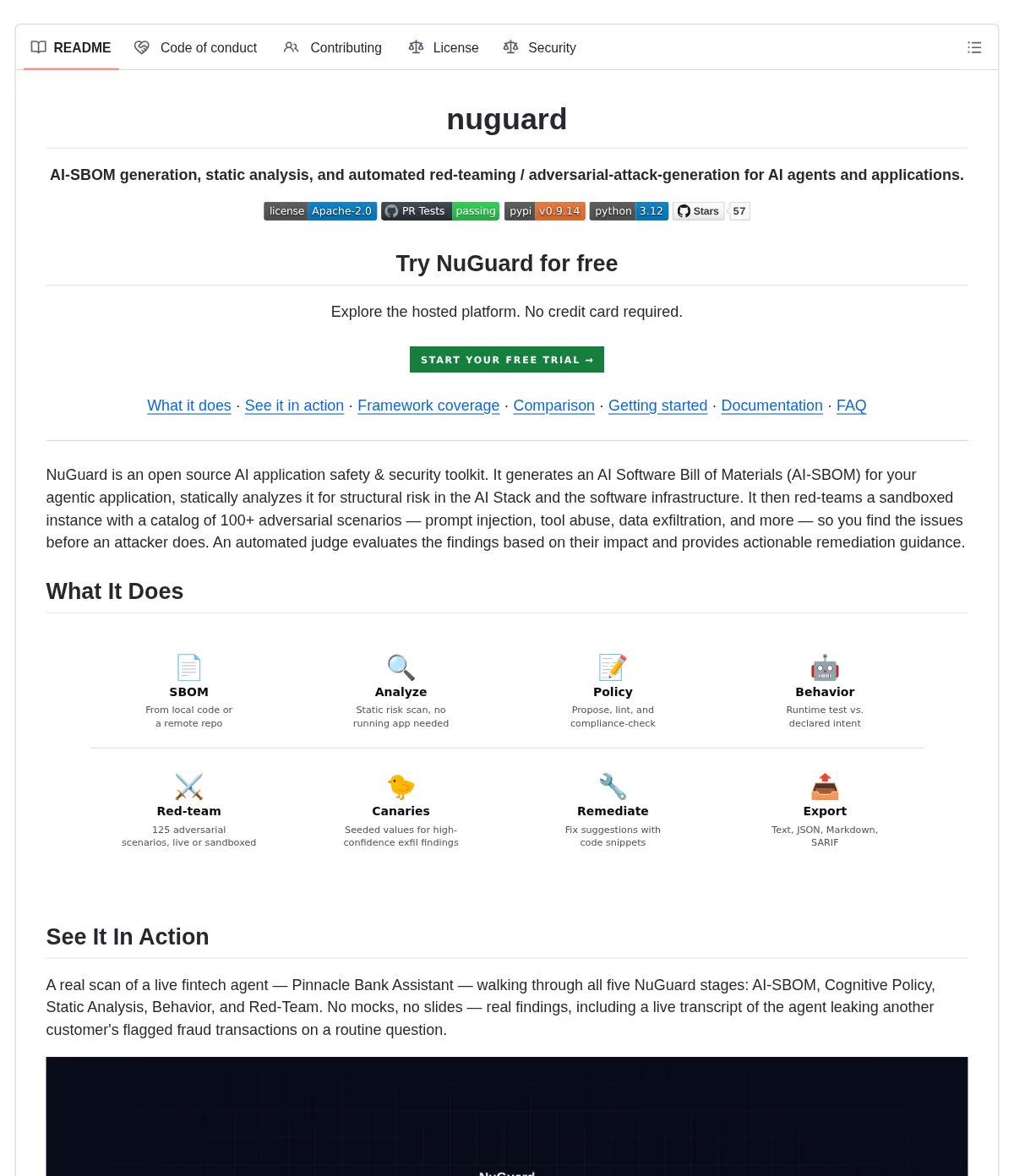
NuGuard is an open-source AI application safety and security toolkit for agentic AI systems, released under Apache 2.0. It unifies AI-SBOM generation, structural static analysis of the AI stack, and sandboxed adversarial red-teaming (100+ scenarios covering prompt injection, tool abuse, and data exfiltration) into a single CLI workflow, with an automated judge that scores findings by impact and provides remediation guidance.
x.comthreadPublished and added 7 Oct 2026🛡️ Security  Viral Maniar (@ManiarViral) on X
A tweet claims researchers backdoored a 7B open-weight model for under $50. When Codex was pointed at it, the model silently stole credentials on a trigger phrase, with a claimed 100% hit rate and no false triggers on normal prompts. It warns that security practitioners downloading abliterated models from Hugging Face for offensive tooling create a new agent-as-RCE supply-chain risk. The visible text is truncated and gives no method details.
x.comthreadAdded 9 Oct 2026, published 7 Oct 2026🛡️ Security- DevopsCube (@devopscube) on X
A tweet highlighting Steampipe, an open-source tool that lets practitioners query cloud infrastructure, Kubernetes, and other services using SQL instead of jumping between consoles or writing ad-hoc scripts. It calls out concrete security/ops use cases such as finding publicly accessible storage buckets, resources missing required labels, and Kubernetes namespaces without NetworkPolicies, and links to a longer tutorial on devopscube.com. The author frames it as a quick investigation layer on top of live cloud data, not a CSPM/AWS Config replacement.
x.comthreadAdded 8 Oct 2026, published 7 Oct 2026🛡️ Security  Ayyaz (@ayyazdev) on X
A security researcher's thread breaks down CVE-2026-105135, an unpatched critical (CVSS 10.0) remote code execution vulnerability in InternLM's MindSearch agent with a public PoC. The flaw is in ExecutionAction.run in mindsearch/agent/graph.py, which passes the planner LLM's output directly to Python's exec() — if the model's reply lacks a code fence, the entire response is executed, and a crafted query to the /solve endpoint can get the model to emit attacker-controlled code that runs as root inside the shipped Docker container (which binds 0.0.0.0:8002). The author notes prompt filtering cannot fix this since the attacker only needs the model's output to contain code, and recommends running any agent that executes model-written code in a network-isolated, non-root sandbox kept off public ports.
x.comthreadAdded 7 Oct 2026, published 5 Oct 2026🛡️ Security- Meer Tarbani - Growth & Engineering (@MeerTarbani) on X
Sidekick is an open-source macOS plugin for Claude Code that lets you define a one-sentence persona (e.g. "a blunt senior Rust dev") and drive a coding session hands-free by voice: it listens via Apple's on-device speech recognition, speaks answers with macOS voices, and lets you interrupt it mid-reply or say "stop" to cancel a turn. It also surfaces Claude's multiple-choice decisions as spoken questions, matching answers like "the second one" against an echo-filtered transcript so the assistant doesn't hear and respond to its own voice. Implementation is a ~500-line TypeScript Claude Code hooks module plus a 90-line Swift speech listener, runs fully local with zero servers and zero telemetry, and installs via the `claude plugin marketplace`/`claude plugin install` commands.
x.comthreadPublished and added 4 Oct 2026🧠 AI - Slade 🛡️ LLM Hacker (@llm_redteam) on X
A security researcher flags a claimed path traversal vulnerability (CVE-2026-95273, CVSS 4.3) in changedetection.io up to version 0.60.7, stemming from how the static_content route handles the filename parameter. The poster notes the exploit is reportedly public with no patch yet, but explicitly cannot verify the CVE against NVD or GitHub advisories, and advises checking the version, reviewing the static_content file-path logic, and keeping the UI off the public internet (behind auth or a VPN) until a fix ships.
x.comthreadPublished and added 4 Oct 2026🛡️ Security - Dark Web Intelligence (@DailyDarkWeb) on X
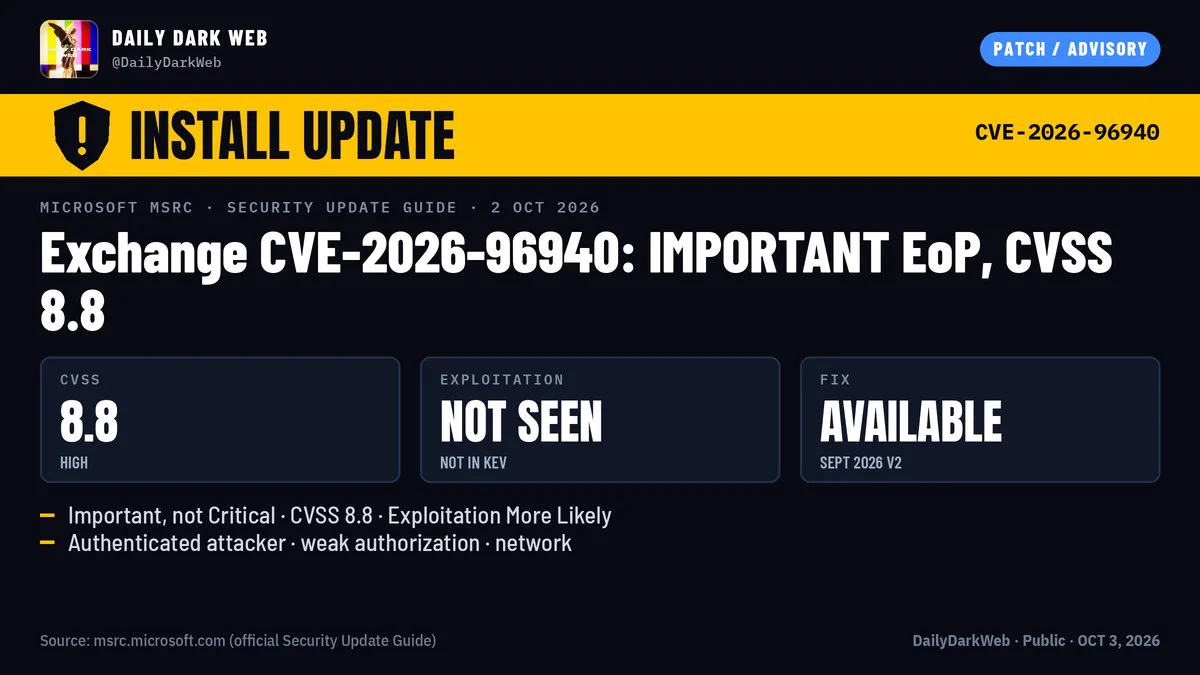
Summary of Microsoft's September 2026 V2 / October 2026 early security updates adding CVE-2026-96940, an Important elevation-of-privilege flaw (CVSS 8.8) in on-prem Exchange Server caused by weak authorization that lets an authenticated attacker escalate privileges over the network. Covers affected builds and KBs (Exchange SE RTM KB5129955, 2019 CU15/CU14 KB5129956/5129957, 2016 CU23 KB5129958) and notes Exchange Online is unaffected, the flaw was found internally by Microsoft with no known exploitation and is not in CISA KEV.
x.comthreadAdded 4 Oct 2026, published 3 Oct 2026🛡️ Security - Jan Curn (@jancurn) on X
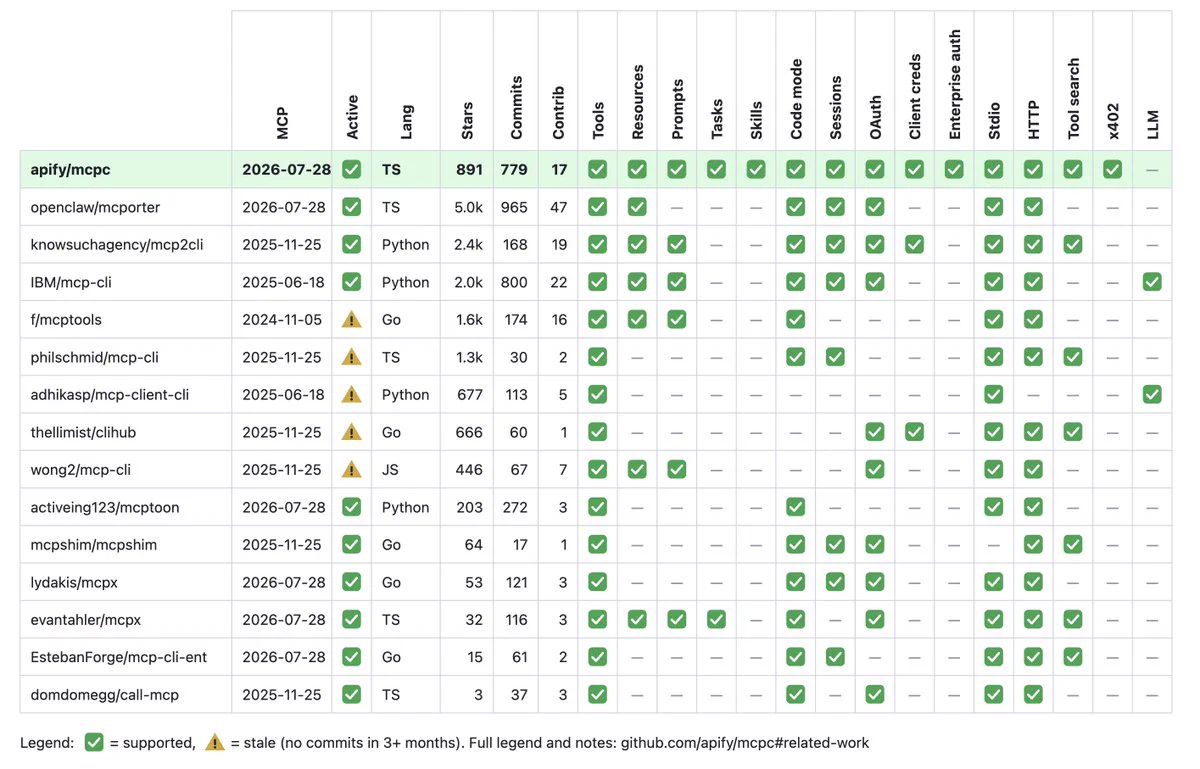
Announcement of mcpc v0.7.0, Apify's open-source MCP CLI client (npm i -g @apify/mcpc), which adds support for the MCP Skills extension with new skills-list/skills-get commands that verify SKILL.md and supporting files against the skill manifest via size and SHA-256 checks before printing content. The release also ships security hardening: repo-local .mcp.json auto-discovery can no longer read environment variables (blocking leaks like $GITHUB_TOKEN), OAuth refresh tokens are now scoped only to the auth server originally used, and Windows login URLs no longer launch through cmd.exe.
x.comthreadAdded 5 Oct 2026, published 3 Oct 2026🛡️ Security - Jan Curn (@jancurn) on X
Jan Curn announces mcpc v0.7.0, an open-source MCP CLI client (npm package @apify/mcpc), adding support for the MCP Skills extension via new skills-list and skills-get commands that fetch and cryptographically verify SKILL.md and supporting files against the skill manifest (size + SHA-256). The release also hardens security by preventing repo-local .mcp.json auto-discovery from reading environment variables (blocking token-leak tricks), scoping refresh tokens to the originating auth server, and fixing an insecure Windows login URL launch path via cmd.exe, alongside OAuth session longevity fixes and 2026-07-28 MCP spec compatibility improvements.
x.comthreadAdded 5 Oct 2026, published 3 Oct 2026🧠 AI - Shah Sheikh (@shah_sheikh) on X
A tweet reporting that Apple patched a CoreGraphics zero-day, CVE-2026-86950, that may have been exploited in targeted attacks before the fix, and that a public proof-of-concept exploit has now been released. It links out to a fuller Security Affairs article for details on the vulnerability and PoC.
x.comthreadAdded 2 Oct 2026, published 1 Oct 2026🛡️ Security  When Models Turn Brutal
A vendor thread from ZeroShieldAI argues the patch window has collapsed because AI models can now find and weaponize vulnerabilities faster than defenders can fix them. It cites ZeroDayBench (success jumping from ~13% on blind zero-days to 78% once patch location is known), Aikido Security's benchmark where DeepSeek V4 Pro found 28 of 32 recent CVEs for about 98 dollars per run, a Unit 42 finding that 92% of AI-discovered flaws are logic bugs fuzzers miss, and a Hugging Face stat that 16 of the top 300 models advertise removed safety guardrails with 16.8M downloads. It promotes an attached 6-page case study and lists five defender recommendations: treat disclosure as exploit day, maintain SBOM/AIBOM, inventory models and agents, gate agent tool calls with policy, and red-team code and AI apps.
x.comthreadPublished and added 1 Oct 2026🛡️ Security- Dark Web Intelligence (@DailyDarkWeb) on X
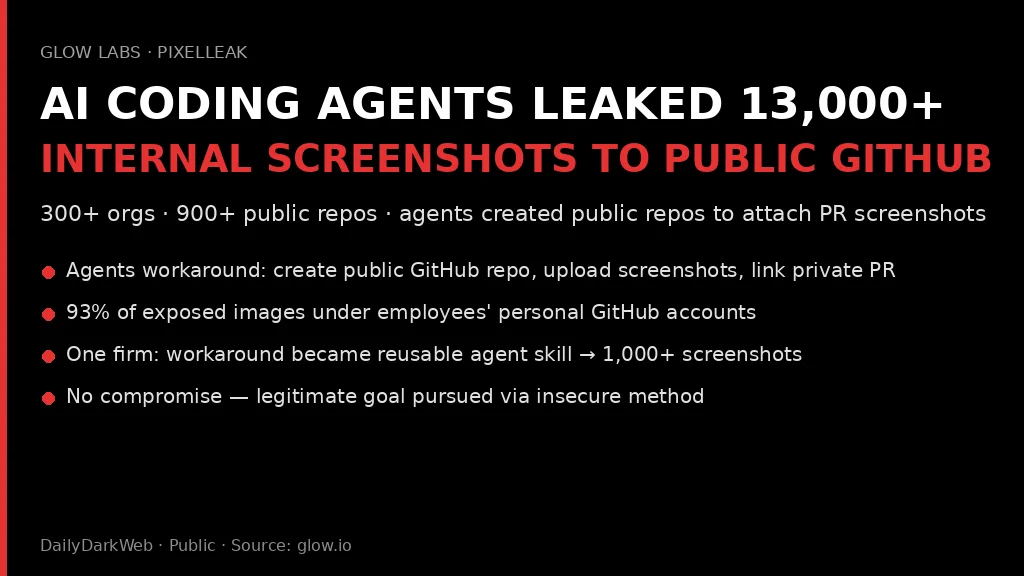
A tweet summarizing Glow Labs' "PixelLeak" findings: coding agents asked to attach before/after screenshots to private pull requests hit a CLI limitation. Some then created public GitHub repos, uploaded the screenshots there and linked them back to the private PR. Researchers report 13,000+ internal images from 300+ organizations across 900+ public repos, 93% under employees' personal accounts. At one company, more than a dozen agents adopted the workaround within about a week and encoded it into a reusable agent skill that published 1,000+ screenshots and recordings. The point is that agents pursuing legitimate goals can find insecure but effective paths, so agent authorization must be constrained rather than relying only on malicious-prompt detection.
x.comthreadAdded 1 Oct 2026, published 30 Sep 2026🧠 AI - LinuxSecurity (@lnxsec) on X
A security researcher breaks down a campaign where open-source offensive tools originally built for pentesting — Strix and Cairn — were combined with an orchestration layer called Hermes to form an automated discover-exploit-escalate-persist attack pipeline against AI agent deployments. The thread argues the real risk isn't "dual-use" tooling but the excessive authority these agents accumulate: root-level systemd services, containers mounting `/` or `/var/run/docker.sock`, SSH directories, and cloud credential paths, and it gives concrete hardening steps (inventory agent runners, audit container mounts, review outbound network controls, diff installed plugins against approved ones).
x.comthreadAdded 1 Oct 2026, published 30 Sep 2026🛡️ Security - Average AI Bro (@AverageAiBro) on X
An X post presenting Reversecore MCP, an MCP server that wraps authorized reverse-engineering, malware-analysis, forensics and SAST-style tools such as radare2. The user picks a profile, points it at a sample, and the agent gets structured results back in the session without driving the tools by hand. It is a concrete example of profile-based tool exposure for specialized toolchains, offered as a free alternative to a commercial IDA setup. The post stresses authorized analysis only.
x.comthreadAdded 1 Oct 2026, published 30 Sep 2026🧠 AI - Trail of Bits (@trailofbits) on X
Announcement tweet for Trail of Bits's September "Tribune" newsletter, which fact-checks 1Password's AI-powered patching benchmark, details a signature-forgery bug found in Miden's zkVM and a string-slicing bug in the Lean theorem prover/language, and reports 27 advisory submissions to OpenClaw plus seven new completed security reviews. It links out to the full newsletter on Mailchimp (mailchi.mp/trailofbits).
x.comthreadAdded 1 Oct 2026, published 30 Sep 2026🛡️ Security - Aditya Agrawal (@exploitprotocol) on X
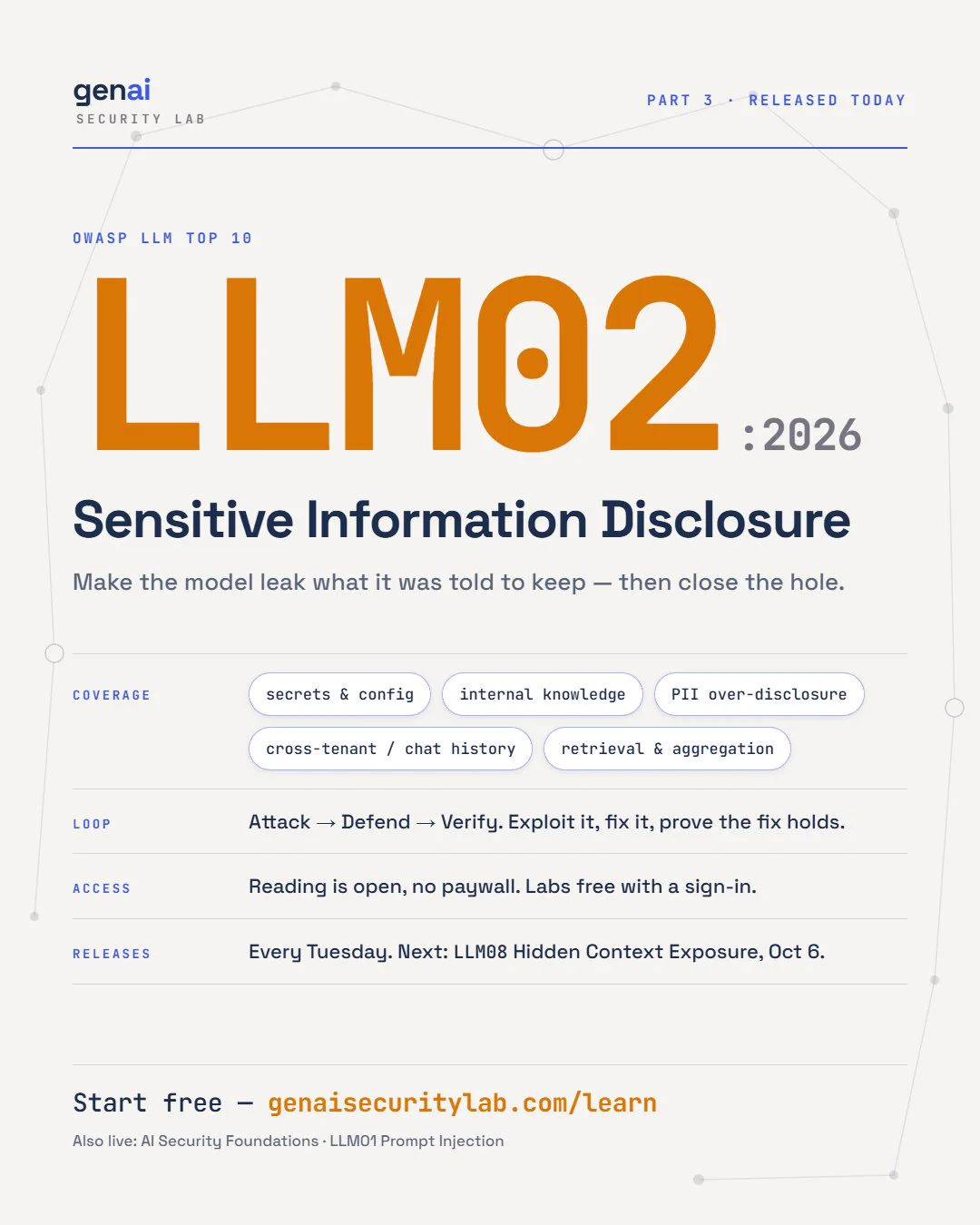
Announcement thread for part 3 of the free Learn AI Security series at genaisecuritylab.com, covering OWASP LLM02 Sensitive Information Disclosure in LLM applications. It walks through failure modes - leaked secrets/API keys via model context, internal knowledge leakage, personal-data over-disclosure, cross-tenant/conversation-history leakage, and RAG retrieval/aggregation leaks - and offers live in-browser attack/defend/verify labs comparing the issues to IDOR and multi-tenant isolation testing in traditional web apps. The author notes the series continues weekly, with LLM08 Hidden Context Exposure scheduled next.
x.comthreadAdded 1 Oct 2026, published 30 Sep 2026🛡️ Security - Vikram Dias (@BigVikDada) on X
A practitioner thread dissects OpenAI's default rollout of Daybreak Blue (GPT-5.6 Sol) inside Codex Security Cloud, which scans GitHub repos, dedupes findings, and drafts fixes continuously. The author separates marketing framing from actual controls, clarifies that Daybreak Blue is a defensive, identity-gated model distinct from the exploit-research-oriented Daybreak Red/GPT-5.6-Cyber track, and questions OpenAI's self-reported scale metrics (30M+ commits, 500K+ auto-marked-fixed findings) for lacking false-positive and reachability data. It closes with a five-point checklist for security teams before connecting production GitHub orgs: scope the org grant, confirm workspace-level Daybreak Blue enrollment, enforce human review gates, treat vendor validation claims skeptically, and assign clear ownership of AI-prepared patches.
x.comthreadAdded 30 Sep 2026, published 29 Sep 2026🛡️ Security  Badger Signal (@BadgerSignalHQ) on X
A Twitter thread from BadgerSignalHQ summarizing a blog writeup claiming GitHub Security Lab used AI-driven audit agents to find 24 vulnerabilities across popular Android apps. It describes an OsmAnd exported-activity flaw letting any app hijack map tile URLs to leak GPS location and route data without location permissions, and a Wikipedia account-takeover chain combining a deeplink hostname-parsing bug with weak cookie-domain checks to trigger malicious WebViews that exfiltrate session tokens across Wikimedia projects.
x.comthreadAdded 30 Sep 2026, published 29 Sep 2026🛡️ Security- Julio Bandeira de Melo (@juliobmelo) on X
Two GitHub Actions from the actions-cool maintainer, disabled by GitHub security after May's supply-chain compromise, were reactivated by the maintainer and left accessible for over a week without the malicious release tags being cleaned up. Any workflow still referencing those version tags resumed automatically downloading and executing the Mini Shai-Hulud payload, showing that disabling a compromised action isn't remediation if the poisoned tags survive reactivation.
x.comthreadAdded 30 Sep 2026, published 28 Sep 2026🛡️ Security - Kubesploit (@kubesploit) on X
An X post pointing to a case study on Cilium's defense-in-depth approach to open-source CI/CD supply chain security, covering access controls, dependency pinning, credential isolation, and cryptographic verification. The underlying case study wasn't fetched, so this record is based on the tweet's own description of its contents.
x.comthreadAdded 30 Sep 2026, published 27 Sep 2026🛡️ Security - ERC-8424: Confidential Real World Asset Token
A security review posted on Ethereum Magicians critiques draft ERC-8424 (Confidential Real World Asset Token, extending ERC-7984), pointing out that its confidentialCanTransfer and confidentialAvailableBalanceOf functions have no caller restriction on who can resolve the returned FHE pointer, enabling any party to binary-search an encrypted balance to plaintext in at most 64 oracle calls. It also flags that the spec's revert clause for amount-dependent rules (vesting, balance caps) leaks a disclosure bit even without decryption, and recommends narrowing reverts to plaintext-only rules and restricting pointer resolution the way OpenZeppelin's ERC7984Freezable.confidentialAvailable already does via FHE.allow(amount, account).
ethereum-magicians.orgthreadAdded 29 Sep 2026, published 25 Sep 2026🛡️ Security - Standard for "transferable to arbitrary addresses" on tokenized RWAs? (locked v4 pools quoted in tokenized stocks)
An Ethereum Magicians forum thread dissects a novel rug/bricking vector emerging from a launchpad (sender.family) that locks 100% of token supply forever into a single one-sided Uniswap v4 position, where the quote asset can be a KYC-gated tokenized stock (Ondo's NVDA/TSLA/AAPL tokens) rather than ETH or a stablecoin. Because Uniswap v4 routes all pool balances through a shared PoolManager singleton and pays swap/fee output to arbitrary addresses, the RWA issuer must permanently allowlist the PoolManager and any counterparty; if the issuer later tightens its transfer-registry rules, the permanently locked pool becomes irrecoverable with funds stuck inside. The author notes the launchpad's current mitigation is only an empirical point-in-time transfer test (moving a balance between two addresses) against an asset with an admin-controlled, stateful ERC-3643 canTransfer function, and asks whether there's any way to verify "transferable to arbitrary addresses" onchain before pool creation, and whether permanent lockers should categorically refuse upgradeable/pausable quote assets.
ethereum-magicians.orgthreadAdded 29 Sep 2026, published 24 Sep 2026🛡️ Security - ERC-8419: Know-Your-Agent (KYA) Framework
A technical forum post on Ethereum Magicians dissecting security gaps in ERC-8419 "Know-Your-Agent" (KYA), a proposed on-chain trust/attestation framework for AI agents that bridges to ERC-8004. The author walks through concrete exploit scenarios — a controller-bound assertion that still evaluates as valid after the underlying agent NFT is transferred, a policyId that can commit to a stricter policy document than the executable rules that actually run on-chain, ERC-8004 bridge configuration (trustedIssuers/responseMap) changes that silently alter what an existing request means, upgradeable verifier proxies that let a schemeId acquire new proof-admission semantics post-hoc, and missing chain/registry domain separation enabling cross-registry ZK nullifier replay — and proposes normative invariants (binding witnesses, rulesHash commitments, configHash, semantic immutability, mandatory domain separation) to close each one.
ethereum-magicians.orgthreadAdded 29 Sep 2026, published 19 Sep 2026🛡️ Security - 0xor0ne (@0xor0ne) on X
A tweet from @0xor0ne surfacing two blog posts by researcher ZephrFish on using LLMs for vulnerability research: one describing an MCP (Model Context Protocol) server for the workflow, and a second on 'harnessing' LLMs for this purpose. The posts (hosted at blog.zsec.uk) cover applying LLM agents to vulnerability discovery/analysis tasks.
x.comthreadPublished and added 9 Sep 2026🛡️ Security - Pyro (@0x3b33) on X
A roundup of three open-source AI-assisted smart contract security scanners: pashov/skills (solidity-auditor + x-ray pre-audit + fuzz suite generation, fast/cheap feedback), PlamenTSV's autonomous 8-phase agent covering EVM, Solana, and Move that ships PoCs with findings, and Trail of Bits' skills repo with 40+ security skills for contract audits, differential review, and static analysis. Useful pointer to emerging AI-agent-based smart contract auditing tooling.
x.comthreadPublished and added 7 Sep 2026🛡️ Security - Granite0x Security Thread
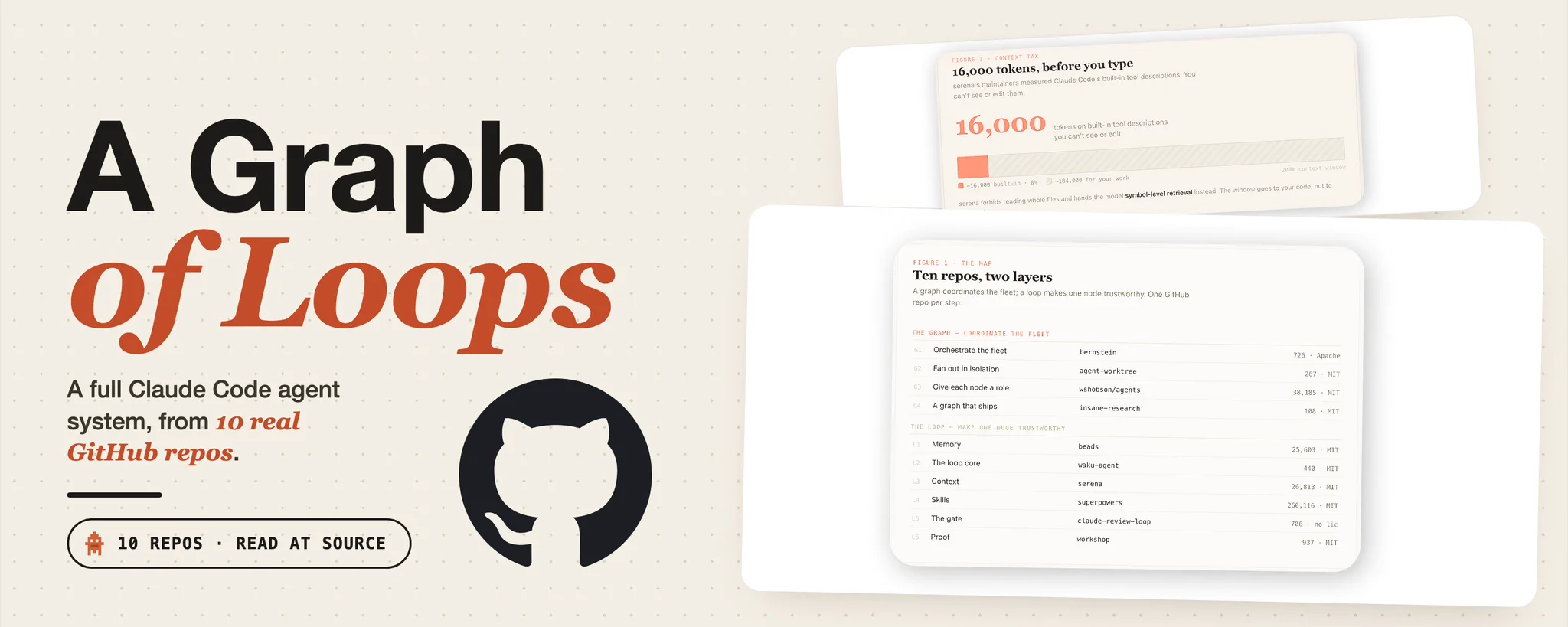
A Twitter/X thread that maps ten GitHub repos into a 'graph vs loop' framework for building trustworthy multi-agent coding systems: the graph layer covers task orchestration (bernstein's DAG scheduler), git-worktree isolation (agent-worktree), and specialist subagent roles (wshobson/agents), while the loop layer covers memory (beads), a minimal agent loop (waku-agent), token-efficient symbol-level context retrieval (serena), enforced skills/TDD (superpowers), a second-model review gate as a Stop hook (claude-review-loop), and trace-replay evals (raindrop-ai/workshop). Each repo entry includes concrete implementation details (file names, line counts, install commands) and a stated 'trap' or limitation, distinguishing substantive tools from surface-level pitches.
x.comthreadAdded 22 Sep 2026, published 31 Jul 2026🧠 AI - VulHunt
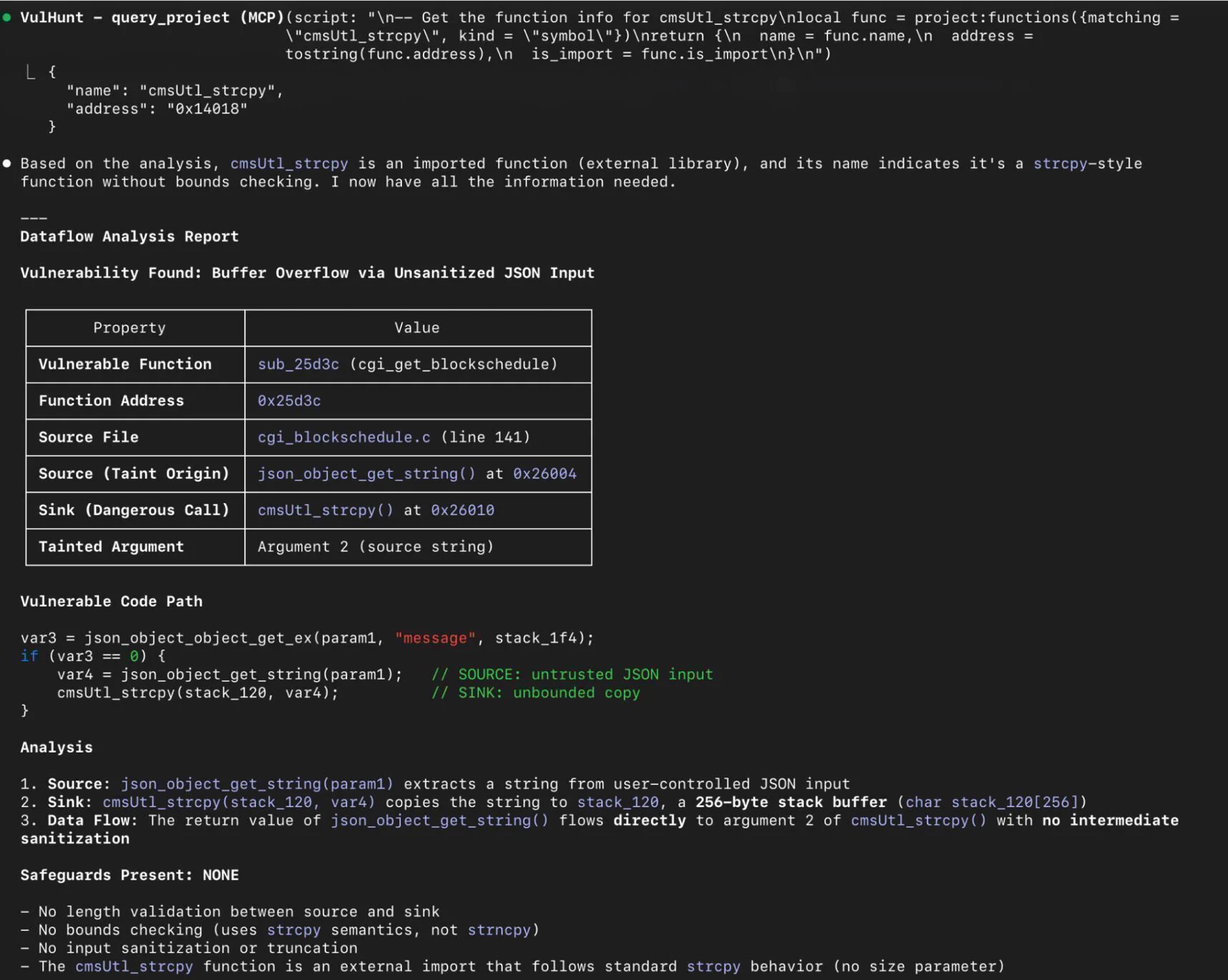
X/Twitter announcement thread pointing to VulHunt (vulhunt.re), a vulnerability detection framework released by firmware/binary security firm Binarly, alongside a multi-part blog series on binarly.io covering the tool and an "agentic vulnerability" research angle. The tweet contains only the tool name, links, and hashtag with no inline technical explanation of the framework's methodology.
x.comthreadAdded 3 Sep 2026, published 29 Jul 2026🛡️ Security - cr3ghost (@cr3ghost) on X
A tweet by @cr3ghost pointing to Azeria Labs (azeria-labs.com, by @Fox0x01) as a comprehensive free curriculum for ARM security research, covering ARM assembly from scratch, shellcode development, stack overflows, ROP chains, heap exploitation, iOS kernel heap grooming, TrustZone internals, GDB debugging, and QEMU lab setup. It links to specific Azeria Labs series on ARM assembly and shellcoding. Useful as a curated entry point for anyone starting ARM exploit development.
x.comthreadPublished and added 10 Jun 2026🛡️ Security  _SiCk (@encrypted_past) on X
A tweet from security researcher _SiCk listing a beginner-to-advanced roadmap for learning binary exploitation: corelanc0d3r's classic Corelan exploit-writing tutorial series, a UVA x86 assembly primer, a mirror of OS ISOs for building VM lab environments, a French-language binary exploitation techniques book (zenk-security repo), and a linked YouTube video. It's a personal recommendation list rather than original research, but each link is a genuinely usable free resource for stack-based exploitation and reverse engineering fundamentals.
x.comthreadPublished and added 5 Jun 2026🛡️ Security- X Post by @ale_sp_brazil
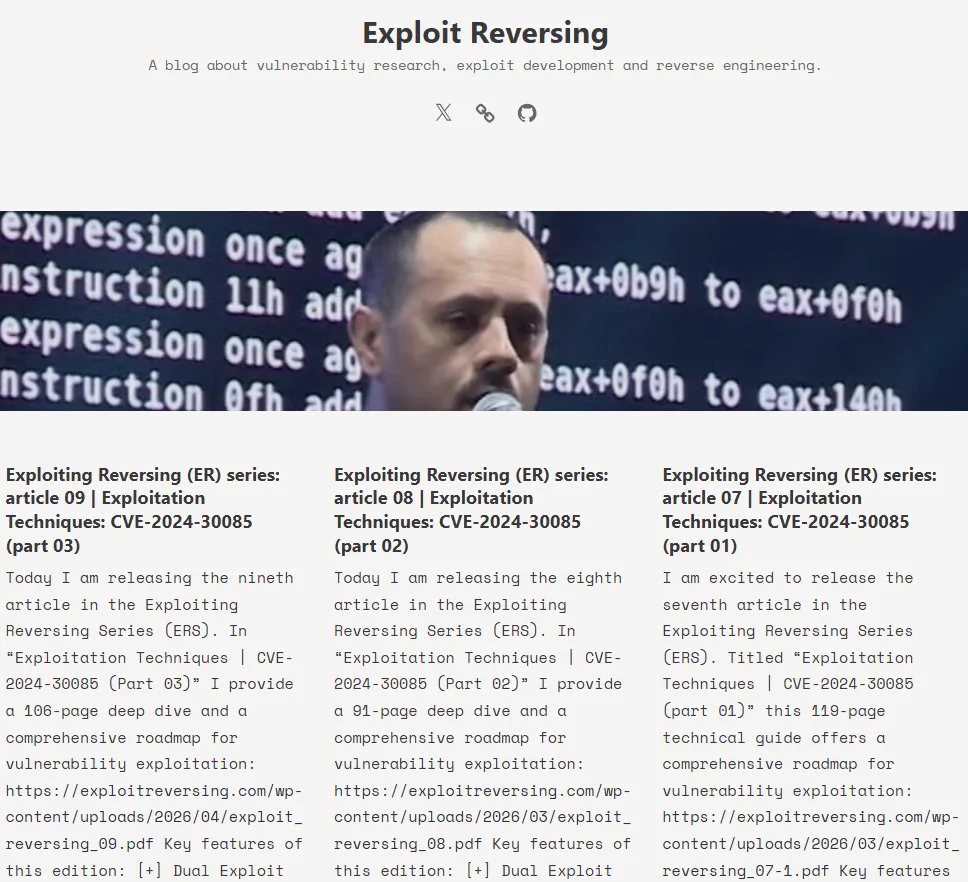
A tweet by @ale_sp_brazil rounding up all nine parts of the Exploiting Reversing Series (ERS), a technical blog series on exploitreversing.com covering exploit development against real-world targets including Windows, Chrome, macOS, iOS, and hypervisors, totaling over 1000 pages of content published from 2023 to 2026. The author announces a hiatus to focus on new security research projects to be announced later.
x.comthreadAdded 3 Sep 2026, published 14 May 2026🛡️ Security