 Introducing MavenGate: a supply chain attack method for Java and Android applications | Oversecured Blog
MavenGate is Oversecured's research on hijacking Maven dependencies by buying expired domains behind groupIds on Maven Central and JitPack. It found 6,170 of 33,938 checked domains (18.18%) vulnerable, and tested the attack with its own com.oversecured:hello-world library. It lists defenses (Gradle verification-metadata.xml, PGP signatures) and proposes changes to repository signing.
 oversecured.comwriteupAdded 29 Oct 2026🛡️ Security
 Gheist: Attempted Scaled Abuse of Stolen GitHub Tokens Stumbles
Gheist is a campaign tracked by Wiz Research since 15 September 2026 that uses stolen GitHub tokens to push a sync-check workflow on ci-sync-* branches in every reachable repository. The workflow prints base32-encoded secrets into logs, which the tool downloads through the GitHub API and then deletes. Over 13,500 branches from 850+ accounts were recovered. The post covers the two tool variants, a buggy self-hosted runner payload, GitHub's approval hold (which does not cover private repositories), overlaps with other campaigns, hunting queries, IOCs and hardening steps.
 wiz.iowriteupPublished and added 25 Oct 2026🛡️ Security
 New Evidence Shows LiteLLM Secret-Stealing Workflows Ran 11 Days Before Supply Chain Attack
Socket's Threat Research team reports that malicious cache.yml workflows ran in the BerriAI/litellm repository on 10 and 12 October 2026, eleven days before the 21 October release attack that published litellm==1.107.0. Each commit pushed to a short-lived ci-tmp-<hex> branch, then deleted it, sending base64-encoded CI secrets to webhook.site. Evidence comes from Actions metrics and environment deployment records; 20 secret names were exposed.
 socket.devwriteupPublished and added 23 Oct 2026🛡️ Security
 LiteLLM Compromised, Steals Credentials
LiteLLM version 1.107.0 was uploaded to PyPI on 21 October 2026 with a credential stealer, and the same build reached GHCR and Docker Hub images. Wiz describes the three dropped files (cook.pth, cook.py, sitecustomize.py), exfiltration to a fake litellm.dev domain, a GitHub dead drop for a second stage, and the malicious commits pushed through the lookalike Berri-AI repository. The last safe version is 1.106.2.
wiz.iowriteupPublished and added 21 Oct 2026🛡️ Security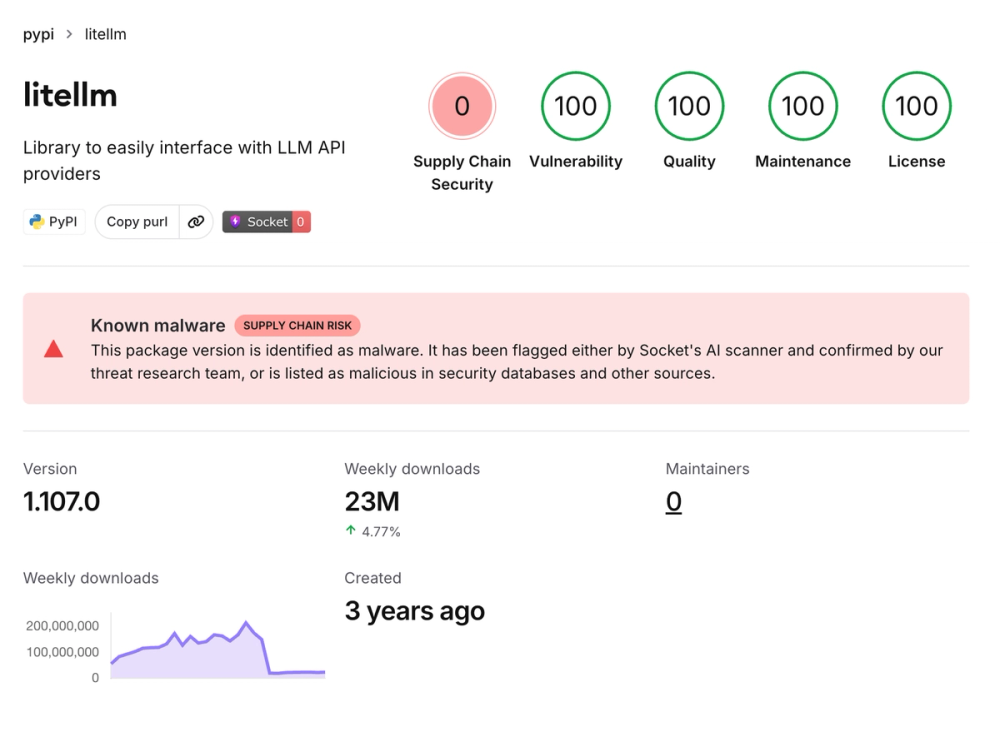 LiteLLM PyPI Package and Docker Images Compromised to Steal Cloud and AI Credentials
LiteLLM 1.107.0 on PyPI and GHCR images shipped Python startup hooks (cook.pth, sitecustomize.py) that steal cloud, SSH, browser and AI-tool credentials, including LiteLLM proxy database credentials. Image build provenance recorded a lookalike Berri-AI/litellm source repository. The post decodes the payload, encrypted exfiltration and GitHub-driven remote loader, and lists containment steps, MITRE ATT&CK mappings and IOCs.
socket.devwriteupPublished and added 21 Oct 2026🛡️ Security Cutting our inference bill by 68% by being obsessive about optimization
Cloudflare describes how it cut the average cost of its AI code reviewer from $2.43 to $0.77 per review (68%) and median time from 4m 9s to 1m 32s, between September and October 2026. About 40% of savings came from code changes, mainly sharing a cached prompt prefix across repositories and reviewers, and the rest from model and effort choices (Opus 5.5, Sonnet 5.5). Quality was checked through author action rates and blinded model judging.
 blog.cloudflare.comwriteupAdded 29 Oct 2026, published 19 Oct 2026🧠 AI
 GhostAction Copycats PolinRider by Hiding a Stealer in a Fake Font File
Analysis of a new GhostAction Stage 2 found in 94 compromised GitHub repos: a hidden .vscode/tasks.json (runOn folderOpen) executes a plain-JavaScript infostealer disguised as public/fonts/fa-solid-400.woff2. The stealer grabs cloud, registry, SSH, Claude/Gemini credentials, POSTs them to a hardcoded IP on port 8080, and installs a 5-minute cron job (#ghc2) that pipes the server's script to bash. It copies PolinRider's launcher but shares no IOCs with it, and the post gives a timeline, one repo hit by both campaigns, IOCs, and cleanup steps (revoke tokens, remove cron, set task.allowAutomaticTasks off).
 opensourcemalware.comwriteupAdded 15 Oct 2026, published 16 Oct 2026🛡️ Security
 Package managers have an integrity problem
Trail of Bits tested 25 popular package managers with a Docker and mitmproxy harness that simulates a compromised package repository injecting malware into legitimate packages. Fewer than half enforce lockfile hashes by default, only two verified every download, and only Go verifies signatures by default. The post covers lockfile hash pitfalls (Pub, pnpm, Conan, CocoaPods, Composer), repository, developer and Sigstore signing, and Go's checksum database. It also proposes lockfiles that commit to a signing identity plus a transparency log.
 blog.trailofbits.comwriteupPublished and added 14 Oct 2026🛡️ Security
 GhostAction Attack Escalates By Targeting GitHub Users
OpenSourceMalware's analysis of the latest GhostAction wave, where compromised GitHub accounts get malicious Actions workflows (security-audit.yml) injected across every writable repository, including an Oct 8 sweep of 346 repos via kitao and henrywoo. The new payload greps the checkout and full git history for credential patterns (AWS, Anthropic, OpenAI, GitHub PATs) and POSTs them over HTTP to 193.32.204.199/?c=monami. It also covers infrastructure reuse (phishing-heavy legacy IP, scanner activity), new watchlist domains my-github.com and my-gitlab.com, GitHub code-search hunting queries, a detection-confidence table, IOCs and incident response steps.
opensourcemalware.comwriteupAdded 10 Oct 2026, published 9 Oct 2026🛡️ Security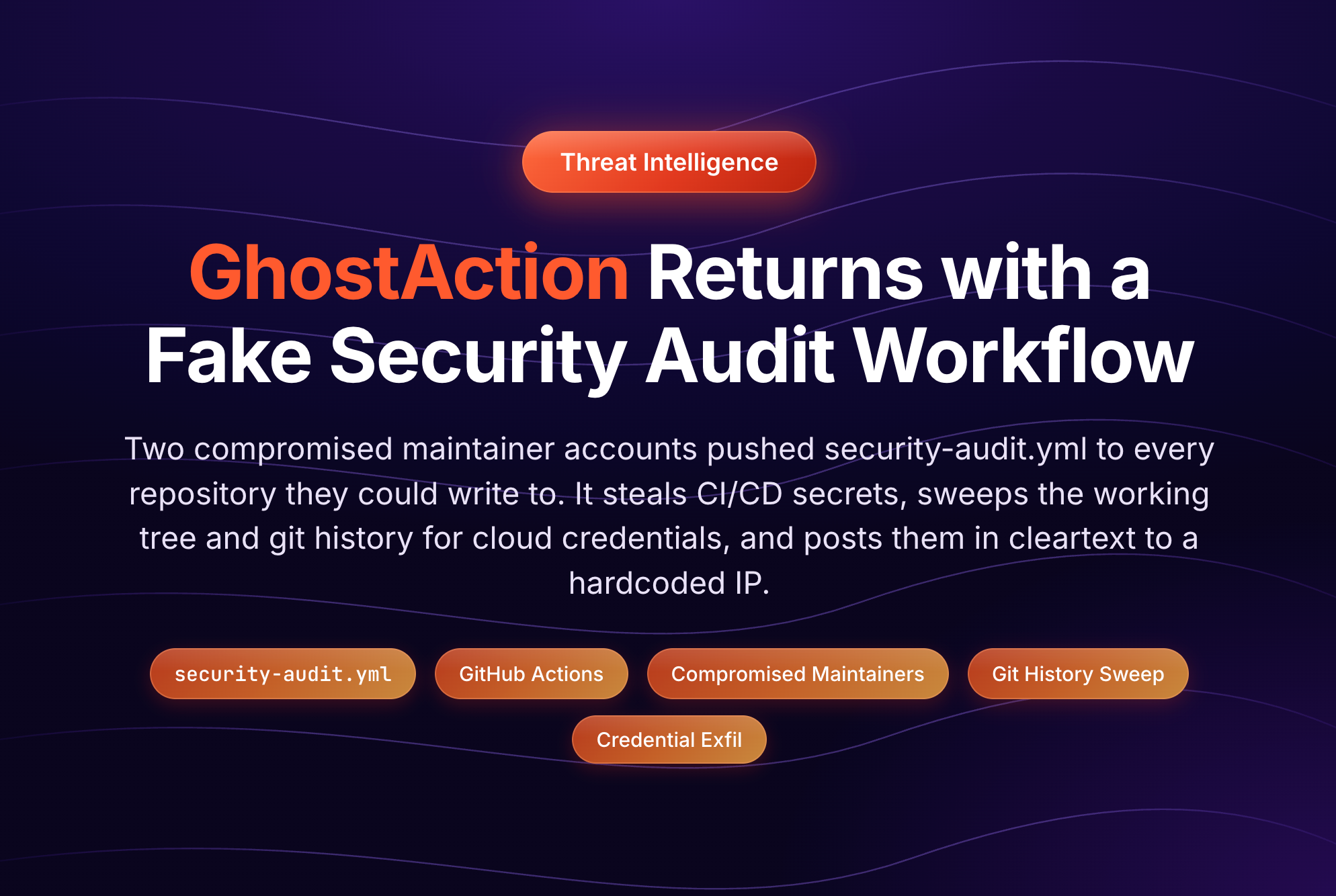 GhostAction Returns: Malicious “Security Audit” Workflows Now Mine Credentials from Entire Git Histories
StepSecurity details a new wave of the GhostAction campaign in which attackers used compromised maintainer accounts of Takashi Kitao (pyxel) and Henry Wu (athenadriver, Uber) to push malicious "Security Audit" GitHub Actions workflows to 345 repositories in minutes. The upgraded payload now runs `git log -p --all` to mine an entire git history (not just current secrets) for thirteen credential patterns including AWS, Anthropic, OpenAI, OpenRouter, GitHub, GitLab, Google, Slack, and SendGrid keys, pairs AWS access key IDs with secret keys via context capture, and exfiltrates everything via raw-IP plain-HTTP POST to 193.32.204.199, bypassing DNS-based defenses. The post includes hunting queries, run-log forensics confirming successful exfiltration from uber/athenadriver, and remediation guidance centered on workflow approval gates and egress allowlisting.
 stepsecurity.iowriteupPublished and added 9 Oct 2026🛡️ Security
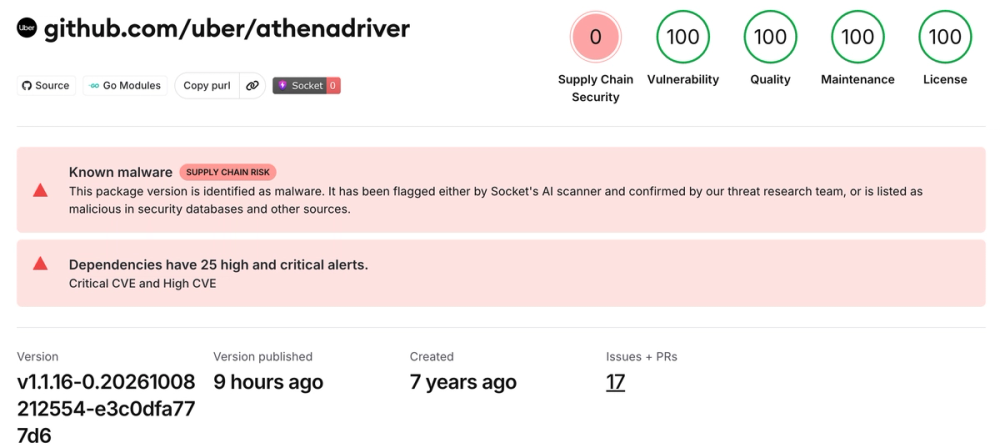 New GhostAction Wave Hits Hundreds of Repos, Expanding Beyond CI/CD Secrets to Cloud Credentials
Socket documents an October 8, 2026 wave of the GhostAction campaign in which two compromised GitHub maintainer accounts (henrywoo and kitao) pushed a malicious security-audit.yml workflow to 346 repositories, including uber/athenadriver and the 18,420-star kitao/pyxel. Beyond the original GhostAction technique of harvesting named GitHub Actions secrets, this variant adds a full git-history grep (via fetch-depth: 0 and git log -p --all) for 13 credential patterns covering AWS keys, Anthropic/OpenAI/OpenRouter API keys, GitHub/GitLab PATs, Google/Firebase keys and SendGrid keys, plus a context-window capture around AWS key IDs to reconstruct usable key pairs, all exfiltrated in cleartext to a single hardcoded IP.
socket.devwriteupPublished and added 9 Oct 2026🛡️ Security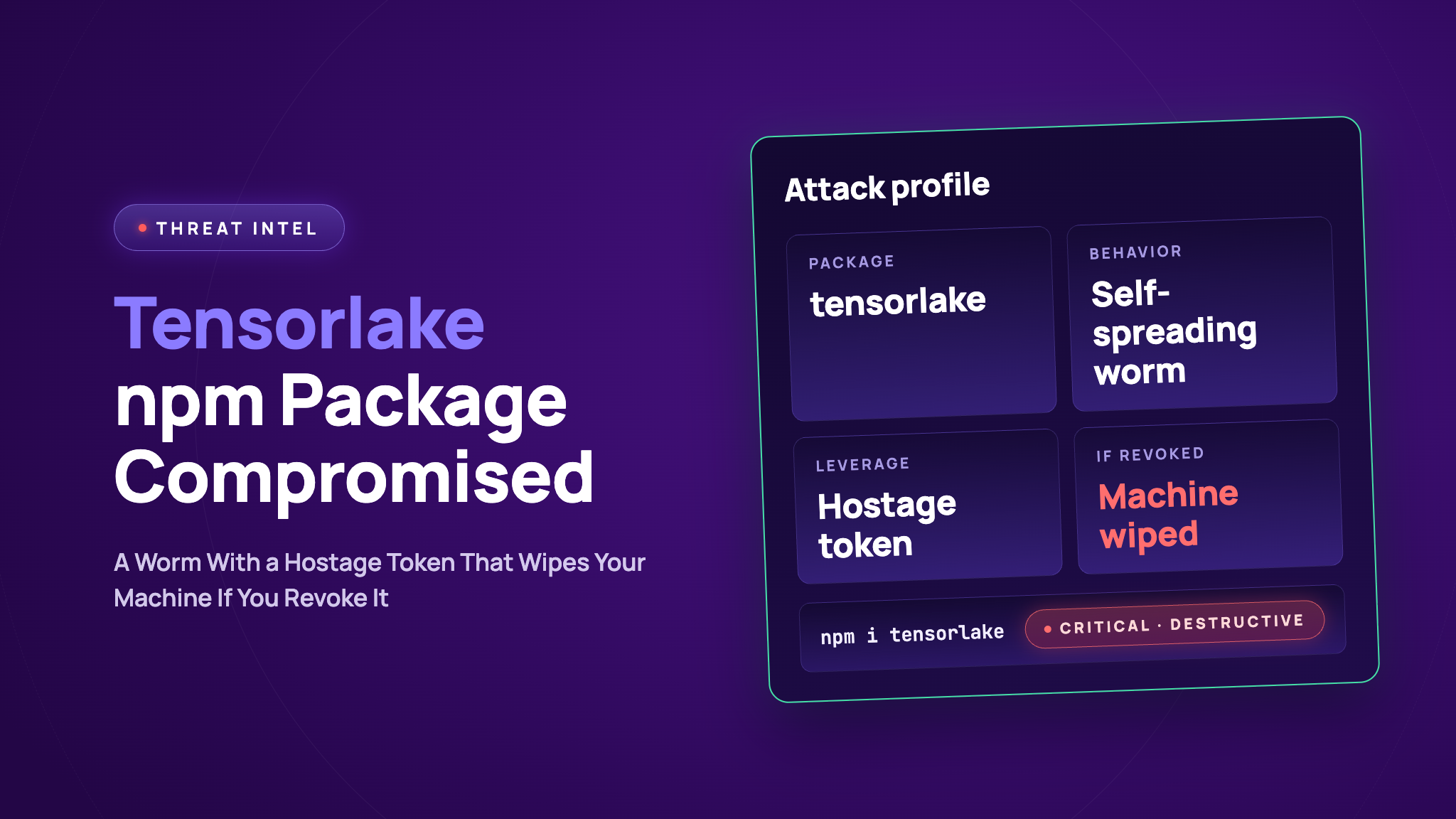 Tensorlake npm Package Compromised: A Worm With a Hostage Token That Wipes Your Machine If You Revoke It
StepSecurity details how tensorlake@0.5.144 was pushed to npm after malicious commits landed directly on the tensorlakeai/tensorlake GitHub repo's main branch under a maintainer's identity, carrying a valid npm provenance attestation despite being malicious. The preinstall hook downloads Bun to run an obfuscated payload that steals GitHub/npm tokens, cloud and Vault/Kubernetes secrets, SSH keys, browser logins, and AI-tool configs (Claude, Cursor, Windsurf), then self-propagates by republishing stolen npm packages and committing persistence files (.claude/settings.json, .vscode/tasks.json) to reachable repos. A "hostage token" mechanism installs a gh-token-monitor service that runs a home-directory wipe if the stolen GitHub token is revoked before the monitor is removed, inverting the normal incident-response order.
stepsecurity.iowriteupPublished and added 8 Oct 2026🛡️ Security How to Investigate a GitHub Repo's Real History
Step-by-step guide to reconstructing the real history of a tampered GitHub repo using data the attacker can't forge: raw commit objects (git cat-file), GitHub's repository activity API and audit log, before/after SHA ancestry checks, and npm publish timestamps. Worked through a PolinRider case (nestjsx/nest-access-control) where a forged commit was force-pushed to master plus 22 branches in 38 seconds, with a malicious .vscode/tasks.json runOn folderOpen trigger. It also covers safe handling of untrusted clones and how to tell victim accounts from attacker accounts.
opensourcemalware.comwriteupPublished and added 6 Oct 2026🛡️ Security Six defects in one signature verification tool, found from outside in six rounds
A forum writeup on ethresear.ch describing a "predictions-first" testing methodology for verification logic, applied against the author's own repository and against a live third-party MCP server (nsgoods Workbench, which offers offline signature verification over the x402 payment catalogue). Six rounds of testing surfaced concrete defects: a false negative caused by a stripped field list, a tamper-accepted body via a service-selection parameter that let callers choose which fields were excluded from the signed message, schema-rejection and signature-failure returning byte-identical error text, and a logging/privacy gap in the operator's system that was fixed after disclosure. The author ships a companion tool, exactzk-verification-guards, which captures both a passing and an actually-reproduced failing run as regression evidence rather than a fabricated example.
 ethresear.chwriteupPublished and added 2 Oct 2026🛡️ Security
 Beyond source code: A path to the keys to the kingdom
Microsoft's DART team details an investigation into Storm-3068, a threat actor that escalated from a self-service password reset account takeover into full control of an organization's Azure DevOps environment, then weaponized a malicious pipeline to harvest kubeconfig files and gain access to Kubernetes clusters. The actor also deployed the Atera remote management agent and the Chisel tunneling tool to establish reverse tunnels and alternate remote access, and exfiltrated seven stolen kubeconfig files into a repository. The report lays out the attack chain, DART's response, and hardening recommendations around SSPR monitoring, phishing-resistant MFA, branch protection, and pipeline permission controls.
 microsoft.comwriteupAdded 7 Oct 2026, published 29 Sep 2026🛡️ Security
 The Blue Agent POV: Investigating Multi-Platform Data Exfiltration Across AWS and GitHub
Wiz walks through a case study of its "Blue Agent" autonomous SOC investigator tracing a compromised CI/CD service account (svc_automation) across AWS and GitHub. The attack chain: a stolen GitHub token cloned 18 private repos containing hardcoded AWS keys, which were used to authenticate to AWS from Kali Linux via a Zenlayer VPN IP, pivot to a second account, run SSM SendCommand against a production Windows domain controller, and stage custom Python exfiltration scripts (mssql_table_export.py, pg_table_export.py, billing_export2.py) in S3 to pull data from MSSQL, PostgreSQL, and billing systems. The piece details the investigative technique used - 30-day baseline comparison, ASO/IP dispersion across the tenant, and correlating CloudTrail management-plane events with S3 data-plane events and GitHub audit logs.
wiz.iowriteupPublished and added 29 Sep 2026🛡️ Security PolinRider is A/B Testing its Way Past Your Detections
Opensourcemalware.com traces PolinRider, a DPRK-linked supply-chain malware delivered via a poisoned .vscode/tasks.json that autoruns an obfuscated payload disguised as a Font Awesome .woff2 file, through an 8-month infection of three real GitHub repos (Binary-Mindz org). Using GitHub's server-side activity log they reconstruct 853 force-pushes showing the operators A/B-testing multiple concurrent payload variants (400/500/900), rewriting commits to impersonate legitimate cleanup commits, hiding payloads inside eslint.config.mjs and prisma.config.ts, and using an Ethereum-wallet-based C2 dead-drop (NullReceiver). The post lists why common detection heuristics (filename search, whitespace padding, marker strings) fail against the new variants and gives working detections (file-type checks, folderOpen task grepping, activity-log force-push monitoring) plus full IOCs.
opensourcemalware.comwriteupPublished and added 26 Sep 2026🛡️ Security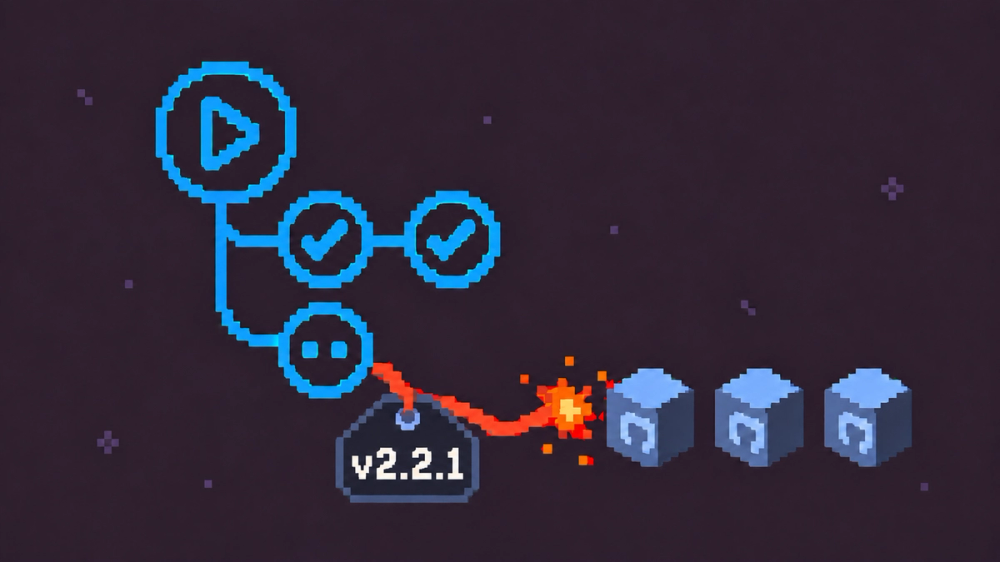 Re-Enabled GitHub Actions Expose Thousands of Repositories to Mini Shai-Hulud
Socket reports that the actions-cool/issues-helper and actions-cool/maintain-one-comment GitHub Actions, compromised in the May 2026 Mini Shai-Hulud campaign and disabled by GitHub, were re-enabled on September 16, 2026 with their release tags still pointing to the malicious code. Any workflow referencing them by tag (about 15,000 dependents for issues-helper alone) resumed running the Bun-executed obfuscated payload. Workflow run logs show the switch from fast "Repository access blocked" failures to multi-minute successful runs. The post gives remediation: SHA-pin actions, rotate secrets, and hunt for oven-sh/setup-bun and bun run index.js in runner logs. An update says both repos were disabled again on September 25.
socket.devwriteupPublished and added 24 Sep 2026🛡️ Security Top 10 attacks on Claude Code and what each one actually broke
Adversa AI catalogs ten distinct Claude Code attacks documented between September 2025 and September 2026: the Miasma supply-chain worm that hit 73 Microsoft repos via a SessionStart hook, TrustFall's unsandboxed MCP server execution on folder-trust, Check Point's CVE-2025-59536/CVE-2026-21852 pre-trust-dialog code execution and API key theft, Sentry-DSN-based "Agentjacking" prompt injection via fake bug reports, a 50-subcommand cap that silently disables deny rules, the SymJack symlink-to-config-hijack primitive working across six agent CLIs, Wiz's GhostApproval deceptive-approval-prompt finding (with CVE-2026-12958 at AWS and CVE-2026-50549 at Cursor but none at Anthropic), the Plugin4Shell SHA/branch-name collision bypassing plugin pinning, an academic MCP tool-poisoning paper achieving RCE on agent/LLM pairs, and SkillCloak's self-extracting-packer bypass of skill scanners. The piece argues almost none of these are model-behavior bugs - they are trust-boundary and consent failures in the surrounding tooling - and closes by pitching Adversa's own runtime agent security gateway as the fix.
 adversa.aiwriteupAdded 7 Oct 2026, published 23 Sep 2026🛡️ Security
 Reaching an Internal OpenAI Repository Through an HEIF RCE and Overprivileged SSO Token Chain
test
 dev.towriteupAdded 26 Sep 2026, published 19 Sep 2026🛡️ Security
 Shai-Hulud 2 Malware Campaign Targets GitHub and Cloud Credentials Using Bun Runtime | Blog | Endor Labs
Endor Labs' live incident tracker for the Shai-Hulud 2.0 npm supply-chain worm that began around Nov 24, 2025, compromising packages from Zapier, ENS Domains, Postman and PostHog. It details the infection chain (malicious preinstall script, setup_bun.js dropper, obfuscated bun_environment.js payload), TruffleHog-style credential theft from AWS, GCP, Azure, GitHub and npm, self-replication via stolen npm and GitHub tokens, a self-hosted GitHub Actions runner backdoor abusing repository Discussions for command injection and C2, and destructive wiper behavior that shreds the user's home directory on Windows and Linux.
 endorlabs.comwriteupPublished and added 11 Sep 2026🛡️ Security
 Active exploitation of Cisco Secure Firewall Management Center vulnerabilities
Cisco Talos details active exploitation of CVE-2026-20079 (CVSS 10.0 unauthenticated auth bypass leading to root) and CVE-2026-20316 (low-privilege login via static credentials) in Cisco Secure Firewall Management Center. Three post-compromise clusters are tracked: UAT-12197 deploying a JSP web shell and JAR command executor to exfiltrate credentials; UAT-11823, overlapping with Sandworm, using a malicious Makeself license.tmp to drop a Netcat reverse shell and a Cyclops Blink variant; and UAT-11988, a Qilin ransomware affiliate who abused package_info.pl for LOTL recon, SOCKS5/reverse-SSH tunneling, and ultimately deployed Qilin ransomware. Talos provides Snort SIDs, hotfix guidance ahead of a comprehensive hardening release, and a GitHub IOC repository.
 blog.talosintelligence.comwriteupAdded 7 Oct 2026, published 9 Sep 2026🛡️ Security
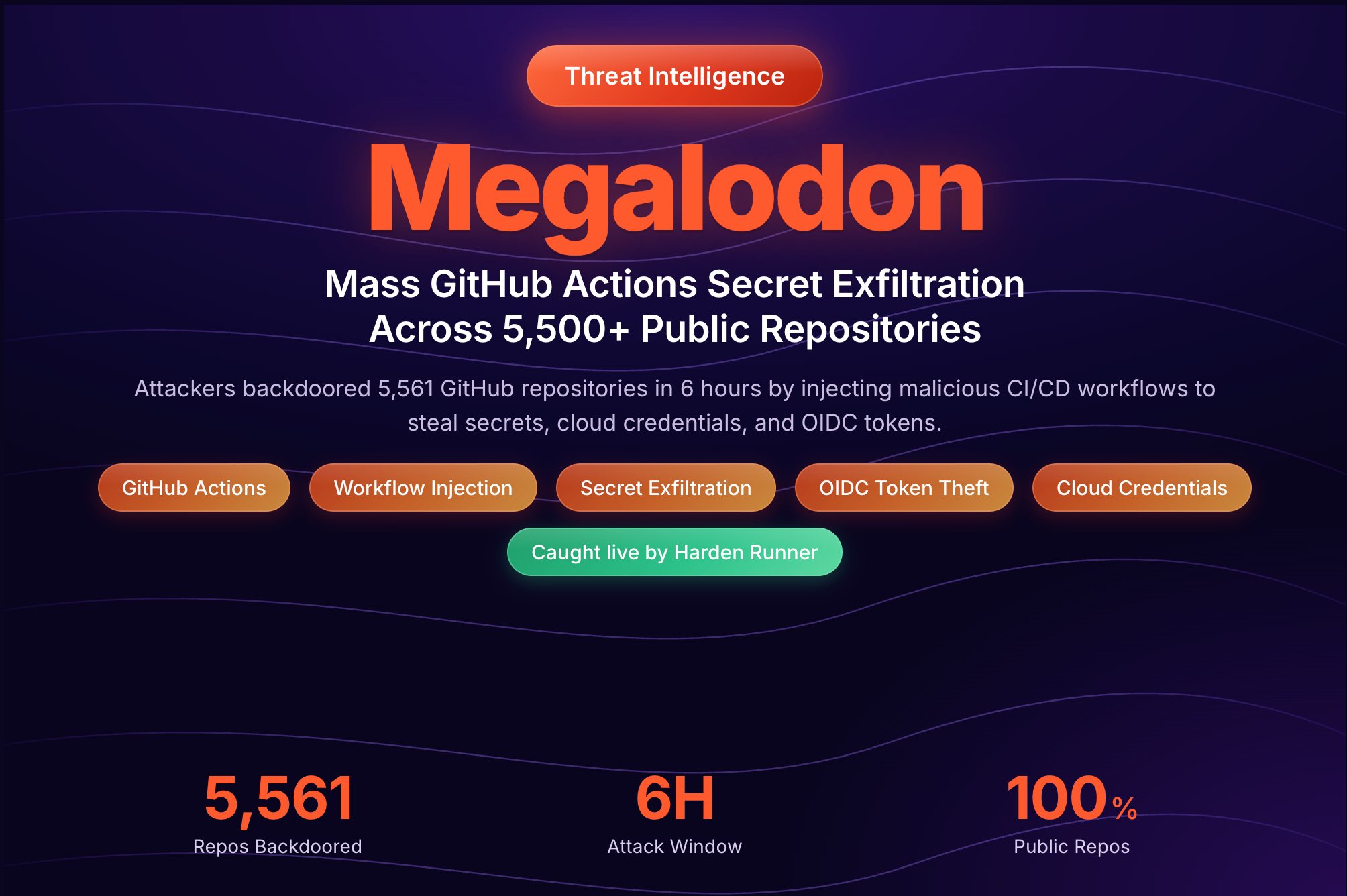 Megalodon: Mass GitHub Actions Secret Exfiltration Across 5,500+ Public Repositories - StepSecurity
StepSecurity documents Megalodon, a May 2026 campaign that injected backdoored GitHub Actions workflow files named SysDiag or Optimize-Build directly into 5,500+ public repositories in a six-hour window via direct Poisoned Pipeline Execution (d-PPE), exploiting weak branch protection. The base64-encoded bash payload harvests AWS/GCP/Azure credentials, SSH keys, Kubernetes/npm/Docker configs, GitHub OIDC tokens, and grep-matched secrets from the workspace, exfiltrating everything via HTTPS POST to a hardcoded C2 IP; the npm package @tiledesk/tiledesk-server was among the confirmed poisoned downstream targets.
stepsecurity.iowriteupAdded 5 Sep 2026🛡️ Security An AI-Assisted Cyber Attack: Inside a Unit 42 Investigation
Unit 42 details an incident response engagement in which a threat actor used frontier AI models and custom agentic AI frameworks to compress a multi-week intrusion into under 10 hours, executing over 50 MITRE ATT&CK techniques largely autonomously. The AI agents mapped internal microservices after breaching a public web service, harvested hard-coded secrets from code repositories, escalated to root via a secrets manager, hijacked CI/CD pipelines to exfiltrate cloud keys (attempting but failing to backdoor Terraform via branch protection), and ultimately hijacked the victim's own cloud AI endpoints as post-compromise infrastructure. The article maps techniques to MITRE ATT&CK and ATLAS, lists AI-usage indicators (structured Markdown handoffs between agent sessions, AI-generated scripts) and offers defensive recommendations like synchronized automated containment, treating AI endpoints/MCP gateways as governed infrastructure, and hunting for bursty API/auth behavioral loops.
 unit42.paloaltonetworks.comwriteupAdded 8 Sep 2026, published 2 Sep 2026🛡️ Security
 GitSpawn: A Single Flaw Lets Untrusted Repos Run Code in Claude Code, Codex, Cursor, and Grok - Manifold Security
Manifold Security discloses 'GitSpawn', a vulnerability class where AI coding agents (Claude Code, Goose, Hermes, Qwen Code, Grok Build, and reportedly Codex/Cursor) run git commands like `git status`/`git diff` for context-gathering at startup without sanitizing the repository's own .git/config. Because these commands refresh git's index, a malicious repo can set `core.fsmonitor` (or a similar config sink) to an arbitrary command, achieving code execution outside the agent's sandbox before any approval prompt, workspace-trust dialog, or even authentication - simply by opening a folder delivered as files (zip, USB, shared drive) rather than cloned. Two CVEs were assigned (Goose, Hermes); four of eight reported findings remain unpatched at publication.
 manifold.securitywriteupAdded 4 Sep 2026, published 1 Sep 2026🛡️ Security
 Deadbugz: Currently Active MCP Supply-Chain Campaign
Pillar Security disclosed "Deadbugz," an active campaign distributing a malicious MCP server called productivity-suite via 23 public GitHub pull requests to AI/MCP/dev-tool repos. The server appears benign (text formatting/summarization) but after three tool calls it flips its tools/list and prompts/get responses to instruct the connected AI agent to hunt for SSH keys, AWS credentials, shell history, and Kubernetes configs while concealing the activity — a "runtime-gated" tool-metadata rug pull designed to evade quick security review. The report attributes delivery to GitHub account zellkernel (linked to X account @llmgod), provides the malicious endpoint and local-path IOCs, and recommends clients treat any post-approval change to an already-approved server's tool definitions as a security event requiring re-approval.
 pillar.securitywriteupAdded 28 Aug 2026🛡️ Security
 NPM Isn't Prepared For North Korean PolinRider Attack
OpenSourceMalware's case study on npm packages fetch-page-assets and html-to-gutenberg, maintained by a legitimate developer (DiogoAngelim) whose GitHub account was compromised by the DPRK-linked PolinRider campaign in March 2026. The post shows GitHub server-side push timestamps proving all seven of the maintainer's repos were force-pushed with an identical NullReceiver loader in two coordinated bursts, and that after npm pulled the flagged v1.2.9 (GHSA-vxq2-vhm7-7mhq), every subsequent release (v1.2.10-v1.2.14) kept shipping the same .vscode/tasks.json auto-run trigger, with the attacker later adding a second obfuscated payload appended to babel.config.cjs. It argues npm/GitHub's per-version advisory model can't scale against thousands of PolinRider-compromised maintainers and lists specific IOCs (hashes, C2 wallet, RPC endpoints).
opensourcemalware.comwriteupAdded 3 Sep 2026, published 25 Aug 2026🛡️ Security Yet another RCE in Gogs, but it's fixed this time!
Aikido researchers detail how an AI pentesting agent found a path traversal in Gogs' organization name handling (CVE-2026-52813), which they manually escalated to full Remote Code Execution by planting a bare git repository inside a worktree and overwriting its hooks/update file to trigger command execution on push. The post also covers a git-receive-pack/git-upload-pack service parameter confusion causing an authorization bypass allowing writes to private repos by read-only users (CVE-2026-52810, with an unpatched case-sensitivity bypass and manual code fix provided), and a stored XSS in Gogs' Jupyter notebook rendering via an outdated notebookjs library that bypasses bluemonday sanitization via onerror handlers set during innerHTML assignment.
 aikido.devwriteupAdded 3 Sep 2026, published 19 Aug 2026🛡️ Security
 How to Investigate GitHub PAT Compromise: Lessons From a Multi-Organization Campaign
Wiz's Customer Incident Response Team (CIRT) details a real campaign (mid-May–early June 2026) in which stolen GitHub Personal Access Tokens were used for repository reconnaissance, low-volume validation cloning, and then mass exfiltration of thousands of repos per organization from AWS IPs using automated tooling. The post provides a structured investigation playbook — containing the compromised PAT, expanding the timeline via GitHub audit logs and Enterprise Log Streaming, tracing the leak source, assessing blast radius (exposed secrets/PII in exfiltrated repos), rotating credentials, and hunting for downstream cloud abuse — while noting GitHub's 7-day audit log retention limits visibility.
wiz.iowriteupAdded 3 Sep 2026, published 13 Aug 2026🛡️ Security keyv and cacheable npm Package Hijacked in Supply Chain Attack
Wiz Research documents an ongoing supply chain attack in which a compromised GitHub maintainer account was used to publish malicious versions of keyv, cacheable, and 400+ dependent npm packages. The payload is a variant of the open-sourced 'Mini' Shai-Hulud malware (linked to the TeamPCP and antv campaigns) that steals cloud, CI/CD, AI-agent, and cryptocurrency credentials, persists via Claude Code hooks and VS Code tasks.json, exfiltrates data to attacker-controlled GitHub repos, and retrieves its C2 domain dynamically via an Ethereum smart contract (StringListStore) eth_call rather than hardcoding it.
wiz.iowriteupAdded 3 Sep 2026, published 4 Aug 2026🛡️ Security 'ChainDrop' worm compromises hundreds of popular npm packages
ChainDrop is an npm worm that compromised hundreds of packages on 4 August 2026, some with over 150 million weekly downloads, starting from a malicious commit (174f6a5) in the keyv repository. Datadog dissects the Bun-based loader, the obfuscated second stage, credential theft (files, GitHub Actions runner memory, AWS, Kubernetes, Vault), Ethereum smart-contract C2 discovery, AES/RSA exfiltration, an eval channel, and propagation via stolen npm tokens, GitHub branches and Sigstore provenance. IOCs and a list of affected packages are included.
 securitylabs.datadoghq.comwriteupAdded 29 Oct 2026, published 4 Aug 2026🛡️ Security
 Before the first prompt: Code execution paths in trusted coding-agent projects
Datadog Security Labs shows two ways a trusted repository can run code before the first prompt in coding agents. In Codex, a project-scoped stdio MCP server in .codex/config.toml starts an attacker process. In Claude Code, a PATH override in .claude/settings.json makes startup Git probes run a repository git wrapper. Neither needs hooks, a model response or command approval. The post gives an rg search and endpoint monitoring advice.
securitylabs.datadoghq.comwriteupAdded 29 Oct 2026, published 3 Aug 2026🛡️ Security MCP Configuration Poisoning: Owning Your Machine With Just A Text File
Explains how a malicious mcp.json in a repository, with attacker-controlled "command" and "args" fields, gives remote code execution when an IDE, scanner, CI/CD pipeline or agent loads it automatically. Walks through a PoC where running Snyk's Agent Scan (snyk-agent-scan) on a poisoned config executes arbitrary commands; Snyk fixed it in 0.5.0 after a duplicate report. Offers mitigations for tool builders (sandboxing, pattern blocking, human-in-the-loop prompts hardened against "Lies in the Loop" dialog forging) and for users (sandbox untrusted repos).
 checkmarx.comwriteupAdded 10 Sep 2026, published 23 Jul 2026🛡️ Security
 Socket: GitHub Actions Abuse Powers Distributed cPanel/WHM Exploitation Campaign
Socket researchers traced malicious dev versions of ten Packagist packages owned by developer dinushchathurya back to compromised GitHub repositories containing 55-62 malicious GitHub Actions workflow files each. The workflows execute on GitHub-hosted Ubuntu runners on every push, download an architecture-matched Linux payload from C2 server 43.228.157.68, and run an internet scanner (`ipscan --exploit CVE-2026-41940`) that exploits an authentication bypass in cPanel/WHM and harvests cloud, database, SSH, and source-control credentials, exfiltrating results via heartbeat/results HTTP endpoints and DNSHook callbacks. GitHub code search for the campaign's unique markers returned 6,100-16,000 matching workflow files across unrelated repositories, indicating the abuse extends far beyond the one compromised maintainer and effectively weaponizes GitHub Actions as free, disposable attack infrastructure.
socket.devwriteupPublished and added 23 Jul 2026🛡️ Security AgentBaiting: How Fake AI Skills Deliver Malware at Scale
Island Research uncovered the FakeGit campaign: roughly 7,600 malicious GitHub repositories (from ~6,600 fake developer profiles), over 800 of which impersonate AI Skills or MCP servers for tools like Gmail, WhatsApp, Databricks, Jenkins, and Docker, collectively logging 14M+ downloads and 600+ listings across registries like LobeHub, Glama, MCP.so, and MCP Market. Malicious READMEs and bundled ZIPs (e.g. Mann1988/awesome-claude-skills, DomingosNgongo/walmart-mcp, 45d5r/databricks-mcp-server) drop a LuaJIT-based loader that runs an obfuscated Lua stage, resolves C2 via a Polygon smart contract, and ultimately injects the StealC infostealer via SmartLoader. The report's core finding, dubbed "AgentBaiting," is that Claude Code, Gemini, and ChatGPT independently discovered and recommended these fake capability repos as installation instructions without ever being given a link, showing agentic search/discovery itself has become a supply-chain attack surface.
 island.iowriteupAdded 22 Jul 2026🛡️ Security
 AI Security Briefing
Noma Labs disclosed GitLost, an indirect prompt-injection vulnerability in GitHub Agentic Workflows where an unauthenticated attacker could open a public GitHub Issue with hidden instructions that, once the AI agent backed by Claude or GitHub Copilot processed the issue on an issues.assigned trigger, caused it to fetch README contents from private organization repositories and post them as a public comment. The researchers also bypassed GitHub's guardrails by inserting the word Additionally into the crafted issue, reframing the model's output instead of triggering a refusal. GitHub was notified and the flaw was responsibly disclosed with a full PoC (workflow run and issue) published.
 noma.securitywriteupPublished and added 18 Jul 2026🛡️ Security
 Coordinated AsyncAPI Supply Chain Attack: Miasma RAT Delivered via Compromised CI/CD Pipelines in Two Repositories
On July 14, 2026, attackers compromised push access to two AsyncAPI GitHub repositories (asyncapi/generator and asyncapi/spec-json-schemas) and pushed malicious commits under a placeholder git identity that triggered legitimate CI/CD release workflows (release-with-changesets.yml, if-nodejs-release.yml), publishing five malicious npm package versions (@asyncapi/generator, generator-helpers, generator-components, specs) carrying a runtime-triggered obfuscated dropper for the Miasma RAT, complete with valid OIDC/SLSA provenance attestations. StepSecurity detected the packages within 30 minutes, used Harden-Runner in an isolated GitHub Actions job to capture the malware's C2 traffic (HTTP plus IPFS/Nostr/BitTorrent DHT fallback channels), and pushed the IOCs to their Global Block List to block exfiltration across customer pipelines; all malicious versions have since been unpublished.
stepsecurity.iowriteupAdded 3 Sep 2026, published 16 Jul 2026🛡️ Security Socket: Operation Muck and Load
Socket details "Operation Muck and Load," a campaign starting with a malicious Go module (github.com/kaleidora/dnsub-scanning-tool) that impersonates a DNS scanner but launches hidden PowerShell to fetch and decode a multi-layer, XOR-encrypted loader. The loader resolves encrypted payload locations from public dead drops (Pastebin, GitHub, YouTube, Instagram, Telegram, Google Docs), retrieves a password-protected .7z archive masquerading as Microsoft Photos, and deploys AsyncRAT/Quasar/Remcos-style RATs and Vidar infostealer. Pivoting from the module, Socket uncovered 222 GitHub repositories across 190 accounts using automated force-push workflows tied to a single email (ischhfd83@rambler.ru) to fake activity and credibility, some directly hosting Vidar, XMRig/BitMiner, and trojan loaders.
socket.devwriteupPublished and added 16 Jul 2026🛡️ Security PolinRider Confirmed Footprint Grows 6.5x Since March
OpenSourceMalware's July hunt update on the PolinRider campaign (a Lazarus Group/DPRK operation linked to Contagious Interview and TasksJacker) found 2,417 newly-compromised GitHub repos, bringing the confirmed footprint to 4,367 repos across 2,152 owners — a 6.5x increase since March. The post breaks down the two injection vectors (94% config-file injection into files like postcss.config.mjs/tailwind.config.js/eslint.config.mjs, 6% payloads hidden in a .woff2 font file), shows the campaign overwhelmingly hits individual developer accounts rather than orgs, and republishes updated signature markers, decoder function names, and grep-based detection/remediation steps.
opensourcemalware.comwriteupAdded 3 Sep 2026, published 15 Jul 2026🛡️ Security The Bitwarden CLI Supply Chain Attack: What Happened and What to Do | Blog | Endor Labs
Analysis of a supply-chain compromise of @bitwarden/cli version 2026.4.0, published to npm for ~1.5 hours on April 22, 2026, which added a preinstall script (bwsetup.js) that downloads a Bun runtime and executes a 10MB obfuscated payload (bw1.js) harvesting CI secrets like SSH keys and API tokens and exfiltrating them to attacker-created public GitHub repos in victims' namespaces. The compromise is linked to a prior breach of Checkmarx's GitHub Actions (checkmarx/ast-github-action), used in Bitwarden's repo, and the payload includes CI/CD platform detection across 30+ platforms and a Russian-locale self-exclusion check consistent with Eastern European threat actor tooling, framed as part of the "Shai-Hulud" campaign lineage.
endorlabs.comwriteupAdded 3 Sep 2026, published 10 Jul 2026🛡️ Security MCP Auto-Execution: From Git Clone to Cloud Compromise in Amazon Q VS Code Extension
Wiz Research found that the Amazon Q Developer VS Code extension auto-loaded and executed MCP server configs from .amazonq/mcp.json in a workspace with no consent prompt or workspace-trust check, and spawned those processes with full environment inheritance. Opening a malicious repository (e.g. a malicious PR, typosquatted package, or fake "coding test" per known DPRK social-engineering tactics) could therefore trigger arbitrary code execution and theft of the developer's AWS credentials, demonstrated by capturing aws sts get-caller-identity output. Amazon remediated the issue in language server version 1.65.0, adding a consent prompt before loading workspace MCP servers.
wiz.iowriteupAdded 3 Sep 2026, published 26 Jun 2026🛡️ Security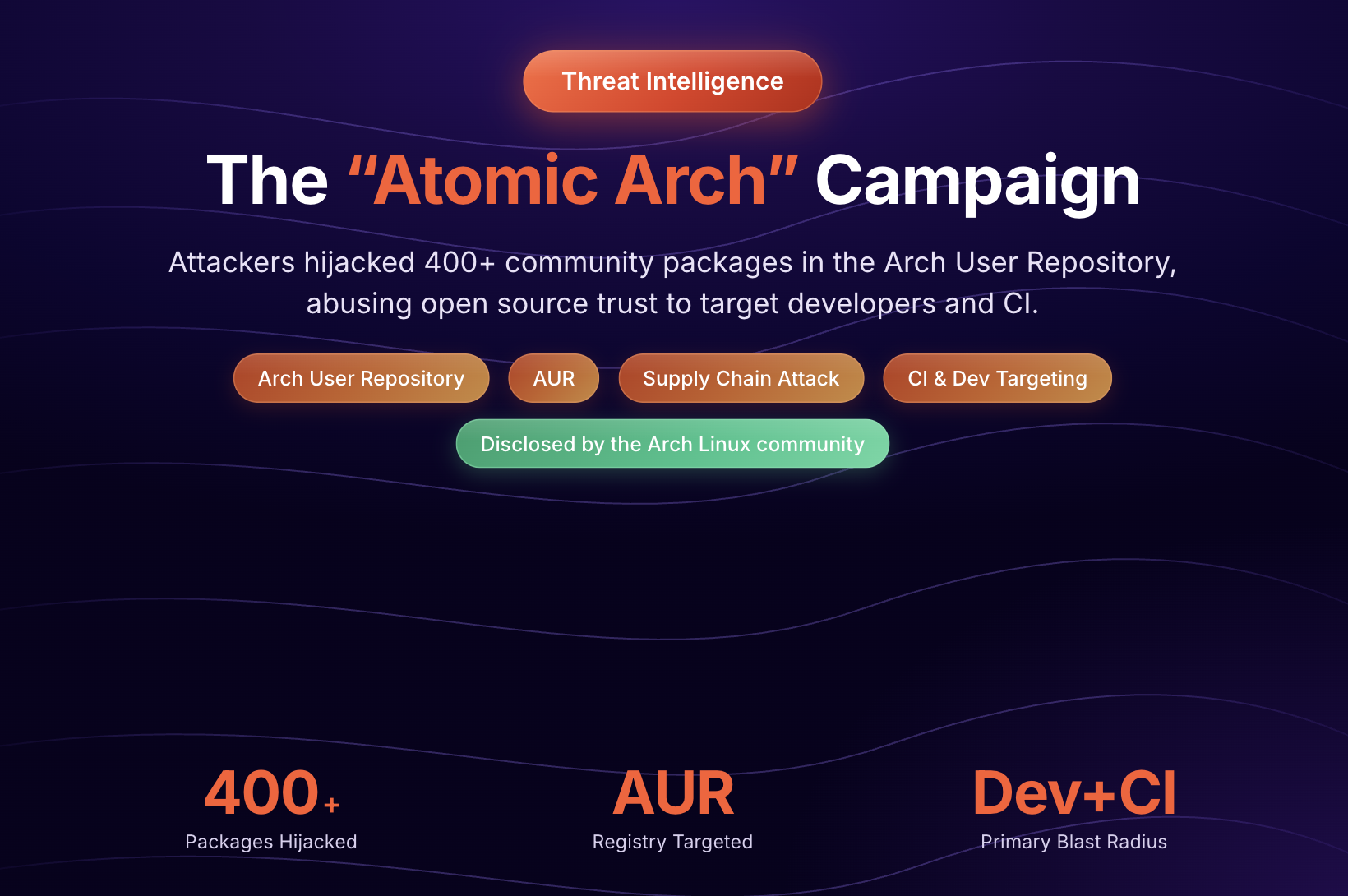 400+ AUR Packages Hijacked: What the “Atomic Arch” Campaign Means for Supply-Chain Security
Attackers adopted 400+ orphaned AUR (Arch User Repository) packages and injected malicious build logic that pulled in a malicious npm dependency (masquerading as atomic-lockfile, also seen as js-digest), dubbed the "Atomic Arch" campaign by Sonatype researchers. The malicious npm package deploys a Rust-based credential stealer targeting browser cookies, SSH keys, GitHub/npm tokens, and cloud/Docker credentials, with optional eBPF-based rootkit persistence on rooted systems. The piece explains scope (Arch, EndeavourOS, Manjaro, WSL2-based Arch, self-hosted Arch CI runners) and draws parallels to similar ownership-hijacking risks in npm, PyPI, GitHub Actions, and Homebrew.
stepsecurity.iowriteupAdded 3 Sep 2026, published 18 Jun 2026🛡️ Security OpenSource Malware: Active Malware Campaigns in January-May 2026
OpenSourceMalware's analysis of active malware campaigns from January-May 2026, covering Lazarus Group's Contagious Interview (fake recruiter outreach delivering BeaverTail/InvisibleFerret via npm, PyPI, Go, Cargo, Packagist) and two new campaigns, TasksJacker (malicious .vscode/tasks.json auto-execution, including payloads hidden in .woff2 font files and fake VS Code dictionary files) and PolinRider (weaponizing stolen credentials via malicious PRs merged into projects like VS Code, Apache Superset, Rails, LangFlow, Expo). It also details TeamPCP's supply chain attack on Trivy's GitHub Actions repos using a leaked Aqua Security PAT to force-push malicious commits across 76 version tags.
opensourcemalware.comwriteupPublished and added 12 Jun 2026🛡️ Security Compromised Rust crate onering performs code exfiltration
Aikido researchers discovered that version 1.4.1 of the Rust crate 'onering' (18,000+ downloads on crates.io, also compromised at the source on the maintainer's GitHub repo) shipped a malicious build.rs build script that walks up from OUT_DIR to locate the consuming project's repository root, runs git log and git diff HEAD^ HEAD to capture the latest commit's metadata and full source diff, then exfiltrates it by disguising the payload as a Sentry crash-report envelope POSTed to a real Sentry ingest endpoint. Because build.rs executes automatically at compile time via Cargo, simply building a project that depends on the crate is enough to trigger the leak, making it a novel build-time supply-chain attack vector distinct from the npm/PyPI postinstall-hook pattern, and notable for exfiltrating source code diffs rather than credentials.
aikido.devwriteupAdded 3 Sep 2026, published 10 Jun 2026🛡️ Security Miasma Worm Hits Microsoft Again: Azure Functions Action and 72 Other Repositories Disabled After Supply Chain Attack Targeting AI Coding Agents
StepSecurity's forensic analysis of the June 5, 2026 Miasma worm incident, in which a compromised contributor account pushed a malicious commit to Microsoft's Azure/durabletask repository planting five files (.claude/settings.json, .gemini/settings.json, .cursor/rules/setup.mdc, .vscode/tasks.json, and a 4.6MB obfuscated .github/setup.js payload) that trigger credential-harvesting code execution the moment the repo is opened in Claude Code, Gemini CLI, Cursor, or VS Code — no package install or code run required. GitHub's automated abuse detection disabled 73 Microsoft repositories in a 105-second sweep, including Azure/functions-action, breaking CI/CD pipelines across GitHub Actions users relying on the mutable @v1 tag. The post ties this to the same compromised account behind the May 19 durabletask PyPI credential-stealer campaign and the broader TeamPCP-linked Miasma worm, which has infected 113+ repositories.
stepsecurity.iowriteupAdded 3 Sep 2026, published 9 Jun 2026🛡️ Security Microsoft's durabletask PyPI Package Compromised in Supply Chain Attack
StepSecurity documents the compromise of Microsoft's durabletask PyPI package (versions 1.4.1-1.4.3, 400k+ monthly downloads), where an attacker bypassed the GitHub CI/CD pipeline entirely using stolen publishing credentials to inject a dropper for rope.pyz, a modular cloud-intrusion framework with dedicated collectors for AWS, Azure, GCP, Kubernetes, HashiCorp Vault, password managers, and the filesystem. The framework encrypts stolen data with AES-256-GCM/RSA-4096, exfiltrates via HTTPS, GitHub commit beacons, and attacker-created public repos using the victim's own stolen GitHub tokens, propagates via AWS SSM and kubectl exec, and drops a geo-targeted rm -rf wiper for systems matching Israeli locale/timezone markers. The post ties the attack to TeamPCP's Mini Shai-Hulud campaign (same infrastructure as TanStack, Mistral AI, LiteLLM, @antv) and later updates describe a second compromise of the Azure/durabletask GitHub repo that plants payloads triggering in Claude Code, Gemini CLI, Cursor, and VS Code.
stepsecurity.iowriteupAdded 3 Sep 2026, published 9 Jun 2026🛡️ Security Pythagora-io/gpt-pilot Compromised on GitHub - Shai-Hulud Credential Stealer Blocked by Python Linter
StepSecurity documents a June 2026 compromise of the Pythagora-io/gpt-pilot GitHub repo (33.7k stars), where an attacker took over a co-founder's account and force-pushed a Shai-Hulud-variant credential stealer disguised as a "Revert" commit. The malware, a 758KB obfuscated Bun/JavaScript payload delivered via a Python telemetry module, steals AWS/npm/GitHub/Kubernetes/Vault/SSH credentials, uses GitHub commit messages as a covert C2 channel, exfiltrates via newly created GitHub repos, can abuse Sigstore/Fulcio to forge SLSA Build Level 3 attestations, and plants persistence hooks in Claude Code and VS Code. Notably, the attacker's injected code was blocked twice by the project's ruff CI linter/formatter before they gave up, illustrating code-quality tooling as an accidental security control, alongside full IOCs and lessons on branch protection and force-push monitoring.
stepsecurity.iowriteupAdded 3 Sep 2026, published 9 Jun 2026🛡️ Security- Active Malware Campaigns in January-May 2026
OpenSourceMalware's analysis of active malware campaigns from January-May 2026, focused on Lazarus Group and TeamPCP. Details include Contagious Interview's pivot to abusing .vscode/tasks.json files to deploy BeaverTail/InvisibleFerret, the new TasksJacker campaign (multi-blockchain C2 across TRON/Aptos/BSC, hex-encoded JS hidden in .woff2 font files and a fake spellright.dict) that compromised 400+ repos including DataStax, and the follow-on PolinRider campaign that weaponized stolen credentials via malicious pull requests merged into high-profile projects like VS Code, Apache Superset, Rails, and Expo. Also covers TeamPCP's cascading attack via a leaked Aqua Security service-account PAT used to force-push malicious commits across version tags.
opensourcemalware.comwriteupAdded 3 Sep 2026, published 8 Jun 2026🛡️ Security  Miasma Blight Reaches Microsoft: 73 Repos Disabled in 105 Seconds
Investigates GitHub's mass disabling of 73 Microsoft repositories across the Azure, Azure-Samples, microsoft, and MicrosoftDocs orgs within a 105-second window on June 5, all flagged for ToS violations, including the widely-used Azure/functions-action GitHub Action that broke CI pipelines globally. The author links the takedown to a re-compromise of the durabletask PyPI package (previously hit May 19 by TeamPCP via stolen GitHub Actions secrets) and to Miasma, a rebrand of TeamPCP's open-sourced Mini Shai-Hulud worm that Aikido and OX Security found had added Azure/GCP credential collectors and self-propagates by committing stolen secrets into attacker-created public repos, which is what likely triggered GitHub's automated abuse enforcement.
opensourcemalware.comwriteupAdded 3 Sep 2026, published 6 Jun 2026🛡️ Security Nx Console VS Code Extension Compromised
StepSecurity's technical teardown of the May 2026 compromise of the Nx Console VS Code extension (nrwl.angular-console v18.95.0, 2.2M+ installs), where a stolen contributor GitHub token was used to push a dangling orphan commit to nrwl/nx and publish a malicious extension via stolen VSCE_PAT credentials. The payload silently ran `npx github:nrwl/nx#<sha>` to fetch a heavily obfuscated 498KB Bun/Node credential stealer that harvests secrets from GitHub, npm, AWS, Vault, Kubernetes, 1Password and Claude Code config, exfiltrates via HTTPS/GitHub API/DNS tunneling, installs a macOS Python backdoor using the GitHub Search API as a C2 dead-drop, and can forge valid Sigstore/SLSA provenance attestations for downstream npm packages. The writeup ties this to a later GitHub breach (3,800 repos, attributed to TeamPCP) and provides detection signals, IOCs, and full recovery steps.
stepsecurity.iowriteupAdded 3 Sep 2026, published 2 Jun 2026🛡️ Security Socket: TrapDoor Crypto Stealer
Socket researchers uncovered TrapDoor, a coordinated crypto-stealer campaign spanning 34+ malicious packages and 384+ versions across npm, PyPI, and Crates.io, targeting crypto, DeFi, Sui/Move, and AI developer communities. The npm packages use postinstall hooks to run a shared trap-core.js payload that harvests SSH keys, AWS/GitHub credentials, wallet data, and browser data, then persists via .cursorrules, CLAUDE.md, git/shell hooks, systemd, cron, and SSH lateral movement; PyPI packages fetch and run remote JS on import, and Crates.io packages use malicious build.rs to XOR-encrypt and exfiltrate Sui/Move keystores to GitHub Gists. The attacker (GitHub account ddjidd564) also opened PRs against major AI/dev tooling repos (browser-use, LangChain, Langflow, llama_index, MetaGPT, OpenHands) attempting to plant hidden .cursorrules/CLAUDE.md instructions designed to trick AI coding assistants into running exfiltration under the guise of a 'security scan'.
socket.devwriteupPublished and added 26 May 2026🛡️ Security Socket: Malicious Postinstall Hook Compromises 8 PHP/Node Packages on Packagist
Socket's AI scanner found a coordinated supply chain campaign in which 8 Packagist (PHP/Composer) packages had their upstream GitHub repos modified to add a malicious postinstall hook — placed in package.json rather than composer.json — that downloads a binary (gvfsd-network) from an attacker GitHub Releases URL to /tmp/.sshd, disables TLS verification, and runs it in the background. The same payload was also found injected into GitHub Actions workflow files (as a step named "Dependency Cache Sync") in forked repos, and a GitHub code search for the attacker account parikhpreyash4 surfaced hundreds of additional references across Node.js projects. Highest real-world risk is concentrated in Laravel starter kits devdojo/wave (~6,400 stars) and devdojo/genesis (~9,100 Packagist installs), since starter-kit repos become the project root where npm install triggers the hook directly.
socket.devwriteupPublished and added 23 May 2026🛡️ Security Socket: Coruna Respawned
Socket's Threat Research team analyzed a repository takeover of the popular npm package art-template, whose versions 4.13.5 and 4.13.6 were backdoored to inject a script loader (v3.jiathis[.]com) that redirects through a watering hole to a Safari/iOS browser exploit delivery framework nearly identical to Google's previously-reported Coruna exploit kit. The writeup provides a full multi-layer deobfuscation of the implant (UTF-16 packing, base64/eval chains, per-string XOR), maps its version-gated payload flags to specific WebKit CVEs (CVE-2021-30952, CVE-2022-48503, CVE-2023-43000, CVE-2024-23222), documents WASM-based JIT fingerprinting/anti-bot probes and CPU-architecture discrimination, and links the campaign to threat actor UNC6691 via content-addressed URL scheme, YARA matches, and C2 domain patterns, ending with concrete detection recommendations and IOCs.
socket.devwriteupPublished and added 22 May 2026🛡️ Security GITHUB LEAK: YOUR CODE @ RISK! – THE RAVEN FILE
Analysis of a claimed BreachForums leak by threat actor TeamPCP of ~4K GitHub private repositories, including two leaked Rails controller files (OrganizationsController, PullRequestsController) that the author dissects for internal architecture details — OFAC/trade-compliance gating, CAPTCHA logic, org deletion "danger zone" tokens, database cluster topology, Voltron graceful-timeout feature flags, PR stacking, and JA3-TLS-fingerprint-based anonymous rate limiting. The piece also links TeamPCP to a lookalike domain (git-service.com, registered May 16 2026) used to compromise Microsoft's durabletask Python package, and notes TeamPCP's dark-web/Telegram presence and ties to CypherForce Ransomware.
 theravenfile.comwriteupAdded 5 Sep 2026, published 20 May 2026🛡️ Security
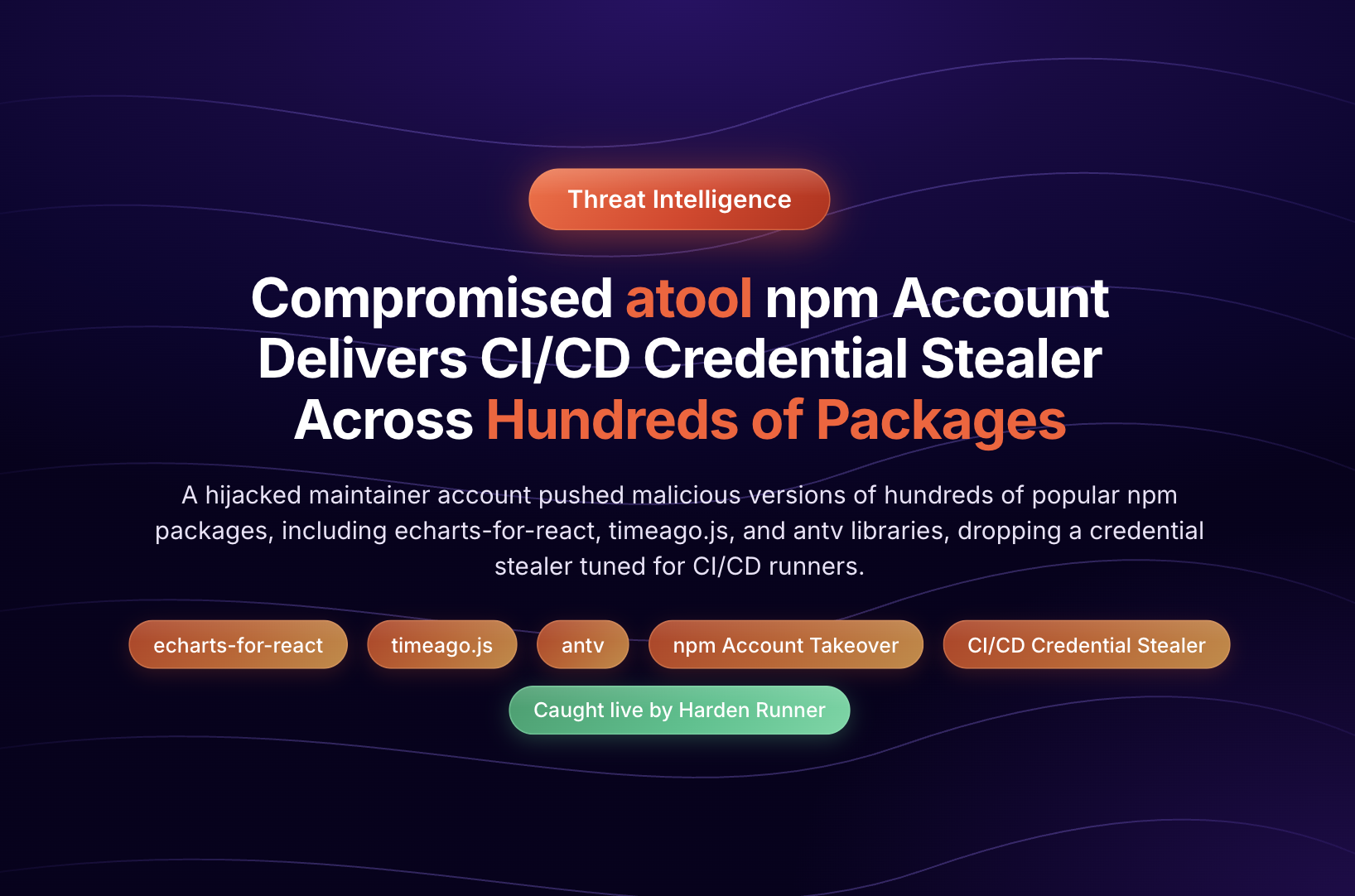 StepSecurity + Endor Labs: Mini-Shai-Hulud Wave 2
StepSecurity and Endor Labs document a second wave of the Mini Shai-Hulud npm worm spreading through the compromised 'atool' account, which publishes timeago.js and maintains packages in Alibaba's @antv namespace, hitting echarts-for-react, jest-canvas-mock and dozens of other packages. The payload scrapes GitHub Actions Runner.Worker process memory to steal masked CI/CD secrets, harvests 130+ credential file paths (cloud, SSH, Kubernetes, Vault, crypto wallets, Claude Code/VS Code configs), exfiltrates via a GitHub API dead-drop in antvis/G2 or a fake-OpenTelemetry C2 at t.m-kosche.com, drops persistent backdoors in Claude Code/VS Code, and has already used stolen GitHub tokens to spin up 2,500+ dead-drop repositories. The writeup includes full process/network telemetry from Harden-Runner showing the attack blocked, deobfuscated payload internals, IOCs, and detection/remediation guidance.
stepsecurity.iowriteupPublished and added 19 May 2026🛡️ Security Quacc++
Somerset Recon details Quacc++, a proof-of-concept automated bug hunter that queries grep.app's regex-based index of public GitHub repos to find candidate vulnerable code, downloads matching repositories, and runs Semgrep taint-analysis rules to confirm exploitable patterns. Using a search for strcpy(buf, argv[ paired with a custom Semgrep taint rule, the authors discovered an unbounded strcpy stack buffer overflow in GetArgumentFiles() in Google DeepMind's Lab repository (engine/code/bspc/bspc.c), confirmed with AddressSanitizer and pwntools/GDB to give full RIP control at offset 1080. The post also walks through Semgrep rules for SQL injection (CWE-89), hardcoded API keys (CWE-798), and disabled TLS certificate validation (CWE-295) across curl/wget/requests/Node/Go.
 somersetrecon.comwriteupPublished and added 7 May 2026🛡️ Security
 Socket: 73 Open VSX Sleeper Extensions Linked to GlassWorm
Socket's Research Team tracks a new wave of 73 cloned/impersonating Open VSX extensions tied to the GlassWorm campaign, published as benign-looking "sleeper" extensions by freshly created GitHub accounts before later being weaponized via normal update channels. The report details GlassWorm's shift to transitive delivery via extensionPack/extensionDependencies (e.g., pulling in the now-removed blockstoks.easily-gitignore-manage), plus two concrete payload techniques: a bundled native .node binary (boulderzitunnel.vscode-buddies) that downloads and installs a malicious VSIX across VS Code/Cursor/Windsurf, and an obfuscated JavaScript loader (cubedivervolt.html-code-validate) that decodes at runtime to fetch a VSIX from GitHub. Includes IOCs (SHA256 hashes, malicious GitHub repos) and notes the automated activation pipeline referenced a dead payload extension 52 hours after Eclipse Foundation removed it.
socket.devwriteupPublished and added 6 May 2026🛡️ Security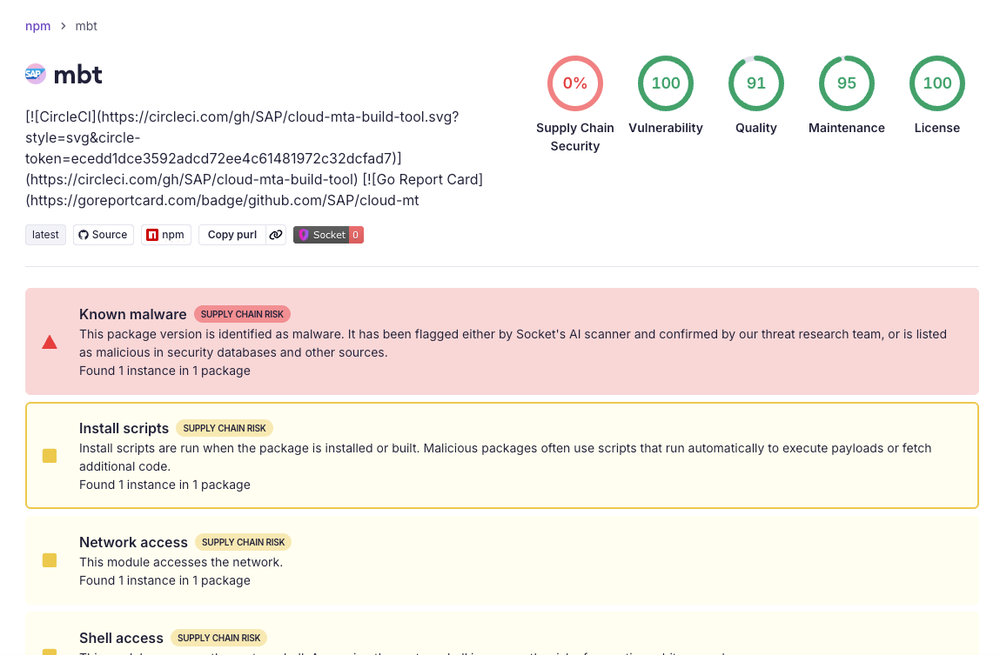 TeamPCP SAP CAP Attack
Socket documents a TeamPCP-linked supply chain attack compromising four SAP-affiliated npm packages (mbt, @cap-js/sqlite, @cap-js/db-service, @cap-js/postgres) via a malicious preinstall script that downloads and runs Bun to execute an 11.7MB obfuscated payload. The payload steals SSH keys, cloud/K8s/npm/GitHub credentials, AI tool configs, and crypto wallets, scrapes secrets from CI runner memory bypassing log masking, exfiltrates via attacker-created GitHub repos, self-propagates by publishing trojanized versions of hardcoded SAP CAP dependencies, and persists via Claude Code and VSCode hooks. Socket attributes the campaign with medium confidence to TeamPCP based on shared __decodeScrambled cipher, Russian-locale kill switch, and GitHub-as-C2 patterns previously seen in Checkmarx, Bitwarden CLI, and Trivy incidents.
socket.devwriteupPublished and added 6 May 2026🛡️ Security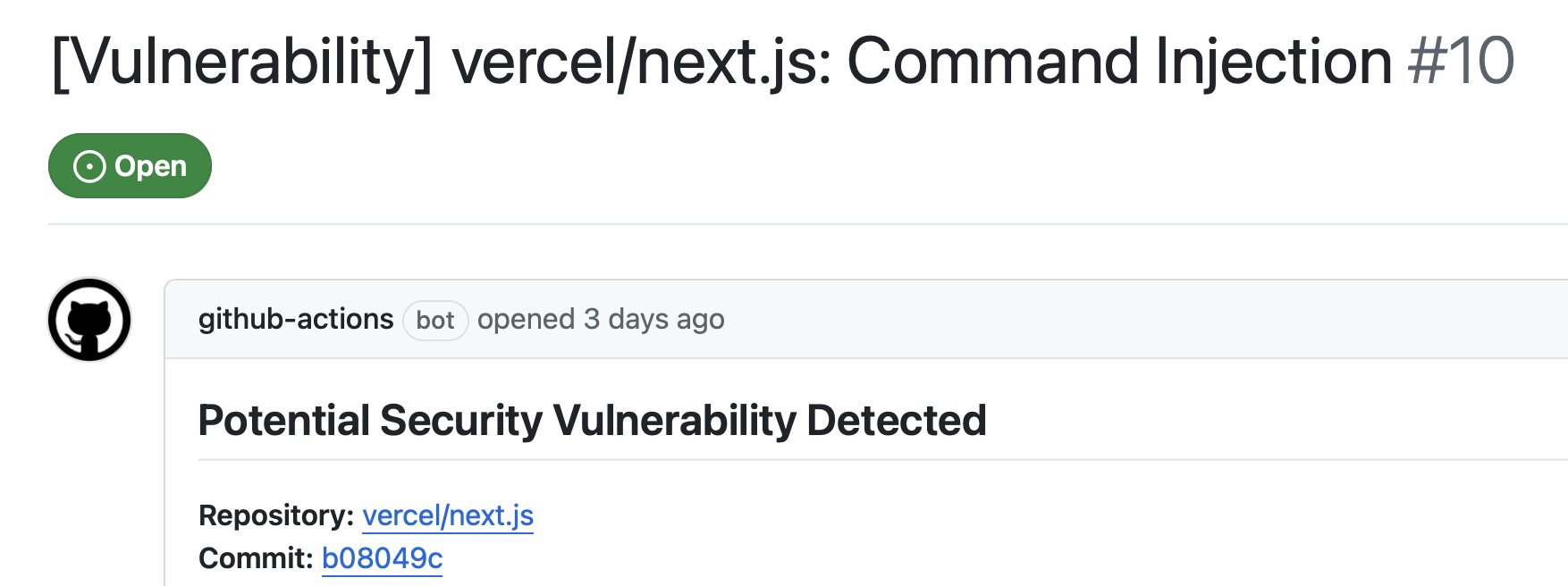 Negative Days in LLM Workflows
A researcher builds "Vulnerability Spoiler Alert," an open-sourced GitHub Action that uses Claude to continuously scan commits and associated pull requests in monitored repos, flagging likely security patches before a CVE is ever published. The post walks through prompt-tuning iterations (adding PR context, requiring a concrete exploit PoC, using the assistant-prefill trick to force clean JSON output), a timing case study showing an ~2-hour "negative-day" window on the React2Shell patch versus CVE feed publication, and a verified command-injection "never-day" the tool surfaced in vercel/next.js's @next/codemod (execSync with unsanitized shell interpolation), reproduced with a trojanized package.json PoC.
 spaceraccoon.devwriteupPublished and added 5 May 2026🛡️ Security
- How Threat Actors Abuse Remote Management Tools | Huntress
Huntress details how low-skill threat actors daisy-chain legitimate RMM tools (ScreenConnect, Action1, HeartbeatRM, AnyDesk, Atera, etc.) via invitation and Social Security themed lures, LLM-generated infostealer scripts, and multi-fallback browser download tricks hosted on GitHub repos (VH851, Drasticc) to gain and disguise persistent access. It also documents firsthand observation of an actor who signed up to Huntress itself, revealing their toolchain (DeepSeek, Email Extractor, Proxy SwitchyOmega, 9Proxy, CertifyTheWeb, Sordum Hide from Uninstall List, and a fake Windows Security PIN harvesting binary pin.exe) and victim data such as W-9 forms and SSNs collected via Telegram based exfiltration.
 huntress.comwriteupAdded 3 Sep 2026, published 11 Mar 2026🛡️ Security
- How Fake OpenClaw Installers Spread GhostSocks Malware
Huntress investigated malicious GitHub repositories impersonating OpenClaw installers (Feb 2-10, 2026) that were surfaced as the top Bing AI search result for "OpenClaw Windows." The Windows installer deployed a new packer dubbed Stealth Packer alongside Vidar and PureLogs infostealers and GhostSocks — a BlackBasta-linked SOCKS backconnect proxy malware that routes attacker traffic through the victim's machine to bypass MFA and anti-fraud checks — while a parallel macOS campaign delivered a signed Mach-O AMOS stealer variant via a fake "puppeteerrr/dmg" repo, later detected by an Apple XProtect update. The blog includes full technical teardown, GitHub account/organisation abuse patterns, and IOCs.
huntress.comwriteupAdded 3 Sep 2026, published 4 Mar 2026🛡️ Security - Manual Configuration Manager (SCCM) credential harvesting
A step-by-step method for harvesting Configuration Manager (SCCM/MECM) credentials by pulling DPAPI-encrypted secret policy blobs (Network Access Accounts, task sequences, collection variables) via WMI or the local CIM repository, then exfiltrating DPAPI master keys and LSA SYSTEM/SECURITY/SAM hives for fully offline decryption with Impacket's dpapi and secretsdump modules. The approach avoids running known SCCM-abuse tools like SharpDPAPI on-target, reducing signature-based detection while still noting which steps (registry hive backup, DPAPI folder copy, WMI queries) a SOC could realistically catch.
 bencteux.frwriteupAdded 3 Sep 2026, published 5 Oct 2025🛡️ Security