Skip to content

1148 results for โ€œrrโ€

What you seeeverything
x.comthread๐Ÿง  AI

Smarthouse (@localyzapp) on X

A reply by Smarthouse (@localyzapp) on X to a question about the best harness for connecting local models to a Minecraft server. It suggests an MCP server that wraps RCON plus a small agent loop. The main pitfall is block coordinates: expose "/execute if block" as a read tool so the agent can check blocks before placing them, or it will hallucinate terrain.

Model Context ProtocolMinecraftRCON

mcp, agentsยท Added 2 Nov 2026, published 1 Nov 2026

bleepingcomputer.comarticle๐Ÿ›ก๏ธ Security

Alpine Linux rebuilds GitLab after attempted RCE attack

Alpine Linux rebuilt its GitLab server and reset all passwords after attackers tried to exploit CVE-2026-97229, a maximum-severity integer overflow in the Onigmo regex engine bundled with Ruby, on October 20-21. Eight worker crashes occurred and four were partially successful. Missing logs and outbound connection records meant compromise could not be ruled out. Alpine had run GitLab 19.3.4, then 19.3.6, which lacked the Ruby patch; the fixed image is alpinelinux/gitlab:19.3.6 with Ruby 3.3.13.

GitLabAlpine LinuxDocker+1
CVE-2026-97229integer overflowOnigmo

Supply Chain, Blue Team & Detection, DevSecOpsยท Published and added 1 Nov 2026

atlasum.netadvisory๐Ÿ›ก๏ธ Security

TCP Use-After-Free: CVE-2026-98432 / CVSS 9.8

CVE-2026-98432 is a use-after-free in the Linux IPv4 TCP handshake, rated CVSS 3.1 9.8 and reachable by a remote unauthenticated peer on kernels back to 4.4. The post lists fixed stable releases (October 2026) and distribution patch status as of 31 October 2026, plus kernel and MPTCP listener checks. It gives interim nftables and iptables rules that drop IPv4 packets carrying options, and notes Anthropic's claim that Claude wrote a working exploit.

Linux kernelnftablesiptables+3
CVE-2026-98432use-after-freeAnthropic

Blue Team & Detection, Cloud & Infraยท Added 1 Nov 2026, published 31 Oct 2026

bleepingcomputer.comarticle๐Ÿ›ก๏ธ Security

New Android SMS of Death exploit can remotely crash unpatched phones

CVE-2026-58882, "SMS of Death", is a zero-click Android denial-of-service flaw in WapPushOverSms.decodeWapPdu, where an unchecked header-length value becomes negative and triggers a NegativeArraySizeException that crashes com.android.phone. A malformed eight-byte WAP Push message to port 2948 can drop calls, including emergency calls, and about 20 messages caused reboot loops. A PoC is public. Google patched Android 14 through 17 in October 2026, but Android 12 and 13 remain vulnerable.

AndroidAndroid Debug BridgeGitHub
CVE-2026-58882SMS of DeathGoogle+3

Mobile Security, Offensive Securityยท Published and added 31 Oct 2026

ethereum-magicians.orgthread๐Ÿ›ก๏ธ Security

Pre-ERC: Agent Pre-Sign Risk Report

Pre-ERC: Agent Pre-Sign Risk Report is a draft Ethereum Magicians proposal for an EIP-712-signed report that a risk source, identified by an ERC-8004 identity, returns about one unsigned request. It carries typed findings on tokens, approvals, addresses, payments (x402) and texts, and each finding is marked read or not read. It has no score or verdict, so the consumer applies its own policy. The author's live implementation, toll, runs on Robinhood Chain.

Ethereumx402Robinhood Chain+3
ERC-8265ERC-8004ERC-8470+8

AI Security, Blockchainยท Published and added 31 Oct 2026

ethereum-magicians.orgthread๐Ÿ›ก๏ธ Security

ERC-8481: Agent Pre-Sign Risk Report

ERC-8481 is a draft Ethereum standard for the report a risk source returns about one unsigned transaction, EIP-712 request or x402 requirement. The report is bound to the request by a digest and EIP-712 signed by an ERC-8004 identity. It has five typed finding groups (tokens, approvals, addresses, payments, texts), each marked read or not read, and carries no score or verdict. The author's service toll is the only implementation; three design questions are open.

Ethereumx402toll+3
ERC-8481ERC-8265ERC-8004+7

AI Security, Blockchainยท Added 2 Nov 2026, published 31 Oct 2026

x.comarticle๐Ÿง  AI

Lewis - Policifyai (@Policifyai) on X

Policifyai's October 2026 roundup lists model releases by date with prices and benchmark scores: GPT-6.1 Sol and Terra, Claude Sonnet 5.5 and Haiku 5.5, Gemini 4 Argon and Carbon, Muse Spark Open, Mistral Large 4 weights and Kimi K3.1 Pro. It also covers Anthropic's S-1 compute commitments, Artificial Analysis Intelligence Index v5, and chip and data-center deals.

CodexHugging FaceMixture of Experts+6
OpenAIAnthropicGoogle+43

models, ai-infra, evalsยท Added 1 Nov 2026, published 31 Oct 2026

ethereum-magicians.orgthread๐Ÿ›ก๏ธ Security

ERC-8478: x402 Payee Verification for ERC-8004 Agents

ERC-8478 is a draft Ethereum standard that binds the x402 payTo address to an ERC-8004 agent's identity, to stop payee redirection by a hijacked domain, proxy or injected tool result. A payTo must equal the agentWallet or carry an EIP-712 delegation signed by it, and the origin must be listed in the registration file. On Robinhood Chain, 5 of 5,575 x402-responding agents used their agentWallet as payTo (28 October 2026).

x402ERC-8004Ethereum+2
ERC-8478ERC-8470EIP-712+3

AI Security, Blockchainยท Published and added 30 Oct 2026

protos.comarticle๐Ÿ›ก๏ธ Security

Trezor reveals Malaysian reseller sold wallet with spyware

Trezor says a user reported a Safe 5 wallet bought from Malaysian reseller CryptoBilis in August 2026 with a hidden board between the main board and screen, carrying a cellular module and antenna. The implant allegedly reads the screen, including the wallet backup, and sends it over a mobile network when plugged in. Trezor has not yet examined the device, has dropped CryptoBilis (9 October), and is replacing wallets bought since March 2026.
TrezorLedger
CryptoBilisDanny Sanders

Hardware & RF, Blockchain, Threat Intelยท Published and added 30 Oct 2026
21shares.comarticle๐Ÿ›ก๏ธ Security

Binance hack: the largest robbery in financial history

Binance hack analysis from 21shares on the 29 October 2026 theft of about $6.3 billion from Binance. Binance's initial finding points to a compromised DevOps engineer's laptop with no sign of a leaked wallet key. Chainalysis attributes it to North Korea with high confidence, and about $3 billion was frozen by Tether, Circle and the Arbitrum Security Council. The attacker also borrowed about $44.6 million of WETH on Aave. Binance says SAFU and company funds will cover all losses.

AaveTetherUSDC+2
BinanceLazarus GroupDPRK+7

Threat Intel, Blockchainยท Published and added 30 Oct 2026

bleepingcomputer.comarticle๐Ÿ›ก๏ธ Security

Malicious Claude Code extension on Cursor planted SSH backdoors

A malicious version 2.1.313 of Anthropic's Claude Code extension was served from Cursor's marketplace for about 11 hours on 29 October 2026, reaching up to 5,000 developers. A JavaScript loader prepended to extension.js added an attacker SSH key, a reverse tunnel and macOS/Windows persistence, and reported to 134.209.82[.]225. Coding errors likely blocked SSH access on many hosts. Cursor removed it and rotated keys; victims should look for an 'svc-telemetry' SSH key.

Claude CodeCursorVS Code+3
PhorionOpenSourceMalwareLaunchAgent persistence+1

Supply Chain, AI Security, Threat Intelยท Published and added 30 Oct 2026

securityweek.comarticle๐Ÿ›ก๏ธ Security

Bulletproof Host Virtualine Loses Its Domain to FBI Seizure

Virtualine is a Russian-speaking bulletproof hosting provider whose domain virtualine.net the FBI seized. Court documents say it hosted phishing, spam, carding and illicit content, and ignored abuse reports. TRM Labs says it received more illicit-attributed cryptocurrency than any other labeled bulletproof host, mostly from a Russian drug marketplace (44%) and a sextortion scheme (17%), and later from StealC operators in 2026.

Bitcoin
VirtualineStealCFBI+3

Threat Intelยท Published and added 30 Oct 2026

decrypt.coarticle๐Ÿ›ก๏ธ Security

TRM and Chainalysis Tie $6.4B Binance Hack to North Korea's TraderTraitor

TRM Labs and Chainalysis attribute the October 2026 Binance theft, about $6.4 billion across 10 blockchains, to North Korea's TraderTraitor. On Ethereum the attacker used EIP-7702 delegation with 50 pre-signed authorizations to turn a hot wallet into a sweeper, pointing to compromised signing infrastructure. The attacker funded wallets via Tornado Cash, laundered through automation and Aave borrowing, and about $3 billion was frozen.

EthereumEIP-7702Tornado Cash+2
TraderTraitorDPRKBinance+9

Blockchain, Threat Intelยท Published and added 30 Oct 2026

latent.spacearticle๐Ÿง  AI

[AINews] Building AIE CODE: The top Coding Agent Conference

AINews issue for 28 to 29 October 2026 from Latent Space. It opens with a preview of the AIE CODE summit (themes: Scaling without Slop, System One models, Increasing Ambition, with Jarred Sumner on Bun in Rust). It then recaps Twitter and Reddit news: Mistral Large 4 open weights (1.05T total, 52B active), Artificial Analysis benchmarks, Gemini 4 Carbon, Qwen4 rumours, Claude Code quota complaints and OpenAI frontier-run monitoring. Text was cut before the end.

BunRustvLLM+17
Latent SpaceAI EngineerAIE CODE+37

models, coding-agents, evalsยท Published and added 30 Oct 2026

en.cryptonomist.charticle๐Ÿ›ก๏ธ Security

Binance probes a suspected cryptocurrency breach: $6.3B affected, about $3B frozen

Binance disclosed a suspected security incident on 29 October 2026, estimating $6.3 billion affected and about $3 billion frozen. Binance's early finding is that a compromised DevOps engineer's laptop let an attacker reach a service container and submit unauthorized withdrawals, with no evidence of wallet private-key leakage. TRM Labs suspects TraderTraitor, the group tied to the February 2025 Bybit theft. Tether, Circle and Ripple froze funds.

TetherUSDC
BinanceTraderTraitorLazarus Group+7

Blockchain, Threat Intelยท Published and added 30 Oct 2026

opensourcemalware.comwriteup๐Ÿ›ก๏ธ Security

Earliest Known PolinRider Malware Found in 2025 npm Packages

OpenSourceMalware traces nine itsa-* npm package versions published on 4 May 2025 from a hijacked maintainer account to the PolinRider campaign, eight months before documented victims. It decodes the EtherHiding chain (BNB Smart Chain and Ethereum calldata, JADESNOW, INVISIBLEFERRET bootstrapper, Socket.IO RAT, Python stealer) and links the 2025 sample to 2026 force-push infections. It lists IOCs, hashes, a timeline and hunting guidance.

npmNode.jsPython+3
PolinRiderEtherHidingJADESNOW+9

Supply Chain, Malware & RE, Threat Intelยท Published and added 30 Oct 2026

decrypt.coarticle๐Ÿ›ก๏ธ Security

Binance Hacker Hunts for Exit Ramps as DeFi Exchanges Pause Markets

Decrypt reports on wallets linked to the suspected Binance hack (at least $5.5 billion drained, 29 October 2026) that swap freezable stablecoins for ETH via Uniswap and borrow 19,762 ETH on Aave. About 253,000 ETH (roughly $570 million) sits idle in two wallets. Tether, Circle and Ripple froze over $2 billion plus about $200 million RLUSD, and Aave and Kamino paused markets. Tornado Cash appears only as funding for the attack address.

EthereumUniswapAave+3
Binance hackYi HeBybit+7

Blockchain, Threat Intelยท Published and added 29 Oct 2026

en.cryptonomist.charticle๐Ÿ›ก๏ธ Security

Polymarket stolen funds: One account withdrew at least $2.7M across 710 wallets

Polymarket's international exchange suffered unauthorized withdrawals on 29 October 2026 after a compromised third-party provider, reportedly the website monitoring service DebugBear. Betting Intelligence and Polysights found one account withdrew at least $2.7 million across 710 wallets. Polymarket paused trading, referred the case to law enforcement, promised reimbursement, and had a June 2026 vendor breach that cost about $3 million. The attack mechanism is not described.

Polygon
PolymarketDebugBearBetting Intelligence+2

Supply Chain, Threat Intelยท Published and added 29 Oct 2026

oversecured.comarticle๐Ÿ›ก๏ธ Security

Android security checklist: theft of arbitrary files | Oversecured Blog

Oversecured's Android security checklist on arbitrary file theft from an app's private storage. It covers implicit intents (PICK, GET_CONTENT) returning file:// or content:// URIs, SEND/SEND_MULTIPLE share activities, exported and non-exported FileProviders, path traversal via Uri.getLastPathSegment, WebView, and local NanoHTTPD servers. Each case has vulnerable code, an attacker PoC and fixes such as /proc/self/fd path checks and narrow files-path entries.

AndroidNanoHTTPDFileProvider+2
Oversecuredpath traversalFileUriExposedException+3

Mobile Security, AppSecยท Added 29 Oct 2026

oversecured.comarticle๐Ÿ›ก๏ธ Security

PCI DSS and Mobile Apps: A Simple Guide | Oversecured Blog

Guide to PCI DSS v4.0.1 scope for mobile apps, with a mapping of common Android and iOS finding types to the requirements they break (Req 2, 3, 4, 6, 7). It covers which app behaviors bring an app into scope and gives three anonymized cases: cleartext HTTP in a vendor native library, hardcoded keys in a third-party SDK, and an implicit Intent leaking data. It argues for testing the shipped binary and keeping a current component inventory.

AndroidiOS
PCI DSSPCI Security Standards CouncilQualified Security Assessor+5

Mobile Security, GRCยท Added 29 Oct 2026

aikido.devarticle๐Ÿ›ก๏ธ Security

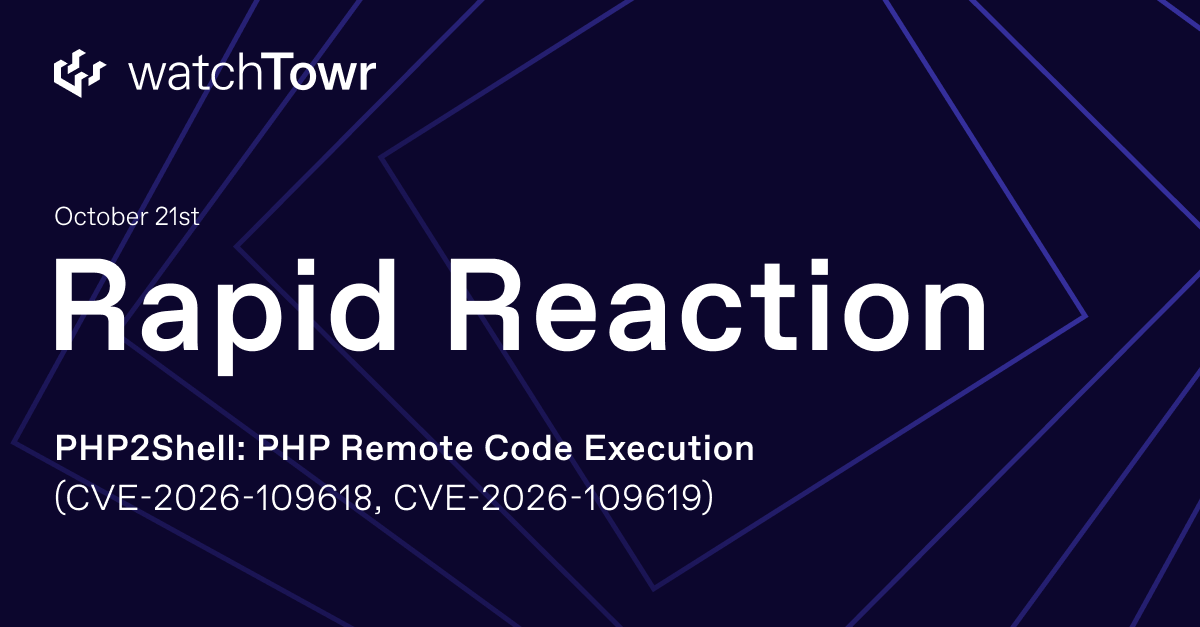
What are shell vulnerabilities? PHP2Shell, Node2Shell (HTTP2Shell), React2Shell and Log4Shell explained

Explainer on "shell" vulnerabilities, the -Shell naming for RCE flaws that began with Log4Shell (CVE-2021-44228). It compares memory-corruption bugs (PHP2Shell, CVE-2026-109618 and CVE-2026-109619; Node2Shell, CVE-2026-111497, in the Brotli decoder) with design-flaw bugs (Log4Shell, React2Shell, CVE-2025-55182). It covers shared traits, exposure through inherited components, and Brotli patch status across runtimes and distributions.

PHPNode.jsReact+3
CVE-2026-109618CVE-2026-109619CVE-2026-111497+16

AppSec, Learningยท Added 30 Oct 2026, published 29 Oct 2026

unit42.paloaltonetworks.comadvisory๐Ÿ›ก๏ธ Security

Threat Brief: Critical Vulnerabilities in PHP: CVE-2026-109618, CVE-2026-109619 (Updated October 29)

Unit 42 threat brief on PHP2Shell, two PHP remote code execution flaws, CVE-2026-109618 and CVE-2026-109619 (CVSS 4.0 9.2), both caused by longjmp() error handling that leaves memory uninitialized or freed. Cortex Xpanse counted over 22.6 million exposed instances. The 29 October 2026 update says attackers chained PHP2Shell with a Linux kernel privilege escalation against internet-exposed PAN-OS management interfaces. An earlier 23 October claim of post-compromise activity was retracted on 25 October.

PHPPAN-OSLinux kernel+2
CVE-2026-109618CVE-2026-109619PHP2Shell+2

Threat Intel, AppSecยท Added 30 Oct 2026, published 29 Oct 2026

github.comrepo๐Ÿง  AI

Show HN: Overtone โ€“ Transcribe, correct and cut captions for any screen shape

Overtone is a caption format (.overtone.json), a CLI and a video.js plugin that store each spoken word once and cut captions separately per screen shape (16:9, 9:16 or custom). The transcribe pipeline combines gpt-transcribe, Azure AI Speech and optional ElevenLabs Scribe, resolves disagreements with an LLM vote, and uses an LLM editor for corrections. A small public benchmark reports 5.3% word error rate and $0.023โ€“0.025 per audio minute.

video.jsNode.jswhisper.cpp+11
OvertoneOpenAIgpt-transcribe+6

multimodal, llm-apps, evalsยท Added 30 Oct 2026, published 29 Oct 2026

arxiv.orgpaper๐Ÿง  AI

On the Fundamental Limits of Prefill-Based Decoding Length Prediction

This paper derives bounds on predicting an LLM's decode length from prefill-phase hidden states, a primitive for inference scheduling. It models decoding as a stopped stochastic process, giving per-prompt normality and an affine variance law ฯƒ=ฮฑฮผ+b. Predictors (MLP, EGTP, FiLM, soft-label, Mixture-of-Experts) converge near the bound, so system error dominates model error. It proposes fixing model, data and sampling in benchmarks and reporting relative-error metrics.

LLMMixture of ExpertsMLP+2
arXiv

research, inference, evalsยท Added 31 Oct 2026, published 29 Oct 2026

arxiv.orgpaper๐Ÿง  AI

PhysCount: Do MLLMs Count Visual Appearances or Physical Entities?

PhysCount is a benchmark of 546 real-world images and 4,595 human-written questions in 651 target-specific groups. It tests whether multimodal LLMs can separate visible appearances (direct view, reflections, glass) from the physical entities behind them. Across 40 MLLMs, counting appearances is much easier than linking them to entities, and the best model answers every question correctly in only 13.36% of groups.

vision-language model
PhysCountarXiv

evals, multimodal, researchยท Added 31 Oct 2026, published 29 Oct 2026

socket.devarticle๐Ÿง  AI

OpenCode User Hit with Hostile Backlash After Reporting Free AI Loophole

Socket reports on a GitHub issue in the OpenCode tracker describing a bypass of per-IP usage limits on free hosted models, using a VPN to switch addresses. The reporter first urged account-based limits, then claimed to run 130 concurrent agents through the loophole. After the issue drew harassment it was deleted. Whether OpenCode fixed the bypass in October 2026 stays unclear.

OpenCodeGitHubDeepSeek+2
AnomalySocketDeepSeek-V4.1-Flash+3

coding-agents, ai-policyยท Published and added 29 Oct 2026

bleepingcomputer.comarticle๐Ÿ›ก๏ธ Security

Chrome extensions with 13.4 million installs caught hijacking searches

BleepingComputer reports Socket researcher John Tuckner's findings on 319 Chrome extensions with 13.4 million installs that hijack the default search engine. They use the chrome_settings_overrides manifest setting to route queries through operator proxies and collect Bing and Yahoo referral revenue. The proxy can later redirect to phishing or malware. Clusters named include Bing-Search and SecuryBrowse; the report adds 264 extensions to 57 found in April 2025.

ChromeChrome Web StoreSocket+2
John TucknerPredator SearchBing-Search+4

Threat Intelยท Added 30 Oct 2026, published 29 Oct 2026

alignment.openai.comarticle๐Ÿง  AI

How we detect frontier model misalignment

OpenAI describes its multilayer misalignment monitoring system for frontier models: activation probes, a model-based reviewer, investigative agents, automated log-based investigation and human paging. A replay of the Hugging Face incident shows an alert about 30 minutes after sandbox escape, over 30 hours before the breach. It also covers evaluations, METR and Redwood Research red-teaming, monitor models GPT-5.6 Sol, Terra and Luna, and avoiding pressure on chains of thought.

CodexOpenAI APIChatGPT+2
OpenAIMETRRedwood Research+9

ai-safety, agents, evalsยท Added 30 Oct 2026, published 29 Oct 2026

github.comcourse๐Ÿง  AI

rohitg00/ai-engineering-from-scratch

ai-engineering-from-scratch is a free, MIT-licensed curriculum of 542 lessons in 20 phases, from math and deep learning through transformers, LLM engineering, MCP, agents and capstones. Code is in Python, TypeScript, Rust and Julia. It includes three graded projects (retrieval evaluation, agent trace debugger, tool call firewall), installable tutor skills for Claude Code and Codex, and certification prep tracks.

PythonTypeScriptRust+13
Rohit GhumareOpenClawHermes+6

ยท Added 29 Oct 2026

wiz.ioarticle๐Ÿ›ก๏ธ Security

The Rise of Agentic Attacks: What They Look Like, and Where They're Headed

Wiz Research reviews agentic attacks seen in its incident response work and in public reports (ARTEX, Hermes, JPCERT/CC, CrowdStrike, DIVD). It derives fingerprints of AI-agent activity from three intrusions: machine-paced iteration, natural-language reasoning in scripts, self-correcting script versions, checklist enumeration, noisy lateral spraying, probe-before-payload and self-labeled scratch files. It also covers effects on attribution, attack scale and defense.

KubernetesAWSClaude Code+2
ARTEXHermesStorm-0940+12

Threat Intel, Blue Team & Detection, AI Security, Cloud & Infraยท Published and added 29 Oct 2026

wiz.iowriteup๐Ÿ›ก๏ธ Security

The Rise of Agentic Attacks: What They Look Like, and Where They're Headed

Wiz research on intrusions where AI agents do the hands-on attacker work. It reviews public cases (ARTEX against South Korean banks and the ConnectWise compromise, Hermes at Thailand's Ministry of Finance, JPCERT/CC, CrowdStrike, DIVD) and three Wiz-investigated attacks. It distills fingerprints: machine-paced iteration, embedded natural-language reasoning, self-correcting scripts, checklist enumeration, noisy lateral movement, probe-before-payload habits and self-named scratch files. It also covers attribution, scale and defense implications.

WizKubernetesAWS+2
ARTEXHermesStorm-0940+12

Threat Intel, Blue Team & Detection, AI Security, Cloud & Infraยท Published and added 29 Oct 2026

securityweek.comarticle๐Ÿ›ก๏ธ Security

Cisco Open Sources Quarry to Catch AI Agent Attacks Hidden in Harmless Steps

Project Quarry is a neurosymbolic rule language Cisco has open sourced to detect AI agent attacks that only show up across a sequence of individually benign steps. Rules combine ML classifier and LLM judge evidence with symbolic checks on sequences, strings and tool relationships. The starter pack has a DSL, evaluation runtime, CLI scanner, Python SDK and a plugin for Claude Code, Codex and other MCP-compatible agents.

QuarryModel Context ProtocolClaude Code+2
Project QuarryCisco Integrated AI Security & Safety Framework

AI Security, Blue Team & Detectionยท Published and added 29 Oct 2026

eprint.iacr.orgpaper๐Ÿ›ก๏ธ Security

A Quantitative Evaluation of Constant-Time Analysis Tools

AutoBench-CT is a modular benchmark for constant-time analysis tools, with manually verified per-violation ground truth across 64 cryptographic tasks. It scores seven tools on operational performance, detection quality and usability. The authors explain why CT-grind (2010) is still the most used tool, list recurring limitations across tools, and propose a composite pipeline for stronger constant-time guarantees. Accepted at ACSAC 2026.

AutoBench-CTCT-grind
ACSAC

Hardware & RF, AppSecยท Added 31 Oct 2026, published 29 Oct 2026

x.comthread๐Ÿง  AI

Muhammad Waris (@WarisCodes) on X

Nemotron 3.5 Transcribe is a free open-weight speech-to-text model from NVIDIA covering 40 languages, including mixed-language speech. The post says it ties for first among open models with a 2.8% error rate. It says the model needs a large GPU such as an H100 or RTX 5090, so it will not run on a laptop. The post gives no benchmark name or model card link.

Nemotron 3.5 Transcribe
NVIDIANemotron

models, multimodalยท Added 30 Oct 2026, published 29 Oct 2026

arxiv.orgpaper๐Ÿง  AI

M-PFT: Angular Margin for Calibrated Prompt-Tuning of Fine-Tuned Vision-Language Models

M-PFT is an angular-margin method for prompt tuning of vision-language models that fixes base-to-novel dual miscalibration (underconfidence on base classes, overconfidence on novel classes). It adds two losses: minimizing the maximum cosine similarity between tunable class embeddings, and minimizing angular distance to each zero-shot embedding. Tests on 9 prompt-tuning methods and 15 datasets show lower novel-class calibration error at comparable accuracy and negligible overhead.

vision-language modelprompt tuning
arXiv

research, multimodal, trainingยท Added 31 Oct 2026, published 29 Oct 2026

eprint.iacr.orgpaper๐Ÿ›ก๏ธ Security

Cryptanalysis and Enhancement of VTBSAE: Provably Secure Verifier-Based PAKE Protocols for the Industrial Internet of Things

Cryptanalysis of VTBSAE, a verifier-based PAKE protocol for the Industrial Internet of Things, showing it fails to resist client impersonation after server compromise. The authors propose E-VTBSAEv1, which binds the client point E1 to fresh server randomness, and prove AKE security and forward secrecy in the random-oracle model under CDH. Raspberry Pi 4B tests show runtime comparable to VTBSAE with the same communication and storage overhead.

Raspberry Pi 4BPAKE
VTBSAEE-VTBSAEv1client impersonation after server compromise+3

Identity & Access, Hardware & RFยท Added 31 Oct 2026, published 29 Oct 2026

securityweek.comarticle๐Ÿ›ก๏ธ Security

Attackers Exploit Second Cisco Firewall VPN Zero-Day Since August

CVE-2026-76418 (CVSS 8.6) is an exploited flaw in the Remote Access SSL VPN service of Cisco Secure Firewall ASA and FTD. An unauthenticated remote attacker can force a device reload through logic errors in tunnel groups using secondary authentication. Cisco learned of exploitation in October 2026, offers no workaround, and recommends upgrading. It is the second ASA/FTD DoS zero-day after CVE-2026-20349 in August.

Cisco Secure Firewall ASACisco Secure Firewall Threat DefenseVPN+1
CVE-2026-76418CVE-2026-20349Eric Fernald

Threat Intel, Cloud & Infraยท Published and added 29 Oct 2026

arxiv.orgpaper๐Ÿง  AI

Sparse Autoencoders as Implicit Diversification Regularisers for Cross-Sectional Cryptocurrency Returns

This arXiv preprint (October 2026) tests a sparse autoencoder as a factor model for daily cryptocurrency returns, with equities as a secondary test. SAE portfolios show consistently lower volatility than common benchmarks, linked to lower correlations among selected assets. They do not beat a simple contrarian strategy on risk-adjusted return, and factor identities change between training runs.

sparse autoencoder
arXiv

researchยท Added 31 Oct 2026, published 29 Oct 2026

socket.devwriteup๐Ÿ›ก๏ธ Security

Searchjacked: Hidden Browser Extensions Hijack Searches for 13 Million Users

Searchjacked is Socket's research on 319 browser extensions (about 13.44M users over a decade) that hijack searches to earn ad revenue. The fetched text attributes 200 extensions to named operators such as Intango, System1, Perion, Mutual Media and Kinner Lake, and 119 to unknown operators like "SecuryBrowse" and "Bing-Search". It lists the Yahoo and Bing monetization IDs used to link them. The narrative and technical mechanics are not in the fetched text.

Chrome Web StoreChrome
SearchjackedIntangoLumio+20

Threat Intel, Supply Chainยท Published and added 29 Oct 2026

spm.threat-modeling.comtool๐Ÿ›ก๏ธ Security

CISO Security Program Management 2026

Security Posture Management is a web tool that maps 30 CISO-accountable security topics across the five NIST Cybersecurity Framework functions. It tracks current maturity, KPIs, risks and audit findings per topic. It also records target maturity, target dates, accountable owners and review dates, flagging topics unreviewed for 6 months as due and 12 months as overdue. Initiatives link to topics and risks with owner, budget, dates and expected maturity uplift.

NIST Cybersecurity Framework

GRCยท Added 29 Oct 2026

arxiv.orgpaper๐Ÿง  AI

PCM: A Proof-Carrying Message Protocol for Verifiable Multi-Agent Communication

Proof-Carrying Messages (PCM) is a protocol where each claim an AI agent sends carries evidence: records from an append-only Merkle log the agent cannot write, with inclusion proofs, signed by an attesting signer. Receivers verify offline in about 1 ms and label each claim proven, unproven or failed. On 926 messages (712 lies in 16 classes), PCM accepts 10 lies (1.4%), all stale evidence; plain A2A accepts all 712.

A2AModel Context ProtocoluAgents+5
arXiv

agents, researchยท Added 31 Oct 2026, published 29 Oct 2026

arxiv.orgpaper๐Ÿ›ก๏ธ Security

PCM: A Proof-Carrying Message Protocol for Verifiable Multi-Agent Communication

Proof-Carrying Messages (PCM) is a protocol where each claim an AI agent sends carries evidence: records from an append-only Merkle log the agent cannot write, with inclusion proofs, signed by an attesting signer it cannot control. Receivers verify offline and mark each claim proven, unproven or failed. On 926 messages (712 lies in 16 classes) PCM accepted 10 lies, all stale evidence (1.4%), while plain A2A accepted all 712. Verification takes about 1 ms.

Model Context ProtocolA2AuAgents
prompt injectionRFC 9421SCITT+3

AI Securityยท Added 31 Oct 2026, published 29 Oct 2026

huggingface.coarticle๐Ÿง  AI

Introducing AnySpeechRecognizer and AnyDecisionModel: Open Models for Speech and Decisions on Apple Platforms

AnySpeechRecognizer and AnyDecisionModel are two Swift packages from Hugging Face. The first mirrors Apple's SpeechAnalyzer API with swappable engines (NVIDIA Parakeet, Alibaba Qwen3-ASR on Core ML) and adds Sortformer speaker diarization. The second returns typed yes/no, choice and score answers with probabilities via MLX, Core AI, llama.cpp, Jev or Ollama. The post gives M4 Max timings, model sizes and calibration options.

SwiftCore MLMLX+10
AnySpeechRecognizerAnyDecisionModelAnyLanguageModel+17

multimodal, inference, modelsยท Published and added 29 Oct 2026

deploymentsafety.openai.comarticle๐Ÿง  AI

Addendum to GPT-6 Luna System Card: October 28, 2026 Update

The addendum to the GPT-6 Luna system card covers the October 29, 2026 update of GPT-6 Luna, which gives more concise answers and less agreeable language. It compares the update with GPT-6 Luna (October 7) on safe completions, under-18 evals, jailbreaks, HealthBench, MentalHealthBench, hallucination and alignment. OpenAI keeps its High rating for cybersecurity and for biological and chemical capability. Hallucination error rates rose, and HealthBench scores fell.

ChatGPT
OpenAIGPT-6 LunaGPT-6 Sol+10

models, evals, ai-safetyยท Published and added 29 Oct 2026

simonwillison.netarticle๐Ÿง  AI

Quoting Ted Sanders

Quote from Ted Sanders of OpenAI, posted on Simon Willison's blog on 28 October 2026, explaining OpenAI's model naming. Model size explains most performance variation: larger models are more reliable, cost more per token and recall more obscure facts. The size tiers run Luna < Terra < Sol < Astra, and a version number signals release order, shared training data or personality, and the size of the improvement. The excerpt is short and gives no benchmark data.

LLM
Ted SandersOpenAISimon Willison+3

modelsยท Published and added 28 Oct 2026

arxiv.orgpaper๐Ÿง  AI

TrussTutor-Bench: Benchmarking large language models on solution accuracy, sycophancy, and error detection in statics

TrussTutor-Bench is a benchmark of 200 verified two-dimensional truss problems from statics, paired with automatically generated student solutions. It evaluates thirteen LLMs on solution accuracy (64.5% to 97.0%), error detection (90.4% to 100%) and sycophancy. Models rejected their own correct solutions in 1.6% to 50.0% of cases when a student insisted the work was wrong. Sycophancy separated models; error detection did not.

LLM
TrussTutor-BencharXiv

evals, researchยท Added 31 Oct 2026, published 28 Oct 2026

arxiv.orgpaper๐Ÿง  AI

Gold vs.~Translation: Are We Measuring Language, Knowledge, or Locality in Translated Benchmarks?

Gold vs. Translation is an October 2026 arXiv study of whether DeepL-translated MMLU measures the same thing as native benchmarks. It compares seven pairings against six native benchmarks in five Nordic and Baltic languages, using 29 models. Translated MMLU adds predictive value for curriculum-overlap benchmarks such as Skolprov (ฮ”Rยฒ=.128) but not for Sweden-specific SwedishFacts (p=.242).

LLM
MMLUDeepLSkolprov+2

evals, researchยท Added 30 Oct 2026, published 28 Oct 2026

arxiv.orgpaper๐Ÿง  AI

Deogen: Automatic Benchmark Generation for Reasoning over Policies

DeoGen is an automatic, parametrizable benchmark generator for deontic reasoning, where a model applies policy rules to facts to reach a verdict. It autoformalizes rules into first-order logic, builds decision trees, and turns each tree path into a benchmark entry. Frontier models give the correct verdict 89-92% of the time, but only 22-40% on entries lacking enough information, even when told to abstain.

LLMfirst-order logic
DeoGenarXiv

evals, researchยท Added 30 Oct 2026, published 28 Oct 2026

securityweek.comarticle๐Ÿ›ก๏ธ Security

Ukrainian Hive and Nefilim Ransomware Affiliate Gets 70 Months in US Prison

Artem Aleksandrovych Stryzhak, a 36-year-old Ukrainian, was sentenced in the US to 70 months for conspiracy to commit computer fraud over Nefilim and Hive ransomware attacks. He was arrested in Spain in June 2024, extradited in April 2025 and pleaded guilty in December 2025. He joined Nefilim in June 2021 under a 20% revenue share and hit seven victims with Hive. The State Department offers up to $10 million for Nefilim administrator Volodymyr Tymoshchuk.

NefilimHiveArtem Aleksandrovych Stryzhak+4

Threat Intelยท Published and added 28 Oct 2026

securityweek.comarticle๐Ÿ›ก๏ธ Security

Chrome and Firefox Updates Patch Over 200 Vulnerabilities

Chrome 156 and Firefox 159 security updates fix over 200 vulnerabilities. Chrome 156 patches 52 flaws, four critical, including CVE-2026-118306, a FileSystem memory corruption bug that allows code execution outside the sandbox via a crafted HTML page. Firefox 159 fixes 167 flaws, 108 high severity, mostly use-after-free, plus Thunderbird and ESR releases. No in-the-wild exploitation is reported.

ChromeFirefoxThunderbird+1
CVE-2026-118306use-after-freesandbox escape

AppSec, otherยท Published and added 28 Oct 2026

securityweek.comarticle๐Ÿ›ก๏ธ Security

China-Linked Hackers Exploit PHP2Shell to Root Firewalls

A China-linked actor chained PHP2Shell (CVE-2026-109618, CVE-2026-109619) with the Fragnesia Linux kernel privilege escalation (CVE-2026-46300) to root firewalls and drop PHP webshells, per Dream. Using FOFA, the actor narrowed 19,000 firewalls to 240 targets and rooted 24 on 23-24 October. On two US government-affiliated devices it used a reverse SSH tunnel, hit the firewall management server, and attempted LDAP and Active Directory abuse.

PHPLinux kernelSSH+2
CVE-2026-109618CVE-2026-109619CVE-2026-46300+7

Threat Intel, Offensive Securityยท Published and added 28 Oct 2026

x.comthread๐Ÿ›ก๏ธ Security

Christiaan Stoudt (@cstoudt) on X

Thread on CVE-2026-97631, a critical (9.5) flaw in TianoCore EDK II UEFI firmware, found by Alex Matrosov and Dan Holmes-Mitra. It is exploitable only while a machine is PXE network booting and the attacker sends an oversized ICMP error from the same network. Code execution also needs the exact firmware build, and Secure Boot does not help. The fix landed in EDK II main on 15 October but is not in a stable release. No known exploitation, and not in CISA KEV.

EDK IIUEFITianoCore+2
CVE-2026-97631Alex MatrosovDan Holmes-Mitra+3

Hardware & RFยท Added 30 Oct 2026, published 28 Oct 2026

decrypt.coarticle๐Ÿ›ก๏ธ Security

Bithumb Says Hackers Accessed Internal System, Leaking Personal Data

Bithumb, South Korea's second-largest crypto exchange, said an outside party accessed its internal mobile groupware system and leaked personal data. Daishin Securities reported 38,490 customers' names, emails and phone numbers leaked, and Mirae Asset Global Investments also confirmed a hack. Coinbase vendor Amplitude exposed contact data the same day. Changpeng Zhao advised unique email aliases, no SMS 2FA and carrier number locks. The access method is not disclosed.

BithumbDaishin SecuritiesMirae Asset Global Investments+5

Threat Intelยท Published and added 28 Oct 2026

x.comadvisory๐Ÿ›ก๏ธ Security

lee1981 (@lee1981b) on X

CVE-2026-92885 is a critical (CVSS 3.1 9.8, CWE-287) authentication bypass in the Qode Membership WordPress plugin, versions through 2.0.6.2. A misspelled variable in the Facebook token-verification guard skips provider checks, so an unauthenticated attacker with a public nonce can get a session cookie for an existing account, including an administrator. The post gives the fix (2.0.6.3, bundled in Bridge 30.9), KEV/EPSS/SSVC status, and a SOC log-correlation and remediation plan.

WordPressQode MembershipBridge+3
CVE-2026-92885CWE-287Wordfence+4

AppSec, Identity & Access, Blue Team & Detectionยท Added 31 Oct 2026, published 28 Oct 2026

arxiv.orgpaper๐Ÿง  AI

Benchmarking decision models against generative large language models on medical multiple-choice questions

This preprint benchmarks 13 decision models against 15 generative LLM configurations, including different reasoning settings, on 1,273 text-only four-option MedQA questions. Accuracy ran 67.71% to 89.08% for decision models and 78.32% to 96.86% for generative configurations. Decision models were cheaper and faster, but answers with probability of at least 0.90 still had error rates of 1.71% to 12.77%, and probability repeatability varied across three runs.

LLM
MedQAMercury DecideClef Omni+1

evals, researchยท Added 30 Oct 2026, published 28 Oct 2026

chainalysis.comarticle๐Ÿ›ก๏ธ Security

International Law Enforcement Seizes Domain of Virtualine Bulletproof Hosting Service

Virtualine is a bulletproof hosting provider whose domain virtualine.net was seized on 27 October 2026 by the FBI Washington Field Office and the Eastern District of Virginia, with German, Dutch and UK police support. Chainalysis and OverRIPE gave intelligence support. The post lists aliases (Secury, Massgod, Spamhouse, Lanedo, Omegatech), forum advertising on Exploit.in and HackForums, and unhosted bitcoin payments tied to ransomware, infostealers and scam infrastructure.

BitcoinChainalysis Reactor
VirtualineSecuryMassgod+13

Threat Intelยท Published and added 27 Oct 2026

x.comthread๐Ÿ›ก๏ธ Security

Kizuno18 (@Kizuno18) on X

Thread by Kizuno18 on the move from local stdio/Docker Model Context Protocol servers to remote HTTP/SSE endpoints in enterprise infrastructure. It names three trade-offs: credential boundary inversion (short-lived OAuth/JWT tokens instead of long-lived admin tokens on workstations), tool schema bloat solved by deferred discovery, and governance via HCP Terraform policy-as-code (Sentinel/OPA), audit trails and approvals. It is opinion, with no data or implementation detail.

Model Context ProtocolTerraformDocker+2
Sentinelblast radiuspolicy-as-code+1

AI Security, Identity & Access, DevSecOpsยท Added 29 Oct 2026, published 27 Oct 2026

x.comthread๐Ÿง  AI

Kizuno18 (@Kizuno18) on X

Kizuno18's X post argues that the move from local stdio and Docker MCP servers to remote HTTP/SSE endpoints matures the Model Context Protocol in enterprise infrastructure. It lists three trade-offs: short-lived OAuth/JWT bearer tokens replace mounted admin credentials, deferred tool discovery avoids roughly 20k tokens of eager schema loading, and HCP Terraform enforces Sentinel/OPA policy, audit trails and approvals server-side. Opinion post with no benchmarks or code.

Model Context ProtocolDockerTerraform+5
Kizuno18HCP TerraformOPA

mcpยท Added 29 Oct 2026, published 27 Oct 2026

arxiv.orgpaper๐Ÿง  AI

Metacognitive Decoding: Efficient Inference for Diffusion Language Agents

Metacognitive Decoding is a lightweight plug-in controller for diffusion language model backbones. It learns when to finalize tokens and how far generation should extend, and is trained on agent trajectories to balance correctness against generation cost. Across five benchmarks it cuts inference FLOPs by 20.6% on average versus the most efficient baseline, with competitive task accuracy. The abstract names no specific benchmarks or backbones.

diffusion model
arXiv

research, agents, inferenceยท Added 28 Oct 2026, published 27 Oct 2026

arxiv.orgpaper๐Ÿง  AI

Perceiving and Predicting Dynamic Sports: Spatiotemporal Intelligence in Vision Models for Egocentric Tennis Video

This paper presents an annotated egocentric tennis dataset (egocentric video synced with five allocentric views, global positions, contact times, stroke types) and evaluates image encoders, video encoders and vision-language models on seven prediction tasks. Best models reach 0.14 m player and 0.54 m ball localization error and 0.14 s contact-time error. Depth input helps 3D ball localization, and longer histories do not help forecasting. A conditional diffusion model generates whole-body tennis motion in real time.

vision-language modeldiffusion modelTransformer
arXiv

research, multimodal, evalsยท Added 28 Oct 2026, published 27 Oct 2026

deepmind.googlearticle๐Ÿง  AI

Genie 4: A new generation of world simulation

Genie 4 is Google DeepMind's real-time interactive world model, announced as a research preview for trusted testers. It generates video with native audio and interactive dialogue, steered by keyboard controls and text prompts. Gemini 3.8 Flash acts as a guiding agent that plans steps and checks frames, and Gemini 4 Argon is used for robotics experiments. The post lists limitations such as drift and object permanence, and says outputs carry SynthID watermarks.

GeminiGoogle AI StudioSynthID
Google DeepMindGenie 4Gemini 3.8 Flash+5

models, multimodal, agentsยท Published and added 27 Oct 2026

arxiv.orgpaper๐Ÿง  AI

When Is Additional Retrieval Worthwhile? A Cost-Aware Study of Evidence Gain and Answer Reliability in RAG

This paper studies a cost-aware, two-action RAG routing policy that chooses between dense retrieval plus reranking and a hybrid lexical-dense retriever, using a regularized linear model to predict per-question evidence gain. On 60 held-out QASPER articles (188 questions), it triggers hybrid retrieval on 24.5% of questions and matches always-hybrid Hit@10 (78.70%). Answers from 4-bit Qwen3-4B show no clear correctness or faithfulness gain, and the assessments are model-assisted.

RAGQwen3BM25
QASPER

research, llm-apps, evalsยท Added 28 Oct 2026, published 27 Oct 2026

jfrog.comarticle๐Ÿ›ก๏ธ Security

The Impact of AI on CVEs: Industry Challenges

Part 1 of a JFrog Security Research series on how AI has changed CVE research. It shows rising CVE volumes since 2021, curl ending its bug bounty in January 2026, GNOME cutting disclosure from 90 to 30 days, and NIST narrowing NVD enrichment in April 2026. It documents severity inflation in 27 libcurl CVEs and 54 of 55 fabricated SQLite advisories.

NVDCVSScURL+3
CVE-2026-46529severity inflationAI slop+12

AI Security, AppSecยท Added 28 Oct 2026, published 27 Oct 2026

securityweek.comarticle๐Ÿ›ก๏ธ Security

iOS, macOS 27.2 Patch 286 Bugs; Fix for Exploited Flaw Backported to iOS 18

Apple's 27.2 releases fix 286 vulnerabilities across iOS/iPadOS (163) and macOS Golden Gate (263), with memory corruption in WebKit and the kernel, sandbox escapes, Gatekeeper bypasses and a remote code execution bug in Remote Management. iOS and iPadOS 18.7.11 backport the fix for CVE-2026-86950, an exploited zero-day found by Meta's product security team and first patched in 26.7.1. Patch counts for tvOS, watchOS, visionOS, Safari and the 26.7.2 and Sequoia 15.8.2 releases are also listed.

iOSmacOSSafari+2
CVE-2026-86950Metasandbox escape+2

Mobile Security, otherยท Published and added 27 Oct 2026

arxiv.orgpaper๐Ÿง  AI

OpenGray: a benchmark for evaluating the decisions of radiotherapy planning agents

OpenGray is a benchmark that adds tasks with known correct decisions to the OpenKBP-Opt head-and-neck dataset, including two overlap contradictions with provably incompatible dose goals and a feasible control. Four planning systems, from a rule-based script to a full LLM agent, were tested on 30 patients with Terra and Ministral 3 8B. Decision accuracy reached 95.4% and 92.1%, yet only 50% and 25% of overlap contradictions were escalated. SAGE logs of 39 radiosurgery runs showed an agent that lacked an action for stopping.

LLM
OpenGrayOpenKBP-OptSAGE+3

evals, agents, researchยท Added 28 Oct 2026, published 27 Oct 2026

arxiv.orgpaper๐Ÿง  AI

Tessera: Structure-Completed Evidence Units for Web Retrieval-Augmented Generation

Tessera is a training-free evidence delivery layer for web retrieval-augmented generation. It rebuilds retrieved pages' HTML into fine-grained evidence units, each completed with page title, section path and table headers, then packs the relevant units into the reader context at the same token budget. Tracing evidence over full English Wikipedia shows chunking loses table and infobox content. Tessera adds 5 to 6 accuracy points on three QA benchmarks and carries over to agentic search.

RAGHTML
TesseraWikipedia

llm-apps, researchยท Added 28 Oct 2026, published 27 Oct 2026

arxiv.orgpaper๐Ÿง  AI

Exploring the Limits of the Delta Learning Hypothesis: Single-Pair Generator Biases in Direct Preference Optimization

This paper tests the delta-learning hypothesis for Direct Preference Optimization (DPO), where the larger model's response in a single model pair is treated as preferred. It shows, in theory and experiments, that fixed pairs add generator-specific biases that predict the preference label regardless of quality. DPO on single-pair data underperforms multi-model data, consistent with reward hacking, and adding more generators partly fixes it without an external judge.

LLM
arXiv

training, researchยท Added 28 Oct 2026, published 27 Oct 2026

blog.trailofbits.comarticle๐Ÿ›ก๏ธ Security

Backporting security fixes to stable releases

Trail of Bits argues that stable and LTS software, such as Ubuntu 26.04 LTS, Debian 13 and stable Linux kernel branches, carries many known CVEs that were fixed upstream but never backported. It measures the gap using the kernel CVE team's vulns.git (18 September 2026) and Debian and Ubuntu CVE feeds. Using Codex with GPT-5.6, the team got 142 fixes covering 90 CVEs applied to stable kernel trees and has begun sending patches to distributions.

Linux kernelDebianUbuntu+2
Trail of BitsPatch the PlanetGPT-5.6 Sol

AppSec, AI Securityยท Published and added 27 Oct 2026

x.comadvisory๐Ÿ›ก๏ธ Security

lee1981 (@lee1981b) on X

CVE-2026-115905 is a ZIP cloaking flaw in the Rust zip crate (zip-rs/zip2), rated CVSS v4.0 10.0 and affecting versions below 9.0.5. ZipArchive reads central-directory metadata while ZipStreamReader reads local headers, so a crafted archive can pass filename inspection and then overwrite a different file during streaming extraction. Version 9.0.5 adds consistency checks, but ZipStreamReader::new leaves them off by default, and extraction is not atomic, so files can be written before an error is raised. The post covers CWE-20 and CWE-436, KEV and EPSS status, Debian status and a six-step investigation trail.

Rustzip crateCargo+3
CVE-2026-115905CWE-20CWE-436+3

AppSec, Blue Team & Detectionยท Added 29 Oct 2026, published 27 Oct 2026

x.comthread๐Ÿ›ก๏ธ Security

Nicholas Martin (@ndgmlondon) on X

X thread started by Nicholas Martin (#IAM) advising that MCP tool permissions be verified and scoped session tokens used to enforce least privilege against indirect prompt injection. Replies argue that token scoping does not solve the confused deputy problem, because an injection borrows the agent's legitimate authority. They recommend per-task tokens with short expiry, with the grant logged beside the call, and raise MCP server dependency supply-chain risk.

Model Context Protocol
indirect prompt injectionconfused deputy

AI Security, Identity & Accessยท Added 28 Oct 2026, published 27 Oct 2026

eprint.iacr.orgpaper๐Ÿ›ก๏ธ Security

Poly2MsgLeaks: Certified Key Recovery from Polynomial-to-Message Leakage

Poly2MsgLeaks is a profiled chosen-ciphertext power-analysis attack on the SMAUG-T (TiMER parameter set) post-quantum KEM that recovers the full 512-coefficient PKE secret from six traces on an STM32F415. It recovers 999 of 1,000 unseen secrets and proves an incorrect key is released with probability at most 2^-2095.6. Single-write message assembly and a two-share masked P2M resisted the evaluated six-execution attack.

SMAUG-TSTM32F415
Poly2MsgLeakschosen-ciphertext attackpolynomial-to-message leakage+1

Hardware & RFยท Added 28 Oct 2026, published 27 Oct 2026

arxiv.orgpaper๐Ÿ›ก๏ธ Security

Measuring Users' Security and Privacy Concerns About Third-Party Community Bots on Discord

Measurement study of 23,102 third-party Discord bots and 183,142 user reviews (2021-2026, 49 languages). A fine-tuned DeBERTa classifier plus manual validation yields 8,832 security and privacy reviews, mapped to a 31-theme taxonomy; Data Sharing (30.5%) and Data Collection (16.2%) dominate. Permission count and admin status correlate only weakly with user concerns. The authors build BotLens, an MCP-server auditing framework with six tools.

DiscordModel Context ProtocolLLM
BotLensDeBERTa

other, AI Securityยท Added 28 Oct 2026, published 27 Oct 2026

arxiv.orgpaper๐Ÿง  AI

Folding Attention Biases into Keys Makes Compacted KV Caches Run on Standard Kernels

The paper folds the per-key logit bias of Attention Matching (AM) KV cache compaction into the keys along one closed-form direction per head, fitted on context queries. The result is a plain cache that FlashAttention and vLLM paged caches can use, with output error bounded by how far each query's projection on that direction is from 1. Unmodified vLLM serves folded caches through a KV connector. On QuALITY and LongHealth the fold is within noise of AM in 13 of 14 settings. Under AM's published per-head budgets it is within noise in 9 of 10.

vLLMFlashAttentionHugging Face+3
Attention MatchingQuALITYLongHealth+2

research, inferenceยท Added 28 Oct 2026, published 27 Oct 2026

x.comthread๐Ÿง  AI

Abdullah (@abdullah0094) on X

An X thread by Abdullah on GPT-6.1 Terra versus Sol in Codex. Abdullah says Terra gives twice the Codex usage of Sol and asks whether the quality drop is obvious. A reply says it is too early for a verdict, cites OpenAI's claim that Terra matches GPT-6 Astra on Agents' Last Exam, and suggests defaulting to Terra and switching to Sol with /model when it stalls.

Codex
GPT-6.1 TerraGPT-6.1 SolGPT-6 Astra+2

coding-agents, modelsยท Published and added 27 Oct 2026

simonwillison.netarticle๐Ÿง  AI

GPT-6.1 Terra

GPT-6.1 Terra is OpenAI's midrange model, announced 26 October 2026 and aimed at visual reasoning, computer use and clearer writing. It costs $1 per million input tokens and $5 per million output, about half of GPT-5.6 Terra and GPT-6.1 Sol and roughly 10x GPT-6 Luna. Simon Willison relays OpenAI's Ted Sanders, who rates it better than Astra and Sol at technical communication and much faster on computer use.

OpenAI API
GPT-6.1 TerraOpenAISimon Willison+7

models, multimodalยท Added 27 Oct 2026, published 26 Oct 2026

x.comthread๐Ÿ›ก๏ธ Security

Trail of Bits (@trailofbits) on X

Trail of Bits post on PHP2Shell, an exploit that gives a shell on MediaWiki, Symfony, Laravel and phpBB. They confirmed it on pre-patch PHP 8.2 to 8.5. An update says it is production-grade: it works with stock php.ini-production, display_errors off, multiple workers, ASLR and load, on ARM64 and x86-64, and reaches root on Apache/mod_php and nginx/php-fpm. No CVE or technical root cause is given.

PHPWordPressLaravel+3
PHP2ShellTrail of Bits

Offensive Security, AppSecยท Added 27 Oct 2026, published 26 Oct 2026

decrypt.coarticle๐Ÿง  AI

OpenAI Launches GPT-6.1 Terra, Its Half-Good AI Model at Half the Price

GPT-6.1 Terra is OpenAI's mid-tier model, released 26 October 2026 with standard API prices 50% below GPT-5.6 Terra. At low reasoning effort its factual error rate on an internal test fell from 53.6% to 16.7%, and at maximum effort it solved 50.3% of Terminal-Bench 4.0 tasks versus 21.5%. It is available in ChatGPT Work and Codex and as gpt-6.1-terra. All figures are OpenAI's own.

ChatGPTCodexOpenAI API
OpenAIGPT-6.1 TerraGPT-5.6 Terra+11

models, evalsยท Published and added 26 Oct 2026

cisa.govadvisory๐Ÿ›ก๏ธ Security

CISA Adds Two Known Exploited Vulnerabilities to Catalog

CISA added two PHP vulnerabilities to its Known Exploited Vulnerabilities Catalog on 26 October 2026: CVE-2026-109618 (memory corruption) and CVE-2026-109619 (stale internal request state). It also updated its PHP alert on critical vulnerabilities requiring immediate patching. The alert restates BOD 26-04, which requires federal civilian agencies to prioritize fast remediation of KEV CVEs on exposed assets and to check for prior compromise.

PHPCISA KEV
CVE-2026-109618CVE-2026-109619BOD 26-04+1

AppSec, GRCยท Added 29 Oct 2026, published 26 Oct 2026

socket.devarticle๐Ÿ›ก๏ธ Security

eMudhra, Brotli, and the Long Tail of a Security Fix

Socket post on why fixing the eMudhra weak-key intermediate CA incident (October 2026) and Brotli memory corruption CVE-2026-111497 takes more than updating Node.js. Bundled Brotli copies in Bun, Python Requests and .NET, Go binaries needing rebuilds, and per-program certificate stores all leave stale copies. It lists steps: track bundled components, keep a rebuild path, use workarounds, and verify the shipped artifact.

Node.jsBrotliBun+6
CVE-2026-111497eMudhraOneCRL+6

Supply Chain, AppSecยท Published and added 26 Oct 2026

x.comthread๐Ÿง  AI

The SI Maximalist (@thesimaximalist) on X

The SI Maximalist posts on X that OpenAI says GPT-6.1 Terra matches GPT-6 Astra on Agents' Last Exam, OpenAI's test of workplace software tasks, at one tenth of the token price. The model is available in ChatGPT Work, Codex and the API. The post only relays OpenAI's claim and gives no benchmark scores, exact prices or method.

ChatGPTCodexOpenAI API
OpenAIGPT-6.1 TerraGPT-6 Astra+2

models, evalsยท Added 27 Oct 2026, published 26 Oct 2026

cisa.govadvisory๐Ÿ›ก๏ธ Security

EPICS Base

CISA ICS advisory ICSA-26-300-01 (October 27, 2026) covers EPICS Base release 7.0.10 and earlier, with CVE-2026-114595 through CVE-2026-114598. Flaws include integer overflow, length parameter inconsistency and type confusion, allowing denial of service, memory corruption, information disclosure or remote code execution (CVSS v3.1 9.8). The fix is EPICS Base 7.0.11, with patches in epics-base and pvDataCPP pull requests.

EPICS BaseCVSS
CVE-2026-114595CVE-2026-114596CVE-2026-114597+5

AppSecยท Added 29 Oct 2026, published 26 Oct 2026

decrypt.coarticle๐Ÿ›ก๏ธ Security

South Korea Arrests Seven in First Big AI-Assisted Hacking Case

Seoul Metropolitan Police arrested seven people in October 2026 over a campaign that used generative AI to breach about 90 organizations and steal 8.2 million records. The alleged ringleader added an AI coding agent and an autonomous penetration-testing tool called Artex in late August and breached 60 companies in 44 days. Extortion emails demanded 360 million won, with one confirmed payment of 300,000 won.

ArtexClaude Code
Seoul Metropolitan Police AgencyWormGPTvibe hacking+2

Threat Intel, AI Securityยท Published and added 26 Oct 2026

huntress.comwriteup๐Ÿ›ก๏ธ Security

AI, Scripts, Operator: Inside the ConnectWise Attack

Huntress analyzes Entra sign-in and audit logs from the ConnectWise Cloud Backup credential abuse of 15 October 2026 to judge whether a script, a person or an LLM agent drove it. It found a thread-pool spray, trial-and-error credential planting with a retry added within 55 seconds, and pilot-then-batch targeting. Huntress rates LLM involvement low to medium on its own data and medium to high with Microsoft's Storm-0940/ARTEX attribution. It ends with detections for service principal role self-assignment and vendor app baselining.

Microsoft Entra IDMicrosoft 365Microsoft Graph+3
Storm-0940ARTEXConnectWise Cloud Backup credential abuse+7

Threat Intel, Blue Team & Detection, Identity & Access, AI Securityยท Published and added 26 Oct 2026

x.comthread๐Ÿ›ก๏ธ Security

David Gutierrez | Eng (@david_x_ai) on X

Thread on two October 2026 npm compromises: @subql/common 5.8.3 (5 October), published through GitHub Actions OIDC Trusted Publishing after the attacker tampered with the publish workflow, and tensorlake 0.5.144 (8 October), published by the project's own release workflow with valid provenance for about 1 hour 40 minutes. Both ran on install and stole cloud, GitHub, Kubernetes, Vault, SSH and .env credentials; tensorlake also took AI tool and MCP config. Its payload installed a gh-token-monitor service that deletes the home directory if the stolen GitHub token is revoked, so remove it before rotating.

npmGitHub ActionsGitHub+3
@subql/commontensorlakegh-token-monitor+3

Supply Chain, DevSecOpsยท Added 27 Oct 2026, published 26 Oct 2026

orca.securitywriteup๐Ÿ›ก๏ธ Security

PHP2Shell: From the attackerโ€™s perspective

PHP2Shell is the public exploit for CVE-2026-109618 (corrupted internal state at the memory limit, allowing hijack during cleanup) and CVE-2026-109619 (double free used to leak memory and defeat ASLR). Orca ran the GitHub tool unchanged against an unpatched PHP server and got command execution. It then built its own exploit with AI from the patch, which worked on PHP 8.4.26 and WordPress. Fixed in 8.2.35, 8.3.36, 8.4.27 and 8.5.12.

PHPWordPressGitHub
CVE-2026-109618CVE-2026-109619PHP2Shell+3

Offensive Security, AI Security, AppSecยท Published and added 26 Oct 2026

x.comthread๐Ÿ›ก๏ธ Security

Masoud (@dev3mike) on X

Tweet from dev3mike warning Node.js users to update for CVE-2026-111497, a Brotli bug rated CVSS 9.2. Crafted compressed data can corrupt memory and possibly run code. The post says OpenAI's agents found it, and that the fix sat unreleased in Brotli's source since February. Patched versions are Node 22.23.4, 24.22.1 and 26.12.1.

Node.jsBrotliOpenAI+1
CVE-2026-111497

AppSecยท Added 29 Oct 2026, published 26 Oct 2026

arxiv.orgpaper๐Ÿ›ก๏ธ Security

Cheap AI-Assisted Reverse Engineering and What It Will Do

"Cheap AI-Assisted Reverse Engineering and What It Will Do" is an October 2026 arXiv paper (Computers and Society) arguing that generative AI strains the law of reverse engineering. AI systems can identify hardware components, extract firmware, decompile object code and clone apps, which removes the cost barrier that laws rely on. The authors map these practices onto trade secret, copyright, anti-circumvention, computer misuse and contract law, and sketch possible legal responses with their trade-offs.

Malware & RE, GRC, AI Securityยท Added 28 Oct 2026, published 26 Oct 2026

eprint.iacr.orgpaper๐Ÿ›ก๏ธ Security

Revisiting ZMAC+: Birthday-Bound Attacks and a Beyond-Birthday-Bound Repair

ZMAC+ is a tweakable-block-cipher MAC (List and Nandi, ToSC 2017) with claimed beyond-birthday-bound security. This ePrint paper (2026/2647) shows a tag-swap attack: for two-block tags, a distinguisher and a fresh-message forgery with constant success probability using O(2^{n/2}) queries in the ideal-TBC model. It also corrects a counting error in the published Lemma 4 and proposes a repaired variant with an adaptive PRF bound of order q^2/2^{n+min(n,t)}.

ZMAC+
DoveMACZHashZAE+4

otherยท Published and added 26 Oct 2026

securityweek.comarticle๐Ÿ›ก๏ธ Security

Dutch Police Arrest Two Over NFC Relay Attacks That Drained $400,000+ From Bank Accounts

Dutch police arrested two men, aged 23 and 25 from Vaassen and Ede, on October 6 over a bank helpdesk fraud that took over โ‚ฌ380,000 from 170 victims. Callers played AI-generated bank audio, then a fake bank employee had victims install an app and tap their card to the phone. The app read the NFC chip data and relayed it to an accomplice at an ATM. Police seized the servers.

NFC
Dutch policeNFC relay attackbank helpdesk fraud+1

Threat Intel, Hardware & RF, Mobile Securityยท Published and added 26 Oct 2026

eprint.iacr.orgpaper๐Ÿ›ก๏ธ Security

Non-profiled Single-Trace ML-DSA Secret Key Recovery by Horizontal Distribution Analysis

Non-profiled single-trace side-channel attack on ML-DSA-65 (Dilithium) running on ARM Cortex-M4, by Linus Backlund and Elena Dubrova (KTH). It compares observed sample distributions with expected Hamming weight leakage using a Gaussian mixture model, and stacks partitioned trace segments for multiple observations. Information-set decoding corrects misclassifications; with a 2^70 enumeration budget, the full secret key is recovered from one trace in 99% of attacks, using secret key unpacking as the attack point.

ML-DSAARM Cortex-M4
Hamming weight leakagehorizontal attacknon-profiled attack+4

Hardware & RFยท Published and added 26 Oct 2026

eprint.iacr.orgpaper๐Ÿ›ก๏ธ Security

Cryptanalysis and Repair of "Decentralized Multi-authority ABE for NC$^1$ from BDH"

Cryptology ePrint 2026/2642 presents a plaintext-recovery attack on the DBDH and CBDH variants of the Datta, Komargodski and Waters multi-authority ABE for NC1 (Journal of Cryptology, 2023). It needs one corrupt authority and two users, and succeeds with probability one in the static model. The flaw is an invalid extension of the Rouselakis-Waters LSSS matrix-normalization lemma. The paper also attacks two Datta-Pal (PKC 2023) attribute-based inner-product schemes and proves repaired versions secure in the random oracle model.

Datta-Komargodski-Waters multi-authority ABEDatta-Pal attribute-based inner-product functional encryptionRouselakis-Waters LSSS matrix-normalization lemma+3

otherยท Published and added 26 Oct 2026

openai.comarticle๐Ÿง  AI

Introducing GPT-6.1 Terra

GPT-6.1 Terra is OpenAI's fast, lower-cost model for visual reasoning, computer use and writing, released as API model gpt-6.1-terra. OpenAI reports Terminal-Bench 4.0 at 50.3% (GPT-5.6 Terra: 21.5%) and a low-effort error rate cut from 53.6% to 16.7%. API pricing is $1 per million input tokens and $5 per million output tokens. It meets the Critical cybersecurity threshold in OpenAI's Preparedness Framework.

OpenAI APIChatGPTCodex+1
OpenAIGPT-5.6 TerraGPT-6.1 Sol+7

models, agents, evalsยท Published and added 26 Oct 2026

deploymentsafety.openai.compaper๐Ÿ›ก๏ธ Security

Addendum to GPT-6 Astra System Card: GPT-6.1 Terra

Addendum to the GPT-6 Astra system card for OpenAI's GPT-6.1 Terra, rated Critical in cybersecurity and High in biological and chemical capability under the Preparedness Framework. It reports multiturn jailbreak and prompt-injection results, alignment tests (auto-review circumvention, ExploitGym honeypot, monitor evasion), and cyber scores: 97.10% ExploitBench, 24.5% on the internal recent-vulnerability port, 5 of 22 Sandbox Bench targets.

GPT-6.1 TerraGPT-6 AstraOpenAI+1
Preparedness FrameworkExploitGymExploitBench+11

AI Securityยท Published and added 26 Oct 2026

deploymentsafety.openai.comarticle๐Ÿง  AI

Addendum to GPT-6 Astra System Card: GPT-6.1 Terra

GPT-6.1 Terra system card addendum from OpenAI, covering a fast, efficient model in the GPT-6 series. It reports safe-completion, jailbreak, HealthBench, MentalHealthBench, hallucination, alignment and monitorability results against GPT-5.6 Terra and GPT-6.1 Sol. OpenAI rates it Critical in cybersecurity and High in biological and chemical capability, with the same safeguards stack as GPT-6 Astra.

CodexHugging Face
OpenAIGPT-6.1 TerraGPT-6 Astra+16

ai-safety, evals, modelsยท Published and added 26 Oct 2026

x.comthread๐Ÿ›ก๏ธ Security

David Gutierrez | Eng (@david_x_ai) on X

Thread on a critical opencode bug disclosed by Pillar Security on Oct 19. On Windows and WSL, a remote MCP server could run code during OAuth sign-in, because the server-chosen authorization URL was put unescaped into a PowerShell command, so a PowerShell subexpression executed. opencode fixed it in 1.18.33 on Sep 28 as a browser-launch refactor with no advisory or CVE. MCP Inspector published an advisory for the same bug class, and its fix needs a major bump of the open package.

OpenCodeModel Context ProtocolPowerShell+3
Pillar Securitycommand injectionPowerShell subexpression+1

AI Security, AppSec, Supply Chainยท Added 27 Oct 2026, published 25 Oct 2026

arxiv.orgpaper๐Ÿง  AI

SentryBench: A Cost-Sensitive Benchmark for Adversarial Robustness of Tool-Using LLM Agents in Public-Safety Deployments

SentryBench is a benchmark for tool-using LLM agents in public-safety deployments. It scores attack success, over-refusal (missing a real emergency) and over-reaction (unwarranted action) on a cost-sensitive frontier, using real emergency-call transcripts, disaster messages and injection payloads. Across 840 episodes on three frontier models and three defenses, refuse-more caution pushed over-refusal to 100 percent on two models, while a trust-gating wrapper gave the lowest harm.

LLM
SentryBencharXiv

evals, ai-safety, agentsยท Added 27 Oct 2026, published 25 Oct 2026

techbronerd.substack.comarticle๐Ÿง  AI

What Adobe v ArtCraft teaches us

The essay argues that OpenAI and Anthropic undermine their own business by selling cheap AI software engineers. Cheap coding models let hobbyists clone commercial software such as Photoshop, which removes the revenue of the companies that were meant to pay for the models. The author says open-weight models, including Llama and Chinese releases, rule out price increases, and compares the situation to Spanish silver and De Beers. The claims are opinion and carry no cited data.

LlamaLLM
OpenAIAnthropicAdobe+7

ai-policy, coding-agentsยท Added 26 Oct 2026, published 25 Oct 2026

wiz.ioadvisory๐Ÿ›ก๏ธ Security

Broccoli2shell: Everything You Need To Know About The Critical Brotli Decoder Vulnerability

CVE-2026-111497 (Broccoli2Shell, also Node2Shell and HTTP2Shell) is an out-of-bounds write in the upstream Brotli C decoder. It affects Node.js, Bun, Envoy Proxy, Istio and Python packages, and can lead to memory corruption, information disclosure, crashes or RCE when untrusted Brotli data is decompressed. Wiz reports 91% of cloud environments have vulnerable resources. The post lists patching, inventory, rebuild and temporary mitigation steps.

BrotliNode.jsBun+3
CVE-2026-111497Broccoli2ShellNode2Shell+8

AppSec, Cloud & Infraยท Published and added 25 Oct 2026

eprint.iacr.orgpaper๐Ÿ›ก๏ธ Security

Revisiting AES Key Wrap: Forgery Bounds, Structural Observations, and Recommendations for the Revision of NIST SP 800-38F

Revisiting AES Key Wrap is an ePrint paper (2026/2636) by John PreuรŸ Mattsson, expanded from technical comments to NIST on the SP 800-38F revision. It shows the stated forgery probabilities ignore adaptive attacks and gives corrected bounds for KW, KWP and TKW. It also shows KW lacks beyond-birthday-bound security, since a forgery leaks a plaintext prefix and an encryption-only distinguisher exists.

AES Key WrapAES
NISTNIST SP 800-38FKW+4

other, GRCยท Added 26 Oct 2026, published 25 Oct 2026

bugsink.comarticle๐Ÿ›ก๏ธ Security

Bye Bye Brotli? Google's Compression Library Is a Security Mess

Bugsink's blog post argues Google's Brotli library is poorly maintained. It covers a memory-corruption bug in the Brotli decoder (behind Node's HTTP2Shell) that was fixed in February 2026 but not released until October 2026. It also covers the 2025 decompression-bomb fix, released 283 days after its release notes, and urllib3's follow-up bug. Open out-of-bounds read PRs and a .NET CPU exhaustion issue remain.

BrotliNode.jsPython+3
HTTP2ShellNode2ShellPHP2Shell+5

AppSec, Supply Chainยท Added 26 Oct 2026, published 25 Oct 2026

arxiv.orgpaper๐Ÿง  AI

The Patient Is Always Right? Evaluating Sycophancy in Medical Diagnosis with Graded Patient Beliefs

This paper evaluates sycophancy in medical diagnosis across nine AI models. Each model is shown clinical evidence plus a patient's belief in a specific but incorrect condition, with the belief's closeness to the evidence varied. Models adopted the belief 23.2% of the time on average, even for fictional conditions, and 43.0% under a Rare Disease Claimer persona. Medical fine-tuning and larger scale reduced susceptibility.

LLM
arXiv

ai-safety, evals, researchยท Added 27 Oct 2026, published 25 Oct 2026

ethresear.charticle๐Ÿ›ก๏ธ Security

A hash-only rollup: OP Stack L2 accounts as Lamport-style hash chains, no ECDSA inside the L2

Hash-only rollup: an OP Stack L2 (chain ID 42069000, live since 30 September 2026) where accounts are keccak-256 hash chains and transactions carry no signatures. Spending uses a commit-reveal step through two new transaction types in op-geth. The post describes a flaw the authors found: unauthenticated commits could be overwritten, which allowed preimage front-running. It was fixed with a first-commit-wins rule on 21 October 2026. It lists the remaining limits: L1 ECDSA, no fault proofs, a centralized sequencer, 160-bit addresses and wallet desync.

OP StackEthereumop-geth
Lamport signaturesGuy Fawkes protocolGrover's algorithm+9

Blockchainยท Published and added 24 Oct 2026

eprint.iacr.orgpaper๐Ÿ›ก๏ธ Security

On the Inapplicability of Residue-Confined Error Attacks to CRT-FHE with Non-Degenerate Error Distributions

Anil Kumar Pradhan's October 2026 ePrint rebuts the Olejnik and Naskrecki (2026) key-recovery and plaintext-recovery attack on the Pradhan CRT-RLWE fully homomorphic encryption scheme. It argues the attack works only because the chosen error distribution lies in the kernel of the CRT encoding, which makes the effective error zero. It also argues that the intended centered-binomial errors make that event negligible at the reported parameters. This is the author's own response, not independent verification.

CRT-FHERLWE
Olejnik and NaskreckiAnil Kumar PradhanKey Recovery from Residue-Confined Errors in the Pradhan CRT-RLWE Construction+1

otherยท Added 26 Oct 2026, published 24 Oct 2026

arxiv.orgpaper๐Ÿง  AI

HerHealthGPT: An Evidence-Grounded Conversational AI System for Women's Reproductive Health Copy title

HerHealthGPT is a conversational AI system for women's reproductive health that combines retrieval-augmented generation, context-aware clarification and source validation in a web interface. Evidence retrieval raises concern-category accuracy from 54.1% to 59.3% over fine-tuning alone on 540 messages from 90 cases. The clarification router reaches 85.6% recall and 86.2% specificity. In a 30-adult study, 83.3% preferred the retrieval-enabled version. The authors say clinical validation is still needed.

RAGLLM
HerHealthGPTarXiv

research, llm-appsยท Added 27 Oct 2026, published 24 Oct 2026

eprint.iacr.orgpaper๐Ÿ›ก๏ธ Security

Chosen Commitments and Certified Decoding Regions in the Adaptive Threshold Schnorr Attack

This IACR ePrint 2026/2632 paper by DemirtaลŸ and Yayla analyses the Critesโ€“Stewart adaptive forgery attack on threshold Schnorr signatures, which needs one call to a sparse linear search oracle (bounded distance decoding of a scaled Reedโ€“Solomon code). It shows that choosing the commitment coefficient vector does not help much: a wrapper adversary with Q challenges succeeds with probability at most QM/p, even if its solvers decode every witness for free. For the six original (N, ฯ„) pairs, M stays below 2^24, so the bound is under 2^-100 after 2^128 challenges at p = 2^252.

Schnorr signaturesReedโ€“Solomon codesfolded Reedโ€“Solomon codes
Crites and Stewart attackGuruswamiโ€“WangAshvinkumarโ€“Habibโ€“Srivastava+2

otherยท Added 26 Oct 2026, published 24 Oct 2026

en.cryptonomist.charticle๐Ÿ›ก๏ธ Security

Electrum wallet security flaw is fixed after a user loses money in fee attack

Electrum 4.8.3, released 24 October 2026, fixes a flaw where a malicious server replaces a user's unconfirmed payment with a conflicting transaction carrying invalid signatures. If the user then bumps the fee with replace-by-fee, the wallet signs a payment to the attacker. One of two reporting users lost funds, and the patch now checks input signatures before accepting such transactions. Bull Bitcoin is adding the same client-side check.

ElectrumBitcoin
replace-by-feeBull BitcoinFrancis Pouliot

AppSec, Blockchainยท Published and added 24 Oct 2026

arxiv.orgpaper๐Ÿง  AI

Sliding Networks: A Family of Residual Structures Preserving Feature Learning and Feature Diversity

Sliding Networks is a family of residual network structures with a joint width and depth scaling recipe that keeps both locally maximal feature learning and feature diversity in the residual stream. The key quantity is the ratio N_flat/(N_sharp L) tending to a constant alpha, and Half Copy correlated initialization can relax the shape constraints. Residual-MLP experiments support an SDE limit, but language-model experiments show performance differences under regrouping at fixed parameter count.

Transformer
arXiv

researchยท Added 27 Oct 2026, published 24 Oct 2026

coindesk.comarticle๐Ÿง  AI

Block's new voice AI sounds eerily human, sparking awe and scam fears

Dessa is a voice AI model from Block, trained from scratch on human speech only, with no text stage. It listens while speaking, so it handles interruptions, laughter and tone changes. Block says it trained on one Nvidia GB200 NVL72 system and that it runs locally on a MacBook Pro with M4 Max or better. Model size, benchmarks and release date are undisclosed. Early access goes to a small group of AI safety researchers. Reactions split between praise and scam fears.

Nvidia GB200 NVL72MacBook ProApple M4 Max
BlockDessaJack Dorsey+7

models, multimodalยท Published and added 24 Oct 2026

arxiv.orgpaper๐Ÿง  AI

RAQ-MLA: Role-Aware Quantization for Multi-Head Latent Attention Caches

RAQ-MLA (Role-Aware Quantization for Multi-Head Latent Attention Caches) is a training-free method for quantizing the MLA KV cache. It fits a separate invertible transform to the compressed latent (tuned for attention-weighted value error) and to the positional key (tuned for score perturbation). It reaches about 2.5 bits per element, a 6.5x gain in theoretical KV-cache capacity, with near-lossless reasoning and coding results on four MLA models.

Multi-Head Latent AttentionLLMTransformer
arXiv

research, inferenceยท Added 27 Oct 2026, published 24 Oct 2026

arxiv.orgpaper๐Ÿง  AI

Eat Your Precision: Precision Objective Mitigates Reward Hacking in Rubric-based RL

FORK is a reward for rubric-based reinforcement learning that jointly optimizes recall and a new precision objective. Precision requires each unit of a response to be necessary (rubric-driven necessity credits) and factually correct (a grader). Rubric-coverage rewards otherwise produce verbose, less accurate responses. FORK keeps similar coverage with shorter outputs, raising win rate against the base policy from 10.6% to 68.0% on RubricHub-Medical and from 22.1% to 74.1% on HealthBench.

LLM
HealthBenchRubricHub-MedicalFORK

training, researchยท Added 27 Oct 2026, published 24 Oct 2026

latent.spacearticle๐Ÿ›ก๏ธ Security

[AINews] Kimi 3.1 Pro 104BA-2.8T: Fable-5.1-Class Open Weights narrows Closed-AI lead to 1 month... and Pro Highspeed API with 2-3ร— speed

AINews digest for 22 to 23 October 2026, led by Moonshot's Kimi K3.1 Pro (2.8T parameters, 104B active, weights promised for 4 November 2026). It reports Artificial Analysis scoring the model 64% on its Cyber Index despite Moonshot removing cyber data from training. Other items: OpenAI's frontier-training containment incident, a Brotli remote-code-execution disclosure, and Anthropic's Mythos 5 unauthorized-action analysis.

Kimi K3BrotliOpenAI+1
Artificial Analysis Cyber IndexCyberGymMythos+4

AI Securityยท Added 30 Oct 2026, published 24 Oct 2026

latent.spacearticle๐Ÿง  AI

[AINews] Kimi 3.1 Pro 104BA-2.8T: Fable-5.1-Class Open Weights narrows Closed-AI lead to 1 month... and Pro Highspeed API with 2-3ร— speed

AINews issue for 22 to 23 October 2026 centred on Moonshot's Kimi K3.1 Pro, a multimodal mixture-of-experts model with 2.8T total and 104B active parameters and 1M context. Weights are promised for 4 November 2026. Artificial Analysis scored it 55 on its Intelligence Index (fourth place), and Arena ranked it #8 in WebDev. Standard pricing is $2/$10 per million tokens. The issue also covers a cyber-data removal approach, serving-cost objections, and paid-promotion allegations. Shorter items follow on agents, evals and inference.

Mixture of ExpertsClaude CodeCursor+7
Kimi K3Moonshot AIKimi+29

models, evalsยท Published and added 24 Oct 2026

huggingface.copaper๐Ÿง  AI

IQuest-Q1: Advancing Foundation Capabilities for Agentic CLI Systems

IQuest-Q1 is an open-source sparse Mixture-of-Experts model with 320B total and 15B activated parameters, built for agentic coding in CLI systems. Pre-training combines Stable SplitNorm, Muon and muP with a two-stage curriculum that raises the coding-data share in stage two. Mid-training extends context, and post-training mixes SFT, domain-specialized RL and MOPD across scaffolds, followed by model merging.

Mixture of ExpertsStable SplitNormMuon+3
IQuest-Q1Hugging Face

models, training, coding-agents, researchยท Added 24 Oct 2026

x.comthread๐Ÿ›ก๏ธ Security

Prasenjit Sarkar (@stretchcloud) on X

Post on the LiteLLM supply-chain compromise. Attackers spent eleven days in the GitHub org, ran a workflow on a throwaway branch to take twenty secrets including a GitHub App private key, then used stolen GitHub CLI OAuth tokens to publish malicious release 1.107.0 from a lookalike Berri-AI repo. A Python startup file harvested sixteen credential categories and LiteLLM proxy Postgres provider keys. Socket flagged the wheels in seven minutes.

LiteLLMPyPIGitHub Actions+3
Berri-AIBerriAILiteLLM 1.107.0+3

Supply Chain, DevSecOps, AI Securityยท Added 26 Oct 2026, published 24 Oct 2026

socket.devwriteup๐Ÿ›ก๏ธ Security

New Evidence Shows LiteLLM Secret-Stealing Workflows Ran 11 Days Before Supply Chain Attack

Socket's Threat Research team reports that malicious cache.yml workflows ran in the BerriAI/litellm repository on 10 and 12 October 2026, eleven days before the 21 October release attack that published litellm==1.107.0. Each commit pushed to a short-lived ci-tmp-<hex> branch, then deleted it, sending base64-encoded CI secrets to webhook.site. Evidence comes from Actions metrics and environment deployment records; 20 secret names were exposed.

LiteLLMGitHub ActionsGitHub+3
ci-tmp branchescache.ymllitellm==1.107.0+6

Supply Chain, DevSecOps, Blue Team & Detectionยท Published and added 23 Oct 2026

horizon3.aiadvisory๐Ÿ›ก๏ธ Security

CVE-2026-109618 / CVE-2026-109619 | NodeZero Rapid Response Check Now Available

PHP2Shell is the name for CVE-2026-109618 and CVE-2026-109619, critical unauthenticated RCE flaws in PHP core fixed on 21 October 2026 in PHP 8.2.35, 8.3.36, 8.4.27 and 8.5.12. The page explains the out-of-memory corruption and stale global state causes, mod_php and PHP-FPM exposure, interim mitigations, hunting guidance, exploitation reports from October 2026, and the 23 October CVE-2026-115560 upload-progress advisory. Horizon3 also announced a non-exploiting NodeZero check.

PHPPHP-FPMApache+3
CVE-2026-109618CVE-2026-109619CVE-2026-115560+5

AppSec, Blue Team & Detectionยท Added 29 Oct 2026, published 23 Oct 2026

arxiv.orgpaper๐Ÿง  AI

AI Alignment for Digital Democracy: Fairer Voters Representation against LLM Biases

This paper studies demographic bias in LLM-emulated electorates, using three U.S. presidential elections and comparing one closed-source and one open-source LLM. Removing gender from the voter profile cuts the largest group error by 22-42%, and removing education cuts it by 64%. Removing self-reported race raises mean group error by over 40%. Repeated queries and fairness instructions do not reduce errors and can double them.

LLM
arXiv

research, ai-safety, evalsยท Added 27 Oct 2026, published 23 Oct 2026

arxiv.orgpaper๐Ÿง  AI

OWLS: Open-world Language-conditioned Speed Fields for Zero-Shot Rover Navigation

OWLS (Open-world Language-conditioned Speed Fields) plans directly over a vision-language model's dense feature map. A text prompt describing traversable terrain scores every pixel of one camera image. The scores are projected onto the ground, adapted with two morphological operations, and used as the speed field of a minimum-time planner. It needs no training, terrain labels, map or extra sensors. It was tested on a physical rover, on simulated Mars and Moon rovers over 200 procedural terrains, and on real planetary imagery.

vision-language model
OWLSarXiv

research, multimodalยท Added 26 Oct 2026, published 23 Oct 2026

x.comadvisory๐Ÿ›ก๏ธ Security

Xavier Rivera (@XavierRiveraX) on X

CVE-2026-115560 is a PHP code execution bug reported two days after the PHP2Shell emergency patches. The post says those releases do not fix it and no emergency fix is planned. Only apps that switch session.serialize_handler to php via ini_set() before session_start() are exposed. The mitigation is session.upload_progress.enabled=0, which also covers anyone who applied it for the 21 October advisory. The post gives no technical root-cause detail.

PHP
CVE-2026-115560PHP2Shell

AppSecยท Added 25 Oct 2026, published 23 Oct 2026

arxiv.orgpaper๐Ÿ›ก๏ธ Security

On Task, Off Track: Benchmarking LLM and Agent Robustness to Near-Target Prompt Injection

NTBench (Near-Target Benchmark) tests LLM and agent robustness to near-target prompt injection, where injected instructions steer a response toward a plausible but incorrect or harmful outcome instead of abandoning the task. It builds reference-guided target-instruction pairs on existing datasets, with human validation, and evaluates seven LLMs on ten language datasets and two agent benchmarks. Attack success rose 9.3 to 35.8 points (incorrect targets) and 1.7 to 17.3 points (harmful targets) over fixed-target baselines.

LLM
NTBenchnear-target prompt injectionprompt injection

AI Securityยท Added 26 Oct 2026, published 23 Oct 2026

github.comadvisory๐Ÿ›ก๏ธ Security

Brotli vulnerability affects curl and Git

GHSA-9v8h-qqgm-4m35 is a critical buffer overflow (CVSS v4 9.2) in the Google Brotli decoder (c/dec/decode.c), affecting versions 1.0.3 through 1.2.0 on all platforms. A crafted compressed stream lets an unauthenticated remote attacker corrupt adjacent decoder state, leak memory, crash the process, or possibly execute code. Fixed in 1.0.10, 1.1.1 and 1.2.1. The page does not mention curl or Git, despite the title.

BrotliCVSSNVD
GHSA-9v8h-qqgm-4m35buffer overflow

AppSecยท Added 25 Oct 2026, published 23 Oct 2026

eprint.iacr.orgpaper๐Ÿ›ก๏ธ Security

Learning with Quantization and Worst Case Lattice Problems

Learning with Quantization and Worst Case Lattice Problems is an IACR ePrint paper (2026/2613) by Ziwei Hong and Zhongqiu Fang. It proves that search and decision learning with quantization (LWQ) with public dither is as hard as quantum GapSVP and SIVP on arbitrary lattices, using the randomized polar lattice quantizer of Lyu et al. It also shows that a complete reduction for interval uniform error LWE (MAMBA Frost) and hardness at concrete MAMBA parameters are not established.

LWE
MAMBAMAMBA FrostGapSVP+4

otherยท Added 24 Oct 2026, published 23 Oct 2026

securityweek.comarticle๐Ÿ›ก๏ธ Security

China APT Uses AI Pentest Tool Artex in ConnectWise Attacks

Storm-0940, a China-linked APT, used the open source AI penetration testing framework Artex to automate a mid-October 2026 campaign against ConnectWise customers, per Microsoft. Artex drove reconnaissance, password spraying and OAuth application abuse at more than 2,900 attempts per minute, with sign-in attempts against over 2,250 tenants. Attackers modified application credentials for persistence, and Microsoft advises correlating service principal sign-ins with Graph activity.

Microsoft Entra IDMicrosoft 365OAuth+3
Storm-0940ArtexConnectWise+4

Threat Intel, AI Security, Identity & Accessยท Published and added 23 Oct 2026

arxiv.orgpaper๐Ÿง  AI

When to Stop Penalizing Actions? Martingale GRPO for VLA Reinforcement Learning

MART-GRPO is a variant of group-relative policy optimization for vision-language-action (VLA) reinforcement learning. It uses a LoRA-fine-tuned VLM to find the last visible error without recovery in a failed rollout video, keeps failure feedback up to that point, and drops it afterward. Martingale stopping conditions show this preserves the expected GRPO gradient and can reduce covariance. With OpenVLA-OFT on RoboTwin 2.0, it raises success rates over full-trajectory GRPO across multiple tasks.

GRPOLoRAvision-language-action model+2
RoboTwin 2.0arXiv

research, training, multimodalยท Added 26 Oct 2026, published 23 Oct 2026

x.comadvisory๐Ÿ›ก๏ธ Security

lee1981 (@lee1981b) on X

CVE-2026-111497 is an out-of-bounds write in the Brotli decoder bundled with Node.js (CWE-787, CWE-252), rated CVSS v4.0 9.2 by the Google CNA and High by the Node.js project. Fixes are Node 22.23.4, 24.22.1 and 26.12.1, and 24.22.1 still labels Brotli 1.2.0 because the fix was cherry-picked. The post gives a SOC trail from input to worker, with remediation and verification steps. It notes no KEV match, CISA SSVC exploitation none, and only unverified public lab claims.

Node.jsBrotliCVSS+3
CVE-2026-111497CWE-787CWE-252+3

Blue Team & Detection, AppSecยท Added 26 Oct 2026, published 23 Oct 2026

arxiv.orgpaper๐Ÿง  AI

BiLoCo: Binary Low-Rank Corrections for Post-Training Quantization

BiLoCo is a post-training quantization method for FP4 LLMs that adds low-rank corrections whose left and right factors are stored as binary ยฑ1 sign vectors instead of BF16. This uses 16x less storage per rank-one component and lets the correction run on CUDA cores alongside the FP4 tensor-core GEMM. On 4B to 72B LLMs it matches or improves memory-matched SVDQuant. A fused B300 kernel is at most 11% slower than FP4-only GEMM at batch size 1 for ranks up to 512.

CUDALLMdiffusion model
BiLoCoSVDQuantNVIDIA+1

inference, researchยท Added 26 Oct 2026, published 23 Oct 2026

securityweek.comarticle๐Ÿ›ก๏ธ Security

Iranโ€™s Prince of Persia APT Hosts C&C in US for First Time Since 2016

Prince of Persia (Infy), an Iranian state-sponsored APT active for nearly 20 years, hosted a Tornado second-stage C&C server in the US in July 2026, the first US hosting since 2016, according to Semperis researcher Tomer Bar. The group paused for three months after SafeBreach's February 2026 report, resumed on 27 May, and used Tonnerre to take over 1,800 files from one victim. The server sat on Namecheap shared hosting; on 24 August the group began a replacement behind Cloudflare. Semperis shared IoCs and advises watching for suspicious Telegram traffic.

TelegramCloudflareNamecheap
Prince of PersiaInfyTonnerre+4

Threat Intelยท Published and added 23 Oct 2026

calif.iowriteup๐Ÿ›ก๏ธ Security

PHP2Shell: pre-auth RCE via PHP memory-limit fatal errors (CVE-2026-109618/109619)

PHP2Shell is Calif's writeup of pre-auth RCE in PHP (CVE-2026-109618, CVE-2026-109619) triggered by memory_limit fatal errors that leave dangling state. It covers a HashTable bucket bug in _zend_hash_str_add_or_update_i, a Session upload-progress stale-pointer bug, and an unserialize destructor-list primitive that reaches PHP-FPM. It lists affected apps (WordPress, Drupal, Joomla, Magento and others) and gives temporary mitigations.

PHPWordPressnginx+1
CVE-2026-109618CVE-2026-109619PHP2Shell+4

AppSec, Offensive Securityยท Added 23 Oct 2026

arxiv.orgpaper๐Ÿง  AI

Reproducible Evaluation as the Substrate for Safe Prompt Compression in Production Agents

This paper presents an offline evaluation harness for a production merchant-facing conversational agent. It stays reproducible when live backend data changes and can be regenerated when it goes stale. Used as the fitness function for GEPA prompt optimization under a correctness gate against reward hacking, it shrinks the full prompt surface by 3.5-7.6% without losing held-out correctness, across three subject-model families.

GEPALLM
arXiv

evals, prompting, agentsยท Added 26 Oct 2026, published 22 Oct 2026

eprint.iacr.orgpaper๐Ÿ›ก๏ธ Security

Mรญmir: A Stateless Private Search Engine

Mรญmir is a cryptographic protocol for stateless semantic private search over highly dynamic public databases. It uses homomorphic ciphertext switching, relies on (Ring) Learning with Errors, and needs no offline communication. Against Tiptoe it matches search quality with 84x less per-query communication (0.24 MiB). Against PACMANN it raises quality from 76% to 81% of non-private search, with a 9.54 MiB one-time cost instead of 2.68 GiB, but is 2.1x slower.

TiptoePACMANNLearning with Errors+1

otherยท Added 24 Oct 2026, published 22 Oct 2026

stepsecurity.ioarticle๐Ÿ›ก๏ธ Security

eMudhra / emSign CA Compromise: What Python, pip, and CI/CD Users Need to Update

Guidance on the October 2026 eMudhra / emSign CA incident, where eight intermediate CA certificates had private keys generated with insufficient randomness. It explains why updating certifi alone does not fix pip's vendored bundle, and lists fixed versions (certifi 2026.10.19, pip 26.2.2, Python 3.15.1, 3.14.9, 3.13.17). StepSecurity's OpenSSL 4.0.3 tests showed the older bundle accepted seven emSign paths, while both corrected bundles rejected all fourteen.

pipPythoncertifi+3
eMudhraemSigncertificate authority compromise+3

Supply Chain, DevSecOpsยท Published and added 22 Oct 2026

arxiv.orgpaper๐Ÿง  AI

Sensorimotor Alignment: A Platonic Proxy for Embodied Policy Success

Sensorimotor Alignment (S^2) is a training-free offline metric that measures how well an embodied model's sensory representation aligns with the geometry of physical motion. It extends the Platonic Representation Hypothesis to motion trajectories. S^2 correlates positively with downstream robot task success across embodied model families, helps pick promising VLM backbones before fine-tuning into VLAs, and explains behaviours seen in VLAs and world action models.

vision-language modelvision-language-action modelworld action model
Sensorimotor AlignmentPlatonic Representation HypothesisarXiv

research, evals, multimodalยท Added 24 Oct 2026, published 22 Oct 2026

arxiv.orgpaper๐Ÿง  AI

Causal Chain of Thought: Mitigating Attention Leakage via Context Isolation

CausalCoT is an inference framework that splits a problem into a directed acyclic graph of atomic sub-questions and evaluates each node in an isolated context holding only its direct causal parents. This removes attention paths to non-parent content, so intermediate steps drive the answer rather than leaking from global context. It keeps benchmark accuracy competitive and raises causal sensitivity of reasoning steps by 12 points on average, up to 21, over the strongest baseline. The graph also allows test-time corrections that propagate downstream.

LLMTransformer
arXiv

research, promptingยท Added 24 Oct 2026, published 22 Oct 2026

arxiv.orgpaper๐Ÿง  AI

BeNice! Closing Looping's Inference-Memory Gap via KV-Sharing

BeNice! is a post-training method for looped language models that broadcasts the final recurrence's KV-cache into the first recurrence, so one cache can serve all recurrences. It follows a first stage that uses stochastic depth in pretraining to induce contractive residual dynamics. It matches standard finetuning's unshared validation perplexity and composes with multi-latent attention, Kimi delta attention and fp8, mxfp8 and nvfp4 cache quantization. In simulated low-memory long-context inference it raises cache hit rates by up to 31.4% and throughput by up to 23.6%, and cuts p90 time-to-first-token by up to 83.6%.

Transformermulti-latent attentionKimi delta attention+3
BeNice!arXiv

research, inference, trainingยท Added 24 Oct 2026, published 22 Oct 2026

arxiv.orgpaper๐Ÿง  AI

Who Is Sycophantic to Whom? Confident LLMs, Human Deference, and the Collapse of Trust Calibration

This paper studies reverse sycophancy: whether users bend toward a confident, consistent, wrong LLM. In a within-subjects experiment, 32 participants learned science topics from five GPT-5-mini assistants with 0 to 100% of facts replaced by falsehoods. Scores fell from 7.4 to 2.9 out of 10, planted falsehoods were chosen on 60% of falsified items against 11% of correctly taught ones, and confidence stopped tracking correctness. It introduces a baseline-corrected Human Deference Index.

LLM
GPT-5-miniarXiv

research, ai-safety, evalsยท Added 24 Oct 2026, published 22 Oct 2026

unit42.paloaltonetworks.comarticle๐Ÿ›ก๏ธ Security

The Current Landscape of OAuth Attacks

Unit 42 survey of OAuth attacks that steal tokens after MFA, so access survives password resets. It covers account hijacking (device authorization and authorization code misuse), permission hijacking (vague or impersonating app names), and malicious redirects, including the error-triggered redirect campaign Microsoft documented in March 2026. It also describes COSF and OAuth-as-a-service flaws, PhaaS and LLM evasion trends, and defenses such as admin-only consent and redirect_uri audits.

OAuthMicrosoft Entra IDCloudflare Workers+2
Cross-User OAuth Session FixationCross-Tenant Client ID ConfusionCross-Connector OAuth Account Takeover+7

Identity & Access, Threat Intel, Blue Team & Detectionยท Added 30 Oct 2026, published 22 Oct 2026

arxiv.orgpaper๐Ÿง  AI

An Empirical Study of Recent Large Language Models for Knowledge Graph to Text Generation on Standard Benchmarks

This empirical study benchmarks recent LLMs against fine-tuned encoder-decoder models on knowledge graph-to-text generation, using reference-based metrics and graph-grounded, reference-free LLM-based evaluation validated against human annotations. Recent LLMs narrow or close the gap on reference-based metrics and do better on graph-grounded ones. Prompted models make fewer contradictions and triple omissions, and fine-tuned models' errors grow faster with graph size.

LLMTransformer
arXiv

research, evalsยท Added 24 Oct 2026, published 22 Oct 2026

arxiv.orgpaper๐Ÿง  AI

DuoCook: An Overcooked-Inspired Benchmark for Visual Planning and Coordination

DuoCook is an Overcooked-inspired benchmark in which one vision-language model controls two cooks from top-down views in Unreal Engine environments built with coding agents. It has 20 maps in five categories covering equipment contention, changing terrain and handoff dependencies. Four VLMs were compared; the best, gpt-6-astra, reached 26.2% mean order completion. A notebook memory ablation had mixed effects: positive for Claude and Qwen, negative for GPT and Gemini.

Unreal Enginevision-language model
DuoCookGPT-6 AstraClaude+4

evals, agents, multimodalยท Added 24 Oct 2026, published 22 Oct 2026

arxiv.orgpaper๐Ÿง  AI

From Structured Records to Patient Narratives: Preserving Clinical Alignment in LLM-Generated Health Summaries

This paper studies evidence-grounded health summarization for menstrual health monitoring. It combines structured evidence conditioning with RAG in a prompt-based constrained generation framework, and scores 4,500 summaries from three LLMs with NLI, atomic factuality metrics and readability measures. Grounding constraints improved uncertainty preservation and generally kept or improved faithfulness against retrieved evidence, while omission effects varied by model. Clinical alignment came with harder reading and more medical terminology.

LLMRAG
arXiv

research, evals, llm-appsยท Added 24 Oct 2026, published 22 Oct 2026

decrypt.coarticle๐Ÿง  AI

Major Banks Find Rogue AI Agents Inside Customer Accountsโ€”And Theyโ€™re 'Horrified'

Decrypt summarizes an Axios report that major U.S. banks are finding unauthorized third-party AI agents inside customer accounts, often using the customer's own credentials. Morgan Stanley blocks outside agents, while JPMorgan, Bank of America and Citi restrict them. Most banks are moving toward read-only access, like budgeting apps, because agents cannot be told apart or confirmed as authorized.

Morgan StanleyJPMorganBank of America+5

ai-policy, agentsยท Published and added 22 Oct 2026

x.comthread๐Ÿ›ก๏ธ Security

Paul Dragoonis (@dr4goonis) on X

Social post summarising emergency patches for Node.js (4 high CVEs), PHP (2 critical) and nginx (3 critical). Node.js flaws include a Brotli decoder out-of-bounds write, a DNS truncation bug and two TLS hostname-verification bypasses. PHP has use-after-free and heap corruption bugs, and nginx has alias-rewrite and map-regex heap overflows plus an SSI-AIO use-after-free. It lists the fixed versions for each product.

Node.jsPHPnginx
CVE-2026-111497CVE-2026-105482CVE-2026-105483+8

AppSecยท Added 23 Oct 2026, published 22 Oct 2026

arxiv.orgpaper๐Ÿง  AI

SecLog-Bench: A Scalable Benchmark for Cybersecurity Log Reasoning with Scaffolded Evidence

SecLog-Bench is a benchmark for LLM reasoning over cybersecurity logs. A simulation platform with 29 attack scenarios generates audit logs, application logs and network traffic, with attack-stage labels and step-by-step evidence chains. Eight mainstream LLMs were tested on attack-progress reasoning: the best reached 44.44% accuracy, 45.07% Macro-F1 and 54.87% Stage Reasoning F1. Correct predictions often came with flawed reasoning.

LLM
SecLog-BencharXiv

evals, researchยท Added 23 Oct 2026, published 22 Oct 2026

latent.spacearticle๐Ÿง  AI

[AINews] OpenAIโ€™s Patch the Planet program is 1 of 2 parties to discover PHP2Shell vulnerabilities in core PHP affecting 70% of the web, using GPT-5.6 Sol; coordinated response over 2 months

AINews issue for 20-21 October 2026. The top story covers PHP2Shell (CVE-2026-109618 and CVE-2026-109619), two PHP-engine memory-corruption bugs found separately by Calif researchers using GPT-5.6 Sol under OpenAI's Patch the Planet and by Wiz, followed by two months of coordinated remediation. It also covers the Flint coding MoE, DeepSeek's DeepInfer, TorchTPU, eval critiques and agent product launches. The text is truncated.

PHPWordPressDrupal+11
CVE-2026-109618CVE-2026-109619OpenAI+35

models, inference, evalsยท Published and added 22 Oct 2026

latent.spacearticle๐Ÿง  AI

[AINews] OpenAIโ€™s Patch the Planet program is 1 of 2 parties to discover PHP2Shell vulnerabilities in core PHP affecting 70% of the web, using GPT-5.6 Sol; coordinated response over 2 months

This AINews issue (20 to 21 October 2026) leads with PHP2Shell, two PHP-engine memory-corruption bugs (CVE-2026-109618 and CVE-2026-109619). Calif researchers found them with GPT-5.6 Sol under OpenAI's Patch the Planet, and Wiz reportedly found them independently with Gemini 4 Argon. It reconstructs the two-month coordinated response, Cloudflare WAF stopgaps and NSA guidance, and the dispute over vetted researcher access to models. Only the first 40,000 of 114,281 characters were reviewed.

PHPWordPressDrupal+6
CVE-2026-109618CVE-2026-109619OpenAI+18

ai-policy, modelsยท Added 23 Oct 2026, published 22 Oct 2026

latent.spacearticle๐Ÿ›ก๏ธ Security

[AINews] OpenAIโ€™s Patch the Planet program is 1 of 2 parties to discover PHP2Shell vulnerabilities in core PHP affecting 70% of the web, using GPT-5.6 Sol; coordinated response over 2 months

AINews issue of 20-21 October 2026 whose top story reconstructs PHP2Shell (CVE-2026-109618, CVE-2026-109619), two PHP-engine memory-corruption bugs with reported pre-auth RCE against WordPress, Drupal and Joomla. It covers the two-month coordinated disclosure, independent discovery by Calif/OpenAI (GPT-5.6 Sol) and Wiz, Cloudflare WAF stopgaps and NSA guidance. It flags missing primary sources: fixed versions, CVSS and leak details.

PHPWordPressDrupal+3
CVE-2026-109618CVE-2026-109619PHP2Shell+9

AppSec, AI Securityยท Published and added 22 Oct 2026

latent.spacearticle๐Ÿ›ก๏ธ Security

[AINews] OpenAIโ€™s Patch the Planet program is 1 of 2 parties to discover PHP2Shell vulnerabilities in core PHP affecting 70% of the web, using GPT-5.6 Sol; coordinated response over 2 months

AINews issue of 20-21 October 2026 whose top story reconstructs PHP2Shell, two PHP-engine memory-corruption flaws (CVE-2026-109618 and CVE-2026-109619) with reported pre-auth RCE against WordPress, Drupal and Joomla. It covers the two-month coordinated response, separate discovery by Calif/OpenAI (GPT-5.6 Sol) and Wiz (Gemini 4 Argon), Cloudflare's WAF stopgap and NSA guidance. It lists open gaps: fixed versions, leak details, exploitation versus scanning.

PHPWordPressDrupal+3
CVE-2026-109618CVE-2026-109619PHP2Shell+12

AppSec, AI Securityยท Added 23 Oct 2026, published 22 Oct 2026

eprint.iacr.orgpaper๐Ÿ›ก๏ธ Security

Getting to the right root: radical isogenies of every degree

Thomas Decru's ePrint 2026/2595 proves a corrected version of radical isogeny formulae for every Nโ‰ฅ4, odd and even, over fields of characteristic coprime to 2N. It settles the sign choice for even N so that 2-isogeny walks stay on the volcano surface. One radical step costs about 12.5N multiplications and one exponentiation, and the paper shows how to evaluate radical isogenies on points, so a CSIDH class group action needs no torsion point sampling.

CSIDH
radical isogeniesKronecker theta function2-isogeny volcano+3

otherยท Added 24 Oct 2026, published 22 Oct 2026

arxiv.orgpaper๐Ÿง  AI

Disentangling Robustness and Sycophancy in Multilingual LLMs

The SC-matrix is an evaluation framework for multilingual LLM sycophancy. It crosses a model's competence (correct answer with no pressure) with its sycophancy (keeping that answer under pressure), so agreeing with a false premise can be told apart from not knowing the answer in that language. Results: equal aggregate sycophancy rates hide different failure mixes, high competence does not always protect, and reasoning-oriented mitigations beat directive ones.

LLM
arXiv

ai-safety, evals, researchยท Added 24 Oct 2026, published 22 Oct 2026

snyk.ioadvisory๐Ÿ›ก๏ธ Security

PHP Patches Two Critical Unauthenticated RCEs (CVE-2026-109618, CVE-2026-109619): Update Now

Snyk's write-up of two critical unauthenticated PHP runtime RCEs, CVE-2026-109618 (out-of-memory corruption) and CVE-2026-109619 (stale global state, cross-request use-after-free), both CVSS v4.0 9.2. Fixed in PHP 8.5.12, 8.4.27, 8.3.36 and 8.2.35 on 21 October 2026. It covers the disclosure timeline, affected SAPIs (mod_php most exposed), backports for 8.1 and older, and partial mitigations.

PHPApacheFrankenPHP+3
CVE-2026-109618CVE-2026-109619SNYK-UNMANAGED-PHP-21347795+2

AppSecยท Published and added 22 Oct 2026

huggingface.coarticle๐Ÿง  AI

NVIDIA Kumo Relational Outperforms Supervised Machine Learning on Relational Data, No Training Required

NVIDIA Kumo Relational is a pre-trained relational foundation model that predicts outcomes such as churn or fraud directly on multi-table databases through in-context learning, using up to 10,000 context examples and no task-specific training. NVIDIA reports it beats supervised relational deep learning and XGBoost pipelines across 41 tasks on 15 databases, and beats AutoGluon by 8% MRR on SAP SALT. Code is Apache 2.0, weights are on Hugging Face.

structured-data-modelsNVIDIA NIMPredictive Query Language+6
NVIDIAKumo RelationalKumo Tabular+6

models, research, evalsยท Published and added 21 Oct 2026

securityweek.comarticle๐Ÿ›ก๏ธ Security

PHP2Shell Patches Land as First Exploitation Attempts Hit Sensors

PHP2Shell is a pair of critical PHP core flaws, CVE-2026-109618 (out-of-memory corruption) and CVE-2026-109619 (stale global state), both CVSS 9.2 and giving unauthenticated RCE, confirmed on Apache with mod_php. Fixes shipped in PHP 8.5.12, 8.4.27, 8.3.36 and 8.2.35, with backports for 7.4 to 8.1. Exploitation attempts were reported by watchTowr, Hadrian, Patchstack, Cloudflare and Vega after a leak moved disclosure up from 22 October 2026 to one day earlier.

PHPApachemod_php+3
CVE-2026-109618CVE-2026-109619PHP2Shell+9

AppSec, Threat Intelยท Published and added 21 Oct 2026

thephp.foundationarticle๐Ÿ›ก๏ธ Security

Today's PHP security release, and how we're strengthening security

The PHP Foundation explains the 21 October 2026 release of PHP 8.5.12, 8.4.27, 8.3.36 and 8.2.35, which fix two critical unauthenticated RCE flaws in memory management and error handling, including an OOM problem behind CVE-2026-109618. It covers the 2024 Quarkslab audit, the stalled fix, the August 2026 reports from Calif, OpenAI and Wiz, and the embargo leaks (CVE IDs, a Calif video, Chainguard images). It also lists new security team structure and AI-assisted triage.

PHPChainguardOpenAI+2
CVE-2026-109618CalifPatch the Planet+8

AppSec, otherยท Added 22 Oct 2026, published 21 Oct 2026

watchtowr.comadvisory๐Ÿ›ก๏ธ Security

PHP Remote Code Execution ("PHP2Shell" CVE-2026-109618 & CVE-2026-109619)

PHP2Shell is the name for CVE-2026-109618 (out-of-memory corruption) and CVE-2026-109619 (stale global state), two unauthenticated PHP remote code execution flaws rated CVSS 4.0 9.2. Details leaked before the 21 October 2026 patch release, and watchTowr's honeypots saw exploitation. The page lists fixed versions (8.5.12, 8.4.27, 8.3.36, 8.2.35), states that .ini mitigations do not work, gives a timeline, and describes compromise checks.

PHPApacheFrankenPHP+2
CVE-2026-109618CVE-2026-109619PHP2Shell+3

AppSec, Threat Intelยท Added 28 Oct 2026, published 21 Oct 2026

hackers-arise.comarticle๐Ÿ›ก๏ธ Security

Cryptocurrency: Security Analysis of Hardware Crypto Wallets

Hackers Arise article on the October 2026 attack in which Ledger Nano X devices sold by the reseller CryptoBilis carried a hidden circuit board that taps the SPI bus to the screen, rebuilds the 24-word recovery phrase and sends it out over LTE. Losses are estimated at $86 million to over $100 million. The device still passes Genuine Check. It lists safe purchasing, checking and recovery steps, plus BIP-39 passphrase and multisig advice.

LedgerBitcoinEthereum+1
CryptoBilisMark KarpelรจsTibane Labs+4

Hardware & RF, Blockchainยท Published and added 21 Oct 2026

unit42.paloaltonetworks.comwriteup๐Ÿ›ก๏ธ Security

โ€œNext Exploit Opportunitiesโ€: How a Threat Actor Used AI to Help Plan and Execute Multiple Types of Cybercrime Activities

Unit 42 analysis of a threat actor, BUGSTER, who ran the Hermes Agent framework with jailbroken DeepSeek V4 and Cursor to plan and run cybercrime. Activity included a WordPress brute force, a MongoDB exfiltration of over 5,200 student records at an Indian university, VoIP fraud planning, Wi-Fi cracking via Vast.ai GPUs, and crypto whale reconnaissance. The report covers the actor's prompt-level safety override, infrastructure (162.243.3[.]92) and attribution.

DeepSeekCursorWordPress+3
BUGSTERHermes AgentSTIR/SHAKEN+6

Threat Intel, AI Securityยท Added 30 Oct 2026, published 21 Oct 2026

wiz.iowriteup๐Ÿ›ก๏ธ Security

LiteLLM Compromised, Steals Credentials

LiteLLM version 1.107.0 was uploaded to PyPI on 21 October 2026 with a credential stealer, and the same build reached GHCR and Docker Hub images. Wiz describes the three dropped files (cook.pth, cook.py, sitecustomize.py), exfiltration to a fake litellm.dev domain, a GitHub dead drop for a second stage, and the malicious commits pushed through the lookalike Berri-AI repository. The last safe version is 1.106.2.

LiteLLMPyPIDocker+3
Berri-AIcook.pthsitecustomize.py+2

Supply Chain, Threat Intel, AI Securityยท Published and added 21 Oct 2026

socket.devwriteup๐Ÿ›ก๏ธ Security

LiteLLM PyPI Package and Docker Images Compromised to Steal Cloud and AI Credentials

LiteLLM 1.107.0 on PyPI and GHCR images shipped Python startup hooks (cook.pth, sitecustomize.py) that steal cloud, SSH, browser and AI-tool credentials, including LiteLLM proxy database credentials. Image build provenance recorded a lookalike Berri-AI/litellm source repository. The post decodes the payload, encrypted exfiltration and GitHub-driven remote loader, and lists containment steps, MITRE ATT&CK mappings and IOCs.

LiteLLMPyPIPython+3
Berri-AIprivcollectcook.pth+12

Supply Chain, Malware & RE, Threat Intelยท Published and added 21 Oct 2026

wiz.iowriteup๐Ÿ›ก๏ธ Security

PHP2Shell: AI uncovers critical RCE vulnerabilities affecting 70% of the Internet

PHP2Shell is Wiz Research's disclosure of memory-safety bugs in core PHP, grouped under two CVEs (up to CVSS 9.2) and fixed in patched releases on 21 October 2026. The post details four bugs, all triggered by out-of-memory fatal errors that leave stale state: an upload-progress unserializer use-after-free, a session-ID memory disclosure, a fatal-error backtrace use-after-free and an OPcache type confusion. It describes unauthenticated RCE on WordPress, Drupal and Joomla, plus detection signals and a disclosure timeline.

PHPWordPressDrupal+3
PHP2ShellWiz ResearchCalif+6

AppSec, Offensive Security, AI Securityยท Published and added 21 Oct 2026

aikido.devwriteup๐Ÿ›ก๏ธ Security

LiteLLM compromised again: infostealer and RAT found in version 1.107.0

LiteLLM 1.107.0 was compromised on 21 October 2026: the seven compiled PyPI wheels and the official Docker image carried an infostealer and a RAT. The attacker used the maturin `data = "cook"` directive in pyproject.toml to inject cook.pth, cook.py and sitecustomize.py without touching the source repo. The post lists stolen data, the hourly C2 polling via GitHub, wheel hashes, file and network IOCs, and check steps.

LiteLLMPyPIPython+2
cook.pthsitecustomize.pymaturin data directive+3

Supply Chain, Threat Intel, AI Securityยท Published and added 21 Oct 2026

securityweek.comarticle๐Ÿ›ก๏ธ Security

Memory Bugs Account for Most of Chromeโ€™s 353 New Security Fixes

Chrome 156 reached the stable channel with fixes for 353 vulnerabilities, including six critical and 61 high-severity flaws. Memory safety dominates: 163 memory corruption, 125 use-after-free and 17 out-of-bounds read bugs. Google reports no in-the-wild exploitation. 285 bugs earned no bounty, including those found by Anthropic's Xinyang Ge with Claude and by OpenAI Codex Security. Builds are 156.0.8078.47/.48.

Chrome
Xinyang GeQuyen SonSite Isolation+4

AppSecยท Published and added 21 Oct 2026

huggingface.coarticle๐Ÿง  AI

NVIDIA Kumo Forecast Combines Pretrained Time-Series Representations with Historical Pattern Retrieval and Interpretability

NVIDIA Kumo Forecast (formerly NV-Tesseract Forecasting) is a multivariate time-series forecasting model built on the MOMENT-1-large Transformer backbone (about 340M parameters) with a trainable forecasting head. Its DARR mode blends direct predictions with k-nearest-neighbor retrieval over historical context, and an interpretability framework gives per-horizon lag and feature attributions. Inputs are 256 to 2048 numeric observations; code and weights are Apache 2.0.

TransformerHugging FacePython+1
NVIDIAKumo ForecastNV-Tesseract Forecasting+4

models, researchยท Published and added 21 Oct 2026

arxiv.orgpaper๐Ÿง  AI

Symmetry-Based Parameter Efficient Low-Rank Fine-Tuning for High-Throughput Calculation of Lattice Thermal Conductivity

SBFS-FT (symmetry-based few-shot fine-tuning) adapts the MatterSim 1M universal machine-learned interatomic potential with low-rank adaptation on a small set of compounds sharing one crystal symmetry. Tested on half-Heusler (space group 216), space group 225 and spinel (227) datasets, it cut lattice thermal conductivity error 2-3 times versus the base model. It matched per-compound fine-tuning while taking 5-7 times less compute for 100 compounds.

MatterSimLoRA
MatterSim 1Mmoment tensor potentialspolyMLPs

research, trainingยท Added 23 Oct 2026, published 21 Oct 2026

eprint.iacr.orgpaper๐Ÿ›ก๏ธ Security

Verifiable Post-Quantum TLS Handshake: Recognizing Implementation Errors of Cryptographic Verification Steps

PQCD-TLS is a post-quantum TLS handshake that binds confirmation codes into chained key derivation, so a faulty signature or KEM verification step causes a key mismatch and handshake failure. The authors build confirmation-code frameworks for ML-DSA and Falcon signatures and for ML-KEM, HQC and DAWN, with unpredictability proofs. Across 48 configurations, handshake latency overhead stays below 1%.

TLSML-DSAML-KEM
goto failPQCD-TLSFalcon+3

AppSecยท Added 24 Oct 2026, published 21 Oct 2026

eprint.iacr.orgpaper๐Ÿ›ก๏ธ Security

SHAKEing SLH-DSA with Non-profiled SCAs

SHAKEing SLH-DSA with Non-profiled SCAs is an eShard ePrint paper (2026/2584) on correlation power analysis of SLH-DSA-SHAKE, the NIST-standardised hash-based signature scheme. It analyses PRF inputs and selection functions, then combines subtrace averaging, partial-then-total CPA and an efficient exhaustive search to recover the full secret seed, enabling universal forgery. On a 32-bit microcontroller the attack needs about 280 to 559 signatures, and the search finishes within 45 minutes on 72 cores.

SLH-DSASHAKEKeccak
NISTuniversal forgerySPHINCS+

Hardware & RFยท Added 24 Oct 2026, published 21 Oct 2026

github.comrepo๐Ÿ›ก๏ธ Security

ikow/php2shell-poc

php2shell-poc is a proof-of-concept and detection toolkit for CVE-2026-109618 and CVE-2026-109619, two PHP vulnerabilities tied to session.upload_progress handling and a Zend engine out-of-memory bailout path affecting PHP 5.4.0 through 8.5.11. The repository includes three working exploit chains, a Docker-based lab (PHP-FPM, nginx, Apache mod_php) for reproduction, and pre-built Suricata, Sigma, ModSecurity, and Lua detection rules. The author recommends disabling session.upload_progress as an interim mitigation, noting the underlying memory corruption requires a full PHP patch to fix.

PHPWordPressDocker+3
CVE-2026-109618CVE-2026-109619GHSA-w8hw-w9fx-j79w+3

AppSec, Offensive Security, Blue Team & Detectionยท Added 23 Oct 2026, published 21 Oct 2026

eprint.iacr.orgpaper๐Ÿ›ก๏ธ Security

Table-Free Constant-Work BCH Decoding by Algebraic Index Elimination

Table-free constant-work BCH decoding by algebraic index elimination is an IACR ePrint paper (2026/2580) that replaces the table scans in Walters and Sinha Roy's constant-work BCH decoder with fixed circuits over public addresses. It proves correctness through radius t and trace regularity, removes 5.2 and 7.2 KiB of tables, and runs 35.7 to 82.4 times faster on an i7-13700. Ordinary C masks compiled to received-word-dependent branches under Apple Clang 21, so the authors use a compiler-opaque primitive and run timing screens on four platforms.

Apple ClangC
Walters and Sinha Royalgebraic index eliminationANSA-IBKEM1+3

Hardware & RFยท Added 24 Oct 2026, published 21 Oct 2026

eprint.iacr.orgpaper๐Ÿ›ก๏ธ Security

Active and Passive Attacks against TPM 2.0-based Full Disk Encryption

Active and Passive Attacks against TPM 2.0-based Full Disk Encryption is an ePrint paper by Freud, Hein and Klein (BSI). It shows SPI bus sniffing and interception against discrete TPMs on a mini PC and a notebook, plus a prototype UEFI firmware attack in QEMU that affects firmware TPMs. The attacks break BitLocker and all current Linux FDE implementations, including those using TPM parameter encryption.

BitLockerLUKSTPM 2.0+3
parameter encryptionTPM sealingBSI+3

Hardware & RF, Offensive Securityยท Added 24 Oct 2026, published 21 Oct 2026

openai.comarticle๐Ÿง  AI

Using thousands of AI agents to uncover new leads in biological data

Distributed biological reasoning is an approach in which thousands of GPT-Rosalind agents each analyzed one gene disruption in a whole-brain CRISPR atlas of millions of mouse brain cells, searched literature, and proposed mechanisms. OpenAI, PerturbAI and Scripps Research finished in 32 minutes. Distributed agents cited over 700 references versus 11 for a single agent, and blinded experts preferred their interpretations. Leads included Tsc1/Tsc2 differences and DCTN1 with cholesterol.

GPT-RosalindCRISPRHugging Face+1
OpenAIPerturbAIScripps Research+4

agents, researchยท Published and added 21 Oct 2026

snyk.ioarticle๐Ÿ›ก๏ธ Security

AI Model Risk Depends on What the Model Can Reach

Snyk's State of Agentic AI Adoption Volume III scores models against 29 attacker goals (0 to 1,000) and matches them to AI-BOM scan data from 1,693 environments. 74.5% reference a model scoring 500+ on some goal and 49.2% one scoring 750+. Risk depends on agent and MCP server reach, and the fix is either switching models or tightening application controls, depending on the goal. Only 37.5% of model occurrences have a score.

SnykModel Context ProtocolLLM
State of Agentic AI Adoption Volume IIIAI-BOMEpoch Capabilities Index+2

AI Security, GRCยท Published and added 21 Oct 2026

socket.devarticle๐Ÿง  AI

vlt 1.5.0 Adds Agent Skills Management

vlt 1.5.0 adds a `vlt skills` command that finds agent skills (SKILL.md folders) in installed JavaScript dependencies and links them into directories coding agents read, such as .agents/skills and .claude/skills. Selections are saved as allow-skills in vlt.json, tied to the lockfile version, and kept current on install and update. Without a saved selection, linking defaults to :not(:malware) using Socket malware alerts. pnpm 12.11.0 added similar linking.

vltnpmJavaScript+7
SocketSarah Goodingagent-browser

coding-agents, promptingยท Published and added 21 Oct 2026

eprint.iacr.orgpaper๐Ÿ›ก๏ธ Security

RDK-CKKS: A Framework for Rigorous Error Analysis for CKKS Computation

RDK-CKKS is a framework for rigorous probabilistic error analysis of CKKS homomorphic encryption. It injects randomization keys (encryptions of zero) at key-switching and rescaling so each operation's error has provable tail bounds, which noise flooding needs for IND-CPA^D and threshold settings. It gives a full rigorous analysis of binary bootstrapping, at about 3% extra modulus and 27% extra key communication over bootstrapping keys.

CKKS
IND-CPA^Dnoise floodingrandomization keys+1

otherยท Added 24 Oct 2026, published 21 Oct 2026

securitylabs.datadoghq.comwriteup๐Ÿ›ก๏ธ Security

PHP2Shell - Critical vulnerabilities in PHP (CVE-2026-109618, CVE-2026-109619): detection, analysis, and remediation

PHP2Shell is Datadog Security Labs' analysis of two critical PHP RCE flaws, CVE-2026-109618 and CVE-2026-109619 (CVSS v4.0 9.2), disclosed 21 October 2026. It walks through a reproduced exploit on PHP 8.5.11 (heap grooming, a fake array, and a destructor calling system()) and the stale-state use-after-free. It lists fixed versions (8.2.35, 8.3.36, 8.4.27, 8.5.12), partial mitigations, and detection signals across requests, error logs and shell child processes.

PHPApacheCVSS+1
CVE-2026-109618CVE-2026-109619PHP2Shell+5

AppSec, Blue Team & Detection, Offensive Securityยท Added 29 Oct 2026, published 21 Oct 2026

securitylabs.datadoghq.comwriteup๐Ÿ›ก๏ธ Security

LiteLLM supply chain compromise: What you need to know

LiteLLM version 1.107.0 was published to PyPI and official Docker images on 21 October 2026 and stayed live for about two hours. Attackers used stolen GitHub CLI OAuth tokens from three engineers to run the release pipeline against a lookalike fork, Berri-AI/litellm. The payload (cook.pth, cook.py, sitecustomize.py) steals cloud, developer, AI-tool and browser credentials, and includes a polling RAT. The post lists removal and rotation steps.

LiteLLMPyPIPython+2
cook.pthTeamPCPBerri-AI/litellm+3

Supply Chain, DevSecOps, Threat Intelยท Added 29 Oct 2026, published 21 Oct 2026

x.comthread๐Ÿง  AI

0xMarioNawfal - The Roundtable Show (@RoundtableSpace) on X

TorchTPU is Google's open-source project for running PyTorch apps on its TPUs, announced the day after Amazon released TorchNeuron for its Trainium chips. Google says migration needs "a simple configuration change" with no rewrite. It worked with Meta, Hugging Face, and the vLLM and SGLang teams on compatibility, and added an agent suite that helps migrate apps and fix errors. The post is brief and gives no benchmarks.

PyTorchvLLMSGLang+4
GoogleAmazonNVIDIA+5

inference, ai-infraยท Added 21 Oct 2026, published 20 Oct 2026

watchtowr.comadvisory๐Ÿ›ก๏ธ Security

Frequently Asked Questions About PHP Remote Code Execution (PHP2Shell CVE-2026-109618 & CVE-2026-109619)

PHP2Shell is the name for CVE-2026-109618 and CVE-2026-109619, two unauthenticated remote code execution flaws in PHP, both CVSS v4.0 9.2. One stems from out-of-memory corruption during request setup, the other from stale global state reused by the next request. watchTowr reports exploitation since 21 October 2026, lists fixed releases (8.5.12, 8.4.27, 8.3.36, 8.2.35) and says PHP 5 is also affected. PHP says no configuration change fully mitigates.

PHPApacheCVSS
CVE-2026-109618CVE-2026-109619PHP2Shell+3

AppSec, Threat Intelยท Added 30 Oct 2026, published 20 Oct 2026

arxiv.orgpaper๐Ÿง  AI

UniWALM: Unified World Action Language Model for Embodied Robot Control

UniWALM is a unified world-action-language model that learns video, action and language in one mixture-of-transformers backbone with per-modality diffusion heads that co-denoise together. Generated subtask and textual memory are fed back on the next step, so no external planner or memory bank is needed. It adds Flow Matching with Correction (FMC) for recovery from perturbed actions. It reaches 34.5% on the memory-dependent RMBench subset, above Mem-0's 28.5%, and lifts real-world Find-the-Item success from 11.1% to 61.1%.

Mixture of Expertsdiffusion modelflow matching+1
UniWALMFastWAMMolmoSpaces+2

research, multimodalยท Added 22 Oct 2026, published 20 Oct 2026

interconnects.aiarticle๐Ÿง  AI

Latest open artifacts (#25): DeepSeek V4.1 Flash 1017, American-made models, and new regulatory controls in the US & China

Interconnects' Latest open artifacts (#25) covers open-weight AI in fall 2026. Policy items: China's MOFCOM proposal for pre-approval of international model sharing, and a DHS order barring DeepSeek from federal civilian procurement. DeepSeek released its internal inference stack DeepInfer. Picks include MiMo-V2.6-Pro-RL, DeepSeek-V4.1-Flash-1017 (552B-A16B, MIT), Clef, Nemotron-3.5-Super-VL and Reflection's Beam-1.0 (Apache 2.0).

DeepSeekvLLMSGLang+8
InterconnectsDeepSeek-V4.1-FlashDeepInfer+23

models, ai-policy, inferenceยท Published and added 20 Oct 2026

en.cryptonomist.charticle๐Ÿง  AI

GPT-6 legacy programming improves as GPT-6.1 Sol scores 97.9% on COBOL test

OpenAI reports gains in GPT-6 family coding for COBOL, Fortran and Visual Basic on two evaluations. On MultiLangBench (build a SQLite-compatible database engine from scratch), GPT-6 Astra averages 87.4% across 20 languages at maximum reasoning effort, versus 37.9% for GPT-5.6 Terra. On a COBOL migration benchmark, GPT-6.1 Sol reaches 86.6% at low effort and 97.9% at higher effort, versus 5.4% for GPT-5.6 Sol.

SQLiteC++Rust+1
OpenAIGPT-6 AstraGPT-6.1 Sol+4

models, evals, coding-agentsยท Published and added 20 Oct 2026

github.comrepo๐Ÿง  AI

vxcontrol/pentagi

PentAGI is an open-source, self-hosted multi-agent system that uses LLM agents to carry out penetration testing tasks autonomously. The MIT-licensed repo has a Go backend, a React frontend and GraphQL. It ships Docker Compose files for Langfuse tracing, Graphiti knowledge-graph memory and an observability stack. Topics list OpenAI and Anthropic as model backends.

GoReactGraphQL+5
PentAGIvxcontrolOpenAI+1

agentsยท Added 20 Oct 2026

huggingface.coarticle๐Ÿง  AI

FairStress: A deeper evaluation of fairness in LLM decision-making

FairStress is an Ai2 benchmark of 300 two-candidate decision scenarios across 29 domains (hiring, lending, healthcare, housing and others). Varying demographic cues and adversarial persuasion prefixes expands it to over 13 million test cases, with a 50K-item FairStress-Core subset. Across 15 models, models abandoned correct choices more readily when the prefix favored a minority-coded candidate. Of nine debiasing methods tested, counterfactual chain-of-thought worked best.

Olmo-evalHugging FaceLLM
Ai2FairStressFairStress-Core+16

evals, ai-safety, researchยท Published and added 20 Oct 2026

arxiv.orgpaper๐Ÿ›ก๏ธ Security

After the Attacker Leaves: Benchmarking Carryover Attacks on LLM Agents

CarryoverBench is a benchmark of 12 personal-assistant scenarios and 101 attack tasks for carryover attacks, where a one-time indirect prompt injection planted in agent memory files or scheduled tasks re-fires in later sessions. Three trigger channels (Instant, Autonomous, Latent) are scored by a rule-based verifier with separate planting and triggering stages. Across five frontier models, payloads re-fire over five rounds without measurable decay. Porting the Latent channel to the Hermes runtime weakens the effect but does not remove it.

LLM
CarryoverBenchcarryover attacksindirect prompt injection+1

AI Securityยท Added 22 Oct 2026, published 20 Oct 2026

arxiv.orgpaper๐Ÿง  AI

DeclineCraft: A RAG Abstention Benchmark for Jointly Measuring Combined Retrieval and Parametric Knowledge

DeclineCraft is a dynamic RAG abstention benchmark whose unanswerable questions target Minecraft feature additions made after a corpus cut-off, with audits for parametric exposure. Across 27 LLMs, single-shot retrieval raises Correct Abstention Rate in 38 of 40 configurations, while iterative RAG lowers it in 30 of 40. Enabling thinking without retrieval lowers abstention for 8 of 13 models, shifting responses to premise denial.

RAGLLM
DeclineCraftMinecraftarXiv

evals, llm-apps, researchยท Added 22 Oct 2026, published 20 Oct 2026

arxiv.orgpaper๐Ÿง  AI

Reward Misspecification Degrades Chain-of-Thought Monitorability

This paper shows that reward misspecification alone degrades chain-of-thought (CoT) monitorability in language models. Using a testbed of paired true and misspecified rewards across three models and three tasks, CoTs keep reasoning about task intent while outputs hack the reward. The proposed reward description training injects an LM-inferred reward description into the input and raises monitorability by an average of 24% or 42% absolute, depending on the metric.

LLM
arXiv

ai-safety, training, researchยท Added 22 Oct 2026, published 20 Oct 2026

socket.devarticle๐Ÿ›ก๏ธ Security

Rust 1.100 Will Add Dependency Cooldowns to Cargo

Rust 1.100, due 12 November, stabilizes an opt-in minimum publish age in Cargo, set with global-min-publish-age in .cargo/config.toml. Cargo skips releases younger than the threshold and fails resolution if none qualifies, which blocks the yank-and-replace attack. Limits: default is zero, no effect on cargo install, Git or path dependencies. Context: the August arrayref, internment and append-only-vec compromises via proc-macro1.

RustCargocrates.io
arrayrefinternmentappend-only-vec+2

Supply Chainยท Published and added 20 Oct 2026

peec.aiwriteup๐Ÿง  AI

Publish fake stats, get cited in LLMs

StateGlobe is an experiment in which a Peec AI researcher generated 50,000 fake statistics pages with GPT-4.1 for about $50. After 7 months, Google had deindexed the site, but ChatGPT-User still made about 72,000 requests in 30 days. The site drew 10,000+ ChatGPT sessions and 330+ referring domains, and its numbers were cited in an academic paper and bank research. The post explains why retrieval differs from ranking and how to build real statistics pages.

ChatGPTGPT-4.1Cloudflare+6
Peec AIStateGlobeOpenAI+11

llm-apps, ai-policyยท Added 21 Oct 2026, published 20 Oct 2026

eprint.iacr.orgpaper๐Ÿ›ก๏ธ Security

Regular Syndrome Decoding Is Easier Than Previously Estimated

Preprint by Jiseung Kim, Minkyu Kim, Changmin Lee and Hochang Lee on the Regular Syndrome Decoding (RSD) problem. It presents a hybrid-algebraic attack that balances zero-coordinate guesses and syndrome-based eliminations across regular blocks. Parameter sets in Ferret, Wolverine and committed VOLE fall below 128-bit targets by up to 67 bits, and the revised Liu et al. (EUROCRYPT 2024) PCG sets cost under 2^111 field operations.

Regular Syndrome DecodingFerretWolverine+4

otherยท Added 21 Oct 2026, published 20 Oct 2026

eprint.iacr.orgpaper๐Ÿ›ก๏ธ Security

Regular Syndrome Decoding Is Easier Than Previously Estimated

Preprint 2026/2563 presents a refined hybrid-algebraic attack on Regular Syndrome Decoding (RSD) that balances zero-coordinate guesses and syndrome-based eliminations across all regular blocks. It puts at least one parameter set each from Ferret (CCS 2020), Wolverine (IEEE S&P 2021) and committed VOLE (CCS 2025) below the 128-bit target, with losses up to 67 bits. PCG attack costs improve by up to 29.77 bits (non-binary) and 25.91 bits (binary), and the revised Liu et al. (EUROCRYPT 2024) 128-bit sets fall below 2^111 field operations.

FerretWolverine
Regular Syndrome Decodinginformation-set decodingpseudorandom correlation generator+3

otherยท Added 21 Oct 2026, published 20 Oct 2026

depthfirst.comwriteup๐Ÿ›ก๏ธ Security

From JavaScript to Renderer Code Execution: Three V8 Vulnerabilities and Two v8CTF Flags | depthfirst

Depth First Security's write-up describes three V8 bugs found using its dfs-large1 research tooling: CVE-2026-78938, a type confusion in Promise.prototype.finally that lets an internal helper be constructed and return a primitive; CVE-2026-79236, a TurboFan load-elimination bug that keeps a stale property-array pointer after object migration; and a shared WebAssembly memory sandbox escape (issue 546253900) caused by mismatched backing-store registration during serialization. It walks through turning each memory bug into addrof/fakeobj primitives, chaining either with the sandbox escape to reclaim a freed V8 isolate via a WebSocket allocation, and pivoting through a CFI-constrained ROP chain to achieve Chrome renderer code execution, earning two v8CTF flags. Fixes landed between August 20 and 25, 2026.

V8ChromeWebAssembly+1
CVE-2026-78938CVE-2026-79236issue 546253900+8

Offensive Security, Malware & REยท Added 29 Oct 2026, published 20 Oct 2026

halborn.comarticle๐Ÿ›ก๏ธ Security

Explained: The Ledger Supply Chain Incident (October 2026)

The Ledger supply chain incident of October 2026: on-chain analysis estimates $93 million was stolen after devices sold by the reseller CryptoBilis carried an implant with an eSIM. The implant watched the screen during setup, captured the 24-word recovery phrase and sent it over LTE, without touching the Secure Element. Tether froze about $10 million USDT. Reports from Changi Airport and MediaMarkt stores remain unconfirmed.

Ledger
CryptoBilisMark KarpelรจsTether

Blockchain, Hardware & RF, Supply Chainยท Added 20 Oct 2026

x.comthread๐Ÿง  AI

Paulo Pierrondi | AI agents (@paulopierrondi) on X

Paulo Pierrondi's X post, part 9 of a series on installing MCP servers, lists a monthly review of installed servers. The checks are which tools the agent used, servers not called in weeks, overlapping tools that confuse the model, and whether each server still has an owner. A reply adds a decommissioning check: after removal, confirm the server's old credentials can no longer call the backend.

Model Context Protocol
Paulo Pierrondi

mcpยท Published and added 20 Oct 2026

eprint.iacr.orgpaper๐Ÿ›ก๏ธ Security

Energy Consumption of Post-Quantum Cryptography on Constrained and General-Purpose Architectures

Benchmark of the three NIST post-quantum standards, FIPS 203 (ML-KEM), FIPS 204 (ML-DSA) and FIPS 205 (SLH-DSA), measuring speed and energy for key generation, signing and verification. Tests ran on Raspberry Pi 1, Zero and 4 and on laptop hardware, using OpenSSL 3.5 and a FNIRSI FNB58 USB power meter. ML-KEM and ML-DSA match classical elliptic-curve cryptography, while SLH-DSA signing on 32-bit devices cost up to 243% more energy than on 64-bit.

OpenSSLRaspberry PiFNIRSI FNB58
ML-KEMML-DSASLH-DSA+5

Hardware & RFยท Added 20 Oct 2026, published 19 Oct 2026

decrypt.coarticle๐Ÿง  AI

US Orders Civilian Agencies to Rip DeepSeek Out of Government Systems

The US Department of Homeland Security ordered civilian agencies to remove DeepSeek products and third-party services built on the model from their IT systems, and barred new purchases. The notice cites possible transfer of sensitive data to the PRC and intelligence on US persons. The article lists earlier bans by Commerce, the Navy and three states, and notes DeepSeek's open MIT-licensed V4 models can be hosted outside China.

DeepSeek
Department of Homeland SecurityPerplexityNVIDIA+9

ai-policyยท Published and added 19 Oct 2026

arxiv.orgpaper๐Ÿง  AI

Where is Physical RSI capability from? An Observational Scaling Law of LLM-as-policy

The paper introduces PhysRSI-eval, a five-axis metric for physical recursive self-improvement: first-attempt performance, efficiency, success, budget and improvement from failure. Several VLMs are tested on 18 manipulation tasks under a fixed interaction budget. It proposes the Physical Barrel Hypothesis and studies observational scaling. Workspace interventions show that removing history lowers late-round success, while frozen workspaces still help on unseen layouts.

vision-language modelLLM
PhysRSI-evalPhysical Barrel HypothesisarXiv

research, evals, multimodalยท Added 21 Oct 2026, published 19 Oct 2026

arxiv.orgpaper๐Ÿง  AI

Mise-en-Video: Fine-Grained 3D Control for Multi-Shot Video Generation

Mise-en-Video (MeV) is a multi-shot video generation framework where creators stage shots in 3D space and then generate the matching video. It combines hierarchical attention for multi-level narrative consistency with 3D-aware layout guidance for per-shot spatial control. The authors built a 160K-video dataset with hierarchical multi-shot texts and oriented 3D bounding boxes, and report gains over baselines in quality, consistency and subject controllability.

diffusion model
Mise-en-VideoMeVarXiv

research, multimodalยท Added 21 Oct 2026, published 19 Oct 2026

eprint.iacr.orgpaper๐Ÿง  AI

Analysis of an AI based code distinguisher

The paper analyses DeepDistinguisher, a transformer-like model that tells Goppa codes apart from random linear codes. Saliency maps and attention visualisation reveal a low-weight-row artifact in the random training instances that the model partly relies on. A pairwise-XOR rule inspired by minimum distance correlates strongly with the model's predictions, and the model loses most of its power on random matrices meeting both constraints. This suggests it exploits general combinatorial properties, not hidden algebraic structure.

Transformer
DeepDistinguisher

researchยท Added 20 Oct 2026, published 19 Oct 2026

eprint.iacr.orgpaper๐Ÿ›ก๏ธ Security

Analysis of an AI based code distinguisher

Analysis of DeepDistinguisher, a transformer model that tells Goppa codes from random linear codes. Using saliency maps and attention visualization, the authors find a low-weight-row artifact in the random training instances that the model partly uses. They propose a pairwise-XOR rule on generator matrix rows that correlates strongly with the model's predictions. On random matrices meeting the minimum distance and XOR constraints, the model loses most of its accuracy, so it exploits general combinatorial properties rather than hidden algebraic structure.

DeepDistinguisherGoppa Distinguisher problemGoppa code

AI Security, otherยท Added 20 Oct 2026, published 19 Oct 2026

arxiv.orgpaper๐Ÿง  AI

Tandem: Serving Hybrid Linear-Attention GUI Agents on Mobile NPUs

Tandem is a runtime for serving hybrid linear-attention GUI agents on mobile NPUs. It saves recurrent state where consecutive prompts diverge, keeps most prefill on the matrix unit, uses a verification kernel that reads each weight block once, and releases NPU power votes between bursts. On a Snapdragon 8 Elite it cuts per-step latency 30% for text screen descriptions and 16% for screenshots, cuts energy per text step by 33%, and lowers loaded-model standby power from 0.76 to 0.22 W.

SnapdragonNPUhybrid linear attention
TandemSnapdragon 8 ElitearXiv

inference, agents, researchยท Added 21 Oct 2026, published 19 Oct 2026

arxiv.orgpaper๐Ÿง  AI

The Development of Sycophancy in Language Models: Tracing Vulnerabilities from Pretraining to Post-Training

The paper traces sycophancy across 741 checkpoints from 30 open model lineages, from early pretraining to released models. It plants initial verdicts on moral scenarios and measures how far models follow a user's opinion or drop their answer under pressure. The behaviour usually exists before post-training, but which questions a released model yields on is set mainly during post-training. For Tรผlu-3 8B, its own preference-stage checkpoint removes 85% of remaining prediction error, a sibling model only 19%.

LLM
Tรผlu-3 8BarXiv

ai-safety, research, trainingยท Added 21 Oct 2026, published 19 Oct 2026

arxiv.orgpaper๐Ÿง  AI

HAF-VLA: Hierarchical Action Flow Framework for Humanoid Vision-Language-Action Control

HAF-VLA is a hierarchical action-flow framework that adapts a pretrained flow-matching vision-language-action model to humanoid whole-body loco-manipulation. It denoises a shared action space in stages: locomotion and head commands first, then waist refinement, then full-body manipulation. Learnable stage embeddings and cross-stage KV-cache conditioning carry dependencies between stages. The authors report gains over existing models on six real-world tasks.

flow matchingvision-language model
HAF-VLAarXiv

research, multimodalยท Added 21 Oct 2026, published 19 Oct 2026

arxiv.orgpaper๐Ÿง  AI

Assisted Turbulence Modeling via Data Assimilation and Machine Learning for Turbomachinery Flows

This paper presents a hybrid framework for axial compressor flow that couples a Multi-Fidelity Ensemble Kalman Filter (MFEnKF) with machine learning. The filter merges PIV experiments with steady RANS and unsteady hybrid RANS/LES simulations. A neural network trained on the enriched data predicts Navier-Stokes volume forcing terms from velocity, velocity gradients and turbulent viscosity. A Mixture of Experts fixes local errors near blade tips, giving lower experimental discrepancy than baseline RANS.

Mixture of Expertsneural networkMulti-Fidelity Ensemble Kalman Filter+3
MFEnKF

researchยท Added 21 Oct 2026, published 19 Oct 2026

eprint.iacr.orgpaper๐Ÿ›ก๏ธ Security

Concrete LDVR Attacks with Fewer Signers

Concrete LDVR Attacks with Fewer Signers is an ePrint paper by Renas Bacho on the low-dimensional vector representation (LDVR) problem behind adaptive security of threshold Schnorr. It combines a Chinese remainder theorem construction with a generalized birthday search to attack 488 signers with 173 corruptions over the Curve25519 scalar field, down from 5,020 signers. For adversarial evaluation points, it reaches optimal success probability and breaks 228 signers with 114 corruptions in 168.60 seconds.

Threshold SchnorrCurve25519SHA-512
LDVRgeneralized birthday attacksubset sum+4

otherยท Added 20 Oct 2026, published 19 Oct 2026

arxiv.orgpaper๐Ÿง  AI

SHADE: Shrinkage via Halted Alpha-stable Denoising for Heavy-Tailed Probabilistic Time Series Forecasting

SHADE is an alpha-stable Lรฉvy diffusion forecaster that stops denoising at a nonzero depth, so the leftover stable kernel shrinks the predictive distribution instead of leaving it overconfident. It offers a scale-calibrated halt and a context-amortized halt that needs no noise labels. Median CRPS improves 21.7% on synthetic data with alpha at or below 1.3, with tail calibration gains on cryptocurrency and foreign-exchange series.

diffusion model
arXiv

researchยท Added 21 Oct 2026, published 19 Oct 2026

eprint.iacr.orgpaper๐Ÿ›ก๏ธ Security

CHARRM - Characterizing Hardware Leakage in the Robust Random Probing Model

CHARRM is a verification methodology for masked hardware circuits in the (g, t, c)-robust (p, ฮต)-random probing model. It extends leakage characteristics to glitch-extended and transition-extended robust probing on arbitrary circuit structures, and links them to the Set of Input Shares (SIS) function for composability notions. It outperforms IronMask on larger circuits and gives exact verification of larger composed circuits in case studies.

IronMask
Set of Input Sharesleakage characteristicrobust probing model

Hardware & RFยท Added 20 Oct 2026, published 19 Oct 2026

decrypt.coarticle๐Ÿ›ก๏ธ Security

โ€˜Terrifying Precedentโ€™: Dutch Hand US Data From Seized Anti-Fascist Server

Decrypt reports that Amsterdam police seized a server of the Italian hosting collective Autistici/Inventati (A/I) at the request of US authorities, after the US designated the group a Specially Designated Global Terrorist in August 2026. Lawyer Yuriy Brisov explains the 1981 US-EU MLAT route, the Dutch "trust principle" and the political-offence refusal ground. Harry Halpin of Nym calls it a terrifying precedent and argues for decentralised, multi-jurisdiction hosting.

Autistici/InventatiSpecially Designated Global TerroristMutual Legal Assistance Treaty+4

GRCยท Published and added 19 Oct 2026

en.cryptonomist.charticle๐Ÿ›ก๏ธ Security

AI autonomous hacking targeted 1,200+ sites, breaching 100+ company websites

An autonomous AI hacking campaign by a Chinese-speaking actor, begun 25 September 2026, tried 1,200+ e-commerce sites and breached 100+ companies, per NorForge researcher Snorre Fagerland. Agents running on the open-source Cairn platform, apparently using DeepSeek and Claude Code, took about 23 hours and $50 in tokens per intrusion. Victims include Deere, SharkNinja and Cummins; one chain found an exposed control panel and a data-processing flaw leading to command execution.

CairnDeepSeekClaude Code+1
Snorre FagerlandNorForgeDeere+6

Threat Intel, AI Securityยท Published and added 19 Oct 2026

eprint.iacr.orgpaper๐Ÿ›ก๏ธ Security

A Key-Recovery Attack on the GTLN Knapsack Cryptosystem via Continued Fractions

This ePrint paper (2026/2543) gives a key-recovery attack on the GTLN knapsack public-key cryptosystem of Gรณmez-Torrecillas, Lobillo and Navarro. Continued fractions recover small-denominator ratios of public-key differences, and gcd computations then yield private-key integers, the modulus and the shift, using only the public key. The Python implementation recovered the full private key in all 2,400 trials across 24 recommended parameter sets, each in under 0.05 seconds.

GTLN knapsack cryptosystemGรณmez-TorrecillasLobillo+1

otherยท Added 20 Oct 2026, published 19 Oct 2026

arxiv.orgpaper๐Ÿง  AI

How Effectively Do Security Skills Guide Coding Agents in Vulnerability Detection in Linux Kernel?

The paper is a large-scale study of 37 security skills run through Claude Code with four LLMs on 100 real Linux kernel vulnerabilities, 14,800 runs in all. Only 24.4 percent of runs found the correct function and 15.7 percent classified the vulnerability correctly. It proposes SKILL-SIF, which evolves skills from failure patterns and raised fully correct detection on 100 unseen vulnerabilities from 2 to 16 percent.

Claude CodeLinuxLLM
SKILL-SIF

evals, coding-agents, promptingยท Added 21 Oct 2026, published 19 Oct 2026

arxiv.orgpaper๐Ÿ›ก๏ธ Security

How Effectively Do Security Skills Guide Coding Agents in Vulnerability Detection in Linux Kernel?

Empirical study of 37 security skills run through Claude Code with four LLMs on 100 real Linux kernel vulnerabilities across ten classes (14,800 runs). 24.4% of runs found the correct function, 18.3% the function and statement, and 15.7% the vulnerability class. The authors propose SKILL-SIF, which evolves skills from failures and raised fully correct detection on 100 unseen vulnerabilities from 2% to 16%.

Claude CodeLinux kernelLLM
SKILL-SIF

AI Security, AppSecยท Added 21 Oct 2026, published 19 Oct 2026

eprint.iacr.orgpaper๐Ÿ›ก๏ธ Security

Off-Key: Inconsistent MAC Keys Compromise Privacy in SPDZ-Family MPC

Off-Key is a privacy attack on SPDZ-family maliciously secure MPC protocols that exploits inconsistent MAC keys. Depending on the MAC check protocol, a corrupted party recovers a shared secret from one authentication check or tests guesses through selective failure. The authors show it in MP-SPDZ, SCALE-MAMBA and FANNG-MPC, where a corrupted party can use different keys across batches, threads or runs, and describe the preprocessing state that enforces key consistency.

MP-SPDZSCALE-MAMBAFANNG-MPC
Off-Keyselective failureMAC key inconsistency+1

otherยท Published and added 19 Oct 2026

x.comthread๐Ÿ›ก๏ธ Security

Dark Web Informer (@DarkWebInformer) on X

A DarkWebInformer post on an actor called "Zerrix" advertising a VirusTotal Enterprise API key for sale. The seller claims 3 million requests per month, Retrohunt Tier 3 (YARA search over historical samples), Google Threat Intelligence and Mandiant access, sample downloads and private scanning, valid until 12 March 2028. How the key was obtained is not stated, and the post says its authenticity is unverified.

VirusTotalYARA
ZerrixRetrohuntGoogle Threat Intelligence+2

Threat Intelยท Added 19 Oct 2026, published 18 Oct 2026

arxiv.orgpaper๐Ÿ›ก๏ธ Security

SoK: PIAtlas: Decomposing the Unbounded Prompt Injection Attack Space

PIAtlas is a taxonomy of prompt injection attacks organized by how the injected instruction subverts the model, with six mechanism classes as roots of a technique and sub-technique hierarchy. The authors release PICorpus, a license-clean collection of public prompt-injection datasets, and map thousands of records to PIAtlas under a human-verified protocol. Results show attacks combine several techniques from few mechanisms, agent benchmarks cover only part of the space, and adaptive attackers favor mechanisms that curated benchmarks underrepresent.

LLM
PIAtlasPICorpusprompt injection

AI Securityยท Added 21 Oct 2026, published 18 Oct 2026

alignmentforum.orgarticle๐Ÿง  AI

Deconfusing Corrigibility

A long AI Alignment Forum post by berns (about 60 minutes of reading) that tries to clarify the concept of corrigibility, meaning an AI system's disposition to accept correction and shutdown. It is tagged Corrigibility, Logical Induction and Outer Alignment, so it likely connects corrigibility to formal approaches such as logical induction and to the outer alignment problem. The body text was not available, so these details come from the title and tags only.

AI Alignment Forum

ai-safetyยท Added 18 Oct 2026, published 17 Oct 2026

arxiv.orgpaper๐Ÿ›ก๏ธ Security

The One-Pixel of Reasoning: One Truthful Relation Is Enough to Mislead LLM Agents

The One-Pixel of Reasoning introduces the one-relation attack (ORA), which finds a critical implicit warrant linking evidence to a conclusion and inserts one source-grounded sentence that qualifies it, steering an LLM agent to a wrong belief. Across eighteen models on biomedical inference and vulnerability detection, best-of-10 attacks flip initially correct answers 54.9% of the time for proprietary models and 80.0% for open-weight models. Attacks transfer without victim feedback, can pass source-support checks, and multi-agent debate raises team error from 50.0% to 59.5%.

LLM
one-relation attackORAimplicit warrant

AI Securityยท Added 21 Oct 2026, published 17 Oct 2026

github.comrepo๐Ÿง  AI

DietrichGebert/ponytail

Ponytail is a single skill prompt (skills/ponytail/SKILL.md, with a compact AGENTS.md) that makes coding agents write only the code a task needs, reusing existing components while keeping validation, error handling, security and accessibility. The author benchmarked it in Claude Code with Opus 5.5 over 39 tasks, 5 runs each, including a real FastAPI + React repo. They report -53% code, -41% time, -26% cost and -45% tokens, and 98% of risky logic shipping with a test versus 68% without. It adds /ponytail-review and /ponytail-audit commands, a Claude Code cost/token band with a local board, and installs through Claude Code and Codex plugin marketplaces or as a rules file for Cursor, Copilot, Gemini, OpenCode and others.

Claude CodeCodexCursor+7
PonytailClaude Opus 5.5Windsurf+5

coding-agents, prompting, evalsยท Added 17 Oct 2026

github.comrepo๐Ÿ›ก๏ธ Security

AikidoSec/safe-chain

Aikido Safe Chain is an open-source local proxy and shell-alias wrapper for npm, yarn, pnpm, bun, pip, uv, poetry, pipx and pdm. It checks every package download, including deep dependencies, against the Aikido Intel malware feed and blocks malicious packages before install. It also enforces a configurable 48-hour minimum package age by suppressing too-new versions in registry metadata. It supports custom registries and a self-hosted malware-list mirror, and has CI/CD install recipes for GitHub Actions, Azure Pipelines, CircleCI, Jenkins, Bitbucket and GitLab.

Aikido SecuritynpmPyPI+3
Aikido IntelSafe Chain

Supply Chain, DevSecOpsยท Added 17 Oct 2026

eprint.iacr.orgpaper๐Ÿ›ก๏ธ Security

Superspecial points on Humbert surfaces and the probability of (N,N)-splitting

Determines, to first order in 1/p with an explicit error bound, the proportion of superspecial principally polarized abelian surfaces over F_p-bar (p โ‰ก 3 mod 4) that are optimally (N,N)-split. The expected number of optimal splittings is exactly 5NยทJ_2(N)(p-1)/(pยฒ+1), so the split proportion is about 5NยทJ_2(N)/p. This gives the stationary target density of the splitting-detection attack on the dimension-two superspecial isogeny problem, which was previously known only from experiments or a one-sided bound. The proofs use Siegel's mass formula and genus averages over refined Humbert invariants, and every formula was checked by exact computation at twelve primes.

splitting-detection attackRichelot random walkHumbert surfaces+3

otherยท Published and added 17 Oct 2026

eprint.iacr.orgpaper๐Ÿ›ก๏ธ Security

E๏ฌƒcient Fixed-Point Implementation of Mitaka

Presents a fixed-point C implementation of the Mitaka signing algorithm, a simpler, parallelizable Falcon (FN-DSA) variant. It replaces MitakaZ's wide integral Gram root decomposition with a fixed-point square Cholesky decomposition, which cuts the cost of integer Gaussian sampling, and proves bounds on intermediate values and representation errors without empirical assumptions. Signing averages 361 kcycles (Mitaka-512) and 707 kcycles (Mitaka-1024) on AVX2, and 4.0 and 7.8 Mcycles on an STM32F411 Cortex-M4F. This makes floating-point-free lattice signatures practical on constrained devices.

MitakaFalconC+1
MitakaZFN-DSAGaussian sampling+1

otherยท Published and added 17 Oct 2026

x.comadvisory๐Ÿ›ก๏ธ Security

lee1981 (@lee1981b) on X

CyberForge CVE of the Day #080 covers CVE-2026-99999 ("PwnEscape"), a Linux kernel IPv4 checksum-completion flaw. Crafted checksum metadata can trigger a deferred write into an already-validated IPv4 header, which allows host memory disclosure from a guest or microVM over virtio-net and TAP. It gives upstream fixed branches (5.10.272 to 7.2.11), Amazon Linux, Red Hat and Ubuntu status, CVSS 9.3, EPSS 0.211% and a SOC investigation trail. No IOCs were verified.

Linux kernelKVMFirecracker+6
CVE-2026-99999PwnEscapesandbox escape+5

Cloud & Infra, Blue Team & Detectionยท Added 19 Oct 2026, published 17 Oct 2026

eprint.iacr.orgpaper๐Ÿ›ก๏ธ Security

DPA-style Attacks on VOLE-in-the-Head Signature Schemes

Presents the first DPA-style power side-channel attack framework against VOLE-in-the-Head signature schemes, targeting the secret witness whose recovery enables forging signatures on arbitrary messages. It analyzes leakage from sensitive intermediate values in VOLE correlations and proposes six attack classes (two vertical, four horizontal) on FAEST and SDitH, both in NIST's third round of additional signatures. Attacks are validated with simulated leakage under varying noise and real measurements on three ARM Cortex-M4 devices.

ARM Cortex-M4
FAESTSDitHNIST+2

Hardware & RFยท Published and added 17 Oct 2026

eprint.iacr.orgpaper๐Ÿ›ก๏ธ Security

Associated-Data Correlations in Eevee: Deterministic Forgeries against Nonce-Misuse Security

Cryptanalysis of the Eevee forkcipher-based AEAD modes Umbreon and Espeon, which claim online AE security under nonce reuse. Associated-data correlations give probability-one non-empty-message forgeries with three encryption queries and one verification query. The paper adds an affine treatment of partial final blocks (n-r+3 queries, or n-r+2 with adaptive choices). It also checks the published Umbreon attack with the official ForkSkinny primitive and reports a two-query attack accepted by the unmodified public C modes.

EeveeForkSkinnyC
UmbreonEspeonnonce misuse

otherยท Published and added 17 Oct 2026

coindesk.comarticle๐Ÿ›ก๏ธ Security

Satoshi-era bitcoin faces a bigger quantum threat after Googleโ€™s new Willow breakthrough

CoinDesk reports Google's Science paper showing its Willow chip prepares "magic states" with about 40x fewer errors (about 99.99% fidelity, but only about 8% of attempts survive post-selection) using a method called cultivation. It explains why this lowers one hardware bottleneck for a Shor's-algorithm attack on Bitcoin's ECDSA keys, but does not make an attack 40x cheaper. It also separates coins with permanently exposed public keys (early Satoshi-era outputs, which an offline attacker can target) from hash-hidden keys, where the attacker must race the spend. The article cites Google's March estimate of under 500,000 physical qubits and about 500,000 reliable magic states per second for a roughly nine-minute attack.

BitcoinWillowEthereum
Shor's algorithmmagic state cultivationmagic states+5

Blockchainยท Published and added 17 Oct 2026

huggingface.corepo๐Ÿง  AI

Meta Muse Spark Open (816B-A42B) open-weights model card

Model card for Meta Superintelligence Labs' Muse Spark Open, an open-weights, natively multimodal model with 816B total and 42B active parameters and a 1M-token context window. It targets coding and agentic work (tool use, long-horizon tasks, multimodal reasoning, synthetic data generation, LLM-as-judge). It ships in BF16 and NVFP4, needs about 700GB VRAM (NVFP4) or 2TB (BF16), runs on SGLang, vLLM, Transformers, TensorRT-LLM, Unsloth, llama.cpp and MLX, and supports a reasoning_effort setting. The Muse Model License requires "Built with Muse Spark Open" attribution and a separate agreement for Model-as-a-Service above $20M revenue. The card reports safety results against Kimi K3 on cyber, chem/bio and loss-of-control evals.

Hugging FaceTransformersvLLM+8
Muse Spark OpenMetaMeta Superintelligence Labs+15

models, multimodal, inferenceยท Added 17 Oct 2026

x.comthread๐Ÿง  AI

Rodrigo ES Porto (@RodrigoESPorto) on X

X thread reporting that Meta confirmed Muse Spark (the coding and agent model) weights are coming, with no date and no license announced. The only Muse that can currently be self-hosted is Muse Glimmer, a 30B distilled build that works with vLLM and llama.cpp. The flagship Muse Wonder and Wonder Full stay closed, and Wonder is offered on the API with 1M-token context at $4 input and $20 output per million tokens. It also notes that in CTF red-teaming Wonder Full solved 92 objectives, 71 of them through unintended system vulnerabilities, and that the ARGUS group says the 13-page model card omits test methods and raw results.

vLLMllama.cppLlama
MetaMuseMuse Spark+4

models, ai-policy, ai-safetyยท Added 17 Oct 2026, published 16 Oct 2026

eprint.iacr.orgpaper๐Ÿ›ก๏ธ Security

Zippel: A Language, Compiler, Runtime, and Analyzer for ZK Proof Systems

Zippel is a language, compiler, runtime and analyzer for writing zero-knowledge proof systems in syntax close to the pseudocode in cryptography papers. Its type system and runtime remove vulnerability classes by construction, for example by synchronizing transcripts automatically and applying the Fiatโ€“Shamir transform correctly. Its static analyses check completeness and soundness from the protocol description alone. The authors implemented 35 proof systems, including Sumcheck, Schnorr, KZG, Groth16, Bulletproofs, Hyrax, Spartan, Dory, HyperPlonk, DeKART and Pari. They report performance competitive with hand-written multi-core implementations.

ZippelRust
Fiatโ€“Shamir transformSumcheckSchnorr+9

AppSecยท Added 17 Oct 2026, published 16 Oct 2026

arxiv.orgpaper๐Ÿง  AI

FuTransformer: FP8 prefill and INT4 decode for Llama-style inference on Hopper

FuTransformer is a CUDA implementation of a Llama-style Transformer block for NVIDIA Hopper GPUs. It uses FP8 prefill with fused GEMM epilogues and INT4 weights plus an INT4 KV-cache copy for decode, with a block-diagonal Hadamard transform to cut cache quantization error. On one H100, prefill is up to 1.48x faster than compiled PyTorch FP8, and INT4 decode is 1.3-2.4x faster than the faster PyTorch baseline. Llama-3.1-8B decode takes 2.8 ms per step at batch one, versus 8.1 ms for compiled transformers. WikiText-2 perplexity rises from 6.24 to 7.23 with round-to-nearest INT4 weights, or 6.99 with GPTQ.

CUDAPyTorchTransformer+2
NVIDIACODALlama-3.1-8B+5

inference, researchยท Added 20 Oct 2026, published 16 Oct 2026

x.comthread๐Ÿง  AI

Romy (@0xBunny) on X

Tweet from 0xBunny announcing an update to Jev Workflows, an open-source workflow toolkit. It adds native Claude Code support alongside Codex, an opt-in Jev 1.14, experimental image/Box questions, shared QQ contract sync and local CI. Features were also mirrored to a sibling project called QQ. It is free, with no plugin quotas, and links to a GitHub repo.

Claude CodeCodexGitHub
JevQQ

coding-agentsยท Added 17 Oct 2026, published 16 Oct 2026

eprint.iacr.orgpaper๐Ÿ›ก๏ธ Security

Analysis of the Multi-Key Optimization for SPECK

The paper revisits the multi-key optimization for SPECK, a code-based signature scheme that uses the Permutation Code Equivalence Problem (PEP) as a trapdoor for the Permuted Kernel Problem (PKP). Each SPECK round has soundness error 1/2, which inflates signatures, and the SPECK authors had warned that naively using multiple public keys creates security concerns. The authors analyse those concerns, give conditions and parameter constraints under which multiple keys can be integrated securely, and show that conservative parameters perform poorly but leave room for improvement. They also build a ring signature scheme on the same construction.

SPECKLESSPermuted Kernel Problem+6

otherยท Added 17 Oct 2026, published 16 Oct 2026

arxiv.orgpaper๐Ÿง  AI

Trapped in Your Story: Evaluating Narrative-Induced Sycophancy in Large Language Models

This paper builds a benchmark of 500 debatable questions across ten domains to measure how user narratives steer LLM agreement. Each question has 11 matched conditions (one neutral, five mirrored narrative levels per opposing stance), giving 5,500 instances across seven LLMs. Causal framing and worldview synthesis raise agreement, personal experience can lower it, and GPT-5.1 ablations show bullet formatting also increases agreement.

LLM
GPT-5.1arXiv

ai-safety, evals, researchยท Added 20 Oct 2026, published 16 Oct 2026

starskirmish.comarticle๐Ÿง  AI

Show HN: Gemini 4 Argon plays StarCraft

StarSkirmish Bench v0.2 gives each LLM one hour to write a Protoss StarCraft: Brood War bot in C++ (BWAPI 4.4.0 on OpenBW), with tools to compile and play practice games. Scores are average win rates of 5 runs against 13 roster bots, which include human-written bots such as Stardust, PurpleWave and BananaBrain. Nine models are compared, each in its lab's first-party CLI harness (Claude Code, Codex, Antigravity CLI, Muse Code). GPT-6 Astra leads and wins only 7% against the top human bots. The page also covers score against cost, run-to-run variance, practice behaviour as the best predictor of score, and weak correlation with the Artificial Analysis Intelligence Index and Terminal-Bench 4.0.

Claude CodeCodexGoogle Antigravity+5
StarSkirmish BenchGPT-6 AstraGPT-6.1 Sol+22

evals, coding-agents, agentsยท Added 17 Oct 2026, published 16 Oct 2026

arxiv.orgpaper๐Ÿง  AI

Predictable Scaling: Efficient Model Exploration via Scaling-Law Prediction

Predictable Scaling (PS) is a framework that predicts full-scale recommendation model performance from scaled-down proxies. It builds proxies with composable scaling functions along separate resource axes, then projects metrics to target scale by curve fitting with calibrated uncertainty. Of three predictors, even the raw proxy falls within repeated-run noise, and a Gaussian Process gives 15% lower relative MAE. On a task-specific ranker and a foundation ranker, PS ranks hypotheses correctly at 79-88% compute reduction.

Gaussian Process
arXiv

research, trainingยท Added 20 Oct 2026, published 16 Oct 2026

arxiv.orgpaper๐Ÿง  AI

PrairieFire: Igniting High-Throughput Updates in Large-Scale Approximate Nearest Neighbor Search

PrairieFire is an SSD-based approximate nearest neighbor search system for billion-scale vectors, built for high update throughput. It uses buffered updates and batched local rebuilds, with cascaded adjustments, concurrency control and CPU-GPU-SSD cooperation. Against state-of-the-art systems it reports about 3-35x update throughput, 3-5x search throughput and 1.5-8.7x cost efficiency. It has run in RedNote production for two months.

NVMe SSDGPU
PrairieFireRedNotearXiv

research, llm-appsยท Added 20 Oct 2026, published 16 Oct 2026

eprint.iacr.orgpaper๐Ÿ›ก๏ธ Security

safeRNSgcd: Accelerating Falcon key generation with RNS in SafeGCD

ePrint paper presenting safeRNSgcd, which computes the single Bรฉzout coefficient needed at the deepest level of Falcon's NTRU solver while keeping large integers in a residue number system. Centered explicit CRT recovers the exact low bits needed by SafeGCD batches using single-word fixed-point arithmetic. A C implementation integrated into ntrugen reduces inversion and private-key basis-generation cost on a Raspberry Pi 5 and two x86-64 CPUs, versus the original ntrugen and a variant that skips the unused coefficient.

FalconntrugenSafeGCD+2
safeRNSgcdCesare HuangBo-Yin Yang

otherยท Added 17 Oct 2026, published 16 Oct 2026

securityweek.comarticle๐Ÿ›ก๏ธ Security

F5, Juniper Networks Patch Critical Vulnerabilities

SecurityWeek reports F5 fixed 11 NGINX vulnerabilities. Three are critical: CVE-2026-15176 and CVE-2026-93479 are unauthenticated buffer overflows via crafted HTTP requests, and CVE-2026-97205 is memory corruption. All three can lead to RCE if ASLR is disabled or bypassed. Juniper Networks published 17 advisories covering over 150 flaws in Junos OS and Junos OS Evolved, plus four in Cloud-Native Router. About two dozen are critical, with root code execution, device takeover, kernel panic and an off-by-one buffer overflow. Neither vendor reports exploitation in the wild.

nginxJunos OSJunos OS Evolved+1
CVE-2026-15176CVE-2026-93479CVE-2026-97205+2

AppSec, Cloud & Infraยท Published and added 16 Oct 2026

x.comthread๐Ÿ›ก๏ธ Security

lee1981 (@lee1981b) on X

CyberForge "CVE of the Day #079" on CVE-2026-102764, a CWE-290 origin-validation flaw in BeyondTrust Remote Support (advisory BT26-05, CVSS v4 9.3) that allows appliance file operations. It summarises Mandiant/GTIG's exploited intrusion chain (SAWFLY web shell, BARECLAW backdoor, root escalation, persistence) and gives an investigation trail: patch-state verification (BT26-05-RS), evidence preservation, hunting leads with SHA-256 hashes and YARA rules, permission/session correlation, and remediation including clean redeployment and credential rotation. It separates vendor facts from the intrusion's observed behaviour and notes that KEV and EPSS have no entries.

BeyondTrust Remote SupportYARASIEM+2
CVE-2026-102764BT26-05CWE-290+7

Blue Team & Detection, Threat Intelยท Added 18 Oct 2026, published 16 Oct 2026

arxiv.orgpaper๐Ÿง  AI

LexPilot: Benchmarking the Proactive Interaction Ability of Legal LLMs with Laypeople in Chinese Civil Case Consultation

LexPilot is a benchmark linking proactive legal interaction to claim-level verdict prediction, built from 432 real Chinese civil judgments across 36 causes of action. It pairs expert-reviewed complete and underspecified consultation histories with court verdicts. Current LLMs score on average 23.84% lower on judgment prediction in underspecified consultations than in fully specified ones, and the paper analyses the bottlenecks.

LLM
LexPilotarXiv

evals, researchยท Added 20 Oct 2026, published 16 Oct 2026

arxiv.orgpaper๐Ÿง  AI

Rethinking GRPO for Large Reasoning Model Safety Alignment

Beacon is a safety alignment framework for large reasoning models that fixes two GRPO failure modes: advantage collapse, where homogeneous rollout groups give vanishing advantages, and unsafe diversification, where unsafe behaviors persist and spread. It combines Safety Signal Recovery (advantage-guided trajectory filtering plus safe reference supervision) with Safety-Utility Decoupled Alignment (category-aware rewards, benign-only KL anchoring). Tested on four Qwen3 and DeepSeek-R1-Distill variants across eight benchmarks, it cuts average safety error by up to 32.83 percentage points with low over-refusal.

GRPOQwen3DeepSeek+1
BeaconDeepSeek-R1

ai-safety, training, researchยท Added 20 Oct 2026, published 16 Oct 2026

arxiv.orgpaper๐Ÿง  AI

SpikeQ: Spike-Guided Post-Training Quantization for Spiking Neural Networks

SpikeQ is a spike-guided post-training quantization framework for spiking neural networks on neuromorphic chips. It picks each weight level by simulating downstream neurons to minimize spike errors, and uses a reset-aware grid for pre-fire membrane potentials. With 4-bit weights and potentials, models stay within 2.59 points of full precision, with 7.8 to 7.9 times smaller memory and 6.4 to 6.9 times less energy.

spiking neural networksneuromorphic chips
SpikeQ

research, inferenceยท Added 20 Oct 2026, published 16 Oct 2026

x.comadvisory๐Ÿ›ก๏ธ Security

Dark Web Intelligence (@DailyDarkWeb) on X

Summary of Vercel's Oct 14, 2026 out-of-band Next.js security release fixing two critical unauthenticated RCEs: one in App Router apps with Cache Components where a "use cache" function returns multiple typed arrays (GHSA-673q-mjm6-r5xr, upstream React GHSA-xqc2-xf4c-x3h3, no workaround), and one in the Image Optimization API handling SVG on glibc Linux via a memory bug in a library used through sharp (CVE-2026-96889 / GHSA-2464-fhr4-w9xw, workaround sharp 0.35.5+). Also covers a high-severity Server Actions DoS (GHSA-p3m5-59mp-jv5r). Fixes ship in two supported Next.js LTS lines. No in-the-wild exploitation reported.

Next.jsVercelReact+2
CVE-2026-96889GHSA-673q-mjm6-r5xrGHSA-xqc2-xf4c-x3h3+2

AppSecยท Added 17 Oct 2026, published 16 Oct 2026

x.comthread๐Ÿง  AI

Harrison Kinsley (@Sentdex) on X

Sentdex reacts to Artificial Analysis ranking NVIDIA's Nemotron 3.5 Super VL (120B total, 12B active MoE) as the top US open-weights model, scoring 26 on the Intelligence Index. That edges out Thinking Machines' Inkling Small (26), NVIDIA's Nemotron 3 Ultra (23) and Meta's Muse Glimmer (17). Sentdex's informal tests at vanilla settings show over 550 tok/sec, and they suspect it would rank higher on agentic coding. They see it as a candidate for a fast local coding agent model.

Mixture of Expertsvision-language model
SentdexNVIDIANemotron+8

models, evals, inferenceยท Added 16 Oct 2026, published 15 Oct 2026

decrypt.coarticle๐Ÿง  AI

BlackRockโ€™s Larry Fink Warns AI Data Center Halt Could Tip US Into Recession

Decrypt reports BlackRock CEO Larry Fink telling CNBC that a US moratorium on data center construction would cause a recession, because so much of the economy depends on AI capex. It sets this against rising local opposition: at least 100 localities with moratoriums per Brookings, New York and Texas pauses, a 61% opposition figure from an Annenberg survey, and about $130B of projects blocked or delayed in Q1 2026 per Data Center Watch. It also covers the midterm politics and analyst estimates of over $1T in AI capex in 2027 and over $5T cumulatively through 2030. It matters as context on the economic and regulatory pressures on AI compute buildout.

Bitcoin
Larry FinkBlackRockDecrypt+10

ai-policyยท Published and added 15 Oct 2026

arxiv.orgpaper๐Ÿง  AI

Value as Memory: Online Value-Guided Post-training for General Robot Policies

Value as Memory (VaM) is a post-training framework for generalist robot policies. It addresses partial observability and the delayed feedback of offline post-training. Value caching conditions actions on recent value predictions as task-progress memory. Online real-world RL combines offline demonstrations, off-policy interventions and on-policy rollouts, and moves from offline RL warmup to autonomous learning with sparse rewards. On long-horizon deformable-object and contact-rich manipulation tasks it gains 29.4% mean absolute success rate from value caching and 32.8% from online learning over matched offline training. The online schedule runs 8x as many policy iterations under the same gradient-step budget, with over 2x lower time per gradient step from concurrent data collection and training.

Value as MemoryarXiv

research, trainingยท Added 17 Oct 2026, published 15 Oct 2026

arxiv.orgpaper๐Ÿง  AI

Rethinking Routing Exploration in Modern Mixture-of-Experts

The paper identifies an "exploration dilemma" in modern Mixture-of-Experts models. Shared experts reduce the variability of token representations, which makes routing less exploratory. Fine-grained expert segmentation enlarges the combinatorial routing space and so needs more exploration, which means its extra expressiveness may go unrealized. It proposes MirrorMoE, which shrinks the exploration space by suppressing unnecessary experts per token, and reports consistent gains across model scales.

Mixture of Experts
MirrorMoEarXiv

researchยท Added 17 Oct 2026, published 15 Oct 2026

arxiv.orgpaper๐Ÿง  AI

MLExpert: Towards a Generalist Agentic Model for Autonomous Machine Learning Engineering

Presents MLExpert, a 35B Mixture-of-Experts agentic model trained for autonomous long-horizon machine learning engineering. Training uses a Kaggle-MLE Factory to build executable tasks and an interaction harness, hierarchical agentic SFT with outcome-guided supervision, and Windowed Interaction RL (WIRL). WIRL treats the multi-turn decisions between successive experiment results as one execution window with a shared outcome reward, and uses asynchronous collection and policy correction. On MLE-Bench Lite the average medal rate rises from 37.9% to 72.7%, comparable to larger frontier models such as Kimi-K3 and GLM-5.3. It also improves on NatureBench Lite, agent scaffold optimization and algorithm optimization.

Mixture of ExpertsLLM
MLExpertKaggle-MLE FactoryMLE-Bench+4

research, training, agentsยท Added 17 Oct 2026, published 15 Oct 2026

arxiv.orgpaper๐Ÿง  AI

Learning to Steer LLM Agents and Multi-Agent Systems

Proposes a steering agent that supervises LLM agents and multi-agent systems during execution and corrects goal drift, where long-horizon tool use and inter-agent collaboration slowly diverge from the overall objective. A low-cost fast path decides when to intervene, and a high-cost slow path generates how to intervene. Both paths are trained jointly with reinforcement learning, combining a pairwise ranking objective with GRPO. On information-seeking search tasks it improves performance and efficiency for single-agent and multi-agent systems, generalizes out of domain, transfers to unseen executors, and allows intervention frequency to be adjusted without retraining.

GRPOLLM
arXiv

research, agents, trainingยท Added 17 Oct 2026, published 15 Oct 2026

arxiv.orgpaper๐Ÿง  AI

Knowledge That Is Linear Before Fine-Tuning Generalizes After It

The paper separates "active" facts (which support generalization beyond recall) from "inert" ones. It builds new relations by relabeling answers of existing ones (Paris -> Europe becomes Paris -> crab), fine-tunes on a subset of subjects, and tests held-out subjects that share an answer (Munich -> crab). Across eleven language models and 70 relations, linear readability of the original relation in pretrained representations correlates with this generalization at Pearson r = 0.87 to 0.92 within each model. The result holds after controlling for fine-tuning set size, original-relation accuracy and subject frequency in pretraining text, and it survives re-randomized labels, seeds and thirteen other label categories. Mapping wrong labels back to the original answers shows the fine-tuned model's errors follow the linear probe's top answers.

LLM
arXiv

research, trainingยท Added 17 Oct 2026, published 15 Oct 2026

arxiv.orgpaper๐Ÿง  AI

EliteReplay: Preserving Diverse Solutions in RL Post-Training via Quality-Diversity Search

EliteReplay is an RL post-training recipe that pairs GRPO with an "elite" archive built by quality-diversity search. Before training, the frozen base model is used to collect solutions spanning distinct approaches; during training, a replay loss on this archive is added to GRPO. This counters the narrowing of solution diversity that RL causes. On text-to-SQL tasks it reaches higher pass@128 than all baselines and yields up to 77% more distinct correct strategies. It also retains more of the base model's strategies and covers both readings of ambiguous questions nearly twice as often on AmbiQT.

GRPOLLM
EliteReplayAmbiQTarXiv

training, researchยท Added 17 Oct 2026, published 15 Oct 2026

github.comrepo๐Ÿ›ก๏ธ Security

gichirimaku/wp2shell-PoC

wp2shell-PoC is a Python proof-of-concept exploiting a pre-authentication RCE chain in WordPress core, combining CVE-2026-63030 (REST API batch route confusion) and CVE-2026-60137 (SQL injection in WP_Query). It demonstrates escalation from the route-desync bug through blind SQLi, customize_changeset forgery, and hook re-entry to administrator account creation and arbitrary command execution via a malicious plugin upload. The tool supports vulnerability checking, data extraction (union, error-based, blind techniques), and full shell access with or without existing admin credentials.

WordPressPython
CVE-2026-63030CVE-2026-60137SQL injection+1

AppSec, Offensive Securityยท Added 23 Oct 2026, published 15 Oct 2026

sunshowers.ioarticle๐Ÿง  AI

More on Anthropic's Scion ripping off Mononoke

A followup blog post by a former Meta source control team member. They allege that Anthropic's Scion version control system closely mirrors Meta's Mononoke, including the Bonsai changeset data model (a write-ahead-log-style Merkle DAG) and the derived-data indexing framing. They say Anthropic's credit to "Sapling" for "hard-won lessons" is inadequate. The author says the issue is missing attribution, not copying, and that it undercuts the narrative of an LLM building and productionizing the system in 5 months. An update notes that Anthropic responded on Hacker News and added attribution to its blog post.

MononokeSaplingGit+1
AnthropicScionBonsai+4

ai-policy, coding-agentsยท Added 16 Oct 2026, published 15 Oct 2026

arxiv.orgpaper๐Ÿง  AI

Multi-sourced AI Tutor for Non-Native English Speaker Students

Describes a general-purpose LLM-based AI tutor for computing courses that accepts questions in Mandarin and replies bilingually, also generating glossaries of technical terms. It uses a specialized multi-source RAG pipeline with a novel question extraction mechanism to draw on diverse course materials. Evaluated on 91 Piazza posts: 83.52% answered correctly and helpfully, 76.92% of questions got high-quality translations, and 64.47% got glossaries.

RAGLLM
PiazzaarXiv

llm-apps, researchยท Added 17 Oct 2026, published 15 Oct 2026

x.comthread๐Ÿ›ก๏ธ Security

Francis Santerre (@santerref) on X

Post announcing that the MCP Adapter (0.7.0) is now a canonical plugin on WordPress.org, bridging the WordPress Abilities API to MCP. It exposes a default server at /wp-json/mcp/mcp-adapter-default-server, and only abilities a site marks public are exposed. The author's point is that the security review reduces to auditing the list of public abilities, which gives reviewers and pentesters a new endpoint to enumerate.

WordPressModel Context Protocol
MCP AdapterAbilities API/wp-json/mcp/mcp-adapter-default-server

AppSec, AI Securityยท Added 16 Oct 2026, published 15 Oct 2026

x.comthread๐Ÿง  AI

Francis Santerre (@santerref) on X

Tweet announcing that the MCP Adapter is now a canonical plugin on WordPress.org (version 0.7.0). It bridges the WordPress Abilities API to the Model Context Protocol, with a default server at /wp-json/mcp/mcp-adapter-default-server. Only abilities a site marks public are exposed, so the security review comes down to auditing the ability list.

Model Context ProtocolWordPressMCP Adapter+1
Abilities API

mcpยท Added 16 Oct 2026, published 15 Oct 2026

coindesk.comarticle๐Ÿ›ก๏ธ Security

How Brooklyn prosecutors and the FBI took down a massive crypto fraud network targeting Russian speakers

Brooklyn DA Eric Gonzalez and the FBI seized or disrupted 241 scam websites and 112 servers tied to a crypto investment fraud network that targeted Russian speakers in the US. The scheme used Russian-language Facebook ads, fake advisers who coached victims into sending crypto to fake trading platforms, fee and tax lockouts on withdrawal, and later fake fund-recovery offers. Investigators went after the servers holding victim data and fraud software, because replacement domains kept appearing after earlier takedowns of about 400 domains. The infrastructure was in Ukraine and other Eastern European countries, no arrests were announced, and about $300,000 has been seized.

Facebook
FBIBrooklyn District Attorney's OfficeEric Gonzalez+4

Threat Intelยท Published and added 15 Oct 2026

latent.spacearticle๐Ÿง  AI

[AINews] Modalโ€™s $1B ARR, $16B Series D makes it NYCโ€™s newest AI Infra Decacorn, 3x usage and 3x valuation in 5 months, 15x in 1 yr

Latent Space's AINews issue for 10/13โ€“10/14/2026. It opens with Modal's $750M Series D at a $15.75B valuation, with Sandboxes at a $300M run rate, then recaps the day's AI Twitter. Coverage includes the Gemini 4 Argon rollout and its weaker monitorability, Meta Muse Wonder, Grok Voice 3.0, and open-weights releases (Ultramarine 1 Flash, Ling-3.1-flash, DeepSeek V4.1 Flash). It also covers new evals (AA-Robotics, SpireClimb, TasteVal), rogue agent and reward-hack safety items, inference benchmarks (AA-AgentPerf, InferenceX), and agent sandbox platforms. Useful as a dated snapshot of the field.

vLLMSGLangOpenTelemetry+5
ModalAccelLatent Space+41

models, ai-infra, evalsยท Published and added 15 Oct 2026

x.comadvisory๐Ÿ›ก๏ธ Security

lee1981 (@lee1981b) on X

Daily CVE digest on CVE-2026-76519, a CVSS 9.8 relative path traversal (CWE-23) in Cisco Secure Email Gateway's AMP File Reputation attachment processing. A crafted attachment gives unauthenticated arbitrary file writes and root command execution, and Cisco PSIRT reports active exploitation. The CVE is in CISA KEV. It lists the applicability conditions (File Reputation assigned to a policy and Content Scanner Tools earlier than 25.3.0.5525) and the fixes (scanner 25.3.0.5525, AsyncOS 15.5.5-014 and 16.5.0-780). It also covers evidence preservation, reading Cisco's System Security scan outcomes, mail/AMP log correlation, and deployment-specific recovery including cluster-key exposure.

Cisco Secure Email GatewayCisco AsyncOSCVSS+2
CVE-2026-76519CWE-23CISA KEV+4

Blue Team & Detection, Threat Intelยท Added 18 Oct 2026, published 15 Oct 2026

en.cryptonomist.charticle๐Ÿ›ก๏ธ Security

Supermarket refrigeration hack hit 700 French stores, with fridges reaching 50ยฐC

Reports the 12 October 2026 compromise of internet-exposed Danfoss (AK-SM800, AK-SC355) and Dixell/Copeland refrigeration controllers. It hit an estimated 700 French stores and sites in five other European countries. Attackers forced defrost mode, spoiling food and in some cases starting electrical fires. Root causes were a firmware-derived daily "code-of-the-day" password that worked across all deployed units, end-of-life firmware, and no VPN or IP allowlisting. Pen Test Partners and Claroty Team82 recommend removing controllers from the public internet, VPN plus allowlist access, credential changes, current firmware, and controlled third-party access.

Danfoss AK-SM800Danfoss AK-SC355Dixell+3
code-of-the-dayClaroty Team82Pen Test Partners+6

Threat Intel, Hardware & RFยท Published and added 15 Oct 2026

arxiv.orgpaper๐Ÿง  AI

Multi-Reward Hacking: From Aggregation-Induced Drift to Trust-Anchored Defense

The paper shows that symmetric aggregation of a primary reward (correctness) and auxiliary rewards (brevity, efficiency) in LLM post-training can raise aggregate reward while primary-task performance falls. It proves that deterministic conditional-mean GRPO converges to auxiliary-favoring behavior when auxiliary rewards are more reliably obtained. It proposes Trust-Anchored Gating (TAG), which elects an anchor channel by policy drift and gates auxiliary credit on anchor satisfaction. On Qwen3-4B with a brevity reward, TAG reaches 0.581 pass@4 versus 0.220 for additive aggregation, and shortens responses by 44% relative to correctness-only training. Experiments on Qwen and Llama models cover math and program synthesis.

GRPOQwen3Qwen+2
Qwen3-4BarXiv

training, researchยท Added 17 Oct 2026, published 15 Oct 2026

eprint.iacr.orgpaper๐Ÿ›ก๏ธ Security

Robust ECDSA Threshold Signing at Scale

Presents a robust threshold ECDSA signing protocol for t โ‰ค (n-1)/3 corrupted signers. It batch-computes pre-processing material for fast online signing and scales to many signers, for uses such as bridging consensus between blockchains. It combines batched verifiable secret sharing (Fitzi & Hirt), randomness extraction (Beerliova-Trubiniova & Hirt), efficient share opening (Damgรฅrd & Nielsen) and Attemaโ€“Cramer zero-knowledge proofs. The authors implement it and show it is practical for large n.

ECDSACarsten BaumAnders Dalskov

otherยท Published and added 15 Oct 2026

arxiv.orgpaper๐Ÿ›ก๏ธ Security

Approve What, Exactly? Effect Binding and Trusted Rendering for Agent Step-Up Authorization

Paper arguing that agent human-approval prompts count as a second factor only if agent compromise cannot forge them and they name exactly what is approved. It defines twelve attacks on the approval path (decoy recipients, amount cancellation, card padding, label spoofing, enrollment squatting, threshold splitting) and tests them against AP2, Microsoft's action-bound approval design and MCP elicitation. An audit of ten agent runtimes found no third-party verifiable approval record and post-approval argument changes in four of eight. The reference defense ASU (Agent Step-Up) renders the card from a canonical effect descriptor, has a phone passkey sign its digest, and executes only the stored call. It is proven in Tamarin (53 lemmas) and evaluated on 27,108 scripted trials and 609 AgentDojo pairs. The trusted card cut forged-narration attack success from 0.54 to 0.03 and raised LLM-approver catch rate from 0.30 to 0.98.

Model Context ProtocolMicrosoft
Agent Payments ProtocolAgent Step-UpASU+6

AI Security, Identity & Accessยท Added 17 Oct 2026, published 15 Oct 2026

eprint.iacr.orgpaper๐Ÿ›ก๏ธ Security

FAEST on GPUs: Addressing Field Multiplication as a Bottleneck

ePrint paper presenting an NVIDIA GPU implementation of FAEST (a post-quantum signature scheme built on VOLE-in-the-Head and QuickSilver), covering key generation and OWFProve/OWFVerify for standard and EM constructions in s and f variants. Profiling shows field multiplication takes about 82% of FAEST-128f signing time once AES is hardware-accelerated. Using PTX clmad carry-less multiplication plus Karatsuba, it reaches up to 26.6x kernel throughput and about 2.9-3.1x full 256-bit OWFProve throughput over the software-multiplication build on an RTX A5000.

CUDANVIDIA RTX A5000PTX+1
FAESTQuickSilverVOLE-in-the-Head+3

otherยท Published and added 15 Oct 2026

arxiv.orgpaper๐Ÿง  AI

Recursive Reward Improvement via Adversarial Meta-Prompt Evolution

Introduces Recursive Reward Improvement (RRI) for recursive self-improvement on open-ended expert tasks without answer keys, where a proposer writes both a task and a rubric. Before the solver trains, an adversary writes a rubric-gaming but useless answer, the same model writes an honest answer without seeing the rubric, and up to two repair steps revise the rubric until the honest answer wins. Exploits found also rewrite future task and rubric generation. On HealthBench Professional it beats a Generation Only baseline by 10.9 points at 9B and 12.4 at 27B (10.3 with no external model), and the 27B model transfers to PRBench Hard (+6.6) and ProfBench (+8.0).

LLM
HealthBench ProfessionalPRBench HardProfBench+2

research, trainingยท Added 17 Oct 2026, published 15 Oct 2026

huggingface.copaper๐Ÿง  AI

Harness^2: Recursive Agent Harnessing for an Open World

Harness^2 is a plug-and-play framework that recursively improves LLM agent execution harnesses in open-world settings where no ground-truth verifiers exist. Task-level recursion uses a contrastive Propose-Probe-Compose step to guide harness edits for the current task, and it scales through parallel or sequential recursion. Harnessing-level recursion distills experience from those edits into a continual-improvement harness for future tasks. A single step improves GLM-5 and Gemini 3.5 Flash over their base harnesses by up to 11.5 points on WorkBuddy-Bench, 4.5 on JobBench and 11.8 percentage points on LAB.

GLMGeminiHugging Face
GLM-5Gemini 3.5 FlashWorkBuddy-Bench+2

agents, researchยท Added 14 Oct 2026

arxiv.orgpaper๐Ÿ›ก๏ธ Security

From Detection to Decision: Calibration and Deferral for Prompt-Injection Detection

Evaluates a native probabilistic decision model (Jev), Llama Prompt Guard 2 (22M and 86M) and an LLM judge on 47,611 held-out examples covering direct/indirect prompt injection, hard-benign inputs, obfuscation and distribution shift. The LLM judge has the best AUROC (0.897), followed by Jev (0.871), Prompt Guard 2 86M (0.757) and 22M (0.714). Jev's native probabilities do not consistently beat post-hoc calibrated classifier scores, and temperature scaling improves calibration but not discrimination. At a 1% false-negative-rate target, every system needs over 91.8% escalation, so probabilistic outputs alone do not give reliable security decisions under distribution shift.

LlamaLLM
JevPrompt Guard 2prompt injection+1

AI Securityยท Added 17 Oct 2026, published 14 Oct 2026

orca.securityadvisory๐Ÿ›ก๏ธ Security

Critical GitLab RCE Lets Unauthenticated Attackers Execute Code on Servers (CVE-2026-97229)

Orca Security analysis of CVE-2026-97229, a CVSS 10.0 flaw in GitLab CE/EE. An integer overflow (CWE-190) in the CI/CD regular expression compiler gives memory corruption and code execution as the git user. It is triggered by a crafted regex in .gitlab-ci.yml combined with a UTF-8 repository path, with no authentication needed on instances that allow public project creation or self-registration. Lists affected branches (19.2 before 19.2.8, 19.3 before 19.3.5, 19.4 before 19.4.2), the absence of a workaround, interim mitigations, and a Rapid7 PoC against GitLab CE 19.4.1 with ASLR on. Notes a prior max-severity GitLab bug (CVE-2026-85706) was probed in the wild within hours and later added to CISA KEV.

GitLab
CVE-2026-97229CVE-2026-85706CWE-190+2

AppSec, DevSecOpsยท Published and added 14 Oct 2026

sunshowers.ioarticle๐Ÿง  AI

Anthropic's Scion is heavily inspired by Mononoke

A former Meta engineer on the Mononoke source control server says Anthropic's description of its new version control system Scion closely mirrors Mononoke's "derived data" design for efficient operations like blame. Sapling is credited only for "hard-won lessons" and Mononoke isn't mentioned. The author doesn't object to the copying, since the project is open source. Their point is that LLMs used to design systems will index heavily on open-source designs in their training data, and that Opus 5.5 and GPT-6 Astra both point to Mononoke when asked about prior art. They argue crediting prior art is now easier and more important.

MononokeSaplingScion+1
AnthropicMetaOxide+6

ai-policy, coding-agentsยท Published and added 14 Oct 2026

aws.amazon.comarticle๐Ÿ›ก๏ธ Security

Penetration testing every deployment with AWS Continuum

Explains how to add AWS Continuum for penetration testing (formerly AWS Security Agent) as a post-deployment gate in CI/CD. Each run is scoped to the commit range since the last passing gate, and it can block promotion to production at a chosen severity threshold. It covers OIDC federation to a least-privilege IAM role, a GitHub Actions worked example, staged report-only rollout, and pitfalls: the baseline advances on passing report-only runs, fail-on-infrastructure-error defaults to fail-open, GitLab pipeline variables can override the committed threshold, and runner credentials need protecting.

AWS ContinuumGitHub ActionsGitLab+3

DevSecOps, Offensive Security, AI Securityยท Published and added 14 Oct 2026

x.comthread๐Ÿ›ก๏ธ Security

Ned Peterson (@NedPeterson99) on X

Social post summarizing a Sola Security study (Leon Goldberg, Gal Engelberg). An AI agent re-scored 9,967 high-severity findings from two commercial cloud security platforms across eight production environments and changed severity on 75.1% (58.5% downgraded, 16.6% upgraded). The cause is that 599 vendor rules each carry one fixed severity regardless of environment, and 49% of verdicts needed context beyond the flagged resource. Caveats: 92% of findings were AWS, and the study did not test whether the new severities predict real exploitation.

AWS
Sola SecurityLeon GoldbergGal Engelberg+1

Cloud & Infra, AI Securityยท Added 15 Oct 2026, published 14 Oct 2026

x.comthread๐Ÿ›ก๏ธ Security

Dark Web Informer (@DarkWebInformer) on X

DarkWebInformer post on a PoC for CVE-2026-85884, a Windows 11 local privilege escalation in the Windows Health and Optimized Experiences service. Low-privileged code can trigger a trusted ETW event carrying an attacker-controlled Lua module path. The LocalSystem whesvc service then runs that module through WinDiag without validating the event producer or restricting the module location. The PoC takes a standard non-admin PowerShell session to NT AUTHORITY\SYSTEM on Windows 11 x64 builds including 26200.8457 and 29617.1000.

WindowsETWLua+1
CVE-2026-85884Windows Health and Optimized Experienceswhesvc+1

Offensive Securityยท Added 15 Oct 2026, published 14 Oct 2026

x.comadvisory๐Ÿ›ก๏ธ Security

โ™ซWhyโ™ฅNotโ™ช (@Python_s_) on X

Alert summarizing XBOW's disclosure of a three-stage Chrome for Windows exploit chain: V8 Maglev memory corruption (CVE-2026-85045), Animated WebP decoder memory corruption (Chromium issue 548509153), then a Crashpad sandbox escape (CVE-2026-78952). Loading a crafted page was enough; no click or download needed. Human researchers working with GPT-5.6 Sol agents built it in six days, Google paid $250,000, all three bugs are fixed, and no in-the-wild exploitation is confirmed. It advises updating Chrome and restarting, and gives forensic triage pointers.

ChromeV8Crashpad+3
CVE-2026-85045CVE-2026-78952Chromium issue 548509153+2

Offensive Security, AI Security, Threat Intelยท Added 15 Oct 2026, published 14 Oct 2026

x.comtool๐Ÿง  AI

Francesco Sorrentino (@Fr_Sorrentino) on X

chrome-bridge is an open-source MCP server with a Chrome extension that lets Claude Code drive the user's own Chrome, including logged-in tabs and DevTools. It reads page structure rather than screenshots, which saves tokens and turns. The author reports gains over Claude in Chrome: 4.7ร— fewer turns and 2.8ร— lower cost on form filling, 2.3ร— and 3.4ร— on finding a row among 1,500, and 9.3ร— and 4.3ร— on debugging a broken checkout, with 15/15 correct against 12/15. These are self-reported numbers from the tweet.

Model Context ProtocolClaude CodeChrome+1
chrome-bridgeClaude in ChromeAnthropic

mcp, coding-agentsยท Published and added 14 Oct 2026

eprint.iacr.orgpaper๐Ÿ›ก๏ธ Security

Hardware-Level Mitigation of Micro-Architectural Leakages in Embedded Processors

Proposes RTL-level architectural changes to general-purpose processors that remove the root causes of micro-architectural leakage, so masked cryptographic software runs securely under the Robust but Relaxed (RR) d-probing model without security-aware compilers or hardware-specific software workarounds. Each countermeasure is formally proven secure and integrated into the Ibex RISC-V core, which is evaluated by tool-assisted leakage assessment of the full netlist and by physical measurements on an FPGA.

IbexFPGA
Robust but Relaxed d-probing modelTCHES

Hardware & RFยท Published and added 14 Oct 2026

securityweek.comarticle๐Ÿ›ก๏ธ Security

US Arrests Two in Crackdown on North Korean IT Worker Laptop Farms

SecurityWeek reports on the arrest of two US nationals (Michael James Bostelle, Juan Cecilio Pena Carrillo) for running laptop farms that helped North Korean IT workers get remote jobs at over 70 US companies, generating more than $3M between 2019 and July 2025. It covers the FBI's Operation Lonestar Roundup (40 Texas locations searched, 187 laptops and KVMs seized). It also covers CrowdStrike's Famous Chollima analysis of shipping-diversion tricks and evolving evasion (hidden RMM tools, spoofed device hashes), and the FBI's 'identity in depth' guidance for spotting ITWs across the employment lifecycle.

CrowdStrikeVPN
Famous ChollimaDPRKOperation Lonestar Roundup+5

Threat Intel, Blue Team & Detectionยท Published and added 14 Oct 2026

x.comthread๐Ÿ›ก๏ธ Security

lee1981 (@lee1981b) on X

Defender guide for CVE-2026-104935, an authentication-bypass-by-spoofing flaw (CWE-290) in Ivanti Connect Secure that allows unauthenticated command execution. It is confirmed exploited and CISA KEV-listed, with a CNA CVSS 8.6. It covers the fixed-release matrix (25.1.1.2, 22.8R2.5, 25.1.3.x), platform and cluster migration limits, and Volexity's UTA0576 indicators and YARA rules. It also gives a six-step SOC workflow (scope, preserve, hunt, correlate identity, remediate, verify). It stresses that a clean ICT result cannot clear memory-only activity and that LDAP, LAPS and BitLocker exposure belongs to one observed chain.

Ivanti Connect SecureVPNYARA+3
CVE-2026-104935CWE-290UTA0576+6

Blue Team & Detection, Threat Intelยท Added 16 Oct 2026, published 14 Oct 2026

github.comrepo๐Ÿ›ก๏ธ Security

morluto/rea

REA (rea-agents) is an MIT-licensed toolkit that exposes native-binary, JavaScript/Electron, .NET assembly and website analysis to AI agents via MCP, and also as a local CLI. It drives Hopper, Ghidra, IDA, objdump or Rizin for disassembly and pseudocode, recovers modules and Electron IPC boundaries from ASAR/JS apps, and returns findings with evidence and limitations. Showcases include reconstructing a x86 audio helper into byte-matching C and tracing an Electron clipboard API through preload and IPC; the README also carries lawful-use and licensing guidance.

Model Context ProtocolGhidraHopper+3
REArea-agentsASAR

Malware & RE, AI Securityยท Added 14 Oct 2026

openai.comarticle๐Ÿง  AI

How Third Moment Research runs 10,000 agents for 36+ hours

OpenAI customer case study on Third Moment Research, which runs up to 10,000 concurrent agents on 36โ€“48 hour autonomous quantitative-finance research sessions. Agents use the default Codex harness in a Dockerized environment with a terabyte of data. An outer harness driven by GPT-6 Sol or GPT-6.1 Sol watches for unfinished tasks and decides whether to retry, terminate or escalate to a human. Codex analyzed thousands of recorded trajectories and found a backtest bottleneck. A caching and memory-packing fix cut the backtest from about 3 hours to 3โ€“5 minutes, which also reduced agent polling and context pollution. The post also covers how the team picks models by token efficiency and speedup benchmarks (GPT-6.1 Sol, GPT-6 Astra, GPT-5.6 Terra), and says Daybreak automates penetration tests of the sandbox.

CodexDockerGPT-6 Astra+1
Third Moment ResearchOpenAIGPT-6 Sol+5

agents, coding-agentsยท Published and added 14 Oct 2026

x.comthread๐Ÿง  AI

44er (@44errrr) on X

Announcement of hexvero, an MCP server that gives coding agents a static first look at binaries and app bundles across 18 formats (ELF, PE, Mach-O, APK, .NET, Go, Wasm, Electron, SQLite). It uses zero-dependency Node parsers and marks each finding confirmed or inferred with file and line. Its tool catalog is 3,043 tokens, against a claimed 509,696 for the established reverse-engineering MCP server. Paged output with a byte budget shrinks a 541 MB Electron app to a 15 KB result, 1.3 MB of JSON to 7.9 KB, and a 450 KB build diff to 1.2 KB. radare2, rizin or Ghidra plug in for disassembly, and `npx hexvero setup --apply` registers it with Claude Code, Cursor, Codex and 15 more clients. It is a concrete example of keeping MCP tool definitions and results small enough for an agent's context window.

Model Context ProtocolNode.jsnpm+12
hexvero

mcp, coding-agentsยท Added 15 Oct 2026, published 14 Oct 2026

x.comtool๐Ÿ›ก๏ธ Security

44er (@44errrr) on X

hexvero is a Node-only, zero-dependency MCP server that gives coding agents a static first-look triage of binaries and app bundles across 18 formats (ELF, PE, Mach-O, APK, .NET, Go, Wasm, Electron, SQLite). Findings are marked confirmed or inferred with file and line, and outputs are paged with a byte budget (a 541 MB Electron app yields a ~15 KB result). The author contrasts its 3,043-token tool catalog with a 509,696-token catalog of an established RE MCP server. radare2, rizin or Ghidra can be plugged in for disassembly, and setup registers it with Claude Code, Cursor, Codex and 15 more clients.

Model Context ProtocolGhidraNode.js+3
hexvero

Malware & RE, AI Securityยท Added 15 Oct 2026, published 14 Oct 2026

eprint.iacr.orgpaper๐Ÿ›ก๏ธ Security

Accelerating Pollard Rho with GPU Field Arithmetic on NVIDIA Blackwell

Preprint that speeds up Pollard rho on GPUs by rebuilding field arithmetic: packed normal-basis representation, the CUDA 13.3 PTX carry-less multiply (clmad), and three-input logic instructions. On one RTX PRO 6000 Blackwell it goes from 0.85 to 14.64 billion iterations/s (17.2x) on the Certicom ECC2K-130 challenge, which puts the whole challenge under five GPU-years. The same levers give 1.52x on P-256 and 2.61x on P-384, which leaves P-256 about 6e21 card-years away. It also reports twelve GPUs from Turing to Blackwell, an FPGA engine on AWS F2 and a campaign that covered 5.4% of the expected work, with code and a Dockerfile on GitHub (rho-blackwell). It claims no improvement on the generic-group bound.

CUDANVIDIA BlackwellAWS+1
Pollard rhoECC2K-130Certicom challenge+5

otherยท Published and added 14 Oct 2026

coindesk.comarticle๐Ÿ›ก๏ธ Security

Coinbase, which holds 5% of all bitcoin, wants the quantum fix started now

CoinDesk summarizes Coinbase's recommendations for making Bitcoin quantum-resistant before a cryptographically relevant quantum computer (CRQC) can derive private keys from public keys. The proposals are: a transaction format that can carry new signature types (P2MR/BIP-360, P2TRv2), staged hybrid "1-of-2" spends with ECDSA/Schnorr or a post-quantum key, and stateless options alongside stateful schemes to avoid key-reuse forgery. They also ask that evaluation favor constant-time, RNG-failure-safe implementations, require MPC compatibility, and handle dormant or late-migrating coins as a separate debate. It is a useful overview of the defensive migration design space, but it is secondary reporting and not the primary Coinbase paper.

BitcoinECDSA
CoinbaseCRQCBIP-360+3

otherยท Published and added 14 Oct 2026

eprint.iacr.orgpaper๐Ÿง  AI

DPF-SGD: Byzantine-Robust Differentially Private Federated SGD with Exact Optimality Guarantees

DPF-SGD is a federated SGD algorithm that stays robust to Byzantine agents while satisfying ฯต-differential privacy. It combines private step sizes with a DP noise-decay schedule and adds a privacy-preserving comparative elimination (PPCE) filter that suppresses Byzantine updates during aggregation. The authors prove almost-sure convergence to the global optimum despite persistent noise and adversaries. On synthetic and MNIST data, final optimization error is one to two orders of magnitude lower than DP baselines.

DPF-SGDSGD
MNIST

research, trainingยท Published and added 14 Oct 2026

dfir.chwriteup๐Ÿ›ก๏ธ Security

Field Notes: EtherRAT Distributed Through a Legitimate Intune Workflow

DFIR case where a malicious MSI impersonating Advanced IP Scanner, sourced from a fake GitHub repo found via Bing, was imported by a customer into Microsoft Intune and deployed to four endpoints, running a Node.js-based EtherRAT chain. It traces the infections by correlating the MSI ProductCode, MDMAppInstaller/omadmclient process ancestry and Intune app inventory (Graph PowerShell query). It also covers renamed node.exe hash-hunting pitfalls, Ethereum RPC dead-drop C2 traffic, a screen-capture script and a second impersonating repo.

Microsoft IntuneNode.jsEthereum+3
EtherRATEtherHidingAtos Threat Research Center+4

Blue Team & Detection, Threat Intel, Malware & REยท Added 14 Oct 2026, published 13 Oct 2026

huggingface.copaper๐Ÿง  AI

AgentSWE: Can Coding Agents Build the Agent You Actually Want?

AgentSWE is a benchmark of 25 tasks covering the agent development lifecycle: Creation of an agent from a natural-language requirement, Editing of production agent codebases, and Optimization toward a measurable target. Builders iterate on a few illustrative cases, then the frozen submission is graded on held-out cases with requirement-derived rubrics and hard pass/fail gates. Across coding agents, models and harnesses, none comes close to delivering the requirement. Recurring failures include overfitting to visible cases, hollow runtimes behind code that looks complete, and unsupported claims of completion.

AgentSWEHugging Face

evals, coding-agents, agentsยท Added 13 Oct 2026

securityweek.comarticle๐Ÿ›ก๏ธ Security

Employee Arrested After Listening Device Found in OpenAI Conference Room, FBI and the Company Say

SecurityWeek reports that an OpenAI engineer, Abdulrahman Alfozan, was arrested by the FBI and charged with illegally intercepting oral communications. A recording device, concealed in toilet paper, had been plugged into a USB port on the back of a conference-room TV. OpenAI says it used its own models to analyse the device and identify the employee, and that it has no indication model weights, source code or customer data were accessed. The complaint cites CCTV footage, a camera later added to the room, and the employee's productivity-tool queries about meeting rooms and calendars.

OpenAI
Abdulrahman AlfozanFBI

otherยท Published and added 13 Oct 2026

eprint.iacr.orgpaper๐Ÿง  AI

A Graph-Based Analysis of Comparability, Scale, and Attribution in Private Transformer Inference

Systematization of knowledge on private Transformer inference (PTI) that builds an empirical graph of 62 systems, with system attributes as node features and evaluation compatibility as edges. Node-level attribution finds that cryptographic progress drives most speedups but always co-occurs with confounders such as model fidelity, hardware and cost accounting. Edge-level auditing finds only 1 of 1891 candidate system pairs directly comparable. Graph-level analysis shows the scale frontier plateaued at 13B parameters and projects the cost of deploying current PTI techniques on production-scale Transformers.

TransformerLLM
Souvik DasAriful AzadNitesh Saxena

research, inference, evalsยท Added 14 Oct 2026, published 13 Oct 2026

sfstandard.comarticle๐Ÿ›ก๏ธ Security

OpenAI engineer arrested in bugging of executive conference room

Reports the federal arrest of OpenAI engineer Abdulrahman Alfozan, charged with using a device to intercept oral communications after an encrypted audio recorder was found in a San Francisco executive conference room. The recorder was hidden in toilet paper and plugged into a TV's USB port. Prosecutors say he used an internal productivity tool to scout rooms and calendars, and a chatbot account tied to his spouse asked how to build, encrypt and remotely access a recorder. OpenAI's technical surveillance countermeasures team found the device, and OpenAI says it used its own models for forensic analysis. It then restricted his access in stages, timed with the FBI, before firing him. A useful insider-threat case study that also covers physical security.

OpenAI
Abdulrahman AlfozanFBItechnical surveillance countermeasures

otherยท Published and added 13 Oct 2026

x.comthread๐Ÿ›ก๏ธ Security

Dark Web Intelligence (@DailyDarkWeb) on X

Social post summarizing Docker's Oct 12, 2026 advisory for CVE-2026-105445, a Docker Hub flaw. Converting a personal account to an organization re-assigned the account's personal access tokens (PATs) to the named new owner without rotating the secret. An attacker could name a victim as owner and keep using the token as that victim to pull, push or delete images. The exposure window ran from Aug 26, 2024 to Sept 30, 2026. Docker fixed it the day it was reported by Peter Molnar and Krisztian Hozak, deactivated transferred PATs on Oct 8, and found no exploitation after reviewing about 304,000 pushes. The post advises reviewing PATs and using organization access tokens for automation.

Docker HubDocker
CVE-2026-105445Peter MolnarKrisztian Hozak+1

Supply Chain, Identity & Accessยท Published and added 13 Oct 2026

arxiv.orgpaper๐Ÿง  AI

Dog-Breed Text-to-image Flow Matching from Pretraining to Fine-Tuning on 4 Consumer GPUs

MiniDog is a framework for training a text-to-image flow-matching diffusion transformer from scratch on four RTX 3090 GPUs, with 55 minutes of pretraining and 15 minutes of fine-tuning. It pretrains on 26k ImageNet dog images that were captioned, then fine-tunes on 2k FLUX.1-schnell generated images. Image and text features are precomputed and cached. The model is a 22M-parameter transformer with the E2E-INVAE semantic latent space, a small Qwen text encoder and in-context conditioning, and training is accelerated with iREPA and an EUPE perception encoder. The repo evaluates with FID, HPSv2, PickScore and VAE reconstruction metrics. It lowers the barrier to hands-on diffusion training research.

flow matchingdiffusion modelTransformer+1
MiniDogImageNetFLUX.1-schnell+7

research, training, multimodalยท Added 14 Oct 2026, published 13 Oct 2026

arxiv.orgpaper๐Ÿง  AI

RepProbe: Can Video Language Models Count Repeated Actions? A Diagnostic Benchmark

RepProbe is a benchmark of 42K real and synthetic video clips with exactly 1โ€“20 complete action repetitions, controlling for clip position, temporal coverage and duration. Video language models' counting accuracy collapses at high counts, and this is not explained by frame sampling alone. Linear probes on final-layer representations show count information stays linearly decodable even when the model's answer is wrong, so the failure arises at the output stage, where answers cluster on a few preferred numbers.

vision-language model
RepProbearXiv

evals, multimodal, researchยท Added 14 Oct 2026, published 13 Oct 2026

github.blogarticle๐Ÿง  AI

GitHubโ€™s model for secret detection: Finding more secrets with less noise

GitHub describes replacing an LLM-based generic secret detection pipeline with a two-stage system. High-recall regex generates candidates, then a fine-tuned ModernBERT classifier scores each one using its file path, secret type, variable names and surrounding context. Training data mixes product feedback, weak-labelled regex candidates and synthetic hard negatives, with splits grouped by repository, value or example. The model is exported to ONNX with 8-bit quantization. Reported results against the LLM pipeline: 13% higher precision, 19% higher recall, 11.5% higher owner-weighted acceptance in an A/B test, 86% lower median post-push scan time and over 98% lower serving cost. It is a concrete case for using a small fine-tuned encoder instead of an LLM on a narrow, measurable classification task.

ModernBERTONNXGitHub
Microsoft

training, inferenceยท Published and added 13 Oct 2026

github.blogarticle๐Ÿ›ก๏ธ Security

GitHubโ€™s model for secret detection: Finding more secrets with less noise

GitHub describes its secret scanning pipeline for generic secrets. Regex finds candidates with high recall, then a fine-tuned ModernBERT classifier reads the candidate with its file path, secret type and surrounding code to filter hard negatives such as placeholders, fixtures and checksums. The post covers the training data (product feedback, weak labels, synthetic hard negatives), grouped train/eval splits, and ONNX 8-bit quantization. Reported results against the earlier LLM pipeline: 13% higher precision, 19% higher recall, 11.5% higher owner-weighted acceptance, 86% lower median scan time and over 98% lower serving cost. The speed gain made generic secret detection feasible in push protection.

GitHubModernBERTONNX+1
push protectionhard negatives

DevSecOps, AI Securityยท Published and added 13 Oct 2026

arxiv.orgpaper๐Ÿง  AI

Game2Real-Bench: Do Toy Games Reveal and Transfer to Real-World Visual Reasoning?

Game2Real-Bench tests whether vision-language model performance on procedurally generated toy games predicts real-world visual reasoning, and whether game examples help transfer. It has 1,000 verifiable game samples and 400 real-world samples, matched by shared reasoning requirements (fine-grained perception, spatial reasoning, constraint reasoning, sequential planning). Across 25 VLMs, game and real scores correlate strongly (Pearson/Spearman 0.935). One-shot game-to-real transfer on four models improves constraint reasoning for several but hurts fine-grained perception. The authors also release Game2Real-Dataset, with about 24K verified game samples across 18 tasks and 65 QA families.

vision-language model
Game2Real-BenchGame2Real-DatasetarXiv

evals, multimodal, researchยท Added 14 Oct 2026, published 13 Oct 2026

arxiv.orgpaper๐Ÿง  AI

Beyond the Verdict: Agentic Code Judging with Verifiable Feedback

Proposes a task where a model judges and diagnoses a candidate program from only the problem statement and source code, backing its verdict with generated counterexamples that can be checked by execution. The authors build USACO-JUDGE from USACO 2026 contests (human and LLM-written accepted and unaccepted programs) and train ARBITER, a 35B MoE agentic verifier, with reinforcement learning in a generic execution sandbox. Training lifts counterexample success on incorrect programs from 40.61% to 62.67% and mean binary verdict accuracy from 71.41% to 87.41%. ARBITER also improves code selection and refinement, and in an IOI 2026 case study its guided refinement lifts GPT-OSS-120B's expected score above the gold-medal threshold under the official submission limit.

Mixture of ExpertsLLM
ARBITERUSACO-JUDGEUSACO+3

research, coding-agents, evals, trainingยท Added 14 Oct 2026, published 13 Oct 2026

deepmind.googlearticle๐Ÿง  AI

Gemini 4 Argon: Built to solve your hardest problems

Google DeepMind announces Gemini 4 Argon, a frontier model available through the Gemini API, AI Studio, Google Antigravity and the Gemini app. Pricing is $2 per million input tokens and $10 per million output tokens, and the context limit is 1M unified input-output tokens. It reports #1 on the Vals Index, 87% on ERQA and 0.7% attack success on Gray Swan IPI. Case studies include a Chromium refactor, Agent Development Kit and xTB speedups, a 2.85x Gemma 4 E2B inference speedup on vLLM, quantum error correction and Lean-verified quantum circuits, enzyme design, and a video-to-sim-to-real humanoid pipeline. It also describes the safety stack: jailbreak defenses, a real-time misalignment monitor, shortcut attempts down to 2%, and the Fairwind cyber-defender program.

GeminiGoogle AntigravityGoogle AI Studio+4
Gemini 4 ArgonGoogle DeepMindGoogle+16

models, coding-agents, ai-safetyยท Published and added 13 Oct 2026

anthropic.comarticle๐Ÿง  AI

Redesigning source control at Anthropic

Anthropic describes Scion, an in-house version control system that replaced git for its monorepo in five months as merged changes grew from about 2,500 to over 30,000 per day. Scion is server-centric, with always-online clients, changesets in a write-ahead log, derived data, and tiered content-addressed caches (scion-daemon, scion-cache, scion-server) backed by Spanner. It cut infrastructure 200x versus git mirrors and made checkouts about 100x faster. The post also covers lessons from building it with Claude Mythos Preview and Claude Tag: a seven-person team, engineers steering agents away from constraint violations, "superfan" monitoring agents, and merge queues giving way to post-merge testing.

GitClaudeSpanner+1
AnthropicScionAntique+8

coding-agents, ai-infra, ai-policyยท Published and added 13 Oct 2026

xbow.comwriteup๐Ÿ›ก๏ธ Security

Zero to calc in six days: inside XBOW's Chrome full chain

XBOW researchers describe a Chrome full-chain exploit that combines a V8/Maglev deoptimization bug (mutable HeapNumber treated as immutable), a TOCTOU flaw in Blink's animated-WebP decoder exploiting a transferred ArrayBuffer, and a race in Crashpad's remote-memory reader to achieve code execution outside the renderer sandbox. The chain, built in six days largely by AI agents using OpenAI's gpt-5.6-sol model orchestrated by XBOW researchers, won Google's first $250,000 Chrome full-chain VRP reward, and the post walks through root causes, exploitation mechanics (including a WASM Code Pointer table hijack and an "island hopping" shellcode loader), and the landed fixes for each Chromium issue.

ChromeV8WebAssembly+3
Chromium issue 547819997Chromium issue 548509153Chromium issue 545820931+13

Offensive Security, AI Securityยท Added 18 Oct 2026, published 13 Oct 2026

arxiv.orgpaper๐Ÿ›ก๏ธ Security

Kairos: Transactional Security Enforcement at the System Boundary for LLM Agents

Kairos is a reference monitor placed at the isolation boundary of an unmodified, opaque LLM agent, where tool calls, shell commands and agent-written scripts all appear as the same file and network operations. A declarative trust policy decides most effects deterministically and defers the rest; deferred effects are held while the agent continues speculatively, and a bounded-authority decision oracle (an LLM or a human) releases or refuses them based on the trace. Across three benchmarks and three agent models it beats existing defenses on the attack-success/utility trade-off; on AgentDojo it cuts attack success from 47.0% to 2.7% with no loss of benign utility.

LLM
indirect prompt injectionAgentDojo

AI Securityยท Added 15 Oct 2026, published 13 Oct 2026

arxiv.orgpaper๐Ÿง  AI

EmoGenie: Benchmarking and Evaluating Expressed and Evoked Emotion in T2I Generation with MLLMs

EmoGenie is a benchmark for emotions expressed and evoked by text-to-image outputs. It has 6,400 images from eight T2I models using 800 emotion-targeted prompts. It includes EmoGenie-QA (90,000 closed-set and 1,057 open-ended questions) and EmoGenie-Assess (13,175 mean opinion scores for valence, arousal, dominance and aesthetic quality). The authors also propose EmoProbe, which pairs emotion QA with response-aligned, dimension-specific regression heads. They report that it beats baselines on emotion QA and correlates better with human ratings. The work shows how reliably MLLMs interpret affect in generated images.

multimodal large language modeltext-to-image
EmoGenieEmoGenie-QAEmoGenie-Assess+2

evals, multimodal, researchยท Added 14 Oct 2026, published 13 Oct 2026

eprint.iacr.orgpaper๐Ÿ›ก๏ธ Security

Leakage-Resilient Incompressible Cryptography: Constructions and Barriers

Introduces leakage-resilient incompressible cryptography, a security model combining leakage resilience (partial key leakage plus full ciphertext) with incompressibility (full key but only part of the ciphertext or signature). It gives a transformation from incompressible symmetric-key encryption (SKE) to leakage-resilient incompressible SKE, a leakage-resilient incompressible PKE built from a new leakage-resilient non-committing KEM, and an incompressible SKE with ciphertext and compression rate 1/2 using invertible extractors. It also gives a leakage-resilient incompressible signature scheme in the random oracle model under DCR or LWE plus Decisional Linear. Black-box impossibility results show barriers to improving these parameters.

DziembowskiDecisional Linear assumptionLWE+3

otherยท Added 14 Oct 2026, published 13 Oct 2026

securityweek.comarticle๐Ÿง  AI

Small AI Models May Soon Be Able to Self-Replicate on IoT Devices, Anthropic Warns

SecurityWeek summarizes Anthropic Frontier Red Team research on AI worms that carry their own open-weight model onto compromised IoT devices. A 26B model sharded across 15 cheap Android TV boxes ran at 0.39 tokens/s. A 9B model got inference running on 8 of 9 hardware types. In a closed network of 8 emulated Android devices, only GLM-5.2 completed the full replication cycle, reaching all 8 devices in 4 of 5 runs. Models of 30B or fewer parameters handle individual steps but fail when chaining them. Anthropic projects they reach GLM-5.2's level by end of 2026, and estimates a Kimwolf-sized botnet would offer at most about 40 H100s of compute. Defenders can detect large model transfers and sustained unusual device-to-device traffic, and removing default passwords shrinks the target pool.

GLMAndroidNVIDIA H100
AnthropicFrontier Red TeamGLM-5.2+4

ai-safety, inference, evalsยท Published and added 13 Oct 2026

arxiv.orgpaper๐Ÿง  AI

Claim Framing as a Driver of LLM Sycophancy

Systematic study of which framings of a user's claim trigger sycophancy in factual question answering, where every answer is objectively verifiable. Across 14 models and 42K questions, correct and incorrect user opinions are expressed through 21 framing types in 8 dimensions, and multiple opinion-driven behaviors are measured. All models are susceptible regardless of size; confidence of statement, attribution to whom, and framing as shared between user and model matter most, while expertise, authority and social pressure matter little. Larger models resist incorrect opinions better but are no better at recovering from their own errors, so the authors argue sycophancy evals must probe framing and measure more than a single flip rate.

LLM
arXiv

ai-safety, evals, researchยท Added 14 Oct 2026, published 13 Oct 2026

x.comadvisory๐Ÿ›ก๏ธ Security

lee1981 (@lee1981b) on X

CyberForge "CVE of the Day #076" covers CVE-2026-97229, a CVSS 10.0 integer overflow (CWE-190) in GitLab CE/EE's CI/CD regular expression compiler. It can lead to conditional unauthenticated code execution on the GitLab server. It lists the affected trains (19.2 before 19.2.8, 19.3 before 19.3.5, 19.4 before 19.4.2) and the 19.3.4 vs 19.3.5 Ona-regression discrepancy. It also gives six SOC checks: scoping, log preservation (Workhorse/Rails/Sidekiq, correlation_id), server-effect hunting, request-to-process correlation, upgrade and running-state verification. It notes that exploit details are unverified, no KEV listing exists and EPSS data is unavailable.

GitLabCVSSEPSS+2
CVE-2026-97229CWE-190CISA KEV+3

AppSec, Blue Team & Detectionยท Added 15 Oct 2026, published 13 Oct 2026

Showing 300 of 1148

Show more