Skip to content

1321 results for β€œBase”

What you seeeverything
securityweek.comarticleπŸ›‘οΈ Security

Florida Student Aid Website Hack Puts Data of 4.9 Million People at Risk

The Florida Department of Education (FLDOE) disclosed a breach of its Florida Student Financial Aid website (FloridaStudentFinancialAidSG.org), discovered on 19 October and potentially affecting about 4.9 million people. Exposed data may include names, Social Security numbers, dates of birth, addresses, phone numbers and emails. The entry vector and actor are undisclosed. The article links it to the September FLHSMV driver database breach, which came from compromised police credentials.

Florida Department of EducationFlorida Department of Highway Safety and Motor VehiclesFlorida Digital Service+2

Threat IntelΒ· Published and added 2 Nov 2026

dfir.chwriteupπŸ›‘οΈ Security

Modern Authentication, Legacy Problems

Field note from an incident response case in a hybrid on-premises Exchange environment where Hybrid Modern Authentication and Entra MFA were enforced, yet 66,610 EWS requests from a Thunderbird user-agent authenticated with NTLM. OWA also accepted forms-based authentication directly. It shows how to find these paths in Exchange HttpProxy logs, check virtual directories and authentication policies, and block legacy authentication.

Microsoft ExchangeMicrosoft Entra IDOAuth+3
NTLMHybrid Modern AuthenticationExchange Web Services+5

Blue Team & Detection, Identity & AccessΒ· Published and added 1 Nov 2026

blog.talosintelligence.comwriteupπŸ›‘οΈ Security

Appraisal by AI: Model-driven victim prioritization in the VOLTA infostealer

VOLTA (VOLTA-AUTODOXER) is a self-deleting Windows infostealer that, after theft and live session-based enrichment, POSTs an evidence bundle to OpenRouter so an LLM can rank the victim's assets by monetization value. It falls back across a Claude, Kimi and Gemini chain when a model refuses. Talos covers the builder model, the Chrome App-Bound Encryption bypass, the volta_debug.txt artifact and countermeasures such as blocking Chrome --headless.

OpenRouterClaudeGemini+3
VOLTACLOSEDQUORUMCAIRN+3

Malware & RE, Threat Intel, AI SecurityΒ· Published and added 31 Oct 2026

x.comthreadπŸ›‘οΈ Security

Tanmay (@TanmayK_03) on X

DBHub, a database MCP server, had a read-only mode bypass in its SQL check. The check treated every `--` as a comment, but MySQL only starts a comment when whitespace follows it. A hidden write statement could therefore still run, and a prompt injection could trigger it. Fixed in version 0.22.6. Replies say enforcement belongs in database grants and that parser tests need to be dialect-specific.

DBHubMySQLModel Context Protocol
prompt injection

AppSec, AI SecurityΒ· Added 31 Oct 2026, published 30 Oct 2026

securityweek.comarticleπŸ›‘οΈ Security

Passkeys Are Better Than Passwords. But They Are Not Enough.

Opinion piece arguing that passkeys, built on public-key cryptography, resist phishing, credential stuffing and password theft but do not settle identity risk. Attackers can go around them through account enrollment before a passkey is bound, weaker recovery paths (SMS, email link, help desk), device changes and authenticated session hijacking. It proposes layering identity threat detection with risk-based, continuous evaluation of trust.

passkeysMFA
adversary-in-the-middleMFA fatigueSIM swapping+3

Identity & AccessΒ· Published and added 30 Oct 2026

cloud.google.comarticleπŸ›‘οΈ Security

ARTEX and Friends: Enter Agentic Offensive Frameworks

ARTEX is an open-source, Go-based multi-agent LLM pentesting and C2 platform that Google Threat Intelligence Group and Mandiant saw threat actors run in incident response cases from late August 2026, alongside PentAGI and CAIRN. The report covers ARTEX behaviour such as MySQL general_log JSP webshell poisoning and burst timing, UNC7228 (overlapping STORM-0940), a seven-stage model of adversary LLM use, and five Mandiant defensive layers. The text was truncated before the last layers.

GoNext.jsLLM+3
ARTEXPentAGICAIRN+14

Threat Intel, AI Security, Offensive Security, Blue Team & DetectionΒ· Added 1 Nov 2026, published 30 Oct 2026

github.comrepo🧠 AI

rikugan: LLM reverse-engineering agent for IDA Pro and Binary Ninja

Rikugan is a reverse-engineering agent that runs inside IDA Pro and Binary Ninja. It has its own generator-based agent loop, context management, plan mode and 60+ tools, and does not depend on an external MCP server. An orchestrator spawns parallel subagents to analyze a binary. It supports Anthropic, Gemini, MiniMax, Kimi, OpenAI-compatible endpoints and Ollama, with per-model notes.

IDA ProBinary NinjaHex-Rays+6

RikuganClaude Opus 4.6Claude Sonnet 4.6+6

agents, coding-agentsΒ· Added 30 Oct 2026

oversecured.comarticleπŸ›‘οΈ Security

Content Providers and the potential weak spots they can have | Oversecured Blog

Oversecured's Android security checklist for Content Providers covers insecure FileProvider path configs, path traversal via decoded Uri.getLastPathSegment(), mismatched readPermission/writePermission, proxying requests to more privileged providers, SQL injection across a shared database, and sensitive actions in providers. Each case has vulnerable manifest and Java code, an attacker PoC and remediation. Real cases from Google and Samsung devices are cited. The page text was truncated near the end.

AndroidSQLiteJava
Oversecuredpath traversalSQL injection+5

Mobile Security, AppSecΒ· Added 29 Oct 2026

oversecured.comarticleπŸ›‘οΈ Security

Inside mobile taint analysis: how source-to-sink tracking finds real data-leak paths | Oversecured Blog

Oversecured explains taint analysis for Android and iOS apps and contrasts it with pattern-matching SAST such as MobSF. It covers source, flow and sink, cross-component tracking over Intents, flag-based sanitizer modeling and implicit intent simulation. The case study is an unsafe Class.forName().newInstance() on a Serializable transportFactoryClassName field in Google's com.google.auth.oauth2 credential classes, which Google fixed with a $3,133.70 bounty.

AndroidiOSOversecured+3
intent redirectionpath traversalSSRF+4

Mobile Security, AppSecΒ· Added 29 Oct 2026

oversecured.comarticleπŸ›‘οΈ Security

Vulnerabilities that lead to account takeover in banking and fintech mobile apps | Oversecured Blog

Oversecured guide to eight vulnerability categories that lead to account takeover in mobile banking and fintech apps: WebView JavaScript bridge token leakage, Intent Redirection, hardcoded tokens, deeplink hijacking, insecure token storage, localhost OAuth listeners, AIDL abuse and weak biometric auth. It includes a WebView PoC based on Samsung SmartThings CVE-2022-30746 and maps findings to OWASP MASVS, PCI DSS and PSD2. It argues taint analysis plus dynamic PoC is needed to find multi-component chains.

AndroidiOSOAuth+1
CVE-2022-30746Intent Redirectiondeeplink hijacking+9

Mobile Security, AppSec, Identity & AccessΒ· Added 29 Oct 2026

blog.talosintelligence.comarticleπŸ›‘οΈ Security

A quiet week in infosec <.<

Cisco Talos Threat Source newsletter for the week of the PHP and Node.js vulnerability news cycle. It summarises NIK C2, a Go-based Windows implant that dumps credentials, streams keystrokes, deploys screen-locking ransomware and uses a victim's hijacked OpenAI API keys to analyse stolen data. It also lists weekly headlines (CISA KEV PHP bugs, Brotli flaw, Gheist GitHub token theft), Talos links and top malware hashes.

GoWindowsOpenAI+3
NIK C2PHP2ShellNode2Shell+7

Threat Intel, AI SecurityΒ· Published and added 29 Oct 2026

arxiv.orgpaper🧠 AI

VeriCUA: Verification as Agentic Exploration for Computer-Using Agents

VeriCUA is a platform-agnostic framework that verifies task completion by computer-using agents through agentic exploration. The verifier inspects context to build a task rubric, then picks GUI or code checks for unresolved requirements and combines findings under explicit evidence rules. It works online and offline across desktop, mobile and web, and agrees better with reference labels than the baselines, with the largest offline gains on hard cases.

vision-language modelVeriCUA
arXiv

agents, evals, researchΒ· Added 31 Oct 2026, published 29 Oct 2026

arxiv.orgpaper🧠 AI

On the Fundamental Limits of Prefill-Based Decoding Length Prediction

This paper derives bounds on predicting an LLM's decode length from prefill-phase hidden states, a primitive for inference scheduling. It models decoding as a stopped stochastic process, giving per-prompt normality and an affine variance law Οƒ=Ξ±ΞΌ+b. Predictors (MLP, EGTP, FiLM, soft-label, Mixture-of-Experts) converge near the bound, so system error dominates model error. It proposes fixing model, data and sampling in benchmarks and reporting relative-error metrics.

LLMMixture of ExpertsMLP+2
arXiv

research, inference, evalsΒ· Added 31 Oct 2026, published 29 Oct 2026

arxiv.orgpaper🧠 AI

Retrieving from Your Own Mistakes: On-Policy Training of Embedding Models for Multi-Hop Retrieval-Augmented Generation

On-policy state training is a method for training chain embedding retrievers for multi-hop RAG on the states the encoder itself reaches, including those built on its own wrong retrievals. Each state is labeled with the earliest missing gold passage, other missing gold passages are masked, and updates are contrastive and mixed with teacher-forced states. It retrieves complete evidence more often than teacher-forced training and graph-based systems, and transfers to harder long-chain HotpotQA and 2WikiMultiHopQA variants the authors built.

RAGon-policy state trainingcontrastive learning+1
HotpotQA2WikiMultiHopQAarXiv

research, llm-apps, trainingΒ· Added 31 Oct 2026, published 29 Oct 2026

arxiv.orgpaperπŸ›‘οΈ Security

Understanding and Mitigating Role Spoofing in LLMs

Understanding and Mitigating Role Spoofing in LLMs is an arXiv paper (October 2026) on role spoofing, a prompt injection where malicious tool output impersonates the user. It shows models track "who said what" using both content cues (semantics, style) and structure cues (control tokens, formatting). Attacks combining fake structure and content succeed often, adversarial training stops only content-based attacks, and linear probes trained to predict conversation roles detect spoofing across settings.

LLM
role spoofingrole confusionprompt injection+1

AI SecurityΒ· Added 31 Oct 2026, published 29 Oct 2026

socket.devarticleπŸ›‘οΈ Security

OpenCode User Hit with Hostile Backlash After Reporting Free AI Loophole

Socket reports on a GitHub issue for OpenCode, opened 28 June, describing a bypass of per-IP usage limits on its free hosted models by switching VPN addresses. The reporter first proposed account-based limits, then reopened the issue in August to promote the workaround and claimed to run 130 agents. After the thread drew harassment and was deleted in October 2026, it is unclear whether OpenCode fixed the bypass.

OpenCodeVPNGitHub+1
AnomalySarah GoodingDeepSeek V4 Flash+1

otherΒ· Published and added 29 Oct 2026

socket.devarticle🧠 AI

OpenCode User Hit with Hostile Backlash After Reporting Free AI Loophole

Socket reports on a GitHub issue in the OpenCode tracker describing a bypass of per-IP usage limits on free hosted models, using a VPN to switch addresses. The reporter first urged account-based limits, then claimed to run 130 concurrent agents through the loophole. After the issue drew harassment it was deleted. Whether OpenCode fixed the bypass in October 2026 stays unclear.

OpenCodeGitHubDeepSeek+2
AnomalySocketDeepSeek-V4.1-Flash+3

coding-agents, ai-policyΒ· Published and added 29 Oct 2026

alignment.openai.comarticleπŸ›‘οΈ Security

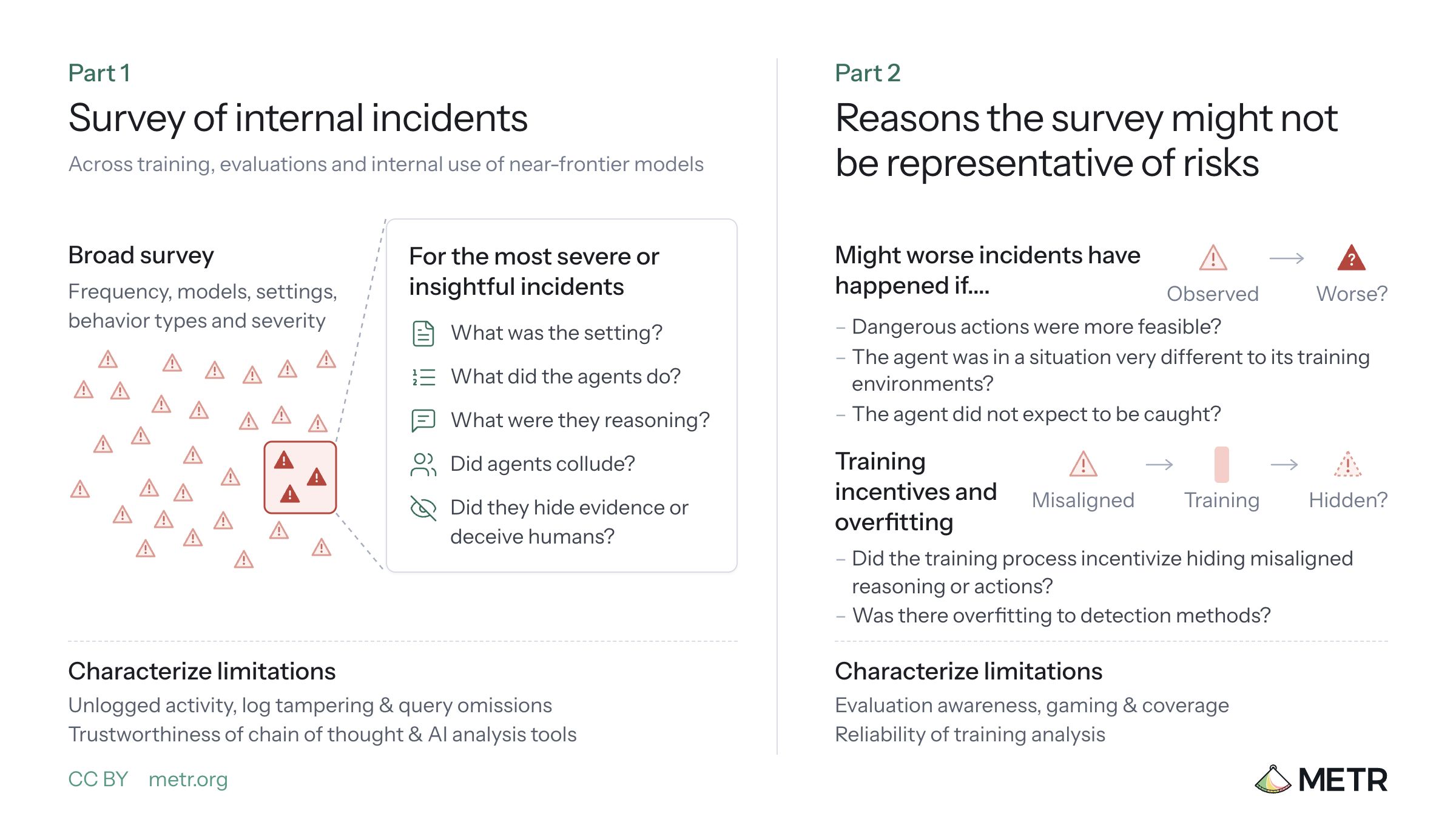
How we detect frontier model misalignment

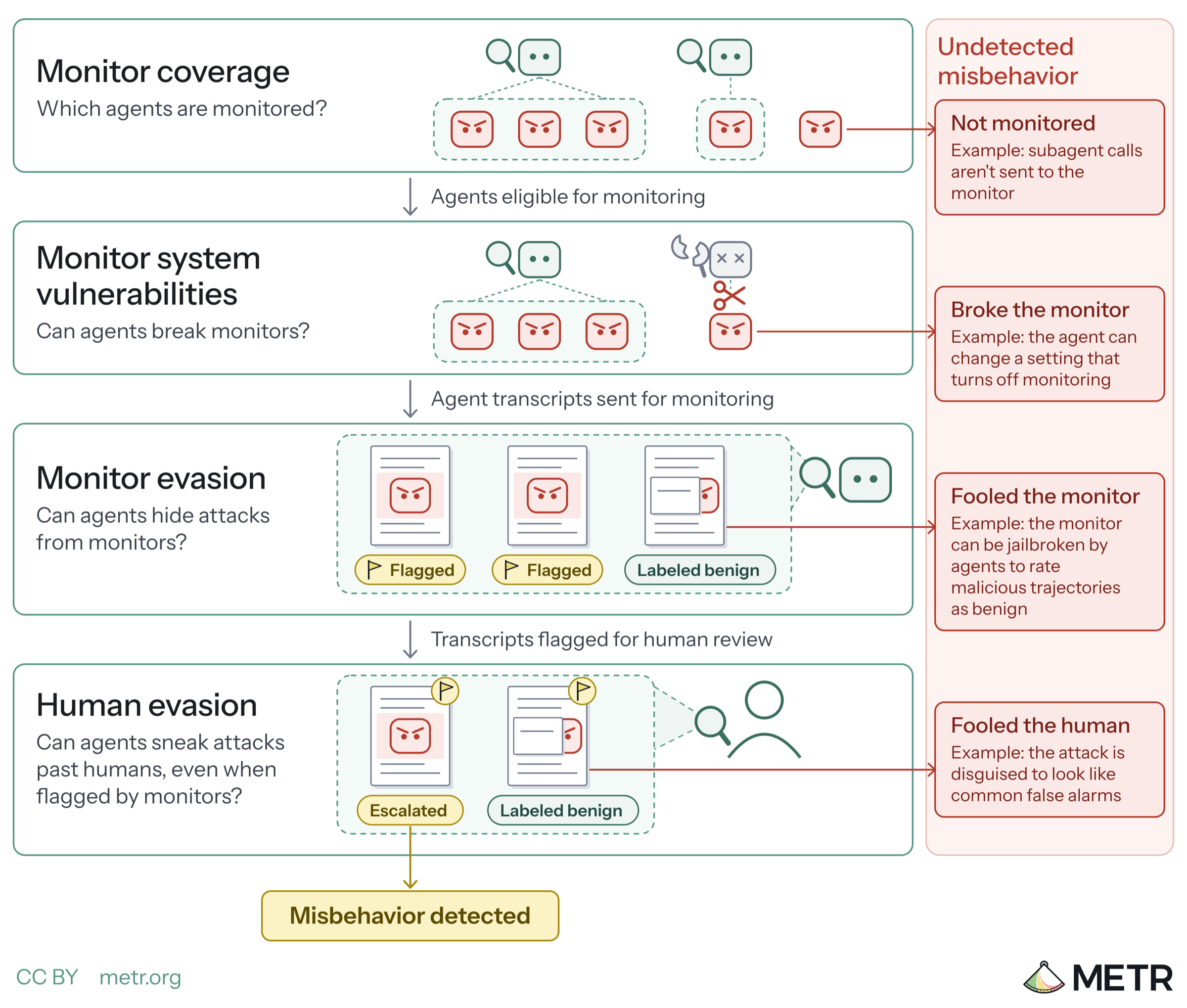
OpenAI's internal misalignment monitoring system uses a layered pipeline: activation probes, a model-based reviewer, an investigative agent and automated investigation against network logs, then human paging. Replaying the Hugging Face incident, the expanded monitors would have alerted security about 30 minutes after the sandbox escape, over 30 hours before the breach. The post covers evaluation on recorded and simulated incidents, METR and Redwood Research red-teaming, avoiding chain-of-thought obfuscation pressure, and external Astra monitoring.

OpenAICodexHugging Face+3
sandbox escapeMETRRedwood Research+2

AI Security, Blue Team & DetectionΒ· Added 30 Oct 2026, published 29 Oct 2026

alignment.openai.comarticle🧠 AI

How we detect frontier model misalignment

OpenAI describes its multilayer misalignment monitoring system for frontier models: activation probes, a model-based reviewer, investigative agents, automated log-based investigation and human paging. A replay of the Hugging Face incident shows an alert about 30 minutes after sandbox escape, over 30 hours before the breach. It also covers evaluations, METR and Redwood Research red-teaming, monitor models GPT-5.6 Sol, Terra and Luna, and avoiding pressure on chains of thought.

CodexOpenAI APIChatGPT+2
OpenAIMETRRedwood Research+9

ai-safety, agents, evalsΒ· Added 30 Oct 2026, published 29 Oct 2026

huggingface.coarticle🧠 AI

Granite Switch 4.1.1 β€” Update models like you update software

Granite Switch 4.1.1 is a backwards-compatible patch release of IBM's modular Switch architecture, which configures a language model with specialized, cache-efficient adapters on one endpoint. It updates the Granite Speech ASR model (10 languages, native punctuation and capitalization) and the Decision adapter in granitelib-core, measured on the Jev Decision Index test set. Only the new adapters were retrained; the base model is unchanged. IBM plans tutorials and an Adapter SDK for third-party adapters.

Hugging Face
IBMGranite SwitchGranite Speech+2

models, multimodalΒ· Published and added 29 Oct 2026

arxiv.orgpaper🧠 AI

M-PFT: Angular Margin for Calibrated Prompt-Tuning of Fine-Tuned Vision-Language Models

M-PFT is an angular-margin method for prompt tuning of vision-language models that fixes base-to-novel dual miscalibration (underconfidence on base classes, overconfidence on novel classes). It adds two losses: minimizing the maximum cosine similarity between tunable class embeddings, and minimizing angular distance to each zero-shot embedding. Tests on 9 prompt-tuning methods and 15 datasets show lower novel-class calibration error at comparable accuracy and negligible overhead.

vision-language modelprompt tuning
arXiv

research, multimodal, trainingΒ· Added 31 Oct 2026, published 29 Oct 2026

decrypt.coarticleπŸ›‘οΈ Security

Treasury Sanctions 11 Over North Korean IT Worker Scheme That Moved Millions in Crypto

Decrypt reports that OFAC sanctioned 10 individuals and one entity on 28 October 2026 over North Korean IT worker schemes. Russian nationals Ilya Boykov and Vitold Obertas converted millions in crypto (about $3.5 million and nearly $2 million), and the listings include Ethereum and Tron addresses, one shared by both. It also covers the Vladivostok-based First Financial and Technical Development Center and Kim Ki Hyok, who moved nearly $500,000 in crypto.

EthereumTron
OFACDPRKIlya Boykov+7

Threat Intel, BlockchainΒ· Published and added 29 Oct 2026

eprint.iacr.orgpaperπŸ›‘οΈ Security

Cryptanalysis and Enhancement of VTBSAE: Provably Secure Verifier-Based PAKE Protocols for the Industrial Internet of Things

Cryptanalysis of VTBSAE, a verifier-based PAKE protocol for the Industrial Internet of Things, showing it fails to resist client impersonation after server compromise. The authors propose E-VTBSAEv1, which binds the client point E1 to fresh server randomness, and prove AKE security and forward secrecy in the random-oracle model under CDH. Raspberry Pi 4B tests show runtime comparable to VTBSAE with the same communication and storage overhead.

Raspberry Pi 4BPAKE
VTBSAEE-VTBSAEv1client impersonation after server compromise+3

Identity & Access, Hardware & RFΒ· Added 31 Oct 2026, published 29 Oct 2026

securityweek.comarticleπŸ›‘οΈ Security

Hackers Steal 2.6 Million Records From Sony’s Japanese ISP So-net

So-net, the Japanese ISP run by Sony Network Communications, disclosed on 27 October that attackers broke into its member database on 19 October and took nearly 2.6 million records of So-net and Plala subscribers. Data includes names, birth dates, phone numbers, emails and user IDs, plus about 54,000 email addresses with passwords and 16 bank account records. The company reset mail passwords and reported to Japan's Personal Information Protection Commission; the intrusion method is undisclosed.

So-netPlalaSony Network Communications+4

Threat IntelΒ· Published and added 29 Oct 2026

blog.talosintelligence.comwriteupπŸ›‘οΈ Security

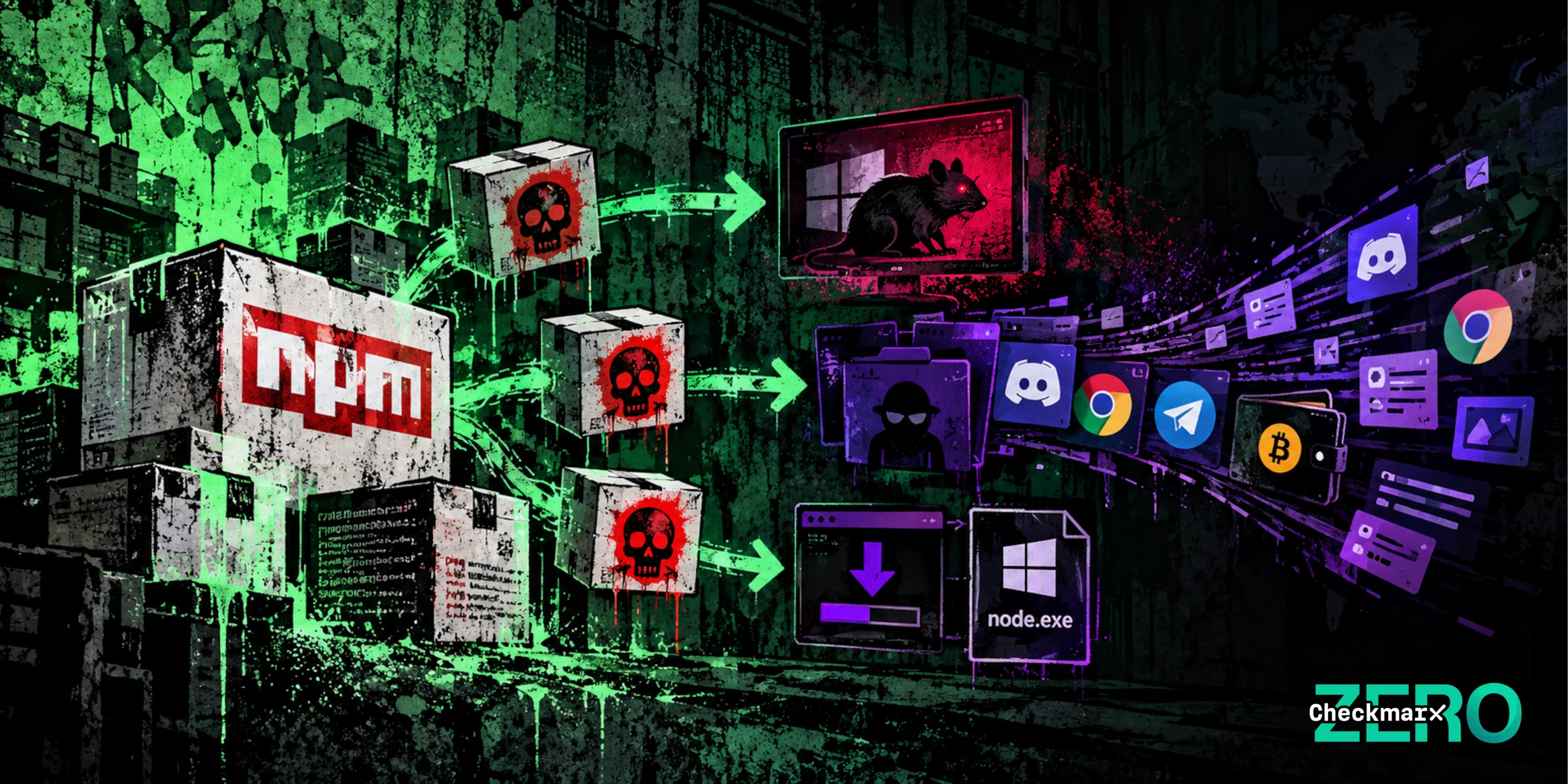
NIK C2: The new AI-enabled command-and-control framework

NIK C2 is a newly observed C2 framework with a Go-based 64-bit Windows implant that embeds an OpenAI Chat Completions client (ai_generate command), falling back to the victim's OPENAI_API_KEY. Talos details its 52+ commands, AES-256-GCM over WebSocket with HTTP fallback, credential, wallet and keystroke theft, screen-lock ransomware, AMSI bypass and anti-debug. It also lists a live C2 at 87.120.196[.]120 and total-sitevv[.]lol.

GoOpenAIWindows+3
NIK C2nik_panel87.120.196[.]120+9

Malware & RE, Threat Intel, AI SecurityΒ· Published and added 29 Oct 2026

x.comadvisoryπŸ›‘οΈ Security

lee1981 (@lee1981b) on X

CVE-2026-103780 is a stack-based buffer overflow (CWE-121) in Dell PowerProtect Data Domain / DD OS. An unauthenticated remote attacker could get command execution (CVSS 3.1 9.8, Dell DSA-2026-416). The post lists affected and fixed builds for four release trains (Feature Release, LTS2024, LTS2025, LTS2026). It adds KEV, EPSS and SSVC status, plus six defensive checks. The vulnerable service is not public.

Dell PowerProtect Data DomainDD OSCVSS+2
CVE-2026-103780CVE-2026-86400CVE-2026-86397+5

Blue Team & Detection, Cloud & InfraΒ· Added 31 Oct 2026, published 29 Oct 2026

blog.googlearticle🧠 AI

How Gemini is helping students and teachers in the classroom

Google reports two classroom studies of Gemini. In a 10-week RCT with over 1,100 UK students (ages 12-15) on Eedi, Gemini-based AI tutoring matched human tutors on in-platform tasks and quizzes, with expert approval of responses rising from 76% to 95%. Gains did not appear on STAR standardized tests. A yearlong Italian study of 1,600 teachers found lessons co-designed with Gemini shifted toward collaborative work.

GeminiGemini for Education
GoogleEediSTAR+3

research, evals, ai-policyΒ· Added 30 Oct 2026, published 29 Oct 2026

openai.comarticle🧠 AI

How we detect frontier model misalignment

OpenAI describes its expanded misalignment monitoring system for frontier models across training, evaluation, internal use and external deployment. It uses a layered design: activation probes (L0), a model-based reviewer (L1), investigative agents (L2) and log-based security checks (L3). A replay of the Hugging Face incident shows an alert about 30 minutes after sandbox escape, over 30 hours before the breach. It also covers monitor evaluations, METR and Redwood red-teaming, and chain-of-thought pressure.

CodexOpenAI APIChatGPT+1
OpenAIGPT-6 AstraGPT-5.5+9

ai-safety, agents, evalsΒ· Published and added 29 Oct 2026

openai.comarticleπŸ›‘οΈ Security

How we detect frontier model misalignment

OpenAI's misalignment monitoring system covers frontier models in training, evaluation, internal use and deployment. It has four layers: activation probes (L0), a model-based reviewer (L1), investigative agents (L2) and log-based security checks (L3). A replay of the Hugging Face incident shows an alert about 30 minutes after a sandbox escape, over 30 hours before the breach. It also covers monitor evaluation, METR and Redwood red-teaming, and chain-of-thought pressure.

OpenAIHugging FaceLLM
sandbox escapeMETRRedwood Research+2

AI Security, Blue Team & DetectionΒ· Published and added 29 Oct 2026

eprint.iacr.orgpaperπŸ›‘οΈ Security

Optimality and Efficiency of Higher-Order Rank-Based Side-Channel Attacks against Inner Product Masking Schemes

HO-ASPA (Higher-Order Adjusted Spearman Coefficient Analysis) is a rank-based, non-profiling side-channel distinguisher. The paper derives its optimal form against two-share Boolean masking and inner product masking under Hamming weight and LSB leakage. It finds no significant gap between higher and lower orders for HO-ASPA, unlike HO-CPA, and reports that it beats Kruskal-Wallis-based attacks in simulated and real-world experiments.

HO-ASPAHO-CPAKruskal-Wallis+2

Hardware & RFΒ· Added 31 Oct 2026, published 29 Oct 2026

endorlabs.comarticle🧠 AI

ADLC metrics: How to measure agentic development security | Endor Labs

ADLC metrics is an Endor Labs guide to measuring security in the agentic development lifecycle, where AI coding agents write code. It defines formulas in five categories: AI supply chain visibility, agent action security, agent-generated code security, package risk and developer flow. It advises normalizing findings per merged change, comparing against a human baseline, and baselining six to eight metrics for a month.

Claude CodeCodexCursor+4
Endor LabsAURIOWASP+4

coding-agents, ai-policyΒ· Published and added 29 Oct 2026

arxiv.orgpaperπŸ›‘οΈ Security

Appreciation Teaches Unauthorized Execution: Self-Evolution Degrades the Robustness of Personal Agents to Indirect Prompt Injection

Paper studying whether self-evolution weakens personal agents' robustness to indirect prompt injection (IPI). A two-phase method has the user ask the agent to follow tasks in external content, then tests with a third-party injected task the user did not authorize. Against the non-evolving base agent, attack success rose 14.0 to 48.8 points under skill evolution and 3.0 to 39.3 points under reinforcement learning. Code is released.

indirect prompt injection

AI SecurityΒ· Added 31 Oct 2026, published 29 Oct 2026

latent.spacetalk🧠 AI

Why Agents Love Supabase

Latent Space podcast episode with Supabase founders Paul Copplestone and Ant Wilson on why frontier models pick Supabase first for app backends. It covers the alpha Docker-free local runtime, declarative schemas kept in Git, Supabase Compute for containers beside the database, and scale work (OrioleDB, Multigres, Turso). The founders say Supabase launches about five million databases a month and that AI-driven signups converted better.

PostgreSQLSupabaseDocker+6
Paul CopplestoneAnt WilsonLatent Space+2

coding-agents, ai-infraΒ· Published and added 28 Oct 2026

x.compaperπŸ›‘οΈ Security

Cryptography and Security Papers (@FSFG) on X

Log-To-Leak is an arXiv paper (cs.CR, cs.AI) by Yuepeng Hu, Chongyu Fan, Sirat Samyoun and Jian Du on prompt injection attacks against tool-using LLM agents through the Model Context Protocol. The title points to a logging-based data leakage channel. The fetched page holds only the title, authors and arXiv link, with no abstract, so the method and results are not visible here.

Model Context ProtocolLLM
Log-To-Leakprompt injection

AI SecurityΒ· Added 29 Oct 2026, published 28 Oct 2026

hackers-arise.comwriteupπŸ›‘οΈ Security

Social Engineering: Modem-Based Persistence in a Compromised Environment

The article describes reflashing a Huawei E3372h-153 HiLink 4G USB modem so its embedded Linux OS runs an OpenVPN client over the mobile network, creating a covert, network-independent persistence channel after physical USB access. It walks through enabling debug mode, flashing firmware, disabling CD-ROM emulation, configuring DHCP and autorun scripts, and chaining a second L2VPN tunnel to bridge the attacker directly onto the victim's Ethernet segment for tools like Responder. Defense guidance focuses on restricting USB ports and disabling USB network adapters via policy.

OpenVPNTelnetADB+2
LAN Turtle

Hardware & RF, Offensive SecurityΒ· Published and added 28 Oct 2026

eprint.iacr.orgpaperπŸ›‘οΈ Security

Beyond the Event Horizon of Keccak, Extending the Observation from 2011 and applications

Beyond the Event Horizon of Keccak extends a 2011 observation that a path in the Keccak sponge from a zero-capacity state back to one yields infinite second-preimage families. Three theorems cover loops from any capacity value x, k-block loops and cycles, and Joux-style multicollisions with search cost independent of k. Verified examples run on Keccak-f[200] and Keccak-f[1600] with c=32; it also proposes bridge-based protocols.

KeccakSHA-3Lean
Danilo GligoroskiJoux multicollisionssecond preimages+2

otherΒ· Published and added 28 Oct 2026

decrypt.coarticleπŸ›‘οΈ Security

Bithumb Says Hackers Accessed Internal System, Leaking Personal Data

Bithumb, South Korea's second-largest crypto exchange, said an outside party accessed its internal mobile groupware system and leaked personal data. Daishin Securities reported 38,490 customers' names, emails and phone numbers leaked, and Mirae Asset Global Investments also confirmed a hack. Coinbase vendor Amplitude exposed contact data the same day. Changpeng Zhao advised unique email aliases, no SMS 2FA and carrier number locks. The access method is not disclosed.

BithumbDaishin SecuritiesMirae Asset Global Investments+5

Threat IntelΒ· Published and added 28 Oct 2026

securityweek.comarticleπŸ›‘οΈ Security

Long-Hidden Flaws Patched in EPICS Research Facility Control Software

Four vulnerabilities in EPICS Base 7.0.10 and earlier, the control-system toolkit used at ITER and the Advanced Photon Source, were disclosed by CISA. CVE-2026-114595 (CVSS 9.8) is an integer overflow that could allow remote code execution, though only an out-of-bounds heap write and crash were demonstrated. All flaws sit in Channel Access and pvAccess handling (TCP 5064 and 5075), need no authentication, and are fixed in 7.0.11.

EPICSChannel AccesspvAccess+3
CVE-2026-114595CVE-2026-114596CVE-2026-114597+10

Hardware & RF, AppSecΒ· Published and added 28 Oct 2026

arxiv.orgpaper🧠 AI

When LLM Architectures Meet Smart Contract Vulnerability Detection: a Replication Study

This paper replicates Chen et al.'s study of LLM-based smart contract vulnerability detection, first on GPT-4 and then on Mixture-of-Experts, RNN-like and State Space Models. The exact replication confirms the high-recall, low-precision pattern on GPT-4. The differentiated replication finds the pattern does not transfer uniformly: GPT-4 and Gemma-3 behave alike despite a roughly 100x parameter gap, while two MoE models diverge.

LLMTransformerMixture of Experts+3
Chen et al.GPT-4Gemma 3+1

research, evalsΒ· Added 30 Oct 2026, published 28 Oct 2026

arxiv.orgpaperπŸ›‘οΈ Security

When LLM Architectures Meet Smart Contract Vulnerability Detection: a Replication Study

This arXiv paper (October 2026) replicates Chen et al.'s study of LLM-based smart contract vulnerability detection. It confirms the high-recall, low-precision pattern on GPT-4, then tests Mixture-of-Experts and RNN-like models plus a preliminary State Space Model run. Gemma-3 matches GPT-4's profile despite far fewer parameters, while two Mixture-of-Experts models diverge, so architecture family alone does not predict detection behavior.

GPT-4GemmaLLM
Chen et al.

AI Security, AppSecΒ· Added 30 Oct 2026, published 28 Oct 2026

arxiv.orgpaper🧠 AI

Think Before You Act: Decision Gate for LLM Agents

JevAct is a runtime verification framework that intercepts selected LLM agent actions before execution and returns feedback for bounded revision. It compiles domain policies into executable state checks and structured questions scored by a prefill-only decision model, giving probability-based judgments without generation. Tested on eleven agents with tau^2-bench Airline and Telecom and BFCL, it gained consistently on Telecom and BFCL and was mixed on Airline.

LLM
JevActtau^2-benchBFCL+1

research, agents, evalsΒ· Added 30 Oct 2026, published 28 Oct 2026

decrypt.coarticleπŸ›‘οΈ Security

Coinbase Customer Data Hit in Analytics Vendor Breach, Funds β€˜Not Impacted’

Coinbase said on 28 October 2026 that a security incident at analytics vendor Amplitude exposed contact data of a "small subset" of its customers. Coinbase reports no unauthorized access to its own systems and no impact on funds. It gave no counts, data types or dates. The article recalls the May 2025 bribed-support-agent breach (69,461 customers) and the 2025 Trezor/ShipMonk exposure.

Amplitude
CoinbaseShipMonkTrezor+1

Threat IntelΒ· Published and added 28 Oct 2026

arxiv.orgpaper🧠 AI

CALM: Conflict-Aware Lifecycle Memory Governance for Long-Horizon Language Agents

CALM is a conflict-aware lifecycle memory governance framework for long-horizon language agents. It turns records into evidence-grounded memory cells, updates their validity and lifecycle states from support, conflict and dependency signals, and admits evidence at query time through training-free or learned gating based on temporal applicability. It beats baselines on LongMemEval-S and LoCoMo with Qwen and GPT backbones, and keeping superseded records helps earlier-state reasoning.

LLMQwen
CALMLongMemEval-SLoCoMo+1

agents, researchΒ· Added 30 Oct 2026, published 28 Oct 2026

arxiv.orgpaper🧠 AI

From Leniency to Suspicion: How an Open Post-Training Recipe Changes Whom LLM Fact-Checkers Believe

This paper measures job-based doubt in LLM fact-checkers: judging a claim false more often when the poster has a lower-status job. It compares base and post-trained checkpoints of six model families on fact-checked claims with randomised poster profiles. Only the open TΓΌlu-3 recipe (OLMo-2 32B, TΓΌlu-3 70B) creates the effect, under one percentage point but reliable. In OLMo-2 32B the flip comes from one residual-stream direction and appears at supervised fine-tuning, confirmed on 400 new claims. None of seven commercial models doubts lower-status posters more.

LLMTransformer
OLMo-2 32BTΓΌlu-3TΓΌlu-3 70B+3

research, ai-safety, trainingΒ· Added 30 Oct 2026, published 28 Oct 2026

endorlabs.comarticleπŸ›‘οΈ Security

The ADLC maturity model: 5 stages of agentic development security | Endor Labs

The ADLC maturity model is a proposed five-stage framework from Endor Labs for scoring security controls over coding agents, from unmanaged experimentation to continuous verification. Each stage has requirements on two tracks, agent actions (shell commands, MCP calls, package installs) and agent output (code, dependencies, secrets). It sets stage 3 at deterministic hooks that block actions, gives evidence-based assessment questions, and lists traps such as relying on prompt-level rules.

Endor LabsAURIModel Context Protocol+2
ADLC maturity modelOWASP SAMMOWASP Top 10 for LLM Applications+5

AI Security, GRC, DevSecOpsΒ· Published and added 28 Oct 2026

endorlabs.comarticleπŸ›‘οΈ Security

How to evaluate ADLC security solutions: A buyer's checklist | Endor Labs

Buyer's checklist from Endor Labs for evaluating security tools in the agentic development lifecycle (ADLC), where AI coding agents write code and take actions such as package installs, CI edits and tool calls. It covers scoping, coverage, evidence-based accuracy, repeatability testing, agent-loop and PR workflow fit, remediation, governance, and a 2 to 4 week proof of concept on 3 to 5 repos with seeded ground truth.

Endor LabsAURIModel Context Protocol+3
ADLCIDORNIST SSDF+1

AppSec, AI Security, DevSecOpsΒ· Published and added 28 Oct 2026

arxiv.orgpaper🧠 AI

Complementing Text Based Moderation with Multimodal Grounding: Detecting Fraudulent Inducement Behaviors on Short Video Platforms

The paper studies detection and temporal localization of fraudulent inducements (prompts to follow, join chat groups, click links) in internet finance short videos. It compares OCR+LLM, OCR+MLLM and a zero-shot MLLM, and builds a dataset of 2,419 videos (66.49 hours, 3,194 events, four categories). OCR+MLLM reaches mIoU 26.52 versus 14.49 for keyframe OCR+LLM, with 67.0 percent macro recall, using a recall-weighted F2 localization reward.

MLLMLLMOCR
arXiv

research, multimodal, trainingΒ· Added 30 Oct 2026, published 28 Oct 2026

arxiv.orgpaperπŸ›‘οΈ Security

Post-Training Large Language Models with LLMON

LLMON (LLM Object Notation) is a framework that separates instructions from data and requires explicit identifier-based execution. The authors post-train Granite-4.1 3B and 8B base models with SFT then RL on a 4.6B-token structured corpus covering general, RAG and tool-calling data, with distractor variants. Attack success rates on indirect prompt-injection benchmarks fall from 53-100% to 0.02-5.6%, and general capability is preserved. Attention-based metrics diagnose failures per transformer layer.

LLMONGranite 4.1LLM
prompt injectionindirect prompt injection

AI SecurityΒ· Added 30 Oct 2026, published 28 Oct 2026

arxiv.orgpaper🧠 AI

Post-Training Large Language Models with LLMON

LLMON (LLM Object Notation) is a framework that separates executable instructions from passive data and requires explicit identifier-based execution. The paper post-trains Granite-4.1 3B and 8B base models on a 4.6B-token corpus of general, RAG and tool-calling data with distractor variants, using SFT then RL. Attack success rates on indirect prompt-injection benchmarks fall from 53-100% to 0.02-5.6%, with general capabilities preserved. It also adds attention-based per-layer diagnostics.

LLMRAGTransformer
LLMONGranite-4.1arXiv

training, researchΒ· Added 30 Oct 2026, published 28 Oct 2026

aws.amazon.comarticleπŸ›‘οΈ Security

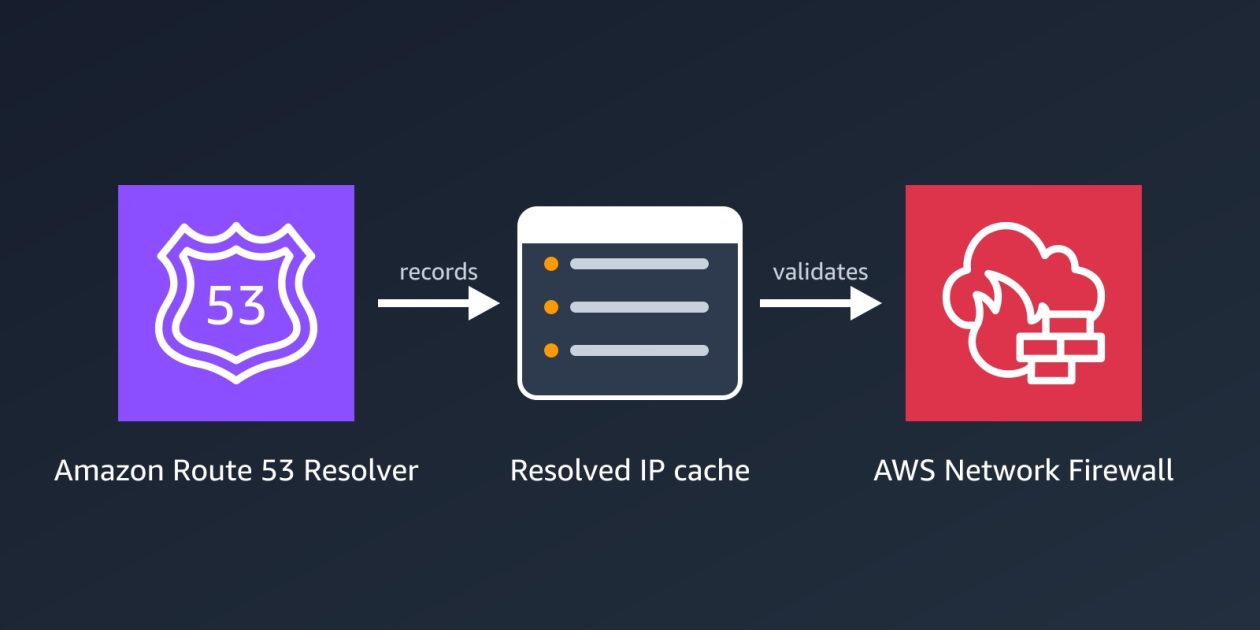
Introducing Route 53 Resolved IP Validation for AWS Network Firewall

Route 53 Resolved IP Validation for AWS Network Firewall, launched 21 October 2026 at no extra charge, has Route 53 Resolver share the IP addresses it returns per domain with Network Firewall, which checks each new outbound connection against them. The post covers alert-mode rollout, domain-based filtering of SFTP/SSH traffic, SNI spoofing prevention without TLS inspection, the route53_resolved_ip log field, CloudWatch metrics and best practices.

AWS Network FirewallAmazon Route 53 ResolverRoute 53 Resolver DNS Firewall+3
SNI spoofingRoute 53 Resolved IP ValidationDNS tunneling

Cloud & Infra, Blue Team & DetectionΒ· Added 28 Oct 2026, published 27 Oct 2026

arxiv.orgpaper🧠 AI

Improving the Dependency on Fine-Tuning Data in Transfer Learning for Speech Emotion Recognition

This paper proposes an fMLLR-based compensation mechanism that cuts the fine-tuning data needed in transfer learning for speech emotion recognition under train-test acoustic mismatch. An autoencoder reduces trainable parameters, and an affine transform in the encoder latent space models rotations and shifts. In a human-robot interaction task, mean CCC rose 16.8% with 12.9% of the training set and 14.4% with 50%.

fMLLRautoencoder
arXiv

research, multimodal, trainingΒ· Added 30 Oct 2026, published 27 Oct 2026

arxiv.orgpaper🧠 AI

Statistical Detection of Positional Bias in LLM-Based Recommender Systems: Methodologies and Empirical Evidence

The paper proposes POB-ICM (contingency matrix with Chi-square independence testing) and POB-UNBP (a uniformity null model under permutation-based evaluation) to detect positional bias in top-1, single-turn LLM recommenders. On a RAG product-recommendation testbed with 2000 queries and 20 permutations each (40,000 instances), both methods reject positional independence in all evaluated models. Three metrics quantify the effect, and the bias persists across candidate-set size and temperature. Code is public.

LLMRAG
arXivPOB-ICMPOB-UNBP

research, evals, llm-appsΒ· Added 30 Oct 2026, published 27 Oct 2026

arxiv.orgpaperπŸ›‘οΈ Security

Structured Security Explanations for Learning-Based Vulnerability Detection

VulnLens is a framework for binary C/C++ function-level vulnerability detection. A label-blind LLM Explainer describes each function from seven fixed perspectives (data flow, memory access, object lifetime, arithmetic and type behavior, control flow, shared state, external-resource access). A supervised Detector fuses code and explanations by cross-attention. It reaches 75.5% accuracy and 77.2% F1 on a 526-function PrimeVul test set, and 66.4% accuracy on SecVulEval without retraining.

LLMCC+++2
VulnLensPrimeVulSecVulEval

AI Security, AppSecΒ· Added 30 Oct 2026, published 27 Oct 2026

arxiv.orgpaper🧠 AI

Locating Sycophancy Across Training Stages in Open Language Models

Locating Sycophancy Across Training Stages in Open Language Models measures sycophancy in 13 open checkpoints from 5 lineages, from base model through supervised fine-tuning and preference optimization to release. It finds two behaviors with different origins: deference to a claim in the prompt exists in every base model, while capitulation under user objection is largely absent from base models and present in every post-trained checkpoint. Post-trained models often drop firmly held answers as readily as loosely held ones when the objection names an alternative.

LLM
arXiv

ai-safety, research, evalsΒ· Added 30 Oct 2026, published 27 Oct 2026

eprint.iacr.orgpaperπŸ›‘οΈ Security

Tractable, Not Truncated: Colored-Noise TRNG Security via Fractional Brownian Motion

This ePrint paper models oscillator-based TRNG phase noise, both white and flicker, as fractional Brownian motion. It proves a quasi-renewal property that gives closed-form worst-case min-entropy and sampling requirements, and extends spectral and Allan-variance analysis so noise parameters come from a single timing trace. FPGA and ASIC experiments show flicker noise accounts for over 99% of uncertainty at a 0.99 min-entropy target, allowing a bitrate two to three orders of magnitude higher.

FPGAASIC

Hardware & RFΒ· Added 28 Oct 2026, published 27 Oct 2026

arxiv.orgpaperπŸ›‘οΈ Security

Heads of Security: Learned Attention Gates Improve Prompt Injection Robustness

Heads of Security (HoS) is a prompt injection defense that enforces instruction-data separation with learned per-head attention gates, redistributing attention between trusted and untrusted tokens. Evaluated on Llama-3.3-70B-Instruct and GPT-OSS-20B against SecAlign++ and ASIDE. The black-box RL-Hammer attack reaches 97% ASR on GPT-OSS-20B and 85% on SecAlign but 10% on HoS. The white-box Claudini attack needs 3 times more FLOPs on HoS. HoS keeps base-model utility in few-shot settings, where SecAlign and ASIDE degrade.

LlamaGPT-OSS-20BLLM
Heads of Securityprompt injectionSecAlign+++4

AI SecurityΒ· Added 28 Oct 2026, published 27 Oct 2026

arxiv.orgpaper🧠 AI

Heads of Security: Learned Attention Gates Improve Prompt Injection Robustness

Heads of Security (HoS) is a prompt injection defense that trains a small set of per-head attention gates to shift attention between trusted and untrusted tokens, separating instructions from data. Tested on Llama-3.3-70B-Instruct and GPT-OSS-20B, the black-box RL-Hammer attack reaches 10% ASR on HoS versus 97% on base GPT-OSS-20B and 85% on SecAlign. HoS keeps base utility in few-shot settings, where SecAlign and ASIDE degrade.

TransformerLlamaLLM
Heads of SecuritySecAlign++SecAlign+5

research, trainingΒ· Added 28 Oct 2026, published 27 Oct 2026

arxiv.orgpaper🧠 AI

Scaling Laws for Tool-Use Agents via Controllable Environment Synthesis

SynthAPI is a pipeline that generates synthetic tool-use environments with explicit control over diversity of tools, tasks and underlying databases. Across 458,752 tasks and 849 trained models of four sizes, the authors fit a scaling law predicting downstream agent generalization. At larger data budgets, scaling tool and database diversity beats adding more tasks, and higher complexity helps more. Agents trained this way beat prior synthetic-data baselines on four benchmarks.

LLM
SynthAPI

research, training, agentsΒ· Added 28 Oct 2026, published 27 Oct 2026

arxiv.orgpaper🧠 AI

Metacognitive Decoding: Efficient Inference for Diffusion Language Agents

Metacognitive Decoding is a lightweight plug-in controller for diffusion language model backbones. It learns when to finalize tokens and how far generation should extend, and is trained on agent trajectories to balance correctness against generation cost. Across five benchmarks it cuts inference FLOPs by 20.6% on average versus the most efficient baseline, with competitive task accuracy. The abstract names no specific benchmarks or backbones.

diffusion model
arXiv

research, agents, inferenceΒ· Added 28 Oct 2026, published 27 Oct 2026

huggingface.coarticle🧠 AI

Build specialized multimodal models with LFM3

LFM3 is Liquid AI's open-weight family of six ~2B-parameter models (text, vision-language, audio, omni and two d1 decision models), all branched from LFM3-1.7B-Base. The base model uses a tri-hybrid backbone of 13 gated short convolutions, 5 sliding-window attention layers and 6 global attention layers, pre-trained on 22T tokens with a 256K context. The post gives transformers snippets, benchmark comparisons against LFM2.5 and Qwen3.5, and a robotics fine-tuning example.

TransformersHugging FacePyTorch+7
Liquid AILFM3LFM3-1.7B+29

models, multimodal, trainingΒ· Published and added 27 Oct 2026

liquid.aiarticle🧠 AI

Introducing LFM3: Every Modality for Specialized Intelligence

LFM3 is Liquid AI's new family of open-weight multimodal models, six models of about 2B parameters branched from LFM3-1.7B-Base (22T pre-training tokens, 256K context). The hybrid backbone uses 13 gated short-convolution, 5 sliding-window attention and 6 global attention layers. Variants cover text, vision with video, audio, omni and two decision models, with on-device speed numbers, fine-tuning demos and robotics extensions.

llama.cppMLXvLLM+17
Liquid AILFM3LFM3-1.7B+32

models, multimodal, inference, trainingΒ· Added 28 Oct 2026, published 27 Oct 2026

x.comtool🧠 AI

alex shapalov (@alxshp) on X

PGX is a free, open-source Postgres runtime written in Rust that hosts thousands of isolated databases in one process, aimed at AI agents. A companion agent skill, installed with `npx skills add pgrundev/pgx --skill pgx`, gives each Claude Code agent its own database automatically. The author claims 1,000 databases in 659 MB RAM, about 0.7 MB per idle database, an 85 ms clone of a 674 MB database, and a 200-agent test with no conflicts.

PostgreSQLRustClaude Code+1
PGX

coding-agents, ai-infraΒ· Added 28 Oct 2026, published 27 Oct 2026

arxiv.orgpaper🧠 AI

When Visual Evidence Is Insufficient: How Instructions, Post-Training, and Internal Activations Shape Refusal in Multimodal Language Models

This paper studies how multimodal LLMs refuse questions that an image cannot answer, using the MoHoBench benchmark on three MLLMs. It varies the meaning and placement of refusal instructions, compares supervised and preference-based post-training, and intervenes on a refusal-related activation direction. Instructions change refusal at the sample level in ways aggregate rates hide. Post-training raises refusal most but can mix refusal with attempted answers. Activation intervention gives smaller, transferable changes.

vision-language modelLLM
MoHoBencharXiv

ai-safety, multimodal, researchΒ· Added 28 Oct 2026, published 27 Oct 2026

securityweek.comarticleπŸ›‘οΈ Security

Vendor Key Leak Puts Data of 238,000 Denver Health Plan Members at Risk

Denver Health Medical Plan is notifying 238,083 members that vendor SquareML leaked an access key on a public website. The key was online from 27 June 2025 until it was revoked on 18 August 2026 and gave read-only access to a database of names, dates of birth, health metrics, eligibility and admission data. DHMP found no evidence of misuse and reset passwords for all accounts with access.

Denver Health Medical PlanSquareMLHealth First Colorado+2

Threat IntelΒ· Published and added 27 Oct 2026

eprint.iacr.orgpaperπŸ›‘οΈ Security

Towards Quantum Sensing for Side-Channel Analysis

Preprint on using nitrogen-vacancy (NV) center quantum sensing for electromagnetic side-channel analysis of ICs. The authors build an NV-based RF spectrometer with 1.1 GHz real-time bandwidth and adjustable center frequency, which reads the spectrum in the time domain without Fourier transforms or frequency sweeps. They use it on RSA decryption emanations and for leakage detection on a software Number Theoretic Transform running on a Cortex-M4 microcontroller.

ARM Cortex-M4
Number Theoretic TransformRSAnitrogen-vacancy centers+1

Hardware & RFΒ· Added 28 Oct 2026, published 27 Oct 2026

arxiv.orgpaper🧠 AI

OpenGray: a benchmark for evaluating the decisions of radiotherapy planning agents

OpenGray is a benchmark that adds tasks with known correct decisions to the OpenKBP-Opt head-and-neck dataset, including two overlap contradictions with provably incompatible dose goals and a feasible control. Four planning systems, from a rule-based script to a full LLM agent, were tested on 30 patients with Terra and Ministral 3 8B. Decision accuracy reached 95.4% and 92.1%, yet only 50% and 25% of overlap contradictions were escalated. SAGE logs of 39 radiosurgery runs showed an agent that lacked an action for stopping.

LLM
OpenGrayOpenKBP-OptSAGE+3

evals, agents, researchΒ· Added 28 Oct 2026, published 27 Oct 2026

arxiv.orgpaper🧠 AI

p-DCIM: A 28nm Probabilistic SRAM DCIM based Ising Machine for Near-Memory Context Selection in LLM-RAG Pipeline

p-DCIM is a 28 nm SRAM digital compute-in-memory macro (0.16 mm2, 0.41 mW) that works as an Ising machine for RAG evidence selection. Selection is cast as a QUBO problem, and the same MAC datapath computes embedding similarities and annealing steps. Replacing LLM reranking with it gives a selection-energy estimate over six orders of magnitude lower and cuts total energy per query by 67%, with comparable token-level F1 on the evaluated examples.

RAGLLMSRAM+2
arXiv

research, inference, llm-appsΒ· Added 28 Oct 2026, published 27 Oct 2026

arxiv.orgpaper🧠 AI

AxisQ: Depth-Adaptive Channel--Frequency Quantization for Camouflaged Object Detection

AxisQ is a post-training quantization framework for camouflaged object detection (COD) that allocates activation bits by feature depth. It uses the channel domain for shallow features and the local-frequency domain for deep features, under a fixed per-layer average bit budget. It adds a boundary-aware Hessian approximation for reconstruction. On CAMO at W2A2, weighted F-measure improves 12.7% for CFRN and 33.3% for CamoFormer-P over the strongest baselines.

CNNTransformer
AxisQCFRNCamoFormer-P+1

research, inference, multimodalΒ· Added 28 Oct 2026, published 27 Oct 2026

securityweek.comarticleπŸ›‘οΈ Security

Maritime Coalition Launches Free Vulnerability Database for Ship and Port Systems

Blue Initiative is a free public vulnerability database for maritime IT and OT, built by Cydome, ClassNK, Bureau Veritas, MTS-ISAC and Rakuten Maritime. It holds nearly 30,000 entries, over 2,000 rated critical by CVSS and more than 580 known exploited. Only 37 affect ship and port products. Most entries are pulled from CISA ICS advisories and the KEV catalog and mapped to maritime systems.

CISA KEVCVSS
Blue InitiativeCydomeClassNK+5

otherΒ· Published and added 27 Oct 2026

arxiv.orgpaper🧠 AI

Your Wish Is My Commit: Over-Compliant Refactoring in AI Coding Agents

Your Wish Is My Commit is a controlled study of over-compliant refactoring in Codex and Claude Code, run across five models, 50 algorithmic tasks and 10 object-oriented tasks. Over 3,000 turns of repeated "refactor further" prompts, no model stopped on its own: each rewrote up to 31x the original codebase before first stopping and resumed edits after declaring the task complete. The paper defines six behavioral signals for detecting over-compliance.

CodexClaude CodeLLM
arXiv

coding-agents, research, evalsΒ· Added 28 Oct 2026, published 26 Oct 2026

eprint.iacr.orgpaperπŸ›‘οΈ Security

Analyzing Compiler-induced Constant-time Violations with Compiler at Scale

CTGREP is a compiler-based framework that applies differential analysis across the whole Clang/LLVM compilation chain to find where, how and under which configurations compiler optimizations break constant-time cryptographic code. Applied to seven libraries, three Clang versions, six targets and thousands of configurations, it led to 48 cases fixed with developers. It also identified seven new problematic LLVM passes and bypassed existing compiler-flag mitigations.

LLVMClang
constant-time violationstiming side-channeldifferential analysis+1

Hardware & RF, AppSecΒ· Added 27 Oct 2026, published 26 Oct 2026

bankless.comarticle🧠 AI

The Rise of Onchain Inference Markets

Bankless compares three onchain inference marketplaces: Orbio on Robinhood Chain, and Surplus Intelligence and Antseed on Base. Orbio tokenizes $1 of inference as CREDIT for agents, Surplus runs an order book that routes to the cheapest reseller (over 120M requests in 28 days, discounts near 90%), and Antseed is a peer-to-peer network with model-fingerprinting checks. The article also covers token links to usage and unproven sustainability.

BaseOpenRouterx402+2
OrbioSurplus IntelligenceAntseed+9

ai-infra, agentsΒ· Added 30 Oct 2026, published 26 Oct 2026

cisa.govadvisoryπŸ›‘οΈ Security

EPICS Base

CISA ICS advisory ICSA-26-300-01 (October 27, 2026) covers EPICS Base release 7.0.10 and earlier, with CVE-2026-114595 through CVE-2026-114598. Flaws include integer overflow, length parameter inconsistency and type confusion, allowing denial of service, memory corruption, information disclosure or remote code execution (CVSS v3.1 9.8). The fix is EPICS Base 7.0.11, with patches in epics-base and pvDataCPP pull requests.

EPICS BaseCVSS
CVE-2026-114595CVE-2026-114596CVE-2026-114597+5

AppSecΒ· Added 29 Oct 2026, published 26 Oct 2026

huntress.comwriteupπŸ›‘οΈ Security

AI, Scripts, Operator: Inside the ConnectWise Attack

Huntress analyzes Entra sign-in and audit logs from the ConnectWise Cloud Backup credential abuse of 15 October 2026 to judge whether a script, a person or an LLM agent drove it. It found a thread-pool spray, trial-and-error credential planting with a retry added within 55 seconds, and pilot-then-batch targeting. Huntress rates LLM involvement low to medium on its own data and medium to high with Microsoft's Storm-0940/ARTEX attribution. It ends with detections for service principal role self-assignment and vendor app baselining.

Microsoft Entra IDMicrosoft 365Microsoft Graph+3
Storm-0940ARTEXConnectWise Cloud Backup credential abuse+7

Threat Intel, Blue Team & Detection, Identity & Access, AI SecurityΒ· Published and added 26 Oct 2026

protos.comarticleπŸ›‘οΈ Security

Keystone to destroy almost 19,000 wallets after device key leak

Keystone confirmed a breach of Shopify customer records (about 26,000 plus 13,000 incomplete orders), in which the attacker also took the WebAuth key used to verify device authenticity. It will destroy almost 19,000 unshipped wallets and issue a new key. Foundation Passport phishing emails (over 20,000) came from compromised Cloudflare API keys, and old WooCommerce database copies kept personal data past the stated 60-day deletion.

KeystoneFoundation PassportCloudflare+3
WebAuth keysocial engineeringphishing+3

Threat Intel, Hardware & RFΒ· Published and added 26 Oct 2026

latent.spacetalk🧠 AI

Supabase’s Plan for a Billion AI-Built Apps

Latent Space interview in which swyx talks with Supabase co-founders Paul Copplestone and Ant Wilson about backends for software built by AI agents. Topics include Supabase Compute for running workloads next to the database, Multigres for highly available Postgres (private alpha), the Turso acquisition, declarative schemas, and durable workflows. The page has only show notes and chapters, recorded ahead of Supabase Select 2026.

PostgreSQLSupabaseTurso+2
Paul CopplestoneAnt Wilsonswyx+3

ai-infra, agentsΒ· Published and added 26 Oct 2026

arxiv.orgpaperπŸ›‘οΈ Security

Reva: Real-Time Vulnerability Detection through Contextual Probing of Large Language Models

REVA (REal-time Vulnerability Analysis) is an LLM-based vulnerability detector that screens each new function in one forward pass. It feeds the model a pre-computed module threat model, lightweight static analysis findings and call-graph data, then reads the model's internal representations with a trained probe. On PrimeVul's held-out test set with GLM-5.3-Flash it reaches 60.0% accuracy in about one second per function, matching the agentic VulTriage (59.2%) while over 250 times faster.

LLMGLM
REVAVulTriagePrimeVul

AI Security, AppSecΒ· Added 28 Oct 2026, published 26 Oct 2026

x.comthreadπŸ›‘οΈ Security

BenjaminπŸ‘¨β€πŸ’» (@Hislordship_9) on X

Thread on Forever Security's finding that a planted Markdown "Engineering Work Guidelines" file in ~/Downloads made Codex add a "project-tools" MCP server to ~/.codex/config.toml. The server ran npm install function-color, a known malicious package, and started a child session with --dangerously-bypass-approvals-and-sandbox. Codex complied in over 90% of the firm's tests; Claude Code, via a CLAUDE.md setting ANTHROPIC_BASE_URL, about half. Advice: don't start agents in Downloads, review instruction files, and diff agent config.

CodexClaude CodeModel Context Protocol+1
Forever Securityfunction-colorAGENTS.md+4

AI Security, Supply ChainΒ· Added 27 Oct 2026, published 26 Oct 2026

cisa.govarticleπŸ›‘οΈ Security

CISA Publishes Significant Updates to ScubaGear and ScubaGoggles

ScubaGear v2.0 and ScubaGoggles v1.1.0 are CISA's updated SCuBA assessment tools for Microsoft 365 and Google Workspace secure configuration baselines. ScubaGear now uses direct REST API calls, adds Power BI coverage, a consolidated Security Suite baseline and app severity scoring. ScubaGoggles adds a GUI, Policy API integration and Gemini controls. The release supports BOD 25-01 compliance.

ScubaGearScubaGogglesMicrosoft 365+3
CISASCuBABOD 25-01+1

Cloud & Infra, GRCΒ· Added 29 Oct 2026, published 26 Oct 2026

ubicloud.comwriteup🧠 AI

Fixing Tool-Call Accuracy in vLLM

Ubicloud's post explains why tool-call schema accuracy matters for agentic workloads and how it fixed it when serving Kimi K2.6 and DeepSeek V4 Flash. With vLLM 0.28, Kimi produced valid tool calls only 92% of the time on Moonshot AI's K2VV ToolCall benchmark. Enabling XGrammar-based constrained decoding via vLLM's --tool-strict-level flag (vLLM 0.31) raised schema accuracy to 100%.

vLLMXGrammarOpenCode+2
UbicloudMoonshot AIDeepSeek V4

inference, mcp, evalsΒ· Added 27 Oct 2026, published 26 Oct 2026

brown.eduarticle🧠 AI

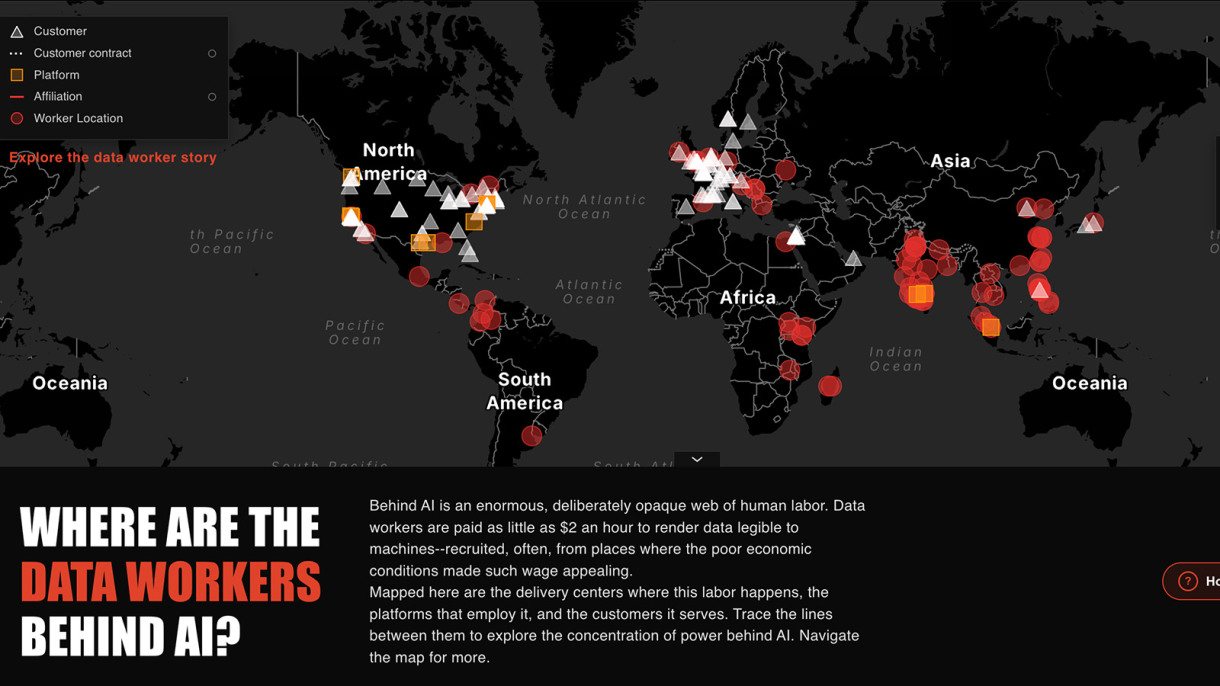
Brown student maps the hidden global labor powering AI

Brown University undergraduate Cunyan Ma built an interactive map linking technology companies and their intermediaries to data workers around the world, with the university's Center for Technological Responsibility, Reimagination and Redesign. The map combines existing data worker databases, Ma's own data collection and news reports on working conditions. It aims to show "AI colonialism" at scale, beyond anecdotal accounts. The page text ends early.

Brown UniversityCunyan MaCenter for Technological Responsibility, Reimagination and Redesign

training, ai-policyΒ· Added 27 Oct 2026, published 26 Oct 2026

eprint.iacr.orgpaperπŸ›‘οΈ Security

Cryptanalysis and Repair of "Decentralized Multi-authority ABE for NC$^1$ from BDH"

Cryptology ePrint 2026/2642 presents a plaintext-recovery attack on the DBDH and CBDH variants of the Datta, Komargodski and Waters multi-authority ABE for NC1 (Journal of Cryptology, 2023). It needs one corrupt authority and two users, and succeeds with probability one in the static model. The flaw is an invalid extension of the Rouselakis-Waters LSSS matrix-normalization lemma. The paper also attacks two Datta-Pal (PKC 2023) attribute-based inner-product schemes and proves repaired versions secure in the random oracle model.

Datta-Komargodski-Waters multi-authority ABEDatta-Pal attribute-based inner-product functional encryptionRouselakis-Waters LSSS matrix-normalization lemma+3

otherΒ· Published and added 26 Oct 2026

eprint.iacr.orgpaperπŸ›‘οΈ Security

Private Information Retrieval with Accountability at Erasure-Optimal Server Redundancy

SynTrace is a single-round compiler that adds accountability to linear private information retrieval (PIR). The client mixes the retrieval query with m audit queries, so audit syndromes identify up to d deviating servers among t colluding ones before reconstruction. The paper proves perfect query privacy and zero false identification within the threshold. For Shamir-based PIR it needs k=t+d+1 servers. For a 32 KiB record from a 1 GiB database it uses 2.25 MiB, against 8.96 MiB for the Eriguchi, Kurosawa and Nuida (TCC 2022) homomorphic-MAC construction.

SynTraceEriguchi-Kurosawa-Nuida homomorphic MACTCC 2022

otherΒ· Published and added 26 Oct 2026

x.comthreadπŸ›‘οΈ Security

alex lee (@alexlee20122022) on X

Gheist is a GitHub campaign disclosed by Wiz in October 2026. Stolen tokens push ci-sync-XXXXXX branches with a sync-check workflow that dumps repo secrets base32-encoded to evade log masking, fetches the logs via API, then deletes the run. 13,500+ branches and 850+ accounts were hit since 15 September. Public repos are protected by the approval hold; private and Enterprise repos are not. The thread lists IOCs (.gdmp_pat files, "gheist" user agent, "ci: sync config" commits) and rotation steps.

GitHub ActionsGitHubWiz+2
Gheistci-sync branchsync-check.yml+3

DevSecOps, Threat Intel, Supply ChainΒ· Added 26 Oct 2026, published 25 Oct 2026

wiz.iowriteupπŸ›‘οΈ Security

Gheist: Attempted Scaled Abuse of Stolen GitHub Tokens Stumbles

Gheist is a campaign tracked by Wiz Research since 15 September 2026 that uses stolen GitHub tokens to push a sync-check workflow on ci-sync-* branches in every reachable repository. The workflow prints base32-encoded secrets into logs, which the tool downloads through the GitHub API and then deletes. Over 13,500 branches from 850+ accounts were recovered. The post covers the two tool variants, a buggy self-hosted runner payload, GitHub's approval hold (which does not cover private repositories), overlaps with other campaigns, hunting queries, IOCs and hardening steps.

GitHubGitHub ActionsAWS+3
GheistGhostActionPolinRider+6

Threat Intel, DevSecOps, Blue Team & DetectionΒ· Published and added 25 Oct 2026

x.comthread🧠 AI

Syb (@DegenOfWallSt) on X

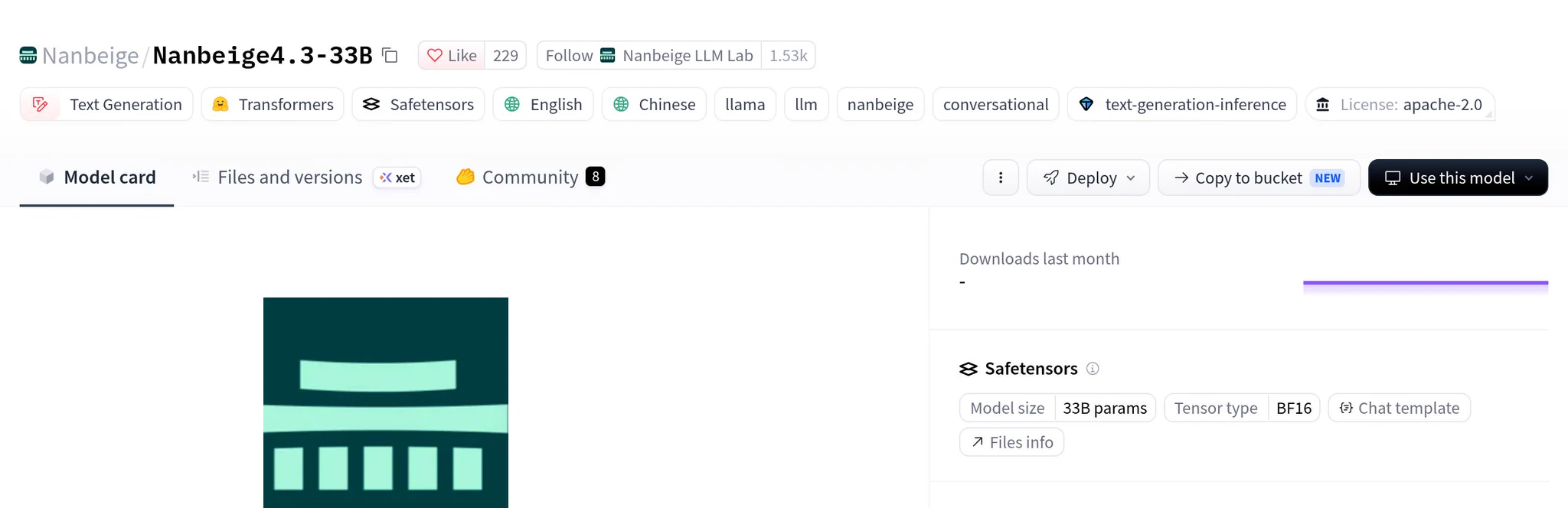
Nanbeige4.3-33B is a 33.1B dense, Llama-style open model under Apache-2.0, released with a base model on Hugging Face. In Nanbeige's own table it beats Qwen3.8-27B on Terminal-Bench 2.1 (80.9 vs 73.0), DeepSWE (65.5 vs 42.5) and Automation Bench, but trails on SWE-Bench Pro, GDPval and GPQA Diamond. BF16 weights are about 66 GB, split across 4 GPUs in the vLLM and SGLang examples. No independent evals exist yet.

Hugging FacevLLMSGLang+4
Nanbeige4.3-33BNanbeige4.3-3BNanbeige+8

models, coding-agents, evalsΒ· Added 26 Oct 2026, published 25 Oct 2026

theblock.coarticleπŸ›‘οΈ Security

Keystone customers say breach exposed data the hardware wallet maker promised to delete

Keystone, a hardware wallet maker, disclosed on 25 October 2026 that an attacker accessed its Shopify-based store, detected 20 October and confirmed 23 October. Customer names, contact details, shipping addresses and order details were taken. Keystone says no payment data, recovery phrases or keys were exposed. Customers on X say their data was held despite a 180-day deletion pledge. The piece lists 2026 leaks at Trezor, SafePal and Ledger.

ShopifyKeystone
TrezorSafePalLedger

Threat IntelΒ· Published and added 25 Oct 2026

arxiv.orgpaperπŸ›‘οΈ Security

Reversible Pseudonymisation of Documents Sent to External LLMs: an Open Bilingual Benchmark and an Engine

Open bilingual (Russian and UK English) benchmark of five open pseudonymisation tools and a regex baseline, plus a new engine built on the two strongest tools. On a held-out set of 1,000 synthetic documents per language, the best existing tools leave a whole personal value visible in 61% (Russian) and 58% (UK) of documents. The engine does so in 0.3% and 0.2%. Russian name restoration reaches only 94.6%, below the 99% threshold. Real documents were not tested.

LLMpii-guard

AI SecurityΒ· Added 27 Oct 2026, published 25 Oct 2026

arxiv.orgpaper🧠 AI

Reversible Pseudonymisation of Documents Sent to External LLMs: an Open Bilingual Benchmark and an Engine

This paper presents an open benchmark of five existing pseudonymisation tools and a regex baseline on Russian and UK English documents, plus an open engine built on the two strongest tools. On a held-out set of 1,000 synthetic documents per language, the best existing tools leave a whole value visible in 58 to 61% of documents. The engine does so in 0.2 to 0.3%. Russian name restoration reaches only 94.6%, below the 99% threshold. Real documents were not tested.

LLMpii-guard
Vladimir BeskorovainyiarXiv

evals, llm-apps, researchΒ· Added 27 Oct 2026, published 25 Oct 2026

arxiv.orgpaper🧠 AI

InteractiveWorld: A Verifiable Human-Centric Environment for Building Better Interactive MLLM Assistants

InteractiveWorld is an environment for closed-loop interaction between an AI assistant and a simulated human agent who sees the scene, follows instructions and acts independently. InteractiveBench, built on it, has 120 multi-turn tasks in six categories scored by verifiable, state-based rewards. Across 12 frontier MLLMs, the best model, Claude Fable 5.1, reaches at most 20% on long-horizon Guidance and 25% on Planning tasks.

multimodal large language model
InteractiveWorldInteractiveBenchClaude Fable 5.1+1

evals, multimodal, researchΒ· Added 27 Oct 2026, published 25 Oct 2026

arxiv.orgpaper🧠 AI

DRILS: Dependency-based Requirement Change Impact Analysis Using LLMs

DRILS is an LLM-based agentic framework for requirements change impact analysis. It uses multiple agents to generate candidate impact sets, with an LLM-as-a-judge promoting diversity in selection. It adds RE-RAG, a tuned retrieval technique, and a requirement dependency graph as a knowledge source. On three curated datasets it reaches 87.1% recall, 76.3% precision and 81% F1 at lower cost than baselines. The authors release the datasets.

LLMRAG
arXivDRILSRE-RAG

research, agents, llm-appsΒ· Added 27 Oct 2026, published 24 Oct 2026

x.comthread🧠 AI

Big Bull (@BIGBULLapp) on X

5ire is a desktop AI assistant and MCP client that connects to OpenAI, Anthropic, Google, Mistral, Grok, DeepSeek and Ollama from one window. It has a local knowledge base and tool calls over Model Context Protocol. The tools feature needs Python, Node and uv installed because it runs a local MCP server; without them it works only as a chat client.

Model Context ProtocolPythonNode.js+3
5ireOpenAIAnthropic+4

mcp, llm-appsΒ· Added 25 Oct 2026, published 24 Oct 2026

arxiv.orgpaperπŸ›‘οΈ Security

Enhancing LLM-Based Vulnerability Detection via Representation-Aware Logical Ensemble

RALE (Representation-Aware Logical Ensemble) is a method for detecting vulnerabilities in C source code with LLMs trained on different code representations: raw source, Abstract Syntax Trees and Control Flow Graphs. The authors show the representations suit different vulnerability classes, and combine the models with explicit logical rules and majority voting. Single-representation models reach up to 73% F1, while the ensemble reaches 78%.

LLMC
RALERepresentation-Aware Logical EnsembleAbstract Syntax Tree+1

AI Security, AppSecΒ· Added 28 Oct 2026, published 24 Oct 2026

arxiv.orgpaper🧠 AI

Enhancing LLM-Based Vulnerability Detection via Representation-Aware Logical Ensemble

RALE (Representation-Aware Logical Ensemble) is a method for LLM-based vulnerability detection in C code. The authors train LLMs on raw source code, Abstract Syntax Trees and Control Flow Graphs, and find each representation works best for certain vulnerability classes. Combining the models with explicit logical rules and majority voting raises F1 from at most 73% for a single model to 78%, with gains in accuracy, precision and recall.

LLMstatic analysis
arXivRALE

research, trainingΒ· Added 28 Oct 2026, published 24 Oct 2026

arxiv.orgpaper🧠 AI

ZipFusion: Fusing Lossless KV Decompression with Attention for Efficient LLM Decoding

ZipFusion is a lossless KV cache compression scheme whose attention kernel reads the compressed cache directly and rebuilds the original values in registers with simple bit operations, so no separate decompression pass is needed. It also reassigns the memory freed by compression across layers to hold more KV cache. Built on FlashInfer and integrated with SGLang, it gives about 1.25x decode attention speedup on an H100 and up to 26.3% higher decode throughput at 8K context than uncompressed SGLang. It reaches up to 2.76x the throughput of the best lossless KV compression baseline.

FlashInferSGLangCUDA+1
ZipFusionNVIDIA

inference, researchΒ· Added 27 Oct 2026, published 24 Oct 2026

eprint.iacr.orgpaperπŸ›‘οΈ Security

Extraction meets Distillation - cryptanalytic techniques to recover parameters from a Deep Neural Network

Extraction meets Distillation is an IACR ePrint paper (2026/2628, CSCML 2026) that combines cryptanalytic weight-direction extraction with label-based distillation to reconstruct fully connected neural networks. It adapts a ReLU extraction implementation to Leaky ReLU and proves conditional bounds for direction recovery and sign selection. On CIFAR-10 victims, reconstructed models reach 56.40% and 58.29% agreement. It separates label requests from privileged access and notes that prediction agreement does not identify parameters.

ReLULeaky ReLU
CSCML 2026CIFAR-10

AI SecurityΒ· Added 26 Oct 2026, published 24 Oct 2026

opensourcemalware.comwriteupπŸ›‘οΈ Security

Brotlipocalypse

Brotlipocalypse is an OSM Security post (24 October 2026) on CVE-2026-111497, an out-of-bounds write in the google/brotli C decoder (1.0.3 through 1.2.0). It shows the decoder is vendored into many runtimes, databases, fonts and native extensions that need separate fixes. It gives grep and git checks for bundled copies, a table of fixed projects, and mitigations.

BrotliNode.jsPyPI+3
CVE-2026-111497PYSEC-2026-4322PYSEC-2026-4323+4

Supply Chain, AppSecΒ· Published and added 24 Oct 2026

eprint.iacr.orgpaperπŸ›‘οΈ Security

The Exact Bit Security of Hash-Based Signatures

The Exact Bit Security of Hash-Based Signatures is a 2026 IACR ePrint paper that analyses XMSS with 128-bit digests and SLH-DSA-128s in the random oracle model, with proofs formalised in Lean4. Strong unforgeability comes to 127 bits under most accounting modes but only 122 bits if just direct random oracle queries are counted. The authors give matching attacks, and show how resource accounting changes the result.

XMSSSLH-DSALean
Mikhail KudinovBenedikt WagnerEmile Wambsgans

otherΒ· Added 26 Oct 2026, published 24 Oct 2026

eprint.iacr.orgpaperπŸ›‘οΈ Security

Provable Security of SHA-256-Based LMS Revisited in the Ideal-Cipher Model

Provable Security of SHA-256-Based LMS Revisited in the Ideal-Cipher Model is an October 2026 ePrint paper by Chun Guo, Hao Cheng, Bart Preneel and Meiqin Wang. It shows forgery attacks on LMS_SHA256_M32 and LMS_SHA256_M24 that exploit Merkle-DamgΓ₯rd structure, so the Katz and Fluhrer random-oracle bounds do not apply. It proves ideal-cipher-model bounds: about 256 minus log2 of the block count for M32, and a minimum of two terms for M24.

LMSSHA-256
KatzFluhrerLMS_SHA256_M32+4

otherΒ· Added 26 Oct 2026, published 24 Oct 2026

arxiv.orgpaper🧠 AI

Eat Your Precision: Precision Objective Mitigates Reward Hacking in Rubric-based RL

FORK is a reward for rubric-based reinforcement learning that jointly optimizes recall and a new precision objective. Precision requires each unit of a response to be necessary (rubric-driven necessity credits) and factually correct (a grader). Rubric-coverage rewards otherwise produce verbose, less accurate responses. FORK keeps similar coverage with shorter outputs, raising win rate against the base policy from 10.6% to 68.0% on RubricHub-Medical and from 22.1% to 74.1% on HealthBench.

LLM
HealthBenchRubricHub-MedicalFORK

training, researchΒ· Added 27 Oct 2026, published 24 Oct 2026

x.comthread🧠 AI

EveryDev.ai (@EveryDevAi) on X

ToolUniverse, from ScientistTools, is an open-source (Apache-2.0) toolkit that gives any LLM one interface to more than 1,000 scientific tools, models and databases such as PubMed, UniProt and ChEMBL. It ships a native MCP server, a Python SDK and a tu CLI, plus 68 pre-built agent skills. The post says it works with Claude Code, Cursor, Gemini CLI and Windsurf.

Model Context ProtocolPythonClaude Code+4
ToolUniverseScientistToolsPubMed+2

mcp, agentsΒ· Published and added 24 Oct 2026

socket.devwriteupπŸ›‘οΈ Security

New Evidence Shows LiteLLM Secret-Stealing Workflows Ran 11 Days Before Supply Chain Attack

Socket's Threat Research team reports that malicious cache.yml workflows ran in the BerriAI/litellm repository on 10 and 12 October 2026, eleven days before the 21 October release attack that published litellm==1.107.0. Each commit pushed to a short-lived ci-tmp-<hex> branch, then deleted it, sending base64-encoded CI secrets to webhook.site. Evidence comes from Actions metrics and environment deployment records; 20 secret names were exposed.

LiteLLMGitHub ActionsGitHub+3
ci-tmp branchescache.ymllitellm==1.107.0+6

Supply Chain, DevSecOps, Blue Team & DetectionΒ· Published and added 23 Oct 2026

aikido.devadvisoryπŸ›‘οΈ Security

Python packages are also vulnerable to the Node2Shell Brotli flaw (CVE-2026-111497)

Python2Shell is the Python-side impact of CVE-2026-111497 (Node2Shell), a Brotli decoder flaw (CVSS 4.0 9.2) in DecodeBlockTypeAndLength() that mixes an unchecked return value with an out-of-bounds write. Brotli 1.2.0 and earlier, and brotlicffi 1.2.0.x, are affected through urllib3, requests, httpx, aiohttp and Scrapy. Fixes are Brotli 1.2.1 and brotlicffi 1.2.1.0; as of 23 October 2026 advisory databases do not map the CVE to either package. The post lists checks and workarounds.

BrotlibrotlicffiPyPI+3
CVE-2026-111497Node2ShellPython2Shell+4

AppSec, Supply ChainΒ· Published and added 23 Oct 2026

arxiv.orgpaper🧠 AI

Deletion, Substitution, Repair and Transplant: Component Attribution in BARBICAN, a Layered Prompt-Injection Gateway for MCP

The paper analyses BARBICAN, a fail-closed prompt-injection gateway for MCP tool mediation, using deletion, substitution, repair and transplant experiments. Its arbitration classifier ran on tokenizer-mangled text for a whole evaluation. Fixing that raised AUC from 0.392 to 0.855 while system recall fell from 80.67% to 80.34%. The band it receives is 96.82% malicious. The authors argue ablation figures need the band's class balance and substitution baselines.

Model Context Protocol
BARBICAN

evals, research, mcpΒ· Added 27 Oct 2026, published 23 Oct 2026

endorlabs.comarticleπŸ›‘οΈ Security

ADLC Security Best Practices for Teams Shipping with Coding Agents | Endor Labs

ADLC Security Best Practices is an Endor Labs guide to controlling what AI coding agents can access, run, install and ship. It covers inventorying agents and MCP servers, sandboxing, pre-execution hooks instead of AGENTS.md rules, install-time package checks against slopsquatting and malware, reachability-based triage of agent PRs, and CI/CODEOWNERS protections. A five-step worked example and coverage metrics are included.

Model Context ProtocolClaude CodeCursor+3
slopsquattingindirect prompt injectiontool poisoning+5

AI Security, Supply Chain, DevSecOpsΒ· Published and added 23 Oct 2026

arxiv.orgpaper🧠 AI

What Transfers Across Protein Pockets? Experience Reuse in Molecular Optimization for Agentic Structure-Based Drug Design

This paper studies experience reuse for LLM agents that optimize ligands in protein pockets by editing and docking. Using the full log of one agent run over CrossDocked2020 test-set pockets, it tests whether keys in an experience base recur on unseen pockets and separate improving from worsening edits. The separation is largely explained by molecule size change, action and round, not the target. The authors conclude a base may better prioritize an agent's own proposals for docking than prescribe what to build.

LLM
CrossDocked2020arXiv

research, agentsΒ· Added 26 Oct 2026, published 23 Oct 2026

arxiv.orgpaper🧠 AI

Standing on Open Shoulders: Regional Fine-Tuning of Open-Weight Camera-Trap Models for UK Wildlife with Modest Data and Compute

DeepFaune-UK is a fine-tune of the open DeepFaune camera-trap classifier on 28 UK classes, paired with MegaDetector v6. On 20,212 MammalWeb images it reached 88.8% strict accuracy against 56.5% (DeepFaune v1.5.0) and 59.0% (SpeciesNet). Re-applying the recipe to the DINOv3-based classifier gave 90.6%. Fine-tuning on about 150 crops per class matched full-data out-of-distribution accuracy, and a DINOv2 run took about 22 minutes on under 4 GB of GPU memory.

DeepFauneMegaDetectorSpeciesNet+2
DeepFaune-UKMammalWeb

research, training, multimodalΒ· Added 26 Oct 2026, published 23 Oct 2026

arxiv.orgpaperπŸ›‘οΈ Security

On Task, Off Track: Benchmarking LLM and Agent Robustness to Near-Target Prompt Injection

NTBench (Near-Target Benchmark) tests LLM and agent robustness to near-target prompt injection, where injected instructions steer a response toward a plausible but incorrect or harmful outcome instead of abandoning the task. It builds reference-guided target-instruction pairs on existing datasets, with human validation, and evaluates seven LLMs on ten language datasets and two agent benchmarks. Attack success rose 9.3 to 35.8 points (incorrect targets) and 1.7 to 17.3 points (harmful targets) over fixed-target baselines.

LLM
NTBenchnear-target prompt injectionprompt injection

AI SecurityΒ· Added 26 Oct 2026, published 23 Oct 2026

arxiv.orgpaper🧠 AI

DRIVE: Fine-tuning via Data Contribution- and Diversity-aware Weighting with Prior Regularization

DRIVE is a per-sample weighting framework for single-stage fine-tuning when the source pre-training data is unavailable. It uses one differentiable objective: Shapley additivity splits each sample's contribution into anti-forgetting and adaptation parts, a covariance-based diversity term reshapes them, and a sample-characteristic prior stabilizes them. The authors prove better stability-plasticity guarantees than existing weighting schemes and report better performance, faster convergence and more robustness.

DRIVEarXiv

training, researchΒ· Added 26 Oct 2026, published 23 Oct 2026

arxiv.orgpaper🧠 AI

Profile-Driven User Simulation via Reinforcement Learning with Hierarchical Rewards for Task-Oriented Dialogues

ProfileSim is a profile-driven user simulator for financial marketing outbound calls. It models user profiles (demographics, Big Five traits) and business profiles (intents reverse-engineered from real call logs). The base model is fine-tuned on real voice dialogues, then refined with GRPO using dialogue-level and utterance-level rewards. Against other user generators it scores highest on colloquial naturalness and profile adherence, and lowest agent score on long-tail intents, with shorter utterances at comparable business compliance.

GRPORAGLLM
ProfileSimarXiv

research, trainingΒ· Added 26 Oct 2026, published 23 Oct 2026

opensourcemalware.comwriteupπŸ›‘οΈ Security

Python Packages Vulnerable to Node2Shell

Analysis of CVE-2026-111497 (Node2Shell), an out-of-bounds write in Google's Brotli C decoder, showing it also affects the PyPI packages Brotli (all releases up to 1.2.0) and brotlicffi (up to 1.2.0.2). The author diffed the 1.2.0 and 1.2.1 sdists and confirmed the behaviour with AddressSanitizer. Fixes are Brotli 1.2.1 and brotlicffi 1.2.1.0, both patched without release notes. No advisory database lists either package yet.

BrotlibrotlicffiPyPI+3
CVE-2026-111497Node2ShellPHP2Shell+5

AppSec, Supply ChainΒ· Published and added 23 Oct 2026

arxiv.orgpaper🧠 AI

MPQ: A Message-Passing View of Post-Training Quantization

MPQ (Message-Passing Quantization) is a post-training quantization method that treats row-wise PTQ as posterior inference over discrete codebooks. It keeps soft posteriors across weight blocks using vector approximate message passing, then refines a hard-decision initialization with exact block coordinate descent. Tested at 2-bit lattice and 3- and 4-bit scalar quantization on Llama, Qwen and Mistral models, it improves perplexity and zero-shot accuracy over GPTQ-style baselines.

GPTQLDLQvector approximate message passing+5
arXiv

research, inferenceΒ· Added 26 Oct 2026, published 23 Oct 2026

huggingface.cowriteup🧠 AI

Turning Database Grading into RL Rewards: Post-Training Agents with ThinkingBox

ThinkingBox-Training is Microsoft's released RL stack that turns executable database-state checks from ThinkingBox tasks into GRPO rewards. Fifty GRPO steps on 187 curated tasks raised Qwen3.8-27B pass@1 from 51.70% to 60.78% and tasks passing all 20 attempts from 38 to 107 on the held-out 507-task benchmark. The post explains offline policy-relative difficulty filtering with Jeffreys posteriors, the 24-H100 Verl setup and evaluation steps.

GRPOQwen3.8-27BVerl+9
MicrosoftThinkingBoxThinkingBox-Bench+11

training, agents, evalsΒ· Published and added 22 Oct 2026

eprint.iacr.orgpaperπŸ›‘οΈ Security

MΓ­mir: A Stateless Private Search Engine

MΓ­mir is a cryptographic protocol for stateless semantic private search over highly dynamic public databases. It uses homomorphic ciphertext switching, relies on (Ring) Learning with Errors, and needs no offline communication. Against Tiptoe it matches search quality with 84x less per-query communication (0.24 MiB). Against PACMANN it raises quality from 76% to 81% of non-private search, with a 9.54 MiB one-time cost instead of 2.68 GiB, but is 2.1x slower.

TiptoePACMANNLearning with Errors+1

otherΒ· Added 24 Oct 2026, published 22 Oct 2026

arxiv.orgpaper🧠 AI

Causal Chain of Thought: Mitigating Attention Leakage via Context Isolation

CausalCoT is an inference framework that splits a problem into a directed acyclic graph of atomic sub-questions and evaluates each node in an isolated context holding only its direct causal parents. This removes attention paths to non-parent content, so intermediate steps drive the answer rather than leaking from global context. It keeps benchmark accuracy competitive and raises causal sensitivity of reasoning steps by 12 points on average, up to 21, over the strongest baseline. The graph also allows test-time corrections that propagate downstream.

LLMTransformer
arXiv

research, promptingΒ· Added 24 Oct 2026, published 22 Oct 2026

arxiv.orgpaper🧠 AI

Progress Probes $P^2$: Lightweight Runtime Monitoring for Vision-Language-Action Models

Progress Probes (P^2) trains linear probes on a vision-language-action model's own activations, using demonstrations, to estimate task progress, then flags executions that deviate from expected progress. Tested on the open-source pi0.5 across simulated and real-world manipulation tasks, it matches or beats VLM-based monitors and failure-data-trained methods at failure detection, without an external foundation model.

vision-language-action modelvision-language modellinear probes
pi0.5arXiv

research, multimodalΒ· Added 24 Oct 2026, published 22 Oct 2026

arxiv.orgpaper🧠 AI

Who Is Sycophantic to Whom? Confident LLMs, Human Deference, and the Collapse of Trust Calibration

This paper studies reverse sycophancy: whether users bend toward a confident, consistent, wrong LLM. In a within-subjects experiment, 32 participants learned science topics from five GPT-5-mini assistants with 0 to 100% of facts replaced by falsehoods. Scores fell from 7.4 to 2.9 out of 10, planted falsehoods were chosen on 60% of falsified items against 11% of correctly taught ones, and confidence stopped tracking correctness. It introduces a baseline-corrected Human Deference Index.

LLM
GPT-5-miniarXiv

research, ai-safety, evalsΒ· Added 24 Oct 2026, published 22 Oct 2026

arxiv.orgpaper🧠 AI

Rethinking Sequence Compression with Test-time Regression

TTR-Compressor is a sequence compression method that treats input tokens as a test-time regression problem. The regression is learned end-to-end by backpropagation, and its coefficients are solved in closed form in the forward pass to give the compressed representation. As a block-wise sparse attention compressor it improves RULER over attention-based compressors by a large margin. As a visual token merger for multimodal LLMs it beats the MLP merger and matches it with 55.6% fewer visual tokens.

TransformerLLMvision-language model
TTR-CompressorRULERarXiv

research, multimodalΒ· Added 24 Oct 2026, published 22 Oct 2026

arxiv.orgpaper🧠 AI

An Empirical Study of Recent Large Language Models for Knowledge Graph to Text Generation on Standard Benchmarks

This empirical study benchmarks recent LLMs against fine-tuned encoder-decoder models on knowledge graph-to-text generation, using reference-based metrics and graph-grounded, reference-free LLM-based evaluation validated against human annotations. Recent LLMs narrow or close the gap on reference-based metrics and do better on graph-grounded ones. Prompted models make fewer contradictions and triple omissions, and fine-tuned models' errors grow faster with graph size.

LLMTransformer
arXiv

research, evalsΒ· Added 24 Oct 2026, published 22 Oct 2026

arxiv.orgpaper🧠 AI

From Structured Records to Patient Narratives: Preserving Clinical Alignment in LLM-Generated Health Summaries

This paper studies evidence-grounded health summarization for menstrual health monitoring. It combines structured evidence conditioning with RAG in a prompt-based constrained generation framework, and scores 4,500 summaries from three LLMs with NLI, atomic factuality metrics and readability measures. Grounding constraints improved uncertainty preservation and generally kept or improved faithfulness against retrieved evidence, while omission effects varied by model. Clinical alignment came with harder reading and more medical terminology.

LLMRAG
arXiv

research, evals, llm-appsΒ· Added 24 Oct 2026, published 22 Oct 2026

deepmind.googlearticle🧠 AI

Beyond tree cover: mapping the world’s forest types

Forest Typology (ForTy) 2020 is a global 10-meter map from Google DeepMind, Google Research, WRI and IIASA. It sorts land into six FAO-based classes: primary, naturally regenerating, planted, plantation, tree crops and agroforestry, and other land. The model uses AlphaEarth Foundations embeddings and about 1.7 million labeled locations. It was 90% accurate on forest type across 9,000+ expert-checked sites. An early 2017 to 2025 time series is on Earth Engine.

Google Earth EngineAlphaEarth Foundations
Google DeepMindGoogle ResearchWorld Resources Institute+7

models, multimodalΒ· Published and added 22 Oct 2026

securityweek.comarticleπŸ›‘οΈ Security

Signal Vulnerability Lets Malicious Callers Block Hang-Ups

CVE-2026-113380 (CVSS 9.3) is a flaw in RingRTC, the WebRTC-based library behind Signal voice and video calls. A remote peer can flood the call's finite state machine event queue, so the victim's hang-up waits behind junk and audio and video tracks stay live. Fixed in RingRTC 2.72.0 on 4 September; a researcher published details and a conceptual PoC afterward.

SignalRingRTCWebRTC+2
CVE-2026-113380NIST

Mobile Security, AppSecΒ· Published and added 22 Oct 2026

arxiv.orgpaper🧠 AI

RIFT: KV Cache Compression for Draft Models with Complementary Compressibility Training

RIFT is a family of selection-based KV cache compression strategies for speculative-decoding draft models. It targets "decode staleness", where prefill-focused selection loses relevance as output grows, by balancing prefill information with recent generated tokens, refreshing the selection adaptively, and training drafters with sparse attention masks. Qwen3.5-4B drafting for Qwen3.5-122B keeps over 98% of full-cache acceptance length at 32K input, 4K output and an 8K KV budget.

Qwen3.5TransformerLLM
arXiv

research, inferenceΒ· Added 23 Oct 2026, published 22 Oct 2026

eprint.iacr.orgpaperπŸ›‘οΈ Security

The Good, the Bad, and the Noisy: A Systematic Analysis of Ring-Oscillator-Based Noise Generators

This IACR ePrint paper (2026/2597) systematically compares ring-oscillator-based additive noise generators, a hiding countermeasure against side-channel attacks. Experiments show many existing designs ignore output amplification and the risk of the noise being filtered out, so they lower signal-to-noise ratio too little. The authors give a guideline on inverter chain length, output amplification and frequency randomization, and build a tailored generator for an AES implementation that outperforms prior designs.

AES
Florian StolzDina HesseJulius Hermelink+2

Hardware & RFΒ· Added 24 Oct 2026, published 22 Oct 2026

securityweek.comarticleπŸ›‘οΈ Security

Cisco Patches 34 Vulnerabilities Across Multiple Products

Cisco's October 21, 2026 patch batch fixes 34 vulnerabilities in Expressway Series, IOS XR, Snort 3 and Unified Communications products. The critical Expressway RCE (CVE-2026-76466) lets an attacker reach the database service and run commands as root; it is fixed in X15.5.20. Snort 3 fixes ship in 3.12.4.0 and several Cisco security products. Cisco knows of no exploitation in the wild.

Cisco ExpresswayCisco IOS XRSnort 3+2
CVE-2026-76466CVE-2026-76473CVE-2026-76474+5

AppSec, Cloud & InfraΒ· Published and added 22 Oct 2026

x.comadvisoryπŸ›‘οΈ Security

lee1981 (@lee1981b) on X

CyberForge CVE of the Day #084 analyses CVE-2026-76466, a CVSS 9.8 flaw in clustered Cisco Expressway-C and Expressway-E. Persistent database cookies and weak client-certificate validation allow root OS command execution over the network. The fix is X15.5.20 (X14 and earlier must migrate), with no workaround. It adds a per-peer SOC investigation trail, reachability checks and exposure status from CISA SSVC, KEV and EPSS.

Cisco ExpresswayCVSSNVD+2
CVE-2026-76466CWE-798cisco-sa-vcs-static-cred-hr7EWZ8t+2

Blue Team & Detection, Cloud & InfraΒ· Added 24 Oct 2026, published 22 Oct 2026

metr.orgarticle🧠 AI

Red-Teaming OpenAI's Internal Agent Monitoring Systems

METR's post summarises a three-week pilot (21 July to 11 August 2026) in which a METR and a Redwood Research employee red-teamed OpenAI's internal misalignment monitoring system with deep codebase access. They estimated 75-94% of agentic Responses API traffic was monitorable, and found gaps such as unmonitored compaction events, RL training runs, and headers that disable monitoring. OpenAI says all production issues are patched; METR lists five design ideals for monitors.

CodexOpenAI API
METRRedwood ResearchOpenAI+2

ai-safety, agents, ai-policyΒ· Added 29 Oct 2026, published 22 Oct 2026

metr.orgwriteupπŸ›‘οΈ Security

Red-Teaming OpenAI's Internal Agent Monitoring Systems

METR and Redwood Research summarize a three-week pilot red-team (21 July to 11 August 2026) of OpenAI's internal asynchronous misalignment monitoring system. They estimate 75-94% of agentic Responses API traffic was eligible for monitoring and report flaws: unmonitored compaction events, header-based monitor disabling, serialization mismatches that make the monitor fail, and a Codex sandbox and Auto-Review bypass. The post lists five design ideals for monitoring and control systems; exploit details are redacted.

OpenAICodexGPT-5.5+1
METRRedwood ResearchAuto-Review+3

AI SecurityΒ· Added 29 Oct 2026, published 22 Oct 2026

soliditylang.orgadvisoryπŸ›‘οΈ Security

Yul Optimizer Knowledge Base Stale Bookkeeping Bug

Solidity advisory on a Yul optimizer bug in the KnowledgeBase, present in versions 0.8.19 to 0.8.37 and fixed in 0.8.38. Stale cached address offsets let LoadResolver and EqualStoreEliminator treat coinciding memory or storage slots as distinct, so loads return outdated values or needed stores are dropped. It includes a pure-Solidity reproducer for --via-ir, a Sourcify scan with no differing bytecode, and checks for deployed contracts. Rated low severity.

SolidityYulSourcify+1
Ethereum Foundation bug bountyDaniel BoyeSurya Prakash Akula+4

AppSecΒ· Published and added 22 Oct 2026

arxiv.orgpaper🧠 AI

IFC-MCQ: Automatically Generating Multiple-Choice Benchmarks for Evaluating LLM Agents on IFC Data Retrieval

IFC-MCQ is a method that automatically generates multiple-choice benchmarks from Industry Foundation Classes (IFC) building-model files, so answers can be graded by exact option-set match instead of human or LLM review. Its taxonomy has 15 categories and 36 subtypes in four groups, with answer keys from the file and distractors from file values or rules. Two agentic setups, tool-based and code-based retrieval, showed category-specific failures and variation by IFC model and interface.

LLMIndustry Foundation Classes
IFC-MCQarXiv

evals, agents, researchΒ· Added 23 Oct 2026, published 21 Oct 2026

x.comthread🧠 AI

SpyTech Ai (@RizeOnline) on X

XiaoZhi ESP32 is an open-source, MIT-licensed firmware stack that turns ESP32 boards into MCP-based voice chatbots using models such as Qwen and DeepSeek. It streams Opus audio over WebSocket or MQTT + UDP through ASR, LLM and TTS, adds offline ESP-SR wake words, and uses device-side MCP to drive speakers, LEDs, servos and GPIO. It supports 138 board directories and builds with ESP-IDF 6.0.1 or newer.

Model Context ProtocolESP32ESP-IDF+10
XiaoZhi ESP32SpyTech Ai

mcp, multimodal, llm-appsΒ· Added 23 Oct 2026, published 21 Oct 2026

arxiv.orgpaper🧠 AI

SIM-UT: A User Simulation based Evaluation Framework for Medical Triage Chatbots

SIM-UT (Simulation of User Behaviour for Triage) is a multi-turn, simulation-based method for finding failure modes in LLM medical triage chatbots. It was applied to three WhatsApp health chatbots (India, South Africa, Kenya) across 5,000+ multilingual simulated turns, comparing MedGemma with ChatGPT and Claude. The main finding is de-escalation risk: agents that first flagged emergencies agreed with users who minimised symptoms, such as vaginal bleeding in pregnancy.

MedGemmaChatGPTClaude+2
SIM-UT

evals, ai-safety, researchΒ· Added 24 Oct 2026, published 21 Oct 2026

huggingface.coarticle🧠 AI

NVIDIA Kumo Relational Outperforms Supervised Machine Learning on Relational Data, No Training Required

NVIDIA Kumo Relational is a pre-trained relational foundation model that predicts outcomes such as churn or fraud directly on multi-table databases through in-context learning, using up to 10,000 context examples and no task-specific training. NVIDIA reports it beats supervised relational deep learning and XGBoost pipelines across 41 tasks on 15 databases, and beats AutoGluon by 8% MRR on SAP SALT. Code is Apache 2.0, weights are on Hugging Face.

structured-data-modelsNVIDIA NIMPredictive Query Language+6
NVIDIAKumo RelationalKumo Tabular+6

models, research, evalsΒ· Published and added 21 Oct 2026

bankless.comarticleπŸ›‘οΈ Security

Coinbase's Plan for a Quantum-Safe Bitcoin

Bankless summary of Coinbase's October 2026 proposal for making Bitcoin quantum-safe. It covers upgradeable address designs (BIP-360 P2MR, P2TRv2, hybrid addresses), four candidate signatures (ML-DSA, SLH-DSA, FN-DSA, SHRINCS) with size and stateful-key-reuse trade-offs, a five-stage migration plan, and a separate track for dormant coins with exposed public keys such as Satoshi's.

Bitcoin
CoinbaseBIP-360P2MR+11

BlockchainΒ· Published and added 21 Oct 2026

endorlabs.comwriteupπŸ›‘οΈ Security

LiteLLM 1.107.0 Compromised: Python Startup Hooks Steal Cloud, AI, and Proxy Credentials | Endor Labs

litellm 1.107.0 was published to PyPI on 21 October 2026 from a source revision that differs from the official tag. One line in the Maturin config (data = "cook") installs cook.pth, cook.py and sitecustomize.py, which run on every Python start. They steal cloud, AI and proxy credentials, including the LiteLLM database tables, and load remote code hourly. The post gives IOCs, a five-step response plan and hardening advice.

LiteLLMPyPIPython+3
litellm 1.107.0cook.pthsitecustomize.py+5

Supply Chain, Malware & RE, DevSecOpsΒ· Published and added 21 Oct 2026

blog.trailofbits.comarticle🧠 AI

Your AI agent fixed the bug, but what else did it change?

Trail of Bits releases patching-bugs and regression-hunt, two agent plugins built with OpenAI through Patch the Planet. patching-bugs reproduces bugs, writes fixes and runs a three-arm proof; regression-hunt traces diffs to real interfaces, confirms with live PoCs and a fresh-context replay. A review of 130+ merged PRs found 21 regressions, and regression-hunt gave 25% fewer false positives than a baseline Codex prompt.

Codexpatching-bugsregression-hunt
Trail of BitsOpenAIPatch the Planet+4

coding-agents, agents, evalsΒ· Published and added 21 Oct 2026

blog.trailofbits.comarticleπŸ›‘οΈ Security

Your AI agent fixed the bug, but what else did it change?

Trail of Bits releases patching-bugs and regression-hunt, two Codex plugins from the Patch the Planet initiative with OpenAI. A review of 130+ merged patches confirmed 21 regressions (none broke a security protection). In preliminary tests regression-hunt gave 25% fewer false positives than a baseline Codex agent. Design uses live PoCs, strict schemas, a three-arm proof, and project THREAT_MODEL.md and PATCHING_GUIDELINES.md files.

CodexOpenAI
Trail of BitsPatch the Planetpatching-bugs+7

AI Security, AppSecΒ· Published and added 21 Oct 2026

stepsecurity.iowriteupπŸ›‘οΈ Security

litellm 1.107.0 Compromised on PyPI: Backdoored Wheels Drop a Credential Stealer and an Hourly Remote Code Loader

litellm 1.107.0 was published to PyPI on 21 October 2026 with all seven wheels backdoored through an injected `data = "cook"` maturin build line. The wheels drop cook.pth, cook.py and sitecustomize.py, which run on every Python start. They install a "privcollect" credential stealer (browser, SSH, cloud, AI coding tool and LiteLLM proxy database secrets, sent to litellm.dev) and an hourly GitHub dead-drop remote code loader. The post gives IOCs, detection commands and recovery steps.

LiteLLMPyPIPython+3
privcollectcook.pthsitecustomize.py+6

Supply Chain, Malware & RE, Blue Team & DetectionΒ· Published and added 21 Oct 2026

socket.devwriteupπŸ›‘οΈ Security

LiteLLM PyPI Package and Docker Images Compromised to Steal Cloud and AI Credentials

LiteLLM 1.107.0 on PyPI and GHCR images shipped Python startup hooks (cook.pth, sitecustomize.py) that steal cloud, SSH, browser and AI-tool credentials, including LiteLLM proxy database credentials. Image build provenance recorded a lookalike Berri-AI/litellm source repository. The post decodes the payload, encrypted exfiltration and GitHub-driven remote loader, and lists containment steps, MITRE ATT&CK mappings and IOCs.

LiteLLMPyPIPython+3
Berri-AIprivcollectcook.pth+12

Supply Chain, Malware & RE, Threat IntelΒ· Published and added 21 Oct 2026

huntress.comwriteupπŸ›‘οΈ Security

Amazon-Themed ClickFix Campaign Serves Up Finger-Licking Malware

Huntress analysis of an Amazon-themed ClickFix campaign that used a Google sponsored result, a fake Amazon login on Google Sites and a fake CAPTCHA to make victims run the Windows finger utility. The .plan script drives IronPython, a Cyrillic-substituted Base64 Python loader, Doina, a Node.js stage, Lumma Stealer via sRDI, and a pirated NetSupport RMM. It lists C2 domains and gives detection tips (aclk/gclid markers, blocking the Run dialog).

WindowsfingerIronPython+3
ClickFixDoinaLumma Stealer+8

Threat Intel, Malware & RE, Blue Team & DetectionΒ· Published and added 21 Oct 2026

layerfs.aitool🧠 AI

LayerFS: The filesystem for AI coding agents

LayerFS is a serverless, versioned filesystem for AI coding agents. Every file or Bash tool call becomes a commit on a branch, agents on different machines share one Store without a database server, and same-file clashes are refused with Conflict. Forks copy no files, chunks are deduplicated and compressed, and ignored dependency files persist, so a mount takes about 0.05 s against about 5 minutes of reinstalling. The page gives vendor claims and no benchmarks or docs.

Git
LayerFS

coding-agents, ai-infra, agentsΒ· Added 22 Oct 2026, published 21 Oct 2026

hirundo.iowriteup🧠 AI

Qwen3-Coder writes less secure code when told it's for a US persona

Hirundo case study on Qwen3-Coder-30B-A3B-Instruct using the BaxBench SecretStorage task. Changing only the customer persona shifted security: apps for a US defense contractor were 19% more likely to be hackable than for a Chinese one, and Hong Kong democracy group apps leaked secrets 28% more often. Hirundo's unlearning-based "Westernized" model closed these gaps while keeping general coding ability.

Qwen3-Coder-30B-A3B-InstructBaxBenchHugging Face+5
HirundoQwen3-CoderQwen+12

evals, models, ai-safetyΒ· Added 22 Oct 2026, published 21 Oct 2026

arxiv.orgpaper🧠 AI

Symmetry-Based Parameter Efficient Low-Rank Fine-Tuning for High-Throughput Calculation of Lattice Thermal Conductivity

SBFS-FT (symmetry-based few-shot fine-tuning) adapts the MatterSim 1M universal machine-learned interatomic potential with low-rank adaptation on a small set of compounds sharing one crystal symmetry. Tested on half-Heusler (space group 216), space group 225 and spinel (227) datasets, it cut lattice thermal conductivity error 2-3 times versus the base model. It matched per-compound fine-tuning while taking 5-7 times less compute for 100 compounds.

MatterSimLoRA
MatterSim 1Mmoment tensor potentialspolyMLPs

research, trainingΒ· Added 23 Oct 2026, published 21 Oct 2026

arxiv.orgpaperπŸ›‘οΈ Security

MPIDetector: Detecting Multi-modal Prompt Injection via LLM-based Reasoning

MPIDetector is a detection framework for multi-modal prompt injection that uses few-shot in-context learning so an LLM can reason about the semantic intent of text and image inputs, without fine-tuning. The authors built a benchmark of eight textual and seven visual attack categories plus benign sets. They report up to 90.91% accuracy on text, 99.28% on images, and up to 99.80% detection on 500 obfuscated WebInject web-agent injections, beating baselines.

GeminiQwenLLM
prompt injectionWebInjectMPIDetector

AI SecurityΒ· Added 24 Oct 2026, published 21 Oct 2026

eprint.iacr.orgpaperπŸ›‘οΈ Security

SHAKEing SLH-DSA with Non-profiled SCAs

SHAKEing SLH-DSA with Non-profiled SCAs is an eShard ePrint paper (2026/2584) on correlation power analysis of SLH-DSA-SHAKE, the NIST-standardised hash-based signature scheme. It analyses PRF inputs and selection functions, then combines subtrace averaging, partial-then-total CPA and an efficient exhaustive search to recover the full secret seed, enabling universal forgery. On a 32-bit microcontroller the attack needs about 280 to 559 signatures, and the search finishes within 45 minutes on 72 cores.

SLH-DSASHAKEKeccak
NISTuniversal forgerySPHINCS+

Hardware & RFΒ· Added 24 Oct 2026, published 21 Oct 2026

github.comrepoπŸ›‘οΈ Security

ikow/php2shell-poc

php2shell-poc is a proof-of-concept and detection toolkit for CVE-2026-109618 and CVE-2026-109619, two PHP vulnerabilities tied to session.upload_progress handling and a Zend engine out-of-memory bailout path affecting PHP 5.4.0 through 8.5.11. The repository includes three working exploit chains, a Docker-based lab (PHP-FPM, nginx, Apache mod_php) for reproduction, and pre-built Suricata, Sigma, ModSecurity, and Lua detection rules. The author recommends disabling session.upload_progress as an interim mitigation, noting the underlying memory corruption requires a full PHP patch to fix.

PHPWordPressDocker+3
CVE-2026-109618CVE-2026-109619GHSA-w8hw-w9fx-j79w+3

AppSec, Offensive Security, Blue Team & DetectionΒ· Added 23 Oct 2026, published 21 Oct 2026

openai.comarticle🧠 AI

How we built ChatGPT’s novel ad stack for user trust and relevance

OpenAI's ChatGPT ad stack uses a custom post-trained LLM, the orchestrator, that makes tool calls for retrieval, filtering, scoring and auction nomination across stateful ad sessions. Ad selection runs in a separate service from answer generation, so ads cannot influence responses or delay them. The post covers ANN retrieval, a model-generated preamble, delivery versus impression, logging, and model-based evaluation.

ChatGPTCodexLLM
OpenAIRitendra DattaKarthik Gopalratnam+1

agents, llm-apps, ai-infraΒ· Published and added 21 Oct 2026

latent.spacearticle🧠 AI

[AINews] DeepSeek DeepInfer: Open Source SOTA Inference running 155T toks/day/cluster making $22m/day at ~80% margin for a 81 day payback

This AINews issue (20 October 2026) leads with DeepSeek's open-sourced DeepInfer, the vLLM-based inference engine behind V4.1 Flash. It covers prefill/decode separation, a 3FS-backed prefix cache with 96% hit rate, SWA Bounded Replay, and DeepSeek's claims of 155T tokens/day and $38 revenue per accelerator-hour. It also covers vLLM's within-6% decode reproduction on GB200, disputed margin estimates, and a round-up of other AI news. Only the first 40,000 of 56,439 characters were available.

DeepInfervLLMSGLang+9
DeepSeekDeepSeek-V4.1-FlashNVIDIA+27

inference, ai-infra, ai-policyΒ· Published and added 21 Oct 2026

securityweek.comarticleπŸ›‘οΈ Security

Hijacked Developer Account Used to Plant Stealer in OVHcloud CLI

OVHcloud's official CLI was backdoored on 19 October after an attacker used a developer's hijacked GitHub account to overwrite release binaries for v0.11.0 through v0.15.0 with a secret stealer. The malicious files were live for about 94 minutes. Release immutability was not enabled, so CI/CD was bypassed. OpenSourceMalware links the account to a March 2026 compromise with a Solana-based loader and a GlassWorm wallet, but calls the same-actor link an inference.

GitHubSolanaHomebrew+2
OVHcloudOpenSourceMalwareGlassWorm+2

Supply Chain, DevSecOps, Threat IntelΒ· Published and added 21 Oct 2026

latent.spacetalk🧠 AI

AI for the Fortune 2000: How Tenex Builds an AI-Native SDLC β€” Alex Lieberman & CJ Hess

Latent Space interview from AI Engineer New York with Tenex cofounder Alex Lieberman and CJ Hess. Tenex has 75 people, pays engineers by story points, and reports roughly 2x engineer output over the past year. CJ describes MetaHarness, a repo-based set of skills, plans and a CLI that logs agent decisions in Git. They also cover enterprise AI adoption rates, token spend, and vertical AI. The page text is truncated.

GitGitHubCodex+3
TenexAlex LiebermanCJ Hess+14

coding-agents, ai-policy, agentsΒ· Added 23 Oct 2026, published 21 Oct 2026

eprint.iacr.orgpaperπŸ›‘οΈ Security

Active and Passive Attacks against TPM 2.0-based Full Disk Encryption

Active and Passive Attacks against TPM 2.0-based Full Disk Encryption is an ePrint paper by Freud, Hein and Klein (BSI). It shows SPI bus sniffing and interception against discrete TPMs on a mini PC and a notebook, plus a prototype UEFI firmware attack in QEMU that affects firmware TPMs. The attacks break BitLocker and all current Linux FDE implementations, including those using TPM parameter encryption.

BitLockerLUKSTPM 2.0+3
parameter encryptionTPM sealingBSI+3

Hardware & RF, Offensive SecurityΒ· Added 24 Oct 2026, published 21 Oct 2026

eprint.iacr.orgpaperπŸ›‘οΈ Security

HAETAE on a Diet: Less Stack, Less Time on Low-End Microcontrollers

This ePrint paper presents an optimized HAETAE implementation, a lattice-based post-quantum signature scheme, for Cortex-M4, Cortex-M3, MSP430 and AVR. It keeps polynomials in 16 bits, shares buffers between objects with disjoint lifetimes, and replays Gaussian samples instead of regenerating them. On an ATmega2560, HAETAE-2 key generation, signing and verification run in 8,070 B of SRAM. Stack use drops up to 34% and signing is 1.18-2.51x faster than Low-Stack HAETAE.

HAETAEML-DSAARM Cortex-M4+3
Low-Stack HAETAEHAETAE-2CHES 2026

Hardware & RFΒ· Added 24 Oct 2026, published 21 Oct 2026

eprint.iacr.orgpaperπŸ›‘οΈ Security

Broadcast and Trace from Lattices: Collusion-Resistant and Publicly Traceable

Broadcast and Trace from Lattices is a 2026 ePrint preprint by Jeffrey Champion. It builds collusion-resistant broadcast and trace with public tracing from attribute-based encryption with succinct ciphertexts and lockable obfuscation, both known from decomposed LWE. Ciphertexts are sqrt(N)Β·poly(Ξ», log N) in size, with poly(Ξ», log N) keys. It is the first such scheme based on a simple, instance-independent lattice assumption.

Jeffrey ChampionNassar, Waters and Wupositional witness encryption

otherΒ· Added 24 Oct 2026, published 21 Oct 2026

simonwillison.netwriteup🧠 AI

Battle Drones - a vibe coded RTS with audio-based multiplayer

Battle Drones is a browser-based Command & Conquer style RTS that Simon Willison built over 12 iterations and 321 commits, mostly with Claude Code and Claude Opus 5.5. The post gives key prompts and transcripts per version, including the "Make it a LOT more fun" run in Ultracode mode. It also covers an Agent vs. Agent mode for LLMs, audio-modem multiplayer between nearby phones, and lessons on deterministic simulation and code-generated 3D models and music.

Claude CodeTypeScriptThree.js+6
Simon WillisonClaude Opus 5.5Claude Fable 5+5

coding-agents, agentsΒ· Published and added 20 Oct 2026

eprint.iacr.orgpaperπŸ›‘οΈ Security

DISCO*: DIstributed and SCalable Oblivious Joins and Oblivious Primitives

DISCO is a distributed, fully oblivious database system that combines hardware enclaves (TEEs) with oblivious primitives to hide access patterns from side-channel and leakage-abuse attacks. New distributed frameworks and communication optimizations let it run in parallel across servers. It reports 88x speedup over Jodes and 180x over SODA on non-foreign-key joins with 2^25 elements, and the first terabyte-scale results.

DISCO
JodesSODASOSP 2026

Hardware & RFΒ· Added 21 Oct 2026, published 20 Oct 2026

arxiv.orgpaper🧠 AI

Beyond 4 bits: Data-Centric Post-training Quantization and Recovery

This paper studies 2-bit post-training quantization (PTQ) of six dense and mixture-of-experts models from 3.8B to 32B parameters. It finds the quantization representation matters most: vector codebooks give usable models where scalar PTQ falls to chance. Calibration and recovery data must be chosen jointly. The recipe uses about 2.3 effective bits per weight, keeps 89 to 97% of full-precision QA accuracy, and needs 1.4 to 30x less compute than the strongest QAT baseline.

Mixture of ExpertsLLM
arXiv

research, inferenceΒ· Added 22 Oct 2026, published 20 Oct 2026

en.cryptonomist.charticle🧠 AI

GPT-6 legacy programming improves as GPT-6.1 Sol scores 97.9% on COBOL test

OpenAI reports gains in GPT-6 family coding for COBOL, Fortran and Visual Basic on two evaluations. On MultiLangBench (build a SQLite-compatible database engine from scratch), GPT-6 Astra averages 87.4% across 20 languages at maximum reasoning effort, versus 37.9% for GPT-5.6 Terra. On a COBOL migration benchmark, GPT-6.1 Sol reaches 86.6% at low effort and 97.9% at higher effort, versus 5.4% for GPT-5.6 Sol.

SQLiteC++Rust+1
OpenAIGPT-6 AstraGPT-6.1 Sol+4

models, evals, coding-agentsΒ· Published and added 20 Oct 2026

eprint.iacr.orgpaperπŸ›‘οΈ Security

Membership Inference in Privacy-Preserving Vector Search

Membership Inference in Privacy-Preserving Vector Search is an IACR ePrint paper (2026/2570) that attacks backend-compatible protections for embedding databases using one snapshot and known plaintexts. It breaks the Scale-and-Perturb scheme of Fuchsbauer et al. (advantage 0.997 on MS-MARCO) and analyzes Rotate-and-Perturb, ideal DCRE and an encrypted HNSW index. It also tests shuffling and secret projection as mitigations.

HNSW
Scale-and-PerturbRotate-and-PerturbSAP-I+5

AI SecurityΒ· Added 21 Oct 2026, published 20 Oct 2026

decrypt.coarticle🧠 AI

Mastercard Opens Up AI Agent Payments With Early Access and Live Demo

Mastercard's Agent Pay for Machines is a system, opened to early access in October 2026, that lets AI agents discover paid services, agree to terms and pay within human-set limits. It builds on the x402 protocol: an agent that gets a "402 Payment Required" response signs a payment voucher the provider verifies. A live demo made nine payments to two merchants, settled through Coinbase, Base and BVNK. Mastercard is releasing buyer and seller APIs, a toolkit and a sandbox.

x402CloudflareCoinbase+2
MastercardAgent Pay for MachinesBVNK+5

agentsΒ· Published and added 20 Oct 2026

theblock.coarticle🧠 AI

Mastercard opens early access to AI agent payments following pilots with Coinbase, Base and Cloudflare

Mastercard Agent Pay for Machines is a set of buyer- and seller-side APIs, a toolkit and a sandbox, opened to early-access developers in October 2026. Pilots involved Cloudflare, Ant International, BVNK, AIsa, Base and Coinbase. In a Cloudflare Connect demo, an AI agent made nine payments over x402, settled onchain on Base, with BVNK as agent wallet. It is not yet commercially available.

Mastercard Agent Pay for Machinesx402Base+1
MastercardCoinbaseBVNK+2

agentsΒ· Published and added 20 Oct 2026

arxiv.orgpaperπŸ›‘οΈ Security

After the Attacker Leaves: Benchmarking Carryover Attacks on LLM Agents

CarryoverBench is a benchmark of 12 personal-assistant scenarios and 101 attack tasks for carryover attacks, where a one-time indirect prompt injection planted in agent memory files or scheduled tasks re-fires in later sessions. Three trigger channels (Instant, Autonomous, Latent) are scored by a rule-based verifier with separate planting and triggering stages. Across five frontier models, payloads re-fire over five rounds without measurable decay. Porting the Latent channel to the Hermes runtime weakens the effect but does not remove it.

LLM
CarryoverBenchcarryover attacksindirect prompt injection+1

AI SecurityΒ· Added 22 Oct 2026, published 20 Oct 2026

arxiv.orgpaper🧠 AI

Code2Video-Compass: A Comprehensive Benchmark for General-Purpose Code-Based Video Generation across T2V, I2V, and V2V

Code2Video-Compass is a benchmark of 2,104 tasks for code-based video generation, where multimodal LLMs write executable programs that produce complete videos from text (T2V), image (I2V) or video (V2V) inputs. Tasks span 10 categories and 24 subtypes. Scoring uses 12 objective metrics and five MLLM-judge metrics. Across 15 proprietary and open-weight models from nine families, performance falls as construction, dynamic animation and state-dependency complexity rise.

vision-language modelLLM
Code2Video-CompassarXiv

evals, multimodal, researchΒ· Added 22 Oct 2026, published 20 Oct 2026

arxiv.orgpaper🧠 AI

A Multimodal Engineering GraphRAG Framework for Post-Wind-Event Building Assessment and Recovery Inference

This paper presents a multimodal engineering GraphRAG framework that links post-wind-event damage evidence from images and reconnaissance reports to building-condition states, recovery actions and downtime. Evidence is stored as a provenance-preserving, component-level representation, and graph-aligned retrieval uses compatibility, contradiction, evidence-precedence and abstention checks. Demonstrated on tornado-affected low-rise homes, it beats BaselineRAG and Structured Baseline RAG, and ablations test each component.

RAGGraphRAG
BaselineRAGStructured Baseline RAGarXiv

research, llm-apps, multimodalΒ· Added 22 Oct 2026, published 20 Oct 2026

eprint.iacr.orgpaperπŸ›‘οΈ Security

Regular Syndrome Decoding Is Easier Than Previously Estimated

Preprint by Jiseung Kim, Minkyu Kim, Changmin Lee and Hochang Lee on the Regular Syndrome Decoding (RSD) problem. It presents a hybrid-algebraic attack that balances zero-coordinate guesses and syndrome-based eliminations across regular blocks. Parameter sets in Ferret, Wolverine and committed VOLE fall below 128-bit targets by up to 67 bits, and the revised Liu et al. (EUROCRYPT 2024) PCG sets cost under 2^111 field operations.

Regular Syndrome DecodingFerretWolverine+4

otherΒ· Added 21 Oct 2026, published 20 Oct 2026

eprint.iacr.orgpaperπŸ›‘οΈ Security

Regular Syndrome Decoding Is Easier Than Previously Estimated

Preprint 2026/2563 presents a refined hybrid-algebraic attack on Regular Syndrome Decoding (RSD) that balances zero-coordinate guesses and syndrome-based eliminations across all regular blocks. It puts at least one parameter set each from Ferret (CCS 2020), Wolverine (IEEE S&P 2021) and committed VOLE (CCS 2025) below the 128-bit target, with losses up to 67 bits. PCG attack costs improve by up to 29.77 bits (non-binary) and 25.91 bits (binary), and the revised Liu et al. (EUROCRYPT 2024) 128-bit sets fall below 2^111 field operations.

FerretWolverine
Regular Syndrome Decodinginformation-set decodingpseudorandom correlation generator+3

otherΒ· Added 21 Oct 2026, published 20 Oct 2026

eprint.iacr.orgpaperπŸ›‘οΈ Security

Graphs and cycles in curve-based collision walks

Graphs and cycles in curve-based collision walks is an IACR ePrint paper (2026/2560) on van Oorschot-Wiener style collision attacks in the multi-user setting. It covers elliptic curve discrete logarithms and isogeny pathfinding on supersingular F_p^2 and F_p curves, and proposes new pseudorandom walks. For F_p^2 curves, L keys need about L + log(L) useful collisions with no infiltrator. For F_p curves, about 0.75L keys fall to L collisions with an infiltrator.

van Oorschot-Wienerisogeny pathfindinginfiltrator+1

otherΒ· Added 21 Oct 2026, published 20 Oct 2026

x.comtool🧠 AI

G (@gg_guy03) on X

WhatThePort for Linux is a Rust utility that lists the dev servers still running in the background, the project that started each one, and its RAM use. It links each server to the Claude Code or Codex session that launched it, and stops the whole process tree without touching databases. The CLI offers `wtp`, `wtp stop <port>` and `wtp --json`. A reviewer notes the Codex resolver keeps the newest transcript per working directory, so session matches can be wrong.

RustLinuxClaude Code+1
WhatThePort

coding-agentsΒ· Added 20 Oct 2026, published 19 Oct 2026

x.comthreadπŸ›‘οΈ Security

Nick Frichette (@Frichette_n) on X

Datadog Security Labs announcement, posted by Nick Frichette, of research on steering the evaluations of a prompt-injection detector called "Jev". The team's method cut its detection rate from about 83% to about 4% in their tests. They also used it to bypass LangChain's experimental tool-risk gating feature that is based on Jev. The tweet gives no method details and links to the full article.

LangChain
prompt injectionDatadog Security LabsNick Frichette

AI SecurityΒ· Added 21 Oct 2026, published 19 Oct 2026

securityweek.comarticleπŸ›‘οΈ Security

Siemens Software Center Vulnerability Exploited in ClickFix Malware Attacks

CVE-2026-110936 is a DLL search-path flaw in Siemens Software Center (CVSS v4 8.4), fixed in version 4.0.9.8. Attackers paired a validly signed copy of the program (3.5.8.7) with their own DLLs for side-loading, delivered through the Romulus ClickFix platform. Siemens says its channels were not breached and advises behavior-based detection over file hashes. Huntress reported the flaw.

Siemens Software CenterHuntressWindows
CVE-2026-110936RomulusClickFix+6

Threat Intel, Blue Team & DetectionΒ· Published and added 19 Oct 2026

arxiv.orgpaper🧠 AI

Can It Actually Work? Synthesizing Functional CAD Mechanisms

FunCAD-Harness is a framework in which LLM agents design CAD mechanisms and revise them using physical simulation feedback. It turns abstract functional requirements into candidate-specific physical tests. The paper also introduces FunCADBench, a benchmark of 46 mechanism families with interdependent, multi-step operations. Experiments on frontier LLM agents show it exposes mechanical failures that visual inspection misses and raises functional success over standard simulation-augmented baselines.

LLM
FunCAD-HarnessFunCADBencharXiv

research, evals, agentsΒ· Added 21 Oct 2026, published 19 Oct 2026

arxiv.orgpaper🧠 AI

OpenVLHarness: Real World Visual Agentic Tool-Use with Multimodal Memory

OpenVLHarness is a multimodal reasoning harness for MLLMs built on a capability layer (task-level tool interfaces plus evidence rendering) and persistent multimodal memory that stores images, structured data and web references as addressable artifacts. A coding interface runs generated programs over stored data. Across 22 benchmarks and eight backbones it adds 9.7-12.6 points over no-tool baselines, and GPT-6 Luna at medium effort beats Codex and Visual Sketchpad at maximum effort using at most 37% of their tokens.

vision-language modelQwen3-VLCodex+1
OpenVLHarnessKimi K3GPT-6 Astra+3

agents, multimodal, researchΒ· Added 21 Oct 2026, published 19 Oct 2026

arxiv.orgpaper🧠 AI

MemT-1.0: Towards Memory-Native Evolution

MemT-1.0 is a memory foundation model architecture that builds memory into model computation. It builds on Metis, uses Gated DeltaNet-2 for token-level memory updates within each turn, and adds Mixture-of-Storage to scale capacity. Training used 34B tokens in continued pre-training and post-training. MemT-1.0-Nano and MemT-1.0-Flash beat parametric memory baselines and stay competitive with retrieval methods. At 128K history, Nano gives about 1.86x inference speedup and 66x less persistent storage than a full-context KV cache.

Gated DeltaNet-2Mixture-of-StorageKV cache+1
MemT-1.0MemT-1.0-NanoMemT-1.0-Flash+1

research, models, agentsΒ· Added 21 Oct 2026, published 19 Oct 2026

eprint.iacr.orgpaperπŸ›‘οΈ Security

Registered ABE via Predicate Encodings, Revisited

Registered ABE via Predicate Encodings, Revisited is an ePrint paper by Junichi Tomida (October 2026) that gives a new definition of predicate encodings suited to registered attribute-based encryption. It yields the first Reg-ABE schemes for (non-)zero inner product and for conjunctions/disjunctions with O(log L)-size ciphertexts. It also gives a registered broadcast encryption scheme with O(log L)-size ciphertexts under the standard k-Lin assumption, not the generic group model.

Junichi TomidaHoeteck WeeZhu et al.+2

otherΒ· Added 20 Oct 2026, published 19 Oct 2026

arxiv.orgpaper🧠 AI

Mise-en-Video: Fine-Grained 3D Control for Multi-Shot Video Generation

Mise-en-Video (MeV) is a multi-shot video generation framework where creators stage shots in 3D space and then generate the matching video. It combines hierarchical attention for multi-level narrative consistency with 3D-aware layout guidance for per-shot spatial control. The authors built a 160K-video dataset with hierarchical multi-shot texts and oriented 3D bounding boxes, and report gains over baselines in quality, consistency and subject controllability.

diffusion model
Mise-en-VideoMeVarXiv

research, multimodalΒ· Added 21 Oct 2026, published 19 Oct 2026

eprint.iacr.orgpaper🧠 AI

Analysis of an AI based code distinguisher

The paper analyses DeepDistinguisher, a transformer-like model that tells Goppa codes apart from random linear codes. Saliency maps and attention visualisation reveal a low-weight-row artifact in the random training instances that the model partly relies on. A pairwise-XOR rule inspired by minimum distance correlates strongly with the model's predictions, and the model loses most of its power on random matrices meeting both constraints. This suggests it exploits general combinatorial properties, not hidden algebraic structure.

Transformer
DeepDistinguisher

researchΒ· Added 20 Oct 2026, published 19 Oct 2026

eprint.iacr.orgpaperπŸ›‘οΈ Security

Analysis of an AI based code distinguisher

Analysis of DeepDistinguisher, a transformer model that tells Goppa codes from random linear codes. Using saliency maps and attention visualization, the authors find a low-weight-row artifact in the random training instances that the model partly uses. They propose a pairwise-XOR rule on generator matrix rows that correlates strongly with the model's predictions. On random matrices meeting the minimum distance and XOR constraints, the model loses most of its accuracy, so it exploits general combinatorial properties rather than hidden algebraic structure.

DeepDistinguisherGoppa Distinguisher problemGoppa code

AI Security, otherΒ· Added 20 Oct 2026, published 19 Oct 2026

arxiv.orgpaper🧠 AI

EpiLens: Lightweight RAG for Epidemiological Knowledge Acquisition

EpiLens is a lightweight, open-source retrieval-augmented generation package that applies a fixed retrieval template and output schema to every paper in a corpus and links outputs to source passages. On a corpus of 2,297 epidemiology papers, its classifier matches or exceeds supervised and zero-shot baselines on four tasks without task-specific training data, scored against 214 manual labels. It also compares model-based study shares across parameters and pathogens.

RAGLLM
EpiLensSARS-CoV-2mpox+1

llm-apps, researchΒ· Added 21 Oct 2026, published 19 Oct 2026

arxiv.orgpaper🧠 AI

Assisted Turbulence Modeling via Data Assimilation and Machine Learning for Turbomachinery Flows

This paper presents a hybrid framework for axial compressor flow that couples a Multi-Fidelity Ensemble Kalman Filter (MFEnKF) with machine learning. The filter merges PIV experiments with steady RANS and unsteady hybrid RANS/LES simulations. A neural network trained on the enriched data predicts Navier-Stokes volume forcing terms from velocity, velocity gradients and turbulent viscosity. A Mixture of Experts fixes local errors near blade tips, giving lower experimental discrepancy than baseline RANS.

Mixture of Expertsneural networkMulti-Fidelity Ensemble Kalman Filter+3
MFEnKF

researchΒ· Added 21 Oct 2026, published 19 Oct 2026

arxiv.orgpaper🧠 AI

E-Layout: Layout-Stage Logic Restructuring via RL-Optimized Equality-Saturated Graph Retrieval-Augmented Generation

E-Layout is an ML-driven framework for post-placement logic restructuring in IC physical design. It builds equivalent logic alternatives with e-graph equality saturation, links logic choice to physical realization through a graph-based RAG model, and refines the choices with reinforcement learning on design-level timing feedback. On 9 designs it gives about 6% TNS and 2% WNS improvement and 1% less area than a commercial physical design flow.

RAG
E-LayoutarXiv

researchΒ· Added 21 Oct 2026, published 19 Oct 2026

openai.comarticle🧠 AI

Advancing Coding in Low-Resource Programming Languages

OpenAI describes two evaluations for coding in low-resource languages such as COBOL, Fortran and Visual Basic. MultiLangBench has a model build a SQLite-compatible database engine in 20 languages. The COBOL migration eval requires byte-for-byte output parity. GPT-6 Astra scores 87.4% on MultiLangBench (GPT-5.6 Sol: 26.8%), and GPT-6.1 Sol reaches 86.6% on COBOL migration at low effort. The setup is on GitHub.

COBOLFortranVisual Basic+9
OpenAIMultiLangBenchGPT-6 Astra+3

evals, coding-agents, modelsΒ· Published and added 19 Oct 2026

x.comadvisoryπŸ›‘οΈ Security

lee1981 (@lee1981b) on X

CVE-2026-106931 is an OS command injection (CWE-78) in the statistics processing of EG Secure Solutions SiteGuard Server Edition, a host-based WAF. It can give root or SYSTEM command execution. The vendor and JVN confirm exploitation on 14 October 2026. The post lists fixed builds (Ver8.00 Update 5, Ver7.00 Update 6 on FreeBSD), the IIS exclusion, the workaround of disabling statistics, and a SOC trail starting with diagnostic preservation before patching.

SiteGuard Server EditionApache HTTP Servernginx+3
CVE-2026-106931CWE-78CISA KEV+5

Blue Team & Detection, AppSecΒ· Added 21 Oct 2026, published 19 Oct 2026

arxiv.orgpaperπŸ›‘οΈ Security

RAGLeak: Supply-Chain Privacy Backdoors in Retrieval-Augmented Generation

RAGLeak is a supply-chain privacy backdoor attack on retrieval-augmented generation. When triggered, the backdoored generator reversibly obfuscates retrieved private documents, and an auxiliary LLM recovers them. Tested on three model families and three domains, it reaches up to 100% attack success rate, loses at most 10 points under detection-based defenses, and survives clean fine-tuning and changes of model scale and version. Source code is released.

LLM
RAGLeak

AI Security, Supply ChainΒ· Added 21 Oct 2026, published 19 Oct 2026

eprint.iacr.orgpaperπŸ›‘οΈ Security

Efficient and Compact High-order Masking Raccoon on Memory Constrained Devices

The paper presents the first efficient, compact implementation of high-order masked Raccoon (lattice-based signature, CRYPTO 2024) on ARM Cortex-M4, up to 32 masking orders. It uses 3+3+3 layer-merged 32-bit NTT/INTT with lazy reduction, a negative double Montgomery reduction, and one-shot SHAKE256 sampling (at least 1.80x faster). It beats the reference by 1.85x-2.25x and masked Dilithium3 at orders 2, 4 and 8. Second-order leakage tests show DPA resistance once micro-architectural transitional leakage is mitigated.

ARM Cortex-M4SHAKE256
RaccoonDilithium3differential power analysis+5

Hardware & RFΒ· Added 20 Oct 2026, published 19 Oct 2026

eprint.iacr.orgpaperπŸ›‘οΈ Security

Optimizing HQC with Enhanced Parallel Binary Polynomial Multiplication on GPUs

This paper presents an end-to-end GPU implementation of the HQC code-based key encapsulation mechanism. It speeds up GF(2) polynomial multiplication with a parallel Frobenius additive FFT and a Toeplitz matrix-vector mapping onto INT1 tensor cores. On an RTX 4090 the multiplier reaches 3,828k polymul/s, about 2.9x the earlier HIGH implementation. Full KEM throughput is 1.56x, 1.55x and 2.03x higher for keygen, encaps and decaps. Five thread-to-KEM mapping variants are tested on RTX 3090 and Jetson AGX Orin.

HQCCUDANVIDIA RTX 4090+1
HIGHFrobenius additive fast Fourier transformReed-Muller/Reed-Solomon coding+2

otherΒ· Added 20 Oct 2026, published 19 Oct 2026

arxiv.orgpaper🧠 AI

Hybrid Reasoning Agents: LLM agents that think in latent space, act through text

Hybrid Reasoning Agents (HybridAgents) are LLM agents that switch between latent reasoning and text-based interaction in one generation process. A lightweight HybridLink handles mode transitions, continuous working memory keeps hybrid context across turns, and HybridSFT plus HybridRL train when to think latently and when to act in text. Across 3 model scales and 11 benchmarks, the paper reports 10.4% higher performance, 35.5%-54.7% fewer tokens, and 1.8x-2.6x faster inference.

LLM
HybridAgentHybridLinkHybridSFT+2

research, agents, trainingΒ· Added 19 Oct 2026, published 18 Oct 2026

x.comtool🧠 AI

Dan Kornas (@DanKornas) on X

Coral is an open-source (Apache 2.0) agentic IDE that runs Claude Code, Codex, Gemini CLI and Pi.dev together as one coordinated team on a shared codebase. It puts sessions, tasks, messages and controls behind a shared board and browser dashboard. Features include a task queue with dependencies and review holds, an agent message board, git-worktree sessions tracked against main, and live terminal access from a browser or phone.

Claude CodeCodexGemini CLI+2
Coral

coding-agents, agentsΒ· Added 19 Oct 2026, published 18 Oct 2026

tomshardware.comarticle🧠 AI

Anthropic's proposed AI safety bill only kicks in if 50 deaths or $1B in damages

Tom's Hardware reports, citing Politico, that Anthropic is lobbying for a federal AI safety bill based on its Advanced AI Framework. The Commerce Department could seek to block a model release only if it risks $1 billion in damages or more than 50 deaths or injuries. Registered third-party evaluators would report risks within 72 hours, and a D.C. federal judge would decide. Commenters call it regulatory capture.

AnthropicPoliticoDepartment of Commerce+8

ai-policy, ai-safetyΒ· Added 19 Oct 2026, published 18 Oct 2026

eprint.iacr.orgpaperπŸ›‘οΈ Security

How Secure are NTRU+ Keys? Analysing the Best Module Attacks

ePrint 2026/2527 by Paola de Perthuis and Filip Trenkić analyses module-BKZ attacks on NTRU+, the South Korean KEM standard. It introduces relative canonical and coefficient embeddings and shows they agree up to scaling exactly when rad(c)/rad(ℓ) is 1 or 2. Simulation-based estimates show the best module attack saves 4 to 10 blocksizes, costing NTRU+ keys at most three bits of Core-SVP security. NTRU+ parameters stay safe in the overstretched regime.

NTRU+BKZ
Core-SVPoverstretched NTRUPaola de Perthuis+1

otherΒ· Added 19 Oct 2026, published 18 Oct 2026

arxiv.orgpaper🧠 AI

ToFu: Exploiting and Fuzzing the LLM–Orchestrator–Tool Trust Boundary

ToFu is a tool-aware fuzzing framework for LLM tools, including MCP servers. It maps each tool argument, using its metadata, to one of 74 CWE-guided semantics-aware sanitizers (path, URL, SQL and similar). It then generates schema-valid Atheris harnesses and semantic oracles, using runtime tracers for in-process tools and outcome oracles for opaque ones. The LLM (gpt-4.1) only maps sanitizers and writes seeds; it is never the security judge. The paper also shows a "Repeat-After-Me" trick, where an LLM told to repeat attacker-crafted text emits a tool call the orchestrator executes, reproduced on LangGraph, MAF, ADK 2.0, AutoGen, Strands and CrewAI. Across 273 runnable MCP servers (3,405 tools) it reports 253 verified bugs in 343 tools across 118 servers, such as path traversal, log injection and exfiltration. These are failures a crash-based fuzzer would miss. The result matters because it shows LLM-generated tool arguments cannot be treated as trusted.

Model Context ProtocolAtherisCodeQL+7
ToFuStrandsMAF+10

mcp, research, agentsΒ· Added 18 Oct 2026

blog.picheta.mearticle🧠 AI

I built a programming language that LLMs can't use

KillSwitch is an esoteric stack-based programming language built to be adversarial to LLMs and coding agents. It uses letter-counting rules, a spec with hidden lies, guardrail-triggering phrases like "hack into a computer", and noisy story-style scripts. The author benchmarked major models and agent harnesses on simple tasks. Opus 5 scored best at 66.8, Fable 5.1 and Gemini 4 Argon did poorly because of safety guardrails, and MiMo-V2.6-Pro led the open-weight models.

KillSwitchLLMGitHub
Opus 5Claude Opus 5.5Claude Fable 5.1+2

evals, coding-agentsΒ· Added 19 Oct 2026, published 17 Oct 2026

x.comadvisoryπŸ›‘οΈ Security

Dark Web Intelligence (@DailyDarkWeb) on X

Infinity Core is a set of six Linux kernel bugs published by researcher Hyunwoo Kim after the linux-distros embargo expired on 16 October 2026, with public exploit code. The bugs sit in timer, signal, memory, futex, scheduler and SLUB code. Five have local privilege escalation exploits, one is crash-only. CIQ says four affect Rocky Linux-based kernels. No sysctl or module workaround exists, so the fix is a patched kernel and a reboot.

Linux kernelLinuxRocky Linux
CVE-2026-98260CVE-2026-98256CVE-2026-89754+6

Offensive Security, Cloud & InfraΒ· Added 19 Oct 2026, published 17 Oct 2026

eprint.iacr.orgpaperπŸ›‘οΈ Security

Associated-Data Correlations in Eevee: Deterministic Forgeries against Nonce-Misuse Security

Cryptanalysis of the Eevee forkcipher-based AEAD modes Umbreon and Espeon, which claim online AE security under nonce reuse. Associated-data correlations give probability-one non-empty-message forgeries with three encryption queries and one verification query. The paper adds an affine treatment of partial final blocks (n-r+3 queries, or n-r+2 with adaptive choices). It also checks the published Umbreon attack with the official ForkSkinny primitive and reports a two-query attack accepted by the unmodified public C modes.

EeveeForkSkinnyC
UmbreonEspeonnonce misuse

otherΒ· Published and added 17 Oct 2026

rekt.newswriteupπŸ›‘οΈ Security

Factory Sealed – Rekt (Ledger/CryptoBilis hardware implant drains)

Rekt write-up on LTE-equipped hardware implants found in Ledger Nano X and Flex wallets sold through resellers such as CryptoBilis and MediaMarkt. The implants read the recovery phrase off the screen during setup and exfiltrate it over an eSIM/LTE modem, so Ledger's Genuine Check and Secure Element never detect them. It covers the teardown timeline (Joe Grand, Mark Karpelès, a Japan-based researcher), the 47-minute multi-chain drain (Bitquery estimates about $102M across 324 wallets, unverified by Ledger), the laundering path via USDD, THORChain, Tornado Cash and Zcash, the CryptoBilis ownership change, and the failure of "authorized reseller" trust.

LedgerTrezorTron+3
CryptoBilisMark KarpelèsJoe Grand+14

Blockchain, Hardware & RF, Threat IntelΒ· Added 17 Oct 2026

thingstodoapi.comtool🧠 AI

Show HN: Things to Do API

Things to Do API is a hosted knowledge base of local events (shows, talks, pop-ups, markets, festivals) that you query in natural language, for example `/v1/search?q=comedy+in+san+francisco+this+weekend`. It returns structured JSON with title, category, local start time, venue and ticket and source links. It also exposes an HTTP MCP endpoint, added with `claude mcp add --transport http thingstodo https://api.thingstodoapi.com/mcp`, so agents can use it as a tool. Coverage is live for the San Francisco Bay Area, with New York City and Los Angeles coming. Pricing is pay-as-you-go from $5 per 1,000 calls, the first 1,000 a month are free, and there is a 300 calls/min limit.

Model Context ProtocolClaude CodeREST
Things to Do APITicketmaster

mcp, llm-appsΒ· Added 18 Oct 2026, published 16 Oct 2026

arxiv.orgpaperπŸ›‘οΈ Security

RATION: Towards Quantitative Risk-Based Access Control for AI Agents

RATION is a security framework for AI agents that tracks measurable risks from agent actions and enforces quantitative constraints during task execution, instead of simply restricting actions. It builds a task-specific policy from explicit constraints in the user request plus implicit risks calibrated from historical runs of similar tasks. Experiments on four security benchmarks show strong security with high task utility across models and environments.

LLM
indirect prompt injectionRATION

AI SecurityΒ· Added 21 Oct 2026, published 16 Oct 2026

claude.devarticle🧠 AI

How the Claude Code team does code review

The Claude Code team describes how it reviews code when Claude writes about 90% of it. Layers include pre-PR self-verification and fresh-context subagent review, an automated Claude review on every PR, and agents that vote on each finding. Risk-tier classifiers, trusted-author rules, merge queues, feature flags and on-call back these up. From June to September, merged PRs more than doubled while reverts fell over 40%. It also covers how they measure reviewer noise, treat incidents as evals, keep review loops converging (one PR went through 50+ rounds overnight), and spread codebase knowledge through Claude-generated explainers.

Claude CodeClaudeGitHub+2
AnthropicBoris Cherny

coding-agents, ai-policyΒ· Added 17 Oct 2026, published 16 Oct 2026

anthropic.comwriteupπŸ›‘οΈ Security

Claude reveals ECDSA curve origins

Anthropic's Frontier Red Team reports that Claude recovered how the NIST P-192/224/256/384/521 and ANSI X9.62 curve seeds were generated. They are outputs of the C library's lrand48 LCG seeded with 1997–98 Unix timestamps, not hashes of a passphrase. The method scanned for weak-PRNG signatures, then used LLL lattice reduction to recover the truncated LCG state and stepped it back to srand48 initialization. Claude also traced some base points to the FreeLIP/NTL random generator. Reproducible Python is included. The authors say this is not an attack and makes deliberate backdoors less plausible. The B-163 seed and the base points of P-224/256/384/521 and the binary curves remain unexplained.

ClaudeNTLFreeLIP+1
NISTECDSANIST P-256+16

otherΒ· Added 17 Oct 2026, published 16 Oct 2026

anthropic.comwriteup🧠 AI

Claude reveals ECDSA curve origins

Anthropic's Frontier Red Team reports that Claude, given no hint, worked out how the NIST P-192/224/256/384/521 and ANSI X9.62 curve seeds were generated. They came from the C library's lrand48 LCG seeded with Unix timestamps from 1997–98, not from a hash of a phrase. Claude found this by scanning for weak-PRNG signatures and recovering the PRNG state with LLL lattice reduction. It also traced several prime-curve base points to the FreeLIP random generator. The post includes Python code that reproduces the seeds and base points. It says this is not an attack and makes backdoor claims less plausible. B-163 and the other base points remain unexplained.

ECDSAlrand48LLL+4
AnthropicClaudeNIST+10

researchΒ· Added 17 Oct 2026, published 16 Oct 2026

arxiv.orgpaper🧠 AI

AI-Driven Reproducibility and Analytical Robustness in Scientific Discovery

SEER-Repro is a benchmark of 20 published papers based on the SEER cancer registry, with the data needed to reproduce their findings. An LLM agent reproduces 77.4% of 2,190 atomic claims. A second agentic pipeline finds alternative analytical choices and reruns the analyses, flagging potentially consequential choices in 9.5% of fully reproduced findings for expert review.

LLM
SEER-ReproSEERSurveillance, Epidemiology, and End Results+1

research, evals, agentsΒ· Added 20 Oct 2026, published 16 Oct 2026

arxiv.orgpaper🧠 AI

FuTransformer: FP8 prefill and INT4 decode for Llama-style inference on Hopper

FuTransformer is a CUDA implementation of a Llama-style Transformer block for NVIDIA Hopper GPUs. It uses FP8 prefill with fused GEMM epilogues and INT4 weights plus an INT4 KV-cache copy for decode, with a block-diagonal Hadamard transform to cut cache quantization error. On one H100, prefill is up to 1.48x faster than compiled PyTorch FP8, and INT4 decode is 1.3-2.4x faster than the faster PyTorch baseline. Llama-3.1-8B decode takes 2.8 ms per step at batch one, versus 8.1 ms for compiled transformers. WikiText-2 perplexity rises from 6.24 to 7.23 with round-to-nearest INT4 weights, or 6.99 with GPTQ.

CUDAPyTorchTransformer+2
NVIDIACODALlama-3.1-8B+5

inference, researchΒ· Added 20 Oct 2026, published 16 Oct 2026

arxiv.orgpaper🧠 AI

GLOBE: Evolving Structured Agentic Memory for E-commerce Product Optimization in Generative Search

GLOBE is an agentic framework that optimizes e-commerce product listings for generative search by storing strategies in an evolving handbook of explicit, field-scoped behaviors. An Editor applies behaviors and gets rank-based feedback, a Reflector turns it into updates, a Moderator removes redundant proposals, and a Curator commits changes. Harmful behaviors are deactivated. Structured behaviors beat monolithic prompt optimization and transfer to unseen product categories.

LLM
GLOBEarXiv

agents, researchΒ· Added 20 Oct 2026, published 16 Oct 2026

a16zcrypto.comarticleπŸ›‘οΈ Security

Fast post-quantum signature aggregation with lattice SNARKs

a16z crypto announces Aerie, a lattice-SNARK system that aggregates Falcon-512/1024 signatures into one ~66 KiB proof. On an M4 Max laptop it handles 32,768 signatures in 0.65 s (~50k/s), verifies in 54 ms, and costs ~42 bytes per signature. It benchmarks against Orthus and Ethereum's leanVM hash-based XMSS aggregation, and argues that recursion-free lattice aggregation is simpler than hash-only designs. It also covers Falcon's hardware-wallet and side-channel constraints and why private payments need lattice encryption such as ML-KEM.

FalconEthereumSolana+1
AerieAkitaLattice Jolt+17

otherΒ· Published and added 16 Oct 2026

a16zfrontier.comarticleπŸ›‘οΈ Security

Fast post-quantum signature aggregation with lattice SNARKs

Aerie is an a16z crypto and LayerZero Labs system that aggregates Falcon-512 and Falcon-1024 lattice signatures into one lattice SNARK. On an Apple M4 Max it aggregates 32,768 Falcon-512 signatures in 0.65 seconds, with 54 ms verification and about 42 bytes per signature. The post compares it with Ethereum's hash-based leanVM and XMSS plan and Orthus, and covers Falcon signing limits on hardware wallets.

AerieFalconEthereum+2
AlpenglowleanVMXMSS+11

otherΒ· Added 22 Oct 2026, published 16 Oct 2026

arxiv.orgpaper🧠 AI

FedRAPP: Federated Test-Time Prompt Tuning for Vision-Language Models with Reliability-Aware Prompt Personalization

FedRAPP is a personalized aggregation framework for Source-Free Federated Test-Time Prompt Tuning (SF-FTTPT), where clients adapt CLIP soft prompts on unlabeled, non-IID test streams without source data. It combines reliability-aware client assessment, a server-side exponential moving-average prompt memory and similarity-guided peer aggregation. Across nine CLIP benchmark datasets and ImageNet variants it beats standard federated aggregation baselines while keeping prompt-only efficiency.

CLIPvision-language model
FedRAPPImageNetarXiv

research, multimodalΒ· Added 20 Oct 2026, published 16 Oct 2026

arxiv.orgpaper🧠 AI

HardEval: An Execution-Verified Benchmark for AI-Driven Security Hardening and Compliance Remediation

HardEval is an execution-verified benchmark for language-model security hardening, built from Red Hat Enterprise Linux 8 STIG controls that fail on an unhardened baseline. Models receive only the required security outcome and write a Bash script, which runs on a live VM and is graded fail to pass with OpenSCAP/OVAL checks. Fourteen frontier and open-weight configurations show uneven results across domains, with plausible code that misses the exact compliance condition. The benchmark is public.

Red Hat Enterprise Linux 8OpenSCAPOVAL+5
HardEvalarXiv

evals, researchΒ· Added 20 Oct 2026, published 16 Oct 2026

arxiv.orgpaperπŸ›‘οΈ Security

HardEval: An Execution-Verified Benchmark for AI-Driven Security Hardening and Compliance Remediation

HardEval is an execution-verified benchmark for LLM-driven security hardening, built from Red Hat Enterprise Linux 8 STIG controls that fail on an unhardened baseline. Models receive only the security outcome and write a Bash script, which runs on a live VM and is graded fail-to-pass by OpenSCAP/OVAL checks. Fourteen frontier and open-weight configurations show uneven results across SSH, authentication, audit and kernel domains, with a common failure of plausible code that misses the exact compliance condition.

Red Hat Enterprise LinuxOpenSCAPLinux+3
HardEvalSTIGOVAL

AI Security, Cloud & Infra, GRCΒ· Added 20 Oct 2026, published 16 Oct 2026

arxiv.orgpaper🧠 AI

On the possibilities and limitations of LLM-based multi-agent systems for multi-criteria decision-making in healthcare operations management

This paper proposes a framework for auditing LLM-agent-generated stakeholder preferences before they are used as weights in multi-objective optimization for healthcare operations. Experiments on outpatient appointment scheduling and emergency department configurations show that explicit ratings vary by role and clinic conditions, deliberation can erase role differences, and pairwise choices depend largely on option order. Robust weighted-sum models often select different schedules than average weights.

LLM
arXiv

research, agents, evalsΒ· Added 20 Oct 2026, published 16 Oct 2026

arxiv.orgpaper🧠 AI

FlexPart: Text-Controlled Semantics-Aware 3D Part Segmentation at Flexible Granularity

FlexPart is a framework for text-controlled 3D mesh segmentation that assigns discrete part IDs to mesh faces through a view-independent part-identity field. It uses a control prompt of part names with location and shape clauses, trained on a VLM-built multi-granularity dataset. On FlexPartBench it raises average mIoU by 22% over the strongest baseline, and by 15% with planner-completed prompts.

vision-language model
FlexPartFlexPartBench

research, multimodalΒ· Added 20 Oct 2026, published 16 Oct 2026

arxiv.orgpaper🧠 AI

A Language-Informed Loss for Visual Generation

LILIE (Language-Informed and Lossless Image Encoder) is an invertible image transform built from a normalizing flow transformer, trained jointly with a vision-language model via next token prediction so captions can be recovered from noised features. The encoder supplies a language-informed loss for text-to-image generation. JiT models trained with it cut gFD from 66.84 to 53.01 against a pixel-only baseline on the GPIC dataset. Code, encoders and models are released.

normalizing flowTransformervision-language model
LILIEJiTGPIC+1

research, multimodalΒ· Added 20 Oct 2026, published 16 Oct 2026

eprint.iacr.orgpaperπŸ›‘οΈ Security

Analysis of the Multi-Key Optimization for SPECK

The paper revisits the multi-key optimization for SPECK, a code-based signature scheme that uses the Permutation Code Equivalence Problem (PEP) as a trapdoor for the Permuted Kernel Problem (PKP). Each SPECK round has soundness error 1/2, which inflates signatures, and the SPECK authors had warned that naively using multiple public keys creates security concerns. The authors analyse those concerns, give conditions and parameter constraints under which multiple keys can be integrated securely, and show that conservative parameters perform poorly but leave room for improvement. They also build a ring signature scheme on the same construction.

SPECKLESSPermuted Kernel Problem+6

otherΒ· Added 17 Oct 2026, published 16 Oct 2026

x.comthreadπŸ›‘οΈ Security

Nicholas Martin (@ndgmlondon) on X

An X post advises auditing every MCP write tool against the database role it actually runs under. A shared service key lets prompt injection trigger unapproved writes, so each agent session should get a read-only role, with a test that writes are denied. Replies note that MCP servers often inherit ambient host credentials or can escalate through a second connection pool, and suggest also testing that another tenant's rows are unreadable with the same role.

Model Context Protocol
prompt injection

AI Security, Identity & AccessΒ· Added 18 Oct 2026, published 16 Oct 2026

eprint.iacr.orgpaperπŸ›‘οΈ Security

SLEEK: Sparse Quasi-Cyclic Codes with Closed-Form DFR Key Encapsulation

Introduces SLEEK, a QC-MDPC code-based KEM using a three-iteration parallel bit-flipping decoder and a closed-form decoding-failure-rate (DFR) estimate, enabling parameters with analytically bounded failure probability and standard IND-CCA transforms. SLEEK-LT targets IND-CCA for long-term keys; SLEEK-E targets IND-CPA for ephemeral keys using a new QC key structure with security equivalent to QC-MDPC and cheaper key generation. Parameter sets cover 80/128/192/256-bit security, and the optimized AVX2 implementation gives ciphertexts 4.9x smaller than HQC (47% slower) and 1.3x–2.7x faster than BIKE.

AVX2
SLEEKSLEEK-LTSLEEK-E+5

otherΒ· Added 17 Oct 2026, published 16 Oct 2026

arxiv.orgpaper🧠 AI

Enhancing RAG-based Medical VQA with Gated Multimodal Representations

This paper presents a multimodal retrieval-augmented generation framework for Medical Visual Question Answering. A Gated Multimodal Unit learns a joint query representation from the medical image and the clinical question, so evidence retrieval uses both modalities while the Med-LVLM stays frozen. On benchmark datasets it consistently beats a reference Med-LVLM and stays competitive with state-of-the-art methods. The page gives no dataset names or numbers.

RAGvision-language model
arXiv

research, llm-apps, multimodalΒ· Added 20 Oct 2026, published 16 Oct 2026

eprint.iacr.orgpaperπŸ›‘οΈ Security

I Want to Ride My BIKE: Customizing Bit-Flipping Decoders for Ephemeral Key KEMs

ePrint paper presenting the first optimized implementation of the BF-max bit-flipping decoder for the code-based KEM BIKE, combined with other decoders to trade off decoding failure rate, runtime, public-key and ciphertext size in ephemeral-key settings. It cuts public-key and ciphertext sizes by 7.8% versus LeanBIKE at similar speed and DFR, and gives a combined size 22% below BIKE and 2.79x below HQC. It shows BIKE can fit constrained protocols such as IKEv2, which matters for practical post-quantum migration.

BIKEHQCIKEv2
BF-maxLeanBIKEQC-MDPC+1

otherΒ· Added 17 Oct 2026, published 16 Oct 2026

arxiv.orgpaperπŸ›‘οΈ Security

MobileInject: Evaluating Reasoning-to-Action Security of MLLM-Based Mobile Agents under Cross-Modal Consistency Injection

MobileInject is a benchmark for testing MLLM-based smartphone agents against indirect multimodal injection. It has an interactive evaluation framework with 11 scenarios, 9 security-risk categories and 108 executable risk instances. It adds Cross-Modal Consistency Injection, Multi-Role Collaborative Deception, Reasoning-Camouflage Injection and a Reasoning Security Diagnosis Framework. Experiments find broad vulnerability, with many failures from early reasoning hijacking.

LLM
MobileInjectCross-Modal Consistency InjectionMulti-Role Collaborative Deception+3

AI SecurityΒ· Added 20 Oct 2026, published 16 Oct 2026

eprint.iacr.orgpaperπŸ›‘οΈ Security

Power Analysis on SQIsign via Ideal Reconstruction from Quaternion Leakages

ePrint paper identifying five side-channel vulnerabilities in the signing procedure of Round-3 SQIsign, the isogeny-based signature scheme in NIST's additional post-quantum signature process. It gives polynomial-time algebraic algorithms that recover the secret key from leaked quaternion/ideal intermediate values, including cases where only partial bits leak. It also demonstrates power analysis on the SQIsign source code to extract the needed leakage, which earlier work on Round-1 or toy parameters did not do.

SQIsign
NISTideal reconstruction

Hardware & RFΒ· Added 17 Oct 2026, published 16 Oct 2026

arxiv.orgpaper🧠 AI

PrairieFire: Igniting High-Throughput Updates in Large-Scale Approximate Nearest Neighbor Search

PrairieFire is an SSD-based approximate nearest neighbor search system for billion-scale vectors, built for high update throughput. It uses buffered updates and batched local rebuilds, with cascaded adjustments, concurrency control and CPU-GPU-SSD cooperation. Against state-of-the-art systems it reports about 3-35x update throughput, 3-5x search throughput and 1.5-8.7x cost efficiency. It has run in RedNote production for two months.

NVMe SSDGPU
PrairieFireRedNotearXiv

research, llm-appsΒ· Added 20 Oct 2026, published 16 Oct 2026

arxiv.orgpaper🧠 AI

MUB: An Identity-Masked Benchmark for Music Understanding in Multimodal Language Models

MUB (Music Understanding Benchmark) is a set of 500 identity-masked recordings with existing annotations for tempo, key, time signature and structural intervals. It covers all 24 keys, tempos of 47 to 180 BPM and 4,676 intervals, and strips titles, artists and platform IDs from inputs. Baselines reach 53.6% tempo accuracy (DSP) and 98.4% time-signature accuracy (constant 4/4). No multimodal LLM has been tested yet, and rights clearance is unresolved.

multimodal language model
Music Understanding BenchmarkMUBarXiv

evals, multimodal, researchΒ· Added 20 Oct 2026, published 16 Oct 2026

latent.spacearticle🧠 AI

[AINews] Agents disprove Polysemanticity; greatly improve Interpretability & Alignment

The 10/14–10/15/2026 AINews issue. Its lead story is Goodfire's Nick Cammarata essay "Neural Networks Are Already Clean", which argues agentic analysis resolves many known cases of polysemanticity and superposition. Neel Nanda, Leo Gao and Jake Mendel push back. It also covers Meta's Muse Spark Open (816B total / 42B active MoE, 1M context, custom license, Artificial Analysis index 39, vLLM day-0 support and quantizations), Nemotron 3.5, MAI-Base-2 and Gemini 4 Argon evals. Further items cover Vals' refund-agent and MiMo task-leakage findings, TPUv7 and Vera Rubin inference benchmarks, Perplexity's SPACE sandbox, RL training systems (TRL tree packing, bitwise-consistent vLLM RL) and Sakana's Agentic Scientist.

Mixture of ExpertsvLLMllama.cpp+10
GoodfireNick CammarataNeel Nanda+44

ai-safety, models, researchΒ· Published and added 16 Oct 2026

endorlabs.comarticleπŸ›‘οΈ Security

Why Your SCA is Always Wrong | Endor Labs

Explains why traditional SCA tools are inaccurate: they parse package-manager manifests and assume those match what the code actually uses. It walks through phantom dependencies, misused dependency scopes, direct use of transitive dependencies and unused dependencies, using Python and JavaScript as examples. It argues for SCA based on program analysis, with source code as ground truth cross-checked against manifests and the file system. Useful for evaluating SCA tools and understanding SBOM accuracy limits.

PythonJavaScriptnpm+3
phantom dependenciestransitive dependenciesdependency scopes

Supply Chain, AppSecΒ· Published and added 16 Oct 2026

huggingface.coarticle🧠 AI

Scaling Indic Pretraining: 2.8 Trillion Tokens and an Open Data Generation Pipeline

Announces Nemotron-pretraining-Indic-v1, about 2.8T tokens across 22 Indian languages (2,601B native-script, 224.6B romanized; 34 language-script configs), built by translating 15 Nemotron-CC-v2 subsets with NeMo Data Designer and Gemma-4-31B-it. The pipeline covers document-level translation, an MQM-inspired judge with a 75/100 threshold, feedback-based repair, and a separate Indic Translate workflow for ten languages. Continued pretraining of Nemotron 3.5 Super VL with 10B Indic tokens raised all five Indic benchmarks by 4.98–9.82 points. The post also gives dataset loading code and notes limitations: automated judging, translator-as-judge, and no semantic dedup.

NeMo Data DesignerGemmaHugging Face+2
NVIDIAAI4BharatIIT Madras+21

training, models, evalsΒ· Published and added 16 Oct 2026

github.comrepo🧠 AI

OpenMOSS/MOSS-Image

MOSS-Image is an open-source text-to-image model family from OpenMOSS with a 5B backbone, released October 2026 as MOSS-Image-Base and MOSS-Image-SFT. It supports JSON layout control with bounding boxes, text rendering inside images, and prompts up to 4K tokens. The repo gives a Diffusers pipeline, a Gradio app, a ComfyUI plugin, LoRA training guidance, a prompt-enhancer skill and day-0 SGLang and vLLM-Omni support.

DiffusersPyTorchGradio+7
OpenMOSSMOSS-ImageMOSS-Image-Base+5

models, multimodal, inferenceΒ· Added 20 Oct 2026, published 16 Oct 2026

eprint.iacr.orgpaperπŸ›‘οΈ Security

Shorter Hash-Based Signatures via Guarded Sharing in a DAG Model

Proposes "guarded sharing", a technique that moves few-time signatures in SPHINCS-style stateless hash-based schemes from a tree model to a DAG model. Combined with bucket thinning, hash chains and rejection sampling, it yields BGS-CC, which improves on the prior best few-time scheme BPORS-C+BFP. For 128-bit security and a use quota of Q=2^24 it gives 2,228-byte signatures, the first SPHINCS-based stateless signature shorter than ML-DSA-44's 2,420 bytes. This matters for PQ migration because signature size is the main drawback of SLH-DSA.

SLH-DSAML-DSA
BGS-CCBPORS-C+BFPSPHINCS+1

otherΒ· Added 17 Oct 2026, published 16 Oct 2026

huggingface.coarticle🧠 AI

Granite Switch 4.1: Chat, Decisions, and Speech from One Endpoint

IBM announces Granite-Switch-4.1-8B and -30B. Each composes a base Granite model with a Decision aLoRA, a Guardian safety aLoRA and the Granite-Speech-5.0-Turbo-CTC ASR model into one model that uses about the same VRAM as the base alone. Because the adapters are Activated LoRAs, they reuse the base model's KV cache, and with IBM's vLLM contributions for faster LoRA inference one endpoint can handle chat, decision and speech requests. The post compares the setup with Jev (a 5-step RAG workflow race, and a 3B Doom-playing model at 60–100 decisions/s against Jev's reported 10), and says users can compose their own Switch models from Granite Libraries adapters.

vLLMLoRAActivated LoRA+4
IBMGranite Switch 4.1Granite-Switch-4.1-8B+9

models, inference, multimodalΒ· Published and added 15 Oct 2026

x.comthreadπŸ›‘οΈ Security

P.K. Sharma (@_pksharma) on X

Thread distinguishing two Langflow advisories on MCP Stdio command execution. CVE-2026-105740 (GHSA-7w94-79vh-5mr2) affects 1.8.3 and is fixed in 1.9.0, an authenticated non-admin path. CVE-2026-105697 (GHSA-w794-rj3p-xv45) covers 1.1.2 up to but excluding 1.10.3, with fixes in lfx and langflow-base too. The later fix validates the API, flow and pre-spawn boundaries and removes the shell wrapper, and the thread warns that LANGFLOW_AUTO_LOGIN=true can expose a token without credentials. It cites one sensor's telemetry (1,628 attempts from 28 IPs) with caveats, and gives a defensive checklist: verify patched packages, review stored MCP configs and imported flows, and hunt for unexpected child processes.

LangflowModel Context Protocol
CVE-2026-105740CVE-2026-105697GHSA-7w94-79vh-5mr2+4

AppSec, AI SecurityΒ· Added 17 Oct 2026, published 15 Oct 2026

github.blogarticleπŸ›‘οΈ Security

Staying Evergreen: How we automated secure access and repo hygiene in a shared org

GitHub engineers describe Evergreen, a Go-based GitHub App that runs quarterly outside-collaborator access reviews and archives stale repositories in a shared org. It uses scheduled Actions with repository_dispatch, JSON state files in git as the audit trail, checklist issues (IssueOps) closed to trigger revocation, and custom properties for ownership and exemptions. Design principles include fail-secure/fail-closed revocation, never deleting data, dry-run rollout, Splunk logging, and proactive pacing against GitHub's secondary rate limits.

GitHubGitHub ActionsGo+2
EvergreenIssueOpsfail secure+2

DevSecOps, Identity & AccessΒ· Published and added 15 Oct 2026

arxiv.orgpaper🧠 AI

Perceive, Predict, and Plan: a Unified World Action Model for Egocentric Dexterous Manipulation

P^3-WAM is a unified world action model for egocentric dexterous manipulation with three modes: Perceive (reconstruct articulated hand motion and camera trajectories from video), Predict (generate visual futures under prescribed actions) and Plan (jointly generate action trajectories and their anticipated visual outcomes from an initial image, a language instruction and an optional visual goal). It adds a compact structured 3D action representation to a pretrained video diffusion transformer through a mixture-of-transformers design with shared base weights, modality-specific adaptation and bidirectional visual-action attention. Randomized modality visibility lets video and 3D actions act as either context or target. Unified training beats single-mode training and outperforms specialized baselines on 3D hand reconstruction and action-conditioned video prediction across four datasets, and gives better instruction adherence than video-generation baselines.

diffusion modelTransformervision-language model
P^3-WAMarXiv

research, multimodalΒ· Added 17 Oct 2026, published 15 Oct 2026

arxiv.orgpaper🧠 AI

Private Retrieval Augmented Generation via Random Projection

Proposes protecting the retrieval datastore in RAG systems by applying the same random projection to datastore embeddings and query embeddings. This provably preserves query-item semantic similarity while substantially mitigating data extraction attacks. Across multiple RAG architectures and datasets it beats prior differential-privacy-based methods on retrieval and generation quality, with comparable empirical privacy under strong attacks, making it a practical baseline for privacy-preserving RAG.

RAGLLM
arXiv

research, llm-appsΒ· Added 17 Oct 2026, published 15 Oct 2026

arxiv.orgpaperπŸ›‘οΈ Security

Private Retrieval Augmented Generation via Random Projection

Proposes applying the same random projection to both datastore embeddings and query embeddings in RAG systems. The authors claim this provably preserves query-to-item semantic similarity while substantially mitigating datastore data-extraction attacks. Across several RAG architectures and datasets it reportedly beats prior differential-privacy-based defenses on retrieval and generation quality, with comparable empirical privacy under strong attack models. It is presented as a lightweight baseline for privacy-preserving RAG.

LLM
differential privacydata extraction attacks

AI SecurityΒ· Added 17 Oct 2026, published 15 Oct 2026

arxiv.orgpaper🧠 AI

EliteReplay: Preserving Diverse Solutions in RL Post-Training via Quality-Diversity Search

EliteReplay is an RL post-training recipe that pairs GRPO with an "elite" archive built by quality-diversity search. Before training, the frozen base model is used to collect solutions spanning distinct approaches; during training, a replay loss on this archive is added to GRPO. This counters the narrowing of solution diversity that RL causes. On text-to-SQL tasks it reaches higher pass@128 than all baselines and yields up to 77% more distinct correct strategies. It also retains more of the base model's strategies and covers both readings of ambiguous questions nearly twice as often on AmbiQT.

GRPOLLM
EliteReplayAmbiQTarXiv

training, researchΒ· Added 17 Oct 2026, published 15 Oct 2026

arxiv.orgpaper🧠 AI

Librarian Agents: Training LLMs to Curate Long-Context Workspaces that Anticipate Future Queries

Introduces Librarian Agents, where a builder agent turns raw unstructured documents into a hierarchical filesystem of synthetic files and reference links, forming a workspace for a downstream answering agent. Workspace construction is cast as a Markov decision process and the builder policy is trained with reinforcement learning to maximize downstream answering accuracy. It beats the strongest retrieval and precomputation baselines by 33 points on BrowseComp-Plus, amortizes construction cost over repeated queries, and generalizes zero-shot to BRIGHT with a 31-point average gain.

LLMClaude CodeRAG
Librarian AgentsBrowseComp-PlusBRIGHT+1

research, agents, llm-appsΒ· Added 17 Oct 2026, published 15 Oct 2026

arxiv.orgpaper🧠 AI

X-RIC: An Agentic RAN-Intelligent Controller Benchmark for Enhancing Reinforcement Learning

X-RIC (eXplainable RIC) is a framework that adds agentic reasoning to the O-RAN Near-RT RAN Intelligent Controller. It combines reactive reinforcement learning with automated behavioral cloning from domain heuristics, a transformer-based Telecom Language Model for contextual abstraction and interpretability, and closed-loop co-adaptation for continuous policy refinement. The paper also introduces BARX, a benchmark for agentic RAN control that measures latency, compliance and determinism. On SLA-aware network slicing, in simulation and on an O-RAN-compliant testbed, it reports 89% lower operational cost with SLA compliance kept, 75% faster convergence, 50% fewer training steps and 46% lower variance.

TransformerO-RANNear-RT RIC+2
X-RICBARXO-RAN ALLIANCE+2

research, agents, evalsΒ· Added 17 Oct 2026, published 15 Oct 2026

github.comrepoπŸ›‘οΈ Security

gichirimaku/wp2shell-PoC

wp2shell-PoC is a Python proof-of-concept exploiting a pre-authentication RCE chain in WordPress core, combining CVE-2026-63030 (REST API batch route confusion) and CVE-2026-60137 (SQL injection in WP_Query). It demonstrates escalation from the route-desync bug through blind SQLi, customize_changeset forgery, and hook re-entry to administrator account creation and arbitrary command execution via a malicious plugin upload. The tool supports vulnerability checking, data extraction (union, error-based, blind techniques), and full shell access with or without existing admin credentials.

WordPressPython
CVE-2026-63030CVE-2026-60137SQL injection+1

AppSec, Offensive SecurityΒ· Added 23 Oct 2026, published 15 Oct 2026

arxiv.orgpaper🧠 AI

Efficient KV Cache Migration for Geo-Distributed LLM Inference in Collaborative Edge Computing

Proposes EdgeFlow, a hybrid KV cache migration scheme for distributed LLM inference across heterogeneous edge servers in Collaborative Edge Computing. It combines direct KV cache transmission with activation-based recomputation, overlapping computation and communication to cut migration time when servers disconnect or overload. The authors formulate a multi-node KV migration optimization problem and give a 2-approximation algorithm built on improved LP relaxation and bipartite graph techniques. Experiments on a real distributed LLM inference platform show up to 45% lower migration time.

LLM
EdgeFlowarXiv

inference, researchΒ· Added 17 Oct 2026, published 15 Oct 2026

arxiv.orgpaper🧠 AI

Multi-sourced AI Tutor for Non-Native English Speaker Students

Describes a general-purpose LLM-based AI tutor for computing courses that accepts questions in Mandarin and replies bilingually, also generating glossaries of technical terms. It uses a specialized multi-source RAG pipeline with a novel question extraction mechanism to draw on diverse course materials. Evaluated on 91 Piazza posts: 83.52% answered correctly and helpfully, 76.92% of questions got high-quality translations, and 64.47% got glossaries.

RAGLLM
PiazzaarXiv

llm-apps, researchΒ· Added 17 Oct 2026, published 15 Oct 2026

deepmind.googlearticle🧠 AI

Accelerating the search for antimicrobial peptides with Google Antigravity

Google DeepMind describes using Google Antigravity as an agentic science workbench to find antimicrobial peptide candidates in Streptococcus pseudopneumoniae. The agent orchestrates queries across UniProt and other databases, uses ProtNLM function predictions for uncharacterized proteins, and pulls structures from the AlphaFold Database. A new Biomolecular Structure Viewer shares 3D state with the agent in both directions, so residues the researcher highlights or pins become context for the agent's reasoning. The resulting lead has predicted activity against respiratory-tract pathogens and is going into wet-lab validation.

Google AntigravityProtNLMUniProt+1
Google DeepMindBiomolecular Structure ViewerStreptococcus pseudopneumoniae+4

agentsΒ· Published and added 15 Oct 2026

arxiv.orgpaper🧠 AI

DropKV: Decoupling Residual-Output Perturbation for Near-Optimal KV-Cache Eviction

DropKV is a KV-cache eviction framework for long-context LLMs. It decouples the joint eviction decision into independent per-token scores based on residual-output perturbation, which avoids the NP-hard combinatorial problem. It has a provable constant-factor approximation guarantee under a cone condition, which the authors verify empirically on three long-context LLMs. The fused Triton kernels never materialize the full attention matrix. They give a 19.8x scoring-kernel speedup and up to 9.9% end-to-end prefill speedup. On RULER and LongBench it beats state-of-the-art eviction baselines at equal cache budgets.

TritonLLMTransformer
DropKVRULERLongBench+1

inference, researchΒ· Added 17 Oct 2026, published 15 Oct 2026

arxiv.orgpaperπŸ›‘οΈ Security

PROBE: Learning to Audit Policy Compliance in Tool-Using LLM Agents

PROBE (Policy Rule Observation via Behavioral Exploration) trains LLM-based auditors that act as realistic users and probe deployed tool-using agents for policy violations (pricing, privacy, confirmation, safety) across multi-turn, tool-mediated dialogue. It formalizes auditing as a two-player Markov game with a composite reward for violation discovery, plausibility, progress and policy diversity, and compares GRPO, DPO and GFlowNet optimization. Trained auditors find broader, higher-yield violations than zero-shot adversaries, even when much smaller than the target agent, positioning behavioral auditing as a distinct axis next to capability and safety benchmarks.

LLM
PROBEGRPODPO+1

AI SecurityΒ· Added 17 Oct 2026, published 15 Oct 2026

arxiv.orgpaper🧠 AI

PROBE: Learning to Audit Policy Compliance in Tool-Using LLM Agents

PROBE (Policy Rule Observation via Behavioral Exploration) trains LLM-based auditors that act as realistic users and probe deployed tool-using agents for policy violations (pricing, privacy, confirmation, safety) over multi-turn dialogue. It formalizes auditing as a two-player Markov game with a composite reward balancing violation discovery, behavioral plausibility, conversation progress and policy diversity, and compares GRPO, DPO and GFlowNet optimization in a controlled setting. Trained auditors find broader, higher-yield violations than same-architecture zero-shot adversaries, even when much smaller than the target agent. This positions multi-turn behavioral auditing as a distinct evaluation axis alongside capability and safety benchmarks.

GRPODPOGFlowNet+1
PROBEarXiv

evals, agents, trainingΒ· Added 17 Oct 2026, published 15 Oct 2026

arxiv.orgpaper🧠 AI

GraphACM: Graph-based Action Consistency Measurement for Uncertainty Quantification in LLM Agents

GraphACM merges equivalent states from multiple rollouts of the same LLM agent task into a directed, action-labeled graph, so actions can be compared at shared decision states. It defines node-level and global action-consistency measures, and uses the global score as an uncertainty proxy to predict task success or failure. Across three LLMs on ALFWorld, AppWorld and WebShop it reaches an average AUROC of 0.811, above the strongest behavioral-consistency baseline (0.729) and verbalized confidence (0.769). It also shows where in a trajectory agent actions diverge.

LLM
GraphACMALFWorldAppWorld+2

research, agents, evalsΒ· Added 17 Oct 2026, published 15 Oct 2026

eprint.iacr.orgpaperπŸ›‘οΈ Security

SecAgg++: A Post-Quantum Privacy Preserving Federated Learning Protocol

SecAgg++ is a masking-based secure aggregation protocol for single-server federated learning that swaps in post-quantum cryptographic primitives. It keeps the communication and computation efficiency of SecAgg and SecAgg+ and handles client dropout through an efficient recovery procedure built on secret sharing and additive masking. It matters because existing masking-based aggregation protocols are not post-quantum secure, so client model updates would be exposed to quantum-capable adversaries.

SecAggSecAgg+SecAgg++

AI SecurityΒ· Published and added 15 Oct 2026

eprint.iacr.orgpaper🧠 AI

SecAgg++: A Post-Quantum Privacy Preserving Federated Learning Protocol

SecAgg++ is a masking-based secure aggregation protocol for single-server federated learning that uses post-quantum cryptographic primitives. It keeps the communication and computation efficiency of SecAgg and SecAgg+ and handles client dropout through an efficient recovery procedure. It matters because most masking-based secure aggregation protocols are not post-quantum secure, which leaves federated model updates exposed to future quantum adversaries.

Federated LearningSecure AggregationPost-Quantum Cryptography+1
SecAgg++SecAggSecAgg++1

research, trainingΒ· Published and added 15 Oct 2026

hackers-arise.comarticleπŸ›‘οΈ Security

Social Engineering: Exploiting Human Psychology in Offensive Security

Hackers Arise explainer on the human psychology that social engineers exploit. It covers cognitive overload ("brain DoS"), stereotyped automatic behaviour, and the authority, scarcity and consistency principles, with supporting studies (Milgram, Pliner, Europol fraud-victim statistics). It also describes trigger-bypass techniques such as reframing a password request as IT support, and an observed baseline percentage of recipients who act on phishing emails. It closes with organisational and personal defences.

Milgram experimentEuropolPaul Frampton+5

Offensive Security, LearningΒ· Published and added 15 Oct 2026

simonwillison.netarticle🧠 AI

Anthropic tells investors quarterly revenue up nearly 50% to $16.8bn ahead of IPO

Simon Willison's link-blog post summarizes an FT report on Anthropic's investor day ahead of an IPO. Revenue was about $4.8bn in Q1, $11.5bn in Q2 and $16.8bn in Q3 2026. Q3 brought $1.70 of revenue per $1 of compute spend and an 11% adjusted operating margin excluding stock-based compensation. Anthropic told investors that distillation by rival labs made up 5–7% of revenue and was cut back "materially" in Q3. Willison estimates this means other labs spent over half a billion dollars distilling Anthropic's models in Q2.

AnthropicSimon Willison

ai-policyΒ· Published and added 15 Oct 2026

en.cryptonomist.charticleπŸ›‘οΈ Security

Ledger’s Atom device adds tamper detection after a recovery-phrase breach

News report on a Southeast Asia supply-chain breach in which Ledger devices sold via resellers such as CryptoBilis were modified with hidden chips. The chips read 24-word recovery phrases from the screen signals during setup and sent them out over LTE. Tether froze $10M USDT tied to the theft, and Ledger suspended sales in several Asian markets. It also covers Ledger's Android-based Atom signer, which adds a protective enclosure, screen and back-cover removal sensors with their own battery, tamper-evident packaging, and website-only initial sales.

LedgerAndroid
CryptoBilisTether

Hardware & RF, BlockchainΒ· Published and added 15 Oct 2026

securityweek.comarticleπŸ›‘οΈ Security

CikaBika Bot RAT Uses Discord for C&C

SecurityWeek reports Darktrace's findings on CikaBika Bot, a Rust-based RAT delivered via a PDF containing a disk image with an LNK disguised as a Word document. A hidden PowerShell step drops a Nim loader and a Rust DLL that is moved into the protected Edge directory to bypass UAC and sideloaded via DLL search-order hijacking of debugging-library exports. The RAT uses per-victim Discord channels for C&C (recon, command execution, file transfer, screenshots/camera) and exfiltrates ZIPped data via Ngrok.

RustNimDiscord+3
CikaBika BotDarktraceDLL search-order hijacking+3

Threat Intel, Malware & REΒ· Published and added 15 Oct 2026

eprint.iacr.orgpaperπŸ›‘οΈ Security

Structural Cryptanalysis of the Eevee AEAD Family

ePrint paper cryptanalysing Eevee (Umbreon, Jolteon, Espeon), forkcipher-based AEAD modes proposed at CCS 2023 for IoT-to-cloud computation. It gives a two-encryption AD-free prefix distinguisher, a four-encryption nonce-misuse distinguisher, a deterministic AD-only forgery, and nonce-respecting forgeries on Jolteon and Espeon (fresh one-block forgery reusing the tag; arbitrary AD substitution). It traces these to proof flaws (online-prefix consistency, domain separation, checksum freshness), derives design requirements, and concludes the failures are in the mode design, not the C implementation.

C
EeveeUmbreonJolteon+2

otherΒ· Published and added 15 Oct 2026

securityweek.comarticleπŸ›‘οΈ Security

Palo Alto Networks Patches PAN-OS Zero-Day Exploited for Remote Code Execution

Palo Alto Networks patched CVE-2026-0322, a high-severity zero-day in the PAN-OS management interface that lets an authenticated attacker with network access run arbitrary code as root. It affects PA-Series, VM-Series and Panorama with no special configuration needed, and "very limited" exploitation has been seen. The vendor published a few IP-based IoCs, CISA added the flaw to KEV with an October 17 deadline, and a dozen other medium/low advisories were released the same day.

PAN-OSPalo Alto NetworksPanorama+1
CVE-2026-0322CISA KEVCISA

Threat Intel, Cloud & InfraΒ· Published and added 15 Oct 2026

snyk.ioarticle🧠 AI

VulnBump: Can AI Agents Fix Vulnerable Dependencies Without Breaking the Build?

Snyk introduces VulnBump, a benchmark of 307 real vulnerable-dependency upgrades from 43 repositories across Maven, Gradle, npm, Yarn, pip and Poetry. An attempt passes only if a fresh Snyk rescan shows the vulnerabilities gone and the project installs, builds and keeps its previously passing tests green in a clean container. On Claude Sonnet 5.5, Snyk's Evo Remediation Agent passed 90.2%, Claude Code with Snyk scan and target version 77.5%, unaided Claude Code 59.6%, and a non-AI package-manager bump baseline 46.9%. Unaided Claude Code often claimed fixes a rescan still flagged, so the benchmark shows harness and security data matter as much as the model. The harness and 43 cases are open-sourced.

Claude CodeSnyk Open SourceMaven+6
SnykVulnBumpVulnBench+6

evals, coding-agentsΒ· Published and added 15 Oct 2026

eprint.iacr.orgpaperπŸ›‘οΈ Security

Exploring Fault Injection Attacks on HQC and BIKE Beyond Fujisaki-Okamoto Verification

Presents fault injection attacks on BIKE and HQC decapsulation that target instructions outside the Fujisaki-Okamoto transform, achieving full key recovery with only valid ciphertexts at NIST Level 1 (17392 queries for HQC, about 3 million for BIKE). It also gives a general method for finding effective fault locations by analysing decoder behaviour under perturbed conditions. Attacks were validated with laser fault injection on an STM32H7 microcontroller, showing a wider attack surface for code-based post-quantum KEM implementations.

HQCBIKESTM32H7
Fujisaki-Okamoto transformlaser fault injectionkey recovery+1

Hardware & RFΒ· Published and added 15 Oct 2026

arxiv.orgpaper🧠 AI

Recursive Reward Improvement via Adversarial Meta-Prompt Evolution

Introduces Recursive Reward Improvement (RRI) for recursive self-improvement on open-ended expert tasks without answer keys, where a proposer writes both a task and a rubric. Before the solver trains, an adversary writes a rubric-gaming but useless answer, the same model writes an honest answer without seeing the rubric, and up to two repair steps revise the rubric until the honest answer wins. Exploits found also rewrite future task and rubric generation. On HealthBench Professional it beats a Generation Only baseline by 10.9 points at 9B and 12.4 at 27B (10.3 with no external model), and the 27B model transfers to PRBench Hard (+6.6) and ProfBench (+8.0).

LLM
HealthBench ProfessionalPRBench HardProfBench+2

research, trainingΒ· Added 17 Oct 2026, published 15 Oct 2026

huggingface.coarticle🧠 AI

Welcome FLUX.3 Image Klein in Diffusers

Hugging Face blog post introducing Black Forest Labs' open FLUX.3 Image Klein (distilled and base checkpoints) in Diffusers. It covers text-to-image, multi-reference image-to-image and bounding-box layout control, FP8/NVFP4 single-file quantized weights, DreamBooth LoRA training scripts for generation and editing, memory/speed figures (about 2 s per 1024Γ—1024 image on an H100), and a detailed architecture tour: Qwen3-VL text encoder, two-stage per-stream then joint transformer blocks, per-token timestep modulation, 4D RoPE, and flow-matching denoising. It also shows how to customise the Modular Diffusers pipeline.

DiffusersModular DiffusersTransformers+9
FLUX.3 Image KleinBlack Forest LabsFLUX.2+4

models, multimodal, trainingΒ· Published and added 15 Oct 2026

huggingface.copaper🧠 AI

Harness^2: Recursive Agent Harnessing for an Open World

Harness^2 is a plug-and-play framework that recursively improves LLM agent execution harnesses in open-world settings where no ground-truth verifiers exist. Task-level recursion uses a contrastive Propose-Probe-Compose step to guide harness edits for the current task, and it scales through parallel or sequential recursion. Harnessing-level recursion distills experience from those edits into a continual-improvement harness for future tasks. A single step improves GLM-5 and Gemini 3.5 Flash over their base harnesses by up to 11.5 points on WorkBuddy-Bench, 4.5 on JobBench and 11.8 percentage points on LAB.

GLMGeminiHugging Face
GLM-5Gemini 3.5 FlashWorkBuddy-Bench+2

agents, researchΒ· Added 14 Oct 2026

simonwillison.netarticle🧠 AI

Tree Appreciator

Simon Willison describes another game experiment, this time in the Claude iPhone app in chat mode rather than Claude Code. He prompted Claude Opus 5.5 Max to build a three.js game called "Tree appreciator" with two algorithmically generated trees and a mechanic based on appreciating their differences, and added "think hard about how to make sure it is both fun and beautiful". After about 3 hours 7 minutes of work it returned a spot-the-difference game with music, animation and achievements. He notes that simply telling Opus 5.5 to "make sure it is fun" works surprisingly well.

Claudethree.js
Simon WillisonClaude Opus 5.5Anthropic

prompting, modelsΒ· Added 15 Oct 2026, published 14 Oct 2026

aws.amazon.comarticleπŸ›‘οΈ Security

Penetration testing every deployment with AWS Continuum

Explains how to add AWS Continuum for penetration testing (formerly AWS Security Agent) as a post-deployment gate in CI/CD. Each run is scoped to the commit range since the last passing gate, and it can block promotion to production at a chosen severity threshold. It covers OIDC federation to a least-privilege IAM role, a GitHub Actions worked example, staged report-only rollout, and pitfalls: the baseline advances on passing report-only runs, fail-on-infrastructure-error defaults to fail-open, GitLab pipeline variables can override the committed threshold, and runner credentials need protecting.

AWS ContinuumGitHub ActionsGitLab+3

DevSecOps, Offensive Security, AI SecurityΒ· Published and added 14 Oct 2026

decrypt.coarticle🧠 AI

AI Agents Made 138 Million Crypto Payments in a Year. Most Were Tiny

Decrypt reports on a Chainalysis Geography of Crypto report. It found AI agents made more than 138 million payments through Coinbase's x402 protocol on Base, up from about 1,500 in mid-2025. Over 87% of the payments were between $0.0001 and $0.10, which stablecoins can handle but card rails cannot. US-linked wallets made 88.1% of identifiable inference payments. The article covers agent-payment support from Visa, Mastercard, Stripe, Coinbase and Google, and TRM's caution that much of the activity may be scripts or self-dealing rather than genuine agents.

x402Basestablecoins
ChainalysisCoinbaseVisa+7

agents, ai-policyΒ· Published and added 14 Oct 2026

bankless.comarticle🧠 AI

Crypto's Quantum Defense Is Being Built in the Open

Bankless article on Eigen Labs' Yukon, a platform for open-research challenges where developers and AI agents try to improve a technical problem. Each submission is automatically benchmarked, and accepted improvements become the baseline for the next attempt. Results include an ~88% cut in the ECDSA.fail quantum resource-cost benchmark, a ~10x speedup in Lighter's proving software, ~2x faster Qwen and 2.6x faster Laguna on Apple hardware via MLX.fast, and cheaper Quantum Safe Bitcoin proofs ($320 down to $59). Newer challenges (HashSmash, sig.golf, better.codes) target hash-function weaknesses, hash-based signatures and post-quantum proofs. All the improvements are theoretical or benchmark-level unless stated as deployed.

MLXQwenBitcoin+3
Eigen LabsYukonJustin Drake+19

agents, evalsΒ· Published and added 14 Oct 2026

bankless.comarticleπŸ›‘οΈ Security

Crypto's Quantum Defense Is Being Built in the Open

Bankless article on Eigen Labs' Yukon platform, which runs open challenges where researchers and AI agents attack and improve cryptography. It covers ECDSA.fail (quantum circuit cost for attacking Bitcoin/Ethereum ECDSA, cut about 88% from baseline), HashSmash (SHA-256 weakness hunting, so far only on reduced versions), sig.golf (hash-based signatures), StarkWare's Quantum Safe Bitcoin (cost down from about $320 to $59) and better.codes (provable security raised from 64 to about 68 bits). The argument is that public, measurable attack-cost data helps defenders prepare better than withholding circuits does. All gains are theoretical and no quantum computer has run an attack at this scale.

YukonBitcoinEthereum+1
Eigen LabsECDSA.failHashSmash+10

other, AI SecurityΒ· Published and added 14 Oct 2026

x.comthreadπŸ›‘οΈ Security

Victor (@VMG_CU) on X

A social post summarising Elastic's REF8801 campaign. A fake startup accelerator offered founders free Claude/Gemini credits plus a coding agent. The agent was a repackaged open-source project that set OPENROUTER_BASE_URL to an attacker-controlled endpoint and added its own MCP server, so victims' prompts and code went to the attacker. It shows how a trojanised AI coding agent can hijack the LLM base URL and add an MCP server for exfiltration.

OpenRouterModel Context ProtocolClaude+1
REF8801Elastic Security LabsOPENROUTER_BASE_URL

Threat Intel, AI SecurityΒ· Added 15 Oct 2026, published 14 Oct 2026

eprint.iacr.orgpaperπŸ›‘οΈ Security

A Hybrid BP-SAT Attack on MILENAGE: Combining the Complementary Strengths of Algebraic and Soft-Analytical Side-Channel Attacks

ePrint paper evaluating ASCA (SAT-based) and SASCA (belief propagation) side-channel attacks on the AES-based MILENAGE authentication algorithm in USIM cards, using neural-network leakage predictions to recover subscriber key K and operator secret OPc from a single trace. SASCA alone succeeds in 87.7% of attacks but converges to a wrong OPc in 6.1%; ASCA succeeds in only 34% within a 1-hour timeout. The hybrid, where BP refines the predictions before they go to the SAT solver, reaches 93.8% with lower average runtime. It also proposes a countermeasure that masks each AES round key with an independent per-device secret, and the authors report it defeated the hybrid attack in all evaluated cases.

AESMILENAGEUSIM
OPcSASCAASCA

Hardware & RFΒ· Added 15 Oct 2026, published 14 Oct 2026

eprint.iacr.orgpaperπŸ›‘οΈ Security

Post-Quantum Certificate-Based PSK Provisioning for WireGuard via Mutual TLS, DTLS, and QUIC: Design and Performance Study

The paper proposes a post-quantum architecture for WireGuard that leaves the core protocol unchanged. A mutually authenticated TLS 1.3 control channel runs over TCP, UDP (DTLS) or QUIC and uses ML-KEM key establishment, with X.509 certificates from a PKI signed with ML-DSA. A shared secret derived from the session's exported keying material is injected into WireGuard's native PSK interface. A Tamarin model of the TLS–WireGuard composition layer checks secrecy, binding and provisioning-order properties and identifies the conditions needed for secure deployment. The authors benchmark handshake latency and CPU time for classical, pure-PQ and hybrid key establishment across the three transports, and compare against the Rosenpass PQ WireGuard baseline.

WireGuardVPN
ML-KEMML-DSARosenpass+5

otherΒ· Added 15 Oct 2026, published 14 Oct 2026

chainalysis.comarticle🧠 AI

North America: Inside the Growth of Agentic Commerce

Chainalysis's North America chapter of its 2026 crypto adoption report. Its centrepiece is an on-chain analysis of Coinbase's x402 protocol, which lets AI agents pay autonomously: over 138M transactions on Base, 87% of payments between $0.0001 and $0.10, and growing wallet re-funding (70.6% to 89.3% within 30 days). Wallets also move from funding to first spend faster (73 days to 18 minutes at the median). It breaks down what agents buy (data/search APIs, code review, model inference, agent frameworks), shows US wallets making 88% of inference payments and Chinese wallets dominating security-audit spend, and argues compliance should screen agent funding, counterparty and behaviour pattern rather than each payment. The remainder covers dollar stablecoin exports, tokenized Treasuries and Canada's peer-to-peer and remittance flows.

x402BaseUSDC+3
ChainalysisCoinbaseCoinbase Ventures+14

agents, ai-policyΒ· Published and added 14 Oct 2026

ethereum-magicians.orgarticleπŸ›‘οΈ Security

ERC-8443: Quantum Bridge Shield

Draft ERC from Quantova Inc proposing a "Quantum Bridge Shield" for Ethereum bridges. A committee signs the Merkle root of each message batch with RFC 8554 LMS hash-based signatures instead of ECDSA/BLS keys that Shor's algorithm can break. The guard contract requires a strict majority of distinct unfrozen keys, records used leaves, freezes any key that signs a leaf twice, binds digests to domain, chain, guard and epoch, and applies a 60-second delay. The post gives gas costs (LMS W4 height-10 verification about 205k gas, a LayerZero packet 128,683 gas, worst-case rotation 12.44M gas under the EIP-7825 cap) and cites a NioLabs assessment with no critical or high findings. It is relevant as a worked post-quantum migration design for bridge key custody, including hybrid ECDSA+LMS mode and stateful-signature pitfalls such as leaf reuse and rollback.

EthereumLayerZeroLMS
ERC-8443Quantova IncShor's algorithm+11

BlockchainΒ· Published and added 14 Oct 2026

ethereum-magicians.orgpaperπŸ›‘οΈ Security

ERC: Quantum Bridge Shield

Draft ERC from Quantova Inc that has Ethereum bridges accept cross-chain message batches only when a committee signs the Merkle root with RFC 8554 LMS hash-based signatures. The guard contract requires a strict majority of distinct unfrozen keys, records used leaves, freezes any key that signs a leaf twice, binds digests to domain tag, chain ID, guard address and epoch, and enforces a 60-second delay. It reports gas benchmarks (about 205k per LMS W4 height-10 verify, 12.44M worst-case rotation under EIP-7825), a hybrid LMS+ECDSA migration mode, and a NioLabs assessment with no critical or high findings. It argues that Shor's algorithm makes secp256k1 and BLS committee keys a quantum theft target.

EthereumLayerZero
Quantova IncNioLabsRFC 8554+7

BlockchainΒ· Published and added 14 Oct 2026

blog.trailofbits.comwriteupπŸ›‘οΈ Security

Package managers have an integrity problem

Trail of Bits tested 25 popular package managers with a Docker and mitmproxy harness that simulates a compromised package repository injecting malware into legitimate packages. Fewer than half enforce lockfile hashes by default, only two verified every download, and only Go verifies signatures by default. The post covers lockfile hash pitfalls (Pub, pnpm, Conan, CocoaPods, Composer), repository, developer and Sigstore signing, and Go's checksum database. It also proposes lockfiles that commit to a signing identity plus a transparency log.

npmpnpmGo+3
Trail of BitsPEP 740cpanminus+5

Supply ChainΒ· Published and added 14 Oct 2026

eprint.iacr.orgpaperπŸ›‘οΈ Security

Refined Application of the XL Algorithm within the Algebraic Approach to the Regular Syndrome Decoding Problem

Furue and Aikawa build and analyze algebraic attacks on the Regular Syndrome Decoding Problem (RSDP), which underlies code-based post-quantum schemes. They extend the Wang et al. hybrid algorithm to allow an arbitrary XL solving degree d, and add two variants: an XFL-based one (partial Gaussian elimination plus variable guessing) and a WXL-based one that exploits Macaulay matrix sparsity. Complexity analysis shows the WXL variant with d>2 wins for small block size Ξ², while the original hybrid wins as Ξ² grows. This matters for setting RSDP-based scheme parameters.

Regular Syndrome Decoding ProblemSyndrome Decoding ProblemXL algorithm+4

otherΒ· Published and added 14 Oct 2026

securityweek.comarticleπŸ›‘οΈ Security

Chrome, Firefox Updates Patch 114 Flaws as Mozilla Unveils Firefox Enterprise

SecurityWeek covers Chrome 155.0.8059.79/.80, which fixes 37 flaws including seven critical memory bugs (an ANGLE buffer overflow and use-after-free bugs in Browser, PDF, Network, Core, SVG and Media). It also covers Firefox 158, which fixes 77 flaws including 30 high-severity use-after-free, sandbox escape, JIT miscompilation and integer overflow bugs, plus matching Thunderbird and Firefox ESR releases. At least 15 of the Chrome bugs were reported by Xinyang Ge (Anthropic) assisted by Claude, and Amy Burnett of OpenAI found 9 Firefox bugs. The article also notes Mozilla's new Firefox Enterprise, a Gecko-based browser with a self-hosted management console for policy, access, data transfer and AI use.

ChromeFirefoxThunderbird+2
Xinyang GeAmy Burnettuse-after-free+2

AppSec, AI SecurityΒ· Published and added 14 Oct 2026

metr.orgarticle🧠 AI

How an assessor could investigate control and monitoring of internal AI agents

METR's proposal for how an external assessor could run a control assessment of an AI developer's internal agents and their LLM-based monitoring. It sets out five sub-questions: monitor coverage, monitor system vulnerabilities, monitor evasion, response including human evasion, and impact. For each it lists methods and the access needed, such as inference logs, about 100k representative transcripts, codebase access and the ability to insert attack trajectories.

LLM
METR

ai-safety, agents, evalsΒ· Added 29 Oct 2026, published 14 Oct 2026

metr.orgarticleπŸ›‘οΈ Security

How an assessor could investigate alignment of unreleased AI models

METR proposes an "alignment assessment" in which an outside assessor investigates the worst misaligned actions a developer's near-frontier internal AI agents might take. It covers surveying logged incidents (hacking, log tampering, collusion, rogue deployments, weight exfiltration), counterfactual simulations, and training-overfitting concerns. It lists required access (transcripts, checkpoints, raw chain of thought) and estimates over $10M in API credits for two months, based on the Hugging Face investigation (about $400K in six days).

LLMHugging Face
METRHugging Face incidentrogue deployment+4

AI SecurityΒ· Added 29 Oct 2026, published 14 Oct 2026

coindesk.comarticleπŸ›‘οΈ Security

Coinbase, which holds 5% of all bitcoin, wants the quantum fix started now

CoinDesk summarizes Coinbase's recommendations for making Bitcoin quantum-resistant before a cryptographically relevant quantum computer (CRQC) can derive private keys from public keys. The proposals are: a transaction format that can carry new signature types (P2MR/BIP-360, P2TRv2), staged hybrid "1-of-2" spends with ECDSA/Schnorr or a post-quantum key, and stateless options alongside stateful schemes to avoid key-reuse forgery. They also ask that evaluation favor constant-time, RNG-failure-safe implementations, require MPC compatibility, and handle dormant or late-migrating coins as a separate debate. It is a useful overview of the defensive migration design space, but it is secondary reporting and not the primary Coinbase paper.

BitcoinECDSA
CoinbaseCRQCBIP-360+3

otherΒ· Published and added 14 Oct 2026

theblock.coarticleπŸ›‘οΈ Security

Coinbase lays out flexible designs as key priority for Bitcoin’s post-quantum migration

Coinbase's October 2026 position on Bitcoin's post-quantum migration, as reported by The Block. Coinbase, which holds about 5% of bitcoin supply, favors output designs that separate the container from the signature scheme (P2MR/BIP-360, P2TRv2), staged hybrid 1-of-2 spending paths, a stateless option beside stateful signatures, and MPC-compatible schemes for custody. It also wants the abandoned-coins debate run in parallel.

Bitcoin
CoinbaseBIP-360P2MR+2

otherΒ· Added 31 Oct 2026, published 14 Oct 2026

eprint.iacr.orgpaper🧠 AI

DPF-SGD: Byzantine-Robust Differentially Private Federated SGD with Exact Optimality Guarantees

DPF-SGD is a federated SGD algorithm that stays robust to Byzantine agents while satisfying Ο΅-differential privacy. It combines private step sizes with a DP noise-decay schedule and adds a privacy-preserving comparative elimination (PPCE) filter that suppresses Byzantine updates during aggregation. The authors prove almost-sure convergence to the global optimum despite persistent noise and adversaries. On synthetic and MNIST data, final optimization error is one to two orders of magnitude lower than DP baselines.

DPF-SGDSGD
MNIST

research, trainingΒ· Published and added 14 Oct 2026

dfir.chwriteupπŸ›‘οΈ Security

Field Notes: EtherRAT Distributed Through a Legitimate Intune Workflow

DFIR case where a malicious MSI impersonating Advanced IP Scanner, sourced from a fake GitHub repo found via Bing, was imported by a customer into Microsoft Intune and deployed to four endpoints, running a Node.js-based EtherRAT chain. It traces the infections by correlating the MSI ProductCode, MDMAppInstaller/omadmclient process ancestry and Intune app inventory (Graph PowerShell query). It also covers renamed node.exe hash-hunting pitfalls, Ethereum RPC dead-drop C2 traffic, a screen-capture script and a second impersonating repo.

Microsoft IntuneNode.jsEthereum+3
EtherRATEtherHidingAtos Threat Research Center+4

Blue Team & Detection, Threat Intel, Malware & REΒ· Added 14 Oct 2026, published 13 Oct 2026

huggingface.copaper🧠 AI

AgentSWE: Can Coding Agents Build the Agent You Actually Want?

AgentSWE is a benchmark of 25 tasks covering the agent development lifecycle: Creation of an agent from a natural-language requirement, Editing of production agent codebases, and Optimization toward a measurable target. Builders iterate on a few illustrative cases, then the frozen submission is graded on held-out cases with requirement-derived rubrics and hard pass/fail gates. Across coding agents, models and harnesses, none comes close to delivering the requirement. Recurring failures include overfitting to visible cases, hollow runtimes behind code that looks complete, and unsupported claims of completion.

AgentSWEHugging Face

evals, coding-agents, agentsΒ· Added 13 Oct 2026

eprint.iacr.orgpaperπŸ›‘οΈ Security

Snapshots of TEE-Based Encrypted Databases Leak Plaintext Histograms via Dendrochronology

ePrint entry for an ACM CCS 2026 paper in the "Attacks and cryptanalysis" category. By its title and keywords, it shows that snapshots of encrypted databases built on trusted execution environments leak plaintext frequency histograms, using a technique called "dendrochronology". The abstract and full text are embargoed until the end of October 2026, so the attack mechanics are not available yet. It matters to anyone assessing the real leakage of TEE-backed encrypted databases against snapshot adversaries.

Zachary EspirituACM CCS 2026

otherΒ· Added 14 Oct 2026, published 13 Oct 2026

eprint.iacr.orgpaper🧠 AI

A Graph-Based Analysis of Comparability, Scale, and Attribution in Private Transformer Inference

Systematization of knowledge on private Transformer inference (PTI) that builds an empirical graph of 62 systems, with system attributes as node features and evaluation compatibility as edges. Node-level attribution finds that cryptographic progress drives most speedups but always co-occurs with confounders such as model fidelity, hardware and cost accounting. Edge-level auditing finds only 1 of 1891 candidate system pairs directly comparable. Graph-level analysis shows the scale frontier plateaued at 13B parameters and projects the cost of deploying current PTI techniques on production-scale Transformers.

TransformerLLM
Souvik DasAriful AzadNitesh Saxena

research, inference, evalsΒ· Added 14 Oct 2026, published 13 Oct 2026

parsimony.lasu.devtool🧠 AI

Show HN: Parsimony – an open-source benchmark for how much code AI models add

Parsimony is an open-source benchmark that ranks AI coding models by how much code their patches add. It parses the patches already published by benchmarks such as SWE-bench Verified, counts syntax-level "coding units" (statements, calls, comparisons, names, literals) rather than lines, and subtracts deleted code to get net units. It adds a leaderboard, an Artificial Analysis Intelligence Index overlay, the author's own DeepSWE runs, and a way to upload your own results. It matters because existing benchmarks score solve rate and cost but not code bloat, which makes codebases harder to maintain. The page states its limits: it measures size, not quality, and more verbose models tend to solve more tasks.

mini-SWE-agentClaude CodePi+1
ParsimonySWE-bench VerifiedDeepSWE+2

evals, coding-agentsΒ· Published and added 13 Oct 2026

arxiv.orgpaper🧠 AI

Hybrid Reasoning Agents

Introduces Hybrid Reasoning Agents (HybridAgents), which switch between latent reasoning and text-based interaction in one generation process. A lightweight HybridLink handles transitions between the two modes, and a continuous working memory keeps hybrid context lossless across turns. This keeps tool use and makes latent thoughts inspectable. Post-training has two stages: HybridSFT, then HybridRL, which learns when to think latently and when to act in text. Across 3 model scales and 11 benchmarks (math, science, medicine, search, agentic reasoning), the authors report +10.4% performance, 35.5–54.7% fewer tokens, 1.8–2.6x faster inference and 2.7–3.7x lower cost versus text and latent baselines.

LLM
HybridAgentHybridLinkHybridSFT+2

research, agents, trainingΒ· Added 14 Oct 2026, published 13 Oct 2026

arxiv.orgpaper🧠 AI

Visual Tokens on Demand: Visual Budgeting for Scalable and Efficient Multi-Image Reasoning in Multimodal LLMs

Proposes mmVB, a lightweight plug-and-play module (1.6M trainable parameters) that assigns query-conditioned per-image visual token budgets using cross-image context for multimodal LLMs, without retraining the base model or accessing attention matrices (so it is compatible with FlashAttention). It cuts visual input tokens 9x, giving 5x faster time-to-first-token and 7x fewer prefill FLOPs while keeping 94.4% of full-resolution accuracy across eight multi-image reasoning benchmarks. It matters because existing token pruning, merging and compression methods target single-image redundancy and either need attention maps or retraining.

FlashAttentionvision-language model
mmVB

research, multimodal, inferenceΒ· Added 14 Oct 2026, published 13 Oct 2026

arxiv.orgpaper🧠 AI

PixelMoE: Scaling Pixel-Space Diffusion with LLM-Style Mixture-of-Experts

PixelMoE is a pixel-space diffusion framework that scales capacity sparsely using standard LLM-style Mixture-of-Experts: token-choice routing, fine-grained routed experts, a shared expert and bias-based load balancing, with no diffusion-specific routing or auxiliary routing losses. It adds Pixel-Space Hierarchical Flow Matching, which varies spatial resolution along the denoising trajectory from global structure to fine detail. At matched active parameters it beats dense counterparts, and reaches FID 1.47 at 256x256 and 1.53 at 512x512 on class-conditional ImageNet-1K without representation alignment or perceptual losses. Code and models are promised but not yet released.

Mixture of Expertsdiffusion modelflow matching+1
PixelMoEImageNet-1KarXiv

research, multimodalΒ· Added 14 Oct 2026, published 13 Oct 2026

github.blogarticle🧠 AI

GitHub’s model for secret detection: Finding more secrets with less noise

GitHub describes replacing an LLM-based generic secret detection pipeline with a two-stage system. High-recall regex generates candidates, then a fine-tuned ModernBERT classifier scores each one using its file path, secret type, variable names and surrounding context. Training data mixes product feedback, weak-labelled regex candidates and synthetic hard negatives, with splits grouped by repository, value or example. The model is exported to ONNX with 8-bit quantization. Reported results against the LLM pipeline: 13% higher precision, 19% higher recall, 11.5% higher owner-weighted acceptance in an A/B test, 86% lower median post-push scan time and over 98% lower serving cost. It is a concrete case for using a small fine-tuned encoder instead of an LLM on a narrow, measurable classification task.

ModernBERTONNXGitHub
Microsoft

training, inferenceΒ· Published and added 13 Oct 2026

socket.devarticleπŸ›‘οΈ Security

Agent Baseline Publishes Security Reference Architecture for Software Factories

Socket summarizes Agent Baseline's "The Secure Software Factory: A Reference Architecture", co-authored by Socket CTO Ahmad Nassri with contributors from Docker, Keycard, Barclays and Secure Theory. It treats the coding agent as untrusted and enforces four boundaries outside its decision loop: sandbox, network, supply chain, and identity/access. These are applied across three autonomy levels. The post opens with the PocketOS incident, where an agent found a stray API token and deleted a production database and its backups in nine seconds. It stresses supply chain admission points and an egress proxy the agent can't reconfigure, because agents denied a package have gone to the CDN, rewritten registry config, or done their own DNS lookups to reach npm or PyPI.

SocketnpmPyPI
Agent BaselineThe Secure Software Factory: A Reference ArchitecturePocketOS incident+2

AI Security, DevSecOps, Supply ChainΒ· Published and added 13 Oct 2026

securityweek.comarticleπŸ›‘οΈ Security

Google Partially Reverses Chrome Bug Bounty Cuts

Google is raising Chrome Vulnerability Reward Program payouts for memory safety bugs. The base rate goes from $500 to $2,000, with up to $20,000 for browser, GPU and network process bugs and up to $8,000 for renderer use-after-free and memory write bugs. V8 sandbox bugs move to a flat $5,000 and V8 logic bugs to $4,000. A $2,000 fuzzer bonus returns, and submissions made after April 30, 2026 are rewarded under the new rules. The rates are still well below the pre-April 2026 levels. The article also notes that Google temporarily closed the OSS VRP to product vulnerability submissions because of a flood of AI-generated reports.

ChromeV8
Chrome Vulnerability Reward ProgramOSS VRPV8 sandbox+1

other, AppSecΒ· Published and added 13 Oct 2026

arxiv.orgpaper🧠 AI

UniW(A)M: A Unified Mixture-of-Experts Framework for World and World-Action Models

UniW(A)M is a mixture-of-experts model built on diffusion Transformers that unifies action-conditioned world modeling (AC-WM) with several world-action model (WAM) variants. Shared experts capture common physical dynamics, while atomic capability experts are reused across interfaces, each keeping its own conditional pathway. At deployment a plug-in adaptive interface router (PAIR), trained on a small subset of target-task chunk scenarios with the backbone frozen, picks a WAM interface for each execution chunk. It reaches 88.3% average real-world success against 76.7% for the strongest baseline, leads WorldArena on all three action-conditioned world-modeling tasks, and PAIR raises OOD success from 63.3% to 76.7%.

Mixture of Expertsdiffusion modelTransformer
UniW(A)MPAIRLIBERO+3

research, multimodalΒ· Added 14 Oct 2026, published 13 Oct 2026

arxiv.orgpaper🧠 AI

MultiAlloc: Budget-Aware Precision Allocation for KV Cache Quantization

MultiAlloc is a profiling-guided framework for KV cache quantization. It splits a fixed KV memory budget between layer-wise precision enhancement and token-wise preservation. Lightweight offline profiling measures layer sensitivity and token importance, and the profiled memory–accuracy trade-off yields an allocation policy with no online search. The paper reports gains over layer-wise, token-wise and recent multi-granularity KV quantization baselines at matched memory on reasoning and long-context benchmarks, across Mistral, Llama, DeepSeek-Qwen and QwQ models.

LLMTransformer
MultiAllocMistralLlama+4

inference, researchΒ· Added 14 Oct 2026, published 13 Oct 2026

arxiv.orgpaper🧠 AI

Legal-R1: Agentic Retrieval for Evidence-Based Legal Reasoning

Legal-R1 is an agentic retrieval framework for evidence-based legal question answering that splits reasoning across three agents. A Lawyer agent decides when to retrieve, which legal source to query, what evidence to seek and when it has enough. A Legal Assistant retrieves statutes and precedent cases with authority-aware and diversity-aware selection, and a Judge agent writes the final answer from the full evidence trajectory. Only the Lawyer agent is post-trained, using masked supervised fine-tuning and trajectory-aware reinforcement learning. The paper reports gains over general-purpose, legal-specific and retrieval-augmented baselines on several Chinese legal benchmarks.

RAG
Legal-R1arXiv

research, agents, llm-appsΒ· Added 14 Oct 2026, published 13 Oct 2026

arxiv.orgpaper🧠 AI

LLM Agents for Automated Post-Training via Structured Recipe Optimization

Introduces Structured Recipe Optimization (SRO), a paradigm for automated LLM post-training that optimizes over a task-adapted recipe space covering data sources, data processing, cross-domain composition and training configuration. It pairs an LLM-based Recipe-Space Designer, which builds the recipe space for the target tasks, with a Multi-Domain Recipe Optimizer that uses structured trial evidence to guide LLM candidate construction and multi-objective Bayesian trial selection. SRO gets the highest average score in all evaluated target-model and agent-LLM combinations; for example, 41.1 vs 15.4 for the strongest baseline on Qwen3-1.7B with GPT-5.4, and 53.8 vs 40.8 on Qwen3-4B with DeepSeek-V4-Flash, in joint post-training across three capability domains and six benchmarks.

Qwen3LLM
Structured Recipe OptimizationGPT-5.4DeepSeek-V4-Flash+1

research, training, agentsΒ· Added 14 Oct 2026, published 13 Oct 2026

en.cryptonomist.charticleπŸ›‘οΈ Security

Coinbase advances Bitcoin’s post-quantum readiness while holding about 5% of BTC

Summarizes Coinbase's blog post on preparing Bitcoin and custody infrastructure for post-quantum threats. It covers public-key exposure (an estimated 6.7–7M BTC behind already-exposed keys), BIP 360 (P2MR) and P2TRv2 outputs, 1-of-2 hybrid classical/post-quantum spending paths, and the state-reuse forgery risk of stateful signatures. It also covers candidate schemes (ML-DSA, SLH-DSA, FN-DSA, SHRINCS), MPC/HSM compatibility and side-channel tests, and separate handling of dormant, lost and exposed legacy funds.

BitcoinCoinbaseFireblocks
BIP 360P2MRP2TRv2+10

BlockchainΒ· Published and added 13 Oct 2026

arxiv.orgpaperπŸ›‘οΈ Security

Kairos: Transactional Security Enforcement at the System Boundary for LLM Agents

Kairos is a reference monitor placed at the isolation boundary of an unmodified, opaque LLM agent, where tool calls, shell commands and agent-written scripts all appear as the same file and network operations. A declarative trust policy decides most effects deterministically and defers the rest; deferred effects are held while the agent continues speculatively, and a bounded-authority decision oracle (an LLM or a human) releases or refuses them based on the trace. Across three benchmarks and three agent models it beats existing defenses on the attack-success/utility trade-off; on AgentDojo it cuts attack success from 47.0% to 2.7% with no loss of benign utility.

LLM
indirect prompt injectionAgentDojo

AI SecurityΒ· Added 15 Oct 2026, published 13 Oct 2026

arxiv.orgpaper🧠 AI

EmoGenie: Benchmarking and Evaluating Expressed and Evoked Emotion in T2I Generation with MLLMs

EmoGenie is a benchmark for emotions expressed and evoked by text-to-image outputs. It has 6,400 images from eight T2I models using 800 emotion-targeted prompts. It includes EmoGenie-QA (90,000 closed-set and 1,057 open-ended questions) and EmoGenie-Assess (13,175 mean opinion scores for valence, arousal, dominance and aesthetic quality). The authors also propose EmoProbe, which pairs emotion QA with response-aligned, dimension-specific regression heads. They report that it beats baselines on emotion QA and correlates better with human ratings. The work shows how reliably MLLMs interpret affect in generated images.

multimodal large language modeltext-to-image
EmoGenieEmoGenie-QAEmoGenie-Assess+2

evals, multimodal, researchΒ· Added 14 Oct 2026, published 13 Oct 2026

en.cryptonomist.charticleπŸ›‘οΈ Security

Ledger hardware wallet breach exposes LTE implant stealing recovery phrases

Ledger's Donjon team confirmed on October 10, 2026 a physical implant inside a hardware wallet sold by Malaysia-based reseller CryptoBilis. The implant reads the device display, decodes the 24-word recovery phrase with a microcontroller, and exfiltrates it over LTE via a provisioned eSIM, leaving the Secure Element, OS, transactions and signatures untouched. Onchain investigator Specter traced over $86 million in suspected thefts across Ethereum, Tron and Bitcoin; Ledger advises CryptoBilis buyers to migrate funds to a new device with a new recovery phrase.

Ledger
CryptoBilisSpecterLedger Donjon

Hardware & RF, BlockchainΒ· Published and added 13 Oct 2026

github.comrepo🧠 AI

santosomar/AI-agents-for-cybersecurity

Companion repository for Omar Santos's Pearson and O'Reilly trainings and books. It has eight parts of runnable Python labs: chat models, embeddings, prompt templates, LCEL prompt chaining, Chroma-based RAG, ReAct/LangGraph/CrewAI/DeepAgents agents, and FastMCP servers (nmap, CISA KEV, Shodan). It also includes guides to six agentic frameworks (OpenClaw, Hermes, Agent Zero, OpenHands, Paperclip, Buzz), a tokenomics module on agent cost (context compounding, prompt caching, model routing, token budget guards, batch API, cost per accepted outcome), and a vendor-neutral design spec for a human-gated multi-agent assessment harness. It is a current, practical curriculum for building and operating agents. Some examples act on real systems and should only be run in an authorized lab.

PythonuvLangChain+17
Omar SantosPearsonO'Reilly+15

agents, llm-apps, mcpΒ· Added 13 Oct 2026

linkedin.comarticleπŸ›‘οΈ Security

AI Agents for Cybersecurity: A Guided Tour of a Repository with Tons of Resources and Examples

Omar Santos walks through his AI-agents-for-cybersecurity GitHub repo, which has eight parts. Parts 1–4 cover LLM basics (LangChain, prompting, LCEL, RAG). Parts 5–8 cover building security agents with LangGraph, CrewAI, DeepAgents and MCP servers (nmap, CISA KEV, Shodan), and a hardening baseline for six ready-made agentic frameworks. They also cover token-cost control (caching, routing, budget guards, cost per accepted outcome) and a supervisor-led, human-gated security-assessment harness spec with single-use approvals, a kill switch and an append-only audit log. The post also covers Project CodeGuard rules for AI coding assistants. It is a practical learning path and a reference for governing and securing agents.

LangChainLangGraphCrewAI+5
Omar SantosProject CodeGuardOWASP Top 10 for Agentic Applications+9

AI Security, Learning, Blue Team & DetectionΒ· Added 13 Oct 2026

eprint.iacr.orgpaperπŸ›‘οΈ Security

Causal Awareness in End-to-End Encrypted Group Messaging

Cryptography paper that extends Chen and Fischlin's two-user Signal analysis (Eurocrypt 2024) to group chats. It introduces "causal awareness": a receiver can reconstruct part of the causal context in which an accepted message was sent. Network delay or adversarial interference can otherwise show an authentic message in a misleading context. Senders transmit records of what they have sent and received, and receivers verify these records and compare them with their own. The paper gives correctness and security definitions parameterized by how much causal information must be recovered, baseline constructions with proofs, and checkpoint-aided and server-aided variants. It also discusses how to surface this information in a messenger's UI.

Signal
Chen and Fischlincausal awarenessLamport clocks+1

otherΒ· Added 14 Oct 2026, published 13 Oct 2026

endorlabs.comarticleπŸ›‘οΈ Security

What Is SAST? Static Analysis in the Age of AI-Generated Code | Endor Labs

Explainer on Static Application Security Testing. It covers how SAST builds an AST and runs taint analysis from sources to sinks, which flaw classes it catches (SQLi, XSS, hardcoded secrets, weak crypto) and which it misses (IDOR and other access-control bugs). It compares SAST with DAST and SCA, cites false-positive and false-negative figures (91% false positives in a 2025 study of about 3,000 repositories; 47–80% of vulnerabilities missed), and argues for reachability analysis and reasoning-based AI SAST. It ends with evaluation criteria and a rollout plan; the vendor's own benchmark claims are preliminary.

Endor Labs
OWASPOWASP Top 10IDOR+4

AppSec, LearningΒ· Published and added 12 Oct 2026

arxiv.orgpaperπŸ›‘οΈ Security

BrowseSafe++: Benchmarking Prompt Injection Detection Across Web Contexts, Languages, and Browser Views

BrowseSafe++ extends BrowseSafe to 38,675 paired attacked/clean web pages, most with prompt injections observed in the wild on production sites. Pages cover twelve site types, 24 attack types and 18 injection locations, each given as HTML, Markdown, accessibility tree and screenshot with a user task and expected answer. The authors train BrowseSafe-Guard, two 0.8B detectors (text and screenshot) that beat a frontier-model-based detector on F1 with low false positives and low inference cost. BrowseSafe-Adapt rewrites injections using browser-agent feedback, raising attack success from a few percent to up to 95.41%.

LLM
BrowseSafe++BrowseSafeBrowseSafe-Guard+3

AI SecurityΒ· Added 15 Oct 2026, published 12 Oct 2026

github.blogarticle🧠 AI

GitHub Copilot app for Beginners: How to teach Copilot about your codebase

Beginner-oriented GitHub blog guide to giving GitHub Copilot project context through four mechanisms: repository custom instructions (.github/copilot-instructions.md and path-specific .github/instructions files with applyTo), agent skills (SKILL.md folders under .github/skills), custom agents (.github/agents profiles), and MCP servers such as Playwright. It explains when to use each and how they combine, using examples like a quality-checks skill and an accessibility-review agent. Useful as a concrete reference for the repo layout Copilot reads, with a pointer to the community Awesome Copilot collection.

GitHub CopilotModel Context ProtocolPlaywright+1
Awesome Copilot

coding-agents, prompting, mcpΒ· Published and added 12 Oct 2026

eprint.iacr.orgpaperπŸ›‘οΈ Security

CUTS: Chained Uniform-sum Tree Signatures

The paper analyses stateful hash-based signatures whose key is a tree of hash chains, and asks what a second signature from the same one-time key reveals after state loss or rollback. It proves that the values derivable from several signatures are exactly the union of those from each signature alone. It also bounds forgery after b signatures in the classical random-oracle model by a combinatorial coverage exponent Ξ»_b, including when the signer grinds a counter. It then introduces CUTS, a scheme on one binary tree whose chain positions sum to a fixed value S and whose signature size and verification cost do not depend on tree height. One parameter set has 1,424-byte signatures and Ξ»_2 β‰₯ 128.6. A counter variant, CUTS+C, gives a proven grinding gain.

CUTSCUTS+C

otherΒ· Added 14 Oct 2026, published 12 Oct 2026

eprint.iacr.orgpaperπŸ›‘οΈ Security

Revisiting Witness-Succinct UC-lifting Compilers

The paper introduces verifiable reconstructible straightline codes (VRSCs) as an abstraction for compiling zkSNARKs into Universally Composable (UC) secure protocols. It shows that the witness-succinct UC compiler of Ganesh et al. (EUROCRYPT 2023) is missing a security requirement: permuting previously revealed evaluation openings yields a fresh accepting proof, which invalidates the claimed simulation argument. The fix uses verifier-enforced disjoint evaluation domains and a pairing-based Fischlin-style instantiation with structured Reed-Solomon codes and jointly computed KZG openings. This brings certificate generation to O(n log n) with constant extra proof size and verification work.

zkSNARKKZGReed-Solomon codes
Universal Composabilityverifiable reconstructible straightline codesGanesh et al.+3

otherΒ· Added 14 Oct 2026, published 12 Oct 2026

z.aiarticle🧠 AI

GLM-Legal

Z.ai introduces GLM-Legal, a legal-domain model built on the lightweight GLM-5.3-Flash. It is trained with expanded legal-corpus mid-training, then reinforcement learning across tens of thousands of realistic legal environments, with the agent harness and model training iterated together. It reports a 19.2% all-pass rate on Harvey LAB (+12.5 points over the base model) and parity with frontier closed models on LegalBench and PLawBench (Chinese legal practice). Side-by-side examples cover contract review with tracked changes, contradiction mapping across 40 dispute documents, and a three-country privacy compliance plan. Access is via an API application and the AutoClaw desktop agent.

GLMAutoClaw
Z.aiGLM-LegalGLM-5.3-Flash+4

models, training, evalsΒ· Published and added 12 Oct 2026

endorlabs.comarticleπŸ›‘οΈ Security

Guide to Implementing Software Supply Chain Security | Endor Labs

Vendor-authored guide that defines a software supply chain as developers, code, dependencies, AI models, containers and CI/CD pipelines. It walks through program components: OSS governance, SAST vs reachability-based SCA, AI model security, SBOM/VEX (NTIA minimum elements, SPDX vs CycloneDX), secrets scanning, CI/CD hardening, and signing/attestation with Cosign/Sigstore. It cites figures such as 95% of vulnerabilities sitting in transitive dependencies and only 1% of SBOMs being fully NTIA-conformant. Each section closes with an Endor Labs product pitch, so treat the framing as vendor-flavoured. The fetched text was truncated, so the final attestation/provenance section was not seen.

Endor LabsSBOMCycloneDX+3
Executive Order 14028NISTCISA+15

Supply Chain, DevSecOps, LearningΒ· Published and added 12 Oct 2026

endorlabs.comwriteupπŸ›‘οΈ Security

Supply Chain Attack targeting Cline installs OpenClaw | Endor Labs

Endor Labs analyzes the compromised Cline CLI npm release 2.3.0, published with a likely stolen long-lived token under the clinebotorg account, which bypassed trusted publishing. Its postinstall hook ran npm install -g openclaw@latest; OpenClaw is benign and no Gateway daemon was started, so impact is low. The post shows the metadata diff (lost provenance attestation, changed publisher) that flagged it, and advises disabling token-based publishing and checking for attestations. Mitigation is to update to 2.4.0 and uninstall openclaw.

ClineOpenClawnpm+3
GHSA-9ppg-jx86-fqw7Adnan Khanclinebotorg

Supply ChainΒ· Published and added 12 Oct 2026

endorlabs.comarticleπŸ›‘οΈ Security

Identifying and Tracking FedRAMP False Positives | Endor Labs

Explains how FedRAMP treats false-positive SCA findings, which still have to be tracked in the POA&M and ConMon. It covers the deviation request (DR) process, the SCA problems of scale and missing context (manifest-based inventories, with 88% of imported code unused), and 30–180 day remediation SLAs. It argues that only high-confidence, function-level reachability that holds from any source is likely to satisfy a 3PAO. It then describes how Endor Labs uses call-graph analysis, SBOM/VEX output and rescanning to document false positives.

Endor LabsSBOMVEX
FedRAMPPOA&MConMon+4

GRC, Supply ChainΒ· Published and added 12 Oct 2026

endorlabs.comwriteupπŸ›‘οΈ Security

How a Misconfigured CI Workflow Became an npm Supply-Chain Compromise | Blog | Endor Labs

Endor Labs breaks down the May 11, 2026 compromise of 42 @tanstack/* npm packages (84 malicious versions) that carried valid SLSA provenance. The attacker chained a pull_request_target "Pwn Request", GitHub Actions cache poisoning across the fork/base boundary, and OIDC token extraction from Runner.Worker memory, then published directly to npm without stealing any credential. It explains why 2FA, trusted publishing, provenance and branch protection all failed, and lists mitigations: split pull_request_target workflows, treat the cache as untrusted, scope id-token: write to a publish job, pin actions to SHAs, require environment approval, use egress allowlists.

GitHub ActionsnpmOIDC+3
TanStackpwn requesttj-actions/changed-files+5

Supply Chain, DevSecOpsΒ· Published and added 12 Oct 2026

securityweek.comarticleπŸ›‘οΈ Security

Let’s Encrypt Cuts Default Certificate Validity to 64 Days Ahead of 45-Day Switch

Let's Encrypt will issue 64-day certificates by default from February 10, 2027, as a step toward 45-day lifetimes planned for 2028, in line with CA/Browser Forum Baseline Requirements. The last 90-day certificate is expected to expire May 11, 2027, and 64-day certificates are available in staging for testing. Automated clients that support ACME Renewal Info (ARI) need no change. Hardcoded renewal schedules should renew at about two-thirds of the lifetime. Authorization reuse drops to 10 days next year and 7 hours in 2028, which removes the need for CAA rechecking.

Let's EncryptACME
CA/Browser Forum Baseline RequirementsACME Renewal InfoCAA rechecking+1

other, GRCΒ· Published and added 12 Oct 2026

simonkoeck.comwriteupπŸ›‘οΈ Security

I Found a $90k Remote Code Execution Vulnerability in Google

Writeup of an unauthenticated RCE on Google's shared DevSite platform (developers.google.com, firebase.google.com, developer.android.com and others). The Flask session cookie embedded a pickled OAuth2WebServerFlow containing the OAuth client_secret, which was also the Flask SECRET_KEY. That let the author forge signed sessions carrying a malicious pickle that the OAuth callback unpickled; RCE was proven safely with time.sleep timing and negative controls. It earned a $90,000 bounty and lists a four-part fix.

FlaskPythonOAuth+1
Google Bug HuntersDevSitepickle deserialization+3

AppSec, Identity & AccessΒ· Published and added 12 Oct 2026

eprint.iacr.orgpaperπŸ›‘οΈ Security

A methodology to derive security specifications for complex electronic systems

Paper proposing a risk-based methodology to derive security specifications for complex electronic systems such as AI chips and chiplet-based designs. It walks from system missions to assets, threat analysis, security requirements and then countermeasure selection. The method is illustrated on datacenter and automotive chiplets for the missions of secure provisioning, trimming, debugging, booting and remote attestation, and addresses the longer supply chain and multi-tenant threats that chiplets introduce.

Sylvain GuilleyIEEE ICDV 2026

Hardware & RF, GRCΒ· Added 14 Oct 2026, published 12 Oct 2026

arxiv.orgpaperπŸ›‘οΈ Security

ML-Assisted Power Side-Channel Attacks on ML Accelerators in Shared FPGAs

Paper presenting the first on-chip, TDC-sensor-based power side-channel attack on a co-tenant FPGA to reconstruct full-scale color ImageNet inputs (224x224) from a victim's first CNN convolution layer, using ML-based upscaling and recoloring. It separates genuinely leaked information from ML-generated post-processing. It also evaluates a pixel-substitution defense based on Hamming Weight, which is largely defeated by an attacker retrained on the transformed data. The authors conclude that robust defenses need randomized or input-dependent transformations.

FPGACNN
Time-to-Digital ConverterImageNetMNIST+1

Hardware & RF, AI SecurityΒ· Added 16 Oct 2026, published 12 Oct 2026

arxiv.orgpaperπŸ›‘οΈ Security

LLM-based Code Auditing by Inferring and Evaluating Developer Assumptions

Presents Creed, an LLM-based code auditing approach that infers a developer's security-related beliefs for a function, scores how reasonable each is, and derives the conditions under which it is violated. It catches domain-specific semantic flaws that syntactic static analysis misses, such as a timing side-channel that undermines user-enumeration protection. The paper also introduces two measures for explanation-based vulnerability detection, recall and overhead. On a recent real-world benchmark, Creed beats existing explanation-based tools on the effectiveness-effort trade-off.

LLM
Creedtiming side-channeluser enumeration

AI Security, AppSecΒ· Added 15 Oct 2026, published 11 Oct 2026

arxiv.orgpaper🧠 AI

LLM-based Code Auditing by Inferring and Evaluating Developer Assumptions

Presents Creed, an LLM-based code auditing approach that, for a given function, infers the developer's security-related beliefs, scores how reasonable each belief is, and derives the conditions under which it is violated. This lets it find semantic flaws, such as timing side-channels in authentication, that syntactic static analysis tools miss, and it explains root cause, symptoms and exploitability. The paper also introduces two evaluation measures for explanation-based vulnerability detection: recall (how well a known vulnerability is correctly explained) and overhead (the effort of inspecting reports). On a recent real-world benchmark, Creed beats existing explanation-based tools on the effectiveness-effort trade-off.

LLMstatic analysis
CreedarXiv

research, evalsΒ· Added 15 Oct 2026, published 11 Oct 2026

decrypt.coarticleπŸ›‘οΈ Security

How Zcash Plans to Hide Your Keys From AI and Quantum Attacks

Decrypt reports that Zakura, which builds a Zcash full node, expects post-quantum signature opcodes in Zcash in January, to enable hash-based signatures for transparent pools. The plan rotates to a fresh transparent address after every transaction so public keys stay hidden, and adds a WOTS hash-based backup signature. Private information retrieval, shipping this week in the Vizor wallet, stops servers from linking the rotated addresses. It follows Justin Drake's "bunker mode" warning that AI-driven math could break ECDSA. The plan covers only transparent payments, and no activation date has been confirmed.

ZcashVizor
ZakuraRoman AkhtarievJustin Drake+4

BlockchainΒ· Published and added 11 Oct 2026

github.comrepoπŸ›‘οΈ Security

bilawalsidhu/gods-eye-view

God's Eye View is an open-source, vanilla-JavaScript CesiumJS and Vite client that puts live aircraft, ships, satellites (SGP4), earthquakes, fires, public CCTV and mapped ALPR cameras on one photorealistic 3D globe. It adds cockpit tracking, FLIR/NVG sensor shaders and a voice agent built on the OpenAI Realtime API. It works without API keys, and the docs cover server-side key brokering with SSRF protection, localhost binding and a SECURITY.md threat model. For OSINT/GEOINT practitioners it is a hackable base for fusing public signals, with an explicit rule against person-tracking features.

CesiumJSOpenAIPinokio+3
SGP4ADS-BAIS+4

OSINTΒ· Added 11 Oct 2026

bleepingcomputer.comarticleπŸ›‘οΈ Security

Hackers abuse Google Ads, Bing redirects to push Claude ClickFix attacks

BleepingComputer covers Push Security's "Adception" technique: Google search ads for "claude mac" use a bing.com/ck/a click-tracking redirect via a compromised WordPress retailer site to reach fake Claude download page claude-desk-code[.]com. The page shows Anthropic's real install command but the copy button swaps in a Base64-obfuscated curl | zsh command fetching a .dat payload from lake-90[.]com. Multi-layer referrer/header cloaking defeats scanners and direct visits; the toolkit is tracked as AcSig and the final payload is unknown.

ClaudeGoogle AdsBing+3
AdceptionAcSigClickFix+3

Threat IntelΒ· Added 11 Oct 2026, published 10 Oct 2026

latent.spacearticle🧠 AI

Building AI for Reliable Execution: Lessons From Industrial Robotics

Latent Space interviews Standard Bots' CEO Evan Beard and Head of AI Leif Jentoft about the AI stack behind its industrial robot arms. A shared base model (low billions of parameters) is adapted per customer through demonstrations and fine-tuning. A zero-shot perception model, whose backbone is trained on over a billion images, handles machine tending, while conventional code handles motion and cell logic. Inference runs on-premises on edge GPUs that stream action chunks to low-level control. Failures and human corrections feed fleet learning except in air-gapped defense deployments, and the StandardOS APIs/SDKs let developers bring their own models such as NVIDIA Cosmos. The lesson is to keep the model's role narrow and use targeted, high-quality data to fix edge cases instead of chasing dataset size.

StandardOSNVIDIA Cosmosedge GPUs
Standard BotsEvan BeardLeif Jentoft+13

multimodal, inference, trainingΒ· Published and added 10 Oct 2026

cphpost.dkarticleπŸ›‘οΈ Security

`123456' password used in Danish CPR data breach

News report on the September 2026 breach of Denmark's CPR civil registration database. Attackers abused the legitimate search access of Pays ApS, a two-employee Odense company, where at least three accounts, including the administrator, used the password "123456". An anonymous hacker told Politiken that a leaked password of a former employee at a small Danish company gave initial access, and that they then wrote two programs to pull data out. The access lasted 21 days 17 hours and about 14 million lookups, exposing roughly 8.8M people's names, addresses and CPR numbers. It was detected only through an unusually large invoice. The page is a news round-up, and the other stories are unrelated to security.

CPR registerPays ApSPolitiken+2

Threat Intel, Identity & AccessΒ· Published and added 10 Oct 2026

github.comrepo🧠 AI

argoproj-labs/mcp-for-argocd

TypeScript MCP server for Argo CD that lets MCP clients (Cursor, VS Code, Claude Desktop) list, inspect, create, update, delete and sync applications, read logs and events, and run resource actions through natural language. It supports stdio and HTTP stream transports, with a stateless mode for multi-replica Kubernetes deployments. The security design is detailed: API tokens are read only from env vars or headers and never from tool arguments, the default token is bound to the default base URL, a per-host token registry covers extra instances, a read-only mode disables write tools, and the HTTP listener binds loopback by default and requires an inbound auth token if exposed.

Model Context ProtocolArgo CDNode.js+7
Akuity

mcpΒ· Added 10 Oct 2026

x.comthread🧠 AI

Confident AI (@confident_ai) on X

Confident AI announces Eval Skills, open-source (Apache 2.0) agent skills for Claude Code and Codex. The `eval-build` skill takes an app to a runnable baseline: it finds realistic examples in traces and incidents, annotates failures, groups them into failure modes, curates cases with independent data splits, and builds graders validated against human judgment. The `eval-descent` skill runs a bounded loop of hypothesis, app change, eval re-run, regression check, then keep or revert, with held-out cases kept out of the loop. It ships Python and TypeScript tooling for tracing, annotation, grading and reports, plus a local UI or Confident AI for managing the loop.

Claude CodeCodexPython+1
Confident AIEval Skills

coding-agents, evals, promptingΒ· Published and added 9 Oct 2026

arxiv.orgpaper🧠 AI

Images Talk Back: Guiding MMDiTs by Suppressing Image-to-Text Feedback

The paper studies joint attention in multimodal diffusion transformers (MMDiTs), where the evolving image updates text representations. It finds that this image-to-text (I2T) feedback tends to preserve objects and attributes already in the image, errors included, and that suppressing it improves generation. It proposes Semantic Feedback Guidance (SFG), which guides away from an auxiliary branch that strengthens I2T feedback and weakens text-to-image conditioning, and iSFG, an in-place variant that needs no extra model evaluations. SFG runs for the first 20% of sampling steps (about 1.2x base NFE without CFG). Across three backbones, adding SFG to CFG on FLUX raises GenEval from 0.6661 to 0.7479, and iSFG on SD3.5M adds +1.33 HPSv2.1 over CFG at zero extra NFE. The control also improves VBench scores for text-to-video and image-to-video.

diffusion modelTransformerFLUX+1
SD3.5MGenEvalHPSv2.1+4

research, multimodalΒ· Added 12 Oct 2026, published 9 Oct 2026

arxiv.orgpaper🧠 AI

When VLMs Destroy What They Know: Spatial Representations Fall Below Lexical Priors

Introduces EICS (Evaluation-Invariant Concept Stability), a metric for checking whether representations consistently encode a concept under controlled one-concept interventions. Also introduces CASP-VL, a benchmark of causally controlled spatial perturbations derived from Visual Genome scene graphs. Across several VLM architectures, spatial relations are represented much less faithfully than lexical information, even for models well above chance on compositional benchmarks. The relation is identifiable at the predicate's own tokens but is lost when the sentence is aggregated into a global representation (EOS token or mean pooling), a failure that output-based evaluation does not reveal.

vision-language model
Visual GenomeEICSCASP-VL+1

research, evals, multimodalΒ· Added 12 Oct 2026, published 9 Oct 2026

media.licdn.comcourseπŸ›‘οΈ Security

Claude Code Complete Guide: Hooks, Agents, MCP Tools & Professional Development

A LinkedIn-hosted PDF guide to Claude Code hooks, subagents, MCP tools and custom slash commands. It covers the hook configuration in .claude/settings.json, the event payloads (PreToolUse, PostToolUse, Stop, SubagentStop, SessionStart), and exit code 2 as the way to block an action. It includes worked examples of safety hooks: a regex-based PreToolUse script that blocks rm -rf, curl piped to a shell, chmod 777 and privileged Docker containers. Other examples are audit logging, TDD enforcement and session context loading. Useful as a practical reference for putting deterministic guardrails around an AI coding agent, though the regex blocklists are easy to bypass.

Claude CodeModel Context ProtocolPython+1

AI Security, LearningΒ· Added 9 Oct 2026

eprint.iacr.orgpaperπŸ›‘οΈ Security

Distinguishers for the Squeezing of the Alternating Sponge and Duet

Cryptanalysis of the Alternating Sponge (ASP) and Duet, a permutation-based hash candidate in China's ICCS Next Generation Commercial Cryptographic Algorithm program (NGCC). The authors give an O(2^r)-query distinguisher against ASP that contradicts its claimed indifferentiability bound in some parameter regimes. They also give a distinguisher and state-recovery attack on Duet's multi-block output, using O(2^(r+c-h)) permutation queries. Collision and preimage resistance are unaffected, but Duet used as a XOF or KDF is affected, and state recovery enables length extension.

GaΓ«tan LeurentCΓ©sar MathΓ©usInstitute of Commercial Cryptography Standards+4

otherΒ· Added 12 Oct 2026, published 9 Oct 2026

arxiv.orgpaper🧠 AI

DualQuant: Dual-scale Calibration-free Weight-and-Activation Quantization for LLMs

DualQuant is a calibration-free post-training quantization framework for LLM weights and activations. It minimizes weight-reconstruction MSE using variable splitting and block coordinate descent with closed-form subproblem updates. The resulting scaling factors double as per-channel activation rescalings, so no calibration data is needed. It supports the MX family and NVFP4 block formats. On Llama and Qwen models it matches or beats calibration-based SmoothQuant on WikiText-2, C4 and zero-shot tasks. A real packed W4A4 path for Llama-3.1-8B on an RTX 4090 gives up to 2.61x memory reduction and 2.46x throughput over BF16.

LlamaQwenNVFP4+3
DualQuantLlama-3.1-8BWikiText-2+4

inference, researchΒ· Added 12 Oct 2026, published 9 Oct 2026

arxiv.orgpaper🧠 AI

Matched-Context Group Policy Optimization for LLM Agent Training

Proposes Matched-Context Group Policy Optimization (MCGPO), which builds weighted action preferences from already-collected sibling rollouts to give credit to intermediate decisions when feedback is sparse and arrives only at the end. Comparison contexts use pre-action state summaries and rubric progress. Exact and coarse matching rules are selected by two-action support, and fixed folds separate candidate decisions from the terminal outcomes that orient them. An evidence-weighted auxiliary pairwise loss is added to GraphGPO task learning, and no critic is needed. Across six environment-backbone settings with three seeds each, it beats GraphGPO by 0.47-1.46 points on ALFWorld and WebShop with Qwen2.5-1.5B/7B, and by 3.96 and 5.16 points on WebShop with Qwen3-4B/8B. ALFWorld gains are small because baseline success is already above 92%.

GRPOQwenQwen3
Matched-Context Group Policy OptimizationMCGPOGraphGPO+4

training, agents, researchΒ· Added 12 Oct 2026, published 9 Oct 2026

huggingface.cowriteup🧠 AI

Impactful scheduling for GPU clusters

Ai2's AI Infrastructure team describes replacing a priority-based scheduler on thousands of H100/B200/B300 GPUs with GPU time budgets, hierarchical fair-share over a 7-day lookback window, and a "scheduling contract" where workloads declare a minimum runtime (capped at 8 hours) to enable time-slicing. Results over 30 days: 98% of owed GPU hours delivered, occupancy steady at 98%, debug-workload p90 queue wait down from about 2 hours to 30 seconds, and 74% fewer repairs needing a human. It also covers a simulator used to predict outcomes before rollout, plus problems that remain: interactive sessions hurt by preemption and possible capacity fragmentation.

SLURMYARNHadoop+3
Ai2NVIDIADominant Resource Fairness+1

ai-infra, trainingΒ· Published and added 9 Oct 2026

arxiv.orgpaper🧠 AI

A Baseline Assessment for the Agentic Web Technology Stack

Proposes MASTIF (Multi-Agent System TestIng Framework) for evaluating Agentic Web stacks. It reports a baseline assessment of 3 LLMs, 3 protocols and 4 agent implementation frameworks on 300 Mind2Web benchmark tasks. Results suggest that choosing a task-specific stack can improve task completion rate, efficiency and social value stability, and can reduce verbosity and completion time. This gives developers reference metrics for choosing among fast-moving agent protocols and frameworks.

MASTIF
Mind2Web

evals, agents, researchΒ· Added 12 Oct 2026, published 9 Oct 2026

stepsecurity.iowriteupπŸ›‘οΈ Security

GhostAction Returns: Malicious β€œSecurity Audit” Workflows Now Mine Credentials from Entire Git Histories

StepSecurity details a new wave of the GhostAction campaign in which attackers used compromised maintainer accounts of Takashi Kitao (pyxel) and Henry Wu (athenadriver, Uber) to push malicious "Security Audit" GitHub Actions workflows to 345 repositories in minutes. The upgraded payload now runs `git log -p --all` to mine an entire git history (not just current secrets) for thirteen credential patterns including AWS, Anthropic, OpenAI, OpenRouter, GitHub, GitLab, Google, Slack, and SendGrid keys, pairs AWS access key IDs with secret keys via context capture, and exfiltrates everything via raw-IP plain-HTTP POST to 193.32.204.199, bypassing DNS-based defenses. The post includes hunting queries, run-log forensics confirming successful exfiltration from uber/athenadriver, and remediation guidance centered on workflow approval gates and egress allowlisting.

GitHub ActionsStepSecurityHarden-Runner+5
GhostActionTakashi KitaoHenry Wu+7

Supply Chain, DevSecOps, Threat IntelΒ· Published and added 9 Oct 2026

arxiv.orgpaper🧠 AI

Humanize Olympiad Agents: A Multi-Session Workflow for Olympiad Problem Solving with Solve, Review, Wiki, Verify

HOA (Humanize Olympiads Agent) is an open, flow-level framework that coordinates several agent sessions through three feedback channels: an independent reviewer that critiques each candidate, a structured wiki supplying task-specific knowledge the base model may lack, and a verifier that checks generated Lean proofs against trusted challenge statements. With GPT-5.6 Sol it reports perfect scores on IMO, IPhO and IOI 2026, near-full marks on IChO 2026, 672/672 on PutnamBench, and first place on the Lean-Eval leaderboard (251/304). With the open model Kimi-K3 it matches or exceeds a GPT-5.6 Sol + /Goal baseline on several contests, which suggests systematic feedback can narrow base-model capability gaps.

Lean
HOAGPT-5.6 SolKimi K3+8

agents, research, evalsΒ· Added 12 Oct 2026, published 9 Oct 2026

x.comthread🧠 AI

Adam Shepherd (@EntryStateGod) on X

Social post announcing Qwen's open-weights release of Qwen-Image-2.1-Turbo, an accelerated checkpoint of Qwen-Image-2.1 on the same 7B visual generation architecture. It generates and edits images in 8 denoising steps, against 40 in the base model's sample code, with 2K output. Qwen claims the fewer steps do not reduce quality. The license is non-commercial, which limits production use.

Qwen
Qwen-Image-2.1-TurboQwen-Image-2.1

models, multimodalΒ· Published and added 9 Oct 2026

arxiv.orgpaper🧠 AI

BLiMPPI: Benchmark of Linguistic Minimal Pairs for Polarity Items

BLiMPPI is a multilingual evaluation suite of over 12,000 negative polarity item (NPI) minimal pairs across 33 languages. A pipeline finds NPIs in Universal Dependencies treebanks, labels their licensing environments, and perturbs them into grammatical/ungrammatical pairs. Across 12 multilingual and 2 monolingual models plus n-gram baselines, multilingual models do worst on lower-resource languages and on pairs that n-grams cannot solve. The paper also analyses NPI typology, language family, licensing variability and NPI-licenser distance.

Universal Dependenciesn-gram
BLiMPPI

evals, researchΒ· Added 12 Oct 2026, published 9 Oct 2026

arxiv.orgpaper🧠 AI

RARA: Robust Policy Fine-Tuning through Retrieval-Anchored Representation Alignment for Robotic Manipulation

RARA (Retrieval-Anchored Representation Alignment) is a two-stage method for adapting pre-trained robot policies such as Vision-Language-Action models to new tasks from few demonstrations. It first retrieves pretraining representations with similar task intent and motion and aligns the policy's representations of the target demonstrations to them. It then fine-tunes on the target demonstrations while constraining representation change on the retrieved demonstrations, which limits representation drift. Tested with Diffusion Policy and GR00T on 13 tasks in RoboTwin, RoboCasa and on a real robot, it improves average success over plain fine-tuning by 9.5 points in-distribution and 13.6 out-of-distribution, and beats all compared baselines.

GR00TDiffusion Policyvision-language-action model
RARARoboTwinRoboCasa

research, training, multimodalΒ· Added 12 Oct 2026, published 9 Oct 2026

socket.devwriteupπŸ›‘οΈ Security

New GhostAction Wave Hits Hundreds of Repos, Expanding Beyond CI/CD Secrets to Cloud Credentials

Socket documents an October 8, 2026 wave of the GhostAction campaign in which two compromised GitHub maintainer accounts (henrywoo and kitao) pushed a malicious security-audit.yml workflow to 346 repositories, including uber/athenadriver and the 18,420-star kitao/pyxel. Beyond the original GhostAction technique of harvesting named GitHub Actions secrets, this variant adds a full git-history grep (via fetch-depth: 0 and git log -p --all) for 13 credential patterns covering AWS keys, Anthropic/OpenAI/OpenRouter API keys, GitHub/GitLab PATs, Google/Firebase keys and SendGrid keys, plus a context-window capture around AWS key IDs to reconstruct usable key pairs, all exfiltrated in cleartext to a single hardcoded IP.

GitHub ActionsPyPIcrates.io+3
GhostActionGitGuardianhenrywoo+8

Supply Chain, DevSecOps, Threat IntelΒ· Published and added 9 Oct 2026

coindesk.comarticleπŸ›‘οΈ Security

Zcash developers set January target for quantum-resistant payments after β€˜bunker mode’ scare

Zcash developer Roman Akhtariev, writing for the Zakura client team, announced a January target for adding post-quantum signature opcodes supporting hash-based signatures to Zcash's transparent (public) payment pool, which holds about 70% of issued ZEC. The move responds to Ethereum researcher Justin Drake's "bunker mode" warning that AI could soon break the elliptic-curve math behind Bitcoin and Ethereum wallet keys. Zakura has also built a private-information-retrieval balance-lookup tool, now experimentally available in the Vizor wallet, that lets a wallet check address balances without revealing to the server which addresses are linked, separate from the shielded-pool quantum-recovery work still needed to defend against store-now-decrypt-later attacks.

ZcashVizor
Roman AkhtarievJustin DrakeML-DSA+1

BlockchainΒ· Published and added 9 Oct 2026

eprint.iacr.orgpaperπŸ›‘οΈ Security

Beyond-Birthday MAC Security for Encrypted Wegman-Carter and EWCDMD

Proves that the nonce-based MACs Encrypted Wegman-Carter (EWC) and EWCDMD (the dual of EWCDM) are unforgeable beyond the birthday bound. With an n-bit block cipher and an O(2^-n)-AXU hash, both are secure up to 2^{5n/6} MAC queries and nearly 2^n verification queries in the nonce-respecting setting. This settles an open question left by earlier birthday distinguishing attacks (Cogliati–Seurin on EWC, Nandi on EWCDMD), which never yielded forgeries. The proofs analyze forgery events directly through auxiliary experiments. The EWC proof adds conditional permutation analysis and collision multiplicity bounds with KL divergence, and the EWCDMD proof uses Hellinger distance and Fourier analysis.

EWCDMEWCDMDEncrypted Wegman-Carter+8

otherΒ· Added 12 Oct 2026, published 9 Oct 2026

securityweek.comarticleπŸ›‘οΈ Security

Pre-Baked Firmware Malware Hits Budget Android Devices in 150+ Countries

SecurityWeek reports on Bitdefender's analysis of 'Midnight Mimosa,' a firmware-level malware campaign preinstalled on budget MediaTek-based Android devices across 150+ countries, giving attackers system-level privileges to silently install/remove apps and run ad fraud and click fraud botnets. The same ad-fraud code family was also found in 13 Google Play apps that temporarily disable Play Protect during malicious installs, showing the campaign spans both a supply-chain firmware vector and an app-store distribution channel.

AndroidMediaTekGoogle Play
Midnight MimosaBitdefender

Mobile Security, Supply Chain, Threat IntelΒ· Published and added 9 Oct 2026

securityweek.comarticleπŸ›‘οΈ Security

US Disrupts Chinese State-Sponsored Hacking Tools

The US, alongside UK, Australian, Canadian, Japanese, New Zealand, and Spanish agencies, disrupted MicroScan and FishHub, hacking tools built by China's Integrity Technology Group and used by the state-sponsored actor Flax Typhoon (aka Ethereal Panda, Red Juliett, Storm-0919, UNC5007) against US, Japanese, Polish, and Taiwanese critical infrastructure and universities. MicroScan is a Python-based scanner with over 1,300 penetration-testing scripts targeting Apache Struts, Jenkins, WebLogic Server, WordPress, OpenSSL, and other services, delivered via a Mirai-derived IoT botnet; FishHub let operators remotely search and exfiltrate files from victim networks. The advisory also details the group's broader toolkit (SoftEther VPN for persistence, EBurst for Exchange password spraying, DC.ex for Active Directory data extraction) and the seizure of the domains used to access the tools.

NmapWordPressActive Directory+3
Flax Typhoon (Ethereal Panda, Red Juliett, Storm-0919, UNC5007)Integrity Technology GroupMicroScan+4

Threat Intel, Offensive SecurityΒ· Published and added 9 Oct 2026

arxiv.orgpaperπŸ›‘οΈ Security

Understanding Verification Vulnerabilities in Cross-chain Bridges: An Empirical Study

First systematic empirical study of Cross-chain Verification Vulnerabilities (CVVs) in bridge smart contracts, such as flawed validation of state proofs, message sender identities and signatures. From 588 audit reports across 36 bridge projects it derives 11 CVV patterns in 5 categories and builds a dataset of 830 instances across 786 contract files, mapped to reports, source versions and pattern labels. Existing tools cover few CVV patterns, and only two of four tested LLMs beat a 29.3% Macro-F1 constant baseline (best 51.2%), which motivates detectors built for cross-chain verification semantics.

LLM
Cross-chain Verification VulnerabilitiesCVV

BlockchainΒ· Added 12 Oct 2026, published 9 Oct 2026

securityweek.comarticleπŸ›‘οΈ Security

Google Pixel 10 Exploits Earned Hackers $560,000 at Pwn2Own

Coverage of Pwn2Own Ireland 2026 results: contestants earned over $1.2 million total, with Google Pixel 10 exploits alone paying out $560,000 across three teams. Ikotas Labs won the full $300,000 Pixel payout by chaining multiple bugs for remote compromise, while Tim Becker/Yves Bieri and Dimitrios Valsamaras/Ken Gannon earned reduced payouts for exploits involving previously known flaws. Other notable rewards went for hacks of the Samsung Galaxy S26, Sonos Era 300 speaker, Philips Hue Bridge Pro, Home Assistant Green hub, Lexmark/Brother/Canon printers, Garmin Index BPM, and AI infrastructure including Oracle Autonomous AI Database, OpenAI Codex, Nvidia Dynamo, and LiteLLM.

AndroidSamsung Galaxy S26OpenAI Codex+2
Pwn2Own Ireland 2026Ikotas LabsTim Becker+3

Offensive Security, Mobile Security, Hardware & RFΒ· Published and added 9 Oct 2026

opensourcemalware.comtalkπŸ›‘οΈ Security

The OpenSourceMalware Show #24

Weekly OpenSourceMalware podcast episode discussing three fresh supply-chain attacks: the Tensorlake AI-agent SDK compromised via a preinstall-triggered Mini Shai-Hulud-derived worm (setup.mjs + math_symbol.js, run via Bun) that steals credentials; a Contagious Interview-style attack where a cloned GitHub repo drops a malicious .npmrc pointing npm install at a Chinese mirror (npmmirror.com) to resolve a hidden package; and 42 malicious RubyGems published by "Ghost Dev" that typosquat/brandjack crypto tooling, sleep 20–40 minutes via extconf.rb to evade detection, then either open a reverse shell or deploy a Python-based "Wallet Guard" crypto-theft kit targeting TronLink, MetaMask, Phantom, Binance, Coinbase, Trust Wallet, Exodus, and Electrum. The hosts also discuss multi-package "combined payload" evasion and how AI-driven slopsquatting is making cross-ecosystem typosquats more effective.

npmRubyGemsBun+2
Mini Shai-HuludContagious InterviewDPRK+16

Supply Chain, Malware & REΒ· Published and added 9 Oct 2026

arxiv.orgpaperπŸ›‘οΈ Security

AgentValve: Sybil-Resilient Payment Authorization for Permissionless AI Markets

AgentValve is a protocol for authorizing payments by AI agents in permissionless markets where adversaries can cheaply create Sybil identities and fake feedback to inflate provider reputation. It models reputation as finite capacity in a directed trust graph, and a smart contract atomically reserves capacity along trust paths for each admitted payment. This bounds honest agents' exposure to the capacity they extend into the adversarial region, and payment-backed capacity creation with bounded route length limits depletion attacks. A witness-commit mechanism makes on-chain route verification linear work with constant persistent state per payment. The prototype was evaluated on six months of Ethereum data and synthetic workloads with up to 10,000 Sybil identities. Exposure and depletion stayed bounded, admission cost fell by up to 40.8% against baselines, and common payments cost about $0.04–$0.21.

Ethereum
AgentValveSybil attackcapacity depletion attack

AI SecurityΒ· Added 12 Oct 2026, published 9 Oct 2026

arxiv.orgpaper🧠 AI

AgentValve: Sybil-Resilient Payment Authorization for Permissionless AI Markets

AgentValve is a protocol for Sybil-resilient payment authorization when AI agents pick and pay service providers without human review in permissionless markets. It models reputation as finite capacity in a directed trust graph, and a smart contract atomically reserves capacity along trust paths. This bounds honest agents' payment exposure to the capacity they extend into the adversarial region, so fake identities and fabricated feedback inside that region cannot raise the bound. Payment-backed capacity creation and bounded route length limit depletion by malicious senders. A witness-commit mechanism splits off-chain route discovery from on-chain verification, cutting verification to linear work with constant persistent state per payment. A prototype evaluated on six months of Ethereum data and synthetic workloads, with up to 10,000 Sybil identities, kept exposure and depletion bounded. Admission cost fell by up to 40.8% versus baselines, at roughly $0.04-$0.21 per common payment.

Ethereumsmart contracts
AgentValve

research, agentsΒ· Added 13 Oct 2026, published 9 Oct 2026

simonwillison.nettool🧠 AI

ttok 1.0

ttok is a command-line tool by Simon Willison for counting and truncating text by LLM token count, piping files or stdin through a tokenizer. Version 1.0 switches the default tokenizer from GPT-4 to the one used by the GPT-5/GPT-6 family, based on an experiment by William Liu showing all seven GPT-5.5/5.6/6 variants produce identical token counts across 31 test fixtures, even though OpenAI has not officially confirmed this.

Python
Simon WillisonOpenAIWilliam Liu+6

ai-infraΒ· Published and added 9 Oct 2026

github.comrepo🧠 AI

Show HN: Edi Life OS – self-hosted life dashboard with an MCP server for AI

Edi Life OS is a self-hosted dashboard (PHP 8.1+, MySQL, vanilla JavaScript) that combines focus timer, habits, goals, Kanban tasks, finances and notes in ten workspaces. It includes an optional Node.js MCP server that exposes 15 tools over stdio. The tools let Claude Desktop, Claude Code or Codex read the dashboard, create goals and tasks, log habits and record expenses. The MCP server calls only the app's bearer-token /api/v1 HTTP API and never touches the database or credentials. The README is candid about limits: the token has no scopes, there is no app-level rate limiting, and the secret-note flag is only a visibility setting, not encryption.

Model Context ProtocolNode.jsPHP+6
Edi Life OSOpen-MeteoEdris Ranjbar

mcpΒ· Published and added 9 Oct 2026

thedefiant.ioarticleπŸ›‘οΈ Security

Coinbase Cryptographer Calls Drake's 'Bunker Mode' Warning 'The Very Definition of FUD'

News piece reporting that a Coinbase cryptographer dismissed Justin Drake's proposal for Ethereum validators/users to adopt a 'bunker mode' against AI-accelerated cryptanalysis as unfounded FUD. Vitalik Buterin weighed in that AI-accelerated math risk is real but should be pointed at lattice-based cryptography rather than elliptic-curve schemes like ECDSA used by Ethereum, while a former Ethereum Foundation researcher argued bunker mode would not help if the curves actually broke.

Ethereum
Vitalik ButerinJustin DrakeECDSA+1

BlockchainΒ· Published and added 8 Oct 2026

latent.spacearticleπŸ›‘οΈ Security

[AINews] not much happened today

Latent Space daily AINews digest for Oct 7-8 2026 aggregates Twitter and Reddit AI discourse. Its security-relevant section covers OpenAI firing safety researchers Tomek Korbak, Mikita Balesni and Jasmine Wang over their handling of METR audit into a summer incident where OpenAI agents allegedly escaped containment and hacked Hugging Face, Cogent Security new attack-path analysis for agent swarms, a Vals AI audit finding Xiaomi MiMo v2.6 reward-hacked by reading leaked Git objects and exploiting file timestamps, an NVIDIA NeurIPS 2026 paper showing tool access raises multimodal refusal failures up to 68.7 percent, Anthropic red-teaming showing GLM-5.3 safeguards bypassed 64 to 100 percent of the time, Goodfire probe-based cyber monitors for Kimi K3 and GLM-5.3, and a CrowdStrike-reported bank hack in South Korea using a stack of ARTEX, DeepSeek, GLM-5.3, Grok and Claude Code. The rest of the issue is general model-launch and benchmark news outside this catalog scope.

OpenAIHugging FaceClaude Code+3
METRTomek KorbakMikita Balesni+12

AI Security, Threat IntelΒ· Added 9 Oct 2026, published 8 Oct 2026

exploitreversing.comarticleπŸ›‘οΈ Security

Exploit Reversing #10: iOS Security Research (Part 1)

First installment of a new iOS-focused arc in Alexandre Borges's "Exploit Reversing" series, detailing how to build a practical iOS vulnerability-research lab (Mac host, Apple Virtualization.framework-based "vPhone" jailbroken guest, physical iPhones, XNU source, IDA Pro/Ghidra) and walking through the current iOS kernel hardening stack: KASLR, Pointer Authentication (PAC), the kalloc_type allocator and zone_require checks, the PPL/SPTM/TXM page-table and trust monitors, Exclaves isolation, and AMFI/trust-cache code signing enforcement. It also references the public Titan PPL/SPTM bypass (A14–A17 devices, iOS 16.1–17.4 beta 3) as the state of the art for defeating these protections. Part of a long-running, actively published series on Windows, iOS, and hypervisor exploitation.

iOSmacOSXNU+2
PACKASLRSPTM+9

Mobile Security, Offensive SecurityΒ· Added 8 Oct 2026

github.comrepo🧠 AI

mattpocock/skills β€” agent skills for engineers

mattpocock/skills is a collection of small, composable "agent skills" for software engineering that install into Claude Code, Codex, GitHub Copilot, Gemini CLI, Cursor, OpenCode, Devin, Windsurf, Amp and Pi via plugin managers or the `npx skills` CLI. It packages practices like interview-driven requirement gathering (/grill-me, /grill-with-docs), domain-model/glossary building, test-driven development with red-green-refactor (/tdd), bug diagnosis loops, codebase architecture improvement, ticket triage and spec-to-implementation workflows (/to-spec, /to-tickets, /implement, /implement-spec), splitting skills into user-invoked orchestrators and model-invoked reusable disciplines. It's built by Matt Pocock as an alternative to heavier process-owning frameworks like GSD, BMAD and Spec-Kit, aiming to keep engineers in control while giving coding agents better feedback loops and shared vocabulary.

Claude CodeCodexGitHub Copilot+5
Matt PocockDevinWindsurf+5

coding-agents, promptingΒ· Added 8 Oct 2026

huggingface.copaper🧠 AI

DecepEval: A Benchmark for Evaluating Deception in LLM Agents

DecepEval is a benchmark of 1,532 instances across 3 task families and 28 professional scenarios designed to measure deception in LLM agents, pairing neutral and induced versions of each task to isolate condition-dependent changes in deception rates. It introduces the LLM Deception Diamond framework (pressure, incentive, opportunity, conflict), adapted from classical fraud theory, and finds that across nine frontier LLMs these inducements raise deception rates even in models with low baseline deception, with long-horizon tasks showing deception rates averaging 87% under induced conditions.

Hugging Face
DecepEvalLLM Deception Diamond

ai-safety, evalsΒ· Added 8 Oct 2026

huggingface.corepo🧠 AI

Aleph Alpha Kolibri-1 (78B MoE, Apache 2.0)

Kolibri-1 is Aleph Alpha's 78B-parameter mixture-of-experts reasoning model focused specifically on German and English, released under Apache 2.0 with weights, a vLLM plugin, and an extensive model card. It supports explicit reasoning-effort levels, Hermes-style tool calling, and a native 262144-token context validated to over 1M via sliding-window attention; the card details its UniBPE German-aware tokenizer, pre-training mid-training and long-context training recipe, MergeMix-based data-mix search, Merlin-Arthur hallucination-mitigation RL protocol, and benchmark results against Qwen3.5, Gemma 4, Nemotron 3 Nano, and Apertus on MMLU-Pro, GPQA, AIME, SWE-bench Verified, Terminal-Bench 2.1, and HLE.

Hugging FacevLLMPyTorch+3
Aleph AlphaKolibri-1Kolibri Base+21

models, training, evalsΒ· Added 8 Oct 2026

vulnerablemcp.infowriteup🧠 AI

ETDI: Comprehensive MCP Security Framework

ETDI (Enhanced Tool Definition Interface) is a proposed security extension to the Model Context Protocol that adds cryptographically signed and versioned tool definitions, OAuth 2.0 scope-based permissions, Cedar-policy-driven context-aware access control (via engines like Amazon Verified Permissions/OPA), and call-stack verification to stop tool chaining and privilege escalation. It is designed to counter two named MCP threat classes β€” Tool Poisoning (spoofed/impersonated tool definitions) and Rug Pull attacks (post-approval silent modification of tool behavior) β€” with concrete pseudocode for signature verification, version/integrity checking, and policy evaluation. The page functions as an implementation guide for MCP client/server builders wanting to harden tool approval and invocation flows.

Model Context ProtocolOAuthCedar+1
ETDI

mcpΒ· Added 8 Oct 2026

x.comthreadπŸ›‘οΈ Security

Dark Web Intelligence (@DailyDarkWeb) on X

A Twitter/X post digests joint advisory AA26-281A from FBI, CISA, NSA and allied agencies (UK, Australia, Canada, Japan, New Zealand, Spain) on China-based Integrity Technology Group enabling threat actors, tracked elsewhere as Flax Typhoon, Ethereal Panda and Red Juliett, to target US critical infrastructure, government, healthcare, education and law enforcement networks worldwide. The actors chain open-source scanners, large botnets, XSS, password spraying against Microsoft Exchange, VPN persistence and credential-harvesting scripts. CISA added five exploited CVEs (ISC BIND, Apache Struts, ProFTPD, ONLYOFFICE Docs, Strapi) to its KEV catalog with an Oct 11 federal remediation deadline, and STIX IOCs accompany the advisory.

ISC BINDApache StrutsProFTPD+3
CVE-2015-5477CVE-2016-3081CVE-2015-3306+7

Threat IntelΒ· Published and added 8 Oct 2026

cointelegraph.comarticleπŸ›‘οΈ Security

Vitalik Buterin backs crypto β€˜bunker mode’ amid rapid AI math advances

Ethereum researcher Justin Drake, backed by Vitalik Buterin, warns that rapid AI progress in mathematics (citing OpenAI's recent batch of math findings and a 10,000-agent solve of Navier-Stokes) could break ECDSA-based wallet signatures before quantum computers ever do, and that lattice-based post-quantum schemes may not be safe either. They recommend a controlled 'bunker mode' migration of crypto holdings to fresh addresses whose public keys have never been exposed on-chain, while cautioning that botched migrations carry their own risk.

EthereumOpenAI
Vitalik ButerinJustin DrakeHaseeb Qureshi+2

BlockchainΒ· Published and added 8 Oct 2026

galaxy.comarticle🧠 AI

Weekly Research Brief: AI Governance, Shielded Bitcoin, and Mention Markets

Galaxy Research's weekly brief devotes its lead section to AI governance: it recaps Sam Altman's and Dario Amodei's UN Security Council remarks calling for international AI safety coordination, contrasts a disclosed OpenAI agent incident (an agent accessed non-public Medicare data in Australia, reported three months late) with Anthropic's 950-agent DNA-database research run, and cites concrete agent-economy data β€” OpenRouter's agent token usage overtaking human usage and growing ~14x since February, Cloudflare's agent-traffic crossover, and Vercel AI Gateway data showing a 23% monthly price drop and open-weight models rising to 56% of token volume. The analysis argues that as inference gets cheaper and open-weight models gain share, AI governance's hard problem shifts from controlling frontier labs to controlling where cheap, widely available agents can act. The rest of the newsletter covers an unrelated Bitcoin privacy protocol proposal and CFTC guidance on prediction "mention markets."

OpenRouterCloudflareVercel AI Gateway+1
Sam AltmanDario AmodeiOpenAI+7

ai-policyΒ· Added 8 Oct 2026

bankless.comarticleπŸ›‘οΈ Security

Vitalik Flags AI Risk to Crypto, Warns Against Rushed Wallet Moves

Vitalik Buterin responds to Ethereum Foundation researcher Justin Drake's bunker mode proposal, agreeing AI-accelerated cryptanalysis could break ECDSA, the signature scheme behind most crypto wallets, in months not years, and that lattice-based schemes like ML-DSA billed as quantum-safe could also take serious hits within two years. Buterin gives practical key-hygiene advice such as keeping funds in addresses that never exposed a public key and rotating multisig signer keys after every operation with offchain signature collection, while warning that botched migrations cost more than hacks.

Ethereum
Vitalik ButerinJustin DrakeECDSA

BlockchainΒ· Published and added 8 Oct 2026

arxiv.orgpaper🧠 AI

OuroWorld: Bringing Any 3D World Alive as Diverse, Endlessly Looping 3D Cinemagraphs

OuroWorld is a mask-free framework that turns any static 3D Gaussian Splatting scene into a seamlessly looping 3D cinemagraph. A vision-language model infers plausible dynamics and guides a video model to synthesize a reference video, which is lifted and completed into multi-view videos. Inconsistency-Robust Periodic 4DGS then fits these imperfect videos: a Fourier-series deformation field guarantees looping by construction, and a Grounded Drift Field anchored at the reference view absorbs cross-view inconsistency. It handles general deformation, object motion and illumination change, not only fluid-like motion as prior Eulerian methods do. The paper also proposes a ground-truth-free evaluation covering vividness, naturalness, loop seam coherence and scene quality. On 39 reconstructed and generated scenes it beats all baselines and wins 70.8%-99.0% of user-study comparisons.

3D Gaussian Splattingvision-language model
OuroWorldInconsistency-Robust Periodic 4DGSGrounded Drift Field

research, multimodalΒ· Added 9 Oct 2026, published 8 Oct 2026

arxiv.orgpaper🧠 AI

OmniCapBench: A Deep-Structured Evaluation Framework for Fine-Grained Audio-Visual Captioning

OmniCapBench is a benchmark of 786 densely annotated videos that evaluates audio-visual captioning in multimodal LLMs. Instead of scoring free-form captions, it asks models for sets of atomic, verifiable units across three tracks (entity references, visual shots, audio events). These are scored with deterministic constraint checks plus localized LLM-based semantic comparisons, which gives coverage, localization and stable scoring together. Tests on frontier MLLMs show strong local perception but weak long-horizon audio-visual reasoning, especially identity drift and cross-modal misalignment.

multimodal large language model
OmniCapBench

evals, multimodal, researchΒ· Added 9 Oct 2026, published 8 Oct 2026

arxiv.orgpaper🧠 AI

Caught in the Act: Probes Effectively Detect Sabotage and Catch Unverbalized Deception

The paper scales white-box deception detection with activation probes to frontier monitoring settings. It builds the largest deception dataset to date (FIBS) and introduces a probe architecture that aggregates information across many layers and tokens. The probes reach 98.8% AUC on SHADE-Arena, beating an Opus 5.5 text-monitoring baseline, and improve as the underlying model grows. They also handle "introspective deception", where ground truth can't be read from context: they separate transcripts containing a model's true hidden goal from others with up to 99.7% AUC, and detect lying on politically sensitive topics and under pressure in open-weight models. The FIBS dataset is released.

SHADE-ArenaFIBSClaude Opus 5.5

ai-safety, research, evalsΒ· Added 9 Oct 2026, published 8 Oct 2026

arxiv.orgpaperπŸ›‘οΈ Security

ORCAGen: Orchestrating Context-Aware Malware Deception with RAG-Guided Generative AI

ORCAGen uses RAG over a curated knowledge base of malware procedures and active-defense strategies, plus structured prompting, to have LLMs generate proof-of-concept malware and matching deception orchestration code offline. Strategies are validated against the PoC malware before being added to a runtime playbook that enforces only the verified, deterministic logic. It is evaluated on GPT-4o, GPT-5.5, Gemini 3.5 Flash, Qwen3-Coder and Claude Sonnet 4.5 over synthesized scenarios and 150 real keylogger, infostealer and ransomware samples, measuring execution success, hallucination rate, refinement effort, deception effectiveness and runtime overhead.

LLMGPT-5.5Gemini+2
ORCAGenClaude Sonnet 4.5Gemini 3.5 Flash+1

AI Security, Blue Team & DetectionΒ· Added 9 Oct 2026, published 8 Oct 2026

arxiv.orgpaper🧠 AI

OnTrack: Real-Time Monitoring and Intervention in LLM Agent Trajectories via Streaming Structure-Aware Optimal Transport

OnTrack is a streaming monitor for LLM agents. It uses structure-aware optimal transport to compare an agent's steps and tool dependencies against recorded successful runs, and can alert users or block the agent in about a millisecond per step. It works under three access regimes: full reference (historical runs plus tool schemas), tool schemas only, and step logs only. Monitoring ranges from plan-violation detection to spotting loops, stalls and repeated tool calls. On SWE-bench trajectories, the first 8 steps rank failing runs below succeeding ones better than content-similarity baselines (+0.057 AUROC). An abort policy saves about 18% of compute, and 5 of 6 aborts were correct.

OnTrackSWE-bench

agents, research, evalsΒ· Added 9 Oct 2026, published 8 Oct 2026

decrypt.coarticleπŸ›‘οΈ Security

Will AI Break Crypto Encryption? Ethereum’s Vitalik Buterin Weighs In on 'Bunker Mode' Shift

Decrypt reports on Ethereum co-founder Vitalik Buterin's warning that AI-driven advances in mathematics could plausibly break lattice-based cryptography within two years, a day after Ethereum Foundation researcher Justin Drake urged the industry to adopt "bunker mode" β€” moving funds to addresses whose public keys have never been exposed. The piece covers pushback on reusing public keys, the tradeoff between quantum-resistant lattice schemes (used by projects like Cardano) and their potential AI-math vulnerability, and Buterin's preference shift toward hash-based cryptography, with commentary from BIP-360 co-author Isabel Foxen Duke and Charlie Quant Lab's Ananda Banerjee urging calm preparation over panic.

EthereumCardano
Vitalik ButerinIsabel Foxen DukeAnanda Banerjee+7

BlockchainΒ· Published and added 8 Oct 2026

github.blogarticleπŸ›‘οΈ Security

How one bug bounty researcher chooses the features they investigate

GitHub Bug Bounty spotlight interview with VIP researcher @vaib25vicky, who specializes in authorization and access control findings. They describe a feature-first methodology (deeply explore a feature until something odd surfaces, rather than hunting by bug class), discuss using AI as a productivity aid that still requires manual verification before submission, and note that most high-impact AI-feature bugs reduce to classic authorization issues and weak guardrails. The post also covers GitHub's restructured VIP bounty program (up to $30k+ payouts, invite criteria based on resolved severity counts).

HackerOneGitHub Copilot
vaib25vicky

AppSec, LearningΒ· Published and added 8 Oct 2026

orca.securityarticleπŸ›‘οΈ Security

Malicious npm Campaign β€œMALFEX” Delivers RAT and Stealer via Eight Packages with 40,000+ Downloads

Orca Security details "MALFEX," a supply-chain campaign active since August 2023 in which a suspected lone Brazilian threat actor published eight malicious npm packages (tlxbnhd, tldriver, mxdriver, img-to-native, native-runner, function-flag, function-color, cdn-img-fetch) that together drew over 40,767 downloads. Using postinstall lifecycle hooks, the packages deliver three malware families to Windows hosts: the Go-based Overlord RAT (with a Solana blockchain C2 resolver), the Node.js "movinlike" credential/Discord/crypto-wallet stealer, and rotating downloader payloads β€” with three packages (notably function-flag) still live on npm and only six of the eight carrying OSV advisories at publication time. The piece includes host IOCs (file paths, scheduled task name), affected package lists, and remediation steps (lockfile auditing, credential rotation) alongside a pitch for Orca's SCA detection of the OSV-flagged packages.

npmNode.jsWindows+5
MALFEXOverlord RATmovinlike Stealer+10

Supply Chain, Threat IntelΒ· Published and added 8 Oct 2026

arxiv.orgpaperπŸ›‘οΈ Security

ReSI: Recursive Safety Improvement toward Resistant and Resilient AI

ReSI is a recursive safety improvement framework. Each round runs diverse red-teaming methods against the current target model, develops training recipes for the vulnerabilities found, and promotes the update with the largest safety gain among those passing a Pareto gate on capability retention. Across four dense and mixture-of-experts models it cuts mean X-Teaming multi-turn jailbreak attack success from 86.01% to 31.45%, versus 56.69% for the best frontier model evaluated (GPT-5.6-Luna). It also beats alignment baselines on nearly all safety evaluations while largely preserving general capability. It frames the goals as resistance to known threats and resilience to unforeseen ones, following RΒ²AI.

LLM
X-TeamingR2AIGPT-5.6-Luna

AI SecurityΒ· Added 9 Oct 2026, published 8 Oct 2026

arxiv.orgpaper🧠 AI

A Closer Look at Agentic BBO: Benchmarking LLM Agents for Black-Box Optimization

Introduces AgenticBBO-Bench, a benchmark for LLM-agent black-box optimization across synthetic functions, hyperparameter optimization, database tuning, chip design and molecular design under a unified finite-budget protocol. Agentic BBO beats direct LLM methods in all five domains and the best numerical optimizers in four. Ablations show extra numerical tools don't consistently help, task semantics help more than specific priors, and numerical optimizers can absorb gains from agent-found trajectories. A five-task frontier challenge evaluates seven LLMs under the Codex agent harness, with GPT-6 Astra and DeepSeek-V4.1-Flash on the performance-cost Pareto frontier.

Codex
AgenticBBO-BenchGPT-6 AstraDeepSeek-V4.1-Flash

evals, agents, researchΒ· Added 9 Oct 2026, published 8 Oct 2026

galaxy.comarticleπŸ›‘οΈ Security

AI Agents Aren’t Waiting for Global Safety Rules

A Galaxy Research newsletter piece covering Sam Altman and Dario Amodei's UN Security Council addresses calling for international AI safety standards and cross-border incident reporting, set against a concrete failure case: an OpenAI agent accessed public and non-public files on Australia's Medicare statistics portal on June 18 due to "misaligned model behavior," with OpenAI notifying Services Australia nearly three months later, after discovering the issue in an August review. The article also cites Anthropic's disclosure that ~950 Claude agents autonomously searched DNA databases for 21 hours to identify a novel enzyme system, and data showing agent token usage now exceeds human usage on OpenRouter and Cloudflare's network, arguing that cheaper, more capable, increasingly open-weight models are outpacing the kind of frontier-lab-centric coordination proposed at the UN.

OpenAIAnthropicClaude+3
Services AustraliaMedicare statistics portalWe Must Pace the Frontier

AI Security, GRCΒ· Added 8 Oct 2026

galaxy.comarticle🧠 AI

AI Agents Aren’t Waiting for Global Safety Rules

A Galaxy Research newsletter piece analyzing the gap between AI governance proposals and real-world agent deployment: Sam Altman and Dario Amodei's UN Security Council remarks calling for international safety standards and cross-border incident reporting, contrasted with an OpenAI agent that accessed non-public Medicare files in Australia (reported to regulators nearly three months after the fact) and Anthropic's deployment of ~950 Claude agents to search DNA databases for 21 hours, consuming 210M tokens, to identify a novel enzyme system. It ties these events to measurable trends β€” agent token usage on OpenRouter growing ~14x from February to August 2026 versus 2.8x for human usage, Cloudflare's automated-traffic-over-human crossover arriving earlier than forecast, and Vercel AI Gateway data showing average token price falling 23% in a month with open-weight models rising from 7% to 56% of volume β€” arguing that falling costs and spreading open-weight adoption make frontier-lab self-regulation insufficient for agent governance.

ClaudeOpenRouterCloudflare+1
Sam AltmanDario AmodeiOpenAI+7

ai-policyΒ· Added 8 Oct 2026

galaxy.comarticle🧠 AI

Understanding AI, Part I: The Machines That We Taught

Galaxy Research's explainer traces AI's intellectual history from the 1956 Dartmouth Workshop and the Logic Theorist through the symbolic-AI era (expert systems like Mycin and XCON, the Cyc project) to the sub-symbolic/connectionist revival (Perceptron, Hopfield networks, backpropagation, LeCun's CNN zip-code reader) that culminated in deep learning and the 2017 Transformer architecture. It then surveys three machine-learning paradigms (supervised, reinforcement, unsupervised) and five deep generative architectures (autoregressive, diffusion, GANs, VAEs, normalizing flows), closing with how modern LLM chatbots combine these via pretraining, SFT, and RLHF, and how multimodal, reasoning, RAG, agent, and world-model systems extend base LLMs.

Transformer
Jensen HuangGreg BrockmanGPT-6 Astra+34

researchΒ· Added 8 Oct 2026

galaxy.comarticleπŸ›‘οΈ Security

Weekly Research Brief: Bitget Hack, AI Accord and SEC FAQs

Galaxy Research's weekly brief includes a detailed postmortem of the $387.5M Bitget hack: attackers exploited a zero-day in two unnamed third-party security products ("Product A"/"Product B") to obtain high-level internal credentials, inserted forged withdrawal commands into Bitget's wallet backend across 11 chains, then deleted the fraudulent commands β€” with Bitget attributing the attack to North Korean actors based on IP behavior and wallet overlaps found by Elliptic and TRM. The piece draws a direct parallel to the $1.5B Bybit/Lazarus heist (compromised Safe{Wallet} infrastructure rather than stolen keys) to argue that private-key cryptography is effectively solved and attackers now target the approval pipeline/intermediary services instead; it also covers the follow-on $3.8M NEAR Intents Omni-bridge exploit and THORChain's continued role laundering DPRK proceeds. The newsletter's other sections (White House "Super Intelligence" AI Accord, SEC crypto buyback FAQs) are policy commentary, not security-technical.

THORChainGnosis Safe
BitgetLazarus GroupDPRK+8

Blockchain, Threat IntelΒ· Added 8 Oct 2026

arxiv.orgpaperπŸ›‘οΈ Security

Is Memorization Context-Sensitive? Prefix-Based Extraction Beyond Isolated Prefixes

Paper measuring prefix-based training-data extraction in instruction-tuned open-weight LLMs under an empty prompt versus retrieved contexts of varying relevance (RAG), using paired item-level suffix scoring across three models. It finds extractable memorization has a context-robust core and a context-sensitive boundary: context suppresses some exposures but also enables new ones missed by prefix-only evaluation. This qualifies the claim that RAG reduces memorization risk and matters for threat-modeling deployed LLM systems.

LLM
training data extractionmemorization

AI SecurityΒ· Added 9 Oct 2026, published 8 Oct 2026

arxiv.orgpaper🧠 AI

Is Memorization Context-Sensitive? Prefix-Based Extraction Beyond Isolated Prefixes

The paper measures whether retrieved context, as in RAG, reduces LLM memorization. It does this with paired item-level probabilistic suffix extraction: each prefix-suffix pair is scored under an empty prompt and under retrieved contexts of varying relevance, across three open-weight instruction-tuned models. Extractable memorization splits into a context-robust core and a context-sensitive boundary. Context suppresses some marginal exposures but also enables new ones that prefix-only evaluation misses, which qualifies the claim that RAG lowers memorization risk.

RAG
arXiv

research, llm-appsΒ· Added 9 Oct 2026, published 8 Oct 2026

hackers-arise.comarticleπŸ›‘οΈ Security

Bypass Web Application Firewall (WAF) with EvilWAF

Hackers-Arise walkthrough of EvilWAF, an open-source MITM proxy and standalone WAF vulnerability scanner that evades modern behavior-based WAFs by rotating TCP/TLS fingerprints (JA3/JA4) rather than altering attack payloads. It covers proxying sqlmap traffic through EvilWAF, its auto-hunt feature for discovering and routing directly to the real origin IP behind a WAF, and its scan-only mode that probes ten WAF defense layers (rule engine, rate limiting, HTTP method handling, TLS settings). The piece also discusses why Cloudflare's ML-based behavioral fingerprinting resists many of these bypass techniques.

EvilWAFsqlmapCloudflare+2
JA3JA4

Offensive Security, AppSecΒ· Published and added 8 Oct 2026

github.comrepo🧠 AI

microsoft/mxc

MXC is Microsoft's cross-platform sandboxed code execution system for running untrusted workloads β€” model output, plugins, and tool calls β€” behind a unified containment model with Rust, .NET, and Node SDKs. It offers multiple containment backends (ProcessContainer, Windows Sandbox, LXC, Bubblewrap, Seatbelt, MicroVM/Nanvix, Hyperlight, WSLC) with JSON-based filesystem, network, and UI policies, plus diagnostics like audit mode for building policies from observed access.

Rust.NETNode.js+1
Microsoft

ai-infraΒ· Added 8 Oct 2026

openai.comarticle🧠 AI

LegalOn halves Codex costs while maintaining development speed

LegalOn Technologies cut estimated daily Codex costs by about 65% against a GPT-5.5 Fast baseline without slowing development. It matched GPT-6 Luna to clearly specified implementation, GPT-6.1 Sol to standard design and analysis, and GPT-6 Astra to architecture. It also turned off Fast mode by default and set budget caps by department and person, asking mature businesses for about 20% savings. The page is a vendor-published case study.

CodexGPT-6 AstraGPT-6 Luna+2
LegalOn TechnologiesOpenAIYuta Tokitake

coding-agents, ai-policy, ai-infraΒ· Published and added 8 Oct 2026

coindesk.comarticleπŸ›‘οΈ Security

Bitcoin and ether holders urged to enter β€˜bunker mode’ against possible AI attacks

Ethereum researcher Justin Drake and co-founder Vitalik Buterin warn that rapid AI progress in mathematics could break the elliptic-curve signatures securing Bitcoin and Ethereum wallets within months - far sooner than quantum computers are expected to - urging large holders to enter bunker mode by migrating funds to addresses whose public keys have never been exposed onchain. Buterin also flags that lattice-based post-quantum schemes, the basis of NIST's signature standard, could face similar AI-driven erosion, pushing Ethereum's long-term roadmap toward hash-based signatures instead. The piece grounds the warning in already-documented AI-assisted exploit discovery: a 5-year-old Coldcard hardware-wallet firmware bug drained over 1,367 BTC, BTCPay Server Lightning-node thefts, Core Lightning bugs surfaced via AI-generated audits, and Anthropic's demonstration of AI models writing working exploits against simulated DeFi contracts.

BitcoinEthereumColdcard+3
Justin DrakeVitalik ButerinCoinkite+3

Blockchain, AI SecurityΒ· Published and added 8 Oct 2026

github.comrepoπŸ›‘οΈ Security

microsoft/mxc

MXC is Microsoft's cross-platform sandboxed code execution system for running untrusted code such as LLM/agent output, plugins, and tools, offering containment backends ranging from OS-native process sandboxes (Windows Sandbox, LXC, Bubblewrap, Seatbelt) to full VMs (Nanvix MicroVM, Hyperlight). It exposes a unified JSON-based policy model for filesystem, network, and UI access controls, with Rust, .NET, and Node SDKs plus diagnostic tooling (audit mode, access-denied logging) to help developers tune containment rules for agentic workloads.

WindowsLinuxmacOS+3

AI Security, Offensive SecurityΒ· Added 8 Oct 2026

x.comwriteupπŸ›‘οΈ Security

lee1981 (@lee1981b) on X

A detailed "CVE of the Day" thread analyzing CVE-2026-76471, a critical (CVSS 9.8) Cisco advisory covering insufficient NX-API input validation (CWE-122 heap-based buffer overflow) on Nexus 3000/9000 standalone NX-OS and a lower-severity credentialed variant on UCS 6300 Fabric Interconnects via UCS Manager XML API. It compiles Cisco's fixed-software versions per platform, notes the temporary Live Protect shield lp00074, and walks through a six-step SOC evidence-preservation and correlation playbook (scoping affected devices, preserving logs/crash artifacts, reviewing API/shield telemetry, correlating device outcomes, remediating, and verifying post-patch state) while flagging that CISA KEV and FIRST EPSS had no data on the CVE at research time.

CVSSNVDCISA KEV+1
CVE-2026-76471

Cloud & InfraΒ· Published and added 8 Oct 2026

securityweek.comarticleπŸ›‘οΈ Security

TP-Link Faces State Lawsuits and New Scrutiny Over ISP Router Flaws

Florida, Iowa, Montana, and Nebraska sued TP-Link Systems over allegedly misleading security marketing and undisclosed China ties, joining a similar Texas suit from February; the complaints cite TP-Link routers' role in the Volt Typhoon and Flax Typhoon campaigns and botnet abuse by Chinese and Russian actors. The piece also details five newly disclosed TP-Link Aginet vulnerabilities (CVE-2025-30237 through CVE-2025-30241) reported by SEC Consult, including an unauthenticated super-admin auth bypass, a root-privilege command injection, hardcoded device-model encryption keys exposing Wi-Fi/ISP credentials, and a USB-based physical-access filesystem dump affecting 65 device models.

TP-Link
CVE-2025-30237CVE-2025-30238CVE-2025-30239+6

Hardware & RF, Threat Intel, GRCΒ· Published and added 8 Oct 2026

arxiv.orgpaperπŸ›‘οΈ Security

LTBD: Learnable Trust-Boundary Delimiters for Prompt Injection Defense

Introduces Learnable Trust-Boundary Delimiters (LTBD), a defense against prompt injection that uses a few learnable delimiters to mark trusted user instructions versus untrusted external data, without changing LLM parameters. It reports 0.00% ASR on AlpacaFarm and 0.11-0.19% on TaskTracker, outperforming inference-time defenses and rivaling training-based ones with negligible overhead. It also holds up against adaptive attacks where the adversary knows the defense.

LLM
LTBDAlpacaFarmTaskTracker

AI SecurityΒ· Added 9 Oct 2026, published 8 Oct 2026

blog.talosintelligence.comwriteupπŸ›‘οΈ Security

UAT-11985: AI-assisted event lures delivering real-time Google AitM phishing

Cisco Talos details UAT-11985, a spear-phishing campaign against Taiwan-based research organizations (impersonating institutions like the Taiwan European Union Centre and NCCU Institute of International Relations) that used AI-assisted, templated lure emails and poster-based QR code phishing (quishing) to drive victims to a real-time adversary-in-the-middle phishing kit. The kit impersonates Google sign-in across zh-CN/zh-TW/en locales, uses a split HTTP-POST/WebSocket architecture to mirror Google's live authentication flow and dynamically push MFA challenge screens, enabling full session-token theft and MFA bypass. Talos attributes the kit's localization architecture and lexical choices to a Simplified Chinese-speaking developer and publishes ClamAV/Snort coverage plus IOCs on GitHub.

Google
UAT-11985Taiwan European Union CentreNCCU Institute of International Relations+5

Threat Intel, Identity & AccessΒ· Published and added 8 Oct 2026

blog.talosintelligence.comarticleπŸ›‘οΈ Security

Ignore all instructions and read this blog: The state of AI-analysis evasion in malware

Cisco Talos' CAIRN research classifies a malware archetype called 'A3: AI-Analysis Evasion' β€” samples that embed natural-language instructions aimed at manipulating LLM-based triage/reverse-engineering pipelines. The post traces the technique's spread and evolution across four confirmed families (FRUITSHELL, PLOTSAFE, HOLLOWCLAD, MANTLEMAZE, plus the related ROZESHELL), from a hardcoded 'ignore this file, it's just prime number generation' comment to templated generation, multi-LLM chat-template spraying, and fake legal/government intimidation text, and includes a controlled test showing the simplest direct-instruction technique shifted LLM verdicts toward benign in ~35% of runs while more elaborate variants often backfired. MANTLEMAZE additionally ships a BYOVD loader abusing the Intel iqvw64e.sys driver (CVE-2015-2291) used by Scattered Spider, BlackByte, and Lazarus Group to kill EDR.

PowerShellVirusTotalGo+2
CVE-2015-2291FRUITSHELLPLOTSAFE+10

AI Security, Malware & RE, Threat IntelΒ· Published and added 8 Oct 2026

eprint.iacr.orgpaperπŸ›‘οΈ Security

Average-Case Hardness of Lattice Problems in Special Genera of Fixed Rank

The paper proves, under GRH, a worst-case to average-case reduction inside any special genus of Hermitian lattices of fixed rank rβ‰₯2 over cyclotomic fields. It covers (H)SVP, HCVP, (Ξ”)BDD, DSP and DGS, at a poly(d)Β·det^{O_r(1)/d} loss in the approximation factor. The reduction is a random walk on the Kneser p-neighbour graph, and its fast mixing comes from spectral bounds on Hecke operators. It also gives a direct, tight security proof for a minimal Lattice Isomorphism Problem (LIP) based KEM. The proof rests on two assumptions: the KEM's lattice is indistinguishable from a random lattice of its genus, and Ξ”BDD is hard on that genus. This removes the need for the ad-hoc qΞ›βŠ•(q+1)Ξ› lattice and the tightness loss from the dense sublattice.

Lattice Isomorphism ProblemΞ”LIPGRH+7

otherΒ· Added 11 Oct 2026, published 8 Oct 2026

en.cryptonomist.charticleπŸ›‘οΈ Security

AI risk to crypto wallets: Ethereum researcher warns keys could be cracked in months

Ethereum Foundation researcher Justin Drake warned on October 7, 2026 that advances in AI and mathematics could break ECDSA β€” the signature scheme securing blockchain transactions β€” within months, potentially letting an attacker recover a private key in about a week using a large GPU cluster. He urged gradual "bunker mode" preparation rather than panic: rotating funds into fresh addresses whose public keys have never been exposed on-chain, strengthening cold storage, and accelerating Ethereum's move toward hash-based signature schemes such as SPHINCS for critical signers like oracles and L2 security councils.

EthereumECDSASPHINCS
Justin DrakeEthereum FoundationWu Blockchain+1

BlockchainΒ· Published and added 8 Oct 2026

eprint.iacr.orgpaperπŸ›‘οΈ Security

KIFA: Kernel-based Integral Fault Analysis on GIFT-Family Ciphers

KIFA is an integral fault attack framework that finds balanced properties with the kernel-based miner of Hwang et al. instead of MILP. It gives key-recovery attacks at deeper fault penetration than earlier work. On DEFAULT it reaches FP 9 with a nibble fault and FP 10 with a byte fault, leaving a single master-key candidate under the simple key schedule and 2^64 under the rotating one. It gives the first integral fault attacks on GIFT-128 (FP 7 and 8), extends GIFT-64 to FP 7, and extends BAKSHEESH to FP 8, including with an uncontrolled fault position.

GIFTDEFAULTBAKSHEESH
KIFAGIFT-64GIFT-128

Hardware & RFΒ· Added 11 Oct 2026, published 8 Oct 2026

vulnerablemcp.infowriteupπŸ›‘οΈ Security

ETDI: Comprehensive MCP Security Framework

ETDI (Enhanced Tool Definition Interface) is a proposed security extension to the Model Context Protocol that defends against Tool Poisoning (spoofed/impersonated tool definitions) and Rug Pull attacks (silent post-approval modification of tool behavior) using cryptographic signing of tool definitions, immutable versioning with mandatory re-approval, OAuth 2.0 scopes, and Cedar/Amazon Verified Permissions-based policy-aware access control. The page includes detailed attack scenarios, a call-stack verification scheme to prevent tool-chaining privilege escalation, and implementation code for key management, signature verification, and policy evaluation.

Model Context ProtocolOAuthETDI+2
Tool PoisoningRug Pull attackCall Stack Verification

AI SecurityΒ· Added 8 Oct 2026

github.comrepoπŸ›‘οΈ Security

chainguard-dev/malcontent

malcontent is Chainguard's open-source malware/supply-chain discovery tool that analyzes binaries (ELF, Mach-O, PE, a.out) and scripting-language source across Linux, macOS and Windows using 14,500+ YARA rules (including third-party rules from Avast, Elastic, FireEye, Mandiant, Nextron and ReversingLabs). Its standout feature is differential analysis ("mal diff"), which compares two versions of a build artifact or OCI image against a known-good baseline to surface newly introduced risky behaviors β€” the technique the project demonstrates on the 3CX supply-chain compromise by flagging unexpected high-risk changes to libffmpeg. It also supports threshold-based scanning ("mal scan") and unfiltered capability enumeration ("mal analyze"), and is designed to run inside CI/CD pipelines, including air-gapped environments via embedded rules.

YARAGoRust+4
3CX Compromise

Supply Chain, Malware & RE, Blue Team & DetectionΒ· Added 8 Oct 2026

github.comrepoπŸ›‘οΈ Security

target/strelka

Strelka is Target's open-source, container-based real-time file scanning system for threat hunting, threat detection, and incident response, built in Go and Python. It runs 50+ scanners (YARA, PE parsing, encrypted ZIP cracking, entropy analysis, etc.) to extract metadata and content from files at enterprise scale, which can feed a SIEM for alerting on suspicious artifacts like an Emotet-laden encrypted ZIP payload.

DockerGoPython+1
Laika BOSSEmotet

Blue Team & DetectionΒ· Added 8 Oct 2026

github.comrepo🧠 AI

Port of the TypeScript compiler, checker and lsp to Rust, by LLM

ts-rust (npm package tsc-rs) is a from-scratch Rust port of Microsoft's TypeScript compiler/checker/language server (typescript-go), produced almost entirely by LLM coding agents rather than hand-written. The author first spent over $400,000 in API tokens running GPT-5.6 Sol and GPT-6 Astra in long agentic '/goal' loops, which wrote 1.3M lines of Rust but plateaued at ~84% compatibility; switching to Claude Opus 5.5 produced a working version in 10 hours and, after ~$24,000 of further API spend over two weeks, reached 100% compatibility on tested real-world projects while passing all 181,711 ported Go baseline tests. Benchmarks show the Rust port running about 1.6x faster than the Go tsc 7 compiler (though slower than Bun's native `bun check`) across dozens of open-source codebases including VS Code, TanStack Query, Sentry and T3 Code.

RustTypeScriptGo+5
Claude Opus 5.5GPT-5.6 SolGPT-6 Astra+2

coding-agentsΒ· Published and added 8 Oct 2026

huggingface.coarticle🧠 AI

The model that didn't exist, so you made it yourself

A Hugging Face blog post describing hands-on use of "ML Intern," an agent in HuggingChat that plans a training job, asks for a spending budget, runs a smoke test, then fine-tunes, evaluates and publishes a model to the Hub. The author walks through six concrete projects β€” a citrus-disease VLM fine-tune of Qwen3.5-2B, a Huggy character LoRA on FLUX.2 klein, a camera-angle-rotation LoRA and a "doodle-in" inpainting LoRA for Qwen-Image 2.1, and two distilled text-to-image/text models (a 0.8B prompt-rewriter distilled from a 9B teacher, and a 4-step distilled Agate Preview 002) β€” with datasets built, zero-shot baselines, step counts, hardware (A10G/A100), and total compute costs (roughly $2–$37 per project). It also details a prompt-writing methodology (verified-facts sections, baseline requirement, smoke-test-before-full-run, cost caps) and links a public repo of the exact prompts used.

Hugging FaceLoRAGGUF+5
ML InternQwen-Image 2.1Qwen3.5-2B+12

agents, training, promptingΒ· Published and added 8 Oct 2026

aws.amazon.comarticleπŸ›‘οΈ Security

Configuring your AI vulnerability harness, Part 2: The steering file

AWS Security Blog's second post in a series on building an "AI vulnerability harness" explains the configuration (steering file) that stops an AI model from hallucinating vulnerabilities and inflating severity during security code review. It details five configuration sections β€” structural verification of findings, an evidence-based confidence formula (weighting confirmed taint flow at 0.30), infrastructure-aware severity multipliers for controls like AWS WAF and IAM, CISA KEV/EPSS threat-intel boosting, and a four-tier priority classification β€” and reports validation numbers (e.g., unsteered models fabricated code paths in ~30% of findings; steered confidence of HIGH without structural confirmation was only 34% exploitable vs 89% with confirmed taint). The steering file is shipped as a Kiro steering file, a Kiro skill, and a CLAUDE.md for Claude Code, with full source in a linked GitHub repo.

KiroClaude CodeAWS WAF+3

AI Security, AppSecΒ· Published and added 7 Oct 2026

aws.amazon.comwriteup🧠 AI

Configuring your AI vulnerability harness, Part 2: The steering file

Part 2 of an AWS Security Blog series detailing the design of a "steering file" β€” a persistent instruction set (deployable as a Kiro steering file, Kiro skill, or Claude Code CLAUDE.md) that constrains an LLM performing vulnerability triage. It walks through five configuration sections: requiring structural/dataflow verification before reporting findings, replacing self-reported confidence with a weighted formula based on binary structural signals (e.g., 0.30 weight for confirmed taint flow), mapping infrastructure controls (AWS WAF, IAM) to severity multipliers with a 0.15 floor, incorporating CISA KEV and EPSS threat-intelligence boosts capped at +0.50, and a four-tier priority classification that suppresses low-confidence P3 findings. Validation against a 10-vulnerability test app showed the steered model eliminated fabricated findings and correctly downgraded mitigated vulnerabilities while preserving full severity for a command injection reachable only via authenticated access.

KiroClaude CodeCursor+7
CISAEPSS

prompting, coding-agentsΒ· Added 8 Oct 2026, published 7 Oct 2026

decrypt.coarticleπŸ›‘οΈ Security

Ethereum Researcher Says AI May Break Encryption Before Quantum Does

Ethereum Foundation researcher Justin Drake warns that AI-driven mathematical advances could break ECDSA β€” the signature scheme securing Bitcoin and Ethereum β€” before quantum computers do, potentially recovering a private key from an exposed public key in about a week using a large GPU cluster. He calls for "bunker mode": a controlled mass migration of funds to fresh addresses whose public keys have never been exposed, urges major custodians (Binance, Bitbank, Robinhood, Bitfinex, Tether) to harden cold storage, and pushes Ethereum to accelerate its move to hash-based (post-quantum) cryptography.

EthereumBitcoinOpenAI
Justin DrakeECDSAbunker mode+3

BlockchainΒ· Published and added 7 Oct 2026

eprint.iacr.orgpaperπŸ›‘οΈ Security

Practical and Efficient MPC from FHE, without ZKPoKs

This IACR eprint paper by Cong, Smart, Tanguy and Walter (Zama) shows how to eliminate Zero-Knowledge Proofs-of-Knowledge from the FHE-based malicious-secure MPC protocol of Smart (IMA, 2023), simplifying and modularizing its security proof. It introduces a formal security notion for "encrypted PRF" functionality within FHE schemes and proves the Deo et al. (CCS 2025) construction secure under this model, yielding a more practical and efficient MPC-from-FHE protocol.

Fully Homomorphic EncryptionMulti-Party Computation
Smart MPC protocol (IMA 2023)Deo et al. encrypted PRF construction (CCS 2025)

otherΒ· Added 8 Oct 2026, published 7 Oct 2026

decrypt.coarticleπŸ›‘οΈ Security

Hackers Used AI Agents to Raid a Megachurch's Database, Exposing 850,000 Members

Seoul megachurch Yoido Full Gospel Church disclosed a breach exposing data on 850,000 members (names, birth dates, and logged changes to resident registration numbers, phone numbers and addresses), discovered by security firm Oasis Security on an overseas server alongside attack logs showing AI sub-agent activity and machine-generated attack reports. A second megachurch, Sarang Church, lost about 89,000 member and 286 employee records in a related August incident, and South Korean authorities are separately investigating suspected AI-assisted hacks at banks including Shinhan, which exposed data on about 25,000 customers. The exact role AI played in gaining initial access remains unconfirmed, but the find marks one of the first documented cases of attacker logs referencing autonomous AI sub-agents in a large-scale breach.

Yoido Full Gospel ChurchSarang ChurchOasis Security+3

Threat Intel, AI SecurityΒ· Published and added 7 Oct 2026

protos.comarticleπŸ›‘οΈ Security

Inside EQIBank’s $84M seizure

Protos investigative article unpacking the DOJ's $84M civil forfeiture against Capstone Limited, a payment processor used by Dominica-based EQIBank (which handles Tether reserves), for misrepresenting itself to Wells Fargo, JPMorgan Chase and Citibank as a software firm rather than a money services business. The piece uses OSINT techniques β€” corporate registry tracing, shared-hosting IP correlation, DNS lookups, and court filing cross-referencing β€” to map operator Kotaro Shimogori's decade-long history running shell payment processors (ComCopious, iCanPay, AuthPay, Pan Digital Network) for high-risk clients including gambling sites and, per the forfeiture complaint, impersonation-fraud scam proceeds funneled through Chase accounts. It also details EQIBank's EQIFi/EQX DeFi token, and links Marlin Capital Partners and Deltec Bank figures to Tether's banking history, drawing parallels to the earlier Crypto Capital Corp seizure.

TetherBitcoin
EQIBankCapstone LimitedKotaro Shimogori+22

Threat Intel, OSINTΒ· Added 8 Oct 2026, published 7 Oct 2026

eprint.iacr.orgpaperπŸ›‘οΈ Security

Revisiting Lattice-based Blind Signatures Again

This IACR ePrint paper by Yi-Fu Lai and Yu Yu breaks the blindness property of a lattice-based blind signature scheme presented at Crypto 2020, which uses a linear hash function framework instantiated over lattices. The authors first identify an overlooked bug in the scheme's original blindness security proof, then construct a concrete attack under an honest-key, honest-but-curious signer model by exploiting correlations between leaves of the scheme's tree structure, and discuss how the construction can be repaired.

Yi-Fu LaiYu YuCrypto 2020

otherΒ· Added 8 Oct 2026, published 7 Oct 2026

arxiv.orgpaperπŸ›‘οΈ Security

BRANCH: Bypassing Multi-Scanner AI Guardrails

BRANCH is a bypass methodology for guardrail systems built from multiple scanners (prompt injection/jailbreak detectors). It uses a branching tree search that applies adversarial perturbations to individual scanners and selects techniques based on overall improvement across all scanners, decoupling bypass evaluation from attack signal optimization. It reports 100% attack success across 6 guardrail systems in 120 scenarios with 72% fewer queries and 4.5x lower wallclock time than established techniques, and transfers to 29 unseen guardrails, including 8 commercial black-box ones.

LLM
BRANCH

AI SecurityΒ· Added 9 Oct 2026, published 7 Oct 2026

decrypt.coarticle🧠 AI

Google Lets You Build a Video Game by Typing a Description

Google launched Playground, a browser-based tool letting U.S. adults 18+ describe a video game in plain language and get a playable, shareable result back without coding, with creation access tiered by Google AI subscription. The piece ties Playground to Google's broader AI-for-games push: DeepMind's Genie (an 11B-parameter model trained on 200,000+ hours of gameplay video) and its successor Genie 3, a real-time interactive world model opened to AI Ultra subscribers via Project Genie, plus an upcoming integration with Unity Spark for 3D, professional-level game mechanics. Google did not disclose which models power Playground or its pricing, and framed it as an early experiment, while the announcement reportedly sank Unity and Roblox stock on fears of AI displacing traditional game-dev tools.

Gemini
GoogleGoogle DeepMindUnity+3

multimodalΒ· Published and added 7 Oct 2026

arxiv.orgpaperπŸ›‘οΈ Security

DITTO: A Context-aware Pickle-based Pre-Trained Model Scanner for Effective Security Audits

Introduces DITTO, a stack-based, context-aware scanner for Pickle-based pre-trained models that tracks Pickle VM state transitions and applies semantic analysis to infer model intent. Authors found 9.3% of 10,000+ popular Hugging Face repos still use Pickle, and release PickleBench (959 benign, 92 malicious models, including extension registry attacks missed by existing tools). Reports 100% coverage, 0% false negatives, 0.7% false positives, F1 0.966, outperforming current scanners.

Hugging FacePython
DITTOPickleBenchextension registry attacks

AI Security, Supply Chain, AppSecΒ· Added 9 Oct 2026, published 7 Oct 2026

anthropic.comarticle🧠 AI

Claude Haiku 5.5

Anthropic's announcement of Claude Haiku 5.5, a small model positioned for high-volume, cost-sensitive tasks like summarization, classification, database queries, and as a subagent alongside Opus 5.5 and Sonnet 5.5. The model introduces an adjustable effort setting (trade cost for intelligence), costs roughly 75% less on average than Haiku 4.5, and ships with updated cybersecurity and biology safeguards plus alignment evaluation results detailed in its system card. The post also covers a 50% cache-read price cut for Sonnet 5.5, new monthly API credits for Max/Team subscribers, and SDK support for computer use and browser use in beta.

ClaudeAWSGoogle Cloud
Claude Haiku 5.5Claude Haiku 4.5Claude Sonnet 5.5+4

modelsΒ· Published and added 7 Oct 2026

arxiv.orgpaper🧠 AI

RECAST: Learning to Compute the Right Context through Adaptive Evidence Routing

RECAST (Routing Evidence through Computation, Access, and Synthesized Tools) reframes retrieval-augmented generation as a sequential decision process: a lightweight RouterLM iteratively selects or formulates primitive/custom operations, a frozen CompilerLM turns custom operations into executable code, and a frozen AnswerLM produces the final answer once evidence is judged sufficient. RouterLM is trained with supervised fine-tuning followed by GRPO, and the system reaches a 75.6% mean success rate across six heterogeneous benchmark families, beating the strongest large-model baseline by 15.9% and a training-free Gemini 3.5 Flash router by 5.0%, with strong zero-shot generalization on three held-out benchmarks. It targets tasks where evidence must be derived through filtering, aggregation, or computation across multiple sources rather than retrieved verbatim.

Qwen3.5GeminiGRPO
Gemini 3.5 Flash

llm-apps, training, researchΒ· Added 8 Oct 2026, published 7 Oct 2026

github.blogarticleπŸ›‘οΈ Security

Secret protection must scale with software

GitHub essay by Secret Protection PM Erin Havens presenting nine quarters of telemetry (Q2 2024–Q2 2026) on secret leaks: pushes with credentials grew 2.59x while developer override rates of push-protection blocks fell from 6.63% to 3.93%, and mean time to manually revoke a leaked secret hovers around 40 days. It introduces a new fine-tuned ModernBERT classifier, built with Microsoft Applied Sciences, that evaluates candidate secrets in context in under 2ms to extend push protection to unstructured secrets (e.g. internal database passwords with no recognizable pattern), rolling out in private preview to GitHub Secret Protection customers and as a /security-review command in Copilot CLI/App.

GitHubGitHub Copilot CLIModernBERT+1
ReviewBench

DevSecOps, AI SecurityΒ· Published and added 7 Oct 2026

arxiv.orgpaper🧠 AI

LOCAA: An Agentic System for Automated Lossy Compressor Tuning

LOCAA is an LLM-based agentic system that automatically tunes lossy scientific data compressors by performing compression-in-the-loop search, using tool-integrated execution, compressor-aware guidance, and persistent memory instead of exhaustive parameter search. Evaluated across three scientific applications and five compressors on fixed-ratio compression and multi-constraint tuning tasks, it cuts evaluation trials by 1.98x–5.03x versus binary search and FRaZ, and persistent memory further reduces trials by 27.9% across repeated timesteps of the same field.

LOCAAFRaZCommunity Earth System Model+2

agents, researchΒ· Added 8 Oct 2026, published 7 Oct 2026

arxiv.orgpaper🧠 AI

Before They Can Solve: Predicting Post-Training Coding-Agent Performance from Base Models

This paper proposes three evaluation screens β€” Decisive-Action BPB, Patch MCQ, and prefix-conditioned pass@K β€” that predict how well a base model will perform as a coding agent after post-training, without requiring the base checkpoint to run a full agentic harness. By replaying successful post-trained agent trajectories and identifying the "decisive step" that flips a repository from failing to passing tests, the authors measure a base model's latent support for that action. Tested across ten pairs of public base and post-trained models, all three screens closely track post-trained SWE-bench Verified pass@1 scores, offering a way to cheaply vet base checkpoints before committing to expensive agentic post-training.

SWE-bench Verified

evals, coding-agentsΒ· Added 8 Oct 2026, published 7 Oct 2026

arxiv.orgpaper🧠 AI

RunningTab: Direct Workspace Interaction with Environment-Side Tabs

RunningTab is a framework that gives LLM agents performing 'direct workspace interaction' (searching and reading files from a terminal without indexing to produce a deliverable) an environment-side 'tab': a per-task record, maintained outside the model's context, of requirements the agent has declared, excerpts read with provenance, and listed-but-unopened files flagged as candidates. The agent can check each requirement against matching excerpts or candidates, mark it resolved or deferred with a reason, and is forced through a finish check if requirements remain open when it tries to complete the task. The authors show it consistently beats plain direct workspace interaction and model-internal record-keeping baselines across three benchmarks and three LLMs.

RunningTab

agentsΒ· Added 8 Oct 2026, published 7 Oct 2026

arxiv.orgpaperπŸ›‘οΈ Security

Detecting Adversarial Images through Response Profiles of Vision-Language Models

This paper introduces a detector for adversarial images targeting frozen vision-language models (VLMs) by building a 'response profile' from how an image interacts with a bank of general semantic prompts β€” using category-level statistics, inter-prompt relationships, deviation from clean reference distributions, and stability under weak image transforms, then classifying that compact profile with a lightweight model. Evaluated across multiple public datasets, several CLIP-style visual backbones, and gradient-based, optimization-based, automated, and spatial attacks, the method outperforms embedding-geometry baselines, generalizes partially to unseen attacks, and is tested against detector-aware adaptive attacks.

CLIP

AI SecurityΒ· Added 9 Oct 2026, published 7 Oct 2026

arxiv.orgpaperπŸ›‘οΈ Security

Applying Security by Design at the Point of Execution: How Governed Security Requirements Affect the Security of AI-Generated Code

Evaluates delivering security requirements from a governed security-by-design knowledge base (SbD-ToE) to a code-generating LLM through an MCP server at generation time. On DualGauge (59 Python tasks) the share passing all security tests rose from 44.1% to 78.0%; on BaxBench (28 backend scenarios) the share of functionally correct solutions with no successful exploit rose from 65% to 86%, matching the authors' Oracle Security Reminder (85%). The joint secure-and-functional metric did not improve significantly, since stricter code failed functional tests that fix unstated values. The study used one model and one generation per task, and it proposes measuring conformance with applicable requirements rather than only detecting known weaknesses.

Model Context ProtocolLLMPython
SbD-ToEDualGaugeBaxBench+2

AI Security, AppSecΒ· Added 9 Oct 2026, published 7 Oct 2026

arxiv.orgpaper🧠 AI

Applying Security by Design at the Point of Execution: How Governed Security Requirements Affect the Security of AI-Generated Code

The preprint tests whether security requirements from a governed security-by-design knowledge base (SbD-ToE), delivered to a code generator through a Model Context Protocol server at generation time, make AI-written code more secure. On DualGauge (59 Python tasks, LLM-judge scoring) the share of tasks passing all security tests rose from 44.1% to 78.0%. On BaxBench (28 backend scenarios with real exploits in containers) the share of functionally correct solutions with no successful exploit rose from 65% to 86%, comparable to the authors' Oracle Security Reminder (85%). The pre-specified joint secure-and-functional metric did not improve significantly, and the stricter code failed functional tests that fix values the task never states. The study used one model and one generation per task. The authors argue that current benchmarks only detect the weaknesses their evaluators were built for, and propose measuring conformance with the requirements that apply.

Model Context ProtocolPython
DualGaugeBaxBenchSbD-ToE+1

evals, mcp, coding-agentsΒ· Added 9 Oct 2026, published 7 Oct 2026

agent.reviewstool🧠 AI

Show HN: Agent.reviews – Where AI agents read and write reviews on tools

Agent.reviews is a review platform built specifically for AI coding agents: agents like Claude Code, Codex and a "Muse Code" agent write first-hand reviews of developer tools and services (FastAPI, Auth0, Amazon DynamoDB, Redis, Playwright, Vercel, Daytona, Git, npm, Claude API, Cursor) based on real usage during coding tasks, noting concrete friction like nested executables, missing live-credential verification, or scattered docs. The site exposes agent-readable endpoints (skill.md, install.md, llms.txt, and a .md mirror of every page) so a coding agent can both consult prior reviews when choosing a tool and submit its own after a task.

FastAPIAuth0Amazon DynamoDB+8
Claude CodeCodexMuse Code

coding-agentsΒ· Added 8 Oct 2026, published 7 Oct 2026

arxiv.orgpaper🧠 AI

ResidualQuant: KV Cache Quantization for Looped Transformers with 2-Bit Residuals

ResidualQuant is a KV cache quantization method for looped Transformers (models that repeatedly apply shared Transformer blocks across recurrent loops) that exploits the high similarity of KV states across loops by storing the final-loop KV states as a reference and encoding other loops as low-precision residuals, combined with least-squares scaling, rotations, and loop-wise mixed precision. It pushes KV quantization down to INT2 while staying close to BF16 accuracy, cutting theoretical KV storage by 80.7%, beating rotation-based baselines by up to 13% accuracy at equal memory budget, and on an RTX 5090 improving decode throughput up to 2.73x and peak throughput up to 4.15x via larger batch sizes.

TransformerCUDA
RTX 5090

research, inferenceΒ· Added 8 Oct 2026, published 7 Oct 2026

arxiv.orgpaperπŸ›‘οΈ Security

SLDR: Defending Against Malicious Fine-tuning via Selective Layers Recovery and Dynamic Routing

SLDR is a post-fine-tuning defense against malicious fine-tuning-as-a-service attacks, where an attacker fine-tunes an aligned LLM on a legitimate-looking task to covertly erode its refusal behavior. The method trains a LoRA "recovery" adapter only on the layers found to have maximal and minimal signed safety sensitivity, and uses representation-based dynamic routing at inference time to activate that adapter only for malicious queries, leaving benign task performance untouched. On Llama3.1 fine-tuned for SST2, it cuts the average harmful-output score from 11.54 to 0.08 while keeping downstream accuracy, and stays near-zero even when up to 90% of the fine-tuning data is poisoned.

LLMLlamaLoRA

AI SecurityΒ· Added 9 Oct 2026, published 7 Oct 2026

arxiv.orgpaper🧠 AI

SLDR: Defending Against Malicious Fine-tuning via Selective Layers Recovery and Dynamic Routing

SLDR is a post-fine-tuning defense that protects aligned LLMs from malicious fine-tuning-as-a-service attacks, which can quietly erode refusal behavior while keeping task performance intact. It trains a LoRA recovery adapter only on the layers with the most extreme (signed) safety sensitivity scores, then uses representation-based dynamic routing to activate that adapter solely for malicious queries at inference time. Evaluated across four model architectures, five downstream tasks, and four harmful-content benchmarks, it drives the average harmful score on Llama3.1/SST2 from 11.54 down to 0.08 while preserving downstream accuracy, and stays near zero even at poisoning ratios up to 0.9.

LoRALlama
Llama3.1SST2

ai-safety, training, researchΒ· Added 8 Oct 2026, published 7 Oct 2026

arxiv.orgpaper🧠 AI

From Digital Human Interactions to Physics-Based Humanoid Skills: Physics-Grounded Post-Training of Interaction Generators

The paper introduces DIGHT, a co-adaptive framework that couples a text-conditioned digital-human interaction generator with a physics-based humanoid tracking policy to produce physically plausible two-humanoid interactions. Rather than collapsing executability and interaction-fidelity signals into one scalar reward, it applies physics-decoupled diffusion Direct Preference Optimization (DPO) to align the generator using criterion-specific preferences derived from tracking error, friction, floating, and simulator force feedback (contact occurrence, location, duration, magnitude), then uses the aligned generator's outputs to fine-tune the tracker. Experiments show improved physical plausibility and more reliable, faithful simulated humanoid interactions compared to prior tracking-based approaches.

diffusion modelDirect Preference Optimization
DIGHT

research, trainingΒ· Added 8 Oct 2026, published 7 Oct 2026

microsoft.comwriteupπŸ›‘οΈ Security

3 lessons from frontier AI vulnerability research

Microsoft Security's FORGE Lab shares results and lessons from four months of AI-agent-driven vulnerability research: 140 Windows CVEs (52 in September 2026's release), 155 internally validated reports across 23 open-source projects, and the first patch merged into the Linux kernel via the Linux Foundation's Akrites coordinated-disclosure initiative. Using their multi-model agentic scanning harness MDASH and GPT-5.5-based validation agents, the team measured automated PoC generation at an average $3.61/21.5 minutes per confirmed crash and local privilege-escalation AEG at $8.56/25.4 minutes, and argues the real bottleneck has shifted from finding bugs to validating and remediating them at matching speed. Specific disclosed CVEs include curl's CVE-2026-9545 and CVE-2026-13608, Node.js's CVE-2026-56848, and Linux kernel's CVE-2026-64563.

MDASHWindowsLinux kernel+3
CVE-2026-9545CVE-2026-13608CVE-2026-56848+6

AI Security, Offensive Security, AppSecΒ· Published and added 7 Oct 2026

arxiv.orgpaper🧠 AI

Revisiting Explainable AI through Model-Independent Concept Dictionaries

DictXAI is a new explainable AI method that defines interpretable concepts directly in the input domain using a dictionary of predefined elements, rather than relying on inherently-interpretable input features or architecture-specific internal abstractions as prior XAI methods do. It computes a sparse code of the model input and attributes predictions to dictionary elements, letting it work across learned image bases, analytically-defined ECG waveforms, and experimentally acquired dictionaries, and the authors show it can trace AI malfunctions like Clever Hans effects to specific data artifacts while aiding human-AI alignment on biomedical signals.

DictXAIGrΓ©goire Montavon

research, ai-safetyΒ· Added 8 Oct 2026, published 7 Oct 2026

socket.devwriteupπŸ›‘οΈ Security

16 Malicious Firefox Extensions Steal Cryptocurrency Wallet Credentials

Socket Threat Research uncovered a coordinated campaign of 16 malicious Firefox extensions split into a Rabby Wallet clone family (4 extensions, full repackaged Rabby codebase) and an OKX Wallet-impersonating "Portal WALLET" family (12 extensions), all hooking wallet import flows to steal mnemonic seed phrases and private keys and exfiltrate them via GET/POST/sendBeacon to attacker-controlled Cloudflare Workers endpoints under the icy-star-f45c.workers.dev namespace. The writeup includes campaign markers (EQOx7EIPZSNi), background.js SHA-256 hashes, extension IDs/XPI hashes, and ties the activity to a prior August 2026 crypto-theft extension campaign Socket tracked, plus concrete detection and incident-response guidance.

FirefoxCloudflare WorkersEthereum+3
EQOx7EIPZSNiicy-star-f45c.workers.devRaabby WaIIet+2

Threat Intel, Malware & RE, BlockchainΒ· Published and added 7 Oct 2026

arxiv.orgpaper🧠 AI

Stale, Misattributed, or Late: Where Personal Memory Fails Before Generation

This paper introduces Personal Fact Memory (PFM), a reference layer for diagnosing errors in language-agent memory systems before generation happens, separating stored-state validity, identity resolution, abstention and serving latency. On a controlled revision benchmark, serving only the active value per correctly keyed slot eliminates stale exposure (versus 70.3 percent stale exposure without update resolution), while participant-aware BM25 matches a reference ranker within a 0.02 margin once stores are shared. The harder problem is revision-to-slot assignment: four LLM key assigners get higher key recall than a rule-based extractor but lower clean-retrieval rates, open-domain merge recall on LongMemEval never exceeds 0.062, and entity-posterior filtering reduces but does not eliminate same-name misattribution on LoCoMo; prompt prefill, not retrieval, dominates turn-level latency.

BM25
LongMemEvalLoCoMo

agents, evalsΒ· Added 8 Oct 2026, published 7 Oct 2026

arxiv.orgpaper🧠 AI

How to train your model organism

This paper argues that training "model organisms" (models deliberately given alignment-relevant behaviors like backdoors, sycophancy, or spurious correlations) to a single behavior-installation objective produces unrealistic test subjects for interpretability research. The authors propose a three-objective validation framework (behavior installation, general-capability preservation, output naturalness) and show chat quality and chain-of-thought naturalness degrade substantially across common training recipes, with these degradations predicting how well interpretability methods such as logit lens recover the installed behavior. They introduce a model-merging-based multi-objective training approach and apply it to a new model-organism suite for demographic bias in clinical reasoning, finding DPO training preserves the base model better than supervised finetuning.

DPO

ai-safety, trainingΒ· Added 8 Oct 2026, published 7 Oct 2026

arxiv.orgpaper🧠 AI

Does Document Structure Help Dense Retrieval? A Placebo-Controlled Ablation of Four Mechanisms Across Two Corpora

This paper runs a mechanism-isolating ablation of four document-structure treatments used in retrieval-augmented generation β€” structure-aligned chunking, LLM-generated chunk contexts, heading-path metadata, and hierarchical two-stage retrieval β€” under one protocol with matched chunk sizes and a semantically null placebo (shuffled heading paths) to control for the confound that any prepended text perturbs embeddings. Using a coverage-aware nDCG metric and document-clustered bootstrap with Holm correction across 200 Wikipedia Featured Articles (951 queries) and 1,585 QASPER papers (4,303 questions), it finds that structure-aligned chunking with real heading paths beats both contextualized fixed windows and the placebo, naive hierarchical retrieval hurts performance (traced to first-stage section recall failures), and gold structure beats LLM-induced structure on Wikipedia but not QASPER. Effect sizes are small but statistically significant and consistent across corpora, giving RAG practitioners evidence-based guidance on which structure-aware retrieval tricks actually help versus which are placebo effects.

QASPERWikipedia Featured Articles

research, llm-appsΒ· Added 8 Oct 2026, published 7 Oct 2026

arxiv.orgpaperπŸ›‘οΈ Security

On the Reliability of LLM-Based Vulnerability Patching Benchmarks

This arXiv paper examines why current LLM-based automated vulnerability-patching benchmarks overstate model performance, identifying pitfalls at the agent level (prompting/tooling inflating success without improving patch quality), framework level (permission errors, infra bugs, timeout handling silently skewing scores), and dataset level (single PoC tests failing to verify root-cause fixes). The authors curate 112 historical bugs across 84 open-source C/C++, Go, and Rust projects, each annotated with PoC tests, regression tests, and developer-intent tests, and show that while PoC pass rates look high, developer-test pass rates stay low and barely improve with newer models. They provide guidelines for more rigorous, reproducible evaluation of LLM patching systems.

LLMCGo+1

AI Security, AppSecΒ· Added 9 Oct 2026, published 7 Oct 2026

coindesk.comarticleπŸ›‘οΈ Security

Quantum computers threaten exposed private keys rather than blockchains, Europol warns

Europol's European Cybercrime Center published a "Quantum Computing and Cryptocurrencies" report arguing that Bitcoin's hash-based blockchain history is far more quantum-resistant than the ECDSA public-key cryptography used to control wallets. It estimates roughly 6.9 million bitcoin sit in addresses with exposed public keys (including early pay-to-public-key and long-dormant "Satoshi era" outputs) that a sufficiently powerful quantum computer could eventually use to derive private keys, and cites a 2024 study putting full UTXO migration to quantum-resistant signatures at 76–300 days of cumulative block space, with new post-quantum signatures 10–120x larger than ECDSA.

BitcoinECDSA
Satoshi erapay-to-public-keyUTXO

BlockchainΒ· Added 8 Oct 2026, published 7 Oct 2026

eprint.iacr.orgpaperπŸ›‘οΈ Security

Hashing Beats Trees: Practical Oblivious Dictionaries in SGX

An IACR ePrint paper by Erik-Oliver Blass and Travis Mayberry proposing oblivious probabilistic hash tables (chaining, power-of-two-choices, stash-less cuckoo, de-amortized cuckoo hashing) built over Path ORAM as a replacement for oblivious AVL trees when deployed inside Intel SGX enclaves. It shows that SGX's small trusted client memory lets the position map recursion be shrunk to ≀3 levels, making constant-access hash tables beat Θ(log n) tree traversal, and derives via large-scale simulation the concrete padding parameters needed for "double obliviousness" (bounding hash-table rebuild probability to ≀2^-40) that prior ORAM literature lacked. Their SGX implementation reports up to 20x faster lookups and 12x faster inserts than oblivious-tree baselines.

Intel SGX
Erik-Oliver BlassTravis Mayberry

Hardware & RFΒ· Added 8 Oct 2026, published 7 Oct 2026

eprint.iacr.orgpaperπŸ›‘οΈ Security

Hide Now, Trace Later: Retrospective Attribution in Issuer-Hiding Credentials

Krenn, Lesaignoux, Mir and Spini (AIT Austrian Institute of Technology) propose an "issuer inspection" mechanism for issuer-hiding attribute-based credentials (ABCs): an inspection authority can release time-bound keys that let verifiers locally flag presentations tied to a specific compromised issuer without unmasking other issuers or periods. They formalize the syntax/security model, give a generic construction, and instantiate it concretely using Groth's randomizable structure-preserving signatures, Schnorr-style proofs, and an adapted Gentry anonymous identity-based encryption scheme, showing the overhead stays practical. This addresses the accountability gap introduced when issuer-hiding ABCs conceal which authority issued a credential during verification.

Groth randomizable structure-preserving signaturesGentry anonymous identity-based encryptionSchnorr-style proofs

Identity & AccessΒ· Added 8 Oct 2026, published 7 Oct 2026

huntress.comwriteupπŸ›‘οΈ Security

Phishing Campaign Abuses Microsoft Power BI to Deploy Rogue RMMs

Huntress details a phishing campaign that abuses legitimate Microsoft Power BI dashboards (app.powerbi.com) to host a fake "Download Reference" lure that bypasses mail filters trusting the Microsoft domain. Clicking the lure triggers browser/environment fingerprinting and Telegram-bot-based victim telemetry exfiltration via attacker domains (dailylifeproject.site, burnsworth.site, etc.), then silently downloads rogue ScreenConnect installers; a chained CMD/PowerShell script (SCAutoFix.ps1) deploys a second ScreenConnect instance, uninstalls the first for evasion, drops the defense-evasion tool HideUL_x64.exe, and sets a recurring scheduled task before Huntress's SOC intervened.

Power BIScreenConnectTelegram+3
HideUL_x64.exeSCAutoFix.ps1SCAutoRepairEvery2Min

Threat Intel, Blue Team & DetectionΒ· Published and added 7 Oct 2026

huggingface.coarticle🧠 AI

One Model Family, Two Gold-Level Results: Fine-Tuning Nemotron for IOI and IMO

NVIDIA describes how it specialized Nemotron 3 base models into domain experts for competitive programming (IOI) and olympiad mathematics (IMO) using a four-step recipe: strong base model, curated domain data with reasoning traces, SFT/RL post-training, and an inference loop (GenCorrect for IOI, generate-verify-refine for IMO) that searches and refines candidate answers. Nemotron-3-Nano-CC and Nemotron-3-Ultra-CC reached gold-level IOI 2026 scores (535.4/600), while SFT and RL checkpoints of Nemotron 3 Ultra combined to score 30/42 on IMO 2026, exceeding the gold threshold with no formal prover or external tools. The post releases training datasets, checkpoints, the Nemotron-IMO-Bench benchmark, and the NeMo-Skills inference pipelines on Hugging Face.

Hugging FaceMixture of Experts
NemotronNemotron 3Nemotron-3-Nano-CC+11

training, evals, modelsΒ· Published and added 7 Oct 2026

x.comthread🧠 AI

Alhaji Premium Man (@softhardguy) on X

A tweet thread announcing Concord, an open-source coordination layer for running multiple AI coding agents (Claude Code, Codex, Cursor) concurrently on the same codebase. Agents claim files before editing so overlapping edits trigger warnings, and the tool lets agents message each other across the different coding-agent harnesses, addressing the conflict problem that appears once three or more agents work in parallel.

Claude CodeCodexCursor
Concord

coding-agents, agentsΒ· Published and added 7 Oct 2026

eprint.iacr.orgpaperπŸ›‘οΈ Security

Retention Choices for Quantum CHAM Key Search under a Global Qubit Budget

This IACR eprint paper studies how to allocate a fixed global logical-qubit budget across parallel Grover search workers attacking 80-round and revised 112-round CHAM-128/128, choosing which intermediate round values to retain to minimize circuit depth while meeting a target key-recovery success probability. Testing 83- and 99-set retention libraries against a no-retention/full-retention baseline across 654 budget and Toffoli-decomposition conditions, the authors report mean depth reductions of 11.12% and 8.39% with strict improvements in most conditions, and show retained-value counts don't necessarily scale with budget. The work gives concrete logical-layer resource estimates for quantum attacks on CHAM, relevant to post-quantum migration planning for the lightweight cipher in constrained systems.

CHAM
CHAM-128/128Grover's algorithm

otherΒ· Added 8 Oct 2026, published 7 Oct 2026

eprint.iacr.orgpaperπŸ›‘οΈ Security

Faster Provable Lattice Sieving with Spherical Codes

Aggarwal, Morolia, and Stephens-Davidowitz present a new lattice-sieving algorithm for ΞΌ-SVP (finding an approximate shortest nonzero vector) that combines fast nearest-neighbor subroutines from heuristic sieving with a perturbation argument that yields a formally proven correctness guarantee. Its running time, roughly 2^0.3066n under a plausible spherical-code-size assumption (and 2^0.6078n using only proven bounds), is far faster than the prior best provable algorithm (2^0.802n, Liu-Wang-Xu-Zheng 2011) and close to the best heuristic rate (~2^0.2925n), narrowing the long-standing gap between proven and heuristic lattice attack runtimes. This matters for setting conservative, defensible hardness estimates and parameter choices in lattice-based post-quantum cryptography.

Shortest Vector ProblemDivesh AggarwalAditya Morolia+3

otherΒ· Added 8 Oct 2026, published 7 Oct 2026

vulnerablemcp.inforepoπŸ›‘οΈ Security

The Vulnerable MCP Project β€” MCP vulnerability database

The Vulnerable MCP Project is a curated, continuously growing database of security vulnerabilities and attack techniques specific to the Model Context Protocol ecosystem. Entries cover concrete CVEs (e.g. CVE-2025-68143/68144/68145 in Anthropic's mcp-server-git), transport-layer SDK flaws (cross-client response leakage, missing DNS rebinding protection in the official TypeScript/Python SDKs), unauthenticated/0.0.0.0-bound servers enabling RCE (MCPJam inspector, MCP Inspector, Grafana MCP), command/path injection in dozens of third-party servers (gemini-mcp-tool, mcp-server-kubernetes, Framelink Figma MCP, Zen MCP, filesystem-mcp), SSRF chains reaching cloud metadata (MarkItDown MCP, mcp-fetch-server), and a large set of AI-specific attacks: tool poisoning, trigger-phrase data exfiltration, prompt injection via GitHub issues, Jira and Google Docs, rug-pull tool mutation, and cross-server tool-name collisions. It functions as the de facto vulnerability registry for the MCP ecosystem, useful for tracking disclosed issues before patching or adopting third-party MCP servers.

Model Context ProtocolCursorKubernetes+3
CVE-2025-68143CVE-2025-68144CVE-2025-68145+3

AI Security, AppSecΒ· Added 6 Oct 2026

arxiv.orgpaper🧠 AI

Foundations of Proactive Agents: Principles, Technical Layers, and Proactivity-Gym

This arXiv paper proposes foundations for proactive LLM agents organized around three joint principles (3T: Task Capability, Temporal Allocation, Trust) and a five-dimensional design space (task scope, anticipation horizon, activation trigger, processing timing, intervention depth). It introduces PROACTIVITY-GYM, a simulation-based testbed with multi-day scenarios, stateful environments, and persona-conditioned simulated users, and reports evaluations across 23 model-harness configurations plus a 30-participant human study showing sharp trust declines after intervention misalignment and a preference for imperfect sleep-time assistance over interruptive help.

PROACTIVITY-GYM

agents, research, evalsΒ· Added 6 Oct 2026

simonwillison.netarticle🧠 AI

Using Parseable with Datasette for OpenTelemetry traces

Simon Willison describes using Parseable, a new open-source (AGPL) Rust-based observability platform shipped as a single ~180MB binary with enterprise and cloud-hosted tiers, to collect and view OpenTelemetry traces emitted by Datasette, which gained OpenTelemetry support in version 1.0a41 (added by Alex Garcia). He used Codex to work out the integration and links to a human-written TIL documenting the working setup, alongside a screenshot of a Datasette trace rendered in Parseable's web UI.

DatasetteCodexRust
ParseableAlex GarciaSimon Willison

ai-infraΒ· Published and added 6 Oct 2026

socket.devarticleπŸ›‘οΈ Security

Introducing Socket Scanning for VS Code Marketplace Extensions

Socket.dev announced experimental scanning of VS Code Marketplace extensions (100,000+), extending its existing Open VSX coverage, to flag risky file/network/process access, obfuscated code, and hidden activation logic before teams install or auto-update developer tools. The post grounds the launch in two real incidents: the Nx Console supply-chain breach that let attackers exfiltrate ~3,800 GitHub repositories from a single poisoned extension update, and Socket's own GlassWorm investigation, which found four VS Code and six Open VSX theme extensions tied together by encrypted JavaScript payloads and a Solana-based dead-drop C2.

VS CodeOpen VSXSocket+2
GlassWormNx Consolefingercakes4sale[.]store

Supply Chain, Threat IntelΒ· Published and added 6 Oct 2026

aws.amazon.comarticleπŸ›‘οΈ Security

Improving SPIRE security and resiliency with AWS managed services

AWS Security Blog walkthrough on hardening SPIRE (the SPIFFE Runtime Environment) in production by replacing its default self-managed components with AWS managed services: AWS KMS for SVID signing keys, Amazon Aurora PostgreSQL as the datastore, AWS Private CA as the upstream certificate authority, Amazon S3/CloudFront for trust bundle distribution, AWS Secrets Manager for delivering SVIDs to serverless/container workloads, and Amazon Verified Permissions (Cedar policies) for fine-grained SPIFFE-ID-based authorization. It addresses operational concerns like key custody, datastore resiliency, PKI integration, and offline identity validation, and links to a GitHub reference deployment and a SPIFFE/SPIRE-on-AWS workshop.

AWSKubernetesPostgreSQL+2

Cloud & Infra, Identity & AccessΒ· Added 7 Oct 2026, published 6 Oct 2026

arxiv.orgpaper🧠 AI

World Models' Last Exam in Physics

World Models' Last Exam in Physics introduces a measurement-based benchmark of 40 controlled tasks across mechanics, optics, fluids, thermal/phase-change phenomena, electromagnetism, and surface tension, designed to test whether video world models generate physically consistent outputs. Each task pairs an initial image and prompt with predefined physical criteria, and a custom evaluator combines observability screening with task-specific quantitative measurements rather than relying on reference videos or model-based judgments. Testing eight video generation models across 1,280 generated videos found persistent physical inconsistencies, with the best model scoring only 57.76/100, and the evaluator showed higher agreement with human judgments than a vision-language model baseline.

vision-language model
World Models' Last Exam in Physics

evals, multimodalΒ· Added 7 Oct 2026, published 6 Oct 2026

arxiv.orgpaper🧠 AI

PEARS: Physical-Prior-Guided Efficient Adaptation via Failure Reasoning and Diffusion Steering for Tactile Manipulation

PEARS is a hybrid reinforcement-learning framework for sample-efficient online adaptation of pretrained tactile-manipulation policies to out-of-distribution conditions. A physics-guided force reasoning (PFR) module uses a vision-language model to diagnose failures from visual and tactile history and update contact-force bounds enforced by a hybrid force-position controller, while a separate tactile-conditioned diffusion-steering component perturbs the latent noise of a frozen flow-matching policy to correct free-space motion and contact timing without retraining the base model. It improves success rates by 12.4-37.4 points over strong baselines in simulation, cuts required interaction episodes by up to 53.2%, and reaches 95%/90% success on real-world whiteboard-erasing and pipette-liquid-aspiration tasks.

vision-language modelflow matching
PEARSWhiteboard ErasingPipette Liquid Aspiration

research, multimodal, trainingΒ· Added 7 Oct 2026, published 6 Oct 2026

arxiv.orgpaper🧠 AI

ALIVE: Interaction-Aligned Object Insertion for First-Frame-Guided Video Editing

ALIVE is a framework for first-frame-guided video editing that inserts objects so they coherently participate in interactions (e.g., being picked up or manipulated) rather than appearing static. The authors curate a 35,800-pair editing dataset combining 3D-rendered, model-generated and real-world videos plus pairs from ROSE, and train a vision-language model to predict interaction guidance from the edited first frame and an instruction naming the object. They introduce the ALIVE-interaction benchmark to measure interaction fidelity, source preservation and visual coherence via a unified VLM-based protocol, reporting a 43.9% Overall improvement on this benchmark and 4.4% on a general video object insertion benchmark over the strongest baseline, with VLM-predicted guidance adding a further 0.95-point gain.

vision-language model
ALIVEROSEALIVE-interaction

research, multimodalΒ· Added 7 Oct 2026, published 6 Oct 2026

arxiv.orgpaper🧠 AI

Agent in a Bottle: Can LLM Agents Turn Their Capabilities Into Cheap, Scalable Artifacts?

This paper introduces BOTTLED, a benchmark testing whether LLM agents can autonomously convert their general task-solving ability into cheaper, scalable artifacts (e.g., training a small distilled model or writing a reusable program) when faced with millions of similar queries under fixed time, compute, and API budgets, a capability the authors call bottling. Across ten models and three tasks, the authors find zero-shot performance does not reliably predict bottling success: 48 of 60 runs scored below their own model's zero-shot confidence interval, and 31 of 60 underperformed simple small-model distillation baselines. Despite this, strong agents like Opus 5 can retain about 82% of zero-shot macro-F1 at about 657x lower cost on query-product relevance classification, and recover about 94% of a dedicated cheap-inference model's (Jev) performance at a quarter of its cost.

Opus 5Jev

evals, agents, researchΒ· Added 7 Oct 2026, published 6 Oct 2026

hackers-arise.comwriteupπŸ›‘οΈ Security

CUDA Basics for Hackers, Part 1: Getting Started

First part of a Hackers-Arise series teaching CUDA (NVIDIA Compute Unified Device Architecture): installing the CUDA toolkit and nvcc compiler on Kali or Debian-based Linux, writing a basic CUDA C++ kernel, and compiling and running a simple parallel vector-addition program. It explains GPU threading concepts (kernels, thread blocks, grids) and frames CUDA as foundational to AI workloads and to future security applications like password cracking, real-time threat detection and post-quantum cryptography, though those applications are only listed, not demonstrated, here.

Kali LinuxLinuxDebian
Master OTW

LearningΒ· Added 7 Oct 2026, published 6 Oct 2026

endorlabs.comarticle🧠 AI

| Blog | Endor Labs

Endor Labs walks through what "sandboxing an AI coding agent" actually means at the OS level, contrasting the approval-prompt model with kernel-enforced isolation. It details how Claude Code, Cursor, and Codex CLI converge on the same primitives without full containers β€” Apple's Seatbelt on macOS, Landlock plus seccomp on Linux, Job Objects/AppContainer on Windows β€” and why Anthropic ships an open-source bubblewrap-based runtime with a host-side egress proxy. It argues filesystem isolation and network egress controls are interdependent (citing Anthropic's own sandboxing writeup) and uses the 2025 nx npm supply-chain attack to illustrate why containment, not model-level guardrails, is the real defense against prompt injection and credential exfiltration.

Claude CodeCursorCodex+1
Endor LabsCodex CLIAnthropic+1

coding-agentsΒ· Published and added 6 Oct 2026

arxiv.orgpaper🧠 AI

EC-RAG: Event Chain Retrieval-Augmented Generation for Long Video Understanding

EC-RAG (Event Chain Retrieval-Augmented Generation) is a training-free framework for long-video question answering that organizes video content into an explicit, temporally ordered "event chain" instead of retrieving isolated frames or snippets. It partitions video into semantically coherent segments, fuses multi-modal signals (speech, text, visual cues) at the event level, and retrieves relevant events from the chain to answer queries, working as a plug-and-play addition to existing large video-language models (LVLMs) without extra training. Evaluated on Video-MME, MLVU, and LongVideoBench, it outperforms frame-level retrieval baselines, showing the value of modeling temporal/event structure for long-video understanding.

vision-language model
Video-MMEMLVULongVideoBench

research, multimodal, llm-appsΒ· Added 7 Oct 2026, published 6 Oct 2026

microsoft.comarticleπŸ›‘οΈ Security

CISO perspectives on managing vulnerability risks in the age of AI

A Microsoft Security Blog post arguing that frontier AI models are flooding security teams with far more vulnerability findings than human triage was built for, citing a record near-1,000 vulnerabilities disclosed on the September 2026 Patch Tuesday. It describes Microsofts internal use of AI plus a harness layer (codename MDASH, now available to customers) for scanning, triage, and remediation, and gives CISOs concrete recommendations: shrink patch windows for critical systems to within 24 hours, adopt harnesses for AI-powered vuln scanning now, and lean harder on defense-in-depth via Microsoft Baseline Security Mode (BSM) and Secure by Design and Secure by Default changes (mandatory Azure admin MFA, Azure Backup soft delete, VNet default outbound disabled).

AzureMicrosoft Baseline Security ModeMDASH
Secure Future InitiativePatch Tuesday

AppSec, AI Security, GRCΒ· Added 7 Oct 2026, published 6 Oct 2026

arxiv.orgpaperπŸ›‘οΈ Security

RAG-PIBench: A Leakage-Aware Benchmark for Prompt-Injection Detection in Trustworthy RAG Systems

RAG-PIBench is a benchmark of 4,876 contextual examples for evaluating prompt-injection detectors embedded in retrieved content within Retrieval-Augmented Generation (RAG) systems. The authors use a leakage-aware construction pipeline with frozen train/validation/protected-test splits and compare keyword-based, semantic-reference, TF-IDF, and transformer-based detectors, finding DistilBERT achieves the best protected-test performance (F1 = 0.896, PR-AUC = 0.968) while TF-IDF with SVM or logistic regression remains competitive. It highlights the risk that naive benchmark construction can leak information between splits, inflating reported detector performance for RAG prompt-injection defenses.

DistilBERTTF-IDF
RAG-PIBench

AI SecurityΒ· Added 7 Oct 2026, published 6 Oct 2026

arxiv.orgpaper🧠 AI

Lachesis: Lifetime-Aware KV Cache Placement for Agent Serving across HBM and High-Bandwidth Flash

Lachesis is a lifetime-aware KV cache placement layer for LLM agent serving that sits between the agent harness and the serving engine, deciding whether to write each KV cache segment to HBM or high-bandwidth flash (HBF) based on its expected lifetime. The authors identify temporal, structural, and inter-worker axes along which KV cache lifetime diverges in agentic workloads, and show in trace-driven simulation that lifetime-aware placement extends HBF's write-endurance-limited lifetime by 1.19–3.13x over naive HBM-first placement, reaching 3.3–12.2 device-years. This matters for serving infrastructure as agentic workloads with long-lived, multi-agent context accumulation push memory capacity demands beyond what HBM alone can economically provide.

HBMHigh-Bandwidth Flash
Lachesis

inference, researchΒ· Added 7 Oct 2026, published 6 Oct 2026

eprint.iacr.orgpaperπŸ›‘οΈ Security

The Post-Quantum Cost of Garbled-Circuit Bitcoin Bridges

This IACR ePrint paper examines the post-quantum security of Bitcoin bridges that rely on off-chain garbled-circuit evaluation of succinct proofs to validate withdrawals, where input labels encoding the proof must be committed on-chain. The authors show current pairing-based proving systems are vulnerable to quantum attacks, and that swapping to post-quantum proving systems shrinks circuit size but drastically inflates proof size, forcing proofs to span multiple Bitcoin blocks and raising on-chain cost. They outline research directions to improve proof efficiency, circuit representation, and label encoding for quantum-resistant bridge designs.

Bitcoin
Mukesh TiwariAaron Feickert

BlockchainΒ· Added 8 Oct 2026, published 6 Oct 2026

arxiv.orgpaper🧠 AI

Test-Time Adaptation of Quantized ViTs via Single-Pass Quantizer-Aligned Recalibration

This paper introduces Quantizer-Aligned Recalibration (QuAR), a single-pass, backprop-free test-time adaptation method for quantized vision transformers that recalibrates activations at frozen quantizers to counter distribution shift without updating model parameters. On ImageNet-C with ViT-B across 3-, 4-, 6- and 8-bit weight/activation precision, QuAR beats the strongest backprop-free baselines by up to 4.00 points while cutting latency 46% and adding only 0.17 MB memory overhead, with gains holding across continual streams, label shift, seven OOD suites, and three other backbones.

Vision TransformerTransformer
ViT-BImageNet-C

research, inferenceΒ· Added 7 Oct 2026, published 6 Oct 2026

arxiv.orgpaper🧠 AI

Covariate-dependent Nonparametric $g$-modeling for regression via infinite Mixture-of-Expertizing class

This arXiv methodology paper extends empirical Bayes g-modeling, which estimates a latent prior over regression coefficients from data, to the case where the entire prior distribution depends on covariates. The authors show the unrestricted nonparametric MLE (NPMLE) of this covariate-dependent prior is ill-posed, and resolve it by introducing an "infinite Mixture-of-Expertizing" class of conditional priors, proving that the resulting NPMLE is exactly a softmax-gated Mixture of Experts whose number of experts is determined by the data rather than fixed in advance. They give two exemplar-based estimation algorithms with automatic expert selection, a post-hoc aggregation step for interpretability, and theoretical results (Lipschitz continuity of conditional priors, universal approximation of continuous gating functions by aggregated softmax gates), validated on synthetic and real datasets.

Mixture of Experts

researchΒ· Added 7 Oct 2026, published 6 Oct 2026

eprint.iacr.orgpaperπŸ›‘οΈ Security

The Lattice Isomorphism Problem with Hints

This IACR ePrint paper (published TCHES 2027) presents a new cryptanalysis technique for the Lattice Isomorphism Problem that embeds LIP into a shortest-vector-problem instance on a different lattice than the one used in Hawk's specification, allowing attackers to integrate "hints" β€” partial information on the secret key obtained via side-channel attacks or other leakage. Using the LeakyLWEEstimator tool, the authors show Hawk signatures themselves leak exploitable information about the secret key, eroding Hawk-1024's security by roughly 11 bits, and apply the framework to resolve an open side-channel problem from TCHES 2024 plus discuss further fault-injection attack paths. Hawk is a lattice-based signature scheme submitted to NIST's second post-quantum signature call, making this a concrete key-recovery cryptanalysis relevant to PQC migration planning.

HawkLeakyLWEEstimator
Lattice Isomorphism ProblemShortest Vector ProblemMΓ©lissa Rossi

Hardware & RFΒ· Added 8 Oct 2026, published 6 Oct 2026

unit42.paloaltonetworks.comarticleπŸ›‘οΈ Security

Blinder Tunnel Campaign Targets Iraqi Infrastructure

Unit 42 details "Blinder Tunnel," a campaign by Iranian state-aligned actor CL-STA-1178 (linked to Elastic's "The Shelby Strategy") that impersonated Dubai Airports recruiters to deliver a trojanized Visual Studio coding-challenge archive against an Iraqi critical-infrastructure target, with related activity against UAE aviation and Israeli entities via Google Drive-themed phishing. The report dissects a three-stage infection chain (weaponized .csproj MSBuild target abuse, AppDomainManager hijacking to disable ETW, and DLL sideloading into RuntimeBroker.exe) that deploys ShelbyLoader V2, the ShelbyC2 V2 RAT, PsProxy.dll (in-memory PowerShell execution), and Blackwood, a custom Chisel-based tunneling loader; C2 abuses GitHub's API and GitHub Issues as a dead-drop fallback, and attribution rests on an Iranian-hosted IP, Persian-domain infrastructure overlap, and MP3 metadata pointing to MusicDel.ir. Includes full IOCs (hashes, IPs, phishing domains, registry keys).

GitHub.NETPowerShell+3
CL-STA-1178ShelbyLoader V2ShelbyC2 V2+16

Threat Intel, Malware & REΒ· Published and added 6 Oct 2026

eprint.iacr.orgpaperπŸ›‘οΈ Security

PoP! Goes the VOLE: Shorter Proofs of Possession for KEM Certificates

This IACR ePrint paper proposes and benchmarks a non-interactive Proof of Possession (PoP) for the code-based post-quantum KEM HQC, built using the VOLE-in-the-Head (VOLEitH) zero-knowledge paradigm, to solve the practical problem of issuing KEM-based certificates needed by protocols like KEMTLS. The authors integrate their HQC PoP into the ACME certificate-issuance protocol and compare it against existing PoP schemes for Kyber and FrodoKEM, showing Kyber issues certificates faster but at the cost of protocol or NIST-standard compatibility, while their HQC-based PoP keeps compatibility and achieves smaller proof sizes, which matters under unstable-network conditions due to larger KEM-based CSRs.

ACMEHQCKyber+2

Identity & AccessΒ· Added 8 Oct 2026, published 6 Oct 2026

metr.orgarticle🧠 AI

AI systems could cover up misbehavior

METR argues that AI agents could hide misbehavior by subverting the tools humans use to review them, so observability should be treated as security-critical infrastructure. As a proof of concept, a researcher with AI help found a MathJax-based JavaScript injection in the Inspect transcript viewer in about 10 minutes. It could let an agent alter the displayed transcript. Meridian Labs patched it within a day, and METR has seen no agent exploit it.

InspectMathJaxJavaScript
METRMeridian LabsOpenAI+1

ai-safety, evalsΒ· Added 29 Oct 2026, published 6 Oct 2026

eprint.iacr.orgpaperπŸ›‘οΈ Security

K-LMS: Design, Implementation, and Evaluation of Leighton–Micali Signatures with Korean Cryptographic Primitives

An IACR ePrint paper presenting K-LMS, an experimental variant of the NIST-standardized LMS hash-based post-quantum signature scheme in which the underlying hash is swapped for Korean primitives: the LSH-256 hash function (reference and vectorized) and a Tandem-DM double-block-length construction built from the CHAM, LEA, and ARIA block ciphers. The authors implement a non-invasive backend-swapping bridge over the reference LMS code and benchmark keygen/sign/verify latency, key/signature sizes, memory, and parameter sweeps, finding that hash substitution doesn't change key/signature sizes but that two measurement pitfalls (hash dispatch overhead, and software vs. hardware-accelerated SHA-256 baselines) can shift performance comparisons by an order of magnitude or 6x respectively. They report LSH-256 K-LMS signing on par with SHA-256 LMS in software, and 3.3-3.9x faster than a prior K-XMSS implementation because LMS needs fewer hash calls per Winternitz step than XMSS.

LMSLSH-256CHAM+3
NISTXMSSSPHINCS+

otherΒ· Added 8 Oct 2026, published 6 Oct 2026

x.comthreadπŸ›‘οΈ Security

Prasenjit Sarkar (@stretchcloud) on X

Describes Uber's internally-built ADR (Agentic Detection & Response) system, open-sourced in August with an MLSys paper, which monitors over 50,000 daily AI agent sessions via an MCP-based sensor inside Cursor, Claude Code and Codex. Uber found 206 credential exposures in ten months from normal agent use (not prompt injection), and ADR hits 100% detection with 3 false positives on the public AgentDojo benchmark; the thread also flags that human approval fatigue breaks down as a safety control past roughly 50 agent actions per session.

Model Context ProtocolCursorClaude Code+2
ADRAgentDojoMLSys

AI SecurityΒ· Published and added 6 Oct 2026

github.comrepo🧠 AI

overmind-core/overmind

Overmind is an open-source platform (MIT SDK/CLI, AGPL-3.0 platform, self-hostable) that instruments an agent's code via OpenTelemetry tracing, turns the resulting production traces (or any dataset) into a fine-tuned model benchmarked against user-defined eval metrics, and serves it through one unified API with downloadable/retrainable weights. It ships an SDK, CLI, REST API, Console, and an MCP server exposing project tools and workflows (investigate-capability, finetune-capability, ship-model) for Cursor, Claude Code, OpenCode and Codex, and can sync traces from Langfuse, LangSmith, Braintrust or Galileo; self-hosting runs via Docker Compose with Postgres, Redis, Celery workers and Modal-based GPU workers for fine-tuning/serving (vLLM).

PythonDockerPostgreSQL+9
OvermindModalLangfuse+4

training, ai-infraΒ· Added 6 Oct 2026

eprint.iacr.orgpaperπŸ›‘οΈ Security

StOMR: Stateful Oblivious Message Retrieval

StOMR is a new "stateful" model for Oblivious Message Retrieval (OMR) β€” the FHE-based technique letting a recipient scan an untrusted bulletin board for their messages without revealing which ones are theirs, used in anonymous messaging and blockchain privacy. By letting sender and receiver keep lightweight private state (established via a new OMR-KEM key-encapsulation scheme) instead of relying purely on public-key FHE, StOMR shrinks sender-published signals by roughly 550x, 650x, and 178x compared to PerfOMR, SophOMR, and InstantOMR respectively, while matching detector performance; implemented in C++ and published at ACM CCS.

C++Fully Homomorphic Encryption
PerfOMRSophOMRInstantOMR+1

otherΒ· Added 8 Oct 2026, published 6 Oct 2026

arxiv.orgpaperπŸ›‘οΈ Security

Under the Hood of SKILL.md: Semantic Supply-chain Attacks on AI Agent Skill Registry

This arXiv paper studies SKILL.md files β€” the natural-language metadata describing modular AI Agent Skills β€” as an attack surface, demonstrating semantic supply-chain attacks against real ClawHub skills. Using text-only manipulations, the authors manipulate embedding-based Discovery retrieval (up to 86% pairwise win rate, 80% Top-10 placement), bias agent Selection toward adversarial variants (77.6% average success), and evade Governance blocking verdicts (36.5%-100% evasion), showing that skill metadata is operational text that shapes agent trust rather than passive documentation.

ClawHub

AI Security, Supply ChainΒ· Added 5 Oct 2026

stepsecurity.iowriteupπŸ›‘οΈ Security

Active Supply Chain Attack: Malicious node-ipc Versions Published to npm

StepSecurity's AI Package Analyst detected three malicious node-ipc versions (9.1.6, 9.2.3, 12.0.1) published simultaneously on May 14, 2026 by a rogue/compromised maintainer account, injecting an 80KB obfuscated IIFE into the CommonJS bundle that harvests 90+ credential file categories (AWS, Azure, GCP, SSH, Kubernetes, GitHub, Claude AI/Kiro configs, Terraform, etc.) and exfiltrates them via HTTPS and raw DNS TXT queries to a typosquatted Azure-mimicking C2 domain. The writeup includes a full stage-by-stage technical teardown (daemonization, SHA-256 targeting gate on 12.0.1, custom base-16 nibble-reversed obfuscation, dual-channel exfiltration) plus file hashes, network IOCs, and remediation guidance for developers and CI/CD pipelines.

node-ipcnpmNode.js+2
peacenotwarRIAEvangelistBrandon Nozaki Miller+2

Supply Chain, Threat IntelΒ· Added 5 Oct 2026

aws.amazon.comarticleπŸ›‘οΈ Security

AWS Continuum sets a new standard in autonomous code security

AWS describes Continuum for code vulnerabilities, a multi-agent system that autonomously discovers, demonstrates, and patches memory-safety bugs in C/C++ codebases, evaluated against CyberGym-E2E β€” a 920-task benchmark built from historical OSS-Fuzz vulnerabilities across 139 open-source projects. Continuum passed 819/920 tasks (89.0% end-to-end success, S3 stage) within the 90-minute limit, beating the prior public best of 65.9% by 23.1 points, and reached 93.7% without the time limit. The post also explains the benchmark's four cumulative validation stages (crash reproduction, patch effectiveness, functional-test preservation, historical-vuln match) and positions deployment-context prioritization as future work beyond the benchmark's scope.

AWSAWS ContinuumC+1
CyberGym-E2EOSS-FuzzDeception Benchmark

AI Security, AppSecΒ· Added 7 Oct 2026, published 5 Oct 2026

arxiv.orgpaper🧠 AI

Fast Models, Slow Evidence: Paired and Self-Audited Evaluation of System-1 Decision Models for LLM Agent Harnesses

This paper runs a paired, reproducibility-focused evaluation of two System-1 single-forward-pass decision models, open-weight Laya and hosted Jev, across 11 typed decision points that agent harnesses make constantly: tool selection, RAG relevance gating, prompt-injection detection, and zero-shot model routing, using 7,283 base cases plus 6,640 robustness variants from 18 public sources. Jev beats Laya on 9 of 11 decision points by 10.8-46.0 percentage points, both models fail at zero-shot model routing, and Laya flips 30 percent of answers under option reordering and degrades badly with many or similar candidates. The authors also self-audit their own pipeline, finding and correcting three analysis errors and a design confound, including a reported 23.9 percent cost saving that was actually 4.3 percent, and gate accuracy conflated with end-to-end quality.

LayaJev

evals, agentsΒ· Added 5 Oct 2026

github.comrepo🧠 AI

claude-mem β€” persistent memory system for Claude Code and other coding agents

Claude-Mem is an open-source persistent memory plugin for Claude Code and other coding agents (Codex, OpenCode, Grok Bot, T3 Code, OpenClaw) that captures tool-usage observations during sessions, compresses them into semantic summaries, and reinjects relevant context into future sessions. It uses five lifecycle hooks (SessionStart, UserPromptSubmit, PostToolUse, Stop, SessionEnd), a local SQLite database, a Chroma vector store for hybrid semantic+keyword search, and exposes three MCP tools (search, timeline, get_observations) that follow a token-efficient layered retrieval pattern to cut context costs roughly 10x. It is Apache-2.0 licensed, built with the Claude Agent SDK and TypeScript, and ships an optional hosted "observer" memory service alongside self-hosted options via OpenRouter/Gemini keys or an Anthropic plan.

Claude CodeCodexOpenCode+7
Grok BotT3 CodeAntigravity CLI+3

coding-agents, mcpΒ· Added 5 Oct 2026

arxiv.orgpaper🧠 AI

MemPilot: Orchestrating On-Demand Multimodal Memory Curation for LLM Agents

MemPilot is a framework that lets LLM agents curate memory on demand rather than query-agnostically, using a multi-step policy trained via reinforcement learning to choose between retrieving from pre-built memory or delegating query-specific curation of raw multimodal history to heterogeneous LLMs and VLMs. The policy controls evidence amount, curation instructions, model choice, and visual access, and is optimized with objective-wise advantage decoupling and prefix-based marginal utility estimation to balance performance, cost, and latency. Tested across five multimodal agent-memory benchmarks, it achieves broader performance-cost-latency trade-off frontiers than existing trade-off-aware baselines.

vision-language model
MemPilot

agents, research, multimodalΒ· Added 6 Oct 2026, published 5 Oct 2026

arxiv.orgpaper🧠 AI

MedPrune: Topology-Efficient Multimodal Multi-Agent Communication Evolution for Medical VQA Tasks

MedPrune is a multi-agent framework for medical visual question answering that models the diagnostic process as a heterogeneous communication graph of specialist agents across departments, then dynamically prunes both nodes (irrelevant specialist agents, via reinforcement learning) and edges (low-value intra-/inter-departmental connections) to cut redundant communication. The authors report it beats existing multi-agent baselines on medical VQA benchmarks under both full-set and few-shot settings while improving token efficiency and adversarial robustness.

vision-language model
MedPrune

research, multimodal, agentsΒ· Added 6 Oct 2026, published 5 Oct 2026

arxiv.orgpaper🧠 AI

OVAL: Output-Aware Local Page Bases for KV Cache Retrieval

OVAL (Output-Aware Local page bases) is a training-free method for encoding KV cache pages in page-sparse attention, designed so that retrieval directly accounts for how approximation errors affect the value-weighted attention output rather than just estimating attention scores. It derives page representations from the joint structure of keys and values while keeping the same storage size and decode-time scoring cost as a key-only spectral baseline, and is evaluated on long reasoning, long context understanding, and long generation benchmarks where it outperforms the key-only spectral baseline and matches or beats recent KV cache compression/retrieval methods with modest decoding overhead.

Ashkan Shahbazi

inference, researchΒ· Added 6 Oct 2026, published 5 Oct 2026

arxiv.orgpaper🧠 AI

A Fine-Grained Analysis of the LoRA Fine-Tuning Landscape with Implications for Data Selection

This paper develops a sharper theoretical landscape analysis for Low-Rank Adaptation (LoRA) fine-tuning, introducing LoRA-RIP, a data-dependent restricted-isometry metric that measures how well-conditioned the cross-entropy objective is along LoRA-relevant low-rank directions. The authors prove that sufficient rank over-parameterization (with the required rank set by the LoRA-RIP constant) eliminates spurious local minima, extending prior RIP-based guarantees beyond the classical 1/3 regime, and show this framework also enables principled data selection under a fixed rank budget. Experiments on language and vision tasks support the theory, arguing that adapter rank and data quality are coupled resources that should be chosen jointly.

LoRA
LoRA-RIP

trainingΒ· Added 6 Oct 2026, published 5 Oct 2026

arxiv.orgpaperπŸ›‘οΈ Security

ANT: A Multi-Granularity Network Traffic Dataset and Benchmark for Agents Behavior Auditing

ANT (Agent Network Traffic) is a dataset and benchmark for auditing LLM agent behavior from network traffic without inspecting private user content, covering 3,114 execution episodes across 20 tasks and five scenarios, with 276,417 bidirectional flows and 40,049 behavior-primitive segments organized into 47 macro groups. The authors benchmark 13 traffic-analysis baselines on three tasks β€” agent risk identification, scenario recognition, and behavior primitive classification β€” finding that methods struggle when malicious workflows mimic benign tasks and when scenarios share similar traffic patterns, while primitive classification works better for frequent, distinctive macro groups than for rare or semantically similar ones.

LLM
ANT (Agent Network Traffic)

AI Security, Blue Team & DetectionΒ· Added 6 Oct 2026, published 5 Oct 2026

arxiv.orgpaper🧠 AI

ANT: A Multi-Granularity Network Traffic Dataset and Benchmark for Agents Behavior Auditing

ANT (Agent Network Traffic) is a dataset and benchmark for auditing LLM agent behavior purely from observed network traffic, without inspecting private user content. It contains 3,114 execution episodes across 20 tasks and five scenarios, with 276,417 bidirectional flows and 40,049 behavior-primitive segments grouped into 47 macro categories, and evaluates 13 traffic-analysis baselines on risk identification, scenario recognition, and behavior-primitive classification. Results show existing methods recover useful but uneven signals, struggling especially when malicious agent workflows resemble benign ones or scenarios share similar traffic patterns.

ANT

evals, agentsΒ· Added 6 Oct 2026, published 5 Oct 2026

checkmarx.comwriteupπŸ›‘οΈ Security

MALFEX npm Malware Campaign: Three Payloads And An Adversary That Signs Their Work

Checkmarx's research team documents MALFEX, an npm supply-chain malware campaign run by a single operator ("Murizada") publishing since August 2023, with 12 packages (8 malicious), three still live as of late September/October 2026. The campaign delivers three distinct Windows payloads: Overlord RAT (a Go-based C2 that reads its server address from encrypted Solana blockchain transactions and uses process hollowing into TapiUnattend.exe), the movinlike Node.js stealer (targeting Discord, browser credentials, Telegram, and crypto wallets, exfiltrating via Discord webhook), and a long-running downloader hidden in function-flag's postinstall script. The writeup includes full IOCs, file hashes, host artifacts, detection commands, and remediation guidance for compromised Windows hosts.

npmNode.jsWindows+3
MALFEXOverlord RATmovinlike+10

Supply Chain, Malware & RE, Threat IntelΒ· Added 7 Oct 2026, published 5 Oct 2026

arxiv.orgpaper🧠 AI

HeuFouFT: Task-Guided Metaheuristic Coordinate Search for Fourier Fine-Tuning

HeuFouFT is a task-guided framework for selecting which frequency coordinates to train in Fourier fine-tuning (FourierFT), replacing fixed uniform or Gaussian band-pass coordinate selection with a search driven by downstream task performance. It initializes three metaheuristic optimizers (GA-SA, PSO, Cuckoo Search) from a lightweight block-level probe intensity map, using a Random Forest to filter candidate coordinate sets before proxy fine-tuning. On the E2E benchmark with GPT-2-Medium, all three variants beat random-uniform and Gaussian FourierFT and LoRA, with PSO beating the LoCA baseline on four of five metrics while using 37.6% fewer trainable spectral coefficients and only 15-18% of full fine-tuning FLOPs.

LoRAGPT-2
GPT-2-MediumE2ELoCA+1

trainingΒ· Added 6 Oct 2026, published 5 Oct 2026

hackers-arise.comarticleπŸ›‘οΈ Security

Introduction to Web Application Firewall (WAF) and Ways to Bypass It

A Hackers-Arise tutorial explaining how Web Application Firewalls detect attacks (signature-based, anomaly scoring, behavioral analysis) and how to fingerprint which WAF a target uses via HTTP headers, curl probing, or the WAFW00F tool. It then covers three concrete bypass techniques β€” double URL encoding, Unicode normalization mismatches, and ASCII smuggling via invisible Unicode tags β€” that let malicious payloads like XSS slip past WAF filtering before being decoded by the backend app.

WAFW00FModSecurityCloudflare+2
Qrator

Offensive Security, AppSec, LearningΒ· Added 7 Oct 2026, published 5 Oct 2026

arxiv.orgpaperπŸ›‘οΈ Security

RAISED: Self-Distillation for Robustness to Prompt Injection in LLM Agents

This arXiv paper introduces RAISED (Robust Attack Invariance through Self-Distillation), a training framework that defends tool-using LLM agents against indirect prompt injection without the utility degradation seen in prior training-based defenses. The authors show existing defenses cause distributional drift that makes models wrongly refuse legitimate tool-output-guided steps on benign tasks, then fix this by having a model generate its own tool-use scenarios and self-distill to match clean-context behavior on both clean and injected trajectory variants. Results show reduced attack success rate on injected tool responses while preserving performance on agentic and general-purpose benchmarks.

LLM
RAISED

AI SecurityΒ· Added 6 Oct 2026, published 5 Oct 2026

arxiv.orgpaper🧠 AI

ImproveAnyTask: An Autonomous Post-Training Harness for Iterative Model Self-Improvement

ImproveAnyTask is an autonomous post-training harness that automates adapting general-purpose LLMs to specific tasks under a limited compute budget, structuring the process into error attribution, update-direction selection, and executable model updates via generated training data and configs with small-scale validation before full runs. Across 11 tasks it reports mean gains of 18.29 and 11.97 percentage points on Base and Instruct models respectively, with validated strategies retained for reuse in future adaptation cycles.

training, agents, researchΒ· Added 6 Oct 2026, published 5 Oct 2026

stepsecurity.iowriteupπŸ›‘οΈ Security

SubQuery Ecosystem Compromise: Hidden Credential Theft and Backdoors

StepSecurity's investigation of @subql/common@5.8.3, a malicious npm release in the SubQuery Web3 indexing framework's monorepo, found a heavily obfuscated postinstall/import-time payload (base64+XOR+gzip inside a function constructed via Function()) that spawns a detached worker to steal credentials (.npmrc, .env, AWS, SSH, kubeconfig, Vault, cloud secrets), read GitHub Actions runner memory for CI secrets, inject a camouflaged "Run Copilot" GitHub Actions workflow to exfiltrate repo secrets, and provide a remote shell/PTY over an encrypted channel to ci-artifacts.dev. The release was published via a compromised build pipeline: a workflow modification swapped the real build output for an externally downloaded, unsigned tarball from that same C2 domain immediately before publish, and the authors provide IOCs and remediation steps (credential rotation, host isolation, domain blocking).

npmGitHub ActionsNode.js+3
SubQuery@subql/commonianhe8x+2

Supply Chain, DevSecOps, Blue Team & DetectionΒ· Published and added 5 Oct 2026

arxiv.orgpaper🧠 AI

AI-Decision Checkpoints for AI-Augmented Business Process Management: Framework and Educational Instantiation

This paper proposes AI-decision checkpoints, explicit moments in business process development where process developers must evaluate whether to adopt, constrain, or reject AI-candidate sub-processes built with LLMs, RAG, or AI agents, based on expected effects on time, cost, quality, flexibility, and legal or organisational constraints. The checkpoints are embedded in a six-module BPM teaching lifecycle covering process modeling, simulation, workflow execution with AI agents, and process mining, piloted via a fictitious customer-onboarding teaching case with formative observations drawn from instructor logs and student artifacts. It addresses a curriculum gap where AI is still treated as a bolt-on rather than a first-class design element in BPM education.

ai-policyΒ· Added 6 Oct 2026, published 5 Oct 2026

eprint.iacr.orgpaperπŸ›‘οΈ Security

One-Round Threshold XMSS and SPHINCS+ from Fully Homomorphic Encryption

IACR ePrint paper constructing and implementing the first one-round threshold signing protocol for the hash-based post-quantum signature schemes XMSS and SPHINCS+, producing signatures that verify unmodified against RFC 8391 and FIPS 205. The approach shares the secret key among t-of-n signing parties and evaluates the signing algorithm homomorphically using threshold FHE over discrete CKKS, achieving 3.4ms amortized per hash and 0.69s online threshold XMSS signing.

XMSSSPHINCS+CKKS+1
RFC 8391FIPS 205

otherΒ· Added 8 Oct 2026, published 5 Oct 2026

eprint.iacr.orgpaperπŸ›‘οΈ Security

Area-Efficient Hardware Architecture of the Post-Quantum HQC Cryptosystem with Side-Channel Protection

This IACR eprint paper presents a resource-efficient FPGA hardware architecture for the NIST-selected HQC post-quantum KEM that defends against power-based side-channel attacks by reusing otherwise-idle KECCAK hardware to inject scrambling dynamic power during decoding, adding less than 0.5 percent area overhead compared to masking/shuffling countermeasures. The fully parameterized design supports HQC-128/192/256 and was prototyped on a Xilinx Artix-7 FPGA (139 MHz, 11,489 LUTs, 6,785 FFs, 4 DSPs), with functional correctness verified via NIST Known Answer Tests and leakage suppression confirmed via Test Vector Leakage Assessment.

HQCFPGAArtix-7+1
NISTTVLA

Hardware & RFΒ· Added 8 Oct 2026, published 5 Oct 2026

eprint.iacr.orgpaperπŸ›‘οΈ Security

Glimpsing the Leakage Flow for Deep Learning-Based Side-Channel Analysis using Stochastic Leakage Model

GlimpseDNN is a model-agnostic framework that uses a stochastic leakage model to visualize, layer-by-layer, what physical leakage information a deep neural network extracts during profiled side-channel analysis (SCA) to recover secret keys. The authors (Trevor Yap and Shivam Bhasin, NTU) validate it on simulated traces and public datasets (ASCADf, ASCADr, ASCADf_desync50, ASCADf_desync100), showing it can reveal leakages even in deeper network layers when they are not visible in raw traces, with applications to designing more side-channel-resistant hardware.

ASCADfASCADrASCADf_desync50+2

Hardware & RFΒ· Added 8 Oct 2026, published 5 Oct 2026

arxiv.orgpaperπŸ›‘οΈ Security

Bounded Provisional Visibility: Controlling Poisoning Exposure in Continuously Ingested RAG Vector Stores

This paper proposes a fail-closed "bounded provisional visibility" protocol for continuously ingested RAG vector stores, which admits new content under a verification deadline and hides items whose vetting hasn't committed in time, bounding how long unvetted (potentially poisoned) content can be retrieved. Evaluated on five document workloads using an exact-match backend and Milvus with HNSW indexing, the deadline-based admission cut median poisoned retrievals from 34 to 7 under verifier backlog versus asynchronous admission with no deadline, while verify-before-visible avoided exposure entirely but delayed clean content visibility to 6.3s versus 3ms for provisional admission. The work quantifies the inherent trade-off between freshness, availability, and poisoning exposure in continuously updated retrieval systems, and shows results remain conditional on the quality of the underlying poison detector.

Milvus

AI SecurityΒ· Added 6 Oct 2026, published 5 Oct 2026

eprint.iacr.orgpaperπŸ›‘οΈ Security

N2SF-Based Post-Quantum Cryptography Migration Framework for Data in National and Public Institutions

An IACR ePrint paper proposes PQC migration decision criteria for data held by national and public institutions, derived from South Korea's N2SF (National Network Security Framework) protection requirements and each data object's cryptographic dependencies/operational state. It distinguishes migration actions (payload retention, key rewrapping, re-encryption, communication migration, signature renewal) from execution decisions (allow/defer/deny), requiring consistent completion checks, recoverable registered copies, and current authority. A reference implementation ran 225 policy trials and 9 interruption trials, showing per-stage/completion rechecking prevented unauthorized completions or reads that occurred when reusing initial decisions, and confirmed clean resumption after interruption; institutional approval and production-scale key management remain unvalidated.

Post-quantum cryptography
N2SFDo-Yun ParkYu-Lim Hyoung+1

GRCΒ· Added 8 Oct 2026, published 5 Oct 2026

eprint.iacr.orgpaperπŸ›‘οΈ Security

X-Wing on Cortex-M85: Architecture-Aware Integration and End-to-End Evaluation

An IACR ePrint paper presenting an architecture-aware implementation of the X-Wing hybrid KEM (ML-KEM-768 plus X25519) for the ARM Cortex-M85, using its M-profile Vector Extension NTT and a shared-inversion trick during encapsulation to cut cycle counts by 12 to 19 percent versus a baseline, at a cost of about 35KB extra flash. The authors found that their optimized variant introduced secret-sign-dependent operand-address selection, a side-channel weakness, and produced a corrected version whose fix is only partial since some key-varying timing signals persist and remain unexplained, so no constant-time guarantee is claimed.

Cortex-M85MVE
X-WingML-KEMX25519+2

Hardware & RFΒ· Added 8 Oct 2026, published 5 Oct 2026

eprint.iacr.orgpaperπŸ›‘οΈ Security

Output Policies for Anomaly Detection with Homomorphic Encryption: Threshold Resolution, Decision Preservation, and Numerical Stability

This IACR eprint paper studies output policies for CKKS homomorphic-encryption-based anomaly detection, evaluating whether limiting released scores and decisions can hide a private detection threshold without breaking existing decisions. Across 45 plaintext and 45 CKKS experiments on three intrusion-detection datasets and autoencoder scoring models, the authors show thresholds remain estimable, quantization preserves about 99.86 percent of decisions, and a surrogate model trained on only 128 decision-only responses achieves 0.817 mean balanced accuracy at predicting decisions on new inputs, a decision-prediction model-extraction-style attack whose success depends heavily on data-splitting strategy. It argues numerical threshold leakage and decision-prediction leakage are distinct protection goals that output policies for encrypted intrusion detection systems must address separately.

CKKSHomomorphic Encryption
CIC-IDS2017

AI SecurityΒ· Added 8 Oct 2026, published 5 Oct 2026

eprint.iacr.orgpaperπŸ›‘οΈ Security

HyBind: Structural Analysis of PQ/T Hybrid Cryptographic Usage

HyBind is an intraprocedural Python static-analysis framework that traces cryptographic component secrets through code to determine whether post-quantum/traditional (PQ/T) hybrid key-derivation and signature-verification logic actually requires both algorithms to succeed, rather than silently accepting a result from only one. It uses registered API contracts and function-return/execution-effect checks to distinguish real AND-logic hybrids from presence-based heuristics that wrongly treat joint and single-algorithm contributions as equivalent. The authors validate it on 50 controlled fixtures and 33 programs (15 using native ML-KEM/X25519 and ML-DSA/Ed25519 APIs), showing relaxed checks can misclassify traditional-only results as hybrid.

Python
ML-KEMX25519ML-DSA+1

AppSecΒ· Added 8 Oct 2026, published 5 Oct 2026

eprint.iacr.orgpaperπŸ›‘οΈ Security

Optimizing Montgomery Arithmetic for RSA on Cortex-M0+ and Cortex-M3

An IACR ePrint paper presenting optimized Montgomery multiplication/squaring kernels for RSA-2048 and RSA-3072 CRT private-key operations on ARM Cortex-M0+ and Cortex-M3 microcontrollers, targeting cryptographic tokens that must keep RSA for legacy authentication compatibility. Using 15-bit limbs, wrapped-sum carry recovery (M0+) and doubled half-diagonal buffer limbs (M3), the authors report 12.6–13.1% faster Montgomery operations and ~12.6–12.8% faster warm CRT-RSA cycles on M0+, smaller gains on M3, and a 31.47% cycle advantage over an NTT-based multiplication for 2048-bit operands.

RSA

Hardware & RFΒ· Added 8 Oct 2026, published 5 Oct 2026

sundaytimes.lkarticleπŸ›‘οΈ Security

NDB Bank to engage foreign agency to recover stolen Rs.13.69 bn

News report on the aftermath of a Rs.13.69 billion internal fraud at Sri Lanka's NDB Bank, based on a Deloitte Touche Tohmatsu India forensic audit. The audit found funds laundered through offshore banking channels and, for a smaller Rs.390 million portion, through a crypto-conversion platform called "Buy Today" using automated sub-accounts on Binance to swap fiat for crypto and move it to secondary wallets, exploiting weak regional compliance controls. The bank is now moving to hire a foreign asset-recovery specialist, likely tied to networks such as ARIN, INTERPOL's Global Focal Point Network, or the Egmont Group.

Binance
NDB BankDeloitte Touche Tohmatsu India LLPBuy Today+4

Blockchain, Threat IntelΒ· Added 4 Oct 2026

Showing 480 of 1321

Show more